User login
Mitchel is a reporter for MDedge based in the Philadelphia area. He started with the company in 1992, when it was International Medical News Group (IMNG), and has since covered a range of medical specialties. Mitchel trained as a virologist at Roswell Park Memorial Institute in Buffalo, and then worked briefly as a researcher at Boston Children's Hospital before pivoting to journalism as a AAAS Mass Media Fellow in 1980. His first reporting job was with Science Digest magazine, and from the mid-1980s to early-1990s he was a reporter with Medical World News. @mitchelzoler
Dalteparin safely used for 12 months to prevent VTE recurrence in cancer patients
AMSTERDAM – Cancer patients who start dalteparin to prevent a recurrence of venous thromboembolism can continue on the drug for as long as a year without an increase in bleeding risk and with stable control against another venous thromboembolism.
But the high underlying mortality risk from cancer that many of these patients face makes it hard to judge which patients will benefit from continued prophylaxis with the low-molecular-weight heparin, Dr. Ajay K. Kakkar said at the congress of the International Society on Thrombosis and Haemostasis.
A third of the patients enrolled in the trial died before the yearlong study ended, and the vast majority of the deaths were due to cancer.
"One of the most important competing risks besides thrombosis that these cancer patients face is the risk of dying from their underlying malignancy. That’s an important determinant in trying to understand whether we should continue anticoagulant treatment," said Dr. Kakkar, a professor of surgery at University College London. "It requires clinical judgment to balance the risk of recurrent venous thromboembolism against the risk of bleeding [as an adverse effect of antithrombotic treatment] in patients with deteriorating health because of their progressive cancer," he said.
About 10 years ago, a 6-month course of treatment with a low-molecular-weight heparin became standard for cancer patients with a venous thromboembolism (VTE). Results from the CLOT (Randomized Comparison of Low Molecular Weight Heparin versus Oral Anticoagulant Therapy for the Prevention of Recurrent Venous Thromboembolism in Patients with Cancer) trial showed that dalteparin (Fragmin) was more effective than warfarin or another oral anticoagulant for preventing recurrent VTE without increasing the risk of bleeding during 6 months of treatment (New Engl. J. Med. 2003;349:146-53).
To examine the impact of dalteparin treatment during months 7-12 following VTE, Dr. Kakkar and his associates conducted an open-label, phase IV study in 334 cancer patients who had a VTE. Trial participants received dalteparin for up to 12 months at 50 centers in the United States, Europe, and Canada. The patients averaged 64 years old, half were women, 92% had a solid tumor, and almost two-thirds had metastatic disease. The most common tumor type was lung cancer, followed by colorectal cancer, and breast and pancreatic cancer. Patients began the regimen by receiving 200 IU/kg dalteparin subcutaneously daily for the first 30 days, and then they received a reduced dosage of 150 IU/kg daily for the balance of their treatment.
The study’s primary endpoint was the rate of major bleeds during months 7-12 compared with months 2-6. Major bleeding occurred in 4.6% of the patients during months 2-6, and in 4.2% of the patients who received treatment during months 7-12. The highest rate of bleeding occurred during the first month of treatment, a 3.6% rate during the first 30 days on dalteparin, the time when the dosage was at its highest.
The incidence of all bleeding events was 13.2% during the first month on treatment, 17.3% during months 2-6, and 14.8% during months 7-12.
The incidence of new or recurrent VTEs was 5.7% during the first month on treatment, 3.4% during months 2-6, and 4.1% during months 7-12. The results suggest that dalteparin continued to suppress thrombosis during extended treatment. The overall VTE rate during the first 6 months was about 9%, which matched the 9% VTE rate on 6 months of dalteparin treatment reported in the CLOT study results in 2003. A logistic regression analysis failed to identify any patient factors that were significantly linked to the development of a new or recurrent VTE.
The study was sponsored by Eisai, the company that markets dalteparin (Fragmin). Dr. Kakkar said that he has been a consultant to and has received honoraria from Eisai as well as from several other drug companies.
mzoler@frontlinemedcom.com
On Twitter @mitchelzoler
AMSTERDAM – Cancer patients who start dalteparin to prevent a recurrence of venous thromboembolism can continue on the drug for as long as a year without an increase in bleeding risk and with stable control against another venous thromboembolism.
But the high underlying mortality risk from cancer that many of these patients face makes it hard to judge which patients will benefit from continued prophylaxis with the low-molecular-weight heparin, Dr. Ajay K. Kakkar said at the congress of the International Society on Thrombosis and Haemostasis.
A third of the patients enrolled in the trial died before the yearlong study ended, and the vast majority of the deaths were due to cancer.
"One of the most important competing risks besides thrombosis that these cancer patients face is the risk of dying from their underlying malignancy. That’s an important determinant in trying to understand whether we should continue anticoagulant treatment," said Dr. Kakkar, a professor of surgery at University College London. "It requires clinical judgment to balance the risk of recurrent venous thromboembolism against the risk of bleeding [as an adverse effect of antithrombotic treatment] in patients with deteriorating health because of their progressive cancer," he said.
About 10 years ago, a 6-month course of treatment with a low-molecular-weight heparin became standard for cancer patients with a venous thromboembolism (VTE). Results from the CLOT (Randomized Comparison of Low Molecular Weight Heparin versus Oral Anticoagulant Therapy for the Prevention of Recurrent Venous Thromboembolism in Patients with Cancer) trial showed that dalteparin (Fragmin) was more effective than warfarin or another oral anticoagulant for preventing recurrent VTE without increasing the risk of bleeding during 6 months of treatment (New Engl. J. Med. 2003;349:146-53).
To examine the impact of dalteparin treatment during months 7-12 following VTE, Dr. Kakkar and his associates conducted an open-label, phase IV study in 334 cancer patients who had a VTE. Trial participants received dalteparin for up to 12 months at 50 centers in the United States, Europe, and Canada. The patients averaged 64 years old, half were women, 92% had a solid tumor, and almost two-thirds had metastatic disease. The most common tumor type was lung cancer, followed by colorectal cancer, and breast and pancreatic cancer. Patients began the regimen by receiving 200 IU/kg dalteparin subcutaneously daily for the first 30 days, and then they received a reduced dosage of 150 IU/kg daily for the balance of their treatment.
The study’s primary endpoint was the rate of major bleeds during months 7-12 compared with months 2-6. Major bleeding occurred in 4.6% of the patients during months 2-6, and in 4.2% of the patients who received treatment during months 7-12. The highest rate of bleeding occurred during the first month of treatment, a 3.6% rate during the first 30 days on dalteparin, the time when the dosage was at its highest.
The incidence of all bleeding events was 13.2% during the first month on treatment, 17.3% during months 2-6, and 14.8% during months 7-12.
The incidence of new or recurrent VTEs was 5.7% during the first month on treatment, 3.4% during months 2-6, and 4.1% during months 7-12. The results suggest that dalteparin continued to suppress thrombosis during extended treatment. The overall VTE rate during the first 6 months was about 9%, which matched the 9% VTE rate on 6 months of dalteparin treatment reported in the CLOT study results in 2003. A logistic regression analysis failed to identify any patient factors that were significantly linked to the development of a new or recurrent VTE.
The study was sponsored by Eisai, the company that markets dalteparin (Fragmin). Dr. Kakkar said that he has been a consultant to and has received honoraria from Eisai as well as from several other drug companies.
mzoler@frontlinemedcom.com
On Twitter @mitchelzoler
AMSTERDAM – Cancer patients who start dalteparin to prevent a recurrence of venous thromboembolism can continue on the drug for as long as a year without an increase in bleeding risk and with stable control against another venous thromboembolism.
But the high underlying mortality risk from cancer that many of these patients face makes it hard to judge which patients will benefit from continued prophylaxis with the low-molecular-weight heparin, Dr. Ajay K. Kakkar said at the congress of the International Society on Thrombosis and Haemostasis.
A third of the patients enrolled in the trial died before the yearlong study ended, and the vast majority of the deaths were due to cancer.
"One of the most important competing risks besides thrombosis that these cancer patients face is the risk of dying from their underlying malignancy. That’s an important determinant in trying to understand whether we should continue anticoagulant treatment," said Dr. Kakkar, a professor of surgery at University College London. "It requires clinical judgment to balance the risk of recurrent venous thromboembolism against the risk of bleeding [as an adverse effect of antithrombotic treatment] in patients with deteriorating health because of their progressive cancer," he said.
About 10 years ago, a 6-month course of treatment with a low-molecular-weight heparin became standard for cancer patients with a venous thromboembolism (VTE). Results from the CLOT (Randomized Comparison of Low Molecular Weight Heparin versus Oral Anticoagulant Therapy for the Prevention of Recurrent Venous Thromboembolism in Patients with Cancer) trial showed that dalteparin (Fragmin) was more effective than warfarin or another oral anticoagulant for preventing recurrent VTE without increasing the risk of bleeding during 6 months of treatment (New Engl. J. Med. 2003;349:146-53).
To examine the impact of dalteparin treatment during months 7-12 following VTE, Dr. Kakkar and his associates conducted an open-label, phase IV study in 334 cancer patients who had a VTE. Trial participants received dalteparin for up to 12 months at 50 centers in the United States, Europe, and Canada. The patients averaged 64 years old, half were women, 92% had a solid tumor, and almost two-thirds had metastatic disease. The most common tumor type was lung cancer, followed by colorectal cancer, and breast and pancreatic cancer. Patients began the regimen by receiving 200 IU/kg dalteparin subcutaneously daily for the first 30 days, and then they received a reduced dosage of 150 IU/kg daily for the balance of their treatment.
The study’s primary endpoint was the rate of major bleeds during months 7-12 compared with months 2-6. Major bleeding occurred in 4.6% of the patients during months 2-6, and in 4.2% of the patients who received treatment during months 7-12. The highest rate of bleeding occurred during the first month of treatment, a 3.6% rate during the first 30 days on dalteparin, the time when the dosage was at its highest.
The incidence of all bleeding events was 13.2% during the first month on treatment, 17.3% during months 2-6, and 14.8% during months 7-12.
The incidence of new or recurrent VTEs was 5.7% during the first month on treatment, 3.4% during months 2-6, and 4.1% during months 7-12. The results suggest that dalteparin continued to suppress thrombosis during extended treatment. The overall VTE rate during the first 6 months was about 9%, which matched the 9% VTE rate on 6 months of dalteparin treatment reported in the CLOT study results in 2003. A logistic regression analysis failed to identify any patient factors that were significantly linked to the development of a new or recurrent VTE.
The study was sponsored by Eisai, the company that markets dalteparin (Fragmin). Dr. Kakkar said that he has been a consultant to and has received honoraria from Eisai as well as from several other drug companies.
mzoler@frontlinemedcom.com
On Twitter @mitchelzoler
AT THE 2013 ISTH CONGRESS
Major finding: Major bleeding occurred in 4.6% of the patients during months 2-6, and in 4.2% of the patients who received treatment during months 7-12.
Data source: Data came from a multicenter, open-label, phase IV study of dalteparin in 334 cancer patients following an index venous thromboembolism.
Disclosures: The study was sponsored by Eisai, the company that markets dalteparin (Fragmin). Dr. Kakkar said that he has been a consultant to and has received honoraria from Eisai as well as from several other drug companies.
Estrogen-related VTE shows low recurrence rate
AMSTERDAM – Women with an unprovoked index venous thromboembolism while they are on estrogen treatment have a low recurrence risk as long as they stop estrogen, and therefore don’t need prolonged anticoagulant treatment, based on a review of 630 cases.
Women whose index venous thromboembolism (VTE) occurred while on estrogen had 4 recurrences for every 10 among the women who had unprovoked VTE and were not on estrogen during an average follow-up of more than 6 years, Dr. Lisbeth Eischer said at the 24th Congress of the International Society on Thrombosis and Haemostasis.
"We propose that these women [whose index VTE occurred while on estrogen] should receive anticoagulant treatment for no longer than 3 months," said Dr. Eischer of the division of hematology and hemostasis at the Medical University of Vienna.
"I think the recommendation [for duration of anticoagulation] should be comparable to women who have undergone surgery, not more than 3 months," she said. In the review she presented, which included 630 women treated for a VTE since 1992, the average duration of anticoagulant treatment was 7 months among women whose VTE occurred when on estrogen as well as those not on estrogen at the time of their VTE.
Dr. Eischer and her associates studied women enrolled in the prospective Austrian Study on Recurrent Venous Thromboembolism (AUREC). The group of 630 included women aged 18 years or older who had a first VTE and received at least 3 months of anticoagulant treatment. The study excluded women with another identifiable cause of VTE, such as surgery, trauma, pregnancy, cancer, or significant thrombophilia. Women were not excluded if they were heterozygous for a factor V Leiden mutation. They averaged 46 years old; 361 (57%) had deep vein thrombosis as their index case, and 269 (43%) had pulmonary embolism as their index case. The average length of follow-up was 76 months (6.3 years).
Three hundred thirty-three (53%) women were on estrogen treatment at the time of their VTE. These women were significantly younger, averaging 38 years compared with an average of 55 among the women not receiving estrogen at the time of their VTE. The prevalence of women with a single factor V Leiden mutation was 48 (16%) among those not on estrogen and 98 (28%) among those on estrogen, a statistically significant difference.
During follow-up, the incidence of recurrent VTE was 22 (7%) among the 333 women whose index VTE occurred while on estrogen, and 49 (16%) among the 297 with an unprovoked index VTE. In a multivariate analysis that adjusted for age, location of the VTE (pulmonary or deep vein), and presence of a factor V Leiden mutation, women whose index VTE occurred while they were taking estrogen had a statistically significant 60% reduced rate of having a recurrent VTE during follow-up compared with the women whose index VTE occurred when they were not on estrogen.
Dr. Eischer said she had no relevant financial disclosures.
On Twitter @mitchelzoler
AMSTERDAM – Women with an unprovoked index venous thromboembolism while they are on estrogen treatment have a low recurrence risk as long as they stop estrogen, and therefore don’t need prolonged anticoagulant treatment, based on a review of 630 cases.
Women whose index venous thromboembolism (VTE) occurred while on estrogen had 4 recurrences for every 10 among the women who had unprovoked VTE and were not on estrogen during an average follow-up of more than 6 years, Dr. Lisbeth Eischer said at the 24th Congress of the International Society on Thrombosis and Haemostasis.
"We propose that these women [whose index VTE occurred while on estrogen] should receive anticoagulant treatment for no longer than 3 months," said Dr. Eischer of the division of hematology and hemostasis at the Medical University of Vienna.
"I think the recommendation [for duration of anticoagulation] should be comparable to women who have undergone surgery, not more than 3 months," she said. In the review she presented, which included 630 women treated for a VTE since 1992, the average duration of anticoagulant treatment was 7 months among women whose VTE occurred when on estrogen as well as those not on estrogen at the time of their VTE.
Dr. Eischer and her associates studied women enrolled in the prospective Austrian Study on Recurrent Venous Thromboembolism (AUREC). The group of 630 included women aged 18 years or older who had a first VTE and received at least 3 months of anticoagulant treatment. The study excluded women with another identifiable cause of VTE, such as surgery, trauma, pregnancy, cancer, or significant thrombophilia. Women were not excluded if they were heterozygous for a factor V Leiden mutation. They averaged 46 years old; 361 (57%) had deep vein thrombosis as their index case, and 269 (43%) had pulmonary embolism as their index case. The average length of follow-up was 76 months (6.3 years).
Three hundred thirty-three (53%) women were on estrogen treatment at the time of their VTE. These women were significantly younger, averaging 38 years compared with an average of 55 among the women not receiving estrogen at the time of their VTE. The prevalence of women with a single factor V Leiden mutation was 48 (16%) among those not on estrogen and 98 (28%) among those on estrogen, a statistically significant difference.
During follow-up, the incidence of recurrent VTE was 22 (7%) among the 333 women whose index VTE occurred while on estrogen, and 49 (16%) among the 297 with an unprovoked index VTE. In a multivariate analysis that adjusted for age, location of the VTE (pulmonary or deep vein), and presence of a factor V Leiden mutation, women whose index VTE occurred while they were taking estrogen had a statistically significant 60% reduced rate of having a recurrent VTE during follow-up compared with the women whose index VTE occurred when they were not on estrogen.
Dr. Eischer said she had no relevant financial disclosures.
On Twitter @mitchelzoler
AMSTERDAM – Women with an unprovoked index venous thromboembolism while they are on estrogen treatment have a low recurrence risk as long as they stop estrogen, and therefore don’t need prolonged anticoagulant treatment, based on a review of 630 cases.
Women whose index venous thromboembolism (VTE) occurred while on estrogen had 4 recurrences for every 10 among the women who had unprovoked VTE and were not on estrogen during an average follow-up of more than 6 years, Dr. Lisbeth Eischer said at the 24th Congress of the International Society on Thrombosis and Haemostasis.
"We propose that these women [whose index VTE occurred while on estrogen] should receive anticoagulant treatment for no longer than 3 months," said Dr. Eischer of the division of hematology and hemostasis at the Medical University of Vienna.
"I think the recommendation [for duration of anticoagulation] should be comparable to women who have undergone surgery, not more than 3 months," she said. In the review she presented, which included 630 women treated for a VTE since 1992, the average duration of anticoagulant treatment was 7 months among women whose VTE occurred when on estrogen as well as those not on estrogen at the time of their VTE.
Dr. Eischer and her associates studied women enrolled in the prospective Austrian Study on Recurrent Venous Thromboembolism (AUREC). The group of 630 included women aged 18 years or older who had a first VTE and received at least 3 months of anticoagulant treatment. The study excluded women with another identifiable cause of VTE, such as surgery, trauma, pregnancy, cancer, or significant thrombophilia. Women were not excluded if they were heterozygous for a factor V Leiden mutation. They averaged 46 years old; 361 (57%) had deep vein thrombosis as their index case, and 269 (43%) had pulmonary embolism as their index case. The average length of follow-up was 76 months (6.3 years).
Three hundred thirty-three (53%) women were on estrogen treatment at the time of their VTE. These women were significantly younger, averaging 38 years compared with an average of 55 among the women not receiving estrogen at the time of their VTE. The prevalence of women with a single factor V Leiden mutation was 48 (16%) among those not on estrogen and 98 (28%) among those on estrogen, a statistically significant difference.
During follow-up, the incidence of recurrent VTE was 22 (7%) among the 333 women whose index VTE occurred while on estrogen, and 49 (16%) among the 297 with an unprovoked index VTE. In a multivariate analysis that adjusted for age, location of the VTE (pulmonary or deep vein), and presence of a factor V Leiden mutation, women whose index VTE occurred while they were taking estrogen had a statistically significant 60% reduced rate of having a recurrent VTE during follow-up compared with the women whose index VTE occurred when they were not on estrogen.
Dr. Eischer said she had no relevant financial disclosures.
On Twitter @mitchelzoler
AT ISTH 2013
Estrogen-related VTE shows low recurrence rate
AMSTERDAM – Women with an unprovoked index venous thromboembolism while they are on estrogen treatment have a low recurrence risk as long as they stop estrogen, and therefore don’t need prolonged anticoagulant treatment, based on a review of 630 cases.
Women whose index venous thromboembolism (VTE) occurred while on estrogen had 4 recurrences for every 10 among the women who had unprovoked VTE and were not on estrogen during an average follow-up of more than 6 years, Dr. Lisbeth Eischer said at the 24th Congress of the International Society on Thrombosis and Haemostasis.
"We propose that these women [whose index VTE occurred while on estrogen] should receive anticoagulant treatment for no longer than 3 months," said Dr. Eischer of the division of hematology and hemostasis at the Medical University of Vienna.
"I think the recommendation [for duration of anticoagulation] should be comparable to women who have undergone surgery, not more than 3 months," she said. In the review she presented, which included 630 women treated for a VTE since 1992, the average duration of anticoagulant treatment was 7 months among women whose VTE occurred when on estrogen as well as those not on estrogen at the time of their VTE.
Dr. Eischer and her associates studied women enrolled in the prospective Austrian Study on Recurrent Venous Thromboembolism (AUREC). The group of 630 included women aged 18 years or older who had a first VTE and received at least 3 months of anticoagulant treatment. The study excluded women with another identifiable cause of VTE, such as surgery, trauma, pregnancy, cancer, or significant thrombophilia. Women were not excluded if they were heterozygous for a factor V Leiden mutation. They averaged 46 years old; 361 (57%) had deep vein thrombosis as their index case, and 269 (43%) had pulmonary embolism as their index case. The average length of follow-up was 76 months (6.3 years).
Three hundred thirty-three (53%) women were on estrogen treatment at the time of their VTE. These women were significantly younger, averaging 38 years compared with an average of 55 among the women not receiving estrogen at the time of their VTE. The prevalence of women with a single factor V Leiden mutation was 48 (16%) among those not on estrogen and 98 (28%) among those on estrogen, a statistically significant difference.
During follow-up, the incidence of recurrent VTE was 22 (7%) among the 333 women whose index VTE occurred while on estrogen, and 49 (16%) among the 297 with an unprovoked index VTE. In a multivariate analysis that adjusted for age, location of the VTE (pulmonary or deep vein), and presence of a factor V Leiden mutation, women whose index VTE occurred while they were taking estrogen had a statistically significant 60% reduced rate of having a recurrent VTE during follow-up compared with the women whose index VTE occurred when they were not on estrogen.
Dr. Eischer said she had no relevant financial disclosures.
On Twitter @mitchelzoler
AMSTERDAM – Women with an unprovoked index venous thromboembolism while they are on estrogen treatment have a low recurrence risk as long as they stop estrogen, and therefore don’t need prolonged anticoagulant treatment, based on a review of 630 cases.
Women whose index venous thromboembolism (VTE) occurred while on estrogen had 4 recurrences for every 10 among the women who had unprovoked VTE and were not on estrogen during an average follow-up of more than 6 years, Dr. Lisbeth Eischer said at the 24th Congress of the International Society on Thrombosis and Haemostasis.
"We propose that these women [whose index VTE occurred while on estrogen] should receive anticoagulant treatment for no longer than 3 months," said Dr. Eischer of the division of hematology and hemostasis at the Medical University of Vienna.
"I think the recommendation [for duration of anticoagulation] should be comparable to women who have undergone surgery, not more than 3 months," she said. In the review she presented, which included 630 women treated for a VTE since 1992, the average duration of anticoagulant treatment was 7 months among women whose VTE occurred when on estrogen as well as those not on estrogen at the time of their VTE.
Dr. Eischer and her associates studied women enrolled in the prospective Austrian Study on Recurrent Venous Thromboembolism (AUREC). The group of 630 included women aged 18 years or older who had a first VTE and received at least 3 months of anticoagulant treatment. The study excluded women with another identifiable cause of VTE, such as surgery, trauma, pregnancy, cancer, or significant thrombophilia. Women were not excluded if they were heterozygous for a factor V Leiden mutation. They averaged 46 years old; 361 (57%) had deep vein thrombosis as their index case, and 269 (43%) had pulmonary embolism as their index case. The average length of follow-up was 76 months (6.3 years).
Three hundred thirty-three (53%) women were on estrogen treatment at the time of their VTE. These women were significantly younger, averaging 38 years compared with an average of 55 among the women not receiving estrogen at the time of their VTE. The prevalence of women with a single factor V Leiden mutation was 48 (16%) among those not on estrogen and 98 (28%) among those on estrogen, a statistically significant difference.
During follow-up, the incidence of recurrent VTE was 22 (7%) among the 333 women whose index VTE occurred while on estrogen, and 49 (16%) among the 297 with an unprovoked index VTE. In a multivariate analysis that adjusted for age, location of the VTE (pulmonary or deep vein), and presence of a factor V Leiden mutation, women whose index VTE occurred while they were taking estrogen had a statistically significant 60% reduced rate of having a recurrent VTE during follow-up compared with the women whose index VTE occurred when they were not on estrogen.
Dr. Eischer said she had no relevant financial disclosures.
On Twitter @mitchelzoler
AMSTERDAM – Women with an unprovoked index venous thromboembolism while they are on estrogen treatment have a low recurrence risk as long as they stop estrogen, and therefore don’t need prolonged anticoagulant treatment, based on a review of 630 cases.
Women whose index venous thromboembolism (VTE) occurred while on estrogen had 4 recurrences for every 10 among the women who had unprovoked VTE and were not on estrogen during an average follow-up of more than 6 years, Dr. Lisbeth Eischer said at the 24th Congress of the International Society on Thrombosis and Haemostasis.
"We propose that these women [whose index VTE occurred while on estrogen] should receive anticoagulant treatment for no longer than 3 months," said Dr. Eischer of the division of hematology and hemostasis at the Medical University of Vienna.
"I think the recommendation [for duration of anticoagulation] should be comparable to women who have undergone surgery, not more than 3 months," she said. In the review she presented, which included 630 women treated for a VTE since 1992, the average duration of anticoagulant treatment was 7 months among women whose VTE occurred when on estrogen as well as those not on estrogen at the time of their VTE.
Dr. Eischer and her associates studied women enrolled in the prospective Austrian Study on Recurrent Venous Thromboembolism (AUREC). The group of 630 included women aged 18 years or older who had a first VTE and received at least 3 months of anticoagulant treatment. The study excluded women with another identifiable cause of VTE, such as surgery, trauma, pregnancy, cancer, or significant thrombophilia. Women were not excluded if they were heterozygous for a factor V Leiden mutation. They averaged 46 years old; 361 (57%) had deep vein thrombosis as their index case, and 269 (43%) had pulmonary embolism as their index case. The average length of follow-up was 76 months (6.3 years).
Three hundred thirty-three (53%) women were on estrogen treatment at the time of their VTE. These women were significantly younger, averaging 38 years compared with an average of 55 among the women not receiving estrogen at the time of their VTE. The prevalence of women with a single factor V Leiden mutation was 48 (16%) among those not on estrogen and 98 (28%) among those on estrogen, a statistically significant difference.
During follow-up, the incidence of recurrent VTE was 22 (7%) among the 333 women whose index VTE occurred while on estrogen, and 49 (16%) among the 297 with an unprovoked index VTE. In a multivariate analysis that adjusted for age, location of the VTE (pulmonary or deep vein), and presence of a factor V Leiden mutation, women whose index VTE occurred while they were taking estrogen had a statistically significant 60% reduced rate of having a recurrent VTE during follow-up compared with the women whose index VTE occurred when they were not on estrogen.
Dr. Eischer said she had no relevant financial disclosures.
On Twitter @mitchelzoler
AT ISTH 2013
Major finding: Women whose otherwise unprovoked venous thromboembolism occurred while they were on estrogen had 60% fewer recurrences than did women not on estrogen.
Data source: A review of 630 women followed after a first-time VTE at one Austrian center.
Disclosures: Dr. Eischer said she had no relevant financial disclosures.
Multidisciplinary approach maintains weight loss in diabetes patients
PHILADELPHIA – A multidisciplinary approach to weight loss and maintenance in obese patients with diabetes produced sustained weight loss and biomarker improvements that lasted for 4 years in 57 of 119 patients (48%) followed that long.
The 57 patients who maintained their weight loss had an average reduction of 24 pounds, 10% of their baseline weight, 4 years after they entered the single-center program and began the 12-week weight-loss phase, Gillian Arathuzik, R.N., said at the annual meeting of the American Association of Diabetes Educators.
The 62 patients (52%) who were unable to maintain their initial weight loss had an average 8-pound loss after 4 years, about 3% of their baseline weight.
All these patients participated in the Weight Achievement and Intensive Treatment (Why WAIT) program, run since 2005 at the Joslin Diabetes Center in Boston, said Ms. Arathuzik, a nutrition diabetes educator at Joslin.
Why WAIT includes intensive diabetes treatment, a structured diet intervention, an individualized exercise plan, cognitive behavioral support, and group education. "The big challenge is maintaining initial weight loss," she said.
The starting diet involves daily restriction of about 1,000 calories, with a weight-loss goal of 7%-10%. The composition is 40% carbohydrate, 30% protein, and 30% fat. "Reducing carbohydrates and increasing protein and fat make patients feel satisfied. The program wouldn’t be successful if patients felt hungry all the time," said Amanda Kirpitch, R.D., a nutrition and diabetes counselor who also works at Joslin. The diet is high in fiber and in mono- and polyunsaturated fatty acids, and low in saturated fatty acids and sodium. The initial diet uses one or two meal-replacement drinks per day, which "establish structure and are satisfying," said Ms. Kirpitch.
"We discuss with patients what [aspect of their diet] is a struggle and what works for them and can be maintained. We try to think about what they can manage 10 years out. And we try to limit their diet monotony. We encourage patients to tell us what drives them off track," she said.
The exercise program starts slowly, aimed at a goal of 60-90 minutes six or seven times a week for weight loss, and 30 minutes five times a week for fitness and weight maintenance. These target amounts can be achieved in several exercise periods that last 10 minutes, and are regarded as a goal that may not be realistic for all participants. "Our target is 60 minutes six times a week," said Ms. Kirpitch. Each patient receives an individualized exercise plan that can include aerobic classes, resistance and strength training, and flexibility exercises. Resistance training is important because it decreases loss of lean body mass and increases muscle mass, fat oxidation, and energy expenditure. The ideal long-term goal for patients is to perform 10-12 resistance training exercises three or four times a week. "We use exercise as medicine," she said.
Cognitive behavioral support occurs during 30- to 60-minute sessions facilitated by a psychologist. The focus is on realistic and attainable goals with long-term sustainability. Sessions deal with relapse prevention, mastering unique challenges, planning ahead, and managing automatic, negative thoughts.
Medical management of patients is assessed by a consulting physician who tries to "make the regimen more weight-loss friendly," said Ms. Arathuzik. The weight-neutral drug metformin is usually the first-line oral agent, followed by a glucagonlike peptide–1 agonist such as exenatide (Byetta) or liraglutide (Victoza) as the preferred second agent because of their weight-loss effect. The dipeptidyl peptidase–4 inhibitors, such as sitagliptin (Januvia) and linagliptin (Tradjenta), are good tertiary oral drugs, as they are also weight neutral. Drugs that cause modest or significant weight gain, such as sulfonylureas or thiazolidinediones, are stopped or reduced. Patients on insulin may be able to have their dosage lowered, and the insulin type changed to detemir (Levemir), which causes more modest weight gain than other insulin types.
By the end of the initial, 12-week intervention "most patients are on fewer medications, and some are totally off medications," said Ms. Arathuzik.
The 119 obese patients with either type 1 or type 2 diabetes enrolled in Why WAIT averaged about 54 years old, had a mean weight of about 245 pounds, and had diabetes for an average of about 8 years. Most patients had a sharp drop in weight during their 12 weeks in the active phase, with an average loss of about 25 pounds among all 119 patients.
Weight loss was greatest in the 48% of patients who went on to maintain their loss through 4 years. The average weight loss in this subgroup reached a maximum of about 32 pounds at 6 months after the start of intervention. This subgroup then began to gradually gain weight, gaining an average of about 6 pounds over the next 18 months, so after 2 years their average loss from baseline was about 24 pounds. These patients then maintained this amount of loss through the next 2 years of follow-up.
In contrast, the 52% of patients who did not maintain their initial loss had a lower initial loss that averaged 20 pounds after 12 weeks and then quickly rebounded to an average net loss of about 6 pounds by 1 year after the intervention began. The patients in this group then stayed at an average loss of about 3-8 pounds through the remaining 3 years of follow-up.
The entire group of program participants averaged a sharp, roughly 1-percentage-point drop in their hemoglobin A1c level, from a starting level of about 7.4% to about 6.4% by the end of the initial 12-week intervention. The levels then rebounded just as sharply in both subgroups. However, by the end of 4 years, patients in the subgroup that maintained weight loss had an average HbA1c of 6.9%, significantly below the average 8.0% level in patients who regained much of their weight.
Ms. Arathuzik speculated that many patients had a sharp drop and then a rebound in their HbA1c levels because of the "huge" reduction in drug treatment many patients had when their weight initially dropped. The reduced need for medications initially cut annual costs by an average of more than $500 per patient. But their need for treatment increased once their weight rose again.
The patients who successfully maintained their weight loss also showed an average decline in their blood pressure of about 4/2 mm Hg at 4 years compared with baseline. Patients in both groups had an average drop in their low density lipoprotein (LDL) cholesterol of 6-9 mg/dL after 4 years, and an average increase in their high density lipoprotein (HDL) cholesterol of about 7 mg/dL, compared with baseline after 4 years.
Future research will examine ways to maintain patients in diabetes remission through weight loss, she said. Another area for further research is to find factors that identify patients who will maintain their weight loss. "We have been bad at predicting who will maintain their loss and who will regain weight," Ms. Arathuzik said in an interview.
Ms. Arathuzik and Ms. Kirpitch said that they had no disclosures.
On Twitter @mitchelzoler
PHILADELPHIA – A multidisciplinary approach to weight loss and maintenance in obese patients with diabetes produced sustained weight loss and biomarker improvements that lasted for 4 years in 57 of 119 patients (48%) followed that long.
The 57 patients who maintained their weight loss had an average reduction of 24 pounds, 10% of their baseline weight, 4 years after they entered the single-center program and began the 12-week weight-loss phase, Gillian Arathuzik, R.N., said at the annual meeting of the American Association of Diabetes Educators.
The 62 patients (52%) who were unable to maintain their initial weight loss had an average 8-pound loss after 4 years, about 3% of their baseline weight.
All these patients participated in the Weight Achievement and Intensive Treatment (Why WAIT) program, run since 2005 at the Joslin Diabetes Center in Boston, said Ms. Arathuzik, a nutrition diabetes educator at Joslin.
Why WAIT includes intensive diabetes treatment, a structured diet intervention, an individualized exercise plan, cognitive behavioral support, and group education. "The big challenge is maintaining initial weight loss," she said.
The starting diet involves daily restriction of about 1,000 calories, with a weight-loss goal of 7%-10%. The composition is 40% carbohydrate, 30% protein, and 30% fat. "Reducing carbohydrates and increasing protein and fat make patients feel satisfied. The program wouldn’t be successful if patients felt hungry all the time," said Amanda Kirpitch, R.D., a nutrition and diabetes counselor who also works at Joslin. The diet is high in fiber and in mono- and polyunsaturated fatty acids, and low in saturated fatty acids and sodium. The initial diet uses one or two meal-replacement drinks per day, which "establish structure and are satisfying," said Ms. Kirpitch.
"We discuss with patients what [aspect of their diet] is a struggle and what works for them and can be maintained. We try to think about what they can manage 10 years out. And we try to limit their diet monotony. We encourage patients to tell us what drives them off track," she said.
The exercise program starts slowly, aimed at a goal of 60-90 minutes six or seven times a week for weight loss, and 30 minutes five times a week for fitness and weight maintenance. These target amounts can be achieved in several exercise periods that last 10 minutes, and are regarded as a goal that may not be realistic for all participants. "Our target is 60 minutes six times a week," said Ms. Kirpitch. Each patient receives an individualized exercise plan that can include aerobic classes, resistance and strength training, and flexibility exercises. Resistance training is important because it decreases loss of lean body mass and increases muscle mass, fat oxidation, and energy expenditure. The ideal long-term goal for patients is to perform 10-12 resistance training exercises three or four times a week. "We use exercise as medicine," she said.
Cognitive behavioral support occurs during 30- to 60-minute sessions facilitated by a psychologist. The focus is on realistic and attainable goals with long-term sustainability. Sessions deal with relapse prevention, mastering unique challenges, planning ahead, and managing automatic, negative thoughts.
Medical management of patients is assessed by a consulting physician who tries to "make the regimen more weight-loss friendly," said Ms. Arathuzik. The weight-neutral drug metformin is usually the first-line oral agent, followed by a glucagonlike peptide–1 agonist such as exenatide (Byetta) or liraglutide (Victoza) as the preferred second agent because of their weight-loss effect. The dipeptidyl peptidase–4 inhibitors, such as sitagliptin (Januvia) and linagliptin (Tradjenta), are good tertiary oral drugs, as they are also weight neutral. Drugs that cause modest or significant weight gain, such as sulfonylureas or thiazolidinediones, are stopped or reduced. Patients on insulin may be able to have their dosage lowered, and the insulin type changed to detemir (Levemir), which causes more modest weight gain than other insulin types.
By the end of the initial, 12-week intervention "most patients are on fewer medications, and some are totally off medications," said Ms. Arathuzik.
The 119 obese patients with either type 1 or type 2 diabetes enrolled in Why WAIT averaged about 54 years old, had a mean weight of about 245 pounds, and had diabetes for an average of about 8 years. Most patients had a sharp drop in weight during their 12 weeks in the active phase, with an average loss of about 25 pounds among all 119 patients.
Weight loss was greatest in the 48% of patients who went on to maintain their loss through 4 years. The average weight loss in this subgroup reached a maximum of about 32 pounds at 6 months after the start of intervention. This subgroup then began to gradually gain weight, gaining an average of about 6 pounds over the next 18 months, so after 2 years their average loss from baseline was about 24 pounds. These patients then maintained this amount of loss through the next 2 years of follow-up.
In contrast, the 52% of patients who did not maintain their initial loss had a lower initial loss that averaged 20 pounds after 12 weeks and then quickly rebounded to an average net loss of about 6 pounds by 1 year after the intervention began. The patients in this group then stayed at an average loss of about 3-8 pounds through the remaining 3 years of follow-up.
The entire group of program participants averaged a sharp, roughly 1-percentage-point drop in their hemoglobin A1c level, from a starting level of about 7.4% to about 6.4% by the end of the initial 12-week intervention. The levels then rebounded just as sharply in both subgroups. However, by the end of 4 years, patients in the subgroup that maintained weight loss had an average HbA1c of 6.9%, significantly below the average 8.0% level in patients who regained much of their weight.
Ms. Arathuzik speculated that many patients had a sharp drop and then a rebound in their HbA1c levels because of the "huge" reduction in drug treatment many patients had when their weight initially dropped. The reduced need for medications initially cut annual costs by an average of more than $500 per patient. But their need for treatment increased once their weight rose again.
The patients who successfully maintained their weight loss also showed an average decline in their blood pressure of about 4/2 mm Hg at 4 years compared with baseline. Patients in both groups had an average drop in their low density lipoprotein (LDL) cholesterol of 6-9 mg/dL after 4 years, and an average increase in their high density lipoprotein (HDL) cholesterol of about 7 mg/dL, compared with baseline after 4 years.
Future research will examine ways to maintain patients in diabetes remission through weight loss, she said. Another area for further research is to find factors that identify patients who will maintain their weight loss. "We have been bad at predicting who will maintain their loss and who will regain weight," Ms. Arathuzik said in an interview.
Ms. Arathuzik and Ms. Kirpitch said that they had no disclosures.
On Twitter @mitchelzoler
PHILADELPHIA – A multidisciplinary approach to weight loss and maintenance in obese patients with diabetes produced sustained weight loss and biomarker improvements that lasted for 4 years in 57 of 119 patients (48%) followed that long.
The 57 patients who maintained their weight loss had an average reduction of 24 pounds, 10% of their baseline weight, 4 years after they entered the single-center program and began the 12-week weight-loss phase, Gillian Arathuzik, R.N., said at the annual meeting of the American Association of Diabetes Educators.
The 62 patients (52%) who were unable to maintain their initial weight loss had an average 8-pound loss after 4 years, about 3% of their baseline weight.
All these patients participated in the Weight Achievement and Intensive Treatment (Why WAIT) program, run since 2005 at the Joslin Diabetes Center in Boston, said Ms. Arathuzik, a nutrition diabetes educator at Joslin.
Why WAIT includes intensive diabetes treatment, a structured diet intervention, an individualized exercise plan, cognitive behavioral support, and group education. "The big challenge is maintaining initial weight loss," she said.
The starting diet involves daily restriction of about 1,000 calories, with a weight-loss goal of 7%-10%. The composition is 40% carbohydrate, 30% protein, and 30% fat. "Reducing carbohydrates and increasing protein and fat make patients feel satisfied. The program wouldn’t be successful if patients felt hungry all the time," said Amanda Kirpitch, R.D., a nutrition and diabetes counselor who also works at Joslin. The diet is high in fiber and in mono- and polyunsaturated fatty acids, and low in saturated fatty acids and sodium. The initial diet uses one or two meal-replacement drinks per day, which "establish structure and are satisfying," said Ms. Kirpitch.
"We discuss with patients what [aspect of their diet] is a struggle and what works for them and can be maintained. We try to think about what they can manage 10 years out. And we try to limit their diet monotony. We encourage patients to tell us what drives them off track," she said.
The exercise program starts slowly, aimed at a goal of 60-90 minutes six or seven times a week for weight loss, and 30 minutes five times a week for fitness and weight maintenance. These target amounts can be achieved in several exercise periods that last 10 minutes, and are regarded as a goal that may not be realistic for all participants. "Our target is 60 minutes six times a week," said Ms. Kirpitch. Each patient receives an individualized exercise plan that can include aerobic classes, resistance and strength training, and flexibility exercises. Resistance training is important because it decreases loss of lean body mass and increases muscle mass, fat oxidation, and energy expenditure. The ideal long-term goal for patients is to perform 10-12 resistance training exercises three or four times a week. "We use exercise as medicine," she said.
Cognitive behavioral support occurs during 30- to 60-minute sessions facilitated by a psychologist. The focus is on realistic and attainable goals with long-term sustainability. Sessions deal with relapse prevention, mastering unique challenges, planning ahead, and managing automatic, negative thoughts.
Medical management of patients is assessed by a consulting physician who tries to "make the regimen more weight-loss friendly," said Ms. Arathuzik. The weight-neutral drug metformin is usually the first-line oral agent, followed by a glucagonlike peptide–1 agonist such as exenatide (Byetta) or liraglutide (Victoza) as the preferred second agent because of their weight-loss effect. The dipeptidyl peptidase–4 inhibitors, such as sitagliptin (Januvia) and linagliptin (Tradjenta), are good tertiary oral drugs, as they are also weight neutral. Drugs that cause modest or significant weight gain, such as sulfonylureas or thiazolidinediones, are stopped or reduced. Patients on insulin may be able to have their dosage lowered, and the insulin type changed to detemir (Levemir), which causes more modest weight gain than other insulin types.
By the end of the initial, 12-week intervention "most patients are on fewer medications, and some are totally off medications," said Ms. Arathuzik.
The 119 obese patients with either type 1 or type 2 diabetes enrolled in Why WAIT averaged about 54 years old, had a mean weight of about 245 pounds, and had diabetes for an average of about 8 years. Most patients had a sharp drop in weight during their 12 weeks in the active phase, with an average loss of about 25 pounds among all 119 patients.
Weight loss was greatest in the 48% of patients who went on to maintain their loss through 4 years. The average weight loss in this subgroup reached a maximum of about 32 pounds at 6 months after the start of intervention. This subgroup then began to gradually gain weight, gaining an average of about 6 pounds over the next 18 months, so after 2 years their average loss from baseline was about 24 pounds. These patients then maintained this amount of loss through the next 2 years of follow-up.
In contrast, the 52% of patients who did not maintain their initial loss had a lower initial loss that averaged 20 pounds after 12 weeks and then quickly rebounded to an average net loss of about 6 pounds by 1 year after the intervention began. The patients in this group then stayed at an average loss of about 3-8 pounds through the remaining 3 years of follow-up.
The entire group of program participants averaged a sharp, roughly 1-percentage-point drop in their hemoglobin A1c level, from a starting level of about 7.4% to about 6.4% by the end of the initial 12-week intervention. The levels then rebounded just as sharply in both subgroups. However, by the end of 4 years, patients in the subgroup that maintained weight loss had an average HbA1c of 6.9%, significantly below the average 8.0% level in patients who regained much of their weight.
Ms. Arathuzik speculated that many patients had a sharp drop and then a rebound in their HbA1c levels because of the "huge" reduction in drug treatment many patients had when their weight initially dropped. The reduced need for medications initially cut annual costs by an average of more than $500 per patient. But their need for treatment increased once their weight rose again.
The patients who successfully maintained their weight loss also showed an average decline in their blood pressure of about 4/2 mm Hg at 4 years compared with baseline. Patients in both groups had an average drop in their low density lipoprotein (LDL) cholesterol of 6-9 mg/dL after 4 years, and an average increase in their high density lipoprotein (HDL) cholesterol of about 7 mg/dL, compared with baseline after 4 years.
Future research will examine ways to maintain patients in diabetes remission through weight loss, she said. Another area for further research is to find factors that identify patients who will maintain their weight loss. "We have been bad at predicting who will maintain their loss and who will regain weight," Ms. Arathuzik said in an interview.
Ms. Arathuzik and Ms. Kirpitch said that they had no disclosures.
On Twitter @mitchelzoler
AT AADE 13
Major finding: Four years after intervention, 48% of patients maintained an average 10% weight loss, compared with their baseline weight.
Data source: Data came from 4-year follow-up of 119 obese patients with diabetes treated at one U.S. center since 2005.
Disclosures: Ms. Arathuzik and Ms. Kirpitch said that they had no disclosures.
CMS updates coverage for dual-chamber pacemakers
The revised coverage policy that the Centers for Medicare and Medicaid Services issued in mid-August for permanent cardiac pacemakers should completely eliminate the dual-chamber pacemaker audit problem that plagued many U.S. electrophysiologists and their hospitals in recent years.
The new coverage decision broadly accepts placement of dual-chamber pacemakers in patients who need a permanent pacemaker, replacing 30-year-old coverage rules that had led to many challenges to Medicare coverage brought by Recovery Audit Contractors (RACs) working on behalf of the Centers for Medicare and Medicaid Services. In its decision memo, CMS said that its revisit of the dual-chamber pacemaker issue resulted from a formal request made by the Heart Rhythm Society (HRS) and the American College of Cardiology (ACC).

The coverage decision by CMS for single- and dual-chamber pacemakers is "a tour de force. They did a beautiful job; I’m very pleased with the document," said Dr. Hugh Calkins, a professor of medicine and an electrophysiologist at Johns Hopkins University in Baltimore and president of the HRS.
CMS’s newly stated policy on what pacemaker implants Medicare will cover "basically gives the green light" to all appropriate pacemaker implants. "The only thing CMS asks is that physicians document their thinking. I don’t think that the RAC auditors will go after dual-chamber pacemakers again," Dr. Calkins said in an interview.
The result should be many fewer hassles for electrophysiologists, but the coverage change will probably have little impact on patient care, he said. Until now, cardiologists have been placing dual-chamber devices when necessary despite the threat that RACs could question the implants. "It’s never been an issue that patients weren’t getting optimal treatment. When patients needed dual-chamber pacemakers, I fully believe electrophysiologists have been putting them in. The problem was the RAC auditors went after the pacemaker issue."
Dr. Calkins cited his own experience of having to deal with three cases during the past year in which a RAC questioned his decision to place a dual-chamber pacemaker. Each of these episodes required about 10 hours of work to resolve, said Dr. Calkins, who also directs the Clinical Electrophysiology Laboratory and Arrhythmia Service at Johns Hopkins Hospital. Last year, CMS was billed for about 150,000 pacemaker procedures for Medicare patients (a number that includes generator replacements as well as placement of new devices), according to data supplied by a spokeswoman for the HRS.
The problems that electrophysiologists placing dual-chamber pacemakers had from RAC actions grew widespread once the RAC program went nationwide for CMS at the start of 2010. The HRS took a big step toward solidifying its defense against the dual-chamber audits when, in 2012, an expert panel assembled by the HRS and ACC published a consensus statement on pacemaker device and mode selection (J. Am. Coll. Card. 2012;60:682-703). In testimony before Congress earlier this year, a representative of the HRS said that the society, acting with the ACC, launched creation of the 2012 consensus statement "in response to" the audit issue.
The new decision memo from CMS says that single- or dual-chamber implanted, permanent, cardiac pacemakers are covered for patients with "documented non-reversible symptomatic bradycardia due to sinus node dysfunction," or with "documented non-reversible symptomatic bradycardia due to second-degree and/or third-degree atrioventricular block."
Dr. Calkins said that he has received research support from Medtronic and St. Jude.
On Twitter @mitchelzoler
The revised coverage policy that the Centers for Medicare and Medicaid Services issued in mid-August for permanent cardiac pacemakers should completely eliminate the dual-chamber pacemaker audit problem that plagued many U.S. electrophysiologists and their hospitals in recent years.
The new coverage decision broadly accepts placement of dual-chamber pacemakers in patients who need a permanent pacemaker, replacing 30-year-old coverage rules that had led to many challenges to Medicare coverage brought by Recovery Audit Contractors (RACs) working on behalf of the Centers for Medicare and Medicaid Services. In its decision memo, CMS said that its revisit of the dual-chamber pacemaker issue resulted from a formal request made by the Heart Rhythm Society (HRS) and the American College of Cardiology (ACC).
The coverage decision by CMS for single- and dual-chamber pacemakers is "a tour de force. They did a beautiful job; I’m very pleased with the document," said Dr. Hugh Calkins, a professor of medicine and an electrophysiologist at Johns Hopkins University in Baltimore and president of the HRS.
CMS’s newly stated policy on what pacemaker implants Medicare will cover "basically gives the green light" to all appropriate pacemaker implants. "The only thing CMS asks is that physicians document their thinking. I don’t think that the RAC auditors will go after dual-chamber pacemakers again," Dr. Calkins said in an interview.
The result should be many fewer hassles for electrophysiologists, but the coverage change will probably have little impact on patient care, he said. Until now, cardiologists have been placing dual-chamber devices when necessary despite the threat that RACs could question the implants. "It’s never been an issue that patients weren’t getting optimal treatment. When patients needed dual-chamber pacemakers, I fully believe electrophysiologists have been putting them in. The problem was the RAC auditors went after the pacemaker issue."
Dr. Calkins cited his own experience of having to deal with three cases during the past year in which a RAC questioned his decision to place a dual-chamber pacemaker. Each of these episodes required about 10 hours of work to resolve, said Dr. Calkins, who also directs the Clinical Electrophysiology Laboratory and Arrhythmia Service at Johns Hopkins Hospital. Last year, CMS was billed for about 150,000 pacemaker procedures for Medicare patients (a number that includes generator replacements as well as placement of new devices), according to data supplied by a spokeswoman for the HRS.
The problems that electrophysiologists placing dual-chamber pacemakers had from RAC actions grew widespread once the RAC program went nationwide for CMS at the start of 2010. The HRS took a big step toward solidifying its defense against the dual-chamber audits when, in 2012, an expert panel assembled by the HRS and ACC published a consensus statement on pacemaker device and mode selection (J. Am. Coll. Card. 2012;60:682-703). In testimony before Congress earlier this year, a representative of the HRS said that the society, acting with the ACC, launched creation of the 2012 consensus statement "in response to" the audit issue.
The new decision memo from CMS says that single- or dual-chamber implanted, permanent, cardiac pacemakers are covered for patients with "documented non-reversible symptomatic bradycardia due to sinus node dysfunction," or with "documented non-reversible symptomatic bradycardia due to second-degree and/or third-degree atrioventricular block."
Dr. Calkins said that he has received research support from Medtronic and St. Jude.
On Twitter @mitchelzoler
The revised coverage policy that the Centers for Medicare and Medicaid Services issued in mid-August for permanent cardiac pacemakers should completely eliminate the dual-chamber pacemaker audit problem that plagued many U.S. electrophysiologists and their hospitals in recent years.
The new coverage decision broadly accepts placement of dual-chamber pacemakers in patients who need a permanent pacemaker, replacing 30-year-old coverage rules that had led to many challenges to Medicare coverage brought by Recovery Audit Contractors (RACs) working on behalf of the Centers for Medicare and Medicaid Services. In its decision memo, CMS said that its revisit of the dual-chamber pacemaker issue resulted from a formal request made by the Heart Rhythm Society (HRS) and the American College of Cardiology (ACC).
The coverage decision by CMS for single- and dual-chamber pacemakers is "a tour de force. They did a beautiful job; I’m very pleased with the document," said Dr. Hugh Calkins, a professor of medicine and an electrophysiologist at Johns Hopkins University in Baltimore and president of the HRS.
CMS’s newly stated policy on what pacemaker implants Medicare will cover "basically gives the green light" to all appropriate pacemaker implants. "The only thing CMS asks is that physicians document their thinking. I don’t think that the RAC auditors will go after dual-chamber pacemakers again," Dr. Calkins said in an interview.
The result should be many fewer hassles for electrophysiologists, but the coverage change will probably have little impact on patient care, he said. Until now, cardiologists have been placing dual-chamber devices when necessary despite the threat that RACs could question the implants. "It’s never been an issue that patients weren’t getting optimal treatment. When patients needed dual-chamber pacemakers, I fully believe electrophysiologists have been putting them in. The problem was the RAC auditors went after the pacemaker issue."
Dr. Calkins cited his own experience of having to deal with three cases during the past year in which a RAC questioned his decision to place a dual-chamber pacemaker. Each of these episodes required about 10 hours of work to resolve, said Dr. Calkins, who also directs the Clinical Electrophysiology Laboratory and Arrhythmia Service at Johns Hopkins Hospital. Last year, CMS was billed for about 150,000 pacemaker procedures for Medicare patients (a number that includes generator replacements as well as placement of new devices), according to data supplied by a spokeswoman for the HRS.
The problems that electrophysiologists placing dual-chamber pacemakers had from RAC actions grew widespread once the RAC program went nationwide for CMS at the start of 2010. The HRS took a big step toward solidifying its defense against the dual-chamber audits when, in 2012, an expert panel assembled by the HRS and ACC published a consensus statement on pacemaker device and mode selection (J. Am. Coll. Card. 2012;60:682-703). In testimony before Congress earlier this year, a representative of the HRS said that the society, acting with the ACC, launched creation of the 2012 consensus statement "in response to" the audit issue.
The new decision memo from CMS says that single- or dual-chamber implanted, permanent, cardiac pacemakers are covered for patients with "documented non-reversible symptomatic bradycardia due to sinus node dysfunction," or with "documented non-reversible symptomatic bradycardia due to second-degree and/or third-degree atrioventricular block."
Dr. Calkins said that he has received research support from Medtronic and St. Jude.
On Twitter @mitchelzoler

Pilot study: Mindfulness stress reduction benefits diabetes patients
PHILADELPHIA – Eight weeks of training classes in mindfulness-based stress reduction plus at-home meditation sessions led to medium to large improvements in mindfulness, stress, and diabetes problems in a pilot study that enrolled six women with type 2 diabetes who were on oral medications.
The mindfulness stress-reduction program also was linked with an average 0.7% cut in hemoglobin A1c (HbA1c) levels in the six women who participated in the intervention, Monica DiNardo said at the annual meeting of the American Association of Diabetes Educators.
Based on these "encouraging" results in the pilot study, Ms. DiNardo, a nurse practitioner at the Veterans Affairs Medical Center in Pittsburgh, and her associates began a similar mindfulness intervention in 28 patients with diabetes treated there in a study that also included 7 control patients who did not undergo the intervention. Follow-up data from many of these patients will soon be analyzed, she said.
Results available so far also show that in the pilot study, as well as the study with 35 veterans, the mindfulness stress-reduction training and home-based sessions were feasible and well received by patients. In the pilot study, all six participants completed the mindfulness intervention and said that they would recommend it to others and that they intended to continue mindfulness on their own. Five of the six patients remained in the study through full follow-up. Among the veterans, 17 of the 35 participants have completed the study with full 3-month follow-up, with several of the others positioned for full follow-up.
Ms. DiNardo and her associates designed these studies to examine whether stress reduction with a mindfulness-based intervention was feasible and acceptable in patients with diabetes. Other research groups in Germany (Diabetes Care 2012;35:945-7) and the Netherlands (Diabetes Care 2013;36:823-30) recently reported improved outcomes in patients with diabetes who underwent mindfulness-based interventions.
The Pittsburgh researchers used mindfulness-based stress reduction training modeled on the work of Jon Kabat-Zinn, Ph.D., who first introduced this approach in the 1970s (JAMA 2008;300:1350-2). Ms. DiNardo described mindfulness as "self-regulated attention to the present moment experience with nonjudgmental acceptance of one’s thoughts, feelings, and physical sensations; attainment of a mental calmness that counteracts the stress response and develops into a permanent set of traits."
The six women with diabetes in the pilot study received weekly training modeled on the work of Dr. Kabat-Zinn during 90 minutes for 8 weeks. The classes were facilitated by a psychologist who had more than 15 years of experience with meditation. The participants were also asked to perform meditation at home during 40-minute sessions guided by a CD five to six times per week, and to maintain a diary of their home sessions.
The women had a median age of 56 years, their median HbA1c was 6.9%, their median body mass index was 38 kg/m2, and they had been diagnosed with type 2 diabetes for a median of about 5 years. All six women were college graduates, and all had annual incomes of more than $40,000.
The researchers measured outcomes using with five different indices along with HbA1c. The measured mindfulness with the Mindfulness Attention Awareness Scale and with the Five Facet Mindfulness Questionnaire, they measured stress with the Perceived Stress Scale and with the Pittsburgh Quality Sleep Index, and they measured diabetes-related distress with the Problem Areas in Diabetes Scale. In addition to seeing an average 0.7% reduction in HbA1c, the researchers also found medium to large improvements from baseline to follow-up in the Mindfulness Attention Awareness Scale, the Perceived Stress Scale, and the Problem Areas in Diabetes Scale.
Ms. DiNardo said that she had no disclosures.
On Twitter @mitchelzoler
PHILADELPHIA – Eight weeks of training classes in mindfulness-based stress reduction plus at-home meditation sessions led to medium to large improvements in mindfulness, stress, and diabetes problems in a pilot study that enrolled six women with type 2 diabetes who were on oral medications.
The mindfulness stress-reduction program also was linked with an average 0.7% cut in hemoglobin A1c (HbA1c) levels in the six women who participated in the intervention, Monica DiNardo said at the annual meeting of the American Association of Diabetes Educators.
Based on these "encouraging" results in the pilot study, Ms. DiNardo, a nurse practitioner at the Veterans Affairs Medical Center in Pittsburgh, and her associates began a similar mindfulness intervention in 28 patients with diabetes treated there in a study that also included 7 control patients who did not undergo the intervention. Follow-up data from many of these patients will soon be analyzed, she said.
Results available so far also show that in the pilot study, as well as the study with 35 veterans, the mindfulness stress-reduction training and home-based sessions were feasible and well received by patients. In the pilot study, all six participants completed the mindfulness intervention and said that they would recommend it to others and that they intended to continue mindfulness on their own. Five of the six patients remained in the study through full follow-up. Among the veterans, 17 of the 35 participants have completed the study with full 3-month follow-up, with several of the others positioned for full follow-up.
Ms. DiNardo and her associates designed these studies to examine whether stress reduction with a mindfulness-based intervention was feasible and acceptable in patients with diabetes. Other research groups in Germany (Diabetes Care 2012;35:945-7) and the Netherlands (Diabetes Care 2013;36:823-30) recently reported improved outcomes in patients with diabetes who underwent mindfulness-based interventions.
The Pittsburgh researchers used mindfulness-based stress reduction training modeled on the work of Jon Kabat-Zinn, Ph.D., who first introduced this approach in the 1970s (JAMA 2008;300:1350-2). Ms. DiNardo described mindfulness as "self-regulated attention to the present moment experience with nonjudgmental acceptance of one’s thoughts, feelings, and physical sensations; attainment of a mental calmness that counteracts the stress response and develops into a permanent set of traits."
The six women with diabetes in the pilot study received weekly training modeled on the work of Dr. Kabat-Zinn during 90 minutes for 8 weeks. The classes were facilitated by a psychologist who had more than 15 years of experience with meditation. The participants were also asked to perform meditation at home during 40-minute sessions guided by a CD five to six times per week, and to maintain a diary of their home sessions.
The women had a median age of 56 years, their median HbA1c was 6.9%, their median body mass index was 38 kg/m2, and they had been diagnosed with type 2 diabetes for a median of about 5 years. All six women were college graduates, and all had annual incomes of more than $40,000.
The researchers measured outcomes using with five different indices along with HbA1c. The measured mindfulness with the Mindfulness Attention Awareness Scale and with the Five Facet Mindfulness Questionnaire, they measured stress with the Perceived Stress Scale and with the Pittsburgh Quality Sleep Index, and they measured diabetes-related distress with the Problem Areas in Diabetes Scale. In addition to seeing an average 0.7% reduction in HbA1c, the researchers also found medium to large improvements from baseline to follow-up in the Mindfulness Attention Awareness Scale, the Perceived Stress Scale, and the Problem Areas in Diabetes Scale.
Ms. DiNardo said that she had no disclosures.
On Twitter @mitchelzoler
PHILADELPHIA – Eight weeks of training classes in mindfulness-based stress reduction plus at-home meditation sessions led to medium to large improvements in mindfulness, stress, and diabetes problems in a pilot study that enrolled six women with type 2 diabetes who were on oral medications.
The mindfulness stress-reduction program also was linked with an average 0.7% cut in hemoglobin A1c (HbA1c) levels in the six women who participated in the intervention, Monica DiNardo said at the annual meeting of the American Association of Diabetes Educators.
Based on these "encouraging" results in the pilot study, Ms. DiNardo, a nurse practitioner at the Veterans Affairs Medical Center in Pittsburgh, and her associates began a similar mindfulness intervention in 28 patients with diabetes treated there in a study that also included 7 control patients who did not undergo the intervention. Follow-up data from many of these patients will soon be analyzed, she said.
Results available so far also show that in the pilot study, as well as the study with 35 veterans, the mindfulness stress-reduction training and home-based sessions were feasible and well received by patients. In the pilot study, all six participants completed the mindfulness intervention and said that they would recommend it to others and that they intended to continue mindfulness on their own. Five of the six patients remained in the study through full follow-up. Among the veterans, 17 of the 35 participants have completed the study with full 3-month follow-up, with several of the others positioned for full follow-up.
Ms. DiNardo and her associates designed these studies to examine whether stress reduction with a mindfulness-based intervention was feasible and acceptable in patients with diabetes. Other research groups in Germany (Diabetes Care 2012;35:945-7) and the Netherlands (Diabetes Care 2013;36:823-30) recently reported improved outcomes in patients with diabetes who underwent mindfulness-based interventions.
The Pittsburgh researchers used mindfulness-based stress reduction training modeled on the work of Jon Kabat-Zinn, Ph.D., who first introduced this approach in the 1970s (JAMA 2008;300:1350-2). Ms. DiNardo described mindfulness as "self-regulated attention to the present moment experience with nonjudgmental acceptance of one’s thoughts, feelings, and physical sensations; attainment of a mental calmness that counteracts the stress response and develops into a permanent set of traits."
The six women with diabetes in the pilot study received weekly training modeled on the work of Dr. Kabat-Zinn during 90 minutes for 8 weeks. The classes were facilitated by a psychologist who had more than 15 years of experience with meditation. The participants were also asked to perform meditation at home during 40-minute sessions guided by a CD five to six times per week, and to maintain a diary of their home sessions.
The women had a median age of 56 years, their median HbA1c was 6.9%, their median body mass index was 38 kg/m2, and they had been diagnosed with type 2 diabetes for a median of about 5 years. All six women were college graduates, and all had annual incomes of more than $40,000.
The researchers measured outcomes using with five different indices along with HbA1c. The measured mindfulness with the Mindfulness Attention Awareness Scale and with the Five Facet Mindfulness Questionnaire, they measured stress with the Perceived Stress Scale and with the Pittsburgh Quality Sleep Index, and they measured diabetes-related distress with the Problem Areas in Diabetes Scale. In addition to seeing an average 0.7% reduction in HbA1c, the researchers also found medium to large improvements from baseline to follow-up in the Mindfulness Attention Awareness Scale, the Perceived Stress Scale, and the Problem Areas in Diabetes Scale.
Ms. DiNardo said that she had no disclosures.
On Twitter @mitchelzoler
AT AADE 2013
Major finding: Women with type-2 diabetes who received mindfulness-based stress-reduction training had an average 0.7% decrease in hemoglobin A1c.
Data source: Data came from six women with type 2 diabetes who received mindfulness-based stress-reduction training for 8 weeks at one U.S. center.
Disclosures: Ms. DiNardo said that she had no disclosures.
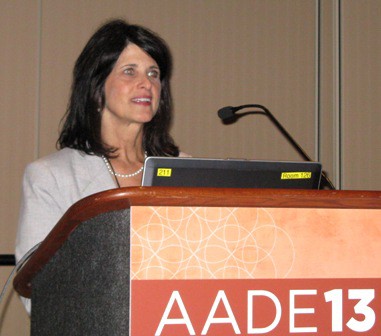
Nutrition society drafts diabetes-prevention recommendations
PHILADELPHIA – Weight loss is the cornerstone of lifestyle measures to prevent people with prediabetes from progressing to type 2 diabetes, but other dietary steps also help, according to draft recommendations from a working group of the Academy of Nutrition and Dietetics.
In addition to weight loss, the new recommendations call for a registered dietician nutritionist to provide medical nutrition therapy to people with prediabetes and to produce individualized plans for macronutrient distribution, Patricia Davidson, DCN, said at the annual meeting of the American Association of Diabetes Educators.
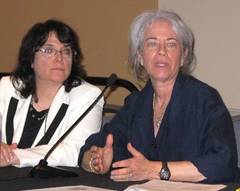
"A registered dietician nutritionist and certified diabetes educator who provides medical nutrition therapy as part of a diabetes management team plays an important role in preventing onset of type 2 diabetes," said Dr. Davidson, who practices in Westfield, N.J., and chaired the panel that drafted the recommendations.
The finalized, published version is planned for later this year, she said.
The draft recommendations also call for an attempt at reducing a person’s glycemic index and glycemic load. "Reducing glycemic load may or may not help, but it can’t hurt, so we try it," said Shelley Mesznik, a member of the recommendation panel and a registered dietician and certified diabetes educator in Mount Kisco, N.Y.
In addition, the recommendations call for consumption of vegetable protein rather than animal protein for prevention of diabetes, but say there is no evidence that the amount of particular fat types in the diet affects progression to diabetes. The recommendations say that while evidence supports physical activity as a means to prevent progression to metabolic syndrome (when done for 135-180 min/week), there is no documented effect of activity on development of diabetes.
Despite endorsing medical nutrition therapy, both speakers highlighted the primacy of weight loss, achieved by lifestyle modification or bariatric surgery.
"We definitely found that weight loss is the key," said Dr. Davidson.
"If a patient asks for a number, we say aim to lose 10%-15%, but we’re looking for trends in the right direction; loss is more important than the size of the loss," Ms. Mesznik said.
The recommendations specify that several of the more marginal interventions, such as reduced glycemic load and index, use of vegetable protein, and increased physical activity, have evidence for efficacy only in the context of concurrent weight loss.
The panel performed a literature review to determine whether diet can reduce the risk for development of type 2 diabetes. The evidence summaries drawn from this literature that form the bases for the recommendations are available only to members of the Academy of Nutrition and Dietetics, Dr. Davidson said.
The work group also addressed the definition of people at high risk for diabetes, and discussed the differences between patients at risk because of prediabetes – based on fasting or challenged glucose levels or blood level of hemoglobin A1c, and those at risk with metabolic syndrome. Most interventions discussed appear equally effective in both populations, except for exercise, which is more effective for metabolic syndrome.
The panel also commented on the growing prevalence of prediabetes. In 2010, the Centers for Disease Control and Prevention estimated that 79 million Americans aged 20 or older had prediabetes, which included about half of those aged 65 or older, said Ms. Mesznik. In 2009, the CDC estimated that about a third of Americans aged 20 years or older had metabolic syndrome.
Dr. Davidson and Ms. Mesznik had no disclosures.
On Twitter @mitchelzoler
PHILADELPHIA – Weight loss is the cornerstone of lifestyle measures to prevent people with prediabetes from progressing to type 2 diabetes, but other dietary steps also help, according to draft recommendations from a working group of the Academy of Nutrition and Dietetics.
In addition to weight loss, the new recommendations call for a registered dietician nutritionist to provide medical nutrition therapy to people with prediabetes and to produce individualized plans for macronutrient distribution, Patricia Davidson, DCN, said at the annual meeting of the American Association of Diabetes Educators.
"A registered dietician nutritionist and certified diabetes educator who provides medical nutrition therapy as part of a diabetes management team plays an important role in preventing onset of type 2 diabetes," said Dr. Davidson, who practices in Westfield, N.J., and chaired the panel that drafted the recommendations.
The finalized, published version is planned for later this year, she said.
The draft recommendations also call for an attempt at reducing a person’s glycemic index and glycemic load. "Reducing glycemic load may or may not help, but it can’t hurt, so we try it," said Shelley Mesznik, a member of the recommendation panel and a registered dietician and certified diabetes educator in Mount Kisco, N.Y.
In addition, the recommendations call for consumption of vegetable protein rather than animal protein for prevention of diabetes, but say there is no evidence that the amount of particular fat types in the diet affects progression to diabetes. The recommendations say that while evidence supports physical activity as a means to prevent progression to metabolic syndrome (when done for 135-180 min/week), there is no documented effect of activity on development of diabetes.
Despite endorsing medical nutrition therapy, both speakers highlighted the primacy of weight loss, achieved by lifestyle modification or bariatric surgery.
"We definitely found that weight loss is the key," said Dr. Davidson.
"If a patient asks for a number, we say aim to lose 10%-15%, but we’re looking for trends in the right direction; loss is more important than the size of the loss," Ms. Mesznik said.
The recommendations specify that several of the more marginal interventions, such as reduced glycemic load and index, use of vegetable protein, and increased physical activity, have evidence for efficacy only in the context of concurrent weight loss.
The panel performed a literature review to determine whether diet can reduce the risk for development of type 2 diabetes. The evidence summaries drawn from this literature that form the bases for the recommendations are available only to members of the Academy of Nutrition and Dietetics, Dr. Davidson said.
The work group also addressed the definition of people at high risk for diabetes, and discussed the differences between patients at risk because of prediabetes – based on fasting or challenged glucose levels or blood level of hemoglobin A1c, and those at risk with metabolic syndrome. Most interventions discussed appear equally effective in both populations, except for exercise, which is more effective for metabolic syndrome.
The panel also commented on the growing prevalence of prediabetes. In 2010, the Centers for Disease Control and Prevention estimated that 79 million Americans aged 20 or older had prediabetes, which included about half of those aged 65 or older, said Ms. Mesznik. In 2009, the CDC estimated that about a third of Americans aged 20 years or older had metabolic syndrome.
Dr. Davidson and Ms. Mesznik had no disclosures.
On Twitter @mitchelzoler
PHILADELPHIA – Weight loss is the cornerstone of lifestyle measures to prevent people with prediabetes from progressing to type 2 diabetes, but other dietary steps also help, according to draft recommendations from a working group of the Academy of Nutrition and Dietetics.
In addition to weight loss, the new recommendations call for a registered dietician nutritionist to provide medical nutrition therapy to people with prediabetes and to produce individualized plans for macronutrient distribution, Patricia Davidson, DCN, said at the annual meeting of the American Association of Diabetes Educators.
"A registered dietician nutritionist and certified diabetes educator who provides medical nutrition therapy as part of a diabetes management team plays an important role in preventing onset of type 2 diabetes," said Dr. Davidson, who practices in Westfield, N.J., and chaired the panel that drafted the recommendations.
The finalized, published version is planned for later this year, she said.
The draft recommendations also call for an attempt at reducing a person’s glycemic index and glycemic load. "Reducing glycemic load may or may not help, but it can’t hurt, so we try it," said Shelley Mesznik, a member of the recommendation panel and a registered dietician and certified diabetes educator in Mount Kisco, N.Y.
In addition, the recommendations call for consumption of vegetable protein rather than animal protein for prevention of diabetes, but say there is no evidence that the amount of particular fat types in the diet affects progression to diabetes. The recommendations say that while evidence supports physical activity as a means to prevent progression to metabolic syndrome (when done for 135-180 min/week), there is no documented effect of activity on development of diabetes.
Despite endorsing medical nutrition therapy, both speakers highlighted the primacy of weight loss, achieved by lifestyle modification or bariatric surgery.
"We definitely found that weight loss is the key," said Dr. Davidson.
"If a patient asks for a number, we say aim to lose 10%-15%, but we’re looking for trends in the right direction; loss is more important than the size of the loss," Ms. Mesznik said.
The recommendations specify that several of the more marginal interventions, such as reduced glycemic load and index, use of vegetable protein, and increased physical activity, have evidence for efficacy only in the context of concurrent weight loss.
The panel performed a literature review to determine whether diet can reduce the risk for development of type 2 diabetes. The evidence summaries drawn from this literature that form the bases for the recommendations are available only to members of the Academy of Nutrition and Dietetics, Dr. Davidson said.
The work group also addressed the definition of people at high risk for diabetes, and discussed the differences between patients at risk because of prediabetes – based on fasting or challenged glucose levels or blood level of hemoglobin A1c, and those at risk with metabolic syndrome. Most interventions discussed appear equally effective in both populations, except for exercise, which is more effective for metabolic syndrome.
The panel also commented on the growing prevalence of prediabetes. In 2010, the Centers for Disease Control and Prevention estimated that 79 million Americans aged 20 or older had prediabetes, which included about half of those aged 65 or older, said Ms. Mesznik. In 2009, the CDC estimated that about a third of Americans aged 20 years or older had metabolic syndrome.
Dr. Davidson and Ms. Mesznik had no disclosures.
On Twitter @mitchelzoler
EXPERT OPINION FROM AADE 2013
Combo of smoking while overweight boosts RA incidence
MADRID – Researchers have begun testing whether immunologic modification can forestall rheumatoid arthritis in people at high risk for the disease and also have identified smoking and overweight as two modifiable risk factors strongly linked to disease onset.
In a group of 55 people without rheumatoid arthritis (RA) who were enrolled because of a family history of RA or a positive RA blood marker, those with an elevated body mass index (BMI) who also smoked had a greater than seven-fold increased rate of incident RA, compared with lower-BMI people and nonsmokers, Dr. Danielle M. Gerlag said at the annual European Congress of Rheumatology.

The finding raises the possibility that weight loss and smoking cessation may be effective tools for preventing RA, said Dr. Gerlag, a rheumatologist at the Academic Medical Center in Amsterdam.
The finding came from 55 people she and her associates recruited because they were either first-degree relatives of RA patients or because they tested positive for either IgM anti-rheumatoid factor or anti-ctirullinated protein antibody or both. Their average age was about 45 years, and two-thirds were women. During a median follow-up of 27 months, 15 people (27%) developed RA. Two baseline characteristics stood out as strongly associated with RA incidence: history of smoking and a BMI of 25 kg/m2 or greater (Ann. Rheum. Dis. 2012;doi:10.1136/annrheumdis-2012-202254).
Patients who had both a history of smoking and an elevated BMI had a statistically significant, 7.5-fold increased rate of RA during follow-up, compared with all the others in the study group, including those who had smoked but were not overweight and those who were overweight but had never smoked.
Dr. Gerlag and her associates also have collected evidence for several specific changes in T and B cell profiles that link with subsequent development of early RA, which led to the hypothesis that a treatment aimed at dampening immune-cell activation might contain RA development. To explore this possibility, they have treated 75 people at high risk for developing RA with a single 1-g dose of rituximab (Rituxan). So far, during a median follow-up of 19 months, 16 patients (21%) have developed RA, she said.
Dr. Gerlag said that she had no disclosures.
On Twitter @mitchelzoler
MADRID – Researchers have begun testing whether immunologic modification can forestall rheumatoid arthritis in people at high risk for the disease and also have identified smoking and overweight as two modifiable risk factors strongly linked to disease onset.
In a group of 55 people without rheumatoid arthritis (RA) who were enrolled because of a family history of RA or a positive RA blood marker, those with an elevated body mass index (BMI) who also smoked had a greater than seven-fold increased rate of incident RA, compared with lower-BMI people and nonsmokers, Dr. Danielle M. Gerlag said at the annual European Congress of Rheumatology.
The finding raises the possibility that weight loss and smoking cessation may be effective tools for preventing RA, said Dr. Gerlag, a rheumatologist at the Academic Medical Center in Amsterdam.
The finding came from 55 people she and her associates recruited because they were either first-degree relatives of RA patients or because they tested positive for either IgM anti-rheumatoid factor or anti-ctirullinated protein antibody or both. Their average age was about 45 years, and two-thirds were women. During a median follow-up of 27 months, 15 people (27%) developed RA. Two baseline characteristics stood out as strongly associated with RA incidence: history of smoking and a BMI of 25 kg/m2 or greater (Ann. Rheum. Dis. 2012;doi:10.1136/annrheumdis-2012-202254).
Patients who had both a history of smoking and an elevated BMI had a statistically significant, 7.5-fold increased rate of RA during follow-up, compared with all the others in the study group, including those who had smoked but were not overweight and those who were overweight but had never smoked.
Dr. Gerlag and her associates also have collected evidence for several specific changes in T and B cell profiles that link with subsequent development of early RA, which led to the hypothesis that a treatment aimed at dampening immune-cell activation might contain RA development. To explore this possibility, they have treated 75 people at high risk for developing RA with a single 1-g dose of rituximab (Rituxan). So far, during a median follow-up of 19 months, 16 patients (21%) have developed RA, she said.
Dr. Gerlag said that she had no disclosures.
On Twitter @mitchelzoler
MADRID – Researchers have begun testing whether immunologic modification can forestall rheumatoid arthritis in people at high risk for the disease and also have identified smoking and overweight as two modifiable risk factors strongly linked to disease onset.
In a group of 55 people without rheumatoid arthritis (RA) who were enrolled because of a family history of RA or a positive RA blood marker, those with an elevated body mass index (BMI) who also smoked had a greater than seven-fold increased rate of incident RA, compared with lower-BMI people and nonsmokers, Dr. Danielle M. Gerlag said at the annual European Congress of Rheumatology.
The finding raises the possibility that weight loss and smoking cessation may be effective tools for preventing RA, said Dr. Gerlag, a rheumatologist at the Academic Medical Center in Amsterdam.
The finding came from 55 people she and her associates recruited because they were either first-degree relatives of RA patients or because they tested positive for either IgM anti-rheumatoid factor or anti-ctirullinated protein antibody or both. Their average age was about 45 years, and two-thirds were women. During a median follow-up of 27 months, 15 people (27%) developed RA. Two baseline characteristics stood out as strongly associated with RA incidence: history of smoking and a BMI of 25 kg/m2 or greater (Ann. Rheum. Dis. 2012;doi:10.1136/annrheumdis-2012-202254).
Patients who had both a history of smoking and an elevated BMI had a statistically significant, 7.5-fold increased rate of RA during follow-up, compared with all the others in the study group, including those who had smoked but were not overweight and those who were overweight but had never smoked.
Dr. Gerlag and her associates also have collected evidence for several specific changes in T and B cell profiles that link with subsequent development of early RA, which led to the hypothesis that a treatment aimed at dampening immune-cell activation might contain RA development. To explore this possibility, they have treated 75 people at high risk for developing RA with a single 1-g dose of rituximab (Rituxan). So far, during a median follow-up of 19 months, 16 patients (21%) have developed RA, she said.
Dr. Gerlag said that she had no disclosures.
On Twitter @mitchelzoler
AT THE EULAR CONGRESS 2013
Major finding: Patients who smoked and a BMI of at least 25 kg/m2 were 7.5-fold more likely to develop rheumatoid arthritis.
Data source: 27-month follow-up of 55 people selected for their high risk for developing rheumatoid arthritis.
Disclosures: Dr. Gerlag said that she had no disclosures.

Most American RA patients quit biologics after 2 years
MADRID – Half the patients who successfully start treatment on a biological drug for rheumatoid arthritis are off it within about 2 years, even when treatment was effective and tolerable for the first 6 months, according to U.S. registry data from more than 6,000 patients.
"These findings say to me that there is a fair amount of dissatisfaction even though we have all these treatments," Dr. Vibeke Strand said at the annual European Congress of Rheumatology. "When patients start a biologic treatment, they probably have fairly high expectations, and I might suppose that some of those expectations weren’t met," said Dr. Strand, a rheumatologist and drug consultant affiliated with Stanford (Calif.) University.

The most common reason patients dropped their biologic was lack of efficacy, cited in 36% of the discontinuations, followed by physician preference in 28%, safety in 20%, patient preference in 18%, and treatment access in 9%. (The total exceeds 100% because more than one reason could be cited.)
The strongest correlates of treatment discontinuation were higher disease activity; patient report of anxiety, depression, or both; and starting treatment during 2007-2010, compared with patients who started in 2002-2003.
The data that Dr. Strand and her associates analyzed came from a registry of U.S. rheumatoid arthritis patients kept by the CORRONA (Consortium of Rheumatology Researchers of North America) registry. During 2002-2011, 6,209 American adults with rheumatoid arthritis in the registry received at least 6 months of treatment with a tumor necrosis factor inhibitor (81% of these patients) or another biologic drug (the remaining 19%). The patients had a mean age of 58 years and had rheumatoid arthritis for a mean of 11 years. Many (43%) had not previously been treated with a biologic drug. Patients were followed in the registry for an average of about 3 years.
By 1 year after entry, a third of the patients were off the biologic drug they entered the registry on. Half were off their entry biologic after about 2 years, and during the average 3 years of follow-up 58% of the patients stopped their medication, Dr. Strand and her associates reported (Ann. Rheum. Dis. 2013;72:71). It took a median of 27 months for patients to drop a tumor necrosis factor inhibitor and a median of 21 months for them to come off another type of biologic.
Dr. Strand stressed that because patients had been receiving their biologic drug for at least 6 months to qualify for this analysis, the subsequent dropouts from treatment do not reflect an empiric search for a safe and tolerated agent.
"The guidelines call for figuring out [if a treatment works] in the first 3 months. By requiring patients to be on treatment for at least 6 months, we got away from empiric switching," Dr. Strand said in an interview. That suggests other factors make patients stop treatment. She said she plans to look for what they might be.
The CORRONA registry and related research projects are funded by a consortium of drug companies. Dr. Strand said that she is a consultant to CORRONA and a member of its advisory board.
On Twitter @mitchelzoler
MADRID – Half the patients who successfully start treatment on a biological drug for rheumatoid arthritis are off it within about 2 years, even when treatment was effective and tolerable for the first 6 months, according to U.S. registry data from more than 6,000 patients.
"These findings say to me that there is a fair amount of dissatisfaction even though we have all these treatments," Dr. Vibeke Strand said at the annual European Congress of Rheumatology. "When patients start a biologic treatment, they probably have fairly high expectations, and I might suppose that some of those expectations weren’t met," said Dr. Strand, a rheumatologist and drug consultant affiliated with Stanford (Calif.) University.
The most common reason patients dropped their biologic was lack of efficacy, cited in 36% of the discontinuations, followed by physician preference in 28%, safety in 20%, patient preference in 18%, and treatment access in 9%. (The total exceeds 100% because more than one reason could be cited.)
The strongest correlates of treatment discontinuation were higher disease activity; patient report of anxiety, depression, or both; and starting treatment during 2007-2010, compared with patients who started in 2002-2003.
The data that Dr. Strand and her associates analyzed came from a registry of U.S. rheumatoid arthritis patients kept by the CORRONA (Consortium of Rheumatology Researchers of North America) registry. During 2002-2011, 6,209 American adults with rheumatoid arthritis in the registry received at least 6 months of treatment with a tumor necrosis factor inhibitor (81% of these patients) or another biologic drug (the remaining 19%). The patients had a mean age of 58 years and had rheumatoid arthritis for a mean of 11 years. Many (43%) had not previously been treated with a biologic drug. Patients were followed in the registry for an average of about 3 years.
By 1 year after entry, a third of the patients were off the biologic drug they entered the registry on. Half were off their entry biologic after about 2 years, and during the average 3 years of follow-up 58% of the patients stopped their medication, Dr. Strand and her associates reported (Ann. Rheum. Dis. 2013;72:71). It took a median of 27 months for patients to drop a tumor necrosis factor inhibitor and a median of 21 months for them to come off another type of biologic.
Dr. Strand stressed that because patients had been receiving their biologic drug for at least 6 months to qualify for this analysis, the subsequent dropouts from treatment do not reflect an empiric search for a safe and tolerated agent.
"The guidelines call for figuring out [if a treatment works] in the first 3 months. By requiring patients to be on treatment for at least 6 months, we got away from empiric switching," Dr. Strand said in an interview. That suggests other factors make patients stop treatment. She said she plans to look for what they might be.
The CORRONA registry and related research projects are funded by a consortium of drug companies. Dr. Strand said that she is a consultant to CORRONA and a member of its advisory board.
On Twitter @mitchelzoler
MADRID – Half the patients who successfully start treatment on a biological drug for rheumatoid arthritis are off it within about 2 years, even when treatment was effective and tolerable for the first 6 months, according to U.S. registry data from more than 6,000 patients.
"These findings say to me that there is a fair amount of dissatisfaction even though we have all these treatments," Dr. Vibeke Strand said at the annual European Congress of Rheumatology. "When patients start a biologic treatment, they probably have fairly high expectations, and I might suppose that some of those expectations weren’t met," said Dr. Strand, a rheumatologist and drug consultant affiliated with Stanford (Calif.) University.
The most common reason patients dropped their biologic was lack of efficacy, cited in 36% of the discontinuations, followed by physician preference in 28%, safety in 20%, patient preference in 18%, and treatment access in 9%. (The total exceeds 100% because more than one reason could be cited.)
The strongest correlates of treatment discontinuation were higher disease activity; patient report of anxiety, depression, or both; and starting treatment during 2007-2010, compared with patients who started in 2002-2003.
The data that Dr. Strand and her associates analyzed came from a registry of U.S. rheumatoid arthritis patients kept by the CORRONA (Consortium of Rheumatology Researchers of North America) registry. During 2002-2011, 6,209 American adults with rheumatoid arthritis in the registry received at least 6 months of treatment with a tumor necrosis factor inhibitor (81% of these patients) or another biologic drug (the remaining 19%). The patients had a mean age of 58 years and had rheumatoid arthritis for a mean of 11 years. Many (43%) had not previously been treated with a biologic drug. Patients were followed in the registry for an average of about 3 years.
By 1 year after entry, a third of the patients were off the biologic drug they entered the registry on. Half were off their entry biologic after about 2 years, and during the average 3 years of follow-up 58% of the patients stopped their medication, Dr. Strand and her associates reported (Ann. Rheum. Dis. 2013;72:71). It took a median of 27 months for patients to drop a tumor necrosis factor inhibitor and a median of 21 months for them to come off another type of biologic.
Dr. Strand stressed that because patients had been receiving their biologic drug for at least 6 months to qualify for this analysis, the subsequent dropouts from treatment do not reflect an empiric search for a safe and tolerated agent.
"The guidelines call for figuring out [if a treatment works] in the first 3 months. By requiring patients to be on treatment for at least 6 months, we got away from empiric switching," Dr. Strand said in an interview. That suggests other factors make patients stop treatment. She said she plans to look for what they might be.
The CORRONA registry and related research projects are funded by a consortium of drug companies. Dr. Strand said that she is a consultant to CORRONA and a member of its advisory board.
On Twitter @mitchelzoler
AT THE EULAR CONGRESS 2013
Major finding: Half of U.S. rheumatoid arthritis patients on a biologic drug for at least 6 months stopped it after 2 years.
Data source: Data came from 6,209 U.S. rheumatoid arthritis patients in the CORRONA registry on a biologic drug for at least 6 months.
Disclosures: The CORRONA registry and related research projects are funded by a consortium of drug companies. Dr. Strand said that she is a consultant to CORRONA and a member of its advisory board.

Rising gonorrhea incidence links to higher resistance
VIENNA – A rising prevalence of ciprofloxacin resistance in gonorrhea linked with an increased rate of infections in the United States during 1991-2006, based on data from 17 U.S. cities.
An increase in the prevalence of ciprofloxacin-resistant gonorrhea isolates from none to 10% linked with a statistically significant 7% rise in the incidence of gonorrhea, reported Harrell W. Chesson, Ph.D., and his associates from the Centers for Disease Control and Prevention.

"To our knowledge, this is the first study to document an association between antimicrobial resistance and increased gonorrhea incidence rates at the population level," said Dr. Chesson, a health economist in the division of STD prevention of the CDC in Atlanta. The link between increased ciprofloxacin resistance and increased gonorrhea incidence occurred even though effective treatment options for gonorrhea other than ciprofloxacin existed at the time.
These findings can help anticipate the potential impact of cephalosporin resistance in circulating gonorrhea strains in the United States, Dr. Chesson and his associates said in a poster at the congress of the International Society for STD Research.
Cephalosporin resistance in gonorrhea isolates is a growing problem, and last year it prompted the CDC to eliminate cefixime as the first-line agent for treating gonorrhea (MMWR 2012;61:590-4). The CDC designated another cephalosporin, ceftriaxone, as the current first-line agent, but it also noted that emergence of gonococcal resistance to ceftriaxone was probably inevitable.
"Emerging cephalosporin resistance could have even more substantial health and economic consequences [than did ciprofloxacin resistance], particularly as the number of available treatment options decreases," Dr. Chesson and his associates said.
Although they cautioned that the evidence they found cannot establish ciprofloxacin resistance in gonorrhea as the cause of the increased incidence, their findings "offer evidence consistent with that of a causal association between resistance and increased incidence."
If 10% of circulating gonorrhea strains remained resistant to a widely used antibiotic, Dr. Chesson and his associates projected, the consequent rise in infection incidence would lead to 50,000 additional cases of pelvic inflammatory disease over a 10-year period and an additional 5,400 cases of epididymitis, compared with rates if resistance did not exist.
To perform the analysis, the researchers used data on gonorrhea resistance that were collected in the Gonococcal Isolate Surveillance Project of the CDC and coupled these data with incidence rates from routine surveillance done in 17 U.S. cities during 1991-2006. In their regression analysis they controlled for socio-demographic factors, city-specific factors, and national trends during the 16-year period.
Disease transmission models suggest that antimicrobial resistance may increase gonorrhea incidence by prolonging the average duration of a patient’s infection, but the authors cautioned that several other factors aside from antibiotic resistance also affect gonorrhea incidence rates.
Dr. Chesson had no disclosures.
On Twitter @mitchelzoler
VIENNA – A rising prevalence of ciprofloxacin resistance in gonorrhea linked with an increased rate of infections in the United States during 1991-2006, based on data from 17 U.S. cities.
An increase in the prevalence of ciprofloxacin-resistant gonorrhea isolates from none to 10% linked with a statistically significant 7% rise in the incidence of gonorrhea, reported Harrell W. Chesson, Ph.D., and his associates from the Centers for Disease Control and Prevention.
"To our knowledge, this is the first study to document an association between antimicrobial resistance and increased gonorrhea incidence rates at the population level," said Dr. Chesson, a health economist in the division of STD prevention of the CDC in Atlanta. The link between increased ciprofloxacin resistance and increased gonorrhea incidence occurred even though effective treatment options for gonorrhea other than ciprofloxacin existed at the time.
These findings can help anticipate the potential impact of cephalosporin resistance in circulating gonorrhea strains in the United States, Dr. Chesson and his associates said in a poster at the congress of the International Society for STD Research.
Cephalosporin resistance in gonorrhea isolates is a growing problem, and last year it prompted the CDC to eliminate cefixime as the first-line agent for treating gonorrhea (MMWR 2012;61:590-4). The CDC designated another cephalosporin, ceftriaxone, as the current first-line agent, but it also noted that emergence of gonococcal resistance to ceftriaxone was probably inevitable.
"Emerging cephalosporin resistance could have even more substantial health and economic consequences [than did ciprofloxacin resistance], particularly as the number of available treatment options decreases," Dr. Chesson and his associates said.
Although they cautioned that the evidence they found cannot establish ciprofloxacin resistance in gonorrhea as the cause of the increased incidence, their findings "offer evidence consistent with that of a causal association between resistance and increased incidence."
If 10% of circulating gonorrhea strains remained resistant to a widely used antibiotic, Dr. Chesson and his associates projected, the consequent rise in infection incidence would lead to 50,000 additional cases of pelvic inflammatory disease over a 10-year period and an additional 5,400 cases of epididymitis, compared with rates if resistance did not exist.
To perform the analysis, the researchers used data on gonorrhea resistance that were collected in the Gonococcal Isolate Surveillance Project of the CDC and coupled these data with incidence rates from routine surveillance done in 17 U.S. cities during 1991-2006. In their regression analysis they controlled for socio-demographic factors, city-specific factors, and national trends during the 16-year period.
Disease transmission models suggest that antimicrobial resistance may increase gonorrhea incidence by prolonging the average duration of a patient’s infection, but the authors cautioned that several other factors aside from antibiotic resistance also affect gonorrhea incidence rates.
Dr. Chesson had no disclosures.
On Twitter @mitchelzoler
VIENNA – A rising prevalence of ciprofloxacin resistance in gonorrhea linked with an increased rate of infections in the United States during 1991-2006, based on data from 17 U.S. cities.
An increase in the prevalence of ciprofloxacin-resistant gonorrhea isolates from none to 10% linked with a statistically significant 7% rise in the incidence of gonorrhea, reported Harrell W. Chesson, Ph.D., and his associates from the Centers for Disease Control and Prevention.
"To our knowledge, this is the first study to document an association between antimicrobial resistance and increased gonorrhea incidence rates at the population level," said Dr. Chesson, a health economist in the division of STD prevention of the CDC in Atlanta. The link between increased ciprofloxacin resistance and increased gonorrhea incidence occurred even though effective treatment options for gonorrhea other than ciprofloxacin existed at the time.
These findings can help anticipate the potential impact of cephalosporin resistance in circulating gonorrhea strains in the United States, Dr. Chesson and his associates said in a poster at the congress of the International Society for STD Research.
Cephalosporin resistance in gonorrhea isolates is a growing problem, and last year it prompted the CDC to eliminate cefixime as the first-line agent for treating gonorrhea (MMWR 2012;61:590-4). The CDC designated another cephalosporin, ceftriaxone, as the current first-line agent, but it also noted that emergence of gonococcal resistance to ceftriaxone was probably inevitable.
"Emerging cephalosporin resistance could have even more substantial health and economic consequences [than did ciprofloxacin resistance], particularly as the number of available treatment options decreases," Dr. Chesson and his associates said.
Although they cautioned that the evidence they found cannot establish ciprofloxacin resistance in gonorrhea as the cause of the increased incidence, their findings "offer evidence consistent with that of a causal association between resistance and increased incidence."
If 10% of circulating gonorrhea strains remained resistant to a widely used antibiotic, Dr. Chesson and his associates projected, the consequent rise in infection incidence would lead to 50,000 additional cases of pelvic inflammatory disease over a 10-year period and an additional 5,400 cases of epididymitis, compared with rates if resistance did not exist.
To perform the analysis, the researchers used data on gonorrhea resistance that were collected in the Gonococcal Isolate Surveillance Project of the CDC and coupled these data with incidence rates from routine surveillance done in 17 U.S. cities during 1991-2006. In their regression analysis they controlled for socio-demographic factors, city-specific factors, and national trends during the 16-year period.
Disease transmission models suggest that antimicrobial resistance may increase gonorrhea incidence by prolonging the average duration of a patient’s infection, but the authors cautioned that several other factors aside from antibiotic resistance also affect gonorrhea incidence rates.
Dr. Chesson had no disclosures.
On Twitter @mitchelzoler
AT THE STI & AIDS CONGRESS 2013
Major finding: As ciprofloxacin resistance in U.S. gonorrhea isolates rose from 0 to 10%, gonorrhea incidence rose by 7%.
Data source: CDC analysis of gonorrhea resistance and incidence data in 17 U.S. cities during 1991-2006.
Disclosures: Dr. Chesson had no disclosures.