User login
Clinical Edge Journal Scan Commentary: CML September 2021

Latin American countries have a high rate of SARS-CoV-2 infection and some of the highest COVID-19 deaths worldwide. Brazil, Colombia, Argentina, and Mexico have reported the highest number of confirmed cases. More recently has been reported that in series form US and Europe the mortality of COVID-19 has not been as high as reported in other hematological conditions and the response to vaccination also has bene described as high. In a recent report, Pagnano et al. (Leuk Lymphoma. 2021) has recently reported the clinical evolution and outcome of COVID-19 in patients with chronic myeloid leukemia in Latin America. In an observational multicenter study with a total of 92 patients with COVID-19 between March and December 2020 with 26% of whom were severe or critical. Eighty-one patients recovered (88%), and 11 (11.9%) died from COVID-19. Almost half of them had at least one comorbidity. Patients with a major molecular response presented superior overall survival compared to patients with no major molecular response (91 vs. 61%, respectively; P = 0.004). Patients in treatment-free remission and receiving tyrosine kinase inhibitors showed higher survival rates (100 and 89%) than patients who underwent hematopoietic stem cell transplantation and those who did not receive tyrosine kinase inhibitors (50 and 33%).
Currently the most common reason for TKI discontinuation is intolerance. Ma et al (Leuk Res. 2021) reports the long-term outcomes associated with switch to an alternative TKI after first-line therapy with a 2GTKI. Of 232 patients who initiated a 2GTKI during the study period, 76 (33 %) switched to an alternative TKI. Reasons for switching included intolerance (79 %) and resistance (21 %). Among the 60 patients who switched due to intolerance, 53 (88 %) were able to achieve or maintain a major molecular response (MMR) with 5-year progression-free survival (PFS) 90.5 % (95 % CI 90.4–90.6 %). However, amongst the 16 patients who switched due to resistance, 8 patients (50 %) were able to achieve MMR with 5-year PFS 80.4 % (95 % CI 80.2–80.6 %). Most patients who switched due to intolerance remained on their second-line TKI. Patients who switch for intolerance continue to enjoy excellent long term clinical outcomes.
Latin American countries have a high rate of SARS-CoV-2 infection and some of the highest COVID-19 deaths worldwide. Brazil, Colombia, Argentina, and Mexico have reported the highest number of confirmed cases. More recently has been reported that in series form US and Europe the mortality of COVID-19 has not been as high as reported in other hematological conditions and the response to vaccination also has bene described as high. In a recent report, Pagnano et al. (Leuk Lymphoma. 2021) has recently reported the clinical evolution and outcome of COVID-19 in patients with chronic myeloid leukemia in Latin America. In an observational multicenter study with a total of 92 patients with COVID-19 between March and December 2020 with 26% of whom were severe or critical. Eighty-one patients recovered (88%), and 11 (11.9%) died from COVID-19. Almost half of them had at least one comorbidity. Patients with a major molecular response presented superior overall survival compared to patients with no major molecular response (91 vs. 61%, respectively; P = 0.004). Patients in treatment-free remission and receiving tyrosine kinase inhibitors showed higher survival rates (100 and 89%) than patients who underwent hematopoietic stem cell transplantation and those who did not receive tyrosine kinase inhibitors (50 and 33%).
Currently the most common reason for TKI discontinuation is intolerance. Ma et al (Leuk Res. 2021) reports the long-term outcomes associated with switch to an alternative TKI after first-line therapy with a 2GTKI. Of 232 patients who initiated a 2GTKI during the study period, 76 (33 %) switched to an alternative TKI. Reasons for switching included intolerance (79 %) and resistance (21 %). Among the 60 patients who switched due to intolerance, 53 (88 %) were able to achieve or maintain a major molecular response (MMR) with 5-year progression-free survival (PFS) 90.5 % (95 % CI 90.4–90.6 %). However, amongst the 16 patients who switched due to resistance, 8 patients (50 %) were able to achieve MMR with 5-year PFS 80.4 % (95 % CI 80.2–80.6 %). Most patients who switched due to intolerance remained on their second-line TKI. Patients who switch for intolerance continue to enjoy excellent long term clinical outcomes.
Latin American countries have a high rate of SARS-CoV-2 infection and some of the highest COVID-19 deaths worldwide. Brazil, Colombia, Argentina, and Mexico have reported the highest number of confirmed cases. More recently has been reported that in series form US and Europe the mortality of COVID-19 has not been as high as reported in other hematological conditions and the response to vaccination also has bene described as high. In a recent report, Pagnano et al. (Leuk Lymphoma. 2021) has recently reported the clinical evolution and outcome of COVID-19 in patients with chronic myeloid leukemia in Latin America. In an observational multicenter study with a total of 92 patients with COVID-19 between March and December 2020 with 26% of whom were severe or critical. Eighty-one patients recovered (88%), and 11 (11.9%) died from COVID-19. Almost half of them had at least one comorbidity. Patients with a major molecular response presented superior overall survival compared to patients with no major molecular response (91 vs. 61%, respectively; P = 0.004). Patients in treatment-free remission and receiving tyrosine kinase inhibitors showed higher survival rates (100 and 89%) than patients who underwent hematopoietic stem cell transplantation and those who did not receive tyrosine kinase inhibitors (50 and 33%).
Currently the most common reason for TKI discontinuation is intolerance. Ma et al (Leuk Res. 2021) reports the long-term outcomes associated with switch to an alternative TKI after first-line therapy with a 2GTKI. Of 232 patients who initiated a 2GTKI during the study period, 76 (33 %) switched to an alternative TKI. Reasons for switching included intolerance (79 %) and resistance (21 %). Among the 60 patients who switched due to intolerance, 53 (88 %) were able to achieve or maintain a major molecular response (MMR) with 5-year progression-free survival (PFS) 90.5 % (95 % CI 90.4–90.6 %). However, amongst the 16 patients who switched due to resistance, 8 patients (50 %) were able to achieve MMR with 5-year PFS 80.4 % (95 % CI 80.2–80.6 %). Most patients who switched due to intolerance remained on their second-line TKI. Patients who switch for intolerance continue to enjoy excellent long term clinical outcomes.
FDA approves zanubrutinib in Waldenström’s macroglobulinemia
The Food and Drug Administration has approved zanubrutinib (Brukinsa) capsules for use in the treatment of adult patients with Waldenström’s macroglobulinemia (WM), a rare non-Hodgkin lymphoma, according to an approval letter from the agency to BeiGene, the drug’s maker.
The FDA stipulated that the company conduct an additional clinical trial (rather than an observational study) to assess the “known serious risk of second primary malignancies” associated with use of zanubrutinib. The study should further characterize the clinical benefit and safety of zanubrutinib for the treatment of patients with newly diagnosed WM with MYD88 mutation, the agency said.
The drug, which is a small-molecule inhibitor of Bruton’s tyrosine kinase (BTK), previously received accelerated approval for use in patients with mantle cell lymphoma who have received one prior therapy. It is also being studied for the treatment of chronic lymphocytic leukemia.
The new approval is primarily based on results from ASPEN, a randomized, active control, open-label trial that compared zanubrutinib and ibrutinib.
The ASPEN trial provided “compelling evidence” that zanubrutinib is a highly active BTK inhibitor in WM and that it showed improved tolerability across a number of clinically important side effects in comparison with the first-generation BTK inhibitor ibrutinib, said study investigator Steven Treon, MD, PhD, director of the Bing Center for Waldenström’s Macroglobulinemia Research at the Dana-Farber Cancer Institute, Boston. “The approval of [zanubrutinib] provides an important new option for targeted therapy in Waldenström’s macroglobulinemia,” he added in a company press statement.
The recommended dosage is 160 mg orally twice daily or 320 mg orally once; the drug should be swallowed whole with water with or without food.
In ASPEN, all patients had MYD88 mutation WM. Patients in cohort 1 (n = 201) were randomly assigned in a 1:1 ratio to receive zanubrutinib 160 mg twice daily or ibrutinib 420 mg once daily until disease progression or unacceptable toxicity. A total of 82% of patients had relapsed/refractory disease.
The major efficacy outcome was the response rate, defined as partial response or better (i.e., partial response, very good partial response, and complete response), as determined on the basis of standard consensus response criteria from the International Workshop on Waldenström’s Macroglobulinemia (IWWM-6) criteria.
The drugs had nearly identical response rates (roughly 77%). There were no complete responses with either drug. However, zanubrutinib had twice the rate of very good partial responses compared with ibrutinib (15.7% vs. 7.1%). In addition, on the basis of modified IWWM-6 criteria, the very good partial response rate was 28% with zanubrutinib, compared to 19% with ibrutinib.
An additional efficacy outcome measure was duration of response, which was measured by the percentage of patients who were event free at 12 months. Zanubrutinib bested ibrutinib in this measure (94.4% vs. 87.9%).
The safety of zanubrutinib was also investigated in the ASPEN trial. Among patients who received zanubrutinib, 93% were exposed for 6 months or longer, and 89% were exposed for longer than 1 year. In cohort 1, serious adverse reactions occurred in 44% of patients who received zanubrutinib. Serious adverse reactions that occurred in > 2% of patients included influenza (3%), pneumonia (4%), neutropenia and decreased neutrophil count (3%), hemorrhage (4%), pyrexia (3%), and febrile neutropenia (3%).
In the FDA’s prescribing information for the drug, which includes approved indications and pooled safety data, the most common adverse reactions for zanubrutinib (≥ 20%) are listed as decreased neutrophil count, upper respiratory tract infection, decreased platelet count, rash, hemorrhage, musculoskeletal pain, decreased hemoglobin, bruising, diarrhea, pneumonia, and cough.
A version of this article first appeared on Medscape.com.
The Food and Drug Administration has approved zanubrutinib (Brukinsa) capsules for use in the treatment of adult patients with Waldenström’s macroglobulinemia (WM), a rare non-Hodgkin lymphoma, according to an approval letter from the agency to BeiGene, the drug’s maker.
The FDA stipulated that the company conduct an additional clinical trial (rather than an observational study) to assess the “known serious risk of second primary malignancies” associated with use of zanubrutinib. The study should further characterize the clinical benefit and safety of zanubrutinib for the treatment of patients with newly diagnosed WM with MYD88 mutation, the agency said.
The drug, which is a small-molecule inhibitor of Bruton’s tyrosine kinase (BTK), previously received accelerated approval for use in patients with mantle cell lymphoma who have received one prior therapy. It is also being studied for the treatment of chronic lymphocytic leukemia.
The new approval is primarily based on results from ASPEN, a randomized, active control, open-label trial that compared zanubrutinib and ibrutinib.
The ASPEN trial provided “compelling evidence” that zanubrutinib is a highly active BTK inhibitor in WM and that it showed improved tolerability across a number of clinically important side effects in comparison with the first-generation BTK inhibitor ibrutinib, said study investigator Steven Treon, MD, PhD, director of the Bing Center for Waldenström’s Macroglobulinemia Research at the Dana-Farber Cancer Institute, Boston. “The approval of [zanubrutinib] provides an important new option for targeted therapy in Waldenström’s macroglobulinemia,” he added in a company press statement.
The recommended dosage is 160 mg orally twice daily or 320 mg orally once; the drug should be swallowed whole with water with or without food.
In ASPEN, all patients had MYD88 mutation WM. Patients in cohort 1 (n = 201) were randomly assigned in a 1:1 ratio to receive zanubrutinib 160 mg twice daily or ibrutinib 420 mg once daily until disease progression or unacceptable toxicity. A total of 82% of patients had relapsed/refractory disease.
The major efficacy outcome was the response rate, defined as partial response or better (i.e., partial response, very good partial response, and complete response), as determined on the basis of standard consensus response criteria from the International Workshop on Waldenström’s Macroglobulinemia (IWWM-6) criteria.
The drugs had nearly identical response rates (roughly 77%). There were no complete responses with either drug. However, zanubrutinib had twice the rate of very good partial responses compared with ibrutinib (15.7% vs. 7.1%). In addition, on the basis of modified IWWM-6 criteria, the very good partial response rate was 28% with zanubrutinib, compared to 19% with ibrutinib.
An additional efficacy outcome measure was duration of response, which was measured by the percentage of patients who were event free at 12 months. Zanubrutinib bested ibrutinib in this measure (94.4% vs. 87.9%).
The safety of zanubrutinib was also investigated in the ASPEN trial. Among patients who received zanubrutinib, 93% were exposed for 6 months or longer, and 89% were exposed for longer than 1 year. In cohort 1, serious adverse reactions occurred in 44% of patients who received zanubrutinib. Serious adverse reactions that occurred in > 2% of patients included influenza (3%), pneumonia (4%), neutropenia and decreased neutrophil count (3%), hemorrhage (4%), pyrexia (3%), and febrile neutropenia (3%).
In the FDA’s prescribing information for the drug, which includes approved indications and pooled safety data, the most common adverse reactions for zanubrutinib (≥ 20%) are listed as decreased neutrophil count, upper respiratory tract infection, decreased platelet count, rash, hemorrhage, musculoskeletal pain, decreased hemoglobin, bruising, diarrhea, pneumonia, and cough.
A version of this article first appeared on Medscape.com.
The Food and Drug Administration has approved zanubrutinib (Brukinsa) capsules for use in the treatment of adult patients with Waldenström’s macroglobulinemia (WM), a rare non-Hodgkin lymphoma, according to an approval letter from the agency to BeiGene, the drug’s maker.
The FDA stipulated that the company conduct an additional clinical trial (rather than an observational study) to assess the “known serious risk of second primary malignancies” associated with use of zanubrutinib. The study should further characterize the clinical benefit and safety of zanubrutinib for the treatment of patients with newly diagnosed WM with MYD88 mutation, the agency said.
The drug, which is a small-molecule inhibitor of Bruton’s tyrosine kinase (BTK), previously received accelerated approval for use in patients with mantle cell lymphoma who have received one prior therapy. It is also being studied for the treatment of chronic lymphocytic leukemia.
The new approval is primarily based on results from ASPEN, a randomized, active control, open-label trial that compared zanubrutinib and ibrutinib.
The ASPEN trial provided “compelling evidence” that zanubrutinib is a highly active BTK inhibitor in WM and that it showed improved tolerability across a number of clinically important side effects in comparison with the first-generation BTK inhibitor ibrutinib, said study investigator Steven Treon, MD, PhD, director of the Bing Center for Waldenström’s Macroglobulinemia Research at the Dana-Farber Cancer Institute, Boston. “The approval of [zanubrutinib] provides an important new option for targeted therapy in Waldenström’s macroglobulinemia,” he added in a company press statement.
The recommended dosage is 160 mg orally twice daily or 320 mg orally once; the drug should be swallowed whole with water with or without food.
In ASPEN, all patients had MYD88 mutation WM. Patients in cohort 1 (n = 201) were randomly assigned in a 1:1 ratio to receive zanubrutinib 160 mg twice daily or ibrutinib 420 mg once daily until disease progression or unacceptable toxicity. A total of 82% of patients had relapsed/refractory disease.
The major efficacy outcome was the response rate, defined as partial response or better (i.e., partial response, very good partial response, and complete response), as determined on the basis of standard consensus response criteria from the International Workshop on Waldenström’s Macroglobulinemia (IWWM-6) criteria.
The drugs had nearly identical response rates (roughly 77%). There were no complete responses with either drug. However, zanubrutinib had twice the rate of very good partial responses compared with ibrutinib (15.7% vs. 7.1%). In addition, on the basis of modified IWWM-6 criteria, the very good partial response rate was 28% with zanubrutinib, compared to 19% with ibrutinib.
An additional efficacy outcome measure was duration of response, which was measured by the percentage of patients who were event free at 12 months. Zanubrutinib bested ibrutinib in this measure (94.4% vs. 87.9%).
The safety of zanubrutinib was also investigated in the ASPEN trial. Among patients who received zanubrutinib, 93% were exposed for 6 months or longer, and 89% were exposed for longer than 1 year. In cohort 1, serious adverse reactions occurred in 44% of patients who received zanubrutinib. Serious adverse reactions that occurred in > 2% of patients included influenza (3%), pneumonia (4%), neutropenia and decreased neutrophil count (3%), hemorrhage (4%), pyrexia (3%), and febrile neutropenia (3%).
In the FDA’s prescribing information for the drug, which includes approved indications and pooled safety data, the most common adverse reactions for zanubrutinib (≥ 20%) are listed as decreased neutrophil count, upper respiratory tract infection, decreased platelet count, rash, hemorrhage, musculoskeletal pain, decreased hemoglobin, bruising, diarrhea, pneumonia, and cough.
A version of this article first appeared on Medscape.com.
NCCN recommends third COVID-19 dose for patients with cancer
Experts at the National Comprehensive Cancer Network have now issued an updated recommendation for COVID-19 vaccination in people with cancer. The panel calls for these patients to be among the highest-priority group to be vaccinated against COVID-19 and to receive the newly approved third dose of vaccine.
The NCCN has recommended in February that all patients receiving active cancer treatment should receive a COVID-19 vaccine and should be prioritized for vaccination. In August, the FDA authorized a third dose of either the Pfizer or Moderna COVID-19 vaccines for people with compromised immune systems. Those eligible for a third dose include solid organ transplant recipients, those undergoing cancer treatments, and people with autoimmune diseases that suppress their immune systems
The new NCCN recommendations state that the following groups should be considered eligible for a third dose of the mRNA COVID-19 vaccine immediately, based on the latest decisions from the Food and Drug Administration and the Centers for Disease Control and Prevention:
- Patients with solid tumors (either new or recurring) receiving treatment within 1 year of their initial vaccine dose, regardless of their type of cancer therapy.
- Patients with active hematologic malignancies regardless of whether they are currently receiving cancer therapy.
- Anyone who received a stem cell transplant (SCT) or engineered cellular therapy (for example, chimeric antigen receptor T cells), especially within the past 2 years.
- Any recipients of allogeneic SCT on immunosuppressive therapy or with a history of graft-versus-host disease regardless of the time of transplant.
- Anyone with an additional immunosuppressive condition (for example, HIV) or being treated with immunosuppressive agents unrelated to their cancer therapy.
Cancer patients at high risk of complications
As previously reported by this news organization, infection with COVID-19 in people with cancer can severely impact survival. One study published in 2020 found that patients with both COVID-19 infection and progressing cancer had a fivefold increase in the risk of 30-day mortality, compared with COVID-19–positive cancer patients who were in remission or had no evidence of cancer.
Another study found that cancer type, stage, and recent treatment could affect outcomes of COVID-19 in patients with cancer. Patients with hematologic malignancies and metastatic cancers had higher risks of developing severe or critical COVID-19 symptoms, being admitted to the ICU, requiring ventilation, and dying. Conversely, those with nonmetastatic disease had outcomes that were comparable with persons without cancer and a COVID-19 infection. This study also found that having undergone recent surgery or receiving immunotherapy also put patients at a higher risk of poor outcomes, although patients with cancer who were treated with radiotherapy had outcomes similar to those of noncancer COVID-19 patients.
“COVID-19 can be very dangerous, especially for people living with cancer, which is why we’re so grateful for safe and effective vaccines that are saving lives,” Robert W. Carlson, MD, CEO of NCCN, said in a statement.
Right timing and location
The current NCCN update also recommends that individuals wait at least 4 weeks between the second and third doses, and those who are infected with COVID-19 after being vaccinated should wait until they have documented clearance of the virus before receiving a third dose.
It also recommends that people who live in the same household with immunocompromised individuals should also get a third dose once it becomes available, and that it is best to have a third dose of the same type of vaccine as the first two doses. However, a different mRNA vaccine is also acceptable.
Immunocompromised individuals should try to receive their third dose in a health care delivery setting, as opposed to a pharmacy or public vaccination clinic if possible, as it would limit their risk of exposure to the general population.
Steve Pergam, MD, MPH, associate professor, vaccine and infectious disease division, Fred Hutchinson Cancer Research Center, Seattle, commented that it is still necessary to take precautions, even after getting the booster dose.
“That means, even after a third dose of vaccine, we still recommend immunocompromised people, such as those undergoing cancer treatment, continue to be cautious, wear masks, and avoid large group gatherings, particularly around those who are unvaccinated,” said Dr. Pergam, who is also coleader of the NCCN COVID-19 Vaccination Advisory Committee. “All of us should do our part to reduce the spread of COVID-19 and get vaccinated to protect those around us from preventable suffering.”
A version of this article first appeared on Medscape.com.
Experts at the National Comprehensive Cancer Network have now issued an updated recommendation for COVID-19 vaccination in people with cancer. The panel calls for these patients to be among the highest-priority group to be vaccinated against COVID-19 and to receive the newly approved third dose of vaccine.
The NCCN has recommended in February that all patients receiving active cancer treatment should receive a COVID-19 vaccine and should be prioritized for vaccination. In August, the FDA authorized a third dose of either the Pfizer or Moderna COVID-19 vaccines for people with compromised immune systems. Those eligible for a third dose include solid organ transplant recipients, those undergoing cancer treatments, and people with autoimmune diseases that suppress their immune systems
The new NCCN recommendations state that the following groups should be considered eligible for a third dose of the mRNA COVID-19 vaccine immediately, based on the latest decisions from the Food and Drug Administration and the Centers for Disease Control and Prevention:
- Patients with solid tumors (either new or recurring) receiving treatment within 1 year of their initial vaccine dose, regardless of their type of cancer therapy.
- Patients with active hematologic malignancies regardless of whether they are currently receiving cancer therapy.
- Anyone who received a stem cell transplant (SCT) or engineered cellular therapy (for example, chimeric antigen receptor T cells), especially within the past 2 years.
- Any recipients of allogeneic SCT on immunosuppressive therapy or with a history of graft-versus-host disease regardless of the time of transplant.
- Anyone with an additional immunosuppressive condition (for example, HIV) or being treated with immunosuppressive agents unrelated to their cancer therapy.
Cancer patients at high risk of complications
As previously reported by this news organization, infection with COVID-19 in people with cancer can severely impact survival. One study published in 2020 found that patients with both COVID-19 infection and progressing cancer had a fivefold increase in the risk of 30-day mortality, compared with COVID-19–positive cancer patients who were in remission or had no evidence of cancer.
Another study found that cancer type, stage, and recent treatment could affect outcomes of COVID-19 in patients with cancer. Patients with hematologic malignancies and metastatic cancers had higher risks of developing severe or critical COVID-19 symptoms, being admitted to the ICU, requiring ventilation, and dying. Conversely, those with nonmetastatic disease had outcomes that were comparable with persons without cancer and a COVID-19 infection. This study also found that having undergone recent surgery or receiving immunotherapy also put patients at a higher risk of poor outcomes, although patients with cancer who were treated with radiotherapy had outcomes similar to those of noncancer COVID-19 patients.
“COVID-19 can be very dangerous, especially for people living with cancer, which is why we’re so grateful for safe and effective vaccines that are saving lives,” Robert W. Carlson, MD, CEO of NCCN, said in a statement.
Right timing and location
The current NCCN update also recommends that individuals wait at least 4 weeks between the second and third doses, and those who are infected with COVID-19 after being vaccinated should wait until they have documented clearance of the virus before receiving a third dose.
It also recommends that people who live in the same household with immunocompromised individuals should also get a third dose once it becomes available, and that it is best to have a third dose of the same type of vaccine as the first two doses. However, a different mRNA vaccine is also acceptable.
Immunocompromised individuals should try to receive their third dose in a health care delivery setting, as opposed to a pharmacy or public vaccination clinic if possible, as it would limit their risk of exposure to the general population.
Steve Pergam, MD, MPH, associate professor, vaccine and infectious disease division, Fred Hutchinson Cancer Research Center, Seattle, commented that it is still necessary to take precautions, even after getting the booster dose.
“That means, even after a third dose of vaccine, we still recommend immunocompromised people, such as those undergoing cancer treatment, continue to be cautious, wear masks, and avoid large group gatherings, particularly around those who are unvaccinated,” said Dr. Pergam, who is also coleader of the NCCN COVID-19 Vaccination Advisory Committee. “All of us should do our part to reduce the spread of COVID-19 and get vaccinated to protect those around us from preventable suffering.”
A version of this article first appeared on Medscape.com.
Experts at the National Comprehensive Cancer Network have now issued an updated recommendation for COVID-19 vaccination in people with cancer. The panel calls for these patients to be among the highest-priority group to be vaccinated against COVID-19 and to receive the newly approved third dose of vaccine.
The NCCN has recommended in February that all patients receiving active cancer treatment should receive a COVID-19 vaccine and should be prioritized for vaccination. In August, the FDA authorized a third dose of either the Pfizer or Moderna COVID-19 vaccines for people with compromised immune systems. Those eligible for a third dose include solid organ transplant recipients, those undergoing cancer treatments, and people with autoimmune diseases that suppress their immune systems
The new NCCN recommendations state that the following groups should be considered eligible for a third dose of the mRNA COVID-19 vaccine immediately, based on the latest decisions from the Food and Drug Administration and the Centers for Disease Control and Prevention:
- Patients with solid tumors (either new or recurring) receiving treatment within 1 year of their initial vaccine dose, regardless of their type of cancer therapy.
- Patients with active hematologic malignancies regardless of whether they are currently receiving cancer therapy.
- Anyone who received a stem cell transplant (SCT) or engineered cellular therapy (for example, chimeric antigen receptor T cells), especially within the past 2 years.
- Any recipients of allogeneic SCT on immunosuppressive therapy or with a history of graft-versus-host disease regardless of the time of transplant.
- Anyone with an additional immunosuppressive condition (for example, HIV) or being treated with immunosuppressive agents unrelated to their cancer therapy.
Cancer patients at high risk of complications
As previously reported by this news organization, infection with COVID-19 in people with cancer can severely impact survival. One study published in 2020 found that patients with both COVID-19 infection and progressing cancer had a fivefold increase in the risk of 30-day mortality, compared with COVID-19–positive cancer patients who were in remission or had no evidence of cancer.
Another study found that cancer type, stage, and recent treatment could affect outcomes of COVID-19 in patients with cancer. Patients with hematologic malignancies and metastatic cancers had higher risks of developing severe or critical COVID-19 symptoms, being admitted to the ICU, requiring ventilation, and dying. Conversely, those with nonmetastatic disease had outcomes that were comparable with persons without cancer and a COVID-19 infection. This study also found that having undergone recent surgery or receiving immunotherapy also put patients at a higher risk of poor outcomes, although patients with cancer who were treated with radiotherapy had outcomes similar to those of noncancer COVID-19 patients.
“COVID-19 can be very dangerous, especially for people living with cancer, which is why we’re so grateful for safe and effective vaccines that are saving lives,” Robert W. Carlson, MD, CEO of NCCN, said in a statement.
Right timing and location
The current NCCN update also recommends that individuals wait at least 4 weeks between the second and third doses, and those who are infected with COVID-19 after being vaccinated should wait until they have documented clearance of the virus before receiving a third dose.
It also recommends that people who live in the same household with immunocompromised individuals should also get a third dose once it becomes available, and that it is best to have a third dose of the same type of vaccine as the first two doses. However, a different mRNA vaccine is also acceptable.
Immunocompromised individuals should try to receive their third dose in a health care delivery setting, as opposed to a pharmacy or public vaccination clinic if possible, as it would limit their risk of exposure to the general population.
Steve Pergam, MD, MPH, associate professor, vaccine and infectious disease division, Fred Hutchinson Cancer Research Center, Seattle, commented that it is still necessary to take precautions, even after getting the booster dose.
“That means, even after a third dose of vaccine, we still recommend immunocompromised people, such as those undergoing cancer treatment, continue to be cautious, wear masks, and avoid large group gatherings, particularly around those who are unvaccinated,” said Dr. Pergam, who is also coleader of the NCCN COVID-19 Vaccination Advisory Committee. “All of us should do our part to reduce the spread of COVID-19 and get vaccinated to protect those around us from preventable suffering.”
A version of this article first appeared on Medscape.com.
Lesions on the Thigh After an Organ Transplant
The Diagnosis: Microcystic Lymphatic Malformation
The shave biopsy demonstrated numerous thin-walled vascular spaces filled with lymphatic fluid within the dermis (Figure), consistent with a diagnosis of microcystic lymphatic malformation (LM). Lymphatic malformations represent a class of benign vascular lesions consisting of anomalous or dilated lymphatic vessels, which can be broadly categorized as macrocystic (formerly cavernous lymphangioma or cystic hygroma), microcystic (formerly lymphangioma circumscriptum), or mixed.1 Patients often will present with pruritus, crusting, secondary infection, edema, or oozing.2 The superficial blebs of microcystic LMs resemble frog spawn and range in color from clear to pink, brawny, or deep maroon.3 Although the lymphatic vessels involved in microcystic LMs appear disconnected from the major lymphatic circulation,3 systemic fluid overload could plausibly promote lesional swelling and tenderness; we attributed our patient's worsening symptoms to the cumulative 7.8 L of intravenous fluid he received intraoperatively during his cardiac transplant. The excess fluid allowed communication between lymphatic cisterns and thin-walled vesicles on the skin surface through dilated channels. Overall, LMs represent roughly 26% of pediatric benign vascular tumors and approximately 4% of all vascular tumors.4
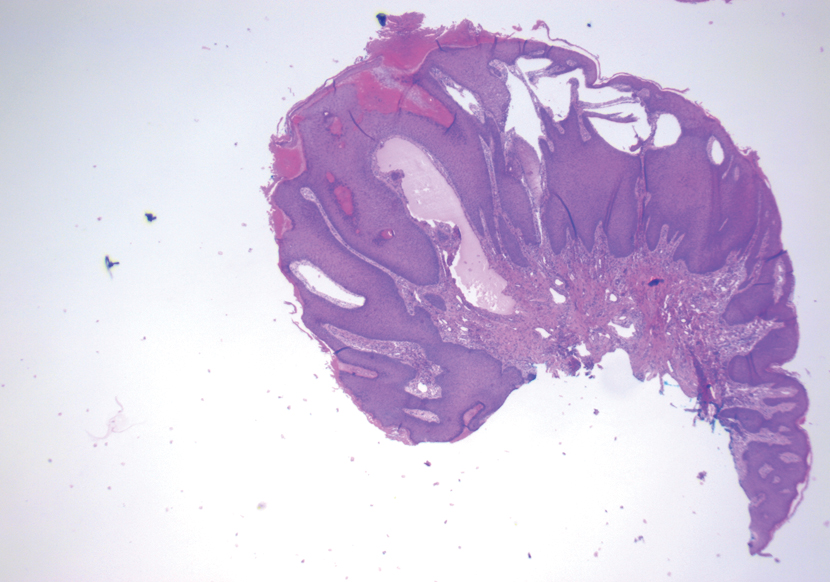
Although microcystic LMs may appear especially vascular or verrucous, the differential diagnosis for our patient's LM included condyloma acuminatum,5,6 condyloma lata,7 epidermal nevus, and lymphangiosarcoma. Epidermal nevi are congenital lesions, varying in appearance from velvety to verrucous patches and plaques that often evolve during puberty and become thicker, more verrucous, and hyperpigmented. Keratinocytic epidermal nevus syndromes and other entities such as nevus sebaceous have been associated with somatic mutations affecting proteins in the fibroblast growth factor receptor signaling pathway (eg, FGFR3, HRAS).8 Although the clinical appearance alone may be similar, lymphangiosarcoma can be distinguished from LM via biopsy.
There are several methods to diagnose LM. Duplex sonography is possibly the best noninvasive method to identify the flow between venous valves. Magnetic resonance imaging can detect larger occurrences of LM, and lymphangiography can be utilized to confirm a normal or abnormal lymphatic network.4 Treatment options are broad, including surgical excision, laser ablation, and topical sirolimus. Hypertonic saline sclerotherapy can be injected into the afflicted lymphatic channels to decrease inflammation, erythema, and hyperpigmentation without further treatment or major side effects.4
However, the benefits of sclerotherapy alone in the treatment of LM often come gradually, and radiofrequency ablation may need to be utilized to achieve more immediate results.2 Overall, outcomes are highly variable, but favorable outcomes often can be difficult to obtain due to a high recurrence rate.2,8 Our patient's symptoms improved during his postoperative recovery, and he declined further intervention.
- Elluru RG, Balakrishnan K, Padua HM. Lymphatic malformations: diagnosis and management. Semin Pediatr Surg. 2014;23:178-185. doi:10.1053/j.sempedsurg.2014.07.002
- Niti K, Manish P. Microcystic lymphatic malformation (lymphangioma circumscriptum) treated using a minimally invasive technique of radiofrequency ablation and sclerotherapy. Dermatol Surg. 2010;36:1711-1717. doi:10.1111/j.1524-4725.2010.01723.x
- Patel GA, Schwartz RA. Cutaneous lymphangioma circumscriptum: frog spawn on the skin. Int J Dermatol. 2009;48:1290-1295. doi:10.1111 /j.1365-4632.2009.04226.x
- Bikowski JB, Dumont AM. Lymphangioma circumscriptum: treatment with hypertonic saline sclerotherapy. J Am Acad Dermatol. 2005;53:442-444. doi:10.1016/j.jaad.2005.04.086
- Costa-Silva M, Fernandes I, Rodrigues AG, et al. Anogenital warts in pediatric population. An Bras Dermatol. 2017;92:675-681. doi:10.1590 /abd1806-4841.201756411
- Darmstadt GL. Perianal lymphangioma circumscriptum mistaken for genital warts. Pediatrics 1996;98;461.
- Bruins FG, van Deudekom FJA, de Vries HJC. Syphilitic condylomata lata mimicking anogenital warts. BMJ. 2015;350:h1259. doi:10.1136 /bmj.h1259
- Asch S, Sugarman JL. Epidermal nevus syndromes: new insights into whorls and swirls. Pediatr Dermatol. 2018;35:21-29. doi:10.1111 /pde.13273
The Diagnosis: Microcystic Lymphatic Malformation
The shave biopsy demonstrated numerous thin-walled vascular spaces filled with lymphatic fluid within the dermis (Figure), consistent with a diagnosis of microcystic lymphatic malformation (LM). Lymphatic malformations represent a class of benign vascular lesions consisting of anomalous or dilated lymphatic vessels, which can be broadly categorized as macrocystic (formerly cavernous lymphangioma or cystic hygroma), microcystic (formerly lymphangioma circumscriptum), or mixed.1 Patients often will present with pruritus, crusting, secondary infection, edema, or oozing.2 The superficial blebs of microcystic LMs resemble frog spawn and range in color from clear to pink, brawny, or deep maroon.3 Although the lymphatic vessels involved in microcystic LMs appear disconnected from the major lymphatic circulation,3 systemic fluid overload could plausibly promote lesional swelling and tenderness; we attributed our patient's worsening symptoms to the cumulative 7.8 L of intravenous fluid he received intraoperatively during his cardiac transplant. The excess fluid allowed communication between lymphatic cisterns and thin-walled vesicles on the skin surface through dilated channels. Overall, LMs represent roughly 26% of pediatric benign vascular tumors and approximately 4% of all vascular tumors.4
Although microcystic LMs may appear especially vascular or verrucous, the differential diagnosis for our patient's LM included condyloma acuminatum,5,6 condyloma lata,7 epidermal nevus, and lymphangiosarcoma. Epidermal nevi are congenital lesions, varying in appearance from velvety to verrucous patches and plaques that often evolve during puberty and become thicker, more verrucous, and hyperpigmented. Keratinocytic epidermal nevus syndromes and other entities such as nevus sebaceous have been associated with somatic mutations affecting proteins in the fibroblast growth factor receptor signaling pathway (eg, FGFR3, HRAS).8 Although the clinical appearance alone may be similar, lymphangiosarcoma can be distinguished from LM via biopsy.
There are several methods to diagnose LM. Duplex sonography is possibly the best noninvasive method to identify the flow between venous valves. Magnetic resonance imaging can detect larger occurrences of LM, and lymphangiography can be utilized to confirm a normal or abnormal lymphatic network.4 Treatment options are broad, including surgical excision, laser ablation, and topical sirolimus. Hypertonic saline sclerotherapy can be injected into the afflicted lymphatic channels to decrease inflammation, erythema, and hyperpigmentation without further treatment or major side effects.4
However, the benefits of sclerotherapy alone in the treatment of LM often come gradually, and radiofrequency ablation may need to be utilized to achieve more immediate results.2 Overall, outcomes are highly variable, but favorable outcomes often can be difficult to obtain due to a high recurrence rate.2,8 Our patient's symptoms improved during his postoperative recovery, and he declined further intervention.
The Diagnosis: Microcystic Lymphatic Malformation
The shave biopsy demonstrated numerous thin-walled vascular spaces filled with lymphatic fluid within the dermis (Figure), consistent with a diagnosis of microcystic lymphatic malformation (LM). Lymphatic malformations represent a class of benign vascular lesions consisting of anomalous or dilated lymphatic vessels, which can be broadly categorized as macrocystic (formerly cavernous lymphangioma or cystic hygroma), microcystic (formerly lymphangioma circumscriptum), or mixed.1 Patients often will present with pruritus, crusting, secondary infection, edema, or oozing.2 The superficial blebs of microcystic LMs resemble frog spawn and range in color from clear to pink, brawny, or deep maroon.3 Although the lymphatic vessels involved in microcystic LMs appear disconnected from the major lymphatic circulation,3 systemic fluid overload could plausibly promote lesional swelling and tenderness; we attributed our patient's worsening symptoms to the cumulative 7.8 L of intravenous fluid he received intraoperatively during his cardiac transplant. The excess fluid allowed communication between lymphatic cisterns and thin-walled vesicles on the skin surface through dilated channels. Overall, LMs represent roughly 26% of pediatric benign vascular tumors and approximately 4% of all vascular tumors.4
Although microcystic LMs may appear especially vascular or verrucous, the differential diagnosis for our patient's LM included condyloma acuminatum,5,6 condyloma lata,7 epidermal nevus, and lymphangiosarcoma. Epidermal nevi are congenital lesions, varying in appearance from velvety to verrucous patches and plaques that often evolve during puberty and become thicker, more verrucous, and hyperpigmented. Keratinocytic epidermal nevus syndromes and other entities such as nevus sebaceous have been associated with somatic mutations affecting proteins in the fibroblast growth factor receptor signaling pathway (eg, FGFR3, HRAS).8 Although the clinical appearance alone may be similar, lymphangiosarcoma can be distinguished from LM via biopsy.
There are several methods to diagnose LM. Duplex sonography is possibly the best noninvasive method to identify the flow between venous valves. Magnetic resonance imaging can detect larger occurrences of LM, and lymphangiography can be utilized to confirm a normal or abnormal lymphatic network.4 Treatment options are broad, including surgical excision, laser ablation, and topical sirolimus. Hypertonic saline sclerotherapy can be injected into the afflicted lymphatic channels to decrease inflammation, erythema, and hyperpigmentation without further treatment or major side effects.4
However, the benefits of sclerotherapy alone in the treatment of LM often come gradually, and radiofrequency ablation may need to be utilized to achieve more immediate results.2 Overall, outcomes are highly variable, but favorable outcomes often can be difficult to obtain due to a high recurrence rate.2,8 Our patient's symptoms improved during his postoperative recovery, and he declined further intervention.
- Elluru RG, Balakrishnan K, Padua HM. Lymphatic malformations: diagnosis and management. Semin Pediatr Surg. 2014;23:178-185. doi:10.1053/j.sempedsurg.2014.07.002
- Niti K, Manish P. Microcystic lymphatic malformation (lymphangioma circumscriptum) treated using a minimally invasive technique of radiofrequency ablation and sclerotherapy. Dermatol Surg. 2010;36:1711-1717. doi:10.1111/j.1524-4725.2010.01723.x
- Patel GA, Schwartz RA. Cutaneous lymphangioma circumscriptum: frog spawn on the skin. Int J Dermatol. 2009;48:1290-1295. doi:10.1111 /j.1365-4632.2009.04226.x
- Bikowski JB, Dumont AM. Lymphangioma circumscriptum: treatment with hypertonic saline sclerotherapy. J Am Acad Dermatol. 2005;53:442-444. doi:10.1016/j.jaad.2005.04.086
- Costa-Silva M, Fernandes I, Rodrigues AG, et al. Anogenital warts in pediatric population. An Bras Dermatol. 2017;92:675-681. doi:10.1590 /abd1806-4841.201756411
- Darmstadt GL. Perianal lymphangioma circumscriptum mistaken for genital warts. Pediatrics 1996;98;461.
- Bruins FG, van Deudekom FJA, de Vries HJC. Syphilitic condylomata lata mimicking anogenital warts. BMJ. 2015;350:h1259. doi:10.1136 /bmj.h1259
- Asch S, Sugarman JL. Epidermal nevus syndromes: new insights into whorls and swirls. Pediatr Dermatol. 2018;35:21-29. doi:10.1111 /pde.13273
- Elluru RG, Balakrishnan K, Padua HM. Lymphatic malformations: diagnosis and management. Semin Pediatr Surg. 2014;23:178-185. doi:10.1053/j.sempedsurg.2014.07.002
- Niti K, Manish P. Microcystic lymphatic malformation (lymphangioma circumscriptum) treated using a minimally invasive technique of radiofrequency ablation and sclerotherapy. Dermatol Surg. 2010;36:1711-1717. doi:10.1111/j.1524-4725.2010.01723.x
- Patel GA, Schwartz RA. Cutaneous lymphangioma circumscriptum: frog spawn on the skin. Int J Dermatol. 2009;48:1290-1295. doi:10.1111 /j.1365-4632.2009.04226.x
- Bikowski JB, Dumont AM. Lymphangioma circumscriptum: treatment with hypertonic saline sclerotherapy. J Am Acad Dermatol. 2005;53:442-444. doi:10.1016/j.jaad.2005.04.086
- Costa-Silva M, Fernandes I, Rodrigues AG, et al. Anogenital warts in pediatric population. An Bras Dermatol. 2017;92:675-681. doi:10.1590 /abd1806-4841.201756411
- Darmstadt GL. Perianal lymphangioma circumscriptum mistaken for genital warts. Pediatrics 1996;98;461.
- Bruins FG, van Deudekom FJA, de Vries HJC. Syphilitic condylomata lata mimicking anogenital warts. BMJ. 2015;350:h1259. doi:10.1136 /bmj.h1259
- Asch S, Sugarman JL. Epidermal nevus syndromes: new insights into whorls and swirls. Pediatr Dermatol. 2018;35:21-29. doi:10.1111 /pde.13273
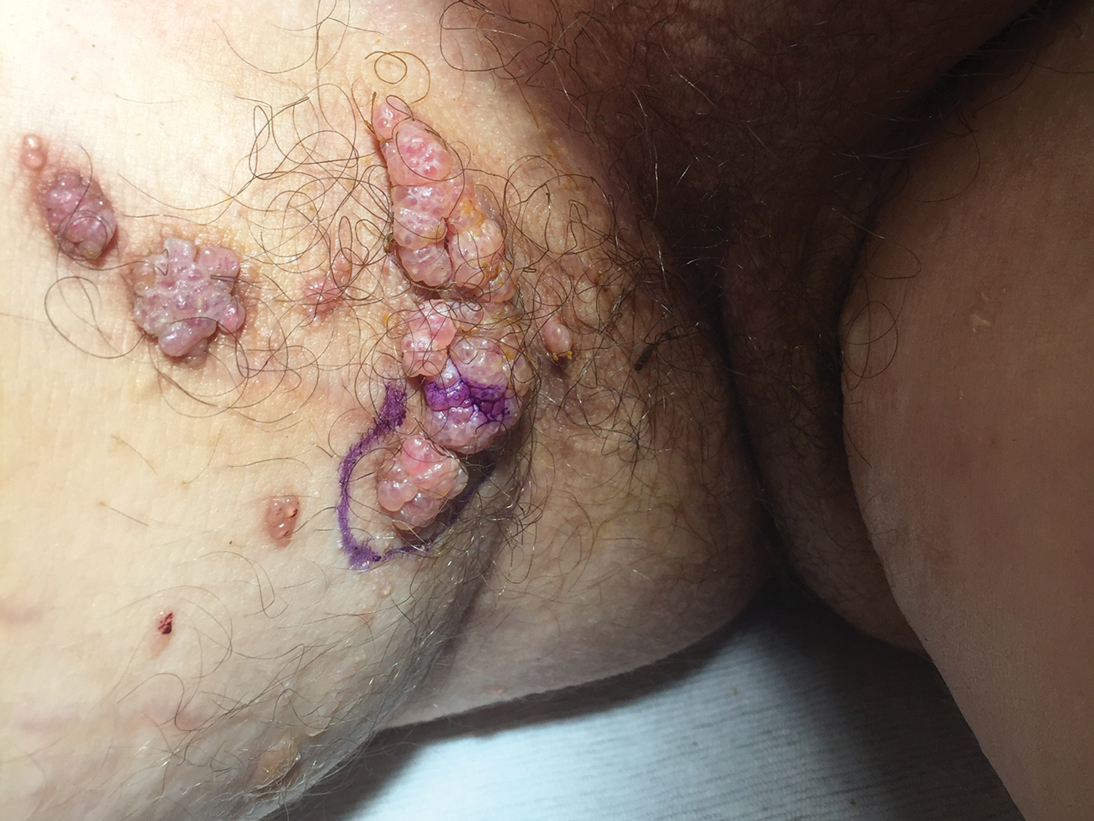
A 17-year-old adolescent boy presented with increasingly painful genital warts on the right thigh, groin, and scrotum that had been present since birth. The patient had a medical history of cardiac transplantation in the months prior to presentation and was on immunosuppressive therapy. The lesions had become more swollen and bothersome in the weeks following the transplantation and now prevented him from ambulating due to discomfort. He denied any history of sexual contact or oral lesions. Physical examination revealed numerous translucent and hemorrhagic vesicles clustered and linearly distributed on the right medial thigh. A shave biopsy of a vesicle was performed.
Clinical Edge Journal Scan Commentary: AML September 2021
Of the 50 patients enrolled, 90%, 8% and 2% had newly diagnosed AML, myelodysplastic syndrome and mixed phenotype acute leukemia respectively. Overall, 94% (95% confidence interval [CI], 83%-98%) had a composite complete response and 82% (95% CI, 68%-92%) achieved measurable residual disease negativity. At 12 months, the rates of duration of response, overall survival, and event-free survival were 74% (95% CI, 60%-92%), 85% (95% CI, 75%-97%), and 68% (95% CI, 54%-85%), respectively. The most common grade 3 or worse adverse events were febrile neutropenia (84%), infection (12%), and alanine aminotransferase elevations (12%). Only one patient had a p53 mutation and that patient did not respond. Another study by Alwash et al, demonstrated that 15% of patients acquire a TP53 mutation during AML therapy.
The poor prognosis of patients with a p53 ,mutation was also seen in a retrospective study of patients with newly diagnosed or relapsed/refractory AML treated with 10-day decitabine + venetoclax (DEC10-VEN). Of the 118 patients, 35 had a TP53 mutation. Complete remission/complete remission with incomplete count recovery (57% vs 775), and overall response was better for patients without vs with a TP53 mutation. In addition, overall survival was dismal (5.2 months) for patients with TP53 mutation vs those without (19.4 months).
This study reiterates the need for newer therapies for this group of patients with a TP53 mutation (Kim K et al). The overall outcome of patients treated with DEC10-VEN was better compared to intensive chemotherapy (IC) in patients with relapsed refractory AML. This was evaluated in a retrospective study assessing the outcomes of adult patients with R/R AML treated with DEC10-VEN (n=65) a vs IC-based regimen (n=130) using propensity score-matched analysis. Patients receiving DEC10-VEN vs IC had superior overall response rate (odds ratio [OR], 3.28; P < .001), minimal residual disease negativity (OR, 2.48; P = .017), event-free survival (hazard ratio [HR], 0.46; P < .001), and overall survival (HR, 0.56; P = .008). Rates of refractory disease (OR, 0.46; P = .011) and 60-day mortality (OR, 0.40; P = .029) were significantly lower in patients receiving DEC10-VEN vs IC.
Of the 50 patients enrolled, 90%, 8% and 2% had newly diagnosed AML, myelodysplastic syndrome and mixed phenotype acute leukemia respectively. Overall, 94% (95% confidence interval [CI], 83%-98%) had a composite complete response and 82% (95% CI, 68%-92%) achieved measurable residual disease negativity. At 12 months, the rates of duration of response, overall survival, and event-free survival were 74% (95% CI, 60%-92%), 85% (95% CI, 75%-97%), and 68% (95% CI, 54%-85%), respectively. The most common grade 3 or worse adverse events were febrile neutropenia (84%), infection (12%), and alanine aminotransferase elevations (12%). Only one patient had a p53 mutation and that patient did not respond. Another study by Alwash et al, demonstrated that 15% of patients acquire a TP53 mutation during AML therapy.
The poor prognosis of patients with a p53 ,mutation was also seen in a retrospective study of patients with newly diagnosed or relapsed/refractory AML treated with 10-day decitabine + venetoclax (DEC10-VEN). Of the 118 patients, 35 had a TP53 mutation. Complete remission/complete remission with incomplete count recovery (57% vs 775), and overall response was better for patients without vs with a TP53 mutation. In addition, overall survival was dismal (5.2 months) for patients with TP53 mutation vs those without (19.4 months).
This study reiterates the need for newer therapies for this group of patients with a TP53 mutation (Kim K et al). The overall outcome of patients treated with DEC10-VEN was better compared to intensive chemotherapy (IC) in patients with relapsed refractory AML. This was evaluated in a retrospective study assessing the outcomes of adult patients with R/R AML treated with DEC10-VEN (n=65) a vs IC-based regimen (n=130) using propensity score-matched analysis. Patients receiving DEC10-VEN vs IC had superior overall response rate (odds ratio [OR], 3.28; P < .001), minimal residual disease negativity (OR, 2.48; P = .017), event-free survival (hazard ratio [HR], 0.46; P < .001), and overall survival (HR, 0.56; P = .008). Rates of refractory disease (OR, 0.46; P = .011) and 60-day mortality (OR, 0.40; P = .029) were significantly lower in patients receiving DEC10-VEN vs IC.
Of the 50 patients enrolled, 90%, 8% and 2% had newly diagnosed AML, myelodysplastic syndrome and mixed phenotype acute leukemia respectively. Overall, 94% (95% confidence interval [CI], 83%-98%) had a composite complete response and 82% (95% CI, 68%-92%) achieved measurable residual disease negativity. At 12 months, the rates of duration of response, overall survival, and event-free survival were 74% (95% CI, 60%-92%), 85% (95% CI, 75%-97%), and 68% (95% CI, 54%-85%), respectively. The most common grade 3 or worse adverse events were febrile neutropenia (84%), infection (12%), and alanine aminotransferase elevations (12%). Only one patient had a p53 mutation and that patient did not respond. Another study by Alwash et al, demonstrated that 15% of patients acquire a TP53 mutation during AML therapy.
The poor prognosis of patients with a p53 ,mutation was also seen in a retrospective study of patients with newly diagnosed or relapsed/refractory AML treated with 10-day decitabine + venetoclax (DEC10-VEN). Of the 118 patients, 35 had a TP53 mutation. Complete remission/complete remission with incomplete count recovery (57% vs 775), and overall response was better for patients without vs with a TP53 mutation. In addition, overall survival was dismal (5.2 months) for patients with TP53 mutation vs those without (19.4 months).
This study reiterates the need for newer therapies for this group of patients with a TP53 mutation (Kim K et al). The overall outcome of patients treated with DEC10-VEN was better compared to intensive chemotherapy (IC) in patients with relapsed refractory AML. This was evaluated in a retrospective study assessing the outcomes of adult patients with R/R AML treated with DEC10-VEN (n=65) a vs IC-based regimen (n=130) using propensity score-matched analysis. Patients receiving DEC10-VEN vs IC had superior overall response rate (odds ratio [OR], 3.28; P < .001), minimal residual disease negativity (OR, 2.48; P = .017), event-free survival (hazard ratio [HR], 0.46; P < .001), and overall survival (HR, 0.56; P = .008). Rates of refractory disease (OR, 0.46; P = .011) and 60-day mortality (OR, 0.40; P = .029) were significantly lower in patients receiving DEC10-VEN vs IC.
Working without a net
My first hospital consult was also on my first day of practice, in July, 1998.
I was in a small room, subleased from an oncology group. My schedule, as first day schedules are, was sparse.
Around noon one of the oncology docs asked me to come to his exam room, so I went across the hall. There he had a lady in her late 50s, with known metastatic cancer. He’d brought her in for a few days of worsening headaches and diplopia, and my 10-second neurological exam showed dysconjugate gaze and dysarthria. He said he was admitting her to the hospital, and asked if I’d consult on her.
I hung out in the hospital’s MRI control room later that day, waiting for her images to come up. I was nervous, maybe even a little scared. In spite of having survived medical school, residency, and fellowship, I was worried I’d screwed up the case, somehow. If the MRI was normal, I’d look like an idiot. My career would be over, on day one. No one would ever consult me again.
Of course, the MRI showed a brainstem metastasis (in addition to other places), and my initial differential was correct. Good for me, terrible for the patient. I ordered Decadron, called the oncologist, spoke to the patient and her family, and went home. I followed her for maybe a another few days, mainly because I didn’t know what the protocol was for signing off.
Self-doubt is common in all fields, especially when starting out, but probably strongest in medicine. A lot depends on us getting the right answer – quickly – in cases like that one. In my case this was compounded by its being my first day of practice. There was no attending I could call for help. I was working without a net.
But the years of training paid off, I got the case right, and moved on. Twenty-three years later it seems silly that I was so worried. Nowadays I order the MRI, move to the next patient, and try not to think about it until the results come back or a nurse calls with a status change. If my initial impression is wrong, I move down the differential list.
But
It’s what makes us better doctors.
Dr. Block has a solo neurology practice in Scottsdale, Ariz.
My first hospital consult was also on my first day of practice, in July, 1998.
I was in a small room, subleased from an oncology group. My schedule, as first day schedules are, was sparse.
Around noon one of the oncology docs asked me to come to his exam room, so I went across the hall. There he had a lady in her late 50s, with known metastatic cancer. He’d brought her in for a few days of worsening headaches and diplopia, and my 10-second neurological exam showed dysconjugate gaze and dysarthria. He said he was admitting her to the hospital, and asked if I’d consult on her.
I hung out in the hospital’s MRI control room later that day, waiting for her images to come up. I was nervous, maybe even a little scared. In spite of having survived medical school, residency, and fellowship, I was worried I’d screwed up the case, somehow. If the MRI was normal, I’d look like an idiot. My career would be over, on day one. No one would ever consult me again.
Of course, the MRI showed a brainstem metastasis (in addition to other places), and my initial differential was correct. Good for me, terrible for the patient. I ordered Decadron, called the oncologist, spoke to the patient and her family, and went home. I followed her for maybe a another few days, mainly because I didn’t know what the protocol was for signing off.
Self-doubt is common in all fields, especially when starting out, but probably strongest in medicine. A lot depends on us getting the right answer – quickly – in cases like that one. In my case this was compounded by its being my first day of practice. There was no attending I could call for help. I was working without a net.
But the years of training paid off, I got the case right, and moved on. Twenty-three years later it seems silly that I was so worried. Nowadays I order the MRI, move to the next patient, and try not to think about it until the results come back or a nurse calls with a status change. If my initial impression is wrong, I move down the differential list.
But
It’s what makes us better doctors.
Dr. Block has a solo neurology practice in Scottsdale, Ariz.
My first hospital consult was also on my first day of practice, in July, 1998.
I was in a small room, subleased from an oncology group. My schedule, as first day schedules are, was sparse.
Around noon one of the oncology docs asked me to come to his exam room, so I went across the hall. There he had a lady in her late 50s, with known metastatic cancer. He’d brought her in for a few days of worsening headaches and diplopia, and my 10-second neurological exam showed dysconjugate gaze and dysarthria. He said he was admitting her to the hospital, and asked if I’d consult on her.
I hung out in the hospital’s MRI control room later that day, waiting for her images to come up. I was nervous, maybe even a little scared. In spite of having survived medical school, residency, and fellowship, I was worried I’d screwed up the case, somehow. If the MRI was normal, I’d look like an idiot. My career would be over, on day one. No one would ever consult me again.
Of course, the MRI showed a brainstem metastasis (in addition to other places), and my initial differential was correct. Good for me, terrible for the patient. I ordered Decadron, called the oncologist, spoke to the patient and her family, and went home. I followed her for maybe a another few days, mainly because I didn’t know what the protocol was for signing off.
Self-doubt is common in all fields, especially when starting out, but probably strongest in medicine. A lot depends on us getting the right answer – quickly – in cases like that one. In my case this was compounded by its being my first day of practice. There was no attending I could call for help. I was working without a net.
But the years of training paid off, I got the case right, and moved on. Twenty-three years later it seems silly that I was so worried. Nowadays I order the MRI, move to the next patient, and try not to think about it until the results come back or a nurse calls with a status change. If my initial impression is wrong, I move down the differential list.
But
It’s what makes us better doctors.
Dr. Block has a solo neurology practice in Scottsdale, Ariz.

The trauma and healing of 9/11 echo in COVID-19
The scope and magnitude of the Sept. 11, 2001, attacks on the World Trade Center and the Pentagon were unprecedented in U.S. history. It was arguably the most serious trauma to beset Americans on U.S. soil. The 20th anniversary of 9/11 will take place during another crisis, not only in American history but also in world history – the COVID-19 pandemic.
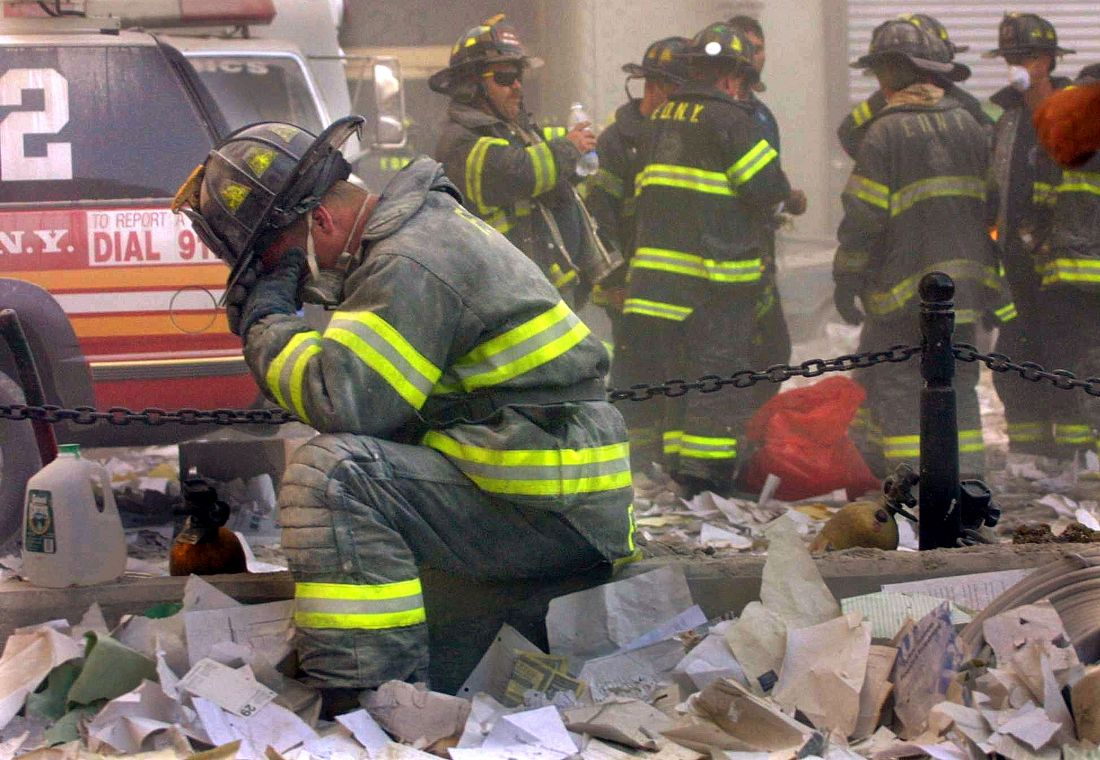
“As different as these two events are, there are obvious points of comparison,” Jonathan DePierro, PhD, assistant professor of psychiatry, Icahn School of Medicine at Mount Sinai, New York, said in an interview. “Both were unprecedented life-threatening situations, presenting threats to individuals’ lives and profoundly traumatizing not only society as a whole but also first responders.”
Dr. DePierro, who is also the clinical director of the Center for Stress, Resilience, and Personal Growth at Mount Sinai, thinks there are many lessons to be learned from the mental health response to 9/11 that can inform our understanding of and response to the mental health needs of today’s first responders in the COVID-19 crisis, particularly health care professionals.
“Every one of our hospitals became a ‘ground zero’ early during the pandemic, and we see the numbers rising again and hospitals again overwhelmed, so he said.
Placing trauma within a new framework
According to Priscilla Dass-Brailsford, EdD, MPH, professor of psychology, department of psychiatry, Georgetown University, Washington, Sept. 11, 2001, “placed trauma within a new framework.”
“Prior to 9/11, crisis protocols and how to manage stress in the aftermath of violent events were uncommon,” Dr. Dass-Brailsford, a clinical psychologist with expertise in trauma who also chairs a clinical psychology program for the Chicago School of Professional Psychology, said in an interview.
As a first responder, she was involved in early interventions for survivors of 9/11. On Sept. 11, 2001, she had just resigned her position as coordinator of the community crisis response team – the first of its kind in the United States – through the Victims of Violence Program in Cambridge, in Cambridge, Mass.
The program responded to communities in which there were high rates of drive-by shootings and similar acts of violence. Because of her crisis experience, Dr. Dass-Brailsford was asked to conduct debriefings in Boston in the area where the 9/11 terrorists had stayed prior to boarding the planes that were used in the terrorist attacks. She subsequently went to New York City to conduct similar psychological debriefings with affected communities.
“What we’ve learned is that we had no crisis protocol on how to manage the stress in the aftermath of such a violent event, no standard operating procedures. There were very few people trained in crisis and trauma response at that time. Partially spurred by 9/11, trauma training programs became more prolific,” she said. Dr. Dass-Brailsford developed a trauma certification program at Lesley University in Cambridge, Mass., where she began to teach after 9/11. “I saw the importance of having clinicians trained to respond in a crisis, because responding to a crisis is very different from conducting regular mental health interventions.”
Short- and long-term interventions
Dr. DePierro said that Mount Sinai has a 20-year history of responding to the physical and mental health needs of 9/11 responders.
“We saw a number of first responders experiencing clinical depression, anxiety, a lot of worry, symptoms of posttraumatic stress disorder, and an increase in alcohol and/or substance use,” he recounted. In some, these responses were immediate; in others, the onset of symptoms was more gradual. Some responders had acute reactions that lasted for several months to a year, whereas for others, the reactions were prolonged, and they remained “chronically distressed long after the immediate exposure to the event,” he said.
Recent studies have shown that, during the COVID-19 pandemic, health care professionals and many essential workers have experienced similar symptoms, Dr. DePierro noted.
Mental health care professionals who provided interventions for workers involved in recovery and cleanup at the World Trade Center have highlighted the need for long-term monitoring of people on the front lines during the COVID-19 pandemic – especially health care workers, other essential personnel (for example, delivery, postal, and grocery store workers) and surviving family members. “Health monitoring and treatment efforts for 9/11 survivors and responders were put into place soon after the attacks and continue to this day,” using funding provided through the James Zadroga Act, Dr. DePierro said.
“Without similarly unified health registry and treatment services, many individuals – especially from underserved groups – will likely experience chronic mental health consequences and will be unable to access high-quality health care services,” he stated.
‘Psychological first aid’
“Although many people who go through a crisis – whether as a result of terrorism, such as 9/11, or a medical crisis, such as the current pandemic, or a natural disaster, such as Hurricane Katrina – experience PTSD, it’s important to note that not everyone who goes through a crisis and is traumatized will go on to develop PTSD,” Dr. Dass-Brailsford emphasized.
“To me, 9/11 placed psychological first aid on the map. Even if you are not a clinician, you can be trained to provide psychological first aid by becoming familiar with people’s reactions to trauma and how you can support them through it,” she continued.
For example, if a coworker is agitated or “seems to be having a meltdown, you can be there by offering support and getting them the appropriate help.” Research has suggested that having social support before and after a traumatic event can be helpful in determining vulnerability to the development of PTSD and in modulating the impact of the trauma.
Psychological first aid is helpful as an interim measure. “If you see a coworker holding their head in their hands all day and staring at the screen, identifying whether the person might be having a dissociative episode is critical. Providing some support is important, but if more intensive professional support is needed, determining that and making a referral becomes key,” Dr. Dass-Brailsford stated.
Dr. DePierro added: “One of the most important messages that I want health care workers to know from my years of working with 9/11 survivors is that feeling distressed after a traumatic event is very common, but with effective care, one doesn’t necessarily need to be in treatment for years.”
Danielle Ofri, MD, PhD, clinical professor, department of medicine, New York University, agreed. “It is important to continue keeping tabs on each other and remaining sensitive to the collateral struggles of our colleagues. Some have children who are struggling in school, others have parents who have lost a job. Continuing to check in on others and offer support is critical going forward,” she said in an interview.
Cohesiveness and volunteerism
One of the most powerful antidotes to long-term traumatization is a sense of community cohesiveness. This was the case following 9/11, and it is the case during the COVID-19 pandemic, according to Dr. Ofri, an internist at Bellevue Hospital in New York.
“There was an enormous mobilization. Bellevue is a city hospital with a level 1 trauma center, and we expected to be swamped, so the whole hospital shifted into gear,” said Dr. Ofri. “What would have been terrifying seemed tolerable because we felt that we were in it together. We discharged the inpatients to make beds available. Within hours, we had converted clinics into emergency departments and ICUs. We worked seamlessly, and the crisis brought us together ... but then, of course, no patients showed up.”
She described her relationship with her colleagues as “feeling almost like a family, especially during the pandemic, when so many others were in lockdown and feeling isolated and useless.”
She and her colleagues saw each other daily. Although the content of their tasks and responsibilities changed and people were redeployed to other areas, “our workday didn’t really change. It would have been overwhelming if we hadn’t had our daily meetings to regroup and assess where we were. Each day, everything we had learned or implemented the day before – treatment protocols, testing protocols, our understanding of how the virus was communicated – would change and need to be reevaluated. Those morning meetings were critical to staying centered. It felt as though we were building a plane and flying it at the same time, which felt both scary and heady. Luckily, it took place within the fraternity of a committed and caring group.”
Dr. Ofri recounted that, after 9/11, as well as during the pandemic, “professionals kept jumping in from the sidelines to volunteer. Within hours of the collapse of the towers, the ED had filled with staff. People came out of retirement and out from vacation and out of the woodwork. It was very heartening.”
Even more inspiring, “all the departmental barriers seemed to break down. People were willing to step out of their ordinary roles and check their egos at the door. Seasoned physicians were willing to function as medical interns.”
This generosity of time and spirit “helped keep us going,” she said.
Dr. DePierro agreed. “One of the things I’ve seen on medical floors is that COVID actually brought some units together, increasing their cohesion and mutual support and increasing the bonds between people.” These intensified bonds “increased the resilience of everyone involved.”
Commitment to the community
Dr. Ofri recalls families gathering at the hospital after 9/11, watching posters of missing people going up all over the hospital as well as on mailboxes and lampposts. Because the center for missing people was located right next door to Bellevue, there were long lines of families coming in to register. The chief medical office was there, and a huge tent was built to accommodate the families. The tent took up the entire block. “We felt a lot of ownership, because families were coming here,” she said.
The street remained closed even as the days, weeks, and years stretched on, and the tent remained. It was used as a reflection area for families. During the pandemic, that area was used for refrigerated trucks that served as temporary morgues.
“Both logistically and emotionally, we had a feeling during the pandemic of, ‘We’ve been here before, we’ll do it again and be there for the community,’ ” Dr. Ofri said.
She noted that the sense of commitment to the community carried her and fellow clinicians through the toughest parts of 9/11 and of the COVID-19 pandemic.
“People look to the medical system as a lodestar. ‘Where’s my family member? What should I do? Should I be tested? Vaccinated?’ We were there to be a steady presence for the community physically, psychologically, emotionally, and medically, which helped center us as well,” Dr. Ofri said. “If we didn’t have that, we might have all given in to existential panic.”
She added: “Although we had to work twice as hard, often amid great personal risk, we had the good fortune of having a sense of purpose, something to contribute, plus the community of colleagues we cared about and trusted with our lives.”
Crisis and personal growth
Dr. DePierro said that participants who went through 9/11 have been coming to Mount Sinai’s World Trade Center Health Program for care for nearly two decades. “Many are doing quite well, despite the emotional trauma and the dust and toxin exposure, which has given us a window into what makes people resilient.”
Social and community support are key factors in resilience. Another is recognizing opportunities for personal or professional growth during the crisis, according to Dr. DePierro.
During the pandemic, hospital staff were redeployed to departments where they didn’t typically work. They worked with new colleagues and used skills in patient care that they hadn’t needed for years or even decades. “Although this was stressful and distressing, quite a number said they came through with more medical knowledge than before and that they had forged relationships in the trenches that have been lasting and have become important to them,” he reported.
He noted that, during both crises, for first responders and health care practitioners, religious or spiritual faith was a source of resilience. “During the peak of the pandemic, chaplains provided an exorbitant amount of staff support as clinicians turned to the chaplain to help make sense of what they were going through and connect to something greater than themselves.” Similarly, during 9/11, police and fire department chaplains “played a huge role in supporting the first responders,” Dr. DePierro said.
He said that Mount Sinai holds resilience workshops “where we focus on these topics and teach health care workers how to build resilience in their lives, heal day-to-day stressors, and even grow from the experience.”
Dr. Ofri, who is the founder and editor-in-chief of the Bellevue Literary Review, added that the arts played an important role in bolstering resilience and providing a creative outlet for clinicians after 9/11 and again during the pandemic.
The publication is celebrating its twentieth anniversary – its first issue went to press in September 2001. The cover contained an acknowledgment of 9/11.
Dr. Ofri said that a gala event had been planned for Oct. 7, 2001, to celebrate the inaugural issue of the publication. She assumed no one would show up, given that the United States had invaded Afghanistan only hours earlier. To her surprise, over a hundred people attended, “which made me realize the role of the arts during trauma. People were seeking to come together and hear poetry, fiction, and creative nonfiction.”
Dr. Ofri has been “impressed by the amount of incredible creative writing of all sorts that has been submitted [to the publication] during the pandemic, an unexpected flowering of the arts.”
Unique challenges, unique opportunities
All three experts pointed to several noteworthy differences between the experiences of first responders following 9/11 and those of today’s health care professionals during the pandemic.
“What happened on Sept. 11 was one discrete event, and although it obviously led to years of recovering body parts and cleaning up Ground Zero, and on a national level it led to a war, it nevertheless was a single event,” Dr. DePierro observed. By contrast, the COVID-19 pandemic is ongoing, and for health care practitioners, “it’s by no means over. Again and again, they are being thrown back into battle, dealing with fatigue, weariness, and loss of life.”
Moreover, “it is my understanding that immediately following 9/11, there was a general coming together in our country, but it’s obvious that today, there’s a great deal of fractiousness, contention, disagreement, and disunity in our country when it comes to COVID-19,” Dr. DePierro continued.
“This takes a great toll, particularly on health care workers who are dealing with COVID-19 on a daily basis and experience a disconnect between what they see on their floors and ICUs of the hospital, experiencing loss of life they’ve likely never encountered in their careers, and what people are saying when they downplay the seriousness of COVID-19,” he said.
Dr. Ofri agreed. “The fragmentation of our country and the failure of leadership at the highest level to provide even the basics, such as PPE [personal protective equipment] for health care professionals, left us baffled, profoundly hurt, and angry.”
A positive difference between the COVID-19 pandemic and the aftermath of 9/11 is the development of sophisticated technology that allows interventions for traumatized individuals – both health care professionals and the general public – through telehealth, Dr. DePierro pointed out.
“I would say that these resources and technologies are a silver lining and should continue to be expanded on,” he said. “Now, busy health care workers can access all manner of supportive services, including teletherapy, right from home or between shifts.”
Another “silver lining” is that the pandemic has shone a spotlight on an issue that predated the pandemic – the mental health of health care professionals. Opening a discussion about this has reduced stigma and hopefully has paved the way for improved treatments and for providing resources.
Dr. Dass-Brailsford added that “it is important, going forward, for all of us to be trauma informed, to know how trauma and trauma-related stress unfolds in both other people and yourself, and to know what coping skills can be used to avoid crises from developing – a task that extends across all types of disasters.”
A version of this article first appeared on Medscape.com.
The scope and magnitude of the Sept. 11, 2001, attacks on the World Trade Center and the Pentagon were unprecedented in U.S. history. It was arguably the most serious trauma to beset Americans on U.S. soil. The 20th anniversary of 9/11 will take place during another crisis, not only in American history but also in world history – the COVID-19 pandemic.
“As different as these two events are, there are obvious points of comparison,” Jonathan DePierro, PhD, assistant professor of psychiatry, Icahn School of Medicine at Mount Sinai, New York, said in an interview. “Both were unprecedented life-threatening situations, presenting threats to individuals’ lives and profoundly traumatizing not only society as a whole but also first responders.”
Dr. DePierro, who is also the clinical director of the Center for Stress, Resilience, and Personal Growth at Mount Sinai, thinks there are many lessons to be learned from the mental health response to 9/11 that can inform our understanding of and response to the mental health needs of today’s first responders in the COVID-19 crisis, particularly health care professionals.
“Every one of our hospitals became a ‘ground zero’ early during the pandemic, and we see the numbers rising again and hospitals again overwhelmed, so he said.
Placing trauma within a new framework
According to Priscilla Dass-Brailsford, EdD, MPH, professor of psychology, department of psychiatry, Georgetown University, Washington, Sept. 11, 2001, “placed trauma within a new framework.”
“Prior to 9/11, crisis protocols and how to manage stress in the aftermath of violent events were uncommon,” Dr. Dass-Brailsford, a clinical psychologist with expertise in trauma who also chairs a clinical psychology program for the Chicago School of Professional Psychology, said in an interview.
As a first responder, she was involved in early interventions for survivors of 9/11. On Sept. 11, 2001, she had just resigned her position as coordinator of the community crisis response team – the first of its kind in the United States – through the Victims of Violence Program in Cambridge, in Cambridge, Mass.
The program responded to communities in which there were high rates of drive-by shootings and similar acts of violence. Because of her crisis experience, Dr. Dass-Brailsford was asked to conduct debriefings in Boston in the area where the 9/11 terrorists had stayed prior to boarding the planes that were used in the terrorist attacks. She subsequently went to New York City to conduct similar psychological debriefings with affected communities.
“What we’ve learned is that we had no crisis protocol on how to manage the stress in the aftermath of such a violent event, no standard operating procedures. There were very few people trained in crisis and trauma response at that time. Partially spurred by 9/11, trauma training programs became more prolific,” she said. Dr. Dass-Brailsford developed a trauma certification program at Lesley University in Cambridge, Mass., where she began to teach after 9/11. “I saw the importance of having clinicians trained to respond in a crisis, because responding to a crisis is very different from conducting regular mental health interventions.”
Short- and long-term interventions
Dr. DePierro said that Mount Sinai has a 20-year history of responding to the physical and mental health needs of 9/11 responders.
“We saw a number of first responders experiencing clinical depression, anxiety, a lot of worry, symptoms of posttraumatic stress disorder, and an increase in alcohol and/or substance use,” he recounted. In some, these responses were immediate; in others, the onset of symptoms was more gradual. Some responders had acute reactions that lasted for several months to a year, whereas for others, the reactions were prolonged, and they remained “chronically distressed long after the immediate exposure to the event,” he said.
Recent studies have shown that, during the COVID-19 pandemic, health care professionals and many essential workers have experienced similar symptoms, Dr. DePierro noted.
Mental health care professionals who provided interventions for workers involved in recovery and cleanup at the World Trade Center have highlighted the need for long-term monitoring of people on the front lines during the COVID-19 pandemic – especially health care workers, other essential personnel (for example, delivery, postal, and grocery store workers) and surviving family members. “Health monitoring and treatment efforts for 9/11 survivors and responders were put into place soon after the attacks and continue to this day,” using funding provided through the James Zadroga Act, Dr. DePierro said.
“Without similarly unified health registry and treatment services, many individuals – especially from underserved groups – will likely experience chronic mental health consequences and will be unable to access high-quality health care services,” he stated.
‘Psychological first aid’
“Although many people who go through a crisis – whether as a result of terrorism, such as 9/11, or a medical crisis, such as the current pandemic, or a natural disaster, such as Hurricane Katrina – experience PTSD, it’s important to note that not everyone who goes through a crisis and is traumatized will go on to develop PTSD,” Dr. Dass-Brailsford emphasized.
“To me, 9/11 placed psychological first aid on the map. Even if you are not a clinician, you can be trained to provide psychological first aid by becoming familiar with people’s reactions to trauma and how you can support them through it,” she continued.
For example, if a coworker is agitated or “seems to be having a meltdown, you can be there by offering support and getting them the appropriate help.” Research has suggested that having social support before and after a traumatic event can be helpful in determining vulnerability to the development of PTSD and in modulating the impact of the trauma.
Psychological first aid is helpful as an interim measure. “If you see a coworker holding their head in their hands all day and staring at the screen, identifying whether the person might be having a dissociative episode is critical. Providing some support is important, but if more intensive professional support is needed, determining that and making a referral becomes key,” Dr. Dass-Brailsford stated.
Dr. DePierro added: “One of the most important messages that I want health care workers to know from my years of working with 9/11 survivors is that feeling distressed after a traumatic event is very common, but with effective care, one doesn’t necessarily need to be in treatment for years.”
Danielle Ofri, MD, PhD, clinical professor, department of medicine, New York University, agreed. “It is important to continue keeping tabs on each other and remaining sensitive to the collateral struggles of our colleagues. Some have children who are struggling in school, others have parents who have lost a job. Continuing to check in on others and offer support is critical going forward,” she said in an interview.
Cohesiveness and volunteerism
One of the most powerful antidotes to long-term traumatization is a sense of community cohesiveness. This was the case following 9/11, and it is the case during the COVID-19 pandemic, according to Dr. Ofri, an internist at Bellevue Hospital in New York.
“There was an enormous mobilization. Bellevue is a city hospital with a level 1 trauma center, and we expected to be swamped, so the whole hospital shifted into gear,” said Dr. Ofri. “What would have been terrifying seemed tolerable because we felt that we were in it together. We discharged the inpatients to make beds available. Within hours, we had converted clinics into emergency departments and ICUs. We worked seamlessly, and the crisis brought us together ... but then, of course, no patients showed up.”
She described her relationship with her colleagues as “feeling almost like a family, especially during the pandemic, when so many others were in lockdown and feeling isolated and useless.”
She and her colleagues saw each other daily. Although the content of their tasks and responsibilities changed and people were redeployed to other areas, “our workday didn’t really change. It would have been overwhelming if we hadn’t had our daily meetings to regroup and assess where we were. Each day, everything we had learned or implemented the day before – treatment protocols, testing protocols, our understanding of how the virus was communicated – would change and need to be reevaluated. Those morning meetings were critical to staying centered. It felt as though we were building a plane and flying it at the same time, which felt both scary and heady. Luckily, it took place within the fraternity of a committed and caring group.”
Dr. Ofri recounted that, after 9/11, as well as during the pandemic, “professionals kept jumping in from the sidelines to volunteer. Within hours of the collapse of the towers, the ED had filled with staff. People came out of retirement and out from vacation and out of the woodwork. It was very heartening.”
Even more inspiring, “all the departmental barriers seemed to break down. People were willing to step out of their ordinary roles and check their egos at the door. Seasoned physicians were willing to function as medical interns.”
This generosity of time and spirit “helped keep us going,” she said.
Dr. DePierro agreed. “One of the things I’ve seen on medical floors is that COVID actually brought some units together, increasing their cohesion and mutual support and increasing the bonds between people.” These intensified bonds “increased the resilience of everyone involved.”
Commitment to the community
Dr. Ofri recalls families gathering at the hospital after 9/11, watching posters of missing people going up all over the hospital as well as on mailboxes and lampposts. Because the center for missing people was located right next door to Bellevue, there were long lines of families coming in to register. The chief medical office was there, and a huge tent was built to accommodate the families. The tent took up the entire block. “We felt a lot of ownership, because families were coming here,” she said.
The street remained closed even as the days, weeks, and years stretched on, and the tent remained. It was used as a reflection area for families. During the pandemic, that area was used for refrigerated trucks that served as temporary morgues.
“Both logistically and emotionally, we had a feeling during the pandemic of, ‘We’ve been here before, we’ll do it again and be there for the community,’ ” Dr. Ofri said.
She noted that the sense of commitment to the community carried her and fellow clinicians through the toughest parts of 9/11 and of the COVID-19 pandemic.
“People look to the medical system as a lodestar. ‘Where’s my family member? What should I do? Should I be tested? Vaccinated?’ We were there to be a steady presence for the community physically, psychologically, emotionally, and medically, which helped center us as well,” Dr. Ofri said. “If we didn’t have that, we might have all given in to existential panic.”
She added: “Although we had to work twice as hard, often amid great personal risk, we had the good fortune of having a sense of purpose, something to contribute, plus the community of colleagues we cared about and trusted with our lives.”
Crisis and personal growth
Dr. DePierro said that participants who went through 9/11 have been coming to Mount Sinai’s World Trade Center Health Program for care for nearly two decades. “Many are doing quite well, despite the emotional trauma and the dust and toxin exposure, which has given us a window into what makes people resilient.”
Social and community support are key factors in resilience. Another is recognizing opportunities for personal or professional growth during the crisis, according to Dr. DePierro.
During the pandemic, hospital staff were redeployed to departments where they didn’t typically work. They worked with new colleagues and used skills in patient care that they hadn’t needed for years or even decades. “Although this was stressful and distressing, quite a number said they came through with more medical knowledge than before and that they had forged relationships in the trenches that have been lasting and have become important to them,” he reported.
He noted that, during both crises, for first responders and health care practitioners, religious or spiritual faith was a source of resilience. “During the peak of the pandemic, chaplains provided an exorbitant amount of staff support as clinicians turned to the chaplain to help make sense of what they were going through and connect to something greater than themselves.” Similarly, during 9/11, police and fire department chaplains “played a huge role in supporting the first responders,” Dr. DePierro said.
He said that Mount Sinai holds resilience workshops “where we focus on these topics and teach health care workers how to build resilience in their lives, heal day-to-day stressors, and even grow from the experience.”
Dr. Ofri, who is the founder and editor-in-chief of the Bellevue Literary Review, added that the arts played an important role in bolstering resilience and providing a creative outlet for clinicians after 9/11 and again during the pandemic.
The publication is celebrating its twentieth anniversary – its first issue went to press in September 2001. The cover contained an acknowledgment of 9/11.
Dr. Ofri said that a gala event had been planned for Oct. 7, 2001, to celebrate the inaugural issue of the publication. She assumed no one would show up, given that the United States had invaded Afghanistan only hours earlier. To her surprise, over a hundred people attended, “which made me realize the role of the arts during trauma. People were seeking to come together and hear poetry, fiction, and creative nonfiction.”
Dr. Ofri has been “impressed by the amount of incredible creative writing of all sorts that has been submitted [to the publication] during the pandemic, an unexpected flowering of the arts.”
Unique challenges, unique opportunities
All three experts pointed to several noteworthy differences between the experiences of first responders following 9/11 and those of today’s health care professionals during the pandemic.
“What happened on Sept. 11 was one discrete event, and although it obviously led to years of recovering body parts and cleaning up Ground Zero, and on a national level it led to a war, it nevertheless was a single event,” Dr. DePierro observed. By contrast, the COVID-19 pandemic is ongoing, and for health care practitioners, “it’s by no means over. Again and again, they are being thrown back into battle, dealing with fatigue, weariness, and loss of life.”
Moreover, “it is my understanding that immediately following 9/11, there was a general coming together in our country, but it’s obvious that today, there’s a great deal of fractiousness, contention, disagreement, and disunity in our country when it comes to COVID-19,” Dr. DePierro continued.
“This takes a great toll, particularly on health care workers who are dealing with COVID-19 on a daily basis and experience a disconnect between what they see on their floors and ICUs of the hospital, experiencing loss of life they’ve likely never encountered in their careers, and what people are saying when they downplay the seriousness of COVID-19,” he said.
Dr. Ofri agreed. “The fragmentation of our country and the failure of leadership at the highest level to provide even the basics, such as PPE [personal protective equipment] for health care professionals, left us baffled, profoundly hurt, and angry.”
A positive difference between the COVID-19 pandemic and the aftermath of 9/11 is the development of sophisticated technology that allows interventions for traumatized individuals – both health care professionals and the general public – through telehealth, Dr. DePierro pointed out.
“I would say that these resources and technologies are a silver lining and should continue to be expanded on,” he said. “Now, busy health care workers can access all manner of supportive services, including teletherapy, right from home or between shifts.”
Another “silver lining” is that the pandemic has shone a spotlight on an issue that predated the pandemic – the mental health of health care professionals. Opening a discussion about this has reduced stigma and hopefully has paved the way for improved treatments and for providing resources.
Dr. Dass-Brailsford added that “it is important, going forward, for all of us to be trauma informed, to know how trauma and trauma-related stress unfolds in both other people and yourself, and to know what coping skills can be used to avoid crises from developing – a task that extends across all types of disasters.”
A version of this article first appeared on Medscape.com.
The scope and magnitude of the Sept. 11, 2001, attacks on the World Trade Center and the Pentagon were unprecedented in U.S. history. It was arguably the most serious trauma to beset Americans on U.S. soil. The 20th anniversary of 9/11 will take place during another crisis, not only in American history but also in world history – the COVID-19 pandemic.
“As different as these two events are, there are obvious points of comparison,” Jonathan DePierro, PhD, assistant professor of psychiatry, Icahn School of Medicine at Mount Sinai, New York, said in an interview. “Both were unprecedented life-threatening situations, presenting threats to individuals’ lives and profoundly traumatizing not only society as a whole but also first responders.”
Dr. DePierro, who is also the clinical director of the Center for Stress, Resilience, and Personal Growth at Mount Sinai, thinks there are many lessons to be learned from the mental health response to 9/11 that can inform our understanding of and response to the mental health needs of today’s first responders in the COVID-19 crisis, particularly health care professionals.
“Every one of our hospitals became a ‘ground zero’ early during the pandemic, and we see the numbers rising again and hospitals again overwhelmed, so he said.
Placing trauma within a new framework
According to Priscilla Dass-Brailsford, EdD, MPH, professor of psychology, department of psychiatry, Georgetown University, Washington, Sept. 11, 2001, “placed trauma within a new framework.”
“Prior to 9/11, crisis protocols and how to manage stress in the aftermath of violent events were uncommon,” Dr. Dass-Brailsford, a clinical psychologist with expertise in trauma who also chairs a clinical psychology program for the Chicago School of Professional Psychology, said in an interview.
As a first responder, she was involved in early interventions for survivors of 9/11. On Sept. 11, 2001, she had just resigned her position as coordinator of the community crisis response team – the first of its kind in the United States – through the Victims of Violence Program in Cambridge, in Cambridge, Mass.
The program responded to communities in which there were high rates of drive-by shootings and similar acts of violence. Because of her crisis experience, Dr. Dass-Brailsford was asked to conduct debriefings in Boston in the area where the 9/11 terrorists had stayed prior to boarding the planes that were used in the terrorist attacks. She subsequently went to New York City to conduct similar psychological debriefings with affected communities.
“What we’ve learned is that we had no crisis protocol on how to manage the stress in the aftermath of such a violent event, no standard operating procedures. There were very few people trained in crisis and trauma response at that time. Partially spurred by 9/11, trauma training programs became more prolific,” she said. Dr. Dass-Brailsford developed a trauma certification program at Lesley University in Cambridge, Mass., where she began to teach after 9/11. “I saw the importance of having clinicians trained to respond in a crisis, because responding to a crisis is very different from conducting regular mental health interventions.”
Short- and long-term interventions
Dr. DePierro said that Mount Sinai has a 20-year history of responding to the physical and mental health needs of 9/11 responders.
“We saw a number of first responders experiencing clinical depression, anxiety, a lot of worry, symptoms of posttraumatic stress disorder, and an increase in alcohol and/or substance use,” he recounted. In some, these responses were immediate; in others, the onset of symptoms was more gradual. Some responders had acute reactions that lasted for several months to a year, whereas for others, the reactions were prolonged, and they remained “chronically distressed long after the immediate exposure to the event,” he said.
Recent studies have shown that, during the COVID-19 pandemic, health care professionals and many essential workers have experienced similar symptoms, Dr. DePierro noted.
Mental health care professionals who provided interventions for workers involved in recovery and cleanup at the World Trade Center have highlighted the need for long-term monitoring of people on the front lines during the COVID-19 pandemic – especially health care workers, other essential personnel (for example, delivery, postal, and grocery store workers) and surviving family members. “Health monitoring and treatment efforts for 9/11 survivors and responders were put into place soon after the attacks and continue to this day,” using funding provided through the James Zadroga Act, Dr. DePierro said.
“Without similarly unified health registry and treatment services, many individuals – especially from underserved groups – will likely experience chronic mental health consequences and will be unable to access high-quality health care services,” he stated.
‘Psychological first aid’
“Although many people who go through a crisis – whether as a result of terrorism, such as 9/11, or a medical crisis, such as the current pandemic, or a natural disaster, such as Hurricane Katrina – experience PTSD, it’s important to note that not everyone who goes through a crisis and is traumatized will go on to develop PTSD,” Dr. Dass-Brailsford emphasized.
“To me, 9/11 placed psychological first aid on the map. Even if you are not a clinician, you can be trained to provide psychological first aid by becoming familiar with people’s reactions to trauma and how you can support them through it,” she continued.
For example, if a coworker is agitated or “seems to be having a meltdown, you can be there by offering support and getting them the appropriate help.” Research has suggested that having social support before and after a traumatic event can be helpful in determining vulnerability to the development of PTSD and in modulating the impact of the trauma.
Psychological first aid is helpful as an interim measure. “If you see a coworker holding their head in their hands all day and staring at the screen, identifying whether the person might be having a dissociative episode is critical. Providing some support is important, but if more intensive professional support is needed, determining that and making a referral becomes key,” Dr. Dass-Brailsford stated.
Dr. DePierro added: “One of the most important messages that I want health care workers to know from my years of working with 9/11 survivors is that feeling distressed after a traumatic event is very common, but with effective care, one doesn’t necessarily need to be in treatment for years.”
Danielle Ofri, MD, PhD, clinical professor, department of medicine, New York University, agreed. “It is important to continue keeping tabs on each other and remaining sensitive to the collateral struggles of our colleagues. Some have children who are struggling in school, others have parents who have lost a job. Continuing to check in on others and offer support is critical going forward,” she said in an interview.
Cohesiveness and volunteerism
One of the most powerful antidotes to long-term traumatization is a sense of community cohesiveness. This was the case following 9/11, and it is the case during the COVID-19 pandemic, according to Dr. Ofri, an internist at Bellevue Hospital in New York.
“There was an enormous mobilization. Bellevue is a city hospital with a level 1 trauma center, and we expected to be swamped, so the whole hospital shifted into gear,” said Dr. Ofri. “What would have been terrifying seemed tolerable because we felt that we were in it together. We discharged the inpatients to make beds available. Within hours, we had converted clinics into emergency departments and ICUs. We worked seamlessly, and the crisis brought us together ... but then, of course, no patients showed up.”
She described her relationship with her colleagues as “feeling almost like a family, especially during the pandemic, when so many others were in lockdown and feeling isolated and useless.”
She and her colleagues saw each other daily. Although the content of their tasks and responsibilities changed and people were redeployed to other areas, “our workday didn’t really change. It would have been overwhelming if we hadn’t had our daily meetings to regroup and assess where we were. Each day, everything we had learned or implemented the day before – treatment protocols, testing protocols, our understanding of how the virus was communicated – would change and need to be reevaluated. Those morning meetings were critical to staying centered. It felt as though we were building a plane and flying it at the same time, which felt both scary and heady. Luckily, it took place within the fraternity of a committed and caring group.”
Dr. Ofri recounted that, after 9/11, as well as during the pandemic, “professionals kept jumping in from the sidelines to volunteer. Within hours of the collapse of the towers, the ED had filled with staff. People came out of retirement and out from vacation and out of the woodwork. It was very heartening.”
Even more inspiring, “all the departmental barriers seemed to break down. People were willing to step out of their ordinary roles and check their egos at the door. Seasoned physicians were willing to function as medical interns.”
This generosity of time and spirit “helped keep us going,” she said.
Dr. DePierro agreed. “One of the things I’ve seen on medical floors is that COVID actually brought some units together, increasing their cohesion and mutual support and increasing the bonds between people.” These intensified bonds “increased the resilience of everyone involved.”
Commitment to the community
Dr. Ofri recalls families gathering at the hospital after 9/11, watching posters of missing people going up all over the hospital as well as on mailboxes and lampposts. Because the center for missing people was located right next door to Bellevue, there were long lines of families coming in to register. The chief medical office was there, and a huge tent was built to accommodate the families. The tent took up the entire block. “We felt a lot of ownership, because families were coming here,” she said.
The street remained closed even as the days, weeks, and years stretched on, and the tent remained. It was used as a reflection area for families. During the pandemic, that area was used for refrigerated trucks that served as temporary morgues.
“Both logistically and emotionally, we had a feeling during the pandemic of, ‘We’ve been here before, we’ll do it again and be there for the community,’ ” Dr. Ofri said.
She noted that the sense of commitment to the community carried her and fellow clinicians through the toughest parts of 9/11 and of the COVID-19 pandemic.
“People look to the medical system as a lodestar. ‘Where’s my family member? What should I do? Should I be tested? Vaccinated?’ We were there to be a steady presence for the community physically, psychologically, emotionally, and medically, which helped center us as well,” Dr. Ofri said. “If we didn’t have that, we might have all given in to existential panic.”
She added: “Although we had to work twice as hard, often amid great personal risk, we had the good fortune of having a sense of purpose, something to contribute, plus the community of colleagues we cared about and trusted with our lives.”
Crisis and personal growth
Dr. DePierro said that participants who went through 9/11 have been coming to Mount Sinai’s World Trade Center Health Program for care for nearly two decades. “Many are doing quite well, despite the emotional trauma and the dust and toxin exposure, which has given us a window into what makes people resilient.”
Social and community support are key factors in resilience. Another is recognizing opportunities for personal or professional growth during the crisis, according to Dr. DePierro.
During the pandemic, hospital staff were redeployed to departments where they didn’t typically work. They worked with new colleagues and used skills in patient care that they hadn’t needed for years or even decades. “Although this was stressful and distressing, quite a number said they came through with more medical knowledge than before and that they had forged relationships in the trenches that have been lasting and have become important to them,” he reported.
He noted that, during both crises, for first responders and health care practitioners, religious or spiritual faith was a source of resilience. “During the peak of the pandemic, chaplains provided an exorbitant amount of staff support as clinicians turned to the chaplain to help make sense of what they were going through and connect to something greater than themselves.” Similarly, during 9/11, police and fire department chaplains “played a huge role in supporting the first responders,” Dr. DePierro said.
He said that Mount Sinai holds resilience workshops “where we focus on these topics and teach health care workers how to build resilience in their lives, heal day-to-day stressors, and even grow from the experience.”
Dr. Ofri, who is the founder and editor-in-chief of the Bellevue Literary Review, added that the arts played an important role in bolstering resilience and providing a creative outlet for clinicians after 9/11 and again during the pandemic.
The publication is celebrating its twentieth anniversary – its first issue went to press in September 2001. The cover contained an acknowledgment of 9/11.
Dr. Ofri said that a gala event had been planned for Oct. 7, 2001, to celebrate the inaugural issue of the publication. She assumed no one would show up, given that the United States had invaded Afghanistan only hours earlier. To her surprise, over a hundred people attended, “which made me realize the role of the arts during trauma. People were seeking to come together and hear poetry, fiction, and creative nonfiction.”
Dr. Ofri has been “impressed by the amount of incredible creative writing of all sorts that has been submitted [to the publication] during the pandemic, an unexpected flowering of the arts.”
Unique challenges, unique opportunities
All three experts pointed to several noteworthy differences between the experiences of first responders following 9/11 and those of today’s health care professionals during the pandemic.
“What happened on Sept. 11 was one discrete event, and although it obviously led to years of recovering body parts and cleaning up Ground Zero, and on a national level it led to a war, it nevertheless was a single event,” Dr. DePierro observed. By contrast, the COVID-19 pandemic is ongoing, and for health care practitioners, “it’s by no means over. Again and again, they are being thrown back into battle, dealing with fatigue, weariness, and loss of life.”
Moreover, “it is my understanding that immediately following 9/11, there was a general coming together in our country, but it’s obvious that today, there’s a great deal of fractiousness, contention, disagreement, and disunity in our country when it comes to COVID-19,” Dr. DePierro continued.
“This takes a great toll, particularly on health care workers who are dealing with COVID-19 on a daily basis and experience a disconnect between what they see on their floors and ICUs of the hospital, experiencing loss of life they’ve likely never encountered in their careers, and what people are saying when they downplay the seriousness of COVID-19,” he said.
Dr. Ofri agreed. “The fragmentation of our country and the failure of leadership at the highest level to provide even the basics, such as PPE [personal protective equipment] for health care professionals, left us baffled, profoundly hurt, and angry.”
A positive difference between the COVID-19 pandemic and the aftermath of 9/11 is the development of sophisticated technology that allows interventions for traumatized individuals – both health care professionals and the general public – through telehealth, Dr. DePierro pointed out.
“I would say that these resources and technologies are a silver lining and should continue to be expanded on,” he said. “Now, busy health care workers can access all manner of supportive services, including teletherapy, right from home or between shifts.”
Another “silver lining” is that the pandemic has shone a spotlight on an issue that predated the pandemic – the mental health of health care professionals. Opening a discussion about this has reduced stigma and hopefully has paved the way for improved treatments and for providing resources.
Dr. Dass-Brailsford added that “it is important, going forward, for all of us to be trauma informed, to know how trauma and trauma-related stress unfolds in both other people and yourself, and to know what coping skills can be used to avoid crises from developing – a task that extends across all types of disasters.”
A version of this article first appeared on Medscape.com.
I did peer review: I saw turf wars, ego, and unfairness
After making an insulting comment to a surgery scheduler, a surgeon become the subject of a peer review investigation.
The surgeon had been called in on a Saturday morning for surgery, but when he arrived at the hospital, staff informed him that the operating room had been incorrectly booked and asked him to come back that afternoon. When the surgeon returned, the room still wasn’t ready, recounted David Beran, DO, a peer reviewer and medical director for the emergency department at University Medical Center New Orleans, in Louisiana. After more waiting and staff uncertainty about which operating room was going to open, the surgeon became frustrated and said to the scheduler: “Any idiot could figure this out!”
During his peer review, the surgeon acknowledged that he shouldn’t have made the rude remark to the scheduler, Dr. Beran said. His exasperation stemmed from an ongoing problem – operating rooms at the hospital were being inefficiently managed.
“The surgeon acknowledged that even though there was a systems issue at the root, that’s not justification to speak to people unprofessionally,” Dr. Beran said. “So, there was education for the surgeon, but the surgeon was also able to explain the frustration that led to that point.”
System problems are commonly encountered by peer reviewers, said Dr. Beran.
“There’s a huge gap between administration and clinical professionals when it comes to peer review,” he said. “So many times, bad situations, whether they’re clinical or behavioral, often boil down to systems issues or some inadequacy, whether it’s an EMR [electronic medical record] problem, an inefficacy, or how complicated a process is for an end user. But having a peer review situation that then leads to a system-level change that prevents that problem from happening again is really unlikely. There’s a huge disconnect between those two.”
Peer review is generally a process that goes on behind closed doors. Although structures may differ, peer review is generally described as the process by which physicians assess the quality of their peers’ work to ensure that standards of care are being met. The process is often used to evaluate issues regarding clinical care as well as behavioral complaints against physicians.
Doctors who undergo peer review frequently share their experiences, but reviewers themselves rarely speak out. For this story,
“Peer review processes are in place to build stronger institutions and stronger practices, and they’re supposed to be helpful,” Dr. Beran said. “But because of how opaque they are, it immediately puts physicians on the defensive, and it doesn’t always succeed in what it’s trying to do. I think that’s one of the biggest challenges.”
Biased reviewers taint evaluations
A peer reviewer on and off throughout her career, Indiana family physician Lana Patch, MD, said she always strived to be fair when evaluating fellow physicians. But not every reviewer she encountered operated the same way, she said. Some were biased.
In one case, Dr. Patch peer reviewed a general surgeon who had performed a hysterectomy on a 16-year-old girl. The surgeon believed the teenager likely had an acute appendicitis, but it turned out she had a uterine pathology, Dr. Patch said. The surgeon saved the girl’s life, but the case came under review because of the patient’s age and the fact that her uterus was removed. A local obstetrician-gynecologist weighed in on the case.
“The local ob.gyn. saw it as a turf battle,” recalled Dr. Patch, who is now retired after 30 years of practice in eastern Indiana. “The doctor had nothing but bad to say about the surgeon. He was a competitor.”
Because it was a small hospital, the committee sometimes had trouble finding a specialist who was qualified to give an opinion and who wasn’t in competition with the physician in question, said Dr. Patch. Eventually they found an outside pediatric gynecologist who reviewed the case and concluded that the surgeon had followed the standard of care.
Personal agendas in can come from different directions, said Robert Marder, MD, the author of several books on peer review. Dr. Marder is a consultant who assists with peer review redesign. He has worked with hundreds of medical staff leaders and is a former vice president at the Greeley Company, a consulting firm in Danvers, Mass., that performs peer review redesign. Dr. Marder is president of Robert J. Marder Consulting.
“It goes both ways,” Dr. Marder said. “I’ve seen where somebody with a personal view decides to bring things to the peer review committee specifically because they want the peer review committee to have an adverse view of this person and get them off the medical staff. And I’ve seen hospitals that are uncomfortable with a certain person for whatever reason and want the peer review committee to address it, as opposed to addressing it from a human resource standpoint.”
Dr. Patch recalled a case in which reviewers and hospital leaders were at odds over the credentialing of a physician. Fifteen years earlier, while driving in California, the psychiatrist had been pulled over and was found with an ounce of marijuana, she said.
“We wanted to privilege him,” Dr. Patch said. “As staff physicians, we felt that was 15 years ago, people change over time. Doctors are human beings, too. He seemed to have good credentials and good training. The hospital said, ‘Oh no, we can’t have somebody like this.’ “
The psychiatrist was placed on probation and had to undergo a review every 90 days for about 3 years. Eventually, he was privileged, Dr. Patch said.
Bias among reviewers, including unintentional bias, is also a challenge, Dr. Marder noted. Some initial reviewers score a physician too harshly, he said, whereas others underscore.
“Underscoring is more insidious and more difficult to deal with,” Dr. Marder said. “Underscoring is where the reviewer is too nice. They tend to dismiss things from their colleagues rather than recognize them as an opportunity to help them improve. With underscoring, a lot of committees, if the initial reviewer says the care was appropriate, they don’t even look at the case. They just take that one person’s word for it.”
Reviewers: Looks can be deceiving
When first examining the documented details of a case, it can be easy for peer reviewers to make a quick judgment about what happened, Dr. Beran said.
“You get these complaints, and you read through it, and you think, ‘Oh man, this person really messed up,’ “ he said. “Then you hear the doctor’s side of it, and you realize, ‘No, there’s a much bigger picture at play.’ You realize both sides have valid perspectives on it.”
In one case, for example, Dr. Beran recalled a complaint against a physician who made a snarky remark to a nurse. The doctor had asked the nurse for a piece of equipment, and the nurse said she was busy preparing the room for a patient. The doctor made a comment along the lines of, “Well, would you like me to do that for you and also intubate the patient while you do some charting?!”
At first glance, it appeared that the physician lashed out inappropriately at the nurse. But when reviewers heard from the doctor, they learned that the nurses knew that a trauma patient was coming by ambulance and that he would likely require a ventilator, Dr. Beran said. As the minutes ticked by, however, the nurses were seen in the break room chatting. Nothing had been prepared in the room, including any airway supply.
“The patient had a prolonged course and a very difficult intubation and could have very easily wound up with a much worse outcome for something the nurses had been warned about prior to the patient’s arrival,” he said. “I can see anybody getting upset in that situation if I warned them 5 or 10 minutes beforehand, ‘Get this stuff ready,’ and then nothing was done.”
There was no direct penalty for the physician.
Just as some complaints can be misleading, the clinical record in some peer review cases can also lead reviewers astray.
Physicians frequently include too much irrelevant information in the record, which can cloud a peer review, said Hans Duvefelt, MD, a family physician at Pines Health Services, in Van Buren, Maine. Dr. Duvefelt is a former medical director at Bucksport Regional Health Center, in Ellsworth, Maine. Both facilities are federally qualified health centers where continuous, random peer reviews are required.
In one case, Dr. Duvefelt was peer reviewing a physician’s office note regarding an elderly patient with a low-grade fever. The final diagnosis was urinary tract infection. Dr. Duvefelt said he had trouble following the doctor’s line of thinking because of a plethora of unnecessary data in the 10-page document. The office note included past medical history, prior lab and imaging test results, and an extensive narrative section that included a mixture of active medical problems and ongoing relationships with specialists, he said.
After reading through the printout three times, Dr. Duvefelt said he finally found mention of increased urinary dribbling and details about an enlarged prostate. He also spotted a same-day urinalysis among nearly a dozen other previous lab tests that had no connection to body temperature. Dr. Duvefelt gave the physician a passing grade but also left a scathing note about all the irrelevant information.
“It’s very common,” Dr. Duvefelt said. “It’s a disaster. Other doctors can’t follow your thinking. A reviewer has a hard time determining whether the doctor acted reasonably.”
Slackers make bad reviewers
Although dedicated reviewers work hard to get to the bottom of cases, it’s not uncommon for some committee members to hardly work at all, according to experts.
Dr. Marder said he’s seen many instances in which reviewers were assigned a review but did not complete it for months. Most committees have set time frames in which reviewers must complete their review.
“That delays that review, and by that time, the review is older and it’s harder to remember things,” he said. “It’s not fair to the physician. If there was a problem the physician could fix and you don’t tell him for 3 or 4 months what it is, he may do the same thing again. The case might come before the committee again and it looks like he’s repeated something, but you never gave him the opportunity to improve.”
Other reviewers fail to attend meetings regularly. Peer review committee members are generally volunteers, and meetings are usually held in the early mornings or late evenings.
“There are reasons for not attending occasionally, but some people put on a committee just don’t take it seriously,” Dr. Marder said. “They don’t fulfill their responsibilities as well as they should. If you accept the job, do the job.”
For physicians considering becoming a peer reviewer, Dr. Beran offers these tips: Be transparent, help physicians understand next steps, and make yourself as available as allowed to answer questions.
Know your committee’s policies and procedures, and follow them, added Dr. Marder. It’s also a good idea to work with your hospital’s quality staff, he said.
Reviewers should keep in mind that they may not always be the one assessing someone else, Dr. Beran said.
“Realize very easily you could be on the other side of that table for things that are outside your control,” he said. “How would you want to be treated?”
A version of this article first appeared on Medscape.com.
After making an insulting comment to a surgery scheduler, a surgeon become the subject of a peer review investigation.
The surgeon had been called in on a Saturday morning for surgery, but when he arrived at the hospital, staff informed him that the operating room had been incorrectly booked and asked him to come back that afternoon. When the surgeon returned, the room still wasn’t ready, recounted David Beran, DO, a peer reviewer and medical director for the emergency department at University Medical Center New Orleans, in Louisiana. After more waiting and staff uncertainty about which operating room was going to open, the surgeon became frustrated and said to the scheduler: “Any idiot could figure this out!”
During his peer review, the surgeon acknowledged that he shouldn’t have made the rude remark to the scheduler, Dr. Beran said. His exasperation stemmed from an ongoing problem – operating rooms at the hospital were being inefficiently managed.
“The surgeon acknowledged that even though there was a systems issue at the root, that’s not justification to speak to people unprofessionally,” Dr. Beran said. “So, there was education for the surgeon, but the surgeon was also able to explain the frustration that led to that point.”
System problems are commonly encountered by peer reviewers, said Dr. Beran.
“There’s a huge gap between administration and clinical professionals when it comes to peer review,” he said. “So many times, bad situations, whether they’re clinical or behavioral, often boil down to systems issues or some inadequacy, whether it’s an EMR [electronic medical record] problem, an inefficacy, or how complicated a process is for an end user. But having a peer review situation that then leads to a system-level change that prevents that problem from happening again is really unlikely. There’s a huge disconnect between those two.”
Peer review is generally a process that goes on behind closed doors. Although structures may differ, peer review is generally described as the process by which physicians assess the quality of their peers’ work to ensure that standards of care are being met. The process is often used to evaluate issues regarding clinical care as well as behavioral complaints against physicians.
Doctors who undergo peer review frequently share their experiences, but reviewers themselves rarely speak out. For this story,
“Peer review processes are in place to build stronger institutions and stronger practices, and they’re supposed to be helpful,” Dr. Beran said. “But because of how opaque they are, it immediately puts physicians on the defensive, and it doesn’t always succeed in what it’s trying to do. I think that’s one of the biggest challenges.”
Biased reviewers taint evaluations
A peer reviewer on and off throughout her career, Indiana family physician Lana Patch, MD, said she always strived to be fair when evaluating fellow physicians. But not every reviewer she encountered operated the same way, she said. Some were biased.
In one case, Dr. Patch peer reviewed a general surgeon who had performed a hysterectomy on a 16-year-old girl. The surgeon believed the teenager likely had an acute appendicitis, but it turned out she had a uterine pathology, Dr. Patch said. The surgeon saved the girl’s life, but the case came under review because of the patient’s age and the fact that her uterus was removed. A local obstetrician-gynecologist weighed in on the case.
“The local ob.gyn. saw it as a turf battle,” recalled Dr. Patch, who is now retired after 30 years of practice in eastern Indiana. “The doctor had nothing but bad to say about the surgeon. He was a competitor.”
Because it was a small hospital, the committee sometimes had trouble finding a specialist who was qualified to give an opinion and who wasn’t in competition with the physician in question, said Dr. Patch. Eventually they found an outside pediatric gynecologist who reviewed the case and concluded that the surgeon had followed the standard of care.
Personal agendas in can come from different directions, said Robert Marder, MD, the author of several books on peer review. Dr. Marder is a consultant who assists with peer review redesign. He has worked with hundreds of medical staff leaders and is a former vice president at the Greeley Company, a consulting firm in Danvers, Mass., that performs peer review redesign. Dr. Marder is president of Robert J. Marder Consulting.
“It goes both ways,” Dr. Marder said. “I’ve seen where somebody with a personal view decides to bring things to the peer review committee specifically because they want the peer review committee to have an adverse view of this person and get them off the medical staff. And I’ve seen hospitals that are uncomfortable with a certain person for whatever reason and want the peer review committee to address it, as opposed to addressing it from a human resource standpoint.”
Dr. Patch recalled a case in which reviewers and hospital leaders were at odds over the credentialing of a physician. Fifteen years earlier, while driving in California, the psychiatrist had been pulled over and was found with an ounce of marijuana, she said.
“We wanted to privilege him,” Dr. Patch said. “As staff physicians, we felt that was 15 years ago, people change over time. Doctors are human beings, too. He seemed to have good credentials and good training. The hospital said, ‘Oh no, we can’t have somebody like this.’ “
The psychiatrist was placed on probation and had to undergo a review every 90 days for about 3 years. Eventually, he was privileged, Dr. Patch said.
Bias among reviewers, including unintentional bias, is also a challenge, Dr. Marder noted. Some initial reviewers score a physician too harshly, he said, whereas others underscore.
“Underscoring is more insidious and more difficult to deal with,” Dr. Marder said. “Underscoring is where the reviewer is too nice. They tend to dismiss things from their colleagues rather than recognize them as an opportunity to help them improve. With underscoring, a lot of committees, if the initial reviewer says the care was appropriate, they don’t even look at the case. They just take that one person’s word for it.”
Reviewers: Looks can be deceiving
When first examining the documented details of a case, it can be easy for peer reviewers to make a quick judgment about what happened, Dr. Beran said.
“You get these complaints, and you read through it, and you think, ‘Oh man, this person really messed up,’ “ he said. “Then you hear the doctor’s side of it, and you realize, ‘No, there’s a much bigger picture at play.’ You realize both sides have valid perspectives on it.”
In one case, for example, Dr. Beran recalled a complaint against a physician who made a snarky remark to a nurse. The doctor had asked the nurse for a piece of equipment, and the nurse said she was busy preparing the room for a patient. The doctor made a comment along the lines of, “Well, would you like me to do that for you and also intubate the patient while you do some charting?!”
At first glance, it appeared that the physician lashed out inappropriately at the nurse. But when reviewers heard from the doctor, they learned that the nurses knew that a trauma patient was coming by ambulance and that he would likely require a ventilator, Dr. Beran said. As the minutes ticked by, however, the nurses were seen in the break room chatting. Nothing had been prepared in the room, including any airway supply.
“The patient had a prolonged course and a very difficult intubation and could have very easily wound up with a much worse outcome for something the nurses had been warned about prior to the patient’s arrival,” he said. “I can see anybody getting upset in that situation if I warned them 5 or 10 minutes beforehand, ‘Get this stuff ready,’ and then nothing was done.”
There was no direct penalty for the physician.
Just as some complaints can be misleading, the clinical record in some peer review cases can also lead reviewers astray.
Physicians frequently include too much irrelevant information in the record, which can cloud a peer review, said Hans Duvefelt, MD, a family physician at Pines Health Services, in Van Buren, Maine. Dr. Duvefelt is a former medical director at Bucksport Regional Health Center, in Ellsworth, Maine. Both facilities are federally qualified health centers where continuous, random peer reviews are required.
In one case, Dr. Duvefelt was peer reviewing a physician’s office note regarding an elderly patient with a low-grade fever. The final diagnosis was urinary tract infection. Dr. Duvefelt said he had trouble following the doctor’s line of thinking because of a plethora of unnecessary data in the 10-page document. The office note included past medical history, prior lab and imaging test results, and an extensive narrative section that included a mixture of active medical problems and ongoing relationships with specialists, he said.
After reading through the printout three times, Dr. Duvefelt said he finally found mention of increased urinary dribbling and details about an enlarged prostate. He also spotted a same-day urinalysis among nearly a dozen other previous lab tests that had no connection to body temperature. Dr. Duvefelt gave the physician a passing grade but also left a scathing note about all the irrelevant information.
“It’s very common,” Dr. Duvefelt said. “It’s a disaster. Other doctors can’t follow your thinking. A reviewer has a hard time determining whether the doctor acted reasonably.”
Slackers make bad reviewers
Although dedicated reviewers work hard to get to the bottom of cases, it’s not uncommon for some committee members to hardly work at all, according to experts.
Dr. Marder said he’s seen many instances in which reviewers were assigned a review but did not complete it for months. Most committees have set time frames in which reviewers must complete their review.
“That delays that review, and by that time, the review is older and it’s harder to remember things,” he said. “It’s not fair to the physician. If there was a problem the physician could fix and you don’t tell him for 3 or 4 months what it is, he may do the same thing again. The case might come before the committee again and it looks like he’s repeated something, but you never gave him the opportunity to improve.”
Other reviewers fail to attend meetings regularly. Peer review committee members are generally volunteers, and meetings are usually held in the early mornings or late evenings.
“There are reasons for not attending occasionally, but some people put on a committee just don’t take it seriously,” Dr. Marder said. “They don’t fulfill their responsibilities as well as they should. If you accept the job, do the job.”
For physicians considering becoming a peer reviewer, Dr. Beran offers these tips: Be transparent, help physicians understand next steps, and make yourself as available as allowed to answer questions.
Know your committee’s policies and procedures, and follow them, added Dr. Marder. It’s also a good idea to work with your hospital’s quality staff, he said.
Reviewers should keep in mind that they may not always be the one assessing someone else, Dr. Beran said.
“Realize very easily you could be on the other side of that table for things that are outside your control,” he said. “How would you want to be treated?”
A version of this article first appeared on Medscape.com.
After making an insulting comment to a surgery scheduler, a surgeon become the subject of a peer review investigation.
The surgeon had been called in on a Saturday morning for surgery, but when he arrived at the hospital, staff informed him that the operating room had been incorrectly booked and asked him to come back that afternoon. When the surgeon returned, the room still wasn’t ready, recounted David Beran, DO, a peer reviewer and medical director for the emergency department at University Medical Center New Orleans, in Louisiana. After more waiting and staff uncertainty about which operating room was going to open, the surgeon became frustrated and said to the scheduler: “Any idiot could figure this out!”
During his peer review, the surgeon acknowledged that he shouldn’t have made the rude remark to the scheduler, Dr. Beran said. His exasperation stemmed from an ongoing problem – operating rooms at the hospital were being inefficiently managed.
“The surgeon acknowledged that even though there was a systems issue at the root, that’s not justification to speak to people unprofessionally,” Dr. Beran said. “So, there was education for the surgeon, but the surgeon was also able to explain the frustration that led to that point.”
System problems are commonly encountered by peer reviewers, said Dr. Beran.
“There’s a huge gap between administration and clinical professionals when it comes to peer review,” he said. “So many times, bad situations, whether they’re clinical or behavioral, often boil down to systems issues or some inadequacy, whether it’s an EMR [electronic medical record] problem, an inefficacy, or how complicated a process is for an end user. But having a peer review situation that then leads to a system-level change that prevents that problem from happening again is really unlikely. There’s a huge disconnect between those two.”
Peer review is generally a process that goes on behind closed doors. Although structures may differ, peer review is generally described as the process by which physicians assess the quality of their peers’ work to ensure that standards of care are being met. The process is often used to evaluate issues regarding clinical care as well as behavioral complaints against physicians.
Doctors who undergo peer review frequently share their experiences, but reviewers themselves rarely speak out. For this story,
“Peer review processes are in place to build stronger institutions and stronger practices, and they’re supposed to be helpful,” Dr. Beran said. “But because of how opaque they are, it immediately puts physicians on the defensive, and it doesn’t always succeed in what it’s trying to do. I think that’s one of the biggest challenges.”
Biased reviewers taint evaluations
A peer reviewer on and off throughout her career, Indiana family physician Lana Patch, MD, said she always strived to be fair when evaluating fellow physicians. But not every reviewer she encountered operated the same way, she said. Some were biased.
In one case, Dr. Patch peer reviewed a general surgeon who had performed a hysterectomy on a 16-year-old girl. The surgeon believed the teenager likely had an acute appendicitis, but it turned out she had a uterine pathology, Dr. Patch said. The surgeon saved the girl’s life, but the case came under review because of the patient’s age and the fact that her uterus was removed. A local obstetrician-gynecologist weighed in on the case.
“The local ob.gyn. saw it as a turf battle,” recalled Dr. Patch, who is now retired after 30 years of practice in eastern Indiana. “The doctor had nothing but bad to say about the surgeon. He was a competitor.”
Because it was a small hospital, the committee sometimes had trouble finding a specialist who was qualified to give an opinion and who wasn’t in competition with the physician in question, said Dr. Patch. Eventually they found an outside pediatric gynecologist who reviewed the case and concluded that the surgeon had followed the standard of care.
Personal agendas in can come from different directions, said Robert Marder, MD, the author of several books on peer review. Dr. Marder is a consultant who assists with peer review redesign. He has worked with hundreds of medical staff leaders and is a former vice president at the Greeley Company, a consulting firm in Danvers, Mass., that performs peer review redesign. Dr. Marder is president of Robert J. Marder Consulting.
“It goes both ways,” Dr. Marder said. “I’ve seen where somebody with a personal view decides to bring things to the peer review committee specifically because they want the peer review committee to have an adverse view of this person and get them off the medical staff. And I’ve seen hospitals that are uncomfortable with a certain person for whatever reason and want the peer review committee to address it, as opposed to addressing it from a human resource standpoint.”
Dr. Patch recalled a case in which reviewers and hospital leaders were at odds over the credentialing of a physician. Fifteen years earlier, while driving in California, the psychiatrist had been pulled over and was found with an ounce of marijuana, she said.
“We wanted to privilege him,” Dr. Patch said. “As staff physicians, we felt that was 15 years ago, people change over time. Doctors are human beings, too. He seemed to have good credentials and good training. The hospital said, ‘Oh no, we can’t have somebody like this.’ “
The psychiatrist was placed on probation and had to undergo a review every 90 days for about 3 years. Eventually, he was privileged, Dr. Patch said.
Bias among reviewers, including unintentional bias, is also a challenge, Dr. Marder noted. Some initial reviewers score a physician too harshly, he said, whereas others underscore.
“Underscoring is more insidious and more difficult to deal with,” Dr. Marder said. “Underscoring is where the reviewer is too nice. They tend to dismiss things from their colleagues rather than recognize them as an opportunity to help them improve. With underscoring, a lot of committees, if the initial reviewer says the care was appropriate, they don’t even look at the case. They just take that one person’s word for it.”
Reviewers: Looks can be deceiving
When first examining the documented details of a case, it can be easy for peer reviewers to make a quick judgment about what happened, Dr. Beran said.
“You get these complaints, and you read through it, and you think, ‘Oh man, this person really messed up,’ “ he said. “Then you hear the doctor’s side of it, and you realize, ‘No, there’s a much bigger picture at play.’ You realize both sides have valid perspectives on it.”
In one case, for example, Dr. Beran recalled a complaint against a physician who made a snarky remark to a nurse. The doctor had asked the nurse for a piece of equipment, and the nurse said she was busy preparing the room for a patient. The doctor made a comment along the lines of, “Well, would you like me to do that for you and also intubate the patient while you do some charting?!”
At first glance, it appeared that the physician lashed out inappropriately at the nurse. But when reviewers heard from the doctor, they learned that the nurses knew that a trauma patient was coming by ambulance and that he would likely require a ventilator, Dr. Beran said. As the minutes ticked by, however, the nurses were seen in the break room chatting. Nothing had been prepared in the room, including any airway supply.
“The patient had a prolonged course and a very difficult intubation and could have very easily wound up with a much worse outcome for something the nurses had been warned about prior to the patient’s arrival,” he said. “I can see anybody getting upset in that situation if I warned them 5 or 10 minutes beforehand, ‘Get this stuff ready,’ and then nothing was done.”
There was no direct penalty for the physician.
Just as some complaints can be misleading, the clinical record in some peer review cases can also lead reviewers astray.
Physicians frequently include too much irrelevant information in the record, which can cloud a peer review, said Hans Duvefelt, MD, a family physician at Pines Health Services, in Van Buren, Maine. Dr. Duvefelt is a former medical director at Bucksport Regional Health Center, in Ellsworth, Maine. Both facilities are federally qualified health centers where continuous, random peer reviews are required.
In one case, Dr. Duvefelt was peer reviewing a physician’s office note regarding an elderly patient with a low-grade fever. The final diagnosis was urinary tract infection. Dr. Duvefelt said he had trouble following the doctor’s line of thinking because of a plethora of unnecessary data in the 10-page document. The office note included past medical history, prior lab and imaging test results, and an extensive narrative section that included a mixture of active medical problems and ongoing relationships with specialists, he said.
After reading through the printout three times, Dr. Duvefelt said he finally found mention of increased urinary dribbling and details about an enlarged prostate. He also spotted a same-day urinalysis among nearly a dozen other previous lab tests that had no connection to body temperature. Dr. Duvefelt gave the physician a passing grade but also left a scathing note about all the irrelevant information.
“It’s very common,” Dr. Duvefelt said. “It’s a disaster. Other doctors can’t follow your thinking. A reviewer has a hard time determining whether the doctor acted reasonably.”
Slackers make bad reviewers
Although dedicated reviewers work hard to get to the bottom of cases, it’s not uncommon for some committee members to hardly work at all, according to experts.
Dr. Marder said he’s seen many instances in which reviewers were assigned a review but did not complete it for months. Most committees have set time frames in which reviewers must complete their review.
“That delays that review, and by that time, the review is older and it’s harder to remember things,” he said. “It’s not fair to the physician. If there was a problem the physician could fix and you don’t tell him for 3 or 4 months what it is, he may do the same thing again. The case might come before the committee again and it looks like he’s repeated something, but you never gave him the opportunity to improve.”
Other reviewers fail to attend meetings regularly. Peer review committee members are generally volunteers, and meetings are usually held in the early mornings or late evenings.
“There are reasons for not attending occasionally, but some people put on a committee just don’t take it seriously,” Dr. Marder said. “They don’t fulfill their responsibilities as well as they should. If you accept the job, do the job.”
For physicians considering becoming a peer reviewer, Dr. Beran offers these tips: Be transparent, help physicians understand next steps, and make yourself as available as allowed to answer questions.
Know your committee’s policies and procedures, and follow them, added Dr. Marder. It’s also a good idea to work with your hospital’s quality staff, he said.
Reviewers should keep in mind that they may not always be the one assessing someone else, Dr. Beran said.
“Realize very easily you could be on the other side of that table for things that are outside your control,” he said. “How would you want to be treated?”
A version of this article first appeared on Medscape.com.
Advances in Hematology and Oncology
Advances in Hematology and Oncology
- Integrated Care for Cancer-Related Distress
- Solid Tumor Checkpoint Inhibitor Dosing Models and Toxicity
- Evidence-Based Algorithm for Prostate Cancer Bone Health
- QOL and Toxicity After High-Dose Brachytherapy for Prostate Cancer
- An Interdisciplinary Approach to Comorbid Pancreatic Cancer and Substance Use Disorder
- Three Primary Cancers in a Veteran With Toxic Exposures
Advances in Hematology and Oncology
- Integrated Care for Cancer-Related Distress
- Solid Tumor Checkpoint Inhibitor Dosing Models and Toxicity
- Evidence-Based Algorithm for Prostate Cancer Bone Health
- QOL and Toxicity After High-Dose Brachytherapy for Prostate Cancer
- An Interdisciplinary Approach to Comorbid Pancreatic Cancer and Substance Use Disorder
- Three Primary Cancers in a Veteran With Toxic Exposures
Advances in Hematology and Oncology
- Integrated Care for Cancer-Related Distress
- Solid Tumor Checkpoint Inhibitor Dosing Models and Toxicity
- Evidence-Based Algorithm for Prostate Cancer Bone Health
- QOL and Toxicity After High-Dose Brachytherapy for Prostate Cancer
- An Interdisciplinary Approach to Comorbid Pancreatic Cancer and Substance Use Disorder
- Three Primary Cancers in a Veteran With Toxic Exposures
Six shifts driving the future of medicine, strategist says
Contact lenses that detect glucose in tears. Capsules embedded in clothes that can be used to counteract the risk of sensitive skin conditions.
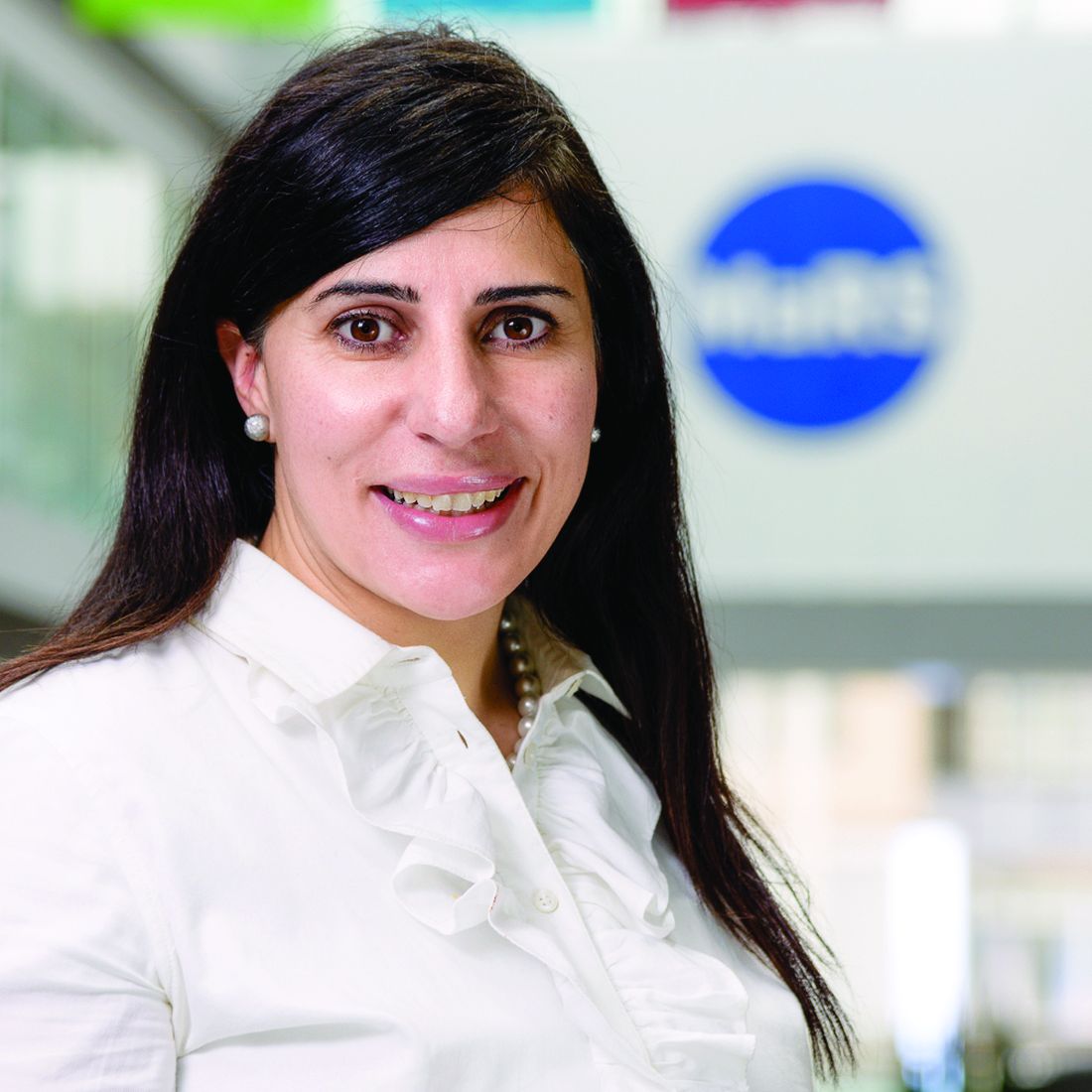
These are just .
At the annual meeting of the Society for Pediatric Dermatology, Zayna Khayat, PhD, said that the future of medicine is driven by six shifts pulling society from a past oriented around the health care system – the buildings, clinicians, and payers – to a patient-oriented perspective. “That doesn’t just happen on its own,” said Dr. Khayat, a future strategist at Toronto-based SE Health. “There are big forces that are pulling us to the future whether we want it to or not. One is that patients have woken up. They have grown to have power in many other complex decisions in their life, and they’re expecting no less from our health care system.”
During her presentation, she discussed the six shifts:
1. The timing of service placement. The traditional model of medicine is “an intermittent and interventional science that waits for the symptoms and goes in and either fixes or manages them,” she said. “So, it’s not really health care; it’s sick care. That’s been fine in the industrial era when we needed to get medicine to stop catastrophic events. Not only is it shifting to be proactive and preventative but it’s shifting to a new science of medicine called predictive medicine.”
As for proactive and preventative care, she continued, each patient’s choice of behaviors related to diet, exercise, and stress “mingles with DNA to produce health, yet we spend about 90% of our resources on sick care. Now, health systems are moving their resources to things like education, housing, transportation, food security, equity, and racial divides. ... This is trickling down to how we train health care professionals. We know that patients live very little of their time in formal care settings, so all of their health is created – or destroyed – well outside of the clinical setting. We train our health professionals mostly in a clinical setting. Health systems are now starting to reimagine how training happens so we can train people to understand the fully loaded context of their patients’ lives.”
2. A shift in precision. For all its advances and science breakthroughs, medicine “is still quite crude,” said Dr. Khayat, who is also an adjunct professor in the Rotman School of Management at the University of Toronto. “It’s very analog, based on a one-size-fits-all approach. In the business world, we call this a segment of one: the idea that in some clinical trial, a result was produced that was based on the average of everybody, and therefore we just give everybody what worked for the average. ... We don’t need to have that trade-off anymore, because it won’t be a trade-off of higher cost to tailor down to an N of 1. It will be highly personalized, intelligent medicine, very precise.”
3. A shift from institution-centered to person-centered care. “The artifacts that health care was built on are very analog and are going to get decentralized out of buildings, dephysicalized, disintermediated,” she predicted. “We’ll have a seamless digital physical experience, expanded channels through which patients can access their services. Pick a channel that makes sense for the patient and don’t let care follow the place but rather let care follow the person.”
4. A shift in care duration, from episodic and intermittent care to more continuous care. “With very little input you should know what’s going on at any point in time instead of time-sharing access to diagnostics and to clinicians,” Dr. Khayat said. Wrist-worn devices that gather personal omics “are now really democratized, with every aspect of a diagnostic clinic available within or connected to a smartphone. This allows for data to be gathered and shared with clinicians, including tools under the skin that can get some of the biochemical data in real time instead of poking and prodding and waiting for a diagnostic lab.” These devices, she said, will become easier to use, cheaper, and will work faster, and provide much better data “at almost zero cost.”
Technologies being developed include tattoos that can read biomarkers, innovations in clothing that can detect biochemical reactions in the skin, underwear that can read vital signs, and contact lenses that can measure glucose levels. “The skin will become a major noninvasive way to obtain information,” she said.
5. A shift in power from providers to patients. “It’s estimated that about 80% of health care decisions could be self-managed by people in their communities,” Dr. Khayat said.
6. A shift from volume-based to value-based care. “Because we’ve been obsessed with the system, we’ve paid for stuff like visits, pills, MRI scans, et cetera,” she said. “We don’t need to do that anymore. Health systems don’t want to keep paying for stuff if they don’t see the results. Because of all the other shifts, we can pay for results. Some call this value-based care. I call it fee-for-health.”
She noted that the future of medicine is underpinned by innovations in AI/predictalytics, voice recognition, virtual reality, blockchain, IoT sensors, 3D printing, omics, robotics, autonomous transport, neurotechnology, nanobiology, and cellular therapy. “They’re moving at a very fast pace because they don’t need the kind of cost, capital, and expertise that the previous tools did,” she said. “This is the promise that technology can bring.”
Dr. Khayat disclosed that she has been a workshop participant for Roche Canada.
Contact lenses that detect glucose in tears. Capsules embedded in clothes that can be used to counteract the risk of sensitive skin conditions.
These are just .
At the annual meeting of the Society for Pediatric Dermatology, Zayna Khayat, PhD, said that the future of medicine is driven by six shifts pulling society from a past oriented around the health care system – the buildings, clinicians, and payers – to a patient-oriented perspective. “That doesn’t just happen on its own,” said Dr. Khayat, a future strategist at Toronto-based SE Health. “There are big forces that are pulling us to the future whether we want it to or not. One is that patients have woken up. They have grown to have power in many other complex decisions in their life, and they’re expecting no less from our health care system.”
During her presentation, she discussed the six shifts:
1. The timing of service placement. The traditional model of medicine is “an intermittent and interventional science that waits for the symptoms and goes in and either fixes or manages them,” she said. “So, it’s not really health care; it’s sick care. That’s been fine in the industrial era when we needed to get medicine to stop catastrophic events. Not only is it shifting to be proactive and preventative but it’s shifting to a new science of medicine called predictive medicine.”
As for proactive and preventative care, she continued, each patient’s choice of behaviors related to diet, exercise, and stress “mingles with DNA to produce health, yet we spend about 90% of our resources on sick care. Now, health systems are moving their resources to things like education, housing, transportation, food security, equity, and racial divides. ... This is trickling down to how we train health care professionals. We know that patients live very little of their time in formal care settings, so all of their health is created – or destroyed – well outside of the clinical setting. We train our health professionals mostly in a clinical setting. Health systems are now starting to reimagine how training happens so we can train people to understand the fully loaded context of their patients’ lives.”
2. A shift in precision. For all its advances and science breakthroughs, medicine “is still quite crude,” said Dr. Khayat, who is also an adjunct professor in the Rotman School of Management at the University of Toronto. “It’s very analog, based on a one-size-fits-all approach. In the business world, we call this a segment of one: the idea that in some clinical trial, a result was produced that was based on the average of everybody, and therefore we just give everybody what worked for the average. ... We don’t need to have that trade-off anymore, because it won’t be a trade-off of higher cost to tailor down to an N of 1. It will be highly personalized, intelligent medicine, very precise.”
3. A shift from institution-centered to person-centered care. “The artifacts that health care was built on are very analog and are going to get decentralized out of buildings, dephysicalized, disintermediated,” she predicted. “We’ll have a seamless digital physical experience, expanded channels through which patients can access their services. Pick a channel that makes sense for the patient and don’t let care follow the place but rather let care follow the person.”
4. A shift in care duration, from episodic and intermittent care to more continuous care. “With very little input you should know what’s going on at any point in time instead of time-sharing access to diagnostics and to clinicians,” Dr. Khayat said. Wrist-worn devices that gather personal omics “are now really democratized, with every aspect of a diagnostic clinic available within or connected to a smartphone. This allows for data to be gathered and shared with clinicians, including tools under the skin that can get some of the biochemical data in real time instead of poking and prodding and waiting for a diagnostic lab.” These devices, she said, will become easier to use, cheaper, and will work faster, and provide much better data “at almost zero cost.”
Technologies being developed include tattoos that can read biomarkers, innovations in clothing that can detect biochemical reactions in the skin, underwear that can read vital signs, and contact lenses that can measure glucose levels. “The skin will become a major noninvasive way to obtain information,” she said.
5. A shift in power from providers to patients. “It’s estimated that about 80% of health care decisions could be self-managed by people in their communities,” Dr. Khayat said.
6. A shift from volume-based to value-based care. “Because we’ve been obsessed with the system, we’ve paid for stuff like visits, pills, MRI scans, et cetera,” she said. “We don’t need to do that anymore. Health systems don’t want to keep paying for stuff if they don’t see the results. Because of all the other shifts, we can pay for results. Some call this value-based care. I call it fee-for-health.”
She noted that the future of medicine is underpinned by innovations in AI/predictalytics, voice recognition, virtual reality, blockchain, IoT sensors, 3D printing, omics, robotics, autonomous transport, neurotechnology, nanobiology, and cellular therapy. “They’re moving at a very fast pace because they don’t need the kind of cost, capital, and expertise that the previous tools did,” she said. “This is the promise that technology can bring.”
Dr. Khayat disclosed that she has been a workshop participant for Roche Canada.
Contact lenses that detect glucose in tears. Capsules embedded in clothes that can be used to counteract the risk of sensitive skin conditions.
These are just .
At the annual meeting of the Society for Pediatric Dermatology, Zayna Khayat, PhD, said that the future of medicine is driven by six shifts pulling society from a past oriented around the health care system – the buildings, clinicians, and payers – to a patient-oriented perspective. “That doesn’t just happen on its own,” said Dr. Khayat, a future strategist at Toronto-based SE Health. “There are big forces that are pulling us to the future whether we want it to or not. One is that patients have woken up. They have grown to have power in many other complex decisions in their life, and they’re expecting no less from our health care system.”
During her presentation, she discussed the six shifts:
1. The timing of service placement. The traditional model of medicine is “an intermittent and interventional science that waits for the symptoms and goes in and either fixes or manages them,” she said. “So, it’s not really health care; it’s sick care. That’s been fine in the industrial era when we needed to get medicine to stop catastrophic events. Not only is it shifting to be proactive and preventative but it’s shifting to a new science of medicine called predictive medicine.”
As for proactive and preventative care, she continued, each patient’s choice of behaviors related to diet, exercise, and stress “mingles with DNA to produce health, yet we spend about 90% of our resources on sick care. Now, health systems are moving their resources to things like education, housing, transportation, food security, equity, and racial divides. ... This is trickling down to how we train health care professionals. We know that patients live very little of their time in formal care settings, so all of their health is created – or destroyed – well outside of the clinical setting. We train our health professionals mostly in a clinical setting. Health systems are now starting to reimagine how training happens so we can train people to understand the fully loaded context of their patients’ lives.”
2. A shift in precision. For all its advances and science breakthroughs, medicine “is still quite crude,” said Dr. Khayat, who is also an adjunct professor in the Rotman School of Management at the University of Toronto. “It’s very analog, based on a one-size-fits-all approach. In the business world, we call this a segment of one: the idea that in some clinical trial, a result was produced that was based on the average of everybody, and therefore we just give everybody what worked for the average. ... We don’t need to have that trade-off anymore, because it won’t be a trade-off of higher cost to tailor down to an N of 1. It will be highly personalized, intelligent medicine, very precise.”
3. A shift from institution-centered to person-centered care. “The artifacts that health care was built on are very analog and are going to get decentralized out of buildings, dephysicalized, disintermediated,” she predicted. “We’ll have a seamless digital physical experience, expanded channels through which patients can access their services. Pick a channel that makes sense for the patient and don’t let care follow the place but rather let care follow the person.”
4. A shift in care duration, from episodic and intermittent care to more continuous care. “With very little input you should know what’s going on at any point in time instead of time-sharing access to diagnostics and to clinicians,” Dr. Khayat said. Wrist-worn devices that gather personal omics “are now really democratized, with every aspect of a diagnostic clinic available within or connected to a smartphone. This allows for data to be gathered and shared with clinicians, including tools under the skin that can get some of the biochemical data in real time instead of poking and prodding and waiting for a diagnostic lab.” These devices, she said, will become easier to use, cheaper, and will work faster, and provide much better data “at almost zero cost.”
Technologies being developed include tattoos that can read biomarkers, innovations in clothing that can detect biochemical reactions in the skin, underwear that can read vital signs, and contact lenses that can measure glucose levels. “The skin will become a major noninvasive way to obtain information,” she said.
5. A shift in power from providers to patients. “It’s estimated that about 80% of health care decisions could be self-managed by people in their communities,” Dr. Khayat said.
6. A shift from volume-based to value-based care. “Because we’ve been obsessed with the system, we’ve paid for stuff like visits, pills, MRI scans, et cetera,” she said. “We don’t need to do that anymore. Health systems don’t want to keep paying for stuff if they don’t see the results. Because of all the other shifts, we can pay for results. Some call this value-based care. I call it fee-for-health.”
She noted that the future of medicine is underpinned by innovations in AI/predictalytics, voice recognition, virtual reality, blockchain, IoT sensors, 3D printing, omics, robotics, autonomous transport, neurotechnology, nanobiology, and cellular therapy. “They’re moving at a very fast pace because they don’t need the kind of cost, capital, and expertise that the previous tools did,” she said. “This is the promise that technology can bring.”
Dr. Khayat disclosed that she has been a workshop participant for Roche Canada.
FROM SPD 2021