User login
Hypofractionated radiotherapy: New normal for lung cancer?
The U.K.-based study showed that patients with stage I-III lung cancer who were set to undergo radiotherapy with curative intent were more likely to receive fewer fractions at higher doses when treated between April and October 2020. During that period, 19% of patients had their radiotherapy dose or fractionation schedule changed to deviate from standard care.
In addition, 8% of patients who were set to undergo surgery ultimately received radiotherapy instead, presumably to ease pressures on already struggling intensive care services, said Kathryn Banfill, MBChB, of Christie NHS Foundation Trust in Manchester, England.
Dr. Banfill presented results from the COVID-RT Lung study at the European Lung Cancer Virtual Congress 2021 (Abstract 203MO).
New guidelines prompt study
When the COVID-19 pandemic began, European and joint European and North American guidelines were issued to try to ensure that lung cancer patients would continue to receive the best possible treatment under the circumstances. This included guidance on how and when to use treatments such as radiotherapy.
One U.K. guideline included recommendations on the use of hypofractionation in the COVID-19 era. The recommendations focused on altering the dosage or length of radiotherapy treatments to try to reduce the number of hospital visits, thereby reducing the risk of exposing patients to SARS-CoV-2.
“The aim of these guidelines is very much to reduce the risk to patients,” Dr. Banfill said. “These patients are often at higher risk of serious COVID-19, both as a result of their cancer and also as a result of many of the coexisting medical conditions that they have, such as COPD [chronic obstructive pulmonary disease],” she explained.
The COVID-RT Lung study was essentially born out of these guidelines. The goals of the study were to see what changes to radiotherapy practice occurred as a result of the guidelines and to assess how the changes have affected patient outcomes.
Changes to diagnosis and treatment
COVID-RT Lung is an ongoing, prospective study of patients with biopsy- or imaging-proven stage I–III lung cancer who were referred for, or treated with, radical radiotherapy at one of 26 oncology centers in the United Kingdom between April and October 2020.
Records on 1,117 patients were available for the initial analysis. The patients’ median age was 72 years (range, 38-93 years), and half were women.
The records showed changes to diagnostic investigations in 14% of patients (n = 160). Changes included not obtaining histology (4.6%, n = 51), not conducting nodal sampling (3.1%, n = 35), not performing pulmonary function tests (1.8%, n = 20), not conducting brain imaging (2.9%, n = 32), not performing PET/CT scans or having out-of-date scans (4.2%, n = 47), and delays in diagnosis (0.6%, n = 7).
Changes to treatment – deviations from standard care – occurred in 37% of patients (n = 415). This included 19% of patients (n = 210) having changes to radiotherapy dose or fractionation schedule, 8% (n = 86) undergoing radiotherapy instead of surgery, and 13% (n = 143) having their chemotherapy omitted or reduced.
The median number of radiotherapy fractions was 15 for patients who had their radiotherapy adjusted and 20 for those who had no treatment amendments.
“Those who had their treatment changed were more likely to have hypofractionated or ultra-hypofractionated radiotherapy,” Dr. Banfill said.
This was particularly true for patients with early-stage disease, she noted, where there was an increase in the percentage of patients getting more than 15 Gy per fraction. Even in stage III disease, there was an increased use of 3–5 Gy per fraction, although “virtually nobody” who had a change in treatment received less than 2 Gy per fraction, Dr. Banfill said.
“The changes are in line with what was reported in international recommendations,” observed Yolande Lievens, MD, PhD, of Ghent University Hospital in Belgium, who discussed the findings at the meeting.
Few patients had COVID-19
“It was striking to me to see that so few patients developed COVID-19 prior to radiotherapy or during radiotherapy,” Dr. Lievens noted. “This is actually something that we’ve also experienced in our setting.”
Indeed, just 15 patients (1%) were diagnosed with COVID-19, 10 of whom were diagnosed before receiving radiotherapy.
Dr. Banfill observed that the COVID-19 diagnosis had been “a reasonable time” before the patients started radiotherapy, and some had been diagnosed with lung cancer as a result of having a chest x-ray for suspected COVID-19.
Of the four patients who were diagnosed during treatment, two had their radiotherapy interrupted as a result.
The low COVID-19 rate is perhaps a result of the protective measures recommended in the United Kingdom, such as advising patients to shield from others, Dr. Banfill said.
Are changes to practice likely to hold?
“Part of the reason we actually stopped the data collection in October was that people were starting to go, ‘Well, is this actually a change?’ because they’d been doing it for 6 months,” Dr. Banfill observed during the discussion session.
“It was becoming almost normal for some of these hypofractionated changes. I think there is potential for these to become more embedded going forward,” she said. Data on how these changes might affect patients in the long term is going to be the focus of a future analysis.
“There is ongoing data collection on recurrence and survival and toxicity, which will hopefully provide more information on the outcomes of this patient group,” Dr. Banfill said.
The COVID-RT Lung project is supported by the NIHR Manchester Biomedical Research Centre. Dr. Banfill and Dr. Lievens reported no relevant conflicts of interest.
The U.K.-based study showed that patients with stage I-III lung cancer who were set to undergo radiotherapy with curative intent were more likely to receive fewer fractions at higher doses when treated between April and October 2020. During that period, 19% of patients had their radiotherapy dose or fractionation schedule changed to deviate from standard care.
In addition, 8% of patients who were set to undergo surgery ultimately received radiotherapy instead, presumably to ease pressures on already struggling intensive care services, said Kathryn Banfill, MBChB, of Christie NHS Foundation Trust in Manchester, England.
Dr. Banfill presented results from the COVID-RT Lung study at the European Lung Cancer Virtual Congress 2021 (Abstract 203MO).
New guidelines prompt study
When the COVID-19 pandemic began, European and joint European and North American guidelines were issued to try to ensure that lung cancer patients would continue to receive the best possible treatment under the circumstances. This included guidance on how and when to use treatments such as radiotherapy.
One U.K. guideline included recommendations on the use of hypofractionation in the COVID-19 era. The recommendations focused on altering the dosage or length of radiotherapy treatments to try to reduce the number of hospital visits, thereby reducing the risk of exposing patients to SARS-CoV-2.
“The aim of these guidelines is very much to reduce the risk to patients,” Dr. Banfill said. “These patients are often at higher risk of serious COVID-19, both as a result of their cancer and also as a result of many of the coexisting medical conditions that they have, such as COPD [chronic obstructive pulmonary disease],” she explained.
The COVID-RT Lung study was essentially born out of these guidelines. The goals of the study were to see what changes to radiotherapy practice occurred as a result of the guidelines and to assess how the changes have affected patient outcomes.
Changes to diagnosis and treatment
COVID-RT Lung is an ongoing, prospective study of patients with biopsy- or imaging-proven stage I–III lung cancer who were referred for, or treated with, radical radiotherapy at one of 26 oncology centers in the United Kingdom between April and October 2020.
Records on 1,117 patients were available for the initial analysis. The patients’ median age was 72 years (range, 38-93 years), and half were women.
The records showed changes to diagnostic investigations in 14% of patients (n = 160). Changes included not obtaining histology (4.6%, n = 51), not conducting nodal sampling (3.1%, n = 35), not performing pulmonary function tests (1.8%, n = 20), not conducting brain imaging (2.9%, n = 32), not performing PET/CT scans or having out-of-date scans (4.2%, n = 47), and delays in diagnosis (0.6%, n = 7).
Changes to treatment – deviations from standard care – occurred in 37% of patients (n = 415). This included 19% of patients (n = 210) having changes to radiotherapy dose or fractionation schedule, 8% (n = 86) undergoing radiotherapy instead of surgery, and 13% (n = 143) having their chemotherapy omitted or reduced.
The median number of radiotherapy fractions was 15 for patients who had their radiotherapy adjusted and 20 for those who had no treatment amendments.
“Those who had their treatment changed were more likely to have hypofractionated or ultra-hypofractionated radiotherapy,” Dr. Banfill said.
This was particularly true for patients with early-stage disease, she noted, where there was an increase in the percentage of patients getting more than 15 Gy per fraction. Even in stage III disease, there was an increased use of 3–5 Gy per fraction, although “virtually nobody” who had a change in treatment received less than 2 Gy per fraction, Dr. Banfill said.
“The changes are in line with what was reported in international recommendations,” observed Yolande Lievens, MD, PhD, of Ghent University Hospital in Belgium, who discussed the findings at the meeting.
Few patients had COVID-19
“It was striking to me to see that so few patients developed COVID-19 prior to radiotherapy or during radiotherapy,” Dr. Lievens noted. “This is actually something that we’ve also experienced in our setting.”
Indeed, just 15 patients (1%) were diagnosed with COVID-19, 10 of whom were diagnosed before receiving radiotherapy.
Dr. Banfill observed that the COVID-19 diagnosis had been “a reasonable time” before the patients started radiotherapy, and some had been diagnosed with lung cancer as a result of having a chest x-ray for suspected COVID-19.
Of the four patients who were diagnosed during treatment, two had their radiotherapy interrupted as a result.
The low COVID-19 rate is perhaps a result of the protective measures recommended in the United Kingdom, such as advising patients to shield from others, Dr. Banfill said.
Are changes to practice likely to hold?
“Part of the reason we actually stopped the data collection in October was that people were starting to go, ‘Well, is this actually a change?’ because they’d been doing it for 6 months,” Dr. Banfill observed during the discussion session.
“It was becoming almost normal for some of these hypofractionated changes. I think there is potential for these to become more embedded going forward,” she said. Data on how these changes might affect patients in the long term is going to be the focus of a future analysis.
“There is ongoing data collection on recurrence and survival and toxicity, which will hopefully provide more information on the outcomes of this patient group,” Dr. Banfill said.
The COVID-RT Lung project is supported by the NIHR Manchester Biomedical Research Centre. Dr. Banfill and Dr. Lievens reported no relevant conflicts of interest.
The U.K.-based study showed that patients with stage I-III lung cancer who were set to undergo radiotherapy with curative intent were more likely to receive fewer fractions at higher doses when treated between April and October 2020. During that period, 19% of patients had their radiotherapy dose or fractionation schedule changed to deviate from standard care.
In addition, 8% of patients who were set to undergo surgery ultimately received radiotherapy instead, presumably to ease pressures on already struggling intensive care services, said Kathryn Banfill, MBChB, of Christie NHS Foundation Trust in Manchester, England.
Dr. Banfill presented results from the COVID-RT Lung study at the European Lung Cancer Virtual Congress 2021 (Abstract 203MO).
New guidelines prompt study
When the COVID-19 pandemic began, European and joint European and North American guidelines were issued to try to ensure that lung cancer patients would continue to receive the best possible treatment under the circumstances. This included guidance on how and when to use treatments such as radiotherapy.
One U.K. guideline included recommendations on the use of hypofractionation in the COVID-19 era. The recommendations focused on altering the dosage or length of radiotherapy treatments to try to reduce the number of hospital visits, thereby reducing the risk of exposing patients to SARS-CoV-2.
“The aim of these guidelines is very much to reduce the risk to patients,” Dr. Banfill said. “These patients are often at higher risk of serious COVID-19, both as a result of their cancer and also as a result of many of the coexisting medical conditions that they have, such as COPD [chronic obstructive pulmonary disease],” she explained.
The COVID-RT Lung study was essentially born out of these guidelines. The goals of the study were to see what changes to radiotherapy practice occurred as a result of the guidelines and to assess how the changes have affected patient outcomes.
Changes to diagnosis and treatment
COVID-RT Lung is an ongoing, prospective study of patients with biopsy- or imaging-proven stage I–III lung cancer who were referred for, or treated with, radical radiotherapy at one of 26 oncology centers in the United Kingdom between April and October 2020.
Records on 1,117 patients were available for the initial analysis. The patients’ median age was 72 years (range, 38-93 years), and half were women.
The records showed changes to diagnostic investigations in 14% of patients (n = 160). Changes included not obtaining histology (4.6%, n = 51), not conducting nodal sampling (3.1%, n = 35), not performing pulmonary function tests (1.8%, n = 20), not conducting brain imaging (2.9%, n = 32), not performing PET/CT scans or having out-of-date scans (4.2%, n = 47), and delays in diagnosis (0.6%, n = 7).
Changes to treatment – deviations from standard care – occurred in 37% of patients (n = 415). This included 19% of patients (n = 210) having changes to radiotherapy dose or fractionation schedule, 8% (n = 86) undergoing radiotherapy instead of surgery, and 13% (n = 143) having their chemotherapy omitted or reduced.
The median number of radiotherapy fractions was 15 for patients who had their radiotherapy adjusted and 20 for those who had no treatment amendments.
“Those who had their treatment changed were more likely to have hypofractionated or ultra-hypofractionated radiotherapy,” Dr. Banfill said.
This was particularly true for patients with early-stage disease, she noted, where there was an increase in the percentage of patients getting more than 15 Gy per fraction. Even in stage III disease, there was an increased use of 3–5 Gy per fraction, although “virtually nobody” who had a change in treatment received less than 2 Gy per fraction, Dr. Banfill said.
“The changes are in line with what was reported in international recommendations,” observed Yolande Lievens, MD, PhD, of Ghent University Hospital in Belgium, who discussed the findings at the meeting.
Few patients had COVID-19
“It was striking to me to see that so few patients developed COVID-19 prior to radiotherapy or during radiotherapy,” Dr. Lievens noted. “This is actually something that we’ve also experienced in our setting.”
Indeed, just 15 patients (1%) were diagnosed with COVID-19, 10 of whom were diagnosed before receiving radiotherapy.
Dr. Banfill observed that the COVID-19 diagnosis had been “a reasonable time” before the patients started radiotherapy, and some had been diagnosed with lung cancer as a result of having a chest x-ray for suspected COVID-19.
Of the four patients who were diagnosed during treatment, two had their radiotherapy interrupted as a result.
The low COVID-19 rate is perhaps a result of the protective measures recommended in the United Kingdom, such as advising patients to shield from others, Dr. Banfill said.
Are changes to practice likely to hold?
“Part of the reason we actually stopped the data collection in October was that people were starting to go, ‘Well, is this actually a change?’ because they’d been doing it for 6 months,” Dr. Banfill observed during the discussion session.
“It was becoming almost normal for some of these hypofractionated changes. I think there is potential for these to become more embedded going forward,” she said. Data on how these changes might affect patients in the long term is going to be the focus of a future analysis.
“There is ongoing data collection on recurrence and survival and toxicity, which will hopefully provide more information on the outcomes of this patient group,” Dr. Banfill said.
The COVID-RT Lung project is supported by the NIHR Manchester Biomedical Research Centre. Dr. Banfill and Dr. Lievens reported no relevant conflicts of interest.
FROM ELCC 2021
List of COVID-19 high-risk comorbidities expanded
The list of medical according to the Centers for Disease Control and Prevention.
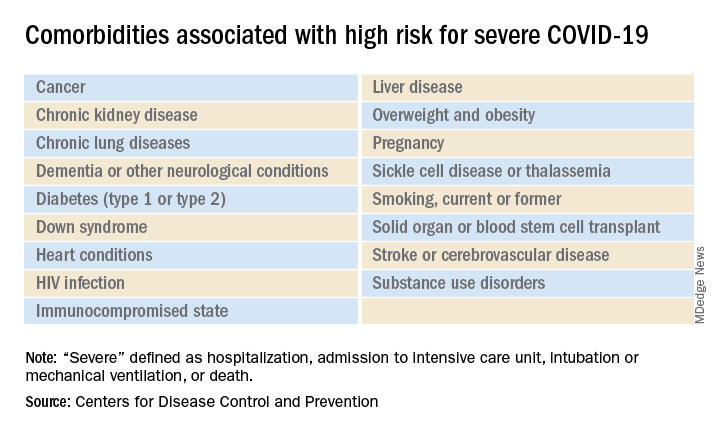
The CDC’s latest list consists of 17 conditions or groups of related conditions that may increase patients’ risk of developing severe outcomes of COVID-19, the CDC said on a web page intended for the general public.
On a separate page, the CDC defines severe outcomes “as hospitalization, admission to the intensive care unit, intubation or mechanical ventilation, or death.”
Asthma is included in the newly expanded list with other chronic lung diseases such as chronic obstructive pulmonary disease and cystic fibrosis; the list’s heart disease entry covers coronary artery disease, heart failure, cardiomyopathies, and hypertension, the CDC said.
The list of medical according to the Centers for Disease Control and Prevention.
The CDC’s latest list consists of 17 conditions or groups of related conditions that may increase patients’ risk of developing severe outcomes of COVID-19, the CDC said on a web page intended for the general public.
On a separate page, the CDC defines severe outcomes “as hospitalization, admission to the intensive care unit, intubation or mechanical ventilation, or death.”
Asthma is included in the newly expanded list with other chronic lung diseases such as chronic obstructive pulmonary disease and cystic fibrosis; the list’s heart disease entry covers coronary artery disease, heart failure, cardiomyopathies, and hypertension, the CDC said.
The list of medical according to the Centers for Disease Control and Prevention.
The CDC’s latest list consists of 17 conditions or groups of related conditions that may increase patients’ risk of developing severe outcomes of COVID-19, the CDC said on a web page intended for the general public.
On a separate page, the CDC defines severe outcomes “as hospitalization, admission to the intensive care unit, intubation or mechanical ventilation, or death.”
Asthma is included in the newly expanded list with other chronic lung diseases such as chronic obstructive pulmonary disease and cystic fibrosis; the list’s heart disease entry covers coronary artery disease, heart failure, cardiomyopathies, and hypertension, the CDC said.
Technique combines ‘best of both worlds’ to target lung nodules
The technique – bronchoscopic transbronchial microwave ablation – had a 100% technical success rate and produced low rates of complications in a single-center study.
“We combined the best of both worlds [for this] technique,” said investigator Joyce Chan, MBBS, of Prince of Wales Hospital in Hong Kong, when describing the method at the European Lung Cancer Virtual Congress 2021 (Abstract 64MO).
Dr. Chan explained that microwave ablation of lung nodules is faster and produces larger ablation zones, compared with radiofrequency ablation, and bronchoscopic ablation is thought to produce fewer pleural-based complications than percutaneous ablation.
Bronchoscopic transbronchial microwave ablation is performed in a hybrid operating room. First, the patient is intubated and anesthetized. Then, electromagnetic navigation bronchoscopy is used to zero in on the lung nodule, which is punctured by a microwave catheter. Cone-beam CT is used to confirm the location of the catheter.
“Next, we connect the system externally to a console, and then we just press the button to microwave it, just like what you do to food,” Dr. Chan explained.
Ablation takes about 10 minutes, and another CT is done to assess success. Ground-glass opacities are seen in the ablated area.
Study results
Dr. Chan and colleagues performed a retrospective analysis of 36 patients who underwent bronchoscopic transbronchial microwave ablation between March 2019 and December 2020.
The patients were unfit for or unwilling to undergo surgical resection. They had to have stage 1a lung cancers, isolated lung oligometastases, or radiologically suspicious lesions. The nodules had to be less than 3 cm in size, preferably with a bronchus leading directly to the lesion.
The patients had a mean age of 68 years. Their lesions had a mean maximal diameter of 15.2 mm, and 68% were in the peripheral one-third of the lung.
In all, 44 nodules were treated with bronchoscopic transbronchial microwave ablation. The technical success rate was 100%, although eight nodules required double ablation.
The majority of patients (95%) were discharged within 3 days, with 77% discharged on day 1. Complications included mild pain (15.9%), pneumothorax (9.1%), fever/ablation reaction (4.5%), self-limiting hemoptysis (2.3%), and bronchopleural fistula (2.3%).
The ablation zone volume decreased “rapidly” in the first 6-9 months, then leveled off, Dr. Chan noted.
In the 16 nodules with 1 year of follow-up, there were 2 complete responses, 13 partial responses, and no progressions.
It’s too soon to know if the recurrence rate will be lower than the up to 30% recurrence rate with percutaneous microwave ablation, and it’s too soon to know if, without transpleural puncture, the risk of tumor seeding is lower, Dr. Chan said.
“This presentation ... is extremely important,” said invited discussant John Edwards, MBChB, PhD, of Sheffield (England) Teaching Hospitals National Health Service Foundation Trust. “There is a great novelty value in the combination. The complications and the radiologic response rates were quite acceptable.”
The research was funded by the University Grants Committee in Hong Kong. Dr. Chan reported having no disclosures. Her colleagues disclosed relationships with Medtronic, Siemens Healthineers, and Johnson & Johnson. Dr. Edwards disclosed relationships with AstraZeneca, Zimmer Biomet, Stryker Leibinger, Pacific Biosciences, BioNano Genomics, Argenx, and Moderna.
The technique – bronchoscopic transbronchial microwave ablation – had a 100% technical success rate and produced low rates of complications in a single-center study.
“We combined the best of both worlds [for this] technique,” said investigator Joyce Chan, MBBS, of Prince of Wales Hospital in Hong Kong, when describing the method at the European Lung Cancer Virtual Congress 2021 (Abstract 64MO).
Dr. Chan explained that microwave ablation of lung nodules is faster and produces larger ablation zones, compared with radiofrequency ablation, and bronchoscopic ablation is thought to produce fewer pleural-based complications than percutaneous ablation.
Bronchoscopic transbronchial microwave ablation is performed in a hybrid operating room. First, the patient is intubated and anesthetized. Then, electromagnetic navigation bronchoscopy is used to zero in on the lung nodule, which is punctured by a microwave catheter. Cone-beam CT is used to confirm the location of the catheter.
“Next, we connect the system externally to a console, and then we just press the button to microwave it, just like what you do to food,” Dr. Chan explained.
Ablation takes about 10 minutes, and another CT is done to assess success. Ground-glass opacities are seen in the ablated area.
Study results
Dr. Chan and colleagues performed a retrospective analysis of 36 patients who underwent bronchoscopic transbronchial microwave ablation between March 2019 and December 2020.
The patients were unfit for or unwilling to undergo surgical resection. They had to have stage 1a lung cancers, isolated lung oligometastases, or radiologically suspicious lesions. The nodules had to be less than 3 cm in size, preferably with a bronchus leading directly to the lesion.
The patients had a mean age of 68 years. Their lesions had a mean maximal diameter of 15.2 mm, and 68% were in the peripheral one-third of the lung.
In all, 44 nodules were treated with bronchoscopic transbronchial microwave ablation. The technical success rate was 100%, although eight nodules required double ablation.
The majority of patients (95%) were discharged within 3 days, with 77% discharged on day 1. Complications included mild pain (15.9%), pneumothorax (9.1%), fever/ablation reaction (4.5%), self-limiting hemoptysis (2.3%), and bronchopleural fistula (2.3%).
The ablation zone volume decreased “rapidly” in the first 6-9 months, then leveled off, Dr. Chan noted.
In the 16 nodules with 1 year of follow-up, there were 2 complete responses, 13 partial responses, and no progressions.
It’s too soon to know if the recurrence rate will be lower than the up to 30% recurrence rate with percutaneous microwave ablation, and it’s too soon to know if, without transpleural puncture, the risk of tumor seeding is lower, Dr. Chan said.
“This presentation ... is extremely important,” said invited discussant John Edwards, MBChB, PhD, of Sheffield (England) Teaching Hospitals National Health Service Foundation Trust. “There is a great novelty value in the combination. The complications and the radiologic response rates were quite acceptable.”
The research was funded by the University Grants Committee in Hong Kong. Dr. Chan reported having no disclosures. Her colleagues disclosed relationships with Medtronic, Siemens Healthineers, and Johnson & Johnson. Dr. Edwards disclosed relationships with AstraZeneca, Zimmer Biomet, Stryker Leibinger, Pacific Biosciences, BioNano Genomics, Argenx, and Moderna.
The technique – bronchoscopic transbronchial microwave ablation – had a 100% technical success rate and produced low rates of complications in a single-center study.
“We combined the best of both worlds [for this] technique,” said investigator Joyce Chan, MBBS, of Prince of Wales Hospital in Hong Kong, when describing the method at the European Lung Cancer Virtual Congress 2021 (Abstract 64MO).
Dr. Chan explained that microwave ablation of lung nodules is faster and produces larger ablation zones, compared with radiofrequency ablation, and bronchoscopic ablation is thought to produce fewer pleural-based complications than percutaneous ablation.
Bronchoscopic transbronchial microwave ablation is performed in a hybrid operating room. First, the patient is intubated and anesthetized. Then, electromagnetic navigation bronchoscopy is used to zero in on the lung nodule, which is punctured by a microwave catheter. Cone-beam CT is used to confirm the location of the catheter.
“Next, we connect the system externally to a console, and then we just press the button to microwave it, just like what you do to food,” Dr. Chan explained.
Ablation takes about 10 minutes, and another CT is done to assess success. Ground-glass opacities are seen in the ablated area.
Study results
Dr. Chan and colleagues performed a retrospective analysis of 36 patients who underwent bronchoscopic transbronchial microwave ablation between March 2019 and December 2020.
The patients were unfit for or unwilling to undergo surgical resection. They had to have stage 1a lung cancers, isolated lung oligometastases, or radiologically suspicious lesions. The nodules had to be less than 3 cm in size, preferably with a bronchus leading directly to the lesion.
The patients had a mean age of 68 years. Their lesions had a mean maximal diameter of 15.2 mm, and 68% were in the peripheral one-third of the lung.
In all, 44 nodules were treated with bronchoscopic transbronchial microwave ablation. The technical success rate was 100%, although eight nodules required double ablation.
The majority of patients (95%) were discharged within 3 days, with 77% discharged on day 1. Complications included mild pain (15.9%), pneumothorax (9.1%), fever/ablation reaction (4.5%), self-limiting hemoptysis (2.3%), and bronchopleural fistula (2.3%).
The ablation zone volume decreased “rapidly” in the first 6-9 months, then leveled off, Dr. Chan noted.
In the 16 nodules with 1 year of follow-up, there were 2 complete responses, 13 partial responses, and no progressions.
It’s too soon to know if the recurrence rate will be lower than the up to 30% recurrence rate with percutaneous microwave ablation, and it’s too soon to know if, without transpleural puncture, the risk of tumor seeding is lower, Dr. Chan said.
“This presentation ... is extremely important,” said invited discussant John Edwards, MBChB, PhD, of Sheffield (England) Teaching Hospitals National Health Service Foundation Trust. “There is a great novelty value in the combination. The complications and the radiologic response rates were quite acceptable.”
The research was funded by the University Grants Committee in Hong Kong. Dr. Chan reported having no disclosures. Her colleagues disclosed relationships with Medtronic, Siemens Healthineers, and Johnson & Johnson. Dr. Edwards disclosed relationships with AstraZeneca, Zimmer Biomet, Stryker Leibinger, Pacific Biosciences, BioNano Genomics, Argenx, and Moderna.
FROM ELCC 2021
Camrelizumab ‘another brick in the wall’ against squamous NSCLC
.
Results of the CAMEL-sq trial showed a progression-free survival (PFS) advantage of 3.6 months with camrelizumab plus chemotherapy, compared with chemotherapy plus placebo (P < .0001). The median overall survival (OS) was not reached in the camrelizumab arm, but it was significantly better than in the placebo arm (P < .0001).
Camrelizumab plus chemotherapy is already a standard of care in China for patients with advanced nonsquamous NSCLC who are negative for EGFR and ALK mutations, study investigator Caicun Zhou, MD, PhD, said when presenting the CAMEL-sq results at the European Lung Cancer Virtual Congress 2021 (Abstract 96O).
The CAMEL-sq findings now support the combination as a “standard first-line treatment for advanced squamous NSCLC,” said Dr. Zhou of Shanghai Pulmonary Hospital and Tongji University.
“The study has kind of changed our daily practice,” he said. “I do think we will have the label, camrelizumab plus chemo as first-line treatment for squamous [NSCLC] in China, maybe in a couple of months.”
“Camrelizumab will most likely be another brick in the wall for our Chinese patients and colleagues to use for patients with squamous histology, non–small cell lung cancer in addition to pembrolizumab,” said Julie Renee Brahmer, MD, of Johns Hopkins Medicine in Baltimore, who was the invited discussant for the trial.
Dr. Brahmer noted that the PFS hazard ratio in this trial – 0.37 – was “impressive.”
Patients and treatment
CAMEL-sq is a phase 3, double-blind, multicenter trial. The 390 patients enrolled had pathologically-confirmed stage IIIB or IV squamous NSCLC, and they had not received any prior treatment.
Patients received four to six cycles of chemotherapy, consisting of carboplatin and paclitaxel given every 3 weeks. Camrelizumab was added to one arm at a dose of 200 mg, and placebo was added to the other.
This was followed by a maintenance phase in which patients remained on active treatment with camrelizumab or placebo for up to 2 years. Patients in the placebo arm could cross over to camrelizumab at progression.
The median age of patients was similar in the camrelizumab and placebo arms (64 years and 62 years, respectively). The majority of study subjects in both arms were men (more than 90%), had a history of smoking (more than 80%), and had stage IV disease (more than 70%).
Efficacy and safety
The median PFS was 8.5 months in the camrelizumab arm and 4.9 months in the placebo arm (HR, 0.37; P < .0001). The median OS was not reached in the camrelizumab arm and was 14.5 months in the placebo arm (HR, 0.55, P < .0001).
The survival benefits were observed in spite of a crossover rate of 46.9%, Dr. Zhou noted.
Furthermore, survival benefits were consistent across all the subgroups tested. Regardless of age, sex, performance status, smoking history, disease stage, presence of liver or brain metastases, or PD-L1 expression, there was an apparent advantage of camrelizumab over placebo.
The objective response rate was higher in the camrelizumab arm than in the placebo arm, at 64.8% and 36.7%, respectively (P < .0001).
The clinical response seen with camrelizumab was “robust and durable,” Dr. Zhou said. Indeed, the duration of response was 13.1 months in the camrelizumab arm and 4.4 months in the placebo arm.
Grade 3/4 treatment-related adverse events (AEs) were reported in a similar percentage of camrelizumab- or placebo-treated patients (73.6% and 71.4%, respectively). However, “the majority of treatment-related adverse effects were chemotherapy related,” Dr. Zhou pointed out. This included decreased total white blood cell, neutrophil, red blood cell, and platelet counts as well as alopecia and increased liver enzymes.
Immune-related AEs occurred in 76.7% of patients in the camrelizumab arm and 20.4% of those in the placebo arm.
“The majority of immune-related adverse events were grade 1 or grade 2; easily manageable in our daily practice,” Dr. Zhou noted.
Putting CAMEL-sq into perspective
Data from other trials of immunotherapy-chemotherapy combinations in squamous NSCLC have been presented recently but with less impressive results, Dr. Brahmer said.
In one trial – ORIENT-12 – sintilimab was combined with gemcitabine and cisplatin (ESMO 2020, Abstract LBA56). The median PFS, per investigators, was 5.5 months with sintilimab and 4.9 months without it, both of which are lower than the 8.5 months seen with camrelizumab plus chemotherapy in the CAMEL-sq trial.
Another trial is KEYNOTE-407, in which patients received pembrolizumab or placebo plus a carboplatin-paclitaxel (or nab-paclitaxel) regimen. Three-year follow-up data from the trial were presented at ELCC 2021 (Abstract 97O). Continued improvements in second PFS (HR, 0.59) and OS (HR, 0.71) were observed with pembrolizumab-chemotherapy versus placebo-chemotherapy.
“We have to remember the high PD-L1-negative disease rate in the CAMEL-sq study, compared to the KEYNOTE-407 rate,” before stacking the two studies against each other, Dr. Brahmer noted. In KEYNOTE-407, almost 35% of patients had PD-L1 expression of less than 1%, compared with nearly 50% in the CAMEL-sq study.
That aside, “very similar impressive 1-year progression-free survival rates are seen on both studies,” Dr. Brahmer said. “I hope that camrelizumab has continued follow-up so we can see how these patients will do long-term.
“My eyebrows were raised a little bit at the camrelizumab immune-related AE rate of almost 76%, compared to the immune-related AE rate of about 36% in the KEYNOTE-407 study,” Dr. Brahmer said.
She noted, however, that almost two-thirds of the immune-related AEs in CAMEL-sq were due to reactive cutaneous capillary endothelial proliferation, which doesn’t appear to have been previously reported with PD-1 or PD-L1 inhibitors. This is a side effect seen in studies of liver cancer and may be linked to PFS, Dr. Brahmer said.
CAMEL-sq is funded by Jiangsu Hengrui Medicine Co. Ltd. Dr. Zhou disclosed honoraria from multiple pharmaceutical companies, including the study sponsor. Two of Dr. Zhou’s coauthors are employees of the company. Dr. Brahmer disclosed relationships with Amgen, Bristol Myers Squibb, Eli Lily, GlaxoSmithKline, Merck, Sanofi, Easi, AstraZeneca, Genentech, Regeneron, and RAPT Therapeutics Inc.
.
Results of the CAMEL-sq trial showed a progression-free survival (PFS) advantage of 3.6 months with camrelizumab plus chemotherapy, compared with chemotherapy plus placebo (P < .0001). The median overall survival (OS) was not reached in the camrelizumab arm, but it was significantly better than in the placebo arm (P < .0001).
Camrelizumab plus chemotherapy is already a standard of care in China for patients with advanced nonsquamous NSCLC who are negative for EGFR and ALK mutations, study investigator Caicun Zhou, MD, PhD, said when presenting the CAMEL-sq results at the European Lung Cancer Virtual Congress 2021 (Abstract 96O).
The CAMEL-sq findings now support the combination as a “standard first-line treatment for advanced squamous NSCLC,” said Dr. Zhou of Shanghai Pulmonary Hospital and Tongji University.
“The study has kind of changed our daily practice,” he said. “I do think we will have the label, camrelizumab plus chemo as first-line treatment for squamous [NSCLC] in China, maybe in a couple of months.”
“Camrelizumab will most likely be another brick in the wall for our Chinese patients and colleagues to use for patients with squamous histology, non–small cell lung cancer in addition to pembrolizumab,” said Julie Renee Brahmer, MD, of Johns Hopkins Medicine in Baltimore, who was the invited discussant for the trial.
Dr. Brahmer noted that the PFS hazard ratio in this trial – 0.37 – was “impressive.”
Patients and treatment
CAMEL-sq is a phase 3, double-blind, multicenter trial. The 390 patients enrolled had pathologically-confirmed stage IIIB or IV squamous NSCLC, and they had not received any prior treatment.
Patients received four to six cycles of chemotherapy, consisting of carboplatin and paclitaxel given every 3 weeks. Camrelizumab was added to one arm at a dose of 200 mg, and placebo was added to the other.
This was followed by a maintenance phase in which patients remained on active treatment with camrelizumab or placebo for up to 2 years. Patients in the placebo arm could cross over to camrelizumab at progression.
The median age of patients was similar in the camrelizumab and placebo arms (64 years and 62 years, respectively). The majority of study subjects in both arms were men (more than 90%), had a history of smoking (more than 80%), and had stage IV disease (more than 70%).
Efficacy and safety
The median PFS was 8.5 months in the camrelizumab arm and 4.9 months in the placebo arm (HR, 0.37; P < .0001). The median OS was not reached in the camrelizumab arm and was 14.5 months in the placebo arm (HR, 0.55, P < .0001).
The survival benefits were observed in spite of a crossover rate of 46.9%, Dr. Zhou noted.
Furthermore, survival benefits were consistent across all the subgroups tested. Regardless of age, sex, performance status, smoking history, disease stage, presence of liver or brain metastases, or PD-L1 expression, there was an apparent advantage of camrelizumab over placebo.
The objective response rate was higher in the camrelizumab arm than in the placebo arm, at 64.8% and 36.7%, respectively (P < .0001).
The clinical response seen with camrelizumab was “robust and durable,” Dr. Zhou said. Indeed, the duration of response was 13.1 months in the camrelizumab arm and 4.4 months in the placebo arm.
Grade 3/4 treatment-related adverse events (AEs) were reported in a similar percentage of camrelizumab- or placebo-treated patients (73.6% and 71.4%, respectively). However, “the majority of treatment-related adverse effects were chemotherapy related,” Dr. Zhou pointed out. This included decreased total white blood cell, neutrophil, red blood cell, and platelet counts as well as alopecia and increased liver enzymes.
Immune-related AEs occurred in 76.7% of patients in the camrelizumab arm and 20.4% of those in the placebo arm.
“The majority of immune-related adverse events were grade 1 or grade 2; easily manageable in our daily practice,” Dr. Zhou noted.
Putting CAMEL-sq into perspective
Data from other trials of immunotherapy-chemotherapy combinations in squamous NSCLC have been presented recently but with less impressive results, Dr. Brahmer said.
In one trial – ORIENT-12 – sintilimab was combined with gemcitabine and cisplatin (ESMO 2020, Abstract LBA56). The median PFS, per investigators, was 5.5 months with sintilimab and 4.9 months without it, both of which are lower than the 8.5 months seen with camrelizumab plus chemotherapy in the CAMEL-sq trial.
Another trial is KEYNOTE-407, in which patients received pembrolizumab or placebo plus a carboplatin-paclitaxel (or nab-paclitaxel) regimen. Three-year follow-up data from the trial were presented at ELCC 2021 (Abstract 97O). Continued improvements in second PFS (HR, 0.59) and OS (HR, 0.71) were observed with pembrolizumab-chemotherapy versus placebo-chemotherapy.
“We have to remember the high PD-L1-negative disease rate in the CAMEL-sq study, compared to the KEYNOTE-407 rate,” before stacking the two studies against each other, Dr. Brahmer noted. In KEYNOTE-407, almost 35% of patients had PD-L1 expression of less than 1%, compared with nearly 50% in the CAMEL-sq study.
That aside, “very similar impressive 1-year progression-free survival rates are seen on both studies,” Dr. Brahmer said. “I hope that camrelizumab has continued follow-up so we can see how these patients will do long-term.
“My eyebrows were raised a little bit at the camrelizumab immune-related AE rate of almost 76%, compared to the immune-related AE rate of about 36% in the KEYNOTE-407 study,” Dr. Brahmer said.
She noted, however, that almost two-thirds of the immune-related AEs in CAMEL-sq were due to reactive cutaneous capillary endothelial proliferation, which doesn’t appear to have been previously reported with PD-1 or PD-L1 inhibitors. This is a side effect seen in studies of liver cancer and may be linked to PFS, Dr. Brahmer said.
CAMEL-sq is funded by Jiangsu Hengrui Medicine Co. Ltd. Dr. Zhou disclosed honoraria from multiple pharmaceutical companies, including the study sponsor. Two of Dr. Zhou’s coauthors are employees of the company. Dr. Brahmer disclosed relationships with Amgen, Bristol Myers Squibb, Eli Lily, GlaxoSmithKline, Merck, Sanofi, Easi, AstraZeneca, Genentech, Regeneron, and RAPT Therapeutics Inc.
.
Results of the CAMEL-sq trial showed a progression-free survival (PFS) advantage of 3.6 months with camrelizumab plus chemotherapy, compared with chemotherapy plus placebo (P < .0001). The median overall survival (OS) was not reached in the camrelizumab arm, but it was significantly better than in the placebo arm (P < .0001).
Camrelizumab plus chemotherapy is already a standard of care in China for patients with advanced nonsquamous NSCLC who are negative for EGFR and ALK mutations, study investigator Caicun Zhou, MD, PhD, said when presenting the CAMEL-sq results at the European Lung Cancer Virtual Congress 2021 (Abstract 96O).
The CAMEL-sq findings now support the combination as a “standard first-line treatment for advanced squamous NSCLC,” said Dr. Zhou of Shanghai Pulmonary Hospital and Tongji University.
“The study has kind of changed our daily practice,” he said. “I do think we will have the label, camrelizumab plus chemo as first-line treatment for squamous [NSCLC] in China, maybe in a couple of months.”
“Camrelizumab will most likely be another brick in the wall for our Chinese patients and colleagues to use for patients with squamous histology, non–small cell lung cancer in addition to pembrolizumab,” said Julie Renee Brahmer, MD, of Johns Hopkins Medicine in Baltimore, who was the invited discussant for the trial.
Dr. Brahmer noted that the PFS hazard ratio in this trial – 0.37 – was “impressive.”
Patients and treatment
CAMEL-sq is a phase 3, double-blind, multicenter trial. The 390 patients enrolled had pathologically-confirmed stage IIIB or IV squamous NSCLC, and they had not received any prior treatment.
Patients received four to six cycles of chemotherapy, consisting of carboplatin and paclitaxel given every 3 weeks. Camrelizumab was added to one arm at a dose of 200 mg, and placebo was added to the other.
This was followed by a maintenance phase in which patients remained on active treatment with camrelizumab or placebo for up to 2 years. Patients in the placebo arm could cross over to camrelizumab at progression.
The median age of patients was similar in the camrelizumab and placebo arms (64 years and 62 years, respectively). The majority of study subjects in both arms were men (more than 90%), had a history of smoking (more than 80%), and had stage IV disease (more than 70%).
Efficacy and safety
The median PFS was 8.5 months in the camrelizumab arm and 4.9 months in the placebo arm (HR, 0.37; P < .0001). The median OS was not reached in the camrelizumab arm and was 14.5 months in the placebo arm (HR, 0.55, P < .0001).
The survival benefits were observed in spite of a crossover rate of 46.9%, Dr. Zhou noted.
Furthermore, survival benefits were consistent across all the subgroups tested. Regardless of age, sex, performance status, smoking history, disease stage, presence of liver or brain metastases, or PD-L1 expression, there was an apparent advantage of camrelizumab over placebo.
The objective response rate was higher in the camrelizumab arm than in the placebo arm, at 64.8% and 36.7%, respectively (P < .0001).
The clinical response seen with camrelizumab was “robust and durable,” Dr. Zhou said. Indeed, the duration of response was 13.1 months in the camrelizumab arm and 4.4 months in the placebo arm.
Grade 3/4 treatment-related adverse events (AEs) were reported in a similar percentage of camrelizumab- or placebo-treated patients (73.6% and 71.4%, respectively). However, “the majority of treatment-related adverse effects were chemotherapy related,” Dr. Zhou pointed out. This included decreased total white blood cell, neutrophil, red blood cell, and platelet counts as well as alopecia and increased liver enzymes.
Immune-related AEs occurred in 76.7% of patients in the camrelizumab arm and 20.4% of those in the placebo arm.
“The majority of immune-related adverse events were grade 1 or grade 2; easily manageable in our daily practice,” Dr. Zhou noted.
Putting CAMEL-sq into perspective
Data from other trials of immunotherapy-chemotherapy combinations in squamous NSCLC have been presented recently but with less impressive results, Dr. Brahmer said.
In one trial – ORIENT-12 – sintilimab was combined with gemcitabine and cisplatin (ESMO 2020, Abstract LBA56). The median PFS, per investigators, was 5.5 months with sintilimab and 4.9 months without it, both of which are lower than the 8.5 months seen with camrelizumab plus chemotherapy in the CAMEL-sq trial.
Another trial is KEYNOTE-407, in which patients received pembrolizumab or placebo plus a carboplatin-paclitaxel (or nab-paclitaxel) regimen. Three-year follow-up data from the trial were presented at ELCC 2021 (Abstract 97O). Continued improvements in second PFS (HR, 0.59) and OS (HR, 0.71) were observed with pembrolizumab-chemotherapy versus placebo-chemotherapy.
“We have to remember the high PD-L1-negative disease rate in the CAMEL-sq study, compared to the KEYNOTE-407 rate,” before stacking the two studies against each other, Dr. Brahmer noted. In KEYNOTE-407, almost 35% of patients had PD-L1 expression of less than 1%, compared with nearly 50% in the CAMEL-sq study.
That aside, “very similar impressive 1-year progression-free survival rates are seen on both studies,” Dr. Brahmer said. “I hope that camrelizumab has continued follow-up so we can see how these patients will do long-term.
“My eyebrows were raised a little bit at the camrelizumab immune-related AE rate of almost 76%, compared to the immune-related AE rate of about 36% in the KEYNOTE-407 study,” Dr. Brahmer said.
She noted, however, that almost two-thirds of the immune-related AEs in CAMEL-sq were due to reactive cutaneous capillary endothelial proliferation, which doesn’t appear to have been previously reported with PD-1 or PD-L1 inhibitors. This is a side effect seen in studies of liver cancer and may be linked to PFS, Dr. Brahmer said.
CAMEL-sq is funded by Jiangsu Hengrui Medicine Co. Ltd. Dr. Zhou disclosed honoraria from multiple pharmaceutical companies, including the study sponsor. Two of Dr. Zhou’s coauthors are employees of the company. Dr. Brahmer disclosed relationships with Amgen, Bristol Myers Squibb, Eli Lily, GlaxoSmithKline, Merck, Sanofi, Easi, AstraZeneca, Genentech, Regeneron, and RAPT Therapeutics Inc.
FROM ELCC 2021
Can benefits of SBRT outweigh risks in ultra-central lung tumors?
Of the 72 patients studied, 15 (21%) experienced grade 3 or higher toxicity and 10 (14%) died of bronchopulmonary hemorrhage.
This doesn’t completely write off the use of SBRT for ultra-central lung tumors, according to Joyce Lodeweges, MD, of University Medical Center (UMC) Utrecht in the Netherlands.
“We have to inform the patient very well that there are some high risks to this treatment,” she said at the European Lung Cancer Virtual Congress 2021 (Abstract 61M0).
Dr. Lodeweges noted that keeping the biologically effective dose of radiation to the main bronchus below a certain threshold (< 90 Gy) could reduce the risk of toxicity significantly, making SBRT a viable option for some patients. In addition, MRI-guided daily adaptation of the radiation treatment to organs at risk may make the treatment safer.
Varying definitions, regimens spur debate
SBRT is standard care in peripherally located, stage I non–small cell lung cancer that is inoperable or if the patient refuses surgery, noted study discussant Yolande Lievens, MD, PhD, of Ghent University Hospital in Belgium.
“[SBRT] has good local control rates with low toxicity even in patients with COPD or being elderly,” Dr. Lievens said.
“In more moderately central tumors, there is quite some evidence that risk-adapted fractionation schemes can be delivered in a safe way and lead to high local control rates,” she added. “For ultra-central legions, there’s still not a recommendation to treat with SBRT because we see a lot of increased toxicity.”
“For ultra-central tumors, SBRT is still under debate,” agreed Dr. Lodeweges. “This is because of the varying definitions in the literature and the varying fractionation schemes used.”
How the location of tumors is defined is important. Central tumors are those that are at least 2 cm away from the main bronchial tree, whereas ultra-central tumors are those that butt onto it or overlap it.
In Dr. Lodeweges’s study, ultra-central tumors were defined as those with a planning target volume (PTV) abutting or overlapping the main bronchi, trachea, and/or esophagus.
Study details
Between 2012 and 2020, there were 72 patients with ultra-central lung tumors treated at UMC Utrecht. Most patients (78%) had a PTV covering the main bronchus, with 21% each having PTVs overlapping the trachea or esophagus.
Patients received a protracted SBRT regimen of 60 Gy given in 12 fractions. The median follow-up was 19 months.
The local failure-free survival rate was 98% at 1 year and 85% at 2 years. Overall survival rates were 77% and 52%, respectively.
Receiving a biologically effective dose of more than 90 Gy to the main bronchus increased the risk of grade 3 or higher toxicity. On the other hand, patient age and tumor histology did not affect the risk of adverse events.
The use of antithrombotic therapy didn’t have any bearing on toxicity either, but it’s a possible risk factor to consider, Dr. Lodeweges said. Peri- or endobronchial tumor location is another consideration.
Findings in context
How do the results of the current study sit with other studies of SBRT in non–small cell lung cancer? Dr. Lievens pointed out that overall survival at 2 years was lower in the current trial (52%) than in patients with central tumors treated in the RTOG 0813 trial (68%-73%) or those with peripheral tumors in the CHISEL trial (77%).
There were, of course, different fractions and doses of radiotherapy used in these trials, with lower doses and more fractions in the UMC Utrecht study, and there was higher toxicity when ultra-central lesions were treated.
“Optimized radiotherapy dose fractionation regimens are investigated quite intensively to improve the clinical benefit. This is an important area of research,” Dr. Lievens said.
The high local control rates but serious risk of bronchopulmonary hemorrhage seen in the current study “calls for further investigation of dose/volume parameters in the context of the location of the tumor but also in the context of other treatment modalities,” she added. “Advanced technologies in radiotherapy, which allow better imaging and daily adaptation, such as the MR-Linac, can optimize clinical benefits.”
The study was supported by UMC Utrecht and received no commercial funding. Dr. Lodeweges and Dr. Lievens had no relevant conflicts of interest.
Of the 72 patients studied, 15 (21%) experienced grade 3 or higher toxicity and 10 (14%) died of bronchopulmonary hemorrhage.
This doesn’t completely write off the use of SBRT for ultra-central lung tumors, according to Joyce Lodeweges, MD, of University Medical Center (UMC) Utrecht in the Netherlands.
“We have to inform the patient very well that there are some high risks to this treatment,” she said at the European Lung Cancer Virtual Congress 2021 (Abstract 61M0).
Dr. Lodeweges noted that keeping the biologically effective dose of radiation to the main bronchus below a certain threshold (< 90 Gy) could reduce the risk of toxicity significantly, making SBRT a viable option for some patients. In addition, MRI-guided daily adaptation of the radiation treatment to organs at risk may make the treatment safer.
Varying definitions, regimens spur debate
SBRT is standard care in peripherally located, stage I non–small cell lung cancer that is inoperable or if the patient refuses surgery, noted study discussant Yolande Lievens, MD, PhD, of Ghent University Hospital in Belgium.
“[SBRT] has good local control rates with low toxicity even in patients with COPD or being elderly,” Dr. Lievens said.
“In more moderately central tumors, there is quite some evidence that risk-adapted fractionation schemes can be delivered in a safe way and lead to high local control rates,” she added. “For ultra-central legions, there’s still not a recommendation to treat with SBRT because we see a lot of increased toxicity.”
“For ultra-central tumors, SBRT is still under debate,” agreed Dr. Lodeweges. “This is because of the varying definitions in the literature and the varying fractionation schemes used.”
How the location of tumors is defined is important. Central tumors are those that are at least 2 cm away from the main bronchial tree, whereas ultra-central tumors are those that butt onto it or overlap it.
In Dr. Lodeweges’s study, ultra-central tumors were defined as those with a planning target volume (PTV) abutting or overlapping the main bronchi, trachea, and/or esophagus.
Study details
Between 2012 and 2020, there were 72 patients with ultra-central lung tumors treated at UMC Utrecht. Most patients (78%) had a PTV covering the main bronchus, with 21% each having PTVs overlapping the trachea or esophagus.
Patients received a protracted SBRT regimen of 60 Gy given in 12 fractions. The median follow-up was 19 months.
The local failure-free survival rate was 98% at 1 year and 85% at 2 years. Overall survival rates were 77% and 52%, respectively.
Receiving a biologically effective dose of more than 90 Gy to the main bronchus increased the risk of grade 3 or higher toxicity. On the other hand, patient age and tumor histology did not affect the risk of adverse events.
The use of antithrombotic therapy didn’t have any bearing on toxicity either, but it’s a possible risk factor to consider, Dr. Lodeweges said. Peri- or endobronchial tumor location is another consideration.
Findings in context
How do the results of the current study sit with other studies of SBRT in non–small cell lung cancer? Dr. Lievens pointed out that overall survival at 2 years was lower in the current trial (52%) than in patients with central tumors treated in the RTOG 0813 trial (68%-73%) or those with peripheral tumors in the CHISEL trial (77%).
There were, of course, different fractions and doses of radiotherapy used in these trials, with lower doses and more fractions in the UMC Utrecht study, and there was higher toxicity when ultra-central lesions were treated.
“Optimized radiotherapy dose fractionation regimens are investigated quite intensively to improve the clinical benefit. This is an important area of research,” Dr. Lievens said.
The high local control rates but serious risk of bronchopulmonary hemorrhage seen in the current study “calls for further investigation of dose/volume parameters in the context of the location of the tumor but also in the context of other treatment modalities,” she added. “Advanced technologies in radiotherapy, which allow better imaging and daily adaptation, such as the MR-Linac, can optimize clinical benefits.”
The study was supported by UMC Utrecht and received no commercial funding. Dr. Lodeweges and Dr. Lievens had no relevant conflicts of interest.
Of the 72 patients studied, 15 (21%) experienced grade 3 or higher toxicity and 10 (14%) died of bronchopulmonary hemorrhage.
This doesn’t completely write off the use of SBRT for ultra-central lung tumors, according to Joyce Lodeweges, MD, of University Medical Center (UMC) Utrecht in the Netherlands.
“We have to inform the patient very well that there are some high risks to this treatment,” she said at the European Lung Cancer Virtual Congress 2021 (Abstract 61M0).
Dr. Lodeweges noted that keeping the biologically effective dose of radiation to the main bronchus below a certain threshold (< 90 Gy) could reduce the risk of toxicity significantly, making SBRT a viable option for some patients. In addition, MRI-guided daily adaptation of the radiation treatment to organs at risk may make the treatment safer.
Varying definitions, regimens spur debate
SBRT is standard care in peripherally located, stage I non–small cell lung cancer that is inoperable or if the patient refuses surgery, noted study discussant Yolande Lievens, MD, PhD, of Ghent University Hospital in Belgium.
“[SBRT] has good local control rates with low toxicity even in patients with COPD or being elderly,” Dr. Lievens said.
“In more moderately central tumors, there is quite some evidence that risk-adapted fractionation schemes can be delivered in a safe way and lead to high local control rates,” she added. “For ultra-central legions, there’s still not a recommendation to treat with SBRT because we see a lot of increased toxicity.”
“For ultra-central tumors, SBRT is still under debate,” agreed Dr. Lodeweges. “This is because of the varying definitions in the literature and the varying fractionation schemes used.”
How the location of tumors is defined is important. Central tumors are those that are at least 2 cm away from the main bronchial tree, whereas ultra-central tumors are those that butt onto it or overlap it.
In Dr. Lodeweges’s study, ultra-central tumors were defined as those with a planning target volume (PTV) abutting or overlapping the main bronchi, trachea, and/or esophagus.
Study details
Between 2012 and 2020, there were 72 patients with ultra-central lung tumors treated at UMC Utrecht. Most patients (78%) had a PTV covering the main bronchus, with 21% each having PTVs overlapping the trachea or esophagus.
Patients received a protracted SBRT regimen of 60 Gy given in 12 fractions. The median follow-up was 19 months.
The local failure-free survival rate was 98% at 1 year and 85% at 2 years. Overall survival rates were 77% and 52%, respectively.
Receiving a biologically effective dose of more than 90 Gy to the main bronchus increased the risk of grade 3 or higher toxicity. On the other hand, patient age and tumor histology did not affect the risk of adverse events.
The use of antithrombotic therapy didn’t have any bearing on toxicity either, but it’s a possible risk factor to consider, Dr. Lodeweges said. Peri- or endobronchial tumor location is another consideration.
Findings in context
How do the results of the current study sit with other studies of SBRT in non–small cell lung cancer? Dr. Lievens pointed out that overall survival at 2 years was lower in the current trial (52%) than in patients with central tumors treated in the RTOG 0813 trial (68%-73%) or those with peripheral tumors in the CHISEL trial (77%).
There were, of course, different fractions and doses of radiotherapy used in these trials, with lower doses and more fractions in the UMC Utrecht study, and there was higher toxicity when ultra-central lesions were treated.
“Optimized radiotherapy dose fractionation regimens are investigated quite intensively to improve the clinical benefit. This is an important area of research,” Dr. Lievens said.
The high local control rates but serious risk of bronchopulmonary hemorrhage seen in the current study “calls for further investigation of dose/volume parameters in the context of the location of the tumor but also in the context of other treatment modalities,” she added. “Advanced technologies in radiotherapy, which allow better imaging and daily adaptation, such as the MR-Linac, can optimize clinical benefits.”
The study was supported by UMC Utrecht and received no commercial funding. Dr. Lodeweges and Dr. Lievens had no relevant conflicts of interest.
FROM ELCC 2021
KRYSTAL-1: Clear activity of adagrasib in KRAS-mutated NSCLC
An objective response rate was seen in 45% of patients, with a further 51% achieving stable disease, for a disease control rate of 96%.
“The vast majority of patients had significant tumor shrinkage,” said study investigator Gregory J. Riely, MD, PhD, when presenting the results at the European Lung Cancer Virtual Congress 2021 (Abstract 990_PR).
Dr. Riely, vice chair of clinical research in the department of medicine at Memorial Sloan Kettering Cancer Center in New York, noted that just 6 of the 70 patients in this phase 1/2 trial showed evidence of measurable tumor growth.
“This new way of targeting an oncogene may very well represent an evolutionary step forward in the management of lung cancer patients, akin to when we first had EGFR inhibitors,” Alastair Greystoke, MBChB, PhD, said in his discussion of the trial.
Dr. Greystoke, a clinical senior lecturer and honorary consultant in medical oncology at Newcastle (England) University, observed that the availability of KRAS-targeting agents could have a large potential impact on clinical practice. They could add another 14% of patients with NSCLC to the list of those who are eligible for molecularly-targeted therapy.
“It may be that soon, almost half our patients with lung adenocarcinoma will have a potential targetable abnormality,” Dr. Greystoke said.
Data confirm KRAS as a therapeutic target
Adagrasib is now the second drug to show promise as an inhibitor of KRAS G12C. In a phase 2 trial, the KRAS inhibitor sotorasib produced a response rate of 37%, a median response duration of 10 months, and a median progression-free survival of 6.8 months in patients with NSCLC.
Data on response duration and progression-free survival are not yet available for adagrasib. However, the duration of response extended past 11 months in four of the six patients who achieved a partial response to adagrasib in the phase 1/1b portion of the KRYSTAL-1 trial.
“What we’ve seen from this data, and data with other agents, is that responses are very heterogeneous,” Dr. Greystoke observed. “A small number of patients do not respond at all. In some patients, responses are short-lived, whilst in other patients, responses are long and still ongoing.”
KRYSTAL-1 study design and safety
KRYSTAL-1 is an ongoing phase 1/2 study designed to assess the safety and clinical activity of adagrasib in patients with advanced solid tumors that have a KRAS G12C mutation, including NSCLC.
Dr. Riely reported data on 79 patients with advanced or metastatic NSCLC who had progressed despite being treated with chemotherapy and immunotherapy. Of these, 18 patients had participated in the phase 1/1b dose-escalation and dose-expansion phase of the study, and 61 had participated in the phase 2 portion. Adagrasib was given at a twice-daily dose of 600 mg.
The patients’ median age was 65 years, 85% were White, and 57% were women. Almost all (95%) were current or former smokers, which is unsurprising since the KRAS G12C mutation is rarely seen in never-smokers. Almost all patients had nonsquamous histology (96%) and had received PD-1 or PD-L1 inhibitors (92%).
Treatment-related adverse events of any grade occurred in 85% of patients, and 30% of patients had grade 3-4 events. The most frequent treatment-related grade 3-4 adverse events were fatigue (6%), increased ALT or AST (each 5%), QT prolongation (3%), anemia (2%), nausea (2%), and vomiting (2%).
Two grade 5 adverse events were recorded – a case of pneumonitis in a patient with recurrent pneumonitis and one case of cardiac failure. Adverse events led to discontinuation in 4.5% of patients.
Greater effect seen with co-mutation
KRAS is commonly co-mutated, so the investigators performed an exploratory analysis to see if the presence of other mutations – STK11, KEAP1, and TP53 – might affect the results of adagrasib.
A greater objective response rate was seen in patients with the STK11 mutation than in those without it (64% and 33%, respectively). STK11 is associated with poorer responses to immune checkpoint inhibitors.
“We hypothesized that adagrasib treatment recruits T cells into the tumor and that T-cell infiltration may reverse STK11-mediated immune suppression,” Dr. Riely said. This theory seemed to be borne out with further analyses, though Dr. Greystoke raised doubts. There was no sign of STK11 mutations having any effect on response rates with adagrasib in preclinical studies.
Patients with KEAP1 as a co-mutation had a lower response rate than that of those without it (36% and 48%, respectively), which is in keeping with what might be expected. KEAP1 is known to be associated to a poor response to chemotherapy and immunotherapy.
“I think this data is very provocative but needs to be confirmed in larger cohorts,” Dr. Greystoke said. It could mean that adagrasib has the potential to turn a “cold tumor, hot,” enabling the use of immunotherapies.
A new cohort has been included in the KRYSTAL-1 study to further evaluate how having both the KRAS G12C and STK11 mutations may affect treatment with adagrasib.
Data could support drug combination
The adagrasib data lend support to the combination of KRAS G12C inhibitors with other molecularly-targeted treatments for NSCLC, Dr. Greystoke said, such as with tyrosine kinase inhibitors or immunotherapies. He noted that high steady-state levels of adagrasib were detected in the blood, and these levels were well above those needed for potential efficacy.
“This gives us confidence that if we do need to drop the dose below the recommended phase 2 dose to allow potential combinations with a small-molecule inhibitor due to overlapping toxicity or overlapping pharmacokinetics, that it is safe to do and shouldn’t [have an] impact on efficacy,” Dr. Greystoke said. “Overall, all this information will help us drive forward the next round of clinical trials of probably a combination of treatments.”
The KRYSTAL-1 study is supported by Mirati Therapeutics, Inc. Dr. Riely disclosed relationships with Mirati Therapeutics, Merck, Novartis, Pfizer, Takeda, and Roche. Dr. Greystoke was not involved in the study but disclosed relationships with Amgen, AstraZeneca, Boehringer-Ingelheim, Bristol-Myers Squibb, Merck, Novartis, Pfizer, Lilly, Takeda, and Roche.
An objective response rate was seen in 45% of patients, with a further 51% achieving stable disease, for a disease control rate of 96%.
“The vast majority of patients had significant tumor shrinkage,” said study investigator Gregory J. Riely, MD, PhD, when presenting the results at the European Lung Cancer Virtual Congress 2021 (Abstract 990_PR).
Dr. Riely, vice chair of clinical research in the department of medicine at Memorial Sloan Kettering Cancer Center in New York, noted that just 6 of the 70 patients in this phase 1/2 trial showed evidence of measurable tumor growth.
“This new way of targeting an oncogene may very well represent an evolutionary step forward in the management of lung cancer patients, akin to when we first had EGFR inhibitors,” Alastair Greystoke, MBChB, PhD, said in his discussion of the trial.
Dr. Greystoke, a clinical senior lecturer and honorary consultant in medical oncology at Newcastle (England) University, observed that the availability of KRAS-targeting agents could have a large potential impact on clinical practice. They could add another 14% of patients with NSCLC to the list of those who are eligible for molecularly-targeted therapy.
“It may be that soon, almost half our patients with lung adenocarcinoma will have a potential targetable abnormality,” Dr. Greystoke said.
Data confirm KRAS as a therapeutic target
Adagrasib is now the second drug to show promise as an inhibitor of KRAS G12C. In a phase 2 trial, the KRAS inhibitor sotorasib produced a response rate of 37%, a median response duration of 10 months, and a median progression-free survival of 6.8 months in patients with NSCLC.
Data on response duration and progression-free survival are not yet available for adagrasib. However, the duration of response extended past 11 months in four of the six patients who achieved a partial response to adagrasib in the phase 1/1b portion of the KRYSTAL-1 trial.
“What we’ve seen from this data, and data with other agents, is that responses are very heterogeneous,” Dr. Greystoke observed. “A small number of patients do not respond at all. In some patients, responses are short-lived, whilst in other patients, responses are long and still ongoing.”
KRYSTAL-1 study design and safety
KRYSTAL-1 is an ongoing phase 1/2 study designed to assess the safety and clinical activity of adagrasib in patients with advanced solid tumors that have a KRAS G12C mutation, including NSCLC.
Dr. Riely reported data on 79 patients with advanced or metastatic NSCLC who had progressed despite being treated with chemotherapy and immunotherapy. Of these, 18 patients had participated in the phase 1/1b dose-escalation and dose-expansion phase of the study, and 61 had participated in the phase 2 portion. Adagrasib was given at a twice-daily dose of 600 mg.
The patients’ median age was 65 years, 85% were White, and 57% were women. Almost all (95%) were current or former smokers, which is unsurprising since the KRAS G12C mutation is rarely seen in never-smokers. Almost all patients had nonsquamous histology (96%) and had received PD-1 or PD-L1 inhibitors (92%).
Treatment-related adverse events of any grade occurred in 85% of patients, and 30% of patients had grade 3-4 events. The most frequent treatment-related grade 3-4 adverse events were fatigue (6%), increased ALT or AST (each 5%), QT prolongation (3%), anemia (2%), nausea (2%), and vomiting (2%).
Two grade 5 adverse events were recorded – a case of pneumonitis in a patient with recurrent pneumonitis and one case of cardiac failure. Adverse events led to discontinuation in 4.5% of patients.
Greater effect seen with co-mutation
KRAS is commonly co-mutated, so the investigators performed an exploratory analysis to see if the presence of other mutations – STK11, KEAP1, and TP53 – might affect the results of adagrasib.
A greater objective response rate was seen in patients with the STK11 mutation than in those without it (64% and 33%, respectively). STK11 is associated with poorer responses to immune checkpoint inhibitors.
“We hypothesized that adagrasib treatment recruits T cells into the tumor and that T-cell infiltration may reverse STK11-mediated immune suppression,” Dr. Riely said. This theory seemed to be borne out with further analyses, though Dr. Greystoke raised doubts. There was no sign of STK11 mutations having any effect on response rates with adagrasib in preclinical studies.
Patients with KEAP1 as a co-mutation had a lower response rate than that of those without it (36% and 48%, respectively), which is in keeping with what might be expected. KEAP1 is known to be associated to a poor response to chemotherapy and immunotherapy.
“I think this data is very provocative but needs to be confirmed in larger cohorts,” Dr. Greystoke said. It could mean that adagrasib has the potential to turn a “cold tumor, hot,” enabling the use of immunotherapies.
A new cohort has been included in the KRYSTAL-1 study to further evaluate how having both the KRAS G12C and STK11 mutations may affect treatment with adagrasib.
Data could support drug combination
The adagrasib data lend support to the combination of KRAS G12C inhibitors with other molecularly-targeted treatments for NSCLC, Dr. Greystoke said, such as with tyrosine kinase inhibitors or immunotherapies. He noted that high steady-state levels of adagrasib were detected in the blood, and these levels were well above those needed for potential efficacy.
“This gives us confidence that if we do need to drop the dose below the recommended phase 2 dose to allow potential combinations with a small-molecule inhibitor due to overlapping toxicity or overlapping pharmacokinetics, that it is safe to do and shouldn’t [have an] impact on efficacy,” Dr. Greystoke said. “Overall, all this information will help us drive forward the next round of clinical trials of probably a combination of treatments.”
The KRYSTAL-1 study is supported by Mirati Therapeutics, Inc. Dr. Riely disclosed relationships with Mirati Therapeutics, Merck, Novartis, Pfizer, Takeda, and Roche. Dr. Greystoke was not involved in the study but disclosed relationships with Amgen, AstraZeneca, Boehringer-Ingelheim, Bristol-Myers Squibb, Merck, Novartis, Pfizer, Lilly, Takeda, and Roche.
An objective response rate was seen in 45% of patients, with a further 51% achieving stable disease, for a disease control rate of 96%.
“The vast majority of patients had significant tumor shrinkage,” said study investigator Gregory J. Riely, MD, PhD, when presenting the results at the European Lung Cancer Virtual Congress 2021 (Abstract 990_PR).
Dr. Riely, vice chair of clinical research in the department of medicine at Memorial Sloan Kettering Cancer Center in New York, noted that just 6 of the 70 patients in this phase 1/2 trial showed evidence of measurable tumor growth.
“This new way of targeting an oncogene may very well represent an evolutionary step forward in the management of lung cancer patients, akin to when we first had EGFR inhibitors,” Alastair Greystoke, MBChB, PhD, said in his discussion of the trial.
Dr. Greystoke, a clinical senior lecturer and honorary consultant in medical oncology at Newcastle (England) University, observed that the availability of KRAS-targeting agents could have a large potential impact on clinical practice. They could add another 14% of patients with NSCLC to the list of those who are eligible for molecularly-targeted therapy.
“It may be that soon, almost half our patients with lung adenocarcinoma will have a potential targetable abnormality,” Dr. Greystoke said.
Data confirm KRAS as a therapeutic target
Adagrasib is now the second drug to show promise as an inhibitor of KRAS G12C. In a phase 2 trial, the KRAS inhibitor sotorasib produced a response rate of 37%, a median response duration of 10 months, and a median progression-free survival of 6.8 months in patients with NSCLC.
Data on response duration and progression-free survival are not yet available for adagrasib. However, the duration of response extended past 11 months in four of the six patients who achieved a partial response to adagrasib in the phase 1/1b portion of the KRYSTAL-1 trial.
“What we’ve seen from this data, and data with other agents, is that responses are very heterogeneous,” Dr. Greystoke observed. “A small number of patients do not respond at all. In some patients, responses are short-lived, whilst in other patients, responses are long and still ongoing.”
KRYSTAL-1 study design and safety
KRYSTAL-1 is an ongoing phase 1/2 study designed to assess the safety and clinical activity of adagrasib in patients with advanced solid tumors that have a KRAS G12C mutation, including NSCLC.
Dr. Riely reported data on 79 patients with advanced or metastatic NSCLC who had progressed despite being treated with chemotherapy and immunotherapy. Of these, 18 patients had participated in the phase 1/1b dose-escalation and dose-expansion phase of the study, and 61 had participated in the phase 2 portion. Adagrasib was given at a twice-daily dose of 600 mg.
The patients’ median age was 65 years, 85% were White, and 57% were women. Almost all (95%) were current or former smokers, which is unsurprising since the KRAS G12C mutation is rarely seen in never-smokers. Almost all patients had nonsquamous histology (96%) and had received PD-1 or PD-L1 inhibitors (92%).
Treatment-related adverse events of any grade occurred in 85% of patients, and 30% of patients had grade 3-4 events. The most frequent treatment-related grade 3-4 adverse events were fatigue (6%), increased ALT or AST (each 5%), QT prolongation (3%), anemia (2%), nausea (2%), and vomiting (2%).
Two grade 5 adverse events were recorded – a case of pneumonitis in a patient with recurrent pneumonitis and one case of cardiac failure. Adverse events led to discontinuation in 4.5% of patients.
Greater effect seen with co-mutation
KRAS is commonly co-mutated, so the investigators performed an exploratory analysis to see if the presence of other mutations – STK11, KEAP1, and TP53 – might affect the results of adagrasib.
A greater objective response rate was seen in patients with the STK11 mutation than in those without it (64% and 33%, respectively). STK11 is associated with poorer responses to immune checkpoint inhibitors.
“We hypothesized that adagrasib treatment recruits T cells into the tumor and that T-cell infiltration may reverse STK11-mediated immune suppression,” Dr. Riely said. This theory seemed to be borne out with further analyses, though Dr. Greystoke raised doubts. There was no sign of STK11 mutations having any effect on response rates with adagrasib in preclinical studies.
Patients with KEAP1 as a co-mutation had a lower response rate than that of those without it (36% and 48%, respectively), which is in keeping with what might be expected. KEAP1 is known to be associated to a poor response to chemotherapy and immunotherapy.
“I think this data is very provocative but needs to be confirmed in larger cohorts,” Dr. Greystoke said. It could mean that adagrasib has the potential to turn a “cold tumor, hot,” enabling the use of immunotherapies.
A new cohort has been included in the KRYSTAL-1 study to further evaluate how having both the KRAS G12C and STK11 mutations may affect treatment with adagrasib.
Data could support drug combination
The adagrasib data lend support to the combination of KRAS G12C inhibitors with other molecularly-targeted treatments for NSCLC, Dr. Greystoke said, such as with tyrosine kinase inhibitors or immunotherapies. He noted that high steady-state levels of adagrasib were detected in the blood, and these levels were well above those needed for potential efficacy.
“This gives us confidence that if we do need to drop the dose below the recommended phase 2 dose to allow potential combinations with a small-molecule inhibitor due to overlapping toxicity or overlapping pharmacokinetics, that it is safe to do and shouldn’t [have an] impact on efficacy,” Dr. Greystoke said. “Overall, all this information will help us drive forward the next round of clinical trials of probably a combination of treatments.”
The KRYSTAL-1 study is supported by Mirati Therapeutics, Inc. Dr. Riely disclosed relationships with Mirati Therapeutics, Merck, Novartis, Pfizer, Takeda, and Roche. Dr. Greystoke was not involved in the study but disclosed relationships with Amgen, AstraZeneca, Boehringer-Ingelheim, Bristol-Myers Squibb, Merck, Novartis, Pfizer, Lilly, Takeda, and Roche.
FROM ELCC 2021
Melatonin not recommended for early-stage NSCLC
There was a hint of benefit with melatonin among patients with stage III/IV NSCLC. These patients had a hazard reduction of 25% in 5-year DFS. However, the median DFS for patients with advanced disease was the same whether they received melatonin or placebo – 18 months.
In the overall study population, melatonin had no beneficial effects on quality of life, sleep, anxiety, depression, pain, or fatigue, and it did not reduce adverse events from chemotherapy or radiation.
These results were reported in EClinicalMedicine.
“In light of the results, we do not recommend the inclusion of adjuvant melatonin for patients with early-stage NSCLC. Evidence suggests there may be a benefit for those with late-stage disease,” the authors wrote. “However, because of the mixed findings observed, we recommend a follow-up randomized, controlled trial involving a larger population focusing on later-stage resected lung cancer to clarify these results.”
“I would very much like to pursue another controlled study of melatonin specifically in a group of late-stage lung cancer and possibly in other more advanced cancer types,” said lead author Dugald Seely, ND, of the Canadian College of Naturopathic Medicine in Toronto.
Study rationale and design
Melatonin has shown promise for treating patients with lung cancer, Dr. Seely and colleagues noted. Melatonin is often recommended by naturopathic doctors following lung cancer surgery, but until now there was no high-level evidence regarding the practice.
For their study, Dr. Seely and colleagues evaluated 709 patients who had undergone NSCLC resection. The patients were randomized to receive placebo (n = 353) or melatonin (n = 356) 1 hour before bedtime for 1 year. A 20-mg melatonin dose was used, which is common in clinical practice and research.
The study arms were well matched, with no “clinically meaningful” differences in demographics, surgery type, cancer type, stage of cancer, or preoperative comorbidities, according to the researchers.
The mean age in both treatment arms was 67 years. Overall, 134 participants received adjuvant chemotherapy (66 melatonin, 68 placebo), and 43 had adjuvant radiation (22 melatonin, 21 placebo).
Results
For 2-year DFS, melatonin showed an adjusted relative risk of 1.01 (95% confidence interval, 0.83-1.22; P = .94) versus placebo. The adjusted relative risk in the per-protocol analysis was 1.12 (95% CI, 0.96-1.32; P = .14.)
At 5 years, the median DFS was not reached in either treatment arm. Melatonin showed a hazard ratio of 0.97 (95% CI, 0.86-1.09; P = .84) for 5-year DFS.
Among patients with stage I-II NSCLC, the median DFS was not reached at 5 years in either treatment arm. Among patients with stage III-IV NSCLC, the median DFS was 18 months in both arms.
Melatonin showed a hazard ratio of 0.97 (95% CI, 0.85-1.11; P = .66) in patients with early-stage NSCLC and a hazard reduction of 25% (HR, 0.75; 95% CI, 0.61-0.92; P = .005) in patients with late-stage NSCLC.
For the entire cohort, there were no significant differences between treatment arms in the number, severity, or seriousness of adverse events. Likewise, there were no significant differences between the treatment arms with regard to fatigue, quality of life, or sleep at 1 or 2 years.
Dr. Seely said the most surprising thing about this study was that melatonin didn’t help with sleep.
“Since initiation of the trial, my thinking on the right dose of melatonin to support sleep has changed. Clinically, I see extended-release and, indeed, lower doses to be more effective than 20 mg nightly,” he noted.
Dr. Seely and colleagues also assessed proposed mechanisms for melatonin’s possible benefit in NSCLC but found no effect on natural killer cell cytotoxicity or phenotype and no effect on blood levels of inflammatory cytokines in a substudy of 92 patients.
This research was funded by the Lotte and John Hecht Memorial Foundation and the Gateway for Cancer Research Foundation. The researchers had no relevant disclosures.
There was a hint of benefit with melatonin among patients with stage III/IV NSCLC. These patients had a hazard reduction of 25% in 5-year DFS. However, the median DFS for patients with advanced disease was the same whether they received melatonin or placebo – 18 months.
In the overall study population, melatonin had no beneficial effects on quality of life, sleep, anxiety, depression, pain, or fatigue, and it did not reduce adverse events from chemotherapy or radiation.
These results were reported in EClinicalMedicine.
“In light of the results, we do not recommend the inclusion of adjuvant melatonin for patients with early-stage NSCLC. Evidence suggests there may be a benefit for those with late-stage disease,” the authors wrote. “However, because of the mixed findings observed, we recommend a follow-up randomized, controlled trial involving a larger population focusing on later-stage resected lung cancer to clarify these results.”
“I would very much like to pursue another controlled study of melatonin specifically in a group of late-stage lung cancer and possibly in other more advanced cancer types,” said lead author Dugald Seely, ND, of the Canadian College of Naturopathic Medicine in Toronto.
Study rationale and design
Melatonin has shown promise for treating patients with lung cancer, Dr. Seely and colleagues noted. Melatonin is often recommended by naturopathic doctors following lung cancer surgery, but until now there was no high-level evidence regarding the practice.
For their study, Dr. Seely and colleagues evaluated 709 patients who had undergone NSCLC resection. The patients were randomized to receive placebo (n = 353) or melatonin (n = 356) 1 hour before bedtime for 1 year. A 20-mg melatonin dose was used, which is common in clinical practice and research.
The study arms were well matched, with no “clinically meaningful” differences in demographics, surgery type, cancer type, stage of cancer, or preoperative comorbidities, according to the researchers.
The mean age in both treatment arms was 67 years. Overall, 134 participants received adjuvant chemotherapy (66 melatonin, 68 placebo), and 43 had adjuvant radiation (22 melatonin, 21 placebo).
Results
For 2-year DFS, melatonin showed an adjusted relative risk of 1.01 (95% confidence interval, 0.83-1.22; P = .94) versus placebo. The adjusted relative risk in the per-protocol analysis was 1.12 (95% CI, 0.96-1.32; P = .14.)
At 5 years, the median DFS was not reached in either treatment arm. Melatonin showed a hazard ratio of 0.97 (95% CI, 0.86-1.09; P = .84) for 5-year DFS.
Among patients with stage I-II NSCLC, the median DFS was not reached at 5 years in either treatment arm. Among patients with stage III-IV NSCLC, the median DFS was 18 months in both arms.
Melatonin showed a hazard ratio of 0.97 (95% CI, 0.85-1.11; P = .66) in patients with early-stage NSCLC and a hazard reduction of 25% (HR, 0.75; 95% CI, 0.61-0.92; P = .005) in patients with late-stage NSCLC.
For the entire cohort, there were no significant differences between treatment arms in the number, severity, or seriousness of adverse events. Likewise, there were no significant differences between the treatment arms with regard to fatigue, quality of life, or sleep at 1 or 2 years.
Dr. Seely said the most surprising thing about this study was that melatonin didn’t help with sleep.
“Since initiation of the trial, my thinking on the right dose of melatonin to support sleep has changed. Clinically, I see extended-release and, indeed, lower doses to be more effective than 20 mg nightly,” he noted.
Dr. Seely and colleagues also assessed proposed mechanisms for melatonin’s possible benefit in NSCLC but found no effect on natural killer cell cytotoxicity or phenotype and no effect on blood levels of inflammatory cytokines in a substudy of 92 patients.
This research was funded by the Lotte and John Hecht Memorial Foundation and the Gateway for Cancer Research Foundation. The researchers had no relevant disclosures.
There was a hint of benefit with melatonin among patients with stage III/IV NSCLC. These patients had a hazard reduction of 25% in 5-year DFS. However, the median DFS for patients with advanced disease was the same whether they received melatonin or placebo – 18 months.
In the overall study population, melatonin had no beneficial effects on quality of life, sleep, anxiety, depression, pain, or fatigue, and it did not reduce adverse events from chemotherapy or radiation.
These results were reported in EClinicalMedicine.
“In light of the results, we do not recommend the inclusion of adjuvant melatonin for patients with early-stage NSCLC. Evidence suggests there may be a benefit for those with late-stage disease,” the authors wrote. “However, because of the mixed findings observed, we recommend a follow-up randomized, controlled trial involving a larger population focusing on later-stage resected lung cancer to clarify these results.”
“I would very much like to pursue another controlled study of melatonin specifically in a group of late-stage lung cancer and possibly in other more advanced cancer types,” said lead author Dugald Seely, ND, of the Canadian College of Naturopathic Medicine in Toronto.
Study rationale and design
Melatonin has shown promise for treating patients with lung cancer, Dr. Seely and colleagues noted. Melatonin is often recommended by naturopathic doctors following lung cancer surgery, but until now there was no high-level evidence regarding the practice.
For their study, Dr. Seely and colleagues evaluated 709 patients who had undergone NSCLC resection. The patients were randomized to receive placebo (n = 353) or melatonin (n = 356) 1 hour before bedtime for 1 year. A 20-mg melatonin dose was used, which is common in clinical practice and research.
The study arms were well matched, with no “clinically meaningful” differences in demographics, surgery type, cancer type, stage of cancer, or preoperative comorbidities, according to the researchers.
The mean age in both treatment arms was 67 years. Overall, 134 participants received adjuvant chemotherapy (66 melatonin, 68 placebo), and 43 had adjuvant radiation (22 melatonin, 21 placebo).
Results
For 2-year DFS, melatonin showed an adjusted relative risk of 1.01 (95% confidence interval, 0.83-1.22; P = .94) versus placebo. The adjusted relative risk in the per-protocol analysis was 1.12 (95% CI, 0.96-1.32; P = .14.)
At 5 years, the median DFS was not reached in either treatment arm. Melatonin showed a hazard ratio of 0.97 (95% CI, 0.86-1.09; P = .84) for 5-year DFS.
Among patients with stage I-II NSCLC, the median DFS was not reached at 5 years in either treatment arm. Among patients with stage III-IV NSCLC, the median DFS was 18 months in both arms.
Melatonin showed a hazard ratio of 0.97 (95% CI, 0.85-1.11; P = .66) in patients with early-stage NSCLC and a hazard reduction of 25% (HR, 0.75; 95% CI, 0.61-0.92; P = .005) in patients with late-stage NSCLC.
For the entire cohort, there were no significant differences between treatment arms in the number, severity, or seriousness of adverse events. Likewise, there were no significant differences between the treatment arms with regard to fatigue, quality of life, or sleep at 1 or 2 years.
Dr. Seely said the most surprising thing about this study was that melatonin didn’t help with sleep.
“Since initiation of the trial, my thinking on the right dose of melatonin to support sleep has changed. Clinically, I see extended-release and, indeed, lower doses to be more effective than 20 mg nightly,” he noted.
Dr. Seely and colleagues also assessed proposed mechanisms for melatonin’s possible benefit in NSCLC but found no effect on natural killer cell cytotoxicity or phenotype and no effect on blood levels of inflammatory cytokines in a substudy of 92 patients.
This research was funded by the Lotte and John Hecht Memorial Foundation and the Gateway for Cancer Research Foundation. The researchers had no relevant disclosures.
FROM ECLINICALMEDICINE
FDA scrutinizes cancer therapies granted accelerated approval
U.S. regulators are stepping up scrutiny of therapies that were granted an accelerated approval to treat cancers on the basis of surrogate endpoints but have failed to show clinical or survival benefits upon more extensive testing.
At issue are a number of cancer indications for immunotherapies. Four have already been withdrawn (voluntarily by the manufacturer), and six more will be reviewed at an upcoming meeting.
In recent years, the US Food and Drug Administration has granted accelerated approvals to oncology medicines on the basis of evidence that suggests a benefit for patients. Examples of such evidence relate to response rates and estimates of tumor shrinkage. But these approvals are granted on the condition that the manufacturer conducts larger clinical trials that show clinical benefit, including benefit in overall survival.
Richard Pazdur, MD, director of the FDA’s Oncology Center of Excellence, has argued that the point of these conditional approvals is to find acceptable surrogate markers to allow people with “desperate illnesses” to have access to potentially helpful drugs while work continues to determine the drug’s actual benefit to patients.
Oncologists are now questioning whether the FDA has become too lenient in its approach, Daniel A. Goldstein, MD, a senior physician in medical oncology and internal medicine at the Rabin Medical Center, Petah Tikva, Israel, told this news organization.
“The main two things you want from a cancer drug is to live longer and live a higher quality of life,” said Goldstein. “But these endpoints that they’ve been using over the past few years are not really giving us confidence that these drugs are actually going to help to live longer or better.”
Dr. Pazdur said the FDA will consider withdrawing its accelerated approvals when results of further studies do not confirm expected benefit for patients.
“This is like the pendulum has swung as far as it was going to swing and now is on the backswing,” said Dr. Goldstein, also of the department of health policy and management at the University of North Carolina at Chapel Hill. “You could call this a watershed moment.”
Although there’s near universal interest in allowing people with advanced cancer access to promising medicines, there’s also rising concern about exposing patients needlessly to costly drugs with potentially tough side effects. That may prompt a shift in the standards U.S. regulators apply to cancer medicines, Dr. Goldstein said.
Indications withdrawn and under review
In a meeting scheduled for April 27-29, the FDA’s Oncologic Drugs Advisory Committee will review indications granted through the accelerated approval process for three immunotherapies: pembrolizumab (Keytruda), atezolizumab (Tecentriq), and nivolumab (Opdivo).
It is part of an industry-wide evaluation of accelerated approvals for cancer indications in which confirmatory trials did not confirm clinical benefit, the FDA noted.
The process has already led to voluntary withdrawals of four cancer indications by the manufacturers, including one indication each for pembrolizumab, atezolizumab, and nivolumab, and one for durvalumab (Imfinzi).
All of these immunotherapies are approved for numerous cancer indications, and they all remain on the market. It is only the U.S. approvals for particular cancer indications that have been withdrawn.
In the past, olaratumab (Lartruvo) was withdrawn from the market altogether. The FDA granted accelerated approval of the drug for soft tissue sarcoma, but clinical benefit was not confirmed in a phase 3 trial.
Issue highlighted by Dr. Prasad and Dr. Gyawali
In recent years, much of the attention on accelerated approvals was spurred by the work of a few researchers, particularly Vinay Prasad, MD, MPH, associate professor in the department of epidemiology and biostatistics, University of California, San Francisco, and Bishal Gyawali, MD, PhD, from Queen’s University Cancer Research Institute, Kingston, Ont. (Both are regular contributors to the oncology section of this news organization.)
Dr. Goldstein made this point in a tweet about the FDA’s announcement of the April ODAC meetings:
“Well done to @oncology_bg and @VPrasadMDMPH among others for highlighting in their papers that the FDA wasn’t properly evaluating accelerated approval drugs.
FDA have listened.
And I thought that the impact of academia was limited!”
Dr. Prasad has made the case for closer scrutiny of accelerated approvals in a number of journal articles and in his 2020 book, “Malignant: How Bad Policy and Bad Evidence Harm People with Cancer,” published by Johns Hopkins University Press.
The book includes highlights of a 2016 article published in Mayo Clinic Proceedings that focused on surrogate endpoints used for FDA approvals. In the article, Dr. Prasad and his coauthor report that they did not find formal analyses of the strength of the surrogate-survival correlation in 14 of 25 cases of accelerated approvals (56%) and in 11 of 30 traditional approvals (37%).
“Our results were concerning. They imply that many surrogates are based on little more than a gut feeling. You might rationalize that and argue a gut feeling is the same as ‘reasonably likely to predict,’ but no reasonable person could think a gut feeling means established,” Dr. Prasad writes in his book. “Our result suggests the FDA is using surrogate endpoints far beyond what may be fair or reasonable.”
Dr. Gyawali has argued that the process by which the FDA assesses cancer drugs for approvals has undergone a profound shift. He has most recently remarked on this in an October 2020 commentary on Medscape.
“Until the recent floodgate of approvals based on response rates from single-arm trials, the majority of cancer therapy decisions were supported by evidence generated from randomized controlled trials (RCTs),” Dr. Gyawali wrote. “The evidence base to support clinical decisions in managing therapeutic side effects has been comparatively sparse.”
Accelerated approval to improve access
The FDA has struggled for about 2 decades with questions of where to set the bar on evidence for promising cancer drugs.
The agency’s accelerated approval program for drugs began in 1992. During the first decade, the focus was largely on medicines related to HIV.
In the early 2000s, oncology drugs began to dominate the program.
Dr. Pazdur has presided over the FDA’s marked changes regarding the use of surrogate markers when weighing whether to allow sales of cancer medicines. Formerly a professor at the University of Texas MD Anderson Cancer Center, Houston, Dr. Pazdur joined the FDA as director of the Division of Oncology Drug Products in 1999.
Soon after his appointment, he had to field inquiries from pharmaceutical companies about how much evidence they needed to receive accelerated approvals.
Early on, he publicly expressed impatience about the drugmakers’ approach. “The purpose of accelerated approval was not accelerated drug company profits,” Dr. Padzur said at a 2004 ODAC meeting.
Rather, the point is to allow access to potentially helpful drugs while work continues to determine their actual benefit to patients, he explained.
“It wasn’t a license to do less, less, less, and less to a point now that we may be getting companies that are coming in” intent on determining the minimum evidence the FDA will take, Dr. Pazdur said. “It shouldn’t be what is the lowest. It is what is a sufficient amount to give patients and physicians a real understanding of what their drug will do.”
In a 2016 interview with The New York Times, Dr. Pazdur said that his views on cancer drug approvals have evolved with time. He described himself as being “on a jihad to streamline the review process and get things out the door faster.”
“I have evolved from regulator to regulator-advocate,” Dr. Pazdur told the newspaper.
His attitude reflected his personal experience in losing his wife to ovarian cancer in 2015, as well as shifts in science and law. In 2012, Congress passed a law that gave the FDA new resources to speed medicines for life-threatening diseases to market. In addition, advances in genetics appeared to be making some medications more effective and easier to test, Dr. Pazdur said in The New York Times interview.
Withdrawals seen as sign of success
Since the program’s inception, only 6% of accelerated approvals for oncology indications have been withdrawn, the FDA said.
It would be a sign that the program is working if the April meetings lead to further withdrawals of indications that have been granted accelerated approval, Julie R. Gralow, MD, chief medical officer of the American Society of Clinical Oncology, said in an interview with this news organization.
“It shouldn’t be seen as a failure,” Dr. Gralow said.
In her own practice at the Fred Hutchinson Cancer Research Center, Seattle, she has seen the value of emerging therapies for patients fighting advanced cancers. During her 25 years of clinical practice in an academic setting, she has gained access to drugs through single-patient investigative new drug applications.
However, this path is not an option for many patients who undergo treatment in facilities other than academic centers, she commented. She noted that the accelerated approval process is a way to expand access to emerging medicines, but she sees a need for caution in the use of drugs that have been given only this conditional approval. She emphasizes that such drugs may be suitable only for certain patients.
“I would say that, for metastatic patients, patients with incurable disease, we are willing to take some risk,” Dr. Gralow said. “We don’t have other options. They can’t wait the years that it would take to get a drug approved.”
One such patient is David Mitchell, who serves as the consumer representative on ODAC. He told this news organization that he is taking three drugs for multiple myeloma that received accelerated approvals: pomalidomide, bortezomib, and daratumumab.
“I want the FDA to have the option to approve drugs in an accelerated pathway, because as a patient taking three drugs granted accelerated approval, I’m benefiting – I’ve lived the benefit,” Mr. Mitchell said, “and I want other patients to have the opportunity to have that benefit.”
He believes that the FDA’s approach regarding accelerated approvals serves to get potentially beneficial medicines to patients who have few options and also fulfills the FDA’s mandate to protect the public from treatments that have little benefit but can cause harm.
Accelerated approval also offers needed flexibility to drugmakers as they develop more specifically targeted drugs for diseases that affect relatively few people, such as multiple myeloma, he said. “As the targeting of your therapies gets tighter and for smaller groups of patients, you have a harder time following the traditional model,” such as conducting large, double-blind, placebo-controlled trials that may indicate increased overall survival, he said.
“To me, this is the way the FDA intended it to work,” he added. “It’s going to offer the accelerated approval based on a surrogate endpoint for a safe drug, but it’s going to require the confirmatory trial, and if the confirmatory trial fails, it will pull the drug off the market.”
Some medicines that have received accelerated approvals may ultimately be found not to benefit patients, Mr. Mitchell acknowledged. But people in his situation, whose disease has progressed despite treatments, may want to take that risk, he added.
Four cancer indications recently withdrawn voluntarily by the manufacturer
- December 2020: Nivolumab for the treatment of patients with metastatic small cell lung cancer with progression after platinum-based chemotherapy and at least one other line of therapy (Bristol Myers Squibb).
- February 2021: Durvalumab for the treatment of patients with locally advanced or metastatic urothelial carcinoma whose disease has progressed during or following platinum-based chemotherapy or within 12 months of neoadjuvant or adjuvant platinum-containing chemotherapy (AstraZeneca).
- March 2021: Pembrolizumab for the treatment of patients with metastatic small cell lung cancer with disease progression on or after platinum-based chemotherapy and at least one other prior line of therapy (Merck).
- March 2021: Atezolizumab for treatment of patients with locally advanced or metastatic urothelial carcinoma who experience disease progression during or following platinum-containing atezolizumab chemotherapy or disease progression within 12 months of neoadjuvant or adjuvant treatment with platinum-containing chemotherapy (Genentech).
Six cancer indications under review at the April 2021 ODAC meeting
- Atezolizumab indicated in combination with protein-bound for the treatment of adults with unresectable locally advanced or metastatic triple-negative whose tumors express PD-L1 (PD-L1 stained tumor-infiltrating immune cells of any intensity covering ≥1% of the tumor area), as determined by an FDA-approved test.
- Atezolizumab indicated for patients with locally advanced or metastatic urothelial carcinoma who are not eligible for cisplatin-containing chemotherapy.
- Pembrolizumab indicated for the treatment of patients with locally advanced or metastatic urothelial carcinoma who are not eligible for cisplatin-containing chemotherapy.
- Pembrolizumab indicated for the treatment of patients with recurrent locally advanced or metastatic gastric or gastroesophageal junction adenocarcinoma whose tumors express PD-L1 (Combined Positive Score ≥1), as determined by an FDA-approved test, with disease progression on or after two or more prior lines of therapy including fluoropyrimidine- and platinum-containing chemotherapy and if appropriate, HER2/neu-targeted therapy.
- Pembrolizumab indicated for the treatment of patients with who have been previously treated with .
- Nivolumab indicated as a single agent for the treatment of patients with hepatocellular carcinoma who have been previously treated with sorafenib.
A version of this article first appeared on Medscape.com.
U.S. regulators are stepping up scrutiny of therapies that were granted an accelerated approval to treat cancers on the basis of surrogate endpoints but have failed to show clinical or survival benefits upon more extensive testing.
At issue are a number of cancer indications for immunotherapies. Four have already been withdrawn (voluntarily by the manufacturer), and six more will be reviewed at an upcoming meeting.
In recent years, the US Food and Drug Administration has granted accelerated approvals to oncology medicines on the basis of evidence that suggests a benefit for patients. Examples of such evidence relate to response rates and estimates of tumor shrinkage. But these approvals are granted on the condition that the manufacturer conducts larger clinical trials that show clinical benefit, including benefit in overall survival.
Richard Pazdur, MD, director of the FDA’s Oncology Center of Excellence, has argued that the point of these conditional approvals is to find acceptable surrogate markers to allow people with “desperate illnesses” to have access to potentially helpful drugs while work continues to determine the drug’s actual benefit to patients.
Oncologists are now questioning whether the FDA has become too lenient in its approach, Daniel A. Goldstein, MD, a senior physician in medical oncology and internal medicine at the Rabin Medical Center, Petah Tikva, Israel, told this news organization.
“The main two things you want from a cancer drug is to live longer and live a higher quality of life,” said Goldstein. “But these endpoints that they’ve been using over the past few years are not really giving us confidence that these drugs are actually going to help to live longer or better.”
Dr. Pazdur said the FDA will consider withdrawing its accelerated approvals when results of further studies do not confirm expected benefit for patients.
“This is like the pendulum has swung as far as it was going to swing and now is on the backswing,” said Dr. Goldstein, also of the department of health policy and management at the University of North Carolina at Chapel Hill. “You could call this a watershed moment.”
Although there’s near universal interest in allowing people with advanced cancer access to promising medicines, there’s also rising concern about exposing patients needlessly to costly drugs with potentially tough side effects. That may prompt a shift in the standards U.S. regulators apply to cancer medicines, Dr. Goldstein said.
Indications withdrawn and under review
In a meeting scheduled for April 27-29, the FDA’s Oncologic Drugs Advisory Committee will review indications granted through the accelerated approval process for three immunotherapies: pembrolizumab (Keytruda), atezolizumab (Tecentriq), and nivolumab (Opdivo).
It is part of an industry-wide evaluation of accelerated approvals for cancer indications in which confirmatory trials did not confirm clinical benefit, the FDA noted.
The process has already led to voluntary withdrawals of four cancer indications by the manufacturers, including one indication each for pembrolizumab, atezolizumab, and nivolumab, and one for durvalumab (Imfinzi).
All of these immunotherapies are approved for numerous cancer indications, and they all remain on the market. It is only the U.S. approvals for particular cancer indications that have been withdrawn.
In the past, olaratumab (Lartruvo) was withdrawn from the market altogether. The FDA granted accelerated approval of the drug for soft tissue sarcoma, but clinical benefit was not confirmed in a phase 3 trial.
Issue highlighted by Dr. Prasad and Dr. Gyawali
In recent years, much of the attention on accelerated approvals was spurred by the work of a few researchers, particularly Vinay Prasad, MD, MPH, associate professor in the department of epidemiology and biostatistics, University of California, San Francisco, and Bishal Gyawali, MD, PhD, from Queen’s University Cancer Research Institute, Kingston, Ont. (Both are regular contributors to the oncology section of this news organization.)
Dr. Goldstein made this point in a tweet about the FDA’s announcement of the April ODAC meetings:
“Well done to @oncology_bg and @VPrasadMDMPH among others for highlighting in their papers that the FDA wasn’t properly evaluating accelerated approval drugs.
FDA have listened.
And I thought that the impact of academia was limited!”
Dr. Prasad has made the case for closer scrutiny of accelerated approvals in a number of journal articles and in his 2020 book, “Malignant: How Bad Policy and Bad Evidence Harm People with Cancer,” published by Johns Hopkins University Press.
The book includes highlights of a 2016 article published in Mayo Clinic Proceedings that focused on surrogate endpoints used for FDA approvals. In the article, Dr. Prasad and his coauthor report that they did not find formal analyses of the strength of the surrogate-survival correlation in 14 of 25 cases of accelerated approvals (56%) and in 11 of 30 traditional approvals (37%).
“Our results were concerning. They imply that many surrogates are based on little more than a gut feeling. You might rationalize that and argue a gut feeling is the same as ‘reasonably likely to predict,’ but no reasonable person could think a gut feeling means established,” Dr. Prasad writes in his book. “Our result suggests the FDA is using surrogate endpoints far beyond what may be fair or reasonable.”
Dr. Gyawali has argued that the process by which the FDA assesses cancer drugs for approvals has undergone a profound shift. He has most recently remarked on this in an October 2020 commentary on Medscape.
“Until the recent floodgate of approvals based on response rates from single-arm trials, the majority of cancer therapy decisions were supported by evidence generated from randomized controlled trials (RCTs),” Dr. Gyawali wrote. “The evidence base to support clinical decisions in managing therapeutic side effects has been comparatively sparse.”
Accelerated approval to improve access
The FDA has struggled for about 2 decades with questions of where to set the bar on evidence for promising cancer drugs.
The agency’s accelerated approval program for drugs began in 1992. During the first decade, the focus was largely on medicines related to HIV.
In the early 2000s, oncology drugs began to dominate the program.
Dr. Pazdur has presided over the FDA’s marked changes regarding the use of surrogate markers when weighing whether to allow sales of cancer medicines. Formerly a professor at the University of Texas MD Anderson Cancer Center, Houston, Dr. Pazdur joined the FDA as director of the Division of Oncology Drug Products in 1999.
Soon after his appointment, he had to field inquiries from pharmaceutical companies about how much evidence they needed to receive accelerated approvals.
Early on, he publicly expressed impatience about the drugmakers’ approach. “The purpose of accelerated approval was not accelerated drug company profits,” Dr. Padzur said at a 2004 ODAC meeting.
Rather, the point is to allow access to potentially helpful drugs while work continues to determine their actual benefit to patients, he explained.
“It wasn’t a license to do less, less, less, and less to a point now that we may be getting companies that are coming in” intent on determining the minimum evidence the FDA will take, Dr. Pazdur said. “It shouldn’t be what is the lowest. It is what is a sufficient amount to give patients and physicians a real understanding of what their drug will do.”
In a 2016 interview with The New York Times, Dr. Pazdur said that his views on cancer drug approvals have evolved with time. He described himself as being “on a jihad to streamline the review process and get things out the door faster.”
“I have evolved from regulator to regulator-advocate,” Dr. Pazdur told the newspaper.
His attitude reflected his personal experience in losing his wife to ovarian cancer in 2015, as well as shifts in science and law. In 2012, Congress passed a law that gave the FDA new resources to speed medicines for life-threatening diseases to market. In addition, advances in genetics appeared to be making some medications more effective and easier to test, Dr. Pazdur said in The New York Times interview.
Withdrawals seen as sign of success
Since the program’s inception, only 6% of accelerated approvals for oncology indications have been withdrawn, the FDA said.
It would be a sign that the program is working if the April meetings lead to further withdrawals of indications that have been granted accelerated approval, Julie R. Gralow, MD, chief medical officer of the American Society of Clinical Oncology, said in an interview with this news organization.
“It shouldn’t be seen as a failure,” Dr. Gralow said.
In her own practice at the Fred Hutchinson Cancer Research Center, Seattle, she has seen the value of emerging therapies for patients fighting advanced cancers. During her 25 years of clinical practice in an academic setting, she has gained access to drugs through single-patient investigative new drug applications.
However, this path is not an option for many patients who undergo treatment in facilities other than academic centers, she commented. She noted that the accelerated approval process is a way to expand access to emerging medicines, but she sees a need for caution in the use of drugs that have been given only this conditional approval. She emphasizes that such drugs may be suitable only for certain patients.
“I would say that, for metastatic patients, patients with incurable disease, we are willing to take some risk,” Dr. Gralow said. “We don’t have other options. They can’t wait the years that it would take to get a drug approved.”
One such patient is David Mitchell, who serves as the consumer representative on ODAC. He told this news organization that he is taking three drugs for multiple myeloma that received accelerated approvals: pomalidomide, bortezomib, and daratumumab.
“I want the FDA to have the option to approve drugs in an accelerated pathway, because as a patient taking three drugs granted accelerated approval, I’m benefiting – I’ve lived the benefit,” Mr. Mitchell said, “and I want other patients to have the opportunity to have that benefit.”
He believes that the FDA’s approach regarding accelerated approvals serves to get potentially beneficial medicines to patients who have few options and also fulfills the FDA’s mandate to protect the public from treatments that have little benefit but can cause harm.
Accelerated approval also offers needed flexibility to drugmakers as they develop more specifically targeted drugs for diseases that affect relatively few people, such as multiple myeloma, he said. “As the targeting of your therapies gets tighter and for smaller groups of patients, you have a harder time following the traditional model,” such as conducting large, double-blind, placebo-controlled trials that may indicate increased overall survival, he said.
“To me, this is the way the FDA intended it to work,” he added. “It’s going to offer the accelerated approval based on a surrogate endpoint for a safe drug, but it’s going to require the confirmatory trial, and if the confirmatory trial fails, it will pull the drug off the market.”
Some medicines that have received accelerated approvals may ultimately be found not to benefit patients, Mr. Mitchell acknowledged. But people in his situation, whose disease has progressed despite treatments, may want to take that risk, he added.
Four cancer indications recently withdrawn voluntarily by the manufacturer
- December 2020: Nivolumab for the treatment of patients with metastatic small cell lung cancer with progression after platinum-based chemotherapy and at least one other line of therapy (Bristol Myers Squibb).
- February 2021: Durvalumab for the treatment of patients with locally advanced or metastatic urothelial carcinoma whose disease has progressed during or following platinum-based chemotherapy or within 12 months of neoadjuvant or adjuvant platinum-containing chemotherapy (AstraZeneca).
- March 2021: Pembrolizumab for the treatment of patients with metastatic small cell lung cancer with disease progression on or after platinum-based chemotherapy and at least one other prior line of therapy (Merck).
- March 2021: Atezolizumab for treatment of patients with locally advanced or metastatic urothelial carcinoma who experience disease progression during or following platinum-containing atezolizumab chemotherapy or disease progression within 12 months of neoadjuvant or adjuvant treatment with platinum-containing chemotherapy (Genentech).
Six cancer indications under review at the April 2021 ODAC meeting
- Atezolizumab indicated in combination with protein-bound for the treatment of adults with unresectable locally advanced or metastatic triple-negative whose tumors express PD-L1 (PD-L1 stained tumor-infiltrating immune cells of any intensity covering ≥1% of the tumor area), as determined by an FDA-approved test.
- Atezolizumab indicated for patients with locally advanced or metastatic urothelial carcinoma who are not eligible for cisplatin-containing chemotherapy.
- Pembrolizumab indicated for the treatment of patients with locally advanced or metastatic urothelial carcinoma who are not eligible for cisplatin-containing chemotherapy.
- Pembrolizumab indicated for the treatment of patients with recurrent locally advanced or metastatic gastric or gastroesophageal junction adenocarcinoma whose tumors express PD-L1 (Combined Positive Score ≥1), as determined by an FDA-approved test, with disease progression on or after two or more prior lines of therapy including fluoropyrimidine- and platinum-containing chemotherapy and if appropriate, HER2/neu-targeted therapy.
- Pembrolizumab indicated for the treatment of patients with who have been previously treated with .
- Nivolumab indicated as a single agent for the treatment of patients with hepatocellular carcinoma who have been previously treated with sorafenib.
A version of this article first appeared on Medscape.com.
U.S. regulators are stepping up scrutiny of therapies that were granted an accelerated approval to treat cancers on the basis of surrogate endpoints but have failed to show clinical or survival benefits upon more extensive testing.
At issue are a number of cancer indications for immunotherapies. Four have already been withdrawn (voluntarily by the manufacturer), and six more will be reviewed at an upcoming meeting.
In recent years, the US Food and Drug Administration has granted accelerated approvals to oncology medicines on the basis of evidence that suggests a benefit for patients. Examples of such evidence relate to response rates and estimates of tumor shrinkage. But these approvals are granted on the condition that the manufacturer conducts larger clinical trials that show clinical benefit, including benefit in overall survival.
Richard Pazdur, MD, director of the FDA’s Oncology Center of Excellence, has argued that the point of these conditional approvals is to find acceptable surrogate markers to allow people with “desperate illnesses” to have access to potentially helpful drugs while work continues to determine the drug’s actual benefit to patients.
Oncologists are now questioning whether the FDA has become too lenient in its approach, Daniel A. Goldstein, MD, a senior physician in medical oncology and internal medicine at the Rabin Medical Center, Petah Tikva, Israel, told this news organization.
“The main two things you want from a cancer drug is to live longer and live a higher quality of life,” said Goldstein. “But these endpoints that they’ve been using over the past few years are not really giving us confidence that these drugs are actually going to help to live longer or better.”
Dr. Pazdur said the FDA will consider withdrawing its accelerated approvals when results of further studies do not confirm expected benefit for patients.
“This is like the pendulum has swung as far as it was going to swing and now is on the backswing,” said Dr. Goldstein, also of the department of health policy and management at the University of North Carolina at Chapel Hill. “You could call this a watershed moment.”
Although there’s near universal interest in allowing people with advanced cancer access to promising medicines, there’s also rising concern about exposing patients needlessly to costly drugs with potentially tough side effects. That may prompt a shift in the standards U.S. regulators apply to cancer medicines, Dr. Goldstein said.
Indications withdrawn and under review
In a meeting scheduled for April 27-29, the FDA’s Oncologic Drugs Advisory Committee will review indications granted through the accelerated approval process for three immunotherapies: pembrolizumab (Keytruda), atezolizumab (Tecentriq), and nivolumab (Opdivo).
It is part of an industry-wide evaluation of accelerated approvals for cancer indications in which confirmatory trials did not confirm clinical benefit, the FDA noted.
The process has already led to voluntary withdrawals of four cancer indications by the manufacturers, including one indication each for pembrolizumab, atezolizumab, and nivolumab, and one for durvalumab (Imfinzi).
All of these immunotherapies are approved for numerous cancer indications, and they all remain on the market. It is only the U.S. approvals for particular cancer indications that have been withdrawn.
In the past, olaratumab (Lartruvo) was withdrawn from the market altogether. The FDA granted accelerated approval of the drug for soft tissue sarcoma, but clinical benefit was not confirmed in a phase 3 trial.
Issue highlighted by Dr. Prasad and Dr. Gyawali
In recent years, much of the attention on accelerated approvals was spurred by the work of a few researchers, particularly Vinay Prasad, MD, MPH, associate professor in the department of epidemiology and biostatistics, University of California, San Francisco, and Bishal Gyawali, MD, PhD, from Queen’s University Cancer Research Institute, Kingston, Ont. (Both are regular contributors to the oncology section of this news organization.)
Dr. Goldstein made this point in a tweet about the FDA’s announcement of the April ODAC meetings:
“Well done to @oncology_bg and @VPrasadMDMPH among others for highlighting in their papers that the FDA wasn’t properly evaluating accelerated approval drugs.
FDA have listened.
And I thought that the impact of academia was limited!”
Dr. Prasad has made the case for closer scrutiny of accelerated approvals in a number of journal articles and in his 2020 book, “Malignant: How Bad Policy and Bad Evidence Harm People with Cancer,” published by Johns Hopkins University Press.
The book includes highlights of a 2016 article published in Mayo Clinic Proceedings that focused on surrogate endpoints used for FDA approvals. In the article, Dr. Prasad and his coauthor report that they did not find formal analyses of the strength of the surrogate-survival correlation in 14 of 25 cases of accelerated approvals (56%) and in 11 of 30 traditional approvals (37%).
“Our results were concerning. They imply that many surrogates are based on little more than a gut feeling. You might rationalize that and argue a gut feeling is the same as ‘reasonably likely to predict,’ but no reasonable person could think a gut feeling means established,” Dr. Prasad writes in his book. “Our result suggests the FDA is using surrogate endpoints far beyond what may be fair or reasonable.”
Dr. Gyawali has argued that the process by which the FDA assesses cancer drugs for approvals has undergone a profound shift. He has most recently remarked on this in an October 2020 commentary on Medscape.
“Until the recent floodgate of approvals based on response rates from single-arm trials, the majority of cancer therapy decisions were supported by evidence generated from randomized controlled trials (RCTs),” Dr. Gyawali wrote. “The evidence base to support clinical decisions in managing therapeutic side effects has been comparatively sparse.”
Accelerated approval to improve access
The FDA has struggled for about 2 decades with questions of where to set the bar on evidence for promising cancer drugs.
The agency’s accelerated approval program for drugs began in 1992. During the first decade, the focus was largely on medicines related to HIV.
In the early 2000s, oncology drugs began to dominate the program.
Dr. Pazdur has presided over the FDA’s marked changes regarding the use of surrogate markers when weighing whether to allow sales of cancer medicines. Formerly a professor at the University of Texas MD Anderson Cancer Center, Houston, Dr. Pazdur joined the FDA as director of the Division of Oncology Drug Products in 1999.
Soon after his appointment, he had to field inquiries from pharmaceutical companies about how much evidence they needed to receive accelerated approvals.
Early on, he publicly expressed impatience about the drugmakers’ approach. “The purpose of accelerated approval was not accelerated drug company profits,” Dr. Padzur said at a 2004 ODAC meeting.
Rather, the point is to allow access to potentially helpful drugs while work continues to determine their actual benefit to patients, he explained.
“It wasn’t a license to do less, less, less, and less to a point now that we may be getting companies that are coming in” intent on determining the minimum evidence the FDA will take, Dr. Pazdur said. “It shouldn’t be what is the lowest. It is what is a sufficient amount to give patients and physicians a real understanding of what their drug will do.”
In a 2016 interview with The New York Times, Dr. Pazdur said that his views on cancer drug approvals have evolved with time. He described himself as being “on a jihad to streamline the review process and get things out the door faster.”
“I have evolved from regulator to regulator-advocate,” Dr. Pazdur told the newspaper.
His attitude reflected his personal experience in losing his wife to ovarian cancer in 2015, as well as shifts in science and law. In 2012, Congress passed a law that gave the FDA new resources to speed medicines for life-threatening diseases to market. In addition, advances in genetics appeared to be making some medications more effective and easier to test, Dr. Pazdur said in The New York Times interview.
Withdrawals seen as sign of success
Since the program’s inception, only 6% of accelerated approvals for oncology indications have been withdrawn, the FDA said.
It would be a sign that the program is working if the April meetings lead to further withdrawals of indications that have been granted accelerated approval, Julie R. Gralow, MD, chief medical officer of the American Society of Clinical Oncology, said in an interview with this news organization.
“It shouldn’t be seen as a failure,” Dr. Gralow said.
In her own practice at the Fred Hutchinson Cancer Research Center, Seattle, she has seen the value of emerging therapies for patients fighting advanced cancers. During her 25 years of clinical practice in an academic setting, she has gained access to drugs through single-patient investigative new drug applications.
However, this path is not an option for many patients who undergo treatment in facilities other than academic centers, she commented. She noted that the accelerated approval process is a way to expand access to emerging medicines, but she sees a need for caution in the use of drugs that have been given only this conditional approval. She emphasizes that such drugs may be suitable only for certain patients.
“I would say that, for metastatic patients, patients with incurable disease, we are willing to take some risk,” Dr. Gralow said. “We don’t have other options. They can’t wait the years that it would take to get a drug approved.”
One such patient is David Mitchell, who serves as the consumer representative on ODAC. He told this news organization that he is taking three drugs for multiple myeloma that received accelerated approvals: pomalidomide, bortezomib, and daratumumab.
“I want the FDA to have the option to approve drugs in an accelerated pathway, because as a patient taking three drugs granted accelerated approval, I’m benefiting – I’ve lived the benefit,” Mr. Mitchell said, “and I want other patients to have the opportunity to have that benefit.”
He believes that the FDA’s approach regarding accelerated approvals serves to get potentially beneficial medicines to patients who have few options and also fulfills the FDA’s mandate to protect the public from treatments that have little benefit but can cause harm.
Accelerated approval also offers needed flexibility to drugmakers as they develop more specifically targeted drugs for diseases that affect relatively few people, such as multiple myeloma, he said. “As the targeting of your therapies gets tighter and for smaller groups of patients, you have a harder time following the traditional model,” such as conducting large, double-blind, placebo-controlled trials that may indicate increased overall survival, he said.
“To me, this is the way the FDA intended it to work,” he added. “It’s going to offer the accelerated approval based on a surrogate endpoint for a safe drug, but it’s going to require the confirmatory trial, and if the confirmatory trial fails, it will pull the drug off the market.”
Some medicines that have received accelerated approvals may ultimately be found not to benefit patients, Mr. Mitchell acknowledged. But people in his situation, whose disease has progressed despite treatments, may want to take that risk, he added.
Four cancer indications recently withdrawn voluntarily by the manufacturer
- December 2020: Nivolumab for the treatment of patients with metastatic small cell lung cancer with progression after platinum-based chemotherapy and at least one other line of therapy (Bristol Myers Squibb).
- February 2021: Durvalumab for the treatment of patients with locally advanced or metastatic urothelial carcinoma whose disease has progressed during or following platinum-based chemotherapy or within 12 months of neoadjuvant or adjuvant platinum-containing chemotherapy (AstraZeneca).
- March 2021: Pembrolizumab for the treatment of patients with metastatic small cell lung cancer with disease progression on or after platinum-based chemotherapy and at least one other prior line of therapy (Merck).
- March 2021: Atezolizumab for treatment of patients with locally advanced or metastatic urothelial carcinoma who experience disease progression during or following platinum-containing atezolizumab chemotherapy or disease progression within 12 months of neoadjuvant or adjuvant treatment with platinum-containing chemotherapy (Genentech).
Six cancer indications under review at the April 2021 ODAC meeting
- Atezolizumab indicated in combination with protein-bound for the treatment of adults with unresectable locally advanced or metastatic triple-negative whose tumors express PD-L1 (PD-L1 stained tumor-infiltrating immune cells of any intensity covering ≥1% of the tumor area), as determined by an FDA-approved test.
- Atezolizumab indicated for patients with locally advanced or metastatic urothelial carcinoma who are not eligible for cisplatin-containing chemotherapy.
- Pembrolizumab indicated for the treatment of patients with locally advanced or metastatic urothelial carcinoma who are not eligible for cisplatin-containing chemotherapy.
- Pembrolizumab indicated for the treatment of patients with recurrent locally advanced or metastatic gastric or gastroesophageal junction adenocarcinoma whose tumors express PD-L1 (Combined Positive Score ≥1), as determined by an FDA-approved test, with disease progression on or after two or more prior lines of therapy including fluoropyrimidine- and platinum-containing chemotherapy and if appropriate, HER2/neu-targeted therapy.
- Pembrolizumab indicated for the treatment of patients with who have been previously treated with .
- Nivolumab indicated as a single agent for the treatment of patients with hepatocellular carcinoma who have been previously treated with sorafenib.
A version of this article first appeared on Medscape.com.
Don’t delay: Cancer patients need both doses of COVID vaccine
The new findings, which are soon to be published as a preprint, cast doubt on the current U.K. policy of delaying the second dose of the vaccine.
Delaying the second dose can leave most patients with cancer wholly or partially unprotected, according to the researchers. Moreover, such a delay has implications for transmission of SARS-CoV-2 in the cancer patient’s environs as well as for the evolution of virus variants that could be of concern, the researchers concluded.
The data come from a British study that included 151 patients with cancer and 54 healthy control persons. All participants received the COVID-19 mRNA BNT162b2 vaccine (Pfizer-BioNTech).
This vaccine requires two doses. The first few participants in this study were given the second dose 21 days after they had received the first dose, but then national guidelines changed, and the remaining participants had to wait 12 weeks to receive their second dose.
The researchers reported that, among health controls, the immune efficacy of the first dose was very high (97% efficacious). By contrast, among patients with solid tumors, the immune efficacy of a single dose was strikingly low (39%), and it was even lower in patients with hematologic malignancies (13%).
The second dose of vaccine greatly and rapidly increased the immune efficacy in patients with solid tumors (95% within 2 weeks of receiving the second dose), the researchers added.
Too few patients with hematologic cancers had received the second dose before the study ended for clear conclusions to be drawn. Nevertheless, the available data suggest that 50% of patients with hematologic cancers who had received the booster at day 21 were seropositive at 5 weeks vs. only 8% of those who had not received the booster.
“Our data provide the first real-world evidence of immune efficacy following one dose of the Pfizer vaccine in immunocompromised patient populations [and] clearly show that the poor one-dose efficacy in cancer patients can be rescued with an early booster at day 21,” commented senior author Sheeba Irshad, MD, senior clinical lecturer, King’s College London.
“Based on our findings, we would recommend an urgent review of the vaccine strategy for clinically extremely vulnerable groups. Until then, it is important that cancer patients continue to observe all public health measures in place, such as social distancing and shielding when attending hospitals, even after vaccination,” Dr. Irshad added.
The paper, with first author Leticia Monin-Aldama, PhD, is scheduled to appear on the preprint server medRxiv. It has not undergone peer review. The paper was distributed to journalists, with comments from experts not involved in the study, by the UK Science Media Centre.
These data are “of immediate importance” to patients with cancer, commented Shoba Amarnath, PhD, Newcastle University research fellow, Laboratory of T-cell Regulation, Newcastle University Center for Cancer, Newcastle upon Tyne, England.
“These findings are consistent with our understanding. … We know that the immune system within cancer patients is compromised as compared to healthy controls,” Dr. Amarnath said. “The data in the study support the notion that, in solid cancer patients, a considerable delay in second dose will extend the period when cancer patients are at risk of SARS-CoV-2 infection.”
Although more data are required, “this study does raise the issue of whether patients with cancer, other diseases, or those undergoing therapies that affect the body’s immune response should be fast-tracked for their second vaccine dose,” commented Lawrence Young, PhD, professor of molecular oncology and director of the Warwick Cancer Research Center, University of Warwick, Coventry, England.
Stephen Evans, MSc, professor of pharmacoepidemiology, London School of Hygiene and Tropical Medicine, underlined that the study is “essentially” observational and “inevitable limitations must be taken into account.
“Nevertheless, these results do suggest that the vaccines may well not protect those patients with cancer as well as those without cancer,” Mr. Evans said. He added that it is “important that this population continues to observe all COVID-19–associated measures, such as social distancing and shielding when attending hospitals, even after vaccination.”
Study details
Previous studies have shown that some patients with cancer have prolonged responses to SARS-CoV-2 infection, with ongoing immune dysregulation, inefficient seroconversion, and prolonged viral shedding.
There are few data, however, on how these patients respond to COVID-19 vaccination. The authors point out that, among the 18,860 individuals who received the Pfizer vaccine during its development trials, “none with an active oncological diagnosis was included.”
To investigate this issue, they launched the SARS-CoV-2 for Cancer Patients (SOAP-02) study.
The 151 patients with cancer who participated in this study were mostly elderly, the authors noted (75% were older than 65 years; the median age was 73 years). The majority (63%) had solid-tumor malignancies. Of those, 8% had late-stage disease and had been living with their cancer for more than 24 months.
The healthy control persons were vaccine-eligible primary health care workers who were not age matched to the cancer patients.
All participants received the first dose of vaccine; 31 (of 151) patients with cancer and 16 (of 54) healthy control persons received the second dose on day 21.
The remaining participants were scheduled to receive their second dose 12 weeks later (after the study ended), in line with the changes in the national guidelines.
The team reported that, approximately 21 days after receiving the first vaccine dose, the immune efficacy of the vaccine was estimated to be 97% among healthy control persons vs. 39% for patients with solid tumors and only 13% for those with hematologic malignancies (P < .0001 for both).
T-cell responses, as assessed via interferon-gamma and/or interleukin-2 production, were observed in 82% of healthy control persons, 71% of patients with solid tumors, and 50% of those with hematologic cancers.
Vaccine boosting at day 21 resulted in immune efficacy of 100% for healthy control persons and 95% for patients with solid tumors. In contrast, only 43% of those who did not receive the second dose were seropositive 2 weeks later.
Further analysis suggested that participants who did not have a serologic response were “spread evenly” across different cancer types, but the reduced responses were more frequent among patients who had received the vaccine within 15 days of cancer treatment, especially chemotherapy, and had undergone intensive treatments.
The SOAP study is sponsored by King’s College London and Guy’s and St. Thomas Trust Foundation NHS Trust. It is funded from grants from the KCL Charity, Cancer Research UK, and program grants from Breast Cancer Now. The investigators have disclosed no relevant financial relationships.
A version of this article first appeared on Medscape.com.
The new findings, which are soon to be published as a preprint, cast doubt on the current U.K. policy of delaying the second dose of the vaccine.
Delaying the second dose can leave most patients with cancer wholly or partially unprotected, according to the researchers. Moreover, such a delay has implications for transmission of SARS-CoV-2 in the cancer patient’s environs as well as for the evolution of virus variants that could be of concern, the researchers concluded.
The data come from a British study that included 151 patients with cancer and 54 healthy control persons. All participants received the COVID-19 mRNA BNT162b2 vaccine (Pfizer-BioNTech).
This vaccine requires two doses. The first few participants in this study were given the second dose 21 days after they had received the first dose, but then national guidelines changed, and the remaining participants had to wait 12 weeks to receive their second dose.
The researchers reported that, among health controls, the immune efficacy of the first dose was very high (97% efficacious). By contrast, among patients with solid tumors, the immune efficacy of a single dose was strikingly low (39%), and it was even lower in patients with hematologic malignancies (13%).
The second dose of vaccine greatly and rapidly increased the immune efficacy in patients with solid tumors (95% within 2 weeks of receiving the second dose), the researchers added.
Too few patients with hematologic cancers had received the second dose before the study ended for clear conclusions to be drawn. Nevertheless, the available data suggest that 50% of patients with hematologic cancers who had received the booster at day 21 were seropositive at 5 weeks vs. only 8% of those who had not received the booster.
“Our data provide the first real-world evidence of immune efficacy following one dose of the Pfizer vaccine in immunocompromised patient populations [and] clearly show that the poor one-dose efficacy in cancer patients can be rescued with an early booster at day 21,” commented senior author Sheeba Irshad, MD, senior clinical lecturer, King’s College London.
“Based on our findings, we would recommend an urgent review of the vaccine strategy for clinically extremely vulnerable groups. Until then, it is important that cancer patients continue to observe all public health measures in place, such as social distancing and shielding when attending hospitals, even after vaccination,” Dr. Irshad added.
The paper, with first author Leticia Monin-Aldama, PhD, is scheduled to appear on the preprint server medRxiv. It has not undergone peer review. The paper was distributed to journalists, with comments from experts not involved in the study, by the UK Science Media Centre.
These data are “of immediate importance” to patients with cancer, commented Shoba Amarnath, PhD, Newcastle University research fellow, Laboratory of T-cell Regulation, Newcastle University Center for Cancer, Newcastle upon Tyne, England.
“These findings are consistent with our understanding. … We know that the immune system within cancer patients is compromised as compared to healthy controls,” Dr. Amarnath said. “The data in the study support the notion that, in solid cancer patients, a considerable delay in second dose will extend the period when cancer patients are at risk of SARS-CoV-2 infection.”
Although more data are required, “this study does raise the issue of whether patients with cancer, other diseases, or those undergoing therapies that affect the body’s immune response should be fast-tracked for their second vaccine dose,” commented Lawrence Young, PhD, professor of molecular oncology and director of the Warwick Cancer Research Center, University of Warwick, Coventry, England.
Stephen Evans, MSc, professor of pharmacoepidemiology, London School of Hygiene and Tropical Medicine, underlined that the study is “essentially” observational and “inevitable limitations must be taken into account.
“Nevertheless, these results do suggest that the vaccines may well not protect those patients with cancer as well as those without cancer,” Mr. Evans said. He added that it is “important that this population continues to observe all COVID-19–associated measures, such as social distancing and shielding when attending hospitals, even after vaccination.”
Study details
Previous studies have shown that some patients with cancer have prolonged responses to SARS-CoV-2 infection, with ongoing immune dysregulation, inefficient seroconversion, and prolonged viral shedding.
There are few data, however, on how these patients respond to COVID-19 vaccination. The authors point out that, among the 18,860 individuals who received the Pfizer vaccine during its development trials, “none with an active oncological diagnosis was included.”
To investigate this issue, they launched the SARS-CoV-2 for Cancer Patients (SOAP-02) study.
The 151 patients with cancer who participated in this study were mostly elderly, the authors noted (75% were older than 65 years; the median age was 73 years). The majority (63%) had solid-tumor malignancies. Of those, 8% had late-stage disease and had been living with their cancer for more than 24 months.
The healthy control persons were vaccine-eligible primary health care workers who were not age matched to the cancer patients.
All participants received the first dose of vaccine; 31 (of 151) patients with cancer and 16 (of 54) healthy control persons received the second dose on day 21.
The remaining participants were scheduled to receive their second dose 12 weeks later (after the study ended), in line with the changes in the national guidelines.
The team reported that, approximately 21 days after receiving the first vaccine dose, the immune efficacy of the vaccine was estimated to be 97% among healthy control persons vs. 39% for patients with solid tumors and only 13% for those with hematologic malignancies (P < .0001 for both).
T-cell responses, as assessed via interferon-gamma and/or interleukin-2 production, were observed in 82% of healthy control persons, 71% of patients with solid tumors, and 50% of those with hematologic cancers.
Vaccine boosting at day 21 resulted in immune efficacy of 100% for healthy control persons and 95% for patients with solid tumors. In contrast, only 43% of those who did not receive the second dose were seropositive 2 weeks later.
Further analysis suggested that participants who did not have a serologic response were “spread evenly” across different cancer types, but the reduced responses were more frequent among patients who had received the vaccine within 15 days of cancer treatment, especially chemotherapy, and had undergone intensive treatments.
The SOAP study is sponsored by King’s College London and Guy’s and St. Thomas Trust Foundation NHS Trust. It is funded from grants from the KCL Charity, Cancer Research UK, and program grants from Breast Cancer Now. The investigators have disclosed no relevant financial relationships.
A version of this article first appeared on Medscape.com.
The new findings, which are soon to be published as a preprint, cast doubt on the current U.K. policy of delaying the second dose of the vaccine.
Delaying the second dose can leave most patients with cancer wholly or partially unprotected, according to the researchers. Moreover, such a delay has implications for transmission of SARS-CoV-2 in the cancer patient’s environs as well as for the evolution of virus variants that could be of concern, the researchers concluded.
The data come from a British study that included 151 patients with cancer and 54 healthy control persons. All participants received the COVID-19 mRNA BNT162b2 vaccine (Pfizer-BioNTech).
This vaccine requires two doses. The first few participants in this study were given the second dose 21 days after they had received the first dose, but then national guidelines changed, and the remaining participants had to wait 12 weeks to receive their second dose.
The researchers reported that, among health controls, the immune efficacy of the first dose was very high (97% efficacious). By contrast, among patients with solid tumors, the immune efficacy of a single dose was strikingly low (39%), and it was even lower in patients with hematologic malignancies (13%).
The second dose of vaccine greatly and rapidly increased the immune efficacy in patients with solid tumors (95% within 2 weeks of receiving the second dose), the researchers added.
Too few patients with hematologic cancers had received the second dose before the study ended for clear conclusions to be drawn. Nevertheless, the available data suggest that 50% of patients with hematologic cancers who had received the booster at day 21 were seropositive at 5 weeks vs. only 8% of those who had not received the booster.
“Our data provide the first real-world evidence of immune efficacy following one dose of the Pfizer vaccine in immunocompromised patient populations [and] clearly show that the poor one-dose efficacy in cancer patients can be rescued with an early booster at day 21,” commented senior author Sheeba Irshad, MD, senior clinical lecturer, King’s College London.
“Based on our findings, we would recommend an urgent review of the vaccine strategy for clinically extremely vulnerable groups. Until then, it is important that cancer patients continue to observe all public health measures in place, such as social distancing and shielding when attending hospitals, even after vaccination,” Dr. Irshad added.
The paper, with first author Leticia Monin-Aldama, PhD, is scheduled to appear on the preprint server medRxiv. It has not undergone peer review. The paper was distributed to journalists, with comments from experts not involved in the study, by the UK Science Media Centre.
These data are “of immediate importance” to patients with cancer, commented Shoba Amarnath, PhD, Newcastle University research fellow, Laboratory of T-cell Regulation, Newcastle University Center for Cancer, Newcastle upon Tyne, England.
“These findings are consistent with our understanding. … We know that the immune system within cancer patients is compromised as compared to healthy controls,” Dr. Amarnath said. “The data in the study support the notion that, in solid cancer patients, a considerable delay in second dose will extend the period when cancer patients are at risk of SARS-CoV-2 infection.”
Although more data are required, “this study does raise the issue of whether patients with cancer, other diseases, or those undergoing therapies that affect the body’s immune response should be fast-tracked for their second vaccine dose,” commented Lawrence Young, PhD, professor of molecular oncology and director of the Warwick Cancer Research Center, University of Warwick, Coventry, England.
Stephen Evans, MSc, professor of pharmacoepidemiology, London School of Hygiene and Tropical Medicine, underlined that the study is “essentially” observational and “inevitable limitations must be taken into account.
“Nevertheless, these results do suggest that the vaccines may well not protect those patients with cancer as well as those without cancer,” Mr. Evans said. He added that it is “important that this population continues to observe all COVID-19–associated measures, such as social distancing and shielding when attending hospitals, even after vaccination.”
Study details
Previous studies have shown that some patients with cancer have prolonged responses to SARS-CoV-2 infection, with ongoing immune dysregulation, inefficient seroconversion, and prolonged viral shedding.
There are few data, however, on how these patients respond to COVID-19 vaccination. The authors point out that, among the 18,860 individuals who received the Pfizer vaccine during its development trials, “none with an active oncological diagnosis was included.”
To investigate this issue, they launched the SARS-CoV-2 for Cancer Patients (SOAP-02) study.
The 151 patients with cancer who participated in this study were mostly elderly, the authors noted (75% were older than 65 years; the median age was 73 years). The majority (63%) had solid-tumor malignancies. Of those, 8% had late-stage disease and had been living with their cancer for more than 24 months.
The healthy control persons were vaccine-eligible primary health care workers who were not age matched to the cancer patients.
All participants received the first dose of vaccine; 31 (of 151) patients with cancer and 16 (of 54) healthy control persons received the second dose on day 21.
The remaining participants were scheduled to receive their second dose 12 weeks later (after the study ended), in line with the changes in the national guidelines.
The team reported that, approximately 21 days after receiving the first vaccine dose, the immune efficacy of the vaccine was estimated to be 97% among healthy control persons vs. 39% for patients with solid tumors and only 13% for those with hematologic malignancies (P < .0001 for both).
T-cell responses, as assessed via interferon-gamma and/or interleukin-2 production, were observed in 82% of healthy control persons, 71% of patients with solid tumors, and 50% of those with hematologic cancers.
Vaccine boosting at day 21 resulted in immune efficacy of 100% for healthy control persons and 95% for patients with solid tumors. In contrast, only 43% of those who did not receive the second dose were seropositive 2 weeks later.
Further analysis suggested that participants who did not have a serologic response were “spread evenly” across different cancer types, but the reduced responses were more frequent among patients who had received the vaccine within 15 days of cancer treatment, especially chemotherapy, and had undergone intensive treatments.
The SOAP study is sponsored by King’s College London and Guy’s and St. Thomas Trust Foundation NHS Trust. It is funded from grants from the KCL Charity, Cancer Research UK, and program grants from Breast Cancer Now. The investigators have disclosed no relevant financial relationships.
A version of this article first appeared on Medscape.com.
Expert recommendations for targeted therapies in advanced NSCLC
The guidelines, jointly released by the American Society of Clinical Oncology (ASCO) and Ontario Health (OH), were published in the Journal of Clinical Oncology. The recommendations are based on results from 54 studies published or presented from Dec. 2015 to May 2020.
The new guidelines supplant ASCO’s 2017 guidelines on stage IV NSCLC. Several driver mutations were touched upon in the 2017 document, but their corresponding targeted therapies were not recommended as first-line treatment.
With substantial progress in targeted therapies since 2017, treatment decision-making in 2021 focuses on the molecular signatures of tumors and PD-L1 score, according to the authors of the current guidelines, Nasser Hanna, MD, of Indiana University, Indianapolis, and colleagues.
“All patients with nonsquamous NSCLC should have the results of testing for potentially targetable mutations (alterations) before implementing therapy for advanced lung cancer, regardless of smoking status recommendations,” the authors wrote.
They noted that about a third of patients with NSCLC have known targetable genetic alterations. The Food and Drug Administration has approved therapeutics targeting seven alterations: EGFR and ALK alterations, ROS-1 fusions, BRAF V600e mutations, RET fusions, MET exon 14 skipping mutations, and NTRK fusions.
EGFR-mutant NSCLC
The authors’ recommendation for osimertinib as first-line therapy applies to patients who have EGFR-activating mutations in exon 19 (deletion), exon 21 L858R, or exon 20 T790M.
The authors also said osimertinib is an option for patients with other EGFR mutations. Alternatively, these patients can receive afatinib or treatments outlined in the ASCO/OH nondriver mutation guideline, which was published in the Journal of Clinical Oncology in 2020.
If osimertinib is not available for first-line treatment, other options include gefitinib, erlotinib, icotinib, gefitinib plus chemotherapy, dacomitinib, afatinib, erlotinib plus bevacizumab, or erlotinib plus ramucirumab.
The authors recommend osimertinib in the second-line setting for patients who did not receive osimertinib initially and who have a T790M mutation at the time of progression. For patients who have progressed on EGFR tyrosine kinase inhibitors and have no T790M mutation or if their disease has progressed on osimertinib, second-line treatment should be based on the ASCO/OH nondriver mutation guideline, according to Dr. Hanna and colleagues.
ALK-mutant NSCLC
For patients with ALK alterations, the authors recommend alectinib or brigatinib as first-line treatment. If these agents are not available, ceritinib or crizotinib should be offered.
In the second-line setting, if alectinib or brigatinib were given initially, lorlatinib may be offered. If crizotinib was given as first-line therapy, then alectinib, brigatinib, or ceritinib should be offered.
If crizotinib was given in the first-line setting and alectinib, brigatinib, or ceritinib were given in the second-line setting, third-line treatment should be lorlatinib or standard treatment based on the ASCO/OH nondriver mutation guideline.
Other mutations
For stage IV NSCLC patients with alterations in ROS1, BRAF, RET, MET, or NTRK, the authors recommend either targeted or standard nontargeted therapy upfront, with the approach not given first-line used in the second line.
“It is unknown if improved outcomes would be seen when comparing standard nondriver mutation treatment with using the targeted therapy in the first- or second-line setting,” the authors wrote.
They noted that the recommendations for EGFR-activating mutations and ALK fusions are based on results from phase 3 trials, but recommendations for other targetable mutations are supported by phase 2 single-arm data.
The authors also noted promising reports for agents aimed at other molecular targets, including aberrations in KRAS, HER2, and NRG-1.
“Although there are insufficient data to recommend targeted therapy in these and other subgroups at the time of this guideline update, we anticipate rapid evolution of the evidence and availability of targeted therapies in these subgroups of patients soon,” the authors wrote.
Cost considerations
The authors noted that cost is a consideration when deciding on treatment, and costs can vary widely. According to 2020 Medicare drug prices, the monthly cost of ramucirumab was $61, while the monthly cost of ceritinib was $21,107.
“Increasingly, individuals with cancer are required to pay a larger proportion of their treatment costs through deductibles and coinsurance. Higher patient out-of-pocket costs have been shown to be a barrier to initiating and adhering to recommended cancer treatments,” the authors wrote.
“Discussion of cost can be an important part of shared decision-making. Clinicians should discuss with patients the use of less expensive alternatives when it is practical and feasible for treatment of the patient’s disease,” they added.
The guidelines were funded by ASCO. The authors had numerous disclosures, including Dr. Hanna, who disclosed relationships with UpToDate, Merck KGaA, Bristol-Myers Squibb, AstraZeneca/MedImmune, Genentech, and BeyondSpring Pharmaceuticals.
The guidelines, jointly released by the American Society of Clinical Oncology (ASCO) and Ontario Health (OH), were published in the Journal of Clinical Oncology. The recommendations are based on results from 54 studies published or presented from Dec. 2015 to May 2020.
The new guidelines supplant ASCO’s 2017 guidelines on stage IV NSCLC. Several driver mutations were touched upon in the 2017 document, but their corresponding targeted therapies were not recommended as first-line treatment.
With substantial progress in targeted therapies since 2017, treatment decision-making in 2021 focuses on the molecular signatures of tumors and PD-L1 score, according to the authors of the current guidelines, Nasser Hanna, MD, of Indiana University, Indianapolis, and colleagues.
“All patients with nonsquamous NSCLC should have the results of testing for potentially targetable mutations (alterations) before implementing therapy for advanced lung cancer, regardless of smoking status recommendations,” the authors wrote.
They noted that about a third of patients with NSCLC have known targetable genetic alterations. The Food and Drug Administration has approved therapeutics targeting seven alterations: EGFR and ALK alterations, ROS-1 fusions, BRAF V600e mutations, RET fusions, MET exon 14 skipping mutations, and NTRK fusions.
EGFR-mutant NSCLC
The authors’ recommendation for osimertinib as first-line therapy applies to patients who have EGFR-activating mutations in exon 19 (deletion), exon 21 L858R, or exon 20 T790M.
The authors also said osimertinib is an option for patients with other EGFR mutations. Alternatively, these patients can receive afatinib or treatments outlined in the ASCO/OH nondriver mutation guideline, which was published in the Journal of Clinical Oncology in 2020.
If osimertinib is not available for first-line treatment, other options include gefitinib, erlotinib, icotinib, gefitinib plus chemotherapy, dacomitinib, afatinib, erlotinib plus bevacizumab, or erlotinib plus ramucirumab.
The authors recommend osimertinib in the second-line setting for patients who did not receive osimertinib initially and who have a T790M mutation at the time of progression. For patients who have progressed on EGFR tyrosine kinase inhibitors and have no T790M mutation or if their disease has progressed on osimertinib, second-line treatment should be based on the ASCO/OH nondriver mutation guideline, according to Dr. Hanna and colleagues.
ALK-mutant NSCLC
For patients with ALK alterations, the authors recommend alectinib or brigatinib as first-line treatment. If these agents are not available, ceritinib or crizotinib should be offered.
In the second-line setting, if alectinib or brigatinib were given initially, lorlatinib may be offered. If crizotinib was given as first-line therapy, then alectinib, brigatinib, or ceritinib should be offered.
If crizotinib was given in the first-line setting and alectinib, brigatinib, or ceritinib were given in the second-line setting, third-line treatment should be lorlatinib or standard treatment based on the ASCO/OH nondriver mutation guideline.
Other mutations
For stage IV NSCLC patients with alterations in ROS1, BRAF, RET, MET, or NTRK, the authors recommend either targeted or standard nontargeted therapy upfront, with the approach not given first-line used in the second line.
“It is unknown if improved outcomes would be seen when comparing standard nondriver mutation treatment with using the targeted therapy in the first- or second-line setting,” the authors wrote.
They noted that the recommendations for EGFR-activating mutations and ALK fusions are based on results from phase 3 trials, but recommendations for other targetable mutations are supported by phase 2 single-arm data.
The authors also noted promising reports for agents aimed at other molecular targets, including aberrations in KRAS, HER2, and NRG-1.
“Although there are insufficient data to recommend targeted therapy in these and other subgroups at the time of this guideline update, we anticipate rapid evolution of the evidence and availability of targeted therapies in these subgroups of patients soon,” the authors wrote.
Cost considerations
The authors noted that cost is a consideration when deciding on treatment, and costs can vary widely. According to 2020 Medicare drug prices, the monthly cost of ramucirumab was $61, while the monthly cost of ceritinib was $21,107.
“Increasingly, individuals with cancer are required to pay a larger proportion of their treatment costs through deductibles and coinsurance. Higher patient out-of-pocket costs have been shown to be a barrier to initiating and adhering to recommended cancer treatments,” the authors wrote.
“Discussion of cost can be an important part of shared decision-making. Clinicians should discuss with patients the use of less expensive alternatives when it is practical and feasible for treatment of the patient’s disease,” they added.
The guidelines were funded by ASCO. The authors had numerous disclosures, including Dr. Hanna, who disclosed relationships with UpToDate, Merck KGaA, Bristol-Myers Squibb, AstraZeneca/MedImmune, Genentech, and BeyondSpring Pharmaceuticals.
The guidelines, jointly released by the American Society of Clinical Oncology (ASCO) and Ontario Health (OH), were published in the Journal of Clinical Oncology. The recommendations are based on results from 54 studies published or presented from Dec. 2015 to May 2020.
The new guidelines supplant ASCO’s 2017 guidelines on stage IV NSCLC. Several driver mutations were touched upon in the 2017 document, but their corresponding targeted therapies were not recommended as first-line treatment.
With substantial progress in targeted therapies since 2017, treatment decision-making in 2021 focuses on the molecular signatures of tumors and PD-L1 score, according to the authors of the current guidelines, Nasser Hanna, MD, of Indiana University, Indianapolis, and colleagues.
“All patients with nonsquamous NSCLC should have the results of testing for potentially targetable mutations (alterations) before implementing therapy for advanced lung cancer, regardless of smoking status recommendations,” the authors wrote.
They noted that about a third of patients with NSCLC have known targetable genetic alterations. The Food and Drug Administration has approved therapeutics targeting seven alterations: EGFR and ALK alterations, ROS-1 fusions, BRAF V600e mutations, RET fusions, MET exon 14 skipping mutations, and NTRK fusions.
EGFR-mutant NSCLC
The authors’ recommendation for osimertinib as first-line therapy applies to patients who have EGFR-activating mutations in exon 19 (deletion), exon 21 L858R, or exon 20 T790M.
The authors also said osimertinib is an option for patients with other EGFR mutations. Alternatively, these patients can receive afatinib or treatments outlined in the ASCO/OH nondriver mutation guideline, which was published in the Journal of Clinical Oncology in 2020.
If osimertinib is not available for first-line treatment, other options include gefitinib, erlotinib, icotinib, gefitinib plus chemotherapy, dacomitinib, afatinib, erlotinib plus bevacizumab, or erlotinib plus ramucirumab.
The authors recommend osimertinib in the second-line setting for patients who did not receive osimertinib initially and who have a T790M mutation at the time of progression. For patients who have progressed on EGFR tyrosine kinase inhibitors and have no T790M mutation or if their disease has progressed on osimertinib, second-line treatment should be based on the ASCO/OH nondriver mutation guideline, according to Dr. Hanna and colleagues.
ALK-mutant NSCLC
For patients with ALK alterations, the authors recommend alectinib or brigatinib as first-line treatment. If these agents are not available, ceritinib or crizotinib should be offered.
In the second-line setting, if alectinib or brigatinib were given initially, lorlatinib may be offered. If crizotinib was given as first-line therapy, then alectinib, brigatinib, or ceritinib should be offered.
If crizotinib was given in the first-line setting and alectinib, brigatinib, or ceritinib were given in the second-line setting, third-line treatment should be lorlatinib or standard treatment based on the ASCO/OH nondriver mutation guideline.
Other mutations
For stage IV NSCLC patients with alterations in ROS1, BRAF, RET, MET, or NTRK, the authors recommend either targeted or standard nontargeted therapy upfront, with the approach not given first-line used in the second line.
“It is unknown if improved outcomes would be seen when comparing standard nondriver mutation treatment with using the targeted therapy in the first- or second-line setting,” the authors wrote.
They noted that the recommendations for EGFR-activating mutations and ALK fusions are based on results from phase 3 trials, but recommendations for other targetable mutations are supported by phase 2 single-arm data.
The authors also noted promising reports for agents aimed at other molecular targets, including aberrations in KRAS, HER2, and NRG-1.
“Although there are insufficient data to recommend targeted therapy in these and other subgroups at the time of this guideline update, we anticipate rapid evolution of the evidence and availability of targeted therapies in these subgroups of patients soon,” the authors wrote.
Cost considerations
The authors noted that cost is a consideration when deciding on treatment, and costs can vary widely. According to 2020 Medicare drug prices, the monthly cost of ramucirumab was $61, while the monthly cost of ceritinib was $21,107.
“Increasingly, individuals with cancer are required to pay a larger proportion of their treatment costs through deductibles and coinsurance. Higher patient out-of-pocket costs have been shown to be a barrier to initiating and adhering to recommended cancer treatments,” the authors wrote.
“Discussion of cost can be an important part of shared decision-making. Clinicians should discuss with patients the use of less expensive alternatives when it is practical and feasible for treatment of the patient’s disease,” they added.
The guidelines were funded by ASCO. The authors had numerous disclosures, including Dr. Hanna, who disclosed relationships with UpToDate, Merck KGaA, Bristol-Myers Squibb, AstraZeneca/MedImmune, Genentech, and BeyondSpring Pharmaceuticals.
FROM JOURNAL OF CLINICAL ONCOLOGY