User login
Topical lidocaine reduces menopausal dyspareunia
Applying topical liquid lidocaine to the vulvar vestibule prior to penetration allows for comfortable intercourse in breast cancer survivors with severe menopausal dyspareunia, according to findings from a randomized, controlled study involving 46 women.
During a double-blind phase of the study, patients randomized to apply 4% aqueous lidocaine had less intercourse pain than those who applied saline (median pain scores of 1.0 and 5.3 out of 10, respectively), according to Dr. Martha F. Goetsch of Oregon Health and Science University, Portland, who will report the finding at the annual meeting of the American Congress of Obstetricians and Gynecologists.
During an open-label phase of the study in which all patients were allowed to apply lidocaine, 37 of 41 (90%) reported comfortable penetration, and sexual distress scores decreased from a median of 30.5 to a median of 14. Additionally, 17 of 20 women (85%) who were abstaining from intercourse because of the discomfort had resumed penetrative intimacy, said Dr. Goetsch, whose abstract was awarded first prize among oral presentations by ACOG.
Patients included in the study were estrogen-deficient breast cancer survivors with severe penetrative dyspareunia not associated with pelvic muscle or organ pain. All had severe vulvovaginal atrophy. During the 1-month blinded phase of the study, the women applied either the lidocaine or the saline to the vulvar vestibule for 3 minutes prior to penetration. Effects of twice-weekly tampon insertion or intercourse were documented in a diary. No partners complained of numbness resulting from the lidocaine.
The findings are notable, because breast cancer survivors number in the millions in the United States alone.
"They often suffer from severe dyspareunia and are urged to refrain from using estrogen, which is the therapy most effective for dyspareunia in menopause," Dr. Goetsch said in an interview.
Furthermore, prior research has focused primarily on vaginal atrophy as the cause of dyspareunia in postmenopausal women.
"This study showed that pain could be prevented even though atrophy was unchanged," she said, noting that this suggests that perhaps atrophy is the wrong therapeutic focus.
"Success came with therapy to the vestibule, not the vagina," she said.
Dr. Goetsch reported having no disclosures.
Applying topical liquid lidocaine to the vulvar vestibule prior to penetration allows for comfortable intercourse in breast cancer survivors with severe menopausal dyspareunia, according to findings from a randomized, controlled study involving 46 women.
During a double-blind phase of the study, patients randomized to apply 4% aqueous lidocaine had less intercourse pain than those who applied saline (median pain scores of 1.0 and 5.3 out of 10, respectively), according to Dr. Martha F. Goetsch of Oregon Health and Science University, Portland, who will report the finding at the annual meeting of the American Congress of Obstetricians and Gynecologists.
During an open-label phase of the study in which all patients were allowed to apply lidocaine, 37 of 41 (90%) reported comfortable penetration, and sexual distress scores decreased from a median of 30.5 to a median of 14. Additionally, 17 of 20 women (85%) who were abstaining from intercourse because of the discomfort had resumed penetrative intimacy, said Dr. Goetsch, whose abstract was awarded first prize among oral presentations by ACOG.
Patients included in the study were estrogen-deficient breast cancer survivors with severe penetrative dyspareunia not associated with pelvic muscle or organ pain. All had severe vulvovaginal atrophy. During the 1-month blinded phase of the study, the women applied either the lidocaine or the saline to the vulvar vestibule for 3 minutes prior to penetration. Effects of twice-weekly tampon insertion or intercourse were documented in a diary. No partners complained of numbness resulting from the lidocaine.
The findings are notable, because breast cancer survivors number in the millions in the United States alone.
"They often suffer from severe dyspareunia and are urged to refrain from using estrogen, which is the therapy most effective for dyspareunia in menopause," Dr. Goetsch said in an interview.
Furthermore, prior research has focused primarily on vaginal atrophy as the cause of dyspareunia in postmenopausal women.
"This study showed that pain could be prevented even though atrophy was unchanged," she said, noting that this suggests that perhaps atrophy is the wrong therapeutic focus.
"Success came with therapy to the vestibule, not the vagina," she said.
Dr. Goetsch reported having no disclosures.
Applying topical liquid lidocaine to the vulvar vestibule prior to penetration allows for comfortable intercourse in breast cancer survivors with severe menopausal dyspareunia, according to findings from a randomized, controlled study involving 46 women.
During a double-blind phase of the study, patients randomized to apply 4% aqueous lidocaine had less intercourse pain than those who applied saline (median pain scores of 1.0 and 5.3 out of 10, respectively), according to Dr. Martha F. Goetsch of Oregon Health and Science University, Portland, who will report the finding at the annual meeting of the American Congress of Obstetricians and Gynecologists.
During an open-label phase of the study in which all patients were allowed to apply lidocaine, 37 of 41 (90%) reported comfortable penetration, and sexual distress scores decreased from a median of 30.5 to a median of 14. Additionally, 17 of 20 women (85%) who were abstaining from intercourse because of the discomfort had resumed penetrative intimacy, said Dr. Goetsch, whose abstract was awarded first prize among oral presentations by ACOG.
Patients included in the study were estrogen-deficient breast cancer survivors with severe penetrative dyspareunia not associated with pelvic muscle or organ pain. All had severe vulvovaginal atrophy. During the 1-month blinded phase of the study, the women applied either the lidocaine or the saline to the vulvar vestibule for 3 minutes prior to penetration. Effects of twice-weekly tampon insertion or intercourse were documented in a diary. No partners complained of numbness resulting from the lidocaine.
The findings are notable, because breast cancer survivors number in the millions in the United States alone.
"They often suffer from severe dyspareunia and are urged to refrain from using estrogen, which is the therapy most effective for dyspareunia in menopause," Dr. Goetsch said in an interview.
Furthermore, prior research has focused primarily on vaginal atrophy as the cause of dyspareunia in postmenopausal women.
"This study showed that pain could be prevented even though atrophy was unchanged," she said, noting that this suggests that perhaps atrophy is the wrong therapeutic focus.
"Success came with therapy to the vestibule, not the vagina," she said.
Dr. Goetsch reported having no disclosures.
FROM THE ACOG ANNUAL CLINICAL MEETING
Key clinical point: Consider lidocaine as an option for women with severe menopausal dyspareunia for whom estrogen therapy is not recommended.
Major finding: 37 of 41 patients (90%) reported comfortable penetration during intercourse.
Data source: A randomized, controlled, double-blind study of 46 women.
Disclosures: Dr. Goetsch reported having no disclosures.
Pan-HER inhibitor ‘graduates’ from I-SPY 2 trial
SAN DIEGO – Efficacy results from an adaptive trial demonstrated that the investigational pan-HER inhibitor neratinib in combination with standard chemotherapy benefited patients with newly diagnosed hormone receptor–negative, HER2-positive primary breast cancer.
During a press briefing at the annual meeting of the American Association for Cancer Research, Dr. John W. Park said that neratinib, an investigational agent being developed by Los Angeles–based Puma Biotechnology, "graduated" in the HR-negative/HER-positive signature, with a 79% probability of success in a phase III study of neratinib plus paclitaxel vs. trastuzumab plus paclitaxel. In addition, the Bayesian probability of superiority for the neratinib-containing regimen, compared with standard therapy, is 95% (P = .051).

The findings come from the I-SPY 2 (Investigation of Serial Studies to Predict Your Therapeutic Response with Imaging and Molecular Analysis 2) trial, a randomized, phase II clinical study of women with newly diagnosed stage II breast cancer with a tumor size of at least 2.5 cm and who are considered to be at high risk for recurrence via MammaPrint test.
I-SPY 2 is designed to investigate whether adding investigational drugs such as neratinib to standard chemotherapy is better than standard therapy alone, said Dr. Park, one of the study investigators who is professor of medicine at the University of California, San Francisco, Helen Diller Family Comprehensive Cancer Center.
The study’s primary endpoint is pathological complete response (pCR) in the breast and in the lymph nodes at the time of surgery. The trial employs an adaptive design based on Bayesian predictive probability that a regimen will be shown to be statistically superior to standard therapy in an equally randomized 300-patient confirmatory trial. "If at any point in the trial this endpoint is not met, the trial continues to learn from the responses obtained to date, and the randomization is revised to reflect the results that have been obtained thus far," Dr. Park explained. "The trial continues to accrue patients in this weighted randomization fashion until graduation or futility is the result."
Dr. Park presented findings from 115 patients (median age, 51 years) who were assigned to receive paclitaxel plus neratinib (followed by doxorubicin and cyclophosphamide). The rates of pCR in the neratinib arm were compared with those of 78 patients (median age, 48 years) who were concurrently randomized to the control arm containing standard chemotherapy, which consisted of paclitaxel plus trastuzumab (followed by doxorubicin and cyclophosphamide). The researchers also compared 10 biomarker signatures prospectively defined by categories of HR, HER2, and MammaPrint.
Among patients with HR-negative, HER2-positive breast cancer (one of the 10 biomarker signatures), the estimated pCR rate was 56% for the neratinib-containing regimen, compared with 33% for standard chemotherapy. The Bayesian probability of superiority for the neratinib-containing regimen, compared with standard chemotherapy, is 95%, while the Bayesian probability of success in a phase III trial, compared with standard chemotherapy, is 79%.
Among the 65 patients in the neratinib-containing regimen who were HER2-positive (a separate biomarker signature), the estimated pCR rate was 39% for the neratinib-containing regimen, compared with 23% for standard chemotherapy. The Bayesian probability of superiority for the neratinib-containing regimen, compared with standard chemotherapy, is 95%, while the Bayesian probability of success in a phase III trial, compared with standard chemotherapy, is 73%.
Neratinib was "largely well tolerated," Dr. Park said, but 39% of patients in the neratinib arm experienced grade 3 or 4 diarrhea, compared with 4% of patients in the control arm. "There was not a particular cardiac safety event that was frequent in either arm, and there are no congestive heart failure events noted to date," he said.
After noticing high rates of diarrhea symptoms, the trial investigators modified the diarrhea supportive care guideline "to include vigorous patient monitoring and early institution of supportive care, which appeared to make a difference in terms of the frequency of diarrhea and amelioration of that side effect," Dr. Park said. "Further to that, there was also the institution of a prophylactic loperamide regimen, which was also instituted later in the trial."
There was no apparent difference in the time to surgery from initiation of treatment in the control versus the neratinib-treated groups (a median of 168 days for both). "Early discontinuation was somewhat more frequently observed with neratinib, primarily due to toxicity, whereas early discontinuation due to progression was observed more frequently in the control group," Dr. Park said.
He concluded his remarks by noting that I-SPY 2 "is a biomarker-rich trial. Additional response predictors and biomarker developments are under investigation, and we anticipate they will be reported in a subsequent forum. Based on these results, neratinib is under consideration for phase III testing in the neoadjuvant population."
In an interview, Dr. Thomas Lynch, director of the Yale Cancer Center in New Haven, Conn., and a member of the American Association for Cancer Research’s annual meeting program committee, praised the novel design of the I-SPY 2 trial, "the fact that it allows rapid evaluation of both biomarkers and new drugs and the interaction between biomarkers and new drugs.
"It’s not a definitive [trial] design; it’s not going to lead to drug approval in and of itself. But it does have a lot of power to sort out which biomarkers and which agents are the most important to combine and look at in putting together treatments for patients," Dr. Lynch said.
He went on to describe the findings regarding neratinib as "intriguing, but I have to see a bigger study to have a sense of magnitude of benefit. What the interaction of the biomarker is, is hard to know."
The study is sponsored by the QuantumLeap Healthcare Collaborative, a 501(3) charitable foundation. Dr. Park said that he had no relevant financial conflicts to disclose. Dr. Lynch disclosed that he is on the board of directors of Bristol-Myers Squibb and Infinity Pharmaceuticals, and that he receives honoraria and stock from both companies. He is also on the scientific advisory board of Arvinas and receives honoraria and stock from that company. In addition, Dr. Lynch is a patent holder with Partners Healthcare for an EGFR mutation testing patent and receives royalties.
SAN DIEGO – Efficacy results from an adaptive trial demonstrated that the investigational pan-HER inhibitor neratinib in combination with standard chemotherapy benefited patients with newly diagnosed hormone receptor–negative, HER2-positive primary breast cancer.
During a press briefing at the annual meeting of the American Association for Cancer Research, Dr. John W. Park said that neratinib, an investigational agent being developed by Los Angeles–based Puma Biotechnology, "graduated" in the HR-negative/HER-positive signature, with a 79% probability of success in a phase III study of neratinib plus paclitaxel vs. trastuzumab plus paclitaxel. In addition, the Bayesian probability of superiority for the neratinib-containing regimen, compared with standard therapy, is 95% (P = .051).
The findings come from the I-SPY 2 (Investigation of Serial Studies to Predict Your Therapeutic Response with Imaging and Molecular Analysis 2) trial, a randomized, phase II clinical study of women with newly diagnosed stage II breast cancer with a tumor size of at least 2.5 cm and who are considered to be at high risk for recurrence via MammaPrint test.
I-SPY 2 is designed to investigate whether adding investigational drugs such as neratinib to standard chemotherapy is better than standard therapy alone, said Dr. Park, one of the study investigators who is professor of medicine at the University of California, San Francisco, Helen Diller Family Comprehensive Cancer Center.
The study’s primary endpoint is pathological complete response (pCR) in the breast and in the lymph nodes at the time of surgery. The trial employs an adaptive design based on Bayesian predictive probability that a regimen will be shown to be statistically superior to standard therapy in an equally randomized 300-patient confirmatory trial. "If at any point in the trial this endpoint is not met, the trial continues to learn from the responses obtained to date, and the randomization is revised to reflect the results that have been obtained thus far," Dr. Park explained. "The trial continues to accrue patients in this weighted randomization fashion until graduation or futility is the result."
Dr. Park presented findings from 115 patients (median age, 51 years) who were assigned to receive paclitaxel plus neratinib (followed by doxorubicin and cyclophosphamide). The rates of pCR in the neratinib arm were compared with those of 78 patients (median age, 48 years) who were concurrently randomized to the control arm containing standard chemotherapy, which consisted of paclitaxel plus trastuzumab (followed by doxorubicin and cyclophosphamide). The researchers also compared 10 biomarker signatures prospectively defined by categories of HR, HER2, and MammaPrint.
Among patients with HR-negative, HER2-positive breast cancer (one of the 10 biomarker signatures), the estimated pCR rate was 56% for the neratinib-containing regimen, compared with 33% for standard chemotherapy. The Bayesian probability of superiority for the neratinib-containing regimen, compared with standard chemotherapy, is 95%, while the Bayesian probability of success in a phase III trial, compared with standard chemotherapy, is 79%.
Among the 65 patients in the neratinib-containing regimen who were HER2-positive (a separate biomarker signature), the estimated pCR rate was 39% for the neratinib-containing regimen, compared with 23% for standard chemotherapy. The Bayesian probability of superiority for the neratinib-containing regimen, compared with standard chemotherapy, is 95%, while the Bayesian probability of success in a phase III trial, compared with standard chemotherapy, is 73%.
Neratinib was "largely well tolerated," Dr. Park said, but 39% of patients in the neratinib arm experienced grade 3 or 4 diarrhea, compared with 4% of patients in the control arm. "There was not a particular cardiac safety event that was frequent in either arm, and there are no congestive heart failure events noted to date," he said.
After noticing high rates of diarrhea symptoms, the trial investigators modified the diarrhea supportive care guideline "to include vigorous patient monitoring and early institution of supportive care, which appeared to make a difference in terms of the frequency of diarrhea and amelioration of that side effect," Dr. Park said. "Further to that, there was also the institution of a prophylactic loperamide regimen, which was also instituted later in the trial."
There was no apparent difference in the time to surgery from initiation of treatment in the control versus the neratinib-treated groups (a median of 168 days for both). "Early discontinuation was somewhat more frequently observed with neratinib, primarily due to toxicity, whereas early discontinuation due to progression was observed more frequently in the control group," Dr. Park said.
He concluded his remarks by noting that I-SPY 2 "is a biomarker-rich trial. Additional response predictors and biomarker developments are under investigation, and we anticipate they will be reported in a subsequent forum. Based on these results, neratinib is under consideration for phase III testing in the neoadjuvant population."
In an interview, Dr. Thomas Lynch, director of the Yale Cancer Center in New Haven, Conn., and a member of the American Association for Cancer Research’s annual meeting program committee, praised the novel design of the I-SPY 2 trial, "the fact that it allows rapid evaluation of both biomarkers and new drugs and the interaction between biomarkers and new drugs.
"It’s not a definitive [trial] design; it’s not going to lead to drug approval in and of itself. But it does have a lot of power to sort out which biomarkers and which agents are the most important to combine and look at in putting together treatments for patients," Dr. Lynch said.
He went on to describe the findings regarding neratinib as "intriguing, but I have to see a bigger study to have a sense of magnitude of benefit. What the interaction of the biomarker is, is hard to know."
The study is sponsored by the QuantumLeap Healthcare Collaborative, a 501(3) charitable foundation. Dr. Park said that he had no relevant financial conflicts to disclose. Dr. Lynch disclosed that he is on the board of directors of Bristol-Myers Squibb and Infinity Pharmaceuticals, and that he receives honoraria and stock from both companies. He is also on the scientific advisory board of Arvinas and receives honoraria and stock from that company. In addition, Dr. Lynch is a patent holder with Partners Healthcare for an EGFR mutation testing patent and receives royalties.
SAN DIEGO – Efficacy results from an adaptive trial demonstrated that the investigational pan-HER inhibitor neratinib in combination with standard chemotherapy benefited patients with newly diagnosed hormone receptor–negative, HER2-positive primary breast cancer.
During a press briefing at the annual meeting of the American Association for Cancer Research, Dr. John W. Park said that neratinib, an investigational agent being developed by Los Angeles–based Puma Biotechnology, "graduated" in the HR-negative/HER-positive signature, with a 79% probability of success in a phase III study of neratinib plus paclitaxel vs. trastuzumab plus paclitaxel. In addition, the Bayesian probability of superiority for the neratinib-containing regimen, compared with standard therapy, is 95% (P = .051).
The findings come from the I-SPY 2 (Investigation of Serial Studies to Predict Your Therapeutic Response with Imaging and Molecular Analysis 2) trial, a randomized, phase II clinical study of women with newly diagnosed stage II breast cancer with a tumor size of at least 2.5 cm and who are considered to be at high risk for recurrence via MammaPrint test.
I-SPY 2 is designed to investigate whether adding investigational drugs such as neratinib to standard chemotherapy is better than standard therapy alone, said Dr. Park, one of the study investigators who is professor of medicine at the University of California, San Francisco, Helen Diller Family Comprehensive Cancer Center.
The study’s primary endpoint is pathological complete response (pCR) in the breast and in the lymph nodes at the time of surgery. The trial employs an adaptive design based on Bayesian predictive probability that a regimen will be shown to be statistically superior to standard therapy in an equally randomized 300-patient confirmatory trial. "If at any point in the trial this endpoint is not met, the trial continues to learn from the responses obtained to date, and the randomization is revised to reflect the results that have been obtained thus far," Dr. Park explained. "The trial continues to accrue patients in this weighted randomization fashion until graduation or futility is the result."
Dr. Park presented findings from 115 patients (median age, 51 years) who were assigned to receive paclitaxel plus neratinib (followed by doxorubicin and cyclophosphamide). The rates of pCR in the neratinib arm were compared with those of 78 patients (median age, 48 years) who were concurrently randomized to the control arm containing standard chemotherapy, which consisted of paclitaxel plus trastuzumab (followed by doxorubicin and cyclophosphamide). The researchers also compared 10 biomarker signatures prospectively defined by categories of HR, HER2, and MammaPrint.
Among patients with HR-negative, HER2-positive breast cancer (one of the 10 biomarker signatures), the estimated pCR rate was 56% for the neratinib-containing regimen, compared with 33% for standard chemotherapy. The Bayesian probability of superiority for the neratinib-containing regimen, compared with standard chemotherapy, is 95%, while the Bayesian probability of success in a phase III trial, compared with standard chemotherapy, is 79%.
Among the 65 patients in the neratinib-containing regimen who were HER2-positive (a separate biomarker signature), the estimated pCR rate was 39% for the neratinib-containing regimen, compared with 23% for standard chemotherapy. The Bayesian probability of superiority for the neratinib-containing regimen, compared with standard chemotherapy, is 95%, while the Bayesian probability of success in a phase III trial, compared with standard chemotherapy, is 73%.
Neratinib was "largely well tolerated," Dr. Park said, but 39% of patients in the neratinib arm experienced grade 3 or 4 diarrhea, compared with 4% of patients in the control arm. "There was not a particular cardiac safety event that was frequent in either arm, and there are no congestive heart failure events noted to date," he said.
After noticing high rates of diarrhea symptoms, the trial investigators modified the diarrhea supportive care guideline "to include vigorous patient monitoring and early institution of supportive care, which appeared to make a difference in terms of the frequency of diarrhea and amelioration of that side effect," Dr. Park said. "Further to that, there was also the institution of a prophylactic loperamide regimen, which was also instituted later in the trial."
There was no apparent difference in the time to surgery from initiation of treatment in the control versus the neratinib-treated groups (a median of 168 days for both). "Early discontinuation was somewhat more frequently observed with neratinib, primarily due to toxicity, whereas early discontinuation due to progression was observed more frequently in the control group," Dr. Park said.
He concluded his remarks by noting that I-SPY 2 "is a biomarker-rich trial. Additional response predictors and biomarker developments are under investigation, and we anticipate they will be reported in a subsequent forum. Based on these results, neratinib is under consideration for phase III testing in the neoadjuvant population."
In an interview, Dr. Thomas Lynch, director of the Yale Cancer Center in New Haven, Conn., and a member of the American Association for Cancer Research’s annual meeting program committee, praised the novel design of the I-SPY 2 trial, "the fact that it allows rapid evaluation of both biomarkers and new drugs and the interaction between biomarkers and new drugs.
"It’s not a definitive [trial] design; it’s not going to lead to drug approval in and of itself. But it does have a lot of power to sort out which biomarkers and which agents are the most important to combine and look at in putting together treatments for patients," Dr. Lynch said.
He went on to describe the findings regarding neratinib as "intriguing, but I have to see a bigger study to have a sense of magnitude of benefit. What the interaction of the biomarker is, is hard to know."
The study is sponsored by the QuantumLeap Healthcare Collaborative, a 501(3) charitable foundation. Dr. Park said that he had no relevant financial conflicts to disclose. Dr. Lynch disclosed that he is on the board of directors of Bristol-Myers Squibb and Infinity Pharmaceuticals, and that he receives honoraria and stock from both companies. He is also on the scientific advisory board of Arvinas and receives honoraria and stock from that company. In addition, Dr. Lynch is a patent holder with Partners Healthcare for an EGFR mutation testing patent and receives royalties.
AT THE AACR ANNUAL MEETING
Major finding: Among patients with HR-negative, HER2-positive breast cancer, the estimated pathological complete response was 56% for the neratinib-containing regimen, compared with 33% for standard chemotherapy.
Data source: Efficacy data from 115 patients with newly diagnosed stage II or higher breast cancer who were assigned to receive neratinib plus paclitaxel (followed by doxorubicin and cyclophosphamide) and 78 patients who were assigned to receive paclitaxel plus trastuzumab (followed by doxorubicin and cyclophosphamide).
Disclosures: The study is sponsored by the QuantumLeap Healthcare Collaborative, a 501(3) charitable foundation. Dr. Park said that he had no relevant financial conflicts to disclose. Dr. Lynch disclosed that he is on the board of directors of Bristol-Myers Squibb and Infinity Pharmaceuticals, and that he receives honoraria and stock from both companies. He is also on the scientific advisory board of Arvinas and receives honoraria and stock from that company. In addition, Dr. Lynch is a patent holder with Partners Healthcare for an EGFR mutation testing patent and receives royalties.

Palbociclib shows promise in advanced ER-positive breast cancer patients
SAN DIEGO – Palbociclib, a first-in-class cyclin-dependent kinase 4/6 inhibitor, in combination with letrozole, significantly improved median progression-free survival in patients with advanced estrogen receptor–positive, human epidermal growth factor receptor 2–negative breast cancer in the first-line setting.
In preclinical studies, palbociclib, previously known as PD 0332991, "has been shown to block the transition from G1 to S in the cell cycle," Dr. Richard S. Finn said during a press briefing at the annual meeting of the American Association for Cancer Research. "That’s a place where CDK 4 and 6 play a critical role in regulating cell metabolism. What is important to note is that palbociclib, unlike prior CDK inhibitors, is very specific for CDK 4 and 6. Earlier [nonspecific] CDK inhibitors had trouble in clinical development."
In a study supported by Pfizer Inc., which is developing palbociclib, Dr. Finn of the University of California, Los Angeles, and his associates conducted an open-label, randomized, phase II study of palbociclib in combination with letrozole vs. letrozole alone for first-line treatment of ER-positive, HER2-negative advanced breast cancer.
The study, known as PALOMA-1, included 165 patients and was conducted in two parts. Part one included 66 postmenopausal women with ER-positive/HER2-negative breast cancer, while part two included 99 postmenopausal women with the same cancer subtype who were additionally screened for CCND1 amplification and/or loss of p16. Women in both study arms were randomized 1:1 open label to letrozole vs. palbociclib 125 mg on a 3-week-on, 3-week-off course and were followed for tumor assessments every 2 months. The primary endpoint was investigator-assessed progression-free survival defined as the time from randomization to objective progression or death.
The median age of the patients was 64 years, and about one-third had received prior hormone replacement therapy in the adjuvant setting. The median progression-free survival was 10.2 months among patients who received letrozole alone, compared with 20.2 months among patients who received letrozole plus palbociclib. This difference reached statistical significance with a hazard ratio of 0.488, or a 51% decrease in the risk of progression with the addition of palbociclib (P = .0004), Dr. Finn reported.
In secondary measures, the researchers observed a benefit of letrozole plus palbociclib, compared with letrozole only, in terms of the objective response rate among all randomized patients (43% vs. 33%, respectively), the objective response rate among patients with measurable disease (55% vs. 39%), and in the clinical benefit rate (81% vs. 58%).
The median overall survival increased from 33.3 months among patients in the letrozole-only arm to 37.5 months among patients in the letrozole-plus-palbociclib arm. That translated into a hazard ratio of 0.813, "which at this time is not statistically significant," Dr. Finn noted.
The most common adverse events were neutropenia, leukopenia, and fatigue. "This neutropenia is not the type we see with chemotherapy," he said. "It is self limited and recovers quickly. We did not see neutropenic fever."
A randomized phase III study is under way to confirm these findings in a similar patient population.
In an interview, Dr. Patricia M. LoRusso, director of the Center for Translational Therapeutics at Wayne State University’s Karmanos Cancer Institute, Detroit, characterized the findings as impressive. "This is just as impressive as the everolimus data that led to a subsequent phase III [trial] that led to subsequent approval of that drug," she said.
The study was supported by Pfizer. Dr. Finn disclosed that he has received research support from the company. Dr. LoRusso disclosed that she has received research funding from Agios Pharmaceuticals.
SAN DIEGO – Palbociclib, a first-in-class cyclin-dependent kinase 4/6 inhibitor, in combination with letrozole, significantly improved median progression-free survival in patients with advanced estrogen receptor–positive, human epidermal growth factor receptor 2–negative breast cancer in the first-line setting.
In preclinical studies, palbociclib, previously known as PD 0332991, "has been shown to block the transition from G1 to S in the cell cycle," Dr. Richard S. Finn said during a press briefing at the annual meeting of the American Association for Cancer Research. "That’s a place where CDK 4 and 6 play a critical role in regulating cell metabolism. What is important to note is that palbociclib, unlike prior CDK inhibitors, is very specific for CDK 4 and 6. Earlier [nonspecific] CDK inhibitors had trouble in clinical development."
In a study supported by Pfizer Inc., which is developing palbociclib, Dr. Finn of the University of California, Los Angeles, and his associates conducted an open-label, randomized, phase II study of palbociclib in combination with letrozole vs. letrozole alone for first-line treatment of ER-positive, HER2-negative advanced breast cancer.
The study, known as PALOMA-1, included 165 patients and was conducted in two parts. Part one included 66 postmenopausal women with ER-positive/HER2-negative breast cancer, while part two included 99 postmenopausal women with the same cancer subtype who were additionally screened for CCND1 amplification and/or loss of p16. Women in both study arms were randomized 1:1 open label to letrozole vs. palbociclib 125 mg on a 3-week-on, 3-week-off course and were followed for tumor assessments every 2 months. The primary endpoint was investigator-assessed progression-free survival defined as the time from randomization to objective progression or death.
The median age of the patients was 64 years, and about one-third had received prior hormone replacement therapy in the adjuvant setting. The median progression-free survival was 10.2 months among patients who received letrozole alone, compared with 20.2 months among patients who received letrozole plus palbociclib. This difference reached statistical significance with a hazard ratio of 0.488, or a 51% decrease in the risk of progression with the addition of palbociclib (P = .0004), Dr. Finn reported.
In secondary measures, the researchers observed a benefit of letrozole plus palbociclib, compared with letrozole only, in terms of the objective response rate among all randomized patients (43% vs. 33%, respectively), the objective response rate among patients with measurable disease (55% vs. 39%), and in the clinical benefit rate (81% vs. 58%).
The median overall survival increased from 33.3 months among patients in the letrozole-only arm to 37.5 months among patients in the letrozole-plus-palbociclib arm. That translated into a hazard ratio of 0.813, "which at this time is not statistically significant," Dr. Finn noted.
The most common adverse events were neutropenia, leukopenia, and fatigue. "This neutropenia is not the type we see with chemotherapy," he said. "It is self limited and recovers quickly. We did not see neutropenic fever."
A randomized phase III study is under way to confirm these findings in a similar patient population.
In an interview, Dr. Patricia M. LoRusso, director of the Center for Translational Therapeutics at Wayne State University’s Karmanos Cancer Institute, Detroit, characterized the findings as impressive. "This is just as impressive as the everolimus data that led to a subsequent phase III [trial] that led to subsequent approval of that drug," she said.
The study was supported by Pfizer. Dr. Finn disclosed that he has received research support from the company. Dr. LoRusso disclosed that she has received research funding from Agios Pharmaceuticals.
SAN DIEGO – Palbociclib, a first-in-class cyclin-dependent kinase 4/6 inhibitor, in combination with letrozole, significantly improved median progression-free survival in patients with advanced estrogen receptor–positive, human epidermal growth factor receptor 2–negative breast cancer in the first-line setting.
In preclinical studies, palbociclib, previously known as PD 0332991, "has been shown to block the transition from G1 to S in the cell cycle," Dr. Richard S. Finn said during a press briefing at the annual meeting of the American Association for Cancer Research. "That’s a place where CDK 4 and 6 play a critical role in regulating cell metabolism. What is important to note is that palbociclib, unlike prior CDK inhibitors, is very specific for CDK 4 and 6. Earlier [nonspecific] CDK inhibitors had trouble in clinical development."
In a study supported by Pfizer Inc., which is developing palbociclib, Dr. Finn of the University of California, Los Angeles, and his associates conducted an open-label, randomized, phase II study of palbociclib in combination with letrozole vs. letrozole alone for first-line treatment of ER-positive, HER2-negative advanced breast cancer.
The study, known as PALOMA-1, included 165 patients and was conducted in two parts. Part one included 66 postmenopausal women with ER-positive/HER2-negative breast cancer, while part two included 99 postmenopausal women with the same cancer subtype who were additionally screened for CCND1 amplification and/or loss of p16. Women in both study arms were randomized 1:1 open label to letrozole vs. palbociclib 125 mg on a 3-week-on, 3-week-off course and were followed for tumor assessments every 2 months. The primary endpoint was investigator-assessed progression-free survival defined as the time from randomization to objective progression or death.
The median age of the patients was 64 years, and about one-third had received prior hormone replacement therapy in the adjuvant setting. The median progression-free survival was 10.2 months among patients who received letrozole alone, compared with 20.2 months among patients who received letrozole plus palbociclib. This difference reached statistical significance with a hazard ratio of 0.488, or a 51% decrease in the risk of progression with the addition of palbociclib (P = .0004), Dr. Finn reported.
In secondary measures, the researchers observed a benefit of letrozole plus palbociclib, compared with letrozole only, in terms of the objective response rate among all randomized patients (43% vs. 33%, respectively), the objective response rate among patients with measurable disease (55% vs. 39%), and in the clinical benefit rate (81% vs. 58%).
The median overall survival increased from 33.3 months among patients in the letrozole-only arm to 37.5 months among patients in the letrozole-plus-palbociclib arm. That translated into a hazard ratio of 0.813, "which at this time is not statistically significant," Dr. Finn noted.
The most common adverse events were neutropenia, leukopenia, and fatigue. "This neutropenia is not the type we see with chemotherapy," he said. "It is self limited and recovers quickly. We did not see neutropenic fever."
A randomized phase III study is under way to confirm these findings in a similar patient population.
In an interview, Dr. Patricia M. LoRusso, director of the Center for Translational Therapeutics at Wayne State University’s Karmanos Cancer Institute, Detroit, characterized the findings as impressive. "This is just as impressive as the everolimus data that led to a subsequent phase III [trial] that led to subsequent approval of that drug," she said.
The study was supported by Pfizer. Dr. Finn disclosed that he has received research support from the company. Dr. LoRusso disclosed that she has received research funding from Agios Pharmaceuticals.
AT THE AACR ANNUAL MEETING
Major Finding: Median progression-free survival was 10.2 months among patients who received letrozole alone, compared with 20.2 months in patients who received letrozole plus palbociclib (hazard ratio, 0.488).
Data Source: Final results from a phase II study in which 165 postmenopausal women with hormone receptor–positive metastatic breast cancer were randomized 1:1 open label to letrozole vs. palbociclib 125 mg on a 3-week-on, 3-week-off course and were followed for tumor assessments every 2 months.
Disclosures: Pfizer funded the study. Dr. Finn disclosed that he has received research support from the company.
First ASCO survivor care guidelines tackle fatigue, anxiety/depression, neuropathy
The American Society of Clinical Oncology has issued three new practice guidelines related to fatigue; anxiety and depression; and chemotherapy-induced peripheral neuropathy in patients with cancer.
For fatigue, the guideline emphasizes regular screening, treatment of treatable contributing factors, and nonpharmacological interventions such as exercise and cognitive behavioral therapy, allowing for the use of psychostimulants in some patients. For depression and anxiety, the guidelines name no favored medications or regimens but stress identification of at-risk patients through regular screening, along with careful referral to treatment. The guidelines recommend duloxetine to treat chemotherapy-induced peripheral neuropathy.
The guidelines represent the first of what ASCO says is a continuing series on survivorship care. The organization cited the growing importance of managing late treatment and cancer-related effects, as cancer survivors are expected to reach 18 million in the United States by 2022, an increase of nearly 4 million from 2012.
ASCO’s anxiety and depression guideline (doi: 10.1200/JCO.2013.52.4611) derives largely from a Pan-Canadian practice guideline. For its guideline on fatigue in survivors (doi: 10.1200/JCO.2013.53.4495), ASCO integrated recommendations from existing Pan-Canadian guidelines, along with guidelines published by the National Comprehensive Cancer Network. ASCO’s guideline on chemotherapy-induced peripheral neuropathy (CIPN) is original (doi: 10.1200/JCO.2013.54.0914).
The CIPN guideline is based on a review of 48 randomized controlled trials of interventions designed to prevent or alleviate CIPN, which is "relatively distinct from other forms of neuropathic pain in many ways, including pathophysiology and symptomatology," the guideline authors noted, and affects nearly 40% of patients treated with multiple agents.
The new guideline does not recommended any agents for the prevention of CIPN, and rejects a host of agents used in other forms of neuropathic pain – including acetyl-l-carnitine, amifostine, amitriptyline, nimodipine, and vitamin E, among others – for treating established CIPN. Venlafaxine is not recommended either, though "data support its potential utility," the guideline authors acknowledged, saying that further evidence was needed. "The identification of new agents to prevent and/or treat CIPN is essential," they wrote.
Only duloxetine, also used in patients with diabetic neuropathy, is recommended for CIPN. Duloxetine may work better for oxaliplatin-induced, as opposed to paclitaxel-induced, painful neuropathy, the guideline noted, adding that more studies were necessary to confirm this.
ASCO cited three other options as acceptable to try, despite limited evidence, in patients with CIPN: a tricyclic antidepressant such as nortriptyline; gabapentin or pregabalin; and a compounded topical gel made containing baclofen, amitriptyline HCl, and ketamine. But the guideline authors stopped short of making formal recommendations for any of these, citing unproven benefit.
The fatigue guideline promotes a program of physical activity after cancer treatment, also recommending cognitive behavioral therapy and other psychosocial interventions. Yoga and other mind-body interventions are sanctioned, and the stimulant wakefulness agents modafinil and methylphenidate are given cautious recommendation with the caveat that there is limited evidence for their use in patients who have completed treatment and are disease free.
The anxiety and depression guideline stresses that all patients with cancer and who have completed treatment be evaluated regularly for symptoms of depression and anxiety, using validated measures, throughout the trajectory of care. Clinicians are asked to identify the resources available in their communities to treat these disorders.
Four of the CIPN guideline authors, Robert Dworkin, Bryan Schneider, Ellen M. Lavoie Smith, and Charles L. Loprinzi, disclosed receiving compensation or research funding from biomedical or pharmaceutical firms. Of the fatigue guideline authors, Carmelita P. Escalante, Patricia A. Ganz, Gary Lyman, and Paul Jacobsen disclosed research support. None of the depression and anxiety guideline authors disclosed conflicts of interest.
ASCO has reported three new guidelines related to survivorship care, involving anxiety and depression symptoms in patients with cancer; cancer-associated fatigue; and prevention and/or treatment of chemotherapy-induced neuropathy.

|
|
In the first, dealing with anxiety and depression, ASCO did not start from scratch but instead utilized Pan-Canadian practice guidelines on screening, assessment, and care of psychosocial distress in patients with cancer, recommending that patients be evaluated for depression and anxiety symptoms during and following treatment. ASCO also recommends that practitioners identify resources available in their practices for treating these disorders. Noting that patients do not often comply with follow-up recommendations for treatment of depression and anxiety symptoms, the guidelines additionally suggest that patients be reassessed routinely.
In its guidelines for managing fatigue in adult patients with cancer, ASCO again chose to rely on previously developed Pan-Canadian guidelines that it supplemented with two National Comprehensive Cancer Network Clinical Practice Guidelines, one on fatigue and another on cancer survivorship. These ASCO guidelines recommend that providers intermittently assess patients for fatigue, and that the cause of the fatigue be evaluated with an appropriate history and physical examination – including, if appropriate, follow-up with selected screening laboratory evaluations. They also recommend that patients receive counseling. As far as interventions for treating cancer-related fatigue (assuming that other contributing factors such as pain, depression, and sleep disturbances have been treated appropriately), they most strongly recommend physical activity. In terms of pharmacological interventions, these guidelines suggest that there is some evidence, albeit limited, that psychostimulant/wakefulness agents, such as methylphenidate and modafinil, might provide some benefit. They also note that preliminary data support that ginseng and vitamin D show some promising effects, but need to be further evaluated.
The ASCO guidelines regarding chemotherapy-induced neuropathy did not rely on earlier guidelines, as none exist that relate to this issue. The authors extensively reviewed the literature for agents that had been tested as potential ways to prevent chemotherapy-induced neuropathy. Despite a large number of drugs evaluated, none of them, to date, has been proven effective in this regard. The guidelines support duloxetine as the best agent to use in practice, based on a recent positive placebo-controlled clinical trial, and list additional treatment options that, while lacking in strong evidence, are worth considering, including gabapentin/pregabalin; tricyclic antidepressants; and a topical formulation of baclofen, amitriptyline, and ketamine.
These three new ASCO supportive-care guidelines address three prominent symptoms for cancer survivors and, while there are not, at this time, very effective means for preventing or alleviating these symptoms, they do set the stage for what is currently known. Hopefully, future updates of these guidelines will be able to identify more effective means of managing these important symptoms.
Dr. Charles L. Loprinzi is professor of oncology at the Mayo Clinic Cancer Center, Rochester, Minn. He served on the ASCO panel that developed the chemotherapy-induced peripheral neuropathy guideline, and has received research funding from Pfizer and Competitive Technologies.
ASCO has reported three new guidelines related to survivorship care, involving anxiety and depression symptoms in patients with cancer; cancer-associated fatigue; and prevention and/or treatment of chemotherapy-induced neuropathy.
|
|
|
In the first, dealing with anxiety and depression, ASCO did not start from scratch but instead utilized Pan-Canadian practice guidelines on screening, assessment, and care of psychosocial distress in patients with cancer, recommending that patients be evaluated for depression and anxiety symptoms during and following treatment. ASCO also recommends that practitioners identify resources available in their practices for treating these disorders. Noting that patients do not often comply with follow-up recommendations for treatment of depression and anxiety symptoms, the guidelines additionally suggest that patients be reassessed routinely.
In its guidelines for managing fatigue in adult patients with cancer, ASCO again chose to rely on previously developed Pan-Canadian guidelines that it supplemented with two National Comprehensive Cancer Network Clinical Practice Guidelines, one on fatigue and another on cancer survivorship. These ASCO guidelines recommend that providers intermittently assess patients for fatigue, and that the cause of the fatigue be evaluated with an appropriate history and physical examination – including, if appropriate, follow-up with selected screening laboratory evaluations. They also recommend that patients receive counseling. As far as interventions for treating cancer-related fatigue (assuming that other contributing factors such as pain, depression, and sleep disturbances have been treated appropriately), they most strongly recommend physical activity. In terms of pharmacological interventions, these guidelines suggest that there is some evidence, albeit limited, that psychostimulant/wakefulness agents, such as methylphenidate and modafinil, might provide some benefit. They also note that preliminary data support that ginseng and vitamin D show some promising effects, but need to be further evaluated.
The ASCO guidelines regarding chemotherapy-induced neuropathy did not rely on earlier guidelines, as none exist that relate to this issue. The authors extensively reviewed the literature for agents that had been tested as potential ways to prevent chemotherapy-induced neuropathy. Despite a large number of drugs evaluated, none of them, to date, has been proven effective in this regard. The guidelines support duloxetine as the best agent to use in practice, based on a recent positive placebo-controlled clinical trial, and list additional treatment options that, while lacking in strong evidence, are worth considering, including gabapentin/pregabalin; tricyclic antidepressants; and a topical formulation of baclofen, amitriptyline, and ketamine.
These three new ASCO supportive-care guidelines address three prominent symptoms for cancer survivors and, while there are not, at this time, very effective means for preventing or alleviating these symptoms, they do set the stage for what is currently known. Hopefully, future updates of these guidelines will be able to identify more effective means of managing these important symptoms.
Dr. Charles L. Loprinzi is professor of oncology at the Mayo Clinic Cancer Center, Rochester, Minn. He served on the ASCO panel that developed the chemotherapy-induced peripheral neuropathy guideline, and has received research funding from Pfizer and Competitive Technologies.
ASCO has reported three new guidelines related to survivorship care, involving anxiety and depression symptoms in patients with cancer; cancer-associated fatigue; and prevention and/or treatment of chemotherapy-induced neuropathy.
|
|
|
In the first, dealing with anxiety and depression, ASCO did not start from scratch but instead utilized Pan-Canadian practice guidelines on screening, assessment, and care of psychosocial distress in patients with cancer, recommending that patients be evaluated for depression and anxiety symptoms during and following treatment. ASCO also recommends that practitioners identify resources available in their practices for treating these disorders. Noting that patients do not often comply with follow-up recommendations for treatment of depression and anxiety symptoms, the guidelines additionally suggest that patients be reassessed routinely.
In its guidelines for managing fatigue in adult patients with cancer, ASCO again chose to rely on previously developed Pan-Canadian guidelines that it supplemented with two National Comprehensive Cancer Network Clinical Practice Guidelines, one on fatigue and another on cancer survivorship. These ASCO guidelines recommend that providers intermittently assess patients for fatigue, and that the cause of the fatigue be evaluated with an appropriate history and physical examination – including, if appropriate, follow-up with selected screening laboratory evaluations. They also recommend that patients receive counseling. As far as interventions for treating cancer-related fatigue (assuming that other contributing factors such as pain, depression, and sleep disturbances have been treated appropriately), they most strongly recommend physical activity. In terms of pharmacological interventions, these guidelines suggest that there is some evidence, albeit limited, that psychostimulant/wakefulness agents, such as methylphenidate and modafinil, might provide some benefit. They also note that preliminary data support that ginseng and vitamin D show some promising effects, but need to be further evaluated.
The ASCO guidelines regarding chemotherapy-induced neuropathy did not rely on earlier guidelines, as none exist that relate to this issue. The authors extensively reviewed the literature for agents that had been tested as potential ways to prevent chemotherapy-induced neuropathy. Despite a large number of drugs evaluated, none of them, to date, has been proven effective in this regard. The guidelines support duloxetine as the best agent to use in practice, based on a recent positive placebo-controlled clinical trial, and list additional treatment options that, while lacking in strong evidence, are worth considering, including gabapentin/pregabalin; tricyclic antidepressants; and a topical formulation of baclofen, amitriptyline, and ketamine.
These three new ASCO supportive-care guidelines address three prominent symptoms for cancer survivors and, while there are not, at this time, very effective means for preventing or alleviating these symptoms, they do set the stage for what is currently known. Hopefully, future updates of these guidelines will be able to identify more effective means of managing these important symptoms.
Dr. Charles L. Loprinzi is professor of oncology at the Mayo Clinic Cancer Center, Rochester, Minn. He served on the ASCO panel that developed the chemotherapy-induced peripheral neuropathy guideline, and has received research funding from Pfizer and Competitive Technologies.
The American Society of Clinical Oncology has issued three new practice guidelines related to fatigue; anxiety and depression; and chemotherapy-induced peripheral neuropathy in patients with cancer.
For fatigue, the guideline emphasizes regular screening, treatment of treatable contributing factors, and nonpharmacological interventions such as exercise and cognitive behavioral therapy, allowing for the use of psychostimulants in some patients. For depression and anxiety, the guidelines name no favored medications or regimens but stress identification of at-risk patients through regular screening, along with careful referral to treatment. The guidelines recommend duloxetine to treat chemotherapy-induced peripheral neuropathy.
The guidelines represent the first of what ASCO says is a continuing series on survivorship care. The organization cited the growing importance of managing late treatment and cancer-related effects, as cancer survivors are expected to reach 18 million in the United States by 2022, an increase of nearly 4 million from 2012.
ASCO’s anxiety and depression guideline (doi: 10.1200/JCO.2013.52.4611) derives largely from a Pan-Canadian practice guideline. For its guideline on fatigue in survivors (doi: 10.1200/JCO.2013.53.4495), ASCO integrated recommendations from existing Pan-Canadian guidelines, along with guidelines published by the National Comprehensive Cancer Network. ASCO’s guideline on chemotherapy-induced peripheral neuropathy (CIPN) is original (doi: 10.1200/JCO.2013.54.0914).
The CIPN guideline is based on a review of 48 randomized controlled trials of interventions designed to prevent or alleviate CIPN, which is "relatively distinct from other forms of neuropathic pain in many ways, including pathophysiology and symptomatology," the guideline authors noted, and affects nearly 40% of patients treated with multiple agents.
The new guideline does not recommended any agents for the prevention of CIPN, and rejects a host of agents used in other forms of neuropathic pain – including acetyl-l-carnitine, amifostine, amitriptyline, nimodipine, and vitamin E, among others – for treating established CIPN. Venlafaxine is not recommended either, though "data support its potential utility," the guideline authors acknowledged, saying that further evidence was needed. "The identification of new agents to prevent and/or treat CIPN is essential," they wrote.
Only duloxetine, also used in patients with diabetic neuropathy, is recommended for CIPN. Duloxetine may work better for oxaliplatin-induced, as opposed to paclitaxel-induced, painful neuropathy, the guideline noted, adding that more studies were necessary to confirm this.
ASCO cited three other options as acceptable to try, despite limited evidence, in patients with CIPN: a tricyclic antidepressant such as nortriptyline; gabapentin or pregabalin; and a compounded topical gel made containing baclofen, amitriptyline HCl, and ketamine. But the guideline authors stopped short of making formal recommendations for any of these, citing unproven benefit.
The fatigue guideline promotes a program of physical activity after cancer treatment, also recommending cognitive behavioral therapy and other psychosocial interventions. Yoga and other mind-body interventions are sanctioned, and the stimulant wakefulness agents modafinil and methylphenidate are given cautious recommendation with the caveat that there is limited evidence for their use in patients who have completed treatment and are disease free.
The anxiety and depression guideline stresses that all patients with cancer and who have completed treatment be evaluated regularly for symptoms of depression and anxiety, using validated measures, throughout the trajectory of care. Clinicians are asked to identify the resources available in their communities to treat these disorders.
Four of the CIPN guideline authors, Robert Dworkin, Bryan Schneider, Ellen M. Lavoie Smith, and Charles L. Loprinzi, disclosed receiving compensation or research funding from biomedical or pharmaceutical firms. Of the fatigue guideline authors, Carmelita P. Escalante, Patricia A. Ganz, Gary Lyman, and Paul Jacobsen disclosed research support. None of the depression and anxiety guideline authors disclosed conflicts of interest.
The American Society of Clinical Oncology has issued three new practice guidelines related to fatigue; anxiety and depression; and chemotherapy-induced peripheral neuropathy in patients with cancer.
For fatigue, the guideline emphasizes regular screening, treatment of treatable contributing factors, and nonpharmacological interventions such as exercise and cognitive behavioral therapy, allowing for the use of psychostimulants in some patients. For depression and anxiety, the guidelines name no favored medications or regimens but stress identification of at-risk patients through regular screening, along with careful referral to treatment. The guidelines recommend duloxetine to treat chemotherapy-induced peripheral neuropathy.
The guidelines represent the first of what ASCO says is a continuing series on survivorship care. The organization cited the growing importance of managing late treatment and cancer-related effects, as cancer survivors are expected to reach 18 million in the United States by 2022, an increase of nearly 4 million from 2012.
ASCO’s anxiety and depression guideline (doi: 10.1200/JCO.2013.52.4611) derives largely from a Pan-Canadian practice guideline. For its guideline on fatigue in survivors (doi: 10.1200/JCO.2013.53.4495), ASCO integrated recommendations from existing Pan-Canadian guidelines, along with guidelines published by the National Comprehensive Cancer Network. ASCO’s guideline on chemotherapy-induced peripheral neuropathy (CIPN) is original (doi: 10.1200/JCO.2013.54.0914).
The CIPN guideline is based on a review of 48 randomized controlled trials of interventions designed to prevent or alleviate CIPN, which is "relatively distinct from other forms of neuropathic pain in many ways, including pathophysiology and symptomatology," the guideline authors noted, and affects nearly 40% of patients treated with multiple agents.
The new guideline does not recommended any agents for the prevention of CIPN, and rejects a host of agents used in other forms of neuropathic pain – including acetyl-l-carnitine, amifostine, amitriptyline, nimodipine, and vitamin E, among others – for treating established CIPN. Venlafaxine is not recommended either, though "data support its potential utility," the guideline authors acknowledged, saying that further evidence was needed. "The identification of new agents to prevent and/or treat CIPN is essential," they wrote.
Only duloxetine, also used in patients with diabetic neuropathy, is recommended for CIPN. Duloxetine may work better for oxaliplatin-induced, as opposed to paclitaxel-induced, painful neuropathy, the guideline noted, adding that more studies were necessary to confirm this.
ASCO cited three other options as acceptable to try, despite limited evidence, in patients with CIPN: a tricyclic antidepressant such as nortriptyline; gabapentin or pregabalin; and a compounded topical gel made containing baclofen, amitriptyline HCl, and ketamine. But the guideline authors stopped short of making formal recommendations for any of these, citing unproven benefit.
The fatigue guideline promotes a program of physical activity after cancer treatment, also recommending cognitive behavioral therapy and other psychosocial interventions. Yoga and other mind-body interventions are sanctioned, and the stimulant wakefulness agents modafinil and methylphenidate are given cautious recommendation with the caveat that there is limited evidence for their use in patients who have completed treatment and are disease free.
The anxiety and depression guideline stresses that all patients with cancer and who have completed treatment be evaluated regularly for symptoms of depression and anxiety, using validated measures, throughout the trajectory of care. Clinicians are asked to identify the resources available in their communities to treat these disorders.
Four of the CIPN guideline authors, Robert Dworkin, Bryan Schneider, Ellen M. Lavoie Smith, and Charles L. Loprinzi, disclosed receiving compensation or research funding from biomedical or pharmaceutical firms. Of the fatigue guideline authors, Carmelita P. Escalante, Patricia A. Ganz, Gary Lyman, and Paul Jacobsen disclosed research support. None of the depression and anxiety guideline authors disclosed conflicts of interest.

Does screening mammography save lives?

When 25-year follow-up data from the Canadian National Breast Screening Study—published earlier this year—showed no benefit for annual mammography in women aged 40 to 59 years, the findings generated renewed debate about whether screening mammography actually saves lives.1
In that study, Miller and colleagues continued their follow-up of almost 90,000 women who had been randomly assigned to mammography (five annual screens) or no mammography from 1980 to 1985. Women aged 40 to 49 in the mammography arm and all women aged 50 to 69 underwent annual clinical breast examination (CBE). Women aged 40 to 49 in the control arm had a single CBE and continued usual care in the community. The main outcome measure was death from breast cancer.1
During the entire 25-year study, 3,250 women in the mammography arm were given a diagnosis of breast cancer, and 3,133 in the control arm received the same diagnosis. Of these, 500 and 505 women, respectively, died of the malignancy.
The overall hazard ratio for death from breast cancer in the mammography and control arms was 0.99 (95% confidence interval, 0.88–1.12). After 15 years of follow-up, 106 residual excess cancers (106/484; or 22%) were identified in the mammography arm and were attributed to “overdiagnosis.”1
During the screening period the mean size of breast cancers identified was 1.91 cm and 2.10 cm in the mammography and control arms, respectively (P = .01), and 30.6% and 32.4% of tumors, respectively, were associated with positive lymph nodes (P = .53).
PROFESSIONAL SOCIETIES STICK BY THEIR GUIDELINES
Following publication of the Canadian findings, the American College of Obstetricians and Gynecologists (ACOG) reaffirmed its recommendation for women at average risk for breast cancer to initiate annual screening at age 40. In an announcement issued February 14, 2014, ACOG noted that it had “a number of concerns” with the Canadian study.2
Similarly, the American Cancer Society reiterated its own recommendation that women aged 40 and older undergo annual mammography and CBE for as long as they remain healthy.3
The American College of Radiology went a few steps further, calling the Canadian study “incredibly flawed and misleading.”4 Its guidelines call for annual mammography beginning at age 40.
The US Preventive Services Task Force (USPSTF) 2009 guidelines on breast cancer screening also stand, with biennial mammography beginning at age 50 for women at average risk for breast cancer.5
The Canadian Cancer Society also reaffirmed its recommendations for breast cancer screening following publication of the Canadian trial 25-year follow-up data—although its recommendations call for screening to begin at age 50 and to be repeated thereafter at 2- to 3-year intervals.6,7
In short, nothing has changed…yet. But the Canadian trial raises a number of questions about breast cancer screening—and the answers aren’t as clear-cut as you might imagine.
IS THE CANADIAN TRIAL CREDIBLE?
Results from earlier randomized, controlled trials have indicated that screening mammography reduces death from breast cancer.
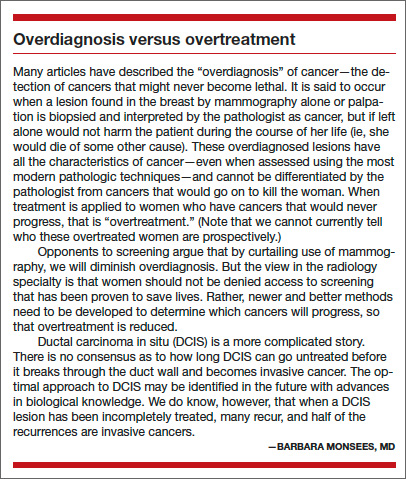
“The Canadian study is an outlier,” says Barbara Monsees, MD, Ronald and Hanna Evens Professor of Women’s Health in the department of radiology at Washington University in St. Louis, Missouri.
“There is an overwhelming amount of evidence that tells us that screening mammography saves lives,” says Dr. Monsees. “This evidence includes other randomized trials, case-control studies, results of organized screening programs, and downward trends in breast cancer deaths where screening is used.”
Mark D. Pearlman, MD, also believes the body of evidence shows that screening mammography is effective. Dr. Pearlman is vice chair and service chief in the division of obstetrics and gynecology and professor of surgery and director of the breast fellowship in obstetrics and gynecology at the University of Michigan Health System in Ann Arbor, Michigan. He has been on the surgical staff of the Breast Care Center there since 1990, with expertise in the management of women with breast disease and increased genetic risks for breast and ovarian cancer.
The Canadian trial is “a reasonably done study,” he says, “but there are some concerns. First, it’s not a new study—it was initially published 22 years ago. This latest publication is just a continuation of following these women.”
“This study, along with seven other randomized, controlled trials, was considered by the USPSTF in formulating its 2009 recommendations. In that meta-analysis, which included women in their 40s, screening mammography had benefit in every decade of life of interest.8 That is the basis on which ACOG made its recommendation for women at average risk to start annual screening at age 40 and continue at least until age 70,” Dr. Pearlman says. “When the USPSTF considered this negative study, it realized that there is benefit for mammography despite this single trial.”
Related article: Which women are most likely to die from breast cancer—those screened annually starting at age 40, biennially starting at age 50, or not at all? Mark D. Pearlman, MD (Examining the Evidence, November 2013)
James Dickinson, MBBS, PhD, a family physician and member of the Canadian Task Force on Preventive Health Care (a forerunner of the USPSTF), which has published its own set of guidelines on breast cancer screening, has a different perspective. Dr. Dickinson teaches at the University of Calgary in Alberta.
“One of the tendencies—particularly in medicine driven by commercial interests—is that as soon as there is even the slightest hint that something is worthwhile, there’s a rush to have everybody do it and make lots of profit from it. People don’t wait for the evidence. They jump to assume guilt or innocence without even looking for the evidence.”
“I give all credit to the Canadian trial investigators,” Dr. Dickinson says. “The world had jumped ahead of them and just assumed that breast screening worked. But they kept looking. They set up a good trial to start with and then followed it through and helped us understand that things aren’t as good as we would like them to be.”
Andrew M. Kaunitz, MD, professor and vice chair of obstetrics and gynecology at the University of Florida–Jacksonville also believes that the Canadian study’s findings are reliable. Dr. Kaunitz serves on the OBG Management Board of Editors.
“As pointed out in an editorial accompanying the Canadian trial, this study’s findings of a lack of efficacy of screening mammograms are ‘strikingly similar’ to other recent studies assessing breast cancer screening.”9–11
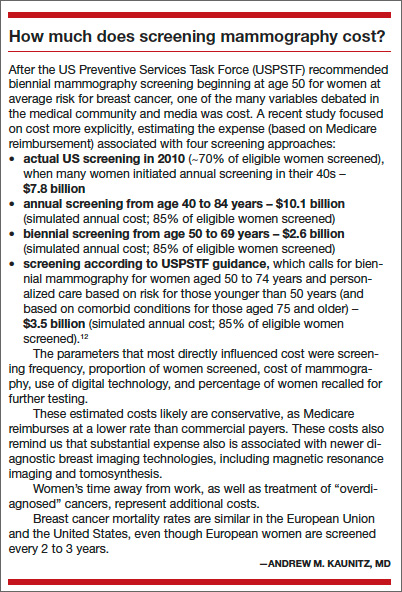
“Further, mammograms are costly and associated with a high rate of false-positive findings,” Dr. Kaunitz says.
“Too many weak links”
Among the main criticisms of the Canadian trial is a claim of flawed methodology.
“The Canadian trial is an update of a flawed study that was previously discredited for good reasons,” says Dr. Monsees. “In short, the quality of the mammograms was poor, and the overall study design did not reflect a true randomization process.”
“For example, true randomization requires eligible patients to be randomly divided into two or more groups, without any knowledge of their specific conditions that might bias trial results,” Dr. Monsees explains. “In the most valid randomized trials, this was accomplished by invitation. Without knowing anything about the women, investigators randomly assigned them to a group invited to be screened and a group not invited. In this manner, two equal groups were produced, with no way to corrupt the randomization process.”
“In the Canadian National Breast Screening Study, in contrast, once the women volunteered, they were given a clinical breast examination, and women with breast lumps and large lymph nodes in their underarms were identified. This information was provided to study coordinators, who assigned women on open lists to the mammography group or the control group,” Dr. Monsees says.
“Those of us in the imaging field know that the quality of mammography is only as good as the weakest link in the imaging chain. This study had far too many weak links. These criticisms are not new; they were raised during and after the trial and remain valid today.”
Dr. Pearlman does not believe that the Canadian trial reflects modern breast cancer screening.
“There are things in the Canadian trial that differ from what we see in modern mammography,” he says. “In the Canadian trial, in women diagnosed with breast cancer, they noted whether there was a palpable mass in the area of cancer. In the Canadian trial the percentage of palpable masses was approximately 66%, and that’s very very different from what we see with modern mammography. In current practice, about 15% of breast cancers diagnosed by mammography are palpable. And so it appears that, for some reason, they were seeing more advanced breast cancers when they were screening by mammography.”
Another concern focuses on the technology used in the trial.
“It appears that the Canadian investigators pulled old machines into service for the trial,” Dr. Pearlman says.
In addition, more recent advances, such as digital mammography and tomosynthesis, were not available at the time of the Canadian trial.
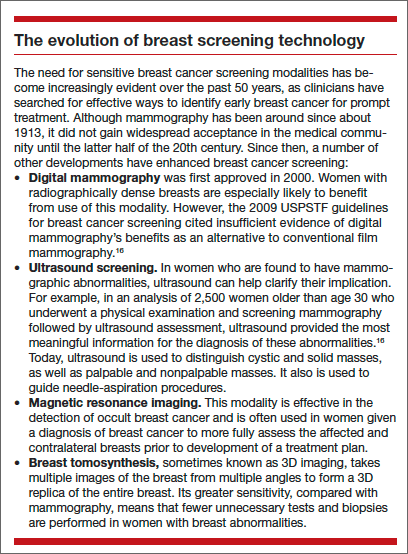
“Overall, the Canadian trial appears to be looking at a different group of women than what we typically see in the United States in women diagnosed with breast cancer,” says Dr. Pearlman. “And if they were, then it makes sense that there would be no benefit in mortality, since they were detecting more advanced breast cancers in that population.”
Dr. Pearlman also points to other studies of screening mammography that have produced findings contrasting those of the Canadian trial.
“At least eight large observational trials, case-control studies, and randomized, controlled trials of screening mammography have been published and were later evaluated by meta-analysis.8 That analysis showed a 50% reduction in mortality in women who had screening mammography. In both randomized, controlled trials, it showed a decrease of about 15% in mortality. In practice, looking at large populations of women who died of breast cancer and comparing them to women who had breast cancer but didn’t die, there is a 50% increased likelihood of dying if you don’t have screening mammography. So looking in both directions—both prospectively and retrospectively—there appears to be a substantial benefit to undergoing routine screening mammography in reducing breast cancer mortality,” Dr. Pearlman says.
Dr. Dickinson asserts that criticisms of the Canadian National Breast Screening Study were disproved long ago.
“Many of those accusations were brought out very early in the course of the Canadian trial and investigated in great detail and rejected. After all, this trial was funded by a major research funding body in Canada. And when it was informed that it had funded a ‘fraudulent’ trial, it investigated and found that the findings actually were legitimate,” says Dr. Dickinson.
“I think that the people who are still bringing up those accusations are doing it primarily because the results don’t fit what they wanted. It’s attacking the messenger because they don’t like the results.”
WEIGHING BENEFITS AND HARMS
When the Canadian Task Force on Preventive Health Care formulated its guidelines on screening mammography, it considered the same body of evidence assessed by the USPSTF for its 2009 guidelines. Dr. Dickinson, a member of the Canadian Task Force, notes that the Canadian approach differed from the American approach in several distinct areas.
“We used the USPSTF literature search up to 2008 and then we did an updated search, looking for papers published up to that time. But there were no new trials published from 2008 to 2011,” he says.
“So we looked at the same data but used the GRADE scheme, which carefully separates the strength of the evidence from the strength of the recommendations. It’s a ‘newish’ way of evaluating evidence,” Dr. Dickinson says. “It’s different from the USPSTF approach, which involves a different scale.”
“We used to assess preventive measures purely on the basis of efficacy—if they worked, we’d recommend them. Now we look at the balance of benefits and the potential for causing harm. So it’s not just about whether an intervention works, but about whether it works more than it causes harm,” he says.
“That means that you can have statistically significant benefits that are fairly small and are outweighed by harms. So, while screening mammography can significantly reduce the risk of death from breast cancer by a small amount, our recommendation for it is very weak because, to achieve that benefit, you also incur a lot of harm,” Dr. Dickinson says.
Dr. Pearlman agrees that “mammography is not a perfect test, by any means.”
“It’s inconvenient, people get worried, it’s uncomfortable, and it isn’t perfectly sensitive,” he says. “It’s also somewhat nonspecific, which means that about 10% of women who don’t have breast cancer will be called back for additional images, and about 10% of that group will get called back for a biopsy that is not due to cancer.”
HOW WE COUNSEL OUR PATIENTS
Dr. Kaunitz says he is less likely to recommend annual mammography screening in the wake of the Canadian trial and other findings.
“For decades, we have marched to the drumbeat of ‘mammograms save lives,’” he says. “Annual screens have become an easy recommendation for us to make and, for our patients, the reassurance that accompanies a normal mammogram is comforting. Many patients will be perplexed by this new information; others may view it with suspicion. While we await updated guidance from professional societies, my approach is to encourage patients to follow the 2009 USPSTF guidelines, which recommend that screening start at age 50 in average-risk women and be repeated every 2 years.”
Related articles:
Biennial vs annual mammograpy: How I manage my patients Andrew M. Kaunitz, MD (Commentary, June 2013)
Best age to begin screening mammograms: How I manage my patients Andrew M. Kaunitz, MD (Commentary, November 2013)
Dr. Dickinson takes a similar approach. “I recommend that people be cautious about having screening, but I listen to their stories. Someone may say, ‘My sister had breast cancer and I want a mammogram.’ Overall, I don’t encourage people to undergo mammography unless they have a strong reason for doing so. I try to follow the latest [Canadian] guidelines because I feel they’re based on the best available evidence.”
In contrast, Dr. Pearlman advises his patients according to ACOG guidelines (guidelines that he formulated on ACOG’s behalf), which call for annual screening to begin at age 40.
Dr. Monsees counsels her patients similarly.
“The scientific evidence clearly shows that screening saves the most lives if average-risk women begin annual screening at the age of 40,” she says. “For high-risk women, our recommendations are tailored to each woman’s individual case and made in conjunction with the referring physician. For example, we often begin screening earlier or perform supplemental screening with breast magnetic resonance imaging for women who are at high risk due to prior chest wall radiation or a strong family history.”
“Others have argued against screening average-risk women in their 40s,” Dr. Monsees notes. “But if diagnosed with breast cancer, women in their 40s have more years of life to lose. More than 40% of the years of life lost to breast cancer are among women diagnosed in their 40s. Others also have argued that only high-risk women should be screened in their 40s or yearly after 50. However, that is problematic because more than 75% of women diagnosed with breast cancer each year are not at elevated risk. If you screen only high-risk women you will miss most breast cancers.”13–15
“Mammography screening has been proven to save lives,” Dr. Monsees says. “It can’t find every cancer, and it can’t find every cancer early enough to save all women. Nevertheless, screening should not be abandoned while we are awaiting better screening tests, better pathological markers to differentiate which tumors should be treated more aggressively, and the development of better therapies. The bottom line: Mammography saves lives now, and we should embrace it.”
Dr. Dickinson is more cautious.
“There isn’t a perfect answer,” he says. “That’s the sad thing.”
Related audiocast: Dr. JoAnn V. Pinkerton discusses how she screens patients at increased risk for breast cancer
ACOG's stance
Current ACOG guidelines recommend that annual screening mammography begin at age 40 for women at average risk for breast cancer. Women with an elevated risk of breast cancer require a more complex assessment and thorough counseling and may begin screening even before age 40 in some cases.
We want to hear from you!
Share your thoughts on this article or on any topic relevant to ObGyns and women’s health practitioners. Tell us which topics you’d like to see covered in future issues, and what challenges you face in daily practice. We will consider publishing your letter and in a future issue. Send your letter to: obg@frontlinemedcom.com Please include the city and state in which you practice. Stay in touch! Your feedback is important to us!
- Miller AB, Wall C, Baines CJ, Sun P, To T, Narod SA. Twenty-five year follow-up for breast cancer incidence and mortality of the Canadian National Breast Screening Study: randomised screening trial. BMJ. 2014;348:g366.
- ObGyns continue to recommend annual mammograms for women beginning at age 40. A look at the Canadian Trial Mammography Study. American College of Obstetricians and Gynecologists. https://www.acog.org/About_ACOG/News_Room/News_Releases/2011/Annual_Mammograms_Now_Recommended_for_Women_Beginning_at_Age_40. Published February 14, 2014. Accessed March 14, 2014.
- Simon S. Canadian study questions mammogram screening; findings unlike those of other studies. American Cancer Society. http://www.cancer.org/cancer/news/news/canadian -study-questions-mammogram-screening-findings-unlike-those-of-other-studies. Published February 12, 2014. Accessed March 14, 2014.
- BMJ article on breast cancer screening effectiveness incredibly flawed and misleading. American College of Radiology. http://www.acr.org/News-Publications/News/News-Articles/2014/ACR/BMJ-Article-on-Breast-Cancer-Screening-Effectiveness-Incredibly-Flawed-and-Misleading. Published February 12, 2014. Accessed March 14, 2014.
- US Preventive Services Task Force. Screening for breast cancer. http://www.uspreventiveservicestaskforce.org/uspstf /uspsbrca.htm. Published December 2009. Accessed March 14, 2014.
- Canadian Cancer Society’s perspective on new mammography study. Canadian Cancer Society. http://www.cancer.ca/en/about-us/for-media/media-releases/national/2014/mammography-study/?region=on. Published February 13, 2014. Accessed March 14, 2014.
- Canadian Task Force on Preventive Health Care. Recommendations on screening for breast cancer in average-risk women aged 40 to 74 years. CMAJ. 2011;183(17):1991–2001.
- Nickson C, Mason KE, English DR, Kavanagh AM. Mammographic screening and breast cancer mortality: a case-control study and meta-analysis. Cancer Epidemiol Biomarkers Prev. 2012;21(9):1479–1488.
- Kalager M, Adami H-O, Bretthauer M. Too much mammography. BMJ. 2014;348:g1403.
- Kalager M, Zelen M, Langmark F, Adami HO. Effect of screening mammography on breast cancer mortality in Norway. N Engl J Med. 2010;363(13):1203–1210.
- Autier P, Boniol M, Gavin A, Vatten LJ. Breast cancer mortality in neighbouring European countries with different levels of screening but similar access to treatment: trend analysis of WHO mortality database. BMJ. 2011;343:d4411.
- O’Donoghue C, Eklund M, Ozanne EM, Esserman LJ. Aggregate cost of mammography screening in the United States: comparison of current practice and advocated strategies. Ann Intern Med. 2014;160:145–153.
- American Cancer Society. What are the risk factors for breast cancer? January 31, 2014. http://www.cancer.org/cancer/breastcancer/detailedguide/breast-cancer-risk-factors. Accessed March 21, 2014.
- National Breast Cancer Coalition: The Breast Cancer Deadline 2020. Myth #8: Most women with breast cancer have a family history of the disease. http://www.breastcancerdeadline2020.org/breast-cancer-information/myths-and-truths/myth-8-most-women-with-bc-have-family-history.html. Accessed March 21, 2014.
- Berg WA. Benefits of screening mammography. JAMA. 2010;303(2):168–169.
- Woodworth KA. Breast imaging through the ages: a historical review and future outlook. eradimaging. September 6, 2011. http://www.eradimaging.com/site/article.cfm?ID=769#.UzAv79ySuMM. Accessed March 24, 2014.
When 25-year follow-up data from the Canadian National Breast Screening Study—published earlier this year—showed no benefit for annual mammography in women aged 40 to 59 years, the findings generated renewed debate about whether screening mammography actually saves lives.1
In that study, Miller and colleagues continued their follow-up of almost 90,000 women who had been randomly assigned to mammography (five annual screens) or no mammography from 1980 to 1985. Women aged 40 to 49 in the mammography arm and all women aged 50 to 69 underwent annual clinical breast examination (CBE). Women aged 40 to 49 in the control arm had a single CBE and continued usual care in the community. The main outcome measure was death from breast cancer.1
During the entire 25-year study, 3,250 women in the mammography arm were given a diagnosis of breast cancer, and 3,133 in the control arm received the same diagnosis. Of these, 500 and 505 women, respectively, died of the malignancy.
The overall hazard ratio for death from breast cancer in the mammography and control arms was 0.99 (95% confidence interval, 0.88–1.12). After 15 years of follow-up, 106 residual excess cancers (106/484; or 22%) were identified in the mammography arm and were attributed to “overdiagnosis.”1
During the screening period the mean size of breast cancers identified was 1.91 cm and 2.10 cm in the mammography and control arms, respectively (P = .01), and 30.6% and 32.4% of tumors, respectively, were associated with positive lymph nodes (P = .53).
PROFESSIONAL SOCIETIES STICK BY THEIR GUIDELINES
Following publication of the Canadian findings, the American College of Obstetricians and Gynecologists (ACOG) reaffirmed its recommendation for women at average risk for breast cancer to initiate annual screening at age 40. In an announcement issued February 14, 2014, ACOG noted that it had “a number of concerns” with the Canadian study.2
Similarly, the American Cancer Society reiterated its own recommendation that women aged 40 and older undergo annual mammography and CBE for as long as they remain healthy.3
The American College of Radiology went a few steps further, calling the Canadian study “incredibly flawed and misleading.”4 Its guidelines call for annual mammography beginning at age 40.
The US Preventive Services Task Force (USPSTF) 2009 guidelines on breast cancer screening also stand, with biennial mammography beginning at age 50 for women at average risk for breast cancer.5
The Canadian Cancer Society also reaffirmed its recommendations for breast cancer screening following publication of the Canadian trial 25-year follow-up data—although its recommendations call for screening to begin at age 50 and to be repeated thereafter at 2- to 3-year intervals.6,7
In short, nothing has changed…yet. But the Canadian trial raises a number of questions about breast cancer screening—and the answers aren’t as clear-cut as you might imagine.
IS THE CANADIAN TRIAL CREDIBLE?
Results from earlier randomized, controlled trials have indicated that screening mammography reduces death from breast cancer.
“The Canadian study is an outlier,” says Barbara Monsees, MD, Ronald and Hanna Evens Professor of Women’s Health in the department of radiology at Washington University in St. Louis, Missouri.
“There is an overwhelming amount of evidence that tells us that screening mammography saves lives,” says Dr. Monsees. “This evidence includes other randomized trials, case-control studies, results of organized screening programs, and downward trends in breast cancer deaths where screening is used.”
Mark D. Pearlman, MD, also believes the body of evidence shows that screening mammography is effective. Dr. Pearlman is vice chair and service chief in the division of obstetrics and gynecology and professor of surgery and director of the breast fellowship in obstetrics and gynecology at the University of Michigan Health System in Ann Arbor, Michigan. He has been on the surgical staff of the Breast Care Center there since 1990, with expertise in the management of women with breast disease and increased genetic risks for breast and ovarian cancer.
The Canadian trial is “a reasonably done study,” he says, “but there are some concerns. First, it’s not a new study—it was initially published 22 years ago. This latest publication is just a continuation of following these women.”
“This study, along with seven other randomized, controlled trials, was considered by the USPSTF in formulating its 2009 recommendations. In that meta-analysis, which included women in their 40s, screening mammography had benefit in every decade of life of interest.8 That is the basis on which ACOG made its recommendation for women at average risk to start annual screening at age 40 and continue at least until age 70,” Dr. Pearlman says. “When the USPSTF considered this negative study, it realized that there is benefit for mammography despite this single trial.”
Related article: Which women are most likely to die from breast cancer—those screened annually starting at age 40, biennially starting at age 50, or not at all? Mark D. Pearlman, MD (Examining the Evidence, November 2013)
James Dickinson, MBBS, PhD, a family physician and member of the Canadian Task Force on Preventive Health Care (a forerunner of the USPSTF), which has published its own set of guidelines on breast cancer screening, has a different perspective. Dr. Dickinson teaches at the University of Calgary in Alberta.
“One of the tendencies—particularly in medicine driven by commercial interests—is that as soon as there is even the slightest hint that something is worthwhile, there’s a rush to have everybody do it and make lots of profit from it. People don’t wait for the evidence. They jump to assume guilt or innocence without even looking for the evidence.”
“I give all credit to the Canadian trial investigators,” Dr. Dickinson says. “The world had jumped ahead of them and just assumed that breast screening worked. But they kept looking. They set up a good trial to start with and then followed it through and helped us understand that things aren’t as good as we would like them to be.”
Andrew M. Kaunitz, MD, professor and vice chair of obstetrics and gynecology at the University of Florida–Jacksonville also believes that the Canadian study’s findings are reliable. Dr. Kaunitz serves on the OBG Management Board of Editors.
“As pointed out in an editorial accompanying the Canadian trial, this study’s findings of a lack of efficacy of screening mammograms are ‘strikingly similar’ to other recent studies assessing breast cancer screening.”9–11
“Further, mammograms are costly and associated with a high rate of false-positive findings,” Dr. Kaunitz says.
“Too many weak links”
Among the main criticisms of the Canadian trial is a claim of flawed methodology.
“The Canadian trial is an update of a flawed study that was previously discredited for good reasons,” says Dr. Monsees. “In short, the quality of the mammograms was poor, and the overall study design did not reflect a true randomization process.”
“For example, true randomization requires eligible patients to be randomly divided into two or more groups, without any knowledge of their specific conditions that might bias trial results,” Dr. Monsees explains. “In the most valid randomized trials, this was accomplished by invitation. Without knowing anything about the women, investigators randomly assigned them to a group invited to be screened and a group not invited. In this manner, two equal groups were produced, with no way to corrupt the randomization process.”
“In the Canadian National Breast Screening Study, in contrast, once the women volunteered, they were given a clinical breast examination, and women with breast lumps and large lymph nodes in their underarms were identified. This information was provided to study coordinators, who assigned women on open lists to the mammography group or the control group,” Dr. Monsees says.
“Those of us in the imaging field know that the quality of mammography is only as good as the weakest link in the imaging chain. This study had far too many weak links. These criticisms are not new; they were raised during and after the trial and remain valid today.”
Dr. Pearlman does not believe that the Canadian trial reflects modern breast cancer screening.
“There are things in the Canadian trial that differ from what we see in modern mammography,” he says. “In the Canadian trial, in women diagnosed with breast cancer, they noted whether there was a palpable mass in the area of cancer. In the Canadian trial the percentage of palpable masses was approximately 66%, and that’s very very different from what we see with modern mammography. In current practice, about 15% of breast cancers diagnosed by mammography are palpable. And so it appears that, for some reason, they were seeing more advanced breast cancers when they were screening by mammography.”
Another concern focuses on the technology used in the trial.
“It appears that the Canadian investigators pulled old machines into service for the trial,” Dr. Pearlman says.
In addition, more recent advances, such as digital mammography and tomosynthesis, were not available at the time of the Canadian trial.
“Overall, the Canadian trial appears to be looking at a different group of women than what we typically see in the United States in women diagnosed with breast cancer,” says Dr. Pearlman. “And if they were, then it makes sense that there would be no benefit in mortality, since they were detecting more advanced breast cancers in that population.”
Dr. Pearlman also points to other studies of screening mammography that have produced findings contrasting those of the Canadian trial.
“At least eight large observational trials, case-control studies, and randomized, controlled trials of screening mammography have been published and were later evaluated by meta-analysis.8 That analysis showed a 50% reduction in mortality in women who had screening mammography. In both randomized, controlled trials, it showed a decrease of about 15% in mortality. In practice, looking at large populations of women who died of breast cancer and comparing them to women who had breast cancer but didn’t die, there is a 50% increased likelihood of dying if you don’t have screening mammography. So looking in both directions—both prospectively and retrospectively—there appears to be a substantial benefit to undergoing routine screening mammography in reducing breast cancer mortality,” Dr. Pearlman says.
Dr. Dickinson asserts that criticisms of the Canadian National Breast Screening Study were disproved long ago.
“Many of those accusations were brought out very early in the course of the Canadian trial and investigated in great detail and rejected. After all, this trial was funded by a major research funding body in Canada. And when it was informed that it had funded a ‘fraudulent’ trial, it investigated and found that the findings actually were legitimate,” says Dr. Dickinson.
“I think that the people who are still bringing up those accusations are doing it primarily because the results don’t fit what they wanted. It’s attacking the messenger because they don’t like the results.”
WEIGHING BENEFITS AND HARMS
When the Canadian Task Force on Preventive Health Care formulated its guidelines on screening mammography, it considered the same body of evidence assessed by the USPSTF for its 2009 guidelines. Dr. Dickinson, a member of the Canadian Task Force, notes that the Canadian approach differed from the American approach in several distinct areas.
“We used the USPSTF literature search up to 2008 and then we did an updated search, looking for papers published up to that time. But there were no new trials published from 2008 to 2011,” he says.
“So we looked at the same data but used the GRADE scheme, which carefully separates the strength of the evidence from the strength of the recommendations. It’s a ‘newish’ way of evaluating evidence,” Dr. Dickinson says. “It’s different from the USPSTF approach, which involves a different scale.”
“We used to assess preventive measures purely on the basis of efficacy—if they worked, we’d recommend them. Now we look at the balance of benefits and the potential for causing harm. So it’s not just about whether an intervention works, but about whether it works more than it causes harm,” he says.
“That means that you can have statistically significant benefits that are fairly small and are outweighed by harms. So, while screening mammography can significantly reduce the risk of death from breast cancer by a small amount, our recommendation for it is very weak because, to achieve that benefit, you also incur a lot of harm,” Dr. Dickinson says.
Dr. Pearlman agrees that “mammography is not a perfect test, by any means.”
“It’s inconvenient, people get worried, it’s uncomfortable, and it isn’t perfectly sensitive,” he says. “It’s also somewhat nonspecific, which means that about 10% of women who don’t have breast cancer will be called back for additional images, and about 10% of that group will get called back for a biopsy that is not due to cancer.”
HOW WE COUNSEL OUR PATIENTS
Dr. Kaunitz says he is less likely to recommend annual mammography screening in the wake of the Canadian trial and other findings.
“For decades, we have marched to the drumbeat of ‘mammograms save lives,’” he says. “Annual screens have become an easy recommendation for us to make and, for our patients, the reassurance that accompanies a normal mammogram is comforting. Many patients will be perplexed by this new information; others may view it with suspicion. While we await updated guidance from professional societies, my approach is to encourage patients to follow the 2009 USPSTF guidelines, which recommend that screening start at age 50 in average-risk women and be repeated every 2 years.”
Related articles:
Biennial vs annual mammograpy: How I manage my patients Andrew M. Kaunitz, MD (Commentary, June 2013)
Best age to begin screening mammograms: How I manage my patients Andrew M. Kaunitz, MD (Commentary, November 2013)
Dr. Dickinson takes a similar approach. “I recommend that people be cautious about having screening, but I listen to their stories. Someone may say, ‘My sister had breast cancer and I want a mammogram.’ Overall, I don’t encourage people to undergo mammography unless they have a strong reason for doing so. I try to follow the latest [Canadian] guidelines because I feel they’re based on the best available evidence.”
In contrast, Dr. Pearlman advises his patients according to ACOG guidelines (guidelines that he formulated on ACOG’s behalf), which call for annual screening to begin at age 40.
Dr. Monsees counsels her patients similarly.
“The scientific evidence clearly shows that screening saves the most lives if average-risk women begin annual screening at the age of 40,” she says. “For high-risk women, our recommendations are tailored to each woman’s individual case and made in conjunction with the referring physician. For example, we often begin screening earlier or perform supplemental screening with breast magnetic resonance imaging for women who are at high risk due to prior chest wall radiation or a strong family history.”
“Others have argued against screening average-risk women in their 40s,” Dr. Monsees notes. “But if diagnosed with breast cancer, women in their 40s have more years of life to lose. More than 40% of the years of life lost to breast cancer are among women diagnosed in their 40s. Others also have argued that only high-risk women should be screened in their 40s or yearly after 50. However, that is problematic because more than 75% of women diagnosed with breast cancer each year are not at elevated risk. If you screen only high-risk women you will miss most breast cancers.”13–15
“Mammography screening has been proven to save lives,” Dr. Monsees says. “It can’t find every cancer, and it can’t find every cancer early enough to save all women. Nevertheless, screening should not be abandoned while we are awaiting better screening tests, better pathological markers to differentiate which tumors should be treated more aggressively, and the development of better therapies. The bottom line: Mammography saves lives now, and we should embrace it.”
Dr. Dickinson is more cautious.
“There isn’t a perfect answer,” he says. “That’s the sad thing.”
Related audiocast: Dr. JoAnn V. Pinkerton discusses how she screens patients at increased risk for breast cancer
ACOG's stance
Current ACOG guidelines recommend that annual screening mammography begin at age 40 for women at average risk for breast cancer. Women with an elevated risk of breast cancer require a more complex assessment and thorough counseling and may begin screening even before age 40 in some cases.
We want to hear from you!
Share your thoughts on this article or on any topic relevant to ObGyns and women’s health practitioners. Tell us which topics you’d like to see covered in future issues, and what challenges you face in daily practice. We will consider publishing your letter and in a future issue. Send your letter to: obg@frontlinemedcom.com Please include the city and state in which you practice. Stay in touch! Your feedback is important to us!
When 25-year follow-up data from the Canadian National Breast Screening Study—published earlier this year—showed no benefit for annual mammography in women aged 40 to 59 years, the findings generated renewed debate about whether screening mammography actually saves lives.1
In that study, Miller and colleagues continued their follow-up of almost 90,000 women who had been randomly assigned to mammography (five annual screens) or no mammography from 1980 to 1985. Women aged 40 to 49 in the mammography arm and all women aged 50 to 69 underwent annual clinical breast examination (CBE). Women aged 40 to 49 in the control arm had a single CBE and continued usual care in the community. The main outcome measure was death from breast cancer.1
During the entire 25-year study, 3,250 women in the mammography arm were given a diagnosis of breast cancer, and 3,133 in the control arm received the same diagnosis. Of these, 500 and 505 women, respectively, died of the malignancy.
The overall hazard ratio for death from breast cancer in the mammography and control arms was 0.99 (95% confidence interval, 0.88–1.12). After 15 years of follow-up, 106 residual excess cancers (106/484; or 22%) were identified in the mammography arm and were attributed to “overdiagnosis.”1
During the screening period the mean size of breast cancers identified was 1.91 cm and 2.10 cm in the mammography and control arms, respectively (P = .01), and 30.6% and 32.4% of tumors, respectively, were associated with positive lymph nodes (P = .53).
PROFESSIONAL SOCIETIES STICK BY THEIR GUIDELINES
Following publication of the Canadian findings, the American College of Obstetricians and Gynecologists (ACOG) reaffirmed its recommendation for women at average risk for breast cancer to initiate annual screening at age 40. In an announcement issued February 14, 2014, ACOG noted that it had “a number of concerns” with the Canadian study.2
Similarly, the American Cancer Society reiterated its own recommendation that women aged 40 and older undergo annual mammography and CBE for as long as they remain healthy.3
The American College of Radiology went a few steps further, calling the Canadian study “incredibly flawed and misleading.”4 Its guidelines call for annual mammography beginning at age 40.
The US Preventive Services Task Force (USPSTF) 2009 guidelines on breast cancer screening also stand, with biennial mammography beginning at age 50 for women at average risk for breast cancer.5
The Canadian Cancer Society also reaffirmed its recommendations for breast cancer screening following publication of the Canadian trial 25-year follow-up data—although its recommendations call for screening to begin at age 50 and to be repeated thereafter at 2- to 3-year intervals.6,7
In short, nothing has changed…yet. But the Canadian trial raises a number of questions about breast cancer screening—and the answers aren’t as clear-cut as you might imagine.
IS THE CANADIAN TRIAL CREDIBLE?
Results from earlier randomized, controlled trials have indicated that screening mammography reduces death from breast cancer.
“The Canadian study is an outlier,” says Barbara Monsees, MD, Ronald and Hanna Evens Professor of Women’s Health in the department of radiology at Washington University in St. Louis, Missouri.
“There is an overwhelming amount of evidence that tells us that screening mammography saves lives,” says Dr. Monsees. “This evidence includes other randomized trials, case-control studies, results of organized screening programs, and downward trends in breast cancer deaths where screening is used.”
Mark D. Pearlman, MD, also believes the body of evidence shows that screening mammography is effective. Dr. Pearlman is vice chair and service chief in the division of obstetrics and gynecology and professor of surgery and director of the breast fellowship in obstetrics and gynecology at the University of Michigan Health System in Ann Arbor, Michigan. He has been on the surgical staff of the Breast Care Center there since 1990, with expertise in the management of women with breast disease and increased genetic risks for breast and ovarian cancer.
The Canadian trial is “a reasonably done study,” he says, “but there are some concerns. First, it’s not a new study—it was initially published 22 years ago. This latest publication is just a continuation of following these women.”
“This study, along with seven other randomized, controlled trials, was considered by the USPSTF in formulating its 2009 recommendations. In that meta-analysis, which included women in their 40s, screening mammography had benefit in every decade of life of interest.8 That is the basis on which ACOG made its recommendation for women at average risk to start annual screening at age 40 and continue at least until age 70,” Dr. Pearlman says. “When the USPSTF considered this negative study, it realized that there is benefit for mammography despite this single trial.”
Related article: Which women are most likely to die from breast cancer—those screened annually starting at age 40, biennially starting at age 50, or not at all? Mark D. Pearlman, MD (Examining the Evidence, November 2013)
James Dickinson, MBBS, PhD, a family physician and member of the Canadian Task Force on Preventive Health Care (a forerunner of the USPSTF), which has published its own set of guidelines on breast cancer screening, has a different perspective. Dr. Dickinson teaches at the University of Calgary in Alberta.
“One of the tendencies—particularly in medicine driven by commercial interests—is that as soon as there is even the slightest hint that something is worthwhile, there’s a rush to have everybody do it and make lots of profit from it. People don’t wait for the evidence. They jump to assume guilt or innocence without even looking for the evidence.”
“I give all credit to the Canadian trial investigators,” Dr. Dickinson says. “The world had jumped ahead of them and just assumed that breast screening worked. But they kept looking. They set up a good trial to start with and then followed it through and helped us understand that things aren’t as good as we would like them to be.”
Andrew M. Kaunitz, MD, professor and vice chair of obstetrics and gynecology at the University of Florida–Jacksonville also believes that the Canadian study’s findings are reliable. Dr. Kaunitz serves on the OBG Management Board of Editors.
“As pointed out in an editorial accompanying the Canadian trial, this study’s findings of a lack of efficacy of screening mammograms are ‘strikingly similar’ to other recent studies assessing breast cancer screening.”9–11
“Further, mammograms are costly and associated with a high rate of false-positive findings,” Dr. Kaunitz says.
“Too many weak links”
Among the main criticisms of the Canadian trial is a claim of flawed methodology.
“The Canadian trial is an update of a flawed study that was previously discredited for good reasons,” says Dr. Monsees. “In short, the quality of the mammograms was poor, and the overall study design did not reflect a true randomization process.”
“For example, true randomization requires eligible patients to be randomly divided into two or more groups, without any knowledge of their specific conditions that might bias trial results,” Dr. Monsees explains. “In the most valid randomized trials, this was accomplished by invitation. Without knowing anything about the women, investigators randomly assigned them to a group invited to be screened and a group not invited. In this manner, two equal groups were produced, with no way to corrupt the randomization process.”
“In the Canadian National Breast Screening Study, in contrast, once the women volunteered, they were given a clinical breast examination, and women with breast lumps and large lymph nodes in their underarms were identified. This information was provided to study coordinators, who assigned women on open lists to the mammography group or the control group,” Dr. Monsees says.
“Those of us in the imaging field know that the quality of mammography is only as good as the weakest link in the imaging chain. This study had far too many weak links. These criticisms are not new; they were raised during and after the trial and remain valid today.”
Dr. Pearlman does not believe that the Canadian trial reflects modern breast cancer screening.
“There are things in the Canadian trial that differ from what we see in modern mammography,” he says. “In the Canadian trial, in women diagnosed with breast cancer, they noted whether there was a palpable mass in the area of cancer. In the Canadian trial the percentage of palpable masses was approximately 66%, and that’s very very different from what we see with modern mammography. In current practice, about 15% of breast cancers diagnosed by mammography are palpable. And so it appears that, for some reason, they were seeing more advanced breast cancers when they were screening by mammography.”
Another concern focuses on the technology used in the trial.
“It appears that the Canadian investigators pulled old machines into service for the trial,” Dr. Pearlman says.
In addition, more recent advances, such as digital mammography and tomosynthesis, were not available at the time of the Canadian trial.
“Overall, the Canadian trial appears to be looking at a different group of women than what we typically see in the United States in women diagnosed with breast cancer,” says Dr. Pearlman. “And if they were, then it makes sense that there would be no benefit in mortality, since they were detecting more advanced breast cancers in that population.”
Dr. Pearlman also points to other studies of screening mammography that have produced findings contrasting those of the Canadian trial.
“At least eight large observational trials, case-control studies, and randomized, controlled trials of screening mammography have been published and were later evaluated by meta-analysis.8 That analysis showed a 50% reduction in mortality in women who had screening mammography. In both randomized, controlled trials, it showed a decrease of about 15% in mortality. In practice, looking at large populations of women who died of breast cancer and comparing them to women who had breast cancer but didn’t die, there is a 50% increased likelihood of dying if you don’t have screening mammography. So looking in both directions—both prospectively and retrospectively—there appears to be a substantial benefit to undergoing routine screening mammography in reducing breast cancer mortality,” Dr. Pearlman says.
Dr. Dickinson asserts that criticisms of the Canadian National Breast Screening Study were disproved long ago.
“Many of those accusations were brought out very early in the course of the Canadian trial and investigated in great detail and rejected. After all, this trial was funded by a major research funding body in Canada. And when it was informed that it had funded a ‘fraudulent’ trial, it investigated and found that the findings actually were legitimate,” says Dr. Dickinson.
“I think that the people who are still bringing up those accusations are doing it primarily because the results don’t fit what they wanted. It’s attacking the messenger because they don’t like the results.”
WEIGHING BENEFITS AND HARMS
When the Canadian Task Force on Preventive Health Care formulated its guidelines on screening mammography, it considered the same body of evidence assessed by the USPSTF for its 2009 guidelines. Dr. Dickinson, a member of the Canadian Task Force, notes that the Canadian approach differed from the American approach in several distinct areas.
“We used the USPSTF literature search up to 2008 and then we did an updated search, looking for papers published up to that time. But there were no new trials published from 2008 to 2011,” he says.
“So we looked at the same data but used the GRADE scheme, which carefully separates the strength of the evidence from the strength of the recommendations. It’s a ‘newish’ way of evaluating evidence,” Dr. Dickinson says. “It’s different from the USPSTF approach, which involves a different scale.”
“We used to assess preventive measures purely on the basis of efficacy—if they worked, we’d recommend them. Now we look at the balance of benefits and the potential for causing harm. So it’s not just about whether an intervention works, but about whether it works more than it causes harm,” he says.
“That means that you can have statistically significant benefits that are fairly small and are outweighed by harms. So, while screening mammography can significantly reduce the risk of death from breast cancer by a small amount, our recommendation for it is very weak because, to achieve that benefit, you also incur a lot of harm,” Dr. Dickinson says.
Dr. Pearlman agrees that “mammography is not a perfect test, by any means.”
“It’s inconvenient, people get worried, it’s uncomfortable, and it isn’t perfectly sensitive,” he says. “It’s also somewhat nonspecific, which means that about 10% of women who don’t have breast cancer will be called back for additional images, and about 10% of that group will get called back for a biopsy that is not due to cancer.”
HOW WE COUNSEL OUR PATIENTS
Dr. Kaunitz says he is less likely to recommend annual mammography screening in the wake of the Canadian trial and other findings.
“For decades, we have marched to the drumbeat of ‘mammograms save lives,’” he says. “Annual screens have become an easy recommendation for us to make and, for our patients, the reassurance that accompanies a normal mammogram is comforting. Many patients will be perplexed by this new information; others may view it with suspicion. While we await updated guidance from professional societies, my approach is to encourage patients to follow the 2009 USPSTF guidelines, which recommend that screening start at age 50 in average-risk women and be repeated every 2 years.”
Related articles:
Biennial vs annual mammograpy: How I manage my patients Andrew M. Kaunitz, MD (Commentary, June 2013)
Best age to begin screening mammograms: How I manage my patients Andrew M. Kaunitz, MD (Commentary, November 2013)
Dr. Dickinson takes a similar approach. “I recommend that people be cautious about having screening, but I listen to their stories. Someone may say, ‘My sister had breast cancer and I want a mammogram.’ Overall, I don’t encourage people to undergo mammography unless they have a strong reason for doing so. I try to follow the latest [Canadian] guidelines because I feel they’re based on the best available evidence.”
In contrast, Dr. Pearlman advises his patients according to ACOG guidelines (guidelines that he formulated on ACOG’s behalf), which call for annual screening to begin at age 40.
Dr. Monsees counsels her patients similarly.
“The scientific evidence clearly shows that screening saves the most lives if average-risk women begin annual screening at the age of 40,” she says. “For high-risk women, our recommendations are tailored to each woman’s individual case and made in conjunction with the referring physician. For example, we often begin screening earlier or perform supplemental screening with breast magnetic resonance imaging for women who are at high risk due to prior chest wall radiation or a strong family history.”
“Others have argued against screening average-risk women in their 40s,” Dr. Monsees notes. “But if diagnosed with breast cancer, women in their 40s have more years of life to lose. More than 40% of the years of life lost to breast cancer are among women diagnosed in their 40s. Others also have argued that only high-risk women should be screened in their 40s or yearly after 50. However, that is problematic because more than 75% of women diagnosed with breast cancer each year are not at elevated risk. If you screen only high-risk women you will miss most breast cancers.”13–15
“Mammography screening has been proven to save lives,” Dr. Monsees says. “It can’t find every cancer, and it can’t find every cancer early enough to save all women. Nevertheless, screening should not be abandoned while we are awaiting better screening tests, better pathological markers to differentiate which tumors should be treated more aggressively, and the development of better therapies. The bottom line: Mammography saves lives now, and we should embrace it.”
Dr. Dickinson is more cautious.
“There isn’t a perfect answer,” he says. “That’s the sad thing.”
Related audiocast: Dr. JoAnn V. Pinkerton discusses how she screens patients at increased risk for breast cancer
ACOG's stance
Current ACOG guidelines recommend that annual screening mammography begin at age 40 for women at average risk for breast cancer. Women with an elevated risk of breast cancer require a more complex assessment and thorough counseling and may begin screening even before age 40 in some cases.
We want to hear from you!
Share your thoughts on this article or on any topic relevant to ObGyns and women’s health practitioners. Tell us which topics you’d like to see covered in future issues, and what challenges you face in daily practice. We will consider publishing your letter and in a future issue. Send your letter to: obg@frontlinemedcom.com Please include the city and state in which you practice. Stay in touch! Your feedback is important to us!
- Miller AB, Wall C, Baines CJ, Sun P, To T, Narod SA. Twenty-five year follow-up for breast cancer incidence and mortality of the Canadian National Breast Screening Study: randomised screening trial. BMJ. 2014;348:g366.
- ObGyns continue to recommend annual mammograms for women beginning at age 40. A look at the Canadian Trial Mammography Study. American College of Obstetricians and Gynecologists. https://www.acog.org/About_ACOG/News_Room/News_Releases/2011/Annual_Mammograms_Now_Recommended_for_Women_Beginning_at_Age_40. Published February 14, 2014. Accessed March 14, 2014.
- Simon S. Canadian study questions mammogram screening; findings unlike those of other studies. American Cancer Society. http://www.cancer.org/cancer/news/news/canadian -study-questions-mammogram-screening-findings-unlike-those-of-other-studies. Published February 12, 2014. Accessed March 14, 2014.
- BMJ article on breast cancer screening effectiveness incredibly flawed and misleading. American College of Radiology. http://www.acr.org/News-Publications/News/News-Articles/2014/ACR/BMJ-Article-on-Breast-Cancer-Screening-Effectiveness-Incredibly-Flawed-and-Misleading. Published February 12, 2014. Accessed March 14, 2014.
- US Preventive Services Task Force. Screening for breast cancer. http://www.uspreventiveservicestaskforce.org/uspstf /uspsbrca.htm. Published December 2009. Accessed March 14, 2014.
- Canadian Cancer Society’s perspective on new mammography study. Canadian Cancer Society. http://www.cancer.ca/en/about-us/for-media/media-releases/national/2014/mammography-study/?region=on. Published February 13, 2014. Accessed March 14, 2014.
- Canadian Task Force on Preventive Health Care. Recommendations on screening for breast cancer in average-risk women aged 40 to 74 years. CMAJ. 2011;183(17):1991–2001.
- Nickson C, Mason KE, English DR, Kavanagh AM. Mammographic screening and breast cancer mortality: a case-control study and meta-analysis. Cancer Epidemiol Biomarkers Prev. 2012;21(9):1479–1488.
- Kalager M, Adami H-O, Bretthauer M. Too much mammography. BMJ. 2014;348:g1403.
- Kalager M, Zelen M, Langmark F, Adami HO. Effect of screening mammography on breast cancer mortality in Norway. N Engl J Med. 2010;363(13):1203–1210.
- Autier P, Boniol M, Gavin A, Vatten LJ. Breast cancer mortality in neighbouring European countries with different levels of screening but similar access to treatment: trend analysis of WHO mortality database. BMJ. 2011;343:d4411.
- O’Donoghue C, Eklund M, Ozanne EM, Esserman LJ. Aggregate cost of mammography screening in the United States: comparison of current practice and advocated strategies. Ann Intern Med. 2014;160:145–153.
- American Cancer Society. What are the risk factors for breast cancer? January 31, 2014. http://www.cancer.org/cancer/breastcancer/detailedguide/breast-cancer-risk-factors. Accessed March 21, 2014.
- National Breast Cancer Coalition: The Breast Cancer Deadline 2020. Myth #8: Most women with breast cancer have a family history of the disease. http://www.breastcancerdeadline2020.org/breast-cancer-information/myths-and-truths/myth-8-most-women-with-bc-have-family-history.html. Accessed March 21, 2014.
- Berg WA. Benefits of screening mammography. JAMA. 2010;303(2):168–169.
- Woodworth KA. Breast imaging through the ages: a historical review and future outlook. eradimaging. September 6, 2011. http://www.eradimaging.com/site/article.cfm?ID=769#.UzAv79ySuMM. Accessed March 24, 2014.
- Miller AB, Wall C, Baines CJ, Sun P, To T, Narod SA. Twenty-five year follow-up for breast cancer incidence and mortality of the Canadian National Breast Screening Study: randomised screening trial. BMJ. 2014;348:g366.
- ObGyns continue to recommend annual mammograms for women beginning at age 40. A look at the Canadian Trial Mammography Study. American College of Obstetricians and Gynecologists. https://www.acog.org/About_ACOG/News_Room/News_Releases/2011/Annual_Mammograms_Now_Recommended_for_Women_Beginning_at_Age_40. Published February 14, 2014. Accessed March 14, 2014.
- Simon S. Canadian study questions mammogram screening; findings unlike those of other studies. American Cancer Society. http://www.cancer.org/cancer/news/news/canadian -study-questions-mammogram-screening-findings-unlike-those-of-other-studies. Published February 12, 2014. Accessed March 14, 2014.
- BMJ article on breast cancer screening effectiveness incredibly flawed and misleading. American College of Radiology. http://www.acr.org/News-Publications/News/News-Articles/2014/ACR/BMJ-Article-on-Breast-Cancer-Screening-Effectiveness-Incredibly-Flawed-and-Misleading. Published February 12, 2014. Accessed March 14, 2014.
- US Preventive Services Task Force. Screening for breast cancer. http://www.uspreventiveservicestaskforce.org/uspstf /uspsbrca.htm. Published December 2009. Accessed March 14, 2014.
- Canadian Cancer Society’s perspective on new mammography study. Canadian Cancer Society. http://www.cancer.ca/en/about-us/for-media/media-releases/national/2014/mammography-study/?region=on. Published February 13, 2014. Accessed March 14, 2014.
- Canadian Task Force on Preventive Health Care. Recommendations on screening for breast cancer in average-risk women aged 40 to 74 years. CMAJ. 2011;183(17):1991–2001.
- Nickson C, Mason KE, English DR, Kavanagh AM. Mammographic screening and breast cancer mortality: a case-control study and meta-analysis. Cancer Epidemiol Biomarkers Prev. 2012;21(9):1479–1488.
- Kalager M, Adami H-O, Bretthauer M. Too much mammography. BMJ. 2014;348:g1403.
- Kalager M, Zelen M, Langmark F, Adami HO. Effect of screening mammography on breast cancer mortality in Norway. N Engl J Med. 2010;363(13):1203–1210.
- Autier P, Boniol M, Gavin A, Vatten LJ. Breast cancer mortality in neighbouring European countries with different levels of screening but similar access to treatment: trend analysis of WHO mortality database. BMJ. 2011;343:d4411.
- O’Donoghue C, Eklund M, Ozanne EM, Esserman LJ. Aggregate cost of mammography screening in the United States: comparison of current practice and advocated strategies. Ann Intern Med. 2014;160:145–153.
- American Cancer Society. What are the risk factors for breast cancer? January 31, 2014. http://www.cancer.org/cancer/breastcancer/detailedguide/breast-cancer-risk-factors. Accessed March 21, 2014.
- National Breast Cancer Coalition: The Breast Cancer Deadline 2020. Myth #8: Most women with breast cancer have a family history of the disease. http://www.breastcancerdeadline2020.org/breast-cancer-information/myths-and-truths/myth-8-most-women-with-bc-have-family-history.html. Accessed March 21, 2014.
- Berg WA. Benefits of screening mammography. JAMA. 2010;303(2):168–169.
- Woodworth KA. Breast imaging through the ages: a historical review and future outlook. eradimaging. September 6, 2011. http://www.eradimaging.com/site/article.cfm?ID=769#.UzAv79ySuMM. Accessed March 24, 2014.


Pertuzumab in neoadjuvant treatment of HER2-positive early breast cancer
Pertuzumab injection was granted accelerated approval by the US Food and Drug Administration last fall for use in combination with trastuzumab plus docetaxel for neoadjuvant treatment of patients with HER2-positive locally advanced, inflammatory, or early-stage breast cancer (either > 2 cm in diameter or node-positive) as part of a complete treatment regimen for early breast cancer.1 The accelerated approval was based on improvement in pathologic complete response (pCR) rate in a phase 2 trial.2,3 Data showing improved event-free survival or overall survival are not yet available. Continued approval for this indication is contingent on demonstration of improvement in disease-free survival in a confirmatory trial.
Click on the PDF icon at the top of this introduction to read the full article.
Pertuzumab injection was granted accelerated approval by the US Food and Drug Administration last fall for use in combination with trastuzumab plus docetaxel for neoadjuvant treatment of patients with HER2-positive locally advanced, inflammatory, or early-stage breast cancer (either > 2 cm in diameter or node-positive) as part of a complete treatment regimen for early breast cancer.1 The accelerated approval was based on improvement in pathologic complete response (pCR) rate in a phase 2 trial.2,3 Data showing improved event-free survival or overall survival are not yet available. Continued approval for this indication is contingent on demonstration of improvement in disease-free survival in a confirmatory trial.
Click on the PDF icon at the top of this introduction to read the full article.
Pertuzumab injection was granted accelerated approval by the US Food and Drug Administration last fall for use in combination with trastuzumab plus docetaxel for neoadjuvant treatment of patients with HER2-positive locally advanced, inflammatory, or early-stage breast cancer (either > 2 cm in diameter or node-positive) as part of a complete treatment regimen for early breast cancer.1 The accelerated approval was based on improvement in pathologic complete response (pCR) rate in a phase 2 trial.2,3 Data showing improved event-free survival or overall survival are not yet available. Continued approval for this indication is contingent on demonstration of improvement in disease-free survival in a confirmatory trial.
Click on the PDF icon at the top of this introduction to read the full article.
Postmastectomy radiotherapy improves survival with one to three positive nodes
Radiotherapy after mastectomy for women with one to three positive nodes significantly reduces the risk of recurrence and breast cancer mortality, researchers found in a meta-analysis.
With follow-up of 20 years for breast cancer mortality, a review of 22 randomized trials found that among women with one to three positive nodes after mastectomy and axillary dissection, radiotherapy reduced the rates of overall recurrence by almost a third (relative risk, 0.68; 95% confidence interval, 0.57-0.82; P = .00006) and breast cancer mortality by a fifth (RR, 0.80; 95% CI, 0.67-0.95; P = .01), investigators reported online March 19 in the Lancet.
This benefit from radiotherapy in women with one to three positive nodes held up when women also received chemotherapy and/or hormone treatment. The proportional reductions in the rates of any first recurrence and breast cancer mortality did not differ significantly according to whether or not systemic therapy was given, the investigators said.
The group analyzed outcomes for 8,135 women enrolled in 22 studies, randomized to receive radiotherapy to the chest wall and regional lymph nodes after mastectomy and axillary surgery, or to receive the same surgery with no radiotherapy. The median length of follow-up per woman was about 9 years, although many in the studies have now been followed for up to 20 years. Most had positive nodes at dissection (72%); 20% had node-negative disease, and nodal status was unknown for the remainder.
For women with no positive nodes, radiotherapy had no significant effect on locoregional recurrence, overall recurrence, or breast cancer morality, but did however increase overall mortality (RR, 1.23; 95% CI, 1.02-1.49; P = .03). For women with axillary dissection and four or more positive nodes, radiotherapy reduced overall recurrence (RR, 0.79; 95% CI, 0.69-0.90; P = .0003) and breast cancer mortality (RR, 0.87; 95% CI, 0.77-0.99; P = .04).
All of the studies were conducted between 1964 and 1986. Benefits could be even greater today, "... because radiotherapy planning has changed substantially and women today receive better coverage of target areas. Furthermore, doses to normal tissues are lower today, so the risks of radiotherapy are also likely to be lower," wrote the investigators with the Early Breast Cancer Trialists’ Collaborative Group, which conducted the analysis (Lancet 2014 March 19 [doi: 10.1016/S0140-6736(14)60488-8]).
"Breast cancer is a disease with a long natural history," the researchers wrote. "Many of the women in these trials have now been followed up for 20 years and therefore they provide information about the long-term benefits of radiotherapy. Radiotherapy techniques have improved in the past few decades, and so the proportional benefits of radiotherapy are likely to be larger than in these trials."
However, they added, "the absolute risks of breast cancer recurrence and mortality have [been] reduced in many countries because of advances in detection and treatment of breast cancer, so the absolute benefits from postmastectomy radiotherapy today are likely to be smaller than those reported here."
The study group is funded by Cancer Research UK, the British Heart Foundation, and the UK Medical Research Council. None of the members reported any financial disclosures.
Radiotherapy after mastectomy for women with one to three positive nodes significantly reduces the risk of recurrence and breast cancer mortality, researchers found in a meta-analysis.
With follow-up of 20 years for breast cancer mortality, a review of 22 randomized trials found that among women with one to three positive nodes after mastectomy and axillary dissection, radiotherapy reduced the rates of overall recurrence by almost a third (relative risk, 0.68; 95% confidence interval, 0.57-0.82; P = .00006) and breast cancer mortality by a fifth (RR, 0.80; 95% CI, 0.67-0.95; P = .01), investigators reported online March 19 in the Lancet.
This benefit from radiotherapy in women with one to three positive nodes held up when women also received chemotherapy and/or hormone treatment. The proportional reductions in the rates of any first recurrence and breast cancer mortality did not differ significantly according to whether or not systemic therapy was given, the investigators said.
The group analyzed outcomes for 8,135 women enrolled in 22 studies, randomized to receive radiotherapy to the chest wall and regional lymph nodes after mastectomy and axillary surgery, or to receive the same surgery with no radiotherapy. The median length of follow-up per woman was about 9 years, although many in the studies have now been followed for up to 20 years. Most had positive nodes at dissection (72%); 20% had node-negative disease, and nodal status was unknown for the remainder.
For women with no positive nodes, radiotherapy had no significant effect on locoregional recurrence, overall recurrence, or breast cancer morality, but did however increase overall mortality (RR, 1.23; 95% CI, 1.02-1.49; P = .03). For women with axillary dissection and four or more positive nodes, radiotherapy reduced overall recurrence (RR, 0.79; 95% CI, 0.69-0.90; P = .0003) and breast cancer mortality (RR, 0.87; 95% CI, 0.77-0.99; P = .04).
All of the studies were conducted between 1964 and 1986. Benefits could be even greater today, "... because radiotherapy planning has changed substantially and women today receive better coverage of target areas. Furthermore, doses to normal tissues are lower today, so the risks of radiotherapy are also likely to be lower," wrote the investigators with the Early Breast Cancer Trialists’ Collaborative Group, which conducted the analysis (Lancet 2014 March 19 [doi: 10.1016/S0140-6736(14)60488-8]).
"Breast cancer is a disease with a long natural history," the researchers wrote. "Many of the women in these trials have now been followed up for 20 years and therefore they provide information about the long-term benefits of radiotherapy. Radiotherapy techniques have improved in the past few decades, and so the proportional benefits of radiotherapy are likely to be larger than in these trials."
However, they added, "the absolute risks of breast cancer recurrence and mortality have [been] reduced in many countries because of advances in detection and treatment of breast cancer, so the absolute benefits from postmastectomy radiotherapy today are likely to be smaller than those reported here."
The study group is funded by Cancer Research UK, the British Heart Foundation, and the UK Medical Research Council. None of the members reported any financial disclosures.
Radiotherapy after mastectomy for women with one to three positive nodes significantly reduces the risk of recurrence and breast cancer mortality, researchers found in a meta-analysis.
With follow-up of 20 years for breast cancer mortality, a review of 22 randomized trials found that among women with one to three positive nodes after mastectomy and axillary dissection, radiotherapy reduced the rates of overall recurrence by almost a third (relative risk, 0.68; 95% confidence interval, 0.57-0.82; P = .00006) and breast cancer mortality by a fifth (RR, 0.80; 95% CI, 0.67-0.95; P = .01), investigators reported online March 19 in the Lancet.
This benefit from radiotherapy in women with one to three positive nodes held up when women also received chemotherapy and/or hormone treatment. The proportional reductions in the rates of any first recurrence and breast cancer mortality did not differ significantly according to whether or not systemic therapy was given, the investigators said.
The group analyzed outcomes for 8,135 women enrolled in 22 studies, randomized to receive radiotherapy to the chest wall and regional lymph nodes after mastectomy and axillary surgery, or to receive the same surgery with no radiotherapy. The median length of follow-up per woman was about 9 years, although many in the studies have now been followed for up to 20 years. Most had positive nodes at dissection (72%); 20% had node-negative disease, and nodal status was unknown for the remainder.
For women with no positive nodes, radiotherapy had no significant effect on locoregional recurrence, overall recurrence, or breast cancer morality, but did however increase overall mortality (RR, 1.23; 95% CI, 1.02-1.49; P = .03). For women with axillary dissection and four or more positive nodes, radiotherapy reduced overall recurrence (RR, 0.79; 95% CI, 0.69-0.90; P = .0003) and breast cancer mortality (RR, 0.87; 95% CI, 0.77-0.99; P = .04).
All of the studies were conducted between 1964 and 1986. Benefits could be even greater today, "... because radiotherapy planning has changed substantially and women today receive better coverage of target areas. Furthermore, doses to normal tissues are lower today, so the risks of radiotherapy are also likely to be lower," wrote the investigators with the Early Breast Cancer Trialists’ Collaborative Group, which conducted the analysis (Lancet 2014 March 19 [doi: 10.1016/S0140-6736(14)60488-8]).
"Breast cancer is a disease with a long natural history," the researchers wrote. "Many of the women in these trials have now been followed up for 20 years and therefore they provide information about the long-term benefits of radiotherapy. Radiotherapy techniques have improved in the past few decades, and so the proportional benefits of radiotherapy are likely to be larger than in these trials."
However, they added, "the absolute risks of breast cancer recurrence and mortality have [been] reduced in many countries because of advances in detection and treatment of breast cancer, so the absolute benefits from postmastectomy radiotherapy today are likely to be smaller than those reported here."
The study group is funded by Cancer Research UK, the British Heart Foundation, and the UK Medical Research Council. None of the members reported any financial disclosures.
FROM THE LANCET
Major finding: Among those with one to three positive nodes, radiotherapy significantly reduced locoregional recurrence (RR, 0.68) and breast cancer mortality (RR, 0.80).
Data source: A meta-analysis of 22 randomized trials evaluating radiotherapy after mastectomy in 8,135 women.
Disclosures: The study group is funded by Cancer Research UK, the British Heart Foundation, and the UK Medical Research Council. None of the members reported any financial disclosures.
Survey: Liquid tamoxifen formulation may improve compliance among some patients
HOLLYWOOD, FLA. – Compliance with tamoxifen treatment regimens among hormone receptor–positive breast cancer patients is suboptimal, but use of an oral liquid formulation could help change that, findings from a large CAPTURE (Compliance and Preference for Tamoxifen Registry) Internet-based survey suggest.
Of 626 women with breast cancer who were using tamoxifen and who participated in the health care provider–administered survey, 88 (14%) reported missing between 2 and 10 doses each month, and 75 (12%) said they had stopped taking tamoxifen for periods of more than 2 weeks; 13% said they would prefer an oral liquid formulation over the tablet formulation, 22% said they would be willing to try an oral liquid formulation, and 7% said they believed an oral liquid formulation would help them improve long-term adherence, Dr. Stefan Gluck reported in a poster at the annual conference of the National Comprehensive Cancer Network.
Of those who reported missing two or more doses per month, 22% said they would prefer an oral liquid formulation, 30% said they would try a liquid formulation, and 16% said they thought an oral liquid formulation would help improve their compliance, said Dr. Gluck of the University of Miami Health System’s Sylvester Comprehensive Cancer Center, Miami.
Responses on the validated Eating Assessment Tool (EAT-10), which was administered along with the 36-item survey, suggested that swallowing difficulties contributed to the lack of compliance in 48 (8%) of respondents, Dr. Gluck said.
Those with swallowing difficulties did not differ significantly from the overall study population with respect to age, race, or education, although a higher percentage of those with swallowing difficulties had undergone a mastectomy (65% vs. 46%), and had experienced or been diagnosed with persistent or frequent symptoms of heartburn, acid reflux, or gastroesophageal reflux disease (44% vs. 26%). Of those with swallowing difficulties, 35% said they would prefer an oral liquid form, 50% said they were willing to try a liquid formulation, and 25% said a liquid formulation would help improve their compliance with long-term tamoxifen therapy.
Reasons given for stopping tamoxifen for more than 2 weeks included side effects in 27% of cases, physician recommendation in 17% of cases, "felt better" in 4% of cases, expense in 3% of cases, and "other" reasons in 49% of cases.
Respondents were women with a mean age of 55 years at a mean of 3 years since breast cancer diagnosis. Most (66%) had invasive disease, 29% had noninvasive disease, and 5% had metastatic disease. The vast majority (97%) had undergone surgery, 58% received radiation therapy, and 47% received chemotherapy. The women had been taking tamoxifen for a median of 2 years, with the vast majority (98%) taking a 20-mg dose.
The importance of adherence to 5 full years of tamoxifen for long-term positive outcomes in women with hormone receptor–positive breast cancer has been well documented, and breast cancer treatment guidelines updated by the National Comprehensive Cancer Network in March 2013 recommend consideration of up to 10 years of tamoxifen therapy, Dr. Gluck noted.
Though limited by factors inherent in survey methodology, including self-reported data, the findings of this study "provide an avenue for improving the adherence of patients to long-term tamoxifen treatment by providing them a choice between a tablet and an oral liquid," he concluded.
CAPTURE is a project of DARA BioSciences, which markets the only Food and Drug Administration–approved liquid tamoxifen formulation (Soltamox).
HOLLYWOOD, FLA. – Compliance with tamoxifen treatment regimens among hormone receptor–positive breast cancer patients is suboptimal, but use of an oral liquid formulation could help change that, findings from a large CAPTURE (Compliance and Preference for Tamoxifen Registry) Internet-based survey suggest.
Of 626 women with breast cancer who were using tamoxifen and who participated in the health care provider–administered survey, 88 (14%) reported missing between 2 and 10 doses each month, and 75 (12%) said they had stopped taking tamoxifen for periods of more than 2 weeks; 13% said they would prefer an oral liquid formulation over the tablet formulation, 22% said they would be willing to try an oral liquid formulation, and 7% said they believed an oral liquid formulation would help them improve long-term adherence, Dr. Stefan Gluck reported in a poster at the annual conference of the National Comprehensive Cancer Network.
Of those who reported missing two or more doses per month, 22% said they would prefer an oral liquid formulation, 30% said they would try a liquid formulation, and 16% said they thought an oral liquid formulation would help improve their compliance, said Dr. Gluck of the University of Miami Health System’s Sylvester Comprehensive Cancer Center, Miami.
Responses on the validated Eating Assessment Tool (EAT-10), which was administered along with the 36-item survey, suggested that swallowing difficulties contributed to the lack of compliance in 48 (8%) of respondents, Dr. Gluck said.
Those with swallowing difficulties did not differ significantly from the overall study population with respect to age, race, or education, although a higher percentage of those with swallowing difficulties had undergone a mastectomy (65% vs. 46%), and had experienced or been diagnosed with persistent or frequent symptoms of heartburn, acid reflux, or gastroesophageal reflux disease (44% vs. 26%). Of those with swallowing difficulties, 35% said they would prefer an oral liquid form, 50% said they were willing to try a liquid formulation, and 25% said a liquid formulation would help improve their compliance with long-term tamoxifen therapy.
Reasons given for stopping tamoxifen for more than 2 weeks included side effects in 27% of cases, physician recommendation in 17% of cases, "felt better" in 4% of cases, expense in 3% of cases, and "other" reasons in 49% of cases.
Respondents were women with a mean age of 55 years at a mean of 3 years since breast cancer diagnosis. Most (66%) had invasive disease, 29% had noninvasive disease, and 5% had metastatic disease. The vast majority (97%) had undergone surgery, 58% received radiation therapy, and 47% received chemotherapy. The women had been taking tamoxifen for a median of 2 years, with the vast majority (98%) taking a 20-mg dose.
The importance of adherence to 5 full years of tamoxifen for long-term positive outcomes in women with hormone receptor–positive breast cancer has been well documented, and breast cancer treatment guidelines updated by the National Comprehensive Cancer Network in March 2013 recommend consideration of up to 10 years of tamoxifen therapy, Dr. Gluck noted.
Though limited by factors inherent in survey methodology, including self-reported data, the findings of this study "provide an avenue for improving the adherence of patients to long-term tamoxifen treatment by providing them a choice between a tablet and an oral liquid," he concluded.
CAPTURE is a project of DARA BioSciences, which markets the only Food and Drug Administration–approved liquid tamoxifen formulation (Soltamox).
HOLLYWOOD, FLA. – Compliance with tamoxifen treatment regimens among hormone receptor–positive breast cancer patients is suboptimal, but use of an oral liquid formulation could help change that, findings from a large CAPTURE (Compliance and Preference for Tamoxifen Registry) Internet-based survey suggest.
Of 626 women with breast cancer who were using tamoxifen and who participated in the health care provider–administered survey, 88 (14%) reported missing between 2 and 10 doses each month, and 75 (12%) said they had stopped taking tamoxifen for periods of more than 2 weeks; 13% said they would prefer an oral liquid formulation over the tablet formulation, 22% said they would be willing to try an oral liquid formulation, and 7% said they believed an oral liquid formulation would help them improve long-term adherence, Dr. Stefan Gluck reported in a poster at the annual conference of the National Comprehensive Cancer Network.
Of those who reported missing two or more doses per month, 22% said they would prefer an oral liquid formulation, 30% said they would try a liquid formulation, and 16% said they thought an oral liquid formulation would help improve their compliance, said Dr. Gluck of the University of Miami Health System’s Sylvester Comprehensive Cancer Center, Miami.
Responses on the validated Eating Assessment Tool (EAT-10), which was administered along with the 36-item survey, suggested that swallowing difficulties contributed to the lack of compliance in 48 (8%) of respondents, Dr. Gluck said.
Those with swallowing difficulties did not differ significantly from the overall study population with respect to age, race, or education, although a higher percentage of those with swallowing difficulties had undergone a mastectomy (65% vs. 46%), and had experienced or been diagnosed with persistent or frequent symptoms of heartburn, acid reflux, or gastroesophageal reflux disease (44% vs. 26%). Of those with swallowing difficulties, 35% said they would prefer an oral liquid form, 50% said they were willing to try a liquid formulation, and 25% said a liquid formulation would help improve their compliance with long-term tamoxifen therapy.
Reasons given for stopping tamoxifen for more than 2 weeks included side effects in 27% of cases, physician recommendation in 17% of cases, "felt better" in 4% of cases, expense in 3% of cases, and "other" reasons in 49% of cases.
Respondents were women with a mean age of 55 years at a mean of 3 years since breast cancer diagnosis. Most (66%) had invasive disease, 29% had noninvasive disease, and 5% had metastatic disease. The vast majority (97%) had undergone surgery, 58% received radiation therapy, and 47% received chemotherapy. The women had been taking tamoxifen for a median of 2 years, with the vast majority (98%) taking a 20-mg dose.
The importance of adherence to 5 full years of tamoxifen for long-term positive outcomes in women with hormone receptor–positive breast cancer has been well documented, and breast cancer treatment guidelines updated by the National Comprehensive Cancer Network in March 2013 recommend consideration of up to 10 years of tamoxifen therapy, Dr. Gluck noted.
Though limited by factors inherent in survey methodology, including self-reported data, the findings of this study "provide an avenue for improving the adherence of patients to long-term tamoxifen treatment by providing them a choice between a tablet and an oral liquid," he concluded.
CAPTURE is a project of DARA BioSciences, which markets the only Food and Drug Administration–approved liquid tamoxifen formulation (Soltamox).
AT THE NCCN ANNUAL CONFERENCE
Major finding: A total of 14% of respondents reported missing two or more tamoxifen doses each month; 7% said an oral formulation could help improve compliance.
Data source: An Internet-based survey, administered by health care providers, of 626 women who were taking tamoxifen for breast cancer.
Disclosures: CAPTURE is a project of DARA BioSciences, which markets the only Food and Drug Administration–approved oral liquid tamoxifen formulation (Soltamox).
Obesity-hunger paradox prevalent in low-income cancer survivors
ARLINGTON, VA. – Low-income minority women recovering from cancer are also likely to face the paradoxical burden of obesity and hunger, a study has shown.
"It’s counterintuitive, this relationship that exists in this country where you can report having issues around hunger, food insecurity – where you don’t know where your next meal is going to come from, and whether it will be nutritious – and at the same time be obese or overweight," the poster’s presenter, Errol Philip, Ph.D., said in an interview at the annual meeting of the American Society of Preventive Oncology, where he presented the findings.
Add to that the strain of undergoing chemotherapy or other cancer interventions, and one’s quality of life is dramatically affected. Study participants whose body mass index (BMI) was near 30 kg/m2, and who self-reported skipping meals or going an entire day without food because it was not available, also tended to have the lowest scores on the Functional Assessment of Cancer Therapy scale, which measures quality of life in cancer patients, reported Dr. Philip of Memorial Sloan Kettering Cancer Center, New York.

"This obesity-hunger paradox is thought to exist because of the change in our food environment over the past 50 years," he said, noting that images of hunger in days past were of underweight individuals. "Now, those who exist on aid, who have very little access to money, are purchasing cheap calories that are highly processed, malnutritious."
For this prospective, longitudinal assessment, Dr. Philip and his colleagues, including Dr. Francesca Gany, director of the Immigrant Health and Cancer Disparities Service at Memorial Sloan Kettering Cancer Center, analyzed the self-reported food insecurity and quality-of-life scores of 426 minority cancer patients (median age, 56 years), who had either been treated for cancer of any type or were at that time undergoing cancer treatment at one of 5 urban cancer centers. Food insecurity was measured according to the U.S. Department of Agriculture’s Core Food Security Module.
The majority of participants were women (70%), half of all participants were black, and just over a third were Hispanic. The most common diagnoses were breast cancer (44%) and gastrointestinal cancer (16%). More than three-quarters of the respondents reported income below the national poverty level.
The investigators found that two-thirds of all respondents were either overweight or obese (34% and 29% respectively), with nearly three-quarters (71%) reporting food insecurity, ranging from not knowing where the next nutritious meal would be found to not eating for an entire day.
Although the BMI of men in the study did not vary significantly according to whether they experienced food insecurity, the BMI of the women in the group did. Women who reported food insecurity along with moderate hunger had the highest BMI, while those who reported food insecurity and severe hunger had the lowest (27 vs. 26.6). Women who reported their food supply was secure had, on average, a BMI of 27.2.
The women with both food insecurity and obesity had the greatest measure of impaired quality of life. As for why women should be more affected than men, Dr. Philip said several hypotheses exist, including biomechanical ones such as women’s natural propensity to gain more weight than men, and women as caretakers forsaking their own meals in order to nourish others, but that no one knows for certain.
Overall, the implications are "troubling," said Dr. Philip. "In the general population, about 15% will endorse some kind of food insecurity. For individuals living below the poverty line, that number rises to about 40%. Among those individuals who also have cancer, the number rises to 70%."
Because many cancers have been associated with excess weight and low-quality nutrition, Dr. Philip said it was important for primary care providers to be aware that while these patients are vulnerable to begin with, dealing with cancer while also juggling the effects of both obesity and a lack of nutritious food means they are even more strained.
"Primary care providers can’t make the assumption that a patient who is overweight or obese is representative of that person having sufficient food," Dr. Philip said.
Dr. Philip did not report any relevant disclosures. Support for this research was provided by grants from the National Cancer Institute, the New York Community Trust, Susan G. Komen for the Cure (Greater New York City affiliate), and the Laurie M. Tisch Illumination Fund.
This article was updated March 19, 2014.
ARLINGTON, VA. – Low-income minority women recovering from cancer are also likely to face the paradoxical burden of obesity and hunger, a study has shown.
"It’s counterintuitive, this relationship that exists in this country where you can report having issues around hunger, food insecurity – where you don’t know where your next meal is going to come from, and whether it will be nutritious – and at the same time be obese or overweight," the poster’s presenter, Errol Philip, Ph.D., said in an interview at the annual meeting of the American Society of Preventive Oncology, where he presented the findings.
Add to that the strain of undergoing chemotherapy or other cancer interventions, and one’s quality of life is dramatically affected. Study participants whose body mass index (BMI) was near 30 kg/m2, and who self-reported skipping meals or going an entire day without food because it was not available, also tended to have the lowest scores on the Functional Assessment of Cancer Therapy scale, which measures quality of life in cancer patients, reported Dr. Philip of Memorial Sloan Kettering Cancer Center, New York.
"This obesity-hunger paradox is thought to exist because of the change in our food environment over the past 50 years," he said, noting that images of hunger in days past were of underweight individuals. "Now, those who exist on aid, who have very little access to money, are purchasing cheap calories that are highly processed, malnutritious."
For this prospective, longitudinal assessment, Dr. Philip and his colleagues, including Dr. Francesca Gany, director of the Immigrant Health and Cancer Disparities Service at Memorial Sloan Kettering Cancer Center, analyzed the self-reported food insecurity and quality-of-life scores of 426 minority cancer patients (median age, 56 years), who had either been treated for cancer of any type or were at that time undergoing cancer treatment at one of 5 urban cancer centers. Food insecurity was measured according to the U.S. Department of Agriculture’s Core Food Security Module.
The majority of participants were women (70%), half of all participants were black, and just over a third were Hispanic. The most common diagnoses were breast cancer (44%) and gastrointestinal cancer (16%). More than three-quarters of the respondents reported income below the national poverty level.
The investigators found that two-thirds of all respondents were either overweight or obese (34% and 29% respectively), with nearly three-quarters (71%) reporting food insecurity, ranging from not knowing where the next nutritious meal would be found to not eating for an entire day.
Although the BMI of men in the study did not vary significantly according to whether they experienced food insecurity, the BMI of the women in the group did. Women who reported food insecurity along with moderate hunger had the highest BMI, while those who reported food insecurity and severe hunger had the lowest (27 vs. 26.6). Women who reported their food supply was secure had, on average, a BMI of 27.2.
The women with both food insecurity and obesity had the greatest measure of impaired quality of life. As for why women should be more affected than men, Dr. Philip said several hypotheses exist, including biomechanical ones such as women’s natural propensity to gain more weight than men, and women as caretakers forsaking their own meals in order to nourish others, but that no one knows for certain.
Overall, the implications are "troubling," said Dr. Philip. "In the general population, about 15% will endorse some kind of food insecurity. For individuals living below the poverty line, that number rises to about 40%. Among those individuals who also have cancer, the number rises to 70%."
Because many cancers have been associated with excess weight and low-quality nutrition, Dr. Philip said it was important for primary care providers to be aware that while these patients are vulnerable to begin with, dealing with cancer while also juggling the effects of both obesity and a lack of nutritious food means they are even more strained.
"Primary care providers can’t make the assumption that a patient who is overweight or obese is representative of that person having sufficient food," Dr. Philip said.
Dr. Philip did not report any relevant disclosures. Support for this research was provided by grants from the National Cancer Institute, the New York Community Trust, Susan G. Komen for the Cure (Greater New York City affiliate), and the Laurie M. Tisch Illumination Fund.
This article was updated March 19, 2014.
ARLINGTON, VA. – Low-income minority women recovering from cancer are also likely to face the paradoxical burden of obesity and hunger, a study has shown.
"It’s counterintuitive, this relationship that exists in this country where you can report having issues around hunger, food insecurity – where you don’t know where your next meal is going to come from, and whether it will be nutritious – and at the same time be obese or overweight," the poster’s presenter, Errol Philip, Ph.D., said in an interview at the annual meeting of the American Society of Preventive Oncology, where he presented the findings.
Add to that the strain of undergoing chemotherapy or other cancer interventions, and one’s quality of life is dramatically affected. Study participants whose body mass index (BMI) was near 30 kg/m2, and who self-reported skipping meals or going an entire day without food because it was not available, also tended to have the lowest scores on the Functional Assessment of Cancer Therapy scale, which measures quality of life in cancer patients, reported Dr. Philip of Memorial Sloan Kettering Cancer Center, New York.
"This obesity-hunger paradox is thought to exist because of the change in our food environment over the past 50 years," he said, noting that images of hunger in days past were of underweight individuals. "Now, those who exist on aid, who have very little access to money, are purchasing cheap calories that are highly processed, malnutritious."
For this prospective, longitudinal assessment, Dr. Philip and his colleagues, including Dr. Francesca Gany, director of the Immigrant Health and Cancer Disparities Service at Memorial Sloan Kettering Cancer Center, analyzed the self-reported food insecurity and quality-of-life scores of 426 minority cancer patients (median age, 56 years), who had either been treated for cancer of any type or were at that time undergoing cancer treatment at one of 5 urban cancer centers. Food insecurity was measured according to the U.S. Department of Agriculture’s Core Food Security Module.
The majority of participants were women (70%), half of all participants were black, and just over a third were Hispanic. The most common diagnoses were breast cancer (44%) and gastrointestinal cancer (16%). More than three-quarters of the respondents reported income below the national poverty level.
The investigators found that two-thirds of all respondents were either overweight or obese (34% and 29% respectively), with nearly three-quarters (71%) reporting food insecurity, ranging from not knowing where the next nutritious meal would be found to not eating for an entire day.
Although the BMI of men in the study did not vary significantly according to whether they experienced food insecurity, the BMI of the women in the group did. Women who reported food insecurity along with moderate hunger had the highest BMI, while those who reported food insecurity and severe hunger had the lowest (27 vs. 26.6). Women who reported their food supply was secure had, on average, a BMI of 27.2.
The women with both food insecurity and obesity had the greatest measure of impaired quality of life. As for why women should be more affected than men, Dr. Philip said several hypotheses exist, including biomechanical ones such as women’s natural propensity to gain more weight than men, and women as caretakers forsaking their own meals in order to nourish others, but that no one knows for certain.
Overall, the implications are "troubling," said Dr. Philip. "In the general population, about 15% will endorse some kind of food insecurity. For individuals living below the poverty line, that number rises to about 40%. Among those individuals who also have cancer, the number rises to 70%."
Because many cancers have been associated with excess weight and low-quality nutrition, Dr. Philip said it was important for primary care providers to be aware that while these patients are vulnerable to begin with, dealing with cancer while also juggling the effects of both obesity and a lack of nutritious food means they are even more strained.
"Primary care providers can’t make the assumption that a patient who is overweight or obese is representative of that person having sufficient food," Dr. Philip said.
Dr. Philip did not report any relevant disclosures. Support for this research was provided by grants from the National Cancer Institute, the New York Community Trust, Susan G. Komen for the Cure (Greater New York City affiliate), and the Laurie M. Tisch Illumination Fund.
This article was updated March 19, 2014.
AT THE ASPO ANNUAL MEETING
Major finding: Three-quarters of low-income, minority women cancer survivors who were either overweight or obese reported food insecurity.
Data source: Prospective, longitudinal study of 426 cancer patients (median age, 56 years) treated for any type of cancer in 1 of 12 urban cancer centers.
Disclosures: Dr. Philip did not report any relevant disclosures. Support for this research was provided by grants from the National Cancer Institute, the New York Community Trust, Susan G. Komen for the Cure (Greater New York City affiliate), and the Laurie M. Tisch Illumination Fund.

The push for smaller, smarter cancer trials
The American Society of Clinical Oncology is pressing cancer researchers to rethink the design of future clinical trials to achieve larger gains in four common cancers.
The final recommendations, which come after months of deliberations and public comment, try to hit the sweet spot between proposing guidelines that are not obtainable, and thus ignored, and having ambitious yet realistic goals.
For pancreatic cancer, for example, the experts recommended that clinical trials seek to improve median overall survival by 50%, or 4-5 months, for patients eligible for FOLFIRINOX (leucovorin, fluorouracil, irinotecan, and oxaliplatin) and by 3-4 months for those eligible for gemcitabine (Gemzar) with or without nab-paclitaxel (Abraxane).
Overall survival (OS) was selected over progression-free survival as the primary endpoint, although it was acknowledged that OS poses challenges such as the need for longer follow-up, the potential confounding effect of post-study therapies, and use of second-line therapies for secondary mutations identified after progression during first-line targeted therapy.
Ultimately, an improvement in median OS of 2.5-6 months, depending on the setting, was identified as the minimum incremental improvement over standard therapy that would define a clinically meaningful outcome.
The recommendations, published March 17 in the Journal of Clinical Oncology (J. Clin. Oncol. 2014 Mar. 17 [doi:10.1200/JCO.2013.53.8009]), also note that incremental improvements should be accompanied by little to no added toxicity over current treatments, and that a highly toxic regimen should produce the greatest OS gains to be considered clinically meaningful.
"We expect that sponsors will appreciate the need for raising the bar with regard to clinical trial goals, but that they will be conservative in their adoption of the recommendations," Dr. Lee M. Ellis, committee chair and professor of surgery at the University of Texas M.D. Anderson Cancer Center, Houston, said in an interview. "Trials designed with less ambitious goals may still be of benefit to individual patients if trial endpoints are met and if we can develop methods to identify patients most likely to benefit from the intervention."
Achieving the "smaller and smarter" trials envisioned by the committee rests on the ability to select patients for targeted therapy based on the molecular drivers of their tumors, rather than enrolling all comers. Unfortunately, in many cases, targeted agents continue to be developed without complete understanding of the drug target and, therefore, companion diagnostics to aid in patient selection, the experts observed.
"It is difficult to hit a target when it is not certain where it is or if it is valid," agreed Dr. David M. Dilts, codirector of the Center for Management Research in Healthcare, Oregon Health & Science University, Portland, in an accompanying editorial (J. Clin. Oncol. 2014 Mar. 17 [doi:10.1200/JCO.2013.54.5277]). "This, not insubstantial risk, should be ameliorated in the near future as major clinical research organizations are banking specimens, some of which are highly annotated, and as technology to analyze such specimens becomes faster, better, and cheaper."
To further this goal, the expert committee calls on trial sponsors to develop comprehensive biospecimen banks for each trial.
"Obstacles to developing these banks include cost and the willingness and ability of trial sponsors to foot the bill," Dr. Ellis said. "However, we believe the investment will pay off in increasing our ability to understand the molecular drivers of cancer and, as a result, more appropriate targeted therapies for people with cancer."
QOL
Though quality of life was a common theme that arose in all working group discussions, the recommendations lack hard targets in this area. Instead, the working groups cited the 2011 approval of the Janus kinase 1 and 2 inhibitor ruxolitinib (Jakavi) for myelofibrosis as an example of how serial assessment of specific cancer-related symptoms can define a clinically meaningful outcome for patients.
"It is not enough to just mention how important quality of life is. A clinical trial must be designed with a suite of thoughtful, feasible, validated patient-reported outcome measures that capture clinical benefit," Ms. Musa Mayer, a long-time advocate for patients with metastatic breast cancer, said in an interview. "Observed adverse events can never fully account for the lived experience of a given treatment."
Breast cancer
For breast cancer, the committee selected metastatic triple-negative breast cancer that was previously untreated for metastatic disease. They recommend clinical trials aim for an increase in OS of 4.5-6 months, although it was noted that consensus was not achieved by the breast cancer group on the magnitude of the benefit that would be considered clinically meaningful. The current median overall survival in this poor-prognosis population is 18 months.
Lung cancer
The committee addressed two lung cancer populations: nonsquamous cell carcinoma and squamous cell carcinoma. They recommend clinical trials seek to improve OS by 3.25-4 months and by 2.5-3 months, respectively. Current baseline median OS in these groups is 13 and 10 months.
Colon cancer
The recommendations for colon cancer target patients with disease progression with all prior therapies, or who are not candidates for standard second- or third-line options. Here, the goal is to improve OS by 3-5 months over the current baseline median OS of 4-6 months.
Notably, the cost of delivering the recommended targets for all four cancers was not addressed by the committee. The ASCO Value of Cancer Care Task Force, however, is already tasked with evaluating the efficacy, toxicity, and cost of specific oncology treatments.
"The working group provided thoughtful recommendations for the topics considered, although the specific recommendations were limited," Ms. Patricia Haugen, breast cancer survivor and current member and previous chair of the Department of Defense Congressionally Directed Breast Cancer Research Program Integration Panel, said in an interview.
She is hopeful that the new recommendations will be followed, but said there needs to be broad support and commitment to changes that produce more meaningful clinical benefit. "That commitment must be real and must come from all parties involved in the clinical trials process, so that clinical trials that do not meet a high bar are not considered, funded, nor implemented," she said.

Editorialist Dr. Dilts agreed that advocates from many areas are needed if the recommended goals are to be reached and suggested what might be required is "a more DARPA [Defense Advanced Research Projects Agency] approach, where answering high-risk questions are fostered and supported."
Dr. Ellis reported a consultant/advisory role with Genentech, Roche, Imclone, Eli Lilly, and Amgen. Ms. Mayer, Ms. Haugen, and Dr. Dilts reported no potential conflicts of interest.
The American Society of Clinical Oncology is pressing cancer researchers to rethink the design of future clinical trials to achieve larger gains in four common cancers.
The final recommendations, which come after months of deliberations and public comment, try to hit the sweet spot between proposing guidelines that are not obtainable, and thus ignored, and having ambitious yet realistic goals.
For pancreatic cancer, for example, the experts recommended that clinical trials seek to improve median overall survival by 50%, or 4-5 months, for patients eligible for FOLFIRINOX (leucovorin, fluorouracil, irinotecan, and oxaliplatin) and by 3-4 months for those eligible for gemcitabine (Gemzar) with or without nab-paclitaxel (Abraxane).
Overall survival (OS) was selected over progression-free survival as the primary endpoint, although it was acknowledged that OS poses challenges such as the need for longer follow-up, the potential confounding effect of post-study therapies, and use of second-line therapies for secondary mutations identified after progression during first-line targeted therapy.
Ultimately, an improvement in median OS of 2.5-6 months, depending on the setting, was identified as the minimum incremental improvement over standard therapy that would define a clinically meaningful outcome.
The recommendations, published March 17 in the Journal of Clinical Oncology (J. Clin. Oncol. 2014 Mar. 17 [doi:10.1200/JCO.2013.53.8009]), also note that incremental improvements should be accompanied by little to no added toxicity over current treatments, and that a highly toxic regimen should produce the greatest OS gains to be considered clinically meaningful.
"We expect that sponsors will appreciate the need for raising the bar with regard to clinical trial goals, but that they will be conservative in their adoption of the recommendations," Dr. Lee M. Ellis, committee chair and professor of surgery at the University of Texas M.D. Anderson Cancer Center, Houston, said in an interview. "Trials designed with less ambitious goals may still be of benefit to individual patients if trial endpoints are met and if we can develop methods to identify patients most likely to benefit from the intervention."
Achieving the "smaller and smarter" trials envisioned by the committee rests on the ability to select patients for targeted therapy based on the molecular drivers of their tumors, rather than enrolling all comers. Unfortunately, in many cases, targeted agents continue to be developed without complete understanding of the drug target and, therefore, companion diagnostics to aid in patient selection, the experts observed.
"It is difficult to hit a target when it is not certain where it is or if it is valid," agreed Dr. David M. Dilts, codirector of the Center for Management Research in Healthcare, Oregon Health & Science University, Portland, in an accompanying editorial (J. Clin. Oncol. 2014 Mar. 17 [doi:10.1200/JCO.2013.54.5277]). "This, not insubstantial risk, should be ameliorated in the near future as major clinical research organizations are banking specimens, some of which are highly annotated, and as technology to analyze such specimens becomes faster, better, and cheaper."
To further this goal, the expert committee calls on trial sponsors to develop comprehensive biospecimen banks for each trial.
"Obstacles to developing these banks include cost and the willingness and ability of trial sponsors to foot the bill," Dr. Ellis said. "However, we believe the investment will pay off in increasing our ability to understand the molecular drivers of cancer and, as a result, more appropriate targeted therapies for people with cancer."
QOL
Though quality of life was a common theme that arose in all working group discussions, the recommendations lack hard targets in this area. Instead, the working groups cited the 2011 approval of the Janus kinase 1 and 2 inhibitor ruxolitinib (Jakavi) for myelofibrosis as an example of how serial assessment of specific cancer-related symptoms can define a clinically meaningful outcome for patients.
"It is not enough to just mention how important quality of life is. A clinical trial must be designed with a suite of thoughtful, feasible, validated patient-reported outcome measures that capture clinical benefit," Ms. Musa Mayer, a long-time advocate for patients with metastatic breast cancer, said in an interview. "Observed adverse events can never fully account for the lived experience of a given treatment."
Breast cancer
For breast cancer, the committee selected metastatic triple-negative breast cancer that was previously untreated for metastatic disease. They recommend clinical trials aim for an increase in OS of 4.5-6 months, although it was noted that consensus was not achieved by the breast cancer group on the magnitude of the benefit that would be considered clinically meaningful. The current median overall survival in this poor-prognosis population is 18 months.
Lung cancer
The committee addressed two lung cancer populations: nonsquamous cell carcinoma and squamous cell carcinoma. They recommend clinical trials seek to improve OS by 3.25-4 months and by 2.5-3 months, respectively. Current baseline median OS in these groups is 13 and 10 months.
Colon cancer
The recommendations for colon cancer target patients with disease progression with all prior therapies, or who are not candidates for standard second- or third-line options. Here, the goal is to improve OS by 3-5 months over the current baseline median OS of 4-6 months.
Notably, the cost of delivering the recommended targets for all four cancers was not addressed by the committee. The ASCO Value of Cancer Care Task Force, however, is already tasked with evaluating the efficacy, toxicity, and cost of specific oncology treatments.
"The working group provided thoughtful recommendations for the topics considered, although the specific recommendations were limited," Ms. Patricia Haugen, breast cancer survivor and current member and previous chair of the Department of Defense Congressionally Directed Breast Cancer Research Program Integration Panel, said in an interview.
She is hopeful that the new recommendations will be followed, but said there needs to be broad support and commitment to changes that produce more meaningful clinical benefit. "That commitment must be real and must come from all parties involved in the clinical trials process, so that clinical trials that do not meet a high bar are not considered, funded, nor implemented," she said.
Editorialist Dr. Dilts agreed that advocates from many areas are needed if the recommended goals are to be reached and suggested what might be required is "a more DARPA [Defense Advanced Research Projects Agency] approach, where answering high-risk questions are fostered and supported."
Dr. Ellis reported a consultant/advisory role with Genentech, Roche, Imclone, Eli Lilly, and Amgen. Ms. Mayer, Ms. Haugen, and Dr. Dilts reported no potential conflicts of interest.
The American Society of Clinical Oncology is pressing cancer researchers to rethink the design of future clinical trials to achieve larger gains in four common cancers.
The final recommendations, which come after months of deliberations and public comment, try to hit the sweet spot between proposing guidelines that are not obtainable, and thus ignored, and having ambitious yet realistic goals.
For pancreatic cancer, for example, the experts recommended that clinical trials seek to improve median overall survival by 50%, or 4-5 months, for patients eligible for FOLFIRINOX (leucovorin, fluorouracil, irinotecan, and oxaliplatin) and by 3-4 months for those eligible for gemcitabine (Gemzar) with or without nab-paclitaxel (Abraxane).
Overall survival (OS) was selected over progression-free survival as the primary endpoint, although it was acknowledged that OS poses challenges such as the need for longer follow-up, the potential confounding effect of post-study therapies, and use of second-line therapies for secondary mutations identified after progression during first-line targeted therapy.
Ultimately, an improvement in median OS of 2.5-6 months, depending on the setting, was identified as the minimum incremental improvement over standard therapy that would define a clinically meaningful outcome.
The recommendations, published March 17 in the Journal of Clinical Oncology (J. Clin. Oncol. 2014 Mar. 17 [doi:10.1200/JCO.2013.53.8009]), also note that incremental improvements should be accompanied by little to no added toxicity over current treatments, and that a highly toxic regimen should produce the greatest OS gains to be considered clinically meaningful.
"We expect that sponsors will appreciate the need for raising the bar with regard to clinical trial goals, but that they will be conservative in their adoption of the recommendations," Dr. Lee M. Ellis, committee chair and professor of surgery at the University of Texas M.D. Anderson Cancer Center, Houston, said in an interview. "Trials designed with less ambitious goals may still be of benefit to individual patients if trial endpoints are met and if we can develop methods to identify patients most likely to benefit from the intervention."
Achieving the "smaller and smarter" trials envisioned by the committee rests on the ability to select patients for targeted therapy based on the molecular drivers of their tumors, rather than enrolling all comers. Unfortunately, in many cases, targeted agents continue to be developed without complete understanding of the drug target and, therefore, companion diagnostics to aid in patient selection, the experts observed.
"It is difficult to hit a target when it is not certain where it is or if it is valid," agreed Dr. David M. Dilts, codirector of the Center for Management Research in Healthcare, Oregon Health & Science University, Portland, in an accompanying editorial (J. Clin. Oncol. 2014 Mar. 17 [doi:10.1200/JCO.2013.54.5277]). "This, not insubstantial risk, should be ameliorated in the near future as major clinical research organizations are banking specimens, some of which are highly annotated, and as technology to analyze such specimens becomes faster, better, and cheaper."
To further this goal, the expert committee calls on trial sponsors to develop comprehensive biospecimen banks for each trial.
"Obstacles to developing these banks include cost and the willingness and ability of trial sponsors to foot the bill," Dr. Ellis said. "However, we believe the investment will pay off in increasing our ability to understand the molecular drivers of cancer and, as a result, more appropriate targeted therapies for people with cancer."
QOL
Though quality of life was a common theme that arose in all working group discussions, the recommendations lack hard targets in this area. Instead, the working groups cited the 2011 approval of the Janus kinase 1 and 2 inhibitor ruxolitinib (Jakavi) for myelofibrosis as an example of how serial assessment of specific cancer-related symptoms can define a clinically meaningful outcome for patients.
"It is not enough to just mention how important quality of life is. A clinical trial must be designed with a suite of thoughtful, feasible, validated patient-reported outcome measures that capture clinical benefit," Ms. Musa Mayer, a long-time advocate for patients with metastatic breast cancer, said in an interview. "Observed adverse events can never fully account for the lived experience of a given treatment."
Breast cancer
For breast cancer, the committee selected metastatic triple-negative breast cancer that was previously untreated for metastatic disease. They recommend clinical trials aim for an increase in OS of 4.5-6 months, although it was noted that consensus was not achieved by the breast cancer group on the magnitude of the benefit that would be considered clinically meaningful. The current median overall survival in this poor-prognosis population is 18 months.
Lung cancer
The committee addressed two lung cancer populations: nonsquamous cell carcinoma and squamous cell carcinoma. They recommend clinical trials seek to improve OS by 3.25-4 months and by 2.5-3 months, respectively. Current baseline median OS in these groups is 13 and 10 months.
Colon cancer
The recommendations for colon cancer target patients with disease progression with all prior therapies, or who are not candidates for standard second- or third-line options. Here, the goal is to improve OS by 3-5 months over the current baseline median OS of 4-6 months.
Notably, the cost of delivering the recommended targets for all four cancers was not addressed by the committee. The ASCO Value of Cancer Care Task Force, however, is already tasked with evaluating the efficacy, toxicity, and cost of specific oncology treatments.
"The working group provided thoughtful recommendations for the topics considered, although the specific recommendations were limited," Ms. Patricia Haugen, breast cancer survivor and current member and previous chair of the Department of Defense Congressionally Directed Breast Cancer Research Program Integration Panel, said in an interview.
She is hopeful that the new recommendations will be followed, but said there needs to be broad support and commitment to changes that produce more meaningful clinical benefit. "That commitment must be real and must come from all parties involved in the clinical trials process, so that clinical trials that do not meet a high bar are not considered, funded, nor implemented," she said.
Editorialist Dr. Dilts agreed that advocates from many areas are needed if the recommended goals are to be reached and suggested what might be required is "a more DARPA [Defense Advanced Research Projects Agency] approach, where answering high-risk questions are fostered and supported."
Dr. Ellis reported a consultant/advisory role with Genentech, Roche, Imclone, Eli Lilly, and Amgen. Ms. Mayer, Ms. Haugen, and Dr. Dilts reported no potential conflicts of interest.
FROM THE JOURNAL OF CLINICAL ONCOLOGY