User login
Lessons from our dying patients
Dying patients teach us to think more carefully about whether or not our surgical interventions will be beneficial.
I work in palliative care, and my surgical colleagues, especially the residents, are often surprised when I call them and ask them to consult on my patients who are very ill and have a “Do Not Resuscitate” order in their charts. I’m also an anesthesiologist working in interventional pain management, and I regularly do procedures on patients who have prognoses that are extremely limited. For other patients, I recommend against any interventions at all.
How do we know when to intervene on patients who are dying? Perhaps more importantly, how do we know when NOT to intervene? Two recent cases of almost identical fractures illustrated for me the need to think beyond the anatomic problem when evaluating options for care.
Last year, I admitted a woman, “Donna,” with widely metastatic breast cancer to our inpatient palliative care service. She had fallen at home and hurt her arm about 2 months prior to admission. She had been confined to her bed for about 6 weeks. She was brought to the hospital because she was becoming delirious. She had many sources of pain that were relatively well controlled when she was lying down, but her worst pain was in her left arm. We found a fracture of her humerus. When her family learned that the fracture would not heal on its own because of the large metastasis there, they demanded surgery to fix it. Shortly thereafter, I re-admitted a patient, “Cindy,” with a very similar story. She also had widely metastatic breast cancer, and her pain had been very difficult to control. We had found a pain regimen that worked well for her on her previous admission, but she had fallen over her walker and broke her humerus after we had discharged her to a rehab facility. When I saw her back in the hospital, I told her that I thought she would need surgery to fix her arm. She was depressed by this setback, she was in pain again, and she told me that she would prefer not to have any intervention because she feared the additional pain that it would cause.
With Donna, we sat down with her and her family to hear what their hopes were for her care. They understood that she did not have further chemotherapy or radiation options for her cancer, but they thought if she got the surgery that at least she would be able to get out of bed and walk again. My colleague carefully explained that yes, he could fix the fracture and that this could mean that the pain in her left arm would improve. He went on to say, however, that he did not think that the surgery would allow her to walk again as she had not been able to walk for a few weeks after the injury. When the family heard that the surgery probably wouldn’t restore her mobility, they decided against the procedure. With Cindy, we had a very different conversation. She was not inclined to have the procedure, but I expressed my concern that she wouldn’t be able to walk again unless she had the procedure because she needed her arms to use her walker. Although she did not have any further chemotherapy or radiation options, her oncologist had told us that her prognosis could be several months. In this case, my surgical colleague explained that he could perform surgery for the fracture and that he thought that it would both help her pain and allow her to use her walker again. We recommended that she have the surgery given her hope to continue to live independently, as she had been, for as long as possible. She ultimately agreed to do so and was able to return home.
These two patients reminded me again of how important it is for us to understand what our patients’ hopes and expectations are for a procedure. It is very distressing for clinicians when desperate families want treatments that likely have little benefit. When patients have limited prognoses, aligning patient goals and procedure goals is especially important as the outcome of the procedure can define the patient’s remaining days.
Donna’s family demanded a surgery expecting a result that was very unlikely, and Cindy initially declined the same surgery that ultimately benefitted her greatly. Our job is to make and execute the medical recommendations that best fit with our patients’ goals and understanding. Sometimes this will mean performing procedures on patients who are extremely ill and have “Do Not Resuscitate” orders, and at other times, it will mean not doing procedures, even if a patient and family want them to be done.
Dr. Rickerson is an anesthesiologist at the Dana-Farber Cancer Institute and Brigham and Women’s Hospital, Boston.
Dying patients teach us to think more carefully about whether or not our surgical interventions will be beneficial.
I work in palliative care, and my surgical colleagues, especially the residents, are often surprised when I call them and ask them to consult on my patients who are very ill and have a “Do Not Resuscitate” order in their charts. I’m also an anesthesiologist working in interventional pain management, and I regularly do procedures on patients who have prognoses that are extremely limited. For other patients, I recommend against any interventions at all.
How do we know when to intervene on patients who are dying? Perhaps more importantly, how do we know when NOT to intervene? Two recent cases of almost identical fractures illustrated for me the need to think beyond the anatomic problem when evaluating options for care.
Last year, I admitted a woman, “Donna,” with widely metastatic breast cancer to our inpatient palliative care service. She had fallen at home and hurt her arm about 2 months prior to admission. She had been confined to her bed for about 6 weeks. She was brought to the hospital because she was becoming delirious. She had many sources of pain that were relatively well controlled when she was lying down, but her worst pain was in her left arm. We found a fracture of her humerus. When her family learned that the fracture would not heal on its own because of the large metastasis there, they demanded surgery to fix it. Shortly thereafter, I re-admitted a patient, “Cindy,” with a very similar story. She also had widely metastatic breast cancer, and her pain had been very difficult to control. We had found a pain regimen that worked well for her on her previous admission, but she had fallen over her walker and broke her humerus after we had discharged her to a rehab facility. When I saw her back in the hospital, I told her that I thought she would need surgery to fix her arm. She was depressed by this setback, she was in pain again, and she told me that she would prefer not to have any intervention because she feared the additional pain that it would cause.
With Donna, we sat down with her and her family to hear what their hopes were for her care. They understood that she did not have further chemotherapy or radiation options for her cancer, but they thought if she got the surgery that at least she would be able to get out of bed and walk again. My colleague carefully explained that yes, he could fix the fracture and that this could mean that the pain in her left arm would improve. He went on to say, however, that he did not think that the surgery would allow her to walk again as she had not been able to walk for a few weeks after the injury. When the family heard that the surgery probably wouldn’t restore her mobility, they decided against the procedure. With Cindy, we had a very different conversation. She was not inclined to have the procedure, but I expressed my concern that she wouldn’t be able to walk again unless she had the procedure because she needed her arms to use her walker. Although she did not have any further chemotherapy or radiation options, her oncologist had told us that her prognosis could be several months. In this case, my surgical colleague explained that he could perform surgery for the fracture and that he thought that it would both help her pain and allow her to use her walker again. We recommended that she have the surgery given her hope to continue to live independently, as she had been, for as long as possible. She ultimately agreed to do so and was able to return home.
These two patients reminded me again of how important it is for us to understand what our patients’ hopes and expectations are for a procedure. It is very distressing for clinicians when desperate families want treatments that likely have little benefit. When patients have limited prognoses, aligning patient goals and procedure goals is especially important as the outcome of the procedure can define the patient’s remaining days.
Donna’s family demanded a surgery expecting a result that was very unlikely, and Cindy initially declined the same surgery that ultimately benefitted her greatly. Our job is to make and execute the medical recommendations that best fit with our patients’ goals and understanding. Sometimes this will mean performing procedures on patients who are extremely ill and have “Do Not Resuscitate” orders, and at other times, it will mean not doing procedures, even if a patient and family want them to be done.
Dr. Rickerson is an anesthesiologist at the Dana-Farber Cancer Institute and Brigham and Women’s Hospital, Boston.
Dying patients teach us to think more carefully about whether or not our surgical interventions will be beneficial.
I work in palliative care, and my surgical colleagues, especially the residents, are often surprised when I call them and ask them to consult on my patients who are very ill and have a “Do Not Resuscitate” order in their charts. I’m also an anesthesiologist working in interventional pain management, and I regularly do procedures on patients who have prognoses that are extremely limited. For other patients, I recommend against any interventions at all.
How do we know when to intervene on patients who are dying? Perhaps more importantly, how do we know when NOT to intervene? Two recent cases of almost identical fractures illustrated for me the need to think beyond the anatomic problem when evaluating options for care.
Last year, I admitted a woman, “Donna,” with widely metastatic breast cancer to our inpatient palliative care service. She had fallen at home and hurt her arm about 2 months prior to admission. She had been confined to her bed for about 6 weeks. She was brought to the hospital because she was becoming delirious. She had many sources of pain that were relatively well controlled when she was lying down, but her worst pain was in her left arm. We found a fracture of her humerus. When her family learned that the fracture would not heal on its own because of the large metastasis there, they demanded surgery to fix it. Shortly thereafter, I re-admitted a patient, “Cindy,” with a very similar story. She also had widely metastatic breast cancer, and her pain had been very difficult to control. We had found a pain regimen that worked well for her on her previous admission, but she had fallen over her walker and broke her humerus after we had discharged her to a rehab facility. When I saw her back in the hospital, I told her that I thought she would need surgery to fix her arm. She was depressed by this setback, she was in pain again, and she told me that she would prefer not to have any intervention because she feared the additional pain that it would cause.
With Donna, we sat down with her and her family to hear what their hopes were for her care. They understood that she did not have further chemotherapy or radiation options for her cancer, but they thought if she got the surgery that at least she would be able to get out of bed and walk again. My colleague carefully explained that yes, he could fix the fracture and that this could mean that the pain in her left arm would improve. He went on to say, however, that he did not think that the surgery would allow her to walk again as she had not been able to walk for a few weeks after the injury. When the family heard that the surgery probably wouldn’t restore her mobility, they decided against the procedure. With Cindy, we had a very different conversation. She was not inclined to have the procedure, but I expressed my concern that she wouldn’t be able to walk again unless she had the procedure because she needed her arms to use her walker. Although she did not have any further chemotherapy or radiation options, her oncologist had told us that her prognosis could be several months. In this case, my surgical colleague explained that he could perform surgery for the fracture and that he thought that it would both help her pain and allow her to use her walker again. We recommended that she have the surgery given her hope to continue to live independently, as she had been, for as long as possible. She ultimately agreed to do so and was able to return home.
These two patients reminded me again of how important it is for us to understand what our patients’ hopes and expectations are for a procedure. It is very distressing for clinicians when desperate families want treatments that likely have little benefit. When patients have limited prognoses, aligning patient goals and procedure goals is especially important as the outcome of the procedure can define the patient’s remaining days.
Donna’s family demanded a surgery expecting a result that was very unlikely, and Cindy initially declined the same surgery that ultimately benefitted her greatly. Our job is to make and execute the medical recommendations that best fit with our patients’ goals and understanding. Sometimes this will mean performing procedures on patients who are extremely ill and have “Do Not Resuscitate” orders, and at other times, it will mean not doing procedures, even if a patient and family want them to be done.
Dr. Rickerson is an anesthesiologist at the Dana-Farber Cancer Institute and Brigham and Women’s Hospital, Boston.
Avoiding metformin in renal insufficiency
A 47-year-old obese male with type 2 diabetes has been on metformin for the last 2 years with good effect (hemoglobin A1c of 6.8), and with exercise has been able to lose 5-10 pounds. His last two blood tests show creatinine levels of 1.5 and 1.6. What do you recommend?
A) Continue with metformin.
B) Stop metformin, start sulfonylurea.
C) Stop metformin, begin glargine.
D) Stop metformin, begin pioglitazone.
Myth: Metformin should not be used in patients with mild to moderate renal insufficiency because of an increased risk of lactic acidosis.
Metformin is the most commonly used oral agent for the treatment of type 2 diabetes in the United States, but the FDA-approved drug label states that it is contraindicated in patients with an abnormal creatinine clearance or serum creatinine of 1.4 in women and 1.5 in men.<sup/>The concern is for development of lactic acidosis in patients because the renally excreted metformin may build up as a result of decreased renal function.
Metformin was approved for use in the United States in 1995, many years after the drug was introduced in Europe. The first drug in its class, phenformin, was removed from the United States and most European markets in 1977 because of a high incidence of lactic acidosis occurring at therapeutic doses. One in 4,000 patients taking phenformin develops lactic acidosis (J. Emerg. Med. 1998;16:881-6). Phenformin has been shown to cause type B lactic acidosis, without evidence of hypoxia or hypoperfusion, and lactic acidosis because of phenformin carried a 50% mortality rate.
Deep concern for the possibility of a similar problem with metformin played an important role in its delay of availability in the United States. It isn’t clear, however, that diabetes patients on metformin have a higher risk of developing lactic acidosis than diabetes patients who are not on metformin.
A Cochrane review of 347 studies, including 70,490 person-years of metformin use, compared with 55,451 person-years in the nonmetformin group, showed no cases of fatal or nonfatal lactic acidosis in either group (Cochrane Database Syst. Rev. 2010 Apr 14:CD002967). More than half the studies included (53%) allowed for the inclusion of patients with creatinine levels greater than 1.5. There were no differences in lactate levels between metformin-treated patients and patients who did not receive metformin.
In a study using the Saskatchewan Health administrative database, which involved 11,797 patients with 22,296 years of metformin exposure, there were two cases of lactic acidosis (Diabetes Care 1999;22:925-7). This calculates to a rate of 9 cases per 100,000 person years, the same rate as in patients with diabetes who are not taking metformin (9.7 cases per 100,000) (Diabetes Care 1998;21:1659-63).
A recent study looked at the incidence of lactic acidosis in patients taking metformin with and without abnormalities in renal function (Diabetes Care 2014;37:2291-5). There was no statistically significant difference in the rates of lactic acidosis in patients who were on metformin with normal renal function, compared with those with varying degrees of renal insufficiency. The overall rate of lactic acidosis was 10.3 per 100,000 patient years, which is almost identical to the rates in the other studies mentioned, and there were no fatalities.
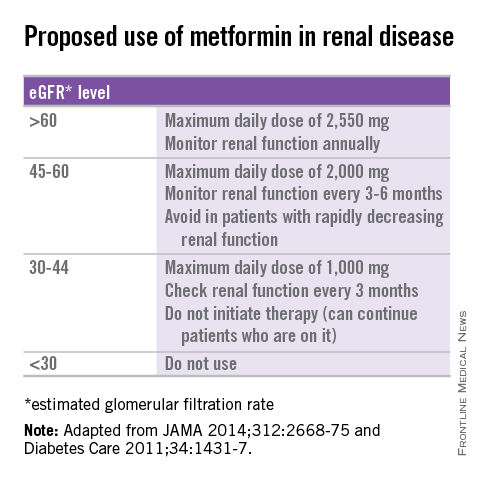
Several recommendations for using metformin in patients with renal insufficiency have been published (see table) (JAMA 2014;312:2668-75; Diabetes Care 2011;34:1431-7). Metformin has shown cardiovascular mortality benefits, compared with sulfonylureas, in the treatment of diabetes (Diabetes Care 2013;36:1304-11). Avoiding its use in patients with mild to moderate renal insufficiency in favor of other treatments that may not be as beneficial and may well lead to worse outcomes.
There is no evidence that metformin increases the lactic acidosis risk in patients with diabetes, but until there is a change in the FDA labeling, physicians will likely continue to be hesitant to use it in patients with renal insufficiency.
Dr. Paauw is professor of medicine in the division of general internal medicine at the University of Washington, Seattle, and he serves as third-year medical student clerkship director at the University of Washington. He is the Rathmann Family Foundation Chair in Patient-Centered Clinical Education. Contact Dr. Paauw at dpaauw@uw.edu.
A 47-year-old obese male with type 2 diabetes has been on metformin for the last 2 years with good effect (hemoglobin A1c of 6.8), and with exercise has been able to lose 5-10 pounds. His last two blood tests show creatinine levels of 1.5 and 1.6. What do you recommend?
A) Continue with metformin.
B) Stop metformin, start sulfonylurea.
C) Stop metformin, begin glargine.
D) Stop metformin, begin pioglitazone.
Myth: Metformin should not be used in patients with mild to moderate renal insufficiency because of an increased risk of lactic acidosis.
Metformin is the most commonly used oral agent for the treatment of type 2 diabetes in the United States, but the FDA-approved drug label states that it is contraindicated in patients with an abnormal creatinine clearance or serum creatinine of 1.4 in women and 1.5 in men.<sup/>The concern is for development of lactic acidosis in patients because the renally excreted metformin may build up as a result of decreased renal function.
Metformin was approved for use in the United States in 1995, many years after the drug was introduced in Europe. The first drug in its class, phenformin, was removed from the United States and most European markets in 1977 because of a high incidence of lactic acidosis occurring at therapeutic doses. One in 4,000 patients taking phenformin develops lactic acidosis (J. Emerg. Med. 1998;16:881-6). Phenformin has been shown to cause type B lactic acidosis, without evidence of hypoxia or hypoperfusion, and lactic acidosis because of phenformin carried a 50% mortality rate.
Deep concern for the possibility of a similar problem with metformin played an important role in its delay of availability in the United States. It isn’t clear, however, that diabetes patients on metformin have a higher risk of developing lactic acidosis than diabetes patients who are not on metformin.
A Cochrane review of 347 studies, including 70,490 person-years of metformin use, compared with 55,451 person-years in the nonmetformin group, showed no cases of fatal or nonfatal lactic acidosis in either group (Cochrane Database Syst. Rev. 2010 Apr 14:CD002967). More than half the studies included (53%) allowed for the inclusion of patients with creatinine levels greater than 1.5. There were no differences in lactate levels between metformin-treated patients and patients who did not receive metformin.
In a study using the Saskatchewan Health administrative database, which involved 11,797 patients with 22,296 years of metformin exposure, there were two cases of lactic acidosis (Diabetes Care 1999;22:925-7). This calculates to a rate of 9 cases per 100,000 person years, the same rate as in patients with diabetes who are not taking metformin (9.7 cases per 100,000) (Diabetes Care 1998;21:1659-63).
A recent study looked at the incidence of lactic acidosis in patients taking metformin with and without abnormalities in renal function (Diabetes Care 2014;37:2291-5). There was no statistically significant difference in the rates of lactic acidosis in patients who were on metformin with normal renal function, compared with those with varying degrees of renal insufficiency. The overall rate of lactic acidosis was 10.3 per 100,000 patient years, which is almost identical to the rates in the other studies mentioned, and there were no fatalities.
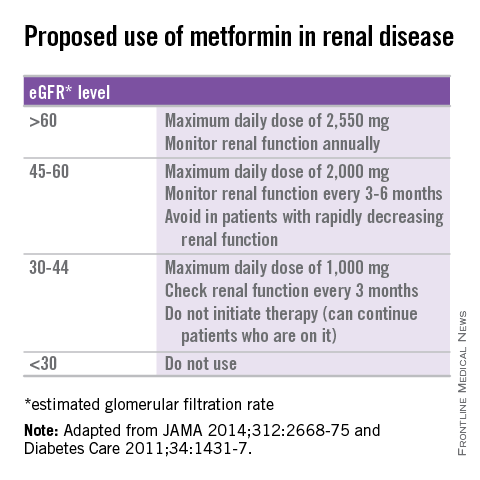
Several recommendations for using metformin in patients with renal insufficiency have been published (see table) (JAMA 2014;312:2668-75; Diabetes Care 2011;34:1431-7). Metformin has shown cardiovascular mortality benefits, compared with sulfonylureas, in the treatment of diabetes (Diabetes Care 2013;36:1304-11). Avoiding its use in patients with mild to moderate renal insufficiency in favor of other treatments that may not be as beneficial and may well lead to worse outcomes.
There is no evidence that metformin increases the lactic acidosis risk in patients with diabetes, but until there is a change in the FDA labeling, physicians will likely continue to be hesitant to use it in patients with renal insufficiency.
Dr. Paauw is professor of medicine in the division of general internal medicine at the University of Washington, Seattle, and he serves as third-year medical student clerkship director at the University of Washington. He is the Rathmann Family Foundation Chair in Patient-Centered Clinical Education. Contact Dr. Paauw at dpaauw@uw.edu.
A 47-year-old obese male with type 2 diabetes has been on metformin for the last 2 years with good effect (hemoglobin A1c of 6.8), and with exercise has been able to lose 5-10 pounds. His last two blood tests show creatinine levels of 1.5 and 1.6. What do you recommend?
A) Continue with metformin.
B) Stop metformin, start sulfonylurea.
C) Stop metformin, begin glargine.
D) Stop metformin, begin pioglitazone.
Myth: Metformin should not be used in patients with mild to moderate renal insufficiency because of an increased risk of lactic acidosis.
Metformin is the most commonly used oral agent for the treatment of type 2 diabetes in the United States, but the FDA-approved drug label states that it is contraindicated in patients with an abnormal creatinine clearance or serum creatinine of 1.4 in women and 1.5 in men.<sup/>The concern is for development of lactic acidosis in patients because the renally excreted metformin may build up as a result of decreased renal function.
Metformin was approved for use in the United States in 1995, many years after the drug was introduced in Europe. The first drug in its class, phenformin, was removed from the United States and most European markets in 1977 because of a high incidence of lactic acidosis occurring at therapeutic doses. One in 4,000 patients taking phenformin develops lactic acidosis (J. Emerg. Med. 1998;16:881-6). Phenformin has been shown to cause type B lactic acidosis, without evidence of hypoxia or hypoperfusion, and lactic acidosis because of phenformin carried a 50% mortality rate.
Deep concern for the possibility of a similar problem with metformin played an important role in its delay of availability in the United States. It isn’t clear, however, that diabetes patients on metformin have a higher risk of developing lactic acidosis than diabetes patients who are not on metformin.
A Cochrane review of 347 studies, including 70,490 person-years of metformin use, compared with 55,451 person-years in the nonmetformin group, showed no cases of fatal or nonfatal lactic acidosis in either group (Cochrane Database Syst. Rev. 2010 Apr 14:CD002967). More than half the studies included (53%) allowed for the inclusion of patients with creatinine levels greater than 1.5. There were no differences in lactate levels between metformin-treated patients and patients who did not receive metformin.
In a study using the Saskatchewan Health administrative database, which involved 11,797 patients with 22,296 years of metformin exposure, there were two cases of lactic acidosis (Diabetes Care 1999;22:925-7). This calculates to a rate of 9 cases per 100,000 person years, the same rate as in patients with diabetes who are not taking metformin (9.7 cases per 100,000) (Diabetes Care 1998;21:1659-63).
A recent study looked at the incidence of lactic acidosis in patients taking metformin with and without abnormalities in renal function (Diabetes Care 2014;37:2291-5). There was no statistically significant difference in the rates of lactic acidosis in patients who were on metformin with normal renal function, compared with those with varying degrees of renal insufficiency. The overall rate of lactic acidosis was 10.3 per 100,000 patient years, which is almost identical to the rates in the other studies mentioned, and there were no fatalities.
Several recommendations for using metformin in patients with renal insufficiency have been published (see table) (JAMA 2014;312:2668-75; Diabetes Care 2011;34:1431-7). Metformin has shown cardiovascular mortality benefits, compared with sulfonylureas, in the treatment of diabetes (Diabetes Care 2013;36:1304-11). Avoiding its use in patients with mild to moderate renal insufficiency in favor of other treatments that may not be as beneficial and may well lead to worse outcomes.
There is no evidence that metformin increases the lactic acidosis risk in patients with diabetes, but until there is a change in the FDA labeling, physicians will likely continue to be hesitant to use it in patients with renal insufficiency.
Dr. Paauw is professor of medicine in the division of general internal medicine at the University of Washington, Seattle, and he serves as third-year medical student clerkship director at the University of Washington. He is the Rathmann Family Foundation Chair in Patient-Centered Clinical Education. Contact Dr. Paauw at dpaauw@uw.edu.
Best interest
A dense broth of tedium, a sprinkle of annoyance, and a dash of trepidation – these are the ingredients of the mental soup that simmers in my head when I answer a middle-of-the-night parent phone call.
At least they were until the task of solving the community’s nighttime phone “crises” fell upon the able, eager shoulders of our new interns.

Every now and then, the universe throws up a surprise. One night, my intern was placating a very angry man who was upset with his inconsolable baby. He was the foster father of a baby with neonatal abstinence syndrome (NAS) who had been discharged earlier that day.
“I feel like this baby’s been thrown at us! He wasn’t ready to go home!” he cried. Having never met the baby (foster mom had taken the baby home), this man had returned from a long work shift to find a screaming baby at home. He was aggressive and rude as he ranted at my intern. She empathized and explained that other symptoms might include rapid breathing, irritability, sleep problems, etc.
Although she handled the call with consummate grace and professionalism, afterward an uneasy feeling crept over us. An angry, tired man pushed to his limits, and a very difficult, strange new baby at home was a setup for the perfect storm. Our duty in this situation was clear – we were the protectors of this baby’s best interest. That was all that mattered.
With a rising sense of dread, we juggled frantic phone calls between Child Protective Services, the attending physician, the foster family, and the nearest emergency department. All I could think of was how badly we had failed this baby. Something somewhere had gone horribly wrong for this innocent child to be in danger now.
An hour later, when I finally got through to the foster father, he sounded calmer. “We can’t do this,” he stated simply. He informed me he had called Child Protective Services himself. The baby would come back to us temporarily, while we found him a safe home. Relief swept over us.
Perhaps the baby should never have gone home with this family. Perhaps we had no way of knowing this would happen. Perhaps the family did not realize the responsibility they were assuming. We are all only human. We make mistakes. But we pick up the pieces and we try again, guided by the best interest of the children we swear to protect. This desire to keep trying is what makes all the difference in the world. By making the call himself, this man reaffirmed my faith in the process in which we all play a part. May the quest for the best interest of our children endure forever.
Dr. Behere is a third-year resident in pediatrics at Children’s Hospital at Dartmouth-Hitchcock, Lebanon, N.H. E-mail him at pdnews@frontlinemedcom.com.
A dense broth of tedium, a sprinkle of annoyance, and a dash of trepidation – these are the ingredients of the mental soup that simmers in my head when I answer a middle-of-the-night parent phone call.
At least they were until the task of solving the community’s nighttime phone “crises” fell upon the able, eager shoulders of our new interns.
Every now and then, the universe throws up a surprise. One night, my intern was placating a very angry man who was upset with his inconsolable baby. He was the foster father of a baby with neonatal abstinence syndrome (NAS) who had been discharged earlier that day.
“I feel like this baby’s been thrown at us! He wasn’t ready to go home!” he cried. Having never met the baby (foster mom had taken the baby home), this man had returned from a long work shift to find a screaming baby at home. He was aggressive and rude as he ranted at my intern. She empathized and explained that other symptoms might include rapid breathing, irritability, sleep problems, etc.
Although she handled the call with consummate grace and professionalism, afterward an uneasy feeling crept over us. An angry, tired man pushed to his limits, and a very difficult, strange new baby at home was a setup for the perfect storm. Our duty in this situation was clear – we were the protectors of this baby’s best interest. That was all that mattered.
With a rising sense of dread, we juggled frantic phone calls between Child Protective Services, the attending physician, the foster family, and the nearest emergency department. All I could think of was how badly we had failed this baby. Something somewhere had gone horribly wrong for this innocent child to be in danger now.
An hour later, when I finally got through to the foster father, he sounded calmer. “We can’t do this,” he stated simply. He informed me he had called Child Protective Services himself. The baby would come back to us temporarily, while we found him a safe home. Relief swept over us.
Perhaps the baby should never have gone home with this family. Perhaps we had no way of knowing this would happen. Perhaps the family did not realize the responsibility they were assuming. We are all only human. We make mistakes. But we pick up the pieces and we try again, guided by the best interest of the children we swear to protect. This desire to keep trying is what makes all the difference in the world. By making the call himself, this man reaffirmed my faith in the process in which we all play a part. May the quest for the best interest of our children endure forever.
Dr. Behere is a third-year resident in pediatrics at Children’s Hospital at Dartmouth-Hitchcock, Lebanon, N.H. E-mail him at pdnews@frontlinemedcom.com.
A dense broth of tedium, a sprinkle of annoyance, and a dash of trepidation – these are the ingredients of the mental soup that simmers in my head when I answer a middle-of-the-night parent phone call.
At least they were until the task of solving the community’s nighttime phone “crises” fell upon the able, eager shoulders of our new interns.
Every now and then, the universe throws up a surprise. One night, my intern was placating a very angry man who was upset with his inconsolable baby. He was the foster father of a baby with neonatal abstinence syndrome (NAS) who had been discharged earlier that day.
“I feel like this baby’s been thrown at us! He wasn’t ready to go home!” he cried. Having never met the baby (foster mom had taken the baby home), this man had returned from a long work shift to find a screaming baby at home. He was aggressive and rude as he ranted at my intern. She empathized and explained that other symptoms might include rapid breathing, irritability, sleep problems, etc.
Although she handled the call with consummate grace and professionalism, afterward an uneasy feeling crept over us. An angry, tired man pushed to his limits, and a very difficult, strange new baby at home was a setup for the perfect storm. Our duty in this situation was clear – we were the protectors of this baby’s best interest. That was all that mattered.
With a rising sense of dread, we juggled frantic phone calls between Child Protective Services, the attending physician, the foster family, and the nearest emergency department. All I could think of was how badly we had failed this baby. Something somewhere had gone horribly wrong for this innocent child to be in danger now.
An hour later, when I finally got through to the foster father, he sounded calmer. “We can’t do this,” he stated simply. He informed me he had called Child Protective Services himself. The baby would come back to us temporarily, while we found him a safe home. Relief swept over us.
Perhaps the baby should never have gone home with this family. Perhaps we had no way of knowing this would happen. Perhaps the family did not realize the responsibility they were assuming. We are all only human. We make mistakes. But we pick up the pieces and we try again, guided by the best interest of the children we swear to protect. This desire to keep trying is what makes all the difference in the world. By making the call himself, this man reaffirmed my faith in the process in which we all play a part. May the quest for the best interest of our children endure forever.
Dr. Behere is a third-year resident in pediatrics at Children’s Hospital at Dartmouth-Hitchcock, Lebanon, N.H. E-mail him at pdnews@frontlinemedcom.com.

Medicare at 50: Or, the end of fee-for-service
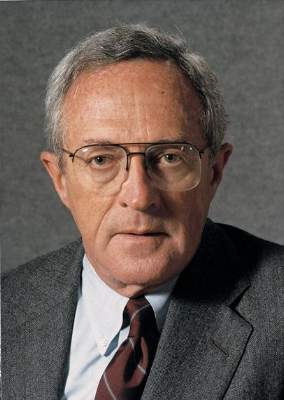
Few of my readers were around when Medicare was signed into law in 1965 by President Lyndon Johnson. Mr. Johnson was into his first elected term as president, having first taken the oath of office with the assassination of John F. Kennedy in November 1963.
Hardly a darling of the liberal left, he was maligned as the perpetrator, if not for the expansion, of the Vietnam War. He was elected with the largest presidential plurality in history, receiving 61% of the votes, and he carried with him a solid Democratic Congress bolstered by a large block of solid Southern Democrats, a firmament from which he had emerged. He can be credited for the most far-reaching social legislation of the 20th century, second only to Franklin Delano Roosevelt of the 1930s. Johnson was able to move the Civil Rights Act of 1964 and the Voting Rights Act and Medicare Act through Congress in 1965, the latter of which we celebrate this year.
At the time of passage of Medicare, 35% of Americans over 65 had no health insurance, either because they found insurance unaffordable or because of preexisting illness. Health insurance premiums for the elderly cost roughly three times more than did those for younger individuals. With many of the elderly living on Social Security alone, health insurance was an impossibility. If they needed care, they might find it at the emergency department of their local hospitals.
The battle for the passage of Medicare was formidable. In contrast to the passive role of the American Medical Association in the passage of the Affordable Care Act, Medicare was, to put it mildly, vigorously opposed by most doctors and by the AMA, which viewed it as the harbinger of long-anticipated socialized medicine. It ended up being far from it.
Medicare provided a pathway to an economic bonanza for the practicing physician and to hospitals that they could never have imagined. It immediately expanded the patient population and allowed enterprising and not-so-enterprising doctors and hospitals to run up the costs of health care by strengthening the fee-for-service style of medical care. Doctors, hospitals, and patients had no concern for cost: Medicare paid for everything.
Hospitals found Medicare a ready source of income. Doctor and hospital bills were based on the usual cost to each in their respective communities. Medical educators as well as house staff also saw their income lifted as a result of the federal government’s paying for a large part if not all of the cost of house staff education. Even the small number of physicians who opted out of Medicare, because of the red tape or to preserve their independence from the federal government, benefited. Their fees increased as the payment schedules of Medicare increased in their communities.
One of the by-products of Medicare was the end of hospital segregation. For those of you who were not around then, you can imagine what an impact that had on hospitals and doctors in both the North and the South.
Over time, Medicare expanded its footprint to include treatment of chronic kidney disease at any age, as well as drug coverage. I would guess that most Americans over 65 (this writer included) love Medicare. And doctors? Well, they still grumble about it.
With the recent readjustment of physicians’ Medicare reimbursement rates, the door has been opened to new initiatives based on quality of care. No matter what your political persuasion, it is clear that Americans cannot afford Medicare as we know it. Physicians undoubtedly will find their fee-for-service style of reimbursement curtailed as we learn the definition of “quality care standards.” Quality standards will not only define clinical performance, but will also include cost of rendering that care. So long to the world of fee-for-service reimbursement.
Dr. Goldstein, medical editor of Cardiology News, is professor of medicine at Wayne State University and division head emeritus of cardiovascular medicine at Henry Ford Hospital, both in Detroit. He is on data safety monitoring committees for the National Institutes of Health and several pharmaceutical companies.
Few of my readers were around when Medicare was signed into law in 1965 by President Lyndon Johnson. Mr. Johnson was into his first elected term as president, having first taken the oath of office with the assassination of John F. Kennedy in November 1963.
Hardly a darling of the liberal left, he was maligned as the perpetrator, if not for the expansion, of the Vietnam War. He was elected with the largest presidential plurality in history, receiving 61% of the votes, and he carried with him a solid Democratic Congress bolstered by a large block of solid Southern Democrats, a firmament from which he had emerged. He can be credited for the most far-reaching social legislation of the 20th century, second only to Franklin Delano Roosevelt of the 1930s. Johnson was able to move the Civil Rights Act of 1964 and the Voting Rights Act and Medicare Act through Congress in 1965, the latter of which we celebrate this year.
At the time of passage of Medicare, 35% of Americans over 65 had no health insurance, either because they found insurance unaffordable or because of preexisting illness. Health insurance premiums for the elderly cost roughly three times more than did those for younger individuals. With many of the elderly living on Social Security alone, health insurance was an impossibility. If they needed care, they might find it at the emergency department of their local hospitals.
The battle for the passage of Medicare was formidable. In contrast to the passive role of the American Medical Association in the passage of the Affordable Care Act, Medicare was, to put it mildly, vigorously opposed by most doctors and by the AMA, which viewed it as the harbinger of long-anticipated socialized medicine. It ended up being far from it.
Medicare provided a pathway to an economic bonanza for the practicing physician and to hospitals that they could never have imagined. It immediately expanded the patient population and allowed enterprising and not-so-enterprising doctors and hospitals to run up the costs of health care by strengthening the fee-for-service style of medical care. Doctors, hospitals, and patients had no concern for cost: Medicare paid for everything.
Hospitals found Medicare a ready source of income. Doctor and hospital bills were based on the usual cost to each in their respective communities. Medical educators as well as house staff also saw their income lifted as a result of the federal government’s paying for a large part if not all of the cost of house staff education. Even the small number of physicians who opted out of Medicare, because of the red tape or to preserve their independence from the federal government, benefited. Their fees increased as the payment schedules of Medicare increased in their communities.
One of the by-products of Medicare was the end of hospital segregation. For those of you who were not around then, you can imagine what an impact that had on hospitals and doctors in both the North and the South.
Over time, Medicare expanded its footprint to include treatment of chronic kidney disease at any age, as well as drug coverage. I would guess that most Americans over 65 (this writer included) love Medicare. And doctors? Well, they still grumble about it.
With the recent readjustment of physicians’ Medicare reimbursement rates, the door has been opened to new initiatives based on quality of care. No matter what your political persuasion, it is clear that Americans cannot afford Medicare as we know it. Physicians undoubtedly will find their fee-for-service style of reimbursement curtailed as we learn the definition of “quality care standards.” Quality standards will not only define clinical performance, but will also include cost of rendering that care. So long to the world of fee-for-service reimbursement.
Dr. Goldstein, medical editor of Cardiology News, is professor of medicine at Wayne State University and division head emeritus of cardiovascular medicine at Henry Ford Hospital, both in Detroit. He is on data safety monitoring committees for the National Institutes of Health and several pharmaceutical companies.
Few of my readers were around when Medicare was signed into law in 1965 by President Lyndon Johnson. Mr. Johnson was into his first elected term as president, having first taken the oath of office with the assassination of John F. Kennedy in November 1963.
Hardly a darling of the liberal left, he was maligned as the perpetrator, if not for the expansion, of the Vietnam War. He was elected with the largest presidential plurality in history, receiving 61% of the votes, and he carried with him a solid Democratic Congress bolstered by a large block of solid Southern Democrats, a firmament from which he had emerged. He can be credited for the most far-reaching social legislation of the 20th century, second only to Franklin Delano Roosevelt of the 1930s. Johnson was able to move the Civil Rights Act of 1964 and the Voting Rights Act and Medicare Act through Congress in 1965, the latter of which we celebrate this year.
At the time of passage of Medicare, 35% of Americans over 65 had no health insurance, either because they found insurance unaffordable or because of preexisting illness. Health insurance premiums for the elderly cost roughly three times more than did those for younger individuals. With many of the elderly living on Social Security alone, health insurance was an impossibility. If they needed care, they might find it at the emergency department of their local hospitals.
The battle for the passage of Medicare was formidable. In contrast to the passive role of the American Medical Association in the passage of the Affordable Care Act, Medicare was, to put it mildly, vigorously opposed by most doctors and by the AMA, which viewed it as the harbinger of long-anticipated socialized medicine. It ended up being far from it.
Medicare provided a pathway to an economic bonanza for the practicing physician and to hospitals that they could never have imagined. It immediately expanded the patient population and allowed enterprising and not-so-enterprising doctors and hospitals to run up the costs of health care by strengthening the fee-for-service style of medical care. Doctors, hospitals, and patients had no concern for cost: Medicare paid for everything.
Hospitals found Medicare a ready source of income. Doctor and hospital bills were based on the usual cost to each in their respective communities. Medical educators as well as house staff also saw their income lifted as a result of the federal government’s paying for a large part if not all of the cost of house staff education. Even the small number of physicians who opted out of Medicare, because of the red tape or to preserve their independence from the federal government, benefited. Their fees increased as the payment schedules of Medicare increased in their communities.
One of the by-products of Medicare was the end of hospital segregation. For those of you who were not around then, you can imagine what an impact that had on hospitals and doctors in both the North and the South.
Over time, Medicare expanded its footprint to include treatment of chronic kidney disease at any age, as well as drug coverage. I would guess that most Americans over 65 (this writer included) love Medicare. And doctors? Well, they still grumble about it.
With the recent readjustment of physicians’ Medicare reimbursement rates, the door has been opened to new initiatives based on quality of care. No matter what your political persuasion, it is clear that Americans cannot afford Medicare as we know it. Physicians undoubtedly will find their fee-for-service style of reimbursement curtailed as we learn the definition of “quality care standards.” Quality standards will not only define clinical performance, but will also include cost of rendering that care. So long to the world of fee-for-service reimbursement.
Dr. Goldstein, medical editor of Cardiology News, is professor of medicine at Wayne State University and division head emeritus of cardiovascular medicine at Henry Ford Hospital, both in Detroit. He is on data safety monitoring committees for the National Institutes of Health and several pharmaceutical companies.
ACP: The Beantown Airing of Grievances
BOSTON – Four-thirty in the afternoon isn’t the time slot most conference presenters covet.
By that point, many attendees are done for the day – loaded up with new knowledge and weighed down with schwag-stuffed tote bags. By 4:30 p.m., the hotel bar is enjoying stronger attendance and better survey-sheet ratings than a closing-time clinical diagnosis session.
But, by 4:30 Thursday at the annual meeting of the American College of Physicians, cavernous room 107 in Boston’s convention center was filling up.
Was it hosting “Atrial Fibrillation 2015”? “Prescribing Chronic Opioids”? “Update in Endocrinology”?
In fact, the session’s topic wasn’t clinical, but its nature was definitely acute. Room 107’s attendees had arrived for a session with the potential for as much action as the weekend’s upcoming Mayweather-Pacquiao megafight: “ABIM: Understanding MOC Requirements.”
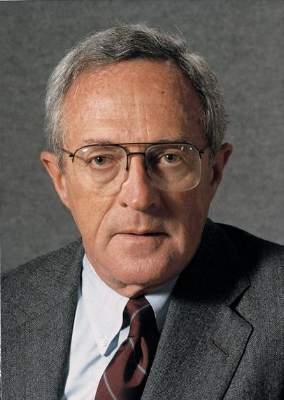
There behind the podium stood the subdued president and CEO of the American Board of Internal Medicine, Dr. Richard J. Baron, looking like a Yankees fan about to lecture the Fenway Park faithful on the many merits of Bucky “Bleepin’ ” Dent.
In fact, before him seethed bleachers of angry doctors eager to share their opinions about what they viewed as ABIM’s own Bucky Dent: the Maintenance of Certification program.
With the ABIM board’s chair-elect, Dr. Clarence Braddock III, sitting nearby on the dais, Dr. Baron dutifully outlined the MOC backtracking that came with February’s public apology by ABIM: updates to its internal medicine exam; suspension of the practice assessment, patient voice, and patient safety requirements for at least 2 years; and MOC enrollment fees set at or below the 2014 levels through at least 2017. And if those three requirements did return, ABIM would give physicians a year’s notice before they would have to start meeting them.
By the end of the year, ABIM also will unveil more flexible ways to earn MOC points, Dr. Baron noted. He also offered his listeners assurances that the fall 2015 MOC exam would better reflect doctors’ clinical experiences.
“The most important thing we learned from Feb. 3 is that ABIM needed to change to an organization much more rooted in the community,” Dr. Baron explained.
Then he opened the meeting to questions from the audience – triggering an Airing of Grievances worthy of a “Seinfeld” Festivus.

Beginning with a New Jersey physician who vigorously aired her own grievances at a volume that made a microphone redundant – “Don’t scare us away – we WANT to keep up!” – room 107’s open mics amplified a steady stream of physicians eager to vent their MOC-fueled fury and despair.
What about changing the MOC exam to open-book? “ ‘Consult the gastroenterologist’ is the real-world approach to solving problems!” Why can’t multiple sources of CME credit count toward MOC? Why not dump the recertification exam and simply use the modules to keep physicians fresh?
One physician who spent most of his practice in urgent-care settings and occupational medicine – in which relationships with patients are, by nature, short-lived – worried that a return of the patient voice requirement would make failure certain for him.
“I may be 72, but I will retire before I do one of those Practice Improvement Modules again!” warned another physician.
Attendees also zeroed in on financial allegations made in two recent Newsweek articles about ABIM (“The Ugly Civil War in American Medicine” and “A Certified Medical Controversy”). “Is an independent group going to review reports about ABIM’s finances?” one attendee asked. Another stated that ABIM’s board shouldn’t be paid, a suggestion for which the doctor received a generous round of applause.
Dr. Baron categorically dismissed claims that ABIM was financially troubled and that it manipulated exams to drive down pass rates – and thus boost its revenues with retests. “We had the sixth-largest auditor review our finances, and they found no issue with our finances,” Dr. Baron countered. “Our audited finances are available on our website.”
Although the audience appeared unified in its deep displeasure with ABIM’s approach to the now-postponed MOC changes, the still-active issue of recertification exams revealed fissures between older and younger doctors.
One younger physician questioned the fairness of the dual system: “Why do older doctors not have to recertify? Abolish grandfathering!”
That drove “grandfathered” physicians to the room mics to defend their exclusion from recertification tests. Some stated that no data backed the belief that recertified physicians delivered better care. One grandfathered physician insisted she shouldn’t be “bullied into recertifying.”
Dr. Baron backed recertification by declaring that “we know that knowledge decays over time.” A study of grandfathered physicians vs. recertified physicians showed higher costs associated with grandfathers, he added.
After nearly an hour of open mics and talk therapy, the session came to a less-animated end. Attendees drifted off to evening events and, no doubt, nearby hotel bars for postgame MOC analysis. Dr. Baron left with the look of a New York fan relieved simply to escape Fenway Park physically unscathed after a Yankees win.
Will the communal catharsis from the Beantown Airing of Grievances – and similar sessions elsewhere – earn ABIM more time to morph MOC into something more acceptable and relevant to its test-takers and fee-payers before more physicians flee to upstart competing boards? Probably for many physicians, for whom ABIM’s MOC program remains at best a valued, necessary credential, and at worst a necessary evil.
But others say they’ve had enough.
As one physician emphatically declared to her colleagues in room 107 and beyond: “I would like the opportunity to put ‘Boycotting the MOC’ as my status on the ABIM website!”
BOSTON – Four-thirty in the afternoon isn’t the time slot most conference presenters covet.
By that point, many attendees are done for the day – loaded up with new knowledge and weighed down with schwag-stuffed tote bags. By 4:30 p.m., the hotel bar is enjoying stronger attendance and better survey-sheet ratings than a closing-time clinical diagnosis session.
But, by 4:30 Thursday at the annual meeting of the American College of Physicians, cavernous room 107 in Boston’s convention center was filling up.
Was it hosting “Atrial Fibrillation 2015”? “Prescribing Chronic Opioids”? “Update in Endocrinology”?
In fact, the session’s topic wasn’t clinical, but its nature was definitely acute. Room 107’s attendees had arrived for a session with the potential for as much action as the weekend’s upcoming Mayweather-Pacquiao megafight: “ABIM: Understanding MOC Requirements.”
There behind the podium stood the subdued president and CEO of the American Board of Internal Medicine, Dr. Richard J. Baron, looking like a Yankees fan about to lecture the Fenway Park faithful on the many merits of Bucky “Bleepin’ ” Dent.
In fact, before him seethed bleachers of angry doctors eager to share their opinions about what they viewed as ABIM’s own Bucky Dent: the Maintenance of Certification program.
With the ABIM board’s chair-elect, Dr. Clarence Braddock III, sitting nearby on the dais, Dr. Baron dutifully outlined the MOC backtracking that came with February’s public apology by ABIM: updates to its internal medicine exam; suspension of the practice assessment, patient voice, and patient safety requirements for at least 2 years; and MOC enrollment fees set at or below the 2014 levels through at least 2017. And if those three requirements did return, ABIM would give physicians a year’s notice before they would have to start meeting them.
By the end of the year, ABIM also will unveil more flexible ways to earn MOC points, Dr. Baron noted. He also offered his listeners assurances that the fall 2015 MOC exam would better reflect doctors’ clinical experiences.
“The most important thing we learned from Feb. 3 is that ABIM needed to change to an organization much more rooted in the community,” Dr. Baron explained.
Then he opened the meeting to questions from the audience – triggering an Airing of Grievances worthy of a “Seinfeld” Festivus.
Beginning with a New Jersey physician who vigorously aired her own grievances at a volume that made a microphone redundant – “Don’t scare us away – we WANT to keep up!” – room 107’s open mics amplified a steady stream of physicians eager to vent their MOC-fueled fury and despair.
What about changing the MOC exam to open-book? “ ‘Consult the gastroenterologist’ is the real-world approach to solving problems!” Why can’t multiple sources of CME credit count toward MOC? Why not dump the recertification exam and simply use the modules to keep physicians fresh?
One physician who spent most of his practice in urgent-care settings and occupational medicine – in which relationships with patients are, by nature, short-lived – worried that a return of the patient voice requirement would make failure certain for him.
“I may be 72, but I will retire before I do one of those Practice Improvement Modules again!” warned another physician.
Attendees also zeroed in on financial allegations made in two recent Newsweek articles about ABIM (“The Ugly Civil War in American Medicine” and “A Certified Medical Controversy”). “Is an independent group going to review reports about ABIM’s finances?” one attendee asked. Another stated that ABIM’s board shouldn’t be paid, a suggestion for which the doctor received a generous round of applause.
Dr. Baron categorically dismissed claims that ABIM was financially troubled and that it manipulated exams to drive down pass rates – and thus boost its revenues with retests. “We had the sixth-largest auditor review our finances, and they found no issue with our finances,” Dr. Baron countered. “Our audited finances are available on our website.”
Although the audience appeared unified in its deep displeasure with ABIM’s approach to the now-postponed MOC changes, the still-active issue of recertification exams revealed fissures between older and younger doctors.
One younger physician questioned the fairness of the dual system: “Why do older doctors not have to recertify? Abolish grandfathering!”
That drove “grandfathered” physicians to the room mics to defend their exclusion from recertification tests. Some stated that no data backed the belief that recertified physicians delivered better care. One grandfathered physician insisted she shouldn’t be “bullied into recertifying.”
Dr. Baron backed recertification by declaring that “we know that knowledge decays over time.” A study of grandfathered physicians vs. recertified physicians showed higher costs associated with grandfathers, he added.
After nearly an hour of open mics and talk therapy, the session came to a less-animated end. Attendees drifted off to evening events and, no doubt, nearby hotel bars for postgame MOC analysis. Dr. Baron left with the look of a New York fan relieved simply to escape Fenway Park physically unscathed after a Yankees win.
Will the communal catharsis from the Beantown Airing of Grievances – and similar sessions elsewhere – earn ABIM more time to morph MOC into something more acceptable and relevant to its test-takers and fee-payers before more physicians flee to upstart competing boards? Probably for many physicians, for whom ABIM’s MOC program remains at best a valued, necessary credential, and at worst a necessary evil.
But others say they’ve had enough.
As one physician emphatically declared to her colleagues in room 107 and beyond: “I would like the opportunity to put ‘Boycotting the MOC’ as my status on the ABIM website!”
BOSTON – Four-thirty in the afternoon isn’t the time slot most conference presenters covet.
By that point, many attendees are done for the day – loaded up with new knowledge and weighed down with schwag-stuffed tote bags. By 4:30 p.m., the hotel bar is enjoying stronger attendance and better survey-sheet ratings than a closing-time clinical diagnosis session.
But, by 4:30 Thursday at the annual meeting of the American College of Physicians, cavernous room 107 in Boston’s convention center was filling up.
Was it hosting “Atrial Fibrillation 2015”? “Prescribing Chronic Opioids”? “Update in Endocrinology”?
In fact, the session’s topic wasn’t clinical, but its nature was definitely acute. Room 107’s attendees had arrived for a session with the potential for as much action as the weekend’s upcoming Mayweather-Pacquiao megafight: “ABIM: Understanding MOC Requirements.”
There behind the podium stood the subdued president and CEO of the American Board of Internal Medicine, Dr. Richard J. Baron, looking like a Yankees fan about to lecture the Fenway Park faithful on the many merits of Bucky “Bleepin’ ” Dent.
In fact, before him seethed bleachers of angry doctors eager to share their opinions about what they viewed as ABIM’s own Bucky Dent: the Maintenance of Certification program.
With the ABIM board’s chair-elect, Dr. Clarence Braddock III, sitting nearby on the dais, Dr. Baron dutifully outlined the MOC backtracking that came with February’s public apology by ABIM: updates to its internal medicine exam; suspension of the practice assessment, patient voice, and patient safety requirements for at least 2 years; and MOC enrollment fees set at or below the 2014 levels through at least 2017. And if those three requirements did return, ABIM would give physicians a year’s notice before they would have to start meeting them.
By the end of the year, ABIM also will unveil more flexible ways to earn MOC points, Dr. Baron noted. He also offered his listeners assurances that the fall 2015 MOC exam would better reflect doctors’ clinical experiences.
“The most important thing we learned from Feb. 3 is that ABIM needed to change to an organization much more rooted in the community,” Dr. Baron explained.
Then he opened the meeting to questions from the audience – triggering an Airing of Grievances worthy of a “Seinfeld” Festivus.
Beginning with a New Jersey physician who vigorously aired her own grievances at a volume that made a microphone redundant – “Don’t scare us away – we WANT to keep up!” – room 107’s open mics amplified a steady stream of physicians eager to vent their MOC-fueled fury and despair.
What about changing the MOC exam to open-book? “ ‘Consult the gastroenterologist’ is the real-world approach to solving problems!” Why can’t multiple sources of CME credit count toward MOC? Why not dump the recertification exam and simply use the modules to keep physicians fresh?
One physician who spent most of his practice in urgent-care settings and occupational medicine – in which relationships with patients are, by nature, short-lived – worried that a return of the patient voice requirement would make failure certain for him.
“I may be 72, but I will retire before I do one of those Practice Improvement Modules again!” warned another physician.
Attendees also zeroed in on financial allegations made in two recent Newsweek articles about ABIM (“The Ugly Civil War in American Medicine” and “A Certified Medical Controversy”). “Is an independent group going to review reports about ABIM’s finances?” one attendee asked. Another stated that ABIM’s board shouldn’t be paid, a suggestion for which the doctor received a generous round of applause.
Dr. Baron categorically dismissed claims that ABIM was financially troubled and that it manipulated exams to drive down pass rates – and thus boost its revenues with retests. “We had the sixth-largest auditor review our finances, and they found no issue with our finances,” Dr. Baron countered. “Our audited finances are available on our website.”
Although the audience appeared unified in its deep displeasure with ABIM’s approach to the now-postponed MOC changes, the still-active issue of recertification exams revealed fissures between older and younger doctors.
One younger physician questioned the fairness of the dual system: “Why do older doctors not have to recertify? Abolish grandfathering!”
That drove “grandfathered” physicians to the room mics to defend their exclusion from recertification tests. Some stated that no data backed the belief that recertified physicians delivered better care. One grandfathered physician insisted she shouldn’t be “bullied into recertifying.”
Dr. Baron backed recertification by declaring that “we know that knowledge decays over time.” A study of grandfathered physicians vs. recertified physicians showed higher costs associated with grandfathers, he added.
After nearly an hour of open mics and talk therapy, the session came to a less-animated end. Attendees drifted off to evening events and, no doubt, nearby hotel bars for postgame MOC analysis. Dr. Baron left with the look of a New York fan relieved simply to escape Fenway Park physically unscathed after a Yankees win.
Will the communal catharsis from the Beantown Airing of Grievances – and similar sessions elsewhere – earn ABIM more time to morph MOC into something more acceptable and relevant to its test-takers and fee-payers before more physicians flee to upstart competing boards? Probably for many physicians, for whom ABIM’s MOC program remains at best a valued, necessary credential, and at worst a necessary evil.
But others say they’ve had enough.
As one physician emphatically declared to her colleagues in room 107 and beyond: “I would like the opportunity to put ‘Boycotting the MOC’ as my status on the ABIM website!”
AT ACP INTERNAL MEDICINE 2015

Prepping for the Boards? We can help
The results of the 2015 National Residency Match Program were announced on March 20. For family medicine, the glass was either half empty or half full, depending on your point of view.
On the plus side, 84 more family medicine positions were offered compared to 2014 (3216 vs 3132) and 60 more positions were filled, for a total of 3060 new family medicine residents in 2015.1 This was far more than matched in gloomy 2009, when only 2555 residents chose family medicine. On the negative side of the balance sheet, there will be 233 fewer family medicine residents this year than matched at the peak of medical student interest in family medicine in 1998.
I’m a glass half full kind of guy, so I am delighted that the trend of increased medical student interest in family medicine continues. According to Merritt Hawkins, a national recruitment firm, family medicine has been the top recruited specialty for several years. The firm reports that starting salaries for family physicians increased by nearly 12% from 2010/11 to 2013/14, which was a higher rate than that of most other specialties.2 So there is reason to be optimistic about the future of our specialty.
However, to be card-carrying family physicians, our new residents must take the American Board of Family Medicine certification exam, and not all pass on their first attempt. A 2013 study of family medicine residency graduates found that only 86% of graduates passed the board exam on their first try.3
We can help. In addition to the evidence-based reviews published in The Journal of Family Practice (JFP), we have launched a new feature called Residents’ Rapid Review (RRR) to provide an additional resource for residents.
RRR is a monthly 5-question evidence-based quiz prepared by primary care faculty, including current and former residency program directors. After residents click on their answer, the system lets them know whether they’re right and provides the correct answer with an explanation and references. Monthly notifications are sent out to all jfponline.com registered users alerting them that a new quiz is available. (Not a registered user on the site? Sign up at jfponline.com/residents_reg.)
Getting ready for the recertification exam? The RRR quizzes can help you, too. Check out the latest quiz, today!
1. National Resident Matching Program. Advance data tables. 2015 main residency match. National Resident Matching Program Web site. Available at: http://www.nrmp.org/wp-content/uploads/2015/03/ADT2015_final.pdf. Accessed April 16, 2015.
2. Merritt Hawkins. 2014 review of physician and advanced practitioner recruiting incentives. Irving, TX: Merritt Hawkins; 2014:9.
3. Falcone JL, Middleton DB. Pass rates on the American Board of Family Medicine Certification Exam by residency location and size. J Am Board Fam Med. 2013;26:453-459.
The results of the 2015 National Residency Match Program were announced on March 20. For family medicine, the glass was either half empty or half full, depending on your point of view.
On the plus side, 84 more family medicine positions were offered compared to 2014 (3216 vs 3132) and 60 more positions were filled, for a total of 3060 new family medicine residents in 2015.1 This was far more than matched in gloomy 2009, when only 2555 residents chose family medicine. On the negative side of the balance sheet, there will be 233 fewer family medicine residents this year than matched at the peak of medical student interest in family medicine in 1998.
I’m a glass half full kind of guy, so I am delighted that the trend of increased medical student interest in family medicine continues. According to Merritt Hawkins, a national recruitment firm, family medicine has been the top recruited specialty for several years. The firm reports that starting salaries for family physicians increased by nearly 12% from 2010/11 to 2013/14, which was a higher rate than that of most other specialties.2 So there is reason to be optimistic about the future of our specialty.
However, to be card-carrying family physicians, our new residents must take the American Board of Family Medicine certification exam, and not all pass on their first attempt. A 2013 study of family medicine residency graduates found that only 86% of graduates passed the board exam on their first try.3
We can help. In addition to the evidence-based reviews published in The Journal of Family Practice (JFP), we have launched a new feature called Residents’ Rapid Review (RRR) to provide an additional resource for residents.
RRR is a monthly 5-question evidence-based quiz prepared by primary care faculty, including current and former residency program directors. After residents click on their answer, the system lets them know whether they’re right and provides the correct answer with an explanation and references. Monthly notifications are sent out to all jfponline.com registered users alerting them that a new quiz is available. (Not a registered user on the site? Sign up at jfponline.com/residents_reg.)
Getting ready for the recertification exam? The RRR quizzes can help you, too. Check out the latest quiz, today!
The results of the 2015 National Residency Match Program were announced on March 20. For family medicine, the glass was either half empty or half full, depending on your point of view.
On the plus side, 84 more family medicine positions were offered compared to 2014 (3216 vs 3132) and 60 more positions were filled, for a total of 3060 new family medicine residents in 2015.1 This was far more than matched in gloomy 2009, when only 2555 residents chose family medicine. On the negative side of the balance sheet, there will be 233 fewer family medicine residents this year than matched at the peak of medical student interest in family medicine in 1998.
I’m a glass half full kind of guy, so I am delighted that the trend of increased medical student interest in family medicine continues. According to Merritt Hawkins, a national recruitment firm, family medicine has been the top recruited specialty for several years. The firm reports that starting salaries for family physicians increased by nearly 12% from 2010/11 to 2013/14, which was a higher rate than that of most other specialties.2 So there is reason to be optimistic about the future of our specialty.
However, to be card-carrying family physicians, our new residents must take the American Board of Family Medicine certification exam, and not all pass on their first attempt. A 2013 study of family medicine residency graduates found that only 86% of graduates passed the board exam on their first try.3
We can help. In addition to the evidence-based reviews published in The Journal of Family Practice (JFP), we have launched a new feature called Residents’ Rapid Review (RRR) to provide an additional resource for residents.
RRR is a monthly 5-question evidence-based quiz prepared by primary care faculty, including current and former residency program directors. After residents click on their answer, the system lets them know whether they’re right and provides the correct answer with an explanation and references. Monthly notifications are sent out to all jfponline.com registered users alerting them that a new quiz is available. (Not a registered user on the site? Sign up at jfponline.com/residents_reg.)
Getting ready for the recertification exam? The RRR quizzes can help you, too. Check out the latest quiz, today!
1. National Resident Matching Program. Advance data tables. 2015 main residency match. National Resident Matching Program Web site. Available at: http://www.nrmp.org/wp-content/uploads/2015/03/ADT2015_final.pdf. Accessed April 16, 2015.
2. Merritt Hawkins. 2014 review of physician and advanced practitioner recruiting incentives. Irving, TX: Merritt Hawkins; 2014:9.
3. Falcone JL, Middleton DB. Pass rates on the American Board of Family Medicine Certification Exam by residency location and size. J Am Board Fam Med. 2013;26:453-459.
1. National Resident Matching Program. Advance data tables. 2015 main residency match. National Resident Matching Program Web site. Available at: http://www.nrmp.org/wp-content/uploads/2015/03/ADT2015_final.pdf. Accessed April 16, 2015.
2. Merritt Hawkins. 2014 review of physician and advanced practitioner recruiting incentives. Irving, TX: Merritt Hawkins; 2014:9.
3. Falcone JL, Middleton DB. Pass rates on the American Board of Family Medicine Certification Exam by residency location and size. J Am Board Fam Med. 2013;26:453-459.

Don’t be so quick to write off frenotomy
We are writing in response to the Clinical Inquiry, “Does frenotomy help infants with tongue-tie overcome breastfeeding difficulties?” by Cawse-Lucas et al (J Fam Pract. 2015;64:126-127).
We respectfully disagree with the authors’ conclusion that frenotomy probably isn’t helpful in overcoming breastfeeding difficulties and that “the evidence concerning improvements in maternal comfort is conflicting.” In addition, the authors cited only randomized controlled trials (RCTs). We believe they were remiss for not referencing systematic reviews that have found an association between frenotomy and improved breastfeeding.
In a systematic review of 5 RCTs and 9 case studies, Finigan and Long1 found that frenotomy offered long-term improvement in more than half of cases. Edmunds et al2 reviewed 25 papers and concluded that for most infants, frenotomy offers the best chance of improved and continued breastfeeding. In a review that included 4 RCTs and 12 observational studies, Ito3 found “moderate quality” evidence for the effectiveness of frenotomy in treating breastfeeding difficulties.
We also believe that qualitative data from breastfeeding mothers should be used to inform quantitative research. We need to explore—and offer—any interventions that are deemed safe and have the potential to improve breastfeeding duration.
Sarah Oakley, BA (Hons), RN, RHV, IBCLC
Annabelle MacKenzie
Association of Tongue-tie Practitioners and Tongue-tie UK
Clapham, Beddford, England
Authors’ response:
Clinical Inquiries prioritizes the RCT as the best method to evaluate whether a treatment is valid and helpful because these trials can tell us whether treatment produces a significantly better outcome than expectant management.
Other types of studies included in systematic reviews (eg, cohort, case series, observational) can only demonstrate an association between an intervention (frenotomy) and an outcome (subsequent improvement in breastfeeding). They cannot demonstrate whether the treatment produced the improvement or if the babies would have improved anyway without frenotomy.
Based on the highest quality evidence—the 4 RCTs we described in our article—it appears frenotomy produces a small and temporary reduction in maternal nipple pain in infants younger than 2 weeks, but no overall improvements in validated breastfeeding scores.
Frenotomy for tongue-tie in breastfeeding infants is understandably controversial, and will remain so as long as there is a paucity of high-quality research on this topic. We look forward to future RCTs, perhaps informed by the experiences of nursing mothers and using validated tools, that may further elucidate the question.
Jeanne Cawse-Lucas, MD
Shannon Waterman, MD
Leilani St. Anna, MLIS, AHIP
E. Chris Vincent, MD
Seattle, Wash
1. Finigan V, Long T. The effectiveness of frenulotomy on infant feeding outcomes: a systematic review. Evidence Based Midwifery. 2013;11:40-45.
2. Edmunds J, Miles SC, Fulbrook P. Tongue-tie and breastfeeding: a review of the literature. Breastfeed Rev. 2011;19:19-26.
3. Ito Y. Does frenotomy improve breast-feeding difficulties in infants with ankyloglossia? Pediatr Int. 2014;56:497-505.
We are writing in response to the Clinical Inquiry, “Does frenotomy help infants with tongue-tie overcome breastfeeding difficulties?” by Cawse-Lucas et al (J Fam Pract. 2015;64:126-127).
We respectfully disagree with the authors’ conclusion that frenotomy probably isn’t helpful in overcoming breastfeeding difficulties and that “the evidence concerning improvements in maternal comfort is conflicting.” In addition, the authors cited only randomized controlled trials (RCTs). We believe they were remiss for not referencing systematic reviews that have found an association between frenotomy and improved breastfeeding.
In a systematic review of 5 RCTs and 9 case studies, Finigan and Long1 found that frenotomy offered long-term improvement in more than half of cases. Edmunds et al2 reviewed 25 papers and concluded that for most infants, frenotomy offers the best chance of improved and continued breastfeeding. In a review that included 4 RCTs and 12 observational studies, Ito3 found “moderate quality” evidence for the effectiveness of frenotomy in treating breastfeeding difficulties.
We also believe that qualitative data from breastfeeding mothers should be used to inform quantitative research. We need to explore—and offer—any interventions that are deemed safe and have the potential to improve breastfeeding duration.
Sarah Oakley, BA (Hons), RN, RHV, IBCLC
Annabelle MacKenzie
Association of Tongue-tie Practitioners and Tongue-tie UK
Clapham, Beddford, England
Authors’ response:
Clinical Inquiries prioritizes the RCT as the best method to evaluate whether a treatment is valid and helpful because these trials can tell us whether treatment produces a significantly better outcome than expectant management.
Other types of studies included in systematic reviews (eg, cohort, case series, observational) can only demonstrate an association between an intervention (frenotomy) and an outcome (subsequent improvement in breastfeeding). They cannot demonstrate whether the treatment produced the improvement or if the babies would have improved anyway without frenotomy.
Based on the highest quality evidence—the 4 RCTs we described in our article—it appears frenotomy produces a small and temporary reduction in maternal nipple pain in infants younger than 2 weeks, but no overall improvements in validated breastfeeding scores.
Frenotomy for tongue-tie in breastfeeding infants is understandably controversial, and will remain so as long as there is a paucity of high-quality research on this topic. We look forward to future RCTs, perhaps informed by the experiences of nursing mothers and using validated tools, that may further elucidate the question.
Jeanne Cawse-Lucas, MD
Shannon Waterman, MD
Leilani St. Anna, MLIS, AHIP
E. Chris Vincent, MD
Seattle, Wash
We are writing in response to the Clinical Inquiry, “Does frenotomy help infants with tongue-tie overcome breastfeeding difficulties?” by Cawse-Lucas et al (J Fam Pract. 2015;64:126-127).
We respectfully disagree with the authors’ conclusion that frenotomy probably isn’t helpful in overcoming breastfeeding difficulties and that “the evidence concerning improvements in maternal comfort is conflicting.” In addition, the authors cited only randomized controlled trials (RCTs). We believe they were remiss for not referencing systematic reviews that have found an association between frenotomy and improved breastfeeding.
In a systematic review of 5 RCTs and 9 case studies, Finigan and Long1 found that frenotomy offered long-term improvement in more than half of cases. Edmunds et al2 reviewed 25 papers and concluded that for most infants, frenotomy offers the best chance of improved and continued breastfeeding. In a review that included 4 RCTs and 12 observational studies, Ito3 found “moderate quality” evidence for the effectiveness of frenotomy in treating breastfeeding difficulties.
We also believe that qualitative data from breastfeeding mothers should be used to inform quantitative research. We need to explore—and offer—any interventions that are deemed safe and have the potential to improve breastfeeding duration.
Sarah Oakley, BA (Hons), RN, RHV, IBCLC
Annabelle MacKenzie
Association of Tongue-tie Practitioners and Tongue-tie UK
Clapham, Beddford, England
Authors’ response:
Clinical Inquiries prioritizes the RCT as the best method to evaluate whether a treatment is valid and helpful because these trials can tell us whether treatment produces a significantly better outcome than expectant management.
Other types of studies included in systematic reviews (eg, cohort, case series, observational) can only demonstrate an association between an intervention (frenotomy) and an outcome (subsequent improvement in breastfeeding). They cannot demonstrate whether the treatment produced the improvement or if the babies would have improved anyway without frenotomy.
Based on the highest quality evidence—the 4 RCTs we described in our article—it appears frenotomy produces a small and temporary reduction in maternal nipple pain in infants younger than 2 weeks, but no overall improvements in validated breastfeeding scores.
Frenotomy for tongue-tie in breastfeeding infants is understandably controversial, and will remain so as long as there is a paucity of high-quality research on this topic. We look forward to future RCTs, perhaps informed by the experiences of nursing mothers and using validated tools, that may further elucidate the question.
Jeanne Cawse-Lucas, MD
Shannon Waterman, MD
Leilani St. Anna, MLIS, AHIP
E. Chris Vincent, MD
Seattle, Wash
1. Finigan V, Long T. The effectiveness of frenulotomy on infant feeding outcomes: a systematic review. Evidence Based Midwifery. 2013;11:40-45.
2. Edmunds J, Miles SC, Fulbrook P. Tongue-tie and breastfeeding: a review of the literature. Breastfeed Rev. 2011;19:19-26.
3. Ito Y. Does frenotomy improve breast-feeding difficulties in infants with ankyloglossia? Pediatr Int. 2014;56:497-505.
1. Finigan V, Long T. The effectiveness of frenulotomy on infant feeding outcomes: a systematic review. Evidence Based Midwifery. 2013;11:40-45.
2. Edmunds J, Miles SC, Fulbrook P. Tongue-tie and breastfeeding: a review of the literature. Breastfeed Rev. 2011;19:19-26.
3. Ito Y. Does frenotomy improve breast-feeding difficulties in infants with ankyloglossia? Pediatr Int. 2014;56:497-505.
Liquid soap to remove that tick?
The prevalence of Lyme disease in the United States has steadily increased over the past several years. In 2013, the disease was reported in all but 8 states.1 Prevention, as we know, is key.
Common preventive steps include using DEET insect repellent, wearing long pants and sleeves outdoors, tucking pants into socks, wearing light-colored clothing to make ticks more visible, and checking one’s body daily for ticks.2,3 The next best way to prevent Lyme disease is timely tick removal, as it is believed that in most cases the Lyme disease bacterium can be transmitted after 36 to 48 hours of tick attachment.2,3
The safest and most effective method of removal remains controversial. The Centers for Disease Control and Prevention (CDC) recommends using forceps or tweezers to grab the tick as close to the skin as possible, and without twisting, pulling it straight up with steady, even pressure.4
We have used an alternate method of removing ticks that can be done at home or in a clinic without the use of special tools. It has been 100% effective in the 9 patients who presented to our clinic with attached deer ticks. With a cotton swab, apply liquid soap in circles over the tick for about 30 to 60 seconds. Then, use a dry cotton swab to wipe away the soap. The tick will be found on the swab with its head intact. We found this “home remedy” to be fast, easy, and painless; it also doesn’t appear to rely on suffocation.
Because there is no squeezing or twisting, the risk of regurgitation is minimized, and thus, the process is much less frightening for children—and maybe even for some adults.
Dionna Rookey, PA-C
Lebanon, NH
Louis A. Kazal, Jr, MD, FAAFP
Hanover, NH
1. The Centers for Disease Control and Prevention. Reported cases of Lyme disease by state or locality, 2004-2013. The Centers for Disease Control and Prevention Web site. Available at: http://www.cdc.gov/lyme/stats/chartstables/reportedcases_statelocality.html. Accessed April 14, 2015.
2. The Centers for Disease Control and Prevention. Preventing tick bites on people. The Centers for Disease Control and Prevention Web site. Available at: http://www.cdc.gov/lyme/prev/on_people.html. Accessed April 14, 2015.
3. National Institutes of Health Medline Plus. Tick removal. Medline Plus Web site. Available at: http://www.nlm.nih.gov/medlineplus/ency/article/007211.htm. Accessed April 8, 2015.
4. The Centers for Disease Control and Prevention. Tick removal. The Centers for Disease Control and Prevention Web site. Available at: http://www.cdc.gov/lyme/removal/index.html. Accessed April 8, 2015.
The prevalence of Lyme disease in the United States has steadily increased over the past several years. In 2013, the disease was reported in all but 8 states.1 Prevention, as we know, is key.
Common preventive steps include using DEET insect repellent, wearing long pants and sleeves outdoors, tucking pants into socks, wearing light-colored clothing to make ticks more visible, and checking one’s body daily for ticks.2,3 The next best way to prevent Lyme disease is timely tick removal, as it is believed that in most cases the Lyme disease bacterium can be transmitted after 36 to 48 hours of tick attachment.2,3
The safest and most effective method of removal remains controversial. The Centers for Disease Control and Prevention (CDC) recommends using forceps or tweezers to grab the tick as close to the skin as possible, and without twisting, pulling it straight up with steady, even pressure.4
We have used an alternate method of removing ticks that can be done at home or in a clinic without the use of special tools. It has been 100% effective in the 9 patients who presented to our clinic with attached deer ticks. With a cotton swab, apply liquid soap in circles over the tick for about 30 to 60 seconds. Then, use a dry cotton swab to wipe away the soap. The tick will be found on the swab with its head intact. We found this “home remedy” to be fast, easy, and painless; it also doesn’t appear to rely on suffocation.
Because there is no squeezing or twisting, the risk of regurgitation is minimized, and thus, the process is much less frightening for children—and maybe even for some adults.
Dionna Rookey, PA-C
Lebanon, NH
Louis A. Kazal, Jr, MD, FAAFP
Hanover, NH
The prevalence of Lyme disease in the United States has steadily increased over the past several years. In 2013, the disease was reported in all but 8 states.1 Prevention, as we know, is key.
Common preventive steps include using DEET insect repellent, wearing long pants and sleeves outdoors, tucking pants into socks, wearing light-colored clothing to make ticks more visible, and checking one’s body daily for ticks.2,3 The next best way to prevent Lyme disease is timely tick removal, as it is believed that in most cases the Lyme disease bacterium can be transmitted after 36 to 48 hours of tick attachment.2,3
The safest and most effective method of removal remains controversial. The Centers for Disease Control and Prevention (CDC) recommends using forceps or tweezers to grab the tick as close to the skin as possible, and without twisting, pulling it straight up with steady, even pressure.4
We have used an alternate method of removing ticks that can be done at home or in a clinic without the use of special tools. It has been 100% effective in the 9 patients who presented to our clinic with attached deer ticks. With a cotton swab, apply liquid soap in circles over the tick for about 30 to 60 seconds. Then, use a dry cotton swab to wipe away the soap. The tick will be found on the swab with its head intact. We found this “home remedy” to be fast, easy, and painless; it also doesn’t appear to rely on suffocation.
Because there is no squeezing or twisting, the risk of regurgitation is minimized, and thus, the process is much less frightening for children—and maybe even for some adults.
Dionna Rookey, PA-C
Lebanon, NH
Louis A. Kazal, Jr, MD, FAAFP
Hanover, NH
1. The Centers for Disease Control and Prevention. Reported cases of Lyme disease by state or locality, 2004-2013. The Centers for Disease Control and Prevention Web site. Available at: http://www.cdc.gov/lyme/stats/chartstables/reportedcases_statelocality.html. Accessed April 14, 2015.
2. The Centers for Disease Control and Prevention. Preventing tick bites on people. The Centers for Disease Control and Prevention Web site. Available at: http://www.cdc.gov/lyme/prev/on_people.html. Accessed April 14, 2015.
3. National Institutes of Health Medline Plus. Tick removal. Medline Plus Web site. Available at: http://www.nlm.nih.gov/medlineplus/ency/article/007211.htm. Accessed April 8, 2015.
4. The Centers for Disease Control and Prevention. Tick removal. The Centers for Disease Control and Prevention Web site. Available at: http://www.cdc.gov/lyme/removal/index.html. Accessed April 8, 2015.
1. The Centers for Disease Control and Prevention. Reported cases of Lyme disease by state or locality, 2004-2013. The Centers for Disease Control and Prevention Web site. Available at: http://www.cdc.gov/lyme/stats/chartstables/reportedcases_statelocality.html. Accessed April 14, 2015.
2. The Centers for Disease Control and Prevention. Preventing tick bites on people. The Centers for Disease Control and Prevention Web site. Available at: http://www.cdc.gov/lyme/prev/on_people.html. Accessed April 14, 2015.
3. National Institutes of Health Medline Plus. Tick removal. Medline Plus Web site. Available at: http://www.nlm.nih.gov/medlineplus/ency/article/007211.htm. Accessed April 8, 2015.
4. The Centers for Disease Control and Prevention. Tick removal. The Centers for Disease Control and Prevention Web site. Available at: http://www.cdc.gov/lyme/removal/index.html. Accessed April 8, 2015.
C’mon, Give Us a Smile!
Dear readers, I assure you it is pure coincidence that your editors-in-chief would choose to write on similar topics in consecutive months. Although Randy Danielsen and I are simpatico in many ways, we do not actually sit down and coordinate our subject matter. It is simply a matter of similar tastes (ha) that leads me to present you with some musings on the same part of the anatomy that my counterpart focused on last month. Isn’t it about time the mouth got some attention?
So let me ask you: What is the first thing you notice about a person? I recently conducted a survey (albeit limited in scope and scientific rigor) to determine the answer to this question. What I found was that five out of six people notice someone’s face. Going one step further, I queried which specific component of the face they noticed; the majority said a person’s mouth and/or smile.
Smiling is a simple motion that requires only a fraction of the 36 facial muscles to produce. The pertinent percentage is source dependent—and controversial—so I will not include a specific percent or number here. What I will say is that having a smile to be proud of is not controversial at all. Moreover, what people evaluate (or, let’s be honest, pass judgment on) is the teeth as a component of that smile. Yet many children—who grow into adults, naturally—do not have healthy-looking teeth. And that, my friends, is a preventable indignity.
While conducting my research, I was intrigued to learn that Pierre Fauchard (1678-1761) was one of the first practitioners to promote scaling of the teeth and debridement of the root surfaces to prevent periodontal disease.1 Another interesting finding was that the first oral hygiene school opened in Bridgeport, Connecticut, in 1913; the Bridgeport School Board employed the first graduating class to clean the schoolchildren’s teeth, which resulted in a decreased incidence of dental caries.2 In 1945, Newburgh, New York, and Grand Rapids, Michigan, added fluoride to the public water supply, another step toward decreasing the incidence of dental caries.
Many of us recall the toothpaste commercial in which the young child comes home proudly announcing, “Look, Mom—no cavities.”3 That was more than 50 years ago, when having a cavity-free mouth was quite an accomplishment, given the limited access to dental care. And yet, sadly, access to oral health services—and the dental caries that result from lack of care—remain a serious public health problem.
But while we pride ourselves on (and admire) a beautiful smile, those pearly whites aren’t necessarily healthy. In fact, they can mask underlying oral health problems.4 It cannot be emphasized enough: Good dental health is essential to overall health.
In his editorial last month, Dr Danielsen reminded us that the mouth “is the gateway and window into health in our body.”5 We know that properly functioning teeth allow for good nutrition, which can contribute to overall health, while poor dentition can impede eating. (It can also cause speech impediments.) Unhealthy teeth and gums can contribute to pain syndromes and systemic conditions and can lead to bacterial infections in the gums, pharynx, and major organs.6 Moreover, chronic dental infections can compromise the treatment of patients with comprehensive medical conditions, including diabetes, hypertension, renal disease, or cancer.
Dental caries (or cavities) persist as the most common chronic condition among American children: 26% of preschoolers, 44% of kindergarteners, and more than half of adolescents experience preventable tooth decay.7,8 Cavities occur when certain bacteria in oral plaque utilize dietary sugars to produce acid; this gradually erodes the tooth enamel, resulting in a cavity.9 When these same bacteria spread, they cause serious facial infections that result in swelling, toxicity, and sometimes death.
The impact of oral disease is a major public health problem that must not be ignored. The disparities in oral health care cannot be mitigated simply by performing more dental procedures.9 We, as primary care providers, must emphasize the importance of prevention. We already do this with other aspects of health care; to neglect the mouth as part of the body is a regretful oversight.
As health care providers, we need to understand, and communicate to our patients, the basics of common problems such as periodontal disease—including risk factors that compromise overall health and wellness.9 We can also share with them prevention practices that will help them to manage their disease. These elements merge well with routine health maintenance.
Nurse practitioners, nurse-midwives, and physician assistants, as frontline health care providers, are in a prime position to intercede and improve the dental health of all our patients. But while we are the most likely health professionals to take the lead in advancing patient-centered care that includes a dental evaluation, our formal curricula do not include the necessary skills.
The Affordable Care Act (ACA) provided an opportunity to expand dental coverage to millions of children nationwide. The provision to designate oral health services as “essential health benefits” establishes oral health as a critical piece of overall health.10,11 Educational programs for NPs and PAs must follow suit and capitalize on the evidence-based knowledge and tools of our dental colleagues, so we can add oral health as an element of the health and wellness examination. The time has come to integrate the concepts of interprofessional oral health into the curriculum for NPs, PAs, and all health care providers.12
Remember, a “conscientiously applied program of oral hygiene and regular professional care” is an effective means of achieving a healthy smile!13 Let’s become providers of at least some of that professional care. Please share your thoughts with me at NPEditor@frontlinemedcom.com.
REFERENCES
1. Feinberg EM. A short history of modern dentistry. www.edwardfeinbergdmd.com/history-of-dentistry. Accessed April 8, 2015.
2. American Dental Association. History of dentistry timeline. www.ada.org/en/about-the-ada/ada-history-and-presidents-of-the-ada/ada-history-of-dentistry-timeline. Accessed April 8, 2015.
3. 1958 Crest toothpaste commercial. www.youtube.com/watch?v=v72NHYp8KD4. Accessed April 8, 2015.
4. Proctor & Gamble. Crest heritage. www.crest.com/about-crest/crestheritage.aspx. Accessed April 8, 2015.
5. Danielsen RDD. It’s all about the spit! Clin Rev. 2015;25(4):4,6.
6. Feinberg EM. The importance of dentistry. www.edwardfeinbergdmd.com/adult-den tistry/importance-of-dentistry. Accessed April 8, 2015.
7. American Dental Association and the CDC. Water fluoridation: nature’s way to prevent tooth decay. www.cdc.gov/Fluoridation/pdf/natures_way.pdf. Accessed April 8, 2015.
8. Dye BA, Tan S, Smith V, et al; National Center for Health Statistics. (2007), Trends in oral health status: United States, 1988-1994 and 1999-2004. Vital Health Stat. 2007;11(248).
9. American Dental Association. Four dental conditions—prevention summit primer (2013). www.ada.org/~/media/ADA/Public%20Programs/File/2013_Prevention_Summit_Primer_on_Four_Dental_Conditions.ashx. Accessed April 8, 2015.
10. Stahl EM, Reusch C. Ensuring access to pediatric dental benefits in the Affordable Care Act (ACA). http://neach.communitycatalyst.org/publications/asset/Pedi_dental_final_5-29-13.pdf. Accessed April 8, 2015.
11. Patient Protection and Affordable Care Act. Section 1302(b)(4)(F).
12. Haber J, Altman S, Moursi A, et al. Oral health challenges in pregnancy and childhood [webinar]. National Organization of Nurse Practitioner Faculties. 2015. www.nonpf.org/events/event_details.asp?id=508645. Accessed April 8, 2015.
13. American Dental Association, Council on Dental Therapeutics. Evaluation of Crest toothpaste. J Am Dent Assoc. 1960;61:272-274.
Dear readers, I assure you it is pure coincidence that your editors-in-chief would choose to write on similar topics in consecutive months. Although Randy Danielsen and I are simpatico in many ways, we do not actually sit down and coordinate our subject matter. It is simply a matter of similar tastes (ha) that leads me to present you with some musings on the same part of the anatomy that my counterpart focused on last month. Isn’t it about time the mouth got some attention?
So let me ask you: What is the first thing you notice about a person? I recently conducted a survey (albeit limited in scope and scientific rigor) to determine the answer to this question. What I found was that five out of six people notice someone’s face. Going one step further, I queried which specific component of the face they noticed; the majority said a person’s mouth and/or smile.
Smiling is a simple motion that requires only a fraction of the 36 facial muscles to produce. The pertinent percentage is source dependent—and controversial—so I will not include a specific percent or number here. What I will say is that having a smile to be proud of is not controversial at all. Moreover, what people evaluate (or, let’s be honest, pass judgment on) is the teeth as a component of that smile. Yet many children—who grow into adults, naturally—do not have healthy-looking teeth. And that, my friends, is a preventable indignity.
While conducting my research, I was intrigued to learn that Pierre Fauchard (1678-1761) was one of the first practitioners to promote scaling of the teeth and debridement of the root surfaces to prevent periodontal disease.1 Another interesting finding was that the first oral hygiene school opened in Bridgeport, Connecticut, in 1913; the Bridgeport School Board employed the first graduating class to clean the schoolchildren’s teeth, which resulted in a decreased incidence of dental caries.2 In 1945, Newburgh, New York, and Grand Rapids, Michigan, added fluoride to the public water supply, another step toward decreasing the incidence of dental caries.
Many of us recall the toothpaste commercial in which the young child comes home proudly announcing, “Look, Mom—no cavities.”3 That was more than 50 years ago, when having a cavity-free mouth was quite an accomplishment, given the limited access to dental care. And yet, sadly, access to oral health services—and the dental caries that result from lack of care—remain a serious public health problem.
But while we pride ourselves on (and admire) a beautiful smile, those pearly whites aren’t necessarily healthy. In fact, they can mask underlying oral health problems.4 It cannot be emphasized enough: Good dental health is essential to overall health.
In his editorial last month, Dr Danielsen reminded us that the mouth “is the gateway and window into health in our body.”5 We know that properly functioning teeth allow for good nutrition, which can contribute to overall health, while poor dentition can impede eating. (It can also cause speech impediments.) Unhealthy teeth and gums can contribute to pain syndromes and systemic conditions and can lead to bacterial infections in the gums, pharynx, and major organs.6 Moreover, chronic dental infections can compromise the treatment of patients with comprehensive medical conditions, including diabetes, hypertension, renal disease, or cancer.
Dental caries (or cavities) persist as the most common chronic condition among American children: 26% of preschoolers, 44% of kindergarteners, and more than half of adolescents experience preventable tooth decay.7,8 Cavities occur when certain bacteria in oral plaque utilize dietary sugars to produce acid; this gradually erodes the tooth enamel, resulting in a cavity.9 When these same bacteria spread, they cause serious facial infections that result in swelling, toxicity, and sometimes death.
The impact of oral disease is a major public health problem that must not be ignored. The disparities in oral health care cannot be mitigated simply by performing more dental procedures.9 We, as primary care providers, must emphasize the importance of prevention. We already do this with other aspects of health care; to neglect the mouth as part of the body is a regretful oversight.
As health care providers, we need to understand, and communicate to our patients, the basics of common problems such as periodontal disease—including risk factors that compromise overall health and wellness.9 We can also share with them prevention practices that will help them to manage their disease. These elements merge well with routine health maintenance.
Nurse practitioners, nurse-midwives, and physician assistants, as frontline health care providers, are in a prime position to intercede and improve the dental health of all our patients. But while we are the most likely health professionals to take the lead in advancing patient-centered care that includes a dental evaluation, our formal curricula do not include the necessary skills.
The Affordable Care Act (ACA) provided an opportunity to expand dental coverage to millions of children nationwide. The provision to designate oral health services as “essential health benefits” establishes oral health as a critical piece of overall health.10,11 Educational programs for NPs and PAs must follow suit and capitalize on the evidence-based knowledge and tools of our dental colleagues, so we can add oral health as an element of the health and wellness examination. The time has come to integrate the concepts of interprofessional oral health into the curriculum for NPs, PAs, and all health care providers.12
Remember, a “conscientiously applied program of oral hygiene and regular professional care” is an effective means of achieving a healthy smile!13 Let’s become providers of at least some of that professional care. Please share your thoughts with me at NPEditor@frontlinemedcom.com.
REFERENCES
1. Feinberg EM. A short history of modern dentistry. www.edwardfeinbergdmd.com/history-of-dentistry. Accessed April 8, 2015.
2. American Dental Association. History of dentistry timeline. www.ada.org/en/about-the-ada/ada-history-and-presidents-of-the-ada/ada-history-of-dentistry-timeline. Accessed April 8, 2015.
3. 1958 Crest toothpaste commercial. www.youtube.com/watch?v=v72NHYp8KD4. Accessed April 8, 2015.
4. Proctor & Gamble. Crest heritage. www.crest.com/about-crest/crestheritage.aspx. Accessed April 8, 2015.
5. Danielsen RDD. It’s all about the spit! Clin Rev. 2015;25(4):4,6.
6. Feinberg EM. The importance of dentistry. www.edwardfeinbergdmd.com/adult-den tistry/importance-of-dentistry. Accessed April 8, 2015.
7. American Dental Association and the CDC. Water fluoridation: nature’s way to prevent tooth decay. www.cdc.gov/Fluoridation/pdf/natures_way.pdf. Accessed April 8, 2015.
8. Dye BA, Tan S, Smith V, et al; National Center for Health Statistics. (2007), Trends in oral health status: United States, 1988-1994 and 1999-2004. Vital Health Stat. 2007;11(248).
9. American Dental Association. Four dental conditions—prevention summit primer (2013). www.ada.org/~/media/ADA/Public%20Programs/File/2013_Prevention_Summit_Primer_on_Four_Dental_Conditions.ashx. Accessed April 8, 2015.
10. Stahl EM, Reusch C. Ensuring access to pediatric dental benefits in the Affordable Care Act (ACA). http://neach.communitycatalyst.org/publications/asset/Pedi_dental_final_5-29-13.pdf. Accessed April 8, 2015.
11. Patient Protection and Affordable Care Act. Section 1302(b)(4)(F).
12. Haber J, Altman S, Moursi A, et al. Oral health challenges in pregnancy and childhood [webinar]. National Organization of Nurse Practitioner Faculties. 2015. www.nonpf.org/events/event_details.asp?id=508645. Accessed April 8, 2015.
13. American Dental Association, Council on Dental Therapeutics. Evaluation of Crest toothpaste. J Am Dent Assoc. 1960;61:272-274.
Dear readers, I assure you it is pure coincidence that your editors-in-chief would choose to write on similar topics in consecutive months. Although Randy Danielsen and I are simpatico in many ways, we do not actually sit down and coordinate our subject matter. It is simply a matter of similar tastes (ha) that leads me to present you with some musings on the same part of the anatomy that my counterpart focused on last month. Isn’t it about time the mouth got some attention?
So let me ask you: What is the first thing you notice about a person? I recently conducted a survey (albeit limited in scope and scientific rigor) to determine the answer to this question. What I found was that five out of six people notice someone’s face. Going one step further, I queried which specific component of the face they noticed; the majority said a person’s mouth and/or smile.
Smiling is a simple motion that requires only a fraction of the 36 facial muscles to produce. The pertinent percentage is source dependent—and controversial—so I will not include a specific percent or number here. What I will say is that having a smile to be proud of is not controversial at all. Moreover, what people evaluate (or, let’s be honest, pass judgment on) is the teeth as a component of that smile. Yet many children—who grow into adults, naturally—do not have healthy-looking teeth. And that, my friends, is a preventable indignity.
While conducting my research, I was intrigued to learn that Pierre Fauchard (1678-1761) was one of the first practitioners to promote scaling of the teeth and debridement of the root surfaces to prevent periodontal disease.1 Another interesting finding was that the first oral hygiene school opened in Bridgeport, Connecticut, in 1913; the Bridgeport School Board employed the first graduating class to clean the schoolchildren’s teeth, which resulted in a decreased incidence of dental caries.2 In 1945, Newburgh, New York, and Grand Rapids, Michigan, added fluoride to the public water supply, another step toward decreasing the incidence of dental caries.
Many of us recall the toothpaste commercial in which the young child comes home proudly announcing, “Look, Mom—no cavities.”3 That was more than 50 years ago, when having a cavity-free mouth was quite an accomplishment, given the limited access to dental care. And yet, sadly, access to oral health services—and the dental caries that result from lack of care—remain a serious public health problem.
But while we pride ourselves on (and admire) a beautiful smile, those pearly whites aren’t necessarily healthy. In fact, they can mask underlying oral health problems.4 It cannot be emphasized enough: Good dental health is essential to overall health.
In his editorial last month, Dr Danielsen reminded us that the mouth “is the gateway and window into health in our body.”5 We know that properly functioning teeth allow for good nutrition, which can contribute to overall health, while poor dentition can impede eating. (It can also cause speech impediments.) Unhealthy teeth and gums can contribute to pain syndromes and systemic conditions and can lead to bacterial infections in the gums, pharynx, and major organs.6 Moreover, chronic dental infections can compromise the treatment of patients with comprehensive medical conditions, including diabetes, hypertension, renal disease, or cancer.
Dental caries (or cavities) persist as the most common chronic condition among American children: 26% of preschoolers, 44% of kindergarteners, and more than half of adolescents experience preventable tooth decay.7,8 Cavities occur when certain bacteria in oral plaque utilize dietary sugars to produce acid; this gradually erodes the tooth enamel, resulting in a cavity.9 When these same bacteria spread, they cause serious facial infections that result in swelling, toxicity, and sometimes death.
The impact of oral disease is a major public health problem that must not be ignored. The disparities in oral health care cannot be mitigated simply by performing more dental procedures.9 We, as primary care providers, must emphasize the importance of prevention. We already do this with other aspects of health care; to neglect the mouth as part of the body is a regretful oversight.
As health care providers, we need to understand, and communicate to our patients, the basics of common problems such as periodontal disease—including risk factors that compromise overall health and wellness.9 We can also share with them prevention practices that will help them to manage their disease. These elements merge well with routine health maintenance.
Nurse practitioners, nurse-midwives, and physician assistants, as frontline health care providers, are in a prime position to intercede and improve the dental health of all our patients. But while we are the most likely health professionals to take the lead in advancing patient-centered care that includes a dental evaluation, our formal curricula do not include the necessary skills.
The Affordable Care Act (ACA) provided an opportunity to expand dental coverage to millions of children nationwide. The provision to designate oral health services as “essential health benefits” establishes oral health as a critical piece of overall health.10,11 Educational programs for NPs and PAs must follow suit and capitalize on the evidence-based knowledge and tools of our dental colleagues, so we can add oral health as an element of the health and wellness examination. The time has come to integrate the concepts of interprofessional oral health into the curriculum for NPs, PAs, and all health care providers.12
Remember, a “conscientiously applied program of oral hygiene and regular professional care” is an effective means of achieving a healthy smile!13 Let’s become providers of at least some of that professional care. Please share your thoughts with me at NPEditor@frontlinemedcom.com.
REFERENCES
1. Feinberg EM. A short history of modern dentistry. www.edwardfeinbergdmd.com/history-of-dentistry. Accessed April 8, 2015.
2. American Dental Association. History of dentistry timeline. www.ada.org/en/about-the-ada/ada-history-and-presidents-of-the-ada/ada-history-of-dentistry-timeline. Accessed April 8, 2015.
3. 1958 Crest toothpaste commercial. www.youtube.com/watch?v=v72NHYp8KD4. Accessed April 8, 2015.
4. Proctor & Gamble. Crest heritage. www.crest.com/about-crest/crestheritage.aspx. Accessed April 8, 2015.
5. Danielsen RDD. It’s all about the spit! Clin Rev. 2015;25(4):4,6.
6. Feinberg EM. The importance of dentistry. www.edwardfeinbergdmd.com/adult-den tistry/importance-of-dentistry. Accessed April 8, 2015.
7. American Dental Association and the CDC. Water fluoridation: nature’s way to prevent tooth decay. www.cdc.gov/Fluoridation/pdf/natures_way.pdf. Accessed April 8, 2015.
8. Dye BA, Tan S, Smith V, et al; National Center for Health Statistics. (2007), Trends in oral health status: United States, 1988-1994 and 1999-2004. Vital Health Stat. 2007;11(248).
9. American Dental Association. Four dental conditions—prevention summit primer (2013). www.ada.org/~/media/ADA/Public%20Programs/File/2013_Prevention_Summit_Primer_on_Four_Dental_Conditions.ashx. Accessed April 8, 2015.
10. Stahl EM, Reusch C. Ensuring access to pediatric dental benefits in the Affordable Care Act (ACA). http://neach.communitycatalyst.org/publications/asset/Pedi_dental_final_5-29-13.pdf. Accessed April 8, 2015.
11. Patient Protection and Affordable Care Act. Section 1302(b)(4)(F).
12. Haber J, Altman S, Moursi A, et al. Oral health challenges in pregnancy and childhood [webinar]. National Organization of Nurse Practitioner Faculties. 2015. www.nonpf.org/events/event_details.asp?id=508645. Accessed April 8, 2015.
13. American Dental Association, Council on Dental Therapeutics. Evaluation of Crest toothpaste. J Am Dent Assoc. 1960;61:272-274.
A Life Well Lived—in the Fast Lane: John D. States, MD

A chair of orthopedic surgery at Rochester General Hospital and a lifelong automobile enthusiast, Dr States was also the track physician at Watkins Glen International Speedway, where he soon realized that even though the speeds of car crashes on the track were far greater than those on the highways, race-car drivers, protected by seatbelts, helmets, and safety cages or rollbars, typically walked away from their crashes, while drivers and passengers in highway accidents often did not.
Dr States began to research and to document the causes and consequences of severe crashes on his own—even before he began to receive federal funding to establish accident investigation teams. He often interrupted family drives when he came upon a crash site in order to take measurements and obtain information and went on to develop the Abbreviated Injury Scale (AIS) used throughout the world to standardize the measurements of automobile-related trauma injuries. According to the Association for the Advancement of Automotive Medicine, an organization he helped to found and lead, Dr States became an expert in the biomechanics of knee, hip, and spinal injuries, enabling him to develop seatbelt, dashboard, and airbag designs to reduce injuries.
Although Dr States was consulted frequently by auto manufacturers on ways to make cars safer, they did not heed his advice to voluntarily install seatbelts and other safety devices before it became the law. Acting on Dr States’ recommendations, New York State required manufacturers to equip all new cars with seatbelts beginning in 1964 and in 1984 became the first state to mandate their use. Similar laws followed in all but one other state, and John D. States has since been known as “Dr Seatbelt.”
Although mandatory seatbelt usage has been estimated to save 12,000 lives a year, Dr States never suggested that seatbelts alone could prevent all deaths and injuries from automobile crashes. In one of the 83 papers he authored or coauthored, a 1994 Journal of Trauma study (1994;37[3]:404-447) found that the patterns of injury resulting in the deaths of 91 unrestrained and 27 restrained vehicle crash victims were largely the same, with the exception of a 19.8% decrease in injuries resulting from ejection and a lower incidence of cerebral contusions (37% vs 71%) in the restrained group. Head, thoracic, and abdominal injuries followed similar patterns, with cranial injuries being the most likely cause of death in almost two thirds of the victims of both groups. Dr States and his colleagues concluded that accidents involving crushing, intrusion, and significant deceleration exceed the ability of restraints alone to prevent many fatal injuries.
Some of the implications of this data have already resulted in more protective automobile passenger compartments and additional safety features such as side airbags, collapsible steering wheels, and recessed instrumentation.
Along with increasing the numbers of crash victims reaching EDs alive, safety features now incorporated into automobiles based on Dr States’ work have resulted in significant economic benefits to society and to the auto manufacturers who would not voluntarily adopt the safety measures he had advocated. Of the 12,000 lives a year saved, many undoubtedly go on to purchase replacement vehicles and probably continue to purchase new vehicles for many years to come. And, should the next generation of vehicles incorporate sensors and systems to prevent impacts independently of driver-controlled measures, the ideas and principles that John D. States, MD, championed throughout his life may someday reduce ED overcrowding as well.
A chair of orthopedic surgery at Rochester General Hospital and a lifelong automobile enthusiast, Dr States was also the track physician at Watkins Glen International Speedway, where he soon realized that even though the speeds of car crashes on the track were far greater than those on the highways, race-car drivers, protected by seatbelts, helmets, and safety cages or rollbars, typically walked away from their crashes, while drivers and passengers in highway accidents often did not.
Dr States began to research and to document the causes and consequences of severe crashes on his own—even before he began to receive federal funding to establish accident investigation teams. He often interrupted family drives when he came upon a crash site in order to take measurements and obtain information and went on to develop the Abbreviated Injury Scale (AIS) used throughout the world to standardize the measurements of automobile-related trauma injuries. According to the Association for the Advancement of Automotive Medicine, an organization he helped to found and lead, Dr States became an expert in the biomechanics of knee, hip, and spinal injuries, enabling him to develop seatbelt, dashboard, and airbag designs to reduce injuries.
Although Dr States was consulted frequently by auto manufacturers on ways to make cars safer, they did not heed his advice to voluntarily install seatbelts and other safety devices before it became the law. Acting on Dr States’ recommendations, New York State required manufacturers to equip all new cars with seatbelts beginning in 1964 and in 1984 became the first state to mandate their use. Similar laws followed in all but one other state, and John D. States has since been known as “Dr Seatbelt.”
Although mandatory seatbelt usage has been estimated to save 12,000 lives a year, Dr States never suggested that seatbelts alone could prevent all deaths and injuries from automobile crashes. In one of the 83 papers he authored or coauthored, a 1994 Journal of Trauma study (1994;37[3]:404-447) found that the patterns of injury resulting in the deaths of 91 unrestrained and 27 restrained vehicle crash victims were largely the same, with the exception of a 19.8% decrease in injuries resulting from ejection and a lower incidence of cerebral contusions (37% vs 71%) in the restrained group. Head, thoracic, and abdominal injuries followed similar patterns, with cranial injuries being the most likely cause of death in almost two thirds of the victims of both groups. Dr States and his colleagues concluded that accidents involving crushing, intrusion, and significant deceleration exceed the ability of restraints alone to prevent many fatal injuries.
Some of the implications of this data have already resulted in more protective automobile passenger compartments and additional safety features such as side airbags, collapsible steering wheels, and recessed instrumentation.
Along with increasing the numbers of crash victims reaching EDs alive, safety features now incorporated into automobiles based on Dr States’ work have resulted in significant economic benefits to society and to the auto manufacturers who would not voluntarily adopt the safety measures he had advocated. Of the 12,000 lives a year saved, many undoubtedly go on to purchase replacement vehicles and probably continue to purchase new vehicles for many years to come. And, should the next generation of vehicles incorporate sensors and systems to prevent impacts independently of driver-controlled measures, the ideas and principles that John D. States, MD, championed throughout his life may someday reduce ED overcrowding as well.
A chair of orthopedic surgery at Rochester General Hospital and a lifelong automobile enthusiast, Dr States was also the track physician at Watkins Glen International Speedway, where he soon realized that even though the speeds of car crashes on the track were far greater than those on the highways, race-car drivers, protected by seatbelts, helmets, and safety cages or rollbars, typically walked away from their crashes, while drivers and passengers in highway accidents often did not.
Dr States began to research and to document the causes and consequences of severe crashes on his own—even before he began to receive federal funding to establish accident investigation teams. He often interrupted family drives when he came upon a crash site in order to take measurements and obtain information and went on to develop the Abbreviated Injury Scale (AIS) used throughout the world to standardize the measurements of automobile-related trauma injuries. According to the Association for the Advancement of Automotive Medicine, an organization he helped to found and lead, Dr States became an expert in the biomechanics of knee, hip, and spinal injuries, enabling him to develop seatbelt, dashboard, and airbag designs to reduce injuries.
Although Dr States was consulted frequently by auto manufacturers on ways to make cars safer, they did not heed his advice to voluntarily install seatbelts and other safety devices before it became the law. Acting on Dr States’ recommendations, New York State required manufacturers to equip all new cars with seatbelts beginning in 1964 and in 1984 became the first state to mandate their use. Similar laws followed in all but one other state, and John D. States has since been known as “Dr Seatbelt.”
Although mandatory seatbelt usage has been estimated to save 12,000 lives a year, Dr States never suggested that seatbelts alone could prevent all deaths and injuries from automobile crashes. In one of the 83 papers he authored or coauthored, a 1994 Journal of Trauma study (1994;37[3]:404-447) found that the patterns of injury resulting in the deaths of 91 unrestrained and 27 restrained vehicle crash victims were largely the same, with the exception of a 19.8% decrease in injuries resulting from ejection and a lower incidence of cerebral contusions (37% vs 71%) in the restrained group. Head, thoracic, and abdominal injuries followed similar patterns, with cranial injuries being the most likely cause of death in almost two thirds of the victims of both groups. Dr States and his colleagues concluded that accidents involving crushing, intrusion, and significant deceleration exceed the ability of restraints alone to prevent many fatal injuries.
Some of the implications of this data have already resulted in more protective automobile passenger compartments and additional safety features such as side airbags, collapsible steering wheels, and recessed instrumentation.
Along with increasing the numbers of crash victims reaching EDs alive, safety features now incorporated into automobiles based on Dr States’ work have resulted in significant economic benefits to society and to the auto manufacturers who would not voluntarily adopt the safety measures he had advocated. Of the 12,000 lives a year saved, many undoubtedly go on to purchase replacement vehicles and probably continue to purchase new vehicles for many years to come. And, should the next generation of vehicles incorporate sensors and systems to prevent impacts independently of driver-controlled measures, the ideas and principles that John D. States, MD, championed throughout his life may someday reduce ED overcrowding as well.