User login
Justices Hint at Striking Entire Affordable Care Act
WASHINGTON – The Affordable Care Act’s future was thrown further into doubt on March 28 as the Supreme Court concluded its 3 days of oral arguments.
In the morning, a potential majority of the justices seemed to be leaning toward the idea that if they found the so-called individual mandate to be unconstitutional, they might strike down the entire law.

Later in the day, the court heard arguments on whether the law’s Medicaid expansion was unduly coercive to the states. It was not as clear from that discussion whether the court would overturn the expansion or keep it.
In the morning, U.S. Deputy Solicitor General Edwin S. Kneedler argued on behalf of the federal government that even if the court ruled that the individual mandate is unconstitutional, the rest of the ACA should remain law. "This is a huge act with many provisions that are completely unrelated to market reforms and operate in different ways," he said.
He called striking the entire law "extraordinary," and said that millions of people who already have gained health coverage would be "thrown off the insurance rolls."
Instead, the court could parse the law to determine where it best meets congressional intent, Mr. Kneedler argued.
Most of the justices said that that was not realistic.
Striking some parts but not others might "impose a risk on insurance companies that Congress never intended," Justice Anthony Kennedy said. "That, it seems to me, can be argued at least to be a more extreme exercise of judicial power than to strike the whole."
Justices Antonin Scalia and Samuel Alito expressed concerns about overstepping the court’s bounds. In parsing the law, "there is no way that this court’s decision is not going to distort the congressional process," Justice Scalia said.
The challengers – 26 states and the National Federation of Independent Business – argued that if the mandate were ruled unconstitutional, it would gut the law, and thus, the rest would have to be invalidated.

Justice Ruth Bader Ginsburg questioned that assertion. "Why should we say it’s a choice between a wrecking operation – which is what you are requesting – or a salvage job?" she asked. "The more conservative approach would be salvage rather than throwing out everything."
Some of the justices said that not all of the law’s provisions seemed to be related or carefully and thoughtfully included by Congress, as Paul Clement, attorney for the ACA’s challengers, argued.
"A lot of this is reauthorization of appropriations that have been reauthorized for the previous 5 or 10 years, and it was just more convenient for Congress to throw it in the middle of the 2,700 pages than to do it separately," Chief Justice John Roberts said.
In the afternoon, Mr. Clement also represented the 26 states who challenged the ACA’s requirement that states expand Medicaid to residents with incomes equal to or below 133% of the federal poverty line. Under the law, states would have the option to choose what kind of coverage they offered; the federal government would cover 100% of the cost of coverage for the first 2 years, and then 90%-93% of the cost indefinitely.
The challengers said that even though much of the cost would be covered by the federal government, the law provided no way to opt out of the program. As such, the expansion was coercive, Mr. Clement said.
"Why is a big gift from the federal government a matter of coercion?" asked Justice Elena Kagan. "It’s just a boatload of federal money for [the states] to take and spend on poor people’s health care."
Mr. Clement argued that under the law, if the state did not accept the funds for expansion, the U.S. Health and Human Services department could decide to withhold all of the federal Medicaid funds designated for the state.
"Isn’t that true of every Medicaid increase?" Justice Ginsburg asked. Every time Congress has added new Medicaid benefits, "the condition is, if you want the Medicaid program, this is the program; take it or leave it."
Solicitor General Donald B. Verrilli Jr. said that the government has never actually used that authority – that usually, a compromise is reached between the states and the federal government.
But several justices noted that just the threat could amount to coercion.
"When you say you’re coerced, it means you’ve been given an offer you can’t refuse," said Justice Scalia. "You can’t refuse your money or your life."
Justice Roberts also expressed doubt that HHS would not use its authority to withhold its share of a state’s Medicaid funding. "We have to analyze the case on the assumption that that power will be exercised."
At the end of the day, Mr. Verrilli made a somewhat emotional appeal to the justices to keep the ACA intact. Americans who receive health care under the Medicaid expansion will be "unshackled from the disabilities" of their diseases and "have the opportunity to enjoy the blessings of liberty," he said.
The health reform law "was a judgment of policy, that democratically accountable branches of this government made by their best lights," Mr. Verrilli said. "I would encourage this court to respect that judgment and ask that the Affordable Care Act, in its entirety, be upheld."
WASHINGTON – The Affordable Care Act’s future was thrown further into doubt on March 28 as the Supreme Court concluded its 3 days of oral arguments.
In the morning, a potential majority of the justices seemed to be leaning toward the idea that if they found the so-called individual mandate to be unconstitutional, they might strike down the entire law.
Later in the day, the court heard arguments on whether the law’s Medicaid expansion was unduly coercive to the states. It was not as clear from that discussion whether the court would overturn the expansion or keep it.
In the morning, U.S. Deputy Solicitor General Edwin S. Kneedler argued on behalf of the federal government that even if the court ruled that the individual mandate is unconstitutional, the rest of the ACA should remain law. "This is a huge act with many provisions that are completely unrelated to market reforms and operate in different ways," he said.
He called striking the entire law "extraordinary," and said that millions of people who already have gained health coverage would be "thrown off the insurance rolls."
Instead, the court could parse the law to determine where it best meets congressional intent, Mr. Kneedler argued.
Most of the justices said that that was not realistic.
Striking some parts but not others might "impose a risk on insurance companies that Congress never intended," Justice Anthony Kennedy said. "That, it seems to me, can be argued at least to be a more extreme exercise of judicial power than to strike the whole."
Justices Antonin Scalia and Samuel Alito expressed concerns about overstepping the court’s bounds. In parsing the law, "there is no way that this court’s decision is not going to distort the congressional process," Justice Scalia said.
The challengers – 26 states and the National Federation of Independent Business – argued that if the mandate were ruled unconstitutional, it would gut the law, and thus, the rest would have to be invalidated.
Justice Ruth Bader Ginsburg questioned that assertion. "Why should we say it’s a choice between a wrecking operation – which is what you are requesting – or a salvage job?" she asked. "The more conservative approach would be salvage rather than throwing out everything."
Some of the justices said that not all of the law’s provisions seemed to be related or carefully and thoughtfully included by Congress, as Paul Clement, attorney for the ACA’s challengers, argued.
"A lot of this is reauthorization of appropriations that have been reauthorized for the previous 5 or 10 years, and it was just more convenient for Congress to throw it in the middle of the 2,700 pages than to do it separately," Chief Justice John Roberts said.
In the afternoon, Mr. Clement also represented the 26 states who challenged the ACA’s requirement that states expand Medicaid to residents with incomes equal to or below 133% of the federal poverty line. Under the law, states would have the option to choose what kind of coverage they offered; the federal government would cover 100% of the cost of coverage for the first 2 years, and then 90%-93% of the cost indefinitely.
The challengers said that even though much of the cost would be covered by the federal government, the law provided no way to opt out of the program. As such, the expansion was coercive, Mr. Clement said.
"Why is a big gift from the federal government a matter of coercion?" asked Justice Elena Kagan. "It’s just a boatload of federal money for [the states] to take and spend on poor people’s health care."
Mr. Clement argued that under the law, if the state did not accept the funds for expansion, the U.S. Health and Human Services department could decide to withhold all of the federal Medicaid funds designated for the state.
"Isn’t that true of every Medicaid increase?" Justice Ginsburg asked. Every time Congress has added new Medicaid benefits, "the condition is, if you want the Medicaid program, this is the program; take it or leave it."
Solicitor General Donald B. Verrilli Jr. said that the government has never actually used that authority – that usually, a compromise is reached between the states and the federal government.
But several justices noted that just the threat could amount to coercion.
"When you say you’re coerced, it means you’ve been given an offer you can’t refuse," said Justice Scalia. "You can’t refuse your money or your life."
Justice Roberts also expressed doubt that HHS would not use its authority to withhold its share of a state’s Medicaid funding. "We have to analyze the case on the assumption that that power will be exercised."
At the end of the day, Mr. Verrilli made a somewhat emotional appeal to the justices to keep the ACA intact. Americans who receive health care under the Medicaid expansion will be "unshackled from the disabilities" of their diseases and "have the opportunity to enjoy the blessings of liberty," he said.
The health reform law "was a judgment of policy, that democratically accountable branches of this government made by their best lights," Mr. Verrilli said. "I would encourage this court to respect that judgment and ask that the Affordable Care Act, in its entirety, be upheld."
WASHINGTON – The Affordable Care Act’s future was thrown further into doubt on March 28 as the Supreme Court concluded its 3 days of oral arguments.
In the morning, a potential majority of the justices seemed to be leaning toward the idea that if they found the so-called individual mandate to be unconstitutional, they might strike down the entire law.
Later in the day, the court heard arguments on whether the law’s Medicaid expansion was unduly coercive to the states. It was not as clear from that discussion whether the court would overturn the expansion or keep it.
In the morning, U.S. Deputy Solicitor General Edwin S. Kneedler argued on behalf of the federal government that even if the court ruled that the individual mandate is unconstitutional, the rest of the ACA should remain law. "This is a huge act with many provisions that are completely unrelated to market reforms and operate in different ways," he said.
He called striking the entire law "extraordinary," and said that millions of people who already have gained health coverage would be "thrown off the insurance rolls."
Instead, the court could parse the law to determine where it best meets congressional intent, Mr. Kneedler argued.
Most of the justices said that that was not realistic.
Striking some parts but not others might "impose a risk on insurance companies that Congress never intended," Justice Anthony Kennedy said. "That, it seems to me, can be argued at least to be a more extreme exercise of judicial power than to strike the whole."
Justices Antonin Scalia and Samuel Alito expressed concerns about overstepping the court’s bounds. In parsing the law, "there is no way that this court’s decision is not going to distort the congressional process," Justice Scalia said.
The challengers – 26 states and the National Federation of Independent Business – argued that if the mandate were ruled unconstitutional, it would gut the law, and thus, the rest would have to be invalidated.
Justice Ruth Bader Ginsburg questioned that assertion. "Why should we say it’s a choice between a wrecking operation – which is what you are requesting – or a salvage job?" she asked. "The more conservative approach would be salvage rather than throwing out everything."
Some of the justices said that not all of the law’s provisions seemed to be related or carefully and thoughtfully included by Congress, as Paul Clement, attorney for the ACA’s challengers, argued.
"A lot of this is reauthorization of appropriations that have been reauthorized for the previous 5 or 10 years, and it was just more convenient for Congress to throw it in the middle of the 2,700 pages than to do it separately," Chief Justice John Roberts said.
In the afternoon, Mr. Clement also represented the 26 states who challenged the ACA’s requirement that states expand Medicaid to residents with incomes equal to or below 133% of the federal poverty line. Under the law, states would have the option to choose what kind of coverage they offered; the federal government would cover 100% of the cost of coverage for the first 2 years, and then 90%-93% of the cost indefinitely.
The challengers said that even though much of the cost would be covered by the federal government, the law provided no way to opt out of the program. As such, the expansion was coercive, Mr. Clement said.
"Why is a big gift from the federal government a matter of coercion?" asked Justice Elena Kagan. "It’s just a boatload of federal money for [the states] to take and spend on poor people’s health care."
Mr. Clement argued that under the law, if the state did not accept the funds for expansion, the U.S. Health and Human Services department could decide to withhold all of the federal Medicaid funds designated for the state.
"Isn’t that true of every Medicaid increase?" Justice Ginsburg asked. Every time Congress has added new Medicaid benefits, "the condition is, if you want the Medicaid program, this is the program; take it or leave it."
Solicitor General Donald B. Verrilli Jr. said that the government has never actually used that authority – that usually, a compromise is reached between the states and the federal government.
But several justices noted that just the threat could amount to coercion.
"When you say you’re coerced, it means you’ve been given an offer you can’t refuse," said Justice Scalia. "You can’t refuse your money or your life."
Justice Roberts also expressed doubt that HHS would not use its authority to withhold its share of a state’s Medicaid funding. "We have to analyze the case on the assumption that that power will be exercised."
At the end of the day, Mr. Verrilli made a somewhat emotional appeal to the justices to keep the ACA intact. Americans who receive health care under the Medicaid expansion will be "unshackled from the disabilities" of their diseases and "have the opportunity to enjoy the blessings of liberty," he said.
The health reform law "was a judgment of policy, that democratically accountable branches of this government made by their best lights," Mr. Verrilli said. "I would encourage this court to respect that judgment and ask that the Affordable Care Act, in its entirety, be upheld."
FROM ORAL ARGUMENTS HEARD BY THE U.S. SUPREME COURT
Supreme Court Justices Skeptical on Individual Mandate
WASHINGTON – In the second day of oral arguments, a majority of Supreme Court justices expressed skepticism that one of the central tenets of the Affordable Care Act – the requirement that Americans have minimum health insurance coverage – is constitutional.
But at least two justices – Chief Justice John Roberts and Justice Anthony Kennedy – also were dubious about the challengers’ assertion that requiring Americans to buy insurance was an unprecedented act that exceeded Congress’ powers under the U.S. Constitution’s commerce clause.
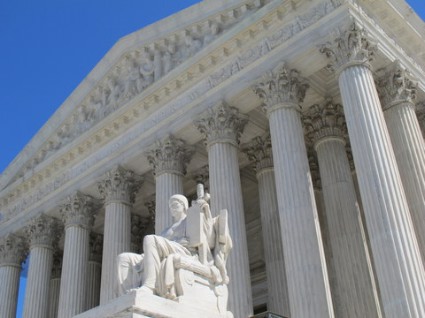
The apparent rift leaves an open question as to whether the justices will uphold or strike down the so-called individual mandate when they render their decision in late June.
The federal government contends that it can require most Americans to buy health insurance – or pay a penalty if they don’t – because those who go without insurance shift the cost of their care onto those who have coverage. The idea is that their "inactivity" affects a substantial portion of U.S. commerce, and thus can be regulated under the commerce clause, U.S. Solicitor General Donald B. Verrilli Jr. argued.
Many of the justices, though, hammered away at Mr. Verrilli, asking him to explain how the Affordable Care Act (ACA) could be considered constitutional.
And, they said, allowing the ACA to stand could result in the expansion of federal powers. If the federal government can compel Americans to buy insurance with the idea that they might need it someday, it could also compel Americans to purchase cell phones so they could make 9-1-1 calls to access government-provided fire and ambulance services, Justice Roberts said.
If the individual mandate – or the whole health reform law – is struck down, it could mean millions of Americans would continue to be uninsured and would directly affect physicians’ practices, said Dr. Jack Lewin, CEO of the American College of Cardiology, in an interview.
"It’s largely a negative thing for doctors and for the country if the law is struck down," Dr. Lewin said. The ACA "expands access to 35 million people who right now have the emergency room as their medical home."
If the law is upheld, Dr. Lewin said, "the nation still has a need for additional policy and legislative action to more emphatically and clearly address delivery system reforms," as well as "payment reforms that will actually reduce the rate of cost increase."
Neal K. Katyal, a Georgetown University law professor who observed the arguments said that it was too soon to speculate on the outcome.
"I would caution anyone from reading anything into the [justices’] questioning," he said in an interview.
Justice Roberts noted that the federal government is "supposed to be a government of limited powers. If the government can do this, what else can it not do?"*
Justice Antonin Scalia called "extraordinary" Mr. Verrilli’s assertion that requiring insurance or payment of a penalty was within congressional taxing powers. Justice Scalia said that following the government’s logic, Congress could require people to exercise, or "make people buy broccoli."
Paul Clement, an attorney for the challengers (26 states and the National Federation of Independent Business), said that the government shouldn’t be allowed to force people to purchase something they don’t want.
Mr. Clement illustrated his point with the federal effort to support the U.S. auto industry during the 2009 recession.
"When we had problems in the automobile industry" instead of saying "everybody over $100,000 has to buy a new car" the federal government came up with an incentive program – Cash for Clunkers, he pointed out.
Justice Roberts, though, noted that the government is arguing that all Americans already participate in the health care market, which "makes it very different than the market for cars or the other hypotheticals."
Justice Kennedy said that if the court upholds the government’s contention that the insurance market is unique, "in the next case, [the government] will say the next market is unique." He acknowledged, though, that in some ways health care is different. "The young person who is uninsured is uniquely proximate to affecting the rates of insurance and the costs of providing medical care in a way that is not true in other industries," said Justice Kennedy. "That’s my concern in the case."
*Correction 3/27/12: Justice Roberts' quote was attributed incorrectly in a previous rendition.
WASHINGTON – In the second day of oral arguments, a majority of Supreme Court justices expressed skepticism that one of the central tenets of the Affordable Care Act – the requirement that Americans have minimum health insurance coverage – is constitutional.
But at least two justices – Chief Justice John Roberts and Justice Anthony Kennedy – also were dubious about the challengers’ assertion that requiring Americans to buy insurance was an unprecedented act that exceeded Congress’ powers under the U.S. Constitution’s commerce clause.
The apparent rift leaves an open question as to whether the justices will uphold or strike down the so-called individual mandate when they render their decision in late June.
The federal government contends that it can require most Americans to buy health insurance – or pay a penalty if they don’t – because those who go without insurance shift the cost of their care onto those who have coverage. The idea is that their "inactivity" affects a substantial portion of U.S. commerce, and thus can be regulated under the commerce clause, U.S. Solicitor General Donald B. Verrilli Jr. argued.
Many of the justices, though, hammered away at Mr. Verrilli, asking him to explain how the Affordable Care Act (ACA) could be considered constitutional.
And, they said, allowing the ACA to stand could result in the expansion of federal powers. If the federal government can compel Americans to buy insurance with the idea that they might need it someday, it could also compel Americans to purchase cell phones so they could make 9-1-1 calls to access government-provided fire and ambulance services, Justice Roberts said.
If the individual mandate – or the whole health reform law – is struck down, it could mean millions of Americans would continue to be uninsured and would directly affect physicians’ practices, said Dr. Jack Lewin, CEO of the American College of Cardiology, in an interview.
"It’s largely a negative thing for doctors and for the country if the law is struck down," Dr. Lewin said. The ACA "expands access to 35 million people who right now have the emergency room as their medical home."
If the law is upheld, Dr. Lewin said, "the nation still has a need for additional policy and legislative action to more emphatically and clearly address delivery system reforms," as well as "payment reforms that will actually reduce the rate of cost increase."
Neal K. Katyal, a Georgetown University law professor who observed the arguments said that it was too soon to speculate on the outcome.
"I would caution anyone from reading anything into the [justices’] questioning," he said in an interview.
Justice Roberts noted that the federal government is "supposed to be a government of limited powers. If the government can do this, what else can it not do?"*
Justice Antonin Scalia called "extraordinary" Mr. Verrilli’s assertion that requiring insurance or payment of a penalty was within congressional taxing powers. Justice Scalia said that following the government’s logic, Congress could require people to exercise, or "make people buy broccoli."
Paul Clement, an attorney for the challengers (26 states and the National Federation of Independent Business), said that the government shouldn’t be allowed to force people to purchase something they don’t want.
Mr. Clement illustrated his point with the federal effort to support the U.S. auto industry during the 2009 recession.
"When we had problems in the automobile industry" instead of saying "everybody over $100,000 has to buy a new car" the federal government came up with an incentive program – Cash for Clunkers, he pointed out.
Justice Roberts, though, noted that the government is arguing that all Americans already participate in the health care market, which "makes it very different than the market for cars or the other hypotheticals."
Justice Kennedy said that if the court upholds the government’s contention that the insurance market is unique, "in the next case, [the government] will say the next market is unique." He acknowledged, though, that in some ways health care is different. "The young person who is uninsured is uniquely proximate to affecting the rates of insurance and the costs of providing medical care in a way that is not true in other industries," said Justice Kennedy. "That’s my concern in the case."
*Correction 3/27/12: Justice Roberts' quote was attributed incorrectly in a previous rendition.
WASHINGTON – In the second day of oral arguments, a majority of Supreme Court justices expressed skepticism that one of the central tenets of the Affordable Care Act – the requirement that Americans have minimum health insurance coverage – is constitutional.
But at least two justices – Chief Justice John Roberts and Justice Anthony Kennedy – also were dubious about the challengers’ assertion that requiring Americans to buy insurance was an unprecedented act that exceeded Congress’ powers under the U.S. Constitution’s commerce clause.
The apparent rift leaves an open question as to whether the justices will uphold or strike down the so-called individual mandate when they render their decision in late June.
The federal government contends that it can require most Americans to buy health insurance – or pay a penalty if they don’t – because those who go without insurance shift the cost of their care onto those who have coverage. The idea is that their "inactivity" affects a substantial portion of U.S. commerce, and thus can be regulated under the commerce clause, U.S. Solicitor General Donald B. Verrilli Jr. argued.
Many of the justices, though, hammered away at Mr. Verrilli, asking him to explain how the Affordable Care Act (ACA) could be considered constitutional.
And, they said, allowing the ACA to stand could result in the expansion of federal powers. If the federal government can compel Americans to buy insurance with the idea that they might need it someday, it could also compel Americans to purchase cell phones so they could make 9-1-1 calls to access government-provided fire and ambulance services, Justice Roberts said.
If the individual mandate – or the whole health reform law – is struck down, it could mean millions of Americans would continue to be uninsured and would directly affect physicians’ practices, said Dr. Jack Lewin, CEO of the American College of Cardiology, in an interview.
"It’s largely a negative thing for doctors and for the country if the law is struck down," Dr. Lewin said. The ACA "expands access to 35 million people who right now have the emergency room as their medical home."
If the law is upheld, Dr. Lewin said, "the nation still has a need for additional policy and legislative action to more emphatically and clearly address delivery system reforms," as well as "payment reforms that will actually reduce the rate of cost increase."
Neal K. Katyal, a Georgetown University law professor who observed the arguments said that it was too soon to speculate on the outcome.
"I would caution anyone from reading anything into the [justices’] questioning," he said in an interview.
Justice Roberts noted that the federal government is "supposed to be a government of limited powers. If the government can do this, what else can it not do?"*
Justice Antonin Scalia called "extraordinary" Mr. Verrilli’s assertion that requiring insurance or payment of a penalty was within congressional taxing powers. Justice Scalia said that following the government’s logic, Congress could require people to exercise, or "make people buy broccoli."
Paul Clement, an attorney for the challengers (26 states and the National Federation of Independent Business), said that the government shouldn’t be allowed to force people to purchase something they don’t want.
Mr. Clement illustrated his point with the federal effort to support the U.S. auto industry during the 2009 recession.
"When we had problems in the automobile industry" instead of saying "everybody over $100,000 has to buy a new car" the federal government came up with an incentive program – Cash for Clunkers, he pointed out.
Justice Roberts, though, noted that the government is arguing that all Americans already participate in the health care market, which "makes it very different than the market for cars or the other hypotheticals."
Justice Kennedy said that if the court upholds the government’s contention that the insurance market is unique, "in the next case, [the government] will say the next market is unique." He acknowledged, though, that in some ways health care is different. "The young person who is uninsured is uniquely proximate to affecting the rates of insurance and the costs of providing medical care in a way that is not true in other industries," said Justice Kennedy. "That’s my concern in the case."
*Correction 3/27/12: Justice Roberts' quote was attributed incorrectly in a previous rendition.
FROM ORAL ARGUMENTS HEARD BY THE U.S. SUPREME COURT
Justices Seem Eager to Hear Mandate Question
WASHINGTON – As the Affordable Care Act finally got its day in the Supreme Court, justices seemed eager to set aside preliminary issues and move on to the important question of whether the law’s individual mandate is constitutional.
Outside the court, Families USA executive director Ron Pollack said that arguments March 26 – which bogged down in discussions of whether Americans would be paying a "tax" or a "penalty" if they failed to secure insurance coverage – were the "hors d’oeuvres," before the "main meal," on Tuesday.
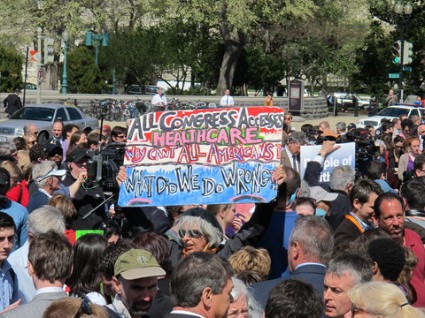
Mr. Pollack said that after seeing the arguments, "clearly, the justices want to get on and render a decision."
Supporters and opponents of the Affordable Care Act rallied outside the court building. A group of physicians representing the grassroots organization Doctors for America (DFA) said they were there to show their support.
Dr. Vivek Murthy, president of DFA, said in an interview that the Affordable Care Act (ACA) provides a window of opportunity to address the problems with the health care system. If all or part of the law is struck down, DFA will continue a planned effort to educate 1,000,000 Americans on the law.
The individual mandate is particularly important because it could help reduce health care costs by ensuring more Americans are insured, according to Dr. Murthy, a hospitalist at Brigham and Women’s Hospital in Boston.
The justices asked several questions about the mandate during Monday’s arguments. Some asked who would be hurt and how if the mandate stayed in place.
Justice Sonia Sotomayor asked U.S. Solicitor General Donald B. Verrilli Jr. what the consequences would be for those who did not pay the penalty, noting that the challengers to the law said that there could be "other collateral consequences."
Mr. Verrilli said that there would be no other consequences and, in addition, that there are several exemptions from the penalty, including for low-income individuals and families.
The challengers – 26 states and the National Federation of Independent Business – represented by attorney Gregory G. Katsas, argued that the mandate would hurt even those not directly subject to the provision.
"We have individuals who are planning for compliance in order to avoid a penalty, which is what their affidavits say. And we have the states, who will be subject no doubt to all sorts of adverse ramifications if they refuse to enroll in Medicaid the people who are forced into Medicaid by virtue of the mandate," said Mr. Katsas, with a Washington law firm.
The justices will consider on Wednesday whether the ACA is unduly coercive by requiring states to expand their Medicaid programs.
Louisiana is one of the 26 states that has alleged it will be harmed by the individual mandate. If the law is upheld, "it will be devastating" to the state, Attorney General Buddy Caldwell said in an interview. Residents already get access to free health care through a statewide charity system, he said, adding that many small businesses as well as low-income residents will suffer if they have to buy insurance coverage.
That’s why the states sued, Mr. Katsas said.
"The purpose of this lawsuit is to challenge a requirement – a federal requirement to buy health insurance. That requirement itself is not a tax," he said. Mr. Katsas said that 19th-century precedents should not prevent the justices from hearing this case and that the penalty could be treated as a separate matter from the mandate.
WASHINGTON – As the Affordable Care Act finally got its day in the Supreme Court, justices seemed eager to set aside preliminary issues and move on to the important question of whether the law’s individual mandate is constitutional.
Outside the court, Families USA executive director Ron Pollack said that arguments March 26 – which bogged down in discussions of whether Americans would be paying a "tax" or a "penalty" if they failed to secure insurance coverage – were the "hors d’oeuvres," before the "main meal," on Tuesday.
Mr. Pollack said that after seeing the arguments, "clearly, the justices want to get on and render a decision."
Supporters and opponents of the Affordable Care Act rallied outside the court building. A group of physicians representing the grassroots organization Doctors for America (DFA) said they were there to show their support.
Dr. Vivek Murthy, president of DFA, said in an interview that the Affordable Care Act (ACA) provides a window of opportunity to address the problems with the health care system. If all or part of the law is struck down, DFA will continue a planned effort to educate 1,000,000 Americans on the law.
The individual mandate is particularly important because it could help reduce health care costs by ensuring more Americans are insured, according to Dr. Murthy, a hospitalist at Brigham and Women’s Hospital in Boston.
The justices asked several questions about the mandate during Monday’s arguments. Some asked who would be hurt and how if the mandate stayed in place.
Justice Sonia Sotomayor asked U.S. Solicitor General Donald B. Verrilli Jr. what the consequences would be for those who did not pay the penalty, noting that the challengers to the law said that there could be "other collateral consequences."
Mr. Verrilli said that there would be no other consequences and, in addition, that there are several exemptions from the penalty, including for low-income individuals and families.
The challengers – 26 states and the National Federation of Independent Business – represented by attorney Gregory G. Katsas, argued that the mandate would hurt even those not directly subject to the provision.
"We have individuals who are planning for compliance in order to avoid a penalty, which is what their affidavits say. And we have the states, who will be subject no doubt to all sorts of adverse ramifications if they refuse to enroll in Medicaid the people who are forced into Medicaid by virtue of the mandate," said Mr. Katsas, with a Washington law firm.
The justices will consider on Wednesday whether the ACA is unduly coercive by requiring states to expand their Medicaid programs.
Louisiana is one of the 26 states that has alleged it will be harmed by the individual mandate. If the law is upheld, "it will be devastating" to the state, Attorney General Buddy Caldwell said in an interview. Residents already get access to free health care through a statewide charity system, he said, adding that many small businesses as well as low-income residents will suffer if they have to buy insurance coverage.
That’s why the states sued, Mr. Katsas said.
"The purpose of this lawsuit is to challenge a requirement – a federal requirement to buy health insurance. That requirement itself is not a tax," he said. Mr. Katsas said that 19th-century precedents should not prevent the justices from hearing this case and that the penalty could be treated as a separate matter from the mandate.
WASHINGTON – As the Affordable Care Act finally got its day in the Supreme Court, justices seemed eager to set aside preliminary issues and move on to the important question of whether the law’s individual mandate is constitutional.
Outside the court, Families USA executive director Ron Pollack said that arguments March 26 – which bogged down in discussions of whether Americans would be paying a "tax" or a "penalty" if they failed to secure insurance coverage – were the "hors d’oeuvres," before the "main meal," on Tuesday.
Mr. Pollack said that after seeing the arguments, "clearly, the justices want to get on and render a decision."
Supporters and opponents of the Affordable Care Act rallied outside the court building. A group of physicians representing the grassroots organization Doctors for America (DFA) said they were there to show their support.
Dr. Vivek Murthy, president of DFA, said in an interview that the Affordable Care Act (ACA) provides a window of opportunity to address the problems with the health care system. If all or part of the law is struck down, DFA will continue a planned effort to educate 1,000,000 Americans on the law.
The individual mandate is particularly important because it could help reduce health care costs by ensuring more Americans are insured, according to Dr. Murthy, a hospitalist at Brigham and Women’s Hospital in Boston.
The justices asked several questions about the mandate during Monday’s arguments. Some asked who would be hurt and how if the mandate stayed in place.
Justice Sonia Sotomayor asked U.S. Solicitor General Donald B. Verrilli Jr. what the consequences would be for those who did not pay the penalty, noting that the challengers to the law said that there could be "other collateral consequences."
Mr. Verrilli said that there would be no other consequences and, in addition, that there are several exemptions from the penalty, including for low-income individuals and families.
The challengers – 26 states and the National Federation of Independent Business – represented by attorney Gregory G. Katsas, argued that the mandate would hurt even those not directly subject to the provision.
"We have individuals who are planning for compliance in order to avoid a penalty, which is what their affidavits say. And we have the states, who will be subject no doubt to all sorts of adverse ramifications if they refuse to enroll in Medicaid the people who are forced into Medicaid by virtue of the mandate," said Mr. Katsas, with a Washington law firm.
The justices will consider on Wednesday whether the ACA is unduly coercive by requiring states to expand their Medicaid programs.
Louisiana is one of the 26 states that has alleged it will be harmed by the individual mandate. If the law is upheld, "it will be devastating" to the state, Attorney General Buddy Caldwell said in an interview. Residents already get access to free health care through a statewide charity system, he said, adding that many small businesses as well as low-income residents will suffer if they have to buy insurance coverage.
That’s why the states sued, Mr. Katsas said.
"The purpose of this lawsuit is to challenge a requirement – a federal requirement to buy health insurance. That requirement itself is not a tax," he said. Mr. Katsas said that 19th-century precedents should not prevent the justices from hearing this case and that the penalty could be treated as a separate matter from the mandate.
FROM ORAL ARGUMENTS HEARD BY THE U.S. SUPREME COURT
Health Spending Growth Slowed in 2010
WASHINGTON – The historically low growth in health spending in 2009 continued through 2010, driven largely by the recession, Centers for Medicare and Medicaid officials haveannounced.
U.S. health spending grew 3.9% in 2010, to a total of $2.6 trillion or $8,402 per person. That was a 0.1% rise from 2009, which was already at an all-time low growth rate.
As the nation’s economy slumped throughout 2009 and 2010, consumers cut back on elective surgical procedures, emergency room visits, physician office visits, and prescription drug use, according to the officials.
"Even though the recession officially ended in 2009, its impact on the health sector appears to have continued into 2010," said Anne Martin, an economist with the CMS.
Employers shifted the costs of insurance and care to employees, which drove up out-of-pocket spending in 2010. But consumers overall spent only 1.8% more out-of-pocket in 2010 than they had in 2009, which was a slow rate of growth when compared with historical patterns, Ms. Martin said.
Consumers reacted to cost-shifting by choosing health insurance plans with lower premiums and higher deductibles, and by reducing, where they could, use of personal health care services. Medical prices and the U.S. population remained relatively stable before, during, and after the recession, and yet, personal health spending fell, indicating a willful pullback.
"The slower growth in personal health care spending was mainly driven by the slowdown in the use and intensity of health care goods and services," Ms. Martin said.
The agency documented a shrinkage in the use of hospital care and physician services as compared with historical levels.
Hospital spending grew only 5% to $814 billion in 2010, compared to 6% in 2009. There was a decline in median inpatient admissions, and slower growth in emergency department visits, outpatient visits, and outpatient surgeries.
Overall spending on physicians and clinical services – totaling $515 billion in 2010 – accounted for 20% of total health spending. As consumers went to the doctor less frequently, fewer prescriptions were written. And, many of those dispensed were for less expensive generic drugs. These and other factors led to the slowest rate of growth in prescription drug spending ever recorded – a 1% increase from 2009 to $259 billion. The data were published in the journal Health Affairs (Health Aff. 2012 [doi: 10.1377/hlthaff.2011.1135]).
Growth in spending on physician and clinical services also was historically low, growing 2.5% in 2010 as compared with 3.3% in 2009, said Ms. Martin.
Meanwhile, as employers and private insurers reduced the amount they spent on health care, the federal government’s share of health spending rose – to 29% or a total of $742 billion in 2010.
The rise in federal spending also was attributed to federal subsidies to state Medicaid programs. Medicaid was about 15% of the nation’s health bill in 2010, at $401 billion.
In 2009, the federal government spent 22% more than in 2008; in 2010, spending rose by almost 9%. That compares to a 10% decrease in spending by states and localities in 2008, and a 4% increase in 2010.
Medicare saw an increase in enrollment, both in Medicare Advantage managed care program and traditional fee-for-service Medicare. The increase in traditional enrollment reversed a several-year pattern of decline. Overall, Medicare spending increased 5% in 2010 to $524 billion, but per-enrollee spending did not rise as quickly as it had in 2009.
This is because there was a big reduction in payments for certain types of home health services, but also because of low use of physician services. Small increases in physician fees in 2009 and 2010 also kept a lid on Medicare spending. Those increases were instituted by Congress in response to cuts that would otherwise have been required by Medicare’s Sustainable Growth Rate formula.
The Affordable Care Act had a negligible impact on overall spending, perhaps accounting for less than 0.1% of the slowdown, according to the CMS economists. This small impact is because few of its provisions were in effect in 2010, and some, such as coverage for patients with preexisting conditions, did not enroll as many people as had been expected.
The last few years of economic recession have fueled intense discussions about optimal use of personal and governmental healthcare dollars. In 2010, total U.S. health care spending increased nearly 4%, a relatively modest amount but still significant given the overall economic climate. Despite continued high unemployment, cutbacks in benefits, and declines across non-healthcare economic sectors, Americans still spent a staggering amount of money on medical care, with roughly 18% of GDP funneled into the healthcare portion of the economy. The percentage share of costs continued to shift towards the federal government as the largest contributor (29% of the total), while households, private businesses and state/local government contributed significant but respectively smaller amounts.
While there is some data suggesting that these tight economic conditions helped create a more efficient and cost-effective health care climate, that climate is also changing as the SGR debate continues and the substantive portions of the Affordable Healthcare Act have yet to be implemented.
As with any major sudden environmental shift, I am concerned that this climate change may not be a good thing for American physicians or their patients.
Dr. Brian Rubin is a professor of the department of surgery at Washington University School of Medicine, St. Louis, and an associate medical editor of Vascular Specialist.
The last few years of economic recession have fueled intense discussions about optimal use of personal and governmental healthcare dollars. In 2010, total U.S. health care spending increased nearly 4%, a relatively modest amount but still significant given the overall economic climate. Despite continued high unemployment, cutbacks in benefits, and declines across non-healthcare economic sectors, Americans still spent a staggering amount of money on medical care, with roughly 18% of GDP funneled into the healthcare portion of the economy. The percentage share of costs continued to shift towards the federal government as the largest contributor (29% of the total), while households, private businesses and state/local government contributed significant but respectively smaller amounts.
While there is some data suggesting that these tight economic conditions helped create a more efficient and cost-effective health care climate, that climate is also changing as the SGR debate continues and the substantive portions of the Affordable Healthcare Act have yet to be implemented.
As with any major sudden environmental shift, I am concerned that this climate change may not be a good thing for American physicians or their patients.
Dr. Brian Rubin is a professor of the department of surgery at Washington University School of Medicine, St. Louis, and an associate medical editor of Vascular Specialist.
The last few years of economic recession have fueled intense discussions about optimal use of personal and governmental healthcare dollars. In 2010, total U.S. health care spending increased nearly 4%, a relatively modest amount but still significant given the overall economic climate. Despite continued high unemployment, cutbacks in benefits, and declines across non-healthcare economic sectors, Americans still spent a staggering amount of money on medical care, with roughly 18% of GDP funneled into the healthcare portion of the economy. The percentage share of costs continued to shift towards the federal government as the largest contributor (29% of the total), while households, private businesses and state/local government contributed significant but respectively smaller amounts.
While there is some data suggesting that these tight economic conditions helped create a more efficient and cost-effective health care climate, that climate is also changing as the SGR debate continues and the substantive portions of the Affordable Healthcare Act have yet to be implemented.
As with any major sudden environmental shift, I am concerned that this climate change may not be a good thing for American physicians or their patients.
Dr. Brian Rubin is a professor of the department of surgery at Washington University School of Medicine, St. Louis, and an associate medical editor of Vascular Specialist.
WASHINGTON – The historically low growth in health spending in 2009 continued through 2010, driven largely by the recession, Centers for Medicare and Medicaid officials haveannounced.
U.S. health spending grew 3.9% in 2010, to a total of $2.6 trillion or $8,402 per person. That was a 0.1% rise from 2009, which was already at an all-time low growth rate.
As the nation’s economy slumped throughout 2009 and 2010, consumers cut back on elective surgical procedures, emergency room visits, physician office visits, and prescription drug use, according to the officials.
"Even though the recession officially ended in 2009, its impact on the health sector appears to have continued into 2010," said Anne Martin, an economist with the CMS.
Employers shifted the costs of insurance and care to employees, which drove up out-of-pocket spending in 2010. But consumers overall spent only 1.8% more out-of-pocket in 2010 than they had in 2009, which was a slow rate of growth when compared with historical patterns, Ms. Martin said.
Consumers reacted to cost-shifting by choosing health insurance plans with lower premiums and higher deductibles, and by reducing, where they could, use of personal health care services. Medical prices and the U.S. population remained relatively stable before, during, and after the recession, and yet, personal health spending fell, indicating a willful pullback.
"The slower growth in personal health care spending was mainly driven by the slowdown in the use and intensity of health care goods and services," Ms. Martin said.
The agency documented a shrinkage in the use of hospital care and physician services as compared with historical levels.
Hospital spending grew only 5% to $814 billion in 2010, compared to 6% in 2009. There was a decline in median inpatient admissions, and slower growth in emergency department visits, outpatient visits, and outpatient surgeries.
Overall spending on physicians and clinical services – totaling $515 billion in 2010 – accounted for 20% of total health spending. As consumers went to the doctor less frequently, fewer prescriptions were written. And, many of those dispensed were for less expensive generic drugs. These and other factors led to the slowest rate of growth in prescription drug spending ever recorded – a 1% increase from 2009 to $259 billion. The data were published in the journal Health Affairs (Health Aff. 2012 [doi: 10.1377/hlthaff.2011.1135]).
Growth in spending on physician and clinical services also was historically low, growing 2.5% in 2010 as compared with 3.3% in 2009, said Ms. Martin.
Meanwhile, as employers and private insurers reduced the amount they spent on health care, the federal government’s share of health spending rose – to 29% or a total of $742 billion in 2010.
The rise in federal spending also was attributed to federal subsidies to state Medicaid programs. Medicaid was about 15% of the nation’s health bill in 2010, at $401 billion.
In 2009, the federal government spent 22% more than in 2008; in 2010, spending rose by almost 9%. That compares to a 10% decrease in spending by states and localities in 2008, and a 4% increase in 2010.
Medicare saw an increase in enrollment, both in Medicare Advantage managed care program and traditional fee-for-service Medicare. The increase in traditional enrollment reversed a several-year pattern of decline. Overall, Medicare spending increased 5% in 2010 to $524 billion, but per-enrollee spending did not rise as quickly as it had in 2009.
This is because there was a big reduction in payments for certain types of home health services, but also because of low use of physician services. Small increases in physician fees in 2009 and 2010 also kept a lid on Medicare spending. Those increases were instituted by Congress in response to cuts that would otherwise have been required by Medicare’s Sustainable Growth Rate formula.
The Affordable Care Act had a negligible impact on overall spending, perhaps accounting for less than 0.1% of the slowdown, according to the CMS economists. This small impact is because few of its provisions were in effect in 2010, and some, such as coverage for patients with preexisting conditions, did not enroll as many people as had been expected.
WASHINGTON – The historically low growth in health spending in 2009 continued through 2010, driven largely by the recession, Centers for Medicare and Medicaid officials haveannounced.
U.S. health spending grew 3.9% in 2010, to a total of $2.6 trillion or $8,402 per person. That was a 0.1% rise from 2009, which was already at an all-time low growth rate.
As the nation’s economy slumped throughout 2009 and 2010, consumers cut back on elective surgical procedures, emergency room visits, physician office visits, and prescription drug use, according to the officials.
"Even though the recession officially ended in 2009, its impact on the health sector appears to have continued into 2010," said Anne Martin, an economist with the CMS.
Employers shifted the costs of insurance and care to employees, which drove up out-of-pocket spending in 2010. But consumers overall spent only 1.8% more out-of-pocket in 2010 than they had in 2009, which was a slow rate of growth when compared with historical patterns, Ms. Martin said.
Consumers reacted to cost-shifting by choosing health insurance plans with lower premiums and higher deductibles, and by reducing, where they could, use of personal health care services. Medical prices and the U.S. population remained relatively stable before, during, and after the recession, and yet, personal health spending fell, indicating a willful pullback.
"The slower growth in personal health care spending was mainly driven by the slowdown in the use and intensity of health care goods and services," Ms. Martin said.
The agency documented a shrinkage in the use of hospital care and physician services as compared with historical levels.
Hospital spending grew only 5% to $814 billion in 2010, compared to 6% in 2009. There was a decline in median inpatient admissions, and slower growth in emergency department visits, outpatient visits, and outpatient surgeries.
Overall spending on physicians and clinical services – totaling $515 billion in 2010 – accounted for 20% of total health spending. As consumers went to the doctor less frequently, fewer prescriptions were written. And, many of those dispensed were for less expensive generic drugs. These and other factors led to the slowest rate of growth in prescription drug spending ever recorded – a 1% increase from 2009 to $259 billion. The data were published in the journal Health Affairs (Health Aff. 2012 [doi: 10.1377/hlthaff.2011.1135]).
Growth in spending on physician and clinical services also was historically low, growing 2.5% in 2010 as compared with 3.3% in 2009, said Ms. Martin.
Meanwhile, as employers and private insurers reduced the amount they spent on health care, the federal government’s share of health spending rose – to 29% or a total of $742 billion in 2010.
The rise in federal spending also was attributed to federal subsidies to state Medicaid programs. Medicaid was about 15% of the nation’s health bill in 2010, at $401 billion.
In 2009, the federal government spent 22% more than in 2008; in 2010, spending rose by almost 9%. That compares to a 10% decrease in spending by states and localities in 2008, and a 4% increase in 2010.
Medicare saw an increase in enrollment, both in Medicare Advantage managed care program and traditional fee-for-service Medicare. The increase in traditional enrollment reversed a several-year pattern of decline. Overall, Medicare spending increased 5% in 2010 to $524 billion, but per-enrollee spending did not rise as quickly as it had in 2009.
This is because there was a big reduction in payments for certain types of home health services, but also because of low use of physician services. Small increases in physician fees in 2009 and 2010 also kept a lid on Medicare spending. Those increases were instituted by Congress in response to cuts that would otherwise have been required by Medicare’s Sustainable Growth Rate formula.
The Affordable Care Act had a negligible impact on overall spending, perhaps accounting for less than 0.1% of the slowdown, according to the CMS economists. This small impact is because few of its provisions were in effect in 2010, and some, such as coverage for patients with preexisting conditions, did not enroll as many people as had been expected.
It's March Madness!
Yep, that’s a shameless bid to appear higher on Google search results, but it’s also a pretty good metaphor for what’s happening in Washington in advance of the Supreme Court oral arguments on the Affordable Care Act–due to be heard March 26, 27 and 28. Although speculation about how the Justices may rule has been going on for months, the gambling has reached a fever pitch.
Next week is to Court Watchers as the Final Four is to legions of NCAA Division 1 basketball fans: The brackets have been completed; it’s just a question now of who will come out on top.
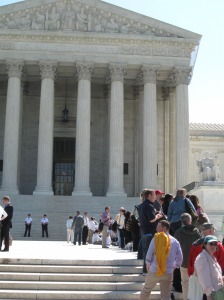
Conventional wisdom has the Supreme Court splitting along perceived “party lines” in a 5-4 vote either in favor of upholding the law, or against it.
But with the Justices taking on three separate, major issues within the law, Washington wonks, soothsayers, and legal eagles have gone into a frenzy of handicapping. Not a day goes by without a backgrounder or briefing that professes to have the best read on the tea leaves.
The Court, as is its wont, has shied from the limelight. Until today, it had not even determined how it would accommodate the legions of journalists (myself included) who will descend upon the courtroom to cover the historic arguments. Details are still being worked out, but one thing was not going to change: the Court has steadfastly refused to allow audio or video broadcasts of the proceedings. (Which means there cannot be any contests requiring a shot every time the challengers’ attorney, Paul Clement, utters “individual mandate.”) The Court is even banning–heaven forbid–cellphones. That means no pithy Tweets on Justice Clarence Thomas’ enduring silence.
This morning–at a briefing sponsored by Politico–came new predictions from an estimable panel of D.C. insiders: former U.S. Solicitor General Walter Dellinger, Neal Katyal, Al Gore’s co-counsel at the Court in Bush v. Gore, Tom Goldstein, a former Court clerk and publisher of Scotusblog, Kevin Walsh, a former clerk to Justice Antonin Scalia, and Nina Totenberg, the veteran Court correspondent for NPR.
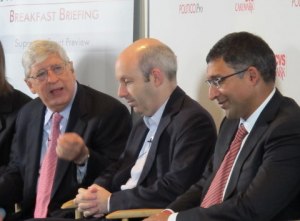
The Justices to watch, said Ms. Totenberg: Anthony Kennedy and Chief Justice John Roberts. They are both widely considered swing votes. Some have also have put Justice Scalia in that camp, “which I personally think is a crock,” Ms. Totenberg said. Mr. Katyal said that Samuel Alito could also be “in play.”
Will politics come into play? Justices “have a grasp of politics that defies imagination in terms of its inaccuracy,” said Ms. Totenberg, who, like the others discounted the idea that the Justices would be influenced–or motivated–to vote in one direction or another based on the prevailing political winds.
The panel was unanimous–except for Ms. Totenberg, who recused herself from making a wager–in its opinion that the Court would uphold the law, most likely in its entirety.
Mr. Goldstein said he could not effectively imagine a victory by the law’s challengers. If the Justices threw out the Act, it “would lead to probably an array of attacks on different parts of the federal regulatory state because for the first time you would have had five justices that take very seriously limits on congressional power,” he said.
By the end of next week, the Court will likely hold one closed-door conference and a series of votes, said Mr. Walsh.
He and the other panelists went out on a limb, saying that the 5-4 prediction may no longer hold. Mr. Goldstein said it could even be a 6-3 or 7-2 ruling upholding the law.
So who will write the opinion, expected to be issued in June? Mr. Dellinger predicted that it would be Justice Roberts. Mr. Goldstein, however, said this might be the rare case where the Court issues a per curiam opinion–that is, written in the name of the Court, rather than by any of the Justices. Interestingly, Bush v. Gore was a per curiam decision.
What is your opinion?
Yep, that’s a shameless bid to appear higher on Google search results, but it’s also a pretty good metaphor for what’s happening in Washington in advance of the Supreme Court oral arguments on the Affordable Care Act–due to be heard March 26, 27 and 28. Although speculation about how the Justices may rule has been going on for months, the gambling has reached a fever pitch.
Next week is to Court Watchers as the Final Four is to legions of NCAA Division 1 basketball fans: The brackets have been completed; it’s just a question now of who will come out on top.
Conventional wisdom has the Supreme Court splitting along perceived “party lines” in a 5-4 vote either in favor of upholding the law, or against it.
But with the Justices taking on three separate, major issues within the law, Washington wonks, soothsayers, and legal eagles have gone into a frenzy of handicapping. Not a day goes by without a backgrounder or briefing that professes to have the best read on the tea leaves.
The Court, as is its wont, has shied from the limelight. Until today, it had not even determined how it would accommodate the legions of journalists (myself included) who will descend upon the courtroom to cover the historic arguments. Details are still being worked out, but one thing was not going to change: the Court has steadfastly refused to allow audio or video broadcasts of the proceedings. (Which means there cannot be any contests requiring a shot every time the challengers’ attorney, Paul Clement, utters “individual mandate.”) The Court is even banning–heaven forbid–cellphones. That means no pithy Tweets on Justice Clarence Thomas’ enduring silence.
This morning–at a briefing sponsored by Politico–came new predictions from an estimable panel of D.C. insiders: former U.S. Solicitor General Walter Dellinger, Neal Katyal, Al Gore’s co-counsel at the Court in Bush v. Gore, Tom Goldstein, a former Court clerk and publisher of Scotusblog, Kevin Walsh, a former clerk to Justice Antonin Scalia, and Nina Totenberg, the veteran Court correspondent for NPR.
The Justices to watch, said Ms. Totenberg: Anthony Kennedy and Chief Justice John Roberts. They are both widely considered swing votes. Some have also have put Justice Scalia in that camp, “which I personally think is a crock,” Ms. Totenberg said. Mr. Katyal said that Samuel Alito could also be “in play.”
Will politics come into play? Justices “have a grasp of politics that defies imagination in terms of its inaccuracy,” said Ms. Totenberg, who, like the others discounted the idea that the Justices would be influenced–or motivated–to vote in one direction or another based on the prevailing political winds.
The panel was unanimous–except for Ms. Totenberg, who recused herself from making a wager–in its opinion that the Court would uphold the law, most likely in its entirety.
Mr. Goldstein said he could not effectively imagine a victory by the law’s challengers. If the Justices threw out the Act, it “would lead to probably an array of attacks on different parts of the federal regulatory state because for the first time you would have had five justices that take very seriously limits on congressional power,” he said.
By the end of next week, the Court will likely hold one closed-door conference and a series of votes, said Mr. Walsh.
He and the other panelists went out on a limb, saying that the 5-4 prediction may no longer hold. Mr. Goldstein said it could even be a 6-3 or 7-2 ruling upholding the law.
So who will write the opinion, expected to be issued in June? Mr. Dellinger predicted that it would be Justice Roberts. Mr. Goldstein, however, said this might be the rare case where the Court issues a per curiam opinion–that is, written in the name of the Court, rather than by any of the Justices. Interestingly, Bush v. Gore was a per curiam decision.
What is your opinion?
Yep, that’s a shameless bid to appear higher on Google search results, but it’s also a pretty good metaphor for what’s happening in Washington in advance of the Supreme Court oral arguments on the Affordable Care Act–due to be heard March 26, 27 and 28. Although speculation about how the Justices may rule has been going on for months, the gambling has reached a fever pitch.
Next week is to Court Watchers as the Final Four is to legions of NCAA Division 1 basketball fans: The brackets have been completed; it’s just a question now of who will come out on top.
Conventional wisdom has the Supreme Court splitting along perceived “party lines” in a 5-4 vote either in favor of upholding the law, or against it.
But with the Justices taking on three separate, major issues within the law, Washington wonks, soothsayers, and legal eagles have gone into a frenzy of handicapping. Not a day goes by without a backgrounder or briefing that professes to have the best read on the tea leaves.
The Court, as is its wont, has shied from the limelight. Until today, it had not even determined how it would accommodate the legions of journalists (myself included) who will descend upon the courtroom to cover the historic arguments. Details are still being worked out, but one thing was not going to change: the Court has steadfastly refused to allow audio or video broadcasts of the proceedings. (Which means there cannot be any contests requiring a shot every time the challengers’ attorney, Paul Clement, utters “individual mandate.”) The Court is even banning–heaven forbid–cellphones. That means no pithy Tweets on Justice Clarence Thomas’ enduring silence.
This morning–at a briefing sponsored by Politico–came new predictions from an estimable panel of D.C. insiders: former U.S. Solicitor General Walter Dellinger, Neal Katyal, Al Gore’s co-counsel at the Court in Bush v. Gore, Tom Goldstein, a former Court clerk and publisher of Scotusblog, Kevin Walsh, a former clerk to Justice Antonin Scalia, and Nina Totenberg, the veteran Court correspondent for NPR.
The Justices to watch, said Ms. Totenberg: Anthony Kennedy and Chief Justice John Roberts. They are both widely considered swing votes. Some have also have put Justice Scalia in that camp, “which I personally think is a crock,” Ms. Totenberg said. Mr. Katyal said that Samuel Alito could also be “in play.”
Will politics come into play? Justices “have a grasp of politics that defies imagination in terms of its inaccuracy,” said Ms. Totenberg, who, like the others discounted the idea that the Justices would be influenced–or motivated–to vote in one direction or another based on the prevailing political winds.
The panel was unanimous–except for Ms. Totenberg, who recused herself from making a wager–in its opinion that the Court would uphold the law, most likely in its entirety.
Mr. Goldstein said he could not effectively imagine a victory by the law’s challengers. If the Justices threw out the Act, it “would lead to probably an array of attacks on different parts of the federal regulatory state because for the first time you would have had five justices that take very seriously limits on congressional power,” he said.
By the end of next week, the Court will likely hold one closed-door conference and a series of votes, said Mr. Walsh.
He and the other panelists went out on a limb, saying that the 5-4 prediction may no longer hold. Mr. Goldstein said it could even be a 6-3 or 7-2 ruling upholding the law.
So who will write the opinion, expected to be issued in June? Mr. Dellinger predicted that it would be Justice Roberts. Mr. Goldstein, however, said this might be the rare case where the Court issues a per curiam opinion–that is, written in the name of the Court, rather than by any of the Justices. Interestingly, Bush v. Gore was a per curiam decision.
What is your opinion?
FDA Advisers Back Marqibo for Ph-Negative ALL
SILVER SPRING, MD. – A Food and Drug Administration advisory committee voted 7-4 on March 21 to recommend accelerated approval of Marqibo, a liposomal-encapsulated version of vincristine, for adult patients with relapsed or refractory Philadelphia-negative acute lymphoblastic leukemia.
Under accelerated approval regulations, a drug can only be approved if it is superior to what is currently available and eventually is proven superior by a confirmatory trial, said Dr. Richard Pazdur, director of the Office of Hematology and Oncology Products in the FDA’s Office of New Drugs.
That sets a high bar for Marqibo, which according to its maker, Talon Therapeutics, is vincristine sulfate "encapsulated in the aqueous core of proprietary, sphingomyelin-based liposomes."
The encapsulated form offers "prolonged plasma circulation, enhanced target tissue delivery, and increased tissue concentration," along with extended release of vincristine, according to Talon. But the advisory panel’s pharmacology experts said the company had not offered enough evidence to support those theoretical advantages.
The panel – the Oncologic Drugs Advisory Committee (ODAC) – was less than enthusiastic in urging approval of Marqibo. Even some of those who voted in favor said they had done so somewhat unwillingly.
Dr. Wyndham H. Wilson, ODAC chairperson and chief of the lymphoma therapeutics section at the National Cancer Institute, said, "I was more voting against the lack of other things than voting for the efficacy of this agent." Dr. Wilson said that although the drug did appear to induce remissions in some patients, there were open questions about toxicity. "I am not at all convinced it is going to be that much more active than vincristine," he added.

"This was a difficult decision," said Dr. Antoinette J. Wozniak, a panelist from the Karmanos Cancer Institute at Wayne State University, Detroit.
Panelist Dr. Mikkael Sekeres of the Cleveland Clinic Taussig Cancer Institute was more sanguine. "I felt that this drug was able to convert patients who were in a palliative setting into a potentially curative setting," he said.
But Dr. Sekeres and other panelists said they hoped the agency would subsequently remove approval if Marqibo did not pan out in a planned phase III confirmatory study.
Some were openly skeptical that the phase III trial – TTX404 – would prove anything. Talon reached an agreement with the FDA in August 2011 on the conduct of that study, said Dr. Steven R. Deitcher, Talon’s president, CEO, and chief medical officer. The randomized two-arm study has a planned enrollment of 348 newly diagnosed patients, which he said will likely take 48 months. The trial is a superiority study with overall survival as the primary end point, and will compare standard vincristine with Marqibo in a five-course regimen known as the Larson regimen.
So far, not a single patient has been enrolled, but Dr. Deitcher said that three trial sites are open, and an additional 14 sites are "ready to be activated."
If the FDA follows its panel’s advice, Marqibo would be approved this spring for a very small patient population with Philadelphia chromosome (Ph)-negative acute lymphoblastic leukemia (ALL) in second or greater relapse or whose disease has progressed following two or more treatment lines of antileukemia therapy. Talon estimated that out of some 1,400 adult patients with Ph-negative ALL, only about 458 a year would be eligible for Marqibo.
Talon, however, has its sights set on bigger markets. Dr. Deitcher said the company is currently enrolling or already beginning trials in newly diagnosed Ph-negative ALL; as a front-line therapy for aggressive non-Hodgkin’s lymphoma (NHL); in child and adolescent cancers; and in newly diagnosed Ph-positive ALL.

It is not Marqibo’s first time before ODAC. The committee unanimously voted against accelerated approval of the agent for aggressive NHL in 2004. That application had been submitted by Inex Pharmaceuticals, which later sold its rights to Talon.
In seeking approval this time, Talon submitted data from a pivotal, single-arm, 68-patient phase II trial. The median age was 31 years, and 48% of the patients had a prior hematopoietic stem cell transplant. Fifty-one percent had failed three or more prior lines of treatment. The median bone marrow blast percentage was 84%. All had previous vincristine exposure, which made it not surprising that 80% had neuropathy at baseline.
The FDA allowed the company to use a surrogate end point, complete response (CR) plus CRi (defined as a CR with incomplete blood count recovery, as determined by the principal investigator). Talon determined that the response rate was 17% (11 responders) of the 65 patients who underwent treatment. The FDA reviewers, however, said that the response rate was 15%, or 10 of the 65 patients.
Talon posited that patients who went on to bone marrow transplant after treatment should be counted as responders, but the agency noted that of the 12 patients who had transplants, only 5 were actually responders.
The agency’s reviewers also raised questions about Marqibo’s safety, which was judged on an 83-patient database. A third of patients (27 of 83) had a grade 3 or greater adverse event. Twenty percent (17) missed a dose, and 22% (18) had a dose reduction. Twenty-three percent of patients died on study.
Talon said that adverse events and patient deaths were in line with what would be expected for the ALL population, especially one with so much prior vincristine exposure.
By law, the FDA must act on Talon’s accelerated approval application by May 13.
SILVER SPRING, MD. – A Food and Drug Administration advisory committee voted 7-4 on March 21 to recommend accelerated approval of Marqibo, a liposomal-encapsulated version of vincristine, for adult patients with relapsed or refractory Philadelphia-negative acute lymphoblastic leukemia.
Under accelerated approval regulations, a drug can only be approved if it is superior to what is currently available and eventually is proven superior by a confirmatory trial, said Dr. Richard Pazdur, director of the Office of Hematology and Oncology Products in the FDA’s Office of New Drugs.
That sets a high bar for Marqibo, which according to its maker, Talon Therapeutics, is vincristine sulfate "encapsulated in the aqueous core of proprietary, sphingomyelin-based liposomes."
The encapsulated form offers "prolonged plasma circulation, enhanced target tissue delivery, and increased tissue concentration," along with extended release of vincristine, according to Talon. But the advisory panel’s pharmacology experts said the company had not offered enough evidence to support those theoretical advantages.
The panel – the Oncologic Drugs Advisory Committee (ODAC) – was less than enthusiastic in urging approval of Marqibo. Even some of those who voted in favor said they had done so somewhat unwillingly.
Dr. Wyndham H. Wilson, ODAC chairperson and chief of the lymphoma therapeutics section at the National Cancer Institute, said, "I was more voting against the lack of other things than voting for the efficacy of this agent." Dr. Wilson said that although the drug did appear to induce remissions in some patients, there were open questions about toxicity. "I am not at all convinced it is going to be that much more active than vincristine," he added.
"This was a difficult decision," said Dr. Antoinette J. Wozniak, a panelist from the Karmanos Cancer Institute at Wayne State University, Detroit.
Panelist Dr. Mikkael Sekeres of the Cleveland Clinic Taussig Cancer Institute was more sanguine. "I felt that this drug was able to convert patients who were in a palliative setting into a potentially curative setting," he said.
But Dr. Sekeres and other panelists said they hoped the agency would subsequently remove approval if Marqibo did not pan out in a planned phase III confirmatory study.
Some were openly skeptical that the phase III trial – TTX404 – would prove anything. Talon reached an agreement with the FDA in August 2011 on the conduct of that study, said Dr. Steven R. Deitcher, Talon’s president, CEO, and chief medical officer. The randomized two-arm study has a planned enrollment of 348 newly diagnosed patients, which he said will likely take 48 months. The trial is a superiority study with overall survival as the primary end point, and will compare standard vincristine with Marqibo in a five-course regimen known as the Larson regimen.
So far, not a single patient has been enrolled, but Dr. Deitcher said that three trial sites are open, and an additional 14 sites are "ready to be activated."
If the FDA follows its panel’s advice, Marqibo would be approved this spring for a very small patient population with Philadelphia chromosome (Ph)-negative acute lymphoblastic leukemia (ALL) in second or greater relapse or whose disease has progressed following two or more treatment lines of antileukemia therapy. Talon estimated that out of some 1,400 adult patients with Ph-negative ALL, only about 458 a year would be eligible for Marqibo.
Talon, however, has its sights set on bigger markets. Dr. Deitcher said the company is currently enrolling or already beginning trials in newly diagnosed Ph-negative ALL; as a front-line therapy for aggressive non-Hodgkin’s lymphoma (NHL); in child and adolescent cancers; and in newly diagnosed Ph-positive ALL.
It is not Marqibo’s first time before ODAC. The committee unanimously voted against accelerated approval of the agent for aggressive NHL in 2004. That application had been submitted by Inex Pharmaceuticals, which later sold its rights to Talon.
In seeking approval this time, Talon submitted data from a pivotal, single-arm, 68-patient phase II trial. The median age was 31 years, and 48% of the patients had a prior hematopoietic stem cell transplant. Fifty-one percent had failed three or more prior lines of treatment. The median bone marrow blast percentage was 84%. All had previous vincristine exposure, which made it not surprising that 80% had neuropathy at baseline.
The FDA allowed the company to use a surrogate end point, complete response (CR) plus CRi (defined as a CR with incomplete blood count recovery, as determined by the principal investigator). Talon determined that the response rate was 17% (11 responders) of the 65 patients who underwent treatment. The FDA reviewers, however, said that the response rate was 15%, or 10 of the 65 patients.
Talon posited that patients who went on to bone marrow transplant after treatment should be counted as responders, but the agency noted that of the 12 patients who had transplants, only 5 were actually responders.
The agency’s reviewers also raised questions about Marqibo’s safety, which was judged on an 83-patient database. A third of patients (27 of 83) had a grade 3 or greater adverse event. Twenty percent (17) missed a dose, and 22% (18) had a dose reduction. Twenty-three percent of patients died on study.
Talon said that adverse events and patient deaths were in line with what would be expected for the ALL population, especially one with so much prior vincristine exposure.
By law, the FDA must act on Talon’s accelerated approval application by May 13.
SILVER SPRING, MD. – A Food and Drug Administration advisory committee voted 7-4 on March 21 to recommend accelerated approval of Marqibo, a liposomal-encapsulated version of vincristine, for adult patients with relapsed or refractory Philadelphia-negative acute lymphoblastic leukemia.
Under accelerated approval regulations, a drug can only be approved if it is superior to what is currently available and eventually is proven superior by a confirmatory trial, said Dr. Richard Pazdur, director of the Office of Hematology and Oncology Products in the FDA’s Office of New Drugs.
That sets a high bar for Marqibo, which according to its maker, Talon Therapeutics, is vincristine sulfate "encapsulated in the aqueous core of proprietary, sphingomyelin-based liposomes."
The encapsulated form offers "prolonged plasma circulation, enhanced target tissue delivery, and increased tissue concentration," along with extended release of vincristine, according to Talon. But the advisory panel’s pharmacology experts said the company had not offered enough evidence to support those theoretical advantages.
The panel – the Oncologic Drugs Advisory Committee (ODAC) – was less than enthusiastic in urging approval of Marqibo. Even some of those who voted in favor said they had done so somewhat unwillingly.
Dr. Wyndham H. Wilson, ODAC chairperson and chief of the lymphoma therapeutics section at the National Cancer Institute, said, "I was more voting against the lack of other things than voting for the efficacy of this agent." Dr. Wilson said that although the drug did appear to induce remissions in some patients, there were open questions about toxicity. "I am not at all convinced it is going to be that much more active than vincristine," he added.
"This was a difficult decision," said Dr. Antoinette J. Wozniak, a panelist from the Karmanos Cancer Institute at Wayne State University, Detroit.
Panelist Dr. Mikkael Sekeres of the Cleveland Clinic Taussig Cancer Institute was more sanguine. "I felt that this drug was able to convert patients who were in a palliative setting into a potentially curative setting," he said.
But Dr. Sekeres and other panelists said they hoped the agency would subsequently remove approval if Marqibo did not pan out in a planned phase III confirmatory study.
Some were openly skeptical that the phase III trial – TTX404 – would prove anything. Talon reached an agreement with the FDA in August 2011 on the conduct of that study, said Dr. Steven R. Deitcher, Talon’s president, CEO, and chief medical officer. The randomized two-arm study has a planned enrollment of 348 newly diagnosed patients, which he said will likely take 48 months. The trial is a superiority study with overall survival as the primary end point, and will compare standard vincristine with Marqibo in a five-course regimen known as the Larson regimen.
So far, not a single patient has been enrolled, but Dr. Deitcher said that three trial sites are open, and an additional 14 sites are "ready to be activated."
If the FDA follows its panel’s advice, Marqibo would be approved this spring for a very small patient population with Philadelphia chromosome (Ph)-negative acute lymphoblastic leukemia (ALL) in second or greater relapse or whose disease has progressed following two or more treatment lines of antileukemia therapy. Talon estimated that out of some 1,400 adult patients with Ph-negative ALL, only about 458 a year would be eligible for Marqibo.
Talon, however, has its sights set on bigger markets. Dr. Deitcher said the company is currently enrolling or already beginning trials in newly diagnosed Ph-negative ALL; as a front-line therapy for aggressive non-Hodgkin’s lymphoma (NHL); in child and adolescent cancers; and in newly diagnosed Ph-positive ALL.
It is not Marqibo’s first time before ODAC. The committee unanimously voted against accelerated approval of the agent for aggressive NHL in 2004. That application had been submitted by Inex Pharmaceuticals, which later sold its rights to Talon.
In seeking approval this time, Talon submitted data from a pivotal, single-arm, 68-patient phase II trial. The median age was 31 years, and 48% of the patients had a prior hematopoietic stem cell transplant. Fifty-one percent had failed three or more prior lines of treatment. The median bone marrow blast percentage was 84%. All had previous vincristine exposure, which made it not surprising that 80% had neuropathy at baseline.
The FDA allowed the company to use a surrogate end point, complete response (CR) plus CRi (defined as a CR with incomplete blood count recovery, as determined by the principal investigator). Talon determined that the response rate was 17% (11 responders) of the 65 patients who underwent treatment. The FDA reviewers, however, said that the response rate was 15%, or 10 of the 65 patients.
Talon posited that patients who went on to bone marrow transplant after treatment should be counted as responders, but the agency noted that of the 12 patients who had transplants, only 5 were actually responders.
The agency’s reviewers also raised questions about Marqibo’s safety, which was judged on an 83-patient database. A third of patients (27 of 83) had a grade 3 or greater adverse event. Twenty percent (17) missed a dose, and 22% (18) had a dose reduction. Twenty-three percent of patients died on study.
Talon said that adverse events and patient deaths were in line with what would be expected for the ALL population, especially one with so much prior vincristine exposure.
By law, the FDA must act on Talon’s accelerated approval application by May 13.
FROM A MEETING OF THE FOOD AND DRUG ADMINISTRATION'S ONCOLOGIC DRUGS ADVISORY COMMITTEE
Feds Streamline Enrollment for Medicaid, CHIP, Exchanges
In anticipation of the huge health insurance expansion coming in 2 years under the Affordable Care Act, federal officials are opening a one-stop shop for those applying for coverage through a health insurance exchange, Medicaid, or the Children’s Health Insurance Program.
The rule establishing the web-based system was issued March 16 but does not take effect until Jan. 1, 2014. The idea is to give states time to set up the new systems, according to Cindy Mann, CMS deputy administrator and director of the Center for Medicaid and CHIP Services.
Ms. Mann said the final rule sets up a process for low-income Americans to apply online for insurance using a single application process. The government – either through the state exchange or state Medicaid/CHIP agencies – will determine whether they are eligible and in which program they will be enrolled.
Rather than submitting lengthy paperwork to support an application, the agencies will use data provided by the Internal Revenue Service, Social Security Administration, state unemployment agencies, and other government databases to determine a "modified gross income" to verify eligibility. The process will be repeated once a year.
Disabled individuals and those needing long-term care coverage through Medicaid will go through a slightly different process requiring more verification, said Ms. Mann.
In some cases, potential enrollees may know within hours whether they are eligible for benefits.
Currently, the Medicaid and CHIP enrollment processes are largely done through the mail, although California, Utah, and Oklahoma are experimenting with online applications, said Ms. Mann. But it can take days or weeks for someone to determine if they are eligible for a program now, she said.
The rule lays the groundwork for an expansion of Medicaid benefits under the ACA. The law guarantees for the first-time coverage to low-income (up to 133% of the federal poverty level) adults without children. Effectively, the expansion will be up to 138% of the poverty level, as the law requires that 5% of income be disregarded for eligibility purposes, Ms. Mann said.
The expansion goes into effect in 2014 when the health insurance exchanges are due to start operating. Under the ACA, the federal government is set to pay 100% of the cost of the Medicaid expansion for 3 years, ending in 2016, and a minimum of 90% permanently thereafter.
Even so, Medicaid expansion is one aspects of the ACA being challenged in the Supreme Court on March 28. Twenty-six states have said that the expansion amounts to coercion by the federal government. If states don’t participate, they stand to lose all of their Medicaid funding.
In anticipation of the huge health insurance expansion coming in 2 years under the Affordable Care Act, federal officials are opening a one-stop shop for those applying for coverage through a health insurance exchange, Medicaid, or the Children’s Health Insurance Program.
The rule establishing the web-based system was issued March 16 but does not take effect until Jan. 1, 2014. The idea is to give states time to set up the new systems, according to Cindy Mann, CMS deputy administrator and director of the Center for Medicaid and CHIP Services.
Ms. Mann said the final rule sets up a process for low-income Americans to apply online for insurance using a single application process. The government – either through the state exchange or state Medicaid/CHIP agencies – will determine whether they are eligible and in which program they will be enrolled.
Rather than submitting lengthy paperwork to support an application, the agencies will use data provided by the Internal Revenue Service, Social Security Administration, state unemployment agencies, and other government databases to determine a "modified gross income" to verify eligibility. The process will be repeated once a year.
Disabled individuals and those needing long-term care coverage through Medicaid will go through a slightly different process requiring more verification, said Ms. Mann.
In some cases, potential enrollees may know within hours whether they are eligible for benefits.
Currently, the Medicaid and CHIP enrollment processes are largely done through the mail, although California, Utah, and Oklahoma are experimenting with online applications, said Ms. Mann. But it can take days or weeks for someone to determine if they are eligible for a program now, she said.
The rule lays the groundwork for an expansion of Medicaid benefits under the ACA. The law guarantees for the first-time coverage to low-income (up to 133% of the federal poverty level) adults without children. Effectively, the expansion will be up to 138% of the poverty level, as the law requires that 5% of income be disregarded for eligibility purposes, Ms. Mann said.
The expansion goes into effect in 2014 when the health insurance exchanges are due to start operating. Under the ACA, the federal government is set to pay 100% of the cost of the Medicaid expansion for 3 years, ending in 2016, and a minimum of 90% permanently thereafter.
Even so, Medicaid expansion is one aspects of the ACA being challenged in the Supreme Court on March 28. Twenty-six states have said that the expansion amounts to coercion by the federal government. If states don’t participate, they stand to lose all of their Medicaid funding.
In anticipation of the huge health insurance expansion coming in 2 years under the Affordable Care Act, federal officials are opening a one-stop shop for those applying for coverage through a health insurance exchange, Medicaid, or the Children’s Health Insurance Program.
The rule establishing the web-based system was issued March 16 but does not take effect until Jan. 1, 2014. The idea is to give states time to set up the new systems, according to Cindy Mann, CMS deputy administrator and director of the Center for Medicaid and CHIP Services.
Ms. Mann said the final rule sets up a process for low-income Americans to apply online for insurance using a single application process. The government – either through the state exchange or state Medicaid/CHIP agencies – will determine whether they are eligible and in which program they will be enrolled.
Rather than submitting lengthy paperwork to support an application, the agencies will use data provided by the Internal Revenue Service, Social Security Administration, state unemployment agencies, and other government databases to determine a "modified gross income" to verify eligibility. The process will be repeated once a year.
Disabled individuals and those needing long-term care coverage through Medicaid will go through a slightly different process requiring more verification, said Ms. Mann.
In some cases, potential enrollees may know within hours whether they are eligible for benefits.
Currently, the Medicaid and CHIP enrollment processes are largely done through the mail, although California, Utah, and Oklahoma are experimenting with online applications, said Ms. Mann. But it can take days or weeks for someone to determine if they are eligible for a program now, she said.
The rule lays the groundwork for an expansion of Medicaid benefits under the ACA. The law guarantees for the first-time coverage to low-income (up to 133% of the federal poverty level) adults without children. Effectively, the expansion will be up to 138% of the poverty level, as the law requires that 5% of income be disregarded for eligibility purposes, Ms. Mann said.
The expansion goes into effect in 2014 when the health insurance exchanges are due to start operating. Under the ACA, the federal government is set to pay 100% of the cost of the Medicaid expansion for 3 years, ending in 2016, and a minimum of 90% permanently thereafter.
Even so, Medicaid expansion is one aspects of the ACA being challenged in the Supreme Court on March 28. Twenty-six states have said that the expansion amounts to coercion by the federal government. If states don’t participate, they stand to lose all of their Medicaid funding.
Genetic Testing Makes Slow, But Steady, Growth
A new UnitedHealthcare study finds that few Americans have undergone genetic testing, but that, increasingly, physicians say they will be using the diagnostics in their practices.
Overall national spending on genetic testing was about $5 billion in 2010, which is only 8% of spending on clinical lab services, according to UnitedHealthcare’s study. Spending should rise to $15 billion to 20 billion by 2021, said the insurer, which studied genetic testing using its own data and an analysis of Medicare and Medicaid fee-for-service data, as well as by conducting surveys of patients and physicians.
The insurer estimates that there are 1,000-1,300 tests available for 2,500 conditions, and that several new tests are being developed each month. UnitedHealthcare said it spent $500 million on testing for its members in 2010 (40% on testing for infectious diseases, 16% for cancer, and the rest for other conditions including inherited disorders).
Testing use per person was highest in UnitedHealthcare’s Medicaid population, followed by its commercially insured and then its Medicare populations. Cancer diagnostics, however, were used at a higher rate in the Medicare population, reflecting "greater risk and incidence of cancer in senior populations."
Molecular and genetic testing increased by 14% per year from 2008 to 2010.
Two surveys that were commissioned by UnitedHealthcare and conducted by Harris Interactive in January and February found that Americans have a positive view of genetic testing, with 71% saying they were familiar with testing, but only 6% saying they’d had such a test. In all, 3% were unsure whether they’d been tested. About half said that they were "knowledgeable" about "genetic science." The vast majority said that the number of tests available and the amount of testing conducted will increase in 5 years.
UnitedHealthcare reported that 63% of physicians said that testing helped them to diagnose undetected conditions. Overall, 75% of physicians said that testing could benefit patients in their practices, but only 4% of their patients had been tested. They expected that figure to rise to 14% of patients in 5 years.
Three-quarters of physicians said they were "somewhat knowledgeable" about genetic science; 7% said they are "very knowledgeable," and 16% said they were "not knowledgeable."
Meanwhile, they said that 72% of their patients are "somewhat able" to understand results. Physicians thought that 7% were "not at all able to understand" genetic test results.
Some 59% of doctors said that they are concerned about the cost of genetic tests for their patients, whereas only 21% said they worried about their own reimbursement. In all, 56% said they expected genetic testing to increase overall health spending, compared with 19% who said it would cut costs. The majority said that testing would improve care.
Molecular and genetic testing,
A new UnitedHealthcare study finds that few Americans have undergone genetic testing, but that, increasingly, physicians say they will be using the diagnostics in their practices.
Overall national spending on genetic testing was about $5 billion in 2010, which is only 8% of spending on clinical lab services, according to UnitedHealthcare’s study. Spending should rise to $15 billion to 20 billion by 2021, said the insurer, which studied genetic testing using its own data and an analysis of Medicare and Medicaid fee-for-service data, as well as by conducting surveys of patients and physicians.
The insurer estimates that there are 1,000-1,300 tests available for 2,500 conditions, and that several new tests are being developed each month. UnitedHealthcare said it spent $500 million on testing for its members in 2010 (40% on testing for infectious diseases, 16% for cancer, and the rest for other conditions including inherited disorders).
Testing use per person was highest in UnitedHealthcare’s Medicaid population, followed by its commercially insured and then its Medicare populations. Cancer diagnostics, however, were used at a higher rate in the Medicare population, reflecting "greater risk and incidence of cancer in senior populations."
Molecular and genetic testing increased by 14% per year from 2008 to 2010.
Two surveys that were commissioned by UnitedHealthcare and conducted by Harris Interactive in January and February found that Americans have a positive view of genetic testing, with 71% saying they were familiar with testing, but only 6% saying they’d had such a test. In all, 3% were unsure whether they’d been tested. About half said that they were "knowledgeable" about "genetic science." The vast majority said that the number of tests available and the amount of testing conducted will increase in 5 years.
UnitedHealthcare reported that 63% of physicians said that testing helped them to diagnose undetected conditions. Overall, 75% of physicians said that testing could benefit patients in their practices, but only 4% of their patients had been tested. They expected that figure to rise to 14% of patients in 5 years.
Three-quarters of physicians said they were "somewhat knowledgeable" about genetic science; 7% said they are "very knowledgeable," and 16% said they were "not knowledgeable."
Meanwhile, they said that 72% of their patients are "somewhat able" to understand results. Physicians thought that 7% were "not at all able to understand" genetic test results.
Some 59% of doctors said that they are concerned about the cost of genetic tests for their patients, whereas only 21% said they worried about their own reimbursement. In all, 56% said they expected genetic testing to increase overall health spending, compared with 19% who said it would cut costs. The majority said that testing would improve care.
A new UnitedHealthcare study finds that few Americans have undergone genetic testing, but that, increasingly, physicians say they will be using the diagnostics in their practices.
Overall national spending on genetic testing was about $5 billion in 2010, which is only 8% of spending on clinical lab services, according to UnitedHealthcare’s study. Spending should rise to $15 billion to 20 billion by 2021, said the insurer, which studied genetic testing using its own data and an analysis of Medicare and Medicaid fee-for-service data, as well as by conducting surveys of patients and physicians.
The insurer estimates that there are 1,000-1,300 tests available for 2,500 conditions, and that several new tests are being developed each month. UnitedHealthcare said it spent $500 million on testing for its members in 2010 (40% on testing for infectious diseases, 16% for cancer, and the rest for other conditions including inherited disorders).
Testing use per person was highest in UnitedHealthcare’s Medicaid population, followed by its commercially insured and then its Medicare populations. Cancer diagnostics, however, were used at a higher rate in the Medicare population, reflecting "greater risk and incidence of cancer in senior populations."
Molecular and genetic testing increased by 14% per year from 2008 to 2010.
Two surveys that were commissioned by UnitedHealthcare and conducted by Harris Interactive in January and February found that Americans have a positive view of genetic testing, with 71% saying they were familiar with testing, but only 6% saying they’d had such a test. In all, 3% were unsure whether they’d been tested. About half said that they were "knowledgeable" about "genetic science." The vast majority said that the number of tests available and the amount of testing conducted will increase in 5 years.
UnitedHealthcare reported that 63% of physicians said that testing helped them to diagnose undetected conditions. Overall, 75% of physicians said that testing could benefit patients in their practices, but only 4% of their patients had been tested. They expected that figure to rise to 14% of patients in 5 years.
Three-quarters of physicians said they were "somewhat knowledgeable" about genetic science; 7% said they are "very knowledgeable," and 16% said they were "not knowledgeable."
Meanwhile, they said that 72% of their patients are "somewhat able" to understand results. Physicians thought that 7% were "not at all able to understand" genetic test results.
Some 59% of doctors said that they are concerned about the cost of genetic tests for their patients, whereas only 21% said they worried about their own reimbursement. In all, 56% said they expected genetic testing to increase overall health spending, compared with 19% who said it would cut costs. The majority said that testing would improve care.
Molecular and genetic testing,
Molecular and genetic testing,
Health Spending Growth Slowed in 2010
WASHINGTON – The historically low growth in health spending in 2009 continued through 2010, driven largely by the recession, Centers for Medicare and Medicaid officials announced earlier this year.
U.S. health spending grew 3.9% in 2010, to a total of $2.6 trillion or $8,402 per person. That was a 0.1% rise from 2009, which was already at an all-time low growth rate.
As the nation’s economy slumped throughout 2009 and 2010, consumers cut back on elective surgical procedures, emergency room visits, physician office visits, and prescription drug use, according to the officials.
"Even though the recession officially ended in 2009, its impact on the health sector appears to have continued into 2010," said Anne Martin, an economist with the CMS.
Employers shifted the costs of insurance and care to employees, which drove up out-of-pocket spending in 2010.
But consumers overall spent only 1.8% more out-of-pocket in 2010 than they had in 2009, which was a slow rate of growth when compared with historical patterns, Ms. Martin said.
Consumers reacted to cost-shifting by choosing health insurance plans with lower premiums and higher deductibles, and by reducing, where they could, use of personal health care services. Medical prices and the U.S. population remained relatively stable before, during, and after the recession, and yet, personal health spending fell, indicating a willful pullback.
"The slower growth in personal health care spending was mainly driven by the slowdown in the use and intensity of health care goods and services," Ms. Martin said. The agency documented a shrinkage in use of hospital care and physician services as compared with historical levels.
Hospital spending grew only 5% to $814 billion in 2010, compared to 6% in 2009. There was a decline in median inpatient admissions, and slower growth in emergency department visits, outpatient visits, and outpatient surgeries.
Overall spending on physicians and clinical services – totaling $515 billion in 2010 – accounted for 20% of total health spending. As consumers went to the doctor less frequently, fewer prescriptions were written. And, many of those dispensed were for less expensive generic drugs. These and other factors led to the slowest rate of growth in prescription drug spending ever recorded – a 1% increase from 2009 to $259 billion. The data were published in the journal Health Affairs (2012 [doi: 10.1377/hlthaff.2011.1135]).
Growth in spending on physician and clinical services also was historically low, growing 2.5% in 2010 as compared with 3.3% in 2009, said Ms. Martin.
Meanwhile, as employers and private insurers reduced the amount they spent on health care, the federal government’s share of health spending rose – to 29% or a total of $742 billion in 2010. The rise in federal spending also was attributed to federal subsidies to state Medicaid programs. Medicaid was about 15% of the nation’s health bill in 2010, at $401 billion.
In 2009, the federal government spent 22% more than in 2008; in 2010, spending rose by almost 9%. That compares to a 10% decrease in spending by states and localities in 2008, and a 4% increase in 2010.
Medicare saw an increase in enrollment, both in Medicare Advantage managed care program and traditional fee-for-service Medicare. The increase in traditional enrollment reversed a several-year pattern of decline. Overall, Medicare spending increased 5% in 2010 to $524 billion, but per-enrollee spending did not rise as quickly as it had in 2009.
This is because there was a big reduction in payments for certain types of home health services, but also because of low use of physician services. Small increases in physician fees in 2009 and 2010 also kept a lid on Medicare spending.
Those increases were instituted by Congress in response to cuts that would otherwise have been required by Medicare’s Sustainable Growth Rate formula.
The Affordable Care Act had a negligible impact on overall spending, perhaps accounting for less than 0.1% of the slowdown, according to the CMS economists. This is because few provisions were in effect in 2010, and some, such as coverage for patients with preexisting conditions, did not enroll as many people as had been expected. ☐
WASHINGTON – The historically low growth in health spending in 2009 continued through 2010, driven largely by the recession, Centers for Medicare and Medicaid officials announced earlier this year.
U.S. health spending grew 3.9% in 2010, to a total of $2.6 trillion or $8,402 per person. That was a 0.1% rise from 2009, which was already at an all-time low growth rate.
As the nation’s economy slumped throughout 2009 and 2010, consumers cut back on elective surgical procedures, emergency room visits, physician office visits, and prescription drug use, according to the officials.
"Even though the recession officially ended in 2009, its impact on the health sector appears to have continued into 2010," said Anne Martin, an economist with the CMS.
Employers shifted the costs of insurance and care to employees, which drove up out-of-pocket spending in 2010.
But consumers overall spent only 1.8% more out-of-pocket in 2010 than they had in 2009, which was a slow rate of growth when compared with historical patterns, Ms. Martin said.
Consumers reacted to cost-shifting by choosing health insurance plans with lower premiums and higher deductibles, and by reducing, where they could, use of personal health care services. Medical prices and the U.S. population remained relatively stable before, during, and after the recession, and yet, personal health spending fell, indicating a willful pullback.
"The slower growth in personal health care spending was mainly driven by the slowdown in the use and intensity of health care goods and services," Ms. Martin said. The agency documented a shrinkage in use of hospital care and physician services as compared with historical levels.
Hospital spending grew only 5% to $814 billion in 2010, compared to 6% in 2009. There was a decline in median inpatient admissions, and slower growth in emergency department visits, outpatient visits, and outpatient surgeries.
Overall spending on physicians and clinical services – totaling $515 billion in 2010 – accounted for 20% of total health spending. As consumers went to the doctor less frequently, fewer prescriptions were written. And, many of those dispensed were for less expensive generic drugs. These and other factors led to the slowest rate of growth in prescription drug spending ever recorded – a 1% increase from 2009 to $259 billion. The data were published in the journal Health Affairs (2012 [doi: 10.1377/hlthaff.2011.1135]).
Growth in spending on physician and clinical services also was historically low, growing 2.5% in 2010 as compared with 3.3% in 2009, said Ms. Martin.
Meanwhile, as employers and private insurers reduced the amount they spent on health care, the federal government’s share of health spending rose – to 29% or a total of $742 billion in 2010. The rise in federal spending also was attributed to federal subsidies to state Medicaid programs. Medicaid was about 15% of the nation’s health bill in 2010, at $401 billion.
In 2009, the federal government spent 22% more than in 2008; in 2010, spending rose by almost 9%. That compares to a 10% decrease in spending by states and localities in 2008, and a 4% increase in 2010.
Medicare saw an increase in enrollment, both in Medicare Advantage managed care program and traditional fee-for-service Medicare. The increase in traditional enrollment reversed a several-year pattern of decline. Overall, Medicare spending increased 5% in 2010 to $524 billion, but per-enrollee spending did not rise as quickly as it had in 2009.
This is because there was a big reduction in payments for certain types of home health services, but also because of low use of physician services. Small increases in physician fees in 2009 and 2010 also kept a lid on Medicare spending.
Those increases were instituted by Congress in response to cuts that would otherwise have been required by Medicare’s Sustainable Growth Rate formula.
The Affordable Care Act had a negligible impact on overall spending, perhaps accounting for less than 0.1% of the slowdown, according to the CMS economists. This is because few provisions were in effect in 2010, and some, such as coverage for patients with preexisting conditions, did not enroll as many people as had been expected. ☐
WASHINGTON – The historically low growth in health spending in 2009 continued through 2010, driven largely by the recession, Centers for Medicare and Medicaid officials announced earlier this year.
U.S. health spending grew 3.9% in 2010, to a total of $2.6 trillion or $8,402 per person. That was a 0.1% rise from 2009, which was already at an all-time low growth rate.
As the nation’s economy slumped throughout 2009 and 2010, consumers cut back on elective surgical procedures, emergency room visits, physician office visits, and prescription drug use, according to the officials.
"Even though the recession officially ended in 2009, its impact on the health sector appears to have continued into 2010," said Anne Martin, an economist with the CMS.
Employers shifted the costs of insurance and care to employees, which drove up out-of-pocket spending in 2010.
But consumers overall spent only 1.8% more out-of-pocket in 2010 than they had in 2009, which was a slow rate of growth when compared with historical patterns, Ms. Martin said.
Consumers reacted to cost-shifting by choosing health insurance plans with lower premiums and higher deductibles, and by reducing, where they could, use of personal health care services. Medical prices and the U.S. population remained relatively stable before, during, and after the recession, and yet, personal health spending fell, indicating a willful pullback.
"The slower growth in personal health care spending was mainly driven by the slowdown in the use and intensity of health care goods and services," Ms. Martin said. The agency documented a shrinkage in use of hospital care and physician services as compared with historical levels.
Hospital spending grew only 5% to $814 billion in 2010, compared to 6% in 2009. There was a decline in median inpatient admissions, and slower growth in emergency department visits, outpatient visits, and outpatient surgeries.
Overall spending on physicians and clinical services – totaling $515 billion in 2010 – accounted for 20% of total health spending. As consumers went to the doctor less frequently, fewer prescriptions were written. And, many of those dispensed were for less expensive generic drugs. These and other factors led to the slowest rate of growth in prescription drug spending ever recorded – a 1% increase from 2009 to $259 billion. The data were published in the journal Health Affairs (2012 [doi: 10.1377/hlthaff.2011.1135]).
Growth in spending on physician and clinical services also was historically low, growing 2.5% in 2010 as compared with 3.3% in 2009, said Ms. Martin.
Meanwhile, as employers and private insurers reduced the amount they spent on health care, the federal government’s share of health spending rose – to 29% or a total of $742 billion in 2010. The rise in federal spending also was attributed to federal subsidies to state Medicaid programs. Medicaid was about 15% of the nation’s health bill in 2010, at $401 billion.
In 2009, the federal government spent 22% more than in 2008; in 2010, spending rose by almost 9%. That compares to a 10% decrease in spending by states and localities in 2008, and a 4% increase in 2010.
Medicare saw an increase in enrollment, both in Medicare Advantage managed care program and traditional fee-for-service Medicare. The increase in traditional enrollment reversed a several-year pattern of decline. Overall, Medicare spending increased 5% in 2010 to $524 billion, but per-enrollee spending did not rise as quickly as it had in 2009.
This is because there was a big reduction in payments for certain types of home health services, but also because of low use of physician services. Small increases in physician fees in 2009 and 2010 also kept a lid on Medicare spending.
Those increases were instituted by Congress in response to cuts that would otherwise have been required by Medicare’s Sustainable Growth Rate formula.
The Affordable Care Act had a negligible impact on overall spending, perhaps accounting for less than 0.1% of the slowdown, according to the CMS economists. This is because few provisions were in effect in 2010, and some, such as coverage for patients with preexisting conditions, did not enroll as many people as had been expected. ☐
Tanning Regulations Linger at FDA
Rep. Rosa DeLauro (D-Conn.) sent a letter on March 9 to FDA Commissioner Margaret Hamburg urging her to act on recommendations - made by the General and Plastic Surgery Devices Panel on March 25, 2010 - to enforce stricter tanning bed regulations.
Rep. DeLauro noted that it will soon be exactly 2 years since the panel met and asked whether there will be any action before the end of May.
She also included a letter from two melanoma experts: Dr. David Fisher, director of the Melanoma Program at Massachusetts General Hospital and Mr. Alan Geller of the Harvard School of Public Health.
In the letter, the two experts contend that during the 2 years since the FDA panel meeting, tanning bed use has led to more than 5,000 cases of new melanomas, and an estimated 750 unnecessary deaths. They also asked, "How can the established skin cancer risk from tanning beds be continuously permitted, in the face of so much scientific and clinical evidence?"
Rep. DeLauro, who is a cancer survivor, said, "I simply cannot accept this inaction." She added," When will we have honest and accurate regulations and labels in place to protect Americans and end these unnecessary deaths caused by an inappropriately-regulated device?"
Her letter comes about a month after Democrats on the House Energy and Commerce Committee released results of an investigation that showed tanning salons were misleading users about the potential health risks.
The American Academy of Dermatology supports tougher regulations of indoor tanning and has urged Congress to pass H.R. 1676, the Tanning Bed Cancer Control Act. The bill had only 12 cosponsors at press time and had not been the subject of any hearings.
Rep. Rosa DeLauro (D-Conn.) sent a letter on March 9 to FDA Commissioner Margaret Hamburg urging her to act on recommendations - made by the General and Plastic Surgery Devices Panel on March 25, 2010 - to enforce stricter tanning bed regulations.
Rep. DeLauro noted that it will soon be exactly 2 years since the panel met and asked whether there will be any action before the end of May.
She also included a letter from two melanoma experts: Dr. David Fisher, director of the Melanoma Program at Massachusetts General Hospital and Mr. Alan Geller of the Harvard School of Public Health.
In the letter, the two experts contend that during the 2 years since the FDA panel meeting, tanning bed use has led to more than 5,000 cases of new melanomas, and an estimated 750 unnecessary deaths. They also asked, "How can the established skin cancer risk from tanning beds be continuously permitted, in the face of so much scientific and clinical evidence?"
Rep. DeLauro, who is a cancer survivor, said, "I simply cannot accept this inaction." She added," When will we have honest and accurate regulations and labels in place to protect Americans and end these unnecessary deaths caused by an inappropriately-regulated device?"
Her letter comes about a month after Democrats on the House Energy and Commerce Committee released results of an investigation that showed tanning salons were misleading users about the potential health risks.
The American Academy of Dermatology supports tougher regulations of indoor tanning and has urged Congress to pass H.R. 1676, the Tanning Bed Cancer Control Act. The bill had only 12 cosponsors at press time and had not been the subject of any hearings.
Rep. Rosa DeLauro (D-Conn.) sent a letter on March 9 to FDA Commissioner Margaret Hamburg urging her to act on recommendations - made by the General and Plastic Surgery Devices Panel on March 25, 2010 - to enforce stricter tanning bed regulations.
Rep. DeLauro noted that it will soon be exactly 2 years since the panel met and asked whether there will be any action before the end of May.
She also included a letter from two melanoma experts: Dr. David Fisher, director of the Melanoma Program at Massachusetts General Hospital and Mr. Alan Geller of the Harvard School of Public Health.
In the letter, the two experts contend that during the 2 years since the FDA panel meeting, tanning bed use has led to more than 5,000 cases of new melanomas, and an estimated 750 unnecessary deaths. They also asked, "How can the established skin cancer risk from tanning beds be continuously permitted, in the face of so much scientific and clinical evidence?"
Rep. DeLauro, who is a cancer survivor, said, "I simply cannot accept this inaction." She added," When will we have honest and accurate regulations and labels in place to protect Americans and end these unnecessary deaths caused by an inappropriately-regulated device?"
Her letter comes about a month after Democrats on the House Energy and Commerce Committee released results of an investigation that showed tanning salons were misleading users about the potential health risks.
The American Academy of Dermatology supports tougher regulations of indoor tanning and has urged Congress to pass H.R. 1676, the Tanning Bed Cancer Control Act. The bill had only 12 cosponsors at press time and had not been the subject of any hearings.