User login
Liability protection when practicing during a disaster: How the laws work
Disasters—both natural and human-caused—can strike at any time, causing severe trauma for those impacted. Disasters may create circumstances where the need for mental health resources could exceed capacity, and hospitals and clinics would be unable to meet the needs of the affected communities. As psychiatric clinicians, we may want to provide our services in such situations; however, we are still at risk for civil, criminal, or constitutional liability claims against us if we fail to meet our legal obligations related to psychiatric practice. Ideally, whether we live and work in an area affected by a disaster or volunteer from other states, we should be able to care for patients without fear of facing unreasonable liability risks. Although an exhaustive list of all relevant federal and state laws and regulations is beyond the scope of this article, here I discuss some of the federal and state laws and regulations that could provide protection from these risks, and some limitations of liability protection.
A familiar list of liability concerns
From a liability perspective, what should we be aware of when practicing during disasters? The same liability concerns we have during our day-to-day practice also exist during disasters, especially when there are suboptimal or adverse outcomes.
Box
During disasters, changes in the usual standard of practice may be necessary to save as many lives as possible, and when resources are scarce, the focus of mental health services could shift from individualized patient care to those who are most in need. Examples of potential liability concerns clinicians may face in such situations include:
Negligence. Clinicians may have to provide emergent care for patients that may result in an adverse outcome. Examples include applying a tourniquet to a patient’s badly injured limb without their consent, and then that patient loses their limb, or administering the COVID-19 vaccine to a patient because of significant clinician shortages, and then that patient develops complications. These scenarios could possibly give rise to ordinary negligence claims of practicing outside the usual scope of practice, especially for a clinician who does not have liability protections.
Practicing without the proper state medical license. When out-of-state clinicians come to a facility that needs emergency assistance, they can face liability concerns for practicing without a properly recognized state medical license.1 Because care is deemed to have been provided where the patient was physically present when services were provided, liability can occur when providing services to patients in a state where the psychiatrist does not have a medical license. An example of this would be a psychiatrist in South Carolina who provides telehealth services to patients in a Florida community ravaged by a hurricane when the psychiatrist does not have a Florida medical license.
Abandonment. When we take a confirmatory step to provide care to an individual, it may create a clinician-patient relationship and a duty on behalf of the clinician within the applicable standard of care.2 With disasters, the customary expectations and parameters associated with clinician-patient relationships can change. We may have to cease treating some patients so that we can focus our time or resources elsewhere, which could open up liability concerns regarding claims of abandonment.1 At times, we may refuse to treat patients outright, creating conflicts with the Emergency Medical Treatment & Active Labor Act (EMTALA) and its state counterparts.
Liability protections
There are no comprehensive national liability protections for all practitioners during disasters.1 Limited immunity is often provided through a patchwork of federal and state laws and regulations, which can be complex and are often modified. This immunity depends on several factors, such as applicable regulations, the type of services that are provided, and whether the clinicians are volunteering their services (ie, they are not being paid for providing services).2 There is usually no immunity due to willful or wanton acts, gross negligence, providing care while intoxicated, or criminal acts.2
Federal laws and regulations
Most of the federal laws that provide liability protections are activated once a disaster is declared. However, some laws provide liability protections without requiring such declarations. Additional federal laws and regulations that provide additional liability protections, especially to volunteers, can be enacted after disasters occur.
Federal Tort Claims Act
The Federal Tort Claims Act (FTCA)3 protects federal government employees from tort liability by substituting the federal government as the defendant in certain types of suits brought against the federal government. These suits may involve injury, loss of personal property, personal injury, or death by the negligent or wrongful act or omission of any federal government employees while acting in the scope of their office or employment.3,4 It does not require that an emergency be declared before immunity is conferred. FTCA covers all federal government employees, including volunteers.4 In the context of an emergency response, volunteers can assert the liability protections afforded to federal employees if they are designated as unpaid employees of the federal government.4 Federal employees are immune from suit under state tort law.4
Volunteer Protection Act
The Volunteer Protection Act (VPA) of 19975 provides liability protections to uncompensated volunteer health professionals (VHPs) who perform services for nonprofit organizations or government entities against claims of ordinary negligence committed within the scope of their volunteer responsibilities.4 It does not require that an emergency be declared before immunity is conferred. Although VHPs are not liable for economic damages caused by providing medical care within the scope of their volunteer responsibilities, this exemption does not extend to non-economic damages, such as losses for suffering and mental anguish.5 VPA does not protect VHPs working in businesses (including for-profit hospitals) and organizational entities of any type (including nonprofit or governmental organizations) that use VHPs.4
VPA only protects VHPs practicing with a license as required by law in the state where the harm occurred, unless state authorities allow for licensure exceptions. VPA overrides state laws that are inconsistent with VPA, unless those state laws provide greater liability protection for VHPs.4 However, VPA protections are limited. VPA protects only volunteers, not clinicians working in their regular nonemergency roles and capacities.6 A nonprofit or government agent can still bring civil claims against VHPs.6 VPA does not override certain state laws that put conditions on volunteers, such as risk management requirements, vicarious liability, and a financially secure form of recovery for intended victims.6
Continue to: Health Insurance Portability and Accountability Act
Health Insurance Portability and Accountability Act
The Health Insurance Portability and Accountability Act (HIPAA) of 1996,7 specifically Section 194, extends eligibility for FTCA liability protections to VHPs at qualifying free clinics, provided the clinic sponsors the VHPs by applying to the Health Resources and Services Administration.8 It does not require that an emergency be declared before immunity is conferred.
Public Readiness and Emergency Preparedness Act
The Public Readiness and Emergency Preparedness (PREP) Act of 20059 authorizes the US Department of Health and Human Services (HHS) Secretary to issue a declaration that provides immunity to VHPs from tort liability for claims of loss caused by the use of authorized countermeasures (eg, vaccines) against diseases or other threats of public health emergencies.4 A separate emergency determination under Public Health Service Act Section 319 or another statute is not required for PREP Act immunities to take effect.4 The PREP Act covers individual persons and entities involved in the manufacture, testing, distribution, administration, and use of covered countermeasures.4
PREP Act immunity is not absolute and does not protect against claims of willful misconduct, violation of the Americans with Disabilities Act (ADA), or other civil rights violations.4 Liability protection under the PREP Act is limited to a specific emergency and includes only the countermeasures and other conditions listed in the PREP Act declaration by the HHS Secretary.4
State laws and regulations
States have a variety of standing liability protections that could apply to VHPs who provide care in an emergency. Some states have crafted executive orders to be put into effect during a disaster. Most of these executive orders, which can include extending liability protections, are similar to what other states have done by adopting model acts such as Model State Emergency Health Powers Act.6 These orders are not actually laws; they only become effective when the governor signs them at the time of the disaster. These orders also are time-limited and must be reissued in subsequent disasters.
State tort claims acts and state claims acts
Similar to the federal government, some states have waived sovereign immunity in certain circumstances through state tort claims or state claims acts.
Continue to: State tort claims act
State tort claims acts either abolish state sovereign immunity generally and provide immunity only in specific circumstances, or preserve sovereign immunity generally but identify certain exceptions in which immunity is waived.4
State claims acts limit state sovereign immunity by establishing procedures for making claims against the state.4 These acts typically immunize state government employees from tort liability for acts or omissions committed within the scope of their employment.4 Some states extend these protections to volunteers, and some states declare volunteers to be unpaid state employees during an emergency, which allows volunteers to assert the liability protections afforded of state employees.4
Emergency power statutes
State emergency laws can trigger additional powers, suspend certain administrative requirements, and provide or enhance liability protections to specified groups of volunteers and other responders upon a gubernatorial declaration of emergency.4 These statutes can extend the rights and immunities provided to governmental employees to volunteers performing work that is eligible for coverage under governmental immunity and state tort claims acts.4 There is a wide range in the types and degrees of coverage provided to volunteers under emergency powers statutes, and these provisions can be broad or duplicative of other provisions in state law.4
State volunteer protection statutes
All states have some statutory provisions for volunteers. Similar to the VPA, these state volunteer protection statutes generally do not require that an emergency be declared, apply to uncompensated individual volunteers for nonprofit and government entities only, and apply only to individuals and not to organizations.4 Many states have adopted specific liability protections for VHPs in addition to or to supplement their emergency powers and general volunteer protection statutes.4 These statutes confer immunity from civil liability provided that certain conditions are met and are not dependent on the declaration of an emergency.4 Each state statute differs in regard to who receives immunity, which acts are immune from liability, and what liability protections are available.
Good Samaritan laws
All 50 states and the District of Columbia have enacted Good Samaritan laws. These laws, which do not need an official declaration of an emergency in order to be applicable, generally protect VHPs from liability when volunteering in good faith and without compensation at the scene of an emergency.2 Good Samaritan protections may also apply to care provided by VHPs in a hospital if the VHP is not on duty and does not charge a fee.2 However, the effect and scope of Good Samaritan laws vary dramatically from state to state. Some states include hospital settings as an emergency scene in their statutes, while others expressly exclude hospitals from their statutes.6 Some state statutes only include declared emergencies, while others are drawn to broadly cover all emergency situations.6
Continue to: Limitations
Limitations. Many Good Samaritan statutes apply only to volunteers, and not all states have statutes that allow clinicians to be designated as such,6 so receiving compensation would take a clinician outside the scope of the statute. Further, most states only shield action taken at the scene of an accident, and immunity would not extend to a hospital emergency department, or in the aftermath of an emergency as normal conditions slowly return.6 Therefore, Good Samaritan liability protection would apply to the common scenario of assisting at the scene of a car crash, but not necessarily to treating individuals in the emergency department after a hurricane or during a pandemic.6 State laws vary considerably on what constitutes “good faith” and “without compensation,” which would determine whether protection applies for a clinician who is otherwise salaried in a regular job.1
Mutual aid agreements
Mutual aid agreements are mechanisms through which jurisdictions can aid other jurisdictions during emergencies.4 These agreements also include provisions for reimbursing expenses, providing liability protections to governmental employees and volunteers who provide aid, and awarding compensation for injuries to personnel deployed under the agreement.4 These protections are not automatic and are limited in their applicability.
The Emergency Management Assistance Compact (EMAC), the most widely adopted mutual aid agreement in the United States, has been adopted by all 50 states, the District of Columbia, and some territories.10 It only becomes effective once an emergency has been declared. EMAC provides immunity to officers from the state that is rendering aid to the state requesting aid, in which officers are considered agents of the requesting state for tort liability and immunity purposes.8 These individuals, who must be properly dispatched in response to an EMAC request, are not to be held liable for acts or omissions rendered in good faith; however, EMAC does not provide liability protection for actions constituting willful misconduct, gross negligence, or recklessness.6 EMAC also provides reciprocity for individuals who are properly dispatched in response to an EMAC request who hold medical licenses to practice medicine in the receiving state, subject to any limitations imposed by the receiving state.4 Clinicians can familiarize themselves with a state’s medical licensing requirements by reviewing that state’s medical board website. For EMAC protections to apply, a state must make a request to another/other state(s) through EMAC, and such requests must be formally accepted by the rendering state.8 EMAC does not require participating states to actually provide aid.10
Non-volunteer health care clinicians
Non-volunteer (salaried or paid) health care clinicians are more likely to bear the brunt of providing care during a disaster, especially in the early stages before VHPs arrive; however, most legislation does not address the associated disproportionate liability risk burden of non-volunteer health care clinicians.1,11 As opposed to VHPs and government employees, non-volunteer health care clinicians performing their regular job duties during a disaster are generally not provided immunity from negligence by most legislation.1,6 One exception is the PREP Act, which provides immunity for all clinicians from claims that may arise from dispensing a specific countermeasure during a declared public health emergency.1,9 Some states have enacted the Model State Emergency Health Powers Act, which may offer immunity from negligence if the non-volunteer clinician is rendering care under contract with or at the request of a state1; however, non-volunteer clinicians who practice from their office or a local hospital will not receive protection through these laws.1 Good Samaritan laws may not apply unless care is provided at a scene of an emergency.
A few states have attempted to narrow this legislative gap by enacting laws that provide immunity more broadly for clinicians, regardless of their volunteer or compensation status.1 Elements of these states’ laws include acting in response to a declared emergency or disaster in which there is a recognized depletion of resources attributable to the disaster, at express or implied request of the state government, and consistent with emergency plans.1
Continue to: Bottom Line
Bottom Line
There are potential liability risks when treating patients during a disaster. Statutory protections that limit liability may be enacted when the US President or a state Governor declares an official state of emergency. Although some federal and state laws and regulations provide liability protections during these situations, there is a discrepancy in the protections offered to non-volunteer vs volunteer clinicians.
Related Resources
- Federal Emergency Management Agency. https://www.fema.gov/
- Federation of State Medical Boards. https://www.fsmb.org
1. Altman RL, Santucci KA, Anderson MR, et al. American Academy of Pediatrics Committee on Medical Liability and Risk Management. Understanding liability risks and protections for pediatric providers during disasters. Pediatrics. 2019;143(3):e20183893. doi.org/10.1542/peds.2018-3892
2. Lambert K, Wertheimer M. American Professional Agency: Risk management in disaster response. Published September 2017. Accessed May 25, 2021. https://www.aacap.org/App_Themes/AACAP/Docs/resource_centers/disaster/resource_group/resources/orgs/RMDisasterResp.pdf
3. Federal Torts Claims Act, as amended. Codified at 28 USC. §1346 (1946).
4. Association of State and Territorial Health Officials (ASTHO). Liability, immunity, and workers’ compensation issue in public health emergencies. Published 2012. Accessed May 25, 2021. https://www.astho.org/Programs/Preparedness/Public-Health-Emergency-Law/Emergency-Authority-and-Immunity-Toolkit/Liability,-Immunity,-and-Workers%E2%80%99-Compensation-Issues-in-Public-Health-Emergencies-Issue-Brief/
5. Volunteer Protection Act of 1997. Pub. L. 105-19, 111 Stat. 221.
6. Pope TM, Palazzo MF. Legal briefing: crisis standards of care and legal protections during disasters and emergencies. J Clin Ethics. 2010;21(4):358-367.
7. Health Insurance Portability and Accountability Act of 1996. Pub. L. 104-191, 110 Stat. 1936. https://www.congress.gov/104/plaws/publ191/PLAW-104publ191.pdf
8. American Medical Association. Liability protections for health care professionals during COVID-19. Updated April 8, 2020. Accessed May 25, 2021. https://www.ama-assn.org/practice-management/sustainability/liability-protections-health-care-professionals-during-covid-19
9. Public Readiness and Emergency Preparedness Act of 2005. Pub. L. 109-148, 119 Stat. 2818. https://www.govinfo.gov/content/pkg/PLAW-109publ148/html/PLAW-109publ148.htm
10. Emergency Management Assistance Compact (EMAC). Accessed May 25, 2021. https://www.emacweb.org/
11. Hodge JG, Garcia AM, Anderson ED, et al. Emergency legal preparedness for hospitals and health care personnel. Disaster Med Public Health Prep. 2009;3(2 Supplement):S37-S44. doi: 10.1097/DMP.0b013e31819d977c
Disasters—both natural and human-caused—can strike at any time, causing severe trauma for those impacted. Disasters may create circumstances where the need for mental health resources could exceed capacity, and hospitals and clinics would be unable to meet the needs of the affected communities. As psychiatric clinicians, we may want to provide our services in such situations; however, we are still at risk for civil, criminal, or constitutional liability claims against us if we fail to meet our legal obligations related to psychiatric practice. Ideally, whether we live and work in an area affected by a disaster or volunteer from other states, we should be able to care for patients without fear of facing unreasonable liability risks. Although an exhaustive list of all relevant federal and state laws and regulations is beyond the scope of this article, here I discuss some of the federal and state laws and regulations that could provide protection from these risks, and some limitations of liability protection.
A familiar list of liability concerns
From a liability perspective, what should we be aware of when practicing during disasters? The same liability concerns we have during our day-to-day practice also exist during disasters, especially when there are suboptimal or adverse outcomes.
Box
During disasters, changes in the usual standard of practice may be necessary to save as many lives as possible, and when resources are scarce, the focus of mental health services could shift from individualized patient care to those who are most in need. Examples of potential liability concerns clinicians may face in such situations include:
Negligence. Clinicians may have to provide emergent care for patients that may result in an adverse outcome. Examples include applying a tourniquet to a patient’s badly injured limb without their consent, and then that patient loses their limb, or administering the COVID-19 vaccine to a patient because of significant clinician shortages, and then that patient develops complications. These scenarios could possibly give rise to ordinary negligence claims of practicing outside the usual scope of practice, especially for a clinician who does not have liability protections.
Practicing without the proper state medical license. When out-of-state clinicians come to a facility that needs emergency assistance, they can face liability concerns for practicing without a properly recognized state medical license.1 Because care is deemed to have been provided where the patient was physically present when services were provided, liability can occur when providing services to patients in a state where the psychiatrist does not have a medical license. An example of this would be a psychiatrist in South Carolina who provides telehealth services to patients in a Florida community ravaged by a hurricane when the psychiatrist does not have a Florida medical license.
Abandonment. When we take a confirmatory step to provide care to an individual, it may create a clinician-patient relationship and a duty on behalf of the clinician within the applicable standard of care.2 With disasters, the customary expectations and parameters associated with clinician-patient relationships can change. We may have to cease treating some patients so that we can focus our time or resources elsewhere, which could open up liability concerns regarding claims of abandonment.1 At times, we may refuse to treat patients outright, creating conflicts with the Emergency Medical Treatment & Active Labor Act (EMTALA) and its state counterparts.
Liability protections
There are no comprehensive national liability protections for all practitioners during disasters.1 Limited immunity is often provided through a patchwork of federal and state laws and regulations, which can be complex and are often modified. This immunity depends on several factors, such as applicable regulations, the type of services that are provided, and whether the clinicians are volunteering their services (ie, they are not being paid for providing services).2 There is usually no immunity due to willful or wanton acts, gross negligence, providing care while intoxicated, or criminal acts.2
Federal laws and regulations
Most of the federal laws that provide liability protections are activated once a disaster is declared. However, some laws provide liability protections without requiring such declarations. Additional federal laws and regulations that provide additional liability protections, especially to volunteers, can be enacted after disasters occur.
Federal Tort Claims Act
The Federal Tort Claims Act (FTCA)3 protects federal government employees from tort liability by substituting the federal government as the defendant in certain types of suits brought against the federal government. These suits may involve injury, loss of personal property, personal injury, or death by the negligent or wrongful act or omission of any federal government employees while acting in the scope of their office or employment.3,4 It does not require that an emergency be declared before immunity is conferred. FTCA covers all federal government employees, including volunteers.4 In the context of an emergency response, volunteers can assert the liability protections afforded to federal employees if they are designated as unpaid employees of the federal government.4 Federal employees are immune from suit under state tort law.4
Volunteer Protection Act
The Volunteer Protection Act (VPA) of 19975 provides liability protections to uncompensated volunteer health professionals (VHPs) who perform services for nonprofit organizations or government entities against claims of ordinary negligence committed within the scope of their volunteer responsibilities.4 It does not require that an emergency be declared before immunity is conferred. Although VHPs are not liable for economic damages caused by providing medical care within the scope of their volunteer responsibilities, this exemption does not extend to non-economic damages, such as losses for suffering and mental anguish.5 VPA does not protect VHPs working in businesses (including for-profit hospitals) and organizational entities of any type (including nonprofit or governmental organizations) that use VHPs.4
VPA only protects VHPs practicing with a license as required by law in the state where the harm occurred, unless state authorities allow for licensure exceptions. VPA overrides state laws that are inconsistent with VPA, unless those state laws provide greater liability protection for VHPs.4 However, VPA protections are limited. VPA protects only volunteers, not clinicians working in their regular nonemergency roles and capacities.6 A nonprofit or government agent can still bring civil claims against VHPs.6 VPA does not override certain state laws that put conditions on volunteers, such as risk management requirements, vicarious liability, and a financially secure form of recovery for intended victims.6
Continue to: Health Insurance Portability and Accountability Act
Health Insurance Portability and Accountability Act
The Health Insurance Portability and Accountability Act (HIPAA) of 1996,7 specifically Section 194, extends eligibility for FTCA liability protections to VHPs at qualifying free clinics, provided the clinic sponsors the VHPs by applying to the Health Resources and Services Administration.8 It does not require that an emergency be declared before immunity is conferred.
Public Readiness and Emergency Preparedness Act
The Public Readiness and Emergency Preparedness (PREP) Act of 20059 authorizes the US Department of Health and Human Services (HHS) Secretary to issue a declaration that provides immunity to VHPs from tort liability for claims of loss caused by the use of authorized countermeasures (eg, vaccines) against diseases or other threats of public health emergencies.4 A separate emergency determination under Public Health Service Act Section 319 or another statute is not required for PREP Act immunities to take effect.4 The PREP Act covers individual persons and entities involved in the manufacture, testing, distribution, administration, and use of covered countermeasures.4
PREP Act immunity is not absolute and does not protect against claims of willful misconduct, violation of the Americans with Disabilities Act (ADA), or other civil rights violations.4 Liability protection under the PREP Act is limited to a specific emergency and includes only the countermeasures and other conditions listed in the PREP Act declaration by the HHS Secretary.4
State laws and regulations
States have a variety of standing liability protections that could apply to VHPs who provide care in an emergency. Some states have crafted executive orders to be put into effect during a disaster. Most of these executive orders, which can include extending liability protections, are similar to what other states have done by adopting model acts such as Model State Emergency Health Powers Act.6 These orders are not actually laws; they only become effective when the governor signs them at the time of the disaster. These orders also are time-limited and must be reissued in subsequent disasters.
State tort claims acts and state claims acts
Similar to the federal government, some states have waived sovereign immunity in certain circumstances through state tort claims or state claims acts.
Continue to: State tort claims act
State tort claims acts either abolish state sovereign immunity generally and provide immunity only in specific circumstances, or preserve sovereign immunity generally but identify certain exceptions in which immunity is waived.4
State claims acts limit state sovereign immunity by establishing procedures for making claims against the state.4 These acts typically immunize state government employees from tort liability for acts or omissions committed within the scope of their employment.4 Some states extend these protections to volunteers, and some states declare volunteers to be unpaid state employees during an emergency, which allows volunteers to assert the liability protections afforded of state employees.4
Emergency power statutes
State emergency laws can trigger additional powers, suspend certain administrative requirements, and provide or enhance liability protections to specified groups of volunteers and other responders upon a gubernatorial declaration of emergency.4 These statutes can extend the rights and immunities provided to governmental employees to volunteers performing work that is eligible for coverage under governmental immunity and state tort claims acts.4 There is a wide range in the types and degrees of coverage provided to volunteers under emergency powers statutes, and these provisions can be broad or duplicative of other provisions in state law.4
State volunteer protection statutes
All states have some statutory provisions for volunteers. Similar to the VPA, these state volunteer protection statutes generally do not require that an emergency be declared, apply to uncompensated individual volunteers for nonprofit and government entities only, and apply only to individuals and not to organizations.4 Many states have adopted specific liability protections for VHPs in addition to or to supplement their emergency powers and general volunteer protection statutes.4 These statutes confer immunity from civil liability provided that certain conditions are met and are not dependent on the declaration of an emergency.4 Each state statute differs in regard to who receives immunity, which acts are immune from liability, and what liability protections are available.
Good Samaritan laws
All 50 states and the District of Columbia have enacted Good Samaritan laws. These laws, which do not need an official declaration of an emergency in order to be applicable, generally protect VHPs from liability when volunteering in good faith and without compensation at the scene of an emergency.2 Good Samaritan protections may also apply to care provided by VHPs in a hospital if the VHP is not on duty and does not charge a fee.2 However, the effect and scope of Good Samaritan laws vary dramatically from state to state. Some states include hospital settings as an emergency scene in their statutes, while others expressly exclude hospitals from their statutes.6 Some state statutes only include declared emergencies, while others are drawn to broadly cover all emergency situations.6
Continue to: Limitations
Limitations. Many Good Samaritan statutes apply only to volunteers, and not all states have statutes that allow clinicians to be designated as such,6 so receiving compensation would take a clinician outside the scope of the statute. Further, most states only shield action taken at the scene of an accident, and immunity would not extend to a hospital emergency department, or in the aftermath of an emergency as normal conditions slowly return.6 Therefore, Good Samaritan liability protection would apply to the common scenario of assisting at the scene of a car crash, but not necessarily to treating individuals in the emergency department after a hurricane or during a pandemic.6 State laws vary considerably on what constitutes “good faith” and “without compensation,” which would determine whether protection applies for a clinician who is otherwise salaried in a regular job.1
Mutual aid agreements
Mutual aid agreements are mechanisms through which jurisdictions can aid other jurisdictions during emergencies.4 These agreements also include provisions for reimbursing expenses, providing liability protections to governmental employees and volunteers who provide aid, and awarding compensation for injuries to personnel deployed under the agreement.4 These protections are not automatic and are limited in their applicability.
The Emergency Management Assistance Compact (EMAC), the most widely adopted mutual aid agreement in the United States, has been adopted by all 50 states, the District of Columbia, and some territories.10 It only becomes effective once an emergency has been declared. EMAC provides immunity to officers from the state that is rendering aid to the state requesting aid, in which officers are considered agents of the requesting state for tort liability and immunity purposes.8 These individuals, who must be properly dispatched in response to an EMAC request, are not to be held liable for acts or omissions rendered in good faith; however, EMAC does not provide liability protection for actions constituting willful misconduct, gross negligence, or recklessness.6 EMAC also provides reciprocity for individuals who are properly dispatched in response to an EMAC request who hold medical licenses to practice medicine in the receiving state, subject to any limitations imposed by the receiving state.4 Clinicians can familiarize themselves with a state’s medical licensing requirements by reviewing that state’s medical board website. For EMAC protections to apply, a state must make a request to another/other state(s) through EMAC, and such requests must be formally accepted by the rendering state.8 EMAC does not require participating states to actually provide aid.10
Non-volunteer health care clinicians
Non-volunteer (salaried or paid) health care clinicians are more likely to bear the brunt of providing care during a disaster, especially in the early stages before VHPs arrive; however, most legislation does not address the associated disproportionate liability risk burden of non-volunteer health care clinicians.1,11 As opposed to VHPs and government employees, non-volunteer health care clinicians performing their regular job duties during a disaster are generally not provided immunity from negligence by most legislation.1,6 One exception is the PREP Act, which provides immunity for all clinicians from claims that may arise from dispensing a specific countermeasure during a declared public health emergency.1,9 Some states have enacted the Model State Emergency Health Powers Act, which may offer immunity from negligence if the non-volunteer clinician is rendering care under contract with or at the request of a state1; however, non-volunteer clinicians who practice from their office or a local hospital will not receive protection through these laws.1 Good Samaritan laws may not apply unless care is provided at a scene of an emergency.
A few states have attempted to narrow this legislative gap by enacting laws that provide immunity more broadly for clinicians, regardless of their volunteer or compensation status.1 Elements of these states’ laws include acting in response to a declared emergency or disaster in which there is a recognized depletion of resources attributable to the disaster, at express or implied request of the state government, and consistent with emergency plans.1
Continue to: Bottom Line
Bottom Line
There are potential liability risks when treating patients during a disaster. Statutory protections that limit liability may be enacted when the US President or a state Governor declares an official state of emergency. Although some federal and state laws and regulations provide liability protections during these situations, there is a discrepancy in the protections offered to non-volunteer vs volunteer clinicians.
Related Resources
- Federal Emergency Management Agency. https://www.fema.gov/
- Federation of State Medical Boards. https://www.fsmb.org
Disasters—both natural and human-caused—can strike at any time, causing severe trauma for those impacted. Disasters may create circumstances where the need for mental health resources could exceed capacity, and hospitals and clinics would be unable to meet the needs of the affected communities. As psychiatric clinicians, we may want to provide our services in such situations; however, we are still at risk for civil, criminal, or constitutional liability claims against us if we fail to meet our legal obligations related to psychiatric practice. Ideally, whether we live and work in an area affected by a disaster or volunteer from other states, we should be able to care for patients without fear of facing unreasonable liability risks. Although an exhaustive list of all relevant federal and state laws and regulations is beyond the scope of this article, here I discuss some of the federal and state laws and regulations that could provide protection from these risks, and some limitations of liability protection.
A familiar list of liability concerns
From a liability perspective, what should we be aware of when practicing during disasters? The same liability concerns we have during our day-to-day practice also exist during disasters, especially when there are suboptimal or adverse outcomes.
Box
During disasters, changes in the usual standard of practice may be necessary to save as many lives as possible, and when resources are scarce, the focus of mental health services could shift from individualized patient care to those who are most in need. Examples of potential liability concerns clinicians may face in such situations include:
Negligence. Clinicians may have to provide emergent care for patients that may result in an adverse outcome. Examples include applying a tourniquet to a patient’s badly injured limb without their consent, and then that patient loses their limb, or administering the COVID-19 vaccine to a patient because of significant clinician shortages, and then that patient develops complications. These scenarios could possibly give rise to ordinary negligence claims of practicing outside the usual scope of practice, especially for a clinician who does not have liability protections.
Practicing without the proper state medical license. When out-of-state clinicians come to a facility that needs emergency assistance, they can face liability concerns for practicing without a properly recognized state medical license.1 Because care is deemed to have been provided where the patient was physically present when services were provided, liability can occur when providing services to patients in a state where the psychiatrist does not have a medical license. An example of this would be a psychiatrist in South Carolina who provides telehealth services to patients in a Florida community ravaged by a hurricane when the psychiatrist does not have a Florida medical license.
Abandonment. When we take a confirmatory step to provide care to an individual, it may create a clinician-patient relationship and a duty on behalf of the clinician within the applicable standard of care.2 With disasters, the customary expectations and parameters associated with clinician-patient relationships can change. We may have to cease treating some patients so that we can focus our time or resources elsewhere, which could open up liability concerns regarding claims of abandonment.1 At times, we may refuse to treat patients outright, creating conflicts with the Emergency Medical Treatment & Active Labor Act (EMTALA) and its state counterparts.
Liability protections
There are no comprehensive national liability protections for all practitioners during disasters.1 Limited immunity is often provided through a patchwork of federal and state laws and regulations, which can be complex and are often modified. This immunity depends on several factors, such as applicable regulations, the type of services that are provided, and whether the clinicians are volunteering their services (ie, they are not being paid for providing services).2 There is usually no immunity due to willful or wanton acts, gross negligence, providing care while intoxicated, or criminal acts.2
Federal laws and regulations
Most of the federal laws that provide liability protections are activated once a disaster is declared. However, some laws provide liability protections without requiring such declarations. Additional federal laws and regulations that provide additional liability protections, especially to volunteers, can be enacted after disasters occur.
Federal Tort Claims Act
The Federal Tort Claims Act (FTCA)3 protects federal government employees from tort liability by substituting the federal government as the defendant in certain types of suits brought against the federal government. These suits may involve injury, loss of personal property, personal injury, or death by the negligent or wrongful act or omission of any federal government employees while acting in the scope of their office or employment.3,4 It does not require that an emergency be declared before immunity is conferred. FTCA covers all federal government employees, including volunteers.4 In the context of an emergency response, volunteers can assert the liability protections afforded to federal employees if they are designated as unpaid employees of the federal government.4 Federal employees are immune from suit under state tort law.4
Volunteer Protection Act
The Volunteer Protection Act (VPA) of 19975 provides liability protections to uncompensated volunteer health professionals (VHPs) who perform services for nonprofit organizations or government entities against claims of ordinary negligence committed within the scope of their volunteer responsibilities.4 It does not require that an emergency be declared before immunity is conferred. Although VHPs are not liable for economic damages caused by providing medical care within the scope of their volunteer responsibilities, this exemption does not extend to non-economic damages, such as losses for suffering and mental anguish.5 VPA does not protect VHPs working in businesses (including for-profit hospitals) and organizational entities of any type (including nonprofit or governmental organizations) that use VHPs.4
VPA only protects VHPs practicing with a license as required by law in the state where the harm occurred, unless state authorities allow for licensure exceptions. VPA overrides state laws that are inconsistent with VPA, unless those state laws provide greater liability protection for VHPs.4 However, VPA protections are limited. VPA protects only volunteers, not clinicians working in their regular nonemergency roles and capacities.6 A nonprofit or government agent can still bring civil claims against VHPs.6 VPA does not override certain state laws that put conditions on volunteers, such as risk management requirements, vicarious liability, and a financially secure form of recovery for intended victims.6
Continue to: Health Insurance Portability and Accountability Act
Health Insurance Portability and Accountability Act
The Health Insurance Portability and Accountability Act (HIPAA) of 1996,7 specifically Section 194, extends eligibility for FTCA liability protections to VHPs at qualifying free clinics, provided the clinic sponsors the VHPs by applying to the Health Resources and Services Administration.8 It does not require that an emergency be declared before immunity is conferred.
Public Readiness and Emergency Preparedness Act
The Public Readiness and Emergency Preparedness (PREP) Act of 20059 authorizes the US Department of Health and Human Services (HHS) Secretary to issue a declaration that provides immunity to VHPs from tort liability for claims of loss caused by the use of authorized countermeasures (eg, vaccines) against diseases or other threats of public health emergencies.4 A separate emergency determination under Public Health Service Act Section 319 or another statute is not required for PREP Act immunities to take effect.4 The PREP Act covers individual persons and entities involved in the manufacture, testing, distribution, administration, and use of covered countermeasures.4
PREP Act immunity is not absolute and does not protect against claims of willful misconduct, violation of the Americans with Disabilities Act (ADA), or other civil rights violations.4 Liability protection under the PREP Act is limited to a specific emergency and includes only the countermeasures and other conditions listed in the PREP Act declaration by the HHS Secretary.4
State laws and regulations
States have a variety of standing liability protections that could apply to VHPs who provide care in an emergency. Some states have crafted executive orders to be put into effect during a disaster. Most of these executive orders, which can include extending liability protections, are similar to what other states have done by adopting model acts such as Model State Emergency Health Powers Act.6 These orders are not actually laws; they only become effective when the governor signs them at the time of the disaster. These orders also are time-limited and must be reissued in subsequent disasters.
State tort claims acts and state claims acts
Similar to the federal government, some states have waived sovereign immunity in certain circumstances through state tort claims or state claims acts.
Continue to: State tort claims act
State tort claims acts either abolish state sovereign immunity generally and provide immunity only in specific circumstances, or preserve sovereign immunity generally but identify certain exceptions in which immunity is waived.4
State claims acts limit state sovereign immunity by establishing procedures for making claims against the state.4 These acts typically immunize state government employees from tort liability for acts or omissions committed within the scope of their employment.4 Some states extend these protections to volunteers, and some states declare volunteers to be unpaid state employees during an emergency, which allows volunteers to assert the liability protections afforded of state employees.4
Emergency power statutes
State emergency laws can trigger additional powers, suspend certain administrative requirements, and provide or enhance liability protections to specified groups of volunteers and other responders upon a gubernatorial declaration of emergency.4 These statutes can extend the rights and immunities provided to governmental employees to volunteers performing work that is eligible for coverage under governmental immunity and state tort claims acts.4 There is a wide range in the types and degrees of coverage provided to volunteers under emergency powers statutes, and these provisions can be broad or duplicative of other provisions in state law.4
State volunteer protection statutes
All states have some statutory provisions for volunteers. Similar to the VPA, these state volunteer protection statutes generally do not require that an emergency be declared, apply to uncompensated individual volunteers for nonprofit and government entities only, and apply only to individuals and not to organizations.4 Many states have adopted specific liability protections for VHPs in addition to or to supplement their emergency powers and general volunteer protection statutes.4 These statutes confer immunity from civil liability provided that certain conditions are met and are not dependent on the declaration of an emergency.4 Each state statute differs in regard to who receives immunity, which acts are immune from liability, and what liability protections are available.
Good Samaritan laws
All 50 states and the District of Columbia have enacted Good Samaritan laws. These laws, which do not need an official declaration of an emergency in order to be applicable, generally protect VHPs from liability when volunteering in good faith and without compensation at the scene of an emergency.2 Good Samaritan protections may also apply to care provided by VHPs in a hospital if the VHP is not on duty and does not charge a fee.2 However, the effect and scope of Good Samaritan laws vary dramatically from state to state. Some states include hospital settings as an emergency scene in their statutes, while others expressly exclude hospitals from their statutes.6 Some state statutes only include declared emergencies, while others are drawn to broadly cover all emergency situations.6
Continue to: Limitations
Limitations. Many Good Samaritan statutes apply only to volunteers, and not all states have statutes that allow clinicians to be designated as such,6 so receiving compensation would take a clinician outside the scope of the statute. Further, most states only shield action taken at the scene of an accident, and immunity would not extend to a hospital emergency department, or in the aftermath of an emergency as normal conditions slowly return.6 Therefore, Good Samaritan liability protection would apply to the common scenario of assisting at the scene of a car crash, but not necessarily to treating individuals in the emergency department after a hurricane or during a pandemic.6 State laws vary considerably on what constitutes “good faith” and “without compensation,” which would determine whether protection applies for a clinician who is otherwise salaried in a regular job.1
Mutual aid agreements
Mutual aid agreements are mechanisms through which jurisdictions can aid other jurisdictions during emergencies.4 These agreements also include provisions for reimbursing expenses, providing liability protections to governmental employees and volunteers who provide aid, and awarding compensation for injuries to personnel deployed under the agreement.4 These protections are not automatic and are limited in their applicability.
The Emergency Management Assistance Compact (EMAC), the most widely adopted mutual aid agreement in the United States, has been adopted by all 50 states, the District of Columbia, and some territories.10 It only becomes effective once an emergency has been declared. EMAC provides immunity to officers from the state that is rendering aid to the state requesting aid, in which officers are considered agents of the requesting state for tort liability and immunity purposes.8 These individuals, who must be properly dispatched in response to an EMAC request, are not to be held liable for acts or omissions rendered in good faith; however, EMAC does not provide liability protection for actions constituting willful misconduct, gross negligence, or recklessness.6 EMAC also provides reciprocity for individuals who are properly dispatched in response to an EMAC request who hold medical licenses to practice medicine in the receiving state, subject to any limitations imposed by the receiving state.4 Clinicians can familiarize themselves with a state’s medical licensing requirements by reviewing that state’s medical board website. For EMAC protections to apply, a state must make a request to another/other state(s) through EMAC, and such requests must be formally accepted by the rendering state.8 EMAC does not require participating states to actually provide aid.10
Non-volunteer health care clinicians
Non-volunteer (salaried or paid) health care clinicians are more likely to bear the brunt of providing care during a disaster, especially in the early stages before VHPs arrive; however, most legislation does not address the associated disproportionate liability risk burden of non-volunteer health care clinicians.1,11 As opposed to VHPs and government employees, non-volunteer health care clinicians performing their regular job duties during a disaster are generally not provided immunity from negligence by most legislation.1,6 One exception is the PREP Act, which provides immunity for all clinicians from claims that may arise from dispensing a specific countermeasure during a declared public health emergency.1,9 Some states have enacted the Model State Emergency Health Powers Act, which may offer immunity from negligence if the non-volunteer clinician is rendering care under contract with or at the request of a state1; however, non-volunteer clinicians who practice from their office or a local hospital will not receive protection through these laws.1 Good Samaritan laws may not apply unless care is provided at a scene of an emergency.
A few states have attempted to narrow this legislative gap by enacting laws that provide immunity more broadly for clinicians, regardless of their volunteer or compensation status.1 Elements of these states’ laws include acting in response to a declared emergency or disaster in which there is a recognized depletion of resources attributable to the disaster, at express or implied request of the state government, and consistent with emergency plans.1
Continue to: Bottom Line
Bottom Line
There are potential liability risks when treating patients during a disaster. Statutory protections that limit liability may be enacted when the US President or a state Governor declares an official state of emergency. Although some federal and state laws and regulations provide liability protections during these situations, there is a discrepancy in the protections offered to non-volunteer vs volunteer clinicians.
Related Resources
- Federal Emergency Management Agency. https://www.fema.gov/
- Federation of State Medical Boards. https://www.fsmb.org
1. Altman RL, Santucci KA, Anderson MR, et al. American Academy of Pediatrics Committee on Medical Liability and Risk Management. Understanding liability risks and protections for pediatric providers during disasters. Pediatrics. 2019;143(3):e20183893. doi.org/10.1542/peds.2018-3892
2. Lambert K, Wertheimer M. American Professional Agency: Risk management in disaster response. Published September 2017. Accessed May 25, 2021. https://www.aacap.org/App_Themes/AACAP/Docs/resource_centers/disaster/resource_group/resources/orgs/RMDisasterResp.pdf
3. Federal Torts Claims Act, as amended. Codified at 28 USC. §1346 (1946).
4. Association of State and Territorial Health Officials (ASTHO). Liability, immunity, and workers’ compensation issue in public health emergencies. Published 2012. Accessed May 25, 2021. https://www.astho.org/Programs/Preparedness/Public-Health-Emergency-Law/Emergency-Authority-and-Immunity-Toolkit/Liability,-Immunity,-and-Workers%E2%80%99-Compensation-Issues-in-Public-Health-Emergencies-Issue-Brief/
5. Volunteer Protection Act of 1997. Pub. L. 105-19, 111 Stat. 221.
6. Pope TM, Palazzo MF. Legal briefing: crisis standards of care and legal protections during disasters and emergencies. J Clin Ethics. 2010;21(4):358-367.
7. Health Insurance Portability and Accountability Act of 1996. Pub. L. 104-191, 110 Stat. 1936. https://www.congress.gov/104/plaws/publ191/PLAW-104publ191.pdf
8. American Medical Association. Liability protections for health care professionals during COVID-19. Updated April 8, 2020. Accessed May 25, 2021. https://www.ama-assn.org/practice-management/sustainability/liability-protections-health-care-professionals-during-covid-19
9. Public Readiness and Emergency Preparedness Act of 2005. Pub. L. 109-148, 119 Stat. 2818. https://www.govinfo.gov/content/pkg/PLAW-109publ148/html/PLAW-109publ148.htm
10. Emergency Management Assistance Compact (EMAC). Accessed May 25, 2021. https://www.emacweb.org/
11. Hodge JG, Garcia AM, Anderson ED, et al. Emergency legal preparedness for hospitals and health care personnel. Disaster Med Public Health Prep. 2009;3(2 Supplement):S37-S44. doi: 10.1097/DMP.0b013e31819d977c
1. Altman RL, Santucci KA, Anderson MR, et al. American Academy of Pediatrics Committee on Medical Liability and Risk Management. Understanding liability risks and protections for pediatric providers during disasters. Pediatrics. 2019;143(3):e20183893. doi.org/10.1542/peds.2018-3892
2. Lambert K, Wertheimer M. American Professional Agency: Risk management in disaster response. Published September 2017. Accessed May 25, 2021. https://www.aacap.org/App_Themes/AACAP/Docs/resource_centers/disaster/resource_group/resources/orgs/RMDisasterResp.pdf
3. Federal Torts Claims Act, as amended. Codified at 28 USC. §1346 (1946).
4. Association of State and Territorial Health Officials (ASTHO). Liability, immunity, and workers’ compensation issue in public health emergencies. Published 2012. Accessed May 25, 2021. https://www.astho.org/Programs/Preparedness/Public-Health-Emergency-Law/Emergency-Authority-and-Immunity-Toolkit/Liability,-Immunity,-and-Workers%E2%80%99-Compensation-Issues-in-Public-Health-Emergencies-Issue-Brief/
5. Volunteer Protection Act of 1997. Pub. L. 105-19, 111 Stat. 221.
6. Pope TM, Palazzo MF. Legal briefing: crisis standards of care and legal protections during disasters and emergencies. J Clin Ethics. 2010;21(4):358-367.
7. Health Insurance Portability and Accountability Act of 1996. Pub. L. 104-191, 110 Stat. 1936. https://www.congress.gov/104/plaws/publ191/PLAW-104publ191.pdf
8. American Medical Association. Liability protections for health care professionals during COVID-19. Updated April 8, 2020. Accessed May 25, 2021. https://www.ama-assn.org/practice-management/sustainability/liability-protections-health-care-professionals-during-covid-19
9. Public Readiness and Emergency Preparedness Act of 2005. Pub. L. 109-148, 119 Stat. 2818. https://www.govinfo.gov/content/pkg/PLAW-109publ148/html/PLAW-109publ148.htm
10. Emergency Management Assistance Compact (EMAC). Accessed May 25, 2021. https://www.emacweb.org/
11. Hodge JG, Garcia AM, Anderson ED, et al. Emergency legal preparedness for hospitals and health care personnel. Disaster Med Public Health Prep. 2009;3(2 Supplement):S37-S44. doi: 10.1097/DMP.0b013e31819d977c

The challenge of ‘holding space’ while holding the pager
At morning shift change a few months ago on my consultation-liaison rotation, I thanked the night float resident who had been called to a case that was not at all psychiatrically acute. When I told my colleague I was sorry she had had such a “soft consult” during a busy shift, she graciously replied that the patient had been exceedingly pleasant. She said, “Sometimes we just offer our presence, and you know what? I’m glad I’m in that kind of field. The ‘being-present’ kind of field.”
As mental health professionals, we pride ourselves on being present for our patients and our colleagues alike. Winnicott1 originally coined the psychoanalytic term “holding” to denote one of the earliest stages of parental care, wherein an environment of both physical and emotional reliability allows a child to develop their sense of self. The complementary concept of “containing,” developed by Bion,2 indicates a parental figure’s receiving the child’s emotions, however difficult, and then processing them into a more tolerable form. I am frequently struck by how often our role as psychiatrists is not necessarily to offer a specific diagnosis or medication recommendation, but instead to “hold” by listening, “contain” whatever emotions emerge, and offer a sense of validation and perhaps a biopsychosocial formulation for the patient’s experience.3-5 In the consultation-liaison setting, we might assess the contribution of sleep cycle disturbance, postoperative opioids, and anticholinergic medications on a patient’s mental status. Just as important, we might help the patient and their primary team understand that the patient’s history of childhood trauma could, under stressful conditions such as a prolonged hospitalization, lead to affective dysregulation and result in projective identification through which the team felt just as frustrated and helpless as the patient.
The relentless pursuit of efficiency vs time spent with patients
In inpatient work, I may serve as short-term psychotherapist for the patient, their family members, or a consulting team, and I treasure the time spent in those roles. But I concurrently hold various other responsibilities during my shift, including the roles of triage clinician, medical ethicist, and psychopharmacology expert (or, in the case of a newly-third-year resident such as myself, a nonexpert trying to build her knowledge base). I am also literally holding a pager, which intrudes—with aggressive cacophony, vibration, or both—upon the sanctity of any space. The pager is a reminder of a myriad of tasks: calling collateral, answering questions from team members, pre-charting, note-writing, ordering labs, checking labs, updating the handoff, reconciling medication lists, filling out legal paperwork, triaging the next consult. These are unavoidable and generally necessary parts of clinical work, but sometimes they veer into sheer drudgery.
As a medical student, learning to complete tasks is a substantial part of each clinical rotation, and task completion provides plenty of dopaminergic reinforcements that could masquerade as job satisfaction. Through my first year and a half of residency, I pushed hard to build “efficiency” in my workflow, but eventually, task completion stopped providing sufficient inherent satisfaction. It has been a relief to find that amid the stream of checkboxes, the true work of psychiatric care (the interactions with patients, their clinical presentations, and considering their differential diagnoses and treatment options) feels deeply meaningful and ever more fascinating.
At times, I am angered by the reality of limited clinician bandwidth. This frustration motivates me to seek system-level improvements that can enable us to deliver quality psychiatric care while mitigating the risk of clinician burnout. What ends up shortchanged in the relentless pursuit of efficiency is the time spent with patients. This is never more apparent than during a busy inpatient shift, when I often need to compress patient interactions and focus only on the most acute clinical questions. When I have to apologize for stepping out of the interview room to answer yet another page, I marvel at seeing attending psychiatrists who—with apparent ease—make patients feel as if they have all the time in the world, and I wonder when I will be able to do the same.
And yet, there are other times when my pager stays blessedly quiet, time can slow down in the room, and I can make a patient feel heard, held, and contained. In those moments, I also hold my own need for connection with the patient, and can recall what my colleague reminded me: what a privilege it is to be in the “being-present” kind of field.
1. Winnicott DW. The theory of the parent-infant relationship. Int J Psychoanal. 1961;41:585-595.
2. Bion WR. Learning from experience. William Heinemann Medical Books; 1962.
3. Green SA. Psychotherapeutic principles and techniques: principles of medical psychotherapy. In: Fogel BS, Greenberg DB, eds. Psychiatric care of the medical patient. 3rd ed. Oxford University Press; 2015:191-204.
4. Griffith JL, Gaby L. Brief psychotherapy at the bedside: countering demoralization from medical illness. Psychosomatics. 2005;46(2):109-116. doi:10.1176/appi.psy.46.2.109
5. Nash SS, Kent LK, Muskin PR. Psychodynamics in medically ill patients. Harv Rev Psychiatry. 2009;17(6):389-397. doi:10.3109/10673220903465726
At morning shift change a few months ago on my consultation-liaison rotation, I thanked the night float resident who had been called to a case that was not at all psychiatrically acute. When I told my colleague I was sorry she had had such a “soft consult” during a busy shift, she graciously replied that the patient had been exceedingly pleasant. She said, “Sometimes we just offer our presence, and you know what? I’m glad I’m in that kind of field. The ‘being-present’ kind of field.”
As mental health professionals, we pride ourselves on being present for our patients and our colleagues alike. Winnicott1 originally coined the psychoanalytic term “holding” to denote one of the earliest stages of parental care, wherein an environment of both physical and emotional reliability allows a child to develop their sense of self. The complementary concept of “containing,” developed by Bion,2 indicates a parental figure’s receiving the child’s emotions, however difficult, and then processing them into a more tolerable form. I am frequently struck by how often our role as psychiatrists is not necessarily to offer a specific diagnosis or medication recommendation, but instead to “hold” by listening, “contain” whatever emotions emerge, and offer a sense of validation and perhaps a biopsychosocial formulation for the patient’s experience.3-5 In the consultation-liaison setting, we might assess the contribution of sleep cycle disturbance, postoperative opioids, and anticholinergic medications on a patient’s mental status. Just as important, we might help the patient and their primary team understand that the patient’s history of childhood trauma could, under stressful conditions such as a prolonged hospitalization, lead to affective dysregulation and result in projective identification through which the team felt just as frustrated and helpless as the patient.
The relentless pursuit of efficiency vs time spent with patients
In inpatient work, I may serve as short-term psychotherapist for the patient, their family members, or a consulting team, and I treasure the time spent in those roles. But I concurrently hold various other responsibilities during my shift, including the roles of triage clinician, medical ethicist, and psychopharmacology expert (or, in the case of a newly-third-year resident such as myself, a nonexpert trying to build her knowledge base). I am also literally holding a pager, which intrudes—with aggressive cacophony, vibration, or both—upon the sanctity of any space. The pager is a reminder of a myriad of tasks: calling collateral, answering questions from team members, pre-charting, note-writing, ordering labs, checking labs, updating the handoff, reconciling medication lists, filling out legal paperwork, triaging the next consult. These are unavoidable and generally necessary parts of clinical work, but sometimes they veer into sheer drudgery.
As a medical student, learning to complete tasks is a substantial part of each clinical rotation, and task completion provides plenty of dopaminergic reinforcements that could masquerade as job satisfaction. Through my first year and a half of residency, I pushed hard to build “efficiency” in my workflow, but eventually, task completion stopped providing sufficient inherent satisfaction. It has been a relief to find that amid the stream of checkboxes, the true work of psychiatric care (the interactions with patients, their clinical presentations, and considering their differential diagnoses and treatment options) feels deeply meaningful and ever more fascinating.
At times, I am angered by the reality of limited clinician bandwidth. This frustration motivates me to seek system-level improvements that can enable us to deliver quality psychiatric care while mitigating the risk of clinician burnout. What ends up shortchanged in the relentless pursuit of efficiency is the time spent with patients. This is never more apparent than during a busy inpatient shift, when I often need to compress patient interactions and focus only on the most acute clinical questions. When I have to apologize for stepping out of the interview room to answer yet another page, I marvel at seeing attending psychiatrists who—with apparent ease—make patients feel as if they have all the time in the world, and I wonder when I will be able to do the same.
And yet, there are other times when my pager stays blessedly quiet, time can slow down in the room, and I can make a patient feel heard, held, and contained. In those moments, I also hold my own need for connection with the patient, and can recall what my colleague reminded me: what a privilege it is to be in the “being-present” kind of field.
At morning shift change a few months ago on my consultation-liaison rotation, I thanked the night float resident who had been called to a case that was not at all psychiatrically acute. When I told my colleague I was sorry she had had such a “soft consult” during a busy shift, she graciously replied that the patient had been exceedingly pleasant. She said, “Sometimes we just offer our presence, and you know what? I’m glad I’m in that kind of field. The ‘being-present’ kind of field.”
As mental health professionals, we pride ourselves on being present for our patients and our colleagues alike. Winnicott1 originally coined the psychoanalytic term “holding” to denote one of the earliest stages of parental care, wherein an environment of both physical and emotional reliability allows a child to develop their sense of self. The complementary concept of “containing,” developed by Bion,2 indicates a parental figure’s receiving the child’s emotions, however difficult, and then processing them into a more tolerable form. I am frequently struck by how often our role as psychiatrists is not necessarily to offer a specific diagnosis or medication recommendation, but instead to “hold” by listening, “contain” whatever emotions emerge, and offer a sense of validation and perhaps a biopsychosocial formulation for the patient’s experience.3-5 In the consultation-liaison setting, we might assess the contribution of sleep cycle disturbance, postoperative opioids, and anticholinergic medications on a patient’s mental status. Just as important, we might help the patient and their primary team understand that the patient’s history of childhood trauma could, under stressful conditions such as a prolonged hospitalization, lead to affective dysregulation and result in projective identification through which the team felt just as frustrated and helpless as the patient.
The relentless pursuit of efficiency vs time spent with patients
In inpatient work, I may serve as short-term psychotherapist for the patient, their family members, or a consulting team, and I treasure the time spent in those roles. But I concurrently hold various other responsibilities during my shift, including the roles of triage clinician, medical ethicist, and psychopharmacology expert (or, in the case of a newly-third-year resident such as myself, a nonexpert trying to build her knowledge base). I am also literally holding a pager, which intrudes—with aggressive cacophony, vibration, or both—upon the sanctity of any space. The pager is a reminder of a myriad of tasks: calling collateral, answering questions from team members, pre-charting, note-writing, ordering labs, checking labs, updating the handoff, reconciling medication lists, filling out legal paperwork, triaging the next consult. These are unavoidable and generally necessary parts of clinical work, but sometimes they veer into sheer drudgery.
As a medical student, learning to complete tasks is a substantial part of each clinical rotation, and task completion provides plenty of dopaminergic reinforcements that could masquerade as job satisfaction. Through my first year and a half of residency, I pushed hard to build “efficiency” in my workflow, but eventually, task completion stopped providing sufficient inherent satisfaction. It has been a relief to find that amid the stream of checkboxes, the true work of psychiatric care (the interactions with patients, their clinical presentations, and considering their differential diagnoses and treatment options) feels deeply meaningful and ever more fascinating.
At times, I am angered by the reality of limited clinician bandwidth. This frustration motivates me to seek system-level improvements that can enable us to deliver quality psychiatric care while mitigating the risk of clinician burnout. What ends up shortchanged in the relentless pursuit of efficiency is the time spent with patients. This is never more apparent than during a busy inpatient shift, when I often need to compress patient interactions and focus only on the most acute clinical questions. When I have to apologize for stepping out of the interview room to answer yet another page, I marvel at seeing attending psychiatrists who—with apparent ease—make patients feel as if they have all the time in the world, and I wonder when I will be able to do the same.
And yet, there are other times when my pager stays blessedly quiet, time can slow down in the room, and I can make a patient feel heard, held, and contained. In those moments, I also hold my own need for connection with the patient, and can recall what my colleague reminded me: what a privilege it is to be in the “being-present” kind of field.
1. Winnicott DW. The theory of the parent-infant relationship. Int J Psychoanal. 1961;41:585-595.
2. Bion WR. Learning from experience. William Heinemann Medical Books; 1962.
3. Green SA. Psychotherapeutic principles and techniques: principles of medical psychotherapy. In: Fogel BS, Greenberg DB, eds. Psychiatric care of the medical patient. 3rd ed. Oxford University Press; 2015:191-204.
4. Griffith JL, Gaby L. Brief psychotherapy at the bedside: countering demoralization from medical illness. Psychosomatics. 2005;46(2):109-116. doi:10.1176/appi.psy.46.2.109
5. Nash SS, Kent LK, Muskin PR. Psychodynamics in medically ill patients. Harv Rev Psychiatry. 2009;17(6):389-397. doi:10.3109/10673220903465726
1. Winnicott DW. The theory of the parent-infant relationship. Int J Psychoanal. 1961;41:585-595.
2. Bion WR. Learning from experience. William Heinemann Medical Books; 1962.
3. Green SA. Psychotherapeutic principles and techniques: principles of medical psychotherapy. In: Fogel BS, Greenberg DB, eds. Psychiatric care of the medical patient. 3rd ed. Oxford University Press; 2015:191-204.
4. Griffith JL, Gaby L. Brief psychotherapy at the bedside: countering demoralization from medical illness. Psychosomatics. 2005;46(2):109-116. doi:10.1176/appi.psy.46.2.109
5. Nash SS, Kent LK, Muskin PR. Psychodynamics in medically ill patients. Harv Rev Psychiatry. 2009;17(6):389-397. doi:10.3109/10673220903465726

From ideology to articles of faith: The ‘religification’ of political beliefs
Man is a political animal.
— Aristotle, Politics , Book 1, Section 1253a
Religion is the opium of the people.
— Karl Marx, A contribution to the critique of Hegel’s philosophy of right , introduction
Beliefs are at the core of psychiatric practice. Our patients are often shackled by their anomalous beliefs, which are not reality-based. These beliefs are often the primary targets of psychiatric treatment. Consider a day at the office of a psychiatrist who may see several patients impaired by false beliefs, such as:
- My neighbor is reading my mind remotely and is plotting to kill me
- If I ride on a plane, it will crash and I will die
- I am a failure, a worthless person, and a burden on my family
- I am hopeless and helpless; life is too painful and not worth living anymore
- I am a prophet with supernatural gifts, and I can predict the future
- Whenever I take this substance, I feel I can jump out of a window and fly
- If I do not shower 5 times in a row every night before going to bed, something terrible will happen to my family.
Patients with false beliefs obviously need psychiatric care. However, a large number of religious individuals harbor “unusual” beliefs involving angels and devils and hell and paradise after death. Those people of faith are not considered to have a DSM-5 psychiatric disorder. Billions of people around the world belong to one of the approximately 4,300 religions, which they celebrate using one of the more than 6,800 living languages. Psychiatrists encourage patients to have a faith because it can be quite comforting to its adherents, enhancing their social relations and providing them with hope and resilience during the darkest days of life. Regular attendance at a house of worship is a measure of the strong roots of one’s faith.
So why have there been so many religious wars over centuries of recorded history? Why have millions of people died during conflicts among religions? Why does one religious group adamantly believe that theirs is the real God, while the god of other religions is fake? And why have people who withdrew from or refused to adopt a certain religious belief been persecuted; labeled as “heretic,” “infidel,” “heathen,” or “apostate”; and burned at the stake or beheaded? Perhaps religion is not always a kinder, gentler belief system.
Continue to: Recent statistics...
Recent statistics show a precipitous decline in religious observance in the United States.1 So what happens to a society that gradually abandons its previously entrenched religious beliefs and becomes secular? This trend is spreading widely in Europe and North America. But widely held beliefs with powerful personal meaning don’t just fizzle away: they re-emerge in another form. The substantial energy of religious faith must be invested elsewhere and manifested in an alternative form with similar dynamics.
Enter politics!
It seems that humans’ need to uphold a strong belief is so powerful that they either incorporate political doctrines side-by-side with their religious beliefs (if the 2 are compatible) or adopt a strong political belief if they abandon their religion and become secular. This does not have to be an intellectually wrenching change because there are many similarities between hyper-religiosity and fanatic political beliefs (Table).
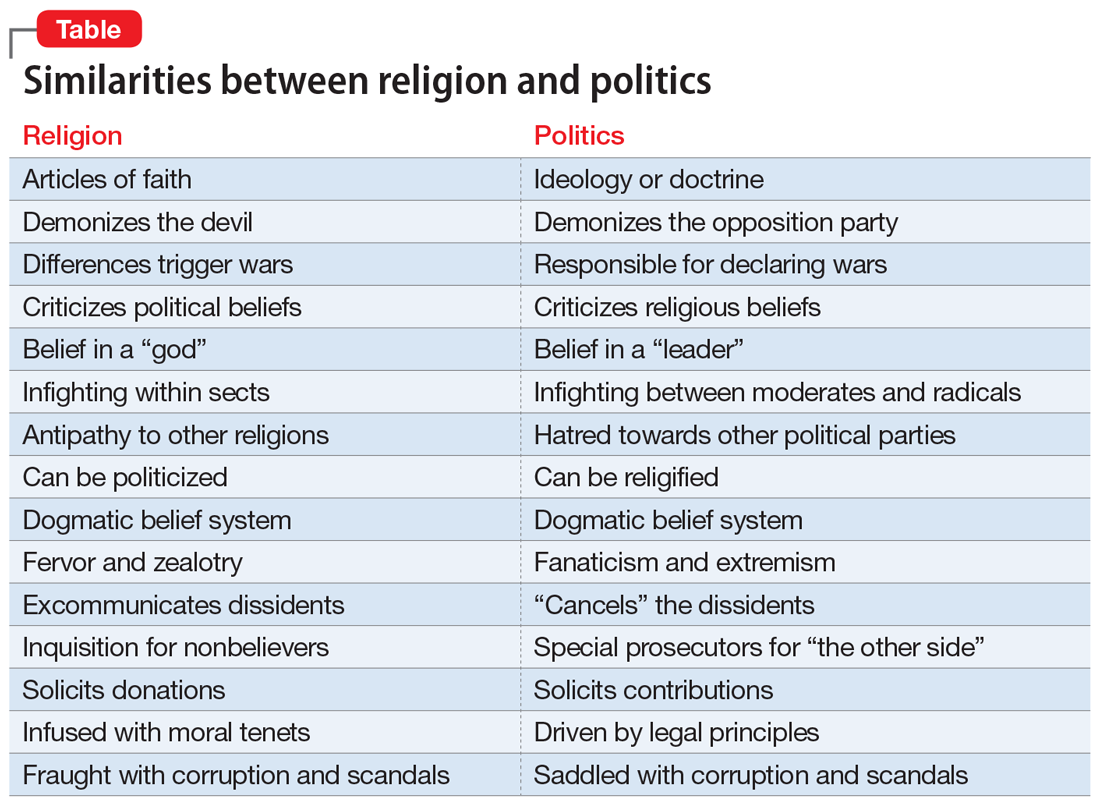
The toxic hyperpartisanship that has dominated the United States over the past several years may be the culmination of an intensified “religification” of politics. The incendiary mix of religious zealotry and political fanaticism is conducive to intensified loathing, hostility, and animus to those with an opposing political ideology.
So it all boils down to the human imperative of harboring a strong personal belief. What is the origin of beliefs, religious, political, or otherwise? Why does the human species have the overwhelming need to uphold a belief? Research suggests that it is the result of evolution and the phylogenetic enlargement of the brain, including the parietal and medial frontal cortex in humans.2 And according to many studies, abnormal and delusional beliefs encountered in psychiatric practice appear to be caused by altered perception and/or misattribution of aversive meaning.3 Lesions in the right hemisphere have been reported to play an important role in generating delusional beliefs.4 A healthy right hemisphere plays an important role in:
- pragmatic communications
- perceptual integration
- attentional surveillance and anomaly novelty detection
- belief updating.4
Right hemispheric pathology disrupts those functions and can lead to false beliefs such as delusions, or, on a milder scale, strongly held superstitions.
One wonders how the structure and function of the right hemisphere generates and perpetuates a belief in a religion or political ideology that ultimately shapes one’s life. Religiosity and politics are an inherent part of human nature, and they can replace each other or merge together. If one is to believe what Durkheim5 proposed more than a century ago, the existence of belief systems is essential for societal stability. He posited that the absence of stable belief systems can lead to what he labeled “anomie,” leading to a surge of suicide and crime. If that is true, then the coexistence of religious and political beliefs may have a significant upside, but also with a palpable downside when either or both of those belief systems become excessively antagonistic or extreme. Three cheers for religious and political moderation that allows them to peacefully coexist.
1. Jones JM. U.S. church membership falls below majority for first time. Gallup. March 29, 2021. Accessed June 7, 2021. https://news.gallup.com/poll/341963/church-membership-falls-below-majority-first-time.aspx
2. Seitz RJ, Angel HF. Belief formation—a driving force for brain evolution. Brain Cogn. 2020;140:105548. doi: 10.1016/j.bandc.2020.105548
3. Seitz RJ. Beliefs: a challenge in neuropsychological disorders. J Neuropsychol. 2021. doi: 10.1111/jnp.12249
4. Gurin L, Blum S. Delusions and the right hemisphere: a review of the case for the right hemisphere as a mediator of reality-based belief. J Neuropsychiatry Clin Neurosci. 2017;29(3):225-235. doi: 10.1176/appi.neuropsych.16060118
5. Durkheim E. Suicide: a study in sociology. The Free Press; 1951.
Man is a political animal.
— Aristotle, Politics , Book 1, Section 1253a
Religion is the opium of the people.
— Karl Marx, A contribution to the critique of Hegel’s philosophy of right , introduction
Beliefs are at the core of psychiatric practice. Our patients are often shackled by their anomalous beliefs, which are not reality-based. These beliefs are often the primary targets of psychiatric treatment. Consider a day at the office of a psychiatrist who may see several patients impaired by false beliefs, such as:
- My neighbor is reading my mind remotely and is plotting to kill me
- If I ride on a plane, it will crash and I will die
- I am a failure, a worthless person, and a burden on my family
- I am hopeless and helpless; life is too painful and not worth living anymore
- I am a prophet with supernatural gifts, and I can predict the future
- Whenever I take this substance, I feel I can jump out of a window and fly
- If I do not shower 5 times in a row every night before going to bed, something terrible will happen to my family.
Patients with false beliefs obviously need psychiatric care. However, a large number of religious individuals harbor “unusual” beliefs involving angels and devils and hell and paradise after death. Those people of faith are not considered to have a DSM-5 psychiatric disorder. Billions of people around the world belong to one of the approximately 4,300 religions, which they celebrate using one of the more than 6,800 living languages. Psychiatrists encourage patients to have a faith because it can be quite comforting to its adherents, enhancing their social relations and providing them with hope and resilience during the darkest days of life. Regular attendance at a house of worship is a measure of the strong roots of one’s faith.
So why have there been so many religious wars over centuries of recorded history? Why have millions of people died during conflicts among religions? Why does one religious group adamantly believe that theirs is the real God, while the god of other religions is fake? And why have people who withdrew from or refused to adopt a certain religious belief been persecuted; labeled as “heretic,” “infidel,” “heathen,” or “apostate”; and burned at the stake or beheaded? Perhaps religion is not always a kinder, gentler belief system.
Continue to: Recent statistics...
Recent statistics show a precipitous decline in religious observance in the United States.1 So what happens to a society that gradually abandons its previously entrenched religious beliefs and becomes secular? This trend is spreading widely in Europe and North America. But widely held beliefs with powerful personal meaning don’t just fizzle away: they re-emerge in another form. The substantial energy of religious faith must be invested elsewhere and manifested in an alternative form with similar dynamics.
Enter politics!
It seems that humans’ need to uphold a strong belief is so powerful that they either incorporate political doctrines side-by-side with their religious beliefs (if the 2 are compatible) or adopt a strong political belief if they abandon their religion and become secular. This does not have to be an intellectually wrenching change because there are many similarities between hyper-religiosity and fanatic political beliefs (Table).
The toxic hyperpartisanship that has dominated the United States over the past several years may be the culmination of an intensified “religification” of politics. The incendiary mix of religious zealotry and political fanaticism is conducive to intensified loathing, hostility, and animus to those with an opposing political ideology.
So it all boils down to the human imperative of harboring a strong personal belief. What is the origin of beliefs, religious, political, or otherwise? Why does the human species have the overwhelming need to uphold a belief? Research suggests that it is the result of evolution and the phylogenetic enlargement of the brain, including the parietal and medial frontal cortex in humans.2 And according to many studies, abnormal and delusional beliefs encountered in psychiatric practice appear to be caused by altered perception and/or misattribution of aversive meaning.3 Lesions in the right hemisphere have been reported to play an important role in generating delusional beliefs.4 A healthy right hemisphere plays an important role in:
- pragmatic communications
- perceptual integration
- attentional surveillance and anomaly novelty detection
- belief updating.4
Right hemispheric pathology disrupts those functions and can lead to false beliefs such as delusions, or, on a milder scale, strongly held superstitions.
One wonders how the structure and function of the right hemisphere generates and perpetuates a belief in a religion or political ideology that ultimately shapes one’s life. Religiosity and politics are an inherent part of human nature, and they can replace each other or merge together. If one is to believe what Durkheim5 proposed more than a century ago, the existence of belief systems is essential for societal stability. He posited that the absence of stable belief systems can lead to what he labeled “anomie,” leading to a surge of suicide and crime. If that is true, then the coexistence of religious and political beliefs may have a significant upside, but also with a palpable downside when either or both of those belief systems become excessively antagonistic or extreme. Three cheers for religious and political moderation that allows them to peacefully coexist.
Man is a political animal.
— Aristotle, Politics , Book 1, Section 1253a
Religion is the opium of the people.
— Karl Marx, A contribution to the critique of Hegel’s philosophy of right , introduction
Beliefs are at the core of psychiatric practice. Our patients are often shackled by their anomalous beliefs, which are not reality-based. These beliefs are often the primary targets of psychiatric treatment. Consider a day at the office of a psychiatrist who may see several patients impaired by false beliefs, such as:
- My neighbor is reading my mind remotely and is plotting to kill me
- If I ride on a plane, it will crash and I will die
- I am a failure, a worthless person, and a burden on my family
- I am hopeless and helpless; life is too painful and not worth living anymore
- I am a prophet with supernatural gifts, and I can predict the future
- Whenever I take this substance, I feel I can jump out of a window and fly
- If I do not shower 5 times in a row every night before going to bed, something terrible will happen to my family.
Patients with false beliefs obviously need psychiatric care. However, a large number of religious individuals harbor “unusual” beliefs involving angels and devils and hell and paradise after death. Those people of faith are not considered to have a DSM-5 psychiatric disorder. Billions of people around the world belong to one of the approximately 4,300 religions, which they celebrate using one of the more than 6,800 living languages. Psychiatrists encourage patients to have a faith because it can be quite comforting to its adherents, enhancing their social relations and providing them with hope and resilience during the darkest days of life. Regular attendance at a house of worship is a measure of the strong roots of one’s faith.
So why have there been so many religious wars over centuries of recorded history? Why have millions of people died during conflicts among religions? Why does one religious group adamantly believe that theirs is the real God, while the god of other religions is fake? And why have people who withdrew from or refused to adopt a certain religious belief been persecuted; labeled as “heretic,” “infidel,” “heathen,” or “apostate”; and burned at the stake or beheaded? Perhaps religion is not always a kinder, gentler belief system.
Continue to: Recent statistics...
Recent statistics show a precipitous decline in religious observance in the United States.1 So what happens to a society that gradually abandons its previously entrenched religious beliefs and becomes secular? This trend is spreading widely in Europe and North America. But widely held beliefs with powerful personal meaning don’t just fizzle away: they re-emerge in another form. The substantial energy of religious faith must be invested elsewhere and manifested in an alternative form with similar dynamics.
Enter politics!
It seems that humans’ need to uphold a strong belief is so powerful that they either incorporate political doctrines side-by-side with their religious beliefs (if the 2 are compatible) or adopt a strong political belief if they abandon their religion and become secular. This does not have to be an intellectually wrenching change because there are many similarities between hyper-religiosity and fanatic political beliefs (Table).
The toxic hyperpartisanship that has dominated the United States over the past several years may be the culmination of an intensified “religification” of politics. The incendiary mix of religious zealotry and political fanaticism is conducive to intensified loathing, hostility, and animus to those with an opposing political ideology.
So it all boils down to the human imperative of harboring a strong personal belief. What is the origin of beliefs, religious, political, or otherwise? Why does the human species have the overwhelming need to uphold a belief? Research suggests that it is the result of evolution and the phylogenetic enlargement of the brain, including the parietal and medial frontal cortex in humans.2 And according to many studies, abnormal and delusional beliefs encountered in psychiatric practice appear to be caused by altered perception and/or misattribution of aversive meaning.3 Lesions in the right hemisphere have been reported to play an important role in generating delusional beliefs.4 A healthy right hemisphere plays an important role in:
- pragmatic communications
- perceptual integration
- attentional surveillance and anomaly novelty detection
- belief updating.4
Right hemispheric pathology disrupts those functions and can lead to false beliefs such as delusions, or, on a milder scale, strongly held superstitions.
One wonders how the structure and function of the right hemisphere generates and perpetuates a belief in a religion or political ideology that ultimately shapes one’s life. Religiosity and politics are an inherent part of human nature, and they can replace each other or merge together. If one is to believe what Durkheim5 proposed more than a century ago, the existence of belief systems is essential for societal stability. He posited that the absence of stable belief systems can lead to what he labeled “anomie,” leading to a surge of suicide and crime. If that is true, then the coexistence of religious and political beliefs may have a significant upside, but also with a palpable downside when either or both of those belief systems become excessively antagonistic or extreme. Three cheers for religious and political moderation that allows them to peacefully coexist.
1. Jones JM. U.S. church membership falls below majority for first time. Gallup. March 29, 2021. Accessed June 7, 2021. https://news.gallup.com/poll/341963/church-membership-falls-below-majority-first-time.aspx
2. Seitz RJ, Angel HF. Belief formation—a driving force for brain evolution. Brain Cogn. 2020;140:105548. doi: 10.1016/j.bandc.2020.105548
3. Seitz RJ. Beliefs: a challenge in neuropsychological disorders. J Neuropsychol. 2021. doi: 10.1111/jnp.12249
4. Gurin L, Blum S. Delusions and the right hemisphere: a review of the case for the right hemisphere as a mediator of reality-based belief. J Neuropsychiatry Clin Neurosci. 2017;29(3):225-235. doi: 10.1176/appi.neuropsych.16060118
5. Durkheim E. Suicide: a study in sociology. The Free Press; 1951.
1. Jones JM. U.S. church membership falls below majority for first time. Gallup. March 29, 2021. Accessed June 7, 2021. https://news.gallup.com/poll/341963/church-membership-falls-below-majority-first-time.aspx
2. Seitz RJ, Angel HF. Belief formation—a driving force for brain evolution. Brain Cogn. 2020;140:105548. doi: 10.1016/j.bandc.2020.105548
3. Seitz RJ. Beliefs: a challenge in neuropsychological disorders. J Neuropsychol. 2021. doi: 10.1111/jnp.12249
4. Gurin L, Blum S. Delusions and the right hemisphere: a review of the case for the right hemisphere as a mediator of reality-based belief. J Neuropsychiatry Clin Neurosci. 2017;29(3):225-235. doi: 10.1176/appi.neuropsych.16060118
5. Durkheim E. Suicide: a study in sociology. The Free Press; 1951.
More on long-acting injectable antipsychotics
Benefits of early LAI use
I want to thank Dr. Nasrallah for his editorial calling for more frequent and earlier use of long-acting injectable antipsychotics (LAIs) in schizophrenia (From the Editor,
In addition to the neuroprotective biologic effects of early LAI usage, I’ve found that many of my FEP patients find great psychological comfort from incorporating LAIs into their treatment plan. The first psychotic break is generally when a person (and their family) feels the most afraid about the future and is in desperate need of hope that they can have a full life—with educational opportunities, sustained employment, meaningful relationships, and more. Just as society has seen the COVID-19 vaccines as a symbol of hope and the first step in overcoming the oppression of living in fear of an uncertain future, we need to help people experiencing FEP find hope in a needle.
Craig Chepke, MD, FAPA
Excel Psychiatric Associates
Huntersville, North Carolina
Reference
1. Chepke C. Drive-up pharmacotherapy during the COVID-19 pandemic. Current Psychiatry. 2020;19(5):29-30.
Dr. Nasrallah responds
Thank you, Dr. Chepke, for your letter confirming full support for using LAIs in schizophrenia. I like the phrase you coined: “hope in a needle.” The early use of LAIs in schizophrenia can provide the same type of hope that the vaccines against the life-threatening COVID-19 virus have generated in our society. Based on my direct observations, I also agree with you that the longer patients with schizophrenia remain on LAIs, the more engaged and happy they are with their progress and the quality of their lives. It is tragic that many patients never had the opportunity to return to their baseline with the early use of LAIs immediately following their first psychotic episode, instead of relapsing again and again due to their inability to adhere completely to their oral medications.
Henry A. Nasrallah, MD
Editor-In-Chief
Continue to: LAIs as the standard of care
LAIs as the standard of care
Thank you, Dr. Nasrallah, for reiterating the importance of compliance with pharmacologic management of schizophrenia after FEP (From the Editor,
As you point out in your editorial, the facts are powerful, well-known, undisputed, and yet not adopted in the United States, when in other countries LAIs are first-line care. Yes, LAIs are expensive, but not nearly as expensive as the disabilities caused by noncompliance are to society.
Why isn’t LAI use the standard of care here in the United States? In the United States, there is advocacy for treatment because there’s money in it. There is no good advocacy for preventive care because there’s no immediate money in it. We have another good example of this in the United States: private, for-profit prisons. They have a vested interest in keeping prisons full and building new ones. Patients with FEP are most often treated in the hospital, where a standard of care could easily be established that mandates LAIs as first-tier care. Why is that not so? Who is pushing for it? Who is resisting?
Your editorial inspired me to advocate more strongly. Do you have advice about how to effect policy change? I know administrators respond when we talk dollars and cents, not quality of care. What is the dollar cost of not using LAIs as the standard of care after FEP? Who cares? Who would listen to the numbers?
Edward A. Major, MD, LFAPA
Clinical Professor of Psychiatry
Upstate Medical Center
Syracuse, New York
Dr. Nasrallah responds
Dr. Major, thanks for your message. Establishing a standard of care for the use of LAIs (or any other therapy) is not that simple. It requires well-coordinated collaboration among several stakeholders (clinicians, researchers, payors, advocacy groups, and a national organization such as the American Psychiatric Association). The cost issue is certainly powerful, but the equation works in favor of LAIs because 1 psychiatric hospitalization due to a psychotic relapse costs up to 3 times the annual cost of an LAI medication that can prevent that rehospitalization. In addition, disability comprises the lion’s share of the large indirect costs of schizophrenia (disability payments, lifetime room and board, incarceration and legal costs, and loss of work and generation of taxes). LAIs can save both lives and expenditures, and a lot of suffering by patients and their families. I, too, long to see the emergence of a rational standard of care for schizophrenia using LAIs right after the initial psychotic episode. Oncology and cardiology have standards of care, so why not psychiatry?
Henry A. Nasrallah, MD
Editor-In-Chief
Continue to: Psychosis and epilepsy
Psychosis and epilepsy
I just read your editorial regarding the devastating consequences of psychotic relapses (From the Editor,
I work in the spheres of psychiatry, epileptology, and whole genome sequencing, and have experienced a psychotic episode myself (in 2013, after temporal lobe resection and overdose). I now consider myself even more lucky to be out the other side! As Governor for South London and Maudsley NHS Foundation Trust (SLaM) and Trustee for Epilepsy Action, many of our patients have psychosis. Some patients with epilepsy even experience postictal psychosis. Just yesterday, we had a call at SLaM regarding patients from a secure unit, and a psychiatric nurse spoke about patients at risk to themselves and others because of their psychotic illness, and how crucial effective long-term care was.
Torie Robinson
CEO, Epilepsy Sparks
Dr. Nasrallah responds
Ms. Robinson, thank you for sharing your story. It is important to note that the neurobiology of the psychosis that may occur with epilepsy may not be as neurodegenerative as the psychosis of schizophrenia. Many neurologic conditions can be associated with psychotic episodes, not only epilepsy. I am glad you overcame your post-temporal lobectomy psychotic episode and have had a very good outcome with high functioning.
Henry A. Nasrallah, MD
Editor-In-Chief
Disclosures
Dr. Chepke is a consultant to and speaker for Janssen Pharmaceuticals, Otsuka Pharmaceuticals, and Alkermes. The other authors report no financial relationships with any companies whose products are mentioned in their letters, or with manufacturers of competing products.
Benefits of early LAI use
I want to thank Dr. Nasrallah for his editorial calling for more frequent and earlier use of long-acting injectable antipsychotics (LAIs) in schizophrenia (From the Editor,
In addition to the neuroprotective biologic effects of early LAI usage, I’ve found that many of my FEP patients find great psychological comfort from incorporating LAIs into their treatment plan. The first psychotic break is generally when a person (and their family) feels the most afraid about the future and is in desperate need of hope that they can have a full life—with educational opportunities, sustained employment, meaningful relationships, and more. Just as society has seen the COVID-19 vaccines as a symbol of hope and the first step in overcoming the oppression of living in fear of an uncertain future, we need to help people experiencing FEP find hope in a needle.
Craig Chepke, MD, FAPA
Excel Psychiatric Associates
Huntersville, North Carolina
Reference
1. Chepke C. Drive-up pharmacotherapy during the COVID-19 pandemic. Current Psychiatry. 2020;19(5):29-30.
Dr. Nasrallah responds
Thank you, Dr. Chepke, for your letter confirming full support for using LAIs in schizophrenia. I like the phrase you coined: “hope in a needle.” The early use of LAIs in schizophrenia can provide the same type of hope that the vaccines against the life-threatening COVID-19 virus have generated in our society. Based on my direct observations, I also agree with you that the longer patients with schizophrenia remain on LAIs, the more engaged and happy they are with their progress and the quality of their lives. It is tragic that many patients never had the opportunity to return to their baseline with the early use of LAIs immediately following their first psychotic episode, instead of relapsing again and again due to their inability to adhere completely to their oral medications.
Henry A. Nasrallah, MD
Editor-In-Chief
Continue to: LAIs as the standard of care
LAIs as the standard of care
Thank you, Dr. Nasrallah, for reiterating the importance of compliance with pharmacologic management of schizophrenia after FEP (From the Editor,
As you point out in your editorial, the facts are powerful, well-known, undisputed, and yet not adopted in the United States, when in other countries LAIs are first-line care. Yes, LAIs are expensive, but not nearly as expensive as the disabilities caused by noncompliance are to society.
Why isn’t LAI use the standard of care here in the United States? In the United States, there is advocacy for treatment because there’s money in it. There is no good advocacy for preventive care because there’s no immediate money in it. We have another good example of this in the United States: private, for-profit prisons. They have a vested interest in keeping prisons full and building new ones. Patients with FEP are most often treated in the hospital, where a standard of care could easily be established that mandates LAIs as first-tier care. Why is that not so? Who is pushing for it? Who is resisting?
Your editorial inspired me to advocate more strongly. Do you have advice about how to effect policy change? I know administrators respond when we talk dollars and cents, not quality of care. What is the dollar cost of not using LAIs as the standard of care after FEP? Who cares? Who would listen to the numbers?
Edward A. Major, MD, LFAPA
Clinical Professor of Psychiatry
Upstate Medical Center
Syracuse, New York
Dr. Nasrallah responds
Dr. Major, thanks for your message. Establishing a standard of care for the use of LAIs (or any other therapy) is not that simple. It requires well-coordinated collaboration among several stakeholders (clinicians, researchers, payors, advocacy groups, and a national organization such as the American Psychiatric Association). The cost issue is certainly powerful, but the equation works in favor of LAIs because 1 psychiatric hospitalization due to a psychotic relapse costs up to 3 times the annual cost of an LAI medication that can prevent that rehospitalization. In addition, disability comprises the lion’s share of the large indirect costs of schizophrenia (disability payments, lifetime room and board, incarceration and legal costs, and loss of work and generation of taxes). LAIs can save both lives and expenditures, and a lot of suffering by patients and their families. I, too, long to see the emergence of a rational standard of care for schizophrenia using LAIs right after the initial psychotic episode. Oncology and cardiology have standards of care, so why not psychiatry?
Henry A. Nasrallah, MD
Editor-In-Chief
Continue to: Psychosis and epilepsy
Psychosis and epilepsy
I just read your editorial regarding the devastating consequences of psychotic relapses (From the Editor,
I work in the spheres of psychiatry, epileptology, and whole genome sequencing, and have experienced a psychotic episode myself (in 2013, after temporal lobe resection and overdose). I now consider myself even more lucky to be out the other side! As Governor for South London and Maudsley NHS Foundation Trust (SLaM) and Trustee for Epilepsy Action, many of our patients have psychosis. Some patients with epilepsy even experience postictal psychosis. Just yesterday, we had a call at SLaM regarding patients from a secure unit, and a psychiatric nurse spoke about patients at risk to themselves and others because of their psychotic illness, and how crucial effective long-term care was.
Torie Robinson
CEO, Epilepsy Sparks
Dr. Nasrallah responds
Ms. Robinson, thank you for sharing your story. It is important to note that the neurobiology of the psychosis that may occur with epilepsy may not be as neurodegenerative as the psychosis of schizophrenia. Many neurologic conditions can be associated with psychotic episodes, not only epilepsy. I am glad you overcame your post-temporal lobectomy psychotic episode and have had a very good outcome with high functioning.
Henry A. Nasrallah, MD
Editor-In-Chief
Disclosures
Dr. Chepke is a consultant to and speaker for Janssen Pharmaceuticals, Otsuka Pharmaceuticals, and Alkermes. The other authors report no financial relationships with any companies whose products are mentioned in their letters, or with manufacturers of competing products.
Benefits of early LAI use
I want to thank Dr. Nasrallah for his editorial calling for more frequent and earlier use of long-acting injectable antipsychotics (LAIs) in schizophrenia (From the Editor,
In addition to the neuroprotective biologic effects of early LAI usage, I’ve found that many of my FEP patients find great psychological comfort from incorporating LAIs into their treatment plan. The first psychotic break is generally when a person (and their family) feels the most afraid about the future and is in desperate need of hope that they can have a full life—with educational opportunities, sustained employment, meaningful relationships, and more. Just as society has seen the COVID-19 vaccines as a symbol of hope and the first step in overcoming the oppression of living in fear of an uncertain future, we need to help people experiencing FEP find hope in a needle.
Craig Chepke, MD, FAPA
Excel Psychiatric Associates
Huntersville, North Carolina
Reference
1. Chepke C. Drive-up pharmacotherapy during the COVID-19 pandemic. Current Psychiatry. 2020;19(5):29-30.
Dr. Nasrallah responds
Thank you, Dr. Chepke, for your letter confirming full support for using LAIs in schizophrenia. I like the phrase you coined: “hope in a needle.” The early use of LAIs in schizophrenia can provide the same type of hope that the vaccines against the life-threatening COVID-19 virus have generated in our society. Based on my direct observations, I also agree with you that the longer patients with schizophrenia remain on LAIs, the more engaged and happy they are with their progress and the quality of their lives. It is tragic that many patients never had the opportunity to return to their baseline with the early use of LAIs immediately following their first psychotic episode, instead of relapsing again and again due to their inability to adhere completely to their oral medications.
Henry A. Nasrallah, MD
Editor-In-Chief
Continue to: LAIs as the standard of care
LAIs as the standard of care
Thank you, Dr. Nasrallah, for reiterating the importance of compliance with pharmacologic management of schizophrenia after FEP (From the Editor,
As you point out in your editorial, the facts are powerful, well-known, undisputed, and yet not adopted in the United States, when in other countries LAIs are first-line care. Yes, LAIs are expensive, but not nearly as expensive as the disabilities caused by noncompliance are to society.
Why isn’t LAI use the standard of care here in the United States? In the United States, there is advocacy for treatment because there’s money in it. There is no good advocacy for preventive care because there’s no immediate money in it. We have another good example of this in the United States: private, for-profit prisons. They have a vested interest in keeping prisons full and building new ones. Patients with FEP are most often treated in the hospital, where a standard of care could easily be established that mandates LAIs as first-tier care. Why is that not so? Who is pushing for it? Who is resisting?
Your editorial inspired me to advocate more strongly. Do you have advice about how to effect policy change? I know administrators respond when we talk dollars and cents, not quality of care. What is the dollar cost of not using LAIs as the standard of care after FEP? Who cares? Who would listen to the numbers?
Edward A. Major, MD, LFAPA
Clinical Professor of Psychiatry
Upstate Medical Center
Syracuse, New York
Dr. Nasrallah responds
Dr. Major, thanks for your message. Establishing a standard of care for the use of LAIs (or any other therapy) is not that simple. It requires well-coordinated collaboration among several stakeholders (clinicians, researchers, payors, advocacy groups, and a national organization such as the American Psychiatric Association). The cost issue is certainly powerful, but the equation works in favor of LAIs because 1 psychiatric hospitalization due to a psychotic relapse costs up to 3 times the annual cost of an LAI medication that can prevent that rehospitalization. In addition, disability comprises the lion’s share of the large indirect costs of schizophrenia (disability payments, lifetime room and board, incarceration and legal costs, and loss of work and generation of taxes). LAIs can save both lives and expenditures, and a lot of suffering by patients and their families. I, too, long to see the emergence of a rational standard of care for schizophrenia using LAIs right after the initial psychotic episode. Oncology and cardiology have standards of care, so why not psychiatry?
Henry A. Nasrallah, MD
Editor-In-Chief
Continue to: Psychosis and epilepsy
Psychosis and epilepsy
I just read your editorial regarding the devastating consequences of psychotic relapses (From the Editor,
I work in the spheres of psychiatry, epileptology, and whole genome sequencing, and have experienced a psychotic episode myself (in 2013, after temporal lobe resection and overdose). I now consider myself even more lucky to be out the other side! As Governor for South London and Maudsley NHS Foundation Trust (SLaM) and Trustee for Epilepsy Action, many of our patients have psychosis. Some patients with epilepsy even experience postictal psychosis. Just yesterday, we had a call at SLaM regarding patients from a secure unit, and a psychiatric nurse spoke about patients at risk to themselves and others because of their psychotic illness, and how crucial effective long-term care was.
Torie Robinson
CEO, Epilepsy Sparks
Dr. Nasrallah responds
Ms. Robinson, thank you for sharing your story. It is important to note that the neurobiology of the psychosis that may occur with epilepsy may not be as neurodegenerative as the psychosis of schizophrenia. Many neurologic conditions can be associated with psychotic episodes, not only epilepsy. I am glad you overcame your post-temporal lobectomy psychotic episode and have had a very good outcome with high functioning.
Henry A. Nasrallah, MD
Editor-In-Chief
Disclosures
Dr. Chepke is a consultant to and speaker for Janssen Pharmaceuticals, Otsuka Pharmaceuticals, and Alkermes. The other authors report no financial relationships with any companies whose products are mentioned in their letters, or with manufacturers of competing products.

COVID-19’s impact on internet gaming disorder among children and adolescents
The impact of the COVID-19 pandemic on the well-being of youth has been significant. Its possible effects range from boredom, depression, anxiety, and suicidal ideation to potential increased rates of internet gaming disorder (IGD), which may have worsened during a nationwide shutdown and extended period of limited social interactions. Presently, there is a paucity of research on the impact of internet gaming on children and adolescents’ mental health and well-being during COVID-19. This article aims to bring awareness to the possible rising impact of the COVID-19 pandemic on IGD and mental health in youth.
Gaming offers benefits—and risks
The gaming industry has grown immensely over the past several years. While many businesses were impacted negatively during the pandemic, the gaming industry grew. It was estimated to be worth $159.3 billion in 2020, an increase of 9.3% from 2019.1
Stay-at-home orders and quarantine protocols during the COVID-19 pandemic have significantly disrupted normal activities, resulting in increased time for digital entertainment, including online gaming and related activities. Internet gaming offers some benefits for children and adolescents, including socialization and connection with peers, which was especially important for avoiding isolation during the pandemic. Empirical evidence of the positive effects of internet gaming can be seen in studies of youth undergoing chemotherapy, those receiving psychotherapy for anxiety or depression, and those having emotional and behavioral problems.2 Internet gaming also provides participants with a platform to communicate with the outside world while maintaining social distancing, and might reduce anxiety, and in some cases, depression.3
Despite these benefits, for some youth, excessive internet gaming can have adverse effects. Due to its addictive properties, internet gaming can be dangerous for vulnerable individuals and lead to unhealthy habits, such as disturbed sleep patterns and increased anxiety.4 In a cross-sectional study conducted in China, Yu et al5 examined the association between IGD and suicidal ideation. They concluded that IGD was positively associated with insomnia and then depression, which in turn contributed to suicide ideation.5 A study based on a survey conducted in Iran from May to August 2020 in individuals age 13 to 18 years found that depression, anxiety, and stress were significant mediators in the association between IGD and self-reported quality of life.2
Internet gaming disorder is included in DSM-5 as a “condition for further study” and in ICD-11.6 Before the COVID-19 pandemic, a study of 1,178 American youth age 8 to 18 years revealed that 8.5% of gamers met the criteria for IGD.7 In a meta-analysis that included 16 studies, the pooled prevalence of IGD among adolescents was 4.6%.8 Some countries, including China and South Korea, have developed treatment plans for IGD,6 but in the United States treatment guidelines have not been established due to insufficient evidence.9
The COVID-19 pandemic has likely led to an increased number of children and adolescents with IGD and its adverse effects on their mental health and well-being. It remains to be seen whether these youth will improve as the pandemic resolves and they resume normal activities, or if impairments will persist.
In conclusion, while internet gaming during the COVID-19 pandemic has provided benefits for many children and adolescents, the negative impact for those who develop IGD may be significant. We should be prepared to detect and address the needs of these youth and their families. Additional research is needed on the post-pandemic prevalence of IGD, its impact on youth mental health, and treatment strategies.
1. WePC. Video game industry statistics, trends and data in 2021. Accessed June 7, 2021. https://www.wepc.com/news/video-game-statistics/
2. Fazeli S, Mohammadi Zeidi I, Lin CY, et al. Depression, anxiety, and stress mediate the associations between internet gaming disorder, insomnia, and quality of life during the COVID-19 outbreak. Addict Behav Rep. 2020;12:100307. doi: 10.1016/j.abrep.2020.100307
3. Özçetin M, Gümüstas F, Çag˘ Y, et al. The relationships between video game experience and cognitive abilities in adolescents. Neuropsychiatr Dis Treat. 2019;15:1171-1180. doi: 10.2147/NDT.S206271
4. Männikkö N, Ruotsalainen H, Miettunen J, et al. Problematic gaming behaviour and health-related outcomes: a systematic review and meta-analysis. J Health Psychol. 2020;25(1):67-81. doi: 10.1177/1359105317740414
5. Yu Y, Yang X, Wang S, et al. Serial multiple mediation of the association between internet gaming disorder and suicidal ideation by insomnia and depression in adolescents in Shanghai, China. BMC Psychiatry. 2020;20(1):460. doi: 10.1186/s12888-020-02870-zz
6. American Psychiatric Association. Internet gaming. Published June 2018. Accessed June 7, 2021. www.psychiatry.org/patients-families/internet-gaming
7. Gentile D. Pathological video-game use among youth ages 8 to 18: a national study. Psychol Sci. 2009;20(5):594-602. doi: 10.1111/j.1467-9280.2009.02340.x
8. Fam JY. Prevalence of internet gaming disorder in adolescents: A meta-analysis across three decades. Scand J Psychol. 2018;59(5):524-531. doi: 10.1111/sjop.12459
9. Gentile DA, Bailey K, Bavelier D, et al. Internet gaming disorder in children and adolescents. Pediatrics. 2017;140(suppl 2):S81-S85. doi: 10.1542/peds.2016-1758H
The impact of the COVID-19 pandemic on the well-being of youth has been significant. Its possible effects range from boredom, depression, anxiety, and suicidal ideation to potential increased rates of internet gaming disorder (IGD), which may have worsened during a nationwide shutdown and extended period of limited social interactions. Presently, there is a paucity of research on the impact of internet gaming on children and adolescents’ mental health and well-being during COVID-19. This article aims to bring awareness to the possible rising impact of the COVID-19 pandemic on IGD and mental health in youth.
Gaming offers benefits—and risks
The gaming industry has grown immensely over the past several years. While many businesses were impacted negatively during the pandemic, the gaming industry grew. It was estimated to be worth $159.3 billion in 2020, an increase of 9.3% from 2019.1
Stay-at-home orders and quarantine protocols during the COVID-19 pandemic have significantly disrupted normal activities, resulting in increased time for digital entertainment, including online gaming and related activities. Internet gaming offers some benefits for children and adolescents, including socialization and connection with peers, which was especially important for avoiding isolation during the pandemic. Empirical evidence of the positive effects of internet gaming can be seen in studies of youth undergoing chemotherapy, those receiving psychotherapy for anxiety or depression, and those having emotional and behavioral problems.2 Internet gaming also provides participants with a platform to communicate with the outside world while maintaining social distancing, and might reduce anxiety, and in some cases, depression.3
Despite these benefits, for some youth, excessive internet gaming can have adverse effects. Due to its addictive properties, internet gaming can be dangerous for vulnerable individuals and lead to unhealthy habits, such as disturbed sleep patterns and increased anxiety.4 In a cross-sectional study conducted in China, Yu et al5 examined the association between IGD and suicidal ideation. They concluded that IGD was positively associated with insomnia and then depression, which in turn contributed to suicide ideation.5 A study based on a survey conducted in Iran from May to August 2020 in individuals age 13 to 18 years found that depression, anxiety, and stress were significant mediators in the association between IGD and self-reported quality of life.2
Internet gaming disorder is included in DSM-5 as a “condition for further study” and in ICD-11.6 Before the COVID-19 pandemic, a study of 1,178 American youth age 8 to 18 years revealed that 8.5% of gamers met the criteria for IGD.7 In a meta-analysis that included 16 studies, the pooled prevalence of IGD among adolescents was 4.6%.8 Some countries, including China and South Korea, have developed treatment plans for IGD,6 but in the United States treatment guidelines have not been established due to insufficient evidence.9
The COVID-19 pandemic has likely led to an increased number of children and adolescents with IGD and its adverse effects on their mental health and well-being. It remains to be seen whether these youth will improve as the pandemic resolves and they resume normal activities, or if impairments will persist.
In conclusion, while internet gaming during the COVID-19 pandemic has provided benefits for many children and adolescents, the negative impact for those who develop IGD may be significant. We should be prepared to detect and address the needs of these youth and their families. Additional research is needed on the post-pandemic prevalence of IGD, its impact on youth mental health, and treatment strategies.
The impact of the COVID-19 pandemic on the well-being of youth has been significant. Its possible effects range from boredom, depression, anxiety, and suicidal ideation to potential increased rates of internet gaming disorder (IGD), which may have worsened during a nationwide shutdown and extended period of limited social interactions. Presently, there is a paucity of research on the impact of internet gaming on children and adolescents’ mental health and well-being during COVID-19. This article aims to bring awareness to the possible rising impact of the COVID-19 pandemic on IGD and mental health in youth.
Gaming offers benefits—and risks
The gaming industry has grown immensely over the past several years. While many businesses were impacted negatively during the pandemic, the gaming industry grew. It was estimated to be worth $159.3 billion in 2020, an increase of 9.3% from 2019.1
Stay-at-home orders and quarantine protocols during the COVID-19 pandemic have significantly disrupted normal activities, resulting in increased time for digital entertainment, including online gaming and related activities. Internet gaming offers some benefits for children and adolescents, including socialization and connection with peers, which was especially important for avoiding isolation during the pandemic. Empirical evidence of the positive effects of internet gaming can be seen in studies of youth undergoing chemotherapy, those receiving psychotherapy for anxiety or depression, and those having emotional and behavioral problems.2 Internet gaming also provides participants with a platform to communicate with the outside world while maintaining social distancing, and might reduce anxiety, and in some cases, depression.3
Despite these benefits, for some youth, excessive internet gaming can have adverse effects. Due to its addictive properties, internet gaming can be dangerous for vulnerable individuals and lead to unhealthy habits, such as disturbed sleep patterns and increased anxiety.4 In a cross-sectional study conducted in China, Yu et al5 examined the association between IGD and suicidal ideation. They concluded that IGD was positively associated with insomnia and then depression, which in turn contributed to suicide ideation.5 A study based on a survey conducted in Iran from May to August 2020 in individuals age 13 to 18 years found that depression, anxiety, and stress were significant mediators in the association between IGD and self-reported quality of life.2
Internet gaming disorder is included in DSM-5 as a “condition for further study” and in ICD-11.6 Before the COVID-19 pandemic, a study of 1,178 American youth age 8 to 18 years revealed that 8.5% of gamers met the criteria for IGD.7 In a meta-analysis that included 16 studies, the pooled prevalence of IGD among adolescents was 4.6%.8 Some countries, including China and South Korea, have developed treatment plans for IGD,6 but in the United States treatment guidelines have not been established due to insufficient evidence.9
The COVID-19 pandemic has likely led to an increased number of children and adolescents with IGD and its adverse effects on their mental health and well-being. It remains to be seen whether these youth will improve as the pandemic resolves and they resume normal activities, or if impairments will persist.
In conclusion, while internet gaming during the COVID-19 pandemic has provided benefits for many children and adolescents, the negative impact for those who develop IGD may be significant. We should be prepared to detect and address the needs of these youth and their families. Additional research is needed on the post-pandemic prevalence of IGD, its impact on youth mental health, and treatment strategies.
1. WePC. Video game industry statistics, trends and data in 2021. Accessed June 7, 2021. https://www.wepc.com/news/video-game-statistics/
2. Fazeli S, Mohammadi Zeidi I, Lin CY, et al. Depression, anxiety, and stress mediate the associations between internet gaming disorder, insomnia, and quality of life during the COVID-19 outbreak. Addict Behav Rep. 2020;12:100307. doi: 10.1016/j.abrep.2020.100307
3. Özçetin M, Gümüstas F, Çag˘ Y, et al. The relationships between video game experience and cognitive abilities in adolescents. Neuropsychiatr Dis Treat. 2019;15:1171-1180. doi: 10.2147/NDT.S206271
4. Männikkö N, Ruotsalainen H, Miettunen J, et al. Problematic gaming behaviour and health-related outcomes: a systematic review and meta-analysis. J Health Psychol. 2020;25(1):67-81. doi: 10.1177/1359105317740414
5. Yu Y, Yang X, Wang S, et al. Serial multiple mediation of the association between internet gaming disorder and suicidal ideation by insomnia and depression in adolescents in Shanghai, China. BMC Psychiatry. 2020;20(1):460. doi: 10.1186/s12888-020-02870-zz
6. American Psychiatric Association. Internet gaming. Published June 2018. Accessed June 7, 2021. www.psychiatry.org/patients-families/internet-gaming
7. Gentile D. Pathological video-game use among youth ages 8 to 18: a national study. Psychol Sci. 2009;20(5):594-602. doi: 10.1111/j.1467-9280.2009.02340.x
8. Fam JY. Prevalence of internet gaming disorder in adolescents: A meta-analysis across three decades. Scand J Psychol. 2018;59(5):524-531. doi: 10.1111/sjop.12459
9. Gentile DA, Bailey K, Bavelier D, et al. Internet gaming disorder in children and adolescents. Pediatrics. 2017;140(suppl 2):S81-S85. doi: 10.1542/peds.2016-1758H
1. WePC. Video game industry statistics, trends and data in 2021. Accessed June 7, 2021. https://www.wepc.com/news/video-game-statistics/
2. Fazeli S, Mohammadi Zeidi I, Lin CY, et al. Depression, anxiety, and stress mediate the associations between internet gaming disorder, insomnia, and quality of life during the COVID-19 outbreak. Addict Behav Rep. 2020;12:100307. doi: 10.1016/j.abrep.2020.100307
3. Özçetin M, Gümüstas F, Çag˘ Y, et al. The relationships between video game experience and cognitive abilities in adolescents. Neuropsychiatr Dis Treat. 2019;15:1171-1180. doi: 10.2147/NDT.S206271
4. Männikkö N, Ruotsalainen H, Miettunen J, et al. Problematic gaming behaviour and health-related outcomes: a systematic review and meta-analysis. J Health Psychol. 2020;25(1):67-81. doi: 10.1177/1359105317740414
5. Yu Y, Yang X, Wang S, et al. Serial multiple mediation of the association between internet gaming disorder and suicidal ideation by insomnia and depression in adolescents in Shanghai, China. BMC Psychiatry. 2020;20(1):460. doi: 10.1186/s12888-020-02870-zz
6. American Psychiatric Association. Internet gaming. Published June 2018. Accessed June 7, 2021. www.psychiatry.org/patients-families/internet-gaming
7. Gentile D. Pathological video-game use among youth ages 8 to 18: a national study. Psychol Sci. 2009;20(5):594-602. doi: 10.1111/j.1467-9280.2009.02340.x
8. Fam JY. Prevalence of internet gaming disorder in adolescents: A meta-analysis across three decades. Scand J Psychol. 2018;59(5):524-531. doi: 10.1111/sjop.12459
9. Gentile DA, Bailey K, Bavelier D, et al. Internet gaming disorder in children and adolescents. Pediatrics. 2017;140(suppl 2):S81-S85. doi: 10.1542/peds.2016-1758H

A new world awaits us all
July is typically the month when new students/physicians arrive at academic medical centers, schools, and hospitals to begin the next phase of training. July also marks the beginning of practice for graduating fellows. In the post-COVID world, these settings will have changed dramatically from the past.

Community practices are consolidating rapidly, with many being acquired by private equity firms, hospitals, and health systems. Private equity made its first investment in GI in 2016, when Audax acquired Miami-based Gastro Health. It was announced this past May that Audax sold Gastro Health to Omers (a larger, Canadian PE firm), marking the first PE sale of a practice (second bite) (Newitt P. “Gastro Health sold to private equity company.” Becker’s GI & Endoscopy. 2021 May 19). The financial success of this model has not been lost on any community practice, so expect more such transactions.
Health systems are bouncing back from 2020, with balance sheets that are recovering quickly. But operating margins are still narrow so physician productivity is being pushed and burnout is a hot-button issue. Older workers are retiring at increasing rates, and low-wage workers are often reluctant to return to the workforce. Both trends increase Medicare and Medicaid rolls. As more patients enter government insurance programs, provider reimbursement falls. “Manage to Medicare” (bringing costs down to levels that are sustainable on Medicare rates) has again become a common goal. The historic reaction to these financial pressures has been to push commercial rates higher thru market consolidation and emphasize margin-producing services.
COVID has changed medicine. We will deliver care differently, and health inequities inherent in the current system will not be tolerable. We now can analyze population-level health outcomes by mining data from enormous databases containing both administrative and health records. Imagine the information we could derive by analyzing IBD populations scattered across multiple states, all cared for by 1,000 gastroenterologists working in a mega practice that uses a single electronic medical record. That might break down the town-gown barrier quickly.
John I. Allen, MD, MBA, AGAF
Editor in Chief
July is typically the month when new students/physicians arrive at academic medical centers, schools, and hospitals to begin the next phase of training. July also marks the beginning of practice for graduating fellows. In the post-COVID world, these settings will have changed dramatically from the past.
Community practices are consolidating rapidly, with many being acquired by private equity firms, hospitals, and health systems. Private equity made its first investment in GI in 2016, when Audax acquired Miami-based Gastro Health. It was announced this past May that Audax sold Gastro Health to Omers (a larger, Canadian PE firm), marking the first PE sale of a practice (second bite) (Newitt P. “Gastro Health sold to private equity company.” Becker’s GI & Endoscopy. 2021 May 19). The financial success of this model has not been lost on any community practice, so expect more such transactions.
Health systems are bouncing back from 2020, with balance sheets that are recovering quickly. But operating margins are still narrow so physician productivity is being pushed and burnout is a hot-button issue. Older workers are retiring at increasing rates, and low-wage workers are often reluctant to return to the workforce. Both trends increase Medicare and Medicaid rolls. As more patients enter government insurance programs, provider reimbursement falls. “Manage to Medicare” (bringing costs down to levels that are sustainable on Medicare rates) has again become a common goal. The historic reaction to these financial pressures has been to push commercial rates higher thru market consolidation and emphasize margin-producing services.
COVID has changed medicine. We will deliver care differently, and health inequities inherent in the current system will not be tolerable. We now can analyze population-level health outcomes by mining data from enormous databases containing both administrative and health records. Imagine the information we could derive by analyzing IBD populations scattered across multiple states, all cared for by 1,000 gastroenterologists working in a mega practice that uses a single electronic medical record. That might break down the town-gown barrier quickly.
John I. Allen, MD, MBA, AGAF
Editor in Chief
July is typically the month when new students/physicians arrive at academic medical centers, schools, and hospitals to begin the next phase of training. July also marks the beginning of practice for graduating fellows. In the post-COVID world, these settings will have changed dramatically from the past.
Community practices are consolidating rapidly, with many being acquired by private equity firms, hospitals, and health systems. Private equity made its first investment in GI in 2016, when Audax acquired Miami-based Gastro Health. It was announced this past May that Audax sold Gastro Health to Omers (a larger, Canadian PE firm), marking the first PE sale of a practice (second bite) (Newitt P. “Gastro Health sold to private equity company.” Becker’s GI & Endoscopy. 2021 May 19). The financial success of this model has not been lost on any community practice, so expect more such transactions.
Health systems are bouncing back from 2020, with balance sheets that are recovering quickly. But operating margins are still narrow so physician productivity is being pushed and burnout is a hot-button issue. Older workers are retiring at increasing rates, and low-wage workers are often reluctant to return to the workforce. Both trends increase Medicare and Medicaid rolls. As more patients enter government insurance programs, provider reimbursement falls. “Manage to Medicare” (bringing costs down to levels that are sustainable on Medicare rates) has again become a common goal. The historic reaction to these financial pressures has been to push commercial rates higher thru market consolidation and emphasize margin-producing services.
COVID has changed medicine. We will deliver care differently, and health inequities inherent in the current system will not be tolerable. We now can analyze population-level health outcomes by mining data from enormous databases containing both administrative and health records. Imagine the information we could derive by analyzing IBD populations scattered across multiple states, all cared for by 1,000 gastroenterologists working in a mega practice that uses a single electronic medical record. That might break down the town-gown barrier quickly.
John I. Allen, MD, MBA, AGAF
Editor in Chief

Few clinical guidelines exist for treating post-COVID symptoms
As doctors struggled through several surges of COVID-19 infections, most of what we learned was acquired through real-life experience. While many treatment options were promoted, most flat-out failed to be real therapeutics at all. Now that we have a safe and effective vaccine, we can prevent many infections from this virus. However, we are still left to manage the many post-COVID symptoms our patients continue to suffer with.
Symptoms following infection can last for months and range widely from “brain fog,” fatigue, dyspnea, chest pain, generalized weakness, depression, and a host of others. Patients may experience one or all of these symptoms, and there is currently no good way to predict who will go on to become a COVID “long hauler”.
Following the example of being educated by COVID as it happened, the same is true for managing post-COVID symptoms. The medical community still has a poor understanding of why some people develop it and there are few evidence-based studies to support any treatment modalities.
which they define as “new, recurring, or ongoing symptoms more than 4 weeks after infection, sometimes after initial symptom recovery.” It is important to note that these symptoms can occur in any degree of sickness during the acute infection, including in those who were asymptomatic. Even the actual name of this post-COVID syndrome is still being developed, with several other names being used for it as well.
While the guidelines are quite extensive, the actual clinical recommendations are still vague. For example, it is advised to let the patient know that post-COVID symptoms are still not well understood. While it is important to be transparent with patients, this does little to reassure them. Patients look to doctors, especially their primary care physicians, to guide them on the best treatment paths. Yet, we currently have none for post-COVID syndrome.
It is also advised to treat the patients’ symptoms and help improve functioning. For many diseases, doctors like to get to the root cause of the problem. Treating a symptom often masks an underlying condition. It may make the patient feel better and improve what they are capable of doing, which is important, but it also fails to unmask the real problem. It is also important to note that symptoms can be out of proportion to clinical findings and should not be dismissed: we just don’t have the answers yet.
One helpful recommendation is having a patient keep a diary of their symptoms. This will help both the patient and doctor learn what may be triggering factors. If it is, for example, exertion that induces breathlessness, perhaps the patient can gradually increase their level of activity to minimize symptoms. Additionally, a “comprehensive rehabilitation program” is also advised and this can greatly assist addressing all the issues a patient is experiencing, physically and medically.
It is also advised that management of underlying medical conditions be optimized. While this is very important, it is not something specific to post-COVID syndrome: All patients should have their underlying medical conditions well controlled. It might be that the patient is paying more attention to their overall health, which is a good thing. However, this does not necessarily reduce the current symptoms a patient is experiencing.
The CDC makes a good attempt to offer guidance in the frustrating management of post-COVID syndrome. However, their clinical guidelines fail to offer specific management tools specific to treating post-COVID patients. The recommendations offered are more helpful to health in general. The fact that more specific recommendations are lacking is simply caused by the lack of knowledge of this condition at present. As more research is conducted and more knowledge obtained, new guidelines should become more detailed.
Dr. Girgis practices family medicine in South River, N.J., and is a clinical assistant professor of family medicine at Robert Wood Johnson Medical School, New Brunswick, N.J. You can contact her at fpnews@mdedge.com.
As doctors struggled through several surges of COVID-19 infections, most of what we learned was acquired through real-life experience. While many treatment options were promoted, most flat-out failed to be real therapeutics at all. Now that we have a safe and effective vaccine, we can prevent many infections from this virus. However, we are still left to manage the many post-COVID symptoms our patients continue to suffer with.
Symptoms following infection can last for months and range widely from “brain fog,” fatigue, dyspnea, chest pain, generalized weakness, depression, and a host of others. Patients may experience one or all of these symptoms, and there is currently no good way to predict who will go on to become a COVID “long hauler”.
Following the example of being educated by COVID as it happened, the same is true for managing post-COVID symptoms. The medical community still has a poor understanding of why some people develop it and there are few evidence-based studies to support any treatment modalities.
which they define as “new, recurring, or ongoing symptoms more than 4 weeks after infection, sometimes after initial symptom recovery.” It is important to note that these symptoms can occur in any degree of sickness during the acute infection, including in those who were asymptomatic. Even the actual name of this post-COVID syndrome is still being developed, with several other names being used for it as well.
While the guidelines are quite extensive, the actual clinical recommendations are still vague. For example, it is advised to let the patient know that post-COVID symptoms are still not well understood. While it is important to be transparent with patients, this does little to reassure them. Patients look to doctors, especially their primary care physicians, to guide them on the best treatment paths. Yet, we currently have none for post-COVID syndrome.
It is also advised to treat the patients’ symptoms and help improve functioning. For many diseases, doctors like to get to the root cause of the problem. Treating a symptom often masks an underlying condition. It may make the patient feel better and improve what they are capable of doing, which is important, but it also fails to unmask the real problem. It is also important to note that symptoms can be out of proportion to clinical findings and should not be dismissed: we just don’t have the answers yet.
One helpful recommendation is having a patient keep a diary of their symptoms. This will help both the patient and doctor learn what may be triggering factors. If it is, for example, exertion that induces breathlessness, perhaps the patient can gradually increase their level of activity to minimize symptoms. Additionally, a “comprehensive rehabilitation program” is also advised and this can greatly assist addressing all the issues a patient is experiencing, physically and medically.
It is also advised that management of underlying medical conditions be optimized. While this is very important, it is not something specific to post-COVID syndrome: All patients should have their underlying medical conditions well controlled. It might be that the patient is paying more attention to their overall health, which is a good thing. However, this does not necessarily reduce the current symptoms a patient is experiencing.
The CDC makes a good attempt to offer guidance in the frustrating management of post-COVID syndrome. However, their clinical guidelines fail to offer specific management tools specific to treating post-COVID patients. The recommendations offered are more helpful to health in general. The fact that more specific recommendations are lacking is simply caused by the lack of knowledge of this condition at present. As more research is conducted and more knowledge obtained, new guidelines should become more detailed.
Dr. Girgis practices family medicine in South River, N.J., and is a clinical assistant professor of family medicine at Robert Wood Johnson Medical School, New Brunswick, N.J. You can contact her at fpnews@mdedge.com.
As doctors struggled through several surges of COVID-19 infections, most of what we learned was acquired through real-life experience. While many treatment options were promoted, most flat-out failed to be real therapeutics at all. Now that we have a safe and effective vaccine, we can prevent many infections from this virus. However, we are still left to manage the many post-COVID symptoms our patients continue to suffer with.
Symptoms following infection can last for months and range widely from “brain fog,” fatigue, dyspnea, chest pain, generalized weakness, depression, and a host of others. Patients may experience one or all of these symptoms, and there is currently no good way to predict who will go on to become a COVID “long hauler”.
Following the example of being educated by COVID as it happened, the same is true for managing post-COVID symptoms. The medical community still has a poor understanding of why some people develop it and there are few evidence-based studies to support any treatment modalities.
which they define as “new, recurring, or ongoing symptoms more than 4 weeks after infection, sometimes after initial symptom recovery.” It is important to note that these symptoms can occur in any degree of sickness during the acute infection, including in those who were asymptomatic. Even the actual name of this post-COVID syndrome is still being developed, with several other names being used for it as well.
While the guidelines are quite extensive, the actual clinical recommendations are still vague. For example, it is advised to let the patient know that post-COVID symptoms are still not well understood. While it is important to be transparent with patients, this does little to reassure them. Patients look to doctors, especially their primary care physicians, to guide them on the best treatment paths. Yet, we currently have none for post-COVID syndrome.
It is also advised to treat the patients’ symptoms and help improve functioning. For many diseases, doctors like to get to the root cause of the problem. Treating a symptom often masks an underlying condition. It may make the patient feel better and improve what they are capable of doing, which is important, but it also fails to unmask the real problem. It is also important to note that symptoms can be out of proportion to clinical findings and should not be dismissed: we just don’t have the answers yet.
One helpful recommendation is having a patient keep a diary of their symptoms. This will help both the patient and doctor learn what may be triggering factors. If it is, for example, exertion that induces breathlessness, perhaps the patient can gradually increase their level of activity to minimize symptoms. Additionally, a “comprehensive rehabilitation program” is also advised and this can greatly assist addressing all the issues a patient is experiencing, physically and medically.
It is also advised that management of underlying medical conditions be optimized. While this is very important, it is not something specific to post-COVID syndrome: All patients should have their underlying medical conditions well controlled. It might be that the patient is paying more attention to their overall health, which is a good thing. However, this does not necessarily reduce the current symptoms a patient is experiencing.
The CDC makes a good attempt to offer guidance in the frustrating management of post-COVID syndrome. However, their clinical guidelines fail to offer specific management tools specific to treating post-COVID patients. The recommendations offered are more helpful to health in general. The fact that more specific recommendations are lacking is simply caused by the lack of knowledge of this condition at present. As more research is conducted and more knowledge obtained, new guidelines should become more detailed.
Dr. Girgis practices family medicine in South River, N.J., and is a clinical assistant professor of family medicine at Robert Wood Johnson Medical School, New Brunswick, N.J. You can contact her at fpnews@mdedge.com.
An overlooked cause of palpitations
Your article, “Is an underlying cardiac condition causing your patient’s palpitations?” (J Fam Pract. 2021;70:60-68), listed a number of causes of palpitations in the table on page 62. However, 1 cause was noticeably missing: underlying genetic disorders, such as amyloidosis. Genetic disorders can affect the cardiac muscle and lead to increased rates of both cardiac arrhythmias and palpitations.
I recently treated a 43-year-old man who presented with shortness of breath and presyncopal episodes; his medical history included anxiety and gastritis. He previously had undergone a cervical spine fusion and was postoperatively given a diagnosis of bigeminy and frequent premature ventricular contractions (PVCs). An echocardiogram was ordered and came back negative, while a Holter monitor showed PVCs > 30%. Genetic testing was performed only after the family history offered some clues. The diagnosis was hereditary transthyretin (ATTR) amyloidosis. Now, he is awaiting cardiac magnetic resonance imaging to determine whether muscle or pericardium has been affected.
When I discussed the findings with the patient, he wisely stated, “Perhaps it is more common than studies show if patients are not normally tested until elderly or hospitalized.” This resonated with me when I considered that routine lab work done in an office would miss amyloidosis. This definitely reinforced my philosophy to always listen to the patient and take symptoms seriously, as sometimes we just haven’t figured out the true diagnosis yet.
Your article, “Is an underlying cardiac condition causing your patient’s palpitations?” (J Fam Pract. 2021;70:60-68), listed a number of causes of palpitations in the table on page 62. However, 1 cause was noticeably missing: underlying genetic disorders, such as amyloidosis. Genetic disorders can affect the cardiac muscle and lead to increased rates of both cardiac arrhythmias and palpitations.
I recently treated a 43-year-old man who presented with shortness of breath and presyncopal episodes; his medical history included anxiety and gastritis. He previously had undergone a cervical spine fusion and was postoperatively given a diagnosis of bigeminy and frequent premature ventricular contractions (PVCs). An echocardiogram was ordered and came back negative, while a Holter monitor showed PVCs > 30%. Genetic testing was performed only after the family history offered some clues. The diagnosis was hereditary transthyretin (ATTR) amyloidosis. Now, he is awaiting cardiac magnetic resonance imaging to determine whether muscle or pericardium has been affected.
When I discussed the findings with the patient, he wisely stated, “Perhaps it is more common than studies show if patients are not normally tested until elderly or hospitalized.” This resonated with me when I considered that routine lab work done in an office would miss amyloidosis. This definitely reinforced my philosophy to always listen to the patient and take symptoms seriously, as sometimes we just haven’t figured out the true diagnosis yet.
Your article, “Is an underlying cardiac condition causing your patient’s palpitations?” (J Fam Pract. 2021;70:60-68), listed a number of causes of palpitations in the table on page 62. However, 1 cause was noticeably missing: underlying genetic disorders, such as amyloidosis. Genetic disorders can affect the cardiac muscle and lead to increased rates of both cardiac arrhythmias and palpitations.
I recently treated a 43-year-old man who presented with shortness of breath and presyncopal episodes; his medical history included anxiety and gastritis. He previously had undergone a cervical spine fusion and was postoperatively given a diagnosis of bigeminy and frequent premature ventricular contractions (PVCs). An echocardiogram was ordered and came back negative, while a Holter monitor showed PVCs > 30%. Genetic testing was performed only after the family history offered some clues. The diagnosis was hereditary transthyretin (ATTR) amyloidosis. Now, he is awaiting cardiac magnetic resonance imaging to determine whether muscle or pericardium has been affected.
When I discussed the findings with the patient, he wisely stated, “Perhaps it is more common than studies show if patients are not normally tested until elderly or hospitalized.” This resonated with me when I considered that routine lab work done in an office would miss amyloidosis. This definitely reinforced my philosophy to always listen to the patient and take symptoms seriously, as sometimes we just haven’t figured out the true diagnosis yet.
To screen or not to screen children for hypertension?
In this issue of JFP, Smith et al recommend following guidelines from the American Academy of Pediatrics to annually screen children for hypertension (see page 220). This recommendation appears to be at odds with the recent US Preventive Services Task Force (USPSTF) statement that concluded there is insufficient evidence for screening children and adolescents for hypertension. But an “I” recommendation from the USPSTF is not the same as a “D” recommendation. “D” means don’t do it, because the evidence indicates that the harms outweigh the benefits. “I” means we don’t have enough evidence to weigh the harms and benefits, so it is up to you and your patients to decide what to do.
So whose recommendations should we follow?
Our decision should be based on a thorough understanding of the evidence, and that evidence is well summarized in the recent USPSTF report.1 The reviewers found no studies that evaluated the benefits and harms of screening children and adolescents for hypertension and no studies evaluating disease outcomes from treating hypertension in these patients.
There is, however, an association between elevated blood pressure in childhood and outcomes such as left ventricular hypertrophy and carotid intimal thickness.2 Some physicians contend that these “disease-oriented outcomes” are sufficient reason to identify and treat hypertension in children and adolescents.3 The USPSTF, however, requires a higher level of evidence that includes patient-oriented outcomes, such as a lower risk of congestive heart failure, renal failure, or death, before recommending treatment. Physicians and patients have to choose what level of evidence is sufficient to take action.
Dr. Smith comments: “As noted in their report, the USPSTF acknowledges that observational studies indicate an association between hypertension in childhood and hypertension in adulthood, but there have been no randomized trials to determine if treating hypertension in children and adolescents reduces risk of cardiovascular events. Although it is a cohort study, not a randomized trial, the ongoing i3C Consortium Outcomes Study4 may provide better information to guide decision-making for children and adolescents with elevated blood pressure.”
What we can all agree on is that, when hypertension is identified in a child or adolescent, it is important to determine if there is a treatable cause of elevated blood pressure such as coarctation of the aorta or renal disease. It is also important to address risk factors for elevated blood pressure and cardiovascular disease, such as obesity, poor dietary habits, and smoking. The treatment is lifestyle modification with diet, exercise, and smoking cessation.
- USPSTF: High blood pressure in children and adolescents: screening. Accessed June 2, 2021. https://uspreventiveservicestaskforce.org/uspstf/recommendation/blood-pressure-in-children-and-adolescents-hypertension-screening
- Yang L, Magnussen CG, Yang L, et al. Elevated blood pressure in childhood or adolescence and cardiovascular outcomes in adulthood: a systematic review. Hypertension. 2020;75:948–955. doi: 10.1161/hypertensionaha.119.14168
- Falkner B, Lurbe E. The USPSTF call to inaction on blood pressure screening in children and adolescents. Pediatr Nephrol. 2021;36:1327-1329. doi: 10.1007/s00467-021-04926-y
- Sinaiko AR, Jacobs DR Jr, Woo JG, et al. The International Childhood Cardiovascular Cohort (i3C) consortium outcomes study of childhood cardiovascular risk factors and adult cardiovascular morbidity and mortality: Design and recruitment. Contemp Clin Trials. 2018;69:55-64. doi: 10.1016/j.cct.2018.04.009
In this issue of JFP, Smith et al recommend following guidelines from the American Academy of Pediatrics to annually screen children for hypertension (see page 220). This recommendation appears to be at odds with the recent US Preventive Services Task Force (USPSTF) statement that concluded there is insufficient evidence for screening children and adolescents for hypertension. But an “I” recommendation from the USPSTF is not the same as a “D” recommendation. “D” means don’t do it, because the evidence indicates that the harms outweigh the benefits. “I” means we don’t have enough evidence to weigh the harms and benefits, so it is up to you and your patients to decide what to do.
So whose recommendations should we follow?
Our decision should be based on a thorough understanding of the evidence, and that evidence is well summarized in the recent USPSTF report.1 The reviewers found no studies that evaluated the benefits and harms of screening children and adolescents for hypertension and no studies evaluating disease outcomes from treating hypertension in these patients.
There is, however, an association between elevated blood pressure in childhood and outcomes such as left ventricular hypertrophy and carotid intimal thickness.2 Some physicians contend that these “disease-oriented outcomes” are sufficient reason to identify and treat hypertension in children and adolescents.3 The USPSTF, however, requires a higher level of evidence that includes patient-oriented outcomes, such as a lower risk of congestive heart failure, renal failure, or death, before recommending treatment. Physicians and patients have to choose what level of evidence is sufficient to take action.
Dr. Smith comments: “As noted in their report, the USPSTF acknowledges that observational studies indicate an association between hypertension in childhood and hypertension in adulthood, but there have been no randomized trials to determine if treating hypertension in children and adolescents reduces risk of cardiovascular events. Although it is a cohort study, not a randomized trial, the ongoing i3C Consortium Outcomes Study4 may provide better information to guide decision-making for children and adolescents with elevated blood pressure.”
What we can all agree on is that, when hypertension is identified in a child or adolescent, it is important to determine if there is a treatable cause of elevated blood pressure such as coarctation of the aorta or renal disease. It is also important to address risk factors for elevated blood pressure and cardiovascular disease, such as obesity, poor dietary habits, and smoking. The treatment is lifestyle modification with diet, exercise, and smoking cessation.
In this issue of JFP, Smith et al recommend following guidelines from the American Academy of Pediatrics to annually screen children for hypertension (see page 220). This recommendation appears to be at odds with the recent US Preventive Services Task Force (USPSTF) statement that concluded there is insufficient evidence for screening children and adolescents for hypertension. But an “I” recommendation from the USPSTF is not the same as a “D” recommendation. “D” means don’t do it, because the evidence indicates that the harms outweigh the benefits. “I” means we don’t have enough evidence to weigh the harms and benefits, so it is up to you and your patients to decide what to do.
So whose recommendations should we follow?
Our decision should be based on a thorough understanding of the evidence, and that evidence is well summarized in the recent USPSTF report.1 The reviewers found no studies that evaluated the benefits and harms of screening children and adolescents for hypertension and no studies evaluating disease outcomes from treating hypertension in these patients.
There is, however, an association between elevated blood pressure in childhood and outcomes such as left ventricular hypertrophy and carotid intimal thickness.2 Some physicians contend that these “disease-oriented outcomes” are sufficient reason to identify and treat hypertension in children and adolescents.3 The USPSTF, however, requires a higher level of evidence that includes patient-oriented outcomes, such as a lower risk of congestive heart failure, renal failure, or death, before recommending treatment. Physicians and patients have to choose what level of evidence is sufficient to take action.
Dr. Smith comments: “As noted in their report, the USPSTF acknowledges that observational studies indicate an association between hypertension in childhood and hypertension in adulthood, but there have been no randomized trials to determine if treating hypertension in children and adolescents reduces risk of cardiovascular events. Although it is a cohort study, not a randomized trial, the ongoing i3C Consortium Outcomes Study4 may provide better information to guide decision-making for children and adolescents with elevated blood pressure.”
What we can all agree on is that, when hypertension is identified in a child or adolescent, it is important to determine if there is a treatable cause of elevated blood pressure such as coarctation of the aorta or renal disease. It is also important to address risk factors for elevated blood pressure and cardiovascular disease, such as obesity, poor dietary habits, and smoking. The treatment is lifestyle modification with diet, exercise, and smoking cessation.
- USPSTF: High blood pressure in children and adolescents: screening. Accessed June 2, 2021. https://uspreventiveservicestaskforce.org/uspstf/recommendation/blood-pressure-in-children-and-adolescents-hypertension-screening
- Yang L, Magnussen CG, Yang L, et al. Elevated blood pressure in childhood or adolescence and cardiovascular outcomes in adulthood: a systematic review. Hypertension. 2020;75:948–955. doi: 10.1161/hypertensionaha.119.14168
- Falkner B, Lurbe E. The USPSTF call to inaction on blood pressure screening in children and adolescents. Pediatr Nephrol. 2021;36:1327-1329. doi: 10.1007/s00467-021-04926-y
- Sinaiko AR, Jacobs DR Jr, Woo JG, et al. The International Childhood Cardiovascular Cohort (i3C) consortium outcomes study of childhood cardiovascular risk factors and adult cardiovascular morbidity and mortality: Design and recruitment. Contemp Clin Trials. 2018;69:55-64. doi: 10.1016/j.cct.2018.04.009
- USPSTF: High blood pressure in children and adolescents: screening. Accessed June 2, 2021. https://uspreventiveservicestaskforce.org/uspstf/recommendation/blood-pressure-in-children-and-adolescents-hypertension-screening
- Yang L, Magnussen CG, Yang L, et al. Elevated blood pressure in childhood or adolescence and cardiovascular outcomes in adulthood: a systematic review. Hypertension. 2020;75:948–955. doi: 10.1161/hypertensionaha.119.14168
- Falkner B, Lurbe E. The USPSTF call to inaction on blood pressure screening in children and adolescents. Pediatr Nephrol. 2021;36:1327-1329. doi: 10.1007/s00467-021-04926-y
- Sinaiko AR, Jacobs DR Jr, Woo JG, et al. The International Childhood Cardiovascular Cohort (i3C) consortium outcomes study of childhood cardiovascular risk factors and adult cardiovascular morbidity and mortality: Design and recruitment. Contemp Clin Trials. 2018;69:55-64. doi: 10.1016/j.cct.2018.04.009