User login
The febrile infant: New AAP guidance for the first 2 months of life
Sixteen years in the making, the American Academy of Pediatrics just released a new clinical practice guideline (CPG), “Evaluation and Management of Well-Appearing Febrile Infants 8-60 Days Old”. The recommendations were derived from interpretations of sequential studies in young, febrile, but well-appearing infants that covered invasive bacterial infection (IBI) incidence, diagnostic modalities, and treatment during the first 2 months of life, further refining approaches to evaluation and empirical treatment.
Pediatricians have long had solid information to help assess the risk for IBI among febrile infants aged 0-3 months, but there has been an ongoing desire to further refine the suggested evaluation of these very young infants. A study of febrile infants from the Pediatric Research in Office Settings network along with subsequent evidence has identified the first 3 weeks of life as the period of highest risk for IBI, with risk declining in a graded fashion aged between 22 and 56 days.
Critical caveats
First, some caveats. Infants 0-7 days are not addressed in the CPG, and all should be treated as high risk and receive full IBI evaluation according to newborn protocols. Second, the recommendations apply only to “well-appearing” infants. Any ill-appearing infant should be treated as high risk and receive full IBI evaluation and begun on empirical antimicrobials. Third, even though the CPG deals with infants as young as 8-21 days old, the recommendations are to treat all infants in this age group as high risk, even if well-appearing, and complete full IBI evaluation and empirical therapy while awaiting results. Fourth, these guidelines apply only to infants born at 37 weeks’ gestation or more. Finally, the new CPG action statements are meant to be recommendations rather than a standard of medical care, leaving some leeway for clinician interpretation of individual patient scenarios. Where appropriate, parents’ values and preferences should be incorporated as part of shared decision-making.
The CPG divides young, febrile infants into three cohorts based on age:
- 8-21 days old
- 22-28 days old
- 29-60 days old
Age 8-21 days
For well-appearing febrile infants 8-21 days old, the CPG recommends a complete IBI evaluation that includes urine, blood, and cerebrospinal fluid (CSF) for culture, approaching all infants in this cohort as high risk. Inflammatory markers may be obtained, but the evidence is not comprehensive enough to evaluate their role in decision-making for this age group. A two-step urine evaluation method (urine analysis followed by culture if the urine analysis looks concerning) is not recommended for infants aged 8-21 days. Urine samples for culture from these young infants should be obtained by catheterization or suprapubic aspiration.
The CPG recommends drawing blood cultures and CSF by lumbar puncture from this cohort. These infants should be admitted to the hospital, treated empirically with antimicrobials, and actively monitored. However, if the cultures are negative at 24-36 hours, the clinician should discontinue antimicrobials and discharge the infant if there is no other reason for continued hospitalization.
Age 22-28 days
Well-appearing, febrile infants 22-28 days old are in an intermediate-risk zone. The recommendation for infants in this cohort is to obtain a urine specimen by catheterization or suprapubic aspiration for both urine analysis and culture. Clinicians may consider obtaining urine samples for analysis noninvasively (e.g., urine bag) in this cohort, but this is not the preferred method.
Blood culture should be obtained from all infants in this group. Inflammatory markers can help clinicians identify infants at greater risk for IBI, including meningitis. Previous data suggested that inflammatory markers such as serum white blood cell counts greater than 11,000/mcL, a serum absolute neutrophil count of greater than 4,000/mcL, and elevated C-reactive protein and procalcitonin levels could help providers identify febrile infants with true IBI. A 2008 study demonstrated that procalcitonin had the best receiver operating characteristic curve in regard to predicting IBI in young febrile infants. Other research backed up that finding and identified cutoff values for procalcitonin levels greater than 1.0 ng/mL. The CPG recommends considering a procalcitonin value of 0.5 ng/mL or higher as positive, indicating that the infant is at greater risk for IBI and potentially should undergo an expanded IBI workup. Therefore, in infants aged 22-28 days, inflammatory markers can play a role in deciding whether to perform a lumbar puncture.
Many more nuanced recommendations for whether to and how to empirically treat with antimicrobials in this cohort can be found in the CPG, including whether to manage in the hospital or at home. Treatment recommendations vary greatly for this cohort on the basis of the tests obtained and whether tests were positive or negative at the initial evaluation.
Age 29-60 days
The CPG will be most helpful when clinicians are faced with well-appearing, febrile infants in the 29- to 60-day age group. As with the other groups, a urine evaluation is recommended; however, the CPG suggests that the two-step approach – obtaining a urine analysis by a noninvasive method and only obtaining culture if the urine analysis is positive – is reasonable. This means that a bag or free-flowing urine specimen would be appropriate for urinalysis, followed by catheterization/suprapubic aspiration if a culture is necessary. This would save approximately 90% of infants from invasive urine collection. Regardless, only catheter or suprapubic specimens are appropriate for urine culture.
The CPG also recommends that clinicians obtain blood culture on all of these infants. Inflammatory markers should be assessed in this cohort because avoiding lumbar puncture for CSF culture would be appropriate in this cohort if the inflammatory markers are negative. If CSF is obtained in this age cohort, enterovirus testing should be added to the testing regimen. Again, for any infant considered at higher risk for IBI on the basis of screening tests, the CPG recommends a 24- to 36-hour rule-out period with empirical antimicrobial treatment and active monitoring in the hospital.
Summary
The recommended approach for febrile infants 8-21 days old is relatively aggressive, with urine, blood, and CSF evaluation for IBI. Clinicians gain some leeway for infants age 22-28 days, but the guidelines recommend a more flexible approach to evaluating well-appearing, febrile infants age 29-60 days, when a two-step urine evaluation and inflammatory marker assessment can help clinicians and parents have a better discussion about the risk-benefit trade-offs of more aggressive testing and empirical treatment.
The author would like to thank Ken Roberts, MD, for his review and helpful comments on this summary of the CPG highlights. Summary points of the CPG were presented by the writing group at the 2021 Pediatric Academic Societies meeting.
William T. Basco, Jr, MD, MS, is a professor of pediatrics at the Medical University of South Carolina, Charleston, and director of the division of general pediatrics. He is an active health services researcher and has published more than 60 manuscripts in the peer-reviewed literature.
A version of this article first appeared on Medscape.com.
Sixteen years in the making, the American Academy of Pediatrics just released a new clinical practice guideline (CPG), “Evaluation and Management of Well-Appearing Febrile Infants 8-60 Days Old”. The recommendations were derived from interpretations of sequential studies in young, febrile, but well-appearing infants that covered invasive bacterial infection (IBI) incidence, diagnostic modalities, and treatment during the first 2 months of life, further refining approaches to evaluation and empirical treatment.
Pediatricians have long had solid information to help assess the risk for IBI among febrile infants aged 0-3 months, but there has been an ongoing desire to further refine the suggested evaluation of these very young infants. A study of febrile infants from the Pediatric Research in Office Settings network along with subsequent evidence has identified the first 3 weeks of life as the period of highest risk for IBI, with risk declining in a graded fashion aged between 22 and 56 days.
Critical caveats
First, some caveats. Infants 0-7 days are not addressed in the CPG, and all should be treated as high risk and receive full IBI evaluation according to newborn protocols. Second, the recommendations apply only to “well-appearing” infants. Any ill-appearing infant should be treated as high risk and receive full IBI evaluation and begun on empirical antimicrobials. Third, even though the CPG deals with infants as young as 8-21 days old, the recommendations are to treat all infants in this age group as high risk, even if well-appearing, and complete full IBI evaluation and empirical therapy while awaiting results. Fourth, these guidelines apply only to infants born at 37 weeks’ gestation or more. Finally, the new CPG action statements are meant to be recommendations rather than a standard of medical care, leaving some leeway for clinician interpretation of individual patient scenarios. Where appropriate, parents’ values and preferences should be incorporated as part of shared decision-making.
The CPG divides young, febrile infants into three cohorts based on age:
- 8-21 days old
- 22-28 days old
- 29-60 days old
Age 8-21 days
For well-appearing febrile infants 8-21 days old, the CPG recommends a complete IBI evaluation that includes urine, blood, and cerebrospinal fluid (CSF) for culture, approaching all infants in this cohort as high risk. Inflammatory markers may be obtained, but the evidence is not comprehensive enough to evaluate their role in decision-making for this age group. A two-step urine evaluation method (urine analysis followed by culture if the urine analysis looks concerning) is not recommended for infants aged 8-21 days. Urine samples for culture from these young infants should be obtained by catheterization or suprapubic aspiration.
The CPG recommends drawing blood cultures and CSF by lumbar puncture from this cohort. These infants should be admitted to the hospital, treated empirically with antimicrobials, and actively monitored. However, if the cultures are negative at 24-36 hours, the clinician should discontinue antimicrobials and discharge the infant if there is no other reason for continued hospitalization.
Age 22-28 days
Well-appearing, febrile infants 22-28 days old are in an intermediate-risk zone. The recommendation for infants in this cohort is to obtain a urine specimen by catheterization or suprapubic aspiration for both urine analysis and culture. Clinicians may consider obtaining urine samples for analysis noninvasively (e.g., urine bag) in this cohort, but this is not the preferred method.
Blood culture should be obtained from all infants in this group. Inflammatory markers can help clinicians identify infants at greater risk for IBI, including meningitis. Previous data suggested that inflammatory markers such as serum white blood cell counts greater than 11,000/mcL, a serum absolute neutrophil count of greater than 4,000/mcL, and elevated C-reactive protein and procalcitonin levels could help providers identify febrile infants with true IBI. A 2008 study demonstrated that procalcitonin had the best receiver operating characteristic curve in regard to predicting IBI in young febrile infants. Other research backed up that finding and identified cutoff values for procalcitonin levels greater than 1.0 ng/mL. The CPG recommends considering a procalcitonin value of 0.5 ng/mL or higher as positive, indicating that the infant is at greater risk for IBI and potentially should undergo an expanded IBI workup. Therefore, in infants aged 22-28 days, inflammatory markers can play a role in deciding whether to perform a lumbar puncture.
Many more nuanced recommendations for whether to and how to empirically treat with antimicrobials in this cohort can be found in the CPG, including whether to manage in the hospital or at home. Treatment recommendations vary greatly for this cohort on the basis of the tests obtained and whether tests were positive or negative at the initial evaluation.
Age 29-60 days
The CPG will be most helpful when clinicians are faced with well-appearing, febrile infants in the 29- to 60-day age group. As with the other groups, a urine evaluation is recommended; however, the CPG suggests that the two-step approach – obtaining a urine analysis by a noninvasive method and only obtaining culture if the urine analysis is positive – is reasonable. This means that a bag or free-flowing urine specimen would be appropriate for urinalysis, followed by catheterization/suprapubic aspiration if a culture is necessary. This would save approximately 90% of infants from invasive urine collection. Regardless, only catheter or suprapubic specimens are appropriate for urine culture.
The CPG also recommends that clinicians obtain blood culture on all of these infants. Inflammatory markers should be assessed in this cohort because avoiding lumbar puncture for CSF culture would be appropriate in this cohort if the inflammatory markers are negative. If CSF is obtained in this age cohort, enterovirus testing should be added to the testing regimen. Again, for any infant considered at higher risk for IBI on the basis of screening tests, the CPG recommends a 24- to 36-hour rule-out period with empirical antimicrobial treatment and active monitoring in the hospital.
Summary
The recommended approach for febrile infants 8-21 days old is relatively aggressive, with urine, blood, and CSF evaluation for IBI. Clinicians gain some leeway for infants age 22-28 days, but the guidelines recommend a more flexible approach to evaluating well-appearing, febrile infants age 29-60 days, when a two-step urine evaluation and inflammatory marker assessment can help clinicians and parents have a better discussion about the risk-benefit trade-offs of more aggressive testing and empirical treatment.
The author would like to thank Ken Roberts, MD, for his review and helpful comments on this summary of the CPG highlights. Summary points of the CPG were presented by the writing group at the 2021 Pediatric Academic Societies meeting.
William T. Basco, Jr, MD, MS, is a professor of pediatrics at the Medical University of South Carolina, Charleston, and director of the division of general pediatrics. He is an active health services researcher and has published more than 60 manuscripts in the peer-reviewed literature.
A version of this article first appeared on Medscape.com.
Sixteen years in the making, the American Academy of Pediatrics just released a new clinical practice guideline (CPG), “Evaluation and Management of Well-Appearing Febrile Infants 8-60 Days Old”. The recommendations were derived from interpretations of sequential studies in young, febrile, but well-appearing infants that covered invasive bacterial infection (IBI) incidence, diagnostic modalities, and treatment during the first 2 months of life, further refining approaches to evaluation and empirical treatment.
Pediatricians have long had solid information to help assess the risk for IBI among febrile infants aged 0-3 months, but there has been an ongoing desire to further refine the suggested evaluation of these very young infants. A study of febrile infants from the Pediatric Research in Office Settings network along with subsequent evidence has identified the first 3 weeks of life as the period of highest risk for IBI, with risk declining in a graded fashion aged between 22 and 56 days.
Critical caveats
First, some caveats. Infants 0-7 days are not addressed in the CPG, and all should be treated as high risk and receive full IBI evaluation according to newborn protocols. Second, the recommendations apply only to “well-appearing” infants. Any ill-appearing infant should be treated as high risk and receive full IBI evaluation and begun on empirical antimicrobials. Third, even though the CPG deals with infants as young as 8-21 days old, the recommendations are to treat all infants in this age group as high risk, even if well-appearing, and complete full IBI evaluation and empirical therapy while awaiting results. Fourth, these guidelines apply only to infants born at 37 weeks’ gestation or more. Finally, the new CPG action statements are meant to be recommendations rather than a standard of medical care, leaving some leeway for clinician interpretation of individual patient scenarios. Where appropriate, parents’ values and preferences should be incorporated as part of shared decision-making.
The CPG divides young, febrile infants into three cohorts based on age:
- 8-21 days old
- 22-28 days old
- 29-60 days old
Age 8-21 days
For well-appearing febrile infants 8-21 days old, the CPG recommends a complete IBI evaluation that includes urine, blood, and cerebrospinal fluid (CSF) for culture, approaching all infants in this cohort as high risk. Inflammatory markers may be obtained, but the evidence is not comprehensive enough to evaluate their role in decision-making for this age group. A two-step urine evaluation method (urine analysis followed by culture if the urine analysis looks concerning) is not recommended for infants aged 8-21 days. Urine samples for culture from these young infants should be obtained by catheterization or suprapubic aspiration.
The CPG recommends drawing blood cultures and CSF by lumbar puncture from this cohort. These infants should be admitted to the hospital, treated empirically with antimicrobials, and actively monitored. However, if the cultures are negative at 24-36 hours, the clinician should discontinue antimicrobials and discharge the infant if there is no other reason for continued hospitalization.
Age 22-28 days
Well-appearing, febrile infants 22-28 days old are in an intermediate-risk zone. The recommendation for infants in this cohort is to obtain a urine specimen by catheterization or suprapubic aspiration for both urine analysis and culture. Clinicians may consider obtaining urine samples for analysis noninvasively (e.g., urine bag) in this cohort, but this is not the preferred method.
Blood culture should be obtained from all infants in this group. Inflammatory markers can help clinicians identify infants at greater risk for IBI, including meningitis. Previous data suggested that inflammatory markers such as serum white blood cell counts greater than 11,000/mcL, a serum absolute neutrophil count of greater than 4,000/mcL, and elevated C-reactive protein and procalcitonin levels could help providers identify febrile infants with true IBI. A 2008 study demonstrated that procalcitonin had the best receiver operating characteristic curve in regard to predicting IBI in young febrile infants. Other research backed up that finding and identified cutoff values for procalcitonin levels greater than 1.0 ng/mL. The CPG recommends considering a procalcitonin value of 0.5 ng/mL or higher as positive, indicating that the infant is at greater risk for IBI and potentially should undergo an expanded IBI workup. Therefore, in infants aged 22-28 days, inflammatory markers can play a role in deciding whether to perform a lumbar puncture.
Many more nuanced recommendations for whether to and how to empirically treat with antimicrobials in this cohort can be found in the CPG, including whether to manage in the hospital or at home. Treatment recommendations vary greatly for this cohort on the basis of the tests obtained and whether tests were positive or negative at the initial evaluation.
Age 29-60 days
The CPG will be most helpful when clinicians are faced with well-appearing, febrile infants in the 29- to 60-day age group. As with the other groups, a urine evaluation is recommended; however, the CPG suggests that the two-step approach – obtaining a urine analysis by a noninvasive method and only obtaining culture if the urine analysis is positive – is reasonable. This means that a bag or free-flowing urine specimen would be appropriate for urinalysis, followed by catheterization/suprapubic aspiration if a culture is necessary. This would save approximately 90% of infants from invasive urine collection. Regardless, only catheter or suprapubic specimens are appropriate for urine culture.
The CPG also recommends that clinicians obtain blood culture on all of these infants. Inflammatory markers should be assessed in this cohort because avoiding lumbar puncture for CSF culture would be appropriate in this cohort if the inflammatory markers are negative. If CSF is obtained in this age cohort, enterovirus testing should be added to the testing regimen. Again, for any infant considered at higher risk for IBI on the basis of screening tests, the CPG recommends a 24- to 36-hour rule-out period with empirical antimicrobial treatment and active monitoring in the hospital.
Summary
The recommended approach for febrile infants 8-21 days old is relatively aggressive, with urine, blood, and CSF evaluation for IBI. Clinicians gain some leeway for infants age 22-28 days, but the guidelines recommend a more flexible approach to evaluating well-appearing, febrile infants age 29-60 days, when a two-step urine evaluation and inflammatory marker assessment can help clinicians and parents have a better discussion about the risk-benefit trade-offs of more aggressive testing and empirical treatment.
The author would like to thank Ken Roberts, MD, for his review and helpful comments on this summary of the CPG highlights. Summary points of the CPG were presented by the writing group at the 2021 Pediatric Academic Societies meeting.
William T. Basco, Jr, MD, MS, is a professor of pediatrics at the Medical University of South Carolina, Charleston, and director of the division of general pediatrics. He is an active health services researcher and has published more than 60 manuscripts in the peer-reviewed literature.
A version of this article first appeared on Medscape.com.
The ADA and hearing-impaired patients
A recent claim against a New Jersey physician attracted considerable attention in both the medical and legal communities, not only because it resulted in a substantial jury award, but because that award was not covered by malpractice insurance.

It is a good reminder for the rest of us: This case involved a charge of discrimination against a hearing-impaired patient – which meant the physician not only had to fund his own defense, but was personally responsible for the $400,000 award against him.
The Americans with Disabilities Act (ADA) was designed to protect individuals with various disabilities against discrimination in various public situations – including, specifically, “the professional office of a health care professional.”
When the disability is impaired hearing, the law requires physicians to provide any “auxiliary aids and services” that might be necessary to insure clear communication between doctor and patient. In the vast majority of such situations, a pad and pencil will satisfy that requirement. But occasionally it does not, particularly when complex medical concepts are involved; and in such cases, as the New Jersey trial demonstrated, failure to make the necessary extra effort can be very expensive.
The claim involved a hearing-impaired patient with lupus erythematosus under treatment by a rheumatologist. For almost 2 years the patient’s partner and her daughter provided translation; but that arrangement was inadequate, she testified, because her partner and daughter were unfamiliar with medical terminology and she was “unable to understand and participate in her care,” which left her “unaware of risks and available alternatives.”
She repeatedly requested that the rheumatologist provide an American Sign Language interpreter for her office visits. He refused on grounds that the cost of an interpreter would exceed the payment he would receive for the visits, which made it an “undue financial burden,” and therefore exempt from ADA requirements.
But the undue-burden exemption is not automatic; it must be demonstrated in court. And the jury decided the rheumatologist’s annual income of $425,000 rendered the cost of an interpreter quite affordable.
The lessons are clear: Physicians must take antidiscrimination laws seriously, particularly when uninsurable issues are involved; and we must be constantly aware of the needs of disabled patients, to be sure their care is not substantially different from that of any other patient.
In the case of hearing-impaired or deaf patients, it is important to remember that forms of communication that are quite adequate for most are not appropriate for some. Lip reading, written notes, and the use of family members as interpreters may be perfectly acceptable to one patient and unsuitable for another.
If the patient agrees to written notes and lip reading, as most do, you need to remember to speak slowly, and to write down critical information to avoid any miscommunications. And as always, it is crucial to document all communication, as well as the methods used for that communication – specifically including the fact that the patient agreed to those forms of communication. Documentation, as I’ve often said, is like garlic: There is no such thing as too much of it.
Should a patient not agree that written notes are sufficient, other alternatives can be offered: computer transcription, assistive listening devices, videotext displays (often available in hospitals), and telecommunication devices such as TTY and TDD. But if the patient rejects all of those options and continues to insist on a professional interpreter, the precedent set by the New Jersey case suggests that you need to acquiesce, even if the interpreter’s fee exceeds the visit reimbursement – and the ADA prohibits you from passing your cost along to the patient. But any such cost will be far less than a noninsured judgment against you.
If you must go that route, make sure the interpreter you hire is familiar with medical terminology, and is not acquainted or related to the patient (for HIPAA reasons). Your state may have an online registry of available interpreters, or your hospital may have a sign language interpreter on its staff that they might allow you to “borrow.”
The good news is several states have responded to this issue by introducing legislation that would require health insurance carriers to pay for the cost of interpreters, although none, as of this writing, have yet become law.
Dr. Eastern practices dermatology and dermatologic surgery in Belleville, N.J. He is the author of numerous articles and textbook chapters, and is a longtime monthly columnist for Dermatology News. Write to him at dermnews@mdedge.com.
A recent claim against a New Jersey physician attracted considerable attention in both the medical and legal communities, not only because it resulted in a substantial jury award, but because that award was not covered by malpractice insurance.
It is a good reminder for the rest of us: This case involved a charge of discrimination against a hearing-impaired patient – which meant the physician not only had to fund his own defense, but was personally responsible for the $400,000 award against him.
The Americans with Disabilities Act (ADA) was designed to protect individuals with various disabilities against discrimination in various public situations – including, specifically, “the professional office of a health care professional.”
When the disability is impaired hearing, the law requires physicians to provide any “auxiliary aids and services” that might be necessary to insure clear communication between doctor and patient. In the vast majority of such situations, a pad and pencil will satisfy that requirement. But occasionally it does not, particularly when complex medical concepts are involved; and in such cases, as the New Jersey trial demonstrated, failure to make the necessary extra effort can be very expensive.
The claim involved a hearing-impaired patient with lupus erythematosus under treatment by a rheumatologist. For almost 2 years the patient’s partner and her daughter provided translation; but that arrangement was inadequate, she testified, because her partner and daughter were unfamiliar with medical terminology and she was “unable to understand and participate in her care,” which left her “unaware of risks and available alternatives.”
She repeatedly requested that the rheumatologist provide an American Sign Language interpreter for her office visits. He refused on grounds that the cost of an interpreter would exceed the payment he would receive for the visits, which made it an “undue financial burden,” and therefore exempt from ADA requirements.
But the undue-burden exemption is not automatic; it must be demonstrated in court. And the jury decided the rheumatologist’s annual income of $425,000 rendered the cost of an interpreter quite affordable.
The lessons are clear: Physicians must take antidiscrimination laws seriously, particularly when uninsurable issues are involved; and we must be constantly aware of the needs of disabled patients, to be sure their care is not substantially different from that of any other patient.
In the case of hearing-impaired or deaf patients, it is important to remember that forms of communication that are quite adequate for most are not appropriate for some. Lip reading, written notes, and the use of family members as interpreters may be perfectly acceptable to one patient and unsuitable for another.
If the patient agrees to written notes and lip reading, as most do, you need to remember to speak slowly, and to write down critical information to avoid any miscommunications. And as always, it is crucial to document all communication, as well as the methods used for that communication – specifically including the fact that the patient agreed to those forms of communication. Documentation, as I’ve often said, is like garlic: There is no such thing as too much of it.
Should a patient not agree that written notes are sufficient, other alternatives can be offered: computer transcription, assistive listening devices, videotext displays (often available in hospitals), and telecommunication devices such as TTY and TDD. But if the patient rejects all of those options and continues to insist on a professional interpreter, the precedent set by the New Jersey case suggests that you need to acquiesce, even if the interpreter’s fee exceeds the visit reimbursement – and the ADA prohibits you from passing your cost along to the patient. But any such cost will be far less than a noninsured judgment against you.
If you must go that route, make sure the interpreter you hire is familiar with medical terminology, and is not acquainted or related to the patient (for HIPAA reasons). Your state may have an online registry of available interpreters, or your hospital may have a sign language interpreter on its staff that they might allow you to “borrow.”
The good news is several states have responded to this issue by introducing legislation that would require health insurance carriers to pay for the cost of interpreters, although none, as of this writing, have yet become law.
Dr. Eastern practices dermatology and dermatologic surgery in Belleville, N.J. He is the author of numerous articles and textbook chapters, and is a longtime monthly columnist for Dermatology News. Write to him at dermnews@mdedge.com.
A recent claim against a New Jersey physician attracted considerable attention in both the medical and legal communities, not only because it resulted in a substantial jury award, but because that award was not covered by malpractice insurance.
It is a good reminder for the rest of us: This case involved a charge of discrimination against a hearing-impaired patient – which meant the physician not only had to fund his own defense, but was personally responsible for the $400,000 award against him.
The Americans with Disabilities Act (ADA) was designed to protect individuals with various disabilities against discrimination in various public situations – including, specifically, “the professional office of a health care professional.”
When the disability is impaired hearing, the law requires physicians to provide any “auxiliary aids and services” that might be necessary to insure clear communication between doctor and patient. In the vast majority of such situations, a pad and pencil will satisfy that requirement. But occasionally it does not, particularly when complex medical concepts are involved; and in such cases, as the New Jersey trial demonstrated, failure to make the necessary extra effort can be very expensive.
The claim involved a hearing-impaired patient with lupus erythematosus under treatment by a rheumatologist. For almost 2 years the patient’s partner and her daughter provided translation; but that arrangement was inadequate, she testified, because her partner and daughter were unfamiliar with medical terminology and she was “unable to understand and participate in her care,” which left her “unaware of risks and available alternatives.”
She repeatedly requested that the rheumatologist provide an American Sign Language interpreter for her office visits. He refused on grounds that the cost of an interpreter would exceed the payment he would receive for the visits, which made it an “undue financial burden,” and therefore exempt from ADA requirements.
But the undue-burden exemption is not automatic; it must be demonstrated in court. And the jury decided the rheumatologist’s annual income of $425,000 rendered the cost of an interpreter quite affordable.
The lessons are clear: Physicians must take antidiscrimination laws seriously, particularly when uninsurable issues are involved; and we must be constantly aware of the needs of disabled patients, to be sure their care is not substantially different from that of any other patient.
In the case of hearing-impaired or deaf patients, it is important to remember that forms of communication that are quite adequate for most are not appropriate for some. Lip reading, written notes, and the use of family members as interpreters may be perfectly acceptable to one patient and unsuitable for another.
If the patient agrees to written notes and lip reading, as most do, you need to remember to speak slowly, and to write down critical information to avoid any miscommunications. And as always, it is crucial to document all communication, as well as the methods used for that communication – specifically including the fact that the patient agreed to those forms of communication. Documentation, as I’ve often said, is like garlic: There is no such thing as too much of it.
Should a patient not agree that written notes are sufficient, other alternatives can be offered: computer transcription, assistive listening devices, videotext displays (often available in hospitals), and telecommunication devices such as TTY and TDD. But if the patient rejects all of those options and continues to insist on a professional interpreter, the precedent set by the New Jersey case suggests that you need to acquiesce, even if the interpreter’s fee exceeds the visit reimbursement – and the ADA prohibits you from passing your cost along to the patient. But any such cost will be far less than a noninsured judgment against you.
If you must go that route, make sure the interpreter you hire is familiar with medical terminology, and is not acquainted or related to the patient (for HIPAA reasons). Your state may have an online registry of available interpreters, or your hospital may have a sign language interpreter on its staff that they might allow you to “borrow.”
The good news is several states have responded to this issue by introducing legislation that would require health insurance carriers to pay for the cost of interpreters, although none, as of this writing, have yet become law.
Dr. Eastern practices dermatology and dermatologic surgery in Belleville, N.J. He is the author of numerous articles and textbook chapters, and is a longtime monthly columnist for Dermatology News. Write to him at dermnews@mdedge.com.

When patients demand vaccinated health care providers
Should a hospital or medical practice fulfill a patient’s request to be treated or cared for only by vaccinated health care providers?The answer is yes, in a perfect world. Patients should feel assured that their health care providers – clinicians and caregivers – are not exposing them to infectious diseases.But issues are being raised – subquestions that need to be answered to understand the current situation and assist health care employers in their decision-making:
- Must health care employers ensure that their employees are vaccinated?
- Can health care employers require that their employees be vaccinated?
- Do employees have any rights to refuse vaccination or to refuse to supply their employer with their vaccination status?
- Can a health care employer terminate an employee who refuses vaccination?
- Does a patient have a legal right to a vaccinated health care provider?
At present, federal policy says that employers may, but are not required to, insist that employees be vaccinated. The currently prevailing state case law says that hospitals and other employers can require staff to be vaccinated and can terminate employees who refuse vaccination. In June, a Texas court dismissed a case in which 117 employees sued a hospital for requiring that employees be vaccinated. More cases are pending in other states, and there may be differing decisions in other states and on appeal.
State laws enacted years ago also weigh in on employer obligations. In at least one state, Oregon, employers of health care providers may not require vaccination, even though other employers may. Other states have laws about what an employer may or may not require of an employee regarding vaccination, and some have introduced laws which are pending.
So, in most states, health care employers may, not must, require that employees be vaccinated. In most states, hospitals and medical practices may terminate employees who refuse vaccination. However, employers should research the laws of their own states before requiring vaccinations and before terminating employees who are not vaccinated.
The issue of employer mandates is complicated further by the practicality that, in some areas of the country, health care providers are in scarce supply. Employers don’t want to lose the providers they have.
And there are additional questions about how certain federal laws affect the situation. Federal law that may apply includes:
- U.S. Food and Drug Administration regulation on approval of vaccines
- The Americans With Disabilities Act (ADA)
- The Health Insurance Portability and Accountability Act of 1996, which protects sensitive patient health information from being disclosed without the patient’s consent
- Civil rights laws
- Patients’ rights
FDA. Some health care providers who refuse vaccination argue that employers have no legal right to require a vaccine that is not fully approved by the FDA. COVID-19 vaccinations have emergency use authorization – something less than full approval. Courts have not yet ruled on this issue.
ADA. Some attorneys believe that honoring a patient’s request to be attended only by a vaccinated health care provider can implicate the ADA. However, the ADA doesn’t protect healthy individuals who don’t want to be vaccinated. The ADA protects the person who, because of their disability, shouldn’t get the vaccination. If an employer mandates vaccination, the employer must, under the ADA, consider requests for exemptions from disabled individuals. However, even when an employee has a disability that may qualify the employee for an exemption to the vaccination requirement, an employer may argue that giving an exemption would be a direct threat to the safety of others; in that case, the ADA may require that the disabled employee and hospital work something out. A compromise might be that the unvaccinated disabled individual would not provide direct patient care or would wear a mask and maintain physical distance.
HIPAA. Some argue that federal privacy law enters into the discussion, maintaining that health care employers can’t disclose employees’ vaccination status under HIPAA. That is not true. Employers are not “covered entities” under HIPAA. It is health care providers who are precluded under HIPAA from disclosing a patient’s personal information. So, if an employer were to ask an employee’s health care provider about the employee’s vaccination status, the health care provider could disclose that status only if the employee consented to the disclosure. An employer may ask an employee for the employee’s proof of vaccination card. However, employers must not ask for unnecessary details that might reveal disability information protected by the ADA.
Civil rights law. Civil rights laws may protect certain individuals from employment consequences of refusing vaccination. Specifically, individuals with sincerely held religious convictions against vaccinations are protected from retaliation by employers for refusing vaccination, under the Constitutional right of freedom of religion. The individual without sincerely held religious convictions against vaccinations and without a relevant disability doesn’t have legal remedies under civil rights laws.
Civil rights laws may apply if employers don’t apply their vaccination requirements to all employees equally. That is, employers can’t require vaccinations of some employees but not others.
Patients’ rights. Legal protections for patients who want a vaccinated health care provider are nowhere to be seen, at this time. It is unlikely that a single patient will be able to convince a hospital or medical practice to require that its staff be vaccinated. However, if a patient becomes infected with COVID-19 and can prove that the illness is causally related to interacting with an unvaccinated health care worker, the patient may have a case against the employer. The legal theory would be malpractice or negligence under informed consent law: That is, the patient did not consent to be treated by an unvaccinated person.
Employer options
So, what can health care employers do? They have three options:
- Require vaccination of all employees, independent contractors, and other providers who have privileges to see patients. Then, as long as the employer enforces the vaccination mandate, the employer can tell patients that all providers are vaccinated.
- Not require that employees and others with access to patients be vaccinated, and if a patient requests to be seen only by vaccinated providers, provide that patient with a vaccinated provider. It is especially important that health care employers take care with patients who are unvaccinated and who have been advised not to be vaccinated because of a medical condition. Both the patient and the health care employer would be protected best by avoiding having two unvaccinated individuals interact. Masks and physical distancing may decrease the risk.
- Not require that employees be vaccinated and refuse to guarantee that providers are vaccinated. To avoid risk for future lawsuits, employers should inform patients that there is no assurance that providers are vaccinated. That leaves it to each patient to ask individual providers about the provider’s vaccination status. If a patient doesn’t like a provider’s answer, then the patient has the right to leave. It’s not clear that the patient has a legal right to stay and demand a vaccinated provider.
Option three is problematic for a number of reasons. Patients aren’t always in a position to query each provider who enters the room about vaccination status. Patients may be sedated or too ill to exert that effort. And it puts supervisors in the position of having to mediate situations where a patient wants to leave against medical advice but the option of staying may also be dangerous.
Health care employers should discuss the options with their legal counsel before deciding which option to adopt.
A version of this article first appeared on Medscape.com.
Should a hospital or medical practice fulfill a patient’s request to be treated or cared for only by vaccinated health care providers?The answer is yes, in a perfect world. Patients should feel assured that their health care providers – clinicians and caregivers – are not exposing them to infectious diseases.But issues are being raised – subquestions that need to be answered to understand the current situation and assist health care employers in their decision-making:
- Must health care employers ensure that their employees are vaccinated?
- Can health care employers require that their employees be vaccinated?
- Do employees have any rights to refuse vaccination or to refuse to supply their employer with their vaccination status?
- Can a health care employer terminate an employee who refuses vaccination?
- Does a patient have a legal right to a vaccinated health care provider?
At present, federal policy says that employers may, but are not required to, insist that employees be vaccinated. The currently prevailing state case law says that hospitals and other employers can require staff to be vaccinated and can terminate employees who refuse vaccination. In June, a Texas court dismissed a case in which 117 employees sued a hospital for requiring that employees be vaccinated. More cases are pending in other states, and there may be differing decisions in other states and on appeal.
State laws enacted years ago also weigh in on employer obligations. In at least one state, Oregon, employers of health care providers may not require vaccination, even though other employers may. Other states have laws about what an employer may or may not require of an employee regarding vaccination, and some have introduced laws which are pending.
So, in most states, health care employers may, not must, require that employees be vaccinated. In most states, hospitals and medical practices may terminate employees who refuse vaccination. However, employers should research the laws of their own states before requiring vaccinations and before terminating employees who are not vaccinated.
The issue of employer mandates is complicated further by the practicality that, in some areas of the country, health care providers are in scarce supply. Employers don’t want to lose the providers they have.
And there are additional questions about how certain federal laws affect the situation. Federal law that may apply includes:
- U.S. Food and Drug Administration regulation on approval of vaccines
- The Americans With Disabilities Act (ADA)
- The Health Insurance Portability and Accountability Act of 1996, which protects sensitive patient health information from being disclosed without the patient’s consent
- Civil rights laws
- Patients’ rights
FDA. Some health care providers who refuse vaccination argue that employers have no legal right to require a vaccine that is not fully approved by the FDA. COVID-19 vaccinations have emergency use authorization – something less than full approval. Courts have not yet ruled on this issue.
ADA. Some attorneys believe that honoring a patient’s request to be attended only by a vaccinated health care provider can implicate the ADA. However, the ADA doesn’t protect healthy individuals who don’t want to be vaccinated. The ADA protects the person who, because of their disability, shouldn’t get the vaccination. If an employer mandates vaccination, the employer must, under the ADA, consider requests for exemptions from disabled individuals. However, even when an employee has a disability that may qualify the employee for an exemption to the vaccination requirement, an employer may argue that giving an exemption would be a direct threat to the safety of others; in that case, the ADA may require that the disabled employee and hospital work something out. A compromise might be that the unvaccinated disabled individual would not provide direct patient care or would wear a mask and maintain physical distance.
HIPAA. Some argue that federal privacy law enters into the discussion, maintaining that health care employers can’t disclose employees’ vaccination status under HIPAA. That is not true. Employers are not “covered entities” under HIPAA. It is health care providers who are precluded under HIPAA from disclosing a patient’s personal information. So, if an employer were to ask an employee’s health care provider about the employee’s vaccination status, the health care provider could disclose that status only if the employee consented to the disclosure. An employer may ask an employee for the employee’s proof of vaccination card. However, employers must not ask for unnecessary details that might reveal disability information protected by the ADA.
Civil rights law. Civil rights laws may protect certain individuals from employment consequences of refusing vaccination. Specifically, individuals with sincerely held religious convictions against vaccinations are protected from retaliation by employers for refusing vaccination, under the Constitutional right of freedom of religion. The individual without sincerely held religious convictions against vaccinations and without a relevant disability doesn’t have legal remedies under civil rights laws.
Civil rights laws may apply if employers don’t apply their vaccination requirements to all employees equally. That is, employers can’t require vaccinations of some employees but not others.
Patients’ rights. Legal protections for patients who want a vaccinated health care provider are nowhere to be seen, at this time. It is unlikely that a single patient will be able to convince a hospital or medical practice to require that its staff be vaccinated. However, if a patient becomes infected with COVID-19 and can prove that the illness is causally related to interacting with an unvaccinated health care worker, the patient may have a case against the employer. The legal theory would be malpractice or negligence under informed consent law: That is, the patient did not consent to be treated by an unvaccinated person.
Employer options
So, what can health care employers do? They have three options:
- Require vaccination of all employees, independent contractors, and other providers who have privileges to see patients. Then, as long as the employer enforces the vaccination mandate, the employer can tell patients that all providers are vaccinated.
- Not require that employees and others with access to patients be vaccinated, and if a patient requests to be seen only by vaccinated providers, provide that patient with a vaccinated provider. It is especially important that health care employers take care with patients who are unvaccinated and who have been advised not to be vaccinated because of a medical condition. Both the patient and the health care employer would be protected best by avoiding having two unvaccinated individuals interact. Masks and physical distancing may decrease the risk.
- Not require that employees be vaccinated and refuse to guarantee that providers are vaccinated. To avoid risk for future lawsuits, employers should inform patients that there is no assurance that providers are vaccinated. That leaves it to each patient to ask individual providers about the provider’s vaccination status. If a patient doesn’t like a provider’s answer, then the patient has the right to leave. It’s not clear that the patient has a legal right to stay and demand a vaccinated provider.
Option three is problematic for a number of reasons. Patients aren’t always in a position to query each provider who enters the room about vaccination status. Patients may be sedated or too ill to exert that effort. And it puts supervisors in the position of having to mediate situations where a patient wants to leave against medical advice but the option of staying may also be dangerous.
Health care employers should discuss the options with their legal counsel before deciding which option to adopt.
A version of this article first appeared on Medscape.com.
Should a hospital or medical practice fulfill a patient’s request to be treated or cared for only by vaccinated health care providers?The answer is yes, in a perfect world. Patients should feel assured that their health care providers – clinicians and caregivers – are not exposing them to infectious diseases.But issues are being raised – subquestions that need to be answered to understand the current situation and assist health care employers in their decision-making:
- Must health care employers ensure that their employees are vaccinated?
- Can health care employers require that their employees be vaccinated?
- Do employees have any rights to refuse vaccination or to refuse to supply their employer with their vaccination status?
- Can a health care employer terminate an employee who refuses vaccination?
- Does a patient have a legal right to a vaccinated health care provider?
At present, federal policy says that employers may, but are not required to, insist that employees be vaccinated. The currently prevailing state case law says that hospitals and other employers can require staff to be vaccinated and can terminate employees who refuse vaccination. In June, a Texas court dismissed a case in which 117 employees sued a hospital for requiring that employees be vaccinated. More cases are pending in other states, and there may be differing decisions in other states and on appeal.
State laws enacted years ago also weigh in on employer obligations. In at least one state, Oregon, employers of health care providers may not require vaccination, even though other employers may. Other states have laws about what an employer may or may not require of an employee regarding vaccination, and some have introduced laws which are pending.
So, in most states, health care employers may, not must, require that employees be vaccinated. In most states, hospitals and medical practices may terminate employees who refuse vaccination. However, employers should research the laws of their own states before requiring vaccinations and before terminating employees who are not vaccinated.
The issue of employer mandates is complicated further by the practicality that, in some areas of the country, health care providers are in scarce supply. Employers don’t want to lose the providers they have.
And there are additional questions about how certain federal laws affect the situation. Federal law that may apply includes:
- U.S. Food and Drug Administration regulation on approval of vaccines
- The Americans With Disabilities Act (ADA)
- The Health Insurance Portability and Accountability Act of 1996, which protects sensitive patient health information from being disclosed without the patient’s consent
- Civil rights laws
- Patients’ rights
FDA. Some health care providers who refuse vaccination argue that employers have no legal right to require a vaccine that is not fully approved by the FDA. COVID-19 vaccinations have emergency use authorization – something less than full approval. Courts have not yet ruled on this issue.
ADA. Some attorneys believe that honoring a patient’s request to be attended only by a vaccinated health care provider can implicate the ADA. However, the ADA doesn’t protect healthy individuals who don’t want to be vaccinated. The ADA protects the person who, because of their disability, shouldn’t get the vaccination. If an employer mandates vaccination, the employer must, under the ADA, consider requests for exemptions from disabled individuals. However, even when an employee has a disability that may qualify the employee for an exemption to the vaccination requirement, an employer may argue that giving an exemption would be a direct threat to the safety of others; in that case, the ADA may require that the disabled employee and hospital work something out. A compromise might be that the unvaccinated disabled individual would not provide direct patient care or would wear a mask and maintain physical distance.
HIPAA. Some argue that federal privacy law enters into the discussion, maintaining that health care employers can’t disclose employees’ vaccination status under HIPAA. That is not true. Employers are not “covered entities” under HIPAA. It is health care providers who are precluded under HIPAA from disclosing a patient’s personal information. So, if an employer were to ask an employee’s health care provider about the employee’s vaccination status, the health care provider could disclose that status only if the employee consented to the disclosure. An employer may ask an employee for the employee’s proof of vaccination card. However, employers must not ask for unnecessary details that might reveal disability information protected by the ADA.
Civil rights law. Civil rights laws may protect certain individuals from employment consequences of refusing vaccination. Specifically, individuals with sincerely held religious convictions against vaccinations are protected from retaliation by employers for refusing vaccination, under the Constitutional right of freedom of religion. The individual without sincerely held religious convictions against vaccinations and without a relevant disability doesn’t have legal remedies under civil rights laws.
Civil rights laws may apply if employers don’t apply their vaccination requirements to all employees equally. That is, employers can’t require vaccinations of some employees but not others.
Patients’ rights. Legal protections for patients who want a vaccinated health care provider are nowhere to be seen, at this time. It is unlikely that a single patient will be able to convince a hospital or medical practice to require that its staff be vaccinated. However, if a patient becomes infected with COVID-19 and can prove that the illness is causally related to interacting with an unvaccinated health care worker, the patient may have a case against the employer. The legal theory would be malpractice or negligence under informed consent law: That is, the patient did not consent to be treated by an unvaccinated person.
Employer options
So, what can health care employers do? They have three options:
- Require vaccination of all employees, independent contractors, and other providers who have privileges to see patients. Then, as long as the employer enforces the vaccination mandate, the employer can tell patients that all providers are vaccinated.
- Not require that employees and others with access to patients be vaccinated, and if a patient requests to be seen only by vaccinated providers, provide that patient with a vaccinated provider. It is especially important that health care employers take care with patients who are unvaccinated and who have been advised not to be vaccinated because of a medical condition. Both the patient and the health care employer would be protected best by avoiding having two unvaccinated individuals interact. Masks and physical distancing may decrease the risk.
- Not require that employees be vaccinated and refuse to guarantee that providers are vaccinated. To avoid risk for future lawsuits, employers should inform patients that there is no assurance that providers are vaccinated. That leaves it to each patient to ask individual providers about the provider’s vaccination status. If a patient doesn’t like a provider’s answer, then the patient has the right to leave. It’s not clear that the patient has a legal right to stay and demand a vaccinated provider.
Option three is problematic for a number of reasons. Patients aren’t always in a position to query each provider who enters the room about vaccination status. Patients may be sedated or too ill to exert that effort. And it puts supervisors in the position of having to mediate situations where a patient wants to leave against medical advice but the option of staying may also be dangerous.
Health care employers should discuss the options with their legal counsel before deciding which option to adopt.
A version of this article first appeared on Medscape.com.
Legislative wins set groundwork for future success
I receive updates and stories every day from rheumatologists and their offices regarding the egregious behavior of various health care entities that profit off patients and harm them in the process. If you know me, you know I’m willing to tell and retell horror stories of pharmacy benefit managers (PBMs), especially of how they construct formularies for the most profit, again, harming patients in the process. It’s critical to serve as a voice to counter the PBM trade group, the Pharmaceutical Care Management Association, which continues to extol how PBMs are essentially saving our country billions ... one restrictive formulary at a time.
It does seem that we are constantly fighting against something:
- Patients arbitrarily being switched to completely different medications to “save” money. These “savings” are pocketed by the middlemen, not the patients or the employers paying for the coverage.
- Copay cards for medications that have no lower-cost alternative. These fill the coffers of the health plans without patients getting credit toward their deductible.
- Mandating that patients move from receiving their infusions under the watchful eye of their rheumatologist’s office to home infusion. This has been shown to be more dangerous for our patients.
- Wasting hours on prior authorization paperwork for needed medication. We know that these are nearly always approved, and thereby delay treatment unnecessarily.
By now you might wonder: “Where is the good news?” In spite of the daily barrage of battles that come our way, rheumatologists continue to do good and improve the lives of our patients. I would go as far as to say that we are prospering in spite of the challenges. Why? Because every day there are wins. Seeing that smile for the first time on the face of a patient who finally has answers and a treatment plan for their newly diagnosed RA. Walking out of the exam room and having patients and their parents give you a hug. Helping a dad be able to walk his daughter down the aisle with ease. On the clinical front, I don’t have to tell you: We score wins every single day.
There is good news on the advocacy side, too. In my own state of Louisiana, this legislative session, we passed a number of bills that are beneficial to our patients, including a bill to stop the aforementioned attacks on copay assistance by state regulated payers. We even blocked one that the Rheumatology Alliance of Louisiana felt would be harmful to our patients. The wins this session follow wins during the previous session, including passage of new and updated laws to put more prescribing power back in the hands of physicians when medication access is unnecessarily restricted by step therapy. While there has been some doubt as to whether these state laws actually work, I can attest that the new Louisiana step therapy law has allowed stable patients to remain on their medication in a number of specialties, including rheumatology and ophthalmology.

My own state of Louisiana is not the only one where the rheumatology community has seen legislative successes, and that speaks to the strength of the network that rheumatologists have built within their states and across the country, as well as our passion for our patients. Just 3 years after the emergence of accumulator programs, 11 states have already seen fit to curtail their use (Arizona, Arkansas, Connecticut, Georgia, Illinois, Kentucky, Louisiana, Oklahoma, Tennessee, Virginia, and West Virginia), and over 20 states considered adopting similar legislation this year. Reforms to the use of step therapy continue their drumbeat across the country, with three more states (Arkansas, Nebraska, and Oregon) having bills signed into law this year. West Virginia took a bold step to reduce patient out-of-pocket costs at the point of sale by an amount commensurate with 100% of rebates received by a PBM. These material policy wins demonstrate how we continue to successfully chip away at the opacity of PBMs and the rebate system, which is truly at the root of so many of the issues affecting our patients’ care.
At the federal level, rheumatologists engage both with Congress and the administration to ensure that our patients’ voices are represented against very well funded and organized forces like insurers and PBMs. Rheumatologists weighed in on issues ranging from Medicaid payment policy, to copay accumulators in the exchanges, to creating transparency and fixing misaligned incentives in the pharmaceutical supply chain. We drive coalition engagement on issues of shared interest with other specialty and provider groups, such as extending a moratorium on Medicare sequestration. We also engage on narrow issues as they arise: For example, I personally testified before Congress that any proposed limitations on pharmaceutical samples must consider the fact that these samples can provide a critical bridge for patients waiting for their insurers to approve their needed medication. And, perhaps most importantly, we have defeated misguided and potentially devastating Part B payment reform models from the Innovation Center three separate times.
There is more work to be done. And to make it easier to find “Rheum for Action” in your daily work, the Coalition of State Rheumatology Organizations has tools on our website that summarize legislation and facilitate engagement with policy makers, including thank you messages to those who supported our priorities to celebrate the good news this year.
So yes, there is good news now, and more to come! I am optimistic that we will continue to see these advocacy wins, which will help to ensure that those hugs we share with our patients will continue long into the future.
Dr. Feldman is a rheumatologist in private practice with The Rheumatology Group in New Orleans. She is President of the CSRO, chair of the Alliance for Safe Biologic Medicines, and a past member of the American College of Rheumatology insurance subcommittee. You can reach her at rhnews@mdedge.com.
I receive updates and stories every day from rheumatologists and their offices regarding the egregious behavior of various health care entities that profit off patients and harm them in the process. If you know me, you know I’m willing to tell and retell horror stories of pharmacy benefit managers (PBMs), especially of how they construct formularies for the most profit, again, harming patients in the process. It’s critical to serve as a voice to counter the PBM trade group, the Pharmaceutical Care Management Association, which continues to extol how PBMs are essentially saving our country billions ... one restrictive formulary at a time.
It does seem that we are constantly fighting against something:
- Patients arbitrarily being switched to completely different medications to “save” money. These “savings” are pocketed by the middlemen, not the patients or the employers paying for the coverage.
- Copay cards for medications that have no lower-cost alternative. These fill the coffers of the health plans without patients getting credit toward their deductible.
- Mandating that patients move from receiving their infusions under the watchful eye of their rheumatologist’s office to home infusion. This has been shown to be more dangerous for our patients.
- Wasting hours on prior authorization paperwork for needed medication. We know that these are nearly always approved, and thereby delay treatment unnecessarily.
By now you might wonder: “Where is the good news?” In spite of the daily barrage of battles that come our way, rheumatologists continue to do good and improve the lives of our patients. I would go as far as to say that we are prospering in spite of the challenges. Why? Because every day there are wins. Seeing that smile for the first time on the face of a patient who finally has answers and a treatment plan for their newly diagnosed RA. Walking out of the exam room and having patients and their parents give you a hug. Helping a dad be able to walk his daughter down the aisle with ease. On the clinical front, I don’t have to tell you: We score wins every single day.
There is good news on the advocacy side, too. In my own state of Louisiana, this legislative session, we passed a number of bills that are beneficial to our patients, including a bill to stop the aforementioned attacks on copay assistance by state regulated payers. We even blocked one that the Rheumatology Alliance of Louisiana felt would be harmful to our patients. The wins this session follow wins during the previous session, including passage of new and updated laws to put more prescribing power back in the hands of physicians when medication access is unnecessarily restricted by step therapy. While there has been some doubt as to whether these state laws actually work, I can attest that the new Louisiana step therapy law has allowed stable patients to remain on their medication in a number of specialties, including rheumatology and ophthalmology.
My own state of Louisiana is not the only one where the rheumatology community has seen legislative successes, and that speaks to the strength of the network that rheumatologists have built within their states and across the country, as well as our passion for our patients. Just 3 years after the emergence of accumulator programs, 11 states have already seen fit to curtail their use (Arizona, Arkansas, Connecticut, Georgia, Illinois, Kentucky, Louisiana, Oklahoma, Tennessee, Virginia, and West Virginia), and over 20 states considered adopting similar legislation this year. Reforms to the use of step therapy continue their drumbeat across the country, with three more states (Arkansas, Nebraska, and Oregon) having bills signed into law this year. West Virginia took a bold step to reduce patient out-of-pocket costs at the point of sale by an amount commensurate with 100% of rebates received by a PBM. These material policy wins demonstrate how we continue to successfully chip away at the opacity of PBMs and the rebate system, which is truly at the root of so many of the issues affecting our patients’ care.
At the federal level, rheumatologists engage both with Congress and the administration to ensure that our patients’ voices are represented against very well funded and organized forces like insurers and PBMs. Rheumatologists weighed in on issues ranging from Medicaid payment policy, to copay accumulators in the exchanges, to creating transparency and fixing misaligned incentives in the pharmaceutical supply chain. We drive coalition engagement on issues of shared interest with other specialty and provider groups, such as extending a moratorium on Medicare sequestration. We also engage on narrow issues as they arise: For example, I personally testified before Congress that any proposed limitations on pharmaceutical samples must consider the fact that these samples can provide a critical bridge for patients waiting for their insurers to approve their needed medication. And, perhaps most importantly, we have defeated misguided and potentially devastating Part B payment reform models from the Innovation Center three separate times.
There is more work to be done. And to make it easier to find “Rheum for Action” in your daily work, the Coalition of State Rheumatology Organizations has tools on our website that summarize legislation and facilitate engagement with policy makers, including thank you messages to those who supported our priorities to celebrate the good news this year.
So yes, there is good news now, and more to come! I am optimistic that we will continue to see these advocacy wins, which will help to ensure that those hugs we share with our patients will continue long into the future.
Dr. Feldman is a rheumatologist in private practice with The Rheumatology Group in New Orleans. She is President of the CSRO, chair of the Alliance for Safe Biologic Medicines, and a past member of the American College of Rheumatology insurance subcommittee. You can reach her at rhnews@mdedge.com.
I receive updates and stories every day from rheumatologists and their offices regarding the egregious behavior of various health care entities that profit off patients and harm them in the process. If you know me, you know I’m willing to tell and retell horror stories of pharmacy benefit managers (PBMs), especially of how they construct formularies for the most profit, again, harming patients in the process. It’s critical to serve as a voice to counter the PBM trade group, the Pharmaceutical Care Management Association, which continues to extol how PBMs are essentially saving our country billions ... one restrictive formulary at a time.
It does seem that we are constantly fighting against something:
- Patients arbitrarily being switched to completely different medications to “save” money. These “savings” are pocketed by the middlemen, not the patients or the employers paying for the coverage.
- Copay cards for medications that have no lower-cost alternative. These fill the coffers of the health plans without patients getting credit toward their deductible.
- Mandating that patients move from receiving their infusions under the watchful eye of their rheumatologist’s office to home infusion. This has been shown to be more dangerous for our patients.
- Wasting hours on prior authorization paperwork for needed medication. We know that these are nearly always approved, and thereby delay treatment unnecessarily.
By now you might wonder: “Where is the good news?” In spite of the daily barrage of battles that come our way, rheumatologists continue to do good and improve the lives of our patients. I would go as far as to say that we are prospering in spite of the challenges. Why? Because every day there are wins. Seeing that smile for the first time on the face of a patient who finally has answers and a treatment plan for their newly diagnosed RA. Walking out of the exam room and having patients and their parents give you a hug. Helping a dad be able to walk his daughter down the aisle with ease. On the clinical front, I don’t have to tell you: We score wins every single day.
There is good news on the advocacy side, too. In my own state of Louisiana, this legislative session, we passed a number of bills that are beneficial to our patients, including a bill to stop the aforementioned attacks on copay assistance by state regulated payers. We even blocked one that the Rheumatology Alliance of Louisiana felt would be harmful to our patients. The wins this session follow wins during the previous session, including passage of new and updated laws to put more prescribing power back in the hands of physicians when medication access is unnecessarily restricted by step therapy. While there has been some doubt as to whether these state laws actually work, I can attest that the new Louisiana step therapy law has allowed stable patients to remain on their medication in a number of specialties, including rheumatology and ophthalmology.
My own state of Louisiana is not the only one where the rheumatology community has seen legislative successes, and that speaks to the strength of the network that rheumatologists have built within their states and across the country, as well as our passion for our patients. Just 3 years after the emergence of accumulator programs, 11 states have already seen fit to curtail their use (Arizona, Arkansas, Connecticut, Georgia, Illinois, Kentucky, Louisiana, Oklahoma, Tennessee, Virginia, and West Virginia), and over 20 states considered adopting similar legislation this year. Reforms to the use of step therapy continue their drumbeat across the country, with three more states (Arkansas, Nebraska, and Oregon) having bills signed into law this year. West Virginia took a bold step to reduce patient out-of-pocket costs at the point of sale by an amount commensurate with 100% of rebates received by a PBM. These material policy wins demonstrate how we continue to successfully chip away at the opacity of PBMs and the rebate system, which is truly at the root of so many of the issues affecting our patients’ care.
At the federal level, rheumatologists engage both with Congress and the administration to ensure that our patients’ voices are represented against very well funded and organized forces like insurers and PBMs. Rheumatologists weighed in on issues ranging from Medicaid payment policy, to copay accumulators in the exchanges, to creating transparency and fixing misaligned incentives in the pharmaceutical supply chain. We drive coalition engagement on issues of shared interest with other specialty and provider groups, such as extending a moratorium on Medicare sequestration. We also engage on narrow issues as they arise: For example, I personally testified before Congress that any proposed limitations on pharmaceutical samples must consider the fact that these samples can provide a critical bridge for patients waiting for their insurers to approve their needed medication. And, perhaps most importantly, we have defeated misguided and potentially devastating Part B payment reform models from the Innovation Center three separate times.
There is more work to be done. And to make it easier to find “Rheum for Action” in your daily work, the Coalition of State Rheumatology Organizations has tools on our website that summarize legislation and facilitate engagement with policy makers, including thank you messages to those who supported our priorities to celebrate the good news this year.
So yes, there is good news now, and more to come! I am optimistic that we will continue to see these advocacy wins, which will help to ensure that those hugs we share with our patients will continue long into the future.
Dr. Feldman is a rheumatologist in private practice with The Rheumatology Group in New Orleans. She is President of the CSRO, chair of the Alliance for Safe Biologic Medicines, and a past member of the American College of Rheumatology insurance subcommittee. You can reach her at rhnews@mdedge.com.
A healthy family who had been living in Brazil presented with crusted plaques on their extremities
Trypanosomatidae
Leishmaniasis is caused by protozoa of the family Trypanosomatidae, called Leishmania. The vector is a sandfly infected with the protozoa.1
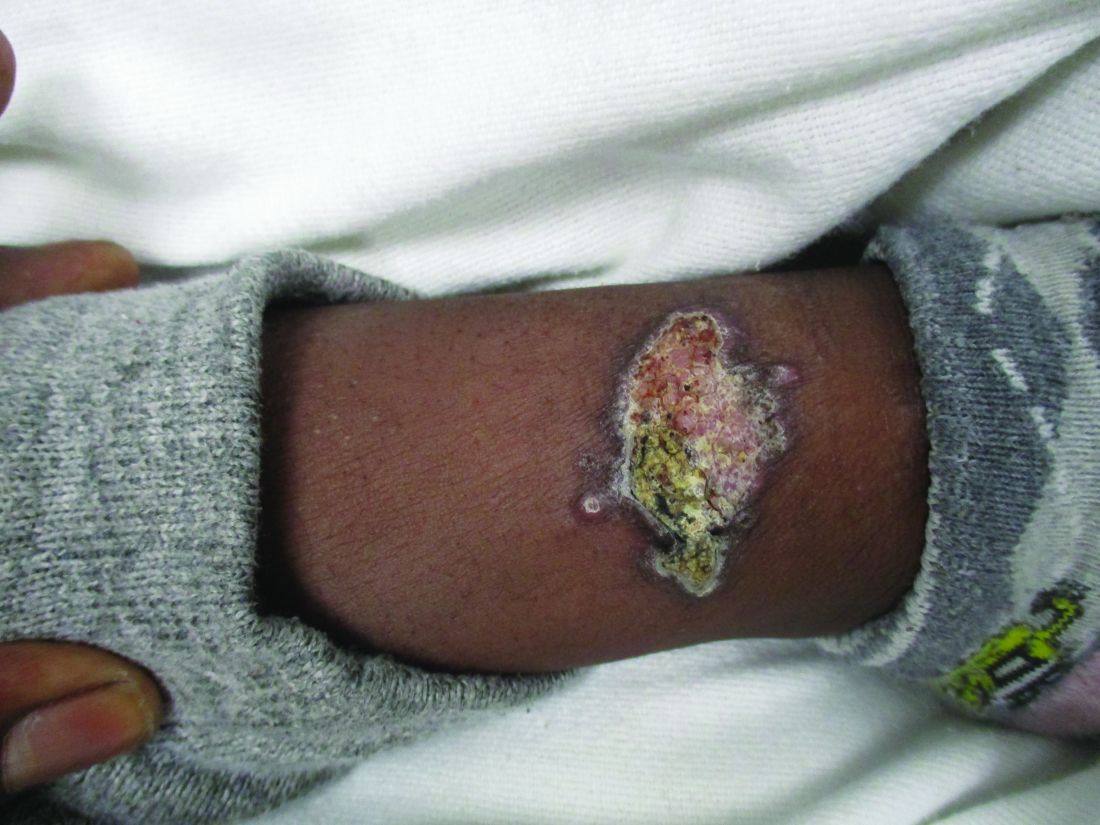
The three main forms of leishmaniasis – cutaneous, mucocutaneous, or visceral – varies with the species of organism involved, the geographic distribution, and the immune response of the patient. A majority of the cases seen in the United States are from patients who contracted the disease elsewhere, particularly from Peru and Brazil.2
Lesions can vary from asymptomatic to severe. The initial lesion typically develops within weeks or months, and presents as an erythematous papule that is seen at the bite site.3 The papule evolves into a nodule or plaque that may ulcerate and crust.3 The ulcer can be distinguished by a raised and distinct border. In older stages, atrophic scarring may be seen. In some cases, the lesions may present years after exposure, because of immunosuppression or trauma.
Histology of CL reveals tuberculoid granulomas with parasitized histiocytes present. Amastigotes with distinct nuclei and kinetoplasts characterize Leishmania.2 In addition to histology, the biopsy may be sent for the press-imprint-smear method (PIS). In a study of 75 patients, the PIS method showed a higher sensitivity, as well as being a less costly and more rapid option for diagnosis.5
The treatment depends on the severity of the lesion and the species of the Leishmania genus. Mild lesions may resolve spontaneously. Topical imiquimod, cryotherapy, photodynamic therapy, and heat therapy may aid in the healing process.5 Systemic azole antifungal medications, miltefosine, and amphotericin B, and pentamidine may be used for more persistent lesions. In very severe cases, pentavalent antimonials (sodium stibogluconate, Pentostam) may be administered intravenously, although there is a high occurrence of recorded side effects.2

This case and the photos were submitted by Sabrina Liao, BS, University of California, San Diego; and Brooke Resh Sateesh, MD, San Diego Family Dermatology The case was edited by Donna Bilu Martin, MD.
References
1. Leishmaniasis – Resources for Health Professionals. Centers for Disease Control and Prevention. 2021 Jun 3.
2. Stark CG. Leishmaniasis. Medscape. 2020 Feb 18.
3. Markle WH and Makhoul K. Am Fam Physician. 2004 Mar 15;69(6):1455-604.
4. Ngan V. Leishmaniasis. DermNet NZ. 2017 Jan. 7.
5. Sousa AQ et al. Am J Trop Med Hyg. 2014 Nov;91(5):905-7.
Trypanosomatidae
Leishmaniasis is caused by protozoa of the family Trypanosomatidae, called Leishmania. The vector is a sandfly infected with the protozoa.1
The three main forms of leishmaniasis – cutaneous, mucocutaneous, or visceral – varies with the species of organism involved, the geographic distribution, and the immune response of the patient. A majority of the cases seen in the United States are from patients who contracted the disease elsewhere, particularly from Peru and Brazil.2
Lesions can vary from asymptomatic to severe. The initial lesion typically develops within weeks or months, and presents as an erythematous papule that is seen at the bite site.3 The papule evolves into a nodule or plaque that may ulcerate and crust.3 The ulcer can be distinguished by a raised and distinct border. In older stages, atrophic scarring may be seen. In some cases, the lesions may present years after exposure, because of immunosuppression or trauma.
Histology of CL reveals tuberculoid granulomas with parasitized histiocytes present. Amastigotes with distinct nuclei and kinetoplasts characterize Leishmania.2 In addition to histology, the biopsy may be sent for the press-imprint-smear method (PIS). In a study of 75 patients, the PIS method showed a higher sensitivity, as well as being a less costly and more rapid option for diagnosis.5
The treatment depends on the severity of the lesion and the species of the Leishmania genus. Mild lesions may resolve spontaneously. Topical imiquimod, cryotherapy, photodynamic therapy, and heat therapy may aid in the healing process.5 Systemic azole antifungal medications, miltefosine, and amphotericin B, and pentamidine may be used for more persistent lesions. In very severe cases, pentavalent antimonials (sodium stibogluconate, Pentostam) may be administered intravenously, although there is a high occurrence of recorded side effects.2
This case and the photos were submitted by Sabrina Liao, BS, University of California, San Diego; and Brooke Resh Sateesh, MD, San Diego Family Dermatology The case was edited by Donna Bilu Martin, MD.
References
1. Leishmaniasis – Resources for Health Professionals. Centers for Disease Control and Prevention. 2021 Jun 3.
2. Stark CG. Leishmaniasis. Medscape. 2020 Feb 18.
3. Markle WH and Makhoul K. Am Fam Physician. 2004 Mar 15;69(6):1455-604.
4. Ngan V. Leishmaniasis. DermNet NZ. 2017 Jan. 7.
5. Sousa AQ et al. Am J Trop Med Hyg. 2014 Nov;91(5):905-7.
Trypanosomatidae
Leishmaniasis is caused by protozoa of the family Trypanosomatidae, called Leishmania. The vector is a sandfly infected with the protozoa.1
The three main forms of leishmaniasis – cutaneous, mucocutaneous, or visceral – varies with the species of organism involved, the geographic distribution, and the immune response of the patient. A majority of the cases seen in the United States are from patients who contracted the disease elsewhere, particularly from Peru and Brazil.2
Lesions can vary from asymptomatic to severe. The initial lesion typically develops within weeks or months, and presents as an erythematous papule that is seen at the bite site.3 The papule evolves into a nodule or plaque that may ulcerate and crust.3 The ulcer can be distinguished by a raised and distinct border. In older stages, atrophic scarring may be seen. In some cases, the lesions may present years after exposure, because of immunosuppression or trauma.
Histology of CL reveals tuberculoid granulomas with parasitized histiocytes present. Amastigotes with distinct nuclei and kinetoplasts characterize Leishmania.2 In addition to histology, the biopsy may be sent for the press-imprint-smear method (PIS). In a study of 75 patients, the PIS method showed a higher sensitivity, as well as being a less costly and more rapid option for diagnosis.5
The treatment depends on the severity of the lesion and the species of the Leishmania genus. Mild lesions may resolve spontaneously. Topical imiquimod, cryotherapy, photodynamic therapy, and heat therapy may aid in the healing process.5 Systemic azole antifungal medications, miltefosine, and amphotericin B, and pentamidine may be used for more persistent lesions. In very severe cases, pentavalent antimonials (sodium stibogluconate, Pentostam) may be administered intravenously, although there is a high occurrence of recorded side effects.2
This case and the photos were submitted by Sabrina Liao, BS, University of California, San Diego; and Brooke Resh Sateesh, MD, San Diego Family Dermatology The case was edited by Donna Bilu Martin, MD.
References
1. Leishmaniasis – Resources for Health Professionals. Centers for Disease Control and Prevention. 2021 Jun 3.
2. Stark CG. Leishmaniasis. Medscape. 2020 Feb 18.
3. Markle WH and Makhoul K. Am Fam Physician. 2004 Mar 15;69(6):1455-604.
4. Ngan V. Leishmaniasis. DermNet NZ. 2017 Jan. 7.
5. Sousa AQ et al. Am J Trop Med Hyg. 2014 Nov;91(5):905-7.

Vaccine mandates, passports, and Kant
Houston Methodist Hospital in June 2021 enforced an April mandate that all its employees, about 26,000 of them, must be vaccinated against COVID-19. In the following weeks, many other large health care systems adopted a similar employer mandate.

Compliance with Houston Methodist’s mandate has been very high at nearly 99%. There were some deferrals, mostly because of pregnancy. There were some “medical and personal” exemptions for less than 1% of employees. The reasons for those personal exemptions have not been made public. A lawsuit by 117 employees objecting to the vaccine mandate was dismissed by a federal district judge on June 12.
Objections to the vaccine mandate have rarely involved religious-based conscientious objections, which need to be accommodated differently, legally and ethically. The objections have been disagreements on the science. As a politician said decades ago: “People are entitled to their own opinions, but not their own facts.” A medical institution is an excellent organization for determining the risks and benefits of vaccination. The judge dismissing the case was very critical of the characterizations used by the plaintiffs.
The vaccine mandate has strong ethical support from both the universalizability principle of Kant and a consequentialist analysis. The U.S. Equal Employment Opportunity Commission on May 28, 2021, released technical assistance that has generally been interpreted to support an employer’s right to set vaccine requirements. HIPAA does not forbid an employer from asking about vaccination, but the EEOC guidance reminds employers that if they do ask, employers have legal obligations to protect the health information and keep it separate from other personnel files.
In the past few years, many hospitals and clinics have adopted mandates for influenza vaccines. In many children’s hospitals staff have been required to have chicken pox vaccines (or, as in my case, titers showing immunity from the real thing – I’m old) since the early 2000s. Measles titers (again, mine were acquired naturally – I still remember the illness and recommend against that) and TB status are occasionally required for locum tenens positions. I keep copies of these labs alongside copies of my diplomas. To me, the COVID-19 mandate is not capricious.
Some people have pointed out that the COVID-19 vaccines are not fully Food and Drug Administration approved. They are used under an emergency use authorization. Any traction that distinction might have had ethically and scientifically in November 2020 has disappeared with the experience of 9 months and 300 million doses in the United States. Dr. Fauci on July 11, 2021, said: “These vaccines are as good as officially approved with all the I’s dotted and the T’s crossed.”
On July 12, 2021, French President Macron, facing a resurgence of the pandemic because of the delta variant, announced a national vaccine mandate for all health care workers. He also announced plans to require proof of vaccination (or prior disease) in order to enter amusement parks, restaurants, and other public facilities. The ethics of his plans have been debated by ethicists and politicians for months under the rubric of a “vaccine passport.” England has required proof of vaccination or a recent negative COVID-19 test before entering soccer stadiums. In the United States, some localities, particularly those where the local politicians are against the vaccine, have passed laws proscribing the creation of these passport-like restrictions. Elsewhere, many businesses have already started to exclude customers who are not vaccinated. Airlines, hotels, and cruise ships are at the forefront of this. Society has started to create consequences for not getting the vaccine. President Macron indicated that the goal was now to put restrictions on the unvaccinated rather than on everyone.
Pediatricians are experts on the importance of consequences for misbehavior and refusals. It is a frequent topic of conversation with parents of toddlers and teenagers. Consequences are ethical, just, and effective ways of promoting safe and fair behavior. At this point, the public has been educated about the disease and the vaccines. In the United States, there has been ample access to the vaccine. It is time to enforce consequences.
Daily vaccination rates in the United States have slowed to 25% of the peak rates. The reasons for hesitancy have been analyzed in many publications. Further public education hasn’t been productive, so empathic listening has been urged to overcome hesitancy. (A similar program has long been advocated to deal with hesitancy for teenage HPV vaccines.) President Biden on July 6, 2021, proposed a program of going door to door to overcome resistance.
The world is in a race between vaccines and the delta variant. The Delta variant is moving the finish line, with some French epidemiologists advising President Macron that this more contagious variant may require a 90% vaccination level to achieve herd immunity. Israel has started giving a third booster shot in select situations and Pfizer is considering the idea. I agree with providing education, using empathic listening, and improving access. Those are all reasonable, even necessary, strategies. But at this point, I anchor my suggestions with the same advice pediatricians have long given to parents. Set rules and create consequences for misbehavior.
Dr. Powell is a retired pediatric hospitalist and clinical ethics consultant living in St. Louis. He has no financial disclosures. Email him at pdnews@mdedge.com.
Houston Methodist Hospital in June 2021 enforced an April mandate that all its employees, about 26,000 of them, must be vaccinated against COVID-19. In the following weeks, many other large health care systems adopted a similar employer mandate.
Compliance with Houston Methodist’s mandate has been very high at nearly 99%. There were some deferrals, mostly because of pregnancy. There were some “medical and personal” exemptions for less than 1% of employees. The reasons for those personal exemptions have not been made public. A lawsuit by 117 employees objecting to the vaccine mandate was dismissed by a federal district judge on June 12.
Objections to the vaccine mandate have rarely involved religious-based conscientious objections, which need to be accommodated differently, legally and ethically. The objections have been disagreements on the science. As a politician said decades ago: “People are entitled to their own opinions, but not their own facts.” A medical institution is an excellent organization for determining the risks and benefits of vaccination. The judge dismissing the case was very critical of the characterizations used by the plaintiffs.
The vaccine mandate has strong ethical support from both the universalizability principle of Kant and a consequentialist analysis. The U.S. Equal Employment Opportunity Commission on May 28, 2021, released technical assistance that has generally been interpreted to support an employer’s right to set vaccine requirements. HIPAA does not forbid an employer from asking about vaccination, but the EEOC guidance reminds employers that if they do ask, employers have legal obligations to protect the health information and keep it separate from other personnel files.
In the past few years, many hospitals and clinics have adopted mandates for influenza vaccines. In many children’s hospitals staff have been required to have chicken pox vaccines (or, as in my case, titers showing immunity from the real thing – I’m old) since the early 2000s. Measles titers (again, mine were acquired naturally – I still remember the illness and recommend against that) and TB status are occasionally required for locum tenens positions. I keep copies of these labs alongside copies of my diplomas. To me, the COVID-19 mandate is not capricious.
Some people have pointed out that the COVID-19 vaccines are not fully Food and Drug Administration approved. They are used under an emergency use authorization. Any traction that distinction might have had ethically and scientifically in November 2020 has disappeared with the experience of 9 months and 300 million doses in the United States. Dr. Fauci on July 11, 2021, said: “These vaccines are as good as officially approved with all the I’s dotted and the T’s crossed.”
On July 12, 2021, French President Macron, facing a resurgence of the pandemic because of the delta variant, announced a national vaccine mandate for all health care workers. He also announced plans to require proof of vaccination (or prior disease) in order to enter amusement parks, restaurants, and other public facilities. The ethics of his plans have been debated by ethicists and politicians for months under the rubric of a “vaccine passport.” England has required proof of vaccination or a recent negative COVID-19 test before entering soccer stadiums. In the United States, some localities, particularly those where the local politicians are against the vaccine, have passed laws proscribing the creation of these passport-like restrictions. Elsewhere, many businesses have already started to exclude customers who are not vaccinated. Airlines, hotels, and cruise ships are at the forefront of this. Society has started to create consequences for not getting the vaccine. President Macron indicated that the goal was now to put restrictions on the unvaccinated rather than on everyone.
Pediatricians are experts on the importance of consequences for misbehavior and refusals. It is a frequent topic of conversation with parents of toddlers and teenagers. Consequences are ethical, just, and effective ways of promoting safe and fair behavior. At this point, the public has been educated about the disease and the vaccines. In the United States, there has been ample access to the vaccine. It is time to enforce consequences.
Daily vaccination rates in the United States have slowed to 25% of the peak rates. The reasons for hesitancy have been analyzed in many publications. Further public education hasn’t been productive, so empathic listening has been urged to overcome hesitancy. (A similar program has long been advocated to deal with hesitancy for teenage HPV vaccines.) President Biden on July 6, 2021, proposed a program of going door to door to overcome resistance.
The world is in a race between vaccines and the delta variant. The Delta variant is moving the finish line, with some French epidemiologists advising President Macron that this more contagious variant may require a 90% vaccination level to achieve herd immunity. Israel has started giving a third booster shot in select situations and Pfizer is considering the idea. I agree with providing education, using empathic listening, and improving access. Those are all reasonable, even necessary, strategies. But at this point, I anchor my suggestions with the same advice pediatricians have long given to parents. Set rules and create consequences for misbehavior.
Dr. Powell is a retired pediatric hospitalist and clinical ethics consultant living in St. Louis. He has no financial disclosures. Email him at pdnews@mdedge.com.
Houston Methodist Hospital in June 2021 enforced an April mandate that all its employees, about 26,000 of them, must be vaccinated against COVID-19. In the following weeks, many other large health care systems adopted a similar employer mandate.
Compliance with Houston Methodist’s mandate has been very high at nearly 99%. There were some deferrals, mostly because of pregnancy. There were some “medical and personal” exemptions for less than 1% of employees. The reasons for those personal exemptions have not been made public. A lawsuit by 117 employees objecting to the vaccine mandate was dismissed by a federal district judge on June 12.
Objections to the vaccine mandate have rarely involved religious-based conscientious objections, which need to be accommodated differently, legally and ethically. The objections have been disagreements on the science. As a politician said decades ago: “People are entitled to their own opinions, but not their own facts.” A medical institution is an excellent organization for determining the risks and benefits of vaccination. The judge dismissing the case was very critical of the characterizations used by the plaintiffs.
The vaccine mandate has strong ethical support from both the universalizability principle of Kant and a consequentialist analysis. The U.S. Equal Employment Opportunity Commission on May 28, 2021, released technical assistance that has generally been interpreted to support an employer’s right to set vaccine requirements. HIPAA does not forbid an employer from asking about vaccination, but the EEOC guidance reminds employers that if they do ask, employers have legal obligations to protect the health information and keep it separate from other personnel files.
In the past few years, many hospitals and clinics have adopted mandates for influenza vaccines. In many children’s hospitals staff have been required to have chicken pox vaccines (or, as in my case, titers showing immunity from the real thing – I’m old) since the early 2000s. Measles titers (again, mine were acquired naturally – I still remember the illness and recommend against that) and TB status are occasionally required for locum tenens positions. I keep copies of these labs alongside copies of my diplomas. To me, the COVID-19 mandate is not capricious.
Some people have pointed out that the COVID-19 vaccines are not fully Food and Drug Administration approved. They are used under an emergency use authorization. Any traction that distinction might have had ethically and scientifically in November 2020 has disappeared with the experience of 9 months and 300 million doses in the United States. Dr. Fauci on July 11, 2021, said: “These vaccines are as good as officially approved with all the I’s dotted and the T’s crossed.”
On July 12, 2021, French President Macron, facing a resurgence of the pandemic because of the delta variant, announced a national vaccine mandate for all health care workers. He also announced plans to require proof of vaccination (or prior disease) in order to enter amusement parks, restaurants, and other public facilities. The ethics of his plans have been debated by ethicists and politicians for months under the rubric of a “vaccine passport.” England has required proof of vaccination or a recent negative COVID-19 test before entering soccer stadiums. In the United States, some localities, particularly those where the local politicians are against the vaccine, have passed laws proscribing the creation of these passport-like restrictions. Elsewhere, many businesses have already started to exclude customers who are not vaccinated. Airlines, hotels, and cruise ships are at the forefront of this. Society has started to create consequences for not getting the vaccine. President Macron indicated that the goal was now to put restrictions on the unvaccinated rather than on everyone.
Pediatricians are experts on the importance of consequences for misbehavior and refusals. It is a frequent topic of conversation with parents of toddlers and teenagers. Consequences are ethical, just, and effective ways of promoting safe and fair behavior. At this point, the public has been educated about the disease and the vaccines. In the United States, there has been ample access to the vaccine. It is time to enforce consequences.
Daily vaccination rates in the United States have slowed to 25% of the peak rates. The reasons for hesitancy have been analyzed in many publications. Further public education hasn’t been productive, so empathic listening has been urged to overcome hesitancy. (A similar program has long been advocated to deal with hesitancy for teenage HPV vaccines.) President Biden on July 6, 2021, proposed a program of going door to door to overcome resistance.
The world is in a race between vaccines and the delta variant. The Delta variant is moving the finish line, with some French epidemiologists advising President Macron that this more contagious variant may require a 90% vaccination level to achieve herd immunity. Israel has started giving a third booster shot in select situations and Pfizer is considering the idea. I agree with providing education, using empathic listening, and improving access. Those are all reasonable, even necessary, strategies. But at this point, I anchor my suggestions with the same advice pediatricians have long given to parents. Set rules and create consequences for misbehavior.
Dr. Powell is a retired pediatric hospitalist and clinical ethics consultant living in St. Louis. He has no financial disclosures. Email him at pdnews@mdedge.com.
Dogs know their humans, but humans don’t know expiration dates
An extreme price to pay for immortality
We know that men don’t live as long as women, but the reasons aren’t entirely clear. However, some New Zealand scientists have a thought on the subject, thanks to a sheep called Shrek.

The researchers were inspired by a famous old sheep who escaped captivity, but was captured 6 years later at the age of 10. The sheep then lived 6 more years, far beyond the lifespan of a normal sheep, capturing the hearts and minds of Kiwis everywhere. Look, it’s New Zealand, sheep are life, so it’s only natural the country got attached. Scientists from the University of Otago suspected that Shrek lived such a long life because he was castrated.
So they undertook a study of sheep, and lo and behold, sheep that were castrated lived significantly longer than their uncastrated kin, thanks to a slowing of their epigenetic clocks – the DNA aged noticeably slower in the castrated sheep.
Although the research can most immediately be applied to the improvement of the New Zealand sheep industry, the implication for humanity is also apparent. Want to live longer? Get rid of the testosterone. An extreme solution to be sure. As previously reported in this column, researchers wanted to torture our mouths to get us to lose weight, and now they want to castrate people for longer life. What exactly is going on down there in New Zealand?
Man’s best mind reader
There are a lot of reasons why dogs are sometimes called “man’s best friend,” but the root of it may actually have something to do with how easily we communicate with each other. Researchers dug deeper and fetched something that Fido is born with, but his wild wolf cousin isn’t.

That something is known as the “theory of mind” ability. Have you noticed that when you point and tell dogs to grab a leash or toy, they react as if they understood the language you spoke? Researchers from Duke University wondered if this ability is a canine thing or just a domesticated dog thing.
They compared 44 canine puppies and 37 wolf pups between 5 and 18 weeks old. The wolf pups were taken into human homes and raised with a great amount of human interaction, while the dog pups were left with their mothers and raised with less human interaction.
All the puppies were then put through multiple tests. In one test, they were given clues to find a treat under a bowl. In another test, a block of wood was placed next to the treat as a physical marker. During yet another test, researchers pointed to the food directly.
The researchers discovered that the dog puppies knew where the treat was every time, while their wild relatives didn’t.
“This study really solidifies the evidence that the social genius of dogs is a product of domestication,” senior author Brian Hare said in a separate statement.
The domestication hypothesis theorizes that dogs picked up the human social cues through thousands of years of interaction. The more friendly and cooperative a wolf was with humans, the more likely it was to survive and pass on those same traits and practices. Even within the study, the dog puppies were 30 times more likely to approach a stranger than were the wolf pups.
You may think your dog understands everything you say, but it’s actually body language that Fido is most fluent in.
I’m not a dentist, but I play one on TikTok
In last week’s column, it was garlic cloves up the nose to treat a cold. This week, TikTok brings us a new way to whiten teeth.

Familiar with the Mr. Clean Magic Eraser? If not, we’ll save you the trouble of Googling it: Check it out here and here.
Have you heard anything about using it to clean your teeth? No, neither did we, and we did a lot of Googling. Proctor & Gamble, which makes the Magic Eraser, goes so far as to say on the package: “Do not use on skin or other parts of the body. Using on skin will likely cause abrasions.” (The warning is actually in all caps, but we are stylistically forbidden by our editorial overlords to do that.)
But it’s magic, right? How can you not use it on your teeth? Enter TikTok. Heather Dunn posted a video in which she rubbed a bit of a Magic Eraser on her teeth – being careful to avoid her gums, because you can never be too careful – “as the product squeaked back and forth,” the Miami Herald reported. The video has almost 256,000 likes so far.
“Yeah, your teeth are white because you scrubbed all the enamel off them. So don’t do this,” Dr. Benjamin Winters, aka the Bentist, said in a YouTube video that has 105,000 likes.
In this race for common sense, common sense is losing. Please help the Bentist restore sanity to the dental world by liking his video. It would make Mr. Clean happy.
Don’t let an expiration date boss you around
Surely you’ve been there: It’s Taco Tuesday and you’re rummaging through the refrigerator to find that shredded cheese you’re sure you have. Jackpot! You find it, but realize it’s probably been in the refrigerator for a while. You open the bag, it smells and looks fine, but the expiration date was 2 days ago. Now you have a decision to make. Maybe you’ll be fine, or maybe you’ll risk food poisoning right before your brother’s wedding.

But here’s the truth: Americans throw away perfectly good food every day. The average American family throws out $1,365 to $2,275 worth of food a year, according to a 2013 study.
Truthfully, expiration dates are not for buyers, rather they’re for stores to have an idea of their stock’s freshness. Emily Broad Leib, director of the Harvard Law School Food and Policy Clinic and lead author of the 2013 study, told Vox that manufacturers use the dates as a way of “protecting the brand” to keep consumers from eating food that’s just a little past its peak.
With approximately 40 million people in the United States concerned about where their next meal is coming from, the Vox article noted, we need to reevaluate our system. Our national misunderstanding of expiration labels is hurting both suppliers and consumers because perfectly good food is wasted.
Sure, there is always that chance that something might be a little funky after a certain amount of time, but all in all, food probably stays fresh a lot longer than we think. Don’t always judge the shredded cheese by its expiration date.
An extreme price to pay for immortality
We know that men don’t live as long as women, but the reasons aren’t entirely clear. However, some New Zealand scientists have a thought on the subject, thanks to a sheep called Shrek.
The researchers were inspired by a famous old sheep who escaped captivity, but was captured 6 years later at the age of 10. The sheep then lived 6 more years, far beyond the lifespan of a normal sheep, capturing the hearts and minds of Kiwis everywhere. Look, it’s New Zealand, sheep are life, so it’s only natural the country got attached. Scientists from the University of Otago suspected that Shrek lived such a long life because he was castrated.
So they undertook a study of sheep, and lo and behold, sheep that were castrated lived significantly longer than their uncastrated kin, thanks to a slowing of their epigenetic clocks – the DNA aged noticeably slower in the castrated sheep.
Although the research can most immediately be applied to the improvement of the New Zealand sheep industry, the implication for humanity is also apparent. Want to live longer? Get rid of the testosterone. An extreme solution to be sure. As previously reported in this column, researchers wanted to torture our mouths to get us to lose weight, and now they want to castrate people for longer life. What exactly is going on down there in New Zealand?
Man’s best mind reader
There are a lot of reasons why dogs are sometimes called “man’s best friend,” but the root of it may actually have something to do with how easily we communicate with each other. Researchers dug deeper and fetched something that Fido is born with, but his wild wolf cousin isn’t.
That something is known as the “theory of mind” ability. Have you noticed that when you point and tell dogs to grab a leash or toy, they react as if they understood the language you spoke? Researchers from Duke University wondered if this ability is a canine thing or just a domesticated dog thing.
They compared 44 canine puppies and 37 wolf pups between 5 and 18 weeks old. The wolf pups were taken into human homes and raised with a great amount of human interaction, while the dog pups were left with their mothers and raised with less human interaction.
All the puppies were then put through multiple tests. In one test, they were given clues to find a treat under a bowl. In another test, a block of wood was placed next to the treat as a physical marker. During yet another test, researchers pointed to the food directly.
The researchers discovered that the dog puppies knew where the treat was every time, while their wild relatives didn’t.
“This study really solidifies the evidence that the social genius of dogs is a product of domestication,” senior author Brian Hare said in a separate statement.
The domestication hypothesis theorizes that dogs picked up the human social cues through thousands of years of interaction. The more friendly and cooperative a wolf was with humans, the more likely it was to survive and pass on those same traits and practices. Even within the study, the dog puppies were 30 times more likely to approach a stranger than were the wolf pups.
You may think your dog understands everything you say, but it’s actually body language that Fido is most fluent in.
I’m not a dentist, but I play one on TikTok
In last week’s column, it was garlic cloves up the nose to treat a cold. This week, TikTok brings us a new way to whiten teeth.
Familiar with the Mr. Clean Magic Eraser? If not, we’ll save you the trouble of Googling it: Check it out here and here.
Have you heard anything about using it to clean your teeth? No, neither did we, and we did a lot of Googling. Proctor & Gamble, which makes the Magic Eraser, goes so far as to say on the package: “Do not use on skin or other parts of the body. Using on skin will likely cause abrasions.” (The warning is actually in all caps, but we are stylistically forbidden by our editorial overlords to do that.)
But it’s magic, right? How can you not use it on your teeth? Enter TikTok. Heather Dunn posted a video in which she rubbed a bit of a Magic Eraser on her teeth – being careful to avoid her gums, because you can never be too careful – “as the product squeaked back and forth,” the Miami Herald reported. The video has almost 256,000 likes so far.
“Yeah, your teeth are white because you scrubbed all the enamel off them. So don’t do this,” Dr. Benjamin Winters, aka the Bentist, said in a YouTube video that has 105,000 likes.
In this race for common sense, common sense is losing. Please help the Bentist restore sanity to the dental world by liking his video. It would make Mr. Clean happy.
Don’t let an expiration date boss you around
Surely you’ve been there: It’s Taco Tuesday and you’re rummaging through the refrigerator to find that shredded cheese you’re sure you have. Jackpot! You find it, but realize it’s probably been in the refrigerator for a while. You open the bag, it smells and looks fine, but the expiration date was 2 days ago. Now you have a decision to make. Maybe you’ll be fine, or maybe you’ll risk food poisoning right before your brother’s wedding.
But here’s the truth: Americans throw away perfectly good food every day. The average American family throws out $1,365 to $2,275 worth of food a year, according to a 2013 study.
Truthfully, expiration dates are not for buyers, rather they’re for stores to have an idea of their stock’s freshness. Emily Broad Leib, director of the Harvard Law School Food and Policy Clinic and lead author of the 2013 study, told Vox that manufacturers use the dates as a way of “protecting the brand” to keep consumers from eating food that’s just a little past its peak.
With approximately 40 million people in the United States concerned about where their next meal is coming from, the Vox article noted, we need to reevaluate our system. Our national misunderstanding of expiration labels is hurting both suppliers and consumers because perfectly good food is wasted.
Sure, there is always that chance that something might be a little funky after a certain amount of time, but all in all, food probably stays fresh a lot longer than we think. Don’t always judge the shredded cheese by its expiration date.
An extreme price to pay for immortality
We know that men don’t live as long as women, but the reasons aren’t entirely clear. However, some New Zealand scientists have a thought on the subject, thanks to a sheep called Shrek.
The researchers were inspired by a famous old sheep who escaped captivity, but was captured 6 years later at the age of 10. The sheep then lived 6 more years, far beyond the lifespan of a normal sheep, capturing the hearts and minds of Kiwis everywhere. Look, it’s New Zealand, sheep are life, so it’s only natural the country got attached. Scientists from the University of Otago suspected that Shrek lived such a long life because he was castrated.
So they undertook a study of sheep, and lo and behold, sheep that were castrated lived significantly longer than their uncastrated kin, thanks to a slowing of their epigenetic clocks – the DNA aged noticeably slower in the castrated sheep.
Although the research can most immediately be applied to the improvement of the New Zealand sheep industry, the implication for humanity is also apparent. Want to live longer? Get rid of the testosterone. An extreme solution to be sure. As previously reported in this column, researchers wanted to torture our mouths to get us to lose weight, and now they want to castrate people for longer life. What exactly is going on down there in New Zealand?
Man’s best mind reader
There are a lot of reasons why dogs are sometimes called “man’s best friend,” but the root of it may actually have something to do with how easily we communicate with each other. Researchers dug deeper and fetched something that Fido is born with, but his wild wolf cousin isn’t.
That something is known as the “theory of mind” ability. Have you noticed that when you point and tell dogs to grab a leash or toy, they react as if they understood the language you spoke? Researchers from Duke University wondered if this ability is a canine thing or just a domesticated dog thing.
They compared 44 canine puppies and 37 wolf pups between 5 and 18 weeks old. The wolf pups were taken into human homes and raised with a great amount of human interaction, while the dog pups were left with their mothers and raised with less human interaction.
All the puppies were then put through multiple tests. In one test, they were given clues to find a treat under a bowl. In another test, a block of wood was placed next to the treat as a physical marker. During yet another test, researchers pointed to the food directly.
The researchers discovered that the dog puppies knew where the treat was every time, while their wild relatives didn’t.
“This study really solidifies the evidence that the social genius of dogs is a product of domestication,” senior author Brian Hare said in a separate statement.
The domestication hypothesis theorizes that dogs picked up the human social cues through thousands of years of interaction. The more friendly and cooperative a wolf was with humans, the more likely it was to survive and pass on those same traits and practices. Even within the study, the dog puppies were 30 times more likely to approach a stranger than were the wolf pups.
You may think your dog understands everything you say, but it’s actually body language that Fido is most fluent in.
I’m not a dentist, but I play one on TikTok
In last week’s column, it was garlic cloves up the nose to treat a cold. This week, TikTok brings us a new way to whiten teeth.
Familiar with the Mr. Clean Magic Eraser? If not, we’ll save you the trouble of Googling it: Check it out here and here.
Have you heard anything about using it to clean your teeth? No, neither did we, and we did a lot of Googling. Proctor & Gamble, which makes the Magic Eraser, goes so far as to say on the package: “Do not use on skin or other parts of the body. Using on skin will likely cause abrasions.” (The warning is actually in all caps, but we are stylistically forbidden by our editorial overlords to do that.)
But it’s magic, right? How can you not use it on your teeth? Enter TikTok. Heather Dunn posted a video in which she rubbed a bit of a Magic Eraser on her teeth – being careful to avoid her gums, because you can never be too careful – “as the product squeaked back and forth,” the Miami Herald reported. The video has almost 256,000 likes so far.
“Yeah, your teeth are white because you scrubbed all the enamel off them. So don’t do this,” Dr. Benjamin Winters, aka the Bentist, said in a YouTube video that has 105,000 likes.
In this race for common sense, common sense is losing. Please help the Bentist restore sanity to the dental world by liking his video. It would make Mr. Clean happy.
Don’t let an expiration date boss you around
Surely you’ve been there: It’s Taco Tuesday and you’re rummaging through the refrigerator to find that shredded cheese you’re sure you have. Jackpot! You find it, but realize it’s probably been in the refrigerator for a while. You open the bag, it smells and looks fine, but the expiration date was 2 days ago. Now you have a decision to make. Maybe you’ll be fine, or maybe you’ll risk food poisoning right before your brother’s wedding.
But here’s the truth: Americans throw away perfectly good food every day. The average American family throws out $1,365 to $2,275 worth of food a year, according to a 2013 study.
Truthfully, expiration dates are not for buyers, rather they’re for stores to have an idea of their stock’s freshness. Emily Broad Leib, director of the Harvard Law School Food and Policy Clinic and lead author of the 2013 study, told Vox that manufacturers use the dates as a way of “protecting the brand” to keep consumers from eating food that’s just a little past its peak.
With approximately 40 million people in the United States concerned about where their next meal is coming from, the Vox article noted, we need to reevaluate our system. Our national misunderstanding of expiration labels is hurting both suppliers and consumers because perfectly good food is wasted.
Sure, there is always that chance that something might be a little funky after a certain amount of time, but all in all, food probably stays fresh a lot longer than we think. Don’t always judge the shredded cheese by its expiration date.
Comment on “Distribution of Skin-Type Diversity in Photographs in AAD Online Educational Modules”
To the Editor:
We read with great interest the article by Chu et al1 (Cutis. 2021;107:157-159) and commend them for noting the underrepresentation of skin of color (SOC) in the American Academy of Dermatology (AAD) Basic Dermatology Curriculum. The AAD Basic Dermatology Curriculum represents one introductory resource that is ubiquitously utilized by medical students. Herein, we add an analysis of the representation of SOC in the following resources that also comprise the first exposure medical students have to dermatology: Dermatology Clinics Clinical Advisor articles (https://www.clinicaladvisor.com/home/dermatology/dermatology-clinics/), Learn Derm Module (LDM) by VisualDx (https://www.visualdx.com/learnderm/), Lookingbill and Marks’ Principles of Dermatology (6th ed)(LB&M),2 and DermNet NZ (https://dermnetnz.org/). We performed a focused search of the DermNet NZ database for images of the following common dermatologic conditions: acne, rosacea, alopecia, urticaria, arthropod bites, blistering diseases (bullous pemphigoid and pemphigus vulgaris), connective tissue diseases (dermatomyositis and lupus), inflammatory conditions (atopic dermatitis, contact dermatitis, and psoriasis), keloids, benign and malignant neoplasms (nevi, seborrheic keratosis, actinic keratosis, basal and squamous cell carcinomas, and melanoma including acral melanoma), bacterial skin infections (impetigo, erysipelas, cellulitis, staphylococcal scalded skin syndrome, and syphilis), fungal infections (dermatophyte infections), and viral skin infections (herpes, molluscum contagiosum, varicella-zoster virus, and warts). We classified images as light (Fitzpatrick phototypes I–IV) or dark (Fitzpatrick phototypes V or VI). We excluded images without visible background skin (eg, images of oral mucosa, genitalia, nails, palms and soles, dermoscopic images, histopathologic images).
We found the representation of SOC in the resources we selected to be as follows: Dermatology Clinics Clinical Advisor articles (70/367 or 19%); LDM (26/150 or 17%); LB&M (52/374 or 14%); DermNet NZ (11/310 or 4%). Representation of SOC in common dermatologic conditions such as actinic keratosis, alopecia, rosacea, urticaria, and warts was entirely absent across all resources. Other common skin diseases were represented in only one of the resources we analyzed: acne (represented only in LB&M, where only 3/11 images of acne were depicted in SOC); contact dermatitis (represented only in LB&M, where only 1/6 images of contact dermatitis were depicted in SOC); psoriasis (represented only on DermNet NZ, where only 2/25 images of psoriasis were depicted in SOC); seborrheic keratosis (represented only in LB&M, where 1/2 images of seborrheic keratosis were depicted in SOC). Furthermore, none of the resources we analyzed depicted malignancy (basal cell carcinoma, squamous cell carcinoma, and melanoma) in SOC. Although the poor representation of SOC in malignancies can be explained by the predilection of skin cancer for light skin, other dermatologic conditions that are more common in SOC also were poorly represented in these resources in SOC: acral melanoma, not represented in any of the resources we analyzed; subacute cutaneous lupus erythematosus and systemic lupus erythematosus, also not represented in any of the resources we analyzed; keloids, represented only in LB&M.
Although no study has investigated the true prevalence of Fitzpatrick phototypes in the United States, He et al3 demonstrated the prevalence of Fitzpatrick phototypes V and VI to be 25.0% and 18.8%, respectively, in an ethnically diverse study of 3386 participants. Indeed, the representation of SOC in the resources we analyzed falls short of this plausible estimate of SOC in an increasingly diverse US population.
Our work adds to the growing body of literature exposing the deficiencies in SOC representation in dermatology. As Lester et al4 noted, such poor representation of SOC is deleterious not just to patients, who may be misdiagnosed, but also more generally to the integrity of the field of dermatology. Moreover, our study, which analyzes introductory resources referenced by the junior medical student, highlights a potential danger of poor SOC representation for trainees—limited exposure to SOC may leave medical students unprepared to recognize lesions in SOC during clerkships and residency. Furthermore, we note an additional concern with minimal SOC representation in online modules such as the AAD and LDM module as well as online databases such as DermNet NZ; images from these resources may be used as training sets for machine learning (ML) software (indeed, DermNet NZ has been used as a training set for ML programs5). However, if data sets with poor representation of SOC are used to train ML algorithms, then ML software may be unable to recognize lesions in SOC.6 Thus, inadequate representation of SOC in online modules and databases may exacerbate existing inequities in dermatology.
To address the paucity of SOC representation, students can be directed to resources devoted to depicting SOC; however, as discussed eloquently by Chu et al,1 an attempt to update existing resources also must be made. The senior author in our study (S.J.K.) embraced such an approach, updating the dermatology lectures given to medical students to include more images of SOC. Such a top-down approach may represent a major step in dismantling the systemic biases that pervade dermatology.
A limitation of our analysis was use of the Fitzpatrick scale, which was conceived as a phenotypic scale to assess cutaneous responses to UV irradiation.7 Although it is the most commonly used scale to describe race/ethnicity and/or constitute skin color, it is not possible to include all non-White skin types and classify strictly under this umbrella term.
References
1. Chu B, Fathy R, Onyekaba G, et al. Distribution of skin-type diversity in photographs in AAD online educational modules. Cutis. 2021;107:157-159. doi:10.12788/cutis.0196
2. Marks JG Jr, Miller JJ. Lookingbill and Marks’ Principles of Dermatology. 6th ed. Saunders Elsevier; 2018.
3. He SY, McCulloch CE, Boscardin WJ, et al. Self-reported pigmentary phenotypes and race are significant but incomplete predictors of Fitzpatrick skin phototype in an ethnically diverse population. J Am Acad Dermatol. 2014;71:731-737. doi:10.1016/j.jaad.2014.05.023
4. Lester JC, Taylor SC, Chren M-M. Under‐representation of skin of colour in dermatology images: not just an educational issue. Br J Dermatol. 2019;180:1521-1522. doi:10.1111/bjd.17608
5. Aggarwal P. Data augmentation in dermatology image recognition using machine learning. Skin Res Technol. 2019;25:815-820. doi:10.1111/srt.12726
6. Adamson AS, Smith A. Machine learning and health care disparities in dermatology. JAMA Dermatol. 2018;154:1247-1248. doi:10.1001/jamadermatol.2018.2348
7. Ware OR, Dawson JE, Shinohara MM, et al. Racial limitations of Fitzpatrick skin type. Cutis. 2020;105:77-80.
Authors’ Response
We thank Mr. Joshi and Dr. Kim for their reply to our article and their added contribution to the literature on inadequate representation of skin of color (SOC) in dermatology educational materials. In recent years, multiple analyses have reviewed textbooks and popular online resources for SOC representation.1 These resources encompass all levels of education—from the laypatient to the medical student, and to residency and beyond—demonstrating the significant challenges to overcome.
In addition, as Mr. Joshi and Dr. Kim state, the potential for these inadequately representative resources to serve as training data for prediction and classification tools adds further urgency to the broader task at hand, as we do not wish to perpetuate disparities. Several tools already exist, including Derm Assist, a recent Google-produced tool that suggests a list of diagnoses from patient-provided images.2 Although Derm Assist has been marked as a CE Class I (low risk) medical device in the European Union, the original research it is built on relied on training data with low representation of darker skin types (2.7% Fitzpatrick V and 0% Fitzpatrick VI),3 drawing concern for its generalizability.
These concerns about SOC representation are not new; dermatology advocates, scholars, and organizations such as the Skin of Color Society have been working to address these deficiencies for many years, contributing to education (including writing of resources and textbooks) and academic research. This work continues today. For instance, Lester et al4 described best practices for clinical photography in SOC; this guidance was not yet published at the time of our original submission. Not only should dermatology strive for increased quantity of representation but also quality. This metric is particularly important if the images are intended not just for education but also for use as training data for prediction and classification tools.
Examples of more recent actions at the organizational level include the American Academy of Dermatology (AAD) announcing a 3-year plan to promote diversity, equity, and inclusion5 and VisualDx establishing #ProjectIMPACT, a collaboration to reduce health care biases in SOC.6 In the AAD 3-year plan, one goal is to “[i]ncrease use of images reflecting full spectrum of skin types and highlight topics on skin of color, health disparities, and cultural competency across all AAD education.”5 Although not specifically mentioned, we hope that the AAD has included updating the Basic Dermatology Curriculum, given its inadequate SOC representation, as part of its short-term goals. The greater recognition of these issues through more prevalent analyses published in leading dermatology journals is encouraging, and we hope both that improvements can be successfully implemented and that future studies will reveal improvements in representation.
Brian Chu, BS; Ramie Fathy, AB; Ginikanwa Onyekaba, BS; Jules B. Lipoff, MD
From the Perelman School of Medicine, University of Pennsylvania, Philadelphia. Dr. Lipoff is from the Department of Dermatology and the Leonard Davis Institute of Health Economics.
The authors report no conflict of interest.
Correspondence: Jules B. Lipoff, MD, Department of Dermatology, University of Pennsylvania, Penn Medicine University City, 3737 Market St, Ste 1100, Philadelphia, PA 19104 (jules.lipoff@pennmedicine.upenn.edu).
References
1. Perlman KL, Williams NM, Egbeto IA, et al. Skin of color lacks representation in medical student resources: a cross-sectional study. Int J Womens Dermatol. 2021;7:195-196. doi:10.1016/j.ijwd.2020.12.018
2. Bui P, Liu Y. Using AI to help find answers to common skin conditions. Published May 18, 2021. Accessed June 12, 2021. https://blog.google/technology/health/ai-dermatology-preview-io-2021
3. Liu Y, Jain A, Eng C, et al. A deep learning system for differential diagnosis of skin diseases. Nature Medicine. 2020;26:900-908. doi:10.1038/s41591-020-0842-3
4. Lester JC, Clark L, Linos E, et al. Clinical photography in skin of colour: tips and best practices. Br J Dermatol. 2021;184:1177-1179. doi:10.1111/bjd.19811
5. American Academy of Dermatology Association. Diversity in dermatology: diversity committee approved plan 2021-2023. Published January 26, 2021. Accessed June 24, 2021. https://assets.ctfassets.net/1ny4yoiyrqia/xQgnCE6ji5skUlcZQHS2b/65f0a9072811e11afcc33d043e02cd4d/DEI_Plan.pdf
6. VisualDx. #ProjectIMPACT. Accessed June 24, 2021. https://www.visualdx.com/projectimpact/
To the Editor:
We read with great interest the article by Chu et al1 (Cutis. 2021;107:157-159) and commend them for noting the underrepresentation of skin of color (SOC) in the American Academy of Dermatology (AAD) Basic Dermatology Curriculum. The AAD Basic Dermatology Curriculum represents one introductory resource that is ubiquitously utilized by medical students. Herein, we add an analysis of the representation of SOC in the following resources that also comprise the first exposure medical students have to dermatology: Dermatology Clinics Clinical Advisor articles (https://www.clinicaladvisor.com/home/dermatology/dermatology-clinics/), Learn Derm Module (LDM) by VisualDx (https://www.visualdx.com/learnderm/), Lookingbill and Marks’ Principles of Dermatology (6th ed)(LB&M),2 and DermNet NZ (https://dermnetnz.org/). We performed a focused search of the DermNet NZ database for images of the following common dermatologic conditions: acne, rosacea, alopecia, urticaria, arthropod bites, blistering diseases (bullous pemphigoid and pemphigus vulgaris), connective tissue diseases (dermatomyositis and lupus), inflammatory conditions (atopic dermatitis, contact dermatitis, and psoriasis), keloids, benign and malignant neoplasms (nevi, seborrheic keratosis, actinic keratosis, basal and squamous cell carcinomas, and melanoma including acral melanoma), bacterial skin infections (impetigo, erysipelas, cellulitis, staphylococcal scalded skin syndrome, and syphilis), fungal infections (dermatophyte infections), and viral skin infections (herpes, molluscum contagiosum, varicella-zoster virus, and warts). We classified images as light (Fitzpatrick phototypes I–IV) or dark (Fitzpatrick phototypes V or VI). We excluded images without visible background skin (eg, images of oral mucosa, genitalia, nails, palms and soles, dermoscopic images, histopathologic images).
We found the representation of SOC in the resources we selected to be as follows: Dermatology Clinics Clinical Advisor articles (70/367 or 19%); LDM (26/150 or 17%); LB&M (52/374 or 14%); DermNet NZ (11/310 or 4%). Representation of SOC in common dermatologic conditions such as actinic keratosis, alopecia, rosacea, urticaria, and warts was entirely absent across all resources. Other common skin diseases were represented in only one of the resources we analyzed: acne (represented only in LB&M, where only 3/11 images of acne were depicted in SOC); contact dermatitis (represented only in LB&M, where only 1/6 images of contact dermatitis were depicted in SOC); psoriasis (represented only on DermNet NZ, where only 2/25 images of psoriasis were depicted in SOC); seborrheic keratosis (represented only in LB&M, where 1/2 images of seborrheic keratosis were depicted in SOC). Furthermore, none of the resources we analyzed depicted malignancy (basal cell carcinoma, squamous cell carcinoma, and melanoma) in SOC. Although the poor representation of SOC in malignancies can be explained by the predilection of skin cancer for light skin, other dermatologic conditions that are more common in SOC also were poorly represented in these resources in SOC: acral melanoma, not represented in any of the resources we analyzed; subacute cutaneous lupus erythematosus and systemic lupus erythematosus, also not represented in any of the resources we analyzed; keloids, represented only in LB&M.
Although no study has investigated the true prevalence of Fitzpatrick phototypes in the United States, He et al3 demonstrated the prevalence of Fitzpatrick phototypes V and VI to be 25.0% and 18.8%, respectively, in an ethnically diverse study of 3386 participants. Indeed, the representation of SOC in the resources we analyzed falls short of this plausible estimate of SOC in an increasingly diverse US population.
Our work adds to the growing body of literature exposing the deficiencies in SOC representation in dermatology. As Lester et al4 noted, such poor representation of SOC is deleterious not just to patients, who may be misdiagnosed, but also more generally to the integrity of the field of dermatology. Moreover, our study, which analyzes introductory resources referenced by the junior medical student, highlights a potential danger of poor SOC representation for trainees—limited exposure to SOC may leave medical students unprepared to recognize lesions in SOC during clerkships and residency. Furthermore, we note an additional concern with minimal SOC representation in online modules such as the AAD and LDM module as well as online databases such as DermNet NZ; images from these resources may be used as training sets for machine learning (ML) software (indeed, DermNet NZ has been used as a training set for ML programs5). However, if data sets with poor representation of SOC are used to train ML algorithms, then ML software may be unable to recognize lesions in SOC.6 Thus, inadequate representation of SOC in online modules and databases may exacerbate existing inequities in dermatology.
To address the paucity of SOC representation, students can be directed to resources devoted to depicting SOC; however, as discussed eloquently by Chu et al,1 an attempt to update existing resources also must be made. The senior author in our study (S.J.K.) embraced such an approach, updating the dermatology lectures given to medical students to include more images of SOC. Such a top-down approach may represent a major step in dismantling the systemic biases that pervade dermatology.
A limitation of our analysis was use of the Fitzpatrick scale, which was conceived as a phenotypic scale to assess cutaneous responses to UV irradiation.7 Although it is the most commonly used scale to describe race/ethnicity and/or constitute skin color, it is not possible to include all non-White skin types and classify strictly under this umbrella term.
References
1. Chu B, Fathy R, Onyekaba G, et al. Distribution of skin-type diversity in photographs in AAD online educational modules. Cutis. 2021;107:157-159. doi:10.12788/cutis.0196
2. Marks JG Jr, Miller JJ. Lookingbill and Marks’ Principles of Dermatology. 6th ed. Saunders Elsevier; 2018.
3. He SY, McCulloch CE, Boscardin WJ, et al. Self-reported pigmentary phenotypes and race are significant but incomplete predictors of Fitzpatrick skin phototype in an ethnically diverse population. J Am Acad Dermatol. 2014;71:731-737. doi:10.1016/j.jaad.2014.05.023
4. Lester JC, Taylor SC, Chren M-M. Under‐representation of skin of colour in dermatology images: not just an educational issue. Br J Dermatol. 2019;180:1521-1522. doi:10.1111/bjd.17608
5. Aggarwal P. Data augmentation in dermatology image recognition using machine learning. Skin Res Technol. 2019;25:815-820. doi:10.1111/srt.12726
6. Adamson AS, Smith A. Machine learning and health care disparities in dermatology. JAMA Dermatol. 2018;154:1247-1248. doi:10.1001/jamadermatol.2018.2348
7. Ware OR, Dawson JE, Shinohara MM, et al. Racial limitations of Fitzpatrick skin type. Cutis. 2020;105:77-80.
Authors’ Response
We thank Mr. Joshi and Dr. Kim for their reply to our article and their added contribution to the literature on inadequate representation of skin of color (SOC) in dermatology educational materials. In recent years, multiple analyses have reviewed textbooks and popular online resources for SOC representation.1 These resources encompass all levels of education—from the laypatient to the medical student, and to residency and beyond—demonstrating the significant challenges to overcome.
In addition, as Mr. Joshi and Dr. Kim state, the potential for these inadequately representative resources to serve as training data for prediction and classification tools adds further urgency to the broader task at hand, as we do not wish to perpetuate disparities. Several tools already exist, including Derm Assist, a recent Google-produced tool that suggests a list of diagnoses from patient-provided images.2 Although Derm Assist has been marked as a CE Class I (low risk) medical device in the European Union, the original research it is built on relied on training data with low representation of darker skin types (2.7% Fitzpatrick V and 0% Fitzpatrick VI),3 drawing concern for its generalizability.
These concerns about SOC representation are not new; dermatology advocates, scholars, and organizations such as the Skin of Color Society have been working to address these deficiencies for many years, contributing to education (including writing of resources and textbooks) and academic research. This work continues today. For instance, Lester et al4 described best practices for clinical photography in SOC; this guidance was not yet published at the time of our original submission. Not only should dermatology strive for increased quantity of representation but also quality. This metric is particularly important if the images are intended not just for education but also for use as training data for prediction and classification tools.
Examples of more recent actions at the organizational level include the American Academy of Dermatology (AAD) announcing a 3-year plan to promote diversity, equity, and inclusion5 and VisualDx establishing #ProjectIMPACT, a collaboration to reduce health care biases in SOC.6 In the AAD 3-year plan, one goal is to “[i]ncrease use of images reflecting full spectrum of skin types and highlight topics on skin of color, health disparities, and cultural competency across all AAD education.”5 Although not specifically mentioned, we hope that the AAD has included updating the Basic Dermatology Curriculum, given its inadequate SOC representation, as part of its short-term goals. The greater recognition of these issues through more prevalent analyses published in leading dermatology journals is encouraging, and we hope both that improvements can be successfully implemented and that future studies will reveal improvements in representation.
Brian Chu, BS; Ramie Fathy, AB; Ginikanwa Onyekaba, BS; Jules B. Lipoff, MD
From the Perelman School of Medicine, University of Pennsylvania, Philadelphia. Dr. Lipoff is from the Department of Dermatology and the Leonard Davis Institute of Health Economics.
The authors report no conflict of interest.
Correspondence: Jules B. Lipoff, MD, Department of Dermatology, University of Pennsylvania, Penn Medicine University City, 3737 Market St, Ste 1100, Philadelphia, PA 19104 (jules.lipoff@pennmedicine.upenn.edu).
References
1. Perlman KL, Williams NM, Egbeto IA, et al. Skin of color lacks representation in medical student resources: a cross-sectional study. Int J Womens Dermatol. 2021;7:195-196. doi:10.1016/j.ijwd.2020.12.018
2. Bui P, Liu Y. Using AI to help find answers to common skin conditions. Published May 18, 2021. Accessed June 12, 2021. https://blog.google/technology/health/ai-dermatology-preview-io-2021
3. Liu Y, Jain A, Eng C, et al. A deep learning system for differential diagnosis of skin diseases. Nature Medicine. 2020;26:900-908. doi:10.1038/s41591-020-0842-3
4. Lester JC, Clark L, Linos E, et al. Clinical photography in skin of colour: tips and best practices. Br J Dermatol. 2021;184:1177-1179. doi:10.1111/bjd.19811
5. American Academy of Dermatology Association. Diversity in dermatology: diversity committee approved plan 2021-2023. Published January 26, 2021. Accessed June 24, 2021. https://assets.ctfassets.net/1ny4yoiyrqia/xQgnCE6ji5skUlcZQHS2b/65f0a9072811e11afcc33d043e02cd4d/DEI_Plan.pdf
6. VisualDx. #ProjectIMPACT. Accessed June 24, 2021. https://www.visualdx.com/projectimpact/
To the Editor:
We read with great interest the article by Chu et al1 (Cutis. 2021;107:157-159) and commend them for noting the underrepresentation of skin of color (SOC) in the American Academy of Dermatology (AAD) Basic Dermatology Curriculum. The AAD Basic Dermatology Curriculum represents one introductory resource that is ubiquitously utilized by medical students. Herein, we add an analysis of the representation of SOC in the following resources that also comprise the first exposure medical students have to dermatology: Dermatology Clinics Clinical Advisor articles (https://www.clinicaladvisor.com/home/dermatology/dermatology-clinics/), Learn Derm Module (LDM) by VisualDx (https://www.visualdx.com/learnderm/), Lookingbill and Marks’ Principles of Dermatology (6th ed)(LB&M),2 and DermNet NZ (https://dermnetnz.org/). We performed a focused search of the DermNet NZ database for images of the following common dermatologic conditions: acne, rosacea, alopecia, urticaria, arthropod bites, blistering diseases (bullous pemphigoid and pemphigus vulgaris), connective tissue diseases (dermatomyositis and lupus), inflammatory conditions (atopic dermatitis, contact dermatitis, and psoriasis), keloids, benign and malignant neoplasms (nevi, seborrheic keratosis, actinic keratosis, basal and squamous cell carcinomas, and melanoma including acral melanoma), bacterial skin infections (impetigo, erysipelas, cellulitis, staphylococcal scalded skin syndrome, and syphilis), fungal infections (dermatophyte infections), and viral skin infections (herpes, molluscum contagiosum, varicella-zoster virus, and warts). We classified images as light (Fitzpatrick phototypes I–IV) or dark (Fitzpatrick phototypes V or VI). We excluded images without visible background skin (eg, images of oral mucosa, genitalia, nails, palms and soles, dermoscopic images, histopathologic images).
We found the representation of SOC in the resources we selected to be as follows: Dermatology Clinics Clinical Advisor articles (70/367 or 19%); LDM (26/150 or 17%); LB&M (52/374 or 14%); DermNet NZ (11/310 or 4%). Representation of SOC in common dermatologic conditions such as actinic keratosis, alopecia, rosacea, urticaria, and warts was entirely absent across all resources. Other common skin diseases were represented in only one of the resources we analyzed: acne (represented only in LB&M, where only 3/11 images of acne were depicted in SOC); contact dermatitis (represented only in LB&M, where only 1/6 images of contact dermatitis were depicted in SOC); psoriasis (represented only on DermNet NZ, where only 2/25 images of psoriasis were depicted in SOC); seborrheic keratosis (represented only in LB&M, where 1/2 images of seborrheic keratosis were depicted in SOC). Furthermore, none of the resources we analyzed depicted malignancy (basal cell carcinoma, squamous cell carcinoma, and melanoma) in SOC. Although the poor representation of SOC in malignancies can be explained by the predilection of skin cancer for light skin, other dermatologic conditions that are more common in SOC also were poorly represented in these resources in SOC: acral melanoma, not represented in any of the resources we analyzed; subacute cutaneous lupus erythematosus and systemic lupus erythematosus, also not represented in any of the resources we analyzed; keloids, represented only in LB&M.
Although no study has investigated the true prevalence of Fitzpatrick phototypes in the United States, He et al3 demonstrated the prevalence of Fitzpatrick phototypes V and VI to be 25.0% and 18.8%, respectively, in an ethnically diverse study of 3386 participants. Indeed, the representation of SOC in the resources we analyzed falls short of this plausible estimate of SOC in an increasingly diverse US population.
Our work adds to the growing body of literature exposing the deficiencies in SOC representation in dermatology. As Lester et al4 noted, such poor representation of SOC is deleterious not just to patients, who may be misdiagnosed, but also more generally to the integrity of the field of dermatology. Moreover, our study, which analyzes introductory resources referenced by the junior medical student, highlights a potential danger of poor SOC representation for trainees—limited exposure to SOC may leave medical students unprepared to recognize lesions in SOC during clerkships and residency. Furthermore, we note an additional concern with minimal SOC representation in online modules such as the AAD and LDM module as well as online databases such as DermNet NZ; images from these resources may be used as training sets for machine learning (ML) software (indeed, DermNet NZ has been used as a training set for ML programs5). However, if data sets with poor representation of SOC are used to train ML algorithms, then ML software may be unable to recognize lesions in SOC.6 Thus, inadequate representation of SOC in online modules and databases may exacerbate existing inequities in dermatology.
To address the paucity of SOC representation, students can be directed to resources devoted to depicting SOC; however, as discussed eloquently by Chu et al,1 an attempt to update existing resources also must be made. The senior author in our study (S.J.K.) embraced such an approach, updating the dermatology lectures given to medical students to include more images of SOC. Such a top-down approach may represent a major step in dismantling the systemic biases that pervade dermatology.
A limitation of our analysis was use of the Fitzpatrick scale, which was conceived as a phenotypic scale to assess cutaneous responses to UV irradiation.7 Although it is the most commonly used scale to describe race/ethnicity and/or constitute skin color, it is not possible to include all non-White skin types and classify strictly under this umbrella term.
References
1. Chu B, Fathy R, Onyekaba G, et al. Distribution of skin-type diversity in photographs in AAD online educational modules. Cutis. 2021;107:157-159. doi:10.12788/cutis.0196
2. Marks JG Jr, Miller JJ. Lookingbill and Marks’ Principles of Dermatology. 6th ed. Saunders Elsevier; 2018.
3. He SY, McCulloch CE, Boscardin WJ, et al. Self-reported pigmentary phenotypes and race are significant but incomplete predictors of Fitzpatrick skin phototype in an ethnically diverse population. J Am Acad Dermatol. 2014;71:731-737. doi:10.1016/j.jaad.2014.05.023
4. Lester JC, Taylor SC, Chren M-M. Under‐representation of skin of colour in dermatology images: not just an educational issue. Br J Dermatol. 2019;180:1521-1522. doi:10.1111/bjd.17608
5. Aggarwal P. Data augmentation in dermatology image recognition using machine learning. Skin Res Technol. 2019;25:815-820. doi:10.1111/srt.12726
6. Adamson AS, Smith A. Machine learning and health care disparities in dermatology. JAMA Dermatol. 2018;154:1247-1248. doi:10.1001/jamadermatol.2018.2348
7. Ware OR, Dawson JE, Shinohara MM, et al. Racial limitations of Fitzpatrick skin type. Cutis. 2020;105:77-80.
Authors’ Response
We thank Mr. Joshi and Dr. Kim for their reply to our article and their added contribution to the literature on inadequate representation of skin of color (SOC) in dermatology educational materials. In recent years, multiple analyses have reviewed textbooks and popular online resources for SOC representation.1 These resources encompass all levels of education—from the laypatient to the medical student, and to residency and beyond—demonstrating the significant challenges to overcome.
In addition, as Mr. Joshi and Dr. Kim state, the potential for these inadequately representative resources to serve as training data for prediction and classification tools adds further urgency to the broader task at hand, as we do not wish to perpetuate disparities. Several tools already exist, including Derm Assist, a recent Google-produced tool that suggests a list of diagnoses from patient-provided images.2 Although Derm Assist has been marked as a CE Class I (low risk) medical device in the European Union, the original research it is built on relied on training data with low representation of darker skin types (2.7% Fitzpatrick V and 0% Fitzpatrick VI),3 drawing concern for its generalizability.
These concerns about SOC representation are not new; dermatology advocates, scholars, and organizations such as the Skin of Color Society have been working to address these deficiencies for many years, contributing to education (including writing of resources and textbooks) and academic research. This work continues today. For instance, Lester et al4 described best practices for clinical photography in SOC; this guidance was not yet published at the time of our original submission. Not only should dermatology strive for increased quantity of representation but also quality. This metric is particularly important if the images are intended not just for education but also for use as training data for prediction and classification tools.
Examples of more recent actions at the organizational level include the American Academy of Dermatology (AAD) announcing a 3-year plan to promote diversity, equity, and inclusion5 and VisualDx establishing #ProjectIMPACT, a collaboration to reduce health care biases in SOC.6 In the AAD 3-year plan, one goal is to “[i]ncrease use of images reflecting full spectrum of skin types and highlight topics on skin of color, health disparities, and cultural competency across all AAD education.”5 Although not specifically mentioned, we hope that the AAD has included updating the Basic Dermatology Curriculum, given its inadequate SOC representation, as part of its short-term goals. The greater recognition of these issues through more prevalent analyses published in leading dermatology journals is encouraging, and we hope both that improvements can be successfully implemented and that future studies will reveal improvements in representation.
Brian Chu, BS; Ramie Fathy, AB; Ginikanwa Onyekaba, BS; Jules B. Lipoff, MD
From the Perelman School of Medicine, University of Pennsylvania, Philadelphia. Dr. Lipoff is from the Department of Dermatology and the Leonard Davis Institute of Health Economics.
The authors report no conflict of interest.
Correspondence: Jules B. Lipoff, MD, Department of Dermatology, University of Pennsylvania, Penn Medicine University City, 3737 Market St, Ste 1100, Philadelphia, PA 19104 (jules.lipoff@pennmedicine.upenn.edu).
References
1. Perlman KL, Williams NM, Egbeto IA, et al. Skin of color lacks representation in medical student resources: a cross-sectional study. Int J Womens Dermatol. 2021;7:195-196. doi:10.1016/j.ijwd.2020.12.018
2. Bui P, Liu Y. Using AI to help find answers to common skin conditions. Published May 18, 2021. Accessed June 12, 2021. https://blog.google/technology/health/ai-dermatology-preview-io-2021
3. Liu Y, Jain A, Eng C, et al. A deep learning system for differential diagnosis of skin diseases. Nature Medicine. 2020;26:900-908. doi:10.1038/s41591-020-0842-3
4. Lester JC, Clark L, Linos E, et al. Clinical photography in skin of colour: tips and best practices. Br J Dermatol. 2021;184:1177-1179. doi:10.1111/bjd.19811
5. American Academy of Dermatology Association. Diversity in dermatology: diversity committee approved plan 2021-2023. Published January 26, 2021. Accessed June 24, 2021. https://assets.ctfassets.net/1ny4yoiyrqia/xQgnCE6ji5skUlcZQHS2b/65f0a9072811e11afcc33d043e02cd4d/DEI_Plan.pdf
6. VisualDx. #ProjectIMPACT. Accessed June 24, 2021. https://www.visualdx.com/projectimpact/

Are there some things we might want to keep from the COVID experience?
As your patients return to your offices for annual exams and sports physicals before the school year starts, everyone will still be processing the challenges, losses, and grief that have marked end of the COVID experience. There will be questions about the safety of vaccines for younger children, whether foreign travel is now a reasonable option, and about how best to help children – school age and teenagers, vulnerable and secure – get their footing socially and academically in the new school year. But dig a little, and you may hear about the silver linings of this past year: children who enjoyed having more time with their parents, parents who were with their families rather than in a car commuting for hours a day or traveling many days a month, grocery deliveries that eased the parent’s workload, adolescents who were able to pull back from overscheduled days, and opportunities for calm conversations that occurred quite naturally during nightly family dinners. Office visits present a dual opportunity to review – what were the psychological costs of COVID and what were positive personal and family adaptations to COVID they may want to continue as the pandemic ends?

Family dinner: Whether because sports practice was suspended, schooling was virtual, or working was at home, many families returned to eating dinner together during the pandemic year. Nightly dinners are a simple but powerful routine allowing all members of a family to reconnect and recharge together, and they are often the first things to disappear in the face of school, sports, and work demands. Research over the past several decades has demonstrated that regular family dinners are associated with better academic performance and higher self-esteem in children. They are also associated with lower rates of depression, substance abuse, eating disorders, and pregnancy in adolescents. Finally, they are associated with better cardiovascular health and lower rates of obesity in both youth and parents. The response is dose dependent, with more regular dinners leading to better outcomes. The food can be simple, what matters most is that the tone is warm, sharing, and curious, not rigid and controlling. Families can be an essential source of support as they help put events and feelings into context, giving them meaning or a framework based on the parents’ past, values, or perspective and on the family’s cultural history. Everyone benefits as family members cope with small and large setbacks, share values, and celebrate one another’s small and large successes. The return of the family dinner table, as often as is reasonable, is one “consequence” of COVID that families should try to preserve.
Consistent virtual family visits: Many families managed the cancellation of holiday visits or supported elderly relatives by connecting with family virtually. For some families, a weekly Zoom call came to function like a weekly family dinner with cousins and grandparents. Not only do these regular video calls protect elderly relatives from loneliness and isolation, but they also made it very easy for extended families to stay connected. Children cannot have too many caring adults around them, and regular calls mean that aunts, uncles, and grandparents can be an enthusiastic audience for their achievements and can offer perspective and guidance when needed. Staying connected without having to manage hours of travel makes it easy to build and maintain these family connections, creating bonds that will be deeper and stronger. Like family dinner, regular virtual gatherings with extended family are unequivocally beneficial for younger and older children and a valuable legacy of COVID.

Lowering the pressure: Many children struggled to stay engaged with virtual school and deeply missed time with friends or in activities like woodshop, soccer, or theater. But many other children had a chance to slow down from a relentless schedule of school, homework, sports, clubs, music lessons, tutoring, and on and on. For these children, many of whom are intensely ambitious and were not willing to voluntarily give up any activities, the forced slowdown of COVID has offered a new perspective on how they might manage their time. The COVID slowdown shone a light on the value of spending enough time in an activity to really learn it, and then choosing which activities to continue to explore and master, while opening time to explore new activities. There was also more time for “senseless fun,” activities that do not lead to achievement or recognition, but are simply fun, e.g., playing video games, splashing in a pool, or surfing the web. This process is critical to healthy development in early and later adolescence, and for many driven teenagers, it has been replaced by a tightly packed schedule of activities they felt they “should” be doing. If these young people hear from you that not only does the COVID pace feel better, but it can also contribute to better health and more meaningful learning and engagement, they may adopt a more thoughtful and intentional approach to managing their most precious asset – their time. Your discussion about prioritizing healthy exercise, virtual visits with friends, hobbies, or even senseless fun might reset the pressure gauge from high to moderate.
Homework help: Many children (and teenagers) found that their parents became an important source of academic support during the year of virtual school. While few parents welcomed the chance to master calculus, it is powerful for parents to know what their children are facing at school and for children to know that their parents are available to help them when they face a challenge. When parents can bear uncertainty, frustration, and even failure alongside their children, they help their children to cultivate tenacity and resilience, whether or not they can help them with a chemistry problem. Some parents will have special skills like knowing a language, being a good writer, or an academic expertise related to their work. But what matters more is working out how to help, not pressure or argue – how to share knowledge in a pleasurable manner. While it is important for children to have access to teachers and tutors with the knowledge and skills to help them learn specific subjects, the positive presence and involvement of their parents can make a valuable contribution to their psychological and educational development.
New ritual: Over the past 16 months, families found many creative ways to pass time together, from evening walks to reading aloud, listening to music, and even mastering new card games. The family evenings of a century earlier, when family members listened together to radio programs, practiced music, or played board games, seemed to have returned. While everyone could still escape to their own space to be on a screen activity alone, solitary computer time was leavened by collective time. Families may have rediscovered joy in shared recreation, exploration, or diversion. This kind of family time is a reward in itself, but it also deepens a child’s connections to everyone in their family. Such time provides lessons in how to turn boredom into something meaningful and even fun. COVID forced families inward and gave them more time. There were many costs including illness, deaths of friends and relatives, loss of time with peers, missed activities and milestones, and an impaired education. However, many of the coerced adaptations had a silver lining or unanticipated benefit. Keeping some of those benefits post COVID could enhance the lives of every member of the family.
Dr. Swick is physician in chief at Ohana, Center for Child and Adolescent Behavioral Health, Community Hospital of the Monterey (Calif.) Peninsula. Dr. Jellinek is professor of psychiatry and pediatrics, Harvard Medical School, Boston. Email them at pdnews@mdedge.com.
As your patients return to your offices for annual exams and sports physicals before the school year starts, everyone will still be processing the challenges, losses, and grief that have marked end of the COVID experience. There will be questions about the safety of vaccines for younger children, whether foreign travel is now a reasonable option, and about how best to help children – school age and teenagers, vulnerable and secure – get their footing socially and academically in the new school year. But dig a little, and you may hear about the silver linings of this past year: children who enjoyed having more time with their parents, parents who were with their families rather than in a car commuting for hours a day or traveling many days a month, grocery deliveries that eased the parent’s workload, adolescents who were able to pull back from overscheduled days, and opportunities for calm conversations that occurred quite naturally during nightly family dinners. Office visits present a dual opportunity to review – what were the psychological costs of COVID and what were positive personal and family adaptations to COVID they may want to continue as the pandemic ends?
Family dinner: Whether because sports practice was suspended, schooling was virtual, or working was at home, many families returned to eating dinner together during the pandemic year. Nightly dinners are a simple but powerful routine allowing all members of a family to reconnect and recharge together, and they are often the first things to disappear in the face of school, sports, and work demands. Research over the past several decades has demonstrated that regular family dinners are associated with better academic performance and higher self-esteem in children. They are also associated with lower rates of depression, substance abuse, eating disorders, and pregnancy in adolescents. Finally, they are associated with better cardiovascular health and lower rates of obesity in both youth and parents. The response is dose dependent, with more regular dinners leading to better outcomes. The food can be simple, what matters most is that the tone is warm, sharing, and curious, not rigid and controlling. Families can be an essential source of support as they help put events and feelings into context, giving them meaning or a framework based on the parents’ past, values, or perspective and on the family’s cultural history. Everyone benefits as family members cope with small and large setbacks, share values, and celebrate one another’s small and large successes. The return of the family dinner table, as often as is reasonable, is one “consequence” of COVID that families should try to preserve.
Consistent virtual family visits: Many families managed the cancellation of holiday visits or supported elderly relatives by connecting with family virtually. For some families, a weekly Zoom call came to function like a weekly family dinner with cousins and grandparents. Not only do these regular video calls protect elderly relatives from loneliness and isolation, but they also made it very easy for extended families to stay connected. Children cannot have too many caring adults around them, and regular calls mean that aunts, uncles, and grandparents can be an enthusiastic audience for their achievements and can offer perspective and guidance when needed. Staying connected without having to manage hours of travel makes it easy to build and maintain these family connections, creating bonds that will be deeper and stronger. Like family dinner, regular virtual gatherings with extended family are unequivocally beneficial for younger and older children and a valuable legacy of COVID.
Lowering the pressure: Many children struggled to stay engaged with virtual school and deeply missed time with friends or in activities like woodshop, soccer, or theater. But many other children had a chance to slow down from a relentless schedule of school, homework, sports, clubs, music lessons, tutoring, and on and on. For these children, many of whom are intensely ambitious and were not willing to voluntarily give up any activities, the forced slowdown of COVID has offered a new perspective on how they might manage their time. The COVID slowdown shone a light on the value of spending enough time in an activity to really learn it, and then choosing which activities to continue to explore and master, while opening time to explore new activities. There was also more time for “senseless fun,” activities that do not lead to achievement or recognition, but are simply fun, e.g., playing video games, splashing in a pool, or surfing the web. This process is critical to healthy development in early and later adolescence, and for many driven teenagers, it has been replaced by a tightly packed schedule of activities they felt they “should” be doing. If these young people hear from you that not only does the COVID pace feel better, but it can also contribute to better health and more meaningful learning and engagement, they may adopt a more thoughtful and intentional approach to managing their most precious asset – their time. Your discussion about prioritizing healthy exercise, virtual visits with friends, hobbies, or even senseless fun might reset the pressure gauge from high to moderate.
Homework help: Many children (and teenagers) found that their parents became an important source of academic support during the year of virtual school. While few parents welcomed the chance to master calculus, it is powerful for parents to know what their children are facing at school and for children to know that their parents are available to help them when they face a challenge. When parents can bear uncertainty, frustration, and even failure alongside their children, they help their children to cultivate tenacity and resilience, whether or not they can help them with a chemistry problem. Some parents will have special skills like knowing a language, being a good writer, or an academic expertise related to their work. But what matters more is working out how to help, not pressure or argue – how to share knowledge in a pleasurable manner. While it is important for children to have access to teachers and tutors with the knowledge and skills to help them learn specific subjects, the positive presence and involvement of their parents can make a valuable contribution to their psychological and educational development.
New ritual: Over the past 16 months, families found many creative ways to pass time together, from evening walks to reading aloud, listening to music, and even mastering new card games. The family evenings of a century earlier, when family members listened together to radio programs, practiced music, or played board games, seemed to have returned. While everyone could still escape to their own space to be on a screen activity alone, solitary computer time was leavened by collective time. Families may have rediscovered joy in shared recreation, exploration, or diversion. This kind of family time is a reward in itself, but it also deepens a child’s connections to everyone in their family. Such time provides lessons in how to turn boredom into something meaningful and even fun. COVID forced families inward and gave them more time. There were many costs including illness, deaths of friends and relatives, loss of time with peers, missed activities and milestones, and an impaired education. However, many of the coerced adaptations had a silver lining or unanticipated benefit. Keeping some of those benefits post COVID could enhance the lives of every member of the family.
Dr. Swick is physician in chief at Ohana, Center for Child and Adolescent Behavioral Health, Community Hospital of the Monterey (Calif.) Peninsula. Dr. Jellinek is professor of psychiatry and pediatrics, Harvard Medical School, Boston. Email them at pdnews@mdedge.com.
As your patients return to your offices for annual exams and sports physicals before the school year starts, everyone will still be processing the challenges, losses, and grief that have marked end of the COVID experience. There will be questions about the safety of vaccines for younger children, whether foreign travel is now a reasonable option, and about how best to help children – school age and teenagers, vulnerable and secure – get their footing socially and academically in the new school year. But dig a little, and you may hear about the silver linings of this past year: children who enjoyed having more time with their parents, parents who were with their families rather than in a car commuting for hours a day or traveling many days a month, grocery deliveries that eased the parent’s workload, adolescents who were able to pull back from overscheduled days, and opportunities for calm conversations that occurred quite naturally during nightly family dinners. Office visits present a dual opportunity to review – what were the psychological costs of COVID and what were positive personal and family adaptations to COVID they may want to continue as the pandemic ends?
Family dinner: Whether because sports practice was suspended, schooling was virtual, or working was at home, many families returned to eating dinner together during the pandemic year. Nightly dinners are a simple but powerful routine allowing all members of a family to reconnect and recharge together, and they are often the first things to disappear in the face of school, sports, and work demands. Research over the past several decades has demonstrated that regular family dinners are associated with better academic performance and higher self-esteem in children. They are also associated with lower rates of depression, substance abuse, eating disorders, and pregnancy in adolescents. Finally, they are associated with better cardiovascular health and lower rates of obesity in both youth and parents. The response is dose dependent, with more regular dinners leading to better outcomes. The food can be simple, what matters most is that the tone is warm, sharing, and curious, not rigid and controlling. Families can be an essential source of support as they help put events and feelings into context, giving them meaning or a framework based on the parents’ past, values, or perspective and on the family’s cultural history. Everyone benefits as family members cope with small and large setbacks, share values, and celebrate one another’s small and large successes. The return of the family dinner table, as often as is reasonable, is one “consequence” of COVID that families should try to preserve.
Consistent virtual family visits: Many families managed the cancellation of holiday visits or supported elderly relatives by connecting with family virtually. For some families, a weekly Zoom call came to function like a weekly family dinner with cousins and grandparents. Not only do these regular video calls protect elderly relatives from loneliness and isolation, but they also made it very easy for extended families to stay connected. Children cannot have too many caring adults around them, and regular calls mean that aunts, uncles, and grandparents can be an enthusiastic audience for their achievements and can offer perspective and guidance when needed. Staying connected without having to manage hours of travel makes it easy to build and maintain these family connections, creating bonds that will be deeper and stronger. Like family dinner, regular virtual gatherings with extended family are unequivocally beneficial for younger and older children and a valuable legacy of COVID.
Lowering the pressure: Many children struggled to stay engaged with virtual school and deeply missed time with friends or in activities like woodshop, soccer, or theater. But many other children had a chance to slow down from a relentless schedule of school, homework, sports, clubs, music lessons, tutoring, and on and on. For these children, many of whom are intensely ambitious and were not willing to voluntarily give up any activities, the forced slowdown of COVID has offered a new perspective on how they might manage their time. The COVID slowdown shone a light on the value of spending enough time in an activity to really learn it, and then choosing which activities to continue to explore and master, while opening time to explore new activities. There was also more time for “senseless fun,” activities that do not lead to achievement or recognition, but are simply fun, e.g., playing video games, splashing in a pool, or surfing the web. This process is critical to healthy development in early and later adolescence, and for many driven teenagers, it has been replaced by a tightly packed schedule of activities they felt they “should” be doing. If these young people hear from you that not only does the COVID pace feel better, but it can also contribute to better health and more meaningful learning and engagement, they may adopt a more thoughtful and intentional approach to managing their most precious asset – their time. Your discussion about prioritizing healthy exercise, virtual visits with friends, hobbies, or even senseless fun might reset the pressure gauge from high to moderate.
Homework help: Many children (and teenagers) found that their parents became an important source of academic support during the year of virtual school. While few parents welcomed the chance to master calculus, it is powerful for parents to know what their children are facing at school and for children to know that their parents are available to help them when they face a challenge. When parents can bear uncertainty, frustration, and even failure alongside their children, they help their children to cultivate tenacity and resilience, whether or not they can help them with a chemistry problem. Some parents will have special skills like knowing a language, being a good writer, or an academic expertise related to their work. But what matters more is working out how to help, not pressure or argue – how to share knowledge in a pleasurable manner. While it is important for children to have access to teachers and tutors with the knowledge and skills to help them learn specific subjects, the positive presence and involvement of their parents can make a valuable contribution to their psychological and educational development.
New ritual: Over the past 16 months, families found many creative ways to pass time together, from evening walks to reading aloud, listening to music, and even mastering new card games. The family evenings of a century earlier, when family members listened together to radio programs, practiced music, or played board games, seemed to have returned. While everyone could still escape to their own space to be on a screen activity alone, solitary computer time was leavened by collective time. Families may have rediscovered joy in shared recreation, exploration, or diversion. This kind of family time is a reward in itself, but it also deepens a child’s connections to everyone in their family. Such time provides lessons in how to turn boredom into something meaningful and even fun. COVID forced families inward and gave them more time. There were many costs including illness, deaths of friends and relatives, loss of time with peers, missed activities and milestones, and an impaired education. However, many of the coerced adaptations had a silver lining or unanticipated benefit. Keeping some of those benefits post COVID could enhance the lives of every member of the family.
Dr. Swick is physician in chief at Ohana, Center for Child and Adolescent Behavioral Health, Community Hospital of the Monterey (Calif.) Peninsula. Dr. Jellinek is professor of psychiatry and pediatrics, Harvard Medical School, Boston. Email them at pdnews@mdedge.com.
Trans youth in sports
Over the last several years, the United States has seen a substantial increase in proposed legislation directed toward transgender individuals, particularly youth.1 One type of this legislation aims to prevent participation of transgender girls on female sports teams. While at first glance these bills may seem like common sense protections, in reality they are based on little evidence and serve to further marginalize an already-vulnerable population.

The majority of the population, and thus the majority of athletes, are cisgender.2 According a limited data set from the 2017 Youth Risk Behavior Survey, only 1.8% of high school students identify as transgender.3,4 Overall, this is a very small percentage and it is unlikely that all of them, or even a majority, participate in athletics. In fact, many transgender individuals avoid athletics as it worsens their dysphoria. Winners are no more likely to be transgender than cisgender.
While proponents of this legislation say that trans women have an unfair advantage because of elevated testosterone levels (and thus theoretically increased muscle mass), there is no clear relationship between higher testosterone levels in athletes and improved athletic performance.2 In fact, there are plenty of sports in which a smaller physique may be beneficial, such as gymnastics. A systematic review showed “no direct or consistent research suggesting transgender female individuals ... have an athletic advantage at any stage of their transition.”5 Furthermore, trans women are not the only women with elevated testosterone levels. Many cisgender women who have polycystic ovary syndrome or a disorder of sexual differentiation can have higher levels of testosterone and theoretically may have higher muscle mass. Who is to decide which team would be most appropriate for them? Is the plan to require a karyotype, other genetic testing, or an invasive physical exam for every young athlete? Even if the concern is with regards to testosterone levels and muscle mass, this ignores that fact that appropriate medical intervention for transgender adolescents will alter these attributes. If a transgender girl began gonadotropin-releasing hormone agonists early in puberty, she is unlikely to have increased muscle mass or a higher testosterone level than a cisgender girl. Those trans girls who take estradiol also experience a decrease in muscle mass. Additionally, adolescents grow and develop at different rates – surely there is already significant variability among hormone levels, muscle mass, sexual maturity ratings, and ability among individual athletes, regardless of gender identity? The argument that trans women should be excluded based on a theoretical genetic advantage is reminiscent of the argument that Black athletes should be excluded because of genetic advantage. Just as with cisgender athletes, transgender athletes will naturally vary in ability.6
In addition, there are many places and organizations that already have trans-inclusive policies in place for sports, yet we have not seen transgender individuals dominate their peers. In the 8 years since implementation of a trans-inclusive sports policy in California, a trans woman has never dominated a sport.7 The same is true for Canada since the institution of their policy 2 years ago. While transgender people can participate in the Olympics, this year marks the first time a trans woman has ever qualified (Laurel Hubbard, New Zealand, women’s weightlifting). The lack of transgender Olympians may be in part because of problematic requirements (such as duration of hormone therapy and surgery requirements) for transgender individuals, which may be so onerous that they are functionally excluded.2,5
In reality, athletes are improving over time and the performance gap between genders is shrinking. For example, in 1970 Mark Spitz swam the 100-meter freestyle in 51.94 seconds, a time that has now been surpassed by both men and women, such as Sarah Sjöström (women’s world record holder at 51.71 seconds). Athletes’ physical attributes are often less important than their training and dedication to their sport.
More importantly, this discussion raises the philosophical question of the purpose of athletics for youth and young adults. Winning and good performance can – though rarely – lead to college scholarships and professional careers, the biggest benefit of athletics comes from participation. We encourage youth to play sports not to win, but to learn about leadership, dedication, and collegiality, as well as for the health benefits of exercise. Inclusion in sports and other extracurricular activities improves depression, anxiety, and suicide rates. In fact, participation in sports has been associated with improved grades, greater homework completion, higher educational and occupational aspirations, and improved self-esteem.8-12 Excluding a population that already experiences such drastic marginalization will cause more damage. Values of nondiscrimination and inclusion should be promoted among all student athletes, rather than “other-ism.”
Forcing trans women to compete with men will worsen their dysphoria and further ostracize the most vulnerable, giving credence to those that believe they are not “real women.” Allowing transgender individuals to play on the team consistent with their gender identity is appropriate, not only for scientific reasons but also for humanitarian ones. Such laws are based not on evidence, but on discrimination. Not only do trans women not do better than cisgender women in sports, but such proposed legislation also ignores the normal variability among individuals as well as the intense training and dedication involved in becoming a top athlete. Limiting trans women’s participation in sports does not raise up cisgender women, but rather brings us all down. Please advocate for your patients to participate in athletics in accordance with their gender identity to promote both their physical and emotional well-being.
Dr. Lawlis is assistant professor of pediatrics at the University of Oklahoma Health Sciences Center, Oklahoma City, and an adolescent medicine specialist at OU Children’s. She has no relevant financial disclosures.
References
1. Cooper MB. Pediatric News. 2020 Dec 11, 2020.
2. Turban J. Scientific American. 2021 May 21.
3. Redfield RR et al. Morbid Mortal Wkly Rep. 2018;67(8):1-11.
4. Johns MM et al. Morbid Mortal Wkly Rep. 2019;68(3):67-71.
5. Jones BA et al. Sports Med (Auckland, New Zealand). 2017;47(4):701-16.
6. Strangio C et al. ACLU News. 2020 Apr 30.
7. Strauss L. USA Today. 2021 Apr 9.
8. Darling N et al. J Leisure Res. 2005;37(1):51-76.
9. Fredricks JA et al. Dev Psych. 2006;42(4):698-713.
10. Marsh HW et al. J Sport Exerc Psychol. 2003;25(2):205.
11. Nelson MC et al. Pediatrics. 2006;117(4):1281-90.
12. Ortega FB et al. Int J Obes. 2008;32(1):1-11.
Over the last several years, the United States has seen a substantial increase in proposed legislation directed toward transgender individuals, particularly youth.1 One type of this legislation aims to prevent participation of transgender girls on female sports teams. While at first glance these bills may seem like common sense protections, in reality they are based on little evidence and serve to further marginalize an already-vulnerable population.
The majority of the population, and thus the majority of athletes, are cisgender.2 According a limited data set from the 2017 Youth Risk Behavior Survey, only 1.8% of high school students identify as transgender.3,4 Overall, this is a very small percentage and it is unlikely that all of them, or even a majority, participate in athletics. In fact, many transgender individuals avoid athletics as it worsens their dysphoria. Winners are no more likely to be transgender than cisgender.
While proponents of this legislation say that trans women have an unfair advantage because of elevated testosterone levels (and thus theoretically increased muscle mass), there is no clear relationship between higher testosterone levels in athletes and improved athletic performance.2 In fact, there are plenty of sports in which a smaller physique may be beneficial, such as gymnastics. A systematic review showed “no direct or consistent research suggesting transgender female individuals ... have an athletic advantage at any stage of their transition.”5 Furthermore, trans women are not the only women with elevated testosterone levels. Many cisgender women who have polycystic ovary syndrome or a disorder of sexual differentiation can have higher levels of testosterone and theoretically may have higher muscle mass. Who is to decide which team would be most appropriate for them? Is the plan to require a karyotype, other genetic testing, or an invasive physical exam for every young athlete? Even if the concern is with regards to testosterone levels and muscle mass, this ignores that fact that appropriate medical intervention for transgender adolescents will alter these attributes. If a transgender girl began gonadotropin-releasing hormone agonists early in puberty, she is unlikely to have increased muscle mass or a higher testosterone level than a cisgender girl. Those trans girls who take estradiol also experience a decrease in muscle mass. Additionally, adolescents grow and develop at different rates – surely there is already significant variability among hormone levels, muscle mass, sexual maturity ratings, and ability among individual athletes, regardless of gender identity? The argument that trans women should be excluded based on a theoretical genetic advantage is reminiscent of the argument that Black athletes should be excluded because of genetic advantage. Just as with cisgender athletes, transgender athletes will naturally vary in ability.6
In addition, there are many places and organizations that already have trans-inclusive policies in place for sports, yet we have not seen transgender individuals dominate their peers. In the 8 years since implementation of a trans-inclusive sports policy in California, a trans woman has never dominated a sport.7 The same is true for Canada since the institution of their policy 2 years ago. While transgender people can participate in the Olympics, this year marks the first time a trans woman has ever qualified (Laurel Hubbard, New Zealand, women’s weightlifting). The lack of transgender Olympians may be in part because of problematic requirements (such as duration of hormone therapy and surgery requirements) for transgender individuals, which may be so onerous that they are functionally excluded.2,5
In reality, athletes are improving over time and the performance gap between genders is shrinking. For example, in 1970 Mark Spitz swam the 100-meter freestyle in 51.94 seconds, a time that has now been surpassed by both men and women, such as Sarah Sjöström (women’s world record holder at 51.71 seconds). Athletes’ physical attributes are often less important than their training and dedication to their sport.
More importantly, this discussion raises the philosophical question of the purpose of athletics for youth and young adults. Winning and good performance can – though rarely – lead to college scholarships and professional careers, the biggest benefit of athletics comes from participation. We encourage youth to play sports not to win, but to learn about leadership, dedication, and collegiality, as well as for the health benefits of exercise. Inclusion in sports and other extracurricular activities improves depression, anxiety, and suicide rates. In fact, participation in sports has been associated with improved grades, greater homework completion, higher educational and occupational aspirations, and improved self-esteem.8-12 Excluding a population that already experiences such drastic marginalization will cause more damage. Values of nondiscrimination and inclusion should be promoted among all student athletes, rather than “other-ism.”
Forcing trans women to compete with men will worsen their dysphoria and further ostracize the most vulnerable, giving credence to those that believe they are not “real women.” Allowing transgender individuals to play on the team consistent with their gender identity is appropriate, not only for scientific reasons but also for humanitarian ones. Such laws are based not on evidence, but on discrimination. Not only do trans women not do better than cisgender women in sports, but such proposed legislation also ignores the normal variability among individuals as well as the intense training and dedication involved in becoming a top athlete. Limiting trans women’s participation in sports does not raise up cisgender women, but rather brings us all down. Please advocate for your patients to participate in athletics in accordance with their gender identity to promote both their physical and emotional well-being.
Dr. Lawlis is assistant professor of pediatrics at the University of Oklahoma Health Sciences Center, Oklahoma City, and an adolescent medicine specialist at OU Children’s. She has no relevant financial disclosures.
References
1. Cooper MB. Pediatric News. 2020 Dec 11, 2020.
2. Turban J. Scientific American. 2021 May 21.
3. Redfield RR et al. Morbid Mortal Wkly Rep. 2018;67(8):1-11.
4. Johns MM et al. Morbid Mortal Wkly Rep. 2019;68(3):67-71.
5. Jones BA et al. Sports Med (Auckland, New Zealand). 2017;47(4):701-16.
6. Strangio C et al. ACLU News. 2020 Apr 30.
7. Strauss L. USA Today. 2021 Apr 9.
8. Darling N et al. J Leisure Res. 2005;37(1):51-76.
9. Fredricks JA et al. Dev Psych. 2006;42(4):698-713.
10. Marsh HW et al. J Sport Exerc Psychol. 2003;25(2):205.
11. Nelson MC et al. Pediatrics. 2006;117(4):1281-90.
12. Ortega FB et al. Int J Obes. 2008;32(1):1-11.
Over the last several years, the United States has seen a substantial increase in proposed legislation directed toward transgender individuals, particularly youth.1 One type of this legislation aims to prevent participation of transgender girls on female sports teams. While at first glance these bills may seem like common sense protections, in reality they are based on little evidence and serve to further marginalize an already-vulnerable population.
The majority of the population, and thus the majority of athletes, are cisgender.2 According a limited data set from the 2017 Youth Risk Behavior Survey, only 1.8% of high school students identify as transgender.3,4 Overall, this is a very small percentage and it is unlikely that all of them, or even a majority, participate in athletics. In fact, many transgender individuals avoid athletics as it worsens their dysphoria. Winners are no more likely to be transgender than cisgender.
While proponents of this legislation say that trans women have an unfair advantage because of elevated testosterone levels (and thus theoretically increased muscle mass), there is no clear relationship between higher testosterone levels in athletes and improved athletic performance.2 In fact, there are plenty of sports in which a smaller physique may be beneficial, such as gymnastics. A systematic review showed “no direct or consistent research suggesting transgender female individuals ... have an athletic advantage at any stage of their transition.”5 Furthermore, trans women are not the only women with elevated testosterone levels. Many cisgender women who have polycystic ovary syndrome or a disorder of sexual differentiation can have higher levels of testosterone and theoretically may have higher muscle mass. Who is to decide which team would be most appropriate for them? Is the plan to require a karyotype, other genetic testing, or an invasive physical exam for every young athlete? Even if the concern is with regards to testosterone levels and muscle mass, this ignores that fact that appropriate medical intervention for transgender adolescents will alter these attributes. If a transgender girl began gonadotropin-releasing hormone agonists early in puberty, she is unlikely to have increased muscle mass or a higher testosterone level than a cisgender girl. Those trans girls who take estradiol also experience a decrease in muscle mass. Additionally, adolescents grow and develop at different rates – surely there is already significant variability among hormone levels, muscle mass, sexual maturity ratings, and ability among individual athletes, regardless of gender identity? The argument that trans women should be excluded based on a theoretical genetic advantage is reminiscent of the argument that Black athletes should be excluded because of genetic advantage. Just as with cisgender athletes, transgender athletes will naturally vary in ability.6
In addition, there are many places and organizations that already have trans-inclusive policies in place for sports, yet we have not seen transgender individuals dominate their peers. In the 8 years since implementation of a trans-inclusive sports policy in California, a trans woman has never dominated a sport.7 The same is true for Canada since the institution of their policy 2 years ago. While transgender people can participate in the Olympics, this year marks the first time a trans woman has ever qualified (Laurel Hubbard, New Zealand, women’s weightlifting). The lack of transgender Olympians may be in part because of problematic requirements (such as duration of hormone therapy and surgery requirements) for transgender individuals, which may be so onerous that they are functionally excluded.2,5
In reality, athletes are improving over time and the performance gap between genders is shrinking. For example, in 1970 Mark Spitz swam the 100-meter freestyle in 51.94 seconds, a time that has now been surpassed by both men and women, such as Sarah Sjöström (women’s world record holder at 51.71 seconds). Athletes’ physical attributes are often less important than their training and dedication to their sport.
More importantly, this discussion raises the philosophical question of the purpose of athletics for youth and young adults. Winning and good performance can – though rarely – lead to college scholarships and professional careers, the biggest benefit of athletics comes from participation. We encourage youth to play sports not to win, but to learn about leadership, dedication, and collegiality, as well as for the health benefits of exercise. Inclusion in sports and other extracurricular activities improves depression, anxiety, and suicide rates. In fact, participation in sports has been associated with improved grades, greater homework completion, higher educational and occupational aspirations, and improved self-esteem.8-12 Excluding a population that already experiences such drastic marginalization will cause more damage. Values of nondiscrimination and inclusion should be promoted among all student athletes, rather than “other-ism.”
Forcing trans women to compete with men will worsen their dysphoria and further ostracize the most vulnerable, giving credence to those that believe they are not “real women.” Allowing transgender individuals to play on the team consistent with their gender identity is appropriate, not only for scientific reasons but also for humanitarian ones. Such laws are based not on evidence, but on discrimination. Not only do trans women not do better than cisgender women in sports, but such proposed legislation also ignores the normal variability among individuals as well as the intense training and dedication involved in becoming a top athlete. Limiting trans women’s participation in sports does not raise up cisgender women, but rather brings us all down. Please advocate for your patients to participate in athletics in accordance with their gender identity to promote both their physical and emotional well-being.
Dr. Lawlis is assistant professor of pediatrics at the University of Oklahoma Health Sciences Center, Oklahoma City, and an adolescent medicine specialist at OU Children’s. She has no relevant financial disclosures.
References
1. Cooper MB. Pediatric News. 2020 Dec 11, 2020.
2. Turban J. Scientific American. 2021 May 21.
3. Redfield RR et al. Morbid Mortal Wkly Rep. 2018;67(8):1-11.
4. Johns MM et al. Morbid Mortal Wkly Rep. 2019;68(3):67-71.
5. Jones BA et al. Sports Med (Auckland, New Zealand). 2017;47(4):701-16.
6. Strangio C et al. ACLU News. 2020 Apr 30.
7. Strauss L. USA Today. 2021 Apr 9.
8. Darling N et al. J Leisure Res. 2005;37(1):51-76.
9. Fredricks JA et al. Dev Psych. 2006;42(4):698-713.
10. Marsh HW et al. J Sport Exerc Psychol. 2003;25(2):205.
11. Nelson MC et al. Pediatrics. 2006;117(4):1281-90.
12. Ortega FB et al. Int J Obes. 2008;32(1):1-11.