User login
Dear Marisol
I know you don’t remember me. We met when you were just a baby. Now that you’re older, I want to tell you a story about your mom you may not know.

When your mom became pregnant with you, it was a joyous occasion. But strange things started to happen. Your mom noticed that she was bleeding into the toilet bowl. She was told pregnancy would make her gain weight, but the opposite was happening. By her second trimester, her maternity clothes were so baggy she had to exchange them.
She went to see a gastroenterologist and told him about the bleeding. He looked at her pregnant belly, ordered no additional tests, and said he would look into the bleeding if it persisted after her pregnancy.
But that was 5 months away. In the meantime, her symptoms got worse. As you probably know by now, your mom is proactive. She sought a second opinion and then a third. Three different gastroenterologists dismissed your mom. The visits were brief; as soon as each doctor noticed she was pregnant, each deferred dealing with her – even though rectal bleeding and weight loss are in no way explained by pregnancy. Even though a colonoscopy could absolutely be safely performed during pregnancy.
A few months later, she gave birth to you. You were a healthy baby and she and your dad cried. They were so happy to meet you.
The next day, your dad stayed with you while the doctors performed a colonoscopy on your mom. To everyone’s horror, the camera saw a huge colon tumor. While the gastroenterologists had been reassuring her during her pregnancy, the tumor was gnawing through the wall of her colon and invading nearby organs.
She was wheeled on a gurney from the maternity unit to oncology. That’s where I met her.
She asked a lot of good questions, none of which we could answer. Her heart rate was in the 140s, and she developed fevers. Her cancer put her at risk for a serious infection called an abscess, and it took the option of chemotherapy off the table.
We went back and forth on what to do. We got lots of experts involved, and we went through the possibilities. We realized something terrible. There was no cure anymore. There were only trade-offs.
I will never forget the meeting between all of these doctors, your mom, and a Spanish interpreter. We gave your mom a best case scenario: 1 year.
Holding her necklace cross in one hand and your dad’s hand in the other, she repeated something over and over. The interpreter couldn’t hold back tears as she translated in a soft voice: “Please don’t let me die. Please don’t let me die. Please don’t let me die.”
We were all working so hard, doing our best to find a way out for her. Meanwhile, you stayed in the newborn nursery near the maternity ward. Every day your mom would go back and forth between oncology and the nursery to hold you.
Finally, we proceeded with surgery. It was an enormous, delicate, risky operation that took more than 10 hours. There were colorectal surgeons, urologists, and gynecologic oncologists. They scooped out not only the tumor but also your mom’s uterus, her ovaries, her bladder, and part of the abdominal wall. There was just so much cancer.
But your mom made it through the operation. Two days later, she married your dad in her hospital room while a nurse held you. She called it the best day of her life.
But we were still so worried. Everyone in the oncology unit had grown to love your mom, and we knew this was not a permanent fix. She was discharged from the hospital to rehab to get stronger. The plan was to see her in clinic and consider chemotherapy.
I usually keep a list of patients I want to follow even after I’m no longer their doctor. With your mom, I couldn’t put her on any list. It was too personal; I was too invested. I knew what the outcome would be, and I couldn’t bear to see it.
I never forgot your mom though. I decided to become an oncologist, and I thought about her when I met patients, especially young women, who had been dismissed by other doctors. I vowed to be the change as I listened to them and diagnosed them and treated them. I vowed to be a part of the system that would do better.
One day, 3 years after I met your mom, I was rotating in a colon cancer clinic and looked at the schedule. I recognized a name. Was it possible? It had to be someone with the same name. Could it really be your mom?
It was. By this time, she had finished chemotherapy. The goal was to keep the cancer from growing, but it somehow did more than that. Throughout your mom’s entire body, the cancer was gone. Her stoma was reversed, and she had gained back all the weight she lost. You were there too, defying instructions telling you not to touch the medical equipment. You hugged your mom’s leg as she made plans for a routine follow-up in 6 months.
I want you to know this story about your mom because, for the rest of your life, people will tell you what to think and how to feel. They will think it’s their business to tell you when to be worried, they will talk like they know better, and they will try to make you feel small for speaking up. I don’t have a perfect solution for all of this, except to say: Don’t let them.
But I’m not worried about you. If you grow up to be anything like your mom, you will be okay.
Dr. Yurkiewicz is a fellow in hematology and oncology at Stanford (Calif.) University. Follow her on Twitter @ilanayurkiewicz.
I know you don’t remember me. We met when you were just a baby. Now that you’re older, I want to tell you a story about your mom you may not know.
When your mom became pregnant with you, it was a joyous occasion. But strange things started to happen. Your mom noticed that she was bleeding into the toilet bowl. She was told pregnancy would make her gain weight, but the opposite was happening. By her second trimester, her maternity clothes were so baggy she had to exchange them.
She went to see a gastroenterologist and told him about the bleeding. He looked at her pregnant belly, ordered no additional tests, and said he would look into the bleeding if it persisted after her pregnancy.
But that was 5 months away. In the meantime, her symptoms got worse. As you probably know by now, your mom is proactive. She sought a second opinion and then a third. Three different gastroenterologists dismissed your mom. The visits were brief; as soon as each doctor noticed she was pregnant, each deferred dealing with her – even though rectal bleeding and weight loss are in no way explained by pregnancy. Even though a colonoscopy could absolutely be safely performed during pregnancy.
A few months later, she gave birth to you. You were a healthy baby and she and your dad cried. They were so happy to meet you.
The next day, your dad stayed with you while the doctors performed a colonoscopy on your mom. To everyone’s horror, the camera saw a huge colon tumor. While the gastroenterologists had been reassuring her during her pregnancy, the tumor was gnawing through the wall of her colon and invading nearby organs.
She was wheeled on a gurney from the maternity unit to oncology. That’s where I met her.
She asked a lot of good questions, none of which we could answer. Her heart rate was in the 140s, and she developed fevers. Her cancer put her at risk for a serious infection called an abscess, and it took the option of chemotherapy off the table.
We went back and forth on what to do. We got lots of experts involved, and we went through the possibilities. We realized something terrible. There was no cure anymore. There were only trade-offs.
I will never forget the meeting between all of these doctors, your mom, and a Spanish interpreter. We gave your mom a best case scenario: 1 year.
Holding her necklace cross in one hand and your dad’s hand in the other, she repeated something over and over. The interpreter couldn’t hold back tears as she translated in a soft voice: “Please don’t let me die. Please don’t let me die. Please don’t let me die.”
We were all working so hard, doing our best to find a way out for her. Meanwhile, you stayed in the newborn nursery near the maternity ward. Every day your mom would go back and forth between oncology and the nursery to hold you.
Finally, we proceeded with surgery. It was an enormous, delicate, risky operation that took more than 10 hours. There were colorectal surgeons, urologists, and gynecologic oncologists. They scooped out not only the tumor but also your mom’s uterus, her ovaries, her bladder, and part of the abdominal wall. There was just so much cancer.
But your mom made it through the operation. Two days later, she married your dad in her hospital room while a nurse held you. She called it the best day of her life.
But we were still so worried. Everyone in the oncology unit had grown to love your mom, and we knew this was not a permanent fix. She was discharged from the hospital to rehab to get stronger. The plan was to see her in clinic and consider chemotherapy.
I usually keep a list of patients I want to follow even after I’m no longer their doctor. With your mom, I couldn’t put her on any list. It was too personal; I was too invested. I knew what the outcome would be, and I couldn’t bear to see it.
I never forgot your mom though. I decided to become an oncologist, and I thought about her when I met patients, especially young women, who had been dismissed by other doctors. I vowed to be the change as I listened to them and diagnosed them and treated them. I vowed to be a part of the system that would do better.
One day, 3 years after I met your mom, I was rotating in a colon cancer clinic and looked at the schedule. I recognized a name. Was it possible? It had to be someone with the same name. Could it really be your mom?
It was. By this time, she had finished chemotherapy. The goal was to keep the cancer from growing, but it somehow did more than that. Throughout your mom’s entire body, the cancer was gone. Her stoma was reversed, and she had gained back all the weight she lost. You were there too, defying instructions telling you not to touch the medical equipment. You hugged your mom’s leg as she made plans for a routine follow-up in 6 months.
I want you to know this story about your mom because, for the rest of your life, people will tell you what to think and how to feel. They will think it’s their business to tell you when to be worried, they will talk like they know better, and they will try to make you feel small for speaking up. I don’t have a perfect solution for all of this, except to say: Don’t let them.
But I’m not worried about you. If you grow up to be anything like your mom, you will be okay.
Dr. Yurkiewicz is a fellow in hematology and oncology at Stanford (Calif.) University. Follow her on Twitter @ilanayurkiewicz.
I know you don’t remember me. We met when you were just a baby. Now that you’re older, I want to tell you a story about your mom you may not know.
When your mom became pregnant with you, it was a joyous occasion. But strange things started to happen. Your mom noticed that she was bleeding into the toilet bowl. She was told pregnancy would make her gain weight, but the opposite was happening. By her second trimester, her maternity clothes were so baggy she had to exchange them.
She went to see a gastroenterologist and told him about the bleeding. He looked at her pregnant belly, ordered no additional tests, and said he would look into the bleeding if it persisted after her pregnancy.
But that was 5 months away. In the meantime, her symptoms got worse. As you probably know by now, your mom is proactive. She sought a second opinion and then a third. Three different gastroenterologists dismissed your mom. The visits were brief; as soon as each doctor noticed she was pregnant, each deferred dealing with her – even though rectal bleeding and weight loss are in no way explained by pregnancy. Even though a colonoscopy could absolutely be safely performed during pregnancy.
A few months later, she gave birth to you. You were a healthy baby and she and your dad cried. They were so happy to meet you.
The next day, your dad stayed with you while the doctors performed a colonoscopy on your mom. To everyone’s horror, the camera saw a huge colon tumor. While the gastroenterologists had been reassuring her during her pregnancy, the tumor was gnawing through the wall of her colon and invading nearby organs.
She was wheeled on a gurney from the maternity unit to oncology. That’s where I met her.
She asked a lot of good questions, none of which we could answer. Her heart rate was in the 140s, and she developed fevers. Her cancer put her at risk for a serious infection called an abscess, and it took the option of chemotherapy off the table.
We went back and forth on what to do. We got lots of experts involved, and we went through the possibilities. We realized something terrible. There was no cure anymore. There were only trade-offs.
I will never forget the meeting between all of these doctors, your mom, and a Spanish interpreter. We gave your mom a best case scenario: 1 year.
Holding her necklace cross in one hand and your dad’s hand in the other, she repeated something over and over. The interpreter couldn’t hold back tears as she translated in a soft voice: “Please don’t let me die. Please don’t let me die. Please don’t let me die.”
We were all working so hard, doing our best to find a way out for her. Meanwhile, you stayed in the newborn nursery near the maternity ward. Every day your mom would go back and forth between oncology and the nursery to hold you.
Finally, we proceeded with surgery. It was an enormous, delicate, risky operation that took more than 10 hours. There were colorectal surgeons, urologists, and gynecologic oncologists. They scooped out not only the tumor but also your mom’s uterus, her ovaries, her bladder, and part of the abdominal wall. There was just so much cancer.
But your mom made it through the operation. Two days later, she married your dad in her hospital room while a nurse held you. She called it the best day of her life.
But we were still so worried. Everyone in the oncology unit had grown to love your mom, and we knew this was not a permanent fix. She was discharged from the hospital to rehab to get stronger. The plan was to see her in clinic and consider chemotherapy.
I usually keep a list of patients I want to follow even after I’m no longer their doctor. With your mom, I couldn’t put her on any list. It was too personal; I was too invested. I knew what the outcome would be, and I couldn’t bear to see it.
I never forgot your mom though. I decided to become an oncologist, and I thought about her when I met patients, especially young women, who had been dismissed by other doctors. I vowed to be the change as I listened to them and diagnosed them and treated them. I vowed to be a part of the system that would do better.
One day, 3 years after I met your mom, I was rotating in a colon cancer clinic and looked at the schedule. I recognized a name. Was it possible? It had to be someone with the same name. Could it really be your mom?
It was. By this time, she had finished chemotherapy. The goal was to keep the cancer from growing, but it somehow did more than that. Throughout your mom’s entire body, the cancer was gone. Her stoma was reversed, and she had gained back all the weight she lost. You were there too, defying instructions telling you not to touch the medical equipment. You hugged your mom’s leg as she made plans for a routine follow-up in 6 months.
I want you to know this story about your mom because, for the rest of your life, people will tell you what to think and how to feel. They will think it’s their business to tell you when to be worried, they will talk like they know better, and they will try to make you feel small for speaking up. I don’t have a perfect solution for all of this, except to say: Don’t let them.
But I’m not worried about you. If you grow up to be anything like your mom, you will be okay.
Dr. Yurkiewicz is a fellow in hematology and oncology at Stanford (Calif.) University. Follow her on Twitter @ilanayurkiewicz.

Pembro as good as chemo for gastric cancers with less toxicity
CHICAGO – In gastric and gastroesophageal junction (GEJ) cancers, positive for PD-L1, treatment with the PD-1 inhibitor pembrolizumab offered comparable survival with fewer side effects, according to results of a phase 3 randomized clinical trial.

The checkpoint inhibitor also demonstrated a clinically meaningful improvement in patients who had high levels of PD-L1 expression, with a 2-year survival rate of 39% versus 22% for patients receiving the standard chemotherapy, which consisted of a platinum and a fluoropyrimidine, according to Josep Tabernero, MD, PhD, lead author of the KEYNOTE-062 study.
By contrast, the study failed to demonstrate that pembrolizumab immunotherapy combined with that chemotherapy backbone was superior to chemotherapy alone on survival endpoints, said Dr. Tabernero, Head of the Medical Oncology Department at the Vall d’Hebron Barcelona University Hospital and Institute of Oncology, Spain.
“There are several factors we are evaluating,” Dr. Tabernero said here in a press conference at the annual meeting of the American Society of Clinical Oncology (ASCO). “We still have to do more studies to understand why, with this chemotherapy backbone, we don’t see a clear synergistic effect for superiority in overall survival.”
Nevertheless, these findings make pembrolizumab a “preferred treatment” for many patients, particularly in light of its “substantially improved safety profile” versus chemotherapy, said ASCO Senior Vice President and Chief Medical Officer Richard L. Schilsky, MD.
“What I take away from this study is that for patients with advanced gastric and gastroesophageal cancer, pembrolizumab should really in many cases replace chemotherapy as a first-line treatment for this population,” Dr. Schilsky said in a press conference. “It’s certainly not worse, and it may well be better.”
The KEYNOTE-062 study included 763 patients with HER2-negative, PD-L1-positive advanced gastric or GEJ cancers randomized to one of three arms: pembrolizumab alone for up to 35 cycles, pembrolizumab for up to 35 cycles plus chemotherapy, or placebo plus chemotherapy.
Pembrolizumab alone was not inferior compared to chemotherapy, with median overall survival rates of 10.5 and 11.1 months, respectively (HR, 0.91; 99.2% CI, 0.69-1.18), Dr. Tabernero reported.
Overall survival appeared to be prolonged in patients with high levels of PD-L1 expression, defined as a combined positive score (CPS) of 10 or greater. The median survival in that subgroup was 17.4 months for those receiving pembrolizumab, and just 10.8 months for chemotherapy. However, the design of the study precluded an analysis of statistical significance for this finding, according to Dr. Tabernero.
Looking at the overall study population, pembrolizumab plus chemotherapy did not improve survival versus chemotherapy alone, he added, reporting median overall survivals of 12.5 and 11.1 months, respectively (P = .046).
Subgroup analysis suggested that Asian patients derived particular benefit from pembrolizumab as compared to chemotherapy, though Dr. Tabernero cautioned against overinterpretation of the finding, saying that it could be due to biology, or could be a statistical anomaly.
Funding for the study came from Merck & Co., Inc. Dr. Tabernero reported disclosures related to Bayer, Boehringer Ingelheim, Lilly, MSD, Merck Serono, Novartis, Sanofi, and others.
SOURCE: Tabernero J, et al. ASCO 2019. Abstract LBA4007.
CHICAGO – In gastric and gastroesophageal junction (GEJ) cancers, positive for PD-L1, treatment with the PD-1 inhibitor pembrolizumab offered comparable survival with fewer side effects, according to results of a phase 3 randomized clinical trial.
The checkpoint inhibitor also demonstrated a clinically meaningful improvement in patients who had high levels of PD-L1 expression, with a 2-year survival rate of 39% versus 22% for patients receiving the standard chemotherapy, which consisted of a platinum and a fluoropyrimidine, according to Josep Tabernero, MD, PhD, lead author of the KEYNOTE-062 study.
By contrast, the study failed to demonstrate that pembrolizumab immunotherapy combined with that chemotherapy backbone was superior to chemotherapy alone on survival endpoints, said Dr. Tabernero, Head of the Medical Oncology Department at the Vall d’Hebron Barcelona University Hospital and Institute of Oncology, Spain.
“There are several factors we are evaluating,” Dr. Tabernero said here in a press conference at the annual meeting of the American Society of Clinical Oncology (ASCO). “We still have to do more studies to understand why, with this chemotherapy backbone, we don’t see a clear synergistic effect for superiority in overall survival.”
Nevertheless, these findings make pembrolizumab a “preferred treatment” for many patients, particularly in light of its “substantially improved safety profile” versus chemotherapy, said ASCO Senior Vice President and Chief Medical Officer Richard L. Schilsky, MD.
“What I take away from this study is that for patients with advanced gastric and gastroesophageal cancer, pembrolizumab should really in many cases replace chemotherapy as a first-line treatment for this population,” Dr. Schilsky said in a press conference. “It’s certainly not worse, and it may well be better.”
The KEYNOTE-062 study included 763 patients with HER2-negative, PD-L1-positive advanced gastric or GEJ cancers randomized to one of three arms: pembrolizumab alone for up to 35 cycles, pembrolizumab for up to 35 cycles plus chemotherapy, or placebo plus chemotherapy.
Pembrolizumab alone was not inferior compared to chemotherapy, with median overall survival rates of 10.5 and 11.1 months, respectively (HR, 0.91; 99.2% CI, 0.69-1.18), Dr. Tabernero reported.
Overall survival appeared to be prolonged in patients with high levels of PD-L1 expression, defined as a combined positive score (CPS) of 10 or greater. The median survival in that subgroup was 17.4 months for those receiving pembrolizumab, and just 10.8 months for chemotherapy. However, the design of the study precluded an analysis of statistical significance for this finding, according to Dr. Tabernero.
Looking at the overall study population, pembrolizumab plus chemotherapy did not improve survival versus chemotherapy alone, he added, reporting median overall survivals of 12.5 and 11.1 months, respectively (P = .046).
Subgroup analysis suggested that Asian patients derived particular benefit from pembrolizumab as compared to chemotherapy, though Dr. Tabernero cautioned against overinterpretation of the finding, saying that it could be due to biology, or could be a statistical anomaly.
Funding for the study came from Merck & Co., Inc. Dr. Tabernero reported disclosures related to Bayer, Boehringer Ingelheim, Lilly, MSD, Merck Serono, Novartis, Sanofi, and others.
SOURCE: Tabernero J, et al. ASCO 2019. Abstract LBA4007.
CHICAGO – In gastric and gastroesophageal junction (GEJ) cancers, positive for PD-L1, treatment with the PD-1 inhibitor pembrolizumab offered comparable survival with fewer side effects, according to results of a phase 3 randomized clinical trial.
The checkpoint inhibitor also demonstrated a clinically meaningful improvement in patients who had high levels of PD-L1 expression, with a 2-year survival rate of 39% versus 22% for patients receiving the standard chemotherapy, which consisted of a platinum and a fluoropyrimidine, according to Josep Tabernero, MD, PhD, lead author of the KEYNOTE-062 study.
By contrast, the study failed to demonstrate that pembrolizumab immunotherapy combined with that chemotherapy backbone was superior to chemotherapy alone on survival endpoints, said Dr. Tabernero, Head of the Medical Oncology Department at the Vall d’Hebron Barcelona University Hospital and Institute of Oncology, Spain.
“There are several factors we are evaluating,” Dr. Tabernero said here in a press conference at the annual meeting of the American Society of Clinical Oncology (ASCO). “We still have to do more studies to understand why, with this chemotherapy backbone, we don’t see a clear synergistic effect for superiority in overall survival.”
Nevertheless, these findings make pembrolizumab a “preferred treatment” for many patients, particularly in light of its “substantially improved safety profile” versus chemotherapy, said ASCO Senior Vice President and Chief Medical Officer Richard L. Schilsky, MD.
“What I take away from this study is that for patients with advanced gastric and gastroesophageal cancer, pembrolizumab should really in many cases replace chemotherapy as a first-line treatment for this population,” Dr. Schilsky said in a press conference. “It’s certainly not worse, and it may well be better.”
The KEYNOTE-062 study included 763 patients with HER2-negative, PD-L1-positive advanced gastric or GEJ cancers randomized to one of three arms: pembrolizumab alone for up to 35 cycles, pembrolizumab for up to 35 cycles plus chemotherapy, or placebo plus chemotherapy.
Pembrolizumab alone was not inferior compared to chemotherapy, with median overall survival rates of 10.5 and 11.1 months, respectively (HR, 0.91; 99.2% CI, 0.69-1.18), Dr. Tabernero reported.
Overall survival appeared to be prolonged in patients with high levels of PD-L1 expression, defined as a combined positive score (CPS) of 10 or greater. The median survival in that subgroup was 17.4 months for those receiving pembrolizumab, and just 10.8 months for chemotherapy. However, the design of the study precluded an analysis of statistical significance for this finding, according to Dr. Tabernero.
Looking at the overall study population, pembrolizumab plus chemotherapy did not improve survival versus chemotherapy alone, he added, reporting median overall survivals of 12.5 and 11.1 months, respectively (P = .046).
Subgroup analysis suggested that Asian patients derived particular benefit from pembrolizumab as compared to chemotherapy, though Dr. Tabernero cautioned against overinterpretation of the finding, saying that it could be due to biology, or could be a statistical anomaly.
Funding for the study came from Merck & Co., Inc. Dr. Tabernero reported disclosures related to Bayer, Boehringer Ingelheim, Lilly, MSD, Merck Serono, Novartis, Sanofi, and others.
SOURCE: Tabernero J, et al. ASCO 2019. Abstract LBA4007.
REPORTING FROM ASCO 2019

Top AGA Community patient cases
Physicians with difficult patient scenarios regularly bring their questions to the AGA Community (https://community.gastro.org/discussions) to seek advice from colleagues about therapy and disease management options, best practices, and diagnoses.

In case you missed it, here are the most popular clinical discussions shared in the forum recently:
1. Perianal fistula found in UC patient (http://ow.ly/S8bJ30okWuO)
A 20-year-old male patient with no previous medical history was seen and treated last year for pancolitis. His physician solicits drug therapy preferences from the GI community, given the age of the patient and a newly discovered perianal fistula.
2. IBD patient with risk of cancer (http://ow.ly/KoGz30oHdjG)
A 62-year-old female patient with a long history of Crohn’s disease developed acute hepatitis. She had a colectomy in 2011 where a one-stage ileo rectal anastomosis was performed instead of a J-pouch. She was in remission under surveillance and mesalamine, until recently. She also has primary sclerosing cholangitis (PSC) and multifocal dysplasia, a combination that raised concern among the GI community about the patient’s risk of cancer.
3. Significant daily pain in Crohn’s patient (http://ow.ly/FHUI30oHdI8)
A recent colonoscopy for a 39-year-old man with Crohn’s disease revealed active disease in the ileum and sigmoid colon with narrowing at the recto-sigmoid colon. The MRE revealed active inflammation at the ileo-colonic anastomosis and of the sigmoid and descending colon, with no noted fistulas. His physician solicits advice in the forum on next steps for the patient, who was experiencing significant pain daily, despite being on a low residue diet and consistent drug therapy.
Other popular clinical discussions:
• WATS imaging in Barrett’s esophagus (http://ow.ly/PrJ330oHdCN)
Members share their opinions and experiences with Wide-Area Transepithelial Sampling (WATS) in Barrett’s esophagus (BE) after mention of recent data demonstrating its promising potential for surveillance in BE patients, despite not yet being approved by the FDA.
• Positive FIT with negative colonoscopy (http://ow.ly/zSxC30oHcZM)
A physician solicits advice on next steps in managing average-risk patients with a positive FIT and negative colonoscopy screening, and asks colleagues if their actions would change after discovering a patient also had non-bleeding hemorrhoids on exam.
More clinical cases and discussions are at https://community.gastro.org/discussions.
Physicians with difficult patient scenarios regularly bring their questions to the AGA Community (https://community.gastro.org/discussions) to seek advice from colleagues about therapy and disease management options, best practices, and diagnoses.
In case you missed it, here are the most popular clinical discussions shared in the forum recently:
1. Perianal fistula found in UC patient (http://ow.ly/S8bJ30okWuO)
A 20-year-old male patient with no previous medical history was seen and treated last year for pancolitis. His physician solicits drug therapy preferences from the GI community, given the age of the patient and a newly discovered perianal fistula.
2. IBD patient with risk of cancer (http://ow.ly/KoGz30oHdjG)
A 62-year-old female patient with a long history of Crohn’s disease developed acute hepatitis. She had a colectomy in 2011 where a one-stage ileo rectal anastomosis was performed instead of a J-pouch. She was in remission under surveillance and mesalamine, until recently. She also has primary sclerosing cholangitis (PSC) and multifocal dysplasia, a combination that raised concern among the GI community about the patient’s risk of cancer.
3. Significant daily pain in Crohn’s patient (http://ow.ly/FHUI30oHdI8)
A recent colonoscopy for a 39-year-old man with Crohn’s disease revealed active disease in the ileum and sigmoid colon with narrowing at the recto-sigmoid colon. The MRE revealed active inflammation at the ileo-colonic anastomosis and of the sigmoid and descending colon, with no noted fistulas. His physician solicits advice in the forum on next steps for the patient, who was experiencing significant pain daily, despite being on a low residue diet and consistent drug therapy.
Other popular clinical discussions:
• WATS imaging in Barrett’s esophagus (http://ow.ly/PrJ330oHdCN)
Members share their opinions and experiences with Wide-Area Transepithelial Sampling (WATS) in Barrett’s esophagus (BE) after mention of recent data demonstrating its promising potential for surveillance in BE patients, despite not yet being approved by the FDA.
• Positive FIT with negative colonoscopy (http://ow.ly/zSxC30oHcZM)
A physician solicits advice on next steps in managing average-risk patients with a positive FIT and negative colonoscopy screening, and asks colleagues if their actions would change after discovering a patient also had non-bleeding hemorrhoids on exam.
More clinical cases and discussions are at https://community.gastro.org/discussions.
Physicians with difficult patient scenarios regularly bring their questions to the AGA Community (https://community.gastro.org/discussions) to seek advice from colleagues about therapy and disease management options, best practices, and diagnoses.
In case you missed it, here are the most popular clinical discussions shared in the forum recently:
1. Perianal fistula found in UC patient (http://ow.ly/S8bJ30okWuO)
A 20-year-old male patient with no previous medical history was seen and treated last year for pancolitis. His physician solicits drug therapy preferences from the GI community, given the age of the patient and a newly discovered perianal fistula.
2. IBD patient with risk of cancer (http://ow.ly/KoGz30oHdjG)
A 62-year-old female patient with a long history of Crohn’s disease developed acute hepatitis. She had a colectomy in 2011 where a one-stage ileo rectal anastomosis was performed instead of a J-pouch. She was in remission under surveillance and mesalamine, until recently. She also has primary sclerosing cholangitis (PSC) and multifocal dysplasia, a combination that raised concern among the GI community about the patient’s risk of cancer.
3. Significant daily pain in Crohn’s patient (http://ow.ly/FHUI30oHdI8)
A recent colonoscopy for a 39-year-old man with Crohn’s disease revealed active disease in the ileum and sigmoid colon with narrowing at the recto-sigmoid colon. The MRE revealed active inflammation at the ileo-colonic anastomosis and of the sigmoid and descending colon, with no noted fistulas. His physician solicits advice in the forum on next steps for the patient, who was experiencing significant pain daily, despite being on a low residue diet and consistent drug therapy.
Other popular clinical discussions:
• WATS imaging in Barrett’s esophagus (http://ow.ly/PrJ330oHdCN)
Members share their opinions and experiences with Wide-Area Transepithelial Sampling (WATS) in Barrett’s esophagus (BE) after mention of recent data demonstrating its promising potential for surveillance in BE patients, despite not yet being approved by the FDA.
• Positive FIT with negative colonoscopy (http://ow.ly/zSxC30oHcZM)
A physician solicits advice on next steps in managing average-risk patients with a positive FIT and negative colonoscopy screening, and asks colleagues if their actions would change after discovering a patient also had non-bleeding hemorrhoids on exam.
More clinical cases and discussions are at https://community.gastro.org/discussions.
Food the focus of gut health at 2019 Freston Conference
Recognition is increasing among GI practitioners about the influence of nutrition and diet on patient outcomes. From irritable bowel syndrome (IBS), inflammatory bowel disease (IBD), celiac, mast cell activation syndrome, and other maladies, what patients consume plays a role in how well they combat these diseases. Increasingly, clinicians are working with allied health professionals including allergists, nutritionists, and dietitians to forge partnerships to promote sound gut health. In response to this growing trend, the 2019 James W. Freston Conference – Food at the Intersection of Gut Health and Disease, Aug. 9-10, 2019, in Chicago, will examine how nutrition management therapies can combat GI disorders and how diet supports improvement across the care continuum.
Since 2008, Freston has focused on single-issue topics where experts gather to address practitioner challenges and solutions as well as gastroenterological science. Following this year’s Freston, attendees will leave with a deep understanding about:
• How to recognize and differentiate food-induced GI disorders.
• Diets that promote sound gut health care.
• How nutrient-gene interactions may alter gastrointestinal conditions.
• How nutrition can help patients with gastroesophageal reflux disease (GERD), IBS, IBD, FGIDs and mast cell activation syndrome.
• Implementing nutrition management therapies.
Join like-minded practitioners and industry counterparts in Freston’s intimate environment designed to foster learning, networking, and engagement. Registration is open and early bird rates are in effect through June 5. Learn more by visiting freston.gastro.org
Recognition is increasing among GI practitioners about the influence of nutrition and diet on patient outcomes. From irritable bowel syndrome (IBS), inflammatory bowel disease (IBD), celiac, mast cell activation syndrome, and other maladies, what patients consume plays a role in how well they combat these diseases. Increasingly, clinicians are working with allied health professionals including allergists, nutritionists, and dietitians to forge partnerships to promote sound gut health. In response to this growing trend, the 2019 James W. Freston Conference – Food at the Intersection of Gut Health and Disease, Aug. 9-10, 2019, in Chicago, will examine how nutrition management therapies can combat GI disorders and how diet supports improvement across the care continuum.
Since 2008, Freston has focused on single-issue topics where experts gather to address practitioner challenges and solutions as well as gastroenterological science. Following this year’s Freston, attendees will leave with a deep understanding about:
• How to recognize and differentiate food-induced GI disorders.
• Diets that promote sound gut health care.
• How nutrient-gene interactions may alter gastrointestinal conditions.
• How nutrition can help patients with gastroesophageal reflux disease (GERD), IBS, IBD, FGIDs and mast cell activation syndrome.
• Implementing nutrition management therapies.
Join like-minded practitioners and industry counterparts in Freston’s intimate environment designed to foster learning, networking, and engagement. Registration is open and early bird rates are in effect through June 5. Learn more by visiting freston.gastro.org
Recognition is increasing among GI practitioners about the influence of nutrition and diet on patient outcomes. From irritable bowel syndrome (IBS), inflammatory bowel disease (IBD), celiac, mast cell activation syndrome, and other maladies, what patients consume plays a role in how well they combat these diseases. Increasingly, clinicians are working with allied health professionals including allergists, nutritionists, and dietitians to forge partnerships to promote sound gut health. In response to this growing trend, the 2019 James W. Freston Conference – Food at the Intersection of Gut Health and Disease, Aug. 9-10, 2019, in Chicago, will examine how nutrition management therapies can combat GI disorders and how diet supports improvement across the care continuum.
Since 2008, Freston has focused on single-issue topics where experts gather to address practitioner challenges and solutions as well as gastroenterological science. Following this year’s Freston, attendees will leave with a deep understanding about:
• How to recognize and differentiate food-induced GI disorders.
• Diets that promote sound gut health care.
• How nutrient-gene interactions may alter gastrointestinal conditions.
• How nutrition can help patients with gastroesophageal reflux disease (GERD), IBS, IBD, FGIDs and mast cell activation syndrome.
• Implementing nutrition management therapies.
Join like-minded practitioners and industry counterparts in Freston’s intimate environment designed to foster learning, networking, and engagement. Registration is open and early bird rates are in effect through June 5. Learn more by visiting freston.gastro.org
SC-PEG comparable to pegaspargase in young ALL/LL patients
CHICAGO – Calaspargase pegol (SC-PEG) produces similar outcomes as standard pegaspargase in pediatric and young adult patients with newly diagnosed acute lymphoblastic leukemia (ALL) or lymphoblastic lymphoma (LL), according to a phase 2 trial.
Patients who received SC-PEG every 3 weeks had similar serum asparaginase activity (SAA), toxicities, and survival rates as patients who received standard pegaspargase every 2 weeks.
Lynda M. Vrooman, MD, of Dana-Farber Cancer Institute in Boston, presented these results at the annual meeting of the American Society of Clinical Oncology.
The trial (NCT01574274) enrolled 239 patients, 230 with ALL and 9 with LL. Most patients had B-cell (n = 207) disease. The patients’ median age was 5.2 years (range, 1.0-20.9 years).
“There were no differences in presenting features by randomization,” Dr. Vrooman noted.
The patients were randomized to receive pegaspargase (n = 120) or SC-PEG (n = 119), a pegylated asparaginase formulation with longer half-life. SC-PEG was given at 2,500 IU/m2 every 3 weeks, and pegaspargase was given at 2,500 IU/m2 every 2 weeks.
Either asparaginase product was given as part of a 4-week induction regimen (vincristine, prednisone, doxorubicin, and methotrexate), a 3-week intensification regimen (intrathecal chemotherapy with or without radiotherapy) for central nervous system disease, and a 27-week second consolidation regimen (mercaptopurine, methotrexate, and, in high-risk patients, doxorubicin).
SAA
The researchers observed significantly longer SAA with SC-PEG during induction but not after.
During induction, at 25 days after the first asparaginase dose, 88% of patients on SC-PEG and 17% of those on pegaspargase had SAA of at least 0.10 IU/mL (P less than .001). Post-induction, at week 25, 100% of patients in each group had a nadir SAA of at least 0.10 IU/mL.
“The high nadir serum asparaginase activity levels observed for both preparations suggest dosing strategies could be further optimized,” Dr. Vrooman noted.
Safety
There were no significant differences in adverse events between the SC-PEG and pegaspargase arms during or after induction.
Adverse events during induction (in the SC-PEG and pegaspargase arms, respectively) included grade 2 or higher asparaginase allergy (0% and 1%), grade 2 or higher pancreatitis (3% in both), grade 2 or higher thrombosis (3% and 9%), grade 4 hyperbilirubinemia (3% and 1%), grade 3 or higher bacterial infection (12% and 9%), and grade 3 or higher fungal infection (4% and 5%).
Adverse events after induction (in the SC-PEG and pegaspargase arms, respectively) included grade 2 or higher asparaginase allergy (17% and 14%), grade 2 or higher pancreatitis (15% in both), grade 2 or higher thrombosis (18% and 13%), grade 4 hyperbilirubinemia (4% and 3%), grade 3 or higher bacterial infection (12% and 15%), grade 3 or higher fungal infection (2% and 1%), grade 2 or higher bone fracture (3% and 8%), and grade 2 or higher osteonecrosis (3% and 4%).
Response and survival
The complete response rate was 95% (109/115) in the SC-PEG arm and 99% (114/115) in the pegaspargase arm. Rates of induction failure were 3% (n = 4) and 1% (n = 1), respectively, and rates of relapse were 3% (n = 5) and 8% (n = 10), respectively.
There were two induction deaths and two remission deaths in the SC-PEG arm but no induction or remission deaths in the pegaspargase arm.
The median follow-up was 4 years. The 4-year event-free survival rate was 87.7% with SC-PEG and 90.2% with pegaspargase (P = .78). The 4-year overall survival rate was 94.8% and 95.6%, respectively (P = .74).
In closing, Dr. Vrooman said these data suggest SC-PEG provides similar results as standard pegaspargase. She noted that these data informed the U.S. approval of SC-PEG for pediatric and young adult ALL.
This trial was sponsored by the Dana-Farber Cancer Institute in collaboration with Shire and the National Cancer Institute. Dr. Vrooman said she had no relationships to disclose.
SOURCE: Vrooman LM et al. ASCO 2019. Abstract 10006.
CHICAGO – Calaspargase pegol (SC-PEG) produces similar outcomes as standard pegaspargase in pediatric and young adult patients with newly diagnosed acute lymphoblastic leukemia (ALL) or lymphoblastic lymphoma (LL), according to a phase 2 trial.
Patients who received SC-PEG every 3 weeks had similar serum asparaginase activity (SAA), toxicities, and survival rates as patients who received standard pegaspargase every 2 weeks.
Lynda M. Vrooman, MD, of Dana-Farber Cancer Institute in Boston, presented these results at the annual meeting of the American Society of Clinical Oncology.
The trial (NCT01574274) enrolled 239 patients, 230 with ALL and 9 with LL. Most patients had B-cell (n = 207) disease. The patients’ median age was 5.2 years (range, 1.0-20.9 years).
“There were no differences in presenting features by randomization,” Dr. Vrooman noted.
The patients were randomized to receive pegaspargase (n = 120) or SC-PEG (n = 119), a pegylated asparaginase formulation with longer half-life. SC-PEG was given at 2,500 IU/m2 every 3 weeks, and pegaspargase was given at 2,500 IU/m2 every 2 weeks.
Either asparaginase product was given as part of a 4-week induction regimen (vincristine, prednisone, doxorubicin, and methotrexate), a 3-week intensification regimen (intrathecal chemotherapy with or without radiotherapy) for central nervous system disease, and a 27-week second consolidation regimen (mercaptopurine, methotrexate, and, in high-risk patients, doxorubicin).
SAA
The researchers observed significantly longer SAA with SC-PEG during induction but not after.
During induction, at 25 days after the first asparaginase dose, 88% of patients on SC-PEG and 17% of those on pegaspargase had SAA of at least 0.10 IU/mL (P less than .001). Post-induction, at week 25, 100% of patients in each group had a nadir SAA of at least 0.10 IU/mL.
“The high nadir serum asparaginase activity levels observed for both preparations suggest dosing strategies could be further optimized,” Dr. Vrooman noted.
Safety
There were no significant differences in adverse events between the SC-PEG and pegaspargase arms during or after induction.
Adverse events during induction (in the SC-PEG and pegaspargase arms, respectively) included grade 2 or higher asparaginase allergy (0% and 1%), grade 2 or higher pancreatitis (3% in both), grade 2 or higher thrombosis (3% and 9%), grade 4 hyperbilirubinemia (3% and 1%), grade 3 or higher bacterial infection (12% and 9%), and grade 3 or higher fungal infection (4% and 5%).
Adverse events after induction (in the SC-PEG and pegaspargase arms, respectively) included grade 2 or higher asparaginase allergy (17% and 14%), grade 2 or higher pancreatitis (15% in both), grade 2 or higher thrombosis (18% and 13%), grade 4 hyperbilirubinemia (4% and 3%), grade 3 or higher bacterial infection (12% and 15%), grade 3 or higher fungal infection (2% and 1%), grade 2 or higher bone fracture (3% and 8%), and grade 2 or higher osteonecrosis (3% and 4%).
Response and survival
The complete response rate was 95% (109/115) in the SC-PEG arm and 99% (114/115) in the pegaspargase arm. Rates of induction failure were 3% (n = 4) and 1% (n = 1), respectively, and rates of relapse were 3% (n = 5) and 8% (n = 10), respectively.
There were two induction deaths and two remission deaths in the SC-PEG arm but no induction or remission deaths in the pegaspargase arm.
The median follow-up was 4 years. The 4-year event-free survival rate was 87.7% with SC-PEG and 90.2% with pegaspargase (P = .78). The 4-year overall survival rate was 94.8% and 95.6%, respectively (P = .74).
In closing, Dr. Vrooman said these data suggest SC-PEG provides similar results as standard pegaspargase. She noted that these data informed the U.S. approval of SC-PEG for pediatric and young adult ALL.
This trial was sponsored by the Dana-Farber Cancer Institute in collaboration with Shire and the National Cancer Institute. Dr. Vrooman said she had no relationships to disclose.
SOURCE: Vrooman LM et al. ASCO 2019. Abstract 10006.
CHICAGO – Calaspargase pegol (SC-PEG) produces similar outcomes as standard pegaspargase in pediatric and young adult patients with newly diagnosed acute lymphoblastic leukemia (ALL) or lymphoblastic lymphoma (LL), according to a phase 2 trial.
Patients who received SC-PEG every 3 weeks had similar serum asparaginase activity (SAA), toxicities, and survival rates as patients who received standard pegaspargase every 2 weeks.
Lynda M. Vrooman, MD, of Dana-Farber Cancer Institute in Boston, presented these results at the annual meeting of the American Society of Clinical Oncology.
The trial (NCT01574274) enrolled 239 patients, 230 with ALL and 9 with LL. Most patients had B-cell (n = 207) disease. The patients’ median age was 5.2 years (range, 1.0-20.9 years).
“There were no differences in presenting features by randomization,” Dr. Vrooman noted.
The patients were randomized to receive pegaspargase (n = 120) or SC-PEG (n = 119), a pegylated asparaginase formulation with longer half-life. SC-PEG was given at 2,500 IU/m2 every 3 weeks, and pegaspargase was given at 2,500 IU/m2 every 2 weeks.
Either asparaginase product was given as part of a 4-week induction regimen (vincristine, prednisone, doxorubicin, and methotrexate), a 3-week intensification regimen (intrathecal chemotherapy with or without radiotherapy) for central nervous system disease, and a 27-week second consolidation regimen (mercaptopurine, methotrexate, and, in high-risk patients, doxorubicin).
SAA
The researchers observed significantly longer SAA with SC-PEG during induction but not after.
During induction, at 25 days after the first asparaginase dose, 88% of patients on SC-PEG and 17% of those on pegaspargase had SAA of at least 0.10 IU/mL (P less than .001). Post-induction, at week 25, 100% of patients in each group had a nadir SAA of at least 0.10 IU/mL.
“The high nadir serum asparaginase activity levels observed for both preparations suggest dosing strategies could be further optimized,” Dr. Vrooman noted.
Safety
There were no significant differences in adverse events between the SC-PEG and pegaspargase arms during or after induction.
Adverse events during induction (in the SC-PEG and pegaspargase arms, respectively) included grade 2 or higher asparaginase allergy (0% and 1%), grade 2 or higher pancreatitis (3% in both), grade 2 or higher thrombosis (3% and 9%), grade 4 hyperbilirubinemia (3% and 1%), grade 3 or higher bacterial infection (12% and 9%), and grade 3 or higher fungal infection (4% and 5%).
Adverse events after induction (in the SC-PEG and pegaspargase arms, respectively) included grade 2 or higher asparaginase allergy (17% and 14%), grade 2 or higher pancreatitis (15% in both), grade 2 or higher thrombosis (18% and 13%), grade 4 hyperbilirubinemia (4% and 3%), grade 3 or higher bacterial infection (12% and 15%), grade 3 or higher fungal infection (2% and 1%), grade 2 or higher bone fracture (3% and 8%), and grade 2 or higher osteonecrosis (3% and 4%).
Response and survival
The complete response rate was 95% (109/115) in the SC-PEG arm and 99% (114/115) in the pegaspargase arm. Rates of induction failure were 3% (n = 4) and 1% (n = 1), respectively, and rates of relapse were 3% (n = 5) and 8% (n = 10), respectively.
There were two induction deaths and two remission deaths in the SC-PEG arm but no induction or remission deaths in the pegaspargase arm.
The median follow-up was 4 years. The 4-year event-free survival rate was 87.7% with SC-PEG and 90.2% with pegaspargase (P = .78). The 4-year overall survival rate was 94.8% and 95.6%, respectively (P = .74).
In closing, Dr. Vrooman said these data suggest SC-PEG provides similar results as standard pegaspargase. She noted that these data informed the U.S. approval of SC-PEG for pediatric and young adult ALL.
This trial was sponsored by the Dana-Farber Cancer Institute in collaboration with Shire and the National Cancer Institute. Dr. Vrooman said she had no relationships to disclose.
SOURCE: Vrooman LM et al. ASCO 2019. Abstract 10006.
REPORTING FROM ASCO 2019
Scope-associated infection still a concern in the US
On April 12, FDA issued a safety communication releasing new information on the duodenoscope contamination rate from postmarket surveillance studies and medical device reports. While the outlook has improved significantly since this issue first arose in 2015, we are not yet at our goal of zero device-associated infections.
AGA encourages all members to stay vigilant when it comes to duodenoscope reprocessing and strictly adhere to the manufacturer’s reprocessing and maintenance instructions.
In the safety communication, FDA reports:
• In the past 6 months, three people died and 45 people developed infections from contaminated endoscopes.
• Results from sampling studies show up to 5.4% of all properly collected samples tested positive for “high concern” organisms. “High concern” bacteria are more often associated with disease, such as E. coli or Staphylococcus aureus.
• Additionally, up to 3.6% of properly collected samples tested positive for low to moderate concern organisms; while these organisms don’t usually lead to dangerous infections, they are indicative of a reprocessing failure.
Jeff Shuren, MD, director of the Center for Devices and Radiological Health at FDA, also issued a communication on continued efforts to assess duodenoscope contamination risk. Dr. Shuren puts this new data into perspective:
“While the current contamination rates we’re seeing in the postmarket studies show the need for improvement, I want to emphasize that an individual patient’s risk of acquiring infection from an inadequately reprocessed medical device remains relatively low given the large number of such devices in use.”
The AGA Center for GI Innovation and Technology (CGIT) continuously monitors this issue and engages with industry and FDA on efforts that will help us reach our goal of zero device-transmitted infections to our patients.
“We continually meet with industry partners, just as recently as last week at the AGA Tech Summit, to understand how they are innovating to reduce the risk of potential infection. We are also in close communication with FDA and other key stakeholders. We all have a role in preventing device-transmitted infections, and we don’t take our role lightly,” added V. Raman Muthusamy, MD, AGAF, FACG, FASGE, chair of the AGA CGIT.
On April 12, FDA issued a safety communication releasing new information on the duodenoscope contamination rate from postmarket surveillance studies and medical device reports. While the outlook has improved significantly since this issue first arose in 2015, we are not yet at our goal of zero device-associated infections.
AGA encourages all members to stay vigilant when it comes to duodenoscope reprocessing and strictly adhere to the manufacturer’s reprocessing and maintenance instructions.
In the safety communication, FDA reports:
• In the past 6 months, three people died and 45 people developed infections from contaminated endoscopes.
• Results from sampling studies show up to 5.4% of all properly collected samples tested positive for “high concern” organisms. “High concern” bacteria are more often associated with disease, such as E. coli or Staphylococcus aureus.
• Additionally, up to 3.6% of properly collected samples tested positive for low to moderate concern organisms; while these organisms don’t usually lead to dangerous infections, they are indicative of a reprocessing failure.
Jeff Shuren, MD, director of the Center for Devices and Radiological Health at FDA, also issued a communication on continued efforts to assess duodenoscope contamination risk. Dr. Shuren puts this new data into perspective:
“While the current contamination rates we’re seeing in the postmarket studies show the need for improvement, I want to emphasize that an individual patient’s risk of acquiring infection from an inadequately reprocessed medical device remains relatively low given the large number of such devices in use.”
The AGA Center for GI Innovation and Technology (CGIT) continuously monitors this issue and engages with industry and FDA on efforts that will help us reach our goal of zero device-transmitted infections to our patients.
“We continually meet with industry partners, just as recently as last week at the AGA Tech Summit, to understand how they are innovating to reduce the risk of potential infection. We are also in close communication with FDA and other key stakeholders. We all have a role in preventing device-transmitted infections, and we don’t take our role lightly,” added V. Raman Muthusamy, MD, AGAF, FACG, FASGE, chair of the AGA CGIT.
On April 12, FDA issued a safety communication releasing new information on the duodenoscope contamination rate from postmarket surveillance studies and medical device reports. While the outlook has improved significantly since this issue first arose in 2015, we are not yet at our goal of zero device-associated infections.
AGA encourages all members to stay vigilant when it comes to duodenoscope reprocessing and strictly adhere to the manufacturer’s reprocessing and maintenance instructions.
In the safety communication, FDA reports:
• In the past 6 months, three people died and 45 people developed infections from contaminated endoscopes.
• Results from sampling studies show up to 5.4% of all properly collected samples tested positive for “high concern” organisms. “High concern” bacteria are more often associated with disease, such as E. coli or Staphylococcus aureus.
• Additionally, up to 3.6% of properly collected samples tested positive for low to moderate concern organisms; while these organisms don’t usually lead to dangerous infections, they are indicative of a reprocessing failure.
Jeff Shuren, MD, director of the Center for Devices and Radiological Health at FDA, also issued a communication on continued efforts to assess duodenoscope contamination risk. Dr. Shuren puts this new data into perspective:
“While the current contamination rates we’re seeing in the postmarket studies show the need for improvement, I want to emphasize that an individual patient’s risk of acquiring infection from an inadequately reprocessed medical device remains relatively low given the large number of such devices in use.”
The AGA Center for GI Innovation and Technology (CGIT) continuously monitors this issue and engages with industry and FDA on efforts that will help us reach our goal of zero device-transmitted infections to our patients.
“We continually meet with industry partners, just as recently as last week at the AGA Tech Summit, to understand how they are innovating to reduce the risk of potential infection. We are also in close communication with FDA and other key stakeholders. We all have a role in preventing device-transmitted infections, and we don’t take our role lightly,” added V. Raman Muthusamy, MD, AGAF, FACG, FASGE, chair of the AGA CGIT.
A doctor in the House: Rep. Raul Ruiz is fighting for GIs and our patients
Rep. Ruiz was a virtually unknown candidate and defeated then incumbent Mary Bono, R-CA, for the seat that represents Coachella Valley and Palm Springs. Rep. Ruiz is the son of migrant farmers from Mexico who went on to medical school and became the first Latino to receive three graduate degrees from Harvard — a medical degree, a masters of public policy, and a masters of public health. Rep. Ruiz is an emergency physician by training and AGA got to know him early in his congressional career and provided support for his initiatives that aligned with our policy priorities and support through AGA PAC.

When Rep. Ruiz was elected to Congress, the Democrats were in the minority in the House and as a freshman member in the minority, did not yield a lot of power and influence. However, AGA continued to work with Rep. Ruiz in garnering his support for repealing the Independent Payment Advisory Board (IPAB) that was created under the Affordable Care Act (ACA) — it was charged with making budgetary decisions for the Medicare program that would have disproportionately impacted physicians. Rep. Ruiz was willing to work with Republicans to support legislation to repeal IPAB; Congress eventually repealed it in the last Congress.
AGA also worked with Rep. Ruiz in support of increasing access to colorectal cancer screening especially for underrepresented minorities and he has been a strong supporter of the Removing Barriers to Colorectal Cancer Screening Act that would fix the current Medicare screening colonoscopy coinsurance problem that disproportionately impacts poorer Medicare beneficiaries who lack supplemental coverage.
Recently, AGA has been working closely with Rep. Ruiz as he champions an issue that impacts GI patients with inflammatory bowel disease and their ability to access the treatment that their doctor recommends. Rep. Ruiz has introduced H.R. 2279, the Safe Step Act, legislation that would provide a clear, transparent, and easily accessible appeals process for physicians and their patients when subject to step therapy protocols. Step therapy, also known as “fail first,” requires patients to try and fail one or more medications before the insurer will provide coverage for the therapy that their doctor thinks is the best to manage their condition. The Safe Step Act would not eliminate step therapy but would provide some common sense guardrails for patients and reasonable exceptions for patients who would be harmed if subjected to such a policy.
Because of AGA PAC’s and other physician organizations’ PAC support for Rep. Ruiz, he was able to secure a seat on the highly coveted Energy and Commerce Committee and its Health Subcommittee. The Committee has jurisdiction over all public health programs such as NIH, CDC, FDA, and Medicare Part B which is all physician services. Given Rep. Ruiz’s background and the committee position he holds, he is well-suited to continue to help champion AGA’s policy priorities and those of all organized medicine.
Over the years, Rep. Ruiz has spoken to AGA members at our annual Advocacy Day on the importance of physicians being involved politically and also in advocacy. He has also met with AGA Government Affairs Committee member Gaurav Singhvi, MD, in the district on issues important to the gastroenterology community and our patients.
AGA looks forward to working with Rep. Ruiz to continue to ensure that patients have access to specialty care, that the administrative burdens that physicians face like prior authorization are reduced, we continue to invest in research, and that we continue to train the next generation of GIs.
Rep. Ruiz was a virtually unknown candidate and defeated then incumbent Mary Bono, R-CA, for the seat that represents Coachella Valley and Palm Springs. Rep. Ruiz is the son of migrant farmers from Mexico who went on to medical school and became the first Latino to receive three graduate degrees from Harvard — a medical degree, a masters of public policy, and a masters of public health. Rep. Ruiz is an emergency physician by training and AGA got to know him early in his congressional career and provided support for his initiatives that aligned with our policy priorities and support through AGA PAC.
When Rep. Ruiz was elected to Congress, the Democrats were in the minority in the House and as a freshman member in the minority, did not yield a lot of power and influence. However, AGA continued to work with Rep. Ruiz in garnering his support for repealing the Independent Payment Advisory Board (IPAB) that was created under the Affordable Care Act (ACA) — it was charged with making budgetary decisions for the Medicare program that would have disproportionately impacted physicians. Rep. Ruiz was willing to work with Republicans to support legislation to repeal IPAB; Congress eventually repealed it in the last Congress.
AGA also worked with Rep. Ruiz in support of increasing access to colorectal cancer screening especially for underrepresented minorities and he has been a strong supporter of the Removing Barriers to Colorectal Cancer Screening Act that would fix the current Medicare screening colonoscopy coinsurance problem that disproportionately impacts poorer Medicare beneficiaries who lack supplemental coverage.
Recently, AGA has been working closely with Rep. Ruiz as he champions an issue that impacts GI patients with inflammatory bowel disease and their ability to access the treatment that their doctor recommends. Rep. Ruiz has introduced H.R. 2279, the Safe Step Act, legislation that would provide a clear, transparent, and easily accessible appeals process for physicians and their patients when subject to step therapy protocols. Step therapy, also known as “fail first,” requires patients to try and fail one or more medications before the insurer will provide coverage for the therapy that their doctor thinks is the best to manage their condition. The Safe Step Act would not eliminate step therapy but would provide some common sense guardrails for patients and reasonable exceptions for patients who would be harmed if subjected to such a policy.
Because of AGA PAC’s and other physician organizations’ PAC support for Rep. Ruiz, he was able to secure a seat on the highly coveted Energy and Commerce Committee and its Health Subcommittee. The Committee has jurisdiction over all public health programs such as NIH, CDC, FDA, and Medicare Part B which is all physician services. Given Rep. Ruiz’s background and the committee position he holds, he is well-suited to continue to help champion AGA’s policy priorities and those of all organized medicine.
Over the years, Rep. Ruiz has spoken to AGA members at our annual Advocacy Day on the importance of physicians being involved politically and also in advocacy. He has also met with AGA Government Affairs Committee member Gaurav Singhvi, MD, in the district on issues important to the gastroenterology community and our patients.
AGA looks forward to working with Rep. Ruiz to continue to ensure that patients have access to specialty care, that the administrative burdens that physicians face like prior authorization are reduced, we continue to invest in research, and that we continue to train the next generation of GIs.
Rep. Ruiz was a virtually unknown candidate and defeated then incumbent Mary Bono, R-CA, for the seat that represents Coachella Valley and Palm Springs. Rep. Ruiz is the son of migrant farmers from Mexico who went on to medical school and became the first Latino to receive three graduate degrees from Harvard — a medical degree, a masters of public policy, and a masters of public health. Rep. Ruiz is an emergency physician by training and AGA got to know him early in his congressional career and provided support for his initiatives that aligned with our policy priorities and support through AGA PAC.
When Rep. Ruiz was elected to Congress, the Democrats were in the minority in the House and as a freshman member in the minority, did not yield a lot of power and influence. However, AGA continued to work with Rep. Ruiz in garnering his support for repealing the Independent Payment Advisory Board (IPAB) that was created under the Affordable Care Act (ACA) — it was charged with making budgetary decisions for the Medicare program that would have disproportionately impacted physicians. Rep. Ruiz was willing to work with Republicans to support legislation to repeal IPAB; Congress eventually repealed it in the last Congress.
AGA also worked with Rep. Ruiz in support of increasing access to colorectal cancer screening especially for underrepresented minorities and he has been a strong supporter of the Removing Barriers to Colorectal Cancer Screening Act that would fix the current Medicare screening colonoscopy coinsurance problem that disproportionately impacts poorer Medicare beneficiaries who lack supplemental coverage.
Recently, AGA has been working closely with Rep. Ruiz as he champions an issue that impacts GI patients with inflammatory bowel disease and their ability to access the treatment that their doctor recommends. Rep. Ruiz has introduced H.R. 2279, the Safe Step Act, legislation that would provide a clear, transparent, and easily accessible appeals process for physicians and their patients when subject to step therapy protocols. Step therapy, also known as “fail first,” requires patients to try and fail one or more medications before the insurer will provide coverage for the therapy that their doctor thinks is the best to manage their condition. The Safe Step Act would not eliminate step therapy but would provide some common sense guardrails for patients and reasonable exceptions for patients who would be harmed if subjected to such a policy.
Because of AGA PAC’s and other physician organizations’ PAC support for Rep. Ruiz, he was able to secure a seat on the highly coveted Energy and Commerce Committee and its Health Subcommittee. The Committee has jurisdiction over all public health programs such as NIH, CDC, FDA, and Medicare Part B which is all physician services. Given Rep. Ruiz’s background and the committee position he holds, he is well-suited to continue to help champion AGA’s policy priorities and those of all organized medicine.
Over the years, Rep. Ruiz has spoken to AGA members at our annual Advocacy Day on the importance of physicians being involved politically and also in advocacy. He has also met with AGA Government Affairs Committee member Gaurav Singhvi, MD, in the district on issues important to the gastroenterology community and our patients.
AGA looks forward to working with Rep. Ruiz to continue to ensure that patients have access to specialty care, that the administrative burdens that physicians face like prior authorization are reduced, we continue to invest in research, and that we continue to train the next generation of GIs.

Low intensity bridging may be best path to CAR T in adult ALL
CHICAGO – A low intensity chemotherapy regimen may be the best approach to bridge patients waiting for chimeric antigen receptor (CAR) T-cell therapy, according to a retrospective analysis of adults with acute lymphoblastic leukemia (ALL).
Investigators found that high intensity bridging regimens provided no clear outcome benefit, but did produce a greater number of infections.
But the decision on the type of regimen is very much dependent on the individual patient, Karlo Perica, MD, PhD, of Memorial Sloan Kettering Cancer Center in New York, said at the annual meeting of the American Society of Clinical Oncology.
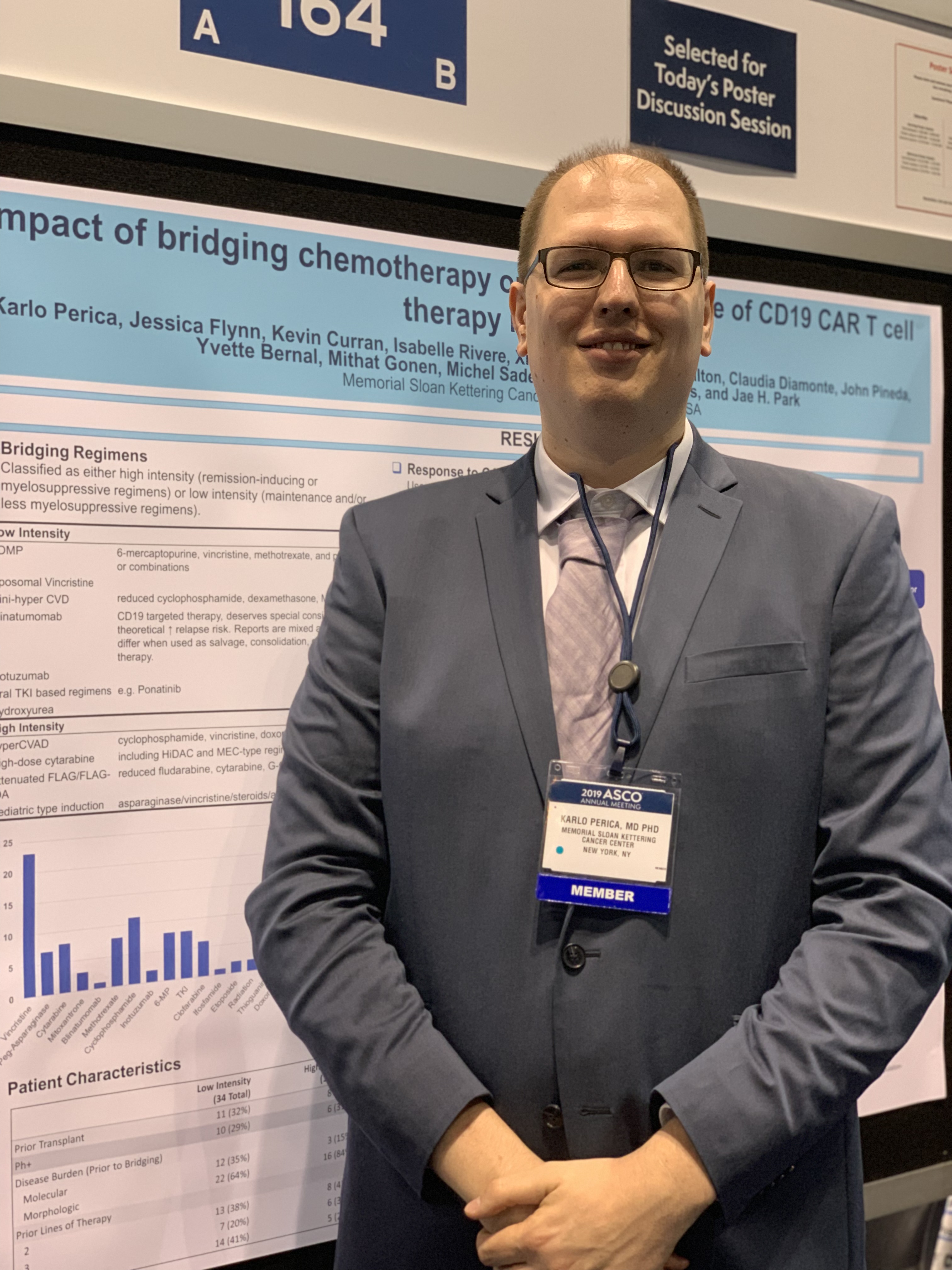
Dr. Perica and his colleagues at Memorial Sloan Kettering examined the effectiveness and toxicity of bridging therapies provided to relapsed or refractory ALL patients waiting to receive CD19 CAR T-cell therapy as part of a phase 1 trial (N Engl J Med. 2018 Feb 1;378[5]:449-59).
Bridging therapy was defined as any therapy given from leukapheresis to cell infusion.
The low-intensity regimens included POMP (6-mercaptopurine, vincristine, methotrexate, and prednisone, or combinations), liposomal vincristine, mini-hyper CVD (reduced cyclophosphamide, dexamethasone, methotrexate, Ara-C), blinatumomab, inotuzumab, oral tyrosine kinase inhibitor-based regimens, or hydroxyurea.
The high-intensity regimens included hyper-CVAD (cyclophosphamide, vincristine, doxorubicin, dexamethasone), high-dose cytarabine, attenuated FLAG/FLAG-IDA (reduced fludarabine, cytarabine, G-CSF plus or minus idarubicin), and pediatric-type induction.
Of the 53 patients who were ultimately infused with CAR T cells, 19 received some type of high intensity regimen, 29 received low intensity regimens, and 5 received no bridging treatment. The group overall was heavily pretreated. Nearly a third of the low intensity and no bridging patients and 42% of the high intensity patients had previously undergone transplant. More than 40% of the low intensity and no bridging patients and about a quarter of the high intensity bridging group had four or more prior lines of therapy.
The use of high intensity bridging therapy was not associated with improved overall response or relapse-free survival to CAR T-cell therapy, the investigators reported. In a subgroup with 23 high disease burden patients with greater than 20% blasts, there was no difference in MRD-negative complete response by intensity (75% versus 60%, Fisher’s P = .65).
High intensity bridging was also not associated with successful CAR T-cell infusion, versus low intensity regimens (63% versus 79%, P greater than .05) or a combined endpoint of CAR T-cell infusion plus transplant or alternative treatment (80% versus 86%, P greater than .05).
In terms of toxicity, the high intensity bridging regimens were associated with a higher rate of grade 3 or 4 infections – 15 versus 11 infections (Fisher’s P = .002). But there was no association with post-infusion grade 3 or 4 cytokine release syndrome or neurotoxicity.
Dr. Perica said the results reflect that the real goal of bridging is not to reduce disease burden but instead to successfully bring patients to the next phase of their treatment. “The goal of the bridging therapy is to get the patient to the CAR infusion,” he said.
Due to the retrospective nature of the study, Dr. Perica said he can’t recommend any single bridging regimen and he emphasized that the decisions are patient-specific.
The original study was funded by several foundations and Juno Therapeutics. Dr. Perica reported royalties from technology licensed to Neximmune.
SOURCE: Perica K et al. ASCO 2019, Abstract 2520.
CHICAGO – A low intensity chemotherapy regimen may be the best approach to bridge patients waiting for chimeric antigen receptor (CAR) T-cell therapy, according to a retrospective analysis of adults with acute lymphoblastic leukemia (ALL).
Investigators found that high intensity bridging regimens provided no clear outcome benefit, but did produce a greater number of infections.
But the decision on the type of regimen is very much dependent on the individual patient, Karlo Perica, MD, PhD, of Memorial Sloan Kettering Cancer Center in New York, said at the annual meeting of the American Society of Clinical Oncology.
Dr. Perica and his colleagues at Memorial Sloan Kettering examined the effectiveness and toxicity of bridging therapies provided to relapsed or refractory ALL patients waiting to receive CD19 CAR T-cell therapy as part of a phase 1 trial (N Engl J Med. 2018 Feb 1;378[5]:449-59).
Bridging therapy was defined as any therapy given from leukapheresis to cell infusion.
The low-intensity regimens included POMP (6-mercaptopurine, vincristine, methotrexate, and prednisone, or combinations), liposomal vincristine, mini-hyper CVD (reduced cyclophosphamide, dexamethasone, methotrexate, Ara-C), blinatumomab, inotuzumab, oral tyrosine kinase inhibitor-based regimens, or hydroxyurea.
The high-intensity regimens included hyper-CVAD (cyclophosphamide, vincristine, doxorubicin, dexamethasone), high-dose cytarabine, attenuated FLAG/FLAG-IDA (reduced fludarabine, cytarabine, G-CSF plus or minus idarubicin), and pediatric-type induction.
Of the 53 patients who were ultimately infused with CAR T cells, 19 received some type of high intensity regimen, 29 received low intensity regimens, and 5 received no bridging treatment. The group overall was heavily pretreated. Nearly a third of the low intensity and no bridging patients and 42% of the high intensity patients had previously undergone transplant. More than 40% of the low intensity and no bridging patients and about a quarter of the high intensity bridging group had four or more prior lines of therapy.
The use of high intensity bridging therapy was not associated with improved overall response or relapse-free survival to CAR T-cell therapy, the investigators reported. In a subgroup with 23 high disease burden patients with greater than 20% blasts, there was no difference in MRD-negative complete response by intensity (75% versus 60%, Fisher’s P = .65).
High intensity bridging was also not associated with successful CAR T-cell infusion, versus low intensity regimens (63% versus 79%, P greater than .05) or a combined endpoint of CAR T-cell infusion plus transplant or alternative treatment (80% versus 86%, P greater than .05).
In terms of toxicity, the high intensity bridging regimens were associated with a higher rate of grade 3 or 4 infections – 15 versus 11 infections (Fisher’s P = .002). But there was no association with post-infusion grade 3 or 4 cytokine release syndrome or neurotoxicity.
Dr. Perica said the results reflect that the real goal of bridging is not to reduce disease burden but instead to successfully bring patients to the next phase of their treatment. “The goal of the bridging therapy is to get the patient to the CAR infusion,” he said.
Due to the retrospective nature of the study, Dr. Perica said he can’t recommend any single bridging regimen and he emphasized that the decisions are patient-specific.
The original study was funded by several foundations and Juno Therapeutics. Dr. Perica reported royalties from technology licensed to Neximmune.
SOURCE: Perica K et al. ASCO 2019, Abstract 2520.
CHICAGO – A low intensity chemotherapy regimen may be the best approach to bridge patients waiting for chimeric antigen receptor (CAR) T-cell therapy, according to a retrospective analysis of adults with acute lymphoblastic leukemia (ALL).
Investigators found that high intensity bridging regimens provided no clear outcome benefit, but did produce a greater number of infections.
But the decision on the type of regimen is very much dependent on the individual patient, Karlo Perica, MD, PhD, of Memorial Sloan Kettering Cancer Center in New York, said at the annual meeting of the American Society of Clinical Oncology.
Dr. Perica and his colleagues at Memorial Sloan Kettering examined the effectiveness and toxicity of bridging therapies provided to relapsed or refractory ALL patients waiting to receive CD19 CAR T-cell therapy as part of a phase 1 trial (N Engl J Med. 2018 Feb 1;378[5]:449-59).
Bridging therapy was defined as any therapy given from leukapheresis to cell infusion.
The low-intensity regimens included POMP (6-mercaptopurine, vincristine, methotrexate, and prednisone, or combinations), liposomal vincristine, mini-hyper CVD (reduced cyclophosphamide, dexamethasone, methotrexate, Ara-C), blinatumomab, inotuzumab, oral tyrosine kinase inhibitor-based regimens, or hydroxyurea.
The high-intensity regimens included hyper-CVAD (cyclophosphamide, vincristine, doxorubicin, dexamethasone), high-dose cytarabine, attenuated FLAG/FLAG-IDA (reduced fludarabine, cytarabine, G-CSF plus or minus idarubicin), and pediatric-type induction.
Of the 53 patients who were ultimately infused with CAR T cells, 19 received some type of high intensity regimen, 29 received low intensity regimens, and 5 received no bridging treatment. The group overall was heavily pretreated. Nearly a third of the low intensity and no bridging patients and 42% of the high intensity patients had previously undergone transplant. More than 40% of the low intensity and no bridging patients and about a quarter of the high intensity bridging group had four or more prior lines of therapy.
The use of high intensity bridging therapy was not associated with improved overall response or relapse-free survival to CAR T-cell therapy, the investigators reported. In a subgroup with 23 high disease burden patients with greater than 20% blasts, there was no difference in MRD-negative complete response by intensity (75% versus 60%, Fisher’s P = .65).
High intensity bridging was also not associated with successful CAR T-cell infusion, versus low intensity regimens (63% versus 79%, P greater than .05) or a combined endpoint of CAR T-cell infusion plus transplant or alternative treatment (80% versus 86%, P greater than .05).
In terms of toxicity, the high intensity bridging regimens were associated with a higher rate of grade 3 or 4 infections – 15 versus 11 infections (Fisher’s P = .002). But there was no association with post-infusion grade 3 or 4 cytokine release syndrome or neurotoxicity.
Dr. Perica said the results reflect that the real goal of bridging is not to reduce disease burden but instead to successfully bring patients to the next phase of their treatment. “The goal of the bridging therapy is to get the patient to the CAR infusion,” he said.
Due to the retrospective nature of the study, Dr. Perica said he can’t recommend any single bridging regimen and he emphasized that the decisions are patient-specific.
The original study was funded by several foundations and Juno Therapeutics. Dr. Perica reported royalties from technology licensed to Neximmune.
SOURCE: Perica K et al. ASCO 2019, Abstract 2520.
FROM ASCO 2019
Ribociclib plus endocrine therapy boosts survival of HR+/HER2- breast cancer
CHICAGO – Adding ribociclib to endocrine therapy significantly improved overall survival of premenopausal women with advanced hormone receptor positive, HER2-negative breast cancer, results of the randomized phase 3 MONALEESA-7 trial showed.
A landmark analysis performed at 42 months of follow-up showed that the overall survival (OS) rate for women randomized to receive endocrine therapy with either a nonsteroidal aromatase inhibitor (AI) or tamoxifen plus the cyclin-dependent kinase 4/6 (CDK4/6) inhibitor ribociclib (Kisqali) was 70%, compared with 46% for women randomized to endocrine therapy plus placebo.
The trial is the first study to evaluate a CDK4/6 inhibitor exclusively in premenopausal women, and the first to show a statistically significant improvement in overall survival with a CDK4/6 inhibitor in combination with endocrine therapy in patients with HR-positive, HER2-negative advanced breast cancer.
In a video interview at the American Society of Clinical Oncology annual meeting, Sara A. Hurvitz, MD, from the University of California Los Angeles Jonsson Comprehensive Cancer Center, describes the significance of the MONALEESA-7 findings and the potential for improving on the study results with other agents or combinations.
The MONALEESA-7 trial is supported by Novartis. Dr. Hurvitz reported travel and accommodation expenses from Novartis.
CHICAGO – Adding ribociclib to endocrine therapy significantly improved overall survival of premenopausal women with advanced hormone receptor positive, HER2-negative breast cancer, results of the randomized phase 3 MONALEESA-7 trial showed.
A landmark analysis performed at 42 months of follow-up showed that the overall survival (OS) rate for women randomized to receive endocrine therapy with either a nonsteroidal aromatase inhibitor (AI) or tamoxifen plus the cyclin-dependent kinase 4/6 (CDK4/6) inhibitor ribociclib (Kisqali) was 70%, compared with 46% for women randomized to endocrine therapy plus placebo.
The trial is the first study to evaluate a CDK4/6 inhibitor exclusively in premenopausal women, and the first to show a statistically significant improvement in overall survival with a CDK4/6 inhibitor in combination with endocrine therapy in patients with HR-positive, HER2-negative advanced breast cancer.
In a video interview at the American Society of Clinical Oncology annual meeting, Sara A. Hurvitz, MD, from the University of California Los Angeles Jonsson Comprehensive Cancer Center, describes the significance of the MONALEESA-7 findings and the potential for improving on the study results with other agents or combinations.
The MONALEESA-7 trial is supported by Novartis. Dr. Hurvitz reported travel and accommodation expenses from Novartis.
CHICAGO – Adding ribociclib to endocrine therapy significantly improved overall survival of premenopausal women with advanced hormone receptor positive, HER2-negative breast cancer, results of the randomized phase 3 MONALEESA-7 trial showed.
A landmark analysis performed at 42 months of follow-up showed that the overall survival (OS) rate for women randomized to receive endocrine therapy with either a nonsteroidal aromatase inhibitor (AI) or tamoxifen plus the cyclin-dependent kinase 4/6 (CDK4/6) inhibitor ribociclib (Kisqali) was 70%, compared with 46% for women randomized to endocrine therapy plus placebo.
The trial is the first study to evaluate a CDK4/6 inhibitor exclusively in premenopausal women, and the first to show a statistically significant improvement in overall survival with a CDK4/6 inhibitor in combination with endocrine therapy in patients with HR-positive, HER2-negative advanced breast cancer.
In a video interview at the American Society of Clinical Oncology annual meeting, Sara A. Hurvitz, MD, from the University of California Los Angeles Jonsson Comprehensive Cancer Center, describes the significance of the MONALEESA-7 findings and the potential for improving on the study results with other agents or combinations.
The MONALEESA-7 trial is supported by Novartis. Dr. Hurvitz reported travel and accommodation expenses from Novartis.
REPORTING FROM ASCO 2019