User login
Omega-3 supplementation improves sleep, mood in breast cancer patients on hormone therapy
After 4 weeks of treatment, patients who received omega-3 reported better sleep, depression, and mood outcomes than those who received placebo.
Estrogen-receptor inhibitors are used to treat breast cancer with positive hormone receptors in combination with other therapies. However, the drugs can lead to long-term side effects, including hot flashes, night sweats, and changes to mood and sleep.
These side effects are often treated with selective serotonin reuptake inhibitors and some anticonvulsant drugs. Omega-3 supplements contain various polyunsaturated fatty acids, which influence cell signaling and contribute to the production of bioactive fat mediators that counter inflammation. They are widely used in cardiovascular disease, breast cancer, rheumatoid arthritis, depression, and other cognitive disorders. They also appear to amplify the antitumor efficacy of tamoxifen through the inhibition of proliferative and antiapoptotic pathways that that are influenced by estrogen-receptor signaling.
“This study showed that omega-3 supplementation can improve mood and sleep disorder in women suffering from breast cancer while they (are) managing with antihormone drugs. … this supplement can be proposed for the treatment of these patients,” wrote researchers led by Azadeh Moghaddas, MD, PhD, who is an associate professor of clinical pharmacy and pharmacy practice at Isfahan (Iran) University of Medical Sciences.
The study was made available as a preprint on ResearchSquare and has not yet been peer reviewed. It included 60 patients who were screened for baseline mood disorders using the hospital anxiety and depression scale (HADS), then randomized to 2 mg omega-3 per day for 4 weeks, or placebo.
Studies have shown that omega-3 supplementation improves menopause and mood symptoms in postmenopausal women without cancer.
Omega-3 supplementation has neuroprotective effects and improved brain function and mood in rats, and a 2019 review suggested that the evidence is strong enough to warrant clinical studies.
To determine if the supplement was also safe and effective in women with breast cancer undergoing hormone therapy, the researchers analyzed data from 32 patients in the intervention group and 28 patients in the placebo group.
At 4 weeks of follow-up, patients in the intervention group had significantly lower values on the Center for Epidemiological Studies-Depression scale (mean, 22.8 vs. 30.8; P < .001), Profile of Mood State (mean, 30.8 versus 39.5; P<.001), and Pittsburgh Sleep Quality Index (mean, 4.6 vs. 5.9; P = .04). There were no statistically significant changes in these values in the placebo group.
At 4 weeks, paired samples t-test comparisons between the intervention and the placebo groups revealed lower scores in the intervention group for mean scores in the PSQI subscales subjective sleep quality (0.8 vs. 1.4; P = .002), delay in falling asleep (1.1 vs. 1.6; P = .02), and sleep disturbances (0.8 vs. 1.1; P = .005).
There were no significant adverse reactions in either group.
The study is limited by its small sample size and the short follow-up period.
The study was funded by Isfahan University of Medical Sciences. The authors declare no other conflicts of interest.
After 4 weeks of treatment, patients who received omega-3 reported better sleep, depression, and mood outcomes than those who received placebo.
Estrogen-receptor inhibitors are used to treat breast cancer with positive hormone receptors in combination with other therapies. However, the drugs can lead to long-term side effects, including hot flashes, night sweats, and changes to mood and sleep.
These side effects are often treated with selective serotonin reuptake inhibitors and some anticonvulsant drugs. Omega-3 supplements contain various polyunsaturated fatty acids, which influence cell signaling and contribute to the production of bioactive fat mediators that counter inflammation. They are widely used in cardiovascular disease, breast cancer, rheumatoid arthritis, depression, and other cognitive disorders. They also appear to amplify the antitumor efficacy of tamoxifen through the inhibition of proliferative and antiapoptotic pathways that that are influenced by estrogen-receptor signaling.
“This study showed that omega-3 supplementation can improve mood and sleep disorder in women suffering from breast cancer while they (are) managing with antihormone drugs. … this supplement can be proposed for the treatment of these patients,” wrote researchers led by Azadeh Moghaddas, MD, PhD, who is an associate professor of clinical pharmacy and pharmacy practice at Isfahan (Iran) University of Medical Sciences.
The study was made available as a preprint on ResearchSquare and has not yet been peer reviewed. It included 60 patients who were screened for baseline mood disorders using the hospital anxiety and depression scale (HADS), then randomized to 2 mg omega-3 per day for 4 weeks, or placebo.
Studies have shown that omega-3 supplementation improves menopause and mood symptoms in postmenopausal women without cancer.
Omega-3 supplementation has neuroprotective effects and improved brain function and mood in rats, and a 2019 review suggested that the evidence is strong enough to warrant clinical studies.
To determine if the supplement was also safe and effective in women with breast cancer undergoing hormone therapy, the researchers analyzed data from 32 patients in the intervention group and 28 patients in the placebo group.
At 4 weeks of follow-up, patients in the intervention group had significantly lower values on the Center for Epidemiological Studies-Depression scale (mean, 22.8 vs. 30.8; P < .001), Profile of Mood State (mean, 30.8 versus 39.5; P<.001), and Pittsburgh Sleep Quality Index (mean, 4.6 vs. 5.9; P = .04). There were no statistically significant changes in these values in the placebo group.
At 4 weeks, paired samples t-test comparisons between the intervention and the placebo groups revealed lower scores in the intervention group for mean scores in the PSQI subscales subjective sleep quality (0.8 vs. 1.4; P = .002), delay in falling asleep (1.1 vs. 1.6; P = .02), and sleep disturbances (0.8 vs. 1.1; P = .005).
There were no significant adverse reactions in either group.
The study is limited by its small sample size and the short follow-up period.
The study was funded by Isfahan University of Medical Sciences. The authors declare no other conflicts of interest.
After 4 weeks of treatment, patients who received omega-3 reported better sleep, depression, and mood outcomes than those who received placebo.
Estrogen-receptor inhibitors are used to treat breast cancer with positive hormone receptors in combination with other therapies. However, the drugs can lead to long-term side effects, including hot flashes, night sweats, and changes to mood and sleep.
These side effects are often treated with selective serotonin reuptake inhibitors and some anticonvulsant drugs. Omega-3 supplements contain various polyunsaturated fatty acids, which influence cell signaling and contribute to the production of bioactive fat mediators that counter inflammation. They are widely used in cardiovascular disease, breast cancer, rheumatoid arthritis, depression, and other cognitive disorders. They also appear to amplify the antitumor efficacy of tamoxifen through the inhibition of proliferative and antiapoptotic pathways that that are influenced by estrogen-receptor signaling.
“This study showed that omega-3 supplementation can improve mood and sleep disorder in women suffering from breast cancer while they (are) managing with antihormone drugs. … this supplement can be proposed for the treatment of these patients,” wrote researchers led by Azadeh Moghaddas, MD, PhD, who is an associate professor of clinical pharmacy and pharmacy practice at Isfahan (Iran) University of Medical Sciences.
The study was made available as a preprint on ResearchSquare and has not yet been peer reviewed. It included 60 patients who were screened for baseline mood disorders using the hospital anxiety and depression scale (HADS), then randomized to 2 mg omega-3 per day for 4 weeks, or placebo.
Studies have shown that omega-3 supplementation improves menopause and mood symptoms in postmenopausal women without cancer.
Omega-3 supplementation has neuroprotective effects and improved brain function and mood in rats, and a 2019 review suggested that the evidence is strong enough to warrant clinical studies.
To determine if the supplement was also safe and effective in women with breast cancer undergoing hormone therapy, the researchers analyzed data from 32 patients in the intervention group and 28 patients in the placebo group.
At 4 weeks of follow-up, patients in the intervention group had significantly lower values on the Center for Epidemiological Studies-Depression scale (mean, 22.8 vs. 30.8; P < .001), Profile of Mood State (mean, 30.8 versus 39.5; P<.001), and Pittsburgh Sleep Quality Index (mean, 4.6 vs. 5.9; P = .04). There were no statistically significant changes in these values in the placebo group.
At 4 weeks, paired samples t-test comparisons between the intervention and the placebo groups revealed lower scores in the intervention group for mean scores in the PSQI subscales subjective sleep quality (0.8 vs. 1.4; P = .002), delay in falling asleep (1.1 vs. 1.6; P = .02), and sleep disturbances (0.8 vs. 1.1; P = .005).
There were no significant adverse reactions in either group.
The study is limited by its small sample size and the short follow-up period.
The study was funded by Isfahan University of Medical Sciences. The authors declare no other conflicts of interest.
FROM RESEARCHSQUARE
NSCLC Diagnosis
Children and COVID: Nearly 200,000 new cases reported in 1 week
, according to the American Academy of Pediatrics and the Children’s Hospital Association.
Available state data show that 198,551 child COVID cases were added during the week of Dec. 17-23 – up by 16.8% from the nearly 170,000 new cases reported the previous week and the highest 7-day figure since Sept. 17-23, when 207,000 cases were reported, the AAP and the CHA said in their weekly COVID report. Since Oct. 22-28, when the weekly count dropped to a seasonal low, the weekly count has nearly doubled.
The largest shares of the nearly 199,000 new cases were divided pretty equally between the Northeast and the South, while the West had just a small bump in cases and the Midwest was in the middle. The largest statewide percent increases came in the New England states, along with New Jersey, the District of Columbia, and Puerto Rico. New York State does not report age ranges for COVID cases, the AAP/CHA report noted.
Emergency department visits and hospital admissions are following a similar trend, as both have risen considerably over the last 2 months, data from the Centers for Disease Control and Prevention show.
COVID-related ED visits for children aged 0-11 years – measured as a proportion of all ED visits – are nearing the pandemic high of 4.1% set in late August, while visits in 12- to 15-year-olds have risen from 1.4% in early November to 5.6% on Dec. 24 and 16- to 17-year-olds have gone from 1.5% to 6% over the same period of time, the CDC reported on its COVID Data Tracker.
As for hospital admissions in children aged 0-17 years, the rate was down to 0.19 per 100,000 population on Nov. 11 but had risen to 0.38 per 100,000 as of Dec. 24. The highest point reached in children during the pandemic was 0.46 per 100,000 in early September, the CDC said.
On Dec. 23, 367 children were admitted to hospitals in the United States, the highest number since Sept. 7, when 374 were hospitalized. The highest 1-day total over the course of the pandemic, 394, came just a week before that, Aug. 31, according to the Department of Health & Human Services.
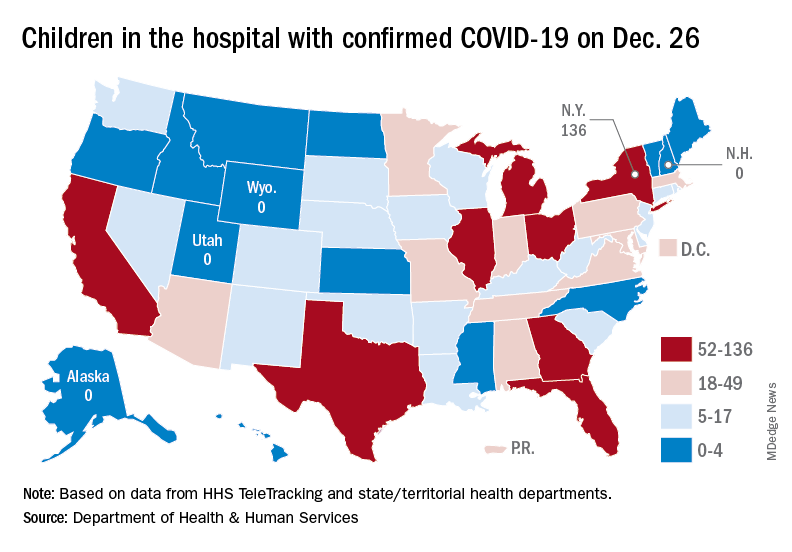
A look at the most recent HHS data shows that 1,161 children were being hospitalized in pediatric inpatient beds with confirmed COVID-19 on Dec. 26. The highest number by state was in New York (136), followed by Texas (90) and Illinois and Ohio, both with 83. There were four states – Alaska, New Hampshire, Utah, and Wyoming – with no hospitalized children, the HHS said. Puerto Rico, meanwhile, had 28 children in the hospital with COVID, more than 38 states.
, according to the American Academy of Pediatrics and the Children’s Hospital Association.
Available state data show that 198,551 child COVID cases were added during the week of Dec. 17-23 – up by 16.8% from the nearly 170,000 new cases reported the previous week and the highest 7-day figure since Sept. 17-23, when 207,000 cases were reported, the AAP and the CHA said in their weekly COVID report. Since Oct. 22-28, when the weekly count dropped to a seasonal low, the weekly count has nearly doubled.
The largest shares of the nearly 199,000 new cases were divided pretty equally between the Northeast and the South, while the West had just a small bump in cases and the Midwest was in the middle. The largest statewide percent increases came in the New England states, along with New Jersey, the District of Columbia, and Puerto Rico. New York State does not report age ranges for COVID cases, the AAP/CHA report noted.
Emergency department visits and hospital admissions are following a similar trend, as both have risen considerably over the last 2 months, data from the Centers for Disease Control and Prevention show.
COVID-related ED visits for children aged 0-11 years – measured as a proportion of all ED visits – are nearing the pandemic high of 4.1% set in late August, while visits in 12- to 15-year-olds have risen from 1.4% in early November to 5.6% on Dec. 24 and 16- to 17-year-olds have gone from 1.5% to 6% over the same period of time, the CDC reported on its COVID Data Tracker.
As for hospital admissions in children aged 0-17 years, the rate was down to 0.19 per 100,000 population on Nov. 11 but had risen to 0.38 per 100,000 as of Dec. 24. The highest point reached in children during the pandemic was 0.46 per 100,000 in early September, the CDC said.
On Dec. 23, 367 children were admitted to hospitals in the United States, the highest number since Sept. 7, when 374 were hospitalized. The highest 1-day total over the course of the pandemic, 394, came just a week before that, Aug. 31, according to the Department of Health & Human Services.
A look at the most recent HHS data shows that 1,161 children were being hospitalized in pediatric inpatient beds with confirmed COVID-19 on Dec. 26. The highest number by state was in New York (136), followed by Texas (90) and Illinois and Ohio, both with 83. There were four states – Alaska, New Hampshire, Utah, and Wyoming – with no hospitalized children, the HHS said. Puerto Rico, meanwhile, had 28 children in the hospital with COVID, more than 38 states.
, according to the American Academy of Pediatrics and the Children’s Hospital Association.
Available state data show that 198,551 child COVID cases were added during the week of Dec. 17-23 – up by 16.8% from the nearly 170,000 new cases reported the previous week and the highest 7-day figure since Sept. 17-23, when 207,000 cases were reported, the AAP and the CHA said in their weekly COVID report. Since Oct. 22-28, when the weekly count dropped to a seasonal low, the weekly count has nearly doubled.
The largest shares of the nearly 199,000 new cases were divided pretty equally between the Northeast and the South, while the West had just a small bump in cases and the Midwest was in the middle. The largest statewide percent increases came in the New England states, along with New Jersey, the District of Columbia, and Puerto Rico. New York State does not report age ranges for COVID cases, the AAP/CHA report noted.
Emergency department visits and hospital admissions are following a similar trend, as both have risen considerably over the last 2 months, data from the Centers for Disease Control and Prevention show.
COVID-related ED visits for children aged 0-11 years – measured as a proportion of all ED visits – are nearing the pandemic high of 4.1% set in late August, while visits in 12- to 15-year-olds have risen from 1.4% in early November to 5.6% on Dec. 24 and 16- to 17-year-olds have gone from 1.5% to 6% over the same period of time, the CDC reported on its COVID Data Tracker.
As for hospital admissions in children aged 0-17 years, the rate was down to 0.19 per 100,000 population on Nov. 11 but had risen to 0.38 per 100,000 as of Dec. 24. The highest point reached in children during the pandemic was 0.46 per 100,000 in early September, the CDC said.
On Dec. 23, 367 children were admitted to hospitals in the United States, the highest number since Sept. 7, when 374 were hospitalized. The highest 1-day total over the course of the pandemic, 394, came just a week before that, Aug. 31, according to the Department of Health & Human Services.
A look at the most recent HHS data shows that 1,161 children were being hospitalized in pediatric inpatient beds with confirmed COVID-19 on Dec. 26. The highest number by state was in New York (136), followed by Texas (90) and Illinois and Ohio, both with 83. There were four states – Alaska, New Hampshire, Utah, and Wyoming – with no hospitalized children, the HHS said. Puerto Rico, meanwhile, had 28 children in the hospital with COVID, more than 38 states.
Most cancer patients with breakthrough COVID-19 infection experience severe outcomes
Of 54 fully vaccinated patients with cancer and COVID-19, 35 (65%) were hospitalized, 10 (19%) were admitted to the intensive care unit or required mechanical ventilation, and 7 (13%) died within 30 days.
Although the study did not assess the rate of breakthrough infection among fully vaccinated patients with cancer, the findings do underscore the need for continued vigilance in protecting this vulnerable patient population by vaccinating close contacts, administering boosters, social distancing, and mask-wearing.
“Overall, vaccination remains an invaluable strategy in protecting vulnerable populations, including patients with cancer, against COVID-19. However, patients with cancer who develop breakthrough infection despite full vaccination remain at risk of severe outcomes,” Andrew L. Schmidt, MB, of Dana-Farber Cancer Institute, Boston, and associates wrote.
The analysis, which appeared online in Annals of Oncology Dec. 24 as a pre-proof but has not yet been peer reviewed, analyzed registry data from 1,787 adults with current or prior invasive cancer and laboratory-confirmed COVID-19 between Nov. 1, 2020, and May 31, 2021, before COVID vaccination was widespread. Of those, 1,656 (93%) were unvaccinated, 77 (4%) were partially vaccinated, and 54 (3%) were considered fully vaccinated at the time of COVID-19 infection.
Of the fully vaccinated patients with breakthrough infection, 52 (96%) experienced a severe outcome: two-thirds had to be hospitalized, nearly 1 in 5 went to the ICU or needed mechanical ventilation, and 13% died within 30 days.
“Comparable rates were observed in the unvaccinated group,” the investigators write, adding that there was no statistical difference in 30-day mortality between the fully vaccinated patients and the unvaccinated cohort (adjusted odds ratio, 1.08).
Factors associated with increased 30-day mortality among unvaccinated patients included lymphopenia (aOR, 1.68), comorbidities (aORs, 1.66-2.10), worse performance status (aORs, 2.26-4.34), and baseline cancer status (active/progressing vs. not active/ progressing, aOR, 6.07).
No significant differences were observed in ICU, mechanical ventilation, or hospitalization rates between the vaccinated and unvaccinated cohort after adjustment for confounders (aORs,1.13 and 1.25, respectively).
Notably, patients with an underlying hematologic malignancy were overrepresented among those with breakthrough COVID-19 (35% vs. 20%). Compared with those with solid cancers, patients with hematologic malignancies also had significantly higher rates of ICU admission, mechanical ventilation, and hospitalization.
This finding is “consistent with evidence that these patients may have a blunted serologic response to vaccination secondary to disease or therapy,” the authors note.
Although the investigators did not evaluate the risk of breakthrough infection post vaccination, recent research indicates that receiving a COVID-19 booster increases antibody levels among patients with cancer under active treatment and thus may provide additional protection against the virus.
Given the risk of breakthrough infection and severe outcomes in patients with cancer, the authors propose that “a mitigation approach that includes vaccination of close contacts, boosters, social distancing, and mask-wearing in public should be continued for the foreseeable future.” However, “additional research is needed to further categorize the patients that remain at risk of symptomatic COVID-19 following vaccination and test strategies that may reduce this risk.”
The findings are from a pre-proof that has not yet been peer reviewed or published. First author Dr. Schmidt reported nonfinancial support from Astellas, nonfinancial support from Pfizer, outside the submitted work. Other coauthors reported a range of disclosures as well. The full list can be found with the original article.
A version of this article first appeared on Medscape.com.
Of 54 fully vaccinated patients with cancer and COVID-19, 35 (65%) were hospitalized, 10 (19%) were admitted to the intensive care unit or required mechanical ventilation, and 7 (13%) died within 30 days.
Although the study did not assess the rate of breakthrough infection among fully vaccinated patients with cancer, the findings do underscore the need for continued vigilance in protecting this vulnerable patient population by vaccinating close contacts, administering boosters, social distancing, and mask-wearing.
“Overall, vaccination remains an invaluable strategy in protecting vulnerable populations, including patients with cancer, against COVID-19. However, patients with cancer who develop breakthrough infection despite full vaccination remain at risk of severe outcomes,” Andrew L. Schmidt, MB, of Dana-Farber Cancer Institute, Boston, and associates wrote.
The analysis, which appeared online in Annals of Oncology Dec. 24 as a pre-proof but has not yet been peer reviewed, analyzed registry data from 1,787 adults with current or prior invasive cancer and laboratory-confirmed COVID-19 between Nov. 1, 2020, and May 31, 2021, before COVID vaccination was widespread. Of those, 1,656 (93%) were unvaccinated, 77 (4%) were partially vaccinated, and 54 (3%) were considered fully vaccinated at the time of COVID-19 infection.
Of the fully vaccinated patients with breakthrough infection, 52 (96%) experienced a severe outcome: two-thirds had to be hospitalized, nearly 1 in 5 went to the ICU or needed mechanical ventilation, and 13% died within 30 days.
“Comparable rates were observed in the unvaccinated group,” the investigators write, adding that there was no statistical difference in 30-day mortality between the fully vaccinated patients and the unvaccinated cohort (adjusted odds ratio, 1.08).
Factors associated with increased 30-day mortality among unvaccinated patients included lymphopenia (aOR, 1.68), comorbidities (aORs, 1.66-2.10), worse performance status (aORs, 2.26-4.34), and baseline cancer status (active/progressing vs. not active/ progressing, aOR, 6.07).
No significant differences were observed in ICU, mechanical ventilation, or hospitalization rates between the vaccinated and unvaccinated cohort after adjustment for confounders (aORs,1.13 and 1.25, respectively).
Notably, patients with an underlying hematologic malignancy were overrepresented among those with breakthrough COVID-19 (35% vs. 20%). Compared with those with solid cancers, patients with hematologic malignancies also had significantly higher rates of ICU admission, mechanical ventilation, and hospitalization.
This finding is “consistent with evidence that these patients may have a blunted serologic response to vaccination secondary to disease or therapy,” the authors note.
Although the investigators did not evaluate the risk of breakthrough infection post vaccination, recent research indicates that receiving a COVID-19 booster increases antibody levels among patients with cancer under active treatment and thus may provide additional protection against the virus.
Given the risk of breakthrough infection and severe outcomes in patients with cancer, the authors propose that “a mitigation approach that includes vaccination of close contacts, boosters, social distancing, and mask-wearing in public should be continued for the foreseeable future.” However, “additional research is needed to further categorize the patients that remain at risk of symptomatic COVID-19 following vaccination and test strategies that may reduce this risk.”
The findings are from a pre-proof that has not yet been peer reviewed or published. First author Dr. Schmidt reported nonfinancial support from Astellas, nonfinancial support from Pfizer, outside the submitted work. Other coauthors reported a range of disclosures as well. The full list can be found with the original article.
A version of this article first appeared on Medscape.com.
Of 54 fully vaccinated patients with cancer and COVID-19, 35 (65%) were hospitalized, 10 (19%) were admitted to the intensive care unit or required mechanical ventilation, and 7 (13%) died within 30 days.
Although the study did not assess the rate of breakthrough infection among fully vaccinated patients with cancer, the findings do underscore the need for continued vigilance in protecting this vulnerable patient population by vaccinating close contacts, administering boosters, social distancing, and mask-wearing.
“Overall, vaccination remains an invaluable strategy in protecting vulnerable populations, including patients with cancer, against COVID-19. However, patients with cancer who develop breakthrough infection despite full vaccination remain at risk of severe outcomes,” Andrew L. Schmidt, MB, of Dana-Farber Cancer Institute, Boston, and associates wrote.
The analysis, which appeared online in Annals of Oncology Dec. 24 as a pre-proof but has not yet been peer reviewed, analyzed registry data from 1,787 adults with current or prior invasive cancer and laboratory-confirmed COVID-19 between Nov. 1, 2020, and May 31, 2021, before COVID vaccination was widespread. Of those, 1,656 (93%) were unvaccinated, 77 (4%) were partially vaccinated, and 54 (3%) were considered fully vaccinated at the time of COVID-19 infection.
Of the fully vaccinated patients with breakthrough infection, 52 (96%) experienced a severe outcome: two-thirds had to be hospitalized, nearly 1 in 5 went to the ICU or needed mechanical ventilation, and 13% died within 30 days.
“Comparable rates were observed in the unvaccinated group,” the investigators write, adding that there was no statistical difference in 30-day mortality between the fully vaccinated patients and the unvaccinated cohort (adjusted odds ratio, 1.08).
Factors associated with increased 30-day mortality among unvaccinated patients included lymphopenia (aOR, 1.68), comorbidities (aORs, 1.66-2.10), worse performance status (aORs, 2.26-4.34), and baseline cancer status (active/progressing vs. not active/ progressing, aOR, 6.07).
No significant differences were observed in ICU, mechanical ventilation, or hospitalization rates between the vaccinated and unvaccinated cohort after adjustment for confounders (aORs,1.13 and 1.25, respectively).
Notably, patients with an underlying hematologic malignancy were overrepresented among those with breakthrough COVID-19 (35% vs. 20%). Compared with those with solid cancers, patients with hematologic malignancies also had significantly higher rates of ICU admission, mechanical ventilation, and hospitalization.
This finding is “consistent with evidence that these patients may have a blunted serologic response to vaccination secondary to disease or therapy,” the authors note.
Although the investigators did not evaluate the risk of breakthrough infection post vaccination, recent research indicates that receiving a COVID-19 booster increases antibody levels among patients with cancer under active treatment and thus may provide additional protection against the virus.
Given the risk of breakthrough infection and severe outcomes in patients with cancer, the authors propose that “a mitigation approach that includes vaccination of close contacts, boosters, social distancing, and mask-wearing in public should be continued for the foreseeable future.” However, “additional research is needed to further categorize the patients that remain at risk of symptomatic COVID-19 following vaccination and test strategies that may reduce this risk.”
The findings are from a pre-proof that has not yet been peer reviewed or published. First author Dr. Schmidt reported nonfinancial support from Astellas, nonfinancial support from Pfizer, outside the submitted work. Other coauthors reported a range of disclosures as well. The full list can be found with the original article.
A version of this article first appeared on Medscape.com.
FROM ANNALS OF ONCOLOGY
FDA gives nod to tralokinumab for adults with moderate to severe AD
whose disease is not well controlled with topical prescription therapies or when those therapies are not advisable.

Administered subcutaneously, tralokinumab is a fully human IgG4 monoclonal antibody that specifically binds to interleukin-13, a key driver of underlying inflammation in AD. The drug, which has been developed by LEO Pharma, comes as a single-dose (150 mg) prefilled syringe with needle guard.
In two pivotal phase 3 trials, ECZTRA 1 and ECZTRA 2, tralokinumab monotherapy was superior to placebo at week 16 for all primary and secondary endpoints. For example, at week 16, for the ECZTRA 1 and 2 monotherapy trials, respectively, 16% and 21% of patients treated with tralokinumab 300 mg every other week achieved clear or almost clear skin (IGA 0/1) versus 7% and 9% with placebo.
In addition, 25% and 33% of patients treated with tralokinumab 300 mg every other week achieved an improvement of 75% or more in the Eczema Area and Severity Index score (EASI-75) versus 13% and 10% with placebo. At 52 weeks, 51% and 60% of patients who responded at week 16 maintained IGA 0/1 response with tralokinumab 300 mg every other week in ECZTRA 1 and 2, respectively.
Finally, 60% and 57% of patients who responded at week 16 maintained EASI-75 response with tralokinumab 300 mg every other week.
In the drug’s third pivotal trial, ECZTRA 3, researchers evaluated the efficacy and safety of tralokinumab 300 mg in combination with topical corticosteroids (TCS) as needed in adults with moderate to severe atopic dermatitis who are candidates for systemic therapy. At week 16, 38% of patients treated with tralokinumab 300 mg every other week plus TCS achieved clear or almost clear skin (IGA 0/1) versus 27% with placebo plus TCS. In addition, 56% of patients treated with tralokinumab 300 mg every other week plus TCS achieved an improvement of 75% or more in the EASI-75 versus 37% with placebo plus TCS. At 32 weeks, 89% and 92% of patients who responded at week 16 maintained response (IGA 0/1 and EASI-75, respectively) with tralokinumab 300 mg every other week.
A link to prescribing information can be found here. Tralokinumab is expected to be available by February 2022.
whose disease is not well controlled with topical prescription therapies or when those therapies are not advisable.
Administered subcutaneously, tralokinumab is a fully human IgG4 monoclonal antibody that specifically binds to interleukin-13, a key driver of underlying inflammation in AD. The drug, which has been developed by LEO Pharma, comes as a single-dose (150 mg) prefilled syringe with needle guard.
In two pivotal phase 3 trials, ECZTRA 1 and ECZTRA 2, tralokinumab monotherapy was superior to placebo at week 16 for all primary and secondary endpoints. For example, at week 16, for the ECZTRA 1 and 2 monotherapy trials, respectively, 16% and 21% of patients treated with tralokinumab 300 mg every other week achieved clear or almost clear skin (IGA 0/1) versus 7% and 9% with placebo.
In addition, 25% and 33% of patients treated with tralokinumab 300 mg every other week achieved an improvement of 75% or more in the Eczema Area and Severity Index score (EASI-75) versus 13% and 10% with placebo. At 52 weeks, 51% and 60% of patients who responded at week 16 maintained IGA 0/1 response with tralokinumab 300 mg every other week in ECZTRA 1 and 2, respectively.
Finally, 60% and 57% of patients who responded at week 16 maintained EASI-75 response with tralokinumab 300 mg every other week.
In the drug’s third pivotal trial, ECZTRA 3, researchers evaluated the efficacy and safety of tralokinumab 300 mg in combination with topical corticosteroids (TCS) as needed in adults with moderate to severe atopic dermatitis who are candidates for systemic therapy. At week 16, 38% of patients treated with tralokinumab 300 mg every other week plus TCS achieved clear or almost clear skin (IGA 0/1) versus 27% with placebo plus TCS. In addition, 56% of patients treated with tralokinumab 300 mg every other week plus TCS achieved an improvement of 75% or more in the EASI-75 versus 37% with placebo plus TCS. At 32 weeks, 89% and 92% of patients who responded at week 16 maintained response (IGA 0/1 and EASI-75, respectively) with tralokinumab 300 mg every other week.
A link to prescribing information can be found here. Tralokinumab is expected to be available by February 2022.
whose disease is not well controlled with topical prescription therapies or when those therapies are not advisable.
Administered subcutaneously, tralokinumab is a fully human IgG4 monoclonal antibody that specifically binds to interleukin-13, a key driver of underlying inflammation in AD. The drug, which has been developed by LEO Pharma, comes as a single-dose (150 mg) prefilled syringe with needle guard.
In two pivotal phase 3 trials, ECZTRA 1 and ECZTRA 2, tralokinumab monotherapy was superior to placebo at week 16 for all primary and secondary endpoints. For example, at week 16, for the ECZTRA 1 and 2 monotherapy trials, respectively, 16% and 21% of patients treated with tralokinumab 300 mg every other week achieved clear or almost clear skin (IGA 0/1) versus 7% and 9% with placebo.
In addition, 25% and 33% of patients treated with tralokinumab 300 mg every other week achieved an improvement of 75% or more in the Eczema Area and Severity Index score (EASI-75) versus 13% and 10% with placebo. At 52 weeks, 51% and 60% of patients who responded at week 16 maintained IGA 0/1 response with tralokinumab 300 mg every other week in ECZTRA 1 and 2, respectively.
Finally, 60% and 57% of patients who responded at week 16 maintained EASI-75 response with tralokinumab 300 mg every other week.
In the drug’s third pivotal trial, ECZTRA 3, researchers evaluated the efficacy and safety of tralokinumab 300 mg in combination with topical corticosteroids (TCS) as needed in adults with moderate to severe atopic dermatitis who are candidates for systemic therapy. At week 16, 38% of patients treated with tralokinumab 300 mg every other week plus TCS achieved clear or almost clear skin (IGA 0/1) versus 27% with placebo plus TCS. In addition, 56% of patients treated with tralokinumab 300 mg every other week plus TCS achieved an improvement of 75% or more in the EASI-75 versus 37% with placebo plus TCS. At 32 weeks, 89% and 92% of patients who responded at week 16 maintained response (IGA 0/1 and EASI-75, respectively) with tralokinumab 300 mg every other week.
A link to prescribing information can be found here. Tralokinumab is expected to be available by February 2022.

Gender-based pay inequity in gastroenterology
In 2017, the number of women students entering medical school surpassed that of men.1 However, the future generation of women doctors is unlikely to be paid the same as their male colleagues for equal work unless something changes in health care. About 34% of gastroenterology fellows are women,2 and there are increasing proportions of women in all academic and community practices, as well as in leadership positions.

Despite this progress, equity in pay between male and female physicians has been unequal in many areas of the country, despite the same level of training.3 Doximity, a social network for physicians, surveyed 65,000 doctors in the United States and found a difference in pay between male and female physicians who worked full time.4 This is an issue that the medical field has been aware of for many years, and articles have been published on this topic in several medical journals.5-11 Doximity found that women physicians are paid less than men, although the extent of the difference varies among regions.

In 2017, per the Doximity report, the field of gastroenterology was one of the top five specialties with the biggest pay gap: Women gastroenterologists earn 19% less (or $86,447) than men gastroenterologists. This study did not differentiate among practice types (academic, private practice, hospital, or multispecialty), but it did break down the data for all physicians into general groups of owner/partner, independent contractor, and employee – it found a gender-based gap in pay among all three of these groups. For owner/partners, the gap was a $114,590 (27.2%) difference.4 According to Doximity survey data from 2018, gastroenterology is no longer in the top five specialties with the largest gender pay gap, indicating the gap is shrinking but still exists.12
A questionnaire sent to gastroenterologists 3, 5, or 10 years after they completed their fellowships (in 1993 or 1995) revealed that after 3 years women earned 23% less per hour than men, and at 5 years, the gap had decreased to 19% less per hour.6-7 The statistical data showed that the mean annual gross income of males was significantly higher at 3 years and 5 years.7 Unfortunately, at 10 years the income gap increased up to 22%.6 The researchers found that female gastroenterologists at academic centers earned 39% less than male gastroenterologists at academic centers, whereas women at nonacademic centers earned 24% less than men, despite similar work hours and call schedules.6-7
Desai and colleauges analyzed health care provider reimbursement data for various medical specialties using the 2014 Medicare Fee-for-Service Provider Utilization and Payment Data Physician and Other Supplier Public Use File, and they found a disparity in reimbursements of female versus male physicians.11 Female physicians received significantly lower Medicare reimbursements in 11 of 13 medical specialties,4 despite adjustments for productivity, work hours, and years of experience. Factors that might affect Medicare reimbursement include variations in payment among different locations, types of service provided, location of procedures performed (hospital vs. clinic), and missing data because of privacy concerns.
Among medical specialties, the gender-based payment gap is highest among vascular surgeons, followed by occupational medicine physicians, gastroenterologists, pediatric endocrinologists, and rheumatologists. In these specialties, men earn approximately 20% more than women (approximately $89,000 more for a male vascular surgeon or about $45,000 more for a male pediatric rheumatologist).4
Gender-based gaps in pay, leadership opportunities, and other opportunities exist in the health care field regardless of whether physicians are employed at academic institutions, community-based private practices, or large health care systems. Women physicians occupy fewer leadership positions, and female physician leaders have greater disparities in pay, compared with men than women who are not in leadership positions.6,10 A 2016 survey of the 50 medical schools with the largest amounts of funding from the National Institutes of Health revealed that only 13% of the department leaders were women.
The Fair Pay Act of 2013 and the Paycheck Fairness Act of 2014 aimed to close the salary gap between men and women.13 So why are women paid less than men for the same work? Some researchers have proposed “gender differences in negotiation skills, lack of opportunities to join networks of influence within organizations, and implicit or explicit bias and discrimination.”8,10
The fee for service model based on relative value units can result in lower pay for female physicians, who spend more time with patients, compared with male physicians, because of fewer billable RVUs per hour and per day.15
What should be done?
The American Medical Women’s Association leadership stated that the key to pay equity is transparency, which has been a struggle. Some states, such as New York, require state contractors, including providers that work with the state health department, to disclose salary information. Because of the persistent gender gap in pay in all medical specialties (even after adjustments for age, experience, faculty rank, and measures of research productivity and clinical revenue), the American Medical Association House of Delegates announced a plan to balance salaries within the AMA, and in medicine overall, by promoting research, action, and advocacy.14 In the American College of Physicians, 37% of the members are women. This organization published a position paper in 2018 on gender disparity in pay, and proposed solutions included reviewing and addressing recruitment and advancement of women and other underrepresented groups.15
The executive director of Indiana University’s National Center of Excellence in Women’s Health in Indianapolis, Theresa Rohr-Kirchgraber, MD, who is a professor of clinical care and pediatrics, said that women physicians should bill and code in ways that better reflect the services they provide. Women should also demand more transparency in salaries and push to remove patient satisfaction scores from being a factor in salary determination.16
It is also important to note that there are medical groups and hospitals at which disparities in gender pay might not be an issue, because of physician compensation models. These include but are not limited to Kaiser Permanente and large private practice groups (such as MNGI Digestive Health). For example, with MNGI Digestive Health, shareholder track, ambulatory surgical center distributions are based on full-time equivalent status and not on production. Shareholder compensation is transparent and communicated to all. For Kaiser Permanente, salary is based on specialty and years of service. We will have the opportunity to evaluate the effects of different compensation models as health care delivery moves toward value-based care.
There is a limitation in data presented, as we were unable to obtain specialty salary data from the Association of American Medical Colleges or Medical Group Management Association to confirm findings from the Doximity survey, etc.
Conclusions
It is important to acknowledge that we have made great strides in ensuring gender diversity in the field of gastroenterology. All professional medical and gastroenterological societies are working to address gender disparities in compensation and leadership opportunities. Medical schools and fellowship programs have incorporated training on negotiation skills into their curriculums. The medical profession and overall society will benefit from providing thriving workplaces to female physicians, allowing them to achieve their full potential by ensuring gender equity in compensation and opportunities.
Dr. Perera is a gastroenterologist at Advocate Aurora Health, Grafton, Wisc. Dr. Toriz is a gastroenterologist, treasurer, and board member, MNGI Digestive Health, Bloomington, Minn. They disclosed having no relevant conflicts of interest.
References
1. The American Association of Medical Colleges. “More Women Than Men Enrolled in U.S. Medical schools in 2017.” 2017 Dec 17. http://news.aamc.org/press-releases/article/applicants-enrollment
2. The American Association of Medical Colleges data. https://aamc.org/downlaod/280338/data/tablel3.pdf
3. CBS Business. “The gender pay gap for women doctors is big – and getting worse.” 2018 Mar 14. https://money.CNN.com/2018/03/14/news/economy/gender-pay-gap-doctors/index.html4. Doximity. “Doxmity 2018 Physician Compensation Report.” 2018 Mar 27. https://blog.doximity.com/articles/doximity-2018-physician-compensation-report
5. Tomer G et al. Gastroenterology. 2015;60: 481-5.
6. Singh A et al. Am J Gastroenterol. 2008 Jul;103(7):1589-95.
7. Burke CA et al. Am J Gastroenterol. 2005 Feb;100(2):259-64.
8. Achkar E. Am J Gastroenterol. 2008 Jul;103(7):1587-8.
9. Hoff TJ. Inquiry. 2004;41(3):301-15.
10. Weaver AC et al. J Hosp Med. 2015 Aug;10(8):486-90.
11. Desai T et al. Postgrad Med J. 2016 Oct;92(1092):571-5.
12. Doximity. “Women in Medicine: The Gender Pay Gap” 2018 Oct 2. https://blog.finder.doximity.info/women-in-medicine-the-gender-pay-gap
13. H.R.438. Fair Pay Act of 2013. 113th Congress (2013-2014)
14. O’Reilly KB. American Medical Association. “Physicians adopt plan to combat pay gap in medicine.” 2018 Jun 13. https://www.ama-assn.org/delivering-care/health-equity/physicians-adopt-plan-combat-pay-gap-medicine
15. Butkus R et al. Ann Intern Med. 2018 May 15;168(10):721-3.
16. Commins J. “5 Reasons Women Doctors Earn Less Than Men.” Health Leaders. 2018 Aug 6. https://www.healthleadersmedia.com/clinical-care /5-reasons-women-doctors-earn-less-men
In 2017, the number of women students entering medical school surpassed that of men.1 However, the future generation of women doctors is unlikely to be paid the same as their male colleagues for equal work unless something changes in health care. About 34% of gastroenterology fellows are women,2 and there are increasing proportions of women in all academic and community practices, as well as in leadership positions.
Despite this progress, equity in pay between male and female physicians has been unequal in many areas of the country, despite the same level of training.3 Doximity, a social network for physicians, surveyed 65,000 doctors in the United States and found a difference in pay between male and female physicians who worked full time.4 This is an issue that the medical field has been aware of for many years, and articles have been published on this topic in several medical journals.5-11 Doximity found that women physicians are paid less than men, although the extent of the difference varies among regions.
In 2017, per the Doximity report, the field of gastroenterology was one of the top five specialties with the biggest pay gap: Women gastroenterologists earn 19% less (or $86,447) than men gastroenterologists. This study did not differentiate among practice types (academic, private practice, hospital, or multispecialty), but it did break down the data for all physicians into general groups of owner/partner, independent contractor, and employee – it found a gender-based gap in pay among all three of these groups. For owner/partners, the gap was a $114,590 (27.2%) difference.4 According to Doximity survey data from 2018, gastroenterology is no longer in the top five specialties with the largest gender pay gap, indicating the gap is shrinking but still exists.12
A questionnaire sent to gastroenterologists 3, 5, or 10 years after they completed their fellowships (in 1993 or 1995) revealed that after 3 years women earned 23% less per hour than men, and at 5 years, the gap had decreased to 19% less per hour.6-7 The statistical data showed that the mean annual gross income of males was significantly higher at 3 years and 5 years.7 Unfortunately, at 10 years the income gap increased up to 22%.6 The researchers found that female gastroenterologists at academic centers earned 39% less than male gastroenterologists at academic centers, whereas women at nonacademic centers earned 24% less than men, despite similar work hours and call schedules.6-7
Desai and colleauges analyzed health care provider reimbursement data for various medical specialties using the 2014 Medicare Fee-for-Service Provider Utilization and Payment Data Physician and Other Supplier Public Use File, and they found a disparity in reimbursements of female versus male physicians.11 Female physicians received significantly lower Medicare reimbursements in 11 of 13 medical specialties,4 despite adjustments for productivity, work hours, and years of experience. Factors that might affect Medicare reimbursement include variations in payment among different locations, types of service provided, location of procedures performed (hospital vs. clinic), and missing data because of privacy concerns.
Among medical specialties, the gender-based payment gap is highest among vascular surgeons, followed by occupational medicine physicians, gastroenterologists, pediatric endocrinologists, and rheumatologists. In these specialties, men earn approximately 20% more than women (approximately $89,000 more for a male vascular surgeon or about $45,000 more for a male pediatric rheumatologist).4
Gender-based gaps in pay, leadership opportunities, and other opportunities exist in the health care field regardless of whether physicians are employed at academic institutions, community-based private practices, or large health care systems. Women physicians occupy fewer leadership positions, and female physician leaders have greater disparities in pay, compared with men than women who are not in leadership positions.6,10 A 2016 survey of the 50 medical schools with the largest amounts of funding from the National Institutes of Health revealed that only 13% of the department leaders were women.
The Fair Pay Act of 2013 and the Paycheck Fairness Act of 2014 aimed to close the salary gap between men and women.13 So why are women paid less than men for the same work? Some researchers have proposed “gender differences in negotiation skills, lack of opportunities to join networks of influence within organizations, and implicit or explicit bias and discrimination.”8,10
The fee for service model based on relative value units can result in lower pay for female physicians, who spend more time with patients, compared with male physicians, because of fewer billable RVUs per hour and per day.15
What should be done?
The American Medical Women’s Association leadership stated that the key to pay equity is transparency, which has been a struggle. Some states, such as New York, require state contractors, including providers that work with the state health department, to disclose salary information. Because of the persistent gender gap in pay in all medical specialties (even after adjustments for age, experience, faculty rank, and measures of research productivity and clinical revenue), the American Medical Association House of Delegates announced a plan to balance salaries within the AMA, and in medicine overall, by promoting research, action, and advocacy.14 In the American College of Physicians, 37% of the members are women. This organization published a position paper in 2018 on gender disparity in pay, and proposed solutions included reviewing and addressing recruitment and advancement of women and other underrepresented groups.15
The executive director of Indiana University’s National Center of Excellence in Women’s Health in Indianapolis, Theresa Rohr-Kirchgraber, MD, who is a professor of clinical care and pediatrics, said that women physicians should bill and code in ways that better reflect the services they provide. Women should also demand more transparency in salaries and push to remove patient satisfaction scores from being a factor in salary determination.16
It is also important to note that there are medical groups and hospitals at which disparities in gender pay might not be an issue, because of physician compensation models. These include but are not limited to Kaiser Permanente and large private practice groups (such as MNGI Digestive Health). For example, with MNGI Digestive Health, shareholder track, ambulatory surgical center distributions are based on full-time equivalent status and not on production. Shareholder compensation is transparent and communicated to all. For Kaiser Permanente, salary is based on specialty and years of service. We will have the opportunity to evaluate the effects of different compensation models as health care delivery moves toward value-based care.
There is a limitation in data presented, as we were unable to obtain specialty salary data from the Association of American Medical Colleges or Medical Group Management Association to confirm findings from the Doximity survey, etc.
Conclusions
It is important to acknowledge that we have made great strides in ensuring gender diversity in the field of gastroenterology. All professional medical and gastroenterological societies are working to address gender disparities in compensation and leadership opportunities. Medical schools and fellowship programs have incorporated training on negotiation skills into their curriculums. The medical profession and overall society will benefit from providing thriving workplaces to female physicians, allowing them to achieve their full potential by ensuring gender equity in compensation and opportunities.
Dr. Perera is a gastroenterologist at Advocate Aurora Health, Grafton, Wisc. Dr. Toriz is a gastroenterologist, treasurer, and board member, MNGI Digestive Health, Bloomington, Minn. They disclosed having no relevant conflicts of interest.
References
1. The American Association of Medical Colleges. “More Women Than Men Enrolled in U.S. Medical schools in 2017.” 2017 Dec 17. http://news.aamc.org/press-releases/article/applicants-enrollment
2. The American Association of Medical Colleges data. https://aamc.org/downlaod/280338/data/tablel3.pdf
3. CBS Business. “The gender pay gap for women doctors is big – and getting worse.” 2018 Mar 14. https://money.CNN.com/2018/03/14/news/economy/gender-pay-gap-doctors/index.html4. Doximity. “Doxmity 2018 Physician Compensation Report.” 2018 Mar 27. https://blog.doximity.com/articles/doximity-2018-physician-compensation-report
5. Tomer G et al. Gastroenterology. 2015;60: 481-5.
6. Singh A et al. Am J Gastroenterol. 2008 Jul;103(7):1589-95.
7. Burke CA et al. Am J Gastroenterol. 2005 Feb;100(2):259-64.
8. Achkar E. Am J Gastroenterol. 2008 Jul;103(7):1587-8.
9. Hoff TJ. Inquiry. 2004;41(3):301-15.
10. Weaver AC et al. J Hosp Med. 2015 Aug;10(8):486-90.
11. Desai T et al. Postgrad Med J. 2016 Oct;92(1092):571-5.
12. Doximity. “Women in Medicine: The Gender Pay Gap” 2018 Oct 2. https://blog.finder.doximity.info/women-in-medicine-the-gender-pay-gap
13. H.R.438. Fair Pay Act of 2013. 113th Congress (2013-2014)
14. O’Reilly KB. American Medical Association. “Physicians adopt plan to combat pay gap in medicine.” 2018 Jun 13. https://www.ama-assn.org/delivering-care/health-equity/physicians-adopt-plan-combat-pay-gap-medicine
15. Butkus R et al. Ann Intern Med. 2018 May 15;168(10):721-3.
16. Commins J. “5 Reasons Women Doctors Earn Less Than Men.” Health Leaders. 2018 Aug 6. https://www.healthleadersmedia.com/clinical-care /5-reasons-women-doctors-earn-less-men
In 2017, the number of women students entering medical school surpassed that of men.1 However, the future generation of women doctors is unlikely to be paid the same as their male colleagues for equal work unless something changes in health care. About 34% of gastroenterology fellows are women,2 and there are increasing proportions of women in all academic and community practices, as well as in leadership positions.
Despite this progress, equity in pay between male and female physicians has been unequal in many areas of the country, despite the same level of training.3 Doximity, a social network for physicians, surveyed 65,000 doctors in the United States and found a difference in pay between male and female physicians who worked full time.4 This is an issue that the medical field has been aware of for many years, and articles have been published on this topic in several medical journals.5-11 Doximity found that women physicians are paid less than men, although the extent of the difference varies among regions.
In 2017, per the Doximity report, the field of gastroenterology was one of the top five specialties with the biggest pay gap: Women gastroenterologists earn 19% less (or $86,447) than men gastroenterologists. This study did not differentiate among practice types (academic, private practice, hospital, or multispecialty), but it did break down the data for all physicians into general groups of owner/partner, independent contractor, and employee – it found a gender-based gap in pay among all three of these groups. For owner/partners, the gap was a $114,590 (27.2%) difference.4 According to Doximity survey data from 2018, gastroenterology is no longer in the top five specialties with the largest gender pay gap, indicating the gap is shrinking but still exists.12
A questionnaire sent to gastroenterologists 3, 5, or 10 years after they completed their fellowships (in 1993 or 1995) revealed that after 3 years women earned 23% less per hour than men, and at 5 years, the gap had decreased to 19% less per hour.6-7 The statistical data showed that the mean annual gross income of males was significantly higher at 3 years and 5 years.7 Unfortunately, at 10 years the income gap increased up to 22%.6 The researchers found that female gastroenterologists at academic centers earned 39% less than male gastroenterologists at academic centers, whereas women at nonacademic centers earned 24% less than men, despite similar work hours and call schedules.6-7
Desai and colleauges analyzed health care provider reimbursement data for various medical specialties using the 2014 Medicare Fee-for-Service Provider Utilization and Payment Data Physician and Other Supplier Public Use File, and they found a disparity in reimbursements of female versus male physicians.11 Female physicians received significantly lower Medicare reimbursements in 11 of 13 medical specialties,4 despite adjustments for productivity, work hours, and years of experience. Factors that might affect Medicare reimbursement include variations in payment among different locations, types of service provided, location of procedures performed (hospital vs. clinic), and missing data because of privacy concerns.
Among medical specialties, the gender-based payment gap is highest among vascular surgeons, followed by occupational medicine physicians, gastroenterologists, pediatric endocrinologists, and rheumatologists. In these specialties, men earn approximately 20% more than women (approximately $89,000 more for a male vascular surgeon or about $45,000 more for a male pediatric rheumatologist).4
Gender-based gaps in pay, leadership opportunities, and other opportunities exist in the health care field regardless of whether physicians are employed at academic institutions, community-based private practices, or large health care systems. Women physicians occupy fewer leadership positions, and female physician leaders have greater disparities in pay, compared with men than women who are not in leadership positions.6,10 A 2016 survey of the 50 medical schools with the largest amounts of funding from the National Institutes of Health revealed that only 13% of the department leaders were women.
The Fair Pay Act of 2013 and the Paycheck Fairness Act of 2014 aimed to close the salary gap between men and women.13 So why are women paid less than men for the same work? Some researchers have proposed “gender differences in negotiation skills, lack of opportunities to join networks of influence within organizations, and implicit or explicit bias and discrimination.”8,10
The fee for service model based on relative value units can result in lower pay for female physicians, who spend more time with patients, compared with male physicians, because of fewer billable RVUs per hour and per day.15
What should be done?
The American Medical Women’s Association leadership stated that the key to pay equity is transparency, which has been a struggle. Some states, such as New York, require state contractors, including providers that work with the state health department, to disclose salary information. Because of the persistent gender gap in pay in all medical specialties (even after adjustments for age, experience, faculty rank, and measures of research productivity and clinical revenue), the American Medical Association House of Delegates announced a plan to balance salaries within the AMA, and in medicine overall, by promoting research, action, and advocacy.14 In the American College of Physicians, 37% of the members are women. This organization published a position paper in 2018 on gender disparity in pay, and proposed solutions included reviewing and addressing recruitment and advancement of women and other underrepresented groups.15
The executive director of Indiana University’s National Center of Excellence in Women’s Health in Indianapolis, Theresa Rohr-Kirchgraber, MD, who is a professor of clinical care and pediatrics, said that women physicians should bill and code in ways that better reflect the services they provide. Women should also demand more transparency in salaries and push to remove patient satisfaction scores from being a factor in salary determination.16
It is also important to note that there are medical groups and hospitals at which disparities in gender pay might not be an issue, because of physician compensation models. These include but are not limited to Kaiser Permanente and large private practice groups (such as MNGI Digestive Health). For example, with MNGI Digestive Health, shareholder track, ambulatory surgical center distributions are based on full-time equivalent status and not on production. Shareholder compensation is transparent and communicated to all. For Kaiser Permanente, salary is based on specialty and years of service. We will have the opportunity to evaluate the effects of different compensation models as health care delivery moves toward value-based care.
There is a limitation in data presented, as we were unable to obtain specialty salary data from the Association of American Medical Colleges or Medical Group Management Association to confirm findings from the Doximity survey, etc.
Conclusions
It is important to acknowledge that we have made great strides in ensuring gender diversity in the field of gastroenterology. All professional medical and gastroenterological societies are working to address gender disparities in compensation and leadership opportunities. Medical schools and fellowship programs have incorporated training on negotiation skills into their curriculums. The medical profession and overall society will benefit from providing thriving workplaces to female physicians, allowing them to achieve their full potential by ensuring gender equity in compensation and opportunities.
Dr. Perera is a gastroenterologist at Advocate Aurora Health, Grafton, Wisc. Dr. Toriz is a gastroenterologist, treasurer, and board member, MNGI Digestive Health, Bloomington, Minn. They disclosed having no relevant conflicts of interest.
References
1. The American Association of Medical Colleges. “More Women Than Men Enrolled in U.S. Medical schools in 2017.” 2017 Dec 17. http://news.aamc.org/press-releases/article/applicants-enrollment
2. The American Association of Medical Colleges data. https://aamc.org/downlaod/280338/data/tablel3.pdf
3. CBS Business. “The gender pay gap for women doctors is big – and getting worse.” 2018 Mar 14. https://money.CNN.com/2018/03/14/news/economy/gender-pay-gap-doctors/index.html4. Doximity. “Doxmity 2018 Physician Compensation Report.” 2018 Mar 27. https://blog.doximity.com/articles/doximity-2018-physician-compensation-report
5. Tomer G et al. Gastroenterology. 2015;60: 481-5.
6. Singh A et al. Am J Gastroenterol. 2008 Jul;103(7):1589-95.
7. Burke CA et al. Am J Gastroenterol. 2005 Feb;100(2):259-64.
8. Achkar E. Am J Gastroenterol. 2008 Jul;103(7):1587-8.
9. Hoff TJ. Inquiry. 2004;41(3):301-15.
10. Weaver AC et al. J Hosp Med. 2015 Aug;10(8):486-90.
11. Desai T et al. Postgrad Med J. 2016 Oct;92(1092):571-5.
12. Doximity. “Women in Medicine: The Gender Pay Gap” 2018 Oct 2. https://blog.finder.doximity.info/women-in-medicine-the-gender-pay-gap
13. H.R.438. Fair Pay Act of 2013. 113th Congress (2013-2014)
14. O’Reilly KB. American Medical Association. “Physicians adopt plan to combat pay gap in medicine.” 2018 Jun 13. https://www.ama-assn.org/delivering-care/health-equity/physicians-adopt-plan-combat-pay-gap-medicine
15. Butkus R et al. Ann Intern Med. 2018 May 15;168(10):721-3.
16. Commins J. “5 Reasons Women Doctors Earn Less Than Men.” Health Leaders. 2018 Aug 6. https://www.healthleadersmedia.com/clinical-care /5-reasons-women-doctors-earn-less-men

CVS, Walmart plan bigger in-store clinics: Will primary care practices suffer?
Jordan Grumet, MD, an internist in Northbrook, Ill., left his private practice about 2 years ago, partly because of competition from local retail clinics.
“We were always fighting the pharmacy clinics,” he said. “My generation of doctors was brought up to think we should have a one-stop shop. That was the idea behind being a primary care doctor. So it was very destructive to know your patients were going to another provider.”
Local retail clinics and urgent care centers were also co-opting many of the minor acute care visits that help primary care practices survive. “The number of visits for flu shots and simple medical problems drops,” said Dr. Grumet, who is now an end-of-life-care consultant and also works in hospices. “That can put downward economic pressure on primary care practices.”
Competition for primary care practices is ready to heat up even more, and the environment may soon become even more threatening for primary care doctors. Over the last year, the two largest pharmacy chains – CVS and Walgreens – announced their intentions to build larger retail clinics that will offer many aspects of traditional primary care. Walmart will also be doing the same.
How many geographical areas will be affected is unknown. However,
“There will be more competition, no question,” said George Abraham, MD, MPH, president of the American College of Physicians.
Andrew Bazemore, MD, MPH, senior vice president of research and policy for the American Board of Family Medicine, agreed. “Seeing retail clinics finally embrace the promise of coordination and comprehensiveness in primary care is a promising step. It’s good to see CVS, Walmart, and Walgreens embracing the notion that they have to do more than just urgent care. On the flip side, it’s a source of competition for longstanding primary care clinics.”
Jeff Kagan, MD, an internist in Newington, Conn., noted that during the pandemic the booming demand for primary care has reduced competition from alternative care settings.
“But if this was not pandemic times, it would be very different. There are more urgent care walk-in clinics that do some primary care, and they are pulling away patients.”
New alternative care settings
The number of retail health centers has leveled off at around 2,000 clinics, about the same as in 2016. But CVS, which has around half that total, is now adding HealthHUB facilities, which offer nonemergency care. CVS had 800 of these quasi-primary care clinics in the first quarter of 2021 and planned to have 1,000 by the end of 2021, according to Managed Healthcare Executive.
Walgreens closed 150 of its retail clinics while partnering with VillageMD to develop 600 VillageMD clinics that are larger than its current in-store offices. The chain plans to build these clinics adjacent to Walgreens stores in 30 markets over the next 4 years. Currently, Walgreens has more than 50 VillageMD clinics, mostly in Sunbelt states.
Walmart opened the first of its new expanded-service clinics in 2019. Now it has clinics in Georgia, Arkansas, Texas, and Florida. These Walmart Health locations offer urgent care, primary care, labs, x-ray, and mental health therapy, as well as dental, optical, and hearing services.
The number of urgent care centers (UCCs), meanwhile, has mushroomed during the last decade. With the addition of 400-500 centers every year since 2014, there were 9,279 UCCs in the United States as of June 2019, according to the Urgent Care Association.
These UCCs usually have on-staff physicians. In contrast, most retail clinics are staffed by nurse practitioners. Another big difference is that in retail clinics, two-thirds of the patients – many of them young and healthy – have no regular primary care clinician; only a third of UCC patients don’t have a personal physician.
Because of these rootless patients, competition from retail clinics “is no big deal” to some primary care practices, said Ateev Mehrotra, MD, a Harvard Medical School professor in Boston who has studied alternative care settings. On the other hand, he asked, why do so few UCC patients have a regular physician? That raises the question of how many of these patients would go to a primary care office if there were no retail clinics or UCCs.
Economic pressure on practices
Dr. Grumet’s point about retail clinics and UCCs depriving his practice of easy, lucrative visits is widely echoed among his peers. The fee-for-service payment system based on Medicare rates exacerbates the problem. As Dr. Abraham pointed out, when primary care doctors see a higher percentage of patients with complicated problems, the doctors don’t get compensated fairly for those visits.
Minor acute care, Dr. Abraham noted, is “easier work for the same pay. When I review 100 pages of records for someone who was hospitalized and figure out their 10 different problems and 20 medications, I get paid virtually the same as if I treated a diabetic with a common cold or a foot laceration. The complexity of thought is not factored completely into the reimbursement. And we use the easier visits to offset the more complex ones.”
What happened to continuity of care?
The fragmentation of care between primary care practices and alternative care settings also “diminishes the primary care function,” Dr. Bazemore said.
“Primary care is supposed to be first contact, covering most of what a patient needs – comprehensive, coordinated, and continuous,” he observed. “When you fragment and separate an urgent care function from the rest, so it’s not done in the context of that first contact, you weaken the primary care component without enhancing its function.”
Observers doubt the advent of larger retail clinics that provide more services is likely to solve this problem. In Dr. Mehrotra’s view, CVS’ HealthHUBs “are all about supporting primary care. But are they really? Who are the patients supposed to come back to? This is a critical point: When you ask patients who’s in charge of their care, what are they going to say?”
Retail clinics and urgent care centers have a similar issue, Dr. Grumet said. “If you see patients in the office, and they have problems late at night, they can call you. There’s a continuity of care you don’t get in alternative care settings. The real goal in those places is to get patients in, assess them, and get them out. Which is fine – for minor things. But for someone who needs more comprehensive care, it’s not so good.”
This is why the ACP advised against the provision of chronic care in alternative care settings, said Dr. Abraham. “The problem with retail clinics is they’ve expanded into chronic care management in one or more episodes that require care, but not true continuity of care. When you go to a primary care physician’s office, we discuss more than just acute problems or chronic health issues; we talk about wellness, lifestyle, preventive services, vaccines, and your family. Relationship-building occurs, which transcends more than care interaction. In a setting where you get your care and you leave, longitudinal, holistic care doesn’t build.”
Dr. Kagan put it more succinctly: “Sometimes urgent care walk-in clinics get in over their head [with chronic care]. They like the guy who has high blood pressure and comes in once or twice a year for a prescription refill. But they’re not involved with the guy who has much more trouble.”
None of the urgent care doctors he knows of are taking long-term responsibility for their patients, Dr. Kagan added. “They don’t schedule follow-ups. They’ll see a patient for something, then say: ‘If you’re not better, come back and see me in a couple of weeks.’ ”
Two flavors of urgent care
Dr. Kagan has seen another type of doctor-patient relationship since he sold his practice to Hartford HealthCare 2 years ago. Hartford HealthCare owns 50% of an urgent care group called GoHealth.
“If our Hartford HealthCare patients can’t get into the office, we encourage them to go to a GoHealth facility,” he noted. “It’s not competition; it’s like one of our colleagues. We use the same EMR, so I can see everything that happens. I can even send someone who needs an x-ray to a GoHealth Center just for that.”
Moreover, GoHealth provides only urgent care. “So if it’s one of my patients, they refer them back to me for follow-up. And if somebody wanders in there without a primary care physician, they’ll hook them up with a Hartford HealthCare clinician.”
Dr. Bazemore has had a similar experience. He practices 1 day a week in his residency clinic in Fairfax, Va., which is owned by the Inova Health System. Inova created an adjoining urgent care facility that is open 7 days a week and uses the same EMR as Dr. Bazemore’s clinic.
This is the kind of relationship that Dr. Abraham would like to see between alternative care settings and traditional primary care practices: complementary rather than competitive. However, he questions the motives of hospital systems that own urgent care centers.
“Health care systems are starting these urgent care centers because they want to cash in on the same market,” he said. “I’m not convinced that their goal is to feed their primary care doctors. That is a potential advantage, but they also feed their specialists and try to blend procedures and other lucrative aspects of care into their system.”
What pharmacy chains are up to
Pharmacy chains have their own ulterior motives, Dr. Abraham noted. They built retail clinics for the same reason they sell drugs: to increase sales of consumer goods in their stores. Dr. Bazemore added that retail clinics also aim “to achieve a certain patient volume and incentivize what’s purchased in the pharmacy.”
Exacerbating the situation, CVS now owns Aetna, one of the biggest health insurers. Dr. Kagan believed that CVS’ new emphasis on HealthHUBs may be related to that. “CVS seems to be closing drugstores and opening up more primary care places, and now that they own Aetna, they’re trying to make Aetna patients go to CVS when they have a problem,” he said. Aetna patients are now required to fill their prescriptions at CVS.
Walmart has said it plans to open expanded-service clinics in locales that don’t have sufficient primary care, especially rural areas. The experts we consulted agree that Walmart won’t stop there if its new model is successful. In fact, Dr. Bazemore noted, competition from the new generation of in-store clinics is likely to be in areas where there are plenty of primary care doctors.
“For economic reasons, you’re going to see more of these clinics fill spaces where there’s already a sufficiency [of primary care] – starting with wealthy suburban areas,” Dr. Bazemore said. “Where you have a Walmart, Walgreens, or CVS, you tend to find more purchasers. I don’t know that it’s necessarily the answer to our access problems.”
What should primary care doctors do?
The obvious response of primary care practices to competition from retail clinics and urgent care centers that are open 7 days a week, 12 hours a day, is to expand their hours. In addition, they can introduce same-day scheduling or reserve a block of time every day for walk-in patients.
That’s the approach that Dr. Grumet took in his private practice. “When my patients called me, I tried to deal with it right away. So it was baffling that some of them went to retail clinics.”
Actually, it’s not so baffling, Dr. Abraham said, when you consider that retail clinics are part of a one-stop-shopping experience that will become even more all-encompassing in stores that add quasi-primary care clinics. “You can pick up the consumables you need, you can pick up prescriptions, and you can see your physician without having to make multiple stops. It’s a great idea for pharmacies.”
How about telemedicine? A lot of acute care similar to that provided in alternative care settings can be offered during virtual visits, noted Dr. Bazemore. However, the pharmacy chains have been providing telemedicine for years, using third-party services. And while the convenience of virtual visits appeals to some patients, that’s no guarantee they won’t go to retail clinics.
Reaching out to patients with reminders about the need for checkups and preventive visits, either by phone or through a patient portal, is another technique that practices can use to retain patients. A recent Press Ganey poll showed that people value this kind of communication. But it hardly seems sufficient to hold off the competitive assault of pharmacy chains.
A flaw in the pharmacies’ strategy, however, could eventually come back to bite them: Because the new, larger clinics don’t provide comprehensive care, people will eventually have to turn to traditional primary care – if it’s still around.
“Here’s the problem,” Dr. Grumet explained. “If you’re going to do [in-store primary care], you have to take ownership of the patient and manage everything. You have to be a full-fledged primary care practice with on-call hours and ER coverage. Otherwise, you’re taking bits and pieces – probably low-hanging fruit – to make money, and taking those away from the primary care practice. Which means you’re taking them from the people who should be doing the job.”
A version of this article first appeared on Medscape.com.
Jordan Grumet, MD, an internist in Northbrook, Ill., left his private practice about 2 years ago, partly because of competition from local retail clinics.
“We were always fighting the pharmacy clinics,” he said. “My generation of doctors was brought up to think we should have a one-stop shop. That was the idea behind being a primary care doctor. So it was very destructive to know your patients were going to another provider.”
Local retail clinics and urgent care centers were also co-opting many of the minor acute care visits that help primary care practices survive. “The number of visits for flu shots and simple medical problems drops,” said Dr. Grumet, who is now an end-of-life-care consultant and also works in hospices. “That can put downward economic pressure on primary care practices.”
Competition for primary care practices is ready to heat up even more, and the environment may soon become even more threatening for primary care doctors. Over the last year, the two largest pharmacy chains – CVS and Walgreens – announced their intentions to build larger retail clinics that will offer many aspects of traditional primary care. Walmart will also be doing the same.
How many geographical areas will be affected is unknown. However,
“There will be more competition, no question,” said George Abraham, MD, MPH, president of the American College of Physicians.
Andrew Bazemore, MD, MPH, senior vice president of research and policy for the American Board of Family Medicine, agreed. “Seeing retail clinics finally embrace the promise of coordination and comprehensiveness in primary care is a promising step. It’s good to see CVS, Walmart, and Walgreens embracing the notion that they have to do more than just urgent care. On the flip side, it’s a source of competition for longstanding primary care clinics.”
Jeff Kagan, MD, an internist in Newington, Conn., noted that during the pandemic the booming demand for primary care has reduced competition from alternative care settings.
“But if this was not pandemic times, it would be very different. There are more urgent care walk-in clinics that do some primary care, and they are pulling away patients.”
New alternative care settings
The number of retail health centers has leveled off at around 2,000 clinics, about the same as in 2016. But CVS, which has around half that total, is now adding HealthHUB facilities, which offer nonemergency care. CVS had 800 of these quasi-primary care clinics in the first quarter of 2021 and planned to have 1,000 by the end of 2021, according to Managed Healthcare Executive.
Walgreens closed 150 of its retail clinics while partnering with VillageMD to develop 600 VillageMD clinics that are larger than its current in-store offices. The chain plans to build these clinics adjacent to Walgreens stores in 30 markets over the next 4 years. Currently, Walgreens has more than 50 VillageMD clinics, mostly in Sunbelt states.
Walmart opened the first of its new expanded-service clinics in 2019. Now it has clinics in Georgia, Arkansas, Texas, and Florida. These Walmart Health locations offer urgent care, primary care, labs, x-ray, and mental health therapy, as well as dental, optical, and hearing services.
The number of urgent care centers (UCCs), meanwhile, has mushroomed during the last decade. With the addition of 400-500 centers every year since 2014, there were 9,279 UCCs in the United States as of June 2019, according to the Urgent Care Association.
These UCCs usually have on-staff physicians. In contrast, most retail clinics are staffed by nurse practitioners. Another big difference is that in retail clinics, two-thirds of the patients – many of them young and healthy – have no regular primary care clinician; only a third of UCC patients don’t have a personal physician.
Because of these rootless patients, competition from retail clinics “is no big deal” to some primary care practices, said Ateev Mehrotra, MD, a Harvard Medical School professor in Boston who has studied alternative care settings. On the other hand, he asked, why do so few UCC patients have a regular physician? That raises the question of how many of these patients would go to a primary care office if there were no retail clinics or UCCs.
Economic pressure on practices
Dr. Grumet’s point about retail clinics and UCCs depriving his practice of easy, lucrative visits is widely echoed among his peers. The fee-for-service payment system based on Medicare rates exacerbates the problem. As Dr. Abraham pointed out, when primary care doctors see a higher percentage of patients with complicated problems, the doctors don’t get compensated fairly for those visits.
Minor acute care, Dr. Abraham noted, is “easier work for the same pay. When I review 100 pages of records for someone who was hospitalized and figure out their 10 different problems and 20 medications, I get paid virtually the same as if I treated a diabetic with a common cold or a foot laceration. The complexity of thought is not factored completely into the reimbursement. And we use the easier visits to offset the more complex ones.”
What happened to continuity of care?
The fragmentation of care between primary care practices and alternative care settings also “diminishes the primary care function,” Dr. Bazemore said.
“Primary care is supposed to be first contact, covering most of what a patient needs – comprehensive, coordinated, and continuous,” he observed. “When you fragment and separate an urgent care function from the rest, so it’s not done in the context of that first contact, you weaken the primary care component without enhancing its function.”
Observers doubt the advent of larger retail clinics that provide more services is likely to solve this problem. In Dr. Mehrotra’s view, CVS’ HealthHUBs “are all about supporting primary care. But are they really? Who are the patients supposed to come back to? This is a critical point: When you ask patients who’s in charge of their care, what are they going to say?”
Retail clinics and urgent care centers have a similar issue, Dr. Grumet said. “If you see patients in the office, and they have problems late at night, they can call you. There’s a continuity of care you don’t get in alternative care settings. The real goal in those places is to get patients in, assess them, and get them out. Which is fine – for minor things. But for someone who needs more comprehensive care, it’s not so good.”
This is why the ACP advised against the provision of chronic care in alternative care settings, said Dr. Abraham. “The problem with retail clinics is they’ve expanded into chronic care management in one or more episodes that require care, but not true continuity of care. When you go to a primary care physician’s office, we discuss more than just acute problems or chronic health issues; we talk about wellness, lifestyle, preventive services, vaccines, and your family. Relationship-building occurs, which transcends more than care interaction. In a setting where you get your care and you leave, longitudinal, holistic care doesn’t build.”
Dr. Kagan put it more succinctly: “Sometimes urgent care walk-in clinics get in over their head [with chronic care]. They like the guy who has high blood pressure and comes in once or twice a year for a prescription refill. But they’re not involved with the guy who has much more trouble.”
None of the urgent care doctors he knows of are taking long-term responsibility for their patients, Dr. Kagan added. “They don’t schedule follow-ups. They’ll see a patient for something, then say: ‘If you’re not better, come back and see me in a couple of weeks.’ ”
Two flavors of urgent care
Dr. Kagan has seen another type of doctor-patient relationship since he sold his practice to Hartford HealthCare 2 years ago. Hartford HealthCare owns 50% of an urgent care group called GoHealth.
“If our Hartford HealthCare patients can’t get into the office, we encourage them to go to a GoHealth facility,” he noted. “It’s not competition; it’s like one of our colleagues. We use the same EMR, so I can see everything that happens. I can even send someone who needs an x-ray to a GoHealth Center just for that.”
Moreover, GoHealth provides only urgent care. “So if it’s one of my patients, they refer them back to me for follow-up. And if somebody wanders in there without a primary care physician, they’ll hook them up with a Hartford HealthCare clinician.”
Dr. Bazemore has had a similar experience. He practices 1 day a week in his residency clinic in Fairfax, Va., which is owned by the Inova Health System. Inova created an adjoining urgent care facility that is open 7 days a week and uses the same EMR as Dr. Bazemore’s clinic.
This is the kind of relationship that Dr. Abraham would like to see between alternative care settings and traditional primary care practices: complementary rather than competitive. However, he questions the motives of hospital systems that own urgent care centers.
“Health care systems are starting these urgent care centers because they want to cash in on the same market,” he said. “I’m not convinced that their goal is to feed their primary care doctors. That is a potential advantage, but they also feed their specialists and try to blend procedures and other lucrative aspects of care into their system.”
What pharmacy chains are up to
Pharmacy chains have their own ulterior motives, Dr. Abraham noted. They built retail clinics for the same reason they sell drugs: to increase sales of consumer goods in their stores. Dr. Bazemore added that retail clinics also aim “to achieve a certain patient volume and incentivize what’s purchased in the pharmacy.”
Exacerbating the situation, CVS now owns Aetna, one of the biggest health insurers. Dr. Kagan believed that CVS’ new emphasis on HealthHUBs may be related to that. “CVS seems to be closing drugstores and opening up more primary care places, and now that they own Aetna, they’re trying to make Aetna patients go to CVS when they have a problem,” he said. Aetna patients are now required to fill their prescriptions at CVS.
Walmart has said it plans to open expanded-service clinics in locales that don’t have sufficient primary care, especially rural areas. The experts we consulted agree that Walmart won’t stop there if its new model is successful. In fact, Dr. Bazemore noted, competition from the new generation of in-store clinics is likely to be in areas where there are plenty of primary care doctors.
“For economic reasons, you’re going to see more of these clinics fill spaces where there’s already a sufficiency [of primary care] – starting with wealthy suburban areas,” Dr. Bazemore said. “Where you have a Walmart, Walgreens, or CVS, you tend to find more purchasers. I don’t know that it’s necessarily the answer to our access problems.”
What should primary care doctors do?
The obvious response of primary care practices to competition from retail clinics and urgent care centers that are open 7 days a week, 12 hours a day, is to expand their hours. In addition, they can introduce same-day scheduling or reserve a block of time every day for walk-in patients.
That’s the approach that Dr. Grumet took in his private practice. “When my patients called me, I tried to deal with it right away. So it was baffling that some of them went to retail clinics.”
Actually, it’s not so baffling, Dr. Abraham said, when you consider that retail clinics are part of a one-stop-shopping experience that will become even more all-encompassing in stores that add quasi-primary care clinics. “You can pick up the consumables you need, you can pick up prescriptions, and you can see your physician without having to make multiple stops. It’s a great idea for pharmacies.”
How about telemedicine? A lot of acute care similar to that provided in alternative care settings can be offered during virtual visits, noted Dr. Bazemore. However, the pharmacy chains have been providing telemedicine for years, using third-party services. And while the convenience of virtual visits appeals to some patients, that’s no guarantee they won’t go to retail clinics.
Reaching out to patients with reminders about the need for checkups and preventive visits, either by phone or through a patient portal, is another technique that practices can use to retain patients. A recent Press Ganey poll showed that people value this kind of communication. But it hardly seems sufficient to hold off the competitive assault of pharmacy chains.
A flaw in the pharmacies’ strategy, however, could eventually come back to bite them: Because the new, larger clinics don’t provide comprehensive care, people will eventually have to turn to traditional primary care – if it’s still around.
“Here’s the problem,” Dr. Grumet explained. “If you’re going to do [in-store primary care], you have to take ownership of the patient and manage everything. You have to be a full-fledged primary care practice with on-call hours and ER coverage. Otherwise, you’re taking bits and pieces – probably low-hanging fruit – to make money, and taking those away from the primary care practice. Which means you’re taking them from the people who should be doing the job.”
A version of this article first appeared on Medscape.com.
Jordan Grumet, MD, an internist in Northbrook, Ill., left his private practice about 2 years ago, partly because of competition from local retail clinics.
“We were always fighting the pharmacy clinics,” he said. “My generation of doctors was brought up to think we should have a one-stop shop. That was the idea behind being a primary care doctor. So it was very destructive to know your patients were going to another provider.”
Local retail clinics and urgent care centers were also co-opting many of the minor acute care visits that help primary care practices survive. “The number of visits for flu shots and simple medical problems drops,” said Dr. Grumet, who is now an end-of-life-care consultant and also works in hospices. “That can put downward economic pressure on primary care practices.”
Competition for primary care practices is ready to heat up even more, and the environment may soon become even more threatening for primary care doctors. Over the last year, the two largest pharmacy chains – CVS and Walgreens – announced their intentions to build larger retail clinics that will offer many aspects of traditional primary care. Walmart will also be doing the same.
How many geographical areas will be affected is unknown. However,
“There will be more competition, no question,” said George Abraham, MD, MPH, president of the American College of Physicians.
Andrew Bazemore, MD, MPH, senior vice president of research and policy for the American Board of Family Medicine, agreed. “Seeing retail clinics finally embrace the promise of coordination and comprehensiveness in primary care is a promising step. It’s good to see CVS, Walmart, and Walgreens embracing the notion that they have to do more than just urgent care. On the flip side, it’s a source of competition for longstanding primary care clinics.”
Jeff Kagan, MD, an internist in Newington, Conn., noted that during the pandemic the booming demand for primary care has reduced competition from alternative care settings.
“But if this was not pandemic times, it would be very different. There are more urgent care walk-in clinics that do some primary care, and they are pulling away patients.”
New alternative care settings
The number of retail health centers has leveled off at around 2,000 clinics, about the same as in 2016. But CVS, which has around half that total, is now adding HealthHUB facilities, which offer nonemergency care. CVS had 800 of these quasi-primary care clinics in the first quarter of 2021 and planned to have 1,000 by the end of 2021, according to Managed Healthcare Executive.
Walgreens closed 150 of its retail clinics while partnering with VillageMD to develop 600 VillageMD clinics that are larger than its current in-store offices. The chain plans to build these clinics adjacent to Walgreens stores in 30 markets over the next 4 years. Currently, Walgreens has more than 50 VillageMD clinics, mostly in Sunbelt states.
Walmart opened the first of its new expanded-service clinics in 2019. Now it has clinics in Georgia, Arkansas, Texas, and Florida. These Walmart Health locations offer urgent care, primary care, labs, x-ray, and mental health therapy, as well as dental, optical, and hearing services.
The number of urgent care centers (UCCs), meanwhile, has mushroomed during the last decade. With the addition of 400-500 centers every year since 2014, there were 9,279 UCCs in the United States as of June 2019, according to the Urgent Care Association.
These UCCs usually have on-staff physicians. In contrast, most retail clinics are staffed by nurse practitioners. Another big difference is that in retail clinics, two-thirds of the patients – many of them young and healthy – have no regular primary care clinician; only a third of UCC patients don’t have a personal physician.
Because of these rootless patients, competition from retail clinics “is no big deal” to some primary care practices, said Ateev Mehrotra, MD, a Harvard Medical School professor in Boston who has studied alternative care settings. On the other hand, he asked, why do so few UCC patients have a regular physician? That raises the question of how many of these patients would go to a primary care office if there were no retail clinics or UCCs.
Economic pressure on practices
Dr. Grumet’s point about retail clinics and UCCs depriving his practice of easy, lucrative visits is widely echoed among his peers. The fee-for-service payment system based on Medicare rates exacerbates the problem. As Dr. Abraham pointed out, when primary care doctors see a higher percentage of patients with complicated problems, the doctors don’t get compensated fairly for those visits.
Minor acute care, Dr. Abraham noted, is “easier work for the same pay. When I review 100 pages of records for someone who was hospitalized and figure out their 10 different problems and 20 medications, I get paid virtually the same as if I treated a diabetic with a common cold or a foot laceration. The complexity of thought is not factored completely into the reimbursement. And we use the easier visits to offset the more complex ones.”
What happened to continuity of care?
The fragmentation of care between primary care practices and alternative care settings also “diminishes the primary care function,” Dr. Bazemore said.
“Primary care is supposed to be first contact, covering most of what a patient needs – comprehensive, coordinated, and continuous,” he observed. “When you fragment and separate an urgent care function from the rest, so it’s not done in the context of that first contact, you weaken the primary care component without enhancing its function.”
Observers doubt the advent of larger retail clinics that provide more services is likely to solve this problem. In Dr. Mehrotra’s view, CVS’ HealthHUBs “are all about supporting primary care. But are they really? Who are the patients supposed to come back to? This is a critical point: When you ask patients who’s in charge of their care, what are they going to say?”
Retail clinics and urgent care centers have a similar issue, Dr. Grumet said. “If you see patients in the office, and they have problems late at night, they can call you. There’s a continuity of care you don’t get in alternative care settings. The real goal in those places is to get patients in, assess them, and get them out. Which is fine – for minor things. But for someone who needs more comprehensive care, it’s not so good.”
This is why the ACP advised against the provision of chronic care in alternative care settings, said Dr. Abraham. “The problem with retail clinics is they’ve expanded into chronic care management in one or more episodes that require care, but not true continuity of care. When you go to a primary care physician’s office, we discuss more than just acute problems or chronic health issues; we talk about wellness, lifestyle, preventive services, vaccines, and your family. Relationship-building occurs, which transcends more than care interaction. In a setting where you get your care and you leave, longitudinal, holistic care doesn’t build.”
Dr. Kagan put it more succinctly: “Sometimes urgent care walk-in clinics get in over their head [with chronic care]. They like the guy who has high blood pressure and comes in once or twice a year for a prescription refill. But they’re not involved with the guy who has much more trouble.”
None of the urgent care doctors he knows of are taking long-term responsibility for their patients, Dr. Kagan added. “They don’t schedule follow-ups. They’ll see a patient for something, then say: ‘If you’re not better, come back and see me in a couple of weeks.’ ”
Two flavors of urgent care
Dr. Kagan has seen another type of doctor-patient relationship since he sold his practice to Hartford HealthCare 2 years ago. Hartford HealthCare owns 50% of an urgent care group called GoHealth.
“If our Hartford HealthCare patients can’t get into the office, we encourage them to go to a GoHealth facility,” he noted. “It’s not competition; it’s like one of our colleagues. We use the same EMR, so I can see everything that happens. I can even send someone who needs an x-ray to a GoHealth Center just for that.”
Moreover, GoHealth provides only urgent care. “So if it’s one of my patients, they refer them back to me for follow-up. And if somebody wanders in there without a primary care physician, they’ll hook them up with a Hartford HealthCare clinician.”
Dr. Bazemore has had a similar experience. He practices 1 day a week in his residency clinic in Fairfax, Va., which is owned by the Inova Health System. Inova created an adjoining urgent care facility that is open 7 days a week and uses the same EMR as Dr. Bazemore’s clinic.
This is the kind of relationship that Dr. Abraham would like to see between alternative care settings and traditional primary care practices: complementary rather than competitive. However, he questions the motives of hospital systems that own urgent care centers.
“Health care systems are starting these urgent care centers because they want to cash in on the same market,” he said. “I’m not convinced that their goal is to feed their primary care doctors. That is a potential advantage, but they also feed their specialists and try to blend procedures and other lucrative aspects of care into their system.”
What pharmacy chains are up to
Pharmacy chains have their own ulterior motives, Dr. Abraham noted. They built retail clinics for the same reason they sell drugs: to increase sales of consumer goods in their stores. Dr. Bazemore added that retail clinics also aim “to achieve a certain patient volume and incentivize what’s purchased in the pharmacy.”
Exacerbating the situation, CVS now owns Aetna, one of the biggest health insurers. Dr. Kagan believed that CVS’ new emphasis on HealthHUBs may be related to that. “CVS seems to be closing drugstores and opening up more primary care places, and now that they own Aetna, they’re trying to make Aetna patients go to CVS when they have a problem,” he said. Aetna patients are now required to fill their prescriptions at CVS.
Walmart has said it plans to open expanded-service clinics in locales that don’t have sufficient primary care, especially rural areas. The experts we consulted agree that Walmart won’t stop there if its new model is successful. In fact, Dr. Bazemore noted, competition from the new generation of in-store clinics is likely to be in areas where there are plenty of primary care doctors.
“For economic reasons, you’re going to see more of these clinics fill spaces where there’s already a sufficiency [of primary care] – starting with wealthy suburban areas,” Dr. Bazemore said. “Where you have a Walmart, Walgreens, or CVS, you tend to find more purchasers. I don’t know that it’s necessarily the answer to our access problems.”
What should primary care doctors do?
The obvious response of primary care practices to competition from retail clinics and urgent care centers that are open 7 days a week, 12 hours a day, is to expand their hours. In addition, they can introduce same-day scheduling or reserve a block of time every day for walk-in patients.
That’s the approach that Dr. Grumet took in his private practice. “When my patients called me, I tried to deal with it right away. So it was baffling that some of them went to retail clinics.”
Actually, it’s not so baffling, Dr. Abraham said, when you consider that retail clinics are part of a one-stop-shopping experience that will become even more all-encompassing in stores that add quasi-primary care clinics. “You can pick up the consumables you need, you can pick up prescriptions, and you can see your physician without having to make multiple stops. It’s a great idea for pharmacies.”
How about telemedicine? A lot of acute care similar to that provided in alternative care settings can be offered during virtual visits, noted Dr. Bazemore. However, the pharmacy chains have been providing telemedicine for years, using third-party services. And while the convenience of virtual visits appeals to some patients, that’s no guarantee they won’t go to retail clinics.
Reaching out to patients with reminders about the need for checkups and preventive visits, either by phone or through a patient portal, is another technique that practices can use to retain patients. A recent Press Ganey poll showed that people value this kind of communication. But it hardly seems sufficient to hold off the competitive assault of pharmacy chains.
A flaw in the pharmacies’ strategy, however, could eventually come back to bite them: Because the new, larger clinics don’t provide comprehensive care, people will eventually have to turn to traditional primary care – if it’s still around.
“Here’s the problem,” Dr. Grumet explained. “If you’re going to do [in-store primary care], you have to take ownership of the patient and manage everything. You have to be a full-fledged primary care practice with on-call hours and ER coverage. Otherwise, you’re taking bits and pieces – probably low-hanging fruit – to make money, and taking those away from the primary care practice. Which means you’re taking them from the people who should be doing the job.”
A version of this article first appeared on Medscape.com.