User login
Mitchel is a reporter for MDedge based in the Philadelphia area. He started with the company in 1992, when it was International Medical News Group (IMNG), and has since covered a range of medical specialties. Mitchel trained as a virologist at Roswell Park Memorial Institute in Buffalo, and then worked briefly as a researcher at Boston Children's Hospital before pivoting to journalism as a AAAS Mass Media Fellow in 1980. His first reporting job was with Science Digest magazine, and from the mid-1980s to early-1990s he was a reporter with Medical World News. @mitchelzoler
VIDEO: Routine hysteroscopy found unnecessary after multiple miscarriages
MUNICH – Routinely performed hysteroscopy proved unable to increase the live-birth rate from in vitro fertilization in women who had two to four prior miscarriages after in vitro fertilization, according to results from a multicenter, controlled trial of 656 women.
Based on these findings, hysteroscopy should be limited to women with either a clinical indication or evidence of a uterine abnormality seen on transvaginal ultrasonography. Clinicians should not perform hysteroscopy in all women with a miscarriage history unless they have a reason to suspect that such an abnormality exists, said Dr. Tarek El-Toukhy in a video interview during the annual meeting of the European Society of Human Reproduction and Embryology.
Prior to this trial, some experts had hope that routine hysteroscopy could boost the live-birth rate following in vitro fertilization by 20%, 30%, or more, said Dr. El-Toukhy, a gynecologist at Guy’s and St. Thomas’ Hospital in London. But the finding that routine hysteroscopy failed to provide any benefit suggested that embryonic factors are more important than uterine factors for explaining the serial miscarriages in these women who have no clinical or ultrasound indication of a uterine problem.
Karl Storz supplied the hysteroscopy devices used in the study and training in their use. Dr. El-Toukhy said that he and his associates had no other disclosures.
On Twitter @mitchelzoler
The video associated with this article is no longer available on this site. Please view all of our videos on the MDedge YouTube channel
MUNICH – Routinely performed hysteroscopy proved unable to increase the live-birth rate from in vitro fertilization in women who had two to four prior miscarriages after in vitro fertilization, according to results from a multicenter, controlled trial of 656 women.
Based on these findings, hysteroscopy should be limited to women with either a clinical indication or evidence of a uterine abnormality seen on transvaginal ultrasonography. Clinicians should not perform hysteroscopy in all women with a miscarriage history unless they have a reason to suspect that such an abnormality exists, said Dr. Tarek El-Toukhy in a video interview during the annual meeting of the European Society of Human Reproduction and Embryology.
Prior to this trial, some experts had hope that routine hysteroscopy could boost the live-birth rate following in vitro fertilization by 20%, 30%, or more, said Dr. El-Toukhy, a gynecologist at Guy’s and St. Thomas’ Hospital in London. But the finding that routine hysteroscopy failed to provide any benefit suggested that embryonic factors are more important than uterine factors for explaining the serial miscarriages in these women who have no clinical or ultrasound indication of a uterine problem.
Karl Storz supplied the hysteroscopy devices used in the study and training in their use. Dr. El-Toukhy said that he and his associates had no other disclosures.
On Twitter @mitchelzoler
The video associated with this article is no longer available on this site. Please view all of our videos on the MDedge YouTube channel
MUNICH – Routinely performed hysteroscopy proved unable to increase the live-birth rate from in vitro fertilization in women who had two to four prior miscarriages after in vitro fertilization, according to results from a multicenter, controlled trial of 656 women.
Based on these findings, hysteroscopy should be limited to women with either a clinical indication or evidence of a uterine abnormality seen on transvaginal ultrasonography. Clinicians should not perform hysteroscopy in all women with a miscarriage history unless they have a reason to suspect that such an abnormality exists, said Dr. Tarek El-Toukhy in a video interview during the annual meeting of the European Society of Human Reproduction and Embryology.
Prior to this trial, some experts had hope that routine hysteroscopy could boost the live-birth rate following in vitro fertilization by 20%, 30%, or more, said Dr. El-Toukhy, a gynecologist at Guy’s and St. Thomas’ Hospital in London. But the finding that routine hysteroscopy failed to provide any benefit suggested that embryonic factors are more important than uterine factors for explaining the serial miscarriages in these women who have no clinical or ultrasound indication of a uterine problem.
Karl Storz supplied the hysteroscopy devices used in the study and training in their use. Dr. El-Toukhy said that he and his associates had no other disclosures.
On Twitter @mitchelzoler
The video associated with this article is no longer available on this site. Please view all of our videos on the MDedge YouTube channel
AT ESHRE 2014

VIDEO: Routine hysteroscopy found unnecessary after multiple miscarriages
MUNICH – Routinely performed hysteroscopy proved unable to increase the live-birth rate from in vitro fertilization in women who had two to four prior miscarriages after in vitro fertilization, according to results from a multicenter, controlled trial of 656 women.
Based on these findings, hysteroscopy should be limited to women with either a clinical indication or evidence of a uterine abnormality seen on transvaginal ultrasonography. Clinicians should not perform hysteroscopy in all women with a miscarriage history unless they have a reason to suspect that such an abnormality exists, said Dr. Tarek El-Toukhy in a video interview during the annual meeting of the European Society of Human Reproduction and Embryology.
Prior to this trial, some experts had hope that routine hysteroscopy could boost the live-birth rate following in vitro fertilization by 20%, 30%, or more, said Dr. El-Toukhy, a gynecologist at Guy’s and St. Thomas’ Hospital in London. But the finding that routine hysteroscopy failed to provide any benefit suggested that embryonic factors are more important than uterine factors for explaining the serial miscarriages in these women who have no clinical or ultrasound indication of a uterine problem.
Karl Storz supplied the hysteroscopy devices used in the study and training in their use. Dr. El-Toukhy said that he and his associates had no other disclosures.
On Twitter @mitchelzoler
The video associated with this article is no longer available on this site. Please view all of our videos on the MDedge YouTube channel
MUNICH – Routinely performed hysteroscopy proved unable to increase the live-birth rate from in vitro fertilization in women who had two to four prior miscarriages after in vitro fertilization, according to results from a multicenter, controlled trial of 656 women.
Based on these findings, hysteroscopy should be limited to women with either a clinical indication or evidence of a uterine abnormality seen on transvaginal ultrasonography. Clinicians should not perform hysteroscopy in all women with a miscarriage history unless they have a reason to suspect that such an abnormality exists, said Dr. Tarek El-Toukhy in a video interview during the annual meeting of the European Society of Human Reproduction and Embryology.
Prior to this trial, some experts had hope that routine hysteroscopy could boost the live-birth rate following in vitro fertilization by 20%, 30%, or more, said Dr. El-Toukhy, a gynecologist at Guy’s and St. Thomas’ Hospital in London. But the finding that routine hysteroscopy failed to provide any benefit suggested that embryonic factors are more important than uterine factors for explaining the serial miscarriages in these women who have no clinical or ultrasound indication of a uterine problem.
Karl Storz supplied the hysteroscopy devices used in the study and training in their use. Dr. El-Toukhy said that he and his associates had no other disclosures.
On Twitter @mitchelzoler
The video associated with this article is no longer available on this site. Please view all of our videos on the MDedge YouTube channel
MUNICH – Routinely performed hysteroscopy proved unable to increase the live-birth rate from in vitro fertilization in women who had two to four prior miscarriages after in vitro fertilization, according to results from a multicenter, controlled trial of 656 women.
Based on these findings, hysteroscopy should be limited to women with either a clinical indication or evidence of a uterine abnormality seen on transvaginal ultrasonography. Clinicians should not perform hysteroscopy in all women with a miscarriage history unless they have a reason to suspect that such an abnormality exists, said Dr. Tarek El-Toukhy in a video interview during the annual meeting of the European Society of Human Reproduction and Embryology.
Prior to this trial, some experts had hope that routine hysteroscopy could boost the live-birth rate following in vitro fertilization by 20%, 30%, or more, said Dr. El-Toukhy, a gynecologist at Guy’s and St. Thomas’ Hospital in London. But the finding that routine hysteroscopy failed to provide any benefit suggested that embryonic factors are more important than uterine factors for explaining the serial miscarriages in these women who have no clinical or ultrasound indication of a uterine problem.
Karl Storz supplied the hysteroscopy devices used in the study and training in their use. Dr. El-Toukhy said that he and his associates had no other disclosures.
On Twitter @mitchelzoler
The video associated with this article is no longer available on this site. Please view all of our videos on the MDedge YouTube channel
AT ESHRE 2014

ACR guidelines employ new methods and EULAR collaboration
PARIS – When the American College of Rheumatology and the European League Against Rheumatism unveiled new joint guidelines in June for managing patients with polymyalgia rheumatica, it marked the start of two new features for ACR guideline development.
Creation of the joint polymyalgia rheumatica (PMR) guidelines using the Grading of Recommendations Assessment, Development and Evaluation (GRADE) system marked a shift for the ACR in how it generates the database for guideline development. The college’s collaboration with the European League Against Rheumatism (EULAR) on a management guideline was new as well. Both changes will carry forward, while the ACR also will step up the pace at which it puts out guidelines and guideline updates, Dr. Kenneth G. Saag said at the annual European Congress of Rheumatology.

"I’m very pleased with our first-ever joint ACR-EULAR guideline [on PMR] presented at this meeting," said Dr. Saag, professor of medicine at the University of Alabama, Birmingham, and an ACR member active in guideline development.
While preparing the PMR guideline, which took shape using the GRADE methods, he noted, the ACR "developed a new infrastructure that will allow us to do [future guidelines] more adeptly and quickly." This infrastructure is now working with an ACR panel to write updated rheumatoid arthritis management guidelines that are expected to be out next year, said Dr. Saag, who is also director of the Center for Education & Research on Therapeutics of Musculoskeletal Disorders at the university.
"GRADE has been advocated internationally as the state of the art for guidelines. It brings a higher level of transparency to the process," he said in an interview. With the switch to the GRADE method, which involved consultations with members of the Cochrane Collaboration data-review organization, the ACR is "transitioning to a process that is more similar to EULAR’s, with a centralized infrastructure. We are moving toward having more in-house expertise with the GRADE method. We hope it will allow us to update guidelines more quickly." ACR groups are reviewing the college’s existing guidelines to find ones that need updating, as well as new areas for guideline development.
Further guideline collaboration with EULAR, however, faces significant hurdles that will mean joint guidelines will only be possible for selected conditions.

Collaboration between EULAR and ACR on guidelines first began in 2003 and eventually led to joint criteria for rheumatoid arthritis remission as well as the PMR guidelines. "We have come a long way in just a few years. Joint management recommendations are not too easy because of the different health care systems in Europe and the United States, and different attitudes towards conflicts of interest," said Dr. Josef Smolen, who represented EULAR’s perspective at the session.
"The issues [in joint ACR and EULAR guidelines] were sorted out for PMR because it was easy. There are no conflicts of interest when treatment is with glucocorticoids," noted Dr. Smolen, professor and chairman of rheumatology at the Medical University of Vienna.
ACR and EULAR collaboration "has been challenging, but it doesn’t mean we can’t do it, and the fact that we now have some momentum [from the PMR guidelines] is a positive sign," Dr. Saag said.
Dr. Saag said that he has served on advisory or data safety and monitoring boards for nine drug companies, and that he has received research grants from Ardea, Amgen, Merck, and Takeda. Dr. Smolen said that he has received honoraria as a consultant or speaker for 17 drug companies.
On Twitter @mitchelzoler
PARIS – When the American College of Rheumatology and the European League Against Rheumatism unveiled new joint guidelines in June for managing patients with polymyalgia rheumatica, it marked the start of two new features for ACR guideline development.
Creation of the joint polymyalgia rheumatica (PMR) guidelines using the Grading of Recommendations Assessment, Development and Evaluation (GRADE) system marked a shift for the ACR in how it generates the database for guideline development. The college’s collaboration with the European League Against Rheumatism (EULAR) on a management guideline was new as well. Both changes will carry forward, while the ACR also will step up the pace at which it puts out guidelines and guideline updates, Dr. Kenneth G. Saag said at the annual European Congress of Rheumatology.
"I’m very pleased with our first-ever joint ACR-EULAR guideline [on PMR] presented at this meeting," said Dr. Saag, professor of medicine at the University of Alabama, Birmingham, and an ACR member active in guideline development.
While preparing the PMR guideline, which took shape using the GRADE methods, he noted, the ACR "developed a new infrastructure that will allow us to do [future guidelines] more adeptly and quickly." This infrastructure is now working with an ACR panel to write updated rheumatoid arthritis management guidelines that are expected to be out next year, said Dr. Saag, who is also director of the Center for Education & Research on Therapeutics of Musculoskeletal Disorders at the university.
"GRADE has been advocated internationally as the state of the art for guidelines. It brings a higher level of transparency to the process," he said in an interview. With the switch to the GRADE method, which involved consultations with members of the Cochrane Collaboration data-review organization, the ACR is "transitioning to a process that is more similar to EULAR’s, with a centralized infrastructure. We are moving toward having more in-house expertise with the GRADE method. We hope it will allow us to update guidelines more quickly." ACR groups are reviewing the college’s existing guidelines to find ones that need updating, as well as new areas for guideline development.
Further guideline collaboration with EULAR, however, faces significant hurdles that will mean joint guidelines will only be possible for selected conditions.
Collaboration between EULAR and ACR on guidelines first began in 2003 and eventually led to joint criteria for rheumatoid arthritis remission as well as the PMR guidelines. "We have come a long way in just a few years. Joint management recommendations are not too easy because of the different health care systems in Europe and the United States, and different attitudes towards conflicts of interest," said Dr. Josef Smolen, who represented EULAR’s perspective at the session.
"The issues [in joint ACR and EULAR guidelines] were sorted out for PMR because it was easy. There are no conflicts of interest when treatment is with glucocorticoids," noted Dr. Smolen, professor and chairman of rheumatology at the Medical University of Vienna.
ACR and EULAR collaboration "has been challenging, but it doesn’t mean we can’t do it, and the fact that we now have some momentum [from the PMR guidelines] is a positive sign," Dr. Saag said.
Dr. Saag said that he has served on advisory or data safety and monitoring boards for nine drug companies, and that he has received research grants from Ardea, Amgen, Merck, and Takeda. Dr. Smolen said that he has received honoraria as a consultant or speaker for 17 drug companies.
On Twitter @mitchelzoler
PARIS – When the American College of Rheumatology and the European League Against Rheumatism unveiled new joint guidelines in June for managing patients with polymyalgia rheumatica, it marked the start of two new features for ACR guideline development.
Creation of the joint polymyalgia rheumatica (PMR) guidelines using the Grading of Recommendations Assessment, Development and Evaluation (GRADE) system marked a shift for the ACR in how it generates the database for guideline development. The college’s collaboration with the European League Against Rheumatism (EULAR) on a management guideline was new as well. Both changes will carry forward, while the ACR also will step up the pace at which it puts out guidelines and guideline updates, Dr. Kenneth G. Saag said at the annual European Congress of Rheumatology.
"I’m very pleased with our first-ever joint ACR-EULAR guideline [on PMR] presented at this meeting," said Dr. Saag, professor of medicine at the University of Alabama, Birmingham, and an ACR member active in guideline development.
While preparing the PMR guideline, which took shape using the GRADE methods, he noted, the ACR "developed a new infrastructure that will allow us to do [future guidelines] more adeptly and quickly." This infrastructure is now working with an ACR panel to write updated rheumatoid arthritis management guidelines that are expected to be out next year, said Dr. Saag, who is also director of the Center for Education & Research on Therapeutics of Musculoskeletal Disorders at the university.
"GRADE has been advocated internationally as the state of the art for guidelines. It brings a higher level of transparency to the process," he said in an interview. With the switch to the GRADE method, which involved consultations with members of the Cochrane Collaboration data-review organization, the ACR is "transitioning to a process that is more similar to EULAR’s, with a centralized infrastructure. We are moving toward having more in-house expertise with the GRADE method. We hope it will allow us to update guidelines more quickly." ACR groups are reviewing the college’s existing guidelines to find ones that need updating, as well as new areas for guideline development.
Further guideline collaboration with EULAR, however, faces significant hurdles that will mean joint guidelines will only be possible for selected conditions.
Collaboration between EULAR and ACR on guidelines first began in 2003 and eventually led to joint criteria for rheumatoid arthritis remission as well as the PMR guidelines. "We have come a long way in just a few years. Joint management recommendations are not too easy because of the different health care systems in Europe and the United States, and different attitudes towards conflicts of interest," said Dr. Josef Smolen, who represented EULAR’s perspective at the session.
"The issues [in joint ACR and EULAR guidelines] were sorted out for PMR because it was easy. There are no conflicts of interest when treatment is with glucocorticoids," noted Dr. Smolen, professor and chairman of rheumatology at the Medical University of Vienna.
ACR and EULAR collaboration "has been challenging, but it doesn’t mean we can’t do it, and the fact that we now have some momentum [from the PMR guidelines] is a positive sign," Dr. Saag said.
Dr. Saag said that he has served on advisory or data safety and monitoring boards for nine drug companies, and that he has received research grants from Ardea, Amgen, Merck, and Takeda. Dr. Smolen said that he has received honoraria as a consultant or speaker for 17 drug companies.
On Twitter @mitchelzoler
EXPERT ANALYSIS FROM THE EULAR CONGRESS 2014

ACR guidelines employ new methods and EULAR collaboration
PARIS – When the American College of Rheumatology and the European League Against Rheumatism unveiled new joint guidelines in June for managing patients with polymyalgia rheumatica, it marked the start of two new features for ACR guideline development.
Creation of the joint polymyalgia rheumatica (PMR) guidelines using the Grading of Recommendations Assessment, Development and Evaluation (GRADE) system marked a shift for the ACR in how it generates the database for guideline development. The college’s collaboration with the European League Against Rheumatism (EULAR) on a management guideline was new as well. Both changes will carry forward, while the ACR also will step up the pace at which it puts out guidelines and guideline updates, Dr. Kenneth G. Saag said at the annual European Congress of Rheumatology.
"I’m very pleased with our first-ever joint ACR-EULAR guideline [on PMR] presented at this meeting," said Dr. Saag, professor of medicine at the University of Alabama, Birmingham, and an ACR member active in guideline development.
While preparing the PMR guideline, which took shape using the GRADE methods, he noted, the ACR "developed a new infrastructure that will allow us to do [future guidelines] more adeptly and quickly." This infrastructure is now working with an ACR panel to write updated rheumatoid arthritis management guidelines that are expected to be out next year, said Dr. Saag, who is also director of the Center for Education & Research on Therapeutics of Musculoskeletal Disorders at the university.
"GRADE has been advocated internationally as the state of the art for guidelines. It brings a higher level of transparency to the process," he said in an interview. With the switch to the GRADE method, which involved consultations with members of the Cochrane Collaboration data-review organization, the ACR is "transitioning to a process that is more similar to EULAR’s, with a centralized infrastructure. We are moving toward having more in-house expertise with the GRADE method. We hope it will allow us to update guidelines more quickly." ACR groups are reviewing the college’s existing guidelines to find ones that need updating, as well as new areas for guideline development.
Further guideline collaboration with EULAR, however, faces significant hurdles that will mean joint guidelines will only be possible for selected conditions.
Collaboration between EULAR and ACR on guidelines first began in 2003 and eventually led to joint criteria for rheumatoid arthritis remission as well as the PMR guidelines. "We have come a long way in just a few years. Joint management recommendations are not too easy because of the different health care systems in Europe and the United States, and different attitudes towards conflicts of interest," said Dr. Josef Smolen, who represented EULAR’s perspective at the session.
"The issues [in joint ACR and EULAR guidelines] were sorted out for PMR because it was easy. There are no conflicts of interest when treatment is with glucocorticoids," noted Dr. Smolen, professor and chairman of rheumatology at the Medical University of Vienna.
ACR and EULAR collaboration "has been challenging, but it doesn’t mean we can’t do it, and the fact that we now have some momentum [from the PMR guidelines] is a positive sign," Dr. Saag said.
Dr. Saag said that he has served on advisory or data safety and monitoring boards for nine drug companies, and that he has received research grants from Ardea, Amgen, Merck, and Takeda. Dr. Smolen said that he has received honoraria as a consultant or speaker for 17 drug companies.
On Twitter @mitchelzoler
PARIS – When the American College of Rheumatology and the European League Against Rheumatism unveiled new joint guidelines in June for managing patients with polymyalgia rheumatica, it marked the start of two new features for ACR guideline development.
Creation of the joint polymyalgia rheumatica (PMR) guidelines using the Grading of Recommendations Assessment, Development and Evaluation (GRADE) system marked a shift for the ACR in how it generates the database for guideline development. The college’s collaboration with the European League Against Rheumatism (EULAR) on a management guideline was new as well. Both changes will carry forward, while the ACR also will step up the pace at which it puts out guidelines and guideline updates, Dr. Kenneth G. Saag said at the annual European Congress of Rheumatology.
"I’m very pleased with our first-ever joint ACR-EULAR guideline [on PMR] presented at this meeting," said Dr. Saag, professor of medicine at the University of Alabama, Birmingham, and an ACR member active in guideline development.
While preparing the PMR guideline, which took shape using the GRADE methods, he noted, the ACR "developed a new infrastructure that will allow us to do [future guidelines] more adeptly and quickly." This infrastructure is now working with an ACR panel to write updated rheumatoid arthritis management guidelines that are expected to be out next year, said Dr. Saag, who is also director of the Center for Education & Research on Therapeutics of Musculoskeletal Disorders at the university.
"GRADE has been advocated internationally as the state of the art for guidelines. It brings a higher level of transparency to the process," he said in an interview. With the switch to the GRADE method, which involved consultations with members of the Cochrane Collaboration data-review organization, the ACR is "transitioning to a process that is more similar to EULAR’s, with a centralized infrastructure. We are moving toward having more in-house expertise with the GRADE method. We hope it will allow us to update guidelines more quickly." ACR groups are reviewing the college’s existing guidelines to find ones that need updating, as well as new areas for guideline development.
Further guideline collaboration with EULAR, however, faces significant hurdles that will mean joint guidelines will only be possible for selected conditions.
Collaboration between EULAR and ACR on guidelines first began in 2003 and eventually led to joint criteria for rheumatoid arthritis remission as well as the PMR guidelines. "We have come a long way in just a few years. Joint management recommendations are not too easy because of the different health care systems in Europe and the United States, and different attitudes towards conflicts of interest," said Dr. Josef Smolen, who represented EULAR’s perspective at the session.
"The issues [in joint ACR and EULAR guidelines] were sorted out for PMR because it was easy. There are no conflicts of interest when treatment is with glucocorticoids," noted Dr. Smolen, professor and chairman of rheumatology at the Medical University of Vienna.
ACR and EULAR collaboration "has been challenging, but it doesn’t mean we can’t do it, and the fact that we now have some momentum [from the PMR guidelines] is a positive sign," Dr. Saag said.
Dr. Saag said that he has served on advisory or data safety and monitoring boards for nine drug companies, and that he has received research grants from Ardea, Amgen, Merck, and Takeda. Dr. Smolen said that he has received honoraria as a consultant or speaker for 17 drug companies.
On Twitter @mitchelzoler
PARIS – When the American College of Rheumatology and the European League Against Rheumatism unveiled new joint guidelines in June for managing patients with polymyalgia rheumatica, it marked the start of two new features for ACR guideline development.
Creation of the joint polymyalgia rheumatica (PMR) guidelines using the Grading of Recommendations Assessment, Development and Evaluation (GRADE) system marked a shift for the ACR in how it generates the database for guideline development. The college’s collaboration with the European League Against Rheumatism (EULAR) on a management guideline was new as well. Both changes will carry forward, while the ACR also will step up the pace at which it puts out guidelines and guideline updates, Dr. Kenneth G. Saag said at the annual European Congress of Rheumatology.
"I’m very pleased with our first-ever joint ACR-EULAR guideline [on PMR] presented at this meeting," said Dr. Saag, professor of medicine at the University of Alabama, Birmingham, and an ACR member active in guideline development.
While preparing the PMR guideline, which took shape using the GRADE methods, he noted, the ACR "developed a new infrastructure that will allow us to do [future guidelines] more adeptly and quickly." This infrastructure is now working with an ACR panel to write updated rheumatoid arthritis management guidelines that are expected to be out next year, said Dr. Saag, who is also director of the Center for Education & Research on Therapeutics of Musculoskeletal Disorders at the university.
"GRADE has been advocated internationally as the state of the art for guidelines. It brings a higher level of transparency to the process," he said in an interview. With the switch to the GRADE method, which involved consultations with members of the Cochrane Collaboration data-review organization, the ACR is "transitioning to a process that is more similar to EULAR’s, with a centralized infrastructure. We are moving toward having more in-house expertise with the GRADE method. We hope it will allow us to update guidelines more quickly." ACR groups are reviewing the college’s existing guidelines to find ones that need updating, as well as new areas for guideline development.
Further guideline collaboration with EULAR, however, faces significant hurdles that will mean joint guidelines will only be possible for selected conditions.
Collaboration between EULAR and ACR on guidelines first began in 2003 and eventually led to joint criteria for rheumatoid arthritis remission as well as the PMR guidelines. "We have come a long way in just a few years. Joint management recommendations are not too easy because of the different health care systems in Europe and the United States, and different attitudes towards conflicts of interest," said Dr. Josef Smolen, who represented EULAR’s perspective at the session.
"The issues [in joint ACR and EULAR guidelines] were sorted out for PMR because it was easy. There are no conflicts of interest when treatment is with glucocorticoids," noted Dr. Smolen, professor and chairman of rheumatology at the Medical University of Vienna.
ACR and EULAR collaboration "has been challenging, but it doesn’t mean we can’t do it, and the fact that we now have some momentum [from the PMR guidelines] is a positive sign," Dr. Saag said.
Dr. Saag said that he has served on advisory or data safety and monitoring boards for nine drug companies, and that he has received research grants from Ardea, Amgen, Merck, and Takeda. Dr. Smolen said that he has received honoraria as a consultant or speaker for 17 drug companies.
On Twitter @mitchelzoler
EXPERT ANALYSIS FROM THE EULAR CONGRESS 2014

New York’s ambitious agenda seeks to end the HIV epidemic
Not every day does an elected politician turn public health hero, but that happened when New York Governor Andrew Cuomo on June 29 announced an ambitious plan to identify all New York state residents who are infected with HIV, and start them on effective treatment. The goal is that by 2020 the number of HIV patients in New York will finally start to drop, and the HIV epidemic will end, at least in New York.

The program was announced in a press release and by Mr. Cuomo before the start of the annual New York City Gay Pride March on June 29. The three-point program is dubbed Bending the Curve, an epidemiologic and public health concept of HIV that has kicked around the infectious diseases community for several years. The idea is that with today’s highly active antiretroviral therapy – with high efficacy for controlling viral load, low toxicity, and a low daily pill count – the amount of HIV circulating in infected patients can be maintained at undetectable levels, rendering the patient noninfectious.
I heard the National Institutes of Health’s Dr. Anthony Fauci, longtime leader of federally funded U.S. efforts to control HIV, present this concept at a meeting a year ago, but at the time, this great idea was just that, a concept not yet being attempted in real life.
New York’s move makes it the first U.S. jurisdiction to adopt early, aggressive treatment as a public health mandate, serving as a tryout for a highly sensible hypothesis.
Speaking to the New York Times on June 26, when word of the New York initiative first came out, Dr. Fauci commented that it would serve as a national model, and that "if you aggressively seek out people who are infected, [and] get them into voluntary testing, care, and treatment, the mathematical model shows a sharp deflection in the curve of people ultimately getting the infection. Ultimately, you can end the pandemic."
The New York program aims to do this with an aggressive program of testing and treatment paid for by the state, which has worked out a deal with a trio of drug companies to buy state-of-the-art HIV drugs at a reduced price. The program also calls for more extensive promotion of and state payment for pre-exposure prophylaxis treatment. The governor’s statement did not put a price tag on what this will cost New York, but it emphasized that substantial cost savings will result from cutting new HIV infections.
As the Times’ coverage highlighted, the program is no slam dunk. It’s a great idea that will surely encounter logistic issues. But it received praise and support from leaders of several constituency groups, a key factor that should help it succeed. For example, the statement announcing the program quoted Benjamin Bashein, acting executive director of the AIDS Community Research Initiative of America, as saying, "ACRIA applauds Governor Cuomo for his bold plan to end AIDS in New York state. We now have the knowledge and the means to dramatically reduce new infections and promote optimal health for those with HIV. Governor Cuomo’s leadership will make New York a model for ending AIDS across the country and around the globe."
On Twitter @mitchelzoler
Not every day does an elected politician turn public health hero, but that happened when New York Governor Andrew Cuomo on June 29 announced an ambitious plan to identify all New York state residents who are infected with HIV, and start them on effective treatment. The goal is that by 2020 the number of HIV patients in New York will finally start to drop, and the HIV epidemic will end, at least in New York.
The program was announced in a press release and by Mr. Cuomo before the start of the annual New York City Gay Pride March on June 29. The three-point program is dubbed Bending the Curve, an epidemiologic and public health concept of HIV that has kicked around the infectious diseases community for several years. The idea is that with today’s highly active antiretroviral therapy – with high efficacy for controlling viral load, low toxicity, and a low daily pill count – the amount of HIV circulating in infected patients can be maintained at undetectable levels, rendering the patient noninfectious.
I heard the National Institutes of Health’s Dr. Anthony Fauci, longtime leader of federally funded U.S. efforts to control HIV, present this concept at a meeting a year ago, but at the time, this great idea was just that, a concept not yet being attempted in real life.
New York’s move makes it the first U.S. jurisdiction to adopt early, aggressive treatment as a public health mandate, serving as a tryout for a highly sensible hypothesis.
Speaking to the New York Times on June 26, when word of the New York initiative first came out, Dr. Fauci commented that it would serve as a national model, and that "if you aggressively seek out people who are infected, [and] get them into voluntary testing, care, and treatment, the mathematical model shows a sharp deflection in the curve of people ultimately getting the infection. Ultimately, you can end the pandemic."
The New York program aims to do this with an aggressive program of testing and treatment paid for by the state, which has worked out a deal with a trio of drug companies to buy state-of-the-art HIV drugs at a reduced price. The program also calls for more extensive promotion of and state payment for pre-exposure prophylaxis treatment. The governor’s statement did not put a price tag on what this will cost New York, but it emphasized that substantial cost savings will result from cutting new HIV infections.
As the Times’ coverage highlighted, the program is no slam dunk. It’s a great idea that will surely encounter logistic issues. But it received praise and support from leaders of several constituency groups, a key factor that should help it succeed. For example, the statement announcing the program quoted Benjamin Bashein, acting executive director of the AIDS Community Research Initiative of America, as saying, "ACRIA applauds Governor Cuomo for his bold plan to end AIDS in New York state. We now have the knowledge and the means to dramatically reduce new infections and promote optimal health for those with HIV. Governor Cuomo’s leadership will make New York a model for ending AIDS across the country and around the globe."
On Twitter @mitchelzoler
Not every day does an elected politician turn public health hero, but that happened when New York Governor Andrew Cuomo on June 29 announced an ambitious plan to identify all New York state residents who are infected with HIV, and start them on effective treatment. The goal is that by 2020 the number of HIV patients in New York will finally start to drop, and the HIV epidemic will end, at least in New York.
The program was announced in a press release and by Mr. Cuomo before the start of the annual New York City Gay Pride March on June 29. The three-point program is dubbed Bending the Curve, an epidemiologic and public health concept of HIV that has kicked around the infectious diseases community for several years. The idea is that with today’s highly active antiretroviral therapy – with high efficacy for controlling viral load, low toxicity, and a low daily pill count – the amount of HIV circulating in infected patients can be maintained at undetectable levels, rendering the patient noninfectious.
I heard the National Institutes of Health’s Dr. Anthony Fauci, longtime leader of federally funded U.S. efforts to control HIV, present this concept at a meeting a year ago, but at the time, this great idea was just that, a concept not yet being attempted in real life.
New York’s move makes it the first U.S. jurisdiction to adopt early, aggressive treatment as a public health mandate, serving as a tryout for a highly sensible hypothesis.
Speaking to the New York Times on June 26, when word of the New York initiative first came out, Dr. Fauci commented that it would serve as a national model, and that "if you aggressively seek out people who are infected, [and] get them into voluntary testing, care, and treatment, the mathematical model shows a sharp deflection in the curve of people ultimately getting the infection. Ultimately, you can end the pandemic."
The New York program aims to do this with an aggressive program of testing and treatment paid for by the state, which has worked out a deal with a trio of drug companies to buy state-of-the-art HIV drugs at a reduced price. The program also calls for more extensive promotion of and state payment for pre-exposure prophylaxis treatment. The governor’s statement did not put a price tag on what this will cost New York, but it emphasized that substantial cost savings will result from cutting new HIV infections.
As the Times’ coverage highlighted, the program is no slam dunk. It’s a great idea that will surely encounter logistic issues. But it received praise and support from leaders of several constituency groups, a key factor that should help it succeed. For example, the statement announcing the program quoted Benjamin Bashein, acting executive director of the AIDS Community Research Initiative of America, as saying, "ACRIA applauds Governor Cuomo for his bold plan to end AIDS in New York state. We now have the knowledge and the means to dramatically reduce new infections and promote optimal health for those with HIV. Governor Cuomo’s leadership will make New York a model for ending AIDS across the country and around the globe."
On Twitter @mitchelzoler

SLE patients in remission safely stop immunotherapy
PARIS – When patients with lupus who were in remission on an immunosuppressant drug and a low dosage of prednisone stopped their immunosuppressant, 70% remained flare free 2 years off immunosuppressant treatment, in a review of 99 patients treated at one Canadian center.
Half of the patients were able to remain flare free off immunosuppressant treatment for at least 3 years, and patients who reached 3 years off treatment without flaring tended to remain stable, with a very low flare rate during 2 additional years of follow-up, Dr. Zahi Touma reported at the annual European Congress of Rheumatology.

The results "confirm that stopping immunosuppressants is possible in a selected group of lupus patients," Dr. Touma said in an interview. "Patients in clinical remission for at least 1 year and off corticosteroids or on small doses of 7.5 mg/day or less are appropriate candidates" for attempting to taper down and eventually withdraw immunosuppressant treatment, said Dr. Touma of the division of rheumatology at the University of Toronto.
"There are no guidelines on how or when to taper and stop immunosuppressants in lupus patients. At present, it is all individual physician preference. In the Toronto Lupus Clinic, in patients with clinically inactive lupus, we first aim to stop corticosteroids or reach a dose of no more than 7.5 mg/day before tapering immunosuppressants.
"Both physician and patient should agree on immunosuppressant withdrawal and discuss the possible consequences of this approach. In our study, among the 99 patients studied, 25 flared within 2 years, and 17 patients experienced a flare after year 2."
When a flare occurs in these patients, they usually restart standard of care treatment, with a corticosteroid or an immunosuppressant or both. The new study did not follow outcomes in patients who flared and then restarted standard treatment, but Dr. Touma noted that "in our clinical practice, we have witnessed patients who achieved remission after flaring, although this has not been specifically addressed in this study." He also was not sure how often patients in routine community practice who meet these criteria attempt to taper down and withdraw immunosuppressant treatment because of the lack of evidence supporting this approach.
The results also showed that a more gradual tapering down of the immunosuppressant dosage linked with a more durable remission once patients were completely off the immunosuppressant. "We have shown that the rate of flare after stopping immunosuppressants was lower in the group of patients who tapered gradually versus faster," Dr. Touma said. "In our center, we aim to taper by 25% from the baseline dose of immunosuppressant in stages, reducing by 25% every 3-6 months so that complete withdrawal is accomplished over 1-2 years."
The review included 1,678 patients with lupus seen at the Toronto Lupus Clinic, of whom 973 ever received immunosuppressant-drug treatment, and 99 of whom reached remission while on a prednisone dosage of 7.5 mg/day or less and also had no proteinuria or lupus-related thrombocytopenia or leucopenia. More than half of these 99 patients had been maintained on azathioprine prior to stopping their immunosuppressant drug, with smaller numbers of patients maintained on either methotrexate or mycophenolate mofetil.
After 2 years, 25 of the 99 patients had flared, which worked out to a 30% flare rate in a Kaplan-Meier analysis. In the same analysis, 46% of patients flared after 3 years off treatment, and 51% by 5 years off treatment. Patients who were serologically active at the time they stopped immunosuppressant therapy were more likely to flare, but Dr. Touma did not suggest using this as a criterion to select patients to withdraw from treatment.
Dr. Touma said that he had no disclosures.
On Twitter @mitchelzoler
PARIS – When patients with lupus who were in remission on an immunosuppressant drug and a low dosage of prednisone stopped their immunosuppressant, 70% remained flare free 2 years off immunosuppressant treatment, in a review of 99 patients treated at one Canadian center.
Half of the patients were able to remain flare free off immunosuppressant treatment for at least 3 years, and patients who reached 3 years off treatment without flaring tended to remain stable, with a very low flare rate during 2 additional years of follow-up, Dr. Zahi Touma reported at the annual European Congress of Rheumatology.
The results "confirm that stopping immunosuppressants is possible in a selected group of lupus patients," Dr. Touma said in an interview. "Patients in clinical remission for at least 1 year and off corticosteroids or on small doses of 7.5 mg/day or less are appropriate candidates" for attempting to taper down and eventually withdraw immunosuppressant treatment, said Dr. Touma of the division of rheumatology at the University of Toronto.
"There are no guidelines on how or when to taper and stop immunosuppressants in lupus patients. At present, it is all individual physician preference. In the Toronto Lupus Clinic, in patients with clinically inactive lupus, we first aim to stop corticosteroids or reach a dose of no more than 7.5 mg/day before tapering immunosuppressants.
"Both physician and patient should agree on immunosuppressant withdrawal and discuss the possible consequences of this approach. In our study, among the 99 patients studied, 25 flared within 2 years, and 17 patients experienced a flare after year 2."
When a flare occurs in these patients, they usually restart standard of care treatment, with a corticosteroid or an immunosuppressant or both. The new study did not follow outcomes in patients who flared and then restarted standard treatment, but Dr. Touma noted that "in our clinical practice, we have witnessed patients who achieved remission after flaring, although this has not been specifically addressed in this study." He also was not sure how often patients in routine community practice who meet these criteria attempt to taper down and withdraw immunosuppressant treatment because of the lack of evidence supporting this approach.
The results also showed that a more gradual tapering down of the immunosuppressant dosage linked with a more durable remission once patients were completely off the immunosuppressant. "We have shown that the rate of flare after stopping immunosuppressants was lower in the group of patients who tapered gradually versus faster," Dr. Touma said. "In our center, we aim to taper by 25% from the baseline dose of immunosuppressant in stages, reducing by 25% every 3-6 months so that complete withdrawal is accomplished over 1-2 years."
The review included 1,678 patients with lupus seen at the Toronto Lupus Clinic, of whom 973 ever received immunosuppressant-drug treatment, and 99 of whom reached remission while on a prednisone dosage of 7.5 mg/day or less and also had no proteinuria or lupus-related thrombocytopenia or leucopenia. More than half of these 99 patients had been maintained on azathioprine prior to stopping their immunosuppressant drug, with smaller numbers of patients maintained on either methotrexate or mycophenolate mofetil.
After 2 years, 25 of the 99 patients had flared, which worked out to a 30% flare rate in a Kaplan-Meier analysis. In the same analysis, 46% of patients flared after 3 years off treatment, and 51% by 5 years off treatment. Patients who were serologically active at the time they stopped immunosuppressant therapy were more likely to flare, but Dr. Touma did not suggest using this as a criterion to select patients to withdraw from treatment.
Dr. Touma said that he had no disclosures.
On Twitter @mitchelzoler
PARIS – When patients with lupus who were in remission on an immunosuppressant drug and a low dosage of prednisone stopped their immunosuppressant, 70% remained flare free 2 years off immunosuppressant treatment, in a review of 99 patients treated at one Canadian center.
Half of the patients were able to remain flare free off immunosuppressant treatment for at least 3 years, and patients who reached 3 years off treatment without flaring tended to remain stable, with a very low flare rate during 2 additional years of follow-up, Dr. Zahi Touma reported at the annual European Congress of Rheumatology.
The results "confirm that stopping immunosuppressants is possible in a selected group of lupus patients," Dr. Touma said in an interview. "Patients in clinical remission for at least 1 year and off corticosteroids or on small doses of 7.5 mg/day or less are appropriate candidates" for attempting to taper down and eventually withdraw immunosuppressant treatment, said Dr. Touma of the division of rheumatology at the University of Toronto.
"There are no guidelines on how or when to taper and stop immunosuppressants in lupus patients. At present, it is all individual physician preference. In the Toronto Lupus Clinic, in patients with clinically inactive lupus, we first aim to stop corticosteroids or reach a dose of no more than 7.5 mg/day before tapering immunosuppressants.
"Both physician and patient should agree on immunosuppressant withdrawal and discuss the possible consequences of this approach. In our study, among the 99 patients studied, 25 flared within 2 years, and 17 patients experienced a flare after year 2."
When a flare occurs in these patients, they usually restart standard of care treatment, with a corticosteroid or an immunosuppressant or both. The new study did not follow outcomes in patients who flared and then restarted standard treatment, but Dr. Touma noted that "in our clinical practice, we have witnessed patients who achieved remission after flaring, although this has not been specifically addressed in this study." He also was not sure how often patients in routine community practice who meet these criteria attempt to taper down and withdraw immunosuppressant treatment because of the lack of evidence supporting this approach.
The results also showed that a more gradual tapering down of the immunosuppressant dosage linked with a more durable remission once patients were completely off the immunosuppressant. "We have shown that the rate of flare after stopping immunosuppressants was lower in the group of patients who tapered gradually versus faster," Dr. Touma said. "In our center, we aim to taper by 25% from the baseline dose of immunosuppressant in stages, reducing by 25% every 3-6 months so that complete withdrawal is accomplished over 1-2 years."
The review included 1,678 patients with lupus seen at the Toronto Lupus Clinic, of whom 973 ever received immunosuppressant-drug treatment, and 99 of whom reached remission while on a prednisone dosage of 7.5 mg/day or less and also had no proteinuria or lupus-related thrombocytopenia or leucopenia. More than half of these 99 patients had been maintained on azathioprine prior to stopping their immunosuppressant drug, with smaller numbers of patients maintained on either methotrexate or mycophenolate mofetil.
After 2 years, 25 of the 99 patients had flared, which worked out to a 30% flare rate in a Kaplan-Meier analysis. In the same analysis, 46% of patients flared after 3 years off treatment, and 51% by 5 years off treatment. Patients who were serologically active at the time they stopped immunosuppressant therapy were more likely to flare, but Dr. Touma did not suggest using this as a criterion to select patients to withdraw from treatment.
Dr. Touma said that he had no disclosures.
On Twitter @mitchelzoler
AT THE EULAR CONGRESS 2014
Key clinical point: A majority of selected patients with lupus who stop immunosuppressant therapy do not flare within the next 2 years.
Major finding: Of 99 patients in remission on low-dose prednisone who stopped immunotherapy, 70% remained flare-free after 2 years.
Data source: Review of 1,678 patients with lupus seen at the University of Toronto Lupus Clinic.
Disclosures: Dr. Touma said that he had no disclosures.

VIDEO: Slow tapering worked best for stopping SLE immunosuppression
PARIS – When physicians withdrew immunosuppressant treatment from lupus patients in long-term remission, a gradual tapering down of their immunosuppressant treatment produced a lower rate of subsequent flares than did faster treatment withdrawal, based on experience with 99 patients treated at the University of Toronto.
"This study has answered a very important question," namely, what approach works best when taking patients with systemic lupus erythematosus who are in long-term remission on immunosuppressant therapy off their treatment, said Dr. Zahi Touma, a rheumatologist at the University of Toronto. When patients had their dose tapered down more gradually, they had a reduced rate of flares and needed less immunosuppressant therapy to restart, compared with patients who withdrew from treatment more quickly.
"This is not a validated approach. It is not yet even published," Dr. Touma cautioned during a video interview at the annual European Congress of Rheumatology. But the apparent advantage of more gradual treatment withdrawal "is something we found in this study," he said.
Dr. Touma said that he had no disclosures.
The video associated with this article is no longer available on this site. Please view all of our videos on the MDedge YouTube channel
On Twitter @mitchelzoler
PARIS – When physicians withdrew immunosuppressant treatment from lupus patients in long-term remission, a gradual tapering down of their immunosuppressant treatment produced a lower rate of subsequent flares than did faster treatment withdrawal, based on experience with 99 patients treated at the University of Toronto.
"This study has answered a very important question," namely, what approach works best when taking patients with systemic lupus erythematosus who are in long-term remission on immunosuppressant therapy off their treatment, said Dr. Zahi Touma, a rheumatologist at the University of Toronto. When patients had their dose tapered down more gradually, they had a reduced rate of flares and needed less immunosuppressant therapy to restart, compared with patients who withdrew from treatment more quickly.
"This is not a validated approach. It is not yet even published," Dr. Touma cautioned during a video interview at the annual European Congress of Rheumatology. But the apparent advantage of more gradual treatment withdrawal "is something we found in this study," he said.
Dr. Touma said that he had no disclosures.
The video associated with this article is no longer available on this site. Please view all of our videos on the MDedge YouTube channel
On Twitter @mitchelzoler
PARIS – When physicians withdrew immunosuppressant treatment from lupus patients in long-term remission, a gradual tapering down of their immunosuppressant treatment produced a lower rate of subsequent flares than did faster treatment withdrawal, based on experience with 99 patients treated at the University of Toronto.
"This study has answered a very important question," namely, what approach works best when taking patients with systemic lupus erythematosus who are in long-term remission on immunosuppressant therapy off their treatment, said Dr. Zahi Touma, a rheumatologist at the University of Toronto. When patients had their dose tapered down more gradually, they had a reduced rate of flares and needed less immunosuppressant therapy to restart, compared with patients who withdrew from treatment more quickly.
"This is not a validated approach. It is not yet even published," Dr. Touma cautioned during a video interview at the annual European Congress of Rheumatology. But the apparent advantage of more gradual treatment withdrawal "is something we found in this study," he said.
Dr. Touma said that he had no disclosures.
The video associated with this article is no longer available on this site. Please view all of our videos on the MDedge YouTube channel
On Twitter @mitchelzoler
AT THE EULAR CONGRESS 2014
VIDEO: Sarilumab shows RA safety, efficacy in phase III trial
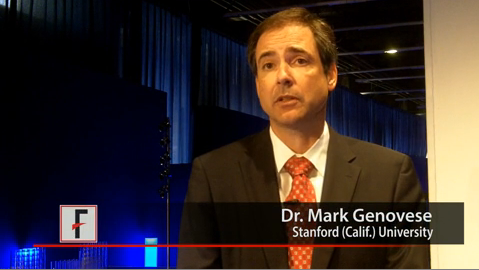
PARIS – Treatment with the interleukin-6–blocking drug sarilumab led to statistically significant and clinically meaningful improvements in patients with rheumatoid arthritis in a multicenter, placebo controlled, phase III trial with 1,197 patients.
The safety and efficacy results from the SARIL-RA-MOBILITY trial are the first outcomes from a panel of phase III studies of sarilumab in patients with rheumatoid arthritis, said Dr. Mark Genovese at the annual European Congress of Rheumatology. The results showed that treatment with sarilumab plus methotrexate led to less joint damage over time, compared with methotrexate plus placebo, a benefit that should result in patients feeling better, said Dr. Genovese, professor of medicine and co-chief of the division of immunology and rheumatology at Stanford (Calif.) University.
Sarilumab is the first agent to progress this far in testing from a novel class of immunosuppressive drugs that work by blocking interleukin-6. Having safe drugs from a new class available to treat patients with rheumatoid arthritis holds promise for better controlling this disease in patients who inadequately respond to existing drug options, Dr. Genovese said in a video interview.
The SARIL-RA-MOBILITY trial was sponsored by Sanofi and Regeneron, the companies developing the drug. Dr. Genovese said that he has been a consultant to and received research support from Sanofi. Several of the coauthors are employees of Sanofi or Regeneron.
The video associated with this article is no longer available on this site. Please view all of our videos on the MDedge YouTube channel
On Twitter @mitchelzoler
PARIS – Treatment with the interleukin-6–blocking drug sarilumab led to statistically significant and clinically meaningful improvements in patients with rheumatoid arthritis in a multicenter, placebo controlled, phase III trial with 1,197 patients.
The safety and efficacy results from the SARIL-RA-MOBILITY trial are the first outcomes from a panel of phase III studies of sarilumab in patients with rheumatoid arthritis, said Dr. Mark Genovese at the annual European Congress of Rheumatology. The results showed that treatment with sarilumab plus methotrexate led to less joint damage over time, compared with methotrexate plus placebo, a benefit that should result in patients feeling better, said Dr. Genovese, professor of medicine and co-chief of the division of immunology and rheumatology at Stanford (Calif.) University.
Sarilumab is the first agent to progress this far in testing from a novel class of immunosuppressive drugs that work by blocking interleukin-6. Having safe drugs from a new class available to treat patients with rheumatoid arthritis holds promise for better controlling this disease in patients who inadequately respond to existing drug options, Dr. Genovese said in a video interview.
The SARIL-RA-MOBILITY trial was sponsored by Sanofi and Regeneron, the companies developing the drug. Dr. Genovese said that he has been a consultant to and received research support from Sanofi. Several of the coauthors are employees of Sanofi or Regeneron.
The video associated with this article is no longer available on this site. Please view all of our videos on the MDedge YouTube channel
On Twitter @mitchelzoler
PARIS – Treatment with the interleukin-6–blocking drug sarilumab led to statistically significant and clinically meaningful improvements in patients with rheumatoid arthritis in a multicenter, placebo controlled, phase III trial with 1,197 patients.
The safety and efficacy results from the SARIL-RA-MOBILITY trial are the first outcomes from a panel of phase III studies of sarilumab in patients with rheumatoid arthritis, said Dr. Mark Genovese at the annual European Congress of Rheumatology. The results showed that treatment with sarilumab plus methotrexate led to less joint damage over time, compared with methotrexate plus placebo, a benefit that should result in patients feeling better, said Dr. Genovese, professor of medicine and co-chief of the division of immunology and rheumatology at Stanford (Calif.) University.
Sarilumab is the first agent to progress this far in testing from a novel class of immunosuppressive drugs that work by blocking interleukin-6. Having safe drugs from a new class available to treat patients with rheumatoid arthritis holds promise for better controlling this disease in patients who inadequately respond to existing drug options, Dr. Genovese said in a video interview.
The SARIL-RA-MOBILITY trial was sponsored by Sanofi and Regeneron, the companies developing the drug. Dr. Genovese said that he has been a consultant to and received research support from Sanofi. Several of the coauthors are employees of Sanofi or Regeneron.
The video associated with this article is no longer available on this site. Please view all of our videos on the MDedge YouTube channel
On Twitter @mitchelzoler
AT THE EULAR CONGRESS 2014
Physically demanding jobs link to worse ankylosing spondylitis progression
PARIS – Patients with ankylosing spondylitis who worked at more physically-demanding jobs showed greater radiographic progression than did patients who performed more sedentary jobs in a prospective cohort study with 136 patients.
The findings immediately raised questions about "our commonly given advice to patients with spondylarthritis to strenuously exercise. Should physically demanding labor be discouraged?" asked Dr. Sofia Ramiro at the annual European Congress of Rheumatology.

Dr. Ramiro stressed that the finding needs confirmation from studies in other cohorts of patients with ankylosing spondylitis (AS), but it raises the possibility that certain stresses and loads on the spine, from work or exercise, can worsen disease severity.
"If we can confirm that mechanical stress has an impact on radiographic progression, then I think we would have to analyze further and identify the type of activity having this impact, and then recommend the activity not be done," said Dr. Ramiro, a researcher at the Amsterdam Rheumatology Center, University of Amsterdam.
"I’m not saying that we would stop recommending exercise and that patients with AS should stay quiet at home, but perhaps we will advise against certain types of exercise," Dr. Ramiro said in an interview.
Dr. Ramiro and her associates previously reported this year that disease activity contributed longitudinally to radiographic AS progression during up to 12 years of follow-up (Ann. Rheum. Dis. 2014 [doi:10.1136/annrheumdis-2014-205178]). They further evaluated patients in the same cohort, 184 AS patients enrolled in OASIS (the Outcome in AS International Study), for additional factors that might affect radiographic progression either directly or indirectly. In addition to documenting a link between disease activity and radiographic progression, the report earlier this year had identified sex and disease duration as modifiers of the impact of disease activity. This impact on radiographic progression was greater in men, and early during the course of AS.
The new analysis looked for possible effects from smoking, and for chronic activity patterns using the surrogate marker of job type. The 184 patients in OASIS were sorted by their type of regular work, which identified 65 people with physically demanding (blue collar) jobs and 71 with relatively sedentary (white collar) jobs. The other 48 patients had either missing employment data or jobs with less clear links to activity levels, such as students or homemakers.

The findings showed that neither smoking nor job type appeared to have a direct influence on radiographic progression, but that smoking and a physically demanding job each had significant indirect effects. A physically demanding job linked with a 1.19-U increase in a measure of radiographic progression (the modified Stoke AS Spine Score, or mSASSS) for every 1-U increase in a measure of disease activity (the AS disease activity score, or ASDAS) during 2 years of follow-up, Dr. Ramiro reported. In contrast, the impact of a sedentary job was a 0.20-U rise in mSASSS for each 1-U rise in ASDAS. Smoking produced a 1.95-U rise in the mSASSS for each 1-U rise in ASDAS, significantly more than the 0.35 rate among nonsmokers.
Personal income, family income, and education each showed no statistically significant link with radiographic progression.
When the investigators analyzed job activity in subgroups divided by sex, they found that the relationship between a more physically demanding job and increased radiographic progression remained statistically significant in men, but the relationship was no longer significant in women.
The researchers could not include leisure activity or sports participation in their analysis as these data were not available. In addition, analysis by leisure activity may pose problems because baseline data on leisure activity may not extrapolate long-term, and patients can also have recall bias when reporting leisure activity, Dr. Ramiro said.
Dr. Ramiro said that she had no disclosures.
On Twitter @mitchelzoler
The relationships reported in this study between both job type and smoking and more extensive radiographic progression in patients with ankylosing spondylitis are probably true. This is not the first study of patients with ankylosing spondylitis to produce results that show these relationships, and the job-related effect is consistent with animal models of AS and the impact of chronic mechanical stress on progression.
Pain and other symptoms of AS improve with activity, but the findings by Dr. Ramiro as well as by others suggest that certain types of activity can worsen progression.
How this may apply to managing patients depends on the magnitude of the effect, and what options a patient might have. Many patients do not have a real choice about the work they do. In addition, we continue to advise patients to do what we consider therapeutic exercises, ideally 20-30 minutes daily. It is possible that therapeutic exercises could counterbalance the bad effects from work-related mechanical stress.
Dr. Martin Rudwaleit is a professor of rheumatology and nephrology at the Endokrinologikum in Berlin. He said that he has been a consultant to and has received honoraria from nine drug companies. He made these comments in an interview.
The relationships reported in this study between both job type and smoking and more extensive radiographic progression in patients with ankylosing spondylitis are probably true. This is not the first study of patients with ankylosing spondylitis to produce results that show these relationships, and the job-related effect is consistent with animal models of AS and the impact of chronic mechanical stress on progression.
Pain and other symptoms of AS improve with activity, but the findings by Dr. Ramiro as well as by others suggest that certain types of activity can worsen progression.
How this may apply to managing patients depends on the magnitude of the effect, and what options a patient might have. Many patients do not have a real choice about the work they do. In addition, we continue to advise patients to do what we consider therapeutic exercises, ideally 20-30 minutes daily. It is possible that therapeutic exercises could counterbalance the bad effects from work-related mechanical stress.
Dr. Martin Rudwaleit is a professor of rheumatology and nephrology at the Endokrinologikum in Berlin. He said that he has been a consultant to and has received honoraria from nine drug companies. He made these comments in an interview.
The relationships reported in this study between both job type and smoking and more extensive radiographic progression in patients with ankylosing spondylitis are probably true. This is not the first study of patients with ankylosing spondylitis to produce results that show these relationships, and the job-related effect is consistent with animal models of AS and the impact of chronic mechanical stress on progression.
Pain and other symptoms of AS improve with activity, but the findings by Dr. Ramiro as well as by others suggest that certain types of activity can worsen progression.
How this may apply to managing patients depends on the magnitude of the effect, and what options a patient might have. Many patients do not have a real choice about the work they do. In addition, we continue to advise patients to do what we consider therapeutic exercises, ideally 20-30 minutes daily. It is possible that therapeutic exercises could counterbalance the bad effects from work-related mechanical stress.
Dr. Martin Rudwaleit is a professor of rheumatology and nephrology at the Endokrinologikum in Berlin. He said that he has been a consultant to and has received honoraria from nine drug companies. He made these comments in an interview.
PARIS – Patients with ankylosing spondylitis who worked at more physically-demanding jobs showed greater radiographic progression than did patients who performed more sedentary jobs in a prospective cohort study with 136 patients.
The findings immediately raised questions about "our commonly given advice to patients with spondylarthritis to strenuously exercise. Should physically demanding labor be discouraged?" asked Dr. Sofia Ramiro at the annual European Congress of Rheumatology.
Dr. Ramiro stressed that the finding needs confirmation from studies in other cohorts of patients with ankylosing spondylitis (AS), but it raises the possibility that certain stresses and loads on the spine, from work or exercise, can worsen disease severity.
"If we can confirm that mechanical stress has an impact on radiographic progression, then I think we would have to analyze further and identify the type of activity having this impact, and then recommend the activity not be done," said Dr. Ramiro, a researcher at the Amsterdam Rheumatology Center, University of Amsterdam.
"I’m not saying that we would stop recommending exercise and that patients with AS should stay quiet at home, but perhaps we will advise against certain types of exercise," Dr. Ramiro said in an interview.
Dr. Ramiro and her associates previously reported this year that disease activity contributed longitudinally to radiographic AS progression during up to 12 years of follow-up (Ann. Rheum. Dis. 2014 [doi:10.1136/annrheumdis-2014-205178]). They further evaluated patients in the same cohort, 184 AS patients enrolled in OASIS (the Outcome in AS International Study), for additional factors that might affect radiographic progression either directly or indirectly. In addition to documenting a link between disease activity and radiographic progression, the report earlier this year had identified sex and disease duration as modifiers of the impact of disease activity. This impact on radiographic progression was greater in men, and early during the course of AS.
The new analysis looked for possible effects from smoking, and for chronic activity patterns using the surrogate marker of job type. The 184 patients in OASIS were sorted by their type of regular work, which identified 65 people with physically demanding (blue collar) jobs and 71 with relatively sedentary (white collar) jobs. The other 48 patients had either missing employment data or jobs with less clear links to activity levels, such as students or homemakers.
The findings showed that neither smoking nor job type appeared to have a direct influence on radiographic progression, but that smoking and a physically demanding job each had significant indirect effects. A physically demanding job linked with a 1.19-U increase in a measure of radiographic progression (the modified Stoke AS Spine Score, or mSASSS) for every 1-U increase in a measure of disease activity (the AS disease activity score, or ASDAS) during 2 years of follow-up, Dr. Ramiro reported. In contrast, the impact of a sedentary job was a 0.20-U rise in mSASSS for each 1-U rise in ASDAS. Smoking produced a 1.95-U rise in the mSASSS for each 1-U rise in ASDAS, significantly more than the 0.35 rate among nonsmokers.
Personal income, family income, and education each showed no statistically significant link with radiographic progression.
When the investigators analyzed job activity in subgroups divided by sex, they found that the relationship between a more physically demanding job and increased radiographic progression remained statistically significant in men, but the relationship was no longer significant in women.
The researchers could not include leisure activity or sports participation in their analysis as these data were not available. In addition, analysis by leisure activity may pose problems because baseline data on leisure activity may not extrapolate long-term, and patients can also have recall bias when reporting leisure activity, Dr. Ramiro said.
Dr. Ramiro said that she had no disclosures.
On Twitter @mitchelzoler
PARIS – Patients with ankylosing spondylitis who worked at more physically-demanding jobs showed greater radiographic progression than did patients who performed more sedentary jobs in a prospective cohort study with 136 patients.
The findings immediately raised questions about "our commonly given advice to patients with spondylarthritis to strenuously exercise. Should physically demanding labor be discouraged?" asked Dr. Sofia Ramiro at the annual European Congress of Rheumatology.
Dr. Ramiro stressed that the finding needs confirmation from studies in other cohorts of patients with ankylosing spondylitis (AS), but it raises the possibility that certain stresses and loads on the spine, from work or exercise, can worsen disease severity.
"If we can confirm that mechanical stress has an impact on radiographic progression, then I think we would have to analyze further and identify the type of activity having this impact, and then recommend the activity not be done," said Dr. Ramiro, a researcher at the Amsterdam Rheumatology Center, University of Amsterdam.
"I’m not saying that we would stop recommending exercise and that patients with AS should stay quiet at home, but perhaps we will advise against certain types of exercise," Dr. Ramiro said in an interview.
Dr. Ramiro and her associates previously reported this year that disease activity contributed longitudinally to radiographic AS progression during up to 12 years of follow-up (Ann. Rheum. Dis. 2014 [doi:10.1136/annrheumdis-2014-205178]). They further evaluated patients in the same cohort, 184 AS patients enrolled in OASIS (the Outcome in AS International Study), for additional factors that might affect radiographic progression either directly or indirectly. In addition to documenting a link between disease activity and radiographic progression, the report earlier this year had identified sex and disease duration as modifiers of the impact of disease activity. This impact on radiographic progression was greater in men, and early during the course of AS.
The new analysis looked for possible effects from smoking, and for chronic activity patterns using the surrogate marker of job type. The 184 patients in OASIS were sorted by their type of regular work, which identified 65 people with physically demanding (blue collar) jobs and 71 with relatively sedentary (white collar) jobs. The other 48 patients had either missing employment data or jobs with less clear links to activity levels, such as students or homemakers.
The findings showed that neither smoking nor job type appeared to have a direct influence on radiographic progression, but that smoking and a physically demanding job each had significant indirect effects. A physically demanding job linked with a 1.19-U increase in a measure of radiographic progression (the modified Stoke AS Spine Score, or mSASSS) for every 1-U increase in a measure of disease activity (the AS disease activity score, or ASDAS) during 2 years of follow-up, Dr. Ramiro reported. In contrast, the impact of a sedentary job was a 0.20-U rise in mSASSS for each 1-U rise in ASDAS. Smoking produced a 1.95-U rise in the mSASSS for each 1-U rise in ASDAS, significantly more than the 0.35 rate among nonsmokers.
Personal income, family income, and education each showed no statistically significant link with radiographic progression.
When the investigators analyzed job activity in subgroups divided by sex, they found that the relationship between a more physically demanding job and increased radiographic progression remained statistically significant in men, but the relationship was no longer significant in women.
The researchers could not include leisure activity or sports participation in their analysis as these data were not available. In addition, analysis by leisure activity may pose problems because baseline data on leisure activity may not extrapolate long-term, and patients can also have recall bias when reporting leisure activity, Dr. Ramiro said.
Dr. Ramiro said that she had no disclosures.
On Twitter @mitchelzoler
AT THE EULAR CONGRESS 2014
Key clinical point: Patients with AS who have more physically demanding jobs showed greater radiographic progression than did patients with more sedentary jobs.
Major finding: Physically demanding jobs linked with an average 1.19-U increase in mSASSS for every 1-U increase in ASDAS, compared with a 0.20-U increase in more sedentary patients.
Data source: Up to 12-year follow-up of a prospectively studied cohort with 136 evaluable patients.
Disclosures: Dr. Ramiro said that she had no disclosures.

Giant-cell arteritis patients face high aortic aneurysm dissection risk
PARIS – The usual rule that the larger an aortic aneurysm grows the greater the risk it will undergo dissection or rupture doesn’t work in patients with giant-cell arteritis. Their aortic aneurysms appear liable to dissect or rupture at any size after the diagnosis of giant-cell arteritis occurs, based on a retrospective study of 195 patients followed at a single U.S. center.
"Aortic size at diagnosis or last follow-up did not predict aortic dissection or rupture," Dr. Ashima Makol reported at the annual European Congress of Rheumatology, nor were linear, serial measurements of aortic size able to reliably predict risk for these complications in patients with GCA. Without a reliable way to identify patients with GCA at risk for dissection or rupture, the only management advice remaining is to follow GCA patients annually with imaging, said Dr. Makol, a rheumatologist at the Mayo Clinic in Rochester, Minn.

Positron emission tomography, CT angiography, or MR angiography seem to be the best ways to follow these patients, but if those are too costly to do annually, then transesophageal echocardiography or a chest x-ray are other options, Dr. Makol said in an interview.
Although 30% of patients with GCA have a vasculitis that involves the aorta and its branches and an increased risk for developing aortic aneurysms, the way these aneurysms change over time and the relationship between aneurysm size and the risk for dissection or rupture in GCA patients were not previously reported. To address this, Dr. Makol and her associates reviewed 195 patients with GCA and an aortic aneurysm seen at the Mayo Clinic during 2000-2012.
The aneurysms occurred in the ascending thoracic aorta in 161 patients (83%), the descending thoracic aorta in 21 (11%), and the abdominal aorta in the remaining 13 patients (7%). (Percentages total 101% because of rounding.) The patients averaged 74 years old, 62% were women, and 49% had a history of smoking.
During follow-up, 14 patients (7%) had an aneurysm dissection, and 1 patient (1%) had an aneurysm rupture, the investigators reported. All of the dissections and the rupture occurred in thoracic aorta aneurysms.
At the time of GCA diagnosis, the average aneurysm size in the 15 patients who developed an aneurysm complication was 51 mm, which was very similar to the average size of 49 mm in the 180 patients who did not have an aneurysm dissection or rupture during follow-up.
Patients also showed no clear link between aneurysm size at the time of dissection or rupture and the aneurysm size during follow-up of patients without these complications. The average maximum aneurysm diameter among the 15 patients with a complication at the time of their event was 54 mm, while the average aneurysm size at last follow-up among those without a dissection or rupture during follow-up was 50 mm, a difference that was not statistically significant, Dr. Makol said.
The average rate of aneurysm growth during 3 years of follow-up for all the GCA patients in the analysis was 1.59 mm/year, a rate "somewhat higher" than the average annual growth rate of 1 mm/year reported for aortic aneurysms in patients without inflammatory disease. The 54-mm average aneurysm diameter at the time of dissection or rupture in the CGA patients was "somewhat lower" than the 65-mm average aneurysm diameter seen at the time of dissection or rupture in patients without inflammatory disease, she noted.
Several patients in the series Dr. Makol reviewed who had no aneurysm complications had undergone prophylactic aneurysm repair. Clinicians at the Mayo Clinic follow the usual recommendations, which call for repair of aortic aneurysms when they reach at least 55 mm in diameter in men and 50 mm in women, and repair of thoracic aortic aneurysms that reach at least 55 mm in men and women. Prophylactic repair is also recommended for patients with an aneurysm that grows by more than 5 mm/year or causes symptoms. Many of the GCA patients included in the review therefore did not qualify for repair based on these criteria at the time of their GCA diagnosis or during follow-up. For now, no recommendations suggest that aortic aneurysms in patients in GCA need a different repair approach than patients without inflammatory disease.
The study is the first reported to look at the pattern of aneurysm growth and complications in GCA patients, although it is limited to the retrospective experience at one tertiary referral center and so may reflect a referral bias, Dr. Makol said. But the inability of the analysis to identify aneurysm characteristics in GCA patients that can telegraph an increased risk for complications means that all GCA patients with an aortic aneurysm need careful surveillance by annual imaging, she advised.
Dr. Makol said that she had no disclosures.
*6/24/14: This story was updated.
On Twitter @mitchelzoler
PARIS – The usual rule that the larger an aortic aneurysm grows the greater the risk it will undergo dissection or rupture doesn’t work in patients with giant-cell arteritis. Their aortic aneurysms appear liable to dissect or rupture at any size after the diagnosis of giant-cell arteritis occurs, based on a retrospective study of 195 patients followed at a single U.S. center.
"Aortic size at diagnosis or last follow-up did not predict aortic dissection or rupture," Dr. Ashima Makol reported at the annual European Congress of Rheumatology, nor were linear, serial measurements of aortic size able to reliably predict risk for these complications in patients with GCA. Without a reliable way to identify patients with GCA at risk for dissection or rupture, the only management advice remaining is to follow GCA patients annually with imaging, said Dr. Makol, a rheumatologist at the Mayo Clinic in Rochester, Minn.
Positron emission tomography, CT angiography, or MR angiography seem to be the best ways to follow these patients, but if those are too costly to do annually, then transesophageal echocardiography or a chest x-ray are other options, Dr. Makol said in an interview.
Although 30% of patients with GCA have a vasculitis that involves the aorta and its branches and an increased risk for developing aortic aneurysms, the way these aneurysms change over time and the relationship between aneurysm size and the risk for dissection or rupture in GCA patients were not previously reported. To address this, Dr. Makol and her associates reviewed 195 patients with GCA and an aortic aneurysm seen at the Mayo Clinic during 2000-2012.
The aneurysms occurred in the ascending thoracic aorta in 161 patients (83%), the descending thoracic aorta in 21 (11%), and the abdominal aorta in the remaining 13 patients (7%). (Percentages total 101% because of rounding.) The patients averaged 74 years old, 62% were women, and 49% had a history of smoking.
During follow-up, 14 patients (7%) had an aneurysm dissection, and 1 patient (1%) had an aneurysm rupture, the investigators reported. All of the dissections and the rupture occurred in thoracic aorta aneurysms.
At the time of GCA diagnosis, the average aneurysm size in the 15 patients who developed an aneurysm complication was 51 mm, which was very similar to the average size of 49 mm in the 180 patients who did not have an aneurysm dissection or rupture during follow-up.
Patients also showed no clear link between aneurysm size at the time of dissection or rupture and the aneurysm size during follow-up of patients without these complications. The average maximum aneurysm diameter among the 15 patients with a complication at the time of their event was 54 mm, while the average aneurysm size at last follow-up among those without a dissection or rupture during follow-up was 50 mm, a difference that was not statistically significant, Dr. Makol said.
The average rate of aneurysm growth during 3 years of follow-up for all the GCA patients in the analysis was 1.59 mm/year, a rate "somewhat higher" than the average annual growth rate of 1 mm/year reported for aortic aneurysms in patients without inflammatory disease. The 54-mm average aneurysm diameter at the time of dissection or rupture in the CGA patients was "somewhat lower" than the 65-mm average aneurysm diameter seen at the time of dissection or rupture in patients without inflammatory disease, she noted.
Several patients in the series Dr. Makol reviewed who had no aneurysm complications had undergone prophylactic aneurysm repair. Clinicians at the Mayo Clinic follow the usual recommendations, which call for repair of aortic aneurysms when they reach at least 55 mm in diameter in men and 50 mm in women, and repair of thoracic aortic aneurysms that reach at least 55 mm in men and women. Prophylactic repair is also recommended for patients with an aneurysm that grows by more than 5 mm/year or causes symptoms. Many of the GCA patients included in the review therefore did not qualify for repair based on these criteria at the time of their GCA diagnosis or during follow-up. For now, no recommendations suggest that aortic aneurysms in patients in GCA need a different repair approach than patients without inflammatory disease.
The study is the first reported to look at the pattern of aneurysm growth and complications in GCA patients, although it is limited to the retrospective experience at one tertiary referral center and so may reflect a referral bias, Dr. Makol said. But the inability of the analysis to identify aneurysm characteristics in GCA patients that can telegraph an increased risk for complications means that all GCA patients with an aortic aneurysm need careful surveillance by annual imaging, she advised.
Dr. Makol said that she had no disclosures.
*6/24/14: This story was updated.
On Twitter @mitchelzoler
PARIS – The usual rule that the larger an aortic aneurysm grows the greater the risk it will undergo dissection or rupture doesn’t work in patients with giant-cell arteritis. Their aortic aneurysms appear liable to dissect or rupture at any size after the diagnosis of giant-cell arteritis occurs, based on a retrospective study of 195 patients followed at a single U.S. center.
"Aortic size at diagnosis or last follow-up did not predict aortic dissection or rupture," Dr. Ashima Makol reported at the annual European Congress of Rheumatology, nor were linear, serial measurements of aortic size able to reliably predict risk for these complications in patients with GCA. Without a reliable way to identify patients with GCA at risk for dissection or rupture, the only management advice remaining is to follow GCA patients annually with imaging, said Dr. Makol, a rheumatologist at the Mayo Clinic in Rochester, Minn.
Positron emission tomography, CT angiography, or MR angiography seem to be the best ways to follow these patients, but if those are too costly to do annually, then transesophageal echocardiography or a chest x-ray are other options, Dr. Makol said in an interview.
Although 30% of patients with GCA have a vasculitis that involves the aorta and its branches and an increased risk for developing aortic aneurysms, the way these aneurysms change over time and the relationship between aneurysm size and the risk for dissection or rupture in GCA patients were not previously reported. To address this, Dr. Makol and her associates reviewed 195 patients with GCA and an aortic aneurysm seen at the Mayo Clinic during 2000-2012.
The aneurysms occurred in the ascending thoracic aorta in 161 patients (83%), the descending thoracic aorta in 21 (11%), and the abdominal aorta in the remaining 13 patients (7%). (Percentages total 101% because of rounding.) The patients averaged 74 years old, 62% were women, and 49% had a history of smoking.
During follow-up, 14 patients (7%) had an aneurysm dissection, and 1 patient (1%) had an aneurysm rupture, the investigators reported. All of the dissections and the rupture occurred in thoracic aorta aneurysms.
At the time of GCA diagnosis, the average aneurysm size in the 15 patients who developed an aneurysm complication was 51 mm, which was very similar to the average size of 49 mm in the 180 patients who did not have an aneurysm dissection or rupture during follow-up.
Patients also showed no clear link between aneurysm size at the time of dissection or rupture and the aneurysm size during follow-up of patients without these complications. The average maximum aneurysm diameter among the 15 patients with a complication at the time of their event was 54 mm, while the average aneurysm size at last follow-up among those without a dissection or rupture during follow-up was 50 mm, a difference that was not statistically significant, Dr. Makol said.
The average rate of aneurysm growth during 3 years of follow-up for all the GCA patients in the analysis was 1.59 mm/year, a rate "somewhat higher" than the average annual growth rate of 1 mm/year reported for aortic aneurysms in patients without inflammatory disease. The 54-mm average aneurysm diameter at the time of dissection or rupture in the CGA patients was "somewhat lower" than the 65-mm average aneurysm diameter seen at the time of dissection or rupture in patients without inflammatory disease, she noted.
Several patients in the series Dr. Makol reviewed who had no aneurysm complications had undergone prophylactic aneurysm repair. Clinicians at the Mayo Clinic follow the usual recommendations, which call for repair of aortic aneurysms when they reach at least 55 mm in diameter in men and 50 mm in women, and repair of thoracic aortic aneurysms that reach at least 55 mm in men and women. Prophylactic repair is also recommended for patients with an aneurysm that grows by more than 5 mm/year or causes symptoms. Many of the GCA patients included in the review therefore did not qualify for repair based on these criteria at the time of their GCA diagnosis or during follow-up. For now, no recommendations suggest that aortic aneurysms in patients in GCA need a different repair approach than patients without inflammatory disease.
The study is the first reported to look at the pattern of aneurysm growth and complications in GCA patients, although it is limited to the retrospective experience at one tertiary referral center and so may reflect a referral bias, Dr. Makol said. But the inability of the analysis to identify aneurysm characteristics in GCA patients that can telegraph an increased risk for complications means that all GCA patients with an aortic aneurysm need careful surveillance by annual imaging, she advised.
Dr. Makol said that she had no disclosures.
*6/24/14: This story was updated.
On Twitter @mitchelzoler
AT THE EULAR CONGRESS 2014
Key clinical point: Risk for aortic aneurysm dissection in patients with giant-cell arteritis showed no link to aneurysm size.
Major finding: GCA patients with dissection or rupture of an aortic aneurysm had aneurysms that were similar in size to those of GCA patients without these complications.
Data source: Retrospective study of 195 patients with GCA at one U.S. center.
Disclosures: Dr. Makol said that she had no disclosures.