User login
VIDEO: Emory’s medical director offers advice on managing an Ebola patient
PHILADELPHIA – How would your hospital handle an Ebola patient? Ask Dr. Bruce Ribner.
At ID Week 2014 in Philadelphia, Dr. Ribner, medical director of Emory University Hospital’s serious communicable diseases unit in Atlanta, gave a detailed account of his hospital’s management of the first two American patients treated at Emory after contracting the disease while working in Africa.
PHILADELPHIA – How would your hospital handle an Ebola patient? Ask Dr. Bruce Ribner.
At ID Week 2014 in Philadelphia, Dr. Ribner, medical director of Emory University Hospital’s serious communicable diseases unit in Atlanta, gave a detailed account of his hospital’s management of the first two American patients treated at Emory after contracting the disease while working in Africa.
PHILADELPHIA – How would your hospital handle an Ebola patient? Ask Dr. Bruce Ribner.
At ID Week 2014 in Philadelphia, Dr. Ribner, medical director of Emory University Hospital’s serious communicable diseases unit in Atlanta, gave a detailed account of his hospital’s management of the first two American patients treated at Emory after contracting the disease while working in Africa.
AT ID WEEK 2014

VIDEO: How red hair and freckles might raise your skin cancer risk
EDINBURGH – Variants in the pigment-associated MC1R gene have been implicated in an increased risk for melanoma and nonmelanoma skin cancers, although the extent of that risk has been inconsistent across studies, according to Dr. Eugene Healy of the University of Southampton (England). In an interview at the 15th World Congress on Cancers of the Skin sponsored by the Skin Cancer Foundation, Dr. Healy discussed how the MC1R gene variants might impact skin cancer risk and the challenges of pinning down genetic data into practical applications for patients.
The video associated with this article is no longer available on this site. Please view all of our videos on the MDedge YouTube channel
EDINBURGH – Variants in the pigment-associated MC1R gene have been implicated in an increased risk for melanoma and nonmelanoma skin cancers, although the extent of that risk has been inconsistent across studies, according to Dr. Eugene Healy of the University of Southampton (England). In an interview at the 15th World Congress on Cancers of the Skin sponsored by the Skin Cancer Foundation, Dr. Healy discussed how the MC1R gene variants might impact skin cancer risk and the challenges of pinning down genetic data into practical applications for patients.
The video associated with this article is no longer available on this site. Please view all of our videos on the MDedge YouTube channel
EDINBURGH – Variants in the pigment-associated MC1R gene have been implicated in an increased risk for melanoma and nonmelanoma skin cancers, although the extent of that risk has been inconsistent across studies, according to Dr. Eugene Healy of the University of Southampton (England). In an interview at the 15th World Congress on Cancers of the Skin sponsored by the Skin Cancer Foundation, Dr. Healy discussed how the MC1R gene variants might impact skin cancer risk and the challenges of pinning down genetic data into practical applications for patients.
The video associated with this article is no longer available on this site. Please view all of our videos on the MDedge YouTube channel
EXPERT ANALYSIS FROM WCCS 2014

VIDEO: What to do when cancer patients say they want to die
EDINBURGH – When your patient says he or she wants to die, what do you do?
There’s no single answer, but asking the right questions can help patients find peace as well as perspective, according to Dr. Ilora Finlay, who spoke at the 15th World Congress on Cancers of the Skin about the types of conversations and seemingly small actions that can make a big difference for patients coping with advanced cancer.
In an interview at the meeting, Dr. Finlay shared some of her expertise from decades of clinical experience in palliative care.
The congress was sponsored by the Skin Cancer Foundation.
The video associated with this article is no longer available on this site. Please view all of our videos on the MDedge YouTube channel
EDINBURGH – When your patient says he or she wants to die, what do you do?
There’s no single answer, but asking the right questions can help patients find peace as well as perspective, according to Dr. Ilora Finlay, who spoke at the 15th World Congress on Cancers of the Skin about the types of conversations and seemingly small actions that can make a big difference for patients coping with advanced cancer.
In an interview at the meeting, Dr. Finlay shared some of her expertise from decades of clinical experience in palliative care.
The congress was sponsored by the Skin Cancer Foundation.
The video associated with this article is no longer available on this site. Please view all of our videos on the MDedge YouTube channel
EDINBURGH – When your patient says he or she wants to die, what do you do?
There’s no single answer, but asking the right questions can help patients find peace as well as perspective, according to Dr. Ilora Finlay, who spoke at the 15th World Congress on Cancers of the Skin about the types of conversations and seemingly small actions that can make a big difference for patients coping with advanced cancer.
In an interview at the meeting, Dr. Finlay shared some of her expertise from decades of clinical experience in palliative care.
The congress was sponsored by the Skin Cancer Foundation.
The video associated with this article is no longer available on this site. Please view all of our videos on the MDedge YouTube channel
EXPERT ANALYSIS FROM WCCS 2014
Health experts push flu vaccination for patients and providers
WASHINGTON – The best way to fight the flu is to “get a flu shot this year and every year,” said Dr. Thomas Frieden.
Last year was a bad year, especially for adults aged 18-64 years, who had their highest rate of flu-related hospitalizations since the 2009 pandemic, Dr. Frieden, director of the Centers for Disease Control and Prevention, Atlanta, said at a recent press conference sponsored by the National Foundation for Infectious Diseases.
Approximately 150 million doses of flu vaccine are expected to be available this season, and there should be plenty to go around, he emphasized.
The CDC has a three-pronged message for patients and health care providers: Get vaccinated, stay home if you are sick, and take medications if they are prescribed.
Overall vaccination coverage of the U.S. population aged 6 months and older was 46% in 2013-2014, which was a slight increase from the previous year. The upward trend is encouraging, Dr. Frieden said, especially the 65% of adults aged 65 and older and 70% of children aged 6 months to 5 years who received flu vaccination last year, but there is certainly room for improvement.
Fortunately, there are more flu vaccine options, and places to get them, than ever before, said Dr. William Schaffner, professor and chairman of the department of preventive medicine at Vanderbilt University, Nashville, past president of the NFID. Choices include the traditional intramuscular shot, an intradermal version with a smaller needle, nasal spray, an egg-free vaccine, and a high-dose vaccine especially for adults aged 65 and older, he said.
This year, for the first time, the CDC recommends the nasal spray as the preferred flu vaccination method for children aged 2-8 years if they have no contraindications, said Dr. Paul A. Offit, chief of the division of infectious diseases and director of the vaccine education center of the Children’s Hospital of Philadelphia. Parents, however, should not postpone vaccinating their children with a different vaccine if the spray is not available, since all are effective, he said.
Although flu vaccination rates in children are up, coverage of pregnant women held steady, said Dr. Laura E. Riley, medical director of labor and delivery in the obstetrics service of Massachusetts General Hospital, Boston.
Vaccination coverage among pregnant women during the 2013-2014 flu season was 52%, only a slight increase from 51% the previous year. Coverage rates varied by age: 46% for pregnant women aged 18-24 years, 57% for those aged 24-34 years, and 53% for those aged 35-49 years.
Numerous studies have shown that the flu shot is safe during all trimesters, although the nasal spray is not recommended for pregnant women, Dr. Riley noted. Employ each doctor visit as an opportunity to offer and recommend flu vaccination. “A strong recommendation” from a health care provider has been significantly associated with increased vaccination across all demographic groups of pregnant women, she said.
Health care personnel seem to be getting the message about flu vaccination, said Dr. Schaffner. Overall, 75% of health care personnel received a flu vaccine last year, including 92% of physicians and 90% of nurses.
He exhorted health care workers to keep the trend going and to get vaccinated for their patients’ health, as well as their own.
“Immunization of health care personnel is, first and foremost, a patient safety issue,” he said.
Complete data on vaccination coverage in health care workers and patient populations were published in the CDC’s Morbidity and Mortality Weekly Report on Sept. 19 (MMWR 2014;63:805-11). Data on flu vaccine coverage in the U.S. population are available online.
WASHINGTON – The best way to fight the flu is to “get a flu shot this year and every year,” said Dr. Thomas Frieden.
Last year was a bad year, especially for adults aged 18-64 years, who had their highest rate of flu-related hospitalizations since the 2009 pandemic, Dr. Frieden, director of the Centers for Disease Control and Prevention, Atlanta, said at a recent press conference sponsored by the National Foundation for Infectious Diseases.
Approximately 150 million doses of flu vaccine are expected to be available this season, and there should be plenty to go around, he emphasized.
The CDC has a three-pronged message for patients and health care providers: Get vaccinated, stay home if you are sick, and take medications if they are prescribed.
Overall vaccination coverage of the U.S. population aged 6 months and older was 46% in 2013-2014, which was a slight increase from the previous year. The upward trend is encouraging, Dr. Frieden said, especially the 65% of adults aged 65 and older and 70% of children aged 6 months to 5 years who received flu vaccination last year, but there is certainly room for improvement.
Fortunately, there are more flu vaccine options, and places to get them, than ever before, said Dr. William Schaffner, professor and chairman of the department of preventive medicine at Vanderbilt University, Nashville, past president of the NFID. Choices include the traditional intramuscular shot, an intradermal version with a smaller needle, nasal spray, an egg-free vaccine, and a high-dose vaccine especially for adults aged 65 and older, he said.
This year, for the first time, the CDC recommends the nasal spray as the preferred flu vaccination method for children aged 2-8 years if they have no contraindications, said Dr. Paul A. Offit, chief of the division of infectious diseases and director of the vaccine education center of the Children’s Hospital of Philadelphia. Parents, however, should not postpone vaccinating their children with a different vaccine if the spray is not available, since all are effective, he said.
Although flu vaccination rates in children are up, coverage of pregnant women held steady, said Dr. Laura E. Riley, medical director of labor and delivery in the obstetrics service of Massachusetts General Hospital, Boston.
Vaccination coverage among pregnant women during the 2013-2014 flu season was 52%, only a slight increase from 51% the previous year. Coverage rates varied by age: 46% for pregnant women aged 18-24 years, 57% for those aged 24-34 years, and 53% for those aged 35-49 years.
Numerous studies have shown that the flu shot is safe during all trimesters, although the nasal spray is not recommended for pregnant women, Dr. Riley noted. Employ each doctor visit as an opportunity to offer and recommend flu vaccination. “A strong recommendation” from a health care provider has been significantly associated with increased vaccination across all demographic groups of pregnant women, she said.
Health care personnel seem to be getting the message about flu vaccination, said Dr. Schaffner. Overall, 75% of health care personnel received a flu vaccine last year, including 92% of physicians and 90% of nurses.
He exhorted health care workers to keep the trend going and to get vaccinated for their patients’ health, as well as their own.
“Immunization of health care personnel is, first and foremost, a patient safety issue,” he said.
Complete data on vaccination coverage in health care workers and patient populations were published in the CDC’s Morbidity and Mortality Weekly Report on Sept. 19 (MMWR 2014;63:805-11). Data on flu vaccine coverage in the U.S. population are available online.
WASHINGTON – The best way to fight the flu is to “get a flu shot this year and every year,” said Dr. Thomas Frieden.
Last year was a bad year, especially for adults aged 18-64 years, who had their highest rate of flu-related hospitalizations since the 2009 pandemic, Dr. Frieden, director of the Centers for Disease Control and Prevention, Atlanta, said at a recent press conference sponsored by the National Foundation for Infectious Diseases.
Approximately 150 million doses of flu vaccine are expected to be available this season, and there should be plenty to go around, he emphasized.
The CDC has a three-pronged message for patients and health care providers: Get vaccinated, stay home if you are sick, and take medications if they are prescribed.
Overall vaccination coverage of the U.S. population aged 6 months and older was 46% in 2013-2014, which was a slight increase from the previous year. The upward trend is encouraging, Dr. Frieden said, especially the 65% of adults aged 65 and older and 70% of children aged 6 months to 5 years who received flu vaccination last year, but there is certainly room for improvement.
Fortunately, there are more flu vaccine options, and places to get them, than ever before, said Dr. William Schaffner, professor and chairman of the department of preventive medicine at Vanderbilt University, Nashville, past president of the NFID. Choices include the traditional intramuscular shot, an intradermal version with a smaller needle, nasal spray, an egg-free vaccine, and a high-dose vaccine especially for adults aged 65 and older, he said.
This year, for the first time, the CDC recommends the nasal spray as the preferred flu vaccination method for children aged 2-8 years if they have no contraindications, said Dr. Paul A. Offit, chief of the division of infectious diseases and director of the vaccine education center of the Children’s Hospital of Philadelphia. Parents, however, should not postpone vaccinating their children with a different vaccine if the spray is not available, since all are effective, he said.
Although flu vaccination rates in children are up, coverage of pregnant women held steady, said Dr. Laura E. Riley, medical director of labor and delivery in the obstetrics service of Massachusetts General Hospital, Boston.
Vaccination coverage among pregnant women during the 2013-2014 flu season was 52%, only a slight increase from 51% the previous year. Coverage rates varied by age: 46% for pregnant women aged 18-24 years, 57% for those aged 24-34 years, and 53% for those aged 35-49 years.
Numerous studies have shown that the flu shot is safe during all trimesters, although the nasal spray is not recommended for pregnant women, Dr. Riley noted. Employ each doctor visit as an opportunity to offer and recommend flu vaccination. “A strong recommendation” from a health care provider has been significantly associated with increased vaccination across all demographic groups of pregnant women, she said.
Health care personnel seem to be getting the message about flu vaccination, said Dr. Schaffner. Overall, 75% of health care personnel received a flu vaccine last year, including 92% of physicians and 90% of nurses.
He exhorted health care workers to keep the trend going and to get vaccinated for their patients’ health, as well as their own.
“Immunization of health care personnel is, first and foremost, a patient safety issue,” he said.
Complete data on vaccination coverage in health care workers and patient populations were published in the CDC’s Morbidity and Mortality Weekly Report on Sept. 19 (MMWR 2014;63:805-11). Data on flu vaccine coverage in the U.S. population are available online.
VIDEO: Experts offer top tips for flu season 2014-2015
WASHINGTON – Options and opportunity are the keys to navigating the 2014-2015 flu season, according to a panel of experts at a press conference sponsored by the National Foundation for Infectious Diseases.
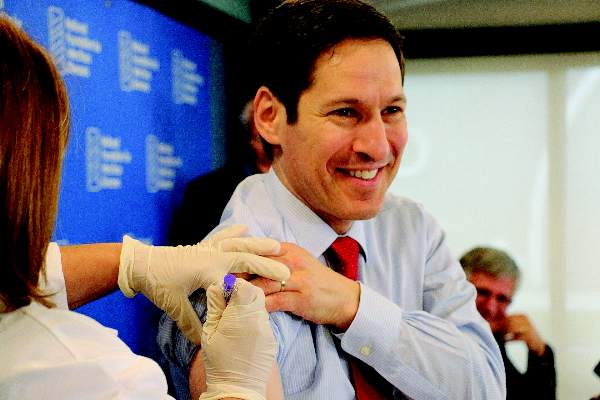
“The easier we make it for people to get vaccinated, the more likely they are to get vaccinated,” said CDC Director Thomas Frieden, who received his flu shot at the press conference.
In interviews at the conference, Dr. Frieden, Dr. Paul A. Offit of the Children’s Hospital of Philadelphia; Dr. Laura E. Riley of Massachusetts General Hospital, Boston; and Dr. William Schaffner of Vanderbilt University, Nashville, Tenn., discussed making the most of opportunities to vaccinate patients, offering reassurance about vaccine safety (especially for pregnant women), setting an example in your practice by getting vaccinated yourself, and ensuring that everyone who works in your office receives a flu vaccine as well.
The video associated with this article is no longer available on this site. Please view all of our videos on the MDedge YouTube channel
The video associated with this article is no longer available on this site. Please view all of our videos on the MDedge YouTube channel
The video associated with this article is no longer available on this site. Please view all of our videos on the MDedge YouTube channel
The video associated with this article is no longer available on this site. Please view all of our videos on the MDedge YouTube channel
WASHINGTON – Options and opportunity are the keys to navigating the 2014-2015 flu season, according to a panel of experts at a press conference sponsored by the National Foundation for Infectious Diseases.
“The easier we make it for people to get vaccinated, the more likely they are to get vaccinated,” said CDC Director Thomas Frieden, who received his flu shot at the press conference.
In interviews at the conference, Dr. Frieden, Dr. Paul A. Offit of the Children’s Hospital of Philadelphia; Dr. Laura E. Riley of Massachusetts General Hospital, Boston; and Dr. William Schaffner of Vanderbilt University, Nashville, Tenn., discussed making the most of opportunities to vaccinate patients, offering reassurance about vaccine safety (especially for pregnant women), setting an example in your practice by getting vaccinated yourself, and ensuring that everyone who works in your office receives a flu vaccine as well.
The video associated with this article is no longer available on this site. Please view all of our videos on the MDedge YouTube channel
The video associated with this article is no longer available on this site. Please view all of our videos on the MDedge YouTube channel
The video associated with this article is no longer available on this site. Please view all of our videos on the MDedge YouTube channel
The video associated with this article is no longer available on this site. Please view all of our videos on the MDedge YouTube channel
WASHINGTON – Options and opportunity are the keys to navigating the 2014-2015 flu season, according to a panel of experts at a press conference sponsored by the National Foundation for Infectious Diseases.
“The easier we make it for people to get vaccinated, the more likely they are to get vaccinated,” said CDC Director Thomas Frieden, who received his flu shot at the press conference.
In interviews at the conference, Dr. Frieden, Dr. Paul A. Offit of the Children’s Hospital of Philadelphia; Dr. Laura E. Riley of Massachusetts General Hospital, Boston; and Dr. William Schaffner of Vanderbilt University, Nashville, Tenn., discussed making the most of opportunities to vaccinate patients, offering reassurance about vaccine safety (especially for pregnant women), setting an example in your practice by getting vaccinated yourself, and ensuring that everyone who works in your office receives a flu vaccine as well.
The video associated with this article is no longer available on this site. Please view all of our videos on the MDedge YouTube channel
The video associated with this article is no longer available on this site. Please view all of our videos on the MDedge YouTube channel
The video associated with this article is no longer available on this site. Please view all of our videos on the MDedge YouTube channel
The video associated with this article is no longer available on this site. Please view all of our videos on the MDedge YouTube channel

VIDEO: German screening initiative catches skin cancer sooner
EDINBURGH – Is population screening for skin cancer worthwhile?
Yes, Dr. Eckhard Breitbart said in a debate at the 15th World Congress on Cancers of the Skin. "Screening is not a diagnostic procedure," he noted. But the potential benefits of screening, including a significant reduction in medical costs, outweigh the potential harms related to false negative or false positive findings, added Dr. Breitbart, a dermatologist in Hamburg, Germany.
In an interview at the meeting, Dr. Breitbart reviewed the findings from his study of the impact of a population-based skin cancer screening program in Germany, and he discussed what research is needed to support such screening elsewhere.
The video associated with this article is no longer available on this site. Please view all of our videos on the MDedge YouTube channel
EDINBURGH – Is population screening for skin cancer worthwhile?
Yes, Dr. Eckhard Breitbart said in a debate at the 15th World Congress on Cancers of the Skin. "Screening is not a diagnostic procedure," he noted. But the potential benefits of screening, including a significant reduction in medical costs, outweigh the potential harms related to false negative or false positive findings, added Dr. Breitbart, a dermatologist in Hamburg, Germany.
In an interview at the meeting, Dr. Breitbart reviewed the findings from his study of the impact of a population-based skin cancer screening program in Germany, and he discussed what research is needed to support such screening elsewhere.
The video associated with this article is no longer available on this site. Please view all of our videos on the MDedge YouTube channel
EDINBURGH – Is population screening for skin cancer worthwhile?
Yes, Dr. Eckhard Breitbart said in a debate at the 15th World Congress on Cancers of the Skin. "Screening is not a diagnostic procedure," he noted. But the potential benefits of screening, including a significant reduction in medical costs, outweigh the potential harms related to false negative or false positive findings, added Dr. Breitbart, a dermatologist in Hamburg, Germany.
In an interview at the meeting, Dr. Breitbart reviewed the findings from his study of the impact of a population-based skin cancer screening program in Germany, and he discussed what research is needed to support such screening elsewhere.
The video associated with this article is no longer available on this site. Please view all of our videos on the MDedge YouTube channel
FROM THE 2014 WORLD CONGRESS ON CANCERS OF THE SKINS

VIDEO: What’s your UV risk today? There’s an app for that
EDINBURGH – How would you like a smartphone app that offers a personalized sun protection strategy based on location and skin type?
At the 15th World Congress on Cancers of the Skin, Nina Goad, head of communications for the British Association of Dermatologists, discussed an app that does just that: the World UV App. The app, developed by the British Association of Dermatologists, provides daily UV forecasts based on an individual’s location via a smartphone or tablet. In addition, the app fine-tunes UV risk according to skin type.
In a video interview at the meeting, Ms. Goad discussed the app’s development and how patients can use it to improve their approach to sun protection.
The video associated with this article is no longer available on this site. Please view all of our videos on the MDedge YouTube channel
EDINBURGH – How would you like a smartphone app that offers a personalized sun protection strategy based on location and skin type?
At the 15th World Congress on Cancers of the Skin, Nina Goad, head of communications for the British Association of Dermatologists, discussed an app that does just that: the World UV App. The app, developed by the British Association of Dermatologists, provides daily UV forecasts based on an individual’s location via a smartphone or tablet. In addition, the app fine-tunes UV risk according to skin type.
In a video interview at the meeting, Ms. Goad discussed the app’s development and how patients can use it to improve their approach to sun protection.
The video associated with this article is no longer available on this site. Please view all of our videos on the MDedge YouTube channel
EDINBURGH – How would you like a smartphone app that offers a personalized sun protection strategy based on location and skin type?
At the 15th World Congress on Cancers of the Skin, Nina Goad, head of communications for the British Association of Dermatologists, discussed an app that does just that: the World UV App. The app, developed by the British Association of Dermatologists, provides daily UV forecasts based on an individual’s location via a smartphone or tablet. In addition, the app fine-tunes UV risk according to skin type.
In a video interview at the meeting, Ms. Goad discussed the app’s development and how patients can use it to improve their approach to sun protection.
The video associated with this article is no longer available on this site. Please view all of our videos on the MDedge YouTube channel
FROM THE 2014 WORLD CONGRESS ON CANCERS OF THE SKINS
What do the guidelines say?
Atopic dermatitis remains a challenging condition.
The 2014 guidelines of care for the management of atopic dermatitis (AD) are being published by the American Academy of Dermatology in a series of four parts. Each part begins with a disclaimer stating that, "the ultimate judgment regarding the propriety of any specific therapy must be made by the physician and the patient in light of all the circumstances presented by the individual patient and the known variability and biologic behavior of the disease." The disclaimer continues, "This guideline reflects the best available data at the time the guideline was prepared. The results of future studies may require revisions to the recommendations in this guideline to reflect new data."
• Section 1: Diagnosis and assessment of atopic dermatitis. This section includes risk factors for the development of AD, diagnostic and monitoring techniques, assessment and outcomes, and clinical associations in AD patients (J. Am. Acad. Dermatol. 2014;70:338-51).
• Section 2: Management and treatment of atopic dermatitis with topical therapies. This section focuses on recommendations for the use of nonpharmacologic and topical therapies in the management of AD (J. Am. Acad. Dermatol. 2014;71:116-32).
• Section 3: Management and treatment with phototherapy and systemic agents. This section reviews indications for the use of phototherapy and systemic immunomodulators for treating AD, including side-effect profiles and clinical considerations for treating children (J. Am. Acad. Dermatol. 2014;71:327-49).
• Section 4: The fourth and final section of the guidelines is expected to be published in the September 2014 issue of the Journal of the American Academy of Dermatology.
No outside funding sources were involved in the creation of the guidelines. Disclosures of members of the guidelines committee are available following full text of each guidelines section in print and online.
Atopic dermatitis remains a challenging condition.
The 2014 guidelines of care for the management of atopic dermatitis (AD) are being published by the American Academy of Dermatology in a series of four parts. Each part begins with a disclaimer stating that, "the ultimate judgment regarding the propriety of any specific therapy must be made by the physician and the patient in light of all the circumstances presented by the individual patient and the known variability and biologic behavior of the disease." The disclaimer continues, "This guideline reflects the best available data at the time the guideline was prepared. The results of future studies may require revisions to the recommendations in this guideline to reflect new data."
• Section 1: Diagnosis and assessment of atopic dermatitis. This section includes risk factors for the development of AD, diagnostic and monitoring techniques, assessment and outcomes, and clinical associations in AD patients (J. Am. Acad. Dermatol. 2014;70:338-51).
• Section 2: Management and treatment of atopic dermatitis with topical therapies. This section focuses on recommendations for the use of nonpharmacologic and topical therapies in the management of AD (J. Am. Acad. Dermatol. 2014;71:116-32).
• Section 3: Management and treatment with phototherapy and systemic agents. This section reviews indications for the use of phototherapy and systemic immunomodulators for treating AD, including side-effect profiles and clinical considerations for treating children (J. Am. Acad. Dermatol. 2014;71:327-49).
• Section 4: The fourth and final section of the guidelines is expected to be published in the September 2014 issue of the Journal of the American Academy of Dermatology.
No outside funding sources were involved in the creation of the guidelines. Disclosures of members of the guidelines committee are available following full text of each guidelines section in print and online.
Atopic dermatitis remains a challenging condition.
The 2014 guidelines of care for the management of atopic dermatitis (AD) are being published by the American Academy of Dermatology in a series of four parts. Each part begins with a disclaimer stating that, "the ultimate judgment regarding the propriety of any specific therapy must be made by the physician and the patient in light of all the circumstances presented by the individual patient and the known variability and biologic behavior of the disease." The disclaimer continues, "This guideline reflects the best available data at the time the guideline was prepared. The results of future studies may require revisions to the recommendations in this guideline to reflect new data."
• Section 1: Diagnosis and assessment of atopic dermatitis. This section includes risk factors for the development of AD, diagnostic and monitoring techniques, assessment and outcomes, and clinical associations in AD patients (J. Am. Acad. Dermatol. 2014;70:338-51).
• Section 2: Management and treatment of atopic dermatitis with topical therapies. This section focuses on recommendations for the use of nonpharmacologic and topical therapies in the management of AD (J. Am. Acad. Dermatol. 2014;71:116-32).
• Section 3: Management and treatment with phototherapy and systemic agents. This section reviews indications for the use of phototherapy and systemic immunomodulators for treating AD, including side-effect profiles and clinical considerations for treating children (J. Am. Acad. Dermatol. 2014;71:327-49).
• Section 4: The fourth and final section of the guidelines is expected to be published in the September 2014 issue of the Journal of the American Academy of Dermatology.
No outside funding sources were involved in the creation of the guidelines. Disclosures of members of the guidelines committee are available following full text of each guidelines section in print and online.
FROM THE JOURNAL OF THE AMERICAN ACADEMY OF DERMATOLOGY
Adding ingenol mebutate after cryosurgery enhances clearance of actinic keratoses
Complete clearance occurred at 12 months in 31% of patients who received field treatment with ingenol mebutate gel after cryotherapy for actinic keratoses, compared with 19% of placebo patients in a phase III trial.
The findings were published in the June issue of the Journal of Drugs in Dermatology.
Recurrence rates for AKs treated with cryotherapy alone are high, possibly because the treatment is lesion-directed and fails to address field cancerization, wrote Dr. Brian Berman of the University of Miami.
The FIELD study 1, a phase III, multicenter, randomized trial, showed that ingenol mebutate gel was safe and effective as a follow-up to cryosurgery for AKs. Short-term efficacy data (11 weeks) have been previously reported.
In this study, the patients were followed for 12 months (J. Drugs Dermatol. 2014;13:741-7).

"In phase III clinical trials, 2 or 3 days of field-directed therapy with ingenol mebutate demonstrated high and sustained clearance of AKs on the head and body, and was well tolerated," noted Dr. Berman and his coauthors.
The percentage reduction in the number of AKs was significantly higher at 12 months in the treatment group compared with the placebo group (68% vs. 54%), and significantly fewer patients in the treatment group developed new lesions in the treatment area compared with the placebo group (39% vs. 52%). In addition, the probability of sustained clearance of AKs at 12 months was 55% in the treatment group vs. 40% in the placebo group.
The study included 329 adults aged 18 years and older with 4-8 clinically typical, visible, and discrete AKs within a 25-cm2 treatment area on the face or scalp. The patients underwent cryosurgery, and 3 weeks later underwent field therapy with 0.015% ingenol mebutate gel or vehicle gel once a day for 3 consecutive days. Patients with suspected basal cell carcinoma or squamous cell carcinoma were excluded.
The findings were limited by the possible unblinding of treatment because of localized skin reactions, the researchers noted. However, few drug-related adverse events and no drug-related serious adverse events were reported, they said.
Dr. Berman has served as a consultant, received honoraria, and served on the speakers bureau for Leo Pharma, which funded the study.
Complete clearance occurred at 12 months in 31% of patients who received field treatment with ingenol mebutate gel after cryotherapy for actinic keratoses, compared with 19% of placebo patients in a phase III trial.
The findings were published in the June issue of the Journal of Drugs in Dermatology.
Recurrence rates for AKs treated with cryotherapy alone are high, possibly because the treatment is lesion-directed and fails to address field cancerization, wrote Dr. Brian Berman of the University of Miami.
The FIELD study 1, a phase III, multicenter, randomized trial, showed that ingenol mebutate gel was safe and effective as a follow-up to cryosurgery for AKs. Short-term efficacy data (11 weeks) have been previously reported.
In this study, the patients were followed for 12 months (J. Drugs Dermatol. 2014;13:741-7).
"In phase III clinical trials, 2 or 3 days of field-directed therapy with ingenol mebutate demonstrated high and sustained clearance of AKs on the head and body, and was well tolerated," noted Dr. Berman and his coauthors.
The percentage reduction in the number of AKs was significantly higher at 12 months in the treatment group compared with the placebo group (68% vs. 54%), and significantly fewer patients in the treatment group developed new lesions in the treatment area compared with the placebo group (39% vs. 52%). In addition, the probability of sustained clearance of AKs at 12 months was 55% in the treatment group vs. 40% in the placebo group.
The study included 329 adults aged 18 years and older with 4-8 clinically typical, visible, and discrete AKs within a 25-cm2 treatment area on the face or scalp. The patients underwent cryosurgery, and 3 weeks later underwent field therapy with 0.015% ingenol mebutate gel or vehicle gel once a day for 3 consecutive days. Patients with suspected basal cell carcinoma or squamous cell carcinoma were excluded.
The findings were limited by the possible unblinding of treatment because of localized skin reactions, the researchers noted. However, few drug-related adverse events and no drug-related serious adverse events were reported, they said.
Dr. Berman has served as a consultant, received honoraria, and served on the speakers bureau for Leo Pharma, which funded the study.
Complete clearance occurred at 12 months in 31% of patients who received field treatment with ingenol mebutate gel after cryotherapy for actinic keratoses, compared with 19% of placebo patients in a phase III trial.
The findings were published in the June issue of the Journal of Drugs in Dermatology.
Recurrence rates for AKs treated with cryotherapy alone are high, possibly because the treatment is lesion-directed and fails to address field cancerization, wrote Dr. Brian Berman of the University of Miami.
The FIELD study 1, a phase III, multicenter, randomized trial, showed that ingenol mebutate gel was safe and effective as a follow-up to cryosurgery for AKs. Short-term efficacy data (11 weeks) have been previously reported.
In this study, the patients were followed for 12 months (J. Drugs Dermatol. 2014;13:741-7).
"In phase III clinical trials, 2 or 3 days of field-directed therapy with ingenol mebutate demonstrated high and sustained clearance of AKs on the head and body, and was well tolerated," noted Dr. Berman and his coauthors.
The percentage reduction in the number of AKs was significantly higher at 12 months in the treatment group compared with the placebo group (68% vs. 54%), and significantly fewer patients in the treatment group developed new lesions in the treatment area compared with the placebo group (39% vs. 52%). In addition, the probability of sustained clearance of AKs at 12 months was 55% in the treatment group vs. 40% in the placebo group.
The study included 329 adults aged 18 years and older with 4-8 clinically typical, visible, and discrete AKs within a 25-cm2 treatment area on the face or scalp. The patients underwent cryosurgery, and 3 weeks later underwent field therapy with 0.015% ingenol mebutate gel or vehicle gel once a day for 3 consecutive days. Patients with suspected basal cell carcinoma or squamous cell carcinoma were excluded.
The findings were limited by the possible unblinding of treatment because of localized skin reactions, the researchers noted. However, few drug-related adverse events and no drug-related serious adverse events were reported, they said.
Dr. Berman has served as a consultant, received honoraria, and served on the speakers bureau for Leo Pharma, which funded the study.
FROM THE JOURNAL OF DRUGS IN DERMATOLOGY
Key clinical point: The findings support the safety and effectiveness of adding field therapy to cryosurgery when treating actinic keratosis lesions.
Major finding: Complete clearance rates at 12 months were significantly higher in patients treated with ingenol mebutate gel vs. a vehicle (31% vs. 19%).
Data source: A phase III, multicenter, randomized trial of adults with clinically typical AKs.
Disclosures: Dr. Berman has served as a consultant, received honoraria, and served on the speakers bureau for Leo Pharma, which funded the study.

Eczema linked to increased suicidal thoughts in teens
Adolescents with eczema were significantly more likely to report suicidal ideation than those who did not have eczema, based on data from a population-based study of more than 3,000 adolescents. The findings were published in the Journal of Investigative Dermatology.
Data from previous studies have shown an increased suicide risk in patients with skin disorders, but the impact of eczema on adolescents in particular has not been well studied, wrote Dr. Jon A. Halvorsen of the department of dermatology at the University of Oslo and his colleagues (J. Invest. Dermatol. 2014;134:1847-54).
The researchers reviewed survey data from 3,556 adolescents aged 18-19 years collected as part of the Oslo section of the Youths 2004 study.
The overall prevalence of eczema was 10% (12% in girls and 7% in boys). The overall incidence of suicidal ideation was 11%, but 16% of adolescents with eczema reported suicidal ideation vs. 9% of those with no eczema (odds ratio, 1.87). The association was even stronger in adolescents who reported eczema with itching (OR, 3.57), compared with those who did not report itching (OR, 1.06).
"The risk of suicidal ideation increased nearly fourfold in this group," the researchers noted. "Our data suggest that itch is a major predictor of psychological problems and may be a greater risk factor for these problems than chronic eczema without itch."
In addition, adolescents with eczema were significantly more likely than those without eczema to report mental health problems (assessed by the Strengths and Difficulties Questionnaire) and mental distress (assessed by the Hopkins Symptom Checklist 10) and these associations were even more significant in adolescents who reported eczema with itch, compared with those who had eczema without itch.
The study was limited by the use of self-reports, but its strengths include a large sample size with high participation, the researchers said. The results suggest that "both treatment of eczema and psychological support in this high-risk group may help to reduce suicide and mental health problems in this vulnerable population," they added.
The researchers reported no financial conflicts.
Adolescents with eczema were significantly more likely to report suicidal ideation than those who did not have eczema, based on data from a population-based study of more than 3,000 adolescents. The findings were published in the Journal of Investigative Dermatology.
Data from previous studies have shown an increased suicide risk in patients with skin disorders, but the impact of eczema on adolescents in particular has not been well studied, wrote Dr. Jon A. Halvorsen of the department of dermatology at the University of Oslo and his colleagues (J. Invest. Dermatol. 2014;134:1847-54).
The researchers reviewed survey data from 3,556 adolescents aged 18-19 years collected as part of the Oslo section of the Youths 2004 study.
The overall prevalence of eczema was 10% (12% in girls and 7% in boys). The overall incidence of suicidal ideation was 11%, but 16% of adolescents with eczema reported suicidal ideation vs. 9% of those with no eczema (odds ratio, 1.87). The association was even stronger in adolescents who reported eczema with itching (OR, 3.57), compared with those who did not report itching (OR, 1.06).
"The risk of suicidal ideation increased nearly fourfold in this group," the researchers noted. "Our data suggest that itch is a major predictor of psychological problems and may be a greater risk factor for these problems than chronic eczema without itch."
In addition, adolescents with eczema were significantly more likely than those without eczema to report mental health problems (assessed by the Strengths and Difficulties Questionnaire) and mental distress (assessed by the Hopkins Symptom Checklist 10) and these associations were even more significant in adolescents who reported eczema with itch, compared with those who had eczema without itch.
The study was limited by the use of self-reports, but its strengths include a large sample size with high participation, the researchers said. The results suggest that "both treatment of eczema and psychological support in this high-risk group may help to reduce suicide and mental health problems in this vulnerable population," they added.
The researchers reported no financial conflicts.
Adolescents with eczema were significantly more likely to report suicidal ideation than those who did not have eczema, based on data from a population-based study of more than 3,000 adolescents. The findings were published in the Journal of Investigative Dermatology.
Data from previous studies have shown an increased suicide risk in patients with skin disorders, but the impact of eczema on adolescents in particular has not been well studied, wrote Dr. Jon A. Halvorsen of the department of dermatology at the University of Oslo and his colleagues (J. Invest. Dermatol. 2014;134:1847-54).
The researchers reviewed survey data from 3,556 adolescents aged 18-19 years collected as part of the Oslo section of the Youths 2004 study.
The overall prevalence of eczema was 10% (12% in girls and 7% in boys). The overall incidence of suicidal ideation was 11%, but 16% of adolescents with eczema reported suicidal ideation vs. 9% of those with no eczema (odds ratio, 1.87). The association was even stronger in adolescents who reported eczema with itching (OR, 3.57), compared with those who did not report itching (OR, 1.06).
"The risk of suicidal ideation increased nearly fourfold in this group," the researchers noted. "Our data suggest that itch is a major predictor of psychological problems and may be a greater risk factor for these problems than chronic eczema without itch."
In addition, adolescents with eczema were significantly more likely than those without eczema to report mental health problems (assessed by the Strengths and Difficulties Questionnaire) and mental distress (assessed by the Hopkins Symptom Checklist 10) and these associations were even more significant in adolescents who reported eczema with itch, compared with those who had eczema without itch.
The study was limited by the use of self-reports, but its strengths include a large sample size with high participation, the researchers said. The results suggest that "both treatment of eczema and psychological support in this high-risk group may help to reduce suicide and mental health problems in this vulnerable population," they added.
The researchers reported no financial conflicts.
FROM THE JOURNAL OF INVESTIGATIVE DERMATOLOGY
Key clinical point: Treating eczema and providing psychological support might help reduce suicidal ideation in vulnerable adolescent populations.
Major finding: Sixteen percent of adolescents with eczema reported suicidal ideation, compared with 9% of those without eczema (odds ratio, 1.87), and the association was even stronger in those reporting itching (OR, 3.57) compared with those without itching (OR, 1.06).
Data source: A population-based study of 3,556 adolescents aged 18-19 years.
Disclosures: The researchers reported no financial conflicts.