User login
TRUE-AHF: Urgent vasodilator therapy in acute HF provides no long-term benefit
NEW ORLEANS – An investigational synthetic natriuretic peptide given early during hospitalization for acute decompensated heart failure didn’t produce any of the hoped-for intermediate- or long-term clinical benefits in the phase III TRUE-AHF study, Milton Packer, MD, reported at the American Heart Association scientific sessions.
The failure of this investigational vasodilator, ularitide, to influence downstream cardiovascular mortality or early readmission for heart failure closes the door on the once-promising hypothesis that myocardial microinjury occurring during ADHF is due to ventricular distension, observed Dr. Packer, the Distinguished Scholar in Cardiovascular Science at Baylor University Medical Center, Dallas. “Ularitide did exactly what we expected it to do while we were giving it: we caused intravascular decompression, we reduced cardiac wall stress, but we did not affect cardiac microinjury, and we didn’t change long-term cardiovascular mortality or any of our secondary endpoints, including and in particular the 30-day risk of rehospitalization for heart failure,” he said.

During a median follow-up of 15 months there were 236 cardiovascular deaths in the ularitide group and 225 in the control group, a nonsignificant difference. Nor were there any differences between the two groups in secondary endpoints including length of stay in the ICU during the index hospitalization, rehospitalization for ADHF within 30 days of discharge, or the composite of all-cause mortality or cardiovascular hospitalization within 6 months, which occurred in 40.7% of the ularitide group and 37.2% of controls.
The explanation for this lack of long-term benefit lies in the finding that myocardial microinjury wasn’t prevented by the rapid reduction of cardiac distension produced by ularitide. This was evident in the therapy’s inability to dampen the rise in high-sensitivity cardiac troponin T which occurred in the initial 48 hours of the study.
“The trial demonstrated the effects and safety of ularitide. However, to gain long-term benefits on hospitalizations and death in patients following a hospital admission for heart failure, physicians must focus on the drugs that patients take as an outpatient rather than the drugs they receive as an inpatient,” Dr. Packer concluded.

“Readmission rates remain stubbornly at 20% within 30 days and near 50% at 6 months. Acute decompensation is an inflection point in the natural history of heart failure with subsequent 1-year mortality rates consistently approximating 25%. Clearly there is something about the hospitalization that is a herald event which speaks to much worse outcomes, compared with chronic ambulatory heart failure,” said Dr. Yancy, professor of medicine and chief of cardiology at Northwestern University in Chicago.
He agreed with Dr. Packer that in light of the TRUE-AHF results, what Dr. Yancy termed “the early injury hypothesis” isn’t worth further pursuit.
Ularitide thus joins a long list of failed therapies for ADHF. Treatments that have convincingly been shown to have no significant impact on mortality and at best only modest impact on morbidity include continuous IV infusion of loop diuretics in the DOSE trial; the arginine vasopressin antagonists, which failed to impress in EVEREST, SECRET, and TACTICS; nesiritide (Natrecor) in the ASCEND-HF trial; and levosimendan (Simdax), which proved disappointing in the SURVIVE and REVIVE II studies, according to Dr. Yancy.
The jury is still out on serelaxin, he added. The drug showed a favorable signal in the RELAX-AHF trial. The results of RELAX II are awaited with interest.
“Today we still don’t have an effective single intervention for acute decompensated heart failure other than process-of-care improvement,” the cardiologist noted.
What holds promise for improved long-term outcomes in ADHF at this point? Dr. Yancy said sacubitril/valsartan (Entresto) is intriguing based upon the results of the PARADIGM-HF trial (N Engl J Med. 2014;371:993-1004). But the drug needs to be studied prospectively in patients in the throes of ADHF before it can appropriately be recommended for the purpose of changing the natural history of this disorder, Dr. Yancy stressed.
Devices such as the implantable pulmonary catheter are under study as a promising means of altering the natural history of ADHF by identifying actionable signals of impending decompensation weeks beforehand, he added.
The TRUE-AHF trial was sponsored by Cardiorentis. Dr. Packer reported serving as a consultant to that company and more than a dozen other pharmaceutical and medical device companies.
bjancin@frontlinemedcom.com
NEW ORLEANS – An investigational synthetic natriuretic peptide given early during hospitalization for acute decompensated heart failure didn’t produce any of the hoped-for intermediate- or long-term clinical benefits in the phase III TRUE-AHF study, Milton Packer, MD, reported at the American Heart Association scientific sessions.
The failure of this investigational vasodilator, ularitide, to influence downstream cardiovascular mortality or early readmission for heart failure closes the door on the once-promising hypothesis that myocardial microinjury occurring during ADHF is due to ventricular distension, observed Dr. Packer, the Distinguished Scholar in Cardiovascular Science at Baylor University Medical Center, Dallas. “Ularitide did exactly what we expected it to do while we were giving it: we caused intravascular decompression, we reduced cardiac wall stress, but we did not affect cardiac microinjury, and we didn’t change long-term cardiovascular mortality or any of our secondary endpoints, including and in particular the 30-day risk of rehospitalization for heart failure,” he said.
During a median follow-up of 15 months there were 236 cardiovascular deaths in the ularitide group and 225 in the control group, a nonsignificant difference. Nor were there any differences between the two groups in secondary endpoints including length of stay in the ICU during the index hospitalization, rehospitalization for ADHF within 30 days of discharge, or the composite of all-cause mortality or cardiovascular hospitalization within 6 months, which occurred in 40.7% of the ularitide group and 37.2% of controls.
The explanation for this lack of long-term benefit lies in the finding that myocardial microinjury wasn’t prevented by the rapid reduction of cardiac distension produced by ularitide. This was evident in the therapy’s inability to dampen the rise in high-sensitivity cardiac troponin T which occurred in the initial 48 hours of the study.
“The trial demonstrated the effects and safety of ularitide. However, to gain long-term benefits on hospitalizations and death in patients following a hospital admission for heart failure, physicians must focus on the drugs that patients take as an outpatient rather than the drugs they receive as an inpatient,” Dr. Packer concluded.
“Readmission rates remain stubbornly at 20% within 30 days and near 50% at 6 months. Acute decompensation is an inflection point in the natural history of heart failure with subsequent 1-year mortality rates consistently approximating 25%. Clearly there is something about the hospitalization that is a herald event which speaks to much worse outcomes, compared with chronic ambulatory heart failure,” said Dr. Yancy, professor of medicine and chief of cardiology at Northwestern University in Chicago.
He agreed with Dr. Packer that in light of the TRUE-AHF results, what Dr. Yancy termed “the early injury hypothesis” isn’t worth further pursuit.
Ularitide thus joins a long list of failed therapies for ADHF. Treatments that have convincingly been shown to have no significant impact on mortality and at best only modest impact on morbidity include continuous IV infusion of loop diuretics in the DOSE trial; the arginine vasopressin antagonists, which failed to impress in EVEREST, SECRET, and TACTICS; nesiritide (Natrecor) in the ASCEND-HF trial; and levosimendan (Simdax), which proved disappointing in the SURVIVE and REVIVE II studies, according to Dr. Yancy.
The jury is still out on serelaxin, he added. The drug showed a favorable signal in the RELAX-AHF trial. The results of RELAX II are awaited with interest.
“Today we still don’t have an effective single intervention for acute decompensated heart failure other than process-of-care improvement,” the cardiologist noted.
What holds promise for improved long-term outcomes in ADHF at this point? Dr. Yancy said sacubitril/valsartan (Entresto) is intriguing based upon the results of the PARADIGM-HF trial (N Engl J Med. 2014;371:993-1004). But the drug needs to be studied prospectively in patients in the throes of ADHF before it can appropriately be recommended for the purpose of changing the natural history of this disorder, Dr. Yancy stressed.
Devices such as the implantable pulmonary catheter are under study as a promising means of altering the natural history of ADHF by identifying actionable signals of impending decompensation weeks beforehand, he added.
The TRUE-AHF trial was sponsored by Cardiorentis. Dr. Packer reported serving as a consultant to that company and more than a dozen other pharmaceutical and medical device companies.
bjancin@frontlinemedcom.com
NEW ORLEANS – An investigational synthetic natriuretic peptide given early during hospitalization for acute decompensated heart failure didn’t produce any of the hoped-for intermediate- or long-term clinical benefits in the phase III TRUE-AHF study, Milton Packer, MD, reported at the American Heart Association scientific sessions.
The failure of this investigational vasodilator, ularitide, to influence downstream cardiovascular mortality or early readmission for heart failure closes the door on the once-promising hypothesis that myocardial microinjury occurring during ADHF is due to ventricular distension, observed Dr. Packer, the Distinguished Scholar in Cardiovascular Science at Baylor University Medical Center, Dallas. “Ularitide did exactly what we expected it to do while we were giving it: we caused intravascular decompression, we reduced cardiac wall stress, but we did not affect cardiac microinjury, and we didn’t change long-term cardiovascular mortality or any of our secondary endpoints, including and in particular the 30-day risk of rehospitalization for heart failure,” he said.
During a median follow-up of 15 months there were 236 cardiovascular deaths in the ularitide group and 225 in the control group, a nonsignificant difference. Nor were there any differences between the two groups in secondary endpoints including length of stay in the ICU during the index hospitalization, rehospitalization for ADHF within 30 days of discharge, or the composite of all-cause mortality or cardiovascular hospitalization within 6 months, which occurred in 40.7% of the ularitide group and 37.2% of controls.
The explanation for this lack of long-term benefit lies in the finding that myocardial microinjury wasn’t prevented by the rapid reduction of cardiac distension produced by ularitide. This was evident in the therapy’s inability to dampen the rise in high-sensitivity cardiac troponin T which occurred in the initial 48 hours of the study.
“The trial demonstrated the effects and safety of ularitide. However, to gain long-term benefits on hospitalizations and death in patients following a hospital admission for heart failure, physicians must focus on the drugs that patients take as an outpatient rather than the drugs they receive as an inpatient,” Dr. Packer concluded.
“Readmission rates remain stubbornly at 20% within 30 days and near 50% at 6 months. Acute decompensation is an inflection point in the natural history of heart failure with subsequent 1-year mortality rates consistently approximating 25%. Clearly there is something about the hospitalization that is a herald event which speaks to much worse outcomes, compared with chronic ambulatory heart failure,” said Dr. Yancy, professor of medicine and chief of cardiology at Northwestern University in Chicago.
He agreed with Dr. Packer that in light of the TRUE-AHF results, what Dr. Yancy termed “the early injury hypothesis” isn’t worth further pursuit.
Ularitide thus joins a long list of failed therapies for ADHF. Treatments that have convincingly been shown to have no significant impact on mortality and at best only modest impact on morbidity include continuous IV infusion of loop diuretics in the DOSE trial; the arginine vasopressin antagonists, which failed to impress in EVEREST, SECRET, and TACTICS; nesiritide (Natrecor) in the ASCEND-HF trial; and levosimendan (Simdax), which proved disappointing in the SURVIVE and REVIVE II studies, according to Dr. Yancy.
The jury is still out on serelaxin, he added. The drug showed a favorable signal in the RELAX-AHF trial. The results of RELAX II are awaited with interest.
“Today we still don’t have an effective single intervention for acute decompensated heart failure other than process-of-care improvement,” the cardiologist noted.
What holds promise for improved long-term outcomes in ADHF at this point? Dr. Yancy said sacubitril/valsartan (Entresto) is intriguing based upon the results of the PARADIGM-HF trial (N Engl J Med. 2014;371:993-1004). But the drug needs to be studied prospectively in patients in the throes of ADHF before it can appropriately be recommended for the purpose of changing the natural history of this disorder, Dr. Yancy stressed.
Devices such as the implantable pulmonary catheter are under study as a promising means of altering the natural history of ADHF by identifying actionable signals of impending decompensation weeks beforehand, he added.
The TRUE-AHF trial was sponsored by Cardiorentis. Dr. Packer reported serving as a consultant to that company and more than a dozen other pharmaceutical and medical device companies.
bjancin@frontlinemedcom.com
Key clinical point:
Major finding: Early administration of ularitide during hospitalization for acute decompensated heart failure failed to achieve any long-term clinical benefits.
Data source: The TRUE-AHF trial was a double-blind, placebo-controlled, randomized trial including 2,157 patients hospitalized for acute decompensated heart failure at 156 centers in 23 countries.
Disclosures: The study was sponsored by Cardiorentis. The presenter reported serving as a consultant to that company and more than a dozen other pharmaceutical and medical device companies.
Cardiac rehab also slashes stroke risk
ROME – Cardiac rehabilitation programs have a previously unappreciated benefit: participants enjoy a 60% reduction in the risk of stroke, Gijs van Halewijn, MD, reported at the annual congress of the European Society of Cardiology.
“I think cardiologists are really focused on cardiovascular deaths, especially from MI. But we’ve shown that cardiac rehabilitation also has an effect on cerebrovascular events,” said Dr. van Halewijn of Erasmus University in Rotterdam (the Netherlands).

He presented a meta-analysis of randomized controlled trials of cardiac rehab conducted during 2010-2015. The purpose was to assess the value provided by cardiac rehab in the contemporary era of acute coronary syndrome management featuring primary percutaneous coronary intervention, drug-eluting stents, and potent medications for secondary cardiovascular prevention. That hadn’t previously been looked at systematically.
“The standard meta-analyses cited in the field include randomized trials from as far back as just after World War II,” Dr. van Halewijn noted in an interview.
He employed the same search and analytic methods utilized by the Cochrane Collaboration in evaluating 18 randomized controlled trials of lifestyle- or exercise-based cardiac rehab, compared with usual care, in a total of 7,691 participants.
The results of the meta-analysis indicate cardiac rehab provides powerful secondary prevention benefits above and beyond those obtained through contemporary interventional procedures and preventive medications.
Cardiovascular mortality was reduced by 58% in cardiac rehab participants compared with usual care controls. The risk of acute MI was decreased by 30%. And in a new observation, cerebrovascular events were reduced by 60% in the four randomized trials in which that was an endpoint. All of these differences were highly statistically significant.
“Interestingly, the number needed to treat was 45 for MI, so if you have 45 patients included in your cardiac rehabilitation program, you can prevent one MI. And you can prevent one cerebrovascular event with 82 participants,” according to Dr. van Halewijn.
Cardiac rehab had no effect on all-cause mortality in the overall meta-analysis. However, in the trials involving comprehensive cardiac rehab programs targeting six or more of the components of secondary cardiovascular prevention described by the British Association for Cardiac Prevention and Rehabilitation (Heart. 2013 Aug;99[15]:1069-71), participation was associated with a 37% reduction in the risk of all-cause mortality, compared with usual care.
Those components are smoking, blood pressure, cholesterol, HbA1c, exercise training, counseling about the importance of exercise, stress management, and checking medications.
In addition, Dr. van Halewijn continued, cardiac rehab programs in which a physician or nurse made sure participants were on guideline-directed cardiovascular medications had a 65% reduction in all-cause mortality, compared with usual care.
“Cardiac rehabilitation’s opportunity is to evolve into comprehensive programs addressing all aspects of lifestyle, risk factor management, and prescription of medications to reduce death and nonfatal events,” the physician concluded.
This study was supported by Erasmus University Medical Center, Imperial College London, and the Dutch Heart Foundation. Dr. van Halewijn reported having no financial conflicts of interest.
bjancin@frontlinemedcom.com
ROME – Cardiac rehabilitation programs have a previously unappreciated benefit: participants enjoy a 60% reduction in the risk of stroke, Gijs van Halewijn, MD, reported at the annual congress of the European Society of Cardiology.
“I think cardiologists are really focused on cardiovascular deaths, especially from MI. But we’ve shown that cardiac rehabilitation also has an effect on cerebrovascular events,” said Dr. van Halewijn of Erasmus University in Rotterdam (the Netherlands).
He presented a meta-analysis of randomized controlled trials of cardiac rehab conducted during 2010-2015. The purpose was to assess the value provided by cardiac rehab in the contemporary era of acute coronary syndrome management featuring primary percutaneous coronary intervention, drug-eluting stents, and potent medications for secondary cardiovascular prevention. That hadn’t previously been looked at systematically.
“The standard meta-analyses cited in the field include randomized trials from as far back as just after World War II,” Dr. van Halewijn noted in an interview.
He employed the same search and analytic methods utilized by the Cochrane Collaboration in evaluating 18 randomized controlled trials of lifestyle- or exercise-based cardiac rehab, compared with usual care, in a total of 7,691 participants.
The results of the meta-analysis indicate cardiac rehab provides powerful secondary prevention benefits above and beyond those obtained through contemporary interventional procedures and preventive medications.
Cardiovascular mortality was reduced by 58% in cardiac rehab participants compared with usual care controls. The risk of acute MI was decreased by 30%. And in a new observation, cerebrovascular events were reduced by 60% in the four randomized trials in which that was an endpoint. All of these differences were highly statistically significant.
“Interestingly, the number needed to treat was 45 for MI, so if you have 45 patients included in your cardiac rehabilitation program, you can prevent one MI. And you can prevent one cerebrovascular event with 82 participants,” according to Dr. van Halewijn.
Cardiac rehab had no effect on all-cause mortality in the overall meta-analysis. However, in the trials involving comprehensive cardiac rehab programs targeting six or more of the components of secondary cardiovascular prevention described by the British Association for Cardiac Prevention and Rehabilitation (Heart. 2013 Aug;99[15]:1069-71), participation was associated with a 37% reduction in the risk of all-cause mortality, compared with usual care.
Those components are smoking, blood pressure, cholesterol, HbA1c, exercise training, counseling about the importance of exercise, stress management, and checking medications.
In addition, Dr. van Halewijn continued, cardiac rehab programs in which a physician or nurse made sure participants were on guideline-directed cardiovascular medications had a 65% reduction in all-cause mortality, compared with usual care.
“Cardiac rehabilitation’s opportunity is to evolve into comprehensive programs addressing all aspects of lifestyle, risk factor management, and prescription of medications to reduce death and nonfatal events,” the physician concluded.
This study was supported by Erasmus University Medical Center, Imperial College London, and the Dutch Heart Foundation. Dr. van Halewijn reported having no financial conflicts of interest.
bjancin@frontlinemedcom.com
ROME – Cardiac rehabilitation programs have a previously unappreciated benefit: participants enjoy a 60% reduction in the risk of stroke, Gijs van Halewijn, MD, reported at the annual congress of the European Society of Cardiology.
“I think cardiologists are really focused on cardiovascular deaths, especially from MI. But we’ve shown that cardiac rehabilitation also has an effect on cerebrovascular events,” said Dr. van Halewijn of Erasmus University in Rotterdam (the Netherlands).
He presented a meta-analysis of randomized controlled trials of cardiac rehab conducted during 2010-2015. The purpose was to assess the value provided by cardiac rehab in the contemporary era of acute coronary syndrome management featuring primary percutaneous coronary intervention, drug-eluting stents, and potent medications for secondary cardiovascular prevention. That hadn’t previously been looked at systematically.
“The standard meta-analyses cited in the field include randomized trials from as far back as just after World War II,” Dr. van Halewijn noted in an interview.
He employed the same search and analytic methods utilized by the Cochrane Collaboration in evaluating 18 randomized controlled trials of lifestyle- or exercise-based cardiac rehab, compared with usual care, in a total of 7,691 participants.
The results of the meta-analysis indicate cardiac rehab provides powerful secondary prevention benefits above and beyond those obtained through contemporary interventional procedures and preventive medications.
Cardiovascular mortality was reduced by 58% in cardiac rehab participants compared with usual care controls. The risk of acute MI was decreased by 30%. And in a new observation, cerebrovascular events were reduced by 60% in the four randomized trials in which that was an endpoint. All of these differences were highly statistically significant.
“Interestingly, the number needed to treat was 45 for MI, so if you have 45 patients included in your cardiac rehabilitation program, you can prevent one MI. And you can prevent one cerebrovascular event with 82 participants,” according to Dr. van Halewijn.
Cardiac rehab had no effect on all-cause mortality in the overall meta-analysis. However, in the trials involving comprehensive cardiac rehab programs targeting six or more of the components of secondary cardiovascular prevention described by the British Association for Cardiac Prevention and Rehabilitation (Heart. 2013 Aug;99[15]:1069-71), participation was associated with a 37% reduction in the risk of all-cause mortality, compared with usual care.
Those components are smoking, blood pressure, cholesterol, HbA1c, exercise training, counseling about the importance of exercise, stress management, and checking medications.
In addition, Dr. van Halewijn continued, cardiac rehab programs in which a physician or nurse made sure participants were on guideline-directed cardiovascular medications had a 65% reduction in all-cause mortality, compared with usual care.
“Cardiac rehabilitation’s opportunity is to evolve into comprehensive programs addressing all aspects of lifestyle, risk factor management, and prescription of medications to reduce death and nonfatal events,” the physician concluded.
This study was supported by Erasmus University Medical Center, Imperial College London, and the Dutch Heart Foundation. Dr. van Halewijn reported having no financial conflicts of interest.
bjancin@frontlinemedcom.com
AT THE ESC CONGRESS 2016
Key clinical point:
Major finding: The number of patients who need to participate in a cardiac rehabilitation program following an ACS in order to prevent one cerebrovascular event is 85.
Data source: This was a meta-analysis of 18 randomized trials carried out in 2010-2015 comparing contemporary cardiac rehabilitation to usual care in 7,691 patients.
Disclosures: This study was supported by Erasmus University (Rotterdam, the Netherlands) Medical Center, Imperial College London, and the Dutch Heart Foundation. The presenter reported having no financial conflicts of interest.
VIDEO: Novel agent inclisiran dramatically lowers LDL
NEW ORLEANS – A single 300-mg injection of inclisiran, a novel non–monoclonal antibody PCSK9 inhibitor, plus statin therapy, achieved a mean 51% reduction in LDL cholesterol, compared with placebo plus a statin, an effect sustained for 90 days.
Moreover, a second subcutaneous 300-mg dose given at day 90 resulted in a 57% reduction in LDL sustained at day 180 with a highly favorable safety profile in the phase II ORION-1 study, Kausik K. Ray, MD, reported at the American Heart Association scientific sessions.
“The efficacy, safety and dosing profile of inclisiran are likely to ensure significant and durable reductions in LDL-C and thus could potentially impact cardiovascular outcomes,” said Dr. Ray, professor of public health at Imperial College London.
Inclisiran is a synthetic RNA interference agent. After injection it selectively goes to the liver, bypassing other tissues and thereby limiting toxicity. Inclisiran halts PCSK9 protein synthesis in the liver, with a resultant sharp, steep, and sustained drop in LDL levels.
Inclisiran achieves LDL lowering of a magnitude similar to that of the PCSK9-inhibiting monoclonal antibodies alirocumab (Praluent) and evolocumab (Repatha), but it will be less expensive to produce and far less costly to administer than the monoclonal antibodies. Dosing is planned to be two or three injections per year, rather than every 2 or 4 weeks, as with the PCSK9 inhibitor monoclonal antibodies, which cost a hefty $14,000 per year. And the sustained efficacy of a dose of inclisiran should make patient adherence to LDL-lowering therapy less of an issue, Dr. Ray continued.
ORION-1 (Inhibition of PCSK9 Synthesis Via RNA Interference) was a double-blind, randomized, placebo-controlled trial comprising 501 patients already on maximally tolerated statin therapy for atherosclerotic cardiovascular disease or at high risk. Nevertheless, their baseline LDL was 125-135 mg/dL. Participants were randomized to one of six doses of inclisiran or placebo. At 90 days they received a second dose. Dr. Ray presented 90- and 180-day outcomes.
This was primarily a safety and dose-ranging study. Side effects at 90 days were no different from placebo regardless of whether patients received 100, 200, 300, or 500 mg of inclisiran. There was no signal of a problem with myalgia or elevated liver enzymes. Mild injection site reactions lasting for more than 4 hours occurred in 1.5%-3.3% of inclisiran-treated patients, but not in a dose-dependent fashion.
One 300-mg dose of inclisiran, in addition to achieving a mean 51% reduction in LDL from baseline at day 90, resulted in a mean 28% reduction in total cholesterol, a modest 10% drop in triglycerides, a 9% increase in HDL, a 37% drop in Apo-B, and a median 23% reduction in Lp(a). Plasma PCSK9 levels plunged in parallel with LDL.
The mean drop in LDL from baseline at day 180 after two 300-mg doses of inclisiran spaced 90 days apart was 65 mg/dL. The LDL reduction ranged from a minimum of 26.5 mg/dL to a maximum of 122 mg/dL.
Dr. Ray’s presentation of the ORION-1 findings followed on the heels of publication of a positive but much smaller phase I study of inclisiran (N Engl J Med. 2016 Nov 13. doi: 10.1056/NEJMoa1609243).
A large phase II clinical trial with cardiovascular outcomes is planned.
Discussant Borge G. Nordestgaard, MD, could find no fault with ORION-1 or inclisiran’s performance to date.

“A 50%-60% reduction in LDL lasting for 3-6 months, with two or three injections per year – it seems fantastic. And there don’t seem to be side effects except for mild injection site reactions. It looks really, really encouraging, I must say,” said Dr. Nordestgaard, professor of genetic epidemiology at the University of Copenhagen.
“I think the key question is, will the very impressive LDL reduction that we see now be sustainable over time in the longer phase III trials,” he added.
Dr. Ray reported serving as a consultant to the Medicines Company, which together with Alnylam Pharmaceuticals sponsored ORION-1, and receiving research grants from and/or serving as a consultant to more than half a dozen other pharmaceutical companies.
Dr. Ray discussed his findings in a video interview at the meeting.
The video associated with this article is no longer available on this site. Please view all of our videos on the MDedge YouTube channel
NEW ORLEANS – A single 300-mg injection of inclisiran, a novel non–monoclonal antibody PCSK9 inhibitor, plus statin therapy, achieved a mean 51% reduction in LDL cholesterol, compared with placebo plus a statin, an effect sustained for 90 days.
Moreover, a second subcutaneous 300-mg dose given at day 90 resulted in a 57% reduction in LDL sustained at day 180 with a highly favorable safety profile in the phase II ORION-1 study, Kausik K. Ray, MD, reported at the American Heart Association scientific sessions.
“The efficacy, safety and dosing profile of inclisiran are likely to ensure significant and durable reductions in LDL-C and thus could potentially impact cardiovascular outcomes,” said Dr. Ray, professor of public health at Imperial College London.
Inclisiran is a synthetic RNA interference agent. After injection it selectively goes to the liver, bypassing other tissues and thereby limiting toxicity. Inclisiran halts PCSK9 protein synthesis in the liver, with a resultant sharp, steep, and sustained drop in LDL levels.
Inclisiran achieves LDL lowering of a magnitude similar to that of the PCSK9-inhibiting monoclonal antibodies alirocumab (Praluent) and evolocumab (Repatha), but it will be less expensive to produce and far less costly to administer than the monoclonal antibodies. Dosing is planned to be two or three injections per year, rather than every 2 or 4 weeks, as with the PCSK9 inhibitor monoclonal antibodies, which cost a hefty $14,000 per year. And the sustained efficacy of a dose of inclisiran should make patient adherence to LDL-lowering therapy less of an issue, Dr. Ray continued.
ORION-1 (Inhibition of PCSK9 Synthesis Via RNA Interference) was a double-blind, randomized, placebo-controlled trial comprising 501 patients already on maximally tolerated statin therapy for atherosclerotic cardiovascular disease or at high risk. Nevertheless, their baseline LDL was 125-135 mg/dL. Participants were randomized to one of six doses of inclisiran or placebo. At 90 days they received a second dose. Dr. Ray presented 90- and 180-day outcomes.
This was primarily a safety and dose-ranging study. Side effects at 90 days were no different from placebo regardless of whether patients received 100, 200, 300, or 500 mg of inclisiran. There was no signal of a problem with myalgia or elevated liver enzymes. Mild injection site reactions lasting for more than 4 hours occurred in 1.5%-3.3% of inclisiran-treated patients, but not in a dose-dependent fashion.
One 300-mg dose of inclisiran, in addition to achieving a mean 51% reduction in LDL from baseline at day 90, resulted in a mean 28% reduction in total cholesterol, a modest 10% drop in triglycerides, a 9% increase in HDL, a 37% drop in Apo-B, and a median 23% reduction in Lp(a). Plasma PCSK9 levels plunged in parallel with LDL.
The mean drop in LDL from baseline at day 180 after two 300-mg doses of inclisiran spaced 90 days apart was 65 mg/dL. The LDL reduction ranged from a minimum of 26.5 mg/dL to a maximum of 122 mg/dL.
Dr. Ray’s presentation of the ORION-1 findings followed on the heels of publication of a positive but much smaller phase I study of inclisiran (N Engl J Med. 2016 Nov 13. doi: 10.1056/NEJMoa1609243).
A large phase II clinical trial with cardiovascular outcomes is planned.
Discussant Borge G. Nordestgaard, MD, could find no fault with ORION-1 or inclisiran’s performance to date.
“A 50%-60% reduction in LDL lasting for 3-6 months, with two or three injections per year – it seems fantastic. And there don’t seem to be side effects except for mild injection site reactions. It looks really, really encouraging, I must say,” said Dr. Nordestgaard, professor of genetic epidemiology at the University of Copenhagen.
“I think the key question is, will the very impressive LDL reduction that we see now be sustainable over time in the longer phase III trials,” he added.
Dr. Ray reported serving as a consultant to the Medicines Company, which together with Alnylam Pharmaceuticals sponsored ORION-1, and receiving research grants from and/or serving as a consultant to more than half a dozen other pharmaceutical companies.
Dr. Ray discussed his findings in a video interview at the meeting.
The video associated with this article is no longer available on this site. Please view all of our videos on the MDedge YouTube channel
NEW ORLEANS – A single 300-mg injection of inclisiran, a novel non–monoclonal antibody PCSK9 inhibitor, plus statin therapy, achieved a mean 51% reduction in LDL cholesterol, compared with placebo plus a statin, an effect sustained for 90 days.
Moreover, a second subcutaneous 300-mg dose given at day 90 resulted in a 57% reduction in LDL sustained at day 180 with a highly favorable safety profile in the phase II ORION-1 study, Kausik K. Ray, MD, reported at the American Heart Association scientific sessions.
“The efficacy, safety and dosing profile of inclisiran are likely to ensure significant and durable reductions in LDL-C and thus could potentially impact cardiovascular outcomes,” said Dr. Ray, professor of public health at Imperial College London.
Inclisiran is a synthetic RNA interference agent. After injection it selectively goes to the liver, bypassing other tissues and thereby limiting toxicity. Inclisiran halts PCSK9 protein synthesis in the liver, with a resultant sharp, steep, and sustained drop in LDL levels.
Inclisiran achieves LDL lowering of a magnitude similar to that of the PCSK9-inhibiting monoclonal antibodies alirocumab (Praluent) and evolocumab (Repatha), but it will be less expensive to produce and far less costly to administer than the monoclonal antibodies. Dosing is planned to be two or three injections per year, rather than every 2 or 4 weeks, as with the PCSK9 inhibitor monoclonal antibodies, which cost a hefty $14,000 per year. And the sustained efficacy of a dose of inclisiran should make patient adherence to LDL-lowering therapy less of an issue, Dr. Ray continued.
ORION-1 (Inhibition of PCSK9 Synthesis Via RNA Interference) was a double-blind, randomized, placebo-controlled trial comprising 501 patients already on maximally tolerated statin therapy for atherosclerotic cardiovascular disease or at high risk. Nevertheless, their baseline LDL was 125-135 mg/dL. Participants were randomized to one of six doses of inclisiran or placebo. At 90 days they received a second dose. Dr. Ray presented 90- and 180-day outcomes.
This was primarily a safety and dose-ranging study. Side effects at 90 days were no different from placebo regardless of whether patients received 100, 200, 300, or 500 mg of inclisiran. There was no signal of a problem with myalgia or elevated liver enzymes. Mild injection site reactions lasting for more than 4 hours occurred in 1.5%-3.3% of inclisiran-treated patients, but not in a dose-dependent fashion.
One 300-mg dose of inclisiran, in addition to achieving a mean 51% reduction in LDL from baseline at day 90, resulted in a mean 28% reduction in total cholesterol, a modest 10% drop in triglycerides, a 9% increase in HDL, a 37% drop in Apo-B, and a median 23% reduction in Lp(a). Plasma PCSK9 levels plunged in parallel with LDL.
The mean drop in LDL from baseline at day 180 after two 300-mg doses of inclisiran spaced 90 days apart was 65 mg/dL. The LDL reduction ranged from a minimum of 26.5 mg/dL to a maximum of 122 mg/dL.
Dr. Ray’s presentation of the ORION-1 findings followed on the heels of publication of a positive but much smaller phase I study of inclisiran (N Engl J Med. 2016 Nov 13. doi: 10.1056/NEJMoa1609243).
A large phase II clinical trial with cardiovascular outcomes is planned.
Discussant Borge G. Nordestgaard, MD, could find no fault with ORION-1 or inclisiran’s performance to date.
“A 50%-60% reduction in LDL lasting for 3-6 months, with two or three injections per year – it seems fantastic. And there don’t seem to be side effects except for mild injection site reactions. It looks really, really encouraging, I must say,” said Dr. Nordestgaard, professor of genetic epidemiology at the University of Copenhagen.
“I think the key question is, will the very impressive LDL reduction that we see now be sustainable over time in the longer phase III trials,” he added.
Dr. Ray reported serving as a consultant to the Medicines Company, which together with Alnylam Pharmaceuticals sponsored ORION-1, and receiving research grants from and/or serving as a consultant to more than half a dozen other pharmaceutical companies.
Dr. Ray discussed his findings in a video interview at the meeting.
The video associated with this article is no longer available on this site. Please view all of our videos on the MDedge YouTube channel
AT THE AHA SCIENTIFIC SESSIONS
Key clinical point:
Major finding: A single 300-mg subcutaneous injection of inclisiran quickly dropped elevated LDL-cholesterol levels by 51% and kept them there for 90 days.
Data source: ORION-1, a double-blind, randomized, placebo-controlled, phase II study conducted in 501 patients assigned to various doses of inclisiran or placebo on top of maximally tolerated statin therapy.
Disclosures: Dr. Ray reported serving as a consultant to the Medicines Company, which together with Alnylam Pharmaceuticals sponsored ORION-1, and receiving research grants from and/or serving as a consultant to more than half a dozen other pharmaceutical companies.

VIDEO: Bariatric surgery may protect against heart failure
NEW ORLEANS – Results of a new 40,000-patient Swedish observational study provide the strongest evidence to date suggesting a causal relationship between bariatric surgery and reduced risk of heart failure, according to Johan Sundström, MD.
The study, which included patients drawn from two large Swedish national registries, demonstrated that bariatric surgery was associated with a 46% reduction in the incidence of heart failure during a median 4.1 years of follow-up, compared with an intensive lifestyle modification program for weight loss.
“These are observational data, but it’s a very large study population – and probably there will never be a large randomized trial of bariatric surgery versus weight loss through intensive lifestyle modification as a means of reducing the risk of heart failure,” Dr. Sundström, professor of epidemiology and a cardiologist at Uppsala (Sweden) University, said at the American Heart Association scientific sessions.
The study included 25,804 bariatric surgery patients in SOReg, the Scandinavian Obesity Surgery Registry, and a matched comparator group of 13,701 participants in a Swedish national registry of obese participants in a commercial Sweden-based intensive structural lifestyle modification program for weight loss called Itrim. The two groups were matched for baseline body mass index, which was a mean of 41.5 kg, and numerous other demographic factors and comorbid conditions. Participants weighed an average of 119 kg at baseline. None of the subjects had a history of heart failure.
The bariatric surgery group lost substantially more weight than did the lifestyle modification group: an average loss of about 35 kg after 1 year, which was 18.8 kg more than in the lifestyle modification group. After 2 years, the bariatric surgery group had an average of 22.6 kg more weight loss than did the comparison group.
The primary outcome was hospitalization for new-onset heart failure during a median 4.1 years of follow-up. Subjects were well below the age range when the incidence of heart failure accelerates – they averaged 41 years of age – but 73 of them did develop heart failure during follow-up. The incidence was 46% lower in the bariatric surgery patients. This supports the study hypothesis that bariatric surgery leads to a low incidence of new-onset heart failure, compared with intensive lifestyle modification because of its larger weight loss effect.
When Dr. Sundström and his coinvestigators combined the two study groups, they found that a 10-kg weight loss at 1 year was associated with a 23% reduction in the risk of heart failure during follow-up, irrespective of whether the weight loss was achieved surgically or through the lifestyle program.
“A great way of studying causality is to take away the exposure and note what happens to the outcome. If there’s a causal link, then if you take away the risk factor – in this case, obesity – the disease should go away,” he explained in a video interview.
The reduced risk of heart failure in the bariatric surgery patients wasn’t because of fewer acute MIs. Indeed, their acute MI rate during follow-up was similar to that of the lifestyle modification group. But bariatric surgery was associated with relative risk reductions of 35%-37% for atrial fibrillation or need for diabetes or blood pressure–lowering medications at 1 year – and atrial fibrillation, diabetes, and hypertension are all established risk factors for heart failure, Dr. Sundström noted.
The Itrim intensive lifestyle modification program entailed an initial very-low-energy diet for the first 3 months in order to achieve massive weight loss, followed by a 9-month maintenance program involving motivational counseling, exercise, behavioral therapy, and a restricted diet.
Dr. Sundström said he and his coinvestigators plan to continue the study and expand it to look at differences in additional cardiovascular endpoints as patients age.
The study was funded by the U.S. National Institute of Diabetes and Digestive and Kidney Diseases, Uppsala University, the Karolinska Institute, and the Swedish Research Council. Dr. Sundström reported serving as a scientific advisor to Itrim.
NEW ORLEANS – Results of a new 40,000-patient Swedish observational study provide the strongest evidence to date suggesting a causal relationship between bariatric surgery and reduced risk of heart failure, according to Johan Sundström, MD.
The study, which included patients drawn from two large Swedish national registries, demonstrated that bariatric surgery was associated with a 46% reduction in the incidence of heart failure during a median 4.1 years of follow-up, compared with an intensive lifestyle modification program for weight loss.
“These are observational data, but it’s a very large study population – and probably there will never be a large randomized trial of bariatric surgery versus weight loss through intensive lifestyle modification as a means of reducing the risk of heart failure,” Dr. Sundström, professor of epidemiology and a cardiologist at Uppsala (Sweden) University, said at the American Heart Association scientific sessions.
The study included 25,804 bariatric surgery patients in SOReg, the Scandinavian Obesity Surgery Registry, and a matched comparator group of 13,701 participants in a Swedish national registry of obese participants in a commercial Sweden-based intensive structural lifestyle modification program for weight loss called Itrim. The two groups were matched for baseline body mass index, which was a mean of 41.5 kg, and numerous other demographic factors and comorbid conditions. Participants weighed an average of 119 kg at baseline. None of the subjects had a history of heart failure.
The bariatric surgery group lost substantially more weight than did the lifestyle modification group: an average loss of about 35 kg after 1 year, which was 18.8 kg more than in the lifestyle modification group. After 2 years, the bariatric surgery group had an average of 22.6 kg more weight loss than did the comparison group.
The primary outcome was hospitalization for new-onset heart failure during a median 4.1 years of follow-up. Subjects were well below the age range when the incidence of heart failure accelerates – they averaged 41 years of age – but 73 of them did develop heart failure during follow-up. The incidence was 46% lower in the bariatric surgery patients. This supports the study hypothesis that bariatric surgery leads to a low incidence of new-onset heart failure, compared with intensive lifestyle modification because of its larger weight loss effect.
When Dr. Sundström and his coinvestigators combined the two study groups, they found that a 10-kg weight loss at 1 year was associated with a 23% reduction in the risk of heart failure during follow-up, irrespective of whether the weight loss was achieved surgically or through the lifestyle program.
“A great way of studying causality is to take away the exposure and note what happens to the outcome. If there’s a causal link, then if you take away the risk factor – in this case, obesity – the disease should go away,” he explained in a video interview.
The reduced risk of heart failure in the bariatric surgery patients wasn’t because of fewer acute MIs. Indeed, their acute MI rate during follow-up was similar to that of the lifestyle modification group. But bariatric surgery was associated with relative risk reductions of 35%-37% for atrial fibrillation or need for diabetes or blood pressure–lowering medications at 1 year – and atrial fibrillation, diabetes, and hypertension are all established risk factors for heart failure, Dr. Sundström noted.
The Itrim intensive lifestyle modification program entailed an initial very-low-energy diet for the first 3 months in order to achieve massive weight loss, followed by a 9-month maintenance program involving motivational counseling, exercise, behavioral therapy, and a restricted diet.
Dr. Sundström said he and his coinvestigators plan to continue the study and expand it to look at differences in additional cardiovascular endpoints as patients age.
The study was funded by the U.S. National Institute of Diabetes and Digestive and Kidney Diseases, Uppsala University, the Karolinska Institute, and the Swedish Research Council. Dr. Sundström reported serving as a scientific advisor to Itrim.
NEW ORLEANS – Results of a new 40,000-patient Swedish observational study provide the strongest evidence to date suggesting a causal relationship between bariatric surgery and reduced risk of heart failure, according to Johan Sundström, MD.
The study, which included patients drawn from two large Swedish national registries, demonstrated that bariatric surgery was associated with a 46% reduction in the incidence of heart failure during a median 4.1 years of follow-up, compared with an intensive lifestyle modification program for weight loss.
“These are observational data, but it’s a very large study population – and probably there will never be a large randomized trial of bariatric surgery versus weight loss through intensive lifestyle modification as a means of reducing the risk of heart failure,” Dr. Sundström, professor of epidemiology and a cardiologist at Uppsala (Sweden) University, said at the American Heart Association scientific sessions.
The study included 25,804 bariatric surgery patients in SOReg, the Scandinavian Obesity Surgery Registry, and a matched comparator group of 13,701 participants in a Swedish national registry of obese participants in a commercial Sweden-based intensive structural lifestyle modification program for weight loss called Itrim. The two groups were matched for baseline body mass index, which was a mean of 41.5 kg, and numerous other demographic factors and comorbid conditions. Participants weighed an average of 119 kg at baseline. None of the subjects had a history of heart failure.
The bariatric surgery group lost substantially more weight than did the lifestyle modification group: an average loss of about 35 kg after 1 year, which was 18.8 kg more than in the lifestyle modification group. After 2 years, the bariatric surgery group had an average of 22.6 kg more weight loss than did the comparison group.
The primary outcome was hospitalization for new-onset heart failure during a median 4.1 years of follow-up. Subjects were well below the age range when the incidence of heart failure accelerates – they averaged 41 years of age – but 73 of them did develop heart failure during follow-up. The incidence was 46% lower in the bariatric surgery patients. This supports the study hypothesis that bariatric surgery leads to a low incidence of new-onset heart failure, compared with intensive lifestyle modification because of its larger weight loss effect.
When Dr. Sundström and his coinvestigators combined the two study groups, they found that a 10-kg weight loss at 1 year was associated with a 23% reduction in the risk of heart failure during follow-up, irrespective of whether the weight loss was achieved surgically or through the lifestyle program.
“A great way of studying causality is to take away the exposure and note what happens to the outcome. If there’s a causal link, then if you take away the risk factor – in this case, obesity – the disease should go away,” he explained in a video interview.
The reduced risk of heart failure in the bariatric surgery patients wasn’t because of fewer acute MIs. Indeed, their acute MI rate during follow-up was similar to that of the lifestyle modification group. But bariatric surgery was associated with relative risk reductions of 35%-37% for atrial fibrillation or need for diabetes or blood pressure–lowering medications at 1 year – and atrial fibrillation, diabetes, and hypertension are all established risk factors for heart failure, Dr. Sundström noted.
The Itrim intensive lifestyle modification program entailed an initial very-low-energy diet for the first 3 months in order to achieve massive weight loss, followed by a 9-month maintenance program involving motivational counseling, exercise, behavioral therapy, and a restricted diet.
Dr. Sundström said he and his coinvestigators plan to continue the study and expand it to look at differences in additional cardiovascular endpoints as patients age.
The study was funded by the U.S. National Institute of Diabetes and Digestive and Kidney Diseases, Uppsala University, the Karolinska Institute, and the Swedish Research Council. Dr. Sundström reported serving as a scientific advisor to Itrim.
AT THE AHA SCIENTIFIC SESSIONS 2016
Key clinical point:
Major finding: The incidence of new-onset heart failure was 46% lower during follow-up after bariatric surgery than among participants in an intensive lifestyle modification program for weight loss.
Data source: This observational registry study followed nearly 26,000 Swedish bariatric surgery patients and 14,000 matched participants in a commercial intensive lifestyle modification program for a median of 4.1 years.
Disclosures: The study was funded by the U.S. National Institutes of Diabetes and Digestive and Kidney Diseases, Uppsala University, the Karolinska Institute, and the Swedish Research Council. The presenter reported serving as a scientific advisor to Itrim.
Weight Watchers program shows efficacy in controlling type 2 diabetes
NEW ORLEANS – Overweight and obese patients with inadequately controlled type 2 diabetes have a new evidence-based treatment option in the form of the standard commercial Weight Watchers program enhanced by telephone and email consultations with a certified diabetes educator.
This intervention resulted in clinically meaningful improvements in glycemic control and weight loss, compared with a control group on standard care in a 12-month randomized clinical trial conducted at 16 U.S. centers, Patrick M. O’Neil, PhD, reported at Obesity Week 2016.
“Patients and providers alike need a broader arsenal of treatment options for managing diabetes; in particular, options that are more accessible to the majority of people with diabetes,” he said. “The number of adults with diabetes is large and growing, and a variety of accessible treatment approaches is needed. The results of this and related trials suggest that adapted, nationally available weight loss programs emphasizing lifestyle changes may represent accessible and effective adjunctive health management resources for people with overweight or obesity and type 2 diabetes.”
Dr. O’Neil reported on a racially and geographically diverse group of 563 overweight or obese adults with inadequately controlled type 2 diabetes who were randomized to the off-the-shelf commercial Weight Watchers program featuring regular community meetings and online tools enhanced with telephone and email consultation with a certified diabetes educator, or to a control group who got an initial face-to-face diabetes nutrition counseling visit with follow-up written information materials.
Control group participants received current standard care, although national survey data indicate that only about 55% of patients with diabetes get any diabetes education at all at diagnosis, he observed.
At enrollment, all study participants were already receiving treatment for their diabetes from a physician not connected to the randomized trial. Ninety-five percent of them were on one or more diabetes medications. Yet their baseline hemoglobin A1clevel was 7%-11% and their body mass index was 27-50 kg/m2.
Both weight loss and improvement in HbA1c were significantly greater in the Weight Watchers group than controls at each of the prespecified interim follow-ups at 13, 26, and 39 weeks.
When the study concluded at 52 weeks, the Weight Watchers group averaged a 0.32% reduction from baseline in HbA1c, and 24% of patients in that study arm had achieved an HbA1c below 7.0%. In contrast, the control group averaged a 0.16% increase in HbA1c, and only 14% of controls got their HbA1c below 7.0%, even though all participants continued to received ongoing background diabetes management from their outside physician throughout the study.
While the 0.48% difference in HbA1c between the Weight Watchers group and controls may not be jaw-dropping, it is equivalent to the placebo-subtracted decrease in HbA1c seen in 2-year long clinical trials of obesity medications in overweight or obese patients with type 2 diabetes, Dr. O’Neil said at the meeting presented by the Obesity Society and the American Society for Metabolic and Bariatric Surgery.
The Weight Watchers group averaged a 4% weight loss at 52 weeks, significantly greater than the 1.9% reduction in controls.
Twenty-six percent of the Weight Watchers group had reduced their diabetes medications at the 52-week mark, compared with 12% of controls. Of the 213 patients on insulin for their type 2 diabetes at baseline, 9 in the Weight Watchers group and 4 controls on standard care were no longer on insulin at 52 weeks. That’s an important secondary outcome because insulin promotes weight gain.
Turning to changes in cardiovascular risk factors, Dr. O’Neil noted that the Weight Watchers group averaged a 3.7-cm reduction in waist circumference from a baseline of 116.3 cm, significantly better than the mean 1.4-cm reduction in controls. C-reactive protein levels dropped significantly in the Weight Watchers group over the course of a year, from 7.3 to 6.3 mg/L, but rose by 0.53 mg/L in the control arm. However, the two groups didn’t differ over time in blood pressure or lipid levels.
Simultaneous with Dr. O’Neil’s presentation, the study findings were published online in the journal Obesity (2016 Nov 2. doi:10.1002/oby.21616).
The study was funded by Weight Watchers International. Dr. O’Neil reported receiving a research grant from the company and serving on advisory boards for several pharmaceutical companies.
NEW ORLEANS – Overweight and obese patients with inadequately controlled type 2 diabetes have a new evidence-based treatment option in the form of the standard commercial Weight Watchers program enhanced by telephone and email consultations with a certified diabetes educator.
This intervention resulted in clinically meaningful improvements in glycemic control and weight loss, compared with a control group on standard care in a 12-month randomized clinical trial conducted at 16 U.S. centers, Patrick M. O’Neil, PhD, reported at Obesity Week 2016.
“Patients and providers alike need a broader arsenal of treatment options for managing diabetes; in particular, options that are more accessible to the majority of people with diabetes,” he said. “The number of adults with diabetes is large and growing, and a variety of accessible treatment approaches is needed. The results of this and related trials suggest that adapted, nationally available weight loss programs emphasizing lifestyle changes may represent accessible and effective adjunctive health management resources for people with overweight or obesity and type 2 diabetes.”
Dr. O’Neil reported on a racially and geographically diverse group of 563 overweight or obese adults with inadequately controlled type 2 diabetes who were randomized to the off-the-shelf commercial Weight Watchers program featuring regular community meetings and online tools enhanced with telephone and email consultation with a certified diabetes educator, or to a control group who got an initial face-to-face diabetes nutrition counseling visit with follow-up written information materials.
Control group participants received current standard care, although national survey data indicate that only about 55% of patients with diabetes get any diabetes education at all at diagnosis, he observed.
At enrollment, all study participants were already receiving treatment for their diabetes from a physician not connected to the randomized trial. Ninety-five percent of them were on one or more diabetes medications. Yet their baseline hemoglobin A1clevel was 7%-11% and their body mass index was 27-50 kg/m2.
Both weight loss and improvement in HbA1c were significantly greater in the Weight Watchers group than controls at each of the prespecified interim follow-ups at 13, 26, and 39 weeks.
When the study concluded at 52 weeks, the Weight Watchers group averaged a 0.32% reduction from baseline in HbA1c, and 24% of patients in that study arm had achieved an HbA1c below 7.0%. In contrast, the control group averaged a 0.16% increase in HbA1c, and only 14% of controls got their HbA1c below 7.0%, even though all participants continued to received ongoing background diabetes management from their outside physician throughout the study.
While the 0.48% difference in HbA1c between the Weight Watchers group and controls may not be jaw-dropping, it is equivalent to the placebo-subtracted decrease in HbA1c seen in 2-year long clinical trials of obesity medications in overweight or obese patients with type 2 diabetes, Dr. O’Neil said at the meeting presented by the Obesity Society and the American Society for Metabolic and Bariatric Surgery.
The Weight Watchers group averaged a 4% weight loss at 52 weeks, significantly greater than the 1.9% reduction in controls.
Twenty-six percent of the Weight Watchers group had reduced their diabetes medications at the 52-week mark, compared with 12% of controls. Of the 213 patients on insulin for their type 2 diabetes at baseline, 9 in the Weight Watchers group and 4 controls on standard care were no longer on insulin at 52 weeks. That’s an important secondary outcome because insulin promotes weight gain.
Turning to changes in cardiovascular risk factors, Dr. O’Neil noted that the Weight Watchers group averaged a 3.7-cm reduction in waist circumference from a baseline of 116.3 cm, significantly better than the mean 1.4-cm reduction in controls. C-reactive protein levels dropped significantly in the Weight Watchers group over the course of a year, from 7.3 to 6.3 mg/L, but rose by 0.53 mg/L in the control arm. However, the two groups didn’t differ over time in blood pressure or lipid levels.
Simultaneous with Dr. O’Neil’s presentation, the study findings were published online in the journal Obesity (2016 Nov 2. doi:10.1002/oby.21616).
The study was funded by Weight Watchers International. Dr. O’Neil reported receiving a research grant from the company and serving on advisory boards for several pharmaceutical companies.
NEW ORLEANS – Overweight and obese patients with inadequately controlled type 2 diabetes have a new evidence-based treatment option in the form of the standard commercial Weight Watchers program enhanced by telephone and email consultations with a certified diabetes educator.
This intervention resulted in clinically meaningful improvements in glycemic control and weight loss, compared with a control group on standard care in a 12-month randomized clinical trial conducted at 16 U.S. centers, Patrick M. O’Neil, PhD, reported at Obesity Week 2016.
“Patients and providers alike need a broader arsenal of treatment options for managing diabetes; in particular, options that are more accessible to the majority of people with diabetes,” he said. “The number of adults with diabetes is large and growing, and a variety of accessible treatment approaches is needed. The results of this and related trials suggest that adapted, nationally available weight loss programs emphasizing lifestyle changes may represent accessible and effective adjunctive health management resources for people with overweight or obesity and type 2 diabetes.”
Dr. O’Neil reported on a racially and geographically diverse group of 563 overweight or obese adults with inadequately controlled type 2 diabetes who were randomized to the off-the-shelf commercial Weight Watchers program featuring regular community meetings and online tools enhanced with telephone and email consultation with a certified diabetes educator, or to a control group who got an initial face-to-face diabetes nutrition counseling visit with follow-up written information materials.
Control group participants received current standard care, although national survey data indicate that only about 55% of patients with diabetes get any diabetes education at all at diagnosis, he observed.
At enrollment, all study participants were already receiving treatment for their diabetes from a physician not connected to the randomized trial. Ninety-five percent of them were on one or more diabetes medications. Yet their baseline hemoglobin A1clevel was 7%-11% and their body mass index was 27-50 kg/m2.
Both weight loss and improvement in HbA1c were significantly greater in the Weight Watchers group than controls at each of the prespecified interim follow-ups at 13, 26, and 39 weeks.
When the study concluded at 52 weeks, the Weight Watchers group averaged a 0.32% reduction from baseline in HbA1c, and 24% of patients in that study arm had achieved an HbA1c below 7.0%. In contrast, the control group averaged a 0.16% increase in HbA1c, and only 14% of controls got their HbA1c below 7.0%, even though all participants continued to received ongoing background diabetes management from their outside physician throughout the study.
While the 0.48% difference in HbA1c between the Weight Watchers group and controls may not be jaw-dropping, it is equivalent to the placebo-subtracted decrease in HbA1c seen in 2-year long clinical trials of obesity medications in overweight or obese patients with type 2 diabetes, Dr. O’Neil said at the meeting presented by the Obesity Society and the American Society for Metabolic and Bariatric Surgery.
The Weight Watchers group averaged a 4% weight loss at 52 weeks, significantly greater than the 1.9% reduction in controls.
Twenty-six percent of the Weight Watchers group had reduced their diabetes medications at the 52-week mark, compared with 12% of controls. Of the 213 patients on insulin for their type 2 diabetes at baseline, 9 in the Weight Watchers group and 4 controls on standard care were no longer on insulin at 52 weeks. That’s an important secondary outcome because insulin promotes weight gain.
Turning to changes in cardiovascular risk factors, Dr. O’Neil noted that the Weight Watchers group averaged a 3.7-cm reduction in waist circumference from a baseline of 116.3 cm, significantly better than the mean 1.4-cm reduction in controls. C-reactive protein levels dropped significantly in the Weight Watchers group over the course of a year, from 7.3 to 6.3 mg/L, but rose by 0.53 mg/L in the control arm. However, the two groups didn’t differ over time in blood pressure or lipid levels.
Simultaneous with Dr. O’Neil’s presentation, the study findings were published online in the journal Obesity (2016 Nov 2. doi:10.1002/oby.21616).
The study was funded by Weight Watchers International. Dr. O’Neil reported receiving a research grant from the company and serving on advisory boards for several pharmaceutical companies.
Key clinical point:
Major finding: Overweight or obese patients with inadequately controlled type 2 diabetes experienced a mean 0.32% decrease in HbA1c and 4% reduction in body weight over the course of 52 weeks on the commercially available Weight Watchers program supplemented by telephone and email counseling by a certified diabetes educator, significantly better outcomes than seen in a standard care control group.
Data source: A 52-week, multicenter, randomized controlled trial in 563 obese or overweight adults with inadequately controlled type 2 diabetes.
Disclosures: The study was funded by Weight Watchers International. The presenter reported receiving a research grant from the company and serving on advisory boards for several pharmaceutical companies.
VIDEO: Blood pressure and LDL lowering in elderly do not slow cognitive decline
NEW ORLEANS – Blood pressure and cholesterol lowering in elderly patients with moderate vascular risk did not prevent cognitive decline in HOPE-3, the large randomized Heart Outcomes and Prevention Evaluation-3 trial, Jackie Bosch, PhD, reported at the American Heart Association scientific sessions.
Disappointing, but the study also brought some welcome glass-half-full good news: Although treatment did not slow cognitive decline, it didn’t worsen it, either, as some had feared. That means the clinically meaningful reduction in cardiovascular events conferred with blood pressure and cholesterol lowering previously reported in HOPE-3 does not come at the cost of an increased risk of dementia.
Rosuvastatin had no adverse effect on cognitive function in HOPE-3. This is an important finding, given the black box warning for statins mandated by the Food and Drug Administration, which was based only on observational postmarketing surveillance data,” observed Dr. Bosch of the Population Health Research Institute at McMaster University in Hamilton, Ont.
The video associated with this article is no longer available on this site. Please view all of our videos on the MDedge YouTube channel
Dr. Bosch reported on the 1,626 subjects who were at least 70 years old at baseline – their mean age was 75 – and who completed a battery of cognitive and functional status tests and questionnaires at baseline.
The primary outcome in the HOPE-3 cognition substudy was decline over time in processing speed as measured on the Digit Symbol Substitution Test. There was an equal decline, regardless of whether patients were on blood pressure lowering, rosuvastatin, both, or double placebo.
Nor did statin- or blood pressure–lowering therapy have any impact on the secondary endpoints of decline in executive function as assessed by the modified Montreal Cognitive Assessment or the change in psychomotor speed as reflected in the Trail Making Test part B.
Moreover, treatment had no effect on age-related decline in overall functional status. During a mean of 5.6 years of follow-up, 22% of participants developed a new functional impairment regardless of whether they were on blood pressure– and/or cholesterol-lowering medication or double placebo.
Intriguingly, however, subgroup analyses provided a glimmer of hope. Patients who were in the top tertile for blood pressure at baseline, with a systolic blood pressure of 133 mm Hg or more, as well as the top tertile for LDL cholesterol, with an LDL of at least 112 mg/dL, showed significantly less decline in cognitive function over time if they were on rosuvastatin and blood pressure lowering than with double placebo. This higher-risk group showed a mean loss of only 4.65 points on the Digit Symbol Substitution Test, compared with an 11.8-point drop for those on double placebo. This is a post-hoc analysis, however, and the efficacy signal must be viewed as hypothesis generating, Dr. Bosch stressed.
Discussant Philip B. Gorelick, MD, MPH, said that he didn’t find the negative HOPE-3 cognition results surprising. After all, he coauthored a recent AHA/American Stroke Association Scientific Statement on the impact of hypertension on cognitive function that scrutinized 10 clinical hypertension trials and concluded that only two of them – SYST-EUR (Systolic Hypertension in Europe) and PROGRESS (Peridopril Protection Against Recurrent Stroke Study) – showed any indication that treating hypertension reduced cognitive decline (Hypertension. 2016. doi: 10.1161/HYP.0000000000000053).
Plus, a 2016 Cochrane Collaboration review of the published evidence concluded that, in older people at vascular risk, statins do not prevent cognitive decline or dementia after 3.5-5 years of treatment (Cochrane Database Syst Rev. 2016 Jan 4;[1]:CD003160).
“The horse may be out of the barn for many of our patients when we start intervening later in life. That’s not to say it can’t work, but the Alzheimer’s changes and disease process are beginning 20 or 30 years earlier, so we’ve got to intervene earlier,” said Dr. Gorelick, professor of translational science and molecular medicine at the Michigan State University College of Human Medicine, Grand Rapids.
Dr. Bosch concurred. “We know that, in epidemiologic studies, midlife hypertension is strongly associated with later cognitive impairment. We’ve missed the boat on the 70-year-olds,” she said. “We need to start treatment earlier and probably for longer.”
Dr. Bosch reported having no financial conflicts regarding the HOPE-3 study, which was funded by unrestricted grants from the Canadian Institutes of Health Research and AstraZeneca. Dr. Gorelick reported serving as a consultant to Novartis regarding blood pressure lowering and maintenance of cognition.
NEW ORLEANS – Blood pressure and cholesterol lowering in elderly patients with moderate vascular risk did not prevent cognitive decline in HOPE-3, the large randomized Heart Outcomes and Prevention Evaluation-3 trial, Jackie Bosch, PhD, reported at the American Heart Association scientific sessions.
Disappointing, but the study also brought some welcome glass-half-full good news: Although treatment did not slow cognitive decline, it didn’t worsen it, either, as some had feared. That means the clinically meaningful reduction in cardiovascular events conferred with blood pressure and cholesterol lowering previously reported in HOPE-3 does not come at the cost of an increased risk of dementia.
Rosuvastatin had no adverse effect on cognitive function in HOPE-3. This is an important finding, given the black box warning for statins mandated by the Food and Drug Administration, which was based only on observational postmarketing surveillance data,” observed Dr. Bosch of the Population Health Research Institute at McMaster University in Hamilton, Ont.
The video associated with this article is no longer available on this site. Please view all of our videos on the MDedge YouTube channel
Dr. Bosch reported on the 1,626 subjects who were at least 70 years old at baseline – their mean age was 75 – and who completed a battery of cognitive and functional status tests and questionnaires at baseline.
The primary outcome in the HOPE-3 cognition substudy was decline over time in processing speed as measured on the Digit Symbol Substitution Test. There was an equal decline, regardless of whether patients were on blood pressure lowering, rosuvastatin, both, or double placebo.
Nor did statin- or blood pressure–lowering therapy have any impact on the secondary endpoints of decline in executive function as assessed by the modified Montreal Cognitive Assessment or the change in psychomotor speed as reflected in the Trail Making Test part B.
Moreover, treatment had no effect on age-related decline in overall functional status. During a mean of 5.6 years of follow-up, 22% of participants developed a new functional impairment regardless of whether they were on blood pressure– and/or cholesterol-lowering medication or double placebo.
Intriguingly, however, subgroup analyses provided a glimmer of hope. Patients who were in the top tertile for blood pressure at baseline, with a systolic blood pressure of 133 mm Hg or more, as well as the top tertile for LDL cholesterol, with an LDL of at least 112 mg/dL, showed significantly less decline in cognitive function over time if they were on rosuvastatin and blood pressure lowering than with double placebo. This higher-risk group showed a mean loss of only 4.65 points on the Digit Symbol Substitution Test, compared with an 11.8-point drop for those on double placebo. This is a post-hoc analysis, however, and the efficacy signal must be viewed as hypothesis generating, Dr. Bosch stressed.
Discussant Philip B. Gorelick, MD, MPH, said that he didn’t find the negative HOPE-3 cognition results surprising. After all, he coauthored a recent AHA/American Stroke Association Scientific Statement on the impact of hypertension on cognitive function that scrutinized 10 clinical hypertension trials and concluded that only two of them – SYST-EUR (Systolic Hypertension in Europe) and PROGRESS (Peridopril Protection Against Recurrent Stroke Study) – showed any indication that treating hypertension reduced cognitive decline (Hypertension. 2016. doi: 10.1161/HYP.0000000000000053).
Plus, a 2016 Cochrane Collaboration review of the published evidence concluded that, in older people at vascular risk, statins do not prevent cognitive decline or dementia after 3.5-5 years of treatment (Cochrane Database Syst Rev. 2016 Jan 4;[1]:CD003160).
“The horse may be out of the barn for many of our patients when we start intervening later in life. That’s not to say it can’t work, but the Alzheimer’s changes and disease process are beginning 20 or 30 years earlier, so we’ve got to intervene earlier,” said Dr. Gorelick, professor of translational science and molecular medicine at the Michigan State University College of Human Medicine, Grand Rapids.
Dr. Bosch concurred. “We know that, in epidemiologic studies, midlife hypertension is strongly associated with later cognitive impairment. We’ve missed the boat on the 70-year-olds,” she said. “We need to start treatment earlier and probably for longer.”
Dr. Bosch reported having no financial conflicts regarding the HOPE-3 study, which was funded by unrestricted grants from the Canadian Institutes of Health Research and AstraZeneca. Dr. Gorelick reported serving as a consultant to Novartis regarding blood pressure lowering and maintenance of cognition.
NEW ORLEANS – Blood pressure and cholesterol lowering in elderly patients with moderate vascular risk did not prevent cognitive decline in HOPE-3, the large randomized Heart Outcomes and Prevention Evaluation-3 trial, Jackie Bosch, PhD, reported at the American Heart Association scientific sessions.
Disappointing, but the study also brought some welcome glass-half-full good news: Although treatment did not slow cognitive decline, it didn’t worsen it, either, as some had feared. That means the clinically meaningful reduction in cardiovascular events conferred with blood pressure and cholesterol lowering previously reported in HOPE-3 does not come at the cost of an increased risk of dementia.
Rosuvastatin had no adverse effect on cognitive function in HOPE-3. This is an important finding, given the black box warning for statins mandated by the Food and Drug Administration, which was based only on observational postmarketing surveillance data,” observed Dr. Bosch of the Population Health Research Institute at McMaster University in Hamilton, Ont.
The video associated with this article is no longer available on this site. Please view all of our videos on the MDedge YouTube channel
Dr. Bosch reported on the 1,626 subjects who were at least 70 years old at baseline – their mean age was 75 – and who completed a battery of cognitive and functional status tests and questionnaires at baseline.
The primary outcome in the HOPE-3 cognition substudy was decline over time in processing speed as measured on the Digit Symbol Substitution Test. There was an equal decline, regardless of whether patients were on blood pressure lowering, rosuvastatin, both, or double placebo.
Nor did statin- or blood pressure–lowering therapy have any impact on the secondary endpoints of decline in executive function as assessed by the modified Montreal Cognitive Assessment or the change in psychomotor speed as reflected in the Trail Making Test part B.
Moreover, treatment had no effect on age-related decline in overall functional status. During a mean of 5.6 years of follow-up, 22% of participants developed a new functional impairment regardless of whether they were on blood pressure– and/or cholesterol-lowering medication or double placebo.
Intriguingly, however, subgroup analyses provided a glimmer of hope. Patients who were in the top tertile for blood pressure at baseline, with a systolic blood pressure of 133 mm Hg or more, as well as the top tertile for LDL cholesterol, with an LDL of at least 112 mg/dL, showed significantly less decline in cognitive function over time if they were on rosuvastatin and blood pressure lowering than with double placebo. This higher-risk group showed a mean loss of only 4.65 points on the Digit Symbol Substitution Test, compared with an 11.8-point drop for those on double placebo. This is a post-hoc analysis, however, and the efficacy signal must be viewed as hypothesis generating, Dr. Bosch stressed.
Discussant Philip B. Gorelick, MD, MPH, said that he didn’t find the negative HOPE-3 cognition results surprising. After all, he coauthored a recent AHA/American Stroke Association Scientific Statement on the impact of hypertension on cognitive function that scrutinized 10 clinical hypertension trials and concluded that only two of them – SYST-EUR (Systolic Hypertension in Europe) and PROGRESS (Peridopril Protection Against Recurrent Stroke Study) – showed any indication that treating hypertension reduced cognitive decline (Hypertension. 2016. doi: 10.1161/HYP.0000000000000053).
Plus, a 2016 Cochrane Collaboration review of the published evidence concluded that, in older people at vascular risk, statins do not prevent cognitive decline or dementia after 3.5-5 years of treatment (Cochrane Database Syst Rev. 2016 Jan 4;[1]:CD003160).
“The horse may be out of the barn for many of our patients when we start intervening later in life. That’s not to say it can’t work, but the Alzheimer’s changes and disease process are beginning 20 or 30 years earlier, so we’ve got to intervene earlier,” said Dr. Gorelick, professor of translational science and molecular medicine at the Michigan State University College of Human Medicine, Grand Rapids.
Dr. Bosch concurred. “We know that, in epidemiologic studies, midlife hypertension is strongly associated with later cognitive impairment. We’ve missed the boat on the 70-year-olds,” she said. “We need to start treatment earlier and probably for longer.”
Dr. Bosch reported having no financial conflicts regarding the HOPE-3 study, which was funded by unrestricted grants from the Canadian Institutes of Health Research and AstraZeneca. Dr. Gorelick reported serving as a consultant to Novartis regarding blood pressure lowering and maintenance of cognition.
AT THE AHA SCIENTIFIC SESSIONS
Key clinical point:
Major finding: Nearly 6 years of blood pressure lowering and statin therapy in elderly patients with moderate vascular risk did not prevent cognitive decline relative to placebo, but the treatment did not worsen it, either.
Data source: This analysis of cognitive and functional outcomes in the randomized multicenter HOPE-3 trial included 1,626 participants who were at least 70 years old at baseline, when they were randomized to blood pressure lowering or placebo and rosuvastatin or placebo and followed for a mean of 5.6 years.
Disclosures: The HOPE-3 study was funded by unrestricted grants from the Canadian Institutes of Health Research and AstraZeneca. The presenter reported having no financial conflicts of interest.
When school’s out, the obesity epidemic grows
NEW ORLEANS – All of the growth in the obesity epidemic in young American schoolchildren takes place during their summer vacations, Paul T. von Hippel, PhD, reported at Obesity Week 2016.
He presented an analysis from the Early Childhood Longitudinal Study, Kindergarten Class of 2010-2011 which included a nationally representative study population composed of 18,170 U.S. children in 970 schools who were followed with serial weight and height measurements from the start of kindergarten in 2010 through the end of second grade in 2013.
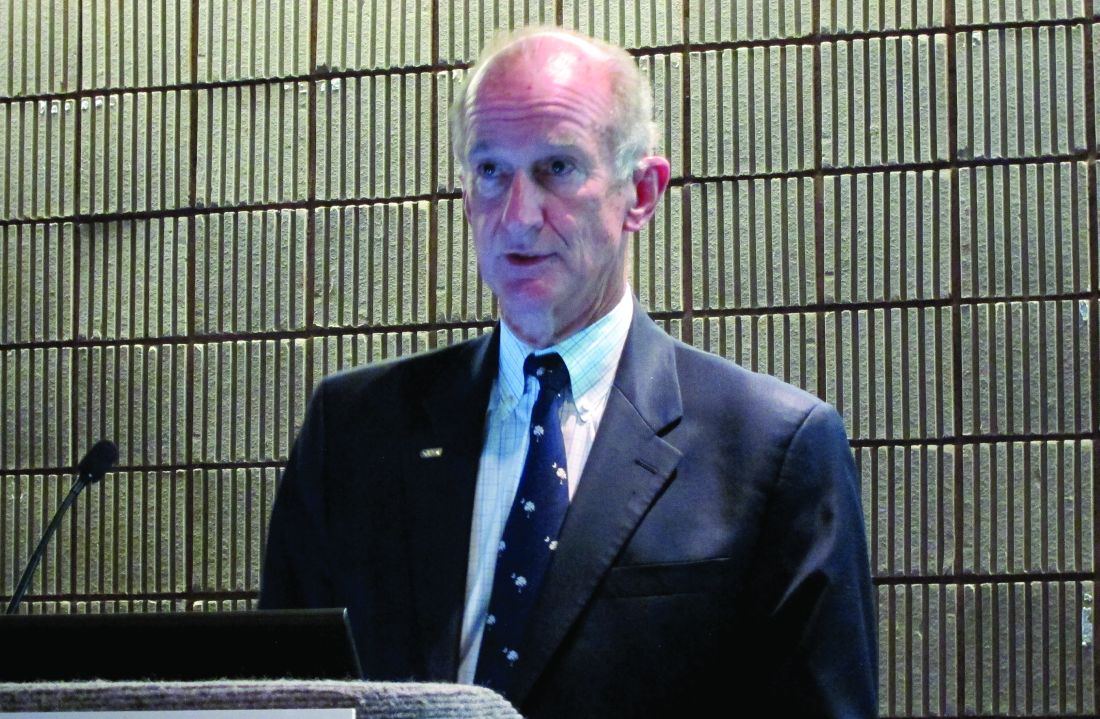
During the summer, the prevalence of both overweight and obesity increased by roughly 1 percentage point per month. In contrast, during the more than 9 months of each school year, the prevalence of overweight didn’t budge, while the prevalence of obesity decreased modestly, by 0.1 percentage points per month.
These data have far-reaching public health implications. The new evidence suggests that the major risk factors for obesity are located outside of schools. That helps explain why many school-based initiatives focused on improving the nutritional content of school lunches and promoting physical activity have had little impact on the pediatric obesity epidemic, said Dr. von Hippel of the University of Texas at Austin.
The data suggest it’s time to explore the potential of reshaping out-of-school behaviors by promoting summer school and summer camp, curbing food advertising directed at children, providing parental nutrition education, and other interventions, he added.
The explanation for the observed increase in body mass index during summer vacation is unclear. It’s known from other studies that children sleep less and engage in more screen time during summer, which may be relevant, according to Dr. von Hippel.
Simultaneous with Dr. von Hippel’s presentation at Obesity 2016, the study was published online in the journal Obesity (2016 Nov 2. doi: 10.1002/oby.21613).
He reported having no financial conflicts of interest regarding the study, which was funded by the Russell Sage Foundation.
NEW ORLEANS – All of the growth in the obesity epidemic in young American schoolchildren takes place during their summer vacations, Paul T. von Hippel, PhD, reported at Obesity Week 2016.
He presented an analysis from the Early Childhood Longitudinal Study, Kindergarten Class of 2010-2011 which included a nationally representative study population composed of 18,170 U.S. children in 970 schools who were followed with serial weight and height measurements from the start of kindergarten in 2010 through the end of second grade in 2013.
During the summer, the prevalence of both overweight and obesity increased by roughly 1 percentage point per month. In contrast, during the more than 9 months of each school year, the prevalence of overweight didn’t budge, while the prevalence of obesity decreased modestly, by 0.1 percentage points per month.
These data have far-reaching public health implications. The new evidence suggests that the major risk factors for obesity are located outside of schools. That helps explain why many school-based initiatives focused on improving the nutritional content of school lunches and promoting physical activity have had little impact on the pediatric obesity epidemic, said Dr. von Hippel of the University of Texas at Austin.
The data suggest it’s time to explore the potential of reshaping out-of-school behaviors by promoting summer school and summer camp, curbing food advertising directed at children, providing parental nutrition education, and other interventions, he added.
The explanation for the observed increase in body mass index during summer vacation is unclear. It’s known from other studies that children sleep less and engage in more screen time during summer, which may be relevant, according to Dr. von Hippel.
Simultaneous with Dr. von Hippel’s presentation at Obesity 2016, the study was published online in the journal Obesity (2016 Nov 2. doi: 10.1002/oby.21613).
He reported having no financial conflicts of interest regarding the study, which was funded by the Russell Sage Foundation.
NEW ORLEANS – All of the growth in the obesity epidemic in young American schoolchildren takes place during their summer vacations, Paul T. von Hippel, PhD, reported at Obesity Week 2016.
He presented an analysis from the Early Childhood Longitudinal Study, Kindergarten Class of 2010-2011 which included a nationally representative study population composed of 18,170 U.S. children in 970 schools who were followed with serial weight and height measurements from the start of kindergarten in 2010 through the end of second grade in 2013.
During the summer, the prevalence of both overweight and obesity increased by roughly 1 percentage point per month. In contrast, during the more than 9 months of each school year, the prevalence of overweight didn’t budge, while the prevalence of obesity decreased modestly, by 0.1 percentage points per month.
These data have far-reaching public health implications. The new evidence suggests that the major risk factors for obesity are located outside of schools. That helps explain why many school-based initiatives focused on improving the nutritional content of school lunches and promoting physical activity have had little impact on the pediatric obesity epidemic, said Dr. von Hippel of the University of Texas at Austin.
The data suggest it’s time to explore the potential of reshaping out-of-school behaviors by promoting summer school and summer camp, curbing food advertising directed at children, providing parental nutrition education, and other interventions, he added.
The explanation for the observed increase in body mass index during summer vacation is unclear. It’s known from other studies that children sleep less and engage in more screen time during summer, which may be relevant, according to Dr. von Hippel.
Simultaneous with Dr. von Hippel’s presentation at Obesity 2016, the study was published online in the journal Obesity (2016 Nov 2. doi: 10.1002/oby.21613).
He reported having no financial conflicts of interest regarding the study, which was funded by the Russell Sage Foundation.
AT OBESITY WEEK 2016
Key clinical point:
Major finding: Between the start of kindergarten and the end of second grade, the prevalence of overweight in a large group of U.S. children grew from 23.3% to 28.7%, with all of the increase coming during their two summer vacations.
Data source: The Early Childhood Longitudinal Study, Kindergarten Class of 2010-2011 included a nationally representative study population composed of more than 18,000 children who were followed with multiple weight and height measurements from the start of kindergarten through the end of second grade.
Disclosures: The study was funded by the Russell Sage Foundation. The presenter reported having no financial conflicts of interest.
Aerobic exercise improves depression-related cognitive impairment
VIENNA – An adjunctive aerobic exercise program improved cognitive impairment in patients hospitalized for depression in a Swiss randomized controlled trial, Christian Imboden, MD, reported at the annual congress of the European College of Neuropsychopharmacology.
This study addresses a major unmet need in the treatment of depression: namely, options to improve the cognitive dysfunction that accompanies the mood disorder.
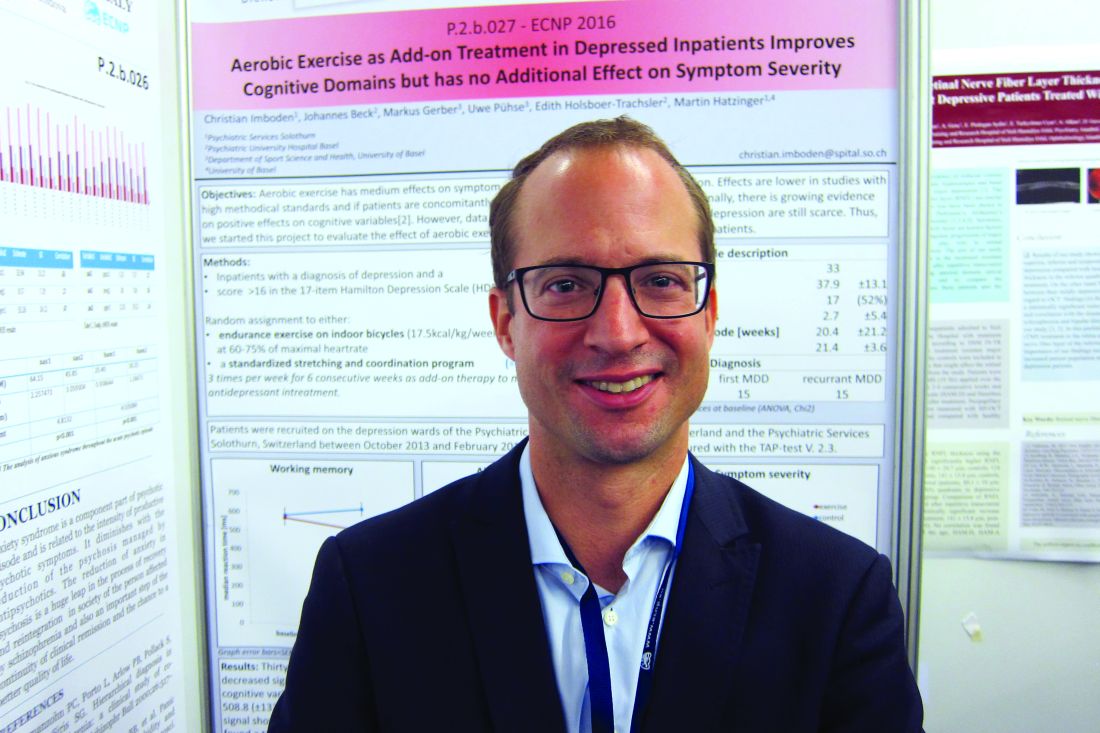
He presented a study involving 33 inpatients with a mean baseline score of 21.4 on the 17-item Hamilton Depression Rating Scale. They averaged just under 38 years of age. Fifteen were hospitalized for a first episode of major depressive disorder, 15 had recurrent depression, and 3 had a diagnosis of bipolar depression.
Participants were randomized to the 6-week endurance exercise program or to a standardized stretching and coordination program that met three times per week as a control arm. The exercise group was required to burn 17.5 kcal per kilo of body weight per week on an indoor bicycle at 60%-75% of their maximal age-appropriate heart rate. Cognitive variables were measured at baseline and after 6 weeks using the German-language TAP-test version 2.3.
At the end of 6 weeks, the 16 patients in the exercise group demonstrated significantly greater improvement in working memory reaction time than controls.
“It’s a medium effect size for working memory,” Dr. Imboden said.
The exercisers also showed a trend, albeit not statistically significant, for greater improvement on a measure of alertness, compared with the controls.
The exercise group and controls showed similar improvements in core depressive symptoms over time. After 6 weeks, their mean Hamilton score had improved from 21.7 to 8.6. This result differs from numerous prior studies by other investigators, which have found – typically in outpatients – that exercise significantly reduced depressive symptom severity relative to controls in patients with mild to moderate depression.
Dr. Imboden believes he knows the explanation for the divergent findings. “We have a very effective inpatient treatment program with evidence-based pharmacology, CBT [cognitive-behavioral therapy], and CBT-I for sleep problems. All of our patients were below 10 on the Hamilton score. I think the added value of exercise is very difficult to show under these circumstances, especially with a small sample size,” he said in an interview.
Also, the control arms in exercise research studies often tend to show a large placebo effect. When sedentary patients in the depth of depression are able to overcome their lassitude and sign up for an exercise trial, even simple stretching represents a significant increase in bodily movement, the psychiatrist added.
The biggest need now is to come up with ways to facilitate the transfer of exercise programs from the treatment setting into posttreatment daily life, according to Dr. Imboden.
“Everybody who’s exercising knows it’s helpful, but it can be difficult to create a routine,” he said.
The study was funded by a health research foundation grant, a Swiss health insurance company, and the Canton of Solothurn. Dr. Imboden reported having no financial disclosures.
VIENNA – An adjunctive aerobic exercise program improved cognitive impairment in patients hospitalized for depression in a Swiss randomized controlled trial, Christian Imboden, MD, reported at the annual congress of the European College of Neuropsychopharmacology.
This study addresses a major unmet need in the treatment of depression: namely, options to improve the cognitive dysfunction that accompanies the mood disorder.
He presented a study involving 33 inpatients with a mean baseline score of 21.4 on the 17-item Hamilton Depression Rating Scale. They averaged just under 38 years of age. Fifteen were hospitalized for a first episode of major depressive disorder, 15 had recurrent depression, and 3 had a diagnosis of bipolar depression.
Participants were randomized to the 6-week endurance exercise program or to a standardized stretching and coordination program that met three times per week as a control arm. The exercise group was required to burn 17.5 kcal per kilo of body weight per week on an indoor bicycle at 60%-75% of their maximal age-appropriate heart rate. Cognitive variables were measured at baseline and after 6 weeks using the German-language TAP-test version 2.3.
At the end of 6 weeks, the 16 patients in the exercise group demonstrated significantly greater improvement in working memory reaction time than controls.
“It’s a medium effect size for working memory,” Dr. Imboden said.
The exercisers also showed a trend, albeit not statistically significant, for greater improvement on a measure of alertness, compared with the controls.
The exercise group and controls showed similar improvements in core depressive symptoms over time. After 6 weeks, their mean Hamilton score had improved from 21.7 to 8.6. This result differs from numerous prior studies by other investigators, which have found – typically in outpatients – that exercise significantly reduced depressive symptom severity relative to controls in patients with mild to moderate depression.
Dr. Imboden believes he knows the explanation for the divergent findings. “We have a very effective inpatient treatment program with evidence-based pharmacology, CBT [cognitive-behavioral therapy], and CBT-I for sleep problems. All of our patients were below 10 on the Hamilton score. I think the added value of exercise is very difficult to show under these circumstances, especially with a small sample size,” he said in an interview.
Also, the control arms in exercise research studies often tend to show a large placebo effect. When sedentary patients in the depth of depression are able to overcome their lassitude and sign up for an exercise trial, even simple stretching represents a significant increase in bodily movement, the psychiatrist added.
The biggest need now is to come up with ways to facilitate the transfer of exercise programs from the treatment setting into posttreatment daily life, according to Dr. Imboden.
“Everybody who’s exercising knows it’s helpful, but it can be difficult to create a routine,” he said.
The study was funded by a health research foundation grant, a Swiss health insurance company, and the Canton of Solothurn. Dr. Imboden reported having no financial disclosures.
VIENNA – An adjunctive aerobic exercise program improved cognitive impairment in patients hospitalized for depression in a Swiss randomized controlled trial, Christian Imboden, MD, reported at the annual congress of the European College of Neuropsychopharmacology.
This study addresses a major unmet need in the treatment of depression: namely, options to improve the cognitive dysfunction that accompanies the mood disorder.
He presented a study involving 33 inpatients with a mean baseline score of 21.4 on the 17-item Hamilton Depression Rating Scale. They averaged just under 38 years of age. Fifteen were hospitalized for a first episode of major depressive disorder, 15 had recurrent depression, and 3 had a diagnosis of bipolar depression.
Participants were randomized to the 6-week endurance exercise program or to a standardized stretching and coordination program that met three times per week as a control arm. The exercise group was required to burn 17.5 kcal per kilo of body weight per week on an indoor bicycle at 60%-75% of their maximal age-appropriate heart rate. Cognitive variables were measured at baseline and after 6 weeks using the German-language TAP-test version 2.3.
At the end of 6 weeks, the 16 patients in the exercise group demonstrated significantly greater improvement in working memory reaction time than controls.
“It’s a medium effect size for working memory,” Dr. Imboden said.
The exercisers also showed a trend, albeit not statistically significant, for greater improvement on a measure of alertness, compared with the controls.
The exercise group and controls showed similar improvements in core depressive symptoms over time. After 6 weeks, their mean Hamilton score had improved from 21.7 to 8.6. This result differs from numerous prior studies by other investigators, which have found – typically in outpatients – that exercise significantly reduced depressive symptom severity relative to controls in patients with mild to moderate depression.
Dr. Imboden believes he knows the explanation for the divergent findings. “We have a very effective inpatient treatment program with evidence-based pharmacology, CBT [cognitive-behavioral therapy], and CBT-I for sleep problems. All of our patients were below 10 on the Hamilton score. I think the added value of exercise is very difficult to show under these circumstances, especially with a small sample size,” he said in an interview.
Also, the control arms in exercise research studies often tend to show a large placebo effect. When sedentary patients in the depth of depression are able to overcome their lassitude and sign up for an exercise trial, even simple stretching represents a significant increase in bodily movement, the psychiatrist added.
The biggest need now is to come up with ways to facilitate the transfer of exercise programs from the treatment setting into posttreatment daily life, according to Dr. Imboden.
“Everybody who’s exercising knows it’s helpful, but it can be difficult to create a routine,” he said.
The study was funded by a health research foundation grant, a Swiss health insurance company, and the Canton of Solothurn. Dr. Imboden reported having no financial disclosures.
Key clinical point:
Major finding: Cognitive dysfunction – particularly working memory – improved significantly in depressed inpatients who burned calories by peddling an indoor bike at 60%-75% of their maximum heart rate in a structured 6-week aerobic exercise program.
Data source: A randomized controlled prospective clinical trial included 33 inpatients with moderate to severe depression who were assigned to an aerobic exercise program or a stretching regimen control group.
Disclosures: The study was funded by a health research foundation grant, a Swiss health insurance company, and the Canton of Solothurn. The presenter reported having no financial disclosures.
Nutraceutical cocktail protects against postpartum blues
VIENNA – A dietary supplement blend virtually eliminated postpartum blues in a promising proof-of-concept controlled trial, Yekta Dowlati, PhD, reported during the annual congress of the European College of Neuropsychopharmacology.
The nutraceutical cocktail is designed to compensate for the effects of the early postpartum surge in monoamine oxidase A (MAO-A) activity that her research group previously has reported. They found that as estrogen levels plunge by 100-fold in the first 3 days postpartum, brain MAO-A levels rise by 40% in affect-controlling regions, including the prefrontal cortex and anterior cingulate cortex (Arch Gen Psychiatry. 2010 May;67[5]:468-74).
That suggests a potential causal relationship with postpartum blues, since MAO-A is an enzyme whose effects include promotion of oxidative stress, apoptosis, and metabolizing serotonin, norepinephrine, and dopamine, explained Dr. Dowlati of the department of psychiatry at the University of Toronto.
Postpartum blues is a common prodrome for postpartum depression, the most frequent complication of childbearing, which has an estimated incidence of 13%. Severe postpartum blues is a strong predictor of subsequent postpartum depression. Yet, despite the large burden of illness imposed by postpartum depression, there is no proven preventive strategy. The hypothesis being pursued in developing this nutraceutical is that a safe dietary intervention that prevents postpartum blues also may prevent postpartum depression.
The nutraceutical cocktail developed by Dr. Dowlati and her coinvestigators consists of monoamine precursors: 2 g of tryptophan, 10 g of tyrosine, and blueberry juice plus blueberry extract.
She reported on 41 healthy breast-feeding mothers who on day 5 postpartum, when postpartum blues typically peaks, were assigned to drink the dietary supplement or not. Later that day, they underwent a quantified assessment of their severity of postpartum blues based upon change from baseline in depressed mood scores on a 0-100 visual analog scale after undergoing a standardized sad mood induction procedure. This is a simple protocol widely used by psychiatrists and psychologists researching the neurobiology of mood states. Dr. Dowlati and her colleagues used the Velten protocol, in which subjects read depressing sentences while listening to sad music.
Mean scores on the Visual Analog Scale for sadness following the standardized mood induction procedure jumped by 43.8 points in the control group but were unchanged, with a mere 0.5-point increase, in the 21 women in the active treatment arm.
“The results of the present study, albeit in an open-label trial, reflect by far the most robust effects of a dietary supplement ever seen on postpartum blues. Our effect size was 2.9. Previous trials have reported effect sizes of 0.07-0.28,” she noted.
An effect size of 2.9 means that if a postpartum woman did not experience a plunge in mood after the induction protocol, there was statistically a 98%-99% chance that she had consumed the supplement.
“One explanation to account for an active effect is that the supplement is compensating for the effects of monoamine metabolism and increased oxidative stress by elevated postpartum MAO-A levels,” according to Dr. Dowlati. “Given the effect size of 2.9 and minimal effects of tryptophan and tyrosine supplementation on total levels in breast milk, there is excellent reason to pursue this supplement in a randomized, double-blind, placebo-controlled trial to further assess its effects.”
Before conducting this efficacy study, the investigators evaluated the safety of their planned intervention by randomizing 54 healthy breast-feeding women to single larger doses of oral tyrosine or tryptophan than were used in the nutraceutical cocktail or to no supplements. They found no subsequent increase in total tyrosine or total tryptophan levels in the subjects’ breast milk, although dose-dependent increases were found in free tyrosine and free tryptophan in maternal plasma. Free tyrosine was increased in breast milk; however, the level was significantly lower than what the investigators found in laboratory analysis of a dozen popular brands of infant formula.
The safety and open-label efficacy studies were funded by the Canadian Institutes of Health Research, the Ontario Mental Health Foundation, and university research grants. Dr. Dowlati reported having no financial conflicts of interest.
VIENNA – A dietary supplement blend virtually eliminated postpartum blues in a promising proof-of-concept controlled trial, Yekta Dowlati, PhD, reported during the annual congress of the European College of Neuropsychopharmacology.
The nutraceutical cocktail is designed to compensate for the effects of the early postpartum surge in monoamine oxidase A (MAO-A) activity that her research group previously has reported. They found that as estrogen levels plunge by 100-fold in the first 3 days postpartum, brain MAO-A levels rise by 40% in affect-controlling regions, including the prefrontal cortex and anterior cingulate cortex (Arch Gen Psychiatry. 2010 May;67[5]:468-74).
That suggests a potential causal relationship with postpartum blues, since MAO-A is an enzyme whose effects include promotion of oxidative stress, apoptosis, and metabolizing serotonin, norepinephrine, and dopamine, explained Dr. Dowlati of the department of psychiatry at the University of Toronto.
Postpartum blues is a common prodrome for postpartum depression, the most frequent complication of childbearing, which has an estimated incidence of 13%. Severe postpartum blues is a strong predictor of subsequent postpartum depression. Yet, despite the large burden of illness imposed by postpartum depression, there is no proven preventive strategy. The hypothesis being pursued in developing this nutraceutical is that a safe dietary intervention that prevents postpartum blues also may prevent postpartum depression.
The nutraceutical cocktail developed by Dr. Dowlati and her coinvestigators consists of monoamine precursors: 2 g of tryptophan, 10 g of tyrosine, and blueberry juice plus blueberry extract.
She reported on 41 healthy breast-feeding mothers who on day 5 postpartum, when postpartum blues typically peaks, were assigned to drink the dietary supplement or not. Later that day, they underwent a quantified assessment of their severity of postpartum blues based upon change from baseline in depressed mood scores on a 0-100 visual analog scale after undergoing a standardized sad mood induction procedure. This is a simple protocol widely used by psychiatrists and psychologists researching the neurobiology of mood states. Dr. Dowlati and her colleagues used the Velten protocol, in which subjects read depressing sentences while listening to sad music.
Mean scores on the Visual Analog Scale for sadness following the standardized mood induction procedure jumped by 43.8 points in the control group but were unchanged, with a mere 0.5-point increase, in the 21 women in the active treatment arm.
“The results of the present study, albeit in an open-label trial, reflect by far the most robust effects of a dietary supplement ever seen on postpartum blues. Our effect size was 2.9. Previous trials have reported effect sizes of 0.07-0.28,” she noted.
An effect size of 2.9 means that if a postpartum woman did not experience a plunge in mood after the induction protocol, there was statistically a 98%-99% chance that she had consumed the supplement.
“One explanation to account for an active effect is that the supplement is compensating for the effects of monoamine metabolism and increased oxidative stress by elevated postpartum MAO-A levels,” according to Dr. Dowlati. “Given the effect size of 2.9 and minimal effects of tryptophan and tyrosine supplementation on total levels in breast milk, there is excellent reason to pursue this supplement in a randomized, double-blind, placebo-controlled trial to further assess its effects.”
Before conducting this efficacy study, the investigators evaluated the safety of their planned intervention by randomizing 54 healthy breast-feeding women to single larger doses of oral tyrosine or tryptophan than were used in the nutraceutical cocktail or to no supplements. They found no subsequent increase in total tyrosine or total tryptophan levels in the subjects’ breast milk, although dose-dependent increases were found in free tyrosine and free tryptophan in maternal plasma. Free tyrosine was increased in breast milk; however, the level was significantly lower than what the investigators found in laboratory analysis of a dozen popular brands of infant formula.
The safety and open-label efficacy studies were funded by the Canadian Institutes of Health Research, the Ontario Mental Health Foundation, and university research grants. Dr. Dowlati reported having no financial conflicts of interest.
VIENNA – A dietary supplement blend virtually eliminated postpartum blues in a promising proof-of-concept controlled trial, Yekta Dowlati, PhD, reported during the annual congress of the European College of Neuropsychopharmacology.
The nutraceutical cocktail is designed to compensate for the effects of the early postpartum surge in monoamine oxidase A (MAO-A) activity that her research group previously has reported. They found that as estrogen levels plunge by 100-fold in the first 3 days postpartum, brain MAO-A levels rise by 40% in affect-controlling regions, including the prefrontal cortex and anterior cingulate cortex (Arch Gen Psychiatry. 2010 May;67[5]:468-74).
That suggests a potential causal relationship with postpartum blues, since MAO-A is an enzyme whose effects include promotion of oxidative stress, apoptosis, and metabolizing serotonin, norepinephrine, and dopamine, explained Dr. Dowlati of the department of psychiatry at the University of Toronto.
Postpartum blues is a common prodrome for postpartum depression, the most frequent complication of childbearing, which has an estimated incidence of 13%. Severe postpartum blues is a strong predictor of subsequent postpartum depression. Yet, despite the large burden of illness imposed by postpartum depression, there is no proven preventive strategy. The hypothesis being pursued in developing this nutraceutical is that a safe dietary intervention that prevents postpartum blues also may prevent postpartum depression.
The nutraceutical cocktail developed by Dr. Dowlati and her coinvestigators consists of monoamine precursors: 2 g of tryptophan, 10 g of tyrosine, and blueberry juice plus blueberry extract.
She reported on 41 healthy breast-feeding mothers who on day 5 postpartum, when postpartum blues typically peaks, were assigned to drink the dietary supplement or not. Later that day, they underwent a quantified assessment of their severity of postpartum blues based upon change from baseline in depressed mood scores on a 0-100 visual analog scale after undergoing a standardized sad mood induction procedure. This is a simple protocol widely used by psychiatrists and psychologists researching the neurobiology of mood states. Dr. Dowlati and her colleagues used the Velten protocol, in which subjects read depressing sentences while listening to sad music.
Mean scores on the Visual Analog Scale for sadness following the standardized mood induction procedure jumped by 43.8 points in the control group but were unchanged, with a mere 0.5-point increase, in the 21 women in the active treatment arm.
“The results of the present study, albeit in an open-label trial, reflect by far the most robust effects of a dietary supplement ever seen on postpartum blues. Our effect size was 2.9. Previous trials have reported effect sizes of 0.07-0.28,” she noted.
An effect size of 2.9 means that if a postpartum woman did not experience a plunge in mood after the induction protocol, there was statistically a 98%-99% chance that she had consumed the supplement.
“One explanation to account for an active effect is that the supplement is compensating for the effects of monoamine metabolism and increased oxidative stress by elevated postpartum MAO-A levels,” according to Dr. Dowlati. “Given the effect size of 2.9 and minimal effects of tryptophan and tyrosine supplementation on total levels in breast milk, there is excellent reason to pursue this supplement in a randomized, double-blind, placebo-controlled trial to further assess its effects.”
Before conducting this efficacy study, the investigators evaluated the safety of their planned intervention by randomizing 54 healthy breast-feeding women to single larger doses of oral tyrosine or tryptophan than were used in the nutraceutical cocktail or to no supplements. They found no subsequent increase in total tyrosine or total tryptophan levels in the subjects’ breast milk, although dose-dependent increases were found in free tyrosine and free tryptophan in maternal plasma. Free tyrosine was increased in breast milk; however, the level was significantly lower than what the investigators found in laboratory analysis of a dozen popular brands of infant formula.
The safety and open-label efficacy studies were funded by the Canadian Institutes of Health Research, the Ontario Mental Health Foundation, and university research grants. Dr. Dowlati reported having no financial conflicts of interest.
Key clinical point:
Major finding: Postpartum women who consumed a dietary supplement designed to compensate for the effects of a surge in monoamine oxidase A activity did not experience any lowering of mood after completing a standardized sad mood induction protocol, while a control group showed a steep rise in sadness scores.
Data source: An open-label proof-of-concept study in which 41 women undertook a standardized sad mood induction protocol on day 5 postpartum, after 21 of them had consumed a dietary supplement blend designed to ward off postpartum blues.
Disclosures: The safety and open-label efficacy studies were funded by the Canadian Institutes of Health Research, the Ontario Mental Health Foundation, and university research grants. Dr. Dowlati reported having no financial conflicts of interest.
Study offers reassuring data on certolizumab use in pregnancy
VIENNA – Data from a large prospective registry of pregnancy outcomes in women on certolizumab are reassuring to date, Alexa B. Kimball, MD, reported at the annual congress of the European Academy of Dermatology and Venereology.
“This unique dataset of pregnancies exposed to a single agent suggests that exposure is really not a problem, although we’ll continue to collect prospective data and anticipate doing so in women with psoriasis going forward,” said Dr. Kimball, professor of dermatology at Harvard Medical School, Boston.

Certolizumab is a tumor necrosis factor–alpha inhibitor currently approved in the United States for the treatment of Crohn’s disease, rheumatoid arthritis, ankylosing spondylitis, and psoriatic arthritis. It is now in clinical trials for psoriasis, and Dr. Kimball said she expects that it will eventually receive an indication for that disease as well. In the interim, she switches her psoriasis patients who are pregnant or plan to become so to either off-label certolizumab or etanercept (Enbrel). She does the same for her psoriatic arthritis patients, although in that situation certolizumab is on-label therapy.
The reason she turns to etanercept or certolizumab in pregnancy or anticipated pregnancy is that these two biologics, unlike others, don’t cross the placenta in the third trimester.
“I’m concerned about the selective uptake of other monoclonal antibodies in the third trimester. We do see in babies born to moms exposed to these other drugs – like ustekinumab, infliximab, and adalimumab – that the baby’s drug blood levels at birth are higher than the mom’s, so you have potentially put them at some risk for infections unnecessarily and maybe have affected how their immune system develops. So if a woman comes to me who is pregnant and on a biologic agent I would either stop treatment in the second trimester or switch to etanercept or certolizumab,” the dermatologist said.
Of the 256 pregnancies prospectively followed in the UCB certolizumab registry, 80.9% resulted in live births, and 10.2% ended in spontaneous abortion or miscarriage. In addition, the induced abortion rate was 8.6%, and there was a single stillbirth.
Of note, the mean age at pregnancy was 31 years, and 29% of the women became pregnant at age 35 or older. In contrast, the mean age at first pregnancy in the general population is 26, and only about 10% are 35 or older. These data are consistent with Dr. Kimball’s own clinical experience, which is that women with moderate to severe psoriasis or psoriatic arthritis often have trouble conceiving, and if they eventually succeed it’s often at a more advanced age.
The rate of maternal complications in this series was unremarkable: preeclampsia in 3.5%, infection in 3.9%, disease flare in 5.1%, and gestational diabetes in 3.1%. The median gestational age at birth was 39 weeks. The rate of early preterm birth before 32 weeks was 3.5%, with 12.6% of babies arriving at 32-36 weeks. Considering these are older moms being treated for serious underlying systemic inflammatory diseases, these numbers look good, according to Dr. Kimball.
Most women were exposed to certolizumab during the first trimester at least, and many were on the drug throughout pregnancy.
She said about one-third of psoriasis patients experience improvement in their skin diseases during pregnancy.
“If they’re doing really well, I see no reason to keep them on systemic therapy during pregnancy. But I will say that I see a lot of very bad postpartum flares, and I’m quite cautious about that. For the women with psoriatic arthritis there may not be a choice; you may need to continue to treat them all the way through their pregnancy to keep from getting permanent joint destruction,” the dermatologist said.
Dr. Kimball reported receiving research grants from and serving as a consultant to UCB and numerous other pharmaceutical companies.
VIENNA – Data from a large prospective registry of pregnancy outcomes in women on certolizumab are reassuring to date, Alexa B. Kimball, MD, reported at the annual congress of the European Academy of Dermatology and Venereology.
“This unique dataset of pregnancies exposed to a single agent suggests that exposure is really not a problem, although we’ll continue to collect prospective data and anticipate doing so in women with psoriasis going forward,” said Dr. Kimball, professor of dermatology at Harvard Medical School, Boston.
Certolizumab is a tumor necrosis factor–alpha inhibitor currently approved in the United States for the treatment of Crohn’s disease, rheumatoid arthritis, ankylosing spondylitis, and psoriatic arthritis. It is now in clinical trials for psoriasis, and Dr. Kimball said she expects that it will eventually receive an indication for that disease as well. In the interim, she switches her psoriasis patients who are pregnant or plan to become so to either off-label certolizumab or etanercept (Enbrel). She does the same for her psoriatic arthritis patients, although in that situation certolizumab is on-label therapy.
The reason she turns to etanercept or certolizumab in pregnancy or anticipated pregnancy is that these two biologics, unlike others, don’t cross the placenta in the third trimester.
“I’m concerned about the selective uptake of other monoclonal antibodies in the third trimester. We do see in babies born to moms exposed to these other drugs – like ustekinumab, infliximab, and adalimumab – that the baby’s drug blood levels at birth are higher than the mom’s, so you have potentially put them at some risk for infections unnecessarily and maybe have affected how their immune system develops. So if a woman comes to me who is pregnant and on a biologic agent I would either stop treatment in the second trimester or switch to etanercept or certolizumab,” the dermatologist said.
Of the 256 pregnancies prospectively followed in the UCB certolizumab registry, 80.9% resulted in live births, and 10.2% ended in spontaneous abortion or miscarriage. In addition, the induced abortion rate was 8.6%, and there was a single stillbirth.
Of note, the mean age at pregnancy was 31 years, and 29% of the women became pregnant at age 35 or older. In contrast, the mean age at first pregnancy in the general population is 26, and only about 10% are 35 or older. These data are consistent with Dr. Kimball’s own clinical experience, which is that women with moderate to severe psoriasis or psoriatic arthritis often have trouble conceiving, and if they eventually succeed it’s often at a more advanced age.
The rate of maternal complications in this series was unremarkable: preeclampsia in 3.5%, infection in 3.9%, disease flare in 5.1%, and gestational diabetes in 3.1%. The median gestational age at birth was 39 weeks. The rate of early preterm birth before 32 weeks was 3.5%, with 12.6% of babies arriving at 32-36 weeks. Considering these are older moms being treated for serious underlying systemic inflammatory diseases, these numbers look good, according to Dr. Kimball.
Most women were exposed to certolizumab during the first trimester at least, and many were on the drug throughout pregnancy.
She said about one-third of psoriasis patients experience improvement in their skin diseases during pregnancy.
“If they’re doing really well, I see no reason to keep them on systemic therapy during pregnancy. But I will say that I see a lot of very bad postpartum flares, and I’m quite cautious about that. For the women with psoriatic arthritis there may not be a choice; you may need to continue to treat them all the way through their pregnancy to keep from getting permanent joint destruction,” the dermatologist said.
Dr. Kimball reported receiving research grants from and serving as a consultant to UCB and numerous other pharmaceutical companies.
VIENNA – Data from a large prospective registry of pregnancy outcomes in women on certolizumab are reassuring to date, Alexa B. Kimball, MD, reported at the annual congress of the European Academy of Dermatology and Venereology.
“This unique dataset of pregnancies exposed to a single agent suggests that exposure is really not a problem, although we’ll continue to collect prospective data and anticipate doing so in women with psoriasis going forward,” said Dr. Kimball, professor of dermatology at Harvard Medical School, Boston.
Certolizumab is a tumor necrosis factor–alpha inhibitor currently approved in the United States for the treatment of Crohn’s disease, rheumatoid arthritis, ankylosing spondylitis, and psoriatic arthritis. It is now in clinical trials for psoriasis, and Dr. Kimball said she expects that it will eventually receive an indication for that disease as well. In the interim, she switches her psoriasis patients who are pregnant or plan to become so to either off-label certolizumab or etanercept (Enbrel). She does the same for her psoriatic arthritis patients, although in that situation certolizumab is on-label therapy.
The reason she turns to etanercept or certolizumab in pregnancy or anticipated pregnancy is that these two biologics, unlike others, don’t cross the placenta in the third trimester.
“I’m concerned about the selective uptake of other monoclonal antibodies in the third trimester. We do see in babies born to moms exposed to these other drugs – like ustekinumab, infliximab, and adalimumab – that the baby’s drug blood levels at birth are higher than the mom’s, so you have potentially put them at some risk for infections unnecessarily and maybe have affected how their immune system develops. So if a woman comes to me who is pregnant and on a biologic agent I would either stop treatment in the second trimester or switch to etanercept or certolizumab,” the dermatologist said.
Of the 256 pregnancies prospectively followed in the UCB certolizumab registry, 80.9% resulted in live births, and 10.2% ended in spontaneous abortion or miscarriage. In addition, the induced abortion rate was 8.6%, and there was a single stillbirth.
Of note, the mean age at pregnancy was 31 years, and 29% of the women became pregnant at age 35 or older. In contrast, the mean age at first pregnancy in the general population is 26, and only about 10% are 35 or older. These data are consistent with Dr. Kimball’s own clinical experience, which is that women with moderate to severe psoriasis or psoriatic arthritis often have trouble conceiving, and if they eventually succeed it’s often at a more advanced age.
The rate of maternal complications in this series was unremarkable: preeclampsia in 3.5%, infection in 3.9%, disease flare in 5.1%, and gestational diabetes in 3.1%. The median gestational age at birth was 39 weeks. The rate of early preterm birth before 32 weeks was 3.5%, with 12.6% of babies arriving at 32-36 weeks. Considering these are older moms being treated for serious underlying systemic inflammatory diseases, these numbers look good, according to Dr. Kimball.
Most women were exposed to certolizumab during the first trimester at least, and many were on the drug throughout pregnancy.
She said about one-third of psoriasis patients experience improvement in their skin diseases during pregnancy.
“If they’re doing really well, I see no reason to keep them on systemic therapy during pregnancy. But I will say that I see a lot of very bad postpartum flares, and I’m quite cautious about that. For the women with psoriatic arthritis there may not be a choice; you may need to continue to treat them all the way through their pregnancy to keep from getting permanent joint destruction,” the dermatologist said.
Dr. Kimball reported receiving research grants from and serving as a consultant to UCB and numerous other pharmaceutical companies.
AT THE EADV CONGRESS
Key clinical point:
Major finding: The rate of major congenital malformations in a large prospective series of pregnancies in women on certolizumab was reassuringly low at 4.2%, with no pattern of malformations being seen.
Data source: This was a report on maternal and fetal outcomes of 256 prospectively followed pregnancies in women on certolizumab.
Disclosures: The presenter reported receiving research funds from and serving as a consultant to UCB, which markets certolizumab and maintains the pregnancy registry.