User login
Tools may aid transition from pediatric to adult care

Photo courtesy of the CDC
WASHINGTON, DC—The American Society of Hematology (ASH) has created a toolkit to help hematologists aid patients who are transitioning from pediatric to adult practices.
The toolkit contains general resources for all hematologic conditions, as well as specific resources for patients with hemophilia and sickle cell disease.
It includes 2 types of forms—a transition-readiness assessment and a clinical summary.
The toolkit was presented at the American College of Physicians (ACP) Internal Medicine Meeting 2016.
“Transitioning from pediatric to adult healthcare practices is often a challenge for patients with chronic medical issues because it can be difficult to adhere to a treatment regimen or attend regular appointments without the assistance of a parent or guardian,” said ASH President Charles S. Abrams, MD, of the University of Pennsylvania in Philadelphia.
“ASH recognizes that understanding a patient’s preparedness to take control of his or her medical condition in adulthood can make a huge difference in quality of care, which is why we are pleased to join the American College of Physicians and partner societies in this important initiative.”
ASH joined more than 2 dozen groups to participate in the ACP’s Pediatric to Adult Care Transition Initiative. The goal of this initiative was to develop guidance and tools that both primary care internal medicine and subspecialty practices can use for patients who are transitioning from pediatric/adolescent practices to adult care.
An ASH Transitions Work Group, made up of society members from pediatric and adult practices, developed 3 segments of the hematology-specific toolkit:
- generic forms for patients with any hematologic condition, with an addendum that includes links to additional condition-specific guidelines and resources
- specific forms for hemophilia
- specific forms for sickle cell disease.
For each segment, there are 2 types of forms— a transition-readiness assessment and a clinical summary.
The transition-readiness assessment should be completed by the patient. It assesses the patient’s readiness for the transition to adult care by evaluating the patient’s understanding of his or her condition and ability to manage medications, appointments, insurance, and medical privacy issues.
This assessment should be used by the adult care team to assess any remaining gaps in the patient’s self-care knowledge or additional issues that should be addressed to ensure optimal care.
The clinical summary is a medical record summary to be completed by the referring provider and the patient. The summary contains essential clinical information regarding the patient’s condition that is to be included in the patient’s medical record upon transfer to the adult practice.
More information on the ACP Pediatric to Adult Care Transitions Initiative is available on the ACP website. The forms for the ASH transitions toolkit are available in the “Hematology” section of the Condition-Specific Tools page. 
Photo courtesy of the CDC
WASHINGTON, DC—The American Society of Hematology (ASH) has created a toolkit to help hematologists aid patients who are transitioning from pediatric to adult practices.
The toolkit contains general resources for all hematologic conditions, as well as specific resources for patients with hemophilia and sickle cell disease.
It includes 2 types of forms—a transition-readiness assessment and a clinical summary.
The toolkit was presented at the American College of Physicians (ACP) Internal Medicine Meeting 2016.
“Transitioning from pediatric to adult healthcare practices is often a challenge for patients with chronic medical issues because it can be difficult to adhere to a treatment regimen or attend regular appointments without the assistance of a parent or guardian,” said ASH President Charles S. Abrams, MD, of the University of Pennsylvania in Philadelphia.
“ASH recognizes that understanding a patient’s preparedness to take control of his or her medical condition in adulthood can make a huge difference in quality of care, which is why we are pleased to join the American College of Physicians and partner societies in this important initiative.”
ASH joined more than 2 dozen groups to participate in the ACP’s Pediatric to Adult Care Transition Initiative. The goal of this initiative was to develop guidance and tools that both primary care internal medicine and subspecialty practices can use for patients who are transitioning from pediatric/adolescent practices to adult care.
An ASH Transitions Work Group, made up of society members from pediatric and adult practices, developed 3 segments of the hematology-specific toolkit:
- generic forms for patients with any hematologic condition, with an addendum that includes links to additional condition-specific guidelines and resources
- specific forms for hemophilia
- specific forms for sickle cell disease.
For each segment, there are 2 types of forms— a transition-readiness assessment and a clinical summary.
The transition-readiness assessment should be completed by the patient. It assesses the patient’s readiness for the transition to adult care by evaluating the patient’s understanding of his or her condition and ability to manage medications, appointments, insurance, and medical privacy issues.
This assessment should be used by the adult care team to assess any remaining gaps in the patient’s self-care knowledge or additional issues that should be addressed to ensure optimal care.
The clinical summary is a medical record summary to be completed by the referring provider and the patient. The summary contains essential clinical information regarding the patient’s condition that is to be included in the patient’s medical record upon transfer to the adult practice.
More information on the ACP Pediatric to Adult Care Transitions Initiative is available on the ACP website. The forms for the ASH transitions toolkit are available in the “Hematology” section of the Condition-Specific Tools page.
Photo courtesy of the CDC
WASHINGTON, DC—The American Society of Hematology (ASH) has created a toolkit to help hematologists aid patients who are transitioning from pediatric to adult practices.
The toolkit contains general resources for all hematologic conditions, as well as specific resources for patients with hemophilia and sickle cell disease.
It includes 2 types of forms—a transition-readiness assessment and a clinical summary.
The toolkit was presented at the American College of Physicians (ACP) Internal Medicine Meeting 2016.
“Transitioning from pediatric to adult healthcare practices is often a challenge for patients with chronic medical issues because it can be difficult to adhere to a treatment regimen or attend regular appointments without the assistance of a parent or guardian,” said ASH President Charles S. Abrams, MD, of the University of Pennsylvania in Philadelphia.
“ASH recognizes that understanding a patient’s preparedness to take control of his or her medical condition in adulthood can make a huge difference in quality of care, which is why we are pleased to join the American College of Physicians and partner societies in this important initiative.”
ASH joined more than 2 dozen groups to participate in the ACP’s Pediatric to Adult Care Transition Initiative. The goal of this initiative was to develop guidance and tools that both primary care internal medicine and subspecialty practices can use for patients who are transitioning from pediatric/adolescent practices to adult care.
An ASH Transitions Work Group, made up of society members from pediatric and adult practices, developed 3 segments of the hematology-specific toolkit:
- generic forms for patients with any hematologic condition, with an addendum that includes links to additional condition-specific guidelines and resources
- specific forms for hemophilia
- specific forms for sickle cell disease.
For each segment, there are 2 types of forms— a transition-readiness assessment and a clinical summary.
The transition-readiness assessment should be completed by the patient. It assesses the patient’s readiness for the transition to adult care by evaluating the patient’s understanding of his or her condition and ability to manage medications, appointments, insurance, and medical privacy issues.
This assessment should be used by the adult care team to assess any remaining gaps in the patient’s self-care knowledge or additional issues that should be addressed to ensure optimal care.
The clinical summary is a medical record summary to be completed by the referring provider and the patient. The summary contains essential clinical information regarding the patient’s condition that is to be included in the patient’s medical record upon transfer to the adult practice.
More information on the ACP Pediatric to Adult Care Transitions Initiative is available on the ACP website. The forms for the ASH transitions toolkit are available in the “Hematology” section of the Condition-Specific Tools page.
FDA takes more steps to keep kids off tobacco products
New regulations from the Food and Drug Administration ban the sale of all tobacco products – including e-cigarettes – to minors.
The final rule announced May 5 extends FDA regulatory authority to e-cigarettes, cigars, hookah tobacco, pipe tobacco, and other similar products. Prior to this, FDA regulated cigarettes, cigarette tobacco, roll-your-own tobacco, and smokeless tobacco under the Tobacco Control Act of 2009.
The new regulations requires manufacturers of all newly regulated products to show that their products meet applicable public health standards and that makers receive marketing authorization from the FDA. The agency now has the authority to evaluate ingredients, product design, and health risks of these products.

U.S. Department of Health & Human Services Secretary Sylvia Burwell said the move was critical to improve public health and protect future generations from the dangers of tobacco.
“As cigarette smoking among those under 18 has fallen, the use of other nicotine products, including e-cigarettes, has taken a drastic leap,” Secretary Burwell said in a statement. “All of this is creating a new generation of Americans who are at risk of addiction. Today’s announcement is an important step in the fight for a tobacco-free generation – it will help us catch up with changes in the marketplace, put into place rules that protect our kids and give adults information they need to make informed decisions.”
Before the rule, no federal law prohibited stores and websites from selling e-cigarettes, hookah tobacco, and cigars to minors, according to an FDA fact sheet. The new rule aims to deter youth access to the products by barring sales to persons under 18, requiring age verification of purchasers, preventing the selling of covered tobacco products in vending machines, and prohibiting the distribution of free samples.
In addition, manufacturers, importers, and retailers of newly regulated tobacco products must follow provisions, such as registering their manufacturing establishments and providing product listings to the FDA, reporting ingredients and potentially harmful constituents to the agency, and placing health warnings on packages and advertisements, among other guidelines. Manufacturers of newly regulated products must meet the applicable public health standards, unless the product was on the market as of Feb. 15, 2007.

FDA Commissioner Dr. Robert M. Califf said the rule marks a milestone in patient protection.
“As a physician, I’ve seen first hand the devastating health effects of tobacco use,” Dr. Califf said in a statement. “At the FDA, we must do our job under the Tobacco Control Act to reduce the harms caused by tobacco. That includes ensuring consumers have the information they need to make informed decisions about tobacco use and making sure that new tobacco products for purchase come under comprehensive FDA review.”
It’s about time that e-cigarettes are regulated like other tobacco products, said Dr. Roy Herbst, chief of medical oncology at Yale Cancer Center and Smilow Cancer Hospital at Yale-New Haven (Conn).
“It’s been quite some time that e-cigarettes have been gaining momentum in our communities and now to finally have them under the purview of the FDA is huge,” Dr. Herbst said in an interview. “It will force more science and research into these products. ... If these are so safe, they should go through clinical studies to prove that.”
Dr. Herbst noted that within 90 days of the published rule, retailers can no longer sell the products to minors, and that within 3 years, the products will be regulated like other tobacco products.

Manufacturers will be allowed to continue selling their products for up to 3 years while they submit a new tobacco product application and the FDA reviews the application, according to the FDA.
Physicians and other health advocates expressed support for the regulations.
“The AMA supports the FDA’s new rule and its efforts to ensure the public – especially young people – is aware of and protected from these harmful products,” AMA President Dr. Steven J. Stack said in a statement. “The new FDA rule, which fills the gap in federal regulations on purchasing, labeling, and packaging of e-cigarettes; cigars; and other tobacco products, is a notable and important step that will ban the sale of these products to minors and improve public health. However, we urge FDA to issue further regulations addressing marketing of these products and banning flavored e-cigarettes, which are particularly enticing to minors.”
The American Academy of Pediatrics also suggested more steps to curb tobacco use.
“The rule is a welcomed starting point, but it is only a framework upon which to build meaningful regulation to end the tobacco epidemic in the United States once and for all,” American Academy of Pediatrics President Dr. Benard P. Dreyer said in a statement. “Today’s action marks an historic step forward in helping to alleviate the threat of lifelong nicotine addiction for our youth, and should serve as a foundation for further progress when it comes to keeping children safe from dangerous tobacco products.”
The rule will be published in the Federal Register on May 10.
On Twitter @legal_med
New regulations from the Food and Drug Administration ban the sale of all tobacco products – including e-cigarettes – to minors.
The final rule announced May 5 extends FDA regulatory authority to e-cigarettes, cigars, hookah tobacco, pipe tobacco, and other similar products. Prior to this, FDA regulated cigarettes, cigarette tobacco, roll-your-own tobacco, and smokeless tobacco under the Tobacco Control Act of 2009.
The new regulations requires manufacturers of all newly regulated products to show that their products meet applicable public health standards and that makers receive marketing authorization from the FDA. The agency now has the authority to evaluate ingredients, product design, and health risks of these products.
U.S. Department of Health & Human Services Secretary Sylvia Burwell said the move was critical to improve public health and protect future generations from the dangers of tobacco.
“As cigarette smoking among those under 18 has fallen, the use of other nicotine products, including e-cigarettes, has taken a drastic leap,” Secretary Burwell said in a statement. “All of this is creating a new generation of Americans who are at risk of addiction. Today’s announcement is an important step in the fight for a tobacco-free generation – it will help us catch up with changes in the marketplace, put into place rules that protect our kids and give adults information they need to make informed decisions.”
Before the rule, no federal law prohibited stores and websites from selling e-cigarettes, hookah tobacco, and cigars to minors, according to an FDA fact sheet. The new rule aims to deter youth access to the products by barring sales to persons under 18, requiring age verification of purchasers, preventing the selling of covered tobacco products in vending machines, and prohibiting the distribution of free samples.
In addition, manufacturers, importers, and retailers of newly regulated tobacco products must follow provisions, such as registering their manufacturing establishments and providing product listings to the FDA, reporting ingredients and potentially harmful constituents to the agency, and placing health warnings on packages and advertisements, among other guidelines. Manufacturers of newly regulated products must meet the applicable public health standards, unless the product was on the market as of Feb. 15, 2007.
FDA Commissioner Dr. Robert M. Califf said the rule marks a milestone in patient protection.
“As a physician, I’ve seen first hand the devastating health effects of tobacco use,” Dr. Califf said in a statement. “At the FDA, we must do our job under the Tobacco Control Act to reduce the harms caused by tobacco. That includes ensuring consumers have the information they need to make informed decisions about tobacco use and making sure that new tobacco products for purchase come under comprehensive FDA review.”
It’s about time that e-cigarettes are regulated like other tobacco products, said Dr. Roy Herbst, chief of medical oncology at Yale Cancer Center and Smilow Cancer Hospital at Yale-New Haven (Conn).
“It’s been quite some time that e-cigarettes have been gaining momentum in our communities and now to finally have them under the purview of the FDA is huge,” Dr. Herbst said in an interview. “It will force more science and research into these products. ... If these are so safe, they should go through clinical studies to prove that.”
Dr. Herbst noted that within 90 days of the published rule, retailers can no longer sell the products to minors, and that within 3 years, the products will be regulated like other tobacco products.
Manufacturers will be allowed to continue selling their products for up to 3 years while they submit a new tobacco product application and the FDA reviews the application, according to the FDA.
Physicians and other health advocates expressed support for the regulations.
“The AMA supports the FDA’s new rule and its efforts to ensure the public – especially young people – is aware of and protected from these harmful products,” AMA President Dr. Steven J. Stack said in a statement. “The new FDA rule, which fills the gap in federal regulations on purchasing, labeling, and packaging of e-cigarettes; cigars; and other tobacco products, is a notable and important step that will ban the sale of these products to minors and improve public health. However, we urge FDA to issue further regulations addressing marketing of these products and banning flavored e-cigarettes, which are particularly enticing to minors.”
The American Academy of Pediatrics also suggested more steps to curb tobacco use.
“The rule is a welcomed starting point, but it is only a framework upon which to build meaningful regulation to end the tobacco epidemic in the United States once and for all,” American Academy of Pediatrics President Dr. Benard P. Dreyer said in a statement. “Today’s action marks an historic step forward in helping to alleviate the threat of lifelong nicotine addiction for our youth, and should serve as a foundation for further progress when it comes to keeping children safe from dangerous tobacco products.”
The rule will be published in the Federal Register on May 10.
On Twitter @legal_med
New regulations from the Food and Drug Administration ban the sale of all tobacco products – including e-cigarettes – to minors.
The final rule announced May 5 extends FDA regulatory authority to e-cigarettes, cigars, hookah tobacco, pipe tobacco, and other similar products. Prior to this, FDA regulated cigarettes, cigarette tobacco, roll-your-own tobacco, and smokeless tobacco under the Tobacco Control Act of 2009.
The new regulations requires manufacturers of all newly regulated products to show that their products meet applicable public health standards and that makers receive marketing authorization from the FDA. The agency now has the authority to evaluate ingredients, product design, and health risks of these products.
U.S. Department of Health & Human Services Secretary Sylvia Burwell said the move was critical to improve public health and protect future generations from the dangers of tobacco.
“As cigarette smoking among those under 18 has fallen, the use of other nicotine products, including e-cigarettes, has taken a drastic leap,” Secretary Burwell said in a statement. “All of this is creating a new generation of Americans who are at risk of addiction. Today’s announcement is an important step in the fight for a tobacco-free generation – it will help us catch up with changes in the marketplace, put into place rules that protect our kids and give adults information they need to make informed decisions.”
Before the rule, no federal law prohibited stores and websites from selling e-cigarettes, hookah tobacco, and cigars to minors, according to an FDA fact sheet. The new rule aims to deter youth access to the products by barring sales to persons under 18, requiring age verification of purchasers, preventing the selling of covered tobacco products in vending machines, and prohibiting the distribution of free samples.
In addition, manufacturers, importers, and retailers of newly regulated tobacco products must follow provisions, such as registering their manufacturing establishments and providing product listings to the FDA, reporting ingredients and potentially harmful constituents to the agency, and placing health warnings on packages and advertisements, among other guidelines. Manufacturers of newly regulated products must meet the applicable public health standards, unless the product was on the market as of Feb. 15, 2007.
FDA Commissioner Dr. Robert M. Califf said the rule marks a milestone in patient protection.
“As a physician, I’ve seen first hand the devastating health effects of tobacco use,” Dr. Califf said in a statement. “At the FDA, we must do our job under the Tobacco Control Act to reduce the harms caused by tobacco. That includes ensuring consumers have the information they need to make informed decisions about tobacco use and making sure that new tobacco products for purchase come under comprehensive FDA review.”
It’s about time that e-cigarettes are regulated like other tobacco products, said Dr. Roy Herbst, chief of medical oncology at Yale Cancer Center and Smilow Cancer Hospital at Yale-New Haven (Conn).
“It’s been quite some time that e-cigarettes have been gaining momentum in our communities and now to finally have them under the purview of the FDA is huge,” Dr. Herbst said in an interview. “It will force more science and research into these products. ... If these are so safe, they should go through clinical studies to prove that.”
Dr. Herbst noted that within 90 days of the published rule, retailers can no longer sell the products to minors, and that within 3 years, the products will be regulated like other tobacco products.
Manufacturers will be allowed to continue selling their products for up to 3 years while they submit a new tobacco product application and the FDA reviews the application, according to the FDA.
Physicians and other health advocates expressed support for the regulations.
“The AMA supports the FDA’s new rule and its efforts to ensure the public – especially young people – is aware of and protected from these harmful products,” AMA President Dr. Steven J. Stack said in a statement. “The new FDA rule, which fills the gap in federal regulations on purchasing, labeling, and packaging of e-cigarettes; cigars; and other tobacco products, is a notable and important step that will ban the sale of these products to minors and improve public health. However, we urge FDA to issue further regulations addressing marketing of these products and banning flavored e-cigarettes, which are particularly enticing to minors.”
The American Academy of Pediatrics also suggested more steps to curb tobacco use.
“The rule is a welcomed starting point, but it is only a framework upon which to build meaningful regulation to end the tobacco epidemic in the United States once and for all,” American Academy of Pediatrics President Dr. Benard P. Dreyer said in a statement. “Today’s action marks an historic step forward in helping to alleviate the threat of lifelong nicotine addiction for our youth, and should serve as a foundation for further progress when it comes to keeping children safe from dangerous tobacco products.”
The rule will be published in the Federal Register on May 10.
On Twitter @legal_med

ED visits due to anaphylaxis doubled at Canadian children’s hospital
The percentage of emergency department (ED) visits due to anaphylaxis more than doubled from 2011 to 2015 at one Canadian children’s hospital, according to a Research Letter to the Editor published in the Journal of Allergy and Clinical Immunology.
“Our results are limited to one pediatric center, but they suggest a worrisome increase in anaphylaxis rate that is consistent with the worldwide reported increase,” said Dr. Elana Hochstadter of the Hospital for Sick Children, University of Toronto, and her associates. The investigators analyzed longitudinal data in a national registry of anaphylaxis cases to track time trends for the disorder at their hospital. They identified 965 cases presenting to their ED during a 4-year period. The percentage of all ED visits accounted for by anaphylaxis rose from 0.20% to 0.41%. The overall volume of ED visits and the volume of specific ED diagnoses did not change during this interval.

As in other studies of anaphylaxis around the world, food was the most common trigger in this series, responsible for 82% of cases. Peanut was the most common food allergen, accounting for 22% of cases. Most reactions were of moderate severity, and the percentages of mild, moderate, and severe reactions remained relatively stable throughout the study period. The presence of asthma was associated with increased severity of anaphylaxis (odds ratio, 2.3), as was the presence of eczema (OR, 2.1). Only half of the patients who had an epinephrine autoinjector used it before presenting to the ED, Dr. Hochstadter and her associates said (J Allergy Clin Immunol. 2016 doi: 10.1016/j.jaci.2016.02.016). The median age of the patients was 6 years.
The reason for this rapid increase is unknown, but it parallels that reported in studies of anaphylaxis throughout North America and Europe. “An important observation in our study is that administration of epinephrine before arrival in the ED is independently associated with a decreased likelihood of requiring multiple doses of epinephrine in the ED, suggesting that prompt epinephrine administration is beneficial,” they noted.
The Allergy, Genes, and Environment Network Centres of Excellence, Health Canada, and Sanofi funded the study. Dr. Hochstadter and her associates reported having no relevant disclosures.
The percentage of emergency department (ED) visits due to anaphylaxis more than doubled from 2011 to 2015 at one Canadian children’s hospital, according to a Research Letter to the Editor published in the Journal of Allergy and Clinical Immunology.
“Our results are limited to one pediatric center, but they suggest a worrisome increase in anaphylaxis rate that is consistent with the worldwide reported increase,” said Dr. Elana Hochstadter of the Hospital for Sick Children, University of Toronto, and her associates. The investigators analyzed longitudinal data in a national registry of anaphylaxis cases to track time trends for the disorder at their hospital. They identified 965 cases presenting to their ED during a 4-year period. The percentage of all ED visits accounted for by anaphylaxis rose from 0.20% to 0.41%. The overall volume of ED visits and the volume of specific ED diagnoses did not change during this interval.
As in other studies of anaphylaxis around the world, food was the most common trigger in this series, responsible for 82% of cases. Peanut was the most common food allergen, accounting for 22% of cases. Most reactions were of moderate severity, and the percentages of mild, moderate, and severe reactions remained relatively stable throughout the study period. The presence of asthma was associated with increased severity of anaphylaxis (odds ratio, 2.3), as was the presence of eczema (OR, 2.1). Only half of the patients who had an epinephrine autoinjector used it before presenting to the ED, Dr. Hochstadter and her associates said (J Allergy Clin Immunol. 2016 doi: 10.1016/j.jaci.2016.02.016). The median age of the patients was 6 years.
The reason for this rapid increase is unknown, but it parallels that reported in studies of anaphylaxis throughout North America and Europe. “An important observation in our study is that administration of epinephrine before arrival in the ED is independently associated with a decreased likelihood of requiring multiple doses of epinephrine in the ED, suggesting that prompt epinephrine administration is beneficial,” they noted.
The Allergy, Genes, and Environment Network Centres of Excellence, Health Canada, and Sanofi funded the study. Dr. Hochstadter and her associates reported having no relevant disclosures.
The percentage of emergency department (ED) visits due to anaphylaxis more than doubled from 2011 to 2015 at one Canadian children’s hospital, according to a Research Letter to the Editor published in the Journal of Allergy and Clinical Immunology.
“Our results are limited to one pediatric center, but they suggest a worrisome increase in anaphylaxis rate that is consistent with the worldwide reported increase,” said Dr. Elana Hochstadter of the Hospital for Sick Children, University of Toronto, and her associates. The investigators analyzed longitudinal data in a national registry of anaphylaxis cases to track time trends for the disorder at their hospital. They identified 965 cases presenting to their ED during a 4-year period. The percentage of all ED visits accounted for by anaphylaxis rose from 0.20% to 0.41%. The overall volume of ED visits and the volume of specific ED diagnoses did not change during this interval.
As in other studies of anaphylaxis around the world, food was the most common trigger in this series, responsible for 82% of cases. Peanut was the most common food allergen, accounting for 22% of cases. Most reactions were of moderate severity, and the percentages of mild, moderate, and severe reactions remained relatively stable throughout the study period. The presence of asthma was associated with increased severity of anaphylaxis (odds ratio, 2.3), as was the presence of eczema (OR, 2.1). Only half of the patients who had an epinephrine autoinjector used it before presenting to the ED, Dr. Hochstadter and her associates said (J Allergy Clin Immunol. 2016 doi: 10.1016/j.jaci.2016.02.016). The median age of the patients was 6 years.
The reason for this rapid increase is unknown, but it parallels that reported in studies of anaphylaxis throughout North America and Europe. “An important observation in our study is that administration of epinephrine before arrival in the ED is independently associated with a decreased likelihood of requiring multiple doses of epinephrine in the ED, suggesting that prompt epinephrine administration is beneficial,” they noted.
The Allergy, Genes, and Environment Network Centres of Excellence, Health Canada, and Sanofi funded the study. Dr. Hochstadter and her associates reported having no relevant disclosures.
FROM JOURNAL OF ALLERGY AND CLINICAL IMMUNOLOGY
Key clinical point: The percentage of ED visits due to anaphylaxis more than doubled at one Canadian children’s hospital between 2011 and 2015.
Major finding: The percentage of all ED visits accounted for by anaphylaxis rose from 0.20% to 0.41% during the 4-year study.
Data source: A single-center longitudinal analysis of 965 ED visits for anaphylaxis.
Disclosures: The Allergy, Genes, and Environment Network Centres of Excellence, Health Canada, and Sanofi funded the study. Dr. Hochstadter and her associates reported having no relevant disclosures.

VIDEO: Childhood obesity, particularly severe obesity, is not declining
BALTIMORE – Rates of obesity, particularly severe obesity, in children have not decreased since 1999, despite what recent studies may say, according to a study presented at the annual meeting of the Pediatric Academic Societies.
“Overall, there is no evidence of a decrease in obesity in any of our age groups,” said Asheley C. Skinner, Ph.D., of Duke University in Durham, N.C., adding that “we see a sort of consistent, ongoing increase up through 2014 for severe obesity and regular class I obesity for all of our age groups.”
In a video interview, Dr. Skinner discussed the findings of her study, in which data from the National Health and Nutrition Examination Survey (NHANES) from the years 1999-2014 were examined to determine obesity in children aged 2-19 years. A combination of body mass index (BMI) and “a percentage of the 95th percentile” of weight across three age groups – 2-5 years, 6-11 years, and 12-19 years – was used to classify children with class I, class II, or class III (severe) obesity.
Dr. Skinner did not report any relevant financial disclosures.
The video associated with this article is no longer available on this site. Please view all of our videos on the MDedge YouTube channel
BALTIMORE – Rates of obesity, particularly severe obesity, in children have not decreased since 1999, despite what recent studies may say, according to a study presented at the annual meeting of the Pediatric Academic Societies.
“Overall, there is no evidence of a decrease in obesity in any of our age groups,” said Asheley C. Skinner, Ph.D., of Duke University in Durham, N.C., adding that “we see a sort of consistent, ongoing increase up through 2014 for severe obesity and regular class I obesity for all of our age groups.”
In a video interview, Dr. Skinner discussed the findings of her study, in which data from the National Health and Nutrition Examination Survey (NHANES) from the years 1999-2014 were examined to determine obesity in children aged 2-19 years. A combination of body mass index (BMI) and “a percentage of the 95th percentile” of weight across three age groups – 2-5 years, 6-11 years, and 12-19 years – was used to classify children with class I, class II, or class III (severe) obesity.
Dr. Skinner did not report any relevant financial disclosures.
The video associated with this article is no longer available on this site. Please view all of our videos on the MDedge YouTube channel
BALTIMORE – Rates of obesity, particularly severe obesity, in children have not decreased since 1999, despite what recent studies may say, according to a study presented at the annual meeting of the Pediatric Academic Societies.
“Overall, there is no evidence of a decrease in obesity in any of our age groups,” said Asheley C. Skinner, Ph.D., of Duke University in Durham, N.C., adding that “we see a sort of consistent, ongoing increase up through 2014 for severe obesity and regular class I obesity for all of our age groups.”
In a video interview, Dr. Skinner discussed the findings of her study, in which data from the National Health and Nutrition Examination Survey (NHANES) from the years 1999-2014 were examined to determine obesity in children aged 2-19 years. A combination of body mass index (BMI) and “a percentage of the 95th percentile” of weight across three age groups – 2-5 years, 6-11 years, and 12-19 years – was used to classify children with class I, class II, or class III (severe) obesity.
Dr. Skinner did not report any relevant financial disclosures.
The video associated with this article is no longer available on this site. Please view all of our videos on the MDedge YouTube channel
AT THE PAS ANNUAL MEETING

Immunization improves with bidirectional data exchange between EHRs and registries
The implementation of bidirectional information sharing between electronic health records (EHRs) and immunization registries resulted in improved pediatric immunization coverage, according to new research in Pediatrics.
Researchers analyzed data from five practices providing pediatric primary care in the New York–Presbyterian Hospital Ambulatory Care Network 6 months before and after a 2009 implementation of a function that allowed for data from the N.Y. Citywide Immunization Registry to be downloaded directly to local practice site EHRs. Prior to that, data could only be uploaded from EHRs, and pediatricians would need to consult the registry separately to check immunization records.

Researchers found that after the implementation of bidirectional information sharing, “significant improvements in pediatric immunization coverage, a reduction in overimmunization for adolescents, and increased completeness of immunization records were observed,” Dr. Melissa S. Stockwell, professor at Columbia University, New York, and her colleagues, wrote in an article appearing online May 5 and scheduled for publication in the June 6 issue of Pediatrics (doi: 10.1542/peds.2015-4335).
According to the research, up-to-date status increased from 75% before to 81.6% after implementation for more than 6,000 children during each period. The percentage of overimmunized decreased from 8.8% to 4.7%.
Researchers suggested that the reason for the improvement was that doctors could make more informed decisions immediately about immunization rather than having to wait for family members to return for a later visit with paper immunization records.
“With full immunization data available electronically at point of care, clinicians may have felt more certain that they had accurate, complete immunization data and that the child was indeed missing the immunization,” Dr. Stockwell and her colleagues wrote. “It has been shown that children of parents who lack paper records are more likely to be underimmunized.”
The researchers reported no conflicts of interest. The study was supported by the Agency for Healthcare Research and Quality.
While meaningful use regulation requires that EHRs only feed information to immunization registries, more should be done by them to help retrieve information from them.
“I would love for the EHR vendors to address this issue and establish bidirectional communication with local/regional immunization registries to help with decision-making at the point of care,” Dr. J. Howard Smart said in an interview.
He also noted other challenges. Registries do not share data across state lines and even within states, such as California, regional registries are not sharing information.
“So even if someone comes from Los Angeles, we are not going to have immunization registry data for them.”
That being said, even if it were just bidirectional information on a local level, it would be a great asset to the practicing pediatrician.
“We are worried about both kinds of errors [missing scheduled vaccinations or overvaccinating], and having bidirectional information would really help that confidence.”
Dr. Smart is chief of pediatrics at Sharp Mary Birch Hospital for Women and Newborns in San Diego, Calif.
While meaningful use regulation requires that EHRs only feed information to immunization registries, more should be done by them to help retrieve information from them.
“I would love for the EHR vendors to address this issue and establish bidirectional communication with local/regional immunization registries to help with decision-making at the point of care,” Dr. J. Howard Smart said in an interview.
He also noted other challenges. Registries do not share data across state lines and even within states, such as California, regional registries are not sharing information.
“So even if someone comes from Los Angeles, we are not going to have immunization registry data for them.”
That being said, even if it were just bidirectional information on a local level, it would be a great asset to the practicing pediatrician.
“We are worried about both kinds of errors [missing scheduled vaccinations or overvaccinating], and having bidirectional information would really help that confidence.”
Dr. Smart is chief of pediatrics at Sharp Mary Birch Hospital for Women and Newborns in San Diego, Calif.
While meaningful use regulation requires that EHRs only feed information to immunization registries, more should be done by them to help retrieve information from them.
“I would love for the EHR vendors to address this issue and establish bidirectional communication with local/regional immunization registries to help with decision-making at the point of care,” Dr. J. Howard Smart said in an interview.
He also noted other challenges. Registries do not share data across state lines and even within states, such as California, regional registries are not sharing information.
“So even if someone comes from Los Angeles, we are not going to have immunization registry data for them.”
That being said, even if it were just bidirectional information on a local level, it would be a great asset to the practicing pediatrician.
“We are worried about both kinds of errors [missing scheduled vaccinations or overvaccinating], and having bidirectional information would really help that confidence.”
Dr. Smart is chief of pediatrics at Sharp Mary Birch Hospital for Women and Newborns in San Diego, Calif.
The implementation of bidirectional information sharing between electronic health records (EHRs) and immunization registries resulted in improved pediatric immunization coverage, according to new research in Pediatrics.
Researchers analyzed data from five practices providing pediatric primary care in the New York–Presbyterian Hospital Ambulatory Care Network 6 months before and after a 2009 implementation of a function that allowed for data from the N.Y. Citywide Immunization Registry to be downloaded directly to local practice site EHRs. Prior to that, data could only be uploaded from EHRs, and pediatricians would need to consult the registry separately to check immunization records.
Researchers found that after the implementation of bidirectional information sharing, “significant improvements in pediatric immunization coverage, a reduction in overimmunization for adolescents, and increased completeness of immunization records were observed,” Dr. Melissa S. Stockwell, professor at Columbia University, New York, and her colleagues, wrote in an article appearing online May 5 and scheduled for publication in the June 6 issue of Pediatrics (doi: 10.1542/peds.2015-4335).
According to the research, up-to-date status increased from 75% before to 81.6% after implementation for more than 6,000 children during each period. The percentage of overimmunized decreased from 8.8% to 4.7%.
Researchers suggested that the reason for the improvement was that doctors could make more informed decisions immediately about immunization rather than having to wait for family members to return for a later visit with paper immunization records.
“With full immunization data available electronically at point of care, clinicians may have felt more certain that they had accurate, complete immunization data and that the child was indeed missing the immunization,” Dr. Stockwell and her colleagues wrote. “It has been shown that children of parents who lack paper records are more likely to be underimmunized.”
The researchers reported no conflicts of interest. The study was supported by the Agency for Healthcare Research and Quality.
The implementation of bidirectional information sharing between electronic health records (EHRs) and immunization registries resulted in improved pediatric immunization coverage, according to new research in Pediatrics.
Researchers analyzed data from five practices providing pediatric primary care in the New York–Presbyterian Hospital Ambulatory Care Network 6 months before and after a 2009 implementation of a function that allowed for data from the N.Y. Citywide Immunization Registry to be downloaded directly to local practice site EHRs. Prior to that, data could only be uploaded from EHRs, and pediatricians would need to consult the registry separately to check immunization records.
Researchers found that after the implementation of bidirectional information sharing, “significant improvements in pediatric immunization coverage, a reduction in overimmunization for adolescents, and increased completeness of immunization records were observed,” Dr. Melissa S. Stockwell, professor at Columbia University, New York, and her colleagues, wrote in an article appearing online May 5 and scheduled for publication in the June 6 issue of Pediatrics (doi: 10.1542/peds.2015-4335).
According to the research, up-to-date status increased from 75% before to 81.6% after implementation for more than 6,000 children during each period. The percentage of overimmunized decreased from 8.8% to 4.7%.
Researchers suggested that the reason for the improvement was that doctors could make more informed decisions immediately about immunization rather than having to wait for family members to return for a later visit with paper immunization records.
“With full immunization data available electronically at point of care, clinicians may have felt more certain that they had accurate, complete immunization data and that the child was indeed missing the immunization,” Dr. Stockwell and her colleagues wrote. “It has been shown that children of parents who lack paper records are more likely to be underimmunized.”
The researchers reported no conflicts of interest. The study was supported by the Agency for Healthcare Research and Quality.
FROM PEDIATRICS

Child with malar rash
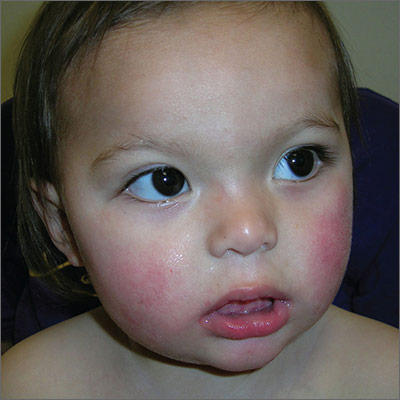
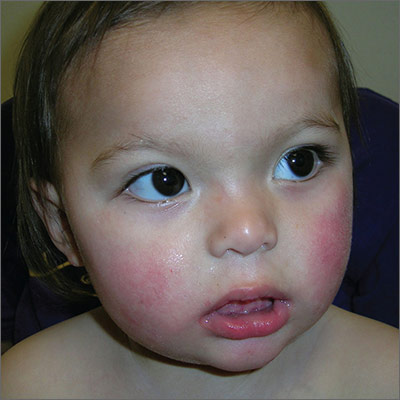
The patient’s “slapped-cheek” appearance led to the diagnosis: fifth disease (erythema infectiosum). The name of the diagnosis derives from the fact that it represents the fifth of 6 common childhood viral exanthems. Transmission of the causative parvovirus B19 occurs through respiratory secretions (possibly through fomites), parenterally via vertical transmission from mother to fetus, or by transfusion of blood or blood products.
Fifth disease is very contagious via the respiratory route and occurs more frequently between late winter and early summer. Up to 60% of the population is seropositive for antiparvovirus B19 immunoglobulin G (IgG) by age 20. Thirty to 40% of pregnant women lack measurable IgG to the infecting agent and are therefore presumed to be susceptible to infection. Infection during pregnancy can, in some cases, lead to fetal death.
Fifth disease is usually a biphasic illness, starting with upper respiratory tract symptoms that may include headache, fever, sore throat, pruritus, coryza, abdominal pain, diarrhea, and/or arthralgias. These constitutional symptoms coincide with the onset of viremia and usually resolve (for about a week) before the next stage begins. The second stage is characterized by a classic erythematous malar rash with relative circumoral pallor (the “slapped-cheek” appearance in children). This is followed by a “lace-like” erythematous rash on the trunk and extremities.
Pregnant women who are exposed to or have symptoms of parvovirus infection should have serologic testing. Fortunately in this case, the mother and the day care providers were not pregnant. The parents were reassured that this would go away on its own. They were told that their son should avoid excessive heat and sunlight, which can cause the rash to flare up. Children who present with the classic skin findings of fifth disease are past the infectious state and can attend school and day care. The child in this case returned to day care the next day with a note from the FP.
Photos and text for Photo Rounds Friday courtesy of Richard P. Usatine, MD. This case was adapted from: Mayeaux EJ. Fifth disease. In: Usatine R, Smith M, Mayeaux EJ, et al, eds. Color Atlas of Family Medicine. 2nd ed. New York, NY: McGraw-Hill; 2013:728-731.
To learn more about the Color Atlas of Family Medicine, see: www.amazon.com/Color-Family-Medicine-Richard-Usatine/dp/0071769641/
You can now get the second edition of the Color Atlas of Family Medicine as an app by clicking on this link: usatinemedia.com
The patient’s “slapped-cheek” appearance led to the diagnosis: fifth disease (erythema infectiosum). The name of the diagnosis derives from the fact that it represents the fifth of 6 common childhood viral exanthems. Transmission of the causative parvovirus B19 occurs through respiratory secretions (possibly through fomites), parenterally via vertical transmission from mother to fetus, or by transfusion of blood or blood products.
Fifth disease is very contagious via the respiratory route and occurs more frequently between late winter and early summer. Up to 60% of the population is seropositive for antiparvovirus B19 immunoglobulin G (IgG) by age 20. Thirty to 40% of pregnant women lack measurable IgG to the infecting agent and are therefore presumed to be susceptible to infection. Infection during pregnancy can, in some cases, lead to fetal death.
Fifth disease is usually a biphasic illness, starting with upper respiratory tract symptoms that may include headache, fever, sore throat, pruritus, coryza, abdominal pain, diarrhea, and/or arthralgias. These constitutional symptoms coincide with the onset of viremia and usually resolve (for about a week) before the next stage begins. The second stage is characterized by a classic erythematous malar rash with relative circumoral pallor (the “slapped-cheek” appearance in children). This is followed by a “lace-like” erythematous rash on the trunk and extremities.
Pregnant women who are exposed to or have symptoms of parvovirus infection should have serologic testing. Fortunately in this case, the mother and the day care providers were not pregnant. The parents were reassured that this would go away on its own. They were told that their son should avoid excessive heat and sunlight, which can cause the rash to flare up. Children who present with the classic skin findings of fifth disease are past the infectious state and can attend school and day care. The child in this case returned to day care the next day with a note from the FP.
Photos and text for Photo Rounds Friday courtesy of Richard P. Usatine, MD. This case was adapted from: Mayeaux EJ. Fifth disease. In: Usatine R, Smith M, Mayeaux EJ, et al, eds. Color Atlas of Family Medicine. 2nd ed. New York, NY: McGraw-Hill; 2013:728-731.
To learn more about the Color Atlas of Family Medicine, see: www.amazon.com/Color-Family-Medicine-Richard-Usatine/dp/0071769641/
You can now get the second edition of the Color Atlas of Family Medicine as an app by clicking on this link: usatinemedia.com
The patient’s “slapped-cheek” appearance led to the diagnosis: fifth disease (erythema infectiosum). The name of the diagnosis derives from the fact that it represents the fifth of 6 common childhood viral exanthems. Transmission of the causative parvovirus B19 occurs through respiratory secretions (possibly through fomites), parenterally via vertical transmission from mother to fetus, or by transfusion of blood or blood products.
Fifth disease is very contagious via the respiratory route and occurs more frequently between late winter and early summer. Up to 60% of the population is seropositive for antiparvovirus B19 immunoglobulin G (IgG) by age 20. Thirty to 40% of pregnant women lack measurable IgG to the infecting agent and are therefore presumed to be susceptible to infection. Infection during pregnancy can, in some cases, lead to fetal death.
Fifth disease is usually a biphasic illness, starting with upper respiratory tract symptoms that may include headache, fever, sore throat, pruritus, coryza, abdominal pain, diarrhea, and/or arthralgias. These constitutional symptoms coincide with the onset of viremia and usually resolve (for about a week) before the next stage begins. The second stage is characterized by a classic erythematous malar rash with relative circumoral pallor (the “slapped-cheek” appearance in children). This is followed by a “lace-like” erythematous rash on the trunk and extremities.
Pregnant women who are exposed to or have symptoms of parvovirus infection should have serologic testing. Fortunately in this case, the mother and the day care providers were not pregnant. The parents were reassured that this would go away on its own. They were told that their son should avoid excessive heat and sunlight, which can cause the rash to flare up. Children who present with the classic skin findings of fifth disease are past the infectious state and can attend school and day care. The child in this case returned to day care the next day with a note from the FP.
Photos and text for Photo Rounds Friday courtesy of Richard P. Usatine, MD. This case was adapted from: Mayeaux EJ. Fifth disease. In: Usatine R, Smith M, Mayeaux EJ, et al, eds. Color Atlas of Family Medicine. 2nd ed. New York, NY: McGraw-Hill; 2013:728-731.
To learn more about the Color Atlas of Family Medicine, see: www.amazon.com/Color-Family-Medicine-Richard-Usatine/dp/0071769641/
You can now get the second edition of the Color Atlas of Family Medicine as an app by clicking on this link: usatinemedia.com
From The Journal of Family Practice | 2016;65(5).
Register for Pediatric Hospital Medicine 2016
Register now. Pediatric Hospital Medicine (PHM) 2016 is the premier educational conference for pediatric hospitalists and other clinicians involved in the care of hospitalized children. This year, PHM 2016 will be held at the Hyatt Regency Chicago in Illinois from July 28 to 31. For the latest information, visit www.phmmeeting.org.
Register now. Pediatric Hospital Medicine (PHM) 2016 is the premier educational conference for pediatric hospitalists and other clinicians involved in the care of hospitalized children. This year, PHM 2016 will be held at the Hyatt Regency Chicago in Illinois from July 28 to 31. For the latest information, visit www.phmmeeting.org.
Register now. Pediatric Hospital Medicine (PHM) 2016 is the premier educational conference for pediatric hospitalists and other clinicians involved in the care of hospitalized children. This year, PHM 2016 will be held at the Hyatt Regency Chicago in Illinois from July 28 to 31. For the latest information, visit www.phmmeeting.org.
FDA grants priority review for blinatumomab

and solution for infusion
Photo courtesy of Amgen
The US Food and Drug Administration (FDA) has accepted for priority review the supplemental biologics license application for blinatumomab (Blincyto) as a treatment for pediatric and adolescent patients with Philadelphia chromosome negative (Ph-) relapsed or refractory B-cell precursor acute lymphoblastic leukemia (ALL).
To grant an application priority review, the FDA must believe the drug would provide a significant improvement in the treatment, diagnosis, or prevention of a serious condition.
The priority review designation means the FDA’s goal is to take action on an application within 6 months, rather than the 10 months typically taken for a standard review.
The Prescription Drug User Fee Act target action date for the supplemental biologics license application for blinatumomab is September 1, 2016.
About blinatumomab
Blinatumomab is a bispecific, CD19-directed, CD3 T-cell engager (BiTE®) antibody construct that binds specifically to CD19 expressed on the surface of cells of B-lineage origin and CD3 expressed on the surface of T cells.
Blinatumomab was previously granted breakthrough therapy and priority review designations by the FDA and is now approved in the US for the treatment of adults with Ph- relapsed or refractory B-cell precursor ALL.
This indication is approved under accelerated approval. Continued approval for this indication may be contingent upon verification of clinical benefit in subsequent trials.
Blinatumomab is marketed by Amgen as Blincyto. The full US prescribing information is available at www.BLINCYTO.com.
‘205 trial
The supplemental biologics license application for blinatumomab in pediatric and adolescent patients is based on data from the phase 1/2 '205 trial.
In this study, researchers evaluated blinatumomab in patients younger than 18 years of age. The patients had B-cell precursor ALL that was refractory, had relapsed at least twice, or relapsed after an allogeneic hematopoietic stem cell transplant.
Treatment in this study has been completed, and subjects are being monitored for long-term efficacy. The data is being submitted for publication.
Preliminary data were presented at the 2014 ASH Annual Meeting (abstract 3703).
and solution for infusion
Photo courtesy of Amgen
The US Food and Drug Administration (FDA) has accepted for priority review the supplemental biologics license application for blinatumomab (Blincyto) as a treatment for pediatric and adolescent patients with Philadelphia chromosome negative (Ph-) relapsed or refractory B-cell precursor acute lymphoblastic leukemia (ALL).
To grant an application priority review, the FDA must believe the drug would provide a significant improvement in the treatment, diagnosis, or prevention of a serious condition.
The priority review designation means the FDA’s goal is to take action on an application within 6 months, rather than the 10 months typically taken for a standard review.
The Prescription Drug User Fee Act target action date for the supplemental biologics license application for blinatumomab is September 1, 2016.
About blinatumomab
Blinatumomab is a bispecific, CD19-directed, CD3 T-cell engager (BiTE®) antibody construct that binds specifically to CD19 expressed on the surface of cells of B-lineage origin and CD3 expressed on the surface of T cells.
Blinatumomab was previously granted breakthrough therapy and priority review designations by the FDA and is now approved in the US for the treatment of adults with Ph- relapsed or refractory B-cell precursor ALL.
This indication is approved under accelerated approval. Continued approval for this indication may be contingent upon verification of clinical benefit in subsequent trials.
Blinatumomab is marketed by Amgen as Blincyto. The full US prescribing information is available at www.BLINCYTO.com.
‘205 trial
The supplemental biologics license application for blinatumomab in pediatric and adolescent patients is based on data from the phase 1/2 '205 trial.
In this study, researchers evaluated blinatumomab in patients younger than 18 years of age. The patients had B-cell precursor ALL that was refractory, had relapsed at least twice, or relapsed after an allogeneic hematopoietic stem cell transplant.
Treatment in this study has been completed, and subjects are being monitored for long-term efficacy. The data is being submitted for publication.
Preliminary data were presented at the 2014 ASH Annual Meeting (abstract 3703).
and solution for infusion
Photo courtesy of Amgen
The US Food and Drug Administration (FDA) has accepted for priority review the supplemental biologics license application for blinatumomab (Blincyto) as a treatment for pediatric and adolescent patients with Philadelphia chromosome negative (Ph-) relapsed or refractory B-cell precursor acute lymphoblastic leukemia (ALL).
To grant an application priority review, the FDA must believe the drug would provide a significant improvement in the treatment, diagnosis, or prevention of a serious condition.
The priority review designation means the FDA’s goal is to take action on an application within 6 months, rather than the 10 months typically taken for a standard review.
The Prescription Drug User Fee Act target action date for the supplemental biologics license application for blinatumomab is September 1, 2016.
About blinatumomab
Blinatumomab is a bispecific, CD19-directed, CD3 T-cell engager (BiTE®) antibody construct that binds specifically to CD19 expressed on the surface of cells of B-lineage origin and CD3 expressed on the surface of T cells.
Blinatumomab was previously granted breakthrough therapy and priority review designations by the FDA and is now approved in the US for the treatment of adults with Ph- relapsed or refractory B-cell precursor ALL.
This indication is approved under accelerated approval. Continued approval for this indication may be contingent upon verification of clinical benefit in subsequent trials.
Blinatumomab is marketed by Amgen as Blincyto. The full US prescribing information is available at www.BLINCYTO.com.
‘205 trial
The supplemental biologics license application for blinatumomab in pediatric and adolescent patients is based on data from the phase 1/2 '205 trial.
In this study, researchers evaluated blinatumomab in patients younger than 18 years of age. The patients had B-cell precursor ALL that was refractory, had relapsed at least twice, or relapsed after an allogeneic hematopoietic stem cell transplant.
Treatment in this study has been completed, and subjects are being monitored for long-term efficacy. The data is being submitted for publication.
Preliminary data were presented at the 2014 ASH Annual Meeting (abstract 3703).
Survey: Teens view e-cigarettes as less harmful than traditional tobacco products
New and emerging tobacco products such as hookah and e-cigarettes are perceived as being less harmful and more socially acceptable than traditional cigarettes, according to Maria Roditis, Ph.D., and her associates.
In a survey of 722 students aged 13-19, cigarettes were perceived as being most harmful to one’s health, to the health of friends, and to the environment. Perceived harm to one’s own health was similar for cigars and chewing tobacco, but chewing tobacco was seen as significantly less harmful to friends and to the environment. E-cigarettes were seen as least harmful overall, followed by hookah.

E-cigarettes were seen to have the least social risk, while cigarettes and cigars had the greatest social risk. Chewing tobacco had the smallest perceived social benefit, while hookah had the greatest social benefit. All tobacco products were seen as having significant long-term health risks, though the effect was smaller in older adolescents and for e-cigarettes.
“There is a clear need to expand messaging campaigns to discuss the risks related to all tobacco products and not focus solely on the risk of cigarettes alone. Although such messaging campaigns should continually be updated to reflect the current body of research, the public health community needs to actively start messaging on known risks related to all tobacco products now,” the investigators noted.
Find the full study in the Journal of Adolescent Health (doi: 10.1016/j.jadohealth.2016.01.012).
New and emerging tobacco products such as hookah and e-cigarettes are perceived as being less harmful and more socially acceptable than traditional cigarettes, according to Maria Roditis, Ph.D., and her associates.
In a survey of 722 students aged 13-19, cigarettes were perceived as being most harmful to one’s health, to the health of friends, and to the environment. Perceived harm to one’s own health was similar for cigars and chewing tobacco, but chewing tobacco was seen as significantly less harmful to friends and to the environment. E-cigarettes were seen as least harmful overall, followed by hookah.
E-cigarettes were seen to have the least social risk, while cigarettes and cigars had the greatest social risk. Chewing tobacco had the smallest perceived social benefit, while hookah had the greatest social benefit. All tobacco products were seen as having significant long-term health risks, though the effect was smaller in older adolescents and for e-cigarettes.
“There is a clear need to expand messaging campaigns to discuss the risks related to all tobacco products and not focus solely on the risk of cigarettes alone. Although such messaging campaigns should continually be updated to reflect the current body of research, the public health community needs to actively start messaging on known risks related to all tobacco products now,” the investigators noted.
Find the full study in the Journal of Adolescent Health (doi: 10.1016/j.jadohealth.2016.01.012).
New and emerging tobacco products such as hookah and e-cigarettes are perceived as being less harmful and more socially acceptable than traditional cigarettes, according to Maria Roditis, Ph.D., and her associates.
In a survey of 722 students aged 13-19, cigarettes were perceived as being most harmful to one’s health, to the health of friends, and to the environment. Perceived harm to one’s own health was similar for cigars and chewing tobacco, but chewing tobacco was seen as significantly less harmful to friends and to the environment. E-cigarettes were seen as least harmful overall, followed by hookah.
E-cigarettes were seen to have the least social risk, while cigarettes and cigars had the greatest social risk. Chewing tobacco had the smallest perceived social benefit, while hookah had the greatest social benefit. All tobacco products were seen as having significant long-term health risks, though the effect was smaller in older adolescents and for e-cigarettes.
“There is a clear need to expand messaging campaigns to discuss the risks related to all tobacco products and not focus solely on the risk of cigarettes alone. Although such messaging campaigns should continually be updated to reflect the current body of research, the public health community needs to actively start messaging on known risks related to all tobacco products now,” the investigators noted.
Find the full study in the Journal of Adolescent Health (doi: 10.1016/j.jadohealth.2016.01.012).
FROM THE JOURNAL OF ADOLESCENT HEALTH

Male HPV vaccination rates soar with intensive QI project
BALTIMORE – A 3-year quality improvement (QI) measure succeeded in delivering the full human papillomavirus series to more than four out of five eligible boys.
The high rate of completed vaccinations – nearly triple the national average – was accomplished at a clinic with a high-need population that includes many newly-arrived immigrants, said Dr. Pilar Gonzalez, a pediatrician at Mount Sinai Health System, New York.

The improvements occurred against the backdrop of a clinic where physicians and staff already had a very strong commitment to achieving high immunization rates, Dr. Gonzalez said during a poster session at the annual meeting of the Pediatric Academic Societies. “We feel this is one of the most important things we can do for our population.”
To assess the efficacy of the pediatric primary care QI program, Dr. Gonzalez and her coinvestigators conducted a retrospective chart review to assess how many of the clinic’s male patients aged 13-17 years had initiated or completed the HPV series. The chart review looked back to Jan. 1, 2012, a full year before the QI initiative was implemented, and ended in December 2015.
Implementing the comprehensive QI program first involved engaging clinic staff, patients, and families through an educational curriculum that gave them facts about the HPV vaccine, and also provided information about oral, genital, and cervical cancer risks from HPV infection. The second arm of the QI project was outreach to the community. This included such interventions as Saturday vaccination clinics focused on delivering the full series to the target patients.
At the end of 2012, 50% of the 731 eligible male patients had received the full HPV vaccination series. One year later, 67% had completed the series and 24% more had started the series, for a total of 91% of eligible male patients who had received at least one HPV immunization. After 2 years of the QI project, a total of 93% of the eligible male patients had at least begun the HPV series.
The final data collection in December 2015, after a full 3 years of the QI project, showed that nearly all eligible male patients – 97% – had received at least one dose of the HPV vaccination.
“At the time we designed the QI project, we did not have the data” showing good efficacy with fewer doses than the full series of three immunizations, said Dr. Gonzalez, so the initiative was focused on getting all eligible adolescent males to completion of the series.
“Educating clinical staff and families, routinely offering the vaccine during clinic visits, sending patient reminders and recalls, and creating a catch-up immunization clinic helped increase the rate of HPV vaccination,” wrote Dr. Gonzalez and her coauthors, emphasizing that success of the effort in a high-need community was really a team effort.
Dr. Gonzalez and her coauthors reported no conflicts of interest.
On Twitter @karioakes
BALTIMORE – A 3-year quality improvement (QI) measure succeeded in delivering the full human papillomavirus series to more than four out of five eligible boys.
The high rate of completed vaccinations – nearly triple the national average – was accomplished at a clinic with a high-need population that includes many newly-arrived immigrants, said Dr. Pilar Gonzalez, a pediatrician at Mount Sinai Health System, New York.
The improvements occurred against the backdrop of a clinic where physicians and staff already had a very strong commitment to achieving high immunization rates, Dr. Gonzalez said during a poster session at the annual meeting of the Pediatric Academic Societies. “We feel this is one of the most important things we can do for our population.”
To assess the efficacy of the pediatric primary care QI program, Dr. Gonzalez and her coinvestigators conducted a retrospective chart review to assess how many of the clinic’s male patients aged 13-17 years had initiated or completed the HPV series. The chart review looked back to Jan. 1, 2012, a full year before the QI initiative was implemented, and ended in December 2015.
Implementing the comprehensive QI program first involved engaging clinic staff, patients, and families through an educational curriculum that gave them facts about the HPV vaccine, and also provided information about oral, genital, and cervical cancer risks from HPV infection. The second arm of the QI project was outreach to the community. This included such interventions as Saturday vaccination clinics focused on delivering the full series to the target patients.
At the end of 2012, 50% of the 731 eligible male patients had received the full HPV vaccination series. One year later, 67% had completed the series and 24% more had started the series, for a total of 91% of eligible male patients who had received at least one HPV immunization. After 2 years of the QI project, a total of 93% of the eligible male patients had at least begun the HPV series.
The final data collection in December 2015, after a full 3 years of the QI project, showed that nearly all eligible male patients – 97% – had received at least one dose of the HPV vaccination.
“At the time we designed the QI project, we did not have the data” showing good efficacy with fewer doses than the full series of three immunizations, said Dr. Gonzalez, so the initiative was focused on getting all eligible adolescent males to completion of the series.
“Educating clinical staff and families, routinely offering the vaccine during clinic visits, sending patient reminders and recalls, and creating a catch-up immunization clinic helped increase the rate of HPV vaccination,” wrote Dr. Gonzalez and her coauthors, emphasizing that success of the effort in a high-need community was really a team effort.
Dr. Gonzalez and her coauthors reported no conflicts of interest.
On Twitter @karioakes
BALTIMORE – A 3-year quality improvement (QI) measure succeeded in delivering the full human papillomavirus series to more than four out of five eligible boys.
The high rate of completed vaccinations – nearly triple the national average – was accomplished at a clinic with a high-need population that includes many newly-arrived immigrants, said Dr. Pilar Gonzalez, a pediatrician at Mount Sinai Health System, New York.
The improvements occurred against the backdrop of a clinic where physicians and staff already had a very strong commitment to achieving high immunization rates, Dr. Gonzalez said during a poster session at the annual meeting of the Pediatric Academic Societies. “We feel this is one of the most important things we can do for our population.”
To assess the efficacy of the pediatric primary care QI program, Dr. Gonzalez and her coinvestigators conducted a retrospective chart review to assess how many of the clinic’s male patients aged 13-17 years had initiated or completed the HPV series. The chart review looked back to Jan. 1, 2012, a full year before the QI initiative was implemented, and ended in December 2015.
Implementing the comprehensive QI program first involved engaging clinic staff, patients, and families through an educational curriculum that gave them facts about the HPV vaccine, and also provided information about oral, genital, and cervical cancer risks from HPV infection. The second arm of the QI project was outreach to the community. This included such interventions as Saturday vaccination clinics focused on delivering the full series to the target patients.
At the end of 2012, 50% of the 731 eligible male patients had received the full HPV vaccination series. One year later, 67% had completed the series and 24% more had started the series, for a total of 91% of eligible male patients who had received at least one HPV immunization. After 2 years of the QI project, a total of 93% of the eligible male patients had at least begun the HPV series.
The final data collection in December 2015, after a full 3 years of the QI project, showed that nearly all eligible male patients – 97% – had received at least one dose of the HPV vaccination.
“At the time we designed the QI project, we did not have the data” showing good efficacy with fewer doses than the full series of three immunizations, said Dr. Gonzalez, so the initiative was focused on getting all eligible adolescent males to completion of the series.
“Educating clinical staff and families, routinely offering the vaccine during clinic visits, sending patient reminders and recalls, and creating a catch-up immunization clinic helped increase the rate of HPV vaccination,” wrote Dr. Gonzalez and her coauthors, emphasizing that success of the effort in a high-need community was really a team effort.
Dr. Gonzalez and her coauthors reported no conflicts of interest.
On Twitter @karioakes
AT THE PAS ANNUAL MEETING
Key clinical point: A multipronged QI project boosted male human papillomavirus (HPV) vaccination rates in a high-need population.
Major finding: The percentage of eligible male patients who completed the HPV series climbed from 50% to 86% after a 3-year QI initiative.
Data source: Retrospective chart review of eligible male patients at a university-associated pediatric primary care clinic before, during, and after a QI project to boost HPV vaccination rates in eligible male patients.
Disclosures: The study investigators reported no disclosures.