User login
The Burden of COPD
Case Scenario
A 62-year-old man who regularly presented to the ED for exacerbations of chronic obstructive pulmonary disease (COPD) after running out of his medications presented again for evaluation and treatment. His outpatient care had been poorly coordinated, and he relied on the ED to provide him with the support he needed. This presentation represented his fifth visit to the ED over the past 3 months.
The patient’s medical history was positive for asthma since childhood, tobacco use, hypertension, and a recent diagnosis of congestive heart failure (CHF). Over the past year, he had four hospital admissions, and was currently unable to walk from his bedroom to another room without becoming short of breath. He also had recently experienced a 20-lb weight loss.
At this visit, the patient complained of chest pain and lightheadedness, which he described as suffocating. Prior to these recent symptoms, he enjoyed walking in his neighborhood and talking with friends. He was an avid reader and sports fan, but admitted that he now had trouble focusing on reading and following games on television. He lived alone, and his family lived across the country. The patient further admitted that although he had attempted to quit cigarette smoking, he was unable to give up his 50-pack per year habit. He had no completed advance health care directive and had significant challenges tending to his basic needs.
The Trajectory of COPD
Chronic obstructive pulmonary disease is a common chronic illness that causes significant morbidity and mortality. A 2016 National Health Services report cited respiratory illness, primarily from COPD, as the third leading cause of death in the United States in 2014.1The trajectory of this disease is marked by frequent exacerbations with partial recovery to baseline function. The burden of those living with COPD is significant and marked by a poor overall health-related quality of life (QOL). The ED has become a staging area for patients seeking care for exacerbations of COPD.2
The World Health Organization (WHO) and the Global Initiative for Chronic Obstructive Lung Disease (GOLD) have defined COPD as a spectrum of diseases including emphysema, chronic bronchitis, and chronic obstructive asthma characterized by persistent airflow limitation that is usually progressive and associated with an enhanced chronic inflammatory response to noxious particles or gases in the airways and lungs.3 Exacerbations and comorbidities contribute to the overall severity of COPD in individual patients.4
The case presented in this article illustrates the common scenario of a patient whose COPD has become severe and highly symptomatic with declining function to the point where he requires home support. His physical decline had been rapid and resulted in many unmet needs. When a patient such as this presents for emergent care, he must first be stabilized; then a care plan will need to be developed prior to discharge.
Management Goals
The overall goals of treating COPD are based on preserving function and are not curative in nature. Chronic obstructive pulmonary disease is a progressive illness that will intensify over time.5 As such, palliative care services are warranted. However, many patients with COPD do not receive palliative care services compared to patients with such other serious and life-limiting disease as cancer and heart disease.
Acute Exacerbations of COPD
Incidence
The frequency of acute exacerbations of COPD (AECOPD) increases with age, productive cough, long-standing COPD, previous hospitalizations related to COPD, eosinophilia, and comorbidities (eg, CHF). Patients with moderate to severe COPD and a history of prior exacerbations were found to have a higher likelihood of future exacerbations. From a quality and cost perspective, it may be useful to identify high-risk patients and strengthen their outpatient program to lessen the need for ED care and more intensive support.6,7
In our case scenario, the patient could have been stabilized at home with a well-controlled plan and home support, which would have resulted in an improved QOL and more time free from his high symptom burden.
Causes
Bacterial and viral respiratory infections are the most likely cause of AECOPD. Environmental pollution and pulmonary embolism are also triggers. Typically, patients with AECOPD present to the ED up to several times a year2 and represent the third most common cause of 30-day readmissions to the hospital.8 Prior exacerbations, dyspnea, and other medical comorbidities are also risk factors for more frequent hospital visits.
Presenting Signs and Symptoms
Each occurrence of AECOPD represents a worsening of a patient’s respiratory symptoms beyond normal variations. This might include increases in cough, sputum production, and dyspnea. The goal in caring for a person with an AECOPD is to stabilize the acute event and provide a treatment plan. The range of acuity for moderate to severe disease makes devising an appropriate treatment plan challenging, and after implementing the best plans, the patient’s course may be characterized by a prolonged cycle of admissions and readmissions without substantial return to baseline.
Management
In practice, ED management of AECOPD in older adults typically differs significantly from published guideline recommendations,9 which may result in pooroutcomes related to shortcomings in quality of care. Better adherence to guideline recommendations when caring for elderly patients with COPD may lead to improved clinical outcomes and better resource usage.
Risk Stratification
Complicating ED management is the challenge of determining the severity of illness and degree of the exacerbation. Airflow obstruction alone is not sufficient to predict outcomes, as any particular measure of obstruction is associated with a spectrum of forced expiratory volume in the first second (FEV1) and varying performance. Moreover, peak-flow measurements are not useful in the setting of AECOPD, as opposed to their use in acute asthma exacerbations, and are not predictive of changes in clinical status.
GOLD and NICE Criteria
Guidelines have been developed and widely promoted to assist ED and hospital and community clinicians in providing evidence-based management for COPD patients. The GOLD Criteria and the National Institute for Clinical Excellence (NICE) are both clinical guidelines on management of COPD.10
Although well recognized and commonly used, the original GOLD criteria did not take into account the frequency and importance of the extrapulmonary manifestations of COPD in predicting outcome. Typically, those with severe or very severe COPD have an average of 12 co-occurring symptoms, an even greater number of signs and symptoms than those occurring in patients with cancer or heart or renal disease.11 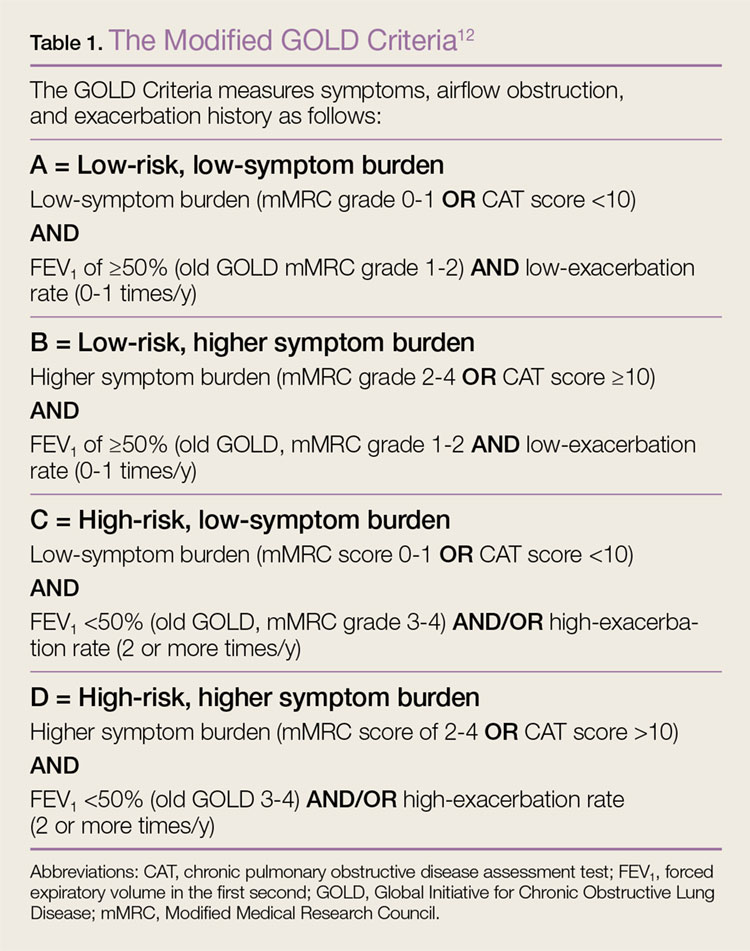
BODE Criteria
The body mass index, airflow obstruction, dyspnea and exercise capacity (BODE) criteria assess and predict the health-related QOL and mortality risk for patients with COPD. Risk is adjusted based on four factors—weight, airway obstruction, dyspnea, and exercise capacity (ie, 6-minute walk distance).13 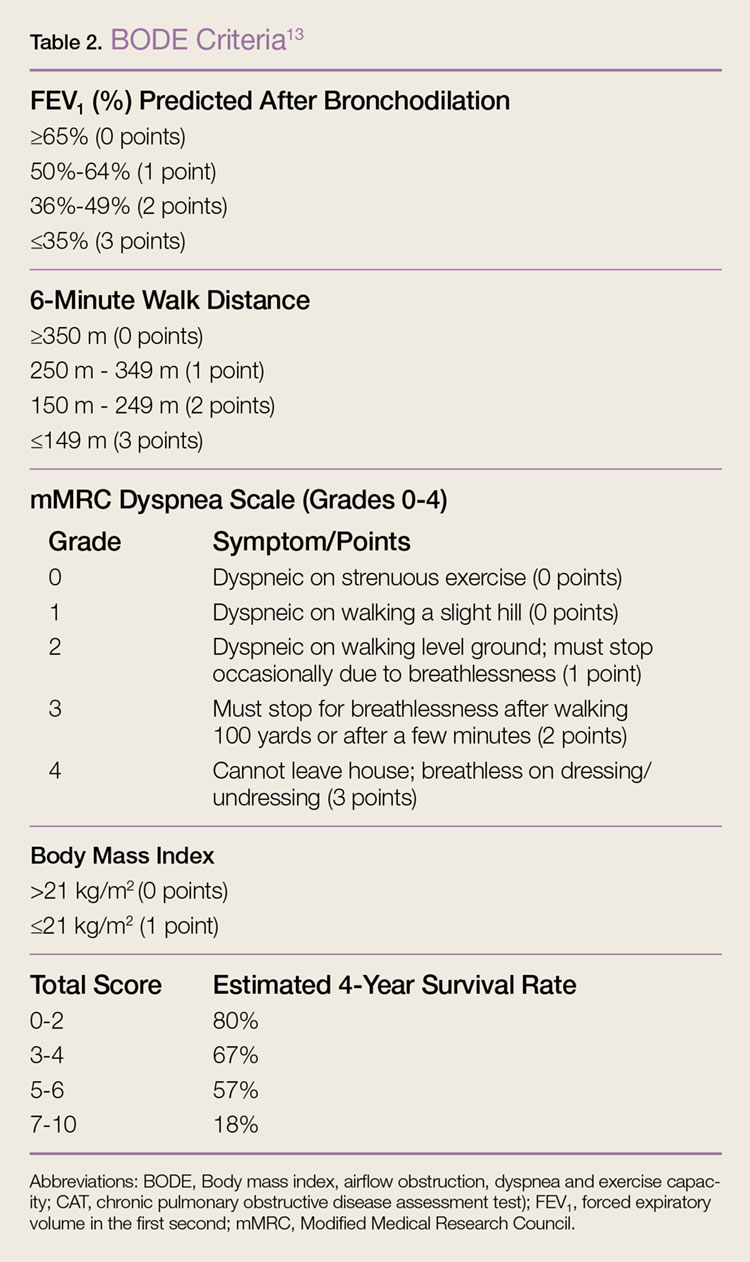
Initial Evaluation and Work-Up
As previously noted, when an AECOPD patient arrives to the ED, the first priority is to stabilize the patient and initiate treatment. In this respect, initial identification of the patient’s pulse oxygen saturation (SpO2) is important.
Laboratory Evaluation
In cases of respiratory failure, obtaining arterial blood gas (ABG) values are critical. The ABG test will assist in determining acute exacerbations of chronic hypercapnia and the need for ventilatory support. When considering CHF, a plasma B-type natriuretic peptide is useful to assess for CHF.
Imaging Studies
A chest radiograph may be useful in the initial evaluation to identify abnormalities, including barotrauma (ie, pneumothorax) and infiltrates. Additionally, in patients with comorbidities, it is important to assess cardiac status, and a chest X-ray may assist in identification of pulmonary edema, pleural effusions, and cardiomegaly. If the radiograph does show a pulmonary infiltrate (ie, pneumonia), it will help identify the probable triggers, but even in these instances, a sputum gram stain will not assist in the diagnosis.
Treatment
Relieving airflow obstruction is achieved with inhaled short-acting bronchodilators and systemic glucocorticoids, by treating infection, and by providing supplemental oxygen and ventilatory support.
Bronchodilators
The short-acting beta-adrenergic agonists (eg, albuterol) act rapidly and are effective in producing bronchodilation. Nebulized therapy may be most comfortable for the acutely ill patient. Typical dosing is 2.5 mg albuterol diluted to 3 cc by nebulizer every hour. Higher doses are not more effective, and there is no evidence of a higher response rate from constant nebulized therapy, which can cause anxiety and tachycardia in patients.14 Anticholinergic agents (eg, ipratropium) are often added despite unclear data regarding clinical advantage. In one study evaluating the effectiveness of adding ipratropium to albuterol, patients receiving a combination had the same improvement in FEV1 at 90 minutes.15 Patients receiving ipratropium alone had the lowest rate of reported side effects.15
Systemic Glucocorticoids
Short-course systemic glucocorticoids are an important addition to treatment and have been found to improve spirometry and decrease relapse rate. The oral and intravenous (IV) routes provide the same benefit. For the acutely ill patient with challenges swallowing, the IV route is preferred. The optimal dose is not clear, but hydrocortisone doses of 100 mg to 125 mg every 6 hours for 3 days are effective, as is oral prednisone 30 mg per day for 14 days, or 60 mg per day for 3 days with a taper.
Antibiotic Therapy
Antibiotics are indicated for patients with moderate to severe AECOPD who are ill enough to be admitted to the hospital. Empiric broad spectrum treatment is recommended. The initial antibiotic regimen should target likely bacterial pathogens (Haemophilus influenzae, Moraxella catarrhalis, and Streptococcus pneumoniae in most patients) and take into account local patterns of antibiotic resistance. Flouroquinolones or third-generation cephalosporins generally provide sufficient coverage. For patients experiencing only a mild exacerbation, antibiotics are not warranted.
Magnesium Sulfate
Other supplemental medications that have been evaluated include magnesium sulfate for bronchial smooth muscle relaxation. Studies have found that while magnesium is helpful in asthma, results are mixed with COPD.16
Supplemental Oxygen
Oxygen therapy is important during an AECOPD episode. Often, concerns arise about decreasing respiratory drive, which is typically driven by hypoxia in patients who have chronic hypercapnia. Arterial blood gas determinations are important in managing a patient’s respiratory status and will assist in determining actual oxygenation and any coexistent metabolic disturbances.
Noninvasive Ventilation. Oxygen can be administered efficiently by a venturi mask, which delivers precise fractions of oxygen, or by nasal cannula. A facemask is less comfortable, but is available for higher oxygen requirements, providing up to 55% oxygen, while a nonrebreather mask delivers up to 90% oxygen.
When necessary, noninvasive positive pressure ventilation (NPPV) improves outcomes for those with severe dyspnea and signs of respiratory fatigue manifested as increased work of breathing. Noninvasive positive pressure ventilation can improve clinical outcomes and is the ventilator mode of choice for those patients with COPD. Indications include severe dyspnea with signs of increased work of breathing and respiratory acidosis (arterial pH <7.35) and partial pressure of arterial carbon dioxide (PaCO2) >45 mm Hg.
Whenever possible, NPPV should be initiated with a triggered mode to allow spontaneous breaths. Inspiratory pressure of 8 cm to 12 cm H2O and expiratory pressure of 3 cm to 5 cm of H2 are recommended.
Mechanical Ventilation. Mechanical ventilation is often undesirable because it may be extraordinarily difficult to wean a patient off the device and permit safe extubation. However, if a patient cannot be stabilized with NPPV, intubation and mechanical ventilation must be considered. Typically, this occurs when there is severe respiratory distress, tachypnea >30 breaths/min, accessory muscle use, and altered mentation.
Goals of intubation/mechanical respiration include correcting oxygenation and severe respiratory acidosis as well as reducing the work of breathing. Barotrauma is a significant risk when patients with COPD require mechanical ventilation. Volume-limited modes of ventilation are commonly used, while pressure support or pressure-limited modes are less suitable for patients with airflow limitation. Again, invasive ventilation should only be administered if a patient cannot tolerate NPPV.
Palliative Care in the ED
Palliative care is an approach that improves the QOL of patients and their families facing the issues associated with life-threatening illness, through the prevention and relief of suffering by means of early identification and accurate assessment and treatment of pain and physical, psychosocial, and spiritual problems.3 This approach to care is warranted for COPD patients given the myriad of burdensome symptoms and functional decline that occurs.17
Palliative care expands traditional treatment goals to include enhancing QOL; helping with medical decision making; and identifying the goals of care. Palliative care is provided by board-certified physicians for the most complex of cases. However, the primary practice of palliative care must be delivered at the bedside by the treating provider. Managing pain, dyspnea, nausea, vomiting, and changes in bowel habits, as well as discussing goals of care, are among the basic palliative care skills all providers need to have and apply when indicated.
Palliative Care for Dyspnea
Opioids. Primary palliative care in the ED includes the appropriate use of low-dose oral and parenteral opioids to treat dyspnea in AECOPD. The use of a low-dose opioid, such as morphine 2 mg IV, titrated up to a desired response, is a safe and effective practice.18 Note the 2-mg starting dose is considered low-dose.19
With respect to managing dyspnea in AECOPD patients, nebulized opioids have not been found to be better than nebulized saline. More specific data regarding the use of oral opioids for managing refractory dyspnea in patients with predominantly COPD have been recently published: Long-acting morphine 20 mg once daily provides symptomatic relief in refractory dyspnea in the community setting. For the opioid-naïve patient, a lower dose is recommended.20
Oxygenation. There is no hard evidence of the effectiveness of oxygen in the palliation of breathlessness. Humidified air is effective initially, as is providing a fan at the bedside. Short-burst oxygen therapy should only be considered for episodes of severe breathlessness in patients whose COPD is not relieved by other treatments. Oxygen should continue to be prescribed only if an improvement in breathlessness following therapy has been documented. The American Thoracic Society recommends continuous oxygen therapy in patients with COPD who have severe resting hypoxemia (PaCO2 ≤55 mm Hg or SpO2 ≤88%).21
POLST Form
The Physicians Order for Life-Sustaining Treatment (POLST) form is a set of medical orders, similar to the “do not resuscitate” (allow natural death) order. A POLST form is not an advance directive and does not serve as a substitute for a patient’s assignation of a health care agent or durable power of attorney for health care.22
The POLST form enables physicians to order treatments patients would want, identify those treatments that patients would not want, and not provide those the patient considers “extraordinary” and excessively burdensome. A POLST form does not allow for active euthanasia or physician-assisted suicide.
Identifying treatment preferences is an important part of the initial evaluation of all patients. When dealing with an airway issue in a COPD patient, management can become complex. Ideally, the POLST form should arrive with the patient in the ED and list preferences regarding possible intensive interventions such as intubation and chest compressions. Discussing these issues with a patient in extreme distress is difficult or impossible, and in these cases, access to pertinent medical records, discussing preferences with family caregivers, and availability of a POLST form are much better ways to determine therapy.
Palliative Home Care
Patient Safety Considerations
Weight loss and associated muscle wasting are common features in patients with severe COPD, creating a high-risk situation for falls and a need for assistance with activities of daily living. The patient who is frail when discharged home from the ED requires a home-care plan before leaving the ED, and strict follow-up with the patient’s primary care provider will typically be needed within 2 to 4 weeks.
Psychological Considerations
Being mindful of the anxiety and depression that accompany the physical limitations of those with COPD is important. Mood disturbances serve as risk factors for re-hospitalization and mortality.13Multiple palliative care interventions provide patients assistance with these issues, including the use of antidepressants that may aid sleep, stabilize mood, and stimulate appetite.
Early referral to the palliative care team will provide improved care for the patient and family. Palliative care referral will provide continued management of the physical symptoms and evaluation and treatment of the psychosocial issues that accompany COPD. Additionally, the palliative care team can assist with safe discharge planning and follow-up, including the provision of the patient’s home needs as well as the family’s ability to cope with the home setting.
Prognosis
Predicting prognosis is difficult for the COPD patient due to the highly variable illness trajectory. Some patients have a low FEV1 and yet are very functional. However, assessment of severity of lung function impairment, frequency of exacerbations, and need for long-term oxygen therapy helps identify those patients who are entering the final 12 months of life. Evaluating symptom burden and impact on activities of daily living for patients with COPD is comparable to those of cancer patients, and in both cases, palliative care approaches are necessary.
Predicting Morbidity and Mortality
A profile developed from observational studies can help predict 6- to 12-month morbidity and mortality in patients with advanced COPD. This profile includes the following criteria:
- Significant dyspnea;
- FEV1 <30%;
- Number of exacerbations;
- Left heart failure or other comorbidities;
- Weight loss or cachexia;
- Decreasing performance status;
- Age older than 70 years; and
- Depression.
Although additional research is required to refine and verify this profile, reviewing these data points can prompt providers to initiate discussions with patients about treatment preferences and end-of-life care.23,24
Palliative Performance Scale
The Palliative Performance Scale (PPS) is another scale used to predict prognosis and eligibility for hospice care.25 This score provides a patient’s estimated survival.25 For a patient with a PPS score of 50%, hospice education may be appropriate.
Case Scenario Continued
Both the BODE and GOLD criteria scores assisted in determining prognosis and risk profiles of the patient in our case scenario. By applying the BODE criteria, our patient had a 4-year survival benefit of under 18%. The GOLD criteria results for this patient also were consistent with the BODE criteria and reflected end-stage COPD. Since this patient also had a PPS score of 50%, hospice education and care were discussed and initiated.
Conclusion
Patients with AECOPD commonly present to the ED. Such patients suffer with a high burden of illness and a need for immediate symptom management. However, after these measures have been instituted, strong evidence suggests that these patients typically do not receive palliative care with the same frequency compared to cancer or heart disease patients.
Management of AECOPD in the ED must include rapid treatment of dyspnea and pain, but also a determination of treatment preferences and an understanding of the prognosis. Several criteria are available to guide prognostic awareness and may help further the goals of care and disposition. Primary palliative care should be started by the ED provider for appropriate patients, with early referral to the palliative care team.
1. National Center for Health Statistics. Health, United States 2015 With Special Feature on Racial and Ethnic Health Disparities. Hyattsville, MD: US Dept. Health and Human Services; 2016. http://www.cdc.gov/nchs/hus/. Accessed October 17, 2016.
2. Khialani B, Sivakumaran P, Keijzers G, Sriram KB. Emergency department management of acute exacerbations of chronic obstructive pulmonary disease and factors associated with hospitalization. J Res Med Sci . 2014;19(4):297-303.
3. World Health Organization Web site. Chronic respiratory diseases. COPD: Definition. http://www.who.int/respiratory/copd/definition/en/. Accessed October 17, 2016.
4. Rabe KF, Hurd S, Anzueto A, et al; Global Initiative for Chronic Obstructive Lung Disease. Global strategy for the diagnosis, management, and prevention of chronic obstructive pulmonary disease: GOLD executive summary. Am J Respir Crit Care Med . 2007;176(6):532-555.
5. Fan VS, Ramsey SD, Make BJ, Martinez FJ. Physiologic variables and functional status independently predict COPD hospitalizations and emergency department visits in patients with severe COPD. COPD . 2007;4(1):29-39.
6. Cydulka RK, Rowe BH, Clark S, Emerman CL, Camargo CA Jr; MARC Investigators. Emergency department management of acute exacerbations of chronic obstructive pulmonary disease in the elderly: the Multicenter Airway Research Collaboration. J Am Geriatr Soc . 2003;51(7):908-916.
7. Strassels SA, Smith DH, Sullivan SD, et al. The costs of treating COPD in the United States. Chest . 2001;119:3.
8. Jencks SF, Williams MV, Coleman EA. Rehospitalizations among patients in the Medicare fee-for-service program. N Engl J Med . 2009;360(14):1418-1428. doi:10.1056/NEJMsa0803563.
9. Rowe BH, Bhutani M, Stickland MK, Cydulka R. Assessment and management of chronic obstructive pulmonary disease in the emergency department and beyond. Expert Rev Respir Med . 2011;5(4):549-559. doi:10.1586/ers.11.43.
10. National Institute for Clinical Excellence Web site. Chronic obstructive pulmonary disease in over 16s: diagnosis and management. Clinical Guideline CG101. https://www.nice.org.uk/Guidance/cg101. Published June 2010. Accessed October 17, 2016.
11. Christensen VL, Holm AM, Cooper B, Paul SM, Miaskowski C, Rustøen T. Differences in symptom burden among patients with moderate, severe, or very severe chronic obstructive pulmonary disease. J Pain Symptom Manage . 2016;51(5):849-859. doi:10.1016/j.jpainsymman.2015.12.324.
12. GOLD Reports. Global Initiative for Chronic Obstructive Lung Disease Web site. http://goldcopd.org/gold-reports/. Accessed October 17, 2016.
13. Funk GC, Kirchheiner K, Burghuber OC, Hartl S. BODE index versus GOLD classification for explaining anxious and depressive symptoms in patients with COPD—a cross-sectional study. Respir Res . 2009;10:1. doi:10.1186/1465-9921-10-1.
14. Bach PB, Brown C, Gelfand SE, McCrory DC; American College of Physicians-American Society of Internal Medicine; American College of Chest Physicians. Management of acute exacerbations of chronic obstructive pulmonary disease: a summary and appraisal of published evidence. Ann Intern Med . 2001;134(7):600-620.
15. McCrory DC, Brown CD. Inhaled short-acting beta 2-agonists versus ipratropium for acute exacerbations of chronic obstructive pulmonary disease. Cochrane Database Syst Rev . 2001;(2):CD002984.
16. Shivanthan MC, Rajapakse S. Magnesium for acute exacerbation of chronic obstructive pulmonary disease: A systematic review of randomised trials. Ann Thorac Med . 2014;9(2):77-80. doi:10.4103/1817-1737.128844.
17. Curtis JR. Palliative and end of life care for patients with severe COPD. Eur Respir J . 2008;32(3):796-803.
18. Rocker GM, Simpson AC, Young J, et al. Opioid therapy for refractory dyspnea in patients with advanced chronic obstructive pulmonary disease: patients’ experiences and outcomes. CMAJ Open . 2013;1(1):E27-E36.
19. Jennings AL, Davies AN, Higgins JP, Gibbs JS, Broadley KE. A systematic review of the use of opioids in the management of dyspnea. Thorax . 2002;57(11):939-944.
20. Abernethy AP, Currow DC, Frith P, Fazekas BS, McHugh A, Bui C. Randomised, double blind, placebo controlled crossover trial of sustained release morphine for the management of refractory dyspnoea. BMJ . 2003;327(7414):523-528.
21. Qaseem A, Wilt TJ, Weinberger SE, et al; American College of Physicians; American College of Chest Physicians; American Thoracic Society; European Respiratory Society. Diagnosis and management of stable chronic obstructive pulmonary disease: a clinical practice guideline update from the American College of Physicians, American College of Chest Physicians, American Thoracic Society, and European Respiratory Society. Ann Intern Med . 2011;155(3):179-191. doi:10.7326/0003-4819-155-3-201108020-00008.
22. National POLST Paradigm. http://polst.org/professionals-page/?pro=1. Accessed October 17, 2016.
23. Hansen-Flaschen J. Chronic obstructive pulmonary disease: the last year of life. Respir Care. 2004;49(1):90-97; discussion 97-98.
24. Spathis A, Booth S. End of life care in chronic obstructive pulmonary disease: in search of a good death. Int J Chron Obstruct Pulmon Dis . 2008;3(1):11-29.
25. Anderson F, Downing GM, Hill J, Casorso L, Lerch N. Palliative performance scale (PPS): a new tool. J Palliat Care . 1996;12(1):5-11.
Case Scenario
A 62-year-old man who regularly presented to the ED for exacerbations of chronic obstructive pulmonary disease (COPD) after running out of his medications presented again for evaluation and treatment. His outpatient care had been poorly coordinated, and he relied on the ED to provide him with the support he needed. This presentation represented his fifth visit to the ED over the past 3 months.
The patient’s medical history was positive for asthma since childhood, tobacco use, hypertension, and a recent diagnosis of congestive heart failure (CHF). Over the past year, he had four hospital admissions, and was currently unable to walk from his bedroom to another room without becoming short of breath. He also had recently experienced a 20-lb weight loss.
At this visit, the patient complained of chest pain and lightheadedness, which he described as suffocating. Prior to these recent symptoms, he enjoyed walking in his neighborhood and talking with friends. He was an avid reader and sports fan, but admitted that he now had trouble focusing on reading and following games on television. He lived alone, and his family lived across the country. The patient further admitted that although he had attempted to quit cigarette smoking, he was unable to give up his 50-pack per year habit. He had no completed advance health care directive and had significant challenges tending to his basic needs.
The Trajectory of COPD
Chronic obstructive pulmonary disease is a common chronic illness that causes significant morbidity and mortality. A 2016 National Health Services report cited respiratory illness, primarily from COPD, as the third leading cause of death in the United States in 2014.1The trajectory of this disease is marked by frequent exacerbations with partial recovery to baseline function. The burden of those living with COPD is significant and marked by a poor overall health-related quality of life (QOL). The ED has become a staging area for patients seeking care for exacerbations of COPD.2
The World Health Organization (WHO) and the Global Initiative for Chronic Obstructive Lung Disease (GOLD) have defined COPD as a spectrum of diseases including emphysema, chronic bronchitis, and chronic obstructive asthma characterized by persistent airflow limitation that is usually progressive and associated with an enhanced chronic inflammatory response to noxious particles or gases in the airways and lungs.3 Exacerbations and comorbidities contribute to the overall severity of COPD in individual patients.4
The case presented in this article illustrates the common scenario of a patient whose COPD has become severe and highly symptomatic with declining function to the point where he requires home support. His physical decline had been rapid and resulted in many unmet needs. When a patient such as this presents for emergent care, he must first be stabilized; then a care plan will need to be developed prior to discharge.
Management Goals
The overall goals of treating COPD are based on preserving function and are not curative in nature. Chronic obstructive pulmonary disease is a progressive illness that will intensify over time.5 As such, palliative care services are warranted. However, many patients with COPD do not receive palliative care services compared to patients with such other serious and life-limiting disease as cancer and heart disease.
Acute Exacerbations of COPD
Incidence
The frequency of acute exacerbations of COPD (AECOPD) increases with age, productive cough, long-standing COPD, previous hospitalizations related to COPD, eosinophilia, and comorbidities (eg, CHF). Patients with moderate to severe COPD and a history of prior exacerbations were found to have a higher likelihood of future exacerbations. From a quality and cost perspective, it may be useful to identify high-risk patients and strengthen their outpatient program to lessen the need for ED care and more intensive support.6,7
In our case scenario, the patient could have been stabilized at home with a well-controlled plan and home support, which would have resulted in an improved QOL and more time free from his high symptom burden.
Causes
Bacterial and viral respiratory infections are the most likely cause of AECOPD. Environmental pollution and pulmonary embolism are also triggers. Typically, patients with AECOPD present to the ED up to several times a year2 and represent the third most common cause of 30-day readmissions to the hospital.8 Prior exacerbations, dyspnea, and other medical comorbidities are also risk factors for more frequent hospital visits.
Presenting Signs and Symptoms
Each occurrence of AECOPD represents a worsening of a patient’s respiratory symptoms beyond normal variations. This might include increases in cough, sputum production, and dyspnea. The goal in caring for a person with an AECOPD is to stabilize the acute event and provide a treatment plan. The range of acuity for moderate to severe disease makes devising an appropriate treatment plan challenging, and after implementing the best plans, the patient’s course may be characterized by a prolonged cycle of admissions and readmissions without substantial return to baseline.
Management
In practice, ED management of AECOPD in older adults typically differs significantly from published guideline recommendations,9 which may result in pooroutcomes related to shortcomings in quality of care. Better adherence to guideline recommendations when caring for elderly patients with COPD may lead to improved clinical outcomes and better resource usage.
Risk Stratification
Complicating ED management is the challenge of determining the severity of illness and degree of the exacerbation. Airflow obstruction alone is not sufficient to predict outcomes, as any particular measure of obstruction is associated with a spectrum of forced expiratory volume in the first second (FEV1) and varying performance. Moreover, peak-flow measurements are not useful in the setting of AECOPD, as opposed to their use in acute asthma exacerbations, and are not predictive of changes in clinical status.
GOLD and NICE Criteria
Guidelines have been developed and widely promoted to assist ED and hospital and community clinicians in providing evidence-based management for COPD patients. The GOLD Criteria and the National Institute for Clinical Excellence (NICE) are both clinical guidelines on management of COPD.10
Although well recognized and commonly used, the original GOLD criteria did not take into account the frequency and importance of the extrapulmonary manifestations of COPD in predicting outcome. Typically, those with severe or very severe COPD have an average of 12 co-occurring symptoms, an even greater number of signs and symptoms than those occurring in patients with cancer or heart or renal disease.11
BODE Criteria
The body mass index, airflow obstruction, dyspnea and exercise capacity (BODE) criteria assess and predict the health-related QOL and mortality risk for patients with COPD. Risk is adjusted based on four factors—weight, airway obstruction, dyspnea, and exercise capacity (ie, 6-minute walk distance).13
Initial Evaluation and Work-Up
As previously noted, when an AECOPD patient arrives to the ED, the first priority is to stabilize the patient and initiate treatment. In this respect, initial identification of the patient’s pulse oxygen saturation (SpO2) is important.
Laboratory Evaluation
In cases of respiratory failure, obtaining arterial blood gas (ABG) values are critical. The ABG test will assist in determining acute exacerbations of chronic hypercapnia and the need for ventilatory support. When considering CHF, a plasma B-type natriuretic peptide is useful to assess for CHF.
Imaging Studies
A chest radiograph may be useful in the initial evaluation to identify abnormalities, including barotrauma (ie, pneumothorax) and infiltrates. Additionally, in patients with comorbidities, it is important to assess cardiac status, and a chest X-ray may assist in identification of pulmonary edema, pleural effusions, and cardiomegaly. If the radiograph does show a pulmonary infiltrate (ie, pneumonia), it will help identify the probable triggers, but even in these instances, a sputum gram stain will not assist in the diagnosis.
Treatment
Relieving airflow obstruction is achieved with inhaled short-acting bronchodilators and systemic glucocorticoids, by treating infection, and by providing supplemental oxygen and ventilatory support.
Bronchodilators
The short-acting beta-adrenergic agonists (eg, albuterol) act rapidly and are effective in producing bronchodilation. Nebulized therapy may be most comfortable for the acutely ill patient. Typical dosing is 2.5 mg albuterol diluted to 3 cc by nebulizer every hour. Higher doses are not more effective, and there is no evidence of a higher response rate from constant nebulized therapy, which can cause anxiety and tachycardia in patients.14 Anticholinergic agents (eg, ipratropium) are often added despite unclear data regarding clinical advantage. In one study evaluating the effectiveness of adding ipratropium to albuterol, patients receiving a combination had the same improvement in FEV1 at 90 minutes.15 Patients receiving ipratropium alone had the lowest rate of reported side effects.15
Systemic Glucocorticoids
Short-course systemic glucocorticoids are an important addition to treatment and have been found to improve spirometry and decrease relapse rate. The oral and intravenous (IV) routes provide the same benefit. For the acutely ill patient with challenges swallowing, the IV route is preferred. The optimal dose is not clear, but hydrocortisone doses of 100 mg to 125 mg every 6 hours for 3 days are effective, as is oral prednisone 30 mg per day for 14 days, or 60 mg per day for 3 days with a taper.
Antibiotic Therapy
Antibiotics are indicated for patients with moderate to severe AECOPD who are ill enough to be admitted to the hospital. Empiric broad spectrum treatment is recommended. The initial antibiotic regimen should target likely bacterial pathogens (Haemophilus influenzae, Moraxella catarrhalis, and Streptococcus pneumoniae in most patients) and take into account local patterns of antibiotic resistance. Flouroquinolones or third-generation cephalosporins generally provide sufficient coverage. For patients experiencing only a mild exacerbation, antibiotics are not warranted.
Magnesium Sulfate
Other supplemental medications that have been evaluated include magnesium sulfate for bronchial smooth muscle relaxation. Studies have found that while magnesium is helpful in asthma, results are mixed with COPD.16
Supplemental Oxygen
Oxygen therapy is important during an AECOPD episode. Often, concerns arise about decreasing respiratory drive, which is typically driven by hypoxia in patients who have chronic hypercapnia. Arterial blood gas determinations are important in managing a patient’s respiratory status and will assist in determining actual oxygenation and any coexistent metabolic disturbances.
Noninvasive Ventilation. Oxygen can be administered efficiently by a venturi mask, which delivers precise fractions of oxygen, or by nasal cannula. A facemask is less comfortable, but is available for higher oxygen requirements, providing up to 55% oxygen, while a nonrebreather mask delivers up to 90% oxygen.
When necessary, noninvasive positive pressure ventilation (NPPV) improves outcomes for those with severe dyspnea and signs of respiratory fatigue manifested as increased work of breathing. Noninvasive positive pressure ventilation can improve clinical outcomes and is the ventilator mode of choice for those patients with COPD. Indications include severe dyspnea with signs of increased work of breathing and respiratory acidosis (arterial pH <7.35) and partial pressure of arterial carbon dioxide (PaCO2) >45 mm Hg.
Whenever possible, NPPV should be initiated with a triggered mode to allow spontaneous breaths. Inspiratory pressure of 8 cm to 12 cm H2O and expiratory pressure of 3 cm to 5 cm of H2 are recommended.
Mechanical Ventilation. Mechanical ventilation is often undesirable because it may be extraordinarily difficult to wean a patient off the device and permit safe extubation. However, if a patient cannot be stabilized with NPPV, intubation and mechanical ventilation must be considered. Typically, this occurs when there is severe respiratory distress, tachypnea >30 breaths/min, accessory muscle use, and altered mentation.
Goals of intubation/mechanical respiration include correcting oxygenation and severe respiratory acidosis as well as reducing the work of breathing. Barotrauma is a significant risk when patients with COPD require mechanical ventilation. Volume-limited modes of ventilation are commonly used, while pressure support or pressure-limited modes are less suitable for patients with airflow limitation. Again, invasive ventilation should only be administered if a patient cannot tolerate NPPV.
Palliative Care in the ED
Palliative care is an approach that improves the QOL of patients and their families facing the issues associated with life-threatening illness, through the prevention and relief of suffering by means of early identification and accurate assessment and treatment of pain and physical, psychosocial, and spiritual problems.3 This approach to care is warranted for COPD patients given the myriad of burdensome symptoms and functional decline that occurs.17
Palliative care expands traditional treatment goals to include enhancing QOL; helping with medical decision making; and identifying the goals of care. Palliative care is provided by board-certified physicians for the most complex of cases. However, the primary practice of palliative care must be delivered at the bedside by the treating provider. Managing pain, dyspnea, nausea, vomiting, and changes in bowel habits, as well as discussing goals of care, are among the basic palliative care skills all providers need to have and apply when indicated.
Palliative Care for Dyspnea
Opioids. Primary palliative care in the ED includes the appropriate use of low-dose oral and parenteral opioids to treat dyspnea in AECOPD. The use of a low-dose opioid, such as morphine 2 mg IV, titrated up to a desired response, is a safe and effective practice.18 Note the 2-mg starting dose is considered low-dose.19
With respect to managing dyspnea in AECOPD patients, nebulized opioids have not been found to be better than nebulized saline. More specific data regarding the use of oral opioids for managing refractory dyspnea in patients with predominantly COPD have been recently published: Long-acting morphine 20 mg once daily provides symptomatic relief in refractory dyspnea in the community setting. For the opioid-naïve patient, a lower dose is recommended.20
Oxygenation. There is no hard evidence of the effectiveness of oxygen in the palliation of breathlessness. Humidified air is effective initially, as is providing a fan at the bedside. Short-burst oxygen therapy should only be considered for episodes of severe breathlessness in patients whose COPD is not relieved by other treatments. Oxygen should continue to be prescribed only if an improvement in breathlessness following therapy has been documented. The American Thoracic Society recommends continuous oxygen therapy in patients with COPD who have severe resting hypoxemia (PaCO2 ≤55 mm Hg or SpO2 ≤88%).21
POLST Form
The Physicians Order for Life-Sustaining Treatment (POLST) form is a set of medical orders, similar to the “do not resuscitate” (allow natural death) order. A POLST form is not an advance directive and does not serve as a substitute for a patient’s assignation of a health care agent or durable power of attorney for health care.22
The POLST form enables physicians to order treatments patients would want, identify those treatments that patients would not want, and not provide those the patient considers “extraordinary” and excessively burdensome. A POLST form does not allow for active euthanasia or physician-assisted suicide.
Identifying treatment preferences is an important part of the initial evaluation of all patients. When dealing with an airway issue in a COPD patient, management can become complex. Ideally, the POLST form should arrive with the patient in the ED and list preferences regarding possible intensive interventions such as intubation and chest compressions. Discussing these issues with a patient in extreme distress is difficult or impossible, and in these cases, access to pertinent medical records, discussing preferences with family caregivers, and availability of a POLST form are much better ways to determine therapy.
Palliative Home Care
Patient Safety Considerations
Weight loss and associated muscle wasting are common features in patients with severe COPD, creating a high-risk situation for falls and a need for assistance with activities of daily living. The patient who is frail when discharged home from the ED requires a home-care plan before leaving the ED, and strict follow-up with the patient’s primary care provider will typically be needed within 2 to 4 weeks.
Psychological Considerations
Being mindful of the anxiety and depression that accompany the physical limitations of those with COPD is important. Mood disturbances serve as risk factors for re-hospitalization and mortality.13Multiple palliative care interventions provide patients assistance with these issues, including the use of antidepressants that may aid sleep, stabilize mood, and stimulate appetite.
Early referral to the palliative care team will provide improved care for the patient and family. Palliative care referral will provide continued management of the physical symptoms and evaluation and treatment of the psychosocial issues that accompany COPD. Additionally, the palliative care team can assist with safe discharge planning and follow-up, including the provision of the patient’s home needs as well as the family’s ability to cope with the home setting.
Prognosis
Predicting prognosis is difficult for the COPD patient due to the highly variable illness trajectory. Some patients have a low FEV1 and yet are very functional. However, assessment of severity of lung function impairment, frequency of exacerbations, and need for long-term oxygen therapy helps identify those patients who are entering the final 12 months of life. Evaluating symptom burden and impact on activities of daily living for patients with COPD is comparable to those of cancer patients, and in both cases, palliative care approaches are necessary.
Predicting Morbidity and Mortality
A profile developed from observational studies can help predict 6- to 12-month morbidity and mortality in patients with advanced COPD. This profile includes the following criteria:
- Significant dyspnea;
- FEV1 <30%;
- Number of exacerbations;
- Left heart failure or other comorbidities;
- Weight loss or cachexia;
- Decreasing performance status;
- Age older than 70 years; and
- Depression.
Although additional research is required to refine and verify this profile, reviewing these data points can prompt providers to initiate discussions with patients about treatment preferences and end-of-life care.23,24
Palliative Performance Scale
The Palliative Performance Scale (PPS) is another scale used to predict prognosis and eligibility for hospice care.25 This score provides a patient’s estimated survival.25 For a patient with a PPS score of 50%, hospice education may be appropriate.
Case Scenario Continued
Both the BODE and GOLD criteria scores assisted in determining prognosis and risk profiles of the patient in our case scenario. By applying the BODE criteria, our patient had a 4-year survival benefit of under 18%. The GOLD criteria results for this patient also were consistent with the BODE criteria and reflected end-stage COPD. Since this patient also had a PPS score of 50%, hospice education and care were discussed and initiated.
Conclusion
Patients with AECOPD commonly present to the ED. Such patients suffer with a high burden of illness and a need for immediate symptom management. However, after these measures have been instituted, strong evidence suggests that these patients typically do not receive palliative care with the same frequency compared to cancer or heart disease patients.
Management of AECOPD in the ED must include rapid treatment of dyspnea and pain, but also a determination of treatment preferences and an understanding of the prognosis. Several criteria are available to guide prognostic awareness and may help further the goals of care and disposition. Primary palliative care should be started by the ED provider for appropriate patients, with early referral to the palliative care team.
Case Scenario
A 62-year-old man who regularly presented to the ED for exacerbations of chronic obstructive pulmonary disease (COPD) after running out of his medications presented again for evaluation and treatment. His outpatient care had been poorly coordinated, and he relied on the ED to provide him with the support he needed. This presentation represented his fifth visit to the ED over the past 3 months.
The patient’s medical history was positive for asthma since childhood, tobacco use, hypertension, and a recent diagnosis of congestive heart failure (CHF). Over the past year, he had four hospital admissions, and was currently unable to walk from his bedroom to another room without becoming short of breath. He also had recently experienced a 20-lb weight loss.
At this visit, the patient complained of chest pain and lightheadedness, which he described as suffocating. Prior to these recent symptoms, he enjoyed walking in his neighborhood and talking with friends. He was an avid reader and sports fan, but admitted that he now had trouble focusing on reading and following games on television. He lived alone, and his family lived across the country. The patient further admitted that although he had attempted to quit cigarette smoking, he was unable to give up his 50-pack per year habit. He had no completed advance health care directive and had significant challenges tending to his basic needs.
The Trajectory of COPD
Chronic obstructive pulmonary disease is a common chronic illness that causes significant morbidity and mortality. A 2016 National Health Services report cited respiratory illness, primarily from COPD, as the third leading cause of death in the United States in 2014.1The trajectory of this disease is marked by frequent exacerbations with partial recovery to baseline function. The burden of those living with COPD is significant and marked by a poor overall health-related quality of life (QOL). The ED has become a staging area for patients seeking care for exacerbations of COPD.2
The World Health Organization (WHO) and the Global Initiative for Chronic Obstructive Lung Disease (GOLD) have defined COPD as a spectrum of diseases including emphysema, chronic bronchitis, and chronic obstructive asthma characterized by persistent airflow limitation that is usually progressive and associated with an enhanced chronic inflammatory response to noxious particles or gases in the airways and lungs.3 Exacerbations and comorbidities contribute to the overall severity of COPD in individual patients.4
The case presented in this article illustrates the common scenario of a patient whose COPD has become severe and highly symptomatic with declining function to the point where he requires home support. His physical decline had been rapid and resulted in many unmet needs. When a patient such as this presents for emergent care, he must first be stabilized; then a care plan will need to be developed prior to discharge.
Management Goals
The overall goals of treating COPD are based on preserving function and are not curative in nature. Chronic obstructive pulmonary disease is a progressive illness that will intensify over time.5 As such, palliative care services are warranted. However, many patients with COPD do not receive palliative care services compared to patients with such other serious and life-limiting disease as cancer and heart disease.
Acute Exacerbations of COPD
Incidence
The frequency of acute exacerbations of COPD (AECOPD) increases with age, productive cough, long-standing COPD, previous hospitalizations related to COPD, eosinophilia, and comorbidities (eg, CHF). Patients with moderate to severe COPD and a history of prior exacerbations were found to have a higher likelihood of future exacerbations. From a quality and cost perspective, it may be useful to identify high-risk patients and strengthen their outpatient program to lessen the need for ED care and more intensive support.6,7
In our case scenario, the patient could have been stabilized at home with a well-controlled plan and home support, which would have resulted in an improved QOL and more time free from his high symptom burden.
Causes
Bacterial and viral respiratory infections are the most likely cause of AECOPD. Environmental pollution and pulmonary embolism are also triggers. Typically, patients with AECOPD present to the ED up to several times a year2 and represent the third most common cause of 30-day readmissions to the hospital.8 Prior exacerbations, dyspnea, and other medical comorbidities are also risk factors for more frequent hospital visits.
Presenting Signs and Symptoms
Each occurrence of AECOPD represents a worsening of a patient’s respiratory symptoms beyond normal variations. This might include increases in cough, sputum production, and dyspnea. The goal in caring for a person with an AECOPD is to stabilize the acute event and provide a treatment plan. The range of acuity for moderate to severe disease makes devising an appropriate treatment plan challenging, and after implementing the best plans, the patient’s course may be characterized by a prolonged cycle of admissions and readmissions without substantial return to baseline.
Management
In practice, ED management of AECOPD in older adults typically differs significantly from published guideline recommendations,9 which may result in pooroutcomes related to shortcomings in quality of care. Better adherence to guideline recommendations when caring for elderly patients with COPD may lead to improved clinical outcomes and better resource usage.
Risk Stratification
Complicating ED management is the challenge of determining the severity of illness and degree of the exacerbation. Airflow obstruction alone is not sufficient to predict outcomes, as any particular measure of obstruction is associated with a spectrum of forced expiratory volume in the first second (FEV1) and varying performance. Moreover, peak-flow measurements are not useful in the setting of AECOPD, as opposed to their use in acute asthma exacerbations, and are not predictive of changes in clinical status.
GOLD and NICE Criteria
Guidelines have been developed and widely promoted to assist ED and hospital and community clinicians in providing evidence-based management for COPD patients. The GOLD Criteria and the National Institute for Clinical Excellence (NICE) are both clinical guidelines on management of COPD.10
Although well recognized and commonly used, the original GOLD criteria did not take into account the frequency and importance of the extrapulmonary manifestations of COPD in predicting outcome. Typically, those with severe or very severe COPD have an average of 12 co-occurring symptoms, an even greater number of signs and symptoms than those occurring in patients with cancer or heart or renal disease.11
BODE Criteria
The body mass index, airflow obstruction, dyspnea and exercise capacity (BODE) criteria assess and predict the health-related QOL and mortality risk for patients with COPD. Risk is adjusted based on four factors—weight, airway obstruction, dyspnea, and exercise capacity (ie, 6-minute walk distance).13
Initial Evaluation and Work-Up
As previously noted, when an AECOPD patient arrives to the ED, the first priority is to stabilize the patient and initiate treatment. In this respect, initial identification of the patient’s pulse oxygen saturation (SpO2) is important.
Laboratory Evaluation
In cases of respiratory failure, obtaining arterial blood gas (ABG) values are critical. The ABG test will assist in determining acute exacerbations of chronic hypercapnia and the need for ventilatory support. When considering CHF, a plasma B-type natriuretic peptide is useful to assess for CHF.
Imaging Studies
A chest radiograph may be useful in the initial evaluation to identify abnormalities, including barotrauma (ie, pneumothorax) and infiltrates. Additionally, in patients with comorbidities, it is important to assess cardiac status, and a chest X-ray may assist in identification of pulmonary edema, pleural effusions, and cardiomegaly. If the radiograph does show a pulmonary infiltrate (ie, pneumonia), it will help identify the probable triggers, but even in these instances, a sputum gram stain will not assist in the diagnosis.
Treatment
Relieving airflow obstruction is achieved with inhaled short-acting bronchodilators and systemic glucocorticoids, by treating infection, and by providing supplemental oxygen and ventilatory support.
Bronchodilators
The short-acting beta-adrenergic agonists (eg, albuterol) act rapidly and are effective in producing bronchodilation. Nebulized therapy may be most comfortable for the acutely ill patient. Typical dosing is 2.5 mg albuterol diluted to 3 cc by nebulizer every hour. Higher doses are not more effective, and there is no evidence of a higher response rate from constant nebulized therapy, which can cause anxiety and tachycardia in patients.14 Anticholinergic agents (eg, ipratropium) are often added despite unclear data regarding clinical advantage. In one study evaluating the effectiveness of adding ipratropium to albuterol, patients receiving a combination had the same improvement in FEV1 at 90 minutes.15 Patients receiving ipratropium alone had the lowest rate of reported side effects.15
Systemic Glucocorticoids
Short-course systemic glucocorticoids are an important addition to treatment and have been found to improve spirometry and decrease relapse rate. The oral and intravenous (IV) routes provide the same benefit. For the acutely ill patient with challenges swallowing, the IV route is preferred. The optimal dose is not clear, but hydrocortisone doses of 100 mg to 125 mg every 6 hours for 3 days are effective, as is oral prednisone 30 mg per day for 14 days, or 60 mg per day for 3 days with a taper.
Antibiotic Therapy
Antibiotics are indicated for patients with moderate to severe AECOPD who are ill enough to be admitted to the hospital. Empiric broad spectrum treatment is recommended. The initial antibiotic regimen should target likely bacterial pathogens (Haemophilus influenzae, Moraxella catarrhalis, and Streptococcus pneumoniae in most patients) and take into account local patterns of antibiotic resistance. Flouroquinolones or third-generation cephalosporins generally provide sufficient coverage. For patients experiencing only a mild exacerbation, antibiotics are not warranted.
Magnesium Sulfate
Other supplemental medications that have been evaluated include magnesium sulfate for bronchial smooth muscle relaxation. Studies have found that while magnesium is helpful in asthma, results are mixed with COPD.16
Supplemental Oxygen
Oxygen therapy is important during an AECOPD episode. Often, concerns arise about decreasing respiratory drive, which is typically driven by hypoxia in patients who have chronic hypercapnia. Arterial blood gas determinations are important in managing a patient’s respiratory status and will assist in determining actual oxygenation and any coexistent metabolic disturbances.
Noninvasive Ventilation. Oxygen can be administered efficiently by a venturi mask, which delivers precise fractions of oxygen, or by nasal cannula. A facemask is less comfortable, but is available for higher oxygen requirements, providing up to 55% oxygen, while a nonrebreather mask delivers up to 90% oxygen.
When necessary, noninvasive positive pressure ventilation (NPPV) improves outcomes for those with severe dyspnea and signs of respiratory fatigue manifested as increased work of breathing. Noninvasive positive pressure ventilation can improve clinical outcomes and is the ventilator mode of choice for those patients with COPD. Indications include severe dyspnea with signs of increased work of breathing and respiratory acidosis (arterial pH <7.35) and partial pressure of arterial carbon dioxide (PaCO2) >45 mm Hg.
Whenever possible, NPPV should be initiated with a triggered mode to allow spontaneous breaths. Inspiratory pressure of 8 cm to 12 cm H2O and expiratory pressure of 3 cm to 5 cm of H2 are recommended.
Mechanical Ventilation. Mechanical ventilation is often undesirable because it may be extraordinarily difficult to wean a patient off the device and permit safe extubation. However, if a patient cannot be stabilized with NPPV, intubation and mechanical ventilation must be considered. Typically, this occurs when there is severe respiratory distress, tachypnea >30 breaths/min, accessory muscle use, and altered mentation.
Goals of intubation/mechanical respiration include correcting oxygenation and severe respiratory acidosis as well as reducing the work of breathing. Barotrauma is a significant risk when patients with COPD require mechanical ventilation. Volume-limited modes of ventilation are commonly used, while pressure support or pressure-limited modes are less suitable for patients with airflow limitation. Again, invasive ventilation should only be administered if a patient cannot tolerate NPPV.
Palliative Care in the ED
Palliative care is an approach that improves the QOL of patients and their families facing the issues associated with life-threatening illness, through the prevention and relief of suffering by means of early identification and accurate assessment and treatment of pain and physical, psychosocial, and spiritual problems.3 This approach to care is warranted for COPD patients given the myriad of burdensome symptoms and functional decline that occurs.17
Palliative care expands traditional treatment goals to include enhancing QOL; helping with medical decision making; and identifying the goals of care. Palliative care is provided by board-certified physicians for the most complex of cases. However, the primary practice of palliative care must be delivered at the bedside by the treating provider. Managing pain, dyspnea, nausea, vomiting, and changes in bowel habits, as well as discussing goals of care, are among the basic palliative care skills all providers need to have and apply when indicated.
Palliative Care for Dyspnea
Opioids. Primary palliative care in the ED includes the appropriate use of low-dose oral and parenteral opioids to treat dyspnea in AECOPD. The use of a low-dose opioid, such as morphine 2 mg IV, titrated up to a desired response, is a safe and effective practice.18 Note the 2-mg starting dose is considered low-dose.19
With respect to managing dyspnea in AECOPD patients, nebulized opioids have not been found to be better than nebulized saline. More specific data regarding the use of oral opioids for managing refractory dyspnea in patients with predominantly COPD have been recently published: Long-acting morphine 20 mg once daily provides symptomatic relief in refractory dyspnea in the community setting. For the opioid-naïve patient, a lower dose is recommended.20
Oxygenation. There is no hard evidence of the effectiveness of oxygen in the palliation of breathlessness. Humidified air is effective initially, as is providing a fan at the bedside. Short-burst oxygen therapy should only be considered for episodes of severe breathlessness in patients whose COPD is not relieved by other treatments. Oxygen should continue to be prescribed only if an improvement in breathlessness following therapy has been documented. The American Thoracic Society recommends continuous oxygen therapy in patients with COPD who have severe resting hypoxemia (PaCO2 ≤55 mm Hg or SpO2 ≤88%).21
POLST Form
The Physicians Order for Life-Sustaining Treatment (POLST) form is a set of medical orders, similar to the “do not resuscitate” (allow natural death) order. A POLST form is not an advance directive and does not serve as a substitute for a patient’s assignation of a health care agent or durable power of attorney for health care.22
The POLST form enables physicians to order treatments patients would want, identify those treatments that patients would not want, and not provide those the patient considers “extraordinary” and excessively burdensome. A POLST form does not allow for active euthanasia or physician-assisted suicide.
Identifying treatment preferences is an important part of the initial evaluation of all patients. When dealing with an airway issue in a COPD patient, management can become complex. Ideally, the POLST form should arrive with the patient in the ED and list preferences regarding possible intensive interventions such as intubation and chest compressions. Discussing these issues with a patient in extreme distress is difficult or impossible, and in these cases, access to pertinent medical records, discussing preferences with family caregivers, and availability of a POLST form are much better ways to determine therapy.
Palliative Home Care
Patient Safety Considerations
Weight loss and associated muscle wasting are common features in patients with severe COPD, creating a high-risk situation for falls and a need for assistance with activities of daily living. The patient who is frail when discharged home from the ED requires a home-care plan before leaving the ED, and strict follow-up with the patient’s primary care provider will typically be needed within 2 to 4 weeks.
Psychological Considerations
Being mindful of the anxiety and depression that accompany the physical limitations of those with COPD is important. Mood disturbances serve as risk factors for re-hospitalization and mortality.13Multiple palliative care interventions provide patients assistance with these issues, including the use of antidepressants that may aid sleep, stabilize mood, and stimulate appetite.
Early referral to the palliative care team will provide improved care for the patient and family. Palliative care referral will provide continued management of the physical symptoms and evaluation and treatment of the psychosocial issues that accompany COPD. Additionally, the palliative care team can assist with safe discharge planning and follow-up, including the provision of the patient’s home needs as well as the family’s ability to cope with the home setting.
Prognosis
Predicting prognosis is difficult for the COPD patient due to the highly variable illness trajectory. Some patients have a low FEV1 and yet are very functional. However, assessment of severity of lung function impairment, frequency of exacerbations, and need for long-term oxygen therapy helps identify those patients who are entering the final 12 months of life. Evaluating symptom burden and impact on activities of daily living for patients with COPD is comparable to those of cancer patients, and in both cases, palliative care approaches are necessary.
Predicting Morbidity and Mortality
A profile developed from observational studies can help predict 6- to 12-month morbidity and mortality in patients with advanced COPD. This profile includes the following criteria:
- Significant dyspnea;
- FEV1 <30%;
- Number of exacerbations;
- Left heart failure or other comorbidities;
- Weight loss or cachexia;
- Decreasing performance status;
- Age older than 70 years; and
- Depression.
Although additional research is required to refine and verify this profile, reviewing these data points can prompt providers to initiate discussions with patients about treatment preferences and end-of-life care.23,24
Palliative Performance Scale
The Palliative Performance Scale (PPS) is another scale used to predict prognosis and eligibility for hospice care.25 This score provides a patient’s estimated survival.25 For a patient with a PPS score of 50%, hospice education may be appropriate.
Case Scenario Continued
Both the BODE and GOLD criteria scores assisted in determining prognosis and risk profiles of the patient in our case scenario. By applying the BODE criteria, our patient had a 4-year survival benefit of under 18%. The GOLD criteria results for this patient also were consistent with the BODE criteria and reflected end-stage COPD. Since this patient also had a PPS score of 50%, hospice education and care were discussed and initiated.
Conclusion
Patients with AECOPD commonly present to the ED. Such patients suffer with a high burden of illness and a need for immediate symptom management. However, after these measures have been instituted, strong evidence suggests that these patients typically do not receive palliative care with the same frequency compared to cancer or heart disease patients.
Management of AECOPD in the ED must include rapid treatment of dyspnea and pain, but also a determination of treatment preferences and an understanding of the prognosis. Several criteria are available to guide prognostic awareness and may help further the goals of care and disposition. Primary palliative care should be started by the ED provider for appropriate patients, with early referral to the palliative care team.
1. National Center for Health Statistics. Health, United States 2015 With Special Feature on Racial and Ethnic Health Disparities. Hyattsville, MD: US Dept. Health and Human Services; 2016. http://www.cdc.gov/nchs/hus/. Accessed October 17, 2016.
2. Khialani B, Sivakumaran P, Keijzers G, Sriram KB. Emergency department management of acute exacerbations of chronic obstructive pulmonary disease and factors associated with hospitalization. J Res Med Sci . 2014;19(4):297-303.
3. World Health Organization Web site. Chronic respiratory diseases. COPD: Definition. http://www.who.int/respiratory/copd/definition/en/. Accessed October 17, 2016.
4. Rabe KF, Hurd S, Anzueto A, et al; Global Initiative for Chronic Obstructive Lung Disease. Global strategy for the diagnosis, management, and prevention of chronic obstructive pulmonary disease: GOLD executive summary. Am J Respir Crit Care Med . 2007;176(6):532-555.
5. Fan VS, Ramsey SD, Make BJ, Martinez FJ. Physiologic variables and functional status independently predict COPD hospitalizations and emergency department visits in patients with severe COPD. COPD . 2007;4(1):29-39.
6. Cydulka RK, Rowe BH, Clark S, Emerman CL, Camargo CA Jr; MARC Investigators. Emergency department management of acute exacerbations of chronic obstructive pulmonary disease in the elderly: the Multicenter Airway Research Collaboration. J Am Geriatr Soc . 2003;51(7):908-916.
7. Strassels SA, Smith DH, Sullivan SD, et al. The costs of treating COPD in the United States. Chest . 2001;119:3.
8. Jencks SF, Williams MV, Coleman EA. Rehospitalizations among patients in the Medicare fee-for-service program. N Engl J Med . 2009;360(14):1418-1428. doi:10.1056/NEJMsa0803563.
9. Rowe BH, Bhutani M, Stickland MK, Cydulka R. Assessment and management of chronic obstructive pulmonary disease in the emergency department and beyond. Expert Rev Respir Med . 2011;5(4):549-559. doi:10.1586/ers.11.43.
10. National Institute for Clinical Excellence Web site. Chronic obstructive pulmonary disease in over 16s: diagnosis and management. Clinical Guideline CG101. https://www.nice.org.uk/Guidance/cg101. Published June 2010. Accessed October 17, 2016.
11. Christensen VL, Holm AM, Cooper B, Paul SM, Miaskowski C, Rustøen T. Differences in symptom burden among patients with moderate, severe, or very severe chronic obstructive pulmonary disease. J Pain Symptom Manage . 2016;51(5):849-859. doi:10.1016/j.jpainsymman.2015.12.324.
12. GOLD Reports. Global Initiative for Chronic Obstructive Lung Disease Web site. http://goldcopd.org/gold-reports/. Accessed October 17, 2016.
13. Funk GC, Kirchheiner K, Burghuber OC, Hartl S. BODE index versus GOLD classification for explaining anxious and depressive symptoms in patients with COPD—a cross-sectional study. Respir Res . 2009;10:1. doi:10.1186/1465-9921-10-1.
14. Bach PB, Brown C, Gelfand SE, McCrory DC; American College of Physicians-American Society of Internal Medicine; American College of Chest Physicians. Management of acute exacerbations of chronic obstructive pulmonary disease: a summary and appraisal of published evidence. Ann Intern Med . 2001;134(7):600-620.
15. McCrory DC, Brown CD. Inhaled short-acting beta 2-agonists versus ipratropium for acute exacerbations of chronic obstructive pulmonary disease. Cochrane Database Syst Rev . 2001;(2):CD002984.
16. Shivanthan MC, Rajapakse S. Magnesium for acute exacerbation of chronic obstructive pulmonary disease: A systematic review of randomised trials. Ann Thorac Med . 2014;9(2):77-80. doi:10.4103/1817-1737.128844.
17. Curtis JR. Palliative and end of life care for patients with severe COPD. Eur Respir J . 2008;32(3):796-803.
18. Rocker GM, Simpson AC, Young J, et al. Opioid therapy for refractory dyspnea in patients with advanced chronic obstructive pulmonary disease: patients’ experiences and outcomes. CMAJ Open . 2013;1(1):E27-E36.
19. Jennings AL, Davies AN, Higgins JP, Gibbs JS, Broadley KE. A systematic review of the use of opioids in the management of dyspnea. Thorax . 2002;57(11):939-944.
20. Abernethy AP, Currow DC, Frith P, Fazekas BS, McHugh A, Bui C. Randomised, double blind, placebo controlled crossover trial of sustained release morphine for the management of refractory dyspnoea. BMJ . 2003;327(7414):523-528.
21. Qaseem A, Wilt TJ, Weinberger SE, et al; American College of Physicians; American College of Chest Physicians; American Thoracic Society; European Respiratory Society. Diagnosis and management of stable chronic obstructive pulmonary disease: a clinical practice guideline update from the American College of Physicians, American College of Chest Physicians, American Thoracic Society, and European Respiratory Society. Ann Intern Med . 2011;155(3):179-191. doi:10.7326/0003-4819-155-3-201108020-00008.
22. National POLST Paradigm. http://polst.org/professionals-page/?pro=1. Accessed October 17, 2016.
23. Hansen-Flaschen J. Chronic obstructive pulmonary disease: the last year of life. Respir Care. 2004;49(1):90-97; discussion 97-98.
24. Spathis A, Booth S. End of life care in chronic obstructive pulmonary disease: in search of a good death. Int J Chron Obstruct Pulmon Dis . 2008;3(1):11-29.
25. Anderson F, Downing GM, Hill J, Casorso L, Lerch N. Palliative performance scale (PPS): a new tool. J Palliat Care . 1996;12(1):5-11.
1. National Center for Health Statistics. Health, United States 2015 With Special Feature on Racial and Ethnic Health Disparities. Hyattsville, MD: US Dept. Health and Human Services; 2016. http://www.cdc.gov/nchs/hus/. Accessed October 17, 2016.
2. Khialani B, Sivakumaran P, Keijzers G, Sriram KB. Emergency department management of acute exacerbations of chronic obstructive pulmonary disease and factors associated with hospitalization. J Res Med Sci . 2014;19(4):297-303.
3. World Health Organization Web site. Chronic respiratory diseases. COPD: Definition. http://www.who.int/respiratory/copd/definition/en/. Accessed October 17, 2016.
4. Rabe KF, Hurd S, Anzueto A, et al; Global Initiative for Chronic Obstructive Lung Disease. Global strategy for the diagnosis, management, and prevention of chronic obstructive pulmonary disease: GOLD executive summary. Am J Respir Crit Care Med . 2007;176(6):532-555.
5. Fan VS, Ramsey SD, Make BJ, Martinez FJ. Physiologic variables and functional status independently predict COPD hospitalizations and emergency department visits in patients with severe COPD. COPD . 2007;4(1):29-39.
6. Cydulka RK, Rowe BH, Clark S, Emerman CL, Camargo CA Jr; MARC Investigators. Emergency department management of acute exacerbations of chronic obstructive pulmonary disease in the elderly: the Multicenter Airway Research Collaboration. J Am Geriatr Soc . 2003;51(7):908-916.
7. Strassels SA, Smith DH, Sullivan SD, et al. The costs of treating COPD in the United States. Chest . 2001;119:3.
8. Jencks SF, Williams MV, Coleman EA. Rehospitalizations among patients in the Medicare fee-for-service program. N Engl J Med . 2009;360(14):1418-1428. doi:10.1056/NEJMsa0803563.
9. Rowe BH, Bhutani M, Stickland MK, Cydulka R. Assessment and management of chronic obstructive pulmonary disease in the emergency department and beyond. Expert Rev Respir Med . 2011;5(4):549-559. doi:10.1586/ers.11.43.
10. National Institute for Clinical Excellence Web site. Chronic obstructive pulmonary disease in over 16s: diagnosis and management. Clinical Guideline CG101. https://www.nice.org.uk/Guidance/cg101. Published June 2010. Accessed October 17, 2016.
11. Christensen VL, Holm AM, Cooper B, Paul SM, Miaskowski C, Rustøen T. Differences in symptom burden among patients with moderate, severe, or very severe chronic obstructive pulmonary disease. J Pain Symptom Manage . 2016;51(5):849-859. doi:10.1016/j.jpainsymman.2015.12.324.
12. GOLD Reports. Global Initiative for Chronic Obstructive Lung Disease Web site. http://goldcopd.org/gold-reports/. Accessed October 17, 2016.
13. Funk GC, Kirchheiner K, Burghuber OC, Hartl S. BODE index versus GOLD classification for explaining anxious and depressive symptoms in patients with COPD—a cross-sectional study. Respir Res . 2009;10:1. doi:10.1186/1465-9921-10-1.
14. Bach PB, Brown C, Gelfand SE, McCrory DC; American College of Physicians-American Society of Internal Medicine; American College of Chest Physicians. Management of acute exacerbations of chronic obstructive pulmonary disease: a summary and appraisal of published evidence. Ann Intern Med . 2001;134(7):600-620.
15. McCrory DC, Brown CD. Inhaled short-acting beta 2-agonists versus ipratropium for acute exacerbations of chronic obstructive pulmonary disease. Cochrane Database Syst Rev . 2001;(2):CD002984.
16. Shivanthan MC, Rajapakse S. Magnesium for acute exacerbation of chronic obstructive pulmonary disease: A systematic review of randomised trials. Ann Thorac Med . 2014;9(2):77-80. doi:10.4103/1817-1737.128844.
17. Curtis JR. Palliative and end of life care for patients with severe COPD. Eur Respir J . 2008;32(3):796-803.
18. Rocker GM, Simpson AC, Young J, et al. Opioid therapy for refractory dyspnea in patients with advanced chronic obstructive pulmonary disease: patients’ experiences and outcomes. CMAJ Open . 2013;1(1):E27-E36.
19. Jennings AL, Davies AN, Higgins JP, Gibbs JS, Broadley KE. A systematic review of the use of opioids in the management of dyspnea. Thorax . 2002;57(11):939-944.
20. Abernethy AP, Currow DC, Frith P, Fazekas BS, McHugh A, Bui C. Randomised, double blind, placebo controlled crossover trial of sustained release morphine for the management of refractory dyspnoea. BMJ . 2003;327(7414):523-528.
21. Qaseem A, Wilt TJ, Weinberger SE, et al; American College of Physicians; American College of Chest Physicians; American Thoracic Society; European Respiratory Society. Diagnosis and management of stable chronic obstructive pulmonary disease: a clinical practice guideline update from the American College of Physicians, American College of Chest Physicians, American Thoracic Society, and European Respiratory Society. Ann Intern Med . 2011;155(3):179-191. doi:10.7326/0003-4819-155-3-201108020-00008.
22. National POLST Paradigm. http://polst.org/professionals-page/?pro=1. Accessed October 17, 2016.
23. Hansen-Flaschen J. Chronic obstructive pulmonary disease: the last year of life. Respir Care. 2004;49(1):90-97; discussion 97-98.
24. Spathis A, Booth S. End of life care in chronic obstructive pulmonary disease: in search of a good death. Int J Chron Obstruct Pulmon Dis . 2008;3(1):11-29.
25. Anderson F, Downing GM, Hill J, Casorso L, Lerch N. Palliative performance scale (PPS): a new tool. J Palliat Care . 1996;12(1):5-11.

Breaking the pain contract: A better controlled-substance agreement for patients on chronic opioid therapy
Regulatory bodies and professional societies have encouraged or mandated written pain treatment agreements for over a decade as a way to establish informed consent, improve adherence, and mitigate risk. Unfortunately, the content of these agreements varies, their efficacy is uncertain, and some are stigmatizing or coercive and jeopardize trust. Additionally, many are written at reading levels beyond most patients’ understanding. However, we believe a well-written agreement is still an important tool in chronic pain management.
In this article, we explore common limitations of current pain treatment “contracts” and propose strategies to improve their usefulness and acceptance.
PAIN AND ITS TREATMENT HAVE COSTS
Chronic pain affects 100 million US adults and is estimated to cost $635 billion each year in treatment, lost wages, and reduced productivity.1
Opioid therapy for chronic noncancer pain is being called into question,2–5 and a 2016 guideline from the US Centers for Disease Control and Prevention has called for more limited and judicious use of opioids in primary care.6 Nevertheless, long-term opioid therapy is probably helpful in some circumstances and will likely continue to have a role in chronic pain management for the foreseeable future.7
Concerns about opioids include risks of overdose and death. Unintentional drug overdoses, typically with opioids, exceeded motor vehicle accidents in 2009 as the leading cause of accidental death in the United States8; by 2014, nearly one and a half times as many people were dying of a drug overdose than of a car accident.9 Even when used appropriately, opioids are associated with sedation, falls, motor vehicle accidents, addiction, and unintended overdose.10
The potential harm extends beyond the patient to the community at large. Diversion of prescription drugs for nonmedical use is common11 and, after marijuana and alcohol abuse, is the most common form of drug abuse in the United States.12 Misuse of prescription drugs costs health insurers an estimated $72.5 billion each year—a cost largely passed on to consumers through higher premiums.13 Most individuals who abuse prescription opioids get them from friends and family, sometimes by stealing them.14
THE SPECIAL ROLE OF THE PRIMARY CARE PHYSICIAN
Chronic pain is extremely prevalent in general internal medicine and primary care practice.15,16 It has tremendous associated medical, social, and economic costs.1
In light of the risks and complexity of opioid use and the increasing regulatory requirements for safe prescribing, some primary care physicians have stopped prescribing opioids altogether and refer patients elsewhere for pain management.
This does a disservice to patients. Primary care physicians cannot entirely avoid chronic pain management or absolutely refuse to prescribe opioids in all circumstances and still provide quality care. And although some primary care physicians may need more training in prescribing opioids, their comprehensive understanding of the patient’s other health issues enables them to address the psychosocial generators and consequences of the patient’s chronic pain more fully than a specialist can.
Furthermore, access to board-certified pain specialists is limited. There are only four such specialists for every 100,000 patients with chronic pain,17 and those who are available often restrict the types of insurance they accept, disproportionately excluding Medicaid patients.
We encourage primary care physicians to undertake continuing medical education and professional development as needed to prescribe opioids as safely and effectively as possible.
A CONTROLLED-SUBSTANCE AGREEMENT INSTEAD OF A ‘NARCOTIC CONTRACT’
To address the challenges of long-term opioid therapy, many state officials, medical licensing boards, professional societies, and other regulatory bodies recommend proactive monitoring and management of prescribing risks. Often promoted and sometimes mandated is the use of a written pain treatment agreement, sometimes called a “pain contract” or “narcotic contract,” in which the patient and the physician ostensibly agree to various conditions under which opioids will be prescribed or discontinued. Although well-intentioned, these documents can cause several problems.
Contracts were being advocated in treating opiate addiction as early as 1981.18 Since then, the term “narcotic contract” has become widely used, even as most professional guidelines have now moved away from using it. A Google search for the term on November 27, 2015, yielded 2,000 results, with numerous examples of the documents in clinical use.
But the phrase is misleading, and we believe physicians should avoid using it. Clinically, the word “narcotic” is imprecise and can refer to substances other than opioids. For example, the US Controlled Substances Act lists cocaine as a narcotic.19 The word also carries a stigma, as law enforcement agencies and drug abuse programs commonly use phrases such as “narcotic task force” or “narcotic treatment program.” On the other hand, the more accurate term “opioid” may be unfamiliar to patients. We recommend using the term “controlled substance” instead.
Similarly, the word “contract” can be perceived as coercive, can erode physician-patient trust, and implies that failure to agree to it will result in loss of access to pain medications.20–23
For these reasons, we encourage physicians to adopt the phrase “controlled-substance agreement” or something similar. This label accurately reflects the specificity of the treatment and connotes a partnership between patient and physician. Furthermore, it allows the physician to use the agreement when prescribing other controlled substances such as benzodiazepines and stimulants that also carry a risk of addiction, misuse, and adverse effects.
STIGMATIZING THE PATIENT
Although no studies have systematically assessed the style and tone of available treatment agreements, many of the agreements seem to stigmatize the patient, using language that is mistrustful, accusatory, and even confrontational and that implies that the patient will misuse or abuse the medications.21,24 For example, “Failure to comply with the terms of the contract will risk loss of medication or discharge from the medical practice” is inflammatory and coercive, but variations of this phrase appear in many of the results of the aforementioned Google search.
Such language defeats attempts to communicate openly and implies a deprecatory attitude towards patients. Stigmatization may result in undertreatment of pain, physician refusal to prescribe opioids, and patient refusal to submit to the terms of a one-sided agreement perceived as unfair. Therefore, poorly written opioid agreements impair the trust necessary for a therapeutic physician-patient relationship and can interfere with optimal pain management.20–23
Some physicians stigmatize inadvertently. Believing that they can identify which patients will misuse their prescriptions, they use controlled-substance agreements only in this subgroup. But in fact, physicians are notoriously poor at predicting which patients will misuse prescription opioids or suffer adverse effects.25 Therefore, it is important to be transparent and consistent with monitoring practices for all patients on chronic opioid therapy.26
Framing the controlled-substance agreement in terms of safety and using it universally can minimize miscommunication and unintentional stigmatization.
SHARED DECISION-MAKING AND CHRONIC OPIOID THERAPY
We recommend using controlled-substance agreements only in the context of personalized patient counseling and shared decision-making.
Shared decision-making promotes mutual respect between patients and physicians, is feasible to implement in primary care, and may improve health outcomes.27,28 A study found that physicians who received 2 hours of training in shared decision-making for chronic opioid therapy were more likely to complete treatment agreements and set mutually agreed-upon functional goals with patients, and they felt more confident, competent, and comfortable treating chronic pain.29 Additionally, after learning about the risks, some patients may choose to forgo opioid therapy.
To be consistent with shared decision-making, the controlled-substance agreement must:
- Engage the patient, emphasizing the shared, reciprocal obligations of physician and patient
- Address goals of treatment that are personalized and mutually agreed-upon and that incorporate the patient’s values and preferences
- Explain treatment options in a way that is understandable and informative for the patient.
Table 1 outlines other key elements in detail.27,30,31
Shared decision-making is especially useful when the balance between the risks and benefits of a treatment plan is uncertain. It is not a substitute for medical expertise, and a patient’s preferences do not override the physician’s clinical judgment. A physician should not offer or implement chronic opioid therapy if he or she believes it is not indicated or is contraindicated, or that the risks for that patient clearly outweigh the benefits.32
THE CONTROLLED-SUBSTANCE AGREEMENT: FOUR OBJECTIVES
Stigmatizing language in the controlled-substance agreement may result from physician ambivalence regarding its intent and objectives. For example, some may perceive the agreement as a way to facilitate communication, while others may use it in a possibly unethical manner to control patient behavior with the threat of cutting off access to pain medication.33
Controlled-substance agreements have four commonly identified objectives,34 explored further below:
- To improve adherence with the safe use of controlled substances while reducing aberrant behaviors
- To obtain informed consent
- To outline the prescribing policies of the practice
- To mitigate the prescriber’s legal risk.
Improving adherence
Many authors say that the primary goal of the controlled-substance agreement is to promote the use of the medication as prescribed, without variance, and from one physician only.35–38 This goal seems reasonable. However, many other classes of medications are also risky when used aberrantly, and we do not ask the patient to sign an agreement when we prescribe them. This double standard may reflect both the inherently higher risks associated with controlled substances and physician ambivalence regarding their use.
Regardless, the efficacy of controlledsubstance agreements in improving safe-use adherence and reducing aberrant medication-taking behaviors is uncertain. A 2010 systematic review based on observational and largely poor-quality studies concluded that using treatment agreements along with urine drug testing modestly reduced opioid misuse,39 while other reports have called their efficacy into question.40 We remain optimistic that well-written controlled-substance agreements can advance this objective, and that absence of evidence is not evidence of absence—ie, lack of efficacy. However, the data are not yet clear.
Interestingly, a 2014 survey found that most primary care physicians thought that controlled-substance agreements do not meaningfully reduce opioid misuse but do give a sense of protection against liability.41 Additionally, these documents are associated with a greater sense of physician satisfaction and mastery,42 and for some physicians these reasons may be enough to justify their use.
Somewhat alarmingly though, one study suggests that many patients do not even know that they signed a treatment agreement.43 Using a controlled-substance agreement without the full awareness and engagement of the patient cannot promote adherence and is likely counterproductive.
Obtaining informed consent
It is essential to discuss possible benefits and risks so that informed and shared decision-making can occur.
Controlled-substance agreements may advance this aim if carefully written, although medical practices often design them for use across a spectrum of patients with varying indications, contraindications, and risks, making these documents inherently inflexible. A one-size-fits-all document does not allow for meaningful personalization and is insufficient without patient-centered counseling.
We strongly recommend that treatment agreements complement but not replace personalized patient-centered counseling about individual risks and benefits. Well-written controlled-substance agreements may reduce the chance of overlooking key risks and launch further customized discussion. Additionally, they can be written in a manner that allows patients and physicians to agree on and document personalized goals (Table 2).
Furthermore, when crafted within a risk-benefit framework, a controlled-substance agreement can help to clarify an ethically important concept, ie, that the physician is judging the safety and appropriateness of the treatment, not the character of the patient.44 The prescriber can focus on evaluating the risks and benefits of treatment choices, not being a police officer or a judge of how “deserving” of opioid therapy the patient is.
Importantly, for patients to provide meaningful informed consent, the agreement must be understandable. A study of 162 opioid treatment agreements found that on average, they were written at a 14th grade level, which is beyond the reading comprehension of most patients.45 Another study evaluated patients’ ability to understand and follow instructions on labels for common prescriptions; even though 70% of the patients could read the labels, only 34.7% could demonstrate the instructions “take two tablets by mouth twice daily.”46
We recommend analyzing all controlled- substance agreements for readability by assessing their Flesch-Kincaid grade level or a similar literacy assessment, using readily available computer apps. The average education level of the patients cared for in each practice will vary based on the demographic served, and the controlled-substance agreement can be modified accordingly, but typically writing the document at the 6th- to 7th-grade reading level is suggested.
Outlining practice policies
Opioids are federally controlled substances with prescribing restrictions that vary based on the drug’s Drug Enforcement Agency schedule. State laws and regulations also govern opioid prescribing and are constantly evolving.47
Refilling opioid prescriptions should be a deliberate process during which the prescriber reviews the appropriateness of the medication and issues the prescription as safely as possible.
To promote practice consistency and to share expectations transparently with patients, we recommend spelling out in the agreement your policies on:
- Who can manage this patient’s opioid therapy
- How to handle refill requests after hours and on weekends
- When and how patients should request opioid refills
- Which pharmacies patients will use
- Whether the practice allows others to pick up refills for the patient.
This not only serves as a reference for patients, who keep a copy for their records, it also reduces the risk of inconsistent processes within the office, which will quickly lead to chaos and confusion among patients and physicians alike. Inconsistent prescription and refill practices can give the impression that a double standard exists and that some patients get more leeway than others, without apparent justification.
There is little evidence that this approach truly improves practice efficiency,34,48 but we believe that it may avert future confusion and conflict.
Mitigating the prescriber’s risk
Most licensing boards and clinical guidelines recommend controlled-substance agreements as part of opioid risk mitigation. These documents are now the standard of care, with many bodies recommending or mandating them, including the Federation of State Medical Boards,49 many states,50 Physicians for Responsible Opioid Prescribing,51 the American Academy of Pain Management,52 and the American Pain Society along with the American Academy of Pain Medicine.53
Historically, primary care physicians have used controlled-substance agreements inconsistently and primarily for patients believed to be at high risk of misuse.54 However, because physicians cannot accurately predict who will misuse or divert medications,25 controlled-substance agreements should be used universally, ie, for all patients prescribed controlled substances.
A controlled-substance agreement can serve as documentation. The patient can keep a copy for future reference, and a cosigned document is evidence that a discussion took place and may lower the risk of malpractice litigation.55 Further, if a state requires physicians to check their prescription monitoring database before prescribing opioids, the controlled-substance agreement can serve to both inform patients about this obligation and to obtain their consent when required.
At a minimum, we recommend that prescribers learn about the regulatory framework in their state and use controlled-substance agreements as legislatively mandated.
A CHECKLIST FOR THE PHYSICIAN AND PATIENT
To facilitate the development and use of ethically appropriate controlled-substance agreements with a focus on shared decision-making, we offer a sample tool in the form of a checklist (Table 2). It can be modified and implemented instead of a traditional controlled-substance agreement or can be used alongside other more comprehensive documents to facilitate discussion.
The model presents critical information for the patient and physician to discuss and acknowledge (initial) in writing. It is divided into three sections: shared responsibilities, patient responsibilities, and physician responsibilities. Each contains an approximately equal number of items; this is deliberate and visually conveys the notion of equivalent and shared responsibilities for patient and physician. The patient, physician, or both should initial each item to indicate their agreement.
The document is customizable for the specific treatment prescribed. It is written at a Flesch-Kincaid grade level of 6.8, consistent with current health literacy recommendations, and avoids medical jargon and complex compound sentences as much as possible.
We indicate key elements of shared decision-making27,30,31 in parentheses in Table 2 and cross-reference them with Table 1, which describes them more fully.
A BETTER TOOL
Both chronic pain and prescription drug abuse are highly prevalent and carry serious consequences. These overlapping epidemics put the prescriber in the difficult position of trying to prevent misuse, abuse, and diversion while simultaneously adequately treating pain.
Physicians and policy makers look to controlled-substance agreements as tools to help them balance the benefits and risks, but frequently at the expense of eroding trust between the patient and physician, stigmatizing the patient, using pejorative and coercive language, not adhering to health literacy guidelines, and failing to share decisions.
We believe a better tool is possible and suggest that controlled-substance agreements be universally applied, use deliberate and understandable language, be framed in terms of safety, and be implemented according to the principles of shared decision-making.
- Committee on Advancing Pain Research Care, Institute of Medicine. Relieving Pain In America: A Blueprint For Transforming Prevention, Care, Education, and Research. Washington, DC: National Academies Press; 2011. 030921484X.
- Von Korff M, Kolodny A, Deyo RA, Chou R. Long-term opioid therapy reconsidered. Ann Intern Med 2011; 155:325–328.
- Chou R, Turner JA, Devine EB, et al. The effectiveness and risks of long-term opioid therapy for chronic pain: a systematic review for a national institutes of health pathways to prevention workshop. Ann Intern Med 2015; 162:276–286.
- Manchikanti L, Vallejo R, Manchikanti KN, Benyamin RM, Datta S, Christo PJ. Effectiveness of long-term opioid therapy for chronic non-cancer pain. Pain Physician 2011; 14:E133–E156.
- Trescot AM, Glaser SE, Hansen H, Benyamin R, Patel S, Manchikanti L. Effectiveness of opioids in the treatment of chronic non-cancer pain. Pain Physician 2008; 11(suppl):S181–S200.
- Dowell D, Haegerich TM, Chou R. CDC Guideline for prescribing opioids for chronic pain—United States, 2016. MMWR Recomm Rep 2016; 65(1):1–49.
- Brooks A, Kominek C, Pham TC, Fudin J. Exploring the use of chronic opioid therapy for chronic pain: when, how, and for whom? Med Clin North Am 2016; 100:81–102.
- Paulozzi L, Dellinger A, Degutis L. Lessons from the past. Injury Prev 2012; 18:70.
- Rudd RA, Aleshire N, Zibbell JE, Gladden RM. Increases in drug and opioid overdose deaths - United States, 2000-2014. MMWR Morb Mortal Wkly Rep 2016; 64(50-51):1378–1382.
- Vowles KE, McEntee ML, Julnes PS, Frohe T, Ney JP, van der Goes DN. Rates of opioid misuse, abuse, and addiction in chronic pain: a systematic review and data synthesis. Pain 2015; 156:569–576.
- Cicero TJ, Kurtz SP, Surratt HL, et al. Multiple determinants of specific modes of prescription opioid diversion. J Drug Issues 2011; 41:283–304.
- SAMHSA. Results from the 2013 National Survey on Drug Use and Health: Summary of National Findings. HHS Publication No. (SMA) 14-4863. Rockville, MD: Substance Abuse and Mental Health Services Administration; 2014: www.samhsa.gov/data/sites/default/files/NSDUHresultsPDFWHTML2013/Web/NSDUHresults2013.htm. Accessed October 10, 2015.
- National Drug Intelligence Center, Drug Enforcement Administration. National Prescription Drug Threat Assessment. 2009.
- Jones CM, Paulozzi LJ, Mack KA. Sources of prescription opioid pain relievers by frequency of past-year nonmedical use: United States, 2008-2011. JAMA Intern Med 2014; 174:802–803.
- Clark JD. Chronic pain prevalence and analgesic prescribing in a general medical population. J Pain Symptom Manage 2002; 23:131–137.
- American Academy of Family Physicians. Pain management and opioid abuse: a public health concern. Position paper, executive summary. 2012; www.aafp.org/content/dam/AAFP/documents/patient_care/pain_management/opioid-abuse-position-paper.pdf. Accessed October 10, 2015.
- Breuer B, Pappagallo M, Tai JY, Portenoy RK. U.S. board-certified pain physician practices: uniformity and census data of their locations. J Pain 2007; 8:244–250.
- Rush AJ, Shaw BF. Psychotherapeutic treatment of opiate addiction. Am J Psychother 1981; 35:61–75.
- U.S. Department of Justice, Office of Diversion Control, Title 21 Code of Federal Regulations - Part 1300 - Definitions. 2015; www.deadiversion.usdoj.gov/21cfr/cfr/1300/1300_01.htm. Accessed October 10, 2016.
- McGee S, Silverman RD. Treatment agreements, informed consent, and the role of state medical boards in opioid prescribing. Pain Med 2015; 16:25–29.
- Buchman DZ, Ho A. What’s trust got to do with it? Revisiting opioid contracts. J Med Ethics 2014; 40:673–677.
- Deep K. Use of narcotics contracts. Virtual Mentor 2013; 15:416–420.
- Payne R, Anderson E, Arnold R, et al. A rose by any other name: pain contracts/agreements. Am J Bioethics 2010; 10:5–12.
- Goldberg DSDS. Job and the stigmatization of chronic pain. Perspect Biol Med 2010; 53:425–438.
- Bronstein K PS, Munitz L, Leider H. Can clinicians accurately predict which patients are misusing their medications? American Pain Society 30th Annual Scientific Meeting; May 18–21, 2011, 2011; Austin, TX.
- Gourlay DL, Heit HA, Almahrezi A. Universal precautions in pain medicine: a rational approach to the treatment of chronic pain. Pain Med 2005; 6:107–112.
- Charles C, Gafni A, Whelan T. Shared decision-making in the medical encounter: what does it mean? (or it takes at least two to tango). Soc Sci Med 1997; 44:681–692.
- Murray E, Charles C, Gafni A. Shared decision-making in primary care: tailoring the Charles et al model to fit the context of general practice. Patient Educ Couns 2006; 62:205–211.
- Sullivan MD, Leigh J, Gaster B. Brief report: training internists in shared decision making about chronic opioid treatment for noncancer pain. J Gen Intern Med 2006; 21:360–362.
- Charles C, Gafni A, Whelan T. Decision-making in the physician-patient encounter: revisiting the shared treatment decision-making model. Soc Sci Med 1999; 49:651–661.
- Makoul G, Clayman ML. An integrative model of shared decision making in medical encounters. Patient Educ Couns 2006; 60:301–312.
- Savage S. The patient-centered opioid treatment agreement. Am J Bioethics 2010; 10:18–19.
- Crowley-Matoka M. How to parse the protective, the punitive and the prejudicial in chronic opioid therapy? Pain 2013; 154:5–6.
- Arnold RM, Han PK, Seltzer D. Opioid contracts in chronic nonmalignant pain management: objectives and uncertainties. Am J Med 2006; 119:292–296.
- Kirkpatrick AF, Derasari M, Kovacs PL, Lamb BD, Miller R, Reading A. A protocol-contract for opioid use in patients with chronic pain not due to malignancy. J Clin Anesth 1998; 10:435–443.
- Fishman SM, Bandman TB, Edwards A, Borsook D. The opioid contract in the management of chronic pain. J Pain Symptom Manage 1999; 18:27–37.
- Hariharan J, Lamb GC, Neuner JM. Long-term opioid contract use for chronic pain management in primary care practice. A five year experience. J Gen Intern Med 2007; 22:485–490.
- Fishman SM, Wilsey B, Yang J, Reisfield GM, Bandman TB, Borsook D. Adherence monitoring and drug surveillance in chronic opioid therapy. J Pain Symptom Manage 2000; 20:293–307.
- Starrels JL, Becker WC, Alford DP, Kapoor A, Williams AR, Turner BJ. Systematic review: treatment agreements and urine drug testing to reduce opioid misuse in patients with chronic pain. Ann Intern Med 2010; 152:712–720.
- King S. How useful are patient opioid agreements and urine drug testing? Psychiatric Times March 2, 2011; www.psychiatrictimes.com/how-useful-are-patient-opioid-agreements-and-urine-drug-testing. Accessed August 2, 2015.
- Starrels JL, Wu B, Peyser D, et al. It made my life a little easier: primary care providers’ beliefs and attitudes about using opioid treatment agreements. J Opioid Manag 2014; 10:95–102.
- Touchet BK, Yates WR, Coon KA. Opioid contract use is associated with physician training level and practice specialty. J Opioid Manage 2005; 1:195–200.
- Penko J, Mattson J, Miaskowski C, Kushel M. Do patients know they are on pain medication agreements? Results from a sample of high-risk patients on chronic opioid therapy. Pain Med 2012; 13:1174–1180.
- Nicolaidis C. Police officer, deal-maker, or health care provider? Moving to a patient-centered framework for chronic opioid management. Pain Med 2011; 12:890–897.
- Roskos SE, Keenum AJ, Newman LM, Wallace LS. Literacy demands and formatting characteristics of opioid contracts in chronic nonmalignant pain management. J Pain 2007; 8:753–758.
- Davis TC, Wolf MS, Bass PF 3rd, et al. Low literacy impairs comprehension of prescription drug warning labels. J Gen Intern Med 2006; 21:847–851.
- American Academy of Pain Medicine. State legislative updates. www.painmed.org/advocacy/state-updates/. Accessed August 5, 2016.
- Burchman SL, Pagel PS. Implementation of a formal treatment agreement for outpatient management of chronic nonmalignant pain with opioid analgesics. J Pain Symptom Manage 1995; 10:556–563.
- Federation of State Medical Boards. Model policy on the use of opioid analgesics in the treatment of chronic pain. 2013; www.fsmb.org/Media/Default/PDF/FSMB/Advocacy/pain_policy_july2013.pdf. Accessed August 2, 2016.
- University of Wisconsin-Madison. Pain & Policy Studies Group. Database of statutes, regulations, & other policies for pain management. www.painpolicy.wisc.edu/database-statutes-regulations-other-policies-pain-management. Accessed August 3, 2016.
- Cameron KA, Rintamaki LS, Kamanda-Kosseh M, Noskin GA, Baker DW, Makoul G. Using theoretical constructs to identify key issues for targeted message design: African American seniors’ perceptions about influenza and influenza vaccination. Health Commun 2009; 24:316–326.
- Kandula NR, Nsiah-Kumi PA, Makoul G, et al. The relationship between health literacy and knowledge improvement after a multimedia type 2 diabetes education program. Patient Educ Couns 2009; 75:321–327.
- Chou R, Fanciullo GJ, Fine PG, et al. Clinical guidelines for the use of chronic opioid therapy in chronic noncancer pain. J Pain 2009; 10:113–130.
- Adams NJ, Plane MB, Fleming MF, Mundt MP, Saunders LA, Stauffacher EA. Opioids and the treatment of chronic pain in a primary care sample. J Pain Symptom Manage 2001; 22:791–796.
- Richeimer SH. Opioids for pain: risk management. Semin Anesthesia Periop Med Pain 2005; 24:165–169.
Regulatory bodies and professional societies have encouraged or mandated written pain treatment agreements for over a decade as a way to establish informed consent, improve adherence, and mitigate risk. Unfortunately, the content of these agreements varies, their efficacy is uncertain, and some are stigmatizing or coercive and jeopardize trust. Additionally, many are written at reading levels beyond most patients’ understanding. However, we believe a well-written agreement is still an important tool in chronic pain management.
In this article, we explore common limitations of current pain treatment “contracts” and propose strategies to improve their usefulness and acceptance.
PAIN AND ITS TREATMENT HAVE COSTS
Chronic pain affects 100 million US adults and is estimated to cost $635 billion each year in treatment, lost wages, and reduced productivity.1
Opioid therapy for chronic noncancer pain is being called into question,2–5 and a 2016 guideline from the US Centers for Disease Control and Prevention has called for more limited and judicious use of opioids in primary care.6 Nevertheless, long-term opioid therapy is probably helpful in some circumstances and will likely continue to have a role in chronic pain management for the foreseeable future.7
Concerns about opioids include risks of overdose and death. Unintentional drug overdoses, typically with opioids, exceeded motor vehicle accidents in 2009 as the leading cause of accidental death in the United States8; by 2014, nearly one and a half times as many people were dying of a drug overdose than of a car accident.9 Even when used appropriately, opioids are associated with sedation, falls, motor vehicle accidents, addiction, and unintended overdose.10
The potential harm extends beyond the patient to the community at large. Diversion of prescription drugs for nonmedical use is common11 and, after marijuana and alcohol abuse, is the most common form of drug abuse in the United States.12 Misuse of prescription drugs costs health insurers an estimated $72.5 billion each year—a cost largely passed on to consumers through higher premiums.13 Most individuals who abuse prescription opioids get them from friends and family, sometimes by stealing them.14
THE SPECIAL ROLE OF THE PRIMARY CARE PHYSICIAN
Chronic pain is extremely prevalent in general internal medicine and primary care practice.15,16 It has tremendous associated medical, social, and economic costs.1
In light of the risks and complexity of opioid use and the increasing regulatory requirements for safe prescribing, some primary care physicians have stopped prescribing opioids altogether and refer patients elsewhere for pain management.
This does a disservice to patients. Primary care physicians cannot entirely avoid chronic pain management or absolutely refuse to prescribe opioids in all circumstances and still provide quality care. And although some primary care physicians may need more training in prescribing opioids, their comprehensive understanding of the patient’s other health issues enables them to address the psychosocial generators and consequences of the patient’s chronic pain more fully than a specialist can.
Furthermore, access to board-certified pain specialists is limited. There are only four such specialists for every 100,000 patients with chronic pain,17 and those who are available often restrict the types of insurance they accept, disproportionately excluding Medicaid patients.
We encourage primary care physicians to undertake continuing medical education and professional development as needed to prescribe opioids as safely and effectively as possible.
A CONTROLLED-SUBSTANCE AGREEMENT INSTEAD OF A ‘NARCOTIC CONTRACT’
To address the challenges of long-term opioid therapy, many state officials, medical licensing boards, professional societies, and other regulatory bodies recommend proactive monitoring and management of prescribing risks. Often promoted and sometimes mandated is the use of a written pain treatment agreement, sometimes called a “pain contract” or “narcotic contract,” in which the patient and the physician ostensibly agree to various conditions under which opioids will be prescribed or discontinued. Although well-intentioned, these documents can cause several problems.
Contracts were being advocated in treating opiate addiction as early as 1981.18 Since then, the term “narcotic contract” has become widely used, even as most professional guidelines have now moved away from using it. A Google search for the term on November 27, 2015, yielded 2,000 results, with numerous examples of the documents in clinical use.
But the phrase is misleading, and we believe physicians should avoid using it. Clinically, the word “narcotic” is imprecise and can refer to substances other than opioids. For example, the US Controlled Substances Act lists cocaine as a narcotic.19 The word also carries a stigma, as law enforcement agencies and drug abuse programs commonly use phrases such as “narcotic task force” or “narcotic treatment program.” On the other hand, the more accurate term “opioid” may be unfamiliar to patients. We recommend using the term “controlled substance” instead.
Similarly, the word “contract” can be perceived as coercive, can erode physician-patient trust, and implies that failure to agree to it will result in loss of access to pain medications.20–23
For these reasons, we encourage physicians to adopt the phrase “controlled-substance agreement” or something similar. This label accurately reflects the specificity of the treatment and connotes a partnership between patient and physician. Furthermore, it allows the physician to use the agreement when prescribing other controlled substances such as benzodiazepines and stimulants that also carry a risk of addiction, misuse, and adverse effects.
STIGMATIZING THE PATIENT
Although no studies have systematically assessed the style and tone of available treatment agreements, many of the agreements seem to stigmatize the patient, using language that is mistrustful, accusatory, and even confrontational and that implies that the patient will misuse or abuse the medications.21,24 For example, “Failure to comply with the terms of the contract will risk loss of medication or discharge from the medical practice” is inflammatory and coercive, but variations of this phrase appear in many of the results of the aforementioned Google search.
Such language defeats attempts to communicate openly and implies a deprecatory attitude towards patients. Stigmatization may result in undertreatment of pain, physician refusal to prescribe opioids, and patient refusal to submit to the terms of a one-sided agreement perceived as unfair. Therefore, poorly written opioid agreements impair the trust necessary for a therapeutic physician-patient relationship and can interfere with optimal pain management.20–23
Some physicians stigmatize inadvertently. Believing that they can identify which patients will misuse their prescriptions, they use controlled-substance agreements only in this subgroup. But in fact, physicians are notoriously poor at predicting which patients will misuse prescription opioids or suffer adverse effects.25 Therefore, it is important to be transparent and consistent with monitoring practices for all patients on chronic opioid therapy.26
Framing the controlled-substance agreement in terms of safety and using it universally can minimize miscommunication and unintentional stigmatization.
SHARED DECISION-MAKING AND CHRONIC OPIOID THERAPY
We recommend using controlled-substance agreements only in the context of personalized patient counseling and shared decision-making.
Shared decision-making promotes mutual respect between patients and physicians, is feasible to implement in primary care, and may improve health outcomes.27,28 A study found that physicians who received 2 hours of training in shared decision-making for chronic opioid therapy were more likely to complete treatment agreements and set mutually agreed-upon functional goals with patients, and they felt more confident, competent, and comfortable treating chronic pain.29 Additionally, after learning about the risks, some patients may choose to forgo opioid therapy.
To be consistent with shared decision-making, the controlled-substance agreement must:
- Engage the patient, emphasizing the shared, reciprocal obligations of physician and patient
- Address goals of treatment that are personalized and mutually agreed-upon and that incorporate the patient’s values and preferences
- Explain treatment options in a way that is understandable and informative for the patient.
Table 1 outlines other key elements in detail.27,30,31
Shared decision-making is especially useful when the balance between the risks and benefits of a treatment plan is uncertain. It is not a substitute for medical expertise, and a patient’s preferences do not override the physician’s clinical judgment. A physician should not offer or implement chronic opioid therapy if he or she believes it is not indicated or is contraindicated, or that the risks for that patient clearly outweigh the benefits.32
THE CONTROLLED-SUBSTANCE AGREEMENT: FOUR OBJECTIVES
Stigmatizing language in the controlled-substance agreement may result from physician ambivalence regarding its intent and objectives. For example, some may perceive the agreement as a way to facilitate communication, while others may use it in a possibly unethical manner to control patient behavior with the threat of cutting off access to pain medication.33
Controlled-substance agreements have four commonly identified objectives,34 explored further below:
- To improve adherence with the safe use of controlled substances while reducing aberrant behaviors
- To obtain informed consent
- To outline the prescribing policies of the practice
- To mitigate the prescriber’s legal risk.
Improving adherence
Many authors say that the primary goal of the controlled-substance agreement is to promote the use of the medication as prescribed, without variance, and from one physician only.35–38 This goal seems reasonable. However, many other classes of medications are also risky when used aberrantly, and we do not ask the patient to sign an agreement when we prescribe them. This double standard may reflect both the inherently higher risks associated with controlled substances and physician ambivalence regarding their use.
Regardless, the efficacy of controlledsubstance agreements in improving safe-use adherence and reducing aberrant medication-taking behaviors is uncertain. A 2010 systematic review based on observational and largely poor-quality studies concluded that using treatment agreements along with urine drug testing modestly reduced opioid misuse,39 while other reports have called their efficacy into question.40 We remain optimistic that well-written controlled-substance agreements can advance this objective, and that absence of evidence is not evidence of absence—ie, lack of efficacy. However, the data are not yet clear.
Interestingly, a 2014 survey found that most primary care physicians thought that controlled-substance agreements do not meaningfully reduce opioid misuse but do give a sense of protection against liability.41 Additionally, these documents are associated with a greater sense of physician satisfaction and mastery,42 and for some physicians these reasons may be enough to justify their use.
Somewhat alarmingly though, one study suggests that many patients do not even know that they signed a treatment agreement.43 Using a controlled-substance agreement without the full awareness and engagement of the patient cannot promote adherence and is likely counterproductive.
Obtaining informed consent
It is essential to discuss possible benefits and risks so that informed and shared decision-making can occur.
Controlled-substance agreements may advance this aim if carefully written, although medical practices often design them for use across a spectrum of patients with varying indications, contraindications, and risks, making these documents inherently inflexible. A one-size-fits-all document does not allow for meaningful personalization and is insufficient without patient-centered counseling.
We strongly recommend that treatment agreements complement but not replace personalized patient-centered counseling about individual risks and benefits. Well-written controlled-substance agreements may reduce the chance of overlooking key risks and launch further customized discussion. Additionally, they can be written in a manner that allows patients and physicians to agree on and document personalized goals (Table 2).
Furthermore, when crafted within a risk-benefit framework, a controlled-substance agreement can help to clarify an ethically important concept, ie, that the physician is judging the safety and appropriateness of the treatment, not the character of the patient.44 The prescriber can focus on evaluating the risks and benefits of treatment choices, not being a police officer or a judge of how “deserving” of opioid therapy the patient is.
Importantly, for patients to provide meaningful informed consent, the agreement must be understandable. A study of 162 opioid treatment agreements found that on average, they were written at a 14th grade level, which is beyond the reading comprehension of most patients.45 Another study evaluated patients’ ability to understand and follow instructions on labels for common prescriptions; even though 70% of the patients could read the labels, only 34.7% could demonstrate the instructions “take two tablets by mouth twice daily.”46
We recommend analyzing all controlled- substance agreements for readability by assessing their Flesch-Kincaid grade level or a similar literacy assessment, using readily available computer apps. The average education level of the patients cared for in each practice will vary based on the demographic served, and the controlled-substance agreement can be modified accordingly, but typically writing the document at the 6th- to 7th-grade reading level is suggested.
Outlining practice policies
Opioids are federally controlled substances with prescribing restrictions that vary based on the drug’s Drug Enforcement Agency schedule. State laws and regulations also govern opioid prescribing and are constantly evolving.47
Refilling opioid prescriptions should be a deliberate process during which the prescriber reviews the appropriateness of the medication and issues the prescription as safely as possible.
To promote practice consistency and to share expectations transparently with patients, we recommend spelling out in the agreement your policies on:
- Who can manage this patient’s opioid therapy
- How to handle refill requests after hours and on weekends
- When and how patients should request opioid refills
- Which pharmacies patients will use
- Whether the practice allows others to pick up refills for the patient.
This not only serves as a reference for patients, who keep a copy for their records, it also reduces the risk of inconsistent processes within the office, which will quickly lead to chaos and confusion among patients and physicians alike. Inconsistent prescription and refill practices can give the impression that a double standard exists and that some patients get more leeway than others, without apparent justification.
There is little evidence that this approach truly improves practice efficiency,34,48 but we believe that it may avert future confusion and conflict.
Mitigating the prescriber’s risk
Most licensing boards and clinical guidelines recommend controlled-substance agreements as part of opioid risk mitigation. These documents are now the standard of care, with many bodies recommending or mandating them, including the Federation of State Medical Boards,49 many states,50 Physicians for Responsible Opioid Prescribing,51 the American Academy of Pain Management,52 and the American Pain Society along with the American Academy of Pain Medicine.53
Historically, primary care physicians have used controlled-substance agreements inconsistently and primarily for patients believed to be at high risk of misuse.54 However, because physicians cannot accurately predict who will misuse or divert medications,25 controlled-substance agreements should be used universally, ie, for all patients prescribed controlled substances.
A controlled-substance agreement can serve as documentation. The patient can keep a copy for future reference, and a cosigned document is evidence that a discussion took place and may lower the risk of malpractice litigation.55 Further, if a state requires physicians to check their prescription monitoring database before prescribing opioids, the controlled-substance agreement can serve to both inform patients about this obligation and to obtain their consent when required.
At a minimum, we recommend that prescribers learn about the regulatory framework in their state and use controlled-substance agreements as legislatively mandated.
A CHECKLIST FOR THE PHYSICIAN AND PATIENT
To facilitate the development and use of ethically appropriate controlled-substance agreements with a focus on shared decision-making, we offer a sample tool in the form of a checklist (Table 2). It can be modified and implemented instead of a traditional controlled-substance agreement or can be used alongside other more comprehensive documents to facilitate discussion.
The model presents critical information for the patient and physician to discuss and acknowledge (initial) in writing. It is divided into three sections: shared responsibilities, patient responsibilities, and physician responsibilities. Each contains an approximately equal number of items; this is deliberate and visually conveys the notion of equivalent and shared responsibilities for patient and physician. The patient, physician, or both should initial each item to indicate their agreement.
The document is customizable for the specific treatment prescribed. It is written at a Flesch-Kincaid grade level of 6.8, consistent with current health literacy recommendations, and avoids medical jargon and complex compound sentences as much as possible.
We indicate key elements of shared decision-making27,30,31 in parentheses in Table 2 and cross-reference them with Table 1, which describes them more fully.
A BETTER TOOL
Both chronic pain and prescription drug abuse are highly prevalent and carry serious consequences. These overlapping epidemics put the prescriber in the difficult position of trying to prevent misuse, abuse, and diversion while simultaneously adequately treating pain.
Physicians and policy makers look to controlled-substance agreements as tools to help them balance the benefits and risks, but frequently at the expense of eroding trust between the patient and physician, stigmatizing the patient, using pejorative and coercive language, not adhering to health literacy guidelines, and failing to share decisions.
We believe a better tool is possible and suggest that controlled-substance agreements be universally applied, use deliberate and understandable language, be framed in terms of safety, and be implemented according to the principles of shared decision-making.
Regulatory bodies and professional societies have encouraged or mandated written pain treatment agreements for over a decade as a way to establish informed consent, improve adherence, and mitigate risk. Unfortunately, the content of these agreements varies, their efficacy is uncertain, and some are stigmatizing or coercive and jeopardize trust. Additionally, many are written at reading levels beyond most patients’ understanding. However, we believe a well-written agreement is still an important tool in chronic pain management.
In this article, we explore common limitations of current pain treatment “contracts” and propose strategies to improve their usefulness and acceptance.
PAIN AND ITS TREATMENT HAVE COSTS
Chronic pain affects 100 million US adults and is estimated to cost $635 billion each year in treatment, lost wages, and reduced productivity.1
Opioid therapy for chronic noncancer pain is being called into question,2–5 and a 2016 guideline from the US Centers for Disease Control and Prevention has called for more limited and judicious use of opioids in primary care.6 Nevertheless, long-term opioid therapy is probably helpful in some circumstances and will likely continue to have a role in chronic pain management for the foreseeable future.7
Concerns about opioids include risks of overdose and death. Unintentional drug overdoses, typically with opioids, exceeded motor vehicle accidents in 2009 as the leading cause of accidental death in the United States8; by 2014, nearly one and a half times as many people were dying of a drug overdose than of a car accident.9 Even when used appropriately, opioids are associated with sedation, falls, motor vehicle accidents, addiction, and unintended overdose.10
The potential harm extends beyond the patient to the community at large. Diversion of prescription drugs for nonmedical use is common11 and, after marijuana and alcohol abuse, is the most common form of drug abuse in the United States.12 Misuse of prescription drugs costs health insurers an estimated $72.5 billion each year—a cost largely passed on to consumers through higher premiums.13 Most individuals who abuse prescription opioids get them from friends and family, sometimes by stealing them.14
THE SPECIAL ROLE OF THE PRIMARY CARE PHYSICIAN
Chronic pain is extremely prevalent in general internal medicine and primary care practice.15,16 It has tremendous associated medical, social, and economic costs.1
In light of the risks and complexity of opioid use and the increasing regulatory requirements for safe prescribing, some primary care physicians have stopped prescribing opioids altogether and refer patients elsewhere for pain management.
This does a disservice to patients. Primary care physicians cannot entirely avoid chronic pain management or absolutely refuse to prescribe opioids in all circumstances and still provide quality care. And although some primary care physicians may need more training in prescribing opioids, their comprehensive understanding of the patient’s other health issues enables them to address the psychosocial generators and consequences of the patient’s chronic pain more fully than a specialist can.
Furthermore, access to board-certified pain specialists is limited. There are only four such specialists for every 100,000 patients with chronic pain,17 and those who are available often restrict the types of insurance they accept, disproportionately excluding Medicaid patients.
We encourage primary care physicians to undertake continuing medical education and professional development as needed to prescribe opioids as safely and effectively as possible.
A CONTROLLED-SUBSTANCE AGREEMENT INSTEAD OF A ‘NARCOTIC CONTRACT’
To address the challenges of long-term opioid therapy, many state officials, medical licensing boards, professional societies, and other regulatory bodies recommend proactive monitoring and management of prescribing risks. Often promoted and sometimes mandated is the use of a written pain treatment agreement, sometimes called a “pain contract” or “narcotic contract,” in which the patient and the physician ostensibly agree to various conditions under which opioids will be prescribed or discontinued. Although well-intentioned, these documents can cause several problems.
Contracts were being advocated in treating opiate addiction as early as 1981.18 Since then, the term “narcotic contract” has become widely used, even as most professional guidelines have now moved away from using it. A Google search for the term on November 27, 2015, yielded 2,000 results, with numerous examples of the documents in clinical use.
But the phrase is misleading, and we believe physicians should avoid using it. Clinically, the word “narcotic” is imprecise and can refer to substances other than opioids. For example, the US Controlled Substances Act lists cocaine as a narcotic.19 The word also carries a stigma, as law enforcement agencies and drug abuse programs commonly use phrases such as “narcotic task force” or “narcotic treatment program.” On the other hand, the more accurate term “opioid” may be unfamiliar to patients. We recommend using the term “controlled substance” instead.
Similarly, the word “contract” can be perceived as coercive, can erode physician-patient trust, and implies that failure to agree to it will result in loss of access to pain medications.20–23
For these reasons, we encourage physicians to adopt the phrase “controlled-substance agreement” or something similar. This label accurately reflects the specificity of the treatment and connotes a partnership between patient and physician. Furthermore, it allows the physician to use the agreement when prescribing other controlled substances such as benzodiazepines and stimulants that also carry a risk of addiction, misuse, and adverse effects.
STIGMATIZING THE PATIENT
Although no studies have systematically assessed the style and tone of available treatment agreements, many of the agreements seem to stigmatize the patient, using language that is mistrustful, accusatory, and even confrontational and that implies that the patient will misuse or abuse the medications.21,24 For example, “Failure to comply with the terms of the contract will risk loss of medication or discharge from the medical practice” is inflammatory and coercive, but variations of this phrase appear in many of the results of the aforementioned Google search.
Such language defeats attempts to communicate openly and implies a deprecatory attitude towards patients. Stigmatization may result in undertreatment of pain, physician refusal to prescribe opioids, and patient refusal to submit to the terms of a one-sided agreement perceived as unfair. Therefore, poorly written opioid agreements impair the trust necessary for a therapeutic physician-patient relationship and can interfere with optimal pain management.20–23
Some physicians stigmatize inadvertently. Believing that they can identify which patients will misuse their prescriptions, they use controlled-substance agreements only in this subgroup. But in fact, physicians are notoriously poor at predicting which patients will misuse prescription opioids or suffer adverse effects.25 Therefore, it is important to be transparent and consistent with monitoring practices for all patients on chronic opioid therapy.26
Framing the controlled-substance agreement in terms of safety and using it universally can minimize miscommunication and unintentional stigmatization.
SHARED DECISION-MAKING AND CHRONIC OPIOID THERAPY
We recommend using controlled-substance agreements only in the context of personalized patient counseling and shared decision-making.
Shared decision-making promotes mutual respect between patients and physicians, is feasible to implement in primary care, and may improve health outcomes.27,28 A study found that physicians who received 2 hours of training in shared decision-making for chronic opioid therapy were more likely to complete treatment agreements and set mutually agreed-upon functional goals with patients, and they felt more confident, competent, and comfortable treating chronic pain.29 Additionally, after learning about the risks, some patients may choose to forgo opioid therapy.
To be consistent with shared decision-making, the controlled-substance agreement must:
- Engage the patient, emphasizing the shared, reciprocal obligations of physician and patient
- Address goals of treatment that are personalized and mutually agreed-upon and that incorporate the patient’s values and preferences
- Explain treatment options in a way that is understandable and informative for the patient.
Table 1 outlines other key elements in detail.27,30,31
Shared decision-making is especially useful when the balance between the risks and benefits of a treatment plan is uncertain. It is not a substitute for medical expertise, and a patient’s preferences do not override the physician’s clinical judgment. A physician should not offer or implement chronic opioid therapy if he or she believes it is not indicated or is contraindicated, or that the risks for that patient clearly outweigh the benefits.32
THE CONTROLLED-SUBSTANCE AGREEMENT: FOUR OBJECTIVES
Stigmatizing language in the controlled-substance agreement may result from physician ambivalence regarding its intent and objectives. For example, some may perceive the agreement as a way to facilitate communication, while others may use it in a possibly unethical manner to control patient behavior with the threat of cutting off access to pain medication.33
Controlled-substance agreements have four commonly identified objectives,34 explored further below:
- To improve adherence with the safe use of controlled substances while reducing aberrant behaviors
- To obtain informed consent
- To outline the prescribing policies of the practice
- To mitigate the prescriber’s legal risk.
Improving adherence
Many authors say that the primary goal of the controlled-substance agreement is to promote the use of the medication as prescribed, without variance, and from one physician only.35–38 This goal seems reasonable. However, many other classes of medications are also risky when used aberrantly, and we do not ask the patient to sign an agreement when we prescribe them. This double standard may reflect both the inherently higher risks associated with controlled substances and physician ambivalence regarding their use.
Regardless, the efficacy of controlledsubstance agreements in improving safe-use adherence and reducing aberrant medication-taking behaviors is uncertain. A 2010 systematic review based on observational and largely poor-quality studies concluded that using treatment agreements along with urine drug testing modestly reduced opioid misuse,39 while other reports have called their efficacy into question.40 We remain optimistic that well-written controlled-substance agreements can advance this objective, and that absence of evidence is not evidence of absence—ie, lack of efficacy. However, the data are not yet clear.
Interestingly, a 2014 survey found that most primary care physicians thought that controlled-substance agreements do not meaningfully reduce opioid misuse but do give a sense of protection against liability.41 Additionally, these documents are associated with a greater sense of physician satisfaction and mastery,42 and for some physicians these reasons may be enough to justify their use.
Somewhat alarmingly though, one study suggests that many patients do not even know that they signed a treatment agreement.43 Using a controlled-substance agreement without the full awareness and engagement of the patient cannot promote adherence and is likely counterproductive.
Obtaining informed consent
It is essential to discuss possible benefits and risks so that informed and shared decision-making can occur.
Controlled-substance agreements may advance this aim if carefully written, although medical practices often design them for use across a spectrum of patients with varying indications, contraindications, and risks, making these documents inherently inflexible. A one-size-fits-all document does not allow for meaningful personalization and is insufficient without patient-centered counseling.
We strongly recommend that treatment agreements complement but not replace personalized patient-centered counseling about individual risks and benefits. Well-written controlled-substance agreements may reduce the chance of overlooking key risks and launch further customized discussion. Additionally, they can be written in a manner that allows patients and physicians to agree on and document personalized goals (Table 2).
Furthermore, when crafted within a risk-benefit framework, a controlled-substance agreement can help to clarify an ethically important concept, ie, that the physician is judging the safety and appropriateness of the treatment, not the character of the patient.44 The prescriber can focus on evaluating the risks and benefits of treatment choices, not being a police officer or a judge of how “deserving” of opioid therapy the patient is.
Importantly, for patients to provide meaningful informed consent, the agreement must be understandable. A study of 162 opioid treatment agreements found that on average, they were written at a 14th grade level, which is beyond the reading comprehension of most patients.45 Another study evaluated patients’ ability to understand and follow instructions on labels for common prescriptions; even though 70% of the patients could read the labels, only 34.7% could demonstrate the instructions “take two tablets by mouth twice daily.”46
We recommend analyzing all controlled- substance agreements for readability by assessing their Flesch-Kincaid grade level or a similar literacy assessment, using readily available computer apps. The average education level of the patients cared for in each practice will vary based on the demographic served, and the controlled-substance agreement can be modified accordingly, but typically writing the document at the 6th- to 7th-grade reading level is suggested.
Outlining practice policies
Opioids are federally controlled substances with prescribing restrictions that vary based on the drug’s Drug Enforcement Agency schedule. State laws and regulations also govern opioid prescribing and are constantly evolving.47
Refilling opioid prescriptions should be a deliberate process during which the prescriber reviews the appropriateness of the medication and issues the prescription as safely as possible.
To promote practice consistency and to share expectations transparently with patients, we recommend spelling out in the agreement your policies on:
- Who can manage this patient’s opioid therapy
- How to handle refill requests after hours and on weekends
- When and how patients should request opioid refills
- Which pharmacies patients will use
- Whether the practice allows others to pick up refills for the patient.
This not only serves as a reference for patients, who keep a copy for their records, it also reduces the risk of inconsistent processes within the office, which will quickly lead to chaos and confusion among patients and physicians alike. Inconsistent prescription and refill practices can give the impression that a double standard exists and that some patients get more leeway than others, without apparent justification.
There is little evidence that this approach truly improves practice efficiency,34,48 but we believe that it may avert future confusion and conflict.
Mitigating the prescriber’s risk
Most licensing boards and clinical guidelines recommend controlled-substance agreements as part of opioid risk mitigation. These documents are now the standard of care, with many bodies recommending or mandating them, including the Federation of State Medical Boards,49 many states,50 Physicians for Responsible Opioid Prescribing,51 the American Academy of Pain Management,52 and the American Pain Society along with the American Academy of Pain Medicine.53
Historically, primary care physicians have used controlled-substance agreements inconsistently and primarily for patients believed to be at high risk of misuse.54 However, because physicians cannot accurately predict who will misuse or divert medications,25 controlled-substance agreements should be used universally, ie, for all patients prescribed controlled substances.
A controlled-substance agreement can serve as documentation. The patient can keep a copy for future reference, and a cosigned document is evidence that a discussion took place and may lower the risk of malpractice litigation.55 Further, if a state requires physicians to check their prescription monitoring database before prescribing opioids, the controlled-substance agreement can serve to both inform patients about this obligation and to obtain their consent when required.
At a minimum, we recommend that prescribers learn about the regulatory framework in their state and use controlled-substance agreements as legislatively mandated.
A CHECKLIST FOR THE PHYSICIAN AND PATIENT
To facilitate the development and use of ethically appropriate controlled-substance agreements with a focus on shared decision-making, we offer a sample tool in the form of a checklist (Table 2). It can be modified and implemented instead of a traditional controlled-substance agreement or can be used alongside other more comprehensive documents to facilitate discussion.
The model presents critical information for the patient and physician to discuss and acknowledge (initial) in writing. It is divided into three sections: shared responsibilities, patient responsibilities, and physician responsibilities. Each contains an approximately equal number of items; this is deliberate and visually conveys the notion of equivalent and shared responsibilities for patient and physician. The patient, physician, or both should initial each item to indicate their agreement.
The document is customizable for the specific treatment prescribed. It is written at a Flesch-Kincaid grade level of 6.8, consistent with current health literacy recommendations, and avoids medical jargon and complex compound sentences as much as possible.
We indicate key elements of shared decision-making27,30,31 in parentheses in Table 2 and cross-reference them with Table 1, which describes them more fully.
A BETTER TOOL
Both chronic pain and prescription drug abuse are highly prevalent and carry serious consequences. These overlapping epidemics put the prescriber in the difficult position of trying to prevent misuse, abuse, and diversion while simultaneously adequately treating pain.
Physicians and policy makers look to controlled-substance agreements as tools to help them balance the benefits and risks, but frequently at the expense of eroding trust between the patient and physician, stigmatizing the patient, using pejorative and coercive language, not adhering to health literacy guidelines, and failing to share decisions.
We believe a better tool is possible and suggest that controlled-substance agreements be universally applied, use deliberate and understandable language, be framed in terms of safety, and be implemented according to the principles of shared decision-making.
- Committee on Advancing Pain Research Care, Institute of Medicine. Relieving Pain In America: A Blueprint For Transforming Prevention, Care, Education, and Research. Washington, DC: National Academies Press; 2011. 030921484X.
- Von Korff M, Kolodny A, Deyo RA, Chou R. Long-term opioid therapy reconsidered. Ann Intern Med 2011; 155:325–328.
- Chou R, Turner JA, Devine EB, et al. The effectiveness and risks of long-term opioid therapy for chronic pain: a systematic review for a national institutes of health pathways to prevention workshop. Ann Intern Med 2015; 162:276–286.
- Manchikanti L, Vallejo R, Manchikanti KN, Benyamin RM, Datta S, Christo PJ. Effectiveness of long-term opioid therapy for chronic non-cancer pain. Pain Physician 2011; 14:E133–E156.
- Trescot AM, Glaser SE, Hansen H, Benyamin R, Patel S, Manchikanti L. Effectiveness of opioids in the treatment of chronic non-cancer pain. Pain Physician 2008; 11(suppl):S181–S200.
- Dowell D, Haegerich TM, Chou R. CDC Guideline for prescribing opioids for chronic pain—United States, 2016. MMWR Recomm Rep 2016; 65(1):1–49.
- Brooks A, Kominek C, Pham TC, Fudin J. Exploring the use of chronic opioid therapy for chronic pain: when, how, and for whom? Med Clin North Am 2016; 100:81–102.
- Paulozzi L, Dellinger A, Degutis L. Lessons from the past. Injury Prev 2012; 18:70.
- Rudd RA, Aleshire N, Zibbell JE, Gladden RM. Increases in drug and opioid overdose deaths - United States, 2000-2014. MMWR Morb Mortal Wkly Rep 2016; 64(50-51):1378–1382.
- Vowles KE, McEntee ML, Julnes PS, Frohe T, Ney JP, van der Goes DN. Rates of opioid misuse, abuse, and addiction in chronic pain: a systematic review and data synthesis. Pain 2015; 156:569–576.
- Cicero TJ, Kurtz SP, Surratt HL, et al. Multiple determinants of specific modes of prescription opioid diversion. J Drug Issues 2011; 41:283–304.
- SAMHSA. Results from the 2013 National Survey on Drug Use and Health: Summary of National Findings. HHS Publication No. (SMA) 14-4863. Rockville, MD: Substance Abuse and Mental Health Services Administration; 2014: www.samhsa.gov/data/sites/default/files/NSDUHresultsPDFWHTML2013/Web/NSDUHresults2013.htm. Accessed October 10, 2015.
- National Drug Intelligence Center, Drug Enforcement Administration. National Prescription Drug Threat Assessment. 2009.
- Jones CM, Paulozzi LJ, Mack KA. Sources of prescription opioid pain relievers by frequency of past-year nonmedical use: United States, 2008-2011. JAMA Intern Med 2014; 174:802–803.
- Clark JD. Chronic pain prevalence and analgesic prescribing in a general medical population. J Pain Symptom Manage 2002; 23:131–137.
- American Academy of Family Physicians. Pain management and opioid abuse: a public health concern. Position paper, executive summary. 2012; www.aafp.org/content/dam/AAFP/documents/patient_care/pain_management/opioid-abuse-position-paper.pdf. Accessed October 10, 2015.
- Breuer B, Pappagallo M, Tai JY, Portenoy RK. U.S. board-certified pain physician practices: uniformity and census data of their locations. J Pain 2007; 8:244–250.
- Rush AJ, Shaw BF. Psychotherapeutic treatment of opiate addiction. Am J Psychother 1981; 35:61–75.
- U.S. Department of Justice, Office of Diversion Control, Title 21 Code of Federal Regulations - Part 1300 - Definitions. 2015; www.deadiversion.usdoj.gov/21cfr/cfr/1300/1300_01.htm. Accessed October 10, 2016.
- McGee S, Silverman RD. Treatment agreements, informed consent, and the role of state medical boards in opioid prescribing. Pain Med 2015; 16:25–29.
- Buchman DZ, Ho A. What’s trust got to do with it? Revisiting opioid contracts. J Med Ethics 2014; 40:673–677.
- Deep K. Use of narcotics contracts. Virtual Mentor 2013; 15:416–420.
- Payne R, Anderson E, Arnold R, et al. A rose by any other name: pain contracts/agreements. Am J Bioethics 2010; 10:5–12.
- Goldberg DSDS. Job and the stigmatization of chronic pain. Perspect Biol Med 2010; 53:425–438.
- Bronstein K PS, Munitz L, Leider H. Can clinicians accurately predict which patients are misusing their medications? American Pain Society 30th Annual Scientific Meeting; May 18–21, 2011, 2011; Austin, TX.
- Gourlay DL, Heit HA, Almahrezi A. Universal precautions in pain medicine: a rational approach to the treatment of chronic pain. Pain Med 2005; 6:107–112.
- Charles C, Gafni A, Whelan T. Shared decision-making in the medical encounter: what does it mean? (or it takes at least two to tango). Soc Sci Med 1997; 44:681–692.
- Murray E, Charles C, Gafni A. Shared decision-making in primary care: tailoring the Charles et al model to fit the context of general practice. Patient Educ Couns 2006; 62:205–211.
- Sullivan MD, Leigh J, Gaster B. Brief report: training internists in shared decision making about chronic opioid treatment for noncancer pain. J Gen Intern Med 2006; 21:360–362.
- Charles C, Gafni A, Whelan T. Decision-making in the physician-patient encounter: revisiting the shared treatment decision-making model. Soc Sci Med 1999; 49:651–661.
- Makoul G, Clayman ML. An integrative model of shared decision making in medical encounters. Patient Educ Couns 2006; 60:301–312.
- Savage S. The patient-centered opioid treatment agreement. Am J Bioethics 2010; 10:18–19.
- Crowley-Matoka M. How to parse the protective, the punitive and the prejudicial in chronic opioid therapy? Pain 2013; 154:5–6.
- Arnold RM, Han PK, Seltzer D. Opioid contracts in chronic nonmalignant pain management: objectives and uncertainties. Am J Med 2006; 119:292–296.
- Kirkpatrick AF, Derasari M, Kovacs PL, Lamb BD, Miller R, Reading A. A protocol-contract for opioid use in patients with chronic pain not due to malignancy. J Clin Anesth 1998; 10:435–443.
- Fishman SM, Bandman TB, Edwards A, Borsook D. The opioid contract in the management of chronic pain. J Pain Symptom Manage 1999; 18:27–37.
- Hariharan J, Lamb GC, Neuner JM. Long-term opioid contract use for chronic pain management in primary care practice. A five year experience. J Gen Intern Med 2007; 22:485–490.
- Fishman SM, Wilsey B, Yang J, Reisfield GM, Bandman TB, Borsook D. Adherence monitoring and drug surveillance in chronic opioid therapy. J Pain Symptom Manage 2000; 20:293–307.
- Starrels JL, Becker WC, Alford DP, Kapoor A, Williams AR, Turner BJ. Systematic review: treatment agreements and urine drug testing to reduce opioid misuse in patients with chronic pain. Ann Intern Med 2010; 152:712–720.
- King S. How useful are patient opioid agreements and urine drug testing? Psychiatric Times March 2, 2011; www.psychiatrictimes.com/how-useful-are-patient-opioid-agreements-and-urine-drug-testing. Accessed August 2, 2015.
- Starrels JL, Wu B, Peyser D, et al. It made my life a little easier: primary care providers’ beliefs and attitudes about using opioid treatment agreements. J Opioid Manag 2014; 10:95–102.
- Touchet BK, Yates WR, Coon KA. Opioid contract use is associated with physician training level and practice specialty. J Opioid Manage 2005; 1:195–200.
- Penko J, Mattson J, Miaskowski C, Kushel M. Do patients know they are on pain medication agreements? Results from a sample of high-risk patients on chronic opioid therapy. Pain Med 2012; 13:1174–1180.
- Nicolaidis C. Police officer, deal-maker, or health care provider? Moving to a patient-centered framework for chronic opioid management. Pain Med 2011; 12:890–897.
- Roskos SE, Keenum AJ, Newman LM, Wallace LS. Literacy demands and formatting characteristics of opioid contracts in chronic nonmalignant pain management. J Pain 2007; 8:753–758.
- Davis TC, Wolf MS, Bass PF 3rd, et al. Low literacy impairs comprehension of prescription drug warning labels. J Gen Intern Med 2006; 21:847–851.
- American Academy of Pain Medicine. State legislative updates. www.painmed.org/advocacy/state-updates/. Accessed August 5, 2016.
- Burchman SL, Pagel PS. Implementation of a formal treatment agreement for outpatient management of chronic nonmalignant pain with opioid analgesics. J Pain Symptom Manage 1995; 10:556–563.
- Federation of State Medical Boards. Model policy on the use of opioid analgesics in the treatment of chronic pain. 2013; www.fsmb.org/Media/Default/PDF/FSMB/Advocacy/pain_policy_july2013.pdf. Accessed August 2, 2016.
- University of Wisconsin-Madison. Pain & Policy Studies Group. Database of statutes, regulations, & other policies for pain management. www.painpolicy.wisc.edu/database-statutes-regulations-other-policies-pain-management. Accessed August 3, 2016.
- Cameron KA, Rintamaki LS, Kamanda-Kosseh M, Noskin GA, Baker DW, Makoul G. Using theoretical constructs to identify key issues for targeted message design: African American seniors’ perceptions about influenza and influenza vaccination. Health Commun 2009; 24:316–326.
- Kandula NR, Nsiah-Kumi PA, Makoul G, et al. The relationship between health literacy and knowledge improvement after a multimedia type 2 diabetes education program. Patient Educ Couns 2009; 75:321–327.
- Chou R, Fanciullo GJ, Fine PG, et al. Clinical guidelines for the use of chronic opioid therapy in chronic noncancer pain. J Pain 2009; 10:113–130.
- Adams NJ, Plane MB, Fleming MF, Mundt MP, Saunders LA, Stauffacher EA. Opioids and the treatment of chronic pain in a primary care sample. J Pain Symptom Manage 2001; 22:791–796.
- Richeimer SH. Opioids for pain: risk management. Semin Anesthesia Periop Med Pain 2005; 24:165–169.
- Committee on Advancing Pain Research Care, Institute of Medicine. Relieving Pain In America: A Blueprint For Transforming Prevention, Care, Education, and Research. Washington, DC: National Academies Press; 2011. 030921484X.
- Von Korff M, Kolodny A, Deyo RA, Chou R. Long-term opioid therapy reconsidered. Ann Intern Med 2011; 155:325–328.
- Chou R, Turner JA, Devine EB, et al. The effectiveness and risks of long-term opioid therapy for chronic pain: a systematic review for a national institutes of health pathways to prevention workshop. Ann Intern Med 2015; 162:276–286.
- Manchikanti L, Vallejo R, Manchikanti KN, Benyamin RM, Datta S, Christo PJ. Effectiveness of long-term opioid therapy for chronic non-cancer pain. Pain Physician 2011; 14:E133–E156.
- Trescot AM, Glaser SE, Hansen H, Benyamin R, Patel S, Manchikanti L. Effectiveness of opioids in the treatment of chronic non-cancer pain. Pain Physician 2008; 11(suppl):S181–S200.
- Dowell D, Haegerich TM, Chou R. CDC Guideline for prescribing opioids for chronic pain—United States, 2016. MMWR Recomm Rep 2016; 65(1):1–49.
- Brooks A, Kominek C, Pham TC, Fudin J. Exploring the use of chronic opioid therapy for chronic pain: when, how, and for whom? Med Clin North Am 2016; 100:81–102.
- Paulozzi L, Dellinger A, Degutis L. Lessons from the past. Injury Prev 2012; 18:70.
- Rudd RA, Aleshire N, Zibbell JE, Gladden RM. Increases in drug and opioid overdose deaths - United States, 2000-2014. MMWR Morb Mortal Wkly Rep 2016; 64(50-51):1378–1382.
- Vowles KE, McEntee ML, Julnes PS, Frohe T, Ney JP, van der Goes DN. Rates of opioid misuse, abuse, and addiction in chronic pain: a systematic review and data synthesis. Pain 2015; 156:569–576.
- Cicero TJ, Kurtz SP, Surratt HL, et al. Multiple determinants of specific modes of prescription opioid diversion. J Drug Issues 2011; 41:283–304.
- SAMHSA. Results from the 2013 National Survey on Drug Use and Health: Summary of National Findings. HHS Publication No. (SMA) 14-4863. Rockville, MD: Substance Abuse and Mental Health Services Administration; 2014: www.samhsa.gov/data/sites/default/files/NSDUHresultsPDFWHTML2013/Web/NSDUHresults2013.htm. Accessed October 10, 2015.
- National Drug Intelligence Center, Drug Enforcement Administration. National Prescription Drug Threat Assessment. 2009.
- Jones CM, Paulozzi LJ, Mack KA. Sources of prescription opioid pain relievers by frequency of past-year nonmedical use: United States, 2008-2011. JAMA Intern Med 2014; 174:802–803.
- Clark JD. Chronic pain prevalence and analgesic prescribing in a general medical population. J Pain Symptom Manage 2002; 23:131–137.
- American Academy of Family Physicians. Pain management and opioid abuse: a public health concern. Position paper, executive summary. 2012; www.aafp.org/content/dam/AAFP/documents/patient_care/pain_management/opioid-abuse-position-paper.pdf. Accessed October 10, 2015.
- Breuer B, Pappagallo M, Tai JY, Portenoy RK. U.S. board-certified pain physician practices: uniformity and census data of their locations. J Pain 2007; 8:244–250.
- Rush AJ, Shaw BF. Psychotherapeutic treatment of opiate addiction. Am J Psychother 1981; 35:61–75.
- U.S. Department of Justice, Office of Diversion Control, Title 21 Code of Federal Regulations - Part 1300 - Definitions. 2015; www.deadiversion.usdoj.gov/21cfr/cfr/1300/1300_01.htm. Accessed October 10, 2016.
- McGee S, Silverman RD. Treatment agreements, informed consent, and the role of state medical boards in opioid prescribing. Pain Med 2015; 16:25–29.
- Buchman DZ, Ho A. What’s trust got to do with it? Revisiting opioid contracts. J Med Ethics 2014; 40:673–677.
- Deep K. Use of narcotics contracts. Virtual Mentor 2013; 15:416–420.
- Payne R, Anderson E, Arnold R, et al. A rose by any other name: pain contracts/agreements. Am J Bioethics 2010; 10:5–12.
- Goldberg DSDS. Job and the stigmatization of chronic pain. Perspect Biol Med 2010; 53:425–438.
- Bronstein K PS, Munitz L, Leider H. Can clinicians accurately predict which patients are misusing their medications? American Pain Society 30th Annual Scientific Meeting; May 18–21, 2011, 2011; Austin, TX.
- Gourlay DL, Heit HA, Almahrezi A. Universal precautions in pain medicine: a rational approach to the treatment of chronic pain. Pain Med 2005; 6:107–112.
- Charles C, Gafni A, Whelan T. Shared decision-making in the medical encounter: what does it mean? (or it takes at least two to tango). Soc Sci Med 1997; 44:681–692.
- Murray E, Charles C, Gafni A. Shared decision-making in primary care: tailoring the Charles et al model to fit the context of general practice. Patient Educ Couns 2006; 62:205–211.
- Sullivan MD, Leigh J, Gaster B. Brief report: training internists in shared decision making about chronic opioid treatment for noncancer pain. J Gen Intern Med 2006; 21:360–362.
- Charles C, Gafni A, Whelan T. Decision-making in the physician-patient encounter: revisiting the shared treatment decision-making model. Soc Sci Med 1999; 49:651–661.
- Makoul G, Clayman ML. An integrative model of shared decision making in medical encounters. Patient Educ Couns 2006; 60:301–312.
- Savage S. The patient-centered opioid treatment agreement. Am J Bioethics 2010; 10:18–19.
- Crowley-Matoka M. How to parse the protective, the punitive and the prejudicial in chronic opioid therapy? Pain 2013; 154:5–6.
- Arnold RM, Han PK, Seltzer D. Opioid contracts in chronic nonmalignant pain management: objectives and uncertainties. Am J Med 2006; 119:292–296.
- Kirkpatrick AF, Derasari M, Kovacs PL, Lamb BD, Miller R, Reading A. A protocol-contract for opioid use in patients with chronic pain not due to malignancy. J Clin Anesth 1998; 10:435–443.
- Fishman SM, Bandman TB, Edwards A, Borsook D. The opioid contract in the management of chronic pain. J Pain Symptom Manage 1999; 18:27–37.
- Hariharan J, Lamb GC, Neuner JM. Long-term opioid contract use for chronic pain management in primary care practice. A five year experience. J Gen Intern Med 2007; 22:485–490.
- Fishman SM, Wilsey B, Yang J, Reisfield GM, Bandman TB, Borsook D. Adherence monitoring and drug surveillance in chronic opioid therapy. J Pain Symptom Manage 2000; 20:293–307.
- Starrels JL, Becker WC, Alford DP, Kapoor A, Williams AR, Turner BJ. Systematic review: treatment agreements and urine drug testing to reduce opioid misuse in patients with chronic pain. Ann Intern Med 2010; 152:712–720.
- King S. How useful are patient opioid agreements and urine drug testing? Psychiatric Times March 2, 2011; www.psychiatrictimes.com/how-useful-are-patient-opioid-agreements-and-urine-drug-testing. Accessed August 2, 2015.
- Starrels JL, Wu B, Peyser D, et al. It made my life a little easier: primary care providers’ beliefs and attitudes about using opioid treatment agreements. J Opioid Manag 2014; 10:95–102.
- Touchet BK, Yates WR, Coon KA. Opioid contract use is associated with physician training level and practice specialty. J Opioid Manage 2005; 1:195–200.
- Penko J, Mattson J, Miaskowski C, Kushel M. Do patients know they are on pain medication agreements? Results from a sample of high-risk patients on chronic opioid therapy. Pain Med 2012; 13:1174–1180.
- Nicolaidis C. Police officer, deal-maker, or health care provider? Moving to a patient-centered framework for chronic opioid management. Pain Med 2011; 12:890–897.
- Roskos SE, Keenum AJ, Newman LM, Wallace LS. Literacy demands and formatting characteristics of opioid contracts in chronic nonmalignant pain management. J Pain 2007; 8:753–758.
- Davis TC, Wolf MS, Bass PF 3rd, et al. Low literacy impairs comprehension of prescription drug warning labels. J Gen Intern Med 2006; 21:847–851.
- American Academy of Pain Medicine. State legislative updates. www.painmed.org/advocacy/state-updates/. Accessed August 5, 2016.
- Burchman SL, Pagel PS. Implementation of a formal treatment agreement for outpatient management of chronic nonmalignant pain with opioid analgesics. J Pain Symptom Manage 1995; 10:556–563.
- Federation of State Medical Boards. Model policy on the use of opioid analgesics in the treatment of chronic pain. 2013; www.fsmb.org/Media/Default/PDF/FSMB/Advocacy/pain_policy_july2013.pdf. Accessed August 2, 2016.
- University of Wisconsin-Madison. Pain & Policy Studies Group. Database of statutes, regulations, & other policies for pain management. www.painpolicy.wisc.edu/database-statutes-regulations-other-policies-pain-management. Accessed August 3, 2016.
- Cameron KA, Rintamaki LS, Kamanda-Kosseh M, Noskin GA, Baker DW, Makoul G. Using theoretical constructs to identify key issues for targeted message design: African American seniors’ perceptions about influenza and influenza vaccination. Health Commun 2009; 24:316–326.
- Kandula NR, Nsiah-Kumi PA, Makoul G, et al. The relationship between health literacy and knowledge improvement after a multimedia type 2 diabetes education program. Patient Educ Couns 2009; 75:321–327.
- Chou R, Fanciullo GJ, Fine PG, et al. Clinical guidelines for the use of chronic opioid therapy in chronic noncancer pain. J Pain 2009; 10:113–130.
- Adams NJ, Plane MB, Fleming MF, Mundt MP, Saunders LA, Stauffacher EA. Opioids and the treatment of chronic pain in a primary care sample. J Pain Symptom Manage 2001; 22:791–796.
- Richeimer SH. Opioids for pain: risk management. Semin Anesthesia Periop Med Pain 2005; 24:165–169.
KEY POINTS
- Both chronic pain and opioid therapy impose costs and risks. Though controversial, long-term opioid therapy will probably have a role for the foreseeable future.
- The term “controlled-substance agreement” is preferable to “pain contract” or “narcotic contract.”
- Controlled-substance agreements should be used only in the context of personalized patient counseling and shared decision-making.
- Objectives of controlled-substance agreements are to improve adherence, obtain informed consent, outline the prescribing policies of the practice, and mitigate risk.

ASCO: Patients with advanced cancer should receive palliative care within 8 weeks of diagnosis
Patients with advanced cancer should receive dedicated palliative care services early in the disease course, concurrently with active treatment, according to the American Society of Clinical Oncology’s new guidelines on the integration of palliative care into standard oncology care.
Ideally, patients should be referred to interdisciplinary palliative care teams within 8 weeks of cancer diagnosis, and palliative care should be available in both the inpatient and outpatient setting, recommended ASCO.
The guidelines, which updated and expanded the 2012 ASCO provisional clinical opinion, were developed by a multidisciplinary expert panel that systematically reviewed phase III randomized controlled trials, secondary analyses of those trials, and meta-analyses that were published between March 2010 and January 2016.
According to the panel, essential components of palliative care include:
• Rapport and relationship building with patient and family caregivers.
• Symptom, distress, and functional status management.
• Exploration of understanding and education about illness and prognosis.
• Clarification of treatment goals.
• Assessment and support of coping needs.
• Assistance with medical decision making.

• Provision of referrals to other care providers as indicated.
The panel makes the case that not only does palliative care improve care for patients and families, it also likely reduces the total cost of care, often substantially. However, “race, poverty and low socioeconomic and/or immigration status are determinants of barriers to palliative care,” wrote the expert panel, which was cochaired by Betty Ferrell, PhD, of the City of Hope Medical Center, Duarte, Calif., and Thomas Smith, MD, of the Sidney Kimmel Comprehensive Cancer Center in Baltimore.

Read the full guidelines here.
jcraig@frontlinemedcom.com
On Twitter @jessnicolecraig
Patients with advanced cancer should receive dedicated palliative care services early in the disease course, concurrently with active treatment, according to the American Society of Clinical Oncology’s new guidelines on the integration of palliative care into standard oncology care.
Ideally, patients should be referred to interdisciplinary palliative care teams within 8 weeks of cancer diagnosis, and palliative care should be available in both the inpatient and outpatient setting, recommended ASCO.
The guidelines, which updated and expanded the 2012 ASCO provisional clinical opinion, were developed by a multidisciplinary expert panel that systematically reviewed phase III randomized controlled trials, secondary analyses of those trials, and meta-analyses that were published between March 2010 and January 2016.
According to the panel, essential components of palliative care include:
• Rapport and relationship building with patient and family caregivers.
• Symptom, distress, and functional status management.
• Exploration of understanding and education about illness and prognosis.
• Clarification of treatment goals.
• Assessment and support of coping needs.
• Assistance with medical decision making.
• Provision of referrals to other care providers as indicated.
The panel makes the case that not only does palliative care improve care for patients and families, it also likely reduces the total cost of care, often substantially. However, “race, poverty and low socioeconomic and/or immigration status are determinants of barriers to palliative care,” wrote the expert panel, which was cochaired by Betty Ferrell, PhD, of the City of Hope Medical Center, Duarte, Calif., and Thomas Smith, MD, of the Sidney Kimmel Comprehensive Cancer Center in Baltimore.
Read the full guidelines here.
jcraig@frontlinemedcom.com
On Twitter @jessnicolecraig
Patients with advanced cancer should receive dedicated palliative care services early in the disease course, concurrently with active treatment, according to the American Society of Clinical Oncology’s new guidelines on the integration of palliative care into standard oncology care.
Ideally, patients should be referred to interdisciplinary palliative care teams within 8 weeks of cancer diagnosis, and palliative care should be available in both the inpatient and outpatient setting, recommended ASCO.
The guidelines, which updated and expanded the 2012 ASCO provisional clinical opinion, were developed by a multidisciplinary expert panel that systematically reviewed phase III randomized controlled trials, secondary analyses of those trials, and meta-analyses that were published between March 2010 and January 2016.
According to the panel, essential components of palliative care include:
• Rapport and relationship building with patient and family caregivers.
• Symptom, distress, and functional status management.
• Exploration of understanding and education about illness and prognosis.
• Clarification of treatment goals.
• Assessment and support of coping needs.
• Assistance with medical decision making.
• Provision of referrals to other care providers as indicated.
The panel makes the case that not only does palliative care improve care for patients and families, it also likely reduces the total cost of care, often substantially. However, “race, poverty and low socioeconomic and/or immigration status are determinants of barriers to palliative care,” wrote the expert panel, which was cochaired by Betty Ferrell, PhD, of the City of Hope Medical Center, Duarte, Calif., and Thomas Smith, MD, of the Sidney Kimmel Comprehensive Cancer Center in Baltimore.
Read the full guidelines here.
jcraig@frontlinemedcom.com
On Twitter @jessnicolecraig
FROM THE JOURNAL OF CLINICAL ONCOLOGY
10 Things Hospitalists Need to Know about Palliative Care

In fact, according to the 2015 Palliative Care Report Card from the Center to Advance Palliative Care (CAPC), 67 percent of hospitals with 50 or more beds had a designated palliative care program.1
While core palliative care skills can be performed by frontline clinicians including hospitalists, specialty palliative care consults are the ones who are called in for complicated cases. The Hospitalist asked several palliative care experts for advice on how to clarify definitions, distinctions, and roles. This is what they told us:
Palliative care is not synonymous with end-of-life care.
Palliative care advocates call this the biggest misconception they struggle to overcome, with the potential to inhibit its contributions to patient care in the hospital. Palliative care, they say, is for any patient with a serious illness who is struggling to cope with the fallout from that illness in their lives.
“Our biggest impact can come earlier in the illness,” says Jeanie Youngwerth, MD, director of the University of Colorado Hospital’s Palliative Care Consult Service in Aurora. “We help people do the best they can for as long as they can. If you’re even considering a palliative-care consult, then do it sooner rather than later.”

Palliative care can offer more than just help with difficult conversations, adds Daniel Fischberg, MD, PhD, FAAHPM, medical director of the Pain and Palliative Care Department at The Queen’s Medical Center in Honolulu. For example, the palliative-care team can work with patients to clarify their expectations and goals for care, plan for what comes next, and address troubling symptoms—whether physical or emotional, Dr. Fischberg says.
“We can really help patients and families who are facing unique and challenging needs,” he says.
The experts also say that palliative care is not synonymous with hospice care, which is a comprehensive service that provides specialized terminal care for patients with a prognosis of six months or fewer to live. Both, however, share many of the same principles and techniques of symptom management and psycho-social-spiritual support. But some patients and families may associate a palliative-care referral with hospice care or have other misconceptions and fears about it. Hospitalists are challenged to provide a consistent message clarifying that palliative care can be helpful for seriously ill patients regardless of prognosis or other medical treatments they’re receiving.
“It’s human nature not to want to deal with our mortality, and any word that gets associated with death and dying can turn people off,” says Joseph Rotella, MD, chief medical officer of the American Academy of Hospice and Palliative Medicine (AAHPM). “The best way to prevent this is to define it in terms of patient and family needs: ‘Let’s bring in our comfort specialists.’ Doctors should not apologize when referring to a service that has proven its value. We should be happy to recommend it often and early.”
Patients with serious illness can benefit from palliative care.
CAPC defines palliative care as “specialized medical care for people with serious illnesses.” It focuses on providing patients with relief from the symptoms and stress of a serious illness, regardless of their diagnosis, at any age and at any stage of a serious illness. This service is provided by a specially trained interdisciplinary palliative-care team of doctors, nurses, and other specialists who work together with patients’ other doctors. Their goal is to improve quality of life for both patients and their families with an extra layer of support.
Palliative care is also a medical specialty that involves specialty training, including year-long hospice and palliative medicine (HPM) fellowships now offered at 112 sites accredited by the Accreditation Council for Graduate Medical Education. Subspecialty board certification is also available through 10 collaborating medical specialty boards within the American Board of Medical Specialties as well as by the American Osteopathic Association. Palliative-care programs are now certified by The Joint Commission, with similar recognition under development by the Community Health Accreditation Partner.
Palliative care is intended for patients facing challenges.
Palliative care is intended for patients who might be expected to face stresses and challenges in any area of their lives as a result of serious illness. This may include, for example, patients who experience frequent emergency department visits, hospital readmissions, or prolonged ICU stays, as well as cancer patients who are admitted to the hospital solely to address out-of-control symptoms resulting from their disease and its treatment.
“We can help with the burdens of any challenging symptoms,” Dr. Fischberg says.
Other examples of appropriate palliative-care referrals are when next steps for patients’ treatment are not clear, when there are questions about patients’ real goals of care, and when unmet needs such as unrelieved symptoms have put their families in a state of distress, whether physical, emotional, social, or spiritual. Patients may need guidance about weighing their care options.
Palliative care is also available for children and their families.
The philosophy and organization of palliative care for delivering compassionate care for children with chronic, complex, or life-threatening conditions are much the same as for adults. In 2013, the American Academy of Pediatrics issued a Pediatric Palliative Care and Hospice Care policy statement,2 which outlined core commitments in such areas as respecting and partnering with patients and families and pursuing care that is high-quality, readily accessible, and equitable.
As with adults, a referral for palliative care typically is most helpful for the more complex cases, says Joanne Wolfe, MD, MPH, director of Pediatric Palliative Care at Boston Children’s Hospital. The palliative care team can offer emotional support to the parents of children with complex illnesses and help them understand confusing treatment options. The children, too, need a sounding board.
“If I were teaching a group of hospitalists, I would emphasize foundational principles of palliative care, starting with relationship and understanding patients’ and families’ goals of care,” Dr. Wolfe says. If the family is struggling to cope with the illness and the hospitalist doesn’t have good answers, that’s when to call palliative care, she adds.
Palliative care’s role is not to talk patients and their families out of treatments.
The palliative-care team tries to enter cases without an agenda, Dr. Fischberg says, rather than aiming to get patients to stop treatments or agree to a do-not-resuscitate (DNR) order.
“We’re interested in what the hospitalist thinks about what best care for this patient looks like but also in eliciting the patient’s values and preferences,” he says.
Palliative-care professionals are skilled at delicately communicating bad news and helping patients and families clarify what their goals of care really are, says Robert Crook, MD, FACP, associate medical director of Mount Carmel Hospice and Palliative Care in Columbus, Ohio.
“It’s more about helping to improve communication between the primary-care team and the patient and family—not talking somebody out of something but helping them understand each other better,” Dr. Crook says.
Palliative care can reduce costs of care on average, but it does not achieve this by rationing care or denying treatments.
“We’re not there to cut costs or to get patients discharged sooner or to steer them away from costly treatments,” explains Dr. Rotella. “The last thing a palliative-care team wants is to be viewed as a care rationer. But if the patient understands what’s really going on, they often won’t want treatments that don’t help. So, in that way, we are part of the solution.”
Dr. Rotella calls this cost-effectiveness a side effect of palliative care, when patients are empowered to make decisions about their own care. “That’s where you achieve the triple aim,” he says. “They feel better about it because they are in the driver’s seat. If a patient wants a treatment consistent with their values, we will advocate for it.”
One study found that patients at eight U.S. hospitals who received palliative care incurred significantly lower hospital costs than a matched group receiving usual care, with an average reduction in direct hospital costs of almost $1,700 for patients discharged alive and almost $5,000 per admission for patients who died in the hospital.3 Another study found that early palliative care interventions for cancer patients led to significant improvements in both quality of life and mood compared with patients receiving standard care, with less cost and fewer aggressive treatments at the end of life but longer survival.4
One of the main tools of the palliative care team is the family meeting.
Family meetings are scheduled to allow as many family members as possible to attend, and the primary-care team and relevant specialists typically are also invited. Many palliative-care teams use a standardized format that involves introductions, clarification of each participant’s understanding of the patient’s prognosis, and an effort to reconcile the patient’s hopes and values with medical realities and possibilities, Dr. Fischberg explains.
“That is such a critical component of our care, where we make sure the patient and family are fully informed and foster shared decision making that results in patients being more comfortable with care that better matches what they want,” says Dr. Rotella.
The palliative-care team typically becomes involved via a consultation request from a patient’s attending physician.
“A big part of our job is doing our homework,” Dr. Youngwerth says. “We’ll talk to the team about what’s going on. We want to get as much information as possible about the patient, about prognosis, about the perspectives of people caring for them. Don’t be surprised if the palliative-care team contacts you to get your input on the prognosis and other medical details in order to best inform their discussion with the patient and family.”
Then the palliative-care team will follow consult protocol in reporting back to the primary medical team.
Palliative-care teams can assist busy hospitalists with difficult patient conversations.
“When I’m on the hospitalist service, I’ll pull in the palliative-care team,” Dr. Youngwerth explains. “It’s not that I don’t have the skills; I don’t have the time.”
Conversations aimed at clarifying goals of care can take 90 minutes or more, but the palliative-care team will take as much time as needed to achieve clarification.
It’s important that hospitalists remain involved in these cases, says Christian Sinclair, MD, assistant professor in the division of palliative medicine at the University of Kansas Medical Center in Kansas City and president-elect of AAHPM.
“Just because you have access to palliative-care services, don’t miss the chance to enhance your own communication skills and your ability to address these issues head on,” Dr. Sinclair says.
American Academy of Hospice and Palliative Medicine is a participant in Choosing Wisely.
The Choosing Wisely program, initiated by the American Board of Internal Medicine Foundation, invites medical societies to identify five treatments that should be questioned by physicians and patients based on lack of supporting evidence in the research base. The Society of Hospital Medicine is also a participant in this initiative.
For AAHPM, one of its recommendations was: “Don’t delay palliative care for a patient with serious illness who has a physical, psychological, social, or spiritual distress because they are pursuing disease-directed treatment.” Other Choosing Wisely suggestions include not recommending feeding tubes for patients with advanced dementia, not leaving implantable cardioverter defibrillators (ICDs) activated when these are not consistent with patient/family goals of care, and not recommending more than a single fraction of palliative radiation for an uncomplicated painful bone metastasis.
Different palliative-care programs provide different services.
It is important for hospitalists to learn their local palliative-care programs and what they emphasize and are able to offer—or not, says Dr. Sinclair.
“There are so many different models,” he says. “Spend some time reaching out to them, outside of actual consults, and find out what their comfort level is on various issues. Hospitalists and palliative-care teams should get to know each other better.”
Access to palliative care and the comprehensiveness of the team and services can vary between hospitals, while access to community-based palliative care outside of the hospital is even more variable.
“Palliative-care teams often have a better sense of our partners in the community and access to community-based palliative care,” Dr. Fischberg says.
References
- Morrison RS, Meier DE. America’s Care of Serious Illness: 2015 State-by-State Report Card on Access to Palliative Care in Our Nation’s Hospitals. New York, NY: Center to Advance Palliative Care; 2015.
- American Academy of Pediatrics. Policy statement: pediatric palliative care and hospice care commitments, guidelines, and recommendations. Pediatr. 2013;132(5):966-972.
- Morrison RS, Penrod JD, Cassel JB, et al. Cost savings associated with US hospital palliative care consultation programs. Arch Intern Med. 2008;168(16):1783-1790.
- Temel JS, Greer JA, Muzikansky et al. Early palliative care for patients with metastatic non-small-cell lung cancer. N Engl J Med. 2010;363(8):733-742.
In fact, according to the 2015 Palliative Care Report Card from the Center to Advance Palliative Care (CAPC), 67 percent of hospitals with 50 or more beds had a designated palliative care program.1
While core palliative care skills can be performed by frontline clinicians including hospitalists, specialty palliative care consults are the ones who are called in for complicated cases. The Hospitalist asked several palliative care experts for advice on how to clarify definitions, distinctions, and roles. This is what they told us:
Palliative care is not synonymous with end-of-life care.
Palliative care advocates call this the biggest misconception they struggle to overcome, with the potential to inhibit its contributions to patient care in the hospital. Palliative care, they say, is for any patient with a serious illness who is struggling to cope with the fallout from that illness in their lives.
“Our biggest impact can come earlier in the illness,” says Jeanie Youngwerth, MD, director of the University of Colorado Hospital’s Palliative Care Consult Service in Aurora. “We help people do the best they can for as long as they can. If you’re even considering a palliative-care consult, then do it sooner rather than later.”
Palliative care can offer more than just help with difficult conversations, adds Daniel Fischberg, MD, PhD, FAAHPM, medical director of the Pain and Palliative Care Department at The Queen’s Medical Center in Honolulu. For example, the palliative-care team can work with patients to clarify their expectations and goals for care, plan for what comes next, and address troubling symptoms—whether physical or emotional, Dr. Fischberg says.
“We can really help patients and families who are facing unique and challenging needs,” he says.
The experts also say that palliative care is not synonymous with hospice care, which is a comprehensive service that provides specialized terminal care for patients with a prognosis of six months or fewer to live. Both, however, share many of the same principles and techniques of symptom management and psycho-social-spiritual support. But some patients and families may associate a palliative-care referral with hospice care or have other misconceptions and fears about it. Hospitalists are challenged to provide a consistent message clarifying that palliative care can be helpful for seriously ill patients regardless of prognosis or other medical treatments they’re receiving.
“It’s human nature not to want to deal with our mortality, and any word that gets associated with death and dying can turn people off,” says Joseph Rotella, MD, chief medical officer of the American Academy of Hospice and Palliative Medicine (AAHPM). “The best way to prevent this is to define it in terms of patient and family needs: ‘Let’s bring in our comfort specialists.’ Doctors should not apologize when referring to a service that has proven its value. We should be happy to recommend it often and early.”
Patients with serious illness can benefit from palliative care.
CAPC defines palliative care as “specialized medical care for people with serious illnesses.” It focuses on providing patients with relief from the symptoms and stress of a serious illness, regardless of their diagnosis, at any age and at any stage of a serious illness. This service is provided by a specially trained interdisciplinary palliative-care team of doctors, nurses, and other specialists who work together with patients’ other doctors. Their goal is to improve quality of life for both patients and their families with an extra layer of support.
Palliative care is also a medical specialty that involves specialty training, including year-long hospice and palliative medicine (HPM) fellowships now offered at 112 sites accredited by the Accreditation Council for Graduate Medical Education. Subspecialty board certification is also available through 10 collaborating medical specialty boards within the American Board of Medical Specialties as well as by the American Osteopathic Association. Palliative-care programs are now certified by The Joint Commission, with similar recognition under development by the Community Health Accreditation Partner.
Palliative care is intended for patients facing challenges.
Palliative care is intended for patients who might be expected to face stresses and challenges in any area of their lives as a result of serious illness. This may include, for example, patients who experience frequent emergency department visits, hospital readmissions, or prolonged ICU stays, as well as cancer patients who are admitted to the hospital solely to address out-of-control symptoms resulting from their disease and its treatment.
“We can help with the burdens of any challenging symptoms,” Dr. Fischberg says.
Other examples of appropriate palliative-care referrals are when next steps for patients’ treatment are not clear, when there are questions about patients’ real goals of care, and when unmet needs such as unrelieved symptoms have put their families in a state of distress, whether physical, emotional, social, or spiritual. Patients may need guidance about weighing their care options.
Palliative care is also available for children and their families.
The philosophy and organization of palliative care for delivering compassionate care for children with chronic, complex, or life-threatening conditions are much the same as for adults. In 2013, the American Academy of Pediatrics issued a Pediatric Palliative Care and Hospice Care policy statement,2 which outlined core commitments in such areas as respecting and partnering with patients and families and pursuing care that is high-quality, readily accessible, and equitable.
As with adults, a referral for palliative care typically is most helpful for the more complex cases, says Joanne Wolfe, MD, MPH, director of Pediatric Palliative Care at Boston Children’s Hospital. The palliative care team can offer emotional support to the parents of children with complex illnesses and help them understand confusing treatment options. The children, too, need a sounding board.
“If I were teaching a group of hospitalists, I would emphasize foundational principles of palliative care, starting with relationship and understanding patients’ and families’ goals of care,” Dr. Wolfe says. If the family is struggling to cope with the illness and the hospitalist doesn’t have good answers, that’s when to call palliative care, she adds.
Palliative care’s role is not to talk patients and their families out of treatments.
The palliative-care team tries to enter cases without an agenda, Dr. Fischberg says, rather than aiming to get patients to stop treatments or agree to a do-not-resuscitate (DNR) order.
“We’re interested in what the hospitalist thinks about what best care for this patient looks like but also in eliciting the patient’s values and preferences,” he says.
Palliative-care professionals are skilled at delicately communicating bad news and helping patients and families clarify what their goals of care really are, says Robert Crook, MD, FACP, associate medical director of Mount Carmel Hospice and Palliative Care in Columbus, Ohio.
“It’s more about helping to improve communication between the primary-care team and the patient and family—not talking somebody out of something but helping them understand each other better,” Dr. Crook says.
Palliative care can reduce costs of care on average, but it does not achieve this by rationing care or denying treatments.
“We’re not there to cut costs or to get patients discharged sooner or to steer them away from costly treatments,” explains Dr. Rotella. “The last thing a palliative-care team wants is to be viewed as a care rationer. But if the patient understands what’s really going on, they often won’t want treatments that don’t help. So, in that way, we are part of the solution.”
Dr. Rotella calls this cost-effectiveness a side effect of palliative care, when patients are empowered to make decisions about their own care. “That’s where you achieve the triple aim,” he says. “They feel better about it because they are in the driver’s seat. If a patient wants a treatment consistent with their values, we will advocate for it.”
One study found that patients at eight U.S. hospitals who received palliative care incurred significantly lower hospital costs than a matched group receiving usual care, with an average reduction in direct hospital costs of almost $1,700 for patients discharged alive and almost $5,000 per admission for patients who died in the hospital.3 Another study found that early palliative care interventions for cancer patients led to significant improvements in both quality of life and mood compared with patients receiving standard care, with less cost and fewer aggressive treatments at the end of life but longer survival.4
One of the main tools of the palliative care team is the family meeting.
Family meetings are scheduled to allow as many family members as possible to attend, and the primary-care team and relevant specialists typically are also invited. Many palliative-care teams use a standardized format that involves introductions, clarification of each participant’s understanding of the patient’s prognosis, and an effort to reconcile the patient’s hopes and values with medical realities and possibilities, Dr. Fischberg explains.
“That is such a critical component of our care, where we make sure the patient and family are fully informed and foster shared decision making that results in patients being more comfortable with care that better matches what they want,” says Dr. Rotella.
The palliative-care team typically becomes involved via a consultation request from a patient’s attending physician.
“A big part of our job is doing our homework,” Dr. Youngwerth says. “We’ll talk to the team about what’s going on. We want to get as much information as possible about the patient, about prognosis, about the perspectives of people caring for them. Don’t be surprised if the palliative-care team contacts you to get your input on the prognosis and other medical details in order to best inform their discussion with the patient and family.”
Then the palliative-care team will follow consult protocol in reporting back to the primary medical team.
Palliative-care teams can assist busy hospitalists with difficult patient conversations.
“When I’m on the hospitalist service, I’ll pull in the palliative-care team,” Dr. Youngwerth explains. “It’s not that I don’t have the skills; I don’t have the time.”
Conversations aimed at clarifying goals of care can take 90 minutes or more, but the palliative-care team will take as much time as needed to achieve clarification.
It’s important that hospitalists remain involved in these cases, says Christian Sinclair, MD, assistant professor in the division of palliative medicine at the University of Kansas Medical Center in Kansas City and president-elect of AAHPM.
“Just because you have access to palliative-care services, don’t miss the chance to enhance your own communication skills and your ability to address these issues head on,” Dr. Sinclair says.
American Academy of Hospice and Palliative Medicine is a participant in Choosing Wisely.
The Choosing Wisely program, initiated by the American Board of Internal Medicine Foundation, invites medical societies to identify five treatments that should be questioned by physicians and patients based on lack of supporting evidence in the research base. The Society of Hospital Medicine is also a participant in this initiative.
For AAHPM, one of its recommendations was: “Don’t delay palliative care for a patient with serious illness who has a physical, psychological, social, or spiritual distress because they are pursuing disease-directed treatment.” Other Choosing Wisely suggestions include not recommending feeding tubes for patients with advanced dementia, not leaving implantable cardioverter defibrillators (ICDs) activated when these are not consistent with patient/family goals of care, and not recommending more than a single fraction of palliative radiation for an uncomplicated painful bone metastasis.
Different palliative-care programs provide different services.
It is important for hospitalists to learn their local palliative-care programs and what they emphasize and are able to offer—or not, says Dr. Sinclair.
“There are so many different models,” he says. “Spend some time reaching out to them, outside of actual consults, and find out what their comfort level is on various issues. Hospitalists and palliative-care teams should get to know each other better.”
Access to palliative care and the comprehensiveness of the team and services can vary between hospitals, while access to community-based palliative care outside of the hospital is even more variable.
“Palliative-care teams often have a better sense of our partners in the community and access to community-based palliative care,” Dr. Fischberg says.
References
- Morrison RS, Meier DE. America’s Care of Serious Illness: 2015 State-by-State Report Card on Access to Palliative Care in Our Nation’s Hospitals. New York, NY: Center to Advance Palliative Care; 2015.
- American Academy of Pediatrics. Policy statement: pediatric palliative care and hospice care commitments, guidelines, and recommendations. Pediatr. 2013;132(5):966-972.
- Morrison RS, Penrod JD, Cassel JB, et al. Cost savings associated with US hospital palliative care consultation programs. Arch Intern Med. 2008;168(16):1783-1790.
- Temel JS, Greer JA, Muzikansky et al. Early palliative care for patients with metastatic non-small-cell lung cancer. N Engl J Med. 2010;363(8):733-742.
In fact, according to the 2015 Palliative Care Report Card from the Center to Advance Palliative Care (CAPC), 67 percent of hospitals with 50 or more beds had a designated palliative care program.1
While core palliative care skills can be performed by frontline clinicians including hospitalists, specialty palliative care consults are the ones who are called in for complicated cases. The Hospitalist asked several palliative care experts for advice on how to clarify definitions, distinctions, and roles. This is what they told us:
Palliative care is not synonymous with end-of-life care.
Palliative care advocates call this the biggest misconception they struggle to overcome, with the potential to inhibit its contributions to patient care in the hospital. Palliative care, they say, is for any patient with a serious illness who is struggling to cope with the fallout from that illness in their lives.
“Our biggest impact can come earlier in the illness,” says Jeanie Youngwerth, MD, director of the University of Colorado Hospital’s Palliative Care Consult Service in Aurora. “We help people do the best they can for as long as they can. If you’re even considering a palliative-care consult, then do it sooner rather than later.”
Palliative care can offer more than just help with difficult conversations, adds Daniel Fischberg, MD, PhD, FAAHPM, medical director of the Pain and Palliative Care Department at The Queen’s Medical Center in Honolulu. For example, the palliative-care team can work with patients to clarify their expectations and goals for care, plan for what comes next, and address troubling symptoms—whether physical or emotional, Dr. Fischberg says.
“We can really help patients and families who are facing unique and challenging needs,” he says.
The experts also say that palliative care is not synonymous with hospice care, which is a comprehensive service that provides specialized terminal care for patients with a prognosis of six months or fewer to live. Both, however, share many of the same principles and techniques of symptom management and psycho-social-spiritual support. But some patients and families may associate a palliative-care referral with hospice care or have other misconceptions and fears about it. Hospitalists are challenged to provide a consistent message clarifying that palliative care can be helpful for seriously ill patients regardless of prognosis or other medical treatments they’re receiving.
“It’s human nature not to want to deal with our mortality, and any word that gets associated with death and dying can turn people off,” says Joseph Rotella, MD, chief medical officer of the American Academy of Hospice and Palliative Medicine (AAHPM). “The best way to prevent this is to define it in terms of patient and family needs: ‘Let’s bring in our comfort specialists.’ Doctors should not apologize when referring to a service that has proven its value. We should be happy to recommend it often and early.”
Patients with serious illness can benefit from palliative care.
CAPC defines palliative care as “specialized medical care for people with serious illnesses.” It focuses on providing patients with relief from the symptoms and stress of a serious illness, regardless of their diagnosis, at any age and at any stage of a serious illness. This service is provided by a specially trained interdisciplinary palliative-care team of doctors, nurses, and other specialists who work together with patients’ other doctors. Their goal is to improve quality of life for both patients and their families with an extra layer of support.
Palliative care is also a medical specialty that involves specialty training, including year-long hospice and palliative medicine (HPM) fellowships now offered at 112 sites accredited by the Accreditation Council for Graduate Medical Education. Subspecialty board certification is also available through 10 collaborating medical specialty boards within the American Board of Medical Specialties as well as by the American Osteopathic Association. Palliative-care programs are now certified by The Joint Commission, with similar recognition under development by the Community Health Accreditation Partner.
Palliative care is intended for patients facing challenges.
Palliative care is intended for patients who might be expected to face stresses and challenges in any area of their lives as a result of serious illness. This may include, for example, patients who experience frequent emergency department visits, hospital readmissions, or prolonged ICU stays, as well as cancer patients who are admitted to the hospital solely to address out-of-control symptoms resulting from their disease and its treatment.
“We can help with the burdens of any challenging symptoms,” Dr. Fischberg says.
Other examples of appropriate palliative-care referrals are when next steps for patients’ treatment are not clear, when there are questions about patients’ real goals of care, and when unmet needs such as unrelieved symptoms have put their families in a state of distress, whether physical, emotional, social, or spiritual. Patients may need guidance about weighing their care options.
Palliative care is also available for children and their families.
The philosophy and organization of palliative care for delivering compassionate care for children with chronic, complex, or life-threatening conditions are much the same as for adults. In 2013, the American Academy of Pediatrics issued a Pediatric Palliative Care and Hospice Care policy statement,2 which outlined core commitments in such areas as respecting and partnering with patients and families and pursuing care that is high-quality, readily accessible, and equitable.
As with adults, a referral for palliative care typically is most helpful for the more complex cases, says Joanne Wolfe, MD, MPH, director of Pediatric Palliative Care at Boston Children’s Hospital. The palliative care team can offer emotional support to the parents of children with complex illnesses and help them understand confusing treatment options. The children, too, need a sounding board.
“If I were teaching a group of hospitalists, I would emphasize foundational principles of palliative care, starting with relationship and understanding patients’ and families’ goals of care,” Dr. Wolfe says. If the family is struggling to cope with the illness and the hospitalist doesn’t have good answers, that’s when to call palliative care, she adds.
Palliative care’s role is not to talk patients and their families out of treatments.
The palliative-care team tries to enter cases without an agenda, Dr. Fischberg says, rather than aiming to get patients to stop treatments or agree to a do-not-resuscitate (DNR) order.
“We’re interested in what the hospitalist thinks about what best care for this patient looks like but also in eliciting the patient’s values and preferences,” he says.
Palliative-care professionals are skilled at delicately communicating bad news and helping patients and families clarify what their goals of care really are, says Robert Crook, MD, FACP, associate medical director of Mount Carmel Hospice and Palliative Care in Columbus, Ohio.
“It’s more about helping to improve communication between the primary-care team and the patient and family—not talking somebody out of something but helping them understand each other better,” Dr. Crook says.
Palliative care can reduce costs of care on average, but it does not achieve this by rationing care or denying treatments.
“We’re not there to cut costs or to get patients discharged sooner or to steer them away from costly treatments,” explains Dr. Rotella. “The last thing a palliative-care team wants is to be viewed as a care rationer. But if the patient understands what’s really going on, they often won’t want treatments that don’t help. So, in that way, we are part of the solution.”
Dr. Rotella calls this cost-effectiveness a side effect of palliative care, when patients are empowered to make decisions about their own care. “That’s where you achieve the triple aim,” he says. “They feel better about it because they are in the driver’s seat. If a patient wants a treatment consistent with their values, we will advocate for it.”
One study found that patients at eight U.S. hospitals who received palliative care incurred significantly lower hospital costs than a matched group receiving usual care, with an average reduction in direct hospital costs of almost $1,700 for patients discharged alive and almost $5,000 per admission for patients who died in the hospital.3 Another study found that early palliative care interventions for cancer patients led to significant improvements in both quality of life and mood compared with patients receiving standard care, with less cost and fewer aggressive treatments at the end of life but longer survival.4
One of the main tools of the palliative care team is the family meeting.
Family meetings are scheduled to allow as many family members as possible to attend, and the primary-care team and relevant specialists typically are also invited. Many palliative-care teams use a standardized format that involves introductions, clarification of each participant’s understanding of the patient’s prognosis, and an effort to reconcile the patient’s hopes and values with medical realities and possibilities, Dr. Fischberg explains.
“That is such a critical component of our care, where we make sure the patient and family are fully informed and foster shared decision making that results in patients being more comfortable with care that better matches what they want,” says Dr. Rotella.
The palliative-care team typically becomes involved via a consultation request from a patient’s attending physician.
“A big part of our job is doing our homework,” Dr. Youngwerth says. “We’ll talk to the team about what’s going on. We want to get as much information as possible about the patient, about prognosis, about the perspectives of people caring for them. Don’t be surprised if the palliative-care team contacts you to get your input on the prognosis and other medical details in order to best inform their discussion with the patient and family.”
Then the palliative-care team will follow consult protocol in reporting back to the primary medical team.
Palliative-care teams can assist busy hospitalists with difficult patient conversations.
“When I’m on the hospitalist service, I’ll pull in the palliative-care team,” Dr. Youngwerth explains. “It’s not that I don’t have the skills; I don’t have the time.”
Conversations aimed at clarifying goals of care can take 90 minutes or more, but the palliative-care team will take as much time as needed to achieve clarification.
It’s important that hospitalists remain involved in these cases, says Christian Sinclair, MD, assistant professor in the division of palliative medicine at the University of Kansas Medical Center in Kansas City and president-elect of AAHPM.
“Just because you have access to palliative-care services, don’t miss the chance to enhance your own communication skills and your ability to address these issues head on,” Dr. Sinclair says.
American Academy of Hospice and Palliative Medicine is a participant in Choosing Wisely.
The Choosing Wisely program, initiated by the American Board of Internal Medicine Foundation, invites medical societies to identify five treatments that should be questioned by physicians and patients based on lack of supporting evidence in the research base. The Society of Hospital Medicine is also a participant in this initiative.
For AAHPM, one of its recommendations was: “Don’t delay palliative care for a patient with serious illness who has a physical, psychological, social, or spiritual distress because they are pursuing disease-directed treatment.” Other Choosing Wisely suggestions include not recommending feeding tubes for patients with advanced dementia, not leaving implantable cardioverter defibrillators (ICDs) activated when these are not consistent with patient/family goals of care, and not recommending more than a single fraction of palliative radiation for an uncomplicated painful bone metastasis.
Different palliative-care programs provide different services.
It is important for hospitalists to learn their local palliative-care programs and what they emphasize and are able to offer—or not, says Dr. Sinclair.
“There are so many different models,” he says. “Spend some time reaching out to them, outside of actual consults, and find out what their comfort level is on various issues. Hospitalists and palliative-care teams should get to know each other better.”
Access to palliative care and the comprehensiveness of the team and services can vary between hospitals, while access to community-based palliative care outside of the hospital is even more variable.
“Palliative-care teams often have a better sense of our partners in the community and access to community-based palliative care,” Dr. Fischberg says.
References
- Morrison RS, Meier DE. America’s Care of Serious Illness: 2015 State-by-State Report Card on Access to Palliative Care in Our Nation’s Hospitals. New York, NY: Center to Advance Palliative Care; 2015.
- American Academy of Pediatrics. Policy statement: pediatric palliative care and hospice care commitments, guidelines, and recommendations. Pediatr. 2013;132(5):966-972.
- Morrison RS, Penrod JD, Cassel JB, et al. Cost savings associated with US hospital palliative care consultation programs. Arch Intern Med. 2008;168(16):1783-1790.
- Temel JS, Greer JA, Muzikansky et al. Early palliative care for patients with metastatic non-small-cell lung cancer. N Engl J Med. 2010;363(8):733-742.

Palliative care boosts heart failure patient outcomes
ORLANDO – Systematic introduction of palliative care interventions for patients with advanced heart failure improved patients’ quality of life and spurred their development of advanced-care preferences in a pair of independently performed, controlled, pilot studies.
But, despite demonstrating the ability of palliative-care interventions to help heart failure patients during their final months of life, the findings raised questions about the generalizability and reproducibility of palliative-care interventions that may depend on the skills and experience of the individual specialists who deliver the palliative care.

“Palliative care for patients with cardiovascular disease is in desperate need of good-quality evidence,” commented Larry A, Allen, MD, a heart failure cardiologist at the University of Colorado in Aurora and designated discussant for one of the two studies presented at the meeting. “We need large, randomized trials with clinical outcomes to look at patient outcomes from palliative-care interventions.”
The patients average 71 years old, about half were women, and about 40% were African Americans. They had been diagnosed with heart failure for an average of more than 5 years, all had advanced heart failure, about 60% spent at least half of their time awake immobilized in a bed or chair, and they had average NT-proBNP blood levels of greater than 10,000 pg/mL.
After 24 weeks of intervention, the palliative-care program produced both statistically significant and clinically meaningful improvements in two different measures of health-related quality of life, the Kansas City Cardiomyopathy Questionnaire (KCCQ) and the Functional Assessment of Chronic Illness Therapy – Palliative Care (FACIT-PAL). The KCCQ showed the palliative care intervention linked with an average rise of more than 9 points compared with patients in the control arm after adjustment for age and sex, a statistically significant increase on a scale where a 5-point rise is considered clinically meaningful. The FACIT-PAL showed an average, adjusted 11-point rise linked with the intervention, a statistically significant increase on a scale where an increase of at least 10 is judged clinically meaningful, reported Dr. Rogers, a heart failure cardiologist and professor of medicine at Duke University.
The palliative-care intervention also led to significant improvements in measures of spirituality, depression, and anxiety, but intervention had no impact on mortality.
“I like these endpoints and the idea that we can make quality-of-life better. These are very sick patients, with a predicted 6-month mortality of 50%. Patients reach a time when they don’t want to live longer but want better life quality for the days they still have,” he said in an interview.
The second report came from a single-center pilot study of 50 patients enrolled when they were hospitalized for acute decompensated heart failure and had at least one addition risk factor for poor prognosis such as age of at least 81 years, renal dysfunction, or a prior heart failure hospitalization within the past year. Patients randomized to the intervention arm underwent a structured evaluation based on the Serious Illness Conversation Guide and performed by a social worker experienced in palliative care and embedded in the heart failure clinical team. The primary endpoint of the SWAP-HF (Social Worker–Aided Palliative Care Intervention in High Risk Patients with Heart Failure) study was clinical-level documentation of advanced-care preferences by 6 months after the program began.

“Although more comprehensive, multidisciplinary palliative care interventions may also be effective, the focused approach [used in this study] may represent a cost-effective and scalable method for shepherding limited specialty resources to enhance the delivery of patient-centered care,” Dr. Desai said. In other words, a program with a social worker costs less than a two-person staff with a palliative-care physician and nurse practitioner.
Despite its relative simplicity, the SWAP-HF intervention had some unique aspects that make it generalizability uncertain, commented Dr. Allen. The embedding of a social worker on the heart failure team placed a professional with a “good understanding of social context” right on the scene with everyone else delivering care to the heart failure patient, a good strategy for minimizing fragmentation, he said. In addition, the place where the study was done, Brigham and Women’s Hospital, “is not your average hospital,” he noted,
In addition, the timing of the intervention studied during hospitalization may be problematic. Clinicians need to “be careful about patients making long-term decisions” about their care while they are hospitalized, a time when patients can be “ill, confused, and scared.” He cited recent findings from a study of hospital-based palliative-care interventions for family members of patients with chronic critical illness that did not reduce anxiety or depression symptoms among the treated family members and may have increased symptoms of posttraumatic stress disorder (JAMA. 2016 July 5;374[1]:51-62).
mzoler@frontlinemedcom.com
On Twitter @mitchelzoler
It’s very exciting to have these two studies presented at the Heart Failure Society of America’s annual meeting. Palliative-care research now receives funding from the National Institutes of Health, but consistently and successfully integrating palliative care into heart failure management still has a long way to go. In 2004, my colleagues and I published a set of consensus recommendations on how to apply palliative care methods to patients with advanced heart failure and what research needs existed for the field (J Card Fail. 2004 June;10[3]:200-9). Today, 12 years later, many of those research needs remain inadequately addressed.

Sarah J. Goodlin, MD , is chief of geriatrics at the Portland (Ore.) VA Medical Center. She had no disclosures. She made these comments as the designated discussant for Dr. Rogers’ report.
It’s very exciting to have these two studies presented at the Heart Failure Society of America’s annual meeting. Palliative-care research now receives funding from the National Institutes of Health, but consistently and successfully integrating palliative care into heart failure management still has a long way to go. In 2004, my colleagues and I published a set of consensus recommendations on how to apply palliative care methods to patients with advanced heart failure and what research needs existed for the field (J Card Fail. 2004 June;10[3]:200-9). Today, 12 years later, many of those research needs remain inadequately addressed.
Sarah J. Goodlin, MD , is chief of geriatrics at the Portland (Ore.) VA Medical Center. She had no disclosures. She made these comments as the designated discussant for Dr. Rogers’ report.
It’s very exciting to have these two studies presented at the Heart Failure Society of America’s annual meeting. Palliative-care research now receives funding from the National Institutes of Health, but consistently and successfully integrating palliative care into heart failure management still has a long way to go. In 2004, my colleagues and I published a set of consensus recommendations on how to apply palliative care methods to patients with advanced heart failure and what research needs existed for the field (J Card Fail. 2004 June;10[3]:200-9). Today, 12 years later, many of those research needs remain inadequately addressed.
Sarah J. Goodlin, MD , is chief of geriatrics at the Portland (Ore.) VA Medical Center. She had no disclosures. She made these comments as the designated discussant for Dr. Rogers’ report.
ORLANDO – Systematic introduction of palliative care interventions for patients with advanced heart failure improved patients’ quality of life and spurred their development of advanced-care preferences in a pair of independently performed, controlled, pilot studies.
But, despite demonstrating the ability of palliative-care interventions to help heart failure patients during their final months of life, the findings raised questions about the generalizability and reproducibility of palliative-care interventions that may depend on the skills and experience of the individual specialists who deliver the palliative care.
“Palliative care for patients with cardiovascular disease is in desperate need of good-quality evidence,” commented Larry A, Allen, MD, a heart failure cardiologist at the University of Colorado in Aurora and designated discussant for one of the two studies presented at the meeting. “We need large, randomized trials with clinical outcomes to look at patient outcomes from palliative-care interventions.”
The patients average 71 years old, about half were women, and about 40% were African Americans. They had been diagnosed with heart failure for an average of more than 5 years, all had advanced heart failure, about 60% spent at least half of their time awake immobilized in a bed or chair, and they had average NT-proBNP blood levels of greater than 10,000 pg/mL.
After 24 weeks of intervention, the palliative-care program produced both statistically significant and clinically meaningful improvements in two different measures of health-related quality of life, the Kansas City Cardiomyopathy Questionnaire (KCCQ) and the Functional Assessment of Chronic Illness Therapy – Palliative Care (FACIT-PAL). The KCCQ showed the palliative care intervention linked with an average rise of more than 9 points compared with patients in the control arm after adjustment for age and sex, a statistically significant increase on a scale where a 5-point rise is considered clinically meaningful. The FACIT-PAL showed an average, adjusted 11-point rise linked with the intervention, a statistically significant increase on a scale where an increase of at least 10 is judged clinically meaningful, reported Dr. Rogers, a heart failure cardiologist and professor of medicine at Duke University.
The palliative-care intervention also led to significant improvements in measures of spirituality, depression, and anxiety, but intervention had no impact on mortality.
“I like these endpoints and the idea that we can make quality-of-life better. These are very sick patients, with a predicted 6-month mortality of 50%. Patients reach a time when they don’t want to live longer but want better life quality for the days they still have,” he said in an interview.
The second report came from a single-center pilot study of 50 patients enrolled when they were hospitalized for acute decompensated heart failure and had at least one addition risk factor for poor prognosis such as age of at least 81 years, renal dysfunction, or a prior heart failure hospitalization within the past year. Patients randomized to the intervention arm underwent a structured evaluation based on the Serious Illness Conversation Guide and performed by a social worker experienced in palliative care and embedded in the heart failure clinical team. The primary endpoint of the SWAP-HF (Social Worker–Aided Palliative Care Intervention in High Risk Patients with Heart Failure) study was clinical-level documentation of advanced-care preferences by 6 months after the program began.
“Although more comprehensive, multidisciplinary palliative care interventions may also be effective, the focused approach [used in this study] may represent a cost-effective and scalable method for shepherding limited specialty resources to enhance the delivery of patient-centered care,” Dr. Desai said. In other words, a program with a social worker costs less than a two-person staff with a palliative-care physician and nurse practitioner.
Despite its relative simplicity, the SWAP-HF intervention had some unique aspects that make it generalizability uncertain, commented Dr. Allen. The embedding of a social worker on the heart failure team placed a professional with a “good understanding of social context” right on the scene with everyone else delivering care to the heart failure patient, a good strategy for minimizing fragmentation, he said. In addition, the place where the study was done, Brigham and Women’s Hospital, “is not your average hospital,” he noted,
In addition, the timing of the intervention studied during hospitalization may be problematic. Clinicians need to “be careful about patients making long-term decisions” about their care while they are hospitalized, a time when patients can be “ill, confused, and scared.” He cited recent findings from a study of hospital-based palliative-care interventions for family members of patients with chronic critical illness that did not reduce anxiety or depression symptoms among the treated family members and may have increased symptoms of posttraumatic stress disorder (JAMA. 2016 July 5;374[1]:51-62).
mzoler@frontlinemedcom.com
On Twitter @mitchelzoler
ORLANDO – Systematic introduction of palliative care interventions for patients with advanced heart failure improved patients’ quality of life and spurred their development of advanced-care preferences in a pair of independently performed, controlled, pilot studies.
But, despite demonstrating the ability of palliative-care interventions to help heart failure patients during their final months of life, the findings raised questions about the generalizability and reproducibility of palliative-care interventions that may depend on the skills and experience of the individual specialists who deliver the palliative care.
“Palliative care for patients with cardiovascular disease is in desperate need of good-quality evidence,” commented Larry A, Allen, MD, a heart failure cardiologist at the University of Colorado in Aurora and designated discussant for one of the two studies presented at the meeting. “We need large, randomized trials with clinical outcomes to look at patient outcomes from palliative-care interventions.”
The patients average 71 years old, about half were women, and about 40% were African Americans. They had been diagnosed with heart failure for an average of more than 5 years, all had advanced heart failure, about 60% spent at least half of their time awake immobilized in a bed or chair, and they had average NT-proBNP blood levels of greater than 10,000 pg/mL.
After 24 weeks of intervention, the palliative-care program produced both statistically significant and clinically meaningful improvements in two different measures of health-related quality of life, the Kansas City Cardiomyopathy Questionnaire (KCCQ) and the Functional Assessment of Chronic Illness Therapy – Palliative Care (FACIT-PAL). The KCCQ showed the palliative care intervention linked with an average rise of more than 9 points compared with patients in the control arm after adjustment for age and sex, a statistically significant increase on a scale where a 5-point rise is considered clinically meaningful. The FACIT-PAL showed an average, adjusted 11-point rise linked with the intervention, a statistically significant increase on a scale where an increase of at least 10 is judged clinically meaningful, reported Dr. Rogers, a heart failure cardiologist and professor of medicine at Duke University.
The palliative-care intervention also led to significant improvements in measures of spirituality, depression, and anxiety, but intervention had no impact on mortality.
“I like these endpoints and the idea that we can make quality-of-life better. These are very sick patients, with a predicted 6-month mortality of 50%. Patients reach a time when they don’t want to live longer but want better life quality for the days they still have,” he said in an interview.
The second report came from a single-center pilot study of 50 patients enrolled when they were hospitalized for acute decompensated heart failure and had at least one addition risk factor for poor prognosis such as age of at least 81 years, renal dysfunction, or a prior heart failure hospitalization within the past year. Patients randomized to the intervention arm underwent a structured evaluation based on the Serious Illness Conversation Guide and performed by a social worker experienced in palliative care and embedded in the heart failure clinical team. The primary endpoint of the SWAP-HF (Social Worker–Aided Palliative Care Intervention in High Risk Patients with Heart Failure) study was clinical-level documentation of advanced-care preferences by 6 months after the program began.
“Although more comprehensive, multidisciplinary palliative care interventions may also be effective, the focused approach [used in this study] may represent a cost-effective and scalable method for shepherding limited specialty resources to enhance the delivery of patient-centered care,” Dr. Desai said. In other words, a program with a social worker costs less than a two-person staff with a palliative-care physician and nurse practitioner.
Despite its relative simplicity, the SWAP-HF intervention had some unique aspects that make it generalizability uncertain, commented Dr. Allen. The embedding of a social worker on the heart failure team placed a professional with a “good understanding of social context” right on the scene with everyone else delivering care to the heart failure patient, a good strategy for minimizing fragmentation, he said. In addition, the place where the study was done, Brigham and Women’s Hospital, “is not your average hospital,” he noted,
In addition, the timing of the intervention studied during hospitalization may be problematic. Clinicians need to “be careful about patients making long-term decisions” about their care while they are hospitalized, a time when patients can be “ill, confused, and scared.” He cited recent findings from a study of hospital-based palliative-care interventions for family members of patients with chronic critical illness that did not reduce anxiety or depression symptoms among the treated family members and may have increased symptoms of posttraumatic stress disorder (JAMA. 2016 July 5;374[1]:51-62).
mzoler@frontlinemedcom.com
On Twitter @mitchelzoler
AT THE HFSA ANNUAL SCIENTIFIC MEETING
Key clinical point:
Major finding: Palliative care measures boosted patients’ Kansas City Cardiomyopathy Questionnaire score by an average of 9 points over that of controls.
Data source: PAL-HF, a single-center study with 150 randomized patients with heart failure and SWAP-HF, a single-center study with 50 randomized patients.
Disclosures: Dr. Rogers, Dr. Allen, and Dr. Desai had no relevant disclosures.
Change in end-of-life cancer care imperative
With the passage of the Medicare Access and CHIP Reauthorization Act, changes to how cancer care is delivered are fast approaching. This legislation aims to reward value-based care and incentivize alternative payment models that prize quality. The shift from quantity-based to value-based reimbursement is motivated in part by the rising cost of health care as well as the growing demand from patients, employers, and payers to better understand the quality of care being delivered. In cancer care, one area of high-cost and questionable value being examined is aggressive care at the end of life.



The scientific pace of progress in cancer care is exciting, with 19 therapies approved or granted a new indication in 2015. New categories of drugs, such as immunotherapies, are changing how we treat patients. It is also a time of great change in how cancer care is being delivered in our clinics, hospitals, and academic institutions. We must be vigilant in learning from these experiments in care delivery to ensure that they deliver on their promise of value to patients.
Dr. Bobby Daly, Dr. Andrew Hantel, and Dr. Blase Polite are with the University of Chicago.
With the passage of the Medicare Access and CHIP Reauthorization Act, changes to how cancer care is delivered are fast approaching. This legislation aims to reward value-based care and incentivize alternative payment models that prize quality. The shift from quantity-based to value-based reimbursement is motivated in part by the rising cost of health care as well as the growing demand from patients, employers, and payers to better understand the quality of care being delivered. In cancer care, one area of high-cost and questionable value being examined is aggressive care at the end of life.
The scientific pace of progress in cancer care is exciting, with 19 therapies approved or granted a new indication in 2015. New categories of drugs, such as immunotherapies, are changing how we treat patients. It is also a time of great change in how cancer care is being delivered in our clinics, hospitals, and academic institutions. We must be vigilant in learning from these experiments in care delivery to ensure that they deliver on their promise of value to patients.
Dr. Bobby Daly, Dr. Andrew Hantel, and Dr. Blase Polite are with the University of Chicago.
With the passage of the Medicare Access and CHIP Reauthorization Act, changes to how cancer care is delivered are fast approaching. This legislation aims to reward value-based care and incentivize alternative payment models that prize quality. The shift from quantity-based to value-based reimbursement is motivated in part by the rising cost of health care as well as the growing demand from patients, employers, and payers to better understand the quality of care being delivered. In cancer care, one area of high-cost and questionable value being examined is aggressive care at the end of life.
The scientific pace of progress in cancer care is exciting, with 19 therapies approved or granted a new indication in 2015. New categories of drugs, such as immunotherapies, are changing how we treat patients. It is also a time of great change in how cancer care is being delivered in our clinics, hospitals, and academic institutions. We must be vigilant in learning from these experiments in care delivery to ensure that they deliver on their promise of value to patients.
Dr. Bobby Daly, Dr. Andrew Hantel, and Dr. Blase Polite are with the University of Chicago.
Almost half of terminal cancer patient hospitalizations deemed avoidable
Nearly half of all intensive care unit hospitalizations among terminal oncology patients in a retrospective case review were identified as potentially avoidable.
The findings suggest a need for strategies to prospectively identify patients at risk for ICU admission and to formulate interventions to improve end-of-life care, wrote Bobby Daly, MD, and colleagues at the University of Chicago. The report was published in the Journal of Oncology Practice.

Of 72 terminal oncology patients who received care in a 600-bed academic medical center’s ambulatory oncology practice and died in an ICU between July 1, 2012, and June 30, 2013, within a week of transfer, 72% were men, 71% had solid tumor malignancies, and 51% had poor performance status (score of 2 or greater). The majority had multiple encounters with the health care system, but only 25% had a documented advance directive, the investigators found.
During a median ICU length of stay of 4 days, 82% of patients had a central line, 81% were intubated, 44% received a feeding tube, 39% received cardiopulmonary resuscitation, 22% began hemodialysis, and 8% received chemotherapy, while 6% had an inpatient palliative care consult, the researchers noted.
Notably, 47% of the ICU hospitalizations were determined to be potentially avoidable by at least two of three reviewers – an oncologist, an intensivist, and a hospitalist – and agreement between the reviewers was fair (kappa statistic, 0.24). Factors independently associated with avoidable hospitalizations on multivariable analysis were worse performance status prior to admission (median score, 2 vs. 1), worse Charlson comorbidity score (median, 8.5 vs. 7.0), number of hospitalizations in the previous 12 months (median, 2 vs. 1), and fewer days since the last outpatient oncology clinic visit (median 21 vs. 41 days). Having chemotherapy as the most recent treatment and cancer symptoms as the reason for hospitalization were also associated with potentially avoidable hospitalization (J Oncol Pract. 2016 Sep. doi: 10.1200/jop.2016.012823).
The findings are important because part of the reason for the increasing cost of cancer care in the United States, which is projected to increase by 27% over 2010 costs to $158 billion by 2020, is the increasingly aggressive care provided at the end of life, the investigators noted.
“Critically ill patients with cancer constitute a large percentage of ICU admissions, 25% of Medicare cancer beneficiaries receive ICU care in the last month of life, and 8% of patients with cancer die there,” they wrote.
Further, high-intensity end-of-life care has been shown in prior studies to improve neither survival nor quality of life for cancer patients.
In fact, the National Quality Forum “endorses ICU admissions in the last 30 days of life as a marker of poor-quality cancer care,” and other groups consider the proportion of patients with advanced cancer dying in the ICU as a quality-of-care metric, they said.
The current study was designed to explore the characteristics of oncology patients who expire in the ICU and the potential avoidability of their deaths there, and although the findings are limited by the single-center retrospective design and use of “subjective majority-driven medical record review,” they “serve to highlight terminal ICU hospitalization as an area of focus to improve the quality and value of cancer care,” the researchers wrote.
The findings also underscore the need for improved advance care planning, they added.
“Beyond the issues of cost and resource scarcity, these ICU deaths often create a traumatic experience for patients and families,” they wrote.
“Understanding these hospitalizations will contribute to the design of interventions aimed at avoiding unnecessary aggressive end-of-life care.”
Dr. Daly reported a leadership role with Quadrant Holdings and financial relationships with Quadrant Holdings, CVS Health, Johnson & Johnson, McKesson, and Walgreens Boots Alliance. Detailed disclosures for all authors are available with the full text of the article at jop.ascopubs.org.
Nearly half of all intensive care unit hospitalizations among terminal oncology patients in a retrospective case review were identified as potentially avoidable.
The findings suggest a need for strategies to prospectively identify patients at risk for ICU admission and to formulate interventions to improve end-of-life care, wrote Bobby Daly, MD, and colleagues at the University of Chicago. The report was published in the Journal of Oncology Practice.
Of 72 terminal oncology patients who received care in a 600-bed academic medical center’s ambulatory oncology practice and died in an ICU between July 1, 2012, and June 30, 2013, within a week of transfer, 72% were men, 71% had solid tumor malignancies, and 51% had poor performance status (score of 2 or greater). The majority had multiple encounters with the health care system, but only 25% had a documented advance directive, the investigators found.
During a median ICU length of stay of 4 days, 82% of patients had a central line, 81% were intubated, 44% received a feeding tube, 39% received cardiopulmonary resuscitation, 22% began hemodialysis, and 8% received chemotherapy, while 6% had an inpatient palliative care consult, the researchers noted.
Notably, 47% of the ICU hospitalizations were determined to be potentially avoidable by at least two of three reviewers – an oncologist, an intensivist, and a hospitalist – and agreement between the reviewers was fair (kappa statistic, 0.24). Factors independently associated with avoidable hospitalizations on multivariable analysis were worse performance status prior to admission (median score, 2 vs. 1), worse Charlson comorbidity score (median, 8.5 vs. 7.0), number of hospitalizations in the previous 12 months (median, 2 vs. 1), and fewer days since the last outpatient oncology clinic visit (median 21 vs. 41 days). Having chemotherapy as the most recent treatment and cancer symptoms as the reason for hospitalization were also associated with potentially avoidable hospitalization (J Oncol Pract. 2016 Sep. doi: 10.1200/jop.2016.012823).
The findings are important because part of the reason for the increasing cost of cancer care in the United States, which is projected to increase by 27% over 2010 costs to $158 billion by 2020, is the increasingly aggressive care provided at the end of life, the investigators noted.
“Critically ill patients with cancer constitute a large percentage of ICU admissions, 25% of Medicare cancer beneficiaries receive ICU care in the last month of life, and 8% of patients with cancer die there,” they wrote.
Further, high-intensity end-of-life care has been shown in prior studies to improve neither survival nor quality of life for cancer patients.
In fact, the National Quality Forum “endorses ICU admissions in the last 30 days of life as a marker of poor-quality cancer care,” and other groups consider the proportion of patients with advanced cancer dying in the ICU as a quality-of-care metric, they said.
The current study was designed to explore the characteristics of oncology patients who expire in the ICU and the potential avoidability of their deaths there, and although the findings are limited by the single-center retrospective design and use of “subjective majority-driven medical record review,” they “serve to highlight terminal ICU hospitalization as an area of focus to improve the quality and value of cancer care,” the researchers wrote.
The findings also underscore the need for improved advance care planning, they added.
“Beyond the issues of cost and resource scarcity, these ICU deaths often create a traumatic experience for patients and families,” they wrote.
“Understanding these hospitalizations will contribute to the design of interventions aimed at avoiding unnecessary aggressive end-of-life care.”
Dr. Daly reported a leadership role with Quadrant Holdings and financial relationships with Quadrant Holdings, CVS Health, Johnson & Johnson, McKesson, and Walgreens Boots Alliance. Detailed disclosures for all authors are available with the full text of the article at jop.ascopubs.org.
Nearly half of all intensive care unit hospitalizations among terminal oncology patients in a retrospective case review were identified as potentially avoidable.
The findings suggest a need for strategies to prospectively identify patients at risk for ICU admission and to formulate interventions to improve end-of-life care, wrote Bobby Daly, MD, and colleagues at the University of Chicago. The report was published in the Journal of Oncology Practice.
Of 72 terminal oncology patients who received care in a 600-bed academic medical center’s ambulatory oncology practice and died in an ICU between July 1, 2012, and June 30, 2013, within a week of transfer, 72% were men, 71% had solid tumor malignancies, and 51% had poor performance status (score of 2 or greater). The majority had multiple encounters with the health care system, but only 25% had a documented advance directive, the investigators found.
During a median ICU length of stay of 4 days, 82% of patients had a central line, 81% were intubated, 44% received a feeding tube, 39% received cardiopulmonary resuscitation, 22% began hemodialysis, and 8% received chemotherapy, while 6% had an inpatient palliative care consult, the researchers noted.
Notably, 47% of the ICU hospitalizations were determined to be potentially avoidable by at least two of three reviewers – an oncologist, an intensivist, and a hospitalist – and agreement between the reviewers was fair (kappa statistic, 0.24). Factors independently associated with avoidable hospitalizations on multivariable analysis were worse performance status prior to admission (median score, 2 vs. 1), worse Charlson comorbidity score (median, 8.5 vs. 7.0), number of hospitalizations in the previous 12 months (median, 2 vs. 1), and fewer days since the last outpatient oncology clinic visit (median 21 vs. 41 days). Having chemotherapy as the most recent treatment and cancer symptoms as the reason for hospitalization were also associated with potentially avoidable hospitalization (J Oncol Pract. 2016 Sep. doi: 10.1200/jop.2016.012823).
The findings are important because part of the reason for the increasing cost of cancer care in the United States, which is projected to increase by 27% over 2010 costs to $158 billion by 2020, is the increasingly aggressive care provided at the end of life, the investigators noted.
“Critically ill patients with cancer constitute a large percentage of ICU admissions, 25% of Medicare cancer beneficiaries receive ICU care in the last month of life, and 8% of patients with cancer die there,” they wrote.
Further, high-intensity end-of-life care has been shown in prior studies to improve neither survival nor quality of life for cancer patients.
In fact, the National Quality Forum “endorses ICU admissions in the last 30 days of life as a marker of poor-quality cancer care,” and other groups consider the proportion of patients with advanced cancer dying in the ICU as a quality-of-care metric, they said.
The current study was designed to explore the characteristics of oncology patients who expire in the ICU and the potential avoidability of their deaths there, and although the findings are limited by the single-center retrospective design and use of “subjective majority-driven medical record review,” they “serve to highlight terminal ICU hospitalization as an area of focus to improve the quality and value of cancer care,” the researchers wrote.
The findings also underscore the need for improved advance care planning, they added.
“Beyond the issues of cost and resource scarcity, these ICU deaths often create a traumatic experience for patients and families,” they wrote.
“Understanding these hospitalizations will contribute to the design of interventions aimed at avoiding unnecessary aggressive end-of-life care.”
Dr. Daly reported a leadership role with Quadrant Holdings and financial relationships with Quadrant Holdings, CVS Health, Johnson & Johnson, McKesson, and Walgreens Boots Alliance. Detailed disclosures for all authors are available with the full text of the article at jop.ascopubs.org.
Key clinical point:
Major finding: Almost half (47%) of the ICU hospitalizations were determined by a majority of reviewers to be potentially avoidable.
Data source: A retrospective review of 72 cases.
Disclosures: Dr. Daly reported a leadership role with Quadrant Holdings and financial relationships with Quadrant Holdings, CVS Health, Johnson & Johnson, McKesson, and Walgreens Boots Alliance. Detailed disclosures for all authors are available with the full text of the article at jop.ascopubs.org.
Palliative Care May Improve End-of-Life Care for Patients with ESRD, Cardiopulmonary Failure, Frailty
Clinical Question: Is there a difference in family-rated quality of care for patients dying with different serious illnesses?

Background: End-of-life care has focused largely on cancer patients. However, other conditions lead to more deaths than cancer in the United States.
Study Design: A retrospective cross-sectional study.
Setting: 146 inpatient Veterans Affairs (VA) facilities.
Synopsis: This study included 57,753 patients who died in inpatient facilities with a diagnosis of cancer, dementia, end-stage renal disease (ESRD), cardiopulmonary failure (heart failure or chronic obstructive pulmonary disease), or frailty. Measures included palliative care consultations, do-not-resuscitate (DNR) orders, death in inpatient hospice, death in the intensive care unit (ICU), and family-reported quality of end-of-life care. Palliative care consultations were given to 73.5% of patients with cancer and 61.4% of patients with dementia, which was significantly more than patients with other diagnoses (P < .001).
Approximately one-third of patients with diagnoses other than cancer or dementia died in the ICU, which was more than double the rate among patients with cancer or dementia (P < .001). Rates of excellent quality of end-of-life care were similar for patients with cancer and dementia (59.2% and 59.3%) but lower for other conditions (P = 0.02 when compared with cancer patient). This was mediated by palliative care consultation, setting of death, and DNR status. Difficulty defining frailty and restriction to only the VA system are limitations of this study.
Bottom Line: Increasing access to palliative care, goals-of-care discussions, and preferred setting of death may improve overall quality of end-of-life care.
Citation: Wachterman MW, Pilver C, Smith D, Ersek M, Lipsitz SR, Keating NL. Quality of end-of-life care provided to patients with different serious illnesses. JAMA Intern Med. 2016;176(8):1095-1102. doi:10.1001/jamainternmed.2016.1200.
Clinical Question: Is there a difference in family-rated quality of care for patients dying with different serious illnesses?
Background: End-of-life care has focused largely on cancer patients. However, other conditions lead to more deaths than cancer in the United States.
Study Design: A retrospective cross-sectional study.
Setting: 146 inpatient Veterans Affairs (VA) facilities.
Synopsis: This study included 57,753 patients who died in inpatient facilities with a diagnosis of cancer, dementia, end-stage renal disease (ESRD), cardiopulmonary failure (heart failure or chronic obstructive pulmonary disease), or frailty. Measures included palliative care consultations, do-not-resuscitate (DNR) orders, death in inpatient hospice, death in the intensive care unit (ICU), and family-reported quality of end-of-life care. Palliative care consultations were given to 73.5% of patients with cancer and 61.4% of patients with dementia, which was significantly more than patients with other diagnoses (P < .001).
Approximately one-third of patients with diagnoses other than cancer or dementia died in the ICU, which was more than double the rate among patients with cancer or dementia (P < .001). Rates of excellent quality of end-of-life care were similar for patients with cancer and dementia (59.2% and 59.3%) but lower for other conditions (P = 0.02 when compared with cancer patient). This was mediated by palliative care consultation, setting of death, and DNR status. Difficulty defining frailty and restriction to only the VA system are limitations of this study.
Bottom Line: Increasing access to palliative care, goals-of-care discussions, and preferred setting of death may improve overall quality of end-of-life care.
Citation: Wachterman MW, Pilver C, Smith D, Ersek M, Lipsitz SR, Keating NL. Quality of end-of-life care provided to patients with different serious illnesses. JAMA Intern Med. 2016;176(8):1095-1102. doi:10.1001/jamainternmed.2016.1200.
Clinical Question: Is there a difference in family-rated quality of care for patients dying with different serious illnesses?
Background: End-of-life care has focused largely on cancer patients. However, other conditions lead to more deaths than cancer in the United States.
Study Design: A retrospective cross-sectional study.
Setting: 146 inpatient Veterans Affairs (VA) facilities.
Synopsis: This study included 57,753 patients who died in inpatient facilities with a diagnosis of cancer, dementia, end-stage renal disease (ESRD), cardiopulmonary failure (heart failure or chronic obstructive pulmonary disease), or frailty. Measures included palliative care consultations, do-not-resuscitate (DNR) orders, death in inpatient hospice, death in the intensive care unit (ICU), and family-reported quality of end-of-life care. Palliative care consultations were given to 73.5% of patients with cancer and 61.4% of patients with dementia, which was significantly more than patients with other diagnoses (P < .001).
Approximately one-third of patients with diagnoses other than cancer or dementia died in the ICU, which was more than double the rate among patients with cancer or dementia (P < .001). Rates of excellent quality of end-of-life care were similar for patients with cancer and dementia (59.2% and 59.3%) but lower for other conditions (P = 0.02 when compared with cancer patient). This was mediated by palliative care consultation, setting of death, and DNR status. Difficulty defining frailty and restriction to only the VA system are limitations of this study.
Bottom Line: Increasing access to palliative care, goals-of-care discussions, and preferred setting of death may improve overall quality of end-of-life care.
Citation: Wachterman MW, Pilver C, Smith D, Ersek M, Lipsitz SR, Keating NL. Quality of end-of-life care provided to patients with different serious illnesses. JAMA Intern Med. 2016;176(8):1095-1102. doi:10.1001/jamainternmed.2016.1200.

Clinicians call for expanded pulmonary palliative care
Patients with chronic obstructive pulmonary disease or interstitial lung disease have longer stays in the intensive care unit, yet are less likely than patients with metastatic cancer to receive comprehensive palliative care.
This finding, reported in Annals of the American Thoracic Society, underscores the need to expand palliative care programs, incorporate elements of palliative care into routine ICU practices, and identify the most effective components of palliative care, said several experts who were not involved in the study.

“Patients with metastatic cancer are more likely to discuss goals of therapy and code status with their inpatient physician and then receive referrals to palliative care,” said Dr. Michael J. Waxman, medical director of the intensive care unit at Research Medical Center in Kansas City. “I can share many anecdotes over the years where a patient is admitted to my ICU with metastatic cancer, or severe COPD [chronic obstructive pulmonary disease] or IPF [idiopathic pulmonary fibrosis],” he added. “The cognition of these patients in some cases may have been normal, but I learned during my review that they did not receive a good discussion of desires regarding resuscitation or intensity of care. It was regularly assumed that there would be no limits on intensity of care.”
Palliative care historically has focused on patients with cancer, even though mortality rates can be high in noncancer lung disease, Dr. Crystal Brown and her associates at the University of Washington in Seattle wrote in their article (Ann Am Thorac Soc. 2016;13:684-9.). Their secondary analysis of the randomized Integrating Palliative and Critical Care trial examined medical chart data for 592 patients with COPD, 158 patients with metastatic cancer, and 79 patients with interstitial lung disease (ILD) who died in the ICUs of 15 Seattle-area hospitals between 2003 and 2008. The investigators performed regression modeling to test associations between diagnosis and eight elements of palliative care – avoidance of cardiopulmonary resuscitation during the hour before death, pain assessment during the 24 hours before death, the presence of a do-not-resuscitate order at the time of death, discussion of prognosis within 72 hours of ICU admission, withdrawal of life support measures before death, involvement of a spiritual care provider, consultation with a palliative care specialist, and the presence of an advance directive. The statistical models controlled for many potential confounders, including age, sex, race and ethnicity, education level, hospital, and whether patients died before or after hospitals implemented a palliative care quality improvement intervention.
Even though median lengths of ICU stay were significantly longer for ILD patients (4.2 days) and COPD patients (2.9 days) than for metastatic cancer patients (2.3 days), patients with COPD were significantly less likely to avoid CPR in the hour before death (adjusted odds ratio, 0.43; 95% confidence interval, 0.20-0.90), while ILD patients were less likely to have a documented pain assessment in the 24 hours before death (OR, 0.43; 95% CI, 0.19-0.97), compared with metastatic cancer patients. Patients with ILD or COPD also were significantly less likely to have a do-not-resuscitate order in place or documentation of a discussion of their prognosis, Dr. Brown and her associates reported.

The findings raise several concerns. “Clearly, this points to both intensivists and palliative care consultants needing to do more to target patients with nonmalignant end-stage chronic lung diseases, such as some patients with COPD and ILD,” said Dr. Robert Hyzy, director of the critical care medicine unit at the University of Michigan Hospital, Ann Arbor. The difference in length of stay also suggests a need to recognize earlier when critically ill patients have not responded to an appropriate time period of treatment (sometimes called a “time-limited trial”), “which signals the transition from cure to comfort,” he added.
Vera De Palo, MD, MBA, FCCP, who is chief of medicine at Signature Healthcare Brockton (Mass.) Hospital, agreed. “While treatment plans for patients with end-stage ILD and COPD do at times include palliative care, the study points out what is often the experience for most patients,” she said. “Our oncology colleagues have better understood the time line of transition between curative care and palliative care than those of us who also manage noncancer chronic diseases. They are more likely to participate in the development of palliative care programs, ensuring that this avenue of care is also available to their patients.”
This is not the only study to reveal gaps in palliative care for advanced nonmalignant lung disease. In a recent analysis of the Nationwide Inpatient Sample, only 2.6% of COPD patients who were home on oxygen and then were hospitalized with an exacerbation received a palliative care referral (CHEST. 2016 Jul 4. doi:10.1016/j.chest.2016.06.023). Such findings belie the most recent palliative care guidelines from the American Thoracic Society for patients with respiratory diseases and critical illnesses, which not only emphasize most of the same palliative care elements as the study by Dr. Brown and her colleagues, but also recommend “early consultation” with palliative care experts to help manage difficult end-of-life discussions (Am J Respir Crit Care Med. 2008;177:912-27).
Oncology palliative care includes both primary and secondary (specialty-level) services, Dr. Arif Kamal of Duke Cancer Institute at Duke University Medical Center, Durham, N.C., and his associates wrote in a viewpoint published in JAMA. Primary services, such as assessing and managing symptoms, discussing priorities and what to expect, and ensuring continuity of care, are usually left to the oncology team. Secondary services are reserved for more complex or time-consuming cases and are provided by palliative care consultants. “This ‘manage first, refer second’ practice reflects the ethos of the oncology profession – the notion that ‘this is our job’ – while also reflecting a practical humility – ‘It’s hard to be everything to everyone all the time,’ ” Dr. Kamal and his associates wrote.
When it comes to palliative care for advanced nonmalignant lung disease, Dr. De Palo said, patients and families may not feel ready to discuss end-of-life issues, and providers may find it difficult to initiate these conversations. “From the moment of diagnosis, the focus of a patient’s care for providers is curative care.” Including a palliative focus can be difficult.

Nonmalignant pulmonary diseases often carry an “uncertain short-term prognosis,” the ATS guidelines stated, and experts echoed that point. “I believe our confidence in determination of prognosis is a key factor in hesitation or delay in engaging palliative care,” said David Bowton, MD, a professor specializing in critical care at Wake Forest School of Medicine, Winston-Salem, N.C. Oncology patients needing ICU care usually have “considerably higher” mortality than the rates of 20%-45% and 15%-30% that are cited for ILD and COPD patients, respectively, he said. Furthermore, there are seemingly accurate scoring systems for predicting short-term mortality in critically ill cancer patients, which is not the case for ILD or COPD, he added.
Such factors point to differences in disease trajectory. “In this study, it is likely that the patients with cancer diagnoses more often received the elements of palliative care in the ICU because it was clearly communicated to the intensive care providers that the opportunities for curative care were exhausted,” Dr. De Palo said. “With care for end-stage chronic respiratory diseases, ICU care can usually optimize breathing enough to get the patient off the vent and stabilized at their previous functional plateau or, more often, at a lower functional plateau, until the next shortness of breath episode.”
Given these challenges and uncertainties, how can clinicians improve palliative care for patients with advanced nonmalignant lung diseases? “Simple. Have a discussion with everyone about what their expectations are,” said Dr. Waxman. “Find out what is important to them and what their goals of therapy are. Help them understand the reality of what actually will be possible to accomplish in a hospitalization, a surgery, or a therapy.”
Dr. De Palo agreed. “For my patients with end-stage respiratory disease, we often discuss whether a sustaining therapy of mechanical ventilation would offer any benefit, and what role cardiopulmonary resuscitation should play in the context of their wishes for care as their disease progresses,” she said. “I believe that providers and health care organizations should offer patients the spectrum of curative and palliative care, and work together to develop a palliative care program where one does not exist,” she stressed. Access to “the full spectrum of care – from curative to palliative – will provide the compassion and quality of life at each stage of their chronic disease.”
Intensivists should also ensure that all ICU patients receive consultations with providers “who can look more at the big picture of their health care, not just at their admission diagnosis and the specific treatment they are receiving,” Dr. Waxman said. And Dr. Bowton offered a final caveat. “While it appears obvious that providing palliative care consultation or integrating elements of palliative care into our routine ICU care will improve the experience for our patients and their families, this has been difficult to demonstrate in well-designed studies,” he said. “Thus, rather than focusing solely on our apparent shortcomings in providing palliative care to our ICU patients with ILD and COPD, we should vigorously support efforts to ascertain what components of palliative care and what ‘dose’ are most effective in alleviating physical and emotional distress.”
The National Institute of Nursing Research funded the study by Dr. Brown and her associates, who reported no relevant financial conflicts of interest.
Patients with chronic obstructive pulmonary disease or interstitial lung disease have longer stays in the intensive care unit, yet are less likely than patients with metastatic cancer to receive comprehensive palliative care.
This finding, reported in Annals of the American Thoracic Society, underscores the need to expand palliative care programs, incorporate elements of palliative care into routine ICU practices, and identify the most effective components of palliative care, said several experts who were not involved in the study.
“Patients with metastatic cancer are more likely to discuss goals of therapy and code status with their inpatient physician and then receive referrals to palliative care,” said Dr. Michael J. Waxman, medical director of the intensive care unit at Research Medical Center in Kansas City. “I can share many anecdotes over the years where a patient is admitted to my ICU with metastatic cancer, or severe COPD [chronic obstructive pulmonary disease] or IPF [idiopathic pulmonary fibrosis],” he added. “The cognition of these patients in some cases may have been normal, but I learned during my review that they did not receive a good discussion of desires regarding resuscitation or intensity of care. It was regularly assumed that there would be no limits on intensity of care.”
Palliative care historically has focused on patients with cancer, even though mortality rates can be high in noncancer lung disease, Dr. Crystal Brown and her associates at the University of Washington in Seattle wrote in their article (Ann Am Thorac Soc. 2016;13:684-9.). Their secondary analysis of the randomized Integrating Palliative and Critical Care trial examined medical chart data for 592 patients with COPD, 158 patients with metastatic cancer, and 79 patients with interstitial lung disease (ILD) who died in the ICUs of 15 Seattle-area hospitals between 2003 and 2008. The investigators performed regression modeling to test associations between diagnosis and eight elements of palliative care – avoidance of cardiopulmonary resuscitation during the hour before death, pain assessment during the 24 hours before death, the presence of a do-not-resuscitate order at the time of death, discussion of prognosis within 72 hours of ICU admission, withdrawal of life support measures before death, involvement of a spiritual care provider, consultation with a palliative care specialist, and the presence of an advance directive. The statistical models controlled for many potential confounders, including age, sex, race and ethnicity, education level, hospital, and whether patients died before or after hospitals implemented a palliative care quality improvement intervention.
Even though median lengths of ICU stay were significantly longer for ILD patients (4.2 days) and COPD patients (2.9 days) than for metastatic cancer patients (2.3 days), patients with COPD were significantly less likely to avoid CPR in the hour before death (adjusted odds ratio, 0.43; 95% confidence interval, 0.20-0.90), while ILD patients were less likely to have a documented pain assessment in the 24 hours before death (OR, 0.43; 95% CI, 0.19-0.97), compared with metastatic cancer patients. Patients with ILD or COPD also were significantly less likely to have a do-not-resuscitate order in place or documentation of a discussion of their prognosis, Dr. Brown and her associates reported.
The findings raise several concerns. “Clearly, this points to both intensivists and palliative care consultants needing to do more to target patients with nonmalignant end-stage chronic lung diseases, such as some patients with COPD and ILD,” said Dr. Robert Hyzy, director of the critical care medicine unit at the University of Michigan Hospital, Ann Arbor. The difference in length of stay also suggests a need to recognize earlier when critically ill patients have not responded to an appropriate time period of treatment (sometimes called a “time-limited trial”), “which signals the transition from cure to comfort,” he added.
Vera De Palo, MD, MBA, FCCP, who is chief of medicine at Signature Healthcare Brockton (Mass.) Hospital, agreed. “While treatment plans for patients with end-stage ILD and COPD do at times include palliative care, the study points out what is often the experience for most patients,” she said. “Our oncology colleagues have better understood the time line of transition between curative care and palliative care than those of us who also manage noncancer chronic diseases. They are more likely to participate in the development of palliative care programs, ensuring that this avenue of care is also available to their patients.”
This is not the only study to reveal gaps in palliative care for advanced nonmalignant lung disease. In a recent analysis of the Nationwide Inpatient Sample, only 2.6% of COPD patients who were home on oxygen and then were hospitalized with an exacerbation received a palliative care referral (CHEST. 2016 Jul 4. doi:10.1016/j.chest.2016.06.023). Such findings belie the most recent palliative care guidelines from the American Thoracic Society for patients with respiratory diseases and critical illnesses, which not only emphasize most of the same palliative care elements as the study by Dr. Brown and her colleagues, but also recommend “early consultation” with palliative care experts to help manage difficult end-of-life discussions (Am J Respir Crit Care Med. 2008;177:912-27).
Oncology palliative care includes both primary and secondary (specialty-level) services, Dr. Arif Kamal of Duke Cancer Institute at Duke University Medical Center, Durham, N.C., and his associates wrote in a viewpoint published in JAMA. Primary services, such as assessing and managing symptoms, discussing priorities and what to expect, and ensuring continuity of care, are usually left to the oncology team. Secondary services are reserved for more complex or time-consuming cases and are provided by palliative care consultants. “This ‘manage first, refer second’ practice reflects the ethos of the oncology profession – the notion that ‘this is our job’ – while also reflecting a practical humility – ‘It’s hard to be everything to everyone all the time,’ ” Dr. Kamal and his associates wrote.
When it comes to palliative care for advanced nonmalignant lung disease, Dr. De Palo said, patients and families may not feel ready to discuss end-of-life issues, and providers may find it difficult to initiate these conversations. “From the moment of diagnosis, the focus of a patient’s care for providers is curative care.” Including a palliative focus can be difficult.
Nonmalignant pulmonary diseases often carry an “uncertain short-term prognosis,” the ATS guidelines stated, and experts echoed that point. “I believe our confidence in determination of prognosis is a key factor in hesitation or delay in engaging palliative care,” said David Bowton, MD, a professor specializing in critical care at Wake Forest School of Medicine, Winston-Salem, N.C. Oncology patients needing ICU care usually have “considerably higher” mortality than the rates of 20%-45% and 15%-30% that are cited for ILD and COPD patients, respectively, he said. Furthermore, there are seemingly accurate scoring systems for predicting short-term mortality in critically ill cancer patients, which is not the case for ILD or COPD, he added.
Such factors point to differences in disease trajectory. “In this study, it is likely that the patients with cancer diagnoses more often received the elements of palliative care in the ICU because it was clearly communicated to the intensive care providers that the opportunities for curative care were exhausted,” Dr. De Palo said. “With care for end-stage chronic respiratory diseases, ICU care can usually optimize breathing enough to get the patient off the vent and stabilized at their previous functional plateau or, more often, at a lower functional plateau, until the next shortness of breath episode.”
Given these challenges and uncertainties, how can clinicians improve palliative care for patients with advanced nonmalignant lung diseases? “Simple. Have a discussion with everyone about what their expectations are,” said Dr. Waxman. “Find out what is important to them and what their goals of therapy are. Help them understand the reality of what actually will be possible to accomplish in a hospitalization, a surgery, or a therapy.”
Dr. De Palo agreed. “For my patients with end-stage respiratory disease, we often discuss whether a sustaining therapy of mechanical ventilation would offer any benefit, and what role cardiopulmonary resuscitation should play in the context of their wishes for care as their disease progresses,” she said. “I believe that providers and health care organizations should offer patients the spectrum of curative and palliative care, and work together to develop a palliative care program where one does not exist,” she stressed. Access to “the full spectrum of care – from curative to palliative – will provide the compassion and quality of life at each stage of their chronic disease.”
Intensivists should also ensure that all ICU patients receive consultations with providers “who can look more at the big picture of their health care, not just at their admission diagnosis and the specific treatment they are receiving,” Dr. Waxman said. And Dr. Bowton offered a final caveat. “While it appears obvious that providing palliative care consultation or integrating elements of palliative care into our routine ICU care will improve the experience for our patients and their families, this has been difficult to demonstrate in well-designed studies,” he said. “Thus, rather than focusing solely on our apparent shortcomings in providing palliative care to our ICU patients with ILD and COPD, we should vigorously support efforts to ascertain what components of palliative care and what ‘dose’ are most effective in alleviating physical and emotional distress.”
The National Institute of Nursing Research funded the study by Dr. Brown and her associates, who reported no relevant financial conflicts of interest.
Patients with chronic obstructive pulmonary disease or interstitial lung disease have longer stays in the intensive care unit, yet are less likely than patients with metastatic cancer to receive comprehensive palliative care.
This finding, reported in Annals of the American Thoracic Society, underscores the need to expand palliative care programs, incorporate elements of palliative care into routine ICU practices, and identify the most effective components of palliative care, said several experts who were not involved in the study.
“Patients with metastatic cancer are more likely to discuss goals of therapy and code status with their inpatient physician and then receive referrals to palliative care,” said Dr. Michael J. Waxman, medical director of the intensive care unit at Research Medical Center in Kansas City. “I can share many anecdotes over the years where a patient is admitted to my ICU with metastatic cancer, or severe COPD [chronic obstructive pulmonary disease] or IPF [idiopathic pulmonary fibrosis],” he added. “The cognition of these patients in some cases may have been normal, but I learned during my review that they did not receive a good discussion of desires regarding resuscitation or intensity of care. It was regularly assumed that there would be no limits on intensity of care.”
Palliative care historically has focused on patients with cancer, even though mortality rates can be high in noncancer lung disease, Dr. Crystal Brown and her associates at the University of Washington in Seattle wrote in their article (Ann Am Thorac Soc. 2016;13:684-9.). Their secondary analysis of the randomized Integrating Palliative and Critical Care trial examined medical chart data for 592 patients with COPD, 158 patients with metastatic cancer, and 79 patients with interstitial lung disease (ILD) who died in the ICUs of 15 Seattle-area hospitals between 2003 and 2008. The investigators performed regression modeling to test associations between diagnosis and eight elements of palliative care – avoidance of cardiopulmonary resuscitation during the hour before death, pain assessment during the 24 hours before death, the presence of a do-not-resuscitate order at the time of death, discussion of prognosis within 72 hours of ICU admission, withdrawal of life support measures before death, involvement of a spiritual care provider, consultation with a palliative care specialist, and the presence of an advance directive. The statistical models controlled for many potential confounders, including age, sex, race and ethnicity, education level, hospital, and whether patients died before or after hospitals implemented a palliative care quality improvement intervention.
Even though median lengths of ICU stay were significantly longer for ILD patients (4.2 days) and COPD patients (2.9 days) than for metastatic cancer patients (2.3 days), patients with COPD were significantly less likely to avoid CPR in the hour before death (adjusted odds ratio, 0.43; 95% confidence interval, 0.20-0.90), while ILD patients were less likely to have a documented pain assessment in the 24 hours before death (OR, 0.43; 95% CI, 0.19-0.97), compared with metastatic cancer patients. Patients with ILD or COPD also were significantly less likely to have a do-not-resuscitate order in place or documentation of a discussion of their prognosis, Dr. Brown and her associates reported.
The findings raise several concerns. “Clearly, this points to both intensivists and palliative care consultants needing to do more to target patients with nonmalignant end-stage chronic lung diseases, such as some patients with COPD and ILD,” said Dr. Robert Hyzy, director of the critical care medicine unit at the University of Michigan Hospital, Ann Arbor. The difference in length of stay also suggests a need to recognize earlier when critically ill patients have not responded to an appropriate time period of treatment (sometimes called a “time-limited trial”), “which signals the transition from cure to comfort,” he added.
Vera De Palo, MD, MBA, FCCP, who is chief of medicine at Signature Healthcare Brockton (Mass.) Hospital, agreed. “While treatment plans for patients with end-stage ILD and COPD do at times include palliative care, the study points out what is often the experience for most patients,” she said. “Our oncology colleagues have better understood the time line of transition between curative care and palliative care than those of us who also manage noncancer chronic diseases. They are more likely to participate in the development of palliative care programs, ensuring that this avenue of care is also available to their patients.”
This is not the only study to reveal gaps in palliative care for advanced nonmalignant lung disease. In a recent analysis of the Nationwide Inpatient Sample, only 2.6% of COPD patients who were home on oxygen and then were hospitalized with an exacerbation received a palliative care referral (CHEST. 2016 Jul 4. doi:10.1016/j.chest.2016.06.023). Such findings belie the most recent palliative care guidelines from the American Thoracic Society for patients with respiratory diseases and critical illnesses, which not only emphasize most of the same palliative care elements as the study by Dr. Brown and her colleagues, but also recommend “early consultation” with palliative care experts to help manage difficult end-of-life discussions (Am J Respir Crit Care Med. 2008;177:912-27).
Oncology palliative care includes both primary and secondary (specialty-level) services, Dr. Arif Kamal of Duke Cancer Institute at Duke University Medical Center, Durham, N.C., and his associates wrote in a viewpoint published in JAMA. Primary services, such as assessing and managing symptoms, discussing priorities and what to expect, and ensuring continuity of care, are usually left to the oncology team. Secondary services are reserved for more complex or time-consuming cases and are provided by palliative care consultants. “This ‘manage first, refer second’ practice reflects the ethos of the oncology profession – the notion that ‘this is our job’ – while also reflecting a practical humility – ‘It’s hard to be everything to everyone all the time,’ ” Dr. Kamal and his associates wrote.
When it comes to palliative care for advanced nonmalignant lung disease, Dr. De Palo said, patients and families may not feel ready to discuss end-of-life issues, and providers may find it difficult to initiate these conversations. “From the moment of diagnosis, the focus of a patient’s care for providers is curative care.” Including a palliative focus can be difficult.
Nonmalignant pulmonary diseases often carry an “uncertain short-term prognosis,” the ATS guidelines stated, and experts echoed that point. “I believe our confidence in determination of prognosis is a key factor in hesitation or delay in engaging palliative care,” said David Bowton, MD, a professor specializing in critical care at Wake Forest School of Medicine, Winston-Salem, N.C. Oncology patients needing ICU care usually have “considerably higher” mortality than the rates of 20%-45% and 15%-30% that are cited for ILD and COPD patients, respectively, he said. Furthermore, there are seemingly accurate scoring systems for predicting short-term mortality in critically ill cancer patients, which is not the case for ILD or COPD, he added.
Such factors point to differences in disease trajectory. “In this study, it is likely that the patients with cancer diagnoses more often received the elements of palliative care in the ICU because it was clearly communicated to the intensive care providers that the opportunities for curative care were exhausted,” Dr. De Palo said. “With care for end-stage chronic respiratory diseases, ICU care can usually optimize breathing enough to get the patient off the vent and stabilized at their previous functional plateau or, more often, at a lower functional plateau, until the next shortness of breath episode.”
Given these challenges and uncertainties, how can clinicians improve palliative care for patients with advanced nonmalignant lung diseases? “Simple. Have a discussion with everyone about what their expectations are,” said Dr. Waxman. “Find out what is important to them and what their goals of therapy are. Help them understand the reality of what actually will be possible to accomplish in a hospitalization, a surgery, or a therapy.”
Dr. De Palo agreed. “For my patients with end-stage respiratory disease, we often discuss whether a sustaining therapy of mechanical ventilation would offer any benefit, and what role cardiopulmonary resuscitation should play in the context of their wishes for care as their disease progresses,” she said. “I believe that providers and health care organizations should offer patients the spectrum of curative and palliative care, and work together to develop a palliative care program where one does not exist,” she stressed. Access to “the full spectrum of care – from curative to palliative – will provide the compassion and quality of life at each stage of their chronic disease.”
Intensivists should also ensure that all ICU patients receive consultations with providers “who can look more at the big picture of their health care, not just at their admission diagnosis and the specific treatment they are receiving,” Dr. Waxman said. And Dr. Bowton offered a final caveat. “While it appears obvious that providing palliative care consultation or integrating elements of palliative care into our routine ICU care will improve the experience for our patients and their families, this has been difficult to demonstrate in well-designed studies,” he said. “Thus, rather than focusing solely on our apparent shortcomings in providing palliative care to our ICU patients with ILD and COPD, we should vigorously support efforts to ascertain what components of palliative care and what ‘dose’ are most effective in alleviating physical and emotional distress.”
The National Institute of Nursing Research funded the study by Dr. Brown and her associates, who reported no relevant financial conflicts of interest.
FROM ANNALS OF THE AMERICAN THORACIC SOCIETY

Sarcopenia an effective measure of frailty in elderly patients
WAIKOLOA, HAWAII – Sarcopenia is an independent predictor of 1-year mortality in elderly patients undergoing emergency abdominal surgery, results from a single-center study demonstrated.
“Setting expectations about operative outcomes is an important part of the preoperative counseling process, Erika L. Rangel, MD, FACS, said at the annual meeting of the American Association for the Surgery of Trauma. In a previous study that she and her associates conducted at Brigham and Women’s Hospital, Boston, the risk for mortality was found to continue long after hospital discharge in older patients who undergo emergency surgery: 16% at 30 days, 22% at 3 months, 28% at 6 months, and 32% 1 year after surgery (J Trauma and Acute Care Surg. 2015 Sep;79[3]:349-58).

Traditionally, surgeons use subjective opinion or basic scoring systems such as the American Society of Anesthesiologists (ASA) classification to stratify risk for surgery in elderly patients. “However, the ASA score can be subjective, and there’s inconsistency between evaluators,” Dr. Rangel said. “The Charlson Comorbidity [Index] rates a patient based on the presence or absence of 19 comorbidities, but it doesn’t tell the surgeon anything about the patient’s functional status.” Frailty is a good measure of an elderly patient’s physiologic reserve to withstand an operation, she continued, but is difficult to measure in the acute care setting. One solution is to measure sarcopenia, which predicts postoperative complications, disability, and mortality in elderly elective surgery patients. “The problem is that very few studies have looked at the impact of sarcopenia in the emergency surgery populations, and the ones that exist only look at short-term outcomes, which don’t completely capture the mortality risk,” she said.
In an effort to better understand how sarcopenia affects long-term outcomes after emergency surgery in the elderly, the researchers retrospectively reviewed patients aged 70 years or older who underwent urgent or emergent abdominal surgery at Brigham and Women’s between 2006 and 2011. Patients were stratified by operative severity using the POSSUM (Physiological and Operative Severity Score for the Enumeration of Mortality and Morbidity) score. Operations considered major included any laparotomy, open cholecystectomy, and bowel resection, while those considered moderate were laparoscopic cholecystectomy, appendectomy, and hernia repairs without bowel compromise. To measure sarcopenia, the researchers used preoperative CT images to calculate the average bilateral psoas muscle cross-sectional area at the L3 level, normalized for height. Primary outcome was 1-year mortality. Secondary outcomes were mortality at 30 days, 90 days, and 180 days.
Dr. Rangel reported results from 297 patients that were evaluated: 222 with no sarcopenia and 75 with sarcopenia. Their mean age was 78 years, 57% were female, and 84% were white. Compared with nonsarcopenic patients, sarcopenic patients did not differ in terms of age, sex, or race. Comorbidities were high in both groups, with 75% of patients having an ASA score of 3 or greater and 31% having a Charlson score of 4 or greater. More than 40% had some sort of underlying malignancy, yet there were no significant differences between the two groups in terms of ASA scores, Charlson scores, or the prevalence of malignancy.
Compared with nonsarcopenic patients, sarcopenic patients had longer hospital length of stay (14 vs. 11 days, respectively; P = .012), were more likely to require ICU care (67% vs. 50%; P = .012), and had higher in-hospital mortality (27% vs. 9%; P less than .01). In addition, sarcopenic patients had higher hazard ratios of mortality, compared with their nonsarcopenic counterparts, at 30 days (hazard ratio, 3.5; P = .01), 90 days (HR, 3.5; P less than .001), 180 days (HR, 2.6; P = .001), and at 1 year (HR, 2.5; P = .001).
“The measurement of sarcopenia is a practical tool that can be used at the bedside,” Dr. Rangel concluded. “It just takes 3 or 4 minutes using a single axial slice of a preoperative CT scan. Since it uses CT imaging that’s obtained for initial diagnostic purposes, it incurs no additional cost. The identification of sarcopenia has immediate applications for care of the geriatric patient. It should trigger the surgeon to set realistic goals of care and frame expectations about survival [and] should prompt processes of care that improve patient outcomes. High-risk patients might benefit from geriatric consultation or specialized geriatric pathways, early palliative care evaluation, and advance care planning.” She reported having no financial disclosures.
WAIKOLOA, HAWAII – Sarcopenia is an independent predictor of 1-year mortality in elderly patients undergoing emergency abdominal surgery, results from a single-center study demonstrated.
“Setting expectations about operative outcomes is an important part of the preoperative counseling process, Erika L. Rangel, MD, FACS, said at the annual meeting of the American Association for the Surgery of Trauma. In a previous study that she and her associates conducted at Brigham and Women’s Hospital, Boston, the risk for mortality was found to continue long after hospital discharge in older patients who undergo emergency surgery: 16% at 30 days, 22% at 3 months, 28% at 6 months, and 32% 1 year after surgery (J Trauma and Acute Care Surg. 2015 Sep;79[3]:349-58).
Traditionally, surgeons use subjective opinion or basic scoring systems such as the American Society of Anesthesiologists (ASA) classification to stratify risk for surgery in elderly patients. “However, the ASA score can be subjective, and there’s inconsistency between evaluators,” Dr. Rangel said. “The Charlson Comorbidity [Index] rates a patient based on the presence or absence of 19 comorbidities, but it doesn’t tell the surgeon anything about the patient’s functional status.” Frailty is a good measure of an elderly patient’s physiologic reserve to withstand an operation, she continued, but is difficult to measure in the acute care setting. One solution is to measure sarcopenia, which predicts postoperative complications, disability, and mortality in elderly elective surgery patients. “The problem is that very few studies have looked at the impact of sarcopenia in the emergency surgery populations, and the ones that exist only look at short-term outcomes, which don’t completely capture the mortality risk,” she said.
In an effort to better understand how sarcopenia affects long-term outcomes after emergency surgery in the elderly, the researchers retrospectively reviewed patients aged 70 years or older who underwent urgent or emergent abdominal surgery at Brigham and Women’s between 2006 and 2011. Patients were stratified by operative severity using the POSSUM (Physiological and Operative Severity Score for the Enumeration of Mortality and Morbidity) score. Operations considered major included any laparotomy, open cholecystectomy, and bowel resection, while those considered moderate were laparoscopic cholecystectomy, appendectomy, and hernia repairs without bowel compromise. To measure sarcopenia, the researchers used preoperative CT images to calculate the average bilateral psoas muscle cross-sectional area at the L3 level, normalized for height. Primary outcome was 1-year mortality. Secondary outcomes were mortality at 30 days, 90 days, and 180 days.
Dr. Rangel reported results from 297 patients that were evaluated: 222 with no sarcopenia and 75 with sarcopenia. Their mean age was 78 years, 57% were female, and 84% were white. Compared with nonsarcopenic patients, sarcopenic patients did not differ in terms of age, sex, or race. Comorbidities were high in both groups, with 75% of patients having an ASA score of 3 or greater and 31% having a Charlson score of 4 or greater. More than 40% had some sort of underlying malignancy, yet there were no significant differences between the two groups in terms of ASA scores, Charlson scores, or the prevalence of malignancy.
Compared with nonsarcopenic patients, sarcopenic patients had longer hospital length of stay (14 vs. 11 days, respectively; P = .012), were more likely to require ICU care (67% vs. 50%; P = .012), and had higher in-hospital mortality (27% vs. 9%; P less than .01). In addition, sarcopenic patients had higher hazard ratios of mortality, compared with their nonsarcopenic counterparts, at 30 days (hazard ratio, 3.5; P = .01), 90 days (HR, 3.5; P less than .001), 180 days (HR, 2.6; P = .001), and at 1 year (HR, 2.5; P = .001).
“The measurement of sarcopenia is a practical tool that can be used at the bedside,” Dr. Rangel concluded. “It just takes 3 or 4 minutes using a single axial slice of a preoperative CT scan. Since it uses CT imaging that’s obtained for initial diagnostic purposes, it incurs no additional cost. The identification of sarcopenia has immediate applications for care of the geriatric patient. It should trigger the surgeon to set realistic goals of care and frame expectations about survival [and] should prompt processes of care that improve patient outcomes. High-risk patients might benefit from geriatric consultation or specialized geriatric pathways, early palliative care evaluation, and advance care planning.” She reported having no financial disclosures.
WAIKOLOA, HAWAII – Sarcopenia is an independent predictor of 1-year mortality in elderly patients undergoing emergency abdominal surgery, results from a single-center study demonstrated.
“Setting expectations about operative outcomes is an important part of the preoperative counseling process, Erika L. Rangel, MD, FACS, said at the annual meeting of the American Association for the Surgery of Trauma. In a previous study that she and her associates conducted at Brigham and Women’s Hospital, Boston, the risk for mortality was found to continue long after hospital discharge in older patients who undergo emergency surgery: 16% at 30 days, 22% at 3 months, 28% at 6 months, and 32% 1 year after surgery (J Trauma and Acute Care Surg. 2015 Sep;79[3]:349-58).
Traditionally, surgeons use subjective opinion or basic scoring systems such as the American Society of Anesthesiologists (ASA) classification to stratify risk for surgery in elderly patients. “However, the ASA score can be subjective, and there’s inconsistency between evaluators,” Dr. Rangel said. “The Charlson Comorbidity [Index] rates a patient based on the presence or absence of 19 comorbidities, but it doesn’t tell the surgeon anything about the patient’s functional status.” Frailty is a good measure of an elderly patient’s physiologic reserve to withstand an operation, she continued, but is difficult to measure in the acute care setting. One solution is to measure sarcopenia, which predicts postoperative complications, disability, and mortality in elderly elective surgery patients. “The problem is that very few studies have looked at the impact of sarcopenia in the emergency surgery populations, and the ones that exist only look at short-term outcomes, which don’t completely capture the mortality risk,” she said.
In an effort to better understand how sarcopenia affects long-term outcomes after emergency surgery in the elderly, the researchers retrospectively reviewed patients aged 70 years or older who underwent urgent or emergent abdominal surgery at Brigham and Women’s between 2006 and 2011. Patients were stratified by operative severity using the POSSUM (Physiological and Operative Severity Score for the Enumeration of Mortality and Morbidity) score. Operations considered major included any laparotomy, open cholecystectomy, and bowel resection, while those considered moderate were laparoscopic cholecystectomy, appendectomy, and hernia repairs without bowel compromise. To measure sarcopenia, the researchers used preoperative CT images to calculate the average bilateral psoas muscle cross-sectional area at the L3 level, normalized for height. Primary outcome was 1-year mortality. Secondary outcomes were mortality at 30 days, 90 days, and 180 days.
Dr. Rangel reported results from 297 patients that were evaluated: 222 with no sarcopenia and 75 with sarcopenia. Their mean age was 78 years, 57% were female, and 84% were white. Compared with nonsarcopenic patients, sarcopenic patients did not differ in terms of age, sex, or race. Comorbidities were high in both groups, with 75% of patients having an ASA score of 3 or greater and 31% having a Charlson score of 4 or greater. More than 40% had some sort of underlying malignancy, yet there were no significant differences between the two groups in terms of ASA scores, Charlson scores, or the prevalence of malignancy.
Compared with nonsarcopenic patients, sarcopenic patients had longer hospital length of stay (14 vs. 11 days, respectively; P = .012), were more likely to require ICU care (67% vs. 50%; P = .012), and had higher in-hospital mortality (27% vs. 9%; P less than .01). In addition, sarcopenic patients had higher hazard ratios of mortality, compared with their nonsarcopenic counterparts, at 30 days (hazard ratio, 3.5; P = .01), 90 days (HR, 3.5; P less than .001), 180 days (HR, 2.6; P = .001), and at 1 year (HR, 2.5; P = .001).
“The measurement of sarcopenia is a practical tool that can be used at the bedside,” Dr. Rangel concluded. “It just takes 3 or 4 minutes using a single axial slice of a preoperative CT scan. Since it uses CT imaging that’s obtained for initial diagnostic purposes, it incurs no additional cost. The identification of sarcopenia has immediate applications for care of the geriatric patient. It should trigger the surgeon to set realistic goals of care and frame expectations about survival [and] should prompt processes of care that improve patient outcomes. High-risk patients might benefit from geriatric consultation or specialized geriatric pathways, early palliative care evaluation, and advance care planning.” She reported having no financial disclosures.
Key clinical point:
Major finding: Sarcopenic patients had higher hazard ratios of mortality, compared with their nonsarcopenic counterparts, at 30 days (HR, 3.5), 90 days (HR, 3.5), 180 days (HR, 2.6), and at 1 year (HR, 2.5).
Data source: A retrospective review of 297 patients aged 70 years or older who underwent urgent or emergent abdominal surgery at Brigham and Women’s between 2006 and 2011.
Disclosures: Dr. Rangel reported having no financial disclosures.