User login
Health-resource utilization attributable to skeletal-related events in patients with advanced cancers associated with bone metastases: results of the US cohort from a multicenter observational study
Background: Patients with advanced cancer and bone metastases frequently experience skeletal-related events (SREs) including pathologic fracture, spinal cord compression, and radiation or surgery to bone. This prospective, observational study characterized health-resource utilization (HRU) associated with each SRE type across tumor types.
Methods: Patients with bone metastases secondary to breast, prostate, or lung cancer as well as patients with multiple myeloma were enrolled within 97 days of experiencing an SRE and were followed prospectively for up to 18 months. Data on hospitalization, length of hospital stay, outpatient visits, emergency department visits, nursing home or long-term care facility stays, home health visits, procedures, and medication usage were collected and attributed to SREs by investigators.
Results: In all, 238 patients were prospectively followed for a median of 9.5 months after enrollment. Bisphosphonates were prescribed in 77% of patients. Of 510 SREs recorded, 442 were included in the HRU analyses. Spinal cord compression and surgery to bone were associated with the highest rates of inpatient stays (mean, 0.6 hospitalizations per SRE), and length of stay was longest for pathologic fracture (mean, 16 days per SRE). Radiation to bone had the most outpatient visits (mean, 10 visits per SRE) and procedures (mean, 12 per SRE).
Limitations: HRU was likely underestimated because patient charts may not have been comprehensive, and the study design did not capture all potential HRU sources. Sample sizes were small for some SRE types.
Conclusions: Each SRE type was associated with substantial HRU, and patterns of HRU were unique across SRE type. The HRU burden of SREs in patients with bone metastases is considerable, even with bisphosphonate treatment.
*For a PDF of the full article, click in the link to the left of this introduction.
Background: Patients with advanced cancer and bone metastases frequently experience skeletal-related events (SREs) including pathologic fracture, spinal cord compression, and radiation or surgery to bone. This prospective, observational study characterized health-resource utilization (HRU) associated with each SRE type across tumor types.
Methods: Patients with bone metastases secondary to breast, prostate, or lung cancer as well as patients with multiple myeloma were enrolled within 97 days of experiencing an SRE and were followed prospectively for up to 18 months. Data on hospitalization, length of hospital stay, outpatient visits, emergency department visits, nursing home or long-term care facility stays, home health visits, procedures, and medication usage were collected and attributed to SREs by investigators.
Results: In all, 238 patients were prospectively followed for a median of 9.5 months after enrollment. Bisphosphonates were prescribed in 77% of patients. Of 510 SREs recorded, 442 were included in the HRU analyses. Spinal cord compression and surgery to bone were associated with the highest rates of inpatient stays (mean, 0.6 hospitalizations per SRE), and length of stay was longest for pathologic fracture (mean, 16 days per SRE). Radiation to bone had the most outpatient visits (mean, 10 visits per SRE) and procedures (mean, 12 per SRE).
Limitations: HRU was likely underestimated because patient charts may not have been comprehensive, and the study design did not capture all potential HRU sources. Sample sizes were small for some SRE types.
Conclusions: Each SRE type was associated with substantial HRU, and patterns of HRU were unique across SRE type. The HRU burden of SREs in patients with bone metastases is considerable, even with bisphosphonate treatment.
*For a PDF of the full article, click in the link to the left of this introduction.
Background: Patients with advanced cancer and bone metastases frequently experience skeletal-related events (SREs) including pathologic fracture, spinal cord compression, and radiation or surgery to bone. This prospective, observational study characterized health-resource utilization (HRU) associated with each SRE type across tumor types.
Methods: Patients with bone metastases secondary to breast, prostate, or lung cancer as well as patients with multiple myeloma were enrolled within 97 days of experiencing an SRE and were followed prospectively for up to 18 months. Data on hospitalization, length of hospital stay, outpatient visits, emergency department visits, nursing home or long-term care facility stays, home health visits, procedures, and medication usage were collected and attributed to SREs by investigators.
Results: In all, 238 patients were prospectively followed for a median of 9.5 months after enrollment. Bisphosphonates were prescribed in 77% of patients. Of 510 SREs recorded, 442 were included in the HRU analyses. Spinal cord compression and surgery to bone were associated with the highest rates of inpatient stays (mean, 0.6 hospitalizations per SRE), and length of stay was longest for pathologic fracture (mean, 16 days per SRE). Radiation to bone had the most outpatient visits (mean, 10 visits per SRE) and procedures (mean, 12 per SRE).
Limitations: HRU was likely underestimated because patient charts may not have been comprehensive, and the study design did not capture all potential HRU sources. Sample sizes were small for some SRE types.
Conclusions: Each SRE type was associated with substantial HRU, and patterns of HRU were unique across SRE type. The HRU burden of SREs in patients with bone metastases is considerable, even with bisphosphonate treatment.
*For a PDF of the full article, click in the link to the left of this introduction.
SHM Calls for CMS to Shorten Time Frame for Reporting and Returning Medicare Overpayments
SHM is pushing back against the Centers for Medicare & Medicaid Services’ (CMS) proposed rule [PDF] to extend to 10 years the "look-back period" for potential Medicare overpayments to providers.
Last month, SHM sent a letter [PDF] to Marilyn Tavenner, acting CMS administrator, calling for the look-back period to be halved to five years. SHM president Shaun Frost, MD, SFHM, FACP, wrote that the extended time frame could be problematic for hospitalists and other physicians.
"SHM was compelled to provide guidance on behalf of its members to protect them from the undue burden proposed in the Reporting and Returning of Overpayments rule," says SHM CEO Larry Wellikson, MD, SFHM. "Though SHM supports the goal of reducing overpayment, asking hospitalists and their hospitals to look back through 10 years of records to identify areas of overpayment is unreasonable."
CMS announced that the 10-year period was chosen to coincide with the statute of limitations of the False Claims Act. But SHM leaders note that most laws governing Medicare overpayments generally don’t exceed six years. Potential problems with the extended audit period include physicians who have moved on from a job and "may no longer have access to the documentation necessary for an adequate 10-year audit," according to the letter.
SHM also is pushing for CMS to include a calculation of "burdens and costs associated" with the extended look-back period in the proposed rule.
"SHM believes a measurement of the cost for all providers to perform a full 10-year audit would more fully illustrate the extent of the burden presented by the proposed look back period," Dr. Frost wrote in the letter.
SHM is pushing back against the Centers for Medicare & Medicaid Services’ (CMS) proposed rule [PDF] to extend to 10 years the "look-back period" for potential Medicare overpayments to providers.
Last month, SHM sent a letter [PDF] to Marilyn Tavenner, acting CMS administrator, calling for the look-back period to be halved to five years. SHM president Shaun Frost, MD, SFHM, FACP, wrote that the extended time frame could be problematic for hospitalists and other physicians.
"SHM was compelled to provide guidance on behalf of its members to protect them from the undue burden proposed in the Reporting and Returning of Overpayments rule," says SHM CEO Larry Wellikson, MD, SFHM. "Though SHM supports the goal of reducing overpayment, asking hospitalists and their hospitals to look back through 10 years of records to identify areas of overpayment is unreasonable."
CMS announced that the 10-year period was chosen to coincide with the statute of limitations of the False Claims Act. But SHM leaders note that most laws governing Medicare overpayments generally don’t exceed six years. Potential problems with the extended audit period include physicians who have moved on from a job and "may no longer have access to the documentation necessary for an adequate 10-year audit," according to the letter.
SHM also is pushing for CMS to include a calculation of "burdens and costs associated" with the extended look-back period in the proposed rule.
"SHM believes a measurement of the cost for all providers to perform a full 10-year audit would more fully illustrate the extent of the burden presented by the proposed look back period," Dr. Frost wrote in the letter.
SHM is pushing back against the Centers for Medicare & Medicaid Services’ (CMS) proposed rule [PDF] to extend to 10 years the "look-back period" for potential Medicare overpayments to providers.
Last month, SHM sent a letter [PDF] to Marilyn Tavenner, acting CMS administrator, calling for the look-back period to be halved to five years. SHM president Shaun Frost, MD, SFHM, FACP, wrote that the extended time frame could be problematic for hospitalists and other physicians.
"SHM was compelled to provide guidance on behalf of its members to protect them from the undue burden proposed in the Reporting and Returning of Overpayments rule," says SHM CEO Larry Wellikson, MD, SFHM. "Though SHM supports the goal of reducing overpayment, asking hospitalists and their hospitals to look back through 10 years of records to identify areas of overpayment is unreasonable."
CMS announced that the 10-year period was chosen to coincide with the statute of limitations of the False Claims Act. But SHM leaders note that most laws governing Medicare overpayments generally don’t exceed six years. Potential problems with the extended audit period include physicians who have moved on from a job and "may no longer have access to the documentation necessary for an adequate 10-year audit," according to the letter.
SHM also is pushing for CMS to include a calculation of "burdens and costs associated" with the extended look-back period in the proposed rule.
"SHM believes a measurement of the cost for all providers to perform a full 10-year audit would more fully illustrate the extent of the burden presented by the proposed look back period," Dr. Frost wrote in the letter.
Binge eating disorder: Identify patterns of dysregulated eating and binging triggers
Advances in Lung Cancer Evaluation and Management
Supplement Editors:
Nathan Pennell, MD, PhD, and Peter Mazzone, MD
Contents
Lung cancer screening: Examining the issues
Peter Mazzone
Treatment implication of the new lung cancer staging system
Cristina P. Rodriguez
Bronchoscopy and endobronchial ultrasound for diagnosis and staging of lung cancer
Francisco Aécio Almeida
Preoperative evaluation of the lung resection candidate
Peter Mazzone
Video-assisted thoracoscopic surgery for the treatment of lung cancer
Sudish Murthy
Stereotactic body radiotherapy for stage I non–small cell lung cancer
Kevin Stephans
Locally advanced non–small cell lung cancer: What is the optimal concurrent chemoradiation regimen?
Gregory M.M. Videtic
The role of surgery for locally advanced non–small cell lung cancer
David P. Mason
The role of adjuvant chemotherapy in early-stage and locally advanced non–small cell lung cancer
Marc Shapiro
Selection of chemotherapy for patients with advanced non–small cell lung cancer
Nathan A. Pennell
The emerging role of palliative medicine in the treatment of lung cancer patients
Mellar P. Davis
Personalized targeted therapy in advanced non–small cell lung cancer
Patrick C. Ma
Supplement Editors:
Nathan Pennell, MD, PhD, and Peter Mazzone, MD
Contents
Lung cancer screening: Examining the issues
Peter Mazzone
Treatment implication of the new lung cancer staging system
Cristina P. Rodriguez
Bronchoscopy and endobronchial ultrasound for diagnosis and staging of lung cancer
Francisco Aécio Almeida
Preoperative evaluation of the lung resection candidate
Peter Mazzone
Video-assisted thoracoscopic surgery for the treatment of lung cancer
Sudish Murthy
Stereotactic body radiotherapy for stage I non–small cell lung cancer
Kevin Stephans
Locally advanced non–small cell lung cancer: What is the optimal concurrent chemoradiation regimen?
Gregory M.M. Videtic
The role of surgery for locally advanced non–small cell lung cancer
David P. Mason
The role of adjuvant chemotherapy in early-stage and locally advanced non–small cell lung cancer
Marc Shapiro
Selection of chemotherapy for patients with advanced non–small cell lung cancer
Nathan A. Pennell
The emerging role of palliative medicine in the treatment of lung cancer patients
Mellar P. Davis
Personalized targeted therapy in advanced non–small cell lung cancer
Patrick C. Ma
Supplement Editors:
Nathan Pennell, MD, PhD, and Peter Mazzone, MD
Contents
Lung cancer screening: Examining the issues
Peter Mazzone
Treatment implication of the new lung cancer staging system
Cristina P. Rodriguez
Bronchoscopy and endobronchial ultrasound for diagnosis and staging of lung cancer
Francisco Aécio Almeida
Preoperative evaluation of the lung resection candidate
Peter Mazzone
Video-assisted thoracoscopic surgery for the treatment of lung cancer
Sudish Murthy
Stereotactic body radiotherapy for stage I non–small cell lung cancer
Kevin Stephans
Locally advanced non–small cell lung cancer: What is the optimal concurrent chemoradiation regimen?
Gregory M.M. Videtic
The role of surgery for locally advanced non–small cell lung cancer
David P. Mason
The role of adjuvant chemotherapy in early-stage and locally advanced non–small cell lung cancer
Marc Shapiro
Selection of chemotherapy for patients with advanced non–small cell lung cancer
Nathan A. Pennell
The emerging role of palliative medicine in the treatment of lung cancer patients
Mellar P. Davis
Personalized targeted therapy in advanced non–small cell lung cancer
Patrick C. Ma
Chronic Lymphocytic Leukemia
Series Editor: Eric D. Jacobsen, MD
Chronic lymphocytic leukemia (CLL) is the most common hematologic malignancy in the Western world, representing 30% of leukemias. The median age at diagnosis is 72 years, and fewer than 10% of patients are under 60. CLL occurs more frequently in Caucasians than in other ethnic groups and more often in men than in women. The age-adjusted incidence rate is 4.2 per 100,000 population. Although CLL is generally considered indolent, it is a heterogeneous disease, and while many patients have slowly progressive disease, a proportion of patients have disease that will have a more aggressive course, requiring treatment soon after diagnosis. Over the past 3 decades, increasing knowledge about the mechanism of CLL and the introduction of new chemotherapeutic and biologic agents has led to better treatments, improved risk stratification, and more durable remissions. Despite these advances in treatment, CLL remains incurable outside the setting of hematopoietic stem cell transplant.
To read the full article in PDF:
Series Editor: Eric D. Jacobsen, MD
Chronic lymphocytic leukemia (CLL) is the most common hematologic malignancy in the Western world, representing 30% of leukemias. The median age at diagnosis is 72 years, and fewer than 10% of patients are under 60. CLL occurs more frequently in Caucasians than in other ethnic groups and more often in men than in women. The age-adjusted incidence rate is 4.2 per 100,000 population. Although CLL is generally considered indolent, it is a heterogeneous disease, and while many patients have slowly progressive disease, a proportion of patients have disease that will have a more aggressive course, requiring treatment soon after diagnosis. Over the past 3 decades, increasing knowledge about the mechanism of CLL and the introduction of new chemotherapeutic and biologic agents has led to better treatments, improved risk stratification, and more durable remissions. Despite these advances in treatment, CLL remains incurable outside the setting of hematopoietic stem cell transplant.
To read the full article in PDF:
Series Editor: Eric D. Jacobsen, MD
Chronic lymphocytic leukemia (CLL) is the most common hematologic malignancy in the Western world, representing 30% of leukemias. The median age at diagnosis is 72 years, and fewer than 10% of patients are under 60. CLL occurs more frequently in Caucasians than in other ethnic groups and more often in men than in women. The age-adjusted incidence rate is 4.2 per 100,000 population. Although CLL is generally considered indolent, it is a heterogeneous disease, and while many patients have slowly progressive disease, a proportion of patients have disease that will have a more aggressive course, requiring treatment soon after diagnosis. Over the past 3 decades, increasing knowledge about the mechanism of CLL and the introduction of new chemotherapeutic and biologic agents has led to better treatments, improved risk stratification, and more durable remissions. Despite these advances in treatment, CLL remains incurable outside the setting of hematopoietic stem cell transplant.
To read the full article in PDF:
A geriatric patient-centered medical home: How to obtain NCQA certification
The concept of the patient-centered medical home began as a solution for children with multiple chronic conditions.1 It has since been touted as a solution for all patients with chronic diseases, for problems with continuity of care, for restructuring primary care flow, for quality and safety, and for reining in cost.2–4 The key to the medical home concept is that the primary care provider helps to coordinate a patient’s care across a variety of settings and specialists and that patients are active participants in their own care. The National Committee for Quality Assurance (NCQA) is a nonprofit organization that certifies a practice as a medical home.
Regardless of whether one accepts all of these potential wide-ranging benefits, the process of becoming a patient-centered medical home can help to transform your practice and provide benefits to patients and staff alike.4,5
This review outlines the background of the patient-centered medical home and details some of the building blocks needed to get started on the NCQA certification process. It also describes the process of choosing the three required and clinically important conditions geared to an older patient population. We then describe the “must-pass” standards in detail, highlight specific geriatric issues, and outline the final submission process.
WHY EXTEND THE MEDICAL HOME CONCEPT TO GERIATRICS?
Although this concept began in pediatrics, it is also well suited for geriatrics. Its features include many that have long been the mainstay of geriatric care: whole-person orientation; partnerships between providers, patients, and families; coordinated and integrated care; enhanced access; a focus on quality; and a focus on management of chronic diseases.2
Traditionally, the management of chronic disease has focused on diseases such as diabetes and congestive heart failure. These diseases have evidence-based interventions, available metrics, and known benefits for both cost and patient outcomes.
However, many of these measures of quality were derived from studies of middle-aged patients with few comorbidities, and they do not necessarily apply to the geriatric population. Moreover, these studies generally do not address functional status, the time frame for expected benefit vs projected life expectancy, the risk-benefit ratio related to managing these conditions, or the patient’s own values and goals.
Therefore, “quality-care” interventions that work well for younger adults may actually harm frail elderly patients.6 An important aspect of building a geriatric medical home is making sure that the changes you implement in care and quality improvement will actually benefit your patients.
WHY WORK TOWARD CERTIFICATION?
In reviewing all the steps involved and the tremendous work required for a successful geriatric medical home, it is worth asking the question: Why work toward NCQA patient-centered medical home certification?
In the end, the goal of undertaking this project is to provide patient care in a way that is comprehensive and efficient. This is the same goal we have always strived for in geriatrics, but now we have an opportunity to measure it and to receive recognition for our work.
In the process of preparing for this application, the practice will have the opportunity to reexamine many of its processes of care, to discover deficits, and to address them. This is something that should be done continuously on some level in any good office practice on a regular basis; the patient-centered medical home application just intensifies the process.
Taking into account the needs of your practice’s geriatric population is a critical component of how one structures the patient-centered medical home. The need to take into account the frail elderly population with limited life expectancy and the lack of evidenced-based data in some areas changes how we manage many chronic illnesses. Geriatrics should take the lead in creating appropriate quality measures for this patient population. Incorporating these concepts into the medical home model is the right way to create a geriatric medical home and helps to lend validity to this concept to insurers and national organizations.
GETTING STARTED
Before getting started, it is important to have adequate support systems in place.
Go electronic. Although the NCQA provides chart-audit tools to facilitate the examination of patient subsets, it is extremely difficult to obtain medical home certification without an electronic health record system. You need to be able to collect and analyze data on your patients, their outcomes, their satisfaction, and other variables important to the practice’s patient population. It is also critical to have personnel with good computer skills, to have administrative support, and to have adequate staffing to support the processes to be put in place.
Talk to major health insurance providers in your area to see if they are interested in supporting your practice. Insurers have a vested interest in their members’ care, and they may have resources to assist with the medical home application.
Learn more. The NCQA provides seminars, online programs (www.ncqa.org/tabid/631/default.aspx), and full-length conferences. These courses provide real examples of documentation that demonstrated compliance with the standards as well as examples of documentation that failed. Learning how to create detailed documentation for the NCQA elements is important.
A good overall resource is the free user’s guide that is available from NCQA. This publication contains step-by-step screen shots to assist in navigating the survey tool, linking documents, and submitting the final survey. Several other organizations have online resources to assist with this process, including the American College of Physicians’ Medical Home Builder (www.acponline.org/running_practice/pcmh/help.htm).7
Gather your documents. The application can be ordered at www.ncqa.org. You can also apply online, and users must purchase a license for the Web application. Final submission of an application involves the following items:
- A completed business associates agreement and the patient-centered medical home recognition program agreement
- A practice profile of all physicians
- The online application form
- The application fee, which ranges from $500 to $4,000, based on the number of physicians in the practice.
Get everyone on board. Most important at this juncture is getting “buy-in.” Studies have shown that becoming a patient-centered medical home requires transformation of the entire practice, including physicians and staff. Shared leadership and protected group reflection time are also helpful.8
In embarking on this journey, the practice should set goals and a realistic time line with an understanding that this is a long and laborious process.
The reward of this major undertaking is the opportunity to examine every aspect of how your practice delivers care and to make meaningful improvements where needed. Practices should not make the mistake of just trying to meet the standards without actually improving quality.
CHOOSE THREE IMPORTANT CONDITIONS FOR QUALITY IMPROVEMENT
One of the most important first steps is to choose three “important” clinical conditions that will be the focus of quality improvement. According to the NCQA, important conditions include unhealthy behaviors, substance abuse, and mental health issues with evidence-based clinical guidelines that affect a large number of people or that consume a disproportionate amount of health care resources.9
The health care providers in your practice should all agree that the chosen conditions are important both to themselves and to their patients and that the proposed interventions will improve the quality of care. At the same time, the conditions and measures of quality need to be relatively easy to define and measure.
The 2011 standards require that at least one of the conditions be related to an unhealthy behavior (eg, obesity, smoking), a mental health issue (eg, depression, anxiety, Alzheimer disease), or substance abuse.
How can quality of care be measured in frail elderly patients?
A special consideration in geriatrics is the frailty of our patients and their limited life expectancy. Chronic care management has not been well studied in the frail elderly, and the benefits of controlling various markers of a chronic illness—for example, diabetes—all have differing time horizons that, depending on patient prognosis, may never be realized.
For some chronic diseases, the practice may need to develop new quality measures that are appropriate for its patient population. These measures must be evidence-based, or, where evidence is lacking, expert consensus must be attained. The American Geriatrics Society has several clinical practice guidelines, including the treatment of diabetes in older persons, the prevention of falls, and the pharmacologic management of persistent pain.10
Another option is to rely on the traditional Healthcare Effectiveness Data and Information Set quality measures for your chosen chronic condition, but to target appropriate patients for the interventions. One way to do this is to incorporate a prognostic indicator such as the Vulnerable Elders Survey11 or gait speed12 into your office flow so that you can categorize patients into groups and then target interventions.
One more option is to choose a geriatric syndrome that is equally relevant to all your geriatric patients regardless of frailty. However, you must be able to measure aspects of the syndrome and have interventions that will improve specific outcomes.
SETTING PRIORITIES
At the outset, it is important to review the NCQA’s standards for a patient-centered medical home and to identify standards for which you have appropriate processes in place, standards in which you are deficient but which can be fixed, and standards that will be more difficult to address.
One way to do this is to complete the Web-based self-assessment survey, which provides a score by element. Each deficiency discovered is an opportunity to brainstorm solutions and to embark upon a rapid cycle of improvement (“plan, do, study, act”).13 Deficiencies should be tackled over time, however, to avoid overwhelming the practice. It is particularly helpful to create small work-groups, to assign tasks with definite deadlines, and to meet regularly to review progress and assign new tasks.
The NCQA released new standards in 2011. A new requirement is that the practice’s electronic health record system must incorporate Meaningful Use Criteria of the Centers for Medicare and Medicaid Services (CMS). These criteria show that the practice is using the electronic health record effectively. As a result, attaining medical home certification will ensure that the practice also meets CMS Meaningful Use Criteria.
Six standards for a patient-centered medical home
The NCQA has six standards for a patient-centered medical home, which align with the core components of primary care14:
- Standard 1: Enhance access and continuity
- Standard 2: Identify and manage patient populations
- Standard 3: Plan and manage care
- Standard 4: Provide self-care support and community resources
- Standard 5: Track and coordinate care
- Standard 6: Measure and improve performance.
Each of these standards is broken down into elements, designated A, B, C, and so on—27 in all. Each element is scored on the basis of the number of “factors” the practice meets in each element. For example, element E in standard 1 has four factors, and the practice will receive 100% of the two possible points if all four factors are met, 50% of all points if the practice meets two factors, and no points if the practice meets none of the factors.
NCQA now designates a “critical factor” for some elements. These are factors thought to be “central to the concept being assessed within particular elements,”9 and they must be met to score any points for the element. In the same element as above, for example, having regular team meetings or a structured communication process is designated as a critical factor. A practice must meet this factor in order to achieve any of the four points assigned to the element.
SIX ‘MUST-PASS’ ELEMENTS
Of the 27 elements, six are considered essential, and the practice must get a score of at least 50% in all six of these to pass. Since they are the most critical elements, it is often useful to focus on them first to ensure that your practice puts into place policies and other building blocks necessary to make these important elements happen.
Policies must be in place for at least 3 months before submission. Most practices will discover many unwritten workflows as they review these processes.
What follows is a summary of the must-pass elements and their requirements. This is meant to be used only as an overview to better understand the scope of the medical home requirements; the actual requirements should be obtained from the NCQA Web site.
Standard 1, element A: Provide timely access during office hours
This element requires that your office have a policy or process in place for patient access. Same-day appointment availability is deemed a critical factor and must be met to receive any score on the whole element.
The practice needs to measure availability for several different appointment types—new, urgent, and routine—and show that same-day access is available. This can be done by completing at least a 5-day audit measuring the length of time from when a patient contacts the practice to request an appointment to the third next available appointment on his or her clinician’s schedule. It is not enough to simply double-book patients in an already full schedule.
The remaining aspects of this element require being able to provide timely clinical advice by telephone or by secure electronic messages, or both, during office hours, and to document it. The practice must have policies in place that define “timely.” It also must audit phone calls to prove adherence to that policy. The audit should cover at least 5 days. The practice then needs to show at least three examples of clinical advice documented in patients’ charts. We recommend not monitoring all the components during the same week, since the monitoring is laborious and would be overwhelming if attempted all at once.
Standard 2, element D: Use data for population management
This element requires that your practice be able to generate lists of patients and send out reminders of needed services; both are also CMS Meaningful Use Criteria.
Specifically, the NCQA requires that you be able to generate lists of patients’ preventive care and chronic care services and be able to reach out to patients who have deficiencies. The practice must target at least three preventive care services and at least three chronic care services.
One can (and should) link this element to the three important conditions that have been chosen for the practice. For example, if osteoporosis is one of the important conditions, it also can be one of the three preventive care services; a possible quality improvement intervention could be to send reminders to patients to have bone density screening if they have not done so within a certain time frame.
In addition, the practice should have the ability to generate a list of patients who have not been seen at an appropriate interval, as well as a list of patients who are taking certain medications that require regular monitoring. To complete the audit, the practice must produce the four lists just described. Each must then be examined for the previous 12-month period, and documentation must be provided to show how patients with deficiencies were contacted.
Local insurance health plans may be able to help with this element, as these types of lists are often standard practice. Submitting the health plans’ lists is acceptable as long as you can show that they account for at least 75% of the practice.
Standard 3, element C: Manage care for your three conditions
This element focuses on the three clinically important chronic conditions you have chosen. It demonstrates that your practice is following these patients’ outcomes and targeting patients who require more attention to improve their outcomes. Doing so requires documenting pre-visit planning and individualized care plans and treatment goals.
The patient or the family, or both, should be given a written plan of care and a clinical summary at each visit. Barriers to progress need to be assessed, and patients should be contacted if they do not come to scheduled appointments. Patients who have significant barriers should be assessed for additional care management support. This is particularly important for a geriatric population, which may have significant psychosocial barriers such as financial problems, transportation issues, cognitive decline, and overall lack of support.
For each factor in this element, the office must create policies and protocols and assign tasks to appropriate members of the care team. For example, a nurse can make phone calls to targeted patients before their appointments to review goals of care using a standardized form. The form can be given to the physician at the time of the appointment for review and incorporation into the medical record.
Documentation for this element requires that the practice evaluate the number of patients with each chronic condition (the denominator) and the number of patients in each group for whom the above standards have been completed (the numerator) over the previous 3 months. At least 75% compliance is required for each of the three conditions to achieve a passing score for this factor.
This element is very time-consuming, even with an electronic health record. The practice team members should work together to create the systems and tools, but, if possible, it is worth trying to acquire help from an intern or a student. Working on the medical home can be a wonderful educational experience.
Standard 4, element A: Support self-care
For this element, one must show that the practice has educational and self-monitoring tools that are given to all patients depending upon their needs. Involving the patient or family or caregiver in managing the patient’s health is an integral part of the patient-centered medical home.
This is particularly challenging in geriatrics, as many patients may be cognitively unable to participate, and it will be necessary to develop self-management tools that are meaningful for caregivers. When choosing the three clinically important conditions, one needs to keep this element in mind, as the practice must be able to create good educational and self-management tools that are relevant to the important conditions and applicable to the geriatric patient population.
To meet the specific requirements for this element, the practice must show that at least 50% of patients or families receive educational resources and have documented self-management plans, tools, and counseling, and an assessment of their self-management abilities. In addition, one can show that the electronic health record is used to identify patient-specific educational resources in at least 10% of patients. This last factor is also one of the CMS Meaningful Use Criteria.
To document that the practice is completing all the requirements for this element, one must look back 12 months (or at least 3 months if earlier data are unavailable) and use the list of patients with the three clinically important conditions. In addition, the practice needs to identify its high-risk or complex patients over the same time period. These two lists comprise the denominator. The numerator is the number of patients for which you can show documentation of each of the above items.
Because this audit is also time-consuming, it and standard 3, element C (care management) should be combined and performed simultaneously.
Standard 5, element B: Track referrals and follow-up
This is often the most difficult must-pass element to fulfill because it requires coordination with health care providers outside one’s practice. To complete this element, the office must have a system in place to track referrals originating within the practice and to ensure that all relevant information is both sent to and received back from the consultant. This tracking must include the reason for and the urgency of the referral, as well as relevant clinical information. One can also establish comanagement when needed for patients who are seen regularly by a specific specialist.
Making sure that the consultant’s report gets back to the practice is, for most sites, the most difficult part. It is often not feasible to do this entirely through the electronic health record, as it is unlikely that all your consultants have the same electronic health record as your practice. Therefore, this often requires at least a partially paper-based system, creating a file that must be checked on a regular basis to ensure that the appointment with the consultant has been completed and that he or she has sent a note back. If the information is not all there, there must be documentation of a phone call that tried to obtain the necessary information or to document the patient’s refusal to follow up.
Two factors in this element also meet CMS Meaningful Use Criteria: demonstrating the capability for electronic exchange of key clinical information between clinicians, and providing an electronic summary of the care record for more than 50% of referrals. To complete the documentation for this element, the practice must do an audit that reviews at least a week’s worth of referrals.
Standard 6, element C: Implement continuous quality improvement
This element requires demonstration of continuous quality improvement activities in specific domains that are outlined in standard 6, elements A and B. Element A includes preventive care measures, chronic or acute care clinical measures, and measures that affect health care costs or help to assess disparities in vulnerable patients’ care. Element B includes surveying access, communication, coordination, and self-management support or obtaining feedback from vulnerable patient groups or patients and their families.
Once again, there is the potential for considerable overlap in the work that your practice does with the clinically important conditions, and with standard 1 (access), standard 2 (population reminders for preventive services), standard 3 (care management), and standard 4 (self-management). This overlap provides the opportunity to go into more depth and to show significant quality outcomes for some of the chosen measures.
This element requires the practice to set goals and to act to improve at least three measures from element A and at least one measure from element B. Points are also awarded for addressing at least one disparity in care or service for vulnerable populations. In geriatrics, some examples of vulnerable populations include the very frail, patients and families with significant psychosocial issues, those at the end of life, or patients with significant financial burdens (especially related to health care costs). Finally, points are awarded for involving patients or families in quality improvement teams.
To document adherence to this element, the practice must demonstrate quality improvement reports for all the selected measures as well as actions taken in response to the data. The goal is to meet the desired level of achievement that is established by your practice. If patients or families are asked to join quality improvement teams, the practice must describe the process employed for inclusion and details of the frequency of meetings and agendas.
OTHER ELEMENTS
Besides the must-pass elements, there are 21 additional elements, each with its own specific requirements and documentation. Some of these overlap with the concepts in the must-pass elements, so it is important to create processes that work for all the factors in all the related elements.
It is also important to understand that one does not need to master all the other elements— the practice can choose ones that are most meaningful for its patient population. One can also elect to skip ones that require particularly labor-intensive audits and that do not add much to the quality of geriatric patient care. The team should focus on making changes that help patient care and flow. All recognition levels require a minimum 50% score for the six must-pass elements, and the final recognition level is based on the following three criteria:
- Level 1: 35–59 points and all six must-pass elements
- Level 2: 60–84 points and all six must-pass elements
- Level 3: 85–100 points and all six must-pass elements.
FINAL SUBMISSION
Final submission involves completion of the application materials mentioned above, payment of the application fee, and attachment of files that have been linked to elements from the document library.
The process of uploading files for submission can be complex when multiple staff members are working on the documents. Files must be uploaded from shared drives, which should be set up when one begins the process of gathering documents. As a last step, the document library must be uploaded to the NCQA server. It is best to do this in batches of files. The time needed to upload depends on the speed of the Internet service. The survey form will indicate if each file has been successfully uploaded to the NCQA server.
The submitted survey tool is assigned a project number that can be used as a reference for inquiries to the NCQA. It is best to keep a copy of the final submission information for future use. Before submitting, it is a good idea to ask someone not involved in your practice to review the documents for clarity and consistency. Remember, the survey tool is a “read-only” document after submission, so no changes can be made to it after final submission.
- Sia C, Tonniges TF, Osterhus E, Taba S. Pediatrics. History of the medical home concept. Pediatrics 2004; 113( suppl 5):1473–1478.
- Robert Graham Center: Center for Policy Standards in Family Medicine and Primary Care. The patient centered medical home: history, seven core features, evidence and transformational change. November 2007. http://www.graham-center.org/online/graham/home/publications/monographs-books/2007/rgcmo-medical-home.html. Accessed April 4, 2012.
- Lee JG, Dayal G, Fontaine D. Starting a medical home: better health at lower cost. Healthcare Financial Management Association. June 2011. http://www.hfma.org/Templates/InteriorMaster.aspx?id=27048. Accessed April 4, 2012.
- Grumbach K, Grundy P. Outcomes of implementing patient centered medical home interventions: a review of the evidence from prospective evaluation studies in the United States. Patient-Centered Primary Care Collaborative. November 2010. http://www.pcpcc.net/content/patient-centered-medical-home. Accessed April 4, 2012.
- Reid RJ, Coleman K, Johnson EA, et al. The group health medical home at year two: cost savings, higher patient satisfaction, and less burnout for providers. Health Aff (Millwood) 2010; 29:835–843.
- Huang ES, Zhang Q, Gandra N, Chin MH, Meltzer DO. The effect of comorbid illness and functional status on the expected benefits of intensive glucose control in older patients with type 2 diabetes: a decision analysis. Ann Intern Med 2008; 149:11–19.
- American College of Physicians. Medical home builder. http://www.Medicalhomebuilder.org. Accessed April 4, 2012.
- Nutting PA, Miller WL, Crabtree BF, Jaen CR, Stewart EE, Stange KC. Initial lessons from the first national demonstration project on practice transformation to a patient-centered medical home. Ann Fam Med 2009; 7:254–260.
- National Committee for Quality Assurance (NCQA). Standards and guidelines for NCQA’s patient-centered medical home (PCMH). March 2011. www.chcact.org/images/customer-files//Appendix3_PCMH2011glossary.pdf. Accessed April 4, 2012.
- American Geriatrics Society. http://www.americangeriatrics.org/health_care_professionals/clinical_practice/clinical_guidelines_recommendations/. Accessed April 4, 2012.
- Min LC, Elliott MN, Wenger NS, Saliba D. Higher vulnerable elders survey scores predict death and functional decline in vulnerable older people. J Am Geriatr Soc 2006; 54:507–511.
- Studenski S, Perera S, Patel K, et al. Gait speed and survival in older adults. JAMA 2011; 305:50–58.
- Plan, do, check, act. In:Karlof B, Lovingsson F, editors. A to Z of Management Concepts & Models. London: Thorogood Publishing; 2005.
- National Committee for Quality Assurance (NCQA). NCQA 2011 Requirements. www.ncqa.org/tabid/1405/Default.aspx. Accessed April 4, 2012.
The concept of the patient-centered medical home began as a solution for children with multiple chronic conditions.1 It has since been touted as a solution for all patients with chronic diseases, for problems with continuity of care, for restructuring primary care flow, for quality and safety, and for reining in cost.2–4 The key to the medical home concept is that the primary care provider helps to coordinate a patient’s care across a variety of settings and specialists and that patients are active participants in their own care. The National Committee for Quality Assurance (NCQA) is a nonprofit organization that certifies a practice as a medical home.
Regardless of whether one accepts all of these potential wide-ranging benefits, the process of becoming a patient-centered medical home can help to transform your practice and provide benefits to patients and staff alike.4,5
This review outlines the background of the patient-centered medical home and details some of the building blocks needed to get started on the NCQA certification process. It also describes the process of choosing the three required and clinically important conditions geared to an older patient population. We then describe the “must-pass” standards in detail, highlight specific geriatric issues, and outline the final submission process.
WHY EXTEND THE MEDICAL HOME CONCEPT TO GERIATRICS?
Although this concept began in pediatrics, it is also well suited for geriatrics. Its features include many that have long been the mainstay of geriatric care: whole-person orientation; partnerships between providers, patients, and families; coordinated and integrated care; enhanced access; a focus on quality; and a focus on management of chronic diseases.2
Traditionally, the management of chronic disease has focused on diseases such as diabetes and congestive heart failure. These diseases have evidence-based interventions, available metrics, and known benefits for both cost and patient outcomes.
However, many of these measures of quality were derived from studies of middle-aged patients with few comorbidities, and they do not necessarily apply to the geriatric population. Moreover, these studies generally do not address functional status, the time frame for expected benefit vs projected life expectancy, the risk-benefit ratio related to managing these conditions, or the patient’s own values and goals.
Therefore, “quality-care” interventions that work well for younger adults may actually harm frail elderly patients.6 An important aspect of building a geriatric medical home is making sure that the changes you implement in care and quality improvement will actually benefit your patients.
WHY WORK TOWARD CERTIFICATION?
In reviewing all the steps involved and the tremendous work required for a successful geriatric medical home, it is worth asking the question: Why work toward NCQA patient-centered medical home certification?
In the end, the goal of undertaking this project is to provide patient care in a way that is comprehensive and efficient. This is the same goal we have always strived for in geriatrics, but now we have an opportunity to measure it and to receive recognition for our work.
In the process of preparing for this application, the practice will have the opportunity to reexamine many of its processes of care, to discover deficits, and to address them. This is something that should be done continuously on some level in any good office practice on a regular basis; the patient-centered medical home application just intensifies the process.
Taking into account the needs of your practice’s geriatric population is a critical component of how one structures the patient-centered medical home. The need to take into account the frail elderly population with limited life expectancy and the lack of evidenced-based data in some areas changes how we manage many chronic illnesses. Geriatrics should take the lead in creating appropriate quality measures for this patient population. Incorporating these concepts into the medical home model is the right way to create a geriatric medical home and helps to lend validity to this concept to insurers and national organizations.
GETTING STARTED
Before getting started, it is important to have adequate support systems in place.
Go electronic. Although the NCQA provides chart-audit tools to facilitate the examination of patient subsets, it is extremely difficult to obtain medical home certification without an electronic health record system. You need to be able to collect and analyze data on your patients, their outcomes, their satisfaction, and other variables important to the practice’s patient population. It is also critical to have personnel with good computer skills, to have administrative support, and to have adequate staffing to support the processes to be put in place.
Talk to major health insurance providers in your area to see if they are interested in supporting your practice. Insurers have a vested interest in their members’ care, and they may have resources to assist with the medical home application.
Learn more. The NCQA provides seminars, online programs (www.ncqa.org/tabid/631/default.aspx), and full-length conferences. These courses provide real examples of documentation that demonstrated compliance with the standards as well as examples of documentation that failed. Learning how to create detailed documentation for the NCQA elements is important.
A good overall resource is the free user’s guide that is available from NCQA. This publication contains step-by-step screen shots to assist in navigating the survey tool, linking documents, and submitting the final survey. Several other organizations have online resources to assist with this process, including the American College of Physicians’ Medical Home Builder (www.acponline.org/running_practice/pcmh/help.htm).7
Gather your documents. The application can be ordered at www.ncqa.org. You can also apply online, and users must purchase a license for the Web application. Final submission of an application involves the following items:
- A completed business associates agreement and the patient-centered medical home recognition program agreement
- A practice profile of all physicians
- The online application form
- The application fee, which ranges from $500 to $4,000, based on the number of physicians in the practice.
Get everyone on board. Most important at this juncture is getting “buy-in.” Studies have shown that becoming a patient-centered medical home requires transformation of the entire practice, including physicians and staff. Shared leadership and protected group reflection time are also helpful.8
In embarking on this journey, the practice should set goals and a realistic time line with an understanding that this is a long and laborious process.
The reward of this major undertaking is the opportunity to examine every aspect of how your practice delivers care and to make meaningful improvements where needed. Practices should not make the mistake of just trying to meet the standards without actually improving quality.
CHOOSE THREE IMPORTANT CONDITIONS FOR QUALITY IMPROVEMENT
One of the most important first steps is to choose three “important” clinical conditions that will be the focus of quality improvement. According to the NCQA, important conditions include unhealthy behaviors, substance abuse, and mental health issues with evidence-based clinical guidelines that affect a large number of people or that consume a disproportionate amount of health care resources.9
The health care providers in your practice should all agree that the chosen conditions are important both to themselves and to their patients and that the proposed interventions will improve the quality of care. At the same time, the conditions and measures of quality need to be relatively easy to define and measure.
The 2011 standards require that at least one of the conditions be related to an unhealthy behavior (eg, obesity, smoking), a mental health issue (eg, depression, anxiety, Alzheimer disease), or substance abuse.
How can quality of care be measured in frail elderly patients?
A special consideration in geriatrics is the frailty of our patients and their limited life expectancy. Chronic care management has not been well studied in the frail elderly, and the benefits of controlling various markers of a chronic illness—for example, diabetes—all have differing time horizons that, depending on patient prognosis, may never be realized.
For some chronic diseases, the practice may need to develop new quality measures that are appropriate for its patient population. These measures must be evidence-based, or, where evidence is lacking, expert consensus must be attained. The American Geriatrics Society has several clinical practice guidelines, including the treatment of diabetes in older persons, the prevention of falls, and the pharmacologic management of persistent pain.10
Another option is to rely on the traditional Healthcare Effectiveness Data and Information Set quality measures for your chosen chronic condition, but to target appropriate patients for the interventions. One way to do this is to incorporate a prognostic indicator such as the Vulnerable Elders Survey11 or gait speed12 into your office flow so that you can categorize patients into groups and then target interventions.
One more option is to choose a geriatric syndrome that is equally relevant to all your geriatric patients regardless of frailty. However, you must be able to measure aspects of the syndrome and have interventions that will improve specific outcomes.
SETTING PRIORITIES
At the outset, it is important to review the NCQA’s standards for a patient-centered medical home and to identify standards for which you have appropriate processes in place, standards in which you are deficient but which can be fixed, and standards that will be more difficult to address.
One way to do this is to complete the Web-based self-assessment survey, which provides a score by element. Each deficiency discovered is an opportunity to brainstorm solutions and to embark upon a rapid cycle of improvement (“plan, do, study, act”).13 Deficiencies should be tackled over time, however, to avoid overwhelming the practice. It is particularly helpful to create small work-groups, to assign tasks with definite deadlines, and to meet regularly to review progress and assign new tasks.
The NCQA released new standards in 2011. A new requirement is that the practice’s electronic health record system must incorporate Meaningful Use Criteria of the Centers for Medicare and Medicaid Services (CMS). These criteria show that the practice is using the electronic health record effectively. As a result, attaining medical home certification will ensure that the practice also meets CMS Meaningful Use Criteria.
Six standards for a patient-centered medical home
The NCQA has six standards for a patient-centered medical home, which align with the core components of primary care14:
- Standard 1: Enhance access and continuity
- Standard 2: Identify and manage patient populations
- Standard 3: Plan and manage care
- Standard 4: Provide self-care support and community resources
- Standard 5: Track and coordinate care
- Standard 6: Measure and improve performance.
Each of these standards is broken down into elements, designated A, B, C, and so on—27 in all. Each element is scored on the basis of the number of “factors” the practice meets in each element. For example, element E in standard 1 has four factors, and the practice will receive 100% of the two possible points if all four factors are met, 50% of all points if the practice meets two factors, and no points if the practice meets none of the factors.
NCQA now designates a “critical factor” for some elements. These are factors thought to be “central to the concept being assessed within particular elements,”9 and they must be met to score any points for the element. In the same element as above, for example, having regular team meetings or a structured communication process is designated as a critical factor. A practice must meet this factor in order to achieve any of the four points assigned to the element.
SIX ‘MUST-PASS’ ELEMENTS
Of the 27 elements, six are considered essential, and the practice must get a score of at least 50% in all six of these to pass. Since they are the most critical elements, it is often useful to focus on them first to ensure that your practice puts into place policies and other building blocks necessary to make these important elements happen.
Policies must be in place for at least 3 months before submission. Most practices will discover many unwritten workflows as they review these processes.
What follows is a summary of the must-pass elements and their requirements. This is meant to be used only as an overview to better understand the scope of the medical home requirements; the actual requirements should be obtained from the NCQA Web site.
Standard 1, element A: Provide timely access during office hours
This element requires that your office have a policy or process in place for patient access. Same-day appointment availability is deemed a critical factor and must be met to receive any score on the whole element.
The practice needs to measure availability for several different appointment types—new, urgent, and routine—and show that same-day access is available. This can be done by completing at least a 5-day audit measuring the length of time from when a patient contacts the practice to request an appointment to the third next available appointment on his or her clinician’s schedule. It is not enough to simply double-book patients in an already full schedule.
The remaining aspects of this element require being able to provide timely clinical advice by telephone or by secure electronic messages, or both, during office hours, and to document it. The practice must have policies in place that define “timely.” It also must audit phone calls to prove adherence to that policy. The audit should cover at least 5 days. The practice then needs to show at least three examples of clinical advice documented in patients’ charts. We recommend not monitoring all the components during the same week, since the monitoring is laborious and would be overwhelming if attempted all at once.
Standard 2, element D: Use data for population management
This element requires that your practice be able to generate lists of patients and send out reminders of needed services; both are also CMS Meaningful Use Criteria.
Specifically, the NCQA requires that you be able to generate lists of patients’ preventive care and chronic care services and be able to reach out to patients who have deficiencies. The practice must target at least three preventive care services and at least three chronic care services.
One can (and should) link this element to the three important conditions that have been chosen for the practice. For example, if osteoporosis is one of the important conditions, it also can be one of the three preventive care services; a possible quality improvement intervention could be to send reminders to patients to have bone density screening if they have not done so within a certain time frame.
In addition, the practice should have the ability to generate a list of patients who have not been seen at an appropriate interval, as well as a list of patients who are taking certain medications that require regular monitoring. To complete the audit, the practice must produce the four lists just described. Each must then be examined for the previous 12-month period, and documentation must be provided to show how patients with deficiencies were contacted.
Local insurance health plans may be able to help with this element, as these types of lists are often standard practice. Submitting the health plans’ lists is acceptable as long as you can show that they account for at least 75% of the practice.
Standard 3, element C: Manage care for your three conditions
This element focuses on the three clinically important chronic conditions you have chosen. It demonstrates that your practice is following these patients’ outcomes and targeting patients who require more attention to improve their outcomes. Doing so requires documenting pre-visit planning and individualized care plans and treatment goals.
The patient or the family, or both, should be given a written plan of care and a clinical summary at each visit. Barriers to progress need to be assessed, and patients should be contacted if they do not come to scheduled appointments. Patients who have significant barriers should be assessed for additional care management support. This is particularly important for a geriatric population, which may have significant psychosocial barriers such as financial problems, transportation issues, cognitive decline, and overall lack of support.
For each factor in this element, the office must create policies and protocols and assign tasks to appropriate members of the care team. For example, a nurse can make phone calls to targeted patients before their appointments to review goals of care using a standardized form. The form can be given to the physician at the time of the appointment for review and incorporation into the medical record.
Documentation for this element requires that the practice evaluate the number of patients with each chronic condition (the denominator) and the number of patients in each group for whom the above standards have been completed (the numerator) over the previous 3 months. At least 75% compliance is required for each of the three conditions to achieve a passing score for this factor.
This element is very time-consuming, even with an electronic health record. The practice team members should work together to create the systems and tools, but, if possible, it is worth trying to acquire help from an intern or a student. Working on the medical home can be a wonderful educational experience.
Standard 4, element A: Support self-care
For this element, one must show that the practice has educational and self-monitoring tools that are given to all patients depending upon their needs. Involving the patient or family or caregiver in managing the patient’s health is an integral part of the patient-centered medical home.
This is particularly challenging in geriatrics, as many patients may be cognitively unable to participate, and it will be necessary to develop self-management tools that are meaningful for caregivers. When choosing the three clinically important conditions, one needs to keep this element in mind, as the practice must be able to create good educational and self-management tools that are relevant to the important conditions and applicable to the geriatric patient population.
To meet the specific requirements for this element, the practice must show that at least 50% of patients or families receive educational resources and have documented self-management plans, tools, and counseling, and an assessment of their self-management abilities. In addition, one can show that the electronic health record is used to identify patient-specific educational resources in at least 10% of patients. This last factor is also one of the CMS Meaningful Use Criteria.
To document that the practice is completing all the requirements for this element, one must look back 12 months (or at least 3 months if earlier data are unavailable) and use the list of patients with the three clinically important conditions. In addition, the practice needs to identify its high-risk or complex patients over the same time period. These two lists comprise the denominator. The numerator is the number of patients for which you can show documentation of each of the above items.
Because this audit is also time-consuming, it and standard 3, element C (care management) should be combined and performed simultaneously.
Standard 5, element B: Track referrals and follow-up
This is often the most difficult must-pass element to fulfill because it requires coordination with health care providers outside one’s practice. To complete this element, the office must have a system in place to track referrals originating within the practice and to ensure that all relevant information is both sent to and received back from the consultant. This tracking must include the reason for and the urgency of the referral, as well as relevant clinical information. One can also establish comanagement when needed for patients who are seen regularly by a specific specialist.
Making sure that the consultant’s report gets back to the practice is, for most sites, the most difficult part. It is often not feasible to do this entirely through the electronic health record, as it is unlikely that all your consultants have the same electronic health record as your practice. Therefore, this often requires at least a partially paper-based system, creating a file that must be checked on a regular basis to ensure that the appointment with the consultant has been completed and that he or she has sent a note back. If the information is not all there, there must be documentation of a phone call that tried to obtain the necessary information or to document the patient’s refusal to follow up.
Two factors in this element also meet CMS Meaningful Use Criteria: demonstrating the capability for electronic exchange of key clinical information between clinicians, and providing an electronic summary of the care record for more than 50% of referrals. To complete the documentation for this element, the practice must do an audit that reviews at least a week’s worth of referrals.
Standard 6, element C: Implement continuous quality improvement
This element requires demonstration of continuous quality improvement activities in specific domains that are outlined in standard 6, elements A and B. Element A includes preventive care measures, chronic or acute care clinical measures, and measures that affect health care costs or help to assess disparities in vulnerable patients’ care. Element B includes surveying access, communication, coordination, and self-management support or obtaining feedback from vulnerable patient groups or patients and their families.
Once again, there is the potential for considerable overlap in the work that your practice does with the clinically important conditions, and with standard 1 (access), standard 2 (population reminders for preventive services), standard 3 (care management), and standard 4 (self-management). This overlap provides the opportunity to go into more depth and to show significant quality outcomes for some of the chosen measures.
This element requires the practice to set goals and to act to improve at least three measures from element A and at least one measure from element B. Points are also awarded for addressing at least one disparity in care or service for vulnerable populations. In geriatrics, some examples of vulnerable populations include the very frail, patients and families with significant psychosocial issues, those at the end of life, or patients with significant financial burdens (especially related to health care costs). Finally, points are awarded for involving patients or families in quality improvement teams.
To document adherence to this element, the practice must demonstrate quality improvement reports for all the selected measures as well as actions taken in response to the data. The goal is to meet the desired level of achievement that is established by your practice. If patients or families are asked to join quality improvement teams, the practice must describe the process employed for inclusion and details of the frequency of meetings and agendas.
OTHER ELEMENTS
Besides the must-pass elements, there are 21 additional elements, each with its own specific requirements and documentation. Some of these overlap with the concepts in the must-pass elements, so it is important to create processes that work for all the factors in all the related elements.
It is also important to understand that one does not need to master all the other elements— the practice can choose ones that are most meaningful for its patient population. One can also elect to skip ones that require particularly labor-intensive audits and that do not add much to the quality of geriatric patient care. The team should focus on making changes that help patient care and flow. All recognition levels require a minimum 50% score for the six must-pass elements, and the final recognition level is based on the following three criteria:
- Level 1: 35–59 points and all six must-pass elements
- Level 2: 60–84 points and all six must-pass elements
- Level 3: 85–100 points and all six must-pass elements.
FINAL SUBMISSION
Final submission involves completion of the application materials mentioned above, payment of the application fee, and attachment of files that have been linked to elements from the document library.
The process of uploading files for submission can be complex when multiple staff members are working on the documents. Files must be uploaded from shared drives, which should be set up when one begins the process of gathering documents. As a last step, the document library must be uploaded to the NCQA server. It is best to do this in batches of files. The time needed to upload depends on the speed of the Internet service. The survey form will indicate if each file has been successfully uploaded to the NCQA server.
The submitted survey tool is assigned a project number that can be used as a reference for inquiries to the NCQA. It is best to keep a copy of the final submission information for future use. Before submitting, it is a good idea to ask someone not involved in your practice to review the documents for clarity and consistency. Remember, the survey tool is a “read-only” document after submission, so no changes can be made to it after final submission.
The concept of the patient-centered medical home began as a solution for children with multiple chronic conditions.1 It has since been touted as a solution for all patients with chronic diseases, for problems with continuity of care, for restructuring primary care flow, for quality and safety, and for reining in cost.2–4 The key to the medical home concept is that the primary care provider helps to coordinate a patient’s care across a variety of settings and specialists and that patients are active participants in their own care. The National Committee for Quality Assurance (NCQA) is a nonprofit organization that certifies a practice as a medical home.
Regardless of whether one accepts all of these potential wide-ranging benefits, the process of becoming a patient-centered medical home can help to transform your practice and provide benefits to patients and staff alike.4,5
This review outlines the background of the patient-centered medical home and details some of the building blocks needed to get started on the NCQA certification process. It also describes the process of choosing the three required and clinically important conditions geared to an older patient population. We then describe the “must-pass” standards in detail, highlight specific geriatric issues, and outline the final submission process.
WHY EXTEND THE MEDICAL HOME CONCEPT TO GERIATRICS?
Although this concept began in pediatrics, it is also well suited for geriatrics. Its features include many that have long been the mainstay of geriatric care: whole-person orientation; partnerships between providers, patients, and families; coordinated and integrated care; enhanced access; a focus on quality; and a focus on management of chronic diseases.2
Traditionally, the management of chronic disease has focused on diseases such as diabetes and congestive heart failure. These diseases have evidence-based interventions, available metrics, and known benefits for both cost and patient outcomes.
However, many of these measures of quality were derived from studies of middle-aged patients with few comorbidities, and they do not necessarily apply to the geriatric population. Moreover, these studies generally do not address functional status, the time frame for expected benefit vs projected life expectancy, the risk-benefit ratio related to managing these conditions, or the patient’s own values and goals.
Therefore, “quality-care” interventions that work well for younger adults may actually harm frail elderly patients.6 An important aspect of building a geriatric medical home is making sure that the changes you implement in care and quality improvement will actually benefit your patients.
WHY WORK TOWARD CERTIFICATION?
In reviewing all the steps involved and the tremendous work required for a successful geriatric medical home, it is worth asking the question: Why work toward NCQA patient-centered medical home certification?
In the end, the goal of undertaking this project is to provide patient care in a way that is comprehensive and efficient. This is the same goal we have always strived for in geriatrics, but now we have an opportunity to measure it and to receive recognition for our work.
In the process of preparing for this application, the practice will have the opportunity to reexamine many of its processes of care, to discover deficits, and to address them. This is something that should be done continuously on some level in any good office practice on a regular basis; the patient-centered medical home application just intensifies the process.
Taking into account the needs of your practice’s geriatric population is a critical component of how one structures the patient-centered medical home. The need to take into account the frail elderly population with limited life expectancy and the lack of evidenced-based data in some areas changes how we manage many chronic illnesses. Geriatrics should take the lead in creating appropriate quality measures for this patient population. Incorporating these concepts into the medical home model is the right way to create a geriatric medical home and helps to lend validity to this concept to insurers and national organizations.
GETTING STARTED
Before getting started, it is important to have adequate support systems in place.
Go electronic. Although the NCQA provides chart-audit tools to facilitate the examination of patient subsets, it is extremely difficult to obtain medical home certification without an electronic health record system. You need to be able to collect and analyze data on your patients, their outcomes, their satisfaction, and other variables important to the practice’s patient population. It is also critical to have personnel with good computer skills, to have administrative support, and to have adequate staffing to support the processes to be put in place.
Talk to major health insurance providers in your area to see if they are interested in supporting your practice. Insurers have a vested interest in their members’ care, and they may have resources to assist with the medical home application.
Learn more. The NCQA provides seminars, online programs (www.ncqa.org/tabid/631/default.aspx), and full-length conferences. These courses provide real examples of documentation that demonstrated compliance with the standards as well as examples of documentation that failed. Learning how to create detailed documentation for the NCQA elements is important.
A good overall resource is the free user’s guide that is available from NCQA. This publication contains step-by-step screen shots to assist in navigating the survey tool, linking documents, and submitting the final survey. Several other organizations have online resources to assist with this process, including the American College of Physicians’ Medical Home Builder (www.acponline.org/running_practice/pcmh/help.htm).7
Gather your documents. The application can be ordered at www.ncqa.org. You can also apply online, and users must purchase a license for the Web application. Final submission of an application involves the following items:
- A completed business associates agreement and the patient-centered medical home recognition program agreement
- A practice profile of all physicians
- The online application form
- The application fee, which ranges from $500 to $4,000, based on the number of physicians in the practice.
Get everyone on board. Most important at this juncture is getting “buy-in.” Studies have shown that becoming a patient-centered medical home requires transformation of the entire practice, including physicians and staff. Shared leadership and protected group reflection time are also helpful.8
In embarking on this journey, the practice should set goals and a realistic time line with an understanding that this is a long and laborious process.
The reward of this major undertaking is the opportunity to examine every aspect of how your practice delivers care and to make meaningful improvements where needed. Practices should not make the mistake of just trying to meet the standards without actually improving quality.
CHOOSE THREE IMPORTANT CONDITIONS FOR QUALITY IMPROVEMENT
One of the most important first steps is to choose three “important” clinical conditions that will be the focus of quality improvement. According to the NCQA, important conditions include unhealthy behaviors, substance abuse, and mental health issues with evidence-based clinical guidelines that affect a large number of people or that consume a disproportionate amount of health care resources.9
The health care providers in your practice should all agree that the chosen conditions are important both to themselves and to their patients and that the proposed interventions will improve the quality of care. At the same time, the conditions and measures of quality need to be relatively easy to define and measure.
The 2011 standards require that at least one of the conditions be related to an unhealthy behavior (eg, obesity, smoking), a mental health issue (eg, depression, anxiety, Alzheimer disease), or substance abuse.
How can quality of care be measured in frail elderly patients?
A special consideration in geriatrics is the frailty of our patients and their limited life expectancy. Chronic care management has not been well studied in the frail elderly, and the benefits of controlling various markers of a chronic illness—for example, diabetes—all have differing time horizons that, depending on patient prognosis, may never be realized.
For some chronic diseases, the practice may need to develop new quality measures that are appropriate for its patient population. These measures must be evidence-based, or, where evidence is lacking, expert consensus must be attained. The American Geriatrics Society has several clinical practice guidelines, including the treatment of diabetes in older persons, the prevention of falls, and the pharmacologic management of persistent pain.10
Another option is to rely on the traditional Healthcare Effectiveness Data and Information Set quality measures for your chosen chronic condition, but to target appropriate patients for the interventions. One way to do this is to incorporate a prognostic indicator such as the Vulnerable Elders Survey11 or gait speed12 into your office flow so that you can categorize patients into groups and then target interventions.
One more option is to choose a geriatric syndrome that is equally relevant to all your geriatric patients regardless of frailty. However, you must be able to measure aspects of the syndrome and have interventions that will improve specific outcomes.
SETTING PRIORITIES
At the outset, it is important to review the NCQA’s standards for a patient-centered medical home and to identify standards for which you have appropriate processes in place, standards in which you are deficient but which can be fixed, and standards that will be more difficult to address.
One way to do this is to complete the Web-based self-assessment survey, which provides a score by element. Each deficiency discovered is an opportunity to brainstorm solutions and to embark upon a rapid cycle of improvement (“plan, do, study, act”).13 Deficiencies should be tackled over time, however, to avoid overwhelming the practice. It is particularly helpful to create small work-groups, to assign tasks with definite deadlines, and to meet regularly to review progress and assign new tasks.
The NCQA released new standards in 2011. A new requirement is that the practice’s electronic health record system must incorporate Meaningful Use Criteria of the Centers for Medicare and Medicaid Services (CMS). These criteria show that the practice is using the electronic health record effectively. As a result, attaining medical home certification will ensure that the practice also meets CMS Meaningful Use Criteria.
Six standards for a patient-centered medical home
The NCQA has six standards for a patient-centered medical home, which align with the core components of primary care14:
- Standard 1: Enhance access and continuity
- Standard 2: Identify and manage patient populations
- Standard 3: Plan and manage care
- Standard 4: Provide self-care support and community resources
- Standard 5: Track and coordinate care
- Standard 6: Measure and improve performance.
Each of these standards is broken down into elements, designated A, B, C, and so on—27 in all. Each element is scored on the basis of the number of “factors” the practice meets in each element. For example, element E in standard 1 has four factors, and the practice will receive 100% of the two possible points if all four factors are met, 50% of all points if the practice meets two factors, and no points if the practice meets none of the factors.
NCQA now designates a “critical factor” for some elements. These are factors thought to be “central to the concept being assessed within particular elements,”9 and they must be met to score any points for the element. In the same element as above, for example, having regular team meetings or a structured communication process is designated as a critical factor. A practice must meet this factor in order to achieve any of the four points assigned to the element.
SIX ‘MUST-PASS’ ELEMENTS
Of the 27 elements, six are considered essential, and the practice must get a score of at least 50% in all six of these to pass. Since they are the most critical elements, it is often useful to focus on them first to ensure that your practice puts into place policies and other building blocks necessary to make these important elements happen.
Policies must be in place for at least 3 months before submission. Most practices will discover many unwritten workflows as they review these processes.
What follows is a summary of the must-pass elements and their requirements. This is meant to be used only as an overview to better understand the scope of the medical home requirements; the actual requirements should be obtained from the NCQA Web site.
Standard 1, element A: Provide timely access during office hours
This element requires that your office have a policy or process in place for patient access. Same-day appointment availability is deemed a critical factor and must be met to receive any score on the whole element.
The practice needs to measure availability for several different appointment types—new, urgent, and routine—and show that same-day access is available. This can be done by completing at least a 5-day audit measuring the length of time from when a patient contacts the practice to request an appointment to the third next available appointment on his or her clinician’s schedule. It is not enough to simply double-book patients in an already full schedule.
The remaining aspects of this element require being able to provide timely clinical advice by telephone or by secure electronic messages, or both, during office hours, and to document it. The practice must have policies in place that define “timely.” It also must audit phone calls to prove adherence to that policy. The audit should cover at least 5 days. The practice then needs to show at least three examples of clinical advice documented in patients’ charts. We recommend not monitoring all the components during the same week, since the monitoring is laborious and would be overwhelming if attempted all at once.
Standard 2, element D: Use data for population management
This element requires that your practice be able to generate lists of patients and send out reminders of needed services; both are also CMS Meaningful Use Criteria.
Specifically, the NCQA requires that you be able to generate lists of patients’ preventive care and chronic care services and be able to reach out to patients who have deficiencies. The practice must target at least three preventive care services and at least three chronic care services.
One can (and should) link this element to the three important conditions that have been chosen for the practice. For example, if osteoporosis is one of the important conditions, it also can be one of the three preventive care services; a possible quality improvement intervention could be to send reminders to patients to have bone density screening if they have not done so within a certain time frame.
In addition, the practice should have the ability to generate a list of patients who have not been seen at an appropriate interval, as well as a list of patients who are taking certain medications that require regular monitoring. To complete the audit, the practice must produce the four lists just described. Each must then be examined for the previous 12-month period, and documentation must be provided to show how patients with deficiencies were contacted.
Local insurance health plans may be able to help with this element, as these types of lists are often standard practice. Submitting the health plans’ lists is acceptable as long as you can show that they account for at least 75% of the practice.
Standard 3, element C: Manage care for your three conditions
This element focuses on the three clinically important chronic conditions you have chosen. It demonstrates that your practice is following these patients’ outcomes and targeting patients who require more attention to improve their outcomes. Doing so requires documenting pre-visit planning and individualized care plans and treatment goals.
The patient or the family, or both, should be given a written plan of care and a clinical summary at each visit. Barriers to progress need to be assessed, and patients should be contacted if they do not come to scheduled appointments. Patients who have significant barriers should be assessed for additional care management support. This is particularly important for a geriatric population, which may have significant psychosocial barriers such as financial problems, transportation issues, cognitive decline, and overall lack of support.
For each factor in this element, the office must create policies and protocols and assign tasks to appropriate members of the care team. For example, a nurse can make phone calls to targeted patients before their appointments to review goals of care using a standardized form. The form can be given to the physician at the time of the appointment for review and incorporation into the medical record.
Documentation for this element requires that the practice evaluate the number of patients with each chronic condition (the denominator) and the number of patients in each group for whom the above standards have been completed (the numerator) over the previous 3 months. At least 75% compliance is required for each of the three conditions to achieve a passing score for this factor.
This element is very time-consuming, even with an electronic health record. The practice team members should work together to create the systems and tools, but, if possible, it is worth trying to acquire help from an intern or a student. Working on the medical home can be a wonderful educational experience.
Standard 4, element A: Support self-care
For this element, one must show that the practice has educational and self-monitoring tools that are given to all patients depending upon their needs. Involving the patient or family or caregiver in managing the patient’s health is an integral part of the patient-centered medical home.
This is particularly challenging in geriatrics, as many patients may be cognitively unable to participate, and it will be necessary to develop self-management tools that are meaningful for caregivers. When choosing the three clinically important conditions, one needs to keep this element in mind, as the practice must be able to create good educational and self-management tools that are relevant to the important conditions and applicable to the geriatric patient population.
To meet the specific requirements for this element, the practice must show that at least 50% of patients or families receive educational resources and have documented self-management plans, tools, and counseling, and an assessment of their self-management abilities. In addition, one can show that the electronic health record is used to identify patient-specific educational resources in at least 10% of patients. This last factor is also one of the CMS Meaningful Use Criteria.
To document that the practice is completing all the requirements for this element, one must look back 12 months (or at least 3 months if earlier data are unavailable) and use the list of patients with the three clinically important conditions. In addition, the practice needs to identify its high-risk or complex patients over the same time period. These two lists comprise the denominator. The numerator is the number of patients for which you can show documentation of each of the above items.
Because this audit is also time-consuming, it and standard 3, element C (care management) should be combined and performed simultaneously.
Standard 5, element B: Track referrals and follow-up
This is often the most difficult must-pass element to fulfill because it requires coordination with health care providers outside one’s practice. To complete this element, the office must have a system in place to track referrals originating within the practice and to ensure that all relevant information is both sent to and received back from the consultant. This tracking must include the reason for and the urgency of the referral, as well as relevant clinical information. One can also establish comanagement when needed for patients who are seen regularly by a specific specialist.
Making sure that the consultant’s report gets back to the practice is, for most sites, the most difficult part. It is often not feasible to do this entirely through the electronic health record, as it is unlikely that all your consultants have the same electronic health record as your practice. Therefore, this often requires at least a partially paper-based system, creating a file that must be checked on a regular basis to ensure that the appointment with the consultant has been completed and that he or she has sent a note back. If the information is not all there, there must be documentation of a phone call that tried to obtain the necessary information or to document the patient’s refusal to follow up.
Two factors in this element also meet CMS Meaningful Use Criteria: demonstrating the capability for electronic exchange of key clinical information between clinicians, and providing an electronic summary of the care record for more than 50% of referrals. To complete the documentation for this element, the practice must do an audit that reviews at least a week’s worth of referrals.
Standard 6, element C: Implement continuous quality improvement
This element requires demonstration of continuous quality improvement activities in specific domains that are outlined in standard 6, elements A and B. Element A includes preventive care measures, chronic or acute care clinical measures, and measures that affect health care costs or help to assess disparities in vulnerable patients’ care. Element B includes surveying access, communication, coordination, and self-management support or obtaining feedback from vulnerable patient groups or patients and their families.
Once again, there is the potential for considerable overlap in the work that your practice does with the clinically important conditions, and with standard 1 (access), standard 2 (population reminders for preventive services), standard 3 (care management), and standard 4 (self-management). This overlap provides the opportunity to go into more depth and to show significant quality outcomes for some of the chosen measures.
This element requires the practice to set goals and to act to improve at least three measures from element A and at least one measure from element B. Points are also awarded for addressing at least one disparity in care or service for vulnerable populations. In geriatrics, some examples of vulnerable populations include the very frail, patients and families with significant psychosocial issues, those at the end of life, or patients with significant financial burdens (especially related to health care costs). Finally, points are awarded for involving patients or families in quality improvement teams.
To document adherence to this element, the practice must demonstrate quality improvement reports for all the selected measures as well as actions taken in response to the data. The goal is to meet the desired level of achievement that is established by your practice. If patients or families are asked to join quality improvement teams, the practice must describe the process employed for inclusion and details of the frequency of meetings and agendas.
OTHER ELEMENTS
Besides the must-pass elements, there are 21 additional elements, each with its own specific requirements and documentation. Some of these overlap with the concepts in the must-pass elements, so it is important to create processes that work for all the factors in all the related elements.
It is also important to understand that one does not need to master all the other elements— the practice can choose ones that are most meaningful for its patient population. One can also elect to skip ones that require particularly labor-intensive audits and that do not add much to the quality of geriatric patient care. The team should focus on making changes that help patient care and flow. All recognition levels require a minimum 50% score for the six must-pass elements, and the final recognition level is based on the following three criteria:
- Level 1: 35–59 points and all six must-pass elements
- Level 2: 60–84 points and all six must-pass elements
- Level 3: 85–100 points and all six must-pass elements.
FINAL SUBMISSION
Final submission involves completion of the application materials mentioned above, payment of the application fee, and attachment of files that have been linked to elements from the document library.
The process of uploading files for submission can be complex when multiple staff members are working on the documents. Files must be uploaded from shared drives, which should be set up when one begins the process of gathering documents. As a last step, the document library must be uploaded to the NCQA server. It is best to do this in batches of files. The time needed to upload depends on the speed of the Internet service. The survey form will indicate if each file has been successfully uploaded to the NCQA server.
The submitted survey tool is assigned a project number that can be used as a reference for inquiries to the NCQA. It is best to keep a copy of the final submission information for future use. Before submitting, it is a good idea to ask someone not involved in your practice to review the documents for clarity and consistency. Remember, the survey tool is a “read-only” document after submission, so no changes can be made to it after final submission.
- Sia C, Tonniges TF, Osterhus E, Taba S. Pediatrics. History of the medical home concept. Pediatrics 2004; 113( suppl 5):1473–1478.
- Robert Graham Center: Center for Policy Standards in Family Medicine and Primary Care. The patient centered medical home: history, seven core features, evidence and transformational change. November 2007. http://www.graham-center.org/online/graham/home/publications/monographs-books/2007/rgcmo-medical-home.html. Accessed April 4, 2012.
- Lee JG, Dayal G, Fontaine D. Starting a medical home: better health at lower cost. Healthcare Financial Management Association. June 2011. http://www.hfma.org/Templates/InteriorMaster.aspx?id=27048. Accessed April 4, 2012.
- Grumbach K, Grundy P. Outcomes of implementing patient centered medical home interventions: a review of the evidence from prospective evaluation studies in the United States. Patient-Centered Primary Care Collaborative. November 2010. http://www.pcpcc.net/content/patient-centered-medical-home. Accessed April 4, 2012.
- Reid RJ, Coleman K, Johnson EA, et al. The group health medical home at year two: cost savings, higher patient satisfaction, and less burnout for providers. Health Aff (Millwood) 2010; 29:835–843.
- Huang ES, Zhang Q, Gandra N, Chin MH, Meltzer DO. The effect of comorbid illness and functional status on the expected benefits of intensive glucose control in older patients with type 2 diabetes: a decision analysis. Ann Intern Med 2008; 149:11–19.
- American College of Physicians. Medical home builder. http://www.Medicalhomebuilder.org. Accessed April 4, 2012.
- Nutting PA, Miller WL, Crabtree BF, Jaen CR, Stewart EE, Stange KC. Initial lessons from the first national demonstration project on practice transformation to a patient-centered medical home. Ann Fam Med 2009; 7:254–260.
- National Committee for Quality Assurance (NCQA). Standards and guidelines for NCQA’s patient-centered medical home (PCMH). March 2011. www.chcact.org/images/customer-files//Appendix3_PCMH2011glossary.pdf. Accessed April 4, 2012.
- American Geriatrics Society. http://www.americangeriatrics.org/health_care_professionals/clinical_practice/clinical_guidelines_recommendations/. Accessed April 4, 2012.
- Min LC, Elliott MN, Wenger NS, Saliba D. Higher vulnerable elders survey scores predict death and functional decline in vulnerable older people. J Am Geriatr Soc 2006; 54:507–511.
- Studenski S, Perera S, Patel K, et al. Gait speed and survival in older adults. JAMA 2011; 305:50–58.
- Plan, do, check, act. In:Karlof B, Lovingsson F, editors. A to Z of Management Concepts & Models. London: Thorogood Publishing; 2005.
- National Committee for Quality Assurance (NCQA). NCQA 2011 Requirements. www.ncqa.org/tabid/1405/Default.aspx. Accessed April 4, 2012.
- Sia C, Tonniges TF, Osterhus E, Taba S. Pediatrics. History of the medical home concept. Pediatrics 2004; 113( suppl 5):1473–1478.
- Robert Graham Center: Center for Policy Standards in Family Medicine and Primary Care. The patient centered medical home: history, seven core features, evidence and transformational change. November 2007. http://www.graham-center.org/online/graham/home/publications/monographs-books/2007/rgcmo-medical-home.html. Accessed April 4, 2012.
- Lee JG, Dayal G, Fontaine D. Starting a medical home: better health at lower cost. Healthcare Financial Management Association. June 2011. http://www.hfma.org/Templates/InteriorMaster.aspx?id=27048. Accessed April 4, 2012.
- Grumbach K, Grundy P. Outcomes of implementing patient centered medical home interventions: a review of the evidence from prospective evaluation studies in the United States. Patient-Centered Primary Care Collaborative. November 2010. http://www.pcpcc.net/content/patient-centered-medical-home. Accessed April 4, 2012.
- Reid RJ, Coleman K, Johnson EA, et al. The group health medical home at year two: cost savings, higher patient satisfaction, and less burnout for providers. Health Aff (Millwood) 2010; 29:835–843.
- Huang ES, Zhang Q, Gandra N, Chin MH, Meltzer DO. The effect of comorbid illness and functional status on the expected benefits of intensive glucose control in older patients with type 2 diabetes: a decision analysis. Ann Intern Med 2008; 149:11–19.
- American College of Physicians. Medical home builder. http://www.Medicalhomebuilder.org. Accessed April 4, 2012.
- Nutting PA, Miller WL, Crabtree BF, Jaen CR, Stewart EE, Stange KC. Initial lessons from the first national demonstration project on practice transformation to a patient-centered medical home. Ann Fam Med 2009; 7:254–260.
- National Committee for Quality Assurance (NCQA). Standards and guidelines for NCQA’s patient-centered medical home (PCMH). March 2011. www.chcact.org/images/customer-files//Appendix3_PCMH2011glossary.pdf. Accessed April 4, 2012.
- American Geriatrics Society. http://www.americangeriatrics.org/health_care_professionals/clinical_practice/clinical_guidelines_recommendations/. Accessed April 4, 2012.
- Min LC, Elliott MN, Wenger NS, Saliba D. Higher vulnerable elders survey scores predict death and functional decline in vulnerable older people. J Am Geriatr Soc 2006; 54:507–511.
- Studenski S, Perera S, Patel K, et al. Gait speed and survival in older adults. JAMA 2011; 305:50–58.
- Plan, do, check, act. In:Karlof B, Lovingsson F, editors. A to Z of Management Concepts & Models. London: Thorogood Publishing; 2005.
- National Committee for Quality Assurance (NCQA). NCQA 2011 Requirements. www.ncqa.org/tabid/1405/Default.aspx. Accessed April 4, 2012.
KEY POINTS
- The NCQA has six broad standards for patient-centered medical homes: practices must enhance access and continuity, identify and manage patient populations, plan and manage care, provide self-care support and community resources, track and coordinate care, and measure and improve performance.
- Each standard has a number of elements, of which six are “must-pass.” These deal with access, data for population management, care management, support for self-care, referral tracking and follow-up, and continuous quality improvement. All must be rigorously documented.
- Practices must identify three important medical conditions for continuous quality improvement.
- Applying for certification is hard work but, if accompanied by real changes to your practice, should improve the care you deliver.
Painful red hands and feet
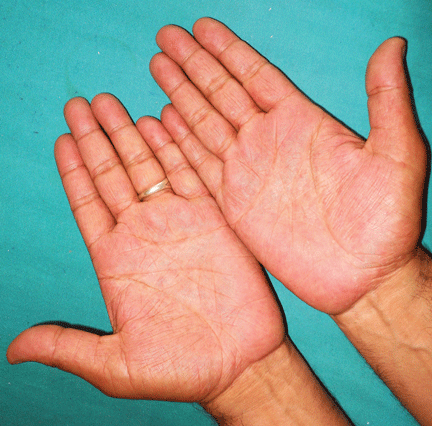
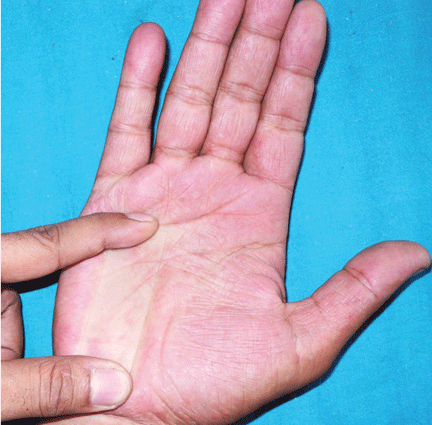
Q: What is the diagnosis?
- Fabry disease
- Peripheral neuropathy
- Polycythemia
- Primary idiopathic erythromelalgia
- Erythrodysesthesia syndrome
A: The correct diagnosis is primary idiopathic erythromelalgia.
Erythromelalgia is a relatively rare clinical condition of uncertain etiology, characterized by the triad of episodic redness, warmth, and burning pain in the extremities.1,2
The condition has primary (ie, no underlying cause is found) and secondary forms.1,3 The primary form may be inherited in an autosomal dominant manner (in which case the symptoms begin in childhood), or it may be idiopathic.4 On the other hand, erythromelalgia can also be secondary to polycythemia vera and other myeloproliferative disorders, connective tissue disorders, neuropathies, spinal cord diseases, carcinoma of the colon and thyroid, and astrocytomas.1–6
The common pathologic mechanism of erythromelalgia is thought to be microvascular arteriovenous shunting.5 A mutation in the voltage-gated sodium channel alpha subunit NaV1.7 may result in primary erythromelalgia. Small-fiber neuropathy2 can manifest as erythromelalgia and may respond to steroids.
The symptoms can be intermittent or, in rare cases, constant.3 The lower limbs are more commonly involved than the upper ones.3 Involvement is often bilateral and symmetric.3 The symptoms may worsen at night, after alcohol consumption, with higher environmental temperature, and with moderate exercise.3 In rare cases, ulceration and gangrene may occur. Patients may get relief by cooling the affected areas.2
DIAGNOSIS BY EXCLUSION OR BASED ON THE PRESENTATION
The diagnosis of erythromelalgia is based on a detailed history and physical examination during a painful episode.2,3 Because the condition is intermittent, only about two-thirds of patients have abnormal findings on physical examination at the time of presentation; in such cases, the diagnosis is based on the history alone.2
Testing is needed to exclude other diagnoses and to determine the cause of secondary erythromelalgia. Histopathologic study of lesions is not helpful, as the features are nonspecific and hence nondiagnostic.2
In our patient, the typical clinical features and the lack of an obvious cause on diagnostic testing confirmed the diagnosis.
THE DIFFERENTIAL DIAGNOSIS
Other conditions can be ruled out by clinical features and laboratory testing.
Fabry disease causes paresthesia and burning pain in the extremities but not erythema. Characteristic dark red keratotic papules are seen all over the body (angiokeratoma corporis diffusum). It is often associated with progressive renal insufficiency.
Peripheral neuropathy of varying causes may also cause pain in the extremities but not erythema. Neurologic examination and a nerve conduction velocity study can resolve the diagnostic problem. Clinical features and laboratory testing often help to pinpoint the cause of neuropathy.
Polycythemia may cause erythema in the hands, feet, and face and mucosal engorgement. Telangiectasia, petechiae, and cyanosis may also occur. Our patient’s normal complete blood cell count excluded this condition.
Erythrodysesthesia syndrome, typically caused by chemotherapeutic drugs, was not included in the differential diagnosis since our patient had taken no medications.
Other causes of palmar erythema to rule out, depending on the patient’s presentation, may include thyrotoxicosis, chronic febrile illness, leukemia, hepatic insufficiency, chronic alcoholism, and rheumatoid arthritis.
TREATMENT AND PROGNOSIS
There is no definitive therapy for erythromelalgia.4 Treatment is often difficult and needs a multidisciplinary approach. Simple measures such as cooling2 (eg, applying cold towels, immersion in cool water, walking on cold floors) or elevating the affected extremity often relieve symptoms. Patients should avoid precipitating factors such as warmth, dependency of extremities, exercise, tight footwear, and alcohol intake.
If there is an underlying disease, treating the disease may also alleviate the symptoms.7 Aspirin2,7 is the therapy of choice for erythromelalgia in patients with an underlying myeloproliferative disorder, and some authors have advocated it for all patients with erythromelalgia unless there is a contraindication.7
Other possible first-line treatments include the synthetic prostaglandin E1 analogue misoprostol (Cytotec) and prostacyclins. Gabapentin (Neurontin), serotonin reuptake inhibitors such as sertaline (Zoloft) and venlafaxine (Effexor), and intravenous nitroprusside (Nitro-press) are considered second-line drugs.7
Surgical sympathectomy8 has also been tried, with variable results.
Outcomes in patients with erythromelalgia
In a case series from Mayo Clinic,2 approximately equal numbers of patients with erythromelalgia became worse, stayed the same, or got better, and the disease resolved in 10% over a mean of 8.7 years.
THE OUTCOME IN OUR PATIENT
We advised our patient to avoid strenuous activity in a warm environment and to work in cooler areas as much as possible. We told him to wrap his affected extremities with cold towels during attacks, and we prescribed aspirin (650 mg/day) for 3 months. The treatment did not cure his condition, but his symptoms lessened within 2 months. We later referred him to a pain clinic.
- Kalgaard OM, Seem E, Kvernebo K. Erythromelalgia: a clinical study of 87 cases. Intern Med 1997; 242:191–197.
- Davis MD, O’Fallon WM, Rogers RS, Rooke TW. Natural history of erythromelalgia: presentation and outcome in 168 patients. Arch Dermatol 2000; 136:330–336.
- Galimberti D, Pontón A, Rubio L, et al. A case of primary erythromelalgia. J Eur Acad Dermatol Venereol 2009; 23:1338–1339.
- Ljubojevic S, Lipozencic J, Pustisek N. Erythromelalgia. Acta Dermatovenerol Croat 2004; 12:99–105.
- Mørk C, Kvernebo K, Asker CL, Salerud EG. Reduced skin capillary density during attacks of erythromelalgia implies arteriovenous shunting as pathogenetic mechanism. J Invest Dermatol 2002; 119:949–953.
- James WD, Berger TG, Elston DM. Andrews’ Diseases of the Skin: Clinical Dermatology. 10th ed. Philadelphia, PA: Saunders Elsevier; 2006.
- Mørk C, Kvernebo K. Erythromelalgia. In:Lebwohl MG, Heymann WR, Berth-Jones J, Koulson Y. editors. Treatment of Skin Disease: Comprehensive Therapeutic Strategies. 3rd ed. Philadelphia, PA: Saunders Elsevier; 2010:236–238.
- Seishima M, Kanoh H, Izumi T, et al. A refractory case of secondary erythermalgia successfully treated with lumbar sympathetic ganglion block. Br J Dermatol 2000; 143:868–872.
Q: What is the diagnosis?
- Fabry disease
- Peripheral neuropathy
- Polycythemia
- Primary idiopathic erythromelalgia
- Erythrodysesthesia syndrome
A: The correct diagnosis is primary idiopathic erythromelalgia.
Erythromelalgia is a relatively rare clinical condition of uncertain etiology, characterized by the triad of episodic redness, warmth, and burning pain in the extremities.1,2
The condition has primary (ie, no underlying cause is found) and secondary forms.1,3 The primary form may be inherited in an autosomal dominant manner (in which case the symptoms begin in childhood), or it may be idiopathic.4 On the other hand, erythromelalgia can also be secondary to polycythemia vera and other myeloproliferative disorders, connective tissue disorders, neuropathies, spinal cord diseases, carcinoma of the colon and thyroid, and astrocytomas.1–6
The common pathologic mechanism of erythromelalgia is thought to be microvascular arteriovenous shunting.5 A mutation in the voltage-gated sodium channel alpha subunit NaV1.7 may result in primary erythromelalgia. Small-fiber neuropathy2 can manifest as erythromelalgia and may respond to steroids.
The symptoms can be intermittent or, in rare cases, constant.3 The lower limbs are more commonly involved than the upper ones.3 Involvement is often bilateral and symmetric.3 The symptoms may worsen at night, after alcohol consumption, with higher environmental temperature, and with moderate exercise.3 In rare cases, ulceration and gangrene may occur. Patients may get relief by cooling the affected areas.2
DIAGNOSIS BY EXCLUSION OR BASED ON THE PRESENTATION
The diagnosis of erythromelalgia is based on a detailed history and physical examination during a painful episode.2,3 Because the condition is intermittent, only about two-thirds of patients have abnormal findings on physical examination at the time of presentation; in such cases, the diagnosis is based on the history alone.2
Testing is needed to exclude other diagnoses and to determine the cause of secondary erythromelalgia. Histopathologic study of lesions is not helpful, as the features are nonspecific and hence nondiagnostic.2
In our patient, the typical clinical features and the lack of an obvious cause on diagnostic testing confirmed the diagnosis.
THE DIFFERENTIAL DIAGNOSIS
Other conditions can be ruled out by clinical features and laboratory testing.
Fabry disease causes paresthesia and burning pain in the extremities but not erythema. Characteristic dark red keratotic papules are seen all over the body (angiokeratoma corporis diffusum). It is often associated with progressive renal insufficiency.
Peripheral neuropathy of varying causes may also cause pain in the extremities but not erythema. Neurologic examination and a nerve conduction velocity study can resolve the diagnostic problem. Clinical features and laboratory testing often help to pinpoint the cause of neuropathy.
Polycythemia may cause erythema in the hands, feet, and face and mucosal engorgement. Telangiectasia, petechiae, and cyanosis may also occur. Our patient’s normal complete blood cell count excluded this condition.
Erythrodysesthesia syndrome, typically caused by chemotherapeutic drugs, was not included in the differential diagnosis since our patient had taken no medications.
Other causes of palmar erythema to rule out, depending on the patient’s presentation, may include thyrotoxicosis, chronic febrile illness, leukemia, hepatic insufficiency, chronic alcoholism, and rheumatoid arthritis.
TREATMENT AND PROGNOSIS
There is no definitive therapy for erythromelalgia.4 Treatment is often difficult and needs a multidisciplinary approach. Simple measures such as cooling2 (eg, applying cold towels, immersion in cool water, walking on cold floors) or elevating the affected extremity often relieve symptoms. Patients should avoid precipitating factors such as warmth, dependency of extremities, exercise, tight footwear, and alcohol intake.
If there is an underlying disease, treating the disease may also alleviate the symptoms.7 Aspirin2,7 is the therapy of choice for erythromelalgia in patients with an underlying myeloproliferative disorder, and some authors have advocated it for all patients with erythromelalgia unless there is a contraindication.7
Other possible first-line treatments include the synthetic prostaglandin E1 analogue misoprostol (Cytotec) and prostacyclins. Gabapentin (Neurontin), serotonin reuptake inhibitors such as sertaline (Zoloft) and venlafaxine (Effexor), and intravenous nitroprusside (Nitro-press) are considered second-line drugs.7
Surgical sympathectomy8 has also been tried, with variable results.
Outcomes in patients with erythromelalgia
In a case series from Mayo Clinic,2 approximately equal numbers of patients with erythromelalgia became worse, stayed the same, or got better, and the disease resolved in 10% over a mean of 8.7 years.
THE OUTCOME IN OUR PATIENT
We advised our patient to avoid strenuous activity in a warm environment and to work in cooler areas as much as possible. We told him to wrap his affected extremities with cold towels during attacks, and we prescribed aspirin (650 mg/day) for 3 months. The treatment did not cure his condition, but his symptoms lessened within 2 months. We later referred him to a pain clinic.
Q: What is the diagnosis?
- Fabry disease
- Peripheral neuropathy
- Polycythemia
- Primary idiopathic erythromelalgia
- Erythrodysesthesia syndrome
A: The correct diagnosis is primary idiopathic erythromelalgia.
Erythromelalgia is a relatively rare clinical condition of uncertain etiology, characterized by the triad of episodic redness, warmth, and burning pain in the extremities.1,2
The condition has primary (ie, no underlying cause is found) and secondary forms.1,3 The primary form may be inherited in an autosomal dominant manner (in which case the symptoms begin in childhood), or it may be idiopathic.4 On the other hand, erythromelalgia can also be secondary to polycythemia vera and other myeloproliferative disorders, connective tissue disorders, neuropathies, spinal cord diseases, carcinoma of the colon and thyroid, and astrocytomas.1–6
The common pathologic mechanism of erythromelalgia is thought to be microvascular arteriovenous shunting.5 A mutation in the voltage-gated sodium channel alpha subunit NaV1.7 may result in primary erythromelalgia. Small-fiber neuropathy2 can manifest as erythromelalgia and may respond to steroids.
The symptoms can be intermittent or, in rare cases, constant.3 The lower limbs are more commonly involved than the upper ones.3 Involvement is often bilateral and symmetric.3 The symptoms may worsen at night, after alcohol consumption, with higher environmental temperature, and with moderate exercise.3 In rare cases, ulceration and gangrene may occur. Patients may get relief by cooling the affected areas.2
DIAGNOSIS BY EXCLUSION OR BASED ON THE PRESENTATION
The diagnosis of erythromelalgia is based on a detailed history and physical examination during a painful episode.2,3 Because the condition is intermittent, only about two-thirds of patients have abnormal findings on physical examination at the time of presentation; in such cases, the diagnosis is based on the history alone.2
Testing is needed to exclude other diagnoses and to determine the cause of secondary erythromelalgia. Histopathologic study of lesions is not helpful, as the features are nonspecific and hence nondiagnostic.2
In our patient, the typical clinical features and the lack of an obvious cause on diagnostic testing confirmed the diagnosis.
THE DIFFERENTIAL DIAGNOSIS
Other conditions can be ruled out by clinical features and laboratory testing.
Fabry disease causes paresthesia and burning pain in the extremities but not erythema. Characteristic dark red keratotic papules are seen all over the body (angiokeratoma corporis diffusum). It is often associated with progressive renal insufficiency.
Peripheral neuropathy of varying causes may also cause pain in the extremities but not erythema. Neurologic examination and a nerve conduction velocity study can resolve the diagnostic problem. Clinical features and laboratory testing often help to pinpoint the cause of neuropathy.
Polycythemia may cause erythema in the hands, feet, and face and mucosal engorgement. Telangiectasia, petechiae, and cyanosis may also occur. Our patient’s normal complete blood cell count excluded this condition.
Erythrodysesthesia syndrome, typically caused by chemotherapeutic drugs, was not included in the differential diagnosis since our patient had taken no medications.
Other causes of palmar erythema to rule out, depending on the patient’s presentation, may include thyrotoxicosis, chronic febrile illness, leukemia, hepatic insufficiency, chronic alcoholism, and rheumatoid arthritis.
TREATMENT AND PROGNOSIS
There is no definitive therapy for erythromelalgia.4 Treatment is often difficult and needs a multidisciplinary approach. Simple measures such as cooling2 (eg, applying cold towels, immersion in cool water, walking on cold floors) or elevating the affected extremity often relieve symptoms. Patients should avoid precipitating factors such as warmth, dependency of extremities, exercise, tight footwear, and alcohol intake.
If there is an underlying disease, treating the disease may also alleviate the symptoms.7 Aspirin2,7 is the therapy of choice for erythromelalgia in patients with an underlying myeloproliferative disorder, and some authors have advocated it for all patients with erythromelalgia unless there is a contraindication.7
Other possible first-line treatments include the synthetic prostaglandin E1 analogue misoprostol (Cytotec) and prostacyclins. Gabapentin (Neurontin), serotonin reuptake inhibitors such as sertaline (Zoloft) and venlafaxine (Effexor), and intravenous nitroprusside (Nitro-press) are considered second-line drugs.7
Surgical sympathectomy8 has also been tried, with variable results.
Outcomes in patients with erythromelalgia
In a case series from Mayo Clinic,2 approximately equal numbers of patients with erythromelalgia became worse, stayed the same, or got better, and the disease resolved in 10% over a mean of 8.7 years.
THE OUTCOME IN OUR PATIENT
We advised our patient to avoid strenuous activity in a warm environment and to work in cooler areas as much as possible. We told him to wrap his affected extremities with cold towels during attacks, and we prescribed aspirin (650 mg/day) for 3 months. The treatment did not cure his condition, but his symptoms lessened within 2 months. We later referred him to a pain clinic.
- Kalgaard OM, Seem E, Kvernebo K. Erythromelalgia: a clinical study of 87 cases. Intern Med 1997; 242:191–197.
- Davis MD, O’Fallon WM, Rogers RS, Rooke TW. Natural history of erythromelalgia: presentation and outcome in 168 patients. Arch Dermatol 2000; 136:330–336.
- Galimberti D, Pontón A, Rubio L, et al. A case of primary erythromelalgia. J Eur Acad Dermatol Venereol 2009; 23:1338–1339.
- Ljubojevic S, Lipozencic J, Pustisek N. Erythromelalgia. Acta Dermatovenerol Croat 2004; 12:99–105.
- Mørk C, Kvernebo K, Asker CL, Salerud EG. Reduced skin capillary density during attacks of erythromelalgia implies arteriovenous shunting as pathogenetic mechanism. J Invest Dermatol 2002; 119:949–953.
- James WD, Berger TG, Elston DM. Andrews’ Diseases of the Skin: Clinical Dermatology. 10th ed. Philadelphia, PA: Saunders Elsevier; 2006.
- Mørk C, Kvernebo K. Erythromelalgia. In:Lebwohl MG, Heymann WR, Berth-Jones J, Koulson Y. editors. Treatment of Skin Disease: Comprehensive Therapeutic Strategies. 3rd ed. Philadelphia, PA: Saunders Elsevier; 2010:236–238.
- Seishima M, Kanoh H, Izumi T, et al. A refractory case of secondary erythermalgia successfully treated with lumbar sympathetic ganglion block. Br J Dermatol 2000; 143:868–872.
- Kalgaard OM, Seem E, Kvernebo K. Erythromelalgia: a clinical study of 87 cases. Intern Med 1997; 242:191–197.
- Davis MD, O’Fallon WM, Rogers RS, Rooke TW. Natural history of erythromelalgia: presentation and outcome in 168 patients. Arch Dermatol 2000; 136:330–336.
- Galimberti D, Pontón A, Rubio L, et al. A case of primary erythromelalgia. J Eur Acad Dermatol Venereol 2009; 23:1338–1339.
- Ljubojevic S, Lipozencic J, Pustisek N. Erythromelalgia. Acta Dermatovenerol Croat 2004; 12:99–105.
- Mørk C, Kvernebo K, Asker CL, Salerud EG. Reduced skin capillary density during attacks of erythromelalgia implies arteriovenous shunting as pathogenetic mechanism. J Invest Dermatol 2002; 119:949–953.
- James WD, Berger TG, Elston DM. Andrews’ Diseases of the Skin: Clinical Dermatology. 10th ed. Philadelphia, PA: Saunders Elsevier; 2006.
- Mørk C, Kvernebo K. Erythromelalgia. In:Lebwohl MG, Heymann WR, Berth-Jones J, Koulson Y. editors. Treatment of Skin Disease: Comprehensive Therapeutic Strategies. 3rd ed. Philadelphia, PA: Saunders Elsevier; 2010:236–238.
- Seishima M, Kanoh H, Izumi T, et al. A refractory case of secondary erythermalgia successfully treated with lumbar sympathetic ganglion block. Br J Dermatol 2000; 143:868–872.
Lung cancer screening: What to expect
Lung cancer can sometimes be detected with a low-dose screening CT (computed tomography) scan. During the scan, you will lie down in a donut-like structure while x-rays are passed through your body. Computers then use these x-rays to produce images of the inside of your body. The scan does not hurt and takes only a few seconds to complete.
Benefits of screening
Screening for lung cancer with a chest CT scan has been shown to lower your chance of dying from lung cancer by 20%. That means that for every 5 people who would have died from lung cancer without screening, 1 of these 5 will not.
Downside of screening
False alarms. Screening for lung cancer with a chest CT has been shown to find a small spot or spots (called lung nodules) in the lungs of at least one-quarter of everyone who gets the CT scan. Only 3 or 4 out of 100 of the lung nodules found are cancer, while the rest are small scars that will never affect your health.
For many of the small lung nodules found, there is no way to tell without additional tests if they are a small scar or a lung cancer. These tests usually include CT scans done over time to see if the lung nodule grows. If the lung nodule is large enough, a biopsy may also be required. Therefore, many people who have a lung cancer screening CT scan and do not have lung cancer will have additional tests performed.
The physician who ordered the screening test will be able to advise you about how the lung nodule should be evaluated. He or she may choose to have you visit a lung nodule clinic for advice as well.
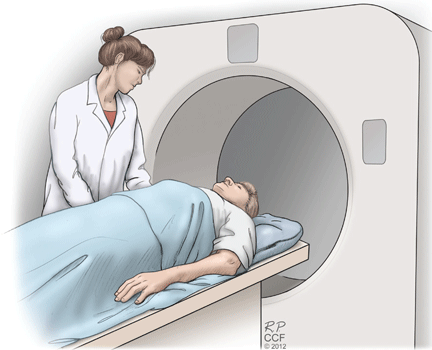
Cost. Most insurance programs do not currently cover the cost of a lung cancer screening chest CT, but they usually do cover the evaluation of any abnormal findings.
Quit smoking!
If you currently smoke, you can lower your risk of dying from lung cancer by quitting smoking. The amount your risk will be lowered by quitting smoking is greater than the amount your risk will be lowered by being screened with a CT scan. If you smoke, try to quit. Talk to your doctor about the best strategies for quitting.
This information is provided by your physician and the Cleveland Clinic Journal of Medicine. It is not designed to replace a physician’s medical assessment and judgment.
This page may be reproduced noncommercially to share with patients. Any other reproduction is subject to Cleveland Clinic Journal of Medicine approval. Bulk color reprints are available by calling 216-444-2661.
For patient information on hundreds of health topics, see the Patient Education and Health Information web site, www.clevelandclinic.org/health
Lung cancer can sometimes be detected with a low-dose screening CT (computed tomography) scan. During the scan, you will lie down in a donut-like structure while x-rays are passed through your body. Computers then use these x-rays to produce images of the inside of your body. The scan does not hurt and takes only a few seconds to complete.
Benefits of screening
Screening for lung cancer with a chest CT scan has been shown to lower your chance of dying from lung cancer by 20%. That means that for every 5 people who would have died from lung cancer without screening, 1 of these 5 will not.
Downside of screening
False alarms. Screening for lung cancer with a chest CT has been shown to find a small spot or spots (called lung nodules) in the lungs of at least one-quarter of everyone who gets the CT scan. Only 3 or 4 out of 100 of the lung nodules found are cancer, while the rest are small scars that will never affect your health.
For many of the small lung nodules found, there is no way to tell without additional tests if they are a small scar or a lung cancer. These tests usually include CT scans done over time to see if the lung nodule grows. If the lung nodule is large enough, a biopsy may also be required. Therefore, many people who have a lung cancer screening CT scan and do not have lung cancer will have additional tests performed.
The physician who ordered the screening test will be able to advise you about how the lung nodule should be evaluated. He or she may choose to have you visit a lung nodule clinic for advice as well.
Cost. Most insurance programs do not currently cover the cost of a lung cancer screening chest CT, but they usually do cover the evaluation of any abnormal findings.
Quit smoking!
If you currently smoke, you can lower your risk of dying from lung cancer by quitting smoking. The amount your risk will be lowered by quitting smoking is greater than the amount your risk will be lowered by being screened with a CT scan. If you smoke, try to quit. Talk to your doctor about the best strategies for quitting.
This information is provided by your physician and the Cleveland Clinic Journal of Medicine. It is not designed to replace a physician’s medical assessment and judgment.
This page may be reproduced noncommercially to share with patients. Any other reproduction is subject to Cleveland Clinic Journal of Medicine approval. Bulk color reprints are available by calling 216-444-2661.
For patient information on hundreds of health topics, see the Patient Education and Health Information web site, www.clevelandclinic.org/health
Lung cancer can sometimes be detected with a low-dose screening CT (computed tomography) scan. During the scan, you will lie down in a donut-like structure while x-rays are passed through your body. Computers then use these x-rays to produce images of the inside of your body. The scan does not hurt and takes only a few seconds to complete.
Benefits of screening
Screening for lung cancer with a chest CT scan has been shown to lower your chance of dying from lung cancer by 20%. That means that for every 5 people who would have died from lung cancer without screening, 1 of these 5 will not.
Downside of screening
False alarms. Screening for lung cancer with a chest CT has been shown to find a small spot or spots (called lung nodules) in the lungs of at least one-quarter of everyone who gets the CT scan. Only 3 or 4 out of 100 of the lung nodules found are cancer, while the rest are small scars that will never affect your health.
For many of the small lung nodules found, there is no way to tell without additional tests if they are a small scar or a lung cancer. These tests usually include CT scans done over time to see if the lung nodule grows. If the lung nodule is large enough, a biopsy may also be required. Therefore, many people who have a lung cancer screening CT scan and do not have lung cancer will have additional tests performed.
The physician who ordered the screening test will be able to advise you about how the lung nodule should be evaluated. He or she may choose to have you visit a lung nodule clinic for advice as well.
Cost. Most insurance programs do not currently cover the cost of a lung cancer screening chest CT, but they usually do cover the evaluation of any abnormal findings.
Quit smoking!
If you currently smoke, you can lower your risk of dying from lung cancer by quitting smoking. The amount your risk will be lowered by quitting smoking is greater than the amount your risk will be lowered by being screened with a CT scan. If you smoke, try to quit. Talk to your doctor about the best strategies for quitting.
This information is provided by your physician and the Cleveland Clinic Journal of Medicine. It is not designed to replace a physician’s medical assessment and judgment.
This page may be reproduced noncommercially to share with patients. Any other reproduction is subject to Cleveland Clinic Journal of Medicine approval. Bulk color reprints are available by calling 216-444-2661.
For patient information on hundreds of health topics, see the Patient Education and Health Information web site, www.clevelandclinic.org/health
Family history: Still relevant in the genomics era
At the dawn of the genomics era, is the family history still relevant? The answer is a resounding yes.1,2
The family history is clinically useful because it is a proxy for genetic, environmental, and behavioral risks to health. It can be used to inform risk stratification, allowing for judicious use of screening and opening the door to early and even prophylactic treatment.3–8 As people live longer, we will need to detect common chronic conditions early in their course so that we can continue to improve health outcomes. Family history can help physicians personalize preventive care for conditions such as diabetes, osteoporosis, and cancers of the breast, colon, and prostate.2,9–15
However, there is ample evidence that the family history is underused. Most practitioners ask about it infrequently and inconsistently.16,17 Why is this, and how can we encourage the use of this powerful tool to enhance our daily clinical practice and improve care?
We will discuss here some of the challenges that make it difficult for physicians to collect and use the family history in clinical practice, and review strategies for collecting and using the family history in a more consistent manner. We anticipate that this discussion will be helpful to clinicians, as the family history is an essential input to personalized, preventive care plans.
CHALLENGE 1: ARE PATIENTS’ REPORTS RELIABLE?
A question that often arises when discussing the utility of the family history is the reliability of patients’ reports. Can we trust that patients can accurately report their family history? For many conditions, the answer is yes.18,19
Ziogas and Anton-Culverl20 asked 1,111 cancer patients whether their relatives had ever had cancer and verified their answers. In more than 95% of cases, if the patient said that a first-degree or second-degree relative did not have cancer of any type, that relative truly did not have cancer. Overall, over-reporting of cancer was rare, occurring in 2.4% of cases.
If the patient said that a relative did have cancer, that statement was usually true as well. The reliability of a report of cancer in first-degree relatives was greater than 75% for most types of cancer (female breast, ovarian, esophageal, colorectal, pancreas, lung, melanoma, brain, thyroid, lymphoma, leukemia). For several of these types of cancer (female breast, colorectal, and brain), the reliability was 90% or higher. For second-degree relatives, the reliability of a reported positive history was moderate (50% to 80%) for the same types of cancer, and for third-degree relatives, the reliability dropped further for all types of cancer except female breast, brain, pancreas, and leukemia, for which the reliability of a positive report remained at 70%.
Wideroff et al21 had similar findings in a study of more than 1,000 patients and more than 20,000 of their relatives.
Yoon et al,18 at the US Centers for Disease Control and Prevention, developed a Web-based risk-assessment tool called Family Healthware, currently undergoing validation trials. They found that patients’ reports were highly reliable for coronary heart disease, stroke, diabetes, and breast, ovarian, and colorectal cancers. They also calculated the degree of risk associated with a positive family history and the prevalence of a family history of each of these diseases.
For the primary care physician, these studies support the reliability of patients’ reports and provide guidance for targeting specific conditions when obtaining a family history.
CHALLENGE 2: NO TIME OR REIMBURSEMENT
Perhaps the most obvious barriers to collecting a family history are lack of time and reimbursement.
Acheson et al,17 in an observational study of 138 primary care physicians and 4,454 patient visits, found that family history was discussed during 51% of new patient visits and 22% of established patient visits. The rate at which the family history was taken varied from 0% (some physicians never asked) to 81% of all patient visits. On average, physicians spent less than 2.5 minutes collecting the family history.
Not surprisingly, the family history was discussed more often at well-care visits than at illness visits, as the former type of visit tends to be longer and, by definition, to be spent partly on preventive care. A difficulty with this strategy is that, given the shortage of primary care physicians, limited access, and patient preference, most preventive-care visits are combined with problem-focused visits, further decreasing the time available to collect and discuss a family history. While some argue that the family history should routinely be obtained and discussed during preventive-care visits regardless of reimbursement and time, the reality is that it may simply drop on the list of priorities for each visit.
Rich et al3 estimated that taking a family history would increase reimbursement for only one new patient evaluation and management code (99202) and one return-visit code (99213) in Current Procedural Terminology. This action would increase reimbursement enough to support about 10 minutes of physician effort for collecting, documenting, and analyzing the family history. While this is certainly better than the average of less than 2.5 minutes observed by Acheson et al,17 doctors would probably do it more if they were paid more for it.
Electronic solutions
Given that a lack of time is a barrier, what are some ways to minimize the time it takes to collect a family history?
With more physicians using electronic health records and with increasing use of Internet-based tools in the population at large, information-technology systems have been developed to help obtain the family history. One of the most widely used is the US surgeon general’s My Family Health Portrait, available free at https://familyhistory.hhs.gov. It is one of the broadest electronic family-history collection tools and has been validated for use in risk assessment for diabetes and cancer of the colon, breast, and ovaries.22
However, electronic solutions have their own challenges. Not all patients have access to the Internet, many need help using these programs, and these tools may not work well with existing electronic medical records systems.23 Ideally, these programs would also provide built-in decision support for the provider, thereby maximizing data use for final patient risk assessment.23 Furthermore, electronic solutions are not a one-time-only risk assessment— periodic re-review of family history and reassessment of familial risk are required.24
Does taking a family history improve outcomes? Lessons from breast cancer
One of the reasons physicians don’t get reimbursed for collecting a family history is that it has been difficult to measure any improvement in outcomes associated with risk prediction through family history.
The best examples of improvement in outcomes associated with family history-based risk prediction come from studies of breast cancer. From 5% to 10% of cases of breast cancer are part of hereditary cancer syndromes, many of which have a known genetic cause. The most prevalent of these genetic syndromes is the hereditary breast and ovarian cancer (HBOC) syndrome, caused by mutations in the breast cancer 1 (BRCA1) and breast cancer 2 (BRCA2) genes. Clinical testing for BRCA mutations has been available since 1998.25 Women with a BRCA mutation have up to a 65% lifetime risk of developing breast cancer and up to a 40% lifetime risk of developing ovarian cancer.26 Men with a BRCA mutation are at 10 to 100 times the risk of the general population (1% to 10% vs 0.1%) for developing breast cancer, and are also at higher risk of prostate and other cancers.27
People who have a relative who developed breast cancer at a young age are more likely to harbor one of these mutations. For example, based on genetic testing in more than 185,000 people, the prevalence of BRCA mutations among people without cancer, not of Ashkenazi Jewish ancestry (a risk factor for breast cancer), and with no family history of early breast cancer or of ovarian cancer in any relative is 1.5%.28 In contrast, people with no personal history of cancer who have a family history of breast cancer before age 50 have a 5.6% prevalence of BRCA mutation, and if they are of Ashkenazi Jewish ancestry, this number is 16.4%.28
Medical and surgical interventions are available to reduce the risk of cancer in people with hereditary cancer syndromes such as HBOC. Options include screening more often, using advanced screening tests,29 giving preventive drugs such as tamoxifen (Nolvadex), and prophylactic surgery.30–32 What is the evidence that early screening and intervention in these people improve outcomes?
Domcheck et al33 prospectively followed more than 2,400 women who had BRCA mutations to assess the effect of prophylactic mastectomy or salpingo-oophorectomy on cancer outcomes. Mastectomy was indeed associated with a lower risk of breast cancer: 0 cases of breast cancer were diagnosed in 3 years of prospective follow-up in the 247 women who elected to undergo mastectomy, compared with 98 cases diagnosed in the 1,372 women who did not elect it over a similar period.
Women who elected to undergo salpingo-oophorectomy had a similarly lower rate of ovarian cancer compared with those who did not elect surgery (1% vs 6%). Additionally, fewer women who elected prophylactic salpingo-oophorectomy died of any cause (3% vs 10%), died of breast cancer (2% vs 6%), or died of ovarian cancer (0.4% vs 3%) compared with women who did not elect surgery.
Taking a family history reduces costs
What is the evidence that appropriate use of the family history decreases health care costs? Let us continue with the example of HBOC syndrome due to BRCA mutations.
Given that germline mutations account for 5% to 10% of cases of breast cancer in the United States and that the women who develop cancer associated with such mutations do so at a relatively young age, these mutations account for a disproportionate share of life-years lost due to cancer.34 Through taking a family history, these women at high risk can be identified and referred for genetic testing. Genetic testing, though costly, is more cost-effective than diagnosing and treating cancer.
Anderson et al,34 in 2006, estimated that cost-effective policies on testing and preventive treatment for persons at high risk of breast cancer could save up to $800 million of the more than $8 billion spent each year on breast cancer diagnosis, prevention, and treatment.
Kwon et al,35 in a simulation model (not a study in real patients), compared four different criteria for BRCA testing in women with ovarian cancer to see which strategy would be most cost-effective in preventing breast and ovarian cancers in their first-degree relatives. The best strategy, according to this analysis, is to test women with ovarian cancer for BRCA mutations if they also have a personal history of breast cancer, have a family history of breast or ovarian cancer, or are of Ashkenazi Jewish ancestry. The estimated cost per life-year gained with this strategy was $32,018, much lower than the widely accepted threshold for cost-effectiveness of $50,000 per life-year gained.
Although many professional organizations, including the US Preventive Services Task Force, have endorsed family-history-based eligibility criteria for genetic counseling and BRCA testing, awareness of the value of genetic testing in people who have been prescreened by family history has been relatively slow in seeping out to insurance carriers, especially Medicaid.12,36 As evidence continues to accumulate showing that this approach can improve outcomes for at-risk family members, reimbursement and time allotted for obtaining and using the family history should be adjusted.
CHALLENGE 3: A KNOWLEDGE GAP IN CLINICIANS
Another challenge often cited as a cause of the underuse of the family history as a predictor of disease risk is that clinicians may not know enough about the topic. Several studies indicated that even when physicians had obtained some components of the family history, they did not document risk appropriately or recognize the significance of the pattern of inheritance observed.37–39
In a study comparing primary care physicians and gastroenterologists in their use of the family history to predict the risk of hereditary colon cancer, gastroenterologists were more likely to elicit a family history of colorectal cancer and implement appropriate screening strategies, but overall compliance with screening guidelines was suboptimal in both groups.40
A 2011 report by an advisory committee to the secretary of the US Department of Health and Human Services concluded that lack of genetics education in medical school limits the integration of genetics into clinical care.41
How can we close this knowledge gap?
Recognizing a need, the National Coalition for Health Professional Education in Genetics was established in 1996 by the American Medical Association, the American Nurses Association, and the National Human Genome Research Institute (www.nchpeg.org). Its mission is to promote the education of health professionals and access to information about advances in human genetics to improve the health care of the nation. It offers educational materials, including a newly updated “Core Principles in Family History” program, which can be used to educate medical providers and their patients about various concepts related to genetics and family history.
In addition, physicians can use many risk assessment tools based on family history in patient care. Two of the best known are:
- The Gail breast cancer risk assessment model, hosted by the National Cancer Institute (www.cancer.gov/bcrisktool/)
- The FRAX osteoporosis risk assessment model, developed by the World Health Organization (www.shef.ac.uk/FRAX).
As we continue to educate the medical community about the value of the family history in predicting disease, it will be important to increase efforts in medical schools and residency programs and to find new, more interactive ways of teaching these concepts.
A possible strategy is to highlight the use of pedigree drawing to recognize patterns of inheritance.2 In a study of physician attitudes toward using patient-generated pedigrees in practice, such as those produced by the US surgeon general’s My Family Health Portrait, 73% of physicians stated that the patient-generated pedigree would improve their ability to assess the risk of disease, and the majority also agreed that it would not extend the time of the assessment.16
Is this information clinically useful?
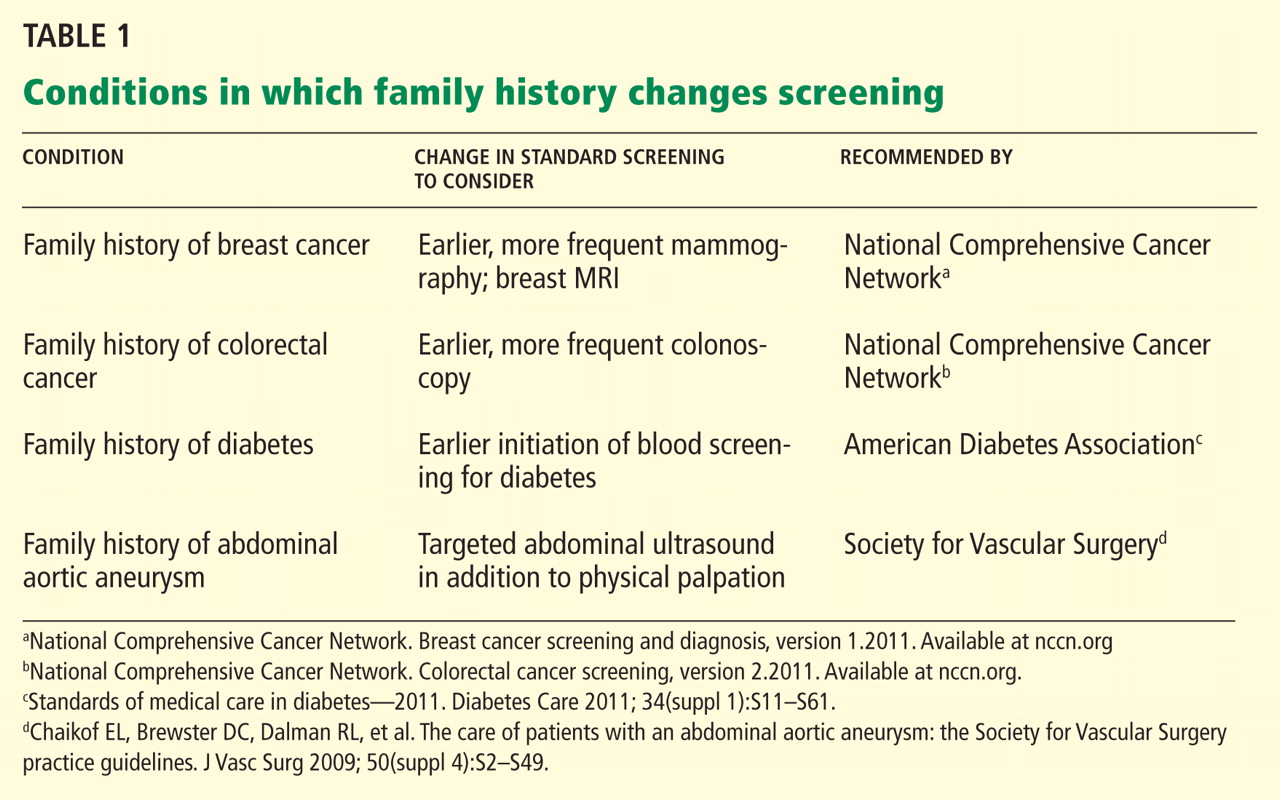
Furthermore, knowing they are at risk might empower people and encourage them to engage with the medical system. For example, counseling people at risk of diabetes as reflected in the family history has been shown to increase their understanding of the risk and of preventive behaviors. Further study is needed to determine if such messages can engender lasting changes in behavior across many diseases.42–46
TOWARD PERSONALIZED CARE
Especially now that caregivers are striving to provide value-based health care with emphasis on preventive care, the family history remains an important tool for detecting risk of disease. The evidence clearly indicates that medical providers have room for improvement in taking a family history and in using it.
We hope that asking patients about family history and recognizing patterns of disease will help us create personalized preventive-care plans, providing greater opportunity to educate and motivate our patients to work with us towards better health. Future solutions need to focus on time-effective ways to collect and analyze family history and on innovative methods of teaching medical providers at all levels to apply the family history to clinical practice.
- Guttmacher AE, Collins FS, Carmona RH. The family history—more important than ever. N Engl J Med 2004; 351:2333–2336.
- American College of Obstetricians and Gynecologists Committee on Genetics. Committee Opinion No. 478: Family history as a risk assessment tool. Obstet Gynecol 2011; 117:747–750.
- Rich EC, Burke W, Heaton CJ, et al. Reconsidering the family history in primary care. J Gen Intern Med 2004; 19:273–280.
- Green RF. Summary of workgroup meeting on use of family history information in pediatric primary care and public health. Pediatrics 2007; 120(suppl 2):S87–S100.
- American College of Obstetricians and Gynecologists. ACOG Practice Bulletin No. 103: Hereditary breast and ovarian cancer syndrome. Obstet Gynecol 2009; 113:957–966.
- Scheuner MT, Setodji CM, Pankow JS, Blumenthal RS, Keeler E. General Cardiovascular Risk Profile identifies advanced coronary artery calcium and is improved by family history: the multiethnic study of atherosclerosis. Circ Cardiovasc Genet 2010; 3:97–105.
- Yang Q, Liu T, Valdez R, Moonesinghe R, Khoury MJ. Improvements in ability to detect undiagnosed diabetes by using information on family history among adults in the United States. Am J Epidemiol 2010; 171:1079–1089.
- Kones R. Primary prevention of coronary heart disease: integration of new data, evolving views, revised goals, and role of rosuvastatin in management. A comprehensive survey. Drug Des Devel Ther 2011; 5:325–380.
- Rex DK, Johnson DA, Anderson JC, Schoenfeld PS, Burke CA, Inadomi JM; American College of Gastroenterology. American College of Gastroenterology guidelines for colorectal cancer screening 2009 (corrected). Am J Gastroenterol 2009; 104:739–750.
- American Diabetes Association. Standards of medical care in diabetes—2011. Diabetes Care 2011; 34(suppl 1):S11–S61.
- Kanis JA, Johansson H, Oden A, McCloskey EV. Assessment of fracture risk. Eur J Radiol 2009; 71:392–397.
- US Preventive Services Task Force. Genetic risk assessment and BRCA mutation testing for breast and ovarian cancer susceptibility: recommendation statement. Ann Intern Med 2005; 143:355–361.
- Williams SB, Salami S, Regan MM, et al. Selective detection of histologically aggressive prostate cancer: An Early Detection Research Network Prediction model to reduce unnecessary prostate biopsies with validation in the Prostate Cancer Prevention Trial. Cancer 2011; Oct 17(Epub ahead of print.)
- Dinh TA, Rosner BI, Atwood JC, et al. Health benefits and cost-effectiveness of primary genetic screening for Lynch syndrome in the general population. Cancer Prev Res (Phila) 2011; 4:9–22.
- Kwon JS, Scott JL, Gilks CB, Daniels MS, Sun CC, Lu KH. Testing women with endometrial cancer to detect Lynch syndrome. J Clin Oncol 2011; 29:2247–2252.
- Fuller M, Myers M, Webb T, Tabangin M, Prows C. Primary care providers’ responses to patient-generated family history. J Genet Couns 2010; 19:84–96.
- Acheson LS, Wiesner GL, Zyzanski SJ, Goodwin MA, Stange KC. Family history-taking in community family practice: implications for genetic screening. Genet Med 2000; 2:180–185.
- Yoon PW, Scheuner MT, Jorgensen C, Khoury MJ. Developing Family Healthware, a family history screening tool to prevent common chronic diseases. Prev Chronic Dis 2009; 6:A33.
- Valdez R, Yoon PW, Qureshi N, Green RF, Khoury MJ. Family history in public health practice: a genomic tool for disease prevention and health promotion. Annu Rev Public Health 2010; 31:69–87.
- Ziogas A, Anton-Culver H. Validation of My Family Health Portrait for six common heritable conditions. Am J Prev Med 2003; 24:190–198.
- Wideroff L, Garceau AO, Greene MH, et al. Coherence and completeness of population-based family cancer reports. Cancer Epidemiol Biomarkers Prev 2010; 19:799–810.
- Facio FM, Feero WG, Linn A, Oden N, Manickam K, Biesecker LG. Validation of My Family Health Portrait for six common heritable conditions. Genet Med 2010; 12:370–375.
- Owens KM, Marvin ML, Gelehrter TD, Ruffin MT, Uhlmann WR. Clinical use of the Surgeon General’s “My Family Health Portrait” (MFHP) tool: opinions of future health care providers. J Genet Couns 2011; 20:510–525.
- Tyler CV, Snyder CW. Cancer risk assessment: examining the family physician’s role. J Am Board Fam Med 2006; 19:468–477.
- Rubenstein WS. The genetics of breast cancer. In:Vogel VG, editor. Management of Patients at High Risk for Breast Cancer. Malden, MA: Blackwell Science; 2001:19–55.
- Antoniou A, Pharoah PD, Narod S, et al. Average risks of breast and ovarian cancer associated with BRCA1 or BRCA2 mutations detected in case series unselected for family history: a combined analysis of 22 studies. Am J Hum Genet 2003; 72:1117–1130.
- Korde LA, Zujewski JA, Kamin L, et al. Multidisciplinary meeting on male breast cancer: summary and research recommendations. J Clin Oncol 2010; 28:2114–2122.
- Myriad Genetic Laboratories, Inc. Mutation prevalence tables. http://www.myriad.com/lib/brac/brca-prevalence-tables.pdf. Accessed April 2, 2012.
- Schousboe JT, Kerlikowske K, Loh A, Cummings SR. Personalizing mammography by breast density and other risk factors for breast cancer: analysis of health benefits and cost-effectiveness. Ann Intern Med 2011; 155:10–20.
- National Cancer Institute. http://www.cancer.gov. Accessed January 20, 2012.
- Saslow D, Boetes C, Burke W, et al; American Cancer Society Breast Cancer Advisory Group. American Cancer Society guidelines for breast screening with MRI as an adjunct to mammography. CA Cancer J Clin 2007; 57:75–89.
- Agency for Healthcare Research and Quality; John M. Medications to reduce the risk of primary breast cancer in women: clinician’s guide. http://www.effectivehealthcare.ahrq.gov/index.cfm/searchfor-guides-reviews-and-reports/?productid=390&pageaction=displayproduct. Accessed April 2, 2012.
- Domchek SM, Friebel TM, Singer CF, et al. Association of risk-reducing surgery in BRCA1 or BRCA2 mutation carriers with cancer risk and mortality. JAMA 2010; 304:967–975.
- Anderson K, Jacobson JS, Heitjan DF, et al. Cost-effectiveness of preventive strategies for women with a BRCA1 or a BRCA2 mutation. Ann Intern Med 2006; 144:397–406.
- Kwon JS, Daniels MS, Sun CC, Lu KH. Preventing future cancers by testing women with ovarian cancer for BRCA mutations. J Clin Oncol 2009; 28:675–682.
- Wang G, Beattie MS, Ponce NA, Phillips KA. Eligibility criteria in private and public coverage policies for BRCA genetic testing and genetic counseling. Genet Med 2011; 13:1045–1050.
- Hinton RB. The family history: reemergence of an established tool. Crit Care Nurs Clin North Am 2008; 20:149–158.
- Murff HJ, Greevy RA, Syngal S. The comprehensiveness of family cancer history assessments in primary care. Community Genet 2007; 10:174–180.
- Wallace E, Hinds A, Campbell H, Mackay J, Cetnarskyj R, Porteous ME. A cross-sectional survey to estimate the prevalence of family history of colorectal, breast and ovarian cancer in a Scottish general practice population. Br J Cancer 2004; 91:1575–1579.
- Schroy PC, Barrison AF, Ling BS, Wilson S, Geller AC. Family history and colorectal cancer screening: a survey of physician knowledge and practice patterns. Am J Gastroenterol 2002; 97:1031–1036.
- Department of Health and Human Services. Genetics education and training: report of the Secretary’s Advisory Committee on Genetics, Health, and Society; 2011. http://oba.od.nih.gov/oba/SACGHS/reports/SACGHS_education_report_2011.pdf. Accessed April 2, 2012.
- Qureshi N, Kai J. Informing patients of familial diabetes mellitus risk: How do they respond? A cross-sectional survey. BMC Health Serv Res 2008; 8:37.
- Zlot AI, Bland MP, Silvey K, Epstein B, Mielke B, Leman RF. Influence of family history of diabetes on health care provider practice and patient behavior among nondiabetic Oregonians. Prev Chronic Dis 2009; 6:A27.
- Pijl M, Timmermans DR, Claassen L, et al. Impact of communicating familial risk of diabetes on illness perceptions and self-reported behavioral outcomes: a randomized controlled trial. Diabetes Care 2009; 32:597–599.
- Ruffin MT, Nease DE, Sen A, et al; Family History Impact Trial (FHITr) Group. Effect of preventive messages tailored to family history on health behaviors: the Family Healthware Impact Trial. Ann Fam Med 2011; 9:3–11.
- Claassen L, Henneman L, Janssens AC, et al. Using family history information to promote healthy lifestyles and prevent diseases; a discussion of the evidence. BMC Public Health 2010; 10:248.
At the dawn of the genomics era, is the family history still relevant? The answer is a resounding yes.1,2
The family history is clinically useful because it is a proxy for genetic, environmental, and behavioral risks to health. It can be used to inform risk stratification, allowing for judicious use of screening and opening the door to early and even prophylactic treatment.3–8 As people live longer, we will need to detect common chronic conditions early in their course so that we can continue to improve health outcomes. Family history can help physicians personalize preventive care for conditions such as diabetes, osteoporosis, and cancers of the breast, colon, and prostate.2,9–15
However, there is ample evidence that the family history is underused. Most practitioners ask about it infrequently and inconsistently.16,17 Why is this, and how can we encourage the use of this powerful tool to enhance our daily clinical practice and improve care?
We will discuss here some of the challenges that make it difficult for physicians to collect and use the family history in clinical practice, and review strategies for collecting and using the family history in a more consistent manner. We anticipate that this discussion will be helpful to clinicians, as the family history is an essential input to personalized, preventive care plans.
CHALLENGE 1: ARE PATIENTS’ REPORTS RELIABLE?
A question that often arises when discussing the utility of the family history is the reliability of patients’ reports. Can we trust that patients can accurately report their family history? For many conditions, the answer is yes.18,19
Ziogas and Anton-Culverl20 asked 1,111 cancer patients whether their relatives had ever had cancer and verified their answers. In more than 95% of cases, if the patient said that a first-degree or second-degree relative did not have cancer of any type, that relative truly did not have cancer. Overall, over-reporting of cancer was rare, occurring in 2.4% of cases.
If the patient said that a relative did have cancer, that statement was usually true as well. The reliability of a report of cancer in first-degree relatives was greater than 75% for most types of cancer (female breast, ovarian, esophageal, colorectal, pancreas, lung, melanoma, brain, thyroid, lymphoma, leukemia). For several of these types of cancer (female breast, colorectal, and brain), the reliability was 90% or higher. For second-degree relatives, the reliability of a reported positive history was moderate (50% to 80%) for the same types of cancer, and for third-degree relatives, the reliability dropped further for all types of cancer except female breast, brain, pancreas, and leukemia, for which the reliability of a positive report remained at 70%.
Wideroff et al21 had similar findings in a study of more than 1,000 patients and more than 20,000 of their relatives.
Yoon et al,18 at the US Centers for Disease Control and Prevention, developed a Web-based risk-assessment tool called Family Healthware, currently undergoing validation trials. They found that patients’ reports were highly reliable for coronary heart disease, stroke, diabetes, and breast, ovarian, and colorectal cancers. They also calculated the degree of risk associated with a positive family history and the prevalence of a family history of each of these diseases.
For the primary care physician, these studies support the reliability of patients’ reports and provide guidance for targeting specific conditions when obtaining a family history.
CHALLENGE 2: NO TIME OR REIMBURSEMENT
Perhaps the most obvious barriers to collecting a family history are lack of time and reimbursement.
Acheson et al,17 in an observational study of 138 primary care physicians and 4,454 patient visits, found that family history was discussed during 51% of new patient visits and 22% of established patient visits. The rate at which the family history was taken varied from 0% (some physicians never asked) to 81% of all patient visits. On average, physicians spent less than 2.5 minutes collecting the family history.
Not surprisingly, the family history was discussed more often at well-care visits than at illness visits, as the former type of visit tends to be longer and, by definition, to be spent partly on preventive care. A difficulty with this strategy is that, given the shortage of primary care physicians, limited access, and patient preference, most preventive-care visits are combined with problem-focused visits, further decreasing the time available to collect and discuss a family history. While some argue that the family history should routinely be obtained and discussed during preventive-care visits regardless of reimbursement and time, the reality is that it may simply drop on the list of priorities for each visit.
Rich et al3 estimated that taking a family history would increase reimbursement for only one new patient evaluation and management code (99202) and one return-visit code (99213) in Current Procedural Terminology. This action would increase reimbursement enough to support about 10 minutes of physician effort for collecting, documenting, and analyzing the family history. While this is certainly better than the average of less than 2.5 minutes observed by Acheson et al,17 doctors would probably do it more if they were paid more for it.
Electronic solutions
Given that a lack of time is a barrier, what are some ways to minimize the time it takes to collect a family history?
With more physicians using electronic health records and with increasing use of Internet-based tools in the population at large, information-technology systems have been developed to help obtain the family history. One of the most widely used is the US surgeon general’s My Family Health Portrait, available free at https://familyhistory.hhs.gov. It is one of the broadest electronic family-history collection tools and has been validated for use in risk assessment for diabetes and cancer of the colon, breast, and ovaries.22
However, electronic solutions have their own challenges. Not all patients have access to the Internet, many need help using these programs, and these tools may not work well with existing electronic medical records systems.23 Ideally, these programs would also provide built-in decision support for the provider, thereby maximizing data use for final patient risk assessment.23 Furthermore, electronic solutions are not a one-time-only risk assessment— periodic re-review of family history and reassessment of familial risk are required.24
Does taking a family history improve outcomes? Lessons from breast cancer
One of the reasons physicians don’t get reimbursed for collecting a family history is that it has been difficult to measure any improvement in outcomes associated with risk prediction through family history.
The best examples of improvement in outcomes associated with family history-based risk prediction come from studies of breast cancer. From 5% to 10% of cases of breast cancer are part of hereditary cancer syndromes, many of which have a known genetic cause. The most prevalent of these genetic syndromes is the hereditary breast and ovarian cancer (HBOC) syndrome, caused by mutations in the breast cancer 1 (BRCA1) and breast cancer 2 (BRCA2) genes. Clinical testing for BRCA mutations has been available since 1998.25 Women with a BRCA mutation have up to a 65% lifetime risk of developing breast cancer and up to a 40% lifetime risk of developing ovarian cancer.26 Men with a BRCA mutation are at 10 to 100 times the risk of the general population (1% to 10% vs 0.1%) for developing breast cancer, and are also at higher risk of prostate and other cancers.27
People who have a relative who developed breast cancer at a young age are more likely to harbor one of these mutations. For example, based on genetic testing in more than 185,000 people, the prevalence of BRCA mutations among people without cancer, not of Ashkenazi Jewish ancestry (a risk factor for breast cancer), and with no family history of early breast cancer or of ovarian cancer in any relative is 1.5%.28 In contrast, people with no personal history of cancer who have a family history of breast cancer before age 50 have a 5.6% prevalence of BRCA mutation, and if they are of Ashkenazi Jewish ancestry, this number is 16.4%.28
Medical and surgical interventions are available to reduce the risk of cancer in people with hereditary cancer syndromes such as HBOC. Options include screening more often, using advanced screening tests,29 giving preventive drugs such as tamoxifen (Nolvadex), and prophylactic surgery.30–32 What is the evidence that early screening and intervention in these people improve outcomes?
Domcheck et al33 prospectively followed more than 2,400 women who had BRCA mutations to assess the effect of prophylactic mastectomy or salpingo-oophorectomy on cancer outcomes. Mastectomy was indeed associated with a lower risk of breast cancer: 0 cases of breast cancer were diagnosed in 3 years of prospective follow-up in the 247 women who elected to undergo mastectomy, compared with 98 cases diagnosed in the 1,372 women who did not elect it over a similar period.
Women who elected to undergo salpingo-oophorectomy had a similarly lower rate of ovarian cancer compared with those who did not elect surgery (1% vs 6%). Additionally, fewer women who elected prophylactic salpingo-oophorectomy died of any cause (3% vs 10%), died of breast cancer (2% vs 6%), or died of ovarian cancer (0.4% vs 3%) compared with women who did not elect surgery.
Taking a family history reduces costs
What is the evidence that appropriate use of the family history decreases health care costs? Let us continue with the example of HBOC syndrome due to BRCA mutations.
Given that germline mutations account for 5% to 10% of cases of breast cancer in the United States and that the women who develop cancer associated with such mutations do so at a relatively young age, these mutations account for a disproportionate share of life-years lost due to cancer.34 Through taking a family history, these women at high risk can be identified and referred for genetic testing. Genetic testing, though costly, is more cost-effective than diagnosing and treating cancer.
Anderson et al,34 in 2006, estimated that cost-effective policies on testing and preventive treatment for persons at high risk of breast cancer could save up to $800 million of the more than $8 billion spent each year on breast cancer diagnosis, prevention, and treatment.
Kwon et al,35 in a simulation model (not a study in real patients), compared four different criteria for BRCA testing in women with ovarian cancer to see which strategy would be most cost-effective in preventing breast and ovarian cancers in their first-degree relatives. The best strategy, according to this analysis, is to test women with ovarian cancer for BRCA mutations if they also have a personal history of breast cancer, have a family history of breast or ovarian cancer, or are of Ashkenazi Jewish ancestry. The estimated cost per life-year gained with this strategy was $32,018, much lower than the widely accepted threshold for cost-effectiveness of $50,000 per life-year gained.
Although many professional organizations, including the US Preventive Services Task Force, have endorsed family-history-based eligibility criteria for genetic counseling and BRCA testing, awareness of the value of genetic testing in people who have been prescreened by family history has been relatively slow in seeping out to insurance carriers, especially Medicaid.12,36 As evidence continues to accumulate showing that this approach can improve outcomes for at-risk family members, reimbursement and time allotted for obtaining and using the family history should be adjusted.
CHALLENGE 3: A KNOWLEDGE GAP IN CLINICIANS
Another challenge often cited as a cause of the underuse of the family history as a predictor of disease risk is that clinicians may not know enough about the topic. Several studies indicated that even when physicians had obtained some components of the family history, they did not document risk appropriately or recognize the significance of the pattern of inheritance observed.37–39
In a study comparing primary care physicians and gastroenterologists in their use of the family history to predict the risk of hereditary colon cancer, gastroenterologists were more likely to elicit a family history of colorectal cancer and implement appropriate screening strategies, but overall compliance with screening guidelines was suboptimal in both groups.40
A 2011 report by an advisory committee to the secretary of the US Department of Health and Human Services concluded that lack of genetics education in medical school limits the integration of genetics into clinical care.41
How can we close this knowledge gap?
Recognizing a need, the National Coalition for Health Professional Education in Genetics was established in 1996 by the American Medical Association, the American Nurses Association, and the National Human Genome Research Institute (www.nchpeg.org). Its mission is to promote the education of health professionals and access to information about advances in human genetics to improve the health care of the nation. It offers educational materials, including a newly updated “Core Principles in Family History” program, which can be used to educate medical providers and their patients about various concepts related to genetics and family history.
In addition, physicians can use many risk assessment tools based on family history in patient care. Two of the best known are:
- The Gail breast cancer risk assessment model, hosted by the National Cancer Institute (www.cancer.gov/bcrisktool/)
- The FRAX osteoporosis risk assessment model, developed by the World Health Organization (www.shef.ac.uk/FRAX).
As we continue to educate the medical community about the value of the family history in predicting disease, it will be important to increase efforts in medical schools and residency programs and to find new, more interactive ways of teaching these concepts.
A possible strategy is to highlight the use of pedigree drawing to recognize patterns of inheritance.2 In a study of physician attitudes toward using patient-generated pedigrees in practice, such as those produced by the US surgeon general’s My Family Health Portrait, 73% of physicians stated that the patient-generated pedigree would improve their ability to assess the risk of disease, and the majority also agreed that it would not extend the time of the assessment.16
Is this information clinically useful?
Furthermore, knowing they are at risk might empower people and encourage them to engage with the medical system. For example, counseling people at risk of diabetes as reflected in the family history has been shown to increase their understanding of the risk and of preventive behaviors. Further study is needed to determine if such messages can engender lasting changes in behavior across many diseases.42–46
TOWARD PERSONALIZED CARE
Especially now that caregivers are striving to provide value-based health care with emphasis on preventive care, the family history remains an important tool for detecting risk of disease. The evidence clearly indicates that medical providers have room for improvement in taking a family history and in using it.
We hope that asking patients about family history and recognizing patterns of disease will help us create personalized preventive-care plans, providing greater opportunity to educate and motivate our patients to work with us towards better health. Future solutions need to focus on time-effective ways to collect and analyze family history and on innovative methods of teaching medical providers at all levels to apply the family history to clinical practice.
At the dawn of the genomics era, is the family history still relevant? The answer is a resounding yes.1,2
The family history is clinically useful because it is a proxy for genetic, environmental, and behavioral risks to health. It can be used to inform risk stratification, allowing for judicious use of screening and opening the door to early and even prophylactic treatment.3–8 As people live longer, we will need to detect common chronic conditions early in their course so that we can continue to improve health outcomes. Family history can help physicians personalize preventive care for conditions such as diabetes, osteoporosis, and cancers of the breast, colon, and prostate.2,9–15
However, there is ample evidence that the family history is underused. Most practitioners ask about it infrequently and inconsistently.16,17 Why is this, and how can we encourage the use of this powerful tool to enhance our daily clinical practice and improve care?
We will discuss here some of the challenges that make it difficult for physicians to collect and use the family history in clinical practice, and review strategies for collecting and using the family history in a more consistent manner. We anticipate that this discussion will be helpful to clinicians, as the family history is an essential input to personalized, preventive care plans.
CHALLENGE 1: ARE PATIENTS’ REPORTS RELIABLE?
A question that often arises when discussing the utility of the family history is the reliability of patients’ reports. Can we trust that patients can accurately report their family history? For many conditions, the answer is yes.18,19
Ziogas and Anton-Culverl20 asked 1,111 cancer patients whether their relatives had ever had cancer and verified their answers. In more than 95% of cases, if the patient said that a first-degree or second-degree relative did not have cancer of any type, that relative truly did not have cancer. Overall, over-reporting of cancer was rare, occurring in 2.4% of cases.
If the patient said that a relative did have cancer, that statement was usually true as well. The reliability of a report of cancer in first-degree relatives was greater than 75% for most types of cancer (female breast, ovarian, esophageal, colorectal, pancreas, lung, melanoma, brain, thyroid, lymphoma, leukemia). For several of these types of cancer (female breast, colorectal, and brain), the reliability was 90% or higher. For second-degree relatives, the reliability of a reported positive history was moderate (50% to 80%) for the same types of cancer, and for third-degree relatives, the reliability dropped further for all types of cancer except female breast, brain, pancreas, and leukemia, for which the reliability of a positive report remained at 70%.
Wideroff et al21 had similar findings in a study of more than 1,000 patients and more than 20,000 of their relatives.
Yoon et al,18 at the US Centers for Disease Control and Prevention, developed a Web-based risk-assessment tool called Family Healthware, currently undergoing validation trials. They found that patients’ reports were highly reliable for coronary heart disease, stroke, diabetes, and breast, ovarian, and colorectal cancers. They also calculated the degree of risk associated with a positive family history and the prevalence of a family history of each of these diseases.
For the primary care physician, these studies support the reliability of patients’ reports and provide guidance for targeting specific conditions when obtaining a family history.
CHALLENGE 2: NO TIME OR REIMBURSEMENT
Perhaps the most obvious barriers to collecting a family history are lack of time and reimbursement.
Acheson et al,17 in an observational study of 138 primary care physicians and 4,454 patient visits, found that family history was discussed during 51% of new patient visits and 22% of established patient visits. The rate at which the family history was taken varied from 0% (some physicians never asked) to 81% of all patient visits. On average, physicians spent less than 2.5 minutes collecting the family history.
Not surprisingly, the family history was discussed more often at well-care visits than at illness visits, as the former type of visit tends to be longer and, by definition, to be spent partly on preventive care. A difficulty with this strategy is that, given the shortage of primary care physicians, limited access, and patient preference, most preventive-care visits are combined with problem-focused visits, further decreasing the time available to collect and discuss a family history. While some argue that the family history should routinely be obtained and discussed during preventive-care visits regardless of reimbursement and time, the reality is that it may simply drop on the list of priorities for each visit.
Rich et al3 estimated that taking a family history would increase reimbursement for only one new patient evaluation and management code (99202) and one return-visit code (99213) in Current Procedural Terminology. This action would increase reimbursement enough to support about 10 minutes of physician effort for collecting, documenting, and analyzing the family history. While this is certainly better than the average of less than 2.5 minutes observed by Acheson et al,17 doctors would probably do it more if they were paid more for it.
Electronic solutions
Given that a lack of time is a barrier, what are some ways to minimize the time it takes to collect a family history?
With more physicians using electronic health records and with increasing use of Internet-based tools in the population at large, information-technology systems have been developed to help obtain the family history. One of the most widely used is the US surgeon general’s My Family Health Portrait, available free at https://familyhistory.hhs.gov. It is one of the broadest electronic family-history collection tools and has been validated for use in risk assessment for diabetes and cancer of the colon, breast, and ovaries.22
However, electronic solutions have their own challenges. Not all patients have access to the Internet, many need help using these programs, and these tools may not work well with existing electronic medical records systems.23 Ideally, these programs would also provide built-in decision support for the provider, thereby maximizing data use for final patient risk assessment.23 Furthermore, electronic solutions are not a one-time-only risk assessment— periodic re-review of family history and reassessment of familial risk are required.24
Does taking a family history improve outcomes? Lessons from breast cancer
One of the reasons physicians don’t get reimbursed for collecting a family history is that it has been difficult to measure any improvement in outcomes associated with risk prediction through family history.
The best examples of improvement in outcomes associated with family history-based risk prediction come from studies of breast cancer. From 5% to 10% of cases of breast cancer are part of hereditary cancer syndromes, many of which have a known genetic cause. The most prevalent of these genetic syndromes is the hereditary breast and ovarian cancer (HBOC) syndrome, caused by mutations in the breast cancer 1 (BRCA1) and breast cancer 2 (BRCA2) genes. Clinical testing for BRCA mutations has been available since 1998.25 Women with a BRCA mutation have up to a 65% lifetime risk of developing breast cancer and up to a 40% lifetime risk of developing ovarian cancer.26 Men with a BRCA mutation are at 10 to 100 times the risk of the general population (1% to 10% vs 0.1%) for developing breast cancer, and are also at higher risk of prostate and other cancers.27
People who have a relative who developed breast cancer at a young age are more likely to harbor one of these mutations. For example, based on genetic testing in more than 185,000 people, the prevalence of BRCA mutations among people without cancer, not of Ashkenazi Jewish ancestry (a risk factor for breast cancer), and with no family history of early breast cancer or of ovarian cancer in any relative is 1.5%.28 In contrast, people with no personal history of cancer who have a family history of breast cancer before age 50 have a 5.6% prevalence of BRCA mutation, and if they are of Ashkenazi Jewish ancestry, this number is 16.4%.28
Medical and surgical interventions are available to reduce the risk of cancer in people with hereditary cancer syndromes such as HBOC. Options include screening more often, using advanced screening tests,29 giving preventive drugs such as tamoxifen (Nolvadex), and prophylactic surgery.30–32 What is the evidence that early screening and intervention in these people improve outcomes?
Domcheck et al33 prospectively followed more than 2,400 women who had BRCA mutations to assess the effect of prophylactic mastectomy or salpingo-oophorectomy on cancer outcomes. Mastectomy was indeed associated with a lower risk of breast cancer: 0 cases of breast cancer were diagnosed in 3 years of prospective follow-up in the 247 women who elected to undergo mastectomy, compared with 98 cases diagnosed in the 1,372 women who did not elect it over a similar period.
Women who elected to undergo salpingo-oophorectomy had a similarly lower rate of ovarian cancer compared with those who did not elect surgery (1% vs 6%). Additionally, fewer women who elected prophylactic salpingo-oophorectomy died of any cause (3% vs 10%), died of breast cancer (2% vs 6%), or died of ovarian cancer (0.4% vs 3%) compared with women who did not elect surgery.
Taking a family history reduces costs
What is the evidence that appropriate use of the family history decreases health care costs? Let us continue with the example of HBOC syndrome due to BRCA mutations.
Given that germline mutations account for 5% to 10% of cases of breast cancer in the United States and that the women who develop cancer associated with such mutations do so at a relatively young age, these mutations account for a disproportionate share of life-years lost due to cancer.34 Through taking a family history, these women at high risk can be identified and referred for genetic testing. Genetic testing, though costly, is more cost-effective than diagnosing and treating cancer.
Anderson et al,34 in 2006, estimated that cost-effective policies on testing and preventive treatment for persons at high risk of breast cancer could save up to $800 million of the more than $8 billion spent each year on breast cancer diagnosis, prevention, and treatment.
Kwon et al,35 in a simulation model (not a study in real patients), compared four different criteria for BRCA testing in women with ovarian cancer to see which strategy would be most cost-effective in preventing breast and ovarian cancers in their first-degree relatives. The best strategy, according to this analysis, is to test women with ovarian cancer for BRCA mutations if they also have a personal history of breast cancer, have a family history of breast or ovarian cancer, or are of Ashkenazi Jewish ancestry. The estimated cost per life-year gained with this strategy was $32,018, much lower than the widely accepted threshold for cost-effectiveness of $50,000 per life-year gained.
Although many professional organizations, including the US Preventive Services Task Force, have endorsed family-history-based eligibility criteria for genetic counseling and BRCA testing, awareness of the value of genetic testing in people who have been prescreened by family history has been relatively slow in seeping out to insurance carriers, especially Medicaid.12,36 As evidence continues to accumulate showing that this approach can improve outcomes for at-risk family members, reimbursement and time allotted for obtaining and using the family history should be adjusted.
CHALLENGE 3: A KNOWLEDGE GAP IN CLINICIANS
Another challenge often cited as a cause of the underuse of the family history as a predictor of disease risk is that clinicians may not know enough about the topic. Several studies indicated that even when physicians had obtained some components of the family history, they did not document risk appropriately or recognize the significance of the pattern of inheritance observed.37–39
In a study comparing primary care physicians and gastroenterologists in their use of the family history to predict the risk of hereditary colon cancer, gastroenterologists were more likely to elicit a family history of colorectal cancer and implement appropriate screening strategies, but overall compliance with screening guidelines was suboptimal in both groups.40
A 2011 report by an advisory committee to the secretary of the US Department of Health and Human Services concluded that lack of genetics education in medical school limits the integration of genetics into clinical care.41
How can we close this knowledge gap?
Recognizing a need, the National Coalition for Health Professional Education in Genetics was established in 1996 by the American Medical Association, the American Nurses Association, and the National Human Genome Research Institute (www.nchpeg.org). Its mission is to promote the education of health professionals and access to information about advances in human genetics to improve the health care of the nation. It offers educational materials, including a newly updated “Core Principles in Family History” program, which can be used to educate medical providers and their patients about various concepts related to genetics and family history.
In addition, physicians can use many risk assessment tools based on family history in patient care. Two of the best known are:
- The Gail breast cancer risk assessment model, hosted by the National Cancer Institute (www.cancer.gov/bcrisktool/)
- The FRAX osteoporosis risk assessment model, developed by the World Health Organization (www.shef.ac.uk/FRAX).
As we continue to educate the medical community about the value of the family history in predicting disease, it will be important to increase efforts in medical schools and residency programs and to find new, more interactive ways of teaching these concepts.
A possible strategy is to highlight the use of pedigree drawing to recognize patterns of inheritance.2 In a study of physician attitudes toward using patient-generated pedigrees in practice, such as those produced by the US surgeon general’s My Family Health Portrait, 73% of physicians stated that the patient-generated pedigree would improve their ability to assess the risk of disease, and the majority also agreed that it would not extend the time of the assessment.16
Is this information clinically useful?
Furthermore, knowing they are at risk might empower people and encourage them to engage with the medical system. For example, counseling people at risk of diabetes as reflected in the family history has been shown to increase their understanding of the risk and of preventive behaviors. Further study is needed to determine if such messages can engender lasting changes in behavior across many diseases.42–46
TOWARD PERSONALIZED CARE
Especially now that caregivers are striving to provide value-based health care with emphasis on preventive care, the family history remains an important tool for detecting risk of disease. The evidence clearly indicates that medical providers have room for improvement in taking a family history and in using it.
We hope that asking patients about family history and recognizing patterns of disease will help us create personalized preventive-care plans, providing greater opportunity to educate and motivate our patients to work with us towards better health. Future solutions need to focus on time-effective ways to collect and analyze family history and on innovative methods of teaching medical providers at all levels to apply the family history to clinical practice.
- Guttmacher AE, Collins FS, Carmona RH. The family history—more important than ever. N Engl J Med 2004; 351:2333–2336.
- American College of Obstetricians and Gynecologists Committee on Genetics. Committee Opinion No. 478: Family history as a risk assessment tool. Obstet Gynecol 2011; 117:747–750.
- Rich EC, Burke W, Heaton CJ, et al. Reconsidering the family history in primary care. J Gen Intern Med 2004; 19:273–280.
- Green RF. Summary of workgroup meeting on use of family history information in pediatric primary care and public health. Pediatrics 2007; 120(suppl 2):S87–S100.
- American College of Obstetricians and Gynecologists. ACOG Practice Bulletin No. 103: Hereditary breast and ovarian cancer syndrome. Obstet Gynecol 2009; 113:957–966.
- Scheuner MT, Setodji CM, Pankow JS, Blumenthal RS, Keeler E. General Cardiovascular Risk Profile identifies advanced coronary artery calcium and is improved by family history: the multiethnic study of atherosclerosis. Circ Cardiovasc Genet 2010; 3:97–105.
- Yang Q, Liu T, Valdez R, Moonesinghe R, Khoury MJ. Improvements in ability to detect undiagnosed diabetes by using information on family history among adults in the United States. Am J Epidemiol 2010; 171:1079–1089.
- Kones R. Primary prevention of coronary heart disease: integration of new data, evolving views, revised goals, and role of rosuvastatin in management. A comprehensive survey. Drug Des Devel Ther 2011; 5:325–380.
- Rex DK, Johnson DA, Anderson JC, Schoenfeld PS, Burke CA, Inadomi JM; American College of Gastroenterology. American College of Gastroenterology guidelines for colorectal cancer screening 2009 (corrected). Am J Gastroenterol 2009; 104:739–750.
- American Diabetes Association. Standards of medical care in diabetes—2011. Diabetes Care 2011; 34(suppl 1):S11–S61.
- Kanis JA, Johansson H, Oden A, McCloskey EV. Assessment of fracture risk. Eur J Radiol 2009; 71:392–397.
- US Preventive Services Task Force. Genetic risk assessment and BRCA mutation testing for breast and ovarian cancer susceptibility: recommendation statement. Ann Intern Med 2005; 143:355–361.
- Williams SB, Salami S, Regan MM, et al. Selective detection of histologically aggressive prostate cancer: An Early Detection Research Network Prediction model to reduce unnecessary prostate biopsies with validation in the Prostate Cancer Prevention Trial. Cancer 2011; Oct 17(Epub ahead of print.)
- Dinh TA, Rosner BI, Atwood JC, et al. Health benefits and cost-effectiveness of primary genetic screening for Lynch syndrome in the general population. Cancer Prev Res (Phila) 2011; 4:9–22.
- Kwon JS, Scott JL, Gilks CB, Daniels MS, Sun CC, Lu KH. Testing women with endometrial cancer to detect Lynch syndrome. J Clin Oncol 2011; 29:2247–2252.
- Fuller M, Myers M, Webb T, Tabangin M, Prows C. Primary care providers’ responses to patient-generated family history. J Genet Couns 2010; 19:84–96.
- Acheson LS, Wiesner GL, Zyzanski SJ, Goodwin MA, Stange KC. Family history-taking in community family practice: implications for genetic screening. Genet Med 2000; 2:180–185.
- Yoon PW, Scheuner MT, Jorgensen C, Khoury MJ. Developing Family Healthware, a family history screening tool to prevent common chronic diseases. Prev Chronic Dis 2009; 6:A33.
- Valdez R, Yoon PW, Qureshi N, Green RF, Khoury MJ. Family history in public health practice: a genomic tool for disease prevention and health promotion. Annu Rev Public Health 2010; 31:69–87.
- Ziogas A, Anton-Culver H. Validation of My Family Health Portrait for six common heritable conditions. Am J Prev Med 2003; 24:190–198.
- Wideroff L, Garceau AO, Greene MH, et al. Coherence and completeness of population-based family cancer reports. Cancer Epidemiol Biomarkers Prev 2010; 19:799–810.
- Facio FM, Feero WG, Linn A, Oden N, Manickam K, Biesecker LG. Validation of My Family Health Portrait for six common heritable conditions. Genet Med 2010; 12:370–375.
- Owens KM, Marvin ML, Gelehrter TD, Ruffin MT, Uhlmann WR. Clinical use of the Surgeon General’s “My Family Health Portrait” (MFHP) tool: opinions of future health care providers. J Genet Couns 2011; 20:510–525.
- Tyler CV, Snyder CW. Cancer risk assessment: examining the family physician’s role. J Am Board Fam Med 2006; 19:468–477.
- Rubenstein WS. The genetics of breast cancer. In:Vogel VG, editor. Management of Patients at High Risk for Breast Cancer. Malden, MA: Blackwell Science; 2001:19–55.
- Antoniou A, Pharoah PD, Narod S, et al. Average risks of breast and ovarian cancer associated with BRCA1 or BRCA2 mutations detected in case series unselected for family history: a combined analysis of 22 studies. Am J Hum Genet 2003; 72:1117–1130.
- Korde LA, Zujewski JA, Kamin L, et al. Multidisciplinary meeting on male breast cancer: summary and research recommendations. J Clin Oncol 2010; 28:2114–2122.
- Myriad Genetic Laboratories, Inc. Mutation prevalence tables. http://www.myriad.com/lib/brac/brca-prevalence-tables.pdf. Accessed April 2, 2012.
- Schousboe JT, Kerlikowske K, Loh A, Cummings SR. Personalizing mammography by breast density and other risk factors for breast cancer: analysis of health benefits and cost-effectiveness. Ann Intern Med 2011; 155:10–20.
- National Cancer Institute. http://www.cancer.gov. Accessed January 20, 2012.
- Saslow D, Boetes C, Burke W, et al; American Cancer Society Breast Cancer Advisory Group. American Cancer Society guidelines for breast screening with MRI as an adjunct to mammography. CA Cancer J Clin 2007; 57:75–89.
- Agency for Healthcare Research and Quality; John M. Medications to reduce the risk of primary breast cancer in women: clinician’s guide. http://www.effectivehealthcare.ahrq.gov/index.cfm/searchfor-guides-reviews-and-reports/?productid=390&pageaction=displayproduct. Accessed April 2, 2012.
- Domchek SM, Friebel TM, Singer CF, et al. Association of risk-reducing surgery in BRCA1 or BRCA2 mutation carriers with cancer risk and mortality. JAMA 2010; 304:967–975.
- Anderson K, Jacobson JS, Heitjan DF, et al. Cost-effectiveness of preventive strategies for women with a BRCA1 or a BRCA2 mutation. Ann Intern Med 2006; 144:397–406.
- Kwon JS, Daniels MS, Sun CC, Lu KH. Preventing future cancers by testing women with ovarian cancer for BRCA mutations. J Clin Oncol 2009; 28:675–682.
- Wang G, Beattie MS, Ponce NA, Phillips KA. Eligibility criteria in private and public coverage policies for BRCA genetic testing and genetic counseling. Genet Med 2011; 13:1045–1050.
- Hinton RB. The family history: reemergence of an established tool. Crit Care Nurs Clin North Am 2008; 20:149–158.
- Murff HJ, Greevy RA, Syngal S. The comprehensiveness of family cancer history assessments in primary care. Community Genet 2007; 10:174–180.
- Wallace E, Hinds A, Campbell H, Mackay J, Cetnarskyj R, Porteous ME. A cross-sectional survey to estimate the prevalence of family history of colorectal, breast and ovarian cancer in a Scottish general practice population. Br J Cancer 2004; 91:1575–1579.
- Schroy PC, Barrison AF, Ling BS, Wilson S, Geller AC. Family history and colorectal cancer screening: a survey of physician knowledge and practice patterns. Am J Gastroenterol 2002; 97:1031–1036.
- Department of Health and Human Services. Genetics education and training: report of the Secretary’s Advisory Committee on Genetics, Health, and Society; 2011. http://oba.od.nih.gov/oba/SACGHS/reports/SACGHS_education_report_2011.pdf. Accessed April 2, 2012.
- Qureshi N, Kai J. Informing patients of familial diabetes mellitus risk: How do they respond? A cross-sectional survey. BMC Health Serv Res 2008; 8:37.
- Zlot AI, Bland MP, Silvey K, Epstein B, Mielke B, Leman RF. Influence of family history of diabetes on health care provider practice and patient behavior among nondiabetic Oregonians. Prev Chronic Dis 2009; 6:A27.
- Pijl M, Timmermans DR, Claassen L, et al. Impact of communicating familial risk of diabetes on illness perceptions and self-reported behavioral outcomes: a randomized controlled trial. Diabetes Care 2009; 32:597–599.
- Ruffin MT, Nease DE, Sen A, et al; Family History Impact Trial (FHITr) Group. Effect of preventive messages tailored to family history on health behaviors: the Family Healthware Impact Trial. Ann Fam Med 2011; 9:3–11.
- Claassen L, Henneman L, Janssens AC, et al. Using family history information to promote healthy lifestyles and prevent diseases; a discussion of the evidence. BMC Public Health 2010; 10:248.
- Guttmacher AE, Collins FS, Carmona RH. The family history—more important than ever. N Engl J Med 2004; 351:2333–2336.
- American College of Obstetricians and Gynecologists Committee on Genetics. Committee Opinion No. 478: Family history as a risk assessment tool. Obstet Gynecol 2011; 117:747–750.
- Rich EC, Burke W, Heaton CJ, et al. Reconsidering the family history in primary care. J Gen Intern Med 2004; 19:273–280.
- Green RF. Summary of workgroup meeting on use of family history information in pediatric primary care and public health. Pediatrics 2007; 120(suppl 2):S87–S100.
- American College of Obstetricians and Gynecologists. ACOG Practice Bulletin No. 103: Hereditary breast and ovarian cancer syndrome. Obstet Gynecol 2009; 113:957–966.
- Scheuner MT, Setodji CM, Pankow JS, Blumenthal RS, Keeler E. General Cardiovascular Risk Profile identifies advanced coronary artery calcium and is improved by family history: the multiethnic study of atherosclerosis. Circ Cardiovasc Genet 2010; 3:97–105.
- Yang Q, Liu T, Valdez R, Moonesinghe R, Khoury MJ. Improvements in ability to detect undiagnosed diabetes by using information on family history among adults in the United States. Am J Epidemiol 2010; 171:1079–1089.
- Kones R. Primary prevention of coronary heart disease: integration of new data, evolving views, revised goals, and role of rosuvastatin in management. A comprehensive survey. Drug Des Devel Ther 2011; 5:325–380.
- Rex DK, Johnson DA, Anderson JC, Schoenfeld PS, Burke CA, Inadomi JM; American College of Gastroenterology. American College of Gastroenterology guidelines for colorectal cancer screening 2009 (corrected). Am J Gastroenterol 2009; 104:739–750.
- American Diabetes Association. Standards of medical care in diabetes—2011. Diabetes Care 2011; 34(suppl 1):S11–S61.
- Kanis JA, Johansson H, Oden A, McCloskey EV. Assessment of fracture risk. Eur J Radiol 2009; 71:392–397.
- US Preventive Services Task Force. Genetic risk assessment and BRCA mutation testing for breast and ovarian cancer susceptibility: recommendation statement. Ann Intern Med 2005; 143:355–361.
- Williams SB, Salami S, Regan MM, et al. Selective detection of histologically aggressive prostate cancer: An Early Detection Research Network Prediction model to reduce unnecessary prostate biopsies with validation in the Prostate Cancer Prevention Trial. Cancer 2011; Oct 17(Epub ahead of print.)
- Dinh TA, Rosner BI, Atwood JC, et al. Health benefits and cost-effectiveness of primary genetic screening for Lynch syndrome in the general population. Cancer Prev Res (Phila) 2011; 4:9–22.
- Kwon JS, Scott JL, Gilks CB, Daniels MS, Sun CC, Lu KH. Testing women with endometrial cancer to detect Lynch syndrome. J Clin Oncol 2011; 29:2247–2252.
- Fuller M, Myers M, Webb T, Tabangin M, Prows C. Primary care providers’ responses to patient-generated family history. J Genet Couns 2010; 19:84–96.
- Acheson LS, Wiesner GL, Zyzanski SJ, Goodwin MA, Stange KC. Family history-taking in community family practice: implications for genetic screening. Genet Med 2000; 2:180–185.
- Yoon PW, Scheuner MT, Jorgensen C, Khoury MJ. Developing Family Healthware, a family history screening tool to prevent common chronic diseases. Prev Chronic Dis 2009; 6:A33.
- Valdez R, Yoon PW, Qureshi N, Green RF, Khoury MJ. Family history in public health practice: a genomic tool for disease prevention and health promotion. Annu Rev Public Health 2010; 31:69–87.
- Ziogas A, Anton-Culver H. Validation of My Family Health Portrait for six common heritable conditions. Am J Prev Med 2003; 24:190–198.
- Wideroff L, Garceau AO, Greene MH, et al. Coherence and completeness of population-based family cancer reports. Cancer Epidemiol Biomarkers Prev 2010; 19:799–810.
- Facio FM, Feero WG, Linn A, Oden N, Manickam K, Biesecker LG. Validation of My Family Health Portrait for six common heritable conditions. Genet Med 2010; 12:370–375.
- Owens KM, Marvin ML, Gelehrter TD, Ruffin MT, Uhlmann WR. Clinical use of the Surgeon General’s “My Family Health Portrait” (MFHP) tool: opinions of future health care providers. J Genet Couns 2011; 20:510–525.
- Tyler CV, Snyder CW. Cancer risk assessment: examining the family physician’s role. J Am Board Fam Med 2006; 19:468–477.
- Rubenstein WS. The genetics of breast cancer. In:Vogel VG, editor. Management of Patients at High Risk for Breast Cancer. Malden, MA: Blackwell Science; 2001:19–55.
- Antoniou A, Pharoah PD, Narod S, et al. Average risks of breast and ovarian cancer associated with BRCA1 or BRCA2 mutations detected in case series unselected for family history: a combined analysis of 22 studies. Am J Hum Genet 2003; 72:1117–1130.
- Korde LA, Zujewski JA, Kamin L, et al. Multidisciplinary meeting on male breast cancer: summary and research recommendations. J Clin Oncol 2010; 28:2114–2122.
- Myriad Genetic Laboratories, Inc. Mutation prevalence tables. http://www.myriad.com/lib/brac/brca-prevalence-tables.pdf. Accessed April 2, 2012.
- Schousboe JT, Kerlikowske K, Loh A, Cummings SR. Personalizing mammography by breast density and other risk factors for breast cancer: analysis of health benefits and cost-effectiveness. Ann Intern Med 2011; 155:10–20.
- National Cancer Institute. http://www.cancer.gov. Accessed January 20, 2012.
- Saslow D, Boetes C, Burke W, et al; American Cancer Society Breast Cancer Advisory Group. American Cancer Society guidelines for breast screening with MRI as an adjunct to mammography. CA Cancer J Clin 2007; 57:75–89.
- Agency for Healthcare Research and Quality; John M. Medications to reduce the risk of primary breast cancer in women: clinician’s guide. http://www.effectivehealthcare.ahrq.gov/index.cfm/searchfor-guides-reviews-and-reports/?productid=390&pageaction=displayproduct. Accessed April 2, 2012.
- Domchek SM, Friebel TM, Singer CF, et al. Association of risk-reducing surgery in BRCA1 or BRCA2 mutation carriers with cancer risk and mortality. JAMA 2010; 304:967–975.
- Anderson K, Jacobson JS, Heitjan DF, et al. Cost-effectiveness of preventive strategies for women with a BRCA1 or a BRCA2 mutation. Ann Intern Med 2006; 144:397–406.
- Kwon JS, Daniels MS, Sun CC, Lu KH. Preventing future cancers by testing women with ovarian cancer for BRCA mutations. J Clin Oncol 2009; 28:675–682.
- Wang G, Beattie MS, Ponce NA, Phillips KA. Eligibility criteria in private and public coverage policies for BRCA genetic testing and genetic counseling. Genet Med 2011; 13:1045–1050.
- Hinton RB. The family history: reemergence of an established tool. Crit Care Nurs Clin North Am 2008; 20:149–158.
- Murff HJ, Greevy RA, Syngal S. The comprehensiveness of family cancer history assessments in primary care. Community Genet 2007; 10:174–180.
- Wallace E, Hinds A, Campbell H, Mackay J, Cetnarskyj R, Porteous ME. A cross-sectional survey to estimate the prevalence of family history of colorectal, breast and ovarian cancer in a Scottish general practice population. Br J Cancer 2004; 91:1575–1579.
- Schroy PC, Barrison AF, Ling BS, Wilson S, Geller AC. Family history and colorectal cancer screening: a survey of physician knowledge and practice patterns. Am J Gastroenterol 2002; 97:1031–1036.
- Department of Health and Human Services. Genetics education and training: report of the Secretary’s Advisory Committee on Genetics, Health, and Society; 2011. http://oba.od.nih.gov/oba/SACGHS/reports/SACGHS_education_report_2011.pdf. Accessed April 2, 2012.
- Qureshi N, Kai J. Informing patients of familial diabetes mellitus risk: How do they respond? A cross-sectional survey. BMC Health Serv Res 2008; 8:37.
- Zlot AI, Bland MP, Silvey K, Epstein B, Mielke B, Leman RF. Influence of family history of diabetes on health care provider practice and patient behavior among nondiabetic Oregonians. Prev Chronic Dis 2009; 6:A27.
- Pijl M, Timmermans DR, Claassen L, et al. Impact of communicating familial risk of diabetes on illness perceptions and self-reported behavioral outcomes: a randomized controlled trial. Diabetes Care 2009; 32:597–599.
- Ruffin MT, Nease DE, Sen A, et al; Family History Impact Trial (FHITr) Group. Effect of preventive messages tailored to family history on health behaviors: the Family Healthware Impact Trial. Ann Fam Med 2011; 9:3–11.
- Claassen L, Henneman L, Janssens AC, et al. Using family history information to promote healthy lifestyles and prevent diseases; a discussion of the evidence. BMC Public Health 2010; 10:248.
KEY POINTS
- The family history is an underused tool for predicting the risk of disease and for personalizing preventive care.
- Barriers to the appropriate collection and use of the family history include concerns over the reliability of patient reporting, a lack of time and reimbursement, and provider knowledge gaps.
- Use of family history to inform genetic testing for hereditary cancer syndromes has been shown to improve outcomes and may reduce overall health care costs.
- Future solutions need to focus on creating time-effective ways to collect and analyze the family history, and on developing innovative methods of educating medical providers at all levels of training as to how to apply the family history in clinical practice.
Personalizing patient care
The concept and promise of personalized health care have been anticipated for decades. Yet in its breadth and in the way we would like it practiced, it is in its infancy.
Personalized health care aims to individualize care by integrating a person’s unique clinical, molecular (ie, genetic, genomic), and environmental information. Applied not only when the patient is sick but also when he or she is well, it builds on and enhances our current standards of care.
As Sir William Osler recognized more than a century ago, “Variability is the law of life, and as no two faces are the same, so no two bodies are alike, and no two individuals react alike and behave alike under the abnormal conditions which we know as disease.”1
PREDICTING THE RISK OF DISEASE
For years, we have attempted to predict and stratify the risk of disease, and the Human Genome Project has given us a new set of tools to help understand the complexity of disease and its variability.
We know and have known for decades—and in some cultures, for centuries—that family history is the most clinically validated tool for predicting the risk of disease.
Nevertheless, evidence suggests that we physicians are not collecting adequate family histories, and because of this, we are missing opportunities to intervene and prevent diseases predicted by the family history. The current standard of care is to use family medical histories to hone genetic differential diagnoses, and based on the differential diagnoses, to target specific genes to test in the setting of genetic counseling. Current genetic testing is used for molecular diagnoses and predictive testing so that gene-specific clinical management can be subsequently tailored.
PREDICTING RESPONSE TO TREATMENT
The use of personalized health care to predict response to treatment is a novel and constantly evolving practice.
ABO blood typing is a form of genetics-based personalization of safe transfusion that dates back to World War II.
A prominent, recent success story is in cancer treatment. For example, the American Society of Clinical Oncology now recommends that tumors from patients with node-negative, estrogen-receptor-positive breast cancer be evaluated with the Oncotype DX assay.2 This test measures the expression of 21 genes, and the score obtained identifies patients most likely to benefit from adjuvant chemotherapy. A similar 12-gene expression signature has been developed for colon cancer, and others have been developed for hematologic cancers.2,3 As with other new but apparently valid tests, the risk scores derived are sensitive at the extremes but ambiguous in the mid-ranges. We anticipate many more developments in this field.
In the field of pharmacogenomics, there is evidence to suggest that prior knowledge of CYP2C9 and VKORC1 genotypes enhances outcomes for patients starting treatment with warfarin. The US Food and Drug Administration revised the label on warfarin in February 2010, suggesting that genotypes be taken into consideration when the drug is prescribed.4
However, clinicians have been slow to adopt genotype testing when prescribing warfarin. Some cite the paucity of large, randomized, controlled trials demonstrating clinical utility of genotype-informed prescribing. Others cite concern that warfarin will soon become obsolete with the arrival of newer anticoagulants (such as factor X inhibitors) that do not carry warfarin’s adverse effects, and these genotypes will therefore become moot. Perhaps, as we move forward and new drugs are developed, companion genotype tests could be developed at the same time to be used with them.5
IMPROVING CARE, SAVING MONEY, AND EMPOWERING PATIENTS
The goal of personalized health care, by customizing treatments (medication types and dosages) and preventive strategies, is to optimize medical care and improve outcomes for each patient. It could improve the quality of care by targeting interventions and reducing adverse events, topics that are important to all of us in the current environment of health care reform.
A personalized approach might also, in the long run, decrease the cost of health care by driving appropriate utilization of resources.
Lastly, the true value of personalized health care may be in its potential to improve patient satisfaction and to empower our patients to work with us towards better health.
WE LAUNCH A NEW SERIES
To keep physicians up-to-date on progress in personalized health care, the Cleveland Clinic Journal of Medicine will present a series of articles on the topic. The series, to run once a quarter, begins in this issue, on page 331, with an article on the importance of the family history as a piece of genetic information that can help to predict the risk of disease and inform preventive care plans. Future topics will include the role of genetics and genomics in personalized care of patients with breast and colorectal cancers; the genetic counselor as a part of the health care team; pharmacogenomics; and ethical, legal, and societal considerations.
Our goal in this series is to provide practical information to help our readers incorporate personalized approaches into daily practice. In addition, as patients become more interested in and informed about personalized health care, we hope this information will help clinicians to effectively coach them about its potential benefits and risks. We also hope this information will enable our readers to ask the right questions so that patient and health care provider can work together to help the patient grow old gracefully.
As the series unfolds, we ask you to send us feedback and to suggest other topics in personalized health care you would like us to cover in this series.
- Osler W. Aequanimitas, With Other Addresses to Medical Students, Nurses and Practitioners of Medicine. 2nd edition. Philadelphia, PA: P. Blakiston’s Sone & Co, 1906:348.
- McDermott U, Downing JR, Stratton MR. Genomics and the continuum of cancer care. N Engl J Med 2011; 364:340–350.
- Eng C. Microenvironmental protection in diffuse large-B-cell lymphoma. N Engl J Med 2008; 359:2379–2381.
- Wang L, McLeod HL, Weinshilboum RM. Genomics and drug response. N Engl J Med 2011; 364:1144–1153.
- Hamburg MA, Collins FS. The path to personalized medicine. N Engl J Med 2010; 363:301–304.
The concept and promise of personalized health care have been anticipated for decades. Yet in its breadth and in the way we would like it practiced, it is in its infancy.
Personalized health care aims to individualize care by integrating a person’s unique clinical, molecular (ie, genetic, genomic), and environmental information. Applied not only when the patient is sick but also when he or she is well, it builds on and enhances our current standards of care.
As Sir William Osler recognized more than a century ago, “Variability is the law of life, and as no two faces are the same, so no two bodies are alike, and no two individuals react alike and behave alike under the abnormal conditions which we know as disease.”1
PREDICTING THE RISK OF DISEASE
For years, we have attempted to predict and stratify the risk of disease, and the Human Genome Project has given us a new set of tools to help understand the complexity of disease and its variability.
We know and have known for decades—and in some cultures, for centuries—that family history is the most clinically validated tool for predicting the risk of disease.
Nevertheless, evidence suggests that we physicians are not collecting adequate family histories, and because of this, we are missing opportunities to intervene and prevent diseases predicted by the family history. The current standard of care is to use family medical histories to hone genetic differential diagnoses, and based on the differential diagnoses, to target specific genes to test in the setting of genetic counseling. Current genetic testing is used for molecular diagnoses and predictive testing so that gene-specific clinical management can be subsequently tailored.
PREDICTING RESPONSE TO TREATMENT
The use of personalized health care to predict response to treatment is a novel and constantly evolving practice.
ABO blood typing is a form of genetics-based personalization of safe transfusion that dates back to World War II.
A prominent, recent success story is in cancer treatment. For example, the American Society of Clinical Oncology now recommends that tumors from patients with node-negative, estrogen-receptor-positive breast cancer be evaluated with the Oncotype DX assay.2 This test measures the expression of 21 genes, and the score obtained identifies patients most likely to benefit from adjuvant chemotherapy. A similar 12-gene expression signature has been developed for colon cancer, and others have been developed for hematologic cancers.2,3 As with other new but apparently valid tests, the risk scores derived are sensitive at the extremes but ambiguous in the mid-ranges. We anticipate many more developments in this field.
In the field of pharmacogenomics, there is evidence to suggest that prior knowledge of CYP2C9 and VKORC1 genotypes enhances outcomes for patients starting treatment with warfarin. The US Food and Drug Administration revised the label on warfarin in February 2010, suggesting that genotypes be taken into consideration when the drug is prescribed.4
However, clinicians have been slow to adopt genotype testing when prescribing warfarin. Some cite the paucity of large, randomized, controlled trials demonstrating clinical utility of genotype-informed prescribing. Others cite concern that warfarin will soon become obsolete with the arrival of newer anticoagulants (such as factor X inhibitors) that do not carry warfarin’s adverse effects, and these genotypes will therefore become moot. Perhaps, as we move forward and new drugs are developed, companion genotype tests could be developed at the same time to be used with them.5
IMPROVING CARE, SAVING MONEY, AND EMPOWERING PATIENTS
The goal of personalized health care, by customizing treatments (medication types and dosages) and preventive strategies, is to optimize medical care and improve outcomes for each patient. It could improve the quality of care by targeting interventions and reducing adverse events, topics that are important to all of us in the current environment of health care reform.
A personalized approach might also, in the long run, decrease the cost of health care by driving appropriate utilization of resources.
Lastly, the true value of personalized health care may be in its potential to improve patient satisfaction and to empower our patients to work with us towards better health.
WE LAUNCH A NEW SERIES
To keep physicians up-to-date on progress in personalized health care, the Cleveland Clinic Journal of Medicine will present a series of articles on the topic. The series, to run once a quarter, begins in this issue, on page 331, with an article on the importance of the family history as a piece of genetic information that can help to predict the risk of disease and inform preventive care plans. Future topics will include the role of genetics and genomics in personalized care of patients with breast and colorectal cancers; the genetic counselor as a part of the health care team; pharmacogenomics; and ethical, legal, and societal considerations.
Our goal in this series is to provide practical information to help our readers incorporate personalized approaches into daily practice. In addition, as patients become more interested in and informed about personalized health care, we hope this information will help clinicians to effectively coach them about its potential benefits and risks. We also hope this information will enable our readers to ask the right questions so that patient and health care provider can work together to help the patient grow old gracefully.
As the series unfolds, we ask you to send us feedback and to suggest other topics in personalized health care you would like us to cover in this series.
The concept and promise of personalized health care have been anticipated for decades. Yet in its breadth and in the way we would like it practiced, it is in its infancy.
Personalized health care aims to individualize care by integrating a person’s unique clinical, molecular (ie, genetic, genomic), and environmental information. Applied not only when the patient is sick but also when he or she is well, it builds on and enhances our current standards of care.
As Sir William Osler recognized more than a century ago, “Variability is the law of life, and as no two faces are the same, so no two bodies are alike, and no two individuals react alike and behave alike under the abnormal conditions which we know as disease.”1
PREDICTING THE RISK OF DISEASE
For years, we have attempted to predict and stratify the risk of disease, and the Human Genome Project has given us a new set of tools to help understand the complexity of disease and its variability.
We know and have known for decades—and in some cultures, for centuries—that family history is the most clinically validated tool for predicting the risk of disease.
Nevertheless, evidence suggests that we physicians are not collecting adequate family histories, and because of this, we are missing opportunities to intervene and prevent diseases predicted by the family history. The current standard of care is to use family medical histories to hone genetic differential diagnoses, and based on the differential diagnoses, to target specific genes to test in the setting of genetic counseling. Current genetic testing is used for molecular diagnoses and predictive testing so that gene-specific clinical management can be subsequently tailored.
PREDICTING RESPONSE TO TREATMENT
The use of personalized health care to predict response to treatment is a novel and constantly evolving practice.
ABO blood typing is a form of genetics-based personalization of safe transfusion that dates back to World War II.
A prominent, recent success story is in cancer treatment. For example, the American Society of Clinical Oncology now recommends that tumors from patients with node-negative, estrogen-receptor-positive breast cancer be evaluated with the Oncotype DX assay.2 This test measures the expression of 21 genes, and the score obtained identifies patients most likely to benefit from adjuvant chemotherapy. A similar 12-gene expression signature has been developed for colon cancer, and others have been developed for hematologic cancers.2,3 As with other new but apparently valid tests, the risk scores derived are sensitive at the extremes but ambiguous in the mid-ranges. We anticipate many more developments in this field.
In the field of pharmacogenomics, there is evidence to suggest that prior knowledge of CYP2C9 and VKORC1 genotypes enhances outcomes for patients starting treatment with warfarin. The US Food and Drug Administration revised the label on warfarin in February 2010, suggesting that genotypes be taken into consideration when the drug is prescribed.4
However, clinicians have been slow to adopt genotype testing when prescribing warfarin. Some cite the paucity of large, randomized, controlled trials demonstrating clinical utility of genotype-informed prescribing. Others cite concern that warfarin will soon become obsolete with the arrival of newer anticoagulants (such as factor X inhibitors) that do not carry warfarin’s adverse effects, and these genotypes will therefore become moot. Perhaps, as we move forward and new drugs are developed, companion genotype tests could be developed at the same time to be used with them.5
IMPROVING CARE, SAVING MONEY, AND EMPOWERING PATIENTS
The goal of personalized health care, by customizing treatments (medication types and dosages) and preventive strategies, is to optimize medical care and improve outcomes for each patient. It could improve the quality of care by targeting interventions and reducing adverse events, topics that are important to all of us in the current environment of health care reform.
A personalized approach might also, in the long run, decrease the cost of health care by driving appropriate utilization of resources.
Lastly, the true value of personalized health care may be in its potential to improve patient satisfaction and to empower our patients to work with us towards better health.
WE LAUNCH A NEW SERIES
To keep physicians up-to-date on progress in personalized health care, the Cleveland Clinic Journal of Medicine will present a series of articles on the topic. The series, to run once a quarter, begins in this issue, on page 331, with an article on the importance of the family history as a piece of genetic information that can help to predict the risk of disease and inform preventive care plans. Future topics will include the role of genetics and genomics in personalized care of patients with breast and colorectal cancers; the genetic counselor as a part of the health care team; pharmacogenomics; and ethical, legal, and societal considerations.
Our goal in this series is to provide practical information to help our readers incorporate personalized approaches into daily practice. In addition, as patients become more interested in and informed about personalized health care, we hope this information will help clinicians to effectively coach them about its potential benefits and risks. We also hope this information will enable our readers to ask the right questions so that patient and health care provider can work together to help the patient grow old gracefully.
As the series unfolds, we ask you to send us feedback and to suggest other topics in personalized health care you would like us to cover in this series.
- Osler W. Aequanimitas, With Other Addresses to Medical Students, Nurses and Practitioners of Medicine. 2nd edition. Philadelphia, PA: P. Blakiston’s Sone & Co, 1906:348.
- McDermott U, Downing JR, Stratton MR. Genomics and the continuum of cancer care. N Engl J Med 2011; 364:340–350.
- Eng C. Microenvironmental protection in diffuse large-B-cell lymphoma. N Engl J Med 2008; 359:2379–2381.
- Wang L, McLeod HL, Weinshilboum RM. Genomics and drug response. N Engl J Med 2011; 364:1144–1153.
- Hamburg MA, Collins FS. The path to personalized medicine. N Engl J Med 2010; 363:301–304.
- Osler W. Aequanimitas, With Other Addresses to Medical Students, Nurses and Practitioners of Medicine. 2nd edition. Philadelphia, PA: P. Blakiston’s Sone & Co, 1906:348.
- McDermott U, Downing JR, Stratton MR. Genomics and the continuum of cancer care. N Engl J Med 2011; 364:340–350.
- Eng C. Microenvironmental protection in diffuse large-B-cell lymphoma. N Engl J Med 2008; 359:2379–2381.
- Wang L, McLeod HL, Weinshilboum RM. Genomics and drug response. N Engl J Med 2011; 364:1144–1153.
- Hamburg MA, Collins FS. The path to personalized medicine. N Engl J Med 2010; 363:301–304.