User login
Texas pharmacies restrict access to morning-after pill
TORONTO – Despite federal legislation making emergency contraception available without age limits or a prescription, Texas adolescents may be denied or hindered in their attempts to obtain it, according to a study presented at the Pediatric Academic Societies.
When researchers queried 768 Texas pharmacy employees (97% of whom were pharmacists or pharmacy techs) about the availability of levonorgestrel at their stores, the drug was available in only 76% of pharmacies. However, contrary to federal law, 6% of stores required a prescription to obtain it.
Almost half (47%) of the pharmacies who stocked the drug reported an age requirement for purchase; this rose to 81% in the panhandle of the state, which is considered a more socially conservative region. The researchers divided the pharmacies into six geographic regions and 25% of pharmacies in each region were randomly selected for inclusion.
“Typically, the age limit these pharmacies picked was 17, which is what the most recent federal law said too, but in 2013, that was changed such that there is not supposed to be an age limit,” said Mr. Goff. “But it really varied – some told us 18, some said 21, and some said, ‘I don’t know the age limit, but I would give it out without checking their ID.’ ”
As well, 52% required some degree of interaction or consultation with pharmacy staff to obtain the drug – either it was behind the counter or on the shelf, but maybe in a locked cabinet.
Turns out, pharmacy staff also aren’t well versed in the use of levonorgestrel. Only 10% of those surveyed recognized that there may be a weight limitation with use of levonorgestrel and only 2% knew that the medication could be used up to 120 hours after unprotected intercourse.
“Texas has the fifth highest rate of teen pregnancy and the highest rate of repeat teen pregnancy in the United States, and we think these barriers are a big contributor to this,” Mr. Goff said in an interview.
Senior author, Maria C. Monge, MD, of the university, added in a press release that comprehensive sex education and contraception services also are not readily available to all adolescents across the state, which likely increases the use of emergency contraception.
In the United States, levonorgestrel 1.5 mg oral tablet has been available over the counter for more than 10 years and without an age limit since 2013.
TORONTO – Despite federal legislation making emergency contraception available without age limits or a prescription, Texas adolescents may be denied or hindered in their attempts to obtain it, according to a study presented at the Pediatric Academic Societies.
When researchers queried 768 Texas pharmacy employees (97% of whom were pharmacists or pharmacy techs) about the availability of levonorgestrel at their stores, the drug was available in only 76% of pharmacies. However, contrary to federal law, 6% of stores required a prescription to obtain it.
Almost half (47%) of the pharmacies who stocked the drug reported an age requirement for purchase; this rose to 81% in the panhandle of the state, which is considered a more socially conservative region. The researchers divided the pharmacies into six geographic regions and 25% of pharmacies in each region were randomly selected for inclusion.
“Typically, the age limit these pharmacies picked was 17, which is what the most recent federal law said too, but in 2013, that was changed such that there is not supposed to be an age limit,” said Mr. Goff. “But it really varied – some told us 18, some said 21, and some said, ‘I don’t know the age limit, but I would give it out without checking their ID.’ ”
As well, 52% required some degree of interaction or consultation with pharmacy staff to obtain the drug – either it was behind the counter or on the shelf, but maybe in a locked cabinet.
Turns out, pharmacy staff also aren’t well versed in the use of levonorgestrel. Only 10% of those surveyed recognized that there may be a weight limitation with use of levonorgestrel and only 2% knew that the medication could be used up to 120 hours after unprotected intercourse.
“Texas has the fifth highest rate of teen pregnancy and the highest rate of repeat teen pregnancy in the United States, and we think these barriers are a big contributor to this,” Mr. Goff said in an interview.
Senior author, Maria C. Monge, MD, of the university, added in a press release that comprehensive sex education and contraception services also are not readily available to all adolescents across the state, which likely increases the use of emergency contraception.
In the United States, levonorgestrel 1.5 mg oral tablet has been available over the counter for more than 10 years and without an age limit since 2013.
TORONTO – Despite federal legislation making emergency contraception available without age limits or a prescription, Texas adolescents may be denied or hindered in their attempts to obtain it, according to a study presented at the Pediatric Academic Societies.
When researchers queried 768 Texas pharmacy employees (97% of whom were pharmacists or pharmacy techs) about the availability of levonorgestrel at their stores, the drug was available in only 76% of pharmacies. However, contrary to federal law, 6% of stores required a prescription to obtain it.
Almost half (47%) of the pharmacies who stocked the drug reported an age requirement for purchase; this rose to 81% in the panhandle of the state, which is considered a more socially conservative region. The researchers divided the pharmacies into six geographic regions and 25% of pharmacies in each region were randomly selected for inclusion.
“Typically, the age limit these pharmacies picked was 17, which is what the most recent federal law said too, but in 2013, that was changed such that there is not supposed to be an age limit,” said Mr. Goff. “But it really varied – some told us 18, some said 21, and some said, ‘I don’t know the age limit, but I would give it out without checking their ID.’ ”
As well, 52% required some degree of interaction or consultation with pharmacy staff to obtain the drug – either it was behind the counter or on the shelf, but maybe in a locked cabinet.
Turns out, pharmacy staff also aren’t well versed in the use of levonorgestrel. Only 10% of those surveyed recognized that there may be a weight limitation with use of levonorgestrel and only 2% knew that the medication could be used up to 120 hours after unprotected intercourse.
“Texas has the fifth highest rate of teen pregnancy and the highest rate of repeat teen pregnancy in the United States, and we think these barriers are a big contributor to this,” Mr. Goff said in an interview.
Senior author, Maria C. Monge, MD, of the university, added in a press release that comprehensive sex education and contraception services also are not readily available to all adolescents across the state, which likely increases the use of emergency contraception.
In the United States, levonorgestrel 1.5 mg oral tablet has been available over the counter for more than 10 years and without an age limit since 2013.
AT PAS 2018
Key clinical point:
Major finding: 76% of pharmacies carried levonorgestrel, but 6% required a prescription, and 47% set an age requirement on its purchase.
Study details: A survey of 768 Texas pharmacy employees from randomly sampled pharmacies, 97% pharmacists or pharmacy technicians.
Disclosures: The author reported no financial conflict of interest.

Patients with CF at increased risk for GI cancers
Patients with cystic fibrosis have a significantly greater risk for developing cancers of the gastrointestinal tract compared with the general population, results of a systematic review and meta-analysis indicate.
Among persons with cystic fibrosis (CF) the standardized incidence ratio (SIR) for any gastrointestinal cancer compared with the general population was 8.13 (P less than .0001). Patients with CF were at significantly elevated risk for cancers of the small bowel, colon, biliary tract, and pancreas, reported Atsushi Sakuraba, MD, PhD, of the University of Chicago, and his colleagues.
“Additionally, our findings suggest that patients who had an organ transplant have a higher risk of developing gastrointestinal cancer than those who did not. Although further studies are needed to monitor gastrointestinal cancer incidence over time in patients with cystic fibrosis, the development of a screening strategy for gastrointestinal cancer in these patients is warranted,” they wrote in Lancet Oncology.
As patients with CF live longer because of improvements in therapies and management of comorbidities, their risks for cancer and other diseases will increase, the authors noted.
To get a more accurate estimate of the degree of risk than what smaller cohort studies could provide, the investigators conducted a systematic review and meta-analysis. They narrowed their search to six cohort studies including 99,925 patients with CF followed for a total of 5,444,695 person-years.
As noted, patients with CF overall had an eightfold higher risk for gastrointestinal cancers compared with the general population, and for the subgroup of patients who had undergone a lung transplant, the SIR was 21.13 compared with 4.18 for those with CF but no lung transplant (P less than .0001).
- The SIRs for site-specific gastrointestinal cancers were as follows:
- Small bowel: SIR= 18.94 (P less than .0001).
- Colon: SIR = 10.91 (P less than .0001).
- Biliary tract: SIR = 17.87 (P less than .0001).
- Pancreas: SIR = 6.18 (P = .022).
The investigators recommend screening for gastrointestinal cancers in patients with CF in general, and especially for patients who have undergone lung transplantation and are receiving immunosuppressive therapies.
Because of the elevated risk of pancreatic and biliary tract cancers, the authors propose a screening program including magnetic resonance cholangiopancreatography, endoscopic ultrasound, or abdominal ultrasound and measurement of cancer antigen 19-9.
The authors reported that the study had no funding source, and they declared no competing interests.
SOURCE: Yamada A et al. Lancet Oncol. 2018 Apr 26. doi: 10.1016/S1470-2045(18)30188-8.
The emergence of gastrointestinal cancer as a clinical complication in adults with cystic fibrosis is a consequence of the substantial improvement in life expectancy. Novel CFTR modulator therapies, which correct the malfunctioning protein and increase its expression at the apical surface, might decrease the incidence of gastrointestinal cancers in patients with cystic fibrosis.
In conclusion, the meta-analysis by Yamada and colleagues shows that cystic fibrosis can be considered a gastrointestinal cancer syndrome, for which screening and surveillance protocols should be implemented. Oncologists and gastroenterologists managing patients with cystic fibrosis should consider the best methods for screening of the small bowel, biliary tract, pancreas, and colon to prevent gastrointestinal malignancies in these patients.
Mordechai Slae, MD, and Michael Wilschanski, MD, are with the Hadassah Medical Center in Jerusalem. These comments are condensed from their editorial in The Lancet Oncology.
The emergence of gastrointestinal cancer as a clinical complication in adults with cystic fibrosis is a consequence of the substantial improvement in life expectancy. Novel CFTR modulator therapies, which correct the malfunctioning protein and increase its expression at the apical surface, might decrease the incidence of gastrointestinal cancers in patients with cystic fibrosis.
In conclusion, the meta-analysis by Yamada and colleagues shows that cystic fibrosis can be considered a gastrointestinal cancer syndrome, for which screening and surveillance protocols should be implemented. Oncologists and gastroenterologists managing patients with cystic fibrosis should consider the best methods for screening of the small bowel, biliary tract, pancreas, and colon to prevent gastrointestinal malignancies in these patients.
Mordechai Slae, MD, and Michael Wilschanski, MD, are with the Hadassah Medical Center in Jerusalem. These comments are condensed from their editorial in The Lancet Oncology.
The emergence of gastrointestinal cancer as a clinical complication in adults with cystic fibrosis is a consequence of the substantial improvement in life expectancy. Novel CFTR modulator therapies, which correct the malfunctioning protein and increase its expression at the apical surface, might decrease the incidence of gastrointestinal cancers in patients with cystic fibrosis.
In conclusion, the meta-analysis by Yamada and colleagues shows that cystic fibrosis can be considered a gastrointestinal cancer syndrome, for which screening and surveillance protocols should be implemented. Oncologists and gastroenterologists managing patients with cystic fibrosis should consider the best methods for screening of the small bowel, biliary tract, pancreas, and colon to prevent gastrointestinal malignancies in these patients.
Mordechai Slae, MD, and Michael Wilschanski, MD, are with the Hadassah Medical Center in Jerusalem. These comments are condensed from their editorial in The Lancet Oncology.
Patients with cystic fibrosis have a significantly greater risk for developing cancers of the gastrointestinal tract compared with the general population, results of a systematic review and meta-analysis indicate.
Among persons with cystic fibrosis (CF) the standardized incidence ratio (SIR) for any gastrointestinal cancer compared with the general population was 8.13 (P less than .0001). Patients with CF were at significantly elevated risk for cancers of the small bowel, colon, biliary tract, and pancreas, reported Atsushi Sakuraba, MD, PhD, of the University of Chicago, and his colleagues.
“Additionally, our findings suggest that patients who had an organ transplant have a higher risk of developing gastrointestinal cancer than those who did not. Although further studies are needed to monitor gastrointestinal cancer incidence over time in patients with cystic fibrosis, the development of a screening strategy for gastrointestinal cancer in these patients is warranted,” they wrote in Lancet Oncology.
As patients with CF live longer because of improvements in therapies and management of comorbidities, their risks for cancer and other diseases will increase, the authors noted.
To get a more accurate estimate of the degree of risk than what smaller cohort studies could provide, the investigators conducted a systematic review and meta-analysis. They narrowed their search to six cohort studies including 99,925 patients with CF followed for a total of 5,444,695 person-years.
As noted, patients with CF overall had an eightfold higher risk for gastrointestinal cancers compared with the general population, and for the subgroup of patients who had undergone a lung transplant, the SIR was 21.13 compared with 4.18 for those with CF but no lung transplant (P less than .0001).
- The SIRs for site-specific gastrointestinal cancers were as follows:
- Small bowel: SIR= 18.94 (P less than .0001).
- Colon: SIR = 10.91 (P less than .0001).
- Biliary tract: SIR = 17.87 (P less than .0001).
- Pancreas: SIR = 6.18 (P = .022).
The investigators recommend screening for gastrointestinal cancers in patients with CF in general, and especially for patients who have undergone lung transplantation and are receiving immunosuppressive therapies.
Because of the elevated risk of pancreatic and biliary tract cancers, the authors propose a screening program including magnetic resonance cholangiopancreatography, endoscopic ultrasound, or abdominal ultrasound and measurement of cancer antigen 19-9.
The authors reported that the study had no funding source, and they declared no competing interests.
SOURCE: Yamada A et al. Lancet Oncol. 2018 Apr 26. doi: 10.1016/S1470-2045(18)30188-8.
Patients with cystic fibrosis have a significantly greater risk for developing cancers of the gastrointestinal tract compared with the general population, results of a systematic review and meta-analysis indicate.
Among persons with cystic fibrosis (CF) the standardized incidence ratio (SIR) for any gastrointestinal cancer compared with the general population was 8.13 (P less than .0001). Patients with CF were at significantly elevated risk for cancers of the small bowel, colon, biliary tract, and pancreas, reported Atsushi Sakuraba, MD, PhD, of the University of Chicago, and his colleagues.
“Additionally, our findings suggest that patients who had an organ transplant have a higher risk of developing gastrointestinal cancer than those who did not. Although further studies are needed to monitor gastrointestinal cancer incidence over time in patients with cystic fibrosis, the development of a screening strategy for gastrointestinal cancer in these patients is warranted,” they wrote in Lancet Oncology.
As patients with CF live longer because of improvements in therapies and management of comorbidities, their risks for cancer and other diseases will increase, the authors noted.
To get a more accurate estimate of the degree of risk than what smaller cohort studies could provide, the investigators conducted a systematic review and meta-analysis. They narrowed their search to six cohort studies including 99,925 patients with CF followed for a total of 5,444,695 person-years.
As noted, patients with CF overall had an eightfold higher risk for gastrointestinal cancers compared with the general population, and for the subgroup of patients who had undergone a lung transplant, the SIR was 21.13 compared with 4.18 for those with CF but no lung transplant (P less than .0001).
- The SIRs for site-specific gastrointestinal cancers were as follows:
- Small bowel: SIR= 18.94 (P less than .0001).
- Colon: SIR = 10.91 (P less than .0001).
- Biliary tract: SIR = 17.87 (P less than .0001).
- Pancreas: SIR = 6.18 (P = .022).
The investigators recommend screening for gastrointestinal cancers in patients with CF in general, and especially for patients who have undergone lung transplantation and are receiving immunosuppressive therapies.
Because of the elevated risk of pancreatic and biliary tract cancers, the authors propose a screening program including magnetic resonance cholangiopancreatography, endoscopic ultrasound, or abdominal ultrasound and measurement of cancer antigen 19-9.
The authors reported that the study had no funding source, and they declared no competing interests.
SOURCE: Yamada A et al. Lancet Oncol. 2018 Apr 26. doi: 10.1016/S1470-2045(18)30188-8.
FROM THE LANCET ONCOLOGY
Key clinical point: Patients with cystic fibrosis, especially those who have received a lung transplant, are at increased risk for gastrointestinal tract cancers.
Major finding: The standard incidence ratio for GI cancers among patients with CF was 8.13 compared with the general population.
Study details: Systematic review and meta-analysis of published studies including 99,925 patients with CF followed for 5,444,695 person-years.
Disclosures: The authors reported that the study had no funding source, and they declared no competing interests.
Source: Yamada A et al. Lancet Oncol 2018 Apr 26. doi: 10.1016/S1470-2045(18)30188-8.
Figure-of-eight overstitch keeps endoscopic stents in place
SEATTLE – Endoscopic stent migration fell from 41% of stent cases to 15% after surgeons at Lenox Hill Hospital, New York, started to secure stents with a single, proximal figure-of-eight overstitch.
Anastomotic leaks are a major and potentially fatal complication of bariatric surgery. Stents are one of the fix options: An expanding tube is rolled down over the wound to take the pressure off and give it time to heal. The stent is removed after the leak closes, which can take a few weeks or longer.

Stents designed specifically for the procedure will likely address the problem in the near future, but for now, the overstitch helps at Lenox Hill. Meanwhile, “it’s important to [realize] that stent migration did not adversely impact [bariatric surgery] failure rates, nor was migration associated with the incidence of revision surgery,” said surgery resident Varun Krishnan, MD.
Dr. Krishnan was the lead investigator on a review of 37 leak cases at Lenox Hill from 2005 to 2017, 17 before overstitch was begun in 2012, and 20 afterwards, with follow-up out to 71 months. The results were presented at the World Congress of Endoscopic Surgery hosted by SAGES & CAGS. The senior investigator was Lenox Hill surgeon Julio Teixeira, MD, FACS, associate professor of medicine at Hofstra University, Hempstead, N.Y. He reported the first use of stents for bariatric leaks in 2007 (Surg Obes Relat Dis. 2007 Jan-Feb;3[1]:68-71).
The goal of the review was to address lingering concerns about long-term effects of stents on weight loss and other issues. In the end, “our experience with stenting has been very positive. It’s a very good [option] for treating leaks after bariatric surgery,” Dr. Krishnan said,
The overall success rate was 95%. The 2 failures were both in the sleeve gastrectomy patient group, which made up 43% of the 37 leak cases. The leaks were fixed in one sleeve patient with conversion to a Roux-en-Y gastric bypass, and the other with a stent redo. Both were in the overstitch group.
“We had better success with gastric bypass [patients], probably due to anatomy,” Dr. Krishnan noted. Sleeves leave patients with higher intraluminal pressures, which complicate leak healing.
Stents didn’t have any impact on weight loss. Patients lost a mean of 57% of their excess body weight over an average of 21 months.
Out of 20 patients with available data, 5 were readmitted for oral intolerance, another major concern with endoscopic stents; 3 had their stents removed because of it. None required total parenteral nutrition.
Among 17 patients with available data, 7 (41.7%) had poststent reflux; all of them reported proton-pump inhibitor histories.
Of the 37 total cases, 15 patients (41%) had Roux-en-Y bypasses. The remaining six bypass patients received either duodenal switches or foregut procedures.
Two sleeve and four bypass patients (16%) had revisions. One was the conversion to bypass after stent failure, but the others were for intussusception, strictures, reflux, and other problems that didn’t seem related to stents. About six patients were restented, the one case for stent failure plus five or so for migration.
Patients were an average of about 40 years old, and 70% were women. Average preop body mass index was over 40 kg/m2. The one death in the series was from fungal sepsis a year after stent removal.
In response to an audience question, Dr. Krishnan noted that the distal tip of the stent was placed just after the gastrojejunal anastomosis in bypass cases. Also, bariatric surgeons do the endoscopy at Lenox Hill and place the stents.
The investigators did not report any relevant disclosures, and there was no outside funding.
SEATTLE – Endoscopic stent migration fell from 41% of stent cases to 15% after surgeons at Lenox Hill Hospital, New York, started to secure stents with a single, proximal figure-of-eight overstitch.
Anastomotic leaks are a major and potentially fatal complication of bariatric surgery. Stents are one of the fix options: An expanding tube is rolled down over the wound to take the pressure off and give it time to heal. The stent is removed after the leak closes, which can take a few weeks or longer.
Stents designed specifically for the procedure will likely address the problem in the near future, but for now, the overstitch helps at Lenox Hill. Meanwhile, “it’s important to [realize] that stent migration did not adversely impact [bariatric surgery] failure rates, nor was migration associated with the incidence of revision surgery,” said surgery resident Varun Krishnan, MD.
Dr. Krishnan was the lead investigator on a review of 37 leak cases at Lenox Hill from 2005 to 2017, 17 before overstitch was begun in 2012, and 20 afterwards, with follow-up out to 71 months. The results were presented at the World Congress of Endoscopic Surgery hosted by SAGES & CAGS. The senior investigator was Lenox Hill surgeon Julio Teixeira, MD, FACS, associate professor of medicine at Hofstra University, Hempstead, N.Y. He reported the first use of stents for bariatric leaks in 2007 (Surg Obes Relat Dis. 2007 Jan-Feb;3[1]:68-71).
The goal of the review was to address lingering concerns about long-term effects of stents on weight loss and other issues. In the end, “our experience with stenting has been very positive. It’s a very good [option] for treating leaks after bariatric surgery,” Dr. Krishnan said,
The overall success rate was 95%. The 2 failures were both in the sleeve gastrectomy patient group, which made up 43% of the 37 leak cases. The leaks were fixed in one sleeve patient with conversion to a Roux-en-Y gastric bypass, and the other with a stent redo. Both were in the overstitch group.
“We had better success with gastric bypass [patients], probably due to anatomy,” Dr. Krishnan noted. Sleeves leave patients with higher intraluminal pressures, which complicate leak healing.
Stents didn’t have any impact on weight loss. Patients lost a mean of 57% of their excess body weight over an average of 21 months.
Out of 20 patients with available data, 5 were readmitted for oral intolerance, another major concern with endoscopic stents; 3 had their stents removed because of it. None required total parenteral nutrition.
Among 17 patients with available data, 7 (41.7%) had poststent reflux; all of them reported proton-pump inhibitor histories.
Of the 37 total cases, 15 patients (41%) had Roux-en-Y bypasses. The remaining six bypass patients received either duodenal switches or foregut procedures.
Two sleeve and four bypass patients (16%) had revisions. One was the conversion to bypass after stent failure, but the others were for intussusception, strictures, reflux, and other problems that didn’t seem related to stents. About six patients were restented, the one case for stent failure plus five or so for migration.
Patients were an average of about 40 years old, and 70% were women. Average preop body mass index was over 40 kg/m2. The one death in the series was from fungal sepsis a year after stent removal.
In response to an audience question, Dr. Krishnan noted that the distal tip of the stent was placed just after the gastrojejunal anastomosis in bypass cases. Also, bariatric surgeons do the endoscopy at Lenox Hill and place the stents.
The investigators did not report any relevant disclosures, and there was no outside funding.
SEATTLE – Endoscopic stent migration fell from 41% of stent cases to 15% after surgeons at Lenox Hill Hospital, New York, started to secure stents with a single, proximal figure-of-eight overstitch.
Anastomotic leaks are a major and potentially fatal complication of bariatric surgery. Stents are one of the fix options: An expanding tube is rolled down over the wound to take the pressure off and give it time to heal. The stent is removed after the leak closes, which can take a few weeks or longer.
Stents designed specifically for the procedure will likely address the problem in the near future, but for now, the overstitch helps at Lenox Hill. Meanwhile, “it’s important to [realize] that stent migration did not adversely impact [bariatric surgery] failure rates, nor was migration associated with the incidence of revision surgery,” said surgery resident Varun Krishnan, MD.
Dr. Krishnan was the lead investigator on a review of 37 leak cases at Lenox Hill from 2005 to 2017, 17 before overstitch was begun in 2012, and 20 afterwards, with follow-up out to 71 months. The results were presented at the World Congress of Endoscopic Surgery hosted by SAGES & CAGS. The senior investigator was Lenox Hill surgeon Julio Teixeira, MD, FACS, associate professor of medicine at Hofstra University, Hempstead, N.Y. He reported the first use of stents for bariatric leaks in 2007 (Surg Obes Relat Dis. 2007 Jan-Feb;3[1]:68-71).
The goal of the review was to address lingering concerns about long-term effects of stents on weight loss and other issues. In the end, “our experience with stenting has been very positive. It’s a very good [option] for treating leaks after bariatric surgery,” Dr. Krishnan said,
The overall success rate was 95%. The 2 failures were both in the sleeve gastrectomy patient group, which made up 43% of the 37 leak cases. The leaks were fixed in one sleeve patient with conversion to a Roux-en-Y gastric bypass, and the other with a stent redo. Both were in the overstitch group.
“We had better success with gastric bypass [patients], probably due to anatomy,” Dr. Krishnan noted. Sleeves leave patients with higher intraluminal pressures, which complicate leak healing.
Stents didn’t have any impact on weight loss. Patients lost a mean of 57% of their excess body weight over an average of 21 months.
Out of 20 patients with available data, 5 were readmitted for oral intolerance, another major concern with endoscopic stents; 3 had their stents removed because of it. None required total parenteral nutrition.
Among 17 patients with available data, 7 (41.7%) had poststent reflux; all of them reported proton-pump inhibitor histories.
Of the 37 total cases, 15 patients (41%) had Roux-en-Y bypasses. The remaining six bypass patients received either duodenal switches or foregut procedures.
Two sleeve and four bypass patients (16%) had revisions. One was the conversion to bypass after stent failure, but the others were for intussusception, strictures, reflux, and other problems that didn’t seem related to stents. About six patients were restented, the one case for stent failure plus five or so for migration.
Patients were an average of about 40 years old, and 70% were women. Average preop body mass index was over 40 kg/m2. The one death in the series was from fungal sepsis a year after stent removal.
In response to an audience question, Dr. Krishnan noted that the distal tip of the stent was placed just after the gastrojejunal anastomosis in bypass cases. Also, bariatric surgeons do the endoscopy at Lenox Hill and place the stents.
The investigators did not report any relevant disclosures, and there was no outside funding.
REPORTING FROM SAGES 2018
Key clinical point: Consider fixation when endoscopic stents are used for bariatric surgery leaks.
Major finding: Endoscopic stent migration fell from 41% of stent cases to 15% after surgeons at Lenox Hill Hospital, New York, started to secure stents with a single, proximal figure-of-eight overstitch.
Study details: A review of 37 leak cases
Disclosures: The investigators did not report any relevant disclosures, and there was no outside funding.

STEMI: Hospital destination policies improve time to first medical contact
Patients with ST-elevation myocardial infarction (STEMI) may get more timely treatment when state policies allow emergency medical services to steer patients to percutaneous coronary intervention (PCI)–capable hospitals, results of a registry study suggested.
Time to receipt of guideline-recommended therapy was significantly faster for states that had adopted STEMI hospital destination policies that permit bypassing closer facilities that are not PCI capable, according to results of the study, which was published in Circulation: Cardiovascular Interventions.
In addition, the mean door-to-balloon time was 48 minutes for patients in states with emergency medical services (EMS) destination policies, versus 52 minutes for patients in states with no destination policies.
These findings provide a compelling case for state-level policies to allow EMS to take patients directly to PCI-capable centers, according to lead study author Jacqueline Green, MD, MPH, a cardiologist at Piedmont Heart Institute in Fayetteville, Ga.
“A policy that improves access to timely care for even an additional 10% of patients could have a significant impact on a population level,” Dr. Green said in a statement.
The analysis by Dr. Green and her colleagues was based on 2013-2014 registry data for six states with bypass policies (Delaware, Iowa, Maryland, North Carolina, Pennsylvania, and Massachusetts) and six control states without bypass policies that were matched based on region, hospital density, and registry participation.
Time from first medical contact to treatment is a “critical determinant” of outcomes in patients with STEMI, Dr. Green and her colleagues wrote in their report.
“When a patient initially is taken to a non–PCI-capable hospital, considerable treatment delays are introduced as the patient must be evaluated, triaged, and wait for a second EMS transport to be called, arrive, and take the patient from the initial hospital to the PCI hospital,” they wrote.
However, whether reducing total ischemic time by “a few minutes” has clinical significance remains controversial, they acknowledged.
They noted that in one previous study, annual improvements in door-to-balloon times of about 16 minutes was not associated with significant reductions in mortality at the population level; however, a reanalysis of that data showed that effects at the individual lever were “important, even if modest at the population level,” they wrote.
In the present study, mean door-to-balloon times were “well within guideline-recommended time frames” for both the states with hospital destination policies and the states without them, Dr. Green and colleagues wrote.
“Many mitigating factors affecting STEMI mortality continue to exist when considering both population- and individual-level effects, and most cardiologists still agree that minimizing total ischemic time improves patient outcomes,” they said.
The project was funded by the American Heart Association’s Mission: Lifeline program, which aims to develop coordinated systems of care for time-sensitive, high-risk emergencies including heart attacks, stroke, and cardiac arrest.
One study coauthor reported serving as the Medical Director at ZOLL Medical. The others had no conflicts reported.
SOURCE: Green J et al. Circulation Cardiovasc Interven. 2018 May;11(5):e005706.
The important and comprehensive analysis by Jacqueline Green, MD, MPH, and her colleagues showed that care and outcomes of STEMI patients can be improved without increasing the number of PCI-capable facilities.
“The results indicate that simply living in a state which has a statewide prehospital plan for EMS [emergency medical services] transport is associated with improved treatment times for heart attack patients,” Daniel M. Kolansky, MD, and Paul N. Fiorilli, MD, wrote in an editorial.
Dr. Green and her colleagues did show that adopting statewide EMS policies which steer STEMI patients directly to PCI-capable hospitals was associated with significantly faster delivery of guideline-directed therapy.
However, the 4-minute improvement in mean door-to-balloon times for states with EMS destination policies versus those with no such policies is “modest,” according to the editorial authors.
“While it is difficult to be certain of the clinical significance of these findings, as the authors point out, it would seem that any action that shortens reperfusion time is an important step in the right direction,” they wrote.
Beyond prehospital EMS transport programs, there are many other aspects of care that could be improved to optimize timely delivery of care to STEMI patients.
Those aspects include routine use of prehospital ECG transmission, development of community outreach programs to help patients recognize symptoms, and more development of regionalized systems of care to reduce time from EMS activation to appropriate treatment.
“Although much work has already been accomplished to expedite the care of these patients, we need to continue to put together all the pieces of this puzzle to provide the best possible heart attack care for our patients,” Dr. Kolansky and Dr. Fiorilli concluded.
Dr. Kolansky and Dr. Fiorilli are with the cardiovascular medicine division at Hospital of the University of Pennsylvania in Philadelphia. These comments are derived from their editorial in Circulation: Cardiovascular Interventions . They had no disclosures.
The important and comprehensive analysis by Jacqueline Green, MD, MPH, and her colleagues showed that care and outcomes of STEMI patients can be improved without increasing the number of PCI-capable facilities.
“The results indicate that simply living in a state which has a statewide prehospital plan for EMS [emergency medical services] transport is associated with improved treatment times for heart attack patients,” Daniel M. Kolansky, MD, and Paul N. Fiorilli, MD, wrote in an editorial.
Dr. Green and her colleagues did show that adopting statewide EMS policies which steer STEMI patients directly to PCI-capable hospitals was associated with significantly faster delivery of guideline-directed therapy.
However, the 4-minute improvement in mean door-to-balloon times for states with EMS destination policies versus those with no such policies is “modest,” according to the editorial authors.
“While it is difficult to be certain of the clinical significance of these findings, as the authors point out, it would seem that any action that shortens reperfusion time is an important step in the right direction,” they wrote.
Beyond prehospital EMS transport programs, there are many other aspects of care that could be improved to optimize timely delivery of care to STEMI patients.
Those aspects include routine use of prehospital ECG transmission, development of community outreach programs to help patients recognize symptoms, and more development of regionalized systems of care to reduce time from EMS activation to appropriate treatment.
“Although much work has already been accomplished to expedite the care of these patients, we need to continue to put together all the pieces of this puzzle to provide the best possible heart attack care for our patients,” Dr. Kolansky and Dr. Fiorilli concluded.
Dr. Kolansky and Dr. Fiorilli are with the cardiovascular medicine division at Hospital of the University of Pennsylvania in Philadelphia. These comments are derived from their editorial in Circulation: Cardiovascular Interventions . They had no disclosures.
The important and comprehensive analysis by Jacqueline Green, MD, MPH, and her colleagues showed that care and outcomes of STEMI patients can be improved without increasing the number of PCI-capable facilities.
“The results indicate that simply living in a state which has a statewide prehospital plan for EMS [emergency medical services] transport is associated with improved treatment times for heart attack patients,” Daniel M. Kolansky, MD, and Paul N. Fiorilli, MD, wrote in an editorial.
Dr. Green and her colleagues did show that adopting statewide EMS policies which steer STEMI patients directly to PCI-capable hospitals was associated with significantly faster delivery of guideline-directed therapy.
However, the 4-minute improvement in mean door-to-balloon times for states with EMS destination policies versus those with no such policies is “modest,” according to the editorial authors.
“While it is difficult to be certain of the clinical significance of these findings, as the authors point out, it would seem that any action that shortens reperfusion time is an important step in the right direction,” they wrote.
Beyond prehospital EMS transport programs, there are many other aspects of care that could be improved to optimize timely delivery of care to STEMI patients.
Those aspects include routine use of prehospital ECG transmission, development of community outreach programs to help patients recognize symptoms, and more development of regionalized systems of care to reduce time from EMS activation to appropriate treatment.
“Although much work has already been accomplished to expedite the care of these patients, we need to continue to put together all the pieces of this puzzle to provide the best possible heart attack care for our patients,” Dr. Kolansky and Dr. Fiorilli concluded.
Dr. Kolansky and Dr. Fiorilli are with the cardiovascular medicine division at Hospital of the University of Pennsylvania in Philadelphia. These comments are derived from their editorial in Circulation: Cardiovascular Interventions . They had no disclosures.
Patients with ST-elevation myocardial infarction (STEMI) may get more timely treatment when state policies allow emergency medical services to steer patients to percutaneous coronary intervention (PCI)–capable hospitals, results of a registry study suggested.
Time to receipt of guideline-recommended therapy was significantly faster for states that had adopted STEMI hospital destination policies that permit bypassing closer facilities that are not PCI capable, according to results of the study, which was published in Circulation: Cardiovascular Interventions.
In addition, the mean door-to-balloon time was 48 minutes for patients in states with emergency medical services (EMS) destination policies, versus 52 minutes for patients in states with no destination policies.
These findings provide a compelling case for state-level policies to allow EMS to take patients directly to PCI-capable centers, according to lead study author Jacqueline Green, MD, MPH, a cardiologist at Piedmont Heart Institute in Fayetteville, Ga.
“A policy that improves access to timely care for even an additional 10% of patients could have a significant impact on a population level,” Dr. Green said in a statement.
The analysis by Dr. Green and her colleagues was based on 2013-2014 registry data for six states with bypass policies (Delaware, Iowa, Maryland, North Carolina, Pennsylvania, and Massachusetts) and six control states without bypass policies that were matched based on region, hospital density, and registry participation.
Time from first medical contact to treatment is a “critical determinant” of outcomes in patients with STEMI, Dr. Green and her colleagues wrote in their report.
“When a patient initially is taken to a non–PCI-capable hospital, considerable treatment delays are introduced as the patient must be evaluated, triaged, and wait for a second EMS transport to be called, arrive, and take the patient from the initial hospital to the PCI hospital,” they wrote.
However, whether reducing total ischemic time by “a few minutes” has clinical significance remains controversial, they acknowledged.
They noted that in one previous study, annual improvements in door-to-balloon times of about 16 minutes was not associated with significant reductions in mortality at the population level; however, a reanalysis of that data showed that effects at the individual lever were “important, even if modest at the population level,” they wrote.
In the present study, mean door-to-balloon times were “well within guideline-recommended time frames” for both the states with hospital destination policies and the states without them, Dr. Green and colleagues wrote.
“Many mitigating factors affecting STEMI mortality continue to exist when considering both population- and individual-level effects, and most cardiologists still agree that minimizing total ischemic time improves patient outcomes,” they said.
The project was funded by the American Heart Association’s Mission: Lifeline program, which aims to develop coordinated systems of care for time-sensitive, high-risk emergencies including heart attacks, stroke, and cardiac arrest.
One study coauthor reported serving as the Medical Director at ZOLL Medical. The others had no conflicts reported.
SOURCE: Green J et al. Circulation Cardiovasc Interven. 2018 May;11(5):e005706.
Patients with ST-elevation myocardial infarction (STEMI) may get more timely treatment when state policies allow emergency medical services to steer patients to percutaneous coronary intervention (PCI)–capable hospitals, results of a registry study suggested.
Time to receipt of guideline-recommended therapy was significantly faster for states that had adopted STEMI hospital destination policies that permit bypassing closer facilities that are not PCI capable, according to results of the study, which was published in Circulation: Cardiovascular Interventions.
In addition, the mean door-to-balloon time was 48 minutes for patients in states with emergency medical services (EMS) destination policies, versus 52 minutes for patients in states with no destination policies.
These findings provide a compelling case for state-level policies to allow EMS to take patients directly to PCI-capable centers, according to lead study author Jacqueline Green, MD, MPH, a cardiologist at Piedmont Heart Institute in Fayetteville, Ga.
“A policy that improves access to timely care for even an additional 10% of patients could have a significant impact on a population level,” Dr. Green said in a statement.
The analysis by Dr. Green and her colleagues was based on 2013-2014 registry data for six states with bypass policies (Delaware, Iowa, Maryland, North Carolina, Pennsylvania, and Massachusetts) and six control states without bypass policies that were matched based on region, hospital density, and registry participation.
Time from first medical contact to treatment is a “critical determinant” of outcomes in patients with STEMI, Dr. Green and her colleagues wrote in their report.
“When a patient initially is taken to a non–PCI-capable hospital, considerable treatment delays are introduced as the patient must be evaluated, triaged, and wait for a second EMS transport to be called, arrive, and take the patient from the initial hospital to the PCI hospital,” they wrote.
However, whether reducing total ischemic time by “a few minutes” has clinical significance remains controversial, they acknowledged.
They noted that in one previous study, annual improvements in door-to-balloon times of about 16 minutes was not associated with significant reductions in mortality at the population level; however, a reanalysis of that data showed that effects at the individual lever were “important, even if modest at the population level,” they wrote.
In the present study, mean door-to-balloon times were “well within guideline-recommended time frames” for both the states with hospital destination policies and the states without them, Dr. Green and colleagues wrote.
“Many mitigating factors affecting STEMI mortality continue to exist when considering both population- and individual-level effects, and most cardiologists still agree that minimizing total ischemic time improves patient outcomes,” they said.
The project was funded by the American Heart Association’s Mission: Lifeline program, which aims to develop coordinated systems of care for time-sensitive, high-risk emergencies including heart attacks, stroke, and cardiac arrest.
One study coauthor reported serving as the Medical Director at ZOLL Medical. The others had no conflicts reported.
SOURCE: Green J et al. Circulation Cardiovasc Interven. 2018 May;11(5):e005706.
FROM CIRCULATION: CARDIOVASCULAR INTERVENTIONS
Key clinical point: Significantly faster time to guideline-recommended treatment was seen in states that adopted STEMI hospital destination policies that allow EMS to bypass facilities that are not PCI capable.
Major finding: Primary PCI was delivered within the guideline-recommended time from first contact for 58% of patients living in states with hospital destination policies, compared with 48% of patients in states with no such policies.
Study details: A report from the American Heart Association’s Mission: Lifeline program that was based on analysis of 2013-2014 registry data for six states with bypass policies and six matched control states without bypass policies.
Disclosures: The AHA Mission: Lifeline program funded the project. One study coauthor reported serving as the medical director at ZOLL Medical. The others had no conflicts reported.
Source: Green J et al. Circ Cardiovasc Interv. 2018 May;11(5):e005706.

Using social media to change the story on MIGS
The video associated with this article is no longer available on this site. Please view all of our videos on the MDedge YouTube channel
The video associated with this article is no longer available on this site. Please view all of our videos on the MDedge YouTube channel
The video associated with this article is no longer available on this site. Please view all of our videos on the MDedge YouTube channel
CAZ-AVI appears safe, effective in pediatric complicated UTI, intra-abdominal infections
MADRID – Two randomized phase 2b trials show the combination of ceftazidime-avibactam (CAZ-AVI) is safe and effective in children with complicated intra-abdominal infections or complicated urinary tract infections (UTIs).
The combination already is approved for these conditions in adults, said John Bradley, MD, who presented the studies at the European Society of Clinical Microbiology and Infectious Diseases annual congress.

However, Pfizer, which recently acquired the drug combination from AstraZeneca as part of its small-molecule anti-infectives sell-off, intends to go for a pediatric approval for these two indications. The studies, which had secondary efficacy endpoints, will be used as part of the application package to the Food and Drug Administration and the European Medicines Agency, said Dr. Bradley, professor of clinical pediatrics at the University of California, San Diego.
“For those of you who take care of adults and use these drugs, this seems like old news, but those of us who take care of children can rejoice, because these are the first pediatric data presented. And – no surprise – the combination appears to be as safe and effective in children as it is in adults.”
Both studies concluded in late 2017. “We have the data locked and it’s being cleaned and soon will be submitted to regulatory agencies,” Dr. Bradley said. “However, we do not yet have approval so if you do use it, it will still be considered an off-label use until regulatory agencies work with the sponsor to achieve approval.”
Both studies were international, conducted in the United States, Europe, Russia, South Korea, Taiwan, and Turkey.
The first study included 83 children, mean age 10 years, who had complicated intra-abdominal infections precipitated by ruptured appendicitis. About 90% already had been treated with other antibiotics. In this trial, the CAZ-AVI combination was augmented with metronidazole, and compared to meropenem, in 72-hour infusions. The microbiologic test of cure was conducted at 8-15 days with a late follow-up at 20-36 days after the last infusion.
Most of the patents (83%) had an infective organism identified; it was most often Escherichia coli or Pseudomonas aeruginosa. All pathogens were susceptible to the study drugs.
Five children in the combination group experienced a serious adverse event. These included one case each of ileus, intestinal obstruction, large intestine perforation, renal colic, and urethra meatus stenosis. There was one case of ileus in the meropenem group.
There was one case of diarrhea in the combination group. There were three allergic reactions in each group (cough, pruritus, and rash). The meropenem group also had two cases of anemia.
At the test-of-cure point, clinical response was similar in the combination and meropenem groups, both in clinical evidence (93% vs. 95%) and microbiological response (90% vs. 95%) At last follow-up, 100% of each group was clinically cured. The microbiological cure rates were 90% and 95%, respectively.
Success for complicated UTI
The complicated UTI study was likewise good news for CAZ-AVI, this time without metronidazole. This study included 95 children, mean age 6 years, in the same globally gathered cohorts. All of the children were hospitalized; they were randomized to CAZ-AVI at age-specific doses or cefepime, less than 2,000 mg/infusion for 72 hours. The test of cure was conducted at 8-15 days with a late follow-up at 20-36 days after the last infusion.
Most patients (83%) had acute pyelonephritis. About a quarter had at least one complicating factor, including obstructive uropathies due to functional or anatomic abnormalities of the urogenital tract, recurrent UTI, vesicoureteral reflex, or intermittent catheterization. About 20% of the group had a urological abnormality and 40% had been on a systemic antibiotic in the 2 weeks before study entry.
The most common infective organism was E. coli, (92%) followed by Klebsiella pneumoniae, Proteus mirabilis, and Enterobacter cloacae.
Again, about half of each group had at least one adverse event. Serious adverse events occurred in 12% of the combination group and 7% of the cefepime group. Three patients taking the combination discontinued because of the reaction.
There were eight serious events in the combination group, including abdominal pain, constipation, cystitis, acute pyelonephritis, UTI (not considered related to the study drug) viral infection, nervous system disorder, and nephrolithiasis. There were two serious adverse events in the cefepime group (cystitis and acute pyelonephritis).
Favorable clinical outcomes occurred in 89% of the combination group and 82.6% of the cefepime group. A microbiological cure was evident in 79.6% and 60.9%, respectively.
The combination was more effective than was cefepime at eradicating E. coli (79.6% vs. 59.1%), although no statistical analysis was presented. The other, less-frequent pathogens did not co-occur in both groups, so comparisons were not made. However, the combination eradicated P. mirabilis in both patients who had it, and 50% of K. pneumoniae infections.
A sustained clinical cure occurred in 81% of the combination group and 82.6% of the cefepime group.
Dr. Bradley said the University of California, San Diego, received fees from both Pfizer or AstraZeneca relating to the studies.
SOURCE: Bradley J et al. ECCMID 2018 oral abstracts O1123 and O1124.
MADRID – Two randomized phase 2b trials show the combination of ceftazidime-avibactam (CAZ-AVI) is safe and effective in children with complicated intra-abdominal infections or complicated urinary tract infections (UTIs).
The combination already is approved for these conditions in adults, said John Bradley, MD, who presented the studies at the European Society of Clinical Microbiology and Infectious Diseases annual congress.
However, Pfizer, which recently acquired the drug combination from AstraZeneca as part of its small-molecule anti-infectives sell-off, intends to go for a pediatric approval for these two indications. The studies, which had secondary efficacy endpoints, will be used as part of the application package to the Food and Drug Administration and the European Medicines Agency, said Dr. Bradley, professor of clinical pediatrics at the University of California, San Diego.
“For those of you who take care of adults and use these drugs, this seems like old news, but those of us who take care of children can rejoice, because these are the first pediatric data presented. And – no surprise – the combination appears to be as safe and effective in children as it is in adults.”
Both studies concluded in late 2017. “We have the data locked and it’s being cleaned and soon will be submitted to regulatory agencies,” Dr. Bradley said. “However, we do not yet have approval so if you do use it, it will still be considered an off-label use until regulatory agencies work with the sponsor to achieve approval.”
Both studies were international, conducted in the United States, Europe, Russia, South Korea, Taiwan, and Turkey.
The first study included 83 children, mean age 10 years, who had complicated intra-abdominal infections precipitated by ruptured appendicitis. About 90% already had been treated with other antibiotics. In this trial, the CAZ-AVI combination was augmented with metronidazole, and compared to meropenem, in 72-hour infusions. The microbiologic test of cure was conducted at 8-15 days with a late follow-up at 20-36 days after the last infusion.
Most of the patents (83%) had an infective organism identified; it was most often Escherichia coli or Pseudomonas aeruginosa. All pathogens were susceptible to the study drugs.
Five children in the combination group experienced a serious adverse event. These included one case each of ileus, intestinal obstruction, large intestine perforation, renal colic, and urethra meatus stenosis. There was one case of ileus in the meropenem group.
There was one case of diarrhea in the combination group. There were three allergic reactions in each group (cough, pruritus, and rash). The meropenem group also had two cases of anemia.
At the test-of-cure point, clinical response was similar in the combination and meropenem groups, both in clinical evidence (93% vs. 95%) and microbiological response (90% vs. 95%) At last follow-up, 100% of each group was clinically cured. The microbiological cure rates were 90% and 95%, respectively.
Success for complicated UTI
The complicated UTI study was likewise good news for CAZ-AVI, this time without metronidazole. This study included 95 children, mean age 6 years, in the same globally gathered cohorts. All of the children were hospitalized; they were randomized to CAZ-AVI at age-specific doses or cefepime, less than 2,000 mg/infusion for 72 hours. The test of cure was conducted at 8-15 days with a late follow-up at 20-36 days after the last infusion.
Most patients (83%) had acute pyelonephritis. About a quarter had at least one complicating factor, including obstructive uropathies due to functional or anatomic abnormalities of the urogenital tract, recurrent UTI, vesicoureteral reflex, or intermittent catheterization. About 20% of the group had a urological abnormality and 40% had been on a systemic antibiotic in the 2 weeks before study entry.
The most common infective organism was E. coli, (92%) followed by Klebsiella pneumoniae, Proteus mirabilis, and Enterobacter cloacae.
Again, about half of each group had at least one adverse event. Serious adverse events occurred in 12% of the combination group and 7% of the cefepime group. Three patients taking the combination discontinued because of the reaction.
There were eight serious events in the combination group, including abdominal pain, constipation, cystitis, acute pyelonephritis, UTI (not considered related to the study drug) viral infection, nervous system disorder, and nephrolithiasis. There were two serious adverse events in the cefepime group (cystitis and acute pyelonephritis).
Favorable clinical outcomes occurred in 89% of the combination group and 82.6% of the cefepime group. A microbiological cure was evident in 79.6% and 60.9%, respectively.
The combination was more effective than was cefepime at eradicating E. coli (79.6% vs. 59.1%), although no statistical analysis was presented. The other, less-frequent pathogens did not co-occur in both groups, so comparisons were not made. However, the combination eradicated P. mirabilis in both patients who had it, and 50% of K. pneumoniae infections.
A sustained clinical cure occurred in 81% of the combination group and 82.6% of the cefepime group.
Dr. Bradley said the University of California, San Diego, received fees from both Pfizer or AstraZeneca relating to the studies.
SOURCE: Bradley J et al. ECCMID 2018 oral abstracts O1123 and O1124.
MADRID – Two randomized phase 2b trials show the combination of ceftazidime-avibactam (CAZ-AVI) is safe and effective in children with complicated intra-abdominal infections or complicated urinary tract infections (UTIs).
The combination already is approved for these conditions in adults, said John Bradley, MD, who presented the studies at the European Society of Clinical Microbiology and Infectious Diseases annual congress.
However, Pfizer, which recently acquired the drug combination from AstraZeneca as part of its small-molecule anti-infectives sell-off, intends to go for a pediatric approval for these two indications. The studies, which had secondary efficacy endpoints, will be used as part of the application package to the Food and Drug Administration and the European Medicines Agency, said Dr. Bradley, professor of clinical pediatrics at the University of California, San Diego.
“For those of you who take care of adults and use these drugs, this seems like old news, but those of us who take care of children can rejoice, because these are the first pediatric data presented. And – no surprise – the combination appears to be as safe and effective in children as it is in adults.”
Both studies concluded in late 2017. “We have the data locked and it’s being cleaned and soon will be submitted to regulatory agencies,” Dr. Bradley said. “However, we do not yet have approval so if you do use it, it will still be considered an off-label use until regulatory agencies work with the sponsor to achieve approval.”
Both studies were international, conducted in the United States, Europe, Russia, South Korea, Taiwan, and Turkey.
The first study included 83 children, mean age 10 years, who had complicated intra-abdominal infections precipitated by ruptured appendicitis. About 90% already had been treated with other antibiotics. In this trial, the CAZ-AVI combination was augmented with metronidazole, and compared to meropenem, in 72-hour infusions. The microbiologic test of cure was conducted at 8-15 days with a late follow-up at 20-36 days after the last infusion.
Most of the patents (83%) had an infective organism identified; it was most often Escherichia coli or Pseudomonas aeruginosa. All pathogens were susceptible to the study drugs.
Five children in the combination group experienced a serious adverse event. These included one case each of ileus, intestinal obstruction, large intestine perforation, renal colic, and urethra meatus stenosis. There was one case of ileus in the meropenem group.
There was one case of diarrhea in the combination group. There were three allergic reactions in each group (cough, pruritus, and rash). The meropenem group also had two cases of anemia.
At the test-of-cure point, clinical response was similar in the combination and meropenem groups, both in clinical evidence (93% vs. 95%) and microbiological response (90% vs. 95%) At last follow-up, 100% of each group was clinically cured. The microbiological cure rates were 90% and 95%, respectively.
Success for complicated UTI
The complicated UTI study was likewise good news for CAZ-AVI, this time without metronidazole. This study included 95 children, mean age 6 years, in the same globally gathered cohorts. All of the children were hospitalized; they were randomized to CAZ-AVI at age-specific doses or cefepime, less than 2,000 mg/infusion for 72 hours. The test of cure was conducted at 8-15 days with a late follow-up at 20-36 days after the last infusion.
Most patients (83%) had acute pyelonephritis. About a quarter had at least one complicating factor, including obstructive uropathies due to functional or anatomic abnormalities of the urogenital tract, recurrent UTI, vesicoureteral reflex, or intermittent catheterization. About 20% of the group had a urological abnormality and 40% had been on a systemic antibiotic in the 2 weeks before study entry.
The most common infective organism was E. coli, (92%) followed by Klebsiella pneumoniae, Proteus mirabilis, and Enterobacter cloacae.
Again, about half of each group had at least one adverse event. Serious adverse events occurred in 12% of the combination group and 7% of the cefepime group. Three patients taking the combination discontinued because of the reaction.
There were eight serious events in the combination group, including abdominal pain, constipation, cystitis, acute pyelonephritis, UTI (not considered related to the study drug) viral infection, nervous system disorder, and nephrolithiasis. There were two serious adverse events in the cefepime group (cystitis and acute pyelonephritis).
Favorable clinical outcomes occurred in 89% of the combination group and 82.6% of the cefepime group. A microbiological cure was evident in 79.6% and 60.9%, respectively.
The combination was more effective than was cefepime at eradicating E. coli (79.6% vs. 59.1%), although no statistical analysis was presented. The other, less-frequent pathogens did not co-occur in both groups, so comparisons were not made. However, the combination eradicated P. mirabilis in both patients who had it, and 50% of K. pneumoniae infections.
A sustained clinical cure occurred in 81% of the combination group and 82.6% of the cefepime group.
Dr. Bradley said the University of California, San Diego, received fees from both Pfizer or AstraZeneca relating to the studies.
SOURCE: Bradley J et al. ECCMID 2018 oral abstracts O1123 and O1124.
REPORTING FROM ECCMID 2018
Key clinical point: The CAZ-AVI combination was as good as the standard comparator drug in both studies.
Major finding: The combination cured close to 90% of infections in both studies.
Study details: Together, the phase 2b studies comprised 178 children.
Disclosures: Pfizer sponsored the studies.
Source: Bradley J et al. ECCMID 2018 oral abstracts O1123 and O1124.

Hydroxyurea in infancy yields better SCD outcomes
PITTSBURGH – Children with sickle cell disease (SCD) who were started on hydroxyurea in infancy had significantly better outcomes than do children started on the drug as toddlers, researchers report.
Among 65 children with SCD, those who started on hydroxyurea before age 1 year had significantly fewer hospitalizations, pain crises, and transfusions in the first 2 years of life, compared with patients started on the drug during 1-2 years of age or after age 2 years, found Sarah B. Schuchard, PharmD, from the SSM Health Cardinal Glennon Children’s Hospital in St. Louis and her colleagues.
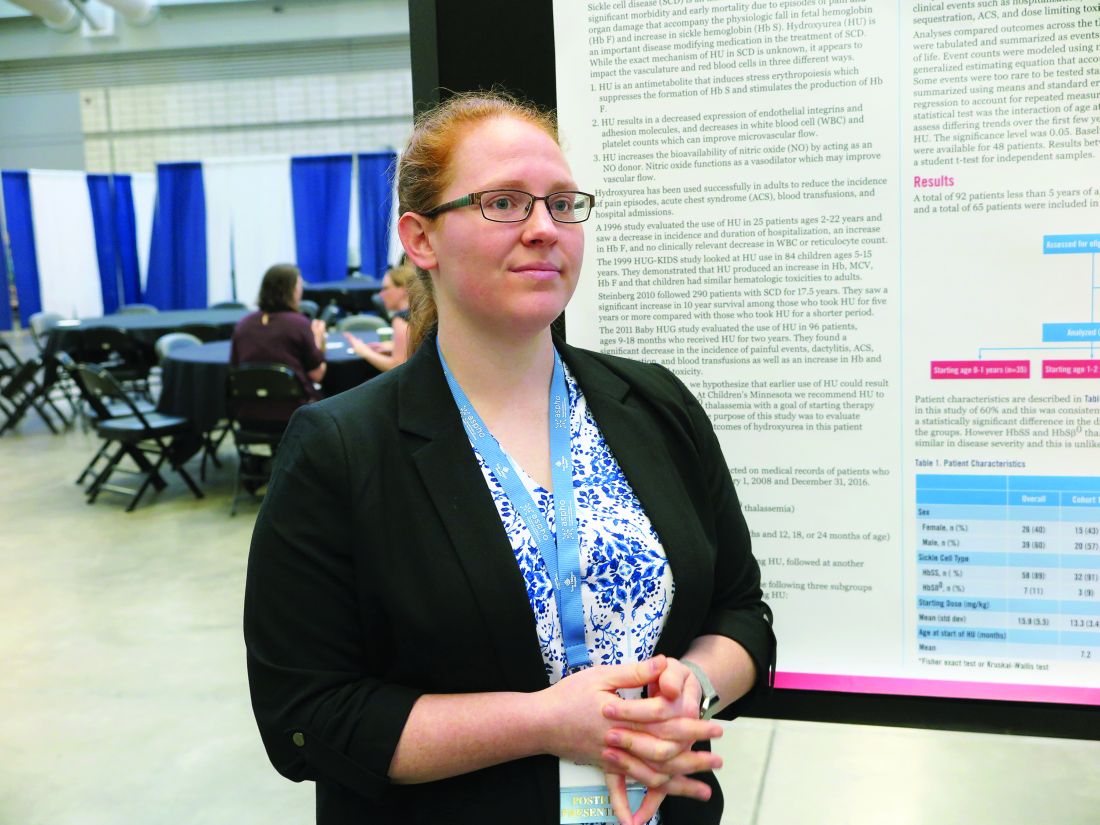
At the Children’s Hospital and Clinics of Minnesota in Minneapolis, where Dr. Schuchard recently completed her training and conducted the research, the goal is to initiate all infants with sickle cell anemia and sickle-beta0-thalassemia on hydroxyurea within this first year of life.
To evaluate outcomes associated with this practice, the investigators conducted a retrospective review of all children with SCD who began hydroxyurea therapy at their center during 2008-2016.
They divided the population into three cohorts. Patients in cohort 1 were started on hydroxyurea before age 1 year (35 patients; mean age, 7.2 months), those in cohort 2 started between 1 and 2 years of age (13 patients; mean age, 19.5 months) and those in cohort 3 were started after 2 years of age (three patients; mean age, 35.5 months).
All patients had been diagnosed with either sickle cell anemia or sickle-beta0-thalassemia, and all had at least two laboratory assessments at 6 months, 12 months, 18 months, or 24 months of age.
For the coprimary endpoint of laboratory data, the investigators found that patients in cohort 1, the early starters, had significantly higher hemoglobin (P = .0003), lower absolute reticulocyte counts (P = .0304), and mean corpuscular volume (P = .0199) than did the patients in cohort 3.
Infants in cohort 1 had significantly lower white blood cell counts than did the patients in either cohorts 2 or 3 (P = .0007 and P less than .0001, respectively) and lower absolute neutrophil counts (P = .0364 and .0025, respectively), although no patients required hydroxyurea therapy to be held because of low ANC.
Clinical events, the other coprimary endpoint, were also significantly better among patients in cohort 1, who had significantly fewer hospitalizations (P = .0025), a trend toward fewer painful events (P = .0618), and significantly fewer transfusions (P = .0426) than did patients in the other two cohorts.
“Early hydroxyurea also appears to contribute to fewer pain crises requiring admission,” the investigators noted.
They noted that in their study, the hematologic response was greater than that seen in the BABY HUG study, which studied the protective effects of hydroxyurea in children aged 9-18 months. The mean age of hydroxyurea initiation was 13.6 months in that study, compared with 7.2 months in the study by Dr. Schuchard and her colleagues.
“It would be interesting to see if the splenic and renal function (the unmet primary endpoints of BABY HUG) are preserved in patients starting hydroxyurea at this younger age,” they wrote.
The study was internally funded. Dr. Schuchard reported having no conflicts of interest.
SOURCE: Schuchard S et al. ASPHO 2018, Poster 342.
PITTSBURGH – Children with sickle cell disease (SCD) who were started on hydroxyurea in infancy had significantly better outcomes than do children started on the drug as toddlers, researchers report.
Among 65 children with SCD, those who started on hydroxyurea before age 1 year had significantly fewer hospitalizations, pain crises, and transfusions in the first 2 years of life, compared with patients started on the drug during 1-2 years of age or after age 2 years, found Sarah B. Schuchard, PharmD, from the SSM Health Cardinal Glennon Children’s Hospital in St. Louis and her colleagues.
At the Children’s Hospital and Clinics of Minnesota in Minneapolis, where Dr. Schuchard recently completed her training and conducted the research, the goal is to initiate all infants with sickle cell anemia and sickle-beta0-thalassemia on hydroxyurea within this first year of life.
To evaluate outcomes associated with this practice, the investigators conducted a retrospective review of all children with SCD who began hydroxyurea therapy at their center during 2008-2016.
They divided the population into three cohorts. Patients in cohort 1 were started on hydroxyurea before age 1 year (35 patients; mean age, 7.2 months), those in cohort 2 started between 1 and 2 years of age (13 patients; mean age, 19.5 months) and those in cohort 3 were started after 2 years of age (three patients; mean age, 35.5 months).
All patients had been diagnosed with either sickle cell anemia or sickle-beta0-thalassemia, and all had at least two laboratory assessments at 6 months, 12 months, 18 months, or 24 months of age.
For the coprimary endpoint of laboratory data, the investigators found that patients in cohort 1, the early starters, had significantly higher hemoglobin (P = .0003), lower absolute reticulocyte counts (P = .0304), and mean corpuscular volume (P = .0199) than did the patients in cohort 3.
Infants in cohort 1 had significantly lower white blood cell counts than did the patients in either cohorts 2 or 3 (P = .0007 and P less than .0001, respectively) and lower absolute neutrophil counts (P = .0364 and .0025, respectively), although no patients required hydroxyurea therapy to be held because of low ANC.
Clinical events, the other coprimary endpoint, were also significantly better among patients in cohort 1, who had significantly fewer hospitalizations (P = .0025), a trend toward fewer painful events (P = .0618), and significantly fewer transfusions (P = .0426) than did patients in the other two cohorts.
“Early hydroxyurea also appears to contribute to fewer pain crises requiring admission,” the investigators noted.
They noted that in their study, the hematologic response was greater than that seen in the BABY HUG study, which studied the protective effects of hydroxyurea in children aged 9-18 months. The mean age of hydroxyurea initiation was 13.6 months in that study, compared with 7.2 months in the study by Dr. Schuchard and her colleagues.
“It would be interesting to see if the splenic and renal function (the unmet primary endpoints of BABY HUG) are preserved in patients starting hydroxyurea at this younger age,” they wrote.
The study was internally funded. Dr. Schuchard reported having no conflicts of interest.
SOURCE: Schuchard S et al. ASPHO 2018, Poster 342.
PITTSBURGH – Children with sickle cell disease (SCD) who were started on hydroxyurea in infancy had significantly better outcomes than do children started on the drug as toddlers, researchers report.
Among 65 children with SCD, those who started on hydroxyurea before age 1 year had significantly fewer hospitalizations, pain crises, and transfusions in the first 2 years of life, compared with patients started on the drug during 1-2 years of age or after age 2 years, found Sarah B. Schuchard, PharmD, from the SSM Health Cardinal Glennon Children’s Hospital in St. Louis and her colleagues.
At the Children’s Hospital and Clinics of Minnesota in Minneapolis, where Dr. Schuchard recently completed her training and conducted the research, the goal is to initiate all infants with sickle cell anemia and sickle-beta0-thalassemia on hydroxyurea within this first year of life.
To evaluate outcomes associated with this practice, the investigators conducted a retrospective review of all children with SCD who began hydroxyurea therapy at their center during 2008-2016.
They divided the population into three cohorts. Patients in cohort 1 were started on hydroxyurea before age 1 year (35 patients; mean age, 7.2 months), those in cohort 2 started between 1 and 2 years of age (13 patients; mean age, 19.5 months) and those in cohort 3 were started after 2 years of age (three patients; mean age, 35.5 months).
All patients had been diagnosed with either sickle cell anemia or sickle-beta0-thalassemia, and all had at least two laboratory assessments at 6 months, 12 months, 18 months, or 24 months of age.
For the coprimary endpoint of laboratory data, the investigators found that patients in cohort 1, the early starters, had significantly higher hemoglobin (P = .0003), lower absolute reticulocyte counts (P = .0304), and mean corpuscular volume (P = .0199) than did the patients in cohort 3.
Infants in cohort 1 had significantly lower white blood cell counts than did the patients in either cohorts 2 or 3 (P = .0007 and P less than .0001, respectively) and lower absolute neutrophil counts (P = .0364 and .0025, respectively), although no patients required hydroxyurea therapy to be held because of low ANC.
Clinical events, the other coprimary endpoint, were also significantly better among patients in cohort 1, who had significantly fewer hospitalizations (P = .0025), a trend toward fewer painful events (P = .0618), and significantly fewer transfusions (P = .0426) than did patients in the other two cohorts.
“Early hydroxyurea also appears to contribute to fewer pain crises requiring admission,” the investigators noted.
They noted that in their study, the hematologic response was greater than that seen in the BABY HUG study, which studied the protective effects of hydroxyurea in children aged 9-18 months. The mean age of hydroxyurea initiation was 13.6 months in that study, compared with 7.2 months in the study by Dr. Schuchard and her colleagues.
“It would be interesting to see if the splenic and renal function (the unmet primary endpoints of BABY HUG) are preserved in patients starting hydroxyurea at this younger age,” they wrote.
The study was internally funded. Dr. Schuchard reported having no conflicts of interest.
SOURCE: Schuchard S et al. ASPHO 2018, Poster 342.
REPORTING FROM ASPHO 2018
Key clinical point: Early initiation of hydroxyurea is associated with better SCD outcomes.
Major finding: Patients started on hydroxyurea at a mean of 7.2 months had significantly fewer admissions, pain crises, and transfusions than did patients started after age 1 year.
Study details: Retrospective review of data on 65 children with SCD in a single center.
Disclosures: The study was internally funded. Dr. Schuchard reported having no conflicts of interest.
Source: Schuchard S et al. ASPHO 2018, Poster 342.
Abstract: Coffee consumption and health: umbrella review of meta-analyses of multiple health outcomes
The video associated with this article is no longer available on this site. Please view all of our videos on the MDedge YouTube channel
Poole, R., et al, BMJ 359:J5024, November 22, 2017
BACKGROUND: Studies examining the benefits versus harms of coffee consumption have yielded conflicting results.
METHODS: The authors, from the United Kingdom, present an umbrella review of meta-analyses published up to 2017 to determine the associations between coffee consumption and any health outcome in adults.
RESULTS: This review includes 201 meta-analyses of observational studies with 67 health outcomes and 17 meta-analyses of randomized trials with 9 health outcomes according to coffee consumption defined as high versus low, any versus none, or per each extra cup per day. Coffee was associated with statistically significant protective effects against several diseases including type 2 diabetes, renal stones, Parkinson’s disease, Alzheimer’s disease, depression, leukemia, gout, colorectal cancer, liver cancer, chronic liver disease, cirrhosis, and endometrial cancer (odds ratios of 0.35-0.94). For some outcomes including all-cause mortality, cardiovascular mortality and cardiovascular disease, a nonlinear association was found whereby 3-4 cups per day (versus 0) conferred the greatest risk reduction (by 17%, 19% and 15%, respectively). High versus low consumption reduced the risk of incident cancers by 18%. Significant harms included lung cancer, urinary tract cancer, pregnancy loss, low birth weight, preterm birth, acute leukemia in childhood, and fracture risk in women (odds ratios of 1.03-1.57). Many of the harms were mitigated after adjustment for smoking, except the risks during pregnancy. This analysis of observational trials cannot prove causality.
CONCLUSIONS: Moderate levels of coffee consumption appear to be safe or even beneficial, except during pregnancy and in women at high fracture risk. 132 references (r.poole@soton.ac.uk – no reprints)
The video associated with this article is no longer available on this site. Please view all of our videos on the MDedge YouTube channel
Poole, R., et al, BMJ 359:J5024, November 22, 2017
BACKGROUND: Studies examining the benefits versus harms of coffee consumption have yielded conflicting results.
METHODS: The authors, from the United Kingdom, present an umbrella review of meta-analyses published up to 2017 to determine the associations between coffee consumption and any health outcome in adults.
RESULTS: This review includes 201 meta-analyses of observational studies with 67 health outcomes and 17 meta-analyses of randomized trials with 9 health outcomes according to coffee consumption defined as high versus low, any versus none, or per each extra cup per day. Coffee was associated with statistically significant protective effects against several diseases including type 2 diabetes, renal stones, Parkinson’s disease, Alzheimer’s disease, depression, leukemia, gout, colorectal cancer, liver cancer, chronic liver disease, cirrhosis, and endometrial cancer (odds ratios of 0.35-0.94). For some outcomes including all-cause mortality, cardiovascular mortality and cardiovascular disease, a nonlinear association was found whereby 3-4 cups per day (versus 0) conferred the greatest risk reduction (by 17%, 19% and 15%, respectively). High versus low consumption reduced the risk of incident cancers by 18%. Significant harms included lung cancer, urinary tract cancer, pregnancy loss, low birth weight, preterm birth, acute leukemia in childhood, and fracture risk in women (odds ratios of 1.03-1.57). Many of the harms were mitigated after adjustment for smoking, except the risks during pregnancy. This analysis of observational trials cannot prove causality.
CONCLUSIONS: Moderate levels of coffee consumption appear to be safe or even beneficial, except during pregnancy and in women at high fracture risk. 132 references (r.poole@soton.ac.uk – no reprints)
The video associated with this article is no longer available on this site. Please view all of our videos on the MDedge YouTube channel
Poole, R., et al, BMJ 359:J5024, November 22, 2017
BACKGROUND: Studies examining the benefits versus harms of coffee consumption have yielded conflicting results.
METHODS: The authors, from the United Kingdom, present an umbrella review of meta-analyses published up to 2017 to determine the associations between coffee consumption and any health outcome in adults.
RESULTS: This review includes 201 meta-analyses of observational studies with 67 health outcomes and 17 meta-analyses of randomized trials with 9 health outcomes according to coffee consumption defined as high versus low, any versus none, or per each extra cup per day. Coffee was associated with statistically significant protective effects against several diseases including type 2 diabetes, renal stones, Parkinson’s disease, Alzheimer’s disease, depression, leukemia, gout, colorectal cancer, liver cancer, chronic liver disease, cirrhosis, and endometrial cancer (odds ratios of 0.35-0.94). For some outcomes including all-cause mortality, cardiovascular mortality and cardiovascular disease, a nonlinear association was found whereby 3-4 cups per day (versus 0) conferred the greatest risk reduction (by 17%, 19% and 15%, respectively). High versus low consumption reduced the risk of incident cancers by 18%. Significant harms included lung cancer, urinary tract cancer, pregnancy loss, low birth weight, preterm birth, acute leukemia in childhood, and fracture risk in women (odds ratios of 1.03-1.57). Many of the harms were mitigated after adjustment for smoking, except the risks during pregnancy. This analysis of observational trials cannot prove causality.
CONCLUSIONS: Moderate levels of coffee consumption appear to be safe or even beneficial, except during pregnancy and in women at high fracture risk. 132 references (r.poole@soton.ac.uk – no reprints)
Learn more about the Primary Care Medical Abstracts and podcasts, for which you can earn up to 9 CME credits per month.
Copyright © The Center for Medical Education
FDA approves marketing of device to control GI bleeding
The Food and Drug Administration announced May 7 that it has permitted marketing of .
Hemospray is an aerosolized spray device that delivers a mineral blend to the bleeding site in the GI tract and is applied during endoscopic procedures and can cover large ulcers or tumors.
The FDA evaluated data from clinical studies consisting of 228 patients with upper and lower GI bleeding, supplemented with evidence from medical literature, including an additional 522 patients. The studies found that Hemospray stopped GI bleeding in 95% of patients within 5 minutes of device usage. Results also found that bleeding recurred, usually within 72 hours, and up to 30 days following device usage, in 20% of patients. Bowel perforation was observed as a serious side effect in approximately 1% of patients.
“The device provides an additional, nonsurgical option for treating upper and lower GI bleeding in certain patients, and may help reduce the risk of death from a GI bleed for many patients,” said Binita Ashar, MD, director, division of surgical devices, in the FDA’s Center for Devices and Radiological Health in a press release.
Hemospray is not intended for patients who have a gastrointestinal fistula or are at high risk for GI perforation. The device is not intended for use in patients with variceal bleeding. The FDA permitted the marketing of the Hemospray device to Wilson-Cook Medical.*
Read the full press release here.
Correction, 5/10/18: An earlier version of this article incorrectly described the patient population that should not be treated with Hemospray.
The Food and Drug Administration announced May 7 that it has permitted marketing of .
Hemospray is an aerosolized spray device that delivers a mineral blend to the bleeding site in the GI tract and is applied during endoscopic procedures and can cover large ulcers or tumors.
The FDA evaluated data from clinical studies consisting of 228 patients with upper and lower GI bleeding, supplemented with evidence from medical literature, including an additional 522 patients. The studies found that Hemospray stopped GI bleeding in 95% of patients within 5 minutes of device usage. Results also found that bleeding recurred, usually within 72 hours, and up to 30 days following device usage, in 20% of patients. Bowel perforation was observed as a serious side effect in approximately 1% of patients.
“The device provides an additional, nonsurgical option for treating upper and lower GI bleeding in certain patients, and may help reduce the risk of death from a GI bleed for many patients,” said Binita Ashar, MD, director, division of surgical devices, in the FDA’s Center for Devices and Radiological Health in a press release.
Hemospray is not intended for patients who have a gastrointestinal fistula or are at high risk for GI perforation. The device is not intended for use in patients with variceal bleeding. The FDA permitted the marketing of the Hemospray device to Wilson-Cook Medical.*
Read the full press release here.
Correction, 5/10/18: An earlier version of this article incorrectly described the patient population that should not be treated with Hemospray.
The Food and Drug Administration announced May 7 that it has permitted marketing of .
Hemospray is an aerosolized spray device that delivers a mineral blend to the bleeding site in the GI tract and is applied during endoscopic procedures and can cover large ulcers or tumors.
The FDA evaluated data from clinical studies consisting of 228 patients with upper and lower GI bleeding, supplemented with evidence from medical literature, including an additional 522 patients. The studies found that Hemospray stopped GI bleeding in 95% of patients within 5 minutes of device usage. Results also found that bleeding recurred, usually within 72 hours, and up to 30 days following device usage, in 20% of patients. Bowel perforation was observed as a serious side effect in approximately 1% of patients.
“The device provides an additional, nonsurgical option for treating upper and lower GI bleeding in certain patients, and may help reduce the risk of death from a GI bleed for many patients,” said Binita Ashar, MD, director, division of surgical devices, in the FDA’s Center for Devices and Radiological Health in a press release.
Hemospray is not intended for patients who have a gastrointestinal fistula or are at high risk for GI perforation. The device is not intended for use in patients with variceal bleeding. The FDA permitted the marketing of the Hemospray device to Wilson-Cook Medical.*
Read the full press release here.
Correction, 5/10/18: An earlier version of this article incorrectly described the patient population that should not be treated with Hemospray.

Pretreatment ECG unwarranted for most infantile hemangioma patients starting propranolol
reported Emily B. Lund, MD, of the University of Chicago, and her associates.
This finding supports previously published studies that pretreatment ECG is not necessary, despite consensus guidelines published in 2013 that recommend ECG screening of high-risk infants presenting with below-normal heart rate, arrhythmia, or family history of either arrhythmia or congenital heart disease.
Among the 6% of patients included in the study who had a positive personal cardiac history, congenital heart disease was most common; coronary artery disease was most prevalent among the 41% with a positive family cardiac history. Baseline vital signs revealed no hypotension or bradycardia.
All patients prescribed propranolol were routinely screened with ECG prior to therapy during the study period. Baseline heart rate and blood pressure were observed for abnormalities; patients also were observed during follow-up for possible propranolol side effects.
A total of 43% of ECG screenings performed were found to be abnormal; left ventricular hypertrophy was the most common abnormality. Despite further cardiac evaluation of all but one patient with abnormal ECG, no contraindications to treatment were identified, Dr. Lund and her colleagues reported in Pediatric Dermatology.
Ultimately, 96% of patients observed started treatment with propranolol; of the remaining 4% who did not, the authors cited parental preference and lack of follow-up as the primary reasons for nontreatment.
The researchers found no association between reported side effects and abnormal ECG, a positive personal history of cardiac problems, or a positive family history of cardiac problems.
Dr. Lund and her associates suggested that future revision of the guidelines should emphasize the absence of significant positive predictive value of ECG abnormalities for treatment-related side effects.
The researchers reported no relevant financial disclosures.
SOURCE: Lund EB et al. Ped Dermatol. 2018. doi: 10.1111/pde.13508.
reported Emily B. Lund, MD, of the University of Chicago, and her associates.
This finding supports previously published studies that pretreatment ECG is not necessary, despite consensus guidelines published in 2013 that recommend ECG screening of high-risk infants presenting with below-normal heart rate, arrhythmia, or family history of either arrhythmia or congenital heart disease.
Among the 6% of patients included in the study who had a positive personal cardiac history, congenital heart disease was most common; coronary artery disease was most prevalent among the 41% with a positive family cardiac history. Baseline vital signs revealed no hypotension or bradycardia.
All patients prescribed propranolol were routinely screened with ECG prior to therapy during the study period. Baseline heart rate and blood pressure were observed for abnormalities; patients also were observed during follow-up for possible propranolol side effects.
A total of 43% of ECG screenings performed were found to be abnormal; left ventricular hypertrophy was the most common abnormality. Despite further cardiac evaluation of all but one patient with abnormal ECG, no contraindications to treatment were identified, Dr. Lund and her colleagues reported in Pediatric Dermatology.
Ultimately, 96% of patients observed started treatment with propranolol; of the remaining 4% who did not, the authors cited parental preference and lack of follow-up as the primary reasons for nontreatment.
The researchers found no association between reported side effects and abnormal ECG, a positive personal history of cardiac problems, or a positive family history of cardiac problems.
Dr. Lund and her associates suggested that future revision of the guidelines should emphasize the absence of significant positive predictive value of ECG abnormalities for treatment-related side effects.
The researchers reported no relevant financial disclosures.
SOURCE: Lund EB et al. Ped Dermatol. 2018. doi: 10.1111/pde.13508.
reported Emily B. Lund, MD, of the University of Chicago, and her associates.
This finding supports previously published studies that pretreatment ECG is not necessary, despite consensus guidelines published in 2013 that recommend ECG screening of high-risk infants presenting with below-normal heart rate, arrhythmia, or family history of either arrhythmia or congenital heart disease.
Among the 6% of patients included in the study who had a positive personal cardiac history, congenital heart disease was most common; coronary artery disease was most prevalent among the 41% with a positive family cardiac history. Baseline vital signs revealed no hypotension or bradycardia.
All patients prescribed propranolol were routinely screened with ECG prior to therapy during the study period. Baseline heart rate and blood pressure were observed for abnormalities; patients also were observed during follow-up for possible propranolol side effects.
A total of 43% of ECG screenings performed were found to be abnormal; left ventricular hypertrophy was the most common abnormality. Despite further cardiac evaluation of all but one patient with abnormal ECG, no contraindications to treatment were identified, Dr. Lund and her colleagues reported in Pediatric Dermatology.
Ultimately, 96% of patients observed started treatment with propranolol; of the remaining 4% who did not, the authors cited parental preference and lack of follow-up as the primary reasons for nontreatment.
The researchers found no association between reported side effects and abnormal ECG, a positive personal history of cardiac problems, or a positive family history of cardiac problems.
Dr. Lund and her associates suggested that future revision of the guidelines should emphasize the absence of significant positive predictive value of ECG abnormalities for treatment-related side effects.
The researchers reported no relevant financial disclosures.
SOURCE: Lund EB et al. Ped Dermatol. 2018. doi: 10.1111/pde.13508.
FROM PEDIATRIC DERMATOLOGY
Key clinical point: There was no association between side effects, abnormal ECG, and personal or family history of cardiac problems in children with infantile hemangioma who underwent propranolol therapy.
Major finding: Despite the fact that 43% of ECG screenings were abnormal, 96% of patients started treatment with propranolol, with no side effects related to abnormal ECG or to personal or family history of cardiac problems.
Study details: A retrospective chart review of 272 patients with infantile hemangioma.
Disclosures: The researchers reported no relevant financial disclosures.
Source: Lund EB et al. Ped Dermatol. 2018. doi: 10.1111/pde.13508.