User login
Minimally invasive cosmetic surgery: Steady growth in 2018
that brought the total to nearly 16 million procedures, according to the American Society of Plastic Surgeons.
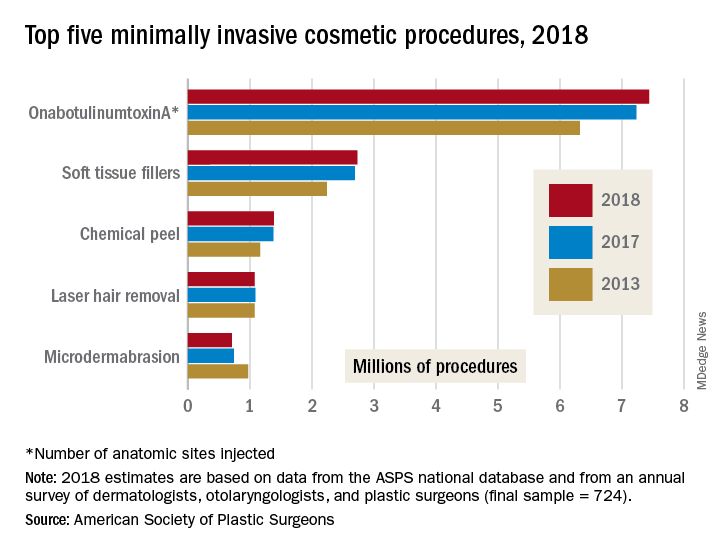
The most popular form of minimally invasive cosmetic surgery among the estimated 15.9 million procedures performed in 2018 was, once again, onabotulinumtoxinA injection, which represented almost half of the total for the year with 7.4 million anatomic sites injected (up by 2.9%), the ASPS said in its 2018 Plastic Surgery Statistics Report.
Soft-tissue-filler injections, the next most popular type of surgery, were up 1.7% to almost 2.7 million procedures, while chemical peels rose 0.6% to nearly 1.4 million procedures. Numbers for 2018 were down, however, for the two other top-five surgeries: Laser hair removal slipped 0.9% from 2017 and microdermabrasion fell 4.2%, the ASPS reported.
Going back quite a bit further in time – the year 2000, to be exact – reveals 21st-century growth of 228% for the minimally invasive sector as a whole, but the long-term trend for cosmetic surgery was not quite as rosy – down by 4.7% since 2000. From 2017 to 2018, though, cosmetic surgery procedures were up by 1.2%, with breast augmentation the most popular, followed by liposuction, rhinoplasty, blepharoplasty, and abdominoplasty, according to the ASPS.
The 2018 statistics report was based on analysis of the society’s Tracking Operations and Outcomes for Plastic Surgeons database and an annual survey of board-certified dermatologists, otolaryngologists, and plastic surgeons (final sample = 724).
that brought the total to nearly 16 million procedures, according to the American Society of Plastic Surgeons.
The most popular form of minimally invasive cosmetic surgery among the estimated 15.9 million procedures performed in 2018 was, once again, onabotulinumtoxinA injection, which represented almost half of the total for the year with 7.4 million anatomic sites injected (up by 2.9%), the ASPS said in its 2018 Plastic Surgery Statistics Report.
Soft-tissue-filler injections, the next most popular type of surgery, were up 1.7% to almost 2.7 million procedures, while chemical peels rose 0.6% to nearly 1.4 million procedures. Numbers for 2018 were down, however, for the two other top-five surgeries: Laser hair removal slipped 0.9% from 2017 and microdermabrasion fell 4.2%, the ASPS reported.
Going back quite a bit further in time – the year 2000, to be exact – reveals 21st-century growth of 228% for the minimally invasive sector as a whole, but the long-term trend for cosmetic surgery was not quite as rosy – down by 4.7% since 2000. From 2017 to 2018, though, cosmetic surgery procedures were up by 1.2%, with breast augmentation the most popular, followed by liposuction, rhinoplasty, blepharoplasty, and abdominoplasty, according to the ASPS.
The 2018 statistics report was based on analysis of the society’s Tracking Operations and Outcomes for Plastic Surgeons database and an annual survey of board-certified dermatologists, otolaryngologists, and plastic surgeons (final sample = 724).
that brought the total to nearly 16 million procedures, according to the American Society of Plastic Surgeons.
The most popular form of minimally invasive cosmetic surgery among the estimated 15.9 million procedures performed in 2018 was, once again, onabotulinumtoxinA injection, which represented almost half of the total for the year with 7.4 million anatomic sites injected (up by 2.9%), the ASPS said in its 2018 Plastic Surgery Statistics Report.
Soft-tissue-filler injections, the next most popular type of surgery, were up 1.7% to almost 2.7 million procedures, while chemical peels rose 0.6% to nearly 1.4 million procedures. Numbers for 2018 were down, however, for the two other top-five surgeries: Laser hair removal slipped 0.9% from 2017 and microdermabrasion fell 4.2%, the ASPS reported.
Going back quite a bit further in time – the year 2000, to be exact – reveals 21st-century growth of 228% for the minimally invasive sector as a whole, but the long-term trend for cosmetic surgery was not quite as rosy – down by 4.7% since 2000. From 2017 to 2018, though, cosmetic surgery procedures were up by 1.2%, with breast augmentation the most popular, followed by liposuction, rhinoplasty, blepharoplasty, and abdominoplasty, according to the ASPS.
The 2018 statistics report was based on analysis of the society’s Tracking Operations and Outcomes for Plastic Surgeons database and an annual survey of board-certified dermatologists, otolaryngologists, and plastic surgeons (final sample = 724).
ACIP approves meningococcal booster for persons at increased risk
according to the Centers for Disease Control and Prevention’s Advisory Committee on Immunization Practices.

The committee voted unanimously in favor of a booster dose of MenB vaccine 1 year after completion of the primary series, with additional boosters every 2-3 years “for as long as risk remains” for high-risk persons, including microbiologists and persons with complement deficiency, complement inhibitor use, or asplenia.
The committee also voted unanimously in favor of a one-time MenB booster for individuals aged 10 years and older who are at least a year beyond completion of a MenB primary series and deemed at increased risk by public health officials in an outbreak situation.
In addition, “a booster dose interval of 6 months or more may be considered by public health officials depending on the specific outbreak, vaccine strategy, and projected duration of elevated risk” according to the language, which was included in the unanimously approved statement “Meningococcal Vaccination: Recommendations of The Advisory Committee on Immunization Practices.”
The updated statement on meningococcal vaccination was developed in 2019 “to consolidate all existing ACIP recommendations for MenACWY and MenB vaccines in a single document,” said Sarah Mbaeyi, MD, of the CDC’s National Center for Immunization and Respiratory Diseases, who presented immunogenicity data and the proposed recommendations.
The statement includes the recommendation of a MenB primary series for individuals aged 16-23 years based on shared clinical decision making. Kelly Moore, MD, of Vanderbilt University, Nashville, Tenn., noted the importance of ongoing data collection, and said clinicians must make clear to patients that, “if they want protection, they need the booster.”
Approximately 7% of serogroup B cases in the United States are related to disease outbreaks, mainly among college students, Dr. Mbaeyi said. All 13 universities that experienced outbreaks between 2013 and 2019 have implemented a MenB primary series, and one university has implemented an off-label booster program.
The work group concluded that a MenB booster dose is necessary to sustain protection against serogroup B disease in persons at increased risk during an outbreak, and that the potential benefits outweighed the harms given the seriousness of meningococcal disease.
Paul Hunter, MD, of the City of Milwaukee Health Department, noted that “the booster recommendation gives more flexibility” in an outbreak response.
The committee also voted unanimously to approve the Vaccines for Children resolution for the meningococcal vaccine that updates language to align with the new recommendations.
The ACIP members had no financial conflicts to disclose.
according to the Centers for Disease Control and Prevention’s Advisory Committee on Immunization Practices.
The committee voted unanimously in favor of a booster dose of MenB vaccine 1 year after completion of the primary series, with additional boosters every 2-3 years “for as long as risk remains” for high-risk persons, including microbiologists and persons with complement deficiency, complement inhibitor use, or asplenia.
The committee also voted unanimously in favor of a one-time MenB booster for individuals aged 10 years and older who are at least a year beyond completion of a MenB primary series and deemed at increased risk by public health officials in an outbreak situation.
In addition, “a booster dose interval of 6 months or more may be considered by public health officials depending on the specific outbreak, vaccine strategy, and projected duration of elevated risk” according to the language, which was included in the unanimously approved statement “Meningococcal Vaccination: Recommendations of The Advisory Committee on Immunization Practices.”
The updated statement on meningococcal vaccination was developed in 2019 “to consolidate all existing ACIP recommendations for MenACWY and MenB vaccines in a single document,” said Sarah Mbaeyi, MD, of the CDC’s National Center for Immunization and Respiratory Diseases, who presented immunogenicity data and the proposed recommendations.
The statement includes the recommendation of a MenB primary series for individuals aged 16-23 years based on shared clinical decision making. Kelly Moore, MD, of Vanderbilt University, Nashville, Tenn., noted the importance of ongoing data collection, and said clinicians must make clear to patients that, “if they want protection, they need the booster.”
Approximately 7% of serogroup B cases in the United States are related to disease outbreaks, mainly among college students, Dr. Mbaeyi said. All 13 universities that experienced outbreaks between 2013 and 2019 have implemented a MenB primary series, and one university has implemented an off-label booster program.
The work group concluded that a MenB booster dose is necessary to sustain protection against serogroup B disease in persons at increased risk during an outbreak, and that the potential benefits outweighed the harms given the seriousness of meningococcal disease.
Paul Hunter, MD, of the City of Milwaukee Health Department, noted that “the booster recommendation gives more flexibility” in an outbreak response.
The committee also voted unanimously to approve the Vaccines for Children resolution for the meningococcal vaccine that updates language to align with the new recommendations.
The ACIP members had no financial conflicts to disclose.
according to the Centers for Disease Control and Prevention’s Advisory Committee on Immunization Practices.
The committee voted unanimously in favor of a booster dose of MenB vaccine 1 year after completion of the primary series, with additional boosters every 2-3 years “for as long as risk remains” for high-risk persons, including microbiologists and persons with complement deficiency, complement inhibitor use, or asplenia.
The committee also voted unanimously in favor of a one-time MenB booster for individuals aged 10 years and older who are at least a year beyond completion of a MenB primary series and deemed at increased risk by public health officials in an outbreak situation.
In addition, “a booster dose interval of 6 months or more may be considered by public health officials depending on the specific outbreak, vaccine strategy, and projected duration of elevated risk” according to the language, which was included in the unanimously approved statement “Meningococcal Vaccination: Recommendations of The Advisory Committee on Immunization Practices.”
The updated statement on meningococcal vaccination was developed in 2019 “to consolidate all existing ACIP recommendations for MenACWY and MenB vaccines in a single document,” said Sarah Mbaeyi, MD, of the CDC’s National Center for Immunization and Respiratory Diseases, who presented immunogenicity data and the proposed recommendations.
The statement includes the recommendation of a MenB primary series for individuals aged 16-23 years based on shared clinical decision making. Kelly Moore, MD, of Vanderbilt University, Nashville, Tenn., noted the importance of ongoing data collection, and said clinicians must make clear to patients that, “if they want protection, they need the booster.”
Approximately 7% of serogroup B cases in the United States are related to disease outbreaks, mainly among college students, Dr. Mbaeyi said. All 13 universities that experienced outbreaks between 2013 and 2019 have implemented a MenB primary series, and one university has implemented an off-label booster program.
The work group concluded that a MenB booster dose is necessary to sustain protection against serogroup B disease in persons at increased risk during an outbreak, and that the potential benefits outweighed the harms given the seriousness of meningococcal disease.
Paul Hunter, MD, of the City of Milwaukee Health Department, noted that “the booster recommendation gives more flexibility” in an outbreak response.
The committee also voted unanimously to approve the Vaccines for Children resolution for the meningococcal vaccine that updates language to align with the new recommendations.
The ACIP members had no financial conflicts to disclose.
REPORTING FROM AN ACIP MEETING

Physician innovator working to bring new tech to patients, thanks to AGA funding
The AGA Research Foundation’s career development awards are invaluable tools for early career investigators to advance their careers in gastroenterology and hepatology research. When Ashish Nimgaonkar, MD, MTech, MS, received the AGA-Boston Scientific Career Development Technology and Innovation Award in 2014, he was able to step up his research and develop a new technological approach for managing patients with chronic liver disease-related complications. We are delighted to introduce you to the work of Dr. Nimgaonkar, medical director in the Johns Hopkins Center for Bioengineering Innovation and Design, department of biomedical engineering, and an assistant professor of medicine and business at Johns Hopkins University.

When Dr. Nimgaonkar received his funding from the AGA Research Foundation in 2014, he was able to focus on developing a technology that would enable patients with refractory ascites to manage their condition at home. This is a condition in which a large volume of fluid accumulates in the abdomen, causes difficulty breathing and affects patients’ quality of life. Patients visit a hospital or clinic several times a month to drain the fluid, which could weigh as much as 10 pounds or more. Refractory ascites is stubbornly resistant to standard medical therapy. The only definitive treatment is liver transplantation.
Dr. Nimgaonkar was able to combine his dual training in gastroenterology and in medical technology innovation through the biodesign program at Stanford University, along with the breadth of engineering and research expertise at Johns Hopkins University, to develop a bio-powered shunt that moves a patient’s fluid buildup out of the peritoneal cavity to the urinary bladder, where it can be eliminated naturally. His shunt has another major advantage for patients who are on liver transplant lists and are required to undergo MRI and other diagnostics: it contains no metal components.
Read more and get to know Ashish Nimgaonkar, MD, MTech, MS by visiting:
https://www.gastro.org/news/physician-innovator-working-to-bring-new-tech-to-patients-thanks-to-aga-funding
Help AGA build a community of investigators through the AGA Research Foundation.
Your donation to the AGA Research Foundation can fund future success stories by keeping young scientists working to advance our understanding of digestive diseases. Donate today at www.gastro.org/donateonline.
The AGA Research Foundation’s career development awards are invaluable tools for early career investigators to advance their careers in gastroenterology and hepatology research. When Ashish Nimgaonkar, MD, MTech, MS, received the AGA-Boston Scientific Career Development Technology and Innovation Award in 2014, he was able to step up his research and develop a new technological approach for managing patients with chronic liver disease-related complications. We are delighted to introduce you to the work of Dr. Nimgaonkar, medical director in the Johns Hopkins Center for Bioengineering Innovation and Design, department of biomedical engineering, and an assistant professor of medicine and business at Johns Hopkins University.
When Dr. Nimgaonkar received his funding from the AGA Research Foundation in 2014, he was able to focus on developing a technology that would enable patients with refractory ascites to manage their condition at home. This is a condition in which a large volume of fluid accumulates in the abdomen, causes difficulty breathing and affects patients’ quality of life. Patients visit a hospital or clinic several times a month to drain the fluid, which could weigh as much as 10 pounds or more. Refractory ascites is stubbornly resistant to standard medical therapy. The only definitive treatment is liver transplantation.
Dr. Nimgaonkar was able to combine his dual training in gastroenterology and in medical technology innovation through the biodesign program at Stanford University, along with the breadth of engineering and research expertise at Johns Hopkins University, to develop a bio-powered shunt that moves a patient’s fluid buildup out of the peritoneal cavity to the urinary bladder, where it can be eliminated naturally. His shunt has another major advantage for patients who are on liver transplant lists and are required to undergo MRI and other diagnostics: it contains no metal components.
Read more and get to know Ashish Nimgaonkar, MD, MTech, MS by visiting:
https://www.gastro.org/news/physician-innovator-working-to-bring-new-tech-to-patients-thanks-to-aga-funding
Help AGA build a community of investigators through the AGA Research Foundation.
Your donation to the AGA Research Foundation can fund future success stories by keeping young scientists working to advance our understanding of digestive diseases. Donate today at www.gastro.org/donateonline.
The AGA Research Foundation’s career development awards are invaluable tools for early career investigators to advance their careers in gastroenterology and hepatology research. When Ashish Nimgaonkar, MD, MTech, MS, received the AGA-Boston Scientific Career Development Technology and Innovation Award in 2014, he was able to step up his research and develop a new technological approach for managing patients with chronic liver disease-related complications. We are delighted to introduce you to the work of Dr. Nimgaonkar, medical director in the Johns Hopkins Center for Bioengineering Innovation and Design, department of biomedical engineering, and an assistant professor of medicine and business at Johns Hopkins University.
When Dr. Nimgaonkar received his funding from the AGA Research Foundation in 2014, he was able to focus on developing a technology that would enable patients with refractory ascites to manage their condition at home. This is a condition in which a large volume of fluid accumulates in the abdomen, causes difficulty breathing and affects patients’ quality of life. Patients visit a hospital or clinic several times a month to drain the fluid, which could weigh as much as 10 pounds or more. Refractory ascites is stubbornly resistant to standard medical therapy. The only definitive treatment is liver transplantation.
Dr. Nimgaonkar was able to combine his dual training in gastroenterology and in medical technology innovation through the biodesign program at Stanford University, along with the breadth of engineering and research expertise at Johns Hopkins University, to develop a bio-powered shunt that moves a patient’s fluid buildup out of the peritoneal cavity to the urinary bladder, where it can be eliminated naturally. His shunt has another major advantage for patients who are on liver transplant lists and are required to undergo MRI and other diagnostics: it contains no metal components.
Read more and get to know Ashish Nimgaonkar, MD, MTech, MS by visiting:
https://www.gastro.org/news/physician-innovator-working-to-bring-new-tech-to-patients-thanks-to-aga-funding
Help AGA build a community of investigators through the AGA Research Foundation.
Your donation to the AGA Research Foundation can fund future success stories by keeping young scientists working to advance our understanding of digestive diseases. Donate today at www.gastro.org/donateonline.

Washington makes low drug prices a priority
The House of Representatives passed two bills aimed at speeding up the development of generics and biosimilars while the Trump administration finalized a rule to require drug companies to list the price of their products in their television ads.
The House passed two bills to address drug pricing. The House passed H.R. 1503, the Orange Book Transparency Act of 2019, legislation that would make changes to the FDA’s “orange” book to provide better information on brand drug and patent exclusivity. The orange book is used by doctors and pharmacists for information on generic drug approvals and availability. It is also used by generic drug manufacturers to make decisions on where to invest in research and development as it provides information on the exclusivity period for brand name drugs. Similarly, the House passed H.R. 1520, the Purple Book Continuity Act, legislation that would update FDA’s “purple” book on patents and exclusivity for biologics. These are the first bills of the 116th Congress to pass that address the costs of drugs.
The Administration finalizes rule on drug costs in advertising. The Trump administration finalized a rule that would require drug manufacturers to disclose prices on their products in television advertisements. Manufacturers must list a product’s monthly wholesale price or the cost of a typical treatment if it is greater than $35 for 30 days. The information must appear in text large enough for people to read it and should also include a statement that people with insurance may pay a different amount for the product. The rule takes effect in 60 days and the drug industry opposes the rule, which they say could sway patients away from certain medications and lead to more misinformation on the actual costs.
House Appropriations Committee approves $2 billion NIH increase. The House Appropriations Committee approved their fiscal year 2020 Labor, HHS, and Education Appropriations bill that includes a $2 billion increase in NIH funding. The Committee also includes critical report language on several GI research areas including inflammatory bowel disease, colorectal cancer screenings, early onset colorectal cancer, and the role of food as medicine in treating diseases. The bill also includes important language directing CMS to require Medicare Advantage plans to exclude from prior authorization requirements those services that align with evidence-based guidelines and have a high prior authorization approval rate. The language also calls for more transparency for MA plans with prior authorization so physicians are aware of what services require it.
Medical Nutrition Equity Act introduced in House. Rep. Jim McGovern, D-Mass., introduced H.R. 2501, the Medical Nutrition Equity Act, legislation that would mandate coverage of medically necessary foods for individuals with digestive and inherited metabolic disorders. AGA is supportive of this legislation that is critical for patients with digestive diseases and ensures their access to these lifesaving products.
The House of Representatives passed two bills aimed at speeding up the development of generics and biosimilars while the Trump administration finalized a rule to require drug companies to list the price of their products in their television ads.
The House passed two bills to address drug pricing. The House passed H.R. 1503, the Orange Book Transparency Act of 2019, legislation that would make changes to the FDA’s “orange” book to provide better information on brand drug and patent exclusivity. The orange book is used by doctors and pharmacists for information on generic drug approvals and availability. It is also used by generic drug manufacturers to make decisions on where to invest in research and development as it provides information on the exclusivity period for brand name drugs. Similarly, the House passed H.R. 1520, the Purple Book Continuity Act, legislation that would update FDA’s “purple” book on patents and exclusivity for biologics. These are the first bills of the 116th Congress to pass that address the costs of drugs.
The Administration finalizes rule on drug costs in advertising. The Trump administration finalized a rule that would require drug manufacturers to disclose prices on their products in television advertisements. Manufacturers must list a product’s monthly wholesale price or the cost of a typical treatment if it is greater than $35 for 30 days. The information must appear in text large enough for people to read it and should also include a statement that people with insurance may pay a different amount for the product. The rule takes effect in 60 days and the drug industry opposes the rule, which they say could sway patients away from certain medications and lead to more misinformation on the actual costs.
House Appropriations Committee approves $2 billion NIH increase. The House Appropriations Committee approved their fiscal year 2020 Labor, HHS, and Education Appropriations bill that includes a $2 billion increase in NIH funding. The Committee also includes critical report language on several GI research areas including inflammatory bowel disease, colorectal cancer screenings, early onset colorectal cancer, and the role of food as medicine in treating diseases. The bill also includes important language directing CMS to require Medicare Advantage plans to exclude from prior authorization requirements those services that align with evidence-based guidelines and have a high prior authorization approval rate. The language also calls for more transparency for MA plans with prior authorization so physicians are aware of what services require it.
Medical Nutrition Equity Act introduced in House. Rep. Jim McGovern, D-Mass., introduced H.R. 2501, the Medical Nutrition Equity Act, legislation that would mandate coverage of medically necessary foods for individuals with digestive and inherited metabolic disorders. AGA is supportive of this legislation that is critical for patients with digestive diseases and ensures their access to these lifesaving products.
The House of Representatives passed two bills aimed at speeding up the development of generics and biosimilars while the Trump administration finalized a rule to require drug companies to list the price of their products in their television ads.
The House passed two bills to address drug pricing. The House passed H.R. 1503, the Orange Book Transparency Act of 2019, legislation that would make changes to the FDA’s “orange” book to provide better information on brand drug and patent exclusivity. The orange book is used by doctors and pharmacists for information on generic drug approvals and availability. It is also used by generic drug manufacturers to make decisions on where to invest in research and development as it provides information on the exclusivity period for brand name drugs. Similarly, the House passed H.R. 1520, the Purple Book Continuity Act, legislation that would update FDA’s “purple” book on patents and exclusivity for biologics. These are the first bills of the 116th Congress to pass that address the costs of drugs.
The Administration finalizes rule on drug costs in advertising. The Trump administration finalized a rule that would require drug manufacturers to disclose prices on their products in television advertisements. Manufacturers must list a product’s monthly wholesale price or the cost of a typical treatment if it is greater than $35 for 30 days. The information must appear in text large enough for people to read it and should also include a statement that people with insurance may pay a different amount for the product. The rule takes effect in 60 days and the drug industry opposes the rule, which they say could sway patients away from certain medications and lead to more misinformation on the actual costs.
House Appropriations Committee approves $2 billion NIH increase. The House Appropriations Committee approved their fiscal year 2020 Labor, HHS, and Education Appropriations bill that includes a $2 billion increase in NIH funding. The Committee also includes critical report language on several GI research areas including inflammatory bowel disease, colorectal cancer screenings, early onset colorectal cancer, and the role of food as medicine in treating diseases. The bill also includes important language directing CMS to require Medicare Advantage plans to exclude from prior authorization requirements those services that align with evidence-based guidelines and have a high prior authorization approval rate. The language also calls for more transparency for MA plans with prior authorization so physicians are aware of what services require it.
Medical Nutrition Equity Act introduced in House. Rep. Jim McGovern, D-Mass., introduced H.R. 2501, the Medical Nutrition Equity Act, legislation that would mandate coverage of medically necessary foods for individuals with digestive and inherited metabolic disorders. AGA is supportive of this legislation that is critical for patients with digestive diseases and ensures their access to these lifesaving products.
Top AGA Community patient cases
Physicians with difficult patient scenarios regularly bring their questions to the AGA Community to seek advice from colleagues about therapy and disease management options, best practices, and diagnoses. In case you missed it, here are the most popular clinical discussions shared in the forum recently:
1. Crohn’s disease, infliximab and liver abscess (http://ow.ly/mTod50uyXCQ)
A 22-year-old Crohn’s patient presented to the hospital in septic shock with acute renal failure due to pyogenic liver abscess, which had ruptured into the peritoneal cavity. Member seeks consult from the AGA Community on treatment options given this serious infection.
2. EUS-guided cholecystoenterostomy with LAMS (http://ow.ly/IqLP50uyXLg)
A member poses the question: how long should the stent stay in?
3. Colorectal cancer surveillance in Crohn’s colitis and small duct PSC (http://ow.ly/tbe650uyXQh)
A member asks if you would continue yearly CRC surveillance on a patient with Crohn’s colitis with very limited colonic involvement in the ascending colon, who is currently in clinical remission. The patient also has small duct PSC with early cirrhosis.
Access these clinical cases and more discussions at https://community.gastro.org/discussions.
Physicians with difficult patient scenarios regularly bring their questions to the AGA Community to seek advice from colleagues about therapy and disease management options, best practices, and diagnoses. In case you missed it, here are the most popular clinical discussions shared in the forum recently:
1. Crohn’s disease, infliximab and liver abscess (http://ow.ly/mTod50uyXCQ)
A 22-year-old Crohn’s patient presented to the hospital in septic shock with acute renal failure due to pyogenic liver abscess, which had ruptured into the peritoneal cavity. Member seeks consult from the AGA Community on treatment options given this serious infection.
2. EUS-guided cholecystoenterostomy with LAMS (http://ow.ly/IqLP50uyXLg)
A member poses the question: how long should the stent stay in?
3. Colorectal cancer surveillance in Crohn’s colitis and small duct PSC (http://ow.ly/tbe650uyXQh)
A member asks if you would continue yearly CRC surveillance on a patient with Crohn’s colitis with very limited colonic involvement in the ascending colon, who is currently in clinical remission. The patient also has small duct PSC with early cirrhosis.
Access these clinical cases and more discussions at https://community.gastro.org/discussions.
Physicians with difficult patient scenarios regularly bring their questions to the AGA Community to seek advice from colleagues about therapy and disease management options, best practices, and diagnoses. In case you missed it, here are the most popular clinical discussions shared in the forum recently:
1. Crohn’s disease, infliximab and liver abscess (http://ow.ly/mTod50uyXCQ)
A 22-year-old Crohn’s patient presented to the hospital in septic shock with acute renal failure due to pyogenic liver abscess, which had ruptured into the peritoneal cavity. Member seeks consult from the AGA Community on treatment options given this serious infection.
2. EUS-guided cholecystoenterostomy with LAMS (http://ow.ly/IqLP50uyXLg)
A member poses the question: how long should the stent stay in?
3. Colorectal cancer surveillance in Crohn’s colitis and small duct PSC (http://ow.ly/tbe650uyXQh)
A member asks if you would continue yearly CRC surveillance on a patient with Crohn’s colitis with very limited colonic involvement in the ascending colon, who is currently in clinical remission. The patient also has small duct PSC with early cirrhosis.
Access these clinical cases and more discussions at https://community.gastro.org/discussions.
FDA approves bevacizumab-bvzr for several cancers
The Food and Drug Administration has approved bevacizumab-bvzr (Zirabev) – a biosimilar to bevacizumab (Avastin) – for the treatment of five cancers: metastatic colorectal cancer (mCRC); unresectable, locally advanced, recurrent or metastatic non-squamous non–small cell lung cancer (NSCLC); recurrent glioblastoma; metastatic renal cell carcinoma (RCC); and persistent, recurrent or metastatic cervical cancer.

Approval was based on “review of a comprehensive data package which demonstrated biosimilarity of [bevacizumab-bvzr] to the reference product,” Pfizer said in a statement announcing the approval.
Bevacizumab-bvzr is the second bevacizumab biosimilar to be approved, following approval of Amgen’s bevacizumab-awwb (Mvasi) in 2017.
Warnings and precautions with the biosimilars, as with bevacizumab, include serious and sometimes fatal gastrointestinal perforation, surgery and wound healing complications, and sometimes serious and fatal hemorrhage.
The most common adverse events observed in bevacizumab patients are epistaxis, headache, hypertension, rhinitis, proteinuria, taste alteration, dry skin, rectal hemorrhage, lacrimation disorder, back pain, and exfoliative dermatitis.
Specific indications for the biosimilar are as follows:
Metastatic colorectal cancer
Bevacizumab-bvzr, in combination with intravenous fluorouracil-based chemotherapy, is indicated for the first- or second-line treatment of patients with mCRC.
Bevacizumab-bvzr, in combination with fluoropyrimidine-irinotecan or fluoropyrimidine-oxaliplatin–based chemotherapy, is indicated for the second-line treatment of patients with mCRC who have progressed on a first-line bevacizumab product–containing regimen.
Bevacizumab-bvzr is not indicated for adjuvant treatment of colon cancer.
First-line nonsquamous non–small cell lung cancer
Bevacizumab-bvzr, in combination with carboplatin and paclitaxel, is indicated for the first-line treatment of patients with unresectable, locally advanced, recurrent or metastatic NSCLC.
Recurrent glioblastoma
Bevacizumab-bvzr is indicated for the treatment of recurrent glioblastoma in adults.
Metastatic renal cell carcinoma
Bevacizumab-bvzr, in combination with interferon alfa, is indicated for the treatment of metastatic RCC.
Persistent, recurrent, or metastatic cervical cancer
Bevacizumab-bvzr, in combination with paclitaxel and cisplatin or paclitaxel and topotecan, is indicated for the treatment of patients with persistent, recurrent, or metastatic cervical cancer.
Complete prescribing information can be found on the FDA website.
The Food and Drug Administration has approved bevacizumab-bvzr (Zirabev) – a biosimilar to bevacizumab (Avastin) – for the treatment of five cancers: metastatic colorectal cancer (mCRC); unresectable, locally advanced, recurrent or metastatic non-squamous non–small cell lung cancer (NSCLC); recurrent glioblastoma; metastatic renal cell carcinoma (RCC); and persistent, recurrent or metastatic cervical cancer.
Approval was based on “review of a comprehensive data package which demonstrated biosimilarity of [bevacizumab-bvzr] to the reference product,” Pfizer said in a statement announcing the approval.
Bevacizumab-bvzr is the second bevacizumab biosimilar to be approved, following approval of Amgen’s bevacizumab-awwb (Mvasi) in 2017.
Warnings and precautions with the biosimilars, as with bevacizumab, include serious and sometimes fatal gastrointestinal perforation, surgery and wound healing complications, and sometimes serious and fatal hemorrhage.
The most common adverse events observed in bevacizumab patients are epistaxis, headache, hypertension, rhinitis, proteinuria, taste alteration, dry skin, rectal hemorrhage, lacrimation disorder, back pain, and exfoliative dermatitis.
Specific indications for the biosimilar are as follows:
Metastatic colorectal cancer
Bevacizumab-bvzr, in combination with intravenous fluorouracil-based chemotherapy, is indicated for the first- or second-line treatment of patients with mCRC.
Bevacizumab-bvzr, in combination with fluoropyrimidine-irinotecan or fluoropyrimidine-oxaliplatin–based chemotherapy, is indicated for the second-line treatment of patients with mCRC who have progressed on a first-line bevacizumab product–containing regimen.
Bevacizumab-bvzr is not indicated for adjuvant treatment of colon cancer.
First-line nonsquamous non–small cell lung cancer
Bevacizumab-bvzr, in combination with carboplatin and paclitaxel, is indicated for the first-line treatment of patients with unresectable, locally advanced, recurrent or metastatic NSCLC.
Recurrent glioblastoma
Bevacizumab-bvzr is indicated for the treatment of recurrent glioblastoma in adults.
Metastatic renal cell carcinoma
Bevacizumab-bvzr, in combination with interferon alfa, is indicated for the treatment of metastatic RCC.
Persistent, recurrent, or metastatic cervical cancer
Bevacizumab-bvzr, in combination with paclitaxel and cisplatin or paclitaxel and topotecan, is indicated for the treatment of patients with persistent, recurrent, or metastatic cervical cancer.
Complete prescribing information can be found on the FDA website.
The Food and Drug Administration has approved bevacizumab-bvzr (Zirabev) – a biosimilar to bevacizumab (Avastin) – for the treatment of five cancers: metastatic colorectal cancer (mCRC); unresectable, locally advanced, recurrent or metastatic non-squamous non–small cell lung cancer (NSCLC); recurrent glioblastoma; metastatic renal cell carcinoma (RCC); and persistent, recurrent or metastatic cervical cancer.
Approval was based on “review of a comprehensive data package which demonstrated biosimilarity of [bevacizumab-bvzr] to the reference product,” Pfizer said in a statement announcing the approval.
Bevacizumab-bvzr is the second bevacizumab biosimilar to be approved, following approval of Amgen’s bevacizumab-awwb (Mvasi) in 2017.
Warnings and precautions with the biosimilars, as with bevacizumab, include serious and sometimes fatal gastrointestinal perforation, surgery and wound healing complications, and sometimes serious and fatal hemorrhage.
The most common adverse events observed in bevacizumab patients are epistaxis, headache, hypertension, rhinitis, proteinuria, taste alteration, dry skin, rectal hemorrhage, lacrimation disorder, back pain, and exfoliative dermatitis.
Specific indications for the biosimilar are as follows:
Metastatic colorectal cancer
Bevacizumab-bvzr, in combination with intravenous fluorouracil-based chemotherapy, is indicated for the first- or second-line treatment of patients with mCRC.
Bevacizumab-bvzr, in combination with fluoropyrimidine-irinotecan or fluoropyrimidine-oxaliplatin–based chemotherapy, is indicated for the second-line treatment of patients with mCRC who have progressed on a first-line bevacizumab product–containing regimen.
Bevacizumab-bvzr is not indicated for adjuvant treatment of colon cancer.
First-line nonsquamous non–small cell lung cancer
Bevacizumab-bvzr, in combination with carboplatin and paclitaxel, is indicated for the first-line treatment of patients with unresectable, locally advanced, recurrent or metastatic NSCLC.
Recurrent glioblastoma
Bevacizumab-bvzr is indicated for the treatment of recurrent glioblastoma in adults.
Metastatic renal cell carcinoma
Bevacizumab-bvzr, in combination with interferon alfa, is indicated for the treatment of metastatic RCC.
Persistent, recurrent, or metastatic cervical cancer
Bevacizumab-bvzr, in combination with paclitaxel and cisplatin or paclitaxel and topotecan, is indicated for the treatment of patients with persistent, recurrent, or metastatic cervical cancer.
Complete prescribing information can be found on the FDA website.

Prior authorization – a call to action
Have you noticed that you and your staff are spending more time on prior authorization than in the past? Insurance companies are increasing the number of Current Procedural Terminology (CPT®) codes for services and procedures included in their prior authorization programs. More importantly, they are doing so without providing evidence that this approach improves patient safety or decreases unindicated medical procedures. There is also no transparency about how these prior authorization processes are developed, evaluated, or adjusted over time. Physicians and their staff are pushing back on social media, calling prior authorization programs a hassle and citing lengthy waits to speak to a physician reviewer who is often not even in their specialty.
Historically, insurers have used prior authorization to control costs, particularly those related to procedures and tests that may be inappropriately overutilized or no longer the standard of care; however, current activity suggests a much broader, indiscriminate approach. For example, insurers are requiring prior authorization for whole families of services and procedures. Anthem, the second largest insurance company in the United States, recently added the entire family of esophagogastroduodenoscopy (EGD) codes to its list of procedures requiring prior authorization in 10 states including Calif., Conn., Ind, Ohio, Ky., Mo., Nev., N.H., Va., and Wisc. A conversation earlier this year with the Anthem national prior authorization team revealed that they intend to keep adding codes for all specialties to their prior authorization program, portraying the process conducted by AIM Specialty Health® (a wholly-owned subsidiary of Anthem, Inc.), as fast, simple, and easy. However, many physicians and their office staff find the prior authorization process complex, time consuming, and frustrating.
Social media is rife with accounts from physicians who were forced to cancel planned procedures because the prior authorization process took weeks instead of days, received denials, and later found out that procedures were actually approved, or found themselves in peer-to-peer review with nonphysicians. Gastroenterologists have also reported cases of patients having flares of inflammatory bowel disease because of medication delays related to a cumbersome preauthorization process.
Because prior authorization impacts gastroenterologists’ ability to provide timely care to patients, AGA and the entire physician community have been calling for regulatory change related to prior authorization in Medicare Advantage (MA) plans to reduce physician burden and enhance patient safety and care.
Last year, AGA worked with our congressional champions Reps. Phil Roe, MD, (R-Tenn.) and Ami Bera, MD, (D-Calif.) to secure 150 signatures on a letter to the CMS Administrator requesting the agency provide guidance to MA plans to ensure that prior authorization requirements do not create barriers to care.
One in every three people with Medicare is enrolled in a Medicare Advantage (MA) plan. Under current law, MA plans may not create inappropriate barriers to care that do not already exist within the original Medicare program. A recent survey by the American Medical Association found that over 90% of physician respondents felt that the prior authorization process led to delays in care for patients that could negatively impact clinical outcomes. AGA and other physician organizations are advocating for regulatory changes related to how MA plans use prior authorization.
In addition to our regulatory efforts, the AGA is working with members of Congress on legislative solutions to require the MA plans to increase transparency, streamline the prior authorization process, and minimize the impact on Medicare beneficiaries. Reps. Susan DelBene, D-Wash., Mike Kelly, R-Penna., Ami Bera, D-Calif., and Roger Marshall, R-Kans. introduced the Improving Seniors Timely Access to Care Act of 2019, legislation that would streamline the prior authorization process in the Medicare Advantage program to relieve the administrative burdens this poses for physicians and help patients receive quicker access to the medical care they need. Although this legislation only addresses MA plans, we are hopeful that this will be the first step in requiring health plans to streamline this process and ease administrative burden. Please help us increase support for this bill by contacting your legislators and asking that they cosponsor. It will take less than 5 minutes of your time and will have a significant effect, given the opposition we face from insurers. The AGA is working on your behalf to address prior authorization hassles with private payors, but to be effective we need to hear your experiences. We know private payors continue to develop more and more restrictive prior authorization policies covering an increasing number of services and procedures without evidence that these actions provide benefit to patients. Frequently, these policies are put into action without advance warning and your reports are the first signs we have that a change has been made. Reach out to the AGA via the AGA Community or Twitter to let us know what’s happening. We will take your stories directly to the insurance companies and demand that they work with us to reduce physician burden and improve transparency.
You may also consider filing a complaint with the State Insurance Commissioner. State Insurance Commissioners are responsible for regulating the insurance industry in their state and can investigate to make sure the laws in their state are being followed and providers and patients are being treated fairly. While insurance law and regulation are established at the state level, the insurance commissioners are members of the National Association of Insurance Commissioners (NAIC), which allows them to coordinate insurance regulation among the states and territories.
If you decide to file a complaint with your State Insurance Commissioner, first familiarize yourself with your state’s complaint process. Many state insurance commissioners have a standard complaint form you can download or fill out online. Be sure to keep records of all conversations and interactions with the insurance company to document the steps you’ve taken to attempt to resolve the issue. Consider creating a log of the dates, times, and nature of your contact with the insurance company.
Once you have filed a complaint, the commissioner may send a copy to the insurance company and give them a date by which they must respond. If the commissioner believes the response is sufficient, she or he will send a copy of the insurance company’s response to you. If the commissioner feels the insurance company’s response is inadequate, staff from the commissioner’s office will work with you and the insurer to resolve the issue.
While a report of one negative experience with an insurer may not be enough to elicit action, a pattern of delays and difficulties with an insurer’s prior authorization process noted by many physicians is likely to catch an Insurance Commissioner’s attention. The NAIC cannot tell a problem is widespread if providers and patients don’t report it to the State Insurance Commissioners.
Please reach out to AGA with your stories about prior authorization problems, consider reporting insurance companies that employ systems that cause undue burden and delay to your State Insurance Commissioner and help us increase support for the Improving Seniors Timely Access to Care Act of 2019 by contacting your legislators and asking that they cosponsor using this link https://app.govpredict.com/portal/grassroots/campaigns/io77ozaa/take_action. Together, we can pressure insurers, Congress, and Medicare to relieve physician burden and help our patients receive the timely care they need.
Dr. Garcia is a member of the AGA Practice Management and Economics Committee’s Coverage And Reimbursement Subcommittee and clinical assistant professor of medicine, gastroenterology & hepatology, Stanford Medicine, Stanford, California. Dr. Mathews is a member of the AGA Government Affairs Committee and leads efforts in clinical innovation at the Johns Hopkins Armstrong Institute for Patient Safety and Quality, Baltimore.
Tihs story was updated on July 29, 2019.
Have you noticed that you and your staff are spending more time on prior authorization than in the past? Insurance companies are increasing the number of Current Procedural Terminology (CPT®) codes for services and procedures included in their prior authorization programs. More importantly, they are doing so without providing evidence that this approach improves patient safety or decreases unindicated medical procedures. There is also no transparency about how these prior authorization processes are developed, evaluated, or adjusted over time. Physicians and their staff are pushing back on social media, calling prior authorization programs a hassle and citing lengthy waits to speak to a physician reviewer who is often not even in their specialty.
Historically, insurers have used prior authorization to control costs, particularly those related to procedures and tests that may be inappropriately overutilized or no longer the standard of care; however, current activity suggests a much broader, indiscriminate approach. For example, insurers are requiring prior authorization for whole families of services and procedures. Anthem, the second largest insurance company in the United States, recently added the entire family of esophagogastroduodenoscopy (EGD) codes to its list of procedures requiring prior authorization in 10 states including Calif., Conn., Ind, Ohio, Ky., Mo., Nev., N.H., Va., and Wisc. A conversation earlier this year with the Anthem national prior authorization team revealed that they intend to keep adding codes for all specialties to their prior authorization program, portraying the process conducted by AIM Specialty Health® (a wholly-owned subsidiary of Anthem, Inc.), as fast, simple, and easy. However, many physicians and their office staff find the prior authorization process complex, time consuming, and frustrating.
Social media is rife with accounts from physicians who were forced to cancel planned procedures because the prior authorization process took weeks instead of days, received denials, and later found out that procedures were actually approved, or found themselves in peer-to-peer review with nonphysicians. Gastroenterologists have also reported cases of patients having flares of inflammatory bowel disease because of medication delays related to a cumbersome preauthorization process.
Because prior authorization impacts gastroenterologists’ ability to provide timely care to patients, AGA and the entire physician community have been calling for regulatory change related to prior authorization in Medicare Advantage (MA) plans to reduce physician burden and enhance patient safety and care.
Last year, AGA worked with our congressional champions Reps. Phil Roe, MD, (R-Tenn.) and Ami Bera, MD, (D-Calif.) to secure 150 signatures on a letter to the CMS Administrator requesting the agency provide guidance to MA plans to ensure that prior authorization requirements do not create barriers to care.
One in every three people with Medicare is enrolled in a Medicare Advantage (MA) plan. Under current law, MA plans may not create inappropriate barriers to care that do not already exist within the original Medicare program. A recent survey by the American Medical Association found that over 90% of physician respondents felt that the prior authorization process led to delays in care for patients that could negatively impact clinical outcomes. AGA and other physician organizations are advocating for regulatory changes related to how MA plans use prior authorization.
In addition to our regulatory efforts, the AGA is working with members of Congress on legislative solutions to require the MA plans to increase transparency, streamline the prior authorization process, and minimize the impact on Medicare beneficiaries. Reps. Susan DelBene, D-Wash., Mike Kelly, R-Penna., Ami Bera, D-Calif., and Roger Marshall, R-Kans. introduced the Improving Seniors Timely Access to Care Act of 2019, legislation that would streamline the prior authorization process in the Medicare Advantage program to relieve the administrative burdens this poses for physicians and help patients receive quicker access to the medical care they need. Although this legislation only addresses MA plans, we are hopeful that this will be the first step in requiring health plans to streamline this process and ease administrative burden. Please help us increase support for this bill by contacting your legislators and asking that they cosponsor. It will take less than 5 minutes of your time and will have a significant effect, given the opposition we face from insurers. The AGA is working on your behalf to address prior authorization hassles with private payors, but to be effective we need to hear your experiences. We know private payors continue to develop more and more restrictive prior authorization policies covering an increasing number of services and procedures without evidence that these actions provide benefit to patients. Frequently, these policies are put into action without advance warning and your reports are the first signs we have that a change has been made. Reach out to the AGA via the AGA Community or Twitter to let us know what’s happening. We will take your stories directly to the insurance companies and demand that they work with us to reduce physician burden and improve transparency.
You may also consider filing a complaint with the State Insurance Commissioner. State Insurance Commissioners are responsible for regulating the insurance industry in their state and can investigate to make sure the laws in their state are being followed and providers and patients are being treated fairly. While insurance law and regulation are established at the state level, the insurance commissioners are members of the National Association of Insurance Commissioners (NAIC), which allows them to coordinate insurance regulation among the states and territories.
If you decide to file a complaint with your State Insurance Commissioner, first familiarize yourself with your state’s complaint process. Many state insurance commissioners have a standard complaint form you can download or fill out online. Be sure to keep records of all conversations and interactions with the insurance company to document the steps you’ve taken to attempt to resolve the issue. Consider creating a log of the dates, times, and nature of your contact with the insurance company.
Once you have filed a complaint, the commissioner may send a copy to the insurance company and give them a date by which they must respond. If the commissioner believes the response is sufficient, she or he will send a copy of the insurance company’s response to you. If the commissioner feels the insurance company’s response is inadequate, staff from the commissioner’s office will work with you and the insurer to resolve the issue.
While a report of one negative experience with an insurer may not be enough to elicit action, a pattern of delays and difficulties with an insurer’s prior authorization process noted by many physicians is likely to catch an Insurance Commissioner’s attention. The NAIC cannot tell a problem is widespread if providers and patients don’t report it to the State Insurance Commissioners.
Please reach out to AGA with your stories about prior authorization problems, consider reporting insurance companies that employ systems that cause undue burden and delay to your State Insurance Commissioner and help us increase support for the Improving Seniors Timely Access to Care Act of 2019 by contacting your legislators and asking that they cosponsor using this link https://app.govpredict.com/portal/grassroots/campaigns/io77ozaa/take_action. Together, we can pressure insurers, Congress, and Medicare to relieve physician burden and help our patients receive the timely care they need.
Dr. Garcia is a member of the AGA Practice Management and Economics Committee’s Coverage And Reimbursement Subcommittee and clinical assistant professor of medicine, gastroenterology & hepatology, Stanford Medicine, Stanford, California. Dr. Mathews is a member of the AGA Government Affairs Committee and leads efforts in clinical innovation at the Johns Hopkins Armstrong Institute for Patient Safety and Quality, Baltimore.
Tihs story was updated on July 29, 2019.
Have you noticed that you and your staff are spending more time on prior authorization than in the past? Insurance companies are increasing the number of Current Procedural Terminology (CPT®) codes for services and procedures included in their prior authorization programs. More importantly, they are doing so without providing evidence that this approach improves patient safety or decreases unindicated medical procedures. There is also no transparency about how these prior authorization processes are developed, evaluated, or adjusted over time. Physicians and their staff are pushing back on social media, calling prior authorization programs a hassle and citing lengthy waits to speak to a physician reviewer who is often not even in their specialty.
Historically, insurers have used prior authorization to control costs, particularly those related to procedures and tests that may be inappropriately overutilized or no longer the standard of care; however, current activity suggests a much broader, indiscriminate approach. For example, insurers are requiring prior authorization for whole families of services and procedures. Anthem, the second largest insurance company in the United States, recently added the entire family of esophagogastroduodenoscopy (EGD) codes to its list of procedures requiring prior authorization in 10 states including Calif., Conn., Ind, Ohio, Ky., Mo., Nev., N.H., Va., and Wisc. A conversation earlier this year with the Anthem national prior authorization team revealed that they intend to keep adding codes for all specialties to their prior authorization program, portraying the process conducted by AIM Specialty Health® (a wholly-owned subsidiary of Anthem, Inc.), as fast, simple, and easy. However, many physicians and their office staff find the prior authorization process complex, time consuming, and frustrating.
Social media is rife with accounts from physicians who were forced to cancel planned procedures because the prior authorization process took weeks instead of days, received denials, and later found out that procedures were actually approved, or found themselves in peer-to-peer review with nonphysicians. Gastroenterologists have also reported cases of patients having flares of inflammatory bowel disease because of medication delays related to a cumbersome preauthorization process.
Because prior authorization impacts gastroenterologists’ ability to provide timely care to patients, AGA and the entire physician community have been calling for regulatory change related to prior authorization in Medicare Advantage (MA) plans to reduce physician burden and enhance patient safety and care.
Last year, AGA worked with our congressional champions Reps. Phil Roe, MD, (R-Tenn.) and Ami Bera, MD, (D-Calif.) to secure 150 signatures on a letter to the CMS Administrator requesting the agency provide guidance to MA plans to ensure that prior authorization requirements do not create barriers to care.
One in every three people with Medicare is enrolled in a Medicare Advantage (MA) plan. Under current law, MA plans may not create inappropriate barriers to care that do not already exist within the original Medicare program. A recent survey by the American Medical Association found that over 90% of physician respondents felt that the prior authorization process led to delays in care for patients that could negatively impact clinical outcomes. AGA and other physician organizations are advocating for regulatory changes related to how MA plans use prior authorization.
In addition to our regulatory efforts, the AGA is working with members of Congress on legislative solutions to require the MA plans to increase transparency, streamline the prior authorization process, and minimize the impact on Medicare beneficiaries. Reps. Susan DelBene, D-Wash., Mike Kelly, R-Penna., Ami Bera, D-Calif., and Roger Marshall, R-Kans. introduced the Improving Seniors Timely Access to Care Act of 2019, legislation that would streamline the prior authorization process in the Medicare Advantage program to relieve the administrative burdens this poses for physicians and help patients receive quicker access to the medical care they need. Although this legislation only addresses MA plans, we are hopeful that this will be the first step in requiring health plans to streamline this process and ease administrative burden. Please help us increase support for this bill by contacting your legislators and asking that they cosponsor. It will take less than 5 minutes of your time and will have a significant effect, given the opposition we face from insurers. The AGA is working on your behalf to address prior authorization hassles with private payors, but to be effective we need to hear your experiences. We know private payors continue to develop more and more restrictive prior authorization policies covering an increasing number of services and procedures without evidence that these actions provide benefit to patients. Frequently, these policies are put into action without advance warning and your reports are the first signs we have that a change has been made. Reach out to the AGA via the AGA Community or Twitter to let us know what’s happening. We will take your stories directly to the insurance companies and demand that they work with us to reduce physician burden and improve transparency.
You may also consider filing a complaint with the State Insurance Commissioner. State Insurance Commissioners are responsible for regulating the insurance industry in their state and can investigate to make sure the laws in their state are being followed and providers and patients are being treated fairly. While insurance law and regulation are established at the state level, the insurance commissioners are members of the National Association of Insurance Commissioners (NAIC), which allows them to coordinate insurance regulation among the states and territories.
If you decide to file a complaint with your State Insurance Commissioner, first familiarize yourself with your state’s complaint process. Many state insurance commissioners have a standard complaint form you can download or fill out online. Be sure to keep records of all conversations and interactions with the insurance company to document the steps you’ve taken to attempt to resolve the issue. Consider creating a log of the dates, times, and nature of your contact with the insurance company.
Once you have filed a complaint, the commissioner may send a copy to the insurance company and give them a date by which they must respond. If the commissioner believes the response is sufficient, she or he will send a copy of the insurance company’s response to you. If the commissioner feels the insurance company’s response is inadequate, staff from the commissioner’s office will work with you and the insurer to resolve the issue.
While a report of one negative experience with an insurer may not be enough to elicit action, a pattern of delays and difficulties with an insurer’s prior authorization process noted by many physicians is likely to catch an Insurance Commissioner’s attention. The NAIC cannot tell a problem is widespread if providers and patients don’t report it to the State Insurance Commissioners.
Please reach out to AGA with your stories about prior authorization problems, consider reporting insurance companies that employ systems that cause undue burden and delay to your State Insurance Commissioner and help us increase support for the Improving Seniors Timely Access to Care Act of 2019 by contacting your legislators and asking that they cosponsor using this link https://app.govpredict.com/portal/grassroots/campaigns/io77ozaa/take_action. Together, we can pressure insurers, Congress, and Medicare to relieve physician burden and help our patients receive the timely care they need.
Dr. Garcia is a member of the AGA Practice Management and Economics Committee’s Coverage And Reimbursement Subcommittee and clinical assistant professor of medicine, gastroenterology & hepatology, Stanford Medicine, Stanford, California. Dr. Mathews is a member of the AGA Government Affairs Committee and leads efforts in clinical innovation at the Johns Hopkins Armstrong Institute for Patient Safety and Quality, Baltimore.
Tihs story was updated on July 29, 2019.
Psoriasis Journal Scan: June 2019
Management of psoriasis as a systemic disease: What is the evidence?
Korman NJ. Br J Dermatol. 2019 Jun 21.
This narrative review explores the pathophysiological relationship between psoriasis and its common comorbidities and discusses the need for new treatment paradigms that include strategies to reduce systemic inflammation in patients with moderate-to-severe psoriasis.
Managing Psoriasis in Patients with HBV or HCV Infection: Practical Considerations.
Piaserico S, Messina F, Russo FP. Am J Clin Dermatol. 2019 Jun 20.
It has been estimated that two billion individuals are infected with HBV worldwide and approximately 240 million have chronic HBV infection. Moreover, there are approximately 71 million individuals with chronic HCV infection worldwide, with a high percentage of them unaware of being infected. As patients with HBV and HCV infections are excluded from controlled clinical trials investigating new drugs, data regarding their safety in patients with psoriasis are based almost exclusively on case reports and small retrospective cohort studies and need to be constantly updated.
Effects of Online Care on Functional and Psychological Outcomes in Patients with Psoriasis: A Randomized Controlled Trial.
Young PM, Chen AY, Ford AR, Cheng MY, Lane CJ, Armstrong AW. J Am Acad Dermatol. 2019 Jun 5.
The impact of online care on patients' functional and psychological outcomes is critical to determine yet still unknown. This 12-month randomized controlled equivalency trial evaluated how a novel online health model that facilitates physician-patient collaboration compares with in-person care for improving psoriasis patients' functional status and mental health.
Feasibility and Utility of the Psoriasis Symptom Inventory (PSI) in Clinical Care Settings: A Study from the International Psoriasis Council.
Strober B, van de Kerkhof PCM, Callis Duffin K, et al. Am J Clin Dermatol. 2019 Jun 21.
The Psoriasis Symptom Inventory (PSI) is a patient-reported outcome measure designed to assess psoriasis signs and symptoms. The aim of the study was to assess the usefulness of the PSI in enhancing patient care in the clinical setting. Eight dermatology clinics in six countries enrolled adults representing the full spectrum of psoriasis severity who regularly received care at the clinic. Key benefits of PSI discussions included the following: new information regarding symptom location and severity for physicians; prompting of quality-of-life discussions; better understanding of patient treatment priorities; change in treatment regimens to target specific symptoms or areas; and improvement of patient-physician relationship.
Socioeconomic Costs and Health Inequalities from Psoriasis: A Cohort Study.
Thomsen SF, Skov L, Dodge R, Hedegaard MS, Kjellberg J. Dermatology. 2019 Jun 25:1-8.
Incentives for health care management based on patient-related outcomes and value (IMPROVE) in psoriasis and psoriatic arthritis is a project aimed at assisting movement from activity-based to outcome-based health care management. One of the key objectives in IMPROVE is to describe the disease-associated socioeconomic burden of psoriasis. The IMPROVE study was a retrospective analysis of patients with a hospital diagnosis of psoriasis identified from the Danish National Patient Registry.
Management of psoriasis as a systemic disease: What is the evidence?
Korman NJ. Br J Dermatol. 2019 Jun 21.
This narrative review explores the pathophysiological relationship between psoriasis and its common comorbidities and discusses the need for new treatment paradigms that include strategies to reduce systemic inflammation in patients with moderate-to-severe psoriasis.
Managing Psoriasis in Patients with HBV or HCV Infection: Practical Considerations.
Piaserico S, Messina F, Russo FP. Am J Clin Dermatol. 2019 Jun 20.
It has been estimated that two billion individuals are infected with HBV worldwide and approximately 240 million have chronic HBV infection. Moreover, there are approximately 71 million individuals with chronic HCV infection worldwide, with a high percentage of them unaware of being infected. As patients with HBV and HCV infections are excluded from controlled clinical trials investigating new drugs, data regarding their safety in patients with psoriasis are based almost exclusively on case reports and small retrospective cohort studies and need to be constantly updated.
Effects of Online Care on Functional and Psychological Outcomes in Patients with Psoriasis: A Randomized Controlled Trial.
Young PM, Chen AY, Ford AR, Cheng MY, Lane CJ, Armstrong AW. J Am Acad Dermatol. 2019 Jun 5.
The impact of online care on patients' functional and psychological outcomes is critical to determine yet still unknown. This 12-month randomized controlled equivalency trial evaluated how a novel online health model that facilitates physician-patient collaboration compares with in-person care for improving psoriasis patients' functional status and mental health.
Feasibility and Utility of the Psoriasis Symptom Inventory (PSI) in Clinical Care Settings: A Study from the International Psoriasis Council.
Strober B, van de Kerkhof PCM, Callis Duffin K, et al. Am J Clin Dermatol. 2019 Jun 21.
The Psoriasis Symptom Inventory (PSI) is a patient-reported outcome measure designed to assess psoriasis signs and symptoms. The aim of the study was to assess the usefulness of the PSI in enhancing patient care in the clinical setting. Eight dermatology clinics in six countries enrolled adults representing the full spectrum of psoriasis severity who regularly received care at the clinic. Key benefits of PSI discussions included the following: new information regarding symptom location and severity for physicians; prompting of quality-of-life discussions; better understanding of patient treatment priorities; change in treatment regimens to target specific symptoms or areas; and improvement of patient-physician relationship.
Socioeconomic Costs and Health Inequalities from Psoriasis: A Cohort Study.
Thomsen SF, Skov L, Dodge R, Hedegaard MS, Kjellberg J. Dermatology. 2019 Jun 25:1-8.
Incentives for health care management based on patient-related outcomes and value (IMPROVE) in psoriasis and psoriatic arthritis is a project aimed at assisting movement from activity-based to outcome-based health care management. One of the key objectives in IMPROVE is to describe the disease-associated socioeconomic burden of psoriasis. The IMPROVE study was a retrospective analysis of patients with a hospital diagnosis of psoriasis identified from the Danish National Patient Registry.
Management of psoriasis as a systemic disease: What is the evidence?
Korman NJ. Br J Dermatol. 2019 Jun 21.
This narrative review explores the pathophysiological relationship between psoriasis and its common comorbidities and discusses the need for new treatment paradigms that include strategies to reduce systemic inflammation in patients with moderate-to-severe psoriasis.
Managing Psoriasis in Patients with HBV or HCV Infection: Practical Considerations.
Piaserico S, Messina F, Russo FP. Am J Clin Dermatol. 2019 Jun 20.
It has been estimated that two billion individuals are infected with HBV worldwide and approximately 240 million have chronic HBV infection. Moreover, there are approximately 71 million individuals with chronic HCV infection worldwide, with a high percentage of them unaware of being infected. As patients with HBV and HCV infections are excluded from controlled clinical trials investigating new drugs, data regarding their safety in patients with psoriasis are based almost exclusively on case reports and small retrospective cohort studies and need to be constantly updated.
Effects of Online Care on Functional and Psychological Outcomes in Patients with Psoriasis: A Randomized Controlled Trial.
Young PM, Chen AY, Ford AR, Cheng MY, Lane CJ, Armstrong AW. J Am Acad Dermatol. 2019 Jun 5.
The impact of online care on patients' functional and psychological outcomes is critical to determine yet still unknown. This 12-month randomized controlled equivalency trial evaluated how a novel online health model that facilitates physician-patient collaboration compares with in-person care for improving psoriasis patients' functional status and mental health.
Feasibility and Utility of the Psoriasis Symptom Inventory (PSI) in Clinical Care Settings: A Study from the International Psoriasis Council.
Strober B, van de Kerkhof PCM, Callis Duffin K, et al. Am J Clin Dermatol. 2019 Jun 21.
The Psoriasis Symptom Inventory (PSI) is a patient-reported outcome measure designed to assess psoriasis signs and symptoms. The aim of the study was to assess the usefulness of the PSI in enhancing patient care in the clinical setting. Eight dermatology clinics in six countries enrolled adults representing the full spectrum of psoriasis severity who regularly received care at the clinic. Key benefits of PSI discussions included the following: new information regarding symptom location and severity for physicians; prompting of quality-of-life discussions; better understanding of patient treatment priorities; change in treatment regimens to target specific symptoms or areas; and improvement of patient-physician relationship.
Socioeconomic Costs and Health Inequalities from Psoriasis: A Cohort Study.
Thomsen SF, Skov L, Dodge R, Hedegaard MS, Kjellberg J. Dermatology. 2019 Jun 25:1-8.
Incentives for health care management based on patient-related outcomes and value (IMPROVE) in psoriasis and psoriatic arthritis is a project aimed at assisting movement from activity-based to outcome-based health care management. One of the key objectives in IMPROVE is to describe the disease-associated socioeconomic burden of psoriasis. The IMPROVE study was a retrospective analysis of patients with a hospital diagnosis of psoriasis identified from the Danish National Patient Registry.
Psoriatic Arthritis Journal Scan: June 2019
Treating Psoriatic Arthritis to Target: Defining Psoriatic Arthritis Disease Activity Score (PASDAS) That Reflects State Of Minimal Disease Activity (MDA).
Perruccio AV, Got M, Li S, Ye Y, Gladman DD, Chandran V. J Rheumatol. 2019 Jun 15.
PsA Disease Activity Score (PASDAS) is a composite disease activity measure (range 0-10) for psoriatic arthritis. The study aimed to validate a cutoff value of PASDAS that defines minimal disease activity state, as well as validate previously defined PASDAS cutoffs for low and high disease activity.
Evaluating current definitions of low disease activity in psoriatic arthritis using ultrasound.
Bosch P, Husic R, Ficjan A, et al. Rheumatology (Oxford). 2019 Jun 14.
The aim of the study was to evaluate low disease activity (LDA) cut-offs in psoriatic arthritis (PsA) using ultrasound. Eighty-three PsA patients underwent clinical and ultrasound examinations at two visits. Pain and pain-related items are the main reason why PsA patients without signs of ultrasound inflammation are classified with higher disease activity.
A Threshold of Meaning for Work Disability Improvement in Psoriatic Arthritis Measured by the Work Productivity and Activity Impairment Questionnaire.
Tillett W, Lin CY, Zbrozek A, Sprabery AT, Birt J. Rheumatol Ther. 2019 Jun 1.
The Work Productivity and Activity Impairment Specific Health Problem Questionnaire (WPAI:SHP) is used to assess the impact of an intervention on work productivity in patients with psoriatic arthritis (PsA). Unfortunately, studies reporting changes or improvements in domains of WPAI:SHP by patients with PsA have a limited threshold of meaning due to the absence of published minimal clinically important differences (MCIDs). The objective of the study was to determine the MCIDs for improvement in WPAI:SHP in patients with active PsA.
Measuring Psoriatic Arthritis Symptoms, A Core Domain in Psoriasis Clinical Trials.
Perez-Chada LM, Gottlieb AB, Cohen J, et al. J Am Acad Dermatol. 2019 Jun 1.
The International Dermatology Outcome Measures (IDEOM) established a set of core domains to be measured in all psoriasis trials. This set indicates that symptoms of psoriatic arthritis (PsA) should be measured in all psoriasis studies. The objective of the study was to identify the approach to PsA screening, and the most appropriate outcome measure for capturing PsA symptoms. The overwhelming majority of expert stakeholders agreed that all psoriasis trial subjects should be screened for PsA with subsequent measurement of PsA symptoms with use of the PsAID9 (with the RAPID3 as an acceptable alternative measure).
The Genetics of Psoriasis and Psoriatic Arthritis.
O'Rielly DD, Jani M, Rahman P, Elder JT. J Rheumatol Suppl. 2019 Jun;95:46-50.
Psoriatic arthritis (PsA) is an inflammatory arthritis that manifests in 20-30% of patients diagnosed with psoriasis. Epidemiologic studies suggest a substantial genetic contribution to PsA. There is a strong need for genome-wide association studies on patients with PsA, including PsA-weighted or specific variants. Genomics and serological factors may also predict treatment response in tumor necrosis factor inhibitors (TNFi) in PsA, and genetics may play a role in treatment response to TNFi. Collaborations through the Group for Research and Assessment of Psoriasis and Psoriatic Arthritis (GRAPPA) are essential to increase study population size, which will enhance the ability to detect the genetic variants that create a predisposition to psoriatic disease and to predict response to biological therapy.
Treating Psoriatic Arthritis to Target: Defining Psoriatic Arthritis Disease Activity Score (PASDAS) That Reflects State Of Minimal Disease Activity (MDA).
Perruccio AV, Got M, Li S, Ye Y, Gladman DD, Chandran V. J Rheumatol. 2019 Jun 15.
PsA Disease Activity Score (PASDAS) is a composite disease activity measure (range 0-10) for psoriatic arthritis. The study aimed to validate a cutoff value of PASDAS that defines minimal disease activity state, as well as validate previously defined PASDAS cutoffs for low and high disease activity.
Evaluating current definitions of low disease activity in psoriatic arthritis using ultrasound.
Bosch P, Husic R, Ficjan A, et al. Rheumatology (Oxford). 2019 Jun 14.
The aim of the study was to evaluate low disease activity (LDA) cut-offs in psoriatic arthritis (PsA) using ultrasound. Eighty-three PsA patients underwent clinical and ultrasound examinations at two visits. Pain and pain-related items are the main reason why PsA patients without signs of ultrasound inflammation are classified with higher disease activity.
A Threshold of Meaning for Work Disability Improvement in Psoriatic Arthritis Measured by the Work Productivity and Activity Impairment Questionnaire.
Tillett W, Lin CY, Zbrozek A, Sprabery AT, Birt J. Rheumatol Ther. 2019 Jun 1.
The Work Productivity and Activity Impairment Specific Health Problem Questionnaire (WPAI:SHP) is used to assess the impact of an intervention on work productivity in patients with psoriatic arthritis (PsA). Unfortunately, studies reporting changes or improvements in domains of WPAI:SHP by patients with PsA have a limited threshold of meaning due to the absence of published minimal clinically important differences (MCIDs). The objective of the study was to determine the MCIDs for improvement in WPAI:SHP in patients with active PsA.
Measuring Psoriatic Arthritis Symptoms, A Core Domain in Psoriasis Clinical Trials.
Perez-Chada LM, Gottlieb AB, Cohen J, et al. J Am Acad Dermatol. 2019 Jun 1.
The International Dermatology Outcome Measures (IDEOM) established a set of core domains to be measured in all psoriasis trials. This set indicates that symptoms of psoriatic arthritis (PsA) should be measured in all psoriasis studies. The objective of the study was to identify the approach to PsA screening, and the most appropriate outcome measure for capturing PsA symptoms. The overwhelming majority of expert stakeholders agreed that all psoriasis trial subjects should be screened for PsA with subsequent measurement of PsA symptoms with use of the PsAID9 (with the RAPID3 as an acceptable alternative measure).
The Genetics of Psoriasis and Psoriatic Arthritis.
O'Rielly DD, Jani M, Rahman P, Elder JT. J Rheumatol Suppl. 2019 Jun;95:46-50.
Psoriatic arthritis (PsA) is an inflammatory arthritis that manifests in 20-30% of patients diagnosed with psoriasis. Epidemiologic studies suggest a substantial genetic contribution to PsA. There is a strong need for genome-wide association studies on patients with PsA, including PsA-weighted or specific variants. Genomics and serological factors may also predict treatment response in tumor necrosis factor inhibitors (TNFi) in PsA, and genetics may play a role in treatment response to TNFi. Collaborations through the Group for Research and Assessment of Psoriasis and Psoriatic Arthritis (GRAPPA) are essential to increase study population size, which will enhance the ability to detect the genetic variants that create a predisposition to psoriatic disease and to predict response to biological therapy.
Treating Psoriatic Arthritis to Target: Defining Psoriatic Arthritis Disease Activity Score (PASDAS) That Reflects State Of Minimal Disease Activity (MDA).
Perruccio AV, Got M, Li S, Ye Y, Gladman DD, Chandran V. J Rheumatol. 2019 Jun 15.
PsA Disease Activity Score (PASDAS) is a composite disease activity measure (range 0-10) for psoriatic arthritis. The study aimed to validate a cutoff value of PASDAS that defines minimal disease activity state, as well as validate previously defined PASDAS cutoffs for low and high disease activity.
Evaluating current definitions of low disease activity in psoriatic arthritis using ultrasound.
Bosch P, Husic R, Ficjan A, et al. Rheumatology (Oxford). 2019 Jun 14.
The aim of the study was to evaluate low disease activity (LDA) cut-offs in psoriatic arthritis (PsA) using ultrasound. Eighty-three PsA patients underwent clinical and ultrasound examinations at two visits. Pain and pain-related items are the main reason why PsA patients without signs of ultrasound inflammation are classified with higher disease activity.
A Threshold of Meaning for Work Disability Improvement in Psoriatic Arthritis Measured by the Work Productivity and Activity Impairment Questionnaire.
Tillett W, Lin CY, Zbrozek A, Sprabery AT, Birt J. Rheumatol Ther. 2019 Jun 1.
The Work Productivity and Activity Impairment Specific Health Problem Questionnaire (WPAI:SHP) is used to assess the impact of an intervention on work productivity in patients with psoriatic arthritis (PsA). Unfortunately, studies reporting changes or improvements in domains of WPAI:SHP by patients with PsA have a limited threshold of meaning due to the absence of published minimal clinically important differences (MCIDs). The objective of the study was to determine the MCIDs for improvement in WPAI:SHP in patients with active PsA.
Measuring Psoriatic Arthritis Symptoms, A Core Domain in Psoriasis Clinical Trials.
Perez-Chada LM, Gottlieb AB, Cohen J, et al. J Am Acad Dermatol. 2019 Jun 1.
The International Dermatology Outcome Measures (IDEOM) established a set of core domains to be measured in all psoriasis trials. This set indicates that symptoms of psoriatic arthritis (PsA) should be measured in all psoriasis studies. The objective of the study was to identify the approach to PsA screening, and the most appropriate outcome measure for capturing PsA symptoms. The overwhelming majority of expert stakeholders agreed that all psoriasis trial subjects should be screened for PsA with subsequent measurement of PsA symptoms with use of the PsAID9 (with the RAPID3 as an acceptable alternative measure).
The Genetics of Psoriasis and Psoriatic Arthritis.
O'Rielly DD, Jani M, Rahman P, Elder JT. J Rheumatol Suppl. 2019 Jun;95:46-50.
Psoriatic arthritis (PsA) is an inflammatory arthritis that manifests in 20-30% of patients diagnosed with psoriasis. Epidemiologic studies suggest a substantial genetic contribution to PsA. There is a strong need for genome-wide association studies on patients with PsA, including PsA-weighted or specific variants. Genomics and serological factors may also predict treatment response in tumor necrosis factor inhibitors (TNFi) in PsA, and genetics may play a role in treatment response to TNFi. Collaborations through the Group for Research and Assessment of Psoriasis and Psoriatic Arthritis (GRAPPA) are essential to increase study population size, which will enhance the ability to detect the genetic variants that create a predisposition to psoriatic disease and to predict response to biological therapy.
Infections linked with transition to psoriatic arthritis
MADRID – Several novel risk associations with psoriasis progression were found to differ by sex, and collectively appeared to implicate infections and the “stress response” as a trigger of psoriatic arthritis.

The findings come from a risk factor analysis of a U.S. claims database of more than 200,000 adults with psoriasis including more than 4,000 patients who progressed to psoriatic arthritis during nearly 6 years of follow-up.
The new analysis confirmed several previously described risk associations linked with progression to psoriatic arthritis (PsA) that have roughly equal impact on both women and men: fatigue, obesity, and depression, Alexis Ogdie, MD, said at the European Congress of Rheumatology. The new findings also showed several novel, sex-specific associations. In women, these associations included salmonella infection, sepsis, and uveitis; in men, they included gangrene, encephalitis, and hidradenitis suppurativa.
The links with various infections were generally rare; they showed strong nominal associations in multivariate analyses but with wide confidence limits. The findings suggest that events that induce major stress responses, such as infections, often preceded the progression of psoriasis to a diagnosis of PsA, said Dr. Ogdie, director of the psoriatic arthritis clinic at the University of Pennsylvania in Philadelphia. Other, noninfectious clinical features that significantly linked with PsA development but at a lower magnitude included anemia and diabetes in women, and irritable bowel syndrome and venous thromboembolism in men.
Dr. Ogdie cautioned that the findings were preliminary and need confirmation in different data sets, as well as in additional subgroup analyses of the data used in the current analysis, taken from the electronic medical records of 215,386 U.S. residents diagnosed with psoriasis in the Optum medical-claims database for 2006-2017.
The analysis focused on patients who received a second diagnostic code in their EMR for psoriasis during the 12 months after the index psoriasis entry. The identified group averaged 50 years old; 55% of the psoriasis patients were women, and 86% were white.
During the year after their first diagnostic-code entry for psoriasis, 4.6% of the patients received a biological drug and 4.2% received an oral drug for their psoriasis. During 5.6 years of follow-up, 4,288 patients (2%) developed PsA, a rate of 3.5 cases/1,000 patient-years. Dr. Ogdie noted that prior studies have documented the challenge of diagnosing PsA in patients with psoriasis, so this may be a conservative estimate of the progression rate.
The researchers assessed possible linkage with PsA progression for more than 250 different entries in the EMR, but the analysis was limited by the absence of measures of rheumatoid susceptibility, such as immunologic markers, which were not included in the EMR. In multivariate analysis of the full cohort, fatigue at baseline was linked with a 77% higher rate of progression to PsA, obesity was linked with a 48% higher rate, and depression with a 29% higher rate of progression when compared with psoriasis patients without each of these factors. All three differences were statistically significant. Dr. Ogdie cited an article she recently coauthored that detailed the background to this approach in studying the etiology of PsA (Nat Rev Rheumatol. 2019 March;15:153-66).
This is the first study to report sex-linked differences in clinical measures that link with progression to PsA, Dr. Ogdie noted. In women, salmonella infection linked with a 9-fold higher rate of PsA development compared with women with psoriasis without salmonella infection, women with uveitis had a 2.9-fold higher rate of PsA development, and those with sepsis had a 2.4-fold increased rate of PsA. Among men, those with gangrene, encephalitis, or hidradenitis suppurativa each had a greater than 4-fold higher rate of developing PsA, and men with osteomyelitis had a 2.7-fold increase.
All these between-group differences were statistically significant. But because each of these was a relatively rare event, the confidence intervals around these point estimates were wide. For example, in women with salmonella infection from a statistical standpoint the possible range of increased risk could be anywhere from 1.3 to 66. The analysis identified among women and men several additional sex-specific risk associations that were statistically significant but with smaller point estimates.
SOURCE: Ogdie A et al. Ann Rheum Dis. Jun 2019;78(Suppl 2):131-2. Abstract OP0115. doi: 10.1136/annrheumdis-2019-eular.4390.
MADRID – Several novel risk associations with psoriasis progression were found to differ by sex, and collectively appeared to implicate infections and the “stress response” as a trigger of psoriatic arthritis.
The findings come from a risk factor analysis of a U.S. claims database of more than 200,000 adults with psoriasis including more than 4,000 patients who progressed to psoriatic arthritis during nearly 6 years of follow-up.
The new analysis confirmed several previously described risk associations linked with progression to psoriatic arthritis (PsA) that have roughly equal impact on both women and men: fatigue, obesity, and depression, Alexis Ogdie, MD, said at the European Congress of Rheumatology. The new findings also showed several novel, sex-specific associations. In women, these associations included salmonella infection, sepsis, and uveitis; in men, they included gangrene, encephalitis, and hidradenitis suppurativa.
The links with various infections were generally rare; they showed strong nominal associations in multivariate analyses but with wide confidence limits. The findings suggest that events that induce major stress responses, such as infections, often preceded the progression of psoriasis to a diagnosis of PsA, said Dr. Ogdie, director of the psoriatic arthritis clinic at the University of Pennsylvania in Philadelphia. Other, noninfectious clinical features that significantly linked with PsA development but at a lower magnitude included anemia and diabetes in women, and irritable bowel syndrome and venous thromboembolism in men.
Dr. Ogdie cautioned that the findings were preliminary and need confirmation in different data sets, as well as in additional subgroup analyses of the data used in the current analysis, taken from the electronic medical records of 215,386 U.S. residents diagnosed with psoriasis in the Optum medical-claims database for 2006-2017.
The analysis focused on patients who received a second diagnostic code in their EMR for psoriasis during the 12 months after the index psoriasis entry. The identified group averaged 50 years old; 55% of the psoriasis patients were women, and 86% were white.
During the year after their first diagnostic-code entry for psoriasis, 4.6% of the patients received a biological drug and 4.2% received an oral drug for their psoriasis. During 5.6 years of follow-up, 4,288 patients (2%) developed PsA, a rate of 3.5 cases/1,000 patient-years. Dr. Ogdie noted that prior studies have documented the challenge of diagnosing PsA in patients with psoriasis, so this may be a conservative estimate of the progression rate.
The researchers assessed possible linkage with PsA progression for more than 250 different entries in the EMR, but the analysis was limited by the absence of measures of rheumatoid susceptibility, such as immunologic markers, which were not included in the EMR. In multivariate analysis of the full cohort, fatigue at baseline was linked with a 77% higher rate of progression to PsA, obesity was linked with a 48% higher rate, and depression with a 29% higher rate of progression when compared with psoriasis patients without each of these factors. All three differences were statistically significant. Dr. Ogdie cited an article she recently coauthored that detailed the background to this approach in studying the etiology of PsA (Nat Rev Rheumatol. 2019 March;15:153-66).
This is the first study to report sex-linked differences in clinical measures that link with progression to PsA, Dr. Ogdie noted. In women, salmonella infection linked with a 9-fold higher rate of PsA development compared with women with psoriasis without salmonella infection, women with uveitis had a 2.9-fold higher rate of PsA development, and those with sepsis had a 2.4-fold increased rate of PsA. Among men, those with gangrene, encephalitis, or hidradenitis suppurativa each had a greater than 4-fold higher rate of developing PsA, and men with osteomyelitis had a 2.7-fold increase.
All these between-group differences were statistically significant. But because each of these was a relatively rare event, the confidence intervals around these point estimates were wide. For example, in women with salmonella infection from a statistical standpoint the possible range of increased risk could be anywhere from 1.3 to 66. The analysis identified among women and men several additional sex-specific risk associations that were statistically significant but with smaller point estimates.
SOURCE: Ogdie A et al. Ann Rheum Dis. Jun 2019;78(Suppl 2):131-2. Abstract OP0115. doi: 10.1136/annrheumdis-2019-eular.4390.
MADRID – Several novel risk associations with psoriasis progression were found to differ by sex, and collectively appeared to implicate infections and the “stress response” as a trigger of psoriatic arthritis.
The findings come from a risk factor analysis of a U.S. claims database of more than 200,000 adults with psoriasis including more than 4,000 patients who progressed to psoriatic arthritis during nearly 6 years of follow-up.
The new analysis confirmed several previously described risk associations linked with progression to psoriatic arthritis (PsA) that have roughly equal impact on both women and men: fatigue, obesity, and depression, Alexis Ogdie, MD, said at the European Congress of Rheumatology. The new findings also showed several novel, sex-specific associations. In women, these associations included salmonella infection, sepsis, and uveitis; in men, they included gangrene, encephalitis, and hidradenitis suppurativa.
The links with various infections were generally rare; they showed strong nominal associations in multivariate analyses but with wide confidence limits. The findings suggest that events that induce major stress responses, such as infections, often preceded the progression of psoriasis to a diagnosis of PsA, said Dr. Ogdie, director of the psoriatic arthritis clinic at the University of Pennsylvania in Philadelphia. Other, noninfectious clinical features that significantly linked with PsA development but at a lower magnitude included anemia and diabetes in women, and irritable bowel syndrome and venous thromboembolism in men.
Dr. Ogdie cautioned that the findings were preliminary and need confirmation in different data sets, as well as in additional subgroup analyses of the data used in the current analysis, taken from the electronic medical records of 215,386 U.S. residents diagnosed with psoriasis in the Optum medical-claims database for 2006-2017.
The analysis focused on patients who received a second diagnostic code in their EMR for psoriasis during the 12 months after the index psoriasis entry. The identified group averaged 50 years old; 55% of the psoriasis patients were women, and 86% were white.
During the year after their first diagnostic-code entry for psoriasis, 4.6% of the patients received a biological drug and 4.2% received an oral drug for their psoriasis. During 5.6 years of follow-up, 4,288 patients (2%) developed PsA, a rate of 3.5 cases/1,000 patient-years. Dr. Ogdie noted that prior studies have documented the challenge of diagnosing PsA in patients with psoriasis, so this may be a conservative estimate of the progression rate.
The researchers assessed possible linkage with PsA progression for more than 250 different entries in the EMR, but the analysis was limited by the absence of measures of rheumatoid susceptibility, such as immunologic markers, which were not included in the EMR. In multivariate analysis of the full cohort, fatigue at baseline was linked with a 77% higher rate of progression to PsA, obesity was linked with a 48% higher rate, and depression with a 29% higher rate of progression when compared with psoriasis patients without each of these factors. All three differences were statistically significant. Dr. Ogdie cited an article she recently coauthored that detailed the background to this approach in studying the etiology of PsA (Nat Rev Rheumatol. 2019 March;15:153-66).
This is the first study to report sex-linked differences in clinical measures that link with progression to PsA, Dr. Ogdie noted. In women, salmonella infection linked with a 9-fold higher rate of PsA development compared with women with psoriasis without salmonella infection, women with uveitis had a 2.9-fold higher rate of PsA development, and those with sepsis had a 2.4-fold increased rate of PsA. Among men, those with gangrene, encephalitis, or hidradenitis suppurativa each had a greater than 4-fold higher rate of developing PsA, and men with osteomyelitis had a 2.7-fold increase.
All these between-group differences were statistically significant. But because each of these was a relatively rare event, the confidence intervals around these point estimates were wide. For example, in women with salmonella infection from a statistical standpoint the possible range of increased risk could be anywhere from 1.3 to 66. The analysis identified among women and men several additional sex-specific risk associations that were statistically significant but with smaller point estimates.
SOURCE: Ogdie A et al. Ann Rheum Dis. Jun 2019;78(Suppl 2):131-2. Abstract OP0115. doi: 10.1136/annrheumdis-2019-eular.4390.
REPORTING FROM THE EULAR 2019 CONGRESS