User login
Fillers in Dermatology: From Past to Present
Fillers are products that are injected into soft tissue and are classified as either resorbable or nonresorbable (permanent). Several dermal and subcutaneous fillers for soft tissue augmentation currently are available. This article provides a brief review of the history of filler agents currently available for soft tissue augmentation. Cadaveric-derived fillers and implants will not be discussed, as these materials are expensive, are not all approved by the US Food and Drug Administration (FDA), and are more commonly used in burn victims than in cosmetic patients.
History of Fillers in Dermatology
The first known injectable agent was paraffin, but its use as a dermal filler was abandoned after complications including embolization, migration (ie, movement into surrounding tissue), and granuloma formation were reported.1 Silicone also was banned by the FDA for use as a soft tissue filler due to similar complications. Bovine collagen was the first agent to be approved by the FDA for cosmetic injection, and since then many filler agents have revolutionized a new era of cosmetic enhancement.1 Injectable soft tissue fillers now can be classified based on several characteristics, including site of placement (ie, dermal or subcutaneous), animal versus nonanimal derivation (eg, autologous, xenograft, semisynthetic, synthetic), and duration of effects (temporary [<6 months], long-lasting [6 months– 2 years], semipermanent [2–5 years], permanent [>5 years]).2
In the 19th century, early instances of soft tissue augmentation using dermal fillers included autologous fat harvested from the arms for correction of depressed facial defects and scars in a patient with tuberculous osteitis as well as injection of paraffin into the scrotum as a testicular prosthesis in a patient with advanced tuberculosis.1 Later, a technique using a syringe to transfer autologous fat from the extremities was used for facial soft tissue augmentation and contouring, and permanent facial soft tissue augmentation using liquid silicone also was performed. In 1981, purified bovine dermal collagen was first approved by the FDA as a xenogenic agent for dermal injection.3
In 2003, the FDA began to approve new fillers for temporary soft tissue augmentation.3 Approval of injectable purified human collagen derived from fibroblasts was followed by another class of new agents: hyaluronic acid fillers.1 A biodegradable non–animal based stabilized hyaluronic acid was followed by more agents derived from rooster combs. Further investigations and research have continued, and more long-lasting synthetic fillers have become available, including calcium hydroxylapatite and poly-L-lactic acid. A renewed interest in permanent agents and longer lasting products such as silicone oil and polymethyl methacrylate also has emerged.4
The Future of Fillers
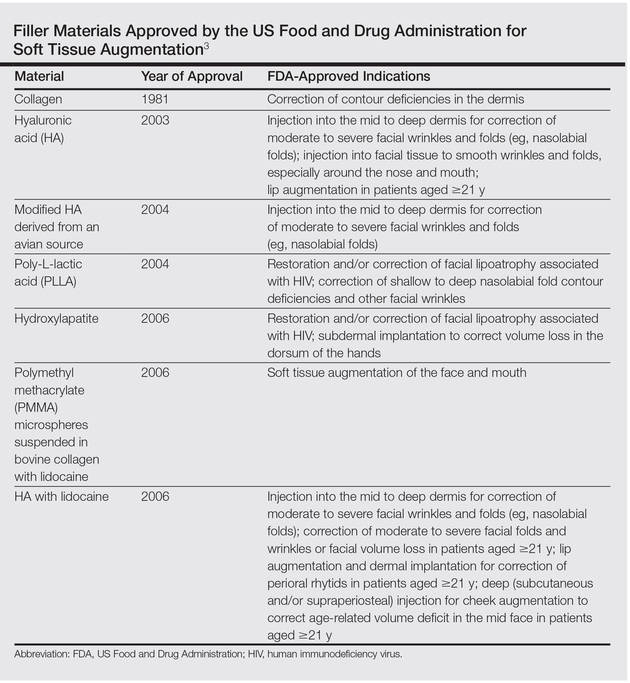
While earlier filler materials were limited, those used today are composed of a wide range of substances including collagen, hyaluronic acid, calcium hydroxylapatite, poly-L-lactic acid, and synthetic or manmade polymers (Table). The FDA has approved approximately 21 filler products for dermatologic indications, each with unique properties, advantages, and disadvantages.3 For example, there are several fillers that not only provide soft tissue augmentation but also stimulate collagen production. However, complications can occur, often many years after the initial treatment. Side effects such as swelling, erythema, and nodules may occur and in rare instances foreign body granulomas may develop and may be difficult to eradicate.5 Except for autologous fat, all fillers are foreign bodies and therefore can cause foreign body granulomatous reactions ranging from common (eg, with paraffin) to rare (eg, with hyaluronic acid) in occurrence.6 The clinical presentation of these reactions is variable, ranging from single to multiple nodules at the injection site to diffuse, hard swelling of the face accompanied by reddening of the skin.
With the increasing desire for a youthful appearance among the aging population, the pharmaceutical industry has responded by increasing the number of available treatment options to meet the demands of cosmetic patients, one of the fastest growing subpopulations in the field of dermatology. Fillers also have provided new options for patients who are unable to afford plastic surgery or those who are poor surgical candidates. The ideal filler material is nonallergenic, noncarcinogenic, and nonteratogenic. It should be stable, affordable, malleable, reversible, and durable with results that can be reproduced and should cause minimal inflammation, migration, and detectable changes. The ideal filler also should have predictable and consistent results, feel natural, take little time to administer, require minimal preparation, cause no patient downtime, and have a low risk for complications. Ideal administration should be painless, user-friendly, and conducted in an outpatient setting with minimal recovery and easy storage. Although no single filler is ideal for all patients, indications, and situations, residents should be aware of the properties and characteristics that make each product unique in order to optimize treatment in all patients.
As demands for cosmetic procedures increase, it is important to incorporate knowledge of cosmetic procedures (eg, fillers for soft tissue augmentation) in resident education and training. Although cosmetic dermatology has been featured prominently in dermatology residency, surveys have shown that residents desire more training in this area.7 Although lectures on soft tissue augmentation are popular topics in dermatology, hands-on experience performing these procedures varies widely depending on different training programs. My institution offers several lectures on cosmetic dermatology, and residents are able to perform procedures for soft tissue augmentation as the first assistant or first surgeon during our cosmetic clinic sessions twice weekly.
Final Thoughts
There are a variety of fillers on the horizon to improve aging and volume loss and the science behind cosmetic injections is evolving. Regardless of the filler material chosen, optimal results are yielded by the combination of patient expectations, physician judgment based on clinical experience, and injection technique.
1. Kontis TC, Rivkin A. The history of injectable facial fillers. Facial Plast Surg. 2009;25:67-72.
2. Ashinoff R. Overview: soft tissue augmentation. Clin Plast Surg. 2000;27:479-487.
3. Soft tissue fillers approved by the Center for Devices and Radiological Health. US Food and Drug Administration Web site. http://www.fda.gov/MedicalDevices/ProductsandMedicalProcedures/CosmeticDevices/WrinkleFillers/ucm227749.htm. Updated July 27, 2015. Accessed November 16, 2015.
4. Rohrich RJ, Ghavami A, Crosby MA. The role of hyaluronic acid fillers (restylane) in facial cosmetic surgery: review and technical considerations. Plast Reconstr Surg. 2007;120(suppl 6):S41-S54.
5. Braun M, Braun S. Nodule formation following lip augmentation using porcine collagen-derived filler. J Drugs Dermatol. 2008;7:579-581.
6. Lee JM, Kim YJ. Foreign body granulomas after the use of dermal fillers: pathophysiology, clinical appearance, histologic features, and treatment. Arch Plast Surg. 2015;42:232-239.
7. Kirby JS, Adgerson CN, Anderson BE. A survey of dermatology resident education in cosmetic procedures. J Am Acad Dermatol 2013;68:e23-e28.
Fillers are products that are injected into soft tissue and are classified as either resorbable or nonresorbable (permanent). Several dermal and subcutaneous fillers for soft tissue augmentation currently are available. This article provides a brief review of the history of filler agents currently available for soft tissue augmentation. Cadaveric-derived fillers and implants will not be discussed, as these materials are expensive, are not all approved by the US Food and Drug Administration (FDA), and are more commonly used in burn victims than in cosmetic patients.
History of Fillers in Dermatology
The first known injectable agent was paraffin, but its use as a dermal filler was abandoned after complications including embolization, migration (ie, movement into surrounding tissue), and granuloma formation were reported.1 Silicone also was banned by the FDA for use as a soft tissue filler due to similar complications. Bovine collagen was the first agent to be approved by the FDA for cosmetic injection, and since then many filler agents have revolutionized a new era of cosmetic enhancement.1 Injectable soft tissue fillers now can be classified based on several characteristics, including site of placement (ie, dermal or subcutaneous), animal versus nonanimal derivation (eg, autologous, xenograft, semisynthetic, synthetic), and duration of effects (temporary [<6 months], long-lasting [6 months– 2 years], semipermanent [2–5 years], permanent [>5 years]).2
In the 19th century, early instances of soft tissue augmentation using dermal fillers included autologous fat harvested from the arms for correction of depressed facial defects and scars in a patient with tuberculous osteitis as well as injection of paraffin into the scrotum as a testicular prosthesis in a patient with advanced tuberculosis.1 Later, a technique using a syringe to transfer autologous fat from the extremities was used for facial soft tissue augmentation and contouring, and permanent facial soft tissue augmentation using liquid silicone also was performed. In 1981, purified bovine dermal collagen was first approved by the FDA as a xenogenic agent for dermal injection.3
In 2003, the FDA began to approve new fillers for temporary soft tissue augmentation.3 Approval of injectable purified human collagen derived from fibroblasts was followed by another class of new agents: hyaluronic acid fillers.1 A biodegradable non–animal based stabilized hyaluronic acid was followed by more agents derived from rooster combs. Further investigations and research have continued, and more long-lasting synthetic fillers have become available, including calcium hydroxylapatite and poly-L-lactic acid. A renewed interest in permanent agents and longer lasting products such as silicone oil and polymethyl methacrylate also has emerged.4
The Future of Fillers
While earlier filler materials were limited, those used today are composed of a wide range of substances including collagen, hyaluronic acid, calcium hydroxylapatite, poly-L-lactic acid, and synthetic or manmade polymers (Table). The FDA has approved approximately 21 filler products for dermatologic indications, each with unique properties, advantages, and disadvantages.3 For example, there are several fillers that not only provide soft tissue augmentation but also stimulate collagen production. However, complications can occur, often many years after the initial treatment. Side effects such as swelling, erythema, and nodules may occur and in rare instances foreign body granulomas may develop and may be difficult to eradicate.5 Except for autologous fat, all fillers are foreign bodies and therefore can cause foreign body granulomatous reactions ranging from common (eg, with paraffin) to rare (eg, with hyaluronic acid) in occurrence.6 The clinical presentation of these reactions is variable, ranging from single to multiple nodules at the injection site to diffuse, hard swelling of the face accompanied by reddening of the skin.
With the increasing desire for a youthful appearance among the aging population, the pharmaceutical industry has responded by increasing the number of available treatment options to meet the demands of cosmetic patients, one of the fastest growing subpopulations in the field of dermatology. Fillers also have provided new options for patients who are unable to afford plastic surgery or those who are poor surgical candidates. The ideal filler material is nonallergenic, noncarcinogenic, and nonteratogenic. It should be stable, affordable, malleable, reversible, and durable with results that can be reproduced and should cause minimal inflammation, migration, and detectable changes. The ideal filler also should have predictable and consistent results, feel natural, take little time to administer, require minimal preparation, cause no patient downtime, and have a low risk for complications. Ideal administration should be painless, user-friendly, and conducted in an outpatient setting with minimal recovery and easy storage. Although no single filler is ideal for all patients, indications, and situations, residents should be aware of the properties and characteristics that make each product unique in order to optimize treatment in all patients.
As demands for cosmetic procedures increase, it is important to incorporate knowledge of cosmetic procedures (eg, fillers for soft tissue augmentation) in resident education and training. Although cosmetic dermatology has been featured prominently in dermatology residency, surveys have shown that residents desire more training in this area.7 Although lectures on soft tissue augmentation are popular topics in dermatology, hands-on experience performing these procedures varies widely depending on different training programs. My institution offers several lectures on cosmetic dermatology, and residents are able to perform procedures for soft tissue augmentation as the first assistant or first surgeon during our cosmetic clinic sessions twice weekly.
Final Thoughts
There are a variety of fillers on the horizon to improve aging and volume loss and the science behind cosmetic injections is evolving. Regardless of the filler material chosen, optimal results are yielded by the combination of patient expectations, physician judgment based on clinical experience, and injection technique.
Fillers are products that are injected into soft tissue and are classified as either resorbable or nonresorbable (permanent). Several dermal and subcutaneous fillers for soft tissue augmentation currently are available. This article provides a brief review of the history of filler agents currently available for soft tissue augmentation. Cadaveric-derived fillers and implants will not be discussed, as these materials are expensive, are not all approved by the US Food and Drug Administration (FDA), and are more commonly used in burn victims than in cosmetic patients.
History of Fillers in Dermatology
The first known injectable agent was paraffin, but its use as a dermal filler was abandoned after complications including embolization, migration (ie, movement into surrounding tissue), and granuloma formation were reported.1 Silicone also was banned by the FDA for use as a soft tissue filler due to similar complications. Bovine collagen was the first agent to be approved by the FDA for cosmetic injection, and since then many filler agents have revolutionized a new era of cosmetic enhancement.1 Injectable soft tissue fillers now can be classified based on several characteristics, including site of placement (ie, dermal or subcutaneous), animal versus nonanimal derivation (eg, autologous, xenograft, semisynthetic, synthetic), and duration of effects (temporary [<6 months], long-lasting [6 months– 2 years], semipermanent [2–5 years], permanent [>5 years]).2
In the 19th century, early instances of soft tissue augmentation using dermal fillers included autologous fat harvested from the arms for correction of depressed facial defects and scars in a patient with tuberculous osteitis as well as injection of paraffin into the scrotum as a testicular prosthesis in a patient with advanced tuberculosis.1 Later, a technique using a syringe to transfer autologous fat from the extremities was used for facial soft tissue augmentation and contouring, and permanent facial soft tissue augmentation using liquid silicone also was performed. In 1981, purified bovine dermal collagen was first approved by the FDA as a xenogenic agent for dermal injection.3
In 2003, the FDA began to approve new fillers for temporary soft tissue augmentation.3 Approval of injectable purified human collagen derived from fibroblasts was followed by another class of new agents: hyaluronic acid fillers.1 A biodegradable non–animal based stabilized hyaluronic acid was followed by more agents derived from rooster combs. Further investigations and research have continued, and more long-lasting synthetic fillers have become available, including calcium hydroxylapatite and poly-L-lactic acid. A renewed interest in permanent agents and longer lasting products such as silicone oil and polymethyl methacrylate also has emerged.4
The Future of Fillers
While earlier filler materials were limited, those used today are composed of a wide range of substances including collagen, hyaluronic acid, calcium hydroxylapatite, poly-L-lactic acid, and synthetic or manmade polymers (Table). The FDA has approved approximately 21 filler products for dermatologic indications, each with unique properties, advantages, and disadvantages.3 For example, there are several fillers that not only provide soft tissue augmentation but also stimulate collagen production. However, complications can occur, often many years after the initial treatment. Side effects such as swelling, erythema, and nodules may occur and in rare instances foreign body granulomas may develop and may be difficult to eradicate.5 Except for autologous fat, all fillers are foreign bodies and therefore can cause foreign body granulomatous reactions ranging from common (eg, with paraffin) to rare (eg, with hyaluronic acid) in occurrence.6 The clinical presentation of these reactions is variable, ranging from single to multiple nodules at the injection site to diffuse, hard swelling of the face accompanied by reddening of the skin.
With the increasing desire for a youthful appearance among the aging population, the pharmaceutical industry has responded by increasing the number of available treatment options to meet the demands of cosmetic patients, one of the fastest growing subpopulations in the field of dermatology. Fillers also have provided new options for patients who are unable to afford plastic surgery or those who are poor surgical candidates. The ideal filler material is nonallergenic, noncarcinogenic, and nonteratogenic. It should be stable, affordable, malleable, reversible, and durable with results that can be reproduced and should cause minimal inflammation, migration, and detectable changes. The ideal filler also should have predictable and consistent results, feel natural, take little time to administer, require minimal preparation, cause no patient downtime, and have a low risk for complications. Ideal administration should be painless, user-friendly, and conducted in an outpatient setting with minimal recovery and easy storage. Although no single filler is ideal for all patients, indications, and situations, residents should be aware of the properties and characteristics that make each product unique in order to optimize treatment in all patients.
As demands for cosmetic procedures increase, it is important to incorporate knowledge of cosmetic procedures (eg, fillers for soft tissue augmentation) in resident education and training. Although cosmetic dermatology has been featured prominently in dermatology residency, surveys have shown that residents desire more training in this area.7 Although lectures on soft tissue augmentation are popular topics in dermatology, hands-on experience performing these procedures varies widely depending on different training programs. My institution offers several lectures on cosmetic dermatology, and residents are able to perform procedures for soft tissue augmentation as the first assistant or first surgeon during our cosmetic clinic sessions twice weekly.
Final Thoughts
There are a variety of fillers on the horizon to improve aging and volume loss and the science behind cosmetic injections is evolving. Regardless of the filler material chosen, optimal results are yielded by the combination of patient expectations, physician judgment based on clinical experience, and injection technique.
1. Kontis TC, Rivkin A. The history of injectable facial fillers. Facial Plast Surg. 2009;25:67-72.
2. Ashinoff R. Overview: soft tissue augmentation. Clin Plast Surg. 2000;27:479-487.
3. Soft tissue fillers approved by the Center for Devices and Radiological Health. US Food and Drug Administration Web site. http://www.fda.gov/MedicalDevices/ProductsandMedicalProcedures/CosmeticDevices/WrinkleFillers/ucm227749.htm. Updated July 27, 2015. Accessed November 16, 2015.
4. Rohrich RJ, Ghavami A, Crosby MA. The role of hyaluronic acid fillers (restylane) in facial cosmetic surgery: review and technical considerations. Plast Reconstr Surg. 2007;120(suppl 6):S41-S54.
5. Braun M, Braun S. Nodule formation following lip augmentation using porcine collagen-derived filler. J Drugs Dermatol. 2008;7:579-581.
6. Lee JM, Kim YJ. Foreign body granulomas after the use of dermal fillers: pathophysiology, clinical appearance, histologic features, and treatment. Arch Plast Surg. 2015;42:232-239.
7. Kirby JS, Adgerson CN, Anderson BE. A survey of dermatology resident education in cosmetic procedures. J Am Acad Dermatol 2013;68:e23-e28.
1. Kontis TC, Rivkin A. The history of injectable facial fillers. Facial Plast Surg. 2009;25:67-72.
2. Ashinoff R. Overview: soft tissue augmentation. Clin Plast Surg. 2000;27:479-487.
3. Soft tissue fillers approved by the Center for Devices and Radiological Health. US Food and Drug Administration Web site. http://www.fda.gov/MedicalDevices/ProductsandMedicalProcedures/CosmeticDevices/WrinkleFillers/ucm227749.htm. Updated July 27, 2015. Accessed November 16, 2015.
4. Rohrich RJ, Ghavami A, Crosby MA. The role of hyaluronic acid fillers (restylane) in facial cosmetic surgery: review and technical considerations. Plast Reconstr Surg. 2007;120(suppl 6):S41-S54.
5. Braun M, Braun S. Nodule formation following lip augmentation using porcine collagen-derived filler. J Drugs Dermatol. 2008;7:579-581.
6. Lee JM, Kim YJ. Foreign body granulomas after the use of dermal fillers: pathophysiology, clinical appearance, histologic features, and treatment. Arch Plast Surg. 2015;42:232-239.
7. Kirby JS, Adgerson CN, Anderson BE. A survey of dermatology resident education in cosmetic procedures. J Am Acad Dermatol 2013;68:e23-e28.

Study: Pediatric cancer patients have high rate of germline mutations in predisposition genes
Children and adolescents with cancer were found to have a significantly higher rate of germline mutations in cancer predisposing genes compared with individuals with no known cancer; however, family history of cancer did not predict the presence of a predisposition syndrome for most patients.
Of the 1,120 children with cancer, 8.5% had mutations in predisposition genes, compared with 1.1% in the control group. Mutations in TP53 were most common (50 patients), followed by APC (6), BRCA2 (6), NF1 (4), PMS2 (4), RB1 (3), and RUNX1 (3). Germline TP53 mutations were present in 27 of 39 patients (69%) with adrenocortical tumors, 9 of 47 (19%) with hypodiploid acute lymphoblastic leukemia, and 1 of 4 (25%) with choroid plexus carcinoma (N Engl J Med. 2015 Nov. 18. doi: 10.1056/NEJMoa1508054).

Only 40% of the pediatric patients with pathogenic germline mutations had a family history of cancer, and in just half of those cases the history was consistent with a known cancer-predisposition syndrome. Among patients without predisposition germline mutations, a similar proportion (42%) had a family history of cancer.
“On the basis of these observations, family history cannot be the sole indication used to guide the provision of genetic testing,” wrote Jinghui Zhang, Ph.D., of the department of computational biology, St. Jude’s Research Hospital, Memphis, Tennessee, and her colleagues.
Unexpected germline mutations were found in several cases. Six patients with Ewing’s sarcoma had unexpected pathogenic germline mutations (TP53 in four patients, PMS2 in one and RET in one). Eight patents had heterozygous mutations in BRCA1, BRCA2, or PALB2, supporting the notion that mutations in these genes may play a role in pediatric as well as adult cancer. Other new associations included germline APC and SDHB mutations with neuroblastoma, and APC, VHL, CDH1, PTCH1, and SDHA germline mutations with leukemia.
The St. Jude–Washington University Pediatric Cancer Genome Project (PCGP) included 1,120 patients representing the major types of pediatric cancer, including 53% with leukemia, 22% with CNS tumors, and 26% with non-CNS tumors. Whole genomes were sequenced from 595 patients, whole exomes (coding regions only) from 456 patients, and both whole genomes and exomes from 69 patients. Whole exomes were sequenced from two control cohorts of individuals with no known cancer: 966 from the 1,000 Genome project and 723 from the National Database for Autism Research (cancer predisposition genes known to be associated with autism, NF1 and PTEN, were excluded from analysis with this control set).
The study sequenced whole genomes and exomes, but focused most of the analysis on 60 autosomal dominant cancer predisposition genes. Tumor types with the highest prevalence of germline mutations in these genes were non-CNS solid tumors (48 of 287 patients, 17%) and CNS tumors (21 of 245, 9%). Among patients with adrenocortical tumors, 69% had germline mutations. Despite inclusion of hypodiploid acute lymphoblastic leukemia, the lowest germline mutation prevalence was found in leukemia (26 of 588, 4%).
Dr. Zhang reported having no disclosures. One coauthor reported financial ties to an industry source.
The sequencing study by Zhang et al. found that 8.5% of 1,120 participants with pediatric cancer had pathogenic mutations in an autosomal dominant cancer-predisposition gene, and four of the mutations were mosaic (i.e., present in only a subset of normal cells, probably indicating the defect was not inherited). The four mosaic mutations probably would not be detected by standard genetic testing strategies.
Not surprisingly, more than 50% of the mutations were in the tumor suppressor gene TP53. A long list of other genes identified as potentially disease causing each occurred at a prevalence of less than 6%.
Although the study’s inclusion of certain high-risk childhood cancers could bias the results toward overestimating the proportion of germline cancer predisposition mutations, more likely the results are an underestimate. By evaluating mutations in only a small subset of candidate autosomal dominant genes, the findings to not reflect a thorough assessment of most genes in the genome. In addition, focusing only on the exome ignores DNA mutations in noncoding regions, especially in tissue-specific enhancers, which may have a role in cancer susceptibility. So-called epimutations may affect cancer susceptibility in a nonmendelian fashion. Finally, the ability to study the interaction of several of these events may contribute to our understanding of tumor initiation.
The study raises several important questions. Are children with mutations in APC, BRCA1, or BRCA2 at risk for childhood cancers? How does germline mosaicism influence disease penetrance, and how many of the mosaic mutations were inherited? How do the mutations identified interact with less well known gene mutations elsewhere in the genome to influence malignant transformation? How can the findings translate to the clinic?
The study highlights the fact that family history is insufficient to assess the likelihood of a cancer-predisposition syndrome in any patient with a newly diagnosed cancer.
Dr. John Maris is a pediatric oncologist in the division of oncology and Center for Childhood Cancer Research, Children’s Hospital of Philadelphia, and in the department of pediatrics at the Perelman School of Medicine, University of Pennsylvania. These remarks were part of an editorial accompanying the report (N Engl J Med. 2015 Nov. 18 doi: 10.1056/NEJMoa1508054). Dr. Maris reported having no disclosures.
The sequencing study by Zhang et al. found that 8.5% of 1,120 participants with pediatric cancer had pathogenic mutations in an autosomal dominant cancer-predisposition gene, and four of the mutations were mosaic (i.e., present in only a subset of normal cells, probably indicating the defect was not inherited). The four mosaic mutations probably would not be detected by standard genetic testing strategies.
Not surprisingly, more than 50% of the mutations were in the tumor suppressor gene TP53. A long list of other genes identified as potentially disease causing each occurred at a prevalence of less than 6%.
Although the study’s inclusion of certain high-risk childhood cancers could bias the results toward overestimating the proportion of germline cancer predisposition mutations, more likely the results are an underestimate. By evaluating mutations in only a small subset of candidate autosomal dominant genes, the findings to not reflect a thorough assessment of most genes in the genome. In addition, focusing only on the exome ignores DNA mutations in noncoding regions, especially in tissue-specific enhancers, which may have a role in cancer susceptibility. So-called epimutations may affect cancer susceptibility in a nonmendelian fashion. Finally, the ability to study the interaction of several of these events may contribute to our understanding of tumor initiation.
The study raises several important questions. Are children with mutations in APC, BRCA1, or BRCA2 at risk for childhood cancers? How does germline mosaicism influence disease penetrance, and how many of the mosaic mutations were inherited? How do the mutations identified interact with less well known gene mutations elsewhere in the genome to influence malignant transformation? How can the findings translate to the clinic?
The study highlights the fact that family history is insufficient to assess the likelihood of a cancer-predisposition syndrome in any patient with a newly diagnosed cancer.
Dr. John Maris is a pediatric oncologist in the division of oncology and Center for Childhood Cancer Research, Children’s Hospital of Philadelphia, and in the department of pediatrics at the Perelman School of Medicine, University of Pennsylvania. These remarks were part of an editorial accompanying the report (N Engl J Med. 2015 Nov. 18 doi: 10.1056/NEJMoa1508054). Dr. Maris reported having no disclosures.
The sequencing study by Zhang et al. found that 8.5% of 1,120 participants with pediatric cancer had pathogenic mutations in an autosomal dominant cancer-predisposition gene, and four of the mutations were mosaic (i.e., present in only a subset of normal cells, probably indicating the defect was not inherited). The four mosaic mutations probably would not be detected by standard genetic testing strategies.
Not surprisingly, more than 50% of the mutations were in the tumor suppressor gene TP53. A long list of other genes identified as potentially disease causing each occurred at a prevalence of less than 6%.
Although the study’s inclusion of certain high-risk childhood cancers could bias the results toward overestimating the proportion of germline cancer predisposition mutations, more likely the results are an underestimate. By evaluating mutations in only a small subset of candidate autosomal dominant genes, the findings to not reflect a thorough assessment of most genes in the genome. In addition, focusing only on the exome ignores DNA mutations in noncoding regions, especially in tissue-specific enhancers, which may have a role in cancer susceptibility. So-called epimutations may affect cancer susceptibility in a nonmendelian fashion. Finally, the ability to study the interaction of several of these events may contribute to our understanding of tumor initiation.
The study raises several important questions. Are children with mutations in APC, BRCA1, or BRCA2 at risk for childhood cancers? How does germline mosaicism influence disease penetrance, and how many of the mosaic mutations were inherited? How do the mutations identified interact with less well known gene mutations elsewhere in the genome to influence malignant transformation? How can the findings translate to the clinic?
The study highlights the fact that family history is insufficient to assess the likelihood of a cancer-predisposition syndrome in any patient with a newly diagnosed cancer.
Dr. John Maris is a pediatric oncologist in the division of oncology and Center for Childhood Cancer Research, Children’s Hospital of Philadelphia, and in the department of pediatrics at the Perelman School of Medicine, University of Pennsylvania. These remarks were part of an editorial accompanying the report (N Engl J Med. 2015 Nov. 18 doi: 10.1056/NEJMoa1508054). Dr. Maris reported having no disclosures.
Children and adolescents with cancer were found to have a significantly higher rate of germline mutations in cancer predisposing genes compared with individuals with no known cancer; however, family history of cancer did not predict the presence of a predisposition syndrome for most patients.
Of the 1,120 children with cancer, 8.5% had mutations in predisposition genes, compared with 1.1% in the control group. Mutations in TP53 were most common (50 patients), followed by APC (6), BRCA2 (6), NF1 (4), PMS2 (4), RB1 (3), and RUNX1 (3). Germline TP53 mutations were present in 27 of 39 patients (69%) with adrenocortical tumors, 9 of 47 (19%) with hypodiploid acute lymphoblastic leukemia, and 1 of 4 (25%) with choroid plexus carcinoma (N Engl J Med. 2015 Nov. 18. doi: 10.1056/NEJMoa1508054).
Only 40% of the pediatric patients with pathogenic germline mutations had a family history of cancer, and in just half of those cases the history was consistent with a known cancer-predisposition syndrome. Among patients without predisposition germline mutations, a similar proportion (42%) had a family history of cancer.
“On the basis of these observations, family history cannot be the sole indication used to guide the provision of genetic testing,” wrote Jinghui Zhang, Ph.D., of the department of computational biology, St. Jude’s Research Hospital, Memphis, Tennessee, and her colleagues.
Unexpected germline mutations were found in several cases. Six patients with Ewing’s sarcoma had unexpected pathogenic germline mutations (TP53 in four patients, PMS2 in one and RET in one). Eight patents had heterozygous mutations in BRCA1, BRCA2, or PALB2, supporting the notion that mutations in these genes may play a role in pediatric as well as adult cancer. Other new associations included germline APC and SDHB mutations with neuroblastoma, and APC, VHL, CDH1, PTCH1, and SDHA germline mutations with leukemia.
The St. Jude–Washington University Pediatric Cancer Genome Project (PCGP) included 1,120 patients representing the major types of pediatric cancer, including 53% with leukemia, 22% with CNS tumors, and 26% with non-CNS tumors. Whole genomes were sequenced from 595 patients, whole exomes (coding regions only) from 456 patients, and both whole genomes and exomes from 69 patients. Whole exomes were sequenced from two control cohorts of individuals with no known cancer: 966 from the 1,000 Genome project and 723 from the National Database for Autism Research (cancer predisposition genes known to be associated with autism, NF1 and PTEN, were excluded from analysis with this control set).
The study sequenced whole genomes and exomes, but focused most of the analysis on 60 autosomal dominant cancer predisposition genes. Tumor types with the highest prevalence of germline mutations in these genes were non-CNS solid tumors (48 of 287 patients, 17%) and CNS tumors (21 of 245, 9%). Among patients with adrenocortical tumors, 69% had germline mutations. Despite inclusion of hypodiploid acute lymphoblastic leukemia, the lowest germline mutation prevalence was found in leukemia (26 of 588, 4%).
Dr. Zhang reported having no disclosures. One coauthor reported financial ties to an industry source.
Children and adolescents with cancer were found to have a significantly higher rate of germline mutations in cancer predisposing genes compared with individuals with no known cancer; however, family history of cancer did not predict the presence of a predisposition syndrome for most patients.
Of the 1,120 children with cancer, 8.5% had mutations in predisposition genes, compared with 1.1% in the control group. Mutations in TP53 were most common (50 patients), followed by APC (6), BRCA2 (6), NF1 (4), PMS2 (4), RB1 (3), and RUNX1 (3). Germline TP53 mutations were present in 27 of 39 patients (69%) with adrenocortical tumors, 9 of 47 (19%) with hypodiploid acute lymphoblastic leukemia, and 1 of 4 (25%) with choroid plexus carcinoma (N Engl J Med. 2015 Nov. 18. doi: 10.1056/NEJMoa1508054).
Only 40% of the pediatric patients with pathogenic germline mutations had a family history of cancer, and in just half of those cases the history was consistent with a known cancer-predisposition syndrome. Among patients without predisposition germline mutations, a similar proportion (42%) had a family history of cancer.
“On the basis of these observations, family history cannot be the sole indication used to guide the provision of genetic testing,” wrote Jinghui Zhang, Ph.D., of the department of computational biology, St. Jude’s Research Hospital, Memphis, Tennessee, and her colleagues.
Unexpected germline mutations were found in several cases. Six patients with Ewing’s sarcoma had unexpected pathogenic germline mutations (TP53 in four patients, PMS2 in one and RET in one). Eight patents had heterozygous mutations in BRCA1, BRCA2, or PALB2, supporting the notion that mutations in these genes may play a role in pediatric as well as adult cancer. Other new associations included germline APC and SDHB mutations with neuroblastoma, and APC, VHL, CDH1, PTCH1, and SDHA germline mutations with leukemia.
The St. Jude–Washington University Pediatric Cancer Genome Project (PCGP) included 1,120 patients representing the major types of pediatric cancer, including 53% with leukemia, 22% with CNS tumors, and 26% with non-CNS tumors. Whole genomes were sequenced from 595 patients, whole exomes (coding regions only) from 456 patients, and both whole genomes and exomes from 69 patients. Whole exomes were sequenced from two control cohorts of individuals with no known cancer: 966 from the 1,000 Genome project and 723 from the National Database for Autism Research (cancer predisposition genes known to be associated with autism, NF1 and PTEN, were excluded from analysis with this control set).
The study sequenced whole genomes and exomes, but focused most of the analysis on 60 autosomal dominant cancer predisposition genes. Tumor types with the highest prevalence of germline mutations in these genes were non-CNS solid tumors (48 of 287 patients, 17%) and CNS tumors (21 of 245, 9%). Among patients with adrenocortical tumors, 69% had germline mutations. Despite inclusion of hypodiploid acute lymphoblastic leukemia, the lowest germline mutation prevalence was found in leukemia (26 of 588, 4%).
Dr. Zhang reported having no disclosures. One coauthor reported financial ties to an industry source.
FROM THE NEW ENGLAND JOURNAL OF MEDICINE
Key clinical point: Children and adolescents with cancer have a significantly higher rate of germline mutations in cancer predisposition genes compared with individuals with no known cancer.
Major finding: Of the 1,120 children with cancer, 8.5% had mutations in predisposition genes, compared with 1.1% in the control group.
Data source: The St. Jude–Washington University Pediatric Cancer Genome Project (PCGP) sequenced whole genomes of 595 patients, whole exomes of 456 patients, and both whole genomes and exomes of 69 patients; whole exomes were sequenced from two control cohorts of 966 and 723 individuals.
Disclosures: Dr. Zhang reported having no disclosures. One coauthor reported financial ties to an industry source.

AGA convened GI and hepatology societies to develop consensus principles on MOC
AGA, in its role as a leader and reformer in the dialogue with the American Board of Internal Medicine (ABIM) on reforming the maintenance of certification (MOC) process, convened the gastroenterology and hepatology societies, including ACG, ASGE, AASLD, ANMS and NASPGHAN to develop a set of consensus principles on this issue at the end of October. AGA shared the following consensus principles with ABIM:
• MOC needs to be simpler, less intrusive, and less expensive.

• We, the societies listed above, support ending the high-stakes, every-10-years exam.
• We, the societies listed above, do not support closed-book assessments as they do not represent the current realities of medicine in the digital age.
• We, the societies listed above, support the principles of lifelong learning as evidenced by ongoing CME activities, rather than lifelong testing.
• We, the societies listed above, support the concept that, for the many diplomates who specialize in certain areas of gastroenterology and hepatology, MOC should not need to include high-stakes assessments of areas where the diplomate may not practice.
For more information, review AGA’s alternate pathway to recertification, The Gastroenterologist: Accountable Professionalism in Practice or G-APP, which was authored by AGA’s education and training councilor, Dr. Suzanne Rose, and a group of AGA colleagues.
AGA, in its role as a leader and reformer in the dialogue with the American Board of Internal Medicine (ABIM) on reforming the maintenance of certification (MOC) process, convened the gastroenterology and hepatology societies, including ACG, ASGE, AASLD, ANMS and NASPGHAN to develop a set of consensus principles on this issue at the end of October. AGA shared the following consensus principles with ABIM:
• MOC needs to be simpler, less intrusive, and less expensive.
• We, the societies listed above, support ending the high-stakes, every-10-years exam.
• We, the societies listed above, do not support closed-book assessments as they do not represent the current realities of medicine in the digital age.
• We, the societies listed above, support the principles of lifelong learning as evidenced by ongoing CME activities, rather than lifelong testing.
• We, the societies listed above, support the concept that, for the many diplomates who specialize in certain areas of gastroenterology and hepatology, MOC should not need to include high-stakes assessments of areas where the diplomate may not practice.
For more information, review AGA’s alternate pathway to recertification, The Gastroenterologist: Accountable Professionalism in Practice or G-APP, which was authored by AGA’s education and training councilor, Dr. Suzanne Rose, and a group of AGA colleagues.
AGA, in its role as a leader and reformer in the dialogue with the American Board of Internal Medicine (ABIM) on reforming the maintenance of certification (MOC) process, convened the gastroenterology and hepatology societies, including ACG, ASGE, AASLD, ANMS and NASPGHAN to develop a set of consensus principles on this issue at the end of October. AGA shared the following consensus principles with ABIM:
• MOC needs to be simpler, less intrusive, and less expensive.
• We, the societies listed above, support ending the high-stakes, every-10-years exam.
• We, the societies listed above, do not support closed-book assessments as they do not represent the current realities of medicine in the digital age.
• We, the societies listed above, support the principles of lifelong learning as evidenced by ongoing CME activities, rather than lifelong testing.
• We, the societies listed above, support the concept that, for the many diplomates who specialize in certain areas of gastroenterology and hepatology, MOC should not need to include high-stakes assessments of areas where the diplomate may not practice.
For more information, review AGA’s alternate pathway to recertification, The Gastroenterologist: Accountable Professionalism in Practice or G-APP, which was authored by AGA’s education and training councilor, Dr. Suzanne Rose, and a group of AGA colleagues.

Law & Medicine: To whom do doctors owe a duty?
Question: A doctor may owe a duty of care in the setting of:
A. A cyber relationship.
B. A special relationship.
C. Both A and B.
D. Neither A nor B.
Answer: C. Ascertaining whether a defendant owes a duty to a claimant is the first inquiry in the tort of negligence. To say there is no duty owed is to deny liability altogether, however obvious the breach or horrendous the foreseeable injuries.
Thus, duty is used as a filter mechanism to reduce frivolous suits or otherwise control the tide of litigation, to prevent “liability in an indeterminate amount for an indeterminate time to an indeterminate class.”
Duty in the context of medical negligence is not usually in dispute, as it is plainly owed by a doctor to his or her patient. It arises out of the doctor-patient relationship. Whether a relationship has been formed in the first place is a threshold inquiry. Where a doctor accepts a patient who is seeking his or her services, the relationship is readily evident. Duty is also established when the doctor begins the evaluation process in a typical encounter.
However, a phone inquiry by a potential patient, without more, may be insufficient to create this relationship, although this may depend on the nature of the phone conversation and the doctor’s response.
Likewise, a “curbside” consultation sought by a colleague does not normally translate into a duty for the doctor offering the opinion. Presumably casual advice given freely and understood as such at social gatherings does not add up to a doctor-patient relationship, and courts will look to reasonableness as the touchstone in deciding whether such a relationship was ever formed.
Still, there are some medical situations where a legitimate question of duty can be raised. With the growth of electronic medical records and communication, medical encounters in cyberspace will emerge as an increasing source of litigation.
Internet liability can be far reaching. In addition to risks governing negligence, informed consent, and privacy/confidentiality, there are additional issues of product liability, cross-border jurisdictional conflicts, and others.
The threshold question when assessing cyberspace liability arising, for example, from the use of doctor-operated medical websites concerns duty, because its existence or denial will determine whether the case can go forward in the first place. Although not the typical office or hospital patient, a plaintiff may argue successfully that a doctor-patient relationship had nonetheless been formed in cyberspace.
It is possible that such a relationship will be found in some circumstances, relevant factors being knowledge of names of subscribers, frequency of interactions, specificity of queries, and so on. In particular, a subscription fee is likely to be construed as evidence of soliciting and accepting a more committed interaction, so it places the operator of the website at greater legal risk. A specific disclaimer is a standard precaution but may not be enough to definitively protect against a lawsuit.
Courts have ruled in favor of plaintiffs despite the absence of face-to-face interaction with a physician. In one case, a doctor speaking to a patient from the emergency department was deemed to have formed a doctor-patient relationship (O’Neill v. Montefiore Hospital, 11 A.D.2d 132 (N.Y.A.D. 1 Dept. 1960). In another, an on-call neurologist’s telephone advice to the treating doctor likewise raised the issue of legal duty (Lection v. Dyll, 65 S.W.3d 696 (Tex. App. Dallas 2001).
The state of Hawaii now permits telehealth services to be reimbursable, notwithstanding the absence of face-to-face contact (HI Rev Stat § 431:10A-116.3[a]). With this law, an online encounter will likely translate into a professional relationship – with corresponding legal duty of due care.
In the case of a Good Samaritan physician – i.e., one who offers gratuitous aid to a stranger in need of medical assistance – courts are unlikely to find a professional relationship, because there is no common law duty to help a stranger.
However, once treatment has begun, there is a duty not to make matters worse. So, all 50 states have enacted Good Samaritan statutes, which protect against liability arising out of negligent rescue. Note that statutory protection is generally excluded for Good Samaritan acts performed within a hospital setting, under the theory that doctors have an ongoing relationship with the hospital and are already obligated to provide emergency care within its walls.
Another category of legal duty concerns nonpatient third parties. The complaint may relate to a failure to warn family members of a patient’s contagious disease, or the transmissible condition may have been missed and an innocent third party was injured as a result.
Another situation where duty to a third party might arise is the learning of a credible threat of harm directed at a named individual. This is famously known as the Tarasoff doctrine, after a California case in which the court imposed a duty on a college psychologist to directly warn an intended victim of harm by his patient – even though that meant breaching confidentiality of a professional relationship, and the victim was a nonpatient third party (Tarasoff v. Regents of University of California, 551 P.2d 334 [Cal. 1976]).
A doctor may also incur liability for automobile injuries sustained by one other than his or her own patient. In a Hawaii case, a car suddenly veered across five lanes of traffic, striking an 11-year-old bystander. The driver alleged that the prescription medication prazosin caused him to lose control of the car.
In ruling that the health care provider was liable to the injured bystander, the Hawaii Supreme Court held that physicians have a duty to warn their patients of potential adverse medication effects, and this responsibility should extend to third parties (McKenzie v. Hawaii Permanente Medical Group, 47 P.3d 1209 [Haw. 2002]).
A foreseeable and unreasonable risk of harm is an important factor, but not the only decisive factor, in construing the existence of a legal duty. Under some circumstances, the term “special relationship” has been employed based on a consideration of “existing social values, customs, and considerations of policy.”
In a Massachusetts case, a family practitioner had failed to warn his patient of the risk of diabetic drugs when operating a vehicle. Just 45 minutes after the patient’s discharge from the hospital, he developed hypoglycemia, losing consciousness and injuring a motorcyclist who then sued the doctor. The court used the “special relationship” rationale in ruling that the doctor owed a duty to the motorcyclist (Arsenault v. McConarty, 21 Mass. L. Rptr. 500 [2006]).
Dr. Tan is emeritus professor of medicine and former adjunct professor of law at the University of Hawaii, and currently directs the St. Francis International Center for Healthcare Ethics in Honolulu. This article is meant to be educational and does not constitute medical, ethical, or legal advice. Some of the articles in this series are adapted from the author’s 2006 book, “Medical Malpractice: Understanding the Law, Managing the Risk,” and his 2012 Halsbury treatise, “Medical Negligence and Professional Misconduct.” For additional information, readers may contact the author at siang@hawaii.edu.
Question: A doctor may owe a duty of care in the setting of:
A. A cyber relationship.
B. A special relationship.
C. Both A and B.
D. Neither A nor B.
Answer: C. Ascertaining whether a defendant owes a duty to a claimant is the first inquiry in the tort of negligence. To say there is no duty owed is to deny liability altogether, however obvious the breach or horrendous the foreseeable injuries.
Thus, duty is used as a filter mechanism to reduce frivolous suits or otherwise control the tide of litigation, to prevent “liability in an indeterminate amount for an indeterminate time to an indeterminate class.”
Duty in the context of medical negligence is not usually in dispute, as it is plainly owed by a doctor to his or her patient. It arises out of the doctor-patient relationship. Whether a relationship has been formed in the first place is a threshold inquiry. Where a doctor accepts a patient who is seeking his or her services, the relationship is readily evident. Duty is also established when the doctor begins the evaluation process in a typical encounter.
However, a phone inquiry by a potential patient, without more, may be insufficient to create this relationship, although this may depend on the nature of the phone conversation and the doctor’s response.
Likewise, a “curbside” consultation sought by a colleague does not normally translate into a duty for the doctor offering the opinion. Presumably casual advice given freely and understood as such at social gatherings does not add up to a doctor-patient relationship, and courts will look to reasonableness as the touchstone in deciding whether such a relationship was ever formed.
Still, there are some medical situations where a legitimate question of duty can be raised. With the growth of electronic medical records and communication, medical encounters in cyberspace will emerge as an increasing source of litigation.
Internet liability can be far reaching. In addition to risks governing negligence, informed consent, and privacy/confidentiality, there are additional issues of product liability, cross-border jurisdictional conflicts, and others.
The threshold question when assessing cyberspace liability arising, for example, from the use of doctor-operated medical websites concerns duty, because its existence or denial will determine whether the case can go forward in the first place. Although not the typical office or hospital patient, a plaintiff may argue successfully that a doctor-patient relationship had nonetheless been formed in cyberspace.
It is possible that such a relationship will be found in some circumstances, relevant factors being knowledge of names of subscribers, frequency of interactions, specificity of queries, and so on. In particular, a subscription fee is likely to be construed as evidence of soliciting and accepting a more committed interaction, so it places the operator of the website at greater legal risk. A specific disclaimer is a standard precaution but may not be enough to definitively protect against a lawsuit.
Courts have ruled in favor of plaintiffs despite the absence of face-to-face interaction with a physician. In one case, a doctor speaking to a patient from the emergency department was deemed to have formed a doctor-patient relationship (O’Neill v. Montefiore Hospital, 11 A.D.2d 132 (N.Y.A.D. 1 Dept. 1960). In another, an on-call neurologist’s telephone advice to the treating doctor likewise raised the issue of legal duty (Lection v. Dyll, 65 S.W.3d 696 (Tex. App. Dallas 2001).
The state of Hawaii now permits telehealth services to be reimbursable, notwithstanding the absence of face-to-face contact (HI Rev Stat § 431:10A-116.3[a]). With this law, an online encounter will likely translate into a professional relationship – with corresponding legal duty of due care.
In the case of a Good Samaritan physician – i.e., one who offers gratuitous aid to a stranger in need of medical assistance – courts are unlikely to find a professional relationship, because there is no common law duty to help a stranger.
However, once treatment has begun, there is a duty not to make matters worse. So, all 50 states have enacted Good Samaritan statutes, which protect against liability arising out of negligent rescue. Note that statutory protection is generally excluded for Good Samaritan acts performed within a hospital setting, under the theory that doctors have an ongoing relationship with the hospital and are already obligated to provide emergency care within its walls.
Another category of legal duty concerns nonpatient third parties. The complaint may relate to a failure to warn family members of a patient’s contagious disease, or the transmissible condition may have been missed and an innocent third party was injured as a result.
Another situation where duty to a third party might arise is the learning of a credible threat of harm directed at a named individual. This is famously known as the Tarasoff doctrine, after a California case in which the court imposed a duty on a college psychologist to directly warn an intended victim of harm by his patient – even though that meant breaching confidentiality of a professional relationship, and the victim was a nonpatient third party (Tarasoff v. Regents of University of California, 551 P.2d 334 [Cal. 1976]).
A doctor may also incur liability for automobile injuries sustained by one other than his or her own patient. In a Hawaii case, a car suddenly veered across five lanes of traffic, striking an 11-year-old bystander. The driver alleged that the prescription medication prazosin caused him to lose control of the car.
In ruling that the health care provider was liable to the injured bystander, the Hawaii Supreme Court held that physicians have a duty to warn their patients of potential adverse medication effects, and this responsibility should extend to third parties (McKenzie v. Hawaii Permanente Medical Group, 47 P.3d 1209 [Haw. 2002]).
A foreseeable and unreasonable risk of harm is an important factor, but not the only decisive factor, in construing the existence of a legal duty. Under some circumstances, the term “special relationship” has been employed based on a consideration of “existing social values, customs, and considerations of policy.”
In a Massachusetts case, a family practitioner had failed to warn his patient of the risk of diabetic drugs when operating a vehicle. Just 45 minutes after the patient’s discharge from the hospital, he developed hypoglycemia, losing consciousness and injuring a motorcyclist who then sued the doctor. The court used the “special relationship” rationale in ruling that the doctor owed a duty to the motorcyclist (Arsenault v. McConarty, 21 Mass. L. Rptr. 500 [2006]).
Dr. Tan is emeritus professor of medicine and former adjunct professor of law at the University of Hawaii, and currently directs the St. Francis International Center for Healthcare Ethics in Honolulu. This article is meant to be educational and does not constitute medical, ethical, or legal advice. Some of the articles in this series are adapted from the author’s 2006 book, “Medical Malpractice: Understanding the Law, Managing the Risk,” and his 2012 Halsbury treatise, “Medical Negligence and Professional Misconduct.” For additional information, readers may contact the author at siang@hawaii.edu.
Question: A doctor may owe a duty of care in the setting of:
A. A cyber relationship.
B. A special relationship.
C. Both A and B.
D. Neither A nor B.
Answer: C. Ascertaining whether a defendant owes a duty to a claimant is the first inquiry in the tort of negligence. To say there is no duty owed is to deny liability altogether, however obvious the breach or horrendous the foreseeable injuries.
Thus, duty is used as a filter mechanism to reduce frivolous suits or otherwise control the tide of litigation, to prevent “liability in an indeterminate amount for an indeterminate time to an indeterminate class.”
Duty in the context of medical negligence is not usually in dispute, as it is plainly owed by a doctor to his or her patient. It arises out of the doctor-patient relationship. Whether a relationship has been formed in the first place is a threshold inquiry. Where a doctor accepts a patient who is seeking his or her services, the relationship is readily evident. Duty is also established when the doctor begins the evaluation process in a typical encounter.
However, a phone inquiry by a potential patient, without more, may be insufficient to create this relationship, although this may depend on the nature of the phone conversation and the doctor’s response.
Likewise, a “curbside” consultation sought by a colleague does not normally translate into a duty for the doctor offering the opinion. Presumably casual advice given freely and understood as such at social gatherings does not add up to a doctor-patient relationship, and courts will look to reasonableness as the touchstone in deciding whether such a relationship was ever formed.
Still, there are some medical situations where a legitimate question of duty can be raised. With the growth of electronic medical records and communication, medical encounters in cyberspace will emerge as an increasing source of litigation.
Internet liability can be far reaching. In addition to risks governing negligence, informed consent, and privacy/confidentiality, there are additional issues of product liability, cross-border jurisdictional conflicts, and others.
The threshold question when assessing cyberspace liability arising, for example, from the use of doctor-operated medical websites concerns duty, because its existence or denial will determine whether the case can go forward in the first place. Although not the typical office or hospital patient, a plaintiff may argue successfully that a doctor-patient relationship had nonetheless been formed in cyberspace.
It is possible that such a relationship will be found in some circumstances, relevant factors being knowledge of names of subscribers, frequency of interactions, specificity of queries, and so on. In particular, a subscription fee is likely to be construed as evidence of soliciting and accepting a more committed interaction, so it places the operator of the website at greater legal risk. A specific disclaimer is a standard precaution but may not be enough to definitively protect against a lawsuit.
Courts have ruled in favor of plaintiffs despite the absence of face-to-face interaction with a physician. In one case, a doctor speaking to a patient from the emergency department was deemed to have formed a doctor-patient relationship (O’Neill v. Montefiore Hospital, 11 A.D.2d 132 (N.Y.A.D. 1 Dept. 1960). In another, an on-call neurologist’s telephone advice to the treating doctor likewise raised the issue of legal duty (Lection v. Dyll, 65 S.W.3d 696 (Tex. App. Dallas 2001).
The state of Hawaii now permits telehealth services to be reimbursable, notwithstanding the absence of face-to-face contact (HI Rev Stat § 431:10A-116.3[a]). With this law, an online encounter will likely translate into a professional relationship – with corresponding legal duty of due care.
In the case of a Good Samaritan physician – i.e., one who offers gratuitous aid to a stranger in need of medical assistance – courts are unlikely to find a professional relationship, because there is no common law duty to help a stranger.
However, once treatment has begun, there is a duty not to make matters worse. So, all 50 states have enacted Good Samaritan statutes, which protect against liability arising out of negligent rescue. Note that statutory protection is generally excluded for Good Samaritan acts performed within a hospital setting, under the theory that doctors have an ongoing relationship with the hospital and are already obligated to provide emergency care within its walls.
Another category of legal duty concerns nonpatient third parties. The complaint may relate to a failure to warn family members of a patient’s contagious disease, or the transmissible condition may have been missed and an innocent third party was injured as a result.
Another situation where duty to a third party might arise is the learning of a credible threat of harm directed at a named individual. This is famously known as the Tarasoff doctrine, after a California case in which the court imposed a duty on a college psychologist to directly warn an intended victim of harm by his patient – even though that meant breaching confidentiality of a professional relationship, and the victim was a nonpatient third party (Tarasoff v. Regents of University of California, 551 P.2d 334 [Cal. 1976]).
A doctor may also incur liability for automobile injuries sustained by one other than his or her own patient. In a Hawaii case, a car suddenly veered across five lanes of traffic, striking an 11-year-old bystander. The driver alleged that the prescription medication prazosin caused him to lose control of the car.
In ruling that the health care provider was liable to the injured bystander, the Hawaii Supreme Court held that physicians have a duty to warn their patients of potential adverse medication effects, and this responsibility should extend to third parties (McKenzie v. Hawaii Permanente Medical Group, 47 P.3d 1209 [Haw. 2002]).
A foreseeable and unreasonable risk of harm is an important factor, but not the only decisive factor, in construing the existence of a legal duty. Under some circumstances, the term “special relationship” has been employed based on a consideration of “existing social values, customs, and considerations of policy.”
In a Massachusetts case, a family practitioner had failed to warn his patient of the risk of diabetic drugs when operating a vehicle. Just 45 minutes after the patient’s discharge from the hospital, he developed hypoglycemia, losing consciousness and injuring a motorcyclist who then sued the doctor. The court used the “special relationship” rationale in ruling that the doctor owed a duty to the motorcyclist (Arsenault v. McConarty, 21 Mass. L. Rptr. 500 [2006]).
Dr. Tan is emeritus professor of medicine and former adjunct professor of law at the University of Hawaii, and currently directs the St. Francis International Center for Healthcare Ethics in Honolulu. This article is meant to be educational and does not constitute medical, ethical, or legal advice. Some of the articles in this series are adapted from the author’s 2006 book, “Medical Malpractice: Understanding the Law, Managing the Risk,” and his 2012 Halsbury treatise, “Medical Negligence and Professional Misconduct.” For additional information, readers may contact the author at siang@hawaii.edu.

Adalimumab posts strong early results in refractory JIA-associated uveitis
SAN FRANCISCO – The monoclonal antibody adalimumab was more than twice as effective as was placebo for treating methotrexate-refractory uveitis in children with idiopathic arthritis, according to early results from the largest-ever double-blind, randomized, controlled trial of the disease.
Because the difference in time to treatment failure met the prespecified efficacy endpoint, investigators halted the trial after enrolling 90 patients, said Dr. Athimalaipet V. Ramanan, professor of pediatric rheumatology at the University of Bristol (England). But adalimumab also was associated with about three times more infections and other serious adverse events, compared with placebo, he reported in a late-breaker session at the annual meeting of the American College of Rheumatology. “We will, of course, be looking at the long-term data to evaluate cost-effectiveness, as well as safety,” he added.

About one in five children with juvenile idiopathic arthritis (JIA) develops uveitis, which threatens sight and is the most common type of pediatric intraocular inflammation. First-line methotrexate can substantially improve articular inflammation in JIA, but had not been studied in randomized, controlled trials of JIA-associated uveitis. Based on adalimumab’s success in treating the articular aspects of JIA, the investigators studied the biologic in patients aged 2-18 years who had active JIA-associated uveitis despite at least 12 weeks of stable methotrexate therapy. Most cases were mild to moderate, including mild flare and little vitreous haze. The average age of the patients was 9 years, about three-quarters were girls, and about half tested positive for antinuclear antibodies. All patients continued on methotrexate and were randomized 1:2 to subcutaneous, biweekly injections of placebo or weight-based adalimumab.
Patients in the adalimumab arm were about 75% less likely than were controls to fail treatment – that is, to meet Standardization of the Uveitis Nomenclature (SUN) criteria for progressive anterior segment inflammation (hazard ratio, 0.25; 95% confidence interval, 0.12-0.49; P less than .0001). The median time to treatment failure was about 20 weeks for the control arm, and nearly 60 weeks for the adalimumab arm. Specific definitions of treatment failure included a consecutive, two-step rise from baseline in the SUN cell activity score, sustained failure to improve from baseline grade 3 inflammation, persistent grade 1 or 2 inflammation after 6 months of treatment, and worsening ocular comorbidities, Dr. Ramanan said. Adalimumab also was associated with improved SUN scores, although the researchers are still analyzing those data, he added.
Serious adverse events occurred in 22% of patients who received adalimumab, Dr. Ramanan reported. These most often consisted of streptococcal disease, varicella, and other infections for which the immunomodulator has a black box warning. Although only 7% of the control group experienced serious adverse events, these included two flares of uveitis that caused patients to withdraw.
The National Institute for Health Research Health Technology Assessment Programme and Arthritis Research UK funded the study. Dr. Ramanan and one coauthor reported having received consulting fees from AbbVie, maker of Humira. AbbVie reviewed and commented on the abstract, but did not participate in trial design or data analysis.
SAN FRANCISCO – The monoclonal antibody adalimumab was more than twice as effective as was placebo for treating methotrexate-refractory uveitis in children with idiopathic arthritis, according to early results from the largest-ever double-blind, randomized, controlled trial of the disease.
Because the difference in time to treatment failure met the prespecified efficacy endpoint, investigators halted the trial after enrolling 90 patients, said Dr. Athimalaipet V. Ramanan, professor of pediatric rheumatology at the University of Bristol (England). But adalimumab also was associated with about three times more infections and other serious adverse events, compared with placebo, he reported in a late-breaker session at the annual meeting of the American College of Rheumatology. “We will, of course, be looking at the long-term data to evaluate cost-effectiveness, as well as safety,” he added.
About one in five children with juvenile idiopathic arthritis (JIA) develops uveitis, which threatens sight and is the most common type of pediatric intraocular inflammation. First-line methotrexate can substantially improve articular inflammation in JIA, but had not been studied in randomized, controlled trials of JIA-associated uveitis. Based on adalimumab’s success in treating the articular aspects of JIA, the investigators studied the biologic in patients aged 2-18 years who had active JIA-associated uveitis despite at least 12 weeks of stable methotrexate therapy. Most cases were mild to moderate, including mild flare and little vitreous haze. The average age of the patients was 9 years, about three-quarters were girls, and about half tested positive for antinuclear antibodies. All patients continued on methotrexate and were randomized 1:2 to subcutaneous, biweekly injections of placebo or weight-based adalimumab.
Patients in the adalimumab arm were about 75% less likely than were controls to fail treatment – that is, to meet Standardization of the Uveitis Nomenclature (SUN) criteria for progressive anterior segment inflammation (hazard ratio, 0.25; 95% confidence interval, 0.12-0.49; P less than .0001). The median time to treatment failure was about 20 weeks for the control arm, and nearly 60 weeks for the adalimumab arm. Specific definitions of treatment failure included a consecutive, two-step rise from baseline in the SUN cell activity score, sustained failure to improve from baseline grade 3 inflammation, persistent grade 1 or 2 inflammation after 6 months of treatment, and worsening ocular comorbidities, Dr. Ramanan said. Adalimumab also was associated with improved SUN scores, although the researchers are still analyzing those data, he added.
Serious adverse events occurred in 22% of patients who received adalimumab, Dr. Ramanan reported. These most often consisted of streptococcal disease, varicella, and other infections for which the immunomodulator has a black box warning. Although only 7% of the control group experienced serious adverse events, these included two flares of uveitis that caused patients to withdraw.
The National Institute for Health Research Health Technology Assessment Programme and Arthritis Research UK funded the study. Dr. Ramanan and one coauthor reported having received consulting fees from AbbVie, maker of Humira. AbbVie reviewed and commented on the abstract, but did not participate in trial design or data analysis.
SAN FRANCISCO – The monoclonal antibody adalimumab was more than twice as effective as was placebo for treating methotrexate-refractory uveitis in children with idiopathic arthritis, according to early results from the largest-ever double-blind, randomized, controlled trial of the disease.
Because the difference in time to treatment failure met the prespecified efficacy endpoint, investigators halted the trial after enrolling 90 patients, said Dr. Athimalaipet V. Ramanan, professor of pediatric rheumatology at the University of Bristol (England). But adalimumab also was associated with about three times more infections and other serious adverse events, compared with placebo, he reported in a late-breaker session at the annual meeting of the American College of Rheumatology. “We will, of course, be looking at the long-term data to evaluate cost-effectiveness, as well as safety,” he added.
About one in five children with juvenile idiopathic arthritis (JIA) develops uveitis, which threatens sight and is the most common type of pediatric intraocular inflammation. First-line methotrexate can substantially improve articular inflammation in JIA, but had not been studied in randomized, controlled trials of JIA-associated uveitis. Based on adalimumab’s success in treating the articular aspects of JIA, the investigators studied the biologic in patients aged 2-18 years who had active JIA-associated uveitis despite at least 12 weeks of stable methotrexate therapy. Most cases were mild to moderate, including mild flare and little vitreous haze. The average age of the patients was 9 years, about three-quarters were girls, and about half tested positive for antinuclear antibodies. All patients continued on methotrexate and were randomized 1:2 to subcutaneous, biweekly injections of placebo or weight-based adalimumab.
Patients in the adalimumab arm were about 75% less likely than were controls to fail treatment – that is, to meet Standardization of the Uveitis Nomenclature (SUN) criteria for progressive anterior segment inflammation (hazard ratio, 0.25; 95% confidence interval, 0.12-0.49; P less than .0001). The median time to treatment failure was about 20 weeks for the control arm, and nearly 60 weeks for the adalimumab arm. Specific definitions of treatment failure included a consecutive, two-step rise from baseline in the SUN cell activity score, sustained failure to improve from baseline grade 3 inflammation, persistent grade 1 or 2 inflammation after 6 months of treatment, and worsening ocular comorbidities, Dr. Ramanan said. Adalimumab also was associated with improved SUN scores, although the researchers are still analyzing those data, he added.
Serious adverse events occurred in 22% of patients who received adalimumab, Dr. Ramanan reported. These most often consisted of streptococcal disease, varicella, and other infections for which the immunomodulator has a black box warning. Although only 7% of the control group experienced serious adverse events, these included two flares of uveitis that caused patients to withdraw.
The National Institute for Health Research Health Technology Assessment Programme and Arthritis Research UK funded the study. Dr. Ramanan and one coauthor reported having received consulting fees from AbbVie, maker of Humira. AbbVie reviewed and commented on the abstract, but did not participate in trial design or data analysis.
AT THE ACR ANNUAL MEETING
Key clinical point: Adalimumab may effectively treat methotrexate-refractory JIA-associated uveitis.
Major finding: Patients in the adalimumab arm were about 75% less likely than were controls to meet SUN criteria for progressive anterior segment inflammation (HR, 0.25; P less than .0001). A total of 21.7% experienced a serious adverse event, compared with 6.7% of the control group.
Data source: A randomized, double-blinded trial of 90 patients who received optimized methotrexate plus either placebo or weight-based adalimumab.
Disclosures: The National Institute for Health Research Health Technology Assessment Programme and Arthritis Research UK funded the study. Dr. Ramanan and one coauthor reported having received consulting fees from AbbVie, maker of Humira. AbbVie reviewed and commented on the abstract, but did not participate in trial design or data analysis.

Blistering Diseases in Newborns

After, test your knowledge by answering the 5 practice questions.
Practice Questions
1. Which congenital blistering condition is caused by a mast cell growth factor receptor (KIT) mutation?
a. aplasia cutis congenita
b. bullous mastocytosis
c. congenital erosive and vesicular dermatosis
d. epidermolysis bullosa simplex
e. ichthyosis bullosa of Siemens
2. What gene mutation is present in acrodermatitis enteropathica?
a. collagen VII
b. keratin 2e
c. mast cell growth factor receptor
d. NF-κB essential modulator
e. solute carrier family 39 (zinc transporter), member 4
3. Which congenital blistering disease is associated with an increased risk of squamous cell carcinoma in adult patients?
a. aplasia cutis congenita
b. bullous mastocytosis
c. Kindler syndrome
d. pemphigus syphiliticus
e. varicella
4. Which congenital blistering condition can be caused by prenatal exposure to methimazole?
a. aplasia cutis congenita
b. bullous mastocytosis
c. dystrophic epidermolysis bullosa
d. Kindler syndrome
e. pemphigus syphiliticus
5. Which congenital blistering condition is caused by a mutation in transglutaminase 5?
a. acral peeling skin syndrome
b. aplasia cutis congenita
c. bullous mastocytosis
d. dystrophic epidermolysis bullosa
e. Kindler syndrome
1. Which congenital blistering condition is caused by a mast cell growth factor (KIT) receptor mutation?
a. aplasia cutis congenita
b. bullous mastocytosis
c. congenital erosive and vesicular dermatosis
d. epidermolysis bullosa simplex
e. ichthyosis bullosa of Siemens
2. What gene mutation is present in acrodermatitis enteropathica?
a. collagen VII
b. keratin 2e
c. mast cell growth factor receptor
d. NF-κB essential modulator
e. solute carrier family 39 (zinc transporter), member 4
3. Which congenital blistering disease is associated with an increased risk of squamous cell carcinoma in adult patients?
a. aplasia cutis congenita
b. bullous mastocytosis
c. Kindler syndrome
d. pemphigus syphiliticus
e. varicella
4. Which congenital blistering condition can be caused by prenatal exposure to methimazole?
a. aplasia cutis congenita
b. bullous mastocytosis
c. dystrophic epidermolysis bullosa
d. Kindler syndrome
e. pemphigus syphiliticus
5. Which congenital blistering condition is caused by a mutation in transglutaminase 5?
a. acral peeling skin syndrome
b. aplasia cutis congenita
c. bullous mastocytosis
d. dystrophic epidermolysis bullosa
e. Kindler syndrome
After, test your knowledge by answering the 5 practice questions.
Practice Questions
1. Which congenital blistering condition is caused by a mast cell growth factor receptor (KIT) mutation?
a. aplasia cutis congenita
b. bullous mastocytosis
c. congenital erosive and vesicular dermatosis
d. epidermolysis bullosa simplex
e. ichthyosis bullosa of Siemens
2. What gene mutation is present in acrodermatitis enteropathica?
a. collagen VII
b. keratin 2e
c. mast cell growth factor receptor
d. NF-κB essential modulator
e. solute carrier family 39 (zinc transporter), member 4
3. Which congenital blistering disease is associated with an increased risk of squamous cell carcinoma in adult patients?
a. aplasia cutis congenita
b. bullous mastocytosis
c. Kindler syndrome
d. pemphigus syphiliticus
e. varicella
4. Which congenital blistering condition can be caused by prenatal exposure to methimazole?
a. aplasia cutis congenita
b. bullous mastocytosis
c. dystrophic epidermolysis bullosa
d. Kindler syndrome
e. pemphigus syphiliticus
5. Which congenital blistering condition is caused by a mutation in transglutaminase 5?
a. acral peeling skin syndrome
b. aplasia cutis congenita
c. bullous mastocytosis
d. dystrophic epidermolysis bullosa
e. Kindler syndrome
1. Which congenital blistering condition is caused by a mast cell growth factor (KIT) receptor mutation?
a. aplasia cutis congenita
b. bullous mastocytosis
c. congenital erosive and vesicular dermatosis
d. epidermolysis bullosa simplex
e. ichthyosis bullosa of Siemens
2. What gene mutation is present in acrodermatitis enteropathica?
a. collagen VII
b. keratin 2e
c. mast cell growth factor receptor
d. NF-κB essential modulator
e. solute carrier family 39 (zinc transporter), member 4
3. Which congenital blistering disease is associated with an increased risk of squamous cell carcinoma in adult patients?
a. aplasia cutis congenita
b. bullous mastocytosis
c. Kindler syndrome
d. pemphigus syphiliticus
e. varicella
4. Which congenital blistering condition can be caused by prenatal exposure to methimazole?
a. aplasia cutis congenita
b. bullous mastocytosis
c. dystrophic epidermolysis bullosa
d. Kindler syndrome
e. pemphigus syphiliticus
5. Which congenital blistering condition is caused by a mutation in transglutaminase 5?
a. acral peeling skin syndrome
b. aplasia cutis congenita
c. bullous mastocytosis
d. dystrophic epidermolysis bullosa
e. Kindler syndrome
After, test your knowledge by answering the 5 practice questions.
Practice Questions
1. Which congenital blistering condition is caused by a mast cell growth factor receptor (KIT) mutation?
a. aplasia cutis congenita
b. bullous mastocytosis
c. congenital erosive and vesicular dermatosis
d. epidermolysis bullosa simplex
e. ichthyosis bullosa of Siemens
2. What gene mutation is present in acrodermatitis enteropathica?
a. collagen VII
b. keratin 2e
c. mast cell growth factor receptor
d. NF-κB essential modulator
e. solute carrier family 39 (zinc transporter), member 4
3. Which congenital blistering disease is associated with an increased risk of squamous cell carcinoma in adult patients?
a. aplasia cutis congenita
b. bullous mastocytosis
c. Kindler syndrome
d. pemphigus syphiliticus
e. varicella
4. Which congenital blistering condition can be caused by prenatal exposure to methimazole?
a. aplasia cutis congenita
b. bullous mastocytosis
c. dystrophic epidermolysis bullosa
d. Kindler syndrome
e. pemphigus syphiliticus
5. Which congenital blistering condition is caused by a mutation in transglutaminase 5?
a. acral peeling skin syndrome
b. aplasia cutis congenita
c. bullous mastocytosis
d. dystrophic epidermolysis bullosa
e. Kindler syndrome
1. Which congenital blistering condition is caused by a mast cell growth factor (KIT) receptor mutation?
a. aplasia cutis congenita
b. bullous mastocytosis
c. congenital erosive and vesicular dermatosis
d. epidermolysis bullosa simplex
e. ichthyosis bullosa of Siemens
2. What gene mutation is present in acrodermatitis enteropathica?
a. collagen VII
b. keratin 2e
c. mast cell growth factor receptor
d. NF-κB essential modulator
e. solute carrier family 39 (zinc transporter), member 4
3. Which congenital blistering disease is associated with an increased risk of squamous cell carcinoma in adult patients?
a. aplasia cutis congenita
b. bullous mastocytosis
c. Kindler syndrome
d. pemphigus syphiliticus
e. varicella
4. Which congenital blistering condition can be caused by prenatal exposure to methimazole?
a. aplasia cutis congenita
b. bullous mastocytosis
c. dystrophic epidermolysis bullosa
d. Kindler syndrome
e. pemphigus syphiliticus
5. Which congenital blistering condition is caused by a mutation in transglutaminase 5?
a. acral peeling skin syndrome
b. aplasia cutis congenita
c. bullous mastocytosis
d. dystrophic epidermolysis bullosa
e. Kindler syndrome

Perception of physical health may affect course of illness in bipolar patients
Bipolar disorder patients’ perceptions of their overall physical health can predict the severity of their functioning over the next 2 years, according to research published in the Journal of Affective Disorders.
Analyzing longitudinal data from the Systematic Treatment Enhancement Program for Bipolar Disorder on the physical subscales of the 36-Item Short Form Health Survey, Emily Bernstein and her colleagues at Harvard Medical School and Massachusetts General Hospital in Boston found that individuals with more negative views of their physical well-being tended to have more severe mood symptoms and worse functioning across 2 years of observation. “Perceptions of role limitations due to physical health problems predicted depressive symptoms and poor life satisfaction, while worse bodily pain predicted symptoms of mania and hypomania,” the authors wrote. Physical functioning was not a significant predictor of clinical outcomes.
“These data suggest that addressing broad attitudes or thoughts about physical health is important in treating individuals with bipolar disorder as subjective perceptions seem to impact course of illness,” Dr. Bernstein and her colleagues wrote. Introducing stress management or relaxation training into treatments for bipolar disorder could help reduce patients’ sensations of pain and their consequences for course of illness, particularly mania and hypomania, the investigators said. Psychotherapy also could play a beneficial role for such patients “in targeting and modifying the way they think about their health.”
Read the article in the Journal of Affective Disorders (doi: http://dx.doi.org/10.1016/j.jad.2015.09.052).
Bipolar disorder patients’ perceptions of their overall physical health can predict the severity of their functioning over the next 2 years, according to research published in the Journal of Affective Disorders.
Analyzing longitudinal data from the Systematic Treatment Enhancement Program for Bipolar Disorder on the physical subscales of the 36-Item Short Form Health Survey, Emily Bernstein and her colleagues at Harvard Medical School and Massachusetts General Hospital in Boston found that individuals with more negative views of their physical well-being tended to have more severe mood symptoms and worse functioning across 2 years of observation. “Perceptions of role limitations due to physical health problems predicted depressive symptoms and poor life satisfaction, while worse bodily pain predicted symptoms of mania and hypomania,” the authors wrote. Physical functioning was not a significant predictor of clinical outcomes.
“These data suggest that addressing broad attitudes or thoughts about physical health is important in treating individuals with bipolar disorder as subjective perceptions seem to impact course of illness,” Dr. Bernstein and her colleagues wrote. Introducing stress management or relaxation training into treatments for bipolar disorder could help reduce patients’ sensations of pain and their consequences for course of illness, particularly mania and hypomania, the investigators said. Psychotherapy also could play a beneficial role for such patients “in targeting and modifying the way they think about their health.”
Read the article in the Journal of Affective Disorders (doi: http://dx.doi.org/10.1016/j.jad.2015.09.052).
Bipolar disorder patients’ perceptions of their overall physical health can predict the severity of their functioning over the next 2 years, according to research published in the Journal of Affective Disorders.
Analyzing longitudinal data from the Systematic Treatment Enhancement Program for Bipolar Disorder on the physical subscales of the 36-Item Short Form Health Survey, Emily Bernstein and her colleagues at Harvard Medical School and Massachusetts General Hospital in Boston found that individuals with more negative views of their physical well-being tended to have more severe mood symptoms and worse functioning across 2 years of observation. “Perceptions of role limitations due to physical health problems predicted depressive symptoms and poor life satisfaction, while worse bodily pain predicted symptoms of mania and hypomania,” the authors wrote. Physical functioning was not a significant predictor of clinical outcomes.
“These data suggest that addressing broad attitudes or thoughts about physical health is important in treating individuals with bipolar disorder as subjective perceptions seem to impact course of illness,” Dr. Bernstein and her colleagues wrote. Introducing stress management or relaxation training into treatments for bipolar disorder could help reduce patients’ sensations of pain and their consequences for course of illness, particularly mania and hypomania, the investigators said. Psychotherapy also could play a beneficial role for such patients “in targeting and modifying the way they think about their health.”
Read the article in the Journal of Affective Disorders (doi: http://dx.doi.org/10.1016/j.jad.2015.09.052).
FROM JOURNAL OF AFFECTIVE DISORDERS
Elevated liver cancer risk after HCV cure may justify surveillance
SAN FRANCISCO – The risk of hepatocellular carcinoma remains sufficiently high in some subgroups who have achieved sustained virologic response to treatment to justify continued cancer surveillance, according to findings from a large cohort study presented at the annual meeting of the American Association for the Study of Liver Diseases.
The risk of hepatocellular carcinoma (HCC) after sustained virologic response (SVR) was relatively elevated in those who were infected with genotype 3 of the hepatitis C virus (HCV), those with diabetes, and those older than 65 years. But those who had cirrhosis at the time of SVR appear to have the highest risk and need for continued surveillance, reported Dr. Hashem B. El-Serag, chief of the gastroenterology and hepatology section at Baylor College of Medicine, Houston.

In this study, data from the national Veterans Affairs (VA) health system were available for 10,730 patients who achieved SVR. When compared to 11,290 patients who did not achieve SVR, the risk of HCC was reduced by two thirds (hazard ratio, 0.358), but Dr. El-Serag labeled this finding “old news.” Instead, his focus was on the 100 cases of HCC identified after SVR over the course of 30,000 patient-years of follow-up.
While the annualized overall incidence of HCC after SVR was 0.32%, incidence rates ranged greatly by subgroup. For those with genotype 3 HCV at the time of SVR, the incidence was 0.558 cancers/year (versus 0.334 for genotype 1). A similar increase in HCC was observed in patients with diabetes (0.558/year). The rate climbed to 0.953/year for those who were age 65 years or older at the time of SVR.
The incidence of HCC was 1.54%/year in those with cirrhosis at the time of SVR, which was the highest rate among subgroups evaluated. This figure is notable because guidelines suggest that surveillance for HCC is justified for patients with an estimated annual risk of 1.5% per year, according to Dr. El-Serag.
“The presence of cirrhosis at SVR carried a 4.45 increase in the adjusted hazard ratio for HCC when compared to the absence of cirrhosis [P less than .0001],” he reported. Being 65 and older was associated with a nearly fivefold increase in hazard ratio of HCC compared with younger patients (HR 4.69; P = .0003), while the presence of diabetes was associated with a nearly twofold risk (HR 2.07; P = .0001).
It is notable that no concentration of cases of HCC was observed over the course of follow-up. Rather, there was a relatively equal distribution over time.
In addition to the known limitations of cohort studies, Dr. El-Serag cautioned that almost all SVRs in this database were achieved with interferon-based therapies. This is important, because the risk for HCC may differ when SVR is achieved with the newer direct-acting antivirals (DAAs). Another limitation is that most patients in the VA database are male.
However, the data strongly suggest that HCC risk after SVR differs markedly among subpopulations of HCV patients. While these findings have implications for considering continued surveillance of HCC, they also may be meaningful for timing of HCV therapy.
“It is obvious that if you treat and cure [patients early in the course of their disease and while they are young], your risk of HCC is much lower than if you treat late and old,” said Dr. El-Serag.
This is the first study to evaluate risk of HCC after SVR in a large and diverse population, according to Dr. El-Serag. The moderator of the oral session in which the report was presented, Dr. Joseph K. Lim, director of the viral hepatitis program at Yale University, New Haven, Conn., characterized the findings as “incredibly important.” Despite the frequency with which SVR is now being achieved with DAAs, these data confirm that some groups of patients may remain at substantial risk of HCV complications even after successful therapy.
Dr. El-Serag reeported that he has a financial relationship with Gilead.
SAN FRANCISCO – The risk of hepatocellular carcinoma remains sufficiently high in some subgroups who have achieved sustained virologic response to treatment to justify continued cancer surveillance, according to findings from a large cohort study presented at the annual meeting of the American Association for the Study of Liver Diseases.
The risk of hepatocellular carcinoma (HCC) after sustained virologic response (SVR) was relatively elevated in those who were infected with genotype 3 of the hepatitis C virus (HCV), those with diabetes, and those older than 65 years. But those who had cirrhosis at the time of SVR appear to have the highest risk and need for continued surveillance, reported Dr. Hashem B. El-Serag, chief of the gastroenterology and hepatology section at Baylor College of Medicine, Houston.
In this study, data from the national Veterans Affairs (VA) health system were available for 10,730 patients who achieved SVR. When compared to 11,290 patients who did not achieve SVR, the risk of HCC was reduced by two thirds (hazard ratio, 0.358), but Dr. El-Serag labeled this finding “old news.” Instead, his focus was on the 100 cases of HCC identified after SVR over the course of 30,000 patient-years of follow-up.
While the annualized overall incidence of HCC after SVR was 0.32%, incidence rates ranged greatly by subgroup. For those with genotype 3 HCV at the time of SVR, the incidence was 0.558 cancers/year (versus 0.334 for genotype 1). A similar increase in HCC was observed in patients with diabetes (0.558/year). The rate climbed to 0.953/year for those who were age 65 years or older at the time of SVR.
The incidence of HCC was 1.54%/year in those with cirrhosis at the time of SVR, which was the highest rate among subgroups evaluated. This figure is notable because guidelines suggest that surveillance for HCC is justified for patients with an estimated annual risk of 1.5% per year, according to Dr. El-Serag.
“The presence of cirrhosis at SVR carried a 4.45 increase in the adjusted hazard ratio for HCC when compared to the absence of cirrhosis [P less than .0001],” he reported. Being 65 and older was associated with a nearly fivefold increase in hazard ratio of HCC compared with younger patients (HR 4.69; P = .0003), while the presence of diabetes was associated with a nearly twofold risk (HR 2.07; P = .0001).
It is notable that no concentration of cases of HCC was observed over the course of follow-up. Rather, there was a relatively equal distribution over time.
In addition to the known limitations of cohort studies, Dr. El-Serag cautioned that almost all SVRs in this database were achieved with interferon-based therapies. This is important, because the risk for HCC may differ when SVR is achieved with the newer direct-acting antivirals (DAAs). Another limitation is that most patients in the VA database are male.
However, the data strongly suggest that HCC risk after SVR differs markedly among subpopulations of HCV patients. While these findings have implications for considering continued surveillance of HCC, they also may be meaningful for timing of HCV therapy.
“It is obvious that if you treat and cure [patients early in the course of their disease and while they are young], your risk of HCC is much lower than if you treat late and old,” said Dr. El-Serag.
This is the first study to evaluate risk of HCC after SVR in a large and diverse population, according to Dr. El-Serag. The moderator of the oral session in which the report was presented, Dr. Joseph K. Lim, director of the viral hepatitis program at Yale University, New Haven, Conn., characterized the findings as “incredibly important.” Despite the frequency with which SVR is now being achieved with DAAs, these data confirm that some groups of patients may remain at substantial risk of HCV complications even after successful therapy.
Dr. El-Serag reeported that he has a financial relationship with Gilead.
SAN FRANCISCO – The risk of hepatocellular carcinoma remains sufficiently high in some subgroups who have achieved sustained virologic response to treatment to justify continued cancer surveillance, according to findings from a large cohort study presented at the annual meeting of the American Association for the Study of Liver Diseases.
The risk of hepatocellular carcinoma (HCC) after sustained virologic response (SVR) was relatively elevated in those who were infected with genotype 3 of the hepatitis C virus (HCV), those with diabetes, and those older than 65 years. But those who had cirrhosis at the time of SVR appear to have the highest risk and need for continued surveillance, reported Dr. Hashem B. El-Serag, chief of the gastroenterology and hepatology section at Baylor College of Medicine, Houston.
In this study, data from the national Veterans Affairs (VA) health system were available for 10,730 patients who achieved SVR. When compared to 11,290 patients who did not achieve SVR, the risk of HCC was reduced by two thirds (hazard ratio, 0.358), but Dr. El-Serag labeled this finding “old news.” Instead, his focus was on the 100 cases of HCC identified after SVR over the course of 30,000 patient-years of follow-up.
While the annualized overall incidence of HCC after SVR was 0.32%, incidence rates ranged greatly by subgroup. For those with genotype 3 HCV at the time of SVR, the incidence was 0.558 cancers/year (versus 0.334 for genotype 1). A similar increase in HCC was observed in patients with diabetes (0.558/year). The rate climbed to 0.953/year for those who were age 65 years or older at the time of SVR.
The incidence of HCC was 1.54%/year in those with cirrhosis at the time of SVR, which was the highest rate among subgroups evaluated. This figure is notable because guidelines suggest that surveillance for HCC is justified for patients with an estimated annual risk of 1.5% per year, according to Dr. El-Serag.
“The presence of cirrhosis at SVR carried a 4.45 increase in the adjusted hazard ratio for HCC when compared to the absence of cirrhosis [P less than .0001],” he reported. Being 65 and older was associated with a nearly fivefold increase in hazard ratio of HCC compared with younger patients (HR 4.69; P = .0003), while the presence of diabetes was associated with a nearly twofold risk (HR 2.07; P = .0001).
It is notable that no concentration of cases of HCC was observed over the course of follow-up. Rather, there was a relatively equal distribution over time.
In addition to the known limitations of cohort studies, Dr. El-Serag cautioned that almost all SVRs in this database were achieved with interferon-based therapies. This is important, because the risk for HCC may differ when SVR is achieved with the newer direct-acting antivirals (DAAs). Another limitation is that most patients in the VA database are male.
However, the data strongly suggest that HCC risk after SVR differs markedly among subpopulations of HCV patients. While these findings have implications for considering continued surveillance of HCC, they also may be meaningful for timing of HCV therapy.
“It is obvious that if you treat and cure [patients early in the course of their disease and while they are young], your risk of HCC is much lower than if you treat late and old,” said Dr. El-Serag.
This is the first study to evaluate risk of HCC after SVR in a large and diverse population, according to Dr. El-Serag. The moderator of the oral session in which the report was presented, Dr. Joseph K. Lim, director of the viral hepatitis program at Yale University, New Haven, Conn., characterized the findings as “incredibly important.” Despite the frequency with which SVR is now being achieved with DAAs, these data confirm that some groups of patients may remain at substantial risk of HCV complications even after successful therapy.
Dr. El-Serag reeported that he has a financial relationship with Gilead.
AT THE LIVER MEETING 2015
Key clinical point: Elevated rates of hepatocellular carcinoma (HCC) remain elevated in patients with hepatitis C virus infection who achieved a sustained virologic response.
Major finding: In a VA database, the overall risk of HCC after SVR was 0.3% per year but was higher among the elderly, those with diabetes, and those with cirrhosis.
Data source: Retrospective cohort study performed with a large database.
Disclosures: Dr. El-Serag has a financial relationship with Gilead.

A good night’s sleep with placebo
Is it just me? I don’t think that I have visited with a single patient this week who’s not struggling with sleep. Our heavily caffeinated, media-obsessed, melatonin-killing, computer-screen-staring, tragic work-life imbalances explain away a lot of it. Knowing that, though, patients in front of me seek immediate relief.
A prescription takes substantially less effort than does training patients on sleep hygiene or sleep restriction. The problem with “z” drugs is, of course, that tolerance can develop within 4 weeks with daily use. These drugs have been associated with mood and cognitive changes and increased mortality. Many of my patients cannot use them sparingly, because relief of insomnia is something of which they cannot get enough. Then we are either back to square one or playing the dose-escalation game.
I have always wondered how much of this is the “placebo effect” and how we could use this to our clinical advantage. This is certainly what I hear from my cynical colleagues when I recommend melatonin – which, by the way, I personally believe is an extremely effective and underutilized intervention. We should remind ourselves to be cognizant of the “if I can’t prescribe it, it can’t work that well” mentality.
Alexander Winkler and Winfried Rief of the University of Marburg, Germany, conducted a brilliant systematic review examining the effect of placebo conditions in randomized trials including polysomnography addressing primary insomnia (Sleep. 2015 Jun 1;38[6]:925-31).
The investigators identified 32 studies with almost 4,000 patients in 82 treatment conditions: The studies were published between 1992 and 2012. Of those 82 treatment conditions, 17 included hypnotic drugs.
Results suggest that 64% of drug response to medications for primary insomnia is achieved in the placebo group.
So what does this mean clinically? I think the first thing it means is that we should consider (re)launching frank discourse about the ethics surrounding the use of placebo in clinical medicine. Are we all too horrified to think that patients may get better despite us rather than because of us to dig too deeply here?
The second thing it means is that patients should be instructed to use the medications only when needed. If a minority of the drug effect for insomnia is from the drug itself, we should minimize the buildup of tolerance by using it sparingly. Studies that have alternated a hypnotic with a placebo show that this works just as well as using a hypnotic every night.
Patients should be encouraged to alternate therapy, such as trying melatonin first and resorting to a “z” drug only if sleep remains elusive. Alternating drug therapy may also enhance the efficacy of the medication.
Always try to combine pharmacotherapy with good sleep hygiene to maximize benefits.
Dr. Ebbert is professor of medicine, a general internist at the Mayo Clinic in Rochester, Minn., and a diplomate of the American Board of Addiction Medicine. The opinions expressed are those of the author and do not necessarily represent the views and opinions of the Mayo Clinic. The opinions expressed in this article should not be used to diagnose or treat any medical condition nor should they be used as a substitute for medical advice from a qualified, board-certified practicing clinician. Dr. Ebbert has no relevant financial disclosures about this article. Follow him on Twitter @jonebbert.
Is it just me? I don’t think that I have visited with a single patient this week who’s not struggling with sleep. Our heavily caffeinated, media-obsessed, melatonin-killing, computer-screen-staring, tragic work-life imbalances explain away a lot of it. Knowing that, though, patients in front of me seek immediate relief.
A prescription takes substantially less effort than does training patients on sleep hygiene or sleep restriction. The problem with “z” drugs is, of course, that tolerance can develop within 4 weeks with daily use. These drugs have been associated with mood and cognitive changes and increased mortality. Many of my patients cannot use them sparingly, because relief of insomnia is something of which they cannot get enough. Then we are either back to square one or playing the dose-escalation game.
I have always wondered how much of this is the “placebo effect” and how we could use this to our clinical advantage. This is certainly what I hear from my cynical colleagues when I recommend melatonin – which, by the way, I personally believe is an extremely effective and underutilized intervention. We should remind ourselves to be cognizant of the “if I can’t prescribe it, it can’t work that well” mentality.
Alexander Winkler and Winfried Rief of the University of Marburg, Germany, conducted a brilliant systematic review examining the effect of placebo conditions in randomized trials including polysomnography addressing primary insomnia (Sleep. 2015 Jun 1;38[6]:925-31).
The investigators identified 32 studies with almost 4,000 patients in 82 treatment conditions: The studies were published between 1992 and 2012. Of those 82 treatment conditions, 17 included hypnotic drugs.
Results suggest that 64% of drug response to medications for primary insomnia is achieved in the placebo group.
So what does this mean clinically? I think the first thing it means is that we should consider (re)launching frank discourse about the ethics surrounding the use of placebo in clinical medicine. Are we all too horrified to think that patients may get better despite us rather than because of us to dig too deeply here?
The second thing it means is that patients should be instructed to use the medications only when needed. If a minority of the drug effect for insomnia is from the drug itself, we should minimize the buildup of tolerance by using it sparingly. Studies that have alternated a hypnotic with a placebo show that this works just as well as using a hypnotic every night.
Patients should be encouraged to alternate therapy, such as trying melatonin first and resorting to a “z” drug only if sleep remains elusive. Alternating drug therapy may also enhance the efficacy of the medication.
Always try to combine pharmacotherapy with good sleep hygiene to maximize benefits.
Dr. Ebbert is professor of medicine, a general internist at the Mayo Clinic in Rochester, Minn., and a diplomate of the American Board of Addiction Medicine. The opinions expressed are those of the author and do not necessarily represent the views and opinions of the Mayo Clinic. The opinions expressed in this article should not be used to diagnose or treat any medical condition nor should they be used as a substitute for medical advice from a qualified, board-certified practicing clinician. Dr. Ebbert has no relevant financial disclosures about this article. Follow him on Twitter @jonebbert.
Is it just me? I don’t think that I have visited with a single patient this week who’s not struggling with sleep. Our heavily caffeinated, media-obsessed, melatonin-killing, computer-screen-staring, tragic work-life imbalances explain away a lot of it. Knowing that, though, patients in front of me seek immediate relief.
A prescription takes substantially less effort than does training patients on sleep hygiene or sleep restriction. The problem with “z” drugs is, of course, that tolerance can develop within 4 weeks with daily use. These drugs have been associated with mood and cognitive changes and increased mortality. Many of my patients cannot use them sparingly, because relief of insomnia is something of which they cannot get enough. Then we are either back to square one or playing the dose-escalation game.
I have always wondered how much of this is the “placebo effect” and how we could use this to our clinical advantage. This is certainly what I hear from my cynical colleagues when I recommend melatonin – which, by the way, I personally believe is an extremely effective and underutilized intervention. We should remind ourselves to be cognizant of the “if I can’t prescribe it, it can’t work that well” mentality.
Alexander Winkler and Winfried Rief of the University of Marburg, Germany, conducted a brilliant systematic review examining the effect of placebo conditions in randomized trials including polysomnography addressing primary insomnia (Sleep. 2015 Jun 1;38[6]:925-31).
The investigators identified 32 studies with almost 4,000 patients in 82 treatment conditions: The studies were published between 1992 and 2012. Of those 82 treatment conditions, 17 included hypnotic drugs.
Results suggest that 64% of drug response to medications for primary insomnia is achieved in the placebo group.
So what does this mean clinically? I think the first thing it means is that we should consider (re)launching frank discourse about the ethics surrounding the use of placebo in clinical medicine. Are we all too horrified to think that patients may get better despite us rather than because of us to dig too deeply here?
The second thing it means is that patients should be instructed to use the medications only when needed. If a minority of the drug effect for insomnia is from the drug itself, we should minimize the buildup of tolerance by using it sparingly. Studies that have alternated a hypnotic with a placebo show that this works just as well as using a hypnotic every night.
Patients should be encouraged to alternate therapy, such as trying melatonin first and resorting to a “z” drug only if sleep remains elusive. Alternating drug therapy may also enhance the efficacy of the medication.
Always try to combine pharmacotherapy with good sleep hygiene to maximize benefits.
Dr. Ebbert is professor of medicine, a general internist at the Mayo Clinic in Rochester, Minn., and a diplomate of the American Board of Addiction Medicine. The opinions expressed are those of the author and do not necessarily represent the views and opinions of the Mayo Clinic. The opinions expressed in this article should not be used to diagnose or treat any medical condition nor should they be used as a substitute for medical advice from a qualified, board-certified practicing clinician. Dr. Ebbert has no relevant financial disclosures about this article. Follow him on Twitter @jonebbert.

Elderly Patients with Pneumonia Benefit from ICU Care
NEW YORK - Elderly patients with pneumonia whose need for intensive care unit (ICU) admission is uncertain actually fare better in the ICU than on the general medical ward, a new study suggests.
"Although our results should be confirmed with a randomized trial, clinicians should be aware that many patients who are borderline candidates for ICU admission may benefit from care provided in an ICU," Dr. Colin Cooke, from the University of Michigan, Ann Arbor, said.
To gauge the relationship between ICU admission and outcomes for elderly patients with pneumonia, the researchers took a look back at more than 1.1 million Medicare beneficiaries admitted to nearly 3,000 acute care hospitals with pneumonia from 2010 to 2012.
The team compared 30-day mortality between patients admitted to the ICU and those admitted solely to the hospital ward. They used instrumental variable analysis to account for selection bias inherent in this comparison.
Thirty percent of the cohort was admitted to the ICU. Patients living less than 3.3 miles of a hospital with high ICU admission were more apt to be admitted to the ICU than their peers living farther away, according to a report in the September 22/29 issue of JAMA.
For the 13 percent of patients whose ICU admission was deemed discretionary, ICU admission was associated with a significant reduction in 30-day mortality (14.8 percent for ICU care vs. 20.5 percent for general ward care, p<0.02).
There were no statistically significant differences in total costs or total Medicare payments between groups, "suggesting that ICU admission can save lives for lower-risk patients, and can do so at similar cost," note the authors of a linked editorial.
This study provides "important empirical evidence that ICU admission can benefit low-risk patients," write Dr. Ian J. Barbash and Dr. Jeremy M. Kahn, of the University of Pittsburgh School of Medicine in Pennsylvania.
The findings, they add, "argue against active efforts to reduce ICU admissions through triage guidelines or bed supply reductions, at least for older patients with pneumonia. In the current health care system, more judicious use of the ICU may well lead to higher mortality in some patient populations." Dr. Cooke said, "It would be premature for our study to warrant significant changes in clinical practice. Nevertheless, our results are intriguing and suggest that there indeed is a population of patients with pneumonia who may not be hospitalized in an ICU but who would otherwise benefit from ICU-level care. The sooner we can identify this group of patients clinically, the sooner we can begin the confirmatory studies."
NEW YORK - Elderly patients with pneumonia whose need for intensive care unit (ICU) admission is uncertain actually fare better in the ICU than on the general medical ward, a new study suggests.
"Although our results should be confirmed with a randomized trial, clinicians should be aware that many patients who are borderline candidates for ICU admission may benefit from care provided in an ICU," Dr. Colin Cooke, from the University of Michigan, Ann Arbor, said.
To gauge the relationship between ICU admission and outcomes for elderly patients with pneumonia, the researchers took a look back at more than 1.1 million Medicare beneficiaries admitted to nearly 3,000 acute care hospitals with pneumonia from 2010 to 2012.
The team compared 30-day mortality between patients admitted to the ICU and those admitted solely to the hospital ward. They used instrumental variable analysis to account for selection bias inherent in this comparison.
Thirty percent of the cohort was admitted to the ICU. Patients living less than 3.3 miles of a hospital with high ICU admission were more apt to be admitted to the ICU than their peers living farther away, according to a report in the September 22/29 issue of JAMA.
For the 13 percent of patients whose ICU admission was deemed discretionary, ICU admission was associated with a significant reduction in 30-day mortality (14.8 percent for ICU care vs. 20.5 percent for general ward care, p<0.02).
There were no statistically significant differences in total costs or total Medicare payments between groups, "suggesting that ICU admission can save lives for lower-risk patients, and can do so at similar cost," note the authors of a linked editorial.
This study provides "important empirical evidence that ICU admission can benefit low-risk patients," write Dr. Ian J. Barbash and Dr. Jeremy M. Kahn, of the University of Pittsburgh School of Medicine in Pennsylvania.
The findings, they add, "argue against active efforts to reduce ICU admissions through triage guidelines or bed supply reductions, at least for older patients with pneumonia. In the current health care system, more judicious use of the ICU may well lead to higher mortality in some patient populations." Dr. Cooke said, "It would be premature for our study to warrant significant changes in clinical practice. Nevertheless, our results are intriguing and suggest that there indeed is a population of patients with pneumonia who may not be hospitalized in an ICU but who would otherwise benefit from ICU-level care. The sooner we can identify this group of patients clinically, the sooner we can begin the confirmatory studies."
NEW YORK - Elderly patients with pneumonia whose need for intensive care unit (ICU) admission is uncertain actually fare better in the ICU than on the general medical ward, a new study suggests.
"Although our results should be confirmed with a randomized trial, clinicians should be aware that many patients who are borderline candidates for ICU admission may benefit from care provided in an ICU," Dr. Colin Cooke, from the University of Michigan, Ann Arbor, said.
To gauge the relationship between ICU admission and outcomes for elderly patients with pneumonia, the researchers took a look back at more than 1.1 million Medicare beneficiaries admitted to nearly 3,000 acute care hospitals with pneumonia from 2010 to 2012.
The team compared 30-day mortality between patients admitted to the ICU and those admitted solely to the hospital ward. They used instrumental variable analysis to account for selection bias inherent in this comparison.
Thirty percent of the cohort was admitted to the ICU. Patients living less than 3.3 miles of a hospital with high ICU admission were more apt to be admitted to the ICU than their peers living farther away, according to a report in the September 22/29 issue of JAMA.
For the 13 percent of patients whose ICU admission was deemed discretionary, ICU admission was associated with a significant reduction in 30-day mortality (14.8 percent for ICU care vs. 20.5 percent for general ward care, p<0.02).
There were no statistically significant differences in total costs or total Medicare payments between groups, "suggesting that ICU admission can save lives for lower-risk patients, and can do so at similar cost," note the authors of a linked editorial.
This study provides "important empirical evidence that ICU admission can benefit low-risk patients," write Dr. Ian J. Barbash and Dr. Jeremy M. Kahn, of the University of Pittsburgh School of Medicine in Pennsylvania.
The findings, they add, "argue against active efforts to reduce ICU admissions through triage guidelines or bed supply reductions, at least for older patients with pneumonia. In the current health care system, more judicious use of the ICU may well lead to higher mortality in some patient populations." Dr. Cooke said, "It would be premature for our study to warrant significant changes in clinical practice. Nevertheless, our results are intriguing and suggest that there indeed is a population of patients with pneumonia who may not be hospitalized in an ICU but who would otherwise benefit from ICU-level care. The sooner we can identify this group of patients clinically, the sooner we can begin the confirmatory studies."