User login
Hydroxychloroquine ineffective for COVID-19, VA study suggests
Hydroxychloroquine (HCQ) with or without azithromycin (AZ) is not associated with a lower risk of requiring mechanical ventilation, according to a retrospective study of Veterans Affairs patients hospitalized with COVID-19.
The study, which was posted on a preprint server April 21 and has not been peer reviewed, also showed an increased risk of death associated with COVID-19 patients treated with HCQ alone.
“These findings highlight the importance of awaiting the results of ongoing prospective, randomized controlled studies before widespread adoption of these drugs,” write Joseph Magagnoli with Dorn Research Institute at the Columbia (S.C.) VA Health Care System and the department of clinical pharmacy & outcomes sciences, University of South Carolina, and colleagues.
A spokesperson with the University of Virginia, Charlottesville, where several of coauthors practice, said that the authors declined to comment for this article before peer review is completed.
The new data are not the first to suggest no benefit with HCQ among patients with COVID-19. A randomized trial showed no benefit and more side effects among 75 patients in China treated with HCQ, compared with 75 who received standard of care alone, according to a preprint posted online April 14.
No benefit in ventilation, death rates
The current analysis included data from all 368 male patients hospitalized with confirmed COVID-19 and treated at Veterans Health Administration medical centers in the United States through April 11.
Patients were categorized into three groups: those treated with HCQ in addition to standard of care (n = 97); those treated with HCQ and the antibiotic azithromycin plus standard of care (n = 113); and those who received standard supportive care only (n = 158).
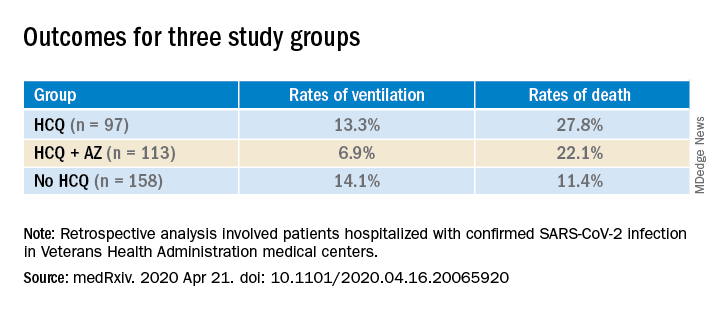
Compared with the no HCQ group, the risk of death from any cause was higher in the HCQ group (adjusted hazard ratio, 2.61; 95% confidence interval, 1.10-6.17; P = .03) but not in the HCQ+AZ group (aHR, 1.14; 95% CI, 0.56-2.32; P = .72).
The risk of ventilation was similar in the HCQ group (aHR, 1.43; 95% CI, 0.53-3.79; P = .48) and in the HCQ+AZ group (aHR, 0.43; 95% CI, 0.16-1.12; P = .09), compared with the no-HCQ group.
This study provides another counterbalance to claims of HCQ efficacy, David R. Wessner, PhD, professor of biology and chair of the department of health and human values at Davidson (N.C.) College, said in an interview.
Interest in HCQ spiked after an open-label, nonrandomized, single-center study of COVID-19 patients in France suggested that hydroxychloroquine helped clear the virus and had a potential enhanced effect when combined with azithromycin.
But the 36-patient trial has since been called into question.
Wait for convincing data
Dr. Wessner, whose research focuses on viral pathogenesis, says that, although the current data don’t definitively answer the question of whether HCQ is effective in treating COVID-19, taking a “let’s try it and see” approach is not reasonable.
“Until we have good, prospective randomized trials, it’s hard to know what to make of this. But this is more evidence that there’s not a good reason to use [HCQ],” Dr. Wessner said. He points out that the small randomized trial from China shows that HCQ comes with potential harms.
Anecdotal evidence is often cited by those who promote HCQ as a potential treatment, but “those are one-off examples,” Wessner continued. “That doesn’t really tell us anything.”
Some HCQ proponents have said that trials finding no benefit are flawed in that the drug is given too late. However, Dr. Wessner says, there’s no way to prove or disprove that claim without randomized controlled trials.
Conflicting messages
Despite lack of clear evidence of benefit for patients with COVID-19, HCQ is recommended off-label by the Chinese National guideline, and the U.S. Food and Drug Administration has issued an emergency-use authorization for the treatment of adult patients with COVID-19.
Conversely, the Infectious Diseases Society of America and a guideline panel convened by the National Institutes of Health each concluded recently that because of insufficient data, they could not recommend any specific treatments for patients with COVID-19.
The VA data for the current study came from the Veterans Affairs Informatics and Computing Infrastructure, which includes inpatient, outpatient and laboratory data and pharmacy claims.
The authors acknowledge some limitations, “including those inherent to all retrospective analyses such as nonrandomization of treatments.”
However, they note that they did adjust for potential confounders, including comorbidities, medications, and clinical and laboratory factors.
A coauthor, Jayakrishna Ambati, MD, is a cofounder of iVeena Holdings, iVeena Delivery Systems and Inflammasome Therapeutics, and has received consultancy fees from Allergan, Biogen, Boehringer Ingelheim, Immunovant, Janssen, Olix Pharmaceuticals, Retinal Solutions, and Saksin LifeSciences, all unrelated to this work. Dr. Ambati is named as an inventor on a patent application filed by the University of Virginia relating to COVID-19 but unrelated to this work. Another coauthor has received research grants from Boehringer Ingelheim, Gilead Sciences, Portola Pharmaceuticals, and United Therapeutics, all unrelated to this work. The other authors and Dr. Wessner have disclosed no relevant financial relationships.
This article first appeared on Medscape.com.
Hydroxychloroquine (HCQ) with or without azithromycin (AZ) is not associated with a lower risk of requiring mechanical ventilation, according to a retrospective study of Veterans Affairs patients hospitalized with COVID-19.
The study, which was posted on a preprint server April 21 and has not been peer reviewed, also showed an increased risk of death associated with COVID-19 patients treated with HCQ alone.
“These findings highlight the importance of awaiting the results of ongoing prospective, randomized controlled studies before widespread adoption of these drugs,” write Joseph Magagnoli with Dorn Research Institute at the Columbia (S.C.) VA Health Care System and the department of clinical pharmacy & outcomes sciences, University of South Carolina, and colleagues.
A spokesperson with the University of Virginia, Charlottesville, where several of coauthors practice, said that the authors declined to comment for this article before peer review is completed.
The new data are not the first to suggest no benefit with HCQ among patients with COVID-19. A randomized trial showed no benefit and more side effects among 75 patients in China treated with HCQ, compared with 75 who received standard of care alone, according to a preprint posted online April 14.
No benefit in ventilation, death rates
The current analysis included data from all 368 male patients hospitalized with confirmed COVID-19 and treated at Veterans Health Administration medical centers in the United States through April 11.
Patients were categorized into three groups: those treated with HCQ in addition to standard of care (n = 97); those treated with HCQ and the antibiotic azithromycin plus standard of care (n = 113); and those who received standard supportive care only (n = 158).
Compared with the no HCQ group, the risk of death from any cause was higher in the HCQ group (adjusted hazard ratio, 2.61; 95% confidence interval, 1.10-6.17; P = .03) but not in the HCQ+AZ group (aHR, 1.14; 95% CI, 0.56-2.32; P = .72).
The risk of ventilation was similar in the HCQ group (aHR, 1.43; 95% CI, 0.53-3.79; P = .48) and in the HCQ+AZ group (aHR, 0.43; 95% CI, 0.16-1.12; P = .09), compared with the no-HCQ group.
This study provides another counterbalance to claims of HCQ efficacy, David R. Wessner, PhD, professor of biology and chair of the department of health and human values at Davidson (N.C.) College, said in an interview.
Interest in HCQ spiked after an open-label, nonrandomized, single-center study of COVID-19 patients in France suggested that hydroxychloroquine helped clear the virus and had a potential enhanced effect when combined with azithromycin.
But the 36-patient trial has since been called into question.
Wait for convincing data
Dr. Wessner, whose research focuses on viral pathogenesis, says that, although the current data don’t definitively answer the question of whether HCQ is effective in treating COVID-19, taking a “let’s try it and see” approach is not reasonable.
“Until we have good, prospective randomized trials, it’s hard to know what to make of this. But this is more evidence that there’s not a good reason to use [HCQ],” Dr. Wessner said. He points out that the small randomized trial from China shows that HCQ comes with potential harms.
Anecdotal evidence is often cited by those who promote HCQ as a potential treatment, but “those are one-off examples,” Wessner continued. “That doesn’t really tell us anything.”
Some HCQ proponents have said that trials finding no benefit are flawed in that the drug is given too late. However, Dr. Wessner says, there’s no way to prove or disprove that claim without randomized controlled trials.
Conflicting messages
Despite lack of clear evidence of benefit for patients with COVID-19, HCQ is recommended off-label by the Chinese National guideline, and the U.S. Food and Drug Administration has issued an emergency-use authorization for the treatment of adult patients with COVID-19.
Conversely, the Infectious Diseases Society of America and a guideline panel convened by the National Institutes of Health each concluded recently that because of insufficient data, they could not recommend any specific treatments for patients with COVID-19.
The VA data for the current study came from the Veterans Affairs Informatics and Computing Infrastructure, which includes inpatient, outpatient and laboratory data and pharmacy claims.
The authors acknowledge some limitations, “including those inherent to all retrospective analyses such as nonrandomization of treatments.”
However, they note that they did adjust for potential confounders, including comorbidities, medications, and clinical and laboratory factors.
A coauthor, Jayakrishna Ambati, MD, is a cofounder of iVeena Holdings, iVeena Delivery Systems and Inflammasome Therapeutics, and has received consultancy fees from Allergan, Biogen, Boehringer Ingelheim, Immunovant, Janssen, Olix Pharmaceuticals, Retinal Solutions, and Saksin LifeSciences, all unrelated to this work. Dr. Ambati is named as an inventor on a patent application filed by the University of Virginia relating to COVID-19 but unrelated to this work. Another coauthor has received research grants from Boehringer Ingelheim, Gilead Sciences, Portola Pharmaceuticals, and United Therapeutics, all unrelated to this work. The other authors and Dr. Wessner have disclosed no relevant financial relationships.
This article first appeared on Medscape.com.
Hydroxychloroquine (HCQ) with or without azithromycin (AZ) is not associated with a lower risk of requiring mechanical ventilation, according to a retrospective study of Veterans Affairs patients hospitalized with COVID-19.
The study, which was posted on a preprint server April 21 and has not been peer reviewed, also showed an increased risk of death associated with COVID-19 patients treated with HCQ alone.
“These findings highlight the importance of awaiting the results of ongoing prospective, randomized controlled studies before widespread adoption of these drugs,” write Joseph Magagnoli with Dorn Research Institute at the Columbia (S.C.) VA Health Care System and the department of clinical pharmacy & outcomes sciences, University of South Carolina, and colleagues.
A spokesperson with the University of Virginia, Charlottesville, where several of coauthors practice, said that the authors declined to comment for this article before peer review is completed.
The new data are not the first to suggest no benefit with HCQ among patients with COVID-19. A randomized trial showed no benefit and more side effects among 75 patients in China treated with HCQ, compared with 75 who received standard of care alone, according to a preprint posted online April 14.
No benefit in ventilation, death rates
The current analysis included data from all 368 male patients hospitalized with confirmed COVID-19 and treated at Veterans Health Administration medical centers in the United States through April 11.
Patients were categorized into three groups: those treated with HCQ in addition to standard of care (n = 97); those treated with HCQ and the antibiotic azithromycin plus standard of care (n = 113); and those who received standard supportive care only (n = 158).
Compared with the no HCQ group, the risk of death from any cause was higher in the HCQ group (adjusted hazard ratio, 2.61; 95% confidence interval, 1.10-6.17; P = .03) but not in the HCQ+AZ group (aHR, 1.14; 95% CI, 0.56-2.32; P = .72).
The risk of ventilation was similar in the HCQ group (aHR, 1.43; 95% CI, 0.53-3.79; P = .48) and in the HCQ+AZ group (aHR, 0.43; 95% CI, 0.16-1.12; P = .09), compared with the no-HCQ group.
This study provides another counterbalance to claims of HCQ efficacy, David R. Wessner, PhD, professor of biology and chair of the department of health and human values at Davidson (N.C.) College, said in an interview.
Interest in HCQ spiked after an open-label, nonrandomized, single-center study of COVID-19 patients in France suggested that hydroxychloroquine helped clear the virus and had a potential enhanced effect when combined with azithromycin.
But the 36-patient trial has since been called into question.
Wait for convincing data
Dr. Wessner, whose research focuses on viral pathogenesis, says that, although the current data don’t definitively answer the question of whether HCQ is effective in treating COVID-19, taking a “let’s try it and see” approach is not reasonable.
“Until we have good, prospective randomized trials, it’s hard to know what to make of this. But this is more evidence that there’s not a good reason to use [HCQ],” Dr. Wessner said. He points out that the small randomized trial from China shows that HCQ comes with potential harms.
Anecdotal evidence is often cited by those who promote HCQ as a potential treatment, but “those are one-off examples,” Wessner continued. “That doesn’t really tell us anything.”
Some HCQ proponents have said that trials finding no benefit are flawed in that the drug is given too late. However, Dr. Wessner says, there’s no way to prove or disprove that claim without randomized controlled trials.
Conflicting messages
Despite lack of clear evidence of benefit for patients with COVID-19, HCQ is recommended off-label by the Chinese National guideline, and the U.S. Food and Drug Administration has issued an emergency-use authorization for the treatment of adult patients with COVID-19.
Conversely, the Infectious Diseases Society of America and a guideline panel convened by the National Institutes of Health each concluded recently that because of insufficient data, they could not recommend any specific treatments for patients with COVID-19.
The VA data for the current study came from the Veterans Affairs Informatics and Computing Infrastructure, which includes inpatient, outpatient and laboratory data and pharmacy claims.
The authors acknowledge some limitations, “including those inherent to all retrospective analyses such as nonrandomization of treatments.”
However, they note that they did adjust for potential confounders, including comorbidities, medications, and clinical and laboratory factors.
A coauthor, Jayakrishna Ambati, MD, is a cofounder of iVeena Holdings, iVeena Delivery Systems and Inflammasome Therapeutics, and has received consultancy fees from Allergan, Biogen, Boehringer Ingelheim, Immunovant, Janssen, Olix Pharmaceuticals, Retinal Solutions, and Saksin LifeSciences, all unrelated to this work. Dr. Ambati is named as an inventor on a patent application filed by the University of Virginia relating to COVID-19 but unrelated to this work. Another coauthor has received research grants from Boehringer Ingelheim, Gilead Sciences, Portola Pharmaceuticals, and United Therapeutics, all unrelated to this work. The other authors and Dr. Wessner have disclosed no relevant financial relationships.
This article first appeared on Medscape.com.
Prioritizing ambulatory gynecology care during COVID-19: The latest guidance
What exactly constitutes appropriate ambulatory gynecology during this time of social distancing?
On March 30, 2020, the American College of Obstetricians and Gynecologists (ACOG) weighed in, releasing COVID-19 FAQs for Obstetrician-Gynecologists. These recommendations, which include information about obstetric and gynecologic surgery, are available to everyone, including the general public. They are intended to supplement guidance from the Centers for Disease Control and Prevention, as well as previously released ACOG guidance.
The recommendations include examples of patients needing in-person appointments, telehealth visits, or visits that should be deferred.
In-person appointments. Examples of patients for whom in-person appointments are appropriate include those with suspected ectopic pregnancy or profuse vaginal bleeding. With respect to contraceptive services, ACOG suggests that placement of IUDs and implants should continue whenever possible. If placement of the contraceptive device is deferred, use of self-administered hormonal contraceptives (including subcutaneous injections, oral, transdermal patch, and vaginal ring) should be encouraged as a bridge to later initiation of long-acting methods.
Telehealth visits. Video or telephone visits are advised for women desiring counseling and prescribing for contraception or menopausal symptoms.
Deferred. Deferral of office visits until after COVID-19 lockdowns is advised for average-risk women wishing routine well-woman visits. Other situations in which deferral should be considered include the following:
- For patients with abnormal cervical cancer screening results, ACOG suggests that colposcopy with cervical biopsies could be deferred for 6-12 months for patients with low-grade test results. In contrast, for patients with high-grade results, ACOG recommends that evaluation be performed within 3 months.
- For women who wish to discontinue their contraceptive, ACOG advises that removal of IUDs and implants be postponed when possible. These women should be counseled regarding extended use of these devices.
ACOG emphasizes that decisions regarding ambulatory gynecology should be individualized and take into consideration such issues as availability of local and regional resources, staffing, personal protective equipment, and the local prevalence of COVID-19.
As a gynecologist focused on ambulatory care, I believe that many clinicians will welcome this guidance from ACOG, which helps us provide optimal care during these challenging times.
Dr. Kaunitz is professor and associate chairman in the department of obstetrics and gynecology at the University of Florida, Jacksonville. He has disclosed receiving royalties from UpToDate, serving on the safety monitoring board for Femasys, and serving as a consultant for AMAG Pharmaceuticals, Merck & Co, Mithra, and Pfizer. His institution has received funding from pharmaceutical companies and nonprofits.
A version of this article originally appeared on Medscape.com.
What exactly constitutes appropriate ambulatory gynecology during this time of social distancing?
On March 30, 2020, the American College of Obstetricians and Gynecologists (ACOG) weighed in, releasing COVID-19 FAQs for Obstetrician-Gynecologists. These recommendations, which include information about obstetric and gynecologic surgery, are available to everyone, including the general public. They are intended to supplement guidance from the Centers for Disease Control and Prevention, as well as previously released ACOG guidance.
The recommendations include examples of patients needing in-person appointments, telehealth visits, or visits that should be deferred.
In-person appointments. Examples of patients for whom in-person appointments are appropriate include those with suspected ectopic pregnancy or profuse vaginal bleeding. With respect to contraceptive services, ACOG suggests that placement of IUDs and implants should continue whenever possible. If placement of the contraceptive device is deferred, use of self-administered hormonal contraceptives (including subcutaneous injections, oral, transdermal patch, and vaginal ring) should be encouraged as a bridge to later initiation of long-acting methods.
Telehealth visits. Video or telephone visits are advised for women desiring counseling and prescribing for contraception or menopausal symptoms.
Deferred. Deferral of office visits until after COVID-19 lockdowns is advised for average-risk women wishing routine well-woman visits. Other situations in which deferral should be considered include the following:
- For patients with abnormal cervical cancer screening results, ACOG suggests that colposcopy with cervical biopsies could be deferred for 6-12 months for patients with low-grade test results. In contrast, for patients with high-grade results, ACOG recommends that evaluation be performed within 3 months.
- For women who wish to discontinue their contraceptive, ACOG advises that removal of IUDs and implants be postponed when possible. These women should be counseled regarding extended use of these devices.
ACOG emphasizes that decisions regarding ambulatory gynecology should be individualized and take into consideration such issues as availability of local and regional resources, staffing, personal protective equipment, and the local prevalence of COVID-19.
As a gynecologist focused on ambulatory care, I believe that many clinicians will welcome this guidance from ACOG, which helps us provide optimal care during these challenging times.
Dr. Kaunitz is professor and associate chairman in the department of obstetrics and gynecology at the University of Florida, Jacksonville. He has disclosed receiving royalties from UpToDate, serving on the safety monitoring board for Femasys, and serving as a consultant for AMAG Pharmaceuticals, Merck & Co, Mithra, and Pfizer. His institution has received funding from pharmaceutical companies and nonprofits.
A version of this article originally appeared on Medscape.com.
What exactly constitutes appropriate ambulatory gynecology during this time of social distancing?
On March 30, 2020, the American College of Obstetricians and Gynecologists (ACOG) weighed in, releasing COVID-19 FAQs for Obstetrician-Gynecologists. These recommendations, which include information about obstetric and gynecologic surgery, are available to everyone, including the general public. They are intended to supplement guidance from the Centers for Disease Control and Prevention, as well as previously released ACOG guidance.
The recommendations include examples of patients needing in-person appointments, telehealth visits, or visits that should be deferred.
In-person appointments. Examples of patients for whom in-person appointments are appropriate include those with suspected ectopic pregnancy or profuse vaginal bleeding. With respect to contraceptive services, ACOG suggests that placement of IUDs and implants should continue whenever possible. If placement of the contraceptive device is deferred, use of self-administered hormonal contraceptives (including subcutaneous injections, oral, transdermal patch, and vaginal ring) should be encouraged as a bridge to later initiation of long-acting methods.
Telehealth visits. Video or telephone visits are advised for women desiring counseling and prescribing for contraception or menopausal symptoms.
Deferred. Deferral of office visits until after COVID-19 lockdowns is advised for average-risk women wishing routine well-woman visits. Other situations in which deferral should be considered include the following:
- For patients with abnormal cervical cancer screening results, ACOG suggests that colposcopy with cervical biopsies could be deferred for 6-12 months for patients with low-grade test results. In contrast, for patients with high-grade results, ACOG recommends that evaluation be performed within 3 months.
- For women who wish to discontinue their contraceptive, ACOG advises that removal of IUDs and implants be postponed when possible. These women should be counseled regarding extended use of these devices.
ACOG emphasizes that decisions regarding ambulatory gynecology should be individualized and take into consideration such issues as availability of local and regional resources, staffing, personal protective equipment, and the local prevalence of COVID-19.
As a gynecologist focused on ambulatory care, I believe that many clinicians will welcome this guidance from ACOG, which helps us provide optimal care during these challenging times.
Dr. Kaunitz is professor and associate chairman in the department of obstetrics and gynecology at the University of Florida, Jacksonville. He has disclosed receiving royalties from UpToDate, serving on the safety monitoring board for Femasys, and serving as a consultant for AMAG Pharmaceuticals, Merck & Co, Mithra, and Pfizer. His institution has received funding from pharmaceutical companies and nonprofits.
A version of this article originally appeared on Medscape.com.
Hip hemiarthroplasty outcomes found better with cement vs. no cement
In older patients undergoing hemiarthroplasty for repair of a hip fracture, cemented fixation reduces the risk of aseptic revisions, according to a large retrospective cohort analysis reported in an abstract scheduled for release at the annual meeting of the American Academy of Orthopaedic Surgeons. The meeting was canceled due to COVID-19.
“These data suggest surgeons should consider cemented over uncemented femoral stem fixation in the absence of contraindications,” reported Kanu M. Okike, MD, an orthopedic surgeon with the Hawaii Permanente Medical Group, Kaiser Moanalua Medical Center, Honolulu.
The finding was drawn from a cohort analysis conducted in the United States. Several studies conducted in Europe and elsewhere, including randomized trials, have also favored cement.
“Cemented fixation is becoming a standard of care for elderly individuals outside of the U.S., but this study was conducted to evaluate the U.S. experience,” explained Dr. Okike in an interview.
Citing 2018 American Joint Replacement Registry data, Dr. Okike reported that more than half of hemiarthroplasties in the United States are still being fixed without cement.
The retrospective cohort analysis was undertaken with the Kaiser Permanente Hip Fracture Registry, selecting patients age 60 years or older who underwent hemiarthroplasty for hip fracture between 2009 and 2017. Of the 12,491 patients, 6,449 (51.6%) included cement fixation, and the remaining were uncemented.
After controlling for confounders, including age, sex, body mass index, and comorbidities, the incidence of aseptic revision 1 year after repair was 3.0% in the uncemented group and 1.3% in the cemented group. By hazard ratio (HR), the risk of aseptic revision, which was the primary endpoint, was increased by more than 75% (HR 1.77; 95% confidence interval, 1.43-2.19; P < .001).
Of the secondary outcomes evaluated, such as medical complications at 90 days or mortality at 1 year, none were significantly different between the two arms.
A post hoc analysis suggested that a higher risk of periprosthetic fracture explained the higher rates of aseptic revision in the uncemented group, according to Dr. Okike, whose data have now been published (JAMA. 2020;323:1077-84).
Surgeon preference was also evaluated in this study as an instrumental variable. When patients treated by a surgeon with a preference for cemented fixation were compared with those treated by a surgeon with a preference for cementless repair, the relative advantage of cement for the primary outcome was similar (HR, 1.74; P = .02).
These data are consistent with trials outside of the United States. For example, a randomized trial with 160 patients conducted in New Zealand associated cemented fixation with a lower risk of periprosthetic fracture (1 vs. 18) and superior Oxford hip scores (J Bone Joint Surg Am. 2012;94:577-83). Similarly, a randomized trial of 141 patients conducted in Sweden associated cemented fixation with lower rate of periprosthetic fracture (0 vs. 9) and improved outcomes on several instruments, including the Harris Hip Scale (Bone Joint J. 2015;97-B:1475-80).
Cemented fixation generally requires a slightly longer operating time, but it is not otherwise more difficult or more expensive, according to Dr. Okike. He believes these results encourage cemented fixation in older patients without contraindications. This is already specifically recommended in AAOS guidelines for the management of hip fractures in elderly patients.
An orthopedic surgeon who has published frequently on total hip arthroplasty, Emil van Haaren, MD, of Zuyderland Medical Center, Heerlen, the Netherlands, confirmed that cemented hemiarthroplasty is considered “the golden standard of care” at his institution. In one study for which he served as the senior author, survival was characterized as excellent in older patients receiving cemented hip arthroplasty that were followed for more than 10 years (J Arthroplasty. 2016;31:194-8).
“We routinely use cemented prosthesis in hip fracture management when an arthroplasty is indicated,” he reported, echoing the contention by Dr. Okike that this approach is dominant in many centers outside of the United States.
Dr. Okike reports no potential conflicts of interest.
SOURCE: Okiki KM et al. JAMA. 2020;323:1077-84.
In older patients undergoing hemiarthroplasty for repair of a hip fracture, cemented fixation reduces the risk of aseptic revisions, according to a large retrospective cohort analysis reported in an abstract scheduled for release at the annual meeting of the American Academy of Orthopaedic Surgeons. The meeting was canceled due to COVID-19.
“These data suggest surgeons should consider cemented over uncemented femoral stem fixation in the absence of contraindications,” reported Kanu M. Okike, MD, an orthopedic surgeon with the Hawaii Permanente Medical Group, Kaiser Moanalua Medical Center, Honolulu.
The finding was drawn from a cohort analysis conducted in the United States. Several studies conducted in Europe and elsewhere, including randomized trials, have also favored cement.
“Cemented fixation is becoming a standard of care for elderly individuals outside of the U.S., but this study was conducted to evaluate the U.S. experience,” explained Dr. Okike in an interview.
Citing 2018 American Joint Replacement Registry data, Dr. Okike reported that more than half of hemiarthroplasties in the United States are still being fixed without cement.
The retrospective cohort analysis was undertaken with the Kaiser Permanente Hip Fracture Registry, selecting patients age 60 years or older who underwent hemiarthroplasty for hip fracture between 2009 and 2017. Of the 12,491 patients, 6,449 (51.6%) included cement fixation, and the remaining were uncemented.
After controlling for confounders, including age, sex, body mass index, and comorbidities, the incidence of aseptic revision 1 year after repair was 3.0% in the uncemented group and 1.3% in the cemented group. By hazard ratio (HR), the risk of aseptic revision, which was the primary endpoint, was increased by more than 75% (HR 1.77; 95% confidence interval, 1.43-2.19; P < .001).
Of the secondary outcomes evaluated, such as medical complications at 90 days or mortality at 1 year, none were significantly different between the two arms.
A post hoc analysis suggested that a higher risk of periprosthetic fracture explained the higher rates of aseptic revision in the uncemented group, according to Dr. Okike, whose data have now been published (JAMA. 2020;323:1077-84).
Surgeon preference was also evaluated in this study as an instrumental variable. When patients treated by a surgeon with a preference for cemented fixation were compared with those treated by a surgeon with a preference for cementless repair, the relative advantage of cement for the primary outcome was similar (HR, 1.74; P = .02).
These data are consistent with trials outside of the United States. For example, a randomized trial with 160 patients conducted in New Zealand associated cemented fixation with a lower risk of periprosthetic fracture (1 vs. 18) and superior Oxford hip scores (J Bone Joint Surg Am. 2012;94:577-83). Similarly, a randomized trial of 141 patients conducted in Sweden associated cemented fixation with lower rate of periprosthetic fracture (0 vs. 9) and improved outcomes on several instruments, including the Harris Hip Scale (Bone Joint J. 2015;97-B:1475-80).
Cemented fixation generally requires a slightly longer operating time, but it is not otherwise more difficult or more expensive, according to Dr. Okike. He believes these results encourage cemented fixation in older patients without contraindications. This is already specifically recommended in AAOS guidelines for the management of hip fractures in elderly patients.
An orthopedic surgeon who has published frequently on total hip arthroplasty, Emil van Haaren, MD, of Zuyderland Medical Center, Heerlen, the Netherlands, confirmed that cemented hemiarthroplasty is considered “the golden standard of care” at his institution. In one study for which he served as the senior author, survival was characterized as excellent in older patients receiving cemented hip arthroplasty that were followed for more than 10 years (J Arthroplasty. 2016;31:194-8).
“We routinely use cemented prosthesis in hip fracture management when an arthroplasty is indicated,” he reported, echoing the contention by Dr. Okike that this approach is dominant in many centers outside of the United States.
Dr. Okike reports no potential conflicts of interest.
SOURCE: Okiki KM et al. JAMA. 2020;323:1077-84.
In older patients undergoing hemiarthroplasty for repair of a hip fracture, cemented fixation reduces the risk of aseptic revisions, according to a large retrospective cohort analysis reported in an abstract scheduled for release at the annual meeting of the American Academy of Orthopaedic Surgeons. The meeting was canceled due to COVID-19.
“These data suggest surgeons should consider cemented over uncemented femoral stem fixation in the absence of contraindications,” reported Kanu M. Okike, MD, an orthopedic surgeon with the Hawaii Permanente Medical Group, Kaiser Moanalua Medical Center, Honolulu.
The finding was drawn from a cohort analysis conducted in the United States. Several studies conducted in Europe and elsewhere, including randomized trials, have also favored cement.
“Cemented fixation is becoming a standard of care for elderly individuals outside of the U.S., but this study was conducted to evaluate the U.S. experience,” explained Dr. Okike in an interview.
Citing 2018 American Joint Replacement Registry data, Dr. Okike reported that more than half of hemiarthroplasties in the United States are still being fixed without cement.
The retrospective cohort analysis was undertaken with the Kaiser Permanente Hip Fracture Registry, selecting patients age 60 years or older who underwent hemiarthroplasty for hip fracture between 2009 and 2017. Of the 12,491 patients, 6,449 (51.6%) included cement fixation, and the remaining were uncemented.
After controlling for confounders, including age, sex, body mass index, and comorbidities, the incidence of aseptic revision 1 year after repair was 3.0% in the uncemented group and 1.3% in the cemented group. By hazard ratio (HR), the risk of aseptic revision, which was the primary endpoint, was increased by more than 75% (HR 1.77; 95% confidence interval, 1.43-2.19; P < .001).
Of the secondary outcomes evaluated, such as medical complications at 90 days or mortality at 1 year, none were significantly different between the two arms.
A post hoc analysis suggested that a higher risk of periprosthetic fracture explained the higher rates of aseptic revision in the uncemented group, according to Dr. Okike, whose data have now been published (JAMA. 2020;323:1077-84).
Surgeon preference was also evaluated in this study as an instrumental variable. When patients treated by a surgeon with a preference for cemented fixation were compared with those treated by a surgeon with a preference for cementless repair, the relative advantage of cement for the primary outcome was similar (HR, 1.74; P = .02).
These data are consistent with trials outside of the United States. For example, a randomized trial with 160 patients conducted in New Zealand associated cemented fixation with a lower risk of periprosthetic fracture (1 vs. 18) and superior Oxford hip scores (J Bone Joint Surg Am. 2012;94:577-83). Similarly, a randomized trial of 141 patients conducted in Sweden associated cemented fixation with lower rate of periprosthetic fracture (0 vs. 9) and improved outcomes on several instruments, including the Harris Hip Scale (Bone Joint J. 2015;97-B:1475-80).
Cemented fixation generally requires a slightly longer operating time, but it is not otherwise more difficult or more expensive, according to Dr. Okike. He believes these results encourage cemented fixation in older patients without contraindications. This is already specifically recommended in AAOS guidelines for the management of hip fractures in elderly patients.
An orthopedic surgeon who has published frequently on total hip arthroplasty, Emil van Haaren, MD, of Zuyderland Medical Center, Heerlen, the Netherlands, confirmed that cemented hemiarthroplasty is considered “the golden standard of care” at his institution. In one study for which he served as the senior author, survival was characterized as excellent in older patients receiving cemented hip arthroplasty that were followed for more than 10 years (J Arthroplasty. 2016;31:194-8).
“We routinely use cemented prosthesis in hip fracture management when an arthroplasty is indicated,” he reported, echoing the contention by Dr. Okike that this approach is dominant in many centers outside of the United States.
Dr. Okike reports no potential conflicts of interest.
SOURCE: Okiki KM et al. JAMA. 2020;323:1077-84.
FROM AAOS 2020
Inactivated Bifidobacterium improves IBS symptoms
pointing the way to a therapeutic path that could avoid some risks of live probiotic use.
Of 443 patients taking part in a randomized, double-blind, placebo-controlled trial of a heat-inactivated nonviable Bifidobacterium probiotic, 221 received the probiotic while 222 received placebo capsules. The study’s primary endpoint was a composite of at least 30% improvement in abdominal pain and “adequate relief” of overall irritable bowel syndrome (IBS) symptoms in at least 4 of the 8 weeks of the study.
Within the B. bifidum group, 74 patients (34%) reached this endpoint, compared with 43 (19%) of those in the placebo group, for a risk ratio of 1.7 (P = .0007). Patients had no serious adverse events from the oral therapy, which they took in the form of two capsules daily for 8 weeks, and participants found both the inactivated Bifidobacterium treatment and placebo tolerable overall.
Bowel movements became more frequent in those who received B. bifidum capsules who had constipation-predominant IBS and less frequent in those with diarrhea-predominant IBS; the changes were statistically significant in both subgroups.
“Some probiotic strains can adhere well to epithelial cells and strengthen intestinal barrier function, providing an explanation for the efficacy of at least some probiotics in the treatment of IBS,” wrote Viola Andresen, MD, MSc, the study‘s lead author.
“Accordingly, enhancing the gut barrier is a useful treatment approach for patients with IBS,” added Dr. Andresen, of the department of internal medicine at the University of Hamburg (Germany) Teaching Hospital, and collaborators. The adherent properties of some strains of Bifidobacteria are mainly dependent on properties of the cell surface that are not changed by heat inactivation, which makes the bacteria nonviable – and removes the risk of infection.
Additional benefits of using nonviable bacteria for IBS therapy might include more stability and enhanced standardization, although previous studies have shown a reduction in efficacy when bacteria are made nonviable. Inactivated B. bifidum MIMBb75 was used in this study because it had previously been shown effective against IBS symptoms, noted Dr. Andresen and coauthors.
Adult patients were included if they met criteria for IBS according to Rome III and had abdominal pain rated at least 4 on an 11-point scale for at least 2 days of a 2-week run-in phase. Among the many criteria for exclusion from the study were history of inflammatory gastrointestinal disease, cancer, other serious stomach diseases, diabetes, many abdominal surgeries, and recent antipsychotic or steroid use.
During the study, participants recorded their abdominal pain over the last 24 hours daily; weekly averages were tallied for each patient. Patients were also asked to rate their relief of IBS symptoms, including abdominal pain, bowel habits, and other symptoms over the past week at weekly time points on a 7-point Likert scale, where scores of 3 or less indicated some measure of relief; IBS symptoms were considered to be adequately relieved with a score of 3 or less.
Secondary outcome measures for the study included changes in the Subjects’ Global Assessment of symptoms, and changes in individual symptoms. Number of bowel movements, stool form, sensation of incomplete evacuation, and medication use were also recorded daily.
Participants were aged a mean of 41 years, and about 70% were female. The mean body mass index was just under 25 kg/m2. About half of each study arm had diarrhea-predominant IBS. About a quarter had constipation-predominant IBS, and most of the rest were not subtyped.
Looking at the primary endpoint, the number needed to treat for benefit was 7.1 in favor of the inactivated bacterium, using an intention-to-treat analysis. Results were similar when a per-protocol analysis was applied. The investigators saw response to treatment climb through the duration of the study for both the probiotic and the placebo arms, with the gap in improvement between the groups widening over the 8-week study period.
“It might be assumed that the use of nonviable bacteria for the treatment of IBS could be a safe alternative, even in patients who are potentially susceptible to infection,” concluded Dr. Andresen and colleagues. A further advantage, noted the researchers, is greater product stability in fluctuating temperatures compared with viable bacteria, ensuring better standardization even in regions with warm or changing climates.
Perspective was offered in an accompanying commentary whose lead author was Nicholas Talley, MD, PhD, a gastroenterologist, adjunct professor, and pro vice-chancellor for global research at the University of Newcastle (Australia).
“By heat inactivating the bacteria the researchers did not administer a probiotic but a bacterial therapy,” wrote Dr. Talley and coauthors. In any event, they added, the exact mechanism by which probiotics benefit individuals with IBS is unknown.
“The concept that a probiotic might be efficacious in IBS even if nonviable organisms are administered is an important observation,” they wrote. Fewer benefits have been seen with oral probiotic therapy than with fecal microbial transfer, and oral therapy does not produce durable results unless administered on a chronic basis, Dr. Talley and coauthors added.
“The absence of fundamental knowledge in terms of how bacterial therapy alters mechanisms in IBS continues to hamper improvements in treatment, limiting any success to short-term symptom control rather than the true goal, reversal of disease,” they concluded.
The study was funded by Synformulas. Dr. Andresen reported financial relationships with several pharmaceutical companies. Dr. Talley reported financial relationships with several pharmaceutical and nutritional companies.
SOURCE: Andresen V et al. Lancet Gastroenterol Hepatol. 2020 Apr 8. doi: 10.1016/S2468-1253(20)30079-0
pointing the way to a therapeutic path that could avoid some risks of live probiotic use.
Of 443 patients taking part in a randomized, double-blind, placebo-controlled trial of a heat-inactivated nonviable Bifidobacterium probiotic, 221 received the probiotic while 222 received placebo capsules. The study’s primary endpoint was a composite of at least 30% improvement in abdominal pain and “adequate relief” of overall irritable bowel syndrome (IBS) symptoms in at least 4 of the 8 weeks of the study.
Within the B. bifidum group, 74 patients (34%) reached this endpoint, compared with 43 (19%) of those in the placebo group, for a risk ratio of 1.7 (P = .0007). Patients had no serious adverse events from the oral therapy, which they took in the form of two capsules daily for 8 weeks, and participants found both the inactivated Bifidobacterium treatment and placebo tolerable overall.
Bowel movements became more frequent in those who received B. bifidum capsules who had constipation-predominant IBS and less frequent in those with diarrhea-predominant IBS; the changes were statistically significant in both subgroups.
“Some probiotic strains can adhere well to epithelial cells and strengthen intestinal barrier function, providing an explanation for the efficacy of at least some probiotics in the treatment of IBS,” wrote Viola Andresen, MD, MSc, the study‘s lead author.
“Accordingly, enhancing the gut barrier is a useful treatment approach for patients with IBS,” added Dr. Andresen, of the department of internal medicine at the University of Hamburg (Germany) Teaching Hospital, and collaborators. The adherent properties of some strains of Bifidobacteria are mainly dependent on properties of the cell surface that are not changed by heat inactivation, which makes the bacteria nonviable – and removes the risk of infection.
Additional benefits of using nonviable bacteria for IBS therapy might include more stability and enhanced standardization, although previous studies have shown a reduction in efficacy when bacteria are made nonviable. Inactivated B. bifidum MIMBb75 was used in this study because it had previously been shown effective against IBS symptoms, noted Dr. Andresen and coauthors.
Adult patients were included if they met criteria for IBS according to Rome III and had abdominal pain rated at least 4 on an 11-point scale for at least 2 days of a 2-week run-in phase. Among the many criteria for exclusion from the study were history of inflammatory gastrointestinal disease, cancer, other serious stomach diseases, diabetes, many abdominal surgeries, and recent antipsychotic or steroid use.
During the study, participants recorded their abdominal pain over the last 24 hours daily; weekly averages were tallied for each patient. Patients were also asked to rate their relief of IBS symptoms, including abdominal pain, bowel habits, and other symptoms over the past week at weekly time points on a 7-point Likert scale, where scores of 3 or less indicated some measure of relief; IBS symptoms were considered to be adequately relieved with a score of 3 or less.
Secondary outcome measures for the study included changes in the Subjects’ Global Assessment of symptoms, and changes in individual symptoms. Number of bowel movements, stool form, sensation of incomplete evacuation, and medication use were also recorded daily.
Participants were aged a mean of 41 years, and about 70% were female. The mean body mass index was just under 25 kg/m2. About half of each study arm had diarrhea-predominant IBS. About a quarter had constipation-predominant IBS, and most of the rest were not subtyped.
Looking at the primary endpoint, the number needed to treat for benefit was 7.1 in favor of the inactivated bacterium, using an intention-to-treat analysis. Results were similar when a per-protocol analysis was applied. The investigators saw response to treatment climb through the duration of the study for both the probiotic and the placebo arms, with the gap in improvement between the groups widening over the 8-week study period.
“It might be assumed that the use of nonviable bacteria for the treatment of IBS could be a safe alternative, even in patients who are potentially susceptible to infection,” concluded Dr. Andresen and colleagues. A further advantage, noted the researchers, is greater product stability in fluctuating temperatures compared with viable bacteria, ensuring better standardization even in regions with warm or changing climates.
Perspective was offered in an accompanying commentary whose lead author was Nicholas Talley, MD, PhD, a gastroenterologist, adjunct professor, and pro vice-chancellor for global research at the University of Newcastle (Australia).
“By heat inactivating the bacteria the researchers did not administer a probiotic but a bacterial therapy,” wrote Dr. Talley and coauthors. In any event, they added, the exact mechanism by which probiotics benefit individuals with IBS is unknown.
“The concept that a probiotic might be efficacious in IBS even if nonviable organisms are administered is an important observation,” they wrote. Fewer benefits have been seen with oral probiotic therapy than with fecal microbial transfer, and oral therapy does not produce durable results unless administered on a chronic basis, Dr. Talley and coauthors added.
“The absence of fundamental knowledge in terms of how bacterial therapy alters mechanisms in IBS continues to hamper improvements in treatment, limiting any success to short-term symptom control rather than the true goal, reversal of disease,” they concluded.
The study was funded by Synformulas. Dr. Andresen reported financial relationships with several pharmaceutical companies. Dr. Talley reported financial relationships with several pharmaceutical and nutritional companies.
SOURCE: Andresen V et al. Lancet Gastroenterol Hepatol. 2020 Apr 8. doi: 10.1016/S2468-1253(20)30079-0
pointing the way to a therapeutic path that could avoid some risks of live probiotic use.
Of 443 patients taking part in a randomized, double-blind, placebo-controlled trial of a heat-inactivated nonviable Bifidobacterium probiotic, 221 received the probiotic while 222 received placebo capsules. The study’s primary endpoint was a composite of at least 30% improvement in abdominal pain and “adequate relief” of overall irritable bowel syndrome (IBS) symptoms in at least 4 of the 8 weeks of the study.
Within the B. bifidum group, 74 patients (34%) reached this endpoint, compared with 43 (19%) of those in the placebo group, for a risk ratio of 1.7 (P = .0007). Patients had no serious adverse events from the oral therapy, which they took in the form of two capsules daily for 8 weeks, and participants found both the inactivated Bifidobacterium treatment and placebo tolerable overall.
Bowel movements became more frequent in those who received B. bifidum capsules who had constipation-predominant IBS and less frequent in those with diarrhea-predominant IBS; the changes were statistically significant in both subgroups.
“Some probiotic strains can adhere well to epithelial cells and strengthen intestinal barrier function, providing an explanation for the efficacy of at least some probiotics in the treatment of IBS,” wrote Viola Andresen, MD, MSc, the study‘s lead author.
“Accordingly, enhancing the gut barrier is a useful treatment approach for patients with IBS,” added Dr. Andresen, of the department of internal medicine at the University of Hamburg (Germany) Teaching Hospital, and collaborators. The adherent properties of some strains of Bifidobacteria are mainly dependent on properties of the cell surface that are not changed by heat inactivation, which makes the bacteria nonviable – and removes the risk of infection.
Additional benefits of using nonviable bacteria for IBS therapy might include more stability and enhanced standardization, although previous studies have shown a reduction in efficacy when bacteria are made nonviable. Inactivated B. bifidum MIMBb75 was used in this study because it had previously been shown effective against IBS symptoms, noted Dr. Andresen and coauthors.
Adult patients were included if they met criteria for IBS according to Rome III and had abdominal pain rated at least 4 on an 11-point scale for at least 2 days of a 2-week run-in phase. Among the many criteria for exclusion from the study were history of inflammatory gastrointestinal disease, cancer, other serious stomach diseases, diabetes, many abdominal surgeries, and recent antipsychotic or steroid use.
During the study, participants recorded their abdominal pain over the last 24 hours daily; weekly averages were tallied for each patient. Patients were also asked to rate their relief of IBS symptoms, including abdominal pain, bowel habits, and other symptoms over the past week at weekly time points on a 7-point Likert scale, where scores of 3 or less indicated some measure of relief; IBS symptoms were considered to be adequately relieved with a score of 3 or less.
Secondary outcome measures for the study included changes in the Subjects’ Global Assessment of symptoms, and changes in individual symptoms. Number of bowel movements, stool form, sensation of incomplete evacuation, and medication use were also recorded daily.
Participants were aged a mean of 41 years, and about 70% were female. The mean body mass index was just under 25 kg/m2. About half of each study arm had diarrhea-predominant IBS. About a quarter had constipation-predominant IBS, and most of the rest were not subtyped.
Looking at the primary endpoint, the number needed to treat for benefit was 7.1 in favor of the inactivated bacterium, using an intention-to-treat analysis. Results were similar when a per-protocol analysis was applied. The investigators saw response to treatment climb through the duration of the study for both the probiotic and the placebo arms, with the gap in improvement between the groups widening over the 8-week study period.
“It might be assumed that the use of nonviable bacteria for the treatment of IBS could be a safe alternative, even in patients who are potentially susceptible to infection,” concluded Dr. Andresen and colleagues. A further advantage, noted the researchers, is greater product stability in fluctuating temperatures compared with viable bacteria, ensuring better standardization even in regions with warm or changing climates.
Perspective was offered in an accompanying commentary whose lead author was Nicholas Talley, MD, PhD, a gastroenterologist, adjunct professor, and pro vice-chancellor for global research at the University of Newcastle (Australia).
“By heat inactivating the bacteria the researchers did not administer a probiotic but a bacterial therapy,” wrote Dr. Talley and coauthors. In any event, they added, the exact mechanism by which probiotics benefit individuals with IBS is unknown.
“The concept that a probiotic might be efficacious in IBS even if nonviable organisms are administered is an important observation,” they wrote. Fewer benefits have been seen with oral probiotic therapy than with fecal microbial transfer, and oral therapy does not produce durable results unless administered on a chronic basis, Dr. Talley and coauthors added.
“The absence of fundamental knowledge in terms of how bacterial therapy alters mechanisms in IBS continues to hamper improvements in treatment, limiting any success to short-term symptom control rather than the true goal, reversal of disease,” they concluded.
The study was funded by Synformulas. Dr. Andresen reported financial relationships with several pharmaceutical companies. Dr. Talley reported financial relationships with several pharmaceutical and nutritional companies.
SOURCE: Andresen V et al. Lancet Gastroenterol Hepatol. 2020 Apr 8. doi: 10.1016/S2468-1253(20)30079-0
FROM THE LANCET GASTROENTEROLOGY AND HEPATOLOGY
Will coronavirus restrictions lead to more advanced cancers?
My pathology lab once faced a daily flood of colon polyps, pap smears, and prostate biopsies. Suddenly, our work has dried up. The coronavirus pandemic has cleared out operating rooms and clinics across the country. Endoscopy and radiology suites have gone dark.
Pathology is largely driven by mass screening programs, and the machinery of screening has grinded to a halt during the COVID-19 pandemic. The American Cancer Society currently recommends that “no one should go to a health care facility for routine cancer screening at this time.”
But malignancies are still growing and spreading even though a great deal of medical care is on hold. The most urgent cancer care is still taking place; the risks of delaying treatment for patients with advanced or symptomatic cancer are obvious—these tumors can cause severe pain and life-threatening complications.
But that leaves us with a more complex and uncomfortable question: Will the pause in screening ultimately leave patients with tiny, asymptomatic cancers or precursor lesions worse off? What will a delay mean for those with ductal carcinoma in situ or small breast cancers? What’s the long-term effect of all those dysplastic nevi and early melanoma left unexcised by dermatologists? Perhaps more troubling, what about the spreading kidney cancer that may have turned up as an incidental finding on a CT scan?
COVID-19: A natural experiment
For many years, we’ve been dealing with the other side of the screening question: overdiagnosing and treating cancers that would probably never harm the patient. Overdiagnosis has been on a decades-long rise due to organized screening like PSA testing and mammography, as well as through ad hoc detection from heavier use of medical imaging. All of these have been disrupted by the pandemic.
Because the correlation between medical interventions and cancer overdiagnosis is clear, we can safely assume that overdiagnosis will decline during the pandemic. But what will be the net effect? Early detection of cancer undoubtedly saves some lives, but how many and at what cost has been a seemingly intractable debate.
Until now.
The coronavirus outbreak will be a natural experiment like no other. Economists and epidemiologists love to study “natural experiments” – systemic shocks that shed light on a complex phenomenon.
The unexpected nationwide delay in screening will undoubtedly inform the debate on overdiagnosis. For one, we can learn whether less intensive screening leads to more advanced cancers. Because screening will probably return to normal at different times across the country, we can almost simulate a randomized trial. Will this transformative data be a silver lining to this awful time?
The pressure to ‘fight’
The pandemic has also raised a question about cancer screening that goes beyond data: Why has the loud epidemic of coronavirus so thoroughly trumped cancer’s silent one? To me, the necessary urgency of our coronavirus response stands in stark contrast to the overly aggressive public health messaging used for cancer screening.
The tools used to fight the coronavirus epidemic have been forceful. We’re all diligently washing our hands and staying inside. We’re making sacrifices in our jobs and personal lives to stop the virus’ spread.
Cancer screening has similarly been touted as dogma – an urgent public health intervention that only a fool would turn down. The American Cancer Society once ran an infamous advertisement suggesting that if you decline mammography, you “need more than your breasts examined.” Even today, well-intentioned organizations run cancer screening drives pushing people to pledge to “get screened now.” It is no surprise, then, that I have had patients and family members confide in me that they feel guilty about not pursuing all of their recommended screening tests. The thought of anyone feeling like they caused their own cancer appalls me.
This pressure extends into the clinic. In many practices, primary care doctors are evaluated based on how many patients “comply” with screening recommendations. There seems to be a relentless drive to reach 100% screening penetration. These oversimplified tactics run counter to the shared decision making and informed consent we profess to value in medicine.
The tricky thing about cancer screening is that because most people will never develop the cancer being screened for, we know that most people can also never be helped by it. This doesn’t make screening useless, just as washing your hands can help even if it doesn’t guarantee that you won’t catch coronavirus. We know that some individuals benefit, which we detect at the population level. Overdiagnosis arises in the same way, as a phenomenon detected within populations and not individuals. These aspects of screening are what has led to cancer being viewed as a “societal disease” requiring a uniform response – 100% screening compliance.
Metaphors of war
These assumptions fall apart now that we are facing a real societal disease, an infectious disease outbreak. Coronavirus has made us reflect on what actions individuals should take in order to protect others. But cancer is not a contagion. When we decide whether and how to screen, we make intimate decisions affecting primarily ourselves and our family – not society at large.
Countless articles have been written about the use of metaphor in cancer, perhaps most famously by essayist and breast cancer patient Susan Sontag. Sontag and others have been critical of the rampant use of war metaphors in the cancer community. Wars invoke sacrifice, duty, and suffering. The “battle” against coronavirus really puts the “war on cancer” in perspective. These pandemic weeks have terrified me. I have been willing to do anything to protect myself and others. They’ve also exhausted me. We can’t be at war forever.
When this current war ends, will the “war on cancer” resume unchanged? Screening will no doubt begin again, hopefully improved by data from the coronavirus natural experiment. But I wonder whether we will tolerate the same kinds of public health messages – and whether we should – having now experienced an infectious disease outbreak where our actions as individuals really do have an impact on the health of others.
After feeling helpless, besieged, and even guilt-ridden during the pandemic, I think many people would appreciate regaining a sense of control over other aspects of their health. Cancer screening can save lives, but it’s a choice we should make for ourselves based on an understanding of the trade-offs and our own preferences. When screening restarts, I hope its paternalistic dogma can be replaced by nuanced, empowering tactics more appropriate for peacetime.
Benjamin Mazer, MD, MBA, is an anatomic and clinical pathology resident at Yale with interests in diagnostic surgical pathology, laboratory management, and evidence-based medicine.
This article first appeared on Medscape.com.
My pathology lab once faced a daily flood of colon polyps, pap smears, and prostate biopsies. Suddenly, our work has dried up. The coronavirus pandemic has cleared out operating rooms and clinics across the country. Endoscopy and radiology suites have gone dark.
Pathology is largely driven by mass screening programs, and the machinery of screening has grinded to a halt during the COVID-19 pandemic. The American Cancer Society currently recommends that “no one should go to a health care facility for routine cancer screening at this time.”
But malignancies are still growing and spreading even though a great deal of medical care is on hold. The most urgent cancer care is still taking place; the risks of delaying treatment for patients with advanced or symptomatic cancer are obvious—these tumors can cause severe pain and life-threatening complications.
But that leaves us with a more complex and uncomfortable question: Will the pause in screening ultimately leave patients with tiny, asymptomatic cancers or precursor lesions worse off? What will a delay mean for those with ductal carcinoma in situ or small breast cancers? What’s the long-term effect of all those dysplastic nevi and early melanoma left unexcised by dermatologists? Perhaps more troubling, what about the spreading kidney cancer that may have turned up as an incidental finding on a CT scan?
COVID-19: A natural experiment
For many years, we’ve been dealing with the other side of the screening question: overdiagnosing and treating cancers that would probably never harm the patient. Overdiagnosis has been on a decades-long rise due to organized screening like PSA testing and mammography, as well as through ad hoc detection from heavier use of medical imaging. All of these have been disrupted by the pandemic.
Because the correlation between medical interventions and cancer overdiagnosis is clear, we can safely assume that overdiagnosis will decline during the pandemic. But what will be the net effect? Early detection of cancer undoubtedly saves some lives, but how many and at what cost has been a seemingly intractable debate.
Until now.
The coronavirus outbreak will be a natural experiment like no other. Economists and epidemiologists love to study “natural experiments” – systemic shocks that shed light on a complex phenomenon.
The unexpected nationwide delay in screening will undoubtedly inform the debate on overdiagnosis. For one, we can learn whether less intensive screening leads to more advanced cancers. Because screening will probably return to normal at different times across the country, we can almost simulate a randomized trial. Will this transformative data be a silver lining to this awful time?
The pressure to ‘fight’
The pandemic has also raised a question about cancer screening that goes beyond data: Why has the loud epidemic of coronavirus so thoroughly trumped cancer’s silent one? To me, the necessary urgency of our coronavirus response stands in stark contrast to the overly aggressive public health messaging used for cancer screening.
The tools used to fight the coronavirus epidemic have been forceful. We’re all diligently washing our hands and staying inside. We’re making sacrifices in our jobs and personal lives to stop the virus’ spread.
Cancer screening has similarly been touted as dogma – an urgent public health intervention that only a fool would turn down. The American Cancer Society once ran an infamous advertisement suggesting that if you decline mammography, you “need more than your breasts examined.” Even today, well-intentioned organizations run cancer screening drives pushing people to pledge to “get screened now.” It is no surprise, then, that I have had patients and family members confide in me that they feel guilty about not pursuing all of their recommended screening tests. The thought of anyone feeling like they caused their own cancer appalls me.
This pressure extends into the clinic. In many practices, primary care doctors are evaluated based on how many patients “comply” with screening recommendations. There seems to be a relentless drive to reach 100% screening penetration. These oversimplified tactics run counter to the shared decision making and informed consent we profess to value in medicine.
The tricky thing about cancer screening is that because most people will never develop the cancer being screened for, we know that most people can also never be helped by it. This doesn’t make screening useless, just as washing your hands can help even if it doesn’t guarantee that you won’t catch coronavirus. We know that some individuals benefit, which we detect at the population level. Overdiagnosis arises in the same way, as a phenomenon detected within populations and not individuals. These aspects of screening are what has led to cancer being viewed as a “societal disease” requiring a uniform response – 100% screening compliance.
Metaphors of war
These assumptions fall apart now that we are facing a real societal disease, an infectious disease outbreak. Coronavirus has made us reflect on what actions individuals should take in order to protect others. But cancer is not a contagion. When we decide whether and how to screen, we make intimate decisions affecting primarily ourselves and our family – not society at large.
Countless articles have been written about the use of metaphor in cancer, perhaps most famously by essayist and breast cancer patient Susan Sontag. Sontag and others have been critical of the rampant use of war metaphors in the cancer community. Wars invoke sacrifice, duty, and suffering. The “battle” against coronavirus really puts the “war on cancer” in perspective. These pandemic weeks have terrified me. I have been willing to do anything to protect myself and others. They’ve also exhausted me. We can’t be at war forever.
When this current war ends, will the “war on cancer” resume unchanged? Screening will no doubt begin again, hopefully improved by data from the coronavirus natural experiment. But I wonder whether we will tolerate the same kinds of public health messages – and whether we should – having now experienced an infectious disease outbreak where our actions as individuals really do have an impact on the health of others.
After feeling helpless, besieged, and even guilt-ridden during the pandemic, I think many people would appreciate regaining a sense of control over other aspects of their health. Cancer screening can save lives, but it’s a choice we should make for ourselves based on an understanding of the trade-offs and our own preferences. When screening restarts, I hope its paternalistic dogma can be replaced by nuanced, empowering tactics more appropriate for peacetime.
Benjamin Mazer, MD, MBA, is an anatomic and clinical pathology resident at Yale with interests in diagnostic surgical pathology, laboratory management, and evidence-based medicine.
This article first appeared on Medscape.com.
My pathology lab once faced a daily flood of colon polyps, pap smears, and prostate biopsies. Suddenly, our work has dried up. The coronavirus pandemic has cleared out operating rooms and clinics across the country. Endoscopy and radiology suites have gone dark.
Pathology is largely driven by mass screening programs, and the machinery of screening has grinded to a halt during the COVID-19 pandemic. The American Cancer Society currently recommends that “no one should go to a health care facility for routine cancer screening at this time.”
But malignancies are still growing and spreading even though a great deal of medical care is on hold. The most urgent cancer care is still taking place; the risks of delaying treatment for patients with advanced or symptomatic cancer are obvious—these tumors can cause severe pain and life-threatening complications.
But that leaves us with a more complex and uncomfortable question: Will the pause in screening ultimately leave patients with tiny, asymptomatic cancers or precursor lesions worse off? What will a delay mean for those with ductal carcinoma in situ or small breast cancers? What’s the long-term effect of all those dysplastic nevi and early melanoma left unexcised by dermatologists? Perhaps more troubling, what about the spreading kidney cancer that may have turned up as an incidental finding on a CT scan?
COVID-19: A natural experiment
For many years, we’ve been dealing with the other side of the screening question: overdiagnosing and treating cancers that would probably never harm the patient. Overdiagnosis has been on a decades-long rise due to organized screening like PSA testing and mammography, as well as through ad hoc detection from heavier use of medical imaging. All of these have been disrupted by the pandemic.
Because the correlation between medical interventions and cancer overdiagnosis is clear, we can safely assume that overdiagnosis will decline during the pandemic. But what will be the net effect? Early detection of cancer undoubtedly saves some lives, but how many and at what cost has been a seemingly intractable debate.
Until now.
The coronavirus outbreak will be a natural experiment like no other. Economists and epidemiologists love to study “natural experiments” – systemic shocks that shed light on a complex phenomenon.
The unexpected nationwide delay in screening will undoubtedly inform the debate on overdiagnosis. For one, we can learn whether less intensive screening leads to more advanced cancers. Because screening will probably return to normal at different times across the country, we can almost simulate a randomized trial. Will this transformative data be a silver lining to this awful time?
The pressure to ‘fight’
The pandemic has also raised a question about cancer screening that goes beyond data: Why has the loud epidemic of coronavirus so thoroughly trumped cancer’s silent one? To me, the necessary urgency of our coronavirus response stands in stark contrast to the overly aggressive public health messaging used for cancer screening.
The tools used to fight the coronavirus epidemic have been forceful. We’re all diligently washing our hands and staying inside. We’re making sacrifices in our jobs and personal lives to stop the virus’ spread.
Cancer screening has similarly been touted as dogma – an urgent public health intervention that only a fool would turn down. The American Cancer Society once ran an infamous advertisement suggesting that if you decline mammography, you “need more than your breasts examined.” Even today, well-intentioned organizations run cancer screening drives pushing people to pledge to “get screened now.” It is no surprise, then, that I have had patients and family members confide in me that they feel guilty about not pursuing all of their recommended screening tests. The thought of anyone feeling like they caused their own cancer appalls me.
This pressure extends into the clinic. In many practices, primary care doctors are evaluated based on how many patients “comply” with screening recommendations. There seems to be a relentless drive to reach 100% screening penetration. These oversimplified tactics run counter to the shared decision making and informed consent we profess to value in medicine.
The tricky thing about cancer screening is that because most people will never develop the cancer being screened for, we know that most people can also never be helped by it. This doesn’t make screening useless, just as washing your hands can help even if it doesn’t guarantee that you won’t catch coronavirus. We know that some individuals benefit, which we detect at the population level. Overdiagnosis arises in the same way, as a phenomenon detected within populations and not individuals. These aspects of screening are what has led to cancer being viewed as a “societal disease” requiring a uniform response – 100% screening compliance.
Metaphors of war
These assumptions fall apart now that we are facing a real societal disease, an infectious disease outbreak. Coronavirus has made us reflect on what actions individuals should take in order to protect others. But cancer is not a contagion. When we decide whether and how to screen, we make intimate decisions affecting primarily ourselves and our family – not society at large.
Countless articles have been written about the use of metaphor in cancer, perhaps most famously by essayist and breast cancer patient Susan Sontag. Sontag and others have been critical of the rampant use of war metaphors in the cancer community. Wars invoke sacrifice, duty, and suffering. The “battle” against coronavirus really puts the “war on cancer” in perspective. These pandemic weeks have terrified me. I have been willing to do anything to protect myself and others. They’ve also exhausted me. We can’t be at war forever.
When this current war ends, will the “war on cancer” resume unchanged? Screening will no doubt begin again, hopefully improved by data from the coronavirus natural experiment. But I wonder whether we will tolerate the same kinds of public health messages – and whether we should – having now experienced an infectious disease outbreak where our actions as individuals really do have an impact on the health of others.
After feeling helpless, besieged, and even guilt-ridden during the pandemic, I think many people would appreciate regaining a sense of control over other aspects of their health. Cancer screening can save lives, but it’s a choice we should make for ourselves based on an understanding of the trade-offs and our own preferences. When screening restarts, I hope its paternalistic dogma can be replaced by nuanced, empowering tactics more appropriate for peacetime.
Benjamin Mazer, MD, MBA, is an anatomic and clinical pathology resident at Yale with interests in diagnostic surgical pathology, laboratory management, and evidence-based medicine.
This article first appeared on Medscape.com.
European COVID-19 insights: Try helmet CPAP
Noninvasive ventilation with helmet continuous positive air pressure (CPAP) deserves to be embraced as an effective strategy in preventing self-induced lung injury, often a key factor in progression from the early milder expression of COVID-19 disease to classic severe acute respiratory distress syndrome, according to European physicians who have been through what they hope are the worst days of the pandemic in the Lombardy region of Northern Italy.

Helmet CPAP is a relatively inexpensive, convenient, well-tolerated intervention. It allows patients to remain conscious and responsive to commands such as “Time to roll over,” which in turn frees up nursing staff. The purpose of helmet CPAP is to curb the huge inspiratory drive that’s a defining feature of this disease and which, unchecked, can lead to self-induced lung injury (SILI), Luciano Gattinoni, MD, explained at a webinar hosted by the European Society of Anaesthesiology.
“Paranoid attention to inspiratory effort – checking it and correcting it – is something where we can make the difference between death and life. It’s extremely important,” said Dr. Gattinoni, guest professor of anesthesiology and intensive care at the University of Gottingen (Germany).
He and his fellow panelists were in accord regarding the merits of helmet CPAP as the premier method of noninvasive ventilatory assistance. They also addressed the importance of monitoring for hypercoagulation, as well as what they’ve come to see as the essential role of pronation in what they define as Type H disease, and the need to have detailed respiratory physiotherapy protocols in place.
“COVID-19 doesn’t like physiotherapy,” explained Paolo Pelosi, MD, professor of anesthesiology and intensive care medicine at the University of Genoa (Italy).
Dr. Gattinoni is credited for identification of two polar phenotypes of what he considers to be a single COVID-19 disease. Early on, many patients present with an atypical form of acute respiratory distress syndrome (ARDS), distinguished by an often-unexpected degree of hypoxia accompanied by high pulmonary compliance and surprisingly little shortness of breath. Dr. Gattinoni and colleagues call this Type L disease, which stands for low elastane, low ventilation to perfusion ratio, low lung weight on CT, and low lung recruitability, which means the patient has a high proportion of aerated lung tissue. Over time, because of either the natural history of the disease or SILI, this may shift to Type H disease, marked by high elastane, high right-to-left shunt, high lung weight, and high recruitability.
“If the pulmonary compliance is above 60 [mL/cm H2O], I’m pretty sure it’s Type L. If it’s 30 [mL/cm H2O] or less, I’m pretty sure it’s Type H. Don’t ask me about 45-55 [mL/cm H2O]; it’s a grey zone,” Dr. Gattinoni said.
Giuseppe Foti, MD, said helmet CPAP in patients with COVID-19 should be free flow, not attached to a ventilator, and the gas flow should be set high – at least 50 L/min – in order to prevent CO2 rebreathing. Although noninvasive ventilation is well accepted for patients with chronic obstructive pulmonary disease or acute cardiogenic pulmonary edema, it hasn’t been extensively studied in the setting of ARDS. A notable exception is a single-center randomized trial in which 83 patients with ARDS at the University of Chicago were assigned to noninvasive ventilation delivered by helmet or face mask (JAMA. 2016 Jun 14;315[22]:2435-41). The endotracheal intubation rate was just 18% in the helmet group, compared with 62% in the face mask group. The 90-day mortality rate was significantly lower in the helmet group as well, noted Dr. Foti, director of the department of anesthesia and intensive care at Monza University Hospital in Milan.
Christian Putensen, MD, said he views intubation for mechanical ventilation as wise in moderate or severe ARDS with an arterial oxygen partial pressure/fraction of inspired oxygen (PaO2/FiO2) ratio below 150. But in milder, Type L COVID-19 disease, he also likes helmet CPAP. It spares the patient from the traumatic compressive stress to the lung induced by mechanical ventilation, which may cause alveolar edema and SILI.
There is, however, a caveat: “Watch carefully and do not delay intubation if you see helmet CPAP is not working; that is, if the blood gas analysis doesn’t improve, the respiratory rate increases, tidal volume increases, and there is still increased respiratory drive,” advised Dr. Putensen, an anesthesiologist at the University of Bonn (Germany).
There is no agreed-upon practical quantitative measure of respiratory drive. A clinical evaluation of the patient’s depth of inspiration is the best guide, he added.
Dr. Gattinoni said that, when helmet CPAP can’t control respiratory drive in a patient with early-stage disease, he feels the only way to interrupt this destructive process is through early intubation and what he termed “gentle mechanical ventilation,” not with a positive end expiratory pressure of 20 cm H2O, but more like 4-5.
Watch for hypercoagulation
Thromboembolic complications are a common feature in COVID-19 disease.
“I’ve had occasion to see the autopsy results in more than 100 patients. It’s devastating to see the number of thromboses and microthromboses in the lungs, the liver, the kidney, and in the brain,” Dr. Gattinoni said.
“COVID-19 is a serial killer, no doubt,” Dr. Pelosi agreed. “He has no mercy for anyone. And he has two bullets: The first one is for the lung, the second is on the vascular side.”
Dr. Putensen is aggressive in utilizing prophylactic high-dose anticoagulation with heparin. He carefully monitors levels of fibrinogen, Factors V and VIII, and d-dimers. In the setting of COVID-19, he has found thromboelastography to be more reliable than partial thromboplastin time in guiding heparin titration.
Pronation
Panelists agreed that pronation is an especially valuable means of enhancing oxygenation in patients with Type H disease. Dr. Putensen tries for more than 16 hours per day. Dr. Foti is preparing a study of the impact of pronation in 50 awake, nonintubated patients, most of whom were on helmet CPAP. Seven of them couldn’t tolerate pronation for even an hour at a time; for the others, the median duration was 3.5 hours at a time.
“We saw a dramatic improvement, a nearly doubling in the PaO2/FiO2 ratio,” Dr. Foti said.
The helmet CPAP study was done outside of the ICU because, in March 2020, the Milan hospital was utterly overwhelmed by COVID-19. The university hospital ordinarily has 25 ICU beds. This was expanded to 100 ICU beds in an effort to meet the emergency, but that still wasn’t sufficient. Indeed, COVID-19 patients occupied 600 of the hospital’s 650 beds. Physicians were forced to do something formerly unthinkable: triage patients for intubation and mechanical ventilation based upon age, comorbidities, and survival prospects.
“We felt schizophrenic. I completely agree with Luciano’s idea to intubate early when we cannot control the respiratory drive that’s due to the disease. But we couldn’t do it because we had too many patients. So we had to triage,” Dr. Foti recalled, breaking off with a sob as other panelists wiped away their own tears during the webcast.
Respiratory physical therapy
Dr. Pelosi said he believes that optimal care of patients with COVID-19 disease requires a major commitment to physical therapy. He strongly recommends having thoughtfully designed separate written protocols in place for respiratory physiotherapy during mechanical ventilation, weaning, and postextubation. COVID-19 patients typically require 7-10 days of assisted ventilation before weaning, and weaning is a protracted process as well.
“I like to say COVID-19 always requires patience. You have to be very, very patient with this disease,” he emphasized. “These patients have a long and difficult weaning. If the patient isn’t improving during weaning, look at two issues: superinfection and thrombembolism, macro and micro.” The physical therapy measures routinely utilized at his hospital during mechanical ventilation include elevation of the bed head greater than 30 degrees, neuromuscular electrical stimulation, subglottic secretion suctioning, tracheal and oral aspiration, and cough assistance. Separate physical therapy menus are used during before and after extubation.
Dr. Gattinoni offered a final word: “We can do almost nothing with this disease. We try our best to keep the patient alive. What we can do is avoid excessive ventilation of the patient. Applying the typical treatment of ARDS in atypical [Type L] ARDS does not make sense and may be extremely harmful.”
Noninvasive ventilation with helmet continuous positive air pressure (CPAP) deserves to be embraced as an effective strategy in preventing self-induced lung injury, often a key factor in progression from the early milder expression of COVID-19 disease to classic severe acute respiratory distress syndrome, according to European physicians who have been through what they hope are the worst days of the pandemic in the Lombardy region of Northern Italy.
Helmet CPAP is a relatively inexpensive, convenient, well-tolerated intervention. It allows patients to remain conscious and responsive to commands such as “Time to roll over,” which in turn frees up nursing staff. The purpose of helmet CPAP is to curb the huge inspiratory drive that’s a defining feature of this disease and which, unchecked, can lead to self-induced lung injury (SILI), Luciano Gattinoni, MD, explained at a webinar hosted by the European Society of Anaesthesiology.
“Paranoid attention to inspiratory effort – checking it and correcting it – is something where we can make the difference between death and life. It’s extremely important,” said Dr. Gattinoni, guest professor of anesthesiology and intensive care at the University of Gottingen (Germany).
He and his fellow panelists were in accord regarding the merits of helmet CPAP as the premier method of noninvasive ventilatory assistance. They also addressed the importance of monitoring for hypercoagulation, as well as what they’ve come to see as the essential role of pronation in what they define as Type H disease, and the need to have detailed respiratory physiotherapy protocols in place.
“COVID-19 doesn’t like physiotherapy,” explained Paolo Pelosi, MD, professor of anesthesiology and intensive care medicine at the University of Genoa (Italy).
Dr. Gattinoni is credited for identification of two polar phenotypes of what he considers to be a single COVID-19 disease. Early on, many patients present with an atypical form of acute respiratory distress syndrome (ARDS), distinguished by an often-unexpected degree of hypoxia accompanied by high pulmonary compliance and surprisingly little shortness of breath. Dr. Gattinoni and colleagues call this Type L disease, which stands for low elastane, low ventilation to perfusion ratio, low lung weight on CT, and low lung recruitability, which means the patient has a high proportion of aerated lung tissue. Over time, because of either the natural history of the disease or SILI, this may shift to Type H disease, marked by high elastane, high right-to-left shunt, high lung weight, and high recruitability.
“If the pulmonary compliance is above 60 [mL/cm H2O], I’m pretty sure it’s Type L. If it’s 30 [mL/cm H2O] or less, I’m pretty sure it’s Type H. Don’t ask me about 45-55 [mL/cm H2O]; it’s a grey zone,” Dr. Gattinoni said.
Giuseppe Foti, MD, said helmet CPAP in patients with COVID-19 should be free flow, not attached to a ventilator, and the gas flow should be set high – at least 50 L/min – in order to prevent CO2 rebreathing. Although noninvasive ventilation is well accepted for patients with chronic obstructive pulmonary disease or acute cardiogenic pulmonary edema, it hasn’t been extensively studied in the setting of ARDS. A notable exception is a single-center randomized trial in which 83 patients with ARDS at the University of Chicago were assigned to noninvasive ventilation delivered by helmet or face mask (JAMA. 2016 Jun 14;315[22]:2435-41). The endotracheal intubation rate was just 18% in the helmet group, compared with 62% in the face mask group. The 90-day mortality rate was significantly lower in the helmet group as well, noted Dr. Foti, director of the department of anesthesia and intensive care at Monza University Hospital in Milan.
Christian Putensen, MD, said he views intubation for mechanical ventilation as wise in moderate or severe ARDS with an arterial oxygen partial pressure/fraction of inspired oxygen (PaO2/FiO2) ratio below 150. But in milder, Type L COVID-19 disease, he also likes helmet CPAP. It spares the patient from the traumatic compressive stress to the lung induced by mechanical ventilation, which may cause alveolar edema and SILI.
There is, however, a caveat: “Watch carefully and do not delay intubation if you see helmet CPAP is not working; that is, if the blood gas analysis doesn’t improve, the respiratory rate increases, tidal volume increases, and there is still increased respiratory drive,” advised Dr. Putensen, an anesthesiologist at the University of Bonn (Germany).
There is no agreed-upon practical quantitative measure of respiratory drive. A clinical evaluation of the patient’s depth of inspiration is the best guide, he added.
Dr. Gattinoni said that, when helmet CPAP can’t control respiratory drive in a patient with early-stage disease, he feels the only way to interrupt this destructive process is through early intubation and what he termed “gentle mechanical ventilation,” not with a positive end expiratory pressure of 20 cm H2O, but more like 4-5.
Watch for hypercoagulation
Thromboembolic complications are a common feature in COVID-19 disease.
“I’ve had occasion to see the autopsy results in more than 100 patients. It’s devastating to see the number of thromboses and microthromboses in the lungs, the liver, the kidney, and in the brain,” Dr. Gattinoni said.
“COVID-19 is a serial killer, no doubt,” Dr. Pelosi agreed. “He has no mercy for anyone. And he has two bullets: The first one is for the lung, the second is on the vascular side.”
Dr. Putensen is aggressive in utilizing prophylactic high-dose anticoagulation with heparin. He carefully monitors levels of fibrinogen, Factors V and VIII, and d-dimers. In the setting of COVID-19, he has found thromboelastography to be more reliable than partial thromboplastin time in guiding heparin titration.
Pronation
Panelists agreed that pronation is an especially valuable means of enhancing oxygenation in patients with Type H disease. Dr. Putensen tries for more than 16 hours per day. Dr. Foti is preparing a study of the impact of pronation in 50 awake, nonintubated patients, most of whom were on helmet CPAP. Seven of them couldn’t tolerate pronation for even an hour at a time; for the others, the median duration was 3.5 hours at a time.
“We saw a dramatic improvement, a nearly doubling in the PaO2/FiO2 ratio,” Dr. Foti said.
The helmet CPAP study was done outside of the ICU because, in March 2020, the Milan hospital was utterly overwhelmed by COVID-19. The university hospital ordinarily has 25 ICU beds. This was expanded to 100 ICU beds in an effort to meet the emergency, but that still wasn’t sufficient. Indeed, COVID-19 patients occupied 600 of the hospital’s 650 beds. Physicians were forced to do something formerly unthinkable: triage patients for intubation and mechanical ventilation based upon age, comorbidities, and survival prospects.
“We felt schizophrenic. I completely agree with Luciano’s idea to intubate early when we cannot control the respiratory drive that’s due to the disease. But we couldn’t do it because we had too many patients. So we had to triage,” Dr. Foti recalled, breaking off with a sob as other panelists wiped away their own tears during the webcast.
Respiratory physical therapy
Dr. Pelosi said he believes that optimal care of patients with COVID-19 disease requires a major commitment to physical therapy. He strongly recommends having thoughtfully designed separate written protocols in place for respiratory physiotherapy during mechanical ventilation, weaning, and postextubation. COVID-19 patients typically require 7-10 days of assisted ventilation before weaning, and weaning is a protracted process as well.
“I like to say COVID-19 always requires patience. You have to be very, very patient with this disease,” he emphasized. “These patients have a long and difficult weaning. If the patient isn’t improving during weaning, look at two issues: superinfection and thrombembolism, macro and micro.” The physical therapy measures routinely utilized at his hospital during mechanical ventilation include elevation of the bed head greater than 30 degrees, neuromuscular electrical stimulation, subglottic secretion suctioning, tracheal and oral aspiration, and cough assistance. Separate physical therapy menus are used during before and after extubation.
Dr. Gattinoni offered a final word: “We can do almost nothing with this disease. We try our best to keep the patient alive. What we can do is avoid excessive ventilation of the patient. Applying the typical treatment of ARDS in atypical [Type L] ARDS does not make sense and may be extremely harmful.”
Noninvasive ventilation with helmet continuous positive air pressure (CPAP) deserves to be embraced as an effective strategy in preventing self-induced lung injury, often a key factor in progression from the early milder expression of COVID-19 disease to classic severe acute respiratory distress syndrome, according to European physicians who have been through what they hope are the worst days of the pandemic in the Lombardy region of Northern Italy.
Helmet CPAP is a relatively inexpensive, convenient, well-tolerated intervention. It allows patients to remain conscious and responsive to commands such as “Time to roll over,” which in turn frees up nursing staff. The purpose of helmet CPAP is to curb the huge inspiratory drive that’s a defining feature of this disease and which, unchecked, can lead to self-induced lung injury (SILI), Luciano Gattinoni, MD, explained at a webinar hosted by the European Society of Anaesthesiology.
“Paranoid attention to inspiratory effort – checking it and correcting it – is something where we can make the difference between death and life. It’s extremely important,” said Dr. Gattinoni, guest professor of anesthesiology and intensive care at the University of Gottingen (Germany).
He and his fellow panelists were in accord regarding the merits of helmet CPAP as the premier method of noninvasive ventilatory assistance. They also addressed the importance of monitoring for hypercoagulation, as well as what they’ve come to see as the essential role of pronation in what they define as Type H disease, and the need to have detailed respiratory physiotherapy protocols in place.
“COVID-19 doesn’t like physiotherapy,” explained Paolo Pelosi, MD, professor of anesthesiology and intensive care medicine at the University of Genoa (Italy).
Dr. Gattinoni is credited for identification of two polar phenotypes of what he considers to be a single COVID-19 disease. Early on, many patients present with an atypical form of acute respiratory distress syndrome (ARDS), distinguished by an often-unexpected degree of hypoxia accompanied by high pulmonary compliance and surprisingly little shortness of breath. Dr. Gattinoni and colleagues call this Type L disease, which stands for low elastane, low ventilation to perfusion ratio, low lung weight on CT, and low lung recruitability, which means the patient has a high proportion of aerated lung tissue. Over time, because of either the natural history of the disease or SILI, this may shift to Type H disease, marked by high elastane, high right-to-left shunt, high lung weight, and high recruitability.
“If the pulmonary compliance is above 60 [mL/cm H2O], I’m pretty sure it’s Type L. If it’s 30 [mL/cm H2O] or less, I’m pretty sure it’s Type H. Don’t ask me about 45-55 [mL/cm H2O]; it’s a grey zone,” Dr. Gattinoni said.
Giuseppe Foti, MD, said helmet CPAP in patients with COVID-19 should be free flow, not attached to a ventilator, and the gas flow should be set high – at least 50 L/min – in order to prevent CO2 rebreathing. Although noninvasive ventilation is well accepted for patients with chronic obstructive pulmonary disease or acute cardiogenic pulmonary edema, it hasn’t been extensively studied in the setting of ARDS. A notable exception is a single-center randomized trial in which 83 patients with ARDS at the University of Chicago were assigned to noninvasive ventilation delivered by helmet or face mask (JAMA. 2016 Jun 14;315[22]:2435-41). The endotracheal intubation rate was just 18% in the helmet group, compared with 62% in the face mask group. The 90-day mortality rate was significantly lower in the helmet group as well, noted Dr. Foti, director of the department of anesthesia and intensive care at Monza University Hospital in Milan.
Christian Putensen, MD, said he views intubation for mechanical ventilation as wise in moderate or severe ARDS with an arterial oxygen partial pressure/fraction of inspired oxygen (PaO2/FiO2) ratio below 150. But in milder, Type L COVID-19 disease, he also likes helmet CPAP. It spares the patient from the traumatic compressive stress to the lung induced by mechanical ventilation, which may cause alveolar edema and SILI.
There is, however, a caveat: “Watch carefully and do not delay intubation if you see helmet CPAP is not working; that is, if the blood gas analysis doesn’t improve, the respiratory rate increases, tidal volume increases, and there is still increased respiratory drive,” advised Dr. Putensen, an anesthesiologist at the University of Bonn (Germany).
There is no agreed-upon practical quantitative measure of respiratory drive. A clinical evaluation of the patient’s depth of inspiration is the best guide, he added.
Dr. Gattinoni said that, when helmet CPAP can’t control respiratory drive in a patient with early-stage disease, he feels the only way to interrupt this destructive process is through early intubation and what he termed “gentle mechanical ventilation,” not with a positive end expiratory pressure of 20 cm H2O, but more like 4-5.
Watch for hypercoagulation
Thromboembolic complications are a common feature in COVID-19 disease.
“I’ve had occasion to see the autopsy results in more than 100 patients. It’s devastating to see the number of thromboses and microthromboses in the lungs, the liver, the kidney, and in the brain,” Dr. Gattinoni said.
“COVID-19 is a serial killer, no doubt,” Dr. Pelosi agreed. “He has no mercy for anyone. And he has two bullets: The first one is for the lung, the second is on the vascular side.”
Dr. Putensen is aggressive in utilizing prophylactic high-dose anticoagulation with heparin. He carefully monitors levels of fibrinogen, Factors V and VIII, and d-dimers. In the setting of COVID-19, he has found thromboelastography to be more reliable than partial thromboplastin time in guiding heparin titration.
Pronation
Panelists agreed that pronation is an especially valuable means of enhancing oxygenation in patients with Type H disease. Dr. Putensen tries for more than 16 hours per day. Dr. Foti is preparing a study of the impact of pronation in 50 awake, nonintubated patients, most of whom were on helmet CPAP. Seven of them couldn’t tolerate pronation for even an hour at a time; for the others, the median duration was 3.5 hours at a time.
“We saw a dramatic improvement, a nearly doubling in the PaO2/FiO2 ratio,” Dr. Foti said.
The helmet CPAP study was done outside of the ICU because, in March 2020, the Milan hospital was utterly overwhelmed by COVID-19. The university hospital ordinarily has 25 ICU beds. This was expanded to 100 ICU beds in an effort to meet the emergency, but that still wasn’t sufficient. Indeed, COVID-19 patients occupied 600 of the hospital’s 650 beds. Physicians were forced to do something formerly unthinkable: triage patients for intubation and mechanical ventilation based upon age, comorbidities, and survival prospects.
“We felt schizophrenic. I completely agree with Luciano’s idea to intubate early when we cannot control the respiratory drive that’s due to the disease. But we couldn’t do it because we had too many patients. So we had to triage,” Dr. Foti recalled, breaking off with a sob as other panelists wiped away their own tears during the webcast.
Respiratory physical therapy
Dr. Pelosi said he believes that optimal care of patients with COVID-19 disease requires a major commitment to physical therapy. He strongly recommends having thoughtfully designed separate written protocols in place for respiratory physiotherapy during mechanical ventilation, weaning, and postextubation. COVID-19 patients typically require 7-10 days of assisted ventilation before weaning, and weaning is a protracted process as well.
“I like to say COVID-19 always requires patience. You have to be very, very patient with this disease,” he emphasized. “These patients have a long and difficult weaning. If the patient isn’t improving during weaning, look at two issues: superinfection and thrombembolism, macro and micro.” The physical therapy measures routinely utilized at his hospital during mechanical ventilation include elevation of the bed head greater than 30 degrees, neuromuscular electrical stimulation, subglottic secretion suctioning, tracheal and oral aspiration, and cough assistance. Separate physical therapy menus are used during before and after extubation.
Dr. Gattinoni offered a final word: “We can do almost nothing with this disease. We try our best to keep the patient alive. What we can do is avoid excessive ventilation of the patient. Applying the typical treatment of ARDS in atypical [Type L] ARDS does not make sense and may be extremely harmful.”
DLCO found to predict outcomes in subset of COPD patients
Use of diffusing capacity of the lung for carbon monoxide may be a useful prognostic tool in patients with chronic pulmonary disease who develop pulmonary hypertension, results from a single-center retrospective cohort study found.
“Historically, COPD-PH was thought to develop as the severity of airflow obstruction, measured by Forced Expiratory Volume in one second (FEV1), and subsequent chronic hypoxemia progressed,” authors led by Aparna Balasubramanian, MD, wrote in a study published online in CHEST. “However, airflow obstruction has increasingly been noted to be insufficient in predicting clinical outcomes in the general COPD population.”
Dr. Balasubramanian of the Johns Hopkins University Division of Pulmonary and Critical Care, Baltimore, and colleagues went on to note that, while studies in COPD-PH have identified hemodynamic measures as better predictors of prognosis, these metrics require right-heart catheterization (RHC), an invasive procedure that carries its own risks. “An alternative noninvasive measure of interest is diffusing capacity of the lung for carbon monoxide (DLCO). DLCO is a measure of gas exchange reflective of the complex interactions occurring at the alveolar-capillary interface, including morphologic changes in the pulmonary vasculature,” they wrote. “Recent work by our group in a large COPD cohort has demonstrated that DLCO is an indicator of disease morbidity beyond that represented by airflow obstruction or by CT evidence of emphysema alone. This may be particularly relevant for those with COPD-PH.”
The study population consisted of 71 patients enrolled in the Johns Hopkins Pulmonary Hypertension Registry between January 2000 and January 2018, all of whom had right-heart catheterization (RHC)–proven PH and pulmonary function testing (PFT) data within 1 year of diagnostic RHC. The researchers calculated transplant-free survival from index RHC and used Cox proportional hazard methods to determine transplant-free survival with age, pulmonary vascular resistance, FEV1, oxygen use, and N-terminal pro-brain natriuretic peptide included as covariates.
The average age of patients was 65 years, 66% were female, their average body mass index was 28.3 kg/m2, and the mean number of pack-years smoked was 44. On unadjusted analysis, the transplant-free survival was 87% at 1 year, 60% at 3 years, and 51% at 5 years. Survival was associated with reduced DLCO across the observed range of pulmonary artery pressures and pulmonary vascular resistance. The researchers found that severe DLCO impairment was associated with poorer survival (P less than .001), and when they adjusted for covariates, they found that mortality increased by 4% for every percent predicted decrease in DLCO (hazard ratio, 1.04).
“This study demonstrates that DLCO, a readily available, inexpensive, noninvasive measurement, is a strong independent predictor of mortality in COPD patients with PH,” the authors concluded. “The presented findings suggest that DLCO should be considered for inclusion in prognostic tools for COPD-PH.”
Dr. Balasubramanian and associates acknowledged certain limitations of the study, including its modest sample size and single-center design and the fact that the cohort underwent subspecialty referral and invasive testing, thereby limiting its generalizability to the larger COPD population. “The findings do, however, offer insight into clinical and physiologic characteristics at one extreme of the pulmonary vascular disease spectrum among COPD patients, and generate hypotheses regarding measures that warrant further exploration in the larger COPD population,” they wrote.
The study was supported by National Heart, Lung and Blood Institute. One of the study authors has served as a consultant to GlaxoSmithKline and Celgene and receives royalties from UpToDate for authorship. Another study author has served as a consultant for Arena, Actelion, Liquidia, and United Therapeutics, and has served on the Scientific Leadership Council of the Pulmonary Hypertension Association. He also serves on the Rare Disease Advisory Panel of the Patient Centered Outcomes Research Institute. The other study authors reported having no disclosures.
SOURCE: Balasubramanian A et al. CHEST. 2020 Mar 14. doi: 10.1016/j.chest.2020.02.047.
Use of diffusing capacity of the lung for carbon monoxide may be a useful prognostic tool in patients with chronic pulmonary disease who develop pulmonary hypertension, results from a single-center retrospective cohort study found.
“Historically, COPD-PH was thought to develop as the severity of airflow obstruction, measured by Forced Expiratory Volume in one second (FEV1), and subsequent chronic hypoxemia progressed,” authors led by Aparna Balasubramanian, MD, wrote in a study published online in CHEST. “However, airflow obstruction has increasingly been noted to be insufficient in predicting clinical outcomes in the general COPD population.”
Dr. Balasubramanian of the Johns Hopkins University Division of Pulmonary and Critical Care, Baltimore, and colleagues went on to note that, while studies in COPD-PH have identified hemodynamic measures as better predictors of prognosis, these metrics require right-heart catheterization (RHC), an invasive procedure that carries its own risks. “An alternative noninvasive measure of interest is diffusing capacity of the lung for carbon monoxide (DLCO). DLCO is a measure of gas exchange reflective of the complex interactions occurring at the alveolar-capillary interface, including morphologic changes in the pulmonary vasculature,” they wrote. “Recent work by our group in a large COPD cohort has demonstrated that DLCO is an indicator of disease morbidity beyond that represented by airflow obstruction or by CT evidence of emphysema alone. This may be particularly relevant for those with COPD-PH.”
The study population consisted of 71 patients enrolled in the Johns Hopkins Pulmonary Hypertension Registry between January 2000 and January 2018, all of whom had right-heart catheterization (RHC)–proven PH and pulmonary function testing (PFT) data within 1 year of diagnostic RHC. The researchers calculated transplant-free survival from index RHC and used Cox proportional hazard methods to determine transplant-free survival with age, pulmonary vascular resistance, FEV1, oxygen use, and N-terminal pro-brain natriuretic peptide included as covariates.
The average age of patients was 65 years, 66% were female, their average body mass index was 28.3 kg/m2, and the mean number of pack-years smoked was 44. On unadjusted analysis, the transplant-free survival was 87% at 1 year, 60% at 3 years, and 51% at 5 years. Survival was associated with reduced DLCO across the observed range of pulmonary artery pressures and pulmonary vascular resistance. The researchers found that severe DLCO impairment was associated with poorer survival (P less than .001), and when they adjusted for covariates, they found that mortality increased by 4% for every percent predicted decrease in DLCO (hazard ratio, 1.04).
“This study demonstrates that DLCO, a readily available, inexpensive, noninvasive measurement, is a strong independent predictor of mortality in COPD patients with PH,” the authors concluded. “The presented findings suggest that DLCO should be considered for inclusion in prognostic tools for COPD-PH.”
Dr. Balasubramanian and associates acknowledged certain limitations of the study, including its modest sample size and single-center design and the fact that the cohort underwent subspecialty referral and invasive testing, thereby limiting its generalizability to the larger COPD population. “The findings do, however, offer insight into clinical and physiologic characteristics at one extreme of the pulmonary vascular disease spectrum among COPD patients, and generate hypotheses regarding measures that warrant further exploration in the larger COPD population,” they wrote.
The study was supported by National Heart, Lung and Blood Institute. One of the study authors has served as a consultant to GlaxoSmithKline and Celgene and receives royalties from UpToDate for authorship. Another study author has served as a consultant for Arena, Actelion, Liquidia, and United Therapeutics, and has served on the Scientific Leadership Council of the Pulmonary Hypertension Association. He also serves on the Rare Disease Advisory Panel of the Patient Centered Outcomes Research Institute. The other study authors reported having no disclosures.
SOURCE: Balasubramanian A et al. CHEST. 2020 Mar 14. doi: 10.1016/j.chest.2020.02.047.
Use of diffusing capacity of the lung for carbon monoxide may be a useful prognostic tool in patients with chronic pulmonary disease who develop pulmonary hypertension, results from a single-center retrospective cohort study found.
“Historically, COPD-PH was thought to develop as the severity of airflow obstruction, measured by Forced Expiratory Volume in one second (FEV1), and subsequent chronic hypoxemia progressed,” authors led by Aparna Balasubramanian, MD, wrote in a study published online in CHEST. “However, airflow obstruction has increasingly been noted to be insufficient in predicting clinical outcomes in the general COPD population.”
Dr. Balasubramanian of the Johns Hopkins University Division of Pulmonary and Critical Care, Baltimore, and colleagues went on to note that, while studies in COPD-PH have identified hemodynamic measures as better predictors of prognosis, these metrics require right-heart catheterization (RHC), an invasive procedure that carries its own risks. “An alternative noninvasive measure of interest is diffusing capacity of the lung for carbon monoxide (DLCO). DLCO is a measure of gas exchange reflective of the complex interactions occurring at the alveolar-capillary interface, including morphologic changes in the pulmonary vasculature,” they wrote. “Recent work by our group in a large COPD cohort has demonstrated that DLCO is an indicator of disease morbidity beyond that represented by airflow obstruction or by CT evidence of emphysema alone. This may be particularly relevant for those with COPD-PH.”
The study population consisted of 71 patients enrolled in the Johns Hopkins Pulmonary Hypertension Registry between January 2000 and January 2018, all of whom had right-heart catheterization (RHC)–proven PH and pulmonary function testing (PFT) data within 1 year of diagnostic RHC. The researchers calculated transplant-free survival from index RHC and used Cox proportional hazard methods to determine transplant-free survival with age, pulmonary vascular resistance, FEV1, oxygen use, and N-terminal pro-brain natriuretic peptide included as covariates.
The average age of patients was 65 years, 66% were female, their average body mass index was 28.3 kg/m2, and the mean number of pack-years smoked was 44. On unadjusted analysis, the transplant-free survival was 87% at 1 year, 60% at 3 years, and 51% at 5 years. Survival was associated with reduced DLCO across the observed range of pulmonary artery pressures and pulmonary vascular resistance. The researchers found that severe DLCO impairment was associated with poorer survival (P less than .001), and when they adjusted for covariates, they found that mortality increased by 4% for every percent predicted decrease in DLCO (hazard ratio, 1.04).
“This study demonstrates that DLCO, a readily available, inexpensive, noninvasive measurement, is a strong independent predictor of mortality in COPD patients with PH,” the authors concluded. “The presented findings suggest that DLCO should be considered for inclusion in prognostic tools for COPD-PH.”
Dr. Balasubramanian and associates acknowledged certain limitations of the study, including its modest sample size and single-center design and the fact that the cohort underwent subspecialty referral and invasive testing, thereby limiting its generalizability to the larger COPD population. “The findings do, however, offer insight into clinical and physiologic characteristics at one extreme of the pulmonary vascular disease spectrum among COPD patients, and generate hypotheses regarding measures that warrant further exploration in the larger COPD population,” they wrote.
The study was supported by National Heart, Lung and Blood Institute. One of the study authors has served as a consultant to GlaxoSmithKline and Celgene and receives royalties from UpToDate for authorship. Another study author has served as a consultant for Arena, Actelion, Liquidia, and United Therapeutics, and has served on the Scientific Leadership Council of the Pulmonary Hypertension Association. He also serves on the Rare Disease Advisory Panel of the Patient Centered Outcomes Research Institute. The other study authors reported having no disclosures.
SOURCE: Balasubramanian A et al. CHEST. 2020 Mar 14. doi: 10.1016/j.chest.2020.02.047.
FROM CHEST
Trial undertaken to better predict pulmonary hypertension prognosis
A research team at Vanderbilt University Medical Center has begun a trial to compare the value of tracking daily activity and the Six Minute Walk Distance to predict pulmonary hypertension prognosis. The Longitudinal Pulmonary Vascular Disease Phenomics Program (L-PVDOMICS), a prospective, longitudinal, observational study will track daily activity and patient-reported outcomes in participants enrolled. Patients with pulmonary hypertension and healthy participants will undergo activity monitoring for 12 weeks once a year for 4 years. Metrics will include patient-reported outcomes including quality of life (emphasis-10, Minnesota Living with Heart Failure, and SF-36 surveys), medication changes, hospitalization, and death.
The study is designed to establish the clinical utility of daily activity tracking in patients with pulmonary hypertension and to identify clinical factors associated with reduced daily activity. Five hundred patients are expected to enroll and the estimated closing date is June 2023. The hypothesis for the study is that daily activity will have stronger prognostic value after 12 weeks than the Six Minute Walk Distance in patients with pulmonary hypertension. Participants will wear an accelerometer to record activity level to determine daily activities and will also engage in the Six Minute Walk Distance Test.
Individuals that are pregnant or have been hospitalized within the past 3 months will be excluded. Participants are currently being recruited.
The trial sponsor is Vanderbilt University Medical Center.
A research team at Vanderbilt University Medical Center has begun a trial to compare the value of tracking daily activity and the Six Minute Walk Distance to predict pulmonary hypertension prognosis. The Longitudinal Pulmonary Vascular Disease Phenomics Program (L-PVDOMICS), a prospective, longitudinal, observational study will track daily activity and patient-reported outcomes in participants enrolled. Patients with pulmonary hypertension and healthy participants will undergo activity monitoring for 12 weeks once a year for 4 years. Metrics will include patient-reported outcomes including quality of life (emphasis-10, Minnesota Living with Heart Failure, and SF-36 surveys), medication changes, hospitalization, and death.
The study is designed to establish the clinical utility of daily activity tracking in patients with pulmonary hypertension and to identify clinical factors associated with reduced daily activity. Five hundred patients are expected to enroll and the estimated closing date is June 2023. The hypothesis for the study is that daily activity will have stronger prognostic value after 12 weeks than the Six Minute Walk Distance in patients with pulmonary hypertension. Participants will wear an accelerometer to record activity level to determine daily activities and will also engage in the Six Minute Walk Distance Test.
Individuals that are pregnant or have been hospitalized within the past 3 months will be excluded. Participants are currently being recruited.
The trial sponsor is Vanderbilt University Medical Center.
A research team at Vanderbilt University Medical Center has begun a trial to compare the value of tracking daily activity and the Six Minute Walk Distance to predict pulmonary hypertension prognosis. The Longitudinal Pulmonary Vascular Disease Phenomics Program (L-PVDOMICS), a prospective, longitudinal, observational study will track daily activity and patient-reported outcomes in participants enrolled. Patients with pulmonary hypertension and healthy participants will undergo activity monitoring for 12 weeks once a year for 4 years. Metrics will include patient-reported outcomes including quality of life (emphasis-10, Minnesota Living with Heart Failure, and SF-36 surveys), medication changes, hospitalization, and death.
The study is designed to establish the clinical utility of daily activity tracking in patients with pulmonary hypertension and to identify clinical factors associated with reduced daily activity. Five hundred patients are expected to enroll and the estimated closing date is June 2023. The hypothesis for the study is that daily activity will have stronger prognostic value after 12 weeks than the Six Minute Walk Distance in patients with pulmonary hypertension. Participants will wear an accelerometer to record activity level to determine daily activities and will also engage in the Six Minute Walk Distance Test.
Individuals that are pregnant or have been hospitalized within the past 3 months will be excluded. Participants are currently being recruited.
The trial sponsor is Vanderbilt University Medical Center.
FDA OKs new drug for triple-negative breast cancer
The US Food and Drug Administration (FDA) granted accelerated approval to sacituzumab govitecan (Trodelvy, Immunomedics) for the treatment of metastatic triple-negative breast cancer (TNBC).
Eligible patients must have received at least two prior therapies.
TNBC is so-called because it lacks the three cellular targets present in more common forms of breast cancer. It is usually treated with chemotherapy.
Sacituzumab govitecan offers a new approach – and it has a target.
Given intravenously, the new drug is an antibody-drug conjugate in which SN-38, an active metabolite of the chemotherapy drug irinotecan (multiple brands), is coupled to a monoclonal antibody that targets an antigen that has high expression in TNBC and induces cancer cell growth.
“Metastatic triple-negative breast cancer is an aggressive form of breast cancer with limited treatment options,” observed Richard Pazdur, MD, director of the FDA’s Oncology Center of Excellence and acting director of the Office of Oncologic Diseases in the FDA’s Center for Drug Evaluation and Research in a press statement. “There is intense interest in finding new medications” for this patient population, he added.
The new approval is based on safety and efficacy results from a phase 1/2 clinical trial of 108 patients (median age, 56 years) who had received at least two prior treatments for metastatic disease.
The overall response rate was 33% (n = 36), including three complete responses. Median duration of response was 7.7 months. Of responders, 55.6% maintained their response for at least 6 months and 16.7% for at least 12 months.
Median progression-free survival was 5.5 months, and median overall survival was 13.0 months.
The study data were published last year in the New England Journal of Medicine.
“It’s not every day that we see this sort of clinical activity in this aggressive subtype of breast cancer,” said senior study author Kevin Kalinsky, MD, in an interview at that time. He is a medical oncologist at New York–Presbyterian Hospital and Columbia University Medical Center in New York City.
The most common side effects of the new therapy were nausea, neutropenia, diarrhea, fatigue, anemia, vomiting, alopecia, constipation, decreased appetite, rash, and abdominal pain.
No peripheral neuropathy of grade 3 or higher was reported.
In the study, patients received sacituzumab govitecan intravenously (10 mg/kg body weight) on days 1 and 8 of each 21-day cycle until disease progression or unacceptable toxicity.
The 108 participants received a mean 18.7 doses of sacituzumab govitecan, or 9.6 cycles. The median duration of exposure was 5.1 months.
Three patients discontinued treatment because of adverse events, and two patients discontinued because of drug-related events.
The prescribing information includes a boxed warning regarding the risks of severe neutropenia and severe diarrhea. Blood cell counts should be monitored during treatment and granulocyte-colony stimulating factor (G-CSF) therapy should be considered. Anti-infective treatment should be initiated in the event of febrile neutropenia. Patients with reduced uridine diphosphate-glucuronosyltransferase 1A1 (UGT1A1) activity are at increased risk for neutropenia following initiation of treatment.
The new drug can also cause hypersensitivity reactions including severe anaphylactic reactions.
Women who are pregnant should not take sacituzumab govitecan.
This article first appeared on Medscape.com.
The US Food and Drug Administration (FDA) granted accelerated approval to sacituzumab govitecan (Trodelvy, Immunomedics) for the treatment of metastatic triple-negative breast cancer (TNBC).
Eligible patients must have received at least two prior therapies.
TNBC is so-called because it lacks the three cellular targets present in more common forms of breast cancer. It is usually treated with chemotherapy.
Sacituzumab govitecan offers a new approach – and it has a target.
Given intravenously, the new drug is an antibody-drug conjugate in which SN-38, an active metabolite of the chemotherapy drug irinotecan (multiple brands), is coupled to a monoclonal antibody that targets an antigen that has high expression in TNBC and induces cancer cell growth.
“Metastatic triple-negative breast cancer is an aggressive form of breast cancer with limited treatment options,” observed Richard Pazdur, MD, director of the FDA’s Oncology Center of Excellence and acting director of the Office of Oncologic Diseases in the FDA’s Center for Drug Evaluation and Research in a press statement. “There is intense interest in finding new medications” for this patient population, he added.
The new approval is based on safety and efficacy results from a phase 1/2 clinical trial of 108 patients (median age, 56 years) who had received at least two prior treatments for metastatic disease.
The overall response rate was 33% (n = 36), including three complete responses. Median duration of response was 7.7 months. Of responders, 55.6% maintained their response for at least 6 months and 16.7% for at least 12 months.
Median progression-free survival was 5.5 months, and median overall survival was 13.0 months.
The study data were published last year in the New England Journal of Medicine.
“It’s not every day that we see this sort of clinical activity in this aggressive subtype of breast cancer,” said senior study author Kevin Kalinsky, MD, in an interview at that time. He is a medical oncologist at New York–Presbyterian Hospital and Columbia University Medical Center in New York City.
The most common side effects of the new therapy were nausea, neutropenia, diarrhea, fatigue, anemia, vomiting, alopecia, constipation, decreased appetite, rash, and abdominal pain.
No peripheral neuropathy of grade 3 or higher was reported.
In the study, patients received sacituzumab govitecan intravenously (10 mg/kg body weight) on days 1 and 8 of each 21-day cycle until disease progression or unacceptable toxicity.
The 108 participants received a mean 18.7 doses of sacituzumab govitecan, or 9.6 cycles. The median duration of exposure was 5.1 months.
Three patients discontinued treatment because of adverse events, and two patients discontinued because of drug-related events.
The prescribing information includes a boxed warning regarding the risks of severe neutropenia and severe diarrhea. Blood cell counts should be monitored during treatment and granulocyte-colony stimulating factor (G-CSF) therapy should be considered. Anti-infective treatment should be initiated in the event of febrile neutropenia. Patients with reduced uridine diphosphate-glucuronosyltransferase 1A1 (UGT1A1) activity are at increased risk for neutropenia following initiation of treatment.
The new drug can also cause hypersensitivity reactions including severe anaphylactic reactions.
Women who are pregnant should not take sacituzumab govitecan.
This article first appeared on Medscape.com.
The US Food and Drug Administration (FDA) granted accelerated approval to sacituzumab govitecan (Trodelvy, Immunomedics) for the treatment of metastatic triple-negative breast cancer (TNBC).
Eligible patients must have received at least two prior therapies.
TNBC is so-called because it lacks the three cellular targets present in more common forms of breast cancer. It is usually treated with chemotherapy.
Sacituzumab govitecan offers a new approach – and it has a target.
Given intravenously, the new drug is an antibody-drug conjugate in which SN-38, an active metabolite of the chemotherapy drug irinotecan (multiple brands), is coupled to a monoclonal antibody that targets an antigen that has high expression in TNBC and induces cancer cell growth.
“Metastatic triple-negative breast cancer is an aggressive form of breast cancer with limited treatment options,” observed Richard Pazdur, MD, director of the FDA’s Oncology Center of Excellence and acting director of the Office of Oncologic Diseases in the FDA’s Center for Drug Evaluation and Research in a press statement. “There is intense interest in finding new medications” for this patient population, he added.
The new approval is based on safety and efficacy results from a phase 1/2 clinical trial of 108 patients (median age, 56 years) who had received at least two prior treatments for metastatic disease.
The overall response rate was 33% (n = 36), including three complete responses. Median duration of response was 7.7 months. Of responders, 55.6% maintained their response for at least 6 months and 16.7% for at least 12 months.
Median progression-free survival was 5.5 months, and median overall survival was 13.0 months.
The study data were published last year in the New England Journal of Medicine.
“It’s not every day that we see this sort of clinical activity in this aggressive subtype of breast cancer,” said senior study author Kevin Kalinsky, MD, in an interview at that time. He is a medical oncologist at New York–Presbyterian Hospital and Columbia University Medical Center in New York City.
The most common side effects of the new therapy were nausea, neutropenia, diarrhea, fatigue, anemia, vomiting, alopecia, constipation, decreased appetite, rash, and abdominal pain.
No peripheral neuropathy of grade 3 or higher was reported.
In the study, patients received sacituzumab govitecan intravenously (10 mg/kg body weight) on days 1 and 8 of each 21-day cycle until disease progression or unacceptable toxicity.
The 108 participants received a mean 18.7 doses of sacituzumab govitecan, or 9.6 cycles. The median duration of exposure was 5.1 months.
Three patients discontinued treatment because of adverse events, and two patients discontinued because of drug-related events.
The prescribing information includes a boxed warning regarding the risks of severe neutropenia and severe diarrhea. Blood cell counts should be monitored during treatment and granulocyte-colony stimulating factor (G-CSF) therapy should be considered. Anti-infective treatment should be initiated in the event of febrile neutropenia. Patients with reduced uridine diphosphate-glucuronosyltransferase 1A1 (UGT1A1) activity are at increased risk for neutropenia following initiation of treatment.
The new drug can also cause hypersensitivity reactions including severe anaphylactic reactions.
Women who are pregnant should not take sacituzumab govitecan.
This article first appeared on Medscape.com.
Private equity: Salvation or death sentence?
The dermatologist had been in practice just a few years when he was approached by a private equity group. This was around 2015, when dermatology was just starting to buzz about investor buyouts. He was curious, so he agreed to meet with the company.
“They approached me with the idea that they could help me grow my practice, help my patients, and cut down overhead,” said the northern Alabama dermatologist, who asked that his name not be used. Over a lavish dinner, the investors lauded the clinician for his business acumen and for having built a great practice so quickly. They made an enticing buyout offer.

Before agreeing, he thought it over. He told the investors he wanted a few more years on his own before he’d consider a buyout. They encouraged him to think about it some more. He did, but the answer was still no.
Suddenly, the investors became aggressive and threatening. “They told me, ‘you have just made the biggest mistake of your early career. We’re going to make sure that our practice swallows you up, and if we can’t take you over and put you out of business, we’re going to buy up everyone around you so you can’t survive,’ ” said the dermatologist.
Surprisingly, the experience did not sour him on private equity – he even entertained a successor company’s offer. But he’s become more circumspect. “It has the potential to do good,” he said, adding that such financial support could help him pay employees, keep the lights on, and improve care. But the investors’ emphasis on profit is not appealing, he said.
“I’m going to have to have good proof that it’s truly going to improve patient care and outcomes. And I haven’t seen that yet,” he said.
Salvation or death sentence?
Depending on whom you ask, the continuing growth of private equity purchases of dermatology practices is either the death – or salvation – of the specialty.
Many dermatologists question whether the financial backers will invest in quality of care, or if they just will hire mid-level providers to churn out procedures to plump up revenues.
Neither the controversy nor the acquisitions show any sign of abating.
The American Academy of Dermatology has hosted debates on the topic at its annual meetings – and was to do so in 2020 until COVID-19 led to the meeting’s cancellation. AAD has not weighed in with any official policy and is not releasing data it may be collecting on the potential impact of private equity ownership. The organization provided a statement from President George J. Hruza, MD, who said, “the AAD supports a member’s right to choose the model that works best for them,” adding that the Academy “expects its members to provide safe and effective patient care, regardless of a dermatologist’s practice setting.” Dr. Hruza sold his Chesterfield, Mo., practice to United Skin Specialists, a private equity–backed company, in 2016, and still works at the same practice.
Some have said the acquisitions need to stop. “Until meaningful data are available on what happens to the quality of care and affordability for patients and payers, dermatologists should stop selling their practices to private equity firms, and legislators should prohibit such transactions,” wrote Joshua M. Sharfstein, MD, and Jamar Slocum, MD, of the Johns Hopkins Bloomberg School of Public Health, Baltimore, in an editorial in July (JAMA Dermatol. 2019;155[9]:1007-8).
Although he acknowledged that he has not tracked the issue closely and that little data exist on the impact on quality or cost, Dr. Sharfstein has not changed his tune. “I think there are enough warning signs to say we should put the brakes on,” he said in an interview.
“For what reason?” asked Betsy Wernli, MD, president of Forefront Dermatology, an investor-owned group based in Manitowoc, Wis. She said it seems that “on this topic, we abandon our scientific foundations and default to emotion and anecdote,” she said in an interview. “Having capital, and an investor that supports us has allowed us to perform better patient care,” she said. Dermatologist variance across all practices and practice models should be cause for more concern, she added.
Sailesh Konda, MD, has been an outspoken critic. Dr. Konda, medical director and clinical assistant professor in the department of dermatology at the University of Florida, Gainesville, and colleagues detailed the complicated financial machinations of private equity in the Journal of the American Academy of Dermatology. They showed that private investors seemed to hone in on buying outlier practices that performed high numbers of procedures. The paper – first made public in the fall of 2018 – created an uproar, especially among private equity companies. It was initially removed from the website in conjunction with a request from the editor that its conclusions be altered to be less harsh on private equity, according to the New York Times. The paper was eventually published in 2019 (J Am Acad Dermatol. Jul;81[1]:287-296.e8).
Dr. Konda has spoken at various dermatology forums and health care gatherings on private equity. He told the Times that he had given 16 talks to health care groups in 2018, and he was due to speak to a health care investors’ group in 2020. But he would not comment on the record for this story.
Brett Coldiron, MD, a former president of the AAD, also has been critical. He believes investor-owners push for more biopsies, freezing of actinic keratoses, Moh’s surgery, and other well-paying procedures. “I’m convinced that private equity may be the undoing of our specialty,” Dr. Coldiron said in an interview.
In a paper titled, “Private Equity Acquisition of Physician Practices,” published in the Annals of Internal Medicine in January 2019, Lawrence Casalino, MD, PhD, chief of the division of health policy and economics at New York’s Weill Cornell Medicine, and colleagues wrote that “private equity firms focus on specialties with high potential for additional income from elective procedures and ancillary services,” and that “dermatology has been a major focus” (Ann Intern Med. 2019;170[2]:114-5).

And in a viewpoint published in JAMA in February 2019, first-year medical student Suhas Gondi and Zirui Song, MD, PhD, both of Harvard Medical School, Boston, concluded that investor-owned practices could drive up overall health spending in part because they extract better reimbursement from insurers (JAMA. 2019;321[11]:1047-8).
Access could also become an issue if the companies drive smaller independent practices out of business, they wrote.
On the other hand, they said, “these investments may also benefit patients and bring more efficiency to a system burdened with waste.” The authors called for more research and “thoughtful regulation” to enhance the potential positives while mitigating the negatives.
So far, the acquisitions have largely escaped the notice of regulators or lawmakers. Congress has made noises about targeting specialty practices owned by private equity as a means of taming surprise medical bills, but that legislation has been stymied.
Dr. Coldiron is convinced that private investors will eventually be tripped up by state laws that prohibit the corporate practice of medicine.
Leslie Baumann, MD, who sold her Miami practice in October 2019 to the investor-owned Skin and Cancer Associates, said critics are too cynical. “What if these private equity firms are going to actually make our specialty better?” she asked in an interview.

What makes dermatology attractive?
Private equity has been acquiring specialty practices since at least 2009, with an acceleration over the last 5 years. Dermatology has been a frequent target, in part because so many dermatologists were in independent or small group private practices, making them ripe for takeover.
A 2015 report on the specialty by Cegedim, a company that provides information technology support to health care, found that the majority of practices had fewer than five physicians and that 57% of the practices were independent.
But more dermatologists are choosing employment. In a 2018 Medscape survey, 57% of dermatologists reported they were employed, while 49% were self-employed.
During 2013-2016, investors bought 35 dermatology practices – comprising 334 physicians, according to one study published in February (JAMA. 2020;323[7]:663-5). Investors bought 69 anesthesiology practices, 43 emergency medicine practices, and 39 family medicine practices during the same period.
Harvard’s Mr. Gondi and Dr. Song estimated that dermatology practices accounted for 15% of investor purchases in 2015 and 2016, even though dermatologists make up just 1% of U.S. clinicians.
In another paper published in JAMA Dermatology, Sally Tan, MD, and colleagues at Brigham and Women’s Hospital, Boston, and Harvard medical and business schools, estimated that, in 2019, at least 184 practices, comprising 381 clinics, were owned by 17 private equity groups and that the acquisitions had been accelerating: from 5 in 2012 to 59 in 2017 to 34 in the first 5 months of 2018 (JAMA Dermatol. 2019;155[9]:1013-21).
“It’s a very attractive area for investors because they know that the future is bright for dermatology,” said Reuven Porges, MD, CEO of Ft. Lauderdale-based Skin and Cancer Associates, which is owned by a private investor. Because dermatology involves providing many ancillary services and cash-only cosmetic services, “it has tremendous potential to continue to be successful in the future regardless of what health care changes are coming,” Dr. Porges said in an interview.
Investors also see promise in dermatology in the United States because “there’s a huge supply demand mismatch,” said Vance Vanier, MD, a cofounding managing partner at Chicago Pacific Founders, the private equity owner of Pinnacle Dermatology, which has 52 locations in Illinois, Indiana, Michigan, Minnesota, and Tennessee.
Theoretically, when investors handle billing, insurance negotiations, and health information technology, it gives clinicians more time to practice, Dr. Vanier said in an interview.
“Once that doctor is freed up to not do administrative tasks and focus on patient care, then, if they want to, they can see more patients and be more responsive to their needs,” he said.
Dr. Vanier said investor acquisitions are here to stay. “This is a trend that could go on for another 50 years before any saturation point is hit,” he said. “It’s a $2 trillion market. It’s hard to wrap your head around how enormous health care services is,” he said.
Dermatology acquisitions will be driven by the continuing imbalance of physician supply and patient demand; the financial pressure on newly graduating physicians who have big debt loads; the requirements for investment in health information technology to report quality metrics; and an aging population, Dr. Vanier said.
In a JAMA Dermatology viewpoint, Jack Resneck Jr., MD, professor of dermatology, University of California, San Francisco, listed many of the same factors – plus a skin cancer epidemic – as fueling dermatology acquisitions (JAMA Dermatol. 2018;154[1]:13-4).
Medical practices – not just dermatology practices – also offer a pure financial play. “Acquisitions of smaller practices provide a major arbitrage opportunity,” Dr. Casalino and colleagues said in the January 2019 Annals of Internal Medicine paper. In a merger of smaller practices into larger, the smaller practice’s valuation immediately becomes that of the bigger one, they wrote.
Could the bottom fall out?
Creating giant groups through consolidation is a main aim for private equity.
Skin and Cancer Associates, founded in 1971, was a large entity, with 25 practices. But for a long time, its leaders had wanted to become a regional or a national player, said Dr. Porges. Those leaders asked Dr. Porges – who helped take his former radiology practice through a private equity purchase – to help them attract investors. In March 2018, Susquehanna Private Capital signed on as a “partner” with Skin and Cancer Associates.
It has since almost doubled in size, with 40 locations and 60 dermatologists, all in Florida, Dr. Porges said. “The only limiting factor for growing it as fast as we want, is really money,” he said.
Consolidation is just an initial step. Most investors have a finite timeline for cashing out. “The ultimate goal is often to realize a profitable secondary sale in three to seven years to another PE investor (or even a publicly traded entity),” Dr. Resneck wrote in the 2018 JAMA Dermatology paper.
Not all private equity companies are the same, said Dr. Wernli, of Forefront. Dermatologists can investigate a company’s “hold period” – how long they keep an investment before trading – and the strength of its capitalization before deciding to sell, she said.
Since 2016, Forefront has been owned by the Ontario Municipal Employee Retirement System (OMERS), a pension fund for the province’s public workers. OMERS bought Forefront from Varsity Healthcare Partners, which had owned the dermatology group for just 2 years.
Dr. Wernli said OMERS is a good, solid investor. “They have unlimited resources to invest so they don’t have to quickly flip a company to satisfy an investment in another company,” she said.
Some investor-backed dermatology practices have gone belly up. In 2012, WestWind Investors bought DermOne, based in Toms River, N.J. But by early 2018, the business had fallen apart, and some practices – in North Carolina, New Jersey, Texas, and Virginia – just shut their doors.
Long Island City, N.Y.–based Schweiger Dermatology Group, backed by private equity, snapped up nine of the New Jersey DermOne practices in March 2018.
Another private equity–backed company, U.S. Dermatology Partners, defaulted on a $377 million loan in January 2020. As reported by Bloomberg, the company had $340 million in revenue in 2018. U.S. Dermatology’s owners are reportedly working out a recapitalization or debt-for-equity swap with the lenders.
Dr. Wernli said that financial problems aren’t unique to investor-owned practices and that doctors could still be out of a job if a private practice goes under.
“A private practice can also default on their loans that they’ve used to fund their own personal practice, leaving employed physicians in the same situation,” she said.
Patients are likely to be in the dark, however, until the doors close.
Pressure on practices
Private equity is changing the shape of practice for both those who work for investor-owned businesses and those still out on their own.
The Alabama dermatologist, for instance, said it has made it harder for him to recruit new doctors, who are offered big signing bonuses and a steady income by the investor-owned practices. “They’re skewing the numbers,” he said, adding that residents are now expecting a big payment and benefits.
Dr. Baumann said that when she was on her own, she had trouble finding and recruiting good dermatologists. But it has become easier since she’d sold to Skin and Cancer Associates, she said, noting that Dr. Porges recently found a qualified candidate for her to interview a week after she put in a request.
Another dermatologist in a Midwestern metropolitan practice – who did not want his name used – said that when it came time for him to increase his equity stake, his older partner, who was near retirement and had explored selling to private equity – wanted four-and-a-half times the price that had been discussed when he joined the practice.
The younger partner believes the private equity offers inflated the practice’s valuation in his partner’s mind. He ended up leaving the practice.
Many dermatologists have been led to believe that their practices are worth more than they might be, according to Dr. Coldiron. “I think a lot of these doctors that sell out are deluded. They think that they’re getting a lot of money and they’re not,” he said.
Typically, investors may offer three or four times earnings before interest, taxes, depreciation and amortization (EBITDA). The money paid out is taxed at the capital gains rate, which provides some savings. “But you have to pay that all back, because when they sign you up, you become an employee,” Dr. Coldiron said.
Doctors often agree to work for 5 years, but during that period, their base salary is decreased while the buyout cash is meted out to them, he added. A chunk of the buyout usually is also given as equity, but that equity is worthless unless the investor sells to another entity.
Pinnacle Dermatology doesn’t want doctors to retire immediately upon an acquisition, said Dr. Vanier of Chicago Pacific Founders. “We want to find physician partners who want to keep working,” he said. “We strongly believe if you don’t have strong physician leadership, experienced physician leadership, that your odds of success go down.”
Chicago Pacific also believes physicians should have an ownership interest, he said. It allows them to share in the eventual financial rewards – whether that’s 5 or 20 years later, said Dr. Vanier.
Dr. Coldiron sees other pressures that skew practice styles and can harm patient care. Clinicians in investor-owned practices are often urged to refer all dermatopathology to labs owned by the practice and often, a Moh’s surgeon is employed to service all the practices – sometimes even being flown in from elsewhere, he claimed.
That takes away the clinician’s autonomy in terms of referring where he or she feels appropriate and also could harm pathologists and Moh’s surgeons that depend on those referral streams, he added.
In their paper, Mr. Gondi and Dr. Song wrote that this practice is concerning because “keeping referrals within the practice may render referral patterns less responsive to patient needs or preference.”
Procedure factories?
Many critics say investor-backed practices are goosing revenues by hiring more mid-level providers – such as nurse practitioners and physician assistants – and getting them to perform more procedures.
Midlevel practitioners do more biopsies than dermatologists do to get a diagnosis, according to Dr. Coldiron.
A 2018 JAMA Dermatology study appears to back that up. Physician assistants needed to conduct 3.9 biopsies to diagnose one skin cancer, compared to 3.3 for dermatologists. For a single melanoma, the number needed to biopsy was 39.4 for PAs and 25.4 for dermatologists (JAMA Dermatol. 2018;154[5]:569-73).
Skin biopsies have almost doubled in the last decade, said Dr. Coldiron. “The skin cancer epidemic would account for only half of that,” he said.
“The ultimate loser is the patient – because the patient doesn’t get the highest quality care and the patient has unnecessary things done to him or her,” he said. But, he said, he could not directly tie the biopsy increase to the rise of private equity.
Forefront tracks the number of biopsies per patient done by every dermatologist in its network – to make sure that no one is outside the norms set by the Centers for Medicare and Medicaid Services, said Dr. Wernli. And she said biopsies declined after the group was bought by private equity.
Dr. Baumann said the average number of biopsies per patient at Skin and Cancer Associates in 2019 was 0.20 – less than the 0.30 average reported by Medicare that same year.
The rising use of mid-level providers existed long before private equity came on the scene, said Dr. Wernli. “There’s not enough board-certified dermatologists to satisfy need,” she said, noting that, in addition, many clinicians won’t serve rural areas. “If we don’t move and extend ourselves, there will be someone who fills our shoes,” she said, adding that Forefront has 1 mid-level for every 1.5 to 2 dermatologists.
Skin and Cancer Associates has 55 doctors and 29 physician assistants, said Dr. Baumann, adding that she had not been pressured to add any mid-level providers to her practice.
Excitement about sale shot down
Dr. Wernli and Dr. Baumann both have been happy with their decision to ally with private equity. For Dr. Baumann, however, her move was tinged by online attacks that reflected the strong opinions on the topic.
She began looking into selling her practice when one of her businesses – Skin Type Solutions – began taking off. Both her clinical practice and research business were thriving. She had two children at home and was having a hard time keeping up with the administrative end of her businesses.
None of her partners nor any groups in Miami showed interest in purchasing the practice, so she began researching private equity. She spoke with seven companies before settling on Skin and Cancer Associates. They had “a long track record of successfully running practices,” said Dr. Baumann, adding that “the doctors who work there are happy, and I respect the quality of the physicians and the organization.”
When she closed the deal in October 2019, she agreed to stay on for 5 years and signed a noncompete clause that she deems “very reasonable.” Among the perks she cites: being able to consult via telemedicine with an expert on pigmented lesions; quick and easy referrals to a Moh’s surgeon; being able to train residents; and having paid personal time off.
It’s less responsibility and the same or better job satisfaction, she said.
But when she shared the news on a private Facebook group for board-certified dermatologists, she was vilified. Of some 195 comments, about half were “mean,” said Dr. Baumann.
“I was shocked about how strongly everybody feels,” she said. Those commenting accused her of doing it for the money or said that her move was contributing to the ruination of dermatology.
“I just defended myself,” she said. “For me, it was my time.”
Dr. Coldiron and Dr. Baumann are members of the Dermatology News editorial advisory board.
The dermatologist had been in practice just a few years when he was approached by a private equity group. This was around 2015, when dermatology was just starting to buzz about investor buyouts. He was curious, so he agreed to meet with the company.
“They approached me with the idea that they could help me grow my practice, help my patients, and cut down overhead,” said the northern Alabama dermatologist, who asked that his name not be used. Over a lavish dinner, the investors lauded the clinician for his business acumen and for having built a great practice so quickly. They made an enticing buyout offer.
Before agreeing, he thought it over. He told the investors he wanted a few more years on his own before he’d consider a buyout. They encouraged him to think about it some more. He did, but the answer was still no.
Suddenly, the investors became aggressive and threatening. “They told me, ‘you have just made the biggest mistake of your early career. We’re going to make sure that our practice swallows you up, and if we can’t take you over and put you out of business, we’re going to buy up everyone around you so you can’t survive,’ ” said the dermatologist.
Surprisingly, the experience did not sour him on private equity – he even entertained a successor company’s offer. But he’s become more circumspect. “It has the potential to do good,” he said, adding that such financial support could help him pay employees, keep the lights on, and improve care. But the investors’ emphasis on profit is not appealing, he said.
“I’m going to have to have good proof that it’s truly going to improve patient care and outcomes. And I haven’t seen that yet,” he said.
Salvation or death sentence?
Depending on whom you ask, the continuing growth of private equity purchases of dermatology practices is either the death – or salvation – of the specialty.
Many dermatologists question whether the financial backers will invest in quality of care, or if they just will hire mid-level providers to churn out procedures to plump up revenues.
Neither the controversy nor the acquisitions show any sign of abating.
The American Academy of Dermatology has hosted debates on the topic at its annual meetings – and was to do so in 2020 until COVID-19 led to the meeting’s cancellation. AAD has not weighed in with any official policy and is not releasing data it may be collecting on the potential impact of private equity ownership. The organization provided a statement from President George J. Hruza, MD, who said, “the AAD supports a member’s right to choose the model that works best for them,” adding that the Academy “expects its members to provide safe and effective patient care, regardless of a dermatologist’s practice setting.” Dr. Hruza sold his Chesterfield, Mo., practice to United Skin Specialists, a private equity–backed company, in 2016, and still works at the same practice.
Some have said the acquisitions need to stop. “Until meaningful data are available on what happens to the quality of care and affordability for patients and payers, dermatologists should stop selling their practices to private equity firms, and legislators should prohibit such transactions,” wrote Joshua M. Sharfstein, MD, and Jamar Slocum, MD, of the Johns Hopkins Bloomberg School of Public Health, Baltimore, in an editorial in July (JAMA Dermatol. 2019;155[9]:1007-8).
Although he acknowledged that he has not tracked the issue closely and that little data exist on the impact on quality or cost, Dr. Sharfstein has not changed his tune. “I think there are enough warning signs to say we should put the brakes on,” he said in an interview.
“For what reason?” asked Betsy Wernli, MD, president of Forefront Dermatology, an investor-owned group based in Manitowoc, Wis. She said it seems that “on this topic, we abandon our scientific foundations and default to emotion and anecdote,” she said in an interview. “Having capital, and an investor that supports us has allowed us to perform better patient care,” she said. Dermatologist variance across all practices and practice models should be cause for more concern, she added.
Sailesh Konda, MD, has been an outspoken critic. Dr. Konda, medical director and clinical assistant professor in the department of dermatology at the University of Florida, Gainesville, and colleagues detailed the complicated financial machinations of private equity in the Journal of the American Academy of Dermatology. They showed that private investors seemed to hone in on buying outlier practices that performed high numbers of procedures. The paper – first made public in the fall of 2018 – created an uproar, especially among private equity companies. It was initially removed from the website in conjunction with a request from the editor that its conclusions be altered to be less harsh on private equity, according to the New York Times. The paper was eventually published in 2019 (J Am Acad Dermatol. Jul;81[1]:287-296.e8).
Dr. Konda has spoken at various dermatology forums and health care gatherings on private equity. He told the Times that he had given 16 talks to health care groups in 2018, and he was due to speak to a health care investors’ group in 2020. But he would not comment on the record for this story.
Brett Coldiron, MD, a former president of the AAD, also has been critical. He believes investor-owners push for more biopsies, freezing of actinic keratoses, Moh’s surgery, and other well-paying procedures. “I’m convinced that private equity may be the undoing of our specialty,” Dr. Coldiron said in an interview.
In a paper titled, “Private Equity Acquisition of Physician Practices,” published in the Annals of Internal Medicine in January 2019, Lawrence Casalino, MD, PhD, chief of the division of health policy and economics at New York’s Weill Cornell Medicine, and colleagues wrote that “private equity firms focus on specialties with high potential for additional income from elective procedures and ancillary services,” and that “dermatology has been a major focus” (Ann Intern Med. 2019;170[2]:114-5).
And in a viewpoint published in JAMA in February 2019, first-year medical student Suhas Gondi and Zirui Song, MD, PhD, both of Harvard Medical School, Boston, concluded that investor-owned practices could drive up overall health spending in part because they extract better reimbursement from insurers (JAMA. 2019;321[11]:1047-8).
Access could also become an issue if the companies drive smaller independent practices out of business, they wrote.
On the other hand, they said, “these investments may also benefit patients and bring more efficiency to a system burdened with waste.” The authors called for more research and “thoughtful regulation” to enhance the potential positives while mitigating the negatives.
So far, the acquisitions have largely escaped the notice of regulators or lawmakers. Congress has made noises about targeting specialty practices owned by private equity as a means of taming surprise medical bills, but that legislation has been stymied.
Dr. Coldiron is convinced that private investors will eventually be tripped up by state laws that prohibit the corporate practice of medicine.
Leslie Baumann, MD, who sold her Miami practice in October 2019 to the investor-owned Skin and Cancer Associates, said critics are too cynical. “What if these private equity firms are going to actually make our specialty better?” she asked in an interview.
What makes dermatology attractive?
Private equity has been acquiring specialty practices since at least 2009, with an acceleration over the last 5 years. Dermatology has been a frequent target, in part because so many dermatologists were in independent or small group private practices, making them ripe for takeover.
A 2015 report on the specialty by Cegedim, a company that provides information technology support to health care, found that the majority of practices had fewer than five physicians and that 57% of the practices were independent.
But more dermatologists are choosing employment. In a 2018 Medscape survey, 57% of dermatologists reported they were employed, while 49% were self-employed.
During 2013-2016, investors bought 35 dermatology practices – comprising 334 physicians, according to one study published in February (JAMA. 2020;323[7]:663-5). Investors bought 69 anesthesiology practices, 43 emergency medicine practices, and 39 family medicine practices during the same period.
Harvard’s Mr. Gondi and Dr. Song estimated that dermatology practices accounted for 15% of investor purchases in 2015 and 2016, even though dermatologists make up just 1% of U.S. clinicians.
In another paper published in JAMA Dermatology, Sally Tan, MD, and colleagues at Brigham and Women’s Hospital, Boston, and Harvard medical and business schools, estimated that, in 2019, at least 184 practices, comprising 381 clinics, were owned by 17 private equity groups and that the acquisitions had been accelerating: from 5 in 2012 to 59 in 2017 to 34 in the first 5 months of 2018 (JAMA Dermatol. 2019;155[9]:1013-21).
“It’s a very attractive area for investors because they know that the future is bright for dermatology,” said Reuven Porges, MD, CEO of Ft. Lauderdale-based Skin and Cancer Associates, which is owned by a private investor. Because dermatology involves providing many ancillary services and cash-only cosmetic services, “it has tremendous potential to continue to be successful in the future regardless of what health care changes are coming,” Dr. Porges said in an interview.
Investors also see promise in dermatology in the United States because “there’s a huge supply demand mismatch,” said Vance Vanier, MD, a cofounding managing partner at Chicago Pacific Founders, the private equity owner of Pinnacle Dermatology, which has 52 locations in Illinois, Indiana, Michigan, Minnesota, and Tennessee.
Theoretically, when investors handle billing, insurance negotiations, and health information technology, it gives clinicians more time to practice, Dr. Vanier said in an interview.
“Once that doctor is freed up to not do administrative tasks and focus on patient care, then, if they want to, they can see more patients and be more responsive to their needs,” he said.
Dr. Vanier said investor acquisitions are here to stay. “This is a trend that could go on for another 50 years before any saturation point is hit,” he said. “It’s a $2 trillion market. It’s hard to wrap your head around how enormous health care services is,” he said.
Dermatology acquisitions will be driven by the continuing imbalance of physician supply and patient demand; the financial pressure on newly graduating physicians who have big debt loads; the requirements for investment in health information technology to report quality metrics; and an aging population, Dr. Vanier said.
In a JAMA Dermatology viewpoint, Jack Resneck Jr., MD, professor of dermatology, University of California, San Francisco, listed many of the same factors – plus a skin cancer epidemic – as fueling dermatology acquisitions (JAMA Dermatol. 2018;154[1]:13-4).
Medical practices – not just dermatology practices – also offer a pure financial play. “Acquisitions of smaller practices provide a major arbitrage opportunity,” Dr. Casalino and colleagues said in the January 2019 Annals of Internal Medicine paper. In a merger of smaller practices into larger, the smaller practice’s valuation immediately becomes that of the bigger one, they wrote.
Could the bottom fall out?
Creating giant groups through consolidation is a main aim for private equity.
Skin and Cancer Associates, founded in 1971, was a large entity, with 25 practices. But for a long time, its leaders had wanted to become a regional or a national player, said Dr. Porges. Those leaders asked Dr. Porges – who helped take his former radiology practice through a private equity purchase – to help them attract investors. In March 2018, Susquehanna Private Capital signed on as a “partner” with Skin and Cancer Associates.
It has since almost doubled in size, with 40 locations and 60 dermatologists, all in Florida, Dr. Porges said. “The only limiting factor for growing it as fast as we want, is really money,” he said.
Consolidation is just an initial step. Most investors have a finite timeline for cashing out. “The ultimate goal is often to realize a profitable secondary sale in three to seven years to another PE investor (or even a publicly traded entity),” Dr. Resneck wrote in the 2018 JAMA Dermatology paper.
Not all private equity companies are the same, said Dr. Wernli, of Forefront. Dermatologists can investigate a company’s “hold period” – how long they keep an investment before trading – and the strength of its capitalization before deciding to sell, she said.
Since 2016, Forefront has been owned by the Ontario Municipal Employee Retirement System (OMERS), a pension fund for the province’s public workers. OMERS bought Forefront from Varsity Healthcare Partners, which had owned the dermatology group for just 2 years.
Dr. Wernli said OMERS is a good, solid investor. “They have unlimited resources to invest so they don’t have to quickly flip a company to satisfy an investment in another company,” she said.
Some investor-backed dermatology practices have gone belly up. In 2012, WestWind Investors bought DermOne, based in Toms River, N.J. But by early 2018, the business had fallen apart, and some practices – in North Carolina, New Jersey, Texas, and Virginia – just shut their doors.
Long Island City, N.Y.–based Schweiger Dermatology Group, backed by private equity, snapped up nine of the New Jersey DermOne practices in March 2018.
Another private equity–backed company, U.S. Dermatology Partners, defaulted on a $377 million loan in January 2020. As reported by Bloomberg, the company had $340 million in revenue in 2018. U.S. Dermatology’s owners are reportedly working out a recapitalization or debt-for-equity swap with the lenders.
Dr. Wernli said that financial problems aren’t unique to investor-owned practices and that doctors could still be out of a job if a private practice goes under.
“A private practice can also default on their loans that they’ve used to fund their own personal practice, leaving employed physicians in the same situation,” she said.
Patients are likely to be in the dark, however, until the doors close.
Pressure on practices
Private equity is changing the shape of practice for both those who work for investor-owned businesses and those still out on their own.
The Alabama dermatologist, for instance, said it has made it harder for him to recruit new doctors, who are offered big signing bonuses and a steady income by the investor-owned practices. “They’re skewing the numbers,” he said, adding that residents are now expecting a big payment and benefits.
Dr. Baumann said that when she was on her own, she had trouble finding and recruiting good dermatologists. But it has become easier since she’d sold to Skin and Cancer Associates, she said, noting that Dr. Porges recently found a qualified candidate for her to interview a week after she put in a request.
Another dermatologist in a Midwestern metropolitan practice – who did not want his name used – said that when it came time for him to increase his equity stake, his older partner, who was near retirement and had explored selling to private equity – wanted four-and-a-half times the price that had been discussed when he joined the practice.
The younger partner believes the private equity offers inflated the practice’s valuation in his partner’s mind. He ended up leaving the practice.
Many dermatologists have been led to believe that their practices are worth more than they might be, according to Dr. Coldiron. “I think a lot of these doctors that sell out are deluded. They think that they’re getting a lot of money and they’re not,” he said.
Typically, investors may offer three or four times earnings before interest, taxes, depreciation and amortization (EBITDA). The money paid out is taxed at the capital gains rate, which provides some savings. “But you have to pay that all back, because when they sign you up, you become an employee,” Dr. Coldiron said.
Doctors often agree to work for 5 years, but during that period, their base salary is decreased while the buyout cash is meted out to them, he added. A chunk of the buyout usually is also given as equity, but that equity is worthless unless the investor sells to another entity.
Pinnacle Dermatology doesn’t want doctors to retire immediately upon an acquisition, said Dr. Vanier of Chicago Pacific Founders. “We want to find physician partners who want to keep working,” he said. “We strongly believe if you don’t have strong physician leadership, experienced physician leadership, that your odds of success go down.”
Chicago Pacific also believes physicians should have an ownership interest, he said. It allows them to share in the eventual financial rewards – whether that’s 5 or 20 years later, said Dr. Vanier.
Dr. Coldiron sees other pressures that skew practice styles and can harm patient care. Clinicians in investor-owned practices are often urged to refer all dermatopathology to labs owned by the practice and often, a Moh’s surgeon is employed to service all the practices – sometimes even being flown in from elsewhere, he claimed.
That takes away the clinician’s autonomy in terms of referring where he or she feels appropriate and also could harm pathologists and Moh’s surgeons that depend on those referral streams, he added.
In their paper, Mr. Gondi and Dr. Song wrote that this practice is concerning because “keeping referrals within the practice may render referral patterns less responsive to patient needs or preference.”
Procedure factories?
Many critics say investor-backed practices are goosing revenues by hiring more mid-level providers – such as nurse practitioners and physician assistants – and getting them to perform more procedures.
Midlevel practitioners do more biopsies than dermatologists do to get a diagnosis, according to Dr. Coldiron.
A 2018 JAMA Dermatology study appears to back that up. Physician assistants needed to conduct 3.9 biopsies to diagnose one skin cancer, compared to 3.3 for dermatologists. For a single melanoma, the number needed to biopsy was 39.4 for PAs and 25.4 for dermatologists (JAMA Dermatol. 2018;154[5]:569-73).
Skin biopsies have almost doubled in the last decade, said Dr. Coldiron. “The skin cancer epidemic would account for only half of that,” he said.
“The ultimate loser is the patient – because the patient doesn’t get the highest quality care and the patient has unnecessary things done to him or her,” he said. But, he said, he could not directly tie the biopsy increase to the rise of private equity.
Forefront tracks the number of biopsies per patient done by every dermatologist in its network – to make sure that no one is outside the norms set by the Centers for Medicare and Medicaid Services, said Dr. Wernli. And she said biopsies declined after the group was bought by private equity.
Dr. Baumann said the average number of biopsies per patient at Skin and Cancer Associates in 2019 was 0.20 – less than the 0.30 average reported by Medicare that same year.
The rising use of mid-level providers existed long before private equity came on the scene, said Dr. Wernli. “There’s not enough board-certified dermatologists to satisfy need,” she said, noting that, in addition, many clinicians won’t serve rural areas. “If we don’t move and extend ourselves, there will be someone who fills our shoes,” she said, adding that Forefront has 1 mid-level for every 1.5 to 2 dermatologists.
Skin and Cancer Associates has 55 doctors and 29 physician assistants, said Dr. Baumann, adding that she had not been pressured to add any mid-level providers to her practice.
Excitement about sale shot down
Dr. Wernli and Dr. Baumann both have been happy with their decision to ally with private equity. For Dr. Baumann, however, her move was tinged by online attacks that reflected the strong opinions on the topic.
She began looking into selling her practice when one of her businesses – Skin Type Solutions – began taking off. Both her clinical practice and research business were thriving. She had two children at home and was having a hard time keeping up with the administrative end of her businesses.
None of her partners nor any groups in Miami showed interest in purchasing the practice, so she began researching private equity. She spoke with seven companies before settling on Skin and Cancer Associates. They had “a long track record of successfully running practices,” said Dr. Baumann, adding that “the doctors who work there are happy, and I respect the quality of the physicians and the organization.”
When she closed the deal in October 2019, she agreed to stay on for 5 years and signed a noncompete clause that she deems “very reasonable.” Among the perks she cites: being able to consult via telemedicine with an expert on pigmented lesions; quick and easy referrals to a Moh’s surgeon; being able to train residents; and having paid personal time off.
It’s less responsibility and the same or better job satisfaction, she said.
But when she shared the news on a private Facebook group for board-certified dermatologists, she was vilified. Of some 195 comments, about half were “mean,” said Dr. Baumann.
“I was shocked about how strongly everybody feels,” she said. Those commenting accused her of doing it for the money or said that her move was contributing to the ruination of dermatology.
“I just defended myself,” she said. “For me, it was my time.”
Dr. Coldiron and Dr. Baumann are members of the Dermatology News editorial advisory board.
The dermatologist had been in practice just a few years when he was approached by a private equity group. This was around 2015, when dermatology was just starting to buzz about investor buyouts. He was curious, so he agreed to meet with the company.
“They approached me with the idea that they could help me grow my practice, help my patients, and cut down overhead,” said the northern Alabama dermatologist, who asked that his name not be used. Over a lavish dinner, the investors lauded the clinician for his business acumen and for having built a great practice so quickly. They made an enticing buyout offer.
Before agreeing, he thought it over. He told the investors he wanted a few more years on his own before he’d consider a buyout. They encouraged him to think about it some more. He did, but the answer was still no.
Suddenly, the investors became aggressive and threatening. “They told me, ‘you have just made the biggest mistake of your early career. We’re going to make sure that our practice swallows you up, and if we can’t take you over and put you out of business, we’re going to buy up everyone around you so you can’t survive,’ ” said the dermatologist.
Surprisingly, the experience did not sour him on private equity – he even entertained a successor company’s offer. But he’s become more circumspect. “It has the potential to do good,” he said, adding that such financial support could help him pay employees, keep the lights on, and improve care. But the investors’ emphasis on profit is not appealing, he said.
“I’m going to have to have good proof that it’s truly going to improve patient care and outcomes. And I haven’t seen that yet,” he said.
Salvation or death sentence?
Depending on whom you ask, the continuing growth of private equity purchases of dermatology practices is either the death – or salvation – of the specialty.
Many dermatologists question whether the financial backers will invest in quality of care, or if they just will hire mid-level providers to churn out procedures to plump up revenues.
Neither the controversy nor the acquisitions show any sign of abating.
The American Academy of Dermatology has hosted debates on the topic at its annual meetings – and was to do so in 2020 until COVID-19 led to the meeting’s cancellation. AAD has not weighed in with any official policy and is not releasing data it may be collecting on the potential impact of private equity ownership. The organization provided a statement from President George J. Hruza, MD, who said, “the AAD supports a member’s right to choose the model that works best for them,” adding that the Academy “expects its members to provide safe and effective patient care, regardless of a dermatologist’s practice setting.” Dr. Hruza sold his Chesterfield, Mo., practice to United Skin Specialists, a private equity–backed company, in 2016, and still works at the same practice.
Some have said the acquisitions need to stop. “Until meaningful data are available on what happens to the quality of care and affordability for patients and payers, dermatologists should stop selling their practices to private equity firms, and legislators should prohibit such transactions,” wrote Joshua M. Sharfstein, MD, and Jamar Slocum, MD, of the Johns Hopkins Bloomberg School of Public Health, Baltimore, in an editorial in July (JAMA Dermatol. 2019;155[9]:1007-8).
Although he acknowledged that he has not tracked the issue closely and that little data exist on the impact on quality or cost, Dr. Sharfstein has not changed his tune. “I think there are enough warning signs to say we should put the brakes on,” he said in an interview.
“For what reason?” asked Betsy Wernli, MD, president of Forefront Dermatology, an investor-owned group based in Manitowoc, Wis. She said it seems that “on this topic, we abandon our scientific foundations and default to emotion and anecdote,” she said in an interview. “Having capital, and an investor that supports us has allowed us to perform better patient care,” she said. Dermatologist variance across all practices and practice models should be cause for more concern, she added.
Sailesh Konda, MD, has been an outspoken critic. Dr. Konda, medical director and clinical assistant professor in the department of dermatology at the University of Florida, Gainesville, and colleagues detailed the complicated financial machinations of private equity in the Journal of the American Academy of Dermatology. They showed that private investors seemed to hone in on buying outlier practices that performed high numbers of procedures. The paper – first made public in the fall of 2018 – created an uproar, especially among private equity companies. It was initially removed from the website in conjunction with a request from the editor that its conclusions be altered to be less harsh on private equity, according to the New York Times. The paper was eventually published in 2019 (J Am Acad Dermatol. Jul;81[1]:287-296.e8).
Dr. Konda has spoken at various dermatology forums and health care gatherings on private equity. He told the Times that he had given 16 talks to health care groups in 2018, and he was due to speak to a health care investors’ group in 2020. But he would not comment on the record for this story.
Brett Coldiron, MD, a former president of the AAD, also has been critical. He believes investor-owners push for more biopsies, freezing of actinic keratoses, Moh’s surgery, and other well-paying procedures. “I’m convinced that private equity may be the undoing of our specialty,” Dr. Coldiron said in an interview.
In a paper titled, “Private Equity Acquisition of Physician Practices,” published in the Annals of Internal Medicine in January 2019, Lawrence Casalino, MD, PhD, chief of the division of health policy and economics at New York’s Weill Cornell Medicine, and colleagues wrote that “private equity firms focus on specialties with high potential for additional income from elective procedures and ancillary services,” and that “dermatology has been a major focus” (Ann Intern Med. 2019;170[2]:114-5).
And in a viewpoint published in JAMA in February 2019, first-year medical student Suhas Gondi and Zirui Song, MD, PhD, both of Harvard Medical School, Boston, concluded that investor-owned practices could drive up overall health spending in part because they extract better reimbursement from insurers (JAMA. 2019;321[11]:1047-8).
Access could also become an issue if the companies drive smaller independent practices out of business, they wrote.
On the other hand, they said, “these investments may also benefit patients and bring more efficiency to a system burdened with waste.” The authors called for more research and “thoughtful regulation” to enhance the potential positives while mitigating the negatives.
So far, the acquisitions have largely escaped the notice of regulators or lawmakers. Congress has made noises about targeting specialty practices owned by private equity as a means of taming surprise medical bills, but that legislation has been stymied.
Dr. Coldiron is convinced that private investors will eventually be tripped up by state laws that prohibit the corporate practice of medicine.
Leslie Baumann, MD, who sold her Miami practice in October 2019 to the investor-owned Skin and Cancer Associates, said critics are too cynical. “What if these private equity firms are going to actually make our specialty better?” she asked in an interview.
What makes dermatology attractive?
Private equity has been acquiring specialty practices since at least 2009, with an acceleration over the last 5 years. Dermatology has been a frequent target, in part because so many dermatologists were in independent or small group private practices, making them ripe for takeover.
A 2015 report on the specialty by Cegedim, a company that provides information technology support to health care, found that the majority of practices had fewer than five physicians and that 57% of the practices were independent.
But more dermatologists are choosing employment. In a 2018 Medscape survey, 57% of dermatologists reported they were employed, while 49% were self-employed.
During 2013-2016, investors bought 35 dermatology practices – comprising 334 physicians, according to one study published in February (JAMA. 2020;323[7]:663-5). Investors bought 69 anesthesiology practices, 43 emergency medicine practices, and 39 family medicine practices during the same period.
Harvard’s Mr. Gondi and Dr. Song estimated that dermatology practices accounted for 15% of investor purchases in 2015 and 2016, even though dermatologists make up just 1% of U.S. clinicians.
In another paper published in JAMA Dermatology, Sally Tan, MD, and colleagues at Brigham and Women’s Hospital, Boston, and Harvard medical and business schools, estimated that, in 2019, at least 184 practices, comprising 381 clinics, were owned by 17 private equity groups and that the acquisitions had been accelerating: from 5 in 2012 to 59 in 2017 to 34 in the first 5 months of 2018 (JAMA Dermatol. 2019;155[9]:1013-21).
“It’s a very attractive area for investors because they know that the future is bright for dermatology,” said Reuven Porges, MD, CEO of Ft. Lauderdale-based Skin and Cancer Associates, which is owned by a private investor. Because dermatology involves providing many ancillary services and cash-only cosmetic services, “it has tremendous potential to continue to be successful in the future regardless of what health care changes are coming,” Dr. Porges said in an interview.
Investors also see promise in dermatology in the United States because “there’s a huge supply demand mismatch,” said Vance Vanier, MD, a cofounding managing partner at Chicago Pacific Founders, the private equity owner of Pinnacle Dermatology, which has 52 locations in Illinois, Indiana, Michigan, Minnesota, and Tennessee.
Theoretically, when investors handle billing, insurance negotiations, and health information technology, it gives clinicians more time to practice, Dr. Vanier said in an interview.
“Once that doctor is freed up to not do administrative tasks and focus on patient care, then, if they want to, they can see more patients and be more responsive to their needs,” he said.
Dr. Vanier said investor acquisitions are here to stay. “This is a trend that could go on for another 50 years before any saturation point is hit,” he said. “It’s a $2 trillion market. It’s hard to wrap your head around how enormous health care services is,” he said.
Dermatology acquisitions will be driven by the continuing imbalance of physician supply and patient demand; the financial pressure on newly graduating physicians who have big debt loads; the requirements for investment in health information technology to report quality metrics; and an aging population, Dr. Vanier said.
In a JAMA Dermatology viewpoint, Jack Resneck Jr., MD, professor of dermatology, University of California, San Francisco, listed many of the same factors – plus a skin cancer epidemic – as fueling dermatology acquisitions (JAMA Dermatol. 2018;154[1]:13-4).
Medical practices – not just dermatology practices – also offer a pure financial play. “Acquisitions of smaller practices provide a major arbitrage opportunity,” Dr. Casalino and colleagues said in the January 2019 Annals of Internal Medicine paper. In a merger of smaller practices into larger, the smaller practice’s valuation immediately becomes that of the bigger one, they wrote.
Could the bottom fall out?
Creating giant groups through consolidation is a main aim for private equity.
Skin and Cancer Associates, founded in 1971, was a large entity, with 25 practices. But for a long time, its leaders had wanted to become a regional or a national player, said Dr. Porges. Those leaders asked Dr. Porges – who helped take his former radiology practice through a private equity purchase – to help them attract investors. In March 2018, Susquehanna Private Capital signed on as a “partner” with Skin and Cancer Associates.
It has since almost doubled in size, with 40 locations and 60 dermatologists, all in Florida, Dr. Porges said. “The only limiting factor for growing it as fast as we want, is really money,” he said.
Consolidation is just an initial step. Most investors have a finite timeline for cashing out. “The ultimate goal is often to realize a profitable secondary sale in three to seven years to another PE investor (or even a publicly traded entity),” Dr. Resneck wrote in the 2018 JAMA Dermatology paper.
Not all private equity companies are the same, said Dr. Wernli, of Forefront. Dermatologists can investigate a company’s “hold period” – how long they keep an investment before trading – and the strength of its capitalization before deciding to sell, she said.
Since 2016, Forefront has been owned by the Ontario Municipal Employee Retirement System (OMERS), a pension fund for the province’s public workers. OMERS bought Forefront from Varsity Healthcare Partners, which had owned the dermatology group for just 2 years.
Dr. Wernli said OMERS is a good, solid investor. “They have unlimited resources to invest so they don’t have to quickly flip a company to satisfy an investment in another company,” she said.
Some investor-backed dermatology practices have gone belly up. In 2012, WestWind Investors bought DermOne, based in Toms River, N.J. But by early 2018, the business had fallen apart, and some practices – in North Carolina, New Jersey, Texas, and Virginia – just shut their doors.
Long Island City, N.Y.–based Schweiger Dermatology Group, backed by private equity, snapped up nine of the New Jersey DermOne practices in March 2018.
Another private equity–backed company, U.S. Dermatology Partners, defaulted on a $377 million loan in January 2020. As reported by Bloomberg, the company had $340 million in revenue in 2018. U.S. Dermatology’s owners are reportedly working out a recapitalization or debt-for-equity swap with the lenders.
Dr. Wernli said that financial problems aren’t unique to investor-owned practices and that doctors could still be out of a job if a private practice goes under.
“A private practice can also default on their loans that they’ve used to fund their own personal practice, leaving employed physicians in the same situation,” she said.
Patients are likely to be in the dark, however, until the doors close.
Pressure on practices
Private equity is changing the shape of practice for both those who work for investor-owned businesses and those still out on their own.
The Alabama dermatologist, for instance, said it has made it harder for him to recruit new doctors, who are offered big signing bonuses and a steady income by the investor-owned practices. “They’re skewing the numbers,” he said, adding that residents are now expecting a big payment and benefits.
Dr. Baumann said that when she was on her own, she had trouble finding and recruiting good dermatologists. But it has become easier since she’d sold to Skin and Cancer Associates, she said, noting that Dr. Porges recently found a qualified candidate for her to interview a week after she put in a request.
Another dermatologist in a Midwestern metropolitan practice – who did not want his name used – said that when it came time for him to increase his equity stake, his older partner, who was near retirement and had explored selling to private equity – wanted four-and-a-half times the price that had been discussed when he joined the practice.
The younger partner believes the private equity offers inflated the practice’s valuation in his partner’s mind. He ended up leaving the practice.
Many dermatologists have been led to believe that their practices are worth more than they might be, according to Dr. Coldiron. “I think a lot of these doctors that sell out are deluded. They think that they’re getting a lot of money and they’re not,” he said.
Typically, investors may offer three or four times earnings before interest, taxes, depreciation and amortization (EBITDA). The money paid out is taxed at the capital gains rate, which provides some savings. “But you have to pay that all back, because when they sign you up, you become an employee,” Dr. Coldiron said.
Doctors often agree to work for 5 years, but during that period, their base salary is decreased while the buyout cash is meted out to them, he added. A chunk of the buyout usually is also given as equity, but that equity is worthless unless the investor sells to another entity.
Pinnacle Dermatology doesn’t want doctors to retire immediately upon an acquisition, said Dr. Vanier of Chicago Pacific Founders. “We want to find physician partners who want to keep working,” he said. “We strongly believe if you don’t have strong physician leadership, experienced physician leadership, that your odds of success go down.”
Chicago Pacific also believes physicians should have an ownership interest, he said. It allows them to share in the eventual financial rewards – whether that’s 5 or 20 years later, said Dr. Vanier.
Dr. Coldiron sees other pressures that skew practice styles and can harm patient care. Clinicians in investor-owned practices are often urged to refer all dermatopathology to labs owned by the practice and often, a Moh’s surgeon is employed to service all the practices – sometimes even being flown in from elsewhere, he claimed.
That takes away the clinician’s autonomy in terms of referring where he or she feels appropriate and also could harm pathologists and Moh’s surgeons that depend on those referral streams, he added.
In their paper, Mr. Gondi and Dr. Song wrote that this practice is concerning because “keeping referrals within the practice may render referral patterns less responsive to patient needs or preference.”
Procedure factories?
Many critics say investor-backed practices are goosing revenues by hiring more mid-level providers – such as nurse practitioners and physician assistants – and getting them to perform more procedures.
Midlevel practitioners do more biopsies than dermatologists do to get a diagnosis, according to Dr. Coldiron.
A 2018 JAMA Dermatology study appears to back that up. Physician assistants needed to conduct 3.9 biopsies to diagnose one skin cancer, compared to 3.3 for dermatologists. For a single melanoma, the number needed to biopsy was 39.4 for PAs and 25.4 for dermatologists (JAMA Dermatol. 2018;154[5]:569-73).
Skin biopsies have almost doubled in the last decade, said Dr. Coldiron. “The skin cancer epidemic would account for only half of that,” he said.
“The ultimate loser is the patient – because the patient doesn’t get the highest quality care and the patient has unnecessary things done to him or her,” he said. But, he said, he could not directly tie the biopsy increase to the rise of private equity.
Forefront tracks the number of biopsies per patient done by every dermatologist in its network – to make sure that no one is outside the norms set by the Centers for Medicare and Medicaid Services, said Dr. Wernli. And she said biopsies declined after the group was bought by private equity.
Dr. Baumann said the average number of biopsies per patient at Skin and Cancer Associates in 2019 was 0.20 – less than the 0.30 average reported by Medicare that same year.
The rising use of mid-level providers existed long before private equity came on the scene, said Dr. Wernli. “There’s not enough board-certified dermatologists to satisfy need,” she said, noting that, in addition, many clinicians won’t serve rural areas. “If we don’t move and extend ourselves, there will be someone who fills our shoes,” she said, adding that Forefront has 1 mid-level for every 1.5 to 2 dermatologists.
Skin and Cancer Associates has 55 doctors and 29 physician assistants, said Dr. Baumann, adding that she had not been pressured to add any mid-level providers to her practice.
Excitement about sale shot down
Dr. Wernli and Dr. Baumann both have been happy with their decision to ally with private equity. For Dr. Baumann, however, her move was tinged by online attacks that reflected the strong opinions on the topic.
She began looking into selling her practice when one of her businesses – Skin Type Solutions – began taking off. Both her clinical practice and research business were thriving. She had two children at home and was having a hard time keeping up with the administrative end of her businesses.
None of her partners nor any groups in Miami showed interest in purchasing the practice, so she began researching private equity. She spoke with seven companies before settling on Skin and Cancer Associates. They had “a long track record of successfully running practices,” said Dr. Baumann, adding that “the doctors who work there are happy, and I respect the quality of the physicians and the organization.”
When she closed the deal in October 2019, she agreed to stay on for 5 years and signed a noncompete clause that she deems “very reasonable.” Among the perks she cites: being able to consult via telemedicine with an expert on pigmented lesions; quick and easy referrals to a Moh’s surgeon; being able to train residents; and having paid personal time off.
It’s less responsibility and the same or better job satisfaction, she said.
But when she shared the news on a private Facebook group for board-certified dermatologists, she was vilified. Of some 195 comments, about half were “mean,” said Dr. Baumann.
“I was shocked about how strongly everybody feels,” she said. Those commenting accused her of doing it for the money or said that her move was contributing to the ruination of dermatology.
“I just defended myself,” she said. “For me, it was my time.”
Dr. Coldiron and Dr. Baumann are members of the Dermatology News editorial advisory board.