User login
Visa worries besiege immigrant physicians fighting COVID-19
Physicians and their sponsoring health care facilities shouldn’t have to worry about visa technicalities as they work on the front lines during the COVID-19 pandemic, said health care leaders and immigration reform advocates.
In a press call hosted by the National Immigration Forum, speakers highlighted the need for fast and flexible solutions to enable health care workers, including physicians, to contribute to efforts to combat the pandemic.
Nationwide, over one in five physicians are immigrants, according to data from the Forum. That figure is over one in three in New York, New Jersey, and California, three states hard-hit by COVID-19 cases.
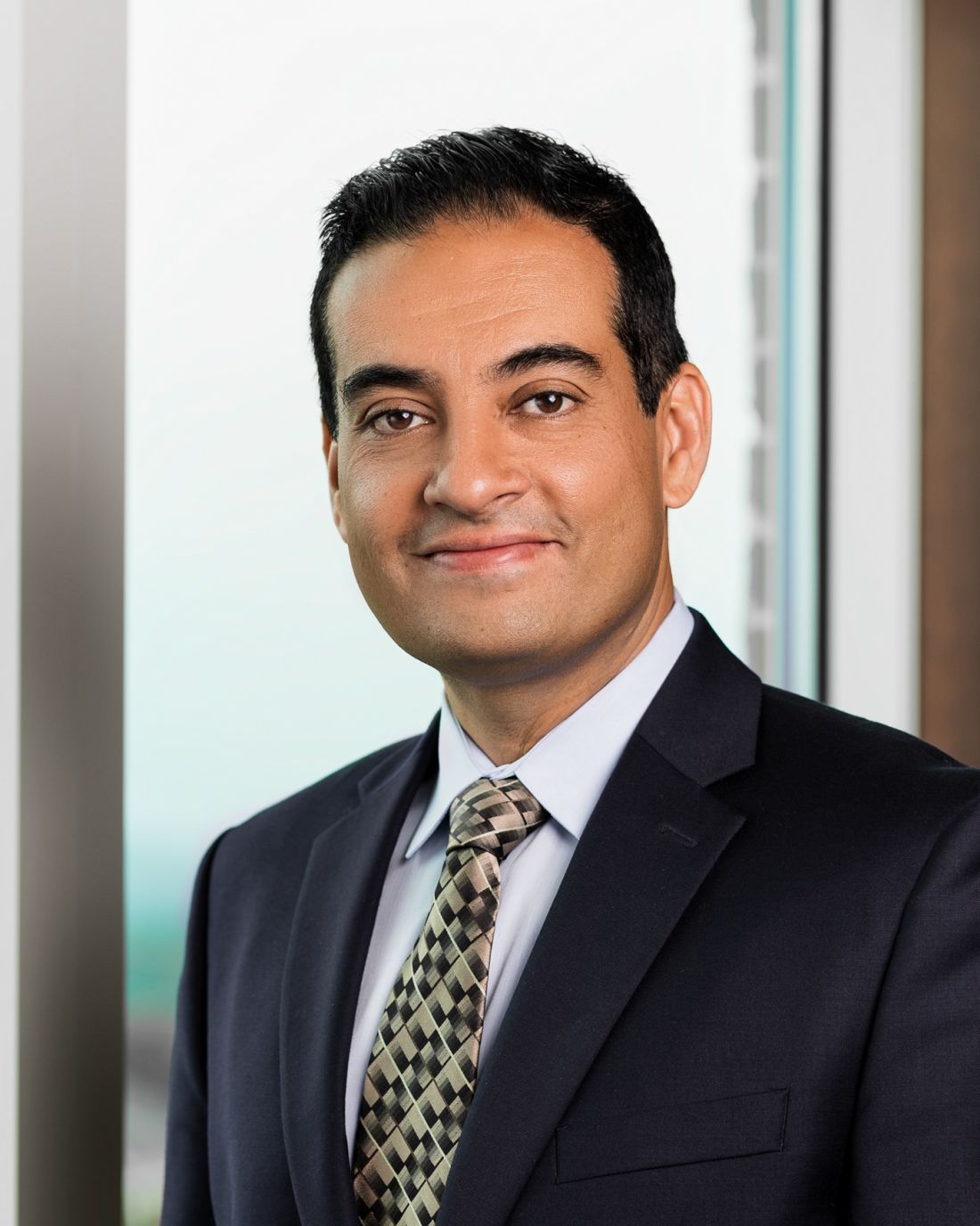
Many physicians stand willing and able to serve where they’re needed, but visa restrictions often block the ability of immigrant physicians to meet COVID-19 surges across the country, said Amit Vashist, MD, senior vice president and chief clinical officer for Ballad Health, Johnson City, Tenn., and a member of the public policy committee of the Society of Hospital Medicine. Ballad Health is an integrated health care system that serves 29 counties in the rural Southeast.
“This pandemic is a war with an invisible enemy, and immigrant physicians have been absolutely critical to providing quality care, especially on the front lines – but current visa restrictions have limited the ability to deploy these physicians in communities with the greatest need,” said Dr. Vashist during the press conference.
Visa requirements currently tie a non-US citizen resident physician to a particular institution and facility, limiting the ability to meet demand flexibly. “Federal agencies and Congress should provide additional flexibility in visa processing to allow for automatic renewals and expediting processing so immigrant medical workers can focus on treating the sick and not on their visa requirements,” said Dr. Vashist.
Dr. Vashist noted that, when he speaks with the many Ballad Health hospitalists who are waiting on permanent residency or citizenship, many of them also cite worries about the fate of their families should they themselves fall ill. Depending on the physician’s visa status, the family may face deportation without recourse if the physician should die.
“Tens of thousands of our physicians continue to endure years, even decades of waiting to obtain a permanent residency in the United States and at the same time, relentlessly and fearlessly serve their communities including in this COVID-19 pandemic,” said Dr. Vashist. “It’s time we take care of them and their long-term immigration needs, and give them the peace of mind that they so desperately deserve,” he added.
Frank Trinity, chief legal officer for the Association of American Medical Colleges, also participated in the call. “For decades,” he said, the United States “has relied on physicians from other countries, especially in rural and underserved areas.”
One of these physicians, Mihir Patel, MD, FHM, a hospitalist at Ballad Health, came to the United States in 2005, but 15 years later is still waiting for the green card that signifies U.S. permanent residency status. He is the corporate director of Ballad’s telemedicine program and is now also the medical director of the health system’s COVID-10 Strike Team.
“During the COVID crisis, these restrictions can cause significant negative impact for small rural hospitals,” Dr. Patel said. “There are physicians on a visa who cannot legally work outside their primary facilities – even though they are willing to do so.”
Regarding the pandemic, Mr. Trinity expressed concerns about whether the surge of patients would “outstrip our workforce.” He noted that, with an unprecedented number of desperately ill patients needing emergency care all across the country, “now is the time for our government to take every possible action to ensure that these highly qualified and courageous health professionals are available in the fight against the coronavirus.”
Mr. Trinity outlined five governmental actions AAMC is proposing to allow immigrant physicians to participate fully in the battle against COVID-19. The first would be to approve a blanket extension of visa deadlines. The second would be to expedite processing of visa extension applications, including reinstating expedited processing of physicians currently holding H-1B visa status.
The third action proposed by AAMC is to provide flexibility to visa sponsors during the emergency so that an individual whose visa is currently limited to a particular program can provide care at another location or by means of telehealth.
Fourth, AAMC proposes streamlined entry for the 4,200 physicians who are matched into residency programs so that they may begin their residencies on time or early.
Finally, Mr. Trinity said that AAMC is proposing that work authorizations be maintained for the 29,000 physicians who are currently not U.S. citizens and actively participating in the health care workforce.
Jacinta Ma, the Forum’s vice president of policy and advocacy, said immigrants are a critical component of the U.S. health care workforce as a whole.
“With immigrants accounting for 17% of health care workers amid the COVID-19 pandemic, it’s clear that they are vital to our communities,” she said. “Congress and the Trump administration both have an opportunity to advance solutions that protect immigrants, and remove immigration-related barriers for immigrant medical professionals by ensuring that immigrant doctors, nurses, home health care workers, researchers, and others can continue their vital work during this pandemic while being afforded adequate protection from COVID-19.”
Physicians and their sponsoring health care facilities shouldn’t have to worry about visa technicalities as they work on the front lines during the COVID-19 pandemic, said health care leaders and immigration reform advocates.
In a press call hosted by the National Immigration Forum, speakers highlighted the need for fast and flexible solutions to enable health care workers, including physicians, to contribute to efforts to combat the pandemic.
Nationwide, over one in five physicians are immigrants, according to data from the Forum. That figure is over one in three in New York, New Jersey, and California, three states hard-hit by COVID-19 cases.
Many physicians stand willing and able to serve where they’re needed, but visa restrictions often block the ability of immigrant physicians to meet COVID-19 surges across the country, said Amit Vashist, MD, senior vice president and chief clinical officer for Ballad Health, Johnson City, Tenn., and a member of the public policy committee of the Society of Hospital Medicine. Ballad Health is an integrated health care system that serves 29 counties in the rural Southeast.
“This pandemic is a war with an invisible enemy, and immigrant physicians have been absolutely critical to providing quality care, especially on the front lines – but current visa restrictions have limited the ability to deploy these physicians in communities with the greatest need,” said Dr. Vashist during the press conference.
Visa requirements currently tie a non-US citizen resident physician to a particular institution and facility, limiting the ability to meet demand flexibly. “Federal agencies and Congress should provide additional flexibility in visa processing to allow for automatic renewals and expediting processing so immigrant medical workers can focus on treating the sick and not on their visa requirements,” said Dr. Vashist.
Dr. Vashist noted that, when he speaks with the many Ballad Health hospitalists who are waiting on permanent residency or citizenship, many of them also cite worries about the fate of their families should they themselves fall ill. Depending on the physician’s visa status, the family may face deportation without recourse if the physician should die.
“Tens of thousands of our physicians continue to endure years, even decades of waiting to obtain a permanent residency in the United States and at the same time, relentlessly and fearlessly serve their communities including in this COVID-19 pandemic,” said Dr. Vashist. “It’s time we take care of them and their long-term immigration needs, and give them the peace of mind that they so desperately deserve,” he added.
Frank Trinity, chief legal officer for the Association of American Medical Colleges, also participated in the call. “For decades,” he said, the United States “has relied on physicians from other countries, especially in rural and underserved areas.”
One of these physicians, Mihir Patel, MD, FHM, a hospitalist at Ballad Health, came to the United States in 2005, but 15 years later is still waiting for the green card that signifies U.S. permanent residency status. He is the corporate director of Ballad’s telemedicine program and is now also the medical director of the health system’s COVID-10 Strike Team.
“During the COVID crisis, these restrictions can cause significant negative impact for small rural hospitals,” Dr. Patel said. “There are physicians on a visa who cannot legally work outside their primary facilities – even though they are willing to do so.”
Regarding the pandemic, Mr. Trinity expressed concerns about whether the surge of patients would “outstrip our workforce.” He noted that, with an unprecedented number of desperately ill patients needing emergency care all across the country, “now is the time for our government to take every possible action to ensure that these highly qualified and courageous health professionals are available in the fight against the coronavirus.”
Mr. Trinity outlined five governmental actions AAMC is proposing to allow immigrant physicians to participate fully in the battle against COVID-19. The first would be to approve a blanket extension of visa deadlines. The second would be to expedite processing of visa extension applications, including reinstating expedited processing of physicians currently holding H-1B visa status.
The third action proposed by AAMC is to provide flexibility to visa sponsors during the emergency so that an individual whose visa is currently limited to a particular program can provide care at another location or by means of telehealth.
Fourth, AAMC proposes streamlined entry for the 4,200 physicians who are matched into residency programs so that they may begin their residencies on time or early.
Finally, Mr. Trinity said that AAMC is proposing that work authorizations be maintained for the 29,000 physicians who are currently not U.S. citizens and actively participating in the health care workforce.
Jacinta Ma, the Forum’s vice president of policy and advocacy, said immigrants are a critical component of the U.S. health care workforce as a whole.
“With immigrants accounting for 17% of health care workers amid the COVID-19 pandemic, it’s clear that they are vital to our communities,” she said. “Congress and the Trump administration both have an opportunity to advance solutions that protect immigrants, and remove immigration-related barriers for immigrant medical professionals by ensuring that immigrant doctors, nurses, home health care workers, researchers, and others can continue their vital work during this pandemic while being afforded adequate protection from COVID-19.”
Physicians and their sponsoring health care facilities shouldn’t have to worry about visa technicalities as they work on the front lines during the COVID-19 pandemic, said health care leaders and immigration reform advocates.
In a press call hosted by the National Immigration Forum, speakers highlighted the need for fast and flexible solutions to enable health care workers, including physicians, to contribute to efforts to combat the pandemic.
Nationwide, over one in five physicians are immigrants, according to data from the Forum. That figure is over one in three in New York, New Jersey, and California, three states hard-hit by COVID-19 cases.
Many physicians stand willing and able to serve where they’re needed, but visa restrictions often block the ability of immigrant physicians to meet COVID-19 surges across the country, said Amit Vashist, MD, senior vice president and chief clinical officer for Ballad Health, Johnson City, Tenn., and a member of the public policy committee of the Society of Hospital Medicine. Ballad Health is an integrated health care system that serves 29 counties in the rural Southeast.
“This pandemic is a war with an invisible enemy, and immigrant physicians have been absolutely critical to providing quality care, especially on the front lines – but current visa restrictions have limited the ability to deploy these physicians in communities with the greatest need,” said Dr. Vashist during the press conference.
Visa requirements currently tie a non-US citizen resident physician to a particular institution and facility, limiting the ability to meet demand flexibly. “Federal agencies and Congress should provide additional flexibility in visa processing to allow for automatic renewals and expediting processing so immigrant medical workers can focus on treating the sick and not on their visa requirements,” said Dr. Vashist.
Dr. Vashist noted that, when he speaks with the many Ballad Health hospitalists who are waiting on permanent residency or citizenship, many of them also cite worries about the fate of their families should they themselves fall ill. Depending on the physician’s visa status, the family may face deportation without recourse if the physician should die.
“Tens of thousands of our physicians continue to endure years, even decades of waiting to obtain a permanent residency in the United States and at the same time, relentlessly and fearlessly serve their communities including in this COVID-19 pandemic,” said Dr. Vashist. “It’s time we take care of them and their long-term immigration needs, and give them the peace of mind that they so desperately deserve,” he added.
Frank Trinity, chief legal officer for the Association of American Medical Colleges, also participated in the call. “For decades,” he said, the United States “has relied on physicians from other countries, especially in rural and underserved areas.”
One of these physicians, Mihir Patel, MD, FHM, a hospitalist at Ballad Health, came to the United States in 2005, but 15 years later is still waiting for the green card that signifies U.S. permanent residency status. He is the corporate director of Ballad’s telemedicine program and is now also the medical director of the health system’s COVID-10 Strike Team.
“During the COVID crisis, these restrictions can cause significant negative impact for small rural hospitals,” Dr. Patel said. “There are physicians on a visa who cannot legally work outside their primary facilities – even though they are willing to do so.”
Regarding the pandemic, Mr. Trinity expressed concerns about whether the surge of patients would “outstrip our workforce.” He noted that, with an unprecedented number of desperately ill patients needing emergency care all across the country, “now is the time for our government to take every possible action to ensure that these highly qualified and courageous health professionals are available in the fight against the coronavirus.”
Mr. Trinity outlined five governmental actions AAMC is proposing to allow immigrant physicians to participate fully in the battle against COVID-19. The first would be to approve a blanket extension of visa deadlines. The second would be to expedite processing of visa extension applications, including reinstating expedited processing of physicians currently holding H-1B visa status.
The third action proposed by AAMC is to provide flexibility to visa sponsors during the emergency so that an individual whose visa is currently limited to a particular program can provide care at another location or by means of telehealth.
Fourth, AAMC proposes streamlined entry for the 4,200 physicians who are matched into residency programs so that they may begin their residencies on time or early.
Finally, Mr. Trinity said that AAMC is proposing that work authorizations be maintained for the 29,000 physicians who are currently not U.S. citizens and actively participating in the health care workforce.
Jacinta Ma, the Forum’s vice president of policy and advocacy, said immigrants are a critical component of the U.S. health care workforce as a whole.
“With immigrants accounting for 17% of health care workers amid the COVID-19 pandemic, it’s clear that they are vital to our communities,” she said. “Congress and the Trump administration both have an opportunity to advance solutions that protect immigrants, and remove immigration-related barriers for immigrant medical professionals by ensuring that immigrant doctors, nurses, home health care workers, researchers, and others can continue their vital work during this pandemic while being afforded adequate protection from COVID-19.”
Increased risk of lung cancer with COPD, even in never smokers
an observational cohort study has shown.
Patients with COPD who had never smoked had more than double the risk of developing lung cancer (with an adjusted hazard ratio [HR] of 2.67), compared to individuals without COPD who had never smoked.
This was slightly higher than the increased risk seen in individuals who had smoked but who did not have COPD. This group had an almost double the risk of developing lung cancer (adjusted HR, 1.97), again compared to never smokers, the investigators added.
The highest risk of lung cancer was in patients who had COPD and who had smoked; this group had a sixfold risk of developing lung cancer (adjusted HR, 6.19) compared with never smokers without COPD, they note.
“COPD was a strong independent risk factor for lung cancer incidence in never smokers,” conclude the authors, led by Hye Yun Park, MD, Samsung Medical Center, Seoul, South Korea.
“Future studies should evaluate whether COPD patients are candidates for lung cancer screening, irrespective of smoking status,” they suggest.
The study was published March 10 in the journal Thorax.
It was based on an analysis of data from the National Health Insurance (NHS) Service National Sample Cohort between January 2002 and December 2013.
“We included all men and women, 40 to 84 years of age, who underwent at least one health screening examination provided by the NHS during the study period,” Park and colleagues explain.
Overall, the cohort included 338,548 men and women. Participants were followed-up for a median of 7 years.
Over the study interval, 1834 participants developed lung cancer.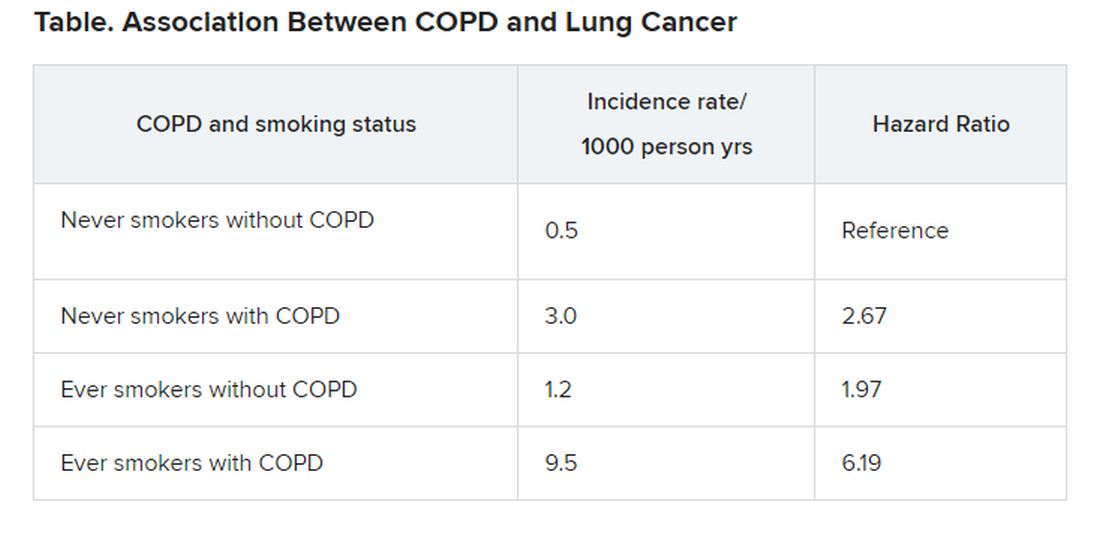
“The risk of disease [lung cancer] in never smokers with COPD was higher than that in ever smokers without COPD,” the investigators observe.
“Given that poor lung function in COPD is often a barrier to optimal lung cancer treatment due to increased risk of treatment-related morbidities, our study suggests that early detection of lung cancer in COPD patients may reduce the risk of treatment complications,” the authors write.
The study was supported by the National Research Foundation of Korea. The authors have disclosed no relevant financial relationships.
This article first appeared on Medscape.com.
an observational cohort study has shown.
Patients with COPD who had never smoked had more than double the risk of developing lung cancer (with an adjusted hazard ratio [HR] of 2.67), compared to individuals without COPD who had never smoked.
This was slightly higher than the increased risk seen in individuals who had smoked but who did not have COPD. This group had an almost double the risk of developing lung cancer (adjusted HR, 1.97), again compared to never smokers, the investigators added.
The highest risk of lung cancer was in patients who had COPD and who had smoked; this group had a sixfold risk of developing lung cancer (adjusted HR, 6.19) compared with never smokers without COPD, they note.
“COPD was a strong independent risk factor for lung cancer incidence in never smokers,” conclude the authors, led by Hye Yun Park, MD, Samsung Medical Center, Seoul, South Korea.
“Future studies should evaluate whether COPD patients are candidates for lung cancer screening, irrespective of smoking status,” they suggest.
The study was published March 10 in the journal Thorax.
It was based on an analysis of data from the National Health Insurance (NHS) Service National Sample Cohort between January 2002 and December 2013.
“We included all men and women, 40 to 84 years of age, who underwent at least one health screening examination provided by the NHS during the study period,” Park and colleagues explain.
Overall, the cohort included 338,548 men and women. Participants were followed-up for a median of 7 years.
Over the study interval, 1834 participants developed lung cancer.
“The risk of disease [lung cancer] in never smokers with COPD was higher than that in ever smokers without COPD,” the investigators observe.
“Given that poor lung function in COPD is often a barrier to optimal lung cancer treatment due to increased risk of treatment-related morbidities, our study suggests that early detection of lung cancer in COPD patients may reduce the risk of treatment complications,” the authors write.
The study was supported by the National Research Foundation of Korea. The authors have disclosed no relevant financial relationships.
This article first appeared on Medscape.com.
an observational cohort study has shown.
Patients with COPD who had never smoked had more than double the risk of developing lung cancer (with an adjusted hazard ratio [HR] of 2.67), compared to individuals without COPD who had never smoked.
This was slightly higher than the increased risk seen in individuals who had smoked but who did not have COPD. This group had an almost double the risk of developing lung cancer (adjusted HR, 1.97), again compared to never smokers, the investigators added.
The highest risk of lung cancer was in patients who had COPD and who had smoked; this group had a sixfold risk of developing lung cancer (adjusted HR, 6.19) compared with never smokers without COPD, they note.
“COPD was a strong independent risk factor for lung cancer incidence in never smokers,” conclude the authors, led by Hye Yun Park, MD, Samsung Medical Center, Seoul, South Korea.
“Future studies should evaluate whether COPD patients are candidates for lung cancer screening, irrespective of smoking status,” they suggest.
The study was published March 10 in the journal Thorax.
It was based on an analysis of data from the National Health Insurance (NHS) Service National Sample Cohort between January 2002 and December 2013.
“We included all men and women, 40 to 84 years of age, who underwent at least one health screening examination provided by the NHS during the study period,” Park and colleagues explain.
Overall, the cohort included 338,548 men and women. Participants were followed-up for a median of 7 years.
Over the study interval, 1834 participants developed lung cancer.
“The risk of disease [lung cancer] in never smokers with COPD was higher than that in ever smokers without COPD,” the investigators observe.
“Given that poor lung function in COPD is often a barrier to optimal lung cancer treatment due to increased risk of treatment-related morbidities, our study suggests that early detection of lung cancer in COPD patients may reduce the risk of treatment complications,” the authors write.
The study was supported by the National Research Foundation of Korea. The authors have disclosed no relevant financial relationships.
This article first appeared on Medscape.com.
COVID-19 registry tracks pregnant women, newborns
A multidisciplinary team of researchers has created a national registry to study how COVID-19 affects pregnant women and their newborns.
“Pregnant women are generally considered healthy, but they are also a vulnerable group, and we currently have no data on COVID-19 in pregnancy,” coprincipal investigator Yalda Afshar, MD, PhD, an ob.gyn. at UCLA Health in Los Angeles, said in an interview.
“We expect this registry to provide data that will be critical in helping to improve care for pregnant women during this global pandemic,” Dr. Afshar, a fellow with UCLA Biodesign, stated in a news release.
The Pregnancy Coronavirus Outcomes Registry is enrolling pregnant women and those who have been pregnant or post partum within the past 6 weeks and who have either received a confirmed diagnosis of COVID-19 or are being evaluated for COVID-19.
Women are being recruited through their health care provider. A study coordinator contacts the participants by telephone. Women can also join the registry on their own without a referral by visiting the registry website.
The registry collects data on COVID-19 symptoms, clinical course, pregnancy, and neonatal outcomes and follows women from enrollment through the second and third trimesters and the postpartum period. The goal is to follow the mothers and babies for up to 1 year.
Hundreds of women already enrolled
Dr. Afshar noted that these kinds of registries often take months to design and to receive funding, but with COVID-19, “there was no time for that. We had to get it up and running ASAP.”
She said the team has been “blown away” by how quickly people have come forward to join the registry. Within 2 weeks of going live, the registry had enrolled more than 400 participants from across the United States. “At this rate, I think we will easily get 1,000 participants in a month or so,” Dr. Afshar said.
“With the global reach of this disease, the findings resulting from this work have the potential to impact millions of lives in an entire generation,” Johnese Spisso, CEO of UCLA Health, said in the news release.
Dr. Afshar noted that, although the impact of COVID-19 on pregnancy remains unknown, history suggests the disease will make some pregnancies and deliveries more challenging. “We know that in previous outbreaks of the regular flu, for example, there have been more deaths and poorer outcomes among pregnant women compared with nonpregnant women.”
Dr. Afshar is overseeing the study with colleagues at the University of California, Los Angeles, and the University of California, San Francisco, where the registry data will be coordinated.
“In addition to gaining a better understanding of the course of the disease, we will investigate disease transmission to determine if it can be passed from a mother to her baby in utero and during the postpartum period, such as in breast milk,” UCSF’s Stephanie Gaw, MD, PhD, who is leading the biospecimen core of the study, said in the release.
Health care providers interested in more information about the registry may send an email to PRIORITYCOVID19@ucsf.edu. A YouTube video on the registry is also available.
Dr. Afshar disclosed no relevant financial relationships.
A version of this article originally appeared on Medscape.com.
A multidisciplinary team of researchers has created a national registry to study how COVID-19 affects pregnant women and their newborns.
“Pregnant women are generally considered healthy, but they are also a vulnerable group, and we currently have no data on COVID-19 in pregnancy,” coprincipal investigator Yalda Afshar, MD, PhD, an ob.gyn. at UCLA Health in Los Angeles, said in an interview.
“We expect this registry to provide data that will be critical in helping to improve care for pregnant women during this global pandemic,” Dr. Afshar, a fellow with UCLA Biodesign, stated in a news release.
The Pregnancy Coronavirus Outcomes Registry is enrolling pregnant women and those who have been pregnant or post partum within the past 6 weeks and who have either received a confirmed diagnosis of COVID-19 or are being evaluated for COVID-19.
Women are being recruited through their health care provider. A study coordinator contacts the participants by telephone. Women can also join the registry on their own without a referral by visiting the registry website.
The registry collects data on COVID-19 symptoms, clinical course, pregnancy, and neonatal outcomes and follows women from enrollment through the second and third trimesters and the postpartum period. The goal is to follow the mothers and babies for up to 1 year.
Hundreds of women already enrolled
Dr. Afshar noted that these kinds of registries often take months to design and to receive funding, but with COVID-19, “there was no time for that. We had to get it up and running ASAP.”
She said the team has been “blown away” by how quickly people have come forward to join the registry. Within 2 weeks of going live, the registry had enrolled more than 400 participants from across the United States. “At this rate, I think we will easily get 1,000 participants in a month or so,” Dr. Afshar said.
“With the global reach of this disease, the findings resulting from this work have the potential to impact millions of lives in an entire generation,” Johnese Spisso, CEO of UCLA Health, said in the news release.
Dr. Afshar noted that, although the impact of COVID-19 on pregnancy remains unknown, history suggests the disease will make some pregnancies and deliveries more challenging. “We know that in previous outbreaks of the regular flu, for example, there have been more deaths and poorer outcomes among pregnant women compared with nonpregnant women.”
Dr. Afshar is overseeing the study with colleagues at the University of California, Los Angeles, and the University of California, San Francisco, where the registry data will be coordinated.
“In addition to gaining a better understanding of the course of the disease, we will investigate disease transmission to determine if it can be passed from a mother to her baby in utero and during the postpartum period, such as in breast milk,” UCSF’s Stephanie Gaw, MD, PhD, who is leading the biospecimen core of the study, said in the release.
Health care providers interested in more information about the registry may send an email to PRIORITYCOVID19@ucsf.edu. A YouTube video on the registry is also available.
Dr. Afshar disclosed no relevant financial relationships.
A version of this article originally appeared on Medscape.com.
A multidisciplinary team of researchers has created a national registry to study how COVID-19 affects pregnant women and their newborns.
“Pregnant women are generally considered healthy, but they are also a vulnerable group, and we currently have no data on COVID-19 in pregnancy,” coprincipal investigator Yalda Afshar, MD, PhD, an ob.gyn. at UCLA Health in Los Angeles, said in an interview.
“We expect this registry to provide data that will be critical in helping to improve care for pregnant women during this global pandemic,” Dr. Afshar, a fellow with UCLA Biodesign, stated in a news release.
The Pregnancy Coronavirus Outcomes Registry is enrolling pregnant women and those who have been pregnant or post partum within the past 6 weeks and who have either received a confirmed diagnosis of COVID-19 or are being evaluated for COVID-19.
Women are being recruited through their health care provider. A study coordinator contacts the participants by telephone. Women can also join the registry on their own without a referral by visiting the registry website.
The registry collects data on COVID-19 symptoms, clinical course, pregnancy, and neonatal outcomes and follows women from enrollment through the second and third trimesters and the postpartum period. The goal is to follow the mothers and babies for up to 1 year.
Hundreds of women already enrolled
Dr. Afshar noted that these kinds of registries often take months to design and to receive funding, but with COVID-19, “there was no time for that. We had to get it up and running ASAP.”
She said the team has been “blown away” by how quickly people have come forward to join the registry. Within 2 weeks of going live, the registry had enrolled more than 400 participants from across the United States. “At this rate, I think we will easily get 1,000 participants in a month or so,” Dr. Afshar said.
“With the global reach of this disease, the findings resulting from this work have the potential to impact millions of lives in an entire generation,” Johnese Spisso, CEO of UCLA Health, said in the news release.
Dr. Afshar noted that, although the impact of COVID-19 on pregnancy remains unknown, history suggests the disease will make some pregnancies and deliveries more challenging. “We know that in previous outbreaks of the regular flu, for example, there have been more deaths and poorer outcomes among pregnant women compared with nonpregnant women.”
Dr. Afshar is overseeing the study with colleagues at the University of California, Los Angeles, and the University of California, San Francisco, where the registry data will be coordinated.
“In addition to gaining a better understanding of the course of the disease, we will investigate disease transmission to determine if it can be passed from a mother to her baby in utero and during the postpartum period, such as in breast milk,” UCSF’s Stephanie Gaw, MD, PhD, who is leading the biospecimen core of the study, said in the release.
Health care providers interested in more information about the registry may send an email to PRIORITYCOVID19@ucsf.edu. A YouTube video on the registry is also available.
Dr. Afshar disclosed no relevant financial relationships.
A version of this article originally appeared on Medscape.com.
Certain anaerobic bacteria linked to increased CRC risk
Certain species of anaerobic bacteria have been linked to dramatic increases in colorectal cancer (CRC), often within a year of infection, although whether or not the bacteria are causal has yet to be determined, say Danish researchers.
“We are not convinced that all the bacteria are directly involved in CRC development — they could just be innocent bystanders that invade the blood stream when the cancer [itself] has caused a breach in the intestinal wall,” lead author Ulrik Justesen, MD, Odense University Hospital, Denmark, told Medscape Medical News in an email.
“But an algorithm for colonoscopy based on the [infecting] species, which could then be supplemented with specific characteristics [of the bacteria] along with age, is certainly a realistic perspective,” he added.
The study was to have be presented at the European Congress of Clinical Microbiology and Infectious Diseases (ECCMID) in Paris, France, but the conference was canceled due to COVID-19.
Another study suggesting a link between bacteria and CRC was published earlier this year in Nature, as reported at the time by Medscape Medical News. That study, from the Netherlands, suggests that a strain of Escherichia coli may be involved in the development of CRC.
Population-Based Study
The latest study from Denmark was a population-based study involving over 2 million people.
From this large cohort, blood culture data from the years 2007 and 2016 were analyzed.
“We combined blood culture data with the national register for colorectal cancer — the Danish Colorectal Cancer Group Database — and identified incident CRC after bacteraemia,” the investigators state.
The risk for incident CRC was investigated specifically for the anaerobic bacteria Bacteroides spp, Clostridium spp, and Fusobacterium spp.
Incident rates were then compared to those from nonanaerobic bacteria, including the Streptococcus bovis group, Escherichia coli, and Staphylococcus aureus, as well as from negative blood samples.
“We included 45,760 bacteraemia episodes, of which 492 or 1.1% were diagnosed with CRC after the bacteraemia; 241 ― 0.5% ― within 1 year,” the researchers report.
The risk for CRC was notably increased in association with most anaerobic species, compared with negative blood cultures and with E coli and S aureus cultures, for which the risk was similar to that of negative blood cultures.
For example, infection with C septicum was associated with a 42 times greater risk for CRC within 1 year of infection and a 21 times greater risk overall with no time limitation.
Infection with B ovatus was linked to a 13 times greater risk for CRC within 1 year and a six times greater risk overall with no time limitation.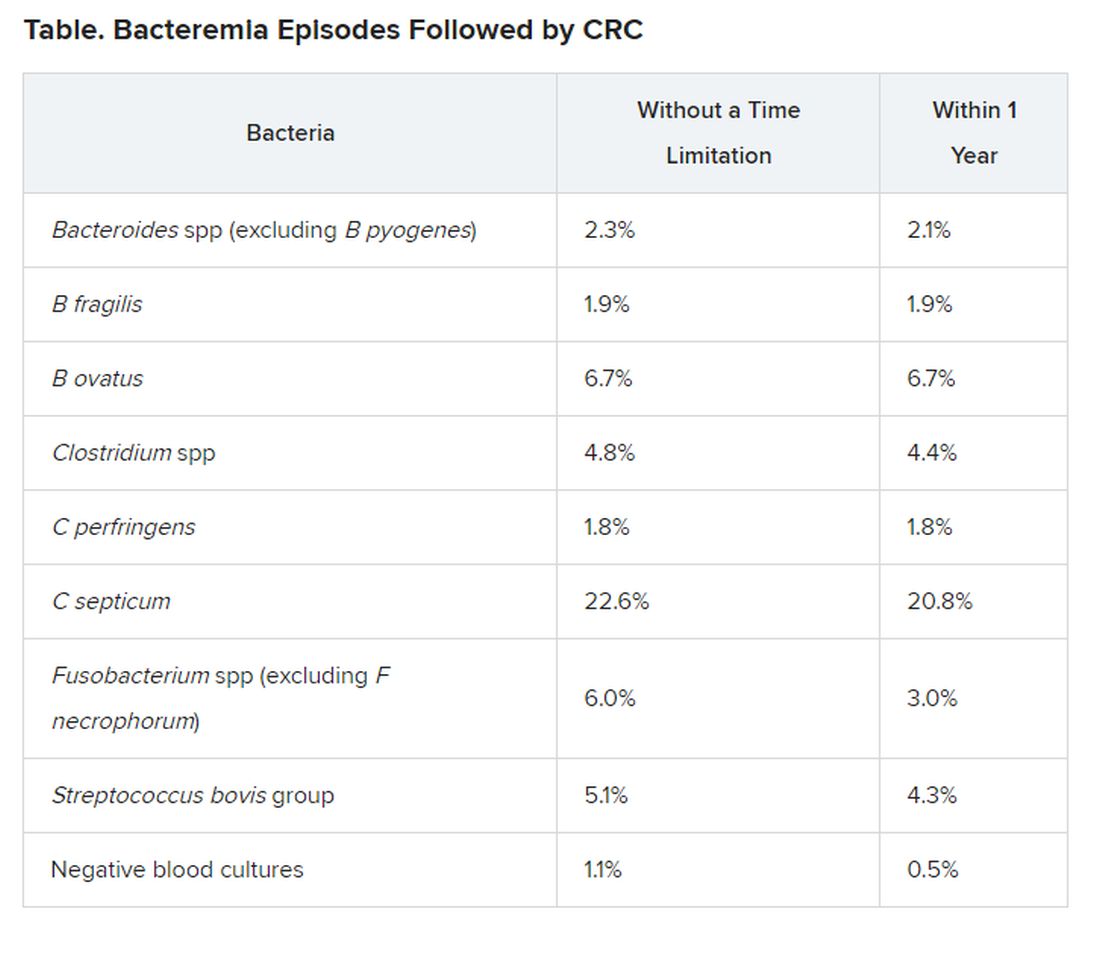
Justesen noted that their group will now focus on specific bacteria from cancer patients in an effort to identify characteristics of the bacteria that could be implicated in cancer development.
“If this is the case, it could be of great importance when it comes to screening and treatment of CRC,” he said in a statement.
For example, if there was evidence that a patient had been infected with C septicum, the anaerobic species associated with the highest risk for CRC within 1 year of infection, “we would immediately inform the treating physician about this risk and that the [patient] should be investigated further,” he told Medscape Medical News.
Justesen also noted that if there was evidence that a patient was infected with any of these high-risk bacteria and the patient was elderly, “then it would definitely be worth screening the patient for CRC,” he said. However, more research is needed before specific recommendations can be made for CRC screening in the context of any anaerobic infection, he stressed.
Justesen has disclosed no relevant financial relationships.
This article first appeared on Medscape.com.
Certain species of anaerobic bacteria have been linked to dramatic increases in colorectal cancer (CRC), often within a year of infection, although whether or not the bacteria are causal has yet to be determined, say Danish researchers.
“We are not convinced that all the bacteria are directly involved in CRC development — they could just be innocent bystanders that invade the blood stream when the cancer [itself] has caused a breach in the intestinal wall,” lead author Ulrik Justesen, MD, Odense University Hospital, Denmark, told Medscape Medical News in an email.
“But an algorithm for colonoscopy based on the [infecting] species, which could then be supplemented with specific characteristics [of the bacteria] along with age, is certainly a realistic perspective,” he added.
The study was to have be presented at the European Congress of Clinical Microbiology and Infectious Diseases (ECCMID) in Paris, France, but the conference was canceled due to COVID-19.
Another study suggesting a link between bacteria and CRC was published earlier this year in Nature, as reported at the time by Medscape Medical News. That study, from the Netherlands, suggests that a strain of Escherichia coli may be involved in the development of CRC.
Population-Based Study
The latest study from Denmark was a population-based study involving over 2 million people.
From this large cohort, blood culture data from the years 2007 and 2016 were analyzed.
“We combined blood culture data with the national register for colorectal cancer — the Danish Colorectal Cancer Group Database — and identified incident CRC after bacteraemia,” the investigators state.
The risk for incident CRC was investigated specifically for the anaerobic bacteria Bacteroides spp, Clostridium spp, and Fusobacterium spp.
Incident rates were then compared to those from nonanaerobic bacteria, including the Streptococcus bovis group, Escherichia coli, and Staphylococcus aureus, as well as from negative blood samples.
“We included 45,760 bacteraemia episodes, of which 492 or 1.1% were diagnosed with CRC after the bacteraemia; 241 ― 0.5% ― within 1 year,” the researchers report.
The risk for CRC was notably increased in association with most anaerobic species, compared with negative blood cultures and with E coli and S aureus cultures, for which the risk was similar to that of negative blood cultures.
For example, infection with C septicum was associated with a 42 times greater risk for CRC within 1 year of infection and a 21 times greater risk overall with no time limitation.
Infection with B ovatus was linked to a 13 times greater risk for CRC within 1 year and a six times greater risk overall with no time limitation.
Justesen noted that their group will now focus on specific bacteria from cancer patients in an effort to identify characteristics of the bacteria that could be implicated in cancer development.
“If this is the case, it could be of great importance when it comes to screening and treatment of CRC,” he said in a statement.
For example, if there was evidence that a patient had been infected with C septicum, the anaerobic species associated with the highest risk for CRC within 1 year of infection, “we would immediately inform the treating physician about this risk and that the [patient] should be investigated further,” he told Medscape Medical News.
Justesen also noted that if there was evidence that a patient was infected with any of these high-risk bacteria and the patient was elderly, “then it would definitely be worth screening the patient for CRC,” he said. However, more research is needed before specific recommendations can be made for CRC screening in the context of any anaerobic infection, he stressed.
Justesen has disclosed no relevant financial relationships.
This article first appeared on Medscape.com.
Certain species of anaerobic bacteria have been linked to dramatic increases in colorectal cancer (CRC), often within a year of infection, although whether or not the bacteria are causal has yet to be determined, say Danish researchers.
“We are not convinced that all the bacteria are directly involved in CRC development — they could just be innocent bystanders that invade the blood stream when the cancer [itself] has caused a breach in the intestinal wall,” lead author Ulrik Justesen, MD, Odense University Hospital, Denmark, told Medscape Medical News in an email.
“But an algorithm for colonoscopy based on the [infecting] species, which could then be supplemented with specific characteristics [of the bacteria] along with age, is certainly a realistic perspective,” he added.
The study was to have be presented at the European Congress of Clinical Microbiology and Infectious Diseases (ECCMID) in Paris, France, but the conference was canceled due to COVID-19.
Another study suggesting a link between bacteria and CRC was published earlier this year in Nature, as reported at the time by Medscape Medical News. That study, from the Netherlands, suggests that a strain of Escherichia coli may be involved in the development of CRC.
Population-Based Study
The latest study from Denmark was a population-based study involving over 2 million people.
From this large cohort, blood culture data from the years 2007 and 2016 were analyzed.
“We combined blood culture data with the national register for colorectal cancer — the Danish Colorectal Cancer Group Database — and identified incident CRC after bacteraemia,” the investigators state.
The risk for incident CRC was investigated specifically for the anaerobic bacteria Bacteroides spp, Clostridium spp, and Fusobacterium spp.
Incident rates were then compared to those from nonanaerobic bacteria, including the Streptococcus bovis group, Escherichia coli, and Staphylococcus aureus, as well as from negative blood samples.
“We included 45,760 bacteraemia episodes, of which 492 or 1.1% were diagnosed with CRC after the bacteraemia; 241 ― 0.5% ― within 1 year,” the researchers report.
The risk for CRC was notably increased in association with most anaerobic species, compared with negative blood cultures and with E coli and S aureus cultures, for which the risk was similar to that of negative blood cultures.
For example, infection with C septicum was associated with a 42 times greater risk for CRC within 1 year of infection and a 21 times greater risk overall with no time limitation.
Infection with B ovatus was linked to a 13 times greater risk for CRC within 1 year and a six times greater risk overall with no time limitation.
Justesen noted that their group will now focus on specific bacteria from cancer patients in an effort to identify characteristics of the bacteria that could be implicated in cancer development.
“If this is the case, it could be of great importance when it comes to screening and treatment of CRC,” he said in a statement.
For example, if there was evidence that a patient had been infected with C septicum, the anaerobic species associated with the highest risk for CRC within 1 year of infection, “we would immediately inform the treating physician about this risk and that the [patient] should be investigated further,” he told Medscape Medical News.
Justesen also noted that if there was evidence that a patient was infected with any of these high-risk bacteria and the patient was elderly, “then it would definitely be worth screening the patient for CRC,” he said. However, more research is needed before specific recommendations can be made for CRC screening in the context of any anaerobic infection, he stressed.
Justesen has disclosed no relevant financial relationships.
This article first appeared on Medscape.com.
COVID-19: Telemedicine boosting access but is not a panacea
The recent surge in telemedicine services fueled by the COVID-19 pandemic has improved access to psychiatry care and may have set the stage for even more dramatic forays into virtual care in the future. However, not all patients want video visits, and it is not clear that the way telepsychiatry is practiced right now will be the best model for clinical practice once the crisis abates, speakers said at the annual meeting of the American Psychiatric Association, which was held as a virtual live event.

The COVID-19 pandemic has effectively “democratized” telepsychiatry, a mode of health care delivery that previously was thought of as “overly complex” and limited to a few specialists, said Avrim Fishkind, MD, CEO/consultant in emergency psychiatry and psychiatric emergency services design at Empathic Soul Health in Houston.
“In a blink of an eye, every psychiatrist and every mental health professional now can see themselves – and many have been forced into – becoming telepsychiatrists,” Dr. Fishkind said in a presentation at the meeting.
“Access to you is fantastic ... and your no-show rates decrease dramatically when people have flexibility to talk to you when they want to schedule and where they want to schedule.”
On the other hand, telepsychiatry should not be viewed as a panacea, cautioned Patrice A. Harris, MD, a child and adolescent psychiatrist and current president of the American Medical Association. The AMA has advocated for the more flexible federal regulations and payment policies that have helped boost telemedicine adoption during the crisis.
“Not every regulation that was relaxed, and not everything we are doing now in the midst of this pandemic, should be continued,” Dr. Harris said in a question-and-answer session earlier in the conference.
“I don’t want us all to say, ‘Wow, we had this experience, and it worked,’ and then continue to do it in the exact same way,” she added. “I know that we, the APA, and AMA, will be there to have a thoughtful, science-based, data-driven conversation about the next move regarding telemedicine and telehealth after we get through this pandemic.”
Telepsychiatry has nevertheless proven very versatile and applicable to a broad swath of patients during the COVID-19 pandemic, according to Dr. Fishkind. “I start from the position that I can see every patient this way, and I have to find a reason why I can’t,” said Dr. Fishkind, who also is lead telepsychiatrist at the Harris Center in Houston and a past president of the American Association for Emergency Psychiatry.
Telemedicine services can be as good as office visits, if not better, he told attendees at the virtual meeting. For example, a virtual visit can obviate the need for an in-person evaluation of a child with autism for whom an in-person visit would be challenging for the patient and parent alike.
However, Dr. Fishkind acknowledged that telepsychiatry is not for everyone: “I don’t want to say it’s heaven on earth. There are some patients who do refuse to be seen this way.”
What happens next in telepsychiatry is anyone’s guess, though Dr. Fishkind said he envisions an online “wheel of access” model of psychiatric services delivery.
In this portal-style model, the psychiatric patient might log in, answer a few automated questions, and then, based on their responses, they would be routed to a social worker or nurse navigator at the center of that services wheel.
In turn, the navigator might route the patient to one of the services on the spokes of the wheel, such as a psychiatrist consult, video-based or online cognitive-behavioral therapy, peer forums, group therapy, a pharmacist, or to other clinicians and interventions.
“Patients would have instant access to all of the things that we always want them to have access to – but now, by using virtual technologies, they could actually get them,” said Dr. Fishkind.
Dr. Fishkind reported no financial conflicts.
SOURCE: Fishkind A. APA 2020, Abstract.
The recent surge in telemedicine services fueled by the COVID-19 pandemic has improved access to psychiatry care and may have set the stage for even more dramatic forays into virtual care in the future. However, not all patients want video visits, and it is not clear that the way telepsychiatry is practiced right now will be the best model for clinical practice once the crisis abates, speakers said at the annual meeting of the American Psychiatric Association, which was held as a virtual live event.
The COVID-19 pandemic has effectively “democratized” telepsychiatry, a mode of health care delivery that previously was thought of as “overly complex” and limited to a few specialists, said Avrim Fishkind, MD, CEO/consultant in emergency psychiatry and psychiatric emergency services design at Empathic Soul Health in Houston.
“In a blink of an eye, every psychiatrist and every mental health professional now can see themselves – and many have been forced into – becoming telepsychiatrists,” Dr. Fishkind said in a presentation at the meeting.
“Access to you is fantastic ... and your no-show rates decrease dramatically when people have flexibility to talk to you when they want to schedule and where they want to schedule.”
On the other hand, telepsychiatry should not be viewed as a panacea, cautioned Patrice A. Harris, MD, a child and adolescent psychiatrist and current president of the American Medical Association. The AMA has advocated for the more flexible federal regulations and payment policies that have helped boost telemedicine adoption during the crisis.
“Not every regulation that was relaxed, and not everything we are doing now in the midst of this pandemic, should be continued,” Dr. Harris said in a question-and-answer session earlier in the conference.
“I don’t want us all to say, ‘Wow, we had this experience, and it worked,’ and then continue to do it in the exact same way,” she added. “I know that we, the APA, and AMA, will be there to have a thoughtful, science-based, data-driven conversation about the next move regarding telemedicine and telehealth after we get through this pandemic.”
Telepsychiatry has nevertheless proven very versatile and applicable to a broad swath of patients during the COVID-19 pandemic, according to Dr. Fishkind. “I start from the position that I can see every patient this way, and I have to find a reason why I can’t,” said Dr. Fishkind, who also is lead telepsychiatrist at the Harris Center in Houston and a past president of the American Association for Emergency Psychiatry.
Telemedicine services can be as good as office visits, if not better, he told attendees at the virtual meeting. For example, a virtual visit can obviate the need for an in-person evaluation of a child with autism for whom an in-person visit would be challenging for the patient and parent alike.
However, Dr. Fishkind acknowledged that telepsychiatry is not for everyone: “I don’t want to say it’s heaven on earth. There are some patients who do refuse to be seen this way.”
What happens next in telepsychiatry is anyone’s guess, though Dr. Fishkind said he envisions an online “wheel of access” model of psychiatric services delivery.
In this portal-style model, the psychiatric patient might log in, answer a few automated questions, and then, based on their responses, they would be routed to a social worker or nurse navigator at the center of that services wheel.
In turn, the navigator might route the patient to one of the services on the spokes of the wheel, such as a psychiatrist consult, video-based or online cognitive-behavioral therapy, peer forums, group therapy, a pharmacist, or to other clinicians and interventions.
“Patients would have instant access to all of the things that we always want them to have access to – but now, by using virtual technologies, they could actually get them,” said Dr. Fishkind.
Dr. Fishkind reported no financial conflicts.
SOURCE: Fishkind A. APA 2020, Abstract.
The recent surge in telemedicine services fueled by the COVID-19 pandemic has improved access to psychiatry care and may have set the stage for even more dramatic forays into virtual care in the future. However, not all patients want video visits, and it is not clear that the way telepsychiatry is practiced right now will be the best model for clinical practice once the crisis abates, speakers said at the annual meeting of the American Psychiatric Association, which was held as a virtual live event.
The COVID-19 pandemic has effectively “democratized” telepsychiatry, a mode of health care delivery that previously was thought of as “overly complex” and limited to a few specialists, said Avrim Fishkind, MD, CEO/consultant in emergency psychiatry and psychiatric emergency services design at Empathic Soul Health in Houston.
“In a blink of an eye, every psychiatrist and every mental health professional now can see themselves – and many have been forced into – becoming telepsychiatrists,” Dr. Fishkind said in a presentation at the meeting.
“Access to you is fantastic ... and your no-show rates decrease dramatically when people have flexibility to talk to you when they want to schedule and where they want to schedule.”
On the other hand, telepsychiatry should not be viewed as a panacea, cautioned Patrice A. Harris, MD, a child and adolescent psychiatrist and current president of the American Medical Association. The AMA has advocated for the more flexible federal regulations and payment policies that have helped boost telemedicine adoption during the crisis.
“Not every regulation that was relaxed, and not everything we are doing now in the midst of this pandemic, should be continued,” Dr. Harris said in a question-and-answer session earlier in the conference.
“I don’t want us all to say, ‘Wow, we had this experience, and it worked,’ and then continue to do it in the exact same way,” she added. “I know that we, the APA, and AMA, will be there to have a thoughtful, science-based, data-driven conversation about the next move regarding telemedicine and telehealth after we get through this pandemic.”
Telepsychiatry has nevertheless proven very versatile and applicable to a broad swath of patients during the COVID-19 pandemic, according to Dr. Fishkind. “I start from the position that I can see every patient this way, and I have to find a reason why I can’t,” said Dr. Fishkind, who also is lead telepsychiatrist at the Harris Center in Houston and a past president of the American Association for Emergency Psychiatry.
Telemedicine services can be as good as office visits, if not better, he told attendees at the virtual meeting. For example, a virtual visit can obviate the need for an in-person evaluation of a child with autism for whom an in-person visit would be challenging for the patient and parent alike.
However, Dr. Fishkind acknowledged that telepsychiatry is not for everyone: “I don’t want to say it’s heaven on earth. There are some patients who do refuse to be seen this way.”
What happens next in telepsychiatry is anyone’s guess, though Dr. Fishkind said he envisions an online “wheel of access” model of psychiatric services delivery.
In this portal-style model, the psychiatric patient might log in, answer a few automated questions, and then, based on their responses, they would be routed to a social worker or nurse navigator at the center of that services wheel.
In turn, the navigator might route the patient to one of the services on the spokes of the wheel, such as a psychiatrist consult, video-based or online cognitive-behavioral therapy, peer forums, group therapy, a pharmacist, or to other clinicians and interventions.
“Patients would have instant access to all of the things that we always want them to have access to – but now, by using virtual technologies, they could actually get them,” said Dr. Fishkind.
Dr. Fishkind reported no financial conflicts.
SOURCE: Fishkind A. APA 2020, Abstract.
FROM APA 2020
COVID-19 linked to large vessel stroke in young adults
In a rapid communication to be published online April 29 in the New England Journal of Medicine, investigators led by Thomas Oxley, MD, PhD, of the department of neurosurgery at Mount Sinai Health System, reported five cases of large vessel stroke over a 2-week period in COVID-19 patients under age 50 years. This represents a sevenfold increase in what would normally be expected.
The five cases had either no, or mild, COVID-19 symptoms.
“It’s been surprising to learn that the virus appears to cause disease through a process of blood clotting,” Dr. Oxley said in an interview.
The message for neurologists and other physicians is “we’re learning that this can disproportionally affect large vessels more than small vessels in terms of presentation of stroke,” he said.
Inflammation in the blood vessel walls may be driving thrombosis formation, Dr. Oxley added. This report joins other research pointing to this emerging phenomenon.
Recently, investigators in the Netherlands found a “remarkably high” 31% rate of thrombotic complications among 184 critical care patients with COVID-19 pneumonia.
Dr. Oxley and colleagues also suggested that, since the onset of the pandemic, fewer patients may be calling emergency services when they experience signs of a stroke. The physicians noted that two of the five cases in the report delayed calling an ambulance.
“I understand why people do not want to leave the household. I think people are more willing to ignore other [non–COVID-19] symptoms in this environment,” he said.
As previously reported, physicians in hospitals across the United States and elsewhere have reported a significant drop in stroke patients since the COVID-19 pandemic took hold, which suggests that patients may indeed be foregoing emergency care.
The observations from Dr. Oxley and colleagues call for greater awareness of the association between COVID-19 and large vessel strokes in this age group, they add.
One patient in the case series died, one remains hospitalized, two are undergoing rehabilitation, and one was discharged home as of April 24.
Dr. Oxley and colleagues dedicated their report to “our inspiring colleague Gary Sclar, MD, a stroke physician who succumbed to COVID-19 while caring for his patients.”
Dr. Oxley has disclosed no relevant financial relationships.
A version of this article originally appeared on Medscape.com.
In a rapid communication to be published online April 29 in the New England Journal of Medicine, investigators led by Thomas Oxley, MD, PhD, of the department of neurosurgery at Mount Sinai Health System, reported five cases of large vessel stroke over a 2-week period in COVID-19 patients under age 50 years. This represents a sevenfold increase in what would normally be expected.
The five cases had either no, or mild, COVID-19 symptoms.
“It’s been surprising to learn that the virus appears to cause disease through a process of blood clotting,” Dr. Oxley said in an interview.
The message for neurologists and other physicians is “we’re learning that this can disproportionally affect large vessels more than small vessels in terms of presentation of stroke,” he said.
Inflammation in the blood vessel walls may be driving thrombosis formation, Dr. Oxley added. This report joins other research pointing to this emerging phenomenon.
Recently, investigators in the Netherlands found a “remarkably high” 31% rate of thrombotic complications among 184 critical care patients with COVID-19 pneumonia.
Dr. Oxley and colleagues also suggested that, since the onset of the pandemic, fewer patients may be calling emergency services when they experience signs of a stroke. The physicians noted that two of the five cases in the report delayed calling an ambulance.
“I understand why people do not want to leave the household. I think people are more willing to ignore other [non–COVID-19] symptoms in this environment,” he said.
As previously reported, physicians in hospitals across the United States and elsewhere have reported a significant drop in stroke patients since the COVID-19 pandemic took hold, which suggests that patients may indeed be foregoing emergency care.
The observations from Dr. Oxley and colleagues call for greater awareness of the association between COVID-19 and large vessel strokes in this age group, they add.
One patient in the case series died, one remains hospitalized, two are undergoing rehabilitation, and one was discharged home as of April 24.
Dr. Oxley and colleagues dedicated their report to “our inspiring colleague Gary Sclar, MD, a stroke physician who succumbed to COVID-19 while caring for his patients.”
Dr. Oxley has disclosed no relevant financial relationships.
A version of this article originally appeared on Medscape.com.
In a rapid communication to be published online April 29 in the New England Journal of Medicine, investigators led by Thomas Oxley, MD, PhD, of the department of neurosurgery at Mount Sinai Health System, reported five cases of large vessel stroke over a 2-week period in COVID-19 patients under age 50 years. This represents a sevenfold increase in what would normally be expected.
The five cases had either no, or mild, COVID-19 symptoms.
“It’s been surprising to learn that the virus appears to cause disease through a process of blood clotting,” Dr. Oxley said in an interview.
The message for neurologists and other physicians is “we’re learning that this can disproportionally affect large vessels more than small vessels in terms of presentation of stroke,” he said.
Inflammation in the blood vessel walls may be driving thrombosis formation, Dr. Oxley added. This report joins other research pointing to this emerging phenomenon.
Recently, investigators in the Netherlands found a “remarkably high” 31% rate of thrombotic complications among 184 critical care patients with COVID-19 pneumonia.
Dr. Oxley and colleagues also suggested that, since the onset of the pandemic, fewer patients may be calling emergency services when they experience signs of a stroke. The physicians noted that two of the five cases in the report delayed calling an ambulance.
“I understand why people do not want to leave the household. I think people are more willing to ignore other [non–COVID-19] symptoms in this environment,” he said.
As previously reported, physicians in hospitals across the United States and elsewhere have reported a significant drop in stroke patients since the COVID-19 pandemic took hold, which suggests that patients may indeed be foregoing emergency care.
The observations from Dr. Oxley and colleagues call for greater awareness of the association between COVID-19 and large vessel strokes in this age group, they add.
One patient in the case series died, one remains hospitalized, two are undergoing rehabilitation, and one was discharged home as of April 24.
Dr. Oxley and colleagues dedicated their report to “our inspiring colleague Gary Sclar, MD, a stroke physician who succumbed to COVID-19 while caring for his patients.”
Dr. Oxley has disclosed no relevant financial relationships.
A version of this article originally appeared on Medscape.com.
COVID-19: Psychiatrists ‘more than a match’ for crisis moment
Tackling the COVID-19 crisis will require psychiatrists to muster the courage to lead, establish trust, and ultimately provide psychiatric care with competence, honesty, and compassion, said Patrice A. Harris, MD, an Atlanta-based psychiatrist who is president of the American Medical Association.

Leaders in psychiatry are uniquely positioned to combat a wave of disease misinformation, address inequities in care, and meet the logistical challenges of safely meeting patient needs as the outbreak continues, Dr. Harris said at the American Psychiatric Association annual meeting, which was held as a virtual live event.
“I believe you, we, are more than a match for this moment – a moment that requires our leadership and requires us to hold other leaders accountable as we fight this pandemic,” she said in remarks to online attendees.
Using trust to fight myths
Misinformation about COVID-19 has been “spreading rapidly, even intentionally, due to fear or political agendas,” said Dr. Harris, who became the 174th president of the AMA in June 2019.
Others believe the coronavirus crisis is a new way to force vaccinations on people who don’t want them, added Dr. Harris.
Myths, rumors, and conspiracy theories lead to “more illness and death,” she said, at a time when most Americans say they’ve lost trust in the federal government and even in other American citizens.
“Fortunately, people still trust us – their doctors,” she added. “We fight for science, we call out quackery and snake oil when we see it, [and] we are willing to counter the propaganda of the antiscience voice.”
Physicians are ranked among the most trusted professions because they are committed to seeing, acknowledging, and sharing patients’ human experience, “and of course, I believe we do that as psychiatrists more than most,” Dr. Harris said.
Fighting COVID-19 at the AMA level
During the pandemic, the AMA has advocated for adequate testing and supplies, adequate insurance coverage, and changes to current procedural technology (CPT) codes to streamline novel coronavirus testing. The AMA has also developed a free COVID-19 resource center on the JAMA Network website, Dr. Harris said, as well as guidance on protecting medical students responding to the pandemic.
The safety of health care clinicians remains a central issue for the AMA at a time when masks and other personal protective equipment (PPE) remain in short supply.
In a recent letter to Vice President Mike Pence, who is leading the White House’s coronavirus task force, AMA Executive Vice President and CEO James L. Madara, MD, urged the Trump administration to undertake a Manhattan Project–like effort to expand capacity for needed supplies.
“We will continue to call on the White House, and APA has as well, to make sure these needs are met,” Dr. Harris said.
COVID-19 and inequities in care
Because the pandemic has had dramatic effects on African American communities across the United States, AMA Chief Health Equity Officer Aletha Maybank, MD, has made recent media appearances to highlight care inequities and what can be done about them.
Meanwhile, the AMA and other physician associations have urged the Trump Administration to collect, analyze, and make available COVID-19 data by race and ethnicity: “We can’t fix a problem until we identify a problem,” Dr. Harris said in her address to the APA.
Relying on science
In a virtual address hosted by the National Press Club earlier in April, Dr. Harris made an appeal for “relying on the science and evidence” to inform COVID-19–related decisions.
Elected officials need to “affirm science, evidence, and fact in their words and actions,” while media need to be vigilant in citing credible sources and challenging those who “chose to trade in misinformation,” she said in that address.
Speaking at the APA virtual meeting, Dr. Harris spoke of an “assault on science for several years” that inspired the National Press Club address. “We wanted to remind the public of its responsibility to focus on science and the evidence, for us to turn the tide against COVID-19,” she explained.
Physician care and self-care
While the AMA urges social distancing, Dr. Harris used the term “physical distancing” in her APA address. Physical distancing emphasizes the need for stay-at-home and shelter-in-place restrictions, while recognizing the need for maintaining meaningful social interactions, she explained.
Social media use represents one “opportunity” to bridge that gap when physical proximity is not an option, she added.
Dr. Harris also stressed the need for physicians to “take time out and practice self-care” to ensure that they are recharged and able to provide optimal patient care.
“We need to be there for others, but we have to put our own masks on first,” she said.
Dr. Harris reported no financial relationships with commercial interests.
SOURCE: Harris PA. APA 2020 Virtual Meeting.
Tackling the COVID-19 crisis will require psychiatrists to muster the courage to lead, establish trust, and ultimately provide psychiatric care with competence, honesty, and compassion, said Patrice A. Harris, MD, an Atlanta-based psychiatrist who is president of the American Medical Association.
Leaders in psychiatry are uniquely positioned to combat a wave of disease misinformation, address inequities in care, and meet the logistical challenges of safely meeting patient needs as the outbreak continues, Dr. Harris said at the American Psychiatric Association annual meeting, which was held as a virtual live event.
“I believe you, we, are more than a match for this moment – a moment that requires our leadership and requires us to hold other leaders accountable as we fight this pandemic,” she said in remarks to online attendees.
Using trust to fight myths
Misinformation about COVID-19 has been “spreading rapidly, even intentionally, due to fear or political agendas,” said Dr. Harris, who became the 174th president of the AMA in June 2019.
Others believe the coronavirus crisis is a new way to force vaccinations on people who don’t want them, added Dr. Harris.
Myths, rumors, and conspiracy theories lead to “more illness and death,” she said, at a time when most Americans say they’ve lost trust in the federal government and even in other American citizens.
“Fortunately, people still trust us – their doctors,” she added. “We fight for science, we call out quackery and snake oil when we see it, [and] we are willing to counter the propaganda of the antiscience voice.”
Physicians are ranked among the most trusted professions because they are committed to seeing, acknowledging, and sharing patients’ human experience, “and of course, I believe we do that as psychiatrists more than most,” Dr. Harris said.
Fighting COVID-19 at the AMA level
During the pandemic, the AMA has advocated for adequate testing and supplies, adequate insurance coverage, and changes to current procedural technology (CPT) codes to streamline novel coronavirus testing. The AMA has also developed a free COVID-19 resource center on the JAMA Network website, Dr. Harris said, as well as guidance on protecting medical students responding to the pandemic.
The safety of health care clinicians remains a central issue for the AMA at a time when masks and other personal protective equipment (PPE) remain in short supply.
In a recent letter to Vice President Mike Pence, who is leading the White House’s coronavirus task force, AMA Executive Vice President and CEO James L. Madara, MD, urged the Trump administration to undertake a Manhattan Project–like effort to expand capacity for needed supplies.
“We will continue to call on the White House, and APA has as well, to make sure these needs are met,” Dr. Harris said.
COVID-19 and inequities in care
Because the pandemic has had dramatic effects on African American communities across the United States, AMA Chief Health Equity Officer Aletha Maybank, MD, has made recent media appearances to highlight care inequities and what can be done about them.
Meanwhile, the AMA and other physician associations have urged the Trump Administration to collect, analyze, and make available COVID-19 data by race and ethnicity: “We can’t fix a problem until we identify a problem,” Dr. Harris said in her address to the APA.
Relying on science
In a virtual address hosted by the National Press Club earlier in April, Dr. Harris made an appeal for “relying on the science and evidence” to inform COVID-19–related decisions.
Elected officials need to “affirm science, evidence, and fact in their words and actions,” while media need to be vigilant in citing credible sources and challenging those who “chose to trade in misinformation,” she said in that address.
Speaking at the APA virtual meeting, Dr. Harris spoke of an “assault on science for several years” that inspired the National Press Club address. “We wanted to remind the public of its responsibility to focus on science and the evidence, for us to turn the tide against COVID-19,” she explained.
Physician care and self-care
While the AMA urges social distancing, Dr. Harris used the term “physical distancing” in her APA address. Physical distancing emphasizes the need for stay-at-home and shelter-in-place restrictions, while recognizing the need for maintaining meaningful social interactions, she explained.
Social media use represents one “opportunity” to bridge that gap when physical proximity is not an option, she added.
Dr. Harris also stressed the need for physicians to “take time out and practice self-care” to ensure that they are recharged and able to provide optimal patient care.
“We need to be there for others, but we have to put our own masks on first,” she said.
Dr. Harris reported no financial relationships with commercial interests.
SOURCE: Harris PA. APA 2020 Virtual Meeting.
Tackling the COVID-19 crisis will require psychiatrists to muster the courage to lead, establish trust, and ultimately provide psychiatric care with competence, honesty, and compassion, said Patrice A. Harris, MD, an Atlanta-based psychiatrist who is president of the American Medical Association.
Leaders in psychiatry are uniquely positioned to combat a wave of disease misinformation, address inequities in care, and meet the logistical challenges of safely meeting patient needs as the outbreak continues, Dr. Harris said at the American Psychiatric Association annual meeting, which was held as a virtual live event.
“I believe you, we, are more than a match for this moment – a moment that requires our leadership and requires us to hold other leaders accountable as we fight this pandemic,” she said in remarks to online attendees.
Using trust to fight myths
Misinformation about COVID-19 has been “spreading rapidly, even intentionally, due to fear or political agendas,” said Dr. Harris, who became the 174th president of the AMA in June 2019.
Others believe the coronavirus crisis is a new way to force vaccinations on people who don’t want them, added Dr. Harris.
Myths, rumors, and conspiracy theories lead to “more illness and death,” she said, at a time when most Americans say they’ve lost trust in the federal government and even in other American citizens.
“Fortunately, people still trust us – their doctors,” she added. “We fight for science, we call out quackery and snake oil when we see it, [and] we are willing to counter the propaganda of the antiscience voice.”
Physicians are ranked among the most trusted professions because they are committed to seeing, acknowledging, and sharing patients’ human experience, “and of course, I believe we do that as psychiatrists more than most,” Dr. Harris said.
Fighting COVID-19 at the AMA level
During the pandemic, the AMA has advocated for adequate testing and supplies, adequate insurance coverage, and changes to current procedural technology (CPT) codes to streamline novel coronavirus testing. The AMA has also developed a free COVID-19 resource center on the JAMA Network website, Dr. Harris said, as well as guidance on protecting medical students responding to the pandemic.
The safety of health care clinicians remains a central issue for the AMA at a time when masks and other personal protective equipment (PPE) remain in short supply.
In a recent letter to Vice President Mike Pence, who is leading the White House’s coronavirus task force, AMA Executive Vice President and CEO James L. Madara, MD, urged the Trump administration to undertake a Manhattan Project–like effort to expand capacity for needed supplies.
“We will continue to call on the White House, and APA has as well, to make sure these needs are met,” Dr. Harris said.
COVID-19 and inequities in care
Because the pandemic has had dramatic effects on African American communities across the United States, AMA Chief Health Equity Officer Aletha Maybank, MD, has made recent media appearances to highlight care inequities and what can be done about them.
Meanwhile, the AMA and other physician associations have urged the Trump Administration to collect, analyze, and make available COVID-19 data by race and ethnicity: “We can’t fix a problem until we identify a problem,” Dr. Harris said in her address to the APA.
Relying on science
In a virtual address hosted by the National Press Club earlier in April, Dr. Harris made an appeal for “relying on the science and evidence” to inform COVID-19–related decisions.
Elected officials need to “affirm science, evidence, and fact in their words and actions,” while media need to be vigilant in citing credible sources and challenging those who “chose to trade in misinformation,” she said in that address.
Speaking at the APA virtual meeting, Dr. Harris spoke of an “assault on science for several years” that inspired the National Press Club address. “We wanted to remind the public of its responsibility to focus on science and the evidence, for us to turn the tide against COVID-19,” she explained.
Physician care and self-care
While the AMA urges social distancing, Dr. Harris used the term “physical distancing” in her APA address. Physical distancing emphasizes the need for stay-at-home and shelter-in-place restrictions, while recognizing the need for maintaining meaningful social interactions, she explained.
Social media use represents one “opportunity” to bridge that gap when physical proximity is not an option, she added.
Dr. Harris also stressed the need for physicians to “take time out and practice self-care” to ensure that they are recharged and able to provide optimal patient care.
“We need to be there for others, but we have to put our own masks on first,” she said.
Dr. Harris reported no financial relationships with commercial interests.
SOURCE: Harris PA. APA 2020 Virtual Meeting.
FROM APA 2020
COVID-19 decimates outpatient visits
There has been a massive decline in outpatient office visits as patients have stayed home – likely deferring needed care – because of COVID-19, new research shows.
The number of visits to ambulatory practices dropped by a whopping 60% in mid-March, and continues to be down by at least 50% since early February, according to new data compiled and analyzed by Harvard University and Phreesia, a health care technology company.
Phreesia – which helps medical practices with patient registration, insurance verification, and payments – has data on 50,000 providers in all 50 states; in a typical year, Phreesia tracks 50 million outpatient visits.
The report was published online April 23 by the Commonwealth Fund.
The company captured data on visits from February 1 through April 16. The decline was greatest in New England and the Mid-Atlantic states, where, at the steepest end of the decline in late March, visits were down 66%.
They have rebounded slightly since then but are still down 64%. Practices in the mountain states had the smallest decline, but visits were down by 45% as of April 16.
Many practices have attempted to reach out to patients through telemedicine. As of April 16, about 30% of all visits tracked by Phreesia were provided via telemedicine – by phone or through video. That’s a monumental increase from mid-February, when zero visits were conducted virtually.
However, the Harvard researchers found that telemedicine visits barely made up for the huge decline in office visits.
Decline by specialty
Not surprisingly, declining visits have been steeper in procedure-oriented specialties.
Overall visits – including telemedicine – to ophthalmologists and otolaryngologists had declined by 79% and 75%, respectively, as of the week of April 5. Dermatology saw a 73% decline. Surgery, pulmonology, urology, orthopedics, cardiology, and gastroenterology all experienced declines ranging from 61% to 66%.
Primary care offices, oncology, endocrinology, and obstetrics/gynecology all fared slightly better, with visits down by half. Behavioral health experienced the lowest rate of decline (30%).
School-aged children were skipping care most often. The study showed a 71% drop in visits in 7- to 17-year-olds, and a 59% decline in visits by neonates, infants, and toddlers (up to age 6). Overall, pediatric practices experienced a 62% drop-off in visits.
Nearly two-thirds of Americans over age 65 also stayed away from their doctors. Only half of those aged 18 to 64 reduced their physician visits.
This article first appeared on Medscape.com.
There has been a massive decline in outpatient office visits as patients have stayed home – likely deferring needed care – because of COVID-19, new research shows.
The number of visits to ambulatory practices dropped by a whopping 60% in mid-March, and continues to be down by at least 50% since early February, according to new data compiled and analyzed by Harvard University and Phreesia, a health care technology company.
Phreesia – which helps medical practices with patient registration, insurance verification, and payments – has data on 50,000 providers in all 50 states; in a typical year, Phreesia tracks 50 million outpatient visits.
The report was published online April 23 by the Commonwealth Fund.
The company captured data on visits from February 1 through April 16. The decline was greatest in New England and the Mid-Atlantic states, where, at the steepest end of the decline in late March, visits were down 66%.
They have rebounded slightly since then but are still down 64%. Practices in the mountain states had the smallest decline, but visits were down by 45% as of April 16.
Many practices have attempted to reach out to patients through telemedicine. As of April 16, about 30% of all visits tracked by Phreesia were provided via telemedicine – by phone or through video. That’s a monumental increase from mid-February, when zero visits were conducted virtually.
However, the Harvard researchers found that telemedicine visits barely made up for the huge decline in office visits.
Decline by specialty
Not surprisingly, declining visits have been steeper in procedure-oriented specialties.
Overall visits – including telemedicine – to ophthalmologists and otolaryngologists had declined by 79% and 75%, respectively, as of the week of April 5. Dermatology saw a 73% decline. Surgery, pulmonology, urology, orthopedics, cardiology, and gastroenterology all experienced declines ranging from 61% to 66%.
Primary care offices, oncology, endocrinology, and obstetrics/gynecology all fared slightly better, with visits down by half. Behavioral health experienced the lowest rate of decline (30%).
School-aged children were skipping care most often. The study showed a 71% drop in visits in 7- to 17-year-olds, and a 59% decline in visits by neonates, infants, and toddlers (up to age 6). Overall, pediatric practices experienced a 62% drop-off in visits.
Nearly two-thirds of Americans over age 65 also stayed away from their doctors. Only half of those aged 18 to 64 reduced their physician visits.
This article first appeared on Medscape.com.
There has been a massive decline in outpatient office visits as patients have stayed home – likely deferring needed care – because of COVID-19, new research shows.
The number of visits to ambulatory practices dropped by a whopping 60% in mid-March, and continues to be down by at least 50% since early February, according to new data compiled and analyzed by Harvard University and Phreesia, a health care technology company.
Phreesia – which helps medical practices with patient registration, insurance verification, and payments – has data on 50,000 providers in all 50 states; in a typical year, Phreesia tracks 50 million outpatient visits.
The report was published online April 23 by the Commonwealth Fund.
The company captured data on visits from February 1 through April 16. The decline was greatest in New England and the Mid-Atlantic states, where, at the steepest end of the decline in late March, visits were down 66%.
They have rebounded slightly since then but are still down 64%. Practices in the mountain states had the smallest decline, but visits were down by 45% as of April 16.
Many practices have attempted to reach out to patients through telemedicine. As of April 16, about 30% of all visits tracked by Phreesia were provided via telemedicine – by phone or through video. That’s a monumental increase from mid-February, when zero visits were conducted virtually.
However, the Harvard researchers found that telemedicine visits barely made up for the huge decline in office visits.
Decline by specialty
Not surprisingly, declining visits have been steeper in procedure-oriented specialties.
Overall visits – including telemedicine – to ophthalmologists and otolaryngologists had declined by 79% and 75%, respectively, as of the week of April 5. Dermatology saw a 73% decline. Surgery, pulmonology, urology, orthopedics, cardiology, and gastroenterology all experienced declines ranging from 61% to 66%.
Primary care offices, oncology, endocrinology, and obstetrics/gynecology all fared slightly better, with visits down by half. Behavioral health experienced the lowest rate of decline (30%).
School-aged children were skipping care most often. The study showed a 71% drop in visits in 7- to 17-year-olds, and a 59% decline in visits by neonates, infants, and toddlers (up to age 6). Overall, pediatric practices experienced a 62% drop-off in visits.
Nearly two-thirds of Americans over age 65 also stayed away from their doctors. Only half of those aged 18 to 64 reduced their physician visits.
This article first appeared on Medscape.com.
What’s in your wallet? Trends in hospitalist compensation
Ever wonder how your hospitalist group’s compensation stacks up? Whether you’re a practicing hospitalist curious about how competitive your compensation package is or a hospital medicine group leader performing an appraisal of your group’s salary structure, chances are you’re looking to fair market benchmarks for hospitalist compensation. In the 2018 State of Hospital Medicine (SoHM) report, the Society of Hospital Medicine partners with the Medical Group Management Association to provide data on hospitalist compensation and productivity.
In 2018, the median compensation for adult hospitalist respondents was $289,151, an increase of over $10,000 from 2016. When comparing compensation across different regions, there appear to be remarkable differences across the nation. Not surprisingly, hospitalists in the South fare better than their colleagues in the East, with a reported median compensation difference of nearly $33,000. Does that make you want to move to Texas? What about the even more striking difference between adult hospitalists and pediatric hospitalists, whose median compensation was reported to be $205,342 in 2018?
A common pitfall in compensation analysis is comparing wages across regions and specialties without considering productivity. Reviewing compensation per work relative value units (wRVU) and compensation per encounter offer additional insight for a more comprehensive assessment of compensation.
A regional comparison of compensation per wRVU reveals that hospitalists in the West earn more per wRVU than their colleagues in other parts of the country, including the South. Specifically, compensation per wRVU in the West is $86.57; in the South, $59.38; in the East, $65.74; and in the Midwest, $73.08. A similar comparison of compensation per wRVU (see Figure 1) suggests that academic adult, academic pediatric, and nonacademic adult hospitalists are fairly evenly compensated when considering productivity, but nonacademic pediatric hospitalist respondents earned significantly more per wRVU. From this perspective, pediatric hospitalists appear to be similarly compensated, if not better, than their adult hospitalist colleagues.
While differences in compensation per wRVU may be minimal between nonacademic and academic hospitalists, there remains a significant difference in total compensation. Median compensation for nonacademic internal medicine hospitalists was approximately $63,000 more than that reported for academic internal medicine hospitalists. This doesn’t come as a surprise since compensation tends to be lower in academic settings across all specialties. It could be valuable for future compensation and productivity assessments to define and measure academic and other forms of nonbillable hospitalist productivity. Development of national standards for nonbillable productivity units could help create a more comprehensive model for structuring hospitalist compensation.
While it’s important to understand compensation benchmarks in order to remain competitive as an hospital medicine group, money isn’t everything. Group culture, professional development and growth opportunities, and schedules that afford better work-life integration are important factors that contribute to hospitalist “compensation” valuations. Arguably these factors are more valuable than any compensation package, but it’s not easy to quantify their weight. Some indirect forms of compensation include paid time off, paid sick days, and support for professional development through allowances and protected time off for CME. Other indirect compensation includes tuition benefits for hospitalists and their family, retirement benefits programs, and the unicorn of benefits – pension plans. In the 2018 SoHM survey, the median employer contribution to retirement plans was reported to be $19,875, with respondents in the Midwest receiving the highest retirement benefit of $28,340.
The good news is that hospitalist physician compensation has continued to rise, compared with previous years (see Figure 2), despite the relative flat trends in wRVUs and encounters. Among other reasons, this may reflect a shift from compensating hospitalists for volume towards compensation for their value.
The not-so-good news? In contrast to prior SoHM Surveys reporting compensation differences that increased at a rate of 8%-10% every 2 years, the difference in median compensation between 2016 and 2018 was 3.7%. Several factors could play into the slower acceleration rate, including differences in respondent groups between 2016 and 2018. It will be more intriguing to know whether we’re starting to see hospitalist compensation leveling off.
As the 2020 SoHM surveying period just concluded, it remains to be seen how compensation has changed in the past 2 years and whether hospitalist compensation is starting to plateau. Stay tuned for the 2020 SoHM Report available later this year, which will offer invaluable insights into hospitalist compensation trends. You can sign up to be notified when it becomes available at www.hospitalmedicine.org/SoHM.
Dr. Kurian is chief of the academic division of hospital medicine at Northwell Health in New York. She is a member of the SHM Practice Analysis Committee.
Ever wonder how your hospitalist group’s compensation stacks up? Whether you’re a practicing hospitalist curious about how competitive your compensation package is or a hospital medicine group leader performing an appraisal of your group’s salary structure, chances are you’re looking to fair market benchmarks for hospitalist compensation. In the 2018 State of Hospital Medicine (SoHM) report, the Society of Hospital Medicine partners with the Medical Group Management Association to provide data on hospitalist compensation and productivity.
In 2018, the median compensation for adult hospitalist respondents was $289,151, an increase of over $10,000 from 2016. When comparing compensation across different regions, there appear to be remarkable differences across the nation. Not surprisingly, hospitalists in the South fare better than their colleagues in the East, with a reported median compensation difference of nearly $33,000. Does that make you want to move to Texas? What about the even more striking difference between adult hospitalists and pediatric hospitalists, whose median compensation was reported to be $205,342 in 2018?
A common pitfall in compensation analysis is comparing wages across regions and specialties without considering productivity. Reviewing compensation per work relative value units (wRVU) and compensation per encounter offer additional insight for a more comprehensive assessment of compensation.
A regional comparison of compensation per wRVU reveals that hospitalists in the West earn more per wRVU than their colleagues in other parts of the country, including the South. Specifically, compensation per wRVU in the West is $86.57; in the South, $59.38; in the East, $65.74; and in the Midwest, $73.08. A similar comparison of compensation per wRVU (see Figure 1) suggests that academic adult, academic pediatric, and nonacademic adult hospitalists are fairly evenly compensated when considering productivity, but nonacademic pediatric hospitalist respondents earned significantly more per wRVU. From this perspective, pediatric hospitalists appear to be similarly compensated, if not better, than their adult hospitalist colleagues.
While differences in compensation per wRVU may be minimal between nonacademic and academic hospitalists, there remains a significant difference in total compensation. Median compensation for nonacademic internal medicine hospitalists was approximately $63,000 more than that reported for academic internal medicine hospitalists. This doesn’t come as a surprise since compensation tends to be lower in academic settings across all specialties. It could be valuable for future compensation and productivity assessments to define and measure academic and other forms of nonbillable hospitalist productivity. Development of national standards for nonbillable productivity units could help create a more comprehensive model for structuring hospitalist compensation.
While it’s important to understand compensation benchmarks in order to remain competitive as an hospital medicine group, money isn’t everything. Group culture, professional development and growth opportunities, and schedules that afford better work-life integration are important factors that contribute to hospitalist “compensation” valuations. Arguably these factors are more valuable than any compensation package, but it’s not easy to quantify their weight. Some indirect forms of compensation include paid time off, paid sick days, and support for professional development through allowances and protected time off for CME. Other indirect compensation includes tuition benefits for hospitalists and their family, retirement benefits programs, and the unicorn of benefits – pension plans. In the 2018 SoHM survey, the median employer contribution to retirement plans was reported to be $19,875, with respondents in the Midwest receiving the highest retirement benefit of $28,340.
The good news is that hospitalist physician compensation has continued to rise, compared with previous years (see Figure 2), despite the relative flat trends in wRVUs and encounters. Among other reasons, this may reflect a shift from compensating hospitalists for volume towards compensation for their value.
The not-so-good news? In contrast to prior SoHM Surveys reporting compensation differences that increased at a rate of 8%-10% every 2 years, the difference in median compensation between 2016 and 2018 was 3.7%. Several factors could play into the slower acceleration rate, including differences in respondent groups between 2016 and 2018. It will be more intriguing to know whether we’re starting to see hospitalist compensation leveling off.
As the 2020 SoHM surveying period just concluded, it remains to be seen how compensation has changed in the past 2 years and whether hospitalist compensation is starting to plateau. Stay tuned for the 2020 SoHM Report available later this year, which will offer invaluable insights into hospitalist compensation trends. You can sign up to be notified when it becomes available at www.hospitalmedicine.org/SoHM.
Dr. Kurian is chief of the academic division of hospital medicine at Northwell Health in New York. She is a member of the SHM Practice Analysis Committee.
Ever wonder how your hospitalist group’s compensation stacks up? Whether you’re a practicing hospitalist curious about how competitive your compensation package is or a hospital medicine group leader performing an appraisal of your group’s salary structure, chances are you’re looking to fair market benchmarks for hospitalist compensation. In the 2018 State of Hospital Medicine (SoHM) report, the Society of Hospital Medicine partners with the Medical Group Management Association to provide data on hospitalist compensation and productivity.
In 2018, the median compensation for adult hospitalist respondents was $289,151, an increase of over $10,000 from 2016. When comparing compensation across different regions, there appear to be remarkable differences across the nation. Not surprisingly, hospitalists in the South fare better than their colleagues in the East, with a reported median compensation difference of nearly $33,000. Does that make you want to move to Texas? What about the even more striking difference between adult hospitalists and pediatric hospitalists, whose median compensation was reported to be $205,342 in 2018?
A common pitfall in compensation analysis is comparing wages across regions and specialties without considering productivity. Reviewing compensation per work relative value units (wRVU) and compensation per encounter offer additional insight for a more comprehensive assessment of compensation.
A regional comparison of compensation per wRVU reveals that hospitalists in the West earn more per wRVU than their colleagues in other parts of the country, including the South. Specifically, compensation per wRVU in the West is $86.57; in the South, $59.38; in the East, $65.74; and in the Midwest, $73.08. A similar comparison of compensation per wRVU (see Figure 1) suggests that academic adult, academic pediatric, and nonacademic adult hospitalists are fairly evenly compensated when considering productivity, but nonacademic pediatric hospitalist respondents earned significantly more per wRVU. From this perspective, pediatric hospitalists appear to be similarly compensated, if not better, than their adult hospitalist colleagues.
While differences in compensation per wRVU may be minimal between nonacademic and academic hospitalists, there remains a significant difference in total compensation. Median compensation for nonacademic internal medicine hospitalists was approximately $63,000 more than that reported for academic internal medicine hospitalists. This doesn’t come as a surprise since compensation tends to be lower in academic settings across all specialties. It could be valuable for future compensation and productivity assessments to define and measure academic and other forms of nonbillable hospitalist productivity. Development of national standards for nonbillable productivity units could help create a more comprehensive model for structuring hospitalist compensation.
While it’s important to understand compensation benchmarks in order to remain competitive as an hospital medicine group, money isn’t everything. Group culture, professional development and growth opportunities, and schedules that afford better work-life integration are important factors that contribute to hospitalist “compensation” valuations. Arguably these factors are more valuable than any compensation package, but it’s not easy to quantify their weight. Some indirect forms of compensation include paid time off, paid sick days, and support for professional development through allowances and protected time off for CME. Other indirect compensation includes tuition benefits for hospitalists and their family, retirement benefits programs, and the unicorn of benefits – pension plans. In the 2018 SoHM survey, the median employer contribution to retirement plans was reported to be $19,875, with respondents in the Midwest receiving the highest retirement benefit of $28,340.
The good news is that hospitalist physician compensation has continued to rise, compared with previous years (see Figure 2), despite the relative flat trends in wRVUs and encounters. Among other reasons, this may reflect a shift from compensating hospitalists for volume towards compensation for their value.
The not-so-good news? In contrast to prior SoHM Surveys reporting compensation differences that increased at a rate of 8%-10% every 2 years, the difference in median compensation between 2016 and 2018 was 3.7%. Several factors could play into the slower acceleration rate, including differences in respondent groups between 2016 and 2018. It will be more intriguing to know whether we’re starting to see hospitalist compensation leveling off.
As the 2020 SoHM surveying period just concluded, it remains to be seen how compensation has changed in the past 2 years and whether hospitalist compensation is starting to plateau. Stay tuned for the 2020 SoHM Report available later this year, which will offer invaluable insights into hospitalist compensation trends. You can sign up to be notified when it becomes available at www.hospitalmedicine.org/SoHM.
Dr. Kurian is chief of the academic division of hospital medicine at Northwell Health in New York. She is a member of the SHM Practice Analysis Committee.
COVID-19: Loss and grief without an expiration date
We are all experiencing collective loss and grief because of COVID-19, but that doesn’t mean that we are experiencing the same loss or grieving the same way.

Losses can be unique to individuals, such as the death of a loved one or divorce from a spouse. They can also be more universal, such as the tragedy of Sept. 11, 2001. However, both of these types of losses are generally associated with a distinct event that has a known beginning and endpoint. What makes the losses related to the coronavirus so different is that there is not a known expiration date. This lack of certainty about when the losses caused by the pandemic will end makes it difficult to process and mourn appropriately.
The multitude of potential losses includes, of course, the death of thousands of people. Many of us have personally lost loved ones or know people who have had loss because of COVID-19-related illnesses. There have also been numerous illnesses caused by delayed medical care tied to fears of going to a hospital during the pandemic. Unfortunately, there is an anticipatory loss because of the invariable diseases that will be diagnosed because of the halt of routine and preventive medical care during this current restricted phase of social distancing.
There are also losses that are not related to health. These more intangible losses may include the loss of employment and stable income; loss of our children’s completion of their academic year; loss of socialization; loss of travel and visits to friends and family; loss of normal childbirth where a pregnant mother is accompanied by her partner; loss of visiting sick relatives and newborns; loss of dating, weddings, graduations, and milestone birthday celebrations; loss of visits to nursing homes of your loved ones; loss of the needed services and support to help with your young child’s disabilities; and loss of intimacy, connection and touch.
Such losses may seem inconsequential, compared with the death of an acquaintance or loved one. But we do not know the back story behind these other losses. For example, could a family member who is unable to meet the newest addition to the family have a terminal disease and his or her own expiration date? Could the lack of dating exacerbate a new divorcée’s feeling of loneliness and despair?
When we know the details associated with the individual’s loss due to COVID-19, we can understand and better empathize. Continued collective loss without an expiration date will lead to collective grief without an endpoint.
Stages of grief
The five distinct stages of grief experienced after a loss were initially developed by psychiatrist Elisabeth Kübler-Ross, in her 1969 book “On Death and Dying” and again explored in her book “On Grief and Grieving” in 2005. The stages of grief are denial, anger, bargaining, depression, and acceptance.

The grief process is unique to each individual and not necessarily a predictable process, with some moving through the stages at a slower pace while others can get stuck in one or more of the stages. This non-linear pattern of grief is evident in our grief response to the COVID-19 pandemic.
Some of us had experiences of denial back in early March, when initial thoughts crept up, such as “this can’t be as bad as what the medical officials are proposing” and “how is this any different from the flu?” Denial is used as a protective defense against feeling an abundance of emotions all at once, while allowing us time to adjust to the new situation.
Most of us have also had experiences with anger directed at our leaders for not adequately preparing us and intense rage at health care administrators for lack of proper protective gear for our first-line health care workers.
Bargaining tactics were noticeable with common thoughts such as “if we stay home and risk the demise of our economy, we will have the chance to protect our most vulnerable populations and therefore save lives.” Unfortunately, many of us have also experienced thoughts of despair and depression. Feelings of hopelessness and helplessness set in with many parents, who, overnight, were given dual roles as a parent and teacher. Many parents are attempting to simultaneously juggle a full-time workload.
Some of us already have begun to move to the last stage of grief, which is acceptance. Although most of us will experience all five of the stages of grief, we are not necessarily in the same stage at the same time. This can lead to contentious conversations among colleagues, friends, and family members. We might not necessarily be in the same mourning stage as our spouse, child, mother, father, sister, brother, aunt, uncle, cousins, or friend. The differences in how we mourn can result in your spouse remaining in the denial phase of grief and refusing to wear a mask to the grocery store. At the same time, you may have already entered the bargaining phase and are willing to forgo the niceties of grocery shopping to protect and promote the common good.
With loss inevitably comes change
This difference in these stages of loss can affect how we all return to a new sense of routine when we begin to reopen our communities.
Unfortunately, we will not have defined guidelines or cookbook steps and rules to abide by. The one thing we will have is our ability to accept each other’s differences, especially when it comes to grief.
Remember, we all will grieve in our way, and this isn’t a race to the finish line. What we do know is that none of us are coming out of this unscathed. This global loss will forever change us. Our new standard will take time for acclimation, but we will get there. With loss inevitably comes change, and this experience will allow us to redefine who we are and what we choose to prioritize and focus on post pandemic. There will be a post-pandemic period, whether it is 6 months, 1 year, or 2 years from now; we will eventually start to shake hands again, even hug and kiss hello. What we need to make sure of is that we don’t forget this time. Whatever meaning you find, and change for the better, will hopefully transcend to your post-pandemic life.
Dr. Abraham is a psychiatrist in private practice in Philadelphia. She has no disclosures.
We are all experiencing collective loss and grief because of COVID-19, but that doesn’t mean that we are experiencing the same loss or grieving the same way.
Losses can be unique to individuals, such as the death of a loved one or divorce from a spouse. They can also be more universal, such as the tragedy of Sept. 11, 2001. However, both of these types of losses are generally associated with a distinct event that has a known beginning and endpoint. What makes the losses related to the coronavirus so different is that there is not a known expiration date. This lack of certainty about when the losses caused by the pandemic will end makes it difficult to process and mourn appropriately.
The multitude of potential losses includes, of course, the death of thousands of people. Many of us have personally lost loved ones or know people who have had loss because of COVID-19-related illnesses. There have also been numerous illnesses caused by delayed medical care tied to fears of going to a hospital during the pandemic. Unfortunately, there is an anticipatory loss because of the invariable diseases that will be diagnosed because of the halt of routine and preventive medical care during this current restricted phase of social distancing.
There are also losses that are not related to health. These more intangible losses may include the loss of employment and stable income; loss of our children’s completion of their academic year; loss of socialization; loss of travel and visits to friends and family; loss of normal childbirth where a pregnant mother is accompanied by her partner; loss of visiting sick relatives and newborns; loss of dating, weddings, graduations, and milestone birthday celebrations; loss of visits to nursing homes of your loved ones; loss of the needed services and support to help with your young child’s disabilities; and loss of intimacy, connection and touch.
Such losses may seem inconsequential, compared with the death of an acquaintance or loved one. But we do not know the back story behind these other losses. For example, could a family member who is unable to meet the newest addition to the family have a terminal disease and his or her own expiration date? Could the lack of dating exacerbate a new divorcée’s feeling of loneliness and despair?
When we know the details associated with the individual’s loss due to COVID-19, we can understand and better empathize. Continued collective loss without an expiration date will lead to collective grief without an endpoint.
Stages of grief
The five distinct stages of grief experienced after a loss were initially developed by psychiatrist Elisabeth Kübler-Ross, in her 1969 book “On Death and Dying” and again explored in her book “On Grief and Grieving” in 2005. The stages of grief are denial, anger, bargaining, depression, and acceptance.
The grief process is unique to each individual and not necessarily a predictable process, with some moving through the stages at a slower pace while others can get stuck in one or more of the stages. This non-linear pattern of grief is evident in our grief response to the COVID-19 pandemic.
Some of us had experiences of denial back in early March, when initial thoughts crept up, such as “this can’t be as bad as what the medical officials are proposing” and “how is this any different from the flu?” Denial is used as a protective defense against feeling an abundance of emotions all at once, while allowing us time to adjust to the new situation.
Most of us have also had experiences with anger directed at our leaders for not adequately preparing us and intense rage at health care administrators for lack of proper protective gear for our first-line health care workers.
Bargaining tactics were noticeable with common thoughts such as “if we stay home and risk the demise of our economy, we will have the chance to protect our most vulnerable populations and therefore save lives.” Unfortunately, many of us have also experienced thoughts of despair and depression. Feelings of hopelessness and helplessness set in with many parents, who, overnight, were given dual roles as a parent and teacher. Many parents are attempting to simultaneously juggle a full-time workload.
Some of us already have begun to move to the last stage of grief, which is acceptance. Although most of us will experience all five of the stages of grief, we are not necessarily in the same stage at the same time. This can lead to contentious conversations among colleagues, friends, and family members. We might not necessarily be in the same mourning stage as our spouse, child, mother, father, sister, brother, aunt, uncle, cousins, or friend. The differences in how we mourn can result in your spouse remaining in the denial phase of grief and refusing to wear a mask to the grocery store. At the same time, you may have already entered the bargaining phase and are willing to forgo the niceties of grocery shopping to protect and promote the common good.
With loss inevitably comes change
This difference in these stages of loss can affect how we all return to a new sense of routine when we begin to reopen our communities.
Unfortunately, we will not have defined guidelines or cookbook steps and rules to abide by. The one thing we will have is our ability to accept each other’s differences, especially when it comes to grief.
Remember, we all will grieve in our way, and this isn’t a race to the finish line. What we do know is that none of us are coming out of this unscathed. This global loss will forever change us. Our new standard will take time for acclimation, but we will get there. With loss inevitably comes change, and this experience will allow us to redefine who we are and what we choose to prioritize and focus on post pandemic. There will be a post-pandemic period, whether it is 6 months, 1 year, or 2 years from now; we will eventually start to shake hands again, even hug and kiss hello. What we need to make sure of is that we don’t forget this time. Whatever meaning you find, and change for the better, will hopefully transcend to your post-pandemic life.
Dr. Abraham is a psychiatrist in private practice in Philadelphia. She has no disclosures.
We are all experiencing collective loss and grief because of COVID-19, but that doesn’t mean that we are experiencing the same loss or grieving the same way.
Losses can be unique to individuals, such as the death of a loved one or divorce from a spouse. They can also be more universal, such as the tragedy of Sept. 11, 2001. However, both of these types of losses are generally associated with a distinct event that has a known beginning and endpoint. What makes the losses related to the coronavirus so different is that there is not a known expiration date. This lack of certainty about when the losses caused by the pandemic will end makes it difficult to process and mourn appropriately.
The multitude of potential losses includes, of course, the death of thousands of people. Many of us have personally lost loved ones or know people who have had loss because of COVID-19-related illnesses. There have also been numerous illnesses caused by delayed medical care tied to fears of going to a hospital during the pandemic. Unfortunately, there is an anticipatory loss because of the invariable diseases that will be diagnosed because of the halt of routine and preventive medical care during this current restricted phase of social distancing.
There are also losses that are not related to health. These more intangible losses may include the loss of employment and stable income; loss of our children’s completion of their academic year; loss of socialization; loss of travel and visits to friends and family; loss of normal childbirth where a pregnant mother is accompanied by her partner; loss of visiting sick relatives and newborns; loss of dating, weddings, graduations, and milestone birthday celebrations; loss of visits to nursing homes of your loved ones; loss of the needed services and support to help with your young child’s disabilities; and loss of intimacy, connection and touch.
Such losses may seem inconsequential, compared with the death of an acquaintance or loved one. But we do not know the back story behind these other losses. For example, could a family member who is unable to meet the newest addition to the family have a terminal disease and his or her own expiration date? Could the lack of dating exacerbate a new divorcée’s feeling of loneliness and despair?
When we know the details associated with the individual’s loss due to COVID-19, we can understand and better empathize. Continued collective loss without an expiration date will lead to collective grief without an endpoint.
Stages of grief
The five distinct stages of grief experienced after a loss were initially developed by psychiatrist Elisabeth Kübler-Ross, in her 1969 book “On Death and Dying” and again explored in her book “On Grief and Grieving” in 2005. The stages of grief are denial, anger, bargaining, depression, and acceptance.
The grief process is unique to each individual and not necessarily a predictable process, with some moving through the stages at a slower pace while others can get stuck in one or more of the stages. This non-linear pattern of grief is evident in our grief response to the COVID-19 pandemic.
Some of us had experiences of denial back in early March, when initial thoughts crept up, such as “this can’t be as bad as what the medical officials are proposing” and “how is this any different from the flu?” Denial is used as a protective defense against feeling an abundance of emotions all at once, while allowing us time to adjust to the new situation.
Most of us have also had experiences with anger directed at our leaders for not adequately preparing us and intense rage at health care administrators for lack of proper protective gear for our first-line health care workers.
Bargaining tactics were noticeable with common thoughts such as “if we stay home and risk the demise of our economy, we will have the chance to protect our most vulnerable populations and therefore save lives.” Unfortunately, many of us have also experienced thoughts of despair and depression. Feelings of hopelessness and helplessness set in with many parents, who, overnight, were given dual roles as a parent and teacher. Many parents are attempting to simultaneously juggle a full-time workload.
Some of us already have begun to move to the last stage of grief, which is acceptance. Although most of us will experience all five of the stages of grief, we are not necessarily in the same stage at the same time. This can lead to contentious conversations among colleagues, friends, and family members. We might not necessarily be in the same mourning stage as our spouse, child, mother, father, sister, brother, aunt, uncle, cousins, or friend. The differences in how we mourn can result in your spouse remaining in the denial phase of grief and refusing to wear a mask to the grocery store. At the same time, you may have already entered the bargaining phase and are willing to forgo the niceties of grocery shopping to protect and promote the common good.
With loss inevitably comes change
This difference in these stages of loss can affect how we all return to a new sense of routine when we begin to reopen our communities.
Unfortunately, we will not have defined guidelines or cookbook steps and rules to abide by. The one thing we will have is our ability to accept each other’s differences, especially when it comes to grief.
Remember, we all will grieve in our way, and this isn’t a race to the finish line. What we do know is that none of us are coming out of this unscathed. This global loss will forever change us. Our new standard will take time for acclimation, but we will get there. With loss inevitably comes change, and this experience will allow us to redefine who we are and what we choose to prioritize and focus on post pandemic. There will be a post-pandemic period, whether it is 6 months, 1 year, or 2 years from now; we will eventually start to shake hands again, even hug and kiss hello. What we need to make sure of is that we don’t forget this time. Whatever meaning you find, and change for the better, will hopefully transcend to your post-pandemic life.
Dr. Abraham is a psychiatrist in private practice in Philadelphia. She has no disclosures.