User login
Patient navigators’ personal experiences with cancer: does it have an impact on treatment?
Patient navigation has emerged in the past decade as a strategy to decrease cancer disparities among low-income, minority populations. Patient navigators help individuals who face personal and systemtic barriers to gaining access to care.1 Their role is to help patients find their way through a complex health care system,2,3 including logistic support of rescheduling appointments, assistance with transportation, and child care needs. They provide personal support, including coaching patients on their clinical visits, educating them about the cancer treatment process, and addressing their fears of diagnosis and treatment. Patient navigation has shown improvement in cancer screening rates, time to diagnostic resolution for those patients who have abnormal cancer screening tests, and quality of cancer care.4,5
In hiring patient navigators, it is not clear which professional training and skill sets and what personal experiences are most useful to becoming an effective navigator. Personal cancer experience can include a personal diagnosis, the experience of serving as a primary caregiver for a patient during treatment, or having a family member or close friend with cancer. Several current support programs specifically recruit cancer survivors on the assumption that their cancer treatment experience can provide helpful insights to a current patient for both emotional and logistical support.6 In this paper, we sought to address whether patient navigation promotes more timely diagnostic care if the navigator has experience with cancer.
Methods
This is a secondary analysis of the patients with abnormal cancer screening in the navigation arm of the national Patient Navigation Research Program (PNRP) study,1, 5 a collaborative effort across 10 centers to investigate the efficacy of patient navigation on improving patient-level outcomes for those who have abnormal results from a breast, cervical, colorectal, or prostate cancer screening test. The study demonstrated that patient navigation was effective in reducing delays in diagnosis and treatment5 and resulting in a higher quality of care,4 especially among vulnerable populations.7 The Institutional Review Board of each respective institution approved the research.
All of the patient navigators were paid employees with a minimum high-school diploma or equivalent. Navigators’ activities were standardized across centers through a national training program.8 Navigators used the care management model to identify and address barriers to care and to track participants throughout the course of their diagnostic evaluation,9 with the primary aim of timely diagnostic resolution. Most navigation programs were embedded within the clinical care system and interacted with patients through mail, by phone, and face-to-face contact.1
Data collection
Each center used agreed-upon inclusion and exclusion criteria and collected and coded the same patient-level data. Medical records were abstracted for pertinent clinical data on patients. Demographic data were collected through a patient survey or extracted from medical record registration. The central data coordinating center collected navigator information including demographic characteristics and experience with cancer.
We created a new variable, Personal experience with cancer. Personal experience with cancer was based on three questions asked of navigators: whether they were a cancer survivor; whether they were the primary caregiver to a family member or close friend with cancer; and whether they had a family member with cancer. Because of the small sample size, responses from navigators who were cancer survivors (n = 6) or primary caregivers to a family member with cancer (n = 4) were collapsed into a single category, referred to as personal experience with cancer, to compare with navigators who had no personal experience with cancer, which included those who reported a family member with cancer but who were not serving as a primary caregiver.
All procedures performed in studies involving human participants were in accordance with the ethical standards of the institutional and/or national research committee and with the 1964 Helsinki declaration and its later amendments or comparable ethical standards. Each clinical center received approved from their institution’s human subjects review board. Informed consent was obtained from all patient navigator participants included in the study. Participating patients completed informed consent at some centers. At other centers where the study design was an implementation of a system intervention, a waiver of informed consent was approved by the Institutional Review Board.
Data analysis
The primary outcome variable was time to diagnostic resolution. We included only participants supported by a single navigator. A Fisher exact test by cancer type was used to compare the two groups (personal experience vs none) in the proportion of patients who achieved diagnostic resolution by 365 days. We reviewed the percentage of patients resolved for the total population as well as stratified by cancer site (breast, cervical, prostate, and colorectal), owing to the known mean differences in time to diagnostic resolution by type of cancer.
Cox proportional hazard models and adjusted hazard ratios were developed and calculated to examine the impact of navigator’s personal experience with cancer on time to resolution, controlling for patient gender, race, age, and cancer type in the models. The analysis controlled for the individual effect of navigators through clustering. We used P < .05 as the cut-off for significance, and used Stata 10.1 (StataCorp, College Station Texas 77845) for all analyses.
Results
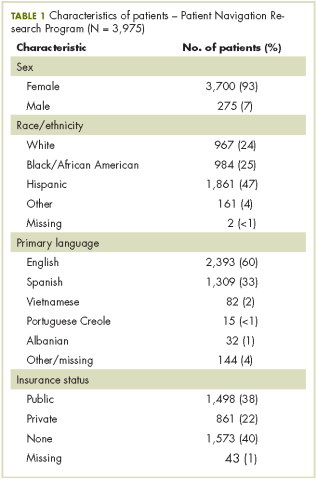
Our analytic sample included the 3,975 patients with only 1 navigator over the course of the study, 79% of the navigation (n = 5,063) arm. Most of the patients were women (93%), and most were from racial and ethnic minority communities. Most patients spoke English (60%), with Spanish (33%) as the next most common language. Most patients were publically insured (38%) or uninsured (40%) (Table 1).
Of the total 49 navigators, 6 were cancer survivors and 4 were primary caregivers to a family member with cancer; an additional 19 reported that they had family members with cancer (Table 2). Most of the navigators were women. The racial/ethnic distribution mirrored the populations they served: white (29%); black or African American (31%); and Hispanic (37%). English was the only spoken language of 67% of the navigators; 27% spoke Spanish, and 6% reported speaking another language. Most had a college degree (63%).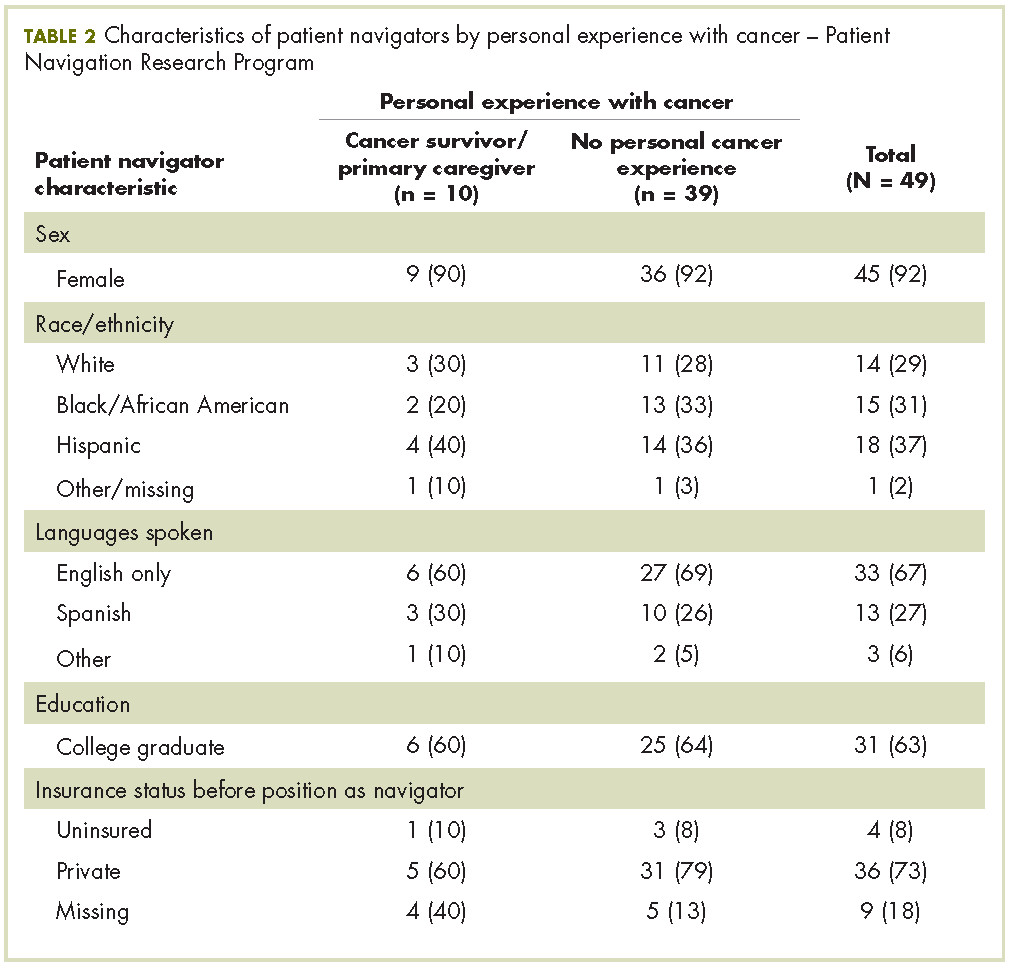
The unadjusted bivariate comparison of patients who achieved diagnostic resolution within 365 days, by navigator experience with cancer, are shown in Table 3. We found no difference in time to diagnostic resolution for those patients for whom navigators had personal experience with cancer compared with those whose navigators had no experience. When stratified by type of cancer screening abnormality (breast, cervical, prostate, or colorectal), the results also did not reveal a significant difference in the proportion of patients achieving diagnostic resolution by 365 days by navigator experience with cancer.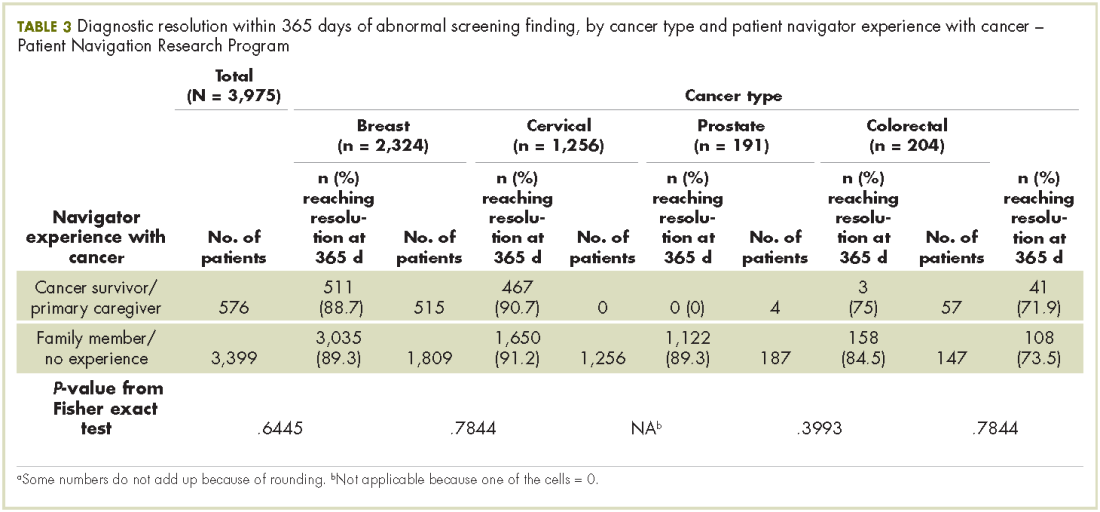
In the Cox proportional hazard model adjusting for patient gender, age, race/ethnicity, cancer type, and adjusting for navigator using clustering, there was no difference between patients whose navigators had experience with cancer care, and those who did not (adjusted hazard ratio, 1.03; 95% confidence interval, .83-1.3). The level of education of navigators was not significantly associated with time to diagnostic resolution for patients.
Discussion
Although several cancer support programs have explicitly used cancer survivors as patient navigators or other supports for patients in active cancer care, there are scant data on whether this expertise improves care. Our study was not able to identify that navigators with previous experience with cancer care, either as a patient or as the primary caregiver, was associated with improved time to diagnostic resolution.
As patient navigation has become the standard of cancer diagnostic and treatment practices, there is a need to develop competencies and standards for hiring and training navigators. Part of this hiring process is to determine what past experience and training are relevant for effective navigation. There is little previous research on relevant skills of navigators, with only one study having demonstrated that language and racial/ ethnic concordance between patients and navigators was associated with more timely care. The national PNRP program hired mostly lay navigators with minimal medical experience, but with affiliations to the communities of the patients receiving care. Our program has demonstrated that lay individuals can be trained in the logistic aspects of navigation.5 Although it may seem intuitive that the experience of being a cancer survivor may make a navigator more empathetic, it is also possible that being too close to the experience of survivorship can also pose challenges to a navigator. Alternatively, navigation may be equally effective with proper training regardless of previous experience with cancer.
Our study is limited to addressing the outcome of timely resolution in the diagnostic phase of care after abnormal cancer screening. It is possible that past experience with cancer care will be beneficial when providing navigation for cancer care. While this study represents one of the largest groups of navigators who have been studied, the small sample may have limited our ability to detect differences. Our study has the benefit of a diverse group of navigators from a nationally representative, multi-site study. We suggest that prior experience with cancer care is not a prerequisite to supporting diagnostic care after abnormal cancer screening. Providing appropriate training to navigators may be sufficient to ensure effective and appropriate care is provided by patient navigators.
Acknowledgments
The authors acknowledge the contributions of the following members of the Patient Navigation Research Program:Clinical centers Boston Medical Center and Boston University: Karen M Freund (principal investigator [PI]), Tracy A Battaglia (co-PI); Denver Health and Hospital Authority: Peter Raich (PI), Elizabeth Whitley (co-PI); George Washington University Cancer Institute: Steven R Patierno (PI), Lisa M Alexander, Paul H Levine, Heather A Young, Heather J Hoffman, Nancy L LaVerda; H Lee Moffitt Cancer Center and Research Institute: Richard G Roetzheim (PI), Cathy Meade, Kristen J Wells; Northwest Portland Area Indian Health Board: Victoria Warren-Mears (PI); Northwestern University Robert H Lurie Comprehensive Cancer Center: Steven Rosen (PI), Melissa Simon; The Ohio State University Comprehensive Cancer Center: Electra Paskett (PI); University of Illinois at Chicago and Access Community Health Center: Elizabeth Calhoun (PI), Julie Darnell. University of Rochester: Kevin Fiscella (PI), Samantha Hendren; University of Texas Health Science Center at San Antonio Cancer Therapy and Research Center: Donald Dudley (PI), Kevin Hall, Anand Karnard, Amelie Ramirez. Program office National Cancer Institute, Center to Reduce Cancer Health Disparities: Martha Hare, Mollie Howerton, Ken Chu, Emmanuel Taylor, Mary Ann Van Dyun. Evaluation contractor NOVA Research Company: Paul Young, Frederick Snyder
6. Macvean ML, White VM, Sanson-Fisher R. One-to-one volunteer support programs for people with cancer: a review of the literature. Patient Educ Couns. 2008;70:10-24.
7. Rodday AM, Parsons SK, Snyder F, et al. The impact of patient navigation in eliminating economic disparities in cancer care. Cancer. 2015;121(22):4025-4034.
10. Charlot M, Santana MC, Chen CA, et al. Impact of patient and navigator race and language concordance on care after cancer screening abnormalities. Cancer. 2015;121(9):1477-1483.
Patient navigation has emerged in the past decade as a strategy to decrease cancer disparities among low-income, minority populations. Patient navigators help individuals who face personal and systemtic barriers to gaining access to care.1 Their role is to help patients find their way through a complex health care system,2,3 including logistic support of rescheduling appointments, assistance with transportation, and child care needs. They provide personal support, including coaching patients on their clinical visits, educating them about the cancer treatment process, and addressing their fears of diagnosis and treatment. Patient navigation has shown improvement in cancer screening rates, time to diagnostic resolution for those patients who have abnormal cancer screening tests, and quality of cancer care.4,5
In hiring patient navigators, it is not clear which professional training and skill sets and what personal experiences are most useful to becoming an effective navigator. Personal cancer experience can include a personal diagnosis, the experience of serving as a primary caregiver for a patient during treatment, or having a family member or close friend with cancer. Several current support programs specifically recruit cancer survivors on the assumption that their cancer treatment experience can provide helpful insights to a current patient for both emotional and logistical support.6 In this paper, we sought to address whether patient navigation promotes more timely diagnostic care if the navigator has experience with cancer.
Methods
This is a secondary analysis of the patients with abnormal cancer screening in the navigation arm of the national Patient Navigation Research Program (PNRP) study,1, 5 a collaborative effort across 10 centers to investigate the efficacy of patient navigation on improving patient-level outcomes for those who have abnormal results from a breast, cervical, colorectal, or prostate cancer screening test. The study demonstrated that patient navigation was effective in reducing delays in diagnosis and treatment5 and resulting in a higher quality of care,4 especially among vulnerable populations.7 The Institutional Review Board of each respective institution approved the research.
All of the patient navigators were paid employees with a minimum high-school diploma or equivalent. Navigators’ activities were standardized across centers through a national training program.8 Navigators used the care management model to identify and address barriers to care and to track participants throughout the course of their diagnostic evaluation,9 with the primary aim of timely diagnostic resolution. Most navigation programs were embedded within the clinical care system and interacted with patients through mail, by phone, and face-to-face contact.1
Data collection
Each center used agreed-upon inclusion and exclusion criteria and collected and coded the same patient-level data. Medical records were abstracted for pertinent clinical data on patients. Demographic data were collected through a patient survey or extracted from medical record registration. The central data coordinating center collected navigator information including demographic characteristics and experience with cancer.
We created a new variable, Personal experience with cancer. Personal experience with cancer was based on three questions asked of navigators: whether they were a cancer survivor; whether they were the primary caregiver to a family member or close friend with cancer; and whether they had a family member with cancer. Because of the small sample size, responses from navigators who were cancer survivors (n = 6) or primary caregivers to a family member with cancer (n = 4) were collapsed into a single category, referred to as personal experience with cancer, to compare with navigators who had no personal experience with cancer, which included those who reported a family member with cancer but who were not serving as a primary caregiver.
All procedures performed in studies involving human participants were in accordance with the ethical standards of the institutional and/or national research committee and with the 1964 Helsinki declaration and its later amendments or comparable ethical standards. Each clinical center received approved from their institution’s human subjects review board. Informed consent was obtained from all patient navigator participants included in the study. Participating patients completed informed consent at some centers. At other centers where the study design was an implementation of a system intervention, a waiver of informed consent was approved by the Institutional Review Board.
Data analysis
The primary outcome variable was time to diagnostic resolution. We included only participants supported by a single navigator. A Fisher exact test by cancer type was used to compare the two groups (personal experience vs none) in the proportion of patients who achieved diagnostic resolution by 365 days. We reviewed the percentage of patients resolved for the total population as well as stratified by cancer site (breast, cervical, prostate, and colorectal), owing to the known mean differences in time to diagnostic resolution by type of cancer.
Cox proportional hazard models and adjusted hazard ratios were developed and calculated to examine the impact of navigator’s personal experience with cancer on time to resolution, controlling for patient gender, race, age, and cancer type in the models. The analysis controlled for the individual effect of navigators through clustering. We used P < .05 as the cut-off for significance, and used Stata 10.1 (StataCorp, College Station Texas 77845) for all analyses.
Results
Our analytic sample included the 3,975 patients with only 1 navigator over the course of the study, 79% of the navigation (n = 5,063) arm. Most of the patients were women (93%), and most were from racial and ethnic minority communities. Most patients spoke English (60%), with Spanish (33%) as the next most common language. Most patients were publically insured (38%) or uninsured (40%) (Table 1).
Of the total 49 navigators, 6 were cancer survivors and 4 were primary caregivers to a family member with cancer; an additional 19 reported that they had family members with cancer (Table 2). Most of the navigators were women. The racial/ethnic distribution mirrored the populations they served: white (29%); black or African American (31%); and Hispanic (37%). English was the only spoken language of 67% of the navigators; 27% spoke Spanish, and 6% reported speaking another language. Most had a college degree (63%).
The unadjusted bivariate comparison of patients who achieved diagnostic resolution within 365 days, by navigator experience with cancer, are shown in Table 3. We found no difference in time to diagnostic resolution for those patients for whom navigators had personal experience with cancer compared with those whose navigators had no experience. When stratified by type of cancer screening abnormality (breast, cervical, prostate, or colorectal), the results also did not reveal a significant difference in the proportion of patients achieving diagnostic resolution by 365 days by navigator experience with cancer.
In the Cox proportional hazard model adjusting for patient gender, age, race/ethnicity, cancer type, and adjusting for navigator using clustering, there was no difference between patients whose navigators had experience with cancer care, and those who did not (adjusted hazard ratio, 1.03; 95% confidence interval, .83-1.3). The level of education of navigators was not significantly associated with time to diagnostic resolution for patients.
Discussion
Although several cancer support programs have explicitly used cancer survivors as patient navigators or other supports for patients in active cancer care, there are scant data on whether this expertise improves care. Our study was not able to identify that navigators with previous experience with cancer care, either as a patient or as the primary caregiver, was associated with improved time to diagnostic resolution.
As patient navigation has become the standard of cancer diagnostic and treatment practices, there is a need to develop competencies and standards for hiring and training navigators. Part of this hiring process is to determine what past experience and training are relevant for effective navigation. There is little previous research on relevant skills of navigators, with only one study having demonstrated that language and racial/ ethnic concordance between patients and navigators was associated with more timely care. The national PNRP program hired mostly lay navigators with minimal medical experience, but with affiliations to the communities of the patients receiving care. Our program has demonstrated that lay individuals can be trained in the logistic aspects of navigation.5 Although it may seem intuitive that the experience of being a cancer survivor may make a navigator more empathetic, it is also possible that being too close to the experience of survivorship can also pose challenges to a navigator. Alternatively, navigation may be equally effective with proper training regardless of previous experience with cancer.
Our study is limited to addressing the outcome of timely resolution in the diagnostic phase of care after abnormal cancer screening. It is possible that past experience with cancer care will be beneficial when providing navigation for cancer care. While this study represents one of the largest groups of navigators who have been studied, the small sample may have limited our ability to detect differences. Our study has the benefit of a diverse group of navigators from a nationally representative, multi-site study. We suggest that prior experience with cancer care is not a prerequisite to supporting diagnostic care after abnormal cancer screening. Providing appropriate training to navigators may be sufficient to ensure effective and appropriate care is provided by patient navigators.
Acknowledgments
The authors acknowledge the contributions of the following members of the Patient Navigation Research Program:Clinical centers Boston Medical Center and Boston University: Karen M Freund (principal investigator [PI]), Tracy A Battaglia (co-PI); Denver Health and Hospital Authority: Peter Raich (PI), Elizabeth Whitley (co-PI); George Washington University Cancer Institute: Steven R Patierno (PI), Lisa M Alexander, Paul H Levine, Heather A Young, Heather J Hoffman, Nancy L LaVerda; H Lee Moffitt Cancer Center and Research Institute: Richard G Roetzheim (PI), Cathy Meade, Kristen J Wells; Northwest Portland Area Indian Health Board: Victoria Warren-Mears (PI); Northwestern University Robert H Lurie Comprehensive Cancer Center: Steven Rosen (PI), Melissa Simon; The Ohio State University Comprehensive Cancer Center: Electra Paskett (PI); University of Illinois at Chicago and Access Community Health Center: Elizabeth Calhoun (PI), Julie Darnell. University of Rochester: Kevin Fiscella (PI), Samantha Hendren; University of Texas Health Science Center at San Antonio Cancer Therapy and Research Center: Donald Dudley (PI), Kevin Hall, Anand Karnard, Amelie Ramirez. Program office National Cancer Institute, Center to Reduce Cancer Health Disparities: Martha Hare, Mollie Howerton, Ken Chu, Emmanuel Taylor, Mary Ann Van Dyun. Evaluation contractor NOVA Research Company: Paul Young, Frederick Snyder
Patient navigation has emerged in the past decade as a strategy to decrease cancer disparities among low-income, minority populations. Patient navigators help individuals who face personal and systemtic barriers to gaining access to care.1 Their role is to help patients find their way through a complex health care system,2,3 including logistic support of rescheduling appointments, assistance with transportation, and child care needs. They provide personal support, including coaching patients on their clinical visits, educating them about the cancer treatment process, and addressing their fears of diagnosis and treatment. Patient navigation has shown improvement in cancer screening rates, time to diagnostic resolution for those patients who have abnormal cancer screening tests, and quality of cancer care.4,5
In hiring patient navigators, it is not clear which professional training and skill sets and what personal experiences are most useful to becoming an effective navigator. Personal cancer experience can include a personal diagnosis, the experience of serving as a primary caregiver for a patient during treatment, or having a family member or close friend with cancer. Several current support programs specifically recruit cancer survivors on the assumption that their cancer treatment experience can provide helpful insights to a current patient for both emotional and logistical support.6 In this paper, we sought to address whether patient navigation promotes more timely diagnostic care if the navigator has experience with cancer.
Methods
This is a secondary analysis of the patients with abnormal cancer screening in the navigation arm of the national Patient Navigation Research Program (PNRP) study,1, 5 a collaborative effort across 10 centers to investigate the efficacy of patient navigation on improving patient-level outcomes for those who have abnormal results from a breast, cervical, colorectal, or prostate cancer screening test. The study demonstrated that patient navigation was effective in reducing delays in diagnosis and treatment5 and resulting in a higher quality of care,4 especially among vulnerable populations.7 The Institutional Review Board of each respective institution approved the research.
All of the patient navigators were paid employees with a minimum high-school diploma or equivalent. Navigators’ activities were standardized across centers through a national training program.8 Navigators used the care management model to identify and address barriers to care and to track participants throughout the course of their diagnostic evaluation,9 with the primary aim of timely diagnostic resolution. Most navigation programs were embedded within the clinical care system and interacted with patients through mail, by phone, and face-to-face contact.1
Data collection
Each center used agreed-upon inclusion and exclusion criteria and collected and coded the same patient-level data. Medical records were abstracted for pertinent clinical data on patients. Demographic data were collected through a patient survey or extracted from medical record registration. The central data coordinating center collected navigator information including demographic characteristics and experience with cancer.
We created a new variable, Personal experience with cancer. Personal experience with cancer was based on three questions asked of navigators: whether they were a cancer survivor; whether they were the primary caregiver to a family member or close friend with cancer; and whether they had a family member with cancer. Because of the small sample size, responses from navigators who were cancer survivors (n = 6) or primary caregivers to a family member with cancer (n = 4) were collapsed into a single category, referred to as personal experience with cancer, to compare with navigators who had no personal experience with cancer, which included those who reported a family member with cancer but who were not serving as a primary caregiver.
All procedures performed in studies involving human participants were in accordance with the ethical standards of the institutional and/or national research committee and with the 1964 Helsinki declaration and its later amendments or comparable ethical standards. Each clinical center received approved from their institution’s human subjects review board. Informed consent was obtained from all patient navigator participants included in the study. Participating patients completed informed consent at some centers. At other centers where the study design was an implementation of a system intervention, a waiver of informed consent was approved by the Institutional Review Board.
Data analysis
The primary outcome variable was time to diagnostic resolution. We included only participants supported by a single navigator. A Fisher exact test by cancer type was used to compare the two groups (personal experience vs none) in the proportion of patients who achieved diagnostic resolution by 365 days. We reviewed the percentage of patients resolved for the total population as well as stratified by cancer site (breast, cervical, prostate, and colorectal), owing to the known mean differences in time to diagnostic resolution by type of cancer.
Cox proportional hazard models and adjusted hazard ratios were developed and calculated to examine the impact of navigator’s personal experience with cancer on time to resolution, controlling for patient gender, race, age, and cancer type in the models. The analysis controlled for the individual effect of navigators through clustering. We used P < .05 as the cut-off for significance, and used Stata 10.1 (StataCorp, College Station Texas 77845) for all analyses.
Results
Our analytic sample included the 3,975 patients with only 1 navigator over the course of the study, 79% of the navigation (n = 5,063) arm. Most of the patients were women (93%), and most were from racial and ethnic minority communities. Most patients spoke English (60%), with Spanish (33%) as the next most common language. Most patients were publically insured (38%) or uninsured (40%) (Table 1).
Of the total 49 navigators, 6 were cancer survivors and 4 were primary caregivers to a family member with cancer; an additional 19 reported that they had family members with cancer (Table 2). Most of the navigators were women. The racial/ethnic distribution mirrored the populations they served: white (29%); black or African American (31%); and Hispanic (37%). English was the only spoken language of 67% of the navigators; 27% spoke Spanish, and 6% reported speaking another language. Most had a college degree (63%).
The unadjusted bivariate comparison of patients who achieved diagnostic resolution within 365 days, by navigator experience with cancer, are shown in Table 3. We found no difference in time to diagnostic resolution for those patients for whom navigators had personal experience with cancer compared with those whose navigators had no experience. When stratified by type of cancer screening abnormality (breast, cervical, prostate, or colorectal), the results also did not reveal a significant difference in the proportion of patients achieving diagnostic resolution by 365 days by navigator experience with cancer.
In the Cox proportional hazard model adjusting for patient gender, age, race/ethnicity, cancer type, and adjusting for navigator using clustering, there was no difference between patients whose navigators had experience with cancer care, and those who did not (adjusted hazard ratio, 1.03; 95% confidence interval, .83-1.3). The level of education of navigators was not significantly associated with time to diagnostic resolution for patients.
Discussion
Although several cancer support programs have explicitly used cancer survivors as patient navigators or other supports for patients in active cancer care, there are scant data on whether this expertise improves care. Our study was not able to identify that navigators with previous experience with cancer care, either as a patient or as the primary caregiver, was associated with improved time to diagnostic resolution.
As patient navigation has become the standard of cancer diagnostic and treatment practices, there is a need to develop competencies and standards for hiring and training navigators. Part of this hiring process is to determine what past experience and training are relevant for effective navigation. There is little previous research on relevant skills of navigators, with only one study having demonstrated that language and racial/ ethnic concordance between patients and navigators was associated with more timely care. The national PNRP program hired mostly lay navigators with minimal medical experience, but with affiliations to the communities of the patients receiving care. Our program has demonstrated that lay individuals can be trained in the logistic aspects of navigation.5 Although it may seem intuitive that the experience of being a cancer survivor may make a navigator more empathetic, it is also possible that being too close to the experience of survivorship can also pose challenges to a navigator. Alternatively, navigation may be equally effective with proper training regardless of previous experience with cancer.
Our study is limited to addressing the outcome of timely resolution in the diagnostic phase of care after abnormal cancer screening. It is possible that past experience with cancer care will be beneficial when providing navigation for cancer care. While this study represents one of the largest groups of navigators who have been studied, the small sample may have limited our ability to detect differences. Our study has the benefit of a diverse group of navigators from a nationally representative, multi-site study. We suggest that prior experience with cancer care is not a prerequisite to supporting diagnostic care after abnormal cancer screening. Providing appropriate training to navigators may be sufficient to ensure effective and appropriate care is provided by patient navigators.
Acknowledgments
The authors acknowledge the contributions of the following members of the Patient Navigation Research Program:Clinical centers Boston Medical Center and Boston University: Karen M Freund (principal investigator [PI]), Tracy A Battaglia (co-PI); Denver Health and Hospital Authority: Peter Raich (PI), Elizabeth Whitley (co-PI); George Washington University Cancer Institute: Steven R Patierno (PI), Lisa M Alexander, Paul H Levine, Heather A Young, Heather J Hoffman, Nancy L LaVerda; H Lee Moffitt Cancer Center and Research Institute: Richard G Roetzheim (PI), Cathy Meade, Kristen J Wells; Northwest Portland Area Indian Health Board: Victoria Warren-Mears (PI); Northwestern University Robert H Lurie Comprehensive Cancer Center: Steven Rosen (PI), Melissa Simon; The Ohio State University Comprehensive Cancer Center: Electra Paskett (PI); University of Illinois at Chicago and Access Community Health Center: Elizabeth Calhoun (PI), Julie Darnell. University of Rochester: Kevin Fiscella (PI), Samantha Hendren; University of Texas Health Science Center at San Antonio Cancer Therapy and Research Center: Donald Dudley (PI), Kevin Hall, Anand Karnard, Amelie Ramirez. Program office National Cancer Institute, Center to Reduce Cancer Health Disparities: Martha Hare, Mollie Howerton, Ken Chu, Emmanuel Taylor, Mary Ann Van Dyun. Evaluation contractor NOVA Research Company: Paul Young, Frederick Snyder
6. Macvean ML, White VM, Sanson-Fisher R. One-to-one volunteer support programs for people with cancer: a review of the literature. Patient Educ Couns. 2008;70:10-24.
7. Rodday AM, Parsons SK, Snyder F, et al. The impact of patient navigation in eliminating economic disparities in cancer care. Cancer. 2015;121(22):4025-4034.
10. Charlot M, Santana MC, Chen CA, et al. Impact of patient and navigator race and language concordance on care after cancer screening abnormalities. Cancer. 2015;121(9):1477-1483.
6. Macvean ML, White VM, Sanson-Fisher R. One-to-one volunteer support programs for people with cancer: a review of the literature. Patient Educ Couns. 2008;70:10-24.
7. Rodday AM, Parsons SK, Snyder F, et al. The impact of patient navigation in eliminating economic disparities in cancer care. Cancer. 2015;121(22):4025-4034.
10. Charlot M, Santana MC, Chen CA, et al. Impact of patient and navigator race and language concordance on care after cancer screening abnormalities. Cancer. 2015;121(9):1477-1483.
Imfinzi approved for stage III unresectable NSCLC
Durvalumab (Imfinzi) has been approved as the first treatment for patients with stage III unresectable non-small cell lung cancer (NSCLC) that has not progressed after chemotherapy and radiation, the Food and Drug Administration announced on Feb. 16.
Chemoradiation had been the only option for such patients. “Although a small number of patients may be cured with the chemoradiation, the cancer may eventually progress. Patients now have an approved therapy that has been shown to keep the cancer from progressing for a longer time after chemoradiation,” Richard Pazdur, MD, director of the FDA’s Oncology Center of Excellence and acting director of the Office of Hematology and Oncology Products in the FDA’s Center for Drug Evaluation and Research, said in a press release.
Durvalumab, which targets the PD-1/PD-L1 pathway, was previously granted accelerated approval in 2017 for the treatment of certain patients with locally advanced or metastatic bladder cancer.
The approval for the treatment of stage III, unresectable NSCLC was based on the results of the randomized PACIFIC trial of 713 patients whose cancer had not progressed after completing chemotherapy and radiation. The trial measured progression-free survival with durvalumab or a placebo, and found a median progression-free survival of 16.8 months for patients taking durvalumab and 5.6 months for patients receiving a placebo. The drug's sponsor, AstraZeneca, has agreed to provide data on overall survival in the study.
Common side effects of durvalumab in patients with stage III unresectable NSCLC include cough, fatigue, inflammation in the lungs (pneumonitis/radiation pneumonitis), upper respiratory tract infections, difficulty breathing (dyspnea) and rash.
Serious risks of durvalumab include pneumonitis, hepatitis, colitis, endocrinopathies, and nephritis. Other serious side effects include infection and infusion-related reactions. Durvalumab can cause harm to a developing fetus; women should be advised of the potential risk to the fetus and to use effective contraception.
Durvalumab (Imfinzi) has been approved as the first treatment for patients with stage III unresectable non-small cell lung cancer (NSCLC) that has not progressed after chemotherapy and radiation, the Food and Drug Administration announced on Feb. 16.
Chemoradiation had been the only option for such patients. “Although a small number of patients may be cured with the chemoradiation, the cancer may eventually progress. Patients now have an approved therapy that has been shown to keep the cancer from progressing for a longer time after chemoradiation,” Richard Pazdur, MD, director of the FDA’s Oncology Center of Excellence and acting director of the Office of Hematology and Oncology Products in the FDA’s Center for Drug Evaluation and Research, said in a press release.
Durvalumab, which targets the PD-1/PD-L1 pathway, was previously granted accelerated approval in 2017 for the treatment of certain patients with locally advanced or metastatic bladder cancer.
The approval for the treatment of stage III, unresectable NSCLC was based on the results of the randomized PACIFIC trial of 713 patients whose cancer had not progressed after completing chemotherapy and radiation. The trial measured progression-free survival with durvalumab or a placebo, and found a median progression-free survival of 16.8 months for patients taking durvalumab and 5.6 months for patients receiving a placebo. The drug's sponsor, AstraZeneca, has agreed to provide data on overall survival in the study.
Common side effects of durvalumab in patients with stage III unresectable NSCLC include cough, fatigue, inflammation in the lungs (pneumonitis/radiation pneumonitis), upper respiratory tract infections, difficulty breathing (dyspnea) and rash.
Serious risks of durvalumab include pneumonitis, hepatitis, colitis, endocrinopathies, and nephritis. Other serious side effects include infection and infusion-related reactions. Durvalumab can cause harm to a developing fetus; women should be advised of the potential risk to the fetus and to use effective contraception.
Durvalumab (Imfinzi) has been approved as the first treatment for patients with stage III unresectable non-small cell lung cancer (NSCLC) that has not progressed after chemotherapy and radiation, the Food and Drug Administration announced on Feb. 16.
Chemoradiation had been the only option for such patients. “Although a small number of patients may be cured with the chemoradiation, the cancer may eventually progress. Patients now have an approved therapy that has been shown to keep the cancer from progressing for a longer time after chemoradiation,” Richard Pazdur, MD, director of the FDA’s Oncology Center of Excellence and acting director of the Office of Hematology and Oncology Products in the FDA’s Center for Drug Evaluation and Research, said in a press release.
Durvalumab, which targets the PD-1/PD-L1 pathway, was previously granted accelerated approval in 2017 for the treatment of certain patients with locally advanced or metastatic bladder cancer.
The approval for the treatment of stage III, unresectable NSCLC was based on the results of the randomized PACIFIC trial of 713 patients whose cancer had not progressed after completing chemotherapy and radiation. The trial measured progression-free survival with durvalumab or a placebo, and found a median progression-free survival of 16.8 months for patients taking durvalumab and 5.6 months for patients receiving a placebo. The drug's sponsor, AstraZeneca, has agreed to provide data on overall survival in the study.
Common side effects of durvalumab in patients with stage III unresectable NSCLC include cough, fatigue, inflammation in the lungs (pneumonitis/radiation pneumonitis), upper respiratory tract infections, difficulty breathing (dyspnea) and rash.
Serious risks of durvalumab include pneumonitis, hepatitis, colitis, endocrinopathies, and nephritis. Other serious side effects include infection and infusion-related reactions. Durvalumab can cause harm to a developing fetus; women should be advised of the potential risk to the fetus and to use effective contraception.
Refractory alopecia patients could consider a JAK inhibitor
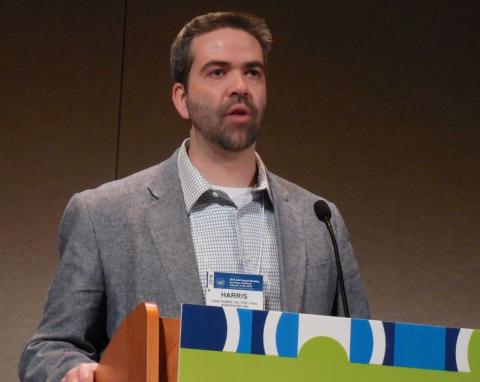
SAN DIEGO – Treatment with a Janus kinase inhibitor such as tofacitinib is a reasonable option for patients with refractory alopecia who seek resolution of their hair loss and understand the adverse event risk from using this drug class, John E. Harris, MD, PhD, said at the annual meeting of the American Academy of Dermatology.
Using a Janus kinase (JAK) inhibitor to treat alopecia areata or totalis is a “highly successful, emerging therapy,” with efficacy rates for good responses of about a third or higher in a handful of published reports with experiences in more than 150 patients, said Dr. Harris, an associate professor of dermatology and director of the Vitiligo Clinic and Research Center at the University of Massachusetts Medical School in Worcester.

“Some clinicians may say ‘I’d never prescribe a JAK inhibitor for hair loss, it’s too dangerous,’ but several hundred alopecia patients have now received this with no serious adverse effects,” said Dr. Harris. He acknowledged, however, that eventually some patients treated this way will have serious adverse effects. He said that he is treating with tofacitinib a “handful” of alopecia patients who have been unresponsive to other treatments, are eager for an intervention that might regrow their hair, and who understand and accept the risk for developing an infection, shingles, or myelosuppression (with ruxolitinib treatment).
Roughly half of the alopecia patients prescribed tofacitinib (Xeljanz) by Dr. Harris have had their drug cost covered by health insurance, with the others paying for it themselves. Arranging for insurance coverage has usually involved filing an appeal, Dr. Harris said in an interview. The reported successful dosages have been 5 mg bid, with a boost to 10 mg bid for patients who don’t initially respond.
Insurance companies have not yet paid for treatment with ruxolitinib (Jakafi), which has been described in case reports in far fewer patients and which costs about $120,000 a year, he noted.
Dr. Harris said that JAK inhibitors also have great potential for treating vitiligo, a disorder he thinks shares many features in common with alopecia ( J Allergy Clin Immunol. 2017 Sept;140[3]:654-62).
“I think [JAK inhibitors] will have the same efficacy in vitiligo,” he predicted. He is particularly enthused about the possibility of administering ruxolitinib topically to patients with alopecia or vitiligo. Ruxolitinib is well suited to topical administration because of its good skin penetration, Dr. Harris said. Several trials now in progress are further studying JAK inhibitors for alopecia using oral or topical formulations.
Dr. Harris has been a consultant to and has received research funding from Pfizer, the company that markets tofacitinib (Xeljanz). He has also been a consultant to a dozen other companies, and has also received research support from Aclaris Therapeutics, Celgene, Dermavant, Genzyme, Sanofi, and Stiefel/GlaxoSmithKline.
SAN DIEGO – Treatment with a Janus kinase inhibitor such as tofacitinib is a reasonable option for patients with refractory alopecia who seek resolution of their hair loss and understand the adverse event risk from using this drug class, John E. Harris, MD, PhD, said at the annual meeting of the American Academy of Dermatology.
Using a Janus kinase (JAK) inhibitor to treat alopecia areata or totalis is a “highly successful, emerging therapy,” with efficacy rates for good responses of about a third or higher in a handful of published reports with experiences in more than 150 patients, said Dr. Harris, an associate professor of dermatology and director of the Vitiligo Clinic and Research Center at the University of Massachusetts Medical School in Worcester.
“Some clinicians may say ‘I’d never prescribe a JAK inhibitor for hair loss, it’s too dangerous,’ but several hundred alopecia patients have now received this with no serious adverse effects,” said Dr. Harris. He acknowledged, however, that eventually some patients treated this way will have serious adverse effects. He said that he is treating with tofacitinib a “handful” of alopecia patients who have been unresponsive to other treatments, are eager for an intervention that might regrow their hair, and who understand and accept the risk for developing an infection, shingles, or myelosuppression (with ruxolitinib treatment).
Roughly half of the alopecia patients prescribed tofacitinib (Xeljanz) by Dr. Harris have had their drug cost covered by health insurance, with the others paying for it themselves. Arranging for insurance coverage has usually involved filing an appeal, Dr. Harris said in an interview. The reported successful dosages have been 5 mg bid, with a boost to 10 mg bid for patients who don’t initially respond.
Insurance companies have not yet paid for treatment with ruxolitinib (Jakafi), which has been described in case reports in far fewer patients and which costs about $120,000 a year, he noted.
Dr. Harris said that JAK inhibitors also have great potential for treating vitiligo, a disorder he thinks shares many features in common with alopecia ( J Allergy Clin Immunol. 2017 Sept;140[3]:654-62).
“I think [JAK inhibitors] will have the same efficacy in vitiligo,” he predicted. He is particularly enthused about the possibility of administering ruxolitinib topically to patients with alopecia or vitiligo. Ruxolitinib is well suited to topical administration because of its good skin penetration, Dr. Harris said. Several trials now in progress are further studying JAK inhibitors for alopecia using oral or topical formulations.
Dr. Harris has been a consultant to and has received research funding from Pfizer, the company that markets tofacitinib (Xeljanz). He has also been a consultant to a dozen other companies, and has also received research support from Aclaris Therapeutics, Celgene, Dermavant, Genzyme, Sanofi, and Stiefel/GlaxoSmithKline.
SAN DIEGO – Treatment with a Janus kinase inhibitor such as tofacitinib is a reasonable option for patients with refractory alopecia who seek resolution of their hair loss and understand the adverse event risk from using this drug class, John E. Harris, MD, PhD, said at the annual meeting of the American Academy of Dermatology.
Using a Janus kinase (JAK) inhibitor to treat alopecia areata or totalis is a “highly successful, emerging therapy,” with efficacy rates for good responses of about a third or higher in a handful of published reports with experiences in more than 150 patients, said Dr. Harris, an associate professor of dermatology and director of the Vitiligo Clinic and Research Center at the University of Massachusetts Medical School in Worcester.
“Some clinicians may say ‘I’d never prescribe a JAK inhibitor for hair loss, it’s too dangerous,’ but several hundred alopecia patients have now received this with no serious adverse effects,” said Dr. Harris. He acknowledged, however, that eventually some patients treated this way will have serious adverse effects. He said that he is treating with tofacitinib a “handful” of alopecia patients who have been unresponsive to other treatments, are eager for an intervention that might regrow their hair, and who understand and accept the risk for developing an infection, shingles, or myelosuppression (with ruxolitinib treatment).
Roughly half of the alopecia patients prescribed tofacitinib (Xeljanz) by Dr. Harris have had their drug cost covered by health insurance, with the others paying for it themselves. Arranging for insurance coverage has usually involved filing an appeal, Dr. Harris said in an interview. The reported successful dosages have been 5 mg bid, with a boost to 10 mg bid for patients who don’t initially respond.
Insurance companies have not yet paid for treatment with ruxolitinib (Jakafi), which has been described in case reports in far fewer patients and which costs about $120,000 a year, he noted.
Dr. Harris said that JAK inhibitors also have great potential for treating vitiligo, a disorder he thinks shares many features in common with alopecia ( J Allergy Clin Immunol. 2017 Sept;140[3]:654-62).
“I think [JAK inhibitors] will have the same efficacy in vitiligo,” he predicted. He is particularly enthused about the possibility of administering ruxolitinib topically to patients with alopecia or vitiligo. Ruxolitinib is well suited to topical administration because of its good skin penetration, Dr. Harris said. Several trials now in progress are further studying JAK inhibitors for alopecia using oral or topical formulations.
Dr. Harris has been a consultant to and has received research funding from Pfizer, the company that markets tofacitinib (Xeljanz). He has also been a consultant to a dozen other companies, and has also received research support from Aclaris Therapeutics, Celgene, Dermavant, Genzyme, Sanofi, and Stiefel/GlaxoSmithKline.
EXPERT ANALYSIS AT AAD 18
Tips for avoiding, taming most postlaser complications
SAN DIEGO – Do not use the fractional laser on tanned skin or skin that will be getting sun exposure soon after the treatment, Tina Alster, MD, advised as one of her cardinal rules for avoiding hyperpigmentation complications.
Melanocytes are already activated and ready to deposit pigment in such patients. Also, use strict posttreatment sun protection with a mineral sunscreen, she said.

Fractional lasers – both ablative and nonablative – are remarkably safe, said Dr. Alster of Georgetown University Medical Center, Washington.
Her own 2008 study found side effects and complications in just 7.6% of 961 patients. The most frequent were acneiform eruptions (1.8%) and herpes simplex virus outbreaks (1.7%).
A more recent study comprising 730 patients treated with three different fractional lasers found an even lower complication rate of 4%. Complications included 5 herpes simplex virus breakouts, 13 acne eruptions, one abrasion, one bacterial infection, 9 cases of dermatitis, one drug eruption, 4 cases of prolonged erythema, one case of hyperpigmentation, one case of increased swelling and one of telangiectasia.
“We consistently find these very low incidences of less than 10%, and most of these I would term ‘side effects’ and not true complications,” Dr. Alster said at the annual meeting of the American Academy of Dermatology.
Still, if a clinician performs enough laser procedures, these outcomes will eventually occur. Dr. Alster gave her “top tips” for dealing with them when they do arise.
Tip #1: Adequate preoperative assessment
“You must be thorough in assessing all of these things: the type and location of the lesion, the Fitzpatrick skin phototype, any prior treatments the patient has had for the condition (and many have had them). We need to know of any pre-existing medical conditions, particularly autoimmune, and whether the patient has a history of scarring or delayed wound healing.”
Another part of this assessment is managing patient expectations upfront to avoid postprocedural dissatisfaction. “If someone comes to me and says ‘I want you to get rid of every acne scar on my face,’ I tell them right there, ‘I can’t do that,’” she said.
Tip #2: Prepare the patient for the expected – and the unexpected
“The overall risk of even the most common side effects, like prolonged erythema, is relatively small. But they can happen and patients need to be prepared for them.” The most common are prolonged erythema of more than 4 days for nonablative fractional lasers and more than a month for ablative lasers. But dermatitis may appear, as well as reactivation of acne, especially in patients who are having acne scars removed. There is also always the risk of infection and pigmentary alteration.”
Tip #3: Proper technique and close follow-up
The most expensive laser in the world still relies on good technique during deployment, she said. “I always stress, do not ‘pulse stack.’ Use side-by-side, nonoverlapping passes.”
Another key for success is to avoid using the laser on any tanned skin, or skin that will soon have sun exposure. “Any skin phototype with recent sun exposure has activated melanocytes and will have a higher tendency to develop postinflammatory hyperpigmentation. The cells are already activated and in the presence of any other damage – including a laser – they are programmed to produce more pigment.”
Individualize your treatment plan, she advised. “Do additional passes on the most severe areas, like cheek scars and perioral rhytides, and fewer passes and lower density on scar-prone areas, like the infraorbital area, mandible neck, and chest.”
Tip #4: Recognize and address complications
“Complications run the full spectrum from mild erythema to disseminated infections. I am always careful to figure out if it’s a true complication or an expected side effect. The greatest risk profiles are patients with darker skin phototypes, treatments in more sensitive areas, and patients with predisposing medical conditions like collagen or vascular diseases. You don’t need to avoid treating them, just be prepared for the higher risks.”
Dr. Alster also shared her techniques for managing some of the more common adverse events following a fractional laser procedure.
Prolonged erythema isn’t clinically serious, but it really bothers patients. They should be counseled to avoid putting any potentially irritating or allergenic product on their face, and that includes chemical sunscreens. A mineral sunscreen is a much better choice. “For management, postoperative cooling with ice packs is important. A mild topical corticosteroid and a nonsteroidal anti-inflammatory can help, too.”
Acne exacerbation is not uncommon, especially among patients being treated for acne scars. “In people who are prone to acne, I write a script for doxycycline. They don’t have to take it unless they break out. And I always avoid laser skin resurfacing in active acne.”
If a breakout does happen, stick to the well-trodden path, she advised. “We know how to treat acne. Discontinue any occlusive topical, start the patent on an antibiotic, treat topically with a clay masque to help dry things out.”
Infections can be alarming but are manageable when promptly treated. “The main thing is to diagnose and treat early. In those patients who are proven to have herpes simplex virus, I give an antiviral, like valacyclovir. I give 1 gram twice a day for a week, starting on the day of the procedure. I think a bigger question is, ‘Does everyone need a prophylactic antibiotic?’ There is probably no reason to start one routinely, and in fact, there is some evidence that if you do, you may get a more pathogenic organism if you do get an infection.”
Hyperpigmentation is always a concern. Dr Alster repeated her cardinal rule: Do not use the fractional laser on tanned skin or skin that will be getting sun exposure soon after the treatment, as melanocytes are already activated and ready to deposit pigment. Use strict posttreatment sun protection with a mineral sunscreen. While she is not “a big fan” of hydroquinone, Dr. Alster does employ other bleaching agents for postoperative hyperpigmentation, including alpha hydroxyl acid, retinoic acid, kojic acid, and lignin peroxidase.
Good technique and aftercare reduce the risk of hypertrophic scarring. This means avoiding excessive fluences and aggressive lasering techniques and early treatment of any suspected infection. “My main treatment is the 585nm pulsed dye laser, but the main thing is to avoid aggressive techniques with overlapping or stacking of pulses, strict wound care, and early treatment of any infections.”
Dr. Alster disclosed that she is a consultant to L’Oréal USA, an investigator for Revance Therapeutics and Sente Labs, and a medical advisor to Merz Aesthetics, and has investments/commercial interests in Home Skinovations.
SOURCE: Alster, T. et al, PREVENTION & MANAGEMENT OF
SAN DIEGO – Do not use the fractional laser on tanned skin or skin that will be getting sun exposure soon after the treatment, Tina Alster, MD, advised as one of her cardinal rules for avoiding hyperpigmentation complications.
Melanocytes are already activated and ready to deposit pigment in such patients. Also, use strict posttreatment sun protection with a mineral sunscreen, she said.
Fractional lasers – both ablative and nonablative – are remarkably safe, said Dr. Alster of Georgetown University Medical Center, Washington.
Her own 2008 study found side effects and complications in just 7.6% of 961 patients. The most frequent were acneiform eruptions (1.8%) and herpes simplex virus outbreaks (1.7%).
A more recent study comprising 730 patients treated with three different fractional lasers found an even lower complication rate of 4%. Complications included 5 herpes simplex virus breakouts, 13 acne eruptions, one abrasion, one bacterial infection, 9 cases of dermatitis, one drug eruption, 4 cases of prolonged erythema, one case of hyperpigmentation, one case of increased swelling and one of telangiectasia.
“We consistently find these very low incidences of less than 10%, and most of these I would term ‘side effects’ and not true complications,” Dr. Alster said at the annual meeting of the American Academy of Dermatology.
Still, if a clinician performs enough laser procedures, these outcomes will eventually occur. Dr. Alster gave her “top tips” for dealing with them when they do arise.
Tip #1: Adequate preoperative assessment
“You must be thorough in assessing all of these things: the type and location of the lesion, the Fitzpatrick skin phototype, any prior treatments the patient has had for the condition (and many have had them). We need to know of any pre-existing medical conditions, particularly autoimmune, and whether the patient has a history of scarring or delayed wound healing.”
Another part of this assessment is managing patient expectations upfront to avoid postprocedural dissatisfaction. “If someone comes to me and says ‘I want you to get rid of every acne scar on my face,’ I tell them right there, ‘I can’t do that,’” she said.
Tip #2: Prepare the patient for the expected – and the unexpected
“The overall risk of even the most common side effects, like prolonged erythema, is relatively small. But they can happen and patients need to be prepared for them.” The most common are prolonged erythema of more than 4 days for nonablative fractional lasers and more than a month for ablative lasers. But dermatitis may appear, as well as reactivation of acne, especially in patients who are having acne scars removed. There is also always the risk of infection and pigmentary alteration.”
Tip #3: Proper technique and close follow-up
The most expensive laser in the world still relies on good technique during deployment, she said. “I always stress, do not ‘pulse stack.’ Use side-by-side, nonoverlapping passes.”
Another key for success is to avoid using the laser on any tanned skin, or skin that will soon have sun exposure. “Any skin phototype with recent sun exposure has activated melanocytes and will have a higher tendency to develop postinflammatory hyperpigmentation. The cells are already activated and in the presence of any other damage – including a laser – they are programmed to produce more pigment.”
Individualize your treatment plan, she advised. “Do additional passes on the most severe areas, like cheek scars and perioral rhytides, and fewer passes and lower density on scar-prone areas, like the infraorbital area, mandible neck, and chest.”
Tip #4: Recognize and address complications
“Complications run the full spectrum from mild erythema to disseminated infections. I am always careful to figure out if it’s a true complication or an expected side effect. The greatest risk profiles are patients with darker skin phototypes, treatments in more sensitive areas, and patients with predisposing medical conditions like collagen or vascular diseases. You don’t need to avoid treating them, just be prepared for the higher risks.”
Dr. Alster also shared her techniques for managing some of the more common adverse events following a fractional laser procedure.
Prolonged erythema isn’t clinically serious, but it really bothers patients. They should be counseled to avoid putting any potentially irritating or allergenic product on their face, and that includes chemical sunscreens. A mineral sunscreen is a much better choice. “For management, postoperative cooling with ice packs is important. A mild topical corticosteroid and a nonsteroidal anti-inflammatory can help, too.”
Acne exacerbation is not uncommon, especially among patients being treated for acne scars. “In people who are prone to acne, I write a script for doxycycline. They don’t have to take it unless they break out. And I always avoid laser skin resurfacing in active acne.”
If a breakout does happen, stick to the well-trodden path, she advised. “We know how to treat acne. Discontinue any occlusive topical, start the patent on an antibiotic, treat topically with a clay masque to help dry things out.”
Infections can be alarming but are manageable when promptly treated. “The main thing is to diagnose and treat early. In those patients who are proven to have herpes simplex virus, I give an antiviral, like valacyclovir. I give 1 gram twice a day for a week, starting on the day of the procedure. I think a bigger question is, ‘Does everyone need a prophylactic antibiotic?’ There is probably no reason to start one routinely, and in fact, there is some evidence that if you do, you may get a more pathogenic organism if you do get an infection.”
Hyperpigmentation is always a concern. Dr Alster repeated her cardinal rule: Do not use the fractional laser on tanned skin or skin that will be getting sun exposure soon after the treatment, as melanocytes are already activated and ready to deposit pigment. Use strict posttreatment sun protection with a mineral sunscreen. While she is not “a big fan” of hydroquinone, Dr. Alster does employ other bleaching agents for postoperative hyperpigmentation, including alpha hydroxyl acid, retinoic acid, kojic acid, and lignin peroxidase.
Good technique and aftercare reduce the risk of hypertrophic scarring. This means avoiding excessive fluences and aggressive lasering techniques and early treatment of any suspected infection. “My main treatment is the 585nm pulsed dye laser, but the main thing is to avoid aggressive techniques with overlapping or stacking of pulses, strict wound care, and early treatment of any infections.”
Dr. Alster disclosed that she is a consultant to L’Oréal USA, an investigator for Revance Therapeutics and Sente Labs, and a medical advisor to Merz Aesthetics, and has investments/commercial interests in Home Skinovations.
SOURCE: Alster, T. et al, PREVENTION & MANAGEMENT OF
SAN DIEGO – Do not use the fractional laser on tanned skin or skin that will be getting sun exposure soon after the treatment, Tina Alster, MD, advised as one of her cardinal rules for avoiding hyperpigmentation complications.
Melanocytes are already activated and ready to deposit pigment in such patients. Also, use strict posttreatment sun protection with a mineral sunscreen, she said.
Fractional lasers – both ablative and nonablative – are remarkably safe, said Dr. Alster of Georgetown University Medical Center, Washington.
Her own 2008 study found side effects and complications in just 7.6% of 961 patients. The most frequent were acneiform eruptions (1.8%) and herpes simplex virus outbreaks (1.7%).
A more recent study comprising 730 patients treated with three different fractional lasers found an even lower complication rate of 4%. Complications included 5 herpes simplex virus breakouts, 13 acne eruptions, one abrasion, one bacterial infection, 9 cases of dermatitis, one drug eruption, 4 cases of prolonged erythema, one case of hyperpigmentation, one case of increased swelling and one of telangiectasia.
“We consistently find these very low incidences of less than 10%, and most of these I would term ‘side effects’ and not true complications,” Dr. Alster said at the annual meeting of the American Academy of Dermatology.
Still, if a clinician performs enough laser procedures, these outcomes will eventually occur. Dr. Alster gave her “top tips” for dealing with them when they do arise.
Tip #1: Adequate preoperative assessment
“You must be thorough in assessing all of these things: the type and location of the lesion, the Fitzpatrick skin phototype, any prior treatments the patient has had for the condition (and many have had them). We need to know of any pre-existing medical conditions, particularly autoimmune, and whether the patient has a history of scarring or delayed wound healing.”
Another part of this assessment is managing patient expectations upfront to avoid postprocedural dissatisfaction. “If someone comes to me and says ‘I want you to get rid of every acne scar on my face,’ I tell them right there, ‘I can’t do that,’” she said.
Tip #2: Prepare the patient for the expected – and the unexpected
“The overall risk of even the most common side effects, like prolonged erythema, is relatively small. But they can happen and patients need to be prepared for them.” The most common are prolonged erythema of more than 4 days for nonablative fractional lasers and more than a month for ablative lasers. But dermatitis may appear, as well as reactivation of acne, especially in patients who are having acne scars removed. There is also always the risk of infection and pigmentary alteration.”
Tip #3: Proper technique and close follow-up
The most expensive laser in the world still relies on good technique during deployment, she said. “I always stress, do not ‘pulse stack.’ Use side-by-side, nonoverlapping passes.”
Another key for success is to avoid using the laser on any tanned skin, or skin that will soon have sun exposure. “Any skin phototype with recent sun exposure has activated melanocytes and will have a higher tendency to develop postinflammatory hyperpigmentation. The cells are already activated and in the presence of any other damage – including a laser – they are programmed to produce more pigment.”
Individualize your treatment plan, she advised. “Do additional passes on the most severe areas, like cheek scars and perioral rhytides, and fewer passes and lower density on scar-prone areas, like the infraorbital area, mandible neck, and chest.”
Tip #4: Recognize and address complications
“Complications run the full spectrum from mild erythema to disseminated infections. I am always careful to figure out if it’s a true complication or an expected side effect. The greatest risk profiles are patients with darker skin phototypes, treatments in more sensitive areas, and patients with predisposing medical conditions like collagen or vascular diseases. You don’t need to avoid treating them, just be prepared for the higher risks.”
Dr. Alster also shared her techniques for managing some of the more common adverse events following a fractional laser procedure.
Prolonged erythema isn’t clinically serious, but it really bothers patients. They should be counseled to avoid putting any potentially irritating or allergenic product on their face, and that includes chemical sunscreens. A mineral sunscreen is a much better choice. “For management, postoperative cooling with ice packs is important. A mild topical corticosteroid and a nonsteroidal anti-inflammatory can help, too.”
Acne exacerbation is not uncommon, especially among patients being treated for acne scars. “In people who are prone to acne, I write a script for doxycycline. They don’t have to take it unless they break out. And I always avoid laser skin resurfacing in active acne.”
If a breakout does happen, stick to the well-trodden path, she advised. “We know how to treat acne. Discontinue any occlusive topical, start the patent on an antibiotic, treat topically with a clay masque to help dry things out.”
Infections can be alarming but are manageable when promptly treated. “The main thing is to diagnose and treat early. In those patients who are proven to have herpes simplex virus, I give an antiviral, like valacyclovir. I give 1 gram twice a day for a week, starting on the day of the procedure. I think a bigger question is, ‘Does everyone need a prophylactic antibiotic?’ There is probably no reason to start one routinely, and in fact, there is some evidence that if you do, you may get a more pathogenic organism if you do get an infection.”
Hyperpigmentation is always a concern. Dr Alster repeated her cardinal rule: Do not use the fractional laser on tanned skin or skin that will be getting sun exposure soon after the treatment, as melanocytes are already activated and ready to deposit pigment. Use strict posttreatment sun protection with a mineral sunscreen. While she is not “a big fan” of hydroquinone, Dr. Alster does employ other bleaching agents for postoperative hyperpigmentation, including alpha hydroxyl acid, retinoic acid, kojic acid, and lignin peroxidase.
Good technique and aftercare reduce the risk of hypertrophic scarring. This means avoiding excessive fluences and aggressive lasering techniques and early treatment of any suspected infection. “My main treatment is the 585nm pulsed dye laser, but the main thing is to avoid aggressive techniques with overlapping or stacking of pulses, strict wound care, and early treatment of any infections.”
Dr. Alster disclosed that she is a consultant to L’Oréal USA, an investigator for Revance Therapeutics and Sente Labs, and a medical advisor to Merz Aesthetics, and has investments/commercial interests in Home Skinovations.
SOURCE: Alster, T. et al, PREVENTION & MANAGEMENT OF
EXPERT ANALYSIS AT AAD 18

Biologics gaining traction in children with moderate to severe psoriasis
SAN DIEGO – Systemic therapies are increasingly being used for children with moderate to severe psoriasis; methotrexate is still the mainstay of systemic treatment, but biologics appear to achieve superior results with fewer side effects, Amy S. Paller, MD, said at the annual meeting of the American Academy of Dermatology.
Etanercept was approved in 2016 for children ages 6 and up, and ustekinumab was approved for use in patients aged 12 years or older in October 2017. Ongoing trials are examining adalimumab, apremilast, ustekinumab, and ixekizumab for use in adolescents and younger children. Trials are also being planned for other therapies that inhibit the Th17/IL-23 pathway, said Dr. Paller, the Walter J. Hamlin Professor and chair of dermatology at Northwestern University Feinberg School of Medicine, Chicago.

Further, the study found that biologic agents, primarily etanercept, were used by 27%, acitretin by nearly 15%, cyclosporine by about 8%, and fumaric acid esters by 5%. More than 1 medication was used by 19%, according to the study results.
Adverse events affected the ability to tolerate therapy, and methotrexate and biologic agents were taken for a mean duration that was 2-fold greater than the mean duration for cyclosporine or fumaric acid esters. “A prospective registry is needed to track the long-term risks of systemic agents for pediatric psoriasis,” the authors concluded.
Dr. Paller reported that, in her practice, "we're still primarily using methotrexate. It takes time to see an effect with methotrexate, and you have to let people know this up front.” She pointed to a 2015 single-site prospective study of 25 children that found just 40% achieved Psoriasis Area and Severity Index 50 at 12 weeks, with that number rising to 80% by 36 weeks. (J Derm Treat 2015; 26: 406-12)
Dr. Paller recommends baseline and annual TB testing, updated vaccinations and pregnancy counseling for all patients taking immunosuppressant therapies.
"I don't use a lot of retinoids for plaque psoriasis in kids," Dr. Paller said, "but for pustular psoriasis, I use (them) quite a bit. The beauty of retinoids is that they are not immunosuppressants, and you can start and stop them without loss of efficacy. There are many potential side effects, primarily skin and mucosal dryness."
Cyclosporine "has the greatest potential toxicity, which leaves it lower on the therapeutic ladder," Dr. Paller said. "But it has a pretty good safety record. The nice thing we can say is that (cyclosporine has) been around a long time. We have decades of experience in children, and we're using a low dose."
Benefits of biologics include convenience, infrequent dosing, and, potentially, fewer lab tests, Dr. Paller said. She added that there's no consensus about whether lab tests beyond annual TB tests are a good idea for patients on biologics.
Long-term risks are unclear, however, and drug holidays could spell trouble for efficacy when kids return to the medications.
Dr. Paller noted that biologics can cost tens of thousands of dollars for several weeks of treatment, and insurers may not cover them.
A 2014 meta-analysis of 48 randomized, controlled trials of 16,696 adult patients with psoriasis put biologics as the most effective therapies, with infliximab at the top (risk difference 76%), followed by adalimumab (RD 61%) and ustekinumab (RD 63%).
“These biologics are more effective than etanercept and all conventional treatments. Head-to-head trials indicate the superiority of adalimumab and infliximab over methotrexate (MTX), the superiority of ustekinumab over etanercept …” the meta-analysis concluded. (Br J Dermatol. 2014 Feb;170(2):274-303)
Dr. Paller disclosed that she is an investigator for Abbvie; Celgene; Eli Lilly, Janssen, Leo Foundation; Novartis. She is a consultant with honorarium for Amgen; Celgene; Eli Lilly; and Novartis.
SOURCE: Paller, A. et al, Session F025 Update on systemic therapies and emerging treatments
SAN DIEGO – Systemic therapies are increasingly being used for children with moderate to severe psoriasis; methotrexate is still the mainstay of systemic treatment, but biologics appear to achieve superior results with fewer side effects, Amy S. Paller, MD, said at the annual meeting of the American Academy of Dermatology.
Etanercept was approved in 2016 for children ages 6 and up, and ustekinumab was approved for use in patients aged 12 years or older in October 2017. Ongoing trials are examining adalimumab, apremilast, ustekinumab, and ixekizumab for use in adolescents and younger children. Trials are also being planned for other therapies that inhibit the Th17/IL-23 pathway, said Dr. Paller, the Walter J. Hamlin Professor and chair of dermatology at Northwestern University Feinberg School of Medicine, Chicago.
Further, the study found that biologic agents, primarily etanercept, were used by 27%, acitretin by nearly 15%, cyclosporine by about 8%, and fumaric acid esters by 5%. More than 1 medication was used by 19%, according to the study results.
Adverse events affected the ability to tolerate therapy, and methotrexate and biologic agents were taken for a mean duration that was 2-fold greater than the mean duration for cyclosporine or fumaric acid esters. “A prospective registry is needed to track the long-term risks of systemic agents for pediatric psoriasis,” the authors concluded.
Dr. Paller reported that, in her practice, "we're still primarily using methotrexate. It takes time to see an effect with methotrexate, and you have to let people know this up front.” She pointed to a 2015 single-site prospective study of 25 children that found just 40% achieved Psoriasis Area and Severity Index 50 at 12 weeks, with that number rising to 80% by 36 weeks. (J Derm Treat 2015; 26: 406-12)
Dr. Paller recommends baseline and annual TB testing, updated vaccinations and pregnancy counseling for all patients taking immunosuppressant therapies.
"I don't use a lot of retinoids for plaque psoriasis in kids," Dr. Paller said, "but for pustular psoriasis, I use (them) quite a bit. The beauty of retinoids is that they are not immunosuppressants, and you can start and stop them without loss of efficacy. There are many potential side effects, primarily skin and mucosal dryness."
Cyclosporine "has the greatest potential toxicity, which leaves it lower on the therapeutic ladder," Dr. Paller said. "But it has a pretty good safety record. The nice thing we can say is that (cyclosporine has) been around a long time. We have decades of experience in children, and we're using a low dose."
Benefits of biologics include convenience, infrequent dosing, and, potentially, fewer lab tests, Dr. Paller said. She added that there's no consensus about whether lab tests beyond annual TB tests are a good idea for patients on biologics.
Long-term risks are unclear, however, and drug holidays could spell trouble for efficacy when kids return to the medications.
Dr. Paller noted that biologics can cost tens of thousands of dollars for several weeks of treatment, and insurers may not cover them.
A 2014 meta-analysis of 48 randomized, controlled trials of 16,696 adult patients with psoriasis put biologics as the most effective therapies, with infliximab at the top (risk difference 76%), followed by adalimumab (RD 61%) and ustekinumab (RD 63%).
“These biologics are more effective than etanercept and all conventional treatments. Head-to-head trials indicate the superiority of adalimumab and infliximab over methotrexate (MTX), the superiority of ustekinumab over etanercept …” the meta-analysis concluded. (Br J Dermatol. 2014 Feb;170(2):274-303)
Dr. Paller disclosed that she is an investigator for Abbvie; Celgene; Eli Lilly, Janssen, Leo Foundation; Novartis. She is a consultant with honorarium for Amgen; Celgene; Eli Lilly; and Novartis.
SOURCE: Paller, A. et al, Session F025 Update on systemic therapies and emerging treatments
SAN DIEGO – Systemic therapies are increasingly being used for children with moderate to severe psoriasis; methotrexate is still the mainstay of systemic treatment, but biologics appear to achieve superior results with fewer side effects, Amy S. Paller, MD, said at the annual meeting of the American Academy of Dermatology.
Etanercept was approved in 2016 for children ages 6 and up, and ustekinumab was approved for use in patients aged 12 years or older in October 2017. Ongoing trials are examining adalimumab, apremilast, ustekinumab, and ixekizumab for use in adolescents and younger children. Trials are also being planned for other therapies that inhibit the Th17/IL-23 pathway, said Dr. Paller, the Walter J. Hamlin Professor and chair of dermatology at Northwestern University Feinberg School of Medicine, Chicago.
Further, the study found that biologic agents, primarily etanercept, were used by 27%, acitretin by nearly 15%, cyclosporine by about 8%, and fumaric acid esters by 5%. More than 1 medication was used by 19%, according to the study results.
Adverse events affected the ability to tolerate therapy, and methotrexate and biologic agents were taken for a mean duration that was 2-fold greater than the mean duration for cyclosporine or fumaric acid esters. “A prospective registry is needed to track the long-term risks of systemic agents for pediatric psoriasis,” the authors concluded.
Dr. Paller reported that, in her practice, "we're still primarily using methotrexate. It takes time to see an effect with methotrexate, and you have to let people know this up front.” She pointed to a 2015 single-site prospective study of 25 children that found just 40% achieved Psoriasis Area and Severity Index 50 at 12 weeks, with that number rising to 80% by 36 weeks. (J Derm Treat 2015; 26: 406-12)
Dr. Paller recommends baseline and annual TB testing, updated vaccinations and pregnancy counseling for all patients taking immunosuppressant therapies.
"I don't use a lot of retinoids for plaque psoriasis in kids," Dr. Paller said, "but for pustular psoriasis, I use (them) quite a bit. The beauty of retinoids is that they are not immunosuppressants, and you can start and stop them without loss of efficacy. There are many potential side effects, primarily skin and mucosal dryness."
Cyclosporine "has the greatest potential toxicity, which leaves it lower on the therapeutic ladder," Dr. Paller said. "But it has a pretty good safety record. The nice thing we can say is that (cyclosporine has) been around a long time. We have decades of experience in children, and we're using a low dose."
Benefits of biologics include convenience, infrequent dosing, and, potentially, fewer lab tests, Dr. Paller said. She added that there's no consensus about whether lab tests beyond annual TB tests are a good idea for patients on biologics.
Long-term risks are unclear, however, and drug holidays could spell trouble for efficacy when kids return to the medications.
Dr. Paller noted that biologics can cost tens of thousands of dollars for several weeks of treatment, and insurers may not cover them.
A 2014 meta-analysis of 48 randomized, controlled trials of 16,696 adult patients with psoriasis put biologics as the most effective therapies, with infliximab at the top (risk difference 76%), followed by adalimumab (RD 61%) and ustekinumab (RD 63%).
“These biologics are more effective than etanercept and all conventional treatments. Head-to-head trials indicate the superiority of adalimumab and infliximab over methotrexate (MTX), the superiority of ustekinumab over etanercept …” the meta-analysis concluded. (Br J Dermatol. 2014 Feb;170(2):274-303)
Dr. Paller disclosed that she is an investigator for Abbvie; Celgene; Eli Lilly, Janssen, Leo Foundation; Novartis. She is a consultant with honorarium for Amgen; Celgene; Eli Lilly; and Novartis.
SOURCE: Paller, A. et al, Session F025 Update on systemic therapies and emerging treatments
EXPERT ANALYSIS AT AAD 18

FDA grants ivosidenib NDA priority review

The US Food and Drug Administration (FDA) has accepted for priority review the new drug application (NDA) for ivosidenib, a targeted inhibitor of mutant IDH1.
With this NDA, Agios Pharmaceuticals, Inc., is seeking approval for ivosidenib (formerly AG-120) to treat patients with relapsed or refractory acute myeloid leukemia (AML) with an IDH1 mutation.
The FDA expects to make a decision on the NDA by August 21, 2018.
The agency aims to take action on a priority review application within 6 months of receiving it, rather than the standard 10 months.
The FDA grants priority review to applications for products that may provide significant improvements in the treatment, diagnosis, or prevention of serious conditions.
Phase 1 data
The priority review for the ivosidenib NDA is based on results from AG120-C-001, a phase 1 trial of patients with advanced hematologic malignancies and an IDH1 mutation. Data from this study were presented at the 2017 ASH Annual Meeting (abstract 725).
This ongoing trial includes a dose-escalation phase and 4 expansion arms. Ivosidenib doses ranged from 200 mg to 1200 mg in the dose-escalation phase. Patients in the dose-expansion arms received a 500 mg daily dose of the drug.
Arm 1 includes IDH1-mutant-positive AML patients who relapsed after bone marrow transplant, were in second or later relapse, were refractory to initial induction or re-induction treatment, or who relapsed within a year of initial treatment, excluding patients with favorable-risk status.
Arms 2, 3 and 4 were not included in the primary efficacy analysis.
The primary analysis set consists of 125 relapsed/refractory AML patients—92 from arm 1 of the expansion and 33 patients from the dose-escalation who met the eligibility criteria for arm 1 and received ivosidenib at 500 mg once daily.
The median age of these patients was 67 (range, 18-87), and the median number of prior regimens they received was 2 (range, 1-6).
The primary endpoint for these patients is the rate of complete response (CR) and CR with partial hematologic recovery (CRh), which was 30.4%. The CR rate was 21.6% (27/125), and the CRh rate was 8.8% (11/125).
The overall response rate was 41.6% (52/125). The median duration of response was 6.5 months for all patients, 9.3 months for those who achieved a CR, and 8.2 months for those who had a CR/CRh.
At the time of the data cut-off, the median overall survival was 8.8 months. The median overall survival was not reached for patients who achieved a CR/CRh, was 9.3 months for non-CR/CRh responders, and was 3.9 months for non-responders.
There were a few adverse events of interest. Eight percent of patients reported grade 3 or higher leukocytosis, which was managed with hydroxyurea, and none of the cases were fatal.
Eight percent of patients reported grade 3 QT prolongation. Ivosidenib was reduced in 1 patient and held in 5 patients (for any grade of QT prolongation). There were no grade 4 or 5 cases of QT prolongation.
Finally, 9.6% of patients reported IDH-differentiation syndrome, which was managed with corticosteroids and diuretics. None of the cases were grade 4 or 5.
Companion diagnostic
Abbott has submitted a premarket approval application to the FDA for an IDH1 assay to be used on the Abbott m2000 RealTime System, an automated sample preparation and batch analyzer system for nucleic acid amplification and detection.
In 2014, Abbott and Agios entered into an exclusive agreement under which Abbott is responsible for the development and commercialization of a RealTime PCR assay for detection of the IDH1 mutation in bone marrow and blood. The Abbott assay is intended to serve as a companion diagnostic for ivosidenib.
The US Food and Drug Administration (FDA) has accepted for priority review the new drug application (NDA) for ivosidenib, a targeted inhibitor of mutant IDH1.
With this NDA, Agios Pharmaceuticals, Inc., is seeking approval for ivosidenib (formerly AG-120) to treat patients with relapsed or refractory acute myeloid leukemia (AML) with an IDH1 mutation.
The FDA expects to make a decision on the NDA by August 21, 2018.
The agency aims to take action on a priority review application within 6 months of receiving it, rather than the standard 10 months.
The FDA grants priority review to applications for products that may provide significant improvements in the treatment, diagnosis, or prevention of serious conditions.
Phase 1 data
The priority review for the ivosidenib NDA is based on results from AG120-C-001, a phase 1 trial of patients with advanced hematologic malignancies and an IDH1 mutation. Data from this study were presented at the 2017 ASH Annual Meeting (abstract 725).
This ongoing trial includes a dose-escalation phase and 4 expansion arms. Ivosidenib doses ranged from 200 mg to 1200 mg in the dose-escalation phase. Patients in the dose-expansion arms received a 500 mg daily dose of the drug.
Arm 1 includes IDH1-mutant-positive AML patients who relapsed after bone marrow transplant, were in second or later relapse, were refractory to initial induction or re-induction treatment, or who relapsed within a year of initial treatment, excluding patients with favorable-risk status.
Arms 2, 3 and 4 were not included in the primary efficacy analysis.
The primary analysis set consists of 125 relapsed/refractory AML patients—92 from arm 1 of the expansion and 33 patients from the dose-escalation who met the eligibility criteria for arm 1 and received ivosidenib at 500 mg once daily.
The median age of these patients was 67 (range, 18-87), and the median number of prior regimens they received was 2 (range, 1-6).
The primary endpoint for these patients is the rate of complete response (CR) and CR with partial hematologic recovery (CRh), which was 30.4%. The CR rate was 21.6% (27/125), and the CRh rate was 8.8% (11/125).
The overall response rate was 41.6% (52/125). The median duration of response was 6.5 months for all patients, 9.3 months for those who achieved a CR, and 8.2 months for those who had a CR/CRh.
At the time of the data cut-off, the median overall survival was 8.8 months. The median overall survival was not reached for patients who achieved a CR/CRh, was 9.3 months for non-CR/CRh responders, and was 3.9 months for non-responders.
There were a few adverse events of interest. Eight percent of patients reported grade 3 or higher leukocytosis, which was managed with hydroxyurea, and none of the cases were fatal.
Eight percent of patients reported grade 3 QT prolongation. Ivosidenib was reduced in 1 patient and held in 5 patients (for any grade of QT prolongation). There were no grade 4 or 5 cases of QT prolongation.
Finally, 9.6% of patients reported IDH-differentiation syndrome, which was managed with corticosteroids and diuretics. None of the cases were grade 4 or 5.
Companion diagnostic
Abbott has submitted a premarket approval application to the FDA for an IDH1 assay to be used on the Abbott m2000 RealTime System, an automated sample preparation and batch analyzer system for nucleic acid amplification and detection.
In 2014, Abbott and Agios entered into an exclusive agreement under which Abbott is responsible for the development and commercialization of a RealTime PCR assay for detection of the IDH1 mutation in bone marrow and blood. The Abbott assay is intended to serve as a companion diagnostic for ivosidenib.
The US Food and Drug Administration (FDA) has accepted for priority review the new drug application (NDA) for ivosidenib, a targeted inhibitor of mutant IDH1.
With this NDA, Agios Pharmaceuticals, Inc., is seeking approval for ivosidenib (formerly AG-120) to treat patients with relapsed or refractory acute myeloid leukemia (AML) with an IDH1 mutation.
The FDA expects to make a decision on the NDA by August 21, 2018.
The agency aims to take action on a priority review application within 6 months of receiving it, rather than the standard 10 months.
The FDA grants priority review to applications for products that may provide significant improvements in the treatment, diagnosis, or prevention of serious conditions.
Phase 1 data
The priority review for the ivosidenib NDA is based on results from AG120-C-001, a phase 1 trial of patients with advanced hematologic malignancies and an IDH1 mutation. Data from this study were presented at the 2017 ASH Annual Meeting (abstract 725).
This ongoing trial includes a dose-escalation phase and 4 expansion arms. Ivosidenib doses ranged from 200 mg to 1200 mg in the dose-escalation phase. Patients in the dose-expansion arms received a 500 mg daily dose of the drug.
Arm 1 includes IDH1-mutant-positive AML patients who relapsed after bone marrow transplant, were in second or later relapse, were refractory to initial induction or re-induction treatment, or who relapsed within a year of initial treatment, excluding patients with favorable-risk status.
Arms 2, 3 and 4 were not included in the primary efficacy analysis.
The primary analysis set consists of 125 relapsed/refractory AML patients—92 from arm 1 of the expansion and 33 patients from the dose-escalation who met the eligibility criteria for arm 1 and received ivosidenib at 500 mg once daily.
The median age of these patients was 67 (range, 18-87), and the median number of prior regimens they received was 2 (range, 1-6).
The primary endpoint for these patients is the rate of complete response (CR) and CR with partial hematologic recovery (CRh), which was 30.4%. The CR rate was 21.6% (27/125), and the CRh rate was 8.8% (11/125).
The overall response rate was 41.6% (52/125). The median duration of response was 6.5 months for all patients, 9.3 months for those who achieved a CR, and 8.2 months for those who had a CR/CRh.
At the time of the data cut-off, the median overall survival was 8.8 months. The median overall survival was not reached for patients who achieved a CR/CRh, was 9.3 months for non-CR/CRh responders, and was 3.9 months for non-responders.
There were a few adverse events of interest. Eight percent of patients reported grade 3 or higher leukocytosis, which was managed with hydroxyurea, and none of the cases were fatal.
Eight percent of patients reported grade 3 QT prolongation. Ivosidenib was reduced in 1 patient and held in 5 patients (for any grade of QT prolongation). There were no grade 4 or 5 cases of QT prolongation.
Finally, 9.6% of patients reported IDH-differentiation syndrome, which was managed with corticosteroids and diuretics. None of the cases were grade 4 or 5.
Companion diagnostic
Abbott has submitted a premarket approval application to the FDA for an IDH1 assay to be used on the Abbott m2000 RealTime System, an automated sample preparation and batch analyzer system for nucleic acid amplification and detection.
In 2014, Abbott and Agios entered into an exclusive agreement under which Abbott is responsible for the development and commercialization of a RealTime PCR assay for detection of the IDH1 mutation in bone marrow and blood. The Abbott assay is intended to serve as a companion diagnostic for ivosidenib.

DDW® 2018 general registration is now open
General registration and housing for Digestive Disease Week® (DDW) 2018 are now open. Registering during the early-bird period (until April 18) guarantees a savings of at least $80 on your registration.
Why DDW?
Just as monumental as this year’s host city, Washington, D.C., DDW is the premier meeting for GI professionals. Come to DDW 2018, taking place June 2-5, to:
- • Choose from an extensive program of high-quality education presented in a variety of learning formats.
- • Explore research unveiled in more than 4,000 poster presentations and over 1,000 abstract presentations.
- • Network and share capital ideas with more than 14,000 other attendees from around the world.
- • Browse an extensive Exhibit Hall featuring the latest products and services in gastroenterology and related fields.
Whether your area of expertise is in patient care, research, education, or administration, DDW has something for you. Register today
General registration and housing for Digestive Disease Week® (DDW) 2018 are now open. Registering during the early-bird period (until April 18) guarantees a savings of at least $80 on your registration.
Why DDW?
Just as monumental as this year’s host city, Washington, D.C., DDW is the premier meeting for GI professionals. Come to DDW 2018, taking place June 2-5, to:
- • Choose from an extensive program of high-quality education presented in a variety of learning formats.
- • Explore research unveiled in more than 4,000 poster presentations and over 1,000 abstract presentations.
- • Network and share capital ideas with more than 14,000 other attendees from around the world.
- • Browse an extensive Exhibit Hall featuring the latest products and services in gastroenterology and related fields.
Whether your area of expertise is in patient care, research, education, or administration, DDW has something for you. Register today
General registration and housing for Digestive Disease Week® (DDW) 2018 are now open. Registering during the early-bird period (until April 18) guarantees a savings of at least $80 on your registration.
Why DDW?
Just as monumental as this year’s host city, Washington, D.C., DDW is the premier meeting for GI professionals. Come to DDW 2018, taking place June 2-5, to:
- • Choose from an extensive program of high-quality education presented in a variety of learning formats.
- • Explore research unveiled in more than 4,000 poster presentations and over 1,000 abstract presentations.
- • Network and share capital ideas with more than 14,000 other attendees from around the world.
- • Browse an extensive Exhibit Hall featuring the latest products and services in gastroenterology and related fields.
Whether your area of expertise is in patient care, research, education, or administration, DDW has something for you. Register today
AGA’s Fecal Microbiota Transplantation National Registry enrolls first patient
The AGA Fecal Microbiota Transplantation (FMT) National Registry is officially underway! The first patient enrolled in the FMT National Registry received a fecal transplant through the Gastroenterology Center of Connecticut/Medical Research Center of Connecticut by Paul Feuerstadt, MD. The patient being treated had experienced multiple recurrences of C. difficile infection. As part of the registry, Dr. Feuerstadt will follow up with the patient four times over the next 2 years and report back on the patient’s health post-FMT. The patient will also provide yearly reports for up to 10 years.
The AGA FMT National Registry, a program of the AGA Center for Gut Microbiome Research and Education, was established in August 2016 after receiving funding from the National Institute of Allergy and Infectious Diseases (NIAID) of the NIH (award number R24AI118629). The registry aims to enroll 75 sites and track 4,000 patients for 5-10 years after their FMT procedure. The data collected from this registry will guide physicians in determining when to use FMT on their patients and will provide much-needed information on the potential risks associated with stool transplants.
If you’re interested in participating in the registry, email FMTRegistry@gastro.org.
New registry collaborators
AGA will collaborate with the American Gut Project – an academic effort run by the laboratory of Rob Knight, PhD, professor and director of the Center for Microbiome Innovation at the University of California, San Diego – to build a biobank of stool samples from participants in the FMT National Registry. American Gut will receive stool samples from registry participants before and after their FMT. The microbiota will be sequenced in each sample, and remaining material will be frozen to be made available for future research. Eventually, this information could help doctors screen and select the best donor samples for individual patients.
AGA will also collaborate with OpenBiome, a public stool bank and nonprofit research organization that provides clinicians with rigorously screened, ready-to-use stool preparations for fecal transplant procedures. As the only public stool bank in the country, OpenBiome serves as the source of stool preparations for nearly 1,000 clinical partners performing FMT across the U.S. For patients enrolled in the registry who receive OpenBiome FMT material, OpenBiome will provide screening information and samples to support the registry’s research analyses. Learn more at www.gastro.org/FMTRegistry.
The AGA Fecal Microbiota Transplantation (FMT) National Registry is officially underway! The first patient enrolled in the FMT National Registry received a fecal transplant through the Gastroenterology Center of Connecticut/Medical Research Center of Connecticut by Paul Feuerstadt, MD. The patient being treated had experienced multiple recurrences of C. difficile infection. As part of the registry, Dr. Feuerstadt will follow up with the patient four times over the next 2 years and report back on the patient’s health post-FMT. The patient will also provide yearly reports for up to 10 years.
The AGA FMT National Registry, a program of the AGA Center for Gut Microbiome Research and Education, was established in August 2016 after receiving funding from the National Institute of Allergy and Infectious Diseases (NIAID) of the NIH (award number R24AI118629). The registry aims to enroll 75 sites and track 4,000 patients for 5-10 years after their FMT procedure. The data collected from this registry will guide physicians in determining when to use FMT on their patients and will provide much-needed information on the potential risks associated with stool transplants.
If you’re interested in participating in the registry, email FMTRegistry@gastro.org.
New registry collaborators
AGA will collaborate with the American Gut Project – an academic effort run by the laboratory of Rob Knight, PhD, professor and director of the Center for Microbiome Innovation at the University of California, San Diego – to build a biobank of stool samples from participants in the FMT National Registry. American Gut will receive stool samples from registry participants before and after their FMT. The microbiota will be sequenced in each sample, and remaining material will be frozen to be made available for future research. Eventually, this information could help doctors screen and select the best donor samples for individual patients.
AGA will also collaborate with OpenBiome, a public stool bank and nonprofit research organization that provides clinicians with rigorously screened, ready-to-use stool preparations for fecal transplant procedures. As the only public stool bank in the country, OpenBiome serves as the source of stool preparations for nearly 1,000 clinical partners performing FMT across the U.S. For patients enrolled in the registry who receive OpenBiome FMT material, OpenBiome will provide screening information and samples to support the registry’s research analyses. Learn more at www.gastro.org/FMTRegistry.
The AGA Fecal Microbiota Transplantation (FMT) National Registry is officially underway! The first patient enrolled in the FMT National Registry received a fecal transplant through the Gastroenterology Center of Connecticut/Medical Research Center of Connecticut by Paul Feuerstadt, MD. The patient being treated had experienced multiple recurrences of C. difficile infection. As part of the registry, Dr. Feuerstadt will follow up with the patient four times over the next 2 years and report back on the patient’s health post-FMT. The patient will also provide yearly reports for up to 10 years.
The AGA FMT National Registry, a program of the AGA Center for Gut Microbiome Research and Education, was established in August 2016 after receiving funding from the National Institute of Allergy and Infectious Diseases (NIAID) of the NIH (award number R24AI118629). The registry aims to enroll 75 sites and track 4,000 patients for 5-10 years after their FMT procedure. The data collected from this registry will guide physicians in determining when to use FMT on their patients and will provide much-needed information on the potential risks associated with stool transplants.
If you’re interested in participating in the registry, email FMTRegistry@gastro.org.
New registry collaborators
AGA will collaborate with the American Gut Project – an academic effort run by the laboratory of Rob Knight, PhD, professor and director of the Center for Microbiome Innovation at the University of California, San Diego – to build a biobank of stool samples from participants in the FMT National Registry. American Gut will receive stool samples from registry participants before and after their FMT. The microbiota will be sequenced in each sample, and remaining material will be frozen to be made available for future research. Eventually, this information could help doctors screen and select the best donor samples for individual patients.
AGA will also collaborate with OpenBiome, a public stool bank and nonprofit research organization that provides clinicians with rigorously screened, ready-to-use stool preparations for fecal transplant procedures. As the only public stool bank in the country, OpenBiome serves as the source of stool preparations for nearly 1,000 clinical partners performing FMT across the U.S. For patients enrolled in the registry who receive OpenBiome FMT material, OpenBiome will provide screening information and samples to support the registry’s research analyses. Learn more at www.gastro.org/FMTRegistry.
Long-term effects of ketamine uncertain
LAS VEGAS – Low doses of ketamine, an N-methyl-D-asparate glutamate receptor antagonist, can produce benefits that are unprecedented in the history of treating major depression, according to David Feifel, MD, PhD.
“When have we ever had the ability to be sitting in front of a patient who is extremely suicidal and have an intervention that will work within [an] hour that will remediate that?” he asked at an annual psychopharmacology update held by the Nevada Psychiatric Association. “Ketamine is that tool. If nothing else, that’s what ketamine already presents to us in this field.”

Then there’s the potential for abuse. he asked. “What about other long-term side effects?”
A recent consensus statement authored by Gerard Sanacora, PhD, MD, and associates acknowledged that data on the long-term effects of using ketamine in psychiatry practice are limited or nonexistent (JAMA Psychiatry. 2017 Apr 1;74[4]:399-405), even though an increasing number of clinicians are providing off-label ketamine for depression and other psychiatric disorders. First synthesized in the 1960s, ketamine’s primary site of action in the central nervous system seems to be the thalamocortical projection system, said Dr. Feifel, who has been providing the drug to patients since 2008. In a handout that accompanied his talk, he wrote that ketamine “selectively depresses neuronal function in parts of the cortex and thalamus while stimulating parts of the limbic system, including the hippocampus. This process creates what is termed a functional disorganization of nonspecific pathways in midbrain and thalamic areas.”
Ketamine creates acute subjective experiences that vary with doses, including a sense of “melting into people or things” at lower doses, and visions and hallucinations at higher doses. “Patients will tell me that they deliberately tried to move their hands and feet, to make sure they were still connected to their bodies,” Dr. Feifel said. “There’s often a sensation of moving through space. At higher doses, they often experience a profound sense of connection to all things, an ineffable universal unity that can change their perspective on themselves and their depression. It’s very profound.”
Antidepressant benefits with ketamine are usually dramatic, said Dr. Feifel, who also is founder and director of the Kadima Neuropsychiatry Institute in La Jolla, Calif. The drug is most commonly administered as an IV infusion over a 40 minute period at a dosage of 0.5 mg/kg. It also can be administered orally, intranasally, and intramuscularly. “Patients may achieve response and even remission of depression within a day, even when the depression was previously medication refractory,” he said. “The benefits are usually lost in 3-21 days. Maintenance treatment with ketamine, scheduled once every 2-4 weeks, can maintain the treatment gains. Dissociative and psychotomimetic effects are common but very seldom problematic.”
Dr. Feifel noted that ketamine’s remarkable results have piqued the interest of pharmaceutical companies. “But it is off patent – non proprietary,” he said. “Several novel agents by different pharmaceutical companies quickly have been developed and are in development. Some have modified pharmacology and are claimed to produce less acute dissociative/psychedelic effects. Janssen is developing intranasal esketamine for acutely suicidal patients that has been fast-tracked by the FDA.”
Dr. Feifel reported having no financial disclosures.
LAS VEGAS – Low doses of ketamine, an N-methyl-D-asparate glutamate receptor antagonist, can produce benefits that are unprecedented in the history of treating major depression, according to David Feifel, MD, PhD.
“When have we ever had the ability to be sitting in front of a patient who is extremely suicidal and have an intervention that will work within [an] hour that will remediate that?” he asked at an annual psychopharmacology update held by the Nevada Psychiatric Association. “Ketamine is that tool. If nothing else, that’s what ketamine already presents to us in this field.”
Then there’s the potential for abuse. he asked. “What about other long-term side effects?”
A recent consensus statement authored by Gerard Sanacora, PhD, MD, and associates acknowledged that data on the long-term effects of using ketamine in psychiatry practice are limited or nonexistent (JAMA Psychiatry. 2017 Apr 1;74[4]:399-405), even though an increasing number of clinicians are providing off-label ketamine for depression and other psychiatric disorders. First synthesized in the 1960s, ketamine’s primary site of action in the central nervous system seems to be the thalamocortical projection system, said Dr. Feifel, who has been providing the drug to patients since 2008. In a handout that accompanied his talk, he wrote that ketamine “selectively depresses neuronal function in parts of the cortex and thalamus while stimulating parts of the limbic system, including the hippocampus. This process creates what is termed a functional disorganization of nonspecific pathways in midbrain and thalamic areas.”
Ketamine creates acute subjective experiences that vary with doses, including a sense of “melting into people or things” at lower doses, and visions and hallucinations at higher doses. “Patients will tell me that they deliberately tried to move their hands and feet, to make sure they were still connected to their bodies,” Dr. Feifel said. “There’s often a sensation of moving through space. At higher doses, they often experience a profound sense of connection to all things, an ineffable universal unity that can change their perspective on themselves and their depression. It’s very profound.”
Antidepressant benefits with ketamine are usually dramatic, said Dr. Feifel, who also is founder and director of the Kadima Neuropsychiatry Institute in La Jolla, Calif. The drug is most commonly administered as an IV infusion over a 40 minute period at a dosage of 0.5 mg/kg. It also can be administered orally, intranasally, and intramuscularly. “Patients may achieve response and even remission of depression within a day, even when the depression was previously medication refractory,” he said. “The benefits are usually lost in 3-21 days. Maintenance treatment with ketamine, scheduled once every 2-4 weeks, can maintain the treatment gains. Dissociative and psychotomimetic effects are common but very seldom problematic.”
Dr. Feifel noted that ketamine’s remarkable results have piqued the interest of pharmaceutical companies. “But it is off patent – non proprietary,” he said. “Several novel agents by different pharmaceutical companies quickly have been developed and are in development. Some have modified pharmacology and are claimed to produce less acute dissociative/psychedelic effects. Janssen is developing intranasal esketamine for acutely suicidal patients that has been fast-tracked by the FDA.”
Dr. Feifel reported having no financial disclosures.
LAS VEGAS – Low doses of ketamine, an N-methyl-D-asparate glutamate receptor antagonist, can produce benefits that are unprecedented in the history of treating major depression, according to David Feifel, MD, PhD.
“When have we ever had the ability to be sitting in front of a patient who is extremely suicidal and have an intervention that will work within [an] hour that will remediate that?” he asked at an annual psychopharmacology update held by the Nevada Psychiatric Association. “Ketamine is that tool. If nothing else, that’s what ketamine already presents to us in this field.”
Then there’s the potential for abuse. he asked. “What about other long-term side effects?”
A recent consensus statement authored by Gerard Sanacora, PhD, MD, and associates acknowledged that data on the long-term effects of using ketamine in psychiatry practice are limited or nonexistent (JAMA Psychiatry. 2017 Apr 1;74[4]:399-405), even though an increasing number of clinicians are providing off-label ketamine for depression and other psychiatric disorders. First synthesized in the 1960s, ketamine’s primary site of action in the central nervous system seems to be the thalamocortical projection system, said Dr. Feifel, who has been providing the drug to patients since 2008. In a handout that accompanied his talk, he wrote that ketamine “selectively depresses neuronal function in parts of the cortex and thalamus while stimulating parts of the limbic system, including the hippocampus. This process creates what is termed a functional disorganization of nonspecific pathways in midbrain and thalamic areas.”
Ketamine creates acute subjective experiences that vary with doses, including a sense of “melting into people or things” at lower doses, and visions and hallucinations at higher doses. “Patients will tell me that they deliberately tried to move their hands and feet, to make sure they were still connected to their bodies,” Dr. Feifel said. “There’s often a sensation of moving through space. At higher doses, they often experience a profound sense of connection to all things, an ineffable universal unity that can change their perspective on themselves and their depression. It’s very profound.”
Antidepressant benefits with ketamine are usually dramatic, said Dr. Feifel, who also is founder and director of the Kadima Neuropsychiatry Institute in La Jolla, Calif. The drug is most commonly administered as an IV infusion over a 40 minute period at a dosage of 0.5 mg/kg. It also can be administered orally, intranasally, and intramuscularly. “Patients may achieve response and even remission of depression within a day, even when the depression was previously medication refractory,” he said. “The benefits are usually lost in 3-21 days. Maintenance treatment with ketamine, scheduled once every 2-4 weeks, can maintain the treatment gains. Dissociative and psychotomimetic effects are common but very seldom problematic.”
Dr. Feifel noted that ketamine’s remarkable results have piqued the interest of pharmaceutical companies. “But it is off patent – non proprietary,” he said. “Several novel agents by different pharmaceutical companies quickly have been developed and are in development. Some have modified pharmacology and are claimed to produce less acute dissociative/psychedelic effects. Janssen is developing intranasal esketamine for acutely suicidal patients that has been fast-tracked by the FDA.”
Dr. Feifel reported having no financial disclosures.
REPORTING FROM NPA 2018

Embrace the complexity of marijuana use in adolescents
Las Vegas – When talking with adolescents and their families about marijuana use, Kevin M. Gray, MD, recommends embracing the complexity of the issue.
“Avoid polarizing this topic and avoid vilifying cannabis,” he advised at an annual psychopharmacology update held by the Nevada Psychiatric Association. “Take an interest in what they have to say about cannabis. Work in a gentle, nonconfrontational way where you avoid polarization and find some common ground where you can agree that maybe there’s some good and some bad [about cannabis], but the overwhelming evidence in adolescents is that there’s more harm than good with cannabis use, particularly recreationally.”

Dr. Gray, professor and director of child and adolescent psychiatry at the Medical University of South Carolina, Charleston, acknowledged that clinicians face a delicate balance between risk and benefit, even among Food and Drug Administration–approved medications. However, teens and families may struggle with these nuances, especially in light of the term “medical marijuana.” Some assume that “medical” implies “beneficial.” Others may equate “marijuana” with “natural,” which they may, in turn, equate with being “harmless.”
“Perception is critically important,” Dr. Gray said at an annual psychopharmacology update held by the Nevada Psychiatric Association.
Cannabis initiation typically occurs during adolescence, and rates of initiation and use are increasing. According to Dr. Gray, 55% of U.S. high school seniors have used marijuana, 23% use currently, and 6% use daily. “Those are the ones who have adverse outcomes,” he said. Young users are particularly prone to dependence symptoms and an inability to cut back their use. The odds of meeting criteria for cannabis use disorder are substantially greater in adolescent users than they are in adults regardless of time frame or intensity of use.
“In a dose-dependent manner, adolescent cannabis use is associated with adverse academic, occupational, cognitive, psychiatric, and substance use outcomes,” Dr. Gray said, adding that the average potency of delta-9-tetrahydrocannabinol (THC) in seized cannabis increased from 3% in 1992 to 11% in 2010. “Cannabis use in adolescence is associated with increased incidence and worsened course of psychotic, mood, and anxiety disorders. Serious cannabis-associated risks are well recognized and are particularly striking in adolescents. Adult-onset cannabis users may experience fewer adverse effects.”
Evidence-based psychosocial approaches for adolescents with cannabis use disorder include motivational enhancement therapy, which involves building rapport in a gentle way, with phrasing such as “Tell me what you like about marijuana use” and “What don’t you like about it?” Dr. Gray described motivational enhancement therapy as “a gentle nudge for behavior change” that serves as a bridge to cognitive-behavioral therapy, family therapy, and contingency management. “That said, long-term abstinence outcomes are generally poor,” he said. “People tend to go back to use.”
N-acetylcysteine (NAC) shows promise as a medication for adolescents with cannabis use disorder. NAC activates the cystine/glutamate exchanger and upregulates the GLT-1 receptor, which leads to reduction in reinstatement of drug seeking in animal models. One trial of NAC supported efficacy in 116 cannabis-dependent adolescents (Am J Psychiatry. 2012 Aug;169[8]:805-12). Led by Dr. Gray, the trial consisted of 8 weeks of active treatment on placebo or NAC 1,200 mg BID. All participants received weekly brief cessation counseling and twice-weekly contingency management. The researchers found that adolescents in the NAC group were more than twice as likely to submit a negative urine specimen during treatment than were their counterparts in the placebo group (odds ratio, 2.4; P = .029). In addition, those in the NAC group also were significantly more likely than were those in the placebo group to achieve end-of-treatment abstinence, which was defined as self-reported abstinence confirmed by negative urine testing throughout the last 2 weeks of treatment (OR, 2.3; P = .054).
A similarly designed adult trial indicated that adolescent findings did not translate to adults (Drug Alcohol Depend. 2017 Aug 1;177:249-57). “Whether this may be due to developmental differences in the course and phenomenology of cannabis use disorder, we don’t know,” Dr. Gray said. “For now, NAC remains the only pharmacotherapy with positive published intent-to-treat clinical trial abstinence findings for cannabis use disorder in adolescents. Positive adolescent findings must be replicated, but the necessary behavioral treatment platform must be clarified to translate successfully to real-world practice.”
Dr. Gray disclosed that he receives research funding from the National Institutes of Health.
dbrunk@frontlinemedcom.com
Las Vegas – When talking with adolescents and their families about marijuana use, Kevin M. Gray, MD, recommends embracing the complexity of the issue.
“Avoid polarizing this topic and avoid vilifying cannabis,” he advised at an annual psychopharmacology update held by the Nevada Psychiatric Association. “Take an interest in what they have to say about cannabis. Work in a gentle, nonconfrontational way where you avoid polarization and find some common ground where you can agree that maybe there’s some good and some bad [about cannabis], but the overwhelming evidence in adolescents is that there’s more harm than good with cannabis use, particularly recreationally.”
Dr. Gray, professor and director of child and adolescent psychiatry at the Medical University of South Carolina, Charleston, acknowledged that clinicians face a delicate balance between risk and benefit, even among Food and Drug Administration–approved medications. However, teens and families may struggle with these nuances, especially in light of the term “medical marijuana.” Some assume that “medical” implies “beneficial.” Others may equate “marijuana” with “natural,” which they may, in turn, equate with being “harmless.”
“Perception is critically important,” Dr. Gray said at an annual psychopharmacology update held by the Nevada Psychiatric Association.
Cannabis initiation typically occurs during adolescence, and rates of initiation and use are increasing. According to Dr. Gray, 55% of U.S. high school seniors have used marijuana, 23% use currently, and 6% use daily. “Those are the ones who have adverse outcomes,” he said. Young users are particularly prone to dependence symptoms and an inability to cut back their use. The odds of meeting criteria for cannabis use disorder are substantially greater in adolescent users than they are in adults regardless of time frame or intensity of use.
“In a dose-dependent manner, adolescent cannabis use is associated with adverse academic, occupational, cognitive, psychiatric, and substance use outcomes,” Dr. Gray said, adding that the average potency of delta-9-tetrahydrocannabinol (THC) in seized cannabis increased from 3% in 1992 to 11% in 2010. “Cannabis use in adolescence is associated with increased incidence and worsened course of psychotic, mood, and anxiety disorders. Serious cannabis-associated risks are well recognized and are particularly striking in adolescents. Adult-onset cannabis users may experience fewer adverse effects.”
Evidence-based psychosocial approaches for adolescents with cannabis use disorder include motivational enhancement therapy, which involves building rapport in a gentle way, with phrasing such as “Tell me what you like about marijuana use” and “What don’t you like about it?” Dr. Gray described motivational enhancement therapy as “a gentle nudge for behavior change” that serves as a bridge to cognitive-behavioral therapy, family therapy, and contingency management. “That said, long-term abstinence outcomes are generally poor,” he said. “People tend to go back to use.”
N-acetylcysteine (NAC) shows promise as a medication for adolescents with cannabis use disorder. NAC activates the cystine/glutamate exchanger and upregulates the GLT-1 receptor, which leads to reduction in reinstatement of drug seeking in animal models. One trial of NAC supported efficacy in 116 cannabis-dependent adolescents (Am J Psychiatry. 2012 Aug;169[8]:805-12). Led by Dr. Gray, the trial consisted of 8 weeks of active treatment on placebo or NAC 1,200 mg BID. All participants received weekly brief cessation counseling and twice-weekly contingency management. The researchers found that adolescents in the NAC group were more than twice as likely to submit a negative urine specimen during treatment than were their counterparts in the placebo group (odds ratio, 2.4; P = .029). In addition, those in the NAC group also were significantly more likely than were those in the placebo group to achieve end-of-treatment abstinence, which was defined as self-reported abstinence confirmed by negative urine testing throughout the last 2 weeks of treatment (OR, 2.3; P = .054).
A similarly designed adult trial indicated that adolescent findings did not translate to adults (Drug Alcohol Depend. 2017 Aug 1;177:249-57). “Whether this may be due to developmental differences in the course and phenomenology of cannabis use disorder, we don’t know,” Dr. Gray said. “For now, NAC remains the only pharmacotherapy with positive published intent-to-treat clinical trial abstinence findings for cannabis use disorder in adolescents. Positive adolescent findings must be replicated, but the necessary behavioral treatment platform must be clarified to translate successfully to real-world practice.”
Dr. Gray disclosed that he receives research funding from the National Institutes of Health.
dbrunk@frontlinemedcom.com
Las Vegas – When talking with adolescents and their families about marijuana use, Kevin M. Gray, MD, recommends embracing the complexity of the issue.
“Avoid polarizing this topic and avoid vilifying cannabis,” he advised at an annual psychopharmacology update held by the Nevada Psychiatric Association. “Take an interest in what they have to say about cannabis. Work in a gentle, nonconfrontational way where you avoid polarization and find some common ground where you can agree that maybe there’s some good and some bad [about cannabis], but the overwhelming evidence in adolescents is that there’s more harm than good with cannabis use, particularly recreationally.”
Dr. Gray, professor and director of child and adolescent psychiatry at the Medical University of South Carolina, Charleston, acknowledged that clinicians face a delicate balance between risk and benefit, even among Food and Drug Administration–approved medications. However, teens and families may struggle with these nuances, especially in light of the term “medical marijuana.” Some assume that “medical” implies “beneficial.” Others may equate “marijuana” with “natural,” which they may, in turn, equate with being “harmless.”
“Perception is critically important,” Dr. Gray said at an annual psychopharmacology update held by the Nevada Psychiatric Association.
Cannabis initiation typically occurs during adolescence, and rates of initiation and use are increasing. According to Dr. Gray, 55% of U.S. high school seniors have used marijuana, 23% use currently, and 6% use daily. “Those are the ones who have adverse outcomes,” he said. Young users are particularly prone to dependence symptoms and an inability to cut back their use. The odds of meeting criteria for cannabis use disorder are substantially greater in adolescent users than they are in adults regardless of time frame or intensity of use.
“In a dose-dependent manner, adolescent cannabis use is associated with adverse academic, occupational, cognitive, psychiatric, and substance use outcomes,” Dr. Gray said, adding that the average potency of delta-9-tetrahydrocannabinol (THC) in seized cannabis increased from 3% in 1992 to 11% in 2010. “Cannabis use in adolescence is associated with increased incidence and worsened course of psychotic, mood, and anxiety disorders. Serious cannabis-associated risks are well recognized and are particularly striking in adolescents. Adult-onset cannabis users may experience fewer adverse effects.”
Evidence-based psychosocial approaches for adolescents with cannabis use disorder include motivational enhancement therapy, which involves building rapport in a gentle way, with phrasing such as “Tell me what you like about marijuana use” and “What don’t you like about it?” Dr. Gray described motivational enhancement therapy as “a gentle nudge for behavior change” that serves as a bridge to cognitive-behavioral therapy, family therapy, and contingency management. “That said, long-term abstinence outcomes are generally poor,” he said. “People tend to go back to use.”
N-acetylcysteine (NAC) shows promise as a medication for adolescents with cannabis use disorder. NAC activates the cystine/glutamate exchanger and upregulates the GLT-1 receptor, which leads to reduction in reinstatement of drug seeking in animal models. One trial of NAC supported efficacy in 116 cannabis-dependent adolescents (Am J Psychiatry. 2012 Aug;169[8]:805-12). Led by Dr. Gray, the trial consisted of 8 weeks of active treatment on placebo or NAC 1,200 mg BID. All participants received weekly brief cessation counseling and twice-weekly contingency management. The researchers found that adolescents in the NAC group were more than twice as likely to submit a negative urine specimen during treatment than were their counterparts in the placebo group (odds ratio, 2.4; P = .029). In addition, those in the NAC group also were significantly more likely than were those in the placebo group to achieve end-of-treatment abstinence, which was defined as self-reported abstinence confirmed by negative urine testing throughout the last 2 weeks of treatment (OR, 2.3; P = .054).
A similarly designed adult trial indicated that adolescent findings did not translate to adults (Drug Alcohol Depend. 2017 Aug 1;177:249-57). “Whether this may be due to developmental differences in the course and phenomenology of cannabis use disorder, we don’t know,” Dr. Gray said. “For now, NAC remains the only pharmacotherapy with positive published intent-to-treat clinical trial abstinence findings for cannabis use disorder in adolescents. Positive adolescent findings must be replicated, but the necessary behavioral treatment platform must be clarified to translate successfully to real-world practice.”
Dr. Gray disclosed that he receives research funding from the National Institutes of Health.
dbrunk@frontlinemedcom.com
REPORTING FROM NPA 2018