User login
Drug may best BSC in some high-risk MDS patients

Results of a phase 3 trial suggest the small-molecule inhibitor rigosertib may improve overall survival (OS) in some patients with higher-risk myelodysplastic syndromes (HR-MDS).
Overall, researchers found no significant difference in OS between patients who received rigosertib and those who received best supportive care (BSC).
However, the data indicate that rigosertib can confer a survival benefit in certain subgroups of HR-MDS patients.
The results of this trial, known as ONTIME, were published in The Lancet Oncology. The trial was sponsored by Onconova Therapeutics, Inc., the company developing rigosertib.
The trial enrolled 299 HR-MDS patients. They had refractory anemia with excess blasts (RAEB)-1, RAEB-2, RAEB-t, or chronic myelomonocytic leukemia based on local site assessment. They had all failed treatment with a hypomethylating agent (HMA) in the past 2 years.
The patients were randomized (2:1) to receive rigosertib at 1800 mg per 24 hours via 72-hour continuous intravenous (IV) infusion, administered every other week (n=199), or BSC with or without low-dose cytarabine (n=100).
At a median follow-up of 19.5 months, there was no significant difference in OS between the treatment arms. The median OS was 8.2 months in the rigosertib arm and 5.9 months in the BSC arm. The hazard ratio (HR) was 0.87 (P=0.33).
However, the researchers said that subgroup analyses suggested rigosertib may provide a survival benefit over BSC in some HR-MDS patients. This includes:
- Patients younger than 75 years of age (HR=0.55, P=0.0010)
- Patients who received HMA therapy for 9 months or fewer (HR=0.54, P=0.0016)
- Patients with primary, rather than secondary, HMA failure (HR=0.72, P=0.060)
- Patients who were classified as “very high risk” according to the Revised International Prognostic Scoring System (HR=0.61, P=0.015)
- Patients with monosomy 7 (HR=0.26, P=0.0041)
- Patients with trisomy 8 (HR=0.28, P=0.0083).
The most common grade 3 or higher adverse events—in the rigosertib and BSC arms, respectively—were anemia (18% vs 8%), thrombocytopenia (19% vs 7%), neutropenia (17% vs 8%), febrile neutropenia (12% vs 11%), and pneumonia (12% vs 11%).
Twenty-two percent of patients in the rigosertib arm and 33% in the BSC arm died due to adverse events. Three deaths were attributed to rigosertib.
“Rigosertib was well-tolerated in patients with a high unmet medical need who have no approved therapeutic options,” said study author Guillermo Garcia-Manero, MD, of The University of Texas MD Anderson Cancer Center in Houston.
“We are impressed by the trend to notable efficacy in well-defined, well-balanced subgroups of HR-MDS patients with very poor prognosis. Based on these findings, we have designed the new phase 3 INSPIRE study with IV rigosertib, which is currently enrolling patients.”
INSPIRE is a randomized, controlled study designed to assess the efficacy and safety of IV rigosertib in HR-MDS patients under 80 years of age who had progressed on, failed to respond to, or relapsed after previous treatment with an HMA within the first 9 months of HMA treatment initiation.
The trial is expected to enroll approximately 225 patients, who will be randomized at a 2:1 ratio into 2 treatment arms: IV rigosertib plus BSC versus physician’s choice plus BSC. The primary endpoint is OS. Full details on the trial can be found on clinicaltrials.gov (NCT02562443). 
Results of a phase 3 trial suggest the small-molecule inhibitor rigosertib may improve overall survival (OS) in some patients with higher-risk myelodysplastic syndromes (HR-MDS).
Overall, researchers found no significant difference in OS between patients who received rigosertib and those who received best supportive care (BSC).
However, the data indicate that rigosertib can confer a survival benefit in certain subgroups of HR-MDS patients.
The results of this trial, known as ONTIME, were published in The Lancet Oncology. The trial was sponsored by Onconova Therapeutics, Inc., the company developing rigosertib.
The trial enrolled 299 HR-MDS patients. They had refractory anemia with excess blasts (RAEB)-1, RAEB-2, RAEB-t, or chronic myelomonocytic leukemia based on local site assessment. They had all failed treatment with a hypomethylating agent (HMA) in the past 2 years.
The patients were randomized (2:1) to receive rigosertib at 1800 mg per 24 hours via 72-hour continuous intravenous (IV) infusion, administered every other week (n=199), or BSC with or without low-dose cytarabine (n=100).
At a median follow-up of 19.5 months, there was no significant difference in OS between the treatment arms. The median OS was 8.2 months in the rigosertib arm and 5.9 months in the BSC arm. The hazard ratio (HR) was 0.87 (P=0.33).
However, the researchers said that subgroup analyses suggested rigosertib may provide a survival benefit over BSC in some HR-MDS patients. This includes:
- Patients younger than 75 years of age (HR=0.55, P=0.0010)
- Patients who received HMA therapy for 9 months or fewer (HR=0.54, P=0.0016)
- Patients with primary, rather than secondary, HMA failure (HR=0.72, P=0.060)
- Patients who were classified as “very high risk” according to the Revised International Prognostic Scoring System (HR=0.61, P=0.015)
- Patients with monosomy 7 (HR=0.26, P=0.0041)
- Patients with trisomy 8 (HR=0.28, P=0.0083).
The most common grade 3 or higher adverse events—in the rigosertib and BSC arms, respectively—were anemia (18% vs 8%), thrombocytopenia (19% vs 7%), neutropenia (17% vs 8%), febrile neutropenia (12% vs 11%), and pneumonia (12% vs 11%).
Twenty-two percent of patients in the rigosertib arm and 33% in the BSC arm died due to adverse events. Three deaths were attributed to rigosertib.
“Rigosertib was well-tolerated in patients with a high unmet medical need who have no approved therapeutic options,” said study author Guillermo Garcia-Manero, MD, of The University of Texas MD Anderson Cancer Center in Houston.
“We are impressed by the trend to notable efficacy in well-defined, well-balanced subgroups of HR-MDS patients with very poor prognosis. Based on these findings, we have designed the new phase 3 INSPIRE study with IV rigosertib, which is currently enrolling patients.”
INSPIRE is a randomized, controlled study designed to assess the efficacy and safety of IV rigosertib in HR-MDS patients under 80 years of age who had progressed on, failed to respond to, or relapsed after previous treatment with an HMA within the first 9 months of HMA treatment initiation.
The trial is expected to enroll approximately 225 patients, who will be randomized at a 2:1 ratio into 2 treatment arms: IV rigosertib plus BSC versus physician’s choice plus BSC. The primary endpoint is OS. Full details on the trial can be found on clinicaltrials.gov (NCT02562443).
Results of a phase 3 trial suggest the small-molecule inhibitor rigosertib may improve overall survival (OS) in some patients with higher-risk myelodysplastic syndromes (HR-MDS).
Overall, researchers found no significant difference in OS between patients who received rigosertib and those who received best supportive care (BSC).
However, the data indicate that rigosertib can confer a survival benefit in certain subgroups of HR-MDS patients.
The results of this trial, known as ONTIME, were published in The Lancet Oncology. The trial was sponsored by Onconova Therapeutics, Inc., the company developing rigosertib.
The trial enrolled 299 HR-MDS patients. They had refractory anemia with excess blasts (RAEB)-1, RAEB-2, RAEB-t, or chronic myelomonocytic leukemia based on local site assessment. They had all failed treatment with a hypomethylating agent (HMA) in the past 2 years.
The patients were randomized (2:1) to receive rigosertib at 1800 mg per 24 hours via 72-hour continuous intravenous (IV) infusion, administered every other week (n=199), or BSC with or without low-dose cytarabine (n=100).
At a median follow-up of 19.5 months, there was no significant difference in OS between the treatment arms. The median OS was 8.2 months in the rigosertib arm and 5.9 months in the BSC arm. The hazard ratio (HR) was 0.87 (P=0.33).
However, the researchers said that subgroup analyses suggested rigosertib may provide a survival benefit over BSC in some HR-MDS patients. This includes:
- Patients younger than 75 years of age (HR=0.55, P=0.0010)
- Patients who received HMA therapy for 9 months or fewer (HR=0.54, P=0.0016)
- Patients with primary, rather than secondary, HMA failure (HR=0.72, P=0.060)
- Patients who were classified as “very high risk” according to the Revised International Prognostic Scoring System (HR=0.61, P=0.015)
- Patients with monosomy 7 (HR=0.26, P=0.0041)
- Patients with trisomy 8 (HR=0.28, P=0.0083).
The most common grade 3 or higher adverse events—in the rigosertib and BSC arms, respectively—were anemia (18% vs 8%), thrombocytopenia (19% vs 7%), neutropenia (17% vs 8%), febrile neutropenia (12% vs 11%), and pneumonia (12% vs 11%).
Twenty-two percent of patients in the rigosertib arm and 33% in the BSC arm died due to adverse events. Three deaths were attributed to rigosertib.
“Rigosertib was well-tolerated in patients with a high unmet medical need who have no approved therapeutic options,” said study author Guillermo Garcia-Manero, MD, of The University of Texas MD Anderson Cancer Center in Houston.
“We are impressed by the trend to notable efficacy in well-defined, well-balanced subgroups of HR-MDS patients with very poor prognosis. Based on these findings, we have designed the new phase 3 INSPIRE study with IV rigosertib, which is currently enrolling patients.”
INSPIRE is a randomized, controlled study designed to assess the efficacy and safety of IV rigosertib in HR-MDS patients under 80 years of age who had progressed on, failed to respond to, or relapsed after previous treatment with an HMA within the first 9 months of HMA treatment initiation.
The trial is expected to enroll approximately 225 patients, who will be randomized at a 2:1 ratio into 2 treatment arms: IV rigosertib plus BSC versus physician’s choice plus BSC. The primary endpoint is OS. Full details on the trial can be found on clinicaltrials.gov (NCT02562443).
FDA approves product for hemophilia A

Photo by Bill Branson
The US Food and Drug Administration (FDA) has approved the recombinant antihemophilic factor Kovaltry for the treatment of adults and children with hemophilia A.
Kovaltry is an unmodified, full-length factor VIII compound indicated for on-demand treatment and control of bleeding episodes, perioperative management of bleeding, and routine prophylaxis to reduce the frequency of bleeding episodes.
Dosing of Kovaltry should be individualized based on each patient’s clinical response.
The recommended dosing for adults and adolescents is 20 to 40 IU per kg of body weight 2 or 3 times per week. The recommended dosing for children age 12 and younger is 25 to 50 IU per kg of body weight twice weekly, 3 times weekly, or every other day, according to individual requirements.
For more details, see the full prescribing information.
The FDA’s approval of Kovaltry is based on results from the LEOPOLD trials—3 multinational trials of patients with severe hemophilia A. The trials were supported by Bayer HealthCare AG, the company developing Kovaltry.
LEOPOLD I
LEOPOLD I is an open-label, cross-over, phase 3 study of males, ages 12 to 65, with severe hemophilia A. Sixty-two patients were assigned to either 2- or 3-times-weekly dosing with Kovaltry, based on each patient’s phenotype, prior bleeding history, and other factors.
The median annualized bleeding rate (ABR) was 1.0 for all the patients who received Kovaltry prophylaxis, 1.0 for patients who received twice-weekly prophylaxis, and 2.0 for patients who received thrice-weekly prophylaxis.
LEOPOLD II
LEOPOLD II is a randomized, cross-over, open-label trial conducted in males ages 12 to 65. In this phase 3 study, 80 subjects were randomized to receive Kovaltry as a low-dose prophylaxis regimen (n=28) twice per week, high-dose prophylaxis (n=31) 3 times a week, or on-demand treatment (n=21).
The median ABR was significantly lower in patients who received either prophylactic regimen than those who received on-demand treatment—2.0 and 60.0, respectively (P<0.0001). The median ABR was 4.0 for patients who received twice-weekly prophylaxis and 2.0 for patients who received thrice-weekly prophylaxis.
LEOPOLD Kids
LEOPOLD Kids is an open-label, non-randomized, phase 3 study designed to evaluate Kovaltry in children age 12 and younger. The study is divided into 2 parts. Part A enrolled only previously treated children, and part B, which is ongoing, includes only untreated children.
For part A, 51 children received Kovaltry twice a week, 3 times a week, or every other day (according to investigator decision) for at least 50 exposure days. The median ABR within 48 hours of prophylactic injection was 0, and the median ABR independent of the time of injection was 1.9.
Safety results
For all 3 trials, 193 patients were evaluable for safety. Adverse reactions were defined as treatment-emergent adverse events with at least a reasonable suspected causal relationship to Kovaltry.
The researchers said the frequency, type, and severity of adverse reactions in children were similar to those observed in adults and adolescents.
The adverse reactions included headache (7.3%), pyrexia (4.1%), pruritus (3.1%), injection site reactions (2.6%), insomnia (2.6%), rash (2.6%), abdominal pain (2.1%), dyspepsia (2.1%), abdominal discomfort (1.6%), lymphadenopathy (1%), dizziness (1%), allergic dermatitis (1%), heart palpitations (1%), sinus tachycardia (1%), chest discomfort (1%), hypersensitivity (0.5%), dysgeusia (0.5%), urticaria (0.5%), and flushing (0.5%).
None of the patients developed factor VIII inhibitors.
Photo by Bill Branson
The US Food and Drug Administration (FDA) has approved the recombinant antihemophilic factor Kovaltry for the treatment of adults and children with hemophilia A.
Kovaltry is an unmodified, full-length factor VIII compound indicated for on-demand treatment and control of bleeding episodes, perioperative management of bleeding, and routine prophylaxis to reduce the frequency of bleeding episodes.
Dosing of Kovaltry should be individualized based on each patient’s clinical response.
The recommended dosing for adults and adolescents is 20 to 40 IU per kg of body weight 2 or 3 times per week. The recommended dosing for children age 12 and younger is 25 to 50 IU per kg of body weight twice weekly, 3 times weekly, or every other day, according to individual requirements.
For more details, see the full prescribing information.
The FDA’s approval of Kovaltry is based on results from the LEOPOLD trials—3 multinational trials of patients with severe hemophilia A. The trials were supported by Bayer HealthCare AG, the company developing Kovaltry.
LEOPOLD I
LEOPOLD I is an open-label, cross-over, phase 3 study of males, ages 12 to 65, with severe hemophilia A. Sixty-two patients were assigned to either 2- or 3-times-weekly dosing with Kovaltry, based on each patient’s phenotype, prior bleeding history, and other factors.
The median annualized bleeding rate (ABR) was 1.0 for all the patients who received Kovaltry prophylaxis, 1.0 for patients who received twice-weekly prophylaxis, and 2.0 for patients who received thrice-weekly prophylaxis.
LEOPOLD II
LEOPOLD II is a randomized, cross-over, open-label trial conducted in males ages 12 to 65. In this phase 3 study, 80 subjects were randomized to receive Kovaltry as a low-dose prophylaxis regimen (n=28) twice per week, high-dose prophylaxis (n=31) 3 times a week, or on-demand treatment (n=21).
The median ABR was significantly lower in patients who received either prophylactic regimen than those who received on-demand treatment—2.0 and 60.0, respectively (P<0.0001). The median ABR was 4.0 for patients who received twice-weekly prophylaxis and 2.0 for patients who received thrice-weekly prophylaxis.
LEOPOLD Kids
LEOPOLD Kids is an open-label, non-randomized, phase 3 study designed to evaluate Kovaltry in children age 12 and younger. The study is divided into 2 parts. Part A enrolled only previously treated children, and part B, which is ongoing, includes only untreated children.
For part A, 51 children received Kovaltry twice a week, 3 times a week, or every other day (according to investigator decision) for at least 50 exposure days. The median ABR within 48 hours of prophylactic injection was 0, and the median ABR independent of the time of injection was 1.9.
Safety results
For all 3 trials, 193 patients were evaluable for safety. Adverse reactions were defined as treatment-emergent adverse events with at least a reasonable suspected causal relationship to Kovaltry.
The researchers said the frequency, type, and severity of adverse reactions in children were similar to those observed in adults and adolescents.
The adverse reactions included headache (7.3%), pyrexia (4.1%), pruritus (3.1%), injection site reactions (2.6%), insomnia (2.6%), rash (2.6%), abdominal pain (2.1%), dyspepsia (2.1%), abdominal discomfort (1.6%), lymphadenopathy (1%), dizziness (1%), allergic dermatitis (1%), heart palpitations (1%), sinus tachycardia (1%), chest discomfort (1%), hypersensitivity (0.5%), dysgeusia (0.5%), urticaria (0.5%), and flushing (0.5%).
None of the patients developed factor VIII inhibitors.
Photo by Bill Branson
The US Food and Drug Administration (FDA) has approved the recombinant antihemophilic factor Kovaltry for the treatment of adults and children with hemophilia A.
Kovaltry is an unmodified, full-length factor VIII compound indicated for on-demand treatment and control of bleeding episodes, perioperative management of bleeding, and routine prophylaxis to reduce the frequency of bleeding episodes.
Dosing of Kovaltry should be individualized based on each patient’s clinical response.
The recommended dosing for adults and adolescents is 20 to 40 IU per kg of body weight 2 or 3 times per week. The recommended dosing for children age 12 and younger is 25 to 50 IU per kg of body weight twice weekly, 3 times weekly, or every other day, according to individual requirements.
For more details, see the full prescribing information.
The FDA’s approval of Kovaltry is based on results from the LEOPOLD trials—3 multinational trials of patients with severe hemophilia A. The trials were supported by Bayer HealthCare AG, the company developing Kovaltry.
LEOPOLD I
LEOPOLD I is an open-label, cross-over, phase 3 study of males, ages 12 to 65, with severe hemophilia A. Sixty-two patients were assigned to either 2- or 3-times-weekly dosing with Kovaltry, based on each patient’s phenotype, prior bleeding history, and other factors.
The median annualized bleeding rate (ABR) was 1.0 for all the patients who received Kovaltry prophylaxis, 1.0 for patients who received twice-weekly prophylaxis, and 2.0 for patients who received thrice-weekly prophylaxis.
LEOPOLD II
LEOPOLD II is a randomized, cross-over, open-label trial conducted in males ages 12 to 65. In this phase 3 study, 80 subjects were randomized to receive Kovaltry as a low-dose prophylaxis regimen (n=28) twice per week, high-dose prophylaxis (n=31) 3 times a week, or on-demand treatment (n=21).
The median ABR was significantly lower in patients who received either prophylactic regimen than those who received on-demand treatment—2.0 and 60.0, respectively (P<0.0001). The median ABR was 4.0 for patients who received twice-weekly prophylaxis and 2.0 for patients who received thrice-weekly prophylaxis.
LEOPOLD Kids
LEOPOLD Kids is an open-label, non-randomized, phase 3 study designed to evaluate Kovaltry in children age 12 and younger. The study is divided into 2 parts. Part A enrolled only previously treated children, and part B, which is ongoing, includes only untreated children.
For part A, 51 children received Kovaltry twice a week, 3 times a week, or every other day (according to investigator decision) for at least 50 exposure days. The median ABR within 48 hours of prophylactic injection was 0, and the median ABR independent of the time of injection was 1.9.
Safety results
For all 3 trials, 193 patients were evaluable for safety. Adverse reactions were defined as treatment-emergent adverse events with at least a reasonable suspected causal relationship to Kovaltry.
The researchers said the frequency, type, and severity of adverse reactions in children were similar to those observed in adults and adolescents.
The adverse reactions included headache (7.3%), pyrexia (4.1%), pruritus (3.1%), injection site reactions (2.6%), insomnia (2.6%), rash (2.6%), abdominal pain (2.1%), dyspepsia (2.1%), abdominal discomfort (1.6%), lymphadenopathy (1%), dizziness (1%), allergic dermatitis (1%), heart palpitations (1%), sinus tachycardia (1%), chest discomfort (1%), hypersensitivity (0.5%), dysgeusia (0.5%), urticaria (0.5%), and flushing (0.5%).
None of the patients developed factor VIII inhibitors.
Inhibitor exhibits activity against resistant AML

Preclinical research indicates that a novel inhibitor can overcome resistance-conferring FLT3 mutations in acute myeloid leukemia (AML).
The MERTK/FLT3 inhibitor MRX-2843 induced apoptosis and inhibited colony formation in AML cell lines and primary patient samples expressing MERTK and/or FLT3-ITD.
MRX-2843 also improved survival in mouse models of AML, including cases where tumors were resistant to the FLT3 inhibitor quizartinib.
Douglas Graham, MD, PhD, of the University of Colorado in Aurora, and his colleagues conducted this research and reported the results in JCI Insight.
The researchers previously showed that the receptor tyrosine kinase MERTK is overexpressed in 80% to 90% of AMLs and contributes to leukemogenesis.
With the current study, they showed that MRX-2843 abrogates activation of MERTK, FLT3, and their downstream effectors. And this translates to antileukemic activity in vitro and in vivo.
MRX-2843 inhibited MERTK signaling, induced cell death, and abolished oncogenic phenotypes in AML cells. The drug also exhibited therapeutic activity in a MERTK-dependent xenograft model.
MRX-2843 was able to stop the activation of FLT3 and its signaling pathways almost completely. The researchers said this suggests the drug has somewhat higher cellular potency against FLT3 relative to MERTK.
In mouse models of FLT3-ITD AML, MRX-2843 significantly prolonged survival when compared to vehicle control.
The researchers also said MRX-2843 selectively inhibited colony formation in primary AML patient samples. Primary human MERTK-expressing leukemic blasts, with or without FLT3-ITD mutations, proved sensitive to treatment with MRX-2843.
In addition, MRX-2843 increased survival and decreased peripheral disease burden in patient-derived xenograft models of AML—both MERTK+FLT3-WT and MERTK+FLT3-ITD models.
Finally, the researchers found that MRX-2843 was active against quizartinib-resistant FLT3-mutant proteins, induced apoptosis and inhibited colony formation in quizartinib-resistant FLT3-ITD cell lines, and prolonged survival in quizartinib-resistant FLT3-ITD xenograft models.
Preclinical research indicates that a novel inhibitor can overcome resistance-conferring FLT3 mutations in acute myeloid leukemia (AML).
The MERTK/FLT3 inhibitor MRX-2843 induced apoptosis and inhibited colony formation in AML cell lines and primary patient samples expressing MERTK and/or FLT3-ITD.
MRX-2843 also improved survival in mouse models of AML, including cases where tumors were resistant to the FLT3 inhibitor quizartinib.
Douglas Graham, MD, PhD, of the University of Colorado in Aurora, and his colleagues conducted this research and reported the results in JCI Insight.
The researchers previously showed that the receptor tyrosine kinase MERTK is overexpressed in 80% to 90% of AMLs and contributes to leukemogenesis.
With the current study, they showed that MRX-2843 abrogates activation of MERTK, FLT3, and their downstream effectors. And this translates to antileukemic activity in vitro and in vivo.
MRX-2843 inhibited MERTK signaling, induced cell death, and abolished oncogenic phenotypes in AML cells. The drug also exhibited therapeutic activity in a MERTK-dependent xenograft model.
MRX-2843 was able to stop the activation of FLT3 and its signaling pathways almost completely. The researchers said this suggests the drug has somewhat higher cellular potency against FLT3 relative to MERTK.
In mouse models of FLT3-ITD AML, MRX-2843 significantly prolonged survival when compared to vehicle control.
The researchers also said MRX-2843 selectively inhibited colony formation in primary AML patient samples. Primary human MERTK-expressing leukemic blasts, with or without FLT3-ITD mutations, proved sensitive to treatment with MRX-2843.
In addition, MRX-2843 increased survival and decreased peripheral disease burden in patient-derived xenograft models of AML—both MERTK+FLT3-WT and MERTK+FLT3-ITD models.
Finally, the researchers found that MRX-2843 was active against quizartinib-resistant FLT3-mutant proteins, induced apoptosis and inhibited colony formation in quizartinib-resistant FLT3-ITD cell lines, and prolonged survival in quizartinib-resistant FLT3-ITD xenograft models.
Preclinical research indicates that a novel inhibitor can overcome resistance-conferring FLT3 mutations in acute myeloid leukemia (AML).
The MERTK/FLT3 inhibitor MRX-2843 induced apoptosis and inhibited colony formation in AML cell lines and primary patient samples expressing MERTK and/or FLT3-ITD.
MRX-2843 also improved survival in mouse models of AML, including cases where tumors were resistant to the FLT3 inhibitor quizartinib.
Douglas Graham, MD, PhD, of the University of Colorado in Aurora, and his colleagues conducted this research and reported the results in JCI Insight.
The researchers previously showed that the receptor tyrosine kinase MERTK is overexpressed in 80% to 90% of AMLs and contributes to leukemogenesis.
With the current study, they showed that MRX-2843 abrogates activation of MERTK, FLT3, and their downstream effectors. And this translates to antileukemic activity in vitro and in vivo.
MRX-2843 inhibited MERTK signaling, induced cell death, and abolished oncogenic phenotypes in AML cells. The drug also exhibited therapeutic activity in a MERTK-dependent xenograft model.
MRX-2843 was able to stop the activation of FLT3 and its signaling pathways almost completely. The researchers said this suggests the drug has somewhat higher cellular potency against FLT3 relative to MERTK.
In mouse models of FLT3-ITD AML, MRX-2843 significantly prolonged survival when compared to vehicle control.
The researchers also said MRX-2843 selectively inhibited colony formation in primary AML patient samples. Primary human MERTK-expressing leukemic blasts, with or without FLT3-ITD mutations, proved sensitive to treatment with MRX-2843.
In addition, MRX-2843 increased survival and decreased peripheral disease burden in patient-derived xenograft models of AML—both MERTK+FLT3-WT and MERTK+FLT3-ITD models.
Finally, the researchers found that MRX-2843 was active against quizartinib-resistant FLT3-mutant proteins, induced apoptosis and inhibited colony formation in quizartinib-resistant FLT3-ITD cell lines, and prolonged survival in quizartinib-resistant FLT3-ITD xenograft models.
Bloodstream infection linked to antinausea drug

Researchers say they have discovered the source of a bloodstream infection observed in more than 50 South American cancer patients.
Using whole-genome sequence typing (WGST), the team was able to link infection with the fungus Sarocladium kiliense to a tainted antinausea medication, ondansetron, that was given to cancer patients in Chile and Colombia.
This work is described in Emerging Infectious Diseases.
“Contamination of medical products, particularly with environmental fungi, poses growing concern and a public health threat, especially in vulnerable populations such as cancer patients,” said study author David Engelthaler, PhD, of The Translational Genomics Research Institute in Flagstaff, Arizona.
“Increased vigilance and the use of advanced technologies are needed to rapidly identify the likely sources of infection to efficiently guide epidemiologic investigations and initiate appropriate control measures.”
The S kiliense bloodstream-infection outbreak, which occurred from June 2013 through January 2014, included a cluster of cases at 8 hospitals in Santiago, Chile.
All of the patients received the same 4 intravenous medications. But only the antinausea medication ondansetron was given exclusively to cancer patients.
All of the patients infected with S kiliense received ondansetron from the same source, a pharmaceutical company called Vitrofarma SA (specifically, Plant No. 8 in Bogotá, Colombia). The drug was imported by LabVitales Chile SA and distributed by Pharma Isa Ltda.
Two of 3 lots of unopened ondansetron, tested by the Chilean Ministry of Health, yielded vials contaminated with S kiliense, forcing a recall of all ondansetron in Chile that was made by Vitrofarma SA.
Subsequently, Colombian officials discovered 14 other cases in which patients who were given ondansetron from Vitrofarma SA were infected with S kiliense.
S kiliense has been implicated in healthcare-related infections before, but the lack of available typing methods has precluded the ability to substantiate sources.
“The use of WGST to investigate fungal outbreaks has become integral to epidemiologic investigations,” Dr Engelthaler said. “Our WGST analysis demonstrated that the patient isolates from Chile and Colombia were nearly genetically indistinguishable from those recovered from the unopened medication vials, indicating the likely presence of a single-source infection.”
Researchers say they have discovered the source of a bloodstream infection observed in more than 50 South American cancer patients.
Using whole-genome sequence typing (WGST), the team was able to link infection with the fungus Sarocladium kiliense to a tainted antinausea medication, ondansetron, that was given to cancer patients in Chile and Colombia.
This work is described in Emerging Infectious Diseases.
“Contamination of medical products, particularly with environmental fungi, poses growing concern and a public health threat, especially in vulnerable populations such as cancer patients,” said study author David Engelthaler, PhD, of The Translational Genomics Research Institute in Flagstaff, Arizona.
“Increased vigilance and the use of advanced technologies are needed to rapidly identify the likely sources of infection to efficiently guide epidemiologic investigations and initiate appropriate control measures.”
The S kiliense bloodstream-infection outbreak, which occurred from June 2013 through January 2014, included a cluster of cases at 8 hospitals in Santiago, Chile.
All of the patients received the same 4 intravenous medications. But only the antinausea medication ondansetron was given exclusively to cancer patients.
All of the patients infected with S kiliense received ondansetron from the same source, a pharmaceutical company called Vitrofarma SA (specifically, Plant No. 8 in Bogotá, Colombia). The drug was imported by LabVitales Chile SA and distributed by Pharma Isa Ltda.
Two of 3 lots of unopened ondansetron, tested by the Chilean Ministry of Health, yielded vials contaminated with S kiliense, forcing a recall of all ondansetron in Chile that was made by Vitrofarma SA.
Subsequently, Colombian officials discovered 14 other cases in which patients who were given ondansetron from Vitrofarma SA were infected with S kiliense.
S kiliense has been implicated in healthcare-related infections before, but the lack of available typing methods has precluded the ability to substantiate sources.
“The use of WGST to investigate fungal outbreaks has become integral to epidemiologic investigations,” Dr Engelthaler said. “Our WGST analysis demonstrated that the patient isolates from Chile and Colombia were nearly genetically indistinguishable from those recovered from the unopened medication vials, indicating the likely presence of a single-source infection.”
Researchers say they have discovered the source of a bloodstream infection observed in more than 50 South American cancer patients.
Using whole-genome sequence typing (WGST), the team was able to link infection with the fungus Sarocladium kiliense to a tainted antinausea medication, ondansetron, that was given to cancer patients in Chile and Colombia.
This work is described in Emerging Infectious Diseases.
“Contamination of medical products, particularly with environmental fungi, poses growing concern and a public health threat, especially in vulnerable populations such as cancer patients,” said study author David Engelthaler, PhD, of The Translational Genomics Research Institute in Flagstaff, Arizona.
“Increased vigilance and the use of advanced technologies are needed to rapidly identify the likely sources of infection to efficiently guide epidemiologic investigations and initiate appropriate control measures.”
The S kiliense bloodstream-infection outbreak, which occurred from June 2013 through January 2014, included a cluster of cases at 8 hospitals in Santiago, Chile.
All of the patients received the same 4 intravenous medications. But only the antinausea medication ondansetron was given exclusively to cancer patients.
All of the patients infected with S kiliense received ondansetron from the same source, a pharmaceutical company called Vitrofarma SA (specifically, Plant No. 8 in Bogotá, Colombia). The drug was imported by LabVitales Chile SA and distributed by Pharma Isa Ltda.
Two of 3 lots of unopened ondansetron, tested by the Chilean Ministry of Health, yielded vials contaminated with S kiliense, forcing a recall of all ondansetron in Chile that was made by Vitrofarma SA.
Subsequently, Colombian officials discovered 14 other cases in which patients who were given ondansetron from Vitrofarma SA were infected with S kiliense.
S kiliense has been implicated in healthcare-related infections before, but the lack of available typing methods has precluded the ability to substantiate sources.
“The use of WGST to investigate fungal outbreaks has become integral to epidemiologic investigations,” Dr Engelthaler said. “Our WGST analysis demonstrated that the patient isolates from Chile and Colombia were nearly genetically indistinguishable from those recovered from the unopened medication vials, indicating the likely presence of a single-source infection.”
IDR in Hospitalized Medicine Patients
Interdisciplinary rounds (IDR) constitute a model of care where healthcare team members representing multiple disciplines meet to develop patient care plans. IDR allow input from a range of professionals without communication lag, thereby improving communication while incorporating diverse sets of information. IDR appear to improve collaboration among physicians and nurses,[1] increase compliance with guidelines,[2] improve safety and quality,[3] reduce adverse drug events,[4] and possibly lower mortality.[5] Recommendations have been published regarding implementation of IDR.[6] The Institute for Healthcare Improvement (IHI) supports IDR as a formal daily mechanism for identifying patient safety risks and determining daily goals.[7] IHI recommendations include guidance on team membership, patient and family participation, using a daily goals sheet, and addressing safety concerns. However, there is no standard definition of IDR. Consequently, there is variation in the design and outcomes, leading to a poor understanding of the relationship between the two. Although IDR are increasingly being used, to our knowledge, there is no published evidence regarding the optimal composition of IDR teams or how specific outcomes may be impacted by team composition or focus. This is a particular problem in general medicine units caring for patients with complex medical and social issues whose care involves several professionals. In addition, the results from other IDR settings may not be transferable to general medicine units.
Therefore, we conducted a systematic review of experimental, quasiexperimental, and observational studies to (1) document types of IDR on general medicine units, (2) categorize IDR interventions by similarities in team composition and focus, and (3) determine the differential impact of each category of intervention on outcomes including measures of efficiency, quality, safety, and satisfaction.
METHODS
This systematic review was performed according to the Preferred Reporting Items for Systematic Reviews and Meta‐Analyses (PRISMA) guidelines.[8]
Data Sources and Searches
We conducted systematic literature searches of databases including Ovid MEDLINE, Ovid MEDLINE In‐Process & Other Non‐Indexed Citations, Journals@Ovid, Cumulative Index to Nursing and Allied Health Literature (EBSCOhost), and PubMed (NCBI/National Library of Medicine) to identify English‐language articles published from 1990 to 2014. In Ovid MEDLINE, the librarians (E.M.J., E.B.) identified a combination of relevant Medical Subject Headings and keywords to capture the concepts of interdisciplinary rounds and general medicine hospital units. To identify additional relevant studies, we examined reference lists from included studies and review articles. A detailed search strategy for Ovid MEDLINE is included in the Supporting Information, Appendix A, in the online version of this article.
Study Selection
One author (V.S.B.) screened titles for abstract selection. Two reviewers (D.J.E. and V.S.B.) independently reviewed all abstracts for full‐text eligibility. A third reviewer adjudicated all inclusion disagreements (E.J.R.).
We included IDR studies where the attending physician or resident physician and at least one other healthcare team member (from a different discipline) managing a common group of patients was present. We used this as a screening criterion rather than a definition of IDR to include studies that would be relevant to the current climate in inpatient medicine. Although there is no accepted definition of IDR, IDR are generally designed as a process that involves several team members. However, we included studies that utilized fewer team members for completeness and to investigate possible linkages between design and outcomes. We included experimental, quasiexperimental, and observational studies on general medicine units in the English‐language literature. We were neutral to cardiac monitoring status and age of general medicine patients. We excluded studies lacking a definite IDR intervention or a study design. We excluded health care settings other than inpatient medicine, and intensive care units (ICUs) were excluded. A flow diagram outlining the study selection process appears as Supporting Information, Appendix B, in the online version of this article.
Data Extraction and Study Quality Assessment
We drafted an abstraction tool based on published reports of IDR.[9, 10] Three reviewers (V.S.B., D.J.E., and E.J.R.) independently tested the tool's applicability to several included articles. We developed the tool in an iterative process to come up with a final version by reviewer consensus. Two reviewers (V.S.B., S.S.S.) abstracted all articles. Disagreements were resolved through consensus.
We categorized abstraction elements into three categories: (1) study setting and characteristics, (2) IDR design, and (3) IDR outcomes. Study setting and characteristics included setting and location, type of unit, study design, and number of study participants (intervention vs control groups) when available. The IDR design category included timing, location, duration, and frequency of rounds, time per patient, presence of geographic colocation of physician's patients (geographic cohorting), use of team training for IDR teams, format of IDR (scripted vs free‐flowing discussion), use of patient communication tools, and use of safety checklists. Team composition was also included in the IDR design category. This included attending physician, bedside nurse, nurse leader or charge nurse, case manager, pharmacist, social worker, resident, and/or medical student. Some studies referenced a nurse or nurse leader who facilitated rounds, which we collected as a rounds manager, based on IHI recommendations. We were also interested in patient and family presence in rounds and documented such when available. The IDR outcomes category included hospital length of stay (LOS), cost per case, use of cardiac monitors, readmission rates, rates of venous thromboembolism:prophylaxis and occurrence, falls, skin breakdown, hospital‐acquired infections, and patient and staff satisfaction.
We modified the 27‐question Downs and Black quality scoring tool[11] to include 15 questions aligned with study characteristics relevant to IDR (see Supporting Information, Appendix C, in the online version of this article). Scoring was yes/no (1/0) for each quality indicator, allowing scores from 0 to 15. We categorized studies with scores 0 to 5 as low, 6 to 10 as medium, and 11 to 15 as high‐quality studies. Two reviewers (V.S.B. and S.S.S.) independently performed quality scoring of all articles, and disagreements were resolved through consensus.
Data Synthesis and Analysis
Due to significant variability in IDR characteristics, design and outcomes, a meta‐analysis was not feasible. As a result, we did a narrative review of IDR design and outcomes. To understand the potential causal pathways that relate IDR design to outcomes, we grouped studies with similar design and explored similarities in outcomes in those groups. We report the number of studies both as a number and percentage within each subgroup rounded to the nearest lower whole number.
RESULTS
The searches identified 12,692 titles. We eliminated duplicates and applied inclusion and exclusion criteria to titles and abstracts, leading to review of 259 full‐text articles. Hand searching yielded two additional titles. Of these, 239 articles were excluded, leaving 22 full‐text articles for abstraction. Study setting and characteristics appear as Table 1.
| Author, Year | Title | Study Nation, Setting | Study Design |
Total Study Patients (IDR, Control Patients) |
No. of Study Subjects, If Not Patients; Total, Intervention, Control | Quality Score |
|---|---|---|---|---|---|---|
| ||||||
| Boyko et al., 1997 | Pharmacist influence on economic and morbidity outcomes in a tertiary care teaching hospital | USA, university | Quasiexperimental study | 867 (414 IDR, 453 control) | NA | 9 |
| Haig et al., 1991 | Effect of pharmacist participation on a medical team on costs, charges, and length of stay | USA, community teaching | Observational study | 619 (287 IDR, 332 control) | NA | 8 |
| Makowsky et al., 2009 | Capturing outcomes of clinical activities performed by a rounding pharmacist practicing in a team environment: the COLLABORATE study (NCT00351676) | Canada, university | Quasiexperimental study | 452 (220 IDR, 231 control) | NA | 11 |
| Gallagher et al., 2004 | Multidisciplinary meetings in medical admissions units | UK, not reported | Observational study | Not reported | NA | 3 |
| Gonzalo et al., 2014 | Bedside interprofessional rounds: perceptions and benefits of barriers by internal medicine nursing staff, attending physicians, and housestaff physicians | USA, university | Observational study | NA | 149/171 staff surveys completed | 11 |
| Sharma et al., 2014 | Attitudes of nursing staff toward interprofessional in‐patientcentered rounding | USA, community nonteaching | Observational study | NA | 61/90 nurses responded (67% survey response rate); 61 pre‐IDR, 61 post‐IDR. | 7 |
| Spitzer et al., 1999 | Patient care centers improve outcomes | UK, community nonteaching | Observational study | Not reported | NA | 5 |
| Cameron et al., 2000 | Impact of a nurse‐led multidisciplinary team on an acute medical admissions unit | USA, university | Observational study | 1,000, no control | NA | 5 |
| Curley et al., 1998 | A firm trial of interdisciplinary rounds on the inpatient medical wards | USA, university | RCT | 1,102 (567 IDR, 535 control) | NA | 11 |
| Ellrodt et al., 2007 | Multidisciplinary rounds: an implementation system for sustained improvement in the American Heart Association's Get With the Guidelines Program | USA, university | Observational study | NA | NA | 6 |
| Ettner et al., 2006 | An alternative approach to reducing the costs of patient care? A controlled trial of the multidisciplinary doctor‐nurse practitioner model | USA, university | Quasiexperimental study | Not reported | NA | 9 |
| Jitapunkul et al., 1995 | A controlled clinical trial of a multidisciplinary team approach in the general medical wards of Chulalongkorn Hospital | Thailand, university | RCT | 843 (199 IDR, 644 control) | NA | 9 |
| Mudge et al., 2006 | Controlled trial of multidisciplinary care teams for acutely ill medical inpatients: enhanced multidisciplinary care | Australia, university | Quasiexperimental study | 1,538 (792 IDR, 746 control) | NA | 12 |
| O'Leary et al., 2010 | Improving teamwork: impact of structured interdisciplinary rounds on a medical teaching unit | USA, university | Quasiexperimental study | NA | 147/159 (92%) survey responders; resident physicians 88 (47 IDR, 41 control), nurses 59 (34 IDR, 25 control) | 13 |
| O'Leary et al., 2015 | Implementation of unit‐based interventions to improve teamwork and patient safety on a medical service | USA, university | Observational study | 1,380 | NA | 11 |
| O'Leary et al., 2011 | Improving teamwork: impact of structured interdisciplinary rounds on a hospitalist unit | USA, university | Quasiexperimental study | NA | 49/58 nurses responded; (84%) (24 IDR, 25 control) | 9 |
| O'Leary et al., 2011 | Structured interdisciplinary rounds in a medical teaching unit: improving patient safety | USA, university | Observational study | 370 (185 IDR, 185 control) | NA | 10 |
| O'Mahony et al., 2007 | Multidisciplinary rounds: early results of a resident focused initiative to improve clinical quality measures, promote systems based learning, and shorten inpatient length of stay | USA, community teaching | Observational study | Not reported | NA | 8 |
| Southwick et al., 2014 | Applying athletic principles to medical rounds to improve teaching and patient care | USA, university | Quasiexperimental study | LOS phase 1:780. (363 IDR, 417 control); phase 2 455, (213 IDR, 242 control); readmissions: 1,235 (576 IDR, 659 control) | 21 attending physicians, (11 IDR, 10 control), residents (29 IDR, 24 control), medical students (23 IDR, 19 control) | 12 |
| Vazirani et al., 2005 | Effect of a multidisciplinary intervention on communication and collaboration among physicians and nurses | USA, university | Quasiexperimental study | NA | 264/456 residents (58%), physicians 114/165 (69%), 325/358 (91%) response rates | 8 |
| Wild et al., 2004 | Effects of interdisciplinary rounds on length of stay in a telemetry unit | USA, community teaching | RCT | 84 (42 IDR, 42 control) | NA | 13 |
| Yoo et al., 2013 | Effects of an internal medicine floor interdisciplinary team on hospital and clinical outcomes of seniors with acute medical illness | USA, university | Quasiexperimental study | 484 (236 IDR, 248 control) | NA | 13 |
IDR Design
There were three areas of focus identified: pharmacist studies, bedside rounding studies, and interdisciplinary team studies. Table 2 summarizes IDR team composition and design features.
| IDR Study Subgroup | Author | Type of IDR for Each patient | Safety/Quality Checklist | Attending Physician | Resident | Physician Leader | Nurse | Pharmacist | Case Manager | Social Worker | Physical Therapist | Rounds Manager | Patient | Medical Student | Time Spent per Patient | Geographic Cohorting | Order Writing | Team Training |
|---|---|---|---|---|---|---|---|---|---|---|---|---|---|---|---|---|---|---|
| Author | LOS | Readmissions | Cost per Case | Adverse Events | Patient Satisfaction | VTE Prophylaxis Administration | Staff Satisfaction | Mortality | Functional Capacity | Study Findings | ||||||||
| Bedside rounding studies | Author | Type of IDR for Each Patient | Safety/Quality Checklist | Attending Physician | Resident | Physician Leader | Nurse | Pharmacist | Case Manager | Social Worker | Physical Therapist | Rounds Manager | Patient | Medical Student | Time Spent per Patient | Geographic Cohorting | Order Writing | Team Training |
| Author | LOS | Readmissions | Cost per Case | Adverse Events | Patient Satisfaction | VTE Prophylaxis Administration | Staff Satisfaction | Mortality | Functional Capacity | Study Findings | ||||||||
| Interdisciplinary team studies | Author | Type of IDR for Each Patient | Safety/Quality checklist | Attending Physician | Resident | Physician Leader | Nurse | Pharmacist | Case Manager | Social Worker | Physical Therapist | Rounds Manager | Patient | Medical Student | Time Spent per Patient | Geographic Cohorting | Order Writing | Team Training |
| Author | LOS | Readmissions | Cost per Case | Adverse Events | Patient Satisfaction | VTE Prophylaxis Administration | Staff Satisfaction | Mortality | Functional Capacity | Study Findings | ||||||||
| ||||||||||||||||||
| Pharmacist studies | Boyko et al. | Free‐flowing discussion | ✓ | ✓ | ✓ | ✓ | ||||||||||||
| Haig et al. | Free‐flowing discussion | ✓ | ✓ | ✓ | ||||||||||||||
| Makowsky et al. | Not reported | ✓ | ✓ | ✓ | ||||||||||||||
| Boyko et al. | NM | NM | NM | NM | NM | NM | NM | IDR vs control: LOS 4.2 vs 5.5 days (P 0.0001), pharmacy costs $481 vs $782 (P 0.001), hospital costs $4,501 vs $6,156 (P 0.0001) | ||||||||||
| Haig et al. | NM | NM | NM | NM | NM | NM | NM | IDR vs control: adjusted LOS 5.9 days vs 7.2 days (P = 0.003), adjusted hospital costs $6,122 vs $8,187 (P = 0.001) | ||||||||||
| Makowsky et al. | NM | NM | NM | NM | NM | NM | NM | IDR vs control: core measure compliance 56.% vs 45.3%, 90‐day readmissions 36.2% vs 45.5%, odds ratio 0.63 | ||||||||||
| Gallagher et al. | Free‐flowing discussion | ✓ | ✓ | ✓ | ✓ | ✓ | ✓ | |||||||||||
| Gonzalo et al. | Not reported | ✓ | ✓ | ✓ | ✓ | ✓ | ||||||||||||
| Sharma et al. | Not reported | ✓ | ✓ | ✓ | ||||||||||||||
| Spitzer et al. | Discharge‐ focused discussion | ✓ | ✓ | ✓ | ✓ | ✓ | ✓ | |||||||||||
| Gallagher et al. | NM | NM | NM | NM | NM | NM | NM | NM | Total number of discharges increased by 75% compared to the year prior from a medical admissions unit improving medical patient occupancy of surgical beds | |||||||||
| Gonzalo et al. | NM | NM | NM | NM | NM | NM | NM | NM | Post‐IDR survey: Nursing satisfaction greater than provider satisfaction (P 0.01); nursing satisfaction greater than resident satisfaction (P 0.01) with IDR | |||||||||
| Sharma et al. | NM | NM | NM | NM | NM | NM | NM | NM | Pre‐post IDR: nursing perception of improved communication 7% vs 54% (P 0.001), improved rounding with hospitalists 3% vs 49% (P 0.001), positive impact on workflow 5% vs 56% (P 0.001), value as a team member 26% vs 56% (P = 0.018) | |||||||||
| Spitzer et al. | * | NM | NM | NM | NM | NM | NM | NM | System‐wide patient satisfaction survey showed high ratings of patient satisfaction on plan of care; LOS reduction reported only in cardiology patients | |||||||||
| Cameron et al. | Not reported | ✓ | ✓ | |||||||||||||||
| Curley et al. | Scripted discussion | ✓ | ✓ | ✓ | ✓ | ✓ | ✓ | ✓ | ||||||||||
| Ellrodt et al. | Scripted discussion | ✓ | ✓ | ✓ | ✓ | ✓ | ✓ | 90 s | ✓ | ✓ | ||||||||
| Ettner et al. | Not reported | ✓ | ✓ | ✓ | ✓ | ✓ | ✓ | ✓ | ||||||||||
| Jitapunkul et al. | Not reported | ✓ | ✓ | ✓ | ✓ | ✓ | ||||||||||||
| Mudge et al. | Scripted discussion | ✓ | ✓ | ✓ | ✓ | ✓ | ✓ | |||||||||||
| O'Leary et al. (teamwork, teaching unit) | Scripted discussion | ✓ | ✓ | ✓ | ✓ | ✓ | ✓ | ✓ | ✓ | ✓ | ✓ | |||||||
| O'Leary et al. (implementation study) | Scripted discussion | ✓ | ✓ | ✓ | ✓ | ✓ | ✓ | ✓ | ✓ | ✓ | ✓ | ✓ | ||||||
| O'Leary et al. (teamwork, hospitalist unit) | Scripted discussion | ✓ | ✓ | ✓ | ✓ | ✓ | ✓ | ✓ | ✓ | ✓ | ✓ | |||||||
| O'Leary et al. (Improving safety, teaching unit) | Scripted discussion | ✓ | ✓ | ✓ | ✓ | ✓ | ✓ | ✓ | ✓ | 80 s | ✓ | ✓ | ||||||
| O'Mahony et al. | Scripted discussion | ✓ | ✓ | ✓ | ✓ | ✓ | ✓ | ✓ | ✓ | 45120 s | ||||||||
| Southwick et al. | Scripted discussion | ✓ | ✓ | ✓ | ✓ | ✓ | ✓ | ✓ | ||||||||||
| Vazirani et al. | Not reported | ✓ | ✓ | ✓ | ✓ | ✓ | ✓ | ✓ | ||||||||||
| Wild et al. | Discharge focused discussion | ✓ | ✓ | ✓ | ✓ | ✓ | 25 min | |||||||||||
| Yoo et al. | Not reported | ✓ | ✓ | ✓ | ✓ | ✓ | ✓ | ✓ | ||||||||||
| Cameron et al.[25] | * | NM | NM | NM | NM | NM | NM | NM | NM | In 1,000 patients seen in a medical admissions units, 26% were discharged home, which was perceived as appropriate, no comparison provided | ||||||||
| Curley et al. | NM | NM | NM | NM | NM | NM | IDR vs control, mean LOS 5.46 vs 6.06 days (P = 0.006), total charges $6,681 vs $8,090 (P = 0.002) | |||||||||||
| Ellrodt et al. | NM | NM | NM | NM | NM | NM | NM | Pre post IDR, VTE prophylaxis rates 65% vs 97% | ||||||||||
| Ettner et al. | NM | NM | NM | NM | NM | NM | NM | IDR saved cost of hospital admission with savings of $978 considering IDR costs and hospital costs vs hospital costs for IDR vs control patients | ||||||||||
| Jitapunkul et al. | NM | NM | NM | NM | NM | NM | NM | Mean LOS in IDR vs 1 of the control groups (total 3 controls) in the 60‐ to 74‐year‐old age group patients, 8.7 vs 12 days (P 0.05) | ||||||||||
| Mudge et al. | * | NM | NM | NM | NM | NM | IDR vs control: LOS 7.3 days vs 7.8 days (P = 0.18), in hospital mortality 3.9% vs 6.4% (P = 0.03), functional decline 3.2% vs 5.4% (P = 0.04) | |||||||||||
|
O'Leary et al. (teamwork, teaching unit) |
X | NM | NM | NM | NM | NM | NM | NM | IDR vs control: ratings by nurses on communication with physicians 74% control 44% (P = 0.02), residents 82% vs 77% (P = 0.01) | |||||||||
|
O'Leary et al. (implementation study) |
NM | NM | NM | X | NM | NM | NM | NM | Pre‐post IDR: team work rating 76% vs 80% (P = 0.02), range of score 0100 | |||||||||
|
O'Leary et al. (teamwork, hospitalist unit) |
NM | NM | NM | NM | NM | NM | NM | NM | IDR vs control: very high or high ratings by nurses on communication and collaboration with physicians 84% vs 54% (P = 0.05) | |||||||||
| O'Leary et al.(improving safety, teaching unit) | NM | NM | NM | NM | NM | NM | NM | NM | IDR vs concurrent control vs historical control: rate of preventable adverse events/100 patient days 0.9 vs 2.8 (P = 0.002) vs 2.1 (P = 0.02) | |||||||||
| O'Mahony et al. | NM | NM | NM | NM | NM | NM | NM | Decrease in average LOS by 0.5 days in patients with CHF, PNA, or AMI (P 0.013), 0.6 days for all other diagnoses (P 0.001); improvement in core measure compliance with HF 65% pre‐IDR, 76% post‐IDR (P 0.001), AMI pre‐IDR 89%, 96% post‐IDR (P 0.002) and CAP (27% pre‐IDR to 70% post‐IDR (P 0.001) | ||||||||||
| Southwick et al. | NM | NM | X | NM | NM | NM | IDR vs control relative LOS 0.76 vs 0.93 (P = 0.010) | |||||||||||
| Vazirani et al. | X | NM | NM | NM | NM | NM | NM | NM | IDR vs control group: physicians reported more collaboration with nurses than control group (P 0.001); nurses in IDR and control group reported similar levels of collaboration with physicians (P = 0.47) | |||||||||
| Wild et al. | X | NM | NM | NM | NM | NM | NM | NM | IDR vs control: LOS 2.7 days vs 3.04 days (P = 0.4); staff satisfaction questionnaire: improved communication on a scale of 110 perceived by doctors 8.25 vs nurses and ancillary staff 6.10 (P = 0.39) | |||||||||
| Yoo et al. | X | NM | NM | NM | NM | NM | NM | NM | IDR vs control: mean LOS 6.1 days vs 6.8 days (P = 0.008) | |||||||||
Pharmacist Studies (13% of All Studies)
The three studies in this group were characterized by a physician‐resident team rounding with a pharmacist.[12, 13, 14] Pharmacist recommendations were incorporated into patient plans of care.
Bedside Rounding Studies (18% of All Studies)
The four studies in this group were characterized by bedside rounding as a team with patients.[15, 16, 17, 18] All four studies included patient and family as partners in determining plans of care. Two studies[15, 16] (50%) described physician and nurse bedside rounding, whereas the other two[17, 18] (50%) included a larger complement of team members, notably a discharge planner. Timing, duration, use of IDR scripts, and team training were not reported.
Interdisciplinary Team Studies (68% of All Studies)
The 15 studies in this group were characterized by two or more team members rounding with a physician.[9, 10, 19, 20, 21, 22, 23, 24, 25, 26, 27, 28, 29, 30, 31] Thirteen studies (86%) reported rounding once a day in the morning, often restricted to weekdays only.[9, 14, 25, 27] Only four (26%) studies[19, 20, 23, 31] reported rounding time per patient. Eight (53%) studies[9, 21, 24, 27, 28, 29, 30, 31] reported geographic physician‐patient colocation. Ten (66%) studies[9, 21, 22, 23, 24, 27, 28, 29, 30, 31] reported training teams. Nine (60%) studies[10, 20, 21, 23, 24, 28, 29, 30, 31] reported a scripted discussion during rounds, with adherence to script measured in only two (13%) studies.[21, 28] Four (26%) studies[28, 29, 30, 31] reported using a safety checklist. Nurses, pharmacists, social workers, and case managers were the most common participants in IDR. Roles and responsibilities of individual team members were inconsistently described. Particularly, the role of case manager and social worker were not clearly defined, although it appeared that both roles contributed to discharge planning. Ten (66%) studies[9, 20, 23, 25, 27, 28, 29, 30, 31] reported an individual (usually a nurse or nurse leader) present as a manager and coach for rounds.
IDR Outcomes and Relationship Between Design and Outcomes
We report IDR outcomes within each IDR design group. Table 2 summarizes IDR design and outcomes.
Pharmacist Studies
All three studies in this group were of medium quality.[12, 13, 14] Two[12, 13] (66%) reported a reduction in LOS. Two studies[12, 13] (66%) reported a reduction in cost but used different definitions for cost. Boyko et al.[13] (defined as hospital costs) and Haig et al[12] (defined as hospital charges) studies reported a decrease in both pharmacy and total costs. Only one study[14] (33%) reported a decrease in readmission rates and a concomitant rise in LOS. Review of these studies suggests a relationship between pharmacist‐physician rounding and decrease in cost and LOS.
Bedside Rounding Studies
Only one[16] (25%) of the four studies is a high‐quality study.[15, 16, 17, 18] Three studies[15, 16, 17] (75%) focused on nurse‐physician bedside rounding. Only one study[17] reported patient satisfaction, which was measured using a local survey. Two studies[15, 16] (50%) reported increased satisfaction for rounding team members by both physicians and nurses. One[18] (25%) utilized a complement of team members, including a discharge planner at the bedside, and reported a decrease (not statistically significant) in LOS. These studies suggest (1) a relationship between bedside rounding and patient and team satisfaction and (2) large rounding team (possibly with a discharge planner) and efficiency.
Interdisciplinary Team Studies
Of the 15 interdisciplinary team studies,[9, 10, 19, 20, 21, 22, 23, 24, 25, 26, 27, 28, 29, 30, 31] there were seven high‐quality studies[10, 19, 21, 22, 24, 28, 30] (46%). LOS, cost, harm reduction, and patient and staff satisfaction are the commonly reported outcomes.
LOS
Five (33%) studies[20, 21, 22, 24, 26] reported a statistically significant decrease in LOS. Several of these studies utilized either a case manager[20, 21, 24] or a social worker[22, 26] in a discharge planning role. In these studies, physicians rounded with at least two but mostly three team members. Three[21, 22, 24] (20%) of the LOS studies were of high quality, were done on teaching units, and included a large complement of team members including a discharge planner. All three studies also trained teams to participate in IDR. One study[21] was a two‐phase study that demonstrated additional decrease in LOS after utilizing a case manager and training teams in communication. Two[10, 31] (13%; one medium and one high quality) other studies in this group that were designed similar to the above three studies used a large complement of team members, including a discharge planner and trained teams, but did not report LOS reduction. Overall, the results from the high‐quality studies point to larger teams, discharge planners, and team training as notable features possibly linked to LOS reduction.
Cost
Two (13%) of the 15 studies[24, 27] reported a decrease in cost per case, defined as hospital costs in the Ettner et al. study[27] and hospital charges in the Curley et al.[24] study. The Curley et al. study included a pharmacist similar to the studies[13, 12] in the pharmacist group. This led to the possibility that pharmacist presence in IDR could influence cost reductions. This hypothesis could have been more definitive if the several other studies[20, 21, 22] that utilized a pharmacist also measured cost.
Harm Reduction
Only three (20%) studies[10, 23, 31] reported reduction in patient harm as a result of IDR. Utilization of safety and quality checklists[28, 31] did not reliably demonstrate a decrease in adverse events. Two studies[10, 23] (13%) reported a decrease in mortality. Both studies had a large complement of team members, but we could not isolate any specific features in their model that would link their IDR design to outcomes.
Patient Satisfaction
Only one (6%) study[10] in this group reported improving patient satisfaction with IDR. This study did not include patients in IDR. With this being the only study in this group that reported patient satisfaction, we could not identify an IDR feature that could have led to improved patient satisfaction.
Staff Satisfaction
Although staff satisfaction has not been clearly linked to clinical outcomes, conceptual models[32] have been proposed linking staff satisfaction to patient reported outcomes. Several studies (71%) measured and reported improvement[9, 19, 20, 21, 24, 26, 27, 28, 30, 31] in staff satisfaction (all participants). Some studies reported more nursing satisfaction than physician,[16] and some reported more physician satisfaction than nurse.[19] Rounds manager, team training, and geographic cohorting were commonly reported in many of these studies.[9, 27, 29, 30, 31] However, we did not see a specific IDR model that could be linked to staff satisfaction.
DISCUSSION
In a systematic review of the literature on IDR in general medicine units, we found significant variability in IDR design, outcomes, and reporting. We found 3 different models of IDR: pharmacist focused, bedside rounding, and interdisciplinary team studies. There are data to suggest a relationship between IDR and improvements in LOS and staff satisfaction but little data on patient safety or satisfaction. Our review did not reveal clear causal pathways between IDR design and outcomes but allowed for generation of some hypotheses that require further testing:
- Physician‐pharmacist rounding may be related to decrease in LOS and cost.
- Presence of discharge planner, team training, and large complement of team members may be related to LOS reduction.
- Physician‐nurse or team rounding in general may be related to staff satisfaction.
The reviewed studies underscore the absence of a standardized definition of IDR, with no common process or outcome measures across studies. Few studies provided complete information on design, and even fewer reported similar outcomes, making it difficult to identify links between IDR characteristics and outcomes. As a result, we provide recommendations for an IDR definition and suggested future taxonomy studies (Table 3).
| Reporting Study Setting and Characteristics | Reporting IDR Design | Standardization of IDR Outcomes |
|---|---|---|
| ||
| 1. Institution size and academic affiliation | 1. Type of interdisciplinary rounding discussion (eg, free‐flowing vs scripted) | 1. Clinical outcomes and quality |
| 2. Patient characteristics and unit location | 2. Location, timing, duration, duration per patient, frequency | Adverse events |
| 3. Study design | 3. Use of safety/quality checklists and/or timeouts | Readmission rates |
| 4. Number of sites | 4. Information technology use in IDR | Patient satisfaction |
| 5. Number of study subjects | 5. Facilitative interventions (eg, geographic cohorting or team training) | 2. Compliance with clinical guidelines, core measures, safety |
| 6. Description of control groups/units | 6. IDR leadership | Heart failure, stroke, pneumonia guidelines |
| 7. IDR team members | VTE prophylaxis | |
| 8. Presence of patients and families | Bladder catheter use | |
| 9. Roles/responsibilities for each member | Central line use | |
| 3. Utilization metrics | ||
| LOS | ||
| Cost per case | ||
| Telemetry monitoring | ||
| Antibiotic stewardship | ||
| 4. Process measures | ||
| Time spent in rounds | ||
| Rate of adherence to script | ||
| Team effectiveness | ||
| Staff satisfaction | ||
| Proposed IDR definition: IDR could be defined as a daily scripted interdisciplinary rounds process that includes a physician, incorporates patient and family in the decision‐making process (by use of specific mechanisms of communication or presence of patient in the IDR), and includes nursing staff, discharge planner, pharmacist, and a rounds manager. Team training, rounds management, and geographic rounding may be considered as facilitative interventions while designing IDR. | ||
Several studies (59%) were interested in LOS. From the high‐quality studies[21, 22, 24] that reported LOS reductions, it is notable that large teams, discharge planner presence, and team training are common features. This may be worth further investigation when focused on using IDR to decrease LOS, particularly in community settings, as these studies were done in academic institutions. Real‐time input from several team members, presence of a discharge planner, and highly effective teams could be a potential causal pathway to increased unit efficiency but should be rigorously tested.
All four studies[13, 12, 24, 27] that reported decreased hospital costs utilized a pharmacist, with three[13, 12, 24] of the four also reporting decreased LOS. Decreasing medication utilization and costs through pharmacist participation in IDR, as well as a decrease in LOS, could explain the hospital cost decreases found in these studies. Overall, it appears that pharmacist interventions tend to focus on cost and utilization.
It appears that geographic cohorting, team training, and utilizing a rounds manager are common features in studies that report staff satisfaction.[9, 27, 28, 29, 30, 31] Although we cannot draw any conclusions from this finding, the association can be used to generate a hypothesis. Although staff satisfaction could conceivably be improved through the improved communication inherent in IDR, it is also possible that team efficiency and satisfaction is further enhanced by geographic cohorting, team training, and utilizing a rounds manager.
The role of safety checklists remains unclear, as the gains demonstrated in the O'Leary et al. study[31] were not replicable, as the IDR intervention expanded[28] to several other units in their institution. The role of IDR in preventing adverse events is also unclear.
Although we were interested in patient and family participation and patient‐reported outcomes, in the bedside rounding studies,[15, 16, 17, 18] only one study[17] measured patient satisfaction. Overall, this review revealed limited data[10, 17] on patient satisfaction due to IDR. As a result, the relationship between patient and family participation in IDR and outcomes remains unclear and needs further study.
This review has limitations. Due to the small sample sizes and inconsistent reporting of data among studies, we had insufficient power for a 2 analysis to generate meaningful meta‐analytic results. Our search strategy, although inclusive, could have missed articles, so we compensated by manual searches. Selection of outcome‐driven studies could have eliminated quality improvement reports. Lack of publications of negative studies is also a potential problem that could have biased the review toward the positive impact of IDR interventions. Lastly, although the Downs and Black scoring tool is validated, our modified version has not been validated.
CONCLUSIONS
Our review revealed that IDR may be an important tool for improving efficiency and staff satisfaction, with the potential to improve safety. However, more deliberately designed and completely reported studies are needed to fully understand optimal IDR design. Given the difficulties of implementing robust, randomized, and controlled studies in this setting, standardizing the design and reporting elements of IDR is necessary to inform decision making surrounding the development, implementation, and proposed expansion of these programs. In Table 3 we propose an IDR definition and suggested taxonomy for future studies.
Acknowledgements
The authors acknowledge the support and insightful feedback of Dr. LeRoi Hicks in the preparation of this article.
Disclosure: Nothing to report.
- , , , , , . Interdisciplinary rounds: impact on patients, families, and staff. Clin Nurse Spec. 2003;17(3):133–142.
- . A method to improve quality and safety of critically ill patients. Northeast Fla Med. 2007;58(3):16–19.
- , , , . Improving the quality and safety of care on the medical ward: a review and synthesis of the evidence base. Eur J Intern Med. 2014;25(10):874–887.
- , , , . Pharmacists on rounding teams reduce preventable adverse drug events in hospital general medicine units. Arch Intern Med. 2003;163(17):2014–2018.
- , , , , , . The effect of multidisciplinary care teams on intensive care unit mortality. Arch Intern Med. 2010;170(4):369–376.
- , , . Perspective: a business school view of medical interprofessional rounds: transforming rounding groups into rounding teams. Acad Med. 2012;87(12):1768–1771.
- Institute for Healthcare Improvement. How‐to guide: multidisciplinary rounds. Available at: http://www.ihi.org/resources/Pages/Tools/HowtoGuideMultidisciplinaryRounds.aspx. Published 2010. Accessed January 1, 2015.
- Preferred Reporting Items for Systematic Reviews and Meta‐Analyses. PRISMA statement. Available at: http://prisma‐statement.org/. Accessed November 23, 2015.
- , , , . Effect of a multidisciplinary intervention on communication and collaboration among physicians and nurses. Am J Crit Care. 2005;14(1):71–77.
- , , , . Controlled trial of multidisciplinary care teams for acutely ill medical inpatients: enhanced multidisciplinary care. Intern Med J. 2006;36(9):558–563.
- , . The feasibility of creating a checklist for the assessment of the methodological quality both of randomised and non‐randomised studies of health care interventions. J Epidemiol Community Health. 1998;52:377–384.
- , . Effect of pharmacist participation on a medical team on costs, charges, and length of stay. Am J Hosp Pharm. 1991;48(7):1457–1462.
- , , , , . Pharmacist influence on economic and morbidity outcomes in a tertiary care teaching hospital. Am J Health Syst Pharm. 1997;54(14):1591–1595.
- , . Capturing outcomes of clinical activities performed by a rounding pharmacist practicing in a team environment: the COLLABORATE study. Med Care. 2009;47(6):642–650.
- , . Attitudes of nursing staff toward interprofessional in‐patient‐centered rounding. J Interprof Care. 2014;1820(5):475–477.
- , , , . Bedside interprofessional rounds: perceptions of benefits and barriers by internal medicine nursing staff, attending physicians, and housestaff physicians. J Hosp Med. 2014;9(10):646–651.
- , , , , , . Patient care centers improve outcomes. Continuum. 1999;19(1):14–19.
- , . Multidisciplinary meetings in medical admissions units. Nurs Times. 2004;100(44):34–36.
- , , , . Effects of interdisciplinary rounds on length of stay in a telemetry unit. J Public Health Manag Pract. 2004;10(1):63–69.
- , , , , . Use of multidisciplinary rounds to simultaneously improve quality outcomes, enhance resident education, and shorten length of stay. J Gen Intern Med. 2007;22(8):1073–1079.
- , , , et al. Applying athletic principles to medical rounds to improve teaching and patient care. Acad Med. 2014;89(7):1018–1023.
- , , , et al. Effects of an internal medicine floor interdisciplinary team on hospital and clinical outcomes of seniors with acute medical illness. Geriatr Gerontol Int. 2013;13:942–948.
- , , , et al. Multidisciplinary rounds (MDR): an implementation system for sustained improvement in the American Heart Association's Get With The Guidelines program. Crit Pathw Cardiol. 2007;6(3):106–116.
- , , . A firm trial of interdisciplinary rounds on the inpatient medical wards: an intervention designed using continuous quality improvement. Med Care. 1998;36(8 suppl):AS4–AS12.
- , , , . Impact of a nurse led multidisciplinary team on an acute medical admissions unit. Health Bull (Edinb). 2000;58(6):512–514.
- , , , et al. A controlled clinical trial of multidisciplinary team approach in the general medical wards of Chulalongkorn Hospital. J Med Assoc Thai. 1995;78(11):618–623.
- , , , et al. An alternative approach to reducing the costs of patient care? A controlled trial of the multi‐disciplinary doctor‐nurse practitioner (MDNP) model. Med Decis Making. 2006;26(1):9–17.
- , , , et al. Implementation of unit‐based interventions to improve teamwork and patient safety on a medical service. Am J Med Qual. 2015;30(5):409–416.
- , , , , , . Improving teamwork: impact of structured interdisciplinary rounds on a hospitalist unit. J Hosp Med. 2011;6(2):88–93.
- , , , , , . Improving teamwork: impact of structured interdisciplinary rounds on a medical teaching unit. J Gen Intern Med. 2010;25(8):826–832.
- , , , et al. Structured interdisciplinary rounds in a medical teaching unit. Arch Intern Med. 2011;171(7):678–684.
- , , . Links among high‐performance work environment, service quality, and customer satisfaction: an extension to the healthcare sector. J Healthc Manag. 52(2):109–124; discussion 124–125.
Interdisciplinary rounds (IDR) constitute a model of care where healthcare team members representing multiple disciplines meet to develop patient care plans. IDR allow input from a range of professionals without communication lag, thereby improving communication while incorporating diverse sets of information. IDR appear to improve collaboration among physicians and nurses,[1] increase compliance with guidelines,[2] improve safety and quality,[3] reduce adverse drug events,[4] and possibly lower mortality.[5] Recommendations have been published regarding implementation of IDR.[6] The Institute for Healthcare Improvement (IHI) supports IDR as a formal daily mechanism for identifying patient safety risks and determining daily goals.[7] IHI recommendations include guidance on team membership, patient and family participation, using a daily goals sheet, and addressing safety concerns. However, there is no standard definition of IDR. Consequently, there is variation in the design and outcomes, leading to a poor understanding of the relationship between the two. Although IDR are increasingly being used, to our knowledge, there is no published evidence regarding the optimal composition of IDR teams or how specific outcomes may be impacted by team composition or focus. This is a particular problem in general medicine units caring for patients with complex medical and social issues whose care involves several professionals. In addition, the results from other IDR settings may not be transferable to general medicine units.
Therefore, we conducted a systematic review of experimental, quasiexperimental, and observational studies to (1) document types of IDR on general medicine units, (2) categorize IDR interventions by similarities in team composition and focus, and (3) determine the differential impact of each category of intervention on outcomes including measures of efficiency, quality, safety, and satisfaction.
METHODS
This systematic review was performed according to the Preferred Reporting Items for Systematic Reviews and Meta‐Analyses (PRISMA) guidelines.[8]
Data Sources and Searches
We conducted systematic literature searches of databases including Ovid MEDLINE, Ovid MEDLINE In‐Process & Other Non‐Indexed Citations, Journals@Ovid, Cumulative Index to Nursing and Allied Health Literature (EBSCOhost), and PubMed (NCBI/National Library of Medicine) to identify English‐language articles published from 1990 to 2014. In Ovid MEDLINE, the librarians (E.M.J., E.B.) identified a combination of relevant Medical Subject Headings and keywords to capture the concepts of interdisciplinary rounds and general medicine hospital units. To identify additional relevant studies, we examined reference lists from included studies and review articles. A detailed search strategy for Ovid MEDLINE is included in the Supporting Information, Appendix A, in the online version of this article.
Study Selection
One author (V.S.B.) screened titles for abstract selection. Two reviewers (D.J.E. and V.S.B.) independently reviewed all abstracts for full‐text eligibility. A third reviewer adjudicated all inclusion disagreements (E.J.R.).
We included IDR studies where the attending physician or resident physician and at least one other healthcare team member (from a different discipline) managing a common group of patients was present. We used this as a screening criterion rather than a definition of IDR to include studies that would be relevant to the current climate in inpatient medicine. Although there is no accepted definition of IDR, IDR are generally designed as a process that involves several team members. However, we included studies that utilized fewer team members for completeness and to investigate possible linkages between design and outcomes. We included experimental, quasiexperimental, and observational studies on general medicine units in the English‐language literature. We were neutral to cardiac monitoring status and age of general medicine patients. We excluded studies lacking a definite IDR intervention or a study design. We excluded health care settings other than inpatient medicine, and intensive care units (ICUs) were excluded. A flow diagram outlining the study selection process appears as Supporting Information, Appendix B, in the online version of this article.
Data Extraction and Study Quality Assessment
We drafted an abstraction tool based on published reports of IDR.[9, 10] Three reviewers (V.S.B., D.J.E., and E.J.R.) independently tested the tool's applicability to several included articles. We developed the tool in an iterative process to come up with a final version by reviewer consensus. Two reviewers (V.S.B., S.S.S.) abstracted all articles. Disagreements were resolved through consensus.
We categorized abstraction elements into three categories: (1) study setting and characteristics, (2) IDR design, and (3) IDR outcomes. Study setting and characteristics included setting and location, type of unit, study design, and number of study participants (intervention vs control groups) when available. The IDR design category included timing, location, duration, and frequency of rounds, time per patient, presence of geographic colocation of physician's patients (geographic cohorting), use of team training for IDR teams, format of IDR (scripted vs free‐flowing discussion), use of patient communication tools, and use of safety checklists. Team composition was also included in the IDR design category. This included attending physician, bedside nurse, nurse leader or charge nurse, case manager, pharmacist, social worker, resident, and/or medical student. Some studies referenced a nurse or nurse leader who facilitated rounds, which we collected as a rounds manager, based on IHI recommendations. We were also interested in patient and family presence in rounds and documented such when available. The IDR outcomes category included hospital length of stay (LOS), cost per case, use of cardiac monitors, readmission rates, rates of venous thromboembolism:prophylaxis and occurrence, falls, skin breakdown, hospital‐acquired infections, and patient and staff satisfaction.
We modified the 27‐question Downs and Black quality scoring tool[11] to include 15 questions aligned with study characteristics relevant to IDR (see Supporting Information, Appendix C, in the online version of this article). Scoring was yes/no (1/0) for each quality indicator, allowing scores from 0 to 15. We categorized studies with scores 0 to 5 as low, 6 to 10 as medium, and 11 to 15 as high‐quality studies. Two reviewers (V.S.B. and S.S.S.) independently performed quality scoring of all articles, and disagreements were resolved through consensus.
Data Synthesis and Analysis
Due to significant variability in IDR characteristics, design and outcomes, a meta‐analysis was not feasible. As a result, we did a narrative review of IDR design and outcomes. To understand the potential causal pathways that relate IDR design to outcomes, we grouped studies with similar design and explored similarities in outcomes in those groups. We report the number of studies both as a number and percentage within each subgroup rounded to the nearest lower whole number.
RESULTS
The searches identified 12,692 titles. We eliminated duplicates and applied inclusion and exclusion criteria to titles and abstracts, leading to review of 259 full‐text articles. Hand searching yielded two additional titles. Of these, 239 articles were excluded, leaving 22 full‐text articles for abstraction. Study setting and characteristics appear as Table 1.
| Author, Year | Title | Study Nation, Setting | Study Design |
Total Study Patients (IDR, Control Patients) |
No. of Study Subjects, If Not Patients; Total, Intervention, Control | Quality Score |
|---|---|---|---|---|---|---|
| ||||||
| Boyko et al., 1997 | Pharmacist influence on economic and morbidity outcomes in a tertiary care teaching hospital | USA, university | Quasiexperimental study | 867 (414 IDR, 453 control) | NA | 9 |
| Haig et al., 1991 | Effect of pharmacist participation on a medical team on costs, charges, and length of stay | USA, community teaching | Observational study | 619 (287 IDR, 332 control) | NA | 8 |
| Makowsky et al., 2009 | Capturing outcomes of clinical activities performed by a rounding pharmacist practicing in a team environment: the COLLABORATE study (NCT00351676) | Canada, university | Quasiexperimental study | 452 (220 IDR, 231 control) | NA | 11 |
| Gallagher et al., 2004 | Multidisciplinary meetings in medical admissions units | UK, not reported | Observational study | Not reported | NA | 3 |
| Gonzalo et al., 2014 | Bedside interprofessional rounds: perceptions and benefits of barriers by internal medicine nursing staff, attending physicians, and housestaff physicians | USA, university | Observational study | NA | 149/171 staff surveys completed | 11 |
| Sharma et al., 2014 | Attitudes of nursing staff toward interprofessional in‐patientcentered rounding | USA, community nonteaching | Observational study | NA | 61/90 nurses responded (67% survey response rate); 61 pre‐IDR, 61 post‐IDR. | 7 |
| Spitzer et al., 1999 | Patient care centers improve outcomes | UK, community nonteaching | Observational study | Not reported | NA | 5 |
| Cameron et al., 2000 | Impact of a nurse‐led multidisciplinary team on an acute medical admissions unit | USA, university | Observational study | 1,000, no control | NA | 5 |
| Curley et al., 1998 | A firm trial of interdisciplinary rounds on the inpatient medical wards | USA, university | RCT | 1,102 (567 IDR, 535 control) | NA | 11 |
| Ellrodt et al., 2007 | Multidisciplinary rounds: an implementation system for sustained improvement in the American Heart Association's Get With the Guidelines Program | USA, university | Observational study | NA | NA | 6 |
| Ettner et al., 2006 | An alternative approach to reducing the costs of patient care? A controlled trial of the multidisciplinary doctor‐nurse practitioner model | USA, university | Quasiexperimental study | Not reported | NA | 9 |
| Jitapunkul et al., 1995 | A controlled clinical trial of a multidisciplinary team approach in the general medical wards of Chulalongkorn Hospital | Thailand, university | RCT | 843 (199 IDR, 644 control) | NA | 9 |
| Mudge et al., 2006 | Controlled trial of multidisciplinary care teams for acutely ill medical inpatients: enhanced multidisciplinary care | Australia, university | Quasiexperimental study | 1,538 (792 IDR, 746 control) | NA | 12 |
| O'Leary et al., 2010 | Improving teamwork: impact of structured interdisciplinary rounds on a medical teaching unit | USA, university | Quasiexperimental study | NA | 147/159 (92%) survey responders; resident physicians 88 (47 IDR, 41 control), nurses 59 (34 IDR, 25 control) | 13 |
| O'Leary et al., 2015 | Implementation of unit‐based interventions to improve teamwork and patient safety on a medical service | USA, university | Observational study | 1,380 | NA | 11 |
| O'Leary et al., 2011 | Improving teamwork: impact of structured interdisciplinary rounds on a hospitalist unit | USA, university | Quasiexperimental study | NA | 49/58 nurses responded; (84%) (24 IDR, 25 control) | 9 |
| O'Leary et al., 2011 | Structured interdisciplinary rounds in a medical teaching unit: improving patient safety | USA, university | Observational study | 370 (185 IDR, 185 control) | NA | 10 |
| O'Mahony et al., 2007 | Multidisciplinary rounds: early results of a resident focused initiative to improve clinical quality measures, promote systems based learning, and shorten inpatient length of stay | USA, community teaching | Observational study | Not reported | NA | 8 |
| Southwick et al., 2014 | Applying athletic principles to medical rounds to improve teaching and patient care | USA, university | Quasiexperimental study | LOS phase 1:780. (363 IDR, 417 control); phase 2 455, (213 IDR, 242 control); readmissions: 1,235 (576 IDR, 659 control) | 21 attending physicians, (11 IDR, 10 control), residents (29 IDR, 24 control), medical students (23 IDR, 19 control) | 12 |
| Vazirani et al., 2005 | Effect of a multidisciplinary intervention on communication and collaboration among physicians and nurses | USA, university | Quasiexperimental study | NA | 264/456 residents (58%), physicians 114/165 (69%), 325/358 (91%) response rates | 8 |
| Wild et al., 2004 | Effects of interdisciplinary rounds on length of stay in a telemetry unit | USA, community teaching | RCT | 84 (42 IDR, 42 control) | NA | 13 |
| Yoo et al., 2013 | Effects of an internal medicine floor interdisciplinary team on hospital and clinical outcomes of seniors with acute medical illness | USA, university | Quasiexperimental study | 484 (236 IDR, 248 control) | NA | 13 |
IDR Design
There were three areas of focus identified: pharmacist studies, bedside rounding studies, and interdisciplinary team studies. Table 2 summarizes IDR team composition and design features.
| IDR Study Subgroup | Author | Type of IDR for Each patient | Safety/Quality Checklist | Attending Physician | Resident | Physician Leader | Nurse | Pharmacist | Case Manager | Social Worker | Physical Therapist | Rounds Manager | Patient | Medical Student | Time Spent per Patient | Geographic Cohorting | Order Writing | Team Training |
|---|---|---|---|---|---|---|---|---|---|---|---|---|---|---|---|---|---|---|
| Author | LOS | Readmissions | Cost per Case | Adverse Events | Patient Satisfaction | VTE Prophylaxis Administration | Staff Satisfaction | Mortality | Functional Capacity | Study Findings | ||||||||
| Bedside rounding studies | Author | Type of IDR for Each Patient | Safety/Quality Checklist | Attending Physician | Resident | Physician Leader | Nurse | Pharmacist | Case Manager | Social Worker | Physical Therapist | Rounds Manager | Patient | Medical Student | Time Spent per Patient | Geographic Cohorting | Order Writing | Team Training |
| Author | LOS | Readmissions | Cost per Case | Adverse Events | Patient Satisfaction | VTE Prophylaxis Administration | Staff Satisfaction | Mortality | Functional Capacity | Study Findings | ||||||||
| Interdisciplinary team studies | Author | Type of IDR for Each Patient | Safety/Quality checklist | Attending Physician | Resident | Physician Leader | Nurse | Pharmacist | Case Manager | Social Worker | Physical Therapist | Rounds Manager | Patient | Medical Student | Time Spent per Patient | Geographic Cohorting | Order Writing | Team Training |
| Author | LOS | Readmissions | Cost per Case | Adverse Events | Patient Satisfaction | VTE Prophylaxis Administration | Staff Satisfaction | Mortality | Functional Capacity | Study Findings | ||||||||
| ||||||||||||||||||
| Pharmacist studies | Boyko et al. | Free‐flowing discussion | ✓ | ✓ | ✓ | ✓ | ||||||||||||
| Haig et al. | Free‐flowing discussion | ✓ | ✓ | ✓ | ||||||||||||||
| Makowsky et al. | Not reported | ✓ | ✓ | ✓ | ||||||||||||||
| Boyko et al. | NM | NM | NM | NM | NM | NM | NM | IDR vs control: LOS 4.2 vs 5.5 days (P 0.0001), pharmacy costs $481 vs $782 (P 0.001), hospital costs $4,501 vs $6,156 (P 0.0001) | ||||||||||
| Haig et al. | NM | NM | NM | NM | NM | NM | NM | IDR vs control: adjusted LOS 5.9 days vs 7.2 days (P = 0.003), adjusted hospital costs $6,122 vs $8,187 (P = 0.001) | ||||||||||
| Makowsky et al. | NM | NM | NM | NM | NM | NM | NM | IDR vs control: core measure compliance 56.% vs 45.3%, 90‐day readmissions 36.2% vs 45.5%, odds ratio 0.63 | ||||||||||
| Gallagher et al. | Free‐flowing discussion | ✓ | ✓ | ✓ | ✓ | ✓ | ✓ | |||||||||||
| Gonzalo et al. | Not reported | ✓ | ✓ | ✓ | ✓ | ✓ | ||||||||||||
| Sharma et al. | Not reported | ✓ | ✓ | ✓ | ||||||||||||||
| Spitzer et al. | Discharge‐ focused discussion | ✓ | ✓ | ✓ | ✓ | ✓ | ✓ | |||||||||||
| Gallagher et al. | NM | NM | NM | NM | NM | NM | NM | NM | Total number of discharges increased by 75% compared to the year prior from a medical admissions unit improving medical patient occupancy of surgical beds | |||||||||
| Gonzalo et al. | NM | NM | NM | NM | NM | NM | NM | NM | Post‐IDR survey: Nursing satisfaction greater than provider satisfaction (P 0.01); nursing satisfaction greater than resident satisfaction (P 0.01) with IDR | |||||||||
| Sharma et al. | NM | NM | NM | NM | NM | NM | NM | NM | Pre‐post IDR: nursing perception of improved communication 7% vs 54% (P 0.001), improved rounding with hospitalists 3% vs 49% (P 0.001), positive impact on workflow 5% vs 56% (P 0.001), value as a team member 26% vs 56% (P = 0.018) | |||||||||
| Spitzer et al. | * | NM | NM | NM | NM | NM | NM | NM | System‐wide patient satisfaction survey showed high ratings of patient satisfaction on plan of care; LOS reduction reported only in cardiology patients | |||||||||
| Cameron et al. | Not reported | ✓ | ✓ | |||||||||||||||
| Curley et al. | Scripted discussion | ✓ | ✓ | ✓ | ✓ | ✓ | ✓ | ✓ | ||||||||||
| Ellrodt et al. | Scripted discussion | ✓ | ✓ | ✓ | ✓ | ✓ | ✓ | 90 s | ✓ | ✓ | ||||||||
| Ettner et al. | Not reported | ✓ | ✓ | ✓ | ✓ | ✓ | ✓ | ✓ | ||||||||||
| Jitapunkul et al. | Not reported | ✓ | ✓ | ✓ | ✓ | ✓ | ||||||||||||
| Mudge et al. | Scripted discussion | ✓ | ✓ | ✓ | ✓ | ✓ | ✓ | |||||||||||
| O'Leary et al. (teamwork, teaching unit) | Scripted discussion | ✓ | ✓ | ✓ | ✓ | ✓ | ✓ | ✓ | ✓ | ✓ | ✓ | |||||||
| O'Leary et al. (implementation study) | Scripted discussion | ✓ | ✓ | ✓ | ✓ | ✓ | ✓ | ✓ | ✓ | ✓ | ✓ | ✓ | ||||||
| O'Leary et al. (teamwork, hospitalist unit) | Scripted discussion | ✓ | ✓ | ✓ | ✓ | ✓ | ✓ | ✓ | ✓ | ✓ | ✓ | |||||||
| O'Leary et al. (Improving safety, teaching unit) | Scripted discussion | ✓ | ✓ | ✓ | ✓ | ✓ | ✓ | ✓ | ✓ | 80 s | ✓ | ✓ | ||||||
| O'Mahony et al. | Scripted discussion | ✓ | ✓ | ✓ | ✓ | ✓ | ✓ | ✓ | ✓ | 45120 s | ||||||||
| Southwick et al. | Scripted discussion | ✓ | ✓ | ✓ | ✓ | ✓ | ✓ | ✓ | ||||||||||
| Vazirani et al. | Not reported | ✓ | ✓ | ✓ | ✓ | ✓ | ✓ | ✓ | ||||||||||
| Wild et al. | Discharge focused discussion | ✓ | ✓ | ✓ | ✓ | ✓ | 25 min | |||||||||||
| Yoo et al. | Not reported | ✓ | ✓ | ✓ | ✓ | ✓ | ✓ | ✓ | ||||||||||
| Cameron et al.[25] | * | NM | NM | NM | NM | NM | NM | NM | NM | In 1,000 patients seen in a medical admissions units, 26% were discharged home, which was perceived as appropriate, no comparison provided | ||||||||
| Curley et al. | NM | NM | NM | NM | NM | NM | IDR vs control, mean LOS 5.46 vs 6.06 days (P = 0.006), total charges $6,681 vs $8,090 (P = 0.002) | |||||||||||
| Ellrodt et al. | NM | NM | NM | NM | NM | NM | NM | Pre post IDR, VTE prophylaxis rates 65% vs 97% | ||||||||||
| Ettner et al. | NM | NM | NM | NM | NM | NM | NM | IDR saved cost of hospital admission with savings of $978 considering IDR costs and hospital costs vs hospital costs for IDR vs control patients | ||||||||||
| Jitapunkul et al. | NM | NM | NM | NM | NM | NM | NM | Mean LOS in IDR vs 1 of the control groups (total 3 controls) in the 60‐ to 74‐year‐old age group patients, 8.7 vs 12 days (P 0.05) | ||||||||||
| Mudge et al. | * | NM | NM | NM | NM | NM | IDR vs control: LOS 7.3 days vs 7.8 days (P = 0.18), in hospital mortality 3.9% vs 6.4% (P = 0.03), functional decline 3.2% vs 5.4% (P = 0.04) | |||||||||||
|
O'Leary et al. (teamwork, teaching unit) |
X | NM | NM | NM | NM | NM | NM | NM | IDR vs control: ratings by nurses on communication with physicians 74% control 44% (P = 0.02), residents 82% vs 77% (P = 0.01) | |||||||||
|
O'Leary et al. (implementation study) |
NM | NM | NM | X | NM | NM | NM | NM | Pre‐post IDR: team work rating 76% vs 80% (P = 0.02), range of score 0100 | |||||||||
|
O'Leary et al. (teamwork, hospitalist unit) |
NM | NM | NM | NM | NM | NM | NM | NM | IDR vs control: very high or high ratings by nurses on communication and collaboration with physicians 84% vs 54% (P = 0.05) | |||||||||
| O'Leary et al.(improving safety, teaching unit) | NM | NM | NM | NM | NM | NM | NM | NM | IDR vs concurrent control vs historical control: rate of preventable adverse events/100 patient days 0.9 vs 2.8 (P = 0.002) vs 2.1 (P = 0.02) | |||||||||
| O'Mahony et al. | NM | NM | NM | NM | NM | NM | NM | Decrease in average LOS by 0.5 days in patients with CHF, PNA, or AMI (P 0.013), 0.6 days for all other diagnoses (P 0.001); improvement in core measure compliance with HF 65% pre‐IDR, 76% post‐IDR (P 0.001), AMI pre‐IDR 89%, 96% post‐IDR (P 0.002) and CAP (27% pre‐IDR to 70% post‐IDR (P 0.001) | ||||||||||
| Southwick et al. | NM | NM | X | NM | NM | NM | IDR vs control relative LOS 0.76 vs 0.93 (P = 0.010) | |||||||||||
| Vazirani et al. | X | NM | NM | NM | NM | NM | NM | NM | IDR vs control group: physicians reported more collaboration with nurses than control group (P 0.001); nurses in IDR and control group reported similar levels of collaboration with physicians (P = 0.47) | |||||||||
| Wild et al. | X | NM | NM | NM | NM | NM | NM | NM | IDR vs control: LOS 2.7 days vs 3.04 days (P = 0.4); staff satisfaction questionnaire: improved communication on a scale of 110 perceived by doctors 8.25 vs nurses and ancillary staff 6.10 (P = 0.39) | |||||||||
| Yoo et al. | X | NM | NM | NM | NM | NM | NM | NM | IDR vs control: mean LOS 6.1 days vs 6.8 days (P = 0.008) | |||||||||
Pharmacist Studies (13% of All Studies)
The three studies in this group were characterized by a physician‐resident team rounding with a pharmacist.[12, 13, 14] Pharmacist recommendations were incorporated into patient plans of care.
Bedside Rounding Studies (18% of All Studies)
The four studies in this group were characterized by bedside rounding as a team with patients.[15, 16, 17, 18] All four studies included patient and family as partners in determining plans of care. Two studies[15, 16] (50%) described physician and nurse bedside rounding, whereas the other two[17, 18] (50%) included a larger complement of team members, notably a discharge planner. Timing, duration, use of IDR scripts, and team training were not reported.
Interdisciplinary Team Studies (68% of All Studies)
The 15 studies in this group were characterized by two or more team members rounding with a physician.[9, 10, 19, 20, 21, 22, 23, 24, 25, 26, 27, 28, 29, 30, 31] Thirteen studies (86%) reported rounding once a day in the morning, often restricted to weekdays only.[9, 14, 25, 27] Only four (26%) studies[19, 20, 23, 31] reported rounding time per patient. Eight (53%) studies[9, 21, 24, 27, 28, 29, 30, 31] reported geographic physician‐patient colocation. Ten (66%) studies[9, 21, 22, 23, 24, 27, 28, 29, 30, 31] reported training teams. Nine (60%) studies[10, 20, 21, 23, 24, 28, 29, 30, 31] reported a scripted discussion during rounds, with adherence to script measured in only two (13%) studies.[21, 28] Four (26%) studies[28, 29, 30, 31] reported using a safety checklist. Nurses, pharmacists, social workers, and case managers were the most common participants in IDR. Roles and responsibilities of individual team members were inconsistently described. Particularly, the role of case manager and social worker were not clearly defined, although it appeared that both roles contributed to discharge planning. Ten (66%) studies[9, 20, 23, 25, 27, 28, 29, 30, 31] reported an individual (usually a nurse or nurse leader) present as a manager and coach for rounds.
IDR Outcomes and Relationship Between Design and Outcomes
We report IDR outcomes within each IDR design group. Table 2 summarizes IDR design and outcomes.
Pharmacist Studies
All three studies in this group were of medium quality.[12, 13, 14] Two[12, 13] (66%) reported a reduction in LOS. Two studies[12, 13] (66%) reported a reduction in cost but used different definitions for cost. Boyko et al.[13] (defined as hospital costs) and Haig et al[12] (defined as hospital charges) studies reported a decrease in both pharmacy and total costs. Only one study[14] (33%) reported a decrease in readmission rates and a concomitant rise in LOS. Review of these studies suggests a relationship between pharmacist‐physician rounding and decrease in cost and LOS.
Bedside Rounding Studies
Only one[16] (25%) of the four studies is a high‐quality study.[15, 16, 17, 18] Three studies[15, 16, 17] (75%) focused on nurse‐physician bedside rounding. Only one study[17] reported patient satisfaction, which was measured using a local survey. Two studies[15, 16] (50%) reported increased satisfaction for rounding team members by both physicians and nurses. One[18] (25%) utilized a complement of team members, including a discharge planner at the bedside, and reported a decrease (not statistically significant) in LOS. These studies suggest (1) a relationship between bedside rounding and patient and team satisfaction and (2) large rounding team (possibly with a discharge planner) and efficiency.
Interdisciplinary Team Studies
Of the 15 interdisciplinary team studies,[9, 10, 19, 20, 21, 22, 23, 24, 25, 26, 27, 28, 29, 30, 31] there were seven high‐quality studies[10, 19, 21, 22, 24, 28, 30] (46%). LOS, cost, harm reduction, and patient and staff satisfaction are the commonly reported outcomes.
LOS
Five (33%) studies[20, 21, 22, 24, 26] reported a statistically significant decrease in LOS. Several of these studies utilized either a case manager[20, 21, 24] or a social worker[22, 26] in a discharge planning role. In these studies, physicians rounded with at least two but mostly three team members. Three[21, 22, 24] (20%) of the LOS studies were of high quality, were done on teaching units, and included a large complement of team members including a discharge planner. All three studies also trained teams to participate in IDR. One study[21] was a two‐phase study that demonstrated additional decrease in LOS after utilizing a case manager and training teams in communication. Two[10, 31] (13%; one medium and one high quality) other studies in this group that were designed similar to the above three studies used a large complement of team members, including a discharge planner and trained teams, but did not report LOS reduction. Overall, the results from the high‐quality studies point to larger teams, discharge planners, and team training as notable features possibly linked to LOS reduction.
Cost
Two (13%) of the 15 studies[24, 27] reported a decrease in cost per case, defined as hospital costs in the Ettner et al. study[27] and hospital charges in the Curley et al.[24] study. The Curley et al. study included a pharmacist similar to the studies[13, 12] in the pharmacist group. This led to the possibility that pharmacist presence in IDR could influence cost reductions. This hypothesis could have been more definitive if the several other studies[20, 21, 22] that utilized a pharmacist also measured cost.
Harm Reduction
Only three (20%) studies[10, 23, 31] reported reduction in patient harm as a result of IDR. Utilization of safety and quality checklists[28, 31] did not reliably demonstrate a decrease in adverse events. Two studies[10, 23] (13%) reported a decrease in mortality. Both studies had a large complement of team members, but we could not isolate any specific features in their model that would link their IDR design to outcomes.
Patient Satisfaction
Only one (6%) study[10] in this group reported improving patient satisfaction with IDR. This study did not include patients in IDR. With this being the only study in this group that reported patient satisfaction, we could not identify an IDR feature that could have led to improved patient satisfaction.
Staff Satisfaction
Although staff satisfaction has not been clearly linked to clinical outcomes, conceptual models[32] have been proposed linking staff satisfaction to patient reported outcomes. Several studies (71%) measured and reported improvement[9, 19, 20, 21, 24, 26, 27, 28, 30, 31] in staff satisfaction (all participants). Some studies reported more nursing satisfaction than physician,[16] and some reported more physician satisfaction than nurse.[19] Rounds manager, team training, and geographic cohorting were commonly reported in many of these studies.[9, 27, 29, 30, 31] However, we did not see a specific IDR model that could be linked to staff satisfaction.
DISCUSSION
In a systematic review of the literature on IDR in general medicine units, we found significant variability in IDR design, outcomes, and reporting. We found 3 different models of IDR: pharmacist focused, bedside rounding, and interdisciplinary team studies. There are data to suggest a relationship between IDR and improvements in LOS and staff satisfaction but little data on patient safety or satisfaction. Our review did not reveal clear causal pathways between IDR design and outcomes but allowed for generation of some hypotheses that require further testing:
- Physician‐pharmacist rounding may be related to decrease in LOS and cost.
- Presence of discharge planner, team training, and large complement of team members may be related to LOS reduction.
- Physician‐nurse or team rounding in general may be related to staff satisfaction.
The reviewed studies underscore the absence of a standardized definition of IDR, with no common process or outcome measures across studies. Few studies provided complete information on design, and even fewer reported similar outcomes, making it difficult to identify links between IDR characteristics and outcomes. As a result, we provide recommendations for an IDR definition and suggested future taxonomy studies (Table 3).
| Reporting Study Setting and Characteristics | Reporting IDR Design | Standardization of IDR Outcomes |
|---|---|---|
| ||
| 1. Institution size and academic affiliation | 1. Type of interdisciplinary rounding discussion (eg, free‐flowing vs scripted) | 1. Clinical outcomes and quality |
| 2. Patient characteristics and unit location | 2. Location, timing, duration, duration per patient, frequency | Adverse events |
| 3. Study design | 3. Use of safety/quality checklists and/or timeouts | Readmission rates |
| 4. Number of sites | 4. Information technology use in IDR | Patient satisfaction |
| 5. Number of study subjects | 5. Facilitative interventions (eg, geographic cohorting or team training) | 2. Compliance with clinical guidelines, core measures, safety |
| 6. Description of control groups/units | 6. IDR leadership | Heart failure, stroke, pneumonia guidelines |
| 7. IDR team members | VTE prophylaxis | |
| 8. Presence of patients and families | Bladder catheter use | |
| 9. Roles/responsibilities for each member | Central line use | |
| 3. Utilization metrics | ||
| LOS | ||
| Cost per case | ||
| Telemetry monitoring | ||
| Antibiotic stewardship | ||
| 4. Process measures | ||
| Time spent in rounds | ||
| Rate of adherence to script | ||
| Team effectiveness | ||
| Staff satisfaction | ||
| Proposed IDR definition: IDR could be defined as a daily scripted interdisciplinary rounds process that includes a physician, incorporates patient and family in the decision‐making process (by use of specific mechanisms of communication or presence of patient in the IDR), and includes nursing staff, discharge planner, pharmacist, and a rounds manager. Team training, rounds management, and geographic rounding may be considered as facilitative interventions while designing IDR. | ||
Several studies (59%) were interested in LOS. From the high‐quality studies[21, 22, 24] that reported LOS reductions, it is notable that large teams, discharge planner presence, and team training are common features. This may be worth further investigation when focused on using IDR to decrease LOS, particularly in community settings, as these studies were done in academic institutions. Real‐time input from several team members, presence of a discharge planner, and highly effective teams could be a potential causal pathway to increased unit efficiency but should be rigorously tested.
All four studies[13, 12, 24, 27] that reported decreased hospital costs utilized a pharmacist, with three[13, 12, 24] of the four also reporting decreased LOS. Decreasing medication utilization and costs through pharmacist participation in IDR, as well as a decrease in LOS, could explain the hospital cost decreases found in these studies. Overall, it appears that pharmacist interventions tend to focus on cost and utilization.
It appears that geographic cohorting, team training, and utilizing a rounds manager are common features in studies that report staff satisfaction.[9, 27, 28, 29, 30, 31] Although we cannot draw any conclusions from this finding, the association can be used to generate a hypothesis. Although staff satisfaction could conceivably be improved through the improved communication inherent in IDR, it is also possible that team efficiency and satisfaction is further enhanced by geographic cohorting, team training, and utilizing a rounds manager.
The role of safety checklists remains unclear, as the gains demonstrated in the O'Leary et al. study[31] were not replicable, as the IDR intervention expanded[28] to several other units in their institution. The role of IDR in preventing adverse events is also unclear.
Although we were interested in patient and family participation and patient‐reported outcomes, in the bedside rounding studies,[15, 16, 17, 18] only one study[17] measured patient satisfaction. Overall, this review revealed limited data[10, 17] on patient satisfaction due to IDR. As a result, the relationship between patient and family participation in IDR and outcomes remains unclear and needs further study.
This review has limitations. Due to the small sample sizes and inconsistent reporting of data among studies, we had insufficient power for a 2 analysis to generate meaningful meta‐analytic results. Our search strategy, although inclusive, could have missed articles, so we compensated by manual searches. Selection of outcome‐driven studies could have eliminated quality improvement reports. Lack of publications of negative studies is also a potential problem that could have biased the review toward the positive impact of IDR interventions. Lastly, although the Downs and Black scoring tool is validated, our modified version has not been validated.
CONCLUSIONS
Our review revealed that IDR may be an important tool for improving efficiency and staff satisfaction, with the potential to improve safety. However, more deliberately designed and completely reported studies are needed to fully understand optimal IDR design. Given the difficulties of implementing robust, randomized, and controlled studies in this setting, standardizing the design and reporting elements of IDR is necessary to inform decision making surrounding the development, implementation, and proposed expansion of these programs. In Table 3 we propose an IDR definition and suggested taxonomy for future studies.
Acknowledgements
The authors acknowledge the support and insightful feedback of Dr. LeRoi Hicks in the preparation of this article.
Disclosure: Nothing to report.
Interdisciplinary rounds (IDR) constitute a model of care where healthcare team members representing multiple disciplines meet to develop patient care plans. IDR allow input from a range of professionals without communication lag, thereby improving communication while incorporating diverse sets of information. IDR appear to improve collaboration among physicians and nurses,[1] increase compliance with guidelines,[2] improve safety and quality,[3] reduce adverse drug events,[4] and possibly lower mortality.[5] Recommendations have been published regarding implementation of IDR.[6] The Institute for Healthcare Improvement (IHI) supports IDR as a formal daily mechanism for identifying patient safety risks and determining daily goals.[7] IHI recommendations include guidance on team membership, patient and family participation, using a daily goals sheet, and addressing safety concerns. However, there is no standard definition of IDR. Consequently, there is variation in the design and outcomes, leading to a poor understanding of the relationship between the two. Although IDR are increasingly being used, to our knowledge, there is no published evidence regarding the optimal composition of IDR teams or how specific outcomes may be impacted by team composition or focus. This is a particular problem in general medicine units caring for patients with complex medical and social issues whose care involves several professionals. In addition, the results from other IDR settings may not be transferable to general medicine units.
Therefore, we conducted a systematic review of experimental, quasiexperimental, and observational studies to (1) document types of IDR on general medicine units, (2) categorize IDR interventions by similarities in team composition and focus, and (3) determine the differential impact of each category of intervention on outcomes including measures of efficiency, quality, safety, and satisfaction.
METHODS
This systematic review was performed according to the Preferred Reporting Items for Systematic Reviews and Meta‐Analyses (PRISMA) guidelines.[8]
Data Sources and Searches
We conducted systematic literature searches of databases including Ovid MEDLINE, Ovid MEDLINE In‐Process & Other Non‐Indexed Citations, Journals@Ovid, Cumulative Index to Nursing and Allied Health Literature (EBSCOhost), and PubMed (NCBI/National Library of Medicine) to identify English‐language articles published from 1990 to 2014. In Ovid MEDLINE, the librarians (E.M.J., E.B.) identified a combination of relevant Medical Subject Headings and keywords to capture the concepts of interdisciplinary rounds and general medicine hospital units. To identify additional relevant studies, we examined reference lists from included studies and review articles. A detailed search strategy for Ovid MEDLINE is included in the Supporting Information, Appendix A, in the online version of this article.
Study Selection
One author (V.S.B.) screened titles for abstract selection. Two reviewers (D.J.E. and V.S.B.) independently reviewed all abstracts for full‐text eligibility. A third reviewer adjudicated all inclusion disagreements (E.J.R.).
We included IDR studies where the attending physician or resident physician and at least one other healthcare team member (from a different discipline) managing a common group of patients was present. We used this as a screening criterion rather than a definition of IDR to include studies that would be relevant to the current climate in inpatient medicine. Although there is no accepted definition of IDR, IDR are generally designed as a process that involves several team members. However, we included studies that utilized fewer team members for completeness and to investigate possible linkages between design and outcomes. We included experimental, quasiexperimental, and observational studies on general medicine units in the English‐language literature. We were neutral to cardiac monitoring status and age of general medicine patients. We excluded studies lacking a definite IDR intervention or a study design. We excluded health care settings other than inpatient medicine, and intensive care units (ICUs) were excluded. A flow diagram outlining the study selection process appears as Supporting Information, Appendix B, in the online version of this article.
Data Extraction and Study Quality Assessment
We drafted an abstraction tool based on published reports of IDR.[9, 10] Three reviewers (V.S.B., D.J.E., and E.J.R.) independently tested the tool's applicability to several included articles. We developed the tool in an iterative process to come up with a final version by reviewer consensus. Two reviewers (V.S.B., S.S.S.) abstracted all articles. Disagreements were resolved through consensus.
We categorized abstraction elements into three categories: (1) study setting and characteristics, (2) IDR design, and (3) IDR outcomes. Study setting and characteristics included setting and location, type of unit, study design, and number of study participants (intervention vs control groups) when available. The IDR design category included timing, location, duration, and frequency of rounds, time per patient, presence of geographic colocation of physician's patients (geographic cohorting), use of team training for IDR teams, format of IDR (scripted vs free‐flowing discussion), use of patient communication tools, and use of safety checklists. Team composition was also included in the IDR design category. This included attending physician, bedside nurse, nurse leader or charge nurse, case manager, pharmacist, social worker, resident, and/or medical student. Some studies referenced a nurse or nurse leader who facilitated rounds, which we collected as a rounds manager, based on IHI recommendations. We were also interested in patient and family presence in rounds and documented such when available. The IDR outcomes category included hospital length of stay (LOS), cost per case, use of cardiac monitors, readmission rates, rates of venous thromboembolism:prophylaxis and occurrence, falls, skin breakdown, hospital‐acquired infections, and patient and staff satisfaction.
We modified the 27‐question Downs and Black quality scoring tool[11] to include 15 questions aligned with study characteristics relevant to IDR (see Supporting Information, Appendix C, in the online version of this article). Scoring was yes/no (1/0) for each quality indicator, allowing scores from 0 to 15. We categorized studies with scores 0 to 5 as low, 6 to 10 as medium, and 11 to 15 as high‐quality studies. Two reviewers (V.S.B. and S.S.S.) independently performed quality scoring of all articles, and disagreements were resolved through consensus.
Data Synthesis and Analysis
Due to significant variability in IDR characteristics, design and outcomes, a meta‐analysis was not feasible. As a result, we did a narrative review of IDR design and outcomes. To understand the potential causal pathways that relate IDR design to outcomes, we grouped studies with similar design and explored similarities in outcomes in those groups. We report the number of studies both as a number and percentage within each subgroup rounded to the nearest lower whole number.
RESULTS
The searches identified 12,692 titles. We eliminated duplicates and applied inclusion and exclusion criteria to titles and abstracts, leading to review of 259 full‐text articles. Hand searching yielded two additional titles. Of these, 239 articles were excluded, leaving 22 full‐text articles for abstraction. Study setting and characteristics appear as Table 1.
| Author, Year | Title | Study Nation, Setting | Study Design |
Total Study Patients (IDR, Control Patients) |
No. of Study Subjects, If Not Patients; Total, Intervention, Control | Quality Score |
|---|---|---|---|---|---|---|
| ||||||
| Boyko et al., 1997 | Pharmacist influence on economic and morbidity outcomes in a tertiary care teaching hospital | USA, university | Quasiexperimental study | 867 (414 IDR, 453 control) | NA | 9 |
| Haig et al., 1991 | Effect of pharmacist participation on a medical team on costs, charges, and length of stay | USA, community teaching | Observational study | 619 (287 IDR, 332 control) | NA | 8 |
| Makowsky et al., 2009 | Capturing outcomes of clinical activities performed by a rounding pharmacist practicing in a team environment: the COLLABORATE study (NCT00351676) | Canada, university | Quasiexperimental study | 452 (220 IDR, 231 control) | NA | 11 |
| Gallagher et al., 2004 | Multidisciplinary meetings in medical admissions units | UK, not reported | Observational study | Not reported | NA | 3 |
| Gonzalo et al., 2014 | Bedside interprofessional rounds: perceptions and benefits of barriers by internal medicine nursing staff, attending physicians, and housestaff physicians | USA, university | Observational study | NA | 149/171 staff surveys completed | 11 |
| Sharma et al., 2014 | Attitudes of nursing staff toward interprofessional in‐patientcentered rounding | USA, community nonteaching | Observational study | NA | 61/90 nurses responded (67% survey response rate); 61 pre‐IDR, 61 post‐IDR. | 7 |
| Spitzer et al., 1999 | Patient care centers improve outcomes | UK, community nonteaching | Observational study | Not reported | NA | 5 |
| Cameron et al., 2000 | Impact of a nurse‐led multidisciplinary team on an acute medical admissions unit | USA, university | Observational study | 1,000, no control | NA | 5 |
| Curley et al., 1998 | A firm trial of interdisciplinary rounds on the inpatient medical wards | USA, university | RCT | 1,102 (567 IDR, 535 control) | NA | 11 |
| Ellrodt et al., 2007 | Multidisciplinary rounds: an implementation system for sustained improvement in the American Heart Association's Get With the Guidelines Program | USA, university | Observational study | NA | NA | 6 |
| Ettner et al., 2006 | An alternative approach to reducing the costs of patient care? A controlled trial of the multidisciplinary doctor‐nurse practitioner model | USA, university | Quasiexperimental study | Not reported | NA | 9 |
| Jitapunkul et al., 1995 | A controlled clinical trial of a multidisciplinary team approach in the general medical wards of Chulalongkorn Hospital | Thailand, university | RCT | 843 (199 IDR, 644 control) | NA | 9 |
| Mudge et al., 2006 | Controlled trial of multidisciplinary care teams for acutely ill medical inpatients: enhanced multidisciplinary care | Australia, university | Quasiexperimental study | 1,538 (792 IDR, 746 control) | NA | 12 |
| O'Leary et al., 2010 | Improving teamwork: impact of structured interdisciplinary rounds on a medical teaching unit | USA, university | Quasiexperimental study | NA | 147/159 (92%) survey responders; resident physicians 88 (47 IDR, 41 control), nurses 59 (34 IDR, 25 control) | 13 |
| O'Leary et al., 2015 | Implementation of unit‐based interventions to improve teamwork and patient safety on a medical service | USA, university | Observational study | 1,380 | NA | 11 |
| O'Leary et al., 2011 | Improving teamwork: impact of structured interdisciplinary rounds on a hospitalist unit | USA, university | Quasiexperimental study | NA | 49/58 nurses responded; (84%) (24 IDR, 25 control) | 9 |
| O'Leary et al., 2011 | Structured interdisciplinary rounds in a medical teaching unit: improving patient safety | USA, university | Observational study | 370 (185 IDR, 185 control) | NA | 10 |
| O'Mahony et al., 2007 | Multidisciplinary rounds: early results of a resident focused initiative to improve clinical quality measures, promote systems based learning, and shorten inpatient length of stay | USA, community teaching | Observational study | Not reported | NA | 8 |
| Southwick et al., 2014 | Applying athletic principles to medical rounds to improve teaching and patient care | USA, university | Quasiexperimental study | LOS phase 1:780. (363 IDR, 417 control); phase 2 455, (213 IDR, 242 control); readmissions: 1,235 (576 IDR, 659 control) | 21 attending physicians, (11 IDR, 10 control), residents (29 IDR, 24 control), medical students (23 IDR, 19 control) | 12 |
| Vazirani et al., 2005 | Effect of a multidisciplinary intervention on communication and collaboration among physicians and nurses | USA, university | Quasiexperimental study | NA | 264/456 residents (58%), physicians 114/165 (69%), 325/358 (91%) response rates | 8 |
| Wild et al., 2004 | Effects of interdisciplinary rounds on length of stay in a telemetry unit | USA, community teaching | RCT | 84 (42 IDR, 42 control) | NA | 13 |
| Yoo et al., 2013 | Effects of an internal medicine floor interdisciplinary team on hospital and clinical outcomes of seniors with acute medical illness | USA, university | Quasiexperimental study | 484 (236 IDR, 248 control) | NA | 13 |
IDR Design
There were three areas of focus identified: pharmacist studies, bedside rounding studies, and interdisciplinary team studies. Table 2 summarizes IDR team composition and design features.
| IDR Study Subgroup | Author | Type of IDR for Each patient | Safety/Quality Checklist | Attending Physician | Resident | Physician Leader | Nurse | Pharmacist | Case Manager | Social Worker | Physical Therapist | Rounds Manager | Patient | Medical Student | Time Spent per Patient | Geographic Cohorting | Order Writing | Team Training |
|---|---|---|---|---|---|---|---|---|---|---|---|---|---|---|---|---|---|---|
| Author | LOS | Readmissions | Cost per Case | Adverse Events | Patient Satisfaction | VTE Prophylaxis Administration | Staff Satisfaction | Mortality | Functional Capacity | Study Findings | ||||||||
| Bedside rounding studies | Author | Type of IDR for Each Patient | Safety/Quality Checklist | Attending Physician | Resident | Physician Leader | Nurse | Pharmacist | Case Manager | Social Worker | Physical Therapist | Rounds Manager | Patient | Medical Student | Time Spent per Patient | Geographic Cohorting | Order Writing | Team Training |
| Author | LOS | Readmissions | Cost per Case | Adverse Events | Patient Satisfaction | VTE Prophylaxis Administration | Staff Satisfaction | Mortality | Functional Capacity | Study Findings | ||||||||
| Interdisciplinary team studies | Author | Type of IDR for Each Patient | Safety/Quality checklist | Attending Physician | Resident | Physician Leader | Nurse | Pharmacist | Case Manager | Social Worker | Physical Therapist | Rounds Manager | Patient | Medical Student | Time Spent per Patient | Geographic Cohorting | Order Writing | Team Training |
| Author | LOS | Readmissions | Cost per Case | Adverse Events | Patient Satisfaction | VTE Prophylaxis Administration | Staff Satisfaction | Mortality | Functional Capacity | Study Findings | ||||||||
| ||||||||||||||||||
| Pharmacist studies | Boyko et al. | Free‐flowing discussion | ✓ | ✓ | ✓ | ✓ | ||||||||||||
| Haig et al. | Free‐flowing discussion | ✓ | ✓ | ✓ | ||||||||||||||
| Makowsky et al. | Not reported | ✓ | ✓ | ✓ | ||||||||||||||
| Boyko et al. | NM | NM | NM | NM | NM | NM | NM | IDR vs control: LOS 4.2 vs 5.5 days (P 0.0001), pharmacy costs $481 vs $782 (P 0.001), hospital costs $4,501 vs $6,156 (P 0.0001) | ||||||||||
| Haig et al. | NM | NM | NM | NM | NM | NM | NM | IDR vs control: adjusted LOS 5.9 days vs 7.2 days (P = 0.003), adjusted hospital costs $6,122 vs $8,187 (P = 0.001) | ||||||||||
| Makowsky et al. | NM | NM | NM | NM | NM | NM | NM | IDR vs control: core measure compliance 56.% vs 45.3%, 90‐day readmissions 36.2% vs 45.5%, odds ratio 0.63 | ||||||||||
| Gallagher et al. | Free‐flowing discussion | ✓ | ✓ | ✓ | ✓ | ✓ | ✓ | |||||||||||
| Gonzalo et al. | Not reported | ✓ | ✓ | ✓ | ✓ | ✓ | ||||||||||||
| Sharma et al. | Not reported | ✓ | ✓ | ✓ | ||||||||||||||
| Spitzer et al. | Discharge‐ focused discussion | ✓ | ✓ | ✓ | ✓ | ✓ | ✓ | |||||||||||
| Gallagher et al. | NM | NM | NM | NM | NM | NM | NM | NM | Total number of discharges increased by 75% compared to the year prior from a medical admissions unit improving medical patient occupancy of surgical beds | |||||||||
| Gonzalo et al. | NM | NM | NM | NM | NM | NM | NM | NM | Post‐IDR survey: Nursing satisfaction greater than provider satisfaction (P 0.01); nursing satisfaction greater than resident satisfaction (P 0.01) with IDR | |||||||||
| Sharma et al. | NM | NM | NM | NM | NM | NM | NM | NM | Pre‐post IDR: nursing perception of improved communication 7% vs 54% (P 0.001), improved rounding with hospitalists 3% vs 49% (P 0.001), positive impact on workflow 5% vs 56% (P 0.001), value as a team member 26% vs 56% (P = 0.018) | |||||||||
| Spitzer et al. | * | NM | NM | NM | NM | NM | NM | NM | System‐wide patient satisfaction survey showed high ratings of patient satisfaction on plan of care; LOS reduction reported only in cardiology patients | |||||||||
| Cameron et al. | Not reported | ✓ | ✓ | |||||||||||||||
| Curley et al. | Scripted discussion | ✓ | ✓ | ✓ | ✓ | ✓ | ✓ | ✓ | ||||||||||
| Ellrodt et al. | Scripted discussion | ✓ | ✓ | ✓ | ✓ | ✓ | ✓ | 90 s | ✓ | ✓ | ||||||||
| Ettner et al. | Not reported | ✓ | ✓ | ✓ | ✓ | ✓ | ✓ | ✓ | ||||||||||
| Jitapunkul et al. | Not reported | ✓ | ✓ | ✓ | ✓ | ✓ | ||||||||||||
| Mudge et al. | Scripted discussion | ✓ | ✓ | ✓ | ✓ | ✓ | ✓ | |||||||||||
| O'Leary et al. (teamwork, teaching unit) | Scripted discussion | ✓ | ✓ | ✓ | ✓ | ✓ | ✓ | ✓ | ✓ | ✓ | ✓ | |||||||
| O'Leary et al. (implementation study) | Scripted discussion | ✓ | ✓ | ✓ | ✓ | ✓ | ✓ | ✓ | ✓ | ✓ | ✓ | ✓ | ||||||
| O'Leary et al. (teamwork, hospitalist unit) | Scripted discussion | ✓ | ✓ | ✓ | ✓ | ✓ | ✓ | ✓ | ✓ | ✓ | ✓ | |||||||
| O'Leary et al. (Improving safety, teaching unit) | Scripted discussion | ✓ | ✓ | ✓ | ✓ | ✓ | ✓ | ✓ | ✓ | 80 s | ✓ | ✓ | ||||||
| O'Mahony et al. | Scripted discussion | ✓ | ✓ | ✓ | ✓ | ✓ | ✓ | ✓ | ✓ | 45120 s | ||||||||
| Southwick et al. | Scripted discussion | ✓ | ✓ | ✓ | ✓ | ✓ | ✓ | ✓ | ||||||||||
| Vazirani et al. | Not reported | ✓ | ✓ | ✓ | ✓ | ✓ | ✓ | ✓ | ||||||||||
| Wild et al. | Discharge focused discussion | ✓ | ✓ | ✓ | ✓ | ✓ | 25 min | |||||||||||
| Yoo et al. | Not reported | ✓ | ✓ | ✓ | ✓ | ✓ | ✓ | ✓ | ||||||||||
| Cameron et al.[25] | * | NM | NM | NM | NM | NM | NM | NM | NM | In 1,000 patients seen in a medical admissions units, 26% were discharged home, which was perceived as appropriate, no comparison provided | ||||||||
| Curley et al. | NM | NM | NM | NM | NM | NM | IDR vs control, mean LOS 5.46 vs 6.06 days (P = 0.006), total charges $6,681 vs $8,090 (P = 0.002) | |||||||||||
| Ellrodt et al. | NM | NM | NM | NM | NM | NM | NM | Pre post IDR, VTE prophylaxis rates 65% vs 97% | ||||||||||
| Ettner et al. | NM | NM | NM | NM | NM | NM | NM | IDR saved cost of hospital admission with savings of $978 considering IDR costs and hospital costs vs hospital costs for IDR vs control patients | ||||||||||
| Jitapunkul et al. | NM | NM | NM | NM | NM | NM | NM | Mean LOS in IDR vs 1 of the control groups (total 3 controls) in the 60‐ to 74‐year‐old age group patients, 8.7 vs 12 days (P 0.05) | ||||||||||
| Mudge et al. | * | NM | NM | NM | NM | NM | IDR vs control: LOS 7.3 days vs 7.8 days (P = 0.18), in hospital mortality 3.9% vs 6.4% (P = 0.03), functional decline 3.2% vs 5.4% (P = 0.04) | |||||||||||
|
O'Leary et al. (teamwork, teaching unit) |
X | NM | NM | NM | NM | NM | NM | NM | IDR vs control: ratings by nurses on communication with physicians 74% control 44% (P = 0.02), residents 82% vs 77% (P = 0.01) | |||||||||
|
O'Leary et al. (implementation study) |
NM | NM | NM | X | NM | NM | NM | NM | Pre‐post IDR: team work rating 76% vs 80% (P = 0.02), range of score 0100 | |||||||||
|
O'Leary et al. (teamwork, hospitalist unit) |
NM | NM | NM | NM | NM | NM | NM | NM | IDR vs control: very high or high ratings by nurses on communication and collaboration with physicians 84% vs 54% (P = 0.05) | |||||||||
| O'Leary et al.(improving safety, teaching unit) | NM | NM | NM | NM | NM | NM | NM | NM | IDR vs concurrent control vs historical control: rate of preventable adverse events/100 patient days 0.9 vs 2.8 (P = 0.002) vs 2.1 (P = 0.02) | |||||||||
| O'Mahony et al. | NM | NM | NM | NM | NM | NM | NM | Decrease in average LOS by 0.5 days in patients with CHF, PNA, or AMI (P 0.013), 0.6 days for all other diagnoses (P 0.001); improvement in core measure compliance with HF 65% pre‐IDR, 76% post‐IDR (P 0.001), AMI pre‐IDR 89%, 96% post‐IDR (P 0.002) and CAP (27% pre‐IDR to 70% post‐IDR (P 0.001) | ||||||||||
| Southwick et al. | NM | NM | X | NM | NM | NM | IDR vs control relative LOS 0.76 vs 0.93 (P = 0.010) | |||||||||||
| Vazirani et al. | X | NM | NM | NM | NM | NM | NM | NM | IDR vs control group: physicians reported more collaboration with nurses than control group (P 0.001); nurses in IDR and control group reported similar levels of collaboration with physicians (P = 0.47) | |||||||||
| Wild et al. | X | NM | NM | NM | NM | NM | NM | NM | IDR vs control: LOS 2.7 days vs 3.04 days (P = 0.4); staff satisfaction questionnaire: improved communication on a scale of 110 perceived by doctors 8.25 vs nurses and ancillary staff 6.10 (P = 0.39) | |||||||||
| Yoo et al. | X | NM | NM | NM | NM | NM | NM | NM | IDR vs control: mean LOS 6.1 days vs 6.8 days (P = 0.008) | |||||||||
Pharmacist Studies (13% of All Studies)
The three studies in this group were characterized by a physician‐resident team rounding with a pharmacist.[12, 13, 14] Pharmacist recommendations were incorporated into patient plans of care.
Bedside Rounding Studies (18% of All Studies)
The four studies in this group were characterized by bedside rounding as a team with patients.[15, 16, 17, 18] All four studies included patient and family as partners in determining plans of care. Two studies[15, 16] (50%) described physician and nurse bedside rounding, whereas the other two[17, 18] (50%) included a larger complement of team members, notably a discharge planner. Timing, duration, use of IDR scripts, and team training were not reported.
Interdisciplinary Team Studies (68% of All Studies)
The 15 studies in this group were characterized by two or more team members rounding with a physician.[9, 10, 19, 20, 21, 22, 23, 24, 25, 26, 27, 28, 29, 30, 31] Thirteen studies (86%) reported rounding once a day in the morning, often restricted to weekdays only.[9, 14, 25, 27] Only four (26%) studies[19, 20, 23, 31] reported rounding time per patient. Eight (53%) studies[9, 21, 24, 27, 28, 29, 30, 31] reported geographic physician‐patient colocation. Ten (66%) studies[9, 21, 22, 23, 24, 27, 28, 29, 30, 31] reported training teams. Nine (60%) studies[10, 20, 21, 23, 24, 28, 29, 30, 31] reported a scripted discussion during rounds, with adherence to script measured in only two (13%) studies.[21, 28] Four (26%) studies[28, 29, 30, 31] reported using a safety checklist. Nurses, pharmacists, social workers, and case managers were the most common participants in IDR. Roles and responsibilities of individual team members were inconsistently described. Particularly, the role of case manager and social worker were not clearly defined, although it appeared that both roles contributed to discharge planning. Ten (66%) studies[9, 20, 23, 25, 27, 28, 29, 30, 31] reported an individual (usually a nurse or nurse leader) present as a manager and coach for rounds.
IDR Outcomes and Relationship Between Design and Outcomes
We report IDR outcomes within each IDR design group. Table 2 summarizes IDR design and outcomes.
Pharmacist Studies
All three studies in this group were of medium quality.[12, 13, 14] Two[12, 13] (66%) reported a reduction in LOS. Two studies[12, 13] (66%) reported a reduction in cost but used different definitions for cost. Boyko et al.[13] (defined as hospital costs) and Haig et al[12] (defined as hospital charges) studies reported a decrease in both pharmacy and total costs. Only one study[14] (33%) reported a decrease in readmission rates and a concomitant rise in LOS. Review of these studies suggests a relationship between pharmacist‐physician rounding and decrease in cost and LOS.
Bedside Rounding Studies
Only one[16] (25%) of the four studies is a high‐quality study.[15, 16, 17, 18] Three studies[15, 16, 17] (75%) focused on nurse‐physician bedside rounding. Only one study[17] reported patient satisfaction, which was measured using a local survey. Two studies[15, 16] (50%) reported increased satisfaction for rounding team members by both physicians and nurses. One[18] (25%) utilized a complement of team members, including a discharge planner at the bedside, and reported a decrease (not statistically significant) in LOS. These studies suggest (1) a relationship between bedside rounding and patient and team satisfaction and (2) large rounding team (possibly with a discharge planner) and efficiency.
Interdisciplinary Team Studies
Of the 15 interdisciplinary team studies,[9, 10, 19, 20, 21, 22, 23, 24, 25, 26, 27, 28, 29, 30, 31] there were seven high‐quality studies[10, 19, 21, 22, 24, 28, 30] (46%). LOS, cost, harm reduction, and patient and staff satisfaction are the commonly reported outcomes.
LOS
Five (33%) studies[20, 21, 22, 24, 26] reported a statistically significant decrease in LOS. Several of these studies utilized either a case manager[20, 21, 24] or a social worker[22, 26] in a discharge planning role. In these studies, physicians rounded with at least two but mostly three team members. Three[21, 22, 24] (20%) of the LOS studies were of high quality, were done on teaching units, and included a large complement of team members including a discharge planner. All three studies also trained teams to participate in IDR. One study[21] was a two‐phase study that demonstrated additional decrease in LOS after utilizing a case manager and training teams in communication. Two[10, 31] (13%; one medium and one high quality) other studies in this group that were designed similar to the above three studies used a large complement of team members, including a discharge planner and trained teams, but did not report LOS reduction. Overall, the results from the high‐quality studies point to larger teams, discharge planners, and team training as notable features possibly linked to LOS reduction.
Cost
Two (13%) of the 15 studies[24, 27] reported a decrease in cost per case, defined as hospital costs in the Ettner et al. study[27] and hospital charges in the Curley et al.[24] study. The Curley et al. study included a pharmacist similar to the studies[13, 12] in the pharmacist group. This led to the possibility that pharmacist presence in IDR could influence cost reductions. This hypothesis could have been more definitive if the several other studies[20, 21, 22] that utilized a pharmacist also measured cost.
Harm Reduction
Only three (20%) studies[10, 23, 31] reported reduction in patient harm as a result of IDR. Utilization of safety and quality checklists[28, 31] did not reliably demonstrate a decrease in adverse events. Two studies[10, 23] (13%) reported a decrease in mortality. Both studies had a large complement of team members, but we could not isolate any specific features in their model that would link their IDR design to outcomes.
Patient Satisfaction
Only one (6%) study[10] in this group reported improving patient satisfaction with IDR. This study did not include patients in IDR. With this being the only study in this group that reported patient satisfaction, we could not identify an IDR feature that could have led to improved patient satisfaction.
Staff Satisfaction
Although staff satisfaction has not been clearly linked to clinical outcomes, conceptual models[32] have been proposed linking staff satisfaction to patient reported outcomes. Several studies (71%) measured and reported improvement[9, 19, 20, 21, 24, 26, 27, 28, 30, 31] in staff satisfaction (all participants). Some studies reported more nursing satisfaction than physician,[16] and some reported more physician satisfaction than nurse.[19] Rounds manager, team training, and geographic cohorting were commonly reported in many of these studies.[9, 27, 29, 30, 31] However, we did not see a specific IDR model that could be linked to staff satisfaction.
DISCUSSION
In a systematic review of the literature on IDR in general medicine units, we found significant variability in IDR design, outcomes, and reporting. We found 3 different models of IDR: pharmacist focused, bedside rounding, and interdisciplinary team studies. There are data to suggest a relationship between IDR and improvements in LOS and staff satisfaction but little data on patient safety or satisfaction. Our review did not reveal clear causal pathways between IDR design and outcomes but allowed for generation of some hypotheses that require further testing:
- Physician‐pharmacist rounding may be related to decrease in LOS and cost.
- Presence of discharge planner, team training, and large complement of team members may be related to LOS reduction.
- Physician‐nurse or team rounding in general may be related to staff satisfaction.
The reviewed studies underscore the absence of a standardized definition of IDR, with no common process or outcome measures across studies. Few studies provided complete information on design, and even fewer reported similar outcomes, making it difficult to identify links between IDR characteristics and outcomes. As a result, we provide recommendations for an IDR definition and suggested future taxonomy studies (Table 3).
| Reporting Study Setting and Characteristics | Reporting IDR Design | Standardization of IDR Outcomes |
|---|---|---|
| ||
| 1. Institution size and academic affiliation | 1. Type of interdisciplinary rounding discussion (eg, free‐flowing vs scripted) | 1. Clinical outcomes and quality |
| 2. Patient characteristics and unit location | 2. Location, timing, duration, duration per patient, frequency | Adverse events |
| 3. Study design | 3. Use of safety/quality checklists and/or timeouts | Readmission rates |
| 4. Number of sites | 4. Information technology use in IDR | Patient satisfaction |
| 5. Number of study subjects | 5. Facilitative interventions (eg, geographic cohorting or team training) | 2. Compliance with clinical guidelines, core measures, safety |
| 6. Description of control groups/units | 6. IDR leadership | Heart failure, stroke, pneumonia guidelines |
| 7. IDR team members | VTE prophylaxis | |
| 8. Presence of patients and families | Bladder catheter use | |
| 9. Roles/responsibilities for each member | Central line use | |
| 3. Utilization metrics | ||
| LOS | ||
| Cost per case | ||
| Telemetry monitoring | ||
| Antibiotic stewardship | ||
| 4. Process measures | ||
| Time spent in rounds | ||
| Rate of adherence to script | ||
| Team effectiveness | ||
| Staff satisfaction | ||
| Proposed IDR definition: IDR could be defined as a daily scripted interdisciplinary rounds process that includes a physician, incorporates patient and family in the decision‐making process (by use of specific mechanisms of communication or presence of patient in the IDR), and includes nursing staff, discharge planner, pharmacist, and a rounds manager. Team training, rounds management, and geographic rounding may be considered as facilitative interventions while designing IDR. | ||
Several studies (59%) were interested in LOS. From the high‐quality studies[21, 22, 24] that reported LOS reductions, it is notable that large teams, discharge planner presence, and team training are common features. This may be worth further investigation when focused on using IDR to decrease LOS, particularly in community settings, as these studies were done in academic institutions. Real‐time input from several team members, presence of a discharge planner, and highly effective teams could be a potential causal pathway to increased unit efficiency but should be rigorously tested.
All four studies[13, 12, 24, 27] that reported decreased hospital costs utilized a pharmacist, with three[13, 12, 24] of the four also reporting decreased LOS. Decreasing medication utilization and costs through pharmacist participation in IDR, as well as a decrease in LOS, could explain the hospital cost decreases found in these studies. Overall, it appears that pharmacist interventions tend to focus on cost and utilization.
It appears that geographic cohorting, team training, and utilizing a rounds manager are common features in studies that report staff satisfaction.[9, 27, 28, 29, 30, 31] Although we cannot draw any conclusions from this finding, the association can be used to generate a hypothesis. Although staff satisfaction could conceivably be improved through the improved communication inherent in IDR, it is also possible that team efficiency and satisfaction is further enhanced by geographic cohorting, team training, and utilizing a rounds manager.
The role of safety checklists remains unclear, as the gains demonstrated in the O'Leary et al. study[31] were not replicable, as the IDR intervention expanded[28] to several other units in their institution. The role of IDR in preventing adverse events is also unclear.
Although we were interested in patient and family participation and patient‐reported outcomes, in the bedside rounding studies,[15, 16, 17, 18] only one study[17] measured patient satisfaction. Overall, this review revealed limited data[10, 17] on patient satisfaction due to IDR. As a result, the relationship between patient and family participation in IDR and outcomes remains unclear and needs further study.
This review has limitations. Due to the small sample sizes and inconsistent reporting of data among studies, we had insufficient power for a 2 analysis to generate meaningful meta‐analytic results. Our search strategy, although inclusive, could have missed articles, so we compensated by manual searches. Selection of outcome‐driven studies could have eliminated quality improvement reports. Lack of publications of negative studies is also a potential problem that could have biased the review toward the positive impact of IDR interventions. Lastly, although the Downs and Black scoring tool is validated, our modified version has not been validated.
CONCLUSIONS
Our review revealed that IDR may be an important tool for improving efficiency and staff satisfaction, with the potential to improve safety. However, more deliberately designed and completely reported studies are needed to fully understand optimal IDR design. Given the difficulties of implementing robust, randomized, and controlled studies in this setting, standardizing the design and reporting elements of IDR is necessary to inform decision making surrounding the development, implementation, and proposed expansion of these programs. In Table 3 we propose an IDR definition and suggested taxonomy for future studies.
Acknowledgements
The authors acknowledge the support and insightful feedback of Dr. LeRoi Hicks in the preparation of this article.
Disclosure: Nothing to report.
- , , , , , . Interdisciplinary rounds: impact on patients, families, and staff. Clin Nurse Spec. 2003;17(3):133–142.
- . A method to improve quality and safety of critically ill patients. Northeast Fla Med. 2007;58(3):16–19.
- , , , . Improving the quality and safety of care on the medical ward: a review and synthesis of the evidence base. Eur J Intern Med. 2014;25(10):874–887.
- , , , . Pharmacists on rounding teams reduce preventable adverse drug events in hospital general medicine units. Arch Intern Med. 2003;163(17):2014–2018.
- , , , , , . The effect of multidisciplinary care teams on intensive care unit mortality. Arch Intern Med. 2010;170(4):369–376.
- , , . Perspective: a business school view of medical interprofessional rounds: transforming rounding groups into rounding teams. Acad Med. 2012;87(12):1768–1771.
- Institute for Healthcare Improvement. How‐to guide: multidisciplinary rounds. Available at: http://www.ihi.org/resources/Pages/Tools/HowtoGuideMultidisciplinaryRounds.aspx. Published 2010. Accessed January 1, 2015.
- Preferred Reporting Items for Systematic Reviews and Meta‐Analyses. PRISMA statement. Available at: http://prisma‐statement.org/. Accessed November 23, 2015.
- , , , . Effect of a multidisciplinary intervention on communication and collaboration among physicians and nurses. Am J Crit Care. 2005;14(1):71–77.
- , , , . Controlled trial of multidisciplinary care teams for acutely ill medical inpatients: enhanced multidisciplinary care. Intern Med J. 2006;36(9):558–563.
- , . The feasibility of creating a checklist for the assessment of the methodological quality both of randomised and non‐randomised studies of health care interventions. J Epidemiol Community Health. 1998;52:377–384.
- , . Effect of pharmacist participation on a medical team on costs, charges, and length of stay. Am J Hosp Pharm. 1991;48(7):1457–1462.
- , , , , . Pharmacist influence on economic and morbidity outcomes in a tertiary care teaching hospital. Am J Health Syst Pharm. 1997;54(14):1591–1595.
- , . Capturing outcomes of clinical activities performed by a rounding pharmacist practicing in a team environment: the COLLABORATE study. Med Care. 2009;47(6):642–650.
- , . Attitudes of nursing staff toward interprofessional in‐patient‐centered rounding. J Interprof Care. 2014;1820(5):475–477.
- , , , . Bedside interprofessional rounds: perceptions of benefits and barriers by internal medicine nursing staff, attending physicians, and housestaff physicians. J Hosp Med. 2014;9(10):646–651.
- , , , , , . Patient care centers improve outcomes. Continuum. 1999;19(1):14–19.
- , . Multidisciplinary meetings in medical admissions units. Nurs Times. 2004;100(44):34–36.
- , , , . Effects of interdisciplinary rounds on length of stay in a telemetry unit. J Public Health Manag Pract. 2004;10(1):63–69.
- , , , , . Use of multidisciplinary rounds to simultaneously improve quality outcomes, enhance resident education, and shorten length of stay. J Gen Intern Med. 2007;22(8):1073–1079.
- , , , et al. Applying athletic principles to medical rounds to improve teaching and patient care. Acad Med. 2014;89(7):1018–1023.
- , , , et al. Effects of an internal medicine floor interdisciplinary team on hospital and clinical outcomes of seniors with acute medical illness. Geriatr Gerontol Int. 2013;13:942–948.
- , , , et al. Multidisciplinary rounds (MDR): an implementation system for sustained improvement in the American Heart Association's Get With The Guidelines program. Crit Pathw Cardiol. 2007;6(3):106–116.
- , , . A firm trial of interdisciplinary rounds on the inpatient medical wards: an intervention designed using continuous quality improvement. Med Care. 1998;36(8 suppl):AS4–AS12.
- , , , . Impact of a nurse led multidisciplinary team on an acute medical admissions unit. Health Bull (Edinb). 2000;58(6):512–514.
- , , , et al. A controlled clinical trial of multidisciplinary team approach in the general medical wards of Chulalongkorn Hospital. J Med Assoc Thai. 1995;78(11):618–623.
- , , , et al. An alternative approach to reducing the costs of patient care? A controlled trial of the multi‐disciplinary doctor‐nurse practitioner (MDNP) model. Med Decis Making. 2006;26(1):9–17.
- , , , et al. Implementation of unit‐based interventions to improve teamwork and patient safety on a medical service. Am J Med Qual. 2015;30(5):409–416.
- , , , , , . Improving teamwork: impact of structured interdisciplinary rounds on a hospitalist unit. J Hosp Med. 2011;6(2):88–93.
- , , , , , . Improving teamwork: impact of structured interdisciplinary rounds on a medical teaching unit. J Gen Intern Med. 2010;25(8):826–832.
- , , , et al. Structured interdisciplinary rounds in a medical teaching unit. Arch Intern Med. 2011;171(7):678–684.
- , , . Links among high‐performance work environment, service quality, and customer satisfaction: an extension to the healthcare sector. J Healthc Manag. 52(2):109–124; discussion 124–125.
- , , , , , . Interdisciplinary rounds: impact on patients, families, and staff. Clin Nurse Spec. 2003;17(3):133–142.
- . A method to improve quality and safety of critically ill patients. Northeast Fla Med. 2007;58(3):16–19.
- , , , . Improving the quality and safety of care on the medical ward: a review and synthesis of the evidence base. Eur J Intern Med. 2014;25(10):874–887.
- , , , . Pharmacists on rounding teams reduce preventable adverse drug events in hospital general medicine units. Arch Intern Med. 2003;163(17):2014–2018.
- , , , , , . The effect of multidisciplinary care teams on intensive care unit mortality. Arch Intern Med. 2010;170(4):369–376.
- , , . Perspective: a business school view of medical interprofessional rounds: transforming rounding groups into rounding teams. Acad Med. 2012;87(12):1768–1771.
- Institute for Healthcare Improvement. How‐to guide: multidisciplinary rounds. Available at: http://www.ihi.org/resources/Pages/Tools/HowtoGuideMultidisciplinaryRounds.aspx. Published 2010. Accessed January 1, 2015.
- Preferred Reporting Items for Systematic Reviews and Meta‐Analyses. PRISMA statement. Available at: http://prisma‐statement.org/. Accessed November 23, 2015.
- , , , . Effect of a multidisciplinary intervention on communication and collaboration among physicians and nurses. Am J Crit Care. 2005;14(1):71–77.
- , , , . Controlled trial of multidisciplinary care teams for acutely ill medical inpatients: enhanced multidisciplinary care. Intern Med J. 2006;36(9):558–563.
- , . The feasibility of creating a checklist for the assessment of the methodological quality both of randomised and non‐randomised studies of health care interventions. J Epidemiol Community Health. 1998;52:377–384.
- , . Effect of pharmacist participation on a medical team on costs, charges, and length of stay. Am J Hosp Pharm. 1991;48(7):1457–1462.
- , , , , . Pharmacist influence on economic and morbidity outcomes in a tertiary care teaching hospital. Am J Health Syst Pharm. 1997;54(14):1591–1595.
- , . Capturing outcomes of clinical activities performed by a rounding pharmacist practicing in a team environment: the COLLABORATE study. Med Care. 2009;47(6):642–650.
- , . Attitudes of nursing staff toward interprofessional in‐patient‐centered rounding. J Interprof Care. 2014;1820(5):475–477.
- , , , . Bedside interprofessional rounds: perceptions of benefits and barriers by internal medicine nursing staff, attending physicians, and housestaff physicians. J Hosp Med. 2014;9(10):646–651.
- , , , , , . Patient care centers improve outcomes. Continuum. 1999;19(1):14–19.
- , . Multidisciplinary meetings in medical admissions units. Nurs Times. 2004;100(44):34–36.
- , , , . Effects of interdisciplinary rounds on length of stay in a telemetry unit. J Public Health Manag Pract. 2004;10(1):63–69.
- , , , , . Use of multidisciplinary rounds to simultaneously improve quality outcomes, enhance resident education, and shorten length of stay. J Gen Intern Med. 2007;22(8):1073–1079.
- , , , et al. Applying athletic principles to medical rounds to improve teaching and patient care. Acad Med. 2014;89(7):1018–1023.
- , , , et al. Effects of an internal medicine floor interdisciplinary team on hospital and clinical outcomes of seniors with acute medical illness. Geriatr Gerontol Int. 2013;13:942–948.
- , , , et al. Multidisciplinary rounds (MDR): an implementation system for sustained improvement in the American Heart Association's Get With The Guidelines program. Crit Pathw Cardiol. 2007;6(3):106–116.
- , , . A firm trial of interdisciplinary rounds on the inpatient medical wards: an intervention designed using continuous quality improvement. Med Care. 1998;36(8 suppl):AS4–AS12.
- , , , . Impact of a nurse led multidisciplinary team on an acute medical admissions unit. Health Bull (Edinb). 2000;58(6):512–514.
- , , , et al. A controlled clinical trial of multidisciplinary team approach in the general medical wards of Chulalongkorn Hospital. J Med Assoc Thai. 1995;78(11):618–623.
- , , , et al. An alternative approach to reducing the costs of patient care? A controlled trial of the multi‐disciplinary doctor‐nurse practitioner (MDNP) model. Med Decis Making. 2006;26(1):9–17.
- , , , et al. Implementation of unit‐based interventions to improve teamwork and patient safety on a medical service. Am J Med Qual. 2015;30(5):409–416.
- , , , , , . Improving teamwork: impact of structured interdisciplinary rounds on a hospitalist unit. J Hosp Med. 2011;6(2):88–93.
- , , , , , . Improving teamwork: impact of structured interdisciplinary rounds on a medical teaching unit. J Gen Intern Med. 2010;25(8):826–832.
- , , , et al. Structured interdisciplinary rounds in a medical teaching unit. Arch Intern Med. 2011;171(7):678–684.
- , , . Links among high‐performance work environment, service quality, and customer satisfaction: an extension to the healthcare sector. J Healthc Manag. 52(2):109–124; discussion 124–125.
Acetaminophen ineffective against osteoarthritis pain
The widely used painkiller acetaminophen has little effect on osteoarthritic pain even at high doses, according to results from a new meta-analysis, while several other agents, including diclofenac, improve pain more robustly.
The study, published online March 17 in The Lancet (doi: 10.1016/S0140-6736(16)30002-2), reviewed results from 74 randomized trials enrolling nearly 60,000 patients with knee or hip osteoarthritis.

Patients were assigned different single-agent treatment regimens, comprising various dosages of seven nonsteroidal anti-inflammatory drugs (rofecoxib, lumiracoxib, etoricoxib, diclofenac, celecoxib, naproxen, and ibuprofen) or acetaminophen; in the included trials some treatments were compared head to head, and others to placebo.
First author Bruno R. da Costa, Ph.D., of the University of Bern (Switzerland) and his colleagues found to their surprise that acetaminophen had a nearly null effect on pain symptoms at doses ranging from under 2,000 mg a day to as much as 4,000 mg.
The study’s preestablished cutoff for clinically important pain reduction was an effect size of –0.37. While the most effective regimens in the study had effect sizes approaching –0.6, compared with placebo, acetaminophen’s effect size was only –0.17 across the doses studied.
Acetaminophen “is clinically ineffective and should not be recommended for the symptomatic treatment of osteoarthritis, irrespective of the dose,” the researchers concluded.
Diclofenac, meanwhile, had one of the greatest effect sizes at the maximum dose of 150 mg per day (–0.57), and etoricoxib 60 mg and rofecoxib 25 mg were comparably effective. All three agents at these maximum daily doses had 100% probability to reach the minimum clinically important difference established in the study when used to reduce osteoarthritic pain.
By comparison, maximum daily doses of ibuprofen (2,400 mg) and naproxen (1,000 mg) had 83% and 78% probability, respectively, of achieving clinically important reductions. Treatment effects increased with dosage, but reached statistical significance only for celecoxib, diclofenac, and naproxen.
“Although our findings suggest that some NSAIDs have a clinically relevant treatment effect on osteoarthritis pain,” the investigators wrote, their benefit has to be weighed against their potential harmful effects, which include cardiovascular risk associated with diclofenac and gastrointestinal complications linked to naproxen.
“Appropriate drug selection is a major challenge in patients with osteoarthritis, who are often elderly with polypharmacy. Our study will help to put the available safety data into perspective,” they wrote.
The agents were used short-term, reflecting real-life practice, with average follow-up in the study less than 3 months. However, trials with longer-term follow-up may be needed to compare effectiveness of regimens “on a continuous fixed-dose versus NSAIDs on an as-needed basis,” the researchers acknowledged.
The Swiss National Science Foundation and the Arco Foundation of Switzerland sponsored the study. One investigator disclosed institutional research support from AstraZeneca, Biotronik, Biosensors International, Eli Lilly, and the Medicines Company, while another is currently employed by Novartis and holds shares in Cogitars.
In this network meta-analysis, the most remarkable result is that acetaminophen does not seem to confer any demonstrable effect or benefit in osteoarthritis, at any dose. This finding is not entirely unexpected. It has been on the market for as long as most of us remember. Its efficacy has never been properly established or quantified in chronic diseases, and is probably not as great as many would believe. Its safety is also questioned, not just in overdose. Is recommending it as the universal first-line analgesic in osteoarthritis still tenable? Many patients could be suffering needlessly because of perceived NSAIDs risks and acetaminophen benefits (which might not be real). Perhaps researchers need to reassess both these perceptions (or misconceptions) and the use of other analgesic options that have been discarded over time.
These comments are taken from an editorial by Dr. Nicholas Moore and associates from the department of pharmacology at the University of Bordeaux (France) that accompanied the report by Dr. da Costa and colleagues (Lancet. 2016 Mar 17. doi: 10.1016/S0140-6736(15)01170-8). Dr. Moore disclosed past research support from Boots, Reckitt-Benckiser, Novartis, Pfizer, Roche, Rhone Poulenc, Sanofi, and Helsinn.
In this network meta-analysis, the most remarkable result is that acetaminophen does not seem to confer any demonstrable effect or benefit in osteoarthritis, at any dose. This finding is not entirely unexpected. It has been on the market for as long as most of us remember. Its efficacy has never been properly established or quantified in chronic diseases, and is probably not as great as many would believe. Its safety is also questioned, not just in overdose. Is recommending it as the universal first-line analgesic in osteoarthritis still tenable? Many patients could be suffering needlessly because of perceived NSAIDs risks and acetaminophen benefits (which might not be real). Perhaps researchers need to reassess both these perceptions (or misconceptions) and the use of other analgesic options that have been discarded over time.
These comments are taken from an editorial by Dr. Nicholas Moore and associates from the department of pharmacology at the University of Bordeaux (France) that accompanied the report by Dr. da Costa and colleagues (Lancet. 2016 Mar 17. doi: 10.1016/S0140-6736(15)01170-8). Dr. Moore disclosed past research support from Boots, Reckitt-Benckiser, Novartis, Pfizer, Roche, Rhone Poulenc, Sanofi, and Helsinn.
In this network meta-analysis, the most remarkable result is that acetaminophen does not seem to confer any demonstrable effect or benefit in osteoarthritis, at any dose. This finding is not entirely unexpected. It has been on the market for as long as most of us remember. Its efficacy has never been properly established or quantified in chronic diseases, and is probably not as great as many would believe. Its safety is also questioned, not just in overdose. Is recommending it as the universal first-line analgesic in osteoarthritis still tenable? Many patients could be suffering needlessly because of perceived NSAIDs risks and acetaminophen benefits (which might not be real). Perhaps researchers need to reassess both these perceptions (or misconceptions) and the use of other analgesic options that have been discarded over time.
These comments are taken from an editorial by Dr. Nicholas Moore and associates from the department of pharmacology at the University of Bordeaux (France) that accompanied the report by Dr. da Costa and colleagues (Lancet. 2016 Mar 17. doi: 10.1016/S0140-6736(15)01170-8). Dr. Moore disclosed past research support from Boots, Reckitt-Benckiser, Novartis, Pfizer, Roche, Rhone Poulenc, Sanofi, and Helsinn.
The widely used painkiller acetaminophen has little effect on osteoarthritic pain even at high doses, according to results from a new meta-analysis, while several other agents, including diclofenac, improve pain more robustly.
The study, published online March 17 in The Lancet (doi: 10.1016/S0140-6736(16)30002-2), reviewed results from 74 randomized trials enrolling nearly 60,000 patients with knee or hip osteoarthritis.
Patients were assigned different single-agent treatment regimens, comprising various dosages of seven nonsteroidal anti-inflammatory drugs (rofecoxib, lumiracoxib, etoricoxib, diclofenac, celecoxib, naproxen, and ibuprofen) or acetaminophen; in the included trials some treatments were compared head to head, and others to placebo.
First author Bruno R. da Costa, Ph.D., of the University of Bern (Switzerland) and his colleagues found to their surprise that acetaminophen had a nearly null effect on pain symptoms at doses ranging from under 2,000 mg a day to as much as 4,000 mg.
The study’s preestablished cutoff for clinically important pain reduction was an effect size of –0.37. While the most effective regimens in the study had effect sizes approaching –0.6, compared with placebo, acetaminophen’s effect size was only –0.17 across the doses studied.
Acetaminophen “is clinically ineffective and should not be recommended for the symptomatic treatment of osteoarthritis, irrespective of the dose,” the researchers concluded.
Diclofenac, meanwhile, had one of the greatest effect sizes at the maximum dose of 150 mg per day (–0.57), and etoricoxib 60 mg and rofecoxib 25 mg were comparably effective. All three agents at these maximum daily doses had 100% probability to reach the minimum clinically important difference established in the study when used to reduce osteoarthritic pain.
By comparison, maximum daily doses of ibuprofen (2,400 mg) and naproxen (1,000 mg) had 83% and 78% probability, respectively, of achieving clinically important reductions. Treatment effects increased with dosage, but reached statistical significance only for celecoxib, diclofenac, and naproxen.
“Although our findings suggest that some NSAIDs have a clinically relevant treatment effect on osteoarthritis pain,” the investigators wrote, their benefit has to be weighed against their potential harmful effects, which include cardiovascular risk associated with diclofenac and gastrointestinal complications linked to naproxen.
“Appropriate drug selection is a major challenge in patients with osteoarthritis, who are often elderly with polypharmacy. Our study will help to put the available safety data into perspective,” they wrote.
The agents were used short-term, reflecting real-life practice, with average follow-up in the study less than 3 months. However, trials with longer-term follow-up may be needed to compare effectiveness of regimens “on a continuous fixed-dose versus NSAIDs on an as-needed basis,” the researchers acknowledged.
The Swiss National Science Foundation and the Arco Foundation of Switzerland sponsored the study. One investigator disclosed institutional research support from AstraZeneca, Biotronik, Biosensors International, Eli Lilly, and the Medicines Company, while another is currently employed by Novartis and holds shares in Cogitars.
The widely used painkiller acetaminophen has little effect on osteoarthritic pain even at high doses, according to results from a new meta-analysis, while several other agents, including diclofenac, improve pain more robustly.
The study, published online March 17 in The Lancet (doi: 10.1016/S0140-6736(16)30002-2), reviewed results from 74 randomized trials enrolling nearly 60,000 patients with knee or hip osteoarthritis.
Patients were assigned different single-agent treatment regimens, comprising various dosages of seven nonsteroidal anti-inflammatory drugs (rofecoxib, lumiracoxib, etoricoxib, diclofenac, celecoxib, naproxen, and ibuprofen) or acetaminophen; in the included trials some treatments were compared head to head, and others to placebo.
First author Bruno R. da Costa, Ph.D., of the University of Bern (Switzerland) and his colleagues found to their surprise that acetaminophen had a nearly null effect on pain symptoms at doses ranging from under 2,000 mg a day to as much as 4,000 mg.
The study’s preestablished cutoff for clinically important pain reduction was an effect size of –0.37. While the most effective regimens in the study had effect sizes approaching –0.6, compared with placebo, acetaminophen’s effect size was only –0.17 across the doses studied.
Acetaminophen “is clinically ineffective and should not be recommended for the symptomatic treatment of osteoarthritis, irrespective of the dose,” the researchers concluded.
Diclofenac, meanwhile, had one of the greatest effect sizes at the maximum dose of 150 mg per day (–0.57), and etoricoxib 60 mg and rofecoxib 25 mg were comparably effective. All three agents at these maximum daily doses had 100% probability to reach the minimum clinically important difference established in the study when used to reduce osteoarthritic pain.
By comparison, maximum daily doses of ibuprofen (2,400 mg) and naproxen (1,000 mg) had 83% and 78% probability, respectively, of achieving clinically important reductions. Treatment effects increased with dosage, but reached statistical significance only for celecoxib, diclofenac, and naproxen.
“Although our findings suggest that some NSAIDs have a clinically relevant treatment effect on osteoarthritis pain,” the investigators wrote, their benefit has to be weighed against their potential harmful effects, which include cardiovascular risk associated with diclofenac and gastrointestinal complications linked to naproxen.
“Appropriate drug selection is a major challenge in patients with osteoarthritis, who are often elderly with polypharmacy. Our study will help to put the available safety data into perspective,” they wrote.
The agents were used short-term, reflecting real-life practice, with average follow-up in the study less than 3 months. However, trials with longer-term follow-up may be needed to compare effectiveness of regimens “on a continuous fixed-dose versus NSAIDs on an as-needed basis,” the researchers acknowledged.
The Swiss National Science Foundation and the Arco Foundation of Switzerland sponsored the study. One investigator disclosed institutional research support from AstraZeneca, Biotronik, Biosensors International, Eli Lilly, and the Medicines Company, while another is currently employed by Novartis and holds shares in Cogitars.
FROM THE LANCET
Key clinical point:Acetaminophen, even at high doses, is largely ineffective at reducing pain in knee or hip osteoarthritis.
Major finding: Effect size for acetaminophen was –0.17 vs. placebo (not reaching clinical threshold of –0.37), compared with –0.57 for the maximum dose of diclofenac.
Data source: A meta-analysis of 74 randomized trials evaluating 23 treatment regimens including seven NSAIDS and acetaminophen in 58,566 patients
Disclosures: The Swiss National Science Foundation and the Arco Foundation of Switzerland sponsored the study. Two investigators disclosed industry relationships.

FDA approves two new hemophilia therapies
The Food and Drug Administration has approved Idelvion, the first hemophilia B therapy with up to 14-day dosing intervals, and Kovaltry, an unmodified, full-length factor VIII compound for the treatment of hemophilia A.
Idelvion is a novel long-acting recombinant albumin fusion protein administered intravenously. In clinical trials from the PROLONG-9FP clinical development program – including phase I through III open-label, multicenter studies – the biotherapeutic agent maintained factor IX activity levels above 5% over 14 days at a dose of 75 IU/kg, resulting in a median annualized spontaneous bleeding rate of zero in patients, according to a statement by Idelvion’s manufacturer, CSL Behring. That “reduces the monthly number of units needed for prophylaxis therapy,” the company noted.

Idelvion is indicated in children and adults with hemophilia B for routine prophylaxis, as well as for on-demand control and prevention of bleeding episodes. It is also indicated for the perioperative management of bleeding. With on-demand treatment, 94% of bleeds were controlled with one infusion, and 99% were controlled with one or two infusions.
Appropriate patients 12 years and older can go up to 14 days between infusions, according to CSL Behring. The most common adverse reaction in the clinical trials was headache.
Idelvion is expected to be available later this month.
“The approval of this long-acting recombinant factor IX therapy for hemophilia B is vital, as physicians need more options to help their patients effectively and safely manage their bleeding disorder,” said Elena Santagostino, M.D., Ph.D., of the University of Milan/IRCCS Maggiore Hospital, and lead investigator of PROLONG-9FP, in a statement. “This provides them with greater freedom from frequent infusions.”
The FDA approved Kovaltry for children and adults with hemophilia A based on the results of the LEOPOLD (Long-Term Efficacy Open-Label Program in Severe Hemophilia A Disease) clinical trials. Kovaltry received approval in Europe and Canada earlier this year.
The LEOPOLD findings supported the approval for routine prophylaxis to reduce the frequency of bleeding episodes.
“In the LEOPOLD trials, Kovaltry reduced bleeding episodes in patients with hemophilia A when infused twice to three times per week with routine prophylaxis,” said Dr. Sanjay P. Ahuja, LEOPOLD investigator and director of the hemostasis and thrombosis center at University Hospitals Rainbow Babies & Children’s Hospital, Cleveland, in a statement by Kovaltry manufacturer Bayer. “Kovaltry may offer appropriate patients a twice-weekly prophylaxis dosing option.”
Dosing is 20-40 IU/kg of body weight 2-3 times per week in adolescents and adults, and 25-50 IU/kg of body weight 2-3 times per week or every other day in children aged 12 years or younger.
The most common adverse events associated with Kovaltry in the clinical trials were headache, fever, and pruritus.
The Food and Drug Administration has approved Idelvion, the first hemophilia B therapy with up to 14-day dosing intervals, and Kovaltry, an unmodified, full-length factor VIII compound for the treatment of hemophilia A.
Idelvion is a novel long-acting recombinant albumin fusion protein administered intravenously. In clinical trials from the PROLONG-9FP clinical development program – including phase I through III open-label, multicenter studies – the biotherapeutic agent maintained factor IX activity levels above 5% over 14 days at a dose of 75 IU/kg, resulting in a median annualized spontaneous bleeding rate of zero in patients, according to a statement by Idelvion’s manufacturer, CSL Behring. That “reduces the monthly number of units needed for prophylaxis therapy,” the company noted.
Idelvion is indicated in children and adults with hemophilia B for routine prophylaxis, as well as for on-demand control and prevention of bleeding episodes. It is also indicated for the perioperative management of bleeding. With on-demand treatment, 94% of bleeds were controlled with one infusion, and 99% were controlled with one or two infusions.
Appropriate patients 12 years and older can go up to 14 days between infusions, according to CSL Behring. The most common adverse reaction in the clinical trials was headache.
Idelvion is expected to be available later this month.
“The approval of this long-acting recombinant factor IX therapy for hemophilia B is vital, as physicians need more options to help their patients effectively and safely manage their bleeding disorder,” said Elena Santagostino, M.D., Ph.D., of the University of Milan/IRCCS Maggiore Hospital, and lead investigator of PROLONG-9FP, in a statement. “This provides them with greater freedom from frequent infusions.”
The FDA approved Kovaltry for children and adults with hemophilia A based on the results of the LEOPOLD (Long-Term Efficacy Open-Label Program in Severe Hemophilia A Disease) clinical trials. Kovaltry received approval in Europe and Canada earlier this year.
The LEOPOLD findings supported the approval for routine prophylaxis to reduce the frequency of bleeding episodes.
“In the LEOPOLD trials, Kovaltry reduced bleeding episodes in patients with hemophilia A when infused twice to three times per week with routine prophylaxis,” said Dr. Sanjay P. Ahuja, LEOPOLD investigator and director of the hemostasis and thrombosis center at University Hospitals Rainbow Babies & Children’s Hospital, Cleveland, in a statement by Kovaltry manufacturer Bayer. “Kovaltry may offer appropriate patients a twice-weekly prophylaxis dosing option.”
Dosing is 20-40 IU/kg of body weight 2-3 times per week in adolescents and adults, and 25-50 IU/kg of body weight 2-3 times per week or every other day in children aged 12 years or younger.
The most common adverse events associated with Kovaltry in the clinical trials were headache, fever, and pruritus.
The Food and Drug Administration has approved Idelvion, the first hemophilia B therapy with up to 14-day dosing intervals, and Kovaltry, an unmodified, full-length factor VIII compound for the treatment of hemophilia A.
Idelvion is a novel long-acting recombinant albumin fusion protein administered intravenously. In clinical trials from the PROLONG-9FP clinical development program – including phase I through III open-label, multicenter studies – the biotherapeutic agent maintained factor IX activity levels above 5% over 14 days at a dose of 75 IU/kg, resulting in a median annualized spontaneous bleeding rate of zero in patients, according to a statement by Idelvion’s manufacturer, CSL Behring. That “reduces the monthly number of units needed for prophylaxis therapy,” the company noted.
Idelvion is indicated in children and adults with hemophilia B for routine prophylaxis, as well as for on-demand control and prevention of bleeding episodes. It is also indicated for the perioperative management of bleeding. With on-demand treatment, 94% of bleeds were controlled with one infusion, and 99% were controlled with one or two infusions.
Appropriate patients 12 years and older can go up to 14 days between infusions, according to CSL Behring. The most common adverse reaction in the clinical trials was headache.
Idelvion is expected to be available later this month.
“The approval of this long-acting recombinant factor IX therapy for hemophilia B is vital, as physicians need more options to help their patients effectively and safely manage their bleeding disorder,” said Elena Santagostino, M.D., Ph.D., of the University of Milan/IRCCS Maggiore Hospital, and lead investigator of PROLONG-9FP, in a statement. “This provides them with greater freedom from frequent infusions.”
The FDA approved Kovaltry for children and adults with hemophilia A based on the results of the LEOPOLD (Long-Term Efficacy Open-Label Program in Severe Hemophilia A Disease) clinical trials. Kovaltry received approval in Europe and Canada earlier this year.
The LEOPOLD findings supported the approval for routine prophylaxis to reduce the frequency of bleeding episodes.
“In the LEOPOLD trials, Kovaltry reduced bleeding episodes in patients with hemophilia A when infused twice to three times per week with routine prophylaxis,” said Dr. Sanjay P. Ahuja, LEOPOLD investigator and director of the hemostasis and thrombosis center at University Hospitals Rainbow Babies & Children’s Hospital, Cleveland, in a statement by Kovaltry manufacturer Bayer. “Kovaltry may offer appropriate patients a twice-weekly prophylaxis dosing option.”
Dosing is 20-40 IU/kg of body weight 2-3 times per week in adolescents and adults, and 25-50 IU/kg of body weight 2-3 times per week or every other day in children aged 12 years or younger.
The most common adverse events associated with Kovaltry in the clinical trials were headache, fever, and pruritus.

Evaluation of Internet Information About Rotator Cuff Repair
Patients are learning about health and disease more independently than before, but such self-education may pose a unique challenge for practicing physicians. Although educated patients can assist in the critical appraisal of treatment options,1 misinformed patients may have preconceived treatment biases and unrealistic expectations. More than 66 million Americans use the Internet daily, and recent surveys have shown 86% have used the Internet for health-related information.2,3 With Internet use increasing, the number of patients turning to the web for medical information is increasing as well.4 For many patients, this information can be useful in making decisions about their health and health care.5
Although accessing medical information from the Internet has grown exponentially, analysis of information quality has grown considerably slower.6 With no regulatory body monitoring content, there is easy circumvention of the peer review process, an essential feature of academic publishing.7 With no external regulation, the information retrieved may be incorrect, outdated, or misleading. Many orthopedic studies have analyzed Internet content about numerous diagnoses.3-6,8-18 Most of these studies have found this information highly variable and of poor quality.
We conducted a study to evaluate and analyze rotator cuff repair information available to the general public through the Internet; to assess changes in the quality of information over time; to determine if sites sponsored by academic institutions offered higher-quality information; and to assess whether the readability of the material varied according to DISCERN scores.
Rotator cuff repairs are among the most common surgeries performed by orthopedic surgeons. To our knowledge, this is the first study to assess the quality of web information about rotator cuff repairs. We hypothesized that the quality of information would positively correlate with the reading level of the material presented, that academic institutions would present the highest-quality information, and that the type of information presented would change over time.
Materials and Methods
We used the search phrase rotator cuff repair on the 3 most popular search engines: Google, Yahoo!, and Bing. Google is the dominant engine, taking 83.06% of total market share, followed by Yahoo! (6.86%) and Bing (4.27%).5 The first 50 websites identified by each search engine were selected for evaluation, excluding duplicates or overlapping websites. Similarly, advertisements and strictly video results lacking text were excluded. After each engine was queried, a master list of 150 websites was created for individual evaluation and assessment. To assess changes in results over time, we performed 2 searches, on November 16, 2011, and May 18, 2014.
The content of each website was analyzed for authorship, ability to contact the author, discussion of disorder, surgical treatment, complications, surgical eligibility, rehabilitation, other treatment options, and use of peer-reviewed sources. Authorship was placed in 1 of 6 categories:
1. Academic—university-affiliated physician or research group.
2. Private—physician or group without stated affiliation to an academic organization.
3. Industry—manufacturing or marketing company advertising a product or service for profit.
4. News source—bulletin or article without affiliation to a hospital or an academic institution.
5. Public education—individual or organization with noncommercial website providing third-party information (eg, Wikipedia, About.com).
6. Blog—website publishing an individual’s personal experiences in diary or journal form.
Websites were also assessed for accuracy and validity based on presence or absence of Health On the Net code (HONcode) certification and DISCERN score. Designed by the Health On the Net Foundation in 1996, HONcode provides a framework for disseminating high-quality medical information over the web.19 Website owners can request that their sites be evaluated for HONcode certification; a site that qualifies can display the HONcode seal.20 The DISCERN project, initially funded by the National Health Service in the United Kingdom, judges the quality of written information available on health-related websites.21 It determines the quality of a publication on the basis of 16 questions: The first 8 address the publication’s reliability, the next 7 involve specific details of treatment choices, and the last is an overall rating of the website.
Website readability was assessed with the Flesch-Kincaid test. This test, designed under contract with the US Navy in 1975, has been used in other orthopedic studies.19 Regression analysis was performed to check for correlation between website readability and DISCERN score. Analysis of variance was used to analyze differences between scores.
Results
We performed a comprehensive analysis of the top 50 websites from each of the 3 search engines (N = 150 websites) (Figures 1–5, Table). Regarding authorship, our 2 searches demonstrated similar values (Figure 1). In 2011, 21% of websites were associated with an academic institution, 38% were authored by private physicians or hospital or physician groups not associated with an academic institution, 11.5% were industry-sponsored, 5% were news bulletins or media reports, 21.5% were public education websites, and 3% were personal blogs. Our 2014 search found a similar distribution of contributors. Between 2011 and 2014, the largest change was in academic authors, which decreased by 7%, from 21% to 14%. Percentage of websites authored by private physicians remained constant from the first to the second search: 38%.
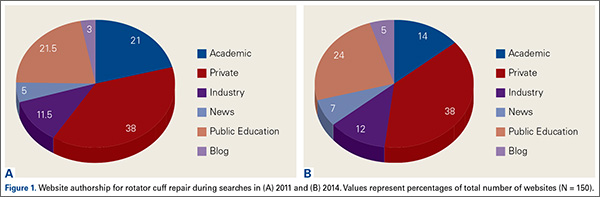
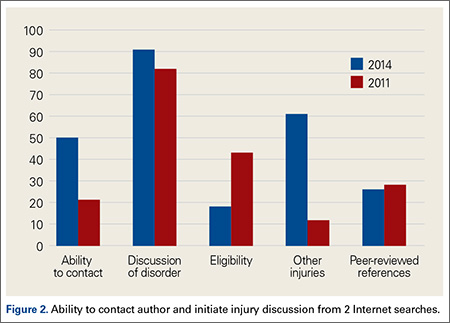
When the 2011 and 2014 website content was compared, several changes were noted. Percentage of websites providing an author contact method increased from 21% to 50% (Figure 2), percentage detailing rotator cuff repairs increased from 82% to 91%, and percentage introducing treatment options in addition to surgical management increased from 11.5% to 61%. Percentage discussing surgical eligibility, however, decreased from 43% to 18%. Percentage citing peer-reviewed sources remained relatively constant (28%, 26%), as did percentage discussing surgical technique for rotator cuff repair (55%, 59%) (Figure 3). A major decrease was found in percentage of websites discussing surgical complications, 42% in 2011 down to 25% in 2014, whereas a major increase was found in percentage discussing rehabilitation, from 39% in 2011 up to 73% in 2014. In 2014, no websites discussed double- versus single-row surgery—compared with 6% in 2011. False claims remained low between 2011 and 2014. In both searches, no website guaranteed a return to sport, and few made claims of painless or bloodless surgery.
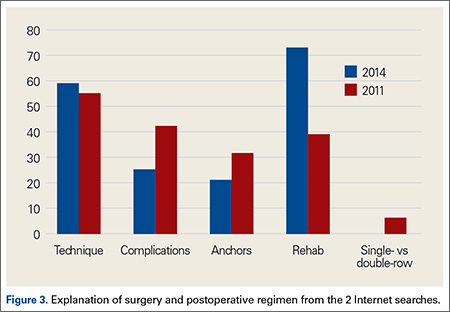
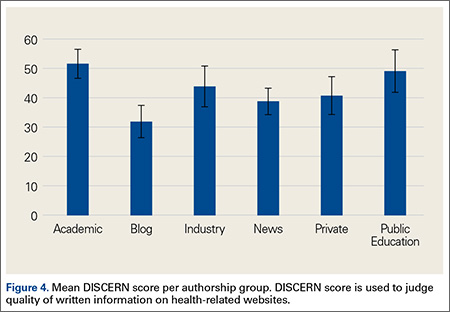
DISCERN scores for websites found during the 2014 search were averaged for each of the 6 authorship groups (Figure 4). The highest DISCERN scores were given to academic institution websites (51.6) and public education websites (49). For the academic websites, this difference was significant relative to news, blog, and private physician websites (Ps = .012, .001, .001) The lowest DISCERN scores were given to news organization websites and personal blogs. DISCERN scores were 43.8 for industry sources and 40.7 for private physician groups; the difference was not significant (P = .229). Overall mean DISCERN score for all websites was 44. Eleven percent of websites were HONcode-certified.
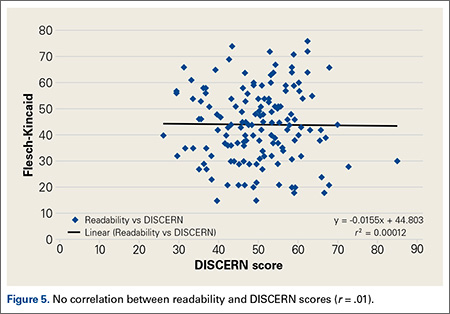
No correlation was found between website readability and DISCERN score; correlation coefficient r was .01 (Figure 5). For the websites in 2014, mean Flesch-Kincaid readability score was 50.17, and mean grade level was 10.98; coefficient of determination r2 was 0.00012.
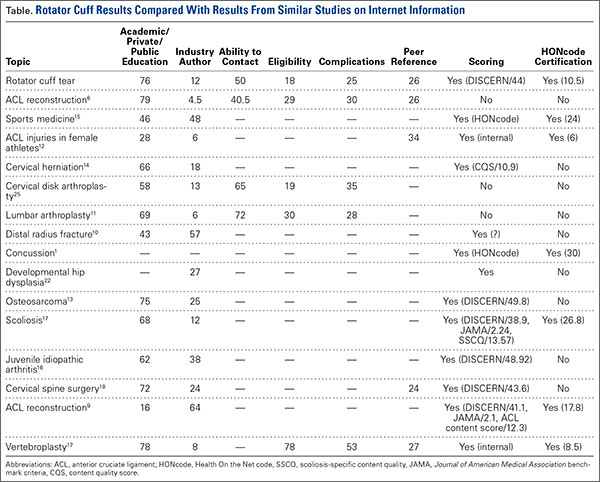
The Table compares our data with data from other orthopedic studies that have analyzed the quality of Internet information about various orthopedic injuries, diseases, and procedures.3-6,8,9,11-18 With its mean DISCERN score of 44, the present rotator cuff tear study was ranked third of 6 studies that have used this scoring system to analyze website content. Of these 6 studies, those reviewing osteosarcoma and juvenile idiopathic arthritis were ranked highest (mean scores, 49.8 and 48.9, respectively), and the study reviewing scoliosis surgery was ranked lowest (38.9). Bruce-Brand and colleagues9 recently found a mean DISCERN score of 41 for anterior cruciate ligament (ACL) reconstruction. When considering HONcode-certified websites, our Internet search for rotator cuff tears found the third lowest percentage, 10.5%, compared with the other studies (Table); the highest percentage, 30%, was found for websites discussing concussions in athletes. When considering authorship, our rotator cuff study found the third highest percentage, 76%, authored by academic centers, physicians, and public education websites; the highest percentage was found in websites discussing ACL reconstruction. Websites discussing ACL reconstruction also had the highest percentage of websites authored by industry.9
Discussion
To our knowledge, this is the first study specifically analyzing the quality of Internet information about rotator cuff repairs. A similar study, conducted by Starman and colleagues15 in 2010, addressed the quality of web information about 10 common sports medicine diagnoses, one of which was rotator cuff tears. In that study, only 16 of the websites included discussed rotator cuff tears. In addition, the authors used a customized, HONcode-based grading system to analyze each website, making their data difficult to compare across studies.
Ideally, a high-quality medical website should be written by a credible source and should cover a disorder, treatment options, eligibility, rehabilitation, and complications. As there is no standard grading system for analyzing web content about rotator cuff repairs, we analyzed the websites for specific information we thought should be included in a high-quality website (Figures 2, 3). When considering authorship, we found academic centers, private physicians, and educational sources comprised 76% of the sources; industry sources made up only 12%. Similar findings were noted by investigators analyzing Internet information about other orthopedic topics, including ACL reconstruction, lumbar arthroplasty, osteosarcoma, and cervical spine surgery.5,11,22 Studies analyzing websites for information on ACL tears and distal radius fractures found have a higher percentage of industry-sponsored websites.9,10
DISCERN showed that the highest-quality information came from websites with academic affiliations, consistent with previous studies,3,9,17 and its mean score (51.6) was significantly higher than the scores for private physician websites, news sites, and blogs (Ps = .001, .016, .001); the least reliable information was from personal blogs and news outlets. Of note, mean DISCERN score was higher for the industry websites we found than for private physician websites (43.8 vs 40.7), though the difference was not significant (P = .229). Previous investigators considered number of industry-sponsored websites as a marker of poor quality of information relating to a given topic; however, given the DISCERN scores in our study, this might not necessarily be true.6 Based on the present study’s data, websites affiliated with academic institutions would be recommended for patients searching for high-quality information about rotator cuff tears.
Given DISCERN scores across studies, information about rotator cuff tears ranked below information about osteosarcoma and juvenile idiopathic arthritis but above information about scoliosis, cervical spine surgery, and ACL reconstruction (Table). DISCERN scores must be compared across studies, as there are no definitions for good and poor DISCERN scores.
Of the 4 studies that analyzed percentage of websites citing peer-reviewed sources, only our study and the study of cervical spine surgery18 analyzed that percentage as well as DISCERN score. Percentage citing peer-reviewed sources was 26% for rotator cuff tears and 24% for cervical spine surgery; the respective DISCERN scores were 44 and 43.6. As only these 2 studies could be compared, no real correlation between percentage of websites citing peer-reviewed sources and the quality of the content on a given topic can be assessed. More research into this relationship is needed. One already delineated association is the correlation between HONcode-certified sites and high DISCERN scores.21 For high-quality medical information, physicians can direct their patients both to academic institution websites and to HONcode-certified websites.
When we compared the present study with previous investigations, we found a large difference between search results for a given topic. In 2013, Duncan and colleagues6 and Bruce-Brand and colleagues9 used similar study designs (eg, search terms, search engines) for their investigations of quality of web information. Their results, however, were widely different. For example, percentages of industry authorship were 4.5% (Duncan and colleagues6) and 64% (Bruce-Brand and colleagues9). This inconsistency between studies conducted during similar periods might be related to what appears at the top of the results queue for a search. Duncan and colleagues6 analyzed 200 websites, Bruce-Brand and colleagues9 only 45. Industries may have made financial arrangements and used search engine optimization techniques to have their websites listed first in search results.
In our study, we also analyzed how web information has changed over time. On the Internet, information changes daily, and we hypothesized that the content found during our 2 searches (2011, 2014) would yield different results. Surprisingly, the data were similar, particularly concerning authorship (Figures 1, 2). In both searches, the largest authorship source was private physician or physician groups (38% in 2011 and 2014). Other authorship sources showed little change in percentage between searches. As for content, we found both increases and decreases in specific web information. Ability to contact authors increased from 21% (2011) to 50% (2014). We think it is important that websites offer a communication channel to people who read the medical information the sites provide. Percentage of websites discussing nonoperative treatment options increased from 11.5% to 61%. Therefore, patients in 2014 were being introduced to more options (in addition to surgery) for managing shoulder pain—an improvement in quality of information between the searches. Percentage of websites discussing surgical eligibility, however, decreased from 43% to 18%—a negative development in information quality. Another decrease, from 42% to 25%, was found for websites discussing surgical complications. Given the data as a whole, and our finding both negative and positive changes, it appears the quality of web content has not improved significantly. Interestingly, no websites discussed double- versus single-row surgery in 2014, but 6% did so in 2011.
Lost in the discussion of quality and reliability of information is whether patients comprehend what they are reading.23 Yi and colleagues19 recentlyassessed the readability level of arthroscopy information in articles published online by the American Academy of Orthopaedic Surgeons (AAOS) and the Arthroscopy Association of North America (AANA). The investigators used the Flesch-Kincaid readability test to determine readability level in terms of grade level. They found that the majority of the patient education articles on the AAOS and AANA sites had a readability level far above the national average; only 4 articles were written at or below the eighth-grade level, the current average reading level in the United States.24 Information that is not comprehensible is of no use to patients, and information that physicians and researchers consider high-quality might not be what patients consider high-quality. As we pursue higher-quality web content, we need to consider that its audience includes nonmedical readers, our patients. In the present study, we found that the readability of a website had no correlation with the site’s DISCERN score (Figure 5). Therefore, for information about rotator cuff repairs, higher-quality websites are no harder than lower-quality sites for patients to comprehend. The Flesch-Kincaid readability test is flawed in that it considers only total number of syllables per word and words per sentence, not nontextual elements of patient education materials, such as illustrations on a website. The 10.98 mean grade level found in our study is higher than the levels found for most studies reviewed by Yi and colleagues.19
This study had several limitations. During an Internet search, the number of websites a user visits drops precipitously after the first page of results. Studies have shown the top 20 sites in a given search receive 97% of the views, and the top 3 receive 58.4%. Whether patients visit websites far down in the list of 150 we found in our given search is unknown. Last, the Flesch-Kincaid readability test is flawed in several ways but nevertheless is used extensively in research. Grading is based on number of words and syllables used in a given sentence; it does not take into account the complexity or common usage of a given word or definition. Therefore, websites may receive low Flesch-Kincaid scores—indicating ease of reading—despite their use of complex medical terminology and jargon that complicate patients’ comprehension of the material.
Conclusion
Numerous authors have evaluated orthopedic patients’ accessing of medical information from the Internet. Although the Internet makes access easier, unreliable content can lead patients to develop certain notions about the direction of their care and certain expectations regarding their clinical outcomes. With there being no regulatory body monitoring content, the peer review process, an essential feature of academic publishing, can be easily circumvented.25
In this study, the highest-quality websites had academic affiliations. Quality of information about rotator cuff repairs was similar to what was found for other orthopedic topics in comparable studies. Surprisingly, there was little change in authorship and content of web information between our 2 search periods (2011, 2014). Although there has been a rapid increase in the number of medical websites, quality of content seems not to have changed significantly. Patients look to physicians for guidance but increasingly are accessing the Internet for additional information. It is essential that physicians understand the quality of information available on the Internet when counseling patients regarding surgery.
1. Brunnekreef JJ, Schreurs BW. Total hip arthroplasty: what information do we offer patients on websites of hospitals? BMC Health Serv Res. 2011;11:83.
2. Koh HS, In Y, Kong CG, Won HY, Kim KH, Lee JH. Factors affecting patients’ graft choice in anterior cruciate ligament reconstruction. Clin Orthop Surg. 2010;2(2):69-75.
3. Nason GJ, Baker JF, Byrne DP, Noel J, Moore D, Kiely PJ. Scoliosis-specific information on the Internet: has the “information highway” led to better information provision? Spine. 2012;37(21):E1364-E1369.
4. Groves ND, Humphreys HW, Williams AJ, Jones A. Effect of informational Internet web pages on patients’ decision making: randomised controlled trial regarding choice of spinal or general anaesthesia for orthopaedic surgery. Anaesthesia. 2010;65(3):277-282.
5. Purcell K, Brenner J, Rainie L. Search Engine Use 2012. Washington, DC: Pew Internet & American Life Project; 2012.
6. Duncan IC, Kane PW, Lawson KA, Cohen SB, Ciccotti MG, Dodson CC. Evaluation of information available on the Internet regarding anterior cruciate ligament reconstruction. Arthroscopy. 2013;29(6):1101-1107.
7. Lichtenfeld LJ. Can the beast be tamed? The woeful tale of accurate health information on the Internet. Ann Surg Oncol. 2012;19(3):701-702.
8. Ahmed OH, Sullivan SJ, Schneiders AG, McCrory PR. Concussion information online: evaluation of information quality, content and readability of concussion-related websites. Br J Sports Med. 2012;46(9):675-683.
9. Bruce-Brand RA, Baker JF, Byrne DP, Hogan NA, McCarthy T. Assessment of the quality and content of information on anterior cruciate ligament reconstruction on the Internet. Arthroscopy. 2013;29(6):1095-1100.
10. Dy JC, Taylor SA, Patel RM, Kitay A, Roberts TR, Daluiski A. The effect of search term on the quality and accuracy of online information regarding distal radius fractures. J Hand Surg Am. 2012;37(9):1881-1887.
11. Garcia RM, Messerschmitt PJ, Ahn NU. An evaluation of information on the Internet of a new device: the lumbar artificial disc replacement. J Spinal Disord Tech. 2009;22(1):52-57.
12. Gosselin MM, Mulcahey MK, Feller E, Hulstyn MJ. Examining Internet resources on gender differences in ACL injuries: what patients are reading. Knee. 2013;20(3):196-202.
13. Lam CG, Roter DL, Cohen KJ. Survey of quality, readability, and social reach of websites on osteosarcoma in adolescents. Patient Educ Couns. 2013;90(1):82-87.
14. Morr S, Shanti N, Carrer A, Kubeck J, Gerling MC. Quality of information concerning cervical disc herniation on the Internet. Spine J. 2010;10(4):350-354.
15. Starman JS, Gettys FK, Capo JA, Fleischli JE, Norton HJ, Karunakar MA. Quality and content of Internet-based information for ten common orthopaedic sports medicine diagnoses. J Bone Joint Surg Am. 2010;92(7):1612-1618.
16. Stinson JN, Tucker L, Huber A, et al. Surfing for juvenile idiopathic arthritis: perspectives on quality and content of information on the Internet. J Rheumatol. 2009;36(8):1755-1762.
17. Sullivan TB, Anderson JS, Ahn UM, Ahn NU. Can Internet information on vertebroplasty be a reliable means of patient self-education? Clin Orthop Relat Res. 2014;472(5):1597-1604.
18. Weil AG, Bojanowski MW, Jamart J, Gustin T, Lévêque M. Evaluation of the quality of information on the Internet available to patients undergoing cervical spine surgery. World Neurosurg. 2014;82(1-2):e31-e39.
19. Yi PH, Ganta A, Hussein KI, Frank RM, Jawa A. Readability of arthroscopy-related patient education materials from the American Academy of Orthopaedic Surgeons and Arthroscopy Association of North America web sites. Arthroscopy. 2013;29(6):1108-1112.
20. Boyer C, Selby M, Scherrer JR, Appel RD. The Health On the Net code of conduct for medical and health websites. Comput Biol Med. 1998;28(5):603-610.
21. Silberg WM, Lundberg GD, Musacchio RA. Assessing, controlling, and assuring the quality of medical information on the Internet: Caveant lector et viewor—Let the reader and viewer beware. JAMA. 1997;277(15):1244-1245.
22. Fabricant PD, Dy CJ, Patel RM, Blanco JS, Doyle SM. Internet search term affects the quality and accuracy of online information about developmental hip dysplasia. J Pediatr Orthop. 2013;33(4):361-365.
23. Aslam N, Bowyer D, Wainwright A, Theologis T, Benson M. Evaluation of Internet use by paediatric orthopaedic outpatients and the quality of information available. J Pediatr Orthop B. 2005;14(2):129-133.
24. Wetzler MJ. “I found it on the Internet”: how reliable and readable is patient information? Arthroscopy. 2013;29(6):967-968.
25. Qureshi SA, Koehler SM, Lin JD, Bird J, Garcia RM, Hecht AC. An evaluation of information on the Internet about a new device: the cervical artificial disc replacement. Spine. 2012;37(10):881-883.
Patients are learning about health and disease more independently than before, but such self-education may pose a unique challenge for practicing physicians. Although educated patients can assist in the critical appraisal of treatment options,1 misinformed patients may have preconceived treatment biases and unrealistic expectations. More than 66 million Americans use the Internet daily, and recent surveys have shown 86% have used the Internet for health-related information.2,3 With Internet use increasing, the number of patients turning to the web for medical information is increasing as well.4 For many patients, this information can be useful in making decisions about their health and health care.5
Although accessing medical information from the Internet has grown exponentially, analysis of information quality has grown considerably slower.6 With no regulatory body monitoring content, there is easy circumvention of the peer review process, an essential feature of academic publishing.7 With no external regulation, the information retrieved may be incorrect, outdated, or misleading. Many orthopedic studies have analyzed Internet content about numerous diagnoses.3-6,8-18 Most of these studies have found this information highly variable and of poor quality.
We conducted a study to evaluate and analyze rotator cuff repair information available to the general public through the Internet; to assess changes in the quality of information over time; to determine if sites sponsored by academic institutions offered higher-quality information; and to assess whether the readability of the material varied according to DISCERN scores.
Rotator cuff repairs are among the most common surgeries performed by orthopedic surgeons. To our knowledge, this is the first study to assess the quality of web information about rotator cuff repairs. We hypothesized that the quality of information would positively correlate with the reading level of the material presented, that academic institutions would present the highest-quality information, and that the type of information presented would change over time.
Materials and Methods
We used the search phrase rotator cuff repair on the 3 most popular search engines: Google, Yahoo!, and Bing. Google is the dominant engine, taking 83.06% of total market share, followed by Yahoo! (6.86%) and Bing (4.27%).5 The first 50 websites identified by each search engine were selected for evaluation, excluding duplicates or overlapping websites. Similarly, advertisements and strictly video results lacking text were excluded. After each engine was queried, a master list of 150 websites was created for individual evaluation and assessment. To assess changes in results over time, we performed 2 searches, on November 16, 2011, and May 18, 2014.
The content of each website was analyzed for authorship, ability to contact the author, discussion of disorder, surgical treatment, complications, surgical eligibility, rehabilitation, other treatment options, and use of peer-reviewed sources. Authorship was placed in 1 of 6 categories:
1. Academic—university-affiliated physician or research group.
2. Private—physician or group without stated affiliation to an academic organization.
3. Industry—manufacturing or marketing company advertising a product or service for profit.
4. News source—bulletin or article without affiliation to a hospital or an academic institution.
5. Public education—individual or organization with noncommercial website providing third-party information (eg, Wikipedia, About.com).
6. Blog—website publishing an individual’s personal experiences in diary or journal form.
Websites were also assessed for accuracy and validity based on presence or absence of Health On the Net code (HONcode) certification and DISCERN score. Designed by the Health On the Net Foundation in 1996, HONcode provides a framework for disseminating high-quality medical information over the web.19 Website owners can request that their sites be evaluated for HONcode certification; a site that qualifies can display the HONcode seal.20 The DISCERN project, initially funded by the National Health Service in the United Kingdom, judges the quality of written information available on health-related websites.21 It determines the quality of a publication on the basis of 16 questions: The first 8 address the publication’s reliability, the next 7 involve specific details of treatment choices, and the last is an overall rating of the website.
Website readability was assessed with the Flesch-Kincaid test. This test, designed under contract with the US Navy in 1975, has been used in other orthopedic studies.19 Regression analysis was performed to check for correlation between website readability and DISCERN score. Analysis of variance was used to analyze differences between scores.
Results
We performed a comprehensive analysis of the top 50 websites from each of the 3 search engines (N = 150 websites) (Figures 1–5, Table). Regarding authorship, our 2 searches demonstrated similar values (Figure 1). In 2011, 21% of websites were associated with an academic institution, 38% were authored by private physicians or hospital or physician groups not associated with an academic institution, 11.5% were industry-sponsored, 5% were news bulletins or media reports, 21.5% were public education websites, and 3% were personal blogs. Our 2014 search found a similar distribution of contributors. Between 2011 and 2014, the largest change was in academic authors, which decreased by 7%, from 21% to 14%. Percentage of websites authored by private physicians remained constant from the first to the second search: 38%.
When the 2011 and 2014 website content was compared, several changes were noted. Percentage of websites providing an author contact method increased from 21% to 50% (Figure 2), percentage detailing rotator cuff repairs increased from 82% to 91%, and percentage introducing treatment options in addition to surgical management increased from 11.5% to 61%. Percentage discussing surgical eligibility, however, decreased from 43% to 18%. Percentage citing peer-reviewed sources remained relatively constant (28%, 26%), as did percentage discussing surgical technique for rotator cuff repair (55%, 59%) (Figure 3). A major decrease was found in percentage of websites discussing surgical complications, 42% in 2011 down to 25% in 2014, whereas a major increase was found in percentage discussing rehabilitation, from 39% in 2011 up to 73% in 2014. In 2014, no websites discussed double- versus single-row surgery—compared with 6% in 2011. False claims remained low between 2011 and 2014. In both searches, no website guaranteed a return to sport, and few made claims of painless or bloodless surgery.
DISCERN scores for websites found during the 2014 search were averaged for each of the 6 authorship groups (Figure 4). The highest DISCERN scores were given to academic institution websites (51.6) and public education websites (49). For the academic websites, this difference was significant relative to news, blog, and private physician websites (Ps = .012, .001, .001) The lowest DISCERN scores were given to news organization websites and personal blogs. DISCERN scores were 43.8 for industry sources and 40.7 for private physician groups; the difference was not significant (P = .229). Overall mean DISCERN score for all websites was 44. Eleven percent of websites were HONcode-certified.
No correlation was found between website readability and DISCERN score; correlation coefficient r was .01 (Figure 5). For the websites in 2014, mean Flesch-Kincaid readability score was 50.17, and mean grade level was 10.98; coefficient of determination r2 was 0.00012.
The Table compares our data with data from other orthopedic studies that have analyzed the quality of Internet information about various orthopedic injuries, diseases, and procedures.3-6,8,9,11-18 With its mean DISCERN score of 44, the present rotator cuff tear study was ranked third of 6 studies that have used this scoring system to analyze website content. Of these 6 studies, those reviewing osteosarcoma and juvenile idiopathic arthritis were ranked highest (mean scores, 49.8 and 48.9, respectively), and the study reviewing scoliosis surgery was ranked lowest (38.9). Bruce-Brand and colleagues9 recently found a mean DISCERN score of 41 for anterior cruciate ligament (ACL) reconstruction. When considering HONcode-certified websites, our Internet search for rotator cuff tears found the third lowest percentage, 10.5%, compared with the other studies (Table); the highest percentage, 30%, was found for websites discussing concussions in athletes. When considering authorship, our rotator cuff study found the third highest percentage, 76%, authored by academic centers, physicians, and public education websites; the highest percentage was found in websites discussing ACL reconstruction. Websites discussing ACL reconstruction also had the highest percentage of websites authored by industry.9
Discussion
To our knowledge, this is the first study specifically analyzing the quality of Internet information about rotator cuff repairs. A similar study, conducted by Starman and colleagues15 in 2010, addressed the quality of web information about 10 common sports medicine diagnoses, one of which was rotator cuff tears. In that study, only 16 of the websites included discussed rotator cuff tears. In addition, the authors used a customized, HONcode-based grading system to analyze each website, making their data difficult to compare across studies.
Ideally, a high-quality medical website should be written by a credible source and should cover a disorder, treatment options, eligibility, rehabilitation, and complications. As there is no standard grading system for analyzing web content about rotator cuff repairs, we analyzed the websites for specific information we thought should be included in a high-quality website (Figures 2, 3). When considering authorship, we found academic centers, private physicians, and educational sources comprised 76% of the sources; industry sources made up only 12%. Similar findings were noted by investigators analyzing Internet information about other orthopedic topics, including ACL reconstruction, lumbar arthroplasty, osteosarcoma, and cervical spine surgery.5,11,22 Studies analyzing websites for information on ACL tears and distal radius fractures found have a higher percentage of industry-sponsored websites.9,10
DISCERN showed that the highest-quality information came from websites with academic affiliations, consistent with previous studies,3,9,17 and its mean score (51.6) was significantly higher than the scores for private physician websites, news sites, and blogs (Ps = .001, .016, .001); the least reliable information was from personal blogs and news outlets. Of note, mean DISCERN score was higher for the industry websites we found than for private physician websites (43.8 vs 40.7), though the difference was not significant (P = .229). Previous investigators considered number of industry-sponsored websites as a marker of poor quality of information relating to a given topic; however, given the DISCERN scores in our study, this might not necessarily be true.6 Based on the present study’s data, websites affiliated with academic institutions would be recommended for patients searching for high-quality information about rotator cuff tears.
Given DISCERN scores across studies, information about rotator cuff tears ranked below information about osteosarcoma and juvenile idiopathic arthritis but above information about scoliosis, cervical spine surgery, and ACL reconstruction (Table). DISCERN scores must be compared across studies, as there are no definitions for good and poor DISCERN scores.
Of the 4 studies that analyzed percentage of websites citing peer-reviewed sources, only our study and the study of cervical spine surgery18 analyzed that percentage as well as DISCERN score. Percentage citing peer-reviewed sources was 26% for rotator cuff tears and 24% for cervical spine surgery; the respective DISCERN scores were 44 and 43.6. As only these 2 studies could be compared, no real correlation between percentage of websites citing peer-reviewed sources and the quality of the content on a given topic can be assessed. More research into this relationship is needed. One already delineated association is the correlation between HONcode-certified sites and high DISCERN scores.21 For high-quality medical information, physicians can direct their patients both to academic institution websites and to HONcode-certified websites.
When we compared the present study with previous investigations, we found a large difference between search results for a given topic. In 2013, Duncan and colleagues6 and Bruce-Brand and colleagues9 used similar study designs (eg, search terms, search engines) for their investigations of quality of web information. Their results, however, were widely different. For example, percentages of industry authorship were 4.5% (Duncan and colleagues6) and 64% (Bruce-Brand and colleagues9). This inconsistency between studies conducted during similar periods might be related to what appears at the top of the results queue for a search. Duncan and colleagues6 analyzed 200 websites, Bruce-Brand and colleagues9 only 45. Industries may have made financial arrangements and used search engine optimization techniques to have their websites listed first in search results.
In our study, we also analyzed how web information has changed over time. On the Internet, information changes daily, and we hypothesized that the content found during our 2 searches (2011, 2014) would yield different results. Surprisingly, the data were similar, particularly concerning authorship (Figures 1, 2). In both searches, the largest authorship source was private physician or physician groups (38% in 2011 and 2014). Other authorship sources showed little change in percentage between searches. As for content, we found both increases and decreases in specific web information. Ability to contact authors increased from 21% (2011) to 50% (2014). We think it is important that websites offer a communication channel to people who read the medical information the sites provide. Percentage of websites discussing nonoperative treatment options increased from 11.5% to 61%. Therefore, patients in 2014 were being introduced to more options (in addition to surgery) for managing shoulder pain—an improvement in quality of information between the searches. Percentage of websites discussing surgical eligibility, however, decreased from 43% to 18%—a negative development in information quality. Another decrease, from 42% to 25%, was found for websites discussing surgical complications. Given the data as a whole, and our finding both negative and positive changes, it appears the quality of web content has not improved significantly. Interestingly, no websites discussed double- versus single-row surgery in 2014, but 6% did so in 2011.
Lost in the discussion of quality and reliability of information is whether patients comprehend what they are reading.23 Yi and colleagues19 recentlyassessed the readability level of arthroscopy information in articles published online by the American Academy of Orthopaedic Surgeons (AAOS) and the Arthroscopy Association of North America (AANA). The investigators used the Flesch-Kincaid readability test to determine readability level in terms of grade level. They found that the majority of the patient education articles on the AAOS and AANA sites had a readability level far above the national average; only 4 articles were written at or below the eighth-grade level, the current average reading level in the United States.24 Information that is not comprehensible is of no use to patients, and information that physicians and researchers consider high-quality might not be what patients consider high-quality. As we pursue higher-quality web content, we need to consider that its audience includes nonmedical readers, our patients. In the present study, we found that the readability of a website had no correlation with the site’s DISCERN score (Figure 5). Therefore, for information about rotator cuff repairs, higher-quality websites are no harder than lower-quality sites for patients to comprehend. The Flesch-Kincaid readability test is flawed in that it considers only total number of syllables per word and words per sentence, not nontextual elements of patient education materials, such as illustrations on a website. The 10.98 mean grade level found in our study is higher than the levels found for most studies reviewed by Yi and colleagues.19
This study had several limitations. During an Internet search, the number of websites a user visits drops precipitously after the first page of results. Studies have shown the top 20 sites in a given search receive 97% of the views, and the top 3 receive 58.4%. Whether patients visit websites far down in the list of 150 we found in our given search is unknown. Last, the Flesch-Kincaid readability test is flawed in several ways but nevertheless is used extensively in research. Grading is based on number of words and syllables used in a given sentence; it does not take into account the complexity or common usage of a given word or definition. Therefore, websites may receive low Flesch-Kincaid scores—indicating ease of reading—despite their use of complex medical terminology and jargon that complicate patients’ comprehension of the material.
Conclusion
Numerous authors have evaluated orthopedic patients’ accessing of medical information from the Internet. Although the Internet makes access easier, unreliable content can lead patients to develop certain notions about the direction of their care and certain expectations regarding their clinical outcomes. With there being no regulatory body monitoring content, the peer review process, an essential feature of academic publishing, can be easily circumvented.25
In this study, the highest-quality websites had academic affiliations. Quality of information about rotator cuff repairs was similar to what was found for other orthopedic topics in comparable studies. Surprisingly, there was little change in authorship and content of web information between our 2 search periods (2011, 2014). Although there has been a rapid increase in the number of medical websites, quality of content seems not to have changed significantly. Patients look to physicians for guidance but increasingly are accessing the Internet for additional information. It is essential that physicians understand the quality of information available on the Internet when counseling patients regarding surgery.
Patients are learning about health and disease more independently than before, but such self-education may pose a unique challenge for practicing physicians. Although educated patients can assist in the critical appraisal of treatment options,1 misinformed patients may have preconceived treatment biases and unrealistic expectations. More than 66 million Americans use the Internet daily, and recent surveys have shown 86% have used the Internet for health-related information.2,3 With Internet use increasing, the number of patients turning to the web for medical information is increasing as well.4 For many patients, this information can be useful in making decisions about their health and health care.5
Although accessing medical information from the Internet has grown exponentially, analysis of information quality has grown considerably slower.6 With no regulatory body monitoring content, there is easy circumvention of the peer review process, an essential feature of academic publishing.7 With no external regulation, the information retrieved may be incorrect, outdated, or misleading. Many orthopedic studies have analyzed Internet content about numerous diagnoses.3-6,8-18 Most of these studies have found this information highly variable and of poor quality.
We conducted a study to evaluate and analyze rotator cuff repair information available to the general public through the Internet; to assess changes in the quality of information over time; to determine if sites sponsored by academic institutions offered higher-quality information; and to assess whether the readability of the material varied according to DISCERN scores.
Rotator cuff repairs are among the most common surgeries performed by orthopedic surgeons. To our knowledge, this is the first study to assess the quality of web information about rotator cuff repairs. We hypothesized that the quality of information would positively correlate with the reading level of the material presented, that academic institutions would present the highest-quality information, and that the type of information presented would change over time.
Materials and Methods
We used the search phrase rotator cuff repair on the 3 most popular search engines: Google, Yahoo!, and Bing. Google is the dominant engine, taking 83.06% of total market share, followed by Yahoo! (6.86%) and Bing (4.27%).5 The first 50 websites identified by each search engine were selected for evaluation, excluding duplicates or overlapping websites. Similarly, advertisements and strictly video results lacking text were excluded. After each engine was queried, a master list of 150 websites was created for individual evaluation and assessment. To assess changes in results over time, we performed 2 searches, on November 16, 2011, and May 18, 2014.
The content of each website was analyzed for authorship, ability to contact the author, discussion of disorder, surgical treatment, complications, surgical eligibility, rehabilitation, other treatment options, and use of peer-reviewed sources. Authorship was placed in 1 of 6 categories:
1. Academic—university-affiliated physician or research group.
2. Private—physician or group without stated affiliation to an academic organization.
3. Industry—manufacturing or marketing company advertising a product or service for profit.
4. News source—bulletin or article without affiliation to a hospital or an academic institution.
5. Public education—individual or organization with noncommercial website providing third-party information (eg, Wikipedia, About.com).
6. Blog—website publishing an individual’s personal experiences in diary or journal form.
Websites were also assessed for accuracy and validity based on presence or absence of Health On the Net code (HONcode) certification and DISCERN score. Designed by the Health On the Net Foundation in 1996, HONcode provides a framework for disseminating high-quality medical information over the web.19 Website owners can request that their sites be evaluated for HONcode certification; a site that qualifies can display the HONcode seal.20 The DISCERN project, initially funded by the National Health Service in the United Kingdom, judges the quality of written information available on health-related websites.21 It determines the quality of a publication on the basis of 16 questions: The first 8 address the publication’s reliability, the next 7 involve specific details of treatment choices, and the last is an overall rating of the website.
Website readability was assessed with the Flesch-Kincaid test. This test, designed under contract with the US Navy in 1975, has been used in other orthopedic studies.19 Regression analysis was performed to check for correlation between website readability and DISCERN score. Analysis of variance was used to analyze differences between scores.
Results
We performed a comprehensive analysis of the top 50 websites from each of the 3 search engines (N = 150 websites) (Figures 1–5, Table). Regarding authorship, our 2 searches demonstrated similar values (Figure 1). In 2011, 21% of websites were associated with an academic institution, 38% were authored by private physicians or hospital or physician groups not associated with an academic institution, 11.5% were industry-sponsored, 5% were news bulletins or media reports, 21.5% were public education websites, and 3% were personal blogs. Our 2014 search found a similar distribution of contributors. Between 2011 and 2014, the largest change was in academic authors, which decreased by 7%, from 21% to 14%. Percentage of websites authored by private physicians remained constant from the first to the second search: 38%.
When the 2011 and 2014 website content was compared, several changes were noted. Percentage of websites providing an author contact method increased from 21% to 50% (Figure 2), percentage detailing rotator cuff repairs increased from 82% to 91%, and percentage introducing treatment options in addition to surgical management increased from 11.5% to 61%. Percentage discussing surgical eligibility, however, decreased from 43% to 18%. Percentage citing peer-reviewed sources remained relatively constant (28%, 26%), as did percentage discussing surgical technique for rotator cuff repair (55%, 59%) (Figure 3). A major decrease was found in percentage of websites discussing surgical complications, 42% in 2011 down to 25% in 2014, whereas a major increase was found in percentage discussing rehabilitation, from 39% in 2011 up to 73% in 2014. In 2014, no websites discussed double- versus single-row surgery—compared with 6% in 2011. False claims remained low between 2011 and 2014. In both searches, no website guaranteed a return to sport, and few made claims of painless or bloodless surgery.
DISCERN scores for websites found during the 2014 search were averaged for each of the 6 authorship groups (Figure 4). The highest DISCERN scores were given to academic institution websites (51.6) and public education websites (49). For the academic websites, this difference was significant relative to news, blog, and private physician websites (Ps = .012, .001, .001) The lowest DISCERN scores were given to news organization websites and personal blogs. DISCERN scores were 43.8 for industry sources and 40.7 for private physician groups; the difference was not significant (P = .229). Overall mean DISCERN score for all websites was 44. Eleven percent of websites were HONcode-certified.
No correlation was found between website readability and DISCERN score; correlation coefficient r was .01 (Figure 5). For the websites in 2014, mean Flesch-Kincaid readability score was 50.17, and mean grade level was 10.98; coefficient of determination r2 was 0.00012.
The Table compares our data with data from other orthopedic studies that have analyzed the quality of Internet information about various orthopedic injuries, diseases, and procedures.3-6,8,9,11-18 With its mean DISCERN score of 44, the present rotator cuff tear study was ranked third of 6 studies that have used this scoring system to analyze website content. Of these 6 studies, those reviewing osteosarcoma and juvenile idiopathic arthritis were ranked highest (mean scores, 49.8 and 48.9, respectively), and the study reviewing scoliosis surgery was ranked lowest (38.9). Bruce-Brand and colleagues9 recently found a mean DISCERN score of 41 for anterior cruciate ligament (ACL) reconstruction. When considering HONcode-certified websites, our Internet search for rotator cuff tears found the third lowest percentage, 10.5%, compared with the other studies (Table); the highest percentage, 30%, was found for websites discussing concussions in athletes. When considering authorship, our rotator cuff study found the third highest percentage, 76%, authored by academic centers, physicians, and public education websites; the highest percentage was found in websites discussing ACL reconstruction. Websites discussing ACL reconstruction also had the highest percentage of websites authored by industry.9
Discussion
To our knowledge, this is the first study specifically analyzing the quality of Internet information about rotator cuff repairs. A similar study, conducted by Starman and colleagues15 in 2010, addressed the quality of web information about 10 common sports medicine diagnoses, one of which was rotator cuff tears. In that study, only 16 of the websites included discussed rotator cuff tears. In addition, the authors used a customized, HONcode-based grading system to analyze each website, making their data difficult to compare across studies.
Ideally, a high-quality medical website should be written by a credible source and should cover a disorder, treatment options, eligibility, rehabilitation, and complications. As there is no standard grading system for analyzing web content about rotator cuff repairs, we analyzed the websites for specific information we thought should be included in a high-quality website (Figures 2, 3). When considering authorship, we found academic centers, private physicians, and educational sources comprised 76% of the sources; industry sources made up only 12%. Similar findings were noted by investigators analyzing Internet information about other orthopedic topics, including ACL reconstruction, lumbar arthroplasty, osteosarcoma, and cervical spine surgery.5,11,22 Studies analyzing websites for information on ACL tears and distal radius fractures found have a higher percentage of industry-sponsored websites.9,10
DISCERN showed that the highest-quality information came from websites with academic affiliations, consistent with previous studies,3,9,17 and its mean score (51.6) was significantly higher than the scores for private physician websites, news sites, and blogs (Ps = .001, .016, .001); the least reliable information was from personal blogs and news outlets. Of note, mean DISCERN score was higher for the industry websites we found than for private physician websites (43.8 vs 40.7), though the difference was not significant (P = .229). Previous investigators considered number of industry-sponsored websites as a marker of poor quality of information relating to a given topic; however, given the DISCERN scores in our study, this might not necessarily be true.6 Based on the present study’s data, websites affiliated with academic institutions would be recommended for patients searching for high-quality information about rotator cuff tears.
Given DISCERN scores across studies, information about rotator cuff tears ranked below information about osteosarcoma and juvenile idiopathic arthritis but above information about scoliosis, cervical spine surgery, and ACL reconstruction (Table). DISCERN scores must be compared across studies, as there are no definitions for good and poor DISCERN scores.
Of the 4 studies that analyzed percentage of websites citing peer-reviewed sources, only our study and the study of cervical spine surgery18 analyzed that percentage as well as DISCERN score. Percentage citing peer-reviewed sources was 26% for rotator cuff tears and 24% for cervical spine surgery; the respective DISCERN scores were 44 and 43.6. As only these 2 studies could be compared, no real correlation between percentage of websites citing peer-reviewed sources and the quality of the content on a given topic can be assessed. More research into this relationship is needed. One already delineated association is the correlation between HONcode-certified sites and high DISCERN scores.21 For high-quality medical information, physicians can direct their patients both to academic institution websites and to HONcode-certified websites.
When we compared the present study with previous investigations, we found a large difference between search results for a given topic. In 2013, Duncan and colleagues6 and Bruce-Brand and colleagues9 used similar study designs (eg, search terms, search engines) for their investigations of quality of web information. Their results, however, were widely different. For example, percentages of industry authorship were 4.5% (Duncan and colleagues6) and 64% (Bruce-Brand and colleagues9). This inconsistency between studies conducted during similar periods might be related to what appears at the top of the results queue for a search. Duncan and colleagues6 analyzed 200 websites, Bruce-Brand and colleagues9 only 45. Industries may have made financial arrangements and used search engine optimization techniques to have their websites listed first in search results.
In our study, we also analyzed how web information has changed over time. On the Internet, information changes daily, and we hypothesized that the content found during our 2 searches (2011, 2014) would yield different results. Surprisingly, the data were similar, particularly concerning authorship (Figures 1, 2). In both searches, the largest authorship source was private physician or physician groups (38% in 2011 and 2014). Other authorship sources showed little change in percentage between searches. As for content, we found both increases and decreases in specific web information. Ability to contact authors increased from 21% (2011) to 50% (2014). We think it is important that websites offer a communication channel to people who read the medical information the sites provide. Percentage of websites discussing nonoperative treatment options increased from 11.5% to 61%. Therefore, patients in 2014 were being introduced to more options (in addition to surgery) for managing shoulder pain—an improvement in quality of information between the searches. Percentage of websites discussing surgical eligibility, however, decreased from 43% to 18%—a negative development in information quality. Another decrease, from 42% to 25%, was found for websites discussing surgical complications. Given the data as a whole, and our finding both negative and positive changes, it appears the quality of web content has not improved significantly. Interestingly, no websites discussed double- versus single-row surgery in 2014, but 6% did so in 2011.
Lost in the discussion of quality and reliability of information is whether patients comprehend what they are reading.23 Yi and colleagues19 recentlyassessed the readability level of arthroscopy information in articles published online by the American Academy of Orthopaedic Surgeons (AAOS) and the Arthroscopy Association of North America (AANA). The investigators used the Flesch-Kincaid readability test to determine readability level in terms of grade level. They found that the majority of the patient education articles on the AAOS and AANA sites had a readability level far above the national average; only 4 articles were written at or below the eighth-grade level, the current average reading level in the United States.24 Information that is not comprehensible is of no use to patients, and information that physicians and researchers consider high-quality might not be what patients consider high-quality. As we pursue higher-quality web content, we need to consider that its audience includes nonmedical readers, our patients. In the present study, we found that the readability of a website had no correlation with the site’s DISCERN score (Figure 5). Therefore, for information about rotator cuff repairs, higher-quality websites are no harder than lower-quality sites for patients to comprehend. The Flesch-Kincaid readability test is flawed in that it considers only total number of syllables per word and words per sentence, not nontextual elements of patient education materials, such as illustrations on a website. The 10.98 mean grade level found in our study is higher than the levels found for most studies reviewed by Yi and colleagues.19
This study had several limitations. During an Internet search, the number of websites a user visits drops precipitously after the first page of results. Studies have shown the top 20 sites in a given search receive 97% of the views, and the top 3 receive 58.4%. Whether patients visit websites far down in the list of 150 we found in our given search is unknown. Last, the Flesch-Kincaid readability test is flawed in several ways but nevertheless is used extensively in research. Grading is based on number of words and syllables used in a given sentence; it does not take into account the complexity or common usage of a given word or definition. Therefore, websites may receive low Flesch-Kincaid scores—indicating ease of reading—despite their use of complex medical terminology and jargon that complicate patients’ comprehension of the material.
Conclusion
Numerous authors have evaluated orthopedic patients’ accessing of medical information from the Internet. Although the Internet makes access easier, unreliable content can lead patients to develop certain notions about the direction of their care and certain expectations regarding their clinical outcomes. With there being no regulatory body monitoring content, the peer review process, an essential feature of academic publishing, can be easily circumvented.25
In this study, the highest-quality websites had academic affiliations. Quality of information about rotator cuff repairs was similar to what was found for other orthopedic topics in comparable studies. Surprisingly, there was little change in authorship and content of web information between our 2 search periods (2011, 2014). Although there has been a rapid increase in the number of medical websites, quality of content seems not to have changed significantly. Patients look to physicians for guidance but increasingly are accessing the Internet for additional information. It is essential that physicians understand the quality of information available on the Internet when counseling patients regarding surgery.
1. Brunnekreef JJ, Schreurs BW. Total hip arthroplasty: what information do we offer patients on websites of hospitals? BMC Health Serv Res. 2011;11:83.
2. Koh HS, In Y, Kong CG, Won HY, Kim KH, Lee JH. Factors affecting patients’ graft choice in anterior cruciate ligament reconstruction. Clin Orthop Surg. 2010;2(2):69-75.
3. Nason GJ, Baker JF, Byrne DP, Noel J, Moore D, Kiely PJ. Scoliosis-specific information on the Internet: has the “information highway” led to better information provision? Spine. 2012;37(21):E1364-E1369.
4. Groves ND, Humphreys HW, Williams AJ, Jones A. Effect of informational Internet web pages on patients’ decision making: randomised controlled trial regarding choice of spinal or general anaesthesia for orthopaedic surgery. Anaesthesia. 2010;65(3):277-282.
5. Purcell K, Brenner J, Rainie L. Search Engine Use 2012. Washington, DC: Pew Internet & American Life Project; 2012.
6. Duncan IC, Kane PW, Lawson KA, Cohen SB, Ciccotti MG, Dodson CC. Evaluation of information available on the Internet regarding anterior cruciate ligament reconstruction. Arthroscopy. 2013;29(6):1101-1107.
7. Lichtenfeld LJ. Can the beast be tamed? The woeful tale of accurate health information on the Internet. Ann Surg Oncol. 2012;19(3):701-702.
8. Ahmed OH, Sullivan SJ, Schneiders AG, McCrory PR. Concussion information online: evaluation of information quality, content and readability of concussion-related websites. Br J Sports Med. 2012;46(9):675-683.
9. Bruce-Brand RA, Baker JF, Byrne DP, Hogan NA, McCarthy T. Assessment of the quality and content of information on anterior cruciate ligament reconstruction on the Internet. Arthroscopy. 2013;29(6):1095-1100.
10. Dy JC, Taylor SA, Patel RM, Kitay A, Roberts TR, Daluiski A. The effect of search term on the quality and accuracy of online information regarding distal radius fractures. J Hand Surg Am. 2012;37(9):1881-1887.
11. Garcia RM, Messerschmitt PJ, Ahn NU. An evaluation of information on the Internet of a new device: the lumbar artificial disc replacement. J Spinal Disord Tech. 2009;22(1):52-57.
12. Gosselin MM, Mulcahey MK, Feller E, Hulstyn MJ. Examining Internet resources on gender differences in ACL injuries: what patients are reading. Knee. 2013;20(3):196-202.
13. Lam CG, Roter DL, Cohen KJ. Survey of quality, readability, and social reach of websites on osteosarcoma in adolescents. Patient Educ Couns. 2013;90(1):82-87.
14. Morr S, Shanti N, Carrer A, Kubeck J, Gerling MC. Quality of information concerning cervical disc herniation on the Internet. Spine J. 2010;10(4):350-354.
15. Starman JS, Gettys FK, Capo JA, Fleischli JE, Norton HJ, Karunakar MA. Quality and content of Internet-based information for ten common orthopaedic sports medicine diagnoses. J Bone Joint Surg Am. 2010;92(7):1612-1618.
16. Stinson JN, Tucker L, Huber A, et al. Surfing for juvenile idiopathic arthritis: perspectives on quality and content of information on the Internet. J Rheumatol. 2009;36(8):1755-1762.
17. Sullivan TB, Anderson JS, Ahn UM, Ahn NU. Can Internet information on vertebroplasty be a reliable means of patient self-education? Clin Orthop Relat Res. 2014;472(5):1597-1604.
18. Weil AG, Bojanowski MW, Jamart J, Gustin T, Lévêque M. Evaluation of the quality of information on the Internet available to patients undergoing cervical spine surgery. World Neurosurg. 2014;82(1-2):e31-e39.
19. Yi PH, Ganta A, Hussein KI, Frank RM, Jawa A. Readability of arthroscopy-related patient education materials from the American Academy of Orthopaedic Surgeons and Arthroscopy Association of North America web sites. Arthroscopy. 2013;29(6):1108-1112.
20. Boyer C, Selby M, Scherrer JR, Appel RD. The Health On the Net code of conduct for medical and health websites. Comput Biol Med. 1998;28(5):603-610.
21. Silberg WM, Lundberg GD, Musacchio RA. Assessing, controlling, and assuring the quality of medical information on the Internet: Caveant lector et viewor—Let the reader and viewer beware. JAMA. 1997;277(15):1244-1245.
22. Fabricant PD, Dy CJ, Patel RM, Blanco JS, Doyle SM. Internet search term affects the quality and accuracy of online information about developmental hip dysplasia. J Pediatr Orthop. 2013;33(4):361-365.
23. Aslam N, Bowyer D, Wainwright A, Theologis T, Benson M. Evaluation of Internet use by paediatric orthopaedic outpatients and the quality of information available. J Pediatr Orthop B. 2005;14(2):129-133.
24. Wetzler MJ. “I found it on the Internet”: how reliable and readable is patient information? Arthroscopy. 2013;29(6):967-968.
25. Qureshi SA, Koehler SM, Lin JD, Bird J, Garcia RM, Hecht AC. An evaluation of information on the Internet about a new device: the cervical artificial disc replacement. Spine. 2012;37(10):881-883.
1. Brunnekreef JJ, Schreurs BW. Total hip arthroplasty: what information do we offer patients on websites of hospitals? BMC Health Serv Res. 2011;11:83.
2. Koh HS, In Y, Kong CG, Won HY, Kim KH, Lee JH. Factors affecting patients’ graft choice in anterior cruciate ligament reconstruction. Clin Orthop Surg. 2010;2(2):69-75.
3. Nason GJ, Baker JF, Byrne DP, Noel J, Moore D, Kiely PJ. Scoliosis-specific information on the Internet: has the “information highway” led to better information provision? Spine. 2012;37(21):E1364-E1369.
4. Groves ND, Humphreys HW, Williams AJ, Jones A. Effect of informational Internet web pages on patients’ decision making: randomised controlled trial regarding choice of spinal or general anaesthesia for orthopaedic surgery. Anaesthesia. 2010;65(3):277-282.
5. Purcell K, Brenner J, Rainie L. Search Engine Use 2012. Washington, DC: Pew Internet & American Life Project; 2012.
6. Duncan IC, Kane PW, Lawson KA, Cohen SB, Ciccotti MG, Dodson CC. Evaluation of information available on the Internet regarding anterior cruciate ligament reconstruction. Arthroscopy. 2013;29(6):1101-1107.
7. Lichtenfeld LJ. Can the beast be tamed? The woeful tale of accurate health information on the Internet. Ann Surg Oncol. 2012;19(3):701-702.
8. Ahmed OH, Sullivan SJ, Schneiders AG, McCrory PR. Concussion information online: evaluation of information quality, content and readability of concussion-related websites. Br J Sports Med. 2012;46(9):675-683.
9. Bruce-Brand RA, Baker JF, Byrne DP, Hogan NA, McCarthy T. Assessment of the quality and content of information on anterior cruciate ligament reconstruction on the Internet. Arthroscopy. 2013;29(6):1095-1100.
10. Dy JC, Taylor SA, Patel RM, Kitay A, Roberts TR, Daluiski A. The effect of search term on the quality and accuracy of online information regarding distal radius fractures. J Hand Surg Am. 2012;37(9):1881-1887.
11. Garcia RM, Messerschmitt PJ, Ahn NU. An evaluation of information on the Internet of a new device: the lumbar artificial disc replacement. J Spinal Disord Tech. 2009;22(1):52-57.
12. Gosselin MM, Mulcahey MK, Feller E, Hulstyn MJ. Examining Internet resources on gender differences in ACL injuries: what patients are reading. Knee. 2013;20(3):196-202.
13. Lam CG, Roter DL, Cohen KJ. Survey of quality, readability, and social reach of websites on osteosarcoma in adolescents. Patient Educ Couns. 2013;90(1):82-87.
14. Morr S, Shanti N, Carrer A, Kubeck J, Gerling MC. Quality of information concerning cervical disc herniation on the Internet. Spine J. 2010;10(4):350-354.
15. Starman JS, Gettys FK, Capo JA, Fleischli JE, Norton HJ, Karunakar MA. Quality and content of Internet-based information for ten common orthopaedic sports medicine diagnoses. J Bone Joint Surg Am. 2010;92(7):1612-1618.
16. Stinson JN, Tucker L, Huber A, et al. Surfing for juvenile idiopathic arthritis: perspectives on quality and content of information on the Internet. J Rheumatol. 2009;36(8):1755-1762.
17. Sullivan TB, Anderson JS, Ahn UM, Ahn NU. Can Internet information on vertebroplasty be a reliable means of patient self-education? Clin Orthop Relat Res. 2014;472(5):1597-1604.
18. Weil AG, Bojanowski MW, Jamart J, Gustin T, Lévêque M. Evaluation of the quality of information on the Internet available to patients undergoing cervical spine surgery. World Neurosurg. 2014;82(1-2):e31-e39.
19. Yi PH, Ganta A, Hussein KI, Frank RM, Jawa A. Readability of arthroscopy-related patient education materials from the American Academy of Orthopaedic Surgeons and Arthroscopy Association of North America web sites. Arthroscopy. 2013;29(6):1108-1112.
20. Boyer C, Selby M, Scherrer JR, Appel RD. The Health On the Net code of conduct for medical and health websites. Comput Biol Med. 1998;28(5):603-610.
21. Silberg WM, Lundberg GD, Musacchio RA. Assessing, controlling, and assuring the quality of medical information on the Internet: Caveant lector et viewor—Let the reader and viewer beware. JAMA. 1997;277(15):1244-1245.
22. Fabricant PD, Dy CJ, Patel RM, Blanco JS, Doyle SM. Internet search term affects the quality and accuracy of online information about developmental hip dysplasia. J Pediatr Orthop. 2013;33(4):361-365.
23. Aslam N, Bowyer D, Wainwright A, Theologis T, Benson M. Evaluation of Internet use by paediatric orthopaedic outpatients and the quality of information available. J Pediatr Orthop B. 2005;14(2):129-133.
24. Wetzler MJ. “I found it on the Internet”: how reliable and readable is patient information? Arthroscopy. 2013;29(6):967-968.
25. Qureshi SA, Koehler SM, Lin JD, Bird J, Garcia RM, Hecht AC. An evaluation of information on the Internet about a new device: the cervical artificial disc replacement. Spine. 2012;37(10):881-883.
Thyroid surgery access and acceptance varies along racial lines
BOSTON – Access to and acceptance of thyroid cancer surgery varies by race, with black patients in particular appearing to be disadvantaged, compared with whites, investigators reported.
A review of data on nearly 138,000 patients diagnosed with thyroid cancer showed that blacks were significantly less likely than were whites to be offered surgery – despite its generally excellent outcomes and low rates of morbidity and mortality, reported Dr. Herbert Castillo Valladares and his colleagues from the department of surgery at the Yale University in New Haven, Conn.
American Indians/Alaskan natives and Asian/Pacific Islanders were significantly more likely to refuse surgery than were whites, the investigators also reported in a poster session at the Society of Surgical Oncology annual cancer symposium.
“In this project, we wanted to focus on the provider-level factors that might be perpetuating these racial disparities, and it appears that we need to educate some providers about the recommendation of surgery or how to educate patients who refuse thyroid cancer surgery,” Dr. Valladares said in an interview.
The investigators noted that although incidence and prevalence rates of thyroid cancer are similar among various racial groups, survival differs by race, and they wanted to find out why. To do so, they polled the Surveillance, Epidemiology, and End Results (SEER) registry to identify 137,483 patients diagnosed with thyroid cancer during 1988-2012. Results were stratified by thyroid cancer type, either papillary, medullary, follicular, or anaplastic.
In all, 82% of the sample were white, 75% were female, 87% had a diagnosis of papillary thyroid cancer, and 95% underwent thyroid cancer surgery.
In logistic regression analysis that controlled for race, the investigators found that blacks, Asian/Pacific Islanders, and persons of unknown race were significantly less likely than whites were to have thyroid cancer surgery (odds ratios, 0.7, 0.82, and 0.34, respectively; P for each less than .0001).
Similarly, surgery was more frequently not recommended for blacks (OR, 1.34; P less than .0001), Asian/Pacific Islanders (OR, 1.2; P = .004) and those of unknown race (OR, 3.06; P less than .0001).
American Indians/Alaskan natives and Asian/Pacific Islanders were also significantly more likely than were whites to refuse surgery (OR, 4.45; P = .0001; OR, 2.96; P less than .0001, respectively).
Compared with whites, blacks – but not other races – had significantly worse 5-year survival (hazard ratio, 1.14; P = .0002).
In an analysis by cancer type, the investigators saw that race was not a predictor for surgery recommendation or refusal of surgery by patients with medullary or anaplastic cancer. However, among patients with papillary thyroid cancer, the most common type, surgery was recommended less often for blacks (OR, 1.2), Asian/Pacific Islanders (OR, 1.3), and patients of unknown race (OR, 3.1; all comparisons significant by 95% confidence interval).
Among patients with follicular histology, patients of unknown race were significantly less likely than were whites to have the surgery recommended (OR, 2.7; significant by 95% CI).
Dr. Valladares explained that the SEER data set does not include information about provider type, such as those in community based versus academic settings, so the next step will be to find a method for analyzing factors at both the patient level and the provider level that might influence recommendations for surgery or patient refusals to accept surgery.
The study was supported by the Paul H. Lavietes, M.D., Summer Research Fellowship of Yale University. The investigators reported no relevant conflicts of interest.
BOSTON – Access to and acceptance of thyroid cancer surgery varies by race, with black patients in particular appearing to be disadvantaged, compared with whites, investigators reported.
A review of data on nearly 138,000 patients diagnosed with thyroid cancer showed that blacks were significantly less likely than were whites to be offered surgery – despite its generally excellent outcomes and low rates of morbidity and mortality, reported Dr. Herbert Castillo Valladares and his colleagues from the department of surgery at the Yale University in New Haven, Conn.
American Indians/Alaskan natives and Asian/Pacific Islanders were significantly more likely to refuse surgery than were whites, the investigators also reported in a poster session at the Society of Surgical Oncology annual cancer symposium.
“In this project, we wanted to focus on the provider-level factors that might be perpetuating these racial disparities, and it appears that we need to educate some providers about the recommendation of surgery or how to educate patients who refuse thyroid cancer surgery,” Dr. Valladares said in an interview.
The investigators noted that although incidence and prevalence rates of thyroid cancer are similar among various racial groups, survival differs by race, and they wanted to find out why. To do so, they polled the Surveillance, Epidemiology, and End Results (SEER) registry to identify 137,483 patients diagnosed with thyroid cancer during 1988-2012. Results were stratified by thyroid cancer type, either papillary, medullary, follicular, or anaplastic.
In all, 82% of the sample were white, 75% were female, 87% had a diagnosis of papillary thyroid cancer, and 95% underwent thyroid cancer surgery.
In logistic regression analysis that controlled for race, the investigators found that blacks, Asian/Pacific Islanders, and persons of unknown race were significantly less likely than whites were to have thyroid cancer surgery (odds ratios, 0.7, 0.82, and 0.34, respectively; P for each less than .0001).
Similarly, surgery was more frequently not recommended for blacks (OR, 1.34; P less than .0001), Asian/Pacific Islanders (OR, 1.2; P = .004) and those of unknown race (OR, 3.06; P less than .0001).
American Indians/Alaskan natives and Asian/Pacific Islanders were also significantly more likely than were whites to refuse surgery (OR, 4.45; P = .0001; OR, 2.96; P less than .0001, respectively).
Compared with whites, blacks – but not other races – had significantly worse 5-year survival (hazard ratio, 1.14; P = .0002).
In an analysis by cancer type, the investigators saw that race was not a predictor for surgery recommendation or refusal of surgery by patients with medullary or anaplastic cancer. However, among patients with papillary thyroid cancer, the most common type, surgery was recommended less often for blacks (OR, 1.2), Asian/Pacific Islanders (OR, 1.3), and patients of unknown race (OR, 3.1; all comparisons significant by 95% confidence interval).
Among patients with follicular histology, patients of unknown race were significantly less likely than were whites to have the surgery recommended (OR, 2.7; significant by 95% CI).
Dr. Valladares explained that the SEER data set does not include information about provider type, such as those in community based versus academic settings, so the next step will be to find a method for analyzing factors at both the patient level and the provider level that might influence recommendations for surgery or patient refusals to accept surgery.
The study was supported by the Paul H. Lavietes, M.D., Summer Research Fellowship of Yale University. The investigators reported no relevant conflicts of interest.
BOSTON – Access to and acceptance of thyroid cancer surgery varies by race, with black patients in particular appearing to be disadvantaged, compared with whites, investigators reported.
A review of data on nearly 138,000 patients diagnosed with thyroid cancer showed that blacks were significantly less likely than were whites to be offered surgery – despite its generally excellent outcomes and low rates of morbidity and mortality, reported Dr. Herbert Castillo Valladares and his colleagues from the department of surgery at the Yale University in New Haven, Conn.
American Indians/Alaskan natives and Asian/Pacific Islanders were significantly more likely to refuse surgery than were whites, the investigators also reported in a poster session at the Society of Surgical Oncology annual cancer symposium.
“In this project, we wanted to focus on the provider-level factors that might be perpetuating these racial disparities, and it appears that we need to educate some providers about the recommendation of surgery or how to educate patients who refuse thyroid cancer surgery,” Dr. Valladares said in an interview.
The investigators noted that although incidence and prevalence rates of thyroid cancer are similar among various racial groups, survival differs by race, and they wanted to find out why. To do so, they polled the Surveillance, Epidemiology, and End Results (SEER) registry to identify 137,483 patients diagnosed with thyroid cancer during 1988-2012. Results were stratified by thyroid cancer type, either papillary, medullary, follicular, or anaplastic.
In all, 82% of the sample were white, 75% were female, 87% had a diagnosis of papillary thyroid cancer, and 95% underwent thyroid cancer surgery.
In logistic regression analysis that controlled for race, the investigators found that blacks, Asian/Pacific Islanders, and persons of unknown race were significantly less likely than whites were to have thyroid cancer surgery (odds ratios, 0.7, 0.82, and 0.34, respectively; P for each less than .0001).
Similarly, surgery was more frequently not recommended for blacks (OR, 1.34; P less than .0001), Asian/Pacific Islanders (OR, 1.2; P = .004) and those of unknown race (OR, 3.06; P less than .0001).
American Indians/Alaskan natives and Asian/Pacific Islanders were also significantly more likely than were whites to refuse surgery (OR, 4.45; P = .0001; OR, 2.96; P less than .0001, respectively).
Compared with whites, blacks – but not other races – had significantly worse 5-year survival (hazard ratio, 1.14; P = .0002).
In an analysis by cancer type, the investigators saw that race was not a predictor for surgery recommendation or refusal of surgery by patients with medullary or anaplastic cancer. However, among patients with papillary thyroid cancer, the most common type, surgery was recommended less often for blacks (OR, 1.2), Asian/Pacific Islanders (OR, 1.3), and patients of unknown race (OR, 3.1; all comparisons significant by 95% confidence interval).
Among patients with follicular histology, patients of unknown race were significantly less likely than were whites to have the surgery recommended (OR, 2.7; significant by 95% CI).
Dr. Valladares explained that the SEER data set does not include information about provider type, such as those in community based versus academic settings, so the next step will be to find a method for analyzing factors at both the patient level and the provider level that might influence recommendations for surgery or patient refusals to accept surgery.
The study was supported by the Paul H. Lavietes, M.D., Summer Research Fellowship of Yale University. The investigators reported no relevant conflicts of interest.
FROM SSO 2016
Key clinical point: Compared with whites, blacks, Asian/Pacific Islanders and persons of unknown race were significantly less likely than were whites to have thyroid cancer surgery.
Major finding: Asian/Pacific Islanders and persons of unknown race were significantly less likely than were whites to have thyroid cancer surgery (OR, 0.7, 0.82, and 0.34, respectively; P for each less than .0001).
Data source: SEER data on 137,483 patients with thyroid cancer during 1988-2012.
Disclosures: The study was supported by a Paul H. Lavietes, M.D., Summer Research Fellowship at Yale University. The investigators reported no relevant conflicts of interest.
Supreme Court to hear debate over contraception coverage mandate
The U.S. Supreme Court will hear oral arguments March 23 in a case that pits the federal government against religious employers who oppose contraceptive use.
Zubik v. Burwell centers on whether an accommodation under the Affordable Care Act’s contraceptive mandate is enough to protect the religious freedoms of nonprofit employers with strongly held religious beliefs.
The ruling in Zubik will have broad implications for contraception care nationwide and the way in which the Religious Freedom Restoration Act (RFRA) is applied going forward, said Laurie Sobel, a senior policy analyst for the Henry J. Kaiser Family Foundation.

“Ultimately, if the court were to rule in favor of Zubik, it would mean the workers and dependents of nonprofits are at risk of losing some or all contraceptive coverage,” Ms. Sobel said during a March 16 Kaiser press briefing. “The burden on women to pay out of pocket has [been] shown to really limit their choices and possibly limit [all] contraceptives for them.”
The ACA’s accommodation clause refers to an exception for organizations that oppose coverage for contraceptives but are not exempted entities, such as churches. The plaintiffs – part of seven consolidated cases that include a Catholic bishop and an order of nuns – argue that the opt-out process put in place by the government makes them complicit in offering contraception coverage indirectly.
The government contends that the exception does not impose a burden on the groups and that courts should not disregard the interest of employees who may not share their employers’ religious beliefs. The 8th U.S. Circuit Court of Appeals struck down the exception twice, ruling that forcing organizations to offer contraceptive coverage – even indirectly – violates their religious rights. The 8th Circuit’s decisions are at odds with rulings by the 2nd and 5th Circuit courts.
The case comes down to whether the plaintiffs can prove the accommodation places a substantial burden on their religious conduct, and if so, whether the government can prove its provision is the least restrictive means of advancing a compelling interest, said Marci A. Hamilton, a law professor at the Benjamin N. Cardozo School of Law, Yeshiva University, New York.
“[If the court sides with Zubik], one possible precedent this could set is that religious objectors – the employers in these cases – will be able to limit independent third-party actions,” Ms. Hamilton said during the media conference. “It doesn’t matter the faith. You can have your decisions about birth control and the cost and reproductive care determined by the faith of your employer.”

A ruling for Zubik would also throw a monkey wrench in the country’s long tradition of legislative accommodations, Ms. Hamilton said, noting that there are many laws that include accommodations for certain populations.
“That means the legislative weighing of harm and safety is going to be pushed aside and essentially, we’re going to be talking about, how can every single law including the accommodations be fine-tuned for one set of believers?”
The recent death of Associate Justice Antonin Scalia, who was the court’s most outspoken conservative, could significantly impact the case’s outcome, analysts said. Justice Scalia was among majority in the 5-4 decision in Burwell v. Hobby Lobby, a 2014 opinion that protected religiously devout owners of closely held, for-profit businesses from having to offer birth control under the mandate. His absence could mean a 4-4 split in the Zubik case, which would allow the lower court rulings to stand, said Lyle Denniston, a Supreme Court analyst who writes for SCOTUSblog.
“My own sense is that the court is going to try very hard to find a way to resolve this case without a 4-4 split,” Mr. Denniston said during the Kaiser media conference. “If the Supreme Court issues a 4-4 decision, that leaves division in the lower courts, and it will vary from region to region in the country as to what the rights for women under the ACA are.”
More than 70 briefs have been issued to the high court in support of or opposition to the plaintiffs, including pleas by religious organizations, women’s advocacy groups, law professors, medical associations, and attorneys.
The American College of Obstetricians and Gynecologists and the American Academy of Family Physicians wrote in a joint brief that contraception coverage under the ACA ensures that patients have access to medically appropriate contraception without regard to their ability to pay. At the same time, the law respects an employer’s sincerely held religious objections to contraception through the accommodation, the brief said.
However, the Council for Christian Colleges & Universities argues the government’s decision to exempt some religious employers from providing contraceptive coverage while requiring others to comply with the mandate “demonstrates that the government’s approach is not the least restrictive means necessary to advance its interests.”
“Civil rights should not vary based on whether that institution is or is not affiliated with a church or other house of worship,” the council wrote in its brief to the Supreme Court. “Religious exercise is not tied to one’s affiliation but rather the source and sincerity of one’s belief and the desire to exercise it. That truth appears to be one the government has been unable to grasp or comprehend as it decides who is sufficiently ‘religious’ to have religious beliefs worthy of protection.”
On Twitter @legal_med
The U.S. Supreme Court will hear oral arguments March 23 in a case that pits the federal government against religious employers who oppose contraceptive use.
Zubik v. Burwell centers on whether an accommodation under the Affordable Care Act’s contraceptive mandate is enough to protect the religious freedoms of nonprofit employers with strongly held religious beliefs.
The ruling in Zubik will have broad implications for contraception care nationwide and the way in which the Religious Freedom Restoration Act (RFRA) is applied going forward, said Laurie Sobel, a senior policy analyst for the Henry J. Kaiser Family Foundation.
“Ultimately, if the court were to rule in favor of Zubik, it would mean the workers and dependents of nonprofits are at risk of losing some or all contraceptive coverage,” Ms. Sobel said during a March 16 Kaiser press briefing. “The burden on women to pay out of pocket has [been] shown to really limit their choices and possibly limit [all] contraceptives for them.”
The ACA’s accommodation clause refers to an exception for organizations that oppose coverage for contraceptives but are not exempted entities, such as churches. The plaintiffs – part of seven consolidated cases that include a Catholic bishop and an order of nuns – argue that the opt-out process put in place by the government makes them complicit in offering contraception coverage indirectly.
The government contends that the exception does not impose a burden on the groups and that courts should not disregard the interest of employees who may not share their employers’ religious beliefs. The 8th U.S. Circuit Court of Appeals struck down the exception twice, ruling that forcing organizations to offer contraceptive coverage – even indirectly – violates their religious rights. The 8th Circuit’s decisions are at odds with rulings by the 2nd and 5th Circuit courts.
The case comes down to whether the plaintiffs can prove the accommodation places a substantial burden on their religious conduct, and if so, whether the government can prove its provision is the least restrictive means of advancing a compelling interest, said Marci A. Hamilton, a law professor at the Benjamin N. Cardozo School of Law, Yeshiva University, New York.
“[If the court sides with Zubik], one possible precedent this could set is that religious objectors – the employers in these cases – will be able to limit independent third-party actions,” Ms. Hamilton said during the media conference. “It doesn’t matter the faith. You can have your decisions about birth control and the cost and reproductive care determined by the faith of your employer.”
A ruling for Zubik would also throw a monkey wrench in the country’s long tradition of legislative accommodations, Ms. Hamilton said, noting that there are many laws that include accommodations for certain populations.
“That means the legislative weighing of harm and safety is going to be pushed aside and essentially, we’re going to be talking about, how can every single law including the accommodations be fine-tuned for one set of believers?”
The recent death of Associate Justice Antonin Scalia, who was the court’s most outspoken conservative, could significantly impact the case’s outcome, analysts said. Justice Scalia was among majority in the 5-4 decision in Burwell v. Hobby Lobby, a 2014 opinion that protected religiously devout owners of closely held, for-profit businesses from having to offer birth control under the mandate. His absence could mean a 4-4 split in the Zubik case, which would allow the lower court rulings to stand, said Lyle Denniston, a Supreme Court analyst who writes for SCOTUSblog.
“My own sense is that the court is going to try very hard to find a way to resolve this case without a 4-4 split,” Mr. Denniston said during the Kaiser media conference. “If the Supreme Court issues a 4-4 decision, that leaves division in the lower courts, and it will vary from region to region in the country as to what the rights for women under the ACA are.”
More than 70 briefs have been issued to the high court in support of or opposition to the plaintiffs, including pleas by religious organizations, women’s advocacy groups, law professors, medical associations, and attorneys.
The American College of Obstetricians and Gynecologists and the American Academy of Family Physicians wrote in a joint brief that contraception coverage under the ACA ensures that patients have access to medically appropriate contraception without regard to their ability to pay. At the same time, the law respects an employer’s sincerely held religious objections to contraception through the accommodation, the brief said.
However, the Council for Christian Colleges & Universities argues the government’s decision to exempt some religious employers from providing contraceptive coverage while requiring others to comply with the mandate “demonstrates that the government’s approach is not the least restrictive means necessary to advance its interests.”
“Civil rights should not vary based on whether that institution is or is not affiliated with a church or other house of worship,” the council wrote in its brief to the Supreme Court. “Religious exercise is not tied to one’s affiliation but rather the source and sincerity of one’s belief and the desire to exercise it. That truth appears to be one the government has been unable to grasp or comprehend as it decides who is sufficiently ‘religious’ to have religious beliefs worthy of protection.”
On Twitter @legal_med
The U.S. Supreme Court will hear oral arguments March 23 in a case that pits the federal government against religious employers who oppose contraceptive use.
Zubik v. Burwell centers on whether an accommodation under the Affordable Care Act’s contraceptive mandate is enough to protect the religious freedoms of nonprofit employers with strongly held religious beliefs.
The ruling in Zubik will have broad implications for contraception care nationwide and the way in which the Religious Freedom Restoration Act (RFRA) is applied going forward, said Laurie Sobel, a senior policy analyst for the Henry J. Kaiser Family Foundation.
“Ultimately, if the court were to rule in favor of Zubik, it would mean the workers and dependents of nonprofits are at risk of losing some or all contraceptive coverage,” Ms. Sobel said during a March 16 Kaiser press briefing. “The burden on women to pay out of pocket has [been] shown to really limit their choices and possibly limit [all] contraceptives for them.”
The ACA’s accommodation clause refers to an exception for organizations that oppose coverage for contraceptives but are not exempted entities, such as churches. The plaintiffs – part of seven consolidated cases that include a Catholic bishop and an order of nuns – argue that the opt-out process put in place by the government makes them complicit in offering contraception coverage indirectly.
The government contends that the exception does not impose a burden on the groups and that courts should not disregard the interest of employees who may not share their employers’ religious beliefs. The 8th U.S. Circuit Court of Appeals struck down the exception twice, ruling that forcing organizations to offer contraceptive coverage – even indirectly – violates their religious rights. The 8th Circuit’s decisions are at odds with rulings by the 2nd and 5th Circuit courts.
The case comes down to whether the plaintiffs can prove the accommodation places a substantial burden on their religious conduct, and if so, whether the government can prove its provision is the least restrictive means of advancing a compelling interest, said Marci A. Hamilton, a law professor at the Benjamin N. Cardozo School of Law, Yeshiva University, New York.
“[If the court sides with Zubik], one possible precedent this could set is that religious objectors – the employers in these cases – will be able to limit independent third-party actions,” Ms. Hamilton said during the media conference. “It doesn’t matter the faith. You can have your decisions about birth control and the cost and reproductive care determined by the faith of your employer.”
A ruling for Zubik would also throw a monkey wrench in the country’s long tradition of legislative accommodations, Ms. Hamilton said, noting that there are many laws that include accommodations for certain populations.
“That means the legislative weighing of harm and safety is going to be pushed aside and essentially, we’re going to be talking about, how can every single law including the accommodations be fine-tuned for one set of believers?”
The recent death of Associate Justice Antonin Scalia, who was the court’s most outspoken conservative, could significantly impact the case’s outcome, analysts said. Justice Scalia was among majority in the 5-4 decision in Burwell v. Hobby Lobby, a 2014 opinion that protected religiously devout owners of closely held, for-profit businesses from having to offer birth control under the mandate. His absence could mean a 4-4 split in the Zubik case, which would allow the lower court rulings to stand, said Lyle Denniston, a Supreme Court analyst who writes for SCOTUSblog.
“My own sense is that the court is going to try very hard to find a way to resolve this case without a 4-4 split,” Mr. Denniston said during the Kaiser media conference. “If the Supreme Court issues a 4-4 decision, that leaves division in the lower courts, and it will vary from region to region in the country as to what the rights for women under the ACA are.”
More than 70 briefs have been issued to the high court in support of or opposition to the plaintiffs, including pleas by religious organizations, women’s advocacy groups, law professors, medical associations, and attorneys.
The American College of Obstetricians and Gynecologists and the American Academy of Family Physicians wrote in a joint brief that contraception coverage under the ACA ensures that patients have access to medically appropriate contraception without regard to their ability to pay. At the same time, the law respects an employer’s sincerely held religious objections to contraception through the accommodation, the brief said.
However, the Council for Christian Colleges & Universities argues the government’s decision to exempt some religious employers from providing contraceptive coverage while requiring others to comply with the mandate “demonstrates that the government’s approach is not the least restrictive means necessary to advance its interests.”
“Civil rights should not vary based on whether that institution is or is not affiliated with a church or other house of worship,” the council wrote in its brief to the Supreme Court. “Religious exercise is not tied to one’s affiliation but rather the source and sincerity of one’s belief and the desire to exercise it. That truth appears to be one the government has been unable to grasp or comprehend as it decides who is sufficiently ‘religious’ to have religious beliefs worthy of protection.”
On Twitter @legal_med
