User login
Lucas Franki is an associate editor for MDedge News, and has been with the company since 2014. He has a BA in English from Penn State University and is an Eagle Scout.
Indoor Tanning Rates Down for High School Students in 2013
Indoor tanning by high school girls decreased from 2009 to 2013, according to a recent study from the Centers for Disease Control and Prevention.
The overall indoor tanning rate for all high school girls dropped to about 20% in 2013, down from just over 25% in 2009. There was a significant drop in indoor tanning for non-Hispanic white girls and a slight decrease for Hispanic girls. The rate of indoor tanning for non-Hispanic black girls remained steady.
Decreases in indoor tanning “may be partly attributable to increased awareness of its harms,” with new or strengthened laws in 40 states having an impact as well, according to Gery P. Guy Jr., Ph.D., of the Division of Cancer Prevention and Control at the CDC in Atlanta.
Non-Hispanic white girls were by far the most likely to indoor tan in 2013, with nearly 31% tanning at least once in the previous year and almost 17% tanning at least 10 times in the same period. No other measured ethnic group had such high rate of usage, with only 2.5% of non-Hispanic blacks, about 8% of Hispanics, and just under 10% of non-Hispanic others engaging in indoor tanning at least once, the investigators reported (JAMA Dermatol. 2014 Dec. 23 [doi:10.1001/jamadermatol.2014.4677]).
Indoor tanning by high school boys was much lower than for girls, with about 5% of all boys tanning at least once in 2013. White boys had the highest rate of measured ethnicities, but this was only at about 6%, the researchers said.
The study is based on data collected for the 2009, 2011, and 2013 Youth Risk Behavior Surveys.

Indoor tanning by high school girls decreased from 2009 to 2013, according to a recent study from the Centers for Disease Control and Prevention.
The overall indoor tanning rate for all high school girls dropped to about 20% in 2013, down from just over 25% in 2009. There was a significant drop in indoor tanning for non-Hispanic white girls and a slight decrease for Hispanic girls. The rate of indoor tanning for non-Hispanic black girls remained steady.
Decreases in indoor tanning “may be partly attributable to increased awareness of its harms,” with new or strengthened laws in 40 states having an impact as well, according to Gery P. Guy Jr., Ph.D., of the Division of Cancer Prevention and Control at the CDC in Atlanta.
Non-Hispanic white girls were by far the most likely to indoor tan in 2013, with nearly 31% tanning at least once in the previous year and almost 17% tanning at least 10 times in the same period. No other measured ethnic group had such high rate of usage, with only 2.5% of non-Hispanic blacks, about 8% of Hispanics, and just under 10% of non-Hispanic others engaging in indoor tanning at least once, the investigators reported (JAMA Dermatol. 2014 Dec. 23 [doi:10.1001/jamadermatol.2014.4677]).
Indoor tanning by high school boys was much lower than for girls, with about 5% of all boys tanning at least once in 2013. White boys had the highest rate of measured ethnicities, but this was only at about 6%, the researchers said.
The study is based on data collected for the 2009, 2011, and 2013 Youth Risk Behavior Surveys.
Indoor tanning by high school girls decreased from 2009 to 2013, according to a recent study from the Centers for Disease Control and Prevention.
The overall indoor tanning rate for all high school girls dropped to about 20% in 2013, down from just over 25% in 2009. There was a significant drop in indoor tanning for non-Hispanic white girls and a slight decrease for Hispanic girls. The rate of indoor tanning for non-Hispanic black girls remained steady.
Decreases in indoor tanning “may be partly attributable to increased awareness of its harms,” with new or strengthened laws in 40 states having an impact as well, according to Gery P. Guy Jr., Ph.D., of the Division of Cancer Prevention and Control at the CDC in Atlanta.
Non-Hispanic white girls were by far the most likely to indoor tan in 2013, with nearly 31% tanning at least once in the previous year and almost 17% tanning at least 10 times in the same period. No other measured ethnic group had such high rate of usage, with only 2.5% of non-Hispanic blacks, about 8% of Hispanics, and just under 10% of non-Hispanic others engaging in indoor tanning at least once, the investigators reported (JAMA Dermatol. 2014 Dec. 23 [doi:10.1001/jamadermatol.2014.4677]).
Indoor tanning by high school boys was much lower than for girls, with about 5% of all boys tanning at least once in 2013. White boys had the highest rate of measured ethnicities, but this was only at about 6%, the researchers said.
The study is based on data collected for the 2009, 2011, and 2013 Youth Risk Behavior Surveys.
FROM JAMA DERMATOLOGY
Indoor tanning rates down for high school students in 2013
Indoor tanning by high school girls decreased from 2009 to 2013, according to a recent study from the Centers for Disease Control and Prevention.
The overall indoor tanning rate for all high school girls dropped to about 20% in 2013, down from just over 25% in 2009. There was a significant drop in indoor tanning for non-Hispanic white girls and a slight decrease for Hispanic girls. The rate of indoor tanning for non-Hispanic black girls remained steady.
Decreases in indoor tanning “may be partly attributable to increased awareness of its harms,” with new or strengthened laws in 40 states having an impact as well, according to Gery P. Guy Jr., Ph.D., of the Division of Cancer Prevention and Control at the CDC in Atlanta.
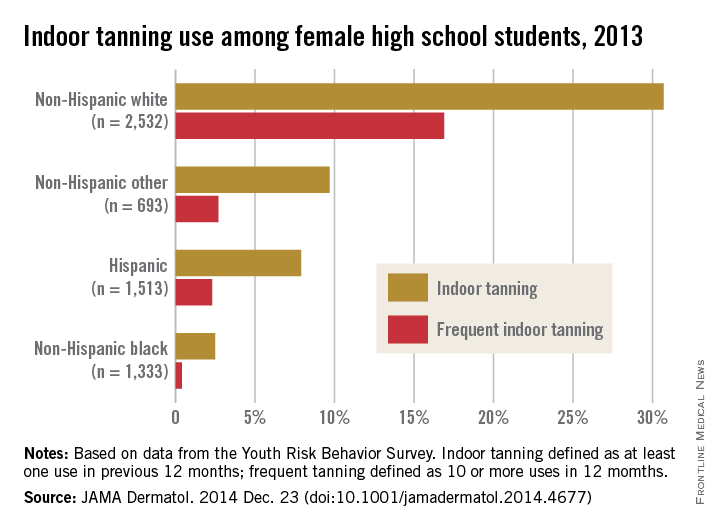
Non-Hispanic white girls were by far the most likely to indoor tan in 2013, with nearly 31% tanning at least once in the previous year and almost 17% tanning at least 10 times in the same period. No other measured ethnic group had such high rate of usage, with only 2.5% of non-Hispanic blacks, about 8% of Hispanics, and just under 10% of non-Hispanic others engaging in indoor tanning at least once, the investigators reported (JAMA Dermatol. 2014 Dec. 23 [doi:10.1001/jamadermatol.2014.4677]).
Indoor tanning by high school boys was much lower than for girls, with about 5% of all boys tanning at least once in 2013. White boys had the highest rate of measured ethnicities, but this was only at about 6%, the researchers said.
The study is based on data collected for the 2009, 2011, and 2013 Youth Risk Behavior Surveys.

Indoor tanning by high school girls decreased from 2009 to 2013, according to a recent study from the Centers for Disease Control and Prevention.
The overall indoor tanning rate for all high school girls dropped to about 20% in 2013, down from just over 25% in 2009. There was a significant drop in indoor tanning for non-Hispanic white girls and a slight decrease for Hispanic girls. The rate of indoor tanning for non-Hispanic black girls remained steady.
Decreases in indoor tanning “may be partly attributable to increased awareness of its harms,” with new or strengthened laws in 40 states having an impact as well, according to Gery P. Guy Jr., Ph.D., of the Division of Cancer Prevention and Control at the CDC in Atlanta.
Non-Hispanic white girls were by far the most likely to indoor tan in 2013, with nearly 31% tanning at least once in the previous year and almost 17% tanning at least 10 times in the same period. No other measured ethnic group had such high rate of usage, with only 2.5% of non-Hispanic blacks, about 8% of Hispanics, and just under 10% of non-Hispanic others engaging in indoor tanning at least once, the investigators reported (JAMA Dermatol. 2014 Dec. 23 [doi:10.1001/jamadermatol.2014.4677]).
Indoor tanning by high school boys was much lower than for girls, with about 5% of all boys tanning at least once in 2013. White boys had the highest rate of measured ethnicities, but this was only at about 6%, the researchers said.
The study is based on data collected for the 2009, 2011, and 2013 Youth Risk Behavior Surveys.
Indoor tanning by high school girls decreased from 2009 to 2013, according to a recent study from the Centers for Disease Control and Prevention.
The overall indoor tanning rate for all high school girls dropped to about 20% in 2013, down from just over 25% in 2009. There was a significant drop in indoor tanning for non-Hispanic white girls and a slight decrease for Hispanic girls. The rate of indoor tanning for non-Hispanic black girls remained steady.
Decreases in indoor tanning “may be partly attributable to increased awareness of its harms,” with new or strengthened laws in 40 states having an impact as well, according to Gery P. Guy Jr., Ph.D., of the Division of Cancer Prevention and Control at the CDC in Atlanta.
Non-Hispanic white girls were by far the most likely to indoor tan in 2013, with nearly 31% tanning at least once in the previous year and almost 17% tanning at least 10 times in the same period. No other measured ethnic group had such high rate of usage, with only 2.5% of non-Hispanic blacks, about 8% of Hispanics, and just under 10% of non-Hispanic others engaging in indoor tanning at least once, the investigators reported (JAMA Dermatol. 2014 Dec. 23 [doi:10.1001/jamadermatol.2014.4677]).
Indoor tanning by high school boys was much lower than for girls, with about 5% of all boys tanning at least once in 2013. White boys had the highest rate of measured ethnicities, but this was only at about 6%, the researchers said.
The study is based on data collected for the 2009, 2011, and 2013 Youth Risk Behavior Surveys.
FROM JAMA DERMATOLOGY

AHRQ releases update on radiotherapy for head and neck cancer
A new guideline update on radiotherapy treatments for head and neck cancer strengthened the previous guideline’s findings but did not find any new significant evidence on the effectiveness of other procedures.
The guideline, prepared by the Blue Cross and Blue Shield Association and published by the Agency for Healthcare Research and Quality, updates Comparative Effectiveness Review (CER) No. 20, published in 2010. The update includes three-dimensional conformal radiotherapy (3DCRT), intensity-modulated RT (IMRT), and proton-beam RT (PBT), which were in the previous guideline, but also includes stereotactic body RT (SBRT) and excludes two-dimensional RT (2DRT). The search included studies published from September 2009 to April 2013, except for SBRT, where studies from January 1, 1990, through April 2013 were included. Fourteen studies and one randomized controlled trial met inclusion criteria.
The update found new evidence that IMRT reduced xerostomia more than did 3DCRT or 2DRT, but no new evidence was found on how quality of life domains were improved, which were the primary findings of the CER No. 20. Evidence toward other radiotherapy comparisons was limited and insufficient to draw any new conclusions, and no evidence was found for PBT.
A new guideline update on radiotherapy treatments for head and neck cancer strengthened the previous guideline’s findings but did not find any new significant evidence on the effectiveness of other procedures.
The guideline, prepared by the Blue Cross and Blue Shield Association and published by the Agency for Healthcare Research and Quality, updates Comparative Effectiveness Review (CER) No. 20, published in 2010. The update includes three-dimensional conformal radiotherapy (3DCRT), intensity-modulated RT (IMRT), and proton-beam RT (PBT), which were in the previous guideline, but also includes stereotactic body RT (SBRT) and excludes two-dimensional RT (2DRT). The search included studies published from September 2009 to April 2013, except for SBRT, where studies from January 1, 1990, through April 2013 were included. Fourteen studies and one randomized controlled trial met inclusion criteria.
The update found new evidence that IMRT reduced xerostomia more than did 3DCRT or 2DRT, but no new evidence was found on how quality of life domains were improved, which were the primary findings of the CER No. 20. Evidence toward other radiotherapy comparisons was limited and insufficient to draw any new conclusions, and no evidence was found for PBT.
A new guideline update on radiotherapy treatments for head and neck cancer strengthened the previous guideline’s findings but did not find any new significant evidence on the effectiveness of other procedures.
The guideline, prepared by the Blue Cross and Blue Shield Association and published by the Agency for Healthcare Research and Quality, updates Comparative Effectiveness Review (CER) No. 20, published in 2010. The update includes three-dimensional conformal radiotherapy (3DCRT), intensity-modulated RT (IMRT), and proton-beam RT (PBT), which were in the previous guideline, but also includes stereotactic body RT (SBRT) and excludes two-dimensional RT (2DRT). The search included studies published from September 2009 to April 2013, except for SBRT, where studies from January 1, 1990, through April 2013 were included. Fourteen studies and one randomized controlled trial met inclusion criteria.
The update found new evidence that IMRT reduced xerostomia more than did 3DCRT or 2DRT, but no new evidence was found on how quality of life domains were improved, which were the primary findings of the CER No. 20. Evidence toward other radiotherapy comparisons was limited and insufficient to draw any new conclusions, and no evidence was found for PBT.
Survey: Hospitals that listen to their patients make fewer errors
Hospital patients who are treated with respect by staff are less likely to experience a preventable medical error, according to a study conducted by Consumer Reports.
About a quarter of the 1,200 patients who responded to the Consumer Reports survey felt hospital staff did not treat them as adults who were involved in their own care. A third of patients felt their wishes for treatments were not respected, with a similar number reporting that hospital staff would interrupt them. Around 20% said they were not treated fairly and experienced discrimination.

Overall, patients who were unhappy with how they were treated at the hospital were two and a half times more likely to experience some sort of preventable error, such as a drug error, rehospitalization, or a hospital-acquired disease than those who were happy with their treatment. Around 440,000 deaths are attributed to medical errors every year.
“We encourage patients to speak up when they feel that their wishes are not being heard. This survey validates that doing so might actually save your life,” Lisa McGiffert, manager of Consumer Reports’ Safe Patient Project, said in a written statement.
The full report, “How Not to Get Sick(er) in the Hospital,” which includes ratings of almost 2,600 U.S. hospitals, is featured in the February 2015 issue of Consumer Reports, and at ConsumerReports.org.
Hospital patients who are treated with respect by staff are less likely to experience a preventable medical error, according to a study conducted by Consumer Reports.
About a quarter of the 1,200 patients who responded to the Consumer Reports survey felt hospital staff did not treat them as adults who were involved in their own care. A third of patients felt their wishes for treatments were not respected, with a similar number reporting that hospital staff would interrupt them. Around 20% said they were not treated fairly and experienced discrimination.
Overall, patients who were unhappy with how they were treated at the hospital were two and a half times more likely to experience some sort of preventable error, such as a drug error, rehospitalization, or a hospital-acquired disease than those who were happy with their treatment. Around 440,000 deaths are attributed to medical errors every year.
“We encourage patients to speak up when they feel that their wishes are not being heard. This survey validates that doing so might actually save your life,” Lisa McGiffert, manager of Consumer Reports’ Safe Patient Project, said in a written statement.
The full report, “How Not to Get Sick(er) in the Hospital,” which includes ratings of almost 2,600 U.S. hospitals, is featured in the February 2015 issue of Consumer Reports, and at ConsumerReports.org.
Hospital patients who are treated with respect by staff are less likely to experience a preventable medical error, according to a study conducted by Consumer Reports.
About a quarter of the 1,200 patients who responded to the Consumer Reports survey felt hospital staff did not treat them as adults who were involved in their own care. A third of patients felt their wishes for treatments were not respected, with a similar number reporting that hospital staff would interrupt them. Around 20% said they were not treated fairly and experienced discrimination.
Overall, patients who were unhappy with how they were treated at the hospital were two and a half times more likely to experience some sort of preventable error, such as a drug error, rehospitalization, or a hospital-acquired disease than those who were happy with their treatment. Around 440,000 deaths are attributed to medical errors every year.
“We encourage patients to speak up when they feel that their wishes are not being heard. This survey validates that doing so might actually save your life,” Lisa McGiffert, manager of Consumer Reports’ Safe Patient Project, said in a written statement.
The full report, “How Not to Get Sick(er) in the Hospital,” which includes ratings of almost 2,600 U.S. hospitals, is featured in the February 2015 issue of Consumer Reports, and at ConsumerReports.org.

Sierra Leone becomes center of Ebola outbreak in Africa
Sierra Leone has exceeded Liberia’s number of reported cases of Ebola, according to a situation report from the World Health Organization.
There were nearly 600 new cases in Sierra Leone in the past week, bringing the total number of reported cases to just under 7,900, with more than 1,750 deaths reported. This is about 175 more cases than Liberia has reported, though information from Liberia is missing from Dec. 3-7, the WHO reported.
Liberia has reported just over 7,700 cases and almost 3,200 deaths; the spread of the disease continues to slowly decline. New case incidence in Guinea has remained fairly constant over the past few months at around 100 new cases per week, with the total number of reported cases nearly 2,300 and total deaths over 1,400. In all, there have been 17,900 reported cases of Ebola in Africa and just under 6,400 deaths, according to the WHO.
There have been no new cases of Ebola in Mali or in the United States. Mali has had eight cases and six deaths, and the United States has had four cases and one death. Spain was declared Ebola free on Dec. 2.
Sierra Leone has exceeded Liberia’s number of reported cases of Ebola, according to a situation report from the World Health Organization.
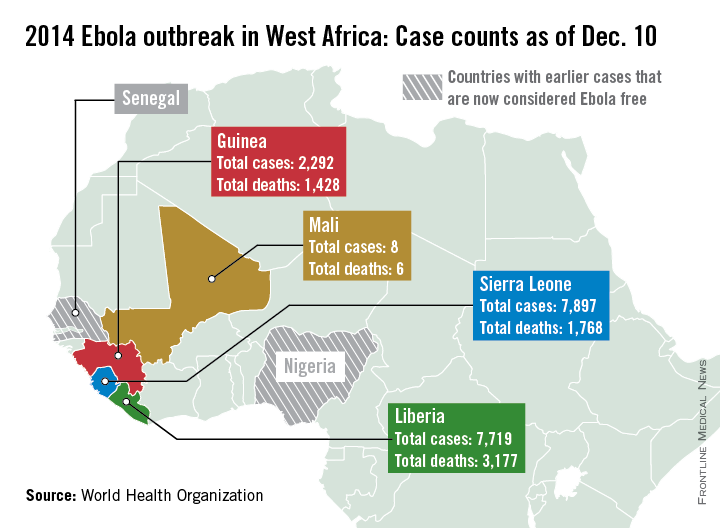
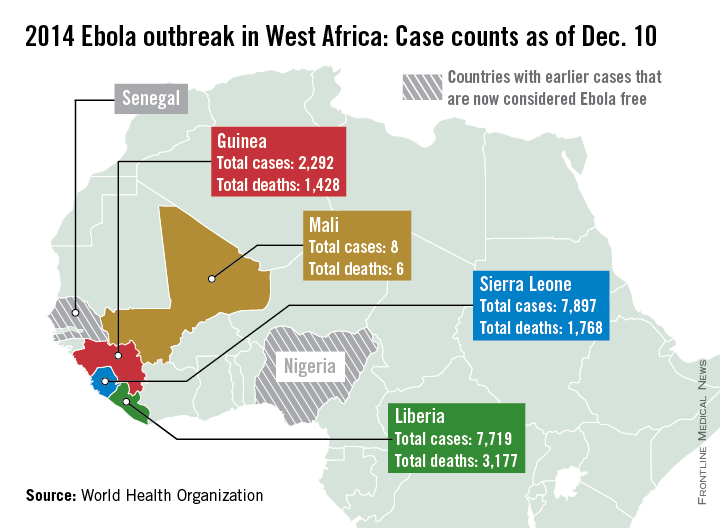
There were nearly 600 new cases in Sierra Leone in the past week, bringing the total number of reported cases to just under 7,900, with more than 1,750 deaths reported. This is about 175 more cases than Liberia has reported, though information from Liberia is missing from Dec. 3-7, the WHO reported.
Liberia has reported just over 7,700 cases and almost 3,200 deaths; the spread of the disease continues to slowly decline. New case incidence in Guinea has remained fairly constant over the past few months at around 100 new cases per week, with the total number of reported cases nearly 2,300 and total deaths over 1,400. In all, there have been 17,900 reported cases of Ebola in Africa and just under 6,400 deaths, according to the WHO.
There have been no new cases of Ebola in Mali or in the United States. Mali has had eight cases and six deaths, and the United States has had four cases and one death. Spain was declared Ebola free on Dec. 2.
Sierra Leone has exceeded Liberia’s number of reported cases of Ebola, according to a situation report from the World Health Organization.
There were nearly 600 new cases in Sierra Leone in the past week, bringing the total number of reported cases to just under 7,900, with more than 1,750 deaths reported. This is about 175 more cases than Liberia has reported, though information from Liberia is missing from Dec. 3-7, the WHO reported.
Liberia has reported just over 7,700 cases and almost 3,200 deaths; the spread of the disease continues to slowly decline. New case incidence in Guinea has remained fairly constant over the past few months at around 100 new cases per week, with the total number of reported cases nearly 2,300 and total deaths over 1,400. In all, there have been 17,900 reported cases of Ebola in Africa and just under 6,400 deaths, according to the WHO.
There have been no new cases of Ebola in Mali or in the United States. Mali has had eight cases and six deaths, and the United States has had four cases and one death. Spain was declared Ebola free on Dec. 2.
Children don’t have to belong to the clean plate club
It’s a scene you’re all too familiar with – you’ve gone to a lot of trouble to give your children a well-prepared and nutritious meal, but a lot of it never leaves the plate. It’s frustrating, and you worry about their health, but according to the Cornell Food and Brand Lab, this is not unusual behavior.
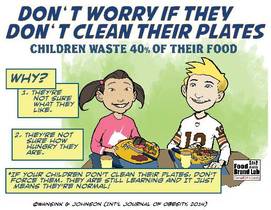
When an adult serves him or herself food, it almost all gets eaten, according to a study from Brian Wansink, Ph.D., director of the Cornell Food and Brand Lab in Ithaca, N.Y., with the average adult eating 92% of the food served. However, the same study also found that children eat only about 60% of the food they serve to themselves, indicating a broad difference in how adults and children approach food.
Adults know what they like, and if they try something new, they might only take a little bit in case they don’t like it. Children tend not to fully understand their limits and may take a lot of something they’ve never had before because it looks appetizing, try it, realize they don’t like it, and not finish it. “It’s natural, for them to make some mistakes and take a food they don’t like or to serve too much,” Dr. Wansink said.
Dr. Wansink noted that the children in the study were not eating with their parents, and perhaps they would have eaten more if their parents had been there, but not enough to account for the vast discrepancy between the two groups. Other possible factors in children eating less include uncertainty toward how much will make them full, whether or not they are eating with utensils, the presence of friends, and whether they are introverted or extroverted.
So for all the frustrated parents out there“who want his/her noncooperating children to be vegetable-eating members of the clean plate club,” there is good news in these results. “They show that children who only eat half to two-thirds of the food they serve themselves aren’t being wasteful, belligerent, or disrespectful,” Dr. Wansink concluded. It’s a matter of kids just being kids.
It’s a scene you’re all too familiar with – you’ve gone to a lot of trouble to give your children a well-prepared and nutritious meal, but a lot of it never leaves the plate. It’s frustrating, and you worry about their health, but according to the Cornell Food and Brand Lab, this is not unusual behavior.
When an adult serves him or herself food, it almost all gets eaten, according to a study from Brian Wansink, Ph.D., director of the Cornell Food and Brand Lab in Ithaca, N.Y., with the average adult eating 92% of the food served. However, the same study also found that children eat only about 60% of the food they serve to themselves, indicating a broad difference in how adults and children approach food.
Adults know what they like, and if they try something new, they might only take a little bit in case they don’t like it. Children tend not to fully understand their limits and may take a lot of something they’ve never had before because it looks appetizing, try it, realize they don’t like it, and not finish it. “It’s natural, for them to make some mistakes and take a food they don’t like or to serve too much,” Dr. Wansink said.
Dr. Wansink noted that the children in the study were not eating with their parents, and perhaps they would have eaten more if their parents had been there, but not enough to account for the vast discrepancy between the two groups. Other possible factors in children eating less include uncertainty toward how much will make them full, whether or not they are eating with utensils, the presence of friends, and whether they are introverted or extroverted.
So for all the frustrated parents out there“who want his/her noncooperating children to be vegetable-eating members of the clean plate club,” there is good news in these results. “They show that children who only eat half to two-thirds of the food they serve themselves aren’t being wasteful, belligerent, or disrespectful,” Dr. Wansink concluded. It’s a matter of kids just being kids.
It’s a scene you’re all too familiar with – you’ve gone to a lot of trouble to give your children a well-prepared and nutritious meal, but a lot of it never leaves the plate. It’s frustrating, and you worry about their health, but according to the Cornell Food and Brand Lab, this is not unusual behavior.
When an adult serves him or herself food, it almost all gets eaten, according to a study from Brian Wansink, Ph.D., director of the Cornell Food and Brand Lab in Ithaca, N.Y., with the average adult eating 92% of the food served. However, the same study also found that children eat only about 60% of the food they serve to themselves, indicating a broad difference in how adults and children approach food.
Adults know what they like, and if they try something new, they might only take a little bit in case they don’t like it. Children tend not to fully understand their limits and may take a lot of something they’ve never had before because it looks appetizing, try it, realize they don’t like it, and not finish it. “It’s natural, for them to make some mistakes and take a food they don’t like or to serve too much,” Dr. Wansink said.
Dr. Wansink noted that the children in the study were not eating with their parents, and perhaps they would have eaten more if their parents had been there, but not enough to account for the vast discrepancy between the two groups. Other possible factors in children eating less include uncertainty toward how much will make them full, whether or not they are eating with utensils, the presence of friends, and whether they are introverted or extroverted.
So for all the frustrated parents out there“who want his/her noncooperating children to be vegetable-eating members of the clean plate club,” there is good news in these results. “They show that children who only eat half to two-thirds of the food they serve themselves aren’t being wasteful, belligerent, or disrespectful,” Dr. Wansink concluded. It’s a matter of kids just being kids.

Spain now completely free of Ebola
Spain was officially declared Ebola free on Dec. 2, according to the World Health Organization.
On Oct. 6, a health care worker in Spain was diagnosed with Ebola after providing care for a patient sent from Sierra Leone, the first case of Ebola transmission outside of Africa. The health care worker recovered and a negative blood sample was returned on Oct. 21. No additional cases were reported, so 42 days after the negative blood sample was returned, the WHO declared Spain Ebola free.
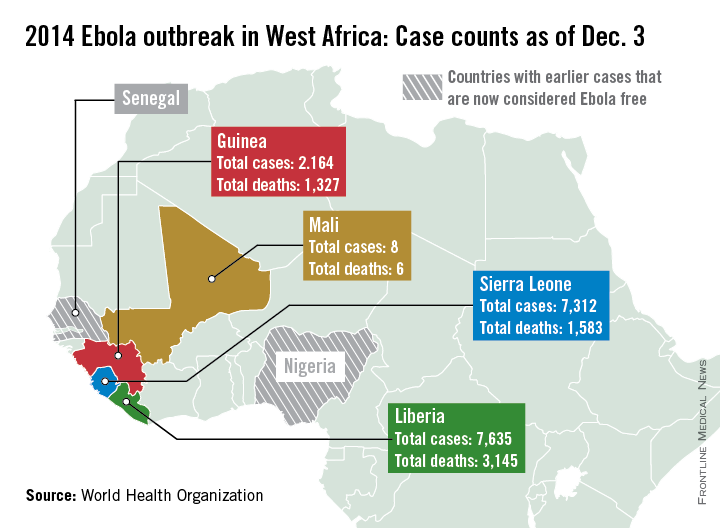
The Ebola outbreak in Sierra Leone continues to worsen, with more than 700 reported cases in the past week, bringing the total number to over 7,300 reported cases, and nearly 1,600 reported deaths. Overall, there are more than 17,000 reported cases and nearly 6,100 deaths in West Africa, with Liberia reporting more than 7,600 cases and nearly 3,150 deaths and Guinea reporting more than 2,150 cases and more than 1,300 deaths. New case incidence in Guinea and Liberia seems to be stabilizing, the WHO reported.
There have now been eight cases of Ebola in Mali, and six deaths, with seven cases and five deaths related to the treatment of an imam from Guinea in Bamako, capital of Mali. The last case was a young child who died in late October, and is not related to the outbreak in the capital. The United States has had four cases of Ebola and one death. While no new localized transmissions have occurred since October, the United States continues to receive health care workers from Africa with Ebola for treatment.
The unrelated outbreak of Ebola in the Democratic Republic of the Congo also is over, and the country was declared Ebola free on Nov. 21. The outbreak there was much smaller than the current one in West Africa and the seventh in the country’s history, with 66 cases and 49 deaths reported.
Spain was officially declared Ebola free on Dec. 2, according to the World Health Organization.
On Oct. 6, a health care worker in Spain was diagnosed with Ebola after providing care for a patient sent from Sierra Leone, the first case of Ebola transmission outside of Africa. The health care worker recovered and a negative blood sample was returned on Oct. 21. No additional cases were reported, so 42 days after the negative blood sample was returned, the WHO declared Spain Ebola free.
The Ebola outbreak in Sierra Leone continues to worsen, with more than 700 reported cases in the past week, bringing the total number to over 7,300 reported cases, and nearly 1,600 reported deaths. Overall, there are more than 17,000 reported cases and nearly 6,100 deaths in West Africa, with Liberia reporting more than 7,600 cases and nearly 3,150 deaths and Guinea reporting more than 2,150 cases and more than 1,300 deaths. New case incidence in Guinea and Liberia seems to be stabilizing, the WHO reported.
There have now been eight cases of Ebola in Mali, and six deaths, with seven cases and five deaths related to the treatment of an imam from Guinea in Bamako, capital of Mali. The last case was a young child who died in late October, and is not related to the outbreak in the capital. The United States has had four cases of Ebola and one death. While no new localized transmissions have occurred since October, the United States continues to receive health care workers from Africa with Ebola for treatment.
The unrelated outbreak of Ebola in the Democratic Republic of the Congo also is over, and the country was declared Ebola free on Nov. 21. The outbreak there was much smaller than the current one in West Africa and the seventh in the country’s history, with 66 cases and 49 deaths reported.
Spain was officially declared Ebola free on Dec. 2, according to the World Health Organization.
On Oct. 6, a health care worker in Spain was diagnosed with Ebola after providing care for a patient sent from Sierra Leone, the first case of Ebola transmission outside of Africa. The health care worker recovered and a negative blood sample was returned on Oct. 21. No additional cases were reported, so 42 days after the negative blood sample was returned, the WHO declared Spain Ebola free.
The Ebola outbreak in Sierra Leone continues to worsen, with more than 700 reported cases in the past week, bringing the total number to over 7,300 reported cases, and nearly 1,600 reported deaths. Overall, there are more than 17,000 reported cases and nearly 6,100 deaths in West Africa, with Liberia reporting more than 7,600 cases and nearly 3,150 deaths and Guinea reporting more than 2,150 cases and more than 1,300 deaths. New case incidence in Guinea and Liberia seems to be stabilizing, the WHO reported.
There have now been eight cases of Ebola in Mali, and six deaths, with seven cases and five deaths related to the treatment of an imam from Guinea in Bamako, capital of Mali. The last case was a young child who died in late October, and is not related to the outbreak in the capital. The United States has had four cases of Ebola and one death. While no new localized transmissions have occurred since October, the United States continues to receive health care workers from Africa with Ebola for treatment.
The unrelated outbreak of Ebola in the Democratic Republic of the Congo also is over, and the country was declared Ebola free on Nov. 21. The outbreak there was much smaller than the current one in West Africa and the seventh in the country’s history, with 66 cases and 49 deaths reported.
Hospitals showed less concern over ACA in 2014 than 2013
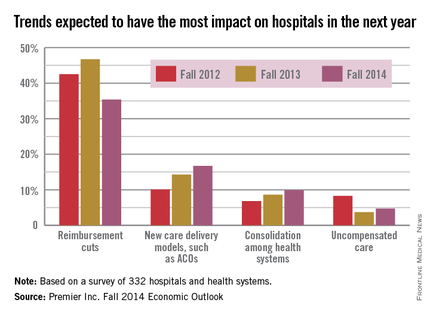
While reimbursement cuts related to the Affordable Care Act remain the most pressing issue hospitals expect to face in 2015, other trends are receiving more attention, according to a survey from health care improvement company Premier Inc.
While just over 35% of hospitals felt that ACA-related reimbursements cuts would impact them most in the next year, this is down from this time in 2013, when 47% of hospitals considered it the most important issue. New care delivery models were the most important concern for 17% of hospitals this year, up from only 10% in fall 2012. Health system consolidation and uncompensated care also became more important to hospitals, according to the survey.
Fewer hospitals are listing ACA compliance as the biggest driver of health care cost; 23% of hospitals cite it as their biggest issue, but this is down from a high of 36% in the spring of 2012. Labor costs are another very significant concern, with 20% of hospitals considering it their biggest driver of costs, Premier reported.
Premiere is an alliance of 3,400 hospitals and 110,000 other providers. The company’s fall 2014 Economic Outlook survey involved 332 hospitals and health systems from 42 states.
While reimbursement cuts related to the Affordable Care Act remain the most pressing issue hospitals expect to face in 2015, other trends are receiving more attention, according to a survey from health care improvement company Premier Inc.
While just over 35% of hospitals felt that ACA-related reimbursements cuts would impact them most in the next year, this is down from this time in 2013, when 47% of hospitals considered it the most important issue. New care delivery models were the most important concern for 17% of hospitals this year, up from only 10% in fall 2012. Health system consolidation and uncompensated care also became more important to hospitals, according to the survey.
Fewer hospitals are listing ACA compliance as the biggest driver of health care cost; 23% of hospitals cite it as their biggest issue, but this is down from a high of 36% in the spring of 2012. Labor costs are another very significant concern, with 20% of hospitals considering it their biggest driver of costs, Premier reported.
Premiere is an alliance of 3,400 hospitals and 110,000 other providers. The company’s fall 2014 Economic Outlook survey involved 332 hospitals and health systems from 42 states.
While reimbursement cuts related to the Affordable Care Act remain the most pressing issue hospitals expect to face in 2015, other trends are receiving more attention, according to a survey from health care improvement company Premier Inc.
While just over 35% of hospitals felt that ACA-related reimbursements cuts would impact them most in the next year, this is down from this time in 2013, when 47% of hospitals considered it the most important issue. New care delivery models were the most important concern for 17% of hospitals this year, up from only 10% in fall 2012. Health system consolidation and uncompensated care also became more important to hospitals, according to the survey.
Fewer hospitals are listing ACA compliance as the biggest driver of health care cost; 23% of hospitals cite it as their biggest issue, but this is down from a high of 36% in the spring of 2012. Labor costs are another very significant concern, with 20% of hospitals considering it their biggest driver of costs, Premier reported.
Premiere is an alliance of 3,400 hospitals and 110,000 other providers. The company’s fall 2014 Economic Outlook survey involved 332 hospitals and health systems from 42 states.

Ebola outbreak spreads further in Mali
Additional cases of Ebola have been reported in the capital of Mali this week, according to a report from the World Health Organization.
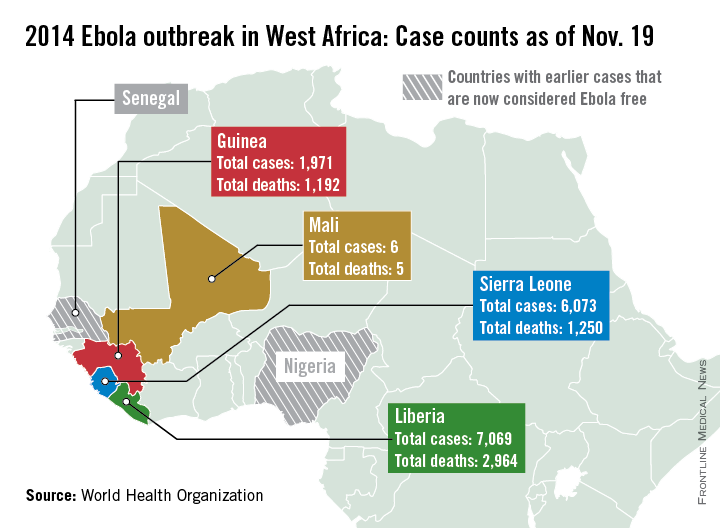
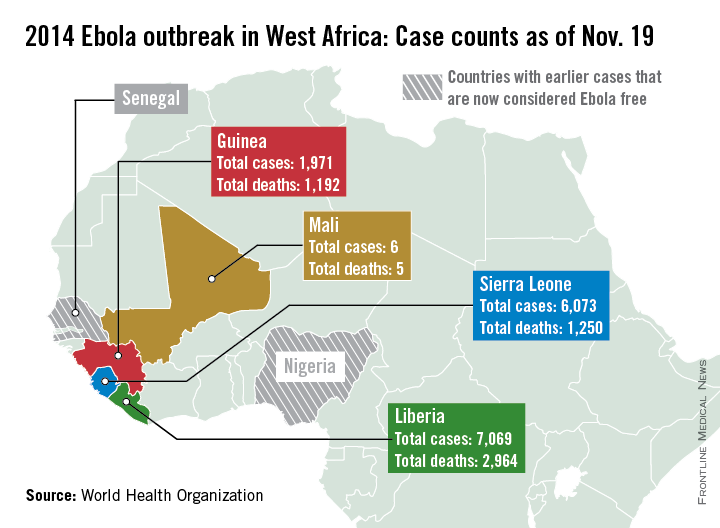
There have been six cases and five deaths from Ebola in Mali, with the initial case of a young child unrelated to the five cases reported in the capital, Bamako. The second outbreak began with an imam who crossed the border from Guinea and died in Mali from an undiagnosed condition. Although the man died in Mali, his case has been classified as a case in Guinea, as he developed symptoms there. Of the nearly 400 contacts in Mali, about a quarter are health care workers, the WHO said.
There were more than 1,000 new cases in the past week throughout Liberia, Sierra Leone, and Guinea, bringing the total to over 15,100 cases and 5,400 deaths. Currently, Liberia has the most reported cases of Ebola, with nearly 7,100 cases and nearly 3,000 reported deaths. With just over 700 cases in the past week, Sierra Leone has now reported over 6,000 cases and 1,250 deaths. Guinea has reported nearly 2,000 cases and just under 1,200 deaths, according to the WHO.
There have been no new localized cases of Ebola in Spain or in the United States. As of today, 42 days have passed since the last Ebola test came back negative in the unrelated outbreak in the Democratic Republic of the Congo, and the country should soon be declared Ebola free, the WHO reported.
Additional cases of Ebola have been reported in the capital of Mali this week, according to a report from the World Health Organization.
There have been six cases and five deaths from Ebola in Mali, with the initial case of a young child unrelated to the five cases reported in the capital, Bamako. The second outbreak began with an imam who crossed the border from Guinea and died in Mali from an undiagnosed condition. Although the man died in Mali, his case has been classified as a case in Guinea, as he developed symptoms there. Of the nearly 400 contacts in Mali, about a quarter are health care workers, the WHO said.
There were more than 1,000 new cases in the past week throughout Liberia, Sierra Leone, and Guinea, bringing the total to over 15,100 cases and 5,400 deaths. Currently, Liberia has the most reported cases of Ebola, with nearly 7,100 cases and nearly 3,000 reported deaths. With just over 700 cases in the past week, Sierra Leone has now reported over 6,000 cases and 1,250 deaths. Guinea has reported nearly 2,000 cases and just under 1,200 deaths, according to the WHO.
There have been no new localized cases of Ebola in Spain or in the United States. As of today, 42 days have passed since the last Ebola test came back negative in the unrelated outbreak in the Democratic Republic of the Congo, and the country should soon be declared Ebola free, the WHO reported.
Additional cases of Ebola have been reported in the capital of Mali this week, according to a report from the World Health Organization.
There have been six cases and five deaths from Ebola in Mali, with the initial case of a young child unrelated to the five cases reported in the capital, Bamako. The second outbreak began with an imam who crossed the border from Guinea and died in Mali from an undiagnosed condition. Although the man died in Mali, his case has been classified as a case in Guinea, as he developed symptoms there. Of the nearly 400 contacts in Mali, about a quarter are health care workers, the WHO said.
There were more than 1,000 new cases in the past week throughout Liberia, Sierra Leone, and Guinea, bringing the total to over 15,100 cases and 5,400 deaths. Currently, Liberia has the most reported cases of Ebola, with nearly 7,100 cases and nearly 3,000 reported deaths. With just over 700 cases in the past week, Sierra Leone has now reported over 6,000 cases and 1,250 deaths. Guinea has reported nearly 2,000 cases and just under 1,200 deaths, according to the WHO.
There have been no new localized cases of Ebola in Spain or in the United States. As of today, 42 days have passed since the last Ebola test came back negative in the unrelated outbreak in the Democratic Republic of the Congo, and the country should soon be declared Ebola free, the WHO reported.
Glutamate plays important role in drug-related neural reward pathways
A reward pathway in the dorsal raphe nucleus important to drug abuse begins with stimulation of glutamate neurons, according to a study from the National Institutes of Health.
Nerve cells in the dorsal raphe nucleus connect to the dopamine reward system, but many of the pathways are rich in serotonin. Serotonin-enhancing drugs have little risk for abuse and are not associated with drug reinforcement, leading scientists to believe that a different neurotransmitter was responsible for the role the dorsal raphe nucleus plays in reward, a press release from the NIH said. Glutamate, important in neural communication and learning, was the most likely option.
In a study on rodents, investigators from the National Institute on Drug Abuse (NIDA) used tracers to confirm that the reward pathways started with glutamate cells in the dorsal raphe nucleus, which connect to dopamine cells in the ventral tegmental area, which eventually lead to the nucleus accumbens, a brain structure important to reward, pleasure, and motivation. Further testing determined that glutamate, not serotonin, activates the reward pathway, the study published in Nature Communications found (2014 Nov. 12 [doi:10.1038/ncomms6390]).
The newly discovered glutamatergic pathway is “the first fully characterized link between electrically stimulated reward circuitry and the dopamine system on which it depends. The discovery of this specific brain pathway opens new avenues to examine its participation in a variety of disorders related to motivation,” Marisela Morales, Ph.D., NIDA scientist and senior author on the paper said in a press release.
The research was conducted at NIDA’s Intramural Research Program.
A reward pathway in the dorsal raphe nucleus important to drug abuse begins with stimulation of glutamate neurons, according to a study from the National Institutes of Health.
Nerve cells in the dorsal raphe nucleus connect to the dopamine reward system, but many of the pathways are rich in serotonin. Serotonin-enhancing drugs have little risk for abuse and are not associated with drug reinforcement, leading scientists to believe that a different neurotransmitter was responsible for the role the dorsal raphe nucleus plays in reward, a press release from the NIH said. Glutamate, important in neural communication and learning, was the most likely option.
In a study on rodents, investigators from the National Institute on Drug Abuse (NIDA) used tracers to confirm that the reward pathways started with glutamate cells in the dorsal raphe nucleus, which connect to dopamine cells in the ventral tegmental area, which eventually lead to the nucleus accumbens, a brain structure important to reward, pleasure, and motivation. Further testing determined that glutamate, not serotonin, activates the reward pathway, the study published in Nature Communications found (2014 Nov. 12 [doi:10.1038/ncomms6390]).
The newly discovered glutamatergic pathway is “the first fully characterized link between electrically stimulated reward circuitry and the dopamine system on which it depends. The discovery of this specific brain pathway opens new avenues to examine its participation in a variety of disorders related to motivation,” Marisela Morales, Ph.D., NIDA scientist and senior author on the paper said in a press release.
The research was conducted at NIDA’s Intramural Research Program.
A reward pathway in the dorsal raphe nucleus important to drug abuse begins with stimulation of glutamate neurons, according to a study from the National Institutes of Health.
Nerve cells in the dorsal raphe nucleus connect to the dopamine reward system, but many of the pathways are rich in serotonin. Serotonin-enhancing drugs have little risk for abuse and are not associated with drug reinforcement, leading scientists to believe that a different neurotransmitter was responsible for the role the dorsal raphe nucleus plays in reward, a press release from the NIH said. Glutamate, important in neural communication and learning, was the most likely option.
In a study on rodents, investigators from the National Institute on Drug Abuse (NIDA) used tracers to confirm that the reward pathways started with glutamate cells in the dorsal raphe nucleus, which connect to dopamine cells in the ventral tegmental area, which eventually lead to the nucleus accumbens, a brain structure important to reward, pleasure, and motivation. Further testing determined that glutamate, not serotonin, activates the reward pathway, the study published in Nature Communications found (2014 Nov. 12 [doi:10.1038/ncomms6390]).
The newly discovered glutamatergic pathway is “the first fully characterized link between electrically stimulated reward circuitry and the dopamine system on which it depends. The discovery of this specific brain pathway opens new avenues to examine its participation in a variety of disorders related to motivation,” Marisela Morales, Ph.D., NIDA scientist and senior author on the paper said in a press release.
The research was conducted at NIDA’s Intramural Research Program.