User login
Mitchel is a reporter for MDedge based in the Philadelphia area. He started with the company in 1992, when it was International Medical News Group (IMNG), and has since covered a range of medical specialties. Mitchel trained as a virologist at Roswell Park Memorial Institute in Buffalo, and then worked briefly as a researcher at Boston Children's Hospital before pivoting to journalism as a AAAS Mass Media Fellow in 1980. His first reporting job was with Science Digest magazine, and from the mid-1980s to early-1990s he was a reporter with Medical World News. @mitchelzoler
VIDEO: Software predicts septic shock in hospitalized patients
WASHINGTON – Researchers have devised a program that can predict severe sepsis or septic shock about 12-30 hours in advance of its onset in hospitalized patients, a feat they hope will allow them to apply early interventions to stave off impending sepsis.
“We’d love to see a change in sepsis mortality. Will earlier recognition and implementation of the sepsis bundle – fluids, antibiotics, etc. – improve outcomes?” wondered Heather M. Giannini, MD, in a video interview at an international conference of the American Thoracic Society.
The computer program works by monitoring all the data that enter a patient’s electronic health record during hospitalization. Researchers developed it and designed it specifically for inpatients who are not in the intensive care unit or emergency department.
Results from initial testing during October-December 2015 in 10,448 patients hospitalized at one of three participating Philadelphia hospitals showed the program predicted subsequent severe sepsis or septic shock with a sensitivity of 26% and a specificity of 98%, reported Dr. Giannini, a researcher in the Center for Evidence-Based Practice at the University of Pennsylvania in Philadelphia. Analysis also showed a positive likelihood ratio of 13 for severe sepsis or septic shock actually occurring following an alert generated by the computer program, a level indicating a “very strong” ability to predict sepsis, she said.
Dr. Giannini and her associates developed the prediction program using a technique called “computational machine learning,” an alternative to standard logistic regression modeling that is better suited to analyzing large data sets and can better integrate outlier data points. They took EHR data for all non-ICU, non-ED inpatients at three Philadelphia hospitals during a 3-year period during 2011-2014 and had the program focus particularly on EHR data gleaned from the nearly 1,000 patients who developed severe sepsis or septic shock during the 12 hours preceding the start of these sepsis events. The analysis identified patients as having developed severe sepsis or shock if they had a blood draw positive for infection at the same time as having a blood lactate level above 2.2 mmol/L or a systolic blood pressure below 90 mm Hg.
To create the algorithm the machine-learning device compared the EHR entries for patients who developed severe sepsis or septic shock with EHR data from patients who did not, a process that involved hundred of thousands of data points, Dr. Giannini said. This identified 587 individual types of relevant EHR data entries and ranked them from most important to least important. Important, novel determinants of impending severe sepsis identified this way included anion gap, blood urea nitrogen, and platelet count. The development process also confirmed an important role for many classic markers of septic shock, such as respiration rate, heart rate, and temperature.
The researchers designed the algorithm to have a moderate level of sensitivity to avoid “alert fatigue” from generating too many alarms for impending severe sepsis. Their goal was for clinicians to receive no more than about 10 alerts per day for each hospital.
“We are satisfied with the sensitivity. We felt it was better to have too few alerts rather than overwhelm clinicians. About 10 alerts a day is reasonable,” Dr. Giannini explained. During initial 2015 testing, the system generated a daily average of 11 alerts.
The video associated with this article is no longer available on this site. Please view all of our videos on the MDedge YouTube channel
mzoler@frontlinemedcom.com
On Twitter @mitchelzoler
Development of this algorithm is tremendously important and exciting. It is an example of how researchers can use big data to predict patient outcomes and use that information to help deliver better patient care.
The algorithm’s performance so far is laudable and extremely promising, and has great potential to help deliver better care to patients when they need it, but it requires further validation. The potential importance of earlier identification of septic shock is huge.

Michelle N. Gong, MD, is professor of medicine and chief of research in the division of critical care at Albert Einstein College of Medicine and Montefiore Medical Center in New York. She had no disclosures. She made these comments in an interview.
Development of this algorithm is tremendously important and exciting. It is an example of how researchers can use big data to predict patient outcomes and use that information to help deliver better patient care.
The algorithm’s performance so far is laudable and extremely promising, and has great potential to help deliver better care to patients when they need it, but it requires further validation. The potential importance of earlier identification of septic shock is huge.
Michelle N. Gong, MD, is professor of medicine and chief of research in the division of critical care at Albert Einstein College of Medicine and Montefiore Medical Center in New York. She had no disclosures. She made these comments in an interview.
Development of this algorithm is tremendously important and exciting. It is an example of how researchers can use big data to predict patient outcomes and use that information to help deliver better patient care.
The algorithm’s performance so far is laudable and extremely promising, and has great potential to help deliver better care to patients when they need it, but it requires further validation. The potential importance of earlier identification of septic shock is huge.
Michelle N. Gong, MD, is professor of medicine and chief of research in the division of critical care at Albert Einstein College of Medicine and Montefiore Medical Center in New York. She had no disclosures. She made these comments in an interview.
WASHINGTON – Researchers have devised a program that can predict severe sepsis or septic shock about 12-30 hours in advance of its onset in hospitalized patients, a feat they hope will allow them to apply early interventions to stave off impending sepsis.
“We’d love to see a change in sepsis mortality. Will earlier recognition and implementation of the sepsis bundle – fluids, antibiotics, etc. – improve outcomes?” wondered Heather M. Giannini, MD, in a video interview at an international conference of the American Thoracic Society.
The computer program works by monitoring all the data that enter a patient’s electronic health record during hospitalization. Researchers developed it and designed it specifically for inpatients who are not in the intensive care unit or emergency department.
Results from initial testing during October-December 2015 in 10,448 patients hospitalized at one of three participating Philadelphia hospitals showed the program predicted subsequent severe sepsis or septic shock with a sensitivity of 26% and a specificity of 98%, reported Dr. Giannini, a researcher in the Center for Evidence-Based Practice at the University of Pennsylvania in Philadelphia. Analysis also showed a positive likelihood ratio of 13 for severe sepsis or septic shock actually occurring following an alert generated by the computer program, a level indicating a “very strong” ability to predict sepsis, she said.
Dr. Giannini and her associates developed the prediction program using a technique called “computational machine learning,” an alternative to standard logistic regression modeling that is better suited to analyzing large data sets and can better integrate outlier data points. They took EHR data for all non-ICU, non-ED inpatients at three Philadelphia hospitals during a 3-year period during 2011-2014 and had the program focus particularly on EHR data gleaned from the nearly 1,000 patients who developed severe sepsis or septic shock during the 12 hours preceding the start of these sepsis events. The analysis identified patients as having developed severe sepsis or shock if they had a blood draw positive for infection at the same time as having a blood lactate level above 2.2 mmol/L or a systolic blood pressure below 90 mm Hg.
To create the algorithm the machine-learning device compared the EHR entries for patients who developed severe sepsis or septic shock with EHR data from patients who did not, a process that involved hundred of thousands of data points, Dr. Giannini said. This identified 587 individual types of relevant EHR data entries and ranked them from most important to least important. Important, novel determinants of impending severe sepsis identified this way included anion gap, blood urea nitrogen, and platelet count. The development process also confirmed an important role for many classic markers of septic shock, such as respiration rate, heart rate, and temperature.
The researchers designed the algorithm to have a moderate level of sensitivity to avoid “alert fatigue” from generating too many alarms for impending severe sepsis. Their goal was for clinicians to receive no more than about 10 alerts per day for each hospital.
“We are satisfied with the sensitivity. We felt it was better to have too few alerts rather than overwhelm clinicians. About 10 alerts a day is reasonable,” Dr. Giannini explained. During initial 2015 testing, the system generated a daily average of 11 alerts.
The video associated with this article is no longer available on this site. Please view all of our videos on the MDedge YouTube channel
mzoler@frontlinemedcom.com
On Twitter @mitchelzoler
WASHINGTON – Researchers have devised a program that can predict severe sepsis or septic shock about 12-30 hours in advance of its onset in hospitalized patients, a feat they hope will allow them to apply early interventions to stave off impending sepsis.
“We’d love to see a change in sepsis mortality. Will earlier recognition and implementation of the sepsis bundle – fluids, antibiotics, etc. – improve outcomes?” wondered Heather M. Giannini, MD, in a video interview at an international conference of the American Thoracic Society.
The computer program works by monitoring all the data that enter a patient’s electronic health record during hospitalization. Researchers developed it and designed it specifically for inpatients who are not in the intensive care unit or emergency department.
Results from initial testing during October-December 2015 in 10,448 patients hospitalized at one of three participating Philadelphia hospitals showed the program predicted subsequent severe sepsis or septic shock with a sensitivity of 26% and a specificity of 98%, reported Dr. Giannini, a researcher in the Center for Evidence-Based Practice at the University of Pennsylvania in Philadelphia. Analysis also showed a positive likelihood ratio of 13 for severe sepsis or septic shock actually occurring following an alert generated by the computer program, a level indicating a “very strong” ability to predict sepsis, she said.
Dr. Giannini and her associates developed the prediction program using a technique called “computational machine learning,” an alternative to standard logistic regression modeling that is better suited to analyzing large data sets and can better integrate outlier data points. They took EHR data for all non-ICU, non-ED inpatients at three Philadelphia hospitals during a 3-year period during 2011-2014 and had the program focus particularly on EHR data gleaned from the nearly 1,000 patients who developed severe sepsis or septic shock during the 12 hours preceding the start of these sepsis events. The analysis identified patients as having developed severe sepsis or shock if they had a blood draw positive for infection at the same time as having a blood lactate level above 2.2 mmol/L or a systolic blood pressure below 90 mm Hg.
To create the algorithm the machine-learning device compared the EHR entries for patients who developed severe sepsis or septic shock with EHR data from patients who did not, a process that involved hundred of thousands of data points, Dr. Giannini said. This identified 587 individual types of relevant EHR data entries and ranked them from most important to least important. Important, novel determinants of impending severe sepsis identified this way included anion gap, blood urea nitrogen, and platelet count. The development process also confirmed an important role for many classic markers of septic shock, such as respiration rate, heart rate, and temperature.
The researchers designed the algorithm to have a moderate level of sensitivity to avoid “alert fatigue” from generating too many alarms for impending severe sepsis. Their goal was for clinicians to receive no more than about 10 alerts per day for each hospital.
“We are satisfied with the sensitivity. We felt it was better to have too few alerts rather than overwhelm clinicians. About 10 alerts a day is reasonable,” Dr. Giannini explained. During initial 2015 testing, the system generated a daily average of 11 alerts.
The video associated with this article is no longer available on this site. Please view all of our videos on the MDedge YouTube channel
mzoler@frontlinemedcom.com
On Twitter @mitchelzoler
AT ATS 2017
Key clinical point:
Major finding: The program predicted severe sepsis with a sensitivity of 26% and specificity of 98%.
Data source: A total of 10,448 inpatients at three Philadelphia hospitals during October-December 2015.
Disclosures: Dr. Giannini had no disclosures.

Spironolactone’s HFpEF benefit happens mostly in women
PARIS – Just when the aldosterone receptor antagonists spironolactone and eplerenone received official recognition in the 2017 U.S. heart failure guidelines as the only drug class that benefits patients with heart failure with preserved ejection fraction (HFpEF), a new post-hoc analysis of the pivotal evidence suggests the benefit is mostly in women, with little benefit to men.
The new analysis used data collected from TOPCAT (Treatment of Preserved Cardiac Function Heart Failure with an Aldosterone Antagonist), which randomized patients with HFpEF to treatment with spironolactone or placebo. Results from the overall study were neutral for the primary outcome of cardiovascular death, aborted cardiac arrest, and heart failure hospitalization (N Engl J Med. 2014 April 10;370[15]:1383-92). However, a series of post-hoc analyses showed that a high percentage of patients enrolled at centers in Russia or Georgia did not match the expected HFpEF profile, and these patients had poor responses to spironolactone. In contrast, patients enrolled at centers in the Americas more frequently matched the study’s target HFpEF profile, and they showed significant improvement for the primary endpoint (Circulation. 2015 Jan 6;131[1]:34-42).
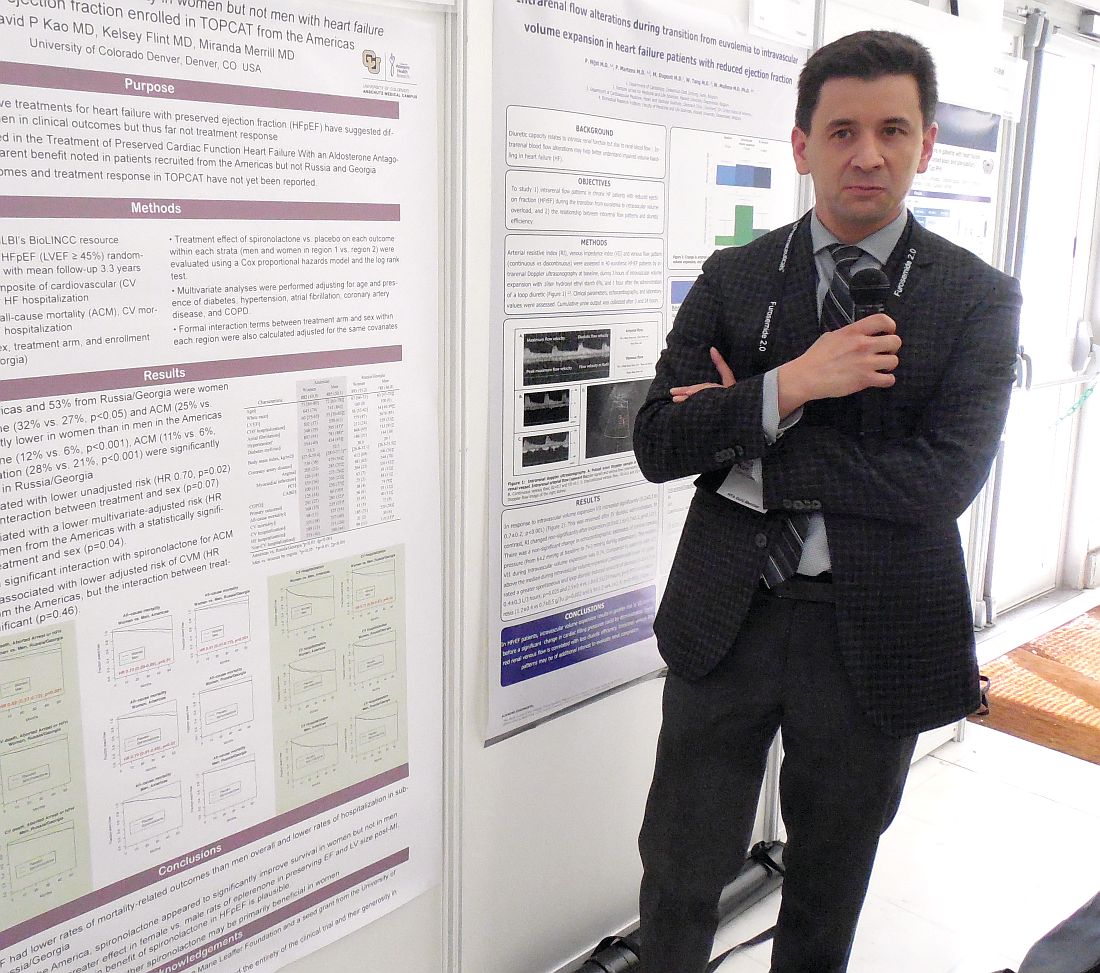
“The observation that most of the benefit [from spironolactone treatment] may have been in women is interesting, but I don’t think that it would stop me from using [an aldosterone receptor antagonist] in men,” said Dr. Kao while presenting his report. The outcomes in both men and women “head in the same direction. It’s just that the mortality benefit is much clearer in women,” said Dr. Kao, a cardiologist at the University of Colorado at Denver, Aurora.
Among the patients enrolled at centers in North and South America, 882 were women, and 885 were men. Dr. Kao used the data collected in TOPCAT to calculate the impact of spironolactone treatment relative to placebo on outcomes just among women in the Americas and just among men.
The difference in all-cause mortality associated with spironolactone treatment had an even sharper sex disparity that in the primary outcome. Overall, all-cause mortality was 28% less common among women, compared with men, in the Americas. Among women, spironolactone treatment linked with a 30% reduced all-cause mortality rate, compared with placebo. Among men, the survival curves of those on spironolactone or placebo superimposed.
Dr. Kao said that published study results in rats had suggested that eplerenone (Inspra), an aldosterone receptor antagonist like spironolactone, had a more potent effect in females rats, compared with male rats, for preserving left ventricular function and size following myocardial damage. In addition, women with HFpEF often have more left ventricular hypertrophy, while men often have more diastolic dysfunction, and prior findings had suggested that aldosterone plays a role in left ventricular hypertrophy.
TOPCAT received no commercial funding. Dr. Kao had no disclosures.
mzoler@frontlinemedcom.com
On Twitter @mitchelzoler
PARIS – Just when the aldosterone receptor antagonists spironolactone and eplerenone received official recognition in the 2017 U.S. heart failure guidelines as the only drug class that benefits patients with heart failure with preserved ejection fraction (HFpEF), a new post-hoc analysis of the pivotal evidence suggests the benefit is mostly in women, with little benefit to men.
The new analysis used data collected from TOPCAT (Treatment of Preserved Cardiac Function Heart Failure with an Aldosterone Antagonist), which randomized patients with HFpEF to treatment with spironolactone or placebo. Results from the overall study were neutral for the primary outcome of cardiovascular death, aborted cardiac arrest, and heart failure hospitalization (N Engl J Med. 2014 April 10;370[15]:1383-92). However, a series of post-hoc analyses showed that a high percentage of patients enrolled at centers in Russia or Georgia did not match the expected HFpEF profile, and these patients had poor responses to spironolactone. In contrast, patients enrolled at centers in the Americas more frequently matched the study’s target HFpEF profile, and they showed significant improvement for the primary endpoint (Circulation. 2015 Jan 6;131[1]:34-42).
“The observation that most of the benefit [from spironolactone treatment] may have been in women is interesting, but I don’t think that it would stop me from using [an aldosterone receptor antagonist] in men,” said Dr. Kao while presenting his report. The outcomes in both men and women “head in the same direction. It’s just that the mortality benefit is much clearer in women,” said Dr. Kao, a cardiologist at the University of Colorado at Denver, Aurora.
Among the patients enrolled at centers in North and South America, 882 were women, and 885 were men. Dr. Kao used the data collected in TOPCAT to calculate the impact of spironolactone treatment relative to placebo on outcomes just among women in the Americas and just among men.
The difference in all-cause mortality associated with spironolactone treatment had an even sharper sex disparity that in the primary outcome. Overall, all-cause mortality was 28% less common among women, compared with men, in the Americas. Among women, spironolactone treatment linked with a 30% reduced all-cause mortality rate, compared with placebo. Among men, the survival curves of those on spironolactone or placebo superimposed.
Dr. Kao said that published study results in rats had suggested that eplerenone (Inspra), an aldosterone receptor antagonist like spironolactone, had a more potent effect in females rats, compared with male rats, for preserving left ventricular function and size following myocardial damage. In addition, women with HFpEF often have more left ventricular hypertrophy, while men often have more diastolic dysfunction, and prior findings had suggested that aldosterone plays a role in left ventricular hypertrophy.
TOPCAT received no commercial funding. Dr. Kao had no disclosures.
mzoler@frontlinemedcom.com
On Twitter @mitchelzoler
PARIS – Just when the aldosterone receptor antagonists spironolactone and eplerenone received official recognition in the 2017 U.S. heart failure guidelines as the only drug class that benefits patients with heart failure with preserved ejection fraction (HFpEF), a new post-hoc analysis of the pivotal evidence suggests the benefit is mostly in women, with little benefit to men.
The new analysis used data collected from TOPCAT (Treatment of Preserved Cardiac Function Heart Failure with an Aldosterone Antagonist), which randomized patients with HFpEF to treatment with spironolactone or placebo. Results from the overall study were neutral for the primary outcome of cardiovascular death, aborted cardiac arrest, and heart failure hospitalization (N Engl J Med. 2014 April 10;370[15]:1383-92). However, a series of post-hoc analyses showed that a high percentage of patients enrolled at centers in Russia or Georgia did not match the expected HFpEF profile, and these patients had poor responses to spironolactone. In contrast, patients enrolled at centers in the Americas more frequently matched the study’s target HFpEF profile, and they showed significant improvement for the primary endpoint (Circulation. 2015 Jan 6;131[1]:34-42).
“The observation that most of the benefit [from spironolactone treatment] may have been in women is interesting, but I don’t think that it would stop me from using [an aldosterone receptor antagonist] in men,” said Dr. Kao while presenting his report. The outcomes in both men and women “head in the same direction. It’s just that the mortality benefit is much clearer in women,” said Dr. Kao, a cardiologist at the University of Colorado at Denver, Aurora.
Among the patients enrolled at centers in North and South America, 882 were women, and 885 were men. Dr. Kao used the data collected in TOPCAT to calculate the impact of spironolactone treatment relative to placebo on outcomes just among women in the Americas and just among men.
The difference in all-cause mortality associated with spironolactone treatment had an even sharper sex disparity that in the primary outcome. Overall, all-cause mortality was 28% less common among women, compared with men, in the Americas. Among women, spironolactone treatment linked with a 30% reduced all-cause mortality rate, compared with placebo. Among men, the survival curves of those on spironolactone or placebo superimposed.
Dr. Kao said that published study results in rats had suggested that eplerenone (Inspra), an aldosterone receptor antagonist like spironolactone, had a more potent effect in females rats, compared with male rats, for preserving left ventricular function and size following myocardial damage. In addition, women with HFpEF often have more left ventricular hypertrophy, while men often have more diastolic dysfunction, and prior findings had suggested that aldosterone plays a role in left ventricular hypertrophy.
TOPCAT received no commercial funding. Dr. Kao had no disclosures.
mzoler@frontlinemedcom.com
On Twitter @mitchelzoler
AT HEART FAILURE 2017
Key clinical point:
Major finding: Women from the Americas in TOPCAT had an 18% lower rate of primary endpoint events, compared with men in the trial.
Data source: TOPCAT, a multicenter, randomized study with 3,445 patients.
Disclosures: TOPCAT received no commercial funding. Dr. Kao had no disclosures.
Stage IV sarcoidosis differs in blacks and whites
WASHINGTON – , a finding with potentially important implications for prognosis and management.
Systematic assessment of 349 American patients diagnosed with sarcoidosis – 264 whites and 85 blacks – showed that black patients had nearly double the prevalence of advanced, end-stage, Scadding stage IV fibrosis in their lungs, with a 19% rate among whites and a 34% rate among blacks, confirming that blacks generally have worse sarcoidosis, Andy Levy, MD, said at an international conference of the American Thoracic Society.

Honeycomb scar is associated with more restrictive disease, characterized by reduced total lung capacity and reduced diffusing capacity of the lungs for carbon monoxide, features seen in these black stage IV patients, said Dr. Levy, a pulmonologist at National Jewish Health in Denver. Bronchovascular distortion, the more common scar pattern seen in the white patients, results in more obstructive symptoms, such as a reduced ratio of forced expiratory volume in 1 second divided by forced vital capacity, which Dr. Levy reported as a characteristic of the white GRADS patients.
Even though the pulmonary fibrosis was end-stage in all the black and white stage IV patients examined, “where the scar occurs may depend on genetics or environment, and may affect how the disease manifests. We don’t fully know what it means yet,” Dr. Levy said in an interview. “There is this difference in the sarcoidosis of some black patients compared with white patients that needs further investigation to figure out why the scar is different.”
The different distribution of lung fibrosis in blacks and whites “could have huge implications for prognosis and management,” said Laura Koth, MD, a pulmonologist and professor at the University of California, San Francisco, and lead investigator for the study reported by Dr. Levy.
The GRADS data collection also showed that a significantly higher percentage of black patients had most recently received prednisone treatment for their sarcoidosis, 45% compared with 29% in whites, Dr. Levy reported. Ideally most sarcoidosis patients would be on a steroid-sparing regimen, such as methotrexate. The excess prednisone treatment the black patients received confirmed prior reports of treatment disparities by race among American sarcoidosis patients, he said.
GRADS includes patients enrolled at seven U.S. research centers. The study’s primary goal is to try to identify “genomic signatures” that link with the clinical phenotypes identified through spirometry, bronchoscopy, CT scans, and physical examinations, Dr. Koth explained. The investigators plan to enroll more patients into the program to validate the findings, she said. “This is an early stage, but we have seen some signals we want to follow-up.”
GRADS is funded by the National Heart, Lung, and Blood Institute. Dr. Levy and Dr. Koth had no relevant financial disclosures.
mzoler@frontlinemedcom.com
On Twitter @mitchelzoler
WASHINGTON – , a finding with potentially important implications for prognosis and management.
Systematic assessment of 349 American patients diagnosed with sarcoidosis – 264 whites and 85 blacks – showed that black patients had nearly double the prevalence of advanced, end-stage, Scadding stage IV fibrosis in their lungs, with a 19% rate among whites and a 34% rate among blacks, confirming that blacks generally have worse sarcoidosis, Andy Levy, MD, said at an international conference of the American Thoracic Society.
Honeycomb scar is associated with more restrictive disease, characterized by reduced total lung capacity and reduced diffusing capacity of the lungs for carbon monoxide, features seen in these black stage IV patients, said Dr. Levy, a pulmonologist at National Jewish Health in Denver. Bronchovascular distortion, the more common scar pattern seen in the white patients, results in more obstructive symptoms, such as a reduced ratio of forced expiratory volume in 1 second divided by forced vital capacity, which Dr. Levy reported as a characteristic of the white GRADS patients.
Even though the pulmonary fibrosis was end-stage in all the black and white stage IV patients examined, “where the scar occurs may depend on genetics or environment, and may affect how the disease manifests. We don’t fully know what it means yet,” Dr. Levy said in an interview. “There is this difference in the sarcoidosis of some black patients compared with white patients that needs further investigation to figure out why the scar is different.”
The different distribution of lung fibrosis in blacks and whites “could have huge implications for prognosis and management,” said Laura Koth, MD, a pulmonologist and professor at the University of California, San Francisco, and lead investigator for the study reported by Dr. Levy.
The GRADS data collection also showed that a significantly higher percentage of black patients had most recently received prednisone treatment for their sarcoidosis, 45% compared with 29% in whites, Dr. Levy reported. Ideally most sarcoidosis patients would be on a steroid-sparing regimen, such as methotrexate. The excess prednisone treatment the black patients received confirmed prior reports of treatment disparities by race among American sarcoidosis patients, he said.
GRADS includes patients enrolled at seven U.S. research centers. The study’s primary goal is to try to identify “genomic signatures” that link with the clinical phenotypes identified through spirometry, bronchoscopy, CT scans, and physical examinations, Dr. Koth explained. The investigators plan to enroll more patients into the program to validate the findings, she said. “This is an early stage, but we have seen some signals we want to follow-up.”
GRADS is funded by the National Heart, Lung, and Blood Institute. Dr. Levy and Dr. Koth had no relevant financial disclosures.
mzoler@frontlinemedcom.com
On Twitter @mitchelzoler
WASHINGTON – , a finding with potentially important implications for prognosis and management.
Systematic assessment of 349 American patients diagnosed with sarcoidosis – 264 whites and 85 blacks – showed that black patients had nearly double the prevalence of advanced, end-stage, Scadding stage IV fibrosis in their lungs, with a 19% rate among whites and a 34% rate among blacks, confirming that blacks generally have worse sarcoidosis, Andy Levy, MD, said at an international conference of the American Thoracic Society.
Honeycomb scar is associated with more restrictive disease, characterized by reduced total lung capacity and reduced diffusing capacity of the lungs for carbon monoxide, features seen in these black stage IV patients, said Dr. Levy, a pulmonologist at National Jewish Health in Denver. Bronchovascular distortion, the more common scar pattern seen in the white patients, results in more obstructive symptoms, such as a reduced ratio of forced expiratory volume in 1 second divided by forced vital capacity, which Dr. Levy reported as a characteristic of the white GRADS patients.
Even though the pulmonary fibrosis was end-stage in all the black and white stage IV patients examined, “where the scar occurs may depend on genetics or environment, and may affect how the disease manifests. We don’t fully know what it means yet,” Dr. Levy said in an interview. “There is this difference in the sarcoidosis of some black patients compared with white patients that needs further investigation to figure out why the scar is different.”
The different distribution of lung fibrosis in blacks and whites “could have huge implications for prognosis and management,” said Laura Koth, MD, a pulmonologist and professor at the University of California, San Francisco, and lead investigator for the study reported by Dr. Levy.
The GRADS data collection also showed that a significantly higher percentage of black patients had most recently received prednisone treatment for their sarcoidosis, 45% compared with 29% in whites, Dr. Levy reported. Ideally most sarcoidosis patients would be on a steroid-sparing regimen, such as methotrexate. The excess prednisone treatment the black patients received confirmed prior reports of treatment disparities by race among American sarcoidosis patients, he said.
GRADS includes patients enrolled at seven U.S. research centers. The study’s primary goal is to try to identify “genomic signatures” that link with the clinical phenotypes identified through spirometry, bronchoscopy, CT scans, and physical examinations, Dr. Koth explained. The investigators plan to enroll more patients into the program to validate the findings, she said. “This is an early stage, but we have seen some signals we want to follow-up.”
GRADS is funded by the National Heart, Lung, and Blood Institute. Dr. Levy and Dr. Koth had no relevant financial disclosures.
mzoler@frontlinemedcom.com
On Twitter @mitchelzoler
AT ATS 2017
Key clinical point: A restrictive, “honeycomb” fibrotic scar was more common in black patients with stage IV sarcoidosis than in white stage IV patients, who more often had obstructive bronchovascular distortion.
Major finding: Honeycomb lung fibrosis occurred in 19% of black sarcoidosis patients and in 4% of white sarcoidosis patients.
Data source: GRADS, which enrolled 349 sarcoidosis patients at seven U.S. centers.
Disclosures: GRADS is funded by the National Heart, Lung, and Blood Institute. Dr. Levy and Dr. Koth had no relevant financial disclosures.
VIDEO: Chronic cough drug shows phase II efficacy, tolerability
WASHINGTON – A new oral drug that blocks a nerve ion channel was generally tolerable and effective at reducing chronic, refractory cough in a placebo-controlled, dose-ranging, phase II study with 252 patients.
A 50 mg b.i.d dosage of MK-7264 cut cough frequency by at least 30% in 80% of patients, compared with 44% of patients on placebo, Jaclyn A. Smith, MD, said at an international conference of the American Thoracic Society.
At that dosage, 48% of patients reported some change in their taste sensations, an expected drug effect, with about 40% characterizing it as very bothersome or extremely bothersome. An additional 9% reported a complete loss of taste. However, only 6 patients out of 63 randomized to this dosage stopped taking their medication, suggesting that the drug was tolerable for most patients. The results also suggested that lower dosages with less potent taste adverse effects produced significant cough reductions in some patients.
“Patients with chronic, refractory cough are often “willing to accept some taste change to reduce their cough count. Patients are willing to put up with the taste side effects,” Dr. Smith said in a video interview.
The study enrolled patients with chronic, refractory cough at U.S. and UK centers and randomized 63 to each of three active treatment arms receiving 7.5 mg, 20 mg, or 50 mg b.i.d. of MK-7264 or to placebo for 12 weeks. The patients averaged 60 years of age and about three-quarters were women. On average, they had their cough for more than 10 years, and these patients coughed roughly 30 times an hour when awake.
The study’s primary endpoint was reduction in awake cough frequency, and, after 12 weeks on treatment with 50 mg b.i.d., this had fallen an average of 37%, compared with placebo, said Dr. Smith, a professor of respiratory medicine at the University of Manchester, England.
The 7.5-mg and 20-mg b.i.d. dosages each led to cough frequency reductions of about 22% over placebo that were not statistically significant. This was likely a result of the unexpectedly strong placebo effect in the study, Dr. Smith said. Most of the cough effect was evident after the first 4 weeks on treatment.
Dr. Smith noted that she and her associates “most definitely” plan to progress to a phase III trial. “We really lack effective treatments for cough,” she said.
The study was sponsored by Merck, the company developing MK-7264. Dr. Smith is a consultant to Merck and has a licensing agreement with Vitalograph.
The video associated with this article is no longer available on this site. Please view all of our videos on the MDedge YouTube channel
mzoler@frontlinemedcom.com
On Twitter @mitchelzoler
WASHINGTON – A new oral drug that blocks a nerve ion channel was generally tolerable and effective at reducing chronic, refractory cough in a placebo-controlled, dose-ranging, phase II study with 252 patients.
A 50 mg b.i.d dosage of MK-7264 cut cough frequency by at least 30% in 80% of patients, compared with 44% of patients on placebo, Jaclyn A. Smith, MD, said at an international conference of the American Thoracic Society.
At that dosage, 48% of patients reported some change in their taste sensations, an expected drug effect, with about 40% characterizing it as very bothersome or extremely bothersome. An additional 9% reported a complete loss of taste. However, only 6 patients out of 63 randomized to this dosage stopped taking their medication, suggesting that the drug was tolerable for most patients. The results also suggested that lower dosages with less potent taste adverse effects produced significant cough reductions in some patients.
“Patients with chronic, refractory cough are often “willing to accept some taste change to reduce their cough count. Patients are willing to put up with the taste side effects,” Dr. Smith said in a video interview.
The study enrolled patients with chronic, refractory cough at U.S. and UK centers and randomized 63 to each of three active treatment arms receiving 7.5 mg, 20 mg, or 50 mg b.i.d. of MK-7264 or to placebo for 12 weeks. The patients averaged 60 years of age and about three-quarters were women. On average, they had their cough for more than 10 years, and these patients coughed roughly 30 times an hour when awake.
The study’s primary endpoint was reduction in awake cough frequency, and, after 12 weeks on treatment with 50 mg b.i.d., this had fallen an average of 37%, compared with placebo, said Dr. Smith, a professor of respiratory medicine at the University of Manchester, England.
The 7.5-mg and 20-mg b.i.d. dosages each led to cough frequency reductions of about 22% over placebo that were not statistically significant. This was likely a result of the unexpectedly strong placebo effect in the study, Dr. Smith said. Most of the cough effect was evident after the first 4 weeks on treatment.
Dr. Smith noted that she and her associates “most definitely” plan to progress to a phase III trial. “We really lack effective treatments for cough,” she said.
The study was sponsored by Merck, the company developing MK-7264. Dr. Smith is a consultant to Merck and has a licensing agreement with Vitalograph.
The video associated with this article is no longer available on this site. Please view all of our videos on the MDedge YouTube channel
mzoler@frontlinemedcom.com
On Twitter @mitchelzoler
WASHINGTON – A new oral drug that blocks a nerve ion channel was generally tolerable and effective at reducing chronic, refractory cough in a placebo-controlled, dose-ranging, phase II study with 252 patients.
A 50 mg b.i.d dosage of MK-7264 cut cough frequency by at least 30% in 80% of patients, compared with 44% of patients on placebo, Jaclyn A. Smith, MD, said at an international conference of the American Thoracic Society.
At that dosage, 48% of patients reported some change in their taste sensations, an expected drug effect, with about 40% characterizing it as very bothersome or extremely bothersome. An additional 9% reported a complete loss of taste. However, only 6 patients out of 63 randomized to this dosage stopped taking their medication, suggesting that the drug was tolerable for most patients. The results also suggested that lower dosages with less potent taste adverse effects produced significant cough reductions in some patients.
“Patients with chronic, refractory cough are often “willing to accept some taste change to reduce their cough count. Patients are willing to put up with the taste side effects,” Dr. Smith said in a video interview.
The study enrolled patients with chronic, refractory cough at U.S. and UK centers and randomized 63 to each of three active treatment arms receiving 7.5 mg, 20 mg, or 50 mg b.i.d. of MK-7264 or to placebo for 12 weeks. The patients averaged 60 years of age and about three-quarters were women. On average, they had their cough for more than 10 years, and these patients coughed roughly 30 times an hour when awake.
The study’s primary endpoint was reduction in awake cough frequency, and, after 12 weeks on treatment with 50 mg b.i.d., this had fallen an average of 37%, compared with placebo, said Dr. Smith, a professor of respiratory medicine at the University of Manchester, England.
The 7.5-mg and 20-mg b.i.d. dosages each led to cough frequency reductions of about 22% over placebo that were not statistically significant. This was likely a result of the unexpectedly strong placebo effect in the study, Dr. Smith said. Most of the cough effect was evident after the first 4 weeks on treatment.
Dr. Smith noted that she and her associates “most definitely” plan to progress to a phase III trial. “We really lack effective treatments for cough,” she said.
The study was sponsored by Merck, the company developing MK-7264. Dr. Smith is a consultant to Merck and has a licensing agreement with Vitalograph.
The video associated with this article is no longer available on this site. Please view all of our videos on the MDedge YouTube channel
mzoler@frontlinemedcom.com
On Twitter @mitchelzoler
AT ATS 2017
Key clinical point:
Major finding: A 50 mg b.i.d. dosage of MK-7264 reduced awake cough frequency by an average of 37%, compared with placebo.
Data source: A multicenter, randomized, placebo-controlled, dose-ranging study with 252 patients.
Disclosures: The study was sponsored by Merck, the company developing MK-7264. Dr. Smith is a consultant to Merck and has a licensing agreement with Vitalograph.

New heart failure guidelines prioritize prevention
The latest update to U.S. guidelines for heart failure management, released at the end of April , puts unprecedented emphasis on heart failure prevention and also shines a brighter light on patients at risk for developing heart failure – people with hypertension, diabetes, or coronary artery disease.
“We have embraced the fact that heart failure can be prevented and that the progression of heart failure can be interrupted, and we articulated how we can use biomarkers to screen patients with asymptomatic left ventricular dysfunction,” said Clyde W. Yancy, MD, chair of the writing group that issued the 2017 focused update to the heart failure management guidelines on behalf of the American College of Cardiology, the American Heart Association, and the Heart Failure Society of America. (Circulation. 2017 Apr 28. doi: 10.1161/CIR.0000000000000509).

This means that, for the first time, these guidelines focus on stage A heart failure patients, those without symptoms or detectable left ventricular dysfunction but at risk for heart failure, a heart failure subgroup that was ignored in the past. Prevention is most immediate for stage A patients. The new guidelines cite the stage A definition from the 2009 guidelines: patients with “risk factors that clearly predispose toward the development of heart failure. For example, patients with coronary artery disease, hypertension, or diabetes mellitus who do not yet demonstrate impaired left ventricular function.”
The number of patients with coronary artery disease, hypertension, or diabetes is pretty large. The new heart failure guidelines apply to many people.
“The mindset [on heart failure] has been on treatment, not prevention. There is far more focus [in the new guidelines] on prevention than ever before,” commented Javed Butler, MD, professor and chief of cardiology at Stony Brook (N.Y.) University and a member of the guideline writing panel.
“One reason why heart failure prevention has not been a focus was because people thought that, if you prevented coronary artery disease, you prevented heart failure. What we’ve learned is that a lot of heart failure is not ischemic and not from overt coronary disease, especially age-related HFpEF [heart failure with preserved ejection fraction]. Hopefully, these guidelines will spur more interest in prevention and risk factor control,” Dr. Butler said in an interview.
It starts with blood pressure
The guidelines contain an entirely new section devoted to blood pressure, and, while part of the section deals with a target blood pressure for symptomatic (stage C) heart failure patients (a goal systolic pressure of less than 130 mm Hg for patients with either a preserved or reduced ejection fraction), the first entry is a target blood pressure of less than 130/80 mm Hg for all stage A heart failure patients.

Because stage A is defined to include any adult with hypertension, the new heart failure guidelines set a new blood pressure treatment goal for all U.S. adults with hypertension at a time when the long-awaited revision to U.S. hypertension management guidelines from the ACC and AHA are still pending. Until the new hypertension guidelines come out – they’re expected later this year – the blood pressure target set in the heart failure guidelines will have to suffice.
Indeed, the less than 130/80-mm Hg target for on-treatment blood pressure set for heart failure prevention in the new guidelines was picked to “harmonize” with the guidelines that the ACC and AHA hypertension panel will soon release, Dr. Jessup said in an interview.
The main evidence for this target, lower than in most prior U.S. hypertension guidelines, comes from SPRINT (Systolic Blood Pressure Intervention Trial) (N Engl J Med. 2015 Nov 26;373[22]:2103-16). In that trial, the goal blood pressure that linked with the best outcomes was less than 120/80 mm Hg, although the average achieved systolic blood pressure was above that goal with a mean systolic pressure of 121.5 mm Hg. One reason for setting a higher goal systolic pressure for practice was that analyses have shown that blood pressure measurement in SPRINT did not perform like conventional measurements in routine practice. SPRINT patients appeared to have lower measured pressures than they would have recorded had they been measured by more conventional means (Hypertension. 2017 January;69[1]:15-9).
“The way that blood pressures were measured in SPRINT, a pressure of 120/80 mm Hg in the trial was akin to a pressure of 130/80 mm Hg in an office,” Dr. Yancy, chief of cardiology at Northwestern University, Chicago, said in an interview. “To avoid dangerous hypotension and to approximate SPRINT, an office pressure of less than 130 mm Hg is a reasonable number.”

New role for BNP screening
Stage A patients are more than just the target for more aggressive hypertension control. They are now also potential candidates for screening for an elevated blood level of brain natriuretic peptide (BNP) or N-terminal (NT)–proBNP. The guidelines panel makes this a level IIa recommendation, saying that a screening BNP test in patients at risk for developing heart failure can be useful if followed by team-based care and optimized guideline directed medical therapy.
This guideline follows the lead of two successful controlled trials that focused more aggressive preventive treatments on stage A patients with an elevated level of BNP or NT-proBNP – the STOP-HF (JAMA. 2013 July 3;310[1]:66-74) and PONTIAC (J Am Coll Cardiol. 2013 Oct;62[15]:1365-72) trials. The target population for some type of BNP screening are patients with cardiovascular disease, vascular disease, diabetes, obesity, or hypertension, Dr. Yancy said. “It was evident in STOP-HF that, if you screened and intervened, you could make a difference” in the development of heart failure.
The STOP-HF intervention included “optimal risk factor management” and “coaching by a specialist nurse who emphasized individual risk status and the importance of adherence to medication and healthy lifestyle behaviors.”
The guidelines aren’t clear on which patients at risk for developing heart failure, stage A patients, should get screened with BNP or NT-proBNP. Dr. Jessup said that it’s for patients in whom a positive result would trigger more aggressive management.
Getting a BNP on a suspect patient can raise a red flag to the patient, as well as to the physician, that more intervention is needed. “It’s easy for a physician to ignore a high-risk patient who looks okay and feels okay.” A BNP or NT-proBNP test can pick out the patients who shouldn’t be ignored, Dr. Januzzi said.
HFpEF treatment now possible
Another groundbreaking change in the guidelines is inclusion, for the first time, of a medical treatment specific for HFpEF. The aldosterone receptor antagonists (ARAs) spironolactone and eplerenone received a class IIb recommendation: An ARA might be considered to decrease hospitalizations in patients with HFpEF with an ejection fraction of at least 45%, an elevated BNP or recent hospitalization, and good renal function and potassium level.
The “might be considered” recommendation is guarded but understandable given that the evidence comes from the somewhat controversial, post-hoc analysis of data from the pivotal TOPCAT trial (N Engl J Med. 2014 Apr 10;370[15]:1383-92) that focused on just the roughly half of patients seen at centers in North or South America (Circulation. 2015 Jan 6;131[1]:34-42).
“It would be irresponsible to overlook the potential that [ARAs] may help patients who looks like the ones enrolled in TOPCAT in the Americas,” said Dr. Yancy. “We blended evidence and pragmatism and said that the field needs this” treatment. He said that an ARA was a reasonable option for HFpEF patients with symptoms of heart failure and a positive biomarker test result.
Dr. Butler largely agreed. ARA treatment is for HFpEF patients with symptomatic heart failure and either a history of hospitalization or a high BNP level, he said.
“I was surprised by how strongly the committee felt there was a reasonable signal of help from ARAs in HFpEF,” said Dr. Jessup. “I believe in them too,” she added.
Dr. Jessup suggested targeting an ARA to a HFpEF patient with some hypertension, some volume problem, some peripheral edema, and a lot of breathlessness but with no underlying ischemia. “I use an ARA on these patients pretty quickly,” Dr. Jessup said. It’s best to start with a low dosage and see how the patient responds. “The best responders have a really stiff heart” and are usually not the more elderly HFpEF patients. ARA treatment also provides more steady volume control, superior to furosemide, she said.
Yet more additions
The revised guidelines contain even more changes. “We say that checking for anemia is important and how iron is an intervention that might make a difference,” said Dr. Jessup. Also, primary care physicians and cardiologists “should look for obstructive sleep apnea” in heart failure patients for whom “intervention with weight loss might help,” she said.
Another feature is the focus on tailored treatment, with many treatment elements that need customizing to each different type of heart failure patient. “Not every drug needs to be given to every patient,” Dr. Yancy warned.
The specifics of how to orchestrate all the guidelines into a coherent management plan may become clearer later this year, when the ACC/AHA group will release a follow-up “Heart Failure Pathways” document, aimed at bridging the gap between guidelines and actual clinical practice, Dr. Yancy said. “We want more value from writing the guidelines. The biggest obstacle is how to implement them,” and that’s what the pathways follow-up will address.
“The biggest challenge the societies have is how to motivate physicians and nurses to more aggressively treat heart failure,” said Dr. Butler.
Dr. Yancy and Dr. Jessup had no disclosures. Dr. Butler has been a consultant to 11 companies. Dr. Januzzi has been a consultant to Critical Diagnostics, Novartis, Phillips, Roche Diagnostics, and Sphingotec, and he has received research support from Amgen, Boehringer Ingelheim, Janssen, and Prevencio.
mzoler@frontlinemedcom.com
On Twitter @mitchelzoler
The latest update to U.S. guidelines for heart failure management, released at the end of April , puts unprecedented emphasis on heart failure prevention and also shines a brighter light on patients at risk for developing heart failure – people with hypertension, diabetes, or coronary artery disease.
“We have embraced the fact that heart failure can be prevented and that the progression of heart failure can be interrupted, and we articulated how we can use biomarkers to screen patients with asymptomatic left ventricular dysfunction,” said Clyde W. Yancy, MD, chair of the writing group that issued the 2017 focused update to the heart failure management guidelines on behalf of the American College of Cardiology, the American Heart Association, and the Heart Failure Society of America. (Circulation. 2017 Apr 28. doi: 10.1161/CIR.0000000000000509).
This means that, for the first time, these guidelines focus on stage A heart failure patients, those without symptoms or detectable left ventricular dysfunction but at risk for heart failure, a heart failure subgroup that was ignored in the past. Prevention is most immediate for stage A patients. The new guidelines cite the stage A definition from the 2009 guidelines: patients with “risk factors that clearly predispose toward the development of heart failure. For example, patients with coronary artery disease, hypertension, or diabetes mellitus who do not yet demonstrate impaired left ventricular function.”
The number of patients with coronary artery disease, hypertension, or diabetes is pretty large. The new heart failure guidelines apply to many people.
“The mindset [on heart failure] has been on treatment, not prevention. There is far more focus [in the new guidelines] on prevention than ever before,” commented Javed Butler, MD, professor and chief of cardiology at Stony Brook (N.Y.) University and a member of the guideline writing panel.
“One reason why heart failure prevention has not been a focus was because people thought that, if you prevented coronary artery disease, you prevented heart failure. What we’ve learned is that a lot of heart failure is not ischemic and not from overt coronary disease, especially age-related HFpEF [heart failure with preserved ejection fraction]. Hopefully, these guidelines will spur more interest in prevention and risk factor control,” Dr. Butler said in an interview.
It starts with blood pressure
The guidelines contain an entirely new section devoted to blood pressure, and, while part of the section deals with a target blood pressure for symptomatic (stage C) heart failure patients (a goal systolic pressure of less than 130 mm Hg for patients with either a preserved or reduced ejection fraction), the first entry is a target blood pressure of less than 130/80 mm Hg for all stage A heart failure patients.
Because stage A is defined to include any adult with hypertension, the new heart failure guidelines set a new blood pressure treatment goal for all U.S. adults with hypertension at a time when the long-awaited revision to U.S. hypertension management guidelines from the ACC and AHA are still pending. Until the new hypertension guidelines come out – they’re expected later this year – the blood pressure target set in the heart failure guidelines will have to suffice.
Indeed, the less than 130/80-mm Hg target for on-treatment blood pressure set for heart failure prevention in the new guidelines was picked to “harmonize” with the guidelines that the ACC and AHA hypertension panel will soon release, Dr. Jessup said in an interview.
The main evidence for this target, lower than in most prior U.S. hypertension guidelines, comes from SPRINT (Systolic Blood Pressure Intervention Trial) (N Engl J Med. 2015 Nov 26;373[22]:2103-16). In that trial, the goal blood pressure that linked with the best outcomes was less than 120/80 mm Hg, although the average achieved systolic blood pressure was above that goal with a mean systolic pressure of 121.5 mm Hg. One reason for setting a higher goal systolic pressure for practice was that analyses have shown that blood pressure measurement in SPRINT did not perform like conventional measurements in routine practice. SPRINT patients appeared to have lower measured pressures than they would have recorded had they been measured by more conventional means (Hypertension. 2017 January;69[1]:15-9).
“The way that blood pressures were measured in SPRINT, a pressure of 120/80 mm Hg in the trial was akin to a pressure of 130/80 mm Hg in an office,” Dr. Yancy, chief of cardiology at Northwestern University, Chicago, said in an interview. “To avoid dangerous hypotension and to approximate SPRINT, an office pressure of less than 130 mm Hg is a reasonable number.”
New role for BNP screening
Stage A patients are more than just the target for more aggressive hypertension control. They are now also potential candidates for screening for an elevated blood level of brain natriuretic peptide (BNP) or N-terminal (NT)–proBNP. The guidelines panel makes this a level IIa recommendation, saying that a screening BNP test in patients at risk for developing heart failure can be useful if followed by team-based care and optimized guideline directed medical therapy.
This guideline follows the lead of two successful controlled trials that focused more aggressive preventive treatments on stage A patients with an elevated level of BNP or NT-proBNP – the STOP-HF (JAMA. 2013 July 3;310[1]:66-74) and PONTIAC (J Am Coll Cardiol. 2013 Oct;62[15]:1365-72) trials. The target population for some type of BNP screening are patients with cardiovascular disease, vascular disease, diabetes, obesity, or hypertension, Dr. Yancy said. “It was evident in STOP-HF that, if you screened and intervened, you could make a difference” in the development of heart failure.
The STOP-HF intervention included “optimal risk factor management” and “coaching by a specialist nurse who emphasized individual risk status and the importance of adherence to medication and healthy lifestyle behaviors.”
The guidelines aren’t clear on which patients at risk for developing heart failure, stage A patients, should get screened with BNP or NT-proBNP. Dr. Jessup said that it’s for patients in whom a positive result would trigger more aggressive management.
Getting a BNP on a suspect patient can raise a red flag to the patient, as well as to the physician, that more intervention is needed. “It’s easy for a physician to ignore a high-risk patient who looks okay and feels okay.” A BNP or NT-proBNP test can pick out the patients who shouldn’t be ignored, Dr. Januzzi said.
HFpEF treatment now possible
Another groundbreaking change in the guidelines is inclusion, for the first time, of a medical treatment specific for HFpEF. The aldosterone receptor antagonists (ARAs) spironolactone and eplerenone received a class IIb recommendation: An ARA might be considered to decrease hospitalizations in patients with HFpEF with an ejection fraction of at least 45%, an elevated BNP or recent hospitalization, and good renal function and potassium level.
The “might be considered” recommendation is guarded but understandable given that the evidence comes from the somewhat controversial, post-hoc analysis of data from the pivotal TOPCAT trial (N Engl J Med. 2014 Apr 10;370[15]:1383-92) that focused on just the roughly half of patients seen at centers in North or South America (Circulation. 2015 Jan 6;131[1]:34-42).
“It would be irresponsible to overlook the potential that [ARAs] may help patients who looks like the ones enrolled in TOPCAT in the Americas,” said Dr. Yancy. “We blended evidence and pragmatism and said that the field needs this” treatment. He said that an ARA was a reasonable option for HFpEF patients with symptoms of heart failure and a positive biomarker test result.
Dr. Butler largely agreed. ARA treatment is for HFpEF patients with symptomatic heart failure and either a history of hospitalization or a high BNP level, he said.
“I was surprised by how strongly the committee felt there was a reasonable signal of help from ARAs in HFpEF,” said Dr. Jessup. “I believe in them too,” she added.
Dr. Jessup suggested targeting an ARA to a HFpEF patient with some hypertension, some volume problem, some peripheral edema, and a lot of breathlessness but with no underlying ischemia. “I use an ARA on these patients pretty quickly,” Dr. Jessup said. It’s best to start with a low dosage and see how the patient responds. “The best responders have a really stiff heart” and are usually not the more elderly HFpEF patients. ARA treatment also provides more steady volume control, superior to furosemide, she said.
Yet more additions
The revised guidelines contain even more changes. “We say that checking for anemia is important and how iron is an intervention that might make a difference,” said Dr. Jessup. Also, primary care physicians and cardiologists “should look for obstructive sleep apnea” in heart failure patients for whom “intervention with weight loss might help,” she said.
Another feature is the focus on tailored treatment, with many treatment elements that need customizing to each different type of heart failure patient. “Not every drug needs to be given to every patient,” Dr. Yancy warned.
The specifics of how to orchestrate all the guidelines into a coherent management plan may become clearer later this year, when the ACC/AHA group will release a follow-up “Heart Failure Pathways” document, aimed at bridging the gap between guidelines and actual clinical practice, Dr. Yancy said. “We want more value from writing the guidelines. The biggest obstacle is how to implement them,” and that’s what the pathways follow-up will address.
“The biggest challenge the societies have is how to motivate physicians and nurses to more aggressively treat heart failure,” said Dr. Butler.
Dr. Yancy and Dr. Jessup had no disclosures. Dr. Butler has been a consultant to 11 companies. Dr. Januzzi has been a consultant to Critical Diagnostics, Novartis, Phillips, Roche Diagnostics, and Sphingotec, and he has received research support from Amgen, Boehringer Ingelheim, Janssen, and Prevencio.
mzoler@frontlinemedcom.com
On Twitter @mitchelzoler
The latest update to U.S. guidelines for heart failure management, released at the end of April , puts unprecedented emphasis on heart failure prevention and also shines a brighter light on patients at risk for developing heart failure – people with hypertension, diabetes, or coronary artery disease.
“We have embraced the fact that heart failure can be prevented and that the progression of heart failure can be interrupted, and we articulated how we can use biomarkers to screen patients with asymptomatic left ventricular dysfunction,” said Clyde W. Yancy, MD, chair of the writing group that issued the 2017 focused update to the heart failure management guidelines on behalf of the American College of Cardiology, the American Heart Association, and the Heart Failure Society of America. (Circulation. 2017 Apr 28. doi: 10.1161/CIR.0000000000000509).
This means that, for the first time, these guidelines focus on stage A heart failure patients, those without symptoms or detectable left ventricular dysfunction but at risk for heart failure, a heart failure subgroup that was ignored in the past. Prevention is most immediate for stage A patients. The new guidelines cite the stage A definition from the 2009 guidelines: patients with “risk factors that clearly predispose toward the development of heart failure. For example, patients with coronary artery disease, hypertension, or diabetes mellitus who do not yet demonstrate impaired left ventricular function.”
The number of patients with coronary artery disease, hypertension, or diabetes is pretty large. The new heart failure guidelines apply to many people.
“The mindset [on heart failure] has been on treatment, not prevention. There is far more focus [in the new guidelines] on prevention than ever before,” commented Javed Butler, MD, professor and chief of cardiology at Stony Brook (N.Y.) University and a member of the guideline writing panel.
“One reason why heart failure prevention has not been a focus was because people thought that, if you prevented coronary artery disease, you prevented heart failure. What we’ve learned is that a lot of heart failure is not ischemic and not from overt coronary disease, especially age-related HFpEF [heart failure with preserved ejection fraction]. Hopefully, these guidelines will spur more interest in prevention and risk factor control,” Dr. Butler said in an interview.
It starts with blood pressure
The guidelines contain an entirely new section devoted to blood pressure, and, while part of the section deals with a target blood pressure for symptomatic (stage C) heart failure patients (a goal systolic pressure of less than 130 mm Hg for patients with either a preserved or reduced ejection fraction), the first entry is a target blood pressure of less than 130/80 mm Hg for all stage A heart failure patients.
Because stage A is defined to include any adult with hypertension, the new heart failure guidelines set a new blood pressure treatment goal for all U.S. adults with hypertension at a time when the long-awaited revision to U.S. hypertension management guidelines from the ACC and AHA are still pending. Until the new hypertension guidelines come out – they’re expected later this year – the blood pressure target set in the heart failure guidelines will have to suffice.
Indeed, the less than 130/80-mm Hg target for on-treatment blood pressure set for heart failure prevention in the new guidelines was picked to “harmonize” with the guidelines that the ACC and AHA hypertension panel will soon release, Dr. Jessup said in an interview.
The main evidence for this target, lower than in most prior U.S. hypertension guidelines, comes from SPRINT (Systolic Blood Pressure Intervention Trial) (N Engl J Med. 2015 Nov 26;373[22]:2103-16). In that trial, the goal blood pressure that linked with the best outcomes was less than 120/80 mm Hg, although the average achieved systolic blood pressure was above that goal with a mean systolic pressure of 121.5 mm Hg. One reason for setting a higher goal systolic pressure for practice was that analyses have shown that blood pressure measurement in SPRINT did not perform like conventional measurements in routine practice. SPRINT patients appeared to have lower measured pressures than they would have recorded had they been measured by more conventional means (Hypertension. 2017 January;69[1]:15-9).
“The way that blood pressures were measured in SPRINT, a pressure of 120/80 mm Hg in the trial was akin to a pressure of 130/80 mm Hg in an office,” Dr. Yancy, chief of cardiology at Northwestern University, Chicago, said in an interview. “To avoid dangerous hypotension and to approximate SPRINT, an office pressure of less than 130 mm Hg is a reasonable number.”
New role for BNP screening
Stage A patients are more than just the target for more aggressive hypertension control. They are now also potential candidates for screening for an elevated blood level of brain natriuretic peptide (BNP) or N-terminal (NT)–proBNP. The guidelines panel makes this a level IIa recommendation, saying that a screening BNP test in patients at risk for developing heart failure can be useful if followed by team-based care and optimized guideline directed medical therapy.
This guideline follows the lead of two successful controlled trials that focused more aggressive preventive treatments on stage A patients with an elevated level of BNP or NT-proBNP – the STOP-HF (JAMA. 2013 July 3;310[1]:66-74) and PONTIAC (J Am Coll Cardiol. 2013 Oct;62[15]:1365-72) trials. The target population for some type of BNP screening are patients with cardiovascular disease, vascular disease, diabetes, obesity, or hypertension, Dr. Yancy said. “It was evident in STOP-HF that, if you screened and intervened, you could make a difference” in the development of heart failure.
The STOP-HF intervention included “optimal risk factor management” and “coaching by a specialist nurse who emphasized individual risk status and the importance of adherence to medication and healthy lifestyle behaviors.”
The guidelines aren’t clear on which patients at risk for developing heart failure, stage A patients, should get screened with BNP or NT-proBNP. Dr. Jessup said that it’s for patients in whom a positive result would trigger more aggressive management.
Getting a BNP on a suspect patient can raise a red flag to the patient, as well as to the physician, that more intervention is needed. “It’s easy for a physician to ignore a high-risk patient who looks okay and feels okay.” A BNP or NT-proBNP test can pick out the patients who shouldn’t be ignored, Dr. Januzzi said.
HFpEF treatment now possible
Another groundbreaking change in the guidelines is inclusion, for the first time, of a medical treatment specific for HFpEF. The aldosterone receptor antagonists (ARAs) spironolactone and eplerenone received a class IIb recommendation: An ARA might be considered to decrease hospitalizations in patients with HFpEF with an ejection fraction of at least 45%, an elevated BNP or recent hospitalization, and good renal function and potassium level.
The “might be considered” recommendation is guarded but understandable given that the evidence comes from the somewhat controversial, post-hoc analysis of data from the pivotal TOPCAT trial (N Engl J Med. 2014 Apr 10;370[15]:1383-92) that focused on just the roughly half of patients seen at centers in North or South America (Circulation. 2015 Jan 6;131[1]:34-42).
“It would be irresponsible to overlook the potential that [ARAs] may help patients who looks like the ones enrolled in TOPCAT in the Americas,” said Dr. Yancy. “We blended evidence and pragmatism and said that the field needs this” treatment. He said that an ARA was a reasonable option for HFpEF patients with symptoms of heart failure and a positive biomarker test result.
Dr. Butler largely agreed. ARA treatment is for HFpEF patients with symptomatic heart failure and either a history of hospitalization or a high BNP level, he said.
“I was surprised by how strongly the committee felt there was a reasonable signal of help from ARAs in HFpEF,” said Dr. Jessup. “I believe in them too,” she added.
Dr. Jessup suggested targeting an ARA to a HFpEF patient with some hypertension, some volume problem, some peripheral edema, and a lot of breathlessness but with no underlying ischemia. “I use an ARA on these patients pretty quickly,” Dr. Jessup said. It’s best to start with a low dosage and see how the patient responds. “The best responders have a really stiff heart” and are usually not the more elderly HFpEF patients. ARA treatment also provides more steady volume control, superior to furosemide, she said.
Yet more additions
The revised guidelines contain even more changes. “We say that checking for anemia is important and how iron is an intervention that might make a difference,” said Dr. Jessup. Also, primary care physicians and cardiologists “should look for obstructive sleep apnea” in heart failure patients for whom “intervention with weight loss might help,” she said.
Another feature is the focus on tailored treatment, with many treatment elements that need customizing to each different type of heart failure patient. “Not every drug needs to be given to every patient,” Dr. Yancy warned.
The specifics of how to orchestrate all the guidelines into a coherent management plan may become clearer later this year, when the ACC/AHA group will release a follow-up “Heart Failure Pathways” document, aimed at bridging the gap between guidelines and actual clinical practice, Dr. Yancy said. “We want more value from writing the guidelines. The biggest obstacle is how to implement them,” and that’s what the pathways follow-up will address.
“The biggest challenge the societies have is how to motivate physicians and nurses to more aggressively treat heart failure,” said Dr. Butler.
Dr. Yancy and Dr. Jessup had no disclosures. Dr. Butler has been a consultant to 11 companies. Dr. Januzzi has been a consultant to Critical Diagnostics, Novartis, Phillips, Roche Diagnostics, and Sphingotec, and he has received research support from Amgen, Boehringer Ingelheim, Janssen, and Prevencio.
mzoler@frontlinemedcom.com
On Twitter @mitchelzoler
Three drug combinations represent next level for high-risk breast cancer
BRUSSELS – Now that dual combinations of targeted breast cancer drugs are standard treatment, researchers see up-front triple drug combinations as the next treatment frontier.
“Doublets are simply not enough,” Dejan Juric, MD, said at a breast cancer conference sponsored by the European Society of Medical Oncology. Triple-drug combinations offer the possibility of substantially-reduced rates of resistance development and the possibility of reducing dosages to improve tolerability.

One way to leverage the potential of a triple regimen is to target all three drugs at the same oncogenic pathway. “If we target a pathway with multiple drugs do we still need the maximally-tolerated dose of each? Clearly no,” said René Bernards, PhD, a professor at the Netherlands Cancer Institute in Amsterdam.
Dr. Bernards said he has as-yet unpublished evidence that individual-drug dosages can be cut when using a combination regimen that joins treatments targeted to the sequential signaling steps of Raf, MEK, and ERK in a key signaling cascade tied to the epidermal growth factor receptor (BBA Mol Cell Res. 2007 Aug;1773[8]:1263-84). “We now have drugs for all these [targets]. You can use 10% of the effective dose of each of these drugs and get complete inhibition of the pathway and not make cells resistant to these low-doses,” he declared.
Having drugs that work well together is critical, agreed Dr. Juric. “We need to keep searching for drugs where you can achieve nice inhibition by the triplet.” The goal is to “completely shut down a pathway,” he said. While “upfront combination is always superior to a sequential strategy, we hope that a new combination is not just more hits at the goal but a new quality.” The conventional concept of first-line, second-line, and third-line treatments is an “obstacle” to development of the most rational combinations.
A challenge when testing a triple regimen as first-line treatment is deciding which patients to target, as some hormone-receptor positive patients can do well on just an aromatase inhibitor.
“I don’t know which patients will do well on a single agent and who will need a combination,” said Dr. Juric. Given that uncertainty, his priorities are testing combination regimens that are both tolerable and cost effective. He also stressed the need to “better understand the tumor we are dealing with, using blood and biopsies, and use an adaptive approach” based on each tumor’s combination of characteristics.
As long as tolerability is possible, preclinical models suggest that the biggest impact from combination regimens comes in treatment naive patients. That would mean targeting patients with high-risk, estrogen–receptor positive breast cancer “where we know the risk continues for 20, 30 years and the long-term prognosis for relapse is very poor,” said Nicholas Turner, MD, a molecular oncologist at the Institute of Cancer Research and the Royal Marsden Hospital, both in London. “Perhaps a triple combination, if tolerable, would have the most potential to change the prognosis of these patients.”
Dr. Juric has been a consultant to Eisai, EMD, Novartis, and Serono. Dr. Bernards owns a portion of Agendia, a company that markets a breast cancer genetic test he codeveloped. Dr. Turner has received honoraria from Lilly, Novartis, Pfizer, and Roche.
mzoler@frontlinemedcom.com
On Twitter @mitchelzoler
BRUSSELS – Now that dual combinations of targeted breast cancer drugs are standard treatment, researchers see up-front triple drug combinations as the next treatment frontier.
“Doublets are simply not enough,” Dejan Juric, MD, said at a breast cancer conference sponsored by the European Society of Medical Oncology. Triple-drug combinations offer the possibility of substantially-reduced rates of resistance development and the possibility of reducing dosages to improve tolerability.
One way to leverage the potential of a triple regimen is to target all three drugs at the same oncogenic pathway. “If we target a pathway with multiple drugs do we still need the maximally-tolerated dose of each? Clearly no,” said René Bernards, PhD, a professor at the Netherlands Cancer Institute in Amsterdam.
Dr. Bernards said he has as-yet unpublished evidence that individual-drug dosages can be cut when using a combination regimen that joins treatments targeted to the sequential signaling steps of Raf, MEK, and ERK in a key signaling cascade tied to the epidermal growth factor receptor (BBA Mol Cell Res. 2007 Aug;1773[8]:1263-84). “We now have drugs for all these [targets]. You can use 10% of the effective dose of each of these drugs and get complete inhibition of the pathway and not make cells resistant to these low-doses,” he declared.
Having drugs that work well together is critical, agreed Dr. Juric. “We need to keep searching for drugs where you can achieve nice inhibition by the triplet.” The goal is to “completely shut down a pathway,” he said. While “upfront combination is always superior to a sequential strategy, we hope that a new combination is not just more hits at the goal but a new quality.” The conventional concept of first-line, second-line, and third-line treatments is an “obstacle” to development of the most rational combinations.
A challenge when testing a triple regimen as first-line treatment is deciding which patients to target, as some hormone-receptor positive patients can do well on just an aromatase inhibitor.
“I don’t know which patients will do well on a single agent and who will need a combination,” said Dr. Juric. Given that uncertainty, his priorities are testing combination regimens that are both tolerable and cost effective. He also stressed the need to “better understand the tumor we are dealing with, using blood and biopsies, and use an adaptive approach” based on each tumor’s combination of characteristics.
As long as tolerability is possible, preclinical models suggest that the biggest impact from combination regimens comes in treatment naive patients. That would mean targeting patients with high-risk, estrogen–receptor positive breast cancer “where we know the risk continues for 20, 30 years and the long-term prognosis for relapse is very poor,” said Nicholas Turner, MD, a molecular oncologist at the Institute of Cancer Research and the Royal Marsden Hospital, both in London. “Perhaps a triple combination, if tolerable, would have the most potential to change the prognosis of these patients.”
Dr. Juric has been a consultant to Eisai, EMD, Novartis, and Serono. Dr. Bernards owns a portion of Agendia, a company that markets a breast cancer genetic test he codeveloped. Dr. Turner has received honoraria from Lilly, Novartis, Pfizer, and Roche.
mzoler@frontlinemedcom.com
On Twitter @mitchelzoler
BRUSSELS – Now that dual combinations of targeted breast cancer drugs are standard treatment, researchers see up-front triple drug combinations as the next treatment frontier.
“Doublets are simply not enough,” Dejan Juric, MD, said at a breast cancer conference sponsored by the European Society of Medical Oncology. Triple-drug combinations offer the possibility of substantially-reduced rates of resistance development and the possibility of reducing dosages to improve tolerability.
One way to leverage the potential of a triple regimen is to target all three drugs at the same oncogenic pathway. “If we target a pathway with multiple drugs do we still need the maximally-tolerated dose of each? Clearly no,” said René Bernards, PhD, a professor at the Netherlands Cancer Institute in Amsterdam.
Dr. Bernards said he has as-yet unpublished evidence that individual-drug dosages can be cut when using a combination regimen that joins treatments targeted to the sequential signaling steps of Raf, MEK, and ERK in a key signaling cascade tied to the epidermal growth factor receptor (BBA Mol Cell Res. 2007 Aug;1773[8]:1263-84). “We now have drugs for all these [targets]. You can use 10% of the effective dose of each of these drugs and get complete inhibition of the pathway and not make cells resistant to these low-doses,” he declared.
Having drugs that work well together is critical, agreed Dr. Juric. “We need to keep searching for drugs where you can achieve nice inhibition by the triplet.” The goal is to “completely shut down a pathway,” he said. While “upfront combination is always superior to a sequential strategy, we hope that a new combination is not just more hits at the goal but a new quality.” The conventional concept of first-line, second-line, and third-line treatments is an “obstacle” to development of the most rational combinations.
A challenge when testing a triple regimen as first-line treatment is deciding which patients to target, as some hormone-receptor positive patients can do well on just an aromatase inhibitor.
“I don’t know which patients will do well on a single agent and who will need a combination,” said Dr. Juric. Given that uncertainty, his priorities are testing combination regimens that are both tolerable and cost effective. He also stressed the need to “better understand the tumor we are dealing with, using blood and biopsies, and use an adaptive approach” based on each tumor’s combination of characteristics.
As long as tolerability is possible, preclinical models suggest that the biggest impact from combination regimens comes in treatment naive patients. That would mean targeting patients with high-risk, estrogen–receptor positive breast cancer “where we know the risk continues for 20, 30 years and the long-term prognosis for relapse is very poor,” said Nicholas Turner, MD, a molecular oncologist at the Institute of Cancer Research and the Royal Marsden Hospital, both in London. “Perhaps a triple combination, if tolerable, would have the most potential to change the prognosis of these patients.”
Dr. Juric has been a consultant to Eisai, EMD, Novartis, and Serono. Dr. Bernards owns a portion of Agendia, a company that markets a breast cancer genetic test he codeveloped. Dr. Turner has received honoraria from Lilly, Novartis, Pfizer, and Roche.
mzoler@frontlinemedcom.com
On Twitter @mitchelzoler
EXPERT ANALYSIS FROM IMPAKT 2017
PPIs triple heart failure hospitalization risk in atrial fib patients
PARIS – Unwarranted prescriptions for proton pump inhibitors tripled the rate at which patients with atrial fibrillation needed hospitalization for a first episode of acute heart failure, in a retrospective study of 172 patients at a single center in Portugal.
About a third of the atrial fibrillation patients received a proton pump inhibitor (PPI) without a clear indication, and the PPI recipients developed heart failure at 2.9 times the rate as patients not on a PPI, a statistically significant difference, João B. Augusto, MD, reported at a meeting held by the Heart Failure Association of the European Society of Cardiology. Dr. Augusto believes that these patients largely had no need for PPI treatment, and the drug may have cut iron and vitamin B12 absorption by lowering gastric acid, resulting in deficiencies that produced anemia, and following that, heart failure, he suggested.

The study focused on 423 patients admitted to Fernando da Fonseca Hospital during January 2014–June 2015 with a primary or secondary diagnosis of atrial fibrillation. He excluded 101 patients with a history of heart failure, 109 patients on antiplatelet therapy, and 33 patients with a clear need for PPI treatment because of a gastrointestinal condition. Another 11 patients were lost to follow-up, leaving 172 patients followed for 1 year.
At the time of their initial hospitalization, 53 patients (31%) received a prescription for a PPI despite having no gastrointestinal diagnosis, likely a prophylactic step for patients receiving an oral anticoagulant, Dr. Augusto said. The patients averaged 69 years old, and nearly two-thirds were men.
During 1-year follow-up, the incidence of hospitalization for acute heart failure was 8% in the patients not on a PPI and 23% among those on a PPI, a statistically significant difference. In a regression analysis that controlled for age and chronic kidney disease, the incidence of acute heart failure was 2.9 times more common among patients on a PPI, Dr. Augusto said. He and his associates used these findings to educate their hospital’s staff to not needlessly prescribe a PPI to atrial fibrillation patients.
Dr. Augusto had no disclosures.
mzoler@frontlinemedcom.com
On Twitter @mitchelzoler
PARIS – Unwarranted prescriptions for proton pump inhibitors tripled the rate at which patients with atrial fibrillation needed hospitalization for a first episode of acute heart failure, in a retrospective study of 172 patients at a single center in Portugal.
About a third of the atrial fibrillation patients received a proton pump inhibitor (PPI) without a clear indication, and the PPI recipients developed heart failure at 2.9 times the rate as patients not on a PPI, a statistically significant difference, João B. Augusto, MD, reported at a meeting held by the Heart Failure Association of the European Society of Cardiology. Dr. Augusto believes that these patients largely had no need for PPI treatment, and the drug may have cut iron and vitamin B12 absorption by lowering gastric acid, resulting in deficiencies that produced anemia, and following that, heart failure, he suggested.
The study focused on 423 patients admitted to Fernando da Fonseca Hospital during January 2014–June 2015 with a primary or secondary diagnosis of atrial fibrillation. He excluded 101 patients with a history of heart failure, 109 patients on antiplatelet therapy, and 33 patients with a clear need for PPI treatment because of a gastrointestinal condition. Another 11 patients were lost to follow-up, leaving 172 patients followed for 1 year.
At the time of their initial hospitalization, 53 patients (31%) received a prescription for a PPI despite having no gastrointestinal diagnosis, likely a prophylactic step for patients receiving an oral anticoagulant, Dr. Augusto said. The patients averaged 69 years old, and nearly two-thirds were men.
During 1-year follow-up, the incidence of hospitalization for acute heart failure was 8% in the patients not on a PPI and 23% among those on a PPI, a statistically significant difference. In a regression analysis that controlled for age and chronic kidney disease, the incidence of acute heart failure was 2.9 times more common among patients on a PPI, Dr. Augusto said. He and his associates used these findings to educate their hospital’s staff to not needlessly prescribe a PPI to atrial fibrillation patients.
Dr. Augusto had no disclosures.
mzoler@frontlinemedcom.com
On Twitter @mitchelzoler
PARIS – Unwarranted prescriptions for proton pump inhibitors tripled the rate at which patients with atrial fibrillation needed hospitalization for a first episode of acute heart failure, in a retrospective study of 172 patients at a single center in Portugal.
About a third of the atrial fibrillation patients received a proton pump inhibitor (PPI) without a clear indication, and the PPI recipients developed heart failure at 2.9 times the rate as patients not on a PPI, a statistically significant difference, João B. Augusto, MD, reported at a meeting held by the Heart Failure Association of the European Society of Cardiology. Dr. Augusto believes that these patients largely had no need for PPI treatment, and the drug may have cut iron and vitamin B12 absorption by lowering gastric acid, resulting in deficiencies that produced anemia, and following that, heart failure, he suggested.
The study focused on 423 patients admitted to Fernando da Fonseca Hospital during January 2014–June 2015 with a primary or secondary diagnosis of atrial fibrillation. He excluded 101 patients with a history of heart failure, 109 patients on antiplatelet therapy, and 33 patients with a clear need for PPI treatment because of a gastrointestinal condition. Another 11 patients were lost to follow-up, leaving 172 patients followed for 1 year.
At the time of their initial hospitalization, 53 patients (31%) received a prescription for a PPI despite having no gastrointestinal diagnosis, likely a prophylactic step for patients receiving an oral anticoagulant, Dr. Augusto said. The patients averaged 69 years old, and nearly two-thirds were men.
During 1-year follow-up, the incidence of hospitalization for acute heart failure was 8% in the patients not on a PPI and 23% among those on a PPI, a statistically significant difference. In a regression analysis that controlled for age and chronic kidney disease, the incidence of acute heart failure was 2.9 times more common among patients on a PPI, Dr. Augusto said. He and his associates used these findings to educate their hospital’s staff to not needlessly prescribe a PPI to atrial fibrillation patients.
Dr. Augusto had no disclosures.
mzoler@frontlinemedcom.com
On Twitter @mitchelzoler
AT HEART FAILURE 2017
Key clinical point:
Major finding: Atrial fibrillation patients had a 2.9 times higher acute heart failure rate on a proton pump inhibitor, compared with no PPI.
Data source: Retrospective review of 172 atrial fibrillation patients seen during 2014-2015 at a single center in Portugal.
Disclosures: Dr. Augusto had no disclosures.
Two new biomarkers show breast cancer validity
BRUSSELS – A pair of breast cancer biomarkers look promising for making better prognosis assessments of selected patients, but acceptance of both into practice will need further documentation of their clinical utility, declared a senior breast cancer oncologist who served as discussant for the studies.
One of the markers is high intratumor heterogeneity of estrogen receptor density, a flag of poor prognosis when heterogeneity is high. The second marker is the phosphorylated signal transducer and activator of transcription (pSTAT) 3, which appeared to link with good prognosis in estrogen receptor–positive breast cancer.

The data on intratumor estrogen-receptor heterogeneity came from specimens collected from the low-risk breast cancer patients enrolled in the Stockholm Adjuvant Tamoxifen trial during 1976-1990 (Acta Oncol. 2007 July 8;46[2]:133-45). Enrolled patients had lymph node–negative disease and primary tumors smaller than 30 mm. During the trial, researchers preserved formalin-fixed tumor specimens in paraffin from 778 patients, which formed the basis for the current study, explained Linda S. Lindström, PhD, a cancer epidemiologist at the Karolinska Institute in Stockholm. Slides from the specimens were restained for their estrogen receptor content in 2014 and assessed by two independent breast cancer pathologists. They scored the heterogeneity of estrogen receptor distribution as high, medium, or low, and Dr. Lindström and her associates calculated a hazard ratio for 25-year patient survival when they compared 593 specimens with high or low receptor heterogeneity. They adjusted the hazard ratios for several baseline variables including age, year of breast cancer diagnosis, HER2 status, Ki67 status, tumor grade, tumor size, randomization to tamoxifen or placebo treatment, and other factors.

“Routine clinical assessment of intratumor heterogeneity of estrogen receptor may identify patients at high long-term risk for fatal breast cancer that may potentially change clinical management, especially for patients with luminal A subtype tumors,” Dr. Lindström said.“I’d like to see the C statistic; will the prognostic model improve significantly with this added?” Dr. Linn wondered. “We need at least two more independent validations.”
The second biomarker study used two separate analyses of pSTAT3 expression. The first involved specimens collected from 3,074 patients with luminal breast cancer. Analysis of pSTAT3 gene signature expression showed that, the higher the expression levels were, associated with better relapse-free survival during follow-up out to as long as 8 years, reported Amir Sonnenblick, MD, an oncologist at the Sharret Institute of Oncology of Hadassah-Hebrew University Medical Center in Jerusalem.

Univariate analysis showed that binary pSTAT3 expression (positive or negative) significantly correlated with 10-year overall survival, with a hazard ratio of 0.66 (P = .04) for patients with positive expression, compared with those with no pSTAT3 expression, Dr. Sonnenblick said.
“pSTAT3 is associated with improved outcome in estrogen receptor–positive breast cancer. Future trials should take pSTAT3 status into account,” he concluded.
Dr. Linn cautioned that pSTAT3 expression should not be used to identify patients who can forgo chemotherapy, as the gene signature expression analysis showed that, even among patients with high pSTAT3 expression, long-term survival was still less than 90%.
Dr. Lindström and Dr. Sonnenblick had no disclosures. Dr. Linn has been an adviser to AstraZeneca, Cergentis, IBM Health, Novartis, Pfizer, Phillips Health, Roche, and Sanofi.
mzoler@frontlinemedcom.com
On Twitter @mitchelzoler
BRUSSELS – A pair of breast cancer biomarkers look promising for making better prognosis assessments of selected patients, but acceptance of both into practice will need further documentation of their clinical utility, declared a senior breast cancer oncologist who served as discussant for the studies.
One of the markers is high intratumor heterogeneity of estrogen receptor density, a flag of poor prognosis when heterogeneity is high. The second marker is the phosphorylated signal transducer and activator of transcription (pSTAT) 3, which appeared to link with good prognosis in estrogen receptor–positive breast cancer.
The data on intratumor estrogen-receptor heterogeneity came from specimens collected from the low-risk breast cancer patients enrolled in the Stockholm Adjuvant Tamoxifen trial during 1976-1990 (Acta Oncol. 2007 July 8;46[2]:133-45). Enrolled patients had lymph node–negative disease and primary tumors smaller than 30 mm. During the trial, researchers preserved formalin-fixed tumor specimens in paraffin from 778 patients, which formed the basis for the current study, explained Linda S. Lindström, PhD, a cancer epidemiologist at the Karolinska Institute in Stockholm. Slides from the specimens were restained for their estrogen receptor content in 2014 and assessed by two independent breast cancer pathologists. They scored the heterogeneity of estrogen receptor distribution as high, medium, or low, and Dr. Lindström and her associates calculated a hazard ratio for 25-year patient survival when they compared 593 specimens with high or low receptor heterogeneity. They adjusted the hazard ratios for several baseline variables including age, year of breast cancer diagnosis, HER2 status, Ki67 status, tumor grade, tumor size, randomization to tamoxifen or placebo treatment, and other factors.
“Routine clinical assessment of intratumor heterogeneity of estrogen receptor may identify patients at high long-term risk for fatal breast cancer that may potentially change clinical management, especially for patients with luminal A subtype tumors,” Dr. Lindström said.“I’d like to see the C statistic; will the prognostic model improve significantly with this added?” Dr. Linn wondered. “We need at least two more independent validations.”
The second biomarker study used two separate analyses of pSTAT3 expression. The first involved specimens collected from 3,074 patients with luminal breast cancer. Analysis of pSTAT3 gene signature expression showed that, the higher the expression levels were, associated with better relapse-free survival during follow-up out to as long as 8 years, reported Amir Sonnenblick, MD, an oncologist at the Sharret Institute of Oncology of Hadassah-Hebrew University Medical Center in Jerusalem.
Univariate analysis showed that binary pSTAT3 expression (positive or negative) significantly correlated with 10-year overall survival, with a hazard ratio of 0.66 (P = .04) for patients with positive expression, compared with those with no pSTAT3 expression, Dr. Sonnenblick said.
“pSTAT3 is associated with improved outcome in estrogen receptor–positive breast cancer. Future trials should take pSTAT3 status into account,” he concluded.
Dr. Linn cautioned that pSTAT3 expression should not be used to identify patients who can forgo chemotherapy, as the gene signature expression analysis showed that, even among patients with high pSTAT3 expression, long-term survival was still less than 90%.
Dr. Lindström and Dr. Sonnenblick had no disclosures. Dr. Linn has been an adviser to AstraZeneca, Cergentis, IBM Health, Novartis, Pfizer, Phillips Health, Roche, and Sanofi.
mzoler@frontlinemedcom.com
On Twitter @mitchelzoler
BRUSSELS – A pair of breast cancer biomarkers look promising for making better prognosis assessments of selected patients, but acceptance of both into practice will need further documentation of their clinical utility, declared a senior breast cancer oncologist who served as discussant for the studies.
One of the markers is high intratumor heterogeneity of estrogen receptor density, a flag of poor prognosis when heterogeneity is high. The second marker is the phosphorylated signal transducer and activator of transcription (pSTAT) 3, which appeared to link with good prognosis in estrogen receptor–positive breast cancer.
The data on intratumor estrogen-receptor heterogeneity came from specimens collected from the low-risk breast cancer patients enrolled in the Stockholm Adjuvant Tamoxifen trial during 1976-1990 (Acta Oncol. 2007 July 8;46[2]:133-45). Enrolled patients had lymph node–negative disease and primary tumors smaller than 30 mm. During the trial, researchers preserved formalin-fixed tumor specimens in paraffin from 778 patients, which formed the basis for the current study, explained Linda S. Lindström, PhD, a cancer epidemiologist at the Karolinska Institute in Stockholm. Slides from the specimens were restained for their estrogen receptor content in 2014 and assessed by two independent breast cancer pathologists. They scored the heterogeneity of estrogen receptor distribution as high, medium, or low, and Dr. Lindström and her associates calculated a hazard ratio for 25-year patient survival when they compared 593 specimens with high or low receptor heterogeneity. They adjusted the hazard ratios for several baseline variables including age, year of breast cancer diagnosis, HER2 status, Ki67 status, tumor grade, tumor size, randomization to tamoxifen or placebo treatment, and other factors.
“Routine clinical assessment of intratumor heterogeneity of estrogen receptor may identify patients at high long-term risk for fatal breast cancer that may potentially change clinical management, especially for patients with luminal A subtype tumors,” Dr. Lindström said.“I’d like to see the C statistic; will the prognostic model improve significantly with this added?” Dr. Linn wondered. “We need at least two more independent validations.”
The second biomarker study used two separate analyses of pSTAT3 expression. The first involved specimens collected from 3,074 patients with luminal breast cancer. Analysis of pSTAT3 gene signature expression showed that, the higher the expression levels were, associated with better relapse-free survival during follow-up out to as long as 8 years, reported Amir Sonnenblick, MD, an oncologist at the Sharret Institute of Oncology of Hadassah-Hebrew University Medical Center in Jerusalem.
Univariate analysis showed that binary pSTAT3 expression (positive or negative) significantly correlated with 10-year overall survival, with a hazard ratio of 0.66 (P = .04) for patients with positive expression, compared with those with no pSTAT3 expression, Dr. Sonnenblick said.
“pSTAT3 is associated with improved outcome in estrogen receptor–positive breast cancer. Future trials should take pSTAT3 status into account,” he concluded.
Dr. Linn cautioned that pSTAT3 expression should not be used to identify patients who can forgo chemotherapy, as the gene signature expression analysis showed that, even among patients with high pSTAT3 expression, long-term survival was still less than 90%.
Dr. Lindström and Dr. Sonnenblick had no disclosures. Dr. Linn has been an adviser to AstraZeneca, Cergentis, IBM Health, Novartis, Pfizer, Phillips Health, Roche, and Sanofi.
mzoler@frontlinemedcom.com
On Twitter @mitchelzoler
AT IMPAKT 2017 BREAST CANCER CONFERENCE
Key clinical point:
Major finding: High estrogen-receptor heterogeneity linked with worse outcomes; pSTAT3 expression linked with better outcomes.
Data source: A total of 593 patients enrolled in the Stockholm Adjuvant Tamoxifen trial, and 610 patients enrolled in the Breast International Group 2-98 trial.
Disclosures: Dr. Lindström and Dr. Sonnenblick had no disclosures. Dr. Linn has been an advisor to AstraZeneca, Cergentis, IBM Health, Novartis, Pfizer, Phillips Health, Roche, and Sanofi.
Biomarkers come up empty for ribociclib targeting
BRUSSELS – The inability of researchers to find a biomarker that could flag a subgroup of breast cancer patients with increased responsiveness to ribociclib plus an aromatase inhibitor was “somewhat disappointing,” Philippe Bedard, MD, said at a breast cancer conference sponsored by the European Society for Medical Oncology.
Many patients who are candidates for this combination treatment, approved by the Food and Drug Administration in March 2017 for postmenopausal women with advanced breast cancer that is hormone receptor positive and HER2 negative, could also do just as well on an aromatase inhibitor alone, said Dr. Bedard, of the Princess Margaret Cancer Centre in Toronto.

“The only validated marker for response to a cyclin-dependent kinase 4/6 inhibitor [such as ribociclib] is hormone receptor positivity. The bottom line is that you can’t target to a more specific subgroup with a biomarker,” Dr. Bedard said in an interview.
The researchers who ran the study collected tumor specimens at baseline from all participants, and Fabrice André, MD reported results from analyses run for seven different biomarkers. The analysis looked at protein levels for three biomarkers – Rb, Ki67, and p16 – in 479, 463, and 405 patients respectively; messenger RNA levels for CCND1, CDKN2A, and ESR1 in 386 patients; and DNA mutational status for the PIKC3A gene in 573 patients. In all seven cases, responsiveness to ribociclib was roughly similar regardless of protein or RNA expression levels or the type of PIKC3A (wild or mutated) the tumor carried, reported Dr. André of the Gustave Roussy Cancer Institute in Villejuif, France. Additional biomarker studies on the MONALEESA-2 specimens are ongoing, he said.
mzoler@frontlinemedcom.com
On Twitter @mitchelzoler
Correction, 5/6/17: An earlier version of this article misstated the citation.
BRUSSELS – The inability of researchers to find a biomarker that could flag a subgroup of breast cancer patients with increased responsiveness to ribociclib plus an aromatase inhibitor was “somewhat disappointing,” Philippe Bedard, MD, said at a breast cancer conference sponsored by the European Society for Medical Oncology.
Many patients who are candidates for this combination treatment, approved by the Food and Drug Administration in March 2017 for postmenopausal women with advanced breast cancer that is hormone receptor positive and HER2 negative, could also do just as well on an aromatase inhibitor alone, said Dr. Bedard, of the Princess Margaret Cancer Centre in Toronto.
“The only validated marker for response to a cyclin-dependent kinase 4/6 inhibitor [such as ribociclib] is hormone receptor positivity. The bottom line is that you can’t target to a more specific subgroup with a biomarker,” Dr. Bedard said in an interview.
The researchers who ran the study collected tumor specimens at baseline from all participants, and Fabrice André, MD reported results from analyses run for seven different biomarkers. The analysis looked at protein levels for three biomarkers – Rb, Ki67, and p16 – in 479, 463, and 405 patients respectively; messenger RNA levels for CCND1, CDKN2A, and ESR1 in 386 patients; and DNA mutational status for the PIKC3A gene in 573 patients. In all seven cases, responsiveness to ribociclib was roughly similar regardless of protein or RNA expression levels or the type of PIKC3A (wild or mutated) the tumor carried, reported Dr. André of the Gustave Roussy Cancer Institute in Villejuif, France. Additional biomarker studies on the MONALEESA-2 specimens are ongoing, he said.
mzoler@frontlinemedcom.com
On Twitter @mitchelzoler
Correction, 5/6/17: An earlier version of this article misstated the citation.
BRUSSELS – The inability of researchers to find a biomarker that could flag a subgroup of breast cancer patients with increased responsiveness to ribociclib plus an aromatase inhibitor was “somewhat disappointing,” Philippe Bedard, MD, said at a breast cancer conference sponsored by the European Society for Medical Oncology.
Many patients who are candidates for this combination treatment, approved by the Food and Drug Administration in March 2017 for postmenopausal women with advanced breast cancer that is hormone receptor positive and HER2 negative, could also do just as well on an aromatase inhibitor alone, said Dr. Bedard, of the Princess Margaret Cancer Centre in Toronto.
“The only validated marker for response to a cyclin-dependent kinase 4/6 inhibitor [such as ribociclib] is hormone receptor positivity. The bottom line is that you can’t target to a more specific subgroup with a biomarker,” Dr. Bedard said in an interview.
The researchers who ran the study collected tumor specimens at baseline from all participants, and Fabrice André, MD reported results from analyses run for seven different biomarkers. The analysis looked at protein levels for three biomarkers – Rb, Ki67, and p16 – in 479, 463, and 405 patients respectively; messenger RNA levels for CCND1, CDKN2A, and ESR1 in 386 patients; and DNA mutational status for the PIKC3A gene in 573 patients. In all seven cases, responsiveness to ribociclib was roughly similar regardless of protein or RNA expression levels or the type of PIKC3A (wild or mutated) the tumor carried, reported Dr. André of the Gustave Roussy Cancer Institute in Villejuif, France. Additional biomarker studies on the MONALEESA-2 specimens are ongoing, he said.
mzoler@frontlinemedcom.com
On Twitter @mitchelzoler
Correction, 5/6/17: An earlier version of this article misstated the citation.
EXPERT ANALYSIS FROM IMPAKT 2017 BREAST CANCER CONFERENCE
Key clinical point:
Major finding: Hazard ratio benefits from ribociclib plus letrozole, compared with letrozole alone, were similar regardless of the levels of seven biomarkers.
Data source: Exploratory analysis of tumor specimens collected from 668 patients with breast cancer enrolled in the MONALEESA-2 study.
Disclosures: MONALEESA-2 was sponsored by Novartis, the company that markets ribociclib (Kisqali). Dr. Bedard has received honoraria from Novartis, Pfizer, Roche, and Sanofi, and he has received research funding from Novartis and several other companies. Dr. André has received research funding from Novartis, AstraZeneca, Lilly, and Pfizer.
Bromocriptine shows efficacy, safety for peripartum cardiomyopathy
PARIS – Two regimens of bromocriptine treatment administered with anticoagulation and standard heart failure management were safe, and often effective, for normalizing ejection fraction levels in women diagnosed with peripartum cardiomyopathy in a study with 63 women and designed to be the pivotal trial for this management strategy.
“Bromocriptine therapy applied for 1 week seems sufficient to promote healing from PPCM [peripartum cardiomyopathy] in most patients, although critically ill patients may profit from prolonged [8 week] treatment,” Denise Hilfiker-Kleiner, PhD, said at a meeting of the Heart Failure Association of the ESC.
Women who are suspected of having PPCM but with less compromised ventricular output, with an ejection fraction of 40%-45%, should be closely followed with repeated clinical examinations for 6 months and echocardiography examinations at 3 and 6 months to see if their cardiac output worsens enough to justify initiating a bromocriptine regimen, she advised. “We don’t recommend that every woman with an postpartum ejection fraction of 45% needs to immediately stop lactation [with bromocriptine treatment], but she should be frequently seen by a cardiologist to see whether she recovers or deteriorates further.”

The PPCM (Effect of Bromocriptine on Left Ventricular Function in Women With Peripartum Cardiomyopathy) trial enrolled 63 women with PPCM and severely depressed left ventricular ejection fraction at 12 German centers. Randomization placed 32 women into a group assigned to received 1 week of bromocriptine treatment, with 26 completing the study, and 31 in a group treated with bromocriptine for 8 weeks, with all 31 completing the study. The patients averaged 34 years of age. All patients also received standard heart failure treatment.
The study’s primary endpoint, the change in left ventricular ejection fraction from baseline to 6-month follow-up, was similar in the two treatment groups, with the 1-week regimen leading to an average 21% improvement in ejection fraction and the 8-week regimen averaging a 24% gain in pump function. Among a subgroup of 37 women who entered the study with a left ventricular ejection fraction of less than 30%, slightly more than 60% achieved full heart function by 6-month follow-up with an ejection fraction of 50% or greater, and an additional 35% had partial recovery, with a follow-up ejection fraction of 35%-49%, Dr. Hilfiker-Kleiner reported.
No women in the study developed a thrombotic complication, a potential danger of the bromocriptine intervention. All participants received antithrombotic prophylaxis with either warfarin or subcutaneous heparin. Although the bromocriptine strategy has already been adopted for routine treatment of PPCM in Germany and in many other parts of the world, its uptake in the United States has lagged, largely because of concerns about thrombotic complications, noted Dr. Sliwa, professor of medicine and director of the Hatter Institute for Cardiovascular Research in Africa at the University of Cape Town, South Africa.
Among all 57 women available for a follow-up echocardiography assessment 6 months after the start of treatment, roughly 60% had a left ventricular ejection fraction of 50% or greater, and more than 20% achieved an ejection fraction of 35%-49%. The remaining roughly 18% of women either did not have a 6-month follow-up or failed to reach at least a 35% ejection fraction at 6 months.
PPCM can be a diagnostic challenge, said Dr. Hilfiker-Kleiner, but it is relatively common, with an average worldwide incidence of about 1 case for every 1,000 deliveries. The incidence may be even higher with many cases going undetected, often because the clinical signs of PPCM, including fatigue, difficulty sleeping, edema, and dyspnea, can be dismissed as the results of recent pregnancy or caring for a newborn baby. Certain racial or ethnic groups appear to have an increased incidence of the disease, including African and Hispanic women, likely because of genetic factors, said Dr. Sliwa. Clinical factors that boost risk include pre-eclampsia, smoking, obesity, older age, and multiparity, but not diabetes.
Testing for N-terminal-pro B-type natriuretic peptide levels appears to be a good screen for women who have developed PPCM, with a level of at least 500 pg/mL high enough to warrant further assessment, Dr. Sliwa said. She recommended running an NT-proBNP test on any recent postpartum women with a clinical or demographic risk factor or suggestive clinical presentation, but she also stressed that PPCM can occur in younger, totally healthy, and athletic women who appear to have a normal delivery.
A significant concern about bromocriptine treatment is that it precludes breastfeeding, a reason not to use the drug in women with an ejection fraction of 40% or greater, especially in settings where access to safe baby formula is a challenge.
The PPCM trial enrolled 63 women at 12 German centers.
The trial received no commercial funding. Dr. Hilfiker-Kleiner and Dr. Sliwa had no disclosures.
mzoler@frontlinemedcom.com
On Twitter @mitchelzoler
This is a very important trial that was extremely difficult to conduct, and the results are exciting. It represents an effective bedside to bench to bedside sequence of research. The problem of peripartum cardiomyopathy was recognized in clinical practice, understood through basic research that led to a potential treatment, and the treatment is now confirmed through clinical testing. The results provide a reason for hope for the women who develop this disease.
These trial results are important for all mothers, for all women, and for anyone born from a woman.
Mariell Jessup, MD, is a heart failure specialist and chief scientific officer of the Leducq organization in Boston. She had no disclosures. She made these comments as designated discussant for the report by Dr. Hilfiker-Kleiner.
This is a very important trial that was extremely difficult to conduct, and the results are exciting. It represents an effective bedside to bench to bedside sequence of research. The problem of peripartum cardiomyopathy was recognized in clinical practice, understood through basic research that led to a potential treatment, and the treatment is now confirmed through clinical testing. The results provide a reason for hope for the women who develop this disease.
These trial results are important for all mothers, for all women, and for anyone born from a woman.
Mariell Jessup, MD, is a heart failure specialist and chief scientific officer of the Leducq organization in Boston. She had no disclosures. She made these comments as designated discussant for the report by Dr. Hilfiker-Kleiner.
This is a very important trial that was extremely difficult to conduct, and the results are exciting. It represents an effective bedside to bench to bedside sequence of research. The problem of peripartum cardiomyopathy was recognized in clinical practice, understood through basic research that led to a potential treatment, and the treatment is now confirmed through clinical testing. The results provide a reason for hope for the women who develop this disease.
These trial results are important for all mothers, for all women, and for anyone born from a woman.
Mariell Jessup, MD, is a heart failure specialist and chief scientific officer of the Leducq organization in Boston. She had no disclosures. She made these comments as designated discussant for the report by Dr. Hilfiker-Kleiner.
PARIS – Two regimens of bromocriptine treatment administered with anticoagulation and standard heart failure management were safe, and often effective, for normalizing ejection fraction levels in women diagnosed with peripartum cardiomyopathy in a study with 63 women and designed to be the pivotal trial for this management strategy.
“Bromocriptine therapy applied for 1 week seems sufficient to promote healing from PPCM [peripartum cardiomyopathy] in most patients, although critically ill patients may profit from prolonged [8 week] treatment,” Denise Hilfiker-Kleiner, PhD, said at a meeting of the Heart Failure Association of the ESC.
Women who are suspected of having PPCM but with less compromised ventricular output, with an ejection fraction of 40%-45%, should be closely followed with repeated clinical examinations for 6 months and echocardiography examinations at 3 and 6 months to see if their cardiac output worsens enough to justify initiating a bromocriptine regimen, she advised. “We don’t recommend that every woman with an postpartum ejection fraction of 45% needs to immediately stop lactation [with bromocriptine treatment], but she should be frequently seen by a cardiologist to see whether she recovers or deteriorates further.”
The PPCM (Effect of Bromocriptine on Left Ventricular Function in Women With Peripartum Cardiomyopathy) trial enrolled 63 women with PPCM and severely depressed left ventricular ejection fraction at 12 German centers. Randomization placed 32 women into a group assigned to received 1 week of bromocriptine treatment, with 26 completing the study, and 31 in a group treated with bromocriptine for 8 weeks, with all 31 completing the study. The patients averaged 34 years of age. All patients also received standard heart failure treatment.
The study’s primary endpoint, the change in left ventricular ejection fraction from baseline to 6-month follow-up, was similar in the two treatment groups, with the 1-week regimen leading to an average 21% improvement in ejection fraction and the 8-week regimen averaging a 24% gain in pump function. Among a subgroup of 37 women who entered the study with a left ventricular ejection fraction of less than 30%, slightly more than 60% achieved full heart function by 6-month follow-up with an ejection fraction of 50% or greater, and an additional 35% had partial recovery, with a follow-up ejection fraction of 35%-49%, Dr. Hilfiker-Kleiner reported.
No women in the study developed a thrombotic complication, a potential danger of the bromocriptine intervention. All participants received antithrombotic prophylaxis with either warfarin or subcutaneous heparin. Although the bromocriptine strategy has already been adopted for routine treatment of PPCM in Germany and in many other parts of the world, its uptake in the United States has lagged, largely because of concerns about thrombotic complications, noted Dr. Sliwa, professor of medicine and director of the Hatter Institute for Cardiovascular Research in Africa at the University of Cape Town, South Africa.
Among all 57 women available for a follow-up echocardiography assessment 6 months after the start of treatment, roughly 60% had a left ventricular ejection fraction of 50% or greater, and more than 20% achieved an ejection fraction of 35%-49%. The remaining roughly 18% of women either did not have a 6-month follow-up or failed to reach at least a 35% ejection fraction at 6 months.
PPCM can be a diagnostic challenge, said Dr. Hilfiker-Kleiner, but it is relatively common, with an average worldwide incidence of about 1 case for every 1,000 deliveries. The incidence may be even higher with many cases going undetected, often because the clinical signs of PPCM, including fatigue, difficulty sleeping, edema, and dyspnea, can be dismissed as the results of recent pregnancy or caring for a newborn baby. Certain racial or ethnic groups appear to have an increased incidence of the disease, including African and Hispanic women, likely because of genetic factors, said Dr. Sliwa. Clinical factors that boost risk include pre-eclampsia, smoking, obesity, older age, and multiparity, but not diabetes.
Testing for N-terminal-pro B-type natriuretic peptide levels appears to be a good screen for women who have developed PPCM, with a level of at least 500 pg/mL high enough to warrant further assessment, Dr. Sliwa said. She recommended running an NT-proBNP test on any recent postpartum women with a clinical or demographic risk factor or suggestive clinical presentation, but she also stressed that PPCM can occur in younger, totally healthy, and athletic women who appear to have a normal delivery.
A significant concern about bromocriptine treatment is that it precludes breastfeeding, a reason not to use the drug in women with an ejection fraction of 40% or greater, especially in settings where access to safe baby formula is a challenge.
The PPCM trial enrolled 63 women at 12 German centers.
The trial received no commercial funding. Dr. Hilfiker-Kleiner and Dr. Sliwa had no disclosures.
mzoler@frontlinemedcom.com
On Twitter @mitchelzoler
PARIS – Two regimens of bromocriptine treatment administered with anticoagulation and standard heart failure management were safe, and often effective, for normalizing ejection fraction levels in women diagnosed with peripartum cardiomyopathy in a study with 63 women and designed to be the pivotal trial for this management strategy.
“Bromocriptine therapy applied for 1 week seems sufficient to promote healing from PPCM [peripartum cardiomyopathy] in most patients, although critically ill patients may profit from prolonged [8 week] treatment,” Denise Hilfiker-Kleiner, PhD, said at a meeting of the Heart Failure Association of the ESC.
Women who are suspected of having PPCM but with less compromised ventricular output, with an ejection fraction of 40%-45%, should be closely followed with repeated clinical examinations for 6 months and echocardiography examinations at 3 and 6 months to see if their cardiac output worsens enough to justify initiating a bromocriptine regimen, she advised. “We don’t recommend that every woman with an postpartum ejection fraction of 45% needs to immediately stop lactation [with bromocriptine treatment], but she should be frequently seen by a cardiologist to see whether she recovers or deteriorates further.”
The PPCM (Effect of Bromocriptine on Left Ventricular Function in Women With Peripartum Cardiomyopathy) trial enrolled 63 women with PPCM and severely depressed left ventricular ejection fraction at 12 German centers. Randomization placed 32 women into a group assigned to received 1 week of bromocriptine treatment, with 26 completing the study, and 31 in a group treated with bromocriptine for 8 weeks, with all 31 completing the study. The patients averaged 34 years of age. All patients also received standard heart failure treatment.
The study’s primary endpoint, the change in left ventricular ejection fraction from baseline to 6-month follow-up, was similar in the two treatment groups, with the 1-week regimen leading to an average 21% improvement in ejection fraction and the 8-week regimen averaging a 24% gain in pump function. Among a subgroup of 37 women who entered the study with a left ventricular ejection fraction of less than 30%, slightly more than 60% achieved full heart function by 6-month follow-up with an ejection fraction of 50% or greater, and an additional 35% had partial recovery, with a follow-up ejection fraction of 35%-49%, Dr. Hilfiker-Kleiner reported.
No women in the study developed a thrombotic complication, a potential danger of the bromocriptine intervention. All participants received antithrombotic prophylaxis with either warfarin or subcutaneous heparin. Although the bromocriptine strategy has already been adopted for routine treatment of PPCM in Germany and in many other parts of the world, its uptake in the United States has lagged, largely because of concerns about thrombotic complications, noted Dr. Sliwa, professor of medicine and director of the Hatter Institute for Cardiovascular Research in Africa at the University of Cape Town, South Africa.
Among all 57 women available for a follow-up echocardiography assessment 6 months after the start of treatment, roughly 60% had a left ventricular ejection fraction of 50% or greater, and more than 20% achieved an ejection fraction of 35%-49%. The remaining roughly 18% of women either did not have a 6-month follow-up or failed to reach at least a 35% ejection fraction at 6 months.
PPCM can be a diagnostic challenge, said Dr. Hilfiker-Kleiner, but it is relatively common, with an average worldwide incidence of about 1 case for every 1,000 deliveries. The incidence may be even higher with many cases going undetected, often because the clinical signs of PPCM, including fatigue, difficulty sleeping, edema, and dyspnea, can be dismissed as the results of recent pregnancy or caring for a newborn baby. Certain racial or ethnic groups appear to have an increased incidence of the disease, including African and Hispanic women, likely because of genetic factors, said Dr. Sliwa. Clinical factors that boost risk include pre-eclampsia, smoking, obesity, older age, and multiparity, but not diabetes.
Testing for N-terminal-pro B-type natriuretic peptide levels appears to be a good screen for women who have developed PPCM, with a level of at least 500 pg/mL high enough to warrant further assessment, Dr. Sliwa said. She recommended running an NT-proBNP test on any recent postpartum women with a clinical or demographic risk factor or suggestive clinical presentation, but she also stressed that PPCM can occur in younger, totally healthy, and athletic women who appear to have a normal delivery.
A significant concern about bromocriptine treatment is that it precludes breastfeeding, a reason not to use the drug in women with an ejection fraction of 40% or greater, especially in settings where access to safe baby formula is a challenge.
The PPCM trial enrolled 63 women at 12 German centers.
The trial received no commercial funding. Dr. Hilfiker-Kleiner and Dr. Sliwa had no disclosures.
mzoler@frontlinemedcom.com
On Twitter @mitchelzoler
AT HEART FAILURE 2017
Key clinical point:
Major finding: At 6-month follow-up, more than 80% of patients had full or partial restoration of their left ventricular function.
Data source: The PPCM trial, which enrolled 63 women at 12 German centers.
Disclosures: The trial received no commercial funding. Dr. Hilfiker-Kleiner and Dr. Sliwa had no disclosures.