User login
USPSTF: No recommendation on screening for celiac disease
The current evidence is insufficient for the U.S. Preventive Services Task Force to recommend either for or against routine screening of asymptomatic people for celiac disease, according to a Recommendation Statement published online March 28 in JAMA.
The USPSTF is tasked with making recommendations regarding the effectiveness of specific preventive health care services for patients who have no related signs or symptoms. In this case, the group commissioned a systematic review of the literature on celiac disease from 1946 through June 2016, which became the basis for the evidence report informing their Recommendation Statement, said Kirsten Bibbins-Domingo, PhD, MD, chair of the USPSTF and lead author of the statement, and her associates.
However, only 4 studies out of the 3,036 that were examined addressed the question of screening adequately, and they offered few data of use. According to Roger Chou, MD, lead author of the Evidence Report, and his associates, no trials assessed the screening of asymptomatic children, adolescents, or adults for celiac disease with regard to morbidity, mortality, or quality of life. The evidence also was inadequate concerning targeted screening of at-risk individuals, and there were no studies of the effectiveness of treatment after screen-detected celiac disease was found.
There was some evidence supporting the diagnostic accuracy of the tissue transglutaminase-IgA test to detect celiac disease, but “little or no evidence ... to inform most of the key questions related to benefits and harms of screening for celiac disease in asymptomatic individuals,” said Dr. Chou, of the Pacific Northwest Evidence-Based Practice Center and Oregon Health & Science University, both in Portland, and his associates (JAMA. 2017 Mar 28. doi: 10.1001/jama.2016.10395).
Dr. Bibbins-Domingo noted that the American Academy of Family Physicians also has concluded that the evidence is insufficient to assess the balance of screening’s benefits and harms. In contrast, the American College of Gastroenterology recommends that screening be considered in asymptomatic people who have a first-degree relative with a confirmed diagnosis of celiac disease (JAMA. 2017 Mar 28. doi: 10.1001/jama.2017.1462).
In addition, the North American Society for Pediatric Gastroenterology, Hepatology, and Nutrition recommends screening at age 3 years for asymptomatic children who have conditions associated with celiac disease, including type 1 diabetes, autoimmune thyroiditis, Down syndrome, Turner syndrome, William’s syndrome, or selective IgA deficiency, said Dr. Bobbins-Domingo, who is also professor of medicine at the University of California, San Francisco.
Copies of the Recommendation Statement, the Evidence Report, the authors’ disclosures, and other materials are available at www.uspreventiveservicestaskforce.org.
Even though the current evidence on the effectiveness of screening for celiac disease is scarce or absent, it remains reasonable for clinicians to have a low threshold for testing patients, especially in high-risk populations such as those with an affected family member or a related autoimmune disorder.
This is because most celiac disease is unrecognized, and patients can present with diverse symptoms rather than the classic triad of abdominal pain, diarrhea, and weight loss.

Rok Seon Choung, MD, and Joseph A. Murray, MD , are in the division of gastroenterology and hepatology at Mayo Clinic, Rochester, Minn. Dr. Murray reported ties to Alvine Pharmaceuticals, Alba Therapeutics, Celimmune, BioLineRx, and numerous others. Dr. Choung and Dr. Murray made these remarks in an editorial accompanying the USPSTF reports (JAMA. 2017 Mar 28;317:1221-3).
Even though the current evidence on the effectiveness of screening for celiac disease is scarce or absent, it remains reasonable for clinicians to have a low threshold for testing patients, especially in high-risk populations such as those with an affected family member or a related autoimmune disorder.
This is because most celiac disease is unrecognized, and patients can present with diverse symptoms rather than the classic triad of abdominal pain, diarrhea, and weight loss.
Rok Seon Choung, MD, and Joseph A. Murray, MD , are in the division of gastroenterology and hepatology at Mayo Clinic, Rochester, Minn. Dr. Murray reported ties to Alvine Pharmaceuticals, Alba Therapeutics, Celimmune, BioLineRx, and numerous others. Dr. Choung and Dr. Murray made these remarks in an editorial accompanying the USPSTF reports (JAMA. 2017 Mar 28;317:1221-3).
Even though the current evidence on the effectiveness of screening for celiac disease is scarce or absent, it remains reasonable for clinicians to have a low threshold for testing patients, especially in high-risk populations such as those with an affected family member or a related autoimmune disorder.
This is because most celiac disease is unrecognized, and patients can present with diverse symptoms rather than the classic triad of abdominal pain, diarrhea, and weight loss.
Rok Seon Choung, MD, and Joseph A. Murray, MD , are in the division of gastroenterology and hepatology at Mayo Clinic, Rochester, Minn. Dr. Murray reported ties to Alvine Pharmaceuticals, Alba Therapeutics, Celimmune, BioLineRx, and numerous others. Dr. Choung and Dr. Murray made these remarks in an editorial accompanying the USPSTF reports (JAMA. 2017 Mar 28;317:1221-3).
The current evidence is insufficient for the U.S. Preventive Services Task Force to recommend either for or against routine screening of asymptomatic people for celiac disease, according to a Recommendation Statement published online March 28 in JAMA.
The USPSTF is tasked with making recommendations regarding the effectiveness of specific preventive health care services for patients who have no related signs or symptoms. In this case, the group commissioned a systematic review of the literature on celiac disease from 1946 through June 2016, which became the basis for the evidence report informing their Recommendation Statement, said Kirsten Bibbins-Domingo, PhD, MD, chair of the USPSTF and lead author of the statement, and her associates.
However, only 4 studies out of the 3,036 that were examined addressed the question of screening adequately, and they offered few data of use. According to Roger Chou, MD, lead author of the Evidence Report, and his associates, no trials assessed the screening of asymptomatic children, adolescents, or adults for celiac disease with regard to morbidity, mortality, or quality of life. The evidence also was inadequate concerning targeted screening of at-risk individuals, and there were no studies of the effectiveness of treatment after screen-detected celiac disease was found.
There was some evidence supporting the diagnostic accuracy of the tissue transglutaminase-IgA test to detect celiac disease, but “little or no evidence ... to inform most of the key questions related to benefits and harms of screening for celiac disease in asymptomatic individuals,” said Dr. Chou, of the Pacific Northwest Evidence-Based Practice Center and Oregon Health & Science University, both in Portland, and his associates (JAMA. 2017 Mar 28. doi: 10.1001/jama.2016.10395).
Dr. Bibbins-Domingo noted that the American Academy of Family Physicians also has concluded that the evidence is insufficient to assess the balance of screening’s benefits and harms. In contrast, the American College of Gastroenterology recommends that screening be considered in asymptomatic people who have a first-degree relative with a confirmed diagnosis of celiac disease (JAMA. 2017 Mar 28. doi: 10.1001/jama.2017.1462).
In addition, the North American Society for Pediatric Gastroenterology, Hepatology, and Nutrition recommends screening at age 3 years for asymptomatic children who have conditions associated with celiac disease, including type 1 diabetes, autoimmune thyroiditis, Down syndrome, Turner syndrome, William’s syndrome, or selective IgA deficiency, said Dr. Bobbins-Domingo, who is also professor of medicine at the University of California, San Francisco.
Copies of the Recommendation Statement, the Evidence Report, the authors’ disclosures, and other materials are available at www.uspreventiveservicestaskforce.org.
The current evidence is insufficient for the U.S. Preventive Services Task Force to recommend either for or against routine screening of asymptomatic people for celiac disease, according to a Recommendation Statement published online March 28 in JAMA.
The USPSTF is tasked with making recommendations regarding the effectiveness of specific preventive health care services for patients who have no related signs or symptoms. In this case, the group commissioned a systematic review of the literature on celiac disease from 1946 through June 2016, which became the basis for the evidence report informing their Recommendation Statement, said Kirsten Bibbins-Domingo, PhD, MD, chair of the USPSTF and lead author of the statement, and her associates.
However, only 4 studies out of the 3,036 that were examined addressed the question of screening adequately, and they offered few data of use. According to Roger Chou, MD, lead author of the Evidence Report, and his associates, no trials assessed the screening of asymptomatic children, adolescents, or adults for celiac disease with regard to morbidity, mortality, or quality of life. The evidence also was inadequate concerning targeted screening of at-risk individuals, and there were no studies of the effectiveness of treatment after screen-detected celiac disease was found.
There was some evidence supporting the diagnostic accuracy of the tissue transglutaminase-IgA test to detect celiac disease, but “little or no evidence ... to inform most of the key questions related to benefits and harms of screening for celiac disease in asymptomatic individuals,” said Dr. Chou, of the Pacific Northwest Evidence-Based Practice Center and Oregon Health & Science University, both in Portland, and his associates (JAMA. 2017 Mar 28. doi: 10.1001/jama.2016.10395).
Dr. Bibbins-Domingo noted that the American Academy of Family Physicians also has concluded that the evidence is insufficient to assess the balance of screening’s benefits and harms. In contrast, the American College of Gastroenterology recommends that screening be considered in asymptomatic people who have a first-degree relative with a confirmed diagnosis of celiac disease (JAMA. 2017 Mar 28. doi: 10.1001/jama.2017.1462).
In addition, the North American Society for Pediatric Gastroenterology, Hepatology, and Nutrition recommends screening at age 3 years for asymptomatic children who have conditions associated with celiac disease, including type 1 diabetes, autoimmune thyroiditis, Down syndrome, Turner syndrome, William’s syndrome, or selective IgA deficiency, said Dr. Bobbins-Domingo, who is also professor of medicine at the University of California, San Francisco.
Copies of the Recommendation Statement, the Evidence Report, the authors’ disclosures, and other materials are available at www.uspreventiveservicestaskforce.org.
FROM JAMA
Key clinical point: The current evidence is insufficient for the USPSTF to recommend either for or against routine screening of asymptomatic people for celiac disease.
Major finding: Only 4 studies out of the 3,036 that were examined addressed the question of screening adequately.
Data source: An assessment of the benefits and harms of screening based on a review of four studies.
Disclosures: The USPSTF’s work is supported by the U.S. Agency for Healthcare Research and Quality. The authors’ financial disclosures are available at www.uspreventiveservicestaskforce.org.
Survey eyes trends in care of severe pediatric asthma
ATLANTA – The treatment of pediatric severe acute asthma has changed over the past 21 years, but interspecialty differences in the management of these patients persist, results from a national survey suggest.
“I think it’s good for every ER and ICU department to have a conversation with providers about what to do when these kinds of patients come in,” lead study author Roua Azmeh, MD, said in an interview at the annual meeting of the American Academy of Allergy, Asthma, and Immunology. “A lot of ERs are establishing protocols. I think that’s going to be the wave of the future.”
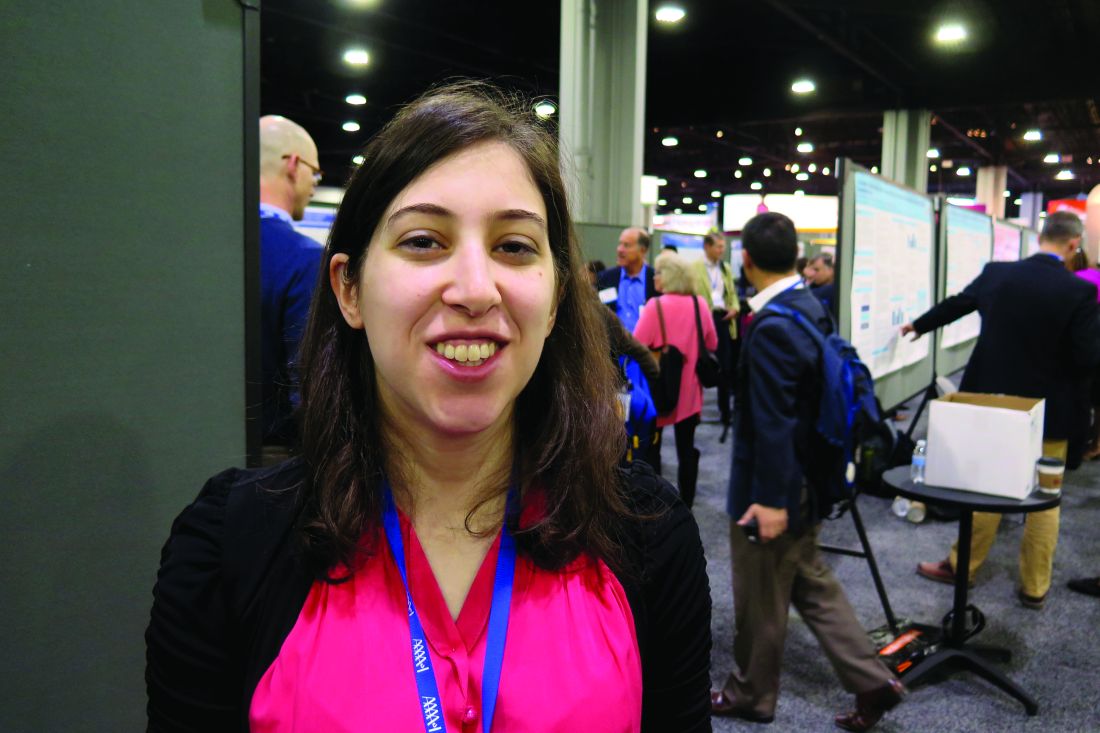
The National Heart, Blood, and Lung Institute Asthma Guidelines, first published in 1991, were most recently revised in 2007. In an effort to observe changes in asthma management in pediatric EDs and ICUs over the past 21 years, and to compare common management strategies, Dr. Azmeh and her associates distributed a 16-question online survey to 144 current program directors of U.S. training programs in pediatric emergency medicine and pediatric critical care. Results were compared to a similar survey that was sent by snail mail to program directors of U.S. training programs in pediatric emergency medicine and pediatric critical care in 1995.
Dr. Azmeh, a fellow in allergy and immunology at the Saint Louis University, reported results from 62 respondents who completed the 2016 questionnaire (43%). For initial management of pediatric acute severe asthma, a greater proportion of program directors in pediatric critical care reported using parenteral corticosteroids, compared with their counterparts in pediatric emergency medicine (85% vs. 32%, respectively; P less than .0001), as well as continuous beta 2-agonists (73% vs. 56%; P less than .05). A majority of overall respondents (98%) did not use theophylline for initial management, but more program directors in pediatric critical care reported using it for treatment failure, compared with their counterparts in pediatric emergency medicine (56% vs. 20%, respectively; P less than .0071). There was a trend among all respondents for more use of heliox for treatment failure than for initial management (13% vs. 6%).
When the researchers compared current survey responses to responses from the 1995 survey, they observed that program training directors across both specialties increased the use of nebulized ipratropium bromide in initial management and treatment failure (17% vs. 69%; P less than .0001 and 33% vs. 42%; P less than .05) and decreased use of theophylline for initial management of severe acute asthma (17% vs. 3%; P less than .05). However, theophylline is still used in treatment failure.
Among respondents to the 2016 survey, program directors in pediatric emergency medicine were less likely than were those in pediatric critical care to use continuous nebulized beta-2 agonists for initial management or to add parenteral selective beta-2 agonists (56% vs. 73% and 12% vs. 21%, respectively; P less than .05). They also were less likely to use theophylline in treatment failure (20% vs. 56%; P less than .05).
Dr. Azmeh reported having no relevant financial disclosures.
Surveys are interesting to establish a trend for what residents and fellows are being taught in emergency rooms and critical care units. The parenteral steroid use difference for the two groups in 2016 may be related to the fact that the emergency room hasn’t decide

Surveys are interesting to establish a trend for what residents and fellows are being taught in emergency rooms and critical care units. The parenteral steroid use difference for the two groups in 2016 may be related to the fact that the emergency room hasn’t decide
Surveys are interesting to establish a trend for what residents and fellows are being taught in emergency rooms and critical care units. The parenteral steroid use difference for the two groups in 2016 may be related to the fact that the emergency room hasn’t decide
ATLANTA – The treatment of pediatric severe acute asthma has changed over the past 21 years, but interspecialty differences in the management of these patients persist, results from a national survey suggest.
“I think it’s good for every ER and ICU department to have a conversation with providers about what to do when these kinds of patients come in,” lead study author Roua Azmeh, MD, said in an interview at the annual meeting of the American Academy of Allergy, Asthma, and Immunology. “A lot of ERs are establishing protocols. I think that’s going to be the wave of the future.”
The National Heart, Blood, and Lung Institute Asthma Guidelines, first published in 1991, were most recently revised in 2007. In an effort to observe changes in asthma management in pediatric EDs and ICUs over the past 21 years, and to compare common management strategies, Dr. Azmeh and her associates distributed a 16-question online survey to 144 current program directors of U.S. training programs in pediatric emergency medicine and pediatric critical care. Results were compared to a similar survey that was sent by snail mail to program directors of U.S. training programs in pediatric emergency medicine and pediatric critical care in 1995.
Dr. Azmeh, a fellow in allergy and immunology at the Saint Louis University, reported results from 62 respondents who completed the 2016 questionnaire (43%). For initial management of pediatric acute severe asthma, a greater proportion of program directors in pediatric critical care reported using parenteral corticosteroids, compared with their counterparts in pediatric emergency medicine (85% vs. 32%, respectively; P less than .0001), as well as continuous beta 2-agonists (73% vs. 56%; P less than .05). A majority of overall respondents (98%) did not use theophylline for initial management, but more program directors in pediatric critical care reported using it for treatment failure, compared with their counterparts in pediatric emergency medicine (56% vs. 20%, respectively; P less than .0071). There was a trend among all respondents for more use of heliox for treatment failure than for initial management (13% vs. 6%).
When the researchers compared current survey responses to responses from the 1995 survey, they observed that program training directors across both specialties increased the use of nebulized ipratropium bromide in initial management and treatment failure (17% vs. 69%; P less than .0001 and 33% vs. 42%; P less than .05) and decreased use of theophylline for initial management of severe acute asthma (17% vs. 3%; P less than .05). However, theophylline is still used in treatment failure.
Among respondents to the 2016 survey, program directors in pediatric emergency medicine were less likely than were those in pediatric critical care to use continuous nebulized beta-2 agonists for initial management or to add parenteral selective beta-2 agonists (56% vs. 73% and 12% vs. 21%, respectively; P less than .05). They also were less likely to use theophylline in treatment failure (20% vs. 56%; P less than .05).
Dr. Azmeh reported having no relevant financial disclosures.
ATLANTA – The treatment of pediatric severe acute asthma has changed over the past 21 years, but interspecialty differences in the management of these patients persist, results from a national survey suggest.
“I think it’s good for every ER and ICU department to have a conversation with providers about what to do when these kinds of patients come in,” lead study author Roua Azmeh, MD, said in an interview at the annual meeting of the American Academy of Allergy, Asthma, and Immunology. “A lot of ERs are establishing protocols. I think that’s going to be the wave of the future.”
The National Heart, Blood, and Lung Institute Asthma Guidelines, first published in 1991, were most recently revised in 2007. In an effort to observe changes in asthma management in pediatric EDs and ICUs over the past 21 years, and to compare common management strategies, Dr. Azmeh and her associates distributed a 16-question online survey to 144 current program directors of U.S. training programs in pediatric emergency medicine and pediatric critical care. Results were compared to a similar survey that was sent by snail mail to program directors of U.S. training programs in pediatric emergency medicine and pediatric critical care in 1995.
Dr. Azmeh, a fellow in allergy and immunology at the Saint Louis University, reported results from 62 respondents who completed the 2016 questionnaire (43%). For initial management of pediatric acute severe asthma, a greater proportion of program directors in pediatric critical care reported using parenteral corticosteroids, compared with their counterparts in pediatric emergency medicine (85% vs. 32%, respectively; P less than .0001), as well as continuous beta 2-agonists (73% vs. 56%; P less than .05). A majority of overall respondents (98%) did not use theophylline for initial management, but more program directors in pediatric critical care reported using it for treatment failure, compared with their counterparts in pediatric emergency medicine (56% vs. 20%, respectively; P less than .0071). There was a trend among all respondents for more use of heliox for treatment failure than for initial management (13% vs. 6%).
When the researchers compared current survey responses to responses from the 1995 survey, they observed that program training directors across both specialties increased the use of nebulized ipratropium bromide in initial management and treatment failure (17% vs. 69%; P less than .0001 and 33% vs. 42%; P less than .05) and decreased use of theophylline for initial management of severe acute asthma (17% vs. 3%; P less than .05). However, theophylline is still used in treatment failure.
Among respondents to the 2016 survey, program directors in pediatric emergency medicine were less likely than were those in pediatric critical care to use continuous nebulized beta-2 agonists for initial management or to add parenteral selective beta-2 agonists (56% vs. 73% and 12% vs. 21%, respectively; P less than .05). They also were less likely to use theophylline in treatment failure (20% vs. 56%; P less than .05).
Dr. Azmeh reported having no relevant financial disclosures.
Key clinical point:
Major finding: For initial management of pediatric acute severe asthma, a greater proportion of program directors in pediatric critical care reported using parenteral corticosteroids, compared with their counterparts in pediatric emergency medicine (85% vs. 32%, respectively; P less than .0001).
Data source: Results from a 16-question online survey sent to 144 current program directors of U.S. training programs in pediatric emergency medicine and pediatric critical care.
Disclosures: Dr. Azmeh reported having no relevant financial disclosures.
Self-injury
Whether you have heard about “cutting” from breathless gossip reports about young starlets or anxious parents of adolescent girls, it seems to be a phenomenon that is on the rise.
As a pediatrician, you may be the first (or only) adult in a young person’s life who notices evidence of self-injury or who asks about it. Self-injurious behaviors may signal significant underlying psychiatric issues or something more benign and brief. Being alert to self-injury is not an easy task. The thought of teenagers cutting themselves on a regular basis and acknowledging their inner distress in your office requires a pediatrician’s self-awareness and emotional preparation.

Self-injury, or nonsuicidal self-injury (NSSI) as it is known in the psychiatric literature, is indeed a relatively common phenomenon. In the United States, it affects approximately 10% of adolescents in a community sample, and as many as 35% of adolescents in treatment for any psychiatric illness. It begins most commonly between the ages of 13 and 15 years, and grows in prevalence through adolescence, dropping off in early adulthood. While adolescent girls are likely to start this behavior earlier than adolescent boys, the gender difference attenuates with age. Some studies have shown adolescent boys are more likely to engage in this behavior than girls by late adolescence.
NSSI typically takes the form of cutting oneself with a sharp object, but it also could involve scratching at the skin until it bleeds, hitting or burning oneself, or interfering with the healing of wounds. It classically was thought of as a symptom of borderline personality disorder, but is a behavior that also may occur with eating disorders, substance use disorders, and anxiety and depressive disorders in adolescents. Clinicians have conceptualized it as a maladaptive way to relieve intense emotional distress, signal distress to others, or inflict self-punishment. It usually starts as an impulsive behavior, and the combination of the intense emotions and high impulsivity of adolescence is why it is so common among this age group. For some adolescents, the impulse will be primarily one of curiosity, perhaps in the setting of some stress, and is more likely to occur if the behavior is common among a teenager’s peers. For those in intense emotional distress, it typically brings a fleeting sense of calm or numbing and an easing of tension. But this relief is usually followed by guilt and shame, and a return, sometimes compounded, of those uncomfortable emotions. Thus what starts as an impulse can become a repetitive, almost compulsive behavior.


If the self-injury happens regularly, it is very important that you show both concern and compassion. You might offer that whatever emotional pain they are experiencing, they deserve more support than a sharp object offers. You could ask about those illnesses that are frequently comorbid with self-injury: substance use, eating disorders, and anxiety and depressive disorders.
But it is essential that you ask about suicidal ideation and suicide attempts. If they are acutely suicidal or describe a history of previously hidden attempts, you will need to help them access care quickly, possibly recommending a visit to the emergency department unless they already have an outpatient treatment team. In these cases, you will need to share your concerns with their parents and help them find their way into the complex mental health system to get a comprehensive psychiatric evaluation and treatment.
Identifying and referring adolescents with NSSI is emotionally demanding work. Learn more from your patients, talk to those who evaluate them, and discuss the issues with colleagues – both to gain skills and to have support as you worry about these patients and help guide them through a complex system of care.
Dr. Swick is an attending psychiatrist in the division of child psychiatry at Massachusetts General Hospital, Boston, and director of the Parenting at a Challenging Time (PACT) Program at the Vernon Cancer Center at Newton Wellesley Hospital, also in Boston. Dr. Jellinek is professor emeritus of psychiatry and pediatrics, Harvard Medical School, Boston.
Whether you have heard about “cutting” from breathless gossip reports about young starlets or anxious parents of adolescent girls, it seems to be a phenomenon that is on the rise.
As a pediatrician, you may be the first (or only) adult in a young person’s life who notices evidence of self-injury or who asks about it. Self-injurious behaviors may signal significant underlying psychiatric issues or something more benign and brief. Being alert to self-injury is not an easy task. The thought of teenagers cutting themselves on a regular basis and acknowledging their inner distress in your office requires a pediatrician’s self-awareness and emotional preparation.
Self-injury, or nonsuicidal self-injury (NSSI) as it is known in the psychiatric literature, is indeed a relatively common phenomenon. In the United States, it affects approximately 10% of adolescents in a community sample, and as many as 35% of adolescents in treatment for any psychiatric illness. It begins most commonly between the ages of 13 and 15 years, and grows in prevalence through adolescence, dropping off in early adulthood. While adolescent girls are likely to start this behavior earlier than adolescent boys, the gender difference attenuates with age. Some studies have shown adolescent boys are more likely to engage in this behavior than girls by late adolescence.
NSSI typically takes the form of cutting oneself with a sharp object, but it also could involve scratching at the skin until it bleeds, hitting or burning oneself, or interfering with the healing of wounds. It classically was thought of as a symptom of borderline personality disorder, but is a behavior that also may occur with eating disorders, substance use disorders, and anxiety and depressive disorders in adolescents. Clinicians have conceptualized it as a maladaptive way to relieve intense emotional distress, signal distress to others, or inflict self-punishment. It usually starts as an impulsive behavior, and the combination of the intense emotions and high impulsivity of adolescence is why it is so common among this age group. For some adolescents, the impulse will be primarily one of curiosity, perhaps in the setting of some stress, and is more likely to occur if the behavior is common among a teenager’s peers. For those in intense emotional distress, it typically brings a fleeting sense of calm or numbing and an easing of tension. But this relief is usually followed by guilt and shame, and a return, sometimes compounded, of those uncomfortable emotions. Thus what starts as an impulse can become a repetitive, almost compulsive behavior.
If the self-injury happens regularly, it is very important that you show both concern and compassion. You might offer that whatever emotional pain they are experiencing, they deserve more support than a sharp object offers. You could ask about those illnesses that are frequently comorbid with self-injury: substance use, eating disorders, and anxiety and depressive disorders.
But it is essential that you ask about suicidal ideation and suicide attempts. If they are acutely suicidal or describe a history of previously hidden attempts, you will need to help them access care quickly, possibly recommending a visit to the emergency department unless they already have an outpatient treatment team. In these cases, you will need to share your concerns with their parents and help them find their way into the complex mental health system to get a comprehensive psychiatric evaluation and treatment.
Identifying and referring adolescents with NSSI is emotionally demanding work. Learn more from your patients, talk to those who evaluate them, and discuss the issues with colleagues – both to gain skills and to have support as you worry about these patients and help guide them through a complex system of care.
Dr. Swick is an attending psychiatrist in the division of child psychiatry at Massachusetts General Hospital, Boston, and director of the Parenting at a Challenging Time (PACT) Program at the Vernon Cancer Center at Newton Wellesley Hospital, also in Boston. Dr. Jellinek is professor emeritus of psychiatry and pediatrics, Harvard Medical School, Boston.
Whether you have heard about “cutting” from breathless gossip reports about young starlets or anxious parents of adolescent girls, it seems to be a phenomenon that is on the rise.
As a pediatrician, you may be the first (or only) adult in a young person’s life who notices evidence of self-injury or who asks about it. Self-injurious behaviors may signal significant underlying psychiatric issues or something more benign and brief. Being alert to self-injury is not an easy task. The thought of teenagers cutting themselves on a regular basis and acknowledging their inner distress in your office requires a pediatrician’s self-awareness and emotional preparation.
Self-injury, or nonsuicidal self-injury (NSSI) as it is known in the psychiatric literature, is indeed a relatively common phenomenon. In the United States, it affects approximately 10% of adolescents in a community sample, and as many as 35% of adolescents in treatment for any psychiatric illness. It begins most commonly between the ages of 13 and 15 years, and grows in prevalence through adolescence, dropping off in early adulthood. While adolescent girls are likely to start this behavior earlier than adolescent boys, the gender difference attenuates with age. Some studies have shown adolescent boys are more likely to engage in this behavior than girls by late adolescence.
NSSI typically takes the form of cutting oneself with a sharp object, but it also could involve scratching at the skin until it bleeds, hitting or burning oneself, or interfering with the healing of wounds. It classically was thought of as a symptom of borderline personality disorder, but is a behavior that also may occur with eating disorders, substance use disorders, and anxiety and depressive disorders in adolescents. Clinicians have conceptualized it as a maladaptive way to relieve intense emotional distress, signal distress to others, or inflict self-punishment. It usually starts as an impulsive behavior, and the combination of the intense emotions and high impulsivity of adolescence is why it is so common among this age group. For some adolescents, the impulse will be primarily one of curiosity, perhaps in the setting of some stress, and is more likely to occur if the behavior is common among a teenager’s peers. For those in intense emotional distress, it typically brings a fleeting sense of calm or numbing and an easing of tension. But this relief is usually followed by guilt and shame, and a return, sometimes compounded, of those uncomfortable emotions. Thus what starts as an impulse can become a repetitive, almost compulsive behavior.
If the self-injury happens regularly, it is very important that you show both concern and compassion. You might offer that whatever emotional pain they are experiencing, they deserve more support than a sharp object offers. You could ask about those illnesses that are frequently comorbid with self-injury: substance use, eating disorders, and anxiety and depressive disorders.
But it is essential that you ask about suicidal ideation and suicide attempts. If they are acutely suicidal or describe a history of previously hidden attempts, you will need to help them access care quickly, possibly recommending a visit to the emergency department unless they already have an outpatient treatment team. In these cases, you will need to share your concerns with their parents and help them find their way into the complex mental health system to get a comprehensive psychiatric evaluation and treatment.
Identifying and referring adolescents with NSSI is emotionally demanding work. Learn more from your patients, talk to those who evaluate them, and discuss the issues with colleagues – both to gain skills and to have support as you worry about these patients and help guide them through a complex system of care.
Dr. Swick is an attending psychiatrist in the division of child psychiatry at Massachusetts General Hospital, Boston, and director of the Parenting at a Challenging Time (PACT) Program at the Vernon Cancer Center at Newton Wellesley Hospital, also in Boston. Dr. Jellinek is professor emeritus of psychiatry and pediatrics, Harvard Medical School, Boston.
Summer camps need help managing childhood anaphylaxis
ATLANTA – Summer camp personnel need a refresher course on the recognition, treatment, and prevention of allergic reactions in children, according to an online survey of camps in almost 40 U.S. states and Canadian provinces.
There’s a lot of data about how schools handle allergies but almost nothing about summer camps. To fill the gap, the investigators sent surveys across North America to 158 camp directors, 141 camp medical personnel – mostly registered nurses – and 198 camp staffers. Most of the camps were traditional rural affairs where children stay for several weeks, but there were also suburban and city day camps.
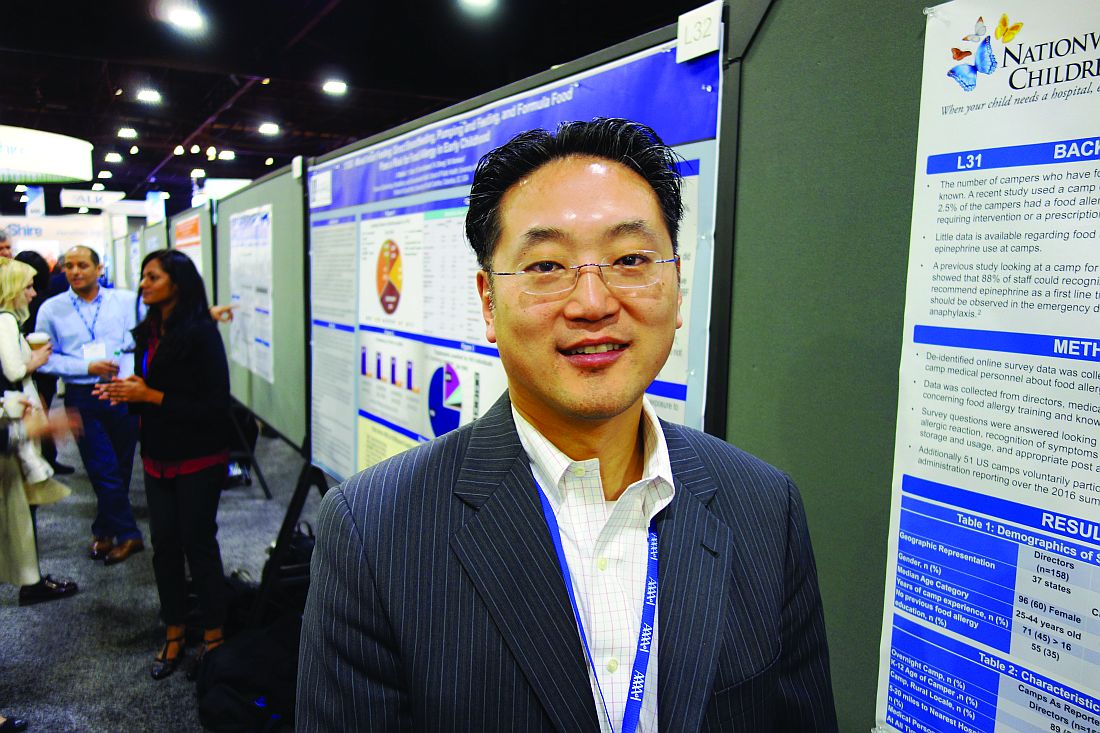
The results weren’t good. About a third of directors and staff, and almost 20% of medical personnel, said they had no education on food allergies. Less than 40% had a good understanding of the different ways that anaphylaxis can present. Less than 80% of camp directors and medical personnel and less than 50% of staff knew the right sequence for anaphylaxis treatment – epinephrine first, followed by a 911 call, and then a call to parents. Many respondents didn’t know the correct injection site for epinephrine.
They also were confused about hand sanitizers versus soap and water. Many mistakenly thought that sanitizers were as good as washing for removing allergens. “Their knowledge about how to clean tables and clean hands of food allergens was limited,” said lead investigator Margaret T. Redmond, MD, an allergist at Nationwide Children’s Hospital in Columbus, Ohio.
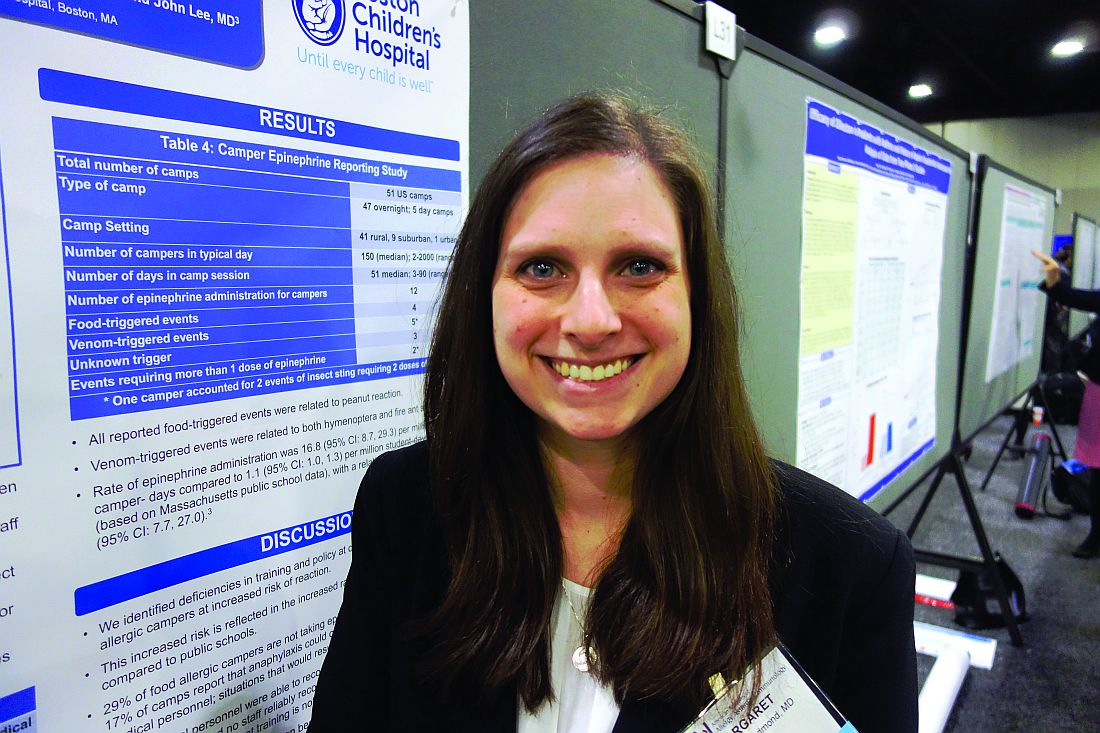
It all points to the need for education. “We were surprised at the poor recognition of anaphylactic symptoms. We are trying to identify the weaknesses in camps for targeted interventions. We know from the school data that, with education, people can change,” Dr. Redmond said.
During the 2016 summer session, 51 camps agreed to report epinephrine. Most were rural, with an average of 150 campers per day staying a median of 51 days. There were 12 epinephrine shots over that time, about half for peanut reactions and the rest for bee, wasp, and fire ant stings. None of the children died.
“Families that have kids with food allergies should reach out to camps about their policies and make sure they have epinephrine available at all times and that they have food allergy action plans” that staff know about, Dr. Redmond said.
The work was funded by Mylan and kaleo, both makers of epinephrine autoinjectors. Dr. Lee and Dr. Redmond had no relevant financial disclosures.
ATLANTA – Summer camp personnel need a refresher course on the recognition, treatment, and prevention of allergic reactions in children, according to an online survey of camps in almost 40 U.S. states and Canadian provinces.
There’s a lot of data about how schools handle allergies but almost nothing about summer camps. To fill the gap, the investigators sent surveys across North America to 158 camp directors, 141 camp medical personnel – mostly registered nurses – and 198 camp staffers. Most of the camps were traditional rural affairs where children stay for several weeks, but there were also suburban and city day camps.
The results weren’t good. About a third of directors and staff, and almost 20% of medical personnel, said they had no education on food allergies. Less than 40% had a good understanding of the different ways that anaphylaxis can present. Less than 80% of camp directors and medical personnel and less than 50% of staff knew the right sequence for anaphylaxis treatment – epinephrine first, followed by a 911 call, and then a call to parents. Many respondents didn’t know the correct injection site for epinephrine.
They also were confused about hand sanitizers versus soap and water. Many mistakenly thought that sanitizers were as good as washing for removing allergens. “Their knowledge about how to clean tables and clean hands of food allergens was limited,” said lead investigator Margaret T. Redmond, MD, an allergist at Nationwide Children’s Hospital in Columbus, Ohio.
It all points to the need for education. “We were surprised at the poor recognition of anaphylactic symptoms. We are trying to identify the weaknesses in camps for targeted interventions. We know from the school data that, with education, people can change,” Dr. Redmond said.
During the 2016 summer session, 51 camps agreed to report epinephrine. Most were rural, with an average of 150 campers per day staying a median of 51 days. There were 12 epinephrine shots over that time, about half for peanut reactions and the rest for bee, wasp, and fire ant stings. None of the children died.
“Families that have kids with food allergies should reach out to camps about their policies and make sure they have epinephrine available at all times and that they have food allergy action plans” that staff know about, Dr. Redmond said.
The work was funded by Mylan and kaleo, both makers of epinephrine autoinjectors. Dr. Lee and Dr. Redmond had no relevant financial disclosures.
ATLANTA – Summer camp personnel need a refresher course on the recognition, treatment, and prevention of allergic reactions in children, according to an online survey of camps in almost 40 U.S. states and Canadian provinces.
There’s a lot of data about how schools handle allergies but almost nothing about summer camps. To fill the gap, the investigators sent surveys across North America to 158 camp directors, 141 camp medical personnel – mostly registered nurses – and 198 camp staffers. Most of the camps were traditional rural affairs where children stay for several weeks, but there were also suburban and city day camps.
The results weren’t good. About a third of directors and staff, and almost 20% of medical personnel, said they had no education on food allergies. Less than 40% had a good understanding of the different ways that anaphylaxis can present. Less than 80% of camp directors and medical personnel and less than 50% of staff knew the right sequence for anaphylaxis treatment – epinephrine first, followed by a 911 call, and then a call to parents. Many respondents didn’t know the correct injection site for epinephrine.
They also were confused about hand sanitizers versus soap and water. Many mistakenly thought that sanitizers were as good as washing for removing allergens. “Their knowledge about how to clean tables and clean hands of food allergens was limited,” said lead investigator Margaret T. Redmond, MD, an allergist at Nationwide Children’s Hospital in Columbus, Ohio.
It all points to the need for education. “We were surprised at the poor recognition of anaphylactic symptoms. We are trying to identify the weaknesses in camps for targeted interventions. We know from the school data that, with education, people can change,” Dr. Redmond said.
During the 2016 summer session, 51 camps agreed to report epinephrine. Most were rural, with an average of 150 campers per day staying a median of 51 days. There were 12 epinephrine shots over that time, about half for peanut reactions and the rest for bee, wasp, and fire ant stings. None of the children died.
“Families that have kids with food allergies should reach out to camps about their policies and make sure they have epinephrine available at all times and that they have food allergy action plans” that staff know about, Dr. Redmond said.
The work was funded by Mylan and kaleo, both makers of epinephrine autoinjectors. Dr. Lee and Dr. Redmond had no relevant financial disclosures.
AT AAAAI 2017 ANNUAL MEETING
Key clinical point:
Major finding: About a third of directors and camp staff and almost 20% of medical personnel (mostly registered nurses) said they had no previous education on food allergies.
Data source: An online survey of camps in almost 40 U.S. states and Canadian provinces, including almost 500 personnel.
Disclosures: The work was funded by Mylan and kaleo, both makers of epinephrine autoinjectors. Dr. Lee and Dr. Redmond had no relevant financial disclosures.
Down syndrome in adolescents
Teen years, no doubt, come with expected challenges. For teens with Down syndrome (DS), the challenges are exponentially greater. Although DS is associated with mental retardation, the vast majority of people with DS have only mild to moderate intellectual disability. Still, this can lead to a great deal of internal stress for the adolescent and anxiety and stress for the parents.
Many issues must be considered for the adolescent with DS. Annual surveillance changes as the child ages and the need for intervention do as well. For example, 50% of children with DS are born with congenital heart defect. During infancy, it is important to do echocardiograms to identify and follow specific lesions. Approximately 57% of adolescents with DS will develop mitral valve prolapse and 10% will develop aortic regurgitation.1 Therefore, close evaluation should be done, listening for new onset murmurs, clicks, and unexplained fatigue, and, if these are identified, an echocardiogram should be repeated.

Dysmorphic features such as midfacial hypoplasia, tonsillar hypertrophy, and narrow ear canals also lead to issues that develop in the adolescent years. Chronic otitis, conductive hearing loss because of chronic middle-ear effusion or impacted cerumen, and enlarged tonsils can result in obstructive sleep apnea. As individuals gain weight, these issues are further affected, and a sleep study may be required. Annual hearing screens are recommended.1

Musculoskeletal disorders such as ligamentous laxity and atlantoaxial instability can also present with complications in the adolescent years. Pes planus is a very common finding that can further lead to hip and knee pain. Obesity also further adds to its occurrence (14%-67%).3
Now, the most pressing and, likely, most overlooked issue is the issue of sexuality. We spend a great deal of time educating teens without DS about the risks of unprotected sex and exposures to STIs, but many assume that these issues do not affect teens with DS. Secondary sexual characteristics develop in the same manner and at the same age that they do in children without DS. Therefore, it is a safe assumption that sexual curiosity and arousal do as well. Given that there can be varying levels of mental impairment, the approach to sex education needs to be developmentally appropriate. Normalizing the feelings and having discussions on appropriate and inappropriate expression are important.
As with all teens, acceptance and inclusion are of utmost importance. Physical and learning disabilities set them apart despite shared sexual and emotional development. This can lead to anxiety, depression, and behavior issues. Understanding that these are real issues for the adolescent with DS is important when providing the appropriate resources and support.
Management of the menstrual cycle can add new challenges for both the adolescent and the parent and, thus, should be investigated during health maintenance visits. Amenorrhea can result from introduction of hormonal therapy and should be considered. Sexual abuse also is increased in this age group, so close supervision and awareness of this issue are important.
Assisting parents of children with DS through the teen years is imperative. Making them aware of local support groups and national organizations for children with disabilities will help them navigate these years. The American Academy of Pediatrics has guidelines for health maintenance for DS.2
Dr. Pearce is a pediatrician in Frankfort, Ill. She reported no relevant financial disclosures. Email her at pdnews@frontlinemedcom.com
References
1. J Pediatr Health Care. 2006 May-Jun;20(3):198-205.
2. Pediatrics. 2011. doi: 10.1542/peds.2011-1605.
3. Clin Obes. 2015;5(2):52-9.
Correction, 7/26/17: An earlier version of this article misstated a recommendation about radiologic evaluation of the cervical spine in asymptomatic children
Teen years, no doubt, come with expected challenges. For teens with Down syndrome (DS), the challenges are exponentially greater. Although DS is associated with mental retardation, the vast majority of people with DS have only mild to moderate intellectual disability. Still, this can lead to a great deal of internal stress for the adolescent and anxiety and stress for the parents.
Many issues must be considered for the adolescent with DS. Annual surveillance changes as the child ages and the need for intervention do as well. For example, 50% of children with DS are born with congenital heart defect. During infancy, it is important to do echocardiograms to identify and follow specific lesions. Approximately 57% of adolescents with DS will develop mitral valve prolapse and 10% will develop aortic regurgitation.1 Therefore, close evaluation should be done, listening for new onset murmurs, clicks, and unexplained fatigue, and, if these are identified, an echocardiogram should be repeated.
Dysmorphic features such as midfacial hypoplasia, tonsillar hypertrophy, and narrow ear canals also lead to issues that develop in the adolescent years. Chronic otitis, conductive hearing loss because of chronic middle-ear effusion or impacted cerumen, and enlarged tonsils can result in obstructive sleep apnea. As individuals gain weight, these issues are further affected, and a sleep study may be required. Annual hearing screens are recommended.1
Musculoskeletal disorders such as ligamentous laxity and atlantoaxial instability can also present with complications in the adolescent years. Pes planus is a very common finding that can further lead to hip and knee pain. Obesity also further adds to its occurrence (14%-67%).3
Now, the most pressing and, likely, most overlooked issue is the issue of sexuality. We spend a great deal of time educating teens without DS about the risks of unprotected sex and exposures to STIs, but many assume that these issues do not affect teens with DS. Secondary sexual characteristics develop in the same manner and at the same age that they do in children without DS. Therefore, it is a safe assumption that sexual curiosity and arousal do as well. Given that there can be varying levels of mental impairment, the approach to sex education needs to be developmentally appropriate. Normalizing the feelings and having discussions on appropriate and inappropriate expression are important.
As with all teens, acceptance and inclusion are of utmost importance. Physical and learning disabilities set them apart despite shared sexual and emotional development. This can lead to anxiety, depression, and behavior issues. Understanding that these are real issues for the adolescent with DS is important when providing the appropriate resources and support.
Management of the menstrual cycle can add new challenges for both the adolescent and the parent and, thus, should be investigated during health maintenance visits. Amenorrhea can result from introduction of hormonal therapy and should be considered. Sexual abuse also is increased in this age group, so close supervision and awareness of this issue are important.
Assisting parents of children with DS through the teen years is imperative. Making them aware of local support groups and national organizations for children with disabilities will help them navigate these years. The American Academy of Pediatrics has guidelines for health maintenance for DS.2
Dr. Pearce is a pediatrician in Frankfort, Ill. She reported no relevant financial disclosures. Email her at pdnews@frontlinemedcom.com
References
1. J Pediatr Health Care. 2006 May-Jun;20(3):198-205.
2. Pediatrics. 2011. doi: 10.1542/peds.2011-1605.
3. Clin Obes. 2015;5(2):52-9.
Correction, 7/26/17: An earlier version of this article misstated a recommendation about radiologic evaluation of the cervical spine in asymptomatic children
Teen years, no doubt, come with expected challenges. For teens with Down syndrome (DS), the challenges are exponentially greater. Although DS is associated with mental retardation, the vast majority of people with DS have only mild to moderate intellectual disability. Still, this can lead to a great deal of internal stress for the adolescent and anxiety and stress for the parents.
Many issues must be considered for the adolescent with DS. Annual surveillance changes as the child ages and the need for intervention do as well. For example, 50% of children with DS are born with congenital heart defect. During infancy, it is important to do echocardiograms to identify and follow specific lesions. Approximately 57% of adolescents with DS will develop mitral valve prolapse and 10% will develop aortic regurgitation.1 Therefore, close evaluation should be done, listening for new onset murmurs, clicks, and unexplained fatigue, and, if these are identified, an echocardiogram should be repeated.
Dysmorphic features such as midfacial hypoplasia, tonsillar hypertrophy, and narrow ear canals also lead to issues that develop in the adolescent years. Chronic otitis, conductive hearing loss because of chronic middle-ear effusion or impacted cerumen, and enlarged tonsils can result in obstructive sleep apnea. As individuals gain weight, these issues are further affected, and a sleep study may be required. Annual hearing screens are recommended.1
Musculoskeletal disorders such as ligamentous laxity and atlantoaxial instability can also present with complications in the adolescent years. Pes planus is a very common finding that can further lead to hip and knee pain. Obesity also further adds to its occurrence (14%-67%).3
Now, the most pressing and, likely, most overlooked issue is the issue of sexuality. We spend a great deal of time educating teens without DS about the risks of unprotected sex and exposures to STIs, but many assume that these issues do not affect teens with DS. Secondary sexual characteristics develop in the same manner and at the same age that they do in children without DS. Therefore, it is a safe assumption that sexual curiosity and arousal do as well. Given that there can be varying levels of mental impairment, the approach to sex education needs to be developmentally appropriate. Normalizing the feelings and having discussions on appropriate and inappropriate expression are important.
As with all teens, acceptance and inclusion are of utmost importance. Physical and learning disabilities set them apart despite shared sexual and emotional development. This can lead to anxiety, depression, and behavior issues. Understanding that these are real issues for the adolescent with DS is important when providing the appropriate resources and support.
Management of the menstrual cycle can add new challenges for both the adolescent and the parent and, thus, should be investigated during health maintenance visits. Amenorrhea can result from introduction of hormonal therapy and should be considered. Sexual abuse also is increased in this age group, so close supervision and awareness of this issue are important.
Assisting parents of children with DS through the teen years is imperative. Making them aware of local support groups and national organizations for children with disabilities will help them navigate these years. The American Academy of Pediatrics has guidelines for health maintenance for DS.2
Dr. Pearce is a pediatrician in Frankfort, Ill. She reported no relevant financial disclosures. Email her at pdnews@frontlinemedcom.com
References
1. J Pediatr Health Care. 2006 May-Jun;20(3):198-205.
2. Pediatrics. 2011. doi: 10.1542/peds.2011-1605.
3. Clin Obes. 2015;5(2):52-9.
Correction, 7/26/17: An earlier version of this article misstated a recommendation about radiologic evaluation of the cervical spine in asymptomatic children
Study nixed magnesium for infants with acute bronchiolitis
Intravenous magnesium does not benefit, and may harm, infants with moderate to severe acute bronchiolitis, investigators reported.
Compared with placebo, adding a single intravenous dose of magnesium sulfate (100 mg/kg) to usual care did not reduce time to medical readiness for discharge, even when patients had eczema or a family history of asthma, and was tied to more than a threefold rise in the rate of short-term readmissions, Khalid Al Ansari, MD, of Hamad Medical Corp. in Doha, Qatar, and his associates wrote in Chest. “To our knowledge, this is the first randomized study to investigate the effect of intravenous magnesium in a bronchiolitis population,” they added.
Bronchiolitis lacks new, inexpensive, readily available treatments, despite being a common reason for hospital admission, the researchers noted. For older children with moderate to severe exacerbations of asthma, a meta-analysis found that the addition of magnesium to usual care appeared to cut readmissions and shorten lengths of stay, compared with placebo. To explore magnesium therapy in younger children, the investigators enrolled 162 previously healthy infants up to 18 months old who had been admitted to the short-stay unit of a pediatric emergency center with a diagnosis of moderate to severe viral bronchiolitis. Patients received usual care with oral dexamethasone and nebulized 5% hypertonic saline in 1 mL of 1:1000 epinephrine, plus an intravenous 60-minute infusion with a blinded syringe of either 0.9% saline placebo or magnesium sulfate (100 mg/kg) (Chest. 2017 Mar 9. doi: 10.1016/j.chest.2017.03.002).
The primary endpoint, time to medical readiness for discharge, did not statistically differ between groups, averaging 24.1 (95% confidence interval, 20.0-29.1) hours with magnesium and 25.3 (95% CI, 20.3-31.5) hours with placebo (P = .91). Among patients with a history of eczema or a family history of asthma, mean times to readiness for discharge resembled those for the entire cohort and did not statistically differ based on treatment. Average Wang bronchiolitis severity scores also were similar between groups, as were rates of outpatient clinic visits (33.8% with magnesium and 27.2% with placebo). Thus, the trial identified “no benefit in adding intravenous magnesium for infant bronchiolitis, even in patients characterized to be at a higher risk for asthma,” the researchers concluded.
Strikingly, 2-week readmission rates were 19.5% with magnesium (95% CI, 11.3-30.1) and 6.2% with placebo (95% CI, 0.02-13.8; P = .016). Among patients with eczema or a family history of asthma, 2-week readmission rates also were significantly higher with magnesium (26.3%; 95% CI, 13.4-43.1) than with placebo (7.5%; 95% CI, 1.6-20.4; P = .034) These might have been chance findings, or magnesium might have masked worse bronchiolitis, prolonged the disease course, or interacted with 5% hypertonic saline or systemic corticosteroids, the investigators said. Intravenous magnesium might contribute to secondary relapse, especially among patients with eczema or a family history of asthma, they added.
Patients in this study had a median age of 3.7 months (range, 22 days to 17.6 months), about half had eczema or a family history of asthma, and 86% had positive nasopharyngeal virus swabs. Cardiopulmonary monitoring revealed no acute events during treatment. Of 16 readmissions in the magnesium group, 11 entered the infirmary and 4 entered the hospital. The five placebo readmissions included four to the infirmary and one to the hospital.
“As with other ‘negative studies,’ we may have failed to identify a benefit from intravenous magnesium in a patient subgroup because of our limited sample size,” the investigators wrote. “But we think our findings are generalizable to a similarly heterogeneous group of patients presenting for bronchiolitis care in a busy urban emergency department.”
Hamad Medical Corp. sponsored the study. The investigators reported having no conflicts of interest.
The study authors are correct that there isn’t a “new” treatment for infant bronchiolitis. But the American Academy of Pediatrics published a Clinical Practice Guidelines in 2014 (Pediatrics. Vol 134, Number 5, November 2014).

This study included patients admitted to a short-stay unit within the emergency room and they were receiving both of these therapies as “usual care.” Therefore, it is difficult to say if this may have confounded the results. In any case, intravenous magnesium sulfate doesn’t make sense as an intervention for bronchiolitis.
The study authors are correct that there isn’t a “new” treatment for infant bronchiolitis. But the American Academy of Pediatrics published a Clinical Practice Guidelines in 2014 (Pediatrics. Vol 134, Number 5, November 2014).
This study included patients admitted to a short-stay unit within the emergency room and they were receiving both of these therapies as “usual care.” Therefore, it is difficult to say if this may have confounded the results. In any case, intravenous magnesium sulfate doesn’t make sense as an intervention for bronchiolitis.
The study authors are correct that there isn’t a “new” treatment for infant bronchiolitis. But the American Academy of Pediatrics published a Clinical Practice Guidelines in 2014 (Pediatrics. Vol 134, Number 5, November 2014).
This study included patients admitted to a short-stay unit within the emergency room and they were receiving both of these therapies as “usual care.” Therefore, it is difficult to say if this may have confounded the results. In any case, intravenous magnesium sulfate doesn’t make sense as an intervention for bronchiolitis.
Intravenous magnesium does not benefit, and may harm, infants with moderate to severe acute bronchiolitis, investigators reported.
Compared with placebo, adding a single intravenous dose of magnesium sulfate (100 mg/kg) to usual care did not reduce time to medical readiness for discharge, even when patients had eczema or a family history of asthma, and was tied to more than a threefold rise in the rate of short-term readmissions, Khalid Al Ansari, MD, of Hamad Medical Corp. in Doha, Qatar, and his associates wrote in Chest. “To our knowledge, this is the first randomized study to investigate the effect of intravenous magnesium in a bronchiolitis population,” they added.
Bronchiolitis lacks new, inexpensive, readily available treatments, despite being a common reason for hospital admission, the researchers noted. For older children with moderate to severe exacerbations of asthma, a meta-analysis found that the addition of magnesium to usual care appeared to cut readmissions and shorten lengths of stay, compared with placebo. To explore magnesium therapy in younger children, the investigators enrolled 162 previously healthy infants up to 18 months old who had been admitted to the short-stay unit of a pediatric emergency center with a diagnosis of moderate to severe viral bronchiolitis. Patients received usual care with oral dexamethasone and nebulized 5% hypertonic saline in 1 mL of 1:1000 epinephrine, plus an intravenous 60-minute infusion with a blinded syringe of either 0.9% saline placebo or magnesium sulfate (100 mg/kg) (Chest. 2017 Mar 9. doi: 10.1016/j.chest.2017.03.002).
The primary endpoint, time to medical readiness for discharge, did not statistically differ between groups, averaging 24.1 (95% confidence interval, 20.0-29.1) hours with magnesium and 25.3 (95% CI, 20.3-31.5) hours with placebo (P = .91). Among patients with a history of eczema or a family history of asthma, mean times to readiness for discharge resembled those for the entire cohort and did not statistically differ based on treatment. Average Wang bronchiolitis severity scores also were similar between groups, as were rates of outpatient clinic visits (33.8% with magnesium and 27.2% with placebo). Thus, the trial identified “no benefit in adding intravenous magnesium for infant bronchiolitis, even in patients characterized to be at a higher risk for asthma,” the researchers concluded.
Strikingly, 2-week readmission rates were 19.5% with magnesium (95% CI, 11.3-30.1) and 6.2% with placebo (95% CI, 0.02-13.8; P = .016). Among patients with eczema or a family history of asthma, 2-week readmission rates also were significantly higher with magnesium (26.3%; 95% CI, 13.4-43.1) than with placebo (7.5%; 95% CI, 1.6-20.4; P = .034) These might have been chance findings, or magnesium might have masked worse bronchiolitis, prolonged the disease course, or interacted with 5% hypertonic saline or systemic corticosteroids, the investigators said. Intravenous magnesium might contribute to secondary relapse, especially among patients with eczema or a family history of asthma, they added.
Patients in this study had a median age of 3.7 months (range, 22 days to 17.6 months), about half had eczema or a family history of asthma, and 86% had positive nasopharyngeal virus swabs. Cardiopulmonary monitoring revealed no acute events during treatment. Of 16 readmissions in the magnesium group, 11 entered the infirmary and 4 entered the hospital. The five placebo readmissions included four to the infirmary and one to the hospital.
“As with other ‘negative studies,’ we may have failed to identify a benefit from intravenous magnesium in a patient subgroup because of our limited sample size,” the investigators wrote. “But we think our findings are generalizable to a similarly heterogeneous group of patients presenting for bronchiolitis care in a busy urban emergency department.”
Hamad Medical Corp. sponsored the study. The investigators reported having no conflicts of interest.
Intravenous magnesium does not benefit, and may harm, infants with moderate to severe acute bronchiolitis, investigators reported.
Compared with placebo, adding a single intravenous dose of magnesium sulfate (100 mg/kg) to usual care did not reduce time to medical readiness for discharge, even when patients had eczema or a family history of asthma, and was tied to more than a threefold rise in the rate of short-term readmissions, Khalid Al Ansari, MD, of Hamad Medical Corp. in Doha, Qatar, and his associates wrote in Chest. “To our knowledge, this is the first randomized study to investigate the effect of intravenous magnesium in a bronchiolitis population,” they added.
Bronchiolitis lacks new, inexpensive, readily available treatments, despite being a common reason for hospital admission, the researchers noted. For older children with moderate to severe exacerbations of asthma, a meta-analysis found that the addition of magnesium to usual care appeared to cut readmissions and shorten lengths of stay, compared with placebo. To explore magnesium therapy in younger children, the investigators enrolled 162 previously healthy infants up to 18 months old who had been admitted to the short-stay unit of a pediatric emergency center with a diagnosis of moderate to severe viral bronchiolitis. Patients received usual care with oral dexamethasone and nebulized 5% hypertonic saline in 1 mL of 1:1000 epinephrine, plus an intravenous 60-minute infusion with a blinded syringe of either 0.9% saline placebo or magnesium sulfate (100 mg/kg) (Chest. 2017 Mar 9. doi: 10.1016/j.chest.2017.03.002).
The primary endpoint, time to medical readiness for discharge, did not statistically differ between groups, averaging 24.1 (95% confidence interval, 20.0-29.1) hours with magnesium and 25.3 (95% CI, 20.3-31.5) hours with placebo (P = .91). Among patients with a history of eczema or a family history of asthma, mean times to readiness for discharge resembled those for the entire cohort and did not statistically differ based on treatment. Average Wang bronchiolitis severity scores also were similar between groups, as were rates of outpatient clinic visits (33.8% with magnesium and 27.2% with placebo). Thus, the trial identified “no benefit in adding intravenous magnesium for infant bronchiolitis, even in patients characterized to be at a higher risk for asthma,” the researchers concluded.
Strikingly, 2-week readmission rates were 19.5% with magnesium (95% CI, 11.3-30.1) and 6.2% with placebo (95% CI, 0.02-13.8; P = .016). Among patients with eczema or a family history of asthma, 2-week readmission rates also were significantly higher with magnesium (26.3%; 95% CI, 13.4-43.1) than with placebo (7.5%; 95% CI, 1.6-20.4; P = .034) These might have been chance findings, or magnesium might have masked worse bronchiolitis, prolonged the disease course, or interacted with 5% hypertonic saline or systemic corticosteroids, the investigators said. Intravenous magnesium might contribute to secondary relapse, especially among patients with eczema or a family history of asthma, they added.
Patients in this study had a median age of 3.7 months (range, 22 days to 17.6 months), about half had eczema or a family history of asthma, and 86% had positive nasopharyngeal virus swabs. Cardiopulmonary monitoring revealed no acute events during treatment. Of 16 readmissions in the magnesium group, 11 entered the infirmary and 4 entered the hospital. The five placebo readmissions included four to the infirmary and one to the hospital.
“As with other ‘negative studies,’ we may have failed to identify a benefit from intravenous magnesium in a patient subgroup because of our limited sample size,” the investigators wrote. “But we think our findings are generalizable to a similarly heterogeneous group of patients presenting for bronchiolitis care in a busy urban emergency department.”
Hamad Medical Corp. sponsored the study. The investigators reported having no conflicts of interest.
Key clinical point: Intravenous magnesium does not benefit, and may harm, infants with acute bronchiolitis.
Major finding: Time to medical readiness for discharge averaged 24.1 hours (95% CI, 20.0-29.1) in the magnesium group and 25.3 hours (95% CI, 20.3-31.5) in the placebo group (P = .91). Rates of 2-week readmission were 19.5% with magnesium and 6.2% with placebo (P = .016).
Data source: A single-center, randomized, double-blind, placebo-controlled trial of 162 previously healthy infants diagnosed with viral bronchiolitis.
Disclosures: Hamad Medical Corp. sponsored the study. The investigators reported having no conflicts of interest.
Nonoperative management of pediatric appendicitis appears feasible
Nonoperative management of uncomplicated acute appendicitis in the pediatric population appeared feasible and didn’t raise the risk of complications in the first metaanalysis to examine this approach, investigators reported March 27 in JAMA Pediatrics.
Nonoperative management, based on antibiotic treatment and close monitoring of the patient, is accepted as safe and effective in adults but has not been well studied in children and adolescents. “Owing to specific anatomical and pathophysiologic features of children, the clinical scenario of acute appendicitis in pediatric patients is different from that in adults, and treatment decisions for children are more difficult,” said Libin Huang, MD, of West China Hospital and Sichuan University, Chengdu, and his associates.
The few clinical trials that have been performed in children have had small sample sizes, so the investigators performed a meta-analysis to pool the results for 404 patients aged 5-18 years. They analyzed data from four single-center prospective but nonrandomized controlled trials and one single-center randomized controlled trial to compare outcomes between 168 patients initially treated with antibiotics and 236 who underwent immediate appendectomy.
Sixteen patients in the nonoperative group (9.5%) had treatment failure, defined as appendectomy within 48 hours (11 patients) or within 1 month of follow-up (5 patients). Three of these patients developed a complication (perforated appendicitis). In comparison, none of the surgery group had treatment failure, and one developed a complication requiring reoperation. Thus, the rate of success in the nonoperative group was 152 of 168 patients, or 90.5%, and the rate of complications was not significantly different between the two study groups, Dr. Huang and his associates said (JAMA Ped. 2017 Mar 27. doi: 10.1001/jamapediatrics.2017.0057).
During the following year, 27 patients in the nonoperative group had a histopathologically confirmed recurrence of appendicitis and underwent appendectomy; another 8 had the surgery because of parents’ requests. Nonoperative management was significantly more likely to fail in patients who had an appendicolith, so this approach should be considered inappropriate for this subgroup of patients, the investigators said.
Larger clinical trials with a randomized design, standardized criteria for antibiotic therapy, and longer follow-up are needed to confirm these preliminary findings, they added.
No sponsor was cited for this study. Dr. Huang and his associates reported having no relevant financial disclosures.
This is the first data synthesis on the effectiveness of nonoperative management compared with appendectomy in children, and it shows that the evidence at this time is simply insufficient to warrant a change in clinical practice. Appendectomy remains the standard of care for this disease.
Despite the high early “success rate” for nonoperative treatment, patients in this group were nearly nine times more likely to have “treatment failure” than those who underwent immediate appendectomy.
The nonoperative approach remains an experimental proposition and should be offered only under protocol in a clinical trial setting. It clearly merits ongoing consideration, but much more data from high-quality clinical trials are needed.
Monica E. Lopez, MD, and David E. Wesson, MD, are both with the division of pediatric surgery at Baylor College of Medicine and the department of surgery at Texas Children’s Hospital, both in Houston. They reported having no relevant financial disclosures. Dr. Lopez and Dr. Wesson made these remarks in an editorial accompanying Dr. Huang’s report (JAMA Ped. 2017 Mar 27. doi: 10.1001/jamapediatrics.2017.0056).
This is the first data synthesis on the effectiveness of nonoperative management compared with appendectomy in children, and it shows that the evidence at this time is simply insufficient to warrant a change in clinical practice. Appendectomy remains the standard of care for this disease.
Despite the high early “success rate” for nonoperative treatment, patients in this group were nearly nine times more likely to have “treatment failure” than those who underwent immediate appendectomy.
The nonoperative approach remains an experimental proposition and should be offered only under protocol in a clinical trial setting. It clearly merits ongoing consideration, but much more data from high-quality clinical trials are needed.
Monica E. Lopez, MD, and David E. Wesson, MD, are both with the division of pediatric surgery at Baylor College of Medicine and the department of surgery at Texas Children’s Hospital, both in Houston. They reported having no relevant financial disclosures. Dr. Lopez and Dr. Wesson made these remarks in an editorial accompanying Dr. Huang’s report (JAMA Ped. 2017 Mar 27. doi: 10.1001/jamapediatrics.2017.0056).
This is the first data synthesis on the effectiveness of nonoperative management compared with appendectomy in children, and it shows that the evidence at this time is simply insufficient to warrant a change in clinical practice. Appendectomy remains the standard of care for this disease.
Despite the high early “success rate” for nonoperative treatment, patients in this group were nearly nine times more likely to have “treatment failure” than those who underwent immediate appendectomy.
The nonoperative approach remains an experimental proposition and should be offered only under protocol in a clinical trial setting. It clearly merits ongoing consideration, but much more data from high-quality clinical trials are needed.
Monica E. Lopez, MD, and David E. Wesson, MD, are both with the division of pediatric surgery at Baylor College of Medicine and the department of surgery at Texas Children’s Hospital, both in Houston. They reported having no relevant financial disclosures. Dr. Lopez and Dr. Wesson made these remarks in an editorial accompanying Dr. Huang’s report (JAMA Ped. 2017 Mar 27. doi: 10.1001/jamapediatrics.2017.0056).
Nonoperative management of uncomplicated acute appendicitis in the pediatric population appeared feasible and didn’t raise the risk of complications in the first metaanalysis to examine this approach, investigators reported March 27 in JAMA Pediatrics.
Nonoperative management, based on antibiotic treatment and close monitoring of the patient, is accepted as safe and effective in adults but has not been well studied in children and adolescents. “Owing to specific anatomical and pathophysiologic features of children, the clinical scenario of acute appendicitis in pediatric patients is different from that in adults, and treatment decisions for children are more difficult,” said Libin Huang, MD, of West China Hospital and Sichuan University, Chengdu, and his associates.
The few clinical trials that have been performed in children have had small sample sizes, so the investigators performed a meta-analysis to pool the results for 404 patients aged 5-18 years. They analyzed data from four single-center prospective but nonrandomized controlled trials and one single-center randomized controlled trial to compare outcomes between 168 patients initially treated with antibiotics and 236 who underwent immediate appendectomy.
Sixteen patients in the nonoperative group (9.5%) had treatment failure, defined as appendectomy within 48 hours (11 patients) or within 1 month of follow-up (5 patients). Three of these patients developed a complication (perforated appendicitis). In comparison, none of the surgery group had treatment failure, and one developed a complication requiring reoperation. Thus, the rate of success in the nonoperative group was 152 of 168 patients, or 90.5%, and the rate of complications was not significantly different between the two study groups, Dr. Huang and his associates said (JAMA Ped. 2017 Mar 27. doi: 10.1001/jamapediatrics.2017.0057).
During the following year, 27 patients in the nonoperative group had a histopathologically confirmed recurrence of appendicitis and underwent appendectomy; another 8 had the surgery because of parents’ requests. Nonoperative management was significantly more likely to fail in patients who had an appendicolith, so this approach should be considered inappropriate for this subgroup of patients, the investigators said.
Larger clinical trials with a randomized design, standardized criteria for antibiotic therapy, and longer follow-up are needed to confirm these preliminary findings, they added.
No sponsor was cited for this study. Dr. Huang and his associates reported having no relevant financial disclosures.
Nonoperative management of uncomplicated acute appendicitis in the pediatric population appeared feasible and didn’t raise the risk of complications in the first metaanalysis to examine this approach, investigators reported March 27 in JAMA Pediatrics.
Nonoperative management, based on antibiotic treatment and close monitoring of the patient, is accepted as safe and effective in adults but has not been well studied in children and adolescents. “Owing to specific anatomical and pathophysiologic features of children, the clinical scenario of acute appendicitis in pediatric patients is different from that in adults, and treatment decisions for children are more difficult,” said Libin Huang, MD, of West China Hospital and Sichuan University, Chengdu, and his associates.
The few clinical trials that have been performed in children have had small sample sizes, so the investigators performed a meta-analysis to pool the results for 404 patients aged 5-18 years. They analyzed data from four single-center prospective but nonrandomized controlled trials and one single-center randomized controlled trial to compare outcomes between 168 patients initially treated with antibiotics and 236 who underwent immediate appendectomy.
Sixteen patients in the nonoperative group (9.5%) had treatment failure, defined as appendectomy within 48 hours (11 patients) or within 1 month of follow-up (5 patients). Three of these patients developed a complication (perforated appendicitis). In comparison, none of the surgery group had treatment failure, and one developed a complication requiring reoperation. Thus, the rate of success in the nonoperative group was 152 of 168 patients, or 90.5%, and the rate of complications was not significantly different between the two study groups, Dr. Huang and his associates said (JAMA Ped. 2017 Mar 27. doi: 10.1001/jamapediatrics.2017.0057).
During the following year, 27 patients in the nonoperative group had a histopathologically confirmed recurrence of appendicitis and underwent appendectomy; another 8 had the surgery because of parents’ requests. Nonoperative management was significantly more likely to fail in patients who had an appendicolith, so this approach should be considered inappropriate for this subgroup of patients, the investigators said.
Larger clinical trials with a randomized design, standardized criteria for antibiotic therapy, and longer follow-up are needed to confirm these preliminary findings, they added.
No sponsor was cited for this study. Dr. Huang and his associates reported having no relevant financial disclosures.
FROM JAMA PEDIATRICS
Key clinical point: Nonoperative management of uncomplicated appendicitis in the pediatric population appeared feasible and didn’t raise the risk of complications in the first metaanalysis to examine this approach.
Major finding: The rate of treatment success in the nonoperative group was 90.5% (152 of 168 patients).
Data source: A metaanalysis of five single-center clinical trials involving 404 patients aged 5-18 years.
Disclosures: No sponsor was cited for this study. Dr. Huang and his associates reported having no relevant financial disclosures.
Grandparents aid in early diagnosis of autism
Family members other than parents can play a key role in initial recognition of problems prior to diagnosis of autism, which may lead to earlier diagnosis and potentially better outcomes, a study found.
Of 477 parents of children with autism who were surveyed online, 25% of parents reported that other individuals indicated their child might have a serious condition before they themselves suspected it. “The two most common categories of individuals are maternal grandmothers (27%) and teachers (24%),” Nachum Sicherman, PhD, of Columbia Business School, New York, and associates said. “If one adds maternal and paternal grandmothers and grandfathers together, then 59% of respondents who reported that anyone had raised concerns before they were aware that their child had a problem identified grandparents as having done so” (Autism. 2017. doi: 10.1177/1362361316679632)”
Children with no siblings were diagnosed 6-8 months earlier than children with siblings (P less than .01).Children with an older sibling were diagnosed approximately 10 months earlier, relative to those with only younger siblings. (P less than .01).
Thus, the presence of grandparents and siblings significantly affects age of diagnosis in autistic children, Dr. Sicherman and associates said.
*This article was update 3/27/2018
Family members other than parents can play a key role in initial recognition of problems prior to diagnosis of autism, which may lead to earlier diagnosis and potentially better outcomes, a study found.
Of 477 parents of children with autism who were surveyed online, 25% of parents reported that other individuals indicated their child might have a serious condition before they themselves suspected it. “The two most common categories of individuals are maternal grandmothers (27%) and teachers (24%),” Nachum Sicherman, PhD, of Columbia Business School, New York, and associates said. “If one adds maternal and paternal grandmothers and grandfathers together, then 59% of respondents who reported that anyone had raised concerns before they were aware that their child had a problem identified grandparents as having done so” (Autism. 2017. doi: 10.1177/1362361316679632)”
Children with no siblings were diagnosed 6-8 months earlier than children with siblings (P less than .01).Children with an older sibling were diagnosed approximately 10 months earlier, relative to those with only younger siblings. (P less than .01).
Thus, the presence of grandparents and siblings significantly affects age of diagnosis in autistic children, Dr. Sicherman and associates said.
*This article was update 3/27/2018
Family members other than parents can play a key role in initial recognition of problems prior to diagnosis of autism, which may lead to earlier diagnosis and potentially better outcomes, a study found.
Of 477 parents of children with autism who were surveyed online, 25% of parents reported that other individuals indicated their child might have a serious condition before they themselves suspected it. “The two most common categories of individuals are maternal grandmothers (27%) and teachers (24%),” Nachum Sicherman, PhD, of Columbia Business School, New York, and associates said. “If one adds maternal and paternal grandmothers and grandfathers together, then 59% of respondents who reported that anyone had raised concerns before they were aware that their child had a problem identified grandparents as having done so” (Autism. 2017. doi: 10.1177/1362361316679632)”
Children with no siblings were diagnosed 6-8 months earlier than children with siblings (P less than .01).Children with an older sibling were diagnosed approximately 10 months earlier, relative to those with only younger siblings. (P less than .01).
Thus, the presence of grandparents and siblings significantly affects age of diagnosis in autistic children, Dr. Sicherman and associates said.
*This article was update 3/27/2018
Parental perception of asthma may predict future acute visits
ATLANTA – For low-income and minority children with asthma, parents’ perception of a child’s asthma control may be an important predictor of future acute visits, independent of guideline-based criteria for asthma control, judging from the results from a prospective cohort study.
The National Asthma Education and Prevention Program (NAEPP)–based assessment of asthma control incorporates symptoms, nighttime awakenings, and activity interference; short-acting beta 2-agonist use, lung function, and history of exacerbations, “but it does not take into account parental perceptions of asthma control,” lead study author Suzanne Rossi, MD, said at the annual meeting of the American Academy of Allergy, Asthma, and Immunology. “We also know that parental report of symptom frequency and their perception of their child’s asthma control are frequently discordant.”
In an effort to answer these questions, the researchers conducted a prospective cohort study of 150 Baltimore children aged 5-17 years with persistent asthma who had an exacerbation within the past year. After a baseline assessment, clinic visits occurred every 3 months for 1 year. The predictor variable was parental perception of asthma control assessed by the following question: “Do you believe that your child’s asthma was well controlled within the past 4 weeks?” The primary outcome was an acute visit, defined as an unscheduled visit to a physician or an ED visit or a hospitalization. The researchers used generalized estimating equations to relate parental perception of asthma control to future acute visits.
The mean age of patients was 11 years, 57% were male, 91% were African American, and 85% were on public health insurance. In addition, 15% were overweight and 28% were obese. At baseline, patients were using short-acting beta-2 agonists a mean of 4.2 days every 2 weeks, and 96% had an acute visit in the prior 12 months. Only 9% met criteria for well-controlled asthma as defined by NAEPP criteria, 36% were not well controlled, and 55% were poorly controlled.
At the baseline visit, 73% of parents said that their child’s asthma was well controlled, 20% said that it was not well controlled, and 7% were unsure. Of the 136 children who met NAEPP criteria for uncontrolled asthma, 71% had parents who reported that their child’s asthma was well controlled.
The researchers found that on average, children with parents who report uncontrolled asthma were 2.4-fold times more likely to have an acute visit within the next 3 months, compared with children whose parents reported that their child’s asthma was well controlled. The odds ratio remained similar after adjustment for NAEPP-based asthma control, and for age, gender, race, controller medication, insurance, and atopy. Data on hospitalization was excluded because there was insufficient data for analysis.
Dr. Rossi and her associates also found that parental perception of uncontrolled asthma was a predictor of future acute visits among females but not males (odds ratio, 5.3 vs. OR, 1.3, respectively; P = .03), and among those who were overweight or obese but not among those with a normal BMI (OR, 6.2 vs. OR, 1.3; P = .04). Age was not a modifier. She acknowledged certain limitations of the study, including the inability to measure the severity of asthma exacerbation. “Therefore, this primary outcome may reflect parental concern,” Dr. Rossi said. “In addition, these findings may not be generalizable to other pediatric asthma populations. We also had a small sample size for some outcomes such as hospitalization. In terms of future directions, it would be nice to know whether the findings are replicable in other similar populations and in population-based studies. It would be interesting to examine the association with larger study populations to evaluate hospitalizations and to get an assessment of the severity of symptoms associated with the acute visit.”
The National Institute of Allergy and Infectious Diseases, the National Institute of Environmental Health Sciences, and Johns Hopkins University School of Medicine supported the study. Dr. Rossi reported having no financial disclosures.
ATLANTA – For low-income and minority children with asthma, parents’ perception of a child’s asthma control may be an important predictor of future acute visits, independent of guideline-based criteria for asthma control, judging from the results from a prospective cohort study.
The National Asthma Education and Prevention Program (NAEPP)–based assessment of asthma control incorporates symptoms, nighttime awakenings, and activity interference; short-acting beta 2-agonist use, lung function, and history of exacerbations, “but it does not take into account parental perceptions of asthma control,” lead study author Suzanne Rossi, MD, said at the annual meeting of the American Academy of Allergy, Asthma, and Immunology. “We also know that parental report of symptom frequency and their perception of their child’s asthma control are frequently discordant.”
In an effort to answer these questions, the researchers conducted a prospective cohort study of 150 Baltimore children aged 5-17 years with persistent asthma who had an exacerbation within the past year. After a baseline assessment, clinic visits occurred every 3 months for 1 year. The predictor variable was parental perception of asthma control assessed by the following question: “Do you believe that your child’s asthma was well controlled within the past 4 weeks?” The primary outcome was an acute visit, defined as an unscheduled visit to a physician or an ED visit or a hospitalization. The researchers used generalized estimating equations to relate parental perception of asthma control to future acute visits.
The mean age of patients was 11 years, 57% were male, 91% were African American, and 85% were on public health insurance. In addition, 15% were overweight and 28% were obese. At baseline, patients were using short-acting beta-2 agonists a mean of 4.2 days every 2 weeks, and 96% had an acute visit in the prior 12 months. Only 9% met criteria for well-controlled asthma as defined by NAEPP criteria, 36% were not well controlled, and 55% were poorly controlled.
At the baseline visit, 73% of parents said that their child’s asthma was well controlled, 20% said that it was not well controlled, and 7% were unsure. Of the 136 children who met NAEPP criteria for uncontrolled asthma, 71% had parents who reported that their child’s asthma was well controlled.
The researchers found that on average, children with parents who report uncontrolled asthma were 2.4-fold times more likely to have an acute visit within the next 3 months, compared with children whose parents reported that their child’s asthma was well controlled. The odds ratio remained similar after adjustment for NAEPP-based asthma control, and for age, gender, race, controller medication, insurance, and atopy. Data on hospitalization was excluded because there was insufficient data for analysis.
Dr. Rossi and her associates also found that parental perception of uncontrolled asthma was a predictor of future acute visits among females but not males (odds ratio, 5.3 vs. OR, 1.3, respectively; P = .03), and among those who were overweight or obese but not among those with a normal BMI (OR, 6.2 vs. OR, 1.3; P = .04). Age was not a modifier. She acknowledged certain limitations of the study, including the inability to measure the severity of asthma exacerbation. “Therefore, this primary outcome may reflect parental concern,” Dr. Rossi said. “In addition, these findings may not be generalizable to other pediatric asthma populations. We also had a small sample size for some outcomes such as hospitalization. In terms of future directions, it would be nice to know whether the findings are replicable in other similar populations and in population-based studies. It would be interesting to examine the association with larger study populations to evaluate hospitalizations and to get an assessment of the severity of symptoms associated with the acute visit.”
The National Institute of Allergy and Infectious Diseases, the National Institute of Environmental Health Sciences, and Johns Hopkins University School of Medicine supported the study. Dr. Rossi reported having no financial disclosures.
ATLANTA – For low-income and minority children with asthma, parents’ perception of a child’s asthma control may be an important predictor of future acute visits, independent of guideline-based criteria for asthma control, judging from the results from a prospective cohort study.
The National Asthma Education and Prevention Program (NAEPP)–based assessment of asthma control incorporates symptoms, nighttime awakenings, and activity interference; short-acting beta 2-agonist use, lung function, and history of exacerbations, “but it does not take into account parental perceptions of asthma control,” lead study author Suzanne Rossi, MD, said at the annual meeting of the American Academy of Allergy, Asthma, and Immunology. “We also know that parental report of symptom frequency and their perception of their child’s asthma control are frequently discordant.”
In an effort to answer these questions, the researchers conducted a prospective cohort study of 150 Baltimore children aged 5-17 years with persistent asthma who had an exacerbation within the past year. After a baseline assessment, clinic visits occurred every 3 months for 1 year. The predictor variable was parental perception of asthma control assessed by the following question: “Do you believe that your child’s asthma was well controlled within the past 4 weeks?” The primary outcome was an acute visit, defined as an unscheduled visit to a physician or an ED visit or a hospitalization. The researchers used generalized estimating equations to relate parental perception of asthma control to future acute visits.
The mean age of patients was 11 years, 57% were male, 91% were African American, and 85% were on public health insurance. In addition, 15% were overweight and 28% were obese. At baseline, patients were using short-acting beta-2 agonists a mean of 4.2 days every 2 weeks, and 96% had an acute visit in the prior 12 months. Only 9% met criteria for well-controlled asthma as defined by NAEPP criteria, 36% were not well controlled, and 55% were poorly controlled.
At the baseline visit, 73% of parents said that their child’s asthma was well controlled, 20% said that it was not well controlled, and 7% were unsure. Of the 136 children who met NAEPP criteria for uncontrolled asthma, 71% had parents who reported that their child’s asthma was well controlled.
The researchers found that on average, children with parents who report uncontrolled asthma were 2.4-fold times more likely to have an acute visit within the next 3 months, compared with children whose parents reported that their child’s asthma was well controlled. The odds ratio remained similar after adjustment for NAEPP-based asthma control, and for age, gender, race, controller medication, insurance, and atopy. Data on hospitalization was excluded because there was insufficient data for analysis.
Dr. Rossi and her associates also found that parental perception of uncontrolled asthma was a predictor of future acute visits among females but not males (odds ratio, 5.3 vs. OR, 1.3, respectively; P = .03), and among those who were overweight or obese but not among those with a normal BMI (OR, 6.2 vs. OR, 1.3; P = .04). Age was not a modifier. She acknowledged certain limitations of the study, including the inability to measure the severity of asthma exacerbation. “Therefore, this primary outcome may reflect parental concern,” Dr. Rossi said. “In addition, these findings may not be generalizable to other pediatric asthma populations. We also had a small sample size for some outcomes such as hospitalization. In terms of future directions, it would be nice to know whether the findings are replicable in other similar populations and in population-based studies. It would be interesting to examine the association with larger study populations to evaluate hospitalizations and to get an assessment of the severity of symptoms associated with the acute visit.”
The National Institute of Allergy and Infectious Diseases, the National Institute of Environmental Health Sciences, and Johns Hopkins University School of Medicine supported the study. Dr. Rossi reported having no financial disclosures.
AT THE 2017 AAAAI ANNUAL MEETING
Key clinical point:
Major finding: Children whose parents reported uncontrolled asthma were 2.4-fold times more likely to have an acute visit within the next 3 months, compared with children whose parents reported that their child’s asthma was well controlled.
Data source: A prospective cohort study of 150 Baltimore children aged 5-17 years with persistent asthma who had an exacerbation within the past year.
Disclosures: The National Institute of Allergy and Infectious Diseases, the National Institute of Environmental Health Sciences, and Johns Hopkins University School of Medicine supported the study. Dr. Rossi reported having no financial disclosures.
Empirical evidence lags behind rise in preadolescents presenting with gender dysphoria
SCOTTSDALE, ARIZ. – The treatment of preadolescents who present with gender questions is often complicated by the absence of evidence-based data on who is most likely to remain gender dysphoric into adulthood and who is not, an expert said at the annual meeting of the American College of Psychiatrists.
“There are some [clinicians] who believe they can predict who will persist and who will not. But they have not published, to my satisfaction, a way to show anyone else how to tell the difference,” said Jack Drescher, MD, a member of the World Health Organization’s (WHO’s) Working Group on the Classification of Sexual Disorders and Sexual Health and clinical professor of psychiatry and behavioral sciences at New York Medical College, Valhalla.

The WHO working group was tasked with categorizing sex and gender diagnoses in the forthcoming International Classification of Diseases (ICD-11). Dr. Drescher said that he and his fellow WHO working group members have identified at least three discrete transgender populations.
“There are persisters, desisters, and those who first develop gender dysphoria in adolescence and adulthood,” he said. “It would be a clinical mistake to think that there is a seamless transition from childhood gender dysphoria into adolescent and adult gender dysphoria.”
Dr. Drescher said that he believes the Dutch model for treating younger children diagnosed with what is interchangeably referred to as gender dysphoria or gender variance demonstrates the greatest sensitivity to how fluid the situation can be for many of these children. The absence of biomarkers for dysphoria that will persist into adulthood and the finding that a minority of prepubescent gender dysphoria diagnoses persist into adolescence inform the Dutch approach.
This approach, which originated at the VU University Medical Center Amsterdam, is based on 2 decades of research and practice. It assumes that it is better not to actively transition a child socially but to remain neutral to the way in which the child expresses gender identity. If children persist into late adolescence in this model, they are assisted in transitioning. If not, they are supported socially as they adjust to their natal gender. Puberty may sometimes have to be suppressed until the time one of the two paths has been decided.
“In my opinion, it is the most conservative approach,” Dr. Drescher said of the Dutch model. “They are the most cognizant of how much we don’t know, and they do a lot of good research.”
An approach originating at the Child and Adolescent Gender Center Clinic, which is affiliated with the University of California, San Francisco, supports a child socially into a cross-gendered role without medical or surgical intervention but also suppresses puberty. This method is based on the presumption of an adult transgender outcome, despite the absence of a way to predict results, said Dr. Drescher, who also cautions about the iatrogenic effects of such a presumption. “It takes a lot of work to socially transition a child in one direction. It would take a lot to transition back in the other direction, and there is no good empirical data as to whether this is entirely a benign process,” he said.
A third method originated in Toronto at the Centre for Addiction and Mental Health. This method actively discourages a child’s atypical gender interests and views transsexualism as an undesirable outcome that can be prevented, despite what Dr. Drescher said is a complete lack of evidence to either support or refute this claim. This method largely has been abandoned, in part since Ontario and five U.S. states and the District of Columbia have passed laws banning efforts to change a minor’s sexual orientation or gender identity. This method does have puberty suppression in children whose gender dysphoria appears to be persisting into adolescence in common with the other two.
Dr. Drescher said puberty suppression has helped decrease the levels of anxiety, depression, and suicidal ideation typically associated with this cohort. Postponing the development of secondary sexual characteristics gives those who ultimately will desist from their dysphoria more time to let it run its course. The Dutch first initiated this procedure 2 decades ago and have shown that any possible future side effects are outweighed by the psychosocial advantages it provides in the present.
The clinical view of gender dysphoria probably will get a jolt in 2018 upon publication of the ICD-11. In an interview, Dr. Drescher said that, if the condition is no longer categorized by the WHO as a mental disorder and is instead called “gender incongruence” in a chapter dedicated to gender and sexuality issues as currently planned, “it is likely the [American Psychiatric Association] will follow suit and remove gender dysphoria from the DSM. However, I don’t know how long that will take,” he said.
In his presentation, Dr. Drescher said that the causes for gender dysphoria remain unknown, as do the ways in which gender identity develops. It is also unclear how biological, psychosocial, and environmental factors affect gender dysphoria. What is clear, he said, is that “we have to rethink our developmental literature.”
Meanwhile, although gender dysphoria affects a relatively small percentage of the population – less than 1% of “nonreferred” children and adolescents, according to the DSM-5 – the number of prepubescent children presenting to gender clinics is on the rise. This increase might be driven more by social forces than by scientific ones. Dr. Drescher made an anecdotal observation during the presentation that more children are presenting to gender clinics already socially transitioned by their parents than there are children in the research literature on persisters and desisters.
Dr. Drescher recalled in the interview that, during the public comment period for the DSM-5, gender dysphoria elicited the third most responses, compared with other diagnoses, despite its rarity as a condition. “Interest in the subject far outweighs its prevalence.”
Gender-related glossary of terms
"There are so many moving parts to our understanding of gender," said Jack Drescher, MD, during a plenary session at the annual meeting of the American College of Psychiatrists. For that reason, "language is very important" when addressing children who might have questions about their gender identity, he said.
To help establish as much clarity as possible when discussing gender in the clinical setting, Dr. Drescher offered the following glossary of terms. These are not listed alphabetically but in a stepwise fashion aimed at leading to a clearer understanding of successive terms.
Sex: The biological attributes of being male or female. This includes sex chromosomes, gonads, sex hormones, and nonambiguous internal and external genitalia.
Gender: The public - and typically the legal - recognition of one's lived role as a boy, girl, man, woman or of other biological factors in combination with psychosocial factors that are seen as contributing to identity development.
Sexual orientation: A person's erotic response tendency or sexual attractions, either directed toward individuals of the same sex (homosexual), the other sex (heterosexual), or both sexes (bisexual).
Gender identity: Often an independent variable from sexual orientation, this refers to how an individual identifies as either male, female, or, in some cases, some other category.
Gender assignment: The natal presentation as either male or female. The historical terms are "biological male" or "biological female"; also occasionally known as "birth assigned male" or "birth assigned female."
Gender atypical: The somatic features or behaviors not statistically typical in individuals with the same assigned gender in a given society or era.
Gender nonconforming: Typically used as an alternative descriptive term for "gender atypical".
Gender dysphoria: The conflict between a person's assigned gender and that person's gender identity and expression; replaced "gender identity disorder" in the DSM-5.
Gender variant: Often used by those who are concerned the term "gender dysphoria" will unnecessarily pathologize a child.
Gender expression: How an individual demonstrates gender to others, including by way of dress, behavior, and appearance. Increasingly, the term is used in antidiscrimination documents.
Desister: Prepubescent children who present with gender dysphoria but who do not become transgender adults.
Persister: This refers to children who present with gender dysphoria and progress to a transgender adulthood.
Gender reassignment: An official - and often legal - change of gender by way of cross-sex endocrine therapy and/or gender reassignment surgery.
Transsexual: An individual who modifies the body via endocrine and/or surgical means to conform with gender identity either partially or completely.
Transwoman: A person, such as Caitlyn Jenner, who transitions from a male sex assignment to become female.
Transman: A person who transitions from a female sex assignment to become male.
Transgender: The "T" in the acronym LGBT; the popular - not scientific - inclusive term for those whose gender identity, gender expression, or behavior does not conform to that which is typically associated with the natal sex assignment.
Cisgender: From the Latin for "on the same side"; used in the transgender community to describe those whose gender identities align with their natal assignment.
Gender beliefs: Used to refer to the implicit, typically binary, cultural views on the "essential" qualities of men and women.
SCOTTSDALE, ARIZ. – The treatment of preadolescents who present with gender questions is often complicated by the absence of evidence-based data on who is most likely to remain gender dysphoric into adulthood and who is not, an expert said at the annual meeting of the American College of Psychiatrists.
“There are some [clinicians] who believe they can predict who will persist and who will not. But they have not published, to my satisfaction, a way to show anyone else how to tell the difference,” said Jack Drescher, MD, a member of the World Health Organization’s (WHO’s) Working Group on the Classification of Sexual Disorders and Sexual Health and clinical professor of psychiatry and behavioral sciences at New York Medical College, Valhalla.
The WHO working group was tasked with categorizing sex and gender diagnoses in the forthcoming International Classification of Diseases (ICD-11). Dr. Drescher said that he and his fellow WHO working group members have identified at least three discrete transgender populations.
“There are persisters, desisters, and those who first develop gender dysphoria in adolescence and adulthood,” he said. “It would be a clinical mistake to think that there is a seamless transition from childhood gender dysphoria into adolescent and adult gender dysphoria.”
Dr. Drescher said that he believes the Dutch model for treating younger children diagnosed with what is interchangeably referred to as gender dysphoria or gender variance demonstrates the greatest sensitivity to how fluid the situation can be for many of these children. The absence of biomarkers for dysphoria that will persist into adulthood and the finding that a minority of prepubescent gender dysphoria diagnoses persist into adolescence inform the Dutch approach.
This approach, which originated at the VU University Medical Center Amsterdam, is based on 2 decades of research and practice. It assumes that it is better not to actively transition a child socially but to remain neutral to the way in which the child expresses gender identity. If children persist into late adolescence in this model, they are assisted in transitioning. If not, they are supported socially as they adjust to their natal gender. Puberty may sometimes have to be suppressed until the time one of the two paths has been decided.
“In my opinion, it is the most conservative approach,” Dr. Drescher said of the Dutch model. “They are the most cognizant of how much we don’t know, and they do a lot of good research.”
An approach originating at the Child and Adolescent Gender Center Clinic, which is affiliated with the University of California, San Francisco, supports a child socially into a cross-gendered role without medical or surgical intervention but also suppresses puberty. This method is based on the presumption of an adult transgender outcome, despite the absence of a way to predict results, said Dr. Drescher, who also cautions about the iatrogenic effects of such a presumption. “It takes a lot of work to socially transition a child in one direction. It would take a lot to transition back in the other direction, and there is no good empirical data as to whether this is entirely a benign process,” he said.
A third method originated in Toronto at the Centre for Addiction and Mental Health. This method actively discourages a child’s atypical gender interests and views transsexualism as an undesirable outcome that can be prevented, despite what Dr. Drescher said is a complete lack of evidence to either support or refute this claim. This method largely has been abandoned, in part since Ontario and five U.S. states and the District of Columbia have passed laws banning efforts to change a minor’s sexual orientation or gender identity. This method does have puberty suppression in children whose gender dysphoria appears to be persisting into adolescence in common with the other two.
Dr. Drescher said puberty suppression has helped decrease the levels of anxiety, depression, and suicidal ideation typically associated with this cohort. Postponing the development of secondary sexual characteristics gives those who ultimately will desist from their dysphoria more time to let it run its course. The Dutch first initiated this procedure 2 decades ago and have shown that any possible future side effects are outweighed by the psychosocial advantages it provides in the present.
The clinical view of gender dysphoria probably will get a jolt in 2018 upon publication of the ICD-11. In an interview, Dr. Drescher said that, if the condition is no longer categorized by the WHO as a mental disorder and is instead called “gender incongruence” in a chapter dedicated to gender and sexuality issues as currently planned, “it is likely the [American Psychiatric Association] will follow suit and remove gender dysphoria from the DSM. However, I don’t know how long that will take,” he said.
In his presentation, Dr. Drescher said that the causes for gender dysphoria remain unknown, as do the ways in which gender identity develops. It is also unclear how biological, psychosocial, and environmental factors affect gender dysphoria. What is clear, he said, is that “we have to rethink our developmental literature.”
Meanwhile, although gender dysphoria affects a relatively small percentage of the population – less than 1% of “nonreferred” children and adolescents, according to the DSM-5 – the number of prepubescent children presenting to gender clinics is on the rise. This increase might be driven more by social forces than by scientific ones. Dr. Drescher made an anecdotal observation during the presentation that more children are presenting to gender clinics already socially transitioned by their parents than there are children in the research literature on persisters and desisters.
Dr. Drescher recalled in the interview that, during the public comment period for the DSM-5, gender dysphoria elicited the third most responses, compared with other diagnoses, despite its rarity as a condition. “Interest in the subject far outweighs its prevalence.”
Gender-related glossary of terms
"There are so many moving parts to our understanding of gender," said Jack Drescher, MD, during a plenary session at the annual meeting of the American College of Psychiatrists. For that reason, "language is very important" when addressing children who might have questions about their gender identity, he said.
To help establish as much clarity as possible when discussing gender in the clinical setting, Dr. Drescher offered the following glossary of terms. These are not listed alphabetically but in a stepwise fashion aimed at leading to a clearer understanding of successive terms.
Sex: The biological attributes of being male or female. This includes sex chromosomes, gonads, sex hormones, and nonambiguous internal and external genitalia.
Gender: The public - and typically the legal - recognition of one's lived role as a boy, girl, man, woman or of other biological factors in combination with psychosocial factors that are seen as contributing to identity development.
Sexual orientation: A person's erotic response tendency or sexual attractions, either directed toward individuals of the same sex (homosexual), the other sex (heterosexual), or both sexes (bisexual).
Gender identity: Often an independent variable from sexual orientation, this refers to how an individual identifies as either male, female, or, in some cases, some other category.
Gender assignment: The natal presentation as either male or female. The historical terms are "biological male" or "biological female"; also occasionally known as "birth assigned male" or "birth assigned female."
Gender atypical: The somatic features or behaviors not statistically typical in individuals with the same assigned gender in a given society or era.
Gender nonconforming: Typically used as an alternative descriptive term for "gender atypical".
Gender dysphoria: The conflict between a person's assigned gender and that person's gender identity and expression; replaced "gender identity disorder" in the DSM-5.
Gender variant: Often used by those who are concerned the term "gender dysphoria" will unnecessarily pathologize a child.
Gender expression: How an individual demonstrates gender to others, including by way of dress, behavior, and appearance. Increasingly, the term is used in antidiscrimination documents.
Desister: Prepubescent children who present with gender dysphoria but who do not become transgender adults.
Persister: This refers to children who present with gender dysphoria and progress to a transgender adulthood.
Gender reassignment: An official - and often legal - change of gender by way of cross-sex endocrine therapy and/or gender reassignment surgery.
Transsexual: An individual who modifies the body via endocrine and/or surgical means to conform with gender identity either partially or completely.
Transwoman: A person, such as Caitlyn Jenner, who transitions from a male sex assignment to become female.
Transman: A person who transitions from a female sex assignment to become male.
Transgender: The "T" in the acronym LGBT; the popular - not scientific - inclusive term for those whose gender identity, gender expression, or behavior does not conform to that which is typically associated with the natal sex assignment.
Cisgender: From the Latin for "on the same side"; used in the transgender community to describe those whose gender identities align with their natal assignment.
Gender beliefs: Used to refer to the implicit, typically binary, cultural views on the "essential" qualities of men and women.
SCOTTSDALE, ARIZ. – The treatment of preadolescents who present with gender questions is often complicated by the absence of evidence-based data on who is most likely to remain gender dysphoric into adulthood and who is not, an expert said at the annual meeting of the American College of Psychiatrists.
“There are some [clinicians] who believe they can predict who will persist and who will not. But they have not published, to my satisfaction, a way to show anyone else how to tell the difference,” said Jack Drescher, MD, a member of the World Health Organization’s (WHO’s) Working Group on the Classification of Sexual Disorders and Sexual Health and clinical professor of psychiatry and behavioral sciences at New York Medical College, Valhalla.
The WHO working group was tasked with categorizing sex and gender diagnoses in the forthcoming International Classification of Diseases (ICD-11). Dr. Drescher said that he and his fellow WHO working group members have identified at least three discrete transgender populations.
“There are persisters, desisters, and those who first develop gender dysphoria in adolescence and adulthood,” he said. “It would be a clinical mistake to think that there is a seamless transition from childhood gender dysphoria into adolescent and adult gender dysphoria.”
Dr. Drescher said that he believes the Dutch model for treating younger children diagnosed with what is interchangeably referred to as gender dysphoria or gender variance demonstrates the greatest sensitivity to how fluid the situation can be for many of these children. The absence of biomarkers for dysphoria that will persist into adulthood and the finding that a minority of prepubescent gender dysphoria diagnoses persist into adolescence inform the Dutch approach.
This approach, which originated at the VU University Medical Center Amsterdam, is based on 2 decades of research and practice. It assumes that it is better not to actively transition a child socially but to remain neutral to the way in which the child expresses gender identity. If children persist into late adolescence in this model, they are assisted in transitioning. If not, they are supported socially as they adjust to their natal gender. Puberty may sometimes have to be suppressed until the time one of the two paths has been decided.
“In my opinion, it is the most conservative approach,” Dr. Drescher said of the Dutch model. “They are the most cognizant of how much we don’t know, and they do a lot of good research.”
An approach originating at the Child and Adolescent Gender Center Clinic, which is affiliated with the University of California, San Francisco, supports a child socially into a cross-gendered role without medical or surgical intervention but also suppresses puberty. This method is based on the presumption of an adult transgender outcome, despite the absence of a way to predict results, said Dr. Drescher, who also cautions about the iatrogenic effects of such a presumption. “It takes a lot of work to socially transition a child in one direction. It would take a lot to transition back in the other direction, and there is no good empirical data as to whether this is entirely a benign process,” he said.
A third method originated in Toronto at the Centre for Addiction and Mental Health. This method actively discourages a child’s atypical gender interests and views transsexualism as an undesirable outcome that can be prevented, despite what Dr. Drescher said is a complete lack of evidence to either support or refute this claim. This method largely has been abandoned, in part since Ontario and five U.S. states and the District of Columbia have passed laws banning efforts to change a minor’s sexual orientation or gender identity. This method does have puberty suppression in children whose gender dysphoria appears to be persisting into adolescence in common with the other two.
Dr. Drescher said puberty suppression has helped decrease the levels of anxiety, depression, and suicidal ideation typically associated with this cohort. Postponing the development of secondary sexual characteristics gives those who ultimately will desist from their dysphoria more time to let it run its course. The Dutch first initiated this procedure 2 decades ago and have shown that any possible future side effects are outweighed by the psychosocial advantages it provides in the present.
The clinical view of gender dysphoria probably will get a jolt in 2018 upon publication of the ICD-11. In an interview, Dr. Drescher said that, if the condition is no longer categorized by the WHO as a mental disorder and is instead called “gender incongruence” in a chapter dedicated to gender and sexuality issues as currently planned, “it is likely the [American Psychiatric Association] will follow suit and remove gender dysphoria from the DSM. However, I don’t know how long that will take,” he said.
In his presentation, Dr. Drescher said that the causes for gender dysphoria remain unknown, as do the ways in which gender identity develops. It is also unclear how biological, psychosocial, and environmental factors affect gender dysphoria. What is clear, he said, is that “we have to rethink our developmental literature.”
Meanwhile, although gender dysphoria affects a relatively small percentage of the population – less than 1% of “nonreferred” children and adolescents, according to the DSM-5 – the number of prepubescent children presenting to gender clinics is on the rise. This increase might be driven more by social forces than by scientific ones. Dr. Drescher made an anecdotal observation during the presentation that more children are presenting to gender clinics already socially transitioned by their parents than there are children in the research literature on persisters and desisters.
Dr. Drescher recalled in the interview that, during the public comment period for the DSM-5, gender dysphoria elicited the third most responses, compared with other diagnoses, despite its rarity as a condition. “Interest in the subject far outweighs its prevalence.”
Gender-related glossary of terms
"There are so many moving parts to our understanding of gender," said Jack Drescher, MD, during a plenary session at the annual meeting of the American College of Psychiatrists. For that reason, "language is very important" when addressing children who might have questions about their gender identity, he said.
To help establish as much clarity as possible when discussing gender in the clinical setting, Dr. Drescher offered the following glossary of terms. These are not listed alphabetically but in a stepwise fashion aimed at leading to a clearer understanding of successive terms.
Sex: The biological attributes of being male or female. This includes sex chromosomes, gonads, sex hormones, and nonambiguous internal and external genitalia.
Gender: The public - and typically the legal - recognition of one's lived role as a boy, girl, man, woman or of other biological factors in combination with psychosocial factors that are seen as contributing to identity development.
Sexual orientation: A person's erotic response tendency or sexual attractions, either directed toward individuals of the same sex (homosexual), the other sex (heterosexual), or both sexes (bisexual).
Gender identity: Often an independent variable from sexual orientation, this refers to how an individual identifies as either male, female, or, in some cases, some other category.
Gender assignment: The natal presentation as either male or female. The historical terms are "biological male" or "biological female"; also occasionally known as "birth assigned male" or "birth assigned female."
Gender atypical: The somatic features or behaviors not statistically typical in individuals with the same assigned gender in a given society or era.
Gender nonconforming: Typically used as an alternative descriptive term for "gender atypical".
Gender dysphoria: The conflict between a person's assigned gender and that person's gender identity and expression; replaced "gender identity disorder" in the DSM-5.
Gender variant: Often used by those who are concerned the term "gender dysphoria" will unnecessarily pathologize a child.
Gender expression: How an individual demonstrates gender to others, including by way of dress, behavior, and appearance. Increasingly, the term is used in antidiscrimination documents.
Desister: Prepubescent children who present with gender dysphoria but who do not become transgender adults.
Persister: This refers to children who present with gender dysphoria and progress to a transgender adulthood.
Gender reassignment: An official - and often legal - change of gender by way of cross-sex endocrine therapy and/or gender reassignment surgery.
Transsexual: An individual who modifies the body via endocrine and/or surgical means to conform with gender identity either partially or completely.
Transwoman: A person, such as Caitlyn Jenner, who transitions from a male sex assignment to become female.
Transman: A person who transitions from a female sex assignment to become male.
Transgender: The "T" in the acronym LGBT; the popular - not scientific - inclusive term for those whose gender identity, gender expression, or behavior does not conform to that which is typically associated with the natal sex assignment.
Cisgender: From the Latin for "on the same side"; used in the transgender community to describe those whose gender identities align with their natal assignment.
Gender beliefs: Used to refer to the implicit, typically binary, cultural views on the "essential" qualities of men and women.
EXPERT ANALYSIS AT THE AMERICAN COLLEGE OF PSYCHIATRISTS ANNUAL MEETING