I’m a little concerned about my grandchildren. I worry that when they are in their twenties, no one will want them as trivia teammates. Or when they are hanging out with other 40-something couples, they will fade into the wallpaper when the conversation turns to, “Remember that episode of Big Bang Theory when ... .”
The 5½-year-old and the 8-year-old have grown up in a household that has never had a TV, and the 10- and 12-year-old are surviving with a cable connection so basic that it barely gets more than a few shopping channels and the local school board meetings.
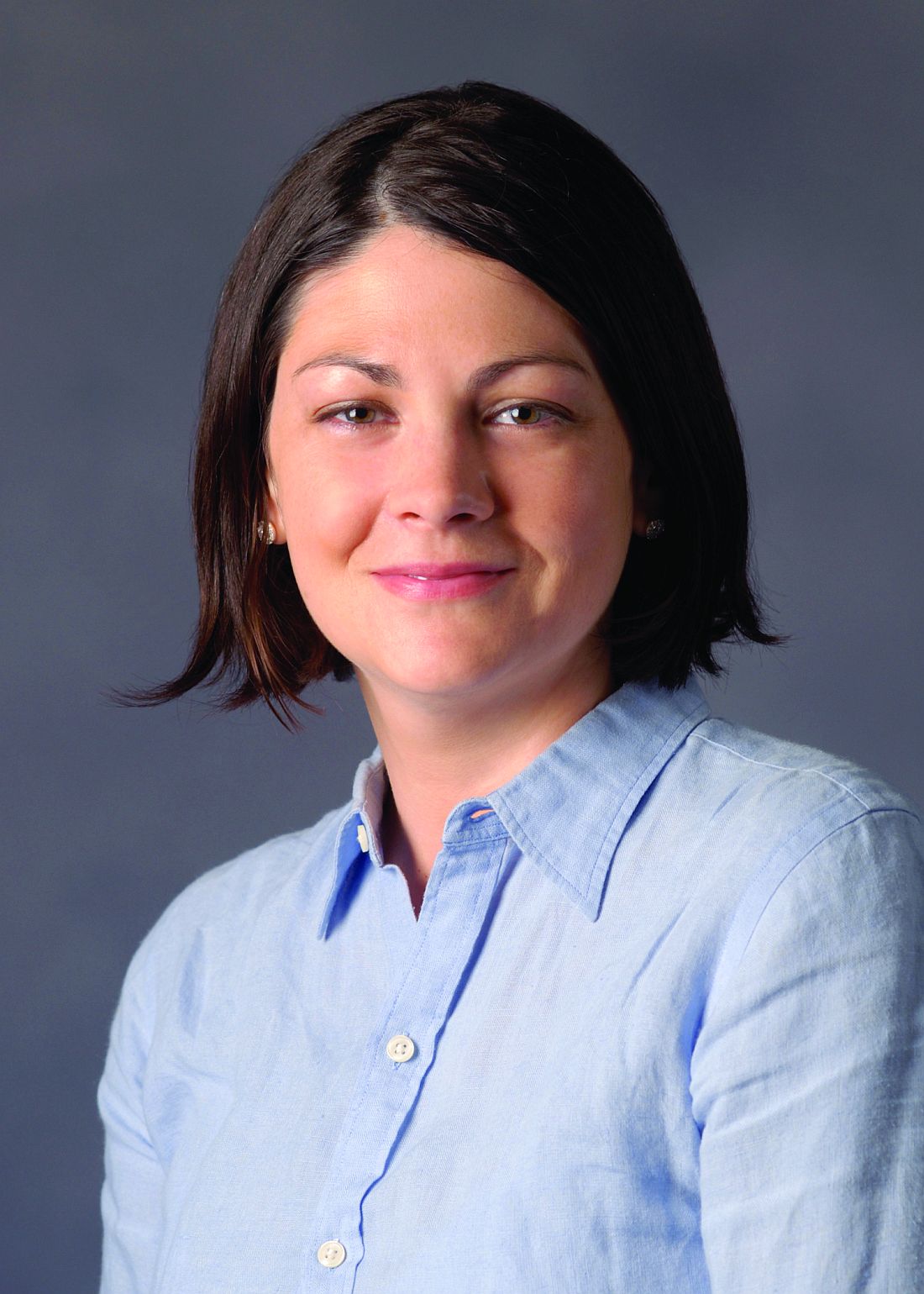
Dr. William G. Wilkoff
This situation is not the direct result of the TV environments in which their parents grew up. While we were among the last families in the neighborhood with a color TV, we did watch TV. We did put some limits on TV viewing, and our children were in their late teens before they realized that our TV was capable of receiving cartoons on Saturday mornings. They thought this kind of special connection existed only in motel rooms. Other than putting a few restrictions on TV viewing, we weren’t militant supervisors of our children’s viewing habits.
Our children were just too busy doing things to watch much TV. Now as adults they have been paying attention to what they have heard and read about the potential negative influence that TV may have on their own children, and imposed restrictions far more severe than those under which they were raised. It has been interesting to watch how their children are responding to these TV-deprived environments.
For the most part, there has been no whining or begging to turn on the TV. The younger two have no other option and don’t realize what they are missing. The older two, who watched some Sesame Street as toddlers, have been similarly disinterested, although my 10-year-old grandson enjoys watching some sports when the opportunity arises.
So what do my grandchildren do with the 28 hours each week that their peers are spending in front of a TV (“Television and Children,” University of Michigan Medical School/Michigan Medicine website)? The two older girls are voracious readers. One spends hours drawing, and with her younger sister, always has a craft project or two going. The older two are skillful board and card game players, and they play musical instruments. All four are involved in at least one sport per season, and when asked, they would prefer to be playing something outside. And they go to bed at a healthy hour.
In a recent article in AAP News (“How to provide evidence-based pediatric care for the digital age,” May 2017), Michael O. Rich, MD, a member of the American Academy of Pediatrics Council on Communications and Media, writes, “Our traditional advice to limit screen time and restrict content is no longer relevant and often unheard by families.” I agree that for many years that AAP advice had been too focused on content. However, seeing my grandchildren thrive in an environment of what many might consider an extreme screen time restriction has further reinforced my previous observations that the critical issue with screen time is that it replaces health-promoting active alternatives. Even screen time that requires some interaction relegates the child to the role of a sedentary spectator.
Although Dr. Rich is to be commended for suggesting that we look at evidence-based studies as we decide how to counsel parents about screen time, I am always skeptical about the validity of short-term “evidence.” I fear that some of the evidence-based studies are being used to excuse or rationalize an already unhealthy situation. At some point we need to step back and take the longer look. Would you rather see your grandchildren hunched over a screen or couched in front of a television watching other people doing things, or would you prefer that they be physically active doers and creators themselves?
Dr. Wilkoff practiced primary care pediatrics in Brunswick, Maine, for nearly 40 years. He has authored several books on behavioral pediatrics, including “How to Say No to Your Toddler.”
I’m a little concerned about my grandchildren. I worry that when they are in their twenties, no one will want them as trivia teammates. Or when they are hanging out with other 40-something couples, they will fade into the wallpaper when the conversation turns to, “Remember that episode of Big Bang Theory when ... .”
The 5½-year-old and the 8-year-old have grown up in a household that has never had a TV, and the 10- and 12-year-old are surviving with a cable connection so basic that it barely gets more than a few shopping channels and the local school board meetings.
Dr. William G. Wilkoff
This situation is not the direct result of the TV environments in which their parents grew up. While we were among the last families in the neighborhood with a color TV, we did watch TV. We did put some limits on TV viewing, and our children were in their late teens before they realized that our TV was capable of receiving cartoons on Saturday mornings. They thought this kind of special connection existed only in motel rooms. Other than putting a few restrictions on TV viewing, we weren’t militant supervisors of our children’s viewing habits.
Our children were just too busy doing things to watch much TV. Now as adults they have been paying attention to what they have heard and read about the potential negative influence that TV may have on their own children, and imposed restrictions far more severe than those under which they were raised. It has been interesting to watch how their children are responding to these TV-deprived environments.
For the most part, there has been no whining or begging to turn on the TV. The younger two have no other option and don’t realize what they are missing. The older two, who watched some Sesame Street as toddlers, have been similarly disinterested, although my 10-year-old grandson enjoys watching some sports when the opportunity arises.
So what do my grandchildren do with the 28 hours each week that their peers are spending in front of a TV (“Television and Children,” University of Michigan Medical School/Michigan Medicine website)? The two older girls are voracious readers. One spends hours drawing, and with her younger sister, always has a craft project or two going. The older two are skillful board and card game players, and they play musical instruments. All four are involved in at least one sport per season, and when asked, they would prefer to be playing something outside. And they go to bed at a healthy hour.
In a recent article in AAP News (“How to provide evidence-based pediatric care for the digital age,” May 2017), Michael O. Rich, MD, a member of the American Academy of Pediatrics Council on Communications and Media, writes, “Our traditional advice to limit screen time and restrict content is no longer relevant and often unheard by families.” I agree that for many years that AAP advice had been too focused on content. However, seeing my grandchildren thrive in an environment of what many might consider an extreme screen time restriction has further reinforced my previous observations that the critical issue with screen time is that it replaces health-promoting active alternatives. Even screen time that requires some interaction relegates the child to the role of a sedentary spectator.
Although Dr. Rich is to be commended for suggesting that we look at evidence-based studies as we decide how to counsel parents about screen time, I am always skeptical about the validity of short-term “evidence.” I fear that some of the evidence-based studies are being used to excuse or rationalize an already unhealthy situation. At some point we need to step back and take the longer look. Would you rather see your grandchildren hunched over a screen or couched in front of a television watching other people doing things, or would you prefer that they be physically active doers and creators themselves?
Dr. Wilkoff practiced primary care pediatrics in Brunswick, Maine, for nearly 40 years. He has authored several books on behavioral pediatrics, including “How to Say No to Your Toddler.”
I’m a little concerned about my grandchildren. I worry that when they are in their twenties, no one will want them as trivia teammates. Or when they are hanging out with other 40-something couples, they will fade into the wallpaper when the conversation turns to, “Remember that episode of Big Bang Theory when ... .”
The 5½-year-old and the 8-year-old have grown up in a household that has never had a TV, and the 10- and 12-year-old are surviving with a cable connection so basic that it barely gets more than a few shopping channels and the local school board meetings.
Dr. William G. Wilkoff
This situation is not the direct result of the TV environments in which their parents grew up. While we were among the last families in the neighborhood with a color TV, we did watch TV. We did put some limits on TV viewing, and our children were in their late teens before they realized that our TV was capable of receiving cartoons on Saturday mornings. They thought this kind of special connection existed only in motel rooms. Other than putting a few restrictions on TV viewing, we weren’t militant supervisors of our children’s viewing habits.
Our children were just too busy doing things to watch much TV. Now as adults they have been paying attention to what they have heard and read about the potential negative influence that TV may have on their own children, and imposed restrictions far more severe than those under which they were raised. It has been interesting to watch how their children are responding to these TV-deprived environments.
For the most part, there has been no whining or begging to turn on the TV. The younger two have no other option and don’t realize what they are missing. The older two, who watched some Sesame Street as toddlers, have been similarly disinterested, although my 10-year-old grandson enjoys watching some sports when the opportunity arises.
So what do my grandchildren do with the 28 hours each week that their peers are spending in front of a TV (“Television and Children,” University of Michigan Medical School/Michigan Medicine website)? The two older girls are voracious readers. One spends hours drawing, and with her younger sister, always has a craft project or two going. The older two are skillful board and card game players, and they play musical instruments. All four are involved in at least one sport per season, and when asked, they would prefer to be playing something outside. And they go to bed at a healthy hour.
In a recent article in AAP News (“How to provide evidence-based pediatric care for the digital age,” May 2017), Michael O. Rich, MD, a member of the American Academy of Pediatrics Council on Communications and Media, writes, “Our traditional advice to limit screen time and restrict content is no longer relevant and often unheard by families.” I agree that for many years that AAP advice had been too focused on content. However, seeing my grandchildren thrive in an environment of what many might consider an extreme screen time restriction has further reinforced my previous observations that the critical issue with screen time is that it replaces health-promoting active alternatives. Even screen time that requires some interaction relegates the child to the role of a sedentary spectator.
Although Dr. Rich is to be commended for suggesting that we look at evidence-based studies as we decide how to counsel parents about screen time, I am always skeptical about the validity of short-term “evidence.” I fear that some of the evidence-based studies are being used to excuse or rationalize an already unhealthy situation. At some point we need to step back and take the longer look. Would you rather see your grandchildren hunched over a screen or couched in front of a television watching other people doing things, or would you prefer that they be physically active doers and creators themselves?
Dr. Wilkoff practiced primary care pediatrics in Brunswick, Maine, for nearly 40 years. He has authored several books on behavioral pediatrics, including “How to Say No to Your Toddler.”
SAN FRANCISCO – A nonpharmacologic approach to neonatal abstinence syndrome (NAS) appears to reduce the use of morphine and may shorten hospital stay, compared with the conventional evaluation that looks at symptoms of opioid withdrawal, a study showed.
“If you focus on the well-being of these infants rather than a list of symptoms, you are much less likely to start medication. Our approach inherently destigmatizes the parents of these infants by allowing them to focus on the same things that any other parent focuses on,” said Matthew Lipshaw, MD, a pediatrician at Yale–New Haven (Conn.) Children’s Hospital.
Dr. Matthew Lipshaw
The conventional system – the Finnegan Neonatal Abstinence Scoring System (FNASS) – has been around since the mid-1970s. It guides treatment, which is generally drug based, according to a battery of symptoms of opioid withdrawal that impair eating and sleeping. In FNASS, three consecutive scores of 8 or higher, or two consecutive scores of 12 or higher, trigger the use of morphine or an increased dose. Morphine is decreased if scores less than 8 are achieved for 24 hours.
The novel approach aims instead to avoid drug use. According to Dr. Lipshaw, the nonintrusive approach “assesses infants’ ability to function as infants during their withdrawal.” The approach provides a low-stimulation environment featuring rooming-in by mothers, and frequent feeding of their infants. Dubbed ESC, the approach gauges the ability of an infant to eat 1 ounce or more or breastfeed well, sleep undisturbed for an hour or longer, and be consolable within 10 minutes.
The ESC approach replaced the FNASS at Yale–New Haven Children’s Hospital in 2013. While patient management decisions since then have been based on ESC, FNASS scores have continued to be collected every 2-6 hours. This provided the researchers with the means to conduct a head-to-head comparison of the two systems on the same patients.
The records of 50 consecutive newborns born from March 2014 to August 2015 who had been exposed to opioids for at least 30 days prior to birth were reviewed. The primary outcome was the proportion of infants treated with morphine. Secondary outcomes included disagreements between the two approaches on a daily basis, seizures, 30-day readmissions, and need for more intensive care.
The neonates (56%, female) were mostly white. All were born at greater than 36 weeks’ gestation. Opioid exposure was methadone in 80% of cases and buprenorphine in 14%, with the remaining 6% exposed to hydrocodone, Percocet (acetaminophen/oxycodone), and/or OxyContin (oxycodone).
Morphine was started in 6 (12%) of the 50 patients. If the FNASS protocol had been followed, 31 (62%) of the infants would have been started on morphine (P less than .01). Over a span of 296 hospital days, when the ESC protocol was used, morphine was not used 87% of the time, morphine use was increased 3% of the time, use was decreased 7% of the time, and use was maintained 3% of the time. If decisions had been made based on the FNASS protocol, the frequency of nonuse, increased use, decreased use, and maintained use of morphine would have been 53%, 26%, 12%, and 10%, respectively (all P less than .01).
The use of morphine was less than the FNASS recommendation on 78 days (26% of the total days). Moreover, the FNASS scores on the days following the decreased use of morphine were lower by an average of 0.9 points and were decreased in 69% of cases. The ESC protocol led to greater morphine use than recommended by the FNASS protocol on only 2 days. Both times, the FNASS score was increased the following day.
No adverse events occurred during the study.
“These findings are significant because nearly all institutions use the Finnegan score to guide management, and most research has used Finnegan-based medication thresholds to evaluate new medical therapies. Our point is that if you base your assessment on function, many of these infants may not need medication at all. We have had dramatic reductions in length of stay, which allows these infants to get home and minimize the interruption in this crucial period for maternal-child bonding in these high-risk patients,” Dr. Lipshaw said at the Pediatric Academic Societies meeting.
So far, only the Boston Medical Center has implemented the new system. This does not surprise Dr. Lipshaw: “Most places have been using a symptom-based approach for decades. It requires major buy in from physicians and nurses who have been doing things differently for a long time.”
He said is not deterred, however, and pointed to ongoing efforts by colleagues at Yale–New Haven Hospital and Boston Medical Center that are underway that could led to the ESC’s use in a network of hospitals in New Hampshire and Vermont.
The study was sponsored by Yale–New Haven Children’s Hospital and was not funded. Dr. Lipshaw reported having no relevant financial disclosures.
SAN FRANCISCO – A nonpharmacologic approach to neonatal abstinence syndrome (NAS) appears to reduce the use of morphine and may shorten hospital stay, compared with the conventional evaluation that looks at symptoms of opioid withdrawal, a study showed.
“If you focus on the well-being of these infants rather than a list of symptoms, you are much less likely to start medication. Our approach inherently destigmatizes the parents of these infants by allowing them to focus on the same things that any other parent focuses on,” said Matthew Lipshaw, MD, a pediatrician at Yale–New Haven (Conn.) Children’s Hospital.
Dr. Matthew Lipshaw
The conventional system – the Finnegan Neonatal Abstinence Scoring System (FNASS) – has been around since the mid-1970s. It guides treatment, which is generally drug based, according to a battery of symptoms of opioid withdrawal that impair eating and sleeping. In FNASS, three consecutive scores of 8 or higher, or two consecutive scores of 12 or higher, trigger the use of morphine or an increased dose. Morphine is decreased if scores less than 8 are achieved for 24 hours.
The novel approach aims instead to avoid drug use. According to Dr. Lipshaw, the nonintrusive approach “assesses infants’ ability to function as infants during their withdrawal.” The approach provides a low-stimulation environment featuring rooming-in by mothers, and frequent feeding of their infants. Dubbed ESC, the approach gauges the ability of an infant to eat 1 ounce or more or breastfeed well, sleep undisturbed for an hour or longer, and be consolable within 10 minutes.
The ESC approach replaced the FNASS at Yale–New Haven Children’s Hospital in 2013. While patient management decisions since then have been based on ESC, FNASS scores have continued to be collected every 2-6 hours. This provided the researchers with the means to conduct a head-to-head comparison of the two systems on the same patients.
The records of 50 consecutive newborns born from March 2014 to August 2015 who had been exposed to opioids for at least 30 days prior to birth were reviewed. The primary outcome was the proportion of infants treated with morphine. Secondary outcomes included disagreements between the two approaches on a daily basis, seizures, 30-day readmissions, and need for more intensive care.
The neonates (56%, female) were mostly white. All were born at greater than 36 weeks’ gestation. Opioid exposure was methadone in 80% of cases and buprenorphine in 14%, with the remaining 6% exposed to hydrocodone, Percocet (acetaminophen/oxycodone), and/or OxyContin (oxycodone).
Morphine was started in 6 (12%) of the 50 patients. If the FNASS protocol had been followed, 31 (62%) of the infants would have been started on morphine (P less than .01). Over a span of 296 hospital days, when the ESC protocol was used, morphine was not used 87% of the time, morphine use was increased 3% of the time, use was decreased 7% of the time, and use was maintained 3% of the time. If decisions had been made based on the FNASS protocol, the frequency of nonuse, increased use, decreased use, and maintained use of morphine would have been 53%, 26%, 12%, and 10%, respectively (all P less than .01).
The use of morphine was less than the FNASS recommendation on 78 days (26% of the total days). Moreover, the FNASS scores on the days following the decreased use of morphine were lower by an average of 0.9 points and were decreased in 69% of cases. The ESC protocol led to greater morphine use than recommended by the FNASS protocol on only 2 days. Both times, the FNASS score was increased the following day.
No adverse events occurred during the study.
“These findings are significant because nearly all institutions use the Finnegan score to guide management, and most research has used Finnegan-based medication thresholds to evaluate new medical therapies. Our point is that if you base your assessment on function, many of these infants may not need medication at all. We have had dramatic reductions in length of stay, which allows these infants to get home and minimize the interruption in this crucial period for maternal-child bonding in these high-risk patients,” Dr. Lipshaw said at the Pediatric Academic Societies meeting.
So far, only the Boston Medical Center has implemented the new system. This does not surprise Dr. Lipshaw: “Most places have been using a symptom-based approach for decades. It requires major buy in from physicians and nurses who have been doing things differently for a long time.”
He said is not deterred, however, and pointed to ongoing efforts by colleagues at Yale–New Haven Hospital and Boston Medical Center that are underway that could led to the ESC’s use in a network of hospitals in New Hampshire and Vermont.
The study was sponsored by Yale–New Haven Children’s Hospital and was not funded. Dr. Lipshaw reported having no relevant financial disclosures.
SAN FRANCISCO – A nonpharmacologic approach to neonatal abstinence syndrome (NAS) appears to reduce the use of morphine and may shorten hospital stay, compared with the conventional evaluation that looks at symptoms of opioid withdrawal, a study showed.
“If you focus on the well-being of these infants rather than a list of symptoms, you are much less likely to start medication. Our approach inherently destigmatizes the parents of these infants by allowing them to focus on the same things that any other parent focuses on,” said Matthew Lipshaw, MD, a pediatrician at Yale–New Haven (Conn.) Children’s Hospital.
Dr. Matthew Lipshaw
The conventional system – the Finnegan Neonatal Abstinence Scoring System (FNASS) – has been around since the mid-1970s. It guides treatment, which is generally drug based, according to a battery of symptoms of opioid withdrawal that impair eating and sleeping. In FNASS, three consecutive scores of 8 or higher, or two consecutive scores of 12 or higher, trigger the use of morphine or an increased dose. Morphine is decreased if scores less than 8 are achieved for 24 hours.
The novel approach aims instead to avoid drug use. According to Dr. Lipshaw, the nonintrusive approach “assesses infants’ ability to function as infants during their withdrawal.” The approach provides a low-stimulation environment featuring rooming-in by mothers, and frequent feeding of their infants. Dubbed ESC, the approach gauges the ability of an infant to eat 1 ounce or more or breastfeed well, sleep undisturbed for an hour or longer, and be consolable within 10 minutes.
The ESC approach replaced the FNASS at Yale–New Haven Children’s Hospital in 2013. While patient management decisions since then have been based on ESC, FNASS scores have continued to be collected every 2-6 hours. This provided the researchers with the means to conduct a head-to-head comparison of the two systems on the same patients.
The records of 50 consecutive newborns born from March 2014 to August 2015 who had been exposed to opioids for at least 30 days prior to birth were reviewed. The primary outcome was the proportion of infants treated with morphine. Secondary outcomes included disagreements between the two approaches on a daily basis, seizures, 30-day readmissions, and need for more intensive care.
The neonates (56%, female) were mostly white. All were born at greater than 36 weeks’ gestation. Opioid exposure was methadone in 80% of cases and buprenorphine in 14%, with the remaining 6% exposed to hydrocodone, Percocet (acetaminophen/oxycodone), and/or OxyContin (oxycodone).
Morphine was started in 6 (12%) of the 50 patients. If the FNASS protocol had been followed, 31 (62%) of the infants would have been started on morphine (P less than .01). Over a span of 296 hospital days, when the ESC protocol was used, morphine was not used 87% of the time, morphine use was increased 3% of the time, use was decreased 7% of the time, and use was maintained 3% of the time. If decisions had been made based on the FNASS protocol, the frequency of nonuse, increased use, decreased use, and maintained use of morphine would have been 53%, 26%, 12%, and 10%, respectively (all P less than .01).
The use of morphine was less than the FNASS recommendation on 78 days (26% of the total days). Moreover, the FNASS scores on the days following the decreased use of morphine were lower by an average of 0.9 points and were decreased in 69% of cases. The ESC protocol led to greater morphine use than recommended by the FNASS protocol on only 2 days. Both times, the FNASS score was increased the following day.
No adverse events occurred during the study.
“These findings are significant because nearly all institutions use the Finnegan score to guide management, and most research has used Finnegan-based medication thresholds to evaluate new medical therapies. Our point is that if you base your assessment on function, many of these infants may not need medication at all. We have had dramatic reductions in length of stay, which allows these infants to get home and minimize the interruption in this crucial period for maternal-child bonding in these high-risk patients,” Dr. Lipshaw said at the Pediatric Academic Societies meeting.
So far, only the Boston Medical Center has implemented the new system. This does not surprise Dr. Lipshaw: “Most places have been using a symptom-based approach for decades. It requires major buy in from physicians and nurses who have been doing things differently for a long time.”
He said is not deterred, however, and pointed to ongoing efforts by colleagues at Yale–New Haven Hospital and Boston Medical Center that are underway that could led to the ESC’s use in a network of hospitals in New Hampshire and Vermont.
The study was sponsored by Yale–New Haven Children’s Hospital and was not funded. Dr. Lipshaw reported having no relevant financial disclosures.
Key clinical point: Evaluation and treatment of neonatal abstinence syndrome that focuses on feeding, quality of sleep, and ability to be consoled significantly reduces morphine use, compared with the established system.
Major finding: The novel ESC approach decreased morphine use, compared with the established FNASS approach (3% vs. 26%, P less than .01).
Data source: A retrospective examination of patient medical records.
Disclosures: The study was sponsored by Yale–New Haven Children’s Hospital and was not funded. Dr. Lipshaw reported having no relevant financial disclosures.
I have a repertoire of about a dozen soups that I enjoy preparing, but I certainly don’t consider myself a gourmet chef. However, I can legitimately claim to be a master of the microwave. Hand me a potentially edible substance, and I will nuke it to a palatable temperature in one step. This skill comes from 30 years of practice and requires a sixth sense that includes factoring in the object’s water content, shape, and density, and knowing whether I am starting from the frozen state, refrigerator cool, or room temperature.
Sadly, our 30-some-year-old microwave nuked its last leftover in a shower of sparks a few weeks ago, and I have been forced to recalibrate my technique with a new machine. Not to worry, I am just one or two more rewarmed meals away from returning to my old “nukelear” mastery.
Dr. William G. Wilkoff
I recently learned that Amana introduced the first countertop microwave in 1967, the same year that Pediatric News began publication (Susan Strasser. “What’s in Your Microwave Oven?” The New York Times. April 14, 2017). Over those ensuing 50 years, the microwave has been one of the major forces molding what, when, and how North Americans eat. It has been a tremendous time-saver for those saddled with the task of preparing family meals. The microwave oven also has allowed millions of adults and children without even the most basic kitchen skills or equipment to prepare themselves warm and nutritious meals at any time they choose or when their schedules allow.
Unfortunately, as with any new technology, the ubiquity of countertop microwave ovens has come with some downsides. While they do offer the cooking challenged among us a broad choice of foods we can prepare in minutes or seconds, the choices we make are not always nutritiously sound.
The microwave oven and single-serving prepared frozen meals have been a great boon to people who live alone or live or work on schedules out of sync with their families’ meal schedule. However, there is a point when this technologically-enabled nutritional independence begins to take precedence over communal dining. The family meal slips on to the endangered species list. Although there is some debate about whether family meals are any more valuable as character-building exercises than other shared family experiences, there is no question that children in families who dine together on a regular basis enjoy substantial health benefits, such as less depressive symptoms, more healthy foods, fewer weight problems, and less delinquency.
The forces that have driven the family meal into decline are numerous and powerful. However, we should not underestimate the role that the microwave oven has had in greasing this path toward extinction. Even if the family has one member with the time, skills, and commitment to create nutritious and complete meals, the microwave oven offers even the youngest member an easy way to opt out of sharing it with the rest of his family. A parent who must work late can rewarm his serving at 9:00 p.m. when he or she gets home. The high school thespian can nuke her own prepared frozen dinner at 5 p.m. so she can get to a rehearsal at 6 p.m. And, the 4-year-old picky eater who won’t touch anything green can have his treasured mac ‘n cheese warmed to his taste while everyone else is enjoying fish tacos. And, there you have it. Poof! With the touch of a couple buttons, the opportunity for a family to enjoy a meal together and share their experiences of the day has vanished into thin air along with a valuable lesson in cooperation and compromise.
But, we needn’t worry about those family members who are dining separately getting lonely because more than likely they each have their own electronic companion to keep them company while they eat their microwaved meal.
Dr. Wilkoff practiced primary care pediatrics in Brunswick, Maine, for nearly 40 years. He has authored several books on behavioral pediatrics, including “How to Say No to Your Toddler.”
I have a repertoire of about a dozen soups that I enjoy preparing, but I certainly don’t consider myself a gourmet chef. However, I can legitimately claim to be a master of the microwave. Hand me a potentially edible substance, and I will nuke it to a palatable temperature in one step. This skill comes from 30 years of practice and requires a sixth sense that includes factoring in the object’s water content, shape, and density, and knowing whether I am starting from the frozen state, refrigerator cool, or room temperature.
Sadly, our 30-some-year-old microwave nuked its last leftover in a shower of sparks a few weeks ago, and I have been forced to recalibrate my technique with a new machine. Not to worry, I am just one or two more rewarmed meals away from returning to my old “nukelear” mastery.
Dr. William G. Wilkoff
I recently learned that Amana introduced the first countertop microwave in 1967, the same year that Pediatric News began publication (Susan Strasser. “What’s in Your Microwave Oven?” The New York Times. April 14, 2017). Over those ensuing 50 years, the microwave has been one of the major forces molding what, when, and how North Americans eat. It has been a tremendous time-saver for those saddled with the task of preparing family meals. The microwave oven also has allowed millions of adults and children without even the most basic kitchen skills or equipment to prepare themselves warm and nutritious meals at any time they choose or when their schedules allow.
Unfortunately, as with any new technology, the ubiquity of countertop microwave ovens has come with some downsides. While they do offer the cooking challenged among us a broad choice of foods we can prepare in minutes or seconds, the choices we make are not always nutritiously sound.
The microwave oven and single-serving prepared frozen meals have been a great boon to people who live alone or live or work on schedules out of sync with their families’ meal schedule. However, there is a point when this technologically-enabled nutritional independence begins to take precedence over communal dining. The family meal slips on to the endangered species list. Although there is some debate about whether family meals are any more valuable as character-building exercises than other shared family experiences, there is no question that children in families who dine together on a regular basis enjoy substantial health benefits, such as less depressive symptoms, more healthy foods, fewer weight problems, and less delinquency.
The forces that have driven the family meal into decline are numerous and powerful. However, we should not underestimate the role that the microwave oven has had in greasing this path toward extinction. Even if the family has one member with the time, skills, and commitment to create nutritious and complete meals, the microwave oven offers even the youngest member an easy way to opt out of sharing it with the rest of his family. A parent who must work late can rewarm his serving at 9:00 p.m. when he or she gets home. The high school thespian can nuke her own prepared frozen dinner at 5 p.m. so she can get to a rehearsal at 6 p.m. And, the 4-year-old picky eater who won’t touch anything green can have his treasured mac ‘n cheese warmed to his taste while everyone else is enjoying fish tacos. And, there you have it. Poof! With the touch of a couple buttons, the opportunity for a family to enjoy a meal together and share their experiences of the day has vanished into thin air along with a valuable lesson in cooperation and compromise.
But, we needn’t worry about those family members who are dining separately getting lonely because more than likely they each have their own electronic companion to keep them company while they eat their microwaved meal.
Dr. Wilkoff practiced primary care pediatrics in Brunswick, Maine, for nearly 40 years. He has authored several books on behavioral pediatrics, including “How to Say No to Your Toddler.”
I have a repertoire of about a dozen soups that I enjoy preparing, but I certainly don’t consider myself a gourmet chef. However, I can legitimately claim to be a master of the microwave. Hand me a potentially edible substance, and I will nuke it to a palatable temperature in one step. This skill comes from 30 years of practice and requires a sixth sense that includes factoring in the object’s water content, shape, and density, and knowing whether I am starting from the frozen state, refrigerator cool, or room temperature.
Sadly, our 30-some-year-old microwave nuked its last leftover in a shower of sparks a few weeks ago, and I have been forced to recalibrate my technique with a new machine. Not to worry, I am just one or two more rewarmed meals away from returning to my old “nukelear” mastery.
Dr. William G. Wilkoff
I recently learned that Amana introduced the first countertop microwave in 1967, the same year that Pediatric News began publication (Susan Strasser. “What’s in Your Microwave Oven?” The New York Times. April 14, 2017). Over those ensuing 50 years, the microwave has been one of the major forces molding what, when, and how North Americans eat. It has been a tremendous time-saver for those saddled with the task of preparing family meals. The microwave oven also has allowed millions of adults and children without even the most basic kitchen skills or equipment to prepare themselves warm and nutritious meals at any time they choose or when their schedules allow.
Unfortunately, as with any new technology, the ubiquity of countertop microwave ovens has come with some downsides. While they do offer the cooking challenged among us a broad choice of foods we can prepare in minutes or seconds, the choices we make are not always nutritiously sound.
The microwave oven and single-serving prepared frozen meals have been a great boon to people who live alone or live or work on schedules out of sync with their families’ meal schedule. However, there is a point when this technologically-enabled nutritional independence begins to take precedence over communal dining. The family meal slips on to the endangered species list. Although there is some debate about whether family meals are any more valuable as character-building exercises than other shared family experiences, there is no question that children in families who dine together on a regular basis enjoy substantial health benefits, such as less depressive symptoms, more healthy foods, fewer weight problems, and less delinquency.
The forces that have driven the family meal into decline are numerous and powerful. However, we should not underestimate the role that the microwave oven has had in greasing this path toward extinction. Even if the family has one member with the time, skills, and commitment to create nutritious and complete meals, the microwave oven offers even the youngest member an easy way to opt out of sharing it with the rest of his family. A parent who must work late can rewarm his serving at 9:00 p.m. when he or she gets home. The high school thespian can nuke her own prepared frozen dinner at 5 p.m. so she can get to a rehearsal at 6 p.m. And, the 4-year-old picky eater who won’t touch anything green can have his treasured mac ‘n cheese warmed to his taste while everyone else is enjoying fish tacos. And, there you have it. Poof! With the touch of a couple buttons, the opportunity for a family to enjoy a meal together and share their experiences of the day has vanished into thin air along with a valuable lesson in cooperation and compromise.
But, we needn’t worry about those family members who are dining separately getting lonely because more than likely they each have their own electronic companion to keep them company while they eat their microwaved meal.
Dr. Wilkoff practiced primary care pediatrics in Brunswick, Maine, for nearly 40 years. He has authored several books on behavioral pediatrics, including “How to Say No to Your Toddler.”
SAN FRANCISCO – The use of three different screening instruments to gauge behavioral development in children up to 5 years of age has yielded results that vary within a single practice and between different practices. This heterogeneity complicates the accurate and early identification of developmental disorders children in the primary care setting.
“The burden of diagnostic services that go along with developmental screening depends on the number of positive screens and the referral completion rate. These rates may vary markedly across practices that from the outside seem relatively homogeneous. This differential burden may help explain the variation between practices that has been observed,” said Radley Sheldrick, PhD, of Boston University School of Public Health.
The American Academy of Pediatrics has recommended the use of developmental screening instruments that have a track record in prior studies of a sensitivity and specificity of at least 70% each. Children who score positive can receive further services. The aim is laudable, Dr. Sheldrick said, but little is known of how different screens compare to one another in the results obtained, and the consistency of their performance in different practice settings.
A few years ago, Dr. Sheldrick and his colleagues at Tufts Medical Center, Boston, initiated the Screen Early, Screen Accurately for Child Well-Being (SESAW) head-to-head comparison of the effectiveness of three sets of developmental behavioral screening instruments used in the pediatric primary care setting: the Ages and Stages Questionnaire, 2nd edition (ASQ-2), Parent’s Evaluation of Developmental Status (PEDS), and the Survey of Well-Being of Young Children (SWYC).
The ASQ-2 and PEDS instruments have been in use for some time. Differences in their sensitivity and specificity of developmental concerns have been noted, although both can be used at the discretion of the physician. SWYC is a more recent instrument, which was developed at Tufts Medical Center. It was designed to be easy to read and quickly completed.
In the study, 1,000 parents of children aged 9 months to 5.5 years were enrolled at six pediatric practices in Massachusetts. About 50% of the children were boys, 10% were Hispanic, and 10% were African American. About one-quarter of the parents were receiving some form of public assistance. The parents completed the three screens. Children scoring positive on any screen were assessed further.
The researchers were especially interested in the agreement between the three screens and the variance across the six practices in the performance of the screens and the proportion of children who tested positive and actually received referral care.
Overall, about 44% of the children scored positive on at least one screen. Of these, 72% were assessed more comprehensively. A closer look at those who were assessed revealed agreement between all three screens in only 16% of the children.
The performance of the three screens was not consistent from practice to practice. Variations were evident with each screen in the different practices, and between the three screens in individual practices. The differences in the performance of the screens in the individual practices were not significantly different. However, considerable difference was noted between practices, the extreme being a 70% higher difference in one practice compared to another.
Referral completion rates also displayed variation between practices, although no significant difference was evident. Still, the extreme case was a 30% higher rate of completion of one of the practices, compared with another.
“As I’ve gotten further into this research, I’ve become struck by the number of things we don’t know about developmental screens [compared to] what we do know. Whether, for example, the sensitivity and specificity of a screen in one population carries over to other populations is an assumption we have made, but which we don’t really know,” said Dr. Sheldrick.
Another unknown is whether a developmental disorder identified by a screen at one age can be identified at a later age in someone who has not received specialized care.
Finally, the issue of false positive results is vexing. While a false positive might be suspected, not to do anything sends the wrong message.
“What to do when there is a problem between a clinical result and a screening result is one of the most important clinical questions we have right now. Clinicians have to make up their minds on this issue every day, and there is not a lot of research on it. The results need to be evaluated while recognizing that there are still some uncertainties with screening results, and recognizing other forms of information, such as parent reporting and observations of the child, that can be informative,” explained Dr. Sheldrick.
Tufts Medical Center sponsored the study, which was funded by the National Institutes of Health. Dr. Sheldrick reported having no relevant financial disclosures.
SAN FRANCISCO – The use of three different screening instruments to gauge behavioral development in children up to 5 years of age has yielded results that vary within a single practice and between different practices. This heterogeneity complicates the accurate and early identification of developmental disorders children in the primary care setting.
“The burden of diagnostic services that go along with developmental screening depends on the number of positive screens and the referral completion rate. These rates may vary markedly across practices that from the outside seem relatively homogeneous. This differential burden may help explain the variation between practices that has been observed,” said Radley Sheldrick, PhD, of Boston University School of Public Health.
The American Academy of Pediatrics has recommended the use of developmental screening instruments that have a track record in prior studies of a sensitivity and specificity of at least 70% each. Children who score positive can receive further services. The aim is laudable, Dr. Sheldrick said, but little is known of how different screens compare to one another in the results obtained, and the consistency of their performance in different practice settings.
A few years ago, Dr. Sheldrick and his colleagues at Tufts Medical Center, Boston, initiated the Screen Early, Screen Accurately for Child Well-Being (SESAW) head-to-head comparison of the effectiveness of three sets of developmental behavioral screening instruments used in the pediatric primary care setting: the Ages and Stages Questionnaire, 2nd edition (ASQ-2), Parent’s Evaluation of Developmental Status (PEDS), and the Survey of Well-Being of Young Children (SWYC).
The ASQ-2 and PEDS instruments have been in use for some time. Differences in their sensitivity and specificity of developmental concerns have been noted, although both can be used at the discretion of the physician. SWYC is a more recent instrument, which was developed at Tufts Medical Center. It was designed to be easy to read and quickly completed.
In the study, 1,000 parents of children aged 9 months to 5.5 years were enrolled at six pediatric practices in Massachusetts. About 50% of the children were boys, 10% were Hispanic, and 10% were African American. About one-quarter of the parents were receiving some form of public assistance. The parents completed the three screens. Children scoring positive on any screen were assessed further.
The researchers were especially interested in the agreement between the three screens and the variance across the six practices in the performance of the screens and the proportion of children who tested positive and actually received referral care.
Overall, about 44% of the children scored positive on at least one screen. Of these, 72% were assessed more comprehensively. A closer look at those who were assessed revealed agreement between all three screens in only 16% of the children.
The performance of the three screens was not consistent from practice to practice. Variations were evident with each screen in the different practices, and between the three screens in individual practices. The differences in the performance of the screens in the individual practices were not significantly different. However, considerable difference was noted between practices, the extreme being a 70% higher difference in one practice compared to another.
Referral completion rates also displayed variation between practices, although no significant difference was evident. Still, the extreme case was a 30% higher rate of completion of one of the practices, compared with another.
“As I’ve gotten further into this research, I’ve become struck by the number of things we don’t know about developmental screens [compared to] what we do know. Whether, for example, the sensitivity and specificity of a screen in one population carries over to other populations is an assumption we have made, but which we don’t really know,” said Dr. Sheldrick.
Another unknown is whether a developmental disorder identified by a screen at one age can be identified at a later age in someone who has not received specialized care.
Finally, the issue of false positive results is vexing. While a false positive might be suspected, not to do anything sends the wrong message.
“What to do when there is a problem between a clinical result and a screening result is one of the most important clinical questions we have right now. Clinicians have to make up their minds on this issue every day, and there is not a lot of research on it. The results need to be evaluated while recognizing that there are still some uncertainties with screening results, and recognizing other forms of information, such as parent reporting and observations of the child, that can be informative,” explained Dr. Sheldrick.
Tufts Medical Center sponsored the study, which was funded by the National Institutes of Health. Dr. Sheldrick reported having no relevant financial disclosures.
SAN FRANCISCO – The use of three different screening instruments to gauge behavioral development in children up to 5 years of age has yielded results that vary within a single practice and between different practices. This heterogeneity complicates the accurate and early identification of developmental disorders children in the primary care setting.
“The burden of diagnostic services that go along with developmental screening depends on the number of positive screens and the referral completion rate. These rates may vary markedly across practices that from the outside seem relatively homogeneous. This differential burden may help explain the variation between practices that has been observed,” said Radley Sheldrick, PhD, of Boston University School of Public Health.
The American Academy of Pediatrics has recommended the use of developmental screening instruments that have a track record in prior studies of a sensitivity and specificity of at least 70% each. Children who score positive can receive further services. The aim is laudable, Dr. Sheldrick said, but little is known of how different screens compare to one another in the results obtained, and the consistency of their performance in different practice settings.
A few years ago, Dr. Sheldrick and his colleagues at Tufts Medical Center, Boston, initiated the Screen Early, Screen Accurately for Child Well-Being (SESAW) head-to-head comparison of the effectiveness of three sets of developmental behavioral screening instruments used in the pediatric primary care setting: the Ages and Stages Questionnaire, 2nd edition (ASQ-2), Parent’s Evaluation of Developmental Status (PEDS), and the Survey of Well-Being of Young Children (SWYC).
The ASQ-2 and PEDS instruments have been in use for some time. Differences in their sensitivity and specificity of developmental concerns have been noted, although both can be used at the discretion of the physician. SWYC is a more recent instrument, which was developed at Tufts Medical Center. It was designed to be easy to read and quickly completed.
In the study, 1,000 parents of children aged 9 months to 5.5 years were enrolled at six pediatric practices in Massachusetts. About 50% of the children were boys, 10% were Hispanic, and 10% were African American. About one-quarter of the parents were receiving some form of public assistance. The parents completed the three screens. Children scoring positive on any screen were assessed further.
The researchers were especially interested in the agreement between the three screens and the variance across the six practices in the performance of the screens and the proportion of children who tested positive and actually received referral care.
Overall, about 44% of the children scored positive on at least one screen. Of these, 72% were assessed more comprehensively. A closer look at those who were assessed revealed agreement between all three screens in only 16% of the children.
The performance of the three screens was not consistent from practice to practice. Variations were evident with each screen in the different practices, and between the three screens in individual practices. The differences in the performance of the screens in the individual practices were not significantly different. However, considerable difference was noted between practices, the extreme being a 70% higher difference in one practice compared to another.
Referral completion rates also displayed variation between practices, although no significant difference was evident. Still, the extreme case was a 30% higher rate of completion of one of the practices, compared with another.
“As I’ve gotten further into this research, I’ve become struck by the number of things we don’t know about developmental screens [compared to] what we do know. Whether, for example, the sensitivity and specificity of a screen in one population carries over to other populations is an assumption we have made, but which we don’t really know,” said Dr. Sheldrick.
Another unknown is whether a developmental disorder identified by a screen at one age can be identified at a later age in someone who has not received specialized care.
Finally, the issue of false positive results is vexing. While a false positive might be suspected, not to do anything sends the wrong message.
“What to do when there is a problem between a clinical result and a screening result is one of the most important clinical questions we have right now. Clinicians have to make up their minds on this issue every day, and there is not a lot of research on it. The results need to be evaluated while recognizing that there are still some uncertainties with screening results, and recognizing other forms of information, such as parent reporting and observations of the child, that can be informative,” explained Dr. Sheldrick.
Tufts Medical Center sponsored the study, which was funded by the National Institutes of Health. Dr. Sheldrick reported having no relevant financial disclosures.
Key clinical point: There were significant differences in the results of different developmental screening instruments within and between practices in a comparative study.
Major finding: The PEDS, ASQ-2, and SWYC developmental screens coidentified only 16% of 317 children aged 9 months to 5.5 years, with significant differences in the results of each developmental screen between practices.
Data source: The Screen Early, Screen Accurately for Child Well-Being (SESAW) head-to-head comparative effectiveness trial of three sets of developmental behavioral screening instruments used in pediatric primary care.
Disclosures: Tufts Medical Center sponsored the study, which was funded by the National Institutes of Health. Dr. Sheldrick reported having no relevant financial disclosures.
SAN FRANCISCO – Serum leukocytosis, pyuria, and urine leukocyte esterase have been identified as predictors of urinary tract infection (UTI) in infants younger than 90 days of age, with males being more likely to develop UTI than females.
The chance of the infection declined in older infants.
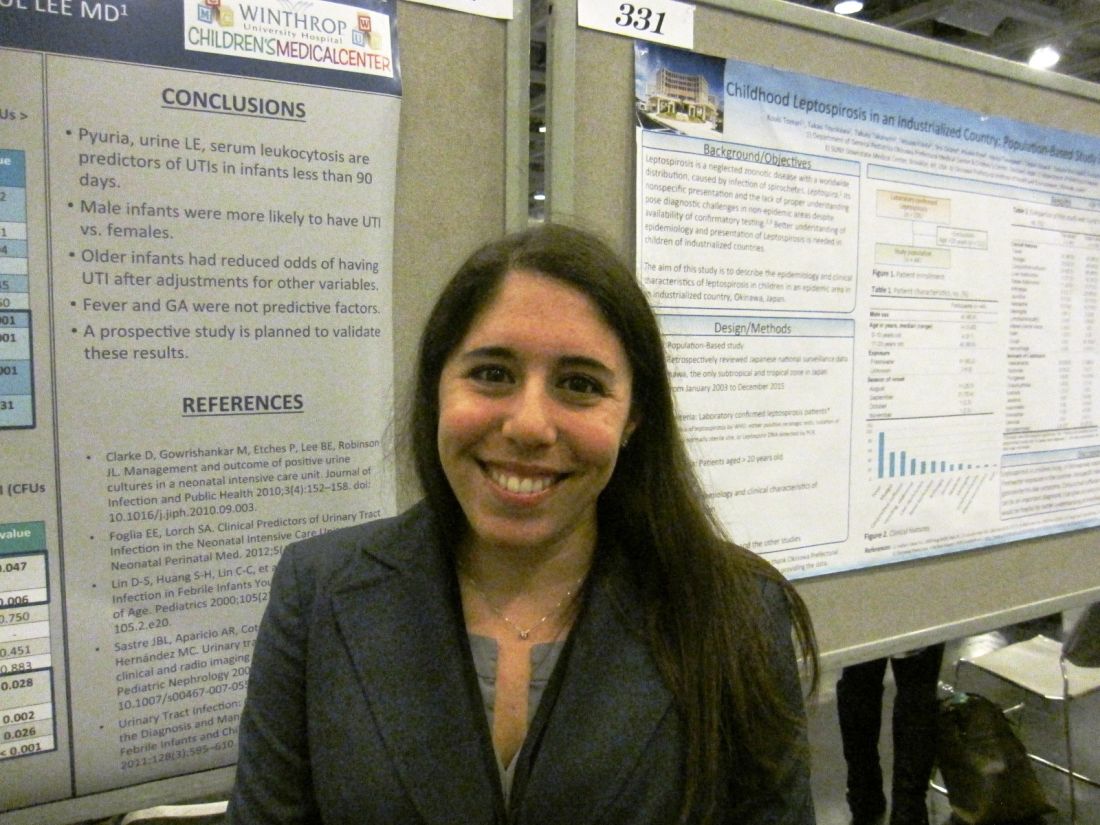
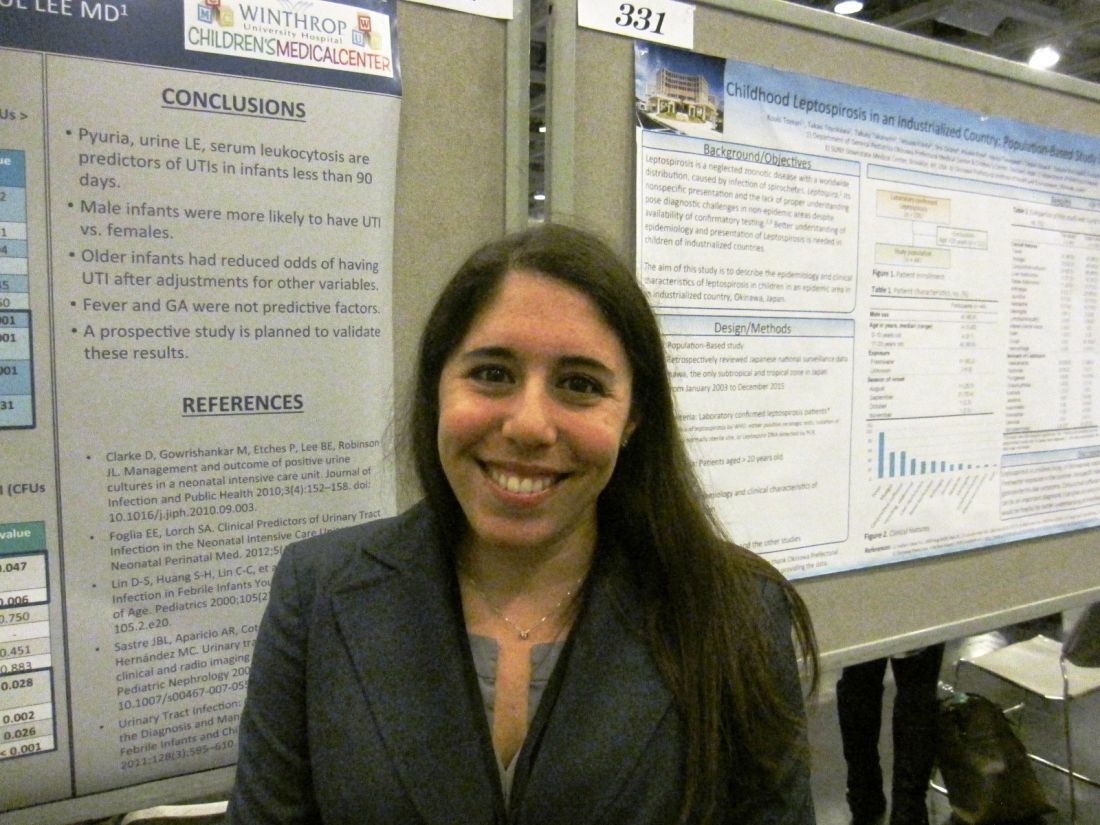
“Really young infants have a less well developed immune system, which may increase their susceptibility to UTIs,” said Sarah Berman, DO, a pediatric resident at Winthrop-University Hospital, Mineola, N.Y.
Brian Hoyle/Frontline Medical News
Dr. Sarah Berman
UTIs are a common cause of bacterial infection in neonates and infants. Diagnosis is hindered by the lack of specific signs and symptoms. In older children, urinalysis results and serum leukocyte count are helpful in guiding the diagnosis. The validity of these factors in predicting UTI in very young infants has been unknown. The findings presented at the Pediatric Academic Societies meeting provide some clarity in the diagnosis of UTI for infants in the first 3 months of life.
In 2011, the American Academy of Pediatrics issued “Urinary Tract Infection: Clinical Practice Guidelines for the Diagnosis and Management of the Initial UTI in Febrile Infants and Children 2 to 24 Months” (Pediatrics. 2011. doi: 10.1542/peds.2011-1330) concerning the diagnosis and management of the presence of bacteria in urine – a possible warning sign of UTI, but the AAP guidelines did not consider infants in the first 2 months of life.
To address this gap, the Winthrop-University Hospital researchers reviewed the medical records for all infants younger than 90 days of age diagnosed with UTI, fever, or viral illness from the beginning of 2009 to September 2015. Residence in neonatal intensive care, known congenital abnormalities, and prior antibiotic use were grounds for exclusion. Standard growth-based definitions of UTI and bacteriuria were used.
Of the 315 mainly white or Hispanic patients, 73 had a diagnosis of UTI and 261 did not. Both groups had the same mean age of 45 days. Fever within 24 hours of admission was more prevalent in those without UTI than those with (57% vs. 41%; P = .035). Those with UTI were significantly more likely (all P lesser than .001) to display serum leukocytosis (35% vs. 12%), pyuria (71% vs. 12%), and urine detection of leukocyte esterase (87% vs. 14%) and nitrite (19% vs. 0%).
In a univariate analysis, factors that were associated with UTI included serum leukocytosis, white blood cells in the urine, and urine leukocyte esterase, with fever within 24 hours of admission associated with reduced chance of UTI. A multivariate analysis that accounted for age, gender, and gestational age identified serum leukocytosis, pyruria, urine leukocyte esterase, and male sex as predictors of UTI, with increased odds ratio of 6.25, 3.19, 28, and 3.88, respectively.
The reduced likelihood of UTI in those who developed a fever within 24 hours of admission held up in the multivariate analysis (odds ratio 0.34).
Validation of the findings will require a prospective study, which is in the planning stage. If the findings bear out, the result could be improved diagnosis of UTI from birth onward, according to Dr. Berman.
Dr. Berman reported having no relevant financial disclosures.
SAN FRANCISCO – Serum leukocytosis, pyuria, and urine leukocyte esterase have been identified as predictors of urinary tract infection (UTI) in infants younger than 90 days of age, with males being more likely to develop UTI than females.
The chance of the infection declined in older infants.
“Really young infants have a less well developed immune system, which may increase their susceptibility to UTIs,” said Sarah Berman, DO, a pediatric resident at Winthrop-University Hospital, Mineola, N.Y.
Brian Hoyle/Frontline Medical News
Dr. Sarah Berman
UTIs are a common cause of bacterial infection in neonates and infants. Diagnosis is hindered by the lack of specific signs and symptoms. In older children, urinalysis results and serum leukocyte count are helpful in guiding the diagnosis. The validity of these factors in predicting UTI in very young infants has been unknown. The findings presented at the Pediatric Academic Societies meeting provide some clarity in the diagnosis of UTI for infants in the first 3 months of life.
In 2011, the American Academy of Pediatrics issued “Urinary Tract Infection: Clinical Practice Guidelines for the Diagnosis and Management of the Initial UTI in Febrile Infants and Children 2 to 24 Months” (Pediatrics. 2011. doi: 10.1542/peds.2011-1330) concerning the diagnosis and management of the presence of bacteria in urine – a possible warning sign of UTI, but the AAP guidelines did not consider infants in the first 2 months of life.
To address this gap, the Winthrop-University Hospital researchers reviewed the medical records for all infants younger than 90 days of age diagnosed with UTI, fever, or viral illness from the beginning of 2009 to September 2015. Residence in neonatal intensive care, known congenital abnormalities, and prior antibiotic use were grounds for exclusion. Standard growth-based definitions of UTI and bacteriuria were used.
Of the 315 mainly white or Hispanic patients, 73 had a diagnosis of UTI and 261 did not. Both groups had the same mean age of 45 days. Fever within 24 hours of admission was more prevalent in those without UTI than those with (57% vs. 41%; P = .035). Those with UTI were significantly more likely (all P lesser than .001) to display serum leukocytosis (35% vs. 12%), pyuria (71% vs. 12%), and urine detection of leukocyte esterase (87% vs. 14%) and nitrite (19% vs. 0%).
In a univariate analysis, factors that were associated with UTI included serum leukocytosis, white blood cells in the urine, and urine leukocyte esterase, with fever within 24 hours of admission associated with reduced chance of UTI. A multivariate analysis that accounted for age, gender, and gestational age identified serum leukocytosis, pyruria, urine leukocyte esterase, and male sex as predictors of UTI, with increased odds ratio of 6.25, 3.19, 28, and 3.88, respectively.
The reduced likelihood of UTI in those who developed a fever within 24 hours of admission held up in the multivariate analysis (odds ratio 0.34).
Validation of the findings will require a prospective study, which is in the planning stage. If the findings bear out, the result could be improved diagnosis of UTI from birth onward, according to Dr. Berman.
Dr. Berman reported having no relevant financial disclosures.
SAN FRANCISCO – Serum leukocytosis, pyuria, and urine leukocyte esterase have been identified as predictors of urinary tract infection (UTI) in infants younger than 90 days of age, with males being more likely to develop UTI than females.
The chance of the infection declined in older infants.
“Really young infants have a less well developed immune system, which may increase their susceptibility to UTIs,” said Sarah Berman, DO, a pediatric resident at Winthrop-University Hospital, Mineola, N.Y.
Brian Hoyle/Frontline Medical News
Dr. Sarah Berman
UTIs are a common cause of bacterial infection in neonates and infants. Diagnosis is hindered by the lack of specific signs and symptoms. In older children, urinalysis results and serum leukocyte count are helpful in guiding the diagnosis. The validity of these factors in predicting UTI in very young infants has been unknown. The findings presented at the Pediatric Academic Societies meeting provide some clarity in the diagnosis of UTI for infants in the first 3 months of life.
In 2011, the American Academy of Pediatrics issued “Urinary Tract Infection: Clinical Practice Guidelines for the Diagnosis and Management of the Initial UTI in Febrile Infants and Children 2 to 24 Months” (Pediatrics. 2011. doi: 10.1542/peds.2011-1330) concerning the diagnosis and management of the presence of bacteria in urine – a possible warning sign of UTI, but the AAP guidelines did not consider infants in the first 2 months of life.
To address this gap, the Winthrop-University Hospital researchers reviewed the medical records for all infants younger than 90 days of age diagnosed with UTI, fever, or viral illness from the beginning of 2009 to September 2015. Residence in neonatal intensive care, known congenital abnormalities, and prior antibiotic use were grounds for exclusion. Standard growth-based definitions of UTI and bacteriuria were used.
Of the 315 mainly white or Hispanic patients, 73 had a diagnosis of UTI and 261 did not. Both groups had the same mean age of 45 days. Fever within 24 hours of admission was more prevalent in those without UTI than those with (57% vs. 41%; P = .035). Those with UTI were significantly more likely (all P lesser than .001) to display serum leukocytosis (35% vs. 12%), pyuria (71% vs. 12%), and urine detection of leukocyte esterase (87% vs. 14%) and nitrite (19% vs. 0%).
In a univariate analysis, factors that were associated with UTI included serum leukocytosis, white blood cells in the urine, and urine leukocyte esterase, with fever within 24 hours of admission associated with reduced chance of UTI. A multivariate analysis that accounted for age, gender, and gestational age identified serum leukocytosis, pyruria, urine leukocyte esterase, and male sex as predictors of UTI, with increased odds ratio of 6.25, 3.19, 28, and 3.88, respectively.
The reduced likelihood of UTI in those who developed a fever within 24 hours of admission held up in the multivariate analysis (odds ratio 0.34).
Validation of the findings will require a prospective study, which is in the planning stage. If the findings bear out, the result could be improved diagnosis of UTI from birth onward, according to Dr. Berman.
Dr. Berman reported having no relevant financial disclosures.
Key clinical point: Pyuria, urine leukocyte esterase, and serum leukocytosis appear to be predictors of urinary tract infection in infants younger than 90 days of age.
Major finding: A multivariate analysis identified serum leukocytosis, pyruria, and urine leukocyte esterase as predictors of UTI, with increased odds ratio of 6.25, 3.19, and 28, respectively.
Data source: Retrospective analysis of medical records from one hospital.
Disclosures: Dr. Berman reported having no relevant financial disclosures.
SAN FRANCISCO – The good news of a prospective, multicenter study presented at the Pediatric Academic Societies meeting was that neonates who were breastfed were less likely to require neonatal abstinence syndrome (NAS) treatment and displayed milder symptoms.
The study also identified other risk factors associated with the need for NAS treatment and the severity of NAS.
“These findings are important because many of these risk factors are modifiable. Prenatal care providers strive to provide the best treatments for both the mother and the fetus. Our findings regarding the association of NAS with some maternal drug exposures can be shared with opiate-dependent mothers during general counseling about tobacco and illicit use in pregnancy and in counseling about NAS,” explained Megan Stover, MD, a fellow in maternal-fetal medicine and genetics at Tufts Medical Center in Boston.
The current standard of care for opioid-dependent pregnant women is medication-assisted treatment with either methadone or buprenorphine. The intervention can be effective in curbing continued opioid abuse and preventing relapse. However, for many of their unborn children, the damage has already been done.
The scope of the problem in the United States is staggering. Between 2004 and 2013, there was a fourfold to fivefold increase in the rate of admissions to neonatal intensive care units (NICUs) for NAS. “It has been estimated that, every minute in the United States, one neonate will require treatment for NAS,” said Dr. Stover. The glum reality for the Tufts researchers is that 50%-80% of opiate-exposed infants will require treatment for NAS. The aim is to reduce this rate.
Dr. Stover was part of a study conducted at hospitals on the U.S. East Coast that aimed to clarify factors before and after birth that were associated with NAS. The enrolled mothers had been treated during their third trimester or following admission for birth for opioid dependence or had received an opioid for relief of chronic pain. They had given birth to their child at term.
Neonates who were born prematurely or who had comorbidities judged to be significant were not part of the analyses. Of the 306 neonates included, 52% required treatment for NAS and 48% did not. The two groups were similar in age of the mother and for neonatal characteristics of gestational age, sex, ethnicity, and body measurements at birth. The severity of NAS was gauged in two ways. One was the number of days of treatment required to free the neonates from the opioid-induced symptoms, with less than 10 days indicating mild NAS, greater than 30 days indicating severe NAS, and the intervening days indicating moderate NAS. Severe NAS also was indicated by the use of two or more medications.
There was good news. Neonates were significantly less likely to require NAS treatment if they were breastfed exclusively, compared with formula fed babies (15% vs 67%; P less than .0001). NAS was usually mild in breastfed babies and often severe in formula-fed babies (P less than .002).
“Our findings regarding the favorable outcomes seen with breastfeeding support recent research regarding the influence of nonpharmacologic approaches to the prevention and management of NAS, namely that more soothing environments, like those outside the NICU, may be more optimal settings for infants undergoing surveillance for NAS,” said Dr. Stover.
Neonatal treatment was more prevalent for women whose opioid substitution therapy involved methadone (54% vs 28% of untreated neonates; P less than .0001). When therapy used buprenorphine, 62% of the neonates did not display NAS. The drug used for substitution therapy had no effect on the length of treatment of the neonates.
“Our data regarding methadone exposure [versus buprenorphine] adds to a growing literature surrounding more favorable neonatal effects seen with this opiate maintenance agent over methadone,” commented Dr. Stover.
NAS treatment was more prevalent for mothers who smoked during pregnancy, compared with those who did not (76% vs 42%; P equal to .02), and for maternal use of illicit drugs (50% vs 34%; P equal to .002), with no effect on length of neonatal treatment.
Maternal psychiatric diagnosis was associated with neonatal NAS (P equal to .03), as was prescription benzodiazepine use in the third trimester of pregnancy (P equal to .02). Benzodiazepine use did not influence the length of treatment. However, maternal alprazolam use did, as it was associated with more severe NAS (P less than .001). Use of selective serotonin reuptake inhibitor during pregnancy was also associated with more severe NAS (P equal to 0.01).
The researchers are currently sifting through the genetic data gathered in the study. The goal is to combine the clinical and genetic data to create a risk score that will be used to tailor care before birth and in the early weeks following birth.
The study was sponsored by Tufts Medical Center and was funded by National Institute on Drug Abuse. Dr. Stover reported having no relevant financial disclosures.
SAN FRANCISCO – The good news of a prospective, multicenter study presented at the Pediatric Academic Societies meeting was that neonates who were breastfed were less likely to require neonatal abstinence syndrome (NAS) treatment and displayed milder symptoms.
The study also identified other risk factors associated with the need for NAS treatment and the severity of NAS.
“These findings are important because many of these risk factors are modifiable. Prenatal care providers strive to provide the best treatments for both the mother and the fetus. Our findings regarding the association of NAS with some maternal drug exposures can be shared with opiate-dependent mothers during general counseling about tobacco and illicit use in pregnancy and in counseling about NAS,” explained Megan Stover, MD, a fellow in maternal-fetal medicine and genetics at Tufts Medical Center in Boston.
The current standard of care for opioid-dependent pregnant women is medication-assisted treatment with either methadone or buprenorphine. The intervention can be effective in curbing continued opioid abuse and preventing relapse. However, for many of their unborn children, the damage has already been done.
The scope of the problem in the United States is staggering. Between 2004 and 2013, there was a fourfold to fivefold increase in the rate of admissions to neonatal intensive care units (NICUs) for NAS. “It has been estimated that, every minute in the United States, one neonate will require treatment for NAS,” said Dr. Stover. The glum reality for the Tufts researchers is that 50%-80% of opiate-exposed infants will require treatment for NAS. The aim is to reduce this rate.
Dr. Stover was part of a study conducted at hospitals on the U.S. East Coast that aimed to clarify factors before and after birth that were associated with NAS. The enrolled mothers had been treated during their third trimester or following admission for birth for opioid dependence or had received an opioid for relief of chronic pain. They had given birth to their child at term.
Neonates who were born prematurely or who had comorbidities judged to be significant were not part of the analyses. Of the 306 neonates included, 52% required treatment for NAS and 48% did not. The two groups were similar in age of the mother and for neonatal characteristics of gestational age, sex, ethnicity, and body measurements at birth. The severity of NAS was gauged in two ways. One was the number of days of treatment required to free the neonates from the opioid-induced symptoms, with less than 10 days indicating mild NAS, greater than 30 days indicating severe NAS, and the intervening days indicating moderate NAS. Severe NAS also was indicated by the use of two or more medications.
There was good news. Neonates were significantly less likely to require NAS treatment if they were breastfed exclusively, compared with formula fed babies (15% vs 67%; P less than .0001). NAS was usually mild in breastfed babies and often severe in formula-fed babies (P less than .002).
“Our findings regarding the favorable outcomes seen with breastfeeding support recent research regarding the influence of nonpharmacologic approaches to the prevention and management of NAS, namely that more soothing environments, like those outside the NICU, may be more optimal settings for infants undergoing surveillance for NAS,” said Dr. Stover.
Neonatal treatment was more prevalent for women whose opioid substitution therapy involved methadone (54% vs 28% of untreated neonates; P less than .0001). When therapy used buprenorphine, 62% of the neonates did not display NAS. The drug used for substitution therapy had no effect on the length of treatment of the neonates.
“Our data regarding methadone exposure [versus buprenorphine] adds to a growing literature surrounding more favorable neonatal effects seen with this opiate maintenance agent over methadone,” commented Dr. Stover.
NAS treatment was more prevalent for mothers who smoked during pregnancy, compared with those who did not (76% vs 42%; P equal to .02), and for maternal use of illicit drugs (50% vs 34%; P equal to .002), with no effect on length of neonatal treatment.
Maternal psychiatric diagnosis was associated with neonatal NAS (P equal to .03), as was prescription benzodiazepine use in the third trimester of pregnancy (P equal to .02). Benzodiazepine use did not influence the length of treatment. However, maternal alprazolam use did, as it was associated with more severe NAS (P less than .001). Use of selective serotonin reuptake inhibitor during pregnancy was also associated with more severe NAS (P equal to 0.01).
The researchers are currently sifting through the genetic data gathered in the study. The goal is to combine the clinical and genetic data to create a risk score that will be used to tailor care before birth and in the early weeks following birth.
The study was sponsored by Tufts Medical Center and was funded by National Institute on Drug Abuse. Dr. Stover reported having no relevant financial disclosures.
SAN FRANCISCO – The good news of a prospective, multicenter study presented at the Pediatric Academic Societies meeting was that neonates who were breastfed were less likely to require neonatal abstinence syndrome (NAS) treatment and displayed milder symptoms.
The study also identified other risk factors associated with the need for NAS treatment and the severity of NAS.
“These findings are important because many of these risk factors are modifiable. Prenatal care providers strive to provide the best treatments for both the mother and the fetus. Our findings regarding the association of NAS with some maternal drug exposures can be shared with opiate-dependent mothers during general counseling about tobacco and illicit use in pregnancy and in counseling about NAS,” explained Megan Stover, MD, a fellow in maternal-fetal medicine and genetics at Tufts Medical Center in Boston.
The current standard of care for opioid-dependent pregnant women is medication-assisted treatment with either methadone or buprenorphine. The intervention can be effective in curbing continued opioid abuse and preventing relapse. However, for many of their unborn children, the damage has already been done.
The scope of the problem in the United States is staggering. Between 2004 and 2013, there was a fourfold to fivefold increase in the rate of admissions to neonatal intensive care units (NICUs) for NAS. “It has been estimated that, every minute in the United States, one neonate will require treatment for NAS,” said Dr. Stover. The glum reality for the Tufts researchers is that 50%-80% of opiate-exposed infants will require treatment for NAS. The aim is to reduce this rate.
Dr. Stover was part of a study conducted at hospitals on the U.S. East Coast that aimed to clarify factors before and after birth that were associated with NAS. The enrolled mothers had been treated during their third trimester or following admission for birth for opioid dependence or had received an opioid for relief of chronic pain. They had given birth to their child at term.
Neonates who were born prematurely or who had comorbidities judged to be significant were not part of the analyses. Of the 306 neonates included, 52% required treatment for NAS and 48% did not. The two groups were similar in age of the mother and for neonatal characteristics of gestational age, sex, ethnicity, and body measurements at birth. The severity of NAS was gauged in two ways. One was the number of days of treatment required to free the neonates from the opioid-induced symptoms, with less than 10 days indicating mild NAS, greater than 30 days indicating severe NAS, and the intervening days indicating moderate NAS. Severe NAS also was indicated by the use of two or more medications.
There was good news. Neonates were significantly less likely to require NAS treatment if they were breastfed exclusively, compared with formula fed babies (15% vs 67%; P less than .0001). NAS was usually mild in breastfed babies and often severe in formula-fed babies (P less than .002).
“Our findings regarding the favorable outcomes seen with breastfeeding support recent research regarding the influence of nonpharmacologic approaches to the prevention and management of NAS, namely that more soothing environments, like those outside the NICU, may be more optimal settings for infants undergoing surveillance for NAS,” said Dr. Stover.
Neonatal treatment was more prevalent for women whose opioid substitution therapy involved methadone (54% vs 28% of untreated neonates; P less than .0001). When therapy used buprenorphine, 62% of the neonates did not display NAS. The drug used for substitution therapy had no effect on the length of treatment of the neonates.
“Our data regarding methadone exposure [versus buprenorphine] adds to a growing literature surrounding more favorable neonatal effects seen with this opiate maintenance agent over methadone,” commented Dr. Stover.
NAS treatment was more prevalent for mothers who smoked during pregnancy, compared with those who did not (76% vs 42%; P equal to .02), and for maternal use of illicit drugs (50% vs 34%; P equal to .002), with no effect on length of neonatal treatment.
Maternal psychiatric diagnosis was associated with neonatal NAS (P equal to .03), as was prescription benzodiazepine use in the third trimester of pregnancy (P equal to .02). Benzodiazepine use did not influence the length of treatment. However, maternal alprazolam use did, as it was associated with more severe NAS (P less than .001). Use of selective serotonin reuptake inhibitor during pregnancy was also associated with more severe NAS (P equal to 0.01).
The researchers are currently sifting through the genetic data gathered in the study. The goal is to combine the clinical and genetic data to create a risk score that will be used to tailor care before birth and in the early weeks following birth.
The study was sponsored by Tufts Medical Center and was funded by National Institute on Drug Abuse. Dr. Stover reported having no relevant financial disclosures.
Key clinical point: Clinical factors associated with the need for treatment of neonatal abstinence syndrome and for its severity were identified.
Major finding: Only 15% of NAS infants who were exclusively breastfed required NAS treatment, compared with 67% of formula-fed infants (P less than .0001). Breastfeeding was also associated with less severe NAS (P equal to .0003).
Data source: Prospective cohort analysis as part of a multisite trial.
Disclosures: The study was sponsored by Tufts Medical Center and was funded by the National Institute on Drug Abuse. Dr. Stover reported having no relevant financial disclosures.
SAN FRANCISCO – The phase III, single-center Blinded Buprenorphine or Neonatal Morphine Solution (BBORN) clinical trial has established the efficacy of buprenorphine as an alternative to morphine for treatment of newborns with neonatal abstinence syndrome (NAS).
The strategy cuts the treatment time needed to relieve the withdrawal symptoms of the infants by nearly half, the researchers reported. The study results, presented at the Pediatric Academic Societies meeting, were simultaneously published in the New England Journal of Medicine (2017. doi: 10.1056/NEJMoa1614835).
“For those infants who ultimately require pharmacologic treatment, the BBORN trial demonstrated that buprenorphine has similar safety and improved efficacy in length of treatment and length of stay compared to morphine, which is used in 80% of neonatal intensive care units,” said Walter K. Kraft, MD, of Thomas Jefferson University, Philadelphia,.
Dr. Walter K. Kraft
“Practice in neonatal abstinence syndrome is driven by institutional decisions. This study now provides high quality evidence to allow such groups to consider buprenorphine as a viable tool when a drug is needed for more severe neonatal abstinence syndrome,” added Dr. Kraft.
In the trial, 63 term infants (greater than and equal to 37 weeks of gestation) exposed to opioids prior to birth and who displayed signs of NAS were randomized to receive sublingual buprenorphine or oral morphine. Prior exposure to benzodiazepine in the 30 days before birth, medical or neurologic illness, and elevated bilirubin were grounds for exclusion.
The primary endpoint was the length of treatment needed to deal with the withdrawal symptoms. Secondary endpoints included length of hospitalization, need for supplementary treatment with phenobarbital, and safety.
The groups were comparable at baseline, with the exception of median gestational age in the buprenorphine group (38.5 vs. 39.0 weeks, P = .03). Most of the infants were white. Almost all mothers were on maintenance methadone therapy and almost all were current smokers. Thirty-three infants were randomized to receive buprenorphine. Three withdrew and were treated with open-label morphine. Thirty infants received morphine, with two withdrawing to the open-label treatment.
Those receiving buprenorphine displayed significantly shorter median duration of treatment (15 vs. 28 days) and median length of hospital stay (21 vs. 33 days) (both P less than .001). The use of supplemental phenobarbital was similar in both groups.
Occurrence of adverse events was similar, with 13 events in 7 infants in the buprenorphine group and 10 events in 8 infants in the morphine group. One serious event occurred in each group; neither was treatment related.
“The trial only proves that buprenorphine works but does not answer how. We suspect a long half-life is a part of the answer, though methadone also has a long half-life. We have not compared buprenorphine to methadone for treatment of infants with neonatal abstinence syndrome. We conjecture that as a partial agonist, weaning may be smoother. In our trial, it was a shorter wean time, rather than quicker control of symptoms, in which buprenorphine was more effective than morphine. Buprenorphine has effects on other receptors, but it is very unclear if this added to efficacy relative to morphine,” explained Dr. Kraft.
“Regarding mechanism, it is believed that the somatic (as opposed to the drug craving) symptoms of opiate withdrawal in the adult arise from areas of the brainstem called the locus coeruleus and periaqueductal gray, which express opiate receptors. These areas are undergoing major developmental changes in utero and at the time of birth. Therefore, although we hypothesize that the withdrawal symptoms in the infants are likely arising from the same regions, it has not been proven, and is actually something we are investigating in rodent models,” explained the study’s main author, Michelle Ehrlich, MD, of Icahn School of Medicine at Mount Sinai, New York.
While the trial’s findings presented at PAS 17 are an advance in the armamentarium of care for NAS, the researchers are adamant that the approach should not be seen as a stand-alone treatment.
“I would stress than an approach to treatment of neonatal abstinence syndrome most importantly be multidisciplinary and use a uniform institutional protocol. For example, there should be standardization of Finnegan scoring with continuous quality improvement. All babies should have nonpharmacologic treatment of breastfeeding, rooming in, and minimization of excessive stimuli,” explained Dr. Kraft.
Next steps include clarifying the pharmacokinetics to optimize the dose, and to assess the influence of buprenorphine on neurobehavior. “We suspect the mechanism of action to be similar to that of adults. However, how the biology of neonatal abstinence syndrome differs from opioid withdrawal of adults is not known and [is] an area in need of more investigation. We did collect pharmacokinetic samples, and these data are currently being analyzed,” said Dr. Kraft.
Thomas Jefferson University sponsored the study, which was funded by the National Institute on Drug Abuse. Dr. Kraft reported serving as an unpaid consultant to Chiesi Farmaceutici S.p.A. Dr. Ehrlich disclosed receipt of buprenorphine from Indivior for the study and grants from NIDA.
SAN FRANCISCO – The phase III, single-center Blinded Buprenorphine or Neonatal Morphine Solution (BBORN) clinical trial has established the efficacy of buprenorphine as an alternative to morphine for treatment of newborns with neonatal abstinence syndrome (NAS).
The strategy cuts the treatment time needed to relieve the withdrawal symptoms of the infants by nearly half, the researchers reported. The study results, presented at the Pediatric Academic Societies meeting, were simultaneously published in the New England Journal of Medicine (2017. doi: 10.1056/NEJMoa1614835).
“For those infants who ultimately require pharmacologic treatment, the BBORN trial demonstrated that buprenorphine has similar safety and improved efficacy in length of treatment and length of stay compared to morphine, which is used in 80% of neonatal intensive care units,” said Walter K. Kraft, MD, of Thomas Jefferson University, Philadelphia,.
Dr. Walter K. Kraft
“Practice in neonatal abstinence syndrome is driven by institutional decisions. This study now provides high quality evidence to allow such groups to consider buprenorphine as a viable tool when a drug is needed for more severe neonatal abstinence syndrome,” added Dr. Kraft.
In the trial, 63 term infants (greater than and equal to 37 weeks of gestation) exposed to opioids prior to birth and who displayed signs of NAS were randomized to receive sublingual buprenorphine or oral morphine. Prior exposure to benzodiazepine in the 30 days before birth, medical or neurologic illness, and elevated bilirubin were grounds for exclusion.
The primary endpoint was the length of treatment needed to deal with the withdrawal symptoms. Secondary endpoints included length of hospitalization, need for supplementary treatment with phenobarbital, and safety.
The groups were comparable at baseline, with the exception of median gestational age in the buprenorphine group (38.5 vs. 39.0 weeks, P = .03). Most of the infants were white. Almost all mothers were on maintenance methadone therapy and almost all were current smokers. Thirty-three infants were randomized to receive buprenorphine. Three withdrew and were treated with open-label morphine. Thirty infants received morphine, with two withdrawing to the open-label treatment.
Those receiving buprenorphine displayed significantly shorter median duration of treatment (15 vs. 28 days) and median length of hospital stay (21 vs. 33 days) (both P less than .001). The use of supplemental phenobarbital was similar in both groups.
Occurrence of adverse events was similar, with 13 events in 7 infants in the buprenorphine group and 10 events in 8 infants in the morphine group. One serious event occurred in each group; neither was treatment related.
“The trial only proves that buprenorphine works but does not answer how. We suspect a long half-life is a part of the answer, though methadone also has a long half-life. We have not compared buprenorphine to methadone for treatment of infants with neonatal abstinence syndrome. We conjecture that as a partial agonist, weaning may be smoother. In our trial, it was a shorter wean time, rather than quicker control of symptoms, in which buprenorphine was more effective than morphine. Buprenorphine has effects on other receptors, but it is very unclear if this added to efficacy relative to morphine,” explained Dr. Kraft.
“Regarding mechanism, it is believed that the somatic (as opposed to the drug craving) symptoms of opiate withdrawal in the adult arise from areas of the brainstem called the locus coeruleus and periaqueductal gray, which express opiate receptors. These areas are undergoing major developmental changes in utero and at the time of birth. Therefore, although we hypothesize that the withdrawal symptoms in the infants are likely arising from the same regions, it has not been proven, and is actually something we are investigating in rodent models,” explained the study’s main author, Michelle Ehrlich, MD, of Icahn School of Medicine at Mount Sinai, New York.
While the trial’s findings presented at PAS 17 are an advance in the armamentarium of care for NAS, the researchers are adamant that the approach should not be seen as a stand-alone treatment.
“I would stress than an approach to treatment of neonatal abstinence syndrome most importantly be multidisciplinary and use a uniform institutional protocol. For example, there should be standardization of Finnegan scoring with continuous quality improvement. All babies should have nonpharmacologic treatment of breastfeeding, rooming in, and minimization of excessive stimuli,” explained Dr. Kraft.
Next steps include clarifying the pharmacokinetics to optimize the dose, and to assess the influence of buprenorphine on neurobehavior. “We suspect the mechanism of action to be similar to that of adults. However, how the biology of neonatal abstinence syndrome differs from opioid withdrawal of adults is not known and [is] an area in need of more investigation. We did collect pharmacokinetic samples, and these data are currently being analyzed,” said Dr. Kraft.
Thomas Jefferson University sponsored the study, which was funded by the National Institute on Drug Abuse. Dr. Kraft reported serving as an unpaid consultant to Chiesi Farmaceutici S.p.A. Dr. Ehrlich disclosed receipt of buprenorphine from Indivior for the study and grants from NIDA.
SAN FRANCISCO – The phase III, single-center Blinded Buprenorphine or Neonatal Morphine Solution (BBORN) clinical trial has established the efficacy of buprenorphine as an alternative to morphine for treatment of newborns with neonatal abstinence syndrome (NAS).
The strategy cuts the treatment time needed to relieve the withdrawal symptoms of the infants by nearly half, the researchers reported. The study results, presented at the Pediatric Academic Societies meeting, were simultaneously published in the New England Journal of Medicine (2017. doi: 10.1056/NEJMoa1614835).
“For those infants who ultimately require pharmacologic treatment, the BBORN trial demonstrated that buprenorphine has similar safety and improved efficacy in length of treatment and length of stay compared to morphine, which is used in 80% of neonatal intensive care units,” said Walter K. Kraft, MD, of Thomas Jefferson University, Philadelphia,.
Dr. Walter K. Kraft
“Practice in neonatal abstinence syndrome is driven by institutional decisions. This study now provides high quality evidence to allow such groups to consider buprenorphine as a viable tool when a drug is needed for more severe neonatal abstinence syndrome,” added Dr. Kraft.
In the trial, 63 term infants (greater than and equal to 37 weeks of gestation) exposed to opioids prior to birth and who displayed signs of NAS were randomized to receive sublingual buprenorphine or oral morphine. Prior exposure to benzodiazepine in the 30 days before birth, medical or neurologic illness, and elevated bilirubin were grounds for exclusion.
The primary endpoint was the length of treatment needed to deal with the withdrawal symptoms. Secondary endpoints included length of hospitalization, need for supplementary treatment with phenobarbital, and safety.
The groups were comparable at baseline, with the exception of median gestational age in the buprenorphine group (38.5 vs. 39.0 weeks, P = .03). Most of the infants were white. Almost all mothers were on maintenance methadone therapy and almost all were current smokers. Thirty-three infants were randomized to receive buprenorphine. Three withdrew and were treated with open-label morphine. Thirty infants received morphine, with two withdrawing to the open-label treatment.
Those receiving buprenorphine displayed significantly shorter median duration of treatment (15 vs. 28 days) and median length of hospital stay (21 vs. 33 days) (both P less than .001). The use of supplemental phenobarbital was similar in both groups.
Occurrence of adverse events was similar, with 13 events in 7 infants in the buprenorphine group and 10 events in 8 infants in the morphine group. One serious event occurred in each group; neither was treatment related.
“The trial only proves that buprenorphine works but does not answer how. We suspect a long half-life is a part of the answer, though methadone also has a long half-life. We have not compared buprenorphine to methadone for treatment of infants with neonatal abstinence syndrome. We conjecture that as a partial agonist, weaning may be smoother. In our trial, it was a shorter wean time, rather than quicker control of symptoms, in which buprenorphine was more effective than morphine. Buprenorphine has effects on other receptors, but it is very unclear if this added to efficacy relative to morphine,” explained Dr. Kraft.
“Regarding mechanism, it is believed that the somatic (as opposed to the drug craving) symptoms of opiate withdrawal in the adult arise from areas of the brainstem called the locus coeruleus and periaqueductal gray, which express opiate receptors. These areas are undergoing major developmental changes in utero and at the time of birth. Therefore, although we hypothesize that the withdrawal symptoms in the infants are likely arising from the same regions, it has not been proven, and is actually something we are investigating in rodent models,” explained the study’s main author, Michelle Ehrlich, MD, of Icahn School of Medicine at Mount Sinai, New York.
While the trial’s findings presented at PAS 17 are an advance in the armamentarium of care for NAS, the researchers are adamant that the approach should not be seen as a stand-alone treatment.
“I would stress than an approach to treatment of neonatal abstinence syndrome most importantly be multidisciplinary and use a uniform institutional protocol. For example, there should be standardization of Finnegan scoring with continuous quality improvement. All babies should have nonpharmacologic treatment of breastfeeding, rooming in, and minimization of excessive stimuli,” explained Dr. Kraft.
Next steps include clarifying the pharmacokinetics to optimize the dose, and to assess the influence of buprenorphine on neurobehavior. “We suspect the mechanism of action to be similar to that of adults. However, how the biology of neonatal abstinence syndrome differs from opioid withdrawal of adults is not known and [is] an area in need of more investigation. We did collect pharmacokinetic samples, and these data are currently being analyzed,” said Dr. Kraft.
Thomas Jefferson University sponsored the study, which was funded by the National Institute on Drug Abuse. Dr. Kraft reported serving as an unpaid consultant to Chiesi Farmaceutici S.p.A. Dr. Ehrlich disclosed receipt of buprenorphine from Indivior for the study and grants from NIDA.
Key clinical point: In treating neonatal abstinence syndrome, sublingual buprenorphine shortens hospital length of treatment and length of stay, compared with oral morphine.
Major finding: Buprenorphine reduced median length of treatment (15 vs. 28 days, P less than .001) and median length of stay (21 vs. 34.5 days, P less than .001), compared with morphine.
Data source: Double-blind, double-dummy, single-site, randomized clinical trial (NCT01452789).
Disclosures: Thomas Jefferson University sponsored the study, which was funded by the National Institute on Drug Abuse. Dr. Kraft reported serving as an unpaid consultant to Chiesi Farmaceutici S.p.A. Dr. Ehrlich disclosed receipt of buprenorphine from Indivior for the study and grants from NIDA.
The incidence of hepatitis C virus infection in reproductive-age women has doubled between 2006 and 2014 while the number of acute cases increased more than threefold, according to data published in the Annals of Internal Medicine.
Researchers analyzed data from the National Notifiable Diseases Surveillance System (NNDSS) from 2006 to 2014 and the Quest Diagnostics Health Trends national database from 2011 to 2014, finding 425,322 women with confirmed HCV infection, 40.4% of whom were aged 15 to 44 years.
s-c-s/Thinkstock
The incidence of acute and past or present infection in reproductive-aged women doubled, from 15,550 in 2006 to 31,039 in 2014, and the number of acute cases increased from 249 in 2006 to 848 in 2014.
Around half of all acute infections were in non-Hispanic white women, and of the 2,069 women with available risk information, 63% acknowledged injection drug use (Ann Intern Med. 2017 May 8. doi:10.7326/M16-2350).
The analysis also found 1,859 cases of hepatitis C infection in children aged 2-13 years. According to the Quest data, the proportion of children with current hepatitis C infection was 3.2-fold higher in children aged 2-3 years than in those aged 12-13 years.
Commenting on this age difference, Kathleen N. Ly, MPH, from the Centers for Disease Control and Prevention, and her coauthors noted that it may have been the result of decreased testing over time in children already known to have chronic hepatitis C infection, or could be caused by spontaneous remission of infection, which is more common in infants and children than in adults.
The rate of infection among pregnant women tested for hepatitis C virus between 2011 and 2014 was 0.73%, which the authors calculated would mean that overall, 29,000 women with hepatitis C virus infection gave birth during that period across the United States. Based on data from a recent systematic review and meta-analysis, which found a likely mother-to-child transmission rate of 5.8/100 live births, they estimated that 1,700 infants were born with hepatitis C infection during that period.
“In contrast, only about 200 childhood cases per year are reported to the NNDSS, which may suggest a need for wider screening for HCV in pregnant women and their infants, as is recommended for HIV and hepatitis B virus,” the authors wrote. “However, recommendations for screening in pregnant women and clearer testing guidelines for infants born to HCV-infected mothers do not exist at this time.”
The study was supported by the CDC. One author was an employee of Quest Diagnostics, but no other conflicts of interest were declared.
Body
Recognizing hepatitis C infection in pregnant women and neonates is possible, and clinical trials of antiviral therapy may show safety and efficacy in pregnant women and in children. Rather than silence, HCV infection calls out for public health action directed at all aspects of the epidemic, including consideration of screening pregnant women. At the very least, screening of pregnant women for HCV infection risk factors, as well as risk-based testing, requires more emphasis. Another issue in need of attention is the lack of authoritative, consensus-based recommendations for the identification, testing, and case management of newborns of infected mothers.
Much work lies ahead to eradicate HCV, starting with resources for public health surveillance to monitor incidence and prevalence and to fully characterize the infection in the population. Strategies to effectively prevent or cure infection in reproductive-aged women and their sexual and needle-sharing partners are critical.
Alfred DeMaria Jr., MD, is from the Massachusetts Department of Public Health. These comments are taken from an accompanying editorial (Ann Intern Med. 2017 May 8. doi:10.7326/M17-0927). No conflicts of interest were declared.
Recognizing hepatitis C infection in pregnant women and neonates is possible, and clinical trials of antiviral therapy may show safety and efficacy in pregnant women and in children. Rather than silence, HCV infection calls out for public health action directed at all aspects of the epidemic, including consideration of screening pregnant women. At the very least, screening of pregnant women for HCV infection risk factors, as well as risk-based testing, requires more emphasis. Another issue in need of attention is the lack of authoritative, consensus-based recommendations for the identification, testing, and case management of newborns of infected mothers.
Much work lies ahead to eradicate HCV, starting with resources for public health surveillance to monitor incidence and prevalence and to fully characterize the infection in the population. Strategies to effectively prevent or cure infection in reproductive-aged women and their sexual and needle-sharing partners are critical.
Alfred DeMaria Jr., MD, is from the Massachusetts Department of Public Health. These comments are taken from an accompanying editorial (Ann Intern Med. 2017 May 8. doi:10.7326/M17-0927). No conflicts of interest were declared.
Body
Recognizing hepatitis C infection in pregnant women and neonates is possible, and clinical trials of antiviral therapy may show safety and efficacy in pregnant women and in children. Rather than silence, HCV infection calls out for public health action directed at all aspects of the epidemic, including consideration of screening pregnant women. At the very least, screening of pregnant women for HCV infection risk factors, as well as risk-based testing, requires more emphasis. Another issue in need of attention is the lack of authoritative, consensus-based recommendations for the identification, testing, and case management of newborns of infected mothers.
Much work lies ahead to eradicate HCV, starting with resources for public health surveillance to monitor incidence and prevalence and to fully characterize the infection in the population. Strategies to effectively prevent or cure infection in reproductive-aged women and their sexual and needle-sharing partners are critical.
Alfred DeMaria Jr., MD, is from the Massachusetts Department of Public Health. These comments are taken from an accompanying editorial (Ann Intern Med. 2017 May 8. doi:10.7326/M17-0927). No conflicts of interest were declared.
Title
HCV strategies needed for reproductive-aged women
HCV strategies needed for reproductive-aged women
The incidence of hepatitis C virus infection in reproductive-age women has doubled between 2006 and 2014 while the number of acute cases increased more than threefold, according to data published in the Annals of Internal Medicine.
Researchers analyzed data from the National Notifiable Diseases Surveillance System (NNDSS) from 2006 to 2014 and the Quest Diagnostics Health Trends national database from 2011 to 2014, finding 425,322 women with confirmed HCV infection, 40.4% of whom were aged 15 to 44 years.
s-c-s/Thinkstock
The incidence of acute and past or present infection in reproductive-aged women doubled, from 15,550 in 2006 to 31,039 in 2014, and the number of acute cases increased from 249 in 2006 to 848 in 2014.
Around half of all acute infections were in non-Hispanic white women, and of the 2,069 women with available risk information, 63% acknowledged injection drug use (Ann Intern Med. 2017 May 8. doi:10.7326/M16-2350).
The analysis also found 1,859 cases of hepatitis C infection in children aged 2-13 years. According to the Quest data, the proportion of children with current hepatitis C infection was 3.2-fold higher in children aged 2-3 years than in those aged 12-13 years.
Commenting on this age difference, Kathleen N. Ly, MPH, from the Centers for Disease Control and Prevention, and her coauthors noted that it may have been the result of decreased testing over time in children already known to have chronic hepatitis C infection, or could be caused by spontaneous remission of infection, which is more common in infants and children than in adults.
The rate of infection among pregnant women tested for hepatitis C virus between 2011 and 2014 was 0.73%, which the authors calculated would mean that overall, 29,000 women with hepatitis C virus infection gave birth during that period across the United States. Based on data from a recent systematic review and meta-analysis, which found a likely mother-to-child transmission rate of 5.8/100 live births, they estimated that 1,700 infants were born with hepatitis C infection during that period.
“In contrast, only about 200 childhood cases per year are reported to the NNDSS, which may suggest a need for wider screening for HCV in pregnant women and their infants, as is recommended for HIV and hepatitis B virus,” the authors wrote. “However, recommendations for screening in pregnant women and clearer testing guidelines for infants born to HCV-infected mothers do not exist at this time.”
The study was supported by the CDC. One author was an employee of Quest Diagnostics, but no other conflicts of interest were declared.
The incidence of hepatitis C virus infection in reproductive-age women has doubled between 2006 and 2014 while the number of acute cases increased more than threefold, according to data published in the Annals of Internal Medicine.
Researchers analyzed data from the National Notifiable Diseases Surveillance System (NNDSS) from 2006 to 2014 and the Quest Diagnostics Health Trends national database from 2011 to 2014, finding 425,322 women with confirmed HCV infection, 40.4% of whom were aged 15 to 44 years.
s-c-s/Thinkstock
The incidence of acute and past or present infection in reproductive-aged women doubled, from 15,550 in 2006 to 31,039 in 2014, and the number of acute cases increased from 249 in 2006 to 848 in 2014.
Around half of all acute infections were in non-Hispanic white women, and of the 2,069 women with available risk information, 63% acknowledged injection drug use (Ann Intern Med. 2017 May 8. doi:10.7326/M16-2350).
The analysis also found 1,859 cases of hepatitis C infection in children aged 2-13 years. According to the Quest data, the proportion of children with current hepatitis C infection was 3.2-fold higher in children aged 2-3 years than in those aged 12-13 years.
Commenting on this age difference, Kathleen N. Ly, MPH, from the Centers for Disease Control and Prevention, and her coauthors noted that it may have been the result of decreased testing over time in children already known to have chronic hepatitis C infection, or could be caused by spontaneous remission of infection, which is more common in infants and children than in adults.
The rate of infection among pregnant women tested for hepatitis C virus between 2011 and 2014 was 0.73%, which the authors calculated would mean that overall, 29,000 women with hepatitis C virus infection gave birth during that period across the United States. Based on data from a recent systematic review and meta-analysis, which found a likely mother-to-child transmission rate of 5.8/100 live births, they estimated that 1,700 infants were born with hepatitis C infection during that period.
“In contrast, only about 200 childhood cases per year are reported to the NNDSS, which may suggest a need for wider screening for HCV in pregnant women and their infants, as is recommended for HIV and hepatitis B virus,” the authors wrote. “However, recommendations for screening in pregnant women and clearer testing guidelines for infants born to HCV-infected mothers do not exist at this time.”
The study was supported by the CDC. One author was an employee of Quest Diagnostics, but no other conflicts of interest were declared.
Key clinical point: The incidence of hepatitis C infection increased significantly in reproductive age women during 2006-2014.
Major finding: The incidence of hepatitis C infection in reproductive-age women doubled during 2006-2014 while the number of acute cases increased more than threefold.
Data source: Analysis of data from the National Notifiable Diseases Surveillance System from 2006 to 2014 and the Quest Diagnostics Health Trends national database from 2011 to 2014.
Disclosures: The study was supported by the Centers for Disease Control and Prevention. One author was an employee of Quest Diagnostics, but no other conflicts of interest were declared.
Among children with nonalcoholic fatty liver disease (NAFLD), those with high birth weight had significantly greater odds of having more severe steatosis and nonalcoholic steatohepatitis (NASH) than those with normal birth weight, reported Kimberly P. Newton, MD, of the University of California, San Diego, and her associates.
In contrast, the children with low birth weight had twice the risk of advanced fibrosis, compared with those with normal birth weight.
Courtesy of Wikimedia / "Nephron" / Creative Commons License
This study used the database of the National Institute of Diabetes and Digestive and Kidney Diseases NASH Clinical Research Network. Birth weights were categorized as low birth weight (LBW) at 1,500 g-2,499 g, normal birth weight (NBW) at 2,500 g-3,999 g, or high birth weight (HBW) at 4,000 g or greater.
Of 538 children with a mean age of 13 years, 9% had LBW, 76% had NBW, and 15% had HBW. Definite NASH was present in 27%.
Of the HBW children, 51% had severe steatosis, and those with HBW had significant 1.82-times greater odds of having severe steatosis than those with NBW. There was no significant difference in severe steatosis between children with LBW and NBW.
The odds of having NASH were two-times higher in the HBW children, compared with NBW children. The prevalence of NASH did not differ between the LBW and NBW children. The children with LBW had 2.23-times greater odds of advanced fibrosis, compared with the NBW children. There was no significant difference in advanced fibrosis between the HBW and NBW children.
“The frequency of children born with HBW has greatly increased recently, in parallel with the epidemic of obesity, and, thus, implications of HBW for future health have not been fully characterized,” Dr. Newton and her colleagues. The results of this study suggest there may be long-lasting hepatic consequences.
Among children with nonalcoholic fatty liver disease (NAFLD), those with high birth weight had significantly greater odds of having more severe steatosis and nonalcoholic steatohepatitis (NASH) than those with normal birth weight, reported Kimberly P. Newton, MD, of the University of California, San Diego, and her associates.
In contrast, the children with low birth weight had twice the risk of advanced fibrosis, compared with those with normal birth weight.
Courtesy of Wikimedia / "Nephron" / Creative Commons License
This study used the database of the National Institute of Diabetes and Digestive and Kidney Diseases NASH Clinical Research Network. Birth weights were categorized as low birth weight (LBW) at 1,500 g-2,499 g, normal birth weight (NBW) at 2,500 g-3,999 g, or high birth weight (HBW) at 4,000 g or greater.
Of 538 children with a mean age of 13 years, 9% had LBW, 76% had NBW, and 15% had HBW. Definite NASH was present in 27%.
Of the HBW children, 51% had severe steatosis, and those with HBW had significant 1.82-times greater odds of having severe steatosis than those with NBW. There was no significant difference in severe steatosis between children with LBW and NBW.
The odds of having NASH were two-times higher in the HBW children, compared with NBW children. The prevalence of NASH did not differ between the LBW and NBW children. The children with LBW had 2.23-times greater odds of advanced fibrosis, compared with the NBW children. There was no significant difference in advanced fibrosis between the HBW and NBW children.
“The frequency of children born with HBW has greatly increased recently, in parallel with the epidemic of obesity, and, thus, implications of HBW for future health have not been fully characterized,” Dr. Newton and her colleagues. The results of this study suggest there may be long-lasting hepatic consequences.
Among children with nonalcoholic fatty liver disease (NAFLD), those with high birth weight had significantly greater odds of having more severe steatosis and nonalcoholic steatohepatitis (NASH) than those with normal birth weight, reported Kimberly P. Newton, MD, of the University of California, San Diego, and her associates.
In contrast, the children with low birth weight had twice the risk of advanced fibrosis, compared with those with normal birth weight.
Courtesy of Wikimedia / "Nephron" / Creative Commons License
This study used the database of the National Institute of Diabetes and Digestive and Kidney Diseases NASH Clinical Research Network. Birth weights were categorized as low birth weight (LBW) at 1,500 g-2,499 g, normal birth weight (NBW) at 2,500 g-3,999 g, or high birth weight (HBW) at 4,000 g or greater.
Of 538 children with a mean age of 13 years, 9% had LBW, 76% had NBW, and 15% had HBW. Definite NASH was present in 27%.
Of the HBW children, 51% had severe steatosis, and those with HBW had significant 1.82-times greater odds of having severe steatosis than those with NBW. There was no significant difference in severe steatosis between children with LBW and NBW.
The odds of having NASH were two-times higher in the HBW children, compared with NBW children. The prevalence of NASH did not differ between the LBW and NBW children. The children with LBW had 2.23-times greater odds of advanced fibrosis, compared with the NBW children. There was no significant difference in advanced fibrosis between the HBW and NBW children.
“The frequency of children born with HBW has greatly increased recently, in parallel with the epidemic of obesity, and, thus, implications of HBW for future health have not been fully characterized,” Dr. Newton and her colleagues. The results of this study suggest there may be long-lasting hepatic consequences.
The grip that opioid addiction has on adolescents often resembles that on addicted adults. Both groups crave the next high at all costs.
“Basically, they’re living to find their next heroin or opioids because their ‘feeling good’ completely depends on it,” Steven C. Matson, MD, , chief of the division of adolescent medicine at Nationwide Children’s Hospital, Columbus, Ohio, said in an interview. “They’re up in the morning, out trying to hustle money constantly, and then using and rebounding, and doing it over and over again. It gets to be a pretty dismal way of life.”
courtesy Lindsey Pulfer, RN
Dr. Steven C. Matson
After losing several friends to opioid overdoses, a 17-year-old patient of Leslie Hulvershorn, MD, became so emotionally hardened that she thought little of her own young life. “She suffers from depression and PTSD and has talked from time to time about how she doesn’t really care if she lives or dies,” said Dr. Hulvershorn, a child and adolescent psychiatrist who runs an adolescent addiction treatment outpatient program at Riley Hospital for Children, Indianapolis.
Parents often have no clue that their child is addicted to opioids, whether prescription forms like oxycodone or synthetic forms like heroin. “It usually only becomes clear when it comes to the attention of a probation officer or a school that insists on treatment,” said Dr. Hulvershorn, who is also medical director for the State of Indiana’s Division of Mental Health and Addiction, which licenses and certifies all of the opioid treatment programs in the state. “It’s not uncommon to see adolescents who get out of the house at night and go out and use or sell or do something that’s really dangerous. The situations are usually very high risk, very concerning.”
Dr. Leslie Hulvershorn
The scope of the problem
The 2015 National Survey on Drug Use and Health (NSDUH) found that 6.5 million Americans over the age of 12 years used controlled prescription medicines nonmedically during the past month, second only to marijuana and more than past-month users of cocaine, heroin, and hallucinogens combined. According to the Centers for Disease Control and Prevention, 91 Americans die every day from an overdose of opioids. In fact, opioid overdoses in the United States increased four times since 1999 and were highest among persons 25-54 years of age. In 2015, the five states with the highest rates of death resulting from drug overdose were West Virginia (41.5 per 100,000), New Hampshire (34.3 per 100,000), Kentucky (29.9 per 100,000), Ohio (29.9 per 100,000), and Rhode Island (28.2 per 100,000).
The CDC also found that, between 2013 and 2014, the number of children aged 0-14 years who died from a drug overdose increased slightly from 105 to 109. The number of children aged 15-24 years who died from a drug overdose rose from 3,664 to 3,798, an increase of 3.6%. While the precise path to opioid addiction differs from patient to patient, experts interviewed for this story noted that adolescents who currently smoke marijuana or drink alcohol on a regular basis face an increased risk of progressing to opioid use, compared with peers who lack substance abuse problems. In such cases, “go ahead and refer for substance abuse treatment at that point, rather than waiting for them to get into something much more dangerous,” Dr. Hulvershorn advised. “Neither of those drugs is good for adolescents either, but you could easily be preventing a worse outcome later. Sometimes physicians will ask, ‘You really want me to refer kids who are smoking pot?’ The answer is, ‘Absolutely.’ That’s probably our best shot at providing them with skills early on, before they get into heavier stuff.”
Dr. Marc Potenza
In October 2016, as part of the Comprehensive Addiction and Recovery Act, the Drug Enforcement Agency announced plans to reduce the amount of almost every Schedule II opiate and opioid medication that may be manufactured in the United States in 2017 by 25% or more. That – coupled with increased media attention in recent years to the perils of opioid addiction in adults, mandatory prescriber education on the use of opioids pain management, and other national efforts to promote safe prescribing practices – has helped to stymie the supply of opioids for illicit use. However, addicts young and old are turning to dangerous alternatives, like heroin, which may be tainted with fentanyl.
“There are even stronger agents like carfentanil, or carfentanyl, a strong veterinary opioid, which is used to put elephants to sleep,” Dr. Matson said. “Suddenly, you read that 18 people die because they got a hold of that. It’s hard to understand. It doesn’t make a lot of sense why somebody trying to make money off of selling drugs would sell you something that would kill you, but most people develop tolerance after long enough use of heroin. People are always trying to reach that new level of high.”
The implication of developing an opioid addiction at such a young age rarely registers with users, yet it can interfere with development “in substantial ways,” said Marc N. Potenza, MD, PhD, professor of psychiatry in the Child Study Center at Yale School of Medicine, New Haven, Conn. “If one is addicted, a lot of time, effort, energy, and attention is focused on the addiction, rather than on things like school, family, and friends.”
How to spot a troubled teen
Pediatricians can do their part to detect addiction by regularly asking about drug use during office visits. One quick screen Dr. Matson recommends is the HEADSS (Home, Education/employment, peer group Activities, Drugs, Sexuality, and Suicide/depression).
But, simply being attuned to how patients are performing in general domains can help you spot a troubled teen. “If a kid is still playing football and getting straight A’s, there’s probably a pretty low chance he’s having a serious problem,” he said. “A big part of addiction is secret, so I think when parents start to see their kids be more secretive, hiding their phone,” that’s a red flag. Or maybe their child has a new set of friends that “don’t seem as ‘good’ as the previous set of friends.” Other signs might be “losing a job that they were doing well at before, grades starting to go down, [or] loss of interest in the things they normally like to do. In general, I think kids work their way up to opioid addiction. If parents know their kids smoke cigarettes and think they might be doing some weed, those are the kids that are at risk for moving on to a bigger high.”
Many kids start with pills that they find or take from someone. “They may not think of them as a drug, so you would need to specifically ask, ‘Have you ever used a pill like a pain medication that you may have found or gotten from a family member or a friend for recreational use or for something other than how it was prescribed?’ ” Dr. Hulvershorn said.
The amount of parental supervision also factors in. “There’s been a lot of research showing that, if parents don’t have any idea where their kids are after school or what they’re up do, those kids are much more likely to be using,” she said. “So, you want to ask parents, ‘Are there times when your adolescent is unsupervised?’ ”
If you suspect that one of your adolescent patients is using opioids, but he or she won’t open up about it, consider intermittent urine screening, Dr. Hulvershorn said. If a screen comes back positive, be familiar with patient privacy regulations in your state, because special federal protections apply to adolescents and adults with respect to substance abuse disorder assessment and treatment. For example, in Indiana there is no age limit. Anyone under the age of 18 has the same protection as an adult. “I cannot legally release that information to the parent without the adolescent’s consent, which is really unusual,” she said. “Each state determines the age where that might apply. The best approach is to try to get the adolescent on board, and say, ‘Here’s what we found. We really need to get this out in the open and get you some treatment. I’d really like to have a conversation with your parents.’ Sometimes you can get them to agree, and sometimes you can’t. Nonetheless, you would try to proceed with treatment. You don’t need parental consent for treatment.”
Once Dr. Matson establishes confidentiality with patients, he spends time helping them understand where they fall in the “continuum of use.” He asks for permission to share information with them about the negative aspects of drug use instead of force-feeding it.
“A lot of these kids are hanging around the same kinds of kids and somehow, in their minds, think that what they’re doing is normal,” he said. “To me, somebody smoking weed twice a day every day is a problem, and they probably are addicted. It’s hard to know whether you’d be ready to pull a parent [into the room] at that point or at least give the kid a chance to think if they ... could cut down. If they would, maybe see them back with a warning that, if it’s not going to get much better, you might have to inform parents.
“Weed is always a big issue, especially in kids with ADHD. Those kids are at high risk for substance abuse, especially if they aren’t maintained on their [ADHD] drugs later on,” Dr. Matson said.
Adolescents on opioids “usually are going to present in a more dramatic fashion because they’re starting to get into trouble. They might have gotten arrested or might have been driving under the influence with both alcohol and opioids. To support their habit, a lot of kids have to steal things, so a kid who gets caught shoplifting is someone to be concerned about,” he said.
Treatment options
In 2016, the American Academy of Pediatrics issued a new policy statement, “Medication-Assisted Treatment for Adolescents with Opioid Disorders,” which recommends that pediatricians consider offering medication-assisted treatments to their adolescent and young adult patients with opioid use disorders or refer them to other providers who can. Ideally, pediatricians should refer patients to clinicians who have expertise in treating substance abuse disorders in adolescents, typically psychiatrists.
Psychiatrists “tend to have quite a bit of experience with addiction, but they can be very hard to find,” Dr. Hulvershorn said. “Sometimes, it’s a mental health center provider who treats adults with addiction. Addiction is a different beast in kids, but that might be the next best thing.”
Three medicines indicated for treating severe opioid disorder include buprenorphine (the “gold standard,” Dr. Matson said), methadone, and naltrexone, which is Dr. Hulvershorn’s typical drug of choice, “because it’s not a drug of abuse. It’s an opioid antagonist, so it blocks the euphoria that you might get when you are using a drug of abuse such as an opioid.”
“It might mean that you partner with a substance use provider who can do more comprehensive services but not the prescribing,” Dr. Hulvershorn said. “You certainly don’t want to treat these kids in a vacuum by yourself, because it’s very complicated to treat them.”
Still, the office-based practice of prescribing opioid withdrawal medication “is a very successful approach and a reasonable alternative to other approaches that have been used historically, like methadone maintenance programs,” noted Dr. Potenza, emphasizing that physicians have to understand how to help patients with addiction.
Physicians interviewed for this story underscored the importance of a comprehensive approach that includes behavioral treatment, medication, and support from family and friends.
“A lot of kids who get into these problems come from families that don’t have many resources,” Dr. Matson said, noting that, often, it is a generational problem, in which grandparents and parents are drug users. “But, for kids who take a wrong path, encouraging words really can come true. It’s really a matter of how many people you have cheerleading for you and keeping an eye on you.”
When Dr. Matson’s clinic began treating patients with opioid use disorders 8 years ago, only about 25% of adolescents returned for a second visit, and the rate of abstinence at 1 year was only 9%. The clinic has undertake a large quality improvement project to improve that percentage. “We learned to not scare people right away with a bunch of assignments they have to get done but to just welcome them in, get them started on the medication, and give them positive messages. For short-term remission at 3 months, we’re at 50%-60%, which is pretty good. It’s probably as good as any adult program. I think we’re at 35%-40% remission at 1 year for people first time in recovery,” he said.
Where to go from here
Reflecting on what he’d like opioid use disorder treatment to look like 5 or 10 years down the road, Dr. Matson emphasized the prominent role that pediatricians can play.
“We’re really the ones that could make a difference if we can try to intervene,” he said. “I’m not sure I can prove it, but my pipe dream is, the earlier that we catch people and the less time they’ve been using drugs, it’s got to be easier to stop it then, than if they’ve been using for 5 or 10 years.”
That’s the kind of hope Dr. Hulvershorn holds for the17-year-old patient she’s treating who suffers from depression and PTSD.
“She has decided that it’s important for her to come clean,” said Dr. Hulvershorn, who added that the patient has received mental health and trauma counseling. “Part of our treatment program involves helping patients reorganize their life so that activities they’re involved with are not drug-related. That involves finding new friends and new activities, which can take some time. She is really committed to graduating from high school now that she’s clean. She’s really made a 180.”
Dr. Potenza disclosed having been a consultant to Jazz Pharmaceuticals and Opiant Pharmaceuticals. Dr. Matson and Dr. Hulvershorn reported having no relevant financial disclosures.
Role of a pediatrician’s support is vital
The way Deepa R. Camenga, MD, sees it, pediatricians play a vital role in not only counseling adolescents struggling with opioid use disorders but in helping to prevent it in the first place.
Prevention starts with advising parents or caregivers to manage any prescription medication that adolescents may receive for medical indications such as wisdom tooth extractions or sports injuries. “There is some risk for misuse or using it inappropriately or recreationally,” said Dr. Camenga, a pediatrician at Yale School of Medicine, New Haven, Conn., who is also board certified in addiction medicine. “The parents should be highly involved in the administration of these medications to teenagers.”
Dr. Deepa Camenga
Other risk factors for opioid use disorders include alcohol, marijuana, or other recreational drugs use or the presence of undiagnosed or undertreated mental health conditions such as ADHD, anxiety, and depression.
“In the primary care setting, I’ve seen a real increase in marijuana use over the last 10 years,” she said. “Some teens are moving on to opiates, but, luckily, it’s still a rarer thing than using marijuana or alcohol. Identifying these conditions is important because, in the act of screening and helping parents and kids link to treatment, pediatricians are preventing drug use.”
Other red flags include poor academic performance and a lack of connectedness in the community. “When we are doing the well-child exams, we often ask about the home and school environment,” Dr. Camenga said. “Looking for positive healthy activities and attachment is essential. If a kid doesn’t have these protective factors, it puts them at higher risk for drug initiation.”
Any time an adolescent’s drug use is escalating in frequency, leading to parental concern or a decrease in function or problems, consider referring the child to a higher level of treatment with a specialist. “Even among teens with low levels of drug use, there are teens who have many risk factors for escalating to a higher level of use,” said Dr. Camenga, who has treated approximately 50 adolescents with opioid use disorders over the past 2 years. “In this case, you may consider referring them earlier rather than later.”
Broaching the conversation about referral to a specialist in substance abuse treatment can be tricky. She recommends saying something like, “ ‘They [the substance use treatment providers] are not going to force you to do anything you don’t want to do,’ because that’s a concern for the teens. ‘They’re going to discuss different options to help you over time, because, physically, it’s very difficult to stop on your own.’ ”
One young patient with several chronic medical conditions was referred to Dr. Camenga after being hospitalized in a psychiatric facility because she was using heroin and stimulants, which triggered a seizure.
“She came into treatment, and it took about 6 months for stabilization, but now she’s doing well,” the pediatrician said. “She’s been in recovery for 2 years and is not using opioids. She’s working, and she’s trying to obtain a higher education certificate.”
Although the American Academy of Pediatrics published a policy statement recommending that pediatricians consider offering buprenorphine and other medication-assisted treatment options for adolescents coping with opioid use disorder (Pediatrics. 2016 Aug. doi: 10.1542/peds.2016-1893). Dr. Camenga said that some physicians are reluctant to do so “because there are concerns about exposing the developing brain to another opiate over time, and there are generally few studies that examine the efficacy of buprenorphine in adolescents specifically. However, the adolescents I’ve had on it do well. I’ve had several adolescents go through an entire treatment course and into recovery on buprenorphine.”
“At first it may seem overwhelming, but you can make a huge impact by treating two or three people,” she said. “When you do the training through Substance Abuse and Mental Health Services Administration–supported programs (including one at www.asam.org), they provide lots of resources for mentorship or support from providers across the nation who work with special populations, including adolescents. Reach out to them. When I was learning, I talked a lot with my colleagues in different states because there are very few people who treat adolescents and who have the comfort in treating children. We’re all very supportive of each other and reach out to discuss cases.”
Dr. Camenga emphasized that pediatricians play a role in supporting parents and families of adolescents impacted by addiction to opioids.
“It’s a rampant disease and we all know someone affected by it,” she said. “Even if we feel powerless, perhaps, with this epidemic, we have a unique skill in supporting families. More awareness and less stigmatization, and support of families who are going through this, is important.
“We as a society have stigmatized this disease. I think that inhibits some young people getting treatment earlier rather than later. We also need to focus on prevention,” Dr. Camenga emphasized.
She reported having no relevant financial disclosures.
The grip that opioid addiction has on adolescents often resembles that on addicted adults. Both groups crave the next high at all costs.
“Basically, they’re living to find their next heroin or opioids because their ‘feeling good’ completely depends on it,” Steven C. Matson, MD, , chief of the division of adolescent medicine at Nationwide Children’s Hospital, Columbus, Ohio, said in an interview. “They’re up in the morning, out trying to hustle money constantly, and then using and rebounding, and doing it over and over again. It gets to be a pretty dismal way of life.”
courtesy Lindsey Pulfer, RN
Dr. Steven C. Matson
After losing several friends to opioid overdoses, a 17-year-old patient of Leslie Hulvershorn, MD, became so emotionally hardened that she thought little of her own young life. “She suffers from depression and PTSD and has talked from time to time about how she doesn’t really care if she lives or dies,” said Dr. Hulvershorn, a child and adolescent psychiatrist who runs an adolescent addiction treatment outpatient program at Riley Hospital for Children, Indianapolis.
Parents often have no clue that their child is addicted to opioids, whether prescription forms like oxycodone or synthetic forms like heroin. “It usually only becomes clear when it comes to the attention of a probation officer or a school that insists on treatment,” said Dr. Hulvershorn, who is also medical director for the State of Indiana’s Division of Mental Health and Addiction, which licenses and certifies all of the opioid treatment programs in the state. “It’s not uncommon to see adolescents who get out of the house at night and go out and use or sell or do something that’s really dangerous. The situations are usually very high risk, very concerning.”
Dr. Leslie Hulvershorn
The scope of the problem
The 2015 National Survey on Drug Use and Health (NSDUH) found that 6.5 million Americans over the age of 12 years used controlled prescription medicines nonmedically during the past month, second only to marijuana and more than past-month users of cocaine, heroin, and hallucinogens combined. According to the Centers for Disease Control and Prevention, 91 Americans die every day from an overdose of opioids. In fact, opioid overdoses in the United States increased four times since 1999 and were highest among persons 25-54 years of age. In 2015, the five states with the highest rates of death resulting from drug overdose were West Virginia (41.5 per 100,000), New Hampshire (34.3 per 100,000), Kentucky (29.9 per 100,000), Ohio (29.9 per 100,000), and Rhode Island (28.2 per 100,000).
The CDC also found that, between 2013 and 2014, the number of children aged 0-14 years who died from a drug overdose increased slightly from 105 to 109. The number of children aged 15-24 years who died from a drug overdose rose from 3,664 to 3,798, an increase of 3.6%. While the precise path to opioid addiction differs from patient to patient, experts interviewed for this story noted that adolescents who currently smoke marijuana or drink alcohol on a regular basis face an increased risk of progressing to opioid use, compared with peers who lack substance abuse problems. In such cases, “go ahead and refer for substance abuse treatment at that point, rather than waiting for them to get into something much more dangerous,” Dr. Hulvershorn advised. “Neither of those drugs is good for adolescents either, but you could easily be preventing a worse outcome later. Sometimes physicians will ask, ‘You really want me to refer kids who are smoking pot?’ The answer is, ‘Absolutely.’ That’s probably our best shot at providing them with skills early on, before they get into heavier stuff.”
Dr. Marc Potenza
In October 2016, as part of the Comprehensive Addiction and Recovery Act, the Drug Enforcement Agency announced plans to reduce the amount of almost every Schedule II opiate and opioid medication that may be manufactured in the United States in 2017 by 25% or more. That – coupled with increased media attention in recent years to the perils of opioid addiction in adults, mandatory prescriber education on the use of opioids pain management, and other national efforts to promote safe prescribing practices – has helped to stymie the supply of opioids for illicit use. However, addicts young and old are turning to dangerous alternatives, like heroin, which may be tainted with fentanyl.
“There are even stronger agents like carfentanil, or carfentanyl, a strong veterinary opioid, which is used to put elephants to sleep,” Dr. Matson said. “Suddenly, you read that 18 people die because they got a hold of that. It’s hard to understand. It doesn’t make a lot of sense why somebody trying to make money off of selling drugs would sell you something that would kill you, but most people develop tolerance after long enough use of heroin. People are always trying to reach that new level of high.”
The implication of developing an opioid addiction at such a young age rarely registers with users, yet it can interfere with development “in substantial ways,” said Marc N. Potenza, MD, PhD, professor of psychiatry in the Child Study Center at Yale School of Medicine, New Haven, Conn. “If one is addicted, a lot of time, effort, energy, and attention is focused on the addiction, rather than on things like school, family, and friends.”
How to spot a troubled teen
Pediatricians can do their part to detect addiction by regularly asking about drug use during office visits. One quick screen Dr. Matson recommends is the HEADSS (Home, Education/employment, peer group Activities, Drugs, Sexuality, and Suicide/depression).
But, simply being attuned to how patients are performing in general domains can help you spot a troubled teen. “If a kid is still playing football and getting straight A’s, there’s probably a pretty low chance he’s having a serious problem,” he said. “A big part of addiction is secret, so I think when parents start to see their kids be more secretive, hiding their phone,” that’s a red flag. Or maybe their child has a new set of friends that “don’t seem as ‘good’ as the previous set of friends.” Other signs might be “losing a job that they were doing well at before, grades starting to go down, [or] loss of interest in the things they normally like to do. In general, I think kids work their way up to opioid addiction. If parents know their kids smoke cigarettes and think they might be doing some weed, those are the kids that are at risk for moving on to a bigger high.”
Many kids start with pills that they find or take from someone. “They may not think of them as a drug, so you would need to specifically ask, ‘Have you ever used a pill like a pain medication that you may have found or gotten from a family member or a friend for recreational use or for something other than how it was prescribed?’ ” Dr. Hulvershorn said.
The amount of parental supervision also factors in. “There’s been a lot of research showing that, if parents don’t have any idea where their kids are after school or what they’re up do, those kids are much more likely to be using,” she said. “So, you want to ask parents, ‘Are there times when your adolescent is unsupervised?’ ”
If you suspect that one of your adolescent patients is using opioids, but he or she won’t open up about it, consider intermittent urine screening, Dr. Hulvershorn said. If a screen comes back positive, be familiar with patient privacy regulations in your state, because special federal protections apply to adolescents and adults with respect to substance abuse disorder assessment and treatment. For example, in Indiana there is no age limit. Anyone under the age of 18 has the same protection as an adult. “I cannot legally release that information to the parent without the adolescent’s consent, which is really unusual,” she said. “Each state determines the age where that might apply. The best approach is to try to get the adolescent on board, and say, ‘Here’s what we found. We really need to get this out in the open and get you some treatment. I’d really like to have a conversation with your parents.’ Sometimes you can get them to agree, and sometimes you can’t. Nonetheless, you would try to proceed with treatment. You don’t need parental consent for treatment.”
Once Dr. Matson establishes confidentiality with patients, he spends time helping them understand where they fall in the “continuum of use.” He asks for permission to share information with them about the negative aspects of drug use instead of force-feeding it.
“A lot of these kids are hanging around the same kinds of kids and somehow, in their minds, think that what they’re doing is normal,” he said. “To me, somebody smoking weed twice a day every day is a problem, and they probably are addicted. It’s hard to know whether you’d be ready to pull a parent [into the room] at that point or at least give the kid a chance to think if they ... could cut down. If they would, maybe see them back with a warning that, if it’s not going to get much better, you might have to inform parents.
“Weed is always a big issue, especially in kids with ADHD. Those kids are at high risk for substance abuse, especially if they aren’t maintained on their [ADHD] drugs later on,” Dr. Matson said.
Adolescents on opioids “usually are going to present in a more dramatic fashion because they’re starting to get into trouble. They might have gotten arrested or might have been driving under the influence with both alcohol and opioids. To support their habit, a lot of kids have to steal things, so a kid who gets caught shoplifting is someone to be concerned about,” he said.
Treatment options
In 2016, the American Academy of Pediatrics issued a new policy statement, “Medication-Assisted Treatment for Adolescents with Opioid Disorders,” which recommends that pediatricians consider offering medication-assisted treatments to their adolescent and young adult patients with opioid use disorders or refer them to other providers who can. Ideally, pediatricians should refer patients to clinicians who have expertise in treating substance abuse disorders in adolescents, typically psychiatrists.
Psychiatrists “tend to have quite a bit of experience with addiction, but they can be very hard to find,” Dr. Hulvershorn said. “Sometimes, it’s a mental health center provider who treats adults with addiction. Addiction is a different beast in kids, but that might be the next best thing.”
Three medicines indicated for treating severe opioid disorder include buprenorphine (the “gold standard,” Dr. Matson said), methadone, and naltrexone, which is Dr. Hulvershorn’s typical drug of choice, “because it’s not a drug of abuse. It’s an opioid antagonist, so it blocks the euphoria that you might get when you are using a drug of abuse such as an opioid.”
“It might mean that you partner with a substance use provider who can do more comprehensive services but not the prescribing,” Dr. Hulvershorn said. “You certainly don’t want to treat these kids in a vacuum by yourself, because it’s very complicated to treat them.”
Still, the office-based practice of prescribing opioid withdrawal medication “is a very successful approach and a reasonable alternative to other approaches that have been used historically, like methadone maintenance programs,” noted Dr. Potenza, emphasizing that physicians have to understand how to help patients with addiction.
Physicians interviewed for this story underscored the importance of a comprehensive approach that includes behavioral treatment, medication, and support from family and friends.
“A lot of kids who get into these problems come from families that don’t have many resources,” Dr. Matson said, noting that, often, it is a generational problem, in which grandparents and parents are drug users. “But, for kids who take a wrong path, encouraging words really can come true. It’s really a matter of how many people you have cheerleading for you and keeping an eye on you.”
When Dr. Matson’s clinic began treating patients with opioid use disorders 8 years ago, only about 25% of adolescents returned for a second visit, and the rate of abstinence at 1 year was only 9%. The clinic has undertake a large quality improvement project to improve that percentage. “We learned to not scare people right away with a bunch of assignments they have to get done but to just welcome them in, get them started on the medication, and give them positive messages. For short-term remission at 3 months, we’re at 50%-60%, which is pretty good. It’s probably as good as any adult program. I think we’re at 35%-40% remission at 1 year for people first time in recovery,” he said.
Where to go from here
Reflecting on what he’d like opioid use disorder treatment to look like 5 or 10 years down the road, Dr. Matson emphasized the prominent role that pediatricians can play.
“We’re really the ones that could make a difference if we can try to intervene,” he said. “I’m not sure I can prove it, but my pipe dream is, the earlier that we catch people and the less time they’ve been using drugs, it’s got to be easier to stop it then, than if they’ve been using for 5 or 10 years.”
That’s the kind of hope Dr. Hulvershorn holds for the17-year-old patient she’s treating who suffers from depression and PTSD.
“She has decided that it’s important for her to come clean,” said Dr. Hulvershorn, who added that the patient has received mental health and trauma counseling. “Part of our treatment program involves helping patients reorganize their life so that activities they’re involved with are not drug-related. That involves finding new friends and new activities, which can take some time. She is really committed to graduating from high school now that she’s clean. She’s really made a 180.”
Dr. Potenza disclosed having been a consultant to Jazz Pharmaceuticals and Opiant Pharmaceuticals. Dr. Matson and Dr. Hulvershorn reported having no relevant financial disclosures.
Role of a pediatrician’s support is vital
The way Deepa R. Camenga, MD, sees it, pediatricians play a vital role in not only counseling adolescents struggling with opioid use disorders but in helping to prevent it in the first place.
Prevention starts with advising parents or caregivers to manage any prescription medication that adolescents may receive for medical indications such as wisdom tooth extractions or sports injuries. “There is some risk for misuse or using it inappropriately or recreationally,” said Dr. Camenga, a pediatrician at Yale School of Medicine, New Haven, Conn., who is also board certified in addiction medicine. “The parents should be highly involved in the administration of these medications to teenagers.”
Dr. Deepa Camenga
Other risk factors for opioid use disorders include alcohol, marijuana, or other recreational drugs use or the presence of undiagnosed or undertreated mental health conditions such as ADHD, anxiety, and depression.
“In the primary care setting, I’ve seen a real increase in marijuana use over the last 10 years,” she said. “Some teens are moving on to opiates, but, luckily, it’s still a rarer thing than using marijuana or alcohol. Identifying these conditions is important because, in the act of screening and helping parents and kids link to treatment, pediatricians are preventing drug use.”
Other red flags include poor academic performance and a lack of connectedness in the community. “When we are doing the well-child exams, we often ask about the home and school environment,” Dr. Camenga said. “Looking for positive healthy activities and attachment is essential. If a kid doesn’t have these protective factors, it puts them at higher risk for drug initiation.”
Any time an adolescent’s drug use is escalating in frequency, leading to parental concern or a decrease in function or problems, consider referring the child to a higher level of treatment with a specialist. “Even among teens with low levels of drug use, there are teens who have many risk factors for escalating to a higher level of use,” said Dr. Camenga, who has treated approximately 50 adolescents with opioid use disorders over the past 2 years. “In this case, you may consider referring them earlier rather than later.”
Broaching the conversation about referral to a specialist in substance abuse treatment can be tricky. She recommends saying something like, “ ‘They [the substance use treatment providers] are not going to force you to do anything you don’t want to do,’ because that’s a concern for the teens. ‘They’re going to discuss different options to help you over time, because, physically, it’s very difficult to stop on your own.’ ”
One young patient with several chronic medical conditions was referred to Dr. Camenga after being hospitalized in a psychiatric facility because she was using heroin and stimulants, which triggered a seizure.
“She came into treatment, and it took about 6 months for stabilization, but now she’s doing well,” the pediatrician said. “She’s been in recovery for 2 years and is not using opioids. She’s working, and she’s trying to obtain a higher education certificate.”
Although the American Academy of Pediatrics published a policy statement recommending that pediatricians consider offering buprenorphine and other medication-assisted treatment options for adolescents coping with opioid use disorder (Pediatrics. 2016 Aug. doi: 10.1542/peds.2016-1893). Dr. Camenga said that some physicians are reluctant to do so “because there are concerns about exposing the developing brain to another opiate over time, and there are generally few studies that examine the efficacy of buprenorphine in adolescents specifically. However, the adolescents I’ve had on it do well. I’ve had several adolescents go through an entire treatment course and into recovery on buprenorphine.”
“At first it may seem overwhelming, but you can make a huge impact by treating two or three people,” she said. “When you do the training through Substance Abuse and Mental Health Services Administration–supported programs (including one at www.asam.org), they provide lots of resources for mentorship or support from providers across the nation who work with special populations, including adolescents. Reach out to them. When I was learning, I talked a lot with my colleagues in different states because there are very few people who treat adolescents and who have the comfort in treating children. We’re all very supportive of each other and reach out to discuss cases.”
Dr. Camenga emphasized that pediatricians play a role in supporting parents and families of adolescents impacted by addiction to opioids.
“It’s a rampant disease and we all know someone affected by it,” she said. “Even if we feel powerless, perhaps, with this epidemic, we have a unique skill in supporting families. More awareness and less stigmatization, and support of families who are going through this, is important.
“We as a society have stigmatized this disease. I think that inhibits some young people getting treatment earlier rather than later. We also need to focus on prevention,” Dr. Camenga emphasized.
She reported having no relevant financial disclosures.
The grip that opioid addiction has on adolescents often resembles that on addicted adults. Both groups crave the next high at all costs.
“Basically, they’re living to find their next heroin or opioids because their ‘feeling good’ completely depends on it,” Steven C. Matson, MD, , chief of the division of adolescent medicine at Nationwide Children’s Hospital, Columbus, Ohio, said in an interview. “They’re up in the morning, out trying to hustle money constantly, and then using and rebounding, and doing it over and over again. It gets to be a pretty dismal way of life.”
courtesy Lindsey Pulfer, RN
Dr. Steven C. Matson
After losing several friends to opioid overdoses, a 17-year-old patient of Leslie Hulvershorn, MD, became so emotionally hardened that she thought little of her own young life. “She suffers from depression and PTSD and has talked from time to time about how she doesn’t really care if she lives or dies,” said Dr. Hulvershorn, a child and adolescent psychiatrist who runs an adolescent addiction treatment outpatient program at Riley Hospital for Children, Indianapolis.
Parents often have no clue that their child is addicted to opioids, whether prescription forms like oxycodone or synthetic forms like heroin. “It usually only becomes clear when it comes to the attention of a probation officer or a school that insists on treatment,” said Dr. Hulvershorn, who is also medical director for the State of Indiana’s Division of Mental Health and Addiction, which licenses and certifies all of the opioid treatment programs in the state. “It’s not uncommon to see adolescents who get out of the house at night and go out and use or sell or do something that’s really dangerous. The situations are usually very high risk, very concerning.”
Dr. Leslie Hulvershorn
The scope of the problem
The 2015 National Survey on Drug Use and Health (NSDUH) found that 6.5 million Americans over the age of 12 years used controlled prescription medicines nonmedically during the past month, second only to marijuana and more than past-month users of cocaine, heroin, and hallucinogens combined. According to the Centers for Disease Control and Prevention, 91 Americans die every day from an overdose of opioids. In fact, opioid overdoses in the United States increased four times since 1999 and were highest among persons 25-54 years of age. In 2015, the five states with the highest rates of death resulting from drug overdose were West Virginia (41.5 per 100,000), New Hampshire (34.3 per 100,000), Kentucky (29.9 per 100,000), Ohio (29.9 per 100,000), and Rhode Island (28.2 per 100,000).
The CDC also found that, between 2013 and 2014, the number of children aged 0-14 years who died from a drug overdose increased slightly from 105 to 109. The number of children aged 15-24 years who died from a drug overdose rose from 3,664 to 3,798, an increase of 3.6%. While the precise path to opioid addiction differs from patient to patient, experts interviewed for this story noted that adolescents who currently smoke marijuana or drink alcohol on a regular basis face an increased risk of progressing to opioid use, compared with peers who lack substance abuse problems. In such cases, “go ahead and refer for substance abuse treatment at that point, rather than waiting for them to get into something much more dangerous,” Dr. Hulvershorn advised. “Neither of those drugs is good for adolescents either, but you could easily be preventing a worse outcome later. Sometimes physicians will ask, ‘You really want me to refer kids who are smoking pot?’ The answer is, ‘Absolutely.’ That’s probably our best shot at providing them with skills early on, before they get into heavier stuff.”
Dr. Marc Potenza
In October 2016, as part of the Comprehensive Addiction and Recovery Act, the Drug Enforcement Agency announced plans to reduce the amount of almost every Schedule II opiate and opioid medication that may be manufactured in the United States in 2017 by 25% or more. That – coupled with increased media attention in recent years to the perils of opioid addiction in adults, mandatory prescriber education on the use of opioids pain management, and other national efforts to promote safe prescribing practices – has helped to stymie the supply of opioids for illicit use. However, addicts young and old are turning to dangerous alternatives, like heroin, which may be tainted with fentanyl.
“There are even stronger agents like carfentanil, or carfentanyl, a strong veterinary opioid, which is used to put elephants to sleep,” Dr. Matson said. “Suddenly, you read that 18 people die because they got a hold of that. It’s hard to understand. It doesn’t make a lot of sense why somebody trying to make money off of selling drugs would sell you something that would kill you, but most people develop tolerance after long enough use of heroin. People are always trying to reach that new level of high.”
The implication of developing an opioid addiction at such a young age rarely registers with users, yet it can interfere with development “in substantial ways,” said Marc N. Potenza, MD, PhD, professor of psychiatry in the Child Study Center at Yale School of Medicine, New Haven, Conn. “If one is addicted, a lot of time, effort, energy, and attention is focused on the addiction, rather than on things like school, family, and friends.”
How to spot a troubled teen
Pediatricians can do their part to detect addiction by regularly asking about drug use during office visits. One quick screen Dr. Matson recommends is the HEADSS (Home, Education/employment, peer group Activities, Drugs, Sexuality, and Suicide/depression).
But, simply being attuned to how patients are performing in general domains can help you spot a troubled teen. “If a kid is still playing football and getting straight A’s, there’s probably a pretty low chance he’s having a serious problem,” he said. “A big part of addiction is secret, so I think when parents start to see their kids be more secretive, hiding their phone,” that’s a red flag. Or maybe their child has a new set of friends that “don’t seem as ‘good’ as the previous set of friends.” Other signs might be “losing a job that they were doing well at before, grades starting to go down, [or] loss of interest in the things they normally like to do. In general, I think kids work their way up to opioid addiction. If parents know their kids smoke cigarettes and think they might be doing some weed, those are the kids that are at risk for moving on to a bigger high.”
Many kids start with pills that they find or take from someone. “They may not think of them as a drug, so you would need to specifically ask, ‘Have you ever used a pill like a pain medication that you may have found or gotten from a family member or a friend for recreational use or for something other than how it was prescribed?’ ” Dr. Hulvershorn said.
The amount of parental supervision also factors in. “There’s been a lot of research showing that, if parents don’t have any idea where their kids are after school or what they’re up do, those kids are much more likely to be using,” she said. “So, you want to ask parents, ‘Are there times when your adolescent is unsupervised?’ ”
If you suspect that one of your adolescent patients is using opioids, but he or she won’t open up about it, consider intermittent urine screening, Dr. Hulvershorn said. If a screen comes back positive, be familiar with patient privacy regulations in your state, because special federal protections apply to adolescents and adults with respect to substance abuse disorder assessment and treatment. For example, in Indiana there is no age limit. Anyone under the age of 18 has the same protection as an adult. “I cannot legally release that information to the parent without the adolescent’s consent, which is really unusual,” she said. “Each state determines the age where that might apply. The best approach is to try to get the adolescent on board, and say, ‘Here’s what we found. We really need to get this out in the open and get you some treatment. I’d really like to have a conversation with your parents.’ Sometimes you can get them to agree, and sometimes you can’t. Nonetheless, you would try to proceed with treatment. You don’t need parental consent for treatment.”
Once Dr. Matson establishes confidentiality with patients, he spends time helping them understand where they fall in the “continuum of use.” He asks for permission to share information with them about the negative aspects of drug use instead of force-feeding it.
“A lot of these kids are hanging around the same kinds of kids and somehow, in their minds, think that what they’re doing is normal,” he said. “To me, somebody smoking weed twice a day every day is a problem, and they probably are addicted. It’s hard to know whether you’d be ready to pull a parent [into the room] at that point or at least give the kid a chance to think if they ... could cut down. If they would, maybe see them back with a warning that, if it’s not going to get much better, you might have to inform parents.
“Weed is always a big issue, especially in kids with ADHD. Those kids are at high risk for substance abuse, especially if they aren’t maintained on their [ADHD] drugs later on,” Dr. Matson said.
Adolescents on opioids “usually are going to present in a more dramatic fashion because they’re starting to get into trouble. They might have gotten arrested or might have been driving under the influence with both alcohol and opioids. To support their habit, a lot of kids have to steal things, so a kid who gets caught shoplifting is someone to be concerned about,” he said.
Treatment options
In 2016, the American Academy of Pediatrics issued a new policy statement, “Medication-Assisted Treatment for Adolescents with Opioid Disorders,” which recommends that pediatricians consider offering medication-assisted treatments to their adolescent and young adult patients with opioid use disorders or refer them to other providers who can. Ideally, pediatricians should refer patients to clinicians who have expertise in treating substance abuse disorders in adolescents, typically psychiatrists.
Psychiatrists “tend to have quite a bit of experience with addiction, but they can be very hard to find,” Dr. Hulvershorn said. “Sometimes, it’s a mental health center provider who treats adults with addiction. Addiction is a different beast in kids, but that might be the next best thing.”
Three medicines indicated for treating severe opioid disorder include buprenorphine (the “gold standard,” Dr. Matson said), methadone, and naltrexone, which is Dr. Hulvershorn’s typical drug of choice, “because it’s not a drug of abuse. It’s an opioid antagonist, so it blocks the euphoria that you might get when you are using a drug of abuse such as an opioid.”
“It might mean that you partner with a substance use provider who can do more comprehensive services but not the prescribing,” Dr. Hulvershorn said. “You certainly don’t want to treat these kids in a vacuum by yourself, because it’s very complicated to treat them.”
Still, the office-based practice of prescribing opioid withdrawal medication “is a very successful approach and a reasonable alternative to other approaches that have been used historically, like methadone maintenance programs,” noted Dr. Potenza, emphasizing that physicians have to understand how to help patients with addiction.
Physicians interviewed for this story underscored the importance of a comprehensive approach that includes behavioral treatment, medication, and support from family and friends.
“A lot of kids who get into these problems come from families that don’t have many resources,” Dr. Matson said, noting that, often, it is a generational problem, in which grandparents and parents are drug users. “But, for kids who take a wrong path, encouraging words really can come true. It’s really a matter of how many people you have cheerleading for you and keeping an eye on you.”
When Dr. Matson’s clinic began treating patients with opioid use disorders 8 years ago, only about 25% of adolescents returned for a second visit, and the rate of abstinence at 1 year was only 9%. The clinic has undertake a large quality improvement project to improve that percentage. “We learned to not scare people right away with a bunch of assignments they have to get done but to just welcome them in, get them started on the medication, and give them positive messages. For short-term remission at 3 months, we’re at 50%-60%, which is pretty good. It’s probably as good as any adult program. I think we’re at 35%-40% remission at 1 year for people first time in recovery,” he said.
Where to go from here
Reflecting on what he’d like opioid use disorder treatment to look like 5 or 10 years down the road, Dr. Matson emphasized the prominent role that pediatricians can play.
“We’re really the ones that could make a difference if we can try to intervene,” he said. “I’m not sure I can prove it, but my pipe dream is, the earlier that we catch people and the less time they’ve been using drugs, it’s got to be easier to stop it then, than if they’ve been using for 5 or 10 years.”
That’s the kind of hope Dr. Hulvershorn holds for the17-year-old patient she’s treating who suffers from depression and PTSD.
“She has decided that it’s important for her to come clean,” said Dr. Hulvershorn, who added that the patient has received mental health and trauma counseling. “Part of our treatment program involves helping patients reorganize their life so that activities they’re involved with are not drug-related. That involves finding new friends and new activities, which can take some time. She is really committed to graduating from high school now that she’s clean. She’s really made a 180.”
Dr. Potenza disclosed having been a consultant to Jazz Pharmaceuticals and Opiant Pharmaceuticals. Dr. Matson and Dr. Hulvershorn reported having no relevant financial disclosures.
Role of a pediatrician’s support is vital
The way Deepa R. Camenga, MD, sees it, pediatricians play a vital role in not only counseling adolescents struggling with opioid use disorders but in helping to prevent it in the first place.
Prevention starts with advising parents or caregivers to manage any prescription medication that adolescents may receive for medical indications such as wisdom tooth extractions or sports injuries. “There is some risk for misuse or using it inappropriately or recreationally,” said Dr. Camenga, a pediatrician at Yale School of Medicine, New Haven, Conn., who is also board certified in addiction medicine. “The parents should be highly involved in the administration of these medications to teenagers.”
Dr. Deepa Camenga
Other risk factors for opioid use disorders include alcohol, marijuana, or other recreational drugs use or the presence of undiagnosed or undertreated mental health conditions such as ADHD, anxiety, and depression.
“In the primary care setting, I’ve seen a real increase in marijuana use over the last 10 years,” she said. “Some teens are moving on to opiates, but, luckily, it’s still a rarer thing than using marijuana or alcohol. Identifying these conditions is important because, in the act of screening and helping parents and kids link to treatment, pediatricians are preventing drug use.”
Other red flags include poor academic performance and a lack of connectedness in the community. “When we are doing the well-child exams, we often ask about the home and school environment,” Dr. Camenga said. “Looking for positive healthy activities and attachment is essential. If a kid doesn’t have these protective factors, it puts them at higher risk for drug initiation.”
Any time an adolescent’s drug use is escalating in frequency, leading to parental concern or a decrease in function or problems, consider referring the child to a higher level of treatment with a specialist. “Even among teens with low levels of drug use, there are teens who have many risk factors for escalating to a higher level of use,” said Dr. Camenga, who has treated approximately 50 adolescents with opioid use disorders over the past 2 years. “In this case, you may consider referring them earlier rather than later.”
Broaching the conversation about referral to a specialist in substance abuse treatment can be tricky. She recommends saying something like, “ ‘They [the substance use treatment providers] are not going to force you to do anything you don’t want to do,’ because that’s a concern for the teens. ‘They’re going to discuss different options to help you over time, because, physically, it’s very difficult to stop on your own.’ ”
One young patient with several chronic medical conditions was referred to Dr. Camenga after being hospitalized in a psychiatric facility because she was using heroin and stimulants, which triggered a seizure.
“She came into treatment, and it took about 6 months for stabilization, but now she’s doing well,” the pediatrician said. “She’s been in recovery for 2 years and is not using opioids. She’s working, and she’s trying to obtain a higher education certificate.”
Although the American Academy of Pediatrics published a policy statement recommending that pediatricians consider offering buprenorphine and other medication-assisted treatment options for adolescents coping with opioid use disorder (Pediatrics. 2016 Aug. doi: 10.1542/peds.2016-1893). Dr. Camenga said that some physicians are reluctant to do so “because there are concerns about exposing the developing brain to another opiate over time, and there are generally few studies that examine the efficacy of buprenorphine in adolescents specifically. However, the adolescents I’ve had on it do well. I’ve had several adolescents go through an entire treatment course and into recovery on buprenorphine.”
“At first it may seem overwhelming, but you can make a huge impact by treating two or three people,” she said. “When you do the training through Substance Abuse and Mental Health Services Administration–supported programs (including one at www.asam.org), they provide lots of resources for mentorship or support from providers across the nation who work with special populations, including adolescents. Reach out to them. When I was learning, I talked a lot with my colleagues in different states because there are very few people who treat adolescents and who have the comfort in treating children. We’re all very supportive of each other and reach out to discuss cases.”
Dr. Camenga emphasized that pediatricians play a role in supporting parents and families of adolescents impacted by addiction to opioids.
“It’s a rampant disease and we all know someone affected by it,” she said. “Even if we feel powerless, perhaps, with this epidemic, we have a unique skill in supporting families. More awareness and less stigmatization, and support of families who are going through this, is important.
“We as a society have stigmatized this disease. I think that inhibits some young people getting treatment earlier rather than later. We also need to focus on prevention,” Dr. Camenga emphasized.
She reported having no relevant financial disclosures.