User login
For MD-IQ use only
Study evaluating in utero treatment for hypohidrotic ectodermal dysplasia seeks enrollees
A multicenter, international phase 2 trial known as EDELIFE is underway to investigate the safety and efficacy of an in utero treatment for developing males with X-linked hypohidrotic ectodermal dysplasia (XLHED).
This condition is caused by mutations in the gene coding for ectodysplasin A (EDA), a protein that signals the epithelial-mesenchymal transition during embryogenesis. EDA loss or dysfunction precludes binding to its endogenous EDA1 receptor (EDAR), and downstream development of teeth, hair, nails, and skin adnexae, most notably eccrine glands.
The treatment, ER004, is a first-in-class signaling protein EDA replacement molecule now under investigation by the EspeRare Foundation, with support from the Pierre Fabre Foundation. The pioneering clinical trial is evaluating the delivery of ER004 protein replacement in utero to affected fetuses, allowing antenatal binding to the EDAR. According to the EDELIFE web site, when ER004 is administered to XLHED-affected males in utero, it “should act as a replacement for the missing EDA and trigger the process that leads to the normal development of a baby’s skin, teeth, hair, and sweat glands, leading to better formation of these structures.”
The protein is delivered into the amniotic fluid via a needle and syringe under ultrasound guidance. In a report on this treatment used in a pair of affected twins and a third XLHED-affected male published in 2018, the authors reported that the three babies were able to sweat normally after birth, “and XLHED-related illness had not developed by 14-22 months of age.”
The goal of the prospective, open-label, genotype match–controlled EDELIFE trial is to confirm the efficacy and safety results for ER004 in a larger group of boys, and to determine if it can lead to robust, and long-lasting improvement in XLHED-associated defects.
In the United States, the first pregnant woman to join the study received the treatment in February 2023 at Washington University in St. Louis. Other clinical sites are located in France, Germany, Italy, Spain, and the United Kingdom. Led by principal investigator Holm Schneider, MD, of the University Erlanger-Nurnberg (Germany), researchers are seeking to enroll mothers aged 18 years and older who are genetically confirmed carriers of the XLHED mutation and pregnant with a boy or considering pregnancy. The control group will include XLHED-affected males, 6 months to 60 years old, who are blood relatives of the pregnant woman participating in the study.

“This is an unprecedented approach to preventing a significant morbidity affecting boys with XLHED, and a potential model for in utero correction of genetic defects involving embryogenesis,” Elaine Siegfried, MD, professor of pediatrics and dermatology at Saint Louis University, said in an interview. Dr. Siegfried, who has served on the scientific advisory board of the National Foundation for Ectodermal Dysplasias since 1997, added that many years of effort “has finally yielded sufficient funding and identified an international network of experts to support this ambitious trial. We are now seeking participation of the most important collaborators: mothers willing to help establish safety and efficacy of this approach.”
Mary Fete, MSN, RN, executive director of the NFED, said that the EDELIFE clinical trial “provides enormous hope for our families affected by XLHED. It’s extraordinary to think that the baby boys affected by XLHED who have received ER004 are sweating normally and have other improved symptoms. The NFED is proud to have begun and fostered the research for 30-plus years that developed ER004.”
Dr. Siegfried is a member of the independent data monitoring committee for the EDELIFE trial.
Clinicians treating affected families or potentially eligible subjects are encouraged to contact the trial investigators at this link.
A multicenter, international phase 2 trial known as EDELIFE is underway to investigate the safety and efficacy of an in utero treatment for developing males with X-linked hypohidrotic ectodermal dysplasia (XLHED).
This condition is caused by mutations in the gene coding for ectodysplasin A (EDA), a protein that signals the epithelial-mesenchymal transition during embryogenesis. EDA loss or dysfunction precludes binding to its endogenous EDA1 receptor (EDAR), and downstream development of teeth, hair, nails, and skin adnexae, most notably eccrine glands.
The treatment, ER004, is a first-in-class signaling protein EDA replacement molecule now under investigation by the EspeRare Foundation, with support from the Pierre Fabre Foundation. The pioneering clinical trial is evaluating the delivery of ER004 protein replacement in utero to affected fetuses, allowing antenatal binding to the EDAR. According to the EDELIFE web site, when ER004 is administered to XLHED-affected males in utero, it “should act as a replacement for the missing EDA and trigger the process that leads to the normal development of a baby’s skin, teeth, hair, and sweat glands, leading to better formation of these structures.”
The protein is delivered into the amniotic fluid via a needle and syringe under ultrasound guidance. In a report on this treatment used in a pair of affected twins and a third XLHED-affected male published in 2018, the authors reported that the three babies were able to sweat normally after birth, “and XLHED-related illness had not developed by 14-22 months of age.”
The goal of the prospective, open-label, genotype match–controlled EDELIFE trial is to confirm the efficacy and safety results for ER004 in a larger group of boys, and to determine if it can lead to robust, and long-lasting improvement in XLHED-associated defects.
In the United States, the first pregnant woman to join the study received the treatment in February 2023 at Washington University in St. Louis. Other clinical sites are located in France, Germany, Italy, Spain, and the United Kingdom. Led by principal investigator Holm Schneider, MD, of the University Erlanger-Nurnberg (Germany), researchers are seeking to enroll mothers aged 18 years and older who are genetically confirmed carriers of the XLHED mutation and pregnant with a boy or considering pregnancy. The control group will include XLHED-affected males, 6 months to 60 years old, who are blood relatives of the pregnant woman participating in the study.
“This is an unprecedented approach to preventing a significant morbidity affecting boys with XLHED, and a potential model for in utero correction of genetic defects involving embryogenesis,” Elaine Siegfried, MD, professor of pediatrics and dermatology at Saint Louis University, said in an interview. Dr. Siegfried, who has served on the scientific advisory board of the National Foundation for Ectodermal Dysplasias since 1997, added that many years of effort “has finally yielded sufficient funding and identified an international network of experts to support this ambitious trial. We are now seeking participation of the most important collaborators: mothers willing to help establish safety and efficacy of this approach.”
Mary Fete, MSN, RN, executive director of the NFED, said that the EDELIFE clinical trial “provides enormous hope for our families affected by XLHED. It’s extraordinary to think that the baby boys affected by XLHED who have received ER004 are sweating normally and have other improved symptoms. The NFED is proud to have begun and fostered the research for 30-plus years that developed ER004.”
Dr. Siegfried is a member of the independent data monitoring committee for the EDELIFE trial.
Clinicians treating affected families or potentially eligible subjects are encouraged to contact the trial investigators at this link.
A multicenter, international phase 2 trial known as EDELIFE is underway to investigate the safety and efficacy of an in utero treatment for developing males with X-linked hypohidrotic ectodermal dysplasia (XLHED).
This condition is caused by mutations in the gene coding for ectodysplasin A (EDA), a protein that signals the epithelial-mesenchymal transition during embryogenesis. EDA loss or dysfunction precludes binding to its endogenous EDA1 receptor (EDAR), and downstream development of teeth, hair, nails, and skin adnexae, most notably eccrine glands.
The treatment, ER004, is a first-in-class signaling protein EDA replacement molecule now under investigation by the EspeRare Foundation, with support from the Pierre Fabre Foundation. The pioneering clinical trial is evaluating the delivery of ER004 protein replacement in utero to affected fetuses, allowing antenatal binding to the EDAR. According to the EDELIFE web site, when ER004 is administered to XLHED-affected males in utero, it “should act as a replacement for the missing EDA and trigger the process that leads to the normal development of a baby’s skin, teeth, hair, and sweat glands, leading to better formation of these structures.”
The protein is delivered into the amniotic fluid via a needle and syringe under ultrasound guidance. In a report on this treatment used in a pair of affected twins and a third XLHED-affected male published in 2018, the authors reported that the three babies were able to sweat normally after birth, “and XLHED-related illness had not developed by 14-22 months of age.”
The goal of the prospective, open-label, genotype match–controlled EDELIFE trial is to confirm the efficacy and safety results for ER004 in a larger group of boys, and to determine if it can lead to robust, and long-lasting improvement in XLHED-associated defects.
In the United States, the first pregnant woman to join the study received the treatment in February 2023 at Washington University in St. Louis. Other clinical sites are located in France, Germany, Italy, Spain, and the United Kingdom. Led by principal investigator Holm Schneider, MD, of the University Erlanger-Nurnberg (Germany), researchers are seeking to enroll mothers aged 18 years and older who are genetically confirmed carriers of the XLHED mutation and pregnant with a boy or considering pregnancy. The control group will include XLHED-affected males, 6 months to 60 years old, who are blood relatives of the pregnant woman participating in the study.
“This is an unprecedented approach to preventing a significant morbidity affecting boys with XLHED, and a potential model for in utero correction of genetic defects involving embryogenesis,” Elaine Siegfried, MD, professor of pediatrics and dermatology at Saint Louis University, said in an interview. Dr. Siegfried, who has served on the scientific advisory board of the National Foundation for Ectodermal Dysplasias since 1997, added that many years of effort “has finally yielded sufficient funding and identified an international network of experts to support this ambitious trial. We are now seeking participation of the most important collaborators: mothers willing to help establish safety and efficacy of this approach.”
Mary Fete, MSN, RN, executive director of the NFED, said that the EDELIFE clinical trial “provides enormous hope for our families affected by XLHED. It’s extraordinary to think that the baby boys affected by XLHED who have received ER004 are sweating normally and have other improved symptoms. The NFED is proud to have begun and fostered the research for 30-plus years that developed ER004.”
Dr. Siegfried is a member of the independent data monitoring committee for the EDELIFE trial.
Clinicians treating affected families or potentially eligible subjects are encouraged to contact the trial investigators at this link.
Transitions and growth
Dear friends,
This fall, I will also be starting my first position out of fellowship. I look forward to many opportunities and challenges to come.

This month in In Focus, Dr. Mai Sedki and Dr. W. Ray Kim unpack the nuances of assessing and risk-stratifying patients with nonalcoholic fatty liver disease by using non-invasive testing in daily practice. Beyond daily practice, it is important to know where our field is advancing to offer patients more options. In Short Clinical Reviews, Dr. Aileen Bui and Dr. James Buxbaum review how the field of endohepatology is expanding into endoscopic ultrasound–guided liver biopsies, portal pressure measurements, and interventions of gastric varices.
In our Early Career feature, Dr. Corlan Eboh, Dr. Victoria Jaeger, and Dr. Dawn Sears describe how gastroenterologists are uniquely positioned for burnout and what can be done to prevent and treat it, particularly among new and transitioning gastroenterologists. In post-COVID era, practices have experienced an increase in portal messages and other non-face-to-face patient care, which may be contributing burnout.
In our Finance section this month, Dr. Luis Nieto and Dr. Jami Kinnucan review the types of patient encounters and billing options to optimize your compensation for time spent.
In Private Practice Perspectives, Dr. David Ramsey discusses why he joined a private practice and how understanding your own goals and values can guide you to a good fit in different practice models. Lastly, Dr. Dan Kroch describes his unique journey in becoming a third-space endoscopist without an advanced fellowship year and why dedicated training is the future of advanced endoscopic resection and third-space endoscopy.
If you are interested in contributing or have ideas for future TNG topics, please contact me (jtrieu23@gmail.com), or Jillian Schweitzer (jschweitzer@gastro.org), managing editor of TNG.
Until next time, I leave you with a historical fun fact: The first endoscopic retrograde cholangiopancreatography (ERCP) was first performed by an obstetrician, Dr. William McCune in 1968, and achieved by taping an external accessory channel to a duodenoscope.
Yours truly,
Judy A Trieu, MD, MPH
Editor-in-Chief
Advanced Endoscopy Fellow
Division of Gastroenterology & Hepatology
University of North Carolina at Chapel Hill
Dear friends,
This fall, I will also be starting my first position out of fellowship. I look forward to many opportunities and challenges to come.
This month in In Focus, Dr. Mai Sedki and Dr. W. Ray Kim unpack the nuances of assessing and risk-stratifying patients with nonalcoholic fatty liver disease by using non-invasive testing in daily practice. Beyond daily practice, it is important to know where our field is advancing to offer patients more options. In Short Clinical Reviews, Dr. Aileen Bui and Dr. James Buxbaum review how the field of endohepatology is expanding into endoscopic ultrasound–guided liver biopsies, portal pressure measurements, and interventions of gastric varices.
In our Early Career feature, Dr. Corlan Eboh, Dr. Victoria Jaeger, and Dr. Dawn Sears describe how gastroenterologists are uniquely positioned for burnout and what can be done to prevent and treat it, particularly among new and transitioning gastroenterologists. In post-COVID era, practices have experienced an increase in portal messages and other non-face-to-face patient care, which may be contributing burnout.
In our Finance section this month, Dr. Luis Nieto and Dr. Jami Kinnucan review the types of patient encounters and billing options to optimize your compensation for time spent.
In Private Practice Perspectives, Dr. David Ramsey discusses why he joined a private practice and how understanding your own goals and values can guide you to a good fit in different practice models. Lastly, Dr. Dan Kroch describes his unique journey in becoming a third-space endoscopist without an advanced fellowship year and why dedicated training is the future of advanced endoscopic resection and third-space endoscopy.
If you are interested in contributing or have ideas for future TNG topics, please contact me (jtrieu23@gmail.com), or Jillian Schweitzer (jschweitzer@gastro.org), managing editor of TNG.
Until next time, I leave you with a historical fun fact: The first endoscopic retrograde cholangiopancreatography (ERCP) was first performed by an obstetrician, Dr. William McCune in 1968, and achieved by taping an external accessory channel to a duodenoscope.
Yours truly,
Judy A Trieu, MD, MPH
Editor-in-Chief
Advanced Endoscopy Fellow
Division of Gastroenterology & Hepatology
University of North Carolina at Chapel Hill
Dear friends,
This fall, I will also be starting my first position out of fellowship. I look forward to many opportunities and challenges to come.
This month in In Focus, Dr. Mai Sedki and Dr. W. Ray Kim unpack the nuances of assessing and risk-stratifying patients with nonalcoholic fatty liver disease by using non-invasive testing in daily practice. Beyond daily practice, it is important to know where our field is advancing to offer patients more options. In Short Clinical Reviews, Dr. Aileen Bui and Dr. James Buxbaum review how the field of endohepatology is expanding into endoscopic ultrasound–guided liver biopsies, portal pressure measurements, and interventions of gastric varices.
In our Early Career feature, Dr. Corlan Eboh, Dr. Victoria Jaeger, and Dr. Dawn Sears describe how gastroenterologists are uniquely positioned for burnout and what can be done to prevent and treat it, particularly among new and transitioning gastroenterologists. In post-COVID era, practices have experienced an increase in portal messages and other non-face-to-face patient care, which may be contributing burnout.
In our Finance section this month, Dr. Luis Nieto and Dr. Jami Kinnucan review the types of patient encounters and billing options to optimize your compensation for time spent.
In Private Practice Perspectives, Dr. David Ramsey discusses why he joined a private practice and how understanding your own goals and values can guide you to a good fit in different practice models. Lastly, Dr. Dan Kroch describes his unique journey in becoming a third-space endoscopist without an advanced fellowship year and why dedicated training is the future of advanced endoscopic resection and third-space endoscopy.
If you are interested in contributing or have ideas for future TNG topics, please contact me (jtrieu23@gmail.com), or Jillian Schweitzer (jschweitzer@gastro.org), managing editor of TNG.
Until next time, I leave you with a historical fun fact: The first endoscopic retrograde cholangiopancreatography (ERCP) was first performed by an obstetrician, Dr. William McCune in 1968, and achieved by taping an external accessory channel to a duodenoscope.
Yours truly,
Judy A Trieu, MD, MPH
Editor-in-Chief
Advanced Endoscopy Fellow
Division of Gastroenterology & Hepatology
University of North Carolina at Chapel Hill
Plant-based milks lack naturally occurring nutrients
, according to research from the University of Minnesota, Minneapolis.
To make up for it, many plant-based milks are fortified with calcium and vitamin D, but most still lack the same level of protein found in cow’s milk, researchers found. The analysis included more than 200 plant-based milk alternatives, including those made from almonds, cashews, coconuts, flax, hazelnuts, hemp, oats, pistachios, rice, soy, and walnuts. The findings, which have not been published, were presented at the American Society for Nutrition’s annual conference in Boston.
“About half were fortified with vitamin D, two-thirds were fortified with calcium, and nearly 20% had protein levels similar to cow’s milk,” said lead study author Abigail Johnson, PhD, RD.
Dr. Johnson is the director of the University of Minnesota Nutrition Coordinating Center, which maintains a database of 19,000 foods for dietary research.
“I’m not seriously concerned about this, as it’s easy to get these nutrients from other sources, and cow’s milk certainly isn’t perfect and infallible,” Dr. Johnson said. “But if a consumer thinks plant-based milks are a one-to-one substitution for dairy, many of them are not.”
Consumers should read product labels and choose those that list calcium and vitamin D as ingredients, as well as consider adding other sources of calcium and vitamin D to their diets, Dr. Johnson said in a statement.
The research team plans to study plant-based milk alternatives further, such as how the products contain fiber, which cow’s milk does not. Nutrition experts explained that plant-based products have attractive features such as less fat, lower cholesterol, and higher fiber, in addition to being produced using more environmentally friendly methods, compared with cow’s milk.
Current U.S. dietary guidelines state that most plant-based milks don’t contribute to meeting recommended amounts of dairy nutrients, because their nutritional content is not similar to dairy milk or to fortified soy beverages. As many as 9 in 10 people in the U.S. don’t meet the current recommendations for dairy intake, the USDA says. An estimated 65% of U.S. children drink milk daily, and just 20% of adults drink dairy milk. Many dairy products contain high levels of added sugar, saturated fat, and sodium, the guidelines warn.
“Most individuals would benefit by increasing intake of dairy in fat-free or low-fat forms, whether from milk (including lactose-free milk), yogurt, and cheese, or from fortified soy beverages or soy yogurt,” the guidelines state. “Strategies to increase dairy intake include drinking fat-free or low-fat milk or a fortified soy beverage with meals or incorporating unsweetened fat-free or low-fat yogurt into breakfast or snacks.”
A version of this article first appeared on WebMD.com.
, according to research from the University of Minnesota, Minneapolis.
To make up for it, many plant-based milks are fortified with calcium and vitamin D, but most still lack the same level of protein found in cow’s milk, researchers found. The analysis included more than 200 plant-based milk alternatives, including those made from almonds, cashews, coconuts, flax, hazelnuts, hemp, oats, pistachios, rice, soy, and walnuts. The findings, which have not been published, were presented at the American Society for Nutrition’s annual conference in Boston.
“About half were fortified with vitamin D, two-thirds were fortified with calcium, and nearly 20% had protein levels similar to cow’s milk,” said lead study author Abigail Johnson, PhD, RD.
Dr. Johnson is the director of the University of Minnesota Nutrition Coordinating Center, which maintains a database of 19,000 foods for dietary research.
“I’m not seriously concerned about this, as it’s easy to get these nutrients from other sources, and cow’s milk certainly isn’t perfect and infallible,” Dr. Johnson said. “But if a consumer thinks plant-based milks are a one-to-one substitution for dairy, many of them are not.”
Consumers should read product labels and choose those that list calcium and vitamin D as ingredients, as well as consider adding other sources of calcium and vitamin D to their diets, Dr. Johnson said in a statement.
The research team plans to study plant-based milk alternatives further, such as how the products contain fiber, which cow’s milk does not. Nutrition experts explained that plant-based products have attractive features such as less fat, lower cholesterol, and higher fiber, in addition to being produced using more environmentally friendly methods, compared with cow’s milk.
Current U.S. dietary guidelines state that most plant-based milks don’t contribute to meeting recommended amounts of dairy nutrients, because their nutritional content is not similar to dairy milk or to fortified soy beverages. As many as 9 in 10 people in the U.S. don’t meet the current recommendations for dairy intake, the USDA says. An estimated 65% of U.S. children drink milk daily, and just 20% of adults drink dairy milk. Many dairy products contain high levels of added sugar, saturated fat, and sodium, the guidelines warn.
“Most individuals would benefit by increasing intake of dairy in fat-free or low-fat forms, whether from milk (including lactose-free milk), yogurt, and cheese, or from fortified soy beverages or soy yogurt,” the guidelines state. “Strategies to increase dairy intake include drinking fat-free or low-fat milk or a fortified soy beverage with meals or incorporating unsweetened fat-free or low-fat yogurt into breakfast or snacks.”
A version of this article first appeared on WebMD.com.
, according to research from the University of Minnesota, Minneapolis.
To make up for it, many plant-based milks are fortified with calcium and vitamin D, but most still lack the same level of protein found in cow’s milk, researchers found. The analysis included more than 200 plant-based milk alternatives, including those made from almonds, cashews, coconuts, flax, hazelnuts, hemp, oats, pistachios, rice, soy, and walnuts. The findings, which have not been published, were presented at the American Society for Nutrition’s annual conference in Boston.
“About half were fortified with vitamin D, two-thirds were fortified with calcium, and nearly 20% had protein levels similar to cow’s milk,” said lead study author Abigail Johnson, PhD, RD.
Dr. Johnson is the director of the University of Minnesota Nutrition Coordinating Center, which maintains a database of 19,000 foods for dietary research.
“I’m not seriously concerned about this, as it’s easy to get these nutrients from other sources, and cow’s milk certainly isn’t perfect and infallible,” Dr. Johnson said. “But if a consumer thinks plant-based milks are a one-to-one substitution for dairy, many of them are not.”
Consumers should read product labels and choose those that list calcium and vitamin D as ingredients, as well as consider adding other sources of calcium and vitamin D to their diets, Dr. Johnson said in a statement.
The research team plans to study plant-based milk alternatives further, such as how the products contain fiber, which cow’s milk does not. Nutrition experts explained that plant-based products have attractive features such as less fat, lower cholesterol, and higher fiber, in addition to being produced using more environmentally friendly methods, compared with cow’s milk.
Current U.S. dietary guidelines state that most plant-based milks don’t contribute to meeting recommended amounts of dairy nutrients, because their nutritional content is not similar to dairy milk or to fortified soy beverages. As many as 9 in 10 people in the U.S. don’t meet the current recommendations for dairy intake, the USDA says. An estimated 65% of U.S. children drink milk daily, and just 20% of adults drink dairy milk. Many dairy products contain high levels of added sugar, saturated fat, and sodium, the guidelines warn.
“Most individuals would benefit by increasing intake of dairy in fat-free or low-fat forms, whether from milk (including lactose-free milk), yogurt, and cheese, or from fortified soy beverages or soy yogurt,” the guidelines state. “Strategies to increase dairy intake include drinking fat-free or low-fat milk or a fortified soy beverage with meals or incorporating unsweetened fat-free or low-fat yogurt into breakfast or snacks.”
A version of this article first appeared on WebMD.com.
From American Society for Nutrition 2023
Women increasingly dying of alcohol-related causes
The most dramatic rise occurred in the last 3 years covered by the study, published in JAMA Network Open.
“From 2018 to 2020, there was an increase of 14.7% per year” in alcohol-related deaths in women, said study researcher Ibraheem M. Karaye, MD, DrPH, assistant professor of population health, and director of the health science program at Hofstra University in Hempstead, N.Y. While alcohol-related deaths in men also rose greatly during that same 3-year period, the increase was less than in women, at 12.5% per year.
Researchers have known for several years that the sex gap related to alcohol use and complications is narrowing. Women are drinking more, engaging in more high-risk drinking, and increasingly developing alcohol use disorder, Dr. Karaye said. “However, we know very little about the trends in alcohol-related deaths.”
Using a Centers for Disease Control and Prevention database that spanned the years 1999 to 2020, Dr. Karaye and his coresearchers analyzed files that identified underlying causes of death. During those years, more than 605,000 alcohol-attributed deaths were identified. Overall, men were still nearly three times more likely to die from alcohol-related issues than were women. However, the rate of alcohol-related deaths in women increased steadily and, in the latest years studied, more greatly than in men.
“We found there were three different segments of trends in women,” Dr. Karaye said. The rates increased slowly, then steadily picked up speed. For instance:
- 1999-2007: “We found that mortality rates from alcohol were increasing by 1% per year” in women, he said.
- 2007-2018: “The rate increased 4.3% per year. That was a big one, but not as phenomenal as the most recent, the most concerning,” he said.
- 2018 to 2020: The rate increased 14.7% per year in women, compared with 12.5% per year for men.
The findings stayed strong, Dr. Karaye said, even when the researchers excluded data from the year 2020, the first pandemic year.
Explaining the increase
“Our study is descriptive; it tells us the ‘what’ but not the ‘why,’” Dr. Karaye said. “However, we can speculate based on what’s known and previous research.” Women are drinking at higher rates than before and tend to develop more alcohol-related complications than men do.
Women have lower concentrations of the enzyme called alcohol dehydrogenase, which helps breaks down and metabolize alcohol. “We know that in women the concentration of fat to water is higher, so that also leads to a possibly higher concentration of alcohol,” Dr. Karaye said.
The study findings point to the need for more research to focus on causes for the rise in women, Dr. Karaye said. Studies on the use of medication for alcohol use disorder need to represent women more equitably, he said.
Other findings on women, alcohol
Other recent research has found that the proportion of suicides that involved alcohol has also increased for women of all age groups, but not men. In research published in 2022, researchers analyzed more than 115,000 deaths by suicide from 2003 to 2018 and found the proportion of those deaths involving alcohol at a level above the legal limit increased annually for women in all age groups, but not for men.
A review by Mayo Clinic researchers found that women are increasingly affected by liver disease linked to alcohol and develop more severe disease at lower levels of drinking than do men. Among other factors, the researchers said that an increase in obesity, which can worsen the liver-damaging effects of alcohol, is a contributor.
Expert perspectives
Overall, recent research is showing that, “not only are women drinking more but potentially are developing more problems later on as a result of the alcohol,” said Mark S. Kaplan, DrPH, professor emeritus of social welfare at the University of California, Los Angeles. He conducted the study finding growing alcohol use involvement in women’s death by suicide.
“I think this new study is strong,” he said. In future research, “we should focus on some of the issues that may have to do with social circumstances.”
In particular, he said, research should examine the increase in alcohol-involved death found in the new study among American Indian or Alaska Native women. While the overall annual increase was 14.7% for the years 2018-2020, the rate among American Indian or Alaska Native women was 22.8% annually.
While the new study and others find the gap between the sexes is narrowing for alcohol-related complications, “unfortunately, alcohol use disorder and alcohol-related deaths are increasing in both men and women,” said Camille A. Kezer, MD, a gastroenterology and hepatology fellow at Mayo Clinic, who led the review on sex differences in alcohol-linked liver disease.
However, she said, “we know that there are risks of alcohol that are unique to women for a variety of reasons, including differences in metabolism and the impact of hormones, as well as the increasing prevalence of obesity and bariatric surgery in women.”
Bariatric surgery has been linked with an increase in alcohol consumption and disorder in some studies.
Dr. Kezer’s advice to women: “Limit alcohol intake to one drink per day or less. If you are concerned about your alcohol intake, you should seek help.”
Health care providers are committed to helping their patients recognize and treat alcohol-related disorders, she said.
A version of this article first appeared on WebMD.com.
The most dramatic rise occurred in the last 3 years covered by the study, published in JAMA Network Open.
“From 2018 to 2020, there was an increase of 14.7% per year” in alcohol-related deaths in women, said study researcher Ibraheem M. Karaye, MD, DrPH, assistant professor of population health, and director of the health science program at Hofstra University in Hempstead, N.Y. While alcohol-related deaths in men also rose greatly during that same 3-year period, the increase was less than in women, at 12.5% per year.
Researchers have known for several years that the sex gap related to alcohol use and complications is narrowing. Women are drinking more, engaging in more high-risk drinking, and increasingly developing alcohol use disorder, Dr. Karaye said. “However, we know very little about the trends in alcohol-related deaths.”
Using a Centers for Disease Control and Prevention database that spanned the years 1999 to 2020, Dr. Karaye and his coresearchers analyzed files that identified underlying causes of death. During those years, more than 605,000 alcohol-attributed deaths were identified. Overall, men were still nearly three times more likely to die from alcohol-related issues than were women. However, the rate of alcohol-related deaths in women increased steadily and, in the latest years studied, more greatly than in men.
“We found there were three different segments of trends in women,” Dr. Karaye said. The rates increased slowly, then steadily picked up speed. For instance:
- 1999-2007: “We found that mortality rates from alcohol were increasing by 1% per year” in women, he said.
- 2007-2018: “The rate increased 4.3% per year. That was a big one, but not as phenomenal as the most recent, the most concerning,” he said.
- 2018 to 2020: The rate increased 14.7% per year in women, compared with 12.5% per year for men.
The findings stayed strong, Dr. Karaye said, even when the researchers excluded data from the year 2020, the first pandemic year.
Explaining the increase
“Our study is descriptive; it tells us the ‘what’ but not the ‘why,’” Dr. Karaye said. “However, we can speculate based on what’s known and previous research.” Women are drinking at higher rates than before and tend to develop more alcohol-related complications than men do.
Women have lower concentrations of the enzyme called alcohol dehydrogenase, which helps breaks down and metabolize alcohol. “We know that in women the concentration of fat to water is higher, so that also leads to a possibly higher concentration of alcohol,” Dr. Karaye said.
The study findings point to the need for more research to focus on causes for the rise in women, Dr. Karaye said. Studies on the use of medication for alcohol use disorder need to represent women more equitably, he said.
Other findings on women, alcohol
Other recent research has found that the proportion of suicides that involved alcohol has also increased for women of all age groups, but not men. In research published in 2022, researchers analyzed more than 115,000 deaths by suicide from 2003 to 2018 and found the proportion of those deaths involving alcohol at a level above the legal limit increased annually for women in all age groups, but not for men.
A review by Mayo Clinic researchers found that women are increasingly affected by liver disease linked to alcohol and develop more severe disease at lower levels of drinking than do men. Among other factors, the researchers said that an increase in obesity, which can worsen the liver-damaging effects of alcohol, is a contributor.
Expert perspectives
Overall, recent research is showing that, “not only are women drinking more but potentially are developing more problems later on as a result of the alcohol,” said Mark S. Kaplan, DrPH, professor emeritus of social welfare at the University of California, Los Angeles. He conducted the study finding growing alcohol use involvement in women’s death by suicide.
“I think this new study is strong,” he said. In future research, “we should focus on some of the issues that may have to do with social circumstances.”
In particular, he said, research should examine the increase in alcohol-involved death found in the new study among American Indian or Alaska Native women. While the overall annual increase was 14.7% for the years 2018-2020, the rate among American Indian or Alaska Native women was 22.8% annually.
While the new study and others find the gap between the sexes is narrowing for alcohol-related complications, “unfortunately, alcohol use disorder and alcohol-related deaths are increasing in both men and women,” said Camille A. Kezer, MD, a gastroenterology and hepatology fellow at Mayo Clinic, who led the review on sex differences in alcohol-linked liver disease.
However, she said, “we know that there are risks of alcohol that are unique to women for a variety of reasons, including differences in metabolism and the impact of hormones, as well as the increasing prevalence of obesity and bariatric surgery in women.”
Bariatric surgery has been linked with an increase in alcohol consumption and disorder in some studies.
Dr. Kezer’s advice to women: “Limit alcohol intake to one drink per day or less. If you are concerned about your alcohol intake, you should seek help.”
Health care providers are committed to helping their patients recognize and treat alcohol-related disorders, she said.
A version of this article first appeared on WebMD.com.
The most dramatic rise occurred in the last 3 years covered by the study, published in JAMA Network Open.
“From 2018 to 2020, there was an increase of 14.7% per year” in alcohol-related deaths in women, said study researcher Ibraheem M. Karaye, MD, DrPH, assistant professor of population health, and director of the health science program at Hofstra University in Hempstead, N.Y. While alcohol-related deaths in men also rose greatly during that same 3-year period, the increase was less than in women, at 12.5% per year.
Researchers have known for several years that the sex gap related to alcohol use and complications is narrowing. Women are drinking more, engaging in more high-risk drinking, and increasingly developing alcohol use disorder, Dr. Karaye said. “However, we know very little about the trends in alcohol-related deaths.”
Using a Centers for Disease Control and Prevention database that spanned the years 1999 to 2020, Dr. Karaye and his coresearchers analyzed files that identified underlying causes of death. During those years, more than 605,000 alcohol-attributed deaths were identified. Overall, men were still nearly three times more likely to die from alcohol-related issues than were women. However, the rate of alcohol-related deaths in women increased steadily and, in the latest years studied, more greatly than in men.
“We found there were three different segments of trends in women,” Dr. Karaye said. The rates increased slowly, then steadily picked up speed. For instance:
- 1999-2007: “We found that mortality rates from alcohol were increasing by 1% per year” in women, he said.
- 2007-2018: “The rate increased 4.3% per year. That was a big one, but not as phenomenal as the most recent, the most concerning,” he said.
- 2018 to 2020: The rate increased 14.7% per year in women, compared with 12.5% per year for men.
The findings stayed strong, Dr. Karaye said, even when the researchers excluded data from the year 2020, the first pandemic year.
Explaining the increase
“Our study is descriptive; it tells us the ‘what’ but not the ‘why,’” Dr. Karaye said. “However, we can speculate based on what’s known and previous research.” Women are drinking at higher rates than before and tend to develop more alcohol-related complications than men do.
Women have lower concentrations of the enzyme called alcohol dehydrogenase, which helps breaks down and metabolize alcohol. “We know that in women the concentration of fat to water is higher, so that also leads to a possibly higher concentration of alcohol,” Dr. Karaye said.
The study findings point to the need for more research to focus on causes for the rise in women, Dr. Karaye said. Studies on the use of medication for alcohol use disorder need to represent women more equitably, he said.
Other findings on women, alcohol
Other recent research has found that the proportion of suicides that involved alcohol has also increased for women of all age groups, but not men. In research published in 2022, researchers analyzed more than 115,000 deaths by suicide from 2003 to 2018 and found the proportion of those deaths involving alcohol at a level above the legal limit increased annually for women in all age groups, but not for men.
A review by Mayo Clinic researchers found that women are increasingly affected by liver disease linked to alcohol and develop more severe disease at lower levels of drinking than do men. Among other factors, the researchers said that an increase in obesity, which can worsen the liver-damaging effects of alcohol, is a contributor.
Expert perspectives
Overall, recent research is showing that, “not only are women drinking more but potentially are developing more problems later on as a result of the alcohol,” said Mark S. Kaplan, DrPH, professor emeritus of social welfare at the University of California, Los Angeles. He conducted the study finding growing alcohol use involvement in women’s death by suicide.
“I think this new study is strong,” he said. In future research, “we should focus on some of the issues that may have to do with social circumstances.”
In particular, he said, research should examine the increase in alcohol-involved death found in the new study among American Indian or Alaska Native women. While the overall annual increase was 14.7% for the years 2018-2020, the rate among American Indian or Alaska Native women was 22.8% annually.
While the new study and others find the gap between the sexes is narrowing for alcohol-related complications, “unfortunately, alcohol use disorder and alcohol-related deaths are increasing in both men and women,” said Camille A. Kezer, MD, a gastroenterology and hepatology fellow at Mayo Clinic, who led the review on sex differences in alcohol-linked liver disease.
However, she said, “we know that there are risks of alcohol that are unique to women for a variety of reasons, including differences in metabolism and the impact of hormones, as well as the increasing prevalence of obesity and bariatric surgery in women.”
Bariatric surgery has been linked with an increase in alcohol consumption and disorder in some studies.
Dr. Kezer’s advice to women: “Limit alcohol intake to one drink per day or less. If you are concerned about your alcohol intake, you should seek help.”
Health care providers are committed to helping their patients recognize and treat alcohol-related disorders, she said.
A version of this article first appeared on WebMD.com.
FROM JAMA NETWORK OPEN
Survival, QoL trump PFS for most patients with cancer
Progression-free survival (PFS) is now the dominant endpoint in cancer clinical trials, but simply prolonging time to progression without extending overall survival or quality of life does not justify additional therapy for many patients, new research indicates.
“The results of our study demonstrate that more than half of patients with advanced cancer would not want a treatment that delays time to progression on imaging without any improvement in survival or quality of life,” Christopher Booth, MD, an oncologist and professor at Queen’s University, Kingston, Ont., said in an interview.
Even with an overall survival benefit of 6 months, one in five patients said they would decline additional treatment, which indicates the limited value of extra months of life with better quality of life.
“This has very important implications for our field – how we design trials, how we write guidelines, and how we make treatment recommendations to our patients,” said Booth.
The findings highlight the importance of “making sure that we incorporate patient perspectives into what we do and the research around it,” agreed Richard Lee, MD, with City of Hope Comprehensive Cancer Center, Duarte, Calif., who wasn’t involved in the study.
“It’s easy for us to pick outcome measures that are important to us as researchers but really have very little value to the patient,” said Dr. Lee, associate editor (palliative care) for Cancer.Net, the American Society of Clinical Oncology patient information website.
The study was published online in the Journal of the National Cancer Institute.
It’s also unclear how much patients value additional time with no progression, especially if it means extra toxicity with no overall survival or quality of life gains.
In the current study, Dr. Booth and colleagues wanted to better understand patients’ attitudes toward a treatment that offers PFS but does not improve overall survival.
The study involved 100 patients who had received at least 3 months of systemic therapy for incurable solid tumors. Nearly two-thirds of the patients were older than 60. They were asked about their preferences and goals for additional therapy. A variety of primary cancer sites were represented, most commonly gastrointestinal, breast, lung, genitourinary, and brain.
Among the patients interviewed, 80 were currently receiving palliative systemic treatment. Only one patient described the intent as curative; 45% described it as intending to prolong life, and 5% described it as intending to improve quality of life. The remainder had a combination of goals.
Overall, patients expressed a variety of preferences about additional treatment.
More than half (52%) said they would decline additional treatment that only offered PFS gains, while 26% said they would accept more treatment in the absence of an overall survival benefit if it meant delaying disease progression by 3-9 months.
About one in six patients (17%) said they would prefer additional treatment, even without any gain in PFS. These patients expressed “wanting to fight or hoping that they would defy the survival statistics” – an attitude that is “not irrational,” the researchers noted, but rather reflects the “more must be better” line of thinking.
Compared with the 26% of patients willing to undergo additional treatment for a PFS benefit but no overall survival benefit, 71% of patients said they would undergo more treatment for a 6-month gain in overall survival.
Weighing the benefits of more treatment
Overall, the findings suggest that while some patients are willing to undergo more toxic treatment regardless of PFS outcomes, most prefer to explicitly weigh the benefits of PFS, overall survival, and quality of life, Dr. Booth and colleagues said.
The findings also make clear the need to design randomized clinical trials that focus on endpoints and the gains that are of greatest value to patients.
“While there are a handful of circumstances in which PFS is a valid surrogate for overall survival, this is the exception and not the rule,” said Dr. Booth, who, along with colleagues, recently launched a global movement called Common Sense Oncology to help make cancer care and clinical trials more patient centered.
Drug companies like the PFS measure because it gives an answer quickly. “They don’t have to wait for the overall survival surrogate,” but in many cases, PFS is not a good primary endpoint, said Dr. Lee.
The exception, he noted, would be for some slow-growing cancers, such as low-grade prostate cancer, in which overall survival takes 10 years to gauge. “But outside of those few cancers, we need to stick to overall survival as the gold standard, and patients are basically telling us the same,” Dr. Lee explained.
What about a treatment that might not extend overall survival but could improve quality of life?
“It is easy to measure a year in life, but what about the life within a year,” Rachel Koven, MSc, author and patient advocate, Queen’s University Cancer Research Institute, said in an interview. “Beyond the potential for an extended number of days, what constitutes a ‘good’ day or a day well lived, and are the treatment decisions impacting that? While this may be different for each person, regardless of the definition used, it will still be of the utmost importance for all.”
Overall, Dr. Lee stressed, it’s important for oncologists to inform patients about what trial results show.
“We have to talk to patients and tell them a drug has shown progression-free improvement but not an overall survival benefit. That absolutely needs to be included in the discussion so that patients can give full, informed consent to what the treatment options are,” he said.
Ms. Koven agreed. “We must continuously strive to improve doctor-patient communication to ensure that patients facing incurable cancer can make evidence-based choices that match their unique goals, preferences, and needs,” she said.
“It is essential that care plans be created with outcomes that matter,” Ms. Koven said. “Treatments with small benefits lead to lost time for patients spent at the cancer center rather than with family and friends.”
The study was supported by the Canadian Institutes of Health Research. Dr. Booth, Ms. Koven, and Dr. Lee reported no relevant disclosures.
A version of this article first appeared on Medscape.com.
Progression-free survival (PFS) is now the dominant endpoint in cancer clinical trials, but simply prolonging time to progression without extending overall survival or quality of life does not justify additional therapy for many patients, new research indicates.
“The results of our study demonstrate that more than half of patients with advanced cancer would not want a treatment that delays time to progression on imaging without any improvement in survival or quality of life,” Christopher Booth, MD, an oncologist and professor at Queen’s University, Kingston, Ont., said in an interview.
Even with an overall survival benefit of 6 months, one in five patients said they would decline additional treatment, which indicates the limited value of extra months of life with better quality of life.
“This has very important implications for our field – how we design trials, how we write guidelines, and how we make treatment recommendations to our patients,” said Booth.
The findings highlight the importance of “making sure that we incorporate patient perspectives into what we do and the research around it,” agreed Richard Lee, MD, with City of Hope Comprehensive Cancer Center, Duarte, Calif., who wasn’t involved in the study.
“It’s easy for us to pick outcome measures that are important to us as researchers but really have very little value to the patient,” said Dr. Lee, associate editor (palliative care) for Cancer.Net, the American Society of Clinical Oncology patient information website.
The study was published online in the Journal of the National Cancer Institute.
It’s also unclear how much patients value additional time with no progression, especially if it means extra toxicity with no overall survival or quality of life gains.
In the current study, Dr. Booth and colleagues wanted to better understand patients’ attitudes toward a treatment that offers PFS but does not improve overall survival.
The study involved 100 patients who had received at least 3 months of systemic therapy for incurable solid tumors. Nearly two-thirds of the patients were older than 60. They were asked about their preferences and goals for additional therapy. A variety of primary cancer sites were represented, most commonly gastrointestinal, breast, lung, genitourinary, and brain.
Among the patients interviewed, 80 were currently receiving palliative systemic treatment. Only one patient described the intent as curative; 45% described it as intending to prolong life, and 5% described it as intending to improve quality of life. The remainder had a combination of goals.
Overall, patients expressed a variety of preferences about additional treatment.
More than half (52%) said they would decline additional treatment that only offered PFS gains, while 26% said they would accept more treatment in the absence of an overall survival benefit if it meant delaying disease progression by 3-9 months.
About one in six patients (17%) said they would prefer additional treatment, even without any gain in PFS. These patients expressed “wanting to fight or hoping that they would defy the survival statistics” – an attitude that is “not irrational,” the researchers noted, but rather reflects the “more must be better” line of thinking.
Compared with the 26% of patients willing to undergo additional treatment for a PFS benefit but no overall survival benefit, 71% of patients said they would undergo more treatment for a 6-month gain in overall survival.
Weighing the benefits of more treatment
Overall, the findings suggest that while some patients are willing to undergo more toxic treatment regardless of PFS outcomes, most prefer to explicitly weigh the benefits of PFS, overall survival, and quality of life, Dr. Booth and colleagues said.
The findings also make clear the need to design randomized clinical trials that focus on endpoints and the gains that are of greatest value to patients.
“While there are a handful of circumstances in which PFS is a valid surrogate for overall survival, this is the exception and not the rule,” said Dr. Booth, who, along with colleagues, recently launched a global movement called Common Sense Oncology to help make cancer care and clinical trials more patient centered.
Drug companies like the PFS measure because it gives an answer quickly. “They don’t have to wait for the overall survival surrogate,” but in many cases, PFS is not a good primary endpoint, said Dr. Lee.
The exception, he noted, would be for some slow-growing cancers, such as low-grade prostate cancer, in which overall survival takes 10 years to gauge. “But outside of those few cancers, we need to stick to overall survival as the gold standard, and patients are basically telling us the same,” Dr. Lee explained.
What about a treatment that might not extend overall survival but could improve quality of life?
“It is easy to measure a year in life, but what about the life within a year,” Rachel Koven, MSc, author and patient advocate, Queen’s University Cancer Research Institute, said in an interview. “Beyond the potential for an extended number of days, what constitutes a ‘good’ day or a day well lived, and are the treatment decisions impacting that? While this may be different for each person, regardless of the definition used, it will still be of the utmost importance for all.”
Overall, Dr. Lee stressed, it’s important for oncologists to inform patients about what trial results show.
“We have to talk to patients and tell them a drug has shown progression-free improvement but not an overall survival benefit. That absolutely needs to be included in the discussion so that patients can give full, informed consent to what the treatment options are,” he said.
Ms. Koven agreed. “We must continuously strive to improve doctor-patient communication to ensure that patients facing incurable cancer can make evidence-based choices that match their unique goals, preferences, and needs,” she said.
“It is essential that care plans be created with outcomes that matter,” Ms. Koven said. “Treatments with small benefits lead to lost time for patients spent at the cancer center rather than with family and friends.”
The study was supported by the Canadian Institutes of Health Research. Dr. Booth, Ms. Koven, and Dr. Lee reported no relevant disclosures.
A version of this article first appeared on Medscape.com.
Progression-free survival (PFS) is now the dominant endpoint in cancer clinical trials, but simply prolonging time to progression without extending overall survival or quality of life does not justify additional therapy for many patients, new research indicates.
“The results of our study demonstrate that more than half of patients with advanced cancer would not want a treatment that delays time to progression on imaging without any improvement in survival or quality of life,” Christopher Booth, MD, an oncologist and professor at Queen’s University, Kingston, Ont., said in an interview.
Even with an overall survival benefit of 6 months, one in five patients said they would decline additional treatment, which indicates the limited value of extra months of life with better quality of life.
“This has very important implications for our field – how we design trials, how we write guidelines, and how we make treatment recommendations to our patients,” said Booth.
The findings highlight the importance of “making sure that we incorporate patient perspectives into what we do and the research around it,” agreed Richard Lee, MD, with City of Hope Comprehensive Cancer Center, Duarte, Calif., who wasn’t involved in the study.
“It’s easy for us to pick outcome measures that are important to us as researchers but really have very little value to the patient,” said Dr. Lee, associate editor (palliative care) for Cancer.Net, the American Society of Clinical Oncology patient information website.
The study was published online in the Journal of the National Cancer Institute.
It’s also unclear how much patients value additional time with no progression, especially if it means extra toxicity with no overall survival or quality of life gains.
In the current study, Dr. Booth and colleagues wanted to better understand patients’ attitudes toward a treatment that offers PFS but does not improve overall survival.
The study involved 100 patients who had received at least 3 months of systemic therapy for incurable solid tumors. Nearly two-thirds of the patients were older than 60. They were asked about their preferences and goals for additional therapy. A variety of primary cancer sites were represented, most commonly gastrointestinal, breast, lung, genitourinary, and brain.
Among the patients interviewed, 80 were currently receiving palliative systemic treatment. Only one patient described the intent as curative; 45% described it as intending to prolong life, and 5% described it as intending to improve quality of life. The remainder had a combination of goals.
Overall, patients expressed a variety of preferences about additional treatment.
More than half (52%) said they would decline additional treatment that only offered PFS gains, while 26% said they would accept more treatment in the absence of an overall survival benefit if it meant delaying disease progression by 3-9 months.
About one in six patients (17%) said they would prefer additional treatment, even without any gain in PFS. These patients expressed “wanting to fight or hoping that they would defy the survival statistics” – an attitude that is “not irrational,” the researchers noted, but rather reflects the “more must be better” line of thinking.
Compared with the 26% of patients willing to undergo additional treatment for a PFS benefit but no overall survival benefit, 71% of patients said they would undergo more treatment for a 6-month gain in overall survival.
Weighing the benefits of more treatment
Overall, the findings suggest that while some patients are willing to undergo more toxic treatment regardless of PFS outcomes, most prefer to explicitly weigh the benefits of PFS, overall survival, and quality of life, Dr. Booth and colleagues said.
The findings also make clear the need to design randomized clinical trials that focus on endpoints and the gains that are of greatest value to patients.
“While there are a handful of circumstances in which PFS is a valid surrogate for overall survival, this is the exception and not the rule,” said Dr. Booth, who, along with colleagues, recently launched a global movement called Common Sense Oncology to help make cancer care and clinical trials more patient centered.
Drug companies like the PFS measure because it gives an answer quickly. “They don’t have to wait for the overall survival surrogate,” but in many cases, PFS is not a good primary endpoint, said Dr. Lee.
The exception, he noted, would be for some slow-growing cancers, such as low-grade prostate cancer, in which overall survival takes 10 years to gauge. “But outside of those few cancers, we need to stick to overall survival as the gold standard, and patients are basically telling us the same,” Dr. Lee explained.
What about a treatment that might not extend overall survival but could improve quality of life?
“It is easy to measure a year in life, but what about the life within a year,” Rachel Koven, MSc, author and patient advocate, Queen’s University Cancer Research Institute, said in an interview. “Beyond the potential for an extended number of days, what constitutes a ‘good’ day or a day well lived, and are the treatment decisions impacting that? While this may be different for each person, regardless of the definition used, it will still be of the utmost importance for all.”
Overall, Dr. Lee stressed, it’s important for oncologists to inform patients about what trial results show.
“We have to talk to patients and tell them a drug has shown progression-free improvement but not an overall survival benefit. That absolutely needs to be included in the discussion so that patients can give full, informed consent to what the treatment options are,” he said.
Ms. Koven agreed. “We must continuously strive to improve doctor-patient communication to ensure that patients facing incurable cancer can make evidence-based choices that match their unique goals, preferences, and needs,” she said.
“It is essential that care plans be created with outcomes that matter,” Ms. Koven said. “Treatments with small benefits lead to lost time for patients spent at the cancer center rather than with family and friends.”
The study was supported by the Canadian Institutes of Health Research. Dr. Booth, Ms. Koven, and Dr. Lee reported no relevant disclosures.
A version of this article first appeared on Medscape.com.
FROM THE JOURNAL OF THE NATIONAL CANCER INSTITUTE
Anticoagulants for cancer-related VTE: What works best?
TOPLINE:
with VTE in comparison with low-molecular-weight heparin (LMWH), according to a recent analysis of U.S. claims data.
METHODOLOGY:
- This retrospective cohort study of electronic records claims data from OptumLabs included adults with an active primary cancer and acute VTE.
- Patients had filled an anticoagulation prescription within 30 days of VTE onset and were categorized on the basis of the anticoagulant prescribed: DOAC, LMWH, or warfarin.
- Patients were followed until the end of treatment. VTE recurrence and all-cause mortality were the main efficacy endpoints, and major bleeding episodes and bleeding sites were the main safety endpoints.
- Overall, 5,100 patients were included (mean age, 66.3 years); a majority (69.8%) were White, 15.7% were Black, and 7.6% were Hispanic. The patients had a range of cancer types, including lung, colorectal, gynecologic, and urologic.
- Nearly half of patients (49.3%) filled prescriptions for DOACs, 29.2% for LMWH, and 28.6% for warfarin.
TAKEAWAY:
- Compared with DOACs, LMWH and warfarin were associated with an increased risk of VTE recurrence (hazard ratio, 1.47 and 1.46, respectively).
- LMWH use was associated with an increased risk of major bleeding (HR, 2.27) and all-cause mortality (HR, 1.61), compared with DOAC use; mortality rates did not differ significantly between warfarin and DOACs (HR, 1.19; 95% confidence interval, 0.85-1.68).
- Patients who received LMWH were at increased risk of hospitalization for major bleeding, GI bleeding, and intracranial bleeding, compared with those who received DOACs (HR, 2.27, 1.72, 2.72, respectively).
- The risks of hospitalization for major bleeding, GI bleeding, and intracranial bleeding among patients who received warfarin and DOACs were similar (HR, 1.12, 1.03, 1.04, respectively).
IN PRACTICE:
Consistent with recent trials, “these data reinforce the general efficacy and safety of DOACs in this patient population” and reveal an association between DOACs and reduced all-cause mortality, the study authors wrote. These data may “help facilitate shared decision-marking and inform clinical guidelines for the treatment of such patients.”
SOURCE:
The study, led by Irbaz Bin Riaz, MD, PhD, of Mayo Clinic, Phoenix, Ariz., was published online in JAMA Network Open on July 24.
LIMITATIONS:
The study is limited by the potential for information bias in the database, the use of ICD codes to identify VTE patients, and the lack of radiologic evidence for VTE, as well as the lack of assessment for clinically relevant nonmajor bleeding.
The use of U.S. claims data limits the applicability of the results to other populations, including the uninsured.
DISCLOSURES:
No funding was declared. The authors have disclosed no relevant financial relationships.
A version of this article first appeared on Medscape.com.
TOPLINE:
with VTE in comparison with low-molecular-weight heparin (LMWH), according to a recent analysis of U.S. claims data.
METHODOLOGY:
- This retrospective cohort study of electronic records claims data from OptumLabs included adults with an active primary cancer and acute VTE.
- Patients had filled an anticoagulation prescription within 30 days of VTE onset and were categorized on the basis of the anticoagulant prescribed: DOAC, LMWH, or warfarin.
- Patients were followed until the end of treatment. VTE recurrence and all-cause mortality were the main efficacy endpoints, and major bleeding episodes and bleeding sites were the main safety endpoints.
- Overall, 5,100 patients were included (mean age, 66.3 years); a majority (69.8%) were White, 15.7% were Black, and 7.6% were Hispanic. The patients had a range of cancer types, including lung, colorectal, gynecologic, and urologic.
- Nearly half of patients (49.3%) filled prescriptions for DOACs, 29.2% for LMWH, and 28.6% for warfarin.
TAKEAWAY:
- Compared with DOACs, LMWH and warfarin were associated with an increased risk of VTE recurrence (hazard ratio, 1.47 and 1.46, respectively).
- LMWH use was associated with an increased risk of major bleeding (HR, 2.27) and all-cause mortality (HR, 1.61), compared with DOAC use; mortality rates did not differ significantly between warfarin and DOACs (HR, 1.19; 95% confidence interval, 0.85-1.68).
- Patients who received LMWH were at increased risk of hospitalization for major bleeding, GI bleeding, and intracranial bleeding, compared with those who received DOACs (HR, 2.27, 1.72, 2.72, respectively).
- The risks of hospitalization for major bleeding, GI bleeding, and intracranial bleeding among patients who received warfarin and DOACs were similar (HR, 1.12, 1.03, 1.04, respectively).
IN PRACTICE:
Consistent with recent trials, “these data reinforce the general efficacy and safety of DOACs in this patient population” and reveal an association between DOACs and reduced all-cause mortality, the study authors wrote. These data may “help facilitate shared decision-marking and inform clinical guidelines for the treatment of such patients.”
SOURCE:
The study, led by Irbaz Bin Riaz, MD, PhD, of Mayo Clinic, Phoenix, Ariz., was published online in JAMA Network Open on July 24.
LIMITATIONS:
The study is limited by the potential for information bias in the database, the use of ICD codes to identify VTE patients, and the lack of radiologic evidence for VTE, as well as the lack of assessment for clinically relevant nonmajor bleeding.
The use of U.S. claims data limits the applicability of the results to other populations, including the uninsured.
DISCLOSURES:
No funding was declared. The authors have disclosed no relevant financial relationships.
A version of this article first appeared on Medscape.com.
TOPLINE:
with VTE in comparison with low-molecular-weight heparin (LMWH), according to a recent analysis of U.S. claims data.
METHODOLOGY:
- This retrospective cohort study of electronic records claims data from OptumLabs included adults with an active primary cancer and acute VTE.
- Patients had filled an anticoagulation prescription within 30 days of VTE onset and were categorized on the basis of the anticoagulant prescribed: DOAC, LMWH, or warfarin.
- Patients were followed until the end of treatment. VTE recurrence and all-cause mortality were the main efficacy endpoints, and major bleeding episodes and bleeding sites were the main safety endpoints.
- Overall, 5,100 patients were included (mean age, 66.3 years); a majority (69.8%) were White, 15.7% were Black, and 7.6% were Hispanic. The patients had a range of cancer types, including lung, colorectal, gynecologic, and urologic.
- Nearly half of patients (49.3%) filled prescriptions for DOACs, 29.2% for LMWH, and 28.6% for warfarin.
TAKEAWAY:
- Compared with DOACs, LMWH and warfarin were associated with an increased risk of VTE recurrence (hazard ratio, 1.47 and 1.46, respectively).
- LMWH use was associated with an increased risk of major bleeding (HR, 2.27) and all-cause mortality (HR, 1.61), compared with DOAC use; mortality rates did not differ significantly between warfarin and DOACs (HR, 1.19; 95% confidence interval, 0.85-1.68).
- Patients who received LMWH were at increased risk of hospitalization for major bleeding, GI bleeding, and intracranial bleeding, compared with those who received DOACs (HR, 2.27, 1.72, 2.72, respectively).
- The risks of hospitalization for major bleeding, GI bleeding, and intracranial bleeding among patients who received warfarin and DOACs were similar (HR, 1.12, 1.03, 1.04, respectively).
IN PRACTICE:
Consistent with recent trials, “these data reinforce the general efficacy and safety of DOACs in this patient population” and reveal an association between DOACs and reduced all-cause mortality, the study authors wrote. These data may “help facilitate shared decision-marking and inform clinical guidelines for the treatment of such patients.”
SOURCE:
The study, led by Irbaz Bin Riaz, MD, PhD, of Mayo Clinic, Phoenix, Ariz., was published online in JAMA Network Open on July 24.
LIMITATIONS:
The study is limited by the potential for information bias in the database, the use of ICD codes to identify VTE patients, and the lack of radiologic evidence for VTE, as well as the lack of assessment for clinically relevant nonmajor bleeding.
The use of U.S. claims data limits the applicability of the results to other populations, including the uninsured.
DISCLOSURES:
No funding was declared. The authors have disclosed no relevant financial relationships.
A version of this article first appeared on Medscape.com.
FROM JAMA ONCOLOGY
Why scratching is so contagious
If you’ve ever felt an urge to scratch after witnessing someone else relieve their own itch, you’re certainly not alone. Itching can be contagious and the phenomenon is so common it doesn’t just affect humans. Now researchers may understand why.
Some background: In a 2007 study led by Zhou-Feng Chen, PhD, professor of anesthesiology, psychiatry, and developmental biology at the Washington University in St. Louis, researchers discovered a specific gene, the GRPR (gastrin-releasing peptide receptor), in the spinal cord and a corresponding neuropeptide, GRP (gastrin-releasing peptide). Together, the GRP system was found to transmit the “itch information” from one’s skin to the spinal cord.
This discovery was further backed by 2017 findings when Dr. Chen and his colleagues closely observed the molecular and neural basis of contagious itch behavior in mice. “We played a video that showed a mouse scratching at a very high frequency to other mice,” said Dr. Chen. “We found that, indeed, the mice who watched the video also scratched.”
To determine the inner workings at play, the researchers used molecular mapping to reveal increased neuronal activity in the suprachiasmatic nucleus (SCN), a bilateral structure found in the hypothalamus of the mouse’s brain. In other words, this part of the mouse’s brain “lit up” when a mouse displayed contagious scratching behavior.
The researchers then decided to take this one step further by manipulating the amount of GRP in the hypothalamus. “When we deleted the GRP in the SCN, the mice stopped imitating the scratch,” Dr. Chen said. “When we injected more GRP into the SCN, the mice started scratching like crazy.”
Now, after more investigating and research published in 2022 in Cell Reports, Dr. Chen and his team suspect contagious itching may have just as much to do with our eyeballs as our skin and spinal cord. Why? The phenomenon begins with a visual component: Someone seeing another person scratching.
The researchers targeted mice’s retinal ganglion cells, a type of light-capturing neuron found near the inner surface of the retina. When those cells were disabled, all scratching stopped.
This recent study argues that a previously undiscovered visual pathway may exist between the retina and the brain – bypassing the visual cortex – to provide more immediate physical reactions to potential adverse situations.
There’s more (and it could be quite relatable to some people): After the mice watched a video of another mouse scratching for half an hour, the researchers measured the mice’s stress hormone levels, finding a significant increase. This suggested that exposure to impulsive, contagious scratching behavior may have caused heightened anxiety in the mice.
said Dr. Chen. “We humans also scratch a lot, sometimes as a way to unconsciously express our internal anxiety.”
The mice may have interpreted the scratching video as a sudden negative change to their environment that they had to prepare for. “Contagious behavior is actually a very efficient way to inform other animals of what’s coming,” Dr. Chen said. “When we see other people running in a panic, there is no time to think. You just run as fast as you can. This is another example of contagious behavior that is in your own interest to survive.”
As a result, Dr. Chen believes it’s fair to infer that contagious behavior, including yawning and emotional contagion, is merely an expression of a fundamental survival mechanism that has evolved over time. “The human being is just an imitation machine. It’s often very difficult for people to act independently or as a minority because you would be working against evolution,” said Dr. Chen.
Scott Ira Krakower, DO, a child and adolescent psychiatrist at Northwell Health in Glen Oaks, N.Y., (and not party to this research), seconds this sentiment. “In regard to the physical benefits of contagion, it acts as a permanent defense and helps build collective immunity,” he said. “The social benefits when it comes to empathy or social media contagion are also important to our development. It helps us understand, adapt, and connect with others.”
Observing how empathy operates as a socially contagious behavior is something Dr. Chen and his colleagues are interested in looking into in the future.
“The definition of empathy is the sharing of emotions,” Dr. Chen said. “Shared feelings are crucial for social bonding and mental health, and for other animals, like mice, this is also the case.” Previous studies have shown that mice do, in fact, experience empathy and share feelings of pain and fear with one another.
There is still much to be explored in the study of contagious behaviors and the components of the brain that are activated during such behavior. Dr. Chen and his team intend to, ahem, scratch that particular itch.
A version of this article first appeared on Medscape.com.
If you’ve ever felt an urge to scratch after witnessing someone else relieve their own itch, you’re certainly not alone. Itching can be contagious and the phenomenon is so common it doesn’t just affect humans. Now researchers may understand why.
Some background: In a 2007 study led by Zhou-Feng Chen, PhD, professor of anesthesiology, psychiatry, and developmental biology at the Washington University in St. Louis, researchers discovered a specific gene, the GRPR (gastrin-releasing peptide receptor), in the spinal cord and a corresponding neuropeptide, GRP (gastrin-releasing peptide). Together, the GRP system was found to transmit the “itch information” from one’s skin to the spinal cord.
This discovery was further backed by 2017 findings when Dr. Chen and his colleagues closely observed the molecular and neural basis of contagious itch behavior in mice. “We played a video that showed a mouse scratching at a very high frequency to other mice,” said Dr. Chen. “We found that, indeed, the mice who watched the video also scratched.”
To determine the inner workings at play, the researchers used molecular mapping to reveal increased neuronal activity in the suprachiasmatic nucleus (SCN), a bilateral structure found in the hypothalamus of the mouse’s brain. In other words, this part of the mouse’s brain “lit up” when a mouse displayed contagious scratching behavior.
The researchers then decided to take this one step further by manipulating the amount of GRP in the hypothalamus. “When we deleted the GRP in the SCN, the mice stopped imitating the scratch,” Dr. Chen said. “When we injected more GRP into the SCN, the mice started scratching like crazy.”
Now, after more investigating and research published in 2022 in Cell Reports, Dr. Chen and his team suspect contagious itching may have just as much to do with our eyeballs as our skin and spinal cord. Why? The phenomenon begins with a visual component: Someone seeing another person scratching.
The researchers targeted mice’s retinal ganglion cells, a type of light-capturing neuron found near the inner surface of the retina. When those cells were disabled, all scratching stopped.
This recent study argues that a previously undiscovered visual pathway may exist between the retina and the brain – bypassing the visual cortex – to provide more immediate physical reactions to potential adverse situations.
There’s more (and it could be quite relatable to some people): After the mice watched a video of another mouse scratching for half an hour, the researchers measured the mice’s stress hormone levels, finding a significant increase. This suggested that exposure to impulsive, contagious scratching behavior may have caused heightened anxiety in the mice.
said Dr. Chen. “We humans also scratch a lot, sometimes as a way to unconsciously express our internal anxiety.”
The mice may have interpreted the scratching video as a sudden negative change to their environment that they had to prepare for. “Contagious behavior is actually a very efficient way to inform other animals of what’s coming,” Dr. Chen said. “When we see other people running in a panic, there is no time to think. You just run as fast as you can. This is another example of contagious behavior that is in your own interest to survive.”
As a result, Dr. Chen believes it’s fair to infer that contagious behavior, including yawning and emotional contagion, is merely an expression of a fundamental survival mechanism that has evolved over time. “The human being is just an imitation machine. It’s often very difficult for people to act independently or as a minority because you would be working against evolution,” said Dr. Chen.
Scott Ira Krakower, DO, a child and adolescent psychiatrist at Northwell Health in Glen Oaks, N.Y., (and not party to this research), seconds this sentiment. “In regard to the physical benefits of contagion, it acts as a permanent defense and helps build collective immunity,” he said. “The social benefits when it comes to empathy or social media contagion are also important to our development. It helps us understand, adapt, and connect with others.”
Observing how empathy operates as a socially contagious behavior is something Dr. Chen and his colleagues are interested in looking into in the future.
“The definition of empathy is the sharing of emotions,” Dr. Chen said. “Shared feelings are crucial for social bonding and mental health, and for other animals, like mice, this is also the case.” Previous studies have shown that mice do, in fact, experience empathy and share feelings of pain and fear with one another.
There is still much to be explored in the study of contagious behaviors and the components of the brain that are activated during such behavior. Dr. Chen and his team intend to, ahem, scratch that particular itch.
A version of this article first appeared on Medscape.com.
If you’ve ever felt an urge to scratch after witnessing someone else relieve their own itch, you’re certainly not alone. Itching can be contagious and the phenomenon is so common it doesn’t just affect humans. Now researchers may understand why.
Some background: In a 2007 study led by Zhou-Feng Chen, PhD, professor of anesthesiology, psychiatry, and developmental biology at the Washington University in St. Louis, researchers discovered a specific gene, the GRPR (gastrin-releasing peptide receptor), in the spinal cord and a corresponding neuropeptide, GRP (gastrin-releasing peptide). Together, the GRP system was found to transmit the “itch information” from one’s skin to the spinal cord.
This discovery was further backed by 2017 findings when Dr. Chen and his colleagues closely observed the molecular and neural basis of contagious itch behavior in mice. “We played a video that showed a mouse scratching at a very high frequency to other mice,” said Dr. Chen. “We found that, indeed, the mice who watched the video also scratched.”
To determine the inner workings at play, the researchers used molecular mapping to reveal increased neuronal activity in the suprachiasmatic nucleus (SCN), a bilateral structure found in the hypothalamus of the mouse’s brain. In other words, this part of the mouse’s brain “lit up” when a mouse displayed contagious scratching behavior.
The researchers then decided to take this one step further by manipulating the amount of GRP in the hypothalamus. “When we deleted the GRP in the SCN, the mice stopped imitating the scratch,” Dr. Chen said. “When we injected more GRP into the SCN, the mice started scratching like crazy.”
Now, after more investigating and research published in 2022 in Cell Reports, Dr. Chen and his team suspect contagious itching may have just as much to do with our eyeballs as our skin and spinal cord. Why? The phenomenon begins with a visual component: Someone seeing another person scratching.
The researchers targeted mice’s retinal ganglion cells, a type of light-capturing neuron found near the inner surface of the retina. When those cells were disabled, all scratching stopped.
This recent study argues that a previously undiscovered visual pathway may exist between the retina and the brain – bypassing the visual cortex – to provide more immediate physical reactions to potential adverse situations.
There’s more (and it could be quite relatable to some people): After the mice watched a video of another mouse scratching for half an hour, the researchers measured the mice’s stress hormone levels, finding a significant increase. This suggested that exposure to impulsive, contagious scratching behavior may have caused heightened anxiety in the mice.
said Dr. Chen. “We humans also scratch a lot, sometimes as a way to unconsciously express our internal anxiety.”
The mice may have interpreted the scratching video as a sudden negative change to their environment that they had to prepare for. “Contagious behavior is actually a very efficient way to inform other animals of what’s coming,” Dr. Chen said. “When we see other people running in a panic, there is no time to think. You just run as fast as you can. This is another example of contagious behavior that is in your own interest to survive.”
As a result, Dr. Chen believes it’s fair to infer that contagious behavior, including yawning and emotional contagion, is merely an expression of a fundamental survival mechanism that has evolved over time. “The human being is just an imitation machine. It’s often very difficult for people to act independently or as a minority because you would be working against evolution,” said Dr. Chen.
Scott Ira Krakower, DO, a child and adolescent psychiatrist at Northwell Health in Glen Oaks, N.Y., (and not party to this research), seconds this sentiment. “In regard to the physical benefits of contagion, it acts as a permanent defense and helps build collective immunity,” he said. “The social benefits when it comes to empathy or social media contagion are also important to our development. It helps us understand, adapt, and connect with others.”
Observing how empathy operates as a socially contagious behavior is something Dr. Chen and his colleagues are interested in looking into in the future.
“The definition of empathy is the sharing of emotions,” Dr. Chen said. “Shared feelings are crucial for social bonding and mental health, and for other animals, like mice, this is also the case.” Previous studies have shown that mice do, in fact, experience empathy and share feelings of pain and fear with one another.
There is still much to be explored in the study of contagious behaviors and the components of the brain that are activated during such behavior. Dr. Chen and his team intend to, ahem, scratch that particular itch.
A version of this article first appeared on Medscape.com.
FROM CELL REPORTS
Oral cancer drugs requiring prior authorization on the rise
TOPLINE:
with the biggest rise occurring for nonspecialty brand drugs.
METHODOLOGY:
- Researchers used Medicare Part D formulary files to identify insurance companies’ use of prior authorization and quantity limits for each drug-dose-formulary combination for oral cancer drugs.
- Drugs were identified using the 2021 Oncology Care Model drug list.
- Researchers categorized drugs as specialty – when monthly costs were higher than $600 in 2010-2016 and $670 in 2017-2020 – or nonspecialty and brand or generic.
- For each year in the study period, which spanned 2010-2020, researchers estimated the enrollment-weighted proportion of drug-dose-formulary combinations subject to administrative burdens.
- Medicare Part D beneficiaries increased from 28,030,290 in 2010 to 47,337,020 in 2020.
TAKEAWAYS:
- In 2010, 333 formularies covered 62 oral cancer drugs – 26 specialty brands, zero specialty generics, 28 nonspecialty brands, and eight nonspecialty generics – compared with 548 formularies and 249 drugs in 2020 – 139 specialty brands, nine specialty generics, 86 nonspecialty brands, and 15 nonspecialty generics.
- Unique drug-dose-formulary prescribing combinations increased from 19,004 to 122,173 between 2010 and 2020; the proportion of drug-dose-formulary combinations requiring prior authorization also increased in that time.
- For specialty brand drugs, the proportion requiring prior authorization increased from 72.8% to 95.4%; that proportion increased nearly fivefold, from 15.9% to 78.2%, for nonspecialty brand drugs, and eightfold, from 1% to 8%, for nonspecialty generic drugs.
- The proportion of drug-dose-formulary combinations for oral oncology drugs requiring quantity limits for specialty brand drugs doubled over the study period – from 31.4% to 62.5%. That proportion increased from 32.7% to 77.8% for specialty generic drugs between 2016 and 2020; and between 2010 and 2020, from 11.8% to 47.3% for nonspecialty brand drugs and from 9.7% to 18.8% for nonspecialty generic drugs.
IN PRACTICE:
“Utilization management may be appropriate for some oncology drugs, such as those approved with provisional evidence of efficacy,” researchers wrote. “It is less clear why prior authorization is required for highly effective, first-line drugs such as generic imatinib.”
SOURCE:
The analysis, led by Michael Anne Kyle, PhD, RN, was published online July 18 in JAMA Network Open.
LIMITATIONS:
The study focused on Medicare and oral oncology drugs, and future work could expand the scope.
DISCLOSURES:
The research was funded by a National Cancer Institute grant. Coauthors received funding from Arnold Ventures and the Commonwealth Fund.
Authors reported affiliations with the Robert Wood Johnson Foundation, Leukemia & Lymphoma Society, Institute for Clinical and Economic Review, West Health, Medicare Payment Advisory Commission, National Cancer Institute, and Centers for Medicare & Medicaid Services.
A version of this article appeared on Medscape.com.
TOPLINE:
with the biggest rise occurring for nonspecialty brand drugs.
METHODOLOGY:
- Researchers used Medicare Part D formulary files to identify insurance companies’ use of prior authorization and quantity limits for each drug-dose-formulary combination for oral cancer drugs.
- Drugs were identified using the 2021 Oncology Care Model drug list.
- Researchers categorized drugs as specialty – when monthly costs were higher than $600 in 2010-2016 and $670 in 2017-2020 – or nonspecialty and brand or generic.
- For each year in the study period, which spanned 2010-2020, researchers estimated the enrollment-weighted proportion of drug-dose-formulary combinations subject to administrative burdens.
- Medicare Part D beneficiaries increased from 28,030,290 in 2010 to 47,337,020 in 2020.
TAKEAWAYS:
- In 2010, 333 formularies covered 62 oral cancer drugs – 26 specialty brands, zero specialty generics, 28 nonspecialty brands, and eight nonspecialty generics – compared with 548 formularies and 249 drugs in 2020 – 139 specialty brands, nine specialty generics, 86 nonspecialty brands, and 15 nonspecialty generics.
- Unique drug-dose-formulary prescribing combinations increased from 19,004 to 122,173 between 2010 and 2020; the proportion of drug-dose-formulary combinations requiring prior authorization also increased in that time.
- For specialty brand drugs, the proportion requiring prior authorization increased from 72.8% to 95.4%; that proportion increased nearly fivefold, from 15.9% to 78.2%, for nonspecialty brand drugs, and eightfold, from 1% to 8%, for nonspecialty generic drugs.
- The proportion of drug-dose-formulary combinations for oral oncology drugs requiring quantity limits for specialty brand drugs doubled over the study period – from 31.4% to 62.5%. That proportion increased from 32.7% to 77.8% for specialty generic drugs between 2016 and 2020; and between 2010 and 2020, from 11.8% to 47.3% for nonspecialty brand drugs and from 9.7% to 18.8% for nonspecialty generic drugs.
IN PRACTICE:
“Utilization management may be appropriate for some oncology drugs, such as those approved with provisional evidence of efficacy,” researchers wrote. “It is less clear why prior authorization is required for highly effective, first-line drugs such as generic imatinib.”
SOURCE:
The analysis, led by Michael Anne Kyle, PhD, RN, was published online July 18 in JAMA Network Open.
LIMITATIONS:
The study focused on Medicare and oral oncology drugs, and future work could expand the scope.
DISCLOSURES:
The research was funded by a National Cancer Institute grant. Coauthors received funding from Arnold Ventures and the Commonwealth Fund.
Authors reported affiliations with the Robert Wood Johnson Foundation, Leukemia & Lymphoma Society, Institute for Clinical and Economic Review, West Health, Medicare Payment Advisory Commission, National Cancer Institute, and Centers for Medicare & Medicaid Services.
A version of this article appeared on Medscape.com.
TOPLINE:
with the biggest rise occurring for nonspecialty brand drugs.
METHODOLOGY:
- Researchers used Medicare Part D formulary files to identify insurance companies’ use of prior authorization and quantity limits for each drug-dose-formulary combination for oral cancer drugs.
- Drugs were identified using the 2021 Oncology Care Model drug list.
- Researchers categorized drugs as specialty – when monthly costs were higher than $600 in 2010-2016 and $670 in 2017-2020 – or nonspecialty and brand or generic.
- For each year in the study period, which spanned 2010-2020, researchers estimated the enrollment-weighted proportion of drug-dose-formulary combinations subject to administrative burdens.
- Medicare Part D beneficiaries increased from 28,030,290 in 2010 to 47,337,020 in 2020.
TAKEAWAYS:
- In 2010, 333 formularies covered 62 oral cancer drugs – 26 specialty brands, zero specialty generics, 28 nonspecialty brands, and eight nonspecialty generics – compared with 548 formularies and 249 drugs in 2020 – 139 specialty brands, nine specialty generics, 86 nonspecialty brands, and 15 nonspecialty generics.
- Unique drug-dose-formulary prescribing combinations increased from 19,004 to 122,173 between 2010 and 2020; the proportion of drug-dose-formulary combinations requiring prior authorization also increased in that time.
- For specialty brand drugs, the proportion requiring prior authorization increased from 72.8% to 95.4%; that proportion increased nearly fivefold, from 15.9% to 78.2%, for nonspecialty brand drugs, and eightfold, from 1% to 8%, for nonspecialty generic drugs.
- The proportion of drug-dose-formulary combinations for oral oncology drugs requiring quantity limits for specialty brand drugs doubled over the study period – from 31.4% to 62.5%. That proportion increased from 32.7% to 77.8% for specialty generic drugs between 2016 and 2020; and between 2010 and 2020, from 11.8% to 47.3% for nonspecialty brand drugs and from 9.7% to 18.8% for nonspecialty generic drugs.
IN PRACTICE:
“Utilization management may be appropriate for some oncology drugs, such as those approved with provisional evidence of efficacy,” researchers wrote. “It is less clear why prior authorization is required for highly effective, first-line drugs such as generic imatinib.”
SOURCE:
The analysis, led by Michael Anne Kyle, PhD, RN, was published online July 18 in JAMA Network Open.
LIMITATIONS:
The study focused on Medicare and oral oncology drugs, and future work could expand the scope.
DISCLOSURES:
The research was funded by a National Cancer Institute grant. Coauthors received funding from Arnold Ventures and the Commonwealth Fund.
Authors reported affiliations with the Robert Wood Johnson Foundation, Leukemia & Lymphoma Society, Institute for Clinical and Economic Review, West Health, Medicare Payment Advisory Commission, National Cancer Institute, and Centers for Medicare & Medicaid Services.
A version of this article appeared on Medscape.com.
FROM JAMA ONCOLOGY
Analysis of a Pilot Curriculum for Business Education in Dermatology Residency
To the Editor:
With health care constituting one of the larger segments of the US economy, medical practice is increasingly subject to business considerations.1 Patients, providers, and organizations are all required to make decisions that reflect choices beyond clinical needs alone. Given the impact of market forces, clinicians often are asked to navigate operational and business decisions. Accordingly, education about the policy and systems that shape care delivery can improve quality and help patients.2
The ability to understand the ecosystem of health care is of utmost importance for medical providers and can be achieved through resident education. Teaching fundamental business concepts enables residents to deliver care that is responsive to the constraints and opportunities encountered by patients and organizations, which ultimately will better prepare them to serve as advocates in alignment with their principal duties as physicians.
Despite the recognizable relationship between business and medicine, training has not yet been standardized to include topics in business education, and clinicians in dermatology are remarkably positioned to benefit because of the variety of practice settings and services they can provide. In dermatology, the diversity of services provided gives rise to complex coding and use of modifiers. Proper utilization of coding and billing is critical to create accurate documentation and receive appropriate reimbursement.3 Furthermore, clinicians in dermatology have to contend with the influence of insurance at many points of care, such as with coverage of pharmaceuticals. Formularies often have wide variability in coverage and are changing as new drugs come to market in the dermatologic space.4
The landscape of practice structure also has undergone change with increasing consolidation and mergers. The acquisition of practices by private equity firms has induced changes in practice infrastructure. The impact of changing organizational and managerial influences continues to be a topic of debate, with disparate opinions on how these developments shape standards of physician satisfaction and patient care.5
The convergence of these factors points to an important question that is gaining popularity: How will young dermatologists work within the context of all these parameters to best advocate and care for their patients? These questions are garnering more attention and were recently investigated through a survey of participants in a pilot program to evaluate the importance of business education in dermatology residency.
A survey of residency program directors was created by Patrinley and Dewan,6 which found that business education during residency was important and additional training should be implemented. Despite the perceived importance of business education, only half of the programs represented by survey respondents offered any structured educational opportunities, revealing a discrepancy between believed importance and practical implementation of business training, which suggests the need to develop a standardized, dermatology-specific curriculum that could be accessed by all residents in training.6
We performed a search of the medical literature to identify models of business education in residency programs. Only a few programs were identified, in which courses were predominantly instructed to trainees in primary care–based fields. According to course graduates, the programs were beneficial.7,8 Programs that had descriptive information about curriculum structure and content were chosen for further investigation and included internal medicine programs at the University of California San Francisco (UCSF) and Columbia University Vagelos College of Physicians and Surgeons (New York, New York). UCSF implemented a Program in Residency Investigation Methods and Epidemiology (PRIME program) to deliver seven 90-minute sessions dedicated to introducing residents to medical economics. Sessions were constructed with the intent of being interactive seminars that took on a variety of forms, including reading-based discussions, case-based analysis, and simulation-based learning.7 Columbia University developed a pilot program of week-long didactic sessions that were delivered to third-year internal medicine residents. These seminars featured discussions on health policy and economics, health insurance, technology and cost assessment, legal medicine, public health, community-oriented primary care, and local health department initiatives.8 We drew on both courses to build a lecture series focused on the business of dermatology that was delivered to dermatology residents at UMass Chan Medical School (Worcester, Massachusetts). Topic selection also was informed by qualitative input collected via email from recent graduates of the UMass dermatology residency program, focusing on the following areas: the US medical economy and health care costs; billing, coding, and claims processing; quality, relative value units (RVUs), reimbursement, and the merit-based incentive payment system; coverage of pharmaceuticals and teledermatology; and management. Residents were not required to prepare for any of the sessions; they were provided with handouts and slideshow presentations for reference to review at their convenience if desired. Five seminars were virtually conducted by an MD/MBA candidate at the institution (E.H.). They were recorded over the course of an academic year at 1- to 2-month intervals. Each 45-minute session was conducted in a lecture-discussion format and included case examples to help illustrate key principles and stimulate conversation. For example, the lecture on reimbursement incorporated a fee schedule calculation for a shave biopsy, using RVU and geographic pricing cost index (GCPI) multipliers. This demonstrated the variation in Centers for Medicare & Medicaid Services reimbursement in relation to (1) constituents of the RVU calculation (ie, work, practice expense, and malpractice) and (2) practice in a particular location (ie, the GCPI). Following this example, a conversation ensued among participants regarding the factors that drive valuation, with particular interest in variation based on urban vs suburban locations across the United States. Participants also found it of interest to examine the percentage of the valuation dedicated to each constituent and how features such as lesion size informed the final assessment of the charge. Another stylistic choice in developing the model was to include prompts for further consideration prior to transitioning topics in the lectures. For example: when examining the burden of skin disease, the audience was prompted to consider: “What is driving cost escalations, and how will services of the clinical domain meet these evolving needs?” At another point in the introductory lecture, residents were asked: “How do different types of insurance plans impact the management of patients with dermatologic concerns?” These questions were intended to transition residents to the next topic of discussion and highlight take-home points of consideration for medical practice. The project was reviewed by the UMass institutional review board and met criteria for exemption.
Residents who participated in at least 1 lecture (N=10) were surveyed after attendance; there were 7 responses (70% response rate). Residents were asked to rate a series of statements on a scale of 1 (strongly disagree) to 5 (strongly agree) and to provide commentary via an online form. Respondents indicated that the course was enjoyable (average score, 4.00), provided an appropriate level of detail (average score, 4.00), would be beneficial to integrate into a dermatology residency curriculum (average score, 3.86), and informed how they would practice as a clinician (average score, 3.86)(Figure). The respondents agreed that the course met the main goals of this initiative: it helped them develop knowledge about the interface between business and dermatology (4.14) and exposed residents to topics they had not learned about previously (4.71).
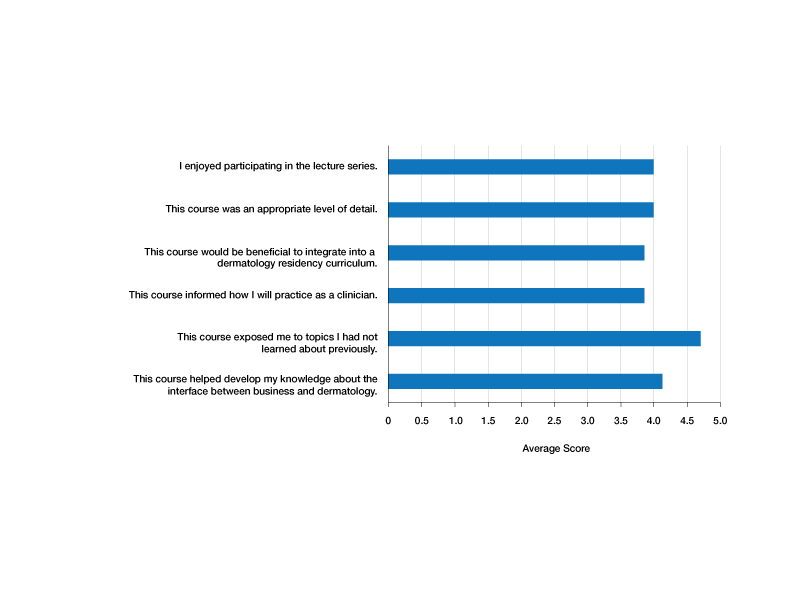
Although the course generally was well received, areas for improvement were identified from respondents’ comments, relating to audience engagement and refining the level of detail in the lectures. Recommendations included “less technical jargon and more focus on ‘big picture’ concepts, given audience’s low baseline knowledge”; “more case examples in each module”; and “more diagrams or interactive activities (polls, quizzes, break-out rooms) because the lectures were a bit dense.” This input was taken into consideration when revising the lectures for future use; they were reconstructed to have more case-based examples and prompts to encourage participation.
Resident commentary also demonstrated appreciation for education in this subject material. Statements such as “this is an important topic for future dermatologists” and “thank you so much for taking the time to implement this course” reflected the perceived value of this material during critical academic time. Another resident remarked: “This was great, thanks for putting it together.”
Given the positive experience of the residents and successful implementation of the series, this course was made available to all dermatology trainees on a network server with accompanying written documents. It is planned to be offered on a 3-year cycle in the future and will be updated to reflect inevitable changes in health care.
Although the relationship between business and medicine is increasingly important, teaching business principles has not become standardized or required in medical training. Despite the perception that this content is of value, implementation of programming has lagged behind that recognition, likely due to challenges in designing the curriculum and diffusing content into an already-saturated schedule. A model course that can be replicated in other residency programs would be valuable. We introduced a dermatology-specific lecture series to help prepare trainees for dermatology practice in a variety of clinical settings and train them with the language of business and operations that will equip them to respond to the needs of their patients, their practice, and the medical environment. Findings of this pilot study may not be generalizable to all dermatology residency programs because the sample size was small; the study was conducted at a single institution; and the content was delivered entirely online.
1. Tan S, Seiger K, Renehan P, et al. Trends in private equity acquisition of dermatology practices in the United States. JAMA Dermatol. 2019;155:1013-1021. doi:10.1001/jamadermatol.2019.1634
2. The business of health care in the United States. Harvard Online [Internet]. June 27, 2022. Accessed July 24, 2023. https://www.harvardonline.harvard.edu/blog/business-health-care-united-states
3. Ranpariya V, Cull D, Feldman SR, et al. Evaluation and management 2021 coding guidelines: key changes and implications. The Dermatologist. December 2020. Accessed July 24, 2023. https://www.hmpgloballearningnetwork.com/site/thederm/article/evaluation-and-management-2021-coding-guidelines-key-changes-and-implications?key=Ranpariya&elastic%5B0%5D=brand%3A73468
4. Lim HW, Collins SAB, Resneck JS Jr, et al. The burden of skin disease in the United States. J Am Acad Dermatol. 2017;76:958-972.e2. doi:10.1016/j.jaad.2016.12.043
5. Resneck JS Jr. Dermatology practice consolidation fueled by private equity investment: potential consequences for the specialty and patients. JAMA Dermatol. 2018;154:13-14. doi:10.1001/jamadermatol.2017.5558
6. Patrinely JR Jr, Dewan AK. Business education in dermatology residency: a survey of program directors. Cutis. 2021;108:E7-E19. doi:10.12788/cutis.0331
7. Kohlwes RJ, Chou CL. A curriculum in medical economics for residents. Acad Med. 2002;77:465-466. doi:10.1097/00001888-200205000-00040
8. Fiebach NH, Rao D, Hamm ME. A curriculum in health systems and public health for internal medicine residents. Am J Prev Med. 2011;41(4 suppl 3):S264-S269. doi:10.1016/j.amepre.2011.05.025
To the Editor:
With health care constituting one of the larger segments of the US economy, medical practice is increasingly subject to business considerations.1 Patients, providers, and organizations are all required to make decisions that reflect choices beyond clinical needs alone. Given the impact of market forces, clinicians often are asked to navigate operational and business decisions. Accordingly, education about the policy and systems that shape care delivery can improve quality and help patients.2
The ability to understand the ecosystem of health care is of utmost importance for medical providers and can be achieved through resident education. Teaching fundamental business concepts enables residents to deliver care that is responsive to the constraints and opportunities encountered by patients and organizations, which ultimately will better prepare them to serve as advocates in alignment with their principal duties as physicians.
Despite the recognizable relationship between business and medicine, training has not yet been standardized to include topics in business education, and clinicians in dermatology are remarkably positioned to benefit because of the variety of practice settings and services they can provide. In dermatology, the diversity of services provided gives rise to complex coding and use of modifiers. Proper utilization of coding and billing is critical to create accurate documentation and receive appropriate reimbursement.3 Furthermore, clinicians in dermatology have to contend with the influence of insurance at many points of care, such as with coverage of pharmaceuticals. Formularies often have wide variability in coverage and are changing as new drugs come to market in the dermatologic space.4
The landscape of practice structure also has undergone change with increasing consolidation and mergers. The acquisition of practices by private equity firms has induced changes in practice infrastructure. The impact of changing organizational and managerial influences continues to be a topic of debate, with disparate opinions on how these developments shape standards of physician satisfaction and patient care.5
The convergence of these factors points to an important question that is gaining popularity: How will young dermatologists work within the context of all these parameters to best advocate and care for their patients? These questions are garnering more attention and were recently investigated through a survey of participants in a pilot program to evaluate the importance of business education in dermatology residency.
A survey of residency program directors was created by Patrinley and Dewan,6 which found that business education during residency was important and additional training should be implemented. Despite the perceived importance of business education, only half of the programs represented by survey respondents offered any structured educational opportunities, revealing a discrepancy between believed importance and practical implementation of business training, which suggests the need to develop a standardized, dermatology-specific curriculum that could be accessed by all residents in training.6
We performed a search of the medical literature to identify models of business education in residency programs. Only a few programs were identified, in which courses were predominantly instructed to trainees in primary care–based fields. According to course graduates, the programs were beneficial.7,8 Programs that had descriptive information about curriculum structure and content were chosen for further investigation and included internal medicine programs at the University of California San Francisco (UCSF) and Columbia University Vagelos College of Physicians and Surgeons (New York, New York). UCSF implemented a Program in Residency Investigation Methods and Epidemiology (PRIME program) to deliver seven 90-minute sessions dedicated to introducing residents to medical economics. Sessions were constructed with the intent of being interactive seminars that took on a variety of forms, including reading-based discussions, case-based analysis, and simulation-based learning.7 Columbia University developed a pilot program of week-long didactic sessions that were delivered to third-year internal medicine residents. These seminars featured discussions on health policy and economics, health insurance, technology and cost assessment, legal medicine, public health, community-oriented primary care, and local health department initiatives.8 We drew on both courses to build a lecture series focused on the business of dermatology that was delivered to dermatology residents at UMass Chan Medical School (Worcester, Massachusetts). Topic selection also was informed by qualitative input collected via email from recent graduates of the UMass dermatology residency program, focusing on the following areas: the US medical economy and health care costs; billing, coding, and claims processing; quality, relative value units (RVUs), reimbursement, and the merit-based incentive payment system; coverage of pharmaceuticals and teledermatology; and management. Residents were not required to prepare for any of the sessions; they were provided with handouts and slideshow presentations for reference to review at their convenience if desired. Five seminars were virtually conducted by an MD/MBA candidate at the institution (E.H.). They were recorded over the course of an academic year at 1- to 2-month intervals. Each 45-minute session was conducted in a lecture-discussion format and included case examples to help illustrate key principles and stimulate conversation. For example, the lecture on reimbursement incorporated a fee schedule calculation for a shave biopsy, using RVU and geographic pricing cost index (GCPI) multipliers. This demonstrated the variation in Centers for Medicare & Medicaid Services reimbursement in relation to (1) constituents of the RVU calculation (ie, work, practice expense, and malpractice) and (2) practice in a particular location (ie, the GCPI). Following this example, a conversation ensued among participants regarding the factors that drive valuation, with particular interest in variation based on urban vs suburban locations across the United States. Participants also found it of interest to examine the percentage of the valuation dedicated to each constituent and how features such as lesion size informed the final assessment of the charge. Another stylistic choice in developing the model was to include prompts for further consideration prior to transitioning topics in the lectures. For example: when examining the burden of skin disease, the audience was prompted to consider: “What is driving cost escalations, and how will services of the clinical domain meet these evolving needs?” At another point in the introductory lecture, residents were asked: “How do different types of insurance plans impact the management of patients with dermatologic concerns?” These questions were intended to transition residents to the next topic of discussion and highlight take-home points of consideration for medical practice. The project was reviewed by the UMass institutional review board and met criteria for exemption.
Residents who participated in at least 1 lecture (N=10) were surveyed after attendance; there were 7 responses (70% response rate). Residents were asked to rate a series of statements on a scale of 1 (strongly disagree) to 5 (strongly agree) and to provide commentary via an online form. Respondents indicated that the course was enjoyable (average score, 4.00), provided an appropriate level of detail (average score, 4.00), would be beneficial to integrate into a dermatology residency curriculum (average score, 3.86), and informed how they would practice as a clinician (average score, 3.86)(Figure). The respondents agreed that the course met the main goals of this initiative: it helped them develop knowledge about the interface between business and dermatology (4.14) and exposed residents to topics they had not learned about previously (4.71).
Although the course generally was well received, areas for improvement were identified from respondents’ comments, relating to audience engagement and refining the level of detail in the lectures. Recommendations included “less technical jargon and more focus on ‘big picture’ concepts, given audience’s low baseline knowledge”; “more case examples in each module”; and “more diagrams or interactive activities (polls, quizzes, break-out rooms) because the lectures were a bit dense.” This input was taken into consideration when revising the lectures for future use; they were reconstructed to have more case-based examples and prompts to encourage participation.
Resident commentary also demonstrated appreciation for education in this subject material. Statements such as “this is an important topic for future dermatologists” and “thank you so much for taking the time to implement this course” reflected the perceived value of this material during critical academic time. Another resident remarked: “This was great, thanks for putting it together.”
Given the positive experience of the residents and successful implementation of the series, this course was made available to all dermatology trainees on a network server with accompanying written documents. It is planned to be offered on a 3-year cycle in the future and will be updated to reflect inevitable changes in health care.
Although the relationship between business and medicine is increasingly important, teaching business principles has not become standardized or required in medical training. Despite the perception that this content is of value, implementation of programming has lagged behind that recognition, likely due to challenges in designing the curriculum and diffusing content into an already-saturated schedule. A model course that can be replicated in other residency programs would be valuable. We introduced a dermatology-specific lecture series to help prepare trainees for dermatology practice in a variety of clinical settings and train them with the language of business and operations that will equip them to respond to the needs of their patients, their practice, and the medical environment. Findings of this pilot study may not be generalizable to all dermatology residency programs because the sample size was small; the study was conducted at a single institution; and the content was delivered entirely online.
To the Editor:
With health care constituting one of the larger segments of the US economy, medical practice is increasingly subject to business considerations.1 Patients, providers, and organizations are all required to make decisions that reflect choices beyond clinical needs alone. Given the impact of market forces, clinicians often are asked to navigate operational and business decisions. Accordingly, education about the policy and systems that shape care delivery can improve quality and help patients.2
The ability to understand the ecosystem of health care is of utmost importance for medical providers and can be achieved through resident education. Teaching fundamental business concepts enables residents to deliver care that is responsive to the constraints and opportunities encountered by patients and organizations, which ultimately will better prepare them to serve as advocates in alignment with their principal duties as physicians.
Despite the recognizable relationship between business and medicine, training has not yet been standardized to include topics in business education, and clinicians in dermatology are remarkably positioned to benefit because of the variety of practice settings and services they can provide. In dermatology, the diversity of services provided gives rise to complex coding and use of modifiers. Proper utilization of coding and billing is critical to create accurate documentation and receive appropriate reimbursement.3 Furthermore, clinicians in dermatology have to contend with the influence of insurance at many points of care, such as with coverage of pharmaceuticals. Formularies often have wide variability in coverage and are changing as new drugs come to market in the dermatologic space.4
The landscape of practice structure also has undergone change with increasing consolidation and mergers. The acquisition of practices by private equity firms has induced changes in practice infrastructure. The impact of changing organizational and managerial influences continues to be a topic of debate, with disparate opinions on how these developments shape standards of physician satisfaction and patient care.5
The convergence of these factors points to an important question that is gaining popularity: How will young dermatologists work within the context of all these parameters to best advocate and care for their patients? These questions are garnering more attention and were recently investigated through a survey of participants in a pilot program to evaluate the importance of business education in dermatology residency.
A survey of residency program directors was created by Patrinley and Dewan,6 which found that business education during residency was important and additional training should be implemented. Despite the perceived importance of business education, only half of the programs represented by survey respondents offered any structured educational opportunities, revealing a discrepancy between believed importance and practical implementation of business training, which suggests the need to develop a standardized, dermatology-specific curriculum that could be accessed by all residents in training.6
We performed a search of the medical literature to identify models of business education in residency programs. Only a few programs were identified, in which courses were predominantly instructed to trainees in primary care–based fields. According to course graduates, the programs were beneficial.7,8 Programs that had descriptive information about curriculum structure and content were chosen for further investigation and included internal medicine programs at the University of California San Francisco (UCSF) and Columbia University Vagelos College of Physicians and Surgeons (New York, New York). UCSF implemented a Program in Residency Investigation Methods and Epidemiology (PRIME program) to deliver seven 90-minute sessions dedicated to introducing residents to medical economics. Sessions were constructed with the intent of being interactive seminars that took on a variety of forms, including reading-based discussions, case-based analysis, and simulation-based learning.7 Columbia University developed a pilot program of week-long didactic sessions that were delivered to third-year internal medicine residents. These seminars featured discussions on health policy and economics, health insurance, technology and cost assessment, legal medicine, public health, community-oriented primary care, and local health department initiatives.8 We drew on both courses to build a lecture series focused on the business of dermatology that was delivered to dermatology residents at UMass Chan Medical School (Worcester, Massachusetts). Topic selection also was informed by qualitative input collected via email from recent graduates of the UMass dermatology residency program, focusing on the following areas: the US medical economy and health care costs; billing, coding, and claims processing; quality, relative value units (RVUs), reimbursement, and the merit-based incentive payment system; coverage of pharmaceuticals and teledermatology; and management. Residents were not required to prepare for any of the sessions; they were provided with handouts and slideshow presentations for reference to review at their convenience if desired. Five seminars were virtually conducted by an MD/MBA candidate at the institution (E.H.). They were recorded over the course of an academic year at 1- to 2-month intervals. Each 45-minute session was conducted in a lecture-discussion format and included case examples to help illustrate key principles and stimulate conversation. For example, the lecture on reimbursement incorporated a fee schedule calculation for a shave biopsy, using RVU and geographic pricing cost index (GCPI) multipliers. This demonstrated the variation in Centers for Medicare & Medicaid Services reimbursement in relation to (1) constituents of the RVU calculation (ie, work, practice expense, and malpractice) and (2) practice in a particular location (ie, the GCPI). Following this example, a conversation ensued among participants regarding the factors that drive valuation, with particular interest in variation based on urban vs suburban locations across the United States. Participants also found it of interest to examine the percentage of the valuation dedicated to each constituent and how features such as lesion size informed the final assessment of the charge. Another stylistic choice in developing the model was to include prompts for further consideration prior to transitioning topics in the lectures. For example: when examining the burden of skin disease, the audience was prompted to consider: “What is driving cost escalations, and how will services of the clinical domain meet these evolving needs?” At another point in the introductory lecture, residents were asked: “How do different types of insurance plans impact the management of patients with dermatologic concerns?” These questions were intended to transition residents to the next topic of discussion and highlight take-home points of consideration for medical practice. The project was reviewed by the UMass institutional review board and met criteria for exemption.
Residents who participated in at least 1 lecture (N=10) were surveyed after attendance; there were 7 responses (70% response rate). Residents were asked to rate a series of statements on a scale of 1 (strongly disagree) to 5 (strongly agree) and to provide commentary via an online form. Respondents indicated that the course was enjoyable (average score, 4.00), provided an appropriate level of detail (average score, 4.00), would be beneficial to integrate into a dermatology residency curriculum (average score, 3.86), and informed how they would practice as a clinician (average score, 3.86)(Figure). The respondents agreed that the course met the main goals of this initiative: it helped them develop knowledge about the interface between business and dermatology (4.14) and exposed residents to topics they had not learned about previously (4.71).
Although the course generally was well received, areas for improvement were identified from respondents’ comments, relating to audience engagement and refining the level of detail in the lectures. Recommendations included “less technical jargon and more focus on ‘big picture’ concepts, given audience’s low baseline knowledge”; “more case examples in each module”; and “more diagrams or interactive activities (polls, quizzes, break-out rooms) because the lectures were a bit dense.” This input was taken into consideration when revising the lectures for future use; they were reconstructed to have more case-based examples and prompts to encourage participation.
Resident commentary also demonstrated appreciation for education in this subject material. Statements such as “this is an important topic for future dermatologists” and “thank you so much for taking the time to implement this course” reflected the perceived value of this material during critical academic time. Another resident remarked: “This was great, thanks for putting it together.”
Given the positive experience of the residents and successful implementation of the series, this course was made available to all dermatology trainees on a network server with accompanying written documents. It is planned to be offered on a 3-year cycle in the future and will be updated to reflect inevitable changes in health care.
Although the relationship between business and medicine is increasingly important, teaching business principles has not become standardized or required in medical training. Despite the perception that this content is of value, implementation of programming has lagged behind that recognition, likely due to challenges in designing the curriculum and diffusing content into an already-saturated schedule. A model course that can be replicated in other residency programs would be valuable. We introduced a dermatology-specific lecture series to help prepare trainees for dermatology practice in a variety of clinical settings and train them with the language of business and operations that will equip them to respond to the needs of their patients, their practice, and the medical environment. Findings of this pilot study may not be generalizable to all dermatology residency programs because the sample size was small; the study was conducted at a single institution; and the content was delivered entirely online.
1. Tan S, Seiger K, Renehan P, et al. Trends in private equity acquisition of dermatology practices in the United States. JAMA Dermatol. 2019;155:1013-1021. doi:10.1001/jamadermatol.2019.1634
2. The business of health care in the United States. Harvard Online [Internet]. June 27, 2022. Accessed July 24, 2023. https://www.harvardonline.harvard.edu/blog/business-health-care-united-states
3. Ranpariya V, Cull D, Feldman SR, et al. Evaluation and management 2021 coding guidelines: key changes and implications. The Dermatologist. December 2020. Accessed July 24, 2023. https://www.hmpgloballearningnetwork.com/site/thederm/article/evaluation-and-management-2021-coding-guidelines-key-changes-and-implications?key=Ranpariya&elastic%5B0%5D=brand%3A73468
4. Lim HW, Collins SAB, Resneck JS Jr, et al. The burden of skin disease in the United States. J Am Acad Dermatol. 2017;76:958-972.e2. doi:10.1016/j.jaad.2016.12.043
5. Resneck JS Jr. Dermatology practice consolidation fueled by private equity investment: potential consequences for the specialty and patients. JAMA Dermatol. 2018;154:13-14. doi:10.1001/jamadermatol.2017.5558
6. Patrinely JR Jr, Dewan AK. Business education in dermatology residency: a survey of program directors. Cutis. 2021;108:E7-E19. doi:10.12788/cutis.0331
7. Kohlwes RJ, Chou CL. A curriculum in medical economics for residents. Acad Med. 2002;77:465-466. doi:10.1097/00001888-200205000-00040
8. Fiebach NH, Rao D, Hamm ME. A curriculum in health systems and public health for internal medicine residents. Am J Prev Med. 2011;41(4 suppl 3):S264-S269. doi:10.1016/j.amepre.2011.05.025
1. Tan S, Seiger K, Renehan P, et al. Trends in private equity acquisition of dermatology practices in the United States. JAMA Dermatol. 2019;155:1013-1021. doi:10.1001/jamadermatol.2019.1634
2. The business of health care in the United States. Harvard Online [Internet]. June 27, 2022. Accessed July 24, 2023. https://www.harvardonline.harvard.edu/blog/business-health-care-united-states
3. Ranpariya V, Cull D, Feldman SR, et al. Evaluation and management 2021 coding guidelines: key changes and implications. The Dermatologist. December 2020. Accessed July 24, 2023. https://www.hmpgloballearningnetwork.com/site/thederm/article/evaluation-and-management-2021-coding-guidelines-key-changes-and-implications?key=Ranpariya&elastic%5B0%5D=brand%3A73468
4. Lim HW, Collins SAB, Resneck JS Jr, et al. The burden of skin disease in the United States. J Am Acad Dermatol. 2017;76:958-972.e2. doi:10.1016/j.jaad.2016.12.043
5. Resneck JS Jr. Dermatology practice consolidation fueled by private equity investment: potential consequences for the specialty and patients. JAMA Dermatol. 2018;154:13-14. doi:10.1001/jamadermatol.2017.5558
6. Patrinely JR Jr, Dewan AK. Business education in dermatology residency: a survey of program directors. Cutis. 2021;108:E7-E19. doi:10.12788/cutis.0331
7. Kohlwes RJ, Chou CL. A curriculum in medical economics for residents. Acad Med. 2002;77:465-466. doi:10.1097/00001888-200205000-00040
8. Fiebach NH, Rao D, Hamm ME. A curriculum in health systems and public health for internal medicine residents. Am J Prev Med. 2011;41(4 suppl 3):S264-S269. doi:10.1016/j.amepre.2011.05.025
Practice Points
- Business education in dermatology residency promotes understanding of the health care ecosystem and can enable residents to more effectively deliver care that is responsive to the needs of their patients.
- Teaching fundamental business principles to residents can inform decision-making on patient, provider, and systems levels.
- A pilot curriculum supports implementation of business education teaching and will be particularly helpful in dermatology.
Stiff arteries may cause metabolic syndrome
New research published in the American Journal of Physiology found that arterial stiffness occurred before the presence of metabolic syndrome. A progressive rise in stiffness was associated with a cumulative increase in risk for the condition among the 3,862 people studied over a 7-year period starting in late adolescence.
Results revealed a notable sex difference: Arterial stiffness increased the risk for metabolic syndrome by 9% for males but only by 1% for females. Males were also five times more likely than females to have metabolic syndrome.
“It seems metabolic syndrome has a new risk factor we haven’t thought about,” said author Andrew O. Agbaje, MD, clinical epidemiologist and researcher, University of Eastern Finland, Kuopio.
Arterial stiffness previously was associated with metabolic syndrome in numerous studies. But the new work is the first to find evidence for causality, Dr. Agbaje said in an interview.
“Interventions have focused on addressing the components of metabolic syndrome such as obesity, dyslipidemia, hyperglycemia, and hypertension,” Dr. Agbaje said. “But arterial stiffness may independently cause metabolic syndrome in 1 out of 10 male teens. I encourage clinicians to think about its role in preventing and managing metabolic syndrome, not just as a consequence but as a cause.”
The results have important implications for physicians, according to Sissi Cossio, MD, pediatric endocrinologist, Pediatrix Medical Group, Fort Lauderdale, Fla.
“The fact that arterial stiffness progression preceded metabolic syndrome is important because it could be used as an earlier detection marker of disease,” Dr. Cossio said.
To conduct the study, Dr. Agbaje and his research team used data collected by the Avon Longitudinal Study of Parents and Children at the University of Bristol in England. Arterial stiffness was measured using carotid-femoral pulse wave velocity, the speed of blood flow from the upper to the lower aorta. They assessed for metabolic syndrome by the presence of three or more risk factors, including high cholesterol, high triglycerides, and high trunk fat mass.
Participants were studied starting in gestation in the early 1990s, and were measured for arterial stiffness and metabolic syndrome starting at age 17 through age 24.
The overall risk for metabolic syndrome doubled within the 7-year study period of follow-up between 2009 and 2017, indicating that early intervention during adolescence is essential.
Dr. Agbaje recommended that physicians start treating arterial stiffness and other markers of metabolic syndrome as early as possible, noting that, “potentially irreversible cardiovascular health damage might occur after age 17.”
Arterial stiffness can be negated through physical activity and dietary changes that lower inflammation. Physicians should refer at-risk teens to a preventative clinic where they can be monitored and receive repeated measurements of arterial stiffness, lipid levels, blood pressure, glucose levels, and obesity every 3 months, Dr. Agbaje said.
“The health progress made after a year would be an indicator for physicians whether a more aggressive therapeutic approach is needed since it takes about 7 years for the risk of metabolic syndrome attributed to arterial stiffness to worsen remarkably in the young population,” he said.
Dr. Agbaje pointed to a few potential pathways through which arterial stiffness might create a disease cascade. Stiffer arteries disrupt blood flow to the liver and pancreas, which could adversely affect their functioning, he said. Damage to these organs may increase insulin and LDL cholesterol blood levels, increasing the risk for metabolic syndrome.
Arterial stiffness also can lead to higher blood pressure and insulin resistance, potentially inducing musculogenesis and vasculogenesis. The resulting excessive muscle mass may also increase the risk for the condition, he said.
Dr. Cossio acknowledged that treatments for metabolic syndrome become less effective with age, but emphasized that reversal is possible in adults with lifestyle changes and medications.
“Early detection will give patients the best chance at reversing the disease, and [primary care physicians] are a key factor in this process,” she said.
Dr. Cossio said that at-risk teens should receive treatment in a weight loss or endocrinology clinic. Treatment may include behavioral, surgical, and pharmacotherapeutic interventions.
“Teens with signs of insulin resistance and impaired fasting glucose, acanthosis, or prediabetes, should start metformin as the first line of therapy,” Dr. Cossio said.
For weight management, she recommends antiobesity medications such as liraglutide, semaglutide, and the combination of phentermine/topiramate in children aged 12 years or older. In teenagers 16 years or older, phentermine alone is another option.
The research group that conducted the study reported received funding from the Jenny and Antti Wihuri Foundation, the North Savo Regional Fund and Central Finnish Cultural Foundation, the Aarne Koskelo Foundation, the Foundation for Pediatric Research, and the Finnish Foundation for Cardiovascular Research, among others. The authors declared no conflicts of interest, financial or otherwise.
A version of this article appeared on Medscape.com.
New research published in the American Journal of Physiology found that arterial stiffness occurred before the presence of metabolic syndrome. A progressive rise in stiffness was associated with a cumulative increase in risk for the condition among the 3,862 people studied over a 7-year period starting in late adolescence.
Results revealed a notable sex difference: Arterial stiffness increased the risk for metabolic syndrome by 9% for males but only by 1% for females. Males were also five times more likely than females to have metabolic syndrome.
“It seems metabolic syndrome has a new risk factor we haven’t thought about,” said author Andrew O. Agbaje, MD, clinical epidemiologist and researcher, University of Eastern Finland, Kuopio.
Arterial stiffness previously was associated with metabolic syndrome in numerous studies. But the new work is the first to find evidence for causality, Dr. Agbaje said in an interview.
“Interventions have focused on addressing the components of metabolic syndrome such as obesity, dyslipidemia, hyperglycemia, and hypertension,” Dr. Agbaje said. “But arterial stiffness may independently cause metabolic syndrome in 1 out of 10 male teens. I encourage clinicians to think about its role in preventing and managing metabolic syndrome, not just as a consequence but as a cause.”
The results have important implications for physicians, according to Sissi Cossio, MD, pediatric endocrinologist, Pediatrix Medical Group, Fort Lauderdale, Fla.
“The fact that arterial stiffness progression preceded metabolic syndrome is important because it could be used as an earlier detection marker of disease,” Dr. Cossio said.
To conduct the study, Dr. Agbaje and his research team used data collected by the Avon Longitudinal Study of Parents and Children at the University of Bristol in England. Arterial stiffness was measured using carotid-femoral pulse wave velocity, the speed of blood flow from the upper to the lower aorta. They assessed for metabolic syndrome by the presence of three or more risk factors, including high cholesterol, high triglycerides, and high trunk fat mass.
Participants were studied starting in gestation in the early 1990s, and were measured for arterial stiffness and metabolic syndrome starting at age 17 through age 24.
The overall risk for metabolic syndrome doubled within the 7-year study period of follow-up between 2009 and 2017, indicating that early intervention during adolescence is essential.
Dr. Agbaje recommended that physicians start treating arterial stiffness and other markers of metabolic syndrome as early as possible, noting that, “potentially irreversible cardiovascular health damage might occur after age 17.”
Arterial stiffness can be negated through physical activity and dietary changes that lower inflammation. Physicians should refer at-risk teens to a preventative clinic where they can be monitored and receive repeated measurements of arterial stiffness, lipid levels, blood pressure, glucose levels, and obesity every 3 months, Dr. Agbaje said.
“The health progress made after a year would be an indicator for physicians whether a more aggressive therapeutic approach is needed since it takes about 7 years for the risk of metabolic syndrome attributed to arterial stiffness to worsen remarkably in the young population,” he said.
Dr. Agbaje pointed to a few potential pathways through which arterial stiffness might create a disease cascade. Stiffer arteries disrupt blood flow to the liver and pancreas, which could adversely affect their functioning, he said. Damage to these organs may increase insulin and LDL cholesterol blood levels, increasing the risk for metabolic syndrome.
Arterial stiffness also can lead to higher blood pressure and insulin resistance, potentially inducing musculogenesis and vasculogenesis. The resulting excessive muscle mass may also increase the risk for the condition, he said.
Dr. Cossio acknowledged that treatments for metabolic syndrome become less effective with age, but emphasized that reversal is possible in adults with lifestyle changes and medications.
“Early detection will give patients the best chance at reversing the disease, and [primary care physicians] are a key factor in this process,” she said.
Dr. Cossio said that at-risk teens should receive treatment in a weight loss or endocrinology clinic. Treatment may include behavioral, surgical, and pharmacotherapeutic interventions.
“Teens with signs of insulin resistance and impaired fasting glucose, acanthosis, or prediabetes, should start metformin as the first line of therapy,” Dr. Cossio said.
For weight management, she recommends antiobesity medications such as liraglutide, semaglutide, and the combination of phentermine/topiramate in children aged 12 years or older. In teenagers 16 years or older, phentermine alone is another option.
The research group that conducted the study reported received funding from the Jenny and Antti Wihuri Foundation, the North Savo Regional Fund and Central Finnish Cultural Foundation, the Aarne Koskelo Foundation, the Foundation for Pediatric Research, and the Finnish Foundation for Cardiovascular Research, among others. The authors declared no conflicts of interest, financial or otherwise.
A version of this article appeared on Medscape.com.
New research published in the American Journal of Physiology found that arterial stiffness occurred before the presence of metabolic syndrome. A progressive rise in stiffness was associated with a cumulative increase in risk for the condition among the 3,862 people studied over a 7-year period starting in late adolescence.
Results revealed a notable sex difference: Arterial stiffness increased the risk for metabolic syndrome by 9% for males but only by 1% for females. Males were also five times more likely than females to have metabolic syndrome.
“It seems metabolic syndrome has a new risk factor we haven’t thought about,” said author Andrew O. Agbaje, MD, clinical epidemiologist and researcher, University of Eastern Finland, Kuopio.
Arterial stiffness previously was associated with metabolic syndrome in numerous studies. But the new work is the first to find evidence for causality, Dr. Agbaje said in an interview.
“Interventions have focused on addressing the components of metabolic syndrome such as obesity, dyslipidemia, hyperglycemia, and hypertension,” Dr. Agbaje said. “But arterial stiffness may independently cause metabolic syndrome in 1 out of 10 male teens. I encourage clinicians to think about its role in preventing and managing metabolic syndrome, not just as a consequence but as a cause.”
The results have important implications for physicians, according to Sissi Cossio, MD, pediatric endocrinologist, Pediatrix Medical Group, Fort Lauderdale, Fla.
“The fact that arterial stiffness progression preceded metabolic syndrome is important because it could be used as an earlier detection marker of disease,” Dr. Cossio said.
To conduct the study, Dr. Agbaje and his research team used data collected by the Avon Longitudinal Study of Parents and Children at the University of Bristol in England. Arterial stiffness was measured using carotid-femoral pulse wave velocity, the speed of blood flow from the upper to the lower aorta. They assessed for metabolic syndrome by the presence of three or more risk factors, including high cholesterol, high triglycerides, and high trunk fat mass.
Participants were studied starting in gestation in the early 1990s, and were measured for arterial stiffness and metabolic syndrome starting at age 17 through age 24.
The overall risk for metabolic syndrome doubled within the 7-year study period of follow-up between 2009 and 2017, indicating that early intervention during adolescence is essential.
Dr. Agbaje recommended that physicians start treating arterial stiffness and other markers of metabolic syndrome as early as possible, noting that, “potentially irreversible cardiovascular health damage might occur after age 17.”
Arterial stiffness can be negated through physical activity and dietary changes that lower inflammation. Physicians should refer at-risk teens to a preventative clinic where they can be monitored and receive repeated measurements of arterial stiffness, lipid levels, blood pressure, glucose levels, and obesity every 3 months, Dr. Agbaje said.
“The health progress made after a year would be an indicator for physicians whether a more aggressive therapeutic approach is needed since it takes about 7 years for the risk of metabolic syndrome attributed to arterial stiffness to worsen remarkably in the young population,” he said.
Dr. Agbaje pointed to a few potential pathways through which arterial stiffness might create a disease cascade. Stiffer arteries disrupt blood flow to the liver and pancreas, which could adversely affect their functioning, he said. Damage to these organs may increase insulin and LDL cholesterol blood levels, increasing the risk for metabolic syndrome.
Arterial stiffness also can lead to higher blood pressure and insulin resistance, potentially inducing musculogenesis and vasculogenesis. The resulting excessive muscle mass may also increase the risk for the condition, he said.
Dr. Cossio acknowledged that treatments for metabolic syndrome become less effective with age, but emphasized that reversal is possible in adults with lifestyle changes and medications.
“Early detection will give patients the best chance at reversing the disease, and [primary care physicians] are a key factor in this process,” she said.
Dr. Cossio said that at-risk teens should receive treatment in a weight loss or endocrinology clinic. Treatment may include behavioral, surgical, and pharmacotherapeutic interventions.
“Teens with signs of insulin resistance and impaired fasting glucose, acanthosis, or prediabetes, should start metformin as the first line of therapy,” Dr. Cossio said.
For weight management, she recommends antiobesity medications such as liraglutide, semaglutide, and the combination of phentermine/topiramate in children aged 12 years or older. In teenagers 16 years or older, phentermine alone is another option.
The research group that conducted the study reported received funding from the Jenny and Antti Wihuri Foundation, the North Savo Regional Fund and Central Finnish Cultural Foundation, the Aarne Koskelo Foundation, the Foundation for Pediatric Research, and the Finnish Foundation for Cardiovascular Research, among others. The authors declared no conflicts of interest, financial or otherwise.
A version of this article appeared on Medscape.com.
FROM AMERICAN JOURNAL OF PHYSIOLOGY