User login
Palliative Care Services Offer New Horizons for Hospitalists
Howard Epstein, a hospitalist at Regions Hospital in St. Paul, MN, spent nearly 2 years planning an inpatient palliative care consultation service for Regions before its launch in January of this year. A multidisciplinary advisory committee met monthly to help with the planning, and Dr. Epstein, the embryonic program’s medical director, went before the hospital’s administration to make the clinical and financial case for supporting it.
“What we’re trying to do is to take the basic interdisciplinary approach pioneered in hospice and move it upstream,” to help relieve suffering in seriously ill patients before they need or qualify for hospice care, he explains. “I just knew I wanted to incorporate it into a hospitalist model,” and into the Hospitalist Services Division’s weekly block schedule.
After the service was launched, it became clear that the schedule did not allow for the significant time commitment required to do palliative care, so a new approach is planned for July. Dr. Epstein and 6 other hospitalists participating in the palliative care service will divide up weekly blocks of time. Half of their duties while on service will be devoted to palliative care and the other half to covering 1 hospital unit as a hospitalist, rather than the usual 2 units for hospitalists at Regions.
The palliative care service at Regions, which includes a half-time chaplain and social worker and a full-time nurse practitioner, responds to consultation requests by doctors and nurses from all of the hospital’s adult services. The service also admits patients from HealthPartners’ affiliated hospice program when they are hospitalized at Regions for short-term symptom management or respite care.
Key to long-term success lies in documenting improved clinical outcomes, patient, family, and provider satisfaction, financial savings, and enhanced patient throughput. “I’m optimistic we’ll be able to demonstrate significant value, but if we can’t, we’ll be hard-pressed to get continued support,” he says. This challenge, he adds, is similar to what the hospitalist service at Regions faced when it was launched in 1998.
Palliative care is not a new concept in medicine, but it has enjoyed dramatic growth in recent years. The American Hospital Association estimates that 17% of community hospitals and 26% of academic teaching hospitals in the United States now have either a palliative care consultation service or a dedicated unit, although the former is more common because it can be established with a smaller fiscal outlay.
Palliative care aims to relieve suffering, broadly defined, for patients living with chronic, advanced illnesses. State-of-the-art pain management is a major emphasis for the interdisciplinary palliative care team, but so are addressing the patient and family’s emotional, psychological and spiritual concerns related to the illness and offering guidance for making informed treatment decisions that reflect their values and goals for care. Palliative care services generally target all patients with advanced illness from the point of diagnosis, simultaneous with any other medical treatment regimens.
Two Medical Fields Growing Together
“I believe hospitalist practices and palliative care services are of necessity growing closer together,” says Susan Block, codirector of the Harvard Medical School Center for Palliative Care in Boston, MA. The Harvard Center provides intensive palliative care training for clinicians who also have an interest in teaching.
“If you run a palliative care consult service or a palliative care unit, you are operating much like a hospitalist, with a focus on hospital systems and workload issues, communication, and getting people out of the hospital,” Dr. Block says. At the same time, most hospitalists deal with end-of-life issues and the challenges of relieving symptoms such as pain, delirium, or anxiety every day, whether they view their role in those terms or not.
Stephanie Grossman, a hospitalist at Emory Healthcare in Atlanta, GA, says she discovered personal satisfaction as a young physician in having meaningful conversations about care goals with seriously ill patients and leading family conferences, despite the time pressures of the job. The head of the hospital medicine service at Emory, Mark Williams, MD, told Dr. Grossman there was a name for what she enjoyed doing: palliative care. He encouraged her, along with colleague Melissa Mahoney, to obtain additional training in developing such a program, starting with a 2003 conference in San Diego sponsored by the Center to Advance Palliative Care.
“I came back from San Diego feeling swept away by how it really was possible to develop a financially feasible program,” says Dr. Grossman. Back at Emory, she and Dr. Mahoney joined a palliative care task force formed by Dr. Williams, with representatives from geriatrics, nursing, social work, chaplaincy, finance, and administration. This group provided input for a business plan for the palliative care service that will start in September at Emory Crawford Long and Emory University hospitals.
The 2 hospitalists, who have become certified in palliative medicine, will divide a full-time position as codirectors of the inpatient palliative care service in alternating monthly blocks, along with additional teaching responsibilities. Their 4-year plan is to add additional staffing as the program grows and to work with a geriatrician to develop a palliative care fellowship program. The palliative care team, including a nurse, social worker, and chaplain, will conduct daily palliative care rounds and biweekly interdisciplinary case conferences at the 2 hospitals.
“We have a nurse practitioner involved to help us coordinate between the 2 sites. We’ll go to various departments and do some grand rounds to introduce and market the program,” Dr. Grossman notes. In addition to practicing a style of medicine that offers deeper personal interactions with patients, she is excited to be part of creating a new program. However, she emphasizes the importance of having an executive champion within the hospital who understands financing, institutional politics, and how to recruit other champions. “We’ve been lucky to enjoy the support of Dr. Williams and [Emory Chief Operating Officer] Pete Basler. Dr. Mahoney and I have been working with hospitalists for several years, but our work has all been clinical,” she says.
Another challenge for hospitalists interested in pursuing palliative care include the need to make sure their new responsibilities are not just an add-on to a full-time job. The hospital needs to commit resources for planning and implementing a palliative care program, including a percentage of the hospitalist’s time, Dr. Block says. “Zero FTEs is not viable in the long run,” she adds.
Physician billing for palliative care consults can help offset the costs of running a service, but it is unlikely to break even on billing alone, says Eva Chittenden, a hospitalist and palliative care physician at the University of California-San Francisco, which has operated a palliative care service since 1999. Dr. Chittenden is also part of the Palliative Care Leadership Center at UCSF, which offers 2-day intensive training programs 4 times a year for hospital teams that want to start or strengthen inpatient palliative care services.
In most cases, palliative care requires financial support from the hospital, although it’s not difficult to justify that support by showing cost avoidance, reduced lengths of stay, and improved clinical outcomes, with the help of tools developed by the Center to Advance Palliative Care, Dr. Chittenden says. Program development also challenges the hospitalist’s leadership and marketing skills.
A Process of Growing Involvement
“What often happens with hospitalists is that they start out exploring palliative care, and it becomes very compelling,” Dr. Block adds. “The more competent you get at it, the more compelling it becomes. They find deeper meaning in their work. And then they’re hooked.”
A hospitalist can seek additional training and then incorporate palliative care tools, concepts, and perspectives into his or her daily work. An interest in palliative care may lead to involvement with the hospital ethics committee, a seat on a palliative care advisory committee, or a role in standards or protocol development, as well as pursuit of specialty certification in hospice and palliative medicine.
Although hospitalists may be obvious candidates to participate in more formal palliative care program development, “incorporating palliative care into a routine hospitalist practice is not a trivial thing,” Dr. Block adds. For starters, it requires additional training. “Most hospitalists don’t have the competencies to practice expert palliative care if they don’t seek them out,” she says. But the opportunities are increasing, with growing palliative care fellowship opportunities nationwide.
Two hospitalists at Chandler Regional Medical Center in Chandler, AZ, are among the 4 physicians who serve on that facility’s 12-member interdisciplinary palliative care team, attending weekly team meetings to review active cases and brainstorm program development. Both have attended national palliative care conferences, reports the palliative care service’s nurse practitioner, Donna Nolde. The service consulted on 89 patients in March, and about 70% of those referrals came from hospitalists.
“As hospitalists, we often deal with issues of death and dying,” especially when working in the ICU or with referring oncologists, notes Chandler’s Mahmood Shahlapour. “We can sometimes step back and see the big picture when other doctors have trouble letting go.” Dr. Shahlapour believes palliative care is a logical extension of good internal medicine and will eventually become a bigger part of the training of internists.
An atypical path to palliative care is that of Glenda Hickman, MD, who was a hospitalist for the Denver, CO–based HealthONE system until one of the system’s hospitals asked her to take on the role of freelance palliative care consultant. Hickman, who also works part-time for Hospice of Metro Denver as a team medical director and picks up lecturing and teaching assignments, accepts consultations from 3 HealthONE hospitals and bills third-party payers for her consultations. Her husband is office manager and biller for her home-based business, and she carries a cell phone and pager to promptly answer referrals.
“I had a reputation for the touchy-feely aspects of medicine at the hospitals where I worked,” Dr. Hickman relates. “Dying patients would often get referred to me.” Based on her interests, Dr. Hickman sought training in palliative care, but she found it difficult to juggle with her full-time job as a hospitalist. “The heart of palliative care in a hospital is talking with patients and families. These conversations take a long time,” she says. When the hospital asked for her help in meeting its JCAHO requirements in pain management and palliative care, Dr. Hickman was willing to explore a model for how she could hang out a shingle as a solo practitioner.
Business is growing, although the workload fluctuates widely. However, while Dr. Hickman works alongside social workers and chaplains at the hospitals, the biggest drawback has been the lack of a formal, interdisciplinary team. “This is high-maintenance, high-emotion work. It can be a big drain, and I don’t have a designated team with which to share the burden. My goal is to run a full palliative care team for the hospital,” she says, and there are signs that HealthONE eventually may move in that direction.
“It’s not that hospitalists can’t do palliative care. I did. I was so drawn to it and to trying to do it right, which meant I was trying to do 2 jobs at once,” she adds. Hospitalists can also participate by recognizing when their patients need the extra attention of a palliative care specialist. “Identifying who those patients are is a huge skill by itself.”
Resources for Getting Started in Palliative Care
The Center to Advance Palliative Care (CAPC) at Mount Sinai School of Medicine in New York City offers a comprehensive national resource for palliative care development in hospitals, including how to make the financial case. Its next national seminar is October 17 to 19 in San Diego, CA. CAPC also supports 6 regional Palliative Care Leadership Centers, including one with a hospitalist emphasis at the University of California-San Francisco, scheduled to run through June 2006. For more information on CAPC’s resources and leadership centers, call 202-201-2670 or visit www.capc.org.
Larry Beresford can be contacted at larryberesford@hotmail.com.
Other Helpful Resources
- For information on the Education in Palliative and End-of-Life Care (EPEC) curriculum, visit www.epec.net.
- The American Board of Hospice and Palliative Medicine will offer its next specialty certifying examination in November of 2005. For eligibility or other questions, call 301-439-8001 or visit www.abhpm.org.
- The American Association of Hospice and Palliative Medicine offers education and training resources, including an annual assembly scheduled for February 8 to 11, 2006, in Nashville, TN; visit www.aahpm.org.
- Harvard’s Center for Palliative Care offers a 2-week intensive training course, with an emphasis on teaching, in April and November every year. For information, call 617-724-9509, send email to pallcare@partners.org, or visit www.hms.harvard.edu/cdi/pallcare/.
- The Veterans Administration also offers palliative care resources, fellowship opportunities and other information; visit www.hospice.va.gov.
Howard Epstein, a hospitalist at Regions Hospital in St. Paul, MN, spent nearly 2 years planning an inpatient palliative care consultation service for Regions before its launch in January of this year. A multidisciplinary advisory committee met monthly to help with the planning, and Dr. Epstein, the embryonic program’s medical director, went before the hospital’s administration to make the clinical and financial case for supporting it.
“What we’re trying to do is to take the basic interdisciplinary approach pioneered in hospice and move it upstream,” to help relieve suffering in seriously ill patients before they need or qualify for hospice care, he explains. “I just knew I wanted to incorporate it into a hospitalist model,” and into the Hospitalist Services Division’s weekly block schedule.
After the service was launched, it became clear that the schedule did not allow for the significant time commitment required to do palliative care, so a new approach is planned for July. Dr. Epstein and 6 other hospitalists participating in the palliative care service will divide up weekly blocks of time. Half of their duties while on service will be devoted to palliative care and the other half to covering 1 hospital unit as a hospitalist, rather than the usual 2 units for hospitalists at Regions.
The palliative care service at Regions, which includes a half-time chaplain and social worker and a full-time nurse practitioner, responds to consultation requests by doctors and nurses from all of the hospital’s adult services. The service also admits patients from HealthPartners’ affiliated hospice program when they are hospitalized at Regions for short-term symptom management or respite care.
Key to long-term success lies in documenting improved clinical outcomes, patient, family, and provider satisfaction, financial savings, and enhanced patient throughput. “I’m optimistic we’ll be able to demonstrate significant value, but if we can’t, we’ll be hard-pressed to get continued support,” he says. This challenge, he adds, is similar to what the hospitalist service at Regions faced when it was launched in 1998.
Palliative care is not a new concept in medicine, but it has enjoyed dramatic growth in recent years. The American Hospital Association estimates that 17% of community hospitals and 26% of academic teaching hospitals in the United States now have either a palliative care consultation service or a dedicated unit, although the former is more common because it can be established with a smaller fiscal outlay.
Palliative care aims to relieve suffering, broadly defined, for patients living with chronic, advanced illnesses. State-of-the-art pain management is a major emphasis for the interdisciplinary palliative care team, but so are addressing the patient and family’s emotional, psychological and spiritual concerns related to the illness and offering guidance for making informed treatment decisions that reflect their values and goals for care. Palliative care services generally target all patients with advanced illness from the point of diagnosis, simultaneous with any other medical treatment regimens.
Two Medical Fields Growing Together
“I believe hospitalist practices and palliative care services are of necessity growing closer together,” says Susan Block, codirector of the Harvard Medical School Center for Palliative Care in Boston, MA. The Harvard Center provides intensive palliative care training for clinicians who also have an interest in teaching.
“If you run a palliative care consult service or a palliative care unit, you are operating much like a hospitalist, with a focus on hospital systems and workload issues, communication, and getting people out of the hospital,” Dr. Block says. At the same time, most hospitalists deal with end-of-life issues and the challenges of relieving symptoms such as pain, delirium, or anxiety every day, whether they view their role in those terms or not.
Stephanie Grossman, a hospitalist at Emory Healthcare in Atlanta, GA, says she discovered personal satisfaction as a young physician in having meaningful conversations about care goals with seriously ill patients and leading family conferences, despite the time pressures of the job. The head of the hospital medicine service at Emory, Mark Williams, MD, told Dr. Grossman there was a name for what she enjoyed doing: palliative care. He encouraged her, along with colleague Melissa Mahoney, to obtain additional training in developing such a program, starting with a 2003 conference in San Diego sponsored by the Center to Advance Palliative Care.
“I came back from San Diego feeling swept away by how it really was possible to develop a financially feasible program,” says Dr. Grossman. Back at Emory, she and Dr. Mahoney joined a palliative care task force formed by Dr. Williams, with representatives from geriatrics, nursing, social work, chaplaincy, finance, and administration. This group provided input for a business plan for the palliative care service that will start in September at Emory Crawford Long and Emory University hospitals.
The 2 hospitalists, who have become certified in palliative medicine, will divide a full-time position as codirectors of the inpatient palliative care service in alternating monthly blocks, along with additional teaching responsibilities. Their 4-year plan is to add additional staffing as the program grows and to work with a geriatrician to develop a palliative care fellowship program. The palliative care team, including a nurse, social worker, and chaplain, will conduct daily palliative care rounds and biweekly interdisciplinary case conferences at the 2 hospitals.
“We have a nurse practitioner involved to help us coordinate between the 2 sites. We’ll go to various departments and do some grand rounds to introduce and market the program,” Dr. Grossman notes. In addition to practicing a style of medicine that offers deeper personal interactions with patients, she is excited to be part of creating a new program. However, she emphasizes the importance of having an executive champion within the hospital who understands financing, institutional politics, and how to recruit other champions. “We’ve been lucky to enjoy the support of Dr. Williams and [Emory Chief Operating Officer] Pete Basler. Dr. Mahoney and I have been working with hospitalists for several years, but our work has all been clinical,” she says.
Another challenge for hospitalists interested in pursuing palliative care include the need to make sure their new responsibilities are not just an add-on to a full-time job. The hospital needs to commit resources for planning and implementing a palliative care program, including a percentage of the hospitalist’s time, Dr. Block says. “Zero FTEs is not viable in the long run,” she adds.
Physician billing for palliative care consults can help offset the costs of running a service, but it is unlikely to break even on billing alone, says Eva Chittenden, a hospitalist and palliative care physician at the University of California-San Francisco, which has operated a palliative care service since 1999. Dr. Chittenden is also part of the Palliative Care Leadership Center at UCSF, which offers 2-day intensive training programs 4 times a year for hospital teams that want to start or strengthen inpatient palliative care services.
In most cases, palliative care requires financial support from the hospital, although it’s not difficult to justify that support by showing cost avoidance, reduced lengths of stay, and improved clinical outcomes, with the help of tools developed by the Center to Advance Palliative Care, Dr. Chittenden says. Program development also challenges the hospitalist’s leadership and marketing skills.
A Process of Growing Involvement
“What often happens with hospitalists is that they start out exploring palliative care, and it becomes very compelling,” Dr. Block adds. “The more competent you get at it, the more compelling it becomes. They find deeper meaning in their work. And then they’re hooked.”
A hospitalist can seek additional training and then incorporate palliative care tools, concepts, and perspectives into his or her daily work. An interest in palliative care may lead to involvement with the hospital ethics committee, a seat on a palliative care advisory committee, or a role in standards or protocol development, as well as pursuit of specialty certification in hospice and palliative medicine.
Although hospitalists may be obvious candidates to participate in more formal palliative care program development, “incorporating palliative care into a routine hospitalist practice is not a trivial thing,” Dr. Block adds. For starters, it requires additional training. “Most hospitalists don’t have the competencies to practice expert palliative care if they don’t seek them out,” she says. But the opportunities are increasing, with growing palliative care fellowship opportunities nationwide.
Two hospitalists at Chandler Regional Medical Center in Chandler, AZ, are among the 4 physicians who serve on that facility’s 12-member interdisciplinary palliative care team, attending weekly team meetings to review active cases and brainstorm program development. Both have attended national palliative care conferences, reports the palliative care service’s nurse practitioner, Donna Nolde. The service consulted on 89 patients in March, and about 70% of those referrals came from hospitalists.
“As hospitalists, we often deal with issues of death and dying,” especially when working in the ICU or with referring oncologists, notes Chandler’s Mahmood Shahlapour. “We can sometimes step back and see the big picture when other doctors have trouble letting go.” Dr. Shahlapour believes palliative care is a logical extension of good internal medicine and will eventually become a bigger part of the training of internists.
An atypical path to palliative care is that of Glenda Hickman, MD, who was a hospitalist for the Denver, CO–based HealthONE system until one of the system’s hospitals asked her to take on the role of freelance palliative care consultant. Hickman, who also works part-time for Hospice of Metro Denver as a team medical director and picks up lecturing and teaching assignments, accepts consultations from 3 HealthONE hospitals and bills third-party payers for her consultations. Her husband is office manager and biller for her home-based business, and she carries a cell phone and pager to promptly answer referrals.
“I had a reputation for the touchy-feely aspects of medicine at the hospitals where I worked,” Dr. Hickman relates. “Dying patients would often get referred to me.” Based on her interests, Dr. Hickman sought training in palliative care, but she found it difficult to juggle with her full-time job as a hospitalist. “The heart of palliative care in a hospital is talking with patients and families. These conversations take a long time,” she says. When the hospital asked for her help in meeting its JCAHO requirements in pain management and palliative care, Dr. Hickman was willing to explore a model for how she could hang out a shingle as a solo practitioner.
Business is growing, although the workload fluctuates widely. However, while Dr. Hickman works alongside social workers and chaplains at the hospitals, the biggest drawback has been the lack of a formal, interdisciplinary team. “This is high-maintenance, high-emotion work. It can be a big drain, and I don’t have a designated team with which to share the burden. My goal is to run a full palliative care team for the hospital,” she says, and there are signs that HealthONE eventually may move in that direction.
“It’s not that hospitalists can’t do palliative care. I did. I was so drawn to it and to trying to do it right, which meant I was trying to do 2 jobs at once,” she adds. Hospitalists can also participate by recognizing when their patients need the extra attention of a palliative care specialist. “Identifying who those patients are is a huge skill by itself.”
Resources for Getting Started in Palliative Care
The Center to Advance Palliative Care (CAPC) at Mount Sinai School of Medicine in New York City offers a comprehensive national resource for palliative care development in hospitals, including how to make the financial case. Its next national seminar is October 17 to 19 in San Diego, CA. CAPC also supports 6 regional Palliative Care Leadership Centers, including one with a hospitalist emphasis at the University of California-San Francisco, scheduled to run through June 2006. For more information on CAPC’s resources and leadership centers, call 202-201-2670 or visit www.capc.org.
Larry Beresford can be contacted at larryberesford@hotmail.com.
Other Helpful Resources
- For information on the Education in Palliative and End-of-Life Care (EPEC) curriculum, visit www.epec.net.
- The American Board of Hospice and Palliative Medicine will offer its next specialty certifying examination in November of 2005. For eligibility or other questions, call 301-439-8001 or visit www.abhpm.org.
- The American Association of Hospice and Palliative Medicine offers education and training resources, including an annual assembly scheduled for February 8 to 11, 2006, in Nashville, TN; visit www.aahpm.org.
- Harvard’s Center for Palliative Care offers a 2-week intensive training course, with an emphasis on teaching, in April and November every year. For information, call 617-724-9509, send email to pallcare@partners.org, or visit www.hms.harvard.edu/cdi/pallcare/.
- The Veterans Administration also offers palliative care resources, fellowship opportunities and other information; visit www.hospice.va.gov.
Howard Epstein, a hospitalist at Regions Hospital in St. Paul, MN, spent nearly 2 years planning an inpatient palliative care consultation service for Regions before its launch in January of this year. A multidisciplinary advisory committee met monthly to help with the planning, and Dr. Epstein, the embryonic program’s medical director, went before the hospital’s administration to make the clinical and financial case for supporting it.
“What we’re trying to do is to take the basic interdisciplinary approach pioneered in hospice and move it upstream,” to help relieve suffering in seriously ill patients before they need or qualify for hospice care, he explains. “I just knew I wanted to incorporate it into a hospitalist model,” and into the Hospitalist Services Division’s weekly block schedule.
After the service was launched, it became clear that the schedule did not allow for the significant time commitment required to do palliative care, so a new approach is planned for July. Dr. Epstein and 6 other hospitalists participating in the palliative care service will divide up weekly blocks of time. Half of their duties while on service will be devoted to palliative care and the other half to covering 1 hospital unit as a hospitalist, rather than the usual 2 units for hospitalists at Regions.
The palliative care service at Regions, which includes a half-time chaplain and social worker and a full-time nurse practitioner, responds to consultation requests by doctors and nurses from all of the hospital’s adult services. The service also admits patients from HealthPartners’ affiliated hospice program when they are hospitalized at Regions for short-term symptom management or respite care.
Key to long-term success lies in documenting improved clinical outcomes, patient, family, and provider satisfaction, financial savings, and enhanced patient throughput. “I’m optimistic we’ll be able to demonstrate significant value, but if we can’t, we’ll be hard-pressed to get continued support,” he says. This challenge, he adds, is similar to what the hospitalist service at Regions faced when it was launched in 1998.
Palliative care is not a new concept in medicine, but it has enjoyed dramatic growth in recent years. The American Hospital Association estimates that 17% of community hospitals and 26% of academic teaching hospitals in the United States now have either a palliative care consultation service or a dedicated unit, although the former is more common because it can be established with a smaller fiscal outlay.
Palliative care aims to relieve suffering, broadly defined, for patients living with chronic, advanced illnesses. State-of-the-art pain management is a major emphasis for the interdisciplinary palliative care team, but so are addressing the patient and family’s emotional, psychological and spiritual concerns related to the illness and offering guidance for making informed treatment decisions that reflect their values and goals for care. Palliative care services generally target all patients with advanced illness from the point of diagnosis, simultaneous with any other medical treatment regimens.
Two Medical Fields Growing Together
“I believe hospitalist practices and palliative care services are of necessity growing closer together,” says Susan Block, codirector of the Harvard Medical School Center for Palliative Care in Boston, MA. The Harvard Center provides intensive palliative care training for clinicians who also have an interest in teaching.
“If you run a palliative care consult service or a palliative care unit, you are operating much like a hospitalist, with a focus on hospital systems and workload issues, communication, and getting people out of the hospital,” Dr. Block says. At the same time, most hospitalists deal with end-of-life issues and the challenges of relieving symptoms such as pain, delirium, or anxiety every day, whether they view their role in those terms or not.
Stephanie Grossman, a hospitalist at Emory Healthcare in Atlanta, GA, says she discovered personal satisfaction as a young physician in having meaningful conversations about care goals with seriously ill patients and leading family conferences, despite the time pressures of the job. The head of the hospital medicine service at Emory, Mark Williams, MD, told Dr. Grossman there was a name for what she enjoyed doing: palliative care. He encouraged her, along with colleague Melissa Mahoney, to obtain additional training in developing such a program, starting with a 2003 conference in San Diego sponsored by the Center to Advance Palliative Care.
“I came back from San Diego feeling swept away by how it really was possible to develop a financially feasible program,” says Dr. Grossman. Back at Emory, she and Dr. Mahoney joined a palliative care task force formed by Dr. Williams, with representatives from geriatrics, nursing, social work, chaplaincy, finance, and administration. This group provided input for a business plan for the palliative care service that will start in September at Emory Crawford Long and Emory University hospitals.
The 2 hospitalists, who have become certified in palliative medicine, will divide a full-time position as codirectors of the inpatient palliative care service in alternating monthly blocks, along with additional teaching responsibilities. Their 4-year plan is to add additional staffing as the program grows and to work with a geriatrician to develop a palliative care fellowship program. The palliative care team, including a nurse, social worker, and chaplain, will conduct daily palliative care rounds and biweekly interdisciplinary case conferences at the 2 hospitals.
“We have a nurse practitioner involved to help us coordinate between the 2 sites. We’ll go to various departments and do some grand rounds to introduce and market the program,” Dr. Grossman notes. In addition to practicing a style of medicine that offers deeper personal interactions with patients, she is excited to be part of creating a new program. However, she emphasizes the importance of having an executive champion within the hospital who understands financing, institutional politics, and how to recruit other champions. “We’ve been lucky to enjoy the support of Dr. Williams and [Emory Chief Operating Officer] Pete Basler. Dr. Mahoney and I have been working with hospitalists for several years, but our work has all been clinical,” she says.
Another challenge for hospitalists interested in pursuing palliative care include the need to make sure their new responsibilities are not just an add-on to a full-time job. The hospital needs to commit resources for planning and implementing a palliative care program, including a percentage of the hospitalist’s time, Dr. Block says. “Zero FTEs is not viable in the long run,” she adds.
Physician billing for palliative care consults can help offset the costs of running a service, but it is unlikely to break even on billing alone, says Eva Chittenden, a hospitalist and palliative care physician at the University of California-San Francisco, which has operated a palliative care service since 1999. Dr. Chittenden is also part of the Palliative Care Leadership Center at UCSF, which offers 2-day intensive training programs 4 times a year for hospital teams that want to start or strengthen inpatient palliative care services.
In most cases, palliative care requires financial support from the hospital, although it’s not difficult to justify that support by showing cost avoidance, reduced lengths of stay, and improved clinical outcomes, with the help of tools developed by the Center to Advance Palliative Care, Dr. Chittenden says. Program development also challenges the hospitalist’s leadership and marketing skills.
A Process of Growing Involvement
“What often happens with hospitalists is that they start out exploring palliative care, and it becomes very compelling,” Dr. Block adds. “The more competent you get at it, the more compelling it becomes. They find deeper meaning in their work. And then they’re hooked.”
A hospitalist can seek additional training and then incorporate palliative care tools, concepts, and perspectives into his or her daily work. An interest in palliative care may lead to involvement with the hospital ethics committee, a seat on a palliative care advisory committee, or a role in standards or protocol development, as well as pursuit of specialty certification in hospice and palliative medicine.
Although hospitalists may be obvious candidates to participate in more formal palliative care program development, “incorporating palliative care into a routine hospitalist practice is not a trivial thing,” Dr. Block adds. For starters, it requires additional training. “Most hospitalists don’t have the competencies to practice expert palliative care if they don’t seek them out,” she says. But the opportunities are increasing, with growing palliative care fellowship opportunities nationwide.
Two hospitalists at Chandler Regional Medical Center in Chandler, AZ, are among the 4 physicians who serve on that facility’s 12-member interdisciplinary palliative care team, attending weekly team meetings to review active cases and brainstorm program development. Both have attended national palliative care conferences, reports the palliative care service’s nurse practitioner, Donna Nolde. The service consulted on 89 patients in March, and about 70% of those referrals came from hospitalists.
“As hospitalists, we often deal with issues of death and dying,” especially when working in the ICU or with referring oncologists, notes Chandler’s Mahmood Shahlapour. “We can sometimes step back and see the big picture when other doctors have trouble letting go.” Dr. Shahlapour believes palliative care is a logical extension of good internal medicine and will eventually become a bigger part of the training of internists.
An atypical path to palliative care is that of Glenda Hickman, MD, who was a hospitalist for the Denver, CO–based HealthONE system until one of the system’s hospitals asked her to take on the role of freelance palliative care consultant. Hickman, who also works part-time for Hospice of Metro Denver as a team medical director and picks up lecturing and teaching assignments, accepts consultations from 3 HealthONE hospitals and bills third-party payers for her consultations. Her husband is office manager and biller for her home-based business, and she carries a cell phone and pager to promptly answer referrals.
“I had a reputation for the touchy-feely aspects of medicine at the hospitals where I worked,” Dr. Hickman relates. “Dying patients would often get referred to me.” Based on her interests, Dr. Hickman sought training in palliative care, but she found it difficult to juggle with her full-time job as a hospitalist. “The heart of palliative care in a hospital is talking with patients and families. These conversations take a long time,” she says. When the hospital asked for her help in meeting its JCAHO requirements in pain management and palliative care, Dr. Hickman was willing to explore a model for how she could hang out a shingle as a solo practitioner.
Business is growing, although the workload fluctuates widely. However, while Dr. Hickman works alongside social workers and chaplains at the hospitals, the biggest drawback has been the lack of a formal, interdisciplinary team. “This is high-maintenance, high-emotion work. It can be a big drain, and I don’t have a designated team with which to share the burden. My goal is to run a full palliative care team for the hospital,” she says, and there are signs that HealthONE eventually may move in that direction.
“It’s not that hospitalists can’t do palliative care. I did. I was so drawn to it and to trying to do it right, which meant I was trying to do 2 jobs at once,” she adds. Hospitalists can also participate by recognizing when their patients need the extra attention of a palliative care specialist. “Identifying who those patients are is a huge skill by itself.”
Resources for Getting Started in Palliative Care
The Center to Advance Palliative Care (CAPC) at Mount Sinai School of Medicine in New York City offers a comprehensive national resource for palliative care development in hospitals, including how to make the financial case. Its next national seminar is October 17 to 19 in San Diego, CA. CAPC also supports 6 regional Palliative Care Leadership Centers, including one with a hospitalist emphasis at the University of California-San Francisco, scheduled to run through June 2006. For more information on CAPC’s resources and leadership centers, call 202-201-2670 or visit www.capc.org.
Larry Beresford can be contacted at larryberesford@hotmail.com.
Other Helpful Resources
- For information on the Education in Palliative and End-of-Life Care (EPEC) curriculum, visit www.epec.net.
- The American Board of Hospice and Palliative Medicine will offer its next specialty certifying examination in November of 2005. For eligibility or other questions, call 301-439-8001 or visit www.abhpm.org.
- The American Association of Hospice and Palliative Medicine offers education and training resources, including an annual assembly scheduled for February 8 to 11, 2006, in Nashville, TN; visit www.aahpm.org.
- Harvard’s Center for Palliative Care offers a 2-week intensive training course, with an emphasis on teaching, in April and November every year. For information, call 617-724-9509, send email to pallcare@partners.org, or visit www.hms.harvard.edu/cdi/pallcare/.
- The Veterans Administration also offers palliative care resources, fellowship opportunities and other information; visit www.hospice.va.gov.
Withholding nutrition at the end of life: Clinical and ethical issues
Elder abuse and neglect: What physicians can and should do
Improving the care of patients dying of heart failure
Defining Effective Clinician Roles in End-of-Life Care
OBJECTIVE: Our goal was to determine primary care clinician perceptions of what is important to the provision of quality end-of-life care.
STUDY DESIGN: We used ethnography, a qualitative research method involving the use of open-ended semistructured interviews.
POPULATION: We included 38 family practice residency faculty from 9 community residency programs of the Affiliated Family Practice Residency Network, Department of Family Medicine, University of Washington School of Medicine.
OUTCOMES MEASURED: The roles described by interviewees when discussing their best practices while delivering end-of-life care were compiled.
RESULTS: Primary care clinicians organize their delivery of quality end-of-life care predominantly through their relationships with patients and families. They play 3 roles when providing end-of-life care. As consultants, clinicians provide expert medical advice and treatment. As collaborators, they seek to understand the patient and family experience. Seasoned clinicians act as guides, using their personal intuitive knowledge of patient and family to facilitate everyone’s growth when providing end-of-life care.
CONCLUSIONS: Shifting clinician focus from skills and knowledge toward relationship, meaning, and roles provides new opportunities to improve end-of-life care for patients, families, and clinicians.
- Exemplary end-of-life care is organized around relationships, meaning, and roles.
- Knowledge and skills are essential but are not how exemplary end-of-life care is organized.
- Clinicians providing end-of-life care play 3 roles: consultant, collaborator, and guide.
- Shifting clinician focus from skills and knowledge toward relationship, meaning, and roles provides new opportunities to improve care.
Modern medicine has dramatically improved the length and quality of life for countless persons but has also created problems in integrating these advances with end-of-life care. Although 70% of Americans want to die in their own home supported by family, 74% of Americans currently die in institutions.1,2 Clearly, there is a disparity between patient preferences and the end-of-life services provided in America.
Most recommendations for the provision of quality end-of-life care are based on unresearched expert opinion that identifies problems and offers solutions.3-5 Studies have explored communication strategies,6 satisfaction levels with care,7 perceptions of management issues,8 and attitudes toward both death and dying patients.9 Yet little research addresses how practicing community clinicians develop the appropriate relationships and integrate the requisite knowledge, skills, and attitudes to provide quality end-of-life care.
The relationship between clinician, patient, and family and the personal meaning of events for each participant greatly influence end-of-life care.10 Although most commentary on physician roles and relationships in end-of-life care also reflects unresearched expert opinion,11-13 Steinmetz and Gabel14,15 theorized a model that was later validated against the experience of practicing family physicians. The role of the clinician in the successful provision of quality care has not been systematically researched and remains a major challenge to improving end-of-life care. We describe an exploratory qualitative study to determine the perceptions of practicing clinicians regarding quality end-of-life care.
Methods
With approval from the Human Subjects Committee of the University of Washington School of Medicine, faculty were recruited from 9 community programs in the Affiliated Family Practice Residency Network of the Department of Family Medicine. Twenty semistructured long interviews were conducted from a convenience sample at 3 residency sites.16 An additional 8 semistructured interviews and 2 focus groups (10 participants) further explored the data. Thus, a total of 38 clinicians participated in the study. Demographic characteristics of the study cohort have been published previously.10
We conducted the initial 20 interviews using open-ended questions designed to uncover faculty perceptions of quality end-of-life care. The questions explored may be found in the Table. Nonspecific prompts such as “tell me more” were used to enrich data and avoid interviewer bias. The interview was rehearsed with a medical school faculty expert in ethnographic research, field tested, and adjusted before final use. The interviews were audio-recorded and transcribed into qualitative research software.17
Throughout the interview process, the investigators met weekly to compare findings, discuss emerging categories, and jointly code the transcripts for model development using the process of grounded theory described by Glaser and Strauss.18 Common themes, communication and educational issues, and roles and relationships were identified. Data were constantly compared and winnowed to facilitate manageability; data collection and analysis occurred simultaneously.19,20 Common themes are published elsewhere.10 We report and discuss the analysis of the data pertaining to clinician roles and relationships.
We employed the following 3 strategies to assess the methodologic validity of the study and face validity of the themes and models emerging from the data analysis.
TABLE
INTERVIEW QUESTIONS
Remember a case in which you provided care for a patient and family facing a chronic, progressive, terminal illness:
|
Methodologic validation
The themes, models, and 2 interview transcripts were reviewed by 2 expert consultants with experience in qualitative research on end-of-life care and chronic debilitating disease. They assessed the validity of the research process and model development.21,22 These experts confirmed the methodologic approach, affirmed that the transcripts supported the coded model, and noted that the results were consistent with their own past research experience.
Face validity faculty interviews
Long interviews were conducted with a convenience sample of 8 faculty at 2 other residency sites. Researchers described the previous interview process and presented a written summary of the roles and relationship model coded from the data. Dialogue was encouraged with nonspecific prompts to enrich the data and avoid interviewer bias. Interviews were recorded, transcribed, and coded by the researchers to assess face validity and further develop the roles and relationship model using a grounded theory approach.
Face validity focus groups
Two focus groups were conducted with a total of 10 faculty at 2 additional sites. The entire model (themes, communication, roles, and relationships) was presented, and dialogue was encouraged. The researchers recorded, transcribed, and reviewed the focus groups to further assess face validity and refine the model.
Content validity
In a manner identical to that of the focus groups, the researchers presented the entire model at 2 of the 3 sites where faculty provided the initial 20 interviews. These sessions were audiotaped, transcribed, and reviewed by the researchers. The model presented was considered a valid, clinically plausible summary of the content of the initial interviews.
Results
Content analysis of the roles and relationships described by the study cohort revealed 3 distinct clinician roles in the provision of end-of-life care that we termed “consultant,” “collaborator,” and “guide.” All roles were viewed as important; none was more valuable than another; and the roles appeared to build on each other, often merging. Roles were implemented fluidly, with clinicians moving from one role to another as circumstances dictated. Although clinicians tended to describe successful cases, they freely discussed the challenges of end-of-life care, noting that less-than-ideal results were frequent. Thus, the models were described as “best practice” rather than routine care.
Consultant
The consultant provides expert medical information to the patient and family based on the biomedical model and the disease process. The power of the consultant role emanates from the clinician’s medical authority and special knowledge. The consultant presents information to help the patient and family understand the diagnosis, prognosis, and treatment. Once this knowledge is understood, the patient and family determine its meaning to them and decide on treatment. If the patient or family cannot decide or understand the medical implications of their particular situation, the consultant decides based on the medical facts.
A pediatrician illustrated the application of the consultant role in 2 situations involving newborns with severe heart anomalies. Here the physician describes the difficulty of using only medical facts to assist the family in deciding whether to discontinue the ventilator: “I remember saying: ‘The only thing that’s keeping the baby alive at this point is the ventilator. How do you feel about making the decision to turn that off?’ I remember it was a very cruel thing to have them make the decision.”
The physician continued: “Next time I said: ‘We have to sit down and talk about how your baby is doing because he died, and I’m going to turn off the machines now.’ I don’t think we should put them in the position of having to make this decision. We should make this decision and tell them what we’re going to do.” In this situation the clinician employed biomedical expertise to determine the appropriate medical care and outcome for the patient and family. In both cases the decision centered on continuing or discontinuing a medical intervention (respirator) and avoided discussion of the parents’ affective experience. Hallmarks of the consultant role include a biomedical focus, disease-centered decision-making processes, and the clinician’s assumption of authority based on biomedical expertise.
Collaborator
The collaborator exchanges information with the patient and family to promote a common understanding of the diagnosis and illness experience, working with them to choose a treatment path. The collaborator incorporates all components of the consultant role and additionally requires the clinician to understand the patient/family experience. The collaborator considers patient and family issues that need to be addressed to understand the medical facts, appreciates their past experiences with serious illness, determines what information would be difficult for them to accept but would benefit them if they were challenged to confront it, and recognizes that the patient and family hold ultimate responsibility for making treatment decisions.
The following quotes exemplify collaborative clinical care. In the first example, the physician steps outside his comfort zone to provide medical care based on the expressed wishes of a 30-year-old man dying of an advanced brain tumor: “The issue for me was letting go of control. He was going 4 hours away to a fishing cabin and going on a boat. I was really nervous…what if he all of a sudden crashed there? It took me a while to get used to the idea that he needs to be able to do what he enjoys doing, and everybody knows that there’s a risk.”
In a second example, the physician describes collaborating with the family of an 85-year-old woman suffering a massive stroke: “Having heard from the family that they understand that Grandma has had a big stroke and isn’t going to survive…then what wishes do Grandma and the family have? Have they ever discussed this sort of situation?”
In both these examples an understanding of the patient/family experience directs the clinician toward appropriate end-of-life care and is a major source of the collaborator’s power.
Guide
As a guide, the clinician actively and personally seeks solutions for the patient based not only on the medical facts (consultant) and the patient’s values and preferences (collaborator) but also on the guide’s greater understanding of the medical context. In essence, the guide not only knows why and where the patient and family prefer to go but also how to get there.
The following quote demonstrates a clinical application of the guide role. The physician first collaborates to understand the resistance of a terminally ill patient to hospice care:
“They had been very resistant to hospice for reasons that I wasn’t quite clear on. It wasn’t until I was in the home and listened to them talk that I realized they viewed hospice as ‘people are giving up on him.’ I think nobody really was talking to the patient about whether he was willing to give up or if he was ready to die.
“Once patient and family concerns were understood, the guide role was employed: I told the wife and family, ‘We’ve maxed out our medical therapies. There’s not much more we can do for him physically, but perhaps there’s something we can do for him spiritually and emotionally.’ When it was presented to them that way, they were much more understanding. We talked about hospice philosophy and looking at death as a part of life, saying: ‘That we’re not going to resuscitate does not mean do not treat.’ That’s where I came in more as the guide and said: ‘This is what I think is reasonable. What are your expectations? What do you want, Billy? And what do you want, as far as [his] wife and kids?”
The guide role requires that the clinician interpret the patient’s experience, integrate this interpretation with the clinician’s understanding of the clinical situation, and make a recommendation based on the guide’s personal and professional understanding of the situation. The power of the guide role emanates from the clinician’s understanding of how to use the medical system to see that the goals of patient and family are realized.
Discussion
The results of our study are consistent with reports over the past 3 decades by researchers, educators, and social critics who have explored how health professionals provide end-of-life care.23-29 Despite their varying perspectives, all reflect a common theme: the need to provide care based on the unique illness experience and values of the patient and family. The majority of clinicians in our study spoke of the importance of their relationships with patients and families. More than 50% of all interview commentary addressed clinician issues of relationship and personal meaning when providing end-of-life care.
The descriptions of consultant,30 collaborator,31,32 and guide33 confirm previous theoretical discussions regarding the nature of roles and relationships between patients and physicians. The guide is the most complex of the roles described by our study cohort and lends itself to ambivalence on the part of clinicians, in light of its potential to be misunderstood as paternalism. Yet, given the vulnerability and dependence of many patients who are terminally ill, the guide provides these patients with structure, safety, support, and care—based on the patients’ values and goals—reminiscent of the role of a nurturing parent.34
The personal nature of the decisions the guide facilitates reflects the reality of medicine as a moral enterprise.34,35 Having generally witnessed many more deaths than the patient, the guide has knowledge regarding the processes of dying and medical systems that is instrumental in assuring that the desires of the patient and family are realized. A knowledge of patient and family, an appreciation of the futility of the medical situation, and an insight into the process and systems of dying afford the clinician an opportunity to shape the death experience; as Nuland36 described: “Each of us needs a guide who knows us as well as he knows the pathways by which we can approach death.”
Facility with these roles may be a function of personal talent, introspection, and experience. The physicians studied reported that competence with these roles grew over time through delivering endof-life care and learning from patients, families, and other caregivers. Less experienced clinicians tended to describe the consultant and collaborator roles only. Clinicians describing the guide role had been in practice at least a decade and thus were at least 17 years into their training and practice in medicine. Apparently, expertise in all 3 roles requires not only excellent technical diagnostic and treatment skills but also the complex integrated skills of relational knowledge and caring gained through experience.
Our data indicate that relationship, meaning, and roles are primary moderators of the organization of exemplary end-of-life care. Yet, it appears to take nearly 2 decades for physicians to gain the confidence in their knowledge, skills, and attitudes necessary to comfortably guide patients and families through the nuances of end-of-life care. How to successfully educate clinicians to use such a model earlier is beyond our scope but appears crucial to improving training efforts. Current attempts to teach end-of-life care do not develop and explore the complex integrative domains of relational knowledge37-40 described in our study. Studies of educational interventions that stress the importance of the relational aspects of end-of-life care appear warranted.
To facilitate skill acquisition, the authors propose the steps diagrammed in the Figure to assist clinicians in providing quality end-of-life care. We believe the time spent determining patient-centered goals and the roles and relationships required by the clinician should at least equal the time spent determining which tests and treatments to provide. At the end of life, when tests and treatments result in fewer benefits and greater risks and burdens, determining patient and family needs and goals becomes increasingly important as management changes from cure to care.
FIGURE
FLOW DIAGRAM FOR CLINICIAN ROLES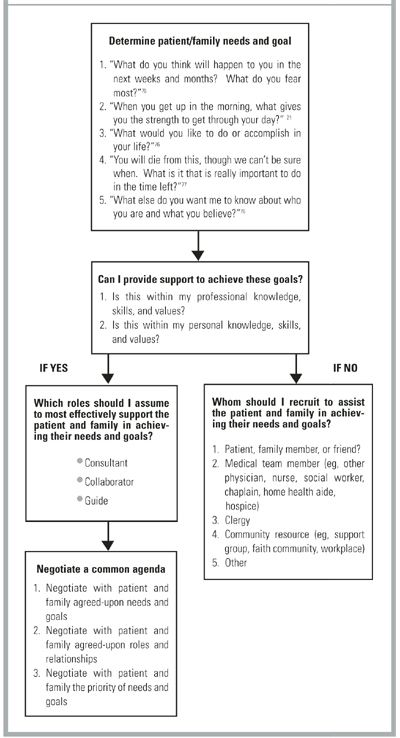
Limitations
This study is limited by a study sample of primary care, family practice faculty who geographically represent all practice in the Pacific Northwest and are predominantly Euro-American in ethnicity. The majority are family physicians, with the remainder pediatricians, internists, and a small number of nurse practitioners and physician assistants. Although no significant differences in terms of roles, relationships, and personal meanings between professional groups were noted, whether these findings are transferable to other primary care clinicians in community practice is unknown. Whether non–primary care specialists and clinicians of differing ethnicity or geographic region would respond differently is unknown. Generalizing these findings to non–primary care clinicians and clinicians of color requires further research.
Conclusions
Given the enormity of social and cultural values that make death a taboo topic, it is unclear how any single reform can easily overcome the multiple barriers to improved end-of-life care. Whether it is possible to teach attitudes and values, such as empathy and self-reflection, is uncertain, though promising curricula and research exist.41-42 If primary care physicians and other professionals improve their knowledge, skills, and attitudes in the delivery of such care, the ultimate effect on improving the experience of patients and families will require further study.
Acknowledgments
We wish to thank the Emily Davie and Joseph S. Kornfeld Foundation and The Nathan Cummings Foundation, New York, which provided generous grants that made our study and article possible. Additionally, we thank Phyllis Silverman, PhD, Harvard University, for her early counsel and advice; Tom Taylor, MD, PhD, University of Washington School of Medicine, for his thoughtful input into the study design, his sage guidance, and his review of the manuscript; Jeanne Quint Benoliel, DNS, Professor Emeritus, University of Washington School of Nursing, for her inspiration and review of the study design and results; and Greg Guldin, PhD, Pacific Lutheran University, for his thoughtful review of the manuscript.
1. The George Gallup International Institute. Spiritual beliefs and the dying process: a report on a national survey. Princeton, NJ: George Gallup International Institute;1997.
2. Field MJ, Cassel CK, eds. Approaching death: improving care at the end of life: Committee on Care at the End of Life, Division of Health Care Services, Institute of Medicine. Washington, DC: National Academy Press; 1997.
3. Schonwetter RS, Hawke W, Knight CF, eds. Hospice and palliative medicine core curriculum and review syllabus: American Academy of Hospice and Palliative Medicine. Dubuque, Iowa: Kendall/Hunt; 1999.
4. Emanuel LL, von Gunten CF, Ferris FD. The education for physicians on end-of-life care (EPEC) curriculum. Chicago, Ill: American Medical Association; 1999.
5. Lo B, Quill T, Tulsky J. Discussing palliative care with patients. Ann Intern Med 1999;130:744-49.
6. Todd C, Still A. General practitioners’ strategies and tactics of communication with the terminally ill. Fam Pract 1993;10:268-76.
7. Blyth AC. Audit of terminal care in a general practice. BMJ 1990;300:983-86.
8. Goodlin SJ, Jette AM, Lynn J, Wasson JH. Community physicians describe management issues for patients expected to live less than twelve months. J Palliat Care 1998;14:30-35.
9. Durand RP, Dickinson GE, Sumner DE, Lancaster CG. Family physicians’ attitudes toward death and the terminally-ill patient. Fam Pract Res J 1990;9:123-29.
10. Farber SJ, Egnew TR, Herman-Bertsch JL. Issues in end-of-life care: family practice faculty perceptions. J Fam Pract 1999;49:525-30.
11. Brewin TB. Not TLC but FPI. J R Soc Med 1990;83:172-75.
12. Mitchell G. The role of the general practitioner in palliative care. Aust Fam Physician 1994;23:1233-39.
13. Ogle KS, Plum JD. The role of the primary care physician in the care of the terminally ill. Clin Geriatr Med 1996;12:267-77.
14. Steinmetz D, Gabel LL. The family physician’s role in caring for the dying patient and family: a comprehensive theoretical model. Fam Pract 1992;9:433-36.
15. Steinmetz D, Walsh M, Gabel LL, Williams PT. Family physicians’ involvement with dying patients and their families. Arch Fam Med 1993;2:753-61.
16. Crabtree BF, Miller WL. A qualitative approach to primary care research: the long interview. Fam Med 1991;23:145-51.
17. Seidel J, Friese S, Leonard DC. The Ethnograph version 4.0 . Amherst, Mass: Qualis Research Associates; 1995.
18. Glaser B, Strauss A. The discovery of grounded theory. New York, NY: Aldine; 1967.
19. Strauss A, Corbin C. Basics of qualitative research. Newbury Park, Calif: Sage; 1990.
20. Wolcott HF. Writing up qualitative research. Newbury Park, Calif: Sage; 1990.
21. Benoliel JQ. Advancing nursing science: qualitative approaches. West J Nurs Res 1984;6:1-8.
22. Taylor TR, Gordon MJ, Ashworth CD. A systems perspective on clinical management. Behav Sci 1984;29:233-47.
23. Glaser BG, Strauss AL. Awareness of dying. Chicago, Ill: Aldine; 1965.
24. Kubler-Ross E. On death and dying. New York, NY: MacMillan; 1969.
25. Weisman A. On dying and denying: a psychiatric study on terminality. New York, NY: Behavioral Publications; 1972.
26. Saunders C, Baines M. Living with dying. New York, NY: Oxford University Press; 1983.
27. Corbin JM, Strauss AL. Unending work and care: managing chronic illness at home. San Francisco, Calif: Jossey-Bass; 1988.
28. Broyard A. Intoxicated by my illness. New York, NY: Potter; 1992.
29. Callahan D. Troubled dream of life. New York, NY: Simon & Schuster; 1993.
30. Balint J, Shelton W. Regaining the initiative: forging a new model of the patient-physician relationship. JAMA 1996;275:887-91.
31. Quill TE. Partnerships in patient care: a contractual approach. Ann Intern Med 1983;98:228-34.
32. Stewart M, Brown JB, Weston WW, McWhinney IR, Freeman TR. Patient centered medicine: transforming the clinical method. Thousand Oaks, Calif: Sage; 1995.
33. Emanuel EJ, Emanuel LL. Four models of the physician-patient relationship. JAMA 1992;267:2221-26.
34. Cassell EJ. The nature of suffering and the goals of medicine. New York, NY: Oxford University Press; 1991.
35. Veatch RM. Contemporary bioethics and the demise of modern medicine. In Ormiston G, Sassower R, eds. Prescriptions: the dissemination of medical authority. New York, NY: Greenwood Press; 1990;23-39.
36. Nuland S. How we die. New York, NY: Knopf; 1994.
37. Rogers CR. Client-centered therapy: its current practice, implications, and theory. Boston, Mass: Houghton Mifflin; 1951.
38. Buber M. I and thou. New York, NY: MacMillan; 1974.
39. Mayeroff M. On caring. New York, NY: HarperPerennial; 1990.
40. Kleinman A, Kleinman J. Suffering and its professional transformation: toward an ethnography of interpersonal experience. Cult Med Psychiatry 1991;15:275-301.
41. Novack DH, Suchman AL, Clark W, Epstein RM, Najberg E, Kaplan C. Calibrating the physician: personal awareness and effective patient care. JAMA 1997;278:502-09.
42. Epstein RM. Mindful practice. JAMA 1999;282:833-39.
OBJECTIVE: Our goal was to determine primary care clinician perceptions of what is important to the provision of quality end-of-life care.
STUDY DESIGN: We used ethnography, a qualitative research method involving the use of open-ended semistructured interviews.
POPULATION: We included 38 family practice residency faculty from 9 community residency programs of the Affiliated Family Practice Residency Network, Department of Family Medicine, University of Washington School of Medicine.
OUTCOMES MEASURED: The roles described by interviewees when discussing their best practices while delivering end-of-life care were compiled.
RESULTS: Primary care clinicians organize their delivery of quality end-of-life care predominantly through their relationships with patients and families. They play 3 roles when providing end-of-life care. As consultants, clinicians provide expert medical advice and treatment. As collaborators, they seek to understand the patient and family experience. Seasoned clinicians act as guides, using their personal intuitive knowledge of patient and family to facilitate everyone’s growth when providing end-of-life care.
CONCLUSIONS: Shifting clinician focus from skills and knowledge toward relationship, meaning, and roles provides new opportunities to improve end-of-life care for patients, families, and clinicians.
- Exemplary end-of-life care is organized around relationships, meaning, and roles.
- Knowledge and skills are essential but are not how exemplary end-of-life care is organized.
- Clinicians providing end-of-life care play 3 roles: consultant, collaborator, and guide.
- Shifting clinician focus from skills and knowledge toward relationship, meaning, and roles provides new opportunities to improve care.
Modern medicine has dramatically improved the length and quality of life for countless persons but has also created problems in integrating these advances with end-of-life care. Although 70% of Americans want to die in their own home supported by family, 74% of Americans currently die in institutions.1,2 Clearly, there is a disparity between patient preferences and the end-of-life services provided in America.
Most recommendations for the provision of quality end-of-life care are based on unresearched expert opinion that identifies problems and offers solutions.3-5 Studies have explored communication strategies,6 satisfaction levels with care,7 perceptions of management issues,8 and attitudes toward both death and dying patients.9 Yet little research addresses how practicing community clinicians develop the appropriate relationships and integrate the requisite knowledge, skills, and attitudes to provide quality end-of-life care.
The relationship between clinician, patient, and family and the personal meaning of events for each participant greatly influence end-of-life care.10 Although most commentary on physician roles and relationships in end-of-life care also reflects unresearched expert opinion,11-13 Steinmetz and Gabel14,15 theorized a model that was later validated against the experience of practicing family physicians. The role of the clinician in the successful provision of quality care has not been systematically researched and remains a major challenge to improving end-of-life care. We describe an exploratory qualitative study to determine the perceptions of practicing clinicians regarding quality end-of-life care.
Methods
With approval from the Human Subjects Committee of the University of Washington School of Medicine, faculty were recruited from 9 community programs in the Affiliated Family Practice Residency Network of the Department of Family Medicine. Twenty semistructured long interviews were conducted from a convenience sample at 3 residency sites.16 An additional 8 semistructured interviews and 2 focus groups (10 participants) further explored the data. Thus, a total of 38 clinicians participated in the study. Demographic characteristics of the study cohort have been published previously.10
We conducted the initial 20 interviews using open-ended questions designed to uncover faculty perceptions of quality end-of-life care. The questions explored may be found in the Table. Nonspecific prompts such as “tell me more” were used to enrich data and avoid interviewer bias. The interview was rehearsed with a medical school faculty expert in ethnographic research, field tested, and adjusted before final use. The interviews were audio-recorded and transcribed into qualitative research software.17
Throughout the interview process, the investigators met weekly to compare findings, discuss emerging categories, and jointly code the transcripts for model development using the process of grounded theory described by Glaser and Strauss.18 Common themes, communication and educational issues, and roles and relationships were identified. Data were constantly compared and winnowed to facilitate manageability; data collection and analysis occurred simultaneously.19,20 Common themes are published elsewhere.10 We report and discuss the analysis of the data pertaining to clinician roles and relationships.
We employed the following 3 strategies to assess the methodologic validity of the study and face validity of the themes and models emerging from the data analysis.
TABLE
INTERVIEW QUESTIONS
Remember a case in which you provided care for a patient and family facing a chronic, progressive, terminal illness:
|
Methodologic validation
The themes, models, and 2 interview transcripts were reviewed by 2 expert consultants with experience in qualitative research on end-of-life care and chronic debilitating disease. They assessed the validity of the research process and model development.21,22 These experts confirmed the methodologic approach, affirmed that the transcripts supported the coded model, and noted that the results were consistent with their own past research experience.
Face validity faculty interviews
Long interviews were conducted with a convenience sample of 8 faculty at 2 other residency sites. Researchers described the previous interview process and presented a written summary of the roles and relationship model coded from the data. Dialogue was encouraged with nonspecific prompts to enrich the data and avoid interviewer bias. Interviews were recorded, transcribed, and coded by the researchers to assess face validity and further develop the roles and relationship model using a grounded theory approach.
Face validity focus groups
Two focus groups were conducted with a total of 10 faculty at 2 additional sites. The entire model (themes, communication, roles, and relationships) was presented, and dialogue was encouraged. The researchers recorded, transcribed, and reviewed the focus groups to further assess face validity and refine the model.
Content validity
In a manner identical to that of the focus groups, the researchers presented the entire model at 2 of the 3 sites where faculty provided the initial 20 interviews. These sessions were audiotaped, transcribed, and reviewed by the researchers. The model presented was considered a valid, clinically plausible summary of the content of the initial interviews.
Results
Content analysis of the roles and relationships described by the study cohort revealed 3 distinct clinician roles in the provision of end-of-life care that we termed “consultant,” “collaborator,” and “guide.” All roles were viewed as important; none was more valuable than another; and the roles appeared to build on each other, often merging. Roles were implemented fluidly, with clinicians moving from one role to another as circumstances dictated. Although clinicians tended to describe successful cases, they freely discussed the challenges of end-of-life care, noting that less-than-ideal results were frequent. Thus, the models were described as “best practice” rather than routine care.
Consultant
The consultant provides expert medical information to the patient and family based on the biomedical model and the disease process. The power of the consultant role emanates from the clinician’s medical authority and special knowledge. The consultant presents information to help the patient and family understand the diagnosis, prognosis, and treatment. Once this knowledge is understood, the patient and family determine its meaning to them and decide on treatment. If the patient or family cannot decide or understand the medical implications of their particular situation, the consultant decides based on the medical facts.
A pediatrician illustrated the application of the consultant role in 2 situations involving newborns with severe heart anomalies. Here the physician describes the difficulty of using only medical facts to assist the family in deciding whether to discontinue the ventilator: “I remember saying: ‘The only thing that’s keeping the baby alive at this point is the ventilator. How do you feel about making the decision to turn that off?’ I remember it was a very cruel thing to have them make the decision.”
The physician continued: “Next time I said: ‘We have to sit down and talk about how your baby is doing because he died, and I’m going to turn off the machines now.’ I don’t think we should put them in the position of having to make this decision. We should make this decision and tell them what we’re going to do.” In this situation the clinician employed biomedical expertise to determine the appropriate medical care and outcome for the patient and family. In both cases the decision centered on continuing or discontinuing a medical intervention (respirator) and avoided discussion of the parents’ affective experience. Hallmarks of the consultant role include a biomedical focus, disease-centered decision-making processes, and the clinician’s assumption of authority based on biomedical expertise.
Collaborator
The collaborator exchanges information with the patient and family to promote a common understanding of the diagnosis and illness experience, working with them to choose a treatment path. The collaborator incorporates all components of the consultant role and additionally requires the clinician to understand the patient/family experience. The collaborator considers patient and family issues that need to be addressed to understand the medical facts, appreciates their past experiences with serious illness, determines what information would be difficult for them to accept but would benefit them if they were challenged to confront it, and recognizes that the patient and family hold ultimate responsibility for making treatment decisions.
The following quotes exemplify collaborative clinical care. In the first example, the physician steps outside his comfort zone to provide medical care based on the expressed wishes of a 30-year-old man dying of an advanced brain tumor: “The issue for me was letting go of control. He was going 4 hours away to a fishing cabin and going on a boat. I was really nervous…what if he all of a sudden crashed there? It took me a while to get used to the idea that he needs to be able to do what he enjoys doing, and everybody knows that there’s a risk.”
In a second example, the physician describes collaborating with the family of an 85-year-old woman suffering a massive stroke: “Having heard from the family that they understand that Grandma has had a big stroke and isn’t going to survive…then what wishes do Grandma and the family have? Have they ever discussed this sort of situation?”
In both these examples an understanding of the patient/family experience directs the clinician toward appropriate end-of-life care and is a major source of the collaborator’s power.
Guide
As a guide, the clinician actively and personally seeks solutions for the patient based not only on the medical facts (consultant) and the patient’s values and preferences (collaborator) but also on the guide’s greater understanding of the medical context. In essence, the guide not only knows why and where the patient and family prefer to go but also how to get there.
The following quote demonstrates a clinical application of the guide role. The physician first collaborates to understand the resistance of a terminally ill patient to hospice care:
“They had been very resistant to hospice for reasons that I wasn’t quite clear on. It wasn’t until I was in the home and listened to them talk that I realized they viewed hospice as ‘people are giving up on him.’ I think nobody really was talking to the patient about whether he was willing to give up or if he was ready to die.
“Once patient and family concerns were understood, the guide role was employed: I told the wife and family, ‘We’ve maxed out our medical therapies. There’s not much more we can do for him physically, but perhaps there’s something we can do for him spiritually and emotionally.’ When it was presented to them that way, they were much more understanding. We talked about hospice philosophy and looking at death as a part of life, saying: ‘That we’re not going to resuscitate does not mean do not treat.’ That’s where I came in more as the guide and said: ‘This is what I think is reasonable. What are your expectations? What do you want, Billy? And what do you want, as far as [his] wife and kids?”
The guide role requires that the clinician interpret the patient’s experience, integrate this interpretation with the clinician’s understanding of the clinical situation, and make a recommendation based on the guide’s personal and professional understanding of the situation. The power of the guide role emanates from the clinician’s understanding of how to use the medical system to see that the goals of patient and family are realized.
Discussion
The results of our study are consistent with reports over the past 3 decades by researchers, educators, and social critics who have explored how health professionals provide end-of-life care.23-29 Despite their varying perspectives, all reflect a common theme: the need to provide care based on the unique illness experience and values of the patient and family. The majority of clinicians in our study spoke of the importance of their relationships with patients and families. More than 50% of all interview commentary addressed clinician issues of relationship and personal meaning when providing end-of-life care.
The descriptions of consultant,30 collaborator,31,32 and guide33 confirm previous theoretical discussions regarding the nature of roles and relationships between patients and physicians. The guide is the most complex of the roles described by our study cohort and lends itself to ambivalence on the part of clinicians, in light of its potential to be misunderstood as paternalism. Yet, given the vulnerability and dependence of many patients who are terminally ill, the guide provides these patients with structure, safety, support, and care—based on the patients’ values and goals—reminiscent of the role of a nurturing parent.34
The personal nature of the decisions the guide facilitates reflects the reality of medicine as a moral enterprise.34,35 Having generally witnessed many more deaths than the patient, the guide has knowledge regarding the processes of dying and medical systems that is instrumental in assuring that the desires of the patient and family are realized. A knowledge of patient and family, an appreciation of the futility of the medical situation, and an insight into the process and systems of dying afford the clinician an opportunity to shape the death experience; as Nuland36 described: “Each of us needs a guide who knows us as well as he knows the pathways by which we can approach death.”
Facility with these roles may be a function of personal talent, introspection, and experience. The physicians studied reported that competence with these roles grew over time through delivering endof-life care and learning from patients, families, and other caregivers. Less experienced clinicians tended to describe the consultant and collaborator roles only. Clinicians describing the guide role had been in practice at least a decade and thus were at least 17 years into their training and practice in medicine. Apparently, expertise in all 3 roles requires not only excellent technical diagnostic and treatment skills but also the complex integrated skills of relational knowledge and caring gained through experience.
Our data indicate that relationship, meaning, and roles are primary moderators of the organization of exemplary end-of-life care. Yet, it appears to take nearly 2 decades for physicians to gain the confidence in their knowledge, skills, and attitudes necessary to comfortably guide patients and families through the nuances of end-of-life care. How to successfully educate clinicians to use such a model earlier is beyond our scope but appears crucial to improving training efforts. Current attempts to teach end-of-life care do not develop and explore the complex integrative domains of relational knowledge37-40 described in our study. Studies of educational interventions that stress the importance of the relational aspects of end-of-life care appear warranted.
To facilitate skill acquisition, the authors propose the steps diagrammed in the Figure to assist clinicians in providing quality end-of-life care. We believe the time spent determining patient-centered goals and the roles and relationships required by the clinician should at least equal the time spent determining which tests and treatments to provide. At the end of life, when tests and treatments result in fewer benefits and greater risks and burdens, determining patient and family needs and goals becomes increasingly important as management changes from cure to care.
FIGURE
FLOW DIAGRAM FOR CLINICIAN ROLES
Limitations
This study is limited by a study sample of primary care, family practice faculty who geographically represent all practice in the Pacific Northwest and are predominantly Euro-American in ethnicity. The majority are family physicians, with the remainder pediatricians, internists, and a small number of nurse practitioners and physician assistants. Although no significant differences in terms of roles, relationships, and personal meanings between professional groups were noted, whether these findings are transferable to other primary care clinicians in community practice is unknown. Whether non–primary care specialists and clinicians of differing ethnicity or geographic region would respond differently is unknown. Generalizing these findings to non–primary care clinicians and clinicians of color requires further research.
Conclusions
Given the enormity of social and cultural values that make death a taboo topic, it is unclear how any single reform can easily overcome the multiple barriers to improved end-of-life care. Whether it is possible to teach attitudes and values, such as empathy and self-reflection, is uncertain, though promising curricula and research exist.41-42 If primary care physicians and other professionals improve their knowledge, skills, and attitudes in the delivery of such care, the ultimate effect on improving the experience of patients and families will require further study.
Acknowledgments
We wish to thank the Emily Davie and Joseph S. Kornfeld Foundation and The Nathan Cummings Foundation, New York, which provided generous grants that made our study and article possible. Additionally, we thank Phyllis Silverman, PhD, Harvard University, for her early counsel and advice; Tom Taylor, MD, PhD, University of Washington School of Medicine, for his thoughtful input into the study design, his sage guidance, and his review of the manuscript; Jeanne Quint Benoliel, DNS, Professor Emeritus, University of Washington School of Nursing, for her inspiration and review of the study design and results; and Greg Guldin, PhD, Pacific Lutheran University, for his thoughtful review of the manuscript.
OBJECTIVE: Our goal was to determine primary care clinician perceptions of what is important to the provision of quality end-of-life care.
STUDY DESIGN: We used ethnography, a qualitative research method involving the use of open-ended semistructured interviews.
POPULATION: We included 38 family practice residency faculty from 9 community residency programs of the Affiliated Family Practice Residency Network, Department of Family Medicine, University of Washington School of Medicine.
OUTCOMES MEASURED: The roles described by interviewees when discussing their best practices while delivering end-of-life care were compiled.
RESULTS: Primary care clinicians organize their delivery of quality end-of-life care predominantly through their relationships with patients and families. They play 3 roles when providing end-of-life care. As consultants, clinicians provide expert medical advice and treatment. As collaborators, they seek to understand the patient and family experience. Seasoned clinicians act as guides, using their personal intuitive knowledge of patient and family to facilitate everyone’s growth when providing end-of-life care.
CONCLUSIONS: Shifting clinician focus from skills and knowledge toward relationship, meaning, and roles provides new opportunities to improve end-of-life care for patients, families, and clinicians.
- Exemplary end-of-life care is organized around relationships, meaning, and roles.
- Knowledge and skills are essential but are not how exemplary end-of-life care is organized.
- Clinicians providing end-of-life care play 3 roles: consultant, collaborator, and guide.
- Shifting clinician focus from skills and knowledge toward relationship, meaning, and roles provides new opportunities to improve care.
Modern medicine has dramatically improved the length and quality of life for countless persons but has also created problems in integrating these advances with end-of-life care. Although 70% of Americans want to die in their own home supported by family, 74% of Americans currently die in institutions.1,2 Clearly, there is a disparity between patient preferences and the end-of-life services provided in America.
Most recommendations for the provision of quality end-of-life care are based on unresearched expert opinion that identifies problems and offers solutions.3-5 Studies have explored communication strategies,6 satisfaction levels with care,7 perceptions of management issues,8 and attitudes toward both death and dying patients.9 Yet little research addresses how practicing community clinicians develop the appropriate relationships and integrate the requisite knowledge, skills, and attitudes to provide quality end-of-life care.
The relationship between clinician, patient, and family and the personal meaning of events for each participant greatly influence end-of-life care.10 Although most commentary on physician roles and relationships in end-of-life care also reflects unresearched expert opinion,11-13 Steinmetz and Gabel14,15 theorized a model that was later validated against the experience of practicing family physicians. The role of the clinician in the successful provision of quality care has not been systematically researched and remains a major challenge to improving end-of-life care. We describe an exploratory qualitative study to determine the perceptions of practicing clinicians regarding quality end-of-life care.
Methods
With approval from the Human Subjects Committee of the University of Washington School of Medicine, faculty were recruited from 9 community programs in the Affiliated Family Practice Residency Network of the Department of Family Medicine. Twenty semistructured long interviews were conducted from a convenience sample at 3 residency sites.16 An additional 8 semistructured interviews and 2 focus groups (10 participants) further explored the data. Thus, a total of 38 clinicians participated in the study. Demographic characteristics of the study cohort have been published previously.10
We conducted the initial 20 interviews using open-ended questions designed to uncover faculty perceptions of quality end-of-life care. The questions explored may be found in the Table. Nonspecific prompts such as “tell me more” were used to enrich data and avoid interviewer bias. The interview was rehearsed with a medical school faculty expert in ethnographic research, field tested, and adjusted before final use. The interviews were audio-recorded and transcribed into qualitative research software.17
Throughout the interview process, the investigators met weekly to compare findings, discuss emerging categories, and jointly code the transcripts for model development using the process of grounded theory described by Glaser and Strauss.18 Common themes, communication and educational issues, and roles and relationships were identified. Data were constantly compared and winnowed to facilitate manageability; data collection and analysis occurred simultaneously.19,20 Common themes are published elsewhere.10 We report and discuss the analysis of the data pertaining to clinician roles and relationships.
We employed the following 3 strategies to assess the methodologic validity of the study and face validity of the themes and models emerging from the data analysis.
TABLE
INTERVIEW QUESTIONS
Remember a case in which you provided care for a patient and family facing a chronic, progressive, terminal illness:
|
Methodologic validation
The themes, models, and 2 interview transcripts were reviewed by 2 expert consultants with experience in qualitative research on end-of-life care and chronic debilitating disease. They assessed the validity of the research process and model development.21,22 These experts confirmed the methodologic approach, affirmed that the transcripts supported the coded model, and noted that the results were consistent with their own past research experience.
Face validity faculty interviews
Long interviews were conducted with a convenience sample of 8 faculty at 2 other residency sites. Researchers described the previous interview process and presented a written summary of the roles and relationship model coded from the data. Dialogue was encouraged with nonspecific prompts to enrich the data and avoid interviewer bias. Interviews were recorded, transcribed, and coded by the researchers to assess face validity and further develop the roles and relationship model using a grounded theory approach.
Face validity focus groups
Two focus groups were conducted with a total of 10 faculty at 2 additional sites. The entire model (themes, communication, roles, and relationships) was presented, and dialogue was encouraged. The researchers recorded, transcribed, and reviewed the focus groups to further assess face validity and refine the model.
Content validity
In a manner identical to that of the focus groups, the researchers presented the entire model at 2 of the 3 sites where faculty provided the initial 20 interviews. These sessions were audiotaped, transcribed, and reviewed by the researchers. The model presented was considered a valid, clinically plausible summary of the content of the initial interviews.
Results
Content analysis of the roles and relationships described by the study cohort revealed 3 distinct clinician roles in the provision of end-of-life care that we termed “consultant,” “collaborator,” and “guide.” All roles were viewed as important; none was more valuable than another; and the roles appeared to build on each other, often merging. Roles were implemented fluidly, with clinicians moving from one role to another as circumstances dictated. Although clinicians tended to describe successful cases, they freely discussed the challenges of end-of-life care, noting that less-than-ideal results were frequent. Thus, the models were described as “best practice” rather than routine care.
Consultant
The consultant provides expert medical information to the patient and family based on the biomedical model and the disease process. The power of the consultant role emanates from the clinician’s medical authority and special knowledge. The consultant presents information to help the patient and family understand the diagnosis, prognosis, and treatment. Once this knowledge is understood, the patient and family determine its meaning to them and decide on treatment. If the patient or family cannot decide or understand the medical implications of their particular situation, the consultant decides based on the medical facts.
A pediatrician illustrated the application of the consultant role in 2 situations involving newborns with severe heart anomalies. Here the physician describes the difficulty of using only medical facts to assist the family in deciding whether to discontinue the ventilator: “I remember saying: ‘The only thing that’s keeping the baby alive at this point is the ventilator. How do you feel about making the decision to turn that off?’ I remember it was a very cruel thing to have them make the decision.”
The physician continued: “Next time I said: ‘We have to sit down and talk about how your baby is doing because he died, and I’m going to turn off the machines now.’ I don’t think we should put them in the position of having to make this decision. We should make this decision and tell them what we’re going to do.” In this situation the clinician employed biomedical expertise to determine the appropriate medical care and outcome for the patient and family. In both cases the decision centered on continuing or discontinuing a medical intervention (respirator) and avoided discussion of the parents’ affective experience. Hallmarks of the consultant role include a biomedical focus, disease-centered decision-making processes, and the clinician’s assumption of authority based on biomedical expertise.
Collaborator
The collaborator exchanges information with the patient and family to promote a common understanding of the diagnosis and illness experience, working with them to choose a treatment path. The collaborator incorporates all components of the consultant role and additionally requires the clinician to understand the patient/family experience. The collaborator considers patient and family issues that need to be addressed to understand the medical facts, appreciates their past experiences with serious illness, determines what information would be difficult for them to accept but would benefit them if they were challenged to confront it, and recognizes that the patient and family hold ultimate responsibility for making treatment decisions.
The following quotes exemplify collaborative clinical care. In the first example, the physician steps outside his comfort zone to provide medical care based on the expressed wishes of a 30-year-old man dying of an advanced brain tumor: “The issue for me was letting go of control. He was going 4 hours away to a fishing cabin and going on a boat. I was really nervous…what if he all of a sudden crashed there? It took me a while to get used to the idea that he needs to be able to do what he enjoys doing, and everybody knows that there’s a risk.”
In a second example, the physician describes collaborating with the family of an 85-year-old woman suffering a massive stroke: “Having heard from the family that they understand that Grandma has had a big stroke and isn’t going to survive…then what wishes do Grandma and the family have? Have they ever discussed this sort of situation?”
In both these examples an understanding of the patient/family experience directs the clinician toward appropriate end-of-life care and is a major source of the collaborator’s power.
Guide
As a guide, the clinician actively and personally seeks solutions for the patient based not only on the medical facts (consultant) and the patient’s values and preferences (collaborator) but also on the guide’s greater understanding of the medical context. In essence, the guide not only knows why and where the patient and family prefer to go but also how to get there.
The following quote demonstrates a clinical application of the guide role. The physician first collaborates to understand the resistance of a terminally ill patient to hospice care:
“They had been very resistant to hospice for reasons that I wasn’t quite clear on. It wasn’t until I was in the home and listened to them talk that I realized they viewed hospice as ‘people are giving up on him.’ I think nobody really was talking to the patient about whether he was willing to give up or if he was ready to die.
“Once patient and family concerns were understood, the guide role was employed: I told the wife and family, ‘We’ve maxed out our medical therapies. There’s not much more we can do for him physically, but perhaps there’s something we can do for him spiritually and emotionally.’ When it was presented to them that way, they were much more understanding. We talked about hospice philosophy and looking at death as a part of life, saying: ‘That we’re not going to resuscitate does not mean do not treat.’ That’s where I came in more as the guide and said: ‘This is what I think is reasonable. What are your expectations? What do you want, Billy? And what do you want, as far as [his] wife and kids?”
The guide role requires that the clinician interpret the patient’s experience, integrate this interpretation with the clinician’s understanding of the clinical situation, and make a recommendation based on the guide’s personal and professional understanding of the situation. The power of the guide role emanates from the clinician’s understanding of how to use the medical system to see that the goals of patient and family are realized.
Discussion
The results of our study are consistent with reports over the past 3 decades by researchers, educators, and social critics who have explored how health professionals provide end-of-life care.23-29 Despite their varying perspectives, all reflect a common theme: the need to provide care based on the unique illness experience and values of the patient and family. The majority of clinicians in our study spoke of the importance of their relationships with patients and families. More than 50% of all interview commentary addressed clinician issues of relationship and personal meaning when providing end-of-life care.
The descriptions of consultant,30 collaborator,31,32 and guide33 confirm previous theoretical discussions regarding the nature of roles and relationships between patients and physicians. The guide is the most complex of the roles described by our study cohort and lends itself to ambivalence on the part of clinicians, in light of its potential to be misunderstood as paternalism. Yet, given the vulnerability and dependence of many patients who are terminally ill, the guide provides these patients with structure, safety, support, and care—based on the patients’ values and goals—reminiscent of the role of a nurturing parent.34
The personal nature of the decisions the guide facilitates reflects the reality of medicine as a moral enterprise.34,35 Having generally witnessed many more deaths than the patient, the guide has knowledge regarding the processes of dying and medical systems that is instrumental in assuring that the desires of the patient and family are realized. A knowledge of patient and family, an appreciation of the futility of the medical situation, and an insight into the process and systems of dying afford the clinician an opportunity to shape the death experience; as Nuland36 described: “Each of us needs a guide who knows us as well as he knows the pathways by which we can approach death.”
Facility with these roles may be a function of personal talent, introspection, and experience. The physicians studied reported that competence with these roles grew over time through delivering endof-life care and learning from patients, families, and other caregivers. Less experienced clinicians tended to describe the consultant and collaborator roles only. Clinicians describing the guide role had been in practice at least a decade and thus were at least 17 years into their training and practice in medicine. Apparently, expertise in all 3 roles requires not only excellent technical diagnostic and treatment skills but also the complex integrated skills of relational knowledge and caring gained through experience.
Our data indicate that relationship, meaning, and roles are primary moderators of the organization of exemplary end-of-life care. Yet, it appears to take nearly 2 decades for physicians to gain the confidence in their knowledge, skills, and attitudes necessary to comfortably guide patients and families through the nuances of end-of-life care. How to successfully educate clinicians to use such a model earlier is beyond our scope but appears crucial to improving training efforts. Current attempts to teach end-of-life care do not develop and explore the complex integrative domains of relational knowledge37-40 described in our study. Studies of educational interventions that stress the importance of the relational aspects of end-of-life care appear warranted.
To facilitate skill acquisition, the authors propose the steps diagrammed in the Figure to assist clinicians in providing quality end-of-life care. We believe the time spent determining patient-centered goals and the roles and relationships required by the clinician should at least equal the time spent determining which tests and treatments to provide. At the end of life, when tests and treatments result in fewer benefits and greater risks and burdens, determining patient and family needs and goals becomes increasingly important as management changes from cure to care.
FIGURE
FLOW DIAGRAM FOR CLINICIAN ROLES
Limitations
This study is limited by a study sample of primary care, family practice faculty who geographically represent all practice in the Pacific Northwest and are predominantly Euro-American in ethnicity. The majority are family physicians, with the remainder pediatricians, internists, and a small number of nurse practitioners and physician assistants. Although no significant differences in terms of roles, relationships, and personal meanings between professional groups were noted, whether these findings are transferable to other primary care clinicians in community practice is unknown. Whether non–primary care specialists and clinicians of differing ethnicity or geographic region would respond differently is unknown. Generalizing these findings to non–primary care clinicians and clinicians of color requires further research.
Conclusions
Given the enormity of social and cultural values that make death a taboo topic, it is unclear how any single reform can easily overcome the multiple barriers to improved end-of-life care. Whether it is possible to teach attitudes and values, such as empathy and self-reflection, is uncertain, though promising curricula and research exist.41-42 If primary care physicians and other professionals improve their knowledge, skills, and attitudes in the delivery of such care, the ultimate effect on improving the experience of patients and families will require further study.
Acknowledgments
We wish to thank the Emily Davie and Joseph S. Kornfeld Foundation and The Nathan Cummings Foundation, New York, which provided generous grants that made our study and article possible. Additionally, we thank Phyllis Silverman, PhD, Harvard University, for her early counsel and advice; Tom Taylor, MD, PhD, University of Washington School of Medicine, for his thoughtful input into the study design, his sage guidance, and his review of the manuscript; Jeanne Quint Benoliel, DNS, Professor Emeritus, University of Washington School of Nursing, for her inspiration and review of the study design and results; and Greg Guldin, PhD, Pacific Lutheran University, for his thoughtful review of the manuscript.
1. The George Gallup International Institute. Spiritual beliefs and the dying process: a report on a national survey. Princeton, NJ: George Gallup International Institute;1997.
2. Field MJ, Cassel CK, eds. Approaching death: improving care at the end of life: Committee on Care at the End of Life, Division of Health Care Services, Institute of Medicine. Washington, DC: National Academy Press; 1997.
3. Schonwetter RS, Hawke W, Knight CF, eds. Hospice and palliative medicine core curriculum and review syllabus: American Academy of Hospice and Palliative Medicine. Dubuque, Iowa: Kendall/Hunt; 1999.
4. Emanuel LL, von Gunten CF, Ferris FD. The education for physicians on end-of-life care (EPEC) curriculum. Chicago, Ill: American Medical Association; 1999.
5. Lo B, Quill T, Tulsky J. Discussing palliative care with patients. Ann Intern Med 1999;130:744-49.
6. Todd C, Still A. General practitioners’ strategies and tactics of communication with the terminally ill. Fam Pract 1993;10:268-76.
7. Blyth AC. Audit of terminal care in a general practice. BMJ 1990;300:983-86.
8. Goodlin SJ, Jette AM, Lynn J, Wasson JH. Community physicians describe management issues for patients expected to live less than twelve months. J Palliat Care 1998;14:30-35.
9. Durand RP, Dickinson GE, Sumner DE, Lancaster CG. Family physicians’ attitudes toward death and the terminally-ill patient. Fam Pract Res J 1990;9:123-29.
10. Farber SJ, Egnew TR, Herman-Bertsch JL. Issues in end-of-life care: family practice faculty perceptions. J Fam Pract 1999;49:525-30.
11. Brewin TB. Not TLC but FPI. J R Soc Med 1990;83:172-75.
12. Mitchell G. The role of the general practitioner in palliative care. Aust Fam Physician 1994;23:1233-39.
13. Ogle KS, Plum JD. The role of the primary care physician in the care of the terminally ill. Clin Geriatr Med 1996;12:267-77.
14. Steinmetz D, Gabel LL. The family physician’s role in caring for the dying patient and family: a comprehensive theoretical model. Fam Pract 1992;9:433-36.
15. Steinmetz D, Walsh M, Gabel LL, Williams PT. Family physicians’ involvement with dying patients and their families. Arch Fam Med 1993;2:753-61.
16. Crabtree BF, Miller WL. A qualitative approach to primary care research: the long interview. Fam Med 1991;23:145-51.
17. Seidel J, Friese S, Leonard DC. The Ethnograph version 4.0 . Amherst, Mass: Qualis Research Associates; 1995.
18. Glaser B, Strauss A. The discovery of grounded theory. New York, NY: Aldine; 1967.
19. Strauss A, Corbin C. Basics of qualitative research. Newbury Park, Calif: Sage; 1990.
20. Wolcott HF. Writing up qualitative research. Newbury Park, Calif: Sage; 1990.
21. Benoliel JQ. Advancing nursing science: qualitative approaches. West J Nurs Res 1984;6:1-8.
22. Taylor TR, Gordon MJ, Ashworth CD. A systems perspective on clinical management. Behav Sci 1984;29:233-47.
23. Glaser BG, Strauss AL. Awareness of dying. Chicago, Ill: Aldine; 1965.
24. Kubler-Ross E. On death and dying. New York, NY: MacMillan; 1969.
25. Weisman A. On dying and denying: a psychiatric study on terminality. New York, NY: Behavioral Publications; 1972.
26. Saunders C, Baines M. Living with dying. New York, NY: Oxford University Press; 1983.
27. Corbin JM, Strauss AL. Unending work and care: managing chronic illness at home. San Francisco, Calif: Jossey-Bass; 1988.
28. Broyard A. Intoxicated by my illness. New York, NY: Potter; 1992.
29. Callahan D. Troubled dream of life. New York, NY: Simon & Schuster; 1993.
30. Balint J, Shelton W. Regaining the initiative: forging a new model of the patient-physician relationship. JAMA 1996;275:887-91.
31. Quill TE. Partnerships in patient care: a contractual approach. Ann Intern Med 1983;98:228-34.
32. Stewart M, Brown JB, Weston WW, McWhinney IR, Freeman TR. Patient centered medicine: transforming the clinical method. Thousand Oaks, Calif: Sage; 1995.
33. Emanuel EJ, Emanuel LL. Four models of the physician-patient relationship. JAMA 1992;267:2221-26.
34. Cassell EJ. The nature of suffering and the goals of medicine. New York, NY: Oxford University Press; 1991.
35. Veatch RM. Contemporary bioethics and the demise of modern medicine. In Ormiston G, Sassower R, eds. Prescriptions: the dissemination of medical authority. New York, NY: Greenwood Press; 1990;23-39.
36. Nuland S. How we die. New York, NY: Knopf; 1994.
37. Rogers CR. Client-centered therapy: its current practice, implications, and theory. Boston, Mass: Houghton Mifflin; 1951.
38. Buber M. I and thou. New York, NY: MacMillan; 1974.
39. Mayeroff M. On caring. New York, NY: HarperPerennial; 1990.
40. Kleinman A, Kleinman J. Suffering and its professional transformation: toward an ethnography of interpersonal experience. Cult Med Psychiatry 1991;15:275-301.
41. Novack DH, Suchman AL, Clark W, Epstein RM, Najberg E, Kaplan C. Calibrating the physician: personal awareness and effective patient care. JAMA 1997;278:502-09.
42. Epstein RM. Mindful practice. JAMA 1999;282:833-39.
1. The George Gallup International Institute. Spiritual beliefs and the dying process: a report on a national survey. Princeton, NJ: George Gallup International Institute;1997.
2. Field MJ, Cassel CK, eds. Approaching death: improving care at the end of life: Committee on Care at the End of Life, Division of Health Care Services, Institute of Medicine. Washington, DC: National Academy Press; 1997.
3. Schonwetter RS, Hawke W, Knight CF, eds. Hospice and palliative medicine core curriculum and review syllabus: American Academy of Hospice and Palliative Medicine. Dubuque, Iowa: Kendall/Hunt; 1999.
4. Emanuel LL, von Gunten CF, Ferris FD. The education for physicians on end-of-life care (EPEC) curriculum. Chicago, Ill: American Medical Association; 1999.
5. Lo B, Quill T, Tulsky J. Discussing palliative care with patients. Ann Intern Med 1999;130:744-49.
6. Todd C, Still A. General practitioners’ strategies and tactics of communication with the terminally ill. Fam Pract 1993;10:268-76.
7. Blyth AC. Audit of terminal care in a general practice. BMJ 1990;300:983-86.
8. Goodlin SJ, Jette AM, Lynn J, Wasson JH. Community physicians describe management issues for patients expected to live less than twelve months. J Palliat Care 1998;14:30-35.
9. Durand RP, Dickinson GE, Sumner DE, Lancaster CG. Family physicians’ attitudes toward death and the terminally-ill patient. Fam Pract Res J 1990;9:123-29.
10. Farber SJ, Egnew TR, Herman-Bertsch JL. Issues in end-of-life care: family practice faculty perceptions. J Fam Pract 1999;49:525-30.
11. Brewin TB. Not TLC but FPI. J R Soc Med 1990;83:172-75.
12. Mitchell G. The role of the general practitioner in palliative care. Aust Fam Physician 1994;23:1233-39.
13. Ogle KS, Plum JD. The role of the primary care physician in the care of the terminally ill. Clin Geriatr Med 1996;12:267-77.
14. Steinmetz D, Gabel LL. The family physician’s role in caring for the dying patient and family: a comprehensive theoretical model. Fam Pract 1992;9:433-36.
15. Steinmetz D, Walsh M, Gabel LL, Williams PT. Family physicians’ involvement with dying patients and their families. Arch Fam Med 1993;2:753-61.
16. Crabtree BF, Miller WL. A qualitative approach to primary care research: the long interview. Fam Med 1991;23:145-51.
17. Seidel J, Friese S, Leonard DC. The Ethnograph version 4.0 . Amherst, Mass: Qualis Research Associates; 1995.
18. Glaser B, Strauss A. The discovery of grounded theory. New York, NY: Aldine; 1967.
19. Strauss A, Corbin C. Basics of qualitative research. Newbury Park, Calif: Sage; 1990.
20. Wolcott HF. Writing up qualitative research. Newbury Park, Calif: Sage; 1990.
21. Benoliel JQ. Advancing nursing science: qualitative approaches. West J Nurs Res 1984;6:1-8.
22. Taylor TR, Gordon MJ, Ashworth CD. A systems perspective on clinical management. Behav Sci 1984;29:233-47.
23. Glaser BG, Strauss AL. Awareness of dying. Chicago, Ill: Aldine; 1965.
24. Kubler-Ross E. On death and dying. New York, NY: MacMillan; 1969.
25. Weisman A. On dying and denying: a psychiatric study on terminality. New York, NY: Behavioral Publications; 1972.
26. Saunders C, Baines M. Living with dying. New York, NY: Oxford University Press; 1983.
27. Corbin JM, Strauss AL. Unending work and care: managing chronic illness at home. San Francisco, Calif: Jossey-Bass; 1988.
28. Broyard A. Intoxicated by my illness. New York, NY: Potter; 1992.
29. Callahan D. Troubled dream of life. New York, NY: Simon & Schuster; 1993.
30. Balint J, Shelton W. Regaining the initiative: forging a new model of the patient-physician relationship. JAMA 1996;275:887-91.
31. Quill TE. Partnerships in patient care: a contractual approach. Ann Intern Med 1983;98:228-34.
32. Stewart M, Brown JB, Weston WW, McWhinney IR, Freeman TR. Patient centered medicine: transforming the clinical method. Thousand Oaks, Calif: Sage; 1995.
33. Emanuel EJ, Emanuel LL. Four models of the physician-patient relationship. JAMA 1992;267:2221-26.
34. Cassell EJ. The nature of suffering and the goals of medicine. New York, NY: Oxford University Press; 1991.
35. Veatch RM. Contemporary bioethics and the demise of modern medicine. In Ormiston G, Sassower R, eds. Prescriptions: the dissemination of medical authority. New York, NY: Greenwood Press; 1990;23-39.
36. Nuland S. How we die. New York, NY: Knopf; 1994.
37. Rogers CR. Client-centered therapy: its current practice, implications, and theory. Boston, Mass: Houghton Mifflin; 1951.
38. Buber M. I and thou. New York, NY: MacMillan; 1974.
39. Mayeroff M. On caring. New York, NY: HarperPerennial; 1990.
40. Kleinman A, Kleinman J. Suffering and its professional transformation: toward an ethnography of interpersonal experience. Cult Med Psychiatry 1991;15:275-301.
41. Novack DH, Suchman AL, Clark W, Epstein RM, Najberg E, Kaplan C. Calibrating the physician: personal awareness and effective patient care. JAMA 1997;278:502-09.
42. Epstein RM. Mindful practice. JAMA 1999;282:833-39.
Home care: What a physician needs to know
Palliative care for the elderly
I was confused by Dr Gross’s case discussion1 in The Art of Medicine until I realized that his moral dilemma was not whether he should use warfarin to prevent strokes in an elderly patient with atrial fibrillation and gastrointestinal (GI) bleeding. His real dilemma was the conflict between what our medical school training tells us to do and what our hearts tell us to do. Fortunately, palliative medicine is now teaching us that we can follow our hearts and let go of these dilemmas. I believe the case presented is a perfect example.
In the case discussion a woman, Mrs Lopez, had multiple strokes. GI bleeding was a complication of warfarin therapy and a possible malignancy. Dr Gross’s heart told him not to be too aggressive in his testing and treatments. Mrs Lopez and her family agreed “not to embark on an elaborate search.” What was missed, perhaps, was the opportunity to more fully discuss her directives for care. What was also missed at the time was the identification that Mrs Lopez was terminally ill. She was terminal because her life was clearly coming to an end. The ability to cure and fix was no longer realistic. Some of her directives were clear: Dr Gross mentioned that Mrs Lopez accepted life’s uncertainties. Her philosophy seemed to be summed up in the phrase: What will be, will be. So a reasonable choice was palliative care, with an aggressive focus on keeping her comfortable and controlling distressing symptoms. GI bleeding is emotionally distressing and can cause weakness, fatigue, dyspnea, and chest pain, if coronary artery disease is present. The moral principle of “do no harm” would uphold the decision not to give her anything (such as warfarin) that increased the risk of GI bleeding. Aspirin might have been included in this decision, especially given aspirin’s limited possible benefit. Transfusions were appropriate treatment for the anemia resulting from the bleeding. Repeated strokes confirmed the terminal nature of her condition. She might die with the next stroke or she might live to have another one. As Mrs Lopez said, “Si dios quiere.”
The goals to reduce suffering, to control her symptoms, and to maximize her comfort could have made Dr Gross’s dilemma disappear. With these goals in mind he might have reacted to the next stroke in a different way. The goals and the ethical principles of beneficence and doing no harm would have supported his decision not to admit her to the intensive care unit again. The time for cure and fix was past. Central lines and nasogastric tubes were inappropriate for the patient, who was terminal and now hoped for a peaceful, comfortable, dignified death. Dr Gross did come to this realization. But he could have avoided the emotionally charged decision to discontinue Mrs Lopez’s treatments by not starting them.
Death need not be the enemy physicians hide from at all costs. Death is part of life. Physicians can help their patients and families a great deal by recognizing when the dying process is starting. The dilemma described by Dr Gross reflects physicians’ reluctance to let go of curing and fixing as the only goals of care. The principles and philosophy of palliative medicine can help physicians get out of apparent moral clinical dilemmas, especially those based on different treatments aimed at fixing what cannot be fixed. Palliative medicine goals remove the dilemma by upholding the physician’s role in looking at the whole patient, the whole picture, and recognizing the need for appropriate end-of-life care. Planning a good peaceful death may create the perfect outcome.
George F. Davis, MD
Albany, New York
- Gross PR. A rock and a hard place. J Fam Pract 2000; 49:863-64.
The preceding letter was referred to Dr Gross who responded as follows:
I applaud Dr Davis for drawing attention to the value of palliative care. I’m afraid, however, that in his eagerness to prescribe palliative care to resolve the quandry I described, he missed the exact location of the “rock and hard place” I spoke of.
My dilemma was not so much a conflict between “what our medical school training tells us to do and what our hearts tell us to do”; rather, it was an uncertainty within my own heart and mind as to which course of action would lead to a better life for my patient.
In this situation—an elderly patient with atrial fibrillation and gastrointestinal bleeding—both heart and medical training speak with 1 voice: Do not anticoagulate. The dilemma is that this clear choice carries its own substantial risk—a stroke that can cripple if it does not kill. After she suffered 1 stroke, then 2, I worried that Mrs Lopez’s next event could lead not only to death but to months of hemiparesis before she perished—and wondered whether I was doing all I could to avert that disaster. Therefore, the thrust of my piece was that clinical uncertainty leads us to second-guess high-stakes decisions, and even wise choices can lead to unhappy outcomes.
I wholeheartedly agree with Dr Davis that palliative care should become our focus as patients near the end of their lives. Perhaps I could have been more exhaustive in my discussions with Mrs Lopez and her family. They did know that she had a terminal condition; we had discussed her wishes regarding resuscitation. Had I recognized at the moment of her last stroke that her situation would quickly deteriorate it would have been easy to spare her the nasogastric tube and central line. Given that she had just bounced back from a similar episode 2 weeks before, I found that call more difficult to make.
Our work as physicians offers us limitless opportunities to establish high standards for ourselves as we minister to our patients. Having set the bar, we may find that reaching it in every situation can be extraordinarily difficult. Just as we look for ways to comfort our patients, I hope that physicians can find ways to share, listen, and comfort one another when we try our best and still fall short.
Paul R. Gross, MD
St. Joseph’s Medical Center
Yonkers, New York
I was confused by Dr Gross’s case discussion1 in The Art of Medicine until I realized that his moral dilemma was not whether he should use warfarin to prevent strokes in an elderly patient with atrial fibrillation and gastrointestinal (GI) bleeding. His real dilemma was the conflict between what our medical school training tells us to do and what our hearts tell us to do. Fortunately, palliative medicine is now teaching us that we can follow our hearts and let go of these dilemmas. I believe the case presented is a perfect example.
In the case discussion a woman, Mrs Lopez, had multiple strokes. GI bleeding was a complication of warfarin therapy and a possible malignancy. Dr Gross’s heart told him not to be too aggressive in his testing and treatments. Mrs Lopez and her family agreed “not to embark on an elaborate search.” What was missed, perhaps, was the opportunity to more fully discuss her directives for care. What was also missed at the time was the identification that Mrs Lopez was terminally ill. She was terminal because her life was clearly coming to an end. The ability to cure and fix was no longer realistic. Some of her directives were clear: Dr Gross mentioned that Mrs Lopez accepted life’s uncertainties. Her philosophy seemed to be summed up in the phrase: What will be, will be. So a reasonable choice was palliative care, with an aggressive focus on keeping her comfortable and controlling distressing symptoms. GI bleeding is emotionally distressing and can cause weakness, fatigue, dyspnea, and chest pain, if coronary artery disease is present. The moral principle of “do no harm” would uphold the decision not to give her anything (such as warfarin) that increased the risk of GI bleeding. Aspirin might have been included in this decision, especially given aspirin’s limited possible benefit. Transfusions were appropriate treatment for the anemia resulting from the bleeding. Repeated strokes confirmed the terminal nature of her condition. She might die with the next stroke or she might live to have another one. As Mrs Lopez said, “Si dios quiere.”
The goals to reduce suffering, to control her symptoms, and to maximize her comfort could have made Dr Gross’s dilemma disappear. With these goals in mind he might have reacted to the next stroke in a different way. The goals and the ethical principles of beneficence and doing no harm would have supported his decision not to admit her to the intensive care unit again. The time for cure and fix was past. Central lines and nasogastric tubes were inappropriate for the patient, who was terminal and now hoped for a peaceful, comfortable, dignified death. Dr Gross did come to this realization. But he could have avoided the emotionally charged decision to discontinue Mrs Lopez’s treatments by not starting them.
Death need not be the enemy physicians hide from at all costs. Death is part of life. Physicians can help their patients and families a great deal by recognizing when the dying process is starting. The dilemma described by Dr Gross reflects physicians’ reluctance to let go of curing and fixing as the only goals of care. The principles and philosophy of palliative medicine can help physicians get out of apparent moral clinical dilemmas, especially those based on different treatments aimed at fixing what cannot be fixed. Palliative medicine goals remove the dilemma by upholding the physician’s role in looking at the whole patient, the whole picture, and recognizing the need for appropriate end-of-life care. Planning a good peaceful death may create the perfect outcome.
George F. Davis, MD
Albany, New York
- Gross PR. A rock and a hard place. J Fam Pract 2000; 49:863-64.
The preceding letter was referred to Dr Gross who responded as follows:
I applaud Dr Davis for drawing attention to the value of palliative care. I’m afraid, however, that in his eagerness to prescribe palliative care to resolve the quandry I described, he missed the exact location of the “rock and hard place” I spoke of.
My dilemma was not so much a conflict between “what our medical school training tells us to do and what our hearts tell us to do”; rather, it was an uncertainty within my own heart and mind as to which course of action would lead to a better life for my patient.
In this situation—an elderly patient with atrial fibrillation and gastrointestinal bleeding—both heart and medical training speak with 1 voice: Do not anticoagulate. The dilemma is that this clear choice carries its own substantial risk—a stroke that can cripple if it does not kill. After she suffered 1 stroke, then 2, I worried that Mrs Lopez’s next event could lead not only to death but to months of hemiparesis before she perished—and wondered whether I was doing all I could to avert that disaster. Therefore, the thrust of my piece was that clinical uncertainty leads us to second-guess high-stakes decisions, and even wise choices can lead to unhappy outcomes.
I wholeheartedly agree with Dr Davis that palliative care should become our focus as patients near the end of their lives. Perhaps I could have been more exhaustive in my discussions with Mrs Lopez and her family. They did know that she had a terminal condition; we had discussed her wishes regarding resuscitation. Had I recognized at the moment of her last stroke that her situation would quickly deteriorate it would have been easy to spare her the nasogastric tube and central line. Given that she had just bounced back from a similar episode 2 weeks before, I found that call more difficult to make.
Our work as physicians offers us limitless opportunities to establish high standards for ourselves as we minister to our patients. Having set the bar, we may find that reaching it in every situation can be extraordinarily difficult. Just as we look for ways to comfort our patients, I hope that physicians can find ways to share, listen, and comfort one another when we try our best and still fall short.
Paul R. Gross, MD
St. Joseph’s Medical Center
Yonkers, New York
I was confused by Dr Gross’s case discussion1 in The Art of Medicine until I realized that his moral dilemma was not whether he should use warfarin to prevent strokes in an elderly patient with atrial fibrillation and gastrointestinal (GI) bleeding. His real dilemma was the conflict between what our medical school training tells us to do and what our hearts tell us to do. Fortunately, palliative medicine is now teaching us that we can follow our hearts and let go of these dilemmas. I believe the case presented is a perfect example.
In the case discussion a woman, Mrs Lopez, had multiple strokes. GI bleeding was a complication of warfarin therapy and a possible malignancy. Dr Gross’s heart told him not to be too aggressive in his testing and treatments. Mrs Lopez and her family agreed “not to embark on an elaborate search.” What was missed, perhaps, was the opportunity to more fully discuss her directives for care. What was also missed at the time was the identification that Mrs Lopez was terminally ill. She was terminal because her life was clearly coming to an end. The ability to cure and fix was no longer realistic. Some of her directives were clear: Dr Gross mentioned that Mrs Lopez accepted life’s uncertainties. Her philosophy seemed to be summed up in the phrase: What will be, will be. So a reasonable choice was palliative care, with an aggressive focus on keeping her comfortable and controlling distressing symptoms. GI bleeding is emotionally distressing and can cause weakness, fatigue, dyspnea, and chest pain, if coronary artery disease is present. The moral principle of “do no harm” would uphold the decision not to give her anything (such as warfarin) that increased the risk of GI bleeding. Aspirin might have been included in this decision, especially given aspirin’s limited possible benefit. Transfusions were appropriate treatment for the anemia resulting from the bleeding. Repeated strokes confirmed the terminal nature of her condition. She might die with the next stroke or she might live to have another one. As Mrs Lopez said, “Si dios quiere.”
The goals to reduce suffering, to control her symptoms, and to maximize her comfort could have made Dr Gross’s dilemma disappear. With these goals in mind he might have reacted to the next stroke in a different way. The goals and the ethical principles of beneficence and doing no harm would have supported his decision not to admit her to the intensive care unit again. The time for cure and fix was past. Central lines and nasogastric tubes were inappropriate for the patient, who was terminal and now hoped for a peaceful, comfortable, dignified death. Dr Gross did come to this realization. But he could have avoided the emotionally charged decision to discontinue Mrs Lopez’s treatments by not starting them.
Death need not be the enemy physicians hide from at all costs. Death is part of life. Physicians can help their patients and families a great deal by recognizing when the dying process is starting. The dilemma described by Dr Gross reflects physicians’ reluctance to let go of curing and fixing as the only goals of care. The principles and philosophy of palliative medicine can help physicians get out of apparent moral clinical dilemmas, especially those based on different treatments aimed at fixing what cannot be fixed. Palliative medicine goals remove the dilemma by upholding the physician’s role in looking at the whole patient, the whole picture, and recognizing the need for appropriate end-of-life care. Planning a good peaceful death may create the perfect outcome.
George F. Davis, MD
Albany, New York
- Gross PR. A rock and a hard place. J Fam Pract 2000; 49:863-64.
The preceding letter was referred to Dr Gross who responded as follows:
I applaud Dr Davis for drawing attention to the value of palliative care. I’m afraid, however, that in his eagerness to prescribe palliative care to resolve the quandry I described, he missed the exact location of the “rock and hard place” I spoke of.
My dilemma was not so much a conflict between “what our medical school training tells us to do and what our hearts tell us to do”; rather, it was an uncertainty within my own heart and mind as to which course of action would lead to a better life for my patient.
In this situation—an elderly patient with atrial fibrillation and gastrointestinal bleeding—both heart and medical training speak with 1 voice: Do not anticoagulate. The dilemma is that this clear choice carries its own substantial risk—a stroke that can cripple if it does not kill. After she suffered 1 stroke, then 2, I worried that Mrs Lopez’s next event could lead not only to death but to months of hemiparesis before she perished—and wondered whether I was doing all I could to avert that disaster. Therefore, the thrust of my piece was that clinical uncertainty leads us to second-guess high-stakes decisions, and even wise choices can lead to unhappy outcomes.
I wholeheartedly agree with Dr Davis that palliative care should become our focus as patients near the end of their lives. Perhaps I could have been more exhaustive in my discussions with Mrs Lopez and her family. They did know that she had a terminal condition; we had discussed her wishes regarding resuscitation. Had I recognized at the moment of her last stroke that her situation would quickly deteriorate it would have been easy to spare her the nasogastric tube and central line. Given that she had just bounced back from a similar episode 2 weeks before, I found that call more difficult to make.
Our work as physicians offers us limitless opportunities to establish high standards for ourselves as we minister to our patients. Having set the bar, we may find that reaching it in every situation can be extraordinarily difficult. Just as we look for ways to comfort our patients, I hope that physicians can find ways to share, listen, and comfort one another when we try our best and still fall short.
Paul R. Gross, MD
St. Joseph’s Medical Center
Yonkers, New York
Which pharmacologic therapies are effective in preventing acute mountain sickness?
BACKGROUND: Acute mountain sickness results in symptoms such as headache, loss of appetite, nausea, fatigue, insomnia, and increased mortality in the first few days of exertion at high altitudes. Acetazolamide and dexamethasone have been recommended as treatments to prevent acute mountain sickness, although their efficacy and tolerability have not been well established.
DATA SOURCE: Thirty-three clinical trials comparing any pharmacologic treatment with placebo for the prevention of acute mountain sickness were identified through a comprehensive search of MEDLINE, EMBASE, the Cochrane Library, a high altitude bibliography Web site, and the bibliographies of retrieved reports and review articles. Of these trials, 18 reported complete prevention of acute mountain sickness as an outcome and as related to ascents to 4050 to 5890 meters (13300 to 19300 feet). These were included in a qualitative analysis of efficacy for any pharmacologic treatment (all 18 trials) and statistical meta-analyses for dexamethasone (8 trials representing 161 subjects) and acetazolamide (9 trials representing 295 subjects).
STUDY DESIGN AND VALIDITY: Only one author determined whether studies met inclusion criteria. All 3 authors read the included articles for validity, applying the 3-item 5-point Oxford score. The mean quality score was 3 (range=2-5). A total of 17 of the 33 trials used an adequate method of blinding. Validity was not a criteria for inclusion in the review. Following the qualitative analysis of efficacy, relative benefit (relative risk [RR] of prevention of mountain sickness) and numbers needed to treat (NNTs) were calculated for 2 interventions, dexamethasone and acetazolamide. Although the studies were rated for validity using previously tested criteria, no information on study limitations is given with which to judge the direction of effect. Using more than one author to determine eligibility would have minimized investigator bias. Although included studies varied in their definitions of acute mountain sickness, the results were homogenous. The investigators limited the outcome to complete prevention of symptoms. This conservative approach would underestimate the efficacy of the treatments making any significant benefit more likely to be real. Unfortunately, no information is provided on the subjects in the trials, including information such as age, sex, training, smoking status, and other risk factors for acute mountain sickness. This information would have helped generalize the study results.
OUTCOMES MEASURED: The primary outcome measured was complete prevention of acute mountain sickness according to the definition used in each of the original studies. Although reported for some of the studies, the reduction in symptom severity was not considered a criterion for efficacy in this study. Secondary outcomes included prevention of headache, nausea, insomnia, and dizziness, and the development of adverse drug reactions.
RESULTS: In 8 trials of dexamethasone (n=161) and 9 of acetazolamide (n=295), all with exposure above 4000 meters, single daily doses of dexamethasone 8 mg, 12 mg, and 16 mg or acetazolamide 750 mg were all more efficacious than placebo (NNT=3 for both). Smaller doses (dexamethasone 0.5 and 2 mg in one trial, acetazolamide 500 mg in 3 trials) did not prevent mountain sickness over placebo. Five trials of acetazolamide reported symptom end points including insomnia, headache, nausea, and dizziness; all results favored acetazolamide (NNT=3-6). Both dexamethasone and acetazolamide demonstrated a trend toward greater efficacy (lower NNT) with faster ascent rates. There was no relative benefit (RR for prophylaxis=1) for trials with ascent rates below approximately 500 meters per day; but there was a five- to six-fold relative benefit for prophylaxis at the highest ascent rates. Regarding adverse effects, subjects in 2 of 5 studies were more likely to experience depression on weaning of dexamethasone (overall RR=4.5). Acetazolamide was associated with polyuria (RR=4.2) and paraesthesia (RR=4.0).
Both dexamethasone 8 to 16 mg and acetazolamide 750 mg per day are effective for preventing acute mountain sickness. Despite US Food and Drug Administration approval, 500 mg per day of acetazolamide is not effective in preventing all symptoms. Side effects are mild for both drugs, but the potential for depression with abrupt cessation of dexamethasone may warrant weaning doses after exposure. There is no apparent benefit to therapy if ascension rates are less than 500 meters per day. Unfortunately, this study does not guide the clinician in selecting high- or low-risk patients in terms of demographics or lifestyle factors, and it does not it clarify how soon to start either medication before the ascent.
BACKGROUND: Acute mountain sickness results in symptoms such as headache, loss of appetite, nausea, fatigue, insomnia, and increased mortality in the first few days of exertion at high altitudes. Acetazolamide and dexamethasone have been recommended as treatments to prevent acute mountain sickness, although their efficacy and tolerability have not been well established.
DATA SOURCE: Thirty-three clinical trials comparing any pharmacologic treatment with placebo for the prevention of acute mountain sickness were identified through a comprehensive search of MEDLINE, EMBASE, the Cochrane Library, a high altitude bibliography Web site, and the bibliographies of retrieved reports and review articles. Of these trials, 18 reported complete prevention of acute mountain sickness as an outcome and as related to ascents to 4050 to 5890 meters (13300 to 19300 feet). These were included in a qualitative analysis of efficacy for any pharmacologic treatment (all 18 trials) and statistical meta-analyses for dexamethasone (8 trials representing 161 subjects) and acetazolamide (9 trials representing 295 subjects).
STUDY DESIGN AND VALIDITY: Only one author determined whether studies met inclusion criteria. All 3 authors read the included articles for validity, applying the 3-item 5-point Oxford score. The mean quality score was 3 (range=2-5). A total of 17 of the 33 trials used an adequate method of blinding. Validity was not a criteria for inclusion in the review. Following the qualitative analysis of efficacy, relative benefit (relative risk [RR] of prevention of mountain sickness) and numbers needed to treat (NNTs) were calculated for 2 interventions, dexamethasone and acetazolamide. Although the studies were rated for validity using previously tested criteria, no information on study limitations is given with which to judge the direction of effect. Using more than one author to determine eligibility would have minimized investigator bias. Although included studies varied in their definitions of acute mountain sickness, the results were homogenous. The investigators limited the outcome to complete prevention of symptoms. This conservative approach would underestimate the efficacy of the treatments making any significant benefit more likely to be real. Unfortunately, no information is provided on the subjects in the trials, including information such as age, sex, training, smoking status, and other risk factors for acute mountain sickness. This information would have helped generalize the study results.
OUTCOMES MEASURED: The primary outcome measured was complete prevention of acute mountain sickness according to the definition used in each of the original studies. Although reported for some of the studies, the reduction in symptom severity was not considered a criterion for efficacy in this study. Secondary outcomes included prevention of headache, nausea, insomnia, and dizziness, and the development of adverse drug reactions.
RESULTS: In 8 trials of dexamethasone (n=161) and 9 of acetazolamide (n=295), all with exposure above 4000 meters, single daily doses of dexamethasone 8 mg, 12 mg, and 16 mg or acetazolamide 750 mg were all more efficacious than placebo (NNT=3 for both). Smaller doses (dexamethasone 0.5 and 2 mg in one trial, acetazolamide 500 mg in 3 trials) did not prevent mountain sickness over placebo. Five trials of acetazolamide reported symptom end points including insomnia, headache, nausea, and dizziness; all results favored acetazolamide (NNT=3-6). Both dexamethasone and acetazolamide demonstrated a trend toward greater efficacy (lower NNT) with faster ascent rates. There was no relative benefit (RR for prophylaxis=1) for trials with ascent rates below approximately 500 meters per day; but there was a five- to six-fold relative benefit for prophylaxis at the highest ascent rates. Regarding adverse effects, subjects in 2 of 5 studies were more likely to experience depression on weaning of dexamethasone (overall RR=4.5). Acetazolamide was associated with polyuria (RR=4.2) and paraesthesia (RR=4.0).
Both dexamethasone 8 to 16 mg and acetazolamide 750 mg per day are effective for preventing acute mountain sickness. Despite US Food and Drug Administration approval, 500 mg per day of acetazolamide is not effective in preventing all symptoms. Side effects are mild for both drugs, but the potential for depression with abrupt cessation of dexamethasone may warrant weaning doses after exposure. There is no apparent benefit to therapy if ascension rates are less than 500 meters per day. Unfortunately, this study does not guide the clinician in selecting high- or low-risk patients in terms of demographics or lifestyle factors, and it does not it clarify how soon to start either medication before the ascent.
BACKGROUND: Acute mountain sickness results in symptoms such as headache, loss of appetite, nausea, fatigue, insomnia, and increased mortality in the first few days of exertion at high altitudes. Acetazolamide and dexamethasone have been recommended as treatments to prevent acute mountain sickness, although their efficacy and tolerability have not been well established.
DATA SOURCE: Thirty-three clinical trials comparing any pharmacologic treatment with placebo for the prevention of acute mountain sickness were identified through a comprehensive search of MEDLINE, EMBASE, the Cochrane Library, a high altitude bibliography Web site, and the bibliographies of retrieved reports and review articles. Of these trials, 18 reported complete prevention of acute mountain sickness as an outcome and as related to ascents to 4050 to 5890 meters (13300 to 19300 feet). These were included in a qualitative analysis of efficacy for any pharmacologic treatment (all 18 trials) and statistical meta-analyses for dexamethasone (8 trials representing 161 subjects) and acetazolamide (9 trials representing 295 subjects).
STUDY DESIGN AND VALIDITY: Only one author determined whether studies met inclusion criteria. All 3 authors read the included articles for validity, applying the 3-item 5-point Oxford score. The mean quality score was 3 (range=2-5). A total of 17 of the 33 trials used an adequate method of blinding. Validity was not a criteria for inclusion in the review. Following the qualitative analysis of efficacy, relative benefit (relative risk [RR] of prevention of mountain sickness) and numbers needed to treat (NNTs) were calculated for 2 interventions, dexamethasone and acetazolamide. Although the studies were rated for validity using previously tested criteria, no information on study limitations is given with which to judge the direction of effect. Using more than one author to determine eligibility would have minimized investigator bias. Although included studies varied in their definitions of acute mountain sickness, the results were homogenous. The investigators limited the outcome to complete prevention of symptoms. This conservative approach would underestimate the efficacy of the treatments making any significant benefit more likely to be real. Unfortunately, no information is provided on the subjects in the trials, including information such as age, sex, training, smoking status, and other risk factors for acute mountain sickness. This information would have helped generalize the study results.
OUTCOMES MEASURED: The primary outcome measured was complete prevention of acute mountain sickness according to the definition used in each of the original studies. Although reported for some of the studies, the reduction in symptom severity was not considered a criterion for efficacy in this study. Secondary outcomes included prevention of headache, nausea, insomnia, and dizziness, and the development of adverse drug reactions.
RESULTS: In 8 trials of dexamethasone (n=161) and 9 of acetazolamide (n=295), all with exposure above 4000 meters, single daily doses of dexamethasone 8 mg, 12 mg, and 16 mg or acetazolamide 750 mg were all more efficacious than placebo (NNT=3 for both). Smaller doses (dexamethasone 0.5 and 2 mg in one trial, acetazolamide 500 mg in 3 trials) did not prevent mountain sickness over placebo. Five trials of acetazolamide reported symptom end points including insomnia, headache, nausea, and dizziness; all results favored acetazolamide (NNT=3-6). Both dexamethasone and acetazolamide demonstrated a trend toward greater efficacy (lower NNT) with faster ascent rates. There was no relative benefit (RR for prophylaxis=1) for trials with ascent rates below approximately 500 meters per day; but there was a five- to six-fold relative benefit for prophylaxis at the highest ascent rates. Regarding adverse effects, subjects in 2 of 5 studies were more likely to experience depression on weaning of dexamethasone (overall RR=4.5). Acetazolamide was associated with polyuria (RR=4.2) and paraesthesia (RR=4.0).
Both dexamethasone 8 to 16 mg and acetazolamide 750 mg per day are effective for preventing acute mountain sickness. Despite US Food and Drug Administration approval, 500 mg per day of acetazolamide is not effective in preventing all symptoms. Side effects are mild for both drugs, but the potential for depression with abrupt cessation of dexamethasone may warrant weaning doses after exposure. There is no apparent benefit to therapy if ascension rates are less than 500 meters per day. Unfortunately, this study does not guide the clinician in selecting high- or low-risk patients in terms of demographics or lifestyle factors, and it does not it clarify how soon to start either medication before the ascent.