User login
COVID-19 and the risk of homicide-suicide among older adults
On March 25, 2020, in Cambridge, United Kingdom, a 71-year-old man stabbed his 71-year-old wife before suffocating himself to death. The couple was reportedly anxious about the coronavirus disease 2019 (COVID-19) pandemic lockdown measures and were on the verge of running out of food and medicine.1
One week later, in Chicago, Illinois, a 54-year-old man shot and killed his female partner, age 54, before killing himself. The couple was tested for COVID-19 2 days earlier and the man believed they had contracted the virus; however, the test results for both of them had come back negative.2
Intimate partner homicide-suicide is the most dramatic domestic abuse outcome.3 Homicide-suicide is defined as “homicide committed by a person who subsequently commits suicide within one week of the homicide. In most cases the subsequent suicide occurs within a 24-hour period.”4 Approximately one-quarter of all homicide-suicides are committed by persons age ≥55 years.5,6 We believe that during the COVID-19 pandemic, the risk of homicide-suicide among older adults may be increased due to several factors, including:
- physical distancing and quarantine measures. Protocols established to slow the spread of the virus may be associated with increased rates of depression and anxiety7 and an increased risk of suicide among older adults8
- increased intimate partner violence9
- increased firearm ownership rates in the United States.10
In this article, we review studies that identified risk factors for homicide-suicide among older adults, discuss the impact the COVID-19 pandemic has had on these risks, and describe steps clinicians can take to intervene.
A review of the literature
To better characterize the perpetrators of older adult homicide-suicide, we conducted a literature search of relevant terms. We identified 9 original research publications that examined homicide-suicide in older adults.
Bourget et al11 (2010) reviewed coroners’ charts of individuals killed by an older (age ≥65) spouse or family member from 1992 through 2007 in Quebec, Canada. They identified 19 cases of homicide-suicide, 17 (90%) of which were perpetrated by men. Perpetrators and victims were married (63%), in common-law relationships (16%), or separated/divorced (16%). A history of domestic violence was documented in 4 (21%) cases. The authors found that 13 of 15 perpetrators (87%) had “major depression” and 2 perpetrators had a psychotic disorder. Substance use at the time of the event was confirmed in 6 (32%) cases. Firearms and strangulation were the top methods used to carry out the homicide-suicide.11
Cheung et al12 (2016) conducted a review of coroners’ records of homicide-suicide cases among individuals age ≥65 in New Zealand from 2007 through 2012. In all 4 cases, the perpetrators were men, and their victims were predominantly female, live-in family members. Two cases involved men with a history of domestic violence who were undergoing significant changes in their home and social lives. Both men had a history suggestive of depression and used a firearm to carry out the homicide-suicide.12
Continue to: Cohen et al
Cohen et al13 (1998) conducted a review of coroners’ records from 1988 through 1994 in 2 regions in Florida. They found 48 intimate partner homicide-suicide cases among “old couples” (age ≥55). All were perpetrated by men. The authors identified sociocultural differences in risk factors between the 2 regions. In west-central Florida, perpetrators and victims were predominantly white and in a spousal relationship. Domestic violence was documented in <4% of cases. Approximately 55% of the couples were reported to be ill, and a substantial proportion were documented to be declining in health. One-quarter of the perpetrators and one-third of the victims had “pain and suffering.” More than one-third of perpetrators were reported to have “depression,” 15% were reported to have talked about suicide, and 4% had a history of a suicide attempt. Only 11% of perpetrators were described as abusing substances.
The authors noted several differences in cases in southeastern Florida. Approximately two-thirds of the couples were Hispanic, and 14% had a history of domestic violence. A minority of the couples were in a live-in relationship. Less than 15% of the perpetrators and victims were described as having a decline in health. Additionally, only 19% of perpetrators were reported to have “depression,” and none of the perpetrators had a documented history of attempted suicide or substance abuse. No information was provided regarding the methods used to carry out the homicide-suicide in the southeastern region.13 Financial stress was not a factor in either region.
Malphurs et al14 (2001) used the same database described in the Cohen et al13 study to compare 27 perpetrators of homicide-suicide to 36 age-matched suicide decedents in west central Florida. They found that homicide-suicide perpetrators were significantly less likely to have health problems and were 3 times more likely to be caregivers to their spouses. Approximately 52% of perpetrators had at least 1 documented psychiatric symptom (“depression” and/or substance abuse or other), but only 5% were seeking mental health services at the time of death.14
De Koning and Piette15 (2014) conducted a retrospective medicolegal chart review from 1935 to 2010 to identify homicide-suicide cases in West and East Flanders, Belgium. They found 19 cases of intimate partner homicide-suicide committed by offenders age ≥55 years. Ninety-five percent of the perpetrators were men who killed their female partners. In one-quarter of the cases, either the perpetrator or the victim had a health issue; 21% of the perpetrators were documented as having depression and 27% had alcohol intoxication at the time of death. A motive was documented in 14 out of 19 cases; “mercy killing” was determined as the motive in 6 (43%) cases and “amorous jealousy” in 5 cases (36%).15 Starting in the 1970s, firearms were the most prevalent method used to kill a partner.
Logan et al16 (2019) used data from the National Violent Death Reporting System between 2003 and 2015 to identify characteristics that differentiated male suicide decedents from male perpetrators of intimate partner homicide-suicide. They found that men age 50 to 64 years were 3 times more likely than men age 18 to 34 years to commit intimate partner homicide-suicide, and that men age ≥65 years were approximately 5 times more likely than men age 18 to 34 years to commit intimate partner homicide-suicide. The authors found that approximately 22% of all perpetrators had a documented history of physical domestic violence, and close to 17% had a prior interaction with the criminal justice system. Furthermore, one-third of perpetrators had relationship difficulties and were in the process of a breakup. Health issues were prevalent in 34% of the victims and 26% of the perpetrators. Perpetrator-caregiver burden was reported as a contributing factor for homicide-suicide in 16% of cases. In 27% of cases, multiple health-related contributing factors were mentioned.16
Continue to: Malphurs and Cohen
Malphurs and Cohen5 (2002) reviewed American newspapers from 1997 through 1999 and identified 673 homicide-suicide events, of which 152 (27%) were committed by individuals age ≥55 years. The victims and perpetrators (95% of which were men) were intimate partners in three-quarters of cases. In nearly one-third of cases, caregiving was a contributing factor for the homicide-suicide. A history of or a pending divorce was reported in nearly 14% of cases. Substance use history was rarely recorded. Firearms were used in 88% of the homicide-suicide cases.5
Malphurs and Cohen17 (2005) reviewed coroner records between 1998 and 1999 in Florida and compared 20 cases of intimate partner homicide-suicide involving perpetrators age ≥55 years with matched suicide decedents. They found that 60% of homicide-suicide perpetrators had documented health issues. The authors reported that a “recent change in health status” was more prevalent among perpetrators compared with decedents. Perpetrators were also more likely to be caregivers to their spouses. The authors found that 65% of perpetrators were reported to have a “depressed mood” and 15% of perpetrators had reportedly threatened suicide prior to the incident. However, none of the perpetrators tested positive for antidepressants as documented on post-mortem toxicology reports. Firearms were used in 100% of homicide-suicide cases.17
Salari3 (2007) reviewed multiple American media sources and published police reports between 1999 and 2005 to retrieve data about intimate partner homicide-suicide events in the United States. There were 225 events identified where the perpetrator and/or the victim were age ≥60 years. Ninety-six percent of the perpetrators were men and most homicide-suicide events were committed at the home. A history of domestic violence was reported in 14% of homicide-suicide cases. Thirteen percent of couples were separated or divorced. The perpetrator and/or victim had health issues in 124 (55%) events. Dementia was reported in 7.5% of cases, but overwhelmingly among the victims. Substance abuse was rarely mentioned as a contributing factor. In three-quarters of cases where a motive was described, the perpetrator was “suicidal”; however, a “suicide pact” was mentioned in only 4% of cases. Firearms were used in 87% of cases.3
Focus on common risk factors
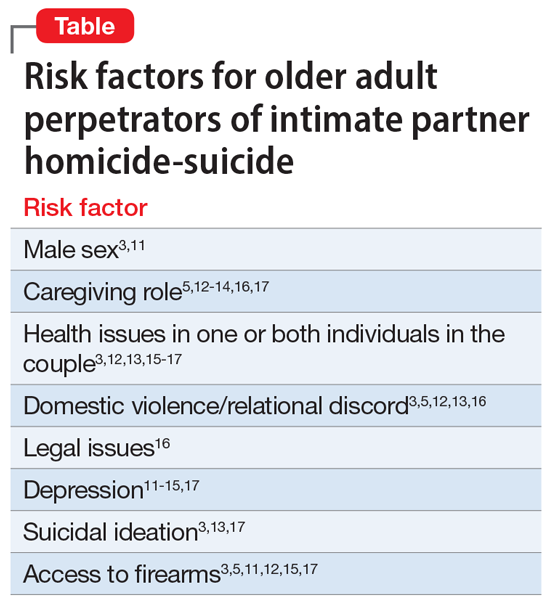
The scarcity and heterogeneity of research regarding older adult homicide-suicide were major limitations to our review. Because most of the studies we identified had a small sample size and limited information regarding the mental health of victims and perpetrators, it would be an overreach to claim to have identified a typical profile of an older perpetrator of homicide-suicide. However, the literature has repeatedly identified several common characteristics of such perpetrators. They are significantly more likely to be men who use firearms to murder their intimate partners and then die by suicide in their home (Table3,5,11-17). Health issues afflicting 1 or both individuals in the couple appear to be a contributing factor, particularly when the perpetrator is in a caregiving role. Relational discord, with or without a history of domestic violence, increases the risk of homicide-suicide. Finally, older perpetrators are highly likely to be depressed and have suicidal ideations.
How COVID-19 affects these risks
Although it is too early to determine if there is a causal relationship between the COVID-19 pandemic and an increase in homicide-suicide, the pandemic is likely to promote risk factors for these events, especially among older adults. Confinement measures put into place during the pandemic context have already been shown to increase rates of domestic violence18 and depression and anxiety among older individuals.7 Furthermore,
Continue to: Late-life psychiatric disorders
Late-life psychiatric disorders
Early recognition and effective treatment of late-life psychiatric disorders is crucial. Unfortunately, depression in geriatric patients is often underdiagnosed and undertreated.20 Older adults have more frequent contact with their primary care physicians, and rarely consult mental health professionals.21,22 Several models of integrated depression care within primary care settings have shown the positive impact of this collaborative approach in treating late-life depression and preventing suicide in older individuals.23 Additionally, because alcohol abuse is also a risk factor for domestic violence and breaking the law in this population,24,25 older adults should be screened for alcohol use disorders, and referred to treatment when necessary.
Take steps to keep patients safe
In the context of the COVID-19 pandemic, there are several steps clinicians need to keep in mind when interacting with older patients:
- Screen for depressive symptoms, suicidality, and alcohol and substance use disorders. Individuals who have tested positive for COVID-19 or who have been in contact with a carrier are a particularly vulnerable population.
- Screen for domestic violence and access to weapons at home.4 Any older adult who has a psychiatric disorder and/or suicide ideation should receive immediate intervention through a social worker that includes providing gun-risk education to other family members or contacting law-enforcement officials.26
- Refer patients with a suspected psychiatric disorder to specialized mental health clinicians. Telemental health services can provide rapid access to subspecialists, allowing patients to be treated from their homes.27 These services need to be promoted among older adults during this critical period and reimbursed by public and private insurance systems to ensure accessibility and affordability.28
- Create psychiatric inpatient units specifically designed for suicidal and/or homicidal patients with COVID-19.
Additionally, informing the public about these major health issues is crucial. The media can raise awareness about domestic violence and depression among older adults; however, this should be done responsibly and with accuracy to prevent the spread of misinformation, confusion, fear, and panic.29
Bottom Line
The mental health burden of the coronavirus disease 2019 pandemic has significantly impacted individuals who are older and most vulnerable. Reducing the incidence of homicide-suicide among older adults requires timely screening and interventions by primary care providers, mental health specialists, social workers, media, and governmental agencies.
Related Resources
- Saeed SA, Hebishi K. The psychiatric consequences of COVID-19: 8 studies. Current Psychiatry. 2020;19(11):22-24,28-30,32-35.
- Schwab-Reese LM, Murfree L, Coppola EC, et al. Homicidesuicide across the lifespan: a mixed methods examination of factors contributing to older adult perpetration. Aging Ment Health. 2020;20:1-9.
1. Christodoulou H. LOCKDOWN ‘MURDER-SUICIDE’ OAP, 71, ‘stabbed wife to death then killed himself as he worried about coping with coronavirus lockdown.’ The Sun. Updated April 4, 2020. Accessed December 22, 2020. https://www.thesun.co.uk/news/11327095/coronavirus-lockdown-murder-suicide-cambridge/
2. Farberov S. Illinois man, 54, shoots dead his wife then kills himself in murder-suicide because he feared they had coronavirus - but tests later show the couple were NOT ill. Updated April 6, 2020. Accessed December 22, 2020. https://www.dailymail.co.uk/news/article-8191933/Man-kills-wife-feared-coronavirus.html
3. Salari S. Patterns of intimate partner homicide suicide in later life: strategies for prevention. Clin Interv Aging. 2007;2(3):441-452.
4. Kotzé C, Roos JL. Homicide–suicide: practical implications for risk reduction and support services at primary care level. South African Family Practice. 2019;61(4):165-169.
5. Malphurs JE, Cohen D. A newspaper surveillance study of homicide-suicide in the United States. Am J Forensic Med Pathol. 2002;23(2):142-148.
6. Eliason S. Murder-suicide: a review of the recent literature. J Am Acad Psychiatry Law. 2009;37(3):371-376.
7. Armitage R, Nellums LB. COVID-19 and the consequences of isolating the elderly. Lancet Public Health. 2020;5(5):e256. doi: 10.1016/S2468-2667(20)30061-X
8. Gunnell D, Appleby L, Arensman E, et al. Suicide risk and prevention during the COVID-19 pandemic. Lancet Psychiatry 2020;7(6):468-471.
9. Gosangi B, Park H, Thomas R, et al. Exacerbation of physical intimate partner violence during COVID-19 pandemic. Radiology. 2021;298(1):E38-E45.
10. Mannix R, Lee LK, Fleegler EW. Coronavirus disease 2019 (COVID-19) and firearms in the United States: will an epidemic of suicide follow? Ann Intern Med. 2020;173(3):228-229.
11. Bourget D, Gagne P, Whitehurst L. Domestic homicide and homicide-suicide: the older offender. J Am Acad Psychiatry Law. 2010;38(3):305-311.
12. Cheung G, Hatters Friedman S, Sundram F. Late-life homicide-suicide: a national case series in New Zealand. Psychogeriatrics. 2016;16(1):76-81.
13. Cohen D, Llorente M, Eisdorfer C. Homicide-suicide in older persons. Am J Psychiatry. 1998;155(3):390-396.
14. Malphurs JE, Eisdorfer C, Cohen D. A comparison of antecedents of homicide-suicide and suicide in older married men. Am J Geriatr Psychiatry. 2001;9(1):49-57.
15. De Koning E, Piette MHA. A retrospective study of murder–suicide at the Forensic Institute of Ghent University, Belgium: 1935–2010. Med Sci Law. 2014;54(2):88-98.
16. Logan JE, Ertl A, Bossarte R. Correlates of intimate partner homicide among male suicide decedents with known intimate partner problems. Suicide Life Threat Behav. 2019;49(6):1693-1706.
17. Malphurs JE, Cohen D. A statewide case-control study of spousal homicide-suicide in older persons. Am J Geriatr Psychiatry. 2005;13(3):211-217.
18. Sanford A. ‘Horrifying surge in domestic violence’ against women amid coronavirus-lockdowns, UN chief warns. Euronews. Published June 4, 2020. Accessed December 22, 2020. https://www.euronews.com/2020/04/06/horrifying-surge-in-domestic-violence-against-women-amid-coronavirus-lockdowns-un-chief-w
19. Appel JM. Intimate partner homicide in elderly populations. In: Friedman SH, ed. Family murder: pathologies of love and hate. American Psychiatric Association Publishing; 2019:131-142.
20. Hall CA, Reynolds-III CF. Late-life depression in the primary care setting: challenges, collaborative care, and prevention. Maturitas. 2014;79(2):147-152.
21. Unützer J. Diagnosis and treatment of older adults with depression in primary care. Biological Psychiatry. 2002;52(3):285-292.
22. Byers AL, Arean PA, Yaffe K. Low use of mental health services among older Americans with mood and anxiety disorders. Psychiatr Serv. 2012;63(1):66-72.
23. Bruce ML, Sirey JA. Integrated care for depression in older primary care patients. Can J Psychiatry. 2018;63(7):439-446.
24. Rao R, Roche A. Substance misuse in older people. BMJ. 2017;358:j3885. doi: 10.1136/bmj.j3885
25. Ghossoub E, Khoury R. Prevalence and correlates of criminal behavior among the non-institutionalized elderly: results from the National Survey on Drug Use and Health. J Geriatr Psychiatry Neurol. 2018;31(4):211-222.
26. Slater MAG. Older adults at risk for suicide. In: Berkman B. Handbook of social work in health and aging. Oxford University Press; 2006:149-161.
27. Hollander JE, Carr BG. Virtually perfect? Telemedicine for Covid-19. N Engl J Med. 2020;382(18):1679-1681.
28. Centers for Medicare & Medicaid Services. President Trump expands telehealth benefits for Medicare beneficiaries during COVID-19 outbreak. Published March 17, 2020. Accessed December 23, 2020. https://www.cms.gov/newsroom/press-releases/president-trump-expands-telehealth-benefits-medicare-beneficiaries-during-covid-19-outbreak
29. Mian A, Khan S. Coronavirus: the spread of misinformation. BMC Med. 2020;18(1):89.
On March 25, 2020, in Cambridge, United Kingdom, a 71-year-old man stabbed his 71-year-old wife before suffocating himself to death. The couple was reportedly anxious about the coronavirus disease 2019 (COVID-19) pandemic lockdown measures and were on the verge of running out of food and medicine.1
One week later, in Chicago, Illinois, a 54-year-old man shot and killed his female partner, age 54, before killing himself. The couple was tested for COVID-19 2 days earlier and the man believed they had contracted the virus; however, the test results for both of them had come back negative.2
Intimate partner homicide-suicide is the most dramatic domestic abuse outcome.3 Homicide-suicide is defined as “homicide committed by a person who subsequently commits suicide within one week of the homicide. In most cases the subsequent suicide occurs within a 24-hour period.”4 Approximately one-quarter of all homicide-suicides are committed by persons age ≥55 years.5,6 We believe that during the COVID-19 pandemic, the risk of homicide-suicide among older adults may be increased due to several factors, including:
- physical distancing and quarantine measures. Protocols established to slow the spread of the virus may be associated with increased rates of depression and anxiety7 and an increased risk of suicide among older adults8
- increased intimate partner violence9
- increased firearm ownership rates in the United States.10
In this article, we review studies that identified risk factors for homicide-suicide among older adults, discuss the impact the COVID-19 pandemic has had on these risks, and describe steps clinicians can take to intervene.
A review of the literature
To better characterize the perpetrators of older adult homicide-suicide, we conducted a literature search of relevant terms. We identified 9 original research publications that examined homicide-suicide in older adults.
Bourget et al11 (2010) reviewed coroners’ charts of individuals killed by an older (age ≥65) spouse or family member from 1992 through 2007 in Quebec, Canada. They identified 19 cases of homicide-suicide, 17 (90%) of which were perpetrated by men. Perpetrators and victims were married (63%), in common-law relationships (16%), or separated/divorced (16%). A history of domestic violence was documented in 4 (21%) cases. The authors found that 13 of 15 perpetrators (87%) had “major depression” and 2 perpetrators had a psychotic disorder. Substance use at the time of the event was confirmed in 6 (32%) cases. Firearms and strangulation were the top methods used to carry out the homicide-suicide.11
Cheung et al12 (2016) conducted a review of coroners’ records of homicide-suicide cases among individuals age ≥65 in New Zealand from 2007 through 2012. In all 4 cases, the perpetrators were men, and their victims were predominantly female, live-in family members. Two cases involved men with a history of domestic violence who were undergoing significant changes in their home and social lives. Both men had a history suggestive of depression and used a firearm to carry out the homicide-suicide.12
Continue to: Cohen et al
Cohen et al13 (1998) conducted a review of coroners’ records from 1988 through 1994 in 2 regions in Florida. They found 48 intimate partner homicide-suicide cases among “old couples” (age ≥55). All were perpetrated by men. The authors identified sociocultural differences in risk factors between the 2 regions. In west-central Florida, perpetrators and victims were predominantly white and in a spousal relationship. Domestic violence was documented in <4% of cases. Approximately 55% of the couples were reported to be ill, and a substantial proportion were documented to be declining in health. One-quarter of the perpetrators and one-third of the victims had “pain and suffering.” More than one-third of perpetrators were reported to have “depression,” 15% were reported to have talked about suicide, and 4% had a history of a suicide attempt. Only 11% of perpetrators were described as abusing substances.
The authors noted several differences in cases in southeastern Florida. Approximately two-thirds of the couples were Hispanic, and 14% had a history of domestic violence. A minority of the couples were in a live-in relationship. Less than 15% of the perpetrators and victims were described as having a decline in health. Additionally, only 19% of perpetrators were reported to have “depression,” and none of the perpetrators had a documented history of attempted suicide or substance abuse. No information was provided regarding the methods used to carry out the homicide-suicide in the southeastern region.13 Financial stress was not a factor in either region.
Malphurs et al14 (2001) used the same database described in the Cohen et al13 study to compare 27 perpetrators of homicide-suicide to 36 age-matched suicide decedents in west central Florida. They found that homicide-suicide perpetrators were significantly less likely to have health problems and were 3 times more likely to be caregivers to their spouses. Approximately 52% of perpetrators had at least 1 documented psychiatric symptom (“depression” and/or substance abuse or other), but only 5% were seeking mental health services at the time of death.14
De Koning and Piette15 (2014) conducted a retrospective medicolegal chart review from 1935 to 2010 to identify homicide-suicide cases in West and East Flanders, Belgium. They found 19 cases of intimate partner homicide-suicide committed by offenders age ≥55 years. Ninety-five percent of the perpetrators were men who killed their female partners. In one-quarter of the cases, either the perpetrator or the victim had a health issue; 21% of the perpetrators were documented as having depression and 27% had alcohol intoxication at the time of death. A motive was documented in 14 out of 19 cases; “mercy killing” was determined as the motive in 6 (43%) cases and “amorous jealousy” in 5 cases (36%).15 Starting in the 1970s, firearms were the most prevalent method used to kill a partner.
Logan et al16 (2019) used data from the National Violent Death Reporting System between 2003 and 2015 to identify characteristics that differentiated male suicide decedents from male perpetrators of intimate partner homicide-suicide. They found that men age 50 to 64 years were 3 times more likely than men age 18 to 34 years to commit intimate partner homicide-suicide, and that men age ≥65 years were approximately 5 times more likely than men age 18 to 34 years to commit intimate partner homicide-suicide. The authors found that approximately 22% of all perpetrators had a documented history of physical domestic violence, and close to 17% had a prior interaction with the criminal justice system. Furthermore, one-third of perpetrators had relationship difficulties and were in the process of a breakup. Health issues were prevalent in 34% of the victims and 26% of the perpetrators. Perpetrator-caregiver burden was reported as a contributing factor for homicide-suicide in 16% of cases. In 27% of cases, multiple health-related contributing factors were mentioned.16
Continue to: Malphurs and Cohen
Malphurs and Cohen5 (2002) reviewed American newspapers from 1997 through 1999 and identified 673 homicide-suicide events, of which 152 (27%) were committed by individuals age ≥55 years. The victims and perpetrators (95% of which were men) were intimate partners in three-quarters of cases. In nearly one-third of cases, caregiving was a contributing factor for the homicide-suicide. A history of or a pending divorce was reported in nearly 14% of cases. Substance use history was rarely recorded. Firearms were used in 88% of the homicide-suicide cases.5
Malphurs and Cohen17 (2005) reviewed coroner records between 1998 and 1999 in Florida and compared 20 cases of intimate partner homicide-suicide involving perpetrators age ≥55 years with matched suicide decedents. They found that 60% of homicide-suicide perpetrators had documented health issues. The authors reported that a “recent change in health status” was more prevalent among perpetrators compared with decedents. Perpetrators were also more likely to be caregivers to their spouses. The authors found that 65% of perpetrators were reported to have a “depressed mood” and 15% of perpetrators had reportedly threatened suicide prior to the incident. However, none of the perpetrators tested positive for antidepressants as documented on post-mortem toxicology reports. Firearms were used in 100% of homicide-suicide cases.17
Salari3 (2007) reviewed multiple American media sources and published police reports between 1999 and 2005 to retrieve data about intimate partner homicide-suicide events in the United States. There were 225 events identified where the perpetrator and/or the victim were age ≥60 years. Ninety-six percent of the perpetrators were men and most homicide-suicide events were committed at the home. A history of domestic violence was reported in 14% of homicide-suicide cases. Thirteen percent of couples were separated or divorced. The perpetrator and/or victim had health issues in 124 (55%) events. Dementia was reported in 7.5% of cases, but overwhelmingly among the victims. Substance abuse was rarely mentioned as a contributing factor. In three-quarters of cases where a motive was described, the perpetrator was “suicidal”; however, a “suicide pact” was mentioned in only 4% of cases. Firearms were used in 87% of cases.3
Focus on common risk factors
The scarcity and heterogeneity of research regarding older adult homicide-suicide were major limitations to our review. Because most of the studies we identified had a small sample size and limited information regarding the mental health of victims and perpetrators, it would be an overreach to claim to have identified a typical profile of an older perpetrator of homicide-suicide. However, the literature has repeatedly identified several common characteristics of such perpetrators. They are significantly more likely to be men who use firearms to murder their intimate partners and then die by suicide in their home (Table3,5,11-17). Health issues afflicting 1 or both individuals in the couple appear to be a contributing factor, particularly when the perpetrator is in a caregiving role. Relational discord, with or without a history of domestic violence, increases the risk of homicide-suicide. Finally, older perpetrators are highly likely to be depressed and have suicidal ideations.
How COVID-19 affects these risks
Although it is too early to determine if there is a causal relationship between the COVID-19 pandemic and an increase in homicide-suicide, the pandemic is likely to promote risk factors for these events, especially among older adults. Confinement measures put into place during the pandemic context have already been shown to increase rates of domestic violence18 and depression and anxiety among older individuals.7 Furthermore,
Continue to: Late-life psychiatric disorders
Late-life psychiatric disorders
Early recognition and effective treatment of late-life psychiatric disorders is crucial. Unfortunately, depression in geriatric patients is often underdiagnosed and undertreated.20 Older adults have more frequent contact with their primary care physicians, and rarely consult mental health professionals.21,22 Several models of integrated depression care within primary care settings have shown the positive impact of this collaborative approach in treating late-life depression and preventing suicide in older individuals.23 Additionally, because alcohol abuse is also a risk factor for domestic violence and breaking the law in this population,24,25 older adults should be screened for alcohol use disorders, and referred to treatment when necessary.
Take steps to keep patients safe
In the context of the COVID-19 pandemic, there are several steps clinicians need to keep in mind when interacting with older patients:
- Screen for depressive symptoms, suicidality, and alcohol and substance use disorders. Individuals who have tested positive for COVID-19 or who have been in contact with a carrier are a particularly vulnerable population.
- Screen for domestic violence and access to weapons at home.4 Any older adult who has a psychiatric disorder and/or suicide ideation should receive immediate intervention through a social worker that includes providing gun-risk education to other family members or contacting law-enforcement officials.26
- Refer patients with a suspected psychiatric disorder to specialized mental health clinicians. Telemental health services can provide rapid access to subspecialists, allowing patients to be treated from their homes.27 These services need to be promoted among older adults during this critical period and reimbursed by public and private insurance systems to ensure accessibility and affordability.28
- Create psychiatric inpatient units specifically designed for suicidal and/or homicidal patients with COVID-19.
Additionally, informing the public about these major health issues is crucial. The media can raise awareness about domestic violence and depression among older adults; however, this should be done responsibly and with accuracy to prevent the spread of misinformation, confusion, fear, and panic.29
Bottom Line
The mental health burden of the coronavirus disease 2019 pandemic has significantly impacted individuals who are older and most vulnerable. Reducing the incidence of homicide-suicide among older adults requires timely screening and interventions by primary care providers, mental health specialists, social workers, media, and governmental agencies.
Related Resources
- Saeed SA, Hebishi K. The psychiatric consequences of COVID-19: 8 studies. Current Psychiatry. 2020;19(11):22-24,28-30,32-35.
- Schwab-Reese LM, Murfree L, Coppola EC, et al. Homicidesuicide across the lifespan: a mixed methods examination of factors contributing to older adult perpetration. Aging Ment Health. 2020;20:1-9.
On March 25, 2020, in Cambridge, United Kingdom, a 71-year-old man stabbed his 71-year-old wife before suffocating himself to death. The couple was reportedly anxious about the coronavirus disease 2019 (COVID-19) pandemic lockdown measures and were on the verge of running out of food and medicine.1
One week later, in Chicago, Illinois, a 54-year-old man shot and killed his female partner, age 54, before killing himself. The couple was tested for COVID-19 2 days earlier and the man believed they had contracted the virus; however, the test results for both of them had come back negative.2
Intimate partner homicide-suicide is the most dramatic domestic abuse outcome.3 Homicide-suicide is defined as “homicide committed by a person who subsequently commits suicide within one week of the homicide. In most cases the subsequent suicide occurs within a 24-hour period.”4 Approximately one-quarter of all homicide-suicides are committed by persons age ≥55 years.5,6 We believe that during the COVID-19 pandemic, the risk of homicide-suicide among older adults may be increased due to several factors, including:
- physical distancing and quarantine measures. Protocols established to slow the spread of the virus may be associated with increased rates of depression and anxiety7 and an increased risk of suicide among older adults8
- increased intimate partner violence9
- increased firearm ownership rates in the United States.10
In this article, we review studies that identified risk factors for homicide-suicide among older adults, discuss the impact the COVID-19 pandemic has had on these risks, and describe steps clinicians can take to intervene.
A review of the literature
To better characterize the perpetrators of older adult homicide-suicide, we conducted a literature search of relevant terms. We identified 9 original research publications that examined homicide-suicide in older adults.
Bourget et al11 (2010) reviewed coroners’ charts of individuals killed by an older (age ≥65) spouse or family member from 1992 through 2007 in Quebec, Canada. They identified 19 cases of homicide-suicide, 17 (90%) of which were perpetrated by men. Perpetrators and victims were married (63%), in common-law relationships (16%), or separated/divorced (16%). A history of domestic violence was documented in 4 (21%) cases. The authors found that 13 of 15 perpetrators (87%) had “major depression” and 2 perpetrators had a psychotic disorder. Substance use at the time of the event was confirmed in 6 (32%) cases. Firearms and strangulation were the top methods used to carry out the homicide-suicide.11
Cheung et al12 (2016) conducted a review of coroners’ records of homicide-suicide cases among individuals age ≥65 in New Zealand from 2007 through 2012. In all 4 cases, the perpetrators were men, and their victims were predominantly female, live-in family members. Two cases involved men with a history of domestic violence who were undergoing significant changes in their home and social lives. Both men had a history suggestive of depression and used a firearm to carry out the homicide-suicide.12
Continue to: Cohen et al
Cohen et al13 (1998) conducted a review of coroners’ records from 1988 through 1994 in 2 regions in Florida. They found 48 intimate partner homicide-suicide cases among “old couples” (age ≥55). All were perpetrated by men. The authors identified sociocultural differences in risk factors between the 2 regions. In west-central Florida, perpetrators and victims were predominantly white and in a spousal relationship. Domestic violence was documented in <4% of cases. Approximately 55% of the couples were reported to be ill, and a substantial proportion were documented to be declining in health. One-quarter of the perpetrators and one-third of the victims had “pain and suffering.” More than one-third of perpetrators were reported to have “depression,” 15% were reported to have talked about suicide, and 4% had a history of a suicide attempt. Only 11% of perpetrators were described as abusing substances.
The authors noted several differences in cases in southeastern Florida. Approximately two-thirds of the couples were Hispanic, and 14% had a history of domestic violence. A minority of the couples were in a live-in relationship. Less than 15% of the perpetrators and victims were described as having a decline in health. Additionally, only 19% of perpetrators were reported to have “depression,” and none of the perpetrators had a documented history of attempted suicide or substance abuse. No information was provided regarding the methods used to carry out the homicide-suicide in the southeastern region.13 Financial stress was not a factor in either region.
Malphurs et al14 (2001) used the same database described in the Cohen et al13 study to compare 27 perpetrators of homicide-suicide to 36 age-matched suicide decedents in west central Florida. They found that homicide-suicide perpetrators were significantly less likely to have health problems and were 3 times more likely to be caregivers to their spouses. Approximately 52% of perpetrators had at least 1 documented psychiatric symptom (“depression” and/or substance abuse or other), but only 5% were seeking mental health services at the time of death.14
De Koning and Piette15 (2014) conducted a retrospective medicolegal chart review from 1935 to 2010 to identify homicide-suicide cases in West and East Flanders, Belgium. They found 19 cases of intimate partner homicide-suicide committed by offenders age ≥55 years. Ninety-five percent of the perpetrators were men who killed their female partners. In one-quarter of the cases, either the perpetrator or the victim had a health issue; 21% of the perpetrators were documented as having depression and 27% had alcohol intoxication at the time of death. A motive was documented in 14 out of 19 cases; “mercy killing” was determined as the motive in 6 (43%) cases and “amorous jealousy” in 5 cases (36%).15 Starting in the 1970s, firearms were the most prevalent method used to kill a partner.
Logan et al16 (2019) used data from the National Violent Death Reporting System between 2003 and 2015 to identify characteristics that differentiated male suicide decedents from male perpetrators of intimate partner homicide-suicide. They found that men age 50 to 64 years were 3 times more likely than men age 18 to 34 years to commit intimate partner homicide-suicide, and that men age ≥65 years were approximately 5 times more likely than men age 18 to 34 years to commit intimate partner homicide-suicide. The authors found that approximately 22% of all perpetrators had a documented history of physical domestic violence, and close to 17% had a prior interaction with the criminal justice system. Furthermore, one-third of perpetrators had relationship difficulties and were in the process of a breakup. Health issues were prevalent in 34% of the victims and 26% of the perpetrators. Perpetrator-caregiver burden was reported as a contributing factor for homicide-suicide in 16% of cases. In 27% of cases, multiple health-related contributing factors were mentioned.16
Continue to: Malphurs and Cohen
Malphurs and Cohen5 (2002) reviewed American newspapers from 1997 through 1999 and identified 673 homicide-suicide events, of which 152 (27%) were committed by individuals age ≥55 years. The victims and perpetrators (95% of which were men) were intimate partners in three-quarters of cases. In nearly one-third of cases, caregiving was a contributing factor for the homicide-suicide. A history of or a pending divorce was reported in nearly 14% of cases. Substance use history was rarely recorded. Firearms were used in 88% of the homicide-suicide cases.5
Malphurs and Cohen17 (2005) reviewed coroner records between 1998 and 1999 in Florida and compared 20 cases of intimate partner homicide-suicide involving perpetrators age ≥55 years with matched suicide decedents. They found that 60% of homicide-suicide perpetrators had documented health issues. The authors reported that a “recent change in health status” was more prevalent among perpetrators compared with decedents. Perpetrators were also more likely to be caregivers to their spouses. The authors found that 65% of perpetrators were reported to have a “depressed mood” and 15% of perpetrators had reportedly threatened suicide prior to the incident. However, none of the perpetrators tested positive for antidepressants as documented on post-mortem toxicology reports. Firearms were used in 100% of homicide-suicide cases.17
Salari3 (2007) reviewed multiple American media sources and published police reports between 1999 and 2005 to retrieve data about intimate partner homicide-suicide events in the United States. There were 225 events identified where the perpetrator and/or the victim were age ≥60 years. Ninety-six percent of the perpetrators were men and most homicide-suicide events were committed at the home. A history of domestic violence was reported in 14% of homicide-suicide cases. Thirteen percent of couples were separated or divorced. The perpetrator and/or victim had health issues in 124 (55%) events. Dementia was reported in 7.5% of cases, but overwhelmingly among the victims. Substance abuse was rarely mentioned as a contributing factor. In three-quarters of cases where a motive was described, the perpetrator was “suicidal”; however, a “suicide pact” was mentioned in only 4% of cases. Firearms were used in 87% of cases.3
Focus on common risk factors
The scarcity and heterogeneity of research regarding older adult homicide-suicide were major limitations to our review. Because most of the studies we identified had a small sample size and limited information regarding the mental health of victims and perpetrators, it would be an overreach to claim to have identified a typical profile of an older perpetrator of homicide-suicide. However, the literature has repeatedly identified several common characteristics of such perpetrators. They are significantly more likely to be men who use firearms to murder their intimate partners and then die by suicide in their home (Table3,5,11-17). Health issues afflicting 1 or both individuals in the couple appear to be a contributing factor, particularly when the perpetrator is in a caregiving role. Relational discord, with or without a history of domestic violence, increases the risk of homicide-suicide. Finally, older perpetrators are highly likely to be depressed and have suicidal ideations.
How COVID-19 affects these risks
Although it is too early to determine if there is a causal relationship between the COVID-19 pandemic and an increase in homicide-suicide, the pandemic is likely to promote risk factors for these events, especially among older adults. Confinement measures put into place during the pandemic context have already been shown to increase rates of domestic violence18 and depression and anxiety among older individuals.7 Furthermore,
Continue to: Late-life psychiatric disorders
Late-life psychiatric disorders
Early recognition and effective treatment of late-life psychiatric disorders is crucial. Unfortunately, depression in geriatric patients is often underdiagnosed and undertreated.20 Older adults have more frequent contact with their primary care physicians, and rarely consult mental health professionals.21,22 Several models of integrated depression care within primary care settings have shown the positive impact of this collaborative approach in treating late-life depression and preventing suicide in older individuals.23 Additionally, because alcohol abuse is also a risk factor for domestic violence and breaking the law in this population,24,25 older adults should be screened for alcohol use disorders, and referred to treatment when necessary.
Take steps to keep patients safe
In the context of the COVID-19 pandemic, there are several steps clinicians need to keep in mind when interacting with older patients:
- Screen for depressive symptoms, suicidality, and alcohol and substance use disorders. Individuals who have tested positive for COVID-19 or who have been in contact with a carrier are a particularly vulnerable population.
- Screen for domestic violence and access to weapons at home.4 Any older adult who has a psychiatric disorder and/or suicide ideation should receive immediate intervention through a social worker that includes providing gun-risk education to other family members or contacting law-enforcement officials.26
- Refer patients with a suspected psychiatric disorder to specialized mental health clinicians. Telemental health services can provide rapid access to subspecialists, allowing patients to be treated from their homes.27 These services need to be promoted among older adults during this critical period and reimbursed by public and private insurance systems to ensure accessibility and affordability.28
- Create psychiatric inpatient units specifically designed for suicidal and/or homicidal patients with COVID-19.
Additionally, informing the public about these major health issues is crucial. The media can raise awareness about domestic violence and depression among older adults; however, this should be done responsibly and with accuracy to prevent the spread of misinformation, confusion, fear, and panic.29
Bottom Line
The mental health burden of the coronavirus disease 2019 pandemic has significantly impacted individuals who are older and most vulnerable. Reducing the incidence of homicide-suicide among older adults requires timely screening and interventions by primary care providers, mental health specialists, social workers, media, and governmental agencies.
Related Resources
- Saeed SA, Hebishi K. The psychiatric consequences of COVID-19: 8 studies. Current Psychiatry. 2020;19(11):22-24,28-30,32-35.
- Schwab-Reese LM, Murfree L, Coppola EC, et al. Homicidesuicide across the lifespan: a mixed methods examination of factors contributing to older adult perpetration. Aging Ment Health. 2020;20:1-9.
1. Christodoulou H. LOCKDOWN ‘MURDER-SUICIDE’ OAP, 71, ‘stabbed wife to death then killed himself as he worried about coping with coronavirus lockdown.’ The Sun. Updated April 4, 2020. Accessed December 22, 2020. https://www.thesun.co.uk/news/11327095/coronavirus-lockdown-murder-suicide-cambridge/
2. Farberov S. Illinois man, 54, shoots dead his wife then kills himself in murder-suicide because he feared they had coronavirus - but tests later show the couple were NOT ill. Updated April 6, 2020. Accessed December 22, 2020. https://www.dailymail.co.uk/news/article-8191933/Man-kills-wife-feared-coronavirus.html
3. Salari S. Patterns of intimate partner homicide suicide in later life: strategies for prevention. Clin Interv Aging. 2007;2(3):441-452.
4. Kotzé C, Roos JL. Homicide–suicide: practical implications for risk reduction and support services at primary care level. South African Family Practice. 2019;61(4):165-169.
5. Malphurs JE, Cohen D. A newspaper surveillance study of homicide-suicide in the United States. Am J Forensic Med Pathol. 2002;23(2):142-148.
6. Eliason S. Murder-suicide: a review of the recent literature. J Am Acad Psychiatry Law. 2009;37(3):371-376.
7. Armitage R, Nellums LB. COVID-19 and the consequences of isolating the elderly. Lancet Public Health. 2020;5(5):e256. doi: 10.1016/S2468-2667(20)30061-X
8. Gunnell D, Appleby L, Arensman E, et al. Suicide risk and prevention during the COVID-19 pandemic. Lancet Psychiatry 2020;7(6):468-471.
9. Gosangi B, Park H, Thomas R, et al. Exacerbation of physical intimate partner violence during COVID-19 pandemic. Radiology. 2021;298(1):E38-E45.
10. Mannix R, Lee LK, Fleegler EW. Coronavirus disease 2019 (COVID-19) and firearms in the United States: will an epidemic of suicide follow? Ann Intern Med. 2020;173(3):228-229.
11. Bourget D, Gagne P, Whitehurst L. Domestic homicide and homicide-suicide: the older offender. J Am Acad Psychiatry Law. 2010;38(3):305-311.
12. Cheung G, Hatters Friedman S, Sundram F. Late-life homicide-suicide: a national case series in New Zealand. Psychogeriatrics. 2016;16(1):76-81.
13. Cohen D, Llorente M, Eisdorfer C. Homicide-suicide in older persons. Am J Psychiatry. 1998;155(3):390-396.
14. Malphurs JE, Eisdorfer C, Cohen D. A comparison of antecedents of homicide-suicide and suicide in older married men. Am J Geriatr Psychiatry. 2001;9(1):49-57.
15. De Koning E, Piette MHA. A retrospective study of murder–suicide at the Forensic Institute of Ghent University, Belgium: 1935–2010. Med Sci Law. 2014;54(2):88-98.
16. Logan JE, Ertl A, Bossarte R. Correlates of intimate partner homicide among male suicide decedents with known intimate partner problems. Suicide Life Threat Behav. 2019;49(6):1693-1706.
17. Malphurs JE, Cohen D. A statewide case-control study of spousal homicide-suicide in older persons. Am J Geriatr Psychiatry. 2005;13(3):211-217.
18. Sanford A. ‘Horrifying surge in domestic violence’ against women amid coronavirus-lockdowns, UN chief warns. Euronews. Published June 4, 2020. Accessed December 22, 2020. https://www.euronews.com/2020/04/06/horrifying-surge-in-domestic-violence-against-women-amid-coronavirus-lockdowns-un-chief-w
19. Appel JM. Intimate partner homicide in elderly populations. In: Friedman SH, ed. Family murder: pathologies of love and hate. American Psychiatric Association Publishing; 2019:131-142.
20. Hall CA, Reynolds-III CF. Late-life depression in the primary care setting: challenges, collaborative care, and prevention. Maturitas. 2014;79(2):147-152.
21. Unützer J. Diagnosis and treatment of older adults with depression in primary care. Biological Psychiatry. 2002;52(3):285-292.
22. Byers AL, Arean PA, Yaffe K. Low use of mental health services among older Americans with mood and anxiety disorders. Psychiatr Serv. 2012;63(1):66-72.
23. Bruce ML, Sirey JA. Integrated care for depression in older primary care patients. Can J Psychiatry. 2018;63(7):439-446.
24. Rao R, Roche A. Substance misuse in older people. BMJ. 2017;358:j3885. doi: 10.1136/bmj.j3885
25. Ghossoub E, Khoury R. Prevalence and correlates of criminal behavior among the non-institutionalized elderly: results from the National Survey on Drug Use and Health. J Geriatr Psychiatry Neurol. 2018;31(4):211-222.
26. Slater MAG. Older adults at risk for suicide. In: Berkman B. Handbook of social work in health and aging. Oxford University Press; 2006:149-161.
27. Hollander JE, Carr BG. Virtually perfect? Telemedicine for Covid-19. N Engl J Med. 2020;382(18):1679-1681.
28. Centers for Medicare & Medicaid Services. President Trump expands telehealth benefits for Medicare beneficiaries during COVID-19 outbreak. Published March 17, 2020. Accessed December 23, 2020. https://www.cms.gov/newsroom/press-releases/president-trump-expands-telehealth-benefits-medicare-beneficiaries-during-covid-19-outbreak
29. Mian A, Khan S. Coronavirus: the spread of misinformation. BMC Med. 2020;18(1):89.
1. Christodoulou H. LOCKDOWN ‘MURDER-SUICIDE’ OAP, 71, ‘stabbed wife to death then killed himself as he worried about coping with coronavirus lockdown.’ The Sun. Updated April 4, 2020. Accessed December 22, 2020. https://www.thesun.co.uk/news/11327095/coronavirus-lockdown-murder-suicide-cambridge/
2. Farberov S. Illinois man, 54, shoots dead his wife then kills himself in murder-suicide because he feared they had coronavirus - but tests later show the couple were NOT ill. Updated April 6, 2020. Accessed December 22, 2020. https://www.dailymail.co.uk/news/article-8191933/Man-kills-wife-feared-coronavirus.html
3. Salari S. Patterns of intimate partner homicide suicide in later life: strategies for prevention. Clin Interv Aging. 2007;2(3):441-452.
4. Kotzé C, Roos JL. Homicide–suicide: practical implications for risk reduction and support services at primary care level. South African Family Practice. 2019;61(4):165-169.
5. Malphurs JE, Cohen D. A newspaper surveillance study of homicide-suicide in the United States. Am J Forensic Med Pathol. 2002;23(2):142-148.
6. Eliason S. Murder-suicide: a review of the recent literature. J Am Acad Psychiatry Law. 2009;37(3):371-376.
7. Armitage R, Nellums LB. COVID-19 and the consequences of isolating the elderly. Lancet Public Health. 2020;5(5):e256. doi: 10.1016/S2468-2667(20)30061-X
8. Gunnell D, Appleby L, Arensman E, et al. Suicide risk and prevention during the COVID-19 pandemic. Lancet Psychiatry 2020;7(6):468-471.
9. Gosangi B, Park H, Thomas R, et al. Exacerbation of physical intimate partner violence during COVID-19 pandemic. Radiology. 2021;298(1):E38-E45.
10. Mannix R, Lee LK, Fleegler EW. Coronavirus disease 2019 (COVID-19) and firearms in the United States: will an epidemic of suicide follow? Ann Intern Med. 2020;173(3):228-229.
11. Bourget D, Gagne P, Whitehurst L. Domestic homicide and homicide-suicide: the older offender. J Am Acad Psychiatry Law. 2010;38(3):305-311.
12. Cheung G, Hatters Friedman S, Sundram F. Late-life homicide-suicide: a national case series in New Zealand. Psychogeriatrics. 2016;16(1):76-81.
13. Cohen D, Llorente M, Eisdorfer C. Homicide-suicide in older persons. Am J Psychiatry. 1998;155(3):390-396.
14. Malphurs JE, Eisdorfer C, Cohen D. A comparison of antecedents of homicide-suicide and suicide in older married men. Am J Geriatr Psychiatry. 2001;9(1):49-57.
15. De Koning E, Piette MHA. A retrospective study of murder–suicide at the Forensic Institute of Ghent University, Belgium: 1935–2010. Med Sci Law. 2014;54(2):88-98.
16. Logan JE, Ertl A, Bossarte R. Correlates of intimate partner homicide among male suicide decedents with known intimate partner problems. Suicide Life Threat Behav. 2019;49(6):1693-1706.
17. Malphurs JE, Cohen D. A statewide case-control study of spousal homicide-suicide in older persons. Am J Geriatr Psychiatry. 2005;13(3):211-217.
18. Sanford A. ‘Horrifying surge in domestic violence’ against women amid coronavirus-lockdowns, UN chief warns. Euronews. Published June 4, 2020. Accessed December 22, 2020. https://www.euronews.com/2020/04/06/horrifying-surge-in-domestic-violence-against-women-amid-coronavirus-lockdowns-un-chief-w
19. Appel JM. Intimate partner homicide in elderly populations. In: Friedman SH, ed. Family murder: pathologies of love and hate. American Psychiatric Association Publishing; 2019:131-142.
20. Hall CA, Reynolds-III CF. Late-life depression in the primary care setting: challenges, collaborative care, and prevention. Maturitas. 2014;79(2):147-152.
21. Unützer J. Diagnosis and treatment of older adults with depression in primary care. Biological Psychiatry. 2002;52(3):285-292.
22. Byers AL, Arean PA, Yaffe K. Low use of mental health services among older Americans with mood and anxiety disorders. Psychiatr Serv. 2012;63(1):66-72.
23. Bruce ML, Sirey JA. Integrated care for depression in older primary care patients. Can J Psychiatry. 2018;63(7):439-446.
24. Rao R, Roche A. Substance misuse in older people. BMJ. 2017;358:j3885. doi: 10.1136/bmj.j3885
25. Ghossoub E, Khoury R. Prevalence and correlates of criminal behavior among the non-institutionalized elderly: results from the National Survey on Drug Use and Health. J Geriatr Psychiatry Neurol. 2018;31(4):211-222.
26. Slater MAG. Older adults at risk for suicide. In: Berkman B. Handbook of social work in health and aging. Oxford University Press; 2006:149-161.
27. Hollander JE, Carr BG. Virtually perfect? Telemedicine for Covid-19. N Engl J Med. 2020;382(18):1679-1681.
28. Centers for Medicare & Medicaid Services. President Trump expands telehealth benefits for Medicare beneficiaries during COVID-19 outbreak. Published March 17, 2020. Accessed December 23, 2020. https://www.cms.gov/newsroom/press-releases/president-trump-expands-telehealth-benefits-medicare-beneficiaries-during-covid-19-outbreak
29. Mian A, Khan S. Coronavirus: the spread of misinformation. BMC Med. 2020;18(1):89.

Plagues that will haunt us long after the COVID-19 pandemic is gone
As we struggle to gradually emerge from the horrid coronavirus disease 2019 (COVID-19) pandemic that has disrupted our lives and killed hundreds of thousands of people in the United States, we harbor the hope that life will return to “normal.” But while it will certainly be a great relief to put this deadly virus behind us, many other epidemics will continue to plague our society and taint our culture.
Scientific ingenuity has led to the development of several vaccines in record time (aka “warp speed”) that will help defeat the deadly scourge of COVID-19. The pandemic is likely to peter out 2 years after its onset. We will all be grateful for such a rapid resolution of the worst health crisis the world has faced in a century, which will enable medical, economic, and social recovery. But as we eventually resume our lives and rejoice in resuming the pursuit of happiness, we will quickly realize that all is not well in our society just because the viral pandemic is gone.
Perhaps the ordeal of the COVID-19 pandemic, and the agony that was universally shared, will open our collective eyes to a jarring reality: many other epidemics will continue to permeate society and cause endless grief and suffering to many of our fellow humans. And thanks to our training as psychiatric physicians, we have developed extra “receptors” to the darker side of the human condition. As we help many of our psychiatric patients rendered sicker under the unbearable stress of the pandemic, we must not overlook the plight of so many others who do not show up in our clinics for health care, yet suffer enormously but imperceptibly. And no vaccine can come to the rescue of those who continue to live in quiet desperation.
Long-standing epidemics
It is truly unfortunate that many of the epidemics I am referring to have persisted for so long that they have become “fixtures” of contemporary societies. They have become “endemic epidemics” with no urgency to squelch them, as with the COVID-19 pandemic. The benign neglect that perpetuates these serious epidemics has had a malignant effect of “grudging resignation” that nothing can be done to reverse them. Unlike the viral epidemic that engulfed everyone around the world and triggered a massive and unified push to defeat the virus, these long-standing epidemics continue to afflict subgroups who are left to fend for themselves. These individuals deserve our empathy and warrant our determination to lift them from their miserable existence.
Consider some of the widespread epidemics that preceded the pandemic and will, in all likelihood, persist after the pandemic’s burden is lifted:
- millions of people living in poverty and hunger
- widespread racism
- smoldering social injustice
- appalling human trafficking, especially targeting children and women
- child abuse and neglect that leads to psychosis, depression, and suicide in adulthood
- gun violence, which kills many innocent people
- domestic violence that inflicts both physical and mental harm on families
- suicide, both attempts and completions, which continues to increase annually
- the festering stigma of mental illness that adds insult to injury for psychiatric patients
- alcohol and drug addictions, which destroy lives and corrode the fabric of society
- lack of access to mental health care for millions of people who need it
- lack of parity for psychiatric disorders, which is so unjust for our patients
- venomous political hatred and hyperpartisanship, which permeates our culture and can lead to violence, as we recently witnessed
- physician burnout, due to many causes, even before the stresses of COVID-19
- the ongoing agony of wars and terrorism, including dangerous cyberattacks
- the deleterious effect of social media on everyone, especially children.
Most of these epidemics claim thousands of lives each year, and yet no concerted public health effort is being mounted to counteract them, as we are seeing with the COVID-19 pandemic. Much is being written about each of them, but there has been little tangible action, so they persist. They have become a perpetual underbelly of our society that is essentially ignored or simply given the usual lip service.
It will take a herculean effort by policymakers, the judicial system, the medical establishment, and faith organizations to put an end to these life-threatening epidemics. It may appear too daunting to mount a war on so many fronts, but that should not deter us all from launching a strategic plan to create meaningful tactics and solutions. And just as was done with the COVID-19 pandemic, both mitigation measures as well as effective interventions must be employed in this campaign against the epidemic “hydra.”
Continue to: It is tragic...
It is tragic that so many fellow humans are allowed to suffer or die while the rest of us watch, or worse, turn a blind eye and never get involved. A civilized society must never neglect so many of its suffering citizens. As psychiatrists, we are aware of those human travesties around us, but we are often so overwhelmed with our work and personal responsibilities that few of us are passionately advocating or setting aside some time for those victimized by one or more of these endemic pandemics. And unless we all decide to be actively, meaningfully involved, many lives will continue to be lost every day, but without the daily “casualty count” displayed on television screens, as is the case with COVID-19 causalities.
Regrettably, maybe that old saw is true: out of sight, out of mind.
As we struggle to gradually emerge from the horrid coronavirus disease 2019 (COVID-19) pandemic that has disrupted our lives and killed hundreds of thousands of people in the United States, we harbor the hope that life will return to “normal.” But while it will certainly be a great relief to put this deadly virus behind us, many other epidemics will continue to plague our society and taint our culture.
Scientific ingenuity has led to the development of several vaccines in record time (aka “warp speed”) that will help defeat the deadly scourge of COVID-19. The pandemic is likely to peter out 2 years after its onset. We will all be grateful for such a rapid resolution of the worst health crisis the world has faced in a century, which will enable medical, economic, and social recovery. But as we eventually resume our lives and rejoice in resuming the pursuit of happiness, we will quickly realize that all is not well in our society just because the viral pandemic is gone.
Perhaps the ordeal of the COVID-19 pandemic, and the agony that was universally shared, will open our collective eyes to a jarring reality: many other epidemics will continue to permeate society and cause endless grief and suffering to many of our fellow humans. And thanks to our training as psychiatric physicians, we have developed extra “receptors” to the darker side of the human condition. As we help many of our psychiatric patients rendered sicker under the unbearable stress of the pandemic, we must not overlook the plight of so many others who do not show up in our clinics for health care, yet suffer enormously but imperceptibly. And no vaccine can come to the rescue of those who continue to live in quiet desperation.
Long-standing epidemics
It is truly unfortunate that many of the epidemics I am referring to have persisted for so long that they have become “fixtures” of contemporary societies. They have become “endemic epidemics” with no urgency to squelch them, as with the COVID-19 pandemic. The benign neglect that perpetuates these serious epidemics has had a malignant effect of “grudging resignation” that nothing can be done to reverse them. Unlike the viral epidemic that engulfed everyone around the world and triggered a massive and unified push to defeat the virus, these long-standing epidemics continue to afflict subgroups who are left to fend for themselves. These individuals deserve our empathy and warrant our determination to lift them from their miserable existence.
Consider some of the widespread epidemics that preceded the pandemic and will, in all likelihood, persist after the pandemic’s burden is lifted:
- millions of people living in poverty and hunger
- widespread racism
- smoldering social injustice
- appalling human trafficking, especially targeting children and women
- child abuse and neglect that leads to psychosis, depression, and suicide in adulthood
- gun violence, which kills many innocent people
- domestic violence that inflicts both physical and mental harm on families
- suicide, both attempts and completions, which continues to increase annually
- the festering stigma of mental illness that adds insult to injury for psychiatric patients
- alcohol and drug addictions, which destroy lives and corrode the fabric of society
- lack of access to mental health care for millions of people who need it
- lack of parity for psychiatric disorders, which is so unjust for our patients
- venomous political hatred and hyperpartisanship, which permeates our culture and can lead to violence, as we recently witnessed
- physician burnout, due to many causes, even before the stresses of COVID-19
- the ongoing agony of wars and terrorism, including dangerous cyberattacks
- the deleterious effect of social media on everyone, especially children.
Most of these epidemics claim thousands of lives each year, and yet no concerted public health effort is being mounted to counteract them, as we are seeing with the COVID-19 pandemic. Much is being written about each of them, but there has been little tangible action, so they persist. They have become a perpetual underbelly of our society that is essentially ignored or simply given the usual lip service.
It will take a herculean effort by policymakers, the judicial system, the medical establishment, and faith organizations to put an end to these life-threatening epidemics. It may appear too daunting to mount a war on so many fronts, but that should not deter us all from launching a strategic plan to create meaningful tactics and solutions. And just as was done with the COVID-19 pandemic, both mitigation measures as well as effective interventions must be employed in this campaign against the epidemic “hydra.”
Continue to: It is tragic...
It is tragic that so many fellow humans are allowed to suffer or die while the rest of us watch, or worse, turn a blind eye and never get involved. A civilized society must never neglect so many of its suffering citizens. As psychiatrists, we are aware of those human travesties around us, but we are often so overwhelmed with our work and personal responsibilities that few of us are passionately advocating or setting aside some time for those victimized by one or more of these endemic pandemics. And unless we all decide to be actively, meaningfully involved, many lives will continue to be lost every day, but without the daily “casualty count” displayed on television screens, as is the case with COVID-19 causalities.
Regrettably, maybe that old saw is true: out of sight, out of mind.
As we struggle to gradually emerge from the horrid coronavirus disease 2019 (COVID-19) pandemic that has disrupted our lives and killed hundreds of thousands of people in the United States, we harbor the hope that life will return to “normal.” But while it will certainly be a great relief to put this deadly virus behind us, many other epidemics will continue to plague our society and taint our culture.
Scientific ingenuity has led to the development of several vaccines in record time (aka “warp speed”) that will help defeat the deadly scourge of COVID-19. The pandemic is likely to peter out 2 years after its onset. We will all be grateful for such a rapid resolution of the worst health crisis the world has faced in a century, which will enable medical, economic, and social recovery. But as we eventually resume our lives and rejoice in resuming the pursuit of happiness, we will quickly realize that all is not well in our society just because the viral pandemic is gone.
Perhaps the ordeal of the COVID-19 pandemic, and the agony that was universally shared, will open our collective eyes to a jarring reality: many other epidemics will continue to permeate society and cause endless grief and suffering to many of our fellow humans. And thanks to our training as psychiatric physicians, we have developed extra “receptors” to the darker side of the human condition. As we help many of our psychiatric patients rendered sicker under the unbearable stress of the pandemic, we must not overlook the plight of so many others who do not show up in our clinics for health care, yet suffer enormously but imperceptibly. And no vaccine can come to the rescue of those who continue to live in quiet desperation.
Long-standing epidemics
It is truly unfortunate that many of the epidemics I am referring to have persisted for so long that they have become “fixtures” of contemporary societies. They have become “endemic epidemics” with no urgency to squelch them, as with the COVID-19 pandemic. The benign neglect that perpetuates these serious epidemics has had a malignant effect of “grudging resignation” that nothing can be done to reverse them. Unlike the viral epidemic that engulfed everyone around the world and triggered a massive and unified push to defeat the virus, these long-standing epidemics continue to afflict subgroups who are left to fend for themselves. These individuals deserve our empathy and warrant our determination to lift them from their miserable existence.
Consider some of the widespread epidemics that preceded the pandemic and will, in all likelihood, persist after the pandemic’s burden is lifted:
- millions of people living in poverty and hunger
- widespread racism
- smoldering social injustice
- appalling human trafficking, especially targeting children and women
- child abuse and neglect that leads to psychosis, depression, and suicide in adulthood
- gun violence, which kills many innocent people
- domestic violence that inflicts both physical and mental harm on families
- suicide, both attempts and completions, which continues to increase annually
- the festering stigma of mental illness that adds insult to injury for psychiatric patients
- alcohol and drug addictions, which destroy lives and corrode the fabric of society
- lack of access to mental health care for millions of people who need it
- lack of parity for psychiatric disorders, which is so unjust for our patients
- venomous political hatred and hyperpartisanship, which permeates our culture and can lead to violence, as we recently witnessed
- physician burnout, due to many causes, even before the stresses of COVID-19
- the ongoing agony of wars and terrorism, including dangerous cyberattacks
- the deleterious effect of social media on everyone, especially children.
Most of these epidemics claim thousands of lives each year, and yet no concerted public health effort is being mounted to counteract them, as we are seeing with the COVID-19 pandemic. Much is being written about each of them, but there has been little tangible action, so they persist. They have become a perpetual underbelly of our society that is essentially ignored or simply given the usual lip service.
It will take a herculean effort by policymakers, the judicial system, the medical establishment, and faith organizations to put an end to these life-threatening epidemics. It may appear too daunting to mount a war on so many fronts, but that should not deter us all from launching a strategic plan to create meaningful tactics and solutions. And just as was done with the COVID-19 pandemic, both mitigation measures as well as effective interventions must be employed in this campaign against the epidemic “hydra.”
Continue to: It is tragic...
It is tragic that so many fellow humans are allowed to suffer or die while the rest of us watch, or worse, turn a blind eye and never get involved. A civilized society must never neglect so many of its suffering citizens. As psychiatrists, we are aware of those human travesties around us, but we are often so overwhelmed with our work and personal responsibilities that few of us are passionately advocating or setting aside some time for those victimized by one or more of these endemic pandemics. And unless we all decide to be actively, meaningfully involved, many lives will continue to be lost every day, but without the daily “casualty count” displayed on television screens, as is the case with COVID-19 causalities.
Regrettably, maybe that old saw is true: out of sight, out of mind.

COVID-19 may alter gut microbiota
COVID-19 infection altered the gut microbiota of adult patients and caused depletion of several types of bacteria with known immunomodulatory properties, based on data from a cohort study of 100 patients with confirmed COVID-19 infections from two hospitals.
“As the GI tract is the largest immunological organ in the body and its resident microbiota are known to modulate host immune responses, we hypothesized that the gut microbiota is associated with host inflammatory immune responses in COVID19,” wrote Yun Kit Yeoh, PhD, of the Chinese University of Hong Kong, and colleagues.
In a study published in Gut, the researchers investigated patient microbiota by collecting blood, stool, and patient records between February and May 2020 from 100 confirmed SARS-CoV-2–infected patients in Hong Kong during hospitalization, as well as follow-up stool samples from 27 patients up to 30 days after they cleared the COVID-19 virus; these observations were compared with 78 non–COVID-19 controls.
Overall, 274 stool samples were sequenced. Samples collected from patients during hospitalization for COVID-19 were compared with non–COVID-19 controls. The presence of phylum Bacteroidetes was significantly higher in COVID-19 patients compared with controls (23.9% vs. 12.8%; P < .001), as were Actinobacteria (26.1% vs. 19.0%; P < .001).
After controlling for antibiotics, the investigators found that “differences between cohorts were primarily linked to enrichment of taxa such as Parabacteroides, Sutterella wadsworthensis, and Bacteroides caccae and depletion of Adlercreutzia equolifaciens, Dorea formicigenerans, and Clostridium leptum in COVID-19 relative to non-COVID-19” (P < .05). In addition, Faecalibacterium prausnitzii and Bifidobacterium bifidum were negatively correlated with COVID-19 severity after investigators controlled for patient age and antibiotic use (P < .05).
The researchers also examined bacteria in COVID-19 patients and controls in the context of cytokines and other inflammatory markers. “We hypothesized that these compositional changes play a role in exacerbating disease by contributing to dysregulation of the immune response,” they said.
In fact, species depleted in COVID-19 patients including included B. adolescentis, E. rectale, and F. prausnitzii were negatively correlated with inflammatory markers including CXCL10, IL-10, TNF-alpha, and CCL2.
In addition, 42 stool samples from 27 patients showed significantly distinct gut microbiota from controls up to 30 days (median, 6 days) after virus clearance, regardless of antibiotics use (P < .05), the researchers said.
Long-term data needed
The study findings were limited by several factors, including the potential confounding of microbial signatures associated with COVID-19 because of heterogeneous patient management in the clinical setting and the potential that gut microbiota reflects a patient’s health with no impact on disease severity, as well as lack of data on the role of antibiotics for severe and critical patients, the researchers noted. In addition, “gut microbiota composition is highly heterogeneous across human populations and changes in compositions reported here may not necessarily be reflected in patients with COVID-19 from other biogeographies,” they wrote.
The “longer follow-up of patients with COVID-19 (e.g., 3 months to 1 year after clearing the virus) is needed to address questions related to the duration of gut microbiota dysbiosis post recovery, link between microbiota dysbiosis and long-term persistent symptoms, and whether the dysbiosis or enrichment/depletion of specific gut microorganisms predisposes recovered individuals to future health problems,” they wrote.
However, the results suggest a likely role for gut microorganisms in host inflammatory responses to COVID-19 infection, and “underscore an urgent need to understand the specific roles of gut microorganisms in human immune function and systemic inflammation,” they concluded.
More than infectious
“A growing body of evidence suggests that severity of illness from COVID-19 is largely determined by the patient’s aberrant immune response to the virus,” Jatin Roper, MD, of Duke University, Durham, N.C., said in an interview. “Therefore, a critical question is: What patient factors determine this immune response? The gut microbiota closely interact with the host immune system and are altered in many immunological diseases,” he said. “Furthermore, the SARS-CoV-2 virus infects enterocytes in the intestine and causes symptomatic gastrointestinal disease in a subset of patients. Therefore, understanding a possible association between gut microbiota and COVID-19 may reveal microbial species involved in disease pathogenesis,” he emphasized.
In the current study, “I was surprised to find that COVID-19 infection is associated with depletion of immunomodulatory gut bacteria,” said Dr. Roper. “An open question is whether these changes are caused by the SARS-CoV-2 virus and then result in altered immune response. Alternatively, the changes in gut microbiota may be a result of the immune response or other changes associated with the disease,” he said.
“COVID-19 is an immunological disease, not just an infectious disease,” explained Dr. Roper. “The gut microbiota may play an important role in the pathogenesis of the disease. Thus, specific gut microbes could one day be analyzed to risk stratify patients, or even modified to treat the disease,” he noted.
Beyond COVID-19
“Given the impact of the gut microbiota on health and disease, as well as the impact of diseases on the microbiota, I am not at all surprised to find that there were significant changes in the microbiota of COVID-19 patients and that these changes are associated with inflammatory cytokines, chemokines, and blood markers of tissue damage,” said Anthony Sung, MD, also of Duke University.
According to Dr. Sung, researchers have already been investigating possible connections between gut microbiota and other conditions such as Alzheimer’s disease, and it’s been hypothesized that these connections are mediated by interactions between the gut microbiota and the immune system.
“While this is an important paper in our understanding of COVID-19, and highlights the microbiome as a potential therapeutic target, we need to conduct clinical trials of microbiota-based interventions before we can fully realize the clinical implications of these findings,” he said.
The study was supported by the Health and Medical Research Fund, the Food and Health Bureau, The Government of the Hong Kong Special Administrative Region, and donations from Hui Hoy & Chow Sin Lan Charity Fund Limited, Pine and Crane Company Limited, Mr. Hui Ming, and The D.H. Chen Foundation. The researchers had no financial conflicts to disclose. Dr. Roper and Dr. Sung had no financial conflicts to disclose.
COVID-19 infection altered the gut microbiota of adult patients and caused depletion of several types of bacteria with known immunomodulatory properties, based on data from a cohort study of 100 patients with confirmed COVID-19 infections from two hospitals.
“As the GI tract is the largest immunological organ in the body and its resident microbiota are known to modulate host immune responses, we hypothesized that the gut microbiota is associated with host inflammatory immune responses in COVID19,” wrote Yun Kit Yeoh, PhD, of the Chinese University of Hong Kong, and colleagues.
In a study published in Gut, the researchers investigated patient microbiota by collecting blood, stool, and patient records between February and May 2020 from 100 confirmed SARS-CoV-2–infected patients in Hong Kong during hospitalization, as well as follow-up stool samples from 27 patients up to 30 days after they cleared the COVID-19 virus; these observations were compared with 78 non–COVID-19 controls.
Overall, 274 stool samples were sequenced. Samples collected from patients during hospitalization for COVID-19 were compared with non–COVID-19 controls. The presence of phylum Bacteroidetes was significantly higher in COVID-19 patients compared with controls (23.9% vs. 12.8%; P < .001), as were Actinobacteria (26.1% vs. 19.0%; P < .001).
After controlling for antibiotics, the investigators found that “differences between cohorts were primarily linked to enrichment of taxa such as Parabacteroides, Sutterella wadsworthensis, and Bacteroides caccae and depletion of Adlercreutzia equolifaciens, Dorea formicigenerans, and Clostridium leptum in COVID-19 relative to non-COVID-19” (P < .05). In addition, Faecalibacterium prausnitzii and Bifidobacterium bifidum were negatively correlated with COVID-19 severity after investigators controlled for patient age and antibiotic use (P < .05).
The researchers also examined bacteria in COVID-19 patients and controls in the context of cytokines and other inflammatory markers. “We hypothesized that these compositional changes play a role in exacerbating disease by contributing to dysregulation of the immune response,” they said.
In fact, species depleted in COVID-19 patients including included B. adolescentis, E. rectale, and F. prausnitzii were negatively correlated with inflammatory markers including CXCL10, IL-10, TNF-alpha, and CCL2.
In addition, 42 stool samples from 27 patients showed significantly distinct gut microbiota from controls up to 30 days (median, 6 days) after virus clearance, regardless of antibiotics use (P < .05), the researchers said.
Long-term data needed
The study findings were limited by several factors, including the potential confounding of microbial signatures associated with COVID-19 because of heterogeneous patient management in the clinical setting and the potential that gut microbiota reflects a patient’s health with no impact on disease severity, as well as lack of data on the role of antibiotics for severe and critical patients, the researchers noted. In addition, “gut microbiota composition is highly heterogeneous across human populations and changes in compositions reported here may not necessarily be reflected in patients with COVID-19 from other biogeographies,” they wrote.
The “longer follow-up of patients with COVID-19 (e.g., 3 months to 1 year after clearing the virus) is needed to address questions related to the duration of gut microbiota dysbiosis post recovery, link between microbiota dysbiosis and long-term persistent symptoms, and whether the dysbiosis or enrichment/depletion of specific gut microorganisms predisposes recovered individuals to future health problems,” they wrote.
However, the results suggest a likely role for gut microorganisms in host inflammatory responses to COVID-19 infection, and “underscore an urgent need to understand the specific roles of gut microorganisms in human immune function and systemic inflammation,” they concluded.
More than infectious
“A growing body of evidence suggests that severity of illness from COVID-19 is largely determined by the patient’s aberrant immune response to the virus,” Jatin Roper, MD, of Duke University, Durham, N.C., said in an interview. “Therefore, a critical question is: What patient factors determine this immune response? The gut microbiota closely interact with the host immune system and are altered in many immunological diseases,” he said. “Furthermore, the SARS-CoV-2 virus infects enterocytes in the intestine and causes symptomatic gastrointestinal disease in a subset of patients. Therefore, understanding a possible association between gut microbiota and COVID-19 may reveal microbial species involved in disease pathogenesis,” he emphasized.
In the current study, “I was surprised to find that COVID-19 infection is associated with depletion of immunomodulatory gut bacteria,” said Dr. Roper. “An open question is whether these changes are caused by the SARS-CoV-2 virus and then result in altered immune response. Alternatively, the changes in gut microbiota may be a result of the immune response or other changes associated with the disease,” he said.
“COVID-19 is an immunological disease, not just an infectious disease,” explained Dr. Roper. “The gut microbiota may play an important role in the pathogenesis of the disease. Thus, specific gut microbes could one day be analyzed to risk stratify patients, or even modified to treat the disease,” he noted.
Beyond COVID-19
“Given the impact of the gut microbiota on health and disease, as well as the impact of diseases on the microbiota, I am not at all surprised to find that there were significant changes in the microbiota of COVID-19 patients and that these changes are associated with inflammatory cytokines, chemokines, and blood markers of tissue damage,” said Anthony Sung, MD, also of Duke University.
According to Dr. Sung, researchers have already been investigating possible connections between gut microbiota and other conditions such as Alzheimer’s disease, and it’s been hypothesized that these connections are mediated by interactions between the gut microbiota and the immune system.
“While this is an important paper in our understanding of COVID-19, and highlights the microbiome as a potential therapeutic target, we need to conduct clinical trials of microbiota-based interventions before we can fully realize the clinical implications of these findings,” he said.
The study was supported by the Health and Medical Research Fund, the Food and Health Bureau, The Government of the Hong Kong Special Administrative Region, and donations from Hui Hoy & Chow Sin Lan Charity Fund Limited, Pine and Crane Company Limited, Mr. Hui Ming, and The D.H. Chen Foundation. The researchers had no financial conflicts to disclose. Dr. Roper and Dr. Sung had no financial conflicts to disclose.
COVID-19 infection altered the gut microbiota of adult patients and caused depletion of several types of bacteria with known immunomodulatory properties, based on data from a cohort study of 100 patients with confirmed COVID-19 infections from two hospitals.
“As the GI tract is the largest immunological organ in the body and its resident microbiota are known to modulate host immune responses, we hypothesized that the gut microbiota is associated with host inflammatory immune responses in COVID19,” wrote Yun Kit Yeoh, PhD, of the Chinese University of Hong Kong, and colleagues.
In a study published in Gut, the researchers investigated patient microbiota by collecting blood, stool, and patient records between February and May 2020 from 100 confirmed SARS-CoV-2–infected patients in Hong Kong during hospitalization, as well as follow-up stool samples from 27 patients up to 30 days after they cleared the COVID-19 virus; these observations were compared with 78 non–COVID-19 controls.
Overall, 274 stool samples were sequenced. Samples collected from patients during hospitalization for COVID-19 were compared with non–COVID-19 controls. The presence of phylum Bacteroidetes was significantly higher in COVID-19 patients compared with controls (23.9% vs. 12.8%; P < .001), as were Actinobacteria (26.1% vs. 19.0%; P < .001).
After controlling for antibiotics, the investigators found that “differences between cohorts were primarily linked to enrichment of taxa such as Parabacteroides, Sutterella wadsworthensis, and Bacteroides caccae and depletion of Adlercreutzia equolifaciens, Dorea formicigenerans, and Clostridium leptum in COVID-19 relative to non-COVID-19” (P < .05). In addition, Faecalibacterium prausnitzii and Bifidobacterium bifidum were negatively correlated with COVID-19 severity after investigators controlled for patient age and antibiotic use (P < .05).
The researchers also examined bacteria in COVID-19 patients and controls in the context of cytokines and other inflammatory markers. “We hypothesized that these compositional changes play a role in exacerbating disease by contributing to dysregulation of the immune response,” they said.
In fact, species depleted in COVID-19 patients including included B. adolescentis, E. rectale, and F. prausnitzii were negatively correlated with inflammatory markers including CXCL10, IL-10, TNF-alpha, and CCL2.
In addition, 42 stool samples from 27 patients showed significantly distinct gut microbiota from controls up to 30 days (median, 6 days) after virus clearance, regardless of antibiotics use (P < .05), the researchers said.
Long-term data needed
The study findings were limited by several factors, including the potential confounding of microbial signatures associated with COVID-19 because of heterogeneous patient management in the clinical setting and the potential that gut microbiota reflects a patient’s health with no impact on disease severity, as well as lack of data on the role of antibiotics for severe and critical patients, the researchers noted. In addition, “gut microbiota composition is highly heterogeneous across human populations and changes in compositions reported here may not necessarily be reflected in patients with COVID-19 from other biogeographies,” they wrote.
The “longer follow-up of patients with COVID-19 (e.g., 3 months to 1 year after clearing the virus) is needed to address questions related to the duration of gut microbiota dysbiosis post recovery, link between microbiota dysbiosis and long-term persistent symptoms, and whether the dysbiosis or enrichment/depletion of specific gut microorganisms predisposes recovered individuals to future health problems,” they wrote.
However, the results suggest a likely role for gut microorganisms in host inflammatory responses to COVID-19 infection, and “underscore an urgent need to understand the specific roles of gut microorganisms in human immune function and systemic inflammation,” they concluded.
More than infectious
“A growing body of evidence suggests that severity of illness from COVID-19 is largely determined by the patient’s aberrant immune response to the virus,” Jatin Roper, MD, of Duke University, Durham, N.C., said in an interview. “Therefore, a critical question is: What patient factors determine this immune response? The gut microbiota closely interact with the host immune system and are altered in many immunological diseases,” he said. “Furthermore, the SARS-CoV-2 virus infects enterocytes in the intestine and causes symptomatic gastrointestinal disease in a subset of patients. Therefore, understanding a possible association between gut microbiota and COVID-19 may reveal microbial species involved in disease pathogenesis,” he emphasized.
In the current study, “I was surprised to find that COVID-19 infection is associated with depletion of immunomodulatory gut bacteria,” said Dr. Roper. “An open question is whether these changes are caused by the SARS-CoV-2 virus and then result in altered immune response. Alternatively, the changes in gut microbiota may be a result of the immune response or other changes associated with the disease,” he said.
“COVID-19 is an immunological disease, not just an infectious disease,” explained Dr. Roper. “The gut microbiota may play an important role in the pathogenesis of the disease. Thus, specific gut microbes could one day be analyzed to risk stratify patients, or even modified to treat the disease,” he noted.
Beyond COVID-19
“Given the impact of the gut microbiota on health and disease, as well as the impact of diseases on the microbiota, I am not at all surprised to find that there were significant changes in the microbiota of COVID-19 patients and that these changes are associated with inflammatory cytokines, chemokines, and blood markers of tissue damage,” said Anthony Sung, MD, also of Duke University.
According to Dr. Sung, researchers have already been investigating possible connections between gut microbiota and other conditions such as Alzheimer’s disease, and it’s been hypothesized that these connections are mediated by interactions between the gut microbiota and the immune system.
“While this is an important paper in our understanding of COVID-19, and highlights the microbiome as a potential therapeutic target, we need to conduct clinical trials of microbiota-based interventions before we can fully realize the clinical implications of these findings,” he said.
The study was supported by the Health and Medical Research Fund, the Food and Health Bureau, The Government of the Hong Kong Special Administrative Region, and donations from Hui Hoy & Chow Sin Lan Charity Fund Limited, Pine and Crane Company Limited, Mr. Hui Ming, and The D.H. Chen Foundation. The researchers had no financial conflicts to disclose. Dr. Roper and Dr. Sung had no financial conflicts to disclose.
FROM GUT
Lessons learned from battlefield can help civilian psychiatrists
COVID has changed our world very rapidly. There are good changes, such as cleaner air and the ability to use telehealth widely. But there are devastating changes. As we are all aware, we have lost more than 400,000 people in America, and that number is climbing.

How can we mitigate some of the psychological effects of the pandemic? It is time to bring lessons learned on the battlefield to civilian psychiatrists and health care systems.
Despite having participated in mass casualty drills, no health system was trained or psychologically prepared for this once-in-a-century event.
The military dictum, “train like you fight; fight like you train” falls short considering the speed of viral replication, the serious flaws and disparities in our health care system revealed by COVID-19, and the public’s disturbingly variable adherence to preventive measures.
Like combat troops, health care workers put the needs of others ahead of their own. They suck up strain and step back from their own needs in favor of the mission.

Whether in combat or pandemic, leaders have valuable opportunities to promote the effectiveness of those on the front lines by caring for them. Those in charge may, themselves, be profoundly affected. While other team members focus on defined roles, leaders are forced to deal with many unknowns. They must often act without adequate information or resources.
Some of us have worked at hospitals treating many COVID patients and have been on “the front lines” for almost a year. We are asked a lot of questions, to which we often answer, "I don't know" or "there are no good choices."
All leaders work hard to model strength, but a difficult lesson that the military has had to learn is that leaders may strengthen cohesion by showing their grief, modeling self-care, drawing attention to even small successes in the face of overwhelming loss, and, when necessary, finding words for those losses.
Peer support is particularly important in high-stress situations. Mental health providers are uniquely qualified to share information, pick up on signs of severe stress, and provide support at the point of need.
Its key elements are:
- Confidence in leadership at all levels – requiring visibility (“battlespace circulation”) of leaders who listen and share timely, accurate information.
- Realistic training – especially for those who, because of staff shortages, assume unfamiliar duties.
- Self-care – including regular meals, adequate sleep, and ongoing contact with family and friends. Here of course, the contact should be virtual as much as possible.
- Belief in the Mission – compassion satisfaction is a buffer against burnout.
- Esprit de corps – cohesive teams suffer significantly fewer combat stress casualties.
It is true that these principles have more often been tested in short-term crisis rather than the long slog that is COVID-19. This pandemic is more like an ongoing civil war than a distant battlefield because your home and those close to you share the risk.

There is no easy path ahead for America’s civilian health care system. These military principles, tested under fire, offer valuable opportunities in the ongoing battle against COVID-19.
Dr. Ritchie practices psychiatry in Washington. She has no disclosures.
Dr. Kudler is associate consulting professor of psychiatry and behavioral sciences at Duke University in Durham. N.C., and recently retired from his post as chief consultant for mental health, at the Department of Veterans Affairs. He has no relevant financial relationships.
Dr. Yehuda is professor of psychiatry and neuroscience and director of the traumatic stress studies division at the Mount Sinai School of Medicine, New York. She also serves as director of mental health at the James J. Peters Veterans Affairs Medical Center, also in New York. Dr. Yehuda has no disclosures.
Dr. Koffman is the senior consultant for Integrative Medicine & Behavioral Health at the National Intrepid Center of Excellence, Bethesda, Md. He has no disclosures.
COVID has changed our world very rapidly. There are good changes, such as cleaner air and the ability to use telehealth widely. But there are devastating changes. As we are all aware, we have lost more than 400,000 people in America, and that number is climbing.
How can we mitigate some of the psychological effects of the pandemic? It is time to bring lessons learned on the battlefield to civilian psychiatrists and health care systems.
Despite having participated in mass casualty drills, no health system was trained or psychologically prepared for this once-in-a-century event.
The military dictum, “train like you fight; fight like you train” falls short considering the speed of viral replication, the serious flaws and disparities in our health care system revealed by COVID-19, and the public’s disturbingly variable adherence to preventive measures.
Like combat troops, health care workers put the needs of others ahead of their own. They suck up strain and step back from their own needs in favor of the mission.
Whether in combat or pandemic, leaders have valuable opportunities to promote the effectiveness of those on the front lines by caring for them. Those in charge may, themselves, be profoundly affected. While other team members focus on defined roles, leaders are forced to deal with many unknowns. They must often act without adequate information or resources.
Some of us have worked at hospitals treating many COVID patients and have been on “the front lines” for almost a year. We are asked a lot of questions, to which we often answer, "I don't know" or "there are no good choices."
All leaders work hard to model strength, but a difficult lesson that the military has had to learn is that leaders may strengthen cohesion by showing their grief, modeling self-care, drawing attention to even small successes in the face of overwhelming loss, and, when necessary, finding words for those losses.
Peer support is particularly important in high-stress situations. Mental health providers are uniquely qualified to share information, pick up on signs of severe stress, and provide support at the point of need.
Its key elements are:
- Confidence in leadership at all levels – requiring visibility (“battlespace circulation”) of leaders who listen and share timely, accurate information.
- Realistic training – especially for those who, because of staff shortages, assume unfamiliar duties.
- Self-care – including regular meals, adequate sleep, and ongoing contact with family and friends. Here of course, the contact should be virtual as much as possible.
- Belief in the Mission – compassion satisfaction is a buffer against burnout.
- Esprit de corps – cohesive teams suffer significantly fewer combat stress casualties.
It is true that these principles have more often been tested in short-term crisis rather than the long slog that is COVID-19. This pandemic is more like an ongoing civil war than a distant battlefield because your home and those close to you share the risk.
There is no easy path ahead for America’s civilian health care system. These military principles, tested under fire, offer valuable opportunities in the ongoing battle against COVID-19.
Dr. Ritchie practices psychiatry in Washington. She has no disclosures.
Dr. Kudler is associate consulting professor of psychiatry and behavioral sciences at Duke University in Durham. N.C., and recently retired from his post as chief consultant for mental health, at the Department of Veterans Affairs. He has no relevant financial relationships.
Dr. Yehuda is professor of psychiatry and neuroscience and director of the traumatic stress studies division at the Mount Sinai School of Medicine, New York. She also serves as director of mental health at the James J. Peters Veterans Affairs Medical Center, also in New York. Dr. Yehuda has no disclosures.
Dr. Koffman is the senior consultant for Integrative Medicine & Behavioral Health at the National Intrepid Center of Excellence, Bethesda, Md. He has no disclosures.
COVID has changed our world very rapidly. There are good changes, such as cleaner air and the ability to use telehealth widely. But there are devastating changes. As we are all aware, we have lost more than 400,000 people in America, and that number is climbing.
How can we mitigate some of the psychological effects of the pandemic? It is time to bring lessons learned on the battlefield to civilian psychiatrists and health care systems.
Despite having participated in mass casualty drills, no health system was trained or psychologically prepared for this once-in-a-century event.
The military dictum, “train like you fight; fight like you train” falls short considering the speed of viral replication, the serious flaws and disparities in our health care system revealed by COVID-19, and the public’s disturbingly variable adherence to preventive measures.
Like combat troops, health care workers put the needs of others ahead of their own. They suck up strain and step back from their own needs in favor of the mission.
Whether in combat or pandemic, leaders have valuable opportunities to promote the effectiveness of those on the front lines by caring for them. Those in charge may, themselves, be profoundly affected. While other team members focus on defined roles, leaders are forced to deal with many unknowns. They must often act without adequate information or resources.
Some of us have worked at hospitals treating many COVID patients and have been on “the front lines” for almost a year. We are asked a lot of questions, to which we often answer, "I don't know" or "there are no good choices."
All leaders work hard to model strength, but a difficult lesson that the military has had to learn is that leaders may strengthen cohesion by showing their grief, modeling self-care, drawing attention to even small successes in the face of overwhelming loss, and, when necessary, finding words for those losses.
Peer support is particularly important in high-stress situations. Mental health providers are uniquely qualified to share information, pick up on signs of severe stress, and provide support at the point of need.
Its key elements are:
- Confidence in leadership at all levels – requiring visibility (“battlespace circulation”) of leaders who listen and share timely, accurate information.
- Realistic training – especially for those who, because of staff shortages, assume unfamiliar duties.
- Self-care – including regular meals, adequate sleep, and ongoing contact with family and friends. Here of course, the contact should be virtual as much as possible.
- Belief in the Mission – compassion satisfaction is a buffer against burnout.
- Esprit de corps – cohesive teams suffer significantly fewer combat stress casualties.
It is true that these principles have more often been tested in short-term crisis rather than the long slog that is COVID-19. This pandemic is more like an ongoing civil war than a distant battlefield because your home and those close to you share the risk.
There is no easy path ahead for America’s civilian health care system. These military principles, tested under fire, offer valuable opportunities in the ongoing battle against COVID-19.
Dr. Ritchie practices psychiatry in Washington. She has no disclosures.
Dr. Kudler is associate consulting professor of psychiatry and behavioral sciences at Duke University in Durham. N.C., and recently retired from his post as chief consultant for mental health, at the Department of Veterans Affairs. He has no relevant financial relationships.
Dr. Yehuda is professor of psychiatry and neuroscience and director of the traumatic stress studies division at the Mount Sinai School of Medicine, New York. She also serves as director of mental health at the James J. Peters Veterans Affairs Medical Center, also in New York. Dr. Yehuda has no disclosures.
Dr. Koffman is the senior consultant for Integrative Medicine & Behavioral Health at the National Intrepid Center of Excellence, Bethesda, Md. He has no disclosures.
Pandemic binge-watching: Is excessive screen time undermining mental health?
During the ongoing COVID-19 pandemic, many people are spending endless hours at home looking at computer, phone, and television screens. Our population has turned to Internet use and television watching as a coping mechanism to deal with their isolation, boredom, stress, and fear of the virus. Indeed, some people have become addicted to watching television and binge-watching entire series in a single sitting on subscription streaming services.

A U.K. study showed that, during the lockdown, adults averaged spending 40% of their waking hours in front of a screen. After a long binge-watch, folks often forget what happened in the episodes or even the name of the program they viewed. When someone finds himself in this situation and can’t remember very much about what he actually watched, he feels as though he has wasted his own time and might become dysphoric and depressed. This type of viewer feels disconnected and forgets what he watched because he is experiencing passive enjoyment, rather than actively relating to the world.
So should television binge-watching give people feelings of guilt?
Fortunately, there are some positive factors about spending excessive time engrossed in these screens during a pandemic; some people use television viewing as a coping mechanism to deal with the reality and the fear of the coronavirus. Some beneficial aspects of television watching include:
- Escaping from the reality and stress of the pandemic in an emotionally safe, isolated cocoon.
- Experiencing safety from contracting COVID-19 by sheltering in place, isolating, and physical distancing from other people in the outside world.
- Experiencing a subdued, private, and mentally relaxing environment.
- Being productive and multitasking while watching television, for example, knit, sew, fold clothes, pay bills, write a letter, etc.
Despite many beneficial aspects of excessive television watching during the pandemic, we have to ask: Can too much television prove detrimental to our mental or physical well-being?
Associated mental, and physical problems
Cause and effect between excessive screen time and sleep disturbances is scientifically unproven, but there is an association between those factors.
Excessive screen time is associated with a sleep deficit, and a proper amount of sleep is necessary for optimal brain function, a healthy immune system, good memory, and overall well-being. Sleep cleans out the short-term memory stage from the information learned that day to make room for new memories. This allows us to store memories every day. An inadequate amount of sleep causes memory problems and cognitive deficits because we are not storing as many memories from days when we are sleep deprived. A good night’s sleep will prevent stress from one day to be carried over to the next day.

Lack of sleep affects people differently, but in some cases, a shortage of sleep can cause feelings of depression and isolation. Television, computer, and phone screens convey excessive damaging LED and blue light, detrimentally affecting our melatonin production and circadian rhythm. Blue light has wavelengths between 380 nm and 500 nm, and although blue wavelengths are beneficial in the day and increase positive mental mood, attention, and reaction times, blue wavelengths are destructive at night. Blue-light exposure suppresses the secretion of melatonin, which, as we know, is a hormone that influences circadian rhythms. The negative disruption of circadian rhythm throws the body’s biological clock in disarray and makes it more difficult for the mind to shut down at night.
Unfortunately, electronics with LED screens increase the amount of exposure to these blue wavelengths. In addition, the U.S. National Toxicology Program has suggested that a link exists between blue-light exposure at night to diabetes, heart disease, cancer, and obesity (Sci Tot Environ. 2017 Dec 31;[607-8]:1073-84).
Advice for patients and clinicians
Time spent watching television and using the Internet should be done in moderation. Make sure that patients understand that they should not feel guilty about watching television during these periods of isolation.
Encourage patients to be selective in their television viewing and to research available programs on streaming services and TV – and limit their screen time only to programs that truly interest them. Discourage them from watching television endlessly, hour after hour. Also, discourage patients from watching too much news. Instead, tell them to limit news to 1 hour per day, because news they perceive as bad might increase their overall anxiety.
Tell patients to engage in physical exercise every day; walk or run outside if possible. When inside, advise them to get up and walk around at least once per hour. Other advice we would like to offer patients and clinicians alike are:
- Put yourself on a schedule and go to sleep the same time each night and try to get 8 hours of sleep in a 24-hour period.
- Put away your devices 1 hour before going to bed or at least use dark mode, and wear blue-block glasses, since they are easier on the eyes and brain. Do not use television to put yourself to sleep. Spending too much time reading news stories is not a good idea, either, because doing so is mentally stimulating and can cause more uncertainty – making it difficult to sleep.
- Protect your eye health by purchasing and installing light bulbs with more internal red coating than blue. These bulbs will produce a warmer tone than the blue, and warmer tones will be less likely to shift circadian rhythm and suppress melatonin, thus reducing blue-light exposure. Blink your eyes often, and use eye solution for dry eyes.
- Sleep in total darkness to reduce your exposure to blue light. Take supplements with lutein and zeaxanthin, which may reduce the oxidative effects of blue light.
Encouraging patients to follow these guidelines – and adhering to them ourselves – should help us emerge from the COVID-19 pandemic mentally and physically healthy.
Dr. Cohen is board certified in psychiatry and has had a private practice in Philadelphia for more than 35 years. His areas of specialty include sports psychiatry, agoraphobia, depression, and substance abuse. In addition, Dr. Cohen is a former professor of psychiatry, family medicine, and otolaryngology at Thomas Jefferson University, Philadelphia. He has no conflicts of interest.
Ms. Cohen holds an MBA from Temple University, Philadelphia, with a focus on health care administration. Previously, Ms. Cohen was an associate administrator at Hahnemann University Hospital and an executive at the Health Services Council, both in Philadelphia. She currently writes biographical summaries of notable 18th- and 19th-century women. Ms. Cohen has no conflicts of interest.
During the ongoing COVID-19 pandemic, many people are spending endless hours at home looking at computer, phone, and television screens. Our population has turned to Internet use and television watching as a coping mechanism to deal with their isolation, boredom, stress, and fear of the virus. Indeed, some people have become addicted to watching television and binge-watching entire series in a single sitting on subscription streaming services.
A U.K. study showed that, during the lockdown, adults averaged spending 40% of their waking hours in front of a screen. After a long binge-watch, folks often forget what happened in the episodes or even the name of the program they viewed. When someone finds himself in this situation and can’t remember very much about what he actually watched, he feels as though he has wasted his own time and might become dysphoric and depressed. This type of viewer feels disconnected and forgets what he watched because he is experiencing passive enjoyment, rather than actively relating to the world.
So should television binge-watching give people feelings of guilt?
Fortunately, there are some positive factors about spending excessive time engrossed in these screens during a pandemic; some people use television viewing as a coping mechanism to deal with the reality and the fear of the coronavirus. Some beneficial aspects of television watching include:
- Escaping from the reality and stress of the pandemic in an emotionally safe, isolated cocoon.
- Experiencing safety from contracting COVID-19 by sheltering in place, isolating, and physical distancing from other people in the outside world.
- Experiencing a subdued, private, and mentally relaxing environment.
- Being productive and multitasking while watching television, for example, knit, sew, fold clothes, pay bills, write a letter, etc.
Despite many beneficial aspects of excessive television watching during the pandemic, we have to ask: Can too much television prove detrimental to our mental or physical well-being?
Associated mental, and physical problems
Cause and effect between excessive screen time and sleep disturbances is scientifically unproven, but there is an association between those factors.
Excessive screen time is associated with a sleep deficit, and a proper amount of sleep is necessary for optimal brain function, a healthy immune system, good memory, and overall well-being. Sleep cleans out the short-term memory stage from the information learned that day to make room for new memories. This allows us to store memories every day. An inadequate amount of sleep causes memory problems and cognitive deficits because we are not storing as many memories from days when we are sleep deprived. A good night’s sleep will prevent stress from one day to be carried over to the next day.
Lack of sleep affects people differently, but in some cases, a shortage of sleep can cause feelings of depression and isolation. Television, computer, and phone screens convey excessive damaging LED and blue light, detrimentally affecting our melatonin production and circadian rhythm. Blue light has wavelengths between 380 nm and 500 nm, and although blue wavelengths are beneficial in the day and increase positive mental mood, attention, and reaction times, blue wavelengths are destructive at night. Blue-light exposure suppresses the secretion of melatonin, which, as we know, is a hormone that influences circadian rhythms. The negative disruption of circadian rhythm throws the body’s biological clock in disarray and makes it more difficult for the mind to shut down at night.
Unfortunately, electronics with LED screens increase the amount of exposure to these blue wavelengths. In addition, the U.S. National Toxicology Program has suggested that a link exists between blue-light exposure at night to diabetes, heart disease, cancer, and obesity (Sci Tot Environ. 2017 Dec 31;[607-8]:1073-84).
Advice for patients and clinicians
Time spent watching television and using the Internet should be done in moderation. Make sure that patients understand that they should not feel guilty about watching television during these periods of isolation.
Encourage patients to be selective in their television viewing and to research available programs on streaming services and TV – and limit their screen time only to programs that truly interest them. Discourage them from watching television endlessly, hour after hour. Also, discourage patients from watching too much news. Instead, tell them to limit news to 1 hour per day, because news they perceive as bad might increase their overall anxiety.
Tell patients to engage in physical exercise every day; walk or run outside if possible. When inside, advise them to get up and walk around at least once per hour. Other advice we would like to offer patients and clinicians alike are:
- Put yourself on a schedule and go to sleep the same time each night and try to get 8 hours of sleep in a 24-hour period.
- Put away your devices 1 hour before going to bed or at least use dark mode, and wear blue-block glasses, since they are easier on the eyes and brain. Do not use television to put yourself to sleep. Spending too much time reading news stories is not a good idea, either, because doing so is mentally stimulating and can cause more uncertainty – making it difficult to sleep.
- Protect your eye health by purchasing and installing light bulbs with more internal red coating than blue. These bulbs will produce a warmer tone than the blue, and warmer tones will be less likely to shift circadian rhythm and suppress melatonin, thus reducing blue-light exposure. Blink your eyes often, and use eye solution for dry eyes.
- Sleep in total darkness to reduce your exposure to blue light. Take supplements with lutein and zeaxanthin, which may reduce the oxidative effects of blue light.
Encouraging patients to follow these guidelines – and adhering to them ourselves – should help us emerge from the COVID-19 pandemic mentally and physically healthy.
Dr. Cohen is board certified in psychiatry and has had a private practice in Philadelphia for more than 35 years. His areas of specialty include sports psychiatry, agoraphobia, depression, and substance abuse. In addition, Dr. Cohen is a former professor of psychiatry, family medicine, and otolaryngology at Thomas Jefferson University, Philadelphia. He has no conflicts of interest.
Ms. Cohen holds an MBA from Temple University, Philadelphia, with a focus on health care administration. Previously, Ms. Cohen was an associate administrator at Hahnemann University Hospital and an executive at the Health Services Council, both in Philadelphia. She currently writes biographical summaries of notable 18th- and 19th-century women. Ms. Cohen has no conflicts of interest.
During the ongoing COVID-19 pandemic, many people are spending endless hours at home looking at computer, phone, and television screens. Our population has turned to Internet use and television watching as a coping mechanism to deal with their isolation, boredom, stress, and fear of the virus. Indeed, some people have become addicted to watching television and binge-watching entire series in a single sitting on subscription streaming services.
A U.K. study showed that, during the lockdown, adults averaged spending 40% of their waking hours in front of a screen. After a long binge-watch, folks often forget what happened in the episodes or even the name of the program they viewed. When someone finds himself in this situation and can’t remember very much about what he actually watched, he feels as though he has wasted his own time and might become dysphoric and depressed. This type of viewer feels disconnected and forgets what he watched because he is experiencing passive enjoyment, rather than actively relating to the world.
So should television binge-watching give people feelings of guilt?
Fortunately, there are some positive factors about spending excessive time engrossed in these screens during a pandemic; some people use television viewing as a coping mechanism to deal with the reality and the fear of the coronavirus. Some beneficial aspects of television watching include:
- Escaping from the reality and stress of the pandemic in an emotionally safe, isolated cocoon.
- Experiencing safety from contracting COVID-19 by sheltering in place, isolating, and physical distancing from other people in the outside world.
- Experiencing a subdued, private, and mentally relaxing environment.
- Being productive and multitasking while watching television, for example, knit, sew, fold clothes, pay bills, write a letter, etc.
Despite many beneficial aspects of excessive television watching during the pandemic, we have to ask: Can too much television prove detrimental to our mental or physical well-being?
Associated mental, and physical problems
Cause and effect between excessive screen time and sleep disturbances is scientifically unproven, but there is an association between those factors.
Excessive screen time is associated with a sleep deficit, and a proper amount of sleep is necessary for optimal brain function, a healthy immune system, good memory, and overall well-being. Sleep cleans out the short-term memory stage from the information learned that day to make room for new memories. This allows us to store memories every day. An inadequate amount of sleep causes memory problems and cognitive deficits because we are not storing as many memories from days when we are sleep deprived. A good night’s sleep will prevent stress from one day to be carried over to the next day.
Lack of sleep affects people differently, but in some cases, a shortage of sleep can cause feelings of depression and isolation. Television, computer, and phone screens convey excessive damaging LED and blue light, detrimentally affecting our melatonin production and circadian rhythm. Blue light has wavelengths between 380 nm and 500 nm, and although blue wavelengths are beneficial in the day and increase positive mental mood, attention, and reaction times, blue wavelengths are destructive at night. Blue-light exposure suppresses the secretion of melatonin, which, as we know, is a hormone that influences circadian rhythms. The negative disruption of circadian rhythm throws the body’s biological clock in disarray and makes it more difficult for the mind to shut down at night.
Unfortunately, electronics with LED screens increase the amount of exposure to these blue wavelengths. In addition, the U.S. National Toxicology Program has suggested that a link exists between blue-light exposure at night to diabetes, heart disease, cancer, and obesity (Sci Tot Environ. 2017 Dec 31;[607-8]:1073-84).
Advice for patients and clinicians
Time spent watching television and using the Internet should be done in moderation. Make sure that patients understand that they should not feel guilty about watching television during these periods of isolation.
Encourage patients to be selective in their television viewing and to research available programs on streaming services and TV – and limit their screen time only to programs that truly interest them. Discourage them from watching television endlessly, hour after hour. Also, discourage patients from watching too much news. Instead, tell them to limit news to 1 hour per day, because news they perceive as bad might increase their overall anxiety.
Tell patients to engage in physical exercise every day; walk or run outside if possible. When inside, advise them to get up and walk around at least once per hour. Other advice we would like to offer patients and clinicians alike are:
- Put yourself on a schedule and go to sleep the same time each night and try to get 8 hours of sleep in a 24-hour period.
- Put away your devices 1 hour before going to bed or at least use dark mode, and wear blue-block glasses, since they are easier on the eyes and brain. Do not use television to put yourself to sleep. Spending too much time reading news stories is not a good idea, either, because doing so is mentally stimulating and can cause more uncertainty – making it difficult to sleep.
- Protect your eye health by purchasing and installing light bulbs with more internal red coating than blue. These bulbs will produce a warmer tone than the blue, and warmer tones will be less likely to shift circadian rhythm and suppress melatonin, thus reducing blue-light exposure. Blink your eyes often, and use eye solution for dry eyes.
- Sleep in total darkness to reduce your exposure to blue light. Take supplements with lutein and zeaxanthin, which may reduce the oxidative effects of blue light.
Encouraging patients to follow these guidelines – and adhering to them ourselves – should help us emerge from the COVID-19 pandemic mentally and physically healthy.
Dr. Cohen is board certified in psychiatry and has had a private practice in Philadelphia for more than 35 years. His areas of specialty include sports psychiatry, agoraphobia, depression, and substance abuse. In addition, Dr. Cohen is a former professor of psychiatry, family medicine, and otolaryngology at Thomas Jefferson University, Philadelphia. He has no conflicts of interest.
Ms. Cohen holds an MBA from Temple University, Philadelphia, with a focus on health care administration. Previously, Ms. Cohen was an associate administrator at Hahnemann University Hospital and an executive at the Health Services Council, both in Philadelphia. She currently writes biographical summaries of notable 18th- and 19th-century women. Ms. Cohen has no conflicts of interest.
Can the U.S. keep COVID-19 variants in check? Here’s what it takes
The COVID-19 variants that have emerged in the United Kingdom, Brazil, South Africa and now Southern California are eliciting two notably distinct responses from U.S. public health officials.

First, broad concern. A variant that wreaked havoc in the United Kingdom, leading to a spike in cases and hospitalizations, is surfacing in a growing number of places in the United States. During the week of Jan. 24, another worrisome variant seen in Brazil surfaced in Minnesota. If these or other strains significantly change the way the virus transmits and attacks the body, as scientists fear they might, they could cause yet another prolonged surge in illness and death in the U.S., even as cases have begun to plateau and vaccines are rolling out.
On the other hand, variants aren’t novel or even uncommon in viral illnesses. The viruses that trigger common colds and flus regularly evolve. Even if a mutated strain of SARS-CoV-2, the virus that causes COVID-19, makes it more contagious or makes people sicker,
The problem is that the U.S. has struggled with every step of its public health response in its first year of battle against COVID-19. And that raises the question of whether the nation will devote the attention and resources needed to outflank the virus as it evolves.
Researchers are quick to stress that a coronavirus mutation in itself is no cause for alarm. In the course of making millions and billions of copies as part of the infection process, small changes to a virus’s genome happen all the time as a function of evolutionary biology.
“The word ‘variant’ and the word ‘mutation’ have these scary connotations, and they aren’t necessarily scary,” said Kelly Wroblewski, director of infectious disease programs for the Association of Public Health Laboratories.
When a mutation rings public health alarms, it’s typically because it has combined with other mutations and, collectively, changed how the virus behaves. At that point, it may be named a variant. A variant can make a virus spread faster, or more easily jump between species. It can make a virus more successful at making people sicker, or change how our immune systems respond.
SARS-CoV-2 has been mutating for as long as we’ve known about it; mutations were identified by scientists throughout 2020. Though relevant scientifically – mutations can actually be helpful, acting like a fingerprint that allows scientists to track a virus’s spread – the identified strains mostly carried little concern for public health.
Then came the end of the year, when several variants began drawing scrutiny. One of the most concerning, first detected in the United Kingdom, appears to make the virus more transmissible. Emerging evidence suggests it also could be deadlier, though scientists are still debating that.
We know more about the U.K. variant than others not because it’s necessarily worse, but because the British have one of the best virus surveillance programs in the world, said William Hanage, PhD, an epidemiologist and a professor at Harvard University.
By contrast, the U.S. has one of the weakest genomic surveillance programs of any rich country, Dr. Hanage said. “As it is, people like me cobble together partnerships with places and try and beg them” for samples, he said on a recent call with reporters.
Other variant strains were identified in South Africa and Brazil, and they share some mutations with the U.K. variant. That those changes evolved independently in several parts of the world suggests they might present an evolutionary advantage for the virus. Yet another strain was recently identified in Southern California and flagged due to its increasing presence in hard-hit cities like Los Angeles.
The Southern California strain was detected because a team of researchers at Cedars-Sinai, a hospital and research center in Los Angeles, has unfettered access to patient samples. They were able to see that the strain made up a growing share of cases at the hospital in recent weeks, as well as among the limited number of other samples haphazardly collected at a network of labs in the region.
Not only does the U.S. do less genomic sequencing than most wealthy countries, but it also does its surveillance by happenstance. That means it takes longer to detect new strains and draw conclusions about them. It’s not yet clear, for example, whether that Southern California strain was truly worthy of a press release.
Vast swaths of America’s privatized and decentralized system of health care aren’t set up to send samples to public health or academic labs. “I’m more concerned about the systems to detect variants than I am these particular variants,” said Mark Pandori, PhD, director of Nevada’s public health laboratory and associate professor at the University of Nevada-Reno School of Medicine.
Limited genomic surveillance of viruses is yet another side effect of a fragmented and underfunded public health system that’s struggled to test, track contacts and get COVID-19 under control throughout the pandemic, Ms. Wroblewski said.
The nation’s public health infrastructure, generally funded on a disease-by-disease basis, has decent systems set up to sequence flu, foodborne illnesses and tuberculosis, but there has been no national strategy on COVID-19. “To look for variants, it needs to be a national picture if it’s going to be done well,” Ms. Wroblewski said.
The Biden administration has outlined a strategy for a national response to COVID-19, which includes expanded surveillance for variants.
So far, vaccines for COVID-19 appear to protect against the known variants. Moderna has said its vaccine is effective against the U.K. and South African strains, though it yields fewer antibodies in the face of the latter. The company is working to develop a revised dose of the vaccine that could be added to the current two-shot regimen as a precaution.
But a lot of damage can be done in the time it will take to roll out the current vaccine, let alone an update.
Even with limited sampling, the U.K. variant has been detected in more than two dozen U.S. states, and the Centers for Disease Control and Prevention has warned it could be the predominant strain in the U.S. by March. When it took off in the United Kingdom at the end of last year, it caused a swell in cases, overwhelmed hospitals, and led to a holiday lockdown. Whether the U.S. faces the same fate could depend on which strains it is competing against, and how the public behaves in the weeks ahead.
Already risky interactions among people could, on average, get a little riskier. Many researchers are calling for better masks and better indoor ventilation. But any updates on recommendations likely would play at the margins. Even if variants spread more easily, the same recommendations public health experts have been espousing for months – masking, physical distancing, and limiting time indoors with others – will be the best way to ward them off, said Kirsten Bibbins-Domingo, MD, a physician and professor at the University of California, San Francisco.
“It’s very unsexy what the solutions are,” Dr. Bibbins-Domingo said. “But we need everyone to do them.”
That doesn’t make the task simple. Masking remains controversial in many states, and the public’s patience for maintaining physical distance has worn thin.
Adding to the concerns: Though case numbers stabilized in many parts of the U.S. in January, they have stabilized at rates many times what they were during previous periods in the pandemic or in other parts of the world. Having all that virus in so many bodies creates more opportunities for new mutations and new variants to emerge.
“If we keep letting this thing sneak around, it’s going to get around all the measures we take against it, and that’s the worst possible thing,” said Nevada’s Dr. Pandori.
Compared with less virulent strains, a more contagious variant likely will require that more people be vaccinated before a community can see the benefits of widespread immunity. It’s a bleak outlook for a nation already falling behind in the race to vaccinate enough people to bring the pandemic under control.
“When your best solution is to ask people to do the things that they don’t like to do anyway, that’s very scary,” said Dr. Bibbins-Domingo.
This story was produced by KHN, which publishes California Healthline, an editorially independent service of the California Health Care Foundation.
The COVID-19 variants that have emerged in the United Kingdom, Brazil, South Africa and now Southern California are eliciting two notably distinct responses from U.S. public health officials.
First, broad concern. A variant that wreaked havoc in the United Kingdom, leading to a spike in cases and hospitalizations, is surfacing in a growing number of places in the United States. During the week of Jan. 24, another worrisome variant seen in Brazil surfaced in Minnesota. If these or other strains significantly change the way the virus transmits and attacks the body, as scientists fear they might, they could cause yet another prolonged surge in illness and death in the U.S., even as cases have begun to plateau and vaccines are rolling out.
On the other hand, variants aren’t novel or even uncommon in viral illnesses. The viruses that trigger common colds and flus regularly evolve. Even if a mutated strain of SARS-CoV-2, the virus that causes COVID-19, makes it more contagious or makes people sicker,
The problem is that the U.S. has struggled with every step of its public health response in its first year of battle against COVID-19. And that raises the question of whether the nation will devote the attention and resources needed to outflank the virus as it evolves.
Researchers are quick to stress that a coronavirus mutation in itself is no cause for alarm. In the course of making millions and billions of copies as part of the infection process, small changes to a virus’s genome happen all the time as a function of evolutionary biology.
“The word ‘variant’ and the word ‘mutation’ have these scary connotations, and they aren’t necessarily scary,” said Kelly Wroblewski, director of infectious disease programs for the Association of Public Health Laboratories.
When a mutation rings public health alarms, it’s typically because it has combined with other mutations and, collectively, changed how the virus behaves. At that point, it may be named a variant. A variant can make a virus spread faster, or more easily jump between species. It can make a virus more successful at making people sicker, or change how our immune systems respond.
SARS-CoV-2 has been mutating for as long as we’ve known about it; mutations were identified by scientists throughout 2020. Though relevant scientifically – mutations can actually be helpful, acting like a fingerprint that allows scientists to track a virus’s spread – the identified strains mostly carried little concern for public health.
Then came the end of the year, when several variants began drawing scrutiny. One of the most concerning, first detected in the United Kingdom, appears to make the virus more transmissible. Emerging evidence suggests it also could be deadlier, though scientists are still debating that.
We know more about the U.K. variant than others not because it’s necessarily worse, but because the British have one of the best virus surveillance programs in the world, said William Hanage, PhD, an epidemiologist and a professor at Harvard University.
By contrast, the U.S. has one of the weakest genomic surveillance programs of any rich country, Dr. Hanage said. “As it is, people like me cobble together partnerships with places and try and beg them” for samples, he said on a recent call with reporters.
Other variant strains were identified in South Africa and Brazil, and they share some mutations with the U.K. variant. That those changes evolved independently in several parts of the world suggests they might present an evolutionary advantage for the virus. Yet another strain was recently identified in Southern California and flagged due to its increasing presence in hard-hit cities like Los Angeles.
The Southern California strain was detected because a team of researchers at Cedars-Sinai, a hospital and research center in Los Angeles, has unfettered access to patient samples. They were able to see that the strain made up a growing share of cases at the hospital in recent weeks, as well as among the limited number of other samples haphazardly collected at a network of labs in the region.
Not only does the U.S. do less genomic sequencing than most wealthy countries, but it also does its surveillance by happenstance. That means it takes longer to detect new strains and draw conclusions about them. It’s not yet clear, for example, whether that Southern California strain was truly worthy of a press release.
Vast swaths of America’s privatized and decentralized system of health care aren’t set up to send samples to public health or academic labs. “I’m more concerned about the systems to detect variants than I am these particular variants,” said Mark Pandori, PhD, director of Nevada’s public health laboratory and associate professor at the University of Nevada-Reno School of Medicine.
Limited genomic surveillance of viruses is yet another side effect of a fragmented and underfunded public health system that’s struggled to test, track contacts and get COVID-19 under control throughout the pandemic, Ms. Wroblewski said.
The nation’s public health infrastructure, generally funded on a disease-by-disease basis, has decent systems set up to sequence flu, foodborne illnesses and tuberculosis, but there has been no national strategy on COVID-19. “To look for variants, it needs to be a national picture if it’s going to be done well,” Ms. Wroblewski said.
The Biden administration has outlined a strategy for a national response to COVID-19, which includes expanded surveillance for variants.
So far, vaccines for COVID-19 appear to protect against the known variants. Moderna has said its vaccine is effective against the U.K. and South African strains, though it yields fewer antibodies in the face of the latter. The company is working to develop a revised dose of the vaccine that could be added to the current two-shot regimen as a precaution.
But a lot of damage can be done in the time it will take to roll out the current vaccine, let alone an update.
Even with limited sampling, the U.K. variant has been detected in more than two dozen U.S. states, and the Centers for Disease Control and Prevention has warned it could be the predominant strain in the U.S. by March. When it took off in the United Kingdom at the end of last year, it caused a swell in cases, overwhelmed hospitals, and led to a holiday lockdown. Whether the U.S. faces the same fate could depend on which strains it is competing against, and how the public behaves in the weeks ahead.
Already risky interactions among people could, on average, get a little riskier. Many researchers are calling for better masks and better indoor ventilation. But any updates on recommendations likely would play at the margins. Even if variants spread more easily, the same recommendations public health experts have been espousing for months – masking, physical distancing, and limiting time indoors with others – will be the best way to ward them off, said Kirsten Bibbins-Domingo, MD, a physician and professor at the University of California, San Francisco.
“It’s very unsexy what the solutions are,” Dr. Bibbins-Domingo said. “But we need everyone to do them.”
That doesn’t make the task simple. Masking remains controversial in many states, and the public’s patience for maintaining physical distance has worn thin.
Adding to the concerns: Though case numbers stabilized in many parts of the U.S. in January, they have stabilized at rates many times what they were during previous periods in the pandemic or in other parts of the world. Having all that virus in so many bodies creates more opportunities for new mutations and new variants to emerge.
“If we keep letting this thing sneak around, it’s going to get around all the measures we take against it, and that’s the worst possible thing,” said Nevada’s Dr. Pandori.
Compared with less virulent strains, a more contagious variant likely will require that more people be vaccinated before a community can see the benefits of widespread immunity. It’s a bleak outlook for a nation already falling behind in the race to vaccinate enough people to bring the pandemic under control.
“When your best solution is to ask people to do the things that they don’t like to do anyway, that’s very scary,” said Dr. Bibbins-Domingo.
This story was produced by KHN, which publishes California Healthline, an editorially independent service of the California Health Care Foundation.
The COVID-19 variants that have emerged in the United Kingdom, Brazil, South Africa and now Southern California are eliciting two notably distinct responses from U.S. public health officials.
First, broad concern. A variant that wreaked havoc in the United Kingdom, leading to a spike in cases and hospitalizations, is surfacing in a growing number of places in the United States. During the week of Jan. 24, another worrisome variant seen in Brazil surfaced in Minnesota. If these or other strains significantly change the way the virus transmits and attacks the body, as scientists fear they might, they could cause yet another prolonged surge in illness and death in the U.S., even as cases have begun to plateau and vaccines are rolling out.
On the other hand, variants aren’t novel or even uncommon in viral illnesses. The viruses that trigger common colds and flus regularly evolve. Even if a mutated strain of SARS-CoV-2, the virus that causes COVID-19, makes it more contagious or makes people sicker,
The problem is that the U.S. has struggled with every step of its public health response in its first year of battle against COVID-19. And that raises the question of whether the nation will devote the attention and resources needed to outflank the virus as it evolves.
Researchers are quick to stress that a coronavirus mutation in itself is no cause for alarm. In the course of making millions and billions of copies as part of the infection process, small changes to a virus’s genome happen all the time as a function of evolutionary biology.
“The word ‘variant’ and the word ‘mutation’ have these scary connotations, and they aren’t necessarily scary,” said Kelly Wroblewski, director of infectious disease programs for the Association of Public Health Laboratories.
When a mutation rings public health alarms, it’s typically because it has combined with other mutations and, collectively, changed how the virus behaves. At that point, it may be named a variant. A variant can make a virus spread faster, or more easily jump between species. It can make a virus more successful at making people sicker, or change how our immune systems respond.
SARS-CoV-2 has been mutating for as long as we’ve known about it; mutations were identified by scientists throughout 2020. Though relevant scientifically – mutations can actually be helpful, acting like a fingerprint that allows scientists to track a virus’s spread – the identified strains mostly carried little concern for public health.
Then came the end of the year, when several variants began drawing scrutiny. One of the most concerning, first detected in the United Kingdom, appears to make the virus more transmissible. Emerging evidence suggests it also could be deadlier, though scientists are still debating that.
We know more about the U.K. variant than others not because it’s necessarily worse, but because the British have one of the best virus surveillance programs in the world, said William Hanage, PhD, an epidemiologist and a professor at Harvard University.
By contrast, the U.S. has one of the weakest genomic surveillance programs of any rich country, Dr. Hanage said. “As it is, people like me cobble together partnerships with places and try and beg them” for samples, he said on a recent call with reporters.
Other variant strains were identified in South Africa and Brazil, and they share some mutations with the U.K. variant. That those changes evolved independently in several parts of the world suggests they might present an evolutionary advantage for the virus. Yet another strain was recently identified in Southern California and flagged due to its increasing presence in hard-hit cities like Los Angeles.
The Southern California strain was detected because a team of researchers at Cedars-Sinai, a hospital and research center in Los Angeles, has unfettered access to patient samples. They were able to see that the strain made up a growing share of cases at the hospital in recent weeks, as well as among the limited number of other samples haphazardly collected at a network of labs in the region.
Not only does the U.S. do less genomic sequencing than most wealthy countries, but it also does its surveillance by happenstance. That means it takes longer to detect new strains and draw conclusions about them. It’s not yet clear, for example, whether that Southern California strain was truly worthy of a press release.
Vast swaths of America’s privatized and decentralized system of health care aren’t set up to send samples to public health or academic labs. “I’m more concerned about the systems to detect variants than I am these particular variants,” said Mark Pandori, PhD, director of Nevada’s public health laboratory and associate professor at the University of Nevada-Reno School of Medicine.
Limited genomic surveillance of viruses is yet another side effect of a fragmented and underfunded public health system that’s struggled to test, track contacts and get COVID-19 under control throughout the pandemic, Ms. Wroblewski said.
The nation’s public health infrastructure, generally funded on a disease-by-disease basis, has decent systems set up to sequence flu, foodborne illnesses and tuberculosis, but there has been no national strategy on COVID-19. “To look for variants, it needs to be a national picture if it’s going to be done well,” Ms. Wroblewski said.
The Biden administration has outlined a strategy for a national response to COVID-19, which includes expanded surveillance for variants.
So far, vaccines for COVID-19 appear to protect against the known variants. Moderna has said its vaccine is effective against the U.K. and South African strains, though it yields fewer antibodies in the face of the latter. The company is working to develop a revised dose of the vaccine that could be added to the current two-shot regimen as a precaution.
But a lot of damage can be done in the time it will take to roll out the current vaccine, let alone an update.
Even with limited sampling, the U.K. variant has been detected in more than two dozen U.S. states, and the Centers for Disease Control and Prevention has warned it could be the predominant strain in the U.S. by March. When it took off in the United Kingdom at the end of last year, it caused a swell in cases, overwhelmed hospitals, and led to a holiday lockdown. Whether the U.S. faces the same fate could depend on which strains it is competing against, and how the public behaves in the weeks ahead.
Already risky interactions among people could, on average, get a little riskier. Many researchers are calling for better masks and better indoor ventilation. But any updates on recommendations likely would play at the margins. Even if variants spread more easily, the same recommendations public health experts have been espousing for months – masking, physical distancing, and limiting time indoors with others – will be the best way to ward them off, said Kirsten Bibbins-Domingo, MD, a physician and professor at the University of California, San Francisco.
“It’s very unsexy what the solutions are,” Dr. Bibbins-Domingo said. “But we need everyone to do them.”
That doesn’t make the task simple. Masking remains controversial in many states, and the public’s patience for maintaining physical distance has worn thin.
Adding to the concerns: Though case numbers stabilized in many parts of the U.S. in January, they have stabilized at rates many times what they were during previous periods in the pandemic or in other parts of the world. Having all that virus in so many bodies creates more opportunities for new mutations and new variants to emerge.
“If we keep letting this thing sneak around, it’s going to get around all the measures we take against it, and that’s the worst possible thing,” said Nevada’s Dr. Pandori.
Compared with less virulent strains, a more contagious variant likely will require that more people be vaccinated before a community can see the benefits of widespread immunity. It’s a bleak outlook for a nation already falling behind in the race to vaccinate enough people to bring the pandemic under control.
“When your best solution is to ask people to do the things that they don’t like to do anyway, that’s very scary,” said Dr. Bibbins-Domingo.
This story was produced by KHN, which publishes California Healthline, an editorially independent service of the California Health Care Foundation.
Protecting patients with diabetes from impact of COVID-19
Experts discuss how to best protect people with diabetes from serious COVID-19 outcomes in a newly published article that summarizes in-depth discussions on the topic from a conference held online last year.
Lead author and Diabetes Technology Society founder and director David C. Klonoff, MD, said in an interview: “To my knowledge this is the largest article or learning that has been written anywhere ever about the co-occurrence of COVID-19 and diabetes and how COVID-19 affects diabetes ... There are a lot of different dimensions.”
The 37-page report covers all sessions from the Virtual International COVID-19 and Diabetes Summit, held Aug. 26-27, 2020, which had 800 attendees from six continents, on topics including pathophysiology and COVID-19 risk factors, the impact of social determinants of health on diabetes and COVID-19, and psychological aspects of the COVID-19 pandemic for people with diabetes.
The freely available report was published online Jan. 21 in the Journal of Diabetes Science and Technology by Jennifer Y. Zhang of the Diabetes Technology Society, Burlingame, Calif., and colleagues.
Other topics include medications and vaccines, outpatient diabetes management during the COVID-19 pandemic and the growth of telehealth, inpatient management of diabetes in patients with or without COVID-19, ethical considerations, children, pregnancy, economics of care for COVID-19, government policy, regulation of tests and treatments, patient surveillance/privacy, and research gaps and opportunities.
“A comprehensive report like this is so important because it covers such a wide range of topics that are all relevant when it comes to protecting patients with diabetes during a pandemic. Our report aims to bring together all these different aspects of policy during the pandemic, patient physiology, and patient psychology, so I hope it will be widely read and widely appreciated,” Ms. Zhang said in an interview.
Two important clinical trends arising as a result of the pandemic – the advent of telehealth in diabetes management and the use of continuous glucose monitoring (CGM) in hospital – are expected to continue even after COVID-19 abates, said Dr. Klonoff, medical director of the Diabetes Research Institute at Mills-Peninsula Medical Center, San Mateo, Calif.
Telehealth in diabetes here to stay, in U.S. at least
Dr. Klonoff noted that with diabetes telehealth, or “telediabetes” as it’s been dubbed, by using downloaded device data patients don’t have to travel, pay for parking, or take as much time off work. “There are advantages ... patients really like it,” he said.
And for health care providers, an advantage of remote visits is that the clinician can look at the patient while reviewing the patient’s data. “With telehealth for diabetes, the patient’s face and the software data are right next to each other on the same screen. Even as I’m typing I’m looking at the patient ... I consider that a huge advantage,” Dr. Klonoff said.
Rule changes early in the pandemic made the shift to telehealth in the United States possible, he said.
“Fortunately, Medicare and other payers are covering telehealth. It used to be there was no coverage, so that was a damper. Now that it’s covered I don’t think that’s going to go back. Everybody likes it,” he said.
CGM in hospitals helps detect hypoglycemia on wards
Regarding the increase of inpatient CGM (continuous glucose monitoring) prompted by the need to minimize patient exposure of nursing staff during the pandemic and the relaxing of Food and Drug Administration rules about its use, Dr. Klonoff said this phenomenon has led to two other positive developments.
“For FDA, it’s actually an opportunity to see some data collected. To do a clinical trial [prior to] March 2020 you had to go through a lot of processes to do a study. Once it becomes part of clinical care, then you can collect a lot of data,” he noted.
Moreover, Dr. Klonoff said there’s an important new area where hospital use of CGM is emerging: detection of hypoglycemia on wards.
“When a patient is in the ICU, if they become hypoglycemic or hyperglycemic it will likely be detected. But on the wards, they simply don’t get the same attention. Just about every doctor has had a case where somebody drifted into hypoglycemia that wasn’t recognized and maybe even died,” he explained.
If, however, “patients treated with insulin could all have CGMs that would be so useful. It would send out an alarm. A lot of times people don’t eat when you think they will. Suddenly the insulin dose is inappropriate and the nurse didn’t realize. Or, if IV nutrition stops and the insulin is given [it can be harmful].”
Another example, he said, is a common scenario when insulin is used in patients who are treated with steroids. “They need insulin, but then the steroid is decreased and the insulin dose isn’t decreased fast enough. All those situations can be helped with CGM.”
Overall, he concluded, COVID-19 has provided many lessons, which are “expanding our horizons.”
Ms. Zhang has reported no relevant financial relationships. Dr. Klonoff has reported being a consultant for Dexcom, EOFlow, Fractyl, Lifecare, Novo Nordisk, Roche Diagnostics, Samsung, and Thirdwayv.
A version of this article first appeared on Medscape.com.
Experts discuss how to best protect people with diabetes from serious COVID-19 outcomes in a newly published article that summarizes in-depth discussions on the topic from a conference held online last year.
Lead author and Diabetes Technology Society founder and director David C. Klonoff, MD, said in an interview: “To my knowledge this is the largest article or learning that has been written anywhere ever about the co-occurrence of COVID-19 and diabetes and how COVID-19 affects diabetes ... There are a lot of different dimensions.”
The 37-page report covers all sessions from the Virtual International COVID-19 and Diabetes Summit, held Aug. 26-27, 2020, which had 800 attendees from six continents, on topics including pathophysiology and COVID-19 risk factors, the impact of social determinants of health on diabetes and COVID-19, and psychological aspects of the COVID-19 pandemic for people with diabetes.
The freely available report was published online Jan. 21 in the Journal of Diabetes Science and Technology by Jennifer Y. Zhang of the Diabetes Technology Society, Burlingame, Calif., and colleagues.
Other topics include medications and vaccines, outpatient diabetes management during the COVID-19 pandemic and the growth of telehealth, inpatient management of diabetes in patients with or without COVID-19, ethical considerations, children, pregnancy, economics of care for COVID-19, government policy, regulation of tests and treatments, patient surveillance/privacy, and research gaps and opportunities.
“A comprehensive report like this is so important because it covers such a wide range of topics that are all relevant when it comes to protecting patients with diabetes during a pandemic. Our report aims to bring together all these different aspects of policy during the pandemic, patient physiology, and patient psychology, so I hope it will be widely read and widely appreciated,” Ms. Zhang said in an interview.
Two important clinical trends arising as a result of the pandemic – the advent of telehealth in diabetes management and the use of continuous glucose monitoring (CGM) in hospital – are expected to continue even after COVID-19 abates, said Dr. Klonoff, medical director of the Diabetes Research Institute at Mills-Peninsula Medical Center, San Mateo, Calif.
Telehealth in diabetes here to stay, in U.S. at least
Dr. Klonoff noted that with diabetes telehealth, or “telediabetes” as it’s been dubbed, by using downloaded device data patients don’t have to travel, pay for parking, or take as much time off work. “There are advantages ... patients really like it,” he said.
And for health care providers, an advantage of remote visits is that the clinician can look at the patient while reviewing the patient’s data. “With telehealth for diabetes, the patient’s face and the software data are right next to each other on the same screen. Even as I’m typing I’m looking at the patient ... I consider that a huge advantage,” Dr. Klonoff said.
Rule changes early in the pandemic made the shift to telehealth in the United States possible, he said.
“Fortunately, Medicare and other payers are covering telehealth. It used to be there was no coverage, so that was a damper. Now that it’s covered I don’t think that’s going to go back. Everybody likes it,” he said.
CGM in hospitals helps detect hypoglycemia on wards
Regarding the increase of inpatient CGM (continuous glucose monitoring) prompted by the need to minimize patient exposure of nursing staff during the pandemic and the relaxing of Food and Drug Administration rules about its use, Dr. Klonoff said this phenomenon has led to two other positive developments.
“For FDA, it’s actually an opportunity to see some data collected. To do a clinical trial [prior to] March 2020 you had to go through a lot of processes to do a study. Once it becomes part of clinical care, then you can collect a lot of data,” he noted.
Moreover, Dr. Klonoff said there’s an important new area where hospital use of CGM is emerging: detection of hypoglycemia on wards.
“When a patient is in the ICU, if they become hypoglycemic or hyperglycemic it will likely be detected. But on the wards, they simply don’t get the same attention. Just about every doctor has had a case where somebody drifted into hypoglycemia that wasn’t recognized and maybe even died,” he explained.
If, however, “patients treated with insulin could all have CGMs that would be so useful. It would send out an alarm. A lot of times people don’t eat when you think they will. Suddenly the insulin dose is inappropriate and the nurse didn’t realize. Or, if IV nutrition stops and the insulin is given [it can be harmful].”
Another example, he said, is a common scenario when insulin is used in patients who are treated with steroids. “They need insulin, but then the steroid is decreased and the insulin dose isn’t decreased fast enough. All those situations can be helped with CGM.”
Overall, he concluded, COVID-19 has provided many lessons, which are “expanding our horizons.”
Ms. Zhang has reported no relevant financial relationships. Dr. Klonoff has reported being a consultant for Dexcom, EOFlow, Fractyl, Lifecare, Novo Nordisk, Roche Diagnostics, Samsung, and Thirdwayv.
A version of this article first appeared on Medscape.com.
Experts discuss how to best protect people with diabetes from serious COVID-19 outcomes in a newly published article that summarizes in-depth discussions on the topic from a conference held online last year.
Lead author and Diabetes Technology Society founder and director David C. Klonoff, MD, said in an interview: “To my knowledge this is the largest article or learning that has been written anywhere ever about the co-occurrence of COVID-19 and diabetes and how COVID-19 affects diabetes ... There are a lot of different dimensions.”
The 37-page report covers all sessions from the Virtual International COVID-19 and Diabetes Summit, held Aug. 26-27, 2020, which had 800 attendees from six continents, on topics including pathophysiology and COVID-19 risk factors, the impact of social determinants of health on diabetes and COVID-19, and psychological aspects of the COVID-19 pandemic for people with diabetes.
The freely available report was published online Jan. 21 in the Journal of Diabetes Science and Technology by Jennifer Y. Zhang of the Diabetes Technology Society, Burlingame, Calif., and colleagues.
Other topics include medications and vaccines, outpatient diabetes management during the COVID-19 pandemic and the growth of telehealth, inpatient management of diabetes in patients with or without COVID-19, ethical considerations, children, pregnancy, economics of care for COVID-19, government policy, regulation of tests and treatments, patient surveillance/privacy, and research gaps and opportunities.
“A comprehensive report like this is so important because it covers such a wide range of topics that are all relevant when it comes to protecting patients with diabetes during a pandemic. Our report aims to bring together all these different aspects of policy during the pandemic, patient physiology, and patient psychology, so I hope it will be widely read and widely appreciated,” Ms. Zhang said in an interview.
Two important clinical trends arising as a result of the pandemic – the advent of telehealth in diabetes management and the use of continuous glucose monitoring (CGM) in hospital – are expected to continue even after COVID-19 abates, said Dr. Klonoff, medical director of the Diabetes Research Institute at Mills-Peninsula Medical Center, San Mateo, Calif.
Telehealth in diabetes here to stay, in U.S. at least
Dr. Klonoff noted that with diabetes telehealth, or “telediabetes” as it’s been dubbed, by using downloaded device data patients don’t have to travel, pay for parking, or take as much time off work. “There are advantages ... patients really like it,” he said.
And for health care providers, an advantage of remote visits is that the clinician can look at the patient while reviewing the patient’s data. “With telehealth for diabetes, the patient’s face and the software data are right next to each other on the same screen. Even as I’m typing I’m looking at the patient ... I consider that a huge advantage,” Dr. Klonoff said.
Rule changes early in the pandemic made the shift to telehealth in the United States possible, he said.
“Fortunately, Medicare and other payers are covering telehealth. It used to be there was no coverage, so that was a damper. Now that it’s covered I don’t think that’s going to go back. Everybody likes it,” he said.
CGM in hospitals helps detect hypoglycemia on wards
Regarding the increase of inpatient CGM (continuous glucose monitoring) prompted by the need to minimize patient exposure of nursing staff during the pandemic and the relaxing of Food and Drug Administration rules about its use, Dr. Klonoff said this phenomenon has led to two other positive developments.
“For FDA, it’s actually an opportunity to see some data collected. To do a clinical trial [prior to] March 2020 you had to go through a lot of processes to do a study. Once it becomes part of clinical care, then you can collect a lot of data,” he noted.
Moreover, Dr. Klonoff said there’s an important new area where hospital use of CGM is emerging: detection of hypoglycemia on wards.
“When a patient is in the ICU, if they become hypoglycemic or hyperglycemic it will likely be detected. But on the wards, they simply don’t get the same attention. Just about every doctor has had a case where somebody drifted into hypoglycemia that wasn’t recognized and maybe even died,” he explained.
If, however, “patients treated with insulin could all have CGMs that would be so useful. It would send out an alarm. A lot of times people don’t eat when you think they will. Suddenly the insulin dose is inappropriate and the nurse didn’t realize. Or, if IV nutrition stops and the insulin is given [it can be harmful].”
Another example, he said, is a common scenario when insulin is used in patients who are treated with steroids. “They need insulin, but then the steroid is decreased and the insulin dose isn’t decreased fast enough. All those situations can be helped with CGM.”
Overall, he concluded, COVID-19 has provided many lessons, which are “expanding our horizons.”
Ms. Zhang has reported no relevant financial relationships. Dr. Klonoff has reported being a consultant for Dexcom, EOFlow, Fractyl, Lifecare, Novo Nordisk, Roche Diagnostics, Samsung, and Thirdwayv.
A version of this article first appeared on Medscape.com.
Physician offices should have bigger role in vaccine rollout: MGMA
Physician offices, which have been deemphasized in the COVID-19 vaccine rollout, should have a more prominent role in the effort going forward, said the Medical Group Management Association in a letter sent to President Joe Biden on Jan. 26.
“Due to our members’ role as community providers, we ask that the Administration include medical group practices in COVID-19 vaccine distribution strategies moving forward,” Halee Fischer-Wright, MD, president and CEO of MGMA, stated in the letter.
“Current vaccine efforts are haphazard at best and appear to rely on a passive first come first served approach with the public rushing to sign up for vaccines when scant supply becomes available,” MGMA noted. “This favors patients who can advocate for themselves or have family members able to do the same. Yet medical group practices already have patient relationships and experience vaccinating patients for influenza and other conditions.”
Moreover, physician practices have data on patient demographics, preexisting conditions, and risk factors. This is valuable information not available to hospitals, pharmacies, and state health departments, MGMA said.
“Furthermore, in a time of uncertainty and misinformation, patients are looking to their own physicians as a trusted source for information on vaccine safety and efficacy,” the letter stated. “Physician group practices can and should play a significant role in vaccine education.”
Despite these advantages of vaccinating patients in doctors’ offices, MGMA pointed out that “states have largely not leveraged physician practices in vaccine rollout efforts.”
In an MGMA survey conducted last week, 85% of independent practices and 45% of hospital- or health system–owned practices that sought COVID-19 vaccine for their patients were unable to obtain any. Of the practices able to get vaccine supplies, the majority said they had received only enough to vaccinate 1% or less of their patients.
Susan R. Bailey, MD, president of the American Medical Association commented in an interview that, “once enough supplies are available, we encourage the administration to ensure physician practices have an adequate supply of COVID-19 vaccines to vaccinate their patients. Physician practices will be an integral part of the vaccine administration process. Physicians are a trusted source of information for patients and their direct conversations and recommendations for patients to get vaccinated will help address hesitancy and result in more people getting vaccinated.”
Many groups, MGMA said, had been approved by their states to distribute the vaccine but received little or no inventory. Practice phone lines have been “flooded” by patients wanting to know why their physicians can’t vaccinate them.
Programs vary by state
In an interview, Dr. Fischer-Wright said that most practices want to vaccinate their patients. But only some states have set up programs that allow them to apply for the COVID-19 vaccines. “Most of our practices that were eligible for vaccination have applied for it,” she added.
The New York State Health Department is taking a different approach, according to Dial Hewlett Jr., MD, medical director for disease control services with the Westchester County Department of Health in White Plains, N.Y.. The state health department has designated specific sites across New York as vaccination hubs; in Westchester County, the hub is the Westchester Medical Center. When the hospital receives a vaccine shipment, it distributes some of it to smaller sites such as the county health department, which includes a vaccination clinic.
“So far, they haven’t gotten to the point where they’re distributing to pharmacies or doctors’ offices,” Dr. Hewlett said in an interview.
Right now, he said, the chief limiting factor is vaccine supply. When that expands, he said, physician offices will likely get more vaccine doses.
Both Dr. Hewlett and Dr. Fischer-Wright pointed out that physician offices are limited because they aren’t able to store the Pfizer vaccine, which requires ultracold freezers. “But now that we have the Moderna vaccine, 50% of the 200 million doses that have been promised can be delivered in a physician office,” said Dr. Fischer-Wright.
So why haven’t practices received more vaccine? Besides the inadequate supply across the nation, Dr. Fischer-Wright said, there have been difficulties in getting the vaccine to physician offices. Some MGMA members, she added, did receive vaccine supplies immediately. “These were independent practices that had over 200 physicians.”
Dr. Hewlett noted that some smaller practices have complained to the county department that they couldn’t obtain vaccine because they lacked the clout to compete with larger groups. “They’re not ordering enough product to make it a priority for whoever is involved with the distribution.”
Another problem – evident in the results of MGMA’s recent poll – is that health care systems that have vaccine supplies are sharing them with their own practices before they make any available to community practices.
“If you’re working for Northwell Health, you probably won’t have the kinds of challenges that the small mom-and-pop practice would have,” Dr. Hewlett said.
Overcoming vaccine hesitancy
More than a quarter of the U.S. population has indicated they are hesitant to get the COVID-19 vaccine. This is an area where Dr. Fischer-Wright believes physicians can help immensely.
“The benefit of having that type of activity occur in the physician office is that it’s a place where physicians have already established trust with patients,” she said. “And one of the reasons why some people don’t want a shot is that they don’t trust the vaccine. Having a human being that you have a relationship with provide you with the pros and cons is very compelling to get people to make an alternative choice.”
Physicians and their staff will also need to be educated before they administer the vaccine, Dr. Hewlett noted. “There will have to be education on the handling of the vaccine, but I think that can easily be done. Many practices have physician assistants and nurse practitioners who have been doing a lot of vaccinations in the office setting.”
Complex logistics
Based on the experience of his department’s vaccination clinic, which has been giving COVID-19 shots since Jan. 5, Dr. Hewlett said private practices have a lot to consider before they launch their own vaccination efforts.
To begin with, he said, “it’s a tricky situation with these vaccines that require two doses.” Before his clinic makes an appointment to vaccinate a patient, the scheduler has to make sure that the patient can return in 21 or 28 days, depending on whether they’re getting the Pfizer or Moderna vaccine.
“It’s difficult if they can’t show up 28 days after that date because we expect the same number of people to show up 28 days later for their second dose,” he said. “This is quite different from a standard medical practice. There aren’t too many situations where a person has to come back to the office after 28 days or 21 days.”
While the Centers for Disease Control and Prevention recently said the immunization schedule can be more flexible, Dr. Hewlett added, his clinic prefers to get patients back on the recommended schedule to make sure the vaccine will be maximally effective.
The clinic also has to follow state regulations requiring that all vaccines it receives be administered within a week of receipt. Right now, the clinic is open 6 days a week, giving about 300-400 shots a day. Each morning, a clerk records how many doses were administered the previous day, along with the lot numbers – and all data must be reported to the state.
The operation is fairly labor intensive. The clinic has a staff of about 30 people, most of whom are now engaged full time in the COVID-19 vaccination effort.
“We have people who check patients in and who screen to make sure no one has COVID symptoms. Other people escort patients to the vaccination stations. We have about 15 nurse practitioners and public health nurses who give the shots, and we have to make sure they’re accounting for every dose that’s given. And we have to make sure everybody getting a dose meets the eligibility criteria for shots,” he said. “We also have an area where patients are watched for 15 minutes after they’re vaccinated. Then there’s a group of five data entry people who locate appointment slots 28 days from today.”
It’s all still “a work in progress,” Dr. Hewlett said, but the staff who give COVID-19 shots and the patients who receive them are gratified to be making a difference.
A version of this article first appeared on Medscape.com.
Physician offices, which have been deemphasized in the COVID-19 vaccine rollout, should have a more prominent role in the effort going forward, said the Medical Group Management Association in a letter sent to President Joe Biden on Jan. 26.
“Due to our members’ role as community providers, we ask that the Administration include medical group practices in COVID-19 vaccine distribution strategies moving forward,” Halee Fischer-Wright, MD, president and CEO of MGMA, stated in the letter.
“Current vaccine efforts are haphazard at best and appear to rely on a passive first come first served approach with the public rushing to sign up for vaccines when scant supply becomes available,” MGMA noted. “This favors patients who can advocate for themselves or have family members able to do the same. Yet medical group practices already have patient relationships and experience vaccinating patients for influenza and other conditions.”
Moreover, physician practices have data on patient demographics, preexisting conditions, and risk factors. This is valuable information not available to hospitals, pharmacies, and state health departments, MGMA said.
“Furthermore, in a time of uncertainty and misinformation, patients are looking to their own physicians as a trusted source for information on vaccine safety and efficacy,” the letter stated. “Physician group practices can and should play a significant role in vaccine education.”
Despite these advantages of vaccinating patients in doctors’ offices, MGMA pointed out that “states have largely not leveraged physician practices in vaccine rollout efforts.”
In an MGMA survey conducted last week, 85% of independent practices and 45% of hospital- or health system–owned practices that sought COVID-19 vaccine for their patients were unable to obtain any. Of the practices able to get vaccine supplies, the majority said they had received only enough to vaccinate 1% or less of their patients.
Susan R. Bailey, MD, president of the American Medical Association commented in an interview that, “once enough supplies are available, we encourage the administration to ensure physician practices have an adequate supply of COVID-19 vaccines to vaccinate their patients. Physician practices will be an integral part of the vaccine administration process. Physicians are a trusted source of information for patients and their direct conversations and recommendations for patients to get vaccinated will help address hesitancy and result in more people getting vaccinated.”
Many groups, MGMA said, had been approved by their states to distribute the vaccine but received little or no inventory. Practice phone lines have been “flooded” by patients wanting to know why their physicians can’t vaccinate them.
Programs vary by state
In an interview, Dr. Fischer-Wright said that most practices want to vaccinate their patients. But only some states have set up programs that allow them to apply for the COVID-19 vaccines. “Most of our practices that were eligible for vaccination have applied for it,” she added.
The New York State Health Department is taking a different approach, according to Dial Hewlett Jr., MD, medical director for disease control services with the Westchester County Department of Health in White Plains, N.Y.. The state health department has designated specific sites across New York as vaccination hubs; in Westchester County, the hub is the Westchester Medical Center. When the hospital receives a vaccine shipment, it distributes some of it to smaller sites such as the county health department, which includes a vaccination clinic.
“So far, they haven’t gotten to the point where they’re distributing to pharmacies or doctors’ offices,” Dr. Hewlett said in an interview.
Right now, he said, the chief limiting factor is vaccine supply. When that expands, he said, physician offices will likely get more vaccine doses.
Both Dr. Hewlett and Dr. Fischer-Wright pointed out that physician offices are limited because they aren’t able to store the Pfizer vaccine, which requires ultracold freezers. “But now that we have the Moderna vaccine, 50% of the 200 million doses that have been promised can be delivered in a physician office,” said Dr. Fischer-Wright.
So why haven’t practices received more vaccine? Besides the inadequate supply across the nation, Dr. Fischer-Wright said, there have been difficulties in getting the vaccine to physician offices. Some MGMA members, she added, did receive vaccine supplies immediately. “These were independent practices that had over 200 physicians.”
Dr. Hewlett noted that some smaller practices have complained to the county department that they couldn’t obtain vaccine because they lacked the clout to compete with larger groups. “They’re not ordering enough product to make it a priority for whoever is involved with the distribution.”
Another problem – evident in the results of MGMA’s recent poll – is that health care systems that have vaccine supplies are sharing them with their own practices before they make any available to community practices.
“If you’re working for Northwell Health, you probably won’t have the kinds of challenges that the small mom-and-pop practice would have,” Dr. Hewlett said.
Overcoming vaccine hesitancy
More than a quarter of the U.S. population has indicated they are hesitant to get the COVID-19 vaccine. This is an area where Dr. Fischer-Wright believes physicians can help immensely.
“The benefit of having that type of activity occur in the physician office is that it’s a place where physicians have already established trust with patients,” she said. “And one of the reasons why some people don’t want a shot is that they don’t trust the vaccine. Having a human being that you have a relationship with provide you with the pros and cons is very compelling to get people to make an alternative choice.”
Physicians and their staff will also need to be educated before they administer the vaccine, Dr. Hewlett noted. “There will have to be education on the handling of the vaccine, but I think that can easily be done. Many practices have physician assistants and nurse practitioners who have been doing a lot of vaccinations in the office setting.”
Complex logistics
Based on the experience of his department’s vaccination clinic, which has been giving COVID-19 shots since Jan. 5, Dr. Hewlett said private practices have a lot to consider before they launch their own vaccination efforts.
To begin with, he said, “it’s a tricky situation with these vaccines that require two doses.” Before his clinic makes an appointment to vaccinate a patient, the scheduler has to make sure that the patient can return in 21 or 28 days, depending on whether they’re getting the Pfizer or Moderna vaccine.
“It’s difficult if they can’t show up 28 days after that date because we expect the same number of people to show up 28 days later for their second dose,” he said. “This is quite different from a standard medical practice. There aren’t too many situations where a person has to come back to the office after 28 days or 21 days.”
While the Centers for Disease Control and Prevention recently said the immunization schedule can be more flexible, Dr. Hewlett added, his clinic prefers to get patients back on the recommended schedule to make sure the vaccine will be maximally effective.
The clinic also has to follow state regulations requiring that all vaccines it receives be administered within a week of receipt. Right now, the clinic is open 6 days a week, giving about 300-400 shots a day. Each morning, a clerk records how many doses were administered the previous day, along with the lot numbers – and all data must be reported to the state.
The operation is fairly labor intensive. The clinic has a staff of about 30 people, most of whom are now engaged full time in the COVID-19 vaccination effort.
“We have people who check patients in and who screen to make sure no one has COVID symptoms. Other people escort patients to the vaccination stations. We have about 15 nurse practitioners and public health nurses who give the shots, and we have to make sure they’re accounting for every dose that’s given. And we have to make sure everybody getting a dose meets the eligibility criteria for shots,” he said. “We also have an area where patients are watched for 15 minutes after they’re vaccinated. Then there’s a group of five data entry people who locate appointment slots 28 days from today.”
It’s all still “a work in progress,” Dr. Hewlett said, but the staff who give COVID-19 shots and the patients who receive them are gratified to be making a difference.
A version of this article first appeared on Medscape.com.
Physician offices, which have been deemphasized in the COVID-19 vaccine rollout, should have a more prominent role in the effort going forward, said the Medical Group Management Association in a letter sent to President Joe Biden on Jan. 26.
“Due to our members’ role as community providers, we ask that the Administration include medical group practices in COVID-19 vaccine distribution strategies moving forward,” Halee Fischer-Wright, MD, president and CEO of MGMA, stated in the letter.
“Current vaccine efforts are haphazard at best and appear to rely on a passive first come first served approach with the public rushing to sign up for vaccines when scant supply becomes available,” MGMA noted. “This favors patients who can advocate for themselves or have family members able to do the same. Yet medical group practices already have patient relationships and experience vaccinating patients for influenza and other conditions.”
Moreover, physician practices have data on patient demographics, preexisting conditions, and risk factors. This is valuable information not available to hospitals, pharmacies, and state health departments, MGMA said.
“Furthermore, in a time of uncertainty and misinformation, patients are looking to their own physicians as a trusted source for information on vaccine safety and efficacy,” the letter stated. “Physician group practices can and should play a significant role in vaccine education.”
Despite these advantages of vaccinating patients in doctors’ offices, MGMA pointed out that “states have largely not leveraged physician practices in vaccine rollout efforts.”
In an MGMA survey conducted last week, 85% of independent practices and 45% of hospital- or health system–owned practices that sought COVID-19 vaccine for their patients were unable to obtain any. Of the practices able to get vaccine supplies, the majority said they had received only enough to vaccinate 1% or less of their patients.
Susan R. Bailey, MD, president of the American Medical Association commented in an interview that, “once enough supplies are available, we encourage the administration to ensure physician practices have an adequate supply of COVID-19 vaccines to vaccinate their patients. Physician practices will be an integral part of the vaccine administration process. Physicians are a trusted source of information for patients and their direct conversations and recommendations for patients to get vaccinated will help address hesitancy and result in more people getting vaccinated.”
Many groups, MGMA said, had been approved by their states to distribute the vaccine but received little or no inventory. Practice phone lines have been “flooded” by patients wanting to know why their physicians can’t vaccinate them.
Programs vary by state
In an interview, Dr. Fischer-Wright said that most practices want to vaccinate their patients. But only some states have set up programs that allow them to apply for the COVID-19 vaccines. “Most of our practices that were eligible for vaccination have applied for it,” she added.
The New York State Health Department is taking a different approach, according to Dial Hewlett Jr., MD, medical director for disease control services with the Westchester County Department of Health in White Plains, N.Y.. The state health department has designated specific sites across New York as vaccination hubs; in Westchester County, the hub is the Westchester Medical Center. When the hospital receives a vaccine shipment, it distributes some of it to smaller sites such as the county health department, which includes a vaccination clinic.
“So far, they haven’t gotten to the point where they’re distributing to pharmacies or doctors’ offices,” Dr. Hewlett said in an interview.
Right now, he said, the chief limiting factor is vaccine supply. When that expands, he said, physician offices will likely get more vaccine doses.
Both Dr. Hewlett and Dr. Fischer-Wright pointed out that physician offices are limited because they aren’t able to store the Pfizer vaccine, which requires ultracold freezers. “But now that we have the Moderna vaccine, 50% of the 200 million doses that have been promised can be delivered in a physician office,” said Dr. Fischer-Wright.
So why haven’t practices received more vaccine? Besides the inadequate supply across the nation, Dr. Fischer-Wright said, there have been difficulties in getting the vaccine to physician offices. Some MGMA members, she added, did receive vaccine supplies immediately. “These were independent practices that had over 200 physicians.”
Dr. Hewlett noted that some smaller practices have complained to the county department that they couldn’t obtain vaccine because they lacked the clout to compete with larger groups. “They’re not ordering enough product to make it a priority for whoever is involved with the distribution.”
Another problem – evident in the results of MGMA’s recent poll – is that health care systems that have vaccine supplies are sharing them with their own practices before they make any available to community practices.
“If you’re working for Northwell Health, you probably won’t have the kinds of challenges that the small mom-and-pop practice would have,” Dr. Hewlett said.
Overcoming vaccine hesitancy
More than a quarter of the U.S. population has indicated they are hesitant to get the COVID-19 vaccine. This is an area where Dr. Fischer-Wright believes physicians can help immensely.
“The benefit of having that type of activity occur in the physician office is that it’s a place where physicians have already established trust with patients,” she said. “And one of the reasons why some people don’t want a shot is that they don’t trust the vaccine. Having a human being that you have a relationship with provide you with the pros and cons is very compelling to get people to make an alternative choice.”
Physicians and their staff will also need to be educated before they administer the vaccine, Dr. Hewlett noted. “There will have to be education on the handling of the vaccine, but I think that can easily be done. Many practices have physician assistants and nurse practitioners who have been doing a lot of vaccinations in the office setting.”
Complex logistics
Based on the experience of his department’s vaccination clinic, which has been giving COVID-19 shots since Jan. 5, Dr. Hewlett said private practices have a lot to consider before they launch their own vaccination efforts.
To begin with, he said, “it’s a tricky situation with these vaccines that require two doses.” Before his clinic makes an appointment to vaccinate a patient, the scheduler has to make sure that the patient can return in 21 or 28 days, depending on whether they’re getting the Pfizer or Moderna vaccine.
“It’s difficult if they can’t show up 28 days after that date because we expect the same number of people to show up 28 days later for their second dose,” he said. “This is quite different from a standard medical practice. There aren’t too many situations where a person has to come back to the office after 28 days or 21 days.”
While the Centers for Disease Control and Prevention recently said the immunization schedule can be more flexible, Dr. Hewlett added, his clinic prefers to get patients back on the recommended schedule to make sure the vaccine will be maximally effective.
The clinic also has to follow state regulations requiring that all vaccines it receives be administered within a week of receipt. Right now, the clinic is open 6 days a week, giving about 300-400 shots a day. Each morning, a clerk records how many doses were administered the previous day, along with the lot numbers – and all data must be reported to the state.
The operation is fairly labor intensive. The clinic has a staff of about 30 people, most of whom are now engaged full time in the COVID-19 vaccination effort.
“We have people who check patients in and who screen to make sure no one has COVID symptoms. Other people escort patients to the vaccination stations. We have about 15 nurse practitioners and public health nurses who give the shots, and we have to make sure they’re accounting for every dose that’s given. And we have to make sure everybody getting a dose meets the eligibility criteria for shots,” he said. “We also have an area where patients are watched for 15 minutes after they’re vaccinated. Then there’s a group of five data entry people who locate appointment slots 28 days from today.”
It’s all still “a work in progress,” Dr. Hewlett said, but the staff who give COVID-19 shots and the patients who receive them are gratified to be making a difference.
A version of this article first appeared on Medscape.com.
Doctors search for missing link between COVID-19 and ITP
Hospitalist Sarah Stone, MD, arrived for her day shift at Sharp Chula Vista one day in late December. The ICU and hospital wards were still overflowing with COVID-19 patients. But over the previous couple of months, she’d also seen more and more recovered patients presenting with a myriad of symptoms: pulmonary emboli, cardiomyopathy, a shocking case of aspergillosis, and those rare cases of “long COVID,” the patients who just can’t get better.
This morning it was a woman in her 30s. She felt fine, but 2 weeks after recovering from COVID-19, she had unexplained bruising on her arm, a petechiae rash on her legs, and her gums were bleeding. Once admitted to the emergency department, her platelet count of 5000/mm3 was a dead giveaway of immune thrombocytopenic purpura (ITP).
In Dr. Stone’s experience, new and otherwise unexplained symptoms so soon post COVID-19 can’t be written off as a coincidence without some additional consideration. But a quick preliminary search of the literature during her rounds came up almost empty. She found one report with three cases of post-COVID-19 ITP. But other online resources made no mention of it. Kenneth Johnson, MD, the hematologist/oncologist consulting on the new case, told Dr. Stone he’d seen one other case of post-COVID-19 ITP only earlier that month. Dr. Stone called a sister hospital. They’d seen one other case just weeks before.
“I was surprised to find just three cases in the literature when we had seen three among us in a matter of weeks,” Dr. Stone said in an interview. Something was missing.
A missing link
ITP is caused by an immune reaction against a patient’s own platelets.
“We know that infections like influenza can cause ITP, so in this light, [COVID-19-associated ITP] might not be surprising,” Gerard Jansen, MD, PhD, an internist and hematologist in Rotterdam, the Netherlands, said in an interview.
Dr. Jansen and colleagues recorded three cases of post-COVID-19 ITP in May 2020 – the report Dr. Stone had found during her shift. Two patients developed ITP several weeks after COVID-19 and responded to treatment with corticosteroids and intravenous immunoglobulin G (IVIG). The third patient, however, died of intracerebral bleeding while still battling COVID-19. He was retrospectively diagnosed with COVID-19-associated ITP.
A deeper dive into the literature uncovers additional case reports from India, France, the United Kingdom, Turkey, and one from China as early as January 2020. A September 2020 review of ITP secondary to COVID-19 included 23 papers and a total of 45 patients. The review authors noted that more than 70% of cases occurred in patients who were aged over 50 years and 75% had had moderate to severe COVID-19 infections. However, the sample size of 45 is too small to definitively describe what’s happening in the overall population.
ITP’s link to COVID-19 gained a media spotlight after the Miami obstetrician, Gregory Michael, MD, developed ITP days after getting the Pfizer COVID-19 vaccine. In early January, after 2 weeks in the ICU, Dr. Michael died of a hemorrhagic stroke caused by the low platelet count.
Pfizer said in a statement that the company is “actively investigating” the case, “but we don’t believe at this time that there is any direct connection to the vaccine.” Other experts have said the timing, particularly in a relatively young and healthy man, means a link to the vaccine is possible or even likely, but final results won›t be known until the Centers for Disease Control and Prevention finishes its investigation.
But “it is quite unusual to die from ITP,” San Diego hematologist Dr. Johnson said in an interview. In his more than 20 years of practice, he has never had a patient die from the condition.
For his part, Dr. Jansen, the hematologist in Rotterdam, said that at this point we just don’t know if there’s a link between the vaccine and ITP. Both infection and drugs are well established causes of ITP, so with that general mechanism or pathology in mind it makes sense that COVID-19 and the vaccine could instigate ITP. But it would be very difficult to prove in just one instance, he said. And considering the millions who have thus far received the vaccine without incident, and the known risks and dangers of COVID-19, “we still advise to vaccinate,” he said.
The number of cases is underestimated
Since his original case report in May, Dr. Jansen has seen five or so additional cases. But the causal link between the coronavirus and the hematologic symptoms is still undefined. “We don’t know much about platelet counts in COVID-19 at all,” he said. It could be that COVID-19 somehow inhibits platelet production or that it kills existing platelets. Whatever the exact relationship to the virus, Dr. Jansen expects that the true number of COVID-19-related ITP cases is higher than current estimates suggest.
One reason it isn’t coming up more often, Dr. Jansen said, may be that the cause of ITP in COVID-19 patients is hard to pin down. In the case report from May, Dr. Jansen and colleagues wrote: “And there are numerous other factors that can cause thrombocytopenia where COVID is concerned. For instance the coagulation activation by COVID‐19 infection leading to disseminated intravascular coagulation (DIC) and subsequent thrombocytopenia. Also, treatments for COVID‐19, including heparin, azithromycin and hydroxychloroquine, may lead to thrombocytopenia.”
Tracking and understanding COVID-19-associated ITP first requires the extensive process of elimination needed to diagnose it.
In addition, drugs used to treat COVID-19 could be masking COVID-19-related ITP. “Dexamethasone is a mainstay of COVID treatment. And it’s how we treat ITP,” Dr. Johnson said, which means physicians may be treating ITP without even registering it. And that’s one hypothesis for why Dr. Stone and Dr. Johnson didn’t see a case until 9 months into the pandemic.
Treating COVID-19-associated ITP also has its challenges, particularly in patients who develop it during an acute COVID-19 infection and are at risk for both internal bleeding and thrombosis. This was the case for the third patient in Dr. Jansen’s case report. The patient developed a pulmonary embolism and had a falling platelet count. He was given a platelet infusion and then an anticoagulant for the thrombosis. But a retrospective look at the case revealed the transfusion “did not increase numbers at all – which suggests ITP,” Dr. Jansen said. Intracerebral bleeding was the cause of death.
That’s why “it’s important to be aware of this phenomenon,” Dr. Jansen said of COVID-19-associated ITP. If a transfusion is unsuccessful, consider that the patient may have ITP and adjust. Dr. Johnson hasn’t had to treat a patient battling both complications simultaneously but says the ideal course of action would be to raise platelets with steroids and IVIG and then give the anticoagulant once the platelet count is higher. But reality is rarely ideal. Often these two treatments will have to be given concurrently since the patient faces two life-threatening risks, he said. “It’s a very challenging situation,” he said.
The good news is that standard treatments for ITP seem to work for COVID-19-associated ITP. The 30-year-old patient of Dr. Stone and Dr. Johnson responded so well to intravenous steroids that IVIG was unnecessary. She’s now on a slow prednisone taper and maintains platelet counts at 114,000/mm3 at her weekly follow-up appointments with Dr. Johnson.
Meanwhile, Dr. Jansen’s two other patients, now nearly a year out of treatment, require no additional medication. One of the patients is fully recovered and, though the other still has lower than normal platelet counts, she has no bleeding symptoms and her platelet counts remain stable. Still, Dr. Jansen is anxious for more data looking at the platelet counts in every COVID-19 patient and to combine findings from existing COVID-19-associated ITP patients.
For Dr. Stone, she says she’s added one COVID-19-associated complication to her belt. One less aftereffect will catch her off guard. And she wants others to have the same information.
“It’s just a little bit daunting. We don’t know how bad post-COVID will be,” she said. “There’s so many levels to this disease. Some people deal with it for so long and some people just get better and move on – we think ... so far.”
A version of this article first appeared on Medscape.com.
Hospitalist Sarah Stone, MD, arrived for her day shift at Sharp Chula Vista one day in late December. The ICU and hospital wards were still overflowing with COVID-19 patients. But over the previous couple of months, she’d also seen more and more recovered patients presenting with a myriad of symptoms: pulmonary emboli, cardiomyopathy, a shocking case of aspergillosis, and those rare cases of “long COVID,” the patients who just can’t get better.
This morning it was a woman in her 30s. She felt fine, but 2 weeks after recovering from COVID-19, she had unexplained bruising on her arm, a petechiae rash on her legs, and her gums were bleeding. Once admitted to the emergency department, her platelet count of 5000/mm3 was a dead giveaway of immune thrombocytopenic purpura (ITP).
In Dr. Stone’s experience, new and otherwise unexplained symptoms so soon post COVID-19 can’t be written off as a coincidence without some additional consideration. But a quick preliminary search of the literature during her rounds came up almost empty. She found one report with three cases of post-COVID-19 ITP. But other online resources made no mention of it. Kenneth Johnson, MD, the hematologist/oncologist consulting on the new case, told Dr. Stone he’d seen one other case of post-COVID-19 ITP only earlier that month. Dr. Stone called a sister hospital. They’d seen one other case just weeks before.
“I was surprised to find just three cases in the literature when we had seen three among us in a matter of weeks,” Dr. Stone said in an interview. Something was missing.
A missing link
ITP is caused by an immune reaction against a patient’s own platelets.
“We know that infections like influenza can cause ITP, so in this light, [COVID-19-associated ITP] might not be surprising,” Gerard Jansen, MD, PhD, an internist and hematologist in Rotterdam, the Netherlands, said in an interview.
Dr. Jansen and colleagues recorded three cases of post-COVID-19 ITP in May 2020 – the report Dr. Stone had found during her shift. Two patients developed ITP several weeks after COVID-19 and responded to treatment with corticosteroids and intravenous immunoglobulin G (IVIG). The third patient, however, died of intracerebral bleeding while still battling COVID-19. He was retrospectively diagnosed with COVID-19-associated ITP.
A deeper dive into the literature uncovers additional case reports from India, France, the United Kingdom, Turkey, and one from China as early as January 2020. A September 2020 review of ITP secondary to COVID-19 included 23 papers and a total of 45 patients. The review authors noted that more than 70% of cases occurred in patients who were aged over 50 years and 75% had had moderate to severe COVID-19 infections. However, the sample size of 45 is too small to definitively describe what’s happening in the overall population.
ITP’s link to COVID-19 gained a media spotlight after the Miami obstetrician, Gregory Michael, MD, developed ITP days after getting the Pfizer COVID-19 vaccine. In early January, after 2 weeks in the ICU, Dr. Michael died of a hemorrhagic stroke caused by the low platelet count.
Pfizer said in a statement that the company is “actively investigating” the case, “but we don’t believe at this time that there is any direct connection to the vaccine.” Other experts have said the timing, particularly in a relatively young and healthy man, means a link to the vaccine is possible or even likely, but final results won›t be known until the Centers for Disease Control and Prevention finishes its investigation.
But “it is quite unusual to die from ITP,” San Diego hematologist Dr. Johnson said in an interview. In his more than 20 years of practice, he has never had a patient die from the condition.
For his part, Dr. Jansen, the hematologist in Rotterdam, said that at this point we just don’t know if there’s a link between the vaccine and ITP. Both infection and drugs are well established causes of ITP, so with that general mechanism or pathology in mind it makes sense that COVID-19 and the vaccine could instigate ITP. But it would be very difficult to prove in just one instance, he said. And considering the millions who have thus far received the vaccine without incident, and the known risks and dangers of COVID-19, “we still advise to vaccinate,” he said.
The number of cases is underestimated
Since his original case report in May, Dr. Jansen has seen five or so additional cases. But the causal link between the coronavirus and the hematologic symptoms is still undefined. “We don’t know much about platelet counts in COVID-19 at all,” he said. It could be that COVID-19 somehow inhibits platelet production or that it kills existing platelets. Whatever the exact relationship to the virus, Dr. Jansen expects that the true number of COVID-19-related ITP cases is higher than current estimates suggest.
One reason it isn’t coming up more often, Dr. Jansen said, may be that the cause of ITP in COVID-19 patients is hard to pin down. In the case report from May, Dr. Jansen and colleagues wrote: “And there are numerous other factors that can cause thrombocytopenia where COVID is concerned. For instance the coagulation activation by COVID‐19 infection leading to disseminated intravascular coagulation (DIC) and subsequent thrombocytopenia. Also, treatments for COVID‐19, including heparin, azithromycin and hydroxychloroquine, may lead to thrombocytopenia.”
Tracking and understanding COVID-19-associated ITP first requires the extensive process of elimination needed to diagnose it.
In addition, drugs used to treat COVID-19 could be masking COVID-19-related ITP. “Dexamethasone is a mainstay of COVID treatment. And it’s how we treat ITP,” Dr. Johnson said, which means physicians may be treating ITP without even registering it. And that’s one hypothesis for why Dr. Stone and Dr. Johnson didn’t see a case until 9 months into the pandemic.
Treating COVID-19-associated ITP also has its challenges, particularly in patients who develop it during an acute COVID-19 infection and are at risk for both internal bleeding and thrombosis. This was the case for the third patient in Dr. Jansen’s case report. The patient developed a pulmonary embolism and had a falling platelet count. He was given a platelet infusion and then an anticoagulant for the thrombosis. But a retrospective look at the case revealed the transfusion “did not increase numbers at all – which suggests ITP,” Dr. Jansen said. Intracerebral bleeding was the cause of death.
That’s why “it’s important to be aware of this phenomenon,” Dr. Jansen said of COVID-19-associated ITP. If a transfusion is unsuccessful, consider that the patient may have ITP and adjust. Dr. Johnson hasn’t had to treat a patient battling both complications simultaneously but says the ideal course of action would be to raise platelets with steroids and IVIG and then give the anticoagulant once the platelet count is higher. But reality is rarely ideal. Often these two treatments will have to be given concurrently since the patient faces two life-threatening risks, he said. “It’s a very challenging situation,” he said.
The good news is that standard treatments for ITP seem to work for COVID-19-associated ITP. The 30-year-old patient of Dr. Stone and Dr. Johnson responded so well to intravenous steroids that IVIG was unnecessary. She’s now on a slow prednisone taper and maintains platelet counts at 114,000/mm3 at her weekly follow-up appointments with Dr. Johnson.
Meanwhile, Dr. Jansen’s two other patients, now nearly a year out of treatment, require no additional medication. One of the patients is fully recovered and, though the other still has lower than normal platelet counts, she has no bleeding symptoms and her platelet counts remain stable. Still, Dr. Jansen is anxious for more data looking at the platelet counts in every COVID-19 patient and to combine findings from existing COVID-19-associated ITP patients.
For Dr. Stone, she says she’s added one COVID-19-associated complication to her belt. One less aftereffect will catch her off guard. And she wants others to have the same information.
“It’s just a little bit daunting. We don’t know how bad post-COVID will be,” she said. “There’s so many levels to this disease. Some people deal with it for so long and some people just get better and move on – we think ... so far.”
A version of this article first appeared on Medscape.com.
Hospitalist Sarah Stone, MD, arrived for her day shift at Sharp Chula Vista one day in late December. The ICU and hospital wards were still overflowing with COVID-19 patients. But over the previous couple of months, she’d also seen more and more recovered patients presenting with a myriad of symptoms: pulmonary emboli, cardiomyopathy, a shocking case of aspergillosis, and those rare cases of “long COVID,” the patients who just can’t get better.
This morning it was a woman in her 30s. She felt fine, but 2 weeks after recovering from COVID-19, she had unexplained bruising on her arm, a petechiae rash on her legs, and her gums were bleeding. Once admitted to the emergency department, her platelet count of 5000/mm3 was a dead giveaway of immune thrombocytopenic purpura (ITP).
In Dr. Stone’s experience, new and otherwise unexplained symptoms so soon post COVID-19 can’t be written off as a coincidence without some additional consideration. But a quick preliminary search of the literature during her rounds came up almost empty. She found one report with three cases of post-COVID-19 ITP. But other online resources made no mention of it. Kenneth Johnson, MD, the hematologist/oncologist consulting on the new case, told Dr. Stone he’d seen one other case of post-COVID-19 ITP only earlier that month. Dr. Stone called a sister hospital. They’d seen one other case just weeks before.
“I was surprised to find just three cases in the literature when we had seen three among us in a matter of weeks,” Dr. Stone said in an interview. Something was missing.
A missing link
ITP is caused by an immune reaction against a patient’s own platelets.
“We know that infections like influenza can cause ITP, so in this light, [COVID-19-associated ITP] might not be surprising,” Gerard Jansen, MD, PhD, an internist and hematologist in Rotterdam, the Netherlands, said in an interview.
Dr. Jansen and colleagues recorded three cases of post-COVID-19 ITP in May 2020 – the report Dr. Stone had found during her shift. Two patients developed ITP several weeks after COVID-19 and responded to treatment with corticosteroids and intravenous immunoglobulin G (IVIG). The third patient, however, died of intracerebral bleeding while still battling COVID-19. He was retrospectively diagnosed with COVID-19-associated ITP.
A deeper dive into the literature uncovers additional case reports from India, France, the United Kingdom, Turkey, and one from China as early as January 2020. A September 2020 review of ITP secondary to COVID-19 included 23 papers and a total of 45 patients. The review authors noted that more than 70% of cases occurred in patients who were aged over 50 years and 75% had had moderate to severe COVID-19 infections. However, the sample size of 45 is too small to definitively describe what’s happening in the overall population.
ITP’s link to COVID-19 gained a media spotlight after the Miami obstetrician, Gregory Michael, MD, developed ITP days after getting the Pfizer COVID-19 vaccine. In early January, after 2 weeks in the ICU, Dr. Michael died of a hemorrhagic stroke caused by the low platelet count.
Pfizer said in a statement that the company is “actively investigating” the case, “but we don’t believe at this time that there is any direct connection to the vaccine.” Other experts have said the timing, particularly in a relatively young and healthy man, means a link to the vaccine is possible or even likely, but final results won›t be known until the Centers for Disease Control and Prevention finishes its investigation.
But “it is quite unusual to die from ITP,” San Diego hematologist Dr. Johnson said in an interview. In his more than 20 years of practice, he has never had a patient die from the condition.
For his part, Dr. Jansen, the hematologist in Rotterdam, said that at this point we just don’t know if there’s a link between the vaccine and ITP. Both infection and drugs are well established causes of ITP, so with that general mechanism or pathology in mind it makes sense that COVID-19 and the vaccine could instigate ITP. But it would be very difficult to prove in just one instance, he said. And considering the millions who have thus far received the vaccine without incident, and the known risks and dangers of COVID-19, “we still advise to vaccinate,” he said.
The number of cases is underestimated
Since his original case report in May, Dr. Jansen has seen five or so additional cases. But the causal link between the coronavirus and the hematologic symptoms is still undefined. “We don’t know much about platelet counts in COVID-19 at all,” he said. It could be that COVID-19 somehow inhibits platelet production or that it kills existing platelets. Whatever the exact relationship to the virus, Dr. Jansen expects that the true number of COVID-19-related ITP cases is higher than current estimates suggest.
One reason it isn’t coming up more often, Dr. Jansen said, may be that the cause of ITP in COVID-19 patients is hard to pin down. In the case report from May, Dr. Jansen and colleagues wrote: “And there are numerous other factors that can cause thrombocytopenia where COVID is concerned. For instance the coagulation activation by COVID‐19 infection leading to disseminated intravascular coagulation (DIC) and subsequent thrombocytopenia. Also, treatments for COVID‐19, including heparin, azithromycin and hydroxychloroquine, may lead to thrombocytopenia.”
Tracking and understanding COVID-19-associated ITP first requires the extensive process of elimination needed to diagnose it.
In addition, drugs used to treat COVID-19 could be masking COVID-19-related ITP. “Dexamethasone is a mainstay of COVID treatment. And it’s how we treat ITP,” Dr. Johnson said, which means physicians may be treating ITP without even registering it. And that’s one hypothesis for why Dr. Stone and Dr. Johnson didn’t see a case until 9 months into the pandemic.
Treating COVID-19-associated ITP also has its challenges, particularly in patients who develop it during an acute COVID-19 infection and are at risk for both internal bleeding and thrombosis. This was the case for the third patient in Dr. Jansen’s case report. The patient developed a pulmonary embolism and had a falling platelet count. He was given a platelet infusion and then an anticoagulant for the thrombosis. But a retrospective look at the case revealed the transfusion “did not increase numbers at all – which suggests ITP,” Dr. Jansen said. Intracerebral bleeding was the cause of death.
That’s why “it’s important to be aware of this phenomenon,” Dr. Jansen said of COVID-19-associated ITP. If a transfusion is unsuccessful, consider that the patient may have ITP and adjust. Dr. Johnson hasn’t had to treat a patient battling both complications simultaneously but says the ideal course of action would be to raise platelets with steroids and IVIG and then give the anticoagulant once the platelet count is higher. But reality is rarely ideal. Often these two treatments will have to be given concurrently since the patient faces two life-threatening risks, he said. “It’s a very challenging situation,” he said.
The good news is that standard treatments for ITP seem to work for COVID-19-associated ITP. The 30-year-old patient of Dr. Stone and Dr. Johnson responded so well to intravenous steroids that IVIG was unnecessary. She’s now on a slow prednisone taper and maintains platelet counts at 114,000/mm3 at her weekly follow-up appointments with Dr. Johnson.
Meanwhile, Dr. Jansen’s two other patients, now nearly a year out of treatment, require no additional medication. One of the patients is fully recovered and, though the other still has lower than normal platelet counts, she has no bleeding symptoms and her platelet counts remain stable. Still, Dr. Jansen is anxious for more data looking at the platelet counts in every COVID-19 patient and to combine findings from existing COVID-19-associated ITP patients.
For Dr. Stone, she says she’s added one COVID-19-associated complication to her belt. One less aftereffect will catch her off guard. And she wants others to have the same information.
“It’s just a little bit daunting. We don’t know how bad post-COVID will be,” she said. “There’s so many levels to this disease. Some people deal with it for so long and some people just get better and move on – we think ... so far.”
A version of this article first appeared on Medscape.com.
CDC panel: No COVID-19 vaccine safety surprises
The United States is nearly 6 weeks into its historic campaign to vaccinate Americans against the virus that causes COVID-19, and so far, the two vaccines in use look remarkably low risk, according to new data presented today at a meeting of vaccine experts that advise the Centers for Disease Control and Prevention.
With 23.5 million doses of the Pfizer and Moderna vaccines now given, there have been very few serious side effects. In addition, deaths reported after people got the vaccine do not seem to be related to it.
The most common symptoms reported after vaccination were pain where people got the shot, fatigue, headache, and muscle soreness. These were more common after the second dose. In addition, about one in four people reported fever and chills after the second shot.
“On the whole, I thought it was very reassuring,” said William Schaffner, MD, an infectious disease expert with Vanderbilt University, Nashville, Tenn., who listened to the presentations.
The CDC is collecting safety information through multiple channels. These include a new smartphone-based app called V-Safe, which collects daily information from people who’ve been vaccinated; the federal Vaccine Adverse Event Reporting System, which accepts reports from anyone; and the Vaccine Safety Datalink, which is a collaboration between the CDC and nine major hospital systems. There’s also the Clinical Immunization Safety Assessment Project, a collaboration between the CDC and vaccine safety experts.
After surveying these systems, experts heading the safety committee for the CDC’s Advisory Committee on Immunization Practices said there have been few serious side effects reported.
Very rarely, severe allergic reactions – called anaphylaxis – have occurred after vaccination. There have been 50 of these cases reported after the Pfizer vaccine and 21 cases reported after the Moderna vaccine to date. Nearly all of them – 94% of the anaphylaxis cases after Pfizer vaccines and 100% of those after Moderna’s vaccine – have been in women, though it’s not clear why.
That translates to a rate of about five cases of anaphylaxis for every million doses of the Pfizer vaccine and about three for every million doses of the Moderna vaccine. Most of these occur within 15 minutes after getting a vaccine dose, with one reported as long as 20 hours after the shot.
The CDC suspects these may be related to an ingredient called polyethylene glycol (PEG). PEG is a part of the particles that slip the vaccines’ mRNA into cells with instructions to make the spike protein of the virus. Cells then express these spikes on their surfaces so the immune system can learn to recognize them and make defenses against them. PEG is a common ingredient in many drugs and occasionally triggers anaphylaxis.
Reported deaths seem unrelated to vaccines
Through Jan. 18, 196 people have died after getting a vaccine.
Most of these deaths (129) were in patients in long term care facilities. These deaths are still being investigated, but when they were compared with the number of deaths that might be expected over the same period because of natural causes, they seemed to be coincidental and not caused by the vaccine, said Tom Shimabukuro, MD, deputy director of the Immunization Safety Office at the CDC, who studied the data.
In fact, death rates were lower among vaccinated nursing home residents, compared with those who had not been vaccinated.
“These findings suggest that short-term mortality rates appear unrelated to vaccination for COVID-19,” Dr. Shimabukuro said.
This also appeared to be true for younger adults who died after their shots.
There were 28 people aged under 65 years who died after being vaccinated. Most of these deaths were heart related, according to autopsy reports. When investigators compared the number of sudden cardiac deaths expected to occur in this population naturally, they found people who were vaccinated had a lower rate than would have been expected without vaccination. This suggests that these deaths were also unrelated to the vaccine.
More vaccines on the horizon
The panel also heard an update from drug company AstraZeneca on its vaccine. It’s being used in 18 countries but has not yet been authorized in the United States.
That vaccine is currently in phase 3 of its U.S. clinical trials, and more than 26,000 people who have volunteered to get the shot had received their second dose as of Jan. 21, the company said.
The Food and Drug Administration requires at least 2 months of follow-up before it will evaluate a vaccine for an emergency-use authorization, which means the company would be ready to submit by the end of March, with a possible approval by April.
The AstraZeneca vaccine uses a more traditional method to create immunity, slipping a key part of the virus that causes COVID-19 into the shell of an adenovirus – a virus that causes cold-like symptoms – that normally infects monkeys. When the immune system sees the virus, it generates protective defenses against it.
The two-dose vaccine can be stored in a regular refrigerator for up to 6 months, which makes it easier to handle than the mRNA vaccines, which require much colder storage. Another advantage appears to be that it’s less likely to trigger severe allergic reactions. So far, there have been no cases of anaphylaxis reported after this shot.
In total, four serious side effects have been reported with the AstraZeneca vaccine, including two cases of transverse myelitis, a serious condition that causes swelling of the spinal cord, leading to pain, muscle weakness, and paralysis. One of these was in the group that got the placebo. The reports paused the trial, but it was allowed to continue after a safety review.
This vaccine also appears to be less effective than the mRNA shots. Data presented to the panel show it appears to cut the risk of developing a COVID infection that has symptoms by 62%. That’s over the 50% threshold the FDA set for approval but less than seen with the mRNA vaccines, which are more than 90% effective at preventing infections.
“Is the average person going to want to take the AstraZeneca shot? What role is this going to play in our vaccination program?” Dr. Schaffner said.
Johnson & Johnson will have enough data from its clinical trials to submit it to the FDA within the next week, the company said in a call with shareholders on Tuesday. So far, its one-dose shots looks to be about as effective as both the Pfizer and Moderna vaccines.
“It could be that we wind up with four vaccines: Three that can run very fast, and one that’s not so fast,” Dr. Schaffner said.
A version of this article first appeared on Medscape.com.
The United States is nearly 6 weeks into its historic campaign to vaccinate Americans against the virus that causes COVID-19, and so far, the two vaccines in use look remarkably low risk, according to new data presented today at a meeting of vaccine experts that advise the Centers for Disease Control and Prevention.
With 23.5 million doses of the Pfizer and Moderna vaccines now given, there have been very few serious side effects. In addition, deaths reported after people got the vaccine do not seem to be related to it.
The most common symptoms reported after vaccination were pain where people got the shot, fatigue, headache, and muscle soreness. These were more common after the second dose. In addition, about one in four people reported fever and chills after the second shot.
“On the whole, I thought it was very reassuring,” said William Schaffner, MD, an infectious disease expert with Vanderbilt University, Nashville, Tenn., who listened to the presentations.
The CDC is collecting safety information through multiple channels. These include a new smartphone-based app called V-Safe, which collects daily information from people who’ve been vaccinated; the federal Vaccine Adverse Event Reporting System, which accepts reports from anyone; and the Vaccine Safety Datalink, which is a collaboration between the CDC and nine major hospital systems. There’s also the Clinical Immunization Safety Assessment Project, a collaboration between the CDC and vaccine safety experts.
After surveying these systems, experts heading the safety committee for the CDC’s Advisory Committee on Immunization Practices said there have been few serious side effects reported.
Very rarely, severe allergic reactions – called anaphylaxis – have occurred after vaccination. There have been 50 of these cases reported after the Pfizer vaccine and 21 cases reported after the Moderna vaccine to date. Nearly all of them – 94% of the anaphylaxis cases after Pfizer vaccines and 100% of those after Moderna’s vaccine – have been in women, though it’s not clear why.
That translates to a rate of about five cases of anaphylaxis for every million doses of the Pfizer vaccine and about three for every million doses of the Moderna vaccine. Most of these occur within 15 minutes after getting a vaccine dose, with one reported as long as 20 hours after the shot.
The CDC suspects these may be related to an ingredient called polyethylene glycol (PEG). PEG is a part of the particles that slip the vaccines’ mRNA into cells with instructions to make the spike protein of the virus. Cells then express these spikes on their surfaces so the immune system can learn to recognize them and make defenses against them. PEG is a common ingredient in many drugs and occasionally triggers anaphylaxis.
Reported deaths seem unrelated to vaccines
Through Jan. 18, 196 people have died after getting a vaccine.
Most of these deaths (129) were in patients in long term care facilities. These deaths are still being investigated, but when they were compared with the number of deaths that might be expected over the same period because of natural causes, they seemed to be coincidental and not caused by the vaccine, said Tom Shimabukuro, MD, deputy director of the Immunization Safety Office at the CDC, who studied the data.
In fact, death rates were lower among vaccinated nursing home residents, compared with those who had not been vaccinated.
“These findings suggest that short-term mortality rates appear unrelated to vaccination for COVID-19,” Dr. Shimabukuro said.
This also appeared to be true for younger adults who died after their shots.
There were 28 people aged under 65 years who died after being vaccinated. Most of these deaths were heart related, according to autopsy reports. When investigators compared the number of sudden cardiac deaths expected to occur in this population naturally, they found people who were vaccinated had a lower rate than would have been expected without vaccination. This suggests that these deaths were also unrelated to the vaccine.
More vaccines on the horizon
The panel also heard an update from drug company AstraZeneca on its vaccine. It’s being used in 18 countries but has not yet been authorized in the United States.
That vaccine is currently in phase 3 of its U.S. clinical trials, and more than 26,000 people who have volunteered to get the shot had received their second dose as of Jan. 21, the company said.
The Food and Drug Administration requires at least 2 months of follow-up before it will evaluate a vaccine for an emergency-use authorization, which means the company would be ready to submit by the end of March, with a possible approval by April.
The AstraZeneca vaccine uses a more traditional method to create immunity, slipping a key part of the virus that causes COVID-19 into the shell of an adenovirus – a virus that causes cold-like symptoms – that normally infects monkeys. When the immune system sees the virus, it generates protective defenses against it.
The two-dose vaccine can be stored in a regular refrigerator for up to 6 months, which makes it easier to handle than the mRNA vaccines, which require much colder storage. Another advantage appears to be that it’s less likely to trigger severe allergic reactions. So far, there have been no cases of anaphylaxis reported after this shot.
In total, four serious side effects have been reported with the AstraZeneca vaccine, including two cases of transverse myelitis, a serious condition that causes swelling of the spinal cord, leading to pain, muscle weakness, and paralysis. One of these was in the group that got the placebo. The reports paused the trial, but it was allowed to continue after a safety review.
This vaccine also appears to be less effective than the mRNA shots. Data presented to the panel show it appears to cut the risk of developing a COVID infection that has symptoms by 62%. That’s over the 50% threshold the FDA set for approval but less than seen with the mRNA vaccines, which are more than 90% effective at preventing infections.
“Is the average person going to want to take the AstraZeneca shot? What role is this going to play in our vaccination program?” Dr. Schaffner said.
Johnson & Johnson will have enough data from its clinical trials to submit it to the FDA within the next week, the company said in a call with shareholders on Tuesday. So far, its one-dose shots looks to be about as effective as both the Pfizer and Moderna vaccines.
“It could be that we wind up with four vaccines: Three that can run very fast, and one that’s not so fast,” Dr. Schaffner said.
A version of this article first appeared on Medscape.com.
The United States is nearly 6 weeks into its historic campaign to vaccinate Americans against the virus that causes COVID-19, and so far, the two vaccines in use look remarkably low risk, according to new data presented today at a meeting of vaccine experts that advise the Centers for Disease Control and Prevention.
With 23.5 million doses of the Pfizer and Moderna vaccines now given, there have been very few serious side effects. In addition, deaths reported after people got the vaccine do not seem to be related to it.
The most common symptoms reported after vaccination were pain where people got the shot, fatigue, headache, and muscle soreness. These were more common after the second dose. In addition, about one in four people reported fever and chills after the second shot.
“On the whole, I thought it was very reassuring,” said William Schaffner, MD, an infectious disease expert with Vanderbilt University, Nashville, Tenn., who listened to the presentations.
The CDC is collecting safety information through multiple channels. These include a new smartphone-based app called V-Safe, which collects daily information from people who’ve been vaccinated; the federal Vaccine Adverse Event Reporting System, which accepts reports from anyone; and the Vaccine Safety Datalink, which is a collaboration between the CDC and nine major hospital systems. There’s also the Clinical Immunization Safety Assessment Project, a collaboration between the CDC and vaccine safety experts.
After surveying these systems, experts heading the safety committee for the CDC’s Advisory Committee on Immunization Practices said there have been few serious side effects reported.
Very rarely, severe allergic reactions – called anaphylaxis – have occurred after vaccination. There have been 50 of these cases reported after the Pfizer vaccine and 21 cases reported after the Moderna vaccine to date. Nearly all of them – 94% of the anaphylaxis cases after Pfizer vaccines and 100% of those after Moderna’s vaccine – have been in women, though it’s not clear why.
That translates to a rate of about five cases of anaphylaxis for every million doses of the Pfizer vaccine and about three for every million doses of the Moderna vaccine. Most of these occur within 15 minutes after getting a vaccine dose, with one reported as long as 20 hours after the shot.
The CDC suspects these may be related to an ingredient called polyethylene glycol (PEG). PEG is a part of the particles that slip the vaccines’ mRNA into cells with instructions to make the spike protein of the virus. Cells then express these spikes on their surfaces so the immune system can learn to recognize them and make defenses against them. PEG is a common ingredient in many drugs and occasionally triggers anaphylaxis.
Reported deaths seem unrelated to vaccines
Through Jan. 18, 196 people have died after getting a vaccine.
Most of these deaths (129) were in patients in long term care facilities. These deaths are still being investigated, but when they were compared with the number of deaths that might be expected over the same period because of natural causes, they seemed to be coincidental and not caused by the vaccine, said Tom Shimabukuro, MD, deputy director of the Immunization Safety Office at the CDC, who studied the data.
In fact, death rates were lower among vaccinated nursing home residents, compared with those who had not been vaccinated.
“These findings suggest that short-term mortality rates appear unrelated to vaccination for COVID-19,” Dr. Shimabukuro said.
This also appeared to be true for younger adults who died after their shots.
There were 28 people aged under 65 years who died after being vaccinated. Most of these deaths were heart related, according to autopsy reports. When investigators compared the number of sudden cardiac deaths expected to occur in this population naturally, they found people who were vaccinated had a lower rate than would have been expected without vaccination. This suggests that these deaths were also unrelated to the vaccine.
More vaccines on the horizon
The panel also heard an update from drug company AstraZeneca on its vaccine. It’s being used in 18 countries but has not yet been authorized in the United States.
That vaccine is currently in phase 3 of its U.S. clinical trials, and more than 26,000 people who have volunteered to get the shot had received their second dose as of Jan. 21, the company said.
The Food and Drug Administration requires at least 2 months of follow-up before it will evaluate a vaccine for an emergency-use authorization, which means the company would be ready to submit by the end of March, with a possible approval by April.
The AstraZeneca vaccine uses a more traditional method to create immunity, slipping a key part of the virus that causes COVID-19 into the shell of an adenovirus – a virus that causes cold-like symptoms – that normally infects monkeys. When the immune system sees the virus, it generates protective defenses against it.
The two-dose vaccine can be stored in a regular refrigerator for up to 6 months, which makes it easier to handle than the mRNA vaccines, which require much colder storage. Another advantage appears to be that it’s less likely to trigger severe allergic reactions. So far, there have been no cases of anaphylaxis reported after this shot.
In total, four serious side effects have been reported with the AstraZeneca vaccine, including two cases of transverse myelitis, a serious condition that causes swelling of the spinal cord, leading to pain, muscle weakness, and paralysis. One of these was in the group that got the placebo. The reports paused the trial, but it was allowed to continue after a safety review.
This vaccine also appears to be less effective than the mRNA shots. Data presented to the panel show it appears to cut the risk of developing a COVID infection that has symptoms by 62%. That’s over the 50% threshold the FDA set for approval but less than seen with the mRNA vaccines, which are more than 90% effective at preventing infections.
“Is the average person going to want to take the AstraZeneca shot? What role is this going to play in our vaccination program?” Dr. Schaffner said.
Johnson & Johnson will have enough data from its clinical trials to submit it to the FDA within the next week, the company said in a call with shareholders on Tuesday. So far, its one-dose shots looks to be about as effective as both the Pfizer and Moderna vaccines.
“It could be that we wind up with four vaccines: Three that can run very fast, and one that’s not so fast,” Dr. Schaffner said.
A version of this article first appeared on Medscape.com.