User login
Market Watch
New Generics
- Imiquimod cream 5% (generic Aldara)1
- Losartan tablets (generic Cozaar)2
- Losartan/hydrochlorothiazide tablets (generic Hyzaar)2
New Drugs, Indications, Approval Recommendations
- Olmesartan medoxomil (Benicar) has been approved by the FDA for treating hypertension in patients ages 6 to 16.3 It has been approved for treating hypertension in adults since 2002.
- Late last year, the prescribing information for rasagiline (Azilect) was updated to remove restrictions related to dietary tyramine ingestion (known as the “cheese reaction”), and removal of restrictions related to concomitant use of sympathomimetic amines (e.g., phenylephrine, pseudoephedrine, ephedrine, etc.) when used at the recommended doses of 0.5 mg and 1 mg.4,5
- Rifaximin (Xifaxin) has been approved by the FDA for treating hepatic encephalopathy.6 Twice-daily use of rifaximin 550 mg maintains remission from hepatic encephalopathy more effectively than placebo over a six-month period and significantly reduces the risk of hospitalization.7 In this study, more than 90% of patients also received lactulose. Rifaximin also has been approved by the FDA for treating travelers’ diarrhea.
- Earlier this year, rosuvastatin (Crestor) became the first statin to garner FDA approval for primary prevention of cardiovascular disease.8 Patients who might benefit from primary prevention include men 50 years or older and women 60 years or older with a fasting LDL <130 mg/dL, a highly-sensitive C-reactive protein level of greater than 2 mg/L, a triglyceride level lower than 500 mg/dL, and no prior history of stroke, myocardial infarction, or coronary heart-disease risk.
- Pipeline
- Fingolimod (FTY720, Gilenia), a once-daily oral disease modifying therapy for the treatment of multiple sclerosis, has been granted a priority review by the FDA. 9 The New Drug Application (NDA) was accepted in December 2009, but a priority review decreases the standard 10-month review to six months. The timeframe, however, could be extended to evaluate a risk evaluation and mitigation strategy (REMS) program. This sphingosine 1-phosphate receptor (S1P-R) has been shown to significantly reduce both relapses and disability progression (compared with placebo) in patients with relapsing remitting multiple sclerosis.
Safety Information
- Oral bisphosphonates: On March 11, the FDA posted information related to a possible connection between the use of bisphosphonates and the risk of developing atypical sub-trochanteric femur fractures.8 Two weeks later, a study and accompanying editorial described how there is no link between bisphosphonates and femur fractures.10,11 As of press time, the FDA had not commented on the study results.
- Clopidogrel has received a boxed warning related to decreased effectiveness when administered to patients who are poor metabolizers of the agent.12 Approximately 2% to 14% of the U.S. population are poor metabolizers due to a variation in CYP2C19 liver enzyme function. The warning includes information for prescribers about genetic testing for patients to identify those who might be poor metabolizers of clopidogrel; the information should assist providers with decision-making on the most appropriate therapy.
- Erythropoiesis-stimulating agents (ESAs): The FDA is requiring all ESAs to be prescribed and used under a REMS program to ensure their safe use.13 The measures were put in place after studies showed that ESA use can increase the risk of tumor growth and shorten survival in oncology patients. Only hospitals and healthcare professionals who enroll and complete specific training in the REMS program (known as ESA APPRISE Oncology) will be able to prescribe and dispense ESAs to healthcare professionals. All patients prescribed ESAs for any indication must receive a copy of the medication guide when the drug is dispensed. For prescribers using ESAs for noncancer indications (e.g., anemia related to HIV, chronic kidney disease patients, etc.), enrollment in the REMS program is not required; however, a medication guide must be given to patients when the drug is dispensed. For more information, visit www.esa-apprise.com/.
- Ritonavir (Norvir) and saquinavir (Invirase) combination and cardiac effects: The FDA is evaluating preliminary data that indicate the combined use of ritonavir and saquinavir might lead to prolongation of the QT and PR interval of the electrocardiogram, and might lead to Torsades de Pointes or heart block.14 Any patients receiving both of these agents should be evaluated for such symptoms as lightheadedness, fainting, or arrhythmias. The risk of arrhythmias may be increased in patients with a history of QT interval prolongation.
- Increased risk of muscle injury with high-dose simvastatin: The FDA has identified that the highest dose of simvastatin (80 mg) is associated with a greater risk of muscle injury, including rhabdomyolysis.15 The concern with simvastatin is as a single ingredient, and as part of combinations with ezetimibe or niacin. The FDA will publish a report when the review has been completed. TH
Michele B. Kaufman, PharmD, BSc, RPh, is a freelance medical writer based in New York City and a clinical pharmacist at New York Downtown Hospital.
References
- Fougera announces first generic approval of imiquimod cream 5% (Rx), equivalent to Aldara. Fougera website. Available at: http://www.fougera.com/news/release_detail.asp?id=1057. Accessed March 5, 2010.
- Dane L. US court ruling restores Teva’s marketing exclusivity for generics of Merck & Co. hypertension drugs. FirstWord website. Available at: http://www.firstwordplus.com/Fws.do?articleid=A9C69CCA747746D2832D25A523C54E63&logRowId=353155. Accessed March 23, 2010.
- FDA approves Benicar for the treatment of high blood pressure in children and adolescents aged 6-16. Available at: http://www.dsi.com/news/pdfs/FINAL_Benicar_Pediatric_Approval_Press_Release.pdf. Accessed March 23, 2010.
- FDA approves newly revised prescribing information for Azilect reducing medication and food restriction. Teva website. Available at: http://www.tevaneuroscience.com/NewsContent.aspx?Ispreview=No&Type=News&Id=251&Status=Current. Accessed March 23, 2010.
- Tilyou S. Tyramine-rich foods and rasagiline not always a bad mix. Pharmacy Practice News website. Available at: http://www.pharmacypracticenews.com/index.asp?section_id=50&show=dept&issue_id=618&article_id=14885. Accessed March 25, 2010.
- Drew J. FDA approves Salix drug Xifaxan as treatment for hepatic encephalopathy. Triangle Business Journal website. Available at: http://triangle.bizjournals.com/triangle/stories/2010/03/22/daily41.html?t=printable. Accessed March 25, 2010.
- Bass NM, Mullen KD, Sanyal A, et al. Rifaximin treatment in hepatic encephalopathy. N Engl J Med. 2010;362(12):1071-1081.
- Peck P, Agus ZS. FDA okays statin for primary prevention. MedPage Today website. Available at: http://www.medpagetoday.com/tbprint.cfm?tbid=18380. Accessed March 23, 2010.
- Novartis oral multiple sclerosis development compound Gilenia (FTY720) granted US priority review status. Novartis website. Available at: http://www.novartis.com/newsroom/media-releases/en/2010/1386852.shtml. Accessed March 23, 2010.
- Oral bisphosphonates: ongoing safety review of atypical subtrochanteric femur fractures. U.S. Food and Drug Administration website. Available at: http://www.fda.gov/Safety/MedWatch/SafetyInformation/SafetyAlertsforHumanMedicalProducts/ucm204127.htm. Accessed March 24, 2010.
- Black DM, Kelly MP, Genant HK, et al. Bisphosphonates and fractures of the subtrochanteric or diaphyseal femur. N Engl J Med. 2010 Mar 24.
- Shane E. Evolving data about subtrochanteric fractures and bisphosphonates. N Engl J Med. 2010 Mar 24.
- Dane L. FDA adds boxed warning to Plavix to advise of reduced effectiveness in some patients. FirstWord website. Available at: http://www.firstwordplus.com/Fws.do?articleid=7AD8DC1985644F1683D822FE7C1EC2B4&logRowId=355395. Accessed March 24, 2010.
- Drug safety communication: erythropoiesis-stimulating agents (ESAs): Procrit, Epogen and Aranesp. U.S. Food and Drug Administration website. Available at: http://www.fda.gov/Drugs/DrugSafety/PostmarketDrugSafetyInformationforPatientsandProviders/ucm200297.htm. Accessed March 24, 2010.
- Jefferson E. FDA Announces Possible Safety Concern for HIV Drug Combination Published February 23, 2010 http://www.fda.gov/NewsEvents/Newsroom/PressAnnouncements/ucm201552.htm. Accessed March 24, 2010.
New Generics
- Imiquimod cream 5% (generic Aldara)1
- Losartan tablets (generic Cozaar)2
- Losartan/hydrochlorothiazide tablets (generic Hyzaar)2
New Drugs, Indications, Approval Recommendations
- Olmesartan medoxomil (Benicar) has been approved by the FDA for treating hypertension in patients ages 6 to 16.3 It has been approved for treating hypertension in adults since 2002.
- Late last year, the prescribing information for rasagiline (Azilect) was updated to remove restrictions related to dietary tyramine ingestion (known as the “cheese reaction”), and removal of restrictions related to concomitant use of sympathomimetic amines (e.g., phenylephrine, pseudoephedrine, ephedrine, etc.) when used at the recommended doses of 0.5 mg and 1 mg.4,5
- Rifaximin (Xifaxin) has been approved by the FDA for treating hepatic encephalopathy.6 Twice-daily use of rifaximin 550 mg maintains remission from hepatic encephalopathy more effectively than placebo over a six-month period and significantly reduces the risk of hospitalization.7 In this study, more than 90% of patients also received lactulose. Rifaximin also has been approved by the FDA for treating travelers’ diarrhea.
- Earlier this year, rosuvastatin (Crestor) became the first statin to garner FDA approval for primary prevention of cardiovascular disease.8 Patients who might benefit from primary prevention include men 50 years or older and women 60 years or older with a fasting LDL <130 mg/dL, a highly-sensitive C-reactive protein level of greater than 2 mg/L, a triglyceride level lower than 500 mg/dL, and no prior history of stroke, myocardial infarction, or coronary heart-disease risk.
- Pipeline
- Fingolimod (FTY720, Gilenia), a once-daily oral disease modifying therapy for the treatment of multiple sclerosis, has been granted a priority review by the FDA. 9 The New Drug Application (NDA) was accepted in December 2009, but a priority review decreases the standard 10-month review to six months. The timeframe, however, could be extended to evaluate a risk evaluation and mitigation strategy (REMS) program. This sphingosine 1-phosphate receptor (S1P-R) has been shown to significantly reduce both relapses and disability progression (compared with placebo) in patients with relapsing remitting multiple sclerosis.
Safety Information
- Oral bisphosphonates: On March 11, the FDA posted information related to a possible connection between the use of bisphosphonates and the risk of developing atypical sub-trochanteric femur fractures.8 Two weeks later, a study and accompanying editorial described how there is no link between bisphosphonates and femur fractures.10,11 As of press time, the FDA had not commented on the study results.
- Clopidogrel has received a boxed warning related to decreased effectiveness when administered to patients who are poor metabolizers of the agent.12 Approximately 2% to 14% of the U.S. population are poor metabolizers due to a variation in CYP2C19 liver enzyme function. The warning includes information for prescribers about genetic testing for patients to identify those who might be poor metabolizers of clopidogrel; the information should assist providers with decision-making on the most appropriate therapy.
- Erythropoiesis-stimulating agents (ESAs): The FDA is requiring all ESAs to be prescribed and used under a REMS program to ensure their safe use.13 The measures were put in place after studies showed that ESA use can increase the risk of tumor growth and shorten survival in oncology patients. Only hospitals and healthcare professionals who enroll and complete specific training in the REMS program (known as ESA APPRISE Oncology) will be able to prescribe and dispense ESAs to healthcare professionals. All patients prescribed ESAs for any indication must receive a copy of the medication guide when the drug is dispensed. For prescribers using ESAs for noncancer indications (e.g., anemia related to HIV, chronic kidney disease patients, etc.), enrollment in the REMS program is not required; however, a medication guide must be given to patients when the drug is dispensed. For more information, visit www.esa-apprise.com/.
- Ritonavir (Norvir) and saquinavir (Invirase) combination and cardiac effects: The FDA is evaluating preliminary data that indicate the combined use of ritonavir and saquinavir might lead to prolongation of the QT and PR interval of the electrocardiogram, and might lead to Torsades de Pointes or heart block.14 Any patients receiving both of these agents should be evaluated for such symptoms as lightheadedness, fainting, or arrhythmias. The risk of arrhythmias may be increased in patients with a history of QT interval prolongation.
- Increased risk of muscle injury with high-dose simvastatin: The FDA has identified that the highest dose of simvastatin (80 mg) is associated with a greater risk of muscle injury, including rhabdomyolysis.15 The concern with simvastatin is as a single ingredient, and as part of combinations with ezetimibe or niacin. The FDA will publish a report when the review has been completed. TH
Michele B. Kaufman, PharmD, BSc, RPh, is a freelance medical writer based in New York City and a clinical pharmacist at New York Downtown Hospital.
References
- Fougera announces first generic approval of imiquimod cream 5% (Rx), equivalent to Aldara. Fougera website. Available at: http://www.fougera.com/news/release_detail.asp?id=1057. Accessed March 5, 2010.
- Dane L. US court ruling restores Teva’s marketing exclusivity for generics of Merck & Co. hypertension drugs. FirstWord website. Available at: http://www.firstwordplus.com/Fws.do?articleid=A9C69CCA747746D2832D25A523C54E63&logRowId=353155. Accessed March 23, 2010.
- FDA approves Benicar for the treatment of high blood pressure in children and adolescents aged 6-16. Available at: http://www.dsi.com/news/pdfs/FINAL_Benicar_Pediatric_Approval_Press_Release.pdf. Accessed March 23, 2010.
- FDA approves newly revised prescribing information for Azilect reducing medication and food restriction. Teva website. Available at: http://www.tevaneuroscience.com/NewsContent.aspx?Ispreview=No&Type=News&Id=251&Status=Current. Accessed March 23, 2010.
- Tilyou S. Tyramine-rich foods and rasagiline not always a bad mix. Pharmacy Practice News website. Available at: http://www.pharmacypracticenews.com/index.asp?section_id=50&show=dept&issue_id=618&article_id=14885. Accessed March 25, 2010.
- Drew J. FDA approves Salix drug Xifaxan as treatment for hepatic encephalopathy. Triangle Business Journal website. Available at: http://triangle.bizjournals.com/triangle/stories/2010/03/22/daily41.html?t=printable. Accessed March 25, 2010.
- Bass NM, Mullen KD, Sanyal A, et al. Rifaximin treatment in hepatic encephalopathy. N Engl J Med. 2010;362(12):1071-1081.
- Peck P, Agus ZS. FDA okays statin for primary prevention. MedPage Today website. Available at: http://www.medpagetoday.com/tbprint.cfm?tbid=18380. Accessed March 23, 2010.
- Novartis oral multiple sclerosis development compound Gilenia (FTY720) granted US priority review status. Novartis website. Available at: http://www.novartis.com/newsroom/media-releases/en/2010/1386852.shtml. Accessed March 23, 2010.
- Oral bisphosphonates: ongoing safety review of atypical subtrochanteric femur fractures. U.S. Food and Drug Administration website. Available at: http://www.fda.gov/Safety/MedWatch/SafetyInformation/SafetyAlertsforHumanMedicalProducts/ucm204127.htm. Accessed March 24, 2010.
- Black DM, Kelly MP, Genant HK, et al. Bisphosphonates and fractures of the subtrochanteric or diaphyseal femur. N Engl J Med. 2010 Mar 24.
- Shane E. Evolving data about subtrochanteric fractures and bisphosphonates. N Engl J Med. 2010 Mar 24.
- Dane L. FDA adds boxed warning to Plavix to advise of reduced effectiveness in some patients. FirstWord website. Available at: http://www.firstwordplus.com/Fws.do?articleid=7AD8DC1985644F1683D822FE7C1EC2B4&logRowId=355395. Accessed March 24, 2010.
- Drug safety communication: erythropoiesis-stimulating agents (ESAs): Procrit, Epogen and Aranesp. U.S. Food and Drug Administration website. Available at: http://www.fda.gov/Drugs/DrugSafety/PostmarketDrugSafetyInformationforPatientsandProviders/ucm200297.htm. Accessed March 24, 2010.
- Jefferson E. FDA Announces Possible Safety Concern for HIV Drug Combination Published February 23, 2010 http://www.fda.gov/NewsEvents/Newsroom/PressAnnouncements/ucm201552.htm. Accessed March 24, 2010.
New Generics
- Imiquimod cream 5% (generic Aldara)1
- Losartan tablets (generic Cozaar)2
- Losartan/hydrochlorothiazide tablets (generic Hyzaar)2
New Drugs, Indications, Approval Recommendations
- Olmesartan medoxomil (Benicar) has been approved by the FDA for treating hypertension in patients ages 6 to 16.3 It has been approved for treating hypertension in adults since 2002.
- Late last year, the prescribing information for rasagiline (Azilect) was updated to remove restrictions related to dietary tyramine ingestion (known as the “cheese reaction”), and removal of restrictions related to concomitant use of sympathomimetic amines (e.g., phenylephrine, pseudoephedrine, ephedrine, etc.) when used at the recommended doses of 0.5 mg and 1 mg.4,5
- Rifaximin (Xifaxin) has been approved by the FDA for treating hepatic encephalopathy.6 Twice-daily use of rifaximin 550 mg maintains remission from hepatic encephalopathy more effectively than placebo over a six-month period and significantly reduces the risk of hospitalization.7 In this study, more than 90% of patients also received lactulose. Rifaximin also has been approved by the FDA for treating travelers’ diarrhea.
- Earlier this year, rosuvastatin (Crestor) became the first statin to garner FDA approval for primary prevention of cardiovascular disease.8 Patients who might benefit from primary prevention include men 50 years or older and women 60 years or older with a fasting LDL <130 mg/dL, a highly-sensitive C-reactive protein level of greater than 2 mg/L, a triglyceride level lower than 500 mg/dL, and no prior history of stroke, myocardial infarction, or coronary heart-disease risk.
- Pipeline
- Fingolimod (FTY720, Gilenia), a once-daily oral disease modifying therapy for the treatment of multiple sclerosis, has been granted a priority review by the FDA. 9 The New Drug Application (NDA) was accepted in December 2009, but a priority review decreases the standard 10-month review to six months. The timeframe, however, could be extended to evaluate a risk evaluation and mitigation strategy (REMS) program. This sphingosine 1-phosphate receptor (S1P-R) has been shown to significantly reduce both relapses and disability progression (compared with placebo) in patients with relapsing remitting multiple sclerosis.
Safety Information
- Oral bisphosphonates: On March 11, the FDA posted information related to a possible connection between the use of bisphosphonates and the risk of developing atypical sub-trochanteric femur fractures.8 Two weeks later, a study and accompanying editorial described how there is no link between bisphosphonates and femur fractures.10,11 As of press time, the FDA had not commented on the study results.
- Clopidogrel has received a boxed warning related to decreased effectiveness when administered to patients who are poor metabolizers of the agent.12 Approximately 2% to 14% of the U.S. population are poor metabolizers due to a variation in CYP2C19 liver enzyme function. The warning includes information for prescribers about genetic testing for patients to identify those who might be poor metabolizers of clopidogrel; the information should assist providers with decision-making on the most appropriate therapy.
- Erythropoiesis-stimulating agents (ESAs): The FDA is requiring all ESAs to be prescribed and used under a REMS program to ensure their safe use.13 The measures were put in place after studies showed that ESA use can increase the risk of tumor growth and shorten survival in oncology patients. Only hospitals and healthcare professionals who enroll and complete specific training in the REMS program (known as ESA APPRISE Oncology) will be able to prescribe and dispense ESAs to healthcare professionals. All patients prescribed ESAs for any indication must receive a copy of the medication guide when the drug is dispensed. For prescribers using ESAs for noncancer indications (e.g., anemia related to HIV, chronic kidney disease patients, etc.), enrollment in the REMS program is not required; however, a medication guide must be given to patients when the drug is dispensed. For more information, visit www.esa-apprise.com/.
- Ritonavir (Norvir) and saquinavir (Invirase) combination and cardiac effects: The FDA is evaluating preliminary data that indicate the combined use of ritonavir and saquinavir might lead to prolongation of the QT and PR interval of the electrocardiogram, and might lead to Torsades de Pointes or heart block.14 Any patients receiving both of these agents should be evaluated for such symptoms as lightheadedness, fainting, or arrhythmias. The risk of arrhythmias may be increased in patients with a history of QT interval prolongation.
- Increased risk of muscle injury with high-dose simvastatin: The FDA has identified that the highest dose of simvastatin (80 mg) is associated with a greater risk of muscle injury, including rhabdomyolysis.15 The concern with simvastatin is as a single ingredient, and as part of combinations with ezetimibe or niacin. The FDA will publish a report when the review has been completed. TH
Michele B. Kaufman, PharmD, BSc, RPh, is a freelance medical writer based in New York City and a clinical pharmacist at New York Downtown Hospital.
References
- Fougera announces first generic approval of imiquimod cream 5% (Rx), equivalent to Aldara. Fougera website. Available at: http://www.fougera.com/news/release_detail.asp?id=1057. Accessed March 5, 2010.
- Dane L. US court ruling restores Teva’s marketing exclusivity for generics of Merck & Co. hypertension drugs. FirstWord website. Available at: http://www.firstwordplus.com/Fws.do?articleid=A9C69CCA747746D2832D25A523C54E63&logRowId=353155. Accessed March 23, 2010.
- FDA approves Benicar for the treatment of high blood pressure in children and adolescents aged 6-16. Available at: http://www.dsi.com/news/pdfs/FINAL_Benicar_Pediatric_Approval_Press_Release.pdf. Accessed March 23, 2010.
- FDA approves newly revised prescribing information for Azilect reducing medication and food restriction. Teva website. Available at: http://www.tevaneuroscience.com/NewsContent.aspx?Ispreview=No&Type=News&Id=251&Status=Current. Accessed March 23, 2010.
- Tilyou S. Tyramine-rich foods and rasagiline not always a bad mix. Pharmacy Practice News website. Available at: http://www.pharmacypracticenews.com/index.asp?section_id=50&show=dept&issue_id=618&article_id=14885. Accessed March 25, 2010.
- Drew J. FDA approves Salix drug Xifaxan as treatment for hepatic encephalopathy. Triangle Business Journal website. Available at: http://triangle.bizjournals.com/triangle/stories/2010/03/22/daily41.html?t=printable. Accessed March 25, 2010.
- Bass NM, Mullen KD, Sanyal A, et al. Rifaximin treatment in hepatic encephalopathy. N Engl J Med. 2010;362(12):1071-1081.
- Peck P, Agus ZS. FDA okays statin for primary prevention. MedPage Today website. Available at: http://www.medpagetoday.com/tbprint.cfm?tbid=18380. Accessed March 23, 2010.
- Novartis oral multiple sclerosis development compound Gilenia (FTY720) granted US priority review status. Novartis website. Available at: http://www.novartis.com/newsroom/media-releases/en/2010/1386852.shtml. Accessed March 23, 2010.
- Oral bisphosphonates: ongoing safety review of atypical subtrochanteric femur fractures. U.S. Food and Drug Administration website. Available at: http://www.fda.gov/Safety/MedWatch/SafetyInformation/SafetyAlertsforHumanMedicalProducts/ucm204127.htm. Accessed March 24, 2010.
- Black DM, Kelly MP, Genant HK, et al. Bisphosphonates and fractures of the subtrochanteric or diaphyseal femur. N Engl J Med. 2010 Mar 24.
- Shane E. Evolving data about subtrochanteric fractures and bisphosphonates. N Engl J Med. 2010 Mar 24.
- Dane L. FDA adds boxed warning to Plavix to advise of reduced effectiveness in some patients. FirstWord website. Available at: http://www.firstwordplus.com/Fws.do?articleid=7AD8DC1985644F1683D822FE7C1EC2B4&logRowId=355395. Accessed March 24, 2010.
- Drug safety communication: erythropoiesis-stimulating agents (ESAs): Procrit, Epogen and Aranesp. U.S. Food and Drug Administration website. Available at: http://www.fda.gov/Drugs/DrugSafety/PostmarketDrugSafetyInformationforPatientsandProviders/ucm200297.htm. Accessed March 24, 2010.
- Jefferson E. FDA Announces Possible Safety Concern for HIV Drug Combination Published February 23, 2010 http://www.fda.gov/NewsEvents/Newsroom/PressAnnouncements/ucm201552.htm. Accessed March 24, 2010.
The Cost of Regulation
The impact of last summer’s new restrictions from the Accreditation Council for Graduate Medical Education (ACGME) on how many hospitalized patients a first-year resident can treat on an internal-medicine (IM) rotation was as immediate as it was evident at Monmouth Medical Center, a 527-bed teaching hospital in Long Branch, N.J. The institution had a class of eight rookie residents whose caseloads were cut from 12 to the new threshold of 10.
Physicians “had to find some other way of getting attention . . . for 16 patients,” says Sarah Wallach, MD, FACP, director of Monmouth’s IM residency program and vice chair of the department of medicine at the hospital. At Monmouth, the solution came in the form of a new hire—a nurse practitioner (NP)—to handle the overflow. The NP service is used predominantly for referral patients from primary-care physicians (PCPs), as opposed to independent hospital admissions.
But because the NP service does not provide 24-hour coverage, the hospital can get away with only one person in the position. To extend coverage all day long, Dr. Wallach estimates she would need to hire two or three additional NPs, plus another one or two administrative positions to provide relief on holidays and vacations. “You would need five people,” she says. “I can’t afford that.”
Few hospitals or HM groups can afford new hires in today’s world of Medicare reimbursement cuts, shrinking budgets, and—courtesy of the newest rules—restricting patient caps for residents. The latest rules took hold about a year ago, but hospitalists in both academic and community settings say the impact already is noticeable.
Many hospitals have had to craft solutions, which have included burdening academic hospitals with more clinical responsibilities, turning to private HM groups (HMGs) to assume the patients residents can no longer care for, or hiring nonphysician providers (NPPs) to pick up the slack. As Dr. Wallach pointedly notes, the latter two solutions cost money at a time when hospitals have less to go around.
Already, teaching hospitals have begun discussions about how the newest rules—and the future changes they presage—will change the playing field. Will a wave of academics flee their classroom (the teaching hospital), as nonteaching duties become an intrusion? Will teaching hospitals face financial pressure as they struggle to replace the low-cost labor force that residents represent?
Perhaps most importantly from a medical perspective, will graduate trainees be as prepared as their predecessors when they enter practice?

The answers will have a direct correlation to private HMGs, which are poised to see more patients in the wake of residency restrictions, particularly on overnight services. The cost of hospital care will increase for hospitals, putting more pressure on hospitalist groups that tout themselves to C-suites as engines for cost savings. Long-term implications, unfortunately, remain murky, as the newest rules have been in place for a relatively short time. Plus, ACGME is expected—at the end of this month, according to a recent memo to program directors—to announce more changes to residency guidelines.
“Hospitalists will always be involved in teaching—it will never go away,” says Julia Wright, MD, FHM, clinical professor of medicine and director of hospital medicine at the University of Wisconsin School of Medicine and Public Health in Madison and a member of Team Hospitalist. “But it will be a very different balance, a different kind of feel.”
The Past to the Future
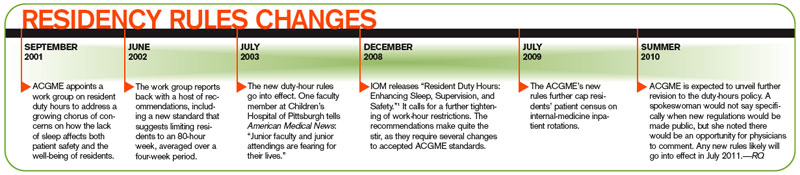
To understand the concerns moving forward, it’s important to first look back. In July 2003, new ACGME rules went into place capping the workweeks of residents at 80 hours. Rules were put into place that regulated the number of patients that residents could be assigned, and those thresholds were further tightened on July 1, 2009. The most notable 2009 change: A first-year resident’s patient census must not exceed 10 patients. ACGME CEO Thomas J. Nasca, MD, MACP, sent a letter to program directors in early May announcing more changes to resident work hours. The letter indicates proposals will be announced by the end of this month, and public comment will follow. At the earliest, new rules changes would go into effect in 2011. “The board may adopt a modification to the duty-hours standard,” says Julie Jacob, a spokeswoman for Chicago-based ACGME. “Any proposed standards would get a public comment.”
Jacob declined further comment, but various hospitalists and academics say they wouldn’t be surprised if new rules reflect 2008 Institute of Medicine (IOM) recommendations.1 The IOM report called for a maximum resident shift length of 30 hours, with admission of patients for up to 16 hours, plus a five-hour uninterrupted sleep period between 10 p.m. and 8 a.m. It also suggested the remaining workweek hours be used for transitional and educational activities.
However those IOM recommendations are incorporated, one thing is clear: Any adoption of those standards will have a financial impact. In fact, a study published last year reported that annual labor costs from implementing the IOM standards was estimated to be $1.6 billion in 2006 dollars (see “The Cost of Progress,” p. 25).2
“Any replacement of a resident costs more than a resident, whether it’s an NP, a PA (physician assistant), an MD, or a DO,” says Kevin O’Leary, MD, MS, associate program director of the IM residency program at Northwestern University’s Feinberg School of Medicine in Chicago. “Everybody costs more.”
The Fate of Teachers
Some of the largest academic centers, including the Feinberg School, the University of Michigan, and the teaching service at St. Luke’s-Roosevelt Hospital in New York City, reduced patient caseloads ahead of the 2009 round of residency rule changes. Hospitalists and educators at those institutions say the proactive approach helped them adjust to the newest rules, which by some estimates reduce resident productivity by 20%.
But the changes shift the workload to academic hospitalists, many of whom forego higher-paying positions to pursue teaching and research. According to the latest SHM survey data, academic hospitalists make about $50,000 less per year than the average community hospitalist. But as clinical work intrudes further, as residents are unable to assume the patient care they once did, educators are put into positions of having to balance the educational portion of their job with patient care, says John Del Valle, MD, professor and residency program director in the department of internal medicine at the University of Michigan Health System in Ann Arbor.
“This is where difficult decisions have to be made,” Dr. Del Valle says. “This is not the blend of activities that traditional academics signed up for.”
Solutions to relieve current and impending pressure on teaching hospitalists have presented themselves in different ways. In Dr. Del Valle’s hospital, there is a split between the hospitalist service and the house staff, which is aimed at keeping up with the growth in IM admissions. That tally has climbed an average of 4% per year for the past five years, reaching some 18,000 admissions last year. To handle that workload, the nonresident service last year added three clinical full-time equivalents (FTEs) to bring its total to nearly 30 FTEs.
Dr. Del Valle notes his institution has been fortunate to be able to afford growth, thanks in large part to a payor mix with a relatively low percentage of charity care and high level of activity.
At Brigham and Women’s Hospital in Boston, the answer is a freestanding PA service that has been in place since 2005. Last summer, the program went to a 24-hour rotation to increase continuity for overnight services and to provide coverage on night shifts, an area most in the industry agree will be hit hardest by the resident caps. Physicians at Brigham’s, a teaching affiliate of Harvard Medical School, are now discussing an expansion of the PA service, or perhaps even an overhaul to a more cost-efficient solution, says Danielle Scheurer, MD, MSc, FHM, assistant professor of medicine at Harvard and director of Brigham’s general medicine service.

At Medical Center Hospital (MCH) in Odessa, Texas, the hospitalists were added to the ED call schedule once every five nights. The plan was under discussion before the new residency rules went into place; however, it was implemented to keep the IM residency program within the new limits, says Bruce Becker, MD, MCH’s chief medical officer.
And at St. Luke’s-Roosevelt Hospital, discussions are under way on how to best extend the nonteaching staff, says Ethan Fried, MD, MS, FACP, assistant professor of clinical medicine at Columbia University, vice chair for education in the department of medicine and director of graduate medical education at St. Luke’s-Roosevelt. “The adjustment has to come from the nonteaching side because the house staff at this point is saturated,” says Dr. Fried, president-elect of the Association of Program Directors in Internal Medicine (APDIM). “You can’t be cheap about acquiring your nonteaching staff.”
The Fate of Students
Perhaps paramount to the fears of how teaching hospitalists will react to current or future restrictions is the effect those limits have on the residents they safeguard. Some physicians think the new rules will produce crops of ill-prepared residents because they have been coddled with limited patient censuses. Other physicians argue that the new thresholds will actually better prepare physicians when HM groups are hiring residents for full-time positions.
Dr. Del Valle acknowledges there is as yet no rigorous data to show the impact of the current restrictions, but he agrees it’s a simple equation of patient-care mathematics. “You can’t [easily] replace 100-110 hours [of care per week],” he says.
Others say patient caps and rules to limit how much work residents do are in line with the purpose of medical training programs. “I’ve bought into the fact that these programs exist to train residents, not to provide clinical care,” Dr. O’Leary says. “I’ve drunk that Kool-Aid. … I think there’s more variation, person to person, than ‘my era vs. the current era.’ Like any new hospitalist that you hire, you need to give an orientation and give enough support to them so when they begin to see patients that they are not overwhelmed.”
Shaun Frost, MD, FACP, FHM, might be best described as halfway between those two extremes. A regional director for the eastern U.S. for Cogent Healthcare, he says duty-hour restrictions have had deleterious impacts but also create learning opportunities.
“The residency work-hour restrictions have inhibited our ability to train people to work as efficiently as trainees who were taught in the past,” says Dr. Frost, an SHM board member. “That doesn’t necessarily mean you can’t teach people to work more efficiently . . . but in the future, my hope is that residency training programs will recognize the deficit that exists in personal work efficiencies between their completion and their responsibilities as a hospitalist.”
To that end, Dr. Frost works with others to develop both structured curriculum and classroom didactics that help new hospitalists make up for gaps in preparation that weren’t addressed in residency. In some cases, that can be practice management and billing issues, but often, according to Dr. Frost, it is addressing personal workflow and bridging the “unnatural discontinuity” in patient care from residency to the real world.
“There is a cost to this investment for the future,” Dr. Frost adds. “If people don’t recognize the potential return on investment as being critical to the development of an educated workforce—an efficient and competent workforce—and thus critical to the retention of high-performing hospitalists, they are selling themselves, unfortunately, significantly short.”
Caught in the Middle
One man’s trash is another man’s treasure, the axiom tells us. Well, in healthcare circles, that could just as easily read: The woes of academic hospitalists are the wealth of community hospitalists.
The new rules “may result in more opportunities for hospitalists to provide needed clinical services,” Dr. Wright says.
The long-term implications, though, remain to be seen. While academic hospitalists say they have seen preliminary increases in care-delivery costs because of the latest rules changes, many say it’s too soon to tell just how high those costs might climb and what ripple effect might follow.
Some physicians, including Dr. Del Valle, note that while the 2009 changes and the expectation of more changes in 2011 are cause for attention, that doesn’t translate to cause for concern. In 2003, months before the 80-hour workweek rules were first put in place by ACGME, many of the same debates were already under way: How will the faculty of IM residency programs cope? How will institutions pay the bills while putting money aside for other physicians picking up the slack?
“This is a pendulum,” Dr. Del Valle says. “I think it will come back to a balanced place.”
Dr. Fried, who is more optimistic that the residency rules can have a positive, long-term effect, agrees. He says residency caps and limits should not be viewed as “things that limit education. We [should] look at them as things that ensure education continues while patient care continues.” TH
Richard Quinn is a freelance writer based in New Jersey.
References
- Institute of Medicine. Resident Duty Hours: Enhancing Sleep, Supervision, and Safety. Ulmer C, Wolman DM, Johns MM, eds. Washington, D.C.: The National Academies Press; 2008.
- Nuckols TK, Bhattacharya J, Wolman DM, Ulmer C, Escarce JJ. Cost implications of reduced work hours and workloads for resident physicians. N Engl J Med. 2009:360(21):2202-2215.
The impact of last summer’s new restrictions from the Accreditation Council for Graduate Medical Education (ACGME) on how many hospitalized patients a first-year resident can treat on an internal-medicine (IM) rotation was as immediate as it was evident at Monmouth Medical Center, a 527-bed teaching hospital in Long Branch, N.J. The institution had a class of eight rookie residents whose caseloads were cut from 12 to the new threshold of 10.
Physicians “had to find some other way of getting attention . . . for 16 patients,” says Sarah Wallach, MD, FACP, director of Monmouth’s IM residency program and vice chair of the department of medicine at the hospital. At Monmouth, the solution came in the form of a new hire—a nurse practitioner (NP)—to handle the overflow. The NP service is used predominantly for referral patients from primary-care physicians (PCPs), as opposed to independent hospital admissions.
But because the NP service does not provide 24-hour coverage, the hospital can get away with only one person in the position. To extend coverage all day long, Dr. Wallach estimates she would need to hire two or three additional NPs, plus another one or two administrative positions to provide relief on holidays and vacations. “You would need five people,” she says. “I can’t afford that.”
Few hospitals or HM groups can afford new hires in today’s world of Medicare reimbursement cuts, shrinking budgets, and—courtesy of the newest rules—restricting patient caps for residents. The latest rules took hold about a year ago, but hospitalists in both academic and community settings say the impact already is noticeable.
Many hospitals have had to craft solutions, which have included burdening academic hospitals with more clinical responsibilities, turning to private HM groups (HMGs) to assume the patients residents can no longer care for, or hiring nonphysician providers (NPPs) to pick up the slack. As Dr. Wallach pointedly notes, the latter two solutions cost money at a time when hospitals have less to go around.
Already, teaching hospitals have begun discussions about how the newest rules—and the future changes they presage—will change the playing field. Will a wave of academics flee their classroom (the teaching hospital), as nonteaching duties become an intrusion? Will teaching hospitals face financial pressure as they struggle to replace the low-cost labor force that residents represent?
Perhaps most importantly from a medical perspective, will graduate trainees be as prepared as their predecessors when they enter practice?
The answers will have a direct correlation to private HMGs, which are poised to see more patients in the wake of residency restrictions, particularly on overnight services. The cost of hospital care will increase for hospitals, putting more pressure on hospitalist groups that tout themselves to C-suites as engines for cost savings. Long-term implications, unfortunately, remain murky, as the newest rules have been in place for a relatively short time. Plus, ACGME is expected—at the end of this month, according to a recent memo to program directors—to announce more changes to residency guidelines.
“Hospitalists will always be involved in teaching—it will never go away,” says Julia Wright, MD, FHM, clinical professor of medicine and director of hospital medicine at the University of Wisconsin School of Medicine and Public Health in Madison and a member of Team Hospitalist. “But it will be a very different balance, a different kind of feel.”
The Past to the Future
To understand the concerns moving forward, it’s important to first look back. In July 2003, new ACGME rules went into place capping the workweeks of residents at 80 hours. Rules were put into place that regulated the number of patients that residents could be assigned, and those thresholds were further tightened on July 1, 2009. The most notable 2009 change: A first-year resident’s patient census must not exceed 10 patients. ACGME CEO Thomas J. Nasca, MD, MACP, sent a letter to program directors in early May announcing more changes to resident work hours. The letter indicates proposals will be announced by the end of this month, and public comment will follow. At the earliest, new rules changes would go into effect in 2011. “The board may adopt a modification to the duty-hours standard,” says Julie Jacob, a spokeswoman for Chicago-based ACGME. “Any proposed standards would get a public comment.”
Jacob declined further comment, but various hospitalists and academics say they wouldn’t be surprised if new rules reflect 2008 Institute of Medicine (IOM) recommendations.1 The IOM report called for a maximum resident shift length of 30 hours, with admission of patients for up to 16 hours, plus a five-hour uninterrupted sleep period between 10 p.m. and 8 a.m. It also suggested the remaining workweek hours be used for transitional and educational activities.
However those IOM recommendations are incorporated, one thing is clear: Any adoption of those standards will have a financial impact. In fact, a study published last year reported that annual labor costs from implementing the IOM standards was estimated to be $1.6 billion in 2006 dollars (see “The Cost of Progress,” p. 25).2
“Any replacement of a resident costs more than a resident, whether it’s an NP, a PA (physician assistant), an MD, or a DO,” says Kevin O’Leary, MD, MS, associate program director of the IM residency program at Northwestern University’s Feinberg School of Medicine in Chicago. “Everybody costs more.”
The Fate of Teachers
Some of the largest academic centers, including the Feinberg School, the University of Michigan, and the teaching service at St. Luke’s-Roosevelt Hospital in New York City, reduced patient caseloads ahead of the 2009 round of residency rule changes. Hospitalists and educators at those institutions say the proactive approach helped them adjust to the newest rules, which by some estimates reduce resident productivity by 20%.
But the changes shift the workload to academic hospitalists, many of whom forego higher-paying positions to pursue teaching and research. According to the latest SHM survey data, academic hospitalists make about $50,000 less per year than the average community hospitalist. But as clinical work intrudes further, as residents are unable to assume the patient care they once did, educators are put into positions of having to balance the educational portion of their job with patient care, says John Del Valle, MD, professor and residency program director in the department of internal medicine at the University of Michigan Health System in Ann Arbor.
“This is where difficult decisions have to be made,” Dr. Del Valle says. “This is not the blend of activities that traditional academics signed up for.”
Solutions to relieve current and impending pressure on teaching hospitalists have presented themselves in different ways. In Dr. Del Valle’s hospital, there is a split between the hospitalist service and the house staff, which is aimed at keeping up with the growth in IM admissions. That tally has climbed an average of 4% per year for the past five years, reaching some 18,000 admissions last year. To handle that workload, the nonresident service last year added three clinical full-time equivalents (FTEs) to bring its total to nearly 30 FTEs.
Dr. Del Valle notes his institution has been fortunate to be able to afford growth, thanks in large part to a payor mix with a relatively low percentage of charity care and high level of activity.
At Brigham and Women’s Hospital in Boston, the answer is a freestanding PA service that has been in place since 2005. Last summer, the program went to a 24-hour rotation to increase continuity for overnight services and to provide coverage on night shifts, an area most in the industry agree will be hit hardest by the resident caps. Physicians at Brigham’s, a teaching affiliate of Harvard Medical School, are now discussing an expansion of the PA service, or perhaps even an overhaul to a more cost-efficient solution, says Danielle Scheurer, MD, MSc, FHM, assistant professor of medicine at Harvard and director of Brigham’s general medicine service.
At Medical Center Hospital (MCH) in Odessa, Texas, the hospitalists were added to the ED call schedule once every five nights. The plan was under discussion before the new residency rules went into place; however, it was implemented to keep the IM residency program within the new limits, says Bruce Becker, MD, MCH’s chief medical officer.
And at St. Luke’s-Roosevelt Hospital, discussions are under way on how to best extend the nonteaching staff, says Ethan Fried, MD, MS, FACP, assistant professor of clinical medicine at Columbia University, vice chair for education in the department of medicine and director of graduate medical education at St. Luke’s-Roosevelt. “The adjustment has to come from the nonteaching side because the house staff at this point is saturated,” says Dr. Fried, president-elect of the Association of Program Directors in Internal Medicine (APDIM). “You can’t be cheap about acquiring your nonteaching staff.”
The Fate of Students
Perhaps paramount to the fears of how teaching hospitalists will react to current or future restrictions is the effect those limits have on the residents they safeguard. Some physicians think the new rules will produce crops of ill-prepared residents because they have been coddled with limited patient censuses. Other physicians argue that the new thresholds will actually better prepare physicians when HM groups are hiring residents for full-time positions.
Dr. Del Valle acknowledges there is as yet no rigorous data to show the impact of the current restrictions, but he agrees it’s a simple equation of patient-care mathematics. “You can’t [easily] replace 100-110 hours [of care per week],” he says.
Others say patient caps and rules to limit how much work residents do are in line with the purpose of medical training programs. “I’ve bought into the fact that these programs exist to train residents, not to provide clinical care,” Dr. O’Leary says. “I’ve drunk that Kool-Aid. … I think there’s more variation, person to person, than ‘my era vs. the current era.’ Like any new hospitalist that you hire, you need to give an orientation and give enough support to them so when they begin to see patients that they are not overwhelmed.”
Shaun Frost, MD, FACP, FHM, might be best described as halfway between those two extremes. A regional director for the eastern U.S. for Cogent Healthcare, he says duty-hour restrictions have had deleterious impacts but also create learning opportunities.
“The residency work-hour restrictions have inhibited our ability to train people to work as efficiently as trainees who were taught in the past,” says Dr. Frost, an SHM board member. “That doesn’t necessarily mean you can’t teach people to work more efficiently . . . but in the future, my hope is that residency training programs will recognize the deficit that exists in personal work efficiencies between their completion and their responsibilities as a hospitalist.”
To that end, Dr. Frost works with others to develop both structured curriculum and classroom didactics that help new hospitalists make up for gaps in preparation that weren’t addressed in residency. In some cases, that can be practice management and billing issues, but often, according to Dr. Frost, it is addressing personal workflow and bridging the “unnatural discontinuity” in patient care from residency to the real world.
“There is a cost to this investment for the future,” Dr. Frost adds. “If people don’t recognize the potential return on investment as being critical to the development of an educated workforce—an efficient and competent workforce—and thus critical to the retention of high-performing hospitalists, they are selling themselves, unfortunately, significantly short.”
Caught in the Middle
One man’s trash is another man’s treasure, the axiom tells us. Well, in healthcare circles, that could just as easily read: The woes of academic hospitalists are the wealth of community hospitalists.
The new rules “may result in more opportunities for hospitalists to provide needed clinical services,” Dr. Wright says.
The long-term implications, though, remain to be seen. While academic hospitalists say they have seen preliminary increases in care-delivery costs because of the latest rules changes, many say it’s too soon to tell just how high those costs might climb and what ripple effect might follow.
Some physicians, including Dr. Del Valle, note that while the 2009 changes and the expectation of more changes in 2011 are cause for attention, that doesn’t translate to cause for concern. In 2003, months before the 80-hour workweek rules were first put in place by ACGME, many of the same debates were already under way: How will the faculty of IM residency programs cope? How will institutions pay the bills while putting money aside for other physicians picking up the slack?
“This is a pendulum,” Dr. Del Valle says. “I think it will come back to a balanced place.”
Dr. Fried, who is more optimistic that the residency rules can have a positive, long-term effect, agrees. He says residency caps and limits should not be viewed as “things that limit education. We [should] look at them as things that ensure education continues while patient care continues.” TH
Richard Quinn is a freelance writer based in New Jersey.
References
- Institute of Medicine. Resident Duty Hours: Enhancing Sleep, Supervision, and Safety. Ulmer C, Wolman DM, Johns MM, eds. Washington, D.C.: The National Academies Press; 2008.
- Nuckols TK, Bhattacharya J, Wolman DM, Ulmer C, Escarce JJ. Cost implications of reduced work hours and workloads for resident physicians. N Engl J Med. 2009:360(21):2202-2215.
The impact of last summer’s new restrictions from the Accreditation Council for Graduate Medical Education (ACGME) on how many hospitalized patients a first-year resident can treat on an internal-medicine (IM) rotation was as immediate as it was evident at Monmouth Medical Center, a 527-bed teaching hospital in Long Branch, N.J. The institution had a class of eight rookie residents whose caseloads were cut from 12 to the new threshold of 10.
Physicians “had to find some other way of getting attention . . . for 16 patients,” says Sarah Wallach, MD, FACP, director of Monmouth’s IM residency program and vice chair of the department of medicine at the hospital. At Monmouth, the solution came in the form of a new hire—a nurse practitioner (NP)—to handle the overflow. The NP service is used predominantly for referral patients from primary-care physicians (PCPs), as opposed to independent hospital admissions.
But because the NP service does not provide 24-hour coverage, the hospital can get away with only one person in the position. To extend coverage all day long, Dr. Wallach estimates she would need to hire two or three additional NPs, plus another one or two administrative positions to provide relief on holidays and vacations. “You would need five people,” she says. “I can’t afford that.”
Few hospitals or HM groups can afford new hires in today’s world of Medicare reimbursement cuts, shrinking budgets, and—courtesy of the newest rules—restricting patient caps for residents. The latest rules took hold about a year ago, but hospitalists in both academic and community settings say the impact already is noticeable.
Many hospitals have had to craft solutions, which have included burdening academic hospitals with more clinical responsibilities, turning to private HM groups (HMGs) to assume the patients residents can no longer care for, or hiring nonphysician providers (NPPs) to pick up the slack. As Dr. Wallach pointedly notes, the latter two solutions cost money at a time when hospitals have less to go around.
Already, teaching hospitals have begun discussions about how the newest rules—and the future changes they presage—will change the playing field. Will a wave of academics flee their classroom (the teaching hospital), as nonteaching duties become an intrusion? Will teaching hospitals face financial pressure as they struggle to replace the low-cost labor force that residents represent?
Perhaps most importantly from a medical perspective, will graduate trainees be as prepared as their predecessors when they enter practice?
The answers will have a direct correlation to private HMGs, which are poised to see more patients in the wake of residency restrictions, particularly on overnight services. The cost of hospital care will increase for hospitals, putting more pressure on hospitalist groups that tout themselves to C-suites as engines for cost savings. Long-term implications, unfortunately, remain murky, as the newest rules have been in place for a relatively short time. Plus, ACGME is expected—at the end of this month, according to a recent memo to program directors—to announce more changes to residency guidelines.
“Hospitalists will always be involved in teaching—it will never go away,” says Julia Wright, MD, FHM, clinical professor of medicine and director of hospital medicine at the University of Wisconsin School of Medicine and Public Health in Madison and a member of Team Hospitalist. “But it will be a very different balance, a different kind of feel.”
The Past to the Future
To understand the concerns moving forward, it’s important to first look back. In July 2003, new ACGME rules went into place capping the workweeks of residents at 80 hours. Rules were put into place that regulated the number of patients that residents could be assigned, and those thresholds were further tightened on July 1, 2009. The most notable 2009 change: A first-year resident’s patient census must not exceed 10 patients. ACGME CEO Thomas J. Nasca, MD, MACP, sent a letter to program directors in early May announcing more changes to resident work hours. The letter indicates proposals will be announced by the end of this month, and public comment will follow. At the earliest, new rules changes would go into effect in 2011. “The board may adopt a modification to the duty-hours standard,” says Julie Jacob, a spokeswoman for Chicago-based ACGME. “Any proposed standards would get a public comment.”
Jacob declined further comment, but various hospitalists and academics say they wouldn’t be surprised if new rules reflect 2008 Institute of Medicine (IOM) recommendations.1 The IOM report called for a maximum resident shift length of 30 hours, with admission of patients for up to 16 hours, plus a five-hour uninterrupted sleep period between 10 p.m. and 8 a.m. It also suggested the remaining workweek hours be used for transitional and educational activities.
However those IOM recommendations are incorporated, one thing is clear: Any adoption of those standards will have a financial impact. In fact, a study published last year reported that annual labor costs from implementing the IOM standards was estimated to be $1.6 billion in 2006 dollars (see “The Cost of Progress,” p. 25).2
“Any replacement of a resident costs more than a resident, whether it’s an NP, a PA (physician assistant), an MD, or a DO,” says Kevin O’Leary, MD, MS, associate program director of the IM residency program at Northwestern University’s Feinberg School of Medicine in Chicago. “Everybody costs more.”
The Fate of Teachers
Some of the largest academic centers, including the Feinberg School, the University of Michigan, and the teaching service at St. Luke’s-Roosevelt Hospital in New York City, reduced patient caseloads ahead of the 2009 round of residency rule changes. Hospitalists and educators at those institutions say the proactive approach helped them adjust to the newest rules, which by some estimates reduce resident productivity by 20%.
But the changes shift the workload to academic hospitalists, many of whom forego higher-paying positions to pursue teaching and research. According to the latest SHM survey data, academic hospitalists make about $50,000 less per year than the average community hospitalist. But as clinical work intrudes further, as residents are unable to assume the patient care they once did, educators are put into positions of having to balance the educational portion of their job with patient care, says John Del Valle, MD, professor and residency program director in the department of internal medicine at the University of Michigan Health System in Ann Arbor.
“This is where difficult decisions have to be made,” Dr. Del Valle says. “This is not the blend of activities that traditional academics signed up for.”
Solutions to relieve current and impending pressure on teaching hospitalists have presented themselves in different ways. In Dr. Del Valle’s hospital, there is a split between the hospitalist service and the house staff, which is aimed at keeping up with the growth in IM admissions. That tally has climbed an average of 4% per year for the past five years, reaching some 18,000 admissions last year. To handle that workload, the nonresident service last year added three clinical full-time equivalents (FTEs) to bring its total to nearly 30 FTEs.
Dr. Del Valle notes his institution has been fortunate to be able to afford growth, thanks in large part to a payor mix with a relatively low percentage of charity care and high level of activity.
At Brigham and Women’s Hospital in Boston, the answer is a freestanding PA service that has been in place since 2005. Last summer, the program went to a 24-hour rotation to increase continuity for overnight services and to provide coverage on night shifts, an area most in the industry agree will be hit hardest by the resident caps. Physicians at Brigham’s, a teaching affiliate of Harvard Medical School, are now discussing an expansion of the PA service, or perhaps even an overhaul to a more cost-efficient solution, says Danielle Scheurer, MD, MSc, FHM, assistant professor of medicine at Harvard and director of Brigham’s general medicine service.
At Medical Center Hospital (MCH) in Odessa, Texas, the hospitalists were added to the ED call schedule once every five nights. The plan was under discussion before the new residency rules went into place; however, it was implemented to keep the IM residency program within the new limits, says Bruce Becker, MD, MCH’s chief medical officer.
And at St. Luke’s-Roosevelt Hospital, discussions are under way on how to best extend the nonteaching staff, says Ethan Fried, MD, MS, FACP, assistant professor of clinical medicine at Columbia University, vice chair for education in the department of medicine and director of graduate medical education at St. Luke’s-Roosevelt. “The adjustment has to come from the nonteaching side because the house staff at this point is saturated,” says Dr. Fried, president-elect of the Association of Program Directors in Internal Medicine (APDIM). “You can’t be cheap about acquiring your nonteaching staff.”
The Fate of Students
Perhaps paramount to the fears of how teaching hospitalists will react to current or future restrictions is the effect those limits have on the residents they safeguard. Some physicians think the new rules will produce crops of ill-prepared residents because they have been coddled with limited patient censuses. Other physicians argue that the new thresholds will actually better prepare physicians when HM groups are hiring residents for full-time positions.
Dr. Del Valle acknowledges there is as yet no rigorous data to show the impact of the current restrictions, but he agrees it’s a simple equation of patient-care mathematics. “You can’t [easily] replace 100-110 hours [of care per week],” he says.
Others say patient caps and rules to limit how much work residents do are in line with the purpose of medical training programs. “I’ve bought into the fact that these programs exist to train residents, not to provide clinical care,” Dr. O’Leary says. “I’ve drunk that Kool-Aid. … I think there’s more variation, person to person, than ‘my era vs. the current era.’ Like any new hospitalist that you hire, you need to give an orientation and give enough support to them so when they begin to see patients that they are not overwhelmed.”
Shaun Frost, MD, FACP, FHM, might be best described as halfway between those two extremes. A regional director for the eastern U.S. for Cogent Healthcare, he says duty-hour restrictions have had deleterious impacts but also create learning opportunities.
“The residency work-hour restrictions have inhibited our ability to train people to work as efficiently as trainees who were taught in the past,” says Dr. Frost, an SHM board member. “That doesn’t necessarily mean you can’t teach people to work more efficiently . . . but in the future, my hope is that residency training programs will recognize the deficit that exists in personal work efficiencies between their completion and their responsibilities as a hospitalist.”
To that end, Dr. Frost works with others to develop both structured curriculum and classroom didactics that help new hospitalists make up for gaps in preparation that weren’t addressed in residency. In some cases, that can be practice management and billing issues, but often, according to Dr. Frost, it is addressing personal workflow and bridging the “unnatural discontinuity” in patient care from residency to the real world.
“There is a cost to this investment for the future,” Dr. Frost adds. “If people don’t recognize the potential return on investment as being critical to the development of an educated workforce—an efficient and competent workforce—and thus critical to the retention of high-performing hospitalists, they are selling themselves, unfortunately, significantly short.”
Caught in the Middle
One man’s trash is another man’s treasure, the axiom tells us. Well, in healthcare circles, that could just as easily read: The woes of academic hospitalists are the wealth of community hospitalists.
The new rules “may result in more opportunities for hospitalists to provide needed clinical services,” Dr. Wright says.
The long-term implications, though, remain to be seen. While academic hospitalists say they have seen preliminary increases in care-delivery costs because of the latest rules changes, many say it’s too soon to tell just how high those costs might climb and what ripple effect might follow.
Some physicians, including Dr. Del Valle, note that while the 2009 changes and the expectation of more changes in 2011 are cause for attention, that doesn’t translate to cause for concern. In 2003, months before the 80-hour workweek rules were first put in place by ACGME, many of the same debates were already under way: How will the faculty of IM residency programs cope? How will institutions pay the bills while putting money aside for other physicians picking up the slack?
“This is a pendulum,” Dr. Del Valle says. “I think it will come back to a balanced place.”
Dr. Fried, who is more optimistic that the residency rules can have a positive, long-term effect, agrees. He says residency caps and limits should not be viewed as “things that limit education. We [should] look at them as things that ensure education continues while patient care continues.” TH
Richard Quinn is a freelance writer based in New Jersey.
References
- Institute of Medicine. Resident Duty Hours: Enhancing Sleep, Supervision, and Safety. Ulmer C, Wolman DM, Johns MM, eds. Washington, D.C.: The National Academies Press; 2008.
- Nuckols TK, Bhattacharya J, Wolman DM, Ulmer C, Escarce JJ. Cost implications of reduced work hours and workloads for resident physicians. N Engl J Med. 2009:360(21):2202-2215.
Market Watch
New Generic
- Perindopril erbumine tablets (generic Aceon)1
New Drugs, Indications, Dosage Forms, and Approval Recommendations
- Collagenase clostridium histolytica injection (Xiaflex) has been approved by the FDA for treating the hand disease Dupuytren’s contracture. The agent breaks down excessive collagen in the hand, allowing patients to straighten the arm and have proper use of their fingers. The agent is also being studied to treat Peyronie’s disease.2
- Dalfampridine tablets (Ampyra) have been approved by the FDA to improve walking in patients with multiple sclerosis (MS).3 Seizures might occur in patients who exceed the recommended daily dose of 10 mg twice daily, or in patients with moderate to severe kidney disease. Therefore, caution is advised in these patients.
- Iloperidone tablets (Fanapt) have been approved by the FDA for the acute treatment of schizophrenia in adults.4 An atypical antipsychotic, it is a mixed dopamine D2/serotonin 5HT2A receptor antagonist.
- Lamotrigine extended-release tablets (Lamictal XR) have received a new FDA-approved indication for once-daily, add-on therapy for epilepsy in patients 13 years and older, with primary, generalized tonic-clonic seizures.5
- Liraglutide (Victoza) has been approved by the FDA as a once-daily injection for the treatment of Type 2 diabetes mellitus.6 Liraglutide is a glucagon-like peptide-1 (GLP-1) receptor agonist, which is similar to exenatide. There is a label warning related to thyroid tumors that occurred in rats and mice. It is unclear whether medullary thyroid cancer will occur in adults; therefore, the agent should not be used in patients who already have this cancer or those with a family history of thyroid cancer.
- Trazodone extended-release tablets (Oleptro) have been approved by the FDA for treating major depressive disorder in adults.7 This product is formulated using Labopharm’s proprietary Contramid long-acting drug delivery system. The product will be available later this year.
Safety Information
- Didanosine (Videx/Videx EC) has undergone a label change in the warning and precautions sections related to the rare but serious complication of noncirrhotic portal hypertension. The label change was added because of the potential severity of portal hypertension, including death from hemorrhaging esophageal varices. A number of well-documented, postmarketing reports of this reaction were made following exclusion of other portal hypertension causes.8
- Long-acting beta-agonists (LABAs), formoterol (Foradil), and salmeterol (Sereven) are required to have a risk management strategy (REMS) and a revised medication guide written specifically for patients. The goal is to educate patients about the appropriate use of LABAs. There also is a plan to educate healthcare professionals about the appropriate use of LABAs.9,10 This update is due to continued analysis of studies that show increased risk of severe asthma exacerbations, which lead to hospitalizations in adult and pediatric patients, including deaths in some LABA-utilizing patients. To safely use LABAs, the following need to be considered:
- Single-ingredient LABAs should not be used as monotherapy; they should only be used in combination with an asthma controller;
- LABAs should only be used long-term in patients whose asthma cannot be adequately controlled on asthma controllers;
- Use an LABA for the shortest duration required to achieve asthma control and discontinue it, if possible, once asthma control is achieved. Patients should then be maintained on an asthma controller; and
- Use a combination product containing both an inhaled corticosteroid and an LABA to enhance adherence in pediatric and adolescent patients who require both of these classes to manage their asthma.
- Olanzapine (Zyprexa) has undergone a label change related to its indications for use in adolescents ages 13-17 for treating schizophrenia and bipolar I disorder (manic or mixed episodes).11 The new label asks providers to consider alternative treatments in this patient population due to the increased potential for weight gain and hyperlipidemia. Additionally, the effectiveness and safety of this agent have not been determined in patients under 13.
- Sibutramine (Meridia), marketed for weight loss, continues to be evaluated for safety.12 A recent review found it poses an increased risk of heart attack and stroke in patients with a history of cardiovascular disease. Although the product label already had a warning related to use in patients with cardiovascular disease, the manufacturer has added a new contraindication to the sibutramine label for patients with cardiovascular disease and a history of: 1) coronary artery disease; 2) stroke or transient ischemic attack; 3) arrhythmias; 4) congestive heart failure; 5) peripheral arterial disease; and/or 6) uncontrolled hypertension (e.g., >145/90 mmHg). Providers should monitor blood pressure and heart rate regularly. If there is an unremitting increase in blood pressure and/or heart rate, sibutramine should be discontinued. Sibutramine should also be stopped in patients who do not lose at least 5% of their baseline body weight within the first three to six months of treatment.13TH
Michele B. Kaufman, PharmD, BSc, RPh, is a freelance medical writer based in New York City and a clinical pharmacist at New York Downtown Hospital.
References
- Lupin receives US FDA approval for Perindopril erbumine tablets. Lupin Web site. Available at: http://www.lupinworld.com/28jan10.htm. Accessed Feb. 22, 2010.
- US FDA approves Auxilium drug for hand disease. Reuters Web site. Available at: http://www.reuters.com/article/idUSN0211921420100203. Accessed Feb. 22, 2010.
- Petrochko C. MS walking drug gets FDA nod. MedPage Today Web site. Available at: http://www.medpagetoday.com/Neurology/MultipleSclerosis/18112. Accessed Feb. 22, 2010.
- Fanapt available for acute schizophrenia. Monthly Prescribing Reference Web site. Available at: http://www.empr.com/fanapt-available-for-acute-schizophrenia/article/160985/. Accessed Feb. 22, 2010.
- FDA approves once-a-day Lamictal XR as add-on epilepsy therapy for primary generalized tonic-clonic seizures. Available at: http://www.medicalnewstoday.com/articles/177796.php. Accessed Feb. 22, 2010.
- FDA approves new treatment for Type 2 diabetes. U.S. Food and Drug Administration Web site. Available at: http://www.fda.gov/NewsEvents/Newsroom/PressAnnouncements/ucm198638.htm. Accessed Feb. 22, 2010.
- Labopharm receives FDA approval for Oleptro. PR Newswire Web site. Available at: http://www.prnewswire.com/news-releases/labopharm-receives-fda-approval-for-oleptrotm-83429037.html. Accessed Feb. 22, 2010.
- Videx/Videx EC (didanosine): Labeling revision—risk of non-cirrhotic portal hypertension. U.S. Food and Drug Administration Web site. Available at: http://www.fda.gov/Safety/MedWatch/SafetyInformation/SafetyAlertsforHumanMedicalProducts/ucm199343.htm. Accessed Feb. 22, 2010.
- Long-acting beta-agonists (LABAs): new safe use requirements. U.S. Food and Drug Administration Web site. Available at: http://www.fda.gov/Safety/MedWatch/SafetyInformation/SafetyAlertsforHumanMedicalProducts/ucm201003.htm. Accessed Feb. 22, 2010.
- Gever J. FDA says LABA asthma drugs not safe for solo use. MedPage Today Web site. Available at: http://www.medpagetoday.com/tbprint.cfm?tbid=18552. Accessed Feb. 22, 2010.
- Zyprexa (olanzapine): use in adolescents. U.S. Food and Drug Administration Web site. Available at: http://www.fda.gov/Safety/MedWatch/SafetyInformation/SafetyAlertsforHumanMedicalProducts/ucm198402.htm. Accessed Feb. 22, 2010.
- Follow-up to the November 2009 early communication about an ongoing safety review of sibutramine, marketed as Meridia. U.S. Food and Drug Administration Web site. Available at: http://www.fda.gov/Drugs/DrugSafety/PostmarketDrugSafetyInformationforPatientsandProviders/DrugSafetyInformationforHeathcareProfessionals/ucm198206.htm. Accessed Feb. 21, 2010.
- Petrochko C. FDA adds cardio warnings to weight-loss drug. MedPage Today Web site. Available at: http://www.medpagetoday.com/tbprint.cfm?tbid=18088?. Accessed Feb. 22, 2010.
New Generic
- Perindopril erbumine tablets (generic Aceon)1
New Drugs, Indications, Dosage Forms, and Approval Recommendations
- Collagenase clostridium histolytica injection (Xiaflex) has been approved by the FDA for treating the hand disease Dupuytren’s contracture. The agent breaks down excessive collagen in the hand, allowing patients to straighten the arm and have proper use of their fingers. The agent is also being studied to treat Peyronie’s disease.2
- Dalfampridine tablets (Ampyra) have been approved by the FDA to improve walking in patients with multiple sclerosis (MS).3 Seizures might occur in patients who exceed the recommended daily dose of 10 mg twice daily, or in patients with moderate to severe kidney disease. Therefore, caution is advised in these patients.
- Iloperidone tablets (Fanapt) have been approved by the FDA for the acute treatment of schizophrenia in adults.4 An atypical antipsychotic, it is a mixed dopamine D2/serotonin 5HT2A receptor antagonist.
- Lamotrigine extended-release tablets (Lamictal XR) have received a new FDA-approved indication for once-daily, add-on therapy for epilepsy in patients 13 years and older, with primary, generalized tonic-clonic seizures.5
- Liraglutide (Victoza) has been approved by the FDA as a once-daily injection for the treatment of Type 2 diabetes mellitus.6 Liraglutide is a glucagon-like peptide-1 (GLP-1) receptor agonist, which is similar to exenatide. There is a label warning related to thyroid tumors that occurred in rats and mice. It is unclear whether medullary thyroid cancer will occur in adults; therefore, the agent should not be used in patients who already have this cancer or those with a family history of thyroid cancer.
- Trazodone extended-release tablets (Oleptro) have been approved by the FDA for treating major depressive disorder in adults.7 This product is formulated using Labopharm’s proprietary Contramid long-acting drug delivery system. The product will be available later this year.
Safety Information
- Didanosine (Videx/Videx EC) has undergone a label change in the warning and precautions sections related to the rare but serious complication of noncirrhotic portal hypertension. The label change was added because of the potential severity of portal hypertension, including death from hemorrhaging esophageal varices. A number of well-documented, postmarketing reports of this reaction were made following exclusion of other portal hypertension causes.8
- Long-acting beta-agonists (LABAs), formoterol (Foradil), and salmeterol (Sereven) are required to have a risk management strategy (REMS) and a revised medication guide written specifically for patients. The goal is to educate patients about the appropriate use of LABAs. There also is a plan to educate healthcare professionals about the appropriate use of LABAs.9,10 This update is due to continued analysis of studies that show increased risk of severe asthma exacerbations, which lead to hospitalizations in adult and pediatric patients, including deaths in some LABA-utilizing patients. To safely use LABAs, the following need to be considered:
- Single-ingredient LABAs should not be used as monotherapy; they should only be used in combination with an asthma controller;
- LABAs should only be used long-term in patients whose asthma cannot be adequately controlled on asthma controllers;
- Use an LABA for the shortest duration required to achieve asthma control and discontinue it, if possible, once asthma control is achieved. Patients should then be maintained on an asthma controller; and
- Use a combination product containing both an inhaled corticosteroid and an LABA to enhance adherence in pediatric and adolescent patients who require both of these classes to manage their asthma.
- Olanzapine (Zyprexa) has undergone a label change related to its indications for use in adolescents ages 13-17 for treating schizophrenia and bipolar I disorder (manic or mixed episodes).11 The new label asks providers to consider alternative treatments in this patient population due to the increased potential for weight gain and hyperlipidemia. Additionally, the effectiveness and safety of this agent have not been determined in patients under 13.
- Sibutramine (Meridia), marketed for weight loss, continues to be evaluated for safety.12 A recent review found it poses an increased risk of heart attack and stroke in patients with a history of cardiovascular disease. Although the product label already had a warning related to use in patients with cardiovascular disease, the manufacturer has added a new contraindication to the sibutramine label for patients with cardiovascular disease and a history of: 1) coronary artery disease; 2) stroke or transient ischemic attack; 3) arrhythmias; 4) congestive heart failure; 5) peripheral arterial disease; and/or 6) uncontrolled hypertension (e.g., >145/90 mmHg). Providers should monitor blood pressure and heart rate regularly. If there is an unremitting increase in blood pressure and/or heart rate, sibutramine should be discontinued. Sibutramine should also be stopped in patients who do not lose at least 5% of their baseline body weight within the first three to six months of treatment.13TH
Michele B. Kaufman, PharmD, BSc, RPh, is a freelance medical writer based in New York City and a clinical pharmacist at New York Downtown Hospital.
References
- Lupin receives US FDA approval for Perindopril erbumine tablets. Lupin Web site. Available at: http://www.lupinworld.com/28jan10.htm. Accessed Feb. 22, 2010.
- US FDA approves Auxilium drug for hand disease. Reuters Web site. Available at: http://www.reuters.com/article/idUSN0211921420100203. Accessed Feb. 22, 2010.
- Petrochko C. MS walking drug gets FDA nod. MedPage Today Web site. Available at: http://www.medpagetoday.com/Neurology/MultipleSclerosis/18112. Accessed Feb. 22, 2010.
- Fanapt available for acute schizophrenia. Monthly Prescribing Reference Web site. Available at: http://www.empr.com/fanapt-available-for-acute-schizophrenia/article/160985/. Accessed Feb. 22, 2010.
- FDA approves once-a-day Lamictal XR as add-on epilepsy therapy for primary generalized tonic-clonic seizures. Available at: http://www.medicalnewstoday.com/articles/177796.php. Accessed Feb. 22, 2010.
- FDA approves new treatment for Type 2 diabetes. U.S. Food and Drug Administration Web site. Available at: http://www.fda.gov/NewsEvents/Newsroom/PressAnnouncements/ucm198638.htm. Accessed Feb. 22, 2010.
- Labopharm receives FDA approval for Oleptro. PR Newswire Web site. Available at: http://www.prnewswire.com/news-releases/labopharm-receives-fda-approval-for-oleptrotm-83429037.html. Accessed Feb. 22, 2010.
- Videx/Videx EC (didanosine): Labeling revision—risk of non-cirrhotic portal hypertension. U.S. Food and Drug Administration Web site. Available at: http://www.fda.gov/Safety/MedWatch/SafetyInformation/SafetyAlertsforHumanMedicalProducts/ucm199343.htm. Accessed Feb. 22, 2010.
- Long-acting beta-agonists (LABAs): new safe use requirements. U.S. Food and Drug Administration Web site. Available at: http://www.fda.gov/Safety/MedWatch/SafetyInformation/SafetyAlertsforHumanMedicalProducts/ucm201003.htm. Accessed Feb. 22, 2010.
- Gever J. FDA says LABA asthma drugs not safe for solo use. MedPage Today Web site. Available at: http://www.medpagetoday.com/tbprint.cfm?tbid=18552. Accessed Feb. 22, 2010.
- Zyprexa (olanzapine): use in adolescents. U.S. Food and Drug Administration Web site. Available at: http://www.fda.gov/Safety/MedWatch/SafetyInformation/SafetyAlertsforHumanMedicalProducts/ucm198402.htm. Accessed Feb. 22, 2010.
- Follow-up to the November 2009 early communication about an ongoing safety review of sibutramine, marketed as Meridia. U.S. Food and Drug Administration Web site. Available at: http://www.fda.gov/Drugs/DrugSafety/PostmarketDrugSafetyInformationforPatientsandProviders/DrugSafetyInformationforHeathcareProfessionals/ucm198206.htm. Accessed Feb. 21, 2010.
- Petrochko C. FDA adds cardio warnings to weight-loss drug. MedPage Today Web site. Available at: http://www.medpagetoday.com/tbprint.cfm?tbid=18088?. Accessed Feb. 22, 2010.
New Generic
- Perindopril erbumine tablets (generic Aceon)1
New Drugs, Indications, Dosage Forms, and Approval Recommendations
- Collagenase clostridium histolytica injection (Xiaflex) has been approved by the FDA for treating the hand disease Dupuytren’s contracture. The agent breaks down excessive collagen in the hand, allowing patients to straighten the arm and have proper use of their fingers. The agent is also being studied to treat Peyronie’s disease.2
- Dalfampridine tablets (Ampyra) have been approved by the FDA to improve walking in patients with multiple sclerosis (MS).3 Seizures might occur in patients who exceed the recommended daily dose of 10 mg twice daily, or in patients with moderate to severe kidney disease. Therefore, caution is advised in these patients.
- Iloperidone tablets (Fanapt) have been approved by the FDA for the acute treatment of schizophrenia in adults.4 An atypical antipsychotic, it is a mixed dopamine D2/serotonin 5HT2A receptor antagonist.
- Lamotrigine extended-release tablets (Lamictal XR) have received a new FDA-approved indication for once-daily, add-on therapy for epilepsy in patients 13 years and older, with primary, generalized tonic-clonic seizures.5
- Liraglutide (Victoza) has been approved by the FDA as a once-daily injection for the treatment of Type 2 diabetes mellitus.6 Liraglutide is a glucagon-like peptide-1 (GLP-1) receptor agonist, which is similar to exenatide. There is a label warning related to thyroid tumors that occurred in rats and mice. It is unclear whether medullary thyroid cancer will occur in adults; therefore, the agent should not be used in patients who already have this cancer or those with a family history of thyroid cancer.
- Trazodone extended-release tablets (Oleptro) have been approved by the FDA for treating major depressive disorder in adults.7 This product is formulated using Labopharm’s proprietary Contramid long-acting drug delivery system. The product will be available later this year.
Safety Information
- Didanosine (Videx/Videx EC) has undergone a label change in the warning and precautions sections related to the rare but serious complication of noncirrhotic portal hypertension. The label change was added because of the potential severity of portal hypertension, including death from hemorrhaging esophageal varices. A number of well-documented, postmarketing reports of this reaction were made following exclusion of other portal hypertension causes.8
- Long-acting beta-agonists (LABAs), formoterol (Foradil), and salmeterol (Sereven) are required to have a risk management strategy (REMS) and a revised medication guide written specifically for patients. The goal is to educate patients about the appropriate use of LABAs. There also is a plan to educate healthcare professionals about the appropriate use of LABAs.9,10 This update is due to continued analysis of studies that show increased risk of severe asthma exacerbations, which lead to hospitalizations in adult and pediatric patients, including deaths in some LABA-utilizing patients. To safely use LABAs, the following need to be considered:
- Single-ingredient LABAs should not be used as monotherapy; they should only be used in combination with an asthma controller;
- LABAs should only be used long-term in patients whose asthma cannot be adequately controlled on asthma controllers;
- Use an LABA for the shortest duration required to achieve asthma control and discontinue it, if possible, once asthma control is achieved. Patients should then be maintained on an asthma controller; and
- Use a combination product containing both an inhaled corticosteroid and an LABA to enhance adherence in pediatric and adolescent patients who require both of these classes to manage their asthma.
- Olanzapine (Zyprexa) has undergone a label change related to its indications for use in adolescents ages 13-17 for treating schizophrenia and bipolar I disorder (manic or mixed episodes).11 The new label asks providers to consider alternative treatments in this patient population due to the increased potential for weight gain and hyperlipidemia. Additionally, the effectiveness and safety of this agent have not been determined in patients under 13.
- Sibutramine (Meridia), marketed for weight loss, continues to be evaluated for safety.12 A recent review found it poses an increased risk of heart attack and stroke in patients with a history of cardiovascular disease. Although the product label already had a warning related to use in patients with cardiovascular disease, the manufacturer has added a new contraindication to the sibutramine label for patients with cardiovascular disease and a history of: 1) coronary artery disease; 2) stroke or transient ischemic attack; 3) arrhythmias; 4) congestive heart failure; 5) peripheral arterial disease; and/or 6) uncontrolled hypertension (e.g., >145/90 mmHg). Providers should monitor blood pressure and heart rate regularly. If there is an unremitting increase in blood pressure and/or heart rate, sibutramine should be discontinued. Sibutramine should also be stopped in patients who do not lose at least 5% of their baseline body weight within the first three to six months of treatment.13TH
Michele B. Kaufman, PharmD, BSc, RPh, is a freelance medical writer based in New York City and a clinical pharmacist at New York Downtown Hospital.
References
- Lupin receives US FDA approval for Perindopril erbumine tablets. Lupin Web site. Available at: http://www.lupinworld.com/28jan10.htm. Accessed Feb. 22, 2010.
- US FDA approves Auxilium drug for hand disease. Reuters Web site. Available at: http://www.reuters.com/article/idUSN0211921420100203. Accessed Feb. 22, 2010.
- Petrochko C. MS walking drug gets FDA nod. MedPage Today Web site. Available at: http://www.medpagetoday.com/Neurology/MultipleSclerosis/18112. Accessed Feb. 22, 2010.
- Fanapt available for acute schizophrenia. Monthly Prescribing Reference Web site. Available at: http://www.empr.com/fanapt-available-for-acute-schizophrenia/article/160985/. Accessed Feb. 22, 2010.
- FDA approves once-a-day Lamictal XR as add-on epilepsy therapy for primary generalized tonic-clonic seizures. Available at: http://www.medicalnewstoday.com/articles/177796.php. Accessed Feb. 22, 2010.
- FDA approves new treatment for Type 2 diabetes. U.S. Food and Drug Administration Web site. Available at: http://www.fda.gov/NewsEvents/Newsroom/PressAnnouncements/ucm198638.htm. Accessed Feb. 22, 2010.
- Labopharm receives FDA approval for Oleptro. PR Newswire Web site. Available at: http://www.prnewswire.com/news-releases/labopharm-receives-fda-approval-for-oleptrotm-83429037.html. Accessed Feb. 22, 2010.
- Videx/Videx EC (didanosine): Labeling revision—risk of non-cirrhotic portal hypertension. U.S. Food and Drug Administration Web site. Available at: http://www.fda.gov/Safety/MedWatch/SafetyInformation/SafetyAlertsforHumanMedicalProducts/ucm199343.htm. Accessed Feb. 22, 2010.
- Long-acting beta-agonists (LABAs): new safe use requirements. U.S. Food and Drug Administration Web site. Available at: http://www.fda.gov/Safety/MedWatch/SafetyInformation/SafetyAlertsforHumanMedicalProducts/ucm201003.htm. Accessed Feb. 22, 2010.
- Gever J. FDA says LABA asthma drugs not safe for solo use. MedPage Today Web site. Available at: http://www.medpagetoday.com/tbprint.cfm?tbid=18552. Accessed Feb. 22, 2010.
- Zyprexa (olanzapine): use in adolescents. U.S. Food and Drug Administration Web site. Available at: http://www.fda.gov/Safety/MedWatch/SafetyInformation/SafetyAlertsforHumanMedicalProducts/ucm198402.htm. Accessed Feb. 22, 2010.
- Follow-up to the November 2009 early communication about an ongoing safety review of sibutramine, marketed as Meridia. U.S. Food and Drug Administration Web site. Available at: http://www.fda.gov/Drugs/DrugSafety/PostmarketDrugSafetyInformationforPatientsandProviders/DrugSafetyInformationforHeathcareProfessionals/ucm198206.htm. Accessed Feb. 21, 2010.
- Petrochko C. FDA adds cardio warnings to weight-loss drug. MedPage Today Web site. Available at: http://www.medpagetoday.com/tbprint.cfm?tbid=18088?. Accessed Feb. 22, 2010.
Discharge Services
Discharge day management services (99238-99239) seem unlikely to cause confusion in the physician community; however, continued requests for documentation involving these CPT codes prove the opposite.
Here’s an example of how a billing error might be made for discharge day management services. A patient with diabetes mellitus, hypertension, and chronic kidney disease is stable for discharge. The patient is being transferred to a skilled nursing facility (SNF). Dr. Aardsma prepares the patient for hospital discharge, and Dr. Broxton admits the patient to the SNF later that day. Dr. Aardsma and Dr. Broxton are members of the same group practice, with the same specialty designation. Can both physicians report their services?
Key Elements
Consider the basic billing principles of discharge services: what, who, and when.
Hospital discharge day management codes are used to report the physician’s total duration of time spent preparing the patient for discharge. These codes include, as appropriate:
- Final examination of the patient;
- Discussion of the hospital stay, even if the time spent by the physician on that date is not continuous;
- Instructions for continuing care to all relevant caregivers; and
- Preparation of discharge records, prescriptions, and referral forms.1
Hospitalists should report one discharge code per hospitalization, but only when the service occurs after the initial date of admission: 99238, hospital discharge day management, 30 minutes or less; or 99239, hospital discharge day management, more than 30 minutes.1,2 Select one of the two codes, depending upon the cumulative discharge service time provided on the patient’s hospital unit/floor during a single calendar day. Do not count time for services performed outside of the patient’s unit or floor (i.e., calls to the receiving physician/facility made from the physician’s private office) or services performed after the patient physically leaves the hospital.
Physician documentation must refer to the discharge status, as well as other clinically relevant information. Don’t be misled into believing that the presence of a discharge summary alone satisfies documentation requirements. In addition to the discharge groundwork, hospitalists must physically see the patient on the day he or she reports discharge management. Discharge summaries are not always useful in noting the physician’s required face-to-face encounter with the patient. Simply state, “Patient seen and examined by me on discharge day.”
Alternatively, hospitalists can elect to include details of a discharge day exam. Although a final exam isn’t mandatory for billing 99238-99239, it is the best justification of a face-to-face encounter on discharge day. Documentation of the time is required when reporting 99239 (e.g., discharge time >30 minutes). Time isn’t typically included in a discharge summary, and upon post-payment payor review, a claim involving 99239 without documented time in the patient’s medical record might result in either a service reduction to the lower level of care (99238) or a request for payment refund.3 Physicians can document all necessary details in the formal summary or a progress note.
Transfers of Care
The admitting physician or group is responsible for performing discharge services unless a formal transfer of care occurs, such as the patient’s transfer from the ICU to the standard medical floor as the patient’s condition improves. Without this transfer of care, comanaging physicians should merely report subsequent hospital-care codes (99231-99233) for the final patient encounter. An example of this is surgical comanagement: If a surgeon is identified as the attending of record, they are responsible for postoperative management of the patient, including discharge services.4,5 Providers in a different group or specialty report 99231-99233 for their medically necessary care.
As with all other time-based services, only the billing provider’s time counts. Discharge-related services performed by residents, students, or ancillary staff (i.e., RNs) do not count toward the physician’s discharge service time. Report the date of the physician’s actual discharge visit even if the patient leaves the facility on a different calendar date—for example, if a patient leaves the next day due to availability of the receiving facility.
Pronouncement of Death
Physicians might not realize that they can report discharge day management codes for pronouncement of death.7 Only the hospitalist who performs the pronouncement is allowed to report this service on the date pronouncement occurred, even if the paperwork is delayed to a subsequent date. Completion of the death certificate alone is not sufficient for billing. Hospitalists must “examine” the patient, thus satisfying the “face to face” visit requirement.
Additional services (e.g., speaking with family members, speaking with healthcare providers, filling out the necessary documentation) count toward the cumulative discharge service time, if performed on the patient’s unit or floor. Document the cumulative time when reporting 99239.
Back to the Case
Typical billing and payment rules mandate the reporting of only one E/M service per specialty, per patient, per day. One of the few exceptions involves reporting a hospital discharge code (99238-99239) with initial nursing facility care (99304-99306). Either the same physician or different physicians from the same group and specialty can report the hospital discharge and the nursing facility admission on the same day. When the same physician or group discharges the patient from any other location (e.g., observation unit) on the same day, report only one service: either the observation discharge (99217) or the initial nursing facility care (99304-99306).
When the same physician or group discharges a patient from the hospital and admits the patient to a facility other than a nursing facility on the same day, report only one service: either the hospital discharge (99228-99239) or the admission care (e.g., long-term acute-care hospital: 99221-99223). TH
Carol Pohlig is a billing and coding expert with the University of Pennsylvania Medical Center, Philadelphia. She is also on the faculty of SHM’s inpatient coding course.
References
- Abraham M, Beebe M, Dalton J, Evans D, Glenn R. Current Procedural Terminology Professional Edition. Chicago: American Medical Association Press; 2010.
- Medicare Claims Processing Manual: Chapter 12, Section 30.6.9.1C. Centers for Medicare & Medicaid Services Web site. Available at: www.cms.hhs.gov/manuals/downloads/clm104c12.pdf. Accessed March 3, 2010.
- Highmark Medicare Services Provider Bulletins: Hospital Discharge Day Management Codes 99238 and 99239. Highmark Medicare Services Web site. Available at: www.highmarkmedicareservices.com/bulletins/partb/news02212008a.html. Accessed March 4, 2010.
- Medicare Claims Processing Manual: Chapter 12, Section 40.1A. Centers for Medicare & Medicaid Services Web site. Available at: www.cms.hhs.gov/manuals/downloads/clm104c12.pdf. Accessed March 5, 2010.
- Medicare Claims Processing Manual: Chapter 12, Section 40.3B. Centers for Medicare & Medicaid Services Web site, Available at: www.cms.hhs.gov/manuals/downloads/clm104c12.pdf. Accessed March 5, 2010.
- Medicare Claims Processing Manual: Chapter 12, Section 30.6.9.2E. Centers for Medicare & Medicaid Services Web site. Available at: www.cms.hhs.gov/manuals/downloads/clm104c12.pdf. Accessed March 5, 2010.
- Medicare Claims Processing Manual: Chapter 12, Section 30.6.9.1d. Centers for Medicare & Medicaid Services Web site. Available at: www.cms.hhs.gov/manuals/downloads/clm104c12.pdf. Accessed March 5, 2010.
- Reporting inpatient hospital evaluation and management (E/M) services that could be described by current procedural terminology (CPT) consultation codes. Cigna Government Services Web site. Available at: www.cignagovernmentservices.com/partb/pubs/news/2010/0210/cope11694.html. Accessed March 5, 2010.
Discharge day management services (99238-99239) seem unlikely to cause confusion in the physician community; however, continued requests for documentation involving these CPT codes prove the opposite.
Here’s an example of how a billing error might be made for discharge day management services. A patient with diabetes mellitus, hypertension, and chronic kidney disease is stable for discharge. The patient is being transferred to a skilled nursing facility (SNF). Dr. Aardsma prepares the patient for hospital discharge, and Dr. Broxton admits the patient to the SNF later that day. Dr. Aardsma and Dr. Broxton are members of the same group practice, with the same specialty designation. Can both physicians report their services?
Key Elements
Consider the basic billing principles of discharge services: what, who, and when.
Hospital discharge day management codes are used to report the physician’s total duration of time spent preparing the patient for discharge. These codes include, as appropriate:
- Final examination of the patient;
- Discussion of the hospital stay, even if the time spent by the physician on that date is not continuous;
- Instructions for continuing care to all relevant caregivers; and
- Preparation of discharge records, prescriptions, and referral forms.1
Hospitalists should report one discharge code per hospitalization, but only when the service occurs after the initial date of admission: 99238, hospital discharge day management, 30 minutes or less; or 99239, hospital discharge day management, more than 30 minutes.1,2 Select one of the two codes, depending upon the cumulative discharge service time provided on the patient’s hospital unit/floor during a single calendar day. Do not count time for services performed outside of the patient’s unit or floor (i.e., calls to the receiving physician/facility made from the physician’s private office) or services performed after the patient physically leaves the hospital.
Physician documentation must refer to the discharge status, as well as other clinically relevant information. Don’t be misled into believing that the presence of a discharge summary alone satisfies documentation requirements. In addition to the discharge groundwork, hospitalists must physically see the patient on the day he or she reports discharge management. Discharge summaries are not always useful in noting the physician’s required face-to-face encounter with the patient. Simply state, “Patient seen and examined by me on discharge day.”
Alternatively, hospitalists can elect to include details of a discharge day exam. Although a final exam isn’t mandatory for billing 99238-99239, it is the best justification of a face-to-face encounter on discharge day. Documentation of the time is required when reporting 99239 (e.g., discharge time >30 minutes). Time isn’t typically included in a discharge summary, and upon post-payment payor review, a claim involving 99239 without documented time in the patient’s medical record might result in either a service reduction to the lower level of care (99238) or a request for payment refund.3 Physicians can document all necessary details in the formal summary or a progress note.
Transfers of Care
The admitting physician or group is responsible for performing discharge services unless a formal transfer of care occurs, such as the patient’s transfer from the ICU to the standard medical floor as the patient’s condition improves. Without this transfer of care, comanaging physicians should merely report subsequent hospital-care codes (99231-99233) for the final patient encounter. An example of this is surgical comanagement: If a surgeon is identified as the attending of record, they are responsible for postoperative management of the patient, including discharge services.4,5 Providers in a different group or specialty report 99231-99233 for their medically necessary care.
As with all other time-based services, only the billing provider’s time counts. Discharge-related services performed by residents, students, or ancillary staff (i.e., RNs) do not count toward the physician’s discharge service time. Report the date of the physician’s actual discharge visit even if the patient leaves the facility on a different calendar date—for example, if a patient leaves the next day due to availability of the receiving facility.
Pronouncement of Death
Physicians might not realize that they can report discharge day management codes for pronouncement of death.7 Only the hospitalist who performs the pronouncement is allowed to report this service on the date pronouncement occurred, even if the paperwork is delayed to a subsequent date. Completion of the death certificate alone is not sufficient for billing. Hospitalists must “examine” the patient, thus satisfying the “face to face” visit requirement.
Additional services (e.g., speaking with family members, speaking with healthcare providers, filling out the necessary documentation) count toward the cumulative discharge service time, if performed on the patient’s unit or floor. Document the cumulative time when reporting 99239.
Back to the Case
Typical billing and payment rules mandate the reporting of only one E/M service per specialty, per patient, per day. One of the few exceptions involves reporting a hospital discharge code (99238-99239) with initial nursing facility care (99304-99306). Either the same physician or different physicians from the same group and specialty can report the hospital discharge and the nursing facility admission on the same day. When the same physician or group discharges the patient from any other location (e.g., observation unit) on the same day, report only one service: either the observation discharge (99217) or the initial nursing facility care (99304-99306).
When the same physician or group discharges a patient from the hospital and admits the patient to a facility other than a nursing facility on the same day, report only one service: either the hospital discharge (99228-99239) or the admission care (e.g., long-term acute-care hospital: 99221-99223). TH
Carol Pohlig is a billing and coding expert with the University of Pennsylvania Medical Center, Philadelphia. She is also on the faculty of SHM’s inpatient coding course.
References
- Abraham M, Beebe M, Dalton J, Evans D, Glenn R. Current Procedural Terminology Professional Edition. Chicago: American Medical Association Press; 2010.
- Medicare Claims Processing Manual: Chapter 12, Section 30.6.9.1C. Centers for Medicare & Medicaid Services Web site. Available at: www.cms.hhs.gov/manuals/downloads/clm104c12.pdf. Accessed March 3, 2010.
- Highmark Medicare Services Provider Bulletins: Hospital Discharge Day Management Codes 99238 and 99239. Highmark Medicare Services Web site. Available at: www.highmarkmedicareservices.com/bulletins/partb/news02212008a.html. Accessed March 4, 2010.
- Medicare Claims Processing Manual: Chapter 12, Section 40.1A. Centers for Medicare & Medicaid Services Web site. Available at: www.cms.hhs.gov/manuals/downloads/clm104c12.pdf. Accessed March 5, 2010.
- Medicare Claims Processing Manual: Chapter 12, Section 40.3B. Centers for Medicare & Medicaid Services Web site, Available at: www.cms.hhs.gov/manuals/downloads/clm104c12.pdf. Accessed March 5, 2010.
- Medicare Claims Processing Manual: Chapter 12, Section 30.6.9.2E. Centers for Medicare & Medicaid Services Web site. Available at: www.cms.hhs.gov/manuals/downloads/clm104c12.pdf. Accessed March 5, 2010.
- Medicare Claims Processing Manual: Chapter 12, Section 30.6.9.1d. Centers for Medicare & Medicaid Services Web site. Available at: www.cms.hhs.gov/manuals/downloads/clm104c12.pdf. Accessed March 5, 2010.
- Reporting inpatient hospital evaluation and management (E/M) services that could be described by current procedural terminology (CPT) consultation codes. Cigna Government Services Web site. Available at: www.cignagovernmentservices.com/partb/pubs/news/2010/0210/cope11694.html. Accessed March 5, 2010.
Discharge day management services (99238-99239) seem unlikely to cause confusion in the physician community; however, continued requests for documentation involving these CPT codes prove the opposite.
Here’s an example of how a billing error might be made for discharge day management services. A patient with diabetes mellitus, hypertension, and chronic kidney disease is stable for discharge. The patient is being transferred to a skilled nursing facility (SNF). Dr. Aardsma prepares the patient for hospital discharge, and Dr. Broxton admits the patient to the SNF later that day. Dr. Aardsma and Dr. Broxton are members of the same group practice, with the same specialty designation. Can both physicians report their services?
Key Elements
Consider the basic billing principles of discharge services: what, who, and when.
Hospital discharge day management codes are used to report the physician’s total duration of time spent preparing the patient for discharge. These codes include, as appropriate:
- Final examination of the patient;
- Discussion of the hospital stay, even if the time spent by the physician on that date is not continuous;
- Instructions for continuing care to all relevant caregivers; and
- Preparation of discharge records, prescriptions, and referral forms.1
Hospitalists should report one discharge code per hospitalization, but only when the service occurs after the initial date of admission: 99238, hospital discharge day management, 30 minutes or less; or 99239, hospital discharge day management, more than 30 minutes.1,2 Select one of the two codes, depending upon the cumulative discharge service time provided on the patient’s hospital unit/floor during a single calendar day. Do not count time for services performed outside of the patient’s unit or floor (i.e., calls to the receiving physician/facility made from the physician’s private office) or services performed after the patient physically leaves the hospital.
Physician documentation must refer to the discharge status, as well as other clinically relevant information. Don’t be misled into believing that the presence of a discharge summary alone satisfies documentation requirements. In addition to the discharge groundwork, hospitalists must physically see the patient on the day he or she reports discharge management. Discharge summaries are not always useful in noting the physician’s required face-to-face encounter with the patient. Simply state, “Patient seen and examined by me on discharge day.”
Alternatively, hospitalists can elect to include details of a discharge day exam. Although a final exam isn’t mandatory for billing 99238-99239, it is the best justification of a face-to-face encounter on discharge day. Documentation of the time is required when reporting 99239 (e.g., discharge time >30 minutes). Time isn’t typically included in a discharge summary, and upon post-payment payor review, a claim involving 99239 without documented time in the patient’s medical record might result in either a service reduction to the lower level of care (99238) or a request for payment refund.3 Physicians can document all necessary details in the formal summary or a progress note.
Transfers of Care
The admitting physician or group is responsible for performing discharge services unless a formal transfer of care occurs, such as the patient’s transfer from the ICU to the standard medical floor as the patient’s condition improves. Without this transfer of care, comanaging physicians should merely report subsequent hospital-care codes (99231-99233) for the final patient encounter. An example of this is surgical comanagement: If a surgeon is identified as the attending of record, they are responsible for postoperative management of the patient, including discharge services.4,5 Providers in a different group or specialty report 99231-99233 for their medically necessary care.
As with all other time-based services, only the billing provider’s time counts. Discharge-related services performed by residents, students, or ancillary staff (i.e., RNs) do not count toward the physician’s discharge service time. Report the date of the physician’s actual discharge visit even if the patient leaves the facility on a different calendar date—for example, if a patient leaves the next day due to availability of the receiving facility.
Pronouncement of Death
Physicians might not realize that they can report discharge day management codes for pronouncement of death.7 Only the hospitalist who performs the pronouncement is allowed to report this service on the date pronouncement occurred, even if the paperwork is delayed to a subsequent date. Completion of the death certificate alone is not sufficient for billing. Hospitalists must “examine” the patient, thus satisfying the “face to face” visit requirement.
Additional services (e.g., speaking with family members, speaking with healthcare providers, filling out the necessary documentation) count toward the cumulative discharge service time, if performed on the patient’s unit or floor. Document the cumulative time when reporting 99239.
Back to the Case
Typical billing and payment rules mandate the reporting of only one E/M service per specialty, per patient, per day. One of the few exceptions involves reporting a hospital discharge code (99238-99239) with initial nursing facility care (99304-99306). Either the same physician or different physicians from the same group and specialty can report the hospital discharge and the nursing facility admission on the same day. When the same physician or group discharges the patient from any other location (e.g., observation unit) on the same day, report only one service: either the observation discharge (99217) or the initial nursing facility care (99304-99306).
When the same physician or group discharges a patient from the hospital and admits the patient to a facility other than a nursing facility on the same day, report only one service: either the hospital discharge (99228-99239) or the admission care (e.g., long-term acute-care hospital: 99221-99223). TH
Carol Pohlig is a billing and coding expert with the University of Pennsylvania Medical Center, Philadelphia. She is also on the faculty of SHM’s inpatient coding course.
References
- Abraham M, Beebe M, Dalton J, Evans D, Glenn R. Current Procedural Terminology Professional Edition. Chicago: American Medical Association Press; 2010.
- Medicare Claims Processing Manual: Chapter 12, Section 30.6.9.1C. Centers for Medicare & Medicaid Services Web site. Available at: www.cms.hhs.gov/manuals/downloads/clm104c12.pdf. Accessed March 3, 2010.
- Highmark Medicare Services Provider Bulletins: Hospital Discharge Day Management Codes 99238 and 99239. Highmark Medicare Services Web site. Available at: www.highmarkmedicareservices.com/bulletins/partb/news02212008a.html. Accessed March 4, 2010.
- Medicare Claims Processing Manual: Chapter 12, Section 40.1A. Centers for Medicare & Medicaid Services Web site. Available at: www.cms.hhs.gov/manuals/downloads/clm104c12.pdf. Accessed March 5, 2010.
- Medicare Claims Processing Manual: Chapter 12, Section 40.3B. Centers for Medicare & Medicaid Services Web site, Available at: www.cms.hhs.gov/manuals/downloads/clm104c12.pdf. Accessed March 5, 2010.
- Medicare Claims Processing Manual: Chapter 12, Section 30.6.9.2E. Centers for Medicare & Medicaid Services Web site. Available at: www.cms.hhs.gov/manuals/downloads/clm104c12.pdf. Accessed March 5, 2010.
- Medicare Claims Processing Manual: Chapter 12, Section 30.6.9.1d. Centers for Medicare & Medicaid Services Web site. Available at: www.cms.hhs.gov/manuals/downloads/clm104c12.pdf. Accessed March 5, 2010.
- Reporting inpatient hospital evaluation and management (E/M) services that could be described by current procedural terminology (CPT) consultation codes. Cigna Government Services Web site. Available at: www.cignagovernmentservices.com/partb/pubs/news/2010/0210/cope11694.html. Accessed March 5, 2010.
Clinical Session: “The New C. Diff”
JOHN G. BARTLETT, MD, professor of medicine in the Department of Infectious Diseases at Johns Hopkins University School of Medicine in Baltimore, mesmerized a standing-room-only crowd of more than 500 at his lecture about the increase of Clostridium difficile in U.S. hospitals.
C. diff incidence has more than doubled since the mid-1990s, to more than 160 cases per 100,000 patients, and currently outnumbers the annual total of MRSA cases in the U.S., according to Dr. Bartlett, one of the foremost scholars on the subject. For hospitalists encountering patients with questions about the disease and where it comes from, Dr. Bartlett encouraged providers to punt that question: “The fact is, we don’t know most of the time.”
Most patients acquire C. diff during a hospital stay (74%) or a previous hospital stay (21%), and research shows the longer patients stay in the hospital, the more likely they are to acquire the disease.
—John G. Bartlett, professor, Department of Infectious Diseases, Johns Hopkins University School of Medicine, Baltimore
“It’s embedded in the fabric of hospitals,” Dr. Bartlett said. “The longer you are in the hospital, the more likely you are to get colonized.”
Prevention guidelines include:
- Hand hygiene;
- Advocate gloves and gowns;
- Patients with C. diff should be in single rooms;
- Maintain precautions until diarrhea resolves; and
- Clean with chlorine antiseptic.
Dr. Bartlett was excited to share his experience with RT-PCR testing, which he termed the “new, slick, fast” testing option for C. diff. In trials, it has been shown to be 99% sensitive and 98% specific. “If your lab does PCR, it is the best test currently available,” Dr. Bartlett said, although he cautioned that “this test detects the bug, not the toxin.”
Treatment of C. diff disease happens in the colon, and medications must make it there to be effective. The most common treatments, vancomycin and metronidazole, have pluses and minuses, Dr. Bartlett explained. Vancomycin is FDA-approved and unbeaten in clinical trials; however, it is the more expensive choice. Metronidazole is cheaper ($5 per day) and proven to be effective in mild to moderate cases, but is not FDA-approved and is unproven in severe cases.
Dr. Bartlett’s guidelines for C. diff treatment:
- Mild cases: no treatment;
- Moderate: metronidazole 250 mg four times a day for 10 to 14 days; and
- Serious: vancomycin 125 mg four times a day for 10 to 14 days.
“If metro doesn’t work, switch to oral vanco,” Dr. Bartlett said. HM10
JOHN G. BARTLETT, MD, professor of medicine in the Department of Infectious Diseases at Johns Hopkins University School of Medicine in Baltimore, mesmerized a standing-room-only crowd of more than 500 at his lecture about the increase of Clostridium difficile in U.S. hospitals.
C. diff incidence has more than doubled since the mid-1990s, to more than 160 cases per 100,000 patients, and currently outnumbers the annual total of MRSA cases in the U.S., according to Dr. Bartlett, one of the foremost scholars on the subject. For hospitalists encountering patients with questions about the disease and where it comes from, Dr. Bartlett encouraged providers to punt that question: “The fact is, we don’t know most of the time.”
Most patients acquire C. diff during a hospital stay (74%) or a previous hospital stay (21%), and research shows the longer patients stay in the hospital, the more likely they are to acquire the disease.
—John G. Bartlett, professor, Department of Infectious Diseases, Johns Hopkins University School of Medicine, Baltimore
“It’s embedded in the fabric of hospitals,” Dr. Bartlett said. “The longer you are in the hospital, the more likely you are to get colonized.”
Prevention guidelines include:
- Hand hygiene;
- Advocate gloves and gowns;
- Patients with C. diff should be in single rooms;
- Maintain precautions until diarrhea resolves; and
- Clean with chlorine antiseptic.
Dr. Bartlett was excited to share his experience with RT-PCR testing, which he termed the “new, slick, fast” testing option for C. diff. In trials, it has been shown to be 99% sensitive and 98% specific. “If your lab does PCR, it is the best test currently available,” Dr. Bartlett said, although he cautioned that “this test detects the bug, not the toxin.”
Treatment of C. diff disease happens in the colon, and medications must make it there to be effective. The most common treatments, vancomycin and metronidazole, have pluses and minuses, Dr. Bartlett explained. Vancomycin is FDA-approved and unbeaten in clinical trials; however, it is the more expensive choice. Metronidazole is cheaper ($5 per day) and proven to be effective in mild to moderate cases, but is not FDA-approved and is unproven in severe cases.
Dr. Bartlett’s guidelines for C. diff treatment:
- Mild cases: no treatment;
- Moderate: metronidazole 250 mg four times a day for 10 to 14 days; and
- Serious: vancomycin 125 mg four times a day for 10 to 14 days.
“If metro doesn’t work, switch to oral vanco,” Dr. Bartlett said. HM10
JOHN G. BARTLETT, MD, professor of medicine in the Department of Infectious Diseases at Johns Hopkins University School of Medicine in Baltimore, mesmerized a standing-room-only crowd of more than 500 at his lecture about the increase of Clostridium difficile in U.S. hospitals.
C. diff incidence has more than doubled since the mid-1990s, to more than 160 cases per 100,000 patients, and currently outnumbers the annual total of MRSA cases in the U.S., according to Dr. Bartlett, one of the foremost scholars on the subject. For hospitalists encountering patients with questions about the disease and where it comes from, Dr. Bartlett encouraged providers to punt that question: “The fact is, we don’t know most of the time.”
Most patients acquire C. diff during a hospital stay (74%) or a previous hospital stay (21%), and research shows the longer patients stay in the hospital, the more likely they are to acquire the disease.
—John G. Bartlett, professor, Department of Infectious Diseases, Johns Hopkins University School of Medicine, Baltimore
“It’s embedded in the fabric of hospitals,” Dr. Bartlett said. “The longer you are in the hospital, the more likely you are to get colonized.”
Prevention guidelines include:
- Hand hygiene;
- Advocate gloves and gowns;
- Patients with C. diff should be in single rooms;
- Maintain precautions until diarrhea resolves; and
- Clean with chlorine antiseptic.
Dr. Bartlett was excited to share his experience with RT-PCR testing, which he termed the “new, slick, fast” testing option for C. diff. In trials, it has been shown to be 99% sensitive and 98% specific. “If your lab does PCR, it is the best test currently available,” Dr. Bartlett said, although he cautioned that “this test detects the bug, not the toxin.”
Treatment of C. diff disease happens in the colon, and medications must make it there to be effective. The most common treatments, vancomycin and metronidazole, have pluses and minuses, Dr. Bartlett explained. Vancomycin is FDA-approved and unbeaten in clinical trials; however, it is the more expensive choice. Metronidazole is cheaper ($5 per day) and proven to be effective in mild to moderate cases, but is not FDA-approved and is unproven in severe cases.
Dr. Bartlett’s guidelines for C. diff treatment:
- Mild cases: no treatment;
- Moderate: metronidazole 250 mg four times a day for 10 to 14 days; and
- Serious: vancomycin 125 mg four times a day for 10 to 14 days.
“If metro doesn’t work, switch to oral vanco,” Dr. Bartlett said. HM10
Clinical Session
ELIZABETH BARLOW, MD, MPP, wants all hospitalists to know that upper-extremity DVT (UEDVT) is on the rise. Although most think of it “as a lesser entity,” Dr. Barlow told a jam-packed clinical-track session at HM10 the data show a higher rate of pulmonary em-bolism [PE] occurrence in UEDVT than was first thought. “So I think treating it seriously is important,” she said.

Dr. Barlow, a hospitalist at the University of Chicago Medical Center, outlined the case for greater attention to UEDVT during “Controversies in Anticoagu-lation and Thrombosis. “UEDVTs make up 1% to 4% of all DVTs in the U.S., and nearly 80% of UEDVT cases are provoked.
Much of the rise in—and controversy—UEDVT is due to the increased use of in-dwelling catheters, primarily how long to leave the catheter in place and when to remove it. “Judicious use of catheters is necessary. You should leave it in, if you need it,” Dr. Barlow said, adding that hospitalists should weigh the benefits and risks of PICC lines.
Some of Dr. Barlow’s key take-home points:
- Treat UEDVT seriously;
- Understand there is a higher rate of PE than previously thought;
- Insert central-vein catheters judiciously, and keep them in if you still need them;
- Manage the duration of therapy parallel to that of lower extremity DVT; and
- Routine thrombolytics use isn’t indicated at this time. HM10
ELIZABETH BARLOW, MD, MPP, wants all hospitalists to know that upper-extremity DVT (UEDVT) is on the rise. Although most think of it “as a lesser entity,” Dr. Barlow told a jam-packed clinical-track session at HM10 the data show a higher rate of pulmonary em-bolism [PE] occurrence in UEDVT than was first thought. “So I think treating it seriously is important,” she said.
Dr. Barlow, a hospitalist at the University of Chicago Medical Center, outlined the case for greater attention to UEDVT during “Controversies in Anticoagu-lation and Thrombosis. “UEDVTs make up 1% to 4% of all DVTs in the U.S., and nearly 80% of UEDVT cases are provoked.
Much of the rise in—and controversy—UEDVT is due to the increased use of in-dwelling catheters, primarily how long to leave the catheter in place and when to remove it. “Judicious use of catheters is necessary. You should leave it in, if you need it,” Dr. Barlow said, adding that hospitalists should weigh the benefits and risks of PICC lines.
Some of Dr. Barlow’s key take-home points:
- Treat UEDVT seriously;
- Understand there is a higher rate of PE than previously thought;
- Insert central-vein catheters judiciously, and keep them in if you still need them;
- Manage the duration of therapy parallel to that of lower extremity DVT; and
- Routine thrombolytics use isn’t indicated at this time. HM10
ELIZABETH BARLOW, MD, MPP, wants all hospitalists to know that upper-extremity DVT (UEDVT) is on the rise. Although most think of it “as a lesser entity,” Dr. Barlow told a jam-packed clinical-track session at HM10 the data show a higher rate of pulmonary em-bolism [PE] occurrence in UEDVT than was first thought. “So I think treating it seriously is important,” she said.
Dr. Barlow, a hospitalist at the University of Chicago Medical Center, outlined the case for greater attention to UEDVT during “Controversies in Anticoagu-lation and Thrombosis. “UEDVTs make up 1% to 4% of all DVTs in the U.S., and nearly 80% of UEDVT cases are provoked.
Much of the rise in—and controversy—UEDVT is due to the increased use of in-dwelling catheters, primarily how long to leave the catheter in place and when to remove it. “Judicious use of catheters is necessary. You should leave it in, if you need it,” Dr. Barlow said, adding that hospitalists should weigh the benefits and risks of PICC lines.
Some of Dr. Barlow’s key take-home points:
- Treat UEDVT seriously;
- Understand there is a higher rate of PE than previously thought;
- Insert central-vein catheters judiciously, and keep them in if you still need them;
- Manage the duration of therapy parallel to that of lower extremity DVT; and
- Routine thrombolytics use isn’t indicated at this time. HM10
Practice Management Session
SIT DOWN.
A simple piece of advice, to be sure, but one that can also humanize a hospitalist in the eyes of a patient, said panelists of “The Patient Experience: What Hospitalists Need to Know About Measuring, Reporting and Benchmarking.”
“As many doctors are figuring out, perception is reality,” said Patrick Blakeslee, DO, a hospitalist with Premiere Medical Partners in Cuyahoga Falls, Ohio. The credentialing process at his hospital takes into account patient-satisfaction levels. “This is articulation ability, not necessarily your technical skill,” he said.

But like any other facet of medicine, with training, hospitalists can improve the patient’s interaction with physicians. Some tips:
- Craft a script for introductions. While it might sound rehearsed, it also gives the hospitalist a chance to lay out ahead of time what they want to say instead of curtailing the message because of a daily time crunch.
- Develop a business card with your picture or a brochure with an FAQ. Give the patient a sense of what they can expect from their doctor and vice versa.
- End with an open-ended question. This technique engages the patient in their treatment.
HM leaders looking to go even further with patient-satisfaction programs can develop an in-house survey that might gauge responses more accurately, said Nancy Mihevc, PhD, president of The Research Group in Florence, Mass. Outside surveys can be valuable, depending on the methodology they use, she said.
“We’re all, at this point, being measured in this realm,” said Winthrop Whitcomb, MD, MHM, medical director for healthcare quality at Baystate Medical Center in Springfield, Mass. “Should you as a hospitalist be compared to all programs, or should you be compared to just hospitalists?” HM10
SIT DOWN.
A simple piece of advice, to be sure, but one that can also humanize a hospitalist in the eyes of a patient, said panelists of “The Patient Experience: What Hospitalists Need to Know About Measuring, Reporting and Benchmarking.”
“As many doctors are figuring out, perception is reality,” said Patrick Blakeslee, DO, a hospitalist with Premiere Medical Partners in Cuyahoga Falls, Ohio. The credentialing process at his hospital takes into account patient-satisfaction levels. “This is articulation ability, not necessarily your technical skill,” he said.
But like any other facet of medicine, with training, hospitalists can improve the patient’s interaction with physicians. Some tips:
- Craft a script for introductions. While it might sound rehearsed, it also gives the hospitalist a chance to lay out ahead of time what they want to say instead of curtailing the message because of a daily time crunch.
- Develop a business card with your picture or a brochure with an FAQ. Give the patient a sense of what they can expect from their doctor and vice versa.
- End with an open-ended question. This technique engages the patient in their treatment.
HM leaders looking to go even further with patient-satisfaction programs can develop an in-house survey that might gauge responses more accurately, said Nancy Mihevc, PhD, president of The Research Group in Florence, Mass. Outside surveys can be valuable, depending on the methodology they use, she said.
“We’re all, at this point, being measured in this realm,” said Winthrop Whitcomb, MD, MHM, medical director for healthcare quality at Baystate Medical Center in Springfield, Mass. “Should you as a hospitalist be compared to all programs, or should you be compared to just hospitalists?” HM10
SIT DOWN.
A simple piece of advice, to be sure, but one that can also humanize a hospitalist in the eyes of a patient, said panelists of “The Patient Experience: What Hospitalists Need to Know About Measuring, Reporting and Benchmarking.”
“As many doctors are figuring out, perception is reality,” said Patrick Blakeslee, DO, a hospitalist with Premiere Medical Partners in Cuyahoga Falls, Ohio. The credentialing process at his hospital takes into account patient-satisfaction levels. “This is articulation ability, not necessarily your technical skill,” he said.
But like any other facet of medicine, with training, hospitalists can improve the patient’s interaction with physicians. Some tips:
- Craft a script for introductions. While it might sound rehearsed, it also gives the hospitalist a chance to lay out ahead of time what they want to say instead of curtailing the message because of a daily time crunch.
- Develop a business card with your picture or a brochure with an FAQ. Give the patient a sense of what they can expect from their doctor and vice versa.
- End with an open-ended question. This technique engages the patient in their treatment.
HM leaders looking to go even further with patient-satisfaction programs can develop an in-house survey that might gauge responses more accurately, said Nancy Mihevc, PhD, president of The Research Group in Florence, Mass. Outside surveys can be valuable, depending on the methodology they use, she said.
“We’re all, at this point, being measured in this realm,” said Winthrop Whitcomb, MD, MHM, medical director for healthcare quality at Baystate Medical Center in Springfield, Mass. “Should you as a hospitalist be compared to all programs, or should you be compared to just hospitalists?” HM10
Continuity Conundrum

Editor’s note: Third of a three-part series.
In the two monthly columns preceding this one, I’ve provided an overview of some ways hospitalist groups distribute new referrals among the providers. This month, I’ll review things that cause some groups to make exceptions to their typical method of distributing patients, and turn from how patients are distributed over 24 hours to thoughts about how they might be assigned over the course of consecutive days worked by a doctor.
Equitable Exceptions
There are a number of reasons groups decide to depart from their typical method of assigning patients. These include:
- “Bouncebacks”;
- One hospitalist is at the cap, others aren’t;
- Consult requested of a specific hospitalist;
- Hospitalists with unique skills (e.g., ICU expertise); and
- A patient “fires” the hospitalist.
There isn’t a standard “hospitalist way” of dealing with these issues, and each group will need to work out its own system. The most common of these issues is “bouncebacks.” Every group should try to have patients readmitted within three or four days of discharge go back to the discharging hospitalist. However, this proves difficult in many cases for several reasons, most commonly because the original discharging doctor might not be working when the patient returns.
The Alpha & Omega
Nearly every hospitalist practice makes some effort to maximize continuity between a single hospitalist and patient over the course of a hospital stay. But the effect of the method of patient assignment on continuity often is overlooked.
A reasonable way to think about or measure continuity is to estimate the portion of patients seen by the group that see the same hospitalist for each daytime visit over the course of their stay. (Assume that in most HM groups the same hospitalist can’t make both day and night visits over the course of the hospital stay. So, just for simplicity, I’ve intentionally left night visits, including an initial admission visit at night, out of the continuity calculation.) Plug the numbers for your practice into the formula (see Figure 1, right) and see what you get.
If a hospitalist always works seven consecutive day shifts (e.g., a seven-on/seven-off schedule) and the hospitalist’s patients have an average LOS of 4.2 days, then 54% of patients will see the same hospitalist for all daytime visits, and 46% will experience at least one handoff. (To keep things simple, I’m ignoring the effect on continuity of patients being admitted by an “admitter” or nocturnist who doesn’t see the patient subsequently.)
Changing the number of consecutive day shifts a hospitalist works has the most significant impact on continuity, but just how many consecutive days can one work routinely before fatigue and burnout—not too mention increased errors and decreased patient satisfaction—become a problem? (Many hospitalists make the mistake of trying to stuff what might be a reasonable annual workload into the smallest number of shifts possible with the goal of maximizing the number of days off. That means each worked day will be very busy, making it really hard to work many consecutive days. But you always have the option of titrating out that same annual workload over more days so that each day is less busy and it becomes easier to work more consecutive days.)
An often-overlooked way to improve continuity without having to work more consecutive day shifts is to have a hospitalist who is early in their series of worked days take on more new admissions and consults, and perhaps exempt that doctor from taking on new referrals for the last day or two he or she is on service. Eric Howell, MD, FHM, an SHM board member, calls this method “slam and dwindle.” This has been the approach I’ve experienced my whole career, and it is hard for me to imagine doing it any other way.
Here’s how it might work: Let’s say Dr. Petty always works seven consecutive day shifts, and on the first day he picks up a list of patients remaining from the doctor he’s replacing. To keep things simple, let’s assume he’s not in a large group, and during his first day of seven days on service he accepts and “keeps” all new referrals to the practice. On each successive day, he might assume the care of some new patients, but none on days six and seven. This means he takes on a disproportionately large number of new referrals at the beginning of his consecutive worked days, or “front-loads” new referrals. And because many of these patients will discharge before the end of his seven days and he takes on no new patients on days six and seven, his census will drop a lot before he rotates off, which in turn means there will be few patients who will have to get to know a new doctor on the first day Dr. Petty starts his seven-off schedule.
This system of patient distribution means continuity improved without requiring Dr. Petty to work more consecutive day shifts. Even though he works seven consecutive days and his average (or median) LOS is 4.2, as in the example above, his continuity will be much better than 54%. In fact, as many as 70% to 80% of Dr. Petty’s patients will see him for every daytime visit during their stay.

Other benefits of assigning more patients early and none late in a series of worked days are that on his last day of service, he will have more time to “tee up” patients for the next doctor, including preparing for patients anticipated to discharge the next day (e.g., dictate discharge summary, complete paperwork, etc.), and might be able to wrap up a little earlier that day. And when rotating back on service, he will pick up a small list of patients left by Dr. Tench, maybe fewer than eight, rather than the group’s average daily load of 15 patients per doctor, so he will have the capacity to admit a lot of patients that day.
I think there are three main reasons this isn’t a more common approach:
- Many HM groups just haven’t considered it.
- HM groups might have a schedule that has all doctors rotate off/on the same days each week. For example, all doctors rotate off on Tuesdays and are replaced by new doctors on Wednesday. That makes it impossible to exempt a doctor from taking on new referrals on the last day of service because all of the group’s doctors have their last day on Tuesday. These groups could stagger the day each doctor rotates off—one on Monday, one on Tuesday, and so on.
- Every doctor is so busy each day that it wouldn’t be feasible to exempt any individual doctor from taking on new patients, even if they are off the next day.
Despite the difficulties implementing a system of front-loading new referrals, I think most hospitalists would find that they like it. Because it reduces handoffs, it reduces, at least modestly, the group’s overall workload and probably benefits the group’s quality and patient satisfaction. TH
Dr. Nelson has been a practicing hospitalist since 1988 and is co-founder and past president of SHM. He is a principal in Nelson Flores Hospital Medicine Consultants, a national hospitalist practice management consulting firm (www.nelsonflores.com). He is also course co-director and faculty for SHM’s “Best Practices in Managing a Hospital Medicine Program” course. This column represents his views and is not intended to reflect an official position of SHM.
Editor’s note: Third of a three-part series.
In the two monthly columns preceding this one, I’ve provided an overview of some ways hospitalist groups distribute new referrals among the providers. This month, I’ll review things that cause some groups to make exceptions to their typical method of distributing patients, and turn from how patients are distributed over 24 hours to thoughts about how they might be assigned over the course of consecutive days worked by a doctor.
Equitable Exceptions
There are a number of reasons groups decide to depart from their typical method of assigning patients. These include:
- “Bouncebacks”;
- One hospitalist is at the cap, others aren’t;
- Consult requested of a specific hospitalist;
- Hospitalists with unique skills (e.g., ICU expertise); and
- A patient “fires” the hospitalist.
There isn’t a standard “hospitalist way” of dealing with these issues, and each group will need to work out its own system. The most common of these issues is “bouncebacks.” Every group should try to have patients readmitted within three or four days of discharge go back to the discharging hospitalist. However, this proves difficult in many cases for several reasons, most commonly because the original discharging doctor might not be working when the patient returns.
The Alpha & Omega
Nearly every hospitalist practice makes some effort to maximize continuity between a single hospitalist and patient over the course of a hospital stay. But the effect of the method of patient assignment on continuity often is overlooked.
A reasonable way to think about or measure continuity is to estimate the portion of patients seen by the group that see the same hospitalist for each daytime visit over the course of their stay. (Assume that in most HM groups the same hospitalist can’t make both day and night visits over the course of the hospital stay. So, just for simplicity, I’ve intentionally left night visits, including an initial admission visit at night, out of the continuity calculation.) Plug the numbers for your practice into the formula (see Figure 1, right) and see what you get.
If a hospitalist always works seven consecutive day shifts (e.g., a seven-on/seven-off schedule) and the hospitalist’s patients have an average LOS of 4.2 days, then 54% of patients will see the same hospitalist for all daytime visits, and 46% will experience at least one handoff. (To keep things simple, I’m ignoring the effect on continuity of patients being admitted by an “admitter” or nocturnist who doesn’t see the patient subsequently.)
Changing the number of consecutive day shifts a hospitalist works has the most significant impact on continuity, but just how many consecutive days can one work routinely before fatigue and burnout—not too mention increased errors and decreased patient satisfaction—become a problem? (Many hospitalists make the mistake of trying to stuff what might be a reasonable annual workload into the smallest number of shifts possible with the goal of maximizing the number of days off. That means each worked day will be very busy, making it really hard to work many consecutive days. But you always have the option of titrating out that same annual workload over more days so that each day is less busy and it becomes easier to work more consecutive days.)
An often-overlooked way to improve continuity without having to work more consecutive day shifts is to have a hospitalist who is early in their series of worked days take on more new admissions and consults, and perhaps exempt that doctor from taking on new referrals for the last day or two he or she is on service. Eric Howell, MD, FHM, an SHM board member, calls this method “slam and dwindle.” This has been the approach I’ve experienced my whole career, and it is hard for me to imagine doing it any other way.
Here’s how it might work: Let’s say Dr. Petty always works seven consecutive day shifts, and on the first day he picks up a list of patients remaining from the doctor he’s replacing. To keep things simple, let’s assume he’s not in a large group, and during his first day of seven days on service he accepts and “keeps” all new referrals to the practice. On each successive day, he might assume the care of some new patients, but none on days six and seven. This means he takes on a disproportionately large number of new referrals at the beginning of his consecutive worked days, or “front-loads” new referrals. And because many of these patients will discharge before the end of his seven days and he takes on no new patients on days six and seven, his census will drop a lot before he rotates off, which in turn means there will be few patients who will have to get to know a new doctor on the first day Dr. Petty starts his seven-off schedule.
This system of patient distribution means continuity improved without requiring Dr. Petty to work more consecutive day shifts. Even though he works seven consecutive days and his average (or median) LOS is 4.2, as in the example above, his continuity will be much better than 54%. In fact, as many as 70% to 80% of Dr. Petty’s patients will see him for every daytime visit during their stay.
Other benefits of assigning more patients early and none late in a series of worked days are that on his last day of service, he will have more time to “tee up” patients for the next doctor, including preparing for patients anticipated to discharge the next day (e.g., dictate discharge summary, complete paperwork, etc.), and might be able to wrap up a little earlier that day. And when rotating back on service, he will pick up a small list of patients left by Dr. Tench, maybe fewer than eight, rather than the group’s average daily load of 15 patients per doctor, so he will have the capacity to admit a lot of patients that day.
I think there are three main reasons this isn’t a more common approach:
- Many HM groups just haven’t considered it.
- HM groups might have a schedule that has all doctors rotate off/on the same days each week. For example, all doctors rotate off on Tuesdays and are replaced by new doctors on Wednesday. That makes it impossible to exempt a doctor from taking on new referrals on the last day of service because all of the group’s doctors have their last day on Tuesday. These groups could stagger the day each doctor rotates off—one on Monday, one on Tuesday, and so on.
- Every doctor is so busy each day that it wouldn’t be feasible to exempt any individual doctor from taking on new patients, even if they are off the next day.
Despite the difficulties implementing a system of front-loading new referrals, I think most hospitalists would find that they like it. Because it reduces handoffs, it reduces, at least modestly, the group’s overall workload and probably benefits the group’s quality and patient satisfaction. TH
Dr. Nelson has been a practicing hospitalist since 1988 and is co-founder and past president of SHM. He is a principal in Nelson Flores Hospital Medicine Consultants, a national hospitalist practice management consulting firm (www.nelsonflores.com). He is also course co-director and faculty for SHM’s “Best Practices in Managing a Hospital Medicine Program” course. This column represents his views and is not intended to reflect an official position of SHM.
Editor’s note: Third of a three-part series.
In the two monthly columns preceding this one, I’ve provided an overview of some ways hospitalist groups distribute new referrals among the providers. This month, I’ll review things that cause some groups to make exceptions to their typical method of distributing patients, and turn from how patients are distributed over 24 hours to thoughts about how they might be assigned over the course of consecutive days worked by a doctor.
Equitable Exceptions
There are a number of reasons groups decide to depart from their typical method of assigning patients. These include:
- “Bouncebacks”;
- One hospitalist is at the cap, others aren’t;
- Consult requested of a specific hospitalist;
- Hospitalists with unique skills (e.g., ICU expertise); and
- A patient “fires” the hospitalist.
There isn’t a standard “hospitalist way” of dealing with these issues, and each group will need to work out its own system. The most common of these issues is “bouncebacks.” Every group should try to have patients readmitted within three or four days of discharge go back to the discharging hospitalist. However, this proves difficult in many cases for several reasons, most commonly because the original discharging doctor might not be working when the patient returns.
The Alpha & Omega
Nearly every hospitalist practice makes some effort to maximize continuity between a single hospitalist and patient over the course of a hospital stay. But the effect of the method of patient assignment on continuity often is overlooked.
A reasonable way to think about or measure continuity is to estimate the portion of patients seen by the group that see the same hospitalist for each daytime visit over the course of their stay. (Assume that in most HM groups the same hospitalist can’t make both day and night visits over the course of the hospital stay. So, just for simplicity, I’ve intentionally left night visits, including an initial admission visit at night, out of the continuity calculation.) Plug the numbers for your practice into the formula (see Figure 1, right) and see what you get.
If a hospitalist always works seven consecutive day shifts (e.g., a seven-on/seven-off schedule) and the hospitalist’s patients have an average LOS of 4.2 days, then 54% of patients will see the same hospitalist for all daytime visits, and 46% will experience at least one handoff. (To keep things simple, I’m ignoring the effect on continuity of patients being admitted by an “admitter” or nocturnist who doesn’t see the patient subsequently.)
Changing the number of consecutive day shifts a hospitalist works has the most significant impact on continuity, but just how many consecutive days can one work routinely before fatigue and burnout—not too mention increased errors and decreased patient satisfaction—become a problem? (Many hospitalists make the mistake of trying to stuff what might be a reasonable annual workload into the smallest number of shifts possible with the goal of maximizing the number of days off. That means each worked day will be very busy, making it really hard to work many consecutive days. But you always have the option of titrating out that same annual workload over more days so that each day is less busy and it becomes easier to work more consecutive days.)
An often-overlooked way to improve continuity without having to work more consecutive day shifts is to have a hospitalist who is early in their series of worked days take on more new admissions and consults, and perhaps exempt that doctor from taking on new referrals for the last day or two he or she is on service. Eric Howell, MD, FHM, an SHM board member, calls this method “slam and dwindle.” This has been the approach I’ve experienced my whole career, and it is hard for me to imagine doing it any other way.
Here’s how it might work: Let’s say Dr. Petty always works seven consecutive day shifts, and on the first day he picks up a list of patients remaining from the doctor he’s replacing. To keep things simple, let’s assume he’s not in a large group, and during his first day of seven days on service he accepts and “keeps” all new referrals to the practice. On each successive day, he might assume the care of some new patients, but none on days six and seven. This means he takes on a disproportionately large number of new referrals at the beginning of his consecutive worked days, or “front-loads” new referrals. And because many of these patients will discharge before the end of his seven days and he takes on no new patients on days six and seven, his census will drop a lot before he rotates off, which in turn means there will be few patients who will have to get to know a new doctor on the first day Dr. Petty starts his seven-off schedule.
This system of patient distribution means continuity improved without requiring Dr. Petty to work more consecutive day shifts. Even though he works seven consecutive days and his average (or median) LOS is 4.2, as in the example above, his continuity will be much better than 54%. In fact, as many as 70% to 80% of Dr. Petty’s patients will see him for every daytime visit during their stay.
Other benefits of assigning more patients early and none late in a series of worked days are that on his last day of service, he will have more time to “tee up” patients for the next doctor, including preparing for patients anticipated to discharge the next day (e.g., dictate discharge summary, complete paperwork, etc.), and might be able to wrap up a little earlier that day. And when rotating back on service, he will pick up a small list of patients left by Dr. Tench, maybe fewer than eight, rather than the group’s average daily load of 15 patients per doctor, so he will have the capacity to admit a lot of patients that day.
I think there are three main reasons this isn’t a more common approach:
- Many HM groups just haven’t considered it.
- HM groups might have a schedule that has all doctors rotate off/on the same days each week. For example, all doctors rotate off on Tuesdays and are replaced by new doctors on Wednesday. That makes it impossible to exempt a doctor from taking on new referrals on the last day of service because all of the group’s doctors have their last day on Tuesday. These groups could stagger the day each doctor rotates off—one on Monday, one on Tuesday, and so on.
- Every doctor is so busy each day that it wouldn’t be feasible to exempt any individual doctor from taking on new patients, even if they are off the next day.
Despite the difficulties implementing a system of front-loading new referrals, I think most hospitalists would find that they like it. Because it reduces handoffs, it reduces, at least modestly, the group’s overall workload and probably benefits the group’s quality and patient satisfaction. TH
Dr. Nelson has been a practicing hospitalist since 1988 and is co-founder and past president of SHM. He is a principal in Nelson Flores Hospital Medicine Consultants, a national hospitalist practice management consulting firm (www.nelsonflores.com). He is also course co-director and faculty for SHM’s “Best Practices in Managing a Hospital Medicine Program” course. This column represents his views and is not intended to reflect an official position of SHM.
In the Literature
In This Edition
Literature at a Glance
A guide to this month’s studies
- Predictors of readmission for patients with CAP.
- High-dose statins vs. lipid-lowering therapy combinations
- Catheter retention and risks of reinfection in patients with coagulase-negative staph
- Stenting vs. medical management of renal-artery stenosis
- Dabigatran for VTE
- Surgical mask vs. N95 respirator for influenza prevention
- Hospitalization and the risk of long-term cognitive decline
- Maturation of rapid-response teams and outcomes
Commonly Available Clinical Variables Predict 30-Day Readmissions for Community-Acquired Pneumonia
Clinical question: What are the risk factors for 30-day readmission in patients hospitalized for community-acquired pneumonia (CAP)?
Background: CAP is a common admission diagnosis associated with significant morbidity, mortality, and resource utilization. While prior data suggested that patients who survive a hospitalization for CAP are particularly vulnerable to readmission, few studies have examined the risk factors for readmission in this population.
Study design: Prospective, observational study.
Setting: A 400-bed teaching hospital in northern Spain.
Synopsis: From 2003 to 2005, this study consecutively enrolled 1,117 patients who were discharged after hospitalization for CAP. Eighty-one patients (7.2%) were readmitted within 30 days of discharge; 29 (35.8%) of these patients were rehospitalized for pneumonia-related causes.
Variables associated with pneumonia-related rehospitalization were treatment failure (HR 2.9; 95% CI, 1.2-6.8) and one or more instability factors at hospital discharge—for example, vital-sign abnormalities or inability to take food or medications by mouth (HR 2.8; 95% CI, 1.3-6.2). Variables associated with readmission unrelated to pneumonia were age greater than 65 years (HR 4.5; 95% CI, 1.4-14.7), Charlson comorbidity index greater than 2 (HR 1.9; 95% CI, 1.0-3.4), and decompensated comorbidities during index hospitalization.
Patients with at least two of the above risk factors were at a significantly higher risk for 30-day hospital readmission (HR 3.37; 95% CI, 2.08-5.46).
Bottom line: The risk factors for readmission after hospitalization for CAP differed between the groups with readmissions related to pneumonia versus other causes. Patients at high risk for readmission can be identified using easily available clinical variables.
Citation: Capelastegui A, España Yandiola PP, Quintana JM, et al. Predictors of short-term rehospitalization following discharge of patients hospitalized with community-acquired pneumonia. Chest. 2009;136(4): 1079-1085.
Combinations of Lipid-Lowering Agents No More Effective than High-Dose Statin Monotherapy
Clinical question: Is high-dose statin monotherapy better than combinations of lipid-lowering agents for dyslipidemia in adults at high risk for coronary artery disease?
Background: While current guidelines support the benefits of aggressive lipid targets, there is little to guide physicians as to the optimal strategy for attaining target lipid levels.
Study design: Systematic review.
Setting: North America, Europe, and Asia.
Synopsis: Very-low-strength evidence showed that statin-ezetimibe (two trials; N=439) and statin-fibrate (one trial; N=166) combinations did not reduce mortality more than high-dose statin monotherapy. No trial data were found comparing the effect of these two strategies on secondary endpoints, including myocardial infarction, stroke, or revascularization.
Two trials (N=295) suggested lower-target lipid levels were more often achieved with statin-ezetimibe combination therapy than with high-dose statin monotherapy (OR 7.21; 95% CI, 4.30-12.08).
Limitations of this systematic review include the small number of studies directly comparing the two strategies, the short duration of most of the studies included, the focus on surrogate outcomes, and the heterogeneity of the study populations’ risk for coronary artery disease. Few studies were available comparing combination therapies other than statin-ezetimibe.
Bottom line: Limited evidence suggests that the combination of a statin with another lipid-lowering agent does not improve clinical outcomes when compared with high-dose statin monotherapy. Low-quality evidence suggests that lower-target lipid levels were more often reached with statin-ezetimibe combination therapy than with high-dose statin monotherapy.
Citation: Sharma M, Ansari MT, Abou-Setta AM, et al. Systematic review: comparative effectiveness and harms of combination therapy and monotherapy for dyslipidemia. Ann Intern Med. 2009;151(9):622-630.
Catheter Retention in Catheter-Related Coagulase-Negative Staphylococcal Bacteremia Is a Significant Risk Factor for Recurrent Infection
Clinical question: Should central venous catheters (CVC) be removed in patients with coagulase-negative staphylococcal catheter-related bloodstream infections (CRBSI)?
Background: Current guidelines for the management of coagulase-negative staphylococcal CRBSI do not recommend routine removal of the CVC, but are based on studies that did not use a strict definition of coagulase-negative staphylococcal CRBSI. Additionally, the studies did not look explicitly at the risk of recurrent infection.
Study design: Retrospective chart review.
Setting: Single academic medical center.
Synopsis: The study retrospectively evaluated 188 patients with coagulase-negative staphylococcal CRBSI. Immediate resolution of the infection was not influenced by the management of the CVC (retention vs. removal or exchange). However, using the multiple logistic regression technique, patients with catheter retention were found to be 6.6 times (95% CI, 1.8-23.9 times) more likely to have recurrence compared with those patients whose catheter was removed or exchanged.
Bottom line: While CVC management does not appear to have an impact on the acute resolution of infection, catheter retention is a significant risk factor for recurrent bacteremia.
Citation: Raad I, Kassar R, Ghannam D, Chaftari AM, Hachem R, Jiang Y. Management of the catheter in documented catheter-related coagulase-negative staphylococcal bacteremia: remove or retain? Clin Infect Dis. 2009;49(8):1187-1194.
Revascularization Offers No Benefit over Medical Therapy for Renal-Artery Stenosis
Clinical question: Does revascularization plus medical therapy compared with medical therapy alone improve outcomes in patients with renal-artery stenosis?
Background: Renal-artery stenosis is associated with significant hypertension and renal dysfunction. Revascularization for atherosclerotic renal-artery stenosis can improve artery patency, but it remains unclear if it provides clinical benefit in terms of preserving renal function or reducing overall mortality.
Study design: Randomized, controlled trial.
Setting: Fifty-seven outpatient sites in the United Kingdom, Australia, and New Zealand.
Synopsis: The study randomized 806 patients with renal-artery stenosis to receive either medical therapy alone (N=403) or medical management plus endovascular revascularization (N=403).
The majority of the patients who underwent revascularization (95%) received a stent.
The data show no significant difference between the two groups in the rate of progression of renal dysfunction, systolic blood pressure, rates of adverse renal and cardiovascular events, and overall survival. Of the 359 patients who underwent revascularization, 23 (6%) experienced serious complications from the procedure, including two deaths and three cases of amputated toes or limbs.
The primary limitation of this trial is the population studied. The trial only included subjects for whom revascularization offered uncertain clinical benefits, according to their doctor. Those subjects for whom revascularization offered certain clinical benefits, as noted by their primary-care physician (PCP), were excluded from the study. Examples include patients presenting with rapidly progressive renal dysfunction or pulmonary edema thought to be a result of renal-artery stenosis.
Bottom line: Revascularization provides no benefit to most patients with renal-artery stenosis, and is associated with some risk.
Citation: ASTRAL investigators, Wheatley K, Ives N, et al. Revascularization versus medical therapy for renal-artery stenosis. N Eng J Med. 2009;361(20):1953-1962.
Dabigatran as Effective as Warfarin in Treatment of Acute VTE
Clinical question: Is dabigatran a safe and effective alternative to warfarin for treatment of acute VTE?
Background: Parenteral anticoagulation followed by warfarin is the standard of care for acute VTE. Warfarin requires frequent monitoring and has numerous drug and food interactions. Dabigatran, which the FDA has yet to approve for use in the U.S., is an oral direct thrombin inhibitor that does not require laboratory monitoring. The role of dabigatran in acute VTE has not been evaluated.
Study design: Randomized, double-blind, noninferiority trial.
Setting: Two hundred twenty-two clinical centers in 29 countries.
Synopsis: This study randomized 2,564 patients with documented VTE (either DVT or pulmonary embolism [PE]) to receive dabigatran 150mg twice daily or warfarin after at least five days of a parenteral anticoagulant. Warfarin was dose-adjusted to an INR goal of 2.0-3.0. The primary outcome was incidence of recurrent VTE and related deaths at six months.
A total of 2.4% of patients assigned to dabigatran and 2.1% of patients assigned to warfarin had recurrent VTE (HR 1.10; 95% CI, 0.8-1.5), which met criteria for noninferiority. Major bleeding occurred in 1.6% of patients assigned to dabigatran and 1.9% assigned to warfarin (HR 0.82; 95% CI, 0.45-1.48). There was no difference between groups in overall adverse effects. Discontinuation due to adverse events was 9% with dabigatran compared with 6.8% with warfarin (P=0.05). Dyspepsia was more common with dabigatran (P<0.001).
Bottom line: Following parenteral anticoagulation, dabigatran is a safe and effective alternative to warfarin for the treatment of acute VTE and does not require therapeutic monitoring.
Citation: Schulman S, Kearon C, Kakkar AK, et al. Dabigatran versus warfarin in the treatment of acute venous thromboembolism. N Engl J Med. 2009;361(24):2342-2352.
Surgical Masks as Effective as N95 Respirators for Preventing Influenza
Clinical question: How effective are surgical masks compared with N95 respirators in protecting healthcare workers against influenza?
Background: Evidence surrounding the effectiveness of the surgical mask compared with the N95 respirator for protecting healthcare workers against influenza is sparse.
Study design: Randomized, controlled trial.
Setting: Eight hospitals in Ontario.
Synopsis: The study looked at 446 nurses working in EDs, medical units, and pediatric units randomized to use either a fit-tested N95 respirator or a surgical mask when caring for patients with febrile respiratory illness during the 2008-2009 flu season. The primary outcome measured was laboratory-confirmed influenza. Only a minority of the study participants (30% in the surgical mask group; 28% in the respirator group) received the influenza vaccine during the study year.
Influenza infection occurred with similar incidence in both the surgical-mask and N95 respirator groups (23.6% vs. 22.9%). A two-week audit period demonstrated solid adherence to the assigned respiratory protection device in both groups (11 out of 11 nurses were compliant in the surgical-mask group; six out of seven nurses were compliant in the respirator group).
The major limitation of this study is that it cannot be extrapolated to other settings where there is a high risk for aerosolization, such as intubation or bronchoscopy, where N95 respirators may be more effective than surgical masks.
Bottom line: Surgical masks are as effective as fit-tested N95 respirators in protecting healthcare workers against influenza in most settings.
Citation: Loeb M, Dafoe N, Mahony J, et al. Surgical mask vs. N95 respirator for preventing influenza among health care workers: a randomized trial. JAMA. 2009;302 (17):1865-1871.
Neither Major Illness Nor Noncardiac Surgery Associated with Long-Term Cognitive Decline in Older Patients
Clinical question: Is there a measurable and lasting cognitive decline in older adults following noncardiac surgery or major illness?
Background: Despite limited evidence, there is some concern that elderly patients are susceptible to significant, long-term deterioration in mental function following surgery or a major illness. Prior studies often have been limited by lack of information about the trajectory of surgical patients’ cognitive status before surgery and lack of relevant control groups.
Study design: Retrospective, cohort study.
Setting: Single outpatient research center.
Synopsis: The Alzheimer’s Disease Research Center (ADRC) at the University of Washington in St. Louis continually enrolls research subjects without regard to their baseline cognitive function and provides annual assessment of cognitive functioning.
From the ADRC database, 575 eligible research participants were identified. Of these, 361 had very mild or mild dementia at enrollment, and 214 had no dementia. Participants were then categorized into three groups: those who had undergone noncardiac surgery (N=180); those who had been admitted to the hospital with a major illness (N=119); and those who had experienced neither surgery nor major illness (N=276).
Cognitive trajectory did not differ between the three groups, although participants with baseline dementia declined more rapidly than participants without dementia. Although 23% of patients without dementia developed detectable evidence of dementia during the study period, this outcome was not more common following surgery or major illness.
As participants were assessed annually, this study does not address the issue of post-operative delirium or early cognitive impairment following surgery.
Bottom line: There is no evidence for a long-term effect on cognitive function independently attributable to noncardiac surgery or major illness.
Citation: Avidan MS, Searleman AC, Storandt M, et al. Long-term cognitive decline in older subjects was not attributable to noncardiac surgery or major illness. Anesthesiology. 2009;111(5):964-970.
Rapid-Response System Maturation Decreases Delays in Emergency Team Activation
Clinical question: Does the maturation of a rapid-response system (RRS) improve performance by decreasing delays in medical emergency team (MET) activation?
Background: RRSs have been widely embraced as a possible means to reduce inpatient cardiopulmonary arrests and unplanned ICU admissions. Assessment of RRSs early in their implementation might underestimate their long-term efficacy. Whether the use and performance of RRSs improve as they mature is currently unknown.
Study design: Observational, cohort study.
Setting: Single tertiary-care hospital.
Synopsis: A recent cohort of 200 patients receiving MET review was prospectively compared with a control cohort of 400 patients receiving an MET review five years earlier, at the start of RRS implementation. Information obtained on the two cohorts included demographics, timing of MET activation in relation to the first documented MET review criterion (activation delay), and patient outcomes.
Fewer patients in the recent cohort had delayed MET activation (22.0% vs. 40.3%). The recent cohort also was independently associated with a decreased risk of delayed activation (OR 0.45; 95% C.I., 0.30-0.67) and ICU admission (OR 0.5; 95% C.I., 0.32-0.78). Delayed MET activation independently was associated with greater risk of unplanned ICU admission (OR 1.79; 95% C.I., 1.33-2.93) and hospital mortality (OR 2.18; 95% C.I., 1.42-3.33).
The study is limited by its observational nature, and thus the association between greater delay and unfavorable outcomes should not infer causality.
Bottom line: The maturation of a RRS decreases delays in MET activation. RRSs might need to mature before their full impact is felt.
Citation: Calzavacca P, Licari E, Tee A, et al. The impact of Rapid Response System on delayed emergency team activation patient characteristics and outcomes—a follow-up study. Resuscitation. 2010;81(1):31-35. TH
In This Edition
Literature at a Glance
A guide to this month’s studies
- Predictors of readmission for patients with CAP.
- High-dose statins vs. lipid-lowering therapy combinations
- Catheter retention and risks of reinfection in patients with coagulase-negative staph
- Stenting vs. medical management of renal-artery stenosis
- Dabigatran for VTE
- Surgical mask vs. N95 respirator for influenza prevention
- Hospitalization and the risk of long-term cognitive decline
- Maturation of rapid-response teams and outcomes
Commonly Available Clinical Variables Predict 30-Day Readmissions for Community-Acquired Pneumonia
Clinical question: What are the risk factors for 30-day readmission in patients hospitalized for community-acquired pneumonia (CAP)?
Background: CAP is a common admission diagnosis associated with significant morbidity, mortality, and resource utilization. While prior data suggested that patients who survive a hospitalization for CAP are particularly vulnerable to readmission, few studies have examined the risk factors for readmission in this population.
Study design: Prospective, observational study.
Setting: A 400-bed teaching hospital in northern Spain.
Synopsis: From 2003 to 2005, this study consecutively enrolled 1,117 patients who were discharged after hospitalization for CAP. Eighty-one patients (7.2%) were readmitted within 30 days of discharge; 29 (35.8%) of these patients were rehospitalized for pneumonia-related causes.
Variables associated with pneumonia-related rehospitalization were treatment failure (HR 2.9; 95% CI, 1.2-6.8) and one or more instability factors at hospital discharge—for example, vital-sign abnormalities or inability to take food or medications by mouth (HR 2.8; 95% CI, 1.3-6.2). Variables associated with readmission unrelated to pneumonia were age greater than 65 years (HR 4.5; 95% CI, 1.4-14.7), Charlson comorbidity index greater than 2 (HR 1.9; 95% CI, 1.0-3.4), and decompensated comorbidities during index hospitalization.
Patients with at least two of the above risk factors were at a significantly higher risk for 30-day hospital readmission (HR 3.37; 95% CI, 2.08-5.46).
Bottom line: The risk factors for readmission after hospitalization for CAP differed between the groups with readmissions related to pneumonia versus other causes. Patients at high risk for readmission can be identified using easily available clinical variables.
Citation: Capelastegui A, España Yandiola PP, Quintana JM, et al. Predictors of short-term rehospitalization following discharge of patients hospitalized with community-acquired pneumonia. Chest. 2009;136(4): 1079-1085.
Combinations of Lipid-Lowering Agents No More Effective than High-Dose Statin Monotherapy
Clinical question: Is high-dose statin monotherapy better than combinations of lipid-lowering agents for dyslipidemia in adults at high risk for coronary artery disease?
Background: While current guidelines support the benefits of aggressive lipid targets, there is little to guide physicians as to the optimal strategy for attaining target lipid levels.
Study design: Systematic review.
Setting: North America, Europe, and Asia.
Synopsis: Very-low-strength evidence showed that statin-ezetimibe (two trials; N=439) and statin-fibrate (one trial; N=166) combinations did not reduce mortality more than high-dose statin monotherapy. No trial data were found comparing the effect of these two strategies on secondary endpoints, including myocardial infarction, stroke, or revascularization.
Two trials (N=295) suggested lower-target lipid levels were more often achieved with statin-ezetimibe combination therapy than with high-dose statin monotherapy (OR 7.21; 95% CI, 4.30-12.08).
Limitations of this systematic review include the small number of studies directly comparing the two strategies, the short duration of most of the studies included, the focus on surrogate outcomes, and the heterogeneity of the study populations’ risk for coronary artery disease. Few studies were available comparing combination therapies other than statin-ezetimibe.
Bottom line: Limited evidence suggests that the combination of a statin with another lipid-lowering agent does not improve clinical outcomes when compared with high-dose statin monotherapy. Low-quality evidence suggests that lower-target lipid levels were more often reached with statin-ezetimibe combination therapy than with high-dose statin monotherapy.
Citation: Sharma M, Ansari MT, Abou-Setta AM, et al. Systematic review: comparative effectiveness and harms of combination therapy and monotherapy for dyslipidemia. Ann Intern Med. 2009;151(9):622-630.
Catheter Retention in Catheter-Related Coagulase-Negative Staphylococcal Bacteremia Is a Significant Risk Factor for Recurrent Infection
Clinical question: Should central venous catheters (CVC) be removed in patients with coagulase-negative staphylococcal catheter-related bloodstream infections (CRBSI)?
Background: Current guidelines for the management of coagulase-negative staphylococcal CRBSI do not recommend routine removal of the CVC, but are based on studies that did not use a strict definition of coagulase-negative staphylococcal CRBSI. Additionally, the studies did not look explicitly at the risk of recurrent infection.
Study design: Retrospective chart review.
Setting: Single academic medical center.
Synopsis: The study retrospectively evaluated 188 patients with coagulase-negative staphylococcal CRBSI. Immediate resolution of the infection was not influenced by the management of the CVC (retention vs. removal or exchange). However, using the multiple logistic regression technique, patients with catheter retention were found to be 6.6 times (95% CI, 1.8-23.9 times) more likely to have recurrence compared with those patients whose catheter was removed or exchanged.
Bottom line: While CVC management does not appear to have an impact on the acute resolution of infection, catheter retention is a significant risk factor for recurrent bacteremia.
Citation: Raad I, Kassar R, Ghannam D, Chaftari AM, Hachem R, Jiang Y. Management of the catheter in documented catheter-related coagulase-negative staphylococcal bacteremia: remove or retain? Clin Infect Dis. 2009;49(8):1187-1194.
Revascularization Offers No Benefit over Medical Therapy for Renal-Artery Stenosis
Clinical question: Does revascularization plus medical therapy compared with medical therapy alone improve outcomes in patients with renal-artery stenosis?
Background: Renal-artery stenosis is associated with significant hypertension and renal dysfunction. Revascularization for atherosclerotic renal-artery stenosis can improve artery patency, but it remains unclear if it provides clinical benefit in terms of preserving renal function or reducing overall mortality.
Study design: Randomized, controlled trial.
Setting: Fifty-seven outpatient sites in the United Kingdom, Australia, and New Zealand.
Synopsis: The study randomized 806 patients with renal-artery stenosis to receive either medical therapy alone (N=403) or medical management plus endovascular revascularization (N=403).
The majority of the patients who underwent revascularization (95%) received a stent.
The data show no significant difference between the two groups in the rate of progression of renal dysfunction, systolic blood pressure, rates of adverse renal and cardiovascular events, and overall survival. Of the 359 patients who underwent revascularization, 23 (6%) experienced serious complications from the procedure, including two deaths and three cases of amputated toes or limbs.
The primary limitation of this trial is the population studied. The trial only included subjects for whom revascularization offered uncertain clinical benefits, according to their doctor. Those subjects for whom revascularization offered certain clinical benefits, as noted by their primary-care physician (PCP), were excluded from the study. Examples include patients presenting with rapidly progressive renal dysfunction or pulmonary edema thought to be a result of renal-artery stenosis.
Bottom line: Revascularization provides no benefit to most patients with renal-artery stenosis, and is associated with some risk.
Citation: ASTRAL investigators, Wheatley K, Ives N, et al. Revascularization versus medical therapy for renal-artery stenosis. N Eng J Med. 2009;361(20):1953-1962.
Dabigatran as Effective as Warfarin in Treatment of Acute VTE
Clinical question: Is dabigatran a safe and effective alternative to warfarin for treatment of acute VTE?
Background: Parenteral anticoagulation followed by warfarin is the standard of care for acute VTE. Warfarin requires frequent monitoring and has numerous drug and food interactions. Dabigatran, which the FDA has yet to approve for use in the U.S., is an oral direct thrombin inhibitor that does not require laboratory monitoring. The role of dabigatran in acute VTE has not been evaluated.
Study design: Randomized, double-blind, noninferiority trial.
Setting: Two hundred twenty-two clinical centers in 29 countries.
Synopsis: This study randomized 2,564 patients with documented VTE (either DVT or pulmonary embolism [PE]) to receive dabigatran 150mg twice daily or warfarin after at least five days of a parenteral anticoagulant. Warfarin was dose-adjusted to an INR goal of 2.0-3.0. The primary outcome was incidence of recurrent VTE and related deaths at six months.
A total of 2.4% of patients assigned to dabigatran and 2.1% of patients assigned to warfarin had recurrent VTE (HR 1.10; 95% CI, 0.8-1.5), which met criteria for noninferiority. Major bleeding occurred in 1.6% of patients assigned to dabigatran and 1.9% assigned to warfarin (HR 0.82; 95% CI, 0.45-1.48). There was no difference between groups in overall adverse effects. Discontinuation due to adverse events was 9% with dabigatran compared with 6.8% with warfarin (P=0.05). Dyspepsia was more common with dabigatran (P<0.001).
Bottom line: Following parenteral anticoagulation, dabigatran is a safe and effective alternative to warfarin for the treatment of acute VTE and does not require therapeutic monitoring.
Citation: Schulman S, Kearon C, Kakkar AK, et al. Dabigatran versus warfarin in the treatment of acute venous thromboembolism. N Engl J Med. 2009;361(24):2342-2352.
Surgical Masks as Effective as N95 Respirators for Preventing Influenza
Clinical question: How effective are surgical masks compared with N95 respirators in protecting healthcare workers against influenza?
Background: Evidence surrounding the effectiveness of the surgical mask compared with the N95 respirator for protecting healthcare workers against influenza is sparse.
Study design: Randomized, controlled trial.
Setting: Eight hospitals in Ontario.
Synopsis: The study looked at 446 nurses working in EDs, medical units, and pediatric units randomized to use either a fit-tested N95 respirator or a surgical mask when caring for patients with febrile respiratory illness during the 2008-2009 flu season. The primary outcome measured was laboratory-confirmed influenza. Only a minority of the study participants (30% in the surgical mask group; 28% in the respirator group) received the influenza vaccine during the study year.
Influenza infection occurred with similar incidence in both the surgical-mask and N95 respirator groups (23.6% vs. 22.9%). A two-week audit period demonstrated solid adherence to the assigned respiratory protection device in both groups (11 out of 11 nurses were compliant in the surgical-mask group; six out of seven nurses were compliant in the respirator group).
The major limitation of this study is that it cannot be extrapolated to other settings where there is a high risk for aerosolization, such as intubation or bronchoscopy, where N95 respirators may be more effective than surgical masks.
Bottom line: Surgical masks are as effective as fit-tested N95 respirators in protecting healthcare workers against influenza in most settings.
Citation: Loeb M, Dafoe N, Mahony J, et al. Surgical mask vs. N95 respirator for preventing influenza among health care workers: a randomized trial. JAMA. 2009;302 (17):1865-1871.
Neither Major Illness Nor Noncardiac Surgery Associated with Long-Term Cognitive Decline in Older Patients
Clinical question: Is there a measurable and lasting cognitive decline in older adults following noncardiac surgery or major illness?
Background: Despite limited evidence, there is some concern that elderly patients are susceptible to significant, long-term deterioration in mental function following surgery or a major illness. Prior studies often have been limited by lack of information about the trajectory of surgical patients’ cognitive status before surgery and lack of relevant control groups.
Study design: Retrospective, cohort study.
Setting: Single outpatient research center.
Synopsis: The Alzheimer’s Disease Research Center (ADRC) at the University of Washington in St. Louis continually enrolls research subjects without regard to their baseline cognitive function and provides annual assessment of cognitive functioning.
From the ADRC database, 575 eligible research participants were identified. Of these, 361 had very mild or mild dementia at enrollment, and 214 had no dementia. Participants were then categorized into three groups: those who had undergone noncardiac surgery (N=180); those who had been admitted to the hospital with a major illness (N=119); and those who had experienced neither surgery nor major illness (N=276).
Cognitive trajectory did not differ between the three groups, although participants with baseline dementia declined more rapidly than participants without dementia. Although 23% of patients without dementia developed detectable evidence of dementia during the study period, this outcome was not more common following surgery or major illness.
As participants were assessed annually, this study does not address the issue of post-operative delirium or early cognitive impairment following surgery.
Bottom line: There is no evidence for a long-term effect on cognitive function independently attributable to noncardiac surgery or major illness.
Citation: Avidan MS, Searleman AC, Storandt M, et al. Long-term cognitive decline in older subjects was not attributable to noncardiac surgery or major illness. Anesthesiology. 2009;111(5):964-970.
Rapid-Response System Maturation Decreases Delays in Emergency Team Activation
Clinical question: Does the maturation of a rapid-response system (RRS) improve performance by decreasing delays in medical emergency team (MET) activation?
Background: RRSs have been widely embraced as a possible means to reduce inpatient cardiopulmonary arrests and unplanned ICU admissions. Assessment of RRSs early in their implementation might underestimate their long-term efficacy. Whether the use and performance of RRSs improve as they mature is currently unknown.
Study design: Observational, cohort study.
Setting: Single tertiary-care hospital.
Synopsis: A recent cohort of 200 patients receiving MET review was prospectively compared with a control cohort of 400 patients receiving an MET review five years earlier, at the start of RRS implementation. Information obtained on the two cohorts included demographics, timing of MET activation in relation to the first documented MET review criterion (activation delay), and patient outcomes.
Fewer patients in the recent cohort had delayed MET activation (22.0% vs. 40.3%). The recent cohort also was independently associated with a decreased risk of delayed activation (OR 0.45; 95% C.I., 0.30-0.67) and ICU admission (OR 0.5; 95% C.I., 0.32-0.78). Delayed MET activation independently was associated with greater risk of unplanned ICU admission (OR 1.79; 95% C.I., 1.33-2.93) and hospital mortality (OR 2.18; 95% C.I., 1.42-3.33).
The study is limited by its observational nature, and thus the association between greater delay and unfavorable outcomes should not infer causality.
Bottom line: The maturation of a RRS decreases delays in MET activation. RRSs might need to mature before their full impact is felt.
Citation: Calzavacca P, Licari E, Tee A, et al. The impact of Rapid Response System on delayed emergency team activation patient characteristics and outcomes—a follow-up study. Resuscitation. 2010;81(1):31-35. TH
In This Edition
Literature at a Glance
A guide to this month’s studies
- Predictors of readmission for patients with CAP.
- High-dose statins vs. lipid-lowering therapy combinations
- Catheter retention and risks of reinfection in patients with coagulase-negative staph
- Stenting vs. medical management of renal-artery stenosis
- Dabigatran for VTE
- Surgical mask vs. N95 respirator for influenza prevention
- Hospitalization and the risk of long-term cognitive decline
- Maturation of rapid-response teams and outcomes
Commonly Available Clinical Variables Predict 30-Day Readmissions for Community-Acquired Pneumonia
Clinical question: What are the risk factors for 30-day readmission in patients hospitalized for community-acquired pneumonia (CAP)?
Background: CAP is a common admission diagnosis associated with significant morbidity, mortality, and resource utilization. While prior data suggested that patients who survive a hospitalization for CAP are particularly vulnerable to readmission, few studies have examined the risk factors for readmission in this population.
Study design: Prospective, observational study.
Setting: A 400-bed teaching hospital in northern Spain.
Synopsis: From 2003 to 2005, this study consecutively enrolled 1,117 patients who were discharged after hospitalization for CAP. Eighty-one patients (7.2%) were readmitted within 30 days of discharge; 29 (35.8%) of these patients were rehospitalized for pneumonia-related causes.
Variables associated with pneumonia-related rehospitalization were treatment failure (HR 2.9; 95% CI, 1.2-6.8) and one or more instability factors at hospital discharge—for example, vital-sign abnormalities or inability to take food or medications by mouth (HR 2.8; 95% CI, 1.3-6.2). Variables associated with readmission unrelated to pneumonia were age greater than 65 years (HR 4.5; 95% CI, 1.4-14.7), Charlson comorbidity index greater than 2 (HR 1.9; 95% CI, 1.0-3.4), and decompensated comorbidities during index hospitalization.
Patients with at least two of the above risk factors were at a significantly higher risk for 30-day hospital readmission (HR 3.37; 95% CI, 2.08-5.46).
Bottom line: The risk factors for readmission after hospitalization for CAP differed between the groups with readmissions related to pneumonia versus other causes. Patients at high risk for readmission can be identified using easily available clinical variables.
Citation: Capelastegui A, España Yandiola PP, Quintana JM, et al. Predictors of short-term rehospitalization following discharge of patients hospitalized with community-acquired pneumonia. Chest. 2009;136(4): 1079-1085.
Combinations of Lipid-Lowering Agents No More Effective than High-Dose Statin Monotherapy
Clinical question: Is high-dose statin monotherapy better than combinations of lipid-lowering agents for dyslipidemia in adults at high risk for coronary artery disease?
Background: While current guidelines support the benefits of aggressive lipid targets, there is little to guide physicians as to the optimal strategy for attaining target lipid levels.
Study design: Systematic review.
Setting: North America, Europe, and Asia.
Synopsis: Very-low-strength evidence showed that statin-ezetimibe (two trials; N=439) and statin-fibrate (one trial; N=166) combinations did not reduce mortality more than high-dose statin monotherapy. No trial data were found comparing the effect of these two strategies on secondary endpoints, including myocardial infarction, stroke, or revascularization.
Two trials (N=295) suggested lower-target lipid levels were more often achieved with statin-ezetimibe combination therapy than with high-dose statin monotherapy (OR 7.21; 95% CI, 4.30-12.08).
Limitations of this systematic review include the small number of studies directly comparing the two strategies, the short duration of most of the studies included, the focus on surrogate outcomes, and the heterogeneity of the study populations’ risk for coronary artery disease. Few studies were available comparing combination therapies other than statin-ezetimibe.
Bottom line: Limited evidence suggests that the combination of a statin with another lipid-lowering agent does not improve clinical outcomes when compared with high-dose statin monotherapy. Low-quality evidence suggests that lower-target lipid levels were more often reached with statin-ezetimibe combination therapy than with high-dose statin monotherapy.
Citation: Sharma M, Ansari MT, Abou-Setta AM, et al. Systematic review: comparative effectiveness and harms of combination therapy and monotherapy for dyslipidemia. Ann Intern Med. 2009;151(9):622-630.
Catheter Retention in Catheter-Related Coagulase-Negative Staphylococcal Bacteremia Is a Significant Risk Factor for Recurrent Infection
Clinical question: Should central venous catheters (CVC) be removed in patients with coagulase-negative staphylococcal catheter-related bloodstream infections (CRBSI)?
Background: Current guidelines for the management of coagulase-negative staphylococcal CRBSI do not recommend routine removal of the CVC, but are based on studies that did not use a strict definition of coagulase-negative staphylococcal CRBSI. Additionally, the studies did not look explicitly at the risk of recurrent infection.
Study design: Retrospective chart review.
Setting: Single academic medical center.
Synopsis: The study retrospectively evaluated 188 patients with coagulase-negative staphylococcal CRBSI. Immediate resolution of the infection was not influenced by the management of the CVC (retention vs. removal or exchange). However, using the multiple logistic regression technique, patients with catheter retention were found to be 6.6 times (95% CI, 1.8-23.9 times) more likely to have recurrence compared with those patients whose catheter was removed or exchanged.
Bottom line: While CVC management does not appear to have an impact on the acute resolution of infection, catheter retention is a significant risk factor for recurrent bacteremia.
Citation: Raad I, Kassar R, Ghannam D, Chaftari AM, Hachem R, Jiang Y. Management of the catheter in documented catheter-related coagulase-negative staphylococcal bacteremia: remove or retain? Clin Infect Dis. 2009;49(8):1187-1194.
Revascularization Offers No Benefit over Medical Therapy for Renal-Artery Stenosis
Clinical question: Does revascularization plus medical therapy compared with medical therapy alone improve outcomes in patients with renal-artery stenosis?
Background: Renal-artery stenosis is associated with significant hypertension and renal dysfunction. Revascularization for atherosclerotic renal-artery stenosis can improve artery patency, but it remains unclear if it provides clinical benefit in terms of preserving renal function or reducing overall mortality.
Study design: Randomized, controlled trial.
Setting: Fifty-seven outpatient sites in the United Kingdom, Australia, and New Zealand.
Synopsis: The study randomized 806 patients with renal-artery stenosis to receive either medical therapy alone (N=403) or medical management plus endovascular revascularization (N=403).
The majority of the patients who underwent revascularization (95%) received a stent.
The data show no significant difference between the two groups in the rate of progression of renal dysfunction, systolic blood pressure, rates of adverse renal and cardiovascular events, and overall survival. Of the 359 patients who underwent revascularization, 23 (6%) experienced serious complications from the procedure, including two deaths and three cases of amputated toes or limbs.
The primary limitation of this trial is the population studied. The trial only included subjects for whom revascularization offered uncertain clinical benefits, according to their doctor. Those subjects for whom revascularization offered certain clinical benefits, as noted by their primary-care physician (PCP), were excluded from the study. Examples include patients presenting with rapidly progressive renal dysfunction or pulmonary edema thought to be a result of renal-artery stenosis.
Bottom line: Revascularization provides no benefit to most patients with renal-artery stenosis, and is associated with some risk.
Citation: ASTRAL investigators, Wheatley K, Ives N, et al. Revascularization versus medical therapy for renal-artery stenosis. N Eng J Med. 2009;361(20):1953-1962.
Dabigatran as Effective as Warfarin in Treatment of Acute VTE
Clinical question: Is dabigatran a safe and effective alternative to warfarin for treatment of acute VTE?
Background: Parenteral anticoagulation followed by warfarin is the standard of care for acute VTE. Warfarin requires frequent monitoring and has numerous drug and food interactions. Dabigatran, which the FDA has yet to approve for use in the U.S., is an oral direct thrombin inhibitor that does not require laboratory monitoring. The role of dabigatran in acute VTE has not been evaluated.
Study design: Randomized, double-blind, noninferiority trial.
Setting: Two hundred twenty-two clinical centers in 29 countries.
Synopsis: This study randomized 2,564 patients with documented VTE (either DVT or pulmonary embolism [PE]) to receive dabigatran 150mg twice daily or warfarin after at least five days of a parenteral anticoagulant. Warfarin was dose-adjusted to an INR goal of 2.0-3.0. The primary outcome was incidence of recurrent VTE and related deaths at six months.
A total of 2.4% of patients assigned to dabigatran and 2.1% of patients assigned to warfarin had recurrent VTE (HR 1.10; 95% CI, 0.8-1.5), which met criteria for noninferiority. Major bleeding occurred in 1.6% of patients assigned to dabigatran and 1.9% assigned to warfarin (HR 0.82; 95% CI, 0.45-1.48). There was no difference between groups in overall adverse effects. Discontinuation due to adverse events was 9% with dabigatran compared with 6.8% with warfarin (P=0.05). Dyspepsia was more common with dabigatran (P<0.001).
Bottom line: Following parenteral anticoagulation, dabigatran is a safe and effective alternative to warfarin for the treatment of acute VTE and does not require therapeutic monitoring.
Citation: Schulman S, Kearon C, Kakkar AK, et al. Dabigatran versus warfarin in the treatment of acute venous thromboembolism. N Engl J Med. 2009;361(24):2342-2352.
Surgical Masks as Effective as N95 Respirators for Preventing Influenza
Clinical question: How effective are surgical masks compared with N95 respirators in protecting healthcare workers against influenza?
Background: Evidence surrounding the effectiveness of the surgical mask compared with the N95 respirator for protecting healthcare workers against influenza is sparse.
Study design: Randomized, controlled trial.
Setting: Eight hospitals in Ontario.
Synopsis: The study looked at 446 nurses working in EDs, medical units, and pediatric units randomized to use either a fit-tested N95 respirator or a surgical mask when caring for patients with febrile respiratory illness during the 2008-2009 flu season. The primary outcome measured was laboratory-confirmed influenza. Only a minority of the study participants (30% in the surgical mask group; 28% in the respirator group) received the influenza vaccine during the study year.
Influenza infection occurred with similar incidence in both the surgical-mask and N95 respirator groups (23.6% vs. 22.9%). A two-week audit period demonstrated solid adherence to the assigned respiratory protection device in both groups (11 out of 11 nurses were compliant in the surgical-mask group; six out of seven nurses were compliant in the respirator group).
The major limitation of this study is that it cannot be extrapolated to other settings where there is a high risk for aerosolization, such as intubation or bronchoscopy, where N95 respirators may be more effective than surgical masks.
Bottom line: Surgical masks are as effective as fit-tested N95 respirators in protecting healthcare workers against influenza in most settings.
Citation: Loeb M, Dafoe N, Mahony J, et al. Surgical mask vs. N95 respirator for preventing influenza among health care workers: a randomized trial. JAMA. 2009;302 (17):1865-1871.
Neither Major Illness Nor Noncardiac Surgery Associated with Long-Term Cognitive Decline in Older Patients
Clinical question: Is there a measurable and lasting cognitive decline in older adults following noncardiac surgery or major illness?
Background: Despite limited evidence, there is some concern that elderly patients are susceptible to significant, long-term deterioration in mental function following surgery or a major illness. Prior studies often have been limited by lack of information about the trajectory of surgical patients’ cognitive status before surgery and lack of relevant control groups.
Study design: Retrospective, cohort study.
Setting: Single outpatient research center.
Synopsis: The Alzheimer’s Disease Research Center (ADRC) at the University of Washington in St. Louis continually enrolls research subjects without regard to their baseline cognitive function and provides annual assessment of cognitive functioning.
From the ADRC database, 575 eligible research participants were identified. Of these, 361 had very mild or mild dementia at enrollment, and 214 had no dementia. Participants were then categorized into three groups: those who had undergone noncardiac surgery (N=180); those who had been admitted to the hospital with a major illness (N=119); and those who had experienced neither surgery nor major illness (N=276).
Cognitive trajectory did not differ between the three groups, although participants with baseline dementia declined more rapidly than participants without dementia. Although 23% of patients without dementia developed detectable evidence of dementia during the study period, this outcome was not more common following surgery or major illness.
As participants were assessed annually, this study does not address the issue of post-operative delirium or early cognitive impairment following surgery.
Bottom line: There is no evidence for a long-term effect on cognitive function independently attributable to noncardiac surgery or major illness.
Citation: Avidan MS, Searleman AC, Storandt M, et al. Long-term cognitive decline in older subjects was not attributable to noncardiac surgery or major illness. Anesthesiology. 2009;111(5):964-970.
Rapid-Response System Maturation Decreases Delays in Emergency Team Activation
Clinical question: Does the maturation of a rapid-response system (RRS) improve performance by decreasing delays in medical emergency team (MET) activation?
Background: RRSs have been widely embraced as a possible means to reduce inpatient cardiopulmonary arrests and unplanned ICU admissions. Assessment of RRSs early in their implementation might underestimate their long-term efficacy. Whether the use and performance of RRSs improve as they mature is currently unknown.
Study design: Observational, cohort study.
Setting: Single tertiary-care hospital.
Synopsis: A recent cohort of 200 patients receiving MET review was prospectively compared with a control cohort of 400 patients receiving an MET review five years earlier, at the start of RRS implementation. Information obtained on the two cohorts included demographics, timing of MET activation in relation to the first documented MET review criterion (activation delay), and patient outcomes.
Fewer patients in the recent cohort had delayed MET activation (22.0% vs. 40.3%). The recent cohort also was independently associated with a decreased risk of delayed activation (OR 0.45; 95% C.I., 0.30-0.67) and ICU admission (OR 0.5; 95% C.I., 0.32-0.78). Delayed MET activation independently was associated with greater risk of unplanned ICU admission (OR 1.79; 95% C.I., 1.33-2.93) and hospital mortality (OR 2.18; 95% C.I., 1.42-3.33).
The study is limited by its observational nature, and thus the association between greater delay and unfavorable outcomes should not infer causality.
Bottom line: The maturation of a RRS decreases delays in MET activation. RRSs might need to mature before their full impact is felt.
Citation: Calzavacca P, Licari E, Tee A, et al. The impact of Rapid Response System on delayed emergency team activation patient characteristics and outcomes—a follow-up study. Resuscitation. 2010;81(1):31-35. TH
Transition Expansion
Thousands of Michigan residents will have a better chance of avoiding readmission to the hospital thanks to a groundbreaking new collaboration between three of the state’s healthcare leaders.
Based on SHM’s Project BOOST (Better Outcomes for Older Adults through Safe Transitions) model, the collaborative program will be managed by the University of Michigan in collaboration with Blue Cross Blue Shield of Michigan. The Michigan Blues provide and administer health benefits to 4.7 million Michigan residents.
Project BOOST helps hospitals reduce readmission rates by providing them with proven resources and expert mentoring to optimize the discharge transition process, enhance patient and family education practices, and improve the flow of information between inpatient and outpatient providers. Project BOOST was developed through a grant from the John A. Hartford Foundation. Earlier in the year, the program recruited 15 Michigan sites to participate. Training begins in May.
Each improvement team will be assigned a mentor to coach them through the process of planning, implementing, and evaluating Project BOOST at their site. Program participants will receive face-to-face training, monthly coaching sessions with their mentors, and a comprehensive toolkit to implement Project BOOST. Sites also participate in an online peer learning and collaboration network.
“This kind of innovative, targeted program benefits both the patient and the healthcare provider by establishing better communication between all parties,” says Scott Flanders, MD, FHM, associate professor and director of hospital medicine at the University of Michigan in Ann Arbor, and SHM president.
To Flanders, it’s no coincidence that hospitalists are taking the lead in improving hospital discharges. “Readmissions are a pervasive but preventable problem,” he says. “Hospitalists are uniquely positioned to provide leadership within the hospital, to promote positive, system-based changes that improve patient satisfaction, and promote collaboration between hospitalists and primary-care physicians.”
In addition to being preventable, readmissions are costly, draining the resources, time, and energy of the patient, PCPs, and hospitals. Research in the April 2009 New England Journal of Medicine indicates that 20% of hospitalized patients are readmitted to the hospital within a month of their discharge.1 Nationally, readmissions cost Medicare $17.4 billion each year.1
Collaborative Partnerships
Prior to the program’s launch in Michigan, SHM recruited and mentored Project BOOST sites independently. However, like many productive relationships in a hospital, Project BOOST in Michigan depends on collaboration between experts.
“Blue Cross Blue Shield of Michigan is confident that this project, like our other Value Partnership programs that focus on robust, statewide, data-driven quality-improvement (QI) partnerships, will have a positive impact on thousands of Michigan lives,” says David Share, MD, MPH, BCBS Michigan’s senior associate medical director of Healthcare Quality. “We look forward to helping hospitals, physicians, and patients work together to assure smooth transitions between inpatient and outpatient care, and to reduce readmissions and improve the patient experience.”
For University of Michigan hospitalist Christopher Kim, MD, MBA, FHM, Project BOOST is a chance to work with a diverse set of groups. “We are grateful for the opportunity to work with not just Blue Cross Blue Shield of Michigan, but also with the other physician organizations across our state to implement and share best-practice ideas in transitions of care,” says Kim, director of the statewide collaborative program on transitions of care.
Results and Reports
Having launched six pilot sites just two years ago, adding 24 additional sites in 2009, Project BOOST is still a relatively young QI program, which makes reliable quantitative data about its effectiveness tough to come by. The expansion into Michigan gives SHM and others the prospect of programwide measurement of how Project BOOST affects discharge and reduces readmissions.
“This is a tremendous opportunity to improve patient safety, reduce readmissions, and study the impact of Project BOOST interventions through patient-level data,” says Mark Williams, MD, FHM, Journal of Hospital Medicine editor, principal investigator for Project BOOST, and former SHM president. “We’re thrilled to be working with the state’s healthcare leaders to implement this critical program.”
Nonetheless, in the absence of comprehensive data, the early reports from Project BOOST sites are promising. At Piedmont Hospital in the Atlanta area, the rate of readmission among patients under the age of 70 participating in BOOST is 8.5%, compared with 25.5% among nonparticipants. The readmission rate among BOOST participants at Piedmont over the age of 70 was 22%, compared with 26% of nonparticipants. When SSM St. Mary’s Medical Center in St. Louis implemented BOOST at its 33-bed hospitalist unit, 30-day readmissions dropped to 7% from 12% within three months.
Patient satisfaction rates also increased markedly, to 68% from 52%. And in 2009, the University of Pennsylvania Health System awarded its annual Operational Quality and Safety Award to the Project BOOST implementation team at the hospital.
BOOST’s Reach Expands
Project BOOST leaders are planning an aggressive expansion in the near future. In addition to the potential for new program sites, SHM has made materials available to hospitalists through the Project BOOST Resource Room at SHM’s newly redesigned Web site (see “The New Face of HospitalMedicine.org,” p. 12), www.hospitalmedicine.org/boost.
In addition to free resources, new BOOST materials are for sale through SHM’s online store. The Project BOOST Implementation Guide—available electronically for free through the resource room—is now available for sale as a hard copy. The online store also features a new Project BOOST instructional DVD for hospitalists, “Using Teach Back to Improve Communication with Patients.” TH
Brendon Shank is a freelance writer based in Philadelphia.
Reference
- Rehospitalizations among patients in the Medicare fee-for-service program. N Engl J Med. 2009;360(14): 1418-1428.
Chapter Updates

Memphis
The Memphis chapter held its quarterly meeting Feb. 4 at Erling Jensen in Memphis, Tenn. Dr. William Edmonson of the North Mississippi Medical Center in Tupelo, Miss., discussed “Updates on COPD.” Boehringer Engelheim sponsored the dinner meeting, which was attended by hospitalists and physicians in the area as well as hospital nurses and administration.
Milwaukee/Southeast Wisconsin
The Milwaukee/Southeast Wisconsin chapter’s Feb. 27 meeting in the Columbia Hospital Auditorium brought together hospitalists, nurse practitioners, pharmacists, and others from the Milwaukee area. Attendees were able to obtain CME credit on topics including acute coronary syndrome, hyponatremia, and sepsis. The meeting highlight was a presentation from Dr. Alpesh Amin, interim chair of the Department of Medicine at the University of California at Irvine. Dr. Amin discussed how to start up a local SHM chapter. Sponsorship from CME University helped make the chapter’s first HM symposium a success.
Nebraska Area
Lincoln HM group Bryan LGH hosted the Nebraska Area chapter quarterly meeting Feb. 23. Dr. Tamer Mahrous gave an overview of coding issues for hospitalists. A copy of the presentation will be sent to all of the chapter members.
The chapter elected officers to serve terms through 2012. They include: Dr. Eric Rice, president; Russ Cowles, vice president; Alissa Clough, secretary; and Jay Snow, officer at large.
Several additional items were discussed, including topics for upcoming meetings, how the chapter can best take advantage of opportunities at HM10, the possibility of launching a chapter newsletter, and organizational issues.
Thousands of Michigan residents will have a better chance of avoiding readmission to the hospital thanks to a groundbreaking new collaboration between three of the state’s healthcare leaders.
Based on SHM’s Project BOOST (Better Outcomes for Older Adults through Safe Transitions) model, the collaborative program will be managed by the University of Michigan in collaboration with Blue Cross Blue Shield of Michigan. The Michigan Blues provide and administer health benefits to 4.7 million Michigan residents.
Project BOOST helps hospitals reduce readmission rates by providing them with proven resources and expert mentoring to optimize the discharge transition process, enhance patient and family education practices, and improve the flow of information between inpatient and outpatient providers. Project BOOST was developed through a grant from the John A. Hartford Foundation. Earlier in the year, the program recruited 15 Michigan sites to participate. Training begins in May.
Each improvement team will be assigned a mentor to coach them through the process of planning, implementing, and evaluating Project BOOST at their site. Program participants will receive face-to-face training, monthly coaching sessions with their mentors, and a comprehensive toolkit to implement Project BOOST. Sites also participate in an online peer learning and collaboration network.
“This kind of innovative, targeted program benefits both the patient and the healthcare provider by establishing better communication between all parties,” says Scott Flanders, MD, FHM, associate professor and director of hospital medicine at the University of Michigan in Ann Arbor, and SHM president.
To Flanders, it’s no coincidence that hospitalists are taking the lead in improving hospital discharges. “Readmissions are a pervasive but preventable problem,” he says. “Hospitalists are uniquely positioned to provide leadership within the hospital, to promote positive, system-based changes that improve patient satisfaction, and promote collaboration between hospitalists and primary-care physicians.”
In addition to being preventable, readmissions are costly, draining the resources, time, and energy of the patient, PCPs, and hospitals. Research in the April 2009 New England Journal of Medicine indicates that 20% of hospitalized patients are readmitted to the hospital within a month of their discharge.1 Nationally, readmissions cost Medicare $17.4 billion each year.1
Collaborative Partnerships
Prior to the program’s launch in Michigan, SHM recruited and mentored Project BOOST sites independently. However, like many productive relationships in a hospital, Project BOOST in Michigan depends on collaboration between experts.
“Blue Cross Blue Shield of Michigan is confident that this project, like our other Value Partnership programs that focus on robust, statewide, data-driven quality-improvement (QI) partnerships, will have a positive impact on thousands of Michigan lives,” says David Share, MD, MPH, BCBS Michigan’s senior associate medical director of Healthcare Quality. “We look forward to helping hospitals, physicians, and patients work together to assure smooth transitions between inpatient and outpatient care, and to reduce readmissions and improve the patient experience.”
For University of Michigan hospitalist Christopher Kim, MD, MBA, FHM, Project BOOST is a chance to work with a diverse set of groups. “We are grateful for the opportunity to work with not just Blue Cross Blue Shield of Michigan, but also with the other physician organizations across our state to implement and share best-practice ideas in transitions of care,” says Kim, director of the statewide collaborative program on transitions of care.
Results and Reports
Having launched six pilot sites just two years ago, adding 24 additional sites in 2009, Project BOOST is still a relatively young QI program, which makes reliable quantitative data about its effectiveness tough to come by. The expansion into Michigan gives SHM and others the prospect of programwide measurement of how Project BOOST affects discharge and reduces readmissions.
“This is a tremendous opportunity to improve patient safety, reduce readmissions, and study the impact of Project BOOST interventions through patient-level data,” says Mark Williams, MD, FHM, Journal of Hospital Medicine editor, principal investigator for Project BOOST, and former SHM president. “We’re thrilled to be working with the state’s healthcare leaders to implement this critical program.”
Nonetheless, in the absence of comprehensive data, the early reports from Project BOOST sites are promising. At Piedmont Hospital in the Atlanta area, the rate of readmission among patients under the age of 70 participating in BOOST is 8.5%, compared with 25.5% among nonparticipants. The readmission rate among BOOST participants at Piedmont over the age of 70 was 22%, compared with 26% of nonparticipants. When SSM St. Mary’s Medical Center in St. Louis implemented BOOST at its 33-bed hospitalist unit, 30-day readmissions dropped to 7% from 12% within three months.
Patient satisfaction rates also increased markedly, to 68% from 52%. And in 2009, the University of Pennsylvania Health System awarded its annual Operational Quality and Safety Award to the Project BOOST implementation team at the hospital.
BOOST’s Reach Expands
Project BOOST leaders are planning an aggressive expansion in the near future. In addition to the potential for new program sites, SHM has made materials available to hospitalists through the Project BOOST Resource Room at SHM’s newly redesigned Web site (see “The New Face of HospitalMedicine.org,” p. 12), www.hospitalmedicine.org/boost.
In addition to free resources, new BOOST materials are for sale through SHM’s online store. The Project BOOST Implementation Guide—available electronically for free through the resource room—is now available for sale as a hard copy. The online store also features a new Project BOOST instructional DVD for hospitalists, “Using Teach Back to Improve Communication with Patients.” TH
Brendon Shank is a freelance writer based in Philadelphia.
Reference
- Rehospitalizations among patients in the Medicare fee-for-service program. N Engl J Med. 2009;360(14): 1418-1428.
Chapter Updates
Memphis
The Memphis chapter held its quarterly meeting Feb. 4 at Erling Jensen in Memphis, Tenn. Dr. William Edmonson of the North Mississippi Medical Center in Tupelo, Miss., discussed “Updates on COPD.” Boehringer Engelheim sponsored the dinner meeting, which was attended by hospitalists and physicians in the area as well as hospital nurses and administration.
Milwaukee/Southeast Wisconsin
The Milwaukee/Southeast Wisconsin chapter’s Feb. 27 meeting in the Columbia Hospital Auditorium brought together hospitalists, nurse practitioners, pharmacists, and others from the Milwaukee area. Attendees were able to obtain CME credit on topics including acute coronary syndrome, hyponatremia, and sepsis. The meeting highlight was a presentation from Dr. Alpesh Amin, interim chair of the Department of Medicine at the University of California at Irvine. Dr. Amin discussed how to start up a local SHM chapter. Sponsorship from CME University helped make the chapter’s first HM symposium a success.
Nebraska Area
Lincoln HM group Bryan LGH hosted the Nebraska Area chapter quarterly meeting Feb. 23. Dr. Tamer Mahrous gave an overview of coding issues for hospitalists. A copy of the presentation will be sent to all of the chapter members.
The chapter elected officers to serve terms through 2012. They include: Dr. Eric Rice, president; Russ Cowles, vice president; Alissa Clough, secretary; and Jay Snow, officer at large.
Several additional items were discussed, including topics for upcoming meetings, how the chapter can best take advantage of opportunities at HM10, the possibility of launching a chapter newsletter, and organizational issues.
Thousands of Michigan residents will have a better chance of avoiding readmission to the hospital thanks to a groundbreaking new collaboration between three of the state’s healthcare leaders.
Based on SHM’s Project BOOST (Better Outcomes for Older Adults through Safe Transitions) model, the collaborative program will be managed by the University of Michigan in collaboration with Blue Cross Blue Shield of Michigan. The Michigan Blues provide and administer health benefits to 4.7 million Michigan residents.
Project BOOST helps hospitals reduce readmission rates by providing them with proven resources and expert mentoring to optimize the discharge transition process, enhance patient and family education practices, and improve the flow of information between inpatient and outpatient providers. Project BOOST was developed through a grant from the John A. Hartford Foundation. Earlier in the year, the program recruited 15 Michigan sites to participate. Training begins in May.
Each improvement team will be assigned a mentor to coach them through the process of planning, implementing, and evaluating Project BOOST at their site. Program participants will receive face-to-face training, monthly coaching sessions with their mentors, and a comprehensive toolkit to implement Project BOOST. Sites also participate in an online peer learning and collaboration network.
“This kind of innovative, targeted program benefits both the patient and the healthcare provider by establishing better communication between all parties,” says Scott Flanders, MD, FHM, associate professor and director of hospital medicine at the University of Michigan in Ann Arbor, and SHM president.
To Flanders, it’s no coincidence that hospitalists are taking the lead in improving hospital discharges. “Readmissions are a pervasive but preventable problem,” he says. “Hospitalists are uniquely positioned to provide leadership within the hospital, to promote positive, system-based changes that improve patient satisfaction, and promote collaboration between hospitalists and primary-care physicians.”
In addition to being preventable, readmissions are costly, draining the resources, time, and energy of the patient, PCPs, and hospitals. Research in the April 2009 New England Journal of Medicine indicates that 20% of hospitalized patients are readmitted to the hospital within a month of their discharge.1 Nationally, readmissions cost Medicare $17.4 billion each year.1
Collaborative Partnerships
Prior to the program’s launch in Michigan, SHM recruited and mentored Project BOOST sites independently. However, like many productive relationships in a hospital, Project BOOST in Michigan depends on collaboration between experts.
“Blue Cross Blue Shield of Michigan is confident that this project, like our other Value Partnership programs that focus on robust, statewide, data-driven quality-improvement (QI) partnerships, will have a positive impact on thousands of Michigan lives,” says David Share, MD, MPH, BCBS Michigan’s senior associate medical director of Healthcare Quality. “We look forward to helping hospitals, physicians, and patients work together to assure smooth transitions between inpatient and outpatient care, and to reduce readmissions and improve the patient experience.”
For University of Michigan hospitalist Christopher Kim, MD, MBA, FHM, Project BOOST is a chance to work with a diverse set of groups. “We are grateful for the opportunity to work with not just Blue Cross Blue Shield of Michigan, but also with the other physician organizations across our state to implement and share best-practice ideas in transitions of care,” says Kim, director of the statewide collaborative program on transitions of care.
Results and Reports
Having launched six pilot sites just two years ago, adding 24 additional sites in 2009, Project BOOST is still a relatively young QI program, which makes reliable quantitative data about its effectiveness tough to come by. The expansion into Michigan gives SHM and others the prospect of programwide measurement of how Project BOOST affects discharge and reduces readmissions.
“This is a tremendous opportunity to improve patient safety, reduce readmissions, and study the impact of Project BOOST interventions through patient-level data,” says Mark Williams, MD, FHM, Journal of Hospital Medicine editor, principal investigator for Project BOOST, and former SHM president. “We’re thrilled to be working with the state’s healthcare leaders to implement this critical program.”
Nonetheless, in the absence of comprehensive data, the early reports from Project BOOST sites are promising. At Piedmont Hospital in the Atlanta area, the rate of readmission among patients under the age of 70 participating in BOOST is 8.5%, compared with 25.5% among nonparticipants. The readmission rate among BOOST participants at Piedmont over the age of 70 was 22%, compared with 26% of nonparticipants. When SSM St. Mary’s Medical Center in St. Louis implemented BOOST at its 33-bed hospitalist unit, 30-day readmissions dropped to 7% from 12% within three months.
Patient satisfaction rates also increased markedly, to 68% from 52%. And in 2009, the University of Pennsylvania Health System awarded its annual Operational Quality and Safety Award to the Project BOOST implementation team at the hospital.
BOOST’s Reach Expands
Project BOOST leaders are planning an aggressive expansion in the near future. In addition to the potential for new program sites, SHM has made materials available to hospitalists through the Project BOOST Resource Room at SHM’s newly redesigned Web site (see “The New Face of HospitalMedicine.org,” p. 12), www.hospitalmedicine.org/boost.
In addition to free resources, new BOOST materials are for sale through SHM’s online store. The Project BOOST Implementation Guide—available electronically for free through the resource room—is now available for sale as a hard copy. The online store also features a new Project BOOST instructional DVD for hospitalists, “Using Teach Back to Improve Communication with Patients.” TH
Brendon Shank is a freelance writer based in Philadelphia.
Reference
- Rehospitalizations among patients in the Medicare fee-for-service program. N Engl J Med. 2009;360(14): 1418-1428.
Chapter Updates
Memphis
The Memphis chapter held its quarterly meeting Feb. 4 at Erling Jensen in Memphis, Tenn. Dr. William Edmonson of the North Mississippi Medical Center in Tupelo, Miss., discussed “Updates on COPD.” Boehringer Engelheim sponsored the dinner meeting, which was attended by hospitalists and physicians in the area as well as hospital nurses and administration.
Milwaukee/Southeast Wisconsin
The Milwaukee/Southeast Wisconsin chapter’s Feb. 27 meeting in the Columbia Hospital Auditorium brought together hospitalists, nurse practitioners, pharmacists, and others from the Milwaukee area. Attendees were able to obtain CME credit on topics including acute coronary syndrome, hyponatremia, and sepsis. The meeting highlight was a presentation from Dr. Alpesh Amin, interim chair of the Department of Medicine at the University of California at Irvine. Dr. Amin discussed how to start up a local SHM chapter. Sponsorship from CME University helped make the chapter’s first HM symposium a success.
Nebraska Area
Lincoln HM group Bryan LGH hosted the Nebraska Area chapter quarterly meeting Feb. 23. Dr. Tamer Mahrous gave an overview of coding issues for hospitalists. A copy of the presentation will be sent to all of the chapter members.
The chapter elected officers to serve terms through 2012. They include: Dr. Eric Rice, president; Russ Cowles, vice president; Alissa Clough, secretary; and Jay Snow, officer at large.
Several additional items were discussed, including topics for upcoming meetings, how the chapter can best take advantage of opportunities at HM10, the possibility of launching a chapter newsletter, and organizational issues.