User login
Start Preparing for the Focused Practice in Hospital Medicine Exam

SHM recently developed the only maintenance of certification (MOC) exam by hospitalists for hospitalists. SHM SPARK is a fantastic complement to MOC tools already on the market and will help hospitalists succeed in the upcoming exam; it delivers access to relevant hospital medicine review content to enhance patient care while at the same time giving you the flexibility to fill your knowledge gaps and study needs at your own pace.
Featuring a unique online platform, SHM SPARK offers 175 vignette-style multiple-choice questions that bridge the primary knowledge gaps found within existing MOC exam-preparation products today. Other preparation tools are targeted toward the ABIM Internal Medicine exam and cover only roughly 60% of the Focused Practice in Hospital Medicine exam.
SHM SPARK is designed to serve as a supplemental study guide providing targeted study in the remaining roughly 40% of the Focused Practice in Hospital Medicine exam blueprint.
SHM SPARK provides in-depth review on the following systems-based content:
- Palliative care, ethics, and decision making
- Patient safety
- Perioperative care and consultative co-management
- Quality, cost, and clinical reasoning
The tool’s self-study provides detailed learning objectives and discussion points and allows users to define individual areas of strengths and weaknesses. Users will have the option to claim applicable ABIM MOC Part II Medical Knowledge points as they complete each module with a minimum passing score of 80%. After successful completion of all four modules, participants may claim up to 10.5 AMA PRA Category 1 Credits.
Order SPARK today at www.hospitalmedicine.org/SPARK.
SHM recently developed the only maintenance of certification (MOC) exam by hospitalists for hospitalists. SHM SPARK is a fantastic complement to MOC tools already on the market and will help hospitalists succeed in the upcoming exam; it delivers access to relevant hospital medicine review content to enhance patient care while at the same time giving you the flexibility to fill your knowledge gaps and study needs at your own pace.
Featuring a unique online platform, SHM SPARK offers 175 vignette-style multiple-choice questions that bridge the primary knowledge gaps found within existing MOC exam-preparation products today. Other preparation tools are targeted toward the ABIM Internal Medicine exam and cover only roughly 60% of the Focused Practice in Hospital Medicine exam.
SHM SPARK is designed to serve as a supplemental study guide providing targeted study in the remaining roughly 40% of the Focused Practice in Hospital Medicine exam blueprint.
SHM SPARK provides in-depth review on the following systems-based content:
- Palliative care, ethics, and decision making
- Patient safety
- Perioperative care and consultative co-management
- Quality, cost, and clinical reasoning
The tool’s self-study provides detailed learning objectives and discussion points and allows users to define individual areas of strengths and weaknesses. Users will have the option to claim applicable ABIM MOC Part II Medical Knowledge points as they complete each module with a minimum passing score of 80%. After successful completion of all four modules, participants may claim up to 10.5 AMA PRA Category 1 Credits.
Order SPARK today at www.hospitalmedicine.org/SPARK.
SHM recently developed the only maintenance of certification (MOC) exam by hospitalists for hospitalists. SHM SPARK is a fantastic complement to MOC tools already on the market and will help hospitalists succeed in the upcoming exam; it delivers access to relevant hospital medicine review content to enhance patient care while at the same time giving you the flexibility to fill your knowledge gaps and study needs at your own pace.
Featuring a unique online platform, SHM SPARK offers 175 vignette-style multiple-choice questions that bridge the primary knowledge gaps found within existing MOC exam-preparation products today. Other preparation tools are targeted toward the ABIM Internal Medicine exam and cover only roughly 60% of the Focused Practice in Hospital Medicine exam.
SHM SPARK is designed to serve as a supplemental study guide providing targeted study in the remaining roughly 40% of the Focused Practice in Hospital Medicine exam blueprint.
SHM SPARK provides in-depth review on the following systems-based content:
- Palliative care, ethics, and decision making
- Patient safety
- Perioperative care and consultative co-management
- Quality, cost, and clinical reasoning
The tool’s self-study provides detailed learning objectives and discussion points and allows users to define individual areas of strengths and weaknesses. Users will have the option to claim applicable ABIM MOC Part II Medical Knowledge points as they complete each module with a minimum passing score of 80%. After successful completion of all four modules, participants may claim up to 10.5 AMA PRA Category 1 Credits.
Order SPARK today at www.hospitalmedicine.org/SPARK.

MACRA Provides New Direction for U.S. Healthcare
Last year, Congress passed legislation to permanently eliminate the Sustainable Growth Rate (SGR) formula, created in 1997 and designed to hold Medicare Part B or outpatient spending under control. Allowing the SGR to go into effect would have severely cut physician reimbursements in recent years, but Congress passed legislation each year to temporarily avert these cuts (also known annually as the “doc fix”). In search of a permanent solution, the passage of bipartisan legislation permanently repealing the SGR in 2015 was hailed as a way to ensure more certainty around the future of Medicare payments for physicians.
This legislation (H.R. 2, 114th Congress), sponsored by Rep. Michael C. Burgess (R-Texas) and entitled “Medicare Access and CHIP Reauthorization Act of 2015,” or MACRA, does much more than simply remove the SGR’s threat of broader Medicare payment cuts. The law changes the ways physicians are reimbursed by Medicare and continues to shift our healthcare system away from volume-based reimbursements and toward a value-based payment system.
What Is MIPS?
MACRA creates two value-based payment tracks for physicians. The first, the Merit-Based Incentive Payment System (MIPS), is closer to the old fee-for-service model of reimbursement. However, MIPS takes into account both volume and quality (i.e., payment is adjusted based on physician-quality scores). These physician-specific scores broaden the scope of quality measurement by including new measures related to resource utilization, electronic health record (EHR) use, and clinical improvement practices, along with the traditional clinical quality markers.
Under MIPS, the current Physician Quality Reporting System (PQRS), EHR Incentive Program, and Physician Value-Based Modifier all will be integrated into this single-payment adjustment.
The range of potential payment adjustments based on a physician’s MIPS score grows each year through 2022 (in 2022, adjustments can range from +9% to -9%). The program is budget neutral, which means that increases in payments to high-scoring providers will be offset by decreases in payments to low-scoring providers. For 2019 to 2024, there also will be an additional payment adjustment given to the highest MIPS performers for exceptional performance.
A benefit of MIPS is that it will streamline the various quality-reporting programs currently in place into one single program and does not ask physicians to assume any additional financial risk related to outcomes when taking care of patients. However, the particulars of how the MIPS score will be calculated are yet to be determined, and much of the utility and palatability of this score will depend on the chosen metrics. The goal of these metrics should be that they are meaningful, valid, and attributable to specific providers.
What Are APMs?
The other payment option MACRA provides for physicians allows them to opt out of MIPS and participate in the Alternative Payment Models (APMs) track. To incentivize physicians to take part in this riskier track, providers taking part in APMs will receive some extra money for their participation: a 5% annual lump sum bonus on reimbursement payments. To clarify, qualifying APMs are those where providers take on “more than nominal” financial risk, report on their quality measures, and use certified EHR technology.
To qualify as a participant in an APM (for example, the Medicare Shared Savings Program), providers must hit a threshold for percentage of total revenue received or percentage of patients from qualifying APMs. This threshold will increase over time. For example, from 2019 to 2020, providers must obtain at least 25% of their Medicare revenue or patients via APMs, whereas in 2023, 75% of their Medicare revenue or \ patients will need to come from APMs.
Providers will benefit from the increased reimbursement offered if they participate in APMs. There also is funding allocated in MACRA to help develop quality measures, with a call for physician leads to develop quality standards. This payment model, however, does come with increased financial risk for the provider contingent on patient outcomes. In addition, it may be difficult for all providers to hit the thresholds for participation.
Stick with MIPS? Or Take the Plunge with APM?
How MACRA affects you will depend a lot on the practice environment. As described above, MACRA is designed to move physicians into risk-based payment structures if possible. If possible, or otherwise, to simplify the current fee-for-service mechanism of payment by consolidating various Medicare pay-for-performance programs.
Let’s look at a few scenarios:
Hospitalist A works for a physician group that assumes risk for patients in a MACRA-approved APM and sees only those inpatients as opposed to unassigned patients. Therefore, almost all of hospitalist A’s patients are covered by risk-based contracts, and hospitalist A might be well positioned for the new APM structure.
Hospitalist B works for a group, or a university, and sees whatever patients are admitted to the hospital. Hospitalist B’s eligibility to participate in the APM will depend on the percentage of patients in alternative payment models in their market. If hospitalist B’s market has many Medicare accountable care organizations, and Medicaid and the commercial insurers compensate through a risk-sharing model, hospitalist B might reach the threshold. This is more accidental than planned, however, and hospitalist B might not be able to consistently hit this threshold year after year.
In addition, just working within the model will probably not be enough to qualify. Hospitalist B will need to also take on “more than nominal risk” as a participant in the model. In an employed academic setting, where the hospital is taking on risk as part of an APM, it is unlikely hospitalist B will qualify just by virtue of hospital employment. Hospitalist B must also meet/exceed the patient or payment thresholds under the model.
Bottom line: Given the current situation, we expect many hospitalists will likely be required to participate in MIPS and not qualify for APMs. Understanding the details and expectations now will help them be successful in the future.
Is MACRA Good for Hospitalists?
Most of organized medicine is happy to be free from the annual threat of reimbursement cuts. In addition, the new law might streamline quality reporting. But the specific upside depends on your perspective.
With APMs, a hospitalist might enjoy more upside potential, particularly for high-quality work and EHR use. However, whether it is realistic for most hospitalists to even participate in the model depends on many factors, as described previously, and SHM is advocating for the law to be implemented in ways that will more readily accommodate hospitalist practice and employment structures.
For example, the SHM Public Policy Committee has provided the Centers for Medicare & Medicaid Services (CMS) with realistic options for implementing the APM framework that would allow hospitalist B in the above example to qualify as an APM participant.
With MIPS, the benefit to hospitalists depends a fair amount on the way the law is implemented: how quality reporting happens, what metrics will count as quality improvement efforts, and how utilization of EHRs is measured.
What Issues Should Hospitalists Be Aware Of?
As MACRA is further developed, the main issue for hospitalists will be to ensure fairness in assessing quality and incentive payments. As previously encountered with quality reporting, hospitalists are not differentiated clearly from outpatient providers. As a result, they could suffer from the comparison of their quality outcomes for their sicker hospitalized patients to the patients cared for in a typical primary-care internal medicine practice. This inaccurate comparison poses problems in both models.
A potential solution would be a hospitalist-specific billing code, which would make it easier to identify hospitalists. SHM applied for and advocated for the approval of such a billing code and the request was recently approved by CMS.
In addition, as hospitalists mostly work in groups with shift-based schedules, thus sharing care of patients, individual identifiers may not be as significant as possibly looking at hospital, system, or team-based metrics. Using facility performance measures for both clinical quality and performance improvement—where hospitalists can opt to align with their hospital, which is already reporting quality outcomes—might be one way out of this conundrum. It would take into account the type of facility-level quality improvement work many hospitalists participate in. This also would decrease reporting burden for hospitalist groups.
SHM has advocated for this solution and was able to ensure this concept was included in the law; however, it is unclear when or how CMS will implement it.
To summarize, looking good in quality reporting will continue to be a challenge for hospitalists. It will be critical to keep pressure on CMS to implement solutions that account for the unique situation of our specialty.
Another issue to be aware of is the ability of hospitalists to participate in APMs. As with other facility-based providers, hospitalists have little control over whether their facility participates in an APM. Ways to ensure hospitalists can reach thresholds for participation could include allowing the various APMs that hospitalist patients are aligned with count toward an individual hospitalists’ APM participation total—a solution that SHM is advocating for Medicare to include in the APM framework.
What’s Next?
Much remains to be solidified regarding implementation of MACRA, despite the fact it goes live in a few short years (see Figure 1). CMS has asked for comments and stakeholder input regarding MIPS and APMs, and it will be releasing the first round of rules around MACRA this year.
SHM is actively working with CMS to ensure this legislation will reflect the work we are doing as hospitalists to provide high-quality clinical care for our patients and enhance the performance of our hospitals and health system. TH

Dr. Doctoroff is a hospitalist at Beth Israel Deaconess Medical Center and an instructor of medicine at Harvard Medical School in Boston. Dr. Dutta is a hospitalist at Rush University Medical Center and an assistant professor of medicine at Rush Medical College in Chicago. Both are members of the SHM Public Policy Committee.
Last year, Congress passed legislation to permanently eliminate the Sustainable Growth Rate (SGR) formula, created in 1997 and designed to hold Medicare Part B or outpatient spending under control. Allowing the SGR to go into effect would have severely cut physician reimbursements in recent years, but Congress passed legislation each year to temporarily avert these cuts (also known annually as the “doc fix”). In search of a permanent solution, the passage of bipartisan legislation permanently repealing the SGR in 2015 was hailed as a way to ensure more certainty around the future of Medicare payments for physicians.
This legislation (H.R. 2, 114th Congress), sponsored by Rep. Michael C. Burgess (R-Texas) and entitled “Medicare Access and CHIP Reauthorization Act of 2015,” or MACRA, does much more than simply remove the SGR’s threat of broader Medicare payment cuts. The law changes the ways physicians are reimbursed by Medicare and continues to shift our healthcare system away from volume-based reimbursements and toward a value-based payment system.
What Is MIPS?
MACRA creates two value-based payment tracks for physicians. The first, the Merit-Based Incentive Payment System (MIPS), is closer to the old fee-for-service model of reimbursement. However, MIPS takes into account both volume and quality (i.e., payment is adjusted based on physician-quality scores). These physician-specific scores broaden the scope of quality measurement by including new measures related to resource utilization, electronic health record (EHR) use, and clinical improvement practices, along with the traditional clinical quality markers.
Under MIPS, the current Physician Quality Reporting System (PQRS), EHR Incentive Program, and Physician Value-Based Modifier all will be integrated into this single-payment adjustment.
The range of potential payment adjustments based on a physician’s MIPS score grows each year through 2022 (in 2022, adjustments can range from +9% to -9%). The program is budget neutral, which means that increases in payments to high-scoring providers will be offset by decreases in payments to low-scoring providers. For 2019 to 2024, there also will be an additional payment adjustment given to the highest MIPS performers for exceptional performance.
A benefit of MIPS is that it will streamline the various quality-reporting programs currently in place into one single program and does not ask physicians to assume any additional financial risk related to outcomes when taking care of patients. However, the particulars of how the MIPS score will be calculated are yet to be determined, and much of the utility and palatability of this score will depend on the chosen metrics. The goal of these metrics should be that they are meaningful, valid, and attributable to specific providers.
What Are APMs?
The other payment option MACRA provides for physicians allows them to opt out of MIPS and participate in the Alternative Payment Models (APMs) track. To incentivize physicians to take part in this riskier track, providers taking part in APMs will receive some extra money for their participation: a 5% annual lump sum bonus on reimbursement payments. To clarify, qualifying APMs are those where providers take on “more than nominal” financial risk, report on their quality measures, and use certified EHR technology.
To qualify as a participant in an APM (for example, the Medicare Shared Savings Program), providers must hit a threshold for percentage of total revenue received or percentage of patients from qualifying APMs. This threshold will increase over time. For example, from 2019 to 2020, providers must obtain at least 25% of their Medicare revenue or patients via APMs, whereas in 2023, 75% of their Medicare revenue or \ patients will need to come from APMs.
Providers will benefit from the increased reimbursement offered if they participate in APMs. There also is funding allocated in MACRA to help develop quality measures, with a call for physician leads to develop quality standards. This payment model, however, does come with increased financial risk for the provider contingent on patient outcomes. In addition, it may be difficult for all providers to hit the thresholds for participation.
Stick with MIPS? Or Take the Plunge with APM?
How MACRA affects you will depend a lot on the practice environment. As described above, MACRA is designed to move physicians into risk-based payment structures if possible. If possible, or otherwise, to simplify the current fee-for-service mechanism of payment by consolidating various Medicare pay-for-performance programs.
Let’s look at a few scenarios:
Hospitalist A works for a physician group that assumes risk for patients in a MACRA-approved APM and sees only those inpatients as opposed to unassigned patients. Therefore, almost all of hospitalist A’s patients are covered by risk-based contracts, and hospitalist A might be well positioned for the new APM structure.
Hospitalist B works for a group, or a university, and sees whatever patients are admitted to the hospital. Hospitalist B’s eligibility to participate in the APM will depend on the percentage of patients in alternative payment models in their market. If hospitalist B’s market has many Medicare accountable care organizations, and Medicaid and the commercial insurers compensate through a risk-sharing model, hospitalist B might reach the threshold. This is more accidental than planned, however, and hospitalist B might not be able to consistently hit this threshold year after year.
In addition, just working within the model will probably not be enough to qualify. Hospitalist B will need to also take on “more than nominal risk” as a participant in the model. In an employed academic setting, where the hospital is taking on risk as part of an APM, it is unlikely hospitalist B will qualify just by virtue of hospital employment. Hospitalist B must also meet/exceed the patient or payment thresholds under the model.
Bottom line: Given the current situation, we expect many hospitalists will likely be required to participate in MIPS and not qualify for APMs. Understanding the details and expectations now will help them be successful in the future.
Is MACRA Good for Hospitalists?
Most of organized medicine is happy to be free from the annual threat of reimbursement cuts. In addition, the new law might streamline quality reporting. But the specific upside depends on your perspective.
With APMs, a hospitalist might enjoy more upside potential, particularly for high-quality work and EHR use. However, whether it is realistic for most hospitalists to even participate in the model depends on many factors, as described previously, and SHM is advocating for the law to be implemented in ways that will more readily accommodate hospitalist practice and employment structures.
For example, the SHM Public Policy Committee has provided the Centers for Medicare & Medicaid Services (CMS) with realistic options for implementing the APM framework that would allow hospitalist B in the above example to qualify as an APM participant.
With MIPS, the benefit to hospitalists depends a fair amount on the way the law is implemented: how quality reporting happens, what metrics will count as quality improvement efforts, and how utilization of EHRs is measured.
What Issues Should Hospitalists Be Aware Of?
As MACRA is further developed, the main issue for hospitalists will be to ensure fairness in assessing quality and incentive payments. As previously encountered with quality reporting, hospitalists are not differentiated clearly from outpatient providers. As a result, they could suffer from the comparison of their quality outcomes for their sicker hospitalized patients to the patients cared for in a typical primary-care internal medicine practice. This inaccurate comparison poses problems in both models.
A potential solution would be a hospitalist-specific billing code, which would make it easier to identify hospitalists. SHM applied for and advocated for the approval of such a billing code and the request was recently approved by CMS.
In addition, as hospitalists mostly work in groups with shift-based schedules, thus sharing care of patients, individual identifiers may not be as significant as possibly looking at hospital, system, or team-based metrics. Using facility performance measures for both clinical quality and performance improvement—where hospitalists can opt to align with their hospital, which is already reporting quality outcomes—might be one way out of this conundrum. It would take into account the type of facility-level quality improvement work many hospitalists participate in. This also would decrease reporting burden for hospitalist groups.
SHM has advocated for this solution and was able to ensure this concept was included in the law; however, it is unclear when or how CMS will implement it.
To summarize, looking good in quality reporting will continue to be a challenge for hospitalists. It will be critical to keep pressure on CMS to implement solutions that account for the unique situation of our specialty.
Another issue to be aware of is the ability of hospitalists to participate in APMs. As with other facility-based providers, hospitalists have little control over whether their facility participates in an APM. Ways to ensure hospitalists can reach thresholds for participation could include allowing the various APMs that hospitalist patients are aligned with count toward an individual hospitalists’ APM participation total—a solution that SHM is advocating for Medicare to include in the APM framework.
What’s Next?
Much remains to be solidified regarding implementation of MACRA, despite the fact it goes live in a few short years (see Figure 1). CMS has asked for comments and stakeholder input regarding MIPS and APMs, and it will be releasing the first round of rules around MACRA this year.
SHM is actively working with CMS to ensure this legislation will reflect the work we are doing as hospitalists to provide high-quality clinical care for our patients and enhance the performance of our hospitals and health system. TH
Dr. Doctoroff is a hospitalist at Beth Israel Deaconess Medical Center and an instructor of medicine at Harvard Medical School in Boston. Dr. Dutta is a hospitalist at Rush University Medical Center and an assistant professor of medicine at Rush Medical College in Chicago. Both are members of the SHM Public Policy Committee.
Last year, Congress passed legislation to permanently eliminate the Sustainable Growth Rate (SGR) formula, created in 1997 and designed to hold Medicare Part B or outpatient spending under control. Allowing the SGR to go into effect would have severely cut physician reimbursements in recent years, but Congress passed legislation each year to temporarily avert these cuts (also known annually as the “doc fix”). In search of a permanent solution, the passage of bipartisan legislation permanently repealing the SGR in 2015 was hailed as a way to ensure more certainty around the future of Medicare payments for physicians.
This legislation (H.R. 2, 114th Congress), sponsored by Rep. Michael C. Burgess (R-Texas) and entitled “Medicare Access and CHIP Reauthorization Act of 2015,” or MACRA, does much more than simply remove the SGR’s threat of broader Medicare payment cuts. The law changes the ways physicians are reimbursed by Medicare and continues to shift our healthcare system away from volume-based reimbursements and toward a value-based payment system.
What Is MIPS?
MACRA creates two value-based payment tracks for physicians. The first, the Merit-Based Incentive Payment System (MIPS), is closer to the old fee-for-service model of reimbursement. However, MIPS takes into account both volume and quality (i.e., payment is adjusted based on physician-quality scores). These physician-specific scores broaden the scope of quality measurement by including new measures related to resource utilization, electronic health record (EHR) use, and clinical improvement practices, along with the traditional clinical quality markers.
Under MIPS, the current Physician Quality Reporting System (PQRS), EHR Incentive Program, and Physician Value-Based Modifier all will be integrated into this single-payment adjustment.
The range of potential payment adjustments based on a physician’s MIPS score grows each year through 2022 (in 2022, adjustments can range from +9% to -9%). The program is budget neutral, which means that increases in payments to high-scoring providers will be offset by decreases in payments to low-scoring providers. For 2019 to 2024, there also will be an additional payment adjustment given to the highest MIPS performers for exceptional performance.
A benefit of MIPS is that it will streamline the various quality-reporting programs currently in place into one single program and does not ask physicians to assume any additional financial risk related to outcomes when taking care of patients. However, the particulars of how the MIPS score will be calculated are yet to be determined, and much of the utility and palatability of this score will depend on the chosen metrics. The goal of these metrics should be that they are meaningful, valid, and attributable to specific providers.
What Are APMs?
The other payment option MACRA provides for physicians allows them to opt out of MIPS and participate in the Alternative Payment Models (APMs) track. To incentivize physicians to take part in this riskier track, providers taking part in APMs will receive some extra money for their participation: a 5% annual lump sum bonus on reimbursement payments. To clarify, qualifying APMs are those where providers take on “more than nominal” financial risk, report on their quality measures, and use certified EHR technology.
To qualify as a participant in an APM (for example, the Medicare Shared Savings Program), providers must hit a threshold for percentage of total revenue received or percentage of patients from qualifying APMs. This threshold will increase over time. For example, from 2019 to 2020, providers must obtain at least 25% of their Medicare revenue or patients via APMs, whereas in 2023, 75% of their Medicare revenue or \ patients will need to come from APMs.
Providers will benefit from the increased reimbursement offered if they participate in APMs. There also is funding allocated in MACRA to help develop quality measures, with a call for physician leads to develop quality standards. This payment model, however, does come with increased financial risk for the provider contingent on patient outcomes. In addition, it may be difficult for all providers to hit the thresholds for participation.
Stick with MIPS? Or Take the Plunge with APM?
How MACRA affects you will depend a lot on the practice environment. As described above, MACRA is designed to move physicians into risk-based payment structures if possible. If possible, or otherwise, to simplify the current fee-for-service mechanism of payment by consolidating various Medicare pay-for-performance programs.
Let’s look at a few scenarios:
Hospitalist A works for a physician group that assumes risk for patients in a MACRA-approved APM and sees only those inpatients as opposed to unassigned patients. Therefore, almost all of hospitalist A’s patients are covered by risk-based contracts, and hospitalist A might be well positioned for the new APM structure.
Hospitalist B works for a group, or a university, and sees whatever patients are admitted to the hospital. Hospitalist B’s eligibility to participate in the APM will depend on the percentage of patients in alternative payment models in their market. If hospitalist B’s market has many Medicare accountable care organizations, and Medicaid and the commercial insurers compensate through a risk-sharing model, hospitalist B might reach the threshold. This is more accidental than planned, however, and hospitalist B might not be able to consistently hit this threshold year after year.
In addition, just working within the model will probably not be enough to qualify. Hospitalist B will need to also take on “more than nominal risk” as a participant in the model. In an employed academic setting, where the hospital is taking on risk as part of an APM, it is unlikely hospitalist B will qualify just by virtue of hospital employment. Hospitalist B must also meet/exceed the patient or payment thresholds under the model.
Bottom line: Given the current situation, we expect many hospitalists will likely be required to participate in MIPS and not qualify for APMs. Understanding the details and expectations now will help them be successful in the future.
Is MACRA Good for Hospitalists?
Most of organized medicine is happy to be free from the annual threat of reimbursement cuts. In addition, the new law might streamline quality reporting. But the specific upside depends on your perspective.
With APMs, a hospitalist might enjoy more upside potential, particularly for high-quality work and EHR use. However, whether it is realistic for most hospitalists to even participate in the model depends on many factors, as described previously, and SHM is advocating for the law to be implemented in ways that will more readily accommodate hospitalist practice and employment structures.
For example, the SHM Public Policy Committee has provided the Centers for Medicare & Medicaid Services (CMS) with realistic options for implementing the APM framework that would allow hospitalist B in the above example to qualify as an APM participant.
With MIPS, the benefit to hospitalists depends a fair amount on the way the law is implemented: how quality reporting happens, what metrics will count as quality improvement efforts, and how utilization of EHRs is measured.
What Issues Should Hospitalists Be Aware Of?
As MACRA is further developed, the main issue for hospitalists will be to ensure fairness in assessing quality and incentive payments. As previously encountered with quality reporting, hospitalists are not differentiated clearly from outpatient providers. As a result, they could suffer from the comparison of their quality outcomes for their sicker hospitalized patients to the patients cared for in a typical primary-care internal medicine practice. This inaccurate comparison poses problems in both models.
A potential solution would be a hospitalist-specific billing code, which would make it easier to identify hospitalists. SHM applied for and advocated for the approval of such a billing code and the request was recently approved by CMS.
In addition, as hospitalists mostly work in groups with shift-based schedules, thus sharing care of patients, individual identifiers may not be as significant as possibly looking at hospital, system, or team-based metrics. Using facility performance measures for both clinical quality and performance improvement—where hospitalists can opt to align with their hospital, which is already reporting quality outcomes—might be one way out of this conundrum. It would take into account the type of facility-level quality improvement work many hospitalists participate in. This also would decrease reporting burden for hospitalist groups.
SHM has advocated for this solution and was able to ensure this concept was included in the law; however, it is unclear when or how CMS will implement it.
To summarize, looking good in quality reporting will continue to be a challenge for hospitalists. It will be critical to keep pressure on CMS to implement solutions that account for the unique situation of our specialty.
Another issue to be aware of is the ability of hospitalists to participate in APMs. As with other facility-based providers, hospitalists have little control over whether their facility participates in an APM. Ways to ensure hospitalists can reach thresholds for participation could include allowing the various APMs that hospitalist patients are aligned with count toward an individual hospitalists’ APM participation total—a solution that SHM is advocating for Medicare to include in the APM framework.
What’s Next?
Much remains to be solidified regarding implementation of MACRA, despite the fact it goes live in a few short years (see Figure 1). CMS has asked for comments and stakeholder input regarding MIPS and APMs, and it will be releasing the first round of rules around MACRA this year.
SHM is actively working with CMS to ensure this legislation will reflect the work we are doing as hospitalists to provide high-quality clinical care for our patients and enhance the performance of our hospitals and health system. TH
Dr. Doctoroff is a hospitalist at Beth Israel Deaconess Medical Center and an instructor of medicine at Harvard Medical School in Boston. Dr. Dutta is a hospitalist at Rush University Medical Center and an assistant professor of medicine at Rush Medical College in Chicago. Both are members of the SHM Public Policy Committee.
SHM’s Twitter Contest Encourages Appropriate Antibiotic Prescribing

- Identify opportunities to engage with all hospital-based clinicians to improve antibiotic stewardship in your hospital.
- Pay attention to appropriate antibiotic choice and resistance patterns and identify mechanisms to educate providers on overprescribing in your hospital.
- Consider the following:
Adhere to antibiotic treatment guidelines.
Track the day.
Set a stop date.
Reevaluate therapy.
Streamline therapy.
Avoid automatic time courses.

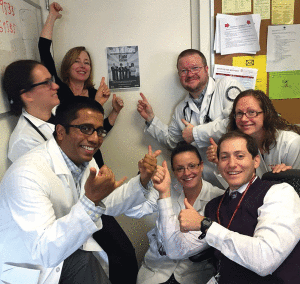
Not only did participants receive recognition for their efforts hanging up the posters and engaging their teams, the posters’ presence in various hospitals and offices around the country created thousands of impressions among hospital-based staff and others directly responsible for proper antibiotic prescribing.
Although the contest is over, you can still help facilitate culture change related to appropriate antibiotic prescribing. Follow SHM on Twitter @SHMLive, and continue to visit FightTheResistance.org for the latest updates on the campaign and new tools to promote antibiotic stewardship. TH
Brett Radler is SHM’s communications coordinator.
- Identify opportunities to engage with all hospital-based clinicians to improve antibiotic stewardship in your hospital.
- Pay attention to appropriate antibiotic choice and resistance patterns and identify mechanisms to educate providers on overprescribing in your hospital.
- Consider the following:
Adhere to antibiotic treatment guidelines.
Track the day.
Set a stop date.
Reevaluate therapy.
Streamline therapy.
Avoid automatic time courses.
Not only did participants receive recognition for their efforts hanging up the posters and engaging their teams, the posters’ presence in various hospitals and offices around the country created thousands of impressions among hospital-based staff and others directly responsible for proper antibiotic prescribing.
Although the contest is over, you can still help facilitate culture change related to appropriate antibiotic prescribing. Follow SHM on Twitter @SHMLive, and continue to visit FightTheResistance.org for the latest updates on the campaign and new tools to promote antibiotic stewardship. TH
Brett Radler is SHM’s communications coordinator.
- Identify opportunities to engage with all hospital-based clinicians to improve antibiotic stewardship in your hospital.
- Pay attention to appropriate antibiotic choice and resistance patterns and identify mechanisms to educate providers on overprescribing in your hospital.
- Consider the following:
Adhere to antibiotic treatment guidelines.
Track the day.
Set a stop date.
Reevaluate therapy.
Streamline therapy.
Avoid automatic time courses.
Not only did participants receive recognition for their efforts hanging up the posters and engaging their teams, the posters’ presence in various hospitals and offices around the country created thousands of impressions among hospital-based staff and others directly responsible for proper antibiotic prescribing.
Although the contest is over, you can still help facilitate culture change related to appropriate antibiotic prescribing. Follow SHM on Twitter @SHMLive, and continue to visit FightTheResistance.org for the latest updates on the campaign and new tools to promote antibiotic stewardship. TH
Brett Radler is SHM’s communications coordinator.
SHM Announces 2016 Awards of Excellence Winners
The Society of Hospital Medicine (SHM) created the Awards of Excellence Program to honor its members whose exemplary contributions to the hospital medicine movement merit acknowledgment and celebration. In honor of their achievements, recipients of each Award of Excellence receive an all-expense paid trip to SHM’s annual meeting.
Award recipients also receive recognition on stage in front of friends, family, and colleagues at SHM’s annual meeting, in The Hospitalist, and on www.hospitalmedicine.org.
Congratulations to this year’s winners:
Clinical Excellence
Mark Thoelke, MD, SFHM
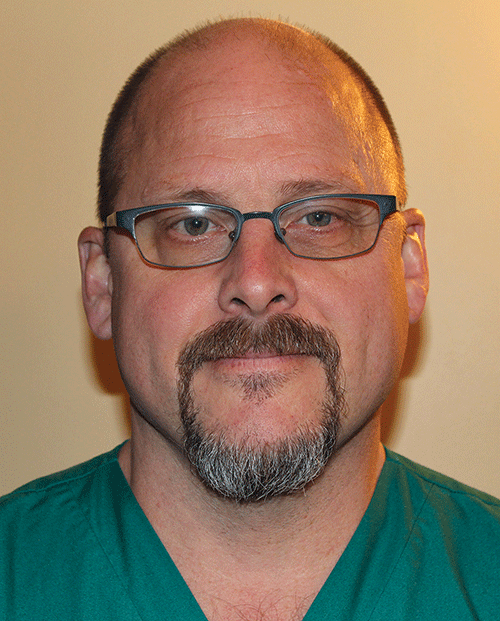
Dr. Thoelke became the first hospitalist at Barnes-Jewish Hospital in 1998 and helped form the Hospital Medicine Division of the Washington University School of Medicine in St. Louis in 2000, one of the first divisions in the U.S. The division is now composed of 70 physicians and eight nurse practitioners and consistently turns in superior performances on clinical outcomes as measured by UnitedHealthcare. The division has led the way with innovations in care models and teaching models and was one of the first to offer a sub-internship experience on the non-teaching service and one of the first to offer co-management with their oncology service in 2002. Dr. Thoelke still spends two-thirds of his time on clinical services and states that his job satisfaction comes largely from patient care and teaching.
Humanitarian Services
Bijay Acharya, MBBS, MD
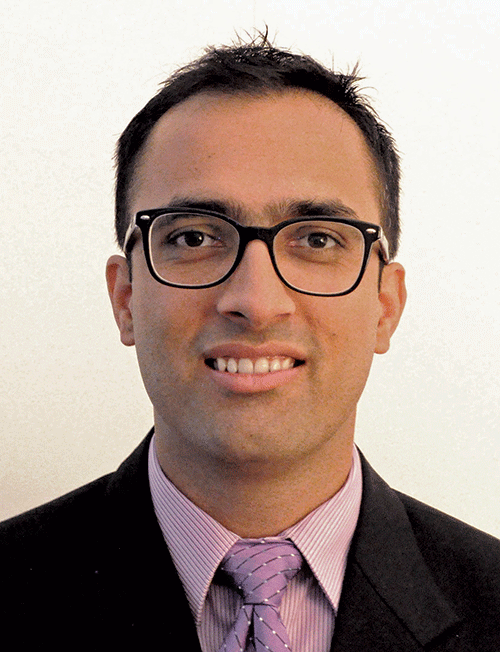
Dr. Acharya works as a hospitalist at Massachusetts General Hospital in Boston and is currently completing the Harvard Medical School/CRICO Fellowship in Patient Safety and Quality. His humanitarian work started when he was in medical school, where he led many health camps in extremely poor villages, ran blood-donation drives, and established the poor-patient fund. After graduation, Dr. Acharya, with his friends, worked to establish a nonprofit clinic named NyayaHealth (now Possible) to serve the healthcare needs of a very remote district in rural Nepal. Prior to the clinic, there was no physician for more than a quarter million people. Recently, after the massive earthquake in Nepal, Dr. Acharya led the relief efforts for the earthquake victims. Dr. Acharya strongly believes in the capacity of hospitalists to be strong advocates for their patients, peers, and communities, both locally and globally.
Non-Physician
Tiffani M. Panek, MA, SFHM, CLHM
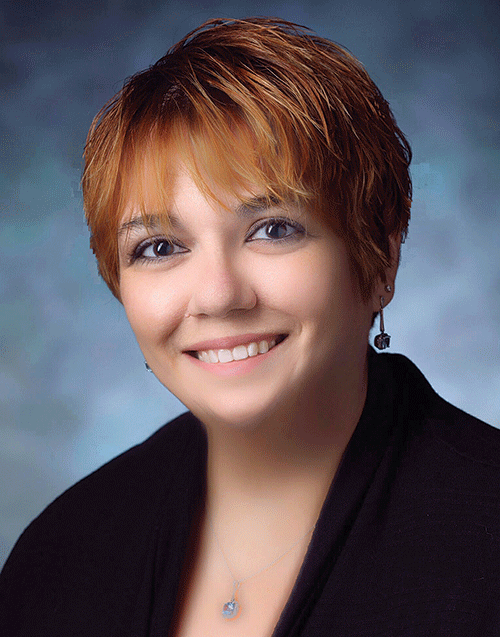
Panek is the hospitalist administrator for the Division of Hospital Medicine at the Johns Hopkins Bayview Medical Center in Baltimore. She is a Senior Fellow in Hospital Medicine and has also received her Certificate of Leadership in Hospital Medicine (CLHM) from SHM. She has been at Johns Hopkins for more than 12 years and has been instrumental in the significant growth and success of the Division of Hospital Medicine. Within SHM, she has been a member of the Practice Administrators Committee for three years and was recently elected to a two-year term as vice president of SHM’s Maryland Chapter. She is the first administrator to be elected to chapter leadership, to receive the CLHM, and to have an abstract accepted at an SHM annual meeting.
Outstanding Service
Thomas McIlraith, MD, SFHM, CLHM

Dr. McIlraith is the chairman of the Hospital Medicine Department at Mercy Medical Group in Sacramento, Calif. He improved patient flow between admissions and rounding with a novel operational system called Central Coordination, and it is now the standard for the Dignity Health facilities in Sacramento. The system markedly improved ED response, on-call hospitalist stress, and patient continuity. He has led many other quality and operational improvements, including unit-based rounding, rapid-response team development, and staff restructuring to improve physician coverage. Most recently, he became a leader in the Patient Experience Movement by developing the “Cognitive/Emotional Disconnect” model for understanding patient experience in hospital medicine. He is a member of the SHM Practice Management Committee.
Research
Vineet Chopra, MD, MSc, FHM
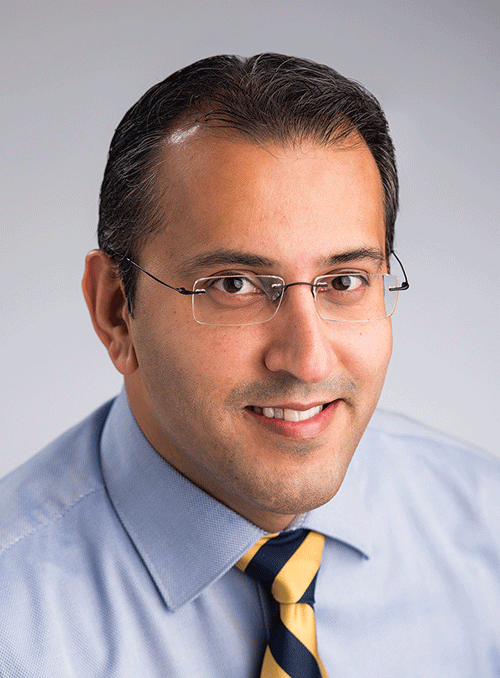
Dr. Chopra is an assistant professor of medicine and research scientist in the Patient Safety Enhancement Program at the University of Michigan and Ann Arbor VA Medical Center. Dr. Chopra’s research efforts are centered on improving the safety of hospitalized patients by preventing hospital-acquired complications. Using peripherally inserted central catheters (PICCs) as a model for this inquiry, his work has focused on quantifying current use of PICCs in hospitalized patients, estimating the risk of complications, and defining innovative ways to improve decision making for these devices. His research has been cited 1,962 times (1,580 times since 2010). He is an associate editor of The American Journal of Medicine and the Journal of Hospital Medicine and will serve as chair of SHM’s Research Committee in 2016.
Teaching
Alberto Puig, MD, PhD, SFHM

Dr. Puig has spent his career fully devoted to medical and clinical education. He is an associate professor of medicine at Harvard Medical School in Boston and director of the core educator faculty in the Department of Medicine at Massachusetts General Hospital, where he leads a unique group of physician-teachers fully devoted to clinical education. He is a regular discussant on educational programs for the academy at Harvard Medical School, and his contributions to medical education and clinical hospital teaching have made him a celebrated teacher and educator. Dr. Puig has played an important role at SHM and in the field of hospital medicine through his efforts as a medical educator; he is an avid student of the history of medicine and has been a frequent presenter at SHM’s annual meeting on this topic.
Teamwork
WellSpan Health, Active Bed Management

With the launch of ABM, Dr. Pfeiffer and Dr. Landis hoped to decrease ED length of stay by standardizing the hospitalist processes surrounding admission orders in computerized physician order entry. Ultimately, ABM at WellSpan has maintained the fastest time-to-admission order entry for any service at York Hospital—a decrease to 10 minutes from 80—with less variation for two years. ABM has also sustained national benchmark ED length of stay when the hospital is functioning at general capacity.
ABM also became instrumental in process and outcome objectives from a number of other hospital-wide initiatives. With ABM, more than 90% of a physician’s patient load is on one medical unit (up from 40%), which allowed the hospitalists to implement structured interdisciplinary bedside rounds (SIBR) on all medical units in York and Gettysburg hospitals. The success of ABM and SIBR allowed a transition-of-care project to focus on efficient discharges. Furthermore, Dr. Pfeiffer led a direct admission task force to improve direct admission referrals, safety, and acceptance, the number of which has since doubled. Without hospitalists’ ongoing leadership and effective teamwork, these significant improvements would not have been possible or sustained. TH
The Society of Hospital Medicine (SHM) created the Awards of Excellence Program to honor its members whose exemplary contributions to the hospital medicine movement merit acknowledgment and celebration. In honor of their achievements, recipients of each Award of Excellence receive an all-expense paid trip to SHM’s annual meeting.
Award recipients also receive recognition on stage in front of friends, family, and colleagues at SHM’s annual meeting, in The Hospitalist, and on www.hospitalmedicine.org.
Congratulations to this year’s winners:
Clinical Excellence
Mark Thoelke, MD, SFHM
Dr. Thoelke became the first hospitalist at Barnes-Jewish Hospital in 1998 and helped form the Hospital Medicine Division of the Washington University School of Medicine in St. Louis in 2000, one of the first divisions in the U.S. The division is now composed of 70 physicians and eight nurse practitioners and consistently turns in superior performances on clinical outcomes as measured by UnitedHealthcare. The division has led the way with innovations in care models and teaching models and was one of the first to offer a sub-internship experience on the non-teaching service and one of the first to offer co-management with their oncology service in 2002. Dr. Thoelke still spends two-thirds of his time on clinical services and states that his job satisfaction comes largely from patient care and teaching.
Humanitarian Services
Bijay Acharya, MBBS, MD
Dr. Acharya works as a hospitalist at Massachusetts General Hospital in Boston and is currently completing the Harvard Medical School/CRICO Fellowship in Patient Safety and Quality. His humanitarian work started when he was in medical school, where he led many health camps in extremely poor villages, ran blood-donation drives, and established the poor-patient fund. After graduation, Dr. Acharya, with his friends, worked to establish a nonprofit clinic named NyayaHealth (now Possible) to serve the healthcare needs of a very remote district in rural Nepal. Prior to the clinic, there was no physician for more than a quarter million people. Recently, after the massive earthquake in Nepal, Dr. Acharya led the relief efforts for the earthquake victims. Dr. Acharya strongly believes in the capacity of hospitalists to be strong advocates for their patients, peers, and communities, both locally and globally.
Non-Physician
Tiffani M. Panek, MA, SFHM, CLHM
Panek is the hospitalist administrator for the Division of Hospital Medicine at the Johns Hopkins Bayview Medical Center in Baltimore. She is a Senior Fellow in Hospital Medicine and has also received her Certificate of Leadership in Hospital Medicine (CLHM) from SHM. She has been at Johns Hopkins for more than 12 years and has been instrumental in the significant growth and success of the Division of Hospital Medicine. Within SHM, she has been a member of the Practice Administrators Committee for three years and was recently elected to a two-year term as vice president of SHM’s Maryland Chapter. She is the first administrator to be elected to chapter leadership, to receive the CLHM, and to have an abstract accepted at an SHM annual meeting.
Outstanding Service
Thomas McIlraith, MD, SFHM, CLHM
Dr. McIlraith is the chairman of the Hospital Medicine Department at Mercy Medical Group in Sacramento, Calif. He improved patient flow between admissions and rounding with a novel operational system called Central Coordination, and it is now the standard for the Dignity Health facilities in Sacramento. The system markedly improved ED response, on-call hospitalist stress, and patient continuity. He has led many other quality and operational improvements, including unit-based rounding, rapid-response team development, and staff restructuring to improve physician coverage. Most recently, he became a leader in the Patient Experience Movement by developing the “Cognitive/Emotional Disconnect” model for understanding patient experience in hospital medicine. He is a member of the SHM Practice Management Committee.
Research
Vineet Chopra, MD, MSc, FHM
Dr. Chopra is an assistant professor of medicine and research scientist in the Patient Safety Enhancement Program at the University of Michigan and Ann Arbor VA Medical Center. Dr. Chopra’s research efforts are centered on improving the safety of hospitalized patients by preventing hospital-acquired complications. Using peripherally inserted central catheters (PICCs) as a model for this inquiry, his work has focused on quantifying current use of PICCs in hospitalized patients, estimating the risk of complications, and defining innovative ways to improve decision making for these devices. His research has been cited 1,962 times (1,580 times since 2010). He is an associate editor of The American Journal of Medicine and the Journal of Hospital Medicine and will serve as chair of SHM’s Research Committee in 2016.
Teaching
Alberto Puig, MD, PhD, SFHM
Dr. Puig has spent his career fully devoted to medical and clinical education. He is an associate professor of medicine at Harvard Medical School in Boston and director of the core educator faculty in the Department of Medicine at Massachusetts General Hospital, where he leads a unique group of physician-teachers fully devoted to clinical education. He is a regular discussant on educational programs for the academy at Harvard Medical School, and his contributions to medical education and clinical hospital teaching have made him a celebrated teacher and educator. Dr. Puig has played an important role at SHM and in the field of hospital medicine through his efforts as a medical educator; he is an avid student of the history of medicine and has been a frequent presenter at SHM’s annual meeting on this topic.
Teamwork
WellSpan Health, Active Bed Management
With the launch of ABM, Dr. Pfeiffer and Dr. Landis hoped to decrease ED length of stay by standardizing the hospitalist processes surrounding admission orders in computerized physician order entry. Ultimately, ABM at WellSpan has maintained the fastest time-to-admission order entry for any service at York Hospital—a decrease to 10 minutes from 80—with less variation for two years. ABM has also sustained national benchmark ED length of stay when the hospital is functioning at general capacity.
ABM also became instrumental in process and outcome objectives from a number of other hospital-wide initiatives. With ABM, more than 90% of a physician’s patient load is on one medical unit (up from 40%), which allowed the hospitalists to implement structured interdisciplinary bedside rounds (SIBR) on all medical units in York and Gettysburg hospitals. The success of ABM and SIBR allowed a transition-of-care project to focus on efficient discharges. Furthermore, Dr. Pfeiffer led a direct admission task force to improve direct admission referrals, safety, and acceptance, the number of which has since doubled. Without hospitalists’ ongoing leadership and effective teamwork, these significant improvements would not have been possible or sustained. TH
The Society of Hospital Medicine (SHM) created the Awards of Excellence Program to honor its members whose exemplary contributions to the hospital medicine movement merit acknowledgment and celebration. In honor of their achievements, recipients of each Award of Excellence receive an all-expense paid trip to SHM’s annual meeting.
Award recipients also receive recognition on stage in front of friends, family, and colleagues at SHM’s annual meeting, in The Hospitalist, and on www.hospitalmedicine.org.
Congratulations to this year’s winners:
Clinical Excellence
Mark Thoelke, MD, SFHM
Dr. Thoelke became the first hospitalist at Barnes-Jewish Hospital in 1998 and helped form the Hospital Medicine Division of the Washington University School of Medicine in St. Louis in 2000, one of the first divisions in the U.S. The division is now composed of 70 physicians and eight nurse practitioners and consistently turns in superior performances on clinical outcomes as measured by UnitedHealthcare. The division has led the way with innovations in care models and teaching models and was one of the first to offer a sub-internship experience on the non-teaching service and one of the first to offer co-management with their oncology service in 2002. Dr. Thoelke still spends two-thirds of his time on clinical services and states that his job satisfaction comes largely from patient care and teaching.
Humanitarian Services
Bijay Acharya, MBBS, MD
Dr. Acharya works as a hospitalist at Massachusetts General Hospital in Boston and is currently completing the Harvard Medical School/CRICO Fellowship in Patient Safety and Quality. His humanitarian work started when he was in medical school, where he led many health camps in extremely poor villages, ran blood-donation drives, and established the poor-patient fund. After graduation, Dr. Acharya, with his friends, worked to establish a nonprofit clinic named NyayaHealth (now Possible) to serve the healthcare needs of a very remote district in rural Nepal. Prior to the clinic, there was no physician for more than a quarter million people. Recently, after the massive earthquake in Nepal, Dr. Acharya led the relief efforts for the earthquake victims. Dr. Acharya strongly believes in the capacity of hospitalists to be strong advocates for their patients, peers, and communities, both locally and globally.
Non-Physician
Tiffani M. Panek, MA, SFHM, CLHM
Panek is the hospitalist administrator for the Division of Hospital Medicine at the Johns Hopkins Bayview Medical Center in Baltimore. She is a Senior Fellow in Hospital Medicine and has also received her Certificate of Leadership in Hospital Medicine (CLHM) from SHM. She has been at Johns Hopkins for more than 12 years and has been instrumental in the significant growth and success of the Division of Hospital Medicine. Within SHM, she has been a member of the Practice Administrators Committee for three years and was recently elected to a two-year term as vice president of SHM’s Maryland Chapter. She is the first administrator to be elected to chapter leadership, to receive the CLHM, and to have an abstract accepted at an SHM annual meeting.
Outstanding Service
Thomas McIlraith, MD, SFHM, CLHM
Dr. McIlraith is the chairman of the Hospital Medicine Department at Mercy Medical Group in Sacramento, Calif. He improved patient flow between admissions and rounding with a novel operational system called Central Coordination, and it is now the standard for the Dignity Health facilities in Sacramento. The system markedly improved ED response, on-call hospitalist stress, and patient continuity. He has led many other quality and operational improvements, including unit-based rounding, rapid-response team development, and staff restructuring to improve physician coverage. Most recently, he became a leader in the Patient Experience Movement by developing the “Cognitive/Emotional Disconnect” model for understanding patient experience in hospital medicine. He is a member of the SHM Practice Management Committee.
Research
Vineet Chopra, MD, MSc, FHM
Dr. Chopra is an assistant professor of medicine and research scientist in the Patient Safety Enhancement Program at the University of Michigan and Ann Arbor VA Medical Center. Dr. Chopra’s research efforts are centered on improving the safety of hospitalized patients by preventing hospital-acquired complications. Using peripherally inserted central catheters (PICCs) as a model for this inquiry, his work has focused on quantifying current use of PICCs in hospitalized patients, estimating the risk of complications, and defining innovative ways to improve decision making for these devices. His research has been cited 1,962 times (1,580 times since 2010). He is an associate editor of The American Journal of Medicine and the Journal of Hospital Medicine and will serve as chair of SHM’s Research Committee in 2016.
Teaching
Alberto Puig, MD, PhD, SFHM
Dr. Puig has spent his career fully devoted to medical and clinical education. He is an associate professor of medicine at Harvard Medical School in Boston and director of the core educator faculty in the Department of Medicine at Massachusetts General Hospital, where he leads a unique group of physician-teachers fully devoted to clinical education. He is a regular discussant on educational programs for the academy at Harvard Medical School, and his contributions to medical education and clinical hospital teaching have made him a celebrated teacher and educator. Dr. Puig has played an important role at SHM and in the field of hospital medicine through his efforts as a medical educator; he is an avid student of the history of medicine and has been a frequent presenter at SHM’s annual meeting on this topic.
Teamwork
WellSpan Health, Active Bed Management
With the launch of ABM, Dr. Pfeiffer and Dr. Landis hoped to decrease ED length of stay by standardizing the hospitalist processes surrounding admission orders in computerized physician order entry. Ultimately, ABM at WellSpan has maintained the fastest time-to-admission order entry for any service at York Hospital—a decrease to 10 minutes from 80—with less variation for two years. ABM has also sustained national benchmark ED length of stay when the hospital is functioning at general capacity.
ABM also became instrumental in process and outcome objectives from a number of other hospital-wide initiatives. With ABM, more than 90% of a physician’s patient load is on one medical unit (up from 40%), which allowed the hospitalists to implement structured interdisciplinary bedside rounds (SIBR) on all medical units in York and Gettysburg hospitals. The success of ABM and SIBR allowed a transition-of-care project to focus on efficient discharges. Furthermore, Dr. Pfeiffer led a direct admission task force to improve direct admission referrals, safety, and acceptance, the number of which has since doubled. Without hospitalists’ ongoing leadership and effective teamwork, these significant improvements would not have been possible or sustained. TH

Benefits of Medicaid Expansion for Hospitalists
By January 2016, 31 states and the District of Columbia had embraced the Medicaid expansion brought to bear by the Affordable Care Act. Three states had not expanded but were “in active discussion,” while 16 states continued to opt out.1
The impacts of those decisions—on hospitals, on patients, and on physicians—are now beginning to be emerge. Several early studies, published toward the end of 2015 and in early 2016, show how the choice to expand or not expand impacted payor mix, patient access to quality healthcare, and physician reimbursement.
A study published in Health Affairs found states that expanded Medicaid in 2014, including Minnesota, Kentucky, and Arizona, saw a dramatic decrease in uninsured hospital stays and a significant increase in Medicaid stays. In six states that did not expand that year, including Florida, Georgia, and Missouri, there was no significant change in payor mix.2
“What a lot of these early studies are saying is that when you expand Medicaid, people get on Medicaid, and that’s exactly what you hope will happen when you do a major public coverage expansion,” says study lead author Sayeh Nikpay, PhD, MPH, assistant professor of health policy at Vanderbilt University School of Medicine in Nashville, Tenn. “Physicians are grappling with payment issues, and it should be quite a relief that people are coming in the door with some kind of insurance rather than uninsured.”
Instant Impact
Dr. Nikpay and the research team at the University of Michigan Institute for Healthcare Policy & Innovation (where she was previously a postdoctoral researcher) utilized a free online tool, HCUP Fast Stats (Healthcare Cost and Utilization Project), from the Agency for Healthcare Research and Quality. They examined adult discharges by quarter in 2013 and 2014 in each state in the study, controlling for demographic and economic characteristics.
Expansion states, the team learned, experienced a seven percentage point rise in Medicaid shares and a six percentage point drop in uninsured shares, reflecting a respective 20% increase in Medicaid discharges and 50% decrease in uninsured discharges. The effect was particularly profound in Kentucky, which saw a 13.5% drop in uninsured shares.
This underscores the “significant benefits of Medicaid expansion for low-income adults and for the hospitals that serve them,” the study authors concluded.
With positive data from this study and others—and the federal government willing to work with states on alternative expansion models, like in Arkansas, which is using Medicaid dollars to subsidize private insurance for recipients—Colleen M. Grogan, professor in the School of Social Service Administration at The University of Chicago, says the remaining states may feel more pressure to expand.
They are “getting pressure from hospitals and the business sector,” Grogan says. “It has an enormous impact on the economy. I don’t think any state is exempt from economic impact when they give up an infusion of federal funds.”
The federal government currently pays 100% of state Medicaid costs for the newly eligible upon expansion, eventually dropping to 90% by 2020.
A January 2016 Health Affairs study from researchers at Harvard University and Brigham and Women’s Hospital in Boston showed that traditional expansion in Kentucky and the “private option” expansion adopted in Arkansas both led to a decrease in the number of uninsured patients, an increase in access to healthcare, and fewer patients skipping medications or experiencing trouble paying medical bills between 2013 and expansion in 2014. This contrasted with the results in Texas, which has not expanded.3
Hospitalist Concerns
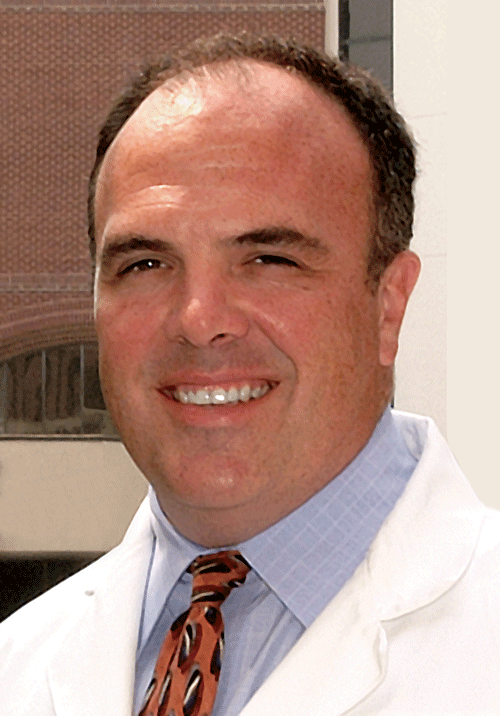
Patrick Cawley, MD, MBA, MHM, is CEO of the Medical University of South Carolina, previously practiced as a hospitalist, and is a past president of the Society of Hospital Medicine. For now, South Carolina is, like Texas, a non-expansion state. Dr. Cawley is concerned for the future of his hospital, an 800-bed academic, tertiary, safety-net hospital in Charleston, because payments to hospitals like his ultimately will drop.
Before a Supreme Court decision that ruled states were not compelled to expand Medicaid, the Affordable Care Act provided for a reduction in payments to safety-net hospitals. This was motivated by the notion that all hospitals would see a significant decrease in uncompensated care. The reduction has been delayed but is still scheduled to start in 2017.
“We couldn’t survive if disproportionate share goes away and something didn’t replace it, like Medicaid expansion,” Dr. Cawley says. But, he adds, over time he expects all or nearly all states will expand.
“When Medicaid first rolled out, it took 10 to 12 years before all states took it. I think expansion is the same way,” he says. “It’s one of those things that probably does work out, but what’s the transition going to be like, and how long is that transition going to last?” TH
Kelly April Tyrrell is a freelance writer in Madison, Wis.
References
- Status of state action on the Medicaid expansion decision. Kaiser Family Foundation website. http://kff.org/health-reform/state-indicator/state-activity-around-expanding-medicaid-under-the-affordable-care-act/. Updated January 12, 2016. Accessed January 14, 2016.
- Nikpay S, Buchmueller T, Levy HG. Affordable Care Act Medicaid expansion reduced uninsured hospital stays in 2014. Health Aff. 2016;35(1):106-110. doi:10.1377/hlthaff.2015.1144.
- Sommers BD, Blendon RJ, Orav EJ. Both the ‘private option’ and traditional Medicaid expansions improved access to care for low-income adults. Health Aff. 2016;35(1):96-105. doi:10.1377/hlthaff.2015.0917.
- Jones CD, Scott SJ, Anoff DL, Pierce RG, Glasheen JJ. Changes in payer mix and physician reimbursement after the Affordable Care Act and Medicaid expansion. Inquiry. 2015;52. doi:10.1177/0046958015602464.
Good News for Hospitalists

An additional 2015 study published by researchers at the University of Colorado Hospital found that Medicaid reimbursement to hospitalists per patient encounter rose 4.2% at the hospital in 2014 upon the state’s Medicaid expansion in January of that year. Medicaid encounters also increased, while uninsured encounters decreased.4
By January 2016, 31 states and the District of Columbia had embraced the Medicaid expansion brought to bear by the Affordable Care Act. Three states had not expanded but were “in active discussion,” while 16 states continued to opt out.1
The impacts of those decisions—on hospitals, on patients, and on physicians—are now beginning to be emerge. Several early studies, published toward the end of 2015 and in early 2016, show how the choice to expand or not expand impacted payor mix, patient access to quality healthcare, and physician reimbursement.
A study published in Health Affairs found states that expanded Medicaid in 2014, including Minnesota, Kentucky, and Arizona, saw a dramatic decrease in uninsured hospital stays and a significant increase in Medicaid stays. In six states that did not expand that year, including Florida, Georgia, and Missouri, there was no significant change in payor mix.2
“What a lot of these early studies are saying is that when you expand Medicaid, people get on Medicaid, and that’s exactly what you hope will happen when you do a major public coverage expansion,” says study lead author Sayeh Nikpay, PhD, MPH, assistant professor of health policy at Vanderbilt University School of Medicine in Nashville, Tenn. “Physicians are grappling with payment issues, and it should be quite a relief that people are coming in the door with some kind of insurance rather than uninsured.”
Instant Impact
Dr. Nikpay and the research team at the University of Michigan Institute for Healthcare Policy & Innovation (where she was previously a postdoctoral researcher) utilized a free online tool, HCUP Fast Stats (Healthcare Cost and Utilization Project), from the Agency for Healthcare Research and Quality. They examined adult discharges by quarter in 2013 and 2014 in each state in the study, controlling for demographic and economic characteristics.
Expansion states, the team learned, experienced a seven percentage point rise in Medicaid shares and a six percentage point drop in uninsured shares, reflecting a respective 20% increase in Medicaid discharges and 50% decrease in uninsured discharges. The effect was particularly profound in Kentucky, which saw a 13.5% drop in uninsured shares.
This underscores the “significant benefits of Medicaid expansion for low-income adults and for the hospitals that serve them,” the study authors concluded.
With positive data from this study and others—and the federal government willing to work with states on alternative expansion models, like in Arkansas, which is using Medicaid dollars to subsidize private insurance for recipients—Colleen M. Grogan, professor in the School of Social Service Administration at The University of Chicago, says the remaining states may feel more pressure to expand.
They are “getting pressure from hospitals and the business sector,” Grogan says. “It has an enormous impact on the economy. I don’t think any state is exempt from economic impact when they give up an infusion of federal funds.”
The federal government currently pays 100% of state Medicaid costs for the newly eligible upon expansion, eventually dropping to 90% by 2020.
A January 2016 Health Affairs study from researchers at Harvard University and Brigham and Women’s Hospital in Boston showed that traditional expansion in Kentucky and the “private option” expansion adopted in Arkansas both led to a decrease in the number of uninsured patients, an increase in access to healthcare, and fewer patients skipping medications or experiencing trouble paying medical bills between 2013 and expansion in 2014. This contrasted with the results in Texas, which has not expanded.3
Hospitalist Concerns
Patrick Cawley, MD, MBA, MHM, is CEO of the Medical University of South Carolina, previously practiced as a hospitalist, and is a past president of the Society of Hospital Medicine. For now, South Carolina is, like Texas, a non-expansion state. Dr. Cawley is concerned for the future of his hospital, an 800-bed academic, tertiary, safety-net hospital in Charleston, because payments to hospitals like his ultimately will drop.
Before a Supreme Court decision that ruled states were not compelled to expand Medicaid, the Affordable Care Act provided for a reduction in payments to safety-net hospitals. This was motivated by the notion that all hospitals would see a significant decrease in uncompensated care. The reduction has been delayed but is still scheduled to start in 2017.
“We couldn’t survive if disproportionate share goes away and something didn’t replace it, like Medicaid expansion,” Dr. Cawley says. But, he adds, over time he expects all or nearly all states will expand.
“When Medicaid first rolled out, it took 10 to 12 years before all states took it. I think expansion is the same way,” he says. “It’s one of those things that probably does work out, but what’s the transition going to be like, and how long is that transition going to last?” TH
Kelly April Tyrrell is a freelance writer in Madison, Wis.
References
- Status of state action on the Medicaid expansion decision. Kaiser Family Foundation website. http://kff.org/health-reform/state-indicator/state-activity-around-expanding-medicaid-under-the-affordable-care-act/. Updated January 12, 2016. Accessed January 14, 2016.
- Nikpay S, Buchmueller T, Levy HG. Affordable Care Act Medicaid expansion reduced uninsured hospital stays in 2014. Health Aff. 2016;35(1):106-110. doi:10.1377/hlthaff.2015.1144.
- Sommers BD, Blendon RJ, Orav EJ. Both the ‘private option’ and traditional Medicaid expansions improved access to care for low-income adults. Health Aff. 2016;35(1):96-105. doi:10.1377/hlthaff.2015.0917.
- Jones CD, Scott SJ, Anoff DL, Pierce RG, Glasheen JJ. Changes in payer mix and physician reimbursement after the Affordable Care Act and Medicaid expansion. Inquiry. 2015;52. doi:10.1177/0046958015602464.
Good News for Hospitalists
An additional 2015 study published by researchers at the University of Colorado Hospital found that Medicaid reimbursement to hospitalists per patient encounter rose 4.2% at the hospital in 2014 upon the state’s Medicaid expansion in January of that year. Medicaid encounters also increased, while uninsured encounters decreased.4
By January 2016, 31 states and the District of Columbia had embraced the Medicaid expansion brought to bear by the Affordable Care Act. Three states had not expanded but were “in active discussion,” while 16 states continued to opt out.1
The impacts of those decisions—on hospitals, on patients, and on physicians—are now beginning to be emerge. Several early studies, published toward the end of 2015 and in early 2016, show how the choice to expand or not expand impacted payor mix, patient access to quality healthcare, and physician reimbursement.
A study published in Health Affairs found states that expanded Medicaid in 2014, including Minnesota, Kentucky, and Arizona, saw a dramatic decrease in uninsured hospital stays and a significant increase in Medicaid stays. In six states that did not expand that year, including Florida, Georgia, and Missouri, there was no significant change in payor mix.2
“What a lot of these early studies are saying is that when you expand Medicaid, people get on Medicaid, and that’s exactly what you hope will happen when you do a major public coverage expansion,” says study lead author Sayeh Nikpay, PhD, MPH, assistant professor of health policy at Vanderbilt University School of Medicine in Nashville, Tenn. “Physicians are grappling with payment issues, and it should be quite a relief that people are coming in the door with some kind of insurance rather than uninsured.”
Instant Impact
Dr. Nikpay and the research team at the University of Michigan Institute for Healthcare Policy & Innovation (where she was previously a postdoctoral researcher) utilized a free online tool, HCUP Fast Stats (Healthcare Cost and Utilization Project), from the Agency for Healthcare Research and Quality. They examined adult discharges by quarter in 2013 and 2014 in each state in the study, controlling for demographic and economic characteristics.
Expansion states, the team learned, experienced a seven percentage point rise in Medicaid shares and a six percentage point drop in uninsured shares, reflecting a respective 20% increase in Medicaid discharges and 50% decrease in uninsured discharges. The effect was particularly profound in Kentucky, which saw a 13.5% drop in uninsured shares.
This underscores the “significant benefits of Medicaid expansion for low-income adults and for the hospitals that serve them,” the study authors concluded.
With positive data from this study and others—and the federal government willing to work with states on alternative expansion models, like in Arkansas, which is using Medicaid dollars to subsidize private insurance for recipients—Colleen M. Grogan, professor in the School of Social Service Administration at The University of Chicago, says the remaining states may feel more pressure to expand.
They are “getting pressure from hospitals and the business sector,” Grogan says. “It has an enormous impact on the economy. I don’t think any state is exempt from economic impact when they give up an infusion of federal funds.”
The federal government currently pays 100% of state Medicaid costs for the newly eligible upon expansion, eventually dropping to 90% by 2020.
A January 2016 Health Affairs study from researchers at Harvard University and Brigham and Women’s Hospital in Boston showed that traditional expansion in Kentucky and the “private option” expansion adopted in Arkansas both led to a decrease in the number of uninsured patients, an increase in access to healthcare, and fewer patients skipping medications or experiencing trouble paying medical bills between 2013 and expansion in 2014. This contrasted with the results in Texas, which has not expanded.3
Hospitalist Concerns
Patrick Cawley, MD, MBA, MHM, is CEO of the Medical University of South Carolina, previously practiced as a hospitalist, and is a past president of the Society of Hospital Medicine. For now, South Carolina is, like Texas, a non-expansion state. Dr. Cawley is concerned for the future of his hospital, an 800-bed academic, tertiary, safety-net hospital in Charleston, because payments to hospitals like his ultimately will drop.
Before a Supreme Court decision that ruled states were not compelled to expand Medicaid, the Affordable Care Act provided for a reduction in payments to safety-net hospitals. This was motivated by the notion that all hospitals would see a significant decrease in uncompensated care. The reduction has been delayed but is still scheduled to start in 2017.
“We couldn’t survive if disproportionate share goes away and something didn’t replace it, like Medicaid expansion,” Dr. Cawley says. But, he adds, over time he expects all or nearly all states will expand.
“When Medicaid first rolled out, it took 10 to 12 years before all states took it. I think expansion is the same way,” he says. “It’s one of those things that probably does work out, but what’s the transition going to be like, and how long is that transition going to last?” TH
Kelly April Tyrrell is a freelance writer in Madison, Wis.
References
- Status of state action on the Medicaid expansion decision. Kaiser Family Foundation website. http://kff.org/health-reform/state-indicator/state-activity-around-expanding-medicaid-under-the-affordable-care-act/. Updated January 12, 2016. Accessed January 14, 2016.
- Nikpay S, Buchmueller T, Levy HG. Affordable Care Act Medicaid expansion reduced uninsured hospital stays in 2014. Health Aff. 2016;35(1):106-110. doi:10.1377/hlthaff.2015.1144.
- Sommers BD, Blendon RJ, Orav EJ. Both the ‘private option’ and traditional Medicaid expansions improved access to care for low-income adults. Health Aff. 2016;35(1):96-105. doi:10.1377/hlthaff.2015.0917.
- Jones CD, Scott SJ, Anoff DL, Pierce RG, Glasheen JJ. Changes in payer mix and physician reimbursement after the Affordable Care Act and Medicaid expansion. Inquiry. 2015;52. doi:10.1177/0046958015602464.
Good News for Hospitalists
An additional 2015 study published by researchers at the University of Colorado Hospital found that Medicaid reimbursement to hospitalists per patient encounter rose 4.2% at the hospital in 2014 upon the state’s Medicaid expansion in January of that year. Medicaid encounters also increased, while uninsured encounters decreased.4
HM16 Session Analysis: Medical, Behavioral Management of Eating Disorders
Presenter: Kyung E. Rhee, MD, MSc, MA
Summary: Eating disorders (ED) are common and have significant morbidity and mortality. EDs are the third most common psychiatric disorder of adolescents with a prevalence of 0.5-2% for anorexia and 0.9-3% for bulimia; 90% of patients are female. Mortality rate can be as high as 10% for anorexia and 1% for bulimia. Diagnosis is formally guided by DSM 5 criteria, but the mnemonic SCOFF can be useful:
- Do you feel or make yourself SICK when eating?
- Do you feel you’ve lost CONTROL of your eating?
- Have you lost one STONE (14 lbs. developed by the British) of weight?
- Do you feel FAT?
- Does FOOD dominate your life?
A detailed history is needed as patients with ED may engage in secretive behaviors to hide their illness. After diagnosis, treatment may be outpatient or inpatient. Medical issues hospitalists are likely to see with inpatients include re-feeding syndrome, various metabolic disturbances, secondary amenorrhea, sleep disturbances, and for patients with bulimia, evidence of dental or esophageal trauma from purging. Differential diagnoses include: IBD, thyroid disease, celiac, diabetes, and Addison’s disease.
Hospitalists’ role in treatment is as part of a multidisciplinary group to manage the medical complications. Inpatient management includes individual and group therapy, monitored group meals, daily blind weights, bathroom visits, and focused lab studies. There is no “cure” and only ~50% of patients are free of ongoing symptoms after treatment.
Key Takeaways
- Eating disorders are common in adolescent females and have significant morbidity and mortality.
- Hospitalists’ role is diagnosis via careful history and management of medical complications with an eating disorder team. TH
Dr. Pressel is a pediatric hospitalist and inpatient medical director at Nemours/Alfred I. duPont Hospital for Children in Wilmington, Del., and a member of Team Hospitalist.
Presenter: Kyung E. Rhee, MD, MSc, MA
Summary: Eating disorders (ED) are common and have significant morbidity and mortality. EDs are the third most common psychiatric disorder of adolescents with a prevalence of 0.5-2% for anorexia and 0.9-3% for bulimia; 90% of patients are female. Mortality rate can be as high as 10% for anorexia and 1% for bulimia. Diagnosis is formally guided by DSM 5 criteria, but the mnemonic SCOFF can be useful:
- Do you feel or make yourself SICK when eating?
- Do you feel you’ve lost CONTROL of your eating?
- Have you lost one STONE (14 lbs. developed by the British) of weight?
- Do you feel FAT?
- Does FOOD dominate your life?
A detailed history is needed as patients with ED may engage in secretive behaviors to hide their illness. After diagnosis, treatment may be outpatient or inpatient. Medical issues hospitalists are likely to see with inpatients include re-feeding syndrome, various metabolic disturbances, secondary amenorrhea, sleep disturbances, and for patients with bulimia, evidence of dental or esophageal trauma from purging. Differential diagnoses include: IBD, thyroid disease, celiac, diabetes, and Addison’s disease.
Hospitalists’ role in treatment is as part of a multidisciplinary group to manage the medical complications. Inpatient management includes individual and group therapy, monitored group meals, daily blind weights, bathroom visits, and focused lab studies. There is no “cure” and only ~50% of patients are free of ongoing symptoms after treatment.
Key Takeaways
- Eating disorders are common in adolescent females and have significant morbidity and mortality.
- Hospitalists’ role is diagnosis via careful history and management of medical complications with an eating disorder team. TH
Dr. Pressel is a pediatric hospitalist and inpatient medical director at Nemours/Alfred I. duPont Hospital for Children in Wilmington, Del., and a member of Team Hospitalist.
Presenter: Kyung E. Rhee, MD, MSc, MA
Summary: Eating disorders (ED) are common and have significant morbidity and mortality. EDs are the third most common psychiatric disorder of adolescents with a prevalence of 0.5-2% for anorexia and 0.9-3% for bulimia; 90% of patients are female. Mortality rate can be as high as 10% for anorexia and 1% for bulimia. Diagnosis is formally guided by DSM 5 criteria, but the mnemonic SCOFF can be useful:
- Do you feel or make yourself SICK when eating?
- Do you feel you’ve lost CONTROL of your eating?
- Have you lost one STONE (14 lbs. developed by the British) of weight?
- Do you feel FAT?
- Does FOOD dominate your life?
A detailed history is needed as patients with ED may engage in secretive behaviors to hide their illness. After diagnosis, treatment may be outpatient or inpatient. Medical issues hospitalists are likely to see with inpatients include re-feeding syndrome, various metabolic disturbances, secondary amenorrhea, sleep disturbances, and for patients with bulimia, evidence of dental or esophageal trauma from purging. Differential diagnoses include: IBD, thyroid disease, celiac, diabetes, and Addison’s disease.
Hospitalists’ role in treatment is as part of a multidisciplinary group to manage the medical complications. Inpatient management includes individual and group therapy, monitored group meals, daily blind weights, bathroom visits, and focused lab studies. There is no “cure” and only ~50% of patients are free of ongoing symptoms after treatment.
Key Takeaways
- Eating disorders are common in adolescent females and have significant morbidity and mortality.
- Hospitalists’ role is diagnosis via careful history and management of medical complications with an eating disorder team. TH
Dr. Pressel is a pediatric hospitalist and inpatient medical director at Nemours/Alfred I. duPont Hospital for Children in Wilmington, Del., and a member of Team Hospitalist.
Preventing Patient Falls
Patient falls are a national issue, creating costs for every player in the healthcare system.
“Patient falls negatively impact patient outcomes, hospital costs, and costs for insurance and health systems,” says Jennifer Hefner, PhD, MPH, lead author of “A Falls Wheel in a Large Academic Medical Center: An Intervention to Reduce Patient Falls with Harm,” published in the Journal of Healthcare Quality.

“Patients are negatively impacted by falls in terms of outcomes like loss of confidence and readmission risks,” Dr. Hefner says. “Centers for Medicare & Medicaid Services in 2008 declared they wouldn’t reimburse hospitals for treatment of fall injuries if they occurred during a patient’s stay and they could be prevented by hospitals. In terms of the cost to society, the length of stay is longer if there’s been a fall with harm, and the total charges are 60% higher between those who fell and sustained an injury and those who didn’t.”
In the researchers’ yearlong study, a falls wheel—a tool that categorized each patient on two dimensions: risk of fall and risk of injury from fall—was placed on every patient’s door. During the year, the rate of falls with harm dropped by almost 50%.
The falls wheel was just one element—the main innovative element—of the hospital’s multifaceted approach to falls prevention. The hospital also enhanced staff education and focus on the issue, launched a resource website, and sent a daily email reporting the number of falls.
“The most important thing we learned is that falls are not a nurse-sensitive indicator,” says co-author Susan Moffatt-Bruce, MD, PhD. “Falls are a team-sensitive indicator. It’s only when you realize falls are not just a nurse’s responsibility but everybody’s responsibility can you actually impact them and reduce them.”
Focusing on the problem and developing specific, multifaceted interventions was the key, the authors say.
“I don’t think everybody needs to use a falls wheel, but you need some kind of system or program,” Dr. Moffatt-Bruce says. “Just putting a wristband on someone to say they’re at high risk is great, but so what? What are you going to do about it? What are the actual items you’re asking the team to do to prevent falls?”
Reference
- Hefner JL, McAlearney AS, Mansfield J, Knupp AM, Moffatt-Bruce SD. A falls wheel in a large academic medical center: an intervention to reduce patient falls with harm. J Healthc Qual. 2015;37(6):374-380.
Fast Fact

Reference
- Barnet S, Green M, Punke H. 10 top patient safety issues for 2016. Becker’s Infection Control and Clinical Quality website. Available at: http://www.beckershospitalreview.com/quality/10-top-patient-safety-issues-for-2016.html. Published January 12, 2016. Accessed January 28, 2016.
Patient falls are a national issue, creating costs for every player in the healthcare system.
“Patient falls negatively impact patient outcomes, hospital costs, and costs for insurance and health systems,” says Jennifer Hefner, PhD, MPH, lead author of “A Falls Wheel in a Large Academic Medical Center: An Intervention to Reduce Patient Falls with Harm,” published in the Journal of Healthcare Quality.
“Patients are negatively impacted by falls in terms of outcomes like loss of confidence and readmission risks,” Dr. Hefner says. “Centers for Medicare & Medicaid Services in 2008 declared they wouldn’t reimburse hospitals for treatment of fall injuries if they occurred during a patient’s stay and they could be prevented by hospitals. In terms of the cost to society, the length of stay is longer if there’s been a fall with harm, and the total charges are 60% higher between those who fell and sustained an injury and those who didn’t.”
In the researchers’ yearlong study, a falls wheel—a tool that categorized each patient on two dimensions: risk of fall and risk of injury from fall—was placed on every patient’s door. During the year, the rate of falls with harm dropped by almost 50%.
The falls wheel was just one element—the main innovative element—of the hospital’s multifaceted approach to falls prevention. The hospital also enhanced staff education and focus on the issue, launched a resource website, and sent a daily email reporting the number of falls.
“The most important thing we learned is that falls are not a nurse-sensitive indicator,” says co-author Susan Moffatt-Bruce, MD, PhD. “Falls are a team-sensitive indicator. It’s only when you realize falls are not just a nurse’s responsibility but everybody’s responsibility can you actually impact them and reduce them.”
Focusing on the problem and developing specific, multifaceted interventions was the key, the authors say.
“I don’t think everybody needs to use a falls wheel, but you need some kind of system or program,” Dr. Moffatt-Bruce says. “Just putting a wristband on someone to say they’re at high risk is great, but so what? What are you going to do about it? What are the actual items you’re asking the team to do to prevent falls?”
Reference
- Hefner JL, McAlearney AS, Mansfield J, Knupp AM, Moffatt-Bruce SD. A falls wheel in a large academic medical center: an intervention to reduce patient falls with harm. J Healthc Qual. 2015;37(6):374-380.
Fast Fact
Reference
- Barnet S, Green M, Punke H. 10 top patient safety issues for 2016. Becker’s Infection Control and Clinical Quality website. Available at: http://www.beckershospitalreview.com/quality/10-top-patient-safety-issues-for-2016.html. Published January 12, 2016. Accessed January 28, 2016.
Patient falls are a national issue, creating costs for every player in the healthcare system.
“Patient falls negatively impact patient outcomes, hospital costs, and costs for insurance and health systems,” says Jennifer Hefner, PhD, MPH, lead author of “A Falls Wheel in a Large Academic Medical Center: An Intervention to Reduce Patient Falls with Harm,” published in the Journal of Healthcare Quality.
“Patients are negatively impacted by falls in terms of outcomes like loss of confidence and readmission risks,” Dr. Hefner says. “Centers for Medicare & Medicaid Services in 2008 declared they wouldn’t reimburse hospitals for treatment of fall injuries if they occurred during a patient’s stay and they could be prevented by hospitals. In terms of the cost to society, the length of stay is longer if there’s been a fall with harm, and the total charges are 60% higher between those who fell and sustained an injury and those who didn’t.”
In the researchers’ yearlong study, a falls wheel—a tool that categorized each patient on two dimensions: risk of fall and risk of injury from fall—was placed on every patient’s door. During the year, the rate of falls with harm dropped by almost 50%.
The falls wheel was just one element—the main innovative element—of the hospital’s multifaceted approach to falls prevention. The hospital also enhanced staff education and focus on the issue, launched a resource website, and sent a daily email reporting the number of falls.
“The most important thing we learned is that falls are not a nurse-sensitive indicator,” says co-author Susan Moffatt-Bruce, MD, PhD. “Falls are a team-sensitive indicator. It’s only when you realize falls are not just a nurse’s responsibility but everybody’s responsibility can you actually impact them and reduce them.”
Focusing on the problem and developing specific, multifaceted interventions was the key, the authors say.
“I don’t think everybody needs to use a falls wheel, but you need some kind of system or program,” Dr. Moffatt-Bruce says. “Just putting a wristband on someone to say they’re at high risk is great, but so what? What are you going to do about it? What are the actual items you’re asking the team to do to prevent falls?”
Reference
- Hefner JL, McAlearney AS, Mansfield J, Knupp AM, Moffatt-Bruce SD. A falls wheel in a large academic medical center: an intervention to reduce patient falls with harm. J Healthc Qual. 2015;37(6):374-380.
Fast Fact
Reference
- Barnet S, Green M, Punke H. 10 top patient safety issues for 2016. Becker’s Infection Control and Clinical Quality website. Available at: http://www.beckershospitalreview.com/quality/10-top-patient-safety-issues-for-2016.html. Published January 12, 2016. Accessed January 28, 2016.
Frontline Teams Needed for Rapidly Changing Healthcare
Healthcare is changing rapidly, shifting focus from volume to value, says Jeffrey Glasheen, MD, SFHM, lead author of the abstract “Developing Frontline Teams to Drive Health System Transformation.” To support this transformation, frontline clinical leaders need to be able to build and manage teams and care processes—skills not taught in traditional health professional training.
That’s why the University of Colorado Anschutz Medical Campus launched the Certificate Training Program (CTP). The CTP curriculum focuses on enhancing team performance, leadership development, and process improvement. Participants meet weekly and receive support from a coach, a process-improvement specialist, and a data analyst.
Following the yearlong program, participants showed significant improvements in self-perception of leadership (37% to 75% able to manage change), quality improvement (23% to 78% able to use QI tools), and efficiency (31% to 69% able to reduce operational waste) skills. The participants’ work resulted in measurable improvements for the hospital: multiday reductions in length of stays, more than $200,000 in antibiotic cost avoidance for hospitalized pediatric patients, and improvement in pain and symptom scores for palliative care patients. Overall cost avoidance and revenue benefit exceeded $5 million.\
“We aimed to demonstrate that the work that we all need to accomplish—improving the value equation—can best be accomplished through the creation, development, and resourcing of high-functioning teams,” says Dr. Glasheen, an SHM board member. “Most important, we showed that a comprehensive training and development program aimed at creating, resourcing, and supporting high-functioning clinical leadership teams can facilitate academic medical centers’ efforts to pursue high-value care and achieve measurable improvement.”
Reference
1. Glasheen J, Cumbler E, Kneeland P, et al. Developing frontline teams to drive health system transformation [abstract]. Journal of Hospital Medicine. 2015;10(suppl 2). Available at: http://www.shmabstracts.com/abstract/developing-frontline-teams-to-drive-health-system-transformation/. Accessed January 28, 2016.
Healthcare is changing rapidly, shifting focus from volume to value, says Jeffrey Glasheen, MD, SFHM, lead author of the abstract “Developing Frontline Teams to Drive Health System Transformation.” To support this transformation, frontline clinical leaders need to be able to build and manage teams and care processes—skills not taught in traditional health professional training.
That’s why the University of Colorado Anschutz Medical Campus launched the Certificate Training Program (CTP). The CTP curriculum focuses on enhancing team performance, leadership development, and process improvement. Participants meet weekly and receive support from a coach, a process-improvement specialist, and a data analyst.
Following the yearlong program, participants showed significant improvements in self-perception of leadership (37% to 75% able to manage change), quality improvement (23% to 78% able to use QI tools), and efficiency (31% to 69% able to reduce operational waste) skills. The participants’ work resulted in measurable improvements for the hospital: multiday reductions in length of stays, more than $200,000 in antibiotic cost avoidance for hospitalized pediatric patients, and improvement in pain and symptom scores for palliative care patients. Overall cost avoidance and revenue benefit exceeded $5 million.\
“We aimed to demonstrate that the work that we all need to accomplish—improving the value equation—can best be accomplished through the creation, development, and resourcing of high-functioning teams,” says Dr. Glasheen, an SHM board member. “Most important, we showed that a comprehensive training and development program aimed at creating, resourcing, and supporting high-functioning clinical leadership teams can facilitate academic medical centers’ efforts to pursue high-value care and achieve measurable improvement.”
Reference
1. Glasheen J, Cumbler E, Kneeland P, et al. Developing frontline teams to drive health system transformation [abstract]. Journal of Hospital Medicine. 2015;10(suppl 2). Available at: http://www.shmabstracts.com/abstract/developing-frontline-teams-to-drive-health-system-transformation/. Accessed January 28, 2016.
Healthcare is changing rapidly, shifting focus from volume to value, says Jeffrey Glasheen, MD, SFHM, lead author of the abstract “Developing Frontline Teams to Drive Health System Transformation.” To support this transformation, frontline clinical leaders need to be able to build and manage teams and care processes—skills not taught in traditional health professional training.
That’s why the University of Colorado Anschutz Medical Campus launched the Certificate Training Program (CTP). The CTP curriculum focuses on enhancing team performance, leadership development, and process improvement. Participants meet weekly and receive support from a coach, a process-improvement specialist, and a data analyst.
Following the yearlong program, participants showed significant improvements in self-perception of leadership (37% to 75% able to manage change), quality improvement (23% to 78% able to use QI tools), and efficiency (31% to 69% able to reduce operational waste) skills. The participants’ work resulted in measurable improvements for the hospital: multiday reductions in length of stays, more than $200,000 in antibiotic cost avoidance for hospitalized pediatric patients, and improvement in pain and symptom scores for palliative care patients. Overall cost avoidance and revenue benefit exceeded $5 million.\
“We aimed to demonstrate that the work that we all need to accomplish—improving the value equation—can best be accomplished through the creation, development, and resourcing of high-functioning teams,” says Dr. Glasheen, an SHM board member. “Most important, we showed that a comprehensive training and development program aimed at creating, resourcing, and supporting high-functioning clinical leadership teams can facilitate academic medical centers’ efforts to pursue high-value care and achieve measurable improvement.”
Reference
1. Glasheen J, Cumbler E, Kneeland P, et al. Developing frontline teams to drive health system transformation [abstract]. Journal of Hospital Medicine. 2015;10(suppl 2). Available at: http://www.shmabstracts.com/abstract/developing-frontline-teams-to-drive-health-system-transformation/. Accessed January 28, 2016.
HM16 Session Analysis: Nonpharmacological Treatment Approach Better for Neonatal Abstinence Syndrome
Presenter: Matthew Grossman, MD, FAAP
Summary: Treating Neonatal Abstinence Syndrome (NAS) traditionally has followed a standardized approach using the Finnegan Scoring System in which if there were three consecutive scores > 8 or two scores > 12, medications would be started. Common medications included tincture of opium or morphine. Medication doses would be adjusted or weaned, typically every other day, by Finnegan scoring.
A better approach is indicated with the 2012 AAP guidelines that indicate the first-line approach to NAS should be nonpharmacological. The approach should be that used for any crying baby, i.e., holding, swaddling, on-demand feeding, and parents rooming in with the infant. NAS infants without significant other medical problems are best cared for in a regular nursery or hospital unit rather than a NICU. With these simple interventions, some NAS infants may not need medications, and if they do, may be weaned sooner.
Additionally, medication management can be more successful if using combinations of a narcotic plus an additional agent such as clonidine or phenobarbital. Medications may be safely weaned more quickly than every other day. Using such a combined approach, the Yale New Haven Hospital has significantly reduced NAS infant LOS, total narcotic dose, and cost while increasing rates of breast feeding.
Key Takeaways
- Treat NAS first by providing high quality nursing care with infants out of an ICU, swaddled, fed and held when first exhibiting withdrawal symptoms.
- Use combination narcotic and other medication if pharmacologic treatment is needed.
- Wean aggressively by symptoms. TH
Dr. Pressel is a pediatric hospitalist and inpatient medical director at Nemours/Alfred I. duPont Hospital for Children in Wilmington, Del., and a member of Team Hospitalist.
Presenter: Matthew Grossman, MD, FAAP
Summary: Treating Neonatal Abstinence Syndrome (NAS) traditionally has followed a standardized approach using the Finnegan Scoring System in which if there were three consecutive scores > 8 or two scores > 12, medications would be started. Common medications included tincture of opium or morphine. Medication doses would be adjusted or weaned, typically every other day, by Finnegan scoring.
A better approach is indicated with the 2012 AAP guidelines that indicate the first-line approach to NAS should be nonpharmacological. The approach should be that used for any crying baby, i.e., holding, swaddling, on-demand feeding, and parents rooming in with the infant. NAS infants without significant other medical problems are best cared for in a regular nursery or hospital unit rather than a NICU. With these simple interventions, some NAS infants may not need medications, and if they do, may be weaned sooner.
Additionally, medication management can be more successful if using combinations of a narcotic plus an additional agent such as clonidine or phenobarbital. Medications may be safely weaned more quickly than every other day. Using such a combined approach, the Yale New Haven Hospital has significantly reduced NAS infant LOS, total narcotic dose, and cost while increasing rates of breast feeding.
Key Takeaways
- Treat NAS first by providing high quality nursing care with infants out of an ICU, swaddled, fed and held when first exhibiting withdrawal symptoms.
- Use combination narcotic and other medication if pharmacologic treatment is needed.
- Wean aggressively by symptoms. TH
Dr. Pressel is a pediatric hospitalist and inpatient medical director at Nemours/Alfred I. duPont Hospital for Children in Wilmington, Del., and a member of Team Hospitalist.
Presenter: Matthew Grossman, MD, FAAP
Summary: Treating Neonatal Abstinence Syndrome (NAS) traditionally has followed a standardized approach using the Finnegan Scoring System in which if there were three consecutive scores > 8 or two scores > 12, medications would be started. Common medications included tincture of opium or morphine. Medication doses would be adjusted or weaned, typically every other day, by Finnegan scoring.
A better approach is indicated with the 2012 AAP guidelines that indicate the first-line approach to NAS should be nonpharmacological. The approach should be that used for any crying baby, i.e., holding, swaddling, on-demand feeding, and parents rooming in with the infant. NAS infants without significant other medical problems are best cared for in a regular nursery or hospital unit rather than a NICU. With these simple interventions, some NAS infants may not need medications, and if they do, may be weaned sooner.
Additionally, medication management can be more successful if using combinations of a narcotic plus an additional agent such as clonidine or phenobarbital. Medications may be safely weaned more quickly than every other day. Using such a combined approach, the Yale New Haven Hospital has significantly reduced NAS infant LOS, total narcotic dose, and cost while increasing rates of breast feeding.
Key Takeaways
- Treat NAS first by providing high quality nursing care with infants out of an ICU, swaddled, fed and held when first exhibiting withdrawal symptoms.
- Use combination narcotic and other medication if pharmacologic treatment is needed.
- Wean aggressively by symptoms. TH
Dr. Pressel is a pediatric hospitalist and inpatient medical director at Nemours/Alfred I. duPont Hospital for Children in Wilmington, Del., and a member of Team Hospitalist.
HM16 Session Analysis: Stay Calm, Safe During Inpatient Behavioral Emergencies
Presenters: David Pressel, MD, PhD, FAAP, FHM, Emily Fingado, MD, FAAP, and Jessica Tomaszewski, MD, FAAP
Summary: Patients may engage in violent behaviors that pose a danger to themselves or others. Behavioral emergencies may be rare, can be dangerous, and staff may feel ill-trained to respond appropriately. Patients with ingestions, or underlying psychiatric or developmental difficulties, are at highest risk for developing a behavioral emergency.
The first strategy in handling a potentially violent patient is de-escalation, i.e., trying to identify and rectify the behavioral trigger. If de-escalation is not successful, personal safety is paramount. Get away from the patient and get help. If a patient needs to be physically restrained, minimally there should be one staff member per limb. Various physical devices, including soft restraints, four-point leathers, hand mittens, and spit hoods may be used to control a violent patient. A violent restraint is characterized by the indication, not the device. Medications may be used to treat the underlying mental health issue and should not be used as PRN chemical restraints.
After a violent patient is safely restrained, further steps need to be taken, including notification of the attending or legal guardian if a minor; documentation of the event, including a debrief of what occurred; a room sweep to ensure securing any dangerous items (metal eating utensils); and modification of the care plan to strategize on removal of the restraints as soon as is safe.
Hospitals should view behavioral emergencies similarly to a Code Blue. Have a specialized team that responds and undergoes regular training.
Key Takeaways
- Behavioral emergencies occur when a patient becomes violent.
- De-escalation is the best response.
- If not successful, maintain personal safety, control and medicate the patient as appropriate, and document clearly. TH
Dr. Pressel is a pediatric hospitalist and inpatient medical director at Nemours/Alfred I. duPont Hospital for Children in Wilmington, Del., and a member of Team Hospitalist.
Presenters: David Pressel, MD, PhD, FAAP, FHM, Emily Fingado, MD, FAAP, and Jessica Tomaszewski, MD, FAAP
Summary: Patients may engage in violent behaviors that pose a danger to themselves or others. Behavioral emergencies may be rare, can be dangerous, and staff may feel ill-trained to respond appropriately. Patients with ingestions, or underlying psychiatric or developmental difficulties, are at highest risk for developing a behavioral emergency.
The first strategy in handling a potentially violent patient is de-escalation, i.e., trying to identify and rectify the behavioral trigger. If de-escalation is not successful, personal safety is paramount. Get away from the patient and get help. If a patient needs to be physically restrained, minimally there should be one staff member per limb. Various physical devices, including soft restraints, four-point leathers, hand mittens, and spit hoods may be used to control a violent patient. A violent restraint is characterized by the indication, not the device. Medications may be used to treat the underlying mental health issue and should not be used as PRN chemical restraints.
After a violent patient is safely restrained, further steps need to be taken, including notification of the attending or legal guardian if a minor; documentation of the event, including a debrief of what occurred; a room sweep to ensure securing any dangerous items (metal eating utensils); and modification of the care plan to strategize on removal of the restraints as soon as is safe.
Hospitals should view behavioral emergencies similarly to a Code Blue. Have a specialized team that responds and undergoes regular training.
Key Takeaways
- Behavioral emergencies occur when a patient becomes violent.
- De-escalation is the best response.
- If not successful, maintain personal safety, control and medicate the patient as appropriate, and document clearly. TH
Dr. Pressel is a pediatric hospitalist and inpatient medical director at Nemours/Alfred I. duPont Hospital for Children in Wilmington, Del., and a member of Team Hospitalist.
Presenters: David Pressel, MD, PhD, FAAP, FHM, Emily Fingado, MD, FAAP, and Jessica Tomaszewski, MD, FAAP
Summary: Patients may engage in violent behaviors that pose a danger to themselves or others. Behavioral emergencies may be rare, can be dangerous, and staff may feel ill-trained to respond appropriately. Patients with ingestions, or underlying psychiatric or developmental difficulties, are at highest risk for developing a behavioral emergency.
The first strategy in handling a potentially violent patient is de-escalation, i.e., trying to identify and rectify the behavioral trigger. If de-escalation is not successful, personal safety is paramount. Get away from the patient and get help. If a patient needs to be physically restrained, minimally there should be one staff member per limb. Various physical devices, including soft restraints, four-point leathers, hand mittens, and spit hoods may be used to control a violent patient. A violent restraint is characterized by the indication, not the device. Medications may be used to treat the underlying mental health issue and should not be used as PRN chemical restraints.
After a violent patient is safely restrained, further steps need to be taken, including notification of the attending or legal guardian if a minor; documentation of the event, including a debrief of what occurred; a room sweep to ensure securing any dangerous items (metal eating utensils); and modification of the care plan to strategize on removal of the restraints as soon as is safe.
Hospitals should view behavioral emergencies similarly to a Code Blue. Have a specialized team that responds and undergoes regular training.
Key Takeaways
- Behavioral emergencies occur when a patient becomes violent.
- De-escalation is the best response.
- If not successful, maintain personal safety, control and medicate the patient as appropriate, and document clearly. TH
Dr. Pressel is a pediatric hospitalist and inpatient medical director at Nemours/Alfred I. duPont Hospital for Children in Wilmington, Del., and a member of Team Hospitalist.