User login
Resume Red Flags
Fifteen seconds: That’s approximately how long an employer looks at a CV. Recruiters and employers know what they want; they skim even the best resumes. They are on the lookout for applicants who meet their requirements; sometimes they’ll take a chance on a long shot whose pitch catches their eye.
So what happens when a resume stands out for the wrong reasons? Work histories aren’t always perfect, and recruiters and prospective employers will notice any blemishes.
“The thing about red flags is they’re just an indicator that the applicant is an outlier,” says Kim Bell, MD, FACP, SFHM, regional medical director of the Pacific West Region for EmCare, a Dallas-based company that provides outsourced physician services to more than 500 hospitals in 40 states. “It doesn’t necessarily rule them out.”
Preempt Suspicion
For hospitalists, resume imperfections that attract attention include:
- Gaps in employment;
- Frequent changes in employment;
- Changes in residency;
- Medical board sanctions or probation;
- Failures on the board exam; and
- Forced resignations or firings.
—Cheryl O’Malley, MD, FACP, program director, Department of Internal Medicine and Pediatrics, Banner Good Samaritan Medical Center, Phoenix
When recruiters or employers notice a red flag, they look for other problems to see if patterns emerge and to discern if the applicant exhibited bad judgment, has character flaws, or shows an inability to learn from a mistake, says Jeff Kaplan, PhD, MBA, MCC, a licensed psychologist and Philadelphia-based executive coach whose clients include healthcare industry executives. If such signs exist, the applicant is generally eliminated from consideration. Therefore, it’s critical that applicants explain clearly and succinctly the reason for any resume shortcoming.
“A good way is to actually write a cover letter to explain some uniqueness in their CV that they want [recruiters] to understand,” says Alpesh Amin, MD, MBA, FACP, SFHM, professor and chairman of the Department of Medicine and executive director of the hospitalist program at the University of California at Irvine.
By explaining the situation, Dr. Bell says, the hospitalist doesn’t give the employer a chance to guess a reason for the red flag—and potentially guess wrong.
“There’s a big difference between there’s been some sort of serious censure and they’ve been driven out, versus they thought another setting might be more interesting or they just wanted to make a geographic move,” says Thomas E. Thorsheim, PhD, a licensed psychologist and physician leadership coach based in Greenville, S.C. “It’s important to preempt any concerns about how reliable or stable they’re going to be.”
Applicants with resume red flags should show that they’ve taken responsibility for what happened and grown from the experience, say Dr. Thorsheim and Cheryl O’Malley, MD, FACP, program director in the department of internal medicine and pediatrics at Banner Good Samaritan Medical Center in Phoenix.
“Everyone wants to know that you have learned from your mistakes. Try to have a demonstrated remediation of the concern and go above and beyond the minimum requirements,” Dr. O’Malley says. “For example, if the red flag is academic concerns or not passing your board exams, then bring in documentation of your schedule for reading daily and all of the CME and MKSAP you complete. If it is interpersonal issues, then give examples of recent successes that show how you have improved.”
Brand Recognition
Physicians with a resume blemish should concentrate on highlighting their strengths and “branding” themselves as a workplace contributor, says Bernadette Norz, MBA, ACC, a certified physician development coach. While this advice applies to all applicants, it is particularly critical for those with resume problems, as it will demonstrate they have skills that set them apart from others.
“What people are really looking for is what did you do and what was the result,” Norz says. “Things that one accomplished as a volunteer or on a committee count, too, because that’s where people gain a lot of leadership skills.”
Resumes should not be recitations of job descriptions, she advises. They should be lists of achievements described with action verbs that give the applicant a clear identity and brand. “When you read a resume, you should walk away from it knowing who this person is,” says Dr. Kaplan. “If you don’t see that on their resume, then you’ve got to question it.”
The best applicants network. The more you can develop a relationship and rapport with peers and potential employers, the more likely you will be given a greater chance to sell your strengths and explain weaknesses, says career strategist Ellen Dunagan, president of Traverse Management Solutions in Arlington, Va. “You really want to step it up and be much more active with your own pitch,” she says.
Attitude Matters
But before a hospitalist or any applicant with a resume shortcoming begins to look for a job, they must resolve the issue internally, Dr. Kaplan notes. Taking responsibility will allow you to speak clearly and comfortably about what happened, without negativity or blame.
“If you don’t, you will fumble,” he says. “The prospective employer will start seeing those red flags and they will ask you about it, and you thought you had your pitch ready. Then they ask you two more questions, and before you know it, they’re not going to feel a sense of transparency with you.”
More and more, what employers are looking for is positivity, Dunagan says. It’s a trait applicants won’t have if they still harbor negative feelings toward a previous employer. “It’s just very important to be not only a team player, but to have a really good attitude,” she says. “So present yourself in the best possible light.”
Lisa Ryan is a freelance writer based in New Jersey.
Fifteen seconds: That’s approximately how long an employer looks at a CV. Recruiters and employers know what they want; they skim even the best resumes. They are on the lookout for applicants who meet their requirements; sometimes they’ll take a chance on a long shot whose pitch catches their eye.
So what happens when a resume stands out for the wrong reasons? Work histories aren’t always perfect, and recruiters and prospective employers will notice any blemishes.
“The thing about red flags is they’re just an indicator that the applicant is an outlier,” says Kim Bell, MD, FACP, SFHM, regional medical director of the Pacific West Region for EmCare, a Dallas-based company that provides outsourced physician services to more than 500 hospitals in 40 states. “It doesn’t necessarily rule them out.”
Preempt Suspicion
For hospitalists, resume imperfections that attract attention include:
- Gaps in employment;
- Frequent changes in employment;
- Changes in residency;
- Medical board sanctions or probation;
- Failures on the board exam; and
- Forced resignations or firings.
—Cheryl O’Malley, MD, FACP, program director, Department of Internal Medicine and Pediatrics, Banner Good Samaritan Medical Center, Phoenix
When recruiters or employers notice a red flag, they look for other problems to see if patterns emerge and to discern if the applicant exhibited bad judgment, has character flaws, or shows an inability to learn from a mistake, says Jeff Kaplan, PhD, MBA, MCC, a licensed psychologist and Philadelphia-based executive coach whose clients include healthcare industry executives. If such signs exist, the applicant is generally eliminated from consideration. Therefore, it’s critical that applicants explain clearly and succinctly the reason for any resume shortcoming.
“A good way is to actually write a cover letter to explain some uniqueness in their CV that they want [recruiters] to understand,” says Alpesh Amin, MD, MBA, FACP, SFHM, professor and chairman of the Department of Medicine and executive director of the hospitalist program at the University of California at Irvine.
By explaining the situation, Dr. Bell says, the hospitalist doesn’t give the employer a chance to guess a reason for the red flag—and potentially guess wrong.
“There’s a big difference between there’s been some sort of serious censure and they’ve been driven out, versus they thought another setting might be more interesting or they just wanted to make a geographic move,” says Thomas E. Thorsheim, PhD, a licensed psychologist and physician leadership coach based in Greenville, S.C. “It’s important to preempt any concerns about how reliable or stable they’re going to be.”
Applicants with resume red flags should show that they’ve taken responsibility for what happened and grown from the experience, say Dr. Thorsheim and Cheryl O’Malley, MD, FACP, program director in the department of internal medicine and pediatrics at Banner Good Samaritan Medical Center in Phoenix.
“Everyone wants to know that you have learned from your mistakes. Try to have a demonstrated remediation of the concern and go above and beyond the minimum requirements,” Dr. O’Malley says. “For example, if the red flag is academic concerns or not passing your board exams, then bring in documentation of your schedule for reading daily and all of the CME and MKSAP you complete. If it is interpersonal issues, then give examples of recent successes that show how you have improved.”
Brand Recognition
Physicians with a resume blemish should concentrate on highlighting their strengths and “branding” themselves as a workplace contributor, says Bernadette Norz, MBA, ACC, a certified physician development coach. While this advice applies to all applicants, it is particularly critical for those with resume problems, as it will demonstrate they have skills that set them apart from others.
“What people are really looking for is what did you do and what was the result,” Norz says. “Things that one accomplished as a volunteer or on a committee count, too, because that’s where people gain a lot of leadership skills.”
Resumes should not be recitations of job descriptions, she advises. They should be lists of achievements described with action verbs that give the applicant a clear identity and brand. “When you read a resume, you should walk away from it knowing who this person is,” says Dr. Kaplan. “If you don’t see that on their resume, then you’ve got to question it.”
The best applicants network. The more you can develop a relationship and rapport with peers and potential employers, the more likely you will be given a greater chance to sell your strengths and explain weaknesses, says career strategist Ellen Dunagan, president of Traverse Management Solutions in Arlington, Va. “You really want to step it up and be much more active with your own pitch,” she says.
Attitude Matters
But before a hospitalist or any applicant with a resume shortcoming begins to look for a job, they must resolve the issue internally, Dr. Kaplan notes. Taking responsibility will allow you to speak clearly and comfortably about what happened, without negativity or blame.
“If you don’t, you will fumble,” he says. “The prospective employer will start seeing those red flags and they will ask you about it, and you thought you had your pitch ready. Then they ask you two more questions, and before you know it, they’re not going to feel a sense of transparency with you.”
More and more, what employers are looking for is positivity, Dunagan says. It’s a trait applicants won’t have if they still harbor negative feelings toward a previous employer. “It’s just very important to be not only a team player, but to have a really good attitude,” she says. “So present yourself in the best possible light.”
Lisa Ryan is a freelance writer based in New Jersey.
Fifteen seconds: That’s approximately how long an employer looks at a CV. Recruiters and employers know what they want; they skim even the best resumes. They are on the lookout for applicants who meet their requirements; sometimes they’ll take a chance on a long shot whose pitch catches their eye.
So what happens when a resume stands out for the wrong reasons? Work histories aren’t always perfect, and recruiters and prospective employers will notice any blemishes.
“The thing about red flags is they’re just an indicator that the applicant is an outlier,” says Kim Bell, MD, FACP, SFHM, regional medical director of the Pacific West Region for EmCare, a Dallas-based company that provides outsourced physician services to more than 500 hospitals in 40 states. “It doesn’t necessarily rule them out.”
Preempt Suspicion
For hospitalists, resume imperfections that attract attention include:
- Gaps in employment;
- Frequent changes in employment;
- Changes in residency;
- Medical board sanctions or probation;
- Failures on the board exam; and
- Forced resignations or firings.
—Cheryl O’Malley, MD, FACP, program director, Department of Internal Medicine and Pediatrics, Banner Good Samaritan Medical Center, Phoenix
When recruiters or employers notice a red flag, they look for other problems to see if patterns emerge and to discern if the applicant exhibited bad judgment, has character flaws, or shows an inability to learn from a mistake, says Jeff Kaplan, PhD, MBA, MCC, a licensed psychologist and Philadelphia-based executive coach whose clients include healthcare industry executives. If such signs exist, the applicant is generally eliminated from consideration. Therefore, it’s critical that applicants explain clearly and succinctly the reason for any resume shortcoming.
“A good way is to actually write a cover letter to explain some uniqueness in their CV that they want [recruiters] to understand,” says Alpesh Amin, MD, MBA, FACP, SFHM, professor and chairman of the Department of Medicine and executive director of the hospitalist program at the University of California at Irvine.
By explaining the situation, Dr. Bell says, the hospitalist doesn’t give the employer a chance to guess a reason for the red flag—and potentially guess wrong.
“There’s a big difference between there’s been some sort of serious censure and they’ve been driven out, versus they thought another setting might be more interesting or they just wanted to make a geographic move,” says Thomas E. Thorsheim, PhD, a licensed psychologist and physician leadership coach based in Greenville, S.C. “It’s important to preempt any concerns about how reliable or stable they’re going to be.”
Applicants with resume red flags should show that they’ve taken responsibility for what happened and grown from the experience, say Dr. Thorsheim and Cheryl O’Malley, MD, FACP, program director in the department of internal medicine and pediatrics at Banner Good Samaritan Medical Center in Phoenix.
“Everyone wants to know that you have learned from your mistakes. Try to have a demonstrated remediation of the concern and go above and beyond the minimum requirements,” Dr. O’Malley says. “For example, if the red flag is academic concerns or not passing your board exams, then bring in documentation of your schedule for reading daily and all of the CME and MKSAP you complete. If it is interpersonal issues, then give examples of recent successes that show how you have improved.”
Brand Recognition
Physicians with a resume blemish should concentrate on highlighting their strengths and “branding” themselves as a workplace contributor, says Bernadette Norz, MBA, ACC, a certified physician development coach. While this advice applies to all applicants, it is particularly critical for those with resume problems, as it will demonstrate they have skills that set them apart from others.
“What people are really looking for is what did you do and what was the result,” Norz says. “Things that one accomplished as a volunteer or on a committee count, too, because that’s where people gain a lot of leadership skills.”
Resumes should not be recitations of job descriptions, she advises. They should be lists of achievements described with action verbs that give the applicant a clear identity and brand. “When you read a resume, you should walk away from it knowing who this person is,” says Dr. Kaplan. “If you don’t see that on their resume, then you’ve got to question it.”
The best applicants network. The more you can develop a relationship and rapport with peers and potential employers, the more likely you will be given a greater chance to sell your strengths and explain weaknesses, says career strategist Ellen Dunagan, president of Traverse Management Solutions in Arlington, Va. “You really want to step it up and be much more active with your own pitch,” she says.
Attitude Matters
But before a hospitalist or any applicant with a resume shortcoming begins to look for a job, they must resolve the issue internally, Dr. Kaplan notes. Taking responsibility will allow you to speak clearly and comfortably about what happened, without negativity or blame.
“If you don’t, you will fumble,” he says. “The prospective employer will start seeing those red flags and they will ask you about it, and you thought you had your pitch ready. Then they ask you two more questions, and before you know it, they’re not going to feel a sense of transparency with you.”
More and more, what employers are looking for is positivity, Dunagan says. It’s a trait applicants won’t have if they still harbor negative feelings toward a previous employer. “It’s just very important to be not only a team player, but to have a really good attitude,” she says. “So present yourself in the best possible light.”
Lisa Ryan is a freelance writer based in New Jersey.
Medical Decision-Making Factors Include Quantity of Information, Complexity
Physicians should formulate a complete and accurate description of a patient’s condition with an equivalent plan of care for each encounter. While acuity and severity can be inferred by healthcare professionals without excessive detail or repetitive documentation of previously entered information, adequate documentation for every service date assists in conveying patient complexity during medical record review.
Regardless of how complex a patient’s condition might be, physicians tend to undervalue their services. This is due, in part, to the routine nature of patient care for seasoned physicians; it is also due in part to a general lack of understanding with respect to the documentation guidelines.
Consider the following scenario: A 68-year-old male with diabetes and a history of chronic obstructive bronchitis was hospitalized after a five-day history of progressive cough with increasing purulent sputum, shortness of breath, and fever. He was treated for an exacerbation of chronic bronchitis within the past six weeks. Upon admission, the patient had an increased temperature (102°F), increased heart rate (96 beats per minute), and increased respiratory rate (28 shallow breaths per minute). His breath sounds included in the right lower lobe rhonchi, and his pulse oximetry was 89% on room air. Chest X-ray confirmed right lower lobe infiltrates along with chronic changes.
Although some physicians would consider this “low complexity” due to the frequency in which they encounter this type of case, others will more appropriately identify this as moderately complex.
MDM Categories
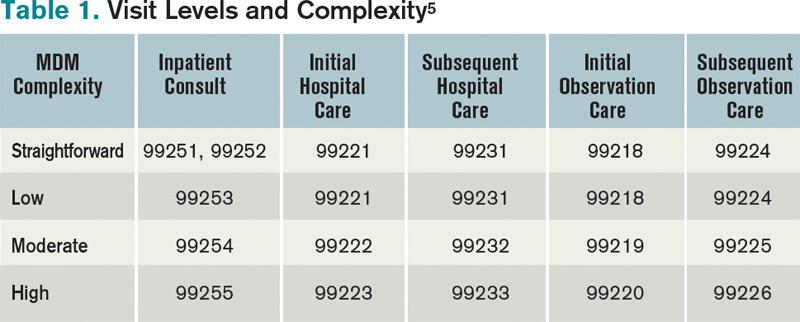
Medical decision-making (MDM) remains consistent in both the 1995 and 1997 guidelines.1,2 Complexity is categorized as straightforward, low, moderate, or high, based on the content of physician documentation. Each visit level is associated with a particular level of complexity. Only the care plan for a given date of service is considered when assigning MDM complexity. For each encounter, the physician receives credit for the number of diagnoses and/or treatment options, the amount and/or complexity of data ordered/reviewed, and the risk of complications/morbidity/mortality (see Table 1).
Number of diagnoses or treatment options. Physicians should document problems addressed and managed daily despite any changes to the treatment plan. Credit is provided for each problem with an associated plan, even if the plan states “continue treatment.” Credit also depends upon the quantity of problems addressed, as well as the problem type. An established problem in which the care plan has been established by the physician or group practice member during the current hospitalization is less complex than a new problem for which a diagnosis, prognosis, or plan has not been determined. Severity of the problem affects the weight of complexity. A worsening problem is more complex than an improving problem. Physician documentation should:
- Identify all problems managed or addressed during each encounter;
- Identify problems as stable or progressing, when appropriate;
- Indicate differential diagnoses when the problem remains undefined;
- Indicate the management/treatment option(s) for each problem; and
- When documentation indicates a continuation of current management options (e.g. “continue meds”), be sure that the management options to be continued are noted somewhere in the progress note for that encounter (e.g. medication list).
The plan of care outlines problems that the physician personally manages and those that impact management options, even if another physician directly oversees the problem. For example, the hospitalist might primarily manage diabetes, while the pulmonologist manages pneumonia. Since the pneumonia may impact the hospitalist’s plan for diabetic management, the hospitalist can receive credit for the pneumonia diagnosis if there is a non-overlapping, hospitalist-related care plan or comment about the pneumonia.
Amount and/or complexity of data ordered/reviewed. “Data” is classified as pathology/laboratory testing, radiology, and medicine-based diagnostics. Pertinent orders or results could be noted in the visit record, but most of the background interactions and communications involving testing are undetected when reviewing the progress note. To receive credit:
- Specify tests ordered and rationale in the physician’s progress note or make an entry that refers to another auditor-accessible location for ordered tests and studies;
- Document test review by including a brief entry in the progress note (e.g. “elevated glucose levels” or “CXR shows RLL infiltrates”);
- Summarize key points when reviewing old records or obtaining history from someone other than the patient, as necessary;
- Indicate when images, tracings, or specimens are “personally reviewed”; and
- Summarize any discussions of unexpected or contradictory test results with the physician performing the procedure or diagnostic study.
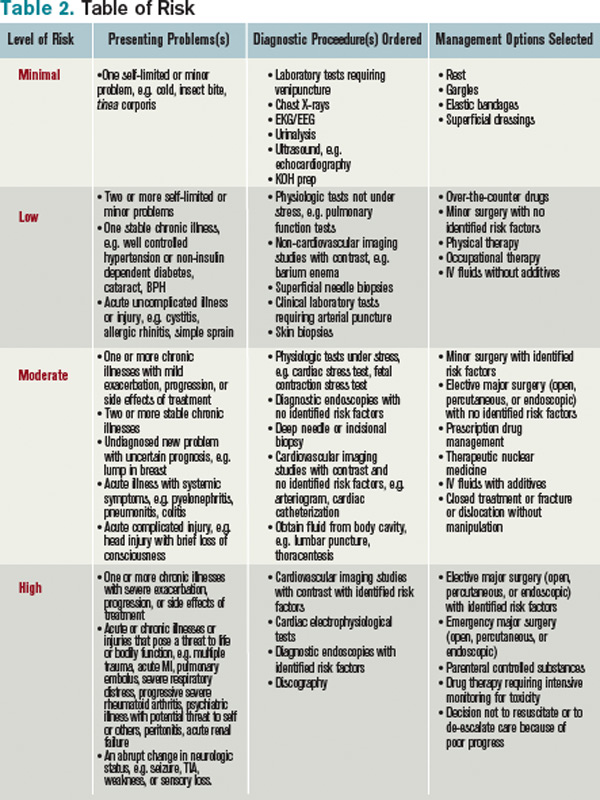
Risks of complication and/or morbidity or mortality. Risk involves the patient’s presenting problem, diagnostic procedures ordered, and management options selected. It is measured as minimal, low, moderate, or high when compared with corresponding items assigned to each risk level (see Table 2). The highest individual item detected on the table determines the overall patient risk for that encounter.
Chronic conditions and invasive procedures pose more risk than acute, uncomplicated illnesses or non-invasive procedures. Stable or improving problems are not as menacing as progressing problems; minor exacerbations are less hazardous than severe exacerbations; and medication risk varies with the type and potential for adverse effects. A patient maintains the same level of risk for a given medication whether the dosage is increased, decreased, or continued without change. Physicians should:
- Status all problems in the plan of care; identify them as stable, worsening, exacerbating (mild or severe), when applicable;
- Document all diagnostic or therapeutic procedures considered;
- Identify surgical risk factors involving comorbid conditions, when appropriate; and
- Associate the labs ordered to monitor for toxicity with the corresponding medication (e.g. “Continue Coumadin, monitor PT/INR”).
Determining complexity of medical decision-making. The final complexity of MDM depends upon the second-highest MDM category. The physician does not have to meet the requirements for all three MDM categories. For example, if a physician satisfies the requirements for a “multiple” number of diagnoses/treatment options, “limited” data, and “high” risk, the physician achieves moderate complexity decision-making (see Table 3). Remember that decision-making is just one of three components in evaluation and management services, along with history and exam.
Beware of payor variation, as it could have a significant impact on visit-level selection.3 Become acquainted with rules applicable to the geographical area. Review insurer websites for guidelines, policies, and “frequently asked questions” that can help improve documentation skills and support billing practices.
Carol Pohlig is a billing and coding expert with the University of Pennsylvania Medical Center, Philadelphia. She is also on the faculty of SHM’s inpatient coding course.
References
- Centers for Medicare and Medicaid Services. 1995 Documentation Guidelines for Evaluation & Management Services. Available at: http://www.cms.hhs.gov/MLNProducts/Downloads/1995dg.pdf. Accessed Nov. 14, 2011.
- Centers for Medicare and Medicaid Services. 1997 Documentation Guidelines for Evaluation & Management Services. Available at: http://www.cms.hhs.gov/MLNProducts/Downloads/MASTER1.pdf. Accessed Nov. 14, 2011.
- Pohlig, C. Documentation and Coding Evaluation and Management Services. In: Coding for Chest Medicine 2010. Northbrook, IL: American College of Chest Physicians, 2009; 87-118.
- Abraham M, Ahlman J, Boudreau A, Connelly J, Evans D. Current Procedural Terminology Professional Edition. Chicago: American Medical Association Press; 2011:1-20.
Physicians should formulate a complete and accurate description of a patient’s condition with an equivalent plan of care for each encounter. While acuity and severity can be inferred by healthcare professionals without excessive detail or repetitive documentation of previously entered information, adequate documentation for every service date assists in conveying patient complexity during medical record review.
Regardless of how complex a patient’s condition might be, physicians tend to undervalue their services. This is due, in part, to the routine nature of patient care for seasoned physicians; it is also due in part to a general lack of understanding with respect to the documentation guidelines.
Consider the following scenario: A 68-year-old male with diabetes and a history of chronic obstructive bronchitis was hospitalized after a five-day history of progressive cough with increasing purulent sputum, shortness of breath, and fever. He was treated for an exacerbation of chronic bronchitis within the past six weeks. Upon admission, the patient had an increased temperature (102°F), increased heart rate (96 beats per minute), and increased respiratory rate (28 shallow breaths per minute). His breath sounds included in the right lower lobe rhonchi, and his pulse oximetry was 89% on room air. Chest X-ray confirmed right lower lobe infiltrates along with chronic changes.
Although some physicians would consider this “low complexity” due to the frequency in which they encounter this type of case, others will more appropriately identify this as moderately complex.
MDM Categories
Medical decision-making (MDM) remains consistent in both the 1995 and 1997 guidelines.1,2 Complexity is categorized as straightforward, low, moderate, or high, based on the content of physician documentation. Each visit level is associated with a particular level of complexity. Only the care plan for a given date of service is considered when assigning MDM complexity. For each encounter, the physician receives credit for the number of diagnoses and/or treatment options, the amount and/or complexity of data ordered/reviewed, and the risk of complications/morbidity/mortality (see Table 1).
Number of diagnoses or treatment options. Physicians should document problems addressed and managed daily despite any changes to the treatment plan. Credit is provided for each problem with an associated plan, even if the plan states “continue treatment.” Credit also depends upon the quantity of problems addressed, as well as the problem type. An established problem in which the care plan has been established by the physician or group practice member during the current hospitalization is less complex than a new problem for which a diagnosis, prognosis, or plan has not been determined. Severity of the problem affects the weight of complexity. A worsening problem is more complex than an improving problem. Physician documentation should:
- Identify all problems managed or addressed during each encounter;
- Identify problems as stable or progressing, when appropriate;
- Indicate differential diagnoses when the problem remains undefined;
- Indicate the management/treatment option(s) for each problem; and
- When documentation indicates a continuation of current management options (e.g. “continue meds”), be sure that the management options to be continued are noted somewhere in the progress note for that encounter (e.g. medication list).
The plan of care outlines problems that the physician personally manages and those that impact management options, even if another physician directly oversees the problem. For example, the hospitalist might primarily manage diabetes, while the pulmonologist manages pneumonia. Since the pneumonia may impact the hospitalist’s plan for diabetic management, the hospitalist can receive credit for the pneumonia diagnosis if there is a non-overlapping, hospitalist-related care plan or comment about the pneumonia.
Amount and/or complexity of data ordered/reviewed. “Data” is classified as pathology/laboratory testing, radiology, and medicine-based diagnostics. Pertinent orders or results could be noted in the visit record, but most of the background interactions and communications involving testing are undetected when reviewing the progress note. To receive credit:
- Specify tests ordered and rationale in the physician’s progress note or make an entry that refers to another auditor-accessible location for ordered tests and studies;
- Document test review by including a brief entry in the progress note (e.g. “elevated glucose levels” or “CXR shows RLL infiltrates”);
- Summarize key points when reviewing old records or obtaining history from someone other than the patient, as necessary;
- Indicate when images, tracings, or specimens are “personally reviewed”; and
- Summarize any discussions of unexpected or contradictory test results with the physician performing the procedure or diagnostic study.
Risks of complication and/or morbidity or mortality. Risk involves the patient’s presenting problem, diagnostic procedures ordered, and management options selected. It is measured as minimal, low, moderate, or high when compared with corresponding items assigned to each risk level (see Table 2). The highest individual item detected on the table determines the overall patient risk for that encounter.
Chronic conditions and invasive procedures pose more risk than acute, uncomplicated illnesses or non-invasive procedures. Stable or improving problems are not as menacing as progressing problems; minor exacerbations are less hazardous than severe exacerbations; and medication risk varies with the type and potential for adverse effects. A patient maintains the same level of risk for a given medication whether the dosage is increased, decreased, or continued without change. Physicians should:
- Status all problems in the plan of care; identify them as stable, worsening, exacerbating (mild or severe), when applicable;
- Document all diagnostic or therapeutic procedures considered;
- Identify surgical risk factors involving comorbid conditions, when appropriate; and
- Associate the labs ordered to monitor for toxicity with the corresponding medication (e.g. “Continue Coumadin, monitor PT/INR”).
Determining complexity of medical decision-making. The final complexity of MDM depends upon the second-highest MDM category. The physician does not have to meet the requirements for all three MDM categories. For example, if a physician satisfies the requirements for a “multiple” number of diagnoses/treatment options, “limited” data, and “high” risk, the physician achieves moderate complexity decision-making (see Table 3). Remember that decision-making is just one of three components in evaluation and management services, along with history and exam.
Beware of payor variation, as it could have a significant impact on visit-level selection.3 Become acquainted with rules applicable to the geographical area. Review insurer websites for guidelines, policies, and “frequently asked questions” that can help improve documentation skills and support billing practices.
Carol Pohlig is a billing and coding expert with the University of Pennsylvania Medical Center, Philadelphia. She is also on the faculty of SHM’s inpatient coding course.
References
- Centers for Medicare and Medicaid Services. 1995 Documentation Guidelines for Evaluation & Management Services. Available at: http://www.cms.hhs.gov/MLNProducts/Downloads/1995dg.pdf. Accessed Nov. 14, 2011.
- Centers for Medicare and Medicaid Services. 1997 Documentation Guidelines for Evaluation & Management Services. Available at: http://www.cms.hhs.gov/MLNProducts/Downloads/MASTER1.pdf. Accessed Nov. 14, 2011.
- Pohlig, C. Documentation and Coding Evaluation and Management Services. In: Coding for Chest Medicine 2010. Northbrook, IL: American College of Chest Physicians, 2009; 87-118.
- Abraham M, Ahlman J, Boudreau A, Connelly J, Evans D. Current Procedural Terminology Professional Edition. Chicago: American Medical Association Press; 2011:1-20.
Physicians should formulate a complete and accurate description of a patient’s condition with an equivalent plan of care for each encounter. While acuity and severity can be inferred by healthcare professionals without excessive detail or repetitive documentation of previously entered information, adequate documentation for every service date assists in conveying patient complexity during medical record review.
Regardless of how complex a patient’s condition might be, physicians tend to undervalue their services. This is due, in part, to the routine nature of patient care for seasoned physicians; it is also due in part to a general lack of understanding with respect to the documentation guidelines.
Consider the following scenario: A 68-year-old male with diabetes and a history of chronic obstructive bronchitis was hospitalized after a five-day history of progressive cough with increasing purulent sputum, shortness of breath, and fever. He was treated for an exacerbation of chronic bronchitis within the past six weeks. Upon admission, the patient had an increased temperature (102°F), increased heart rate (96 beats per minute), and increased respiratory rate (28 shallow breaths per minute). His breath sounds included in the right lower lobe rhonchi, and his pulse oximetry was 89% on room air. Chest X-ray confirmed right lower lobe infiltrates along with chronic changes.
Although some physicians would consider this “low complexity” due to the frequency in which they encounter this type of case, others will more appropriately identify this as moderately complex.
MDM Categories
Medical decision-making (MDM) remains consistent in both the 1995 and 1997 guidelines.1,2 Complexity is categorized as straightforward, low, moderate, or high, based on the content of physician documentation. Each visit level is associated with a particular level of complexity. Only the care plan for a given date of service is considered when assigning MDM complexity. For each encounter, the physician receives credit for the number of diagnoses and/or treatment options, the amount and/or complexity of data ordered/reviewed, and the risk of complications/morbidity/mortality (see Table 1).
Number of diagnoses or treatment options. Physicians should document problems addressed and managed daily despite any changes to the treatment plan. Credit is provided for each problem with an associated plan, even if the plan states “continue treatment.” Credit also depends upon the quantity of problems addressed, as well as the problem type. An established problem in which the care plan has been established by the physician or group practice member during the current hospitalization is less complex than a new problem for which a diagnosis, prognosis, or plan has not been determined. Severity of the problem affects the weight of complexity. A worsening problem is more complex than an improving problem. Physician documentation should:
- Identify all problems managed or addressed during each encounter;
- Identify problems as stable or progressing, when appropriate;
- Indicate differential diagnoses when the problem remains undefined;
- Indicate the management/treatment option(s) for each problem; and
- When documentation indicates a continuation of current management options (e.g. “continue meds”), be sure that the management options to be continued are noted somewhere in the progress note for that encounter (e.g. medication list).
The plan of care outlines problems that the physician personally manages and those that impact management options, even if another physician directly oversees the problem. For example, the hospitalist might primarily manage diabetes, while the pulmonologist manages pneumonia. Since the pneumonia may impact the hospitalist’s plan for diabetic management, the hospitalist can receive credit for the pneumonia diagnosis if there is a non-overlapping, hospitalist-related care plan or comment about the pneumonia.
Amount and/or complexity of data ordered/reviewed. “Data” is classified as pathology/laboratory testing, radiology, and medicine-based diagnostics. Pertinent orders or results could be noted in the visit record, but most of the background interactions and communications involving testing are undetected when reviewing the progress note. To receive credit:
- Specify tests ordered and rationale in the physician’s progress note or make an entry that refers to another auditor-accessible location for ordered tests and studies;
- Document test review by including a brief entry in the progress note (e.g. “elevated glucose levels” or “CXR shows RLL infiltrates”);
- Summarize key points when reviewing old records or obtaining history from someone other than the patient, as necessary;
- Indicate when images, tracings, or specimens are “personally reviewed”; and
- Summarize any discussions of unexpected or contradictory test results with the physician performing the procedure or diagnostic study.
Risks of complication and/or morbidity or mortality. Risk involves the patient’s presenting problem, diagnostic procedures ordered, and management options selected. It is measured as minimal, low, moderate, or high when compared with corresponding items assigned to each risk level (see Table 2). The highest individual item detected on the table determines the overall patient risk for that encounter.
Chronic conditions and invasive procedures pose more risk than acute, uncomplicated illnesses or non-invasive procedures. Stable or improving problems are not as menacing as progressing problems; minor exacerbations are less hazardous than severe exacerbations; and medication risk varies with the type and potential for adverse effects. A patient maintains the same level of risk for a given medication whether the dosage is increased, decreased, or continued without change. Physicians should:
- Status all problems in the plan of care; identify them as stable, worsening, exacerbating (mild or severe), when applicable;
- Document all diagnostic or therapeutic procedures considered;
- Identify surgical risk factors involving comorbid conditions, when appropriate; and
- Associate the labs ordered to monitor for toxicity with the corresponding medication (e.g. “Continue Coumadin, monitor PT/INR”).
Determining complexity of medical decision-making. The final complexity of MDM depends upon the second-highest MDM category. The physician does not have to meet the requirements for all three MDM categories. For example, if a physician satisfies the requirements for a “multiple” number of diagnoses/treatment options, “limited” data, and “high” risk, the physician achieves moderate complexity decision-making (see Table 3). Remember that decision-making is just one of three components in evaluation and management services, along with history and exam.
Beware of payor variation, as it could have a significant impact on visit-level selection.3 Become acquainted with rules applicable to the geographical area. Review insurer websites for guidelines, policies, and “frequently asked questions” that can help improve documentation skills and support billing practices.
Carol Pohlig is a billing and coding expert with the University of Pennsylvania Medical Center, Philadelphia. She is also on the faculty of SHM’s inpatient coding course.
References
- Centers for Medicare and Medicaid Services. 1995 Documentation Guidelines for Evaluation & Management Services. Available at: http://www.cms.hhs.gov/MLNProducts/Downloads/1995dg.pdf. Accessed Nov. 14, 2011.
- Centers for Medicare and Medicaid Services. 1997 Documentation Guidelines for Evaluation & Management Services. Available at: http://www.cms.hhs.gov/MLNProducts/Downloads/MASTER1.pdf. Accessed Nov. 14, 2011.
- Pohlig, C. Documentation and Coding Evaluation and Management Services. In: Coding for Chest Medicine 2010. Northbrook, IL: American College of Chest Physicians, 2009; 87-118.
- Abraham M, Ahlman J, Boudreau A, Connelly J, Evans D. Current Procedural Terminology Professional Edition. Chicago: American Medical Association Press; 2011:1-20.
IPAB is Medicare's New Hammer for Spending Accountability
Now that the latest annual “doc fix” is in, physicians have been granted another reprieve from potentially crippling cuts to their Medicare reimbursement under the flawed sustainable growth rate (SGR) payment formula.
Beginning this year, there’s a new player in town that will have the authority to achieve what Congress has consistently failed to do—cut Medicare provider spending to keep it below a cap—and it can do so with unprecedented autonomy.
Say hello to the Independent Payment Advisory Board (IPAB), a creature of the Affordable Care Act (ACA) that will propose ways to reduce “overpayment” to Medicare providers if target-spending levels are exceeded.
What distinguishes the IPAB from the Medicare Payment Advisory Commission (MedPAC) is that its proposals will automatically become law, unless Congress enacts its own proposals that reduce Medicare provider spending by at least as much as IPAB’s, or the Senate musters a three-fifths majority vote to override IPAB’s proposals entirely. Further, the IPAB’s changes to Medicare cannot be overruled by the executive branch or a court of law.
MedPAC never wielded such authority; in fact, many of its cost-control recommendations were ignored.

—Judith Feder, PhD, professor of public policy, Georgetown University, Washington, D.C., former dean, Georgetown Public Policy Institute, fellow, the Urban Institute
The IPAB comes to life this year, with a $15 million appropriation from the ACA, and begins ramping up its operations (see “The IPAB Timetable,” p. 26). The board will be comprised of a 15-member, multi-stakeholder group—expected to include physicians, nurses, medical experts, economists, consumer advocates, and others—appointed by the President and subject to Senate confirmation.
Incendiary Reactions
Dubbed by its most vociferous and largely Republican critics as “dangerously powerful,” “the real death panel,” and “bureaucrats deciding whether you get care,” the IPAB even has some Democrats decrying its power grab. Rep. Pete Stark (D-Calif.) called the IPAB “an unprecedented abrogation of Congressional authority to an unelected, unaccountable body of so-called experts.”1
Even Allyson Schwartz (D-Pa.), who helped draft the ACA, has come out against the IPAB, joining a handful of Democrats and more than 200 Republicans in signing on to a bill (H.R. 452) to repeal the ACA’s IPAB provision. The Senate has a similar bill (S. 668).
Although the IPAB legally is barred from formally making recommendations to ration care, increase beneficiary premiums or cost sharing, and from restricting benefits or eligibility criteria, critics worry that its authority to control prices could hurt patients by driving Medicare payments so low that physicians cease to offer certain services to them.
Enforcement Power
IPAB will have unprecedented power to enforce Medicare’s provider spending benchmarks. Beginning in 2014, if Medicare’s projected spending growth rate per beneficiary rises above an inflation threshold of Gross Domestic Product per capita plus 1%, the IPAB would be triggered and would propose ways to trim provider payments. President Obama has since proposed a lower threshold of GDP per capita plus 0.5%, meaning that the IPAB would be triggered earlier and likely would have deeper cuts to make.
It is unclear how the spending growth benchmark will be affected by the $123 billion in Medicare payment cuts to hospitals and other providers over nine years, which were triggered when the so-called “super committee” failed to reach a budget-cutting consensus last fall.
U.S. Department of Health and Human Services (HHS) Secretary Kathleen Sebelius describes the IPAB as a “backstop to ensure that rising costs don’t accelerate out of control, threatening Medicare’s stability,” and she maintains that the board is a necessary fallback mechanism to enforce Medicare spending within budget while healthcare providers continue to prove the effectiveness of various value-based delivery and reimbursement reform projects the ACA is funding.2
Impact on Physicians
“The IPAB is a structural intervention to put pressure on Congress, the Executive, and CMS [Centers for Medicare & Medicaid Services] to guarantee the ACA’s investment in cost-containment, and it gives physicians the incentive to act on its principles,” says Judith Feder, PhD, professor of public policy at Georgetown University, former dean of the Georgetown Public Policy Institute, and a fellow at the Urban Institute.
Dr. Feder was a co-signer of a letter sent by 100 health policy experts and economists—including Congressional Budget Office founding director Alice Rivlin, now with the Brookings Institute—to congressional leaders last May urging them to abandon attempts to repeal the IPAB provision. Dr. Feder maintains that the IPAB will marshal “the expertise of professionals who can weigh evidence on how payment incentives affect care delivery and suggest sensible improvements, while forcing debate on difficult choices that Congress has thus far failed to address.”
Because of the changes the ACA has already made to provider reimbursement and Medicare Advantage plan funding, Feder says that Medicare’s average annual growth rate for the next decade is projected to be a full percentage point below per capita growth in GDP. On top of that, she says, “the ACA’s other payment reform experiments have the potential to improve quality and cut spending growth even further by reducing payment for overpriced or undesirable care–like unnecessary hospital readmissions–and rewarding efficiently provided, coordinated care.” By Feder’s analysis, the IPAB would not likely be triggered for a decade, but stands ready as a backup, if needed. Indeed, she favors extending IPAB’s authority beyond Medicare, to allow a system-wide spending target that creates an all-payer incentive to assure that providers really change their behavior to boost quality and efficiency.
Impact on Hospitalists
If the IPAB does come into play, Feder believes that hospitalists have less to worry about than other physician specialists, because the Board’s cost-reduction proposals would likely focus on services where overpayment is the most acute – like imaging and high-cost specialty procedures. “If hospitalists are promoting efficient, coordinated care, their position can only be enhanced by IPAB’s recommendations, to the extent that they can demonstrate value for the healthcare dollar spent,” she says.
Necessary quality and cost reforms that patients deserve, and physicians want to deliver, have been stymied for too long by a crippled Congress, and by powerful special interest agendas, says SHM Public Policy Committee member Bradley Flansbaum DO, MPH, FACP, SFHM, director of the HM program at Lenox Hill Hospital in New York City, and clinical assistant professor of medicine at NYU School of Medicine. Reform requires some real enforcement authority to put value-based quality above the fray, he adds.
“CMS just does not have the teeth to do that right now; they are in the cross-hairs, and an IPAB-like body is needed to insulate Congress from the politically-risky choices, bring evidence and expertise to the decisions, bust through the politics, and get the job done,” Dr. Flansbaum says.
Dr. Flansbaum illustrates the problem by pointing to recent clinical studies that show percutaneous vertebroplasty, which injects bone cement into the spine to treat fractures, to be no better than a placebo in relieving pain. Medicare and private health insurers have been covering vertebroplasty for many years, despite the absence of rigorous study of its effectiveness. The same likely holds true for scores of other expensive treatments and surgical procedures. “Who, exactly, is going to put the kibosh on this?” Dr. Flansbaum asks. “The free market, which includes surgeons, hospitals, and device companies, each with their agendas, or regulators?”
Dr. Flansbaum believes that, in order to effectively bring down costs, the IPAB should not be restricted to supply-side proposals (i.e. provider reimbursement), but also should be allowed to propose demand-side changes to Medicare’s benefit plans, such as tiered network pricing with higher premiums to cover the latest and most expensive technologies.
SHM supports the need for an independent entity to check the growth in Medicare spending, but it does not support the IPAB as it is currently established under the ACA because certain groups (including hospitals) are protected from its scrutiny during its first several years—a limitation that SHM says puts the board’s legitimacy into question and seriously weakens its potential cost-saving effectiveness. SHM supports replacing the IPAB with an independent board that (1) subjects all Medicare providers and suppliers to the same scrutiny without special interest carve-outs, (2) balances cost-saving with QI considerations, (3) protects delivery of quality services, and (4) ensures board membership that represents all potentially affected groups, including physicians. (Read the entire statement in the “Where We Stand” section of SHM’s Advocacy microsite at www.hospitalmedicine.org/advocacy.)
By removing the IPAB’s present handcuffs—opening its scope to all providers, as well as to demand-side changes in Medicare’s benefit structure—an IPAB-like entity with the proper staff and expertise can rationally think-out the choices that Congress will never make, according to Dr. Flansbaum.
“For the sake of our economy and our future generations, healthcare costs have to come down, even if that means some short-term pain,” he says. “Hospitals may take a hit. Some physician income might take a hit. Otherwise, there won’t be any hospitals or salaries to be hit.”
Christopher Guadagnino is a freelance writer in Philadelphia.
Reference
- Statement of Congressman Pete Stark Supporting Health Care Reform, March 21, 2010. Available at: http://www.stark.house.gov/index.php?option=com_content&view=article&id=1534:statement-of-congressman-pete-stark-supporting-health-care-reform&catid=67:floor-statements-2010-. Accessed Jan. 5, 2012.
- Kathleen Sebelius, “IPAB Will Protect Medicare.” Politico, June 23, 2011. Available at: http://dyn.politico.com/printstory.cfm?uuid=FDE594BA-87EE-4DA5-9841-33804926EF36. Accessed Jan. 5, 2012.
Now that the latest annual “doc fix” is in, physicians have been granted another reprieve from potentially crippling cuts to their Medicare reimbursement under the flawed sustainable growth rate (SGR) payment formula.
Beginning this year, there’s a new player in town that will have the authority to achieve what Congress has consistently failed to do—cut Medicare provider spending to keep it below a cap—and it can do so with unprecedented autonomy.
Say hello to the Independent Payment Advisory Board (IPAB), a creature of the Affordable Care Act (ACA) that will propose ways to reduce “overpayment” to Medicare providers if target-spending levels are exceeded.
What distinguishes the IPAB from the Medicare Payment Advisory Commission (MedPAC) is that its proposals will automatically become law, unless Congress enacts its own proposals that reduce Medicare provider spending by at least as much as IPAB’s, or the Senate musters a three-fifths majority vote to override IPAB’s proposals entirely. Further, the IPAB’s changes to Medicare cannot be overruled by the executive branch or a court of law.
MedPAC never wielded such authority; in fact, many of its cost-control recommendations were ignored.
—Judith Feder, PhD, professor of public policy, Georgetown University, Washington, D.C., former dean, Georgetown Public Policy Institute, fellow, the Urban Institute
The IPAB comes to life this year, with a $15 million appropriation from the ACA, and begins ramping up its operations (see “The IPAB Timetable,” p. 26). The board will be comprised of a 15-member, multi-stakeholder group—expected to include physicians, nurses, medical experts, economists, consumer advocates, and others—appointed by the President and subject to Senate confirmation.
Incendiary Reactions
Dubbed by its most vociferous and largely Republican critics as “dangerously powerful,” “the real death panel,” and “bureaucrats deciding whether you get care,” the IPAB even has some Democrats decrying its power grab. Rep. Pete Stark (D-Calif.) called the IPAB “an unprecedented abrogation of Congressional authority to an unelected, unaccountable body of so-called experts.”1
Even Allyson Schwartz (D-Pa.), who helped draft the ACA, has come out against the IPAB, joining a handful of Democrats and more than 200 Republicans in signing on to a bill (H.R. 452) to repeal the ACA’s IPAB provision. The Senate has a similar bill (S. 668).
Although the IPAB legally is barred from formally making recommendations to ration care, increase beneficiary premiums or cost sharing, and from restricting benefits or eligibility criteria, critics worry that its authority to control prices could hurt patients by driving Medicare payments so low that physicians cease to offer certain services to them.
Enforcement Power
IPAB will have unprecedented power to enforce Medicare’s provider spending benchmarks. Beginning in 2014, if Medicare’s projected spending growth rate per beneficiary rises above an inflation threshold of Gross Domestic Product per capita plus 1%, the IPAB would be triggered and would propose ways to trim provider payments. President Obama has since proposed a lower threshold of GDP per capita plus 0.5%, meaning that the IPAB would be triggered earlier and likely would have deeper cuts to make.
It is unclear how the spending growth benchmark will be affected by the $123 billion in Medicare payment cuts to hospitals and other providers over nine years, which were triggered when the so-called “super committee” failed to reach a budget-cutting consensus last fall.
U.S. Department of Health and Human Services (HHS) Secretary Kathleen Sebelius describes the IPAB as a “backstop to ensure that rising costs don’t accelerate out of control, threatening Medicare’s stability,” and she maintains that the board is a necessary fallback mechanism to enforce Medicare spending within budget while healthcare providers continue to prove the effectiveness of various value-based delivery and reimbursement reform projects the ACA is funding.2
Impact on Physicians
“The IPAB is a structural intervention to put pressure on Congress, the Executive, and CMS [Centers for Medicare & Medicaid Services] to guarantee the ACA’s investment in cost-containment, and it gives physicians the incentive to act on its principles,” says Judith Feder, PhD, professor of public policy at Georgetown University, former dean of the Georgetown Public Policy Institute, and a fellow at the Urban Institute.
Dr. Feder was a co-signer of a letter sent by 100 health policy experts and economists—including Congressional Budget Office founding director Alice Rivlin, now with the Brookings Institute—to congressional leaders last May urging them to abandon attempts to repeal the IPAB provision. Dr. Feder maintains that the IPAB will marshal “the expertise of professionals who can weigh evidence on how payment incentives affect care delivery and suggest sensible improvements, while forcing debate on difficult choices that Congress has thus far failed to address.”
Because of the changes the ACA has already made to provider reimbursement and Medicare Advantage plan funding, Feder says that Medicare’s average annual growth rate for the next decade is projected to be a full percentage point below per capita growth in GDP. On top of that, she says, “the ACA’s other payment reform experiments have the potential to improve quality and cut spending growth even further by reducing payment for overpriced or undesirable care–like unnecessary hospital readmissions–and rewarding efficiently provided, coordinated care.” By Feder’s analysis, the IPAB would not likely be triggered for a decade, but stands ready as a backup, if needed. Indeed, she favors extending IPAB’s authority beyond Medicare, to allow a system-wide spending target that creates an all-payer incentive to assure that providers really change their behavior to boost quality and efficiency.
Impact on Hospitalists
If the IPAB does come into play, Feder believes that hospitalists have less to worry about than other physician specialists, because the Board’s cost-reduction proposals would likely focus on services where overpayment is the most acute – like imaging and high-cost specialty procedures. “If hospitalists are promoting efficient, coordinated care, their position can only be enhanced by IPAB’s recommendations, to the extent that they can demonstrate value for the healthcare dollar spent,” she says.
Necessary quality and cost reforms that patients deserve, and physicians want to deliver, have been stymied for too long by a crippled Congress, and by powerful special interest agendas, says SHM Public Policy Committee member Bradley Flansbaum DO, MPH, FACP, SFHM, director of the HM program at Lenox Hill Hospital in New York City, and clinical assistant professor of medicine at NYU School of Medicine. Reform requires some real enforcement authority to put value-based quality above the fray, he adds.
“CMS just does not have the teeth to do that right now; they are in the cross-hairs, and an IPAB-like body is needed to insulate Congress from the politically-risky choices, bring evidence and expertise to the decisions, bust through the politics, and get the job done,” Dr. Flansbaum says.
Dr. Flansbaum illustrates the problem by pointing to recent clinical studies that show percutaneous vertebroplasty, which injects bone cement into the spine to treat fractures, to be no better than a placebo in relieving pain. Medicare and private health insurers have been covering vertebroplasty for many years, despite the absence of rigorous study of its effectiveness. The same likely holds true for scores of other expensive treatments and surgical procedures. “Who, exactly, is going to put the kibosh on this?” Dr. Flansbaum asks. “The free market, which includes surgeons, hospitals, and device companies, each with their agendas, or regulators?”
Dr. Flansbaum believes that, in order to effectively bring down costs, the IPAB should not be restricted to supply-side proposals (i.e. provider reimbursement), but also should be allowed to propose demand-side changes to Medicare’s benefit plans, such as tiered network pricing with higher premiums to cover the latest and most expensive technologies.
SHM supports the need for an independent entity to check the growth in Medicare spending, but it does not support the IPAB as it is currently established under the ACA because certain groups (including hospitals) are protected from its scrutiny during its first several years—a limitation that SHM says puts the board’s legitimacy into question and seriously weakens its potential cost-saving effectiveness. SHM supports replacing the IPAB with an independent board that (1) subjects all Medicare providers and suppliers to the same scrutiny without special interest carve-outs, (2) balances cost-saving with QI considerations, (3) protects delivery of quality services, and (4) ensures board membership that represents all potentially affected groups, including physicians. (Read the entire statement in the “Where We Stand” section of SHM’s Advocacy microsite at www.hospitalmedicine.org/advocacy.)
By removing the IPAB’s present handcuffs—opening its scope to all providers, as well as to demand-side changes in Medicare’s benefit structure—an IPAB-like entity with the proper staff and expertise can rationally think-out the choices that Congress will never make, according to Dr. Flansbaum.
“For the sake of our economy and our future generations, healthcare costs have to come down, even if that means some short-term pain,” he says. “Hospitals may take a hit. Some physician income might take a hit. Otherwise, there won’t be any hospitals or salaries to be hit.”
Christopher Guadagnino is a freelance writer in Philadelphia.
Reference
- Statement of Congressman Pete Stark Supporting Health Care Reform, March 21, 2010. Available at: http://www.stark.house.gov/index.php?option=com_content&view=article&id=1534:statement-of-congressman-pete-stark-supporting-health-care-reform&catid=67:floor-statements-2010-. Accessed Jan. 5, 2012.
- Kathleen Sebelius, “IPAB Will Protect Medicare.” Politico, June 23, 2011. Available at: http://dyn.politico.com/printstory.cfm?uuid=FDE594BA-87EE-4DA5-9841-33804926EF36. Accessed Jan. 5, 2012.
Now that the latest annual “doc fix” is in, physicians have been granted another reprieve from potentially crippling cuts to their Medicare reimbursement under the flawed sustainable growth rate (SGR) payment formula.
Beginning this year, there’s a new player in town that will have the authority to achieve what Congress has consistently failed to do—cut Medicare provider spending to keep it below a cap—and it can do so with unprecedented autonomy.
Say hello to the Independent Payment Advisory Board (IPAB), a creature of the Affordable Care Act (ACA) that will propose ways to reduce “overpayment” to Medicare providers if target-spending levels are exceeded.
What distinguishes the IPAB from the Medicare Payment Advisory Commission (MedPAC) is that its proposals will automatically become law, unless Congress enacts its own proposals that reduce Medicare provider spending by at least as much as IPAB’s, or the Senate musters a three-fifths majority vote to override IPAB’s proposals entirely. Further, the IPAB’s changes to Medicare cannot be overruled by the executive branch or a court of law.
MedPAC never wielded such authority; in fact, many of its cost-control recommendations were ignored.
—Judith Feder, PhD, professor of public policy, Georgetown University, Washington, D.C., former dean, Georgetown Public Policy Institute, fellow, the Urban Institute
The IPAB comes to life this year, with a $15 million appropriation from the ACA, and begins ramping up its operations (see “The IPAB Timetable,” p. 26). The board will be comprised of a 15-member, multi-stakeholder group—expected to include physicians, nurses, medical experts, economists, consumer advocates, and others—appointed by the President and subject to Senate confirmation.
Incendiary Reactions
Dubbed by its most vociferous and largely Republican critics as “dangerously powerful,” “the real death panel,” and “bureaucrats deciding whether you get care,” the IPAB even has some Democrats decrying its power grab. Rep. Pete Stark (D-Calif.) called the IPAB “an unprecedented abrogation of Congressional authority to an unelected, unaccountable body of so-called experts.”1
Even Allyson Schwartz (D-Pa.), who helped draft the ACA, has come out against the IPAB, joining a handful of Democrats and more than 200 Republicans in signing on to a bill (H.R. 452) to repeal the ACA’s IPAB provision. The Senate has a similar bill (S. 668).
Although the IPAB legally is barred from formally making recommendations to ration care, increase beneficiary premiums or cost sharing, and from restricting benefits or eligibility criteria, critics worry that its authority to control prices could hurt patients by driving Medicare payments so low that physicians cease to offer certain services to them.
Enforcement Power
IPAB will have unprecedented power to enforce Medicare’s provider spending benchmarks. Beginning in 2014, if Medicare’s projected spending growth rate per beneficiary rises above an inflation threshold of Gross Domestic Product per capita plus 1%, the IPAB would be triggered and would propose ways to trim provider payments. President Obama has since proposed a lower threshold of GDP per capita plus 0.5%, meaning that the IPAB would be triggered earlier and likely would have deeper cuts to make.
It is unclear how the spending growth benchmark will be affected by the $123 billion in Medicare payment cuts to hospitals and other providers over nine years, which were triggered when the so-called “super committee” failed to reach a budget-cutting consensus last fall.
U.S. Department of Health and Human Services (HHS) Secretary Kathleen Sebelius describes the IPAB as a “backstop to ensure that rising costs don’t accelerate out of control, threatening Medicare’s stability,” and she maintains that the board is a necessary fallback mechanism to enforce Medicare spending within budget while healthcare providers continue to prove the effectiveness of various value-based delivery and reimbursement reform projects the ACA is funding.2
Impact on Physicians
“The IPAB is a structural intervention to put pressure on Congress, the Executive, and CMS [Centers for Medicare & Medicaid Services] to guarantee the ACA’s investment in cost-containment, and it gives physicians the incentive to act on its principles,” says Judith Feder, PhD, professor of public policy at Georgetown University, former dean of the Georgetown Public Policy Institute, and a fellow at the Urban Institute.
Dr. Feder was a co-signer of a letter sent by 100 health policy experts and economists—including Congressional Budget Office founding director Alice Rivlin, now with the Brookings Institute—to congressional leaders last May urging them to abandon attempts to repeal the IPAB provision. Dr. Feder maintains that the IPAB will marshal “the expertise of professionals who can weigh evidence on how payment incentives affect care delivery and suggest sensible improvements, while forcing debate on difficult choices that Congress has thus far failed to address.”
Because of the changes the ACA has already made to provider reimbursement and Medicare Advantage plan funding, Feder says that Medicare’s average annual growth rate for the next decade is projected to be a full percentage point below per capita growth in GDP. On top of that, she says, “the ACA’s other payment reform experiments have the potential to improve quality and cut spending growth even further by reducing payment for overpriced or undesirable care–like unnecessary hospital readmissions–and rewarding efficiently provided, coordinated care.” By Feder’s analysis, the IPAB would not likely be triggered for a decade, but stands ready as a backup, if needed. Indeed, she favors extending IPAB’s authority beyond Medicare, to allow a system-wide spending target that creates an all-payer incentive to assure that providers really change their behavior to boost quality and efficiency.
Impact on Hospitalists
If the IPAB does come into play, Feder believes that hospitalists have less to worry about than other physician specialists, because the Board’s cost-reduction proposals would likely focus on services where overpayment is the most acute – like imaging and high-cost specialty procedures. “If hospitalists are promoting efficient, coordinated care, their position can only be enhanced by IPAB’s recommendations, to the extent that they can demonstrate value for the healthcare dollar spent,” she says.
Necessary quality and cost reforms that patients deserve, and physicians want to deliver, have been stymied for too long by a crippled Congress, and by powerful special interest agendas, says SHM Public Policy Committee member Bradley Flansbaum DO, MPH, FACP, SFHM, director of the HM program at Lenox Hill Hospital in New York City, and clinical assistant professor of medicine at NYU School of Medicine. Reform requires some real enforcement authority to put value-based quality above the fray, he adds.
“CMS just does not have the teeth to do that right now; they are in the cross-hairs, and an IPAB-like body is needed to insulate Congress from the politically-risky choices, bring evidence and expertise to the decisions, bust through the politics, and get the job done,” Dr. Flansbaum says.
Dr. Flansbaum illustrates the problem by pointing to recent clinical studies that show percutaneous vertebroplasty, which injects bone cement into the spine to treat fractures, to be no better than a placebo in relieving pain. Medicare and private health insurers have been covering vertebroplasty for many years, despite the absence of rigorous study of its effectiveness. The same likely holds true for scores of other expensive treatments and surgical procedures. “Who, exactly, is going to put the kibosh on this?” Dr. Flansbaum asks. “The free market, which includes surgeons, hospitals, and device companies, each with their agendas, or regulators?”
Dr. Flansbaum believes that, in order to effectively bring down costs, the IPAB should not be restricted to supply-side proposals (i.e. provider reimbursement), but also should be allowed to propose demand-side changes to Medicare’s benefit plans, such as tiered network pricing with higher premiums to cover the latest and most expensive technologies.
SHM supports the need for an independent entity to check the growth in Medicare spending, but it does not support the IPAB as it is currently established under the ACA because certain groups (including hospitals) are protected from its scrutiny during its first several years—a limitation that SHM says puts the board’s legitimacy into question and seriously weakens its potential cost-saving effectiveness. SHM supports replacing the IPAB with an independent board that (1) subjects all Medicare providers and suppliers to the same scrutiny without special interest carve-outs, (2) balances cost-saving with QI considerations, (3) protects delivery of quality services, and (4) ensures board membership that represents all potentially affected groups, including physicians. (Read the entire statement in the “Where We Stand” section of SHM’s Advocacy microsite at www.hospitalmedicine.org/advocacy.)
By removing the IPAB’s present handcuffs—opening its scope to all providers, as well as to demand-side changes in Medicare’s benefit structure—an IPAB-like entity with the proper staff and expertise can rationally think-out the choices that Congress will never make, according to Dr. Flansbaum.
“For the sake of our economy and our future generations, healthcare costs have to come down, even if that means some short-term pain,” he says. “Hospitals may take a hit. Some physician income might take a hit. Otherwise, there won’t be any hospitals or salaries to be hit.”
Christopher Guadagnino is a freelance writer in Philadelphia.
Reference
- Statement of Congressman Pete Stark Supporting Health Care Reform, March 21, 2010. Available at: http://www.stark.house.gov/index.php?option=com_content&view=article&id=1534:statement-of-congressman-pete-stark-supporting-health-care-reform&catid=67:floor-statements-2010-. Accessed Jan. 5, 2012.
- Kathleen Sebelius, “IPAB Will Protect Medicare.” Politico, June 23, 2011. Available at: http://dyn.politico.com/printstory.cfm?uuid=FDE594BA-87EE-4DA5-9841-33804926EF36. Accessed Jan. 5, 2012.
Patients, Many of Whom are in Crisis, are Tracy Cardin’s Reason for Being
Tracy Cardin, ACNP-BC, entered college as a criminal justice major, believing her talent for crafting sound arguments and her passion for defending her point of view would translate into a successful law career.
Less than a year later, Cardin visited her gravely ill aunt and discovered her true calling. “I noticed a lot of small things: Her fingernails were a little long, her hair was sort of unkempt, and the environment wasn’t as clean as I would have liked,” Cardin says. “I didn’t feel the people who were caring for her were putting in the time or effort to make her as comfortable as possible. I didn’t see a lot of tender loving care, and I honestly felt I could do a better job.”
Cardin changed her major, pursued a nursing career, and now has 22 years of experience providing inpatient care.
“It’s a privilege to take care of patients, and hospitalists have a wonderful opportunity to impact the quality of care they receive,” says Cardin, one of seven nonphysician providers (NPPs) in the Section of Hospital Medicine at the University of Chicago Medical Center. She also is Team Hospitalist’s only NPP member. “They are the reason I do what I do—and the reason I love what I do.”
Are there similarities between being a nurse practitioner (NP) and a litigator?
You definitely have to advocate for your patients. Both fields allow you to see the stories of the human condition. In my job, it’s all about the patients’ stories—how they came to be here and fitting your care for the patient within their narrative. And like the legal setting, people often find themselves in the healthcare world at a time of crisis. I like being there to help people in those times.
Why did you choose to practice in a hospital setting?
I like the objective data you get in a hospital. You have lab work, imaging, and vital signs. It helps create a better picture of what’s going on. I like that it’s very acute. Patients have a problem, hopefully you fix the problem or at least stabilize the person, and then they can go home. I also like that it’s fast-paced and varied. The hospital truly is one of the places I’m most comfortable.
What is your biggest professional reward?
When a patient knows it’s time to go home and die—when it’s their time and they are ready to go—and they need someone to help them get through that process. When patients and their families move from trying to solve unsolvable problems to an acceptance of their mortality, it’s a beautiful journey, and I really like helping them navigate that journey.
How would you describe the relationship between the physicians and NPPs in your program?
Like all relationships, it has gone through an evolution. It started with the “getting to know you” stage, during which the physicians weren’t sure what the NPPs do and the NPPs were very anxious to show our capabilities. There was this pushing and pulling. Over time, thanks to excellent leadership, we have a model that utilizes NPPs to the maximum of their capabilities. We have a very collaborative, collegial group, and it’s a special place to work. I have the utmost respect for the physicians, and I feel they have the utmost respect for our abilities.
Do most HM programs that bring on NPPs go through growing pains?
In the beginning, often there’s a little drama or controversy. Someone oversteps their bounds, someone is too rigid and doesn’t allow a mid-level provider to do something, or someone gets their feelings hurt.
How can you survive that process without the partnership breaking down?
It’s like when you’re driving a car and it starts to pull off the road. If you overcorrect and turn the wheel too hard, you’re going to end up crashing. Instead, you just turn the wheel a little bit. It’s very important that you don’t panic and try to overcorrect. Sometimes only a small adjustment needs to be made. If everyone is committed to one another, it will work out.
What advice would you give to NPPs who are thinking about joining an HM program?
First, be ready to work hard. It’s very rewarding, but it’s a rapid pace and it’s stressful. Second, align yourself with someone who is sympathetic to and supportive of the role of a mid-level provider within a hospitalist group. Third, never give up, because hospital medicine is a great career.
What advice would you give to physicians whose programs are considering hiring NPPs?
Check out the SHM website (www.hospitalmedicine.org), because it is a tremendous resource. Also, treat the NPPs the same way they would treat another physician. Give them the same assistance, invite them to the same meetings, and give them the same education or training. Realize that even though physicians, NPs, and physician assistants have different educations, everyone brings their own skill set to the table that adds to this stew of excellence.
How do you see the role of NPPs evolving as they become more prevalent in HM?
Given residency work-hour reforms and the fact there are not physicians to do all of the work, NPPs are going to be utilized much more. NPPs bring a ton of experience to the care of inpatients, so a hospital medicine group should utilize them in all kinds of roles, whether it’s orienting new physicians or educating nursing staff about the care of their specialized patients. NPPs also can take on leadership roles as part of quality improvement projects. We are going to be needed in patient care, but we shouldn’t just be relegated to patient care. The experience is there to help in many other areas.
You have spoken about the integration of NPs in hospitalist programs at two HM meetings and will do so again at HM12. What does that mean to you?
It’s my passion. I’m fascinated by the entire process. I always say, “Why am I up here speaking about this? Because I’ve made every mistake; learn from me.” My program director [Chad Whelan, MD, FHM], who was so calm and so rational and helped me integrate so well, has impacted me so greatly. I get to pass that on to other people, and it’s a tremendous opportunity.
Mark Leiser is a freelance writer in New Jersey.
Tracy Cardin, ACNP-BC, entered college as a criminal justice major, believing her talent for crafting sound arguments and her passion for defending her point of view would translate into a successful law career.
Less than a year later, Cardin visited her gravely ill aunt and discovered her true calling. “I noticed a lot of small things: Her fingernails were a little long, her hair was sort of unkempt, and the environment wasn’t as clean as I would have liked,” Cardin says. “I didn’t feel the people who were caring for her were putting in the time or effort to make her as comfortable as possible. I didn’t see a lot of tender loving care, and I honestly felt I could do a better job.”
Cardin changed her major, pursued a nursing career, and now has 22 years of experience providing inpatient care.
“It’s a privilege to take care of patients, and hospitalists have a wonderful opportunity to impact the quality of care they receive,” says Cardin, one of seven nonphysician providers (NPPs) in the Section of Hospital Medicine at the University of Chicago Medical Center. She also is Team Hospitalist’s only NPP member. “They are the reason I do what I do—and the reason I love what I do.”
Are there similarities between being a nurse practitioner (NP) and a litigator?
You definitely have to advocate for your patients. Both fields allow you to see the stories of the human condition. In my job, it’s all about the patients’ stories—how they came to be here and fitting your care for the patient within their narrative. And like the legal setting, people often find themselves in the healthcare world at a time of crisis. I like being there to help people in those times.
Why did you choose to practice in a hospital setting?
I like the objective data you get in a hospital. You have lab work, imaging, and vital signs. It helps create a better picture of what’s going on. I like that it’s very acute. Patients have a problem, hopefully you fix the problem or at least stabilize the person, and then they can go home. I also like that it’s fast-paced and varied. The hospital truly is one of the places I’m most comfortable.
What is your biggest professional reward?
When a patient knows it’s time to go home and die—when it’s their time and they are ready to go—and they need someone to help them get through that process. When patients and their families move from trying to solve unsolvable problems to an acceptance of their mortality, it’s a beautiful journey, and I really like helping them navigate that journey.
How would you describe the relationship between the physicians and NPPs in your program?
Like all relationships, it has gone through an evolution. It started with the “getting to know you” stage, during which the physicians weren’t sure what the NPPs do and the NPPs were very anxious to show our capabilities. There was this pushing and pulling. Over time, thanks to excellent leadership, we have a model that utilizes NPPs to the maximum of their capabilities. We have a very collaborative, collegial group, and it’s a special place to work. I have the utmost respect for the physicians, and I feel they have the utmost respect for our abilities.
Do most HM programs that bring on NPPs go through growing pains?
In the beginning, often there’s a little drama or controversy. Someone oversteps their bounds, someone is too rigid and doesn’t allow a mid-level provider to do something, or someone gets their feelings hurt.
How can you survive that process without the partnership breaking down?
It’s like when you’re driving a car and it starts to pull off the road. If you overcorrect and turn the wheel too hard, you’re going to end up crashing. Instead, you just turn the wheel a little bit. It’s very important that you don’t panic and try to overcorrect. Sometimes only a small adjustment needs to be made. If everyone is committed to one another, it will work out.
What advice would you give to NPPs who are thinking about joining an HM program?
First, be ready to work hard. It’s very rewarding, but it’s a rapid pace and it’s stressful. Second, align yourself with someone who is sympathetic to and supportive of the role of a mid-level provider within a hospitalist group. Third, never give up, because hospital medicine is a great career.
What advice would you give to physicians whose programs are considering hiring NPPs?
Check out the SHM website (www.hospitalmedicine.org), because it is a tremendous resource. Also, treat the NPPs the same way they would treat another physician. Give them the same assistance, invite them to the same meetings, and give them the same education or training. Realize that even though physicians, NPs, and physician assistants have different educations, everyone brings their own skill set to the table that adds to this stew of excellence.
How do you see the role of NPPs evolving as they become more prevalent in HM?
Given residency work-hour reforms and the fact there are not physicians to do all of the work, NPPs are going to be utilized much more. NPPs bring a ton of experience to the care of inpatients, so a hospital medicine group should utilize them in all kinds of roles, whether it’s orienting new physicians or educating nursing staff about the care of their specialized patients. NPPs also can take on leadership roles as part of quality improvement projects. We are going to be needed in patient care, but we shouldn’t just be relegated to patient care. The experience is there to help in many other areas.
You have spoken about the integration of NPs in hospitalist programs at two HM meetings and will do so again at HM12. What does that mean to you?
It’s my passion. I’m fascinated by the entire process. I always say, “Why am I up here speaking about this? Because I’ve made every mistake; learn from me.” My program director [Chad Whelan, MD, FHM], who was so calm and so rational and helped me integrate so well, has impacted me so greatly. I get to pass that on to other people, and it’s a tremendous opportunity.
Mark Leiser is a freelance writer in New Jersey.
Tracy Cardin, ACNP-BC, entered college as a criminal justice major, believing her talent for crafting sound arguments and her passion for defending her point of view would translate into a successful law career.
Less than a year later, Cardin visited her gravely ill aunt and discovered her true calling. “I noticed a lot of small things: Her fingernails were a little long, her hair was sort of unkempt, and the environment wasn’t as clean as I would have liked,” Cardin says. “I didn’t feel the people who were caring for her were putting in the time or effort to make her as comfortable as possible. I didn’t see a lot of tender loving care, and I honestly felt I could do a better job.”
Cardin changed her major, pursued a nursing career, and now has 22 years of experience providing inpatient care.
“It’s a privilege to take care of patients, and hospitalists have a wonderful opportunity to impact the quality of care they receive,” says Cardin, one of seven nonphysician providers (NPPs) in the Section of Hospital Medicine at the University of Chicago Medical Center. She also is Team Hospitalist’s only NPP member. “They are the reason I do what I do—and the reason I love what I do.”
Are there similarities between being a nurse practitioner (NP) and a litigator?
You definitely have to advocate for your patients. Both fields allow you to see the stories of the human condition. In my job, it’s all about the patients’ stories—how they came to be here and fitting your care for the patient within their narrative. And like the legal setting, people often find themselves in the healthcare world at a time of crisis. I like being there to help people in those times.
Why did you choose to practice in a hospital setting?
I like the objective data you get in a hospital. You have lab work, imaging, and vital signs. It helps create a better picture of what’s going on. I like that it’s very acute. Patients have a problem, hopefully you fix the problem or at least stabilize the person, and then they can go home. I also like that it’s fast-paced and varied. The hospital truly is one of the places I’m most comfortable.
What is your biggest professional reward?
When a patient knows it’s time to go home and die—when it’s their time and they are ready to go—and they need someone to help them get through that process. When patients and their families move from trying to solve unsolvable problems to an acceptance of their mortality, it’s a beautiful journey, and I really like helping them navigate that journey.
How would you describe the relationship between the physicians and NPPs in your program?
Like all relationships, it has gone through an evolution. It started with the “getting to know you” stage, during which the physicians weren’t sure what the NPPs do and the NPPs were very anxious to show our capabilities. There was this pushing and pulling. Over time, thanks to excellent leadership, we have a model that utilizes NPPs to the maximum of their capabilities. We have a very collaborative, collegial group, and it’s a special place to work. I have the utmost respect for the physicians, and I feel they have the utmost respect for our abilities.
Do most HM programs that bring on NPPs go through growing pains?
In the beginning, often there’s a little drama or controversy. Someone oversteps their bounds, someone is too rigid and doesn’t allow a mid-level provider to do something, or someone gets their feelings hurt.
How can you survive that process without the partnership breaking down?
It’s like when you’re driving a car and it starts to pull off the road. If you overcorrect and turn the wheel too hard, you’re going to end up crashing. Instead, you just turn the wheel a little bit. It’s very important that you don’t panic and try to overcorrect. Sometimes only a small adjustment needs to be made. If everyone is committed to one another, it will work out.
What advice would you give to NPPs who are thinking about joining an HM program?
First, be ready to work hard. It’s very rewarding, but it’s a rapid pace and it’s stressful. Second, align yourself with someone who is sympathetic to and supportive of the role of a mid-level provider within a hospitalist group. Third, never give up, because hospital medicine is a great career.
What advice would you give to physicians whose programs are considering hiring NPPs?
Check out the SHM website (www.hospitalmedicine.org), because it is a tremendous resource. Also, treat the NPPs the same way they would treat another physician. Give them the same assistance, invite them to the same meetings, and give them the same education or training. Realize that even though physicians, NPs, and physician assistants have different educations, everyone brings their own skill set to the table that adds to this stew of excellence.
How do you see the role of NPPs evolving as they become more prevalent in HM?
Given residency work-hour reforms and the fact there are not physicians to do all of the work, NPPs are going to be utilized much more. NPPs bring a ton of experience to the care of inpatients, so a hospital medicine group should utilize them in all kinds of roles, whether it’s orienting new physicians or educating nursing staff about the care of their specialized patients. NPPs also can take on leadership roles as part of quality improvement projects. We are going to be needed in patient care, but we shouldn’t just be relegated to patient care. The experience is there to help in many other areas.
You have spoken about the integration of NPs in hospitalist programs at two HM meetings and will do so again at HM12. What does that mean to you?
It’s my passion. I’m fascinated by the entire process. I always say, “Why am I up here speaking about this? Because I’ve made every mistake; learn from me.” My program director [Chad Whelan, MD, FHM], who was so calm and so rational and helped me integrate so well, has impacted me so greatly. I get to pass that on to other people, and it’s a tremendous opportunity.
Mark Leiser is a freelance writer in New Jersey.
Pioneer Participants Work to Define Hospitalist Role in ACOs

In December, the U.S. Department of Health and Human Services (HHS) announced the selection of 32 organizations from 18 states as participants in the Pioneer Accountable Care Organization (ACO) initiative.
HHS developed this initiative with the hopes that they could save $1.1 billion over the next five years. Five of the 32 participating organizations are Massachusetts-based, including Beth Israel Deaconess Physician Organization (BIDPO) and Atrius Health. My hospitalist colleagues and I at Beth Israel Deaconess Medical Center (BIDMC) are BIDPO members; we also care for hospitalized patients for Atrius Health in Boston. So we will be caring for hospitalized patients involved in two of the 32 Pioneer ACOs.
Many of us are excited, but also understandably a bit anxious. Some of us are outright concerned. I suspect we are not alone. Many of you are in a similar position—being providers in a Pioneer ACO. My colleagues and are having conversations to increase our understanding of ACOs and the role of hospitalists in an ACO.
Nuts and Bolts
An ACO is a system to deliver and pay for healthcare by linking provider reimbursement to quality and cost of care for a defined population of patients. Think of it as a group of providers (primary-care physicians, ED doctors, hospitalists, medical and surgical specialists, etc.) who are bound by shared financial risks and rewards to work together to provide coordinated, high-quality, low-cost care for patients.
In the Pioneer ACO, groups of providers agree to manage the quality, costs, and overall care of the Medicare beneficiaries enrolled in the traditional fee-for-service program assigned to their ACO. The ACO model is designed to address some of the concerns of the traditional fee-for-service payment model, in which each provider offers services and submits their own bills separately. Under the fee-for-service model, the incentive is for each provider to provide as much care as possible, because payment is dependent on provision of more care rather than the provision of higher-quality care.
For example, there is little disincentive for PCPs to send patients to the ED if a patient needs evaluation, for any reason, when it is inconvenient for the PCP. Why keep outpatient clinic open during evenings and weekends when you could simply send the patient to the ED if they needed any sort of care? As an ED doctor, why not set a low threshold to admit patients to the hospital and mitigate any risk of a lawsuit by discharging the patient from the ED? As a hospitalist, why not discharge the patient to a skilled nursing care facility, where they will have more nursing supervision than at home, especially if the hospital, who is contributing to the hospitalist program bottom line, is monitoring your patients’ average length of stay?
Everyone is playing with everyone else’s money. Under the current system, there is little financial incentive for providers to work together in the provision of high-quality care. The ACO model is an attempt to create a model that will provide more integrated care by linking provider reimbursement to quality and cost of care.
Dr. Elliott Fisher at Dartmouth Medical School at Dartmouth College and others have identified several key principles for all ACOs:
- A strong primary-care base capable of being accountable for the quality and costs of care across the full continuum of care for a patient population;
- Provider reimbursement tied to quality improvements that also reduce overall costs; and
- Reliable performance measurement, to support quality improvement.
“ACO” may be a new term to many, but it is not new. Kaiser Permanente and HealthCare Partners Medical Group are examples of longstanding, successful ACOs.
You might be reading this and have arrived at the conclusion that Joe Li is convinced ACOs are the panacea for that ill known as the American healthcare system. That could not be further from the truth. I don’t think that the folks at Medicare are convinced, either. That is why there was a competitive process to select the 32 ACOs for this initiative. They chose provider groups that have experience working together. If ACOs are going to work, Medicare thinks these are the types of organizations that will be successful.
Interestingly, when one looks on the list of Pioneer participants, there are some notable absences. I don’t see Mayo Clinic or Cleveland Clinic. Hmmm. If these ACO “poster children” are not participating, should we? Perhaps they applied and HHS declined to accept their application, but I doubt it. These are the groups who already are ACOs. One can only assume that these organizations didn’t like the rules, or the financial rewards were not sufficiently attractive for them to participate.
Change Is Brewing
Regardless, the big question for hospitalists working in Pioneer groups is, How do we “succeed” in an ACO model? I believe that some of the same principles that allow hospitalists to succeed under the current model also apply under the ACO model. High-performing hospitalists and HM programs have:
Systems to monitor performance and provide feedback to providers with a plan for continuous quality improvement;
Established expectations for hospitalist communication with other providers, including PCPs, ED providers, subspecialists, nurses, and post-discharge care center facilities, among others; and
Multidisciplinary care teams providing evidence-based care with a focus on minimizing variations in care.
If ACOs are successful at providing high-quality care at lower costs, one could imagine changes to our healthcare system that will directly impact hospitalists. If ACOs are able to provide timely and comprehensive outpatient care, fewer patients will need care at acute-care hospitals. Efforts will be made to hospitalize patients at less-expensive community hospitals, instead of tertiary academic medical centers. The resultant smaller population of hospitalized patients will be sicker.
It’s not difficult to extrapolate on this new paradigm, as I can imagine hospitalists seeing fewer, sicker patients daily. These patients, as we all know, often require multiple visits per day. It is difficult to provide high-quality care to sick patients without doctors available in the hospital 24 hours a day, seven days a week. All hospitalists will need the skills to attend to critically ill, hospitalized patients. Hospitalists—and perhaps hospitals, if they are part of the ACO—will focus less on patient length of stay and more on keeping patients out of the hospitals. The cost of an entire readmission dwarfs the cost of one additional day in the hospital.
If you are a hospitalist providing care in a Pioneer ACO, I would love to hear how your practice is changing. Send me an email at JosephLi@hospitalmedicine.org, or message me via Twitter (@JosephLi) or LinkedIn: Joseph Li.
Dr. Li is president of SHM.
In December, the U.S. Department of Health and Human Services (HHS) announced the selection of 32 organizations from 18 states as participants in the Pioneer Accountable Care Organization (ACO) initiative.
HHS developed this initiative with the hopes that they could save $1.1 billion over the next five years. Five of the 32 participating organizations are Massachusetts-based, including Beth Israel Deaconess Physician Organization (BIDPO) and Atrius Health. My hospitalist colleagues and I at Beth Israel Deaconess Medical Center (BIDMC) are BIDPO members; we also care for hospitalized patients for Atrius Health in Boston. So we will be caring for hospitalized patients involved in two of the 32 Pioneer ACOs.
Many of us are excited, but also understandably a bit anxious. Some of us are outright concerned. I suspect we are not alone. Many of you are in a similar position—being providers in a Pioneer ACO. My colleagues and are having conversations to increase our understanding of ACOs and the role of hospitalists in an ACO.
Nuts and Bolts
An ACO is a system to deliver and pay for healthcare by linking provider reimbursement to quality and cost of care for a defined population of patients. Think of it as a group of providers (primary-care physicians, ED doctors, hospitalists, medical and surgical specialists, etc.) who are bound by shared financial risks and rewards to work together to provide coordinated, high-quality, low-cost care for patients.
In the Pioneer ACO, groups of providers agree to manage the quality, costs, and overall care of the Medicare beneficiaries enrolled in the traditional fee-for-service program assigned to their ACO. The ACO model is designed to address some of the concerns of the traditional fee-for-service payment model, in which each provider offers services and submits their own bills separately. Under the fee-for-service model, the incentive is for each provider to provide as much care as possible, because payment is dependent on provision of more care rather than the provision of higher-quality care.
For example, there is little disincentive for PCPs to send patients to the ED if a patient needs evaluation, for any reason, when it is inconvenient for the PCP. Why keep outpatient clinic open during evenings and weekends when you could simply send the patient to the ED if they needed any sort of care? As an ED doctor, why not set a low threshold to admit patients to the hospital and mitigate any risk of a lawsuit by discharging the patient from the ED? As a hospitalist, why not discharge the patient to a skilled nursing care facility, where they will have more nursing supervision than at home, especially if the hospital, who is contributing to the hospitalist program bottom line, is monitoring your patients’ average length of stay?
Everyone is playing with everyone else’s money. Under the current system, there is little financial incentive for providers to work together in the provision of high-quality care. The ACO model is an attempt to create a model that will provide more integrated care by linking provider reimbursement to quality and cost of care.
Dr. Elliott Fisher at Dartmouth Medical School at Dartmouth College and others have identified several key principles for all ACOs:
- A strong primary-care base capable of being accountable for the quality and costs of care across the full continuum of care for a patient population;
- Provider reimbursement tied to quality improvements that also reduce overall costs; and
- Reliable performance measurement, to support quality improvement.
“ACO” may be a new term to many, but it is not new. Kaiser Permanente and HealthCare Partners Medical Group are examples of longstanding, successful ACOs.
You might be reading this and have arrived at the conclusion that Joe Li is convinced ACOs are the panacea for that ill known as the American healthcare system. That could not be further from the truth. I don’t think that the folks at Medicare are convinced, either. That is why there was a competitive process to select the 32 ACOs for this initiative. They chose provider groups that have experience working together. If ACOs are going to work, Medicare thinks these are the types of organizations that will be successful.
Interestingly, when one looks on the list of Pioneer participants, there are some notable absences. I don’t see Mayo Clinic or Cleveland Clinic. Hmmm. If these ACO “poster children” are not participating, should we? Perhaps they applied and HHS declined to accept their application, but I doubt it. These are the groups who already are ACOs. One can only assume that these organizations didn’t like the rules, or the financial rewards were not sufficiently attractive for them to participate.
Change Is Brewing
Regardless, the big question for hospitalists working in Pioneer groups is, How do we “succeed” in an ACO model? I believe that some of the same principles that allow hospitalists to succeed under the current model also apply under the ACO model. High-performing hospitalists and HM programs have:
Systems to monitor performance and provide feedback to providers with a plan for continuous quality improvement;
Established expectations for hospitalist communication with other providers, including PCPs, ED providers, subspecialists, nurses, and post-discharge care center facilities, among others; and
Multidisciplinary care teams providing evidence-based care with a focus on minimizing variations in care.
If ACOs are successful at providing high-quality care at lower costs, one could imagine changes to our healthcare system that will directly impact hospitalists. If ACOs are able to provide timely and comprehensive outpatient care, fewer patients will need care at acute-care hospitals. Efforts will be made to hospitalize patients at less-expensive community hospitals, instead of tertiary academic medical centers. The resultant smaller population of hospitalized patients will be sicker.
It’s not difficult to extrapolate on this new paradigm, as I can imagine hospitalists seeing fewer, sicker patients daily. These patients, as we all know, often require multiple visits per day. It is difficult to provide high-quality care to sick patients without doctors available in the hospital 24 hours a day, seven days a week. All hospitalists will need the skills to attend to critically ill, hospitalized patients. Hospitalists—and perhaps hospitals, if they are part of the ACO—will focus less on patient length of stay and more on keeping patients out of the hospitals. The cost of an entire readmission dwarfs the cost of one additional day in the hospital.
If you are a hospitalist providing care in a Pioneer ACO, I would love to hear how your practice is changing. Send me an email at JosephLi@hospitalmedicine.org, or message me via Twitter (@JosephLi) or LinkedIn: Joseph Li.
Dr. Li is president of SHM.
In December, the U.S. Department of Health and Human Services (HHS) announced the selection of 32 organizations from 18 states as participants in the Pioneer Accountable Care Organization (ACO) initiative.
HHS developed this initiative with the hopes that they could save $1.1 billion over the next five years. Five of the 32 participating organizations are Massachusetts-based, including Beth Israel Deaconess Physician Organization (BIDPO) and Atrius Health. My hospitalist colleagues and I at Beth Israel Deaconess Medical Center (BIDMC) are BIDPO members; we also care for hospitalized patients for Atrius Health in Boston. So we will be caring for hospitalized patients involved in two of the 32 Pioneer ACOs.
Many of us are excited, but also understandably a bit anxious. Some of us are outright concerned. I suspect we are not alone. Many of you are in a similar position—being providers in a Pioneer ACO. My colleagues and are having conversations to increase our understanding of ACOs and the role of hospitalists in an ACO.
Nuts and Bolts
An ACO is a system to deliver and pay for healthcare by linking provider reimbursement to quality and cost of care for a defined population of patients. Think of it as a group of providers (primary-care physicians, ED doctors, hospitalists, medical and surgical specialists, etc.) who are bound by shared financial risks and rewards to work together to provide coordinated, high-quality, low-cost care for patients.
In the Pioneer ACO, groups of providers agree to manage the quality, costs, and overall care of the Medicare beneficiaries enrolled in the traditional fee-for-service program assigned to their ACO. The ACO model is designed to address some of the concerns of the traditional fee-for-service payment model, in which each provider offers services and submits their own bills separately. Under the fee-for-service model, the incentive is for each provider to provide as much care as possible, because payment is dependent on provision of more care rather than the provision of higher-quality care.
For example, there is little disincentive for PCPs to send patients to the ED if a patient needs evaluation, for any reason, when it is inconvenient for the PCP. Why keep outpatient clinic open during evenings and weekends when you could simply send the patient to the ED if they needed any sort of care? As an ED doctor, why not set a low threshold to admit patients to the hospital and mitigate any risk of a lawsuit by discharging the patient from the ED? As a hospitalist, why not discharge the patient to a skilled nursing care facility, where they will have more nursing supervision than at home, especially if the hospital, who is contributing to the hospitalist program bottom line, is monitoring your patients’ average length of stay?
Everyone is playing with everyone else’s money. Under the current system, there is little financial incentive for providers to work together in the provision of high-quality care. The ACO model is an attempt to create a model that will provide more integrated care by linking provider reimbursement to quality and cost of care.
Dr. Elliott Fisher at Dartmouth Medical School at Dartmouth College and others have identified several key principles for all ACOs:
- A strong primary-care base capable of being accountable for the quality and costs of care across the full continuum of care for a patient population;
- Provider reimbursement tied to quality improvements that also reduce overall costs; and
- Reliable performance measurement, to support quality improvement.
“ACO” may be a new term to many, but it is not new. Kaiser Permanente and HealthCare Partners Medical Group are examples of longstanding, successful ACOs.
You might be reading this and have arrived at the conclusion that Joe Li is convinced ACOs are the panacea for that ill known as the American healthcare system. That could not be further from the truth. I don’t think that the folks at Medicare are convinced, either. That is why there was a competitive process to select the 32 ACOs for this initiative. They chose provider groups that have experience working together. If ACOs are going to work, Medicare thinks these are the types of organizations that will be successful.
Interestingly, when one looks on the list of Pioneer participants, there are some notable absences. I don’t see Mayo Clinic or Cleveland Clinic. Hmmm. If these ACO “poster children” are not participating, should we? Perhaps they applied and HHS declined to accept their application, but I doubt it. These are the groups who already are ACOs. One can only assume that these organizations didn’t like the rules, or the financial rewards were not sufficiently attractive for them to participate.
Change Is Brewing
Regardless, the big question for hospitalists working in Pioneer groups is, How do we “succeed” in an ACO model? I believe that some of the same principles that allow hospitalists to succeed under the current model also apply under the ACO model. High-performing hospitalists and HM programs have:
Systems to monitor performance and provide feedback to providers with a plan for continuous quality improvement;
Established expectations for hospitalist communication with other providers, including PCPs, ED providers, subspecialists, nurses, and post-discharge care center facilities, among others; and
Multidisciplinary care teams providing evidence-based care with a focus on minimizing variations in care.
If ACOs are successful at providing high-quality care at lower costs, one could imagine changes to our healthcare system that will directly impact hospitalists. If ACOs are able to provide timely and comprehensive outpatient care, fewer patients will need care at acute-care hospitals. Efforts will be made to hospitalize patients at less-expensive community hospitals, instead of tertiary academic medical centers. The resultant smaller population of hospitalized patients will be sicker.
It’s not difficult to extrapolate on this new paradigm, as I can imagine hospitalists seeing fewer, sicker patients daily. These patients, as we all know, often require multiple visits per day. It is difficult to provide high-quality care to sick patients without doctors available in the hospital 24 hours a day, seven days a week. All hospitalists will need the skills to attend to critically ill, hospitalized patients. Hospitalists—and perhaps hospitals, if they are part of the ACO—will focus less on patient length of stay and more on keeping patients out of the hospitals. The cost of an entire readmission dwarfs the cost of one additional day in the hospital.
If you are a hospitalist providing care in a Pioneer ACO, I would love to hear how your practice is changing. Send me an email at JosephLi@hospitalmedicine.org, or message me via Twitter (@JosephLi) or LinkedIn: Joseph Li.
Dr. Li is president of SHM.
Hospital Value-Based Purchasing

Like all healthcare payors, Medicare has for some time tried to change from being a passive payor of services to a purchaser of value. There might be a lot of ways to do that, but one easy to conceptualize method is for Medicare to pay different amounts for a given service (i.e. a hospital stay for congestive heart failure) based on the quality of that service. Of course, the details of how to measure quality and implement such a program become terribly complex in a hurry.
Hospital value-based purchasing (HVBP), one of the provisions health reform, is one of the Centers for Medicare & Medicaid Services’ (CMS) first large-scale attempts to do just that.
CMS’ goals for this program include improving clinical quality, encouraging more patient-centered care, encouraging hospitals and clinicians to work together to improve quality of care, and empowering consumers to make value-based decisions about their healthcare (see “Value-Based Purchasing Raises the Stakes,” May 2011).
You already were aware that baseline measurements of quality performance for your hospital were collected from July 2009 through March 2010, right? And data collected from July 2010 through March 2011 serves as the first “Performance Period” to determine payment that will begin in October 2012. (If you are not aware, visit www.hospitalcompare.hhs.gov to see the performance your hospital is currently reporting. All the providers in your hospitalist group should be familiar with the data; another good site is www.whynotthebest.org. But keep in mind there is a significant delay in getting the data to display on these sites. In many cases, the data they display today is from nearly a year prior.)
Some Generalizations
HVBP has a number of features that are typical of new reimbursement programs:
- It is budget-neutral for Medicare. In other words, some hospitals will perform well and realize reimbursement increases; some hospitals will not perform well and will see reduced reimbursement.
- It builds on previous programs. HVBP essentially moves performance on core measures and HCAHPS surveys, all of which have been in place several years, from being publically reported to serving as metrics that influence reimbursement.
- The dollar amounts involved grow each year.
- Expect the program to evolve continuously. For example, the number and type of quality metrics on which the program is based will increase each year.
How It Works
Medicare will start withholding a portion of diagnosis-related group (DRG) payments to hospitals, starting with 1% initially and increasing by 0.25% annually, so that 2% is withheld in 2017. Keep in mind that amount is withheld from all DRG payments to a hospital, not just those related to the diagnoses that are part of the HVBP program.
Based on performance on core measures and patient satisfaction, hospitals have a chance to earn additional compensation that could be more or less than the initial 2% withholding. Additional performance measures will be added every year or so.
There are two ways a hospital can earn some of this performance-based compensation based on its “Total Performance Score.” Expressed in the language of Little League baseball, a hospital needs to be either a most valuable player—an MVP—or a most improved player.
The MVP pathway, known as “achievement,” is to grade hospitals on a curve established from the data collected for all hospitals the prior year. Those at the high end of the curve are paid more than the amount that was withheld from them (so they are “net winners”); those at the bottom of the curve are paid nothing (“net losers,” as they lost the chance to earn back any of the amount withheld).
The most improved pathway, cleverly called “improvement,” is for a hospital to improve its performance over its previous baseline, even if it fails to attain a high score relative to others. Measurement of the first baseline year ran from July 2010 through March 2011, and will be used as the reference point for performance from July 2011 through March 2012.
The precise amount of the payment for either of the two methods above is based on a sliding scale rather than an all-or-none threshold. SHM’s website (www.hospitalmedicine.org/hvbp) has an example of this calculation. A simple way to think of it is that a hospital won’t have to do a lot to earn back some portion of the amount withheld, but it has to hit a home run to earn back more than that.
The Dollars at Risk
It is worth thinking about the most a hospital could lose or gain under HVBP. Let’s take an example of a hospital that is paid $50 million annually by Medicare across all DRGs (this would be a pretty small hospital). In 2013, Medicare will pay that hospital only $49.5 million; that is, it will withhold 1% ($500,000) as part of the HVBP program. After the hospital’s Total Performance Score is computed, Medicare might pay more to the hospital in the form of an “add on” to the hospital’s typical DRG payments. If performance stinks or is worse than most hospitals and does not improve significantly over its own baseline, Medicare might not pay a nickel more. But for respectable performance, it might be paid 80% of the amount withheld—$400,000, in this example. So this hypothetical hospital would end up being a “net loser” of $100,000. By 2017, when 2% is withheld, the dollars at risk would be double.
From a practical perspective, the amount by which reimbursement will go up or down for most hospitals will be significantly less than the total withhold amount for most hospitals, so it probably won’t be enough to result in financial disaster or great profits. (Your hospital CFO may dispute this conclusion and you should listen to them.) But because a new “grading curve” is established each year, a score that puts a hospital in a financially attractive category one year might not look so good the next year. Therefore, a hospital whose performance stands still will likely become a net loser within a year or two.
Even if you were to conclude that the potential financial upside isn’t compelling enough to devote a lot of energy to perform well, the fact that most of the measures really do matter to our patients, and that this information is publicly reported, means every hospital should do whatever it takes to perform well. I suspect that patients and employers, as well as all types of payors, will pay more and more attention to your hospital’s performance and overall hospital volume affected in locales where patients have a choice of more than one hospital.
Learn More
I’ve provided only a very general HVBP overview here. Most hospitalist groups should identify at least one person who develops meaningful expertise in this program and other components of healthcare reform (i.e. bundled payments, penalties for excess readmissions, and penalties for hospital-acquired conditions). SHM is a terrific educational resource for these things and has a very informative HVBP toolkit available via its website.
Thanks to Drs. Win Whitcomb and Pat Torcson for helping to explain all this stuff to me. They and others at SHM do a great job of staying on top of things like healthcare reform.
Dr. Nelson has been a practicing hospitalist since 1988 and is co-founder and past president of SHM. He is a principal in Nelson Flores Hospital Medicine Consultants, a national hospitalist practice management consulting firm (www.nelsonflores.com). He is course co-director and faculty for SHM’s “Best Practices in Managing a Hospital Medicine Program” course. This column represents his views and is not intended to reflect an official position of SHM.
Like all healthcare payors, Medicare has for some time tried to change from being a passive payor of services to a purchaser of value. There might be a lot of ways to do that, but one easy to conceptualize method is for Medicare to pay different amounts for a given service (i.e. a hospital stay for congestive heart failure) based on the quality of that service. Of course, the details of how to measure quality and implement such a program become terribly complex in a hurry.
Hospital value-based purchasing (HVBP), one of the provisions health reform, is one of the Centers for Medicare & Medicaid Services’ (CMS) first large-scale attempts to do just that.
CMS’ goals for this program include improving clinical quality, encouraging more patient-centered care, encouraging hospitals and clinicians to work together to improve quality of care, and empowering consumers to make value-based decisions about their healthcare (see “Value-Based Purchasing Raises the Stakes,” May 2011).
You already were aware that baseline measurements of quality performance for your hospital were collected from July 2009 through March 2010, right? And data collected from July 2010 through March 2011 serves as the first “Performance Period” to determine payment that will begin in October 2012. (If you are not aware, visit www.hospitalcompare.hhs.gov to see the performance your hospital is currently reporting. All the providers in your hospitalist group should be familiar with the data; another good site is www.whynotthebest.org. But keep in mind there is a significant delay in getting the data to display on these sites. In many cases, the data they display today is from nearly a year prior.)
Some Generalizations
HVBP has a number of features that are typical of new reimbursement programs:
- It is budget-neutral for Medicare. In other words, some hospitals will perform well and realize reimbursement increases; some hospitals will not perform well and will see reduced reimbursement.
- It builds on previous programs. HVBP essentially moves performance on core measures and HCAHPS surveys, all of which have been in place several years, from being publically reported to serving as metrics that influence reimbursement.
- The dollar amounts involved grow each year.
- Expect the program to evolve continuously. For example, the number and type of quality metrics on which the program is based will increase each year.
How It Works
Medicare will start withholding a portion of diagnosis-related group (DRG) payments to hospitals, starting with 1% initially and increasing by 0.25% annually, so that 2% is withheld in 2017. Keep in mind that amount is withheld from all DRG payments to a hospital, not just those related to the diagnoses that are part of the HVBP program.
Based on performance on core measures and patient satisfaction, hospitals have a chance to earn additional compensation that could be more or less than the initial 2% withholding. Additional performance measures will be added every year or so.
There are two ways a hospital can earn some of this performance-based compensation based on its “Total Performance Score.” Expressed in the language of Little League baseball, a hospital needs to be either a most valuable player—an MVP—or a most improved player.
The MVP pathway, known as “achievement,” is to grade hospitals on a curve established from the data collected for all hospitals the prior year. Those at the high end of the curve are paid more than the amount that was withheld from them (so they are “net winners”); those at the bottom of the curve are paid nothing (“net losers,” as they lost the chance to earn back any of the amount withheld).
The most improved pathway, cleverly called “improvement,” is for a hospital to improve its performance over its previous baseline, even if it fails to attain a high score relative to others. Measurement of the first baseline year ran from July 2010 through March 2011, and will be used as the reference point for performance from July 2011 through March 2012.
The precise amount of the payment for either of the two methods above is based on a sliding scale rather than an all-or-none threshold. SHM’s website (www.hospitalmedicine.org/hvbp) has an example of this calculation. A simple way to think of it is that a hospital won’t have to do a lot to earn back some portion of the amount withheld, but it has to hit a home run to earn back more than that.
The Dollars at Risk
It is worth thinking about the most a hospital could lose or gain under HVBP. Let’s take an example of a hospital that is paid $50 million annually by Medicare across all DRGs (this would be a pretty small hospital). In 2013, Medicare will pay that hospital only $49.5 million; that is, it will withhold 1% ($500,000) as part of the HVBP program. After the hospital’s Total Performance Score is computed, Medicare might pay more to the hospital in the form of an “add on” to the hospital’s typical DRG payments. If performance stinks or is worse than most hospitals and does not improve significantly over its own baseline, Medicare might not pay a nickel more. But for respectable performance, it might be paid 80% of the amount withheld—$400,000, in this example. So this hypothetical hospital would end up being a “net loser” of $100,000. By 2017, when 2% is withheld, the dollars at risk would be double.
From a practical perspective, the amount by which reimbursement will go up or down for most hospitals will be significantly less than the total withhold amount for most hospitals, so it probably won’t be enough to result in financial disaster or great profits. (Your hospital CFO may dispute this conclusion and you should listen to them.) But because a new “grading curve” is established each year, a score that puts a hospital in a financially attractive category one year might not look so good the next year. Therefore, a hospital whose performance stands still will likely become a net loser within a year or two.
Even if you were to conclude that the potential financial upside isn’t compelling enough to devote a lot of energy to perform well, the fact that most of the measures really do matter to our patients, and that this information is publicly reported, means every hospital should do whatever it takes to perform well. I suspect that patients and employers, as well as all types of payors, will pay more and more attention to your hospital’s performance and overall hospital volume affected in locales where patients have a choice of more than one hospital.
Learn More
I’ve provided only a very general HVBP overview here. Most hospitalist groups should identify at least one person who develops meaningful expertise in this program and other components of healthcare reform (i.e. bundled payments, penalties for excess readmissions, and penalties for hospital-acquired conditions). SHM is a terrific educational resource for these things and has a very informative HVBP toolkit available via its website.
Thanks to Drs. Win Whitcomb and Pat Torcson for helping to explain all this stuff to me. They and others at SHM do a great job of staying on top of things like healthcare reform.
Dr. Nelson has been a practicing hospitalist since 1988 and is co-founder and past president of SHM. He is a principal in Nelson Flores Hospital Medicine Consultants, a national hospitalist practice management consulting firm (www.nelsonflores.com). He is course co-director and faculty for SHM’s “Best Practices in Managing a Hospital Medicine Program” course. This column represents his views and is not intended to reflect an official position of SHM.
Like all healthcare payors, Medicare has for some time tried to change from being a passive payor of services to a purchaser of value. There might be a lot of ways to do that, but one easy to conceptualize method is for Medicare to pay different amounts for a given service (i.e. a hospital stay for congestive heart failure) based on the quality of that service. Of course, the details of how to measure quality and implement such a program become terribly complex in a hurry.
Hospital value-based purchasing (HVBP), one of the provisions health reform, is one of the Centers for Medicare & Medicaid Services’ (CMS) first large-scale attempts to do just that.
CMS’ goals for this program include improving clinical quality, encouraging more patient-centered care, encouraging hospitals and clinicians to work together to improve quality of care, and empowering consumers to make value-based decisions about their healthcare (see “Value-Based Purchasing Raises the Stakes,” May 2011).
You already were aware that baseline measurements of quality performance for your hospital were collected from July 2009 through March 2010, right? And data collected from July 2010 through March 2011 serves as the first “Performance Period” to determine payment that will begin in October 2012. (If you are not aware, visit www.hospitalcompare.hhs.gov to see the performance your hospital is currently reporting. All the providers in your hospitalist group should be familiar with the data; another good site is www.whynotthebest.org. But keep in mind there is a significant delay in getting the data to display on these sites. In many cases, the data they display today is from nearly a year prior.)
Some Generalizations
HVBP has a number of features that are typical of new reimbursement programs:
- It is budget-neutral for Medicare. In other words, some hospitals will perform well and realize reimbursement increases; some hospitals will not perform well and will see reduced reimbursement.
- It builds on previous programs. HVBP essentially moves performance on core measures and HCAHPS surveys, all of which have been in place several years, from being publically reported to serving as metrics that influence reimbursement.
- The dollar amounts involved grow each year.
- Expect the program to evolve continuously. For example, the number and type of quality metrics on which the program is based will increase each year.
How It Works
Medicare will start withholding a portion of diagnosis-related group (DRG) payments to hospitals, starting with 1% initially and increasing by 0.25% annually, so that 2% is withheld in 2017. Keep in mind that amount is withheld from all DRG payments to a hospital, not just those related to the diagnoses that are part of the HVBP program.
Based on performance on core measures and patient satisfaction, hospitals have a chance to earn additional compensation that could be more or less than the initial 2% withholding. Additional performance measures will be added every year or so.
There are two ways a hospital can earn some of this performance-based compensation based on its “Total Performance Score.” Expressed in the language of Little League baseball, a hospital needs to be either a most valuable player—an MVP—or a most improved player.
The MVP pathway, known as “achievement,” is to grade hospitals on a curve established from the data collected for all hospitals the prior year. Those at the high end of the curve are paid more than the amount that was withheld from them (so they are “net winners”); those at the bottom of the curve are paid nothing (“net losers,” as they lost the chance to earn back any of the amount withheld).
The most improved pathway, cleverly called “improvement,” is for a hospital to improve its performance over its previous baseline, even if it fails to attain a high score relative to others. Measurement of the first baseline year ran from July 2010 through March 2011, and will be used as the reference point for performance from July 2011 through March 2012.
The precise amount of the payment for either of the two methods above is based on a sliding scale rather than an all-or-none threshold. SHM’s website (www.hospitalmedicine.org/hvbp) has an example of this calculation. A simple way to think of it is that a hospital won’t have to do a lot to earn back some portion of the amount withheld, but it has to hit a home run to earn back more than that.
The Dollars at Risk
It is worth thinking about the most a hospital could lose or gain under HVBP. Let’s take an example of a hospital that is paid $50 million annually by Medicare across all DRGs (this would be a pretty small hospital). In 2013, Medicare will pay that hospital only $49.5 million; that is, it will withhold 1% ($500,000) as part of the HVBP program. After the hospital’s Total Performance Score is computed, Medicare might pay more to the hospital in the form of an “add on” to the hospital’s typical DRG payments. If performance stinks or is worse than most hospitals and does not improve significantly over its own baseline, Medicare might not pay a nickel more. But for respectable performance, it might be paid 80% of the amount withheld—$400,000, in this example. So this hypothetical hospital would end up being a “net loser” of $100,000. By 2017, when 2% is withheld, the dollars at risk would be double.
From a practical perspective, the amount by which reimbursement will go up or down for most hospitals will be significantly less than the total withhold amount for most hospitals, so it probably won’t be enough to result in financial disaster or great profits. (Your hospital CFO may dispute this conclusion and you should listen to them.) But because a new “grading curve” is established each year, a score that puts a hospital in a financially attractive category one year might not look so good the next year. Therefore, a hospital whose performance stands still will likely become a net loser within a year or two.
Even if you were to conclude that the potential financial upside isn’t compelling enough to devote a lot of energy to perform well, the fact that most of the measures really do matter to our patients, and that this information is publicly reported, means every hospital should do whatever it takes to perform well. I suspect that patients and employers, as well as all types of payors, will pay more and more attention to your hospital’s performance and overall hospital volume affected in locales where patients have a choice of more than one hospital.
Learn More
I’ve provided only a very general HVBP overview here. Most hospitalist groups should identify at least one person who develops meaningful expertise in this program and other components of healthcare reform (i.e. bundled payments, penalties for excess readmissions, and penalties for hospital-acquired conditions). SHM is a terrific educational resource for these things and has a very informative HVBP toolkit available via its website.
Thanks to Drs. Win Whitcomb and Pat Torcson for helping to explain all this stuff to me. They and others at SHM do a great job of staying on top of things like healthcare reform.
Dr. Nelson has been a practicing hospitalist since 1988 and is co-founder and past president of SHM. He is a principal in Nelson Flores Hospital Medicine Consultants, a national hospitalist practice management consulting firm (www.nelsonflores.com). He is course co-director and faculty for SHM’s “Best Practices in Managing a Hospital Medicine Program” course. This column represents his views and is not intended to reflect an official position of SHM.
Healthcare Legislative Advocacy Isn't Above Your Pay Grade

Let emails from various sources reminding me about legislative advocacy. I know this is something that SHM is involved with, but do I really make a difference?
R.L., Portland, Ore.
Dr. Hospitalist responds:
It’s been a rather dizzying 15 years for hospitalists, as we all know. We’ve gone from a novelty act to a specialty with its own certification. Now, more than ever, people are looking to us to provide leadership in healthcare, and not just by practicing good medicine. There is a real role for advocacy from all of us who are on the front lines of care. The same questions that your local hospital asks are the ones being asked on the national stage: How do you define quality care? How can we control costs? What does the future of medicine look like?
These are not insignificant questions, but neither should you consider them to be “above your pay grade.” Legislators face incredibly difficult decisions that will fundamentally change the nature of healthcare in your career. These are not abstract arguments. There are millions of dollars at stake, with many disparate voices and interests shouting to be heard.
I would argue that the voice of the physician is important. You are the one providing care at the bedside, serving your community. If the saying goes “all politics is local,” then it is doubly true for healthcare.
It is imperative for all of us to continue to educate, advocate, and lead. You don’t have to be an “expert” in healthcare policy any more than you have to be an “expert” in congestive heart failure—patients benefit in both instances. Nobody is going to hold your hand and get Mrs. Jones back on the illustrious “curve”; she needs treatment, she needs it now, and your skills are more than up to the task. The same can be said for advocacy. You don’t need to be an expert, and you don’t need to wait until you have it all figured out; opportunities to advocate are available—right now. How?
- Check out the SHM website (www.hospitalmedicine.org); “Advocacy” is a link on left side of the home page.
- Contact your state medical society.
- Email your congressman or senator about an issue that’s important to you.
- Consider joining SHM’s Public PolicyCommittee. These folks are doing good work, outside of their daily hospitalist commitments.
Don’t try to solve all the issues; just pick one that’s important to you. Is it the SGR and payment reform? Quality measures? Liability reform?
It does not matter if your political shadings run blue, red, or purple. The bottom line is, start somewhere. You will make a difference, and it will take you less time to send your legislator an email through the tools on SHM’s advocacy portal than it did to read this article. One might argue rather convincingly that it will be more rewarding as well.
Let emails from various sources reminding me about legislative advocacy. I know this is something that SHM is involved with, but do I really make a difference?
R.L., Portland, Ore.
Dr. Hospitalist responds:
It’s been a rather dizzying 15 years for hospitalists, as we all know. We’ve gone from a novelty act to a specialty with its own certification. Now, more than ever, people are looking to us to provide leadership in healthcare, and not just by practicing good medicine. There is a real role for advocacy from all of us who are on the front lines of care. The same questions that your local hospital asks are the ones being asked on the national stage: How do you define quality care? How can we control costs? What does the future of medicine look like?
These are not insignificant questions, but neither should you consider them to be “above your pay grade.” Legislators face incredibly difficult decisions that will fundamentally change the nature of healthcare in your career. These are not abstract arguments. There are millions of dollars at stake, with many disparate voices and interests shouting to be heard.
I would argue that the voice of the physician is important. You are the one providing care at the bedside, serving your community. If the saying goes “all politics is local,” then it is doubly true for healthcare.
It is imperative for all of us to continue to educate, advocate, and lead. You don’t have to be an “expert” in healthcare policy any more than you have to be an “expert” in congestive heart failure—patients benefit in both instances. Nobody is going to hold your hand and get Mrs. Jones back on the illustrious “curve”; she needs treatment, she needs it now, and your skills are more than up to the task. The same can be said for advocacy. You don’t need to be an expert, and you don’t need to wait until you have it all figured out; opportunities to advocate are available—right now. How?
- Check out the SHM website (www.hospitalmedicine.org); “Advocacy” is a link on left side of the home page.
- Contact your state medical society.
- Email your congressman or senator about an issue that’s important to you.
- Consider joining SHM’s Public PolicyCommittee. These folks are doing good work, outside of their daily hospitalist commitments.
Don’t try to solve all the issues; just pick one that’s important to you. Is it the SGR and payment reform? Quality measures? Liability reform?
It does not matter if your political shadings run blue, red, or purple. The bottom line is, start somewhere. You will make a difference, and it will take you less time to send your legislator an email through the tools on SHM’s advocacy portal than it did to read this article. One might argue rather convincingly that it will be more rewarding as well.
Let emails from various sources reminding me about legislative advocacy. I know this is something that SHM is involved with, but do I really make a difference?
R.L., Portland, Ore.
Dr. Hospitalist responds:
It’s been a rather dizzying 15 years for hospitalists, as we all know. We’ve gone from a novelty act to a specialty with its own certification. Now, more than ever, people are looking to us to provide leadership in healthcare, and not just by practicing good medicine. There is a real role for advocacy from all of us who are on the front lines of care. The same questions that your local hospital asks are the ones being asked on the national stage: How do you define quality care? How can we control costs? What does the future of medicine look like?
These are not insignificant questions, but neither should you consider them to be “above your pay grade.” Legislators face incredibly difficult decisions that will fundamentally change the nature of healthcare in your career. These are not abstract arguments. There are millions of dollars at stake, with many disparate voices and interests shouting to be heard.
I would argue that the voice of the physician is important. You are the one providing care at the bedside, serving your community. If the saying goes “all politics is local,” then it is doubly true for healthcare.
It is imperative for all of us to continue to educate, advocate, and lead. You don’t have to be an “expert” in healthcare policy any more than you have to be an “expert” in congestive heart failure—patients benefit in both instances. Nobody is going to hold your hand and get Mrs. Jones back on the illustrious “curve”; she needs treatment, she needs it now, and your skills are more than up to the task. The same can be said for advocacy. You don’t need to be an expert, and you don’t need to wait until you have it all figured out; opportunities to advocate are available—right now. How?
- Check out the SHM website (www.hospitalmedicine.org); “Advocacy” is a link on left side of the home page.
- Contact your state medical society.
- Email your congressman or senator about an issue that’s important to you.
- Consider joining SHM’s Public PolicyCommittee. These folks are doing good work, outside of their daily hospitalist commitments.
Don’t try to solve all the issues; just pick one that’s important to you. Is it the SGR and payment reform? Quality measures? Liability reform?
It does not matter if your political shadings run blue, red, or purple. The bottom line is, start somewhere. You will make a difference, and it will take you less time to send your legislator an email through the tools on SHM’s advocacy portal than it did to read this article. One might argue rather convincingly that it will be more rewarding as well.
Do Pregnant Teens with Chronic Ailments Make You Nervous?
Pre-existing diabetes, hypertension, and other ongoing conditions are tough enough to manage in children as they blossom into adolescents and then young adults. To make matters more complex, hospitalists on occasion encounter pregnant teenagers with chronic illnesses.
The physicians and nurses on a pediatric floor might not be comfortable with obstetrics, or they might lack the equipment for monitoring fetal heart tones. In such instances, a pregnant teen would be best served in an adult hospital with obstetric services, says Heather Toth, MD, director of the med-peds residency program at the Medical College of Wisconsin in Milwaukee.
At times, however, a non-pediatric hospital might be hard-pressed to find a blood pressure cuff snug enough for a smaller patient. Collaboration between adult and pediatric providers is essential to iron out these types of kinks, Dr. Toth says.
It’s understandable if “internal-medicine hospitalists get nervous about pregnant patients,” says Rob Olson, MD, an OBGYN hospitalist at PeaceHealth St. Joseph Medical Center in Bellingham, Wash., and editor of ObGynHospitalist.com. Because adolescents’ emotions can be more magnified, “you’ve got all the drama of their teen life as well as the complications of the pregnancy.”
Like adult expectant mothers, teens present with pregnancy-related complications, most commonly preeclampsia, as well as premature labor. Gestational diabetes and urinary tract or kidney infections also occur, says Laura Elizabeth Riley, MD, director of labor and delivery at Massachusetts General Hospital in Boston.
“We take care of pregnant teens with medical conditions just as we would adults,” Dr. Riley says, adding that pediatric hospitalists typically don’t get involved in care on a maternity ward.
OBGYNs are in charge of pregnant teens. If complications arise, a maternal fetal medicine specialist would intervene, says Patrice M. Weiss, MD, chair of the Patient Safety and Quality Committee at the American Congress of Obstetricians and Gynecologists.
The degree of a pregnancy complication is related to the severity of a patient’s underlying medical condition. Teen pregnancies already are considered high-risk due to young age, says Dr. Weiss, who is the OBGYN chair and professor at the Carilion Clinic/Virginia Tech Carilion School of Medicine in Roanoke.
Preventing teen pregnancies is the biggest challenge, followed by some expectant mothers’ reluctance to seek prenatal care and keep appointments, says Tod Aeby, MD, generalist division director of obstetrics, gynecology, and women’s health at the University of Hawaii at Manoa’s John A. Burns School of Medicine in Honolulu.
—Laura Elizabeth Riley, MD, director of labor and delivery, Massachusetts General Hospital, Boston
“Parents in denial, angry, or embarrassed about their pregnant teen can also be another barrier to early and consistent care,” Dr. Aeby says.
In his experience, many of the chronic conditions affecting these adolescents fall in the categories of mental health (eating disorders, depression, schizophrenia, bipolar affective disorder) or autoimmune diseases (lupus or Type 1 diabetes). Asthma and obesity also are prevalent in Hawaii, so hospitalists should consider regional factors.
“Many pregnant teens do well with pregnancy—they are young and healthy,” says Dr. Riley of Mass General. “Some have a host of social issues, which can complicate pregnancy, so it is important that their social supports be evaluated prior to discharge with a newborn.”
Pre-existing diabetes, hypertension, and other ongoing conditions are tough enough to manage in children as they blossom into adolescents and then young adults. To make matters more complex, hospitalists on occasion encounter pregnant teenagers with chronic illnesses.
The physicians and nurses on a pediatric floor might not be comfortable with obstetrics, or they might lack the equipment for monitoring fetal heart tones. In such instances, a pregnant teen would be best served in an adult hospital with obstetric services, says Heather Toth, MD, director of the med-peds residency program at the Medical College of Wisconsin in Milwaukee.
At times, however, a non-pediatric hospital might be hard-pressed to find a blood pressure cuff snug enough for a smaller patient. Collaboration between adult and pediatric providers is essential to iron out these types of kinks, Dr. Toth says.
It’s understandable if “internal-medicine hospitalists get nervous about pregnant patients,” says Rob Olson, MD, an OBGYN hospitalist at PeaceHealth St. Joseph Medical Center in Bellingham, Wash., and editor of ObGynHospitalist.com. Because adolescents’ emotions can be more magnified, “you’ve got all the drama of their teen life as well as the complications of the pregnancy.”
Like adult expectant mothers, teens present with pregnancy-related complications, most commonly preeclampsia, as well as premature labor. Gestational diabetes and urinary tract or kidney infections also occur, says Laura Elizabeth Riley, MD, director of labor and delivery at Massachusetts General Hospital in Boston.
“We take care of pregnant teens with medical conditions just as we would adults,” Dr. Riley says, adding that pediatric hospitalists typically don’t get involved in care on a maternity ward.
OBGYNs are in charge of pregnant teens. If complications arise, a maternal fetal medicine specialist would intervene, says Patrice M. Weiss, MD, chair of the Patient Safety and Quality Committee at the American Congress of Obstetricians and Gynecologists.
The degree of a pregnancy complication is related to the severity of a patient’s underlying medical condition. Teen pregnancies already are considered high-risk due to young age, says Dr. Weiss, who is the OBGYN chair and professor at the Carilion Clinic/Virginia Tech Carilion School of Medicine in Roanoke.
Preventing teen pregnancies is the biggest challenge, followed by some expectant mothers’ reluctance to seek prenatal care and keep appointments, says Tod Aeby, MD, generalist division director of obstetrics, gynecology, and women’s health at the University of Hawaii at Manoa’s John A. Burns School of Medicine in Honolulu.
—Laura Elizabeth Riley, MD, director of labor and delivery, Massachusetts General Hospital, Boston
“Parents in denial, angry, or embarrassed about their pregnant teen can also be another barrier to early and consistent care,” Dr. Aeby says.
In his experience, many of the chronic conditions affecting these adolescents fall in the categories of mental health (eating disorders, depression, schizophrenia, bipolar affective disorder) or autoimmune diseases (lupus or Type 1 diabetes). Asthma and obesity also are prevalent in Hawaii, so hospitalists should consider regional factors.
“Many pregnant teens do well with pregnancy—they are young and healthy,” says Dr. Riley of Mass General. “Some have a host of social issues, which can complicate pregnancy, so it is important that their social supports be evaluated prior to discharge with a newborn.”
Pre-existing diabetes, hypertension, and other ongoing conditions are tough enough to manage in children as they blossom into adolescents and then young adults. To make matters more complex, hospitalists on occasion encounter pregnant teenagers with chronic illnesses.
The physicians and nurses on a pediatric floor might not be comfortable with obstetrics, or they might lack the equipment for monitoring fetal heart tones. In such instances, a pregnant teen would be best served in an adult hospital with obstetric services, says Heather Toth, MD, director of the med-peds residency program at the Medical College of Wisconsin in Milwaukee.
At times, however, a non-pediatric hospital might be hard-pressed to find a blood pressure cuff snug enough for a smaller patient. Collaboration between adult and pediatric providers is essential to iron out these types of kinks, Dr. Toth says.
It’s understandable if “internal-medicine hospitalists get nervous about pregnant patients,” says Rob Olson, MD, an OBGYN hospitalist at PeaceHealth St. Joseph Medical Center in Bellingham, Wash., and editor of ObGynHospitalist.com. Because adolescents’ emotions can be more magnified, “you’ve got all the drama of their teen life as well as the complications of the pregnancy.”
Like adult expectant mothers, teens present with pregnancy-related complications, most commonly preeclampsia, as well as premature labor. Gestational diabetes and urinary tract or kidney infections also occur, says Laura Elizabeth Riley, MD, director of labor and delivery at Massachusetts General Hospital in Boston.
“We take care of pregnant teens with medical conditions just as we would adults,” Dr. Riley says, adding that pediatric hospitalists typically don’t get involved in care on a maternity ward.
OBGYNs are in charge of pregnant teens. If complications arise, a maternal fetal medicine specialist would intervene, says Patrice M. Weiss, MD, chair of the Patient Safety and Quality Committee at the American Congress of Obstetricians and Gynecologists.
The degree of a pregnancy complication is related to the severity of a patient’s underlying medical condition. Teen pregnancies already are considered high-risk due to young age, says Dr. Weiss, who is the OBGYN chair and professor at the Carilion Clinic/Virginia Tech Carilion School of Medicine in Roanoke.
Preventing teen pregnancies is the biggest challenge, followed by some expectant mothers’ reluctance to seek prenatal care and keep appointments, says Tod Aeby, MD, generalist division director of obstetrics, gynecology, and women’s health at the University of Hawaii at Manoa’s John A. Burns School of Medicine in Honolulu.
—Laura Elizabeth Riley, MD, director of labor and delivery, Massachusetts General Hospital, Boston
“Parents in denial, angry, or embarrassed about their pregnant teen can also be another barrier to early and consistent care,” Dr. Aeby says.
In his experience, many of the chronic conditions affecting these adolescents fall in the categories of mental health (eating disorders, depression, schizophrenia, bipolar affective disorder) or autoimmune diseases (lupus or Type 1 diabetes). Asthma and obesity also are prevalent in Hawaii, so hospitalists should consider regional factors.
“Many pregnant teens do well with pregnancy—they are young and healthy,” says Dr. Riley of Mass General. “Some have a host of social issues, which can complicate pregnancy, so it is important that their social supports be evaluated prior to discharge with a newborn.”
Online Exclusive: TK
Enter text here
Enter text here
Enter text here
Online Exclusive: TK
Enter text here
Enter text here
Enter text here