User login
Understanding your LGBTQ patients’ needs
NEW ORLEANS – One of the most important things pediatricians can do to support their lesbian, gay, bisexual, transgender (LGBT) and other gender-nonconforming patients is to ask all their patients about their feelings, preferences and experiences when it comes to gender and sexuality, according to Julie Finger, MD, MPH.

It’s equally important not to make assumptions, she told attendees at the annual meeting of the American Academy of Pediatrics. Biology and sexual and gender identity and expression can be very diverse, she said. Specifically, doctors should not assume patients are heterosexual, that bisexuality is a phase, that orientation or attraction translates directly to behavior or vice versa, or that LGBTQ patients have unsupportive families or are engaging in risky behavior. Research suggests LGB youth have slightly higher rates of early sexual debut, sexual activity or multiple partners than straight or uncertain youth, but only marginally so.
Pediatricians also cannot assume a patient’s sexual orientation based on their partner’s gender or determine a patient’s sexual orientation or gender identity based on appearance – or even that either is the same as it was on the previous visit.
What doctors can be sure of is that they do have LGBTQ patients, said Dr. Finger, and assistant professor of clinical pediatrics at Tulane University in New Orleans. According to a 2016 Morbidity and Mortality Weekly Report (2016 Aug 12; 65[9]), about 1 in 10 students in grades 9-12 are a sexual minority. About 2% of respondents identify as gay or lesbian, 6% identify as bisexual and 3% say they aren’t sure.
Knowing the terminology
Dr. Finger defined key terminology regarding gender and sexuality. She first clarified that LGBT is not the full spectrum for sexual orientation. Pansexual (fluid attraction to any sex or gender) and asexual (lack of feeling sexual attraction) can also describe sexuality, and the Q on the end of LGBTQ is often an umbrella term for “queer” or “questioning” that encompasses anyone who fits outside conventional social norms of sexual identity and gender expression.
Sexual behaviors – which include “young men who have sex with men” and “young women who have sex with women” – do not necessarily correspond as one might expect with sexual orientation or identity, which is one’s concept of their romantic or sexual feelings, attractions and desires, again reinforcing the importance of asking patients their identity and preferences.
In terms of gender, a person’s natal or biologic gender is the one assigned people at birth based on their body parts and hormones. Gender identity is a person’s understanding of their own gender, and gender expression refers to how someone acts or presents themselves and communicates their gender within their culture.
Those who identify as “gender nonconforming, genderqueer, gender fluid, or nonbinary” see their gender on a spectrum, not within the binary “male” or “female.” A cisgender person’s gender identity matches both their biological sex assigned at birth and conventional cultural norms, while a transgender person’s gender differs from the sex they were assigned at birth. Transgender women (male to female, MTF) and men (female to men, FTM) go through the process of transition, a time that can occur in weeks or years when they shift from living as one gender to another.
While it’s unclear what leads to a person’s sexual orientation – likely a combination of genetic, hormonal and environmental factors—there is no question that sexual orientation is not a “choice,” Dr Finger said. Research has also clarified that one’s sexual orientation does not result from parenting behaviors or a history of sexual abuse.
“But I would urge all of you, instead of focusing on why someone is LGBTQ, to focus on what that means for them in their life,” Dr Finger said. “How is this bearing out in terms of their relationships and their behaviors, and how do they feel about it? How are they being supported by their family or their community, and how is it impacting their lives?”
She cited findings from a Human Rights Campaign survey in 2012 of 10,000 youth aged 13-17, which found that most LGBTQ respondents became aware of their same-sex attraction at 9 years of age, though the average age of disclosures is 16, an improvement from age 21 in the 1980s.
How and what to ask
Although children start becoming conscious of gender at ages 1-2, their sense of gender usually stabilizes by age 4.
“Who should we be screening for gender nonconformity? Quite frankly, all children, because all of them have some gender identity, so we should be asking them about that,” Dr Finger said.
When children are younger, doctors can ask parents about their child’s social interactions, forms of play, dress preferences, and mood. Questions for patients themselves, adapted for their age, might include, “Do you feel more like a girl, boy, neither or both?”, “How would you like to play, cut your hair and dress?” And “What name or pronoun (he or she) fits you?”
While such conversations do not necessarily need to happen annually, doctors should especially ask youth who dress or behave in non–gender-conforming ways or who appear to have mood, behavior or social difficulties.
To understand a patient’s sexuality, ask whether they are attracted to people of their own gender or sex, a different gender or sex, both or all genders or no one, or if they’re not sure yet. Doctors can then ask how comfortable they are with their attraction and whether they have told family members or friends about them.
Sexual behavior questions should be developmentally appropriate and lead to counsel but not judgment, Dr Finger said. Her method, with adjustments for age and development, starts, “There are many way of being sexual or intimate with someone: kissing, hugging and touching, and oral sex, anal sex and vaginal sex. Have you ever had any of these experiences? Which ones? With males or females or both, or other genders?”
Then she gets more specific while remaining sensitive. Doctors can ask younger children if they have held hands or cuddled with someone, if they have kissed someone, or if they have touched another person’s private parts. They can ask teens about oral sex, vaginal sex and anal sex and then gather more details about what parts went where, which helps determine what screenings or treatment options a patient may need or desire.
Doctors can use their judgment about whether to ask questions with parents in the room or not, but as kids grow older, it’s good practice to speak to patients without their caregivers present. Doctors should also explain the rules of confidentiality to their patients and be aware of the risks of “coming out,” including family discord or rejection, problems at school or work, social stigma, bullying and harassment, physical violence and risk-taking behaviors, such as substance use, self-injury and risky sexual behaviors. A HEADSSS screen can help doctors learn if any of these are present.
Making your practice inclusive and welcoming
Fewer than one in five teens who are “out” as LGBTQ have come out to their doctor, Dr Finger cited. Most are out to their friends and classmates, and more than half are out to their family, but teens are less likely to tell their doctors.
Research suggests one reason for this is the fact that pediatricians often don’t ask. One study found that only 20% of pediatricians discussed sexual orientation with their patients (Pediatrics 2010 Apr;125:e741-7). Similarly, only 30% of family physicians brought up sexual orientation, found another study (Fam. Med. 2001 May;33[5]:376-81). The studies found physicians more often discussed condoms, HIV, sexually transmitted infections, abstinence, violence, contraception or, in the case of family physicians, sexual behaviors, and relationships.
But another reason for not being out to doctors is a history of poor experiences. A Lambda Legal Survey in 2009 of 4,916 LGBT respondents found that 8% of LGB and 27% of transgender and gender nonconforming patients had been denied care because of their identity of orientation. Eleven percent said “providers refused to touch them or used excessive precautions,” Dr Finger reported. LGBTQ patients may fear the doctor’s reaction or not keeping their identity confidential. Patients may also have internalized shame or guilt due to societal norms or homophobia, and all these barriers can reduce LGBTQ people’s willingness to seek and access to competent care.
The first step to making LGBTQ patients comfortable in your practice is to confront your own personal biases, Dr Finger said. Understand what they are and that a provider’s discomfort, even unconscious, can be damaging to the patient-provider relationship.
“If you find that this is just not something that you’re going to be comfortable doing, at the very least, I would suggest that you find providers in your area who are comfortable working with this patient population and you refer your patients to them so that they can have a good, trusting patient-provider relationship with somebody who can provide the care that they need,” Dr Finger said.
The next step is creating a safe place with zero tolerance for insensitivity by training staff to be welcoming and inclusive, assuring patients confidentiality, providing support and resources and displaying LGBTQ-affirming materials. These youth need active, visible evidence that the office will be a safe place for them.
Ways pediatricians can communicate an inclusive environment include having gender-neutral restrooms, using “parent” instead of “mother/father” and using forms and EMR prompts with gender-neutral language or multiple options for gender selection.
Screening and LGBTQ patients’ health needs
LGB youth and those who aren’t sure of their sexual orientation tend to have higher rates of substance use, including tobacco, alcohol and illicit drugs, and are more often victims of rape and other sexual violence. Their rates of depressive symptoms, bullying victimization, and suicidality are also significantly higher than in their heterosexual cisgender peers. Homelessness rates are also considerably higher in LGBTQ youth than in heterosexual cisgender youth.
One thing pediatricians can do is work with parents to ensure a patient’s school is meeting their needs. The greater risks LGBTQ youth typically face are mediated by social support, resiliency, supportive friends and family and a supportive school environment, including inclusive curricula and supportive staff.
Lesbian and bisexual women are considerably more at risk for poor sexual or reproductive outcomes, Dr Finger said. Their rates of unplanned pregnancy are double that of straight women, contributing to their higher rates of emergency contraception and abortion. They are also more likely to have more partners (male and females), to have a younger sexual debut and to be forced into sex by a male partner—yet they are far less likely to perceive themselves as at risk for a sexually transmitted infection than their peers.
This patient population therefore may need contraception counseling, including discussing their current methods and reviewing their options, including emergency contraception and possibly an advance prescription. Dr Finger also suggests having male and female condoms available in the office.
Doctors should screen all their female patients, regardless of sexuality, for chlamydia and gonorrhea, and offer routine cervical cancer screening and the HPV vaccine, as recommended by the CDC. They might consider screening for trichomoniasis, bacterial vaginosis, herpes simplex, human papillomavirus and HIV.
For men who have sex with men, the CDC recommends HIV and syphilis serology, urine/pharyngeal/rectal gonorrhea nucleic acid amplification test (NAAT), urine/rectal chlamydia NAAT, and hepatitis C screening for those who are HIV-positive—all at least once a year.
For transgender patients, doctors need to assess their STI- and HIV-related risks based on their current anatomy and sexual behaviors.
Doctors should also consider discussing pre-exposure prophylaxis (PrEP) for any youth at high risk for HIV infection if they are at least 77 pounds (35 kg). Emtricitabine/tenofovir (Truvada, Descovy) reduces the chance of sexually acquired infection by 99%, and infection acquired via drug injection by 74% when taken as prescribed.
Resources
Dr Finger noted a range of resources for LGBTQ youth and their families and providers, including the Family Acceptance Project, Gay and Lesbian Medical Association, Gay, Lesbian and Straight Education Network, GLBTQ Legal Advocates and Defenders (GLAD), Human Rights Campaign, It Gets Better Project, LGBTQ Student Resources and Support, National Center for Lesbian Rights, Parents and Friends of Lesbians and Gays (PFLAG), Safe Schools Coalition and The Trevor Project (concerning suicide risk).
NEW ORLEANS – One of the most important things pediatricians can do to support their lesbian, gay, bisexual, transgender (LGBT) and other gender-nonconforming patients is to ask all their patients about their feelings, preferences and experiences when it comes to gender and sexuality, according to Julie Finger, MD, MPH.
It’s equally important not to make assumptions, she told attendees at the annual meeting of the American Academy of Pediatrics. Biology and sexual and gender identity and expression can be very diverse, she said. Specifically, doctors should not assume patients are heterosexual, that bisexuality is a phase, that orientation or attraction translates directly to behavior or vice versa, or that LGBTQ patients have unsupportive families or are engaging in risky behavior. Research suggests LGB youth have slightly higher rates of early sexual debut, sexual activity or multiple partners than straight or uncertain youth, but only marginally so.
Pediatricians also cannot assume a patient’s sexual orientation based on their partner’s gender or determine a patient’s sexual orientation or gender identity based on appearance – or even that either is the same as it was on the previous visit.
What doctors can be sure of is that they do have LGBTQ patients, said Dr. Finger, and assistant professor of clinical pediatrics at Tulane University in New Orleans. According to a 2016 Morbidity and Mortality Weekly Report (2016 Aug 12; 65[9]), about 1 in 10 students in grades 9-12 are a sexual minority. About 2% of respondents identify as gay or lesbian, 6% identify as bisexual and 3% say they aren’t sure.
Knowing the terminology
Dr. Finger defined key terminology regarding gender and sexuality. She first clarified that LGBT is not the full spectrum for sexual orientation. Pansexual (fluid attraction to any sex or gender) and asexual (lack of feeling sexual attraction) can also describe sexuality, and the Q on the end of LGBTQ is often an umbrella term for “queer” or “questioning” that encompasses anyone who fits outside conventional social norms of sexual identity and gender expression.
Sexual behaviors – which include “young men who have sex with men” and “young women who have sex with women” – do not necessarily correspond as one might expect with sexual orientation or identity, which is one’s concept of their romantic or sexual feelings, attractions and desires, again reinforcing the importance of asking patients their identity and preferences.
In terms of gender, a person’s natal or biologic gender is the one assigned people at birth based on their body parts and hormones. Gender identity is a person’s understanding of their own gender, and gender expression refers to how someone acts or presents themselves and communicates their gender within their culture.
Those who identify as “gender nonconforming, genderqueer, gender fluid, or nonbinary” see their gender on a spectrum, not within the binary “male” or “female.” A cisgender person’s gender identity matches both their biological sex assigned at birth and conventional cultural norms, while a transgender person’s gender differs from the sex they were assigned at birth. Transgender women (male to female, MTF) and men (female to men, FTM) go through the process of transition, a time that can occur in weeks or years when they shift from living as one gender to another.
While it’s unclear what leads to a person’s sexual orientation – likely a combination of genetic, hormonal and environmental factors—there is no question that sexual orientation is not a “choice,” Dr Finger said. Research has also clarified that one’s sexual orientation does not result from parenting behaviors or a history of sexual abuse.
“But I would urge all of you, instead of focusing on why someone is LGBTQ, to focus on what that means for them in their life,” Dr Finger said. “How is this bearing out in terms of their relationships and their behaviors, and how do they feel about it? How are they being supported by their family or their community, and how is it impacting their lives?”
She cited findings from a Human Rights Campaign survey in 2012 of 10,000 youth aged 13-17, which found that most LGBTQ respondents became aware of their same-sex attraction at 9 years of age, though the average age of disclosures is 16, an improvement from age 21 in the 1980s.
How and what to ask
Although children start becoming conscious of gender at ages 1-2, their sense of gender usually stabilizes by age 4.
“Who should we be screening for gender nonconformity? Quite frankly, all children, because all of them have some gender identity, so we should be asking them about that,” Dr Finger said.
When children are younger, doctors can ask parents about their child’s social interactions, forms of play, dress preferences, and mood. Questions for patients themselves, adapted for their age, might include, “Do you feel more like a girl, boy, neither or both?”, “How would you like to play, cut your hair and dress?” And “What name or pronoun (he or she) fits you?”
While such conversations do not necessarily need to happen annually, doctors should especially ask youth who dress or behave in non–gender-conforming ways or who appear to have mood, behavior or social difficulties.
To understand a patient’s sexuality, ask whether they are attracted to people of their own gender or sex, a different gender or sex, both or all genders or no one, or if they’re not sure yet. Doctors can then ask how comfortable they are with their attraction and whether they have told family members or friends about them.
Sexual behavior questions should be developmentally appropriate and lead to counsel but not judgment, Dr Finger said. Her method, with adjustments for age and development, starts, “There are many way of being sexual or intimate with someone: kissing, hugging and touching, and oral sex, anal sex and vaginal sex. Have you ever had any of these experiences? Which ones? With males or females or both, or other genders?”
Then she gets more specific while remaining sensitive. Doctors can ask younger children if they have held hands or cuddled with someone, if they have kissed someone, or if they have touched another person’s private parts. They can ask teens about oral sex, vaginal sex and anal sex and then gather more details about what parts went where, which helps determine what screenings or treatment options a patient may need or desire.
Doctors can use their judgment about whether to ask questions with parents in the room or not, but as kids grow older, it’s good practice to speak to patients without their caregivers present. Doctors should also explain the rules of confidentiality to their patients and be aware of the risks of “coming out,” including family discord or rejection, problems at school or work, social stigma, bullying and harassment, physical violence and risk-taking behaviors, such as substance use, self-injury and risky sexual behaviors. A HEADSSS screen can help doctors learn if any of these are present.
Making your practice inclusive and welcoming
Fewer than one in five teens who are “out” as LGBTQ have come out to their doctor, Dr Finger cited. Most are out to their friends and classmates, and more than half are out to their family, but teens are less likely to tell their doctors.
Research suggests one reason for this is the fact that pediatricians often don’t ask. One study found that only 20% of pediatricians discussed sexual orientation with their patients (Pediatrics 2010 Apr;125:e741-7). Similarly, only 30% of family physicians brought up sexual orientation, found another study (Fam. Med. 2001 May;33[5]:376-81). The studies found physicians more often discussed condoms, HIV, sexually transmitted infections, abstinence, violence, contraception or, in the case of family physicians, sexual behaviors, and relationships.
But another reason for not being out to doctors is a history of poor experiences. A Lambda Legal Survey in 2009 of 4,916 LGBT respondents found that 8% of LGB and 27% of transgender and gender nonconforming patients had been denied care because of their identity of orientation. Eleven percent said “providers refused to touch them or used excessive precautions,” Dr Finger reported. LGBTQ patients may fear the doctor’s reaction or not keeping their identity confidential. Patients may also have internalized shame or guilt due to societal norms or homophobia, and all these barriers can reduce LGBTQ people’s willingness to seek and access to competent care.
The first step to making LGBTQ patients comfortable in your practice is to confront your own personal biases, Dr Finger said. Understand what they are and that a provider’s discomfort, even unconscious, can be damaging to the patient-provider relationship.
“If you find that this is just not something that you’re going to be comfortable doing, at the very least, I would suggest that you find providers in your area who are comfortable working with this patient population and you refer your patients to them so that they can have a good, trusting patient-provider relationship with somebody who can provide the care that they need,” Dr Finger said.
The next step is creating a safe place with zero tolerance for insensitivity by training staff to be welcoming and inclusive, assuring patients confidentiality, providing support and resources and displaying LGBTQ-affirming materials. These youth need active, visible evidence that the office will be a safe place for them.
Ways pediatricians can communicate an inclusive environment include having gender-neutral restrooms, using “parent” instead of “mother/father” and using forms and EMR prompts with gender-neutral language or multiple options for gender selection.
Screening and LGBTQ patients’ health needs
LGB youth and those who aren’t sure of their sexual orientation tend to have higher rates of substance use, including tobacco, alcohol and illicit drugs, and are more often victims of rape and other sexual violence. Their rates of depressive symptoms, bullying victimization, and suicidality are also significantly higher than in their heterosexual cisgender peers. Homelessness rates are also considerably higher in LGBTQ youth than in heterosexual cisgender youth.
One thing pediatricians can do is work with parents to ensure a patient’s school is meeting their needs. The greater risks LGBTQ youth typically face are mediated by social support, resiliency, supportive friends and family and a supportive school environment, including inclusive curricula and supportive staff.
Lesbian and bisexual women are considerably more at risk for poor sexual or reproductive outcomes, Dr Finger said. Their rates of unplanned pregnancy are double that of straight women, contributing to their higher rates of emergency contraception and abortion. They are also more likely to have more partners (male and females), to have a younger sexual debut and to be forced into sex by a male partner—yet they are far less likely to perceive themselves as at risk for a sexually transmitted infection than their peers.
This patient population therefore may need contraception counseling, including discussing their current methods and reviewing their options, including emergency contraception and possibly an advance prescription. Dr Finger also suggests having male and female condoms available in the office.
Doctors should screen all their female patients, regardless of sexuality, for chlamydia and gonorrhea, and offer routine cervical cancer screening and the HPV vaccine, as recommended by the CDC. They might consider screening for trichomoniasis, bacterial vaginosis, herpes simplex, human papillomavirus and HIV.
For men who have sex with men, the CDC recommends HIV and syphilis serology, urine/pharyngeal/rectal gonorrhea nucleic acid amplification test (NAAT), urine/rectal chlamydia NAAT, and hepatitis C screening for those who are HIV-positive—all at least once a year.
For transgender patients, doctors need to assess their STI- and HIV-related risks based on their current anatomy and sexual behaviors.
Doctors should also consider discussing pre-exposure prophylaxis (PrEP) for any youth at high risk for HIV infection if they are at least 77 pounds (35 kg). Emtricitabine/tenofovir (Truvada, Descovy) reduces the chance of sexually acquired infection by 99%, and infection acquired via drug injection by 74% when taken as prescribed.
Resources
Dr Finger noted a range of resources for LGBTQ youth and their families and providers, including the Family Acceptance Project, Gay and Lesbian Medical Association, Gay, Lesbian and Straight Education Network, GLBTQ Legal Advocates and Defenders (GLAD), Human Rights Campaign, It Gets Better Project, LGBTQ Student Resources and Support, National Center for Lesbian Rights, Parents and Friends of Lesbians and Gays (PFLAG), Safe Schools Coalition and The Trevor Project (concerning suicide risk).
NEW ORLEANS – One of the most important things pediatricians can do to support their lesbian, gay, bisexual, transgender (LGBT) and other gender-nonconforming patients is to ask all their patients about their feelings, preferences and experiences when it comes to gender and sexuality, according to Julie Finger, MD, MPH.
It’s equally important not to make assumptions, she told attendees at the annual meeting of the American Academy of Pediatrics. Biology and sexual and gender identity and expression can be very diverse, she said. Specifically, doctors should not assume patients are heterosexual, that bisexuality is a phase, that orientation or attraction translates directly to behavior or vice versa, or that LGBTQ patients have unsupportive families or are engaging in risky behavior. Research suggests LGB youth have slightly higher rates of early sexual debut, sexual activity or multiple partners than straight or uncertain youth, but only marginally so.
Pediatricians also cannot assume a patient’s sexual orientation based on their partner’s gender or determine a patient’s sexual orientation or gender identity based on appearance – or even that either is the same as it was on the previous visit.
What doctors can be sure of is that they do have LGBTQ patients, said Dr. Finger, and assistant professor of clinical pediatrics at Tulane University in New Orleans. According to a 2016 Morbidity and Mortality Weekly Report (2016 Aug 12; 65[9]), about 1 in 10 students in grades 9-12 are a sexual minority. About 2% of respondents identify as gay or lesbian, 6% identify as bisexual and 3% say they aren’t sure.
Knowing the terminology
Dr. Finger defined key terminology regarding gender and sexuality. She first clarified that LGBT is not the full spectrum for sexual orientation. Pansexual (fluid attraction to any sex or gender) and asexual (lack of feeling sexual attraction) can also describe sexuality, and the Q on the end of LGBTQ is often an umbrella term for “queer” or “questioning” that encompasses anyone who fits outside conventional social norms of sexual identity and gender expression.
Sexual behaviors – which include “young men who have sex with men” and “young women who have sex with women” – do not necessarily correspond as one might expect with sexual orientation or identity, which is one’s concept of their romantic or sexual feelings, attractions and desires, again reinforcing the importance of asking patients their identity and preferences.
In terms of gender, a person’s natal or biologic gender is the one assigned people at birth based on their body parts and hormones. Gender identity is a person’s understanding of their own gender, and gender expression refers to how someone acts or presents themselves and communicates their gender within their culture.
Those who identify as “gender nonconforming, genderqueer, gender fluid, or nonbinary” see their gender on a spectrum, not within the binary “male” or “female.” A cisgender person’s gender identity matches both their biological sex assigned at birth and conventional cultural norms, while a transgender person’s gender differs from the sex they were assigned at birth. Transgender women (male to female, MTF) and men (female to men, FTM) go through the process of transition, a time that can occur in weeks or years when they shift from living as one gender to another.
While it’s unclear what leads to a person’s sexual orientation – likely a combination of genetic, hormonal and environmental factors—there is no question that sexual orientation is not a “choice,” Dr Finger said. Research has also clarified that one’s sexual orientation does not result from parenting behaviors or a history of sexual abuse.
“But I would urge all of you, instead of focusing on why someone is LGBTQ, to focus on what that means for them in their life,” Dr Finger said. “How is this bearing out in terms of their relationships and their behaviors, and how do they feel about it? How are they being supported by their family or their community, and how is it impacting their lives?”
She cited findings from a Human Rights Campaign survey in 2012 of 10,000 youth aged 13-17, which found that most LGBTQ respondents became aware of their same-sex attraction at 9 years of age, though the average age of disclosures is 16, an improvement from age 21 in the 1980s.
How and what to ask
Although children start becoming conscious of gender at ages 1-2, their sense of gender usually stabilizes by age 4.
“Who should we be screening for gender nonconformity? Quite frankly, all children, because all of them have some gender identity, so we should be asking them about that,” Dr Finger said.
When children are younger, doctors can ask parents about their child’s social interactions, forms of play, dress preferences, and mood. Questions for patients themselves, adapted for their age, might include, “Do you feel more like a girl, boy, neither or both?”, “How would you like to play, cut your hair and dress?” And “What name or pronoun (he or she) fits you?”
While such conversations do not necessarily need to happen annually, doctors should especially ask youth who dress or behave in non–gender-conforming ways or who appear to have mood, behavior or social difficulties.
To understand a patient’s sexuality, ask whether they are attracted to people of their own gender or sex, a different gender or sex, both or all genders or no one, or if they’re not sure yet. Doctors can then ask how comfortable they are with their attraction and whether they have told family members or friends about them.
Sexual behavior questions should be developmentally appropriate and lead to counsel but not judgment, Dr Finger said. Her method, with adjustments for age and development, starts, “There are many way of being sexual or intimate with someone: kissing, hugging and touching, and oral sex, anal sex and vaginal sex. Have you ever had any of these experiences? Which ones? With males or females or both, or other genders?”
Then she gets more specific while remaining sensitive. Doctors can ask younger children if they have held hands or cuddled with someone, if they have kissed someone, or if they have touched another person’s private parts. They can ask teens about oral sex, vaginal sex and anal sex and then gather more details about what parts went where, which helps determine what screenings or treatment options a patient may need or desire.
Doctors can use their judgment about whether to ask questions with parents in the room or not, but as kids grow older, it’s good practice to speak to patients without their caregivers present. Doctors should also explain the rules of confidentiality to their patients and be aware of the risks of “coming out,” including family discord or rejection, problems at school or work, social stigma, bullying and harassment, physical violence and risk-taking behaviors, such as substance use, self-injury and risky sexual behaviors. A HEADSSS screen can help doctors learn if any of these are present.
Making your practice inclusive and welcoming
Fewer than one in five teens who are “out” as LGBTQ have come out to their doctor, Dr Finger cited. Most are out to their friends and classmates, and more than half are out to their family, but teens are less likely to tell their doctors.
Research suggests one reason for this is the fact that pediatricians often don’t ask. One study found that only 20% of pediatricians discussed sexual orientation with their patients (Pediatrics 2010 Apr;125:e741-7). Similarly, only 30% of family physicians brought up sexual orientation, found another study (Fam. Med. 2001 May;33[5]:376-81). The studies found physicians more often discussed condoms, HIV, sexually transmitted infections, abstinence, violence, contraception or, in the case of family physicians, sexual behaviors, and relationships.
But another reason for not being out to doctors is a history of poor experiences. A Lambda Legal Survey in 2009 of 4,916 LGBT respondents found that 8% of LGB and 27% of transgender and gender nonconforming patients had been denied care because of their identity of orientation. Eleven percent said “providers refused to touch them or used excessive precautions,” Dr Finger reported. LGBTQ patients may fear the doctor’s reaction or not keeping their identity confidential. Patients may also have internalized shame or guilt due to societal norms or homophobia, and all these barriers can reduce LGBTQ people’s willingness to seek and access to competent care.
The first step to making LGBTQ patients comfortable in your practice is to confront your own personal biases, Dr Finger said. Understand what they are and that a provider’s discomfort, even unconscious, can be damaging to the patient-provider relationship.
“If you find that this is just not something that you’re going to be comfortable doing, at the very least, I would suggest that you find providers in your area who are comfortable working with this patient population and you refer your patients to them so that they can have a good, trusting patient-provider relationship with somebody who can provide the care that they need,” Dr Finger said.
The next step is creating a safe place with zero tolerance for insensitivity by training staff to be welcoming and inclusive, assuring patients confidentiality, providing support and resources and displaying LGBTQ-affirming materials. These youth need active, visible evidence that the office will be a safe place for them.
Ways pediatricians can communicate an inclusive environment include having gender-neutral restrooms, using “parent” instead of “mother/father” and using forms and EMR prompts with gender-neutral language or multiple options for gender selection.
Screening and LGBTQ patients’ health needs
LGB youth and those who aren’t sure of their sexual orientation tend to have higher rates of substance use, including tobacco, alcohol and illicit drugs, and are more often victims of rape and other sexual violence. Their rates of depressive symptoms, bullying victimization, and suicidality are also significantly higher than in their heterosexual cisgender peers. Homelessness rates are also considerably higher in LGBTQ youth than in heterosexual cisgender youth.
One thing pediatricians can do is work with parents to ensure a patient’s school is meeting their needs. The greater risks LGBTQ youth typically face are mediated by social support, resiliency, supportive friends and family and a supportive school environment, including inclusive curricula and supportive staff.
Lesbian and bisexual women are considerably more at risk for poor sexual or reproductive outcomes, Dr Finger said. Their rates of unplanned pregnancy are double that of straight women, contributing to their higher rates of emergency contraception and abortion. They are also more likely to have more partners (male and females), to have a younger sexual debut and to be forced into sex by a male partner—yet they are far less likely to perceive themselves as at risk for a sexually transmitted infection than their peers.
This patient population therefore may need contraception counseling, including discussing their current methods and reviewing their options, including emergency contraception and possibly an advance prescription. Dr Finger also suggests having male and female condoms available in the office.
Doctors should screen all their female patients, regardless of sexuality, for chlamydia and gonorrhea, and offer routine cervical cancer screening and the HPV vaccine, as recommended by the CDC. They might consider screening for trichomoniasis, bacterial vaginosis, herpes simplex, human papillomavirus and HIV.
For men who have sex with men, the CDC recommends HIV and syphilis serology, urine/pharyngeal/rectal gonorrhea nucleic acid amplification test (NAAT), urine/rectal chlamydia NAAT, and hepatitis C screening for those who are HIV-positive—all at least once a year.
For transgender patients, doctors need to assess their STI- and HIV-related risks based on their current anatomy and sexual behaviors.
Doctors should also consider discussing pre-exposure prophylaxis (PrEP) for any youth at high risk for HIV infection if they are at least 77 pounds (35 kg). Emtricitabine/tenofovir (Truvada, Descovy) reduces the chance of sexually acquired infection by 99%, and infection acquired via drug injection by 74% when taken as prescribed.
Resources
Dr Finger noted a range of resources for LGBTQ youth and their families and providers, including the Family Acceptance Project, Gay and Lesbian Medical Association, Gay, Lesbian and Straight Education Network, GLBTQ Legal Advocates and Defenders (GLAD), Human Rights Campaign, It Gets Better Project, LGBTQ Student Resources and Support, National Center for Lesbian Rights, Parents and Friends of Lesbians and Gays (PFLAG), Safe Schools Coalition and The Trevor Project (concerning suicide risk).
EXPERT ANALYSIS FROM AAP 2019

One third of CVD disease in black adults linked to hypertension
A significant portion of the increased cardiovascular disease risk seen in black adults may stem from hypertension, according to a prospective cohort study published by a team led by Donald Clark III, MD, of the University of Mississippi in Jackson.

The analysis showed that about one-third of cardiovascular disease can be traced to hypertension in black adults, and the influence was much stronger in individuals under 60, suggesting that early interventions to maintain normal blood pressure have the potential to reduce risk in this population.
Hypertension is already known to be the leading contributor to cardiovascular disease (CVD) in the United States, and non-Hispanic black adults experience it at a rate of 55%, higher than any other group.
The researchers used data from the Jackson Heart Study (JHS) and the Reasons for Geographic and Racial Differences in Stroke (REGARDS) study to determine the association between CVD and hypertension, and NHANES 2011-2014 to examine the rate of hypertension among non-Hispanic black adults in the United States.
At baseline, among 12,497 participants In the JHS and REGARDS studies, 33% had normal blood pressure, 41% had elevated BP, and 36% had hypertension. In the NHANES cohort, 35% had normal BP, 12% had elevated BP, and 53% had hypertension.
In the combined JHS and REGARDS cohorts, subjects with elevated BP and hypertension had greater odds of taking cholesterol-lowering medication compared to those with normal BP: 8.5% of normotensive patients and 9.9% of those with elevated BP were on medication, compared with 26.0% of hypertensive patient, emphasizing the importance of effective hypertension management, the investigators noted.
Similarly, 9.9% of patients with normal BP and 14.7% of those with elevated BP had diabetes, compared with 26.0% of hypertensive patients. Hypertensive patients were also less likely to have graduated from high school (81%) than were those with elevated BP (84.5%) and normal BP (89.9%), and they had a higher mean body mass index (31.4 kg/m2) than their counterparts with elevated (29.6) and normal (28.8) BP.
After a maximum of 14.3 years of follow-up, 9.9% of participants experienced a CVD event. The researchers calculated the population attributable risk (PAR) using the prevalence of hypertension from the NHANES dataset and the multivariable-adjusted association between elevated versus normal BP and hypertension versus normal BP in the JHS and REGARDS data.
“Hypertension was independently associated with incident [coronary heart disease], heart failure, and stroke,” the investigators wrote. The PARs associated with hypertension were 32.5% (95% CI, 20.5-43.6%) for CVD, 42.7% (95% CI, 24.0-58.4%) for coronary heart disease, 21.6% (95% CI, 0.6-40.8%) for heart failure, and 38.9% (95% CI, 19.4-55.6%) for stroke.
Men and women had similar PAR values for CVD (33.9% vs. 31.1%). Participants younger than 60 had a higher value of PAR associated with hypertension than older participants (54.6% [95% CI, 37.2-68.7%] vs. 32.0% [95% CI, 11.9-48.1%]). Dr. Clark and his coinvestigators noted that the “most substantial finding” of the study was PAR of 69% for stroke associated with hypertension found in patients younger than 60 years. “These data suggest that interventions to maintain normal BP across the life course may reduce the incidence of CVD in this population,” they concluded.
The REGARDS study was funded by NIH and the American Heart Association. The JHS study was funded by Jackson State University, Tougaloo College, the Mississippi State Department of Health, and the University of Mississippi Medical Center. The authors have extensive financial ties to pharmaceutical companies.
SOURCE: JAMA Card. 2019. October 23, 2019. doi:10.1001/jamacardio.2019.3773.
A significant portion of the increased cardiovascular disease risk seen in black adults may stem from hypertension, according to a prospective cohort study published by a team led by Donald Clark III, MD, of the University of Mississippi in Jackson.
The analysis showed that about one-third of cardiovascular disease can be traced to hypertension in black adults, and the influence was much stronger in individuals under 60, suggesting that early interventions to maintain normal blood pressure have the potential to reduce risk in this population.
Hypertension is already known to be the leading contributor to cardiovascular disease (CVD) in the United States, and non-Hispanic black adults experience it at a rate of 55%, higher than any other group.
The researchers used data from the Jackson Heart Study (JHS) and the Reasons for Geographic and Racial Differences in Stroke (REGARDS) study to determine the association between CVD and hypertension, and NHANES 2011-2014 to examine the rate of hypertension among non-Hispanic black adults in the United States.
At baseline, among 12,497 participants In the JHS and REGARDS studies, 33% had normal blood pressure, 41% had elevated BP, and 36% had hypertension. In the NHANES cohort, 35% had normal BP, 12% had elevated BP, and 53% had hypertension.
In the combined JHS and REGARDS cohorts, subjects with elevated BP and hypertension had greater odds of taking cholesterol-lowering medication compared to those with normal BP: 8.5% of normotensive patients and 9.9% of those with elevated BP were on medication, compared with 26.0% of hypertensive patient, emphasizing the importance of effective hypertension management, the investigators noted.
Similarly, 9.9% of patients with normal BP and 14.7% of those with elevated BP had diabetes, compared with 26.0% of hypertensive patients. Hypertensive patients were also less likely to have graduated from high school (81%) than were those with elevated BP (84.5%) and normal BP (89.9%), and they had a higher mean body mass index (31.4 kg/m2) than their counterparts with elevated (29.6) and normal (28.8) BP.
After a maximum of 14.3 years of follow-up, 9.9% of participants experienced a CVD event. The researchers calculated the population attributable risk (PAR) using the prevalence of hypertension from the NHANES dataset and the multivariable-adjusted association between elevated versus normal BP and hypertension versus normal BP in the JHS and REGARDS data.
“Hypertension was independently associated with incident [coronary heart disease], heart failure, and stroke,” the investigators wrote. The PARs associated with hypertension were 32.5% (95% CI, 20.5-43.6%) for CVD, 42.7% (95% CI, 24.0-58.4%) for coronary heart disease, 21.6% (95% CI, 0.6-40.8%) for heart failure, and 38.9% (95% CI, 19.4-55.6%) for stroke.
Men and women had similar PAR values for CVD (33.9% vs. 31.1%). Participants younger than 60 had a higher value of PAR associated with hypertension than older participants (54.6% [95% CI, 37.2-68.7%] vs. 32.0% [95% CI, 11.9-48.1%]). Dr. Clark and his coinvestigators noted that the “most substantial finding” of the study was PAR of 69% for stroke associated with hypertension found in patients younger than 60 years. “These data suggest that interventions to maintain normal BP across the life course may reduce the incidence of CVD in this population,” they concluded.
The REGARDS study was funded by NIH and the American Heart Association. The JHS study was funded by Jackson State University, Tougaloo College, the Mississippi State Department of Health, and the University of Mississippi Medical Center. The authors have extensive financial ties to pharmaceutical companies.
SOURCE: JAMA Card. 2019. October 23, 2019. doi:10.1001/jamacardio.2019.3773.
A significant portion of the increased cardiovascular disease risk seen in black adults may stem from hypertension, according to a prospective cohort study published by a team led by Donald Clark III, MD, of the University of Mississippi in Jackson.
The analysis showed that about one-third of cardiovascular disease can be traced to hypertension in black adults, and the influence was much stronger in individuals under 60, suggesting that early interventions to maintain normal blood pressure have the potential to reduce risk in this population.
Hypertension is already known to be the leading contributor to cardiovascular disease (CVD) in the United States, and non-Hispanic black adults experience it at a rate of 55%, higher than any other group.
The researchers used data from the Jackson Heart Study (JHS) and the Reasons for Geographic and Racial Differences in Stroke (REGARDS) study to determine the association between CVD and hypertension, and NHANES 2011-2014 to examine the rate of hypertension among non-Hispanic black adults in the United States.
At baseline, among 12,497 participants In the JHS and REGARDS studies, 33% had normal blood pressure, 41% had elevated BP, and 36% had hypertension. In the NHANES cohort, 35% had normal BP, 12% had elevated BP, and 53% had hypertension.
In the combined JHS and REGARDS cohorts, subjects with elevated BP and hypertension had greater odds of taking cholesterol-lowering medication compared to those with normal BP: 8.5% of normotensive patients and 9.9% of those with elevated BP were on medication, compared with 26.0% of hypertensive patient, emphasizing the importance of effective hypertension management, the investigators noted.
Similarly, 9.9% of patients with normal BP and 14.7% of those with elevated BP had diabetes, compared with 26.0% of hypertensive patients. Hypertensive patients were also less likely to have graduated from high school (81%) than were those with elevated BP (84.5%) and normal BP (89.9%), and they had a higher mean body mass index (31.4 kg/m2) than their counterparts with elevated (29.6) and normal (28.8) BP.
After a maximum of 14.3 years of follow-up, 9.9% of participants experienced a CVD event. The researchers calculated the population attributable risk (PAR) using the prevalence of hypertension from the NHANES dataset and the multivariable-adjusted association between elevated versus normal BP and hypertension versus normal BP in the JHS and REGARDS data.
“Hypertension was independently associated with incident [coronary heart disease], heart failure, and stroke,” the investigators wrote. The PARs associated with hypertension were 32.5% (95% CI, 20.5-43.6%) for CVD, 42.7% (95% CI, 24.0-58.4%) for coronary heart disease, 21.6% (95% CI, 0.6-40.8%) for heart failure, and 38.9% (95% CI, 19.4-55.6%) for stroke.
Men and women had similar PAR values for CVD (33.9% vs. 31.1%). Participants younger than 60 had a higher value of PAR associated with hypertension than older participants (54.6% [95% CI, 37.2-68.7%] vs. 32.0% [95% CI, 11.9-48.1%]). Dr. Clark and his coinvestigators noted that the “most substantial finding” of the study was PAR of 69% for stroke associated with hypertension found in patients younger than 60 years. “These data suggest that interventions to maintain normal BP across the life course may reduce the incidence of CVD in this population,” they concluded.
The REGARDS study was funded by NIH and the American Heart Association. The JHS study was funded by Jackson State University, Tougaloo College, the Mississippi State Department of Health, and the University of Mississippi Medical Center. The authors have extensive financial ties to pharmaceutical companies.
SOURCE: JAMA Card. 2019. October 23, 2019. doi:10.1001/jamacardio.2019.3773.
FROM JAMA CARDIOLOGY

Leadership development in clinical gastroenterology
“Average leaders raise the bar on themselves; good leaders raise the bar for others; great leaders inspire others to raise their own bar.”
– Orrin Woodward
Gastroenterology practices face numerous challenges every day. From addressing reimbursement changes to the development of new service lines to ensuring the highest quality of patient care – the cacophony can drown out the ability of even the most well-meaning groups from attending to the development of internal leadership skills. But thoughtful and intentioned “succession planning” is essential to the long-term success of any practice. At the bedside, we are all leaders – physicians are comfortable in this authoritative leadership role. But most physicians feel less confident assuming a leadership role when it comes to the daily activities of running a busy practice, or more importantly, developing business strategy in a rapidly changing world. Gastroenterology practices and divisions are increasingly challenged with numerous essential nonclinical tasks, including complex practice administration and employee management, intragroup leadership and maintenance of cohesion, and strategy development. Future success in the evolving health care market will depend on the development and execution of new business and service approaches, as well as emerging partnerships and alliances. It will be essential for leaders to effectively shepherd value-added organizational change, not an easy task, and to embrace more participative leadership skills to accomplish goals.
The majority of independent practices are run by a single president; most GI divisions are run by a single chief. A number of factors may inhibit the interest or cultivation of new leaders. There remains a minimum of devoted attention to training more junior physicians to fill leadership roles, and an autocratic practice structure does not naturally promote junior physician engagement in practice leadership. Few physicians receive formal business training through MBA, or other training programs or resources. Physician leaders may be expected to perform many leadership and management duties outside normal clinical activities. This creates stress, risks burn out, and can inhibit succession interest.
With the increasing corporatization of medicine, if physicians sacrifice key leadership roles and duties, they are quickly filled by administrators with priorities that may not align with patient care and physician well-being. In fact, between 1975 and 2010, the number of physicians in the United States grew by 150%. During that same time period, the number of health care administrators grew by 3,200%.1 Skilled practice administrators are of tremendous value to most practices, but physician involvement and comanagement at the administrative level remains crucial to align practice goals to optimize patient care.
How do we combat these trends and defend the role of physicians in maintaining control of fundamental aspects of their clinical practices? This begins with making the development of leadership skills an active priority, coupled with baseline levels of training in practice administration for gastroenterologists. There needs to be processes that allow junior physicians to determine their aptitude for and interest in leading, and conversely for established leaders to identify talent. Currently a minimum of this type of training happens during fellowship; the majority of physicians learn this after beginning their practice. Just as we must master clinical and endoscopic skills, we must also attend to the development of practical skills like understanding revenue cycle management, communicating effectively, and reading an income statement. Practices should consider supporting administrative education as an integral part of training, as well as time away from clinical duties to learn and participate in practice leadership, management, and mentorship activities. Physicians need the tools to understand how their practices are run. Arming our next generation of physicians with the necessary skills to thrive in corporate medicine is required.
Physician leadership development, however, remains the responsibility of both the individual and the organization. We each have a role to play in elevating our practices and our community. Passion for medicine and our profession necessarily motivates each of us to take on these challenges. But leadership skills also take mentorship and encouragement to grow.
The dividends to a practice attending to leadership development, however, can be exponential. When each physician member of a practice is encouraged to develop natural aptitudes and address practice challenges (within a shared vision), the practice as a whole benefits. Taking the time to foster leadership skill development for more junior colleagues allows a natural and comfortable delegation of duties over time. Just as physicians will need to commit time and efforts in developing themselves, gastroenterology practices need to commit to supporting their growth, and creating avenues for such tracks within incentive-based compensation models that can create barriers. Practically, leadership development in GI practices, both in the community and at academic centers, can be accomplished in a variety of ways. Some groups have formal internal practice leadership structures that allow for the natural development of physician leadership from within. Participation in an Executive Committee that supports the president and practice administrator can be highly educational and a fertile forum to develop junior leaders. Current physician leaders also have the opportunity and obligation to include junior physicians in strategy discussions, negotiations, and collaborations with administrators. Mentorship, whether formal or informal, is essential to leadership and business skill development. Many practices already have formal developmental programs in place to encourage leadership in office managers, in practice administrators, and at the nursing level. Arguably, most have been less structured in cultivating leadership at the physician level.
There are also numerous opportunities for leadership within your local medical community on hospital quality boards, industry partnerships, and community engagement/service groups. On a national level, working within a professional society can be an excellent opportunity for professional growth and leadership development. The AGA has several dedicated positions for young GIs on committees as well as several programs specifically devoted to leadership training such as the AGA Young Leaders program and Women’s Leadership program. All of these represent opportunities to give junior members a seat at the table to develop and hone leadership skills.
When a culture of leadership and ownership is established, increased engagement naturally follows. When we spend the time to encourage our colleagues to attend to not just the highest quality of medical care but also consider and develop the highest level of patient service through strategic practice development, our overall care is elevated. Developing leadership raises the bar for everyone.
With the increasing corporatization of medicine, it is the duty of physician leaders to be prepared to advocate and protect our patients, our practices, and our professions. But without proper cultivation of leadership within our practices and groups, a leadership vacuum will leave us all vulnerable to sacrificing these important roles to those who do not wear the white coat. Across the country, large and thriving gastroenterology groups are providing cutting-edge care for their patients, despite increasing challenges. Let’s remember to take the time to prepare future leaders for these challenges as well – ultimately the success of our practices and our patients depend on it.
Reference
1. Cantlupe J. The rise (and rise) of the healthcare administrator. Athenainsight. https://www.athenahealth.com/insight/expert-forum-rise-and-rise-healthcare-administrator.
Dr. Mathew is a gastroenterologist at South Denver Gastroenterology in Denver. She has no conflicts of interest.
“Average leaders raise the bar on themselves; good leaders raise the bar for others; great leaders inspire others to raise their own bar.”
– Orrin Woodward
Gastroenterology practices face numerous challenges every day. From addressing reimbursement changes to the development of new service lines to ensuring the highest quality of patient care – the cacophony can drown out the ability of even the most well-meaning groups from attending to the development of internal leadership skills. But thoughtful and intentioned “succession planning” is essential to the long-term success of any practice. At the bedside, we are all leaders – physicians are comfortable in this authoritative leadership role. But most physicians feel less confident assuming a leadership role when it comes to the daily activities of running a busy practice, or more importantly, developing business strategy in a rapidly changing world. Gastroenterology practices and divisions are increasingly challenged with numerous essential nonclinical tasks, including complex practice administration and employee management, intragroup leadership and maintenance of cohesion, and strategy development. Future success in the evolving health care market will depend on the development and execution of new business and service approaches, as well as emerging partnerships and alliances. It will be essential for leaders to effectively shepherd value-added organizational change, not an easy task, and to embrace more participative leadership skills to accomplish goals.
The majority of independent practices are run by a single president; most GI divisions are run by a single chief. A number of factors may inhibit the interest or cultivation of new leaders. There remains a minimum of devoted attention to training more junior physicians to fill leadership roles, and an autocratic practice structure does not naturally promote junior physician engagement in practice leadership. Few physicians receive formal business training through MBA, or other training programs or resources. Physician leaders may be expected to perform many leadership and management duties outside normal clinical activities. This creates stress, risks burn out, and can inhibit succession interest.
With the increasing corporatization of medicine, if physicians sacrifice key leadership roles and duties, they are quickly filled by administrators with priorities that may not align with patient care and physician well-being. In fact, between 1975 and 2010, the number of physicians in the United States grew by 150%. During that same time period, the number of health care administrators grew by 3,200%.1 Skilled practice administrators are of tremendous value to most practices, but physician involvement and comanagement at the administrative level remains crucial to align practice goals to optimize patient care.
How do we combat these trends and defend the role of physicians in maintaining control of fundamental aspects of their clinical practices? This begins with making the development of leadership skills an active priority, coupled with baseline levels of training in practice administration for gastroenterologists. There needs to be processes that allow junior physicians to determine their aptitude for and interest in leading, and conversely for established leaders to identify talent. Currently a minimum of this type of training happens during fellowship; the majority of physicians learn this after beginning their practice. Just as we must master clinical and endoscopic skills, we must also attend to the development of practical skills like understanding revenue cycle management, communicating effectively, and reading an income statement. Practices should consider supporting administrative education as an integral part of training, as well as time away from clinical duties to learn and participate in practice leadership, management, and mentorship activities. Physicians need the tools to understand how their practices are run. Arming our next generation of physicians with the necessary skills to thrive in corporate medicine is required.
Physician leadership development, however, remains the responsibility of both the individual and the organization. We each have a role to play in elevating our practices and our community. Passion for medicine and our profession necessarily motivates each of us to take on these challenges. But leadership skills also take mentorship and encouragement to grow.
The dividends to a practice attending to leadership development, however, can be exponential. When each physician member of a practice is encouraged to develop natural aptitudes and address practice challenges (within a shared vision), the practice as a whole benefits. Taking the time to foster leadership skill development for more junior colleagues allows a natural and comfortable delegation of duties over time. Just as physicians will need to commit time and efforts in developing themselves, gastroenterology practices need to commit to supporting their growth, and creating avenues for such tracks within incentive-based compensation models that can create barriers. Practically, leadership development in GI practices, both in the community and at academic centers, can be accomplished in a variety of ways. Some groups have formal internal practice leadership structures that allow for the natural development of physician leadership from within. Participation in an Executive Committee that supports the president and practice administrator can be highly educational and a fertile forum to develop junior leaders. Current physician leaders also have the opportunity and obligation to include junior physicians in strategy discussions, negotiations, and collaborations with administrators. Mentorship, whether formal or informal, is essential to leadership and business skill development. Many practices already have formal developmental programs in place to encourage leadership in office managers, in practice administrators, and at the nursing level. Arguably, most have been less structured in cultivating leadership at the physician level.
There are also numerous opportunities for leadership within your local medical community on hospital quality boards, industry partnerships, and community engagement/service groups. On a national level, working within a professional society can be an excellent opportunity for professional growth and leadership development. The AGA has several dedicated positions for young GIs on committees as well as several programs specifically devoted to leadership training such as the AGA Young Leaders program and Women’s Leadership program. All of these represent opportunities to give junior members a seat at the table to develop and hone leadership skills.
When a culture of leadership and ownership is established, increased engagement naturally follows. When we spend the time to encourage our colleagues to attend to not just the highest quality of medical care but also consider and develop the highest level of patient service through strategic practice development, our overall care is elevated. Developing leadership raises the bar for everyone.
With the increasing corporatization of medicine, it is the duty of physician leaders to be prepared to advocate and protect our patients, our practices, and our professions. But without proper cultivation of leadership within our practices and groups, a leadership vacuum will leave us all vulnerable to sacrificing these important roles to those who do not wear the white coat. Across the country, large and thriving gastroenterology groups are providing cutting-edge care for their patients, despite increasing challenges. Let’s remember to take the time to prepare future leaders for these challenges as well – ultimately the success of our practices and our patients depend on it.
Reference
1. Cantlupe J. The rise (and rise) of the healthcare administrator. Athenainsight. https://www.athenahealth.com/insight/expert-forum-rise-and-rise-healthcare-administrator.
Dr. Mathew is a gastroenterologist at South Denver Gastroenterology in Denver. She has no conflicts of interest.
“Average leaders raise the bar on themselves; good leaders raise the bar for others; great leaders inspire others to raise their own bar.”
– Orrin Woodward
Gastroenterology practices face numerous challenges every day. From addressing reimbursement changes to the development of new service lines to ensuring the highest quality of patient care – the cacophony can drown out the ability of even the most well-meaning groups from attending to the development of internal leadership skills. But thoughtful and intentioned “succession planning” is essential to the long-term success of any practice. At the bedside, we are all leaders – physicians are comfortable in this authoritative leadership role. But most physicians feel less confident assuming a leadership role when it comes to the daily activities of running a busy practice, or more importantly, developing business strategy in a rapidly changing world. Gastroenterology practices and divisions are increasingly challenged with numerous essential nonclinical tasks, including complex practice administration and employee management, intragroup leadership and maintenance of cohesion, and strategy development. Future success in the evolving health care market will depend on the development and execution of new business and service approaches, as well as emerging partnerships and alliances. It will be essential for leaders to effectively shepherd value-added organizational change, not an easy task, and to embrace more participative leadership skills to accomplish goals.
The majority of independent practices are run by a single president; most GI divisions are run by a single chief. A number of factors may inhibit the interest or cultivation of new leaders. There remains a minimum of devoted attention to training more junior physicians to fill leadership roles, and an autocratic practice structure does not naturally promote junior physician engagement in practice leadership. Few physicians receive formal business training through MBA, or other training programs or resources. Physician leaders may be expected to perform many leadership and management duties outside normal clinical activities. This creates stress, risks burn out, and can inhibit succession interest.
With the increasing corporatization of medicine, if physicians sacrifice key leadership roles and duties, they are quickly filled by administrators with priorities that may not align with patient care and physician well-being. In fact, between 1975 and 2010, the number of physicians in the United States grew by 150%. During that same time period, the number of health care administrators grew by 3,200%.1 Skilled practice administrators are of tremendous value to most practices, but physician involvement and comanagement at the administrative level remains crucial to align practice goals to optimize patient care.
How do we combat these trends and defend the role of physicians in maintaining control of fundamental aspects of their clinical practices? This begins with making the development of leadership skills an active priority, coupled with baseline levels of training in practice administration for gastroenterologists. There needs to be processes that allow junior physicians to determine their aptitude for and interest in leading, and conversely for established leaders to identify talent. Currently a minimum of this type of training happens during fellowship; the majority of physicians learn this after beginning their practice. Just as we must master clinical and endoscopic skills, we must also attend to the development of practical skills like understanding revenue cycle management, communicating effectively, and reading an income statement. Practices should consider supporting administrative education as an integral part of training, as well as time away from clinical duties to learn and participate in practice leadership, management, and mentorship activities. Physicians need the tools to understand how their practices are run. Arming our next generation of physicians with the necessary skills to thrive in corporate medicine is required.
Physician leadership development, however, remains the responsibility of both the individual and the organization. We each have a role to play in elevating our practices and our community. Passion for medicine and our profession necessarily motivates each of us to take on these challenges. But leadership skills also take mentorship and encouragement to grow.
The dividends to a practice attending to leadership development, however, can be exponential. When each physician member of a practice is encouraged to develop natural aptitudes and address practice challenges (within a shared vision), the practice as a whole benefits. Taking the time to foster leadership skill development for more junior colleagues allows a natural and comfortable delegation of duties over time. Just as physicians will need to commit time and efforts in developing themselves, gastroenterology practices need to commit to supporting their growth, and creating avenues for such tracks within incentive-based compensation models that can create barriers. Practically, leadership development in GI practices, both in the community and at academic centers, can be accomplished in a variety of ways. Some groups have formal internal practice leadership structures that allow for the natural development of physician leadership from within. Participation in an Executive Committee that supports the president and practice administrator can be highly educational and a fertile forum to develop junior leaders. Current physician leaders also have the opportunity and obligation to include junior physicians in strategy discussions, negotiations, and collaborations with administrators. Mentorship, whether formal or informal, is essential to leadership and business skill development. Many practices already have formal developmental programs in place to encourage leadership in office managers, in practice administrators, and at the nursing level. Arguably, most have been less structured in cultivating leadership at the physician level.
There are also numerous opportunities for leadership within your local medical community on hospital quality boards, industry partnerships, and community engagement/service groups. On a national level, working within a professional society can be an excellent opportunity for professional growth and leadership development. The AGA has several dedicated positions for young GIs on committees as well as several programs specifically devoted to leadership training such as the AGA Young Leaders program and Women’s Leadership program. All of these represent opportunities to give junior members a seat at the table to develop and hone leadership skills.
When a culture of leadership and ownership is established, increased engagement naturally follows. When we spend the time to encourage our colleagues to attend to not just the highest quality of medical care but also consider and develop the highest level of patient service through strategic practice development, our overall care is elevated. Developing leadership raises the bar for everyone.
With the increasing corporatization of medicine, it is the duty of physician leaders to be prepared to advocate and protect our patients, our practices, and our professions. But without proper cultivation of leadership within our practices and groups, a leadership vacuum will leave us all vulnerable to sacrificing these important roles to those who do not wear the white coat. Across the country, large and thriving gastroenterology groups are providing cutting-edge care for their patients, despite increasing challenges. Let’s remember to take the time to prepare future leaders for these challenges as well – ultimately the success of our practices and our patients depend on it.
Reference
1. Cantlupe J. The rise (and rise) of the healthcare administrator. Athenainsight. https://www.athenahealth.com/insight/expert-forum-rise-and-rise-healthcare-administrator.
Dr. Mathew is a gastroenterologist at South Denver Gastroenterology in Denver. She has no conflicts of interest.
Recurrent intussusception rare in young children
NEW ORLEANS – Recurrent intussusception after discharge may be far less common in young children than previously reported, and significant morbidity associated with the condition is rare, results from an analysis of national data show.
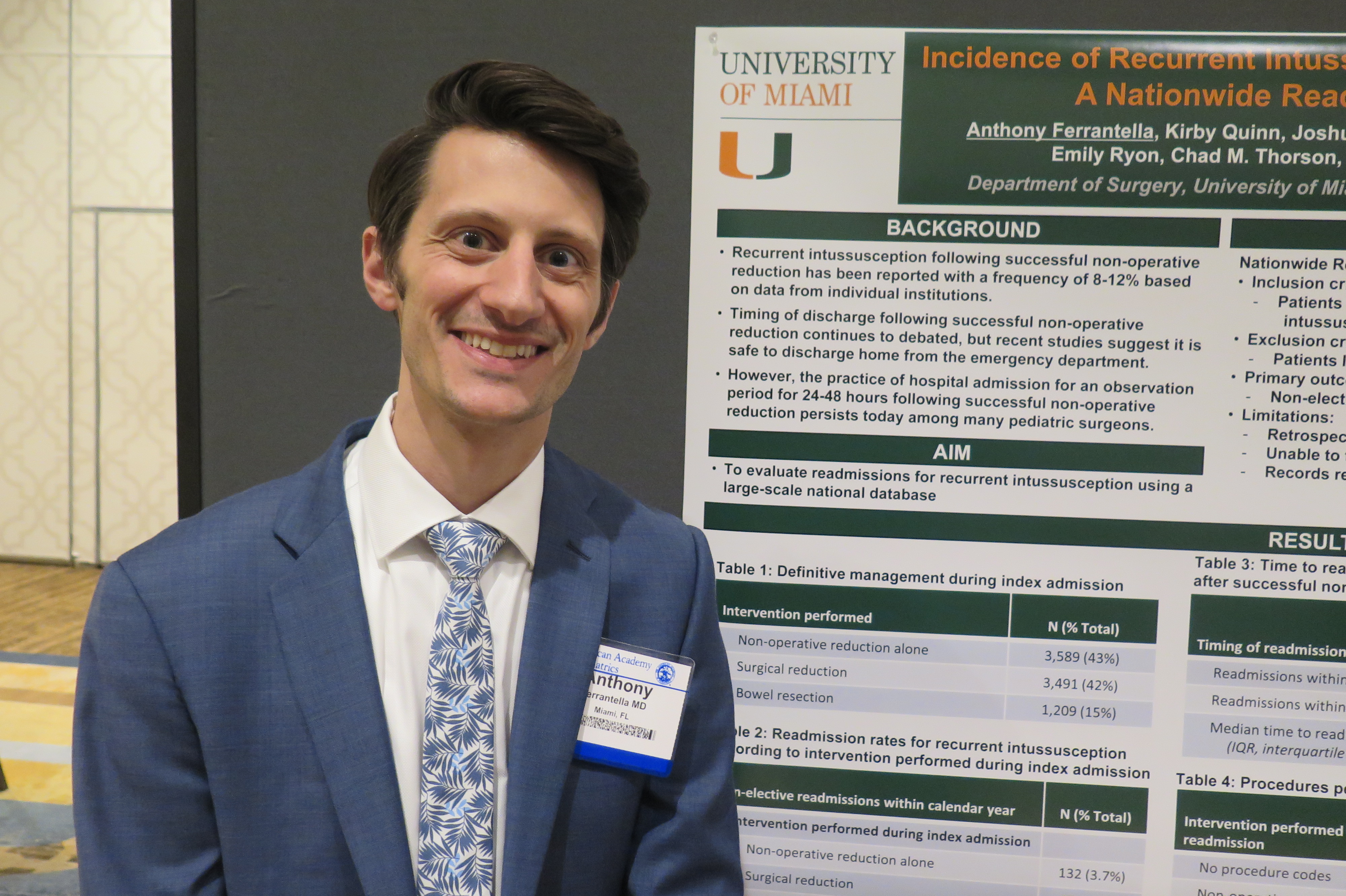
“Recurrent intussusception following successful nonoperative reduction has previously been reported with a frequency of 8-12% based on data from individual institutions,” researchers led by Anthony R. Ferrantella, MD, wrote in an abstract presented at the annual meeting of the American Academy of Pediatrics. “Timing of discharge following successful non-operative reduction continues to be debated, but recent studies suggest it is safe to discharge home from the emergency department. However, the practice of hospital admission for an observation period of 24-48 hours following successful nonoperative reduction persists today among many pediatric surgeons.”
In an effort to evaluate readmissions for recurrent intussusception in young children on a large scale, Dr. Ferrantella, a surgery resident at the University of Miami, and his colleagues queried the Nationwide Readmissions Database during 2010-2014 to identify children younger than 5 years of age diagnosed with ileocolic intussusception. They compared the management during index admission and frequency of readmissions for recurrent intussusception up to one year after discharge. They excluded patients lacking procedure data, weighted the results for national estimates, and used chi-square analysis to compare cohorts.
The search yielded 8,289 young children who were diagnosed with ileocolic intussusception during an index admission. Of these, 43% received definitive treatment with nonoperative reduction alone, 42% underwent surgical reduction without bowel resection, and 15% underwent surgery with bowel resection. Among the hospitals where patients were treated, 75% were large, 80% were not-for-profit, and 94% were metropolitan teaching hospitals.
The researchers found that readmission for recurrent intussusception was required for only 4% of patients managed with nonoperative reduction alone, 2% of patients who underwent surgical reduction, and 0% of those who underwent bowel resection. The median time to readmission was 4 days for those managed with nonoperative reduction only and 64 days for those managed with surgery.
Among patients managed with nonoperative reduction alone during index admission, 71% were again managed successfully with nonoperative reduction alone, 24 underwent surgical reduction, and only 5% required bowel resection. No deaths occurred during any readmissions.
The findings “suggest and support the idea that if you can successfully perform a nonoperative reduction on a child that comes in with an intussusception, you can safely discharge them,” Dr. Ferrantella said in an interview. “If you were to keep them in the hospital, the [rate] of recurrences are very low. Even when they do recur, only 30%-40% will happen within the first 24-48 hours, so the majority will not benefit from a hospital admission.”
He acknowledged certain limitations of the analysis, including that the data came from a retrospectively collected database and that he and his colleagues were unable to track readmissions across state lines.
Dr. Ferrantella reported having no financial disclosures.
dbrunk@mdedge.com
SOURCE: Ferrantella A. AAP 2019, Section on Surgery session.
NEW ORLEANS – Recurrent intussusception after discharge may be far less common in young children than previously reported, and significant morbidity associated with the condition is rare, results from an analysis of national data show.
“Recurrent intussusception following successful nonoperative reduction has previously been reported with a frequency of 8-12% based on data from individual institutions,” researchers led by Anthony R. Ferrantella, MD, wrote in an abstract presented at the annual meeting of the American Academy of Pediatrics. “Timing of discharge following successful non-operative reduction continues to be debated, but recent studies suggest it is safe to discharge home from the emergency department. However, the practice of hospital admission for an observation period of 24-48 hours following successful nonoperative reduction persists today among many pediatric surgeons.”
In an effort to evaluate readmissions for recurrent intussusception in young children on a large scale, Dr. Ferrantella, a surgery resident at the University of Miami, and his colleagues queried the Nationwide Readmissions Database during 2010-2014 to identify children younger than 5 years of age diagnosed with ileocolic intussusception. They compared the management during index admission and frequency of readmissions for recurrent intussusception up to one year after discharge. They excluded patients lacking procedure data, weighted the results for national estimates, and used chi-square analysis to compare cohorts.
The search yielded 8,289 young children who were diagnosed with ileocolic intussusception during an index admission. Of these, 43% received definitive treatment with nonoperative reduction alone, 42% underwent surgical reduction without bowel resection, and 15% underwent surgery with bowel resection. Among the hospitals where patients were treated, 75% were large, 80% were not-for-profit, and 94% were metropolitan teaching hospitals.
The researchers found that readmission for recurrent intussusception was required for only 4% of patients managed with nonoperative reduction alone, 2% of patients who underwent surgical reduction, and 0% of those who underwent bowel resection. The median time to readmission was 4 days for those managed with nonoperative reduction only and 64 days for those managed with surgery.
Among patients managed with nonoperative reduction alone during index admission, 71% were again managed successfully with nonoperative reduction alone, 24 underwent surgical reduction, and only 5% required bowel resection. No deaths occurred during any readmissions.
The findings “suggest and support the idea that if you can successfully perform a nonoperative reduction on a child that comes in with an intussusception, you can safely discharge them,” Dr. Ferrantella said in an interview. “If you were to keep them in the hospital, the [rate] of recurrences are very low. Even when they do recur, only 30%-40% will happen within the first 24-48 hours, so the majority will not benefit from a hospital admission.”
He acknowledged certain limitations of the analysis, including that the data came from a retrospectively collected database and that he and his colleagues were unable to track readmissions across state lines.
Dr. Ferrantella reported having no financial disclosures.
dbrunk@mdedge.com
SOURCE: Ferrantella A. AAP 2019, Section on Surgery session.
NEW ORLEANS – Recurrent intussusception after discharge may be far less common in young children than previously reported, and significant morbidity associated with the condition is rare, results from an analysis of national data show.
“Recurrent intussusception following successful nonoperative reduction has previously been reported with a frequency of 8-12% based on data from individual institutions,” researchers led by Anthony R. Ferrantella, MD, wrote in an abstract presented at the annual meeting of the American Academy of Pediatrics. “Timing of discharge following successful non-operative reduction continues to be debated, but recent studies suggest it is safe to discharge home from the emergency department. However, the practice of hospital admission for an observation period of 24-48 hours following successful nonoperative reduction persists today among many pediatric surgeons.”
In an effort to evaluate readmissions for recurrent intussusception in young children on a large scale, Dr. Ferrantella, a surgery resident at the University of Miami, and his colleagues queried the Nationwide Readmissions Database during 2010-2014 to identify children younger than 5 years of age diagnosed with ileocolic intussusception. They compared the management during index admission and frequency of readmissions for recurrent intussusception up to one year after discharge. They excluded patients lacking procedure data, weighted the results for national estimates, and used chi-square analysis to compare cohorts.
The search yielded 8,289 young children who were diagnosed with ileocolic intussusception during an index admission. Of these, 43% received definitive treatment with nonoperative reduction alone, 42% underwent surgical reduction without bowel resection, and 15% underwent surgery with bowel resection. Among the hospitals where patients were treated, 75% were large, 80% were not-for-profit, and 94% were metropolitan teaching hospitals.
The researchers found that readmission for recurrent intussusception was required for only 4% of patients managed with nonoperative reduction alone, 2% of patients who underwent surgical reduction, and 0% of those who underwent bowel resection. The median time to readmission was 4 days for those managed with nonoperative reduction only and 64 days for those managed with surgery.
Among patients managed with nonoperative reduction alone during index admission, 71% were again managed successfully with nonoperative reduction alone, 24 underwent surgical reduction, and only 5% required bowel resection. No deaths occurred during any readmissions.
The findings “suggest and support the idea that if you can successfully perform a nonoperative reduction on a child that comes in with an intussusception, you can safely discharge them,” Dr. Ferrantella said in an interview. “If you were to keep them in the hospital, the [rate] of recurrences are very low. Even when they do recur, only 30%-40% will happen within the first 24-48 hours, so the majority will not benefit from a hospital admission.”
He acknowledged certain limitations of the analysis, including that the data came from a retrospectively collected database and that he and his colleagues were unable to track readmissions across state lines.
Dr. Ferrantella reported having no financial disclosures.
dbrunk@mdedge.com
SOURCE: Ferrantella A. AAP 2019, Section on Surgery session.
AT AAP 2016
Wandering is underrecognized, serious problem for autistic children
NEW ORLEANS – Nearly half of all children with autism spectrum disorder wander off from safe supervision at some point in their childhood or adolescence, reported Paul Lipkin, MD, at the annual meeting of the American Academy of Pediatrics.
Though such behavior is developmentally normal in toddlers, it’s rarer for older children to leave a supervised, safe space for a longer period than just running away for a bit, he said.
Far more than an inconvenience, wandering, also called elopement, puts these children at high risk for injury or victimization. In fact, statistics from a survey by the National Autism Foundation suggest that nearly a third of autism-related wandering cases resulted in death or serious enough injury to require medical attention, said Dr. Lipkin, an associate professor of pediatrics at the Kennedy Krieger Institute and Johns Hopkins Medicine in Baltimore.
“Drowning is overwhelmingly the main cause of death in children with autism,” he said, sharing the data from National Autism Association, which relied on parent report and media reports. In that data, 71% of deaths from autistic children who wandered from 2011-2016 were drowning, and of those deaths, 76% of the drownings occurred in a natural body of water or drainage water. At a distant second, 18% of deaths were traffic accidents. The remaining causes were being hit by a train (4%), hypothermia or hyperthermia (3%), falling (1%) or other trauma (3%) (J Autism Dev Disord. 2019 Mar 5. doi: 10.1007/s10803-019-03961-x).
Academic research has found similar statistics to those from the National Autism Association. In one study, 53% of autistic youth who attempted to run off succeeded and were missing long enough to cause safety concerns (Pediatrics. 2012 Nov;130[5]:870-7). Among these youth – representing about a quarter of all families surveyed in the study – the police were called in 31% of cases. In addition, 65% had a “close call” with a traffic injury and 24% had a close call with drowning.
The children wandered off in various settings, including home; another’s home; a store or other public place; or school, daycare or camp. A 2019 study found that 70% of parents reported their children wandering off from home at least once in the past 2 years (J Autism Dev Disorders. 2019 Mar 5; doi: 10.1107/s10803-019-03961-x).
Although most cases occur in children and teens, with the highest rate of death among children aged 5-9, the National Autism Association has received reports of wandering occur throughout autistic people’s lifetime.
Yet this issue doesn’t appear to be on the radar of many pediatricians, and those who are aware of it may not know the best strategies to share with parents to prevent wandering and subsequent injury, Dr Lipkin explained. In one study, only one-third of parents reported receiving guidance from a health provider related to wandering (J Dev Behav Pediatr. 2018 Sep;39[7]:538-46).
That research found that only 10% received advice from a pediatrician or other primary care provider, 12% received advice from a developmental pediatrician or neurologist and 10% received advance from a psychologist or psychiatrist. The largest source of guidance in that study was autism advocacy organizations, whom 22% of parents cited. Others included a teacher or other school staff member (15%), a personal contact (13%), law enforcement (8%) or another source (1%).
Role of the pediatrician
Pediatricians have an important role to play in prevention of elopement, Dr Lipkin said. They can screen autistic patients for wandering and elopement during visits, work with community stakeholders such as schools and law enforcement, advocate for awareness, and provider education and resources for families.
Perhaps the most valuable resource, he said, is the Big Red Safety Box, available from the National Autism Association. This resource, sponsored by more than a half dozen autism advocacy organizations, includes three digital safety toolkits: one for caregivers, one for first responders, and one for teachers. Parents can therefore share the toolkits for first responders and teachers with those respective community members.
Pediatricians can also help families develop a Family Wandering Emergency Plan (FWEP), a template for which is in the Big Red Safety Box. Parents and community members should know the steps to take if someone wanders: Stay calm, call 911, search nearby water first and then implement the FWEP.
It’s first helpful to understand why these youth wander off. In the National Autism Association survey, the most common reasons were to escape an anxious situation, particularly for those with Asperger’s, or simply to run, explore, or go to a favorite place, particularly among those with autism or pervasive developmental disorder-not otherwise specified (PDD-NOS).
Researchers have found similar reasons: 43% of elopement situations occurred when children were trying to escape an anxious situation, 39% left while in a stressful environment, and 24% were in an environment with conflict, found one study (J Autism Dev Disord. 2019 Mar 5. doi: 10.1007/s10803-019-03961-x).
Sensory overload was also a trigger, with 38% of elopements occurring when it was too noisy, and 34% when it was a generally uncomfortable sensory experience. Just over a quarter (27%) of children left when they were understimulated or in a “boring” environment, Dr Lipkin reported. The remaining reason was goal-directed: 27% left to pursue a special interest, 18% sought a place where they enjoyed playing, and 11% were after their favorite food.
Prevention Strategies
Most data about effective strategies to prevent wandering comes from research that relies on parents, Dr Lipkin said. In general, environmental interventions tend to be the most effective, and medication tends to be the least effective.
One study on elopement prevention found that 96% of caregivers use at least some type of intervention, and the vast majority (83%) were using environmental interventions such as dead bolts (51%), latches (49%) and gates (36%). An equal proportion used behavioral services (83%), such as a behavioral psychologist (41%), social stories (40%) or an aide (39%). Just under a third used an ID bracelet or shoe tag (31%), and 19% used GPS trackers, according to Dr. Lipkin.
Although parents reported environmental interventions to be very effective, 68% said they were highly burdensome, though the median cost over 2 years was less than $1,000. The least expensive intervention was home behavioral specialists (when covered by insurance) and school aides, and the most expensive and burdensome – albeit highly effective – was a service animal.
Interventions with the least cost effectiveness included security cameras and GPS trackers, which only 15% of parents reported as being effective.
Although nearly half of parents reported their child had taken any psychiatric medication (48%), only 16% had taken medication explicitly to prevent wandering. Few reported the medication was very effective, however. Among the small number who did (less than 10), lorazepam, diazepam and atomoxetine appeared best.
Teaching children survival skills, as developmentally appropriate and possible, can also help. These include swimming lessons as well as learning how to interact in traffic, knowing their home address, and learning how to navigate around their neighborhood.
Dr. Lipkin no disclosures and used no external funding for this presentation.
NEW ORLEANS – Nearly half of all children with autism spectrum disorder wander off from safe supervision at some point in their childhood or adolescence, reported Paul Lipkin, MD, at the annual meeting of the American Academy of Pediatrics.
Though such behavior is developmentally normal in toddlers, it’s rarer for older children to leave a supervised, safe space for a longer period than just running away for a bit, he said.
Far more than an inconvenience, wandering, also called elopement, puts these children at high risk for injury or victimization. In fact, statistics from a survey by the National Autism Foundation suggest that nearly a third of autism-related wandering cases resulted in death or serious enough injury to require medical attention, said Dr. Lipkin, an associate professor of pediatrics at the Kennedy Krieger Institute and Johns Hopkins Medicine in Baltimore.
“Drowning is overwhelmingly the main cause of death in children with autism,” he said, sharing the data from National Autism Association, which relied on parent report and media reports. In that data, 71% of deaths from autistic children who wandered from 2011-2016 were drowning, and of those deaths, 76% of the drownings occurred in a natural body of water or drainage water. At a distant second, 18% of deaths were traffic accidents. The remaining causes were being hit by a train (4%), hypothermia or hyperthermia (3%), falling (1%) or other trauma (3%) (J Autism Dev Disord. 2019 Mar 5. doi: 10.1007/s10803-019-03961-x).
Academic research has found similar statistics to those from the National Autism Association. In one study, 53% of autistic youth who attempted to run off succeeded and were missing long enough to cause safety concerns (Pediatrics. 2012 Nov;130[5]:870-7). Among these youth – representing about a quarter of all families surveyed in the study – the police were called in 31% of cases. In addition, 65% had a “close call” with a traffic injury and 24% had a close call with drowning.
The children wandered off in various settings, including home; another’s home; a store or other public place; or school, daycare or camp. A 2019 study found that 70% of parents reported their children wandering off from home at least once in the past 2 years (J Autism Dev Disorders. 2019 Mar 5; doi: 10.1107/s10803-019-03961-x).
Although most cases occur in children and teens, with the highest rate of death among children aged 5-9, the National Autism Association has received reports of wandering occur throughout autistic people’s lifetime.
Yet this issue doesn’t appear to be on the radar of many pediatricians, and those who are aware of it may not know the best strategies to share with parents to prevent wandering and subsequent injury, Dr Lipkin explained. In one study, only one-third of parents reported receiving guidance from a health provider related to wandering (J Dev Behav Pediatr. 2018 Sep;39[7]:538-46).
That research found that only 10% received advice from a pediatrician or other primary care provider, 12% received advice from a developmental pediatrician or neurologist and 10% received advance from a psychologist or psychiatrist. The largest source of guidance in that study was autism advocacy organizations, whom 22% of parents cited. Others included a teacher or other school staff member (15%), a personal contact (13%), law enforcement (8%) or another source (1%).
Role of the pediatrician
Pediatricians have an important role to play in prevention of elopement, Dr Lipkin said. They can screen autistic patients for wandering and elopement during visits, work with community stakeholders such as schools and law enforcement, advocate for awareness, and provider education and resources for families.
Perhaps the most valuable resource, he said, is the Big Red Safety Box, available from the National Autism Association. This resource, sponsored by more than a half dozen autism advocacy organizations, includes three digital safety toolkits: one for caregivers, one for first responders, and one for teachers. Parents can therefore share the toolkits for first responders and teachers with those respective community members.
Pediatricians can also help families develop a Family Wandering Emergency Plan (FWEP), a template for which is in the Big Red Safety Box. Parents and community members should know the steps to take if someone wanders: Stay calm, call 911, search nearby water first and then implement the FWEP.
It’s first helpful to understand why these youth wander off. In the National Autism Association survey, the most common reasons were to escape an anxious situation, particularly for those with Asperger’s, or simply to run, explore, or go to a favorite place, particularly among those with autism or pervasive developmental disorder-not otherwise specified (PDD-NOS).
Researchers have found similar reasons: 43% of elopement situations occurred when children were trying to escape an anxious situation, 39% left while in a stressful environment, and 24% were in an environment with conflict, found one study (J Autism Dev Disord. 2019 Mar 5. doi: 10.1007/s10803-019-03961-x).
Sensory overload was also a trigger, with 38% of elopements occurring when it was too noisy, and 34% when it was a generally uncomfortable sensory experience. Just over a quarter (27%) of children left when they were understimulated or in a “boring” environment, Dr Lipkin reported. The remaining reason was goal-directed: 27% left to pursue a special interest, 18% sought a place where they enjoyed playing, and 11% were after their favorite food.
Prevention Strategies
Most data about effective strategies to prevent wandering comes from research that relies on parents, Dr Lipkin said. In general, environmental interventions tend to be the most effective, and medication tends to be the least effective.
One study on elopement prevention found that 96% of caregivers use at least some type of intervention, and the vast majority (83%) were using environmental interventions such as dead bolts (51%), latches (49%) and gates (36%). An equal proportion used behavioral services (83%), such as a behavioral psychologist (41%), social stories (40%) or an aide (39%). Just under a third used an ID bracelet or shoe tag (31%), and 19% used GPS trackers, according to Dr. Lipkin.
Although parents reported environmental interventions to be very effective, 68% said they were highly burdensome, though the median cost over 2 years was less than $1,000. The least expensive intervention was home behavioral specialists (when covered by insurance) and school aides, and the most expensive and burdensome – albeit highly effective – was a service animal.
Interventions with the least cost effectiveness included security cameras and GPS trackers, which only 15% of parents reported as being effective.
Although nearly half of parents reported their child had taken any psychiatric medication (48%), only 16% had taken medication explicitly to prevent wandering. Few reported the medication was very effective, however. Among the small number who did (less than 10), lorazepam, diazepam and atomoxetine appeared best.
Teaching children survival skills, as developmentally appropriate and possible, can also help. These include swimming lessons as well as learning how to interact in traffic, knowing their home address, and learning how to navigate around their neighborhood.
Dr. Lipkin no disclosures and used no external funding for this presentation.
NEW ORLEANS – Nearly half of all children with autism spectrum disorder wander off from safe supervision at some point in their childhood or adolescence, reported Paul Lipkin, MD, at the annual meeting of the American Academy of Pediatrics.
Though such behavior is developmentally normal in toddlers, it’s rarer for older children to leave a supervised, safe space for a longer period than just running away for a bit, he said.
Far more than an inconvenience, wandering, also called elopement, puts these children at high risk for injury or victimization. In fact, statistics from a survey by the National Autism Foundation suggest that nearly a third of autism-related wandering cases resulted in death or serious enough injury to require medical attention, said Dr. Lipkin, an associate professor of pediatrics at the Kennedy Krieger Institute and Johns Hopkins Medicine in Baltimore.
“Drowning is overwhelmingly the main cause of death in children with autism,” he said, sharing the data from National Autism Association, which relied on parent report and media reports. In that data, 71% of deaths from autistic children who wandered from 2011-2016 were drowning, and of those deaths, 76% of the drownings occurred in a natural body of water or drainage water. At a distant second, 18% of deaths were traffic accidents. The remaining causes were being hit by a train (4%), hypothermia or hyperthermia (3%), falling (1%) or other trauma (3%) (J Autism Dev Disord. 2019 Mar 5. doi: 10.1007/s10803-019-03961-x).
Academic research has found similar statistics to those from the National Autism Association. In one study, 53% of autistic youth who attempted to run off succeeded and were missing long enough to cause safety concerns (Pediatrics. 2012 Nov;130[5]:870-7). Among these youth – representing about a quarter of all families surveyed in the study – the police were called in 31% of cases. In addition, 65% had a “close call” with a traffic injury and 24% had a close call with drowning.
The children wandered off in various settings, including home; another’s home; a store or other public place; or school, daycare or camp. A 2019 study found that 70% of parents reported their children wandering off from home at least once in the past 2 years (J Autism Dev Disorders. 2019 Mar 5; doi: 10.1107/s10803-019-03961-x).
Although most cases occur in children and teens, with the highest rate of death among children aged 5-9, the National Autism Association has received reports of wandering occur throughout autistic people’s lifetime.
Yet this issue doesn’t appear to be on the radar of many pediatricians, and those who are aware of it may not know the best strategies to share with parents to prevent wandering and subsequent injury, Dr Lipkin explained. In one study, only one-third of parents reported receiving guidance from a health provider related to wandering (J Dev Behav Pediatr. 2018 Sep;39[7]:538-46).
That research found that only 10% received advice from a pediatrician or other primary care provider, 12% received advice from a developmental pediatrician or neurologist and 10% received advance from a psychologist or psychiatrist. The largest source of guidance in that study was autism advocacy organizations, whom 22% of parents cited. Others included a teacher or other school staff member (15%), a personal contact (13%), law enforcement (8%) or another source (1%).
Role of the pediatrician
Pediatricians have an important role to play in prevention of elopement, Dr Lipkin said. They can screen autistic patients for wandering and elopement during visits, work with community stakeholders such as schools and law enforcement, advocate for awareness, and provider education and resources for families.
Perhaps the most valuable resource, he said, is the Big Red Safety Box, available from the National Autism Association. This resource, sponsored by more than a half dozen autism advocacy organizations, includes three digital safety toolkits: one for caregivers, one for first responders, and one for teachers. Parents can therefore share the toolkits for first responders and teachers with those respective community members.
Pediatricians can also help families develop a Family Wandering Emergency Plan (FWEP), a template for which is in the Big Red Safety Box. Parents and community members should know the steps to take if someone wanders: Stay calm, call 911, search nearby water first and then implement the FWEP.
It’s first helpful to understand why these youth wander off. In the National Autism Association survey, the most common reasons were to escape an anxious situation, particularly for those with Asperger’s, or simply to run, explore, or go to a favorite place, particularly among those with autism or pervasive developmental disorder-not otherwise specified (PDD-NOS).
Researchers have found similar reasons: 43% of elopement situations occurred when children were trying to escape an anxious situation, 39% left while in a stressful environment, and 24% were in an environment with conflict, found one study (J Autism Dev Disord. 2019 Mar 5. doi: 10.1007/s10803-019-03961-x).
Sensory overload was also a trigger, with 38% of elopements occurring when it was too noisy, and 34% when it was a generally uncomfortable sensory experience. Just over a quarter (27%) of children left when they were understimulated or in a “boring” environment, Dr Lipkin reported. The remaining reason was goal-directed: 27% left to pursue a special interest, 18% sought a place where they enjoyed playing, and 11% were after their favorite food.
Prevention Strategies
Most data about effective strategies to prevent wandering comes from research that relies on parents, Dr Lipkin said. In general, environmental interventions tend to be the most effective, and medication tends to be the least effective.
One study on elopement prevention found that 96% of caregivers use at least some type of intervention, and the vast majority (83%) were using environmental interventions such as dead bolts (51%), latches (49%) and gates (36%). An equal proportion used behavioral services (83%), such as a behavioral psychologist (41%), social stories (40%) or an aide (39%). Just under a third used an ID bracelet or shoe tag (31%), and 19% used GPS trackers, according to Dr. Lipkin.
Although parents reported environmental interventions to be very effective, 68% said they were highly burdensome, though the median cost over 2 years was less than $1,000. The least expensive intervention was home behavioral specialists (when covered by insurance) and school aides, and the most expensive and burdensome – albeit highly effective – was a service animal.
Interventions with the least cost effectiveness included security cameras and GPS trackers, which only 15% of parents reported as being effective.
Although nearly half of parents reported their child had taken any psychiatric medication (48%), only 16% had taken medication explicitly to prevent wandering. Few reported the medication was very effective, however. Among the small number who did (less than 10), lorazepam, diazepam and atomoxetine appeared best.
Teaching children survival skills, as developmentally appropriate and possible, can also help. These include swimming lessons as well as learning how to interact in traffic, knowing their home address, and learning how to navigate around their neighborhood.
Dr. Lipkin no disclosures and used no external funding for this presentation.
FROM AAP
Emicizumab effective in children with hemophilia A and inhibitors
Emicizumab (Hemlibra) is well tolerated and has substantial, clinically meaningful efficacy in pediatric patients with hemophilia A and factor VIII inhibitors, according to an analysis of data from the HAVEN 2 trial in this bispecific humanized monoclonal antibody.
Among those receiving once-weekly emicizumab prophylaxis, 77% had no treated bleeding events and 100% of evaluable target joints resolved in the HAVEN 2 study, which investigators say is the largest prospective study so far of bleed prevention in pediatric patients with hemophilia A and inhibitors.
Moreover, emicizumab resulted in a 99% reduction in bleeding rate versus previous bypassing agent prophylaxis, subsequent, according to an intraindividual comparison described in the report.
Based on these results, emicizumab stands to become the “next-generation standard of care” for pediatric patients with hemophilia A and factor VIII inhibitors, reported Guy Young, MD, of Children’s Hospital Los Angeles and University of Southern California Keck School of Medicine, and his coinvestigators.
“Despite a rapidly evolving treatment landscape in hemophilia, children have been largely excluded from recent trials of novel agents,” they said in the report, which appears in the journal Blood.
Before emicizumab, current treatment options for pediatric patients with factor VIII inhibitors were limited to immune tolerance induction, or use of bypassing agents with efficacy that “can be suboptimal and unpredictable,” said Dr. Young and colleagues.
“More effective prophylactic options with reduced treatment burden are needed,” they said.
Emicizumab works in hemophilia A by bridging activated factor IX and factor X, restoring the function of missing factor VIIIa, according to the report.
A total of 88 male pediatric patients with congenital hemophilia A were enrolled in HAVEN 2, an ongoing phase 3 multicenter study that is nonrandomized and open label. The median age of patients was 7 years (range, 1-15 years). Most participants (97%) had severe hemophilia A, 72% had previously undergone immune tolerance induction, and 75% were receiving treatment with prophylactic bypassing agents.
Most participants received 4 once-weekly loading doses of 3 mg/kg body weight of emicizumab subcutaneously, followed by a maintenance regimen of 1.5 mg/kg weekly.
The annualized bleed rate was 0.3, with 77% of participants having zero bleeding events, for the 65 participants in the trial who were under 12 and received emicizumab 1.5 mg/kg weekly, according to the report.
In the subset of those patients with target joints, the mean annualized bleed rate was 3.3 for the first 24 weeks, and 0 for the next 24 weeks; these findings suggest that bleed rates decrease over time with continuing emicizumab treatment “even in patients with a more severe phenotype,” the investigators wrote.
For 15 patients younger than 12 years of age receiving bypassing agent prophylaxis, emicizumab 1.5 mg/kg once weekly resulted in an annualized bleed rate of 0.3, compared to 21.1 for the prior bypassing agent, which translates into a 99% reduction in bleeding risk, according to investigators.
Annualized bleed rates for patients receiving emicizumab 3 mg/kg every 2 weeks or 6 mg/kg every 4 weeks were 0.2 and 2.2, respectively; hover, the numerically higher annualized bleed rate in the 6 mg/kg every-4-weeks group was based on 2 out of the 10 patients treated with that maintenance regimen, including one who had 6 target joint bleeds in the 24 weeks before enrolling in the study, and another who developed antidrug antibodies within the first 8 weeks of emicizumab treatment.
Out of 23 patients who had target joints and received emicizumab prophylaxis for at least 52 weeks, 100% (45 of 45) target joints resolved, according to the report.
“Notably, this is the first report of a treatment resolving target joints in an inhibitor population, which until now has only been reported when using factor VIII products in patients without inhibitors,” Dr. Young and colleagues said.
The most common of the 721 adverse events reported in HAVEN 2 were nasopharyngitis and injection-site reactions. Of 21 serious adverse events, only 1 (antidrug antibodies with neutralizing potential) was thought by investigators to be related to emicizumab.
The Food and Drug Administration (FDA) initially approved emicizumab in November 2017 on the basis of the HAVEN 2 pediatric trial, and on HAVEN 1, a randomized, multicenter, open-label, phase 3 trial including 109 adult and adolescent males with hemophilia A and FVIII inhibitors. The indication for emicizumab was expanded to include patients without inhibitors in October 2018, on the basis of the HAVEN 3 and HAVEN 4 randomized phase 3 trials.
Dr. Young reported disclosures related to Alnylam, Bayer, Bioverativ, CSL Behring, Genentech/Roche, Grifols, Kedrion, Novo Nordisk, Shire, Spark, and uniQure.
SOURCE: Young G, et al. Blood. 2019 Oct 10. doi: 10.1182/blood.2019001869.
Emicizumab (Hemlibra) is well tolerated and has substantial, clinically meaningful efficacy in pediatric patients with hemophilia A and factor VIII inhibitors, according to an analysis of data from the HAVEN 2 trial in this bispecific humanized monoclonal antibody.
Among those receiving once-weekly emicizumab prophylaxis, 77% had no treated bleeding events and 100% of evaluable target joints resolved in the HAVEN 2 study, which investigators say is the largest prospective study so far of bleed prevention in pediatric patients with hemophilia A and inhibitors.
Moreover, emicizumab resulted in a 99% reduction in bleeding rate versus previous bypassing agent prophylaxis, subsequent, according to an intraindividual comparison described in the report.
Based on these results, emicizumab stands to become the “next-generation standard of care” for pediatric patients with hemophilia A and factor VIII inhibitors, reported Guy Young, MD, of Children’s Hospital Los Angeles and University of Southern California Keck School of Medicine, and his coinvestigators.
“Despite a rapidly evolving treatment landscape in hemophilia, children have been largely excluded from recent trials of novel agents,” they said in the report, which appears in the journal Blood.
Before emicizumab, current treatment options for pediatric patients with factor VIII inhibitors were limited to immune tolerance induction, or use of bypassing agents with efficacy that “can be suboptimal and unpredictable,” said Dr. Young and colleagues.
“More effective prophylactic options with reduced treatment burden are needed,” they said.
Emicizumab works in hemophilia A by bridging activated factor IX and factor X, restoring the function of missing factor VIIIa, according to the report.
A total of 88 male pediatric patients with congenital hemophilia A were enrolled in HAVEN 2, an ongoing phase 3 multicenter study that is nonrandomized and open label. The median age of patients was 7 years (range, 1-15 years). Most participants (97%) had severe hemophilia A, 72% had previously undergone immune tolerance induction, and 75% were receiving treatment with prophylactic bypassing agents.
Most participants received 4 once-weekly loading doses of 3 mg/kg body weight of emicizumab subcutaneously, followed by a maintenance regimen of 1.5 mg/kg weekly.
The annualized bleed rate was 0.3, with 77% of participants having zero bleeding events, for the 65 participants in the trial who were under 12 and received emicizumab 1.5 mg/kg weekly, according to the report.
In the subset of those patients with target joints, the mean annualized bleed rate was 3.3 for the first 24 weeks, and 0 for the next 24 weeks; these findings suggest that bleed rates decrease over time with continuing emicizumab treatment “even in patients with a more severe phenotype,” the investigators wrote.
For 15 patients younger than 12 years of age receiving bypassing agent prophylaxis, emicizumab 1.5 mg/kg once weekly resulted in an annualized bleed rate of 0.3, compared to 21.1 for the prior bypassing agent, which translates into a 99% reduction in bleeding risk, according to investigators.
Annualized bleed rates for patients receiving emicizumab 3 mg/kg every 2 weeks or 6 mg/kg every 4 weeks were 0.2 and 2.2, respectively; hover, the numerically higher annualized bleed rate in the 6 mg/kg every-4-weeks group was based on 2 out of the 10 patients treated with that maintenance regimen, including one who had 6 target joint bleeds in the 24 weeks before enrolling in the study, and another who developed antidrug antibodies within the first 8 weeks of emicizumab treatment.
Out of 23 patients who had target joints and received emicizumab prophylaxis for at least 52 weeks, 100% (45 of 45) target joints resolved, according to the report.
“Notably, this is the first report of a treatment resolving target joints in an inhibitor population, which until now has only been reported when using factor VIII products in patients without inhibitors,” Dr. Young and colleagues said.
The most common of the 721 adverse events reported in HAVEN 2 were nasopharyngitis and injection-site reactions. Of 21 serious adverse events, only 1 (antidrug antibodies with neutralizing potential) was thought by investigators to be related to emicizumab.
The Food and Drug Administration (FDA) initially approved emicizumab in November 2017 on the basis of the HAVEN 2 pediatric trial, and on HAVEN 1, a randomized, multicenter, open-label, phase 3 trial including 109 adult and adolescent males with hemophilia A and FVIII inhibitors. The indication for emicizumab was expanded to include patients without inhibitors in October 2018, on the basis of the HAVEN 3 and HAVEN 4 randomized phase 3 trials.
Dr. Young reported disclosures related to Alnylam, Bayer, Bioverativ, CSL Behring, Genentech/Roche, Grifols, Kedrion, Novo Nordisk, Shire, Spark, and uniQure.
SOURCE: Young G, et al. Blood. 2019 Oct 10. doi: 10.1182/blood.2019001869.
Emicizumab (Hemlibra) is well tolerated and has substantial, clinically meaningful efficacy in pediatric patients with hemophilia A and factor VIII inhibitors, according to an analysis of data from the HAVEN 2 trial in this bispecific humanized monoclonal antibody.
Among those receiving once-weekly emicizumab prophylaxis, 77% had no treated bleeding events and 100% of evaluable target joints resolved in the HAVEN 2 study, which investigators say is the largest prospective study so far of bleed prevention in pediatric patients with hemophilia A and inhibitors.
Moreover, emicizumab resulted in a 99% reduction in bleeding rate versus previous bypassing agent prophylaxis, subsequent, according to an intraindividual comparison described in the report.
Based on these results, emicizumab stands to become the “next-generation standard of care” for pediatric patients with hemophilia A and factor VIII inhibitors, reported Guy Young, MD, of Children’s Hospital Los Angeles and University of Southern California Keck School of Medicine, and his coinvestigators.
“Despite a rapidly evolving treatment landscape in hemophilia, children have been largely excluded from recent trials of novel agents,” they said in the report, which appears in the journal Blood.
Before emicizumab, current treatment options for pediatric patients with factor VIII inhibitors were limited to immune tolerance induction, or use of bypassing agents with efficacy that “can be suboptimal and unpredictable,” said Dr. Young and colleagues.
“More effective prophylactic options with reduced treatment burden are needed,” they said.
Emicizumab works in hemophilia A by bridging activated factor IX and factor X, restoring the function of missing factor VIIIa, according to the report.
A total of 88 male pediatric patients with congenital hemophilia A were enrolled in HAVEN 2, an ongoing phase 3 multicenter study that is nonrandomized and open label. The median age of patients was 7 years (range, 1-15 years). Most participants (97%) had severe hemophilia A, 72% had previously undergone immune tolerance induction, and 75% were receiving treatment with prophylactic bypassing agents.
Most participants received 4 once-weekly loading doses of 3 mg/kg body weight of emicizumab subcutaneously, followed by a maintenance regimen of 1.5 mg/kg weekly.
The annualized bleed rate was 0.3, with 77% of participants having zero bleeding events, for the 65 participants in the trial who were under 12 and received emicizumab 1.5 mg/kg weekly, according to the report.
In the subset of those patients with target joints, the mean annualized bleed rate was 3.3 for the first 24 weeks, and 0 for the next 24 weeks; these findings suggest that bleed rates decrease over time with continuing emicizumab treatment “even in patients with a more severe phenotype,” the investigators wrote.
For 15 patients younger than 12 years of age receiving bypassing agent prophylaxis, emicizumab 1.5 mg/kg once weekly resulted in an annualized bleed rate of 0.3, compared to 21.1 for the prior bypassing agent, which translates into a 99% reduction in bleeding risk, according to investigators.
Annualized bleed rates for patients receiving emicizumab 3 mg/kg every 2 weeks or 6 mg/kg every 4 weeks were 0.2 and 2.2, respectively; hover, the numerically higher annualized bleed rate in the 6 mg/kg every-4-weeks group was based on 2 out of the 10 patients treated with that maintenance regimen, including one who had 6 target joint bleeds in the 24 weeks before enrolling in the study, and another who developed antidrug antibodies within the first 8 weeks of emicizumab treatment.
Out of 23 patients who had target joints and received emicizumab prophylaxis for at least 52 weeks, 100% (45 of 45) target joints resolved, according to the report.
“Notably, this is the first report of a treatment resolving target joints in an inhibitor population, which until now has only been reported when using factor VIII products in patients without inhibitors,” Dr. Young and colleagues said.
The most common of the 721 adverse events reported in HAVEN 2 were nasopharyngitis and injection-site reactions. Of 21 serious adverse events, only 1 (antidrug antibodies with neutralizing potential) was thought by investigators to be related to emicizumab.
The Food and Drug Administration (FDA) initially approved emicizumab in November 2017 on the basis of the HAVEN 2 pediatric trial, and on HAVEN 1, a randomized, multicenter, open-label, phase 3 trial including 109 adult and adolescent males with hemophilia A and FVIII inhibitors. The indication for emicizumab was expanded to include patients without inhibitors in October 2018, on the basis of the HAVEN 3 and HAVEN 4 randomized phase 3 trials.
Dr. Young reported disclosures related to Alnylam, Bayer, Bioverativ, CSL Behring, Genentech/Roche, Grifols, Kedrion, Novo Nordisk, Shire, Spark, and uniQure.
SOURCE: Young G, et al. Blood. 2019 Oct 10. doi: 10.1182/blood.2019001869.
FROM Blood
Birth year linked to influenza-subtype susceptibility
WASHINGTON – People may differ in their susceptibility to different influenza subtypes based in part on the year when they were born and the flu strains that circulated during their birth year, according to infection patterns during a recent U.S. flu season.

“Our findings may indicate protection against H1 [influenza] viruses in age groups with early exposure to H1N1pdm09 during the 2009 pandemic or to older, antigenically similar H1N1 viruses,” Shikha Garg, MD, said at an annual scientific meeting on infectious diseases. If results from further studies confirm this relationship it could have implications for flu vaccine effectiveness in various age groups and influence the composition of flu vaccines based on the ages of the people who will receive them, said Dr. Garg, a medical epidemiologist with the Centers for Disease Control and Prevention in Atlanta.
The analysis she reported using data collected by the CDC’s Influenza Hospitalization Surveillance Network on 18,699 people hospitalized for influenza infection during the 2018-2019 season, Oct. 1, 2018–April 30, 2019. The database provides a representative sampling of patients hospitalized for influenza at more than 250 acute care hospitals in 13 states. During the season studied, both the H1N1 and H3N2 subtypes circulated and caused similar cumulative rates of infections, with H1N1 causing about 32 confirmed cases per 100,000 people and H3N2 causing about 29 cases/100,000.
But a more granular analysis that divided the hospitalized patients by their birth year showed an excess of H1N1 infections in two demographic slices: those born during 2010-2019 (corresponding to children 0-9 years old), in whom H1N1 accounted for roughly 60% of cases; and also in those born during 1948-1995 (people aged 24-70 years old) in whom H1N1 caused roughly 70% or more of all infections in some for some birth-year groups in this demographic range. In contrast, infection with the circulating H3N2 strain in the 2018-2019 season dominated among those born during 1996-2009 (people aged 10-23), as well as in those born in 1947 or earlier (those who were at least 71 years old). Some age groups within those born in 1996-2009 had H3N2 infection rates that made up 70% or more of all flu infections, and among nonagenarians well over three-quarters of flu infection were by the H3N2 subtype.
Dr. Garg also showed a similar pattern of predominant flu subtype by age using U.S. influenza hospitalization data for the 2017-2018 season, as well as for all types of 2018-2019 U.S. influenza infections that underwent strain typing including outpatients as well as in patients. All of these findings support the hypothesis and extend the data published earlier this year by Dr. Garg and several of her CDC colleagues that described a pattern of “antigen imprinting” that appeared caused by influenza exposure during the first year of life (J Infect Dis. 2019 Sep 1;220[5]:820-9). However, more data are needed to better assess time trends for children who were first exposed to H1N1 influenza during the 2009 pandemic, Dr. Garg said.
mzoler@mdedge.com
SOURCE: Garg S. ID Week 2019, Abstract LB19.
WASHINGTON – People may differ in their susceptibility to different influenza subtypes based in part on the year when they were born and the flu strains that circulated during their birth year, according to infection patterns during a recent U.S. flu season.
“Our findings may indicate protection against H1 [influenza] viruses in age groups with early exposure to H1N1pdm09 during the 2009 pandemic or to older, antigenically similar H1N1 viruses,” Shikha Garg, MD, said at an annual scientific meeting on infectious diseases. If results from further studies confirm this relationship it could have implications for flu vaccine effectiveness in various age groups and influence the composition of flu vaccines based on the ages of the people who will receive them, said Dr. Garg, a medical epidemiologist with the Centers for Disease Control and Prevention in Atlanta.
The analysis she reported using data collected by the CDC’s Influenza Hospitalization Surveillance Network on 18,699 people hospitalized for influenza infection during the 2018-2019 season, Oct. 1, 2018–April 30, 2019. The database provides a representative sampling of patients hospitalized for influenza at more than 250 acute care hospitals in 13 states. During the season studied, both the H1N1 and H3N2 subtypes circulated and caused similar cumulative rates of infections, with H1N1 causing about 32 confirmed cases per 100,000 people and H3N2 causing about 29 cases/100,000.
But a more granular analysis that divided the hospitalized patients by their birth year showed an excess of H1N1 infections in two demographic slices: those born during 2010-2019 (corresponding to children 0-9 years old), in whom H1N1 accounted for roughly 60% of cases; and also in those born during 1948-1995 (people aged 24-70 years old) in whom H1N1 caused roughly 70% or more of all infections in some for some birth-year groups in this demographic range. In contrast, infection with the circulating H3N2 strain in the 2018-2019 season dominated among those born during 1996-2009 (people aged 10-23), as well as in those born in 1947 or earlier (those who were at least 71 years old). Some age groups within those born in 1996-2009 had H3N2 infection rates that made up 70% or more of all flu infections, and among nonagenarians well over three-quarters of flu infection were by the H3N2 subtype.
Dr. Garg also showed a similar pattern of predominant flu subtype by age using U.S. influenza hospitalization data for the 2017-2018 season, as well as for all types of 2018-2019 U.S. influenza infections that underwent strain typing including outpatients as well as in patients. All of these findings support the hypothesis and extend the data published earlier this year by Dr. Garg and several of her CDC colleagues that described a pattern of “antigen imprinting” that appeared caused by influenza exposure during the first year of life (J Infect Dis. 2019 Sep 1;220[5]:820-9). However, more data are needed to better assess time trends for children who were first exposed to H1N1 influenza during the 2009 pandemic, Dr. Garg said.
mzoler@mdedge.com
SOURCE: Garg S. ID Week 2019, Abstract LB19.
WASHINGTON – People may differ in their susceptibility to different influenza subtypes based in part on the year when they were born and the flu strains that circulated during their birth year, according to infection patterns during a recent U.S. flu season.
“Our findings may indicate protection against H1 [influenza] viruses in age groups with early exposure to H1N1pdm09 during the 2009 pandemic or to older, antigenically similar H1N1 viruses,” Shikha Garg, MD, said at an annual scientific meeting on infectious diseases. If results from further studies confirm this relationship it could have implications for flu vaccine effectiveness in various age groups and influence the composition of flu vaccines based on the ages of the people who will receive them, said Dr. Garg, a medical epidemiologist with the Centers for Disease Control and Prevention in Atlanta.
The analysis she reported using data collected by the CDC’s Influenza Hospitalization Surveillance Network on 18,699 people hospitalized for influenza infection during the 2018-2019 season, Oct. 1, 2018–April 30, 2019. The database provides a representative sampling of patients hospitalized for influenza at more than 250 acute care hospitals in 13 states. During the season studied, both the H1N1 and H3N2 subtypes circulated and caused similar cumulative rates of infections, with H1N1 causing about 32 confirmed cases per 100,000 people and H3N2 causing about 29 cases/100,000.
But a more granular analysis that divided the hospitalized patients by their birth year showed an excess of H1N1 infections in two demographic slices: those born during 2010-2019 (corresponding to children 0-9 years old), in whom H1N1 accounted for roughly 60% of cases; and also in those born during 1948-1995 (people aged 24-70 years old) in whom H1N1 caused roughly 70% or more of all infections in some for some birth-year groups in this demographic range. In contrast, infection with the circulating H3N2 strain in the 2018-2019 season dominated among those born during 1996-2009 (people aged 10-23), as well as in those born in 1947 or earlier (those who were at least 71 years old). Some age groups within those born in 1996-2009 had H3N2 infection rates that made up 70% or more of all flu infections, and among nonagenarians well over three-quarters of flu infection were by the H3N2 subtype.
Dr. Garg also showed a similar pattern of predominant flu subtype by age using U.S. influenza hospitalization data for the 2017-2018 season, as well as for all types of 2018-2019 U.S. influenza infections that underwent strain typing including outpatients as well as in patients. All of these findings support the hypothesis and extend the data published earlier this year by Dr. Garg and several of her CDC colleagues that described a pattern of “antigen imprinting” that appeared caused by influenza exposure during the first year of life (J Infect Dis. 2019 Sep 1;220[5]:820-9). However, more data are needed to better assess time trends for children who were first exposed to H1N1 influenza during the 2009 pandemic, Dr. Garg said.
mzoler@mdedge.com
SOURCE: Garg S. ID Week 2019, Abstract LB19.
REPORTING FROM ID WEEK 2019

Virtual visits may cut no-show rate for follow-up HF appointment
PHILADELPHIA – For patients transitioning to home after a heart failure hospitalization, substituting in-person visits with virtual, video-based visits is feasible, safe, and may reduce appointment no-show rates, results of a randomized study suggest.
Connecting patients with clinicians over secure video cut no-show rates at 7 days post-discharge by about one-third, with no difference in risk of readmission, emergency department visits, or death, compared with the traditional in-person follow-up visit, investigator Eiran Z. Gorodeski, MD, MPH, reported here at the annual scientific meeting of the Heart Failure Society of America.
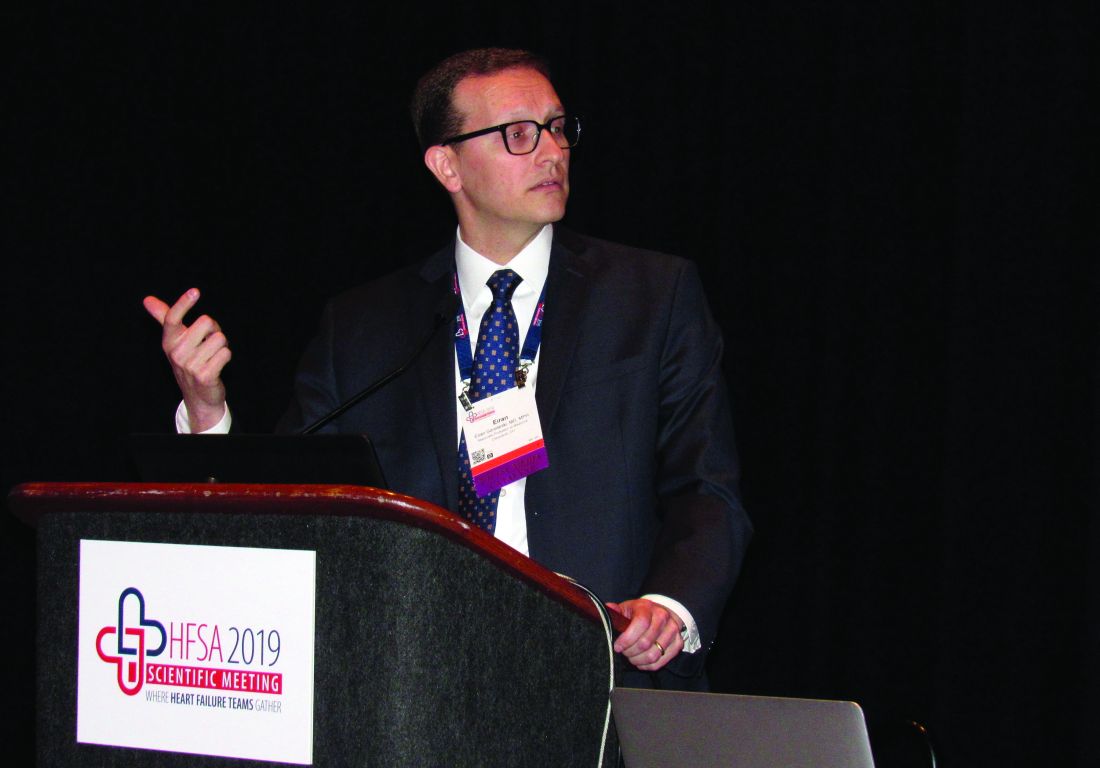
While the video meet-up doesn’t allow for a physical exam, it’s still possible to collect history of what happened since hospital discharge, assess breathing, and complete other aspects of the follow-up visit, according to Dr. Gorodeski, director of advanced heart failure section at the University Hospitals Cleveland Medical Center.
“The way we view use of virtual visits 7 days post-discharge is, in many ways, as a screening platform,” he said in a panel discussion. “If someone seems to be doing poorly, you can always invite them to come in, but most patients post discharge are not congested, and they’re doing quite well. Probably the more relevant issues are things like: Do they have their medications? Do they understand what their follow-up appointments are?”
During the virtual visit, patients are asked to hold their medication bottles up to the camera so the clinician can see what they are taking.
“Frequently, we are able to catch mistakes,” Dr. Gorodeski said. “Of note, most patients don’t bring their pill bottles to the clinic, so in some ways doing the virtual visit for that aspect was more valuable.”
Patients who opt for a virtual visit can do so from any smart phone, laptop, or desktop computer. Once logged in, they enter a virtual waiting room as the clinician receives a text notification to log in and begin the visit.
“It’s very efficient with time, and my questions were answered quickly,” said a patient in a short video Dr. Gorodeski played to illustrate the technology.
“I still feel the same connectivity with the patient,” a clinician in the video said.
There is currently no way to bill insurance companies for this type of visit, Dr. Gorodeski said when asked what initial barriers other institutions might have implementing a similar approach.
In the randomized, single-center clinical trial Dr. Gorodeski presented here at the HFSA meeting, called VIV-HF (Virtual Visits in Heart Failure Care Transitions), a total of 108 patients were randomized to the virtual visit (52 patients) or an in-person visit (56 patients).
The majority of patients (over 60%) had heart failure with reduced ejection fraction, according to the reported study results.
No-show rates were 50% for the in-person visit, and 34.6% for the virtual visit, for a relative risk reduction of 31%. However, this difference did not reach statistical significance, likely because the study was underpowered, according to Dr. Gorodeski.
“This strategy may reduce postdischarge appointment no-show rates, and this needs to be studied further in larger and appropriately powered clinical trials,” he said in presenting the results.
The 7-day postdischarge outpatient clinic visit is recommended in guidelines and viewed as a way to increase care engagement while reducing risk of poor outcomes, according to VIV-HF investigators.
Support for the study came from the Hunnell Fund. Dr. Gorodeski reported being a consultant and advisor to Abbott.
cardnews@mdedge
SOURCE: Gorodeski EZ, et al. HFSA 2019. Late-Breaking Clinical Trials session.
PHILADELPHIA – For patients transitioning to home after a heart failure hospitalization, substituting in-person visits with virtual, video-based visits is feasible, safe, and may reduce appointment no-show rates, results of a randomized study suggest.
Connecting patients with clinicians over secure video cut no-show rates at 7 days post-discharge by about one-third, with no difference in risk of readmission, emergency department visits, or death, compared with the traditional in-person follow-up visit, investigator Eiran Z. Gorodeski, MD, MPH, reported here at the annual scientific meeting of the Heart Failure Society of America.
While the video meet-up doesn’t allow for a physical exam, it’s still possible to collect history of what happened since hospital discharge, assess breathing, and complete other aspects of the follow-up visit, according to Dr. Gorodeski, director of advanced heart failure section at the University Hospitals Cleveland Medical Center.
“The way we view use of virtual visits 7 days post-discharge is, in many ways, as a screening platform,” he said in a panel discussion. “If someone seems to be doing poorly, you can always invite them to come in, but most patients post discharge are not congested, and they’re doing quite well. Probably the more relevant issues are things like: Do they have their medications? Do they understand what their follow-up appointments are?”
During the virtual visit, patients are asked to hold their medication bottles up to the camera so the clinician can see what they are taking.
“Frequently, we are able to catch mistakes,” Dr. Gorodeski said. “Of note, most patients don’t bring their pill bottles to the clinic, so in some ways doing the virtual visit for that aspect was more valuable.”
Patients who opt for a virtual visit can do so from any smart phone, laptop, or desktop computer. Once logged in, they enter a virtual waiting room as the clinician receives a text notification to log in and begin the visit.
“It’s very efficient with time, and my questions were answered quickly,” said a patient in a short video Dr. Gorodeski played to illustrate the technology.
“I still feel the same connectivity with the patient,” a clinician in the video said.
There is currently no way to bill insurance companies for this type of visit, Dr. Gorodeski said when asked what initial barriers other institutions might have implementing a similar approach.
In the randomized, single-center clinical trial Dr. Gorodeski presented here at the HFSA meeting, called VIV-HF (Virtual Visits in Heart Failure Care Transitions), a total of 108 patients were randomized to the virtual visit (52 patients) or an in-person visit (56 patients).
The majority of patients (over 60%) had heart failure with reduced ejection fraction, according to the reported study results.
No-show rates were 50% for the in-person visit, and 34.6% for the virtual visit, for a relative risk reduction of 31%. However, this difference did not reach statistical significance, likely because the study was underpowered, according to Dr. Gorodeski.
“This strategy may reduce postdischarge appointment no-show rates, and this needs to be studied further in larger and appropriately powered clinical trials,” he said in presenting the results.
The 7-day postdischarge outpatient clinic visit is recommended in guidelines and viewed as a way to increase care engagement while reducing risk of poor outcomes, according to VIV-HF investigators.
Support for the study came from the Hunnell Fund. Dr. Gorodeski reported being a consultant and advisor to Abbott.
cardnews@mdedge
SOURCE: Gorodeski EZ, et al. HFSA 2019. Late-Breaking Clinical Trials session.
PHILADELPHIA – For patients transitioning to home after a heart failure hospitalization, substituting in-person visits with virtual, video-based visits is feasible, safe, and may reduce appointment no-show rates, results of a randomized study suggest.
Connecting patients with clinicians over secure video cut no-show rates at 7 days post-discharge by about one-third, with no difference in risk of readmission, emergency department visits, or death, compared with the traditional in-person follow-up visit, investigator Eiran Z. Gorodeski, MD, MPH, reported here at the annual scientific meeting of the Heart Failure Society of America.
While the video meet-up doesn’t allow for a physical exam, it’s still possible to collect history of what happened since hospital discharge, assess breathing, and complete other aspects of the follow-up visit, according to Dr. Gorodeski, director of advanced heart failure section at the University Hospitals Cleveland Medical Center.
“The way we view use of virtual visits 7 days post-discharge is, in many ways, as a screening platform,” he said in a panel discussion. “If someone seems to be doing poorly, you can always invite them to come in, but most patients post discharge are not congested, and they’re doing quite well. Probably the more relevant issues are things like: Do they have their medications? Do they understand what their follow-up appointments are?”
During the virtual visit, patients are asked to hold their medication bottles up to the camera so the clinician can see what they are taking.
“Frequently, we are able to catch mistakes,” Dr. Gorodeski said. “Of note, most patients don’t bring their pill bottles to the clinic, so in some ways doing the virtual visit for that aspect was more valuable.”
Patients who opt for a virtual visit can do so from any smart phone, laptop, or desktop computer. Once logged in, they enter a virtual waiting room as the clinician receives a text notification to log in and begin the visit.
“It’s very efficient with time, and my questions were answered quickly,” said a patient in a short video Dr. Gorodeski played to illustrate the technology.
“I still feel the same connectivity with the patient,” a clinician in the video said.
There is currently no way to bill insurance companies for this type of visit, Dr. Gorodeski said when asked what initial barriers other institutions might have implementing a similar approach.
In the randomized, single-center clinical trial Dr. Gorodeski presented here at the HFSA meeting, called VIV-HF (Virtual Visits in Heart Failure Care Transitions), a total of 108 patients were randomized to the virtual visit (52 patients) or an in-person visit (56 patients).
The majority of patients (over 60%) had heart failure with reduced ejection fraction, according to the reported study results.
No-show rates were 50% for the in-person visit, and 34.6% for the virtual visit, for a relative risk reduction of 31%. However, this difference did not reach statistical significance, likely because the study was underpowered, according to Dr. Gorodeski.
“This strategy may reduce postdischarge appointment no-show rates, and this needs to be studied further in larger and appropriately powered clinical trials,” he said in presenting the results.
The 7-day postdischarge outpatient clinic visit is recommended in guidelines and viewed as a way to increase care engagement while reducing risk of poor outcomes, according to VIV-HF investigators.
Support for the study came from the Hunnell Fund. Dr. Gorodeski reported being a consultant and advisor to Abbott.
cardnews@mdedge
SOURCE: Gorodeski EZ, et al. HFSA 2019. Late-Breaking Clinical Trials session.
REPORTING FROM HFSA 2019
Urban or rural, children’s gun-related injuries equally deadly
NEW ORLEANS – Accidental firearm-related injuries among children occur more frequently in rural than in urban locations, and nearly 60% of such cases are potentially preventable, results from a single-center study suggest.
Furthermore, these gun injuries carry the same mortality and disability risk.

“Firearm-related injury is an understudied topic,” lead study author Amelia Lucisano, MD, said in an interview in advance of the annual meeting of the American Academy of Pediatrics. “In particular there is a lack of granular level research on firearm-related injury in the population.”
At the meeting, she presented findings from an analysis which set out to investigate the location, preventability, and temporal trends of pediatric firearm-related injury in 184 patients age 18 and younger who were treated in the pediatric trauma program at University of Pittsburgh Medical Center during 2008-2017. Dr. Lucisano, a surgical resident at the university, and her colleagues focused their work on efforts to illustrate the differences and similarities in the demographics, injury-related characteristics, and outcomes between the rural and urban populations of children who are injured by firearms in Southwestern Pennsylvania. They classified the location as rural if the injury occurred outside the region’s central metropolitan county, and classified the injury as potentially preventable if the firearm was not stored securely and was used without permission. Statistical analyses included Wilcoxon rank-sum and chi-square analyses.
Of the 184 children who sustained a firearm-related injury during the study period, 43% occurred in a rural location. Compared with children who were injured in an urban setting, those who were injured in a rural setting were younger (a mean of 13 vs. 14 years; P = 0.0003), were more frequently white (81% vs. 14%; P less than 0.0001), and were more frequently injured by accident (70% vs. 15%; P less than 0.0001). They were also more likely to be injured by rifle or shotgun (24.1% vs. 6.67%; P = 0.001).
The rates of death or disability and lengths of stay did not differ significantly based on location of injury, occurring in 16.5% of rural and 13.3% of urban patients.
Nearly three-quarters of accidental injuries (72%) occurred on the gun-owner’s property and 58% were considered by the researchers to be potentially preventable.
“As expected, rural injuries are more frequently unintentional while urban injuries are more frequently assaults,” Dr. Lucisano said. “However, markers of injury severity and outcomes are equivalent between the groups, meaning that morbidity and mortality of injuries in the rural setting are similar to those in the urban setting.”
She emphasized that while clinician bias may be to consider rural firearm-based injuries as less severe, “our study shows that they carry the same burden of morbidity and mortality as urban injuries and thus should be cared for with the same intensity and anticipation of a possible poor outcome. Furthermore, the large number of potentially preventable injuries among those that were unintentional represents a significant burden of morbidity and mortality that could have been avoided through safer firearm storage. Programs to promote safe firearm storage should be targeted to populations that have high rates of potentially preventable injuries.”
Dr. Lucisano and her colleagues observed that the rates of all forms of firearm-related injury appear to be on the rise in both rural and urban areas: accidental, self-inflicted, and assault, in particular. She acknowledged certain limitations of the study, including its retrospective, single-center design. “We did not capture children who died in the field or who were treated at other hospitals, though as our center is the only pediatric Level 1 trauma center, we capture a large majority of pediatric trauma patients in the region,” she said.
The researchers reported having no disclosures.
SOURCE: Lucisano A. AAP 2019, Section on Surgery program.
NEW ORLEANS – Accidental firearm-related injuries among children occur more frequently in rural than in urban locations, and nearly 60% of such cases are potentially preventable, results from a single-center study suggest.
Furthermore, these gun injuries carry the same mortality and disability risk.
“Firearm-related injury is an understudied topic,” lead study author Amelia Lucisano, MD, said in an interview in advance of the annual meeting of the American Academy of Pediatrics. “In particular there is a lack of granular level research on firearm-related injury in the population.”
At the meeting, she presented findings from an analysis which set out to investigate the location, preventability, and temporal trends of pediatric firearm-related injury in 184 patients age 18 and younger who were treated in the pediatric trauma program at University of Pittsburgh Medical Center during 2008-2017. Dr. Lucisano, a surgical resident at the university, and her colleagues focused their work on efforts to illustrate the differences and similarities in the demographics, injury-related characteristics, and outcomes between the rural and urban populations of children who are injured by firearms in Southwestern Pennsylvania. They classified the location as rural if the injury occurred outside the region’s central metropolitan county, and classified the injury as potentially preventable if the firearm was not stored securely and was used without permission. Statistical analyses included Wilcoxon rank-sum and chi-square analyses.
Of the 184 children who sustained a firearm-related injury during the study period, 43% occurred in a rural location. Compared with children who were injured in an urban setting, those who were injured in a rural setting were younger (a mean of 13 vs. 14 years; P = 0.0003), were more frequently white (81% vs. 14%; P less than 0.0001), and were more frequently injured by accident (70% vs. 15%; P less than 0.0001). They were also more likely to be injured by rifle or shotgun (24.1% vs. 6.67%; P = 0.001).
The rates of death or disability and lengths of stay did not differ significantly based on location of injury, occurring in 16.5% of rural and 13.3% of urban patients.
Nearly three-quarters of accidental injuries (72%) occurred on the gun-owner’s property and 58% were considered by the researchers to be potentially preventable.
“As expected, rural injuries are more frequently unintentional while urban injuries are more frequently assaults,” Dr. Lucisano said. “However, markers of injury severity and outcomes are equivalent between the groups, meaning that morbidity and mortality of injuries in the rural setting are similar to those in the urban setting.”
She emphasized that while clinician bias may be to consider rural firearm-based injuries as less severe, “our study shows that they carry the same burden of morbidity and mortality as urban injuries and thus should be cared for with the same intensity and anticipation of a possible poor outcome. Furthermore, the large number of potentially preventable injuries among those that were unintentional represents a significant burden of morbidity and mortality that could have been avoided through safer firearm storage. Programs to promote safe firearm storage should be targeted to populations that have high rates of potentially preventable injuries.”
Dr. Lucisano and her colleagues observed that the rates of all forms of firearm-related injury appear to be on the rise in both rural and urban areas: accidental, self-inflicted, and assault, in particular. She acknowledged certain limitations of the study, including its retrospective, single-center design. “We did not capture children who died in the field or who were treated at other hospitals, though as our center is the only pediatric Level 1 trauma center, we capture a large majority of pediatric trauma patients in the region,” she said.
The researchers reported having no disclosures.
SOURCE: Lucisano A. AAP 2019, Section on Surgery program.
NEW ORLEANS – Accidental firearm-related injuries among children occur more frequently in rural than in urban locations, and nearly 60% of such cases are potentially preventable, results from a single-center study suggest.
Furthermore, these gun injuries carry the same mortality and disability risk.
“Firearm-related injury is an understudied topic,” lead study author Amelia Lucisano, MD, said in an interview in advance of the annual meeting of the American Academy of Pediatrics. “In particular there is a lack of granular level research on firearm-related injury in the population.”
At the meeting, she presented findings from an analysis which set out to investigate the location, preventability, and temporal trends of pediatric firearm-related injury in 184 patients age 18 and younger who were treated in the pediatric trauma program at University of Pittsburgh Medical Center during 2008-2017. Dr. Lucisano, a surgical resident at the university, and her colleagues focused their work on efforts to illustrate the differences and similarities in the demographics, injury-related characteristics, and outcomes between the rural and urban populations of children who are injured by firearms in Southwestern Pennsylvania. They classified the location as rural if the injury occurred outside the region’s central metropolitan county, and classified the injury as potentially preventable if the firearm was not stored securely and was used without permission. Statistical analyses included Wilcoxon rank-sum and chi-square analyses.
Of the 184 children who sustained a firearm-related injury during the study period, 43% occurred in a rural location. Compared with children who were injured in an urban setting, those who were injured in a rural setting were younger (a mean of 13 vs. 14 years; P = 0.0003), were more frequently white (81% vs. 14%; P less than 0.0001), and were more frequently injured by accident (70% vs. 15%; P less than 0.0001). They were also more likely to be injured by rifle or shotgun (24.1% vs. 6.67%; P = 0.001).
The rates of death or disability and lengths of stay did not differ significantly based on location of injury, occurring in 16.5% of rural and 13.3% of urban patients.
Nearly three-quarters of accidental injuries (72%) occurred on the gun-owner’s property and 58% were considered by the researchers to be potentially preventable.
“As expected, rural injuries are more frequently unintentional while urban injuries are more frequently assaults,” Dr. Lucisano said. “However, markers of injury severity and outcomes are equivalent between the groups, meaning that morbidity and mortality of injuries in the rural setting are similar to those in the urban setting.”
She emphasized that while clinician bias may be to consider rural firearm-based injuries as less severe, “our study shows that they carry the same burden of morbidity and mortality as urban injuries and thus should be cared for with the same intensity and anticipation of a possible poor outcome. Furthermore, the large number of potentially preventable injuries among those that were unintentional represents a significant burden of morbidity and mortality that could have been avoided through safer firearm storage. Programs to promote safe firearm storage should be targeted to populations that have high rates of potentially preventable injuries.”
Dr. Lucisano and her colleagues observed that the rates of all forms of firearm-related injury appear to be on the rise in both rural and urban areas: accidental, self-inflicted, and assault, in particular. She acknowledged certain limitations of the study, including its retrospective, single-center design. “We did not capture children who died in the field or who were treated at other hospitals, though as our center is the only pediatric Level 1 trauma center, we capture a large majority of pediatric trauma patients in the region,” she said.
The researchers reported having no disclosures.
SOURCE: Lucisano A. AAP 2019, Section on Surgery program.
AT AAP 2019

Ovarian cryopreservation should no longer be experimental
PHILADELPHIA – Ovarian tissue cryopreservation should no longer be considered experimental, Sherman J. Silber, MD, said at the annual meeting of the American Society for Reproductive Medicine.
That claim is based on more than 20 years of experience at his center performing the procedure and results he presented from patients for whom frozen ovarian tissue has been reimplanted resulting in a spontaneous pregnancy.
“For prepubertal girls with cancer and for patients who have already had a preliminary round of chemotherapy, ovarian tissue freezing is the only method available to preserve their fertility,” said Dr. Silber, of the Infertility Center of St. Louis in Chesterfield, Missouri. “It is also the only method available to preserve their fertility.”
“I have very strong feelings about this,” he added. “It has huge societal implications for insurance payments.”
Dr. Silber presented results of ovarian tissue freezing and reimplantation at his center beginning in 1997, where 115 patients between the ages of 2 and 35 years underwent the procedure using the same technique. Of these patients, 14 women came back years later to have their frozen ovary cortex reimplanted. Dr. Silber and his group followed these patients monthly for more than 2 years after reimplantation for signs of return of menses, hormonal changes, pregnancy, and live birth.
Most of the patients who chose ovarian tissue freezing had cancer. Eight patients underwent the procedure after being diagnosed with solid tissue cancer and three had leukemia, while two patients underwent ovarian tissue freezing due to premature ovarian failure, and one because of multiple sclerosis. Patients who underwent reimplantation were menopausal for at least 3 years, said Dr. Silber.
Dr. Silber also described the technique used for reimplantation. After the cortical tissue was thawed, the tissue was quilted into one piece from three to five slices using 9-0 nylon interrupted sutures. The quilted tissue was then sutured to the medulla after the surgeon completely removed the dead cortex from the other ovary. “Hemostasis was achieved with micro bipolar forceps,” said Dr. Silber. “Constant irrigation was employed with pulsed heparinized media because we wanted to avoid adhesions, and we wanted to try for spontaneous pregnancy rather than IVF.”
“Then, we put [the quilted ovarian slices] on to the medulla on the other side in such a way that the fallopian tube would be able to reach and catch any egg that’s ovulated during that time,” he added.
Dr. Silber and his group found that, over time, follicle-stimulating hormone (FSH) levels sharply decreased to normal or near-normal levels between 69 days and 133 days after the procedure while Anti-Müllerian hormone (AMH) levels dramatically rose to higher levels between 133 days and 227 days post-procedure before dropping to very low levels, “and the AMH remained at low levels despite the fact that [transplants] would last 8 to 10 years,” said Dr. Silber.
Of the 14 cases where frozen ovarian tissue was reimplanted, 11 patients (78%) achieved pregnancy, 10 patients (71%) delivered healthy babies, and 1 patient (9%) experienced a miscarriage. All patients had spontaneous pregnancies, and none used in vitro fertilization (IVF), noted Dr. Silber. There were 2 patients who had four children from transplanted ovarian tissue, and 2 of 3 patients with leukemia had a total of five children.
Additionally, Dr. Silber’s group examined the literature for other examples of ovarian tissue reimplantation after cryopreservation to determine how many live births resulted from the procedure. They found an additional 170 live births in addition to the 15 live births at their center, with a pregnancy rate ranging from 31% to 71% in different studies. Cancer was not transmitted from mother to child in any case, said Dr. Silber.
Compared with egg freezing, there is a benefit to performing ovarian tissue freezing, even after chemotherapy has begun, noted Dr. Silber. The cost of ovarian tissue freezing is also roughly one-tenth that of egg freezing, and the procedure is less burdensome than multiple cycles with the potential for ovarian hyperstimulation, and it restores the hormone function and the fertility of eggs after reimplantation.
“Because the greater primordial follicle recruitment decreases as the ovarian reserve decreases, you can put a piece of ovary tissue back every 8 years, and a woman can have endocrine function until she’s 100 years old,” said Dr. Silber.
Dr. Silber reported no relevant conflicts of interest.
obnews@mdedge.com
SOURCE: Silber SJ. ASRM 2019. Abstract O-203.
PHILADELPHIA – Ovarian tissue cryopreservation should no longer be considered experimental, Sherman J. Silber, MD, said at the annual meeting of the American Society for Reproductive Medicine.
That claim is based on more than 20 years of experience at his center performing the procedure and results he presented from patients for whom frozen ovarian tissue has been reimplanted resulting in a spontaneous pregnancy.
“For prepubertal girls with cancer and for patients who have already had a preliminary round of chemotherapy, ovarian tissue freezing is the only method available to preserve their fertility,” said Dr. Silber, of the Infertility Center of St. Louis in Chesterfield, Missouri. “It is also the only method available to preserve their fertility.”
“I have very strong feelings about this,” he added. “It has huge societal implications for insurance payments.”
Dr. Silber presented results of ovarian tissue freezing and reimplantation at his center beginning in 1997, where 115 patients between the ages of 2 and 35 years underwent the procedure using the same technique. Of these patients, 14 women came back years later to have their frozen ovary cortex reimplanted. Dr. Silber and his group followed these patients monthly for more than 2 years after reimplantation for signs of return of menses, hormonal changes, pregnancy, and live birth.
Most of the patients who chose ovarian tissue freezing had cancer. Eight patients underwent the procedure after being diagnosed with solid tissue cancer and three had leukemia, while two patients underwent ovarian tissue freezing due to premature ovarian failure, and one because of multiple sclerosis. Patients who underwent reimplantation were menopausal for at least 3 years, said Dr. Silber.
Dr. Silber also described the technique used for reimplantation. After the cortical tissue was thawed, the tissue was quilted into one piece from three to five slices using 9-0 nylon interrupted sutures. The quilted tissue was then sutured to the medulla after the surgeon completely removed the dead cortex from the other ovary. “Hemostasis was achieved with micro bipolar forceps,” said Dr. Silber. “Constant irrigation was employed with pulsed heparinized media because we wanted to avoid adhesions, and we wanted to try for spontaneous pregnancy rather than IVF.”
“Then, we put [the quilted ovarian slices] on to the medulla on the other side in such a way that the fallopian tube would be able to reach and catch any egg that’s ovulated during that time,” he added.
Dr. Silber and his group found that, over time, follicle-stimulating hormone (FSH) levels sharply decreased to normal or near-normal levels between 69 days and 133 days after the procedure while Anti-Müllerian hormone (AMH) levels dramatically rose to higher levels between 133 days and 227 days post-procedure before dropping to very low levels, “and the AMH remained at low levels despite the fact that [transplants] would last 8 to 10 years,” said Dr. Silber.
Of the 14 cases where frozen ovarian tissue was reimplanted, 11 patients (78%) achieved pregnancy, 10 patients (71%) delivered healthy babies, and 1 patient (9%) experienced a miscarriage. All patients had spontaneous pregnancies, and none used in vitro fertilization (IVF), noted Dr. Silber. There were 2 patients who had four children from transplanted ovarian tissue, and 2 of 3 patients with leukemia had a total of five children.
Additionally, Dr. Silber’s group examined the literature for other examples of ovarian tissue reimplantation after cryopreservation to determine how many live births resulted from the procedure. They found an additional 170 live births in addition to the 15 live births at their center, with a pregnancy rate ranging from 31% to 71% in different studies. Cancer was not transmitted from mother to child in any case, said Dr. Silber.
Compared with egg freezing, there is a benefit to performing ovarian tissue freezing, even after chemotherapy has begun, noted Dr. Silber. The cost of ovarian tissue freezing is also roughly one-tenth that of egg freezing, and the procedure is less burdensome than multiple cycles with the potential for ovarian hyperstimulation, and it restores the hormone function and the fertility of eggs after reimplantation.
“Because the greater primordial follicle recruitment decreases as the ovarian reserve decreases, you can put a piece of ovary tissue back every 8 years, and a woman can have endocrine function until she’s 100 years old,” said Dr. Silber.
Dr. Silber reported no relevant conflicts of interest.
obnews@mdedge.com
SOURCE: Silber SJ. ASRM 2019. Abstract O-203.
PHILADELPHIA – Ovarian tissue cryopreservation should no longer be considered experimental, Sherman J. Silber, MD, said at the annual meeting of the American Society for Reproductive Medicine.
That claim is based on more than 20 years of experience at his center performing the procedure and results he presented from patients for whom frozen ovarian tissue has been reimplanted resulting in a spontaneous pregnancy.
“For prepubertal girls with cancer and for patients who have already had a preliminary round of chemotherapy, ovarian tissue freezing is the only method available to preserve their fertility,” said Dr. Silber, of the Infertility Center of St. Louis in Chesterfield, Missouri. “It is also the only method available to preserve their fertility.”
“I have very strong feelings about this,” he added. “It has huge societal implications for insurance payments.”
Dr. Silber presented results of ovarian tissue freezing and reimplantation at his center beginning in 1997, where 115 patients between the ages of 2 and 35 years underwent the procedure using the same technique. Of these patients, 14 women came back years later to have their frozen ovary cortex reimplanted. Dr. Silber and his group followed these patients monthly for more than 2 years after reimplantation for signs of return of menses, hormonal changes, pregnancy, and live birth.
Most of the patients who chose ovarian tissue freezing had cancer. Eight patients underwent the procedure after being diagnosed with solid tissue cancer and three had leukemia, while two patients underwent ovarian tissue freezing due to premature ovarian failure, and one because of multiple sclerosis. Patients who underwent reimplantation were menopausal for at least 3 years, said Dr. Silber.
Dr. Silber also described the technique used for reimplantation. After the cortical tissue was thawed, the tissue was quilted into one piece from three to five slices using 9-0 nylon interrupted sutures. The quilted tissue was then sutured to the medulla after the surgeon completely removed the dead cortex from the other ovary. “Hemostasis was achieved with micro bipolar forceps,” said Dr. Silber. “Constant irrigation was employed with pulsed heparinized media because we wanted to avoid adhesions, and we wanted to try for spontaneous pregnancy rather than IVF.”
“Then, we put [the quilted ovarian slices] on to the medulla on the other side in such a way that the fallopian tube would be able to reach and catch any egg that’s ovulated during that time,” he added.
Dr. Silber and his group found that, over time, follicle-stimulating hormone (FSH) levels sharply decreased to normal or near-normal levels between 69 days and 133 days after the procedure while Anti-Müllerian hormone (AMH) levels dramatically rose to higher levels between 133 days and 227 days post-procedure before dropping to very low levels, “and the AMH remained at low levels despite the fact that [transplants] would last 8 to 10 years,” said Dr. Silber.
Of the 14 cases where frozen ovarian tissue was reimplanted, 11 patients (78%) achieved pregnancy, 10 patients (71%) delivered healthy babies, and 1 patient (9%) experienced a miscarriage. All patients had spontaneous pregnancies, and none used in vitro fertilization (IVF), noted Dr. Silber. There were 2 patients who had four children from transplanted ovarian tissue, and 2 of 3 patients with leukemia had a total of five children.
Additionally, Dr. Silber’s group examined the literature for other examples of ovarian tissue reimplantation after cryopreservation to determine how many live births resulted from the procedure. They found an additional 170 live births in addition to the 15 live births at their center, with a pregnancy rate ranging from 31% to 71% in different studies. Cancer was not transmitted from mother to child in any case, said Dr. Silber.
Compared with egg freezing, there is a benefit to performing ovarian tissue freezing, even after chemotherapy has begun, noted Dr. Silber. The cost of ovarian tissue freezing is also roughly one-tenth that of egg freezing, and the procedure is less burdensome than multiple cycles with the potential for ovarian hyperstimulation, and it restores the hormone function and the fertility of eggs after reimplantation.
“Because the greater primordial follicle recruitment decreases as the ovarian reserve decreases, you can put a piece of ovary tissue back every 8 years, and a woman can have endocrine function until she’s 100 years old,” said Dr. Silber.
Dr. Silber reported no relevant conflicts of interest.
obnews@mdedge.com
SOURCE: Silber SJ. ASRM 2019. Abstract O-203.
REPORTING FROM ASRM 2019