User login
For MD-IQ use only
November 2023 - ICYMI
Gastroenterology
July
Newberry C et al. Enhancing Nutrition and Obesity Education in GI Fellowship Through Universal Curriculum Development. Gastroenterology. 2023 Jul;165(1):16-19. doi: 10.1053/j.gastro.2023.04.004. Epub 2023 Apr 13. PMID: 37061170.
Han H et al. Macrophage-derived Osteopontin (SPP1) Protects From Nonalcoholic Steatohepatitis. Gastroenterology. 2023 Jul;165(1):201-17. doi: 10.1053/j.gastro.2023.03.228. Epub 2023 Apr 5. PMID: 37028770.
Deepak P et al. Health Disparities in Inflammatory Bowel Disease Care Driven by Rural Versus Urban Residence: Challenges and Potential Solutions. Gastroenterology. 2023 Jul;165(1):11-15. doi: 10.1053/j.gastro.2023.05.017. PMID: 37349061.
August
Guo L et al. Molecular Profiling Provides Clinical Insights Into Targeted and Immunotherapies as Well as Colorectal Cancer Prognosis. Gastroenterology. 2023 Aug;165(2):414-28.e7. doi: 10.1053/j.gastro.2023.04.029. Epub 2023 May 3. PMID: 37146911.
Huang DQ et al. Fibrosis Progression Rate in Biopsy-Proven Nonalcoholic Fatty Liver Disease Among People With Diabetes Versus People Without Diabetes: A Multicenter Study. Gastroenterology. 2023 Aug;165(2):463-72.e5. doi: 10.1053/j.gastro.2023.04.025. Epub 2023 Apr 29. PMID: 37127100.
Teoh AYB et al. EUS-Guided Choledocho-duodenostomy Using Lumen Apposing Stent Versus ERCP With Covered Metallic Stents in Patients With Unresectable Malignant Distal Biliary Obstruction: A Multicenter Randomized Controlled Trial (DRA-MBO Trial). Gastroenterology. 2023 Aug;165(2):473-82.e2. doi: 10.1053/j.gastro.2023.04.016. Epub 2023 Apr 28. PMID: 37121331.
September
Mehta RS et al. Association of Proton Pump Inhibitor Use With Incident Dementia and Cognitive Decline in Older Adults: A Prospective Cohort Study. Gastroenterology. 2023 Sep;165(3):564-72.e1. doi: 10.1053/j.gastro.2023.05.052. Epub 2023 Jun 12. PMID: 37315867; PMCID: PMC10527011.
Ballou S et al. Prevalence and Associated Factors of Bloating: Results From the Rome Foundation Global Epidemiology Study. Gastroenterology. 2023 Sep;165(3):647-55.e4. doi: 10.1053/j.gastro.2023.05.049. Epub 2023 Jun 13. PMID: 37315866; PMCID: PMC10527500.
CGH
July
Chang JW et al. Development of a Practical Guide to Implement and Monitor Diet Therapy for Eosinophilic Esophagitis. Clin Gastroenterol Hepatol. 2023 Jul;21(7):1690-8. doi: 10.1016/j.cgh.2023.03.006. Epub 2023 Mar 16. PMID: 36933603; PMCID: PMC10293042.
Siboni S et al. Improving the Diagnostic Yield of High-Resolution Esophageal Manometry for GERD: The “Straight Leg-Raise” International Study. Clin Gastroenterol Hepatol. 2023 Jul;21(7):1761-70.e1. doi: 10.1016/j.cgh.2022.10.008. Epub 2022 Oct 19. PMID: 36270615.
August
Wechsler EV et al. Up-Front Endoscopy Maximizes Cost-Effectiveness and Cost-Satisfaction in Uninvestigated Dyspepsia. Clin Gastroenterol Hepatol. 2023 Aug;21(9):2378-88.e28. doi: 10.1016/j.cgh.2023.01.003. Epub 2023 Jan 13. PMID: 36646234; PMCID: PMC10542651.
Frederiks CN et al. Clinical Relevance of Random Biopsies From the Esophagogastric Junction After Complete Eradication of Barrett’s Esophagus is Low. Clin Gastroenterol Hepatol. 2023 Aug;21(9):2260-9.e9. doi: 10.1016/j.cgh.2022.11.012. Epub 2022 Nov 22. PMID: 36423874.
Rustgi SD et al. Management of Gastric Intestinal Metaplasia. Clin Gastroenterol Hepatol. 2023 Aug;21(9):2178-82. doi: 10.1016/j.cgh.2023.03.010. Epub 2023 Apr 19. PMID: 37086748; PMCID: PMC10526696.
September
Baroud S et al. A Protocolized Management of Walled-Off Necrosis (WON) Reduces Time to WON Resolution and Improves Outcomes. Clin Gastroenterol Hepatol. 2023 Sep;21(10):2543-50.e1. doi: 10.1016/j.cgh.2023.04.029. Epub 2023 May 8. PMID: 37164115.
Arnim UV et al. Monitoring Patients With Eosinophilic Esophagitis in Routine Clinical Practice - International Expert Recommendations. Clin Gastroenterol Hepatol. 2023 Sep;21(10):2526-33. doi: 10.1016/j.cgh.2022.12.018. Epub 2022 Dec 24. PMID: 36572109.
TIGE
Kaila V et al. Does the Absence of Contrast Passage Into the Duodenum During Intraoperative Cholangiogram Truly Predict Choledocholithiasis? Techniques and Innovations in Gastrointestinal Endoscopy. 2023. https://doi.org/10.1016/j.tige.2023.05.002.
O’Keefe SJD et al. Early Enteral Feeding in Severe Acute Pancreatitis: A Randomized Clinical Trial Between Gastric vs Distal Jejunal Feeding. Techniques and Innovations in Gastrointestinal Endoscopy. 2023. https://doi.org/10.1016/j.tige.2023.06.002.
Gastro Hep Advances
Mukherjee S et al. Assessing ChatGPT’s ability to reply to queries regarding colon cancer screening based on Multi-Society Guidelines. Gastro Hep Advances. 2023. https://doi.org/10.1016/j.gastha.2023.07.008.
Lopes EW et al. Lochhead P. Improving the Consent Process with an Informed Consent Video Prior to Outpatient Colonoscopy. Gastro Hep Advances. 2023. https://doi.org/10.1016/j.gastha.2023.07.016.
Gastroenterology
July
Newberry C et al. Enhancing Nutrition and Obesity Education in GI Fellowship Through Universal Curriculum Development. Gastroenterology. 2023 Jul;165(1):16-19. doi: 10.1053/j.gastro.2023.04.004. Epub 2023 Apr 13. PMID: 37061170.
Han H et al. Macrophage-derived Osteopontin (SPP1) Protects From Nonalcoholic Steatohepatitis. Gastroenterology. 2023 Jul;165(1):201-17. doi: 10.1053/j.gastro.2023.03.228. Epub 2023 Apr 5. PMID: 37028770.
Deepak P et al. Health Disparities in Inflammatory Bowel Disease Care Driven by Rural Versus Urban Residence: Challenges and Potential Solutions. Gastroenterology. 2023 Jul;165(1):11-15. doi: 10.1053/j.gastro.2023.05.017. PMID: 37349061.
August
Guo L et al. Molecular Profiling Provides Clinical Insights Into Targeted and Immunotherapies as Well as Colorectal Cancer Prognosis. Gastroenterology. 2023 Aug;165(2):414-28.e7. doi: 10.1053/j.gastro.2023.04.029. Epub 2023 May 3. PMID: 37146911.
Huang DQ et al. Fibrosis Progression Rate in Biopsy-Proven Nonalcoholic Fatty Liver Disease Among People With Diabetes Versus People Without Diabetes: A Multicenter Study. Gastroenterology. 2023 Aug;165(2):463-72.e5. doi: 10.1053/j.gastro.2023.04.025. Epub 2023 Apr 29. PMID: 37127100.
Teoh AYB et al. EUS-Guided Choledocho-duodenostomy Using Lumen Apposing Stent Versus ERCP With Covered Metallic Stents in Patients With Unresectable Malignant Distal Biliary Obstruction: A Multicenter Randomized Controlled Trial (DRA-MBO Trial). Gastroenterology. 2023 Aug;165(2):473-82.e2. doi: 10.1053/j.gastro.2023.04.016. Epub 2023 Apr 28. PMID: 37121331.
September
Mehta RS et al. Association of Proton Pump Inhibitor Use With Incident Dementia and Cognitive Decline in Older Adults: A Prospective Cohort Study. Gastroenterology. 2023 Sep;165(3):564-72.e1. doi: 10.1053/j.gastro.2023.05.052. Epub 2023 Jun 12. PMID: 37315867; PMCID: PMC10527011.
Ballou S et al. Prevalence and Associated Factors of Bloating: Results From the Rome Foundation Global Epidemiology Study. Gastroenterology. 2023 Sep;165(3):647-55.e4. doi: 10.1053/j.gastro.2023.05.049. Epub 2023 Jun 13. PMID: 37315866; PMCID: PMC10527500.
CGH
July
Chang JW et al. Development of a Practical Guide to Implement and Monitor Diet Therapy for Eosinophilic Esophagitis. Clin Gastroenterol Hepatol. 2023 Jul;21(7):1690-8. doi: 10.1016/j.cgh.2023.03.006. Epub 2023 Mar 16. PMID: 36933603; PMCID: PMC10293042.
Siboni S et al. Improving the Diagnostic Yield of High-Resolution Esophageal Manometry for GERD: The “Straight Leg-Raise” International Study. Clin Gastroenterol Hepatol. 2023 Jul;21(7):1761-70.e1. doi: 10.1016/j.cgh.2022.10.008. Epub 2022 Oct 19. PMID: 36270615.
August
Wechsler EV et al. Up-Front Endoscopy Maximizes Cost-Effectiveness and Cost-Satisfaction in Uninvestigated Dyspepsia. Clin Gastroenterol Hepatol. 2023 Aug;21(9):2378-88.e28. doi: 10.1016/j.cgh.2023.01.003. Epub 2023 Jan 13. PMID: 36646234; PMCID: PMC10542651.
Frederiks CN et al. Clinical Relevance of Random Biopsies From the Esophagogastric Junction After Complete Eradication of Barrett’s Esophagus is Low. Clin Gastroenterol Hepatol. 2023 Aug;21(9):2260-9.e9. doi: 10.1016/j.cgh.2022.11.012. Epub 2022 Nov 22. PMID: 36423874.
Rustgi SD et al. Management of Gastric Intestinal Metaplasia. Clin Gastroenterol Hepatol. 2023 Aug;21(9):2178-82. doi: 10.1016/j.cgh.2023.03.010. Epub 2023 Apr 19. PMID: 37086748; PMCID: PMC10526696.
September
Baroud S et al. A Protocolized Management of Walled-Off Necrosis (WON) Reduces Time to WON Resolution and Improves Outcomes. Clin Gastroenterol Hepatol. 2023 Sep;21(10):2543-50.e1. doi: 10.1016/j.cgh.2023.04.029. Epub 2023 May 8. PMID: 37164115.
Arnim UV et al. Monitoring Patients With Eosinophilic Esophagitis in Routine Clinical Practice - International Expert Recommendations. Clin Gastroenterol Hepatol. 2023 Sep;21(10):2526-33. doi: 10.1016/j.cgh.2022.12.018. Epub 2022 Dec 24. PMID: 36572109.
TIGE
Kaila V et al. Does the Absence of Contrast Passage Into the Duodenum During Intraoperative Cholangiogram Truly Predict Choledocholithiasis? Techniques and Innovations in Gastrointestinal Endoscopy. 2023. https://doi.org/10.1016/j.tige.2023.05.002.
O’Keefe SJD et al. Early Enteral Feeding in Severe Acute Pancreatitis: A Randomized Clinical Trial Between Gastric vs Distal Jejunal Feeding. Techniques and Innovations in Gastrointestinal Endoscopy. 2023. https://doi.org/10.1016/j.tige.2023.06.002.
Gastro Hep Advances
Mukherjee S et al. Assessing ChatGPT’s ability to reply to queries regarding colon cancer screening based on Multi-Society Guidelines. Gastro Hep Advances. 2023. https://doi.org/10.1016/j.gastha.2023.07.008.
Lopes EW et al. Lochhead P. Improving the Consent Process with an Informed Consent Video Prior to Outpatient Colonoscopy. Gastro Hep Advances. 2023. https://doi.org/10.1016/j.gastha.2023.07.016.
Gastroenterology
July
Newberry C et al. Enhancing Nutrition and Obesity Education in GI Fellowship Through Universal Curriculum Development. Gastroenterology. 2023 Jul;165(1):16-19. doi: 10.1053/j.gastro.2023.04.004. Epub 2023 Apr 13. PMID: 37061170.
Han H et al. Macrophage-derived Osteopontin (SPP1) Protects From Nonalcoholic Steatohepatitis. Gastroenterology. 2023 Jul;165(1):201-17. doi: 10.1053/j.gastro.2023.03.228. Epub 2023 Apr 5. PMID: 37028770.
Deepak P et al. Health Disparities in Inflammatory Bowel Disease Care Driven by Rural Versus Urban Residence: Challenges and Potential Solutions. Gastroenterology. 2023 Jul;165(1):11-15. doi: 10.1053/j.gastro.2023.05.017. PMID: 37349061.
August
Guo L et al. Molecular Profiling Provides Clinical Insights Into Targeted and Immunotherapies as Well as Colorectal Cancer Prognosis. Gastroenterology. 2023 Aug;165(2):414-28.e7. doi: 10.1053/j.gastro.2023.04.029. Epub 2023 May 3. PMID: 37146911.
Huang DQ et al. Fibrosis Progression Rate in Biopsy-Proven Nonalcoholic Fatty Liver Disease Among People With Diabetes Versus People Without Diabetes: A Multicenter Study. Gastroenterology. 2023 Aug;165(2):463-72.e5. doi: 10.1053/j.gastro.2023.04.025. Epub 2023 Apr 29. PMID: 37127100.
Teoh AYB et al. EUS-Guided Choledocho-duodenostomy Using Lumen Apposing Stent Versus ERCP With Covered Metallic Stents in Patients With Unresectable Malignant Distal Biliary Obstruction: A Multicenter Randomized Controlled Trial (DRA-MBO Trial). Gastroenterology. 2023 Aug;165(2):473-82.e2. doi: 10.1053/j.gastro.2023.04.016. Epub 2023 Apr 28. PMID: 37121331.
September
Mehta RS et al. Association of Proton Pump Inhibitor Use With Incident Dementia and Cognitive Decline in Older Adults: A Prospective Cohort Study. Gastroenterology. 2023 Sep;165(3):564-72.e1. doi: 10.1053/j.gastro.2023.05.052. Epub 2023 Jun 12. PMID: 37315867; PMCID: PMC10527011.
Ballou S et al. Prevalence and Associated Factors of Bloating: Results From the Rome Foundation Global Epidemiology Study. Gastroenterology. 2023 Sep;165(3):647-55.e4. doi: 10.1053/j.gastro.2023.05.049. Epub 2023 Jun 13. PMID: 37315866; PMCID: PMC10527500.
CGH
July
Chang JW et al. Development of a Practical Guide to Implement and Monitor Diet Therapy for Eosinophilic Esophagitis. Clin Gastroenterol Hepatol. 2023 Jul;21(7):1690-8. doi: 10.1016/j.cgh.2023.03.006. Epub 2023 Mar 16. PMID: 36933603; PMCID: PMC10293042.
Siboni S et al. Improving the Diagnostic Yield of High-Resolution Esophageal Manometry for GERD: The “Straight Leg-Raise” International Study. Clin Gastroenterol Hepatol. 2023 Jul;21(7):1761-70.e1. doi: 10.1016/j.cgh.2022.10.008. Epub 2022 Oct 19. PMID: 36270615.
August
Wechsler EV et al. Up-Front Endoscopy Maximizes Cost-Effectiveness and Cost-Satisfaction in Uninvestigated Dyspepsia. Clin Gastroenterol Hepatol. 2023 Aug;21(9):2378-88.e28. doi: 10.1016/j.cgh.2023.01.003. Epub 2023 Jan 13. PMID: 36646234; PMCID: PMC10542651.
Frederiks CN et al. Clinical Relevance of Random Biopsies From the Esophagogastric Junction After Complete Eradication of Barrett’s Esophagus is Low. Clin Gastroenterol Hepatol. 2023 Aug;21(9):2260-9.e9. doi: 10.1016/j.cgh.2022.11.012. Epub 2022 Nov 22. PMID: 36423874.
Rustgi SD et al. Management of Gastric Intestinal Metaplasia. Clin Gastroenterol Hepatol. 2023 Aug;21(9):2178-82. doi: 10.1016/j.cgh.2023.03.010. Epub 2023 Apr 19. PMID: 37086748; PMCID: PMC10526696.
September
Baroud S et al. A Protocolized Management of Walled-Off Necrosis (WON) Reduces Time to WON Resolution and Improves Outcomes. Clin Gastroenterol Hepatol. 2023 Sep;21(10):2543-50.e1. doi: 10.1016/j.cgh.2023.04.029. Epub 2023 May 8. PMID: 37164115.
Arnim UV et al. Monitoring Patients With Eosinophilic Esophagitis in Routine Clinical Practice - International Expert Recommendations. Clin Gastroenterol Hepatol. 2023 Sep;21(10):2526-33. doi: 10.1016/j.cgh.2022.12.018. Epub 2022 Dec 24. PMID: 36572109.
TIGE
Kaila V et al. Does the Absence of Contrast Passage Into the Duodenum During Intraoperative Cholangiogram Truly Predict Choledocholithiasis? Techniques and Innovations in Gastrointestinal Endoscopy. 2023. https://doi.org/10.1016/j.tige.2023.05.002.
O’Keefe SJD et al. Early Enteral Feeding in Severe Acute Pancreatitis: A Randomized Clinical Trial Between Gastric vs Distal Jejunal Feeding. Techniques and Innovations in Gastrointestinal Endoscopy. 2023. https://doi.org/10.1016/j.tige.2023.06.002.
Gastro Hep Advances
Mukherjee S et al. Assessing ChatGPT’s ability to reply to queries regarding colon cancer screening based on Multi-Society Guidelines. Gastro Hep Advances. 2023. https://doi.org/10.1016/j.gastha.2023.07.008.
Lopes EW et al. Lochhead P. Improving the Consent Process with an Informed Consent Video Prior to Outpatient Colonoscopy. Gastro Hep Advances. 2023. https://doi.org/10.1016/j.gastha.2023.07.016.
Survey finds oral minoxidil shortage in Washington-area pharmacies
A .
Patients are not finding out until they go to pick up their prescription, which can result in an interruption of treatment – and, potentially a loss of hard-earned hair gain, said Adam Friedman, MD, professor and chair of dermatology at George Washington University, Washington, who was the lead author of the survey, published online on Oct. 26 as a research letter in the Journal of Drugs in Dermatology.
Going off low-dose oral minoxidil may spark a telogen effluvium event, and that is very disappointing to patients, Dr. Friedman told this news organization.
“There needs to be some system that alerts us,” he said. “Even if it’s a minor shortage, just so we’re aware. We can then prepare patients,” he added, noting that it would be better for someone to be taking a lower-than-normal dose rather than no medication at all while they wait for a refill.
Minoxidil has long been approved in a topical formulation to treat androgenetic alopecia, but a low-dose oral form has gained currency in the wake of findings that it might more effectively treat hair loss, and is without side effects. A New York Times article in August 2022 touting low-dose oral minoxidil as a cheap and effective hair loss drug appeared to ignite interest in this option. In May, 2023, researchers reporting in JAMA Network Open demonstrated a significant uptick in prescriptions for oral minoxidil in the wake of the article’s publication.
Oral minoxidil is approved by the Food and Drug Administration only for hypertension, but dermatologists are prescribing it off-label at a lower dose for hair loss. Dr. Friedman said it’s not clear whether the shortages his team found are national in scope, or whether they are a result of increased demand, or other factors.
After several patients told him they were having trouble filling minoxidil prescriptions, and colleagues said they’d had patients with similar experiences, Dr. Friedman and his colleagues undertook the survey. In the first week of October 2023, they contacted 277 pharmacies by phone in Washington and surrounding Virginia and Maryland counties. The pharmacies were CVS, Giant, Walgreens, and Harris Teeter.
Of the 277 pharmacies they contacted, 40% (111) reported availability of 2.5-mg tablets for a 30-day supply, and just under 30% (82) reported having 10-mg tablets for a 30-day supply.
For treating hair loss, most patients are prescribed 2.5-mg pills, with starting doses ranging from 0.625 mg to 5 mg twice a day, Dr. Friedman said. The 10-mg dose is more frequently prescribed for hypertension.
Only 28% (19 of 67) of the Maryland pharmacies had 30-day supplies of 2.5-mg tablets on hand, and just 22% (15) of the Maryland pharmacies had 30-day supplies of 10-mg tablets. In Northern Virginia, 44% (63 of 143) of the pharmacies had 30-day supplies of the 2.5 mg tablets, as did just 43% (29 of 67) of the Washington pharmacies.
Dr. Friedman said he has started giving patients paper prescriptions they can use to shop around, rather than electronically sending a prescription to a particular pharmacy.
Neither the Food and Drug Administration nor the American Society of Health System Pharmacists lists oral minoxidil as a drug in shortage.
Michael Ganio, PharmD, senior director of pharmacy practice and quality for ASHP, said the organization received a report from wholesalers in mid-September showing spotty oral minoxidil availability, with the drug on backorder with some manufacturers. ASHP's shortages list is compiled from reports from physicians, manufacturers and wholesalers, he said.
Under what he calls "blue sky conditions," pharmacies using a just-in-time inventory model should be able to fill prescriptions within hours or days, which might explain why some pharmacies in the Washington, DC area survey did not have a 30-day supply on hand, he said. However, Dr. Ganio noted that the causes of drug shortages are complex and multi-factorial. For now, he said there have been no oral minoxidil shortage reports since mid-September.
But Dr. Friedman said some of his patients have waited weeks for a new supply – and that no one is aware of the problem until the last moment.
The lack of alerts or transparency “also erodes the physician-patient relationship because there’s this expectation of the patient that we should have known this,” said Dr. Friedman.
Dr. Friedman reports no relevant financial relationships.
This story was updated on 11/2/2023.
A .
Patients are not finding out until they go to pick up their prescription, which can result in an interruption of treatment – and, potentially a loss of hard-earned hair gain, said Adam Friedman, MD, professor and chair of dermatology at George Washington University, Washington, who was the lead author of the survey, published online on Oct. 26 as a research letter in the Journal of Drugs in Dermatology.
Going off low-dose oral minoxidil may spark a telogen effluvium event, and that is very disappointing to patients, Dr. Friedman told this news organization.
“There needs to be some system that alerts us,” he said. “Even if it’s a minor shortage, just so we’re aware. We can then prepare patients,” he added, noting that it would be better for someone to be taking a lower-than-normal dose rather than no medication at all while they wait for a refill.
Minoxidil has long been approved in a topical formulation to treat androgenetic alopecia, but a low-dose oral form has gained currency in the wake of findings that it might more effectively treat hair loss, and is without side effects. A New York Times article in August 2022 touting low-dose oral minoxidil as a cheap and effective hair loss drug appeared to ignite interest in this option. In May, 2023, researchers reporting in JAMA Network Open demonstrated a significant uptick in prescriptions for oral minoxidil in the wake of the article’s publication.
Oral minoxidil is approved by the Food and Drug Administration only for hypertension, but dermatologists are prescribing it off-label at a lower dose for hair loss. Dr. Friedman said it’s not clear whether the shortages his team found are national in scope, or whether they are a result of increased demand, or other factors.
After several patients told him they were having trouble filling minoxidil prescriptions, and colleagues said they’d had patients with similar experiences, Dr. Friedman and his colleagues undertook the survey. In the first week of October 2023, they contacted 277 pharmacies by phone in Washington and surrounding Virginia and Maryland counties. The pharmacies were CVS, Giant, Walgreens, and Harris Teeter.
Of the 277 pharmacies they contacted, 40% (111) reported availability of 2.5-mg tablets for a 30-day supply, and just under 30% (82) reported having 10-mg tablets for a 30-day supply.
For treating hair loss, most patients are prescribed 2.5-mg pills, with starting doses ranging from 0.625 mg to 5 mg twice a day, Dr. Friedman said. The 10-mg dose is more frequently prescribed for hypertension.
Only 28% (19 of 67) of the Maryland pharmacies had 30-day supplies of 2.5-mg tablets on hand, and just 22% (15) of the Maryland pharmacies had 30-day supplies of 10-mg tablets. In Northern Virginia, 44% (63 of 143) of the pharmacies had 30-day supplies of the 2.5 mg tablets, as did just 43% (29 of 67) of the Washington pharmacies.
Dr. Friedman said he has started giving patients paper prescriptions they can use to shop around, rather than electronically sending a prescription to a particular pharmacy.
Neither the Food and Drug Administration nor the American Society of Health System Pharmacists lists oral minoxidil as a drug in shortage.
Michael Ganio, PharmD, senior director of pharmacy practice and quality for ASHP, said the organization received a report from wholesalers in mid-September showing spotty oral minoxidil availability, with the drug on backorder with some manufacturers. ASHP's shortages list is compiled from reports from physicians, manufacturers and wholesalers, he said.
Under what he calls "blue sky conditions," pharmacies using a just-in-time inventory model should be able to fill prescriptions within hours or days, which might explain why some pharmacies in the Washington, DC area survey did not have a 30-day supply on hand, he said. However, Dr. Ganio noted that the causes of drug shortages are complex and multi-factorial. For now, he said there have been no oral minoxidil shortage reports since mid-September.
But Dr. Friedman said some of his patients have waited weeks for a new supply – and that no one is aware of the problem until the last moment.
The lack of alerts or transparency “also erodes the physician-patient relationship because there’s this expectation of the patient that we should have known this,” said Dr. Friedman.
Dr. Friedman reports no relevant financial relationships.
This story was updated on 11/2/2023.
A .
Patients are not finding out until they go to pick up their prescription, which can result in an interruption of treatment – and, potentially a loss of hard-earned hair gain, said Adam Friedman, MD, professor and chair of dermatology at George Washington University, Washington, who was the lead author of the survey, published online on Oct. 26 as a research letter in the Journal of Drugs in Dermatology.
Going off low-dose oral minoxidil may spark a telogen effluvium event, and that is very disappointing to patients, Dr. Friedman told this news organization.
“There needs to be some system that alerts us,” he said. “Even if it’s a minor shortage, just so we’re aware. We can then prepare patients,” he added, noting that it would be better for someone to be taking a lower-than-normal dose rather than no medication at all while they wait for a refill.
Minoxidil has long been approved in a topical formulation to treat androgenetic alopecia, but a low-dose oral form has gained currency in the wake of findings that it might more effectively treat hair loss, and is without side effects. A New York Times article in August 2022 touting low-dose oral minoxidil as a cheap and effective hair loss drug appeared to ignite interest in this option. In May, 2023, researchers reporting in JAMA Network Open demonstrated a significant uptick in prescriptions for oral minoxidil in the wake of the article’s publication.
Oral minoxidil is approved by the Food and Drug Administration only for hypertension, but dermatologists are prescribing it off-label at a lower dose for hair loss. Dr. Friedman said it’s not clear whether the shortages his team found are national in scope, or whether they are a result of increased demand, or other factors.
After several patients told him they were having trouble filling minoxidil prescriptions, and colleagues said they’d had patients with similar experiences, Dr. Friedman and his colleagues undertook the survey. In the first week of October 2023, they contacted 277 pharmacies by phone in Washington and surrounding Virginia and Maryland counties. The pharmacies were CVS, Giant, Walgreens, and Harris Teeter.
Of the 277 pharmacies they contacted, 40% (111) reported availability of 2.5-mg tablets for a 30-day supply, and just under 30% (82) reported having 10-mg tablets for a 30-day supply.
For treating hair loss, most patients are prescribed 2.5-mg pills, with starting doses ranging from 0.625 mg to 5 mg twice a day, Dr. Friedman said. The 10-mg dose is more frequently prescribed for hypertension.
Only 28% (19 of 67) of the Maryland pharmacies had 30-day supplies of 2.5-mg tablets on hand, and just 22% (15) of the Maryland pharmacies had 30-day supplies of 10-mg tablets. In Northern Virginia, 44% (63 of 143) of the pharmacies had 30-day supplies of the 2.5 mg tablets, as did just 43% (29 of 67) of the Washington pharmacies.
Dr. Friedman said he has started giving patients paper prescriptions they can use to shop around, rather than electronically sending a prescription to a particular pharmacy.
Neither the Food and Drug Administration nor the American Society of Health System Pharmacists lists oral minoxidil as a drug in shortage.
Michael Ganio, PharmD, senior director of pharmacy practice and quality for ASHP, said the organization received a report from wholesalers in mid-September showing spotty oral minoxidil availability, with the drug on backorder with some manufacturers. ASHP's shortages list is compiled from reports from physicians, manufacturers and wholesalers, he said.
Under what he calls "blue sky conditions," pharmacies using a just-in-time inventory model should be able to fill prescriptions within hours or days, which might explain why some pharmacies in the Washington, DC area survey did not have a 30-day supply on hand, he said. However, Dr. Ganio noted that the causes of drug shortages are complex and multi-factorial. For now, he said there have been no oral minoxidil shortage reports since mid-September.
But Dr. Friedman said some of his patients have waited weeks for a new supply – and that no one is aware of the problem until the last moment.
The lack of alerts or transparency “also erodes the physician-patient relationship because there’s this expectation of the patient that we should have known this,” said Dr. Friedman.
Dr. Friedman reports no relevant financial relationships.
This story was updated on 11/2/2023.
FROM THE JOURNAL OF DRUGS IN DERMATOLOGY
Semaglutide prescribing surged in the past year
Among more than 350,000 prescribers in the nationwide DrFirst network between December 2022 and June 2023, prescriptions for the weight loss formulation Wegovy rose sixfold while those for Ozempic, the lower-dose version for treating type 2 diabetes, increased by 65%.
Before December 2022, prescribing for both semaglutide drug formulations had been relatively flat. Ozempic was approved in the United States for treating type 2 diabetes in 2017, and Wegovy for weight loss in 2021. Prescribing of oral type 2 diabetes drugs also rose during the study period but to a lesser degree.
General and family practice providers were the most frequent semaglutide providers, accounting for 30% of the total, followed by internists at 15%, endocrinologists at 4%, ob.gyns. at 2%, and pediatricians at 1%. Other specialists writing less than 1% of the prescriptions included cardiologists, emergency medicine physicians, hospitalists, psychiatrists, and surgeons.
“What I think is interesting is that in a relatively short period of time, primary care providers got comfortable with writing [prescriptions] for a drug that’s relatively new ... That isn’t always the case ... To me, it’s actually pretty telling that within a year or year and a half, the primary care field got very comfortable writing [prescriptions] for these [glucagon-like peptide 1 receptor agonists],” DrFirst chief medical officer Colin Banas, MD, said in an interview.
Asked to comment, S. Sethu K. Reddy, MD, president of the American Association of Clinical Endocrinologists, noted, “It is to be expected when there is an agent that not only lowers blood sugar levels but also may result in weight loss. These medications are packaged conveniently for a primary care physician to prescribe. There is enough awareness amongst the public in that the patients themselves often ask their physician about the medication.”
Moreover, Dr. Reddy noted, “there is clinical evidence that these medications not only improve diabetes control but also reduce the risk of cardiovascular events. The lack of cardiovascular safety data was a missing piece of the puzzle in the past. So, currently, if someone has type 2 diabetes and is at greater risk of cardiovascular disease, there is little controversy for the patient to receive GLP-1 analogs.”
Are patients actually getting the prescribed medications?
However, Sharon W. Lahiri, MD, of Wayne State University School of Medicine and Henry Ford Hospital, Detroit, pointed out that prescription data don’t equate to actual drug use. “It depends what type of insurance a person has. ... We write prescriptions on a daily basis for semaglutide. At least five or more come into our inbox every day saying it’s denied.”
Earlier this year, Dr. Lahiri co-authored results from a survey of 125 health care providers between February 9 and March 14, 2022, seeking to identify factors influencing medication choices and barriers to prescribing both GLP-1 agonists and sodium-glucose cotransporter 2 inhibitors. High cost and the need for prior authorizations were reported as the main barriers to prescribing drugs in these two classes, along with a lack of experience among some specialists.
Dr. Lahiri told this news organization that many insurers don’t cover Wegovy at all, or they mandate stepped-care paradigms in which the patient must enroll in behavior modification programs for a period of time or first try older, less expensive weight loss drugs such as phentermine, topiramate, or orlistat before they authorize coverage for Wegovy or even for the older weight-loss GLP-1 agonist drug Saxenda. “And then, they require you to document why the prior drugs didn’t work or couldn’t be tolerated.”
Moreover, Wegovy coverage is often time-limited, varying anywhere from 3 months to 2 years, and some insurers require a visit where the patient must have lost at least 5% of their body weight for coverage to continue.
Dr. Lahiri said recently she’s also encountered such “step” requirements when she’s tried to prescribe the “twincretin” Mounjaro for treating type 2 diabetes, where insurers will require trials of other GLP-1 agonists first. “So, it’s very complicated. I would say the barriers are definitely worse now. I don’t think the number of written prescriptions reflects that at all.”
Indeed, Dr. Banas noted, “more patients are going to pay out of pocket for Wegovy than for Ozempic if they have a diabetes indication.” And he added, “In my clinical observation, insurance coverage for obesity medication appears to be holding steady. I haven’t seen a massive increase in these drugs being covered for obesity per se, but I definitely see more coverage for diabetes use cases.”
The study was funded by DrFirst. Dr. Banas is an employee of DrFirst. Dr. Reddy and Dr. Lahiri have no disclosures.
A version of this article appeared on Medscape.com.
Among more than 350,000 prescribers in the nationwide DrFirst network between December 2022 and June 2023, prescriptions for the weight loss formulation Wegovy rose sixfold while those for Ozempic, the lower-dose version for treating type 2 diabetes, increased by 65%.
Before December 2022, prescribing for both semaglutide drug formulations had been relatively flat. Ozempic was approved in the United States for treating type 2 diabetes in 2017, and Wegovy for weight loss in 2021. Prescribing of oral type 2 diabetes drugs also rose during the study period but to a lesser degree.
General and family practice providers were the most frequent semaglutide providers, accounting for 30% of the total, followed by internists at 15%, endocrinologists at 4%, ob.gyns. at 2%, and pediatricians at 1%. Other specialists writing less than 1% of the prescriptions included cardiologists, emergency medicine physicians, hospitalists, psychiatrists, and surgeons.
“What I think is interesting is that in a relatively short period of time, primary care providers got comfortable with writing [prescriptions] for a drug that’s relatively new ... That isn’t always the case ... To me, it’s actually pretty telling that within a year or year and a half, the primary care field got very comfortable writing [prescriptions] for these [glucagon-like peptide 1 receptor agonists],” DrFirst chief medical officer Colin Banas, MD, said in an interview.
Asked to comment, S. Sethu K. Reddy, MD, president of the American Association of Clinical Endocrinologists, noted, “It is to be expected when there is an agent that not only lowers blood sugar levels but also may result in weight loss. These medications are packaged conveniently for a primary care physician to prescribe. There is enough awareness amongst the public in that the patients themselves often ask their physician about the medication.”
Moreover, Dr. Reddy noted, “there is clinical evidence that these medications not only improve diabetes control but also reduce the risk of cardiovascular events. The lack of cardiovascular safety data was a missing piece of the puzzle in the past. So, currently, if someone has type 2 diabetes and is at greater risk of cardiovascular disease, there is little controversy for the patient to receive GLP-1 analogs.”
Are patients actually getting the prescribed medications?
However, Sharon W. Lahiri, MD, of Wayne State University School of Medicine and Henry Ford Hospital, Detroit, pointed out that prescription data don’t equate to actual drug use. “It depends what type of insurance a person has. ... We write prescriptions on a daily basis for semaglutide. At least five or more come into our inbox every day saying it’s denied.”
Earlier this year, Dr. Lahiri co-authored results from a survey of 125 health care providers between February 9 and March 14, 2022, seeking to identify factors influencing medication choices and barriers to prescribing both GLP-1 agonists and sodium-glucose cotransporter 2 inhibitors. High cost and the need for prior authorizations were reported as the main barriers to prescribing drugs in these two classes, along with a lack of experience among some specialists.
Dr. Lahiri told this news organization that many insurers don’t cover Wegovy at all, or they mandate stepped-care paradigms in which the patient must enroll in behavior modification programs for a period of time or first try older, less expensive weight loss drugs such as phentermine, topiramate, or orlistat before they authorize coverage for Wegovy or even for the older weight-loss GLP-1 agonist drug Saxenda. “And then, they require you to document why the prior drugs didn’t work or couldn’t be tolerated.”
Moreover, Wegovy coverage is often time-limited, varying anywhere from 3 months to 2 years, and some insurers require a visit where the patient must have lost at least 5% of their body weight for coverage to continue.
Dr. Lahiri said recently she’s also encountered such “step” requirements when she’s tried to prescribe the “twincretin” Mounjaro for treating type 2 diabetes, where insurers will require trials of other GLP-1 agonists first. “So, it’s very complicated. I would say the barriers are definitely worse now. I don’t think the number of written prescriptions reflects that at all.”
Indeed, Dr. Banas noted, “more patients are going to pay out of pocket for Wegovy than for Ozempic if they have a diabetes indication.” And he added, “In my clinical observation, insurance coverage for obesity medication appears to be holding steady. I haven’t seen a massive increase in these drugs being covered for obesity per se, but I definitely see more coverage for diabetes use cases.”
The study was funded by DrFirst. Dr. Banas is an employee of DrFirst. Dr. Reddy and Dr. Lahiri have no disclosures.
A version of this article appeared on Medscape.com.
Among more than 350,000 prescribers in the nationwide DrFirst network between December 2022 and June 2023, prescriptions for the weight loss formulation Wegovy rose sixfold while those for Ozempic, the lower-dose version for treating type 2 diabetes, increased by 65%.
Before December 2022, prescribing for both semaglutide drug formulations had been relatively flat. Ozempic was approved in the United States for treating type 2 diabetes in 2017, and Wegovy for weight loss in 2021. Prescribing of oral type 2 diabetes drugs also rose during the study period but to a lesser degree.
General and family practice providers were the most frequent semaglutide providers, accounting for 30% of the total, followed by internists at 15%, endocrinologists at 4%, ob.gyns. at 2%, and pediatricians at 1%. Other specialists writing less than 1% of the prescriptions included cardiologists, emergency medicine physicians, hospitalists, psychiatrists, and surgeons.
“What I think is interesting is that in a relatively short period of time, primary care providers got comfortable with writing [prescriptions] for a drug that’s relatively new ... That isn’t always the case ... To me, it’s actually pretty telling that within a year or year and a half, the primary care field got very comfortable writing [prescriptions] for these [glucagon-like peptide 1 receptor agonists],” DrFirst chief medical officer Colin Banas, MD, said in an interview.
Asked to comment, S. Sethu K. Reddy, MD, president of the American Association of Clinical Endocrinologists, noted, “It is to be expected when there is an agent that not only lowers blood sugar levels but also may result in weight loss. These medications are packaged conveniently for a primary care physician to prescribe. There is enough awareness amongst the public in that the patients themselves often ask their physician about the medication.”
Moreover, Dr. Reddy noted, “there is clinical evidence that these medications not only improve diabetes control but also reduce the risk of cardiovascular events. The lack of cardiovascular safety data was a missing piece of the puzzle in the past. So, currently, if someone has type 2 diabetes and is at greater risk of cardiovascular disease, there is little controversy for the patient to receive GLP-1 analogs.”
Are patients actually getting the prescribed medications?
However, Sharon W. Lahiri, MD, of Wayne State University School of Medicine and Henry Ford Hospital, Detroit, pointed out that prescription data don’t equate to actual drug use. “It depends what type of insurance a person has. ... We write prescriptions on a daily basis for semaglutide. At least five or more come into our inbox every day saying it’s denied.”
Earlier this year, Dr. Lahiri co-authored results from a survey of 125 health care providers between February 9 and March 14, 2022, seeking to identify factors influencing medication choices and barriers to prescribing both GLP-1 agonists and sodium-glucose cotransporter 2 inhibitors. High cost and the need for prior authorizations were reported as the main barriers to prescribing drugs in these two classes, along with a lack of experience among some specialists.
Dr. Lahiri told this news organization that many insurers don’t cover Wegovy at all, or they mandate stepped-care paradigms in which the patient must enroll in behavior modification programs for a period of time or first try older, less expensive weight loss drugs such as phentermine, topiramate, or orlistat before they authorize coverage for Wegovy or even for the older weight-loss GLP-1 agonist drug Saxenda. “And then, they require you to document why the prior drugs didn’t work or couldn’t be tolerated.”
Moreover, Wegovy coverage is often time-limited, varying anywhere from 3 months to 2 years, and some insurers require a visit where the patient must have lost at least 5% of their body weight for coverage to continue.
Dr. Lahiri said recently she’s also encountered such “step” requirements when she’s tried to prescribe the “twincretin” Mounjaro for treating type 2 diabetes, where insurers will require trials of other GLP-1 agonists first. “So, it’s very complicated. I would say the barriers are definitely worse now. I don’t think the number of written prescriptions reflects that at all.”
Indeed, Dr. Banas noted, “more patients are going to pay out of pocket for Wegovy than for Ozempic if they have a diabetes indication.” And he added, “In my clinical observation, insurance coverage for obesity medication appears to be holding steady. I haven’t seen a massive increase in these drugs being covered for obesity per se, but I definitely see more coverage for diabetes use cases.”
The study was funded by DrFirst. Dr. Banas is an employee of DrFirst. Dr. Reddy and Dr. Lahiri have no disclosures.
A version of this article appeared on Medscape.com.
Analysis of Internal Dermatology Matches Following the COVID-19 Pandemic
Dermatology residencies continue to be among the most competitive, with only 66% of seniors in US medical schools (MD programs) successfully matching to a dermatology residency in 2023, according to the National Resident Matching Program. In 2023, there were 141 dermatology residency programs accepting applications, with a total of 499 positions offered. Of 578 medical school senior applicants, 384 of those applicants successfully matched. In contrast, of the 79 senior applicants from osteopathic medical schools, only 34 successfully matched, according to the National Resident Matching Program. A higher number of students match to either their home institution or an institution at which they completed an away (external) rotation, likely because faculty members are more comfortable matching future residents with whom they have worked because of greater familiarity with these applicants, and because applicants are more comfortable with programs familiar to them.1
Prior to the COVID-19 pandemic, the Association of Professors of Dermatology published an official statement discouraging programs from offering in-person external electives to applicants in the 2020-2021 cycle. As the pandemic progressed, this evolved: for the 2021-2022 cycle, applicants were encouraged to complete only 1 away rotation, and for the 2022-2023 cycle, applicants were encouraged to complete up to 3 away rotations.2 This most recent recommendation reflects applicant experience before the pandemic, with some students having a personal connection to up to 4 programs, including their home and away programs.
A cross-sectional study published in early 2023 analyzed internal matches prior to and until the second year of the pandemic. The prepandemic rate of internal matches—applicants who matched at their home programs—was 26.7%. This rate increased to 40.3% in the 2020-2021 cycle and was 33.5% in the 2021-2022 cycle.2,3 The increase in internal matches is likely multifactorial, including the emergence of virtual interviews, the addition of program and geographic signals, and the regulation of away rotations. Notably, the rate of internal matches inversely correlates with the number of external programs to which students have connections.
We conducted a cross-sectional study to analyze the rates of internal and regional dermatology matches in the post–COVID-19 pandemic era (2022-2023) vs prepandemic and pandemic rates.
Methods
Data were obtained from publicly available online match lists from 65 US medical schools that detailed programs where dermatology applicants matched. The data reflected the postpandemic residency application cycle (2022-2023). These data were then compared to previous match rates for the prepandemic (2020-2021) and pandemic (2021-2022) application cycles. Medical schools without corresponding dermatology residency programs were excluded from the study. Regions were determined using the Association of American Medical Colleges Residency Explorer tool. The Northeast region included schools from Vermont; Pennsylvania; New Hampshire; New Jersey; Rhode Island; Maryland; Massachusetts; New York; Connecticut; and Washington, DC. The Southern region included schools from Florida, Georgia, Kentucky, Louisiana, Arkansas, North Carolina, Alabama, South Carolina, Mississippi, Tennessee, Texas, Oklahoma, and Virginia. The Western region included schools from Oregon, New Mexico, Utah, Colorado, Arizona, Washington, and California. The Central region included schools from Illinois, Indiana, Michigan, Ohio, Wisconsin, Iowa, Kansas, Minnesota, Missouri, and Nebraska. The data collected included the number of applicants who matched into dermatology, the number of applicants who matched at their home institutions, and the regions in which applicants matched. Rates of matching were calculated as percentages, and Pearson χ2 tests were used to compare internal and regional match rates between different time periods.
Results
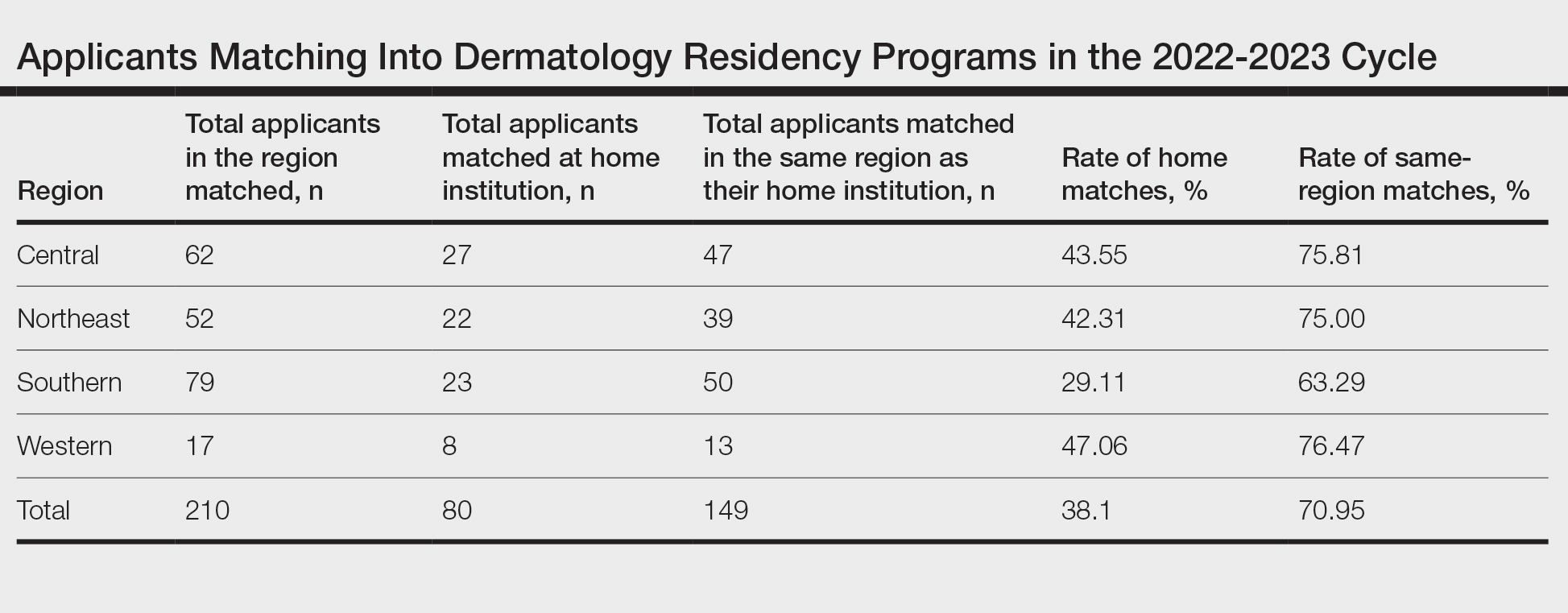
Results for the 2022-2023 residency cycle are summarized in the Table. Of 210 matches, 80 (38.10%) of the applicants matched at their home institution. In prepandemic cycles, 26.7% of applicants matched at their home institutions, which increased to 38.1% after the pandemic (P=.028). During the pandemic, 40.3% of applicants matched at their home institutions (P=.827).2 One hundred forty-nine of 210 (70.95%) applicants matched in the same region as their home institutions. The Western region had the highest rate of both internal matches (47.06%) and same-region matches (76.47%). However, the Central and Northeast regions were a close second (43.55% for home matches and 75.81% for same-region matches) and third (42.31% for home matches and 75.00% for same-region matches) for both rates, respectively. The Southern region had the lowest rates overall, with 29.11% for home matches and 63.29% for same-region matches.
Comment
The changes to the match process resulting from the COVID-19 pandemic have had a profound impact on match outcomes since 2020. During the first year of the pandemic, internal matches increased to 40%; during the second year, the rate decreased to 33%.2 The difference between the current postpandemic internal match rate of 38.1% and the prepandemic internal match rate of 26.7% was statistically significant (P=.028). Conversely, the difference between the postpandemic internal match rate and the pandemic internal match rate was not significant (P=.827). These findings suggest that that pandemic trends have continued despite the return to multiple away rotations for students, perhaps suggesting that virtual interviews, which have been maintained at most programs despite the end of the pandemic, may be the driving force behind the increased home match rate. During the second year of the pandemic, there were greater odds (odds ratio, 2.3) of a dermatology program matching at least 1 internal applicant vs the years prior to 2020.4
The prepandemic regional match rate was 61.6% and increased to 67.5% during the pandemic.3 Following the pandemic, 70.95% of applicants matched in the same region as their home program. A study completed in 2022 using the Texas Seeking Transparency in Application to Residency database found that there was no difference in the percentage of applicants who had a geographic connection to their program when comparing the 2021 cycle to 2018-2020 cycles.5 Frequently, applicants prefer to stay within their regions due to social factors. Although applicants can again travel for external rotations, the regional match rate has stayed relatively constant before and after the pandemic, though it has trended upward throughout the latest application cycles.
During the 2022-2023 cycle, applicants were able to send preference signals to 3 programs. A survey reflecting the 2021-2022 cycle showed that 21.1% of applicants who sent a preference signal to a program were interviewed by that program, whereas only 3.7% of applicants who did not send a preference signal were interviewed. Furthermore, 19% of matched applicants sent a preference signal to the program at which they ultimately matched.6 Survey respondents included 40 accredited dermatology residency programs who reported an average of 506 applications per program. Preference signals were developed to allow applicants to connect with programs at which they were not able to rotate. It is unclear how preference signals are affecting internal or regional match rates, but similar to virtual interviewing, they may be contributing to the higher rates of internal matching.
This study is limited in the number of programs with match data publicly available for analysis. Additionally, there were no official data on how many students match at programs at which they completed external rotations. Furthermore, these data do not include reapplicants or osteopathic applicants who match within their regions. Importantly, all US medical schools were not represented in these data. Many programs, specifically in the Western region, did not have publicly available match lists. Self-reported match lists were not included in this study to avoid discrepancies. Regional rates reported here may not be representative of actual regional rates, as there were more applicants and internal matches in each region than were included in this study.
Conclusion
Although applicants were able to participate in external rotations as of the last 2 application cycles, there was still an increase in the rate of internal dermatology matches during the 2022-2023 cycle. This trend suggests an underlying disadvantage in matching for students without a home program. For the 2023-2024 cycle, applicants are recommended to complete up to 2 external rotations and may consider up to 3 if they do not have a home program. This recommended limitation in external rotations aims to allow students without a home program to develop connections with more programs.
- Luu Y, Gao W, Han J, et al. Personal connections and preference signaling: a cross-sectional analysis of the dermatology residency match during COVID-19. J Am Acad Dermatol. 2023;88:1381-1383. doi:10.1016/j.jaad.2023.01.032
- Dowdle TS, Ryan MP, Tarbox MB, et al. An analysis of internal and regional dermatology matches during the second year of the COVID-19 pandemic: a cross-sectional study. J Am Acad Dermatol. 2023;88:207-209. doi:10.1016/j.jaad.2022.04.036
- Dowdle TS, Ryan MP, Wagner RF. Internal and geographic dermatology match trends in the age of COVID-19. J Am Acad Dermatol. 2021;85:1364-1366. doi:10.1016/j.jaad.2021.08.004
- Abdelwahab R, Antezana LA, Xie KZ, et al. Cross-sectional study of dermatology residency home match incidence during the COVID-19 pandemic. J Am Acad Dermatol. 2022;87:886-888. doi:10.1016/j.jaad.2021.12.004
- Williams GE, Zimmerman JM, Wiggins CJ, et al. The indelible marks on dermatology: impacts of COVID-19 on dermatology residency Match using the Texas STAR database. Clin Dermatol. 2023;41:215-218. doi:10.1016/j.clindermatol.2022.12.001
- Dirr MA, Brownstone N, Zakria D, et al. Dermatology match preference signaling tokens: impact and implications. Dermatol Surg. 2022;48:1367-1368. doi:10.1097/DSS.0000000000003645
Dermatology residencies continue to be among the most competitive, with only 66% of seniors in US medical schools (MD programs) successfully matching to a dermatology residency in 2023, according to the National Resident Matching Program. In 2023, there were 141 dermatology residency programs accepting applications, with a total of 499 positions offered. Of 578 medical school senior applicants, 384 of those applicants successfully matched. In contrast, of the 79 senior applicants from osteopathic medical schools, only 34 successfully matched, according to the National Resident Matching Program. A higher number of students match to either their home institution or an institution at which they completed an away (external) rotation, likely because faculty members are more comfortable matching future residents with whom they have worked because of greater familiarity with these applicants, and because applicants are more comfortable with programs familiar to them.1
Prior to the COVID-19 pandemic, the Association of Professors of Dermatology published an official statement discouraging programs from offering in-person external electives to applicants in the 2020-2021 cycle. As the pandemic progressed, this evolved: for the 2021-2022 cycle, applicants were encouraged to complete only 1 away rotation, and for the 2022-2023 cycle, applicants were encouraged to complete up to 3 away rotations.2 This most recent recommendation reflects applicant experience before the pandemic, with some students having a personal connection to up to 4 programs, including their home and away programs.
A cross-sectional study published in early 2023 analyzed internal matches prior to and until the second year of the pandemic. The prepandemic rate of internal matches—applicants who matched at their home programs—was 26.7%. This rate increased to 40.3% in the 2020-2021 cycle and was 33.5% in the 2021-2022 cycle.2,3 The increase in internal matches is likely multifactorial, including the emergence of virtual interviews, the addition of program and geographic signals, and the regulation of away rotations. Notably, the rate of internal matches inversely correlates with the number of external programs to which students have connections.
We conducted a cross-sectional study to analyze the rates of internal and regional dermatology matches in the post–COVID-19 pandemic era (2022-2023) vs prepandemic and pandemic rates.
Methods
Data were obtained from publicly available online match lists from 65 US medical schools that detailed programs where dermatology applicants matched. The data reflected the postpandemic residency application cycle (2022-2023). These data were then compared to previous match rates for the prepandemic (2020-2021) and pandemic (2021-2022) application cycles. Medical schools without corresponding dermatology residency programs were excluded from the study. Regions were determined using the Association of American Medical Colleges Residency Explorer tool. The Northeast region included schools from Vermont; Pennsylvania; New Hampshire; New Jersey; Rhode Island; Maryland; Massachusetts; New York; Connecticut; and Washington, DC. The Southern region included schools from Florida, Georgia, Kentucky, Louisiana, Arkansas, North Carolina, Alabama, South Carolina, Mississippi, Tennessee, Texas, Oklahoma, and Virginia. The Western region included schools from Oregon, New Mexico, Utah, Colorado, Arizona, Washington, and California. The Central region included schools from Illinois, Indiana, Michigan, Ohio, Wisconsin, Iowa, Kansas, Minnesota, Missouri, and Nebraska. The data collected included the number of applicants who matched into dermatology, the number of applicants who matched at their home institutions, and the regions in which applicants matched. Rates of matching were calculated as percentages, and Pearson χ2 tests were used to compare internal and regional match rates between different time periods.
Results
Results for the 2022-2023 residency cycle are summarized in the Table. Of 210 matches, 80 (38.10%) of the applicants matched at their home institution. In prepandemic cycles, 26.7% of applicants matched at their home institutions, which increased to 38.1% after the pandemic (P=.028). During the pandemic, 40.3% of applicants matched at their home institutions (P=.827).2 One hundred forty-nine of 210 (70.95%) applicants matched in the same region as their home institutions. The Western region had the highest rate of both internal matches (47.06%) and same-region matches (76.47%). However, the Central and Northeast regions were a close second (43.55% for home matches and 75.81% for same-region matches) and third (42.31% for home matches and 75.00% for same-region matches) for both rates, respectively. The Southern region had the lowest rates overall, with 29.11% for home matches and 63.29% for same-region matches.
Comment
The changes to the match process resulting from the COVID-19 pandemic have had a profound impact on match outcomes since 2020. During the first year of the pandemic, internal matches increased to 40%; during the second year, the rate decreased to 33%.2 The difference between the current postpandemic internal match rate of 38.1% and the prepandemic internal match rate of 26.7% was statistically significant (P=.028). Conversely, the difference between the postpandemic internal match rate and the pandemic internal match rate was not significant (P=.827). These findings suggest that that pandemic trends have continued despite the return to multiple away rotations for students, perhaps suggesting that virtual interviews, which have been maintained at most programs despite the end of the pandemic, may be the driving force behind the increased home match rate. During the second year of the pandemic, there were greater odds (odds ratio, 2.3) of a dermatology program matching at least 1 internal applicant vs the years prior to 2020.4
The prepandemic regional match rate was 61.6% and increased to 67.5% during the pandemic.3 Following the pandemic, 70.95% of applicants matched in the same region as their home program. A study completed in 2022 using the Texas Seeking Transparency in Application to Residency database found that there was no difference in the percentage of applicants who had a geographic connection to their program when comparing the 2021 cycle to 2018-2020 cycles.5 Frequently, applicants prefer to stay within their regions due to social factors. Although applicants can again travel for external rotations, the regional match rate has stayed relatively constant before and after the pandemic, though it has trended upward throughout the latest application cycles.
During the 2022-2023 cycle, applicants were able to send preference signals to 3 programs. A survey reflecting the 2021-2022 cycle showed that 21.1% of applicants who sent a preference signal to a program were interviewed by that program, whereas only 3.7% of applicants who did not send a preference signal were interviewed. Furthermore, 19% of matched applicants sent a preference signal to the program at which they ultimately matched.6 Survey respondents included 40 accredited dermatology residency programs who reported an average of 506 applications per program. Preference signals were developed to allow applicants to connect with programs at which they were not able to rotate. It is unclear how preference signals are affecting internal or regional match rates, but similar to virtual interviewing, they may be contributing to the higher rates of internal matching.
This study is limited in the number of programs with match data publicly available for analysis. Additionally, there were no official data on how many students match at programs at which they completed external rotations. Furthermore, these data do not include reapplicants or osteopathic applicants who match within their regions. Importantly, all US medical schools were not represented in these data. Many programs, specifically in the Western region, did not have publicly available match lists. Self-reported match lists were not included in this study to avoid discrepancies. Regional rates reported here may not be representative of actual regional rates, as there were more applicants and internal matches in each region than were included in this study.
Conclusion
Although applicants were able to participate in external rotations as of the last 2 application cycles, there was still an increase in the rate of internal dermatology matches during the 2022-2023 cycle. This trend suggests an underlying disadvantage in matching for students without a home program. For the 2023-2024 cycle, applicants are recommended to complete up to 2 external rotations and may consider up to 3 if they do not have a home program. This recommended limitation in external rotations aims to allow students without a home program to develop connections with more programs.
Dermatology residencies continue to be among the most competitive, with only 66% of seniors in US medical schools (MD programs) successfully matching to a dermatology residency in 2023, according to the National Resident Matching Program. In 2023, there were 141 dermatology residency programs accepting applications, with a total of 499 positions offered. Of 578 medical school senior applicants, 384 of those applicants successfully matched. In contrast, of the 79 senior applicants from osteopathic medical schools, only 34 successfully matched, according to the National Resident Matching Program. A higher number of students match to either their home institution or an institution at which they completed an away (external) rotation, likely because faculty members are more comfortable matching future residents with whom they have worked because of greater familiarity with these applicants, and because applicants are more comfortable with programs familiar to them.1
Prior to the COVID-19 pandemic, the Association of Professors of Dermatology published an official statement discouraging programs from offering in-person external electives to applicants in the 2020-2021 cycle. As the pandemic progressed, this evolved: for the 2021-2022 cycle, applicants were encouraged to complete only 1 away rotation, and for the 2022-2023 cycle, applicants were encouraged to complete up to 3 away rotations.2 This most recent recommendation reflects applicant experience before the pandemic, with some students having a personal connection to up to 4 programs, including their home and away programs.
A cross-sectional study published in early 2023 analyzed internal matches prior to and until the second year of the pandemic. The prepandemic rate of internal matches—applicants who matched at their home programs—was 26.7%. This rate increased to 40.3% in the 2020-2021 cycle and was 33.5% in the 2021-2022 cycle.2,3 The increase in internal matches is likely multifactorial, including the emergence of virtual interviews, the addition of program and geographic signals, and the regulation of away rotations. Notably, the rate of internal matches inversely correlates with the number of external programs to which students have connections.
We conducted a cross-sectional study to analyze the rates of internal and regional dermatology matches in the post–COVID-19 pandemic era (2022-2023) vs prepandemic and pandemic rates.
Methods
Data were obtained from publicly available online match lists from 65 US medical schools that detailed programs where dermatology applicants matched. The data reflected the postpandemic residency application cycle (2022-2023). These data were then compared to previous match rates for the prepandemic (2020-2021) and pandemic (2021-2022) application cycles. Medical schools without corresponding dermatology residency programs were excluded from the study. Regions were determined using the Association of American Medical Colleges Residency Explorer tool. The Northeast region included schools from Vermont; Pennsylvania; New Hampshire; New Jersey; Rhode Island; Maryland; Massachusetts; New York; Connecticut; and Washington, DC. The Southern region included schools from Florida, Georgia, Kentucky, Louisiana, Arkansas, North Carolina, Alabama, South Carolina, Mississippi, Tennessee, Texas, Oklahoma, and Virginia. The Western region included schools from Oregon, New Mexico, Utah, Colorado, Arizona, Washington, and California. The Central region included schools from Illinois, Indiana, Michigan, Ohio, Wisconsin, Iowa, Kansas, Minnesota, Missouri, and Nebraska. The data collected included the number of applicants who matched into dermatology, the number of applicants who matched at their home institutions, and the regions in which applicants matched. Rates of matching were calculated as percentages, and Pearson χ2 tests were used to compare internal and regional match rates between different time periods.
Results
Results for the 2022-2023 residency cycle are summarized in the Table. Of 210 matches, 80 (38.10%) of the applicants matched at their home institution. In prepandemic cycles, 26.7% of applicants matched at their home institutions, which increased to 38.1% after the pandemic (P=.028). During the pandemic, 40.3% of applicants matched at their home institutions (P=.827).2 One hundred forty-nine of 210 (70.95%) applicants matched in the same region as their home institutions. The Western region had the highest rate of both internal matches (47.06%) and same-region matches (76.47%). However, the Central and Northeast regions were a close second (43.55% for home matches and 75.81% for same-region matches) and third (42.31% for home matches and 75.00% for same-region matches) for both rates, respectively. The Southern region had the lowest rates overall, with 29.11% for home matches and 63.29% for same-region matches.
Comment
The changes to the match process resulting from the COVID-19 pandemic have had a profound impact on match outcomes since 2020. During the first year of the pandemic, internal matches increased to 40%; during the second year, the rate decreased to 33%.2 The difference between the current postpandemic internal match rate of 38.1% and the prepandemic internal match rate of 26.7% was statistically significant (P=.028). Conversely, the difference between the postpandemic internal match rate and the pandemic internal match rate was not significant (P=.827). These findings suggest that that pandemic trends have continued despite the return to multiple away rotations for students, perhaps suggesting that virtual interviews, which have been maintained at most programs despite the end of the pandemic, may be the driving force behind the increased home match rate. During the second year of the pandemic, there were greater odds (odds ratio, 2.3) of a dermatology program matching at least 1 internal applicant vs the years prior to 2020.4
The prepandemic regional match rate was 61.6% and increased to 67.5% during the pandemic.3 Following the pandemic, 70.95% of applicants matched in the same region as their home program. A study completed in 2022 using the Texas Seeking Transparency in Application to Residency database found that there was no difference in the percentage of applicants who had a geographic connection to their program when comparing the 2021 cycle to 2018-2020 cycles.5 Frequently, applicants prefer to stay within their regions due to social factors. Although applicants can again travel for external rotations, the regional match rate has stayed relatively constant before and after the pandemic, though it has trended upward throughout the latest application cycles.
During the 2022-2023 cycle, applicants were able to send preference signals to 3 programs. A survey reflecting the 2021-2022 cycle showed that 21.1% of applicants who sent a preference signal to a program were interviewed by that program, whereas only 3.7% of applicants who did not send a preference signal were interviewed. Furthermore, 19% of matched applicants sent a preference signal to the program at which they ultimately matched.6 Survey respondents included 40 accredited dermatology residency programs who reported an average of 506 applications per program. Preference signals were developed to allow applicants to connect with programs at which they were not able to rotate. It is unclear how preference signals are affecting internal or regional match rates, but similar to virtual interviewing, they may be contributing to the higher rates of internal matching.
This study is limited in the number of programs with match data publicly available for analysis. Additionally, there were no official data on how many students match at programs at which they completed external rotations. Furthermore, these data do not include reapplicants or osteopathic applicants who match within their regions. Importantly, all US medical schools were not represented in these data. Many programs, specifically in the Western region, did not have publicly available match lists. Self-reported match lists were not included in this study to avoid discrepancies. Regional rates reported here may not be representative of actual regional rates, as there were more applicants and internal matches in each region than were included in this study.
Conclusion
Although applicants were able to participate in external rotations as of the last 2 application cycles, there was still an increase in the rate of internal dermatology matches during the 2022-2023 cycle. This trend suggests an underlying disadvantage in matching for students without a home program. For the 2023-2024 cycle, applicants are recommended to complete up to 2 external rotations and may consider up to 3 if they do not have a home program. This recommended limitation in external rotations aims to allow students without a home program to develop connections with more programs.
- Luu Y, Gao W, Han J, et al. Personal connections and preference signaling: a cross-sectional analysis of the dermatology residency match during COVID-19. J Am Acad Dermatol. 2023;88:1381-1383. doi:10.1016/j.jaad.2023.01.032
- Dowdle TS, Ryan MP, Tarbox MB, et al. An analysis of internal and regional dermatology matches during the second year of the COVID-19 pandemic: a cross-sectional study. J Am Acad Dermatol. 2023;88:207-209. doi:10.1016/j.jaad.2022.04.036
- Dowdle TS, Ryan MP, Wagner RF. Internal and geographic dermatology match trends in the age of COVID-19. J Am Acad Dermatol. 2021;85:1364-1366. doi:10.1016/j.jaad.2021.08.004
- Abdelwahab R, Antezana LA, Xie KZ, et al. Cross-sectional study of dermatology residency home match incidence during the COVID-19 pandemic. J Am Acad Dermatol. 2022;87:886-888. doi:10.1016/j.jaad.2021.12.004
- Williams GE, Zimmerman JM, Wiggins CJ, et al. The indelible marks on dermatology: impacts of COVID-19 on dermatology residency Match using the Texas STAR database. Clin Dermatol. 2023;41:215-218. doi:10.1016/j.clindermatol.2022.12.001
- Dirr MA, Brownstone N, Zakria D, et al. Dermatology match preference signaling tokens: impact and implications. Dermatol Surg. 2022;48:1367-1368. doi:10.1097/DSS.0000000000003645
- Luu Y, Gao W, Han J, et al. Personal connections and preference signaling: a cross-sectional analysis of the dermatology residency match during COVID-19. J Am Acad Dermatol. 2023;88:1381-1383. doi:10.1016/j.jaad.2023.01.032
- Dowdle TS, Ryan MP, Tarbox MB, et al. An analysis of internal and regional dermatology matches during the second year of the COVID-19 pandemic: a cross-sectional study. J Am Acad Dermatol. 2023;88:207-209. doi:10.1016/j.jaad.2022.04.036
- Dowdle TS, Ryan MP, Wagner RF. Internal and geographic dermatology match trends in the age of COVID-19. J Am Acad Dermatol. 2021;85:1364-1366. doi:10.1016/j.jaad.2021.08.004
- Abdelwahab R, Antezana LA, Xie KZ, et al. Cross-sectional study of dermatology residency home match incidence during the COVID-19 pandemic. J Am Acad Dermatol. 2022;87:886-888. doi:10.1016/j.jaad.2021.12.004
- Williams GE, Zimmerman JM, Wiggins CJ, et al. The indelible marks on dermatology: impacts of COVID-19 on dermatology residency Match using the Texas STAR database. Clin Dermatol. 2023;41:215-218. doi:10.1016/j.clindermatol.2022.12.001
- Dirr MA, Brownstone N, Zakria D, et al. Dermatology match preference signaling tokens: impact and implications. Dermatol Surg. 2022;48:1367-1368. doi:10.1097/DSS.0000000000003645
PRACTICE POINTS
- Following the COVID-19 pandemic, affiliation with a home program is even more impactful in successful application to dermatology residency. Applicants from institutions without dermatology programs should consider completing additional externships.
- The high rate of applicants matching to the same regions as their home programs is due to several factors. Applicants may have a larger social support system near their home institution. Additionally, programs are more comfortable matching applicants within their own regions.
Cutaneous Collagenous Vasculopathy With Ocular Involvement
To the Editor:
Cutaneous collagenous vasculopathy (CCV) is an uncommon microangiopathy that presents with progressive telangiectases on the lower extremities that can eventually spread to involve the upper extremities and trunk. Systemic involvement is uncommon. The diagnosis is confirmed by biopsy, which demonstrates dilated capillaries and postcapillary venules with eosinophilic hyalinized walls. Treatment generally has focused on the use of vascular lasers.1 We report a patient with advanced CCV and ocular involvement that responded to a combination of pulsed dye laser (PDL) therapy and sclerotherapy for cutaneous lesions.
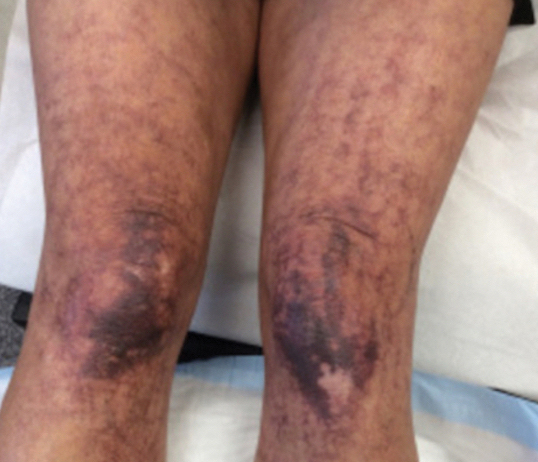
A 63-year-old woman presented with partially blanchable, purple-black patches on the lower extremities (Figure 1). The upper extremities had minimal involvement at the time of presentation. A medical history revealed the lesions presented on the legs 10 years prior but were beginning to form on the arms. She had a history of hypertension and bleeding in the retina.
Histopathology revealed prominent dilation of postcapillary venules with eosinophilic collagenous materials in the vessel walls that was positive on periodic acid–Schiff stain, confirming the diagnosis of CCV. The perivascular collagenous material failed to stain with Congo red. Laboratory testing for serum protein electrophoresis, antinuclear antibodies, and baseline hematologic and metabolic panels revealed no abnormalities.
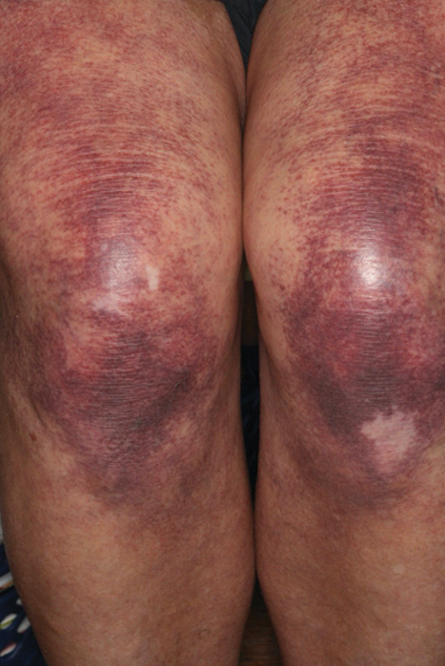
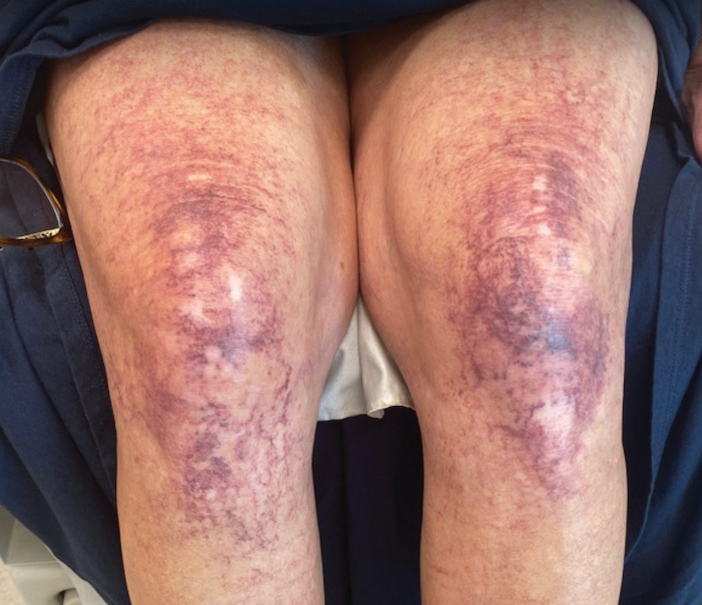
Over 3 years of treatment with PDL, most of the black patches resolved, but prominent telangiectatic vessels remained (Figure 2). Sclerotherapy with polidocanol (10 mg/mL) resulted in clearance of the majority of telangiectatic vessels. After each sclerotherapy treatment, Unna boots were applied for a minimum of 24 hours. The patient had no adverse effects from either PDL or sclerotherapy and was pleased with the results (Figure 3). An ophthalmologist had attributed the retinal bleeding to central serous chorioretinopathy, but tortuosity of superficial scleral and episcleral vessels progressed, suggesting CCV as the more likely cause (Figure 4). Currently, she is being followed for visual changes and further retinal bleeding.
Early CCV typically appears as blanchable pink or red macules, telangiectases, or petechiae on the lower extremities, progressing to involve the trunk and upper extremity.1-3 In rare cases, CCV presents in a papular or annular variant instead of the typical telangiectatic form.4,5 As the lesions progress, they often darken in appearance. Bleeding can occur, and the progressive patches are disfiguring.6,7 Middle-aged to older adults typically present with CCV (range, 16–83 years), with a mean age of 62 years.1,2,6 This disease affects both males and females, predominantly in White individuals.1 Extracutaneous manifestations are rare.1,2,6 One case of mucosal involvement was described in a patient with glossitis and oral erosions.8 We found no prior reports of nail or eye changes.1,2
The etiology of CCV is unknown, but different theories have been proposed. One is that CCV is due to a genetic defect that changes collagen synthesis in the cutaneous microvasculature. Another more widely held belief is that CCV originates from an injury that occurs to the microvasculature endothelial cells. Regardless of the cause of the triggering injury, the result is induced intravascular occlusive microthrombi that cause perivascular fibrosis and endothelial hyperplasia.2,6,7,9
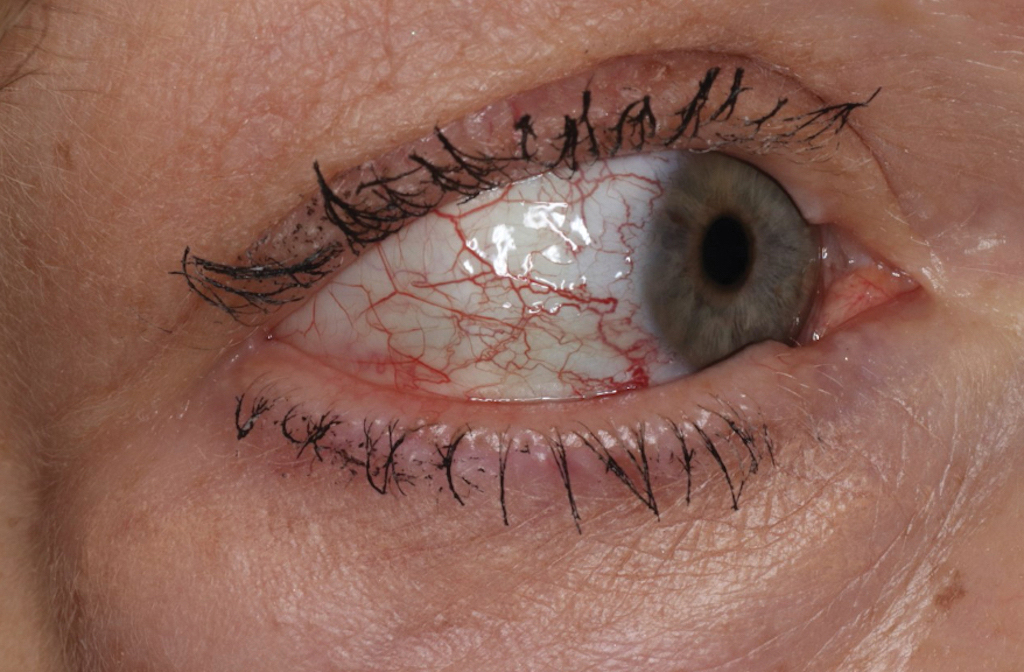
Cutaneous collagenous vasculopathy may be influenced by systemic diseases. The most common comorbidities are hypertension, cardiovascular disease, diabetes mellitus, and hyperlipidemia.1,3,6-8 The presentation of CCV with a malignancy is rare; 1 patient was diagnosed with multiple myeloma 18 months after CCV, and another patient’s cutaneous presentation led to discovery of pancreatic cancer with metastasis.8,10 In this setting, the increased growth factors or hypercoagulability of malignancy may play a role in endothelial cell damage and hyperplasia. Autoimmune vascular injury also has been suggested to trigger CCV; 1 case involved antiribonucleoprotein antibodies, while another case involved anti–endothelial cell antibody assays.11 In addition, CCV has been reported in hypercoagulable patients, demonstrating another route for endothelial damage, with 1 patient being heterozygous for prothrombin G20210A, a report of CCV in a patient with cryofibrinogenemia, and another patient being found positive for lupus anticoagulant.11,12 Drugs also have been thought to influence CCV, including corticosteroids, lithium, thiothixene, interferon, isotretinoin, calcium channel blockers, antibiotics, hydroxyurea, and antidepressants.7,11
The diagnosis of CCV is confirmed using light microscopy and collagen-specific immunostaining. Examination shows hyaline eosinophilic deposition of type IV collagen around the affected vessels, with the postcapillary venules showing characteristic duplication of the basal lamina.3,9 The material stains positive with periodic acid-Schiff and Masson trichrome.3
Underreporting may contribute to the low incidence of CCV. The clinical presentation of CCV is similar to generalized essential telangiectasia, with biopsy distinguishing the two. Other diagnoses in the differential include hereditary hemorrhagic telangiectasia, which typically would have mucosal involvement; radiating telangiectatic mats and a strong family history; and hereditary benign telangiectasia, which typically presents in younger patients aged 1 year to adolescence.1
Treatment with vascular lasers has been the main focus, using either the 595-nm PDL or the 1064-nm Nd:YAG laser.6,13 Pulsed dye laser or intense pulsed light devices can improve patient well-being1,2; intense pulsed light allows for a larger spot size and may be preferred in patients with a larger body surface area involved.13 However, a few other treatments have been proposed. One case report noted poor response to sclerotherapy.1 In another case, a patient treated with a chemotherapy agent, bortezomib, for their concurrent multiple myeloma showed notable CCV cutaneous improvement. The proposed mechanism for bortezomib improving CCV is through its antiproliferative effect on endothelial cells of the superficial dermal vessels.8 Our patient did not achieve an adequate response with PDL, but the addition of sclerotherapy with polidocanol induced a successful response.
Patients should be examined for evidence of ocular involvement and referred to an ophthalmologist for appropriate care. Although there is no definite association with systemic illnesses or mediation, recent associations with an autoimmune disorder or underlying malignancy have been noted.8,10,11 Age-appropriate cancer screening and attention to associated signs and symptoms are recommended.
- Brady BG, Ortleb M, Boyd AS, et al. Cutaneous collagenous vasculopathy. J Clin Aesthet Dermatol. 2015;8:49-52. https://doi.org/10.1097/dad.0000000000000194
- Castiñeiras-Mato I, Rodríguez-Lojo R, Fernández-Díaz ML, et al. Cutaneous collagenous vasculopathy: a case report and review of the literature. Actas Dermosifiliogr. 2016;107:444-447. https://doi.org/10.1016/j.ad.2015.11.006
- Rambhia KD, Hadawale SD, Khopkar US. Cutaneous collagenous vasculopathy: a rare case report. Indian Dermatol Online J. 2016;7:40-42. https://doi.org/10.4103/2229-5178.174327
- Conde-Ferreirós A, Roncero-Riesco M, Cañueto J, et al. Cutaneous collagenous vasculopathy: papular form [published online August 15, 2019]. Dermatol Online J. https://doi.org/10.5070/d3258045128
- García-Martínez P, Gomez-Martin I, Lloreta J, et al. Multiple progressive annular telangiectasias: a clinicopathological variant of cutaneous collagenous vasculopathy? J Cutan Pathol. 2017;44:982-985. https://doi.org/10.1111/cup.13029
- Sartori DS, de Almeida Jr HL, Dorn TV, et al. Cutaneous collagenous vasculopathy: light and transmission electron microscopy. An Bras Dermatol. 2019;94:211-213. https://doi.org/10.1590/abd1806-4841.20198166
- Basso D, Ribero S, Blazek C, et al. Cutaneous collagenous vasculopathy: a rare form of microangiopathy successfully treated with a combination of multiplex laser and optimized pulsed light with a review of the literature. Dermatology. 2016;232:107-111. https://doi.org/10.1159/000439126
- Dura M, Pock L, Cetkovska P, et al. A case of cutaneous collagenous vasculopathy associated with multiple myeloma and with a pathogenic variant of the glucocerebrosidase gene. J Cutan Pathol. 2022;49:717-721. https://doi.org/10.1111/cup.14227
- Salama S, Chorneyko K, Belovic B. Cutaneous collagenous vasculopathy associated with intravascular occlusive fibrin thrombi. J Cutan Pathol. 2014;41:386-393. https://doi.org/10.1111/cup.12285
- Holder E, Schreckenberg C, Lipsker D. Cutaneous collagenous vasculopathy leading to the diagnosis of an advanced pancreatic cancer. J Eur Acad Dermatol Venereol. 2022;36:E699-E701. https://doi.org/10.1111/jdv.18152
- Grossman ME, Cohen M, Ravits M, et al. Cutaneous collagenous vasculopathy: a report of three cases. J Cutan Pathol. 2022;49:491-495. https://doi.org/10.1111/cup.14192
- Eldik H, Leisenring NH, Al-Rohil RN, et al. Cutaneous collagenous vasculopathy in a middle-aged woman with a history of prothrombin G20210A thrombophilia. J Cutan Pathol. 2022;49:679-682. https://doi.org/10.1111/cup.13895
- Weiss E, Lazzara DR. Commentary on clinical improvement of cutaneous collagenous vasculopathy with intense pulsed light therapy. Dermatol Surg. 2021;47:1412. https://doi.org/10.1097/DSS.0000000000003209
To the Editor:
Cutaneous collagenous vasculopathy (CCV) is an uncommon microangiopathy that presents with progressive telangiectases on the lower extremities that can eventually spread to involve the upper extremities and trunk. Systemic involvement is uncommon. The diagnosis is confirmed by biopsy, which demonstrates dilated capillaries and postcapillary venules with eosinophilic hyalinized walls. Treatment generally has focused on the use of vascular lasers.1 We report a patient with advanced CCV and ocular involvement that responded to a combination of pulsed dye laser (PDL) therapy and sclerotherapy for cutaneous lesions.
A 63-year-old woman presented with partially blanchable, purple-black patches on the lower extremities (Figure 1). The upper extremities had minimal involvement at the time of presentation. A medical history revealed the lesions presented on the legs 10 years prior but were beginning to form on the arms. She had a history of hypertension and bleeding in the retina.
Histopathology revealed prominent dilation of postcapillary venules with eosinophilic collagenous materials in the vessel walls that was positive on periodic acid–Schiff stain, confirming the diagnosis of CCV. The perivascular collagenous material failed to stain with Congo red. Laboratory testing for serum protein electrophoresis, antinuclear antibodies, and baseline hematologic and metabolic panels revealed no abnormalities.
Over 3 years of treatment with PDL, most of the black patches resolved, but prominent telangiectatic vessels remained (Figure 2). Sclerotherapy with polidocanol (10 mg/mL) resulted in clearance of the majority of telangiectatic vessels. After each sclerotherapy treatment, Unna boots were applied for a minimum of 24 hours. The patient had no adverse effects from either PDL or sclerotherapy and was pleased with the results (Figure 3). An ophthalmologist had attributed the retinal bleeding to central serous chorioretinopathy, but tortuosity of superficial scleral and episcleral vessels progressed, suggesting CCV as the more likely cause (Figure 4). Currently, she is being followed for visual changes and further retinal bleeding.
Early CCV typically appears as blanchable pink or red macules, telangiectases, or petechiae on the lower extremities, progressing to involve the trunk and upper extremity.1-3 In rare cases, CCV presents in a papular or annular variant instead of the typical telangiectatic form.4,5 As the lesions progress, they often darken in appearance. Bleeding can occur, and the progressive patches are disfiguring.6,7 Middle-aged to older adults typically present with CCV (range, 16–83 years), with a mean age of 62 years.1,2,6 This disease affects both males and females, predominantly in White individuals.1 Extracutaneous manifestations are rare.1,2,6 One case of mucosal involvement was described in a patient with glossitis and oral erosions.8 We found no prior reports of nail or eye changes.1,2
The etiology of CCV is unknown, but different theories have been proposed. One is that CCV is due to a genetic defect that changes collagen synthesis in the cutaneous microvasculature. Another more widely held belief is that CCV originates from an injury that occurs to the microvasculature endothelial cells. Regardless of the cause of the triggering injury, the result is induced intravascular occlusive microthrombi that cause perivascular fibrosis and endothelial hyperplasia.2,6,7,9
Cutaneous collagenous vasculopathy may be influenced by systemic diseases. The most common comorbidities are hypertension, cardiovascular disease, diabetes mellitus, and hyperlipidemia.1,3,6-8 The presentation of CCV with a malignancy is rare; 1 patient was diagnosed with multiple myeloma 18 months after CCV, and another patient’s cutaneous presentation led to discovery of pancreatic cancer with metastasis.8,10 In this setting, the increased growth factors or hypercoagulability of malignancy may play a role in endothelial cell damage and hyperplasia. Autoimmune vascular injury also has been suggested to trigger CCV; 1 case involved antiribonucleoprotein antibodies, while another case involved anti–endothelial cell antibody assays.11 In addition, CCV has been reported in hypercoagulable patients, demonstrating another route for endothelial damage, with 1 patient being heterozygous for prothrombin G20210A, a report of CCV in a patient with cryofibrinogenemia, and another patient being found positive for lupus anticoagulant.11,12 Drugs also have been thought to influence CCV, including corticosteroids, lithium, thiothixene, interferon, isotretinoin, calcium channel blockers, antibiotics, hydroxyurea, and antidepressants.7,11
The diagnosis of CCV is confirmed using light microscopy and collagen-specific immunostaining. Examination shows hyaline eosinophilic deposition of type IV collagen around the affected vessels, with the postcapillary venules showing characteristic duplication of the basal lamina.3,9 The material stains positive with periodic acid-Schiff and Masson trichrome.3
Underreporting may contribute to the low incidence of CCV. The clinical presentation of CCV is similar to generalized essential telangiectasia, with biopsy distinguishing the two. Other diagnoses in the differential include hereditary hemorrhagic telangiectasia, which typically would have mucosal involvement; radiating telangiectatic mats and a strong family history; and hereditary benign telangiectasia, which typically presents in younger patients aged 1 year to adolescence.1
Treatment with vascular lasers has been the main focus, using either the 595-nm PDL or the 1064-nm Nd:YAG laser.6,13 Pulsed dye laser or intense pulsed light devices can improve patient well-being1,2; intense pulsed light allows for a larger spot size and may be preferred in patients with a larger body surface area involved.13 However, a few other treatments have been proposed. One case report noted poor response to sclerotherapy.1 In another case, a patient treated with a chemotherapy agent, bortezomib, for their concurrent multiple myeloma showed notable CCV cutaneous improvement. The proposed mechanism for bortezomib improving CCV is through its antiproliferative effect on endothelial cells of the superficial dermal vessels.8 Our patient did not achieve an adequate response with PDL, but the addition of sclerotherapy with polidocanol induced a successful response.
Patients should be examined for evidence of ocular involvement and referred to an ophthalmologist for appropriate care. Although there is no definite association with systemic illnesses or mediation, recent associations with an autoimmune disorder or underlying malignancy have been noted.8,10,11 Age-appropriate cancer screening and attention to associated signs and symptoms are recommended.
To the Editor:
Cutaneous collagenous vasculopathy (CCV) is an uncommon microangiopathy that presents with progressive telangiectases on the lower extremities that can eventually spread to involve the upper extremities and trunk. Systemic involvement is uncommon. The diagnosis is confirmed by biopsy, which demonstrates dilated capillaries and postcapillary venules with eosinophilic hyalinized walls. Treatment generally has focused on the use of vascular lasers.1 We report a patient with advanced CCV and ocular involvement that responded to a combination of pulsed dye laser (PDL) therapy and sclerotherapy for cutaneous lesions.
A 63-year-old woman presented with partially blanchable, purple-black patches on the lower extremities (Figure 1). The upper extremities had minimal involvement at the time of presentation. A medical history revealed the lesions presented on the legs 10 years prior but were beginning to form on the arms. She had a history of hypertension and bleeding in the retina.
Histopathology revealed prominent dilation of postcapillary venules with eosinophilic collagenous materials in the vessel walls that was positive on periodic acid–Schiff stain, confirming the diagnosis of CCV. The perivascular collagenous material failed to stain with Congo red. Laboratory testing for serum protein electrophoresis, antinuclear antibodies, and baseline hematologic and metabolic panels revealed no abnormalities.
Over 3 years of treatment with PDL, most of the black patches resolved, but prominent telangiectatic vessels remained (Figure 2). Sclerotherapy with polidocanol (10 mg/mL) resulted in clearance of the majority of telangiectatic vessels. After each sclerotherapy treatment, Unna boots were applied for a minimum of 24 hours. The patient had no adverse effects from either PDL or sclerotherapy and was pleased with the results (Figure 3). An ophthalmologist had attributed the retinal bleeding to central serous chorioretinopathy, but tortuosity of superficial scleral and episcleral vessels progressed, suggesting CCV as the more likely cause (Figure 4). Currently, she is being followed for visual changes and further retinal bleeding.
Early CCV typically appears as blanchable pink or red macules, telangiectases, or petechiae on the lower extremities, progressing to involve the trunk and upper extremity.1-3 In rare cases, CCV presents in a papular or annular variant instead of the typical telangiectatic form.4,5 As the lesions progress, they often darken in appearance. Bleeding can occur, and the progressive patches are disfiguring.6,7 Middle-aged to older adults typically present with CCV (range, 16–83 years), with a mean age of 62 years.1,2,6 This disease affects both males and females, predominantly in White individuals.1 Extracutaneous manifestations are rare.1,2,6 One case of mucosal involvement was described in a patient with glossitis and oral erosions.8 We found no prior reports of nail or eye changes.1,2
The etiology of CCV is unknown, but different theories have been proposed. One is that CCV is due to a genetic defect that changes collagen synthesis in the cutaneous microvasculature. Another more widely held belief is that CCV originates from an injury that occurs to the microvasculature endothelial cells. Regardless of the cause of the triggering injury, the result is induced intravascular occlusive microthrombi that cause perivascular fibrosis and endothelial hyperplasia.2,6,7,9
Cutaneous collagenous vasculopathy may be influenced by systemic diseases. The most common comorbidities are hypertension, cardiovascular disease, diabetes mellitus, and hyperlipidemia.1,3,6-8 The presentation of CCV with a malignancy is rare; 1 patient was diagnosed with multiple myeloma 18 months after CCV, and another patient’s cutaneous presentation led to discovery of pancreatic cancer with metastasis.8,10 In this setting, the increased growth factors or hypercoagulability of malignancy may play a role in endothelial cell damage and hyperplasia. Autoimmune vascular injury also has been suggested to trigger CCV; 1 case involved antiribonucleoprotein antibodies, while another case involved anti–endothelial cell antibody assays.11 In addition, CCV has been reported in hypercoagulable patients, demonstrating another route for endothelial damage, with 1 patient being heterozygous for prothrombin G20210A, a report of CCV in a patient with cryofibrinogenemia, and another patient being found positive for lupus anticoagulant.11,12 Drugs also have been thought to influence CCV, including corticosteroids, lithium, thiothixene, interferon, isotretinoin, calcium channel blockers, antibiotics, hydroxyurea, and antidepressants.7,11
The diagnosis of CCV is confirmed using light microscopy and collagen-specific immunostaining. Examination shows hyaline eosinophilic deposition of type IV collagen around the affected vessels, with the postcapillary venules showing characteristic duplication of the basal lamina.3,9 The material stains positive with periodic acid-Schiff and Masson trichrome.3
Underreporting may contribute to the low incidence of CCV. The clinical presentation of CCV is similar to generalized essential telangiectasia, with biopsy distinguishing the two. Other diagnoses in the differential include hereditary hemorrhagic telangiectasia, which typically would have mucosal involvement; radiating telangiectatic mats and a strong family history; and hereditary benign telangiectasia, which typically presents in younger patients aged 1 year to adolescence.1
Treatment with vascular lasers has been the main focus, using either the 595-nm PDL or the 1064-nm Nd:YAG laser.6,13 Pulsed dye laser or intense pulsed light devices can improve patient well-being1,2; intense pulsed light allows for a larger spot size and may be preferred in patients with a larger body surface area involved.13 However, a few other treatments have been proposed. One case report noted poor response to sclerotherapy.1 In another case, a patient treated with a chemotherapy agent, bortezomib, for their concurrent multiple myeloma showed notable CCV cutaneous improvement. The proposed mechanism for bortezomib improving CCV is through its antiproliferative effect on endothelial cells of the superficial dermal vessels.8 Our patient did not achieve an adequate response with PDL, but the addition of sclerotherapy with polidocanol induced a successful response.
Patients should be examined for evidence of ocular involvement and referred to an ophthalmologist for appropriate care. Although there is no definite association with systemic illnesses or mediation, recent associations with an autoimmune disorder or underlying malignancy have been noted.8,10,11 Age-appropriate cancer screening and attention to associated signs and symptoms are recommended.
- Brady BG, Ortleb M, Boyd AS, et al. Cutaneous collagenous vasculopathy. J Clin Aesthet Dermatol. 2015;8:49-52. https://doi.org/10.1097/dad.0000000000000194
- Castiñeiras-Mato I, Rodríguez-Lojo R, Fernández-Díaz ML, et al. Cutaneous collagenous vasculopathy: a case report and review of the literature. Actas Dermosifiliogr. 2016;107:444-447. https://doi.org/10.1016/j.ad.2015.11.006
- Rambhia KD, Hadawale SD, Khopkar US. Cutaneous collagenous vasculopathy: a rare case report. Indian Dermatol Online J. 2016;7:40-42. https://doi.org/10.4103/2229-5178.174327
- Conde-Ferreirós A, Roncero-Riesco M, Cañueto J, et al. Cutaneous collagenous vasculopathy: papular form [published online August 15, 2019]. Dermatol Online J. https://doi.org/10.5070/d3258045128
- García-Martínez P, Gomez-Martin I, Lloreta J, et al. Multiple progressive annular telangiectasias: a clinicopathological variant of cutaneous collagenous vasculopathy? J Cutan Pathol. 2017;44:982-985. https://doi.org/10.1111/cup.13029
- Sartori DS, de Almeida Jr HL, Dorn TV, et al. Cutaneous collagenous vasculopathy: light and transmission electron microscopy. An Bras Dermatol. 2019;94:211-213. https://doi.org/10.1590/abd1806-4841.20198166
- Basso D, Ribero S, Blazek C, et al. Cutaneous collagenous vasculopathy: a rare form of microangiopathy successfully treated with a combination of multiplex laser and optimized pulsed light with a review of the literature. Dermatology. 2016;232:107-111. https://doi.org/10.1159/000439126
- Dura M, Pock L, Cetkovska P, et al. A case of cutaneous collagenous vasculopathy associated with multiple myeloma and with a pathogenic variant of the glucocerebrosidase gene. J Cutan Pathol. 2022;49:717-721. https://doi.org/10.1111/cup.14227
- Salama S, Chorneyko K, Belovic B. Cutaneous collagenous vasculopathy associated with intravascular occlusive fibrin thrombi. J Cutan Pathol. 2014;41:386-393. https://doi.org/10.1111/cup.12285
- Holder E, Schreckenberg C, Lipsker D. Cutaneous collagenous vasculopathy leading to the diagnosis of an advanced pancreatic cancer. J Eur Acad Dermatol Venereol. 2022;36:E699-E701. https://doi.org/10.1111/jdv.18152
- Grossman ME, Cohen M, Ravits M, et al. Cutaneous collagenous vasculopathy: a report of three cases. J Cutan Pathol. 2022;49:491-495. https://doi.org/10.1111/cup.14192
- Eldik H, Leisenring NH, Al-Rohil RN, et al. Cutaneous collagenous vasculopathy in a middle-aged woman with a history of prothrombin G20210A thrombophilia. J Cutan Pathol. 2022;49:679-682. https://doi.org/10.1111/cup.13895
- Weiss E, Lazzara DR. Commentary on clinical improvement of cutaneous collagenous vasculopathy with intense pulsed light therapy. Dermatol Surg. 2021;47:1412. https://doi.org/10.1097/DSS.0000000000003209
- Brady BG, Ortleb M, Boyd AS, et al. Cutaneous collagenous vasculopathy. J Clin Aesthet Dermatol. 2015;8:49-52. https://doi.org/10.1097/dad.0000000000000194
- Castiñeiras-Mato I, Rodríguez-Lojo R, Fernández-Díaz ML, et al. Cutaneous collagenous vasculopathy: a case report and review of the literature. Actas Dermosifiliogr. 2016;107:444-447. https://doi.org/10.1016/j.ad.2015.11.006
- Rambhia KD, Hadawale SD, Khopkar US. Cutaneous collagenous vasculopathy: a rare case report. Indian Dermatol Online J. 2016;7:40-42. https://doi.org/10.4103/2229-5178.174327
- Conde-Ferreirós A, Roncero-Riesco M, Cañueto J, et al. Cutaneous collagenous vasculopathy: papular form [published online August 15, 2019]. Dermatol Online J. https://doi.org/10.5070/d3258045128
- García-Martínez P, Gomez-Martin I, Lloreta J, et al. Multiple progressive annular telangiectasias: a clinicopathological variant of cutaneous collagenous vasculopathy? J Cutan Pathol. 2017;44:982-985. https://doi.org/10.1111/cup.13029
- Sartori DS, de Almeida Jr HL, Dorn TV, et al. Cutaneous collagenous vasculopathy: light and transmission electron microscopy. An Bras Dermatol. 2019;94:211-213. https://doi.org/10.1590/abd1806-4841.20198166
- Basso D, Ribero S, Blazek C, et al. Cutaneous collagenous vasculopathy: a rare form of microangiopathy successfully treated with a combination of multiplex laser and optimized pulsed light with a review of the literature. Dermatology. 2016;232:107-111. https://doi.org/10.1159/000439126
- Dura M, Pock L, Cetkovska P, et al. A case of cutaneous collagenous vasculopathy associated with multiple myeloma and with a pathogenic variant of the glucocerebrosidase gene. J Cutan Pathol. 2022;49:717-721. https://doi.org/10.1111/cup.14227
- Salama S, Chorneyko K, Belovic B. Cutaneous collagenous vasculopathy associated with intravascular occlusive fibrin thrombi. J Cutan Pathol. 2014;41:386-393. https://doi.org/10.1111/cup.12285
- Holder E, Schreckenberg C, Lipsker D. Cutaneous collagenous vasculopathy leading to the diagnosis of an advanced pancreatic cancer. J Eur Acad Dermatol Venereol. 2022;36:E699-E701. https://doi.org/10.1111/jdv.18152
- Grossman ME, Cohen M, Ravits M, et al. Cutaneous collagenous vasculopathy: a report of three cases. J Cutan Pathol. 2022;49:491-495. https://doi.org/10.1111/cup.14192
- Eldik H, Leisenring NH, Al-Rohil RN, et al. Cutaneous collagenous vasculopathy in a middle-aged woman with a history of prothrombin G20210A thrombophilia. J Cutan Pathol. 2022;49:679-682. https://doi.org/10.1111/cup.13895
- Weiss E, Lazzara DR. Commentary on clinical improvement of cutaneous collagenous vasculopathy with intense pulsed light therapy. Dermatol Surg. 2021;47:1412. https://doi.org/10.1097/DSS.0000000000003209
Practice Points
- Collagenous vasculopathy is an underrecognized entity.
- Although most patients exhibit only cutaneous disease, systemic involvement also should be assessed.
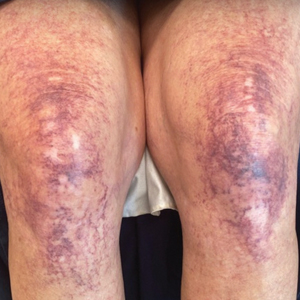
Ocular MALT lymphoma: Radiation reduces relapse
“Our study represents the largest institutional cohort analysis on the course of patients with stage I POAML,” said first author Linrui Gao, MD, of the department of radiation oncology at the National Clinical Research Center for Cancer, Chinese Academy of Medical Sciences and Peking Union Medical College, in Beijing.
Dr. Gao presented these findings at ESMO 2023, held in Madrid.
“We confirm the indolent nature of this stage I disease, with mortality that is similar to the general population and a low rate of lymphoma-attributed mortality,” she said, adding that “radiation therapy was associated with the lowest relapse or disease progression, compared with [other treatments].”
POAML, which can involve lesions in areas including the eyelid, conjunctiva, orbit, and lacrimal gland, makes up about 7% of mucosa-associated lymphoid tissue (MALT) lymphomas. However, the incidence is reported to be steadily increasing. With the majority of patients, 70%-85%, diagnosed as stage I, consensus on treatment approaches is lacking.
Guidelines typically recommend radiation therapy as the standard of care, and approximately 70% of POAML patients do receive the therapy, compared with only about 36% of those with early-stage MALT lymphoma, with the indolent nature of the disease likely weighing on decisions to forgo the treatment, Dr. Gao reported.
“Adoption of initial radiotherapy in early-stage POAML is relatively low worldwide, with possible reasons being [concerns] of a low survival benefit and long-term toxicities,” she said.
To evaluate the long-term outcomes based on baseline clinical features and treatments, Dr. Gao and colleagues conducted a retrospective study of 262 patients with stage I POAML (ipsilateral or bilateral disease), enrolled between January 2000 and December 2020 at two hospitals in China.
Of the patients, who had a median age of 55 and a male-female ratio of 1:3, 82 were initially treated with radiation therapy, 81 with observation, 70 with surgery, and 29 with systemic treatment.
Those receiving radiation therapy had higher rates of an Eastern Cooperative Oncology Group performance status of 1 or higher (P = .02), higher elevations of LDH (P = .03), and higher rates of chronic disease (P < .001), while other baseline characteristics between the groups, including age, T stage, symptom duration, and other factors, were similar.
With a median follow-up of 66 months, the 5-year and 10-year overall survival rates were 96.8% and 90%, respectively, which is similar to the survival rate in the general population in China.
Likewise, the 5- and 10-year rates of lymphoma-specific mortality were both extremely low, at 0.4%, and the corresponding rates of competing nonlymphoma mortality at 5 and 10 years were 2.3% and 4.2%, also consistent with the general population.
The 5- and 10-year mortality rates remained similar to the general population in stratifying patients according to the initial treatment type (P = .767 between treatments).
In terms of recurrence, the overall failure rates were relatively high, with 19.5% of patients experiencing relapse at 5 years and 24.05% at 10 years.
“The failure rates show that the risk of relapse in POAML does not decrease over time,” Dr. Gao said.
Notably, those treated with radiation therapy had a significantly decreased 5-year cumulative risk of failure (8.5%), compared with those who only received observation (29.6%), surgery (22.9%), or systemic treatment (17.2%; overall, P = .002).
The most common failure site was the ipsilateral orbit, and again, rates of those relapses were significantly lower with radiation therapy (2.4%), compared with observation (23.5%), surgery (21.4%), and systemic treatment (17.3%).
However, rates of relapses in other sites, including the contralateral orbit, extraocular site, and multiple sites, were similar among all treatment groups. One patient receiving systemic treatment had large cell transformation, associated with poorer outcomes.
Strategies after recurrence were salvage therapy for 53 patients, including 27 receiving radiation therapy, and observation for 10 patients.
Dr. Gao noted that treatment failure was not associated with higher mortality rates. “However, given the limited number of cases, we think more cases and longer follow-up are needed,” she told MDedge.
Among the most common acute toxicities were ocular dermatitis or mucositis, described as mild, among 23 patients receiving radiation therapy. Nine patients experienced postoperative complications of mild eye irritation and periorbital edema, and five patients receiving systemic treatment experienced grade 2-3 leukopenia. There were no severe adverse events.
In terms of late ocular adverse effects, overall, 3 patients in the radiation therapy group developed cataracts and 143 patients developed dry-eye disease.
“Radiation therapy was associated with the lowest rate of relapse progression, compared with observation, surgery, and systemic treatment, with similar overall and recurrent survival,” Dr. Gao said.
“Based on our study results, radiotherapy should be considered as the optimal treatment for all patients with stage I disease because of its lowest failure risk and minor toxicity,” Dr. Gao told MDedge.
“However, the radiotherapy dose and techniques should be further optimized in good clinical trials,” she noted. “There are some clinical studies undergoing to explore the modern radiotherapy strategy, including by our group.”
Commenting on the study, discussant Olivier Casasnovas, MD, PhD, of the department of hematology, University Hospital Francois Mitterrand, in Dijon, France, noted that “interestingly, radiotherapy reduced the risk of local relapse but not systemic relapse.”
Benefits linked to radiation therapy dose?
Furthermore, the study adds to evidence suggesting the role of dose in radiation therapy’s benefits in POAML, Dr. Casanovas noted. He pointed to previous research showing that, with a median radiotherapy dose of 26 Gy, stage I POAML patients had a local relapse rate of 9.5%, whereas in the current study, which reported a median radiotherapy dose of 30.6 Gy, the local relapse rate was just 2%.
“Regarding the risk of local relapse, it’s important to see that, as previous published, the risk of a local relapse depends probably on the dose of radiotherapy,” he said.
The results indicate that “radiation therapy could impact patients’ outcome. In comparison to previous research, this suggests benefits from a higher dose.”
He added that “it would be interesting to test in this series if patients receiving more or less 30 Gy had different outcomes or the risks of failure at different sites.”
Overall, the study confirms that POAML “can be safely treated with radiation therapy, which allows for a better chance of local control, compared with other options, but does not preclude relapse over time,” Dr. Casasnovas concluded, adding, “I think that a standardization of radiotherapy dose is warranted to provide guidelines to clinicians treating this infrequent population of patients.”
The authors had no disclosures to report.
“Our study represents the largest institutional cohort analysis on the course of patients with stage I POAML,” said first author Linrui Gao, MD, of the department of radiation oncology at the National Clinical Research Center for Cancer, Chinese Academy of Medical Sciences and Peking Union Medical College, in Beijing.
Dr. Gao presented these findings at ESMO 2023, held in Madrid.
“We confirm the indolent nature of this stage I disease, with mortality that is similar to the general population and a low rate of lymphoma-attributed mortality,” she said, adding that “radiation therapy was associated with the lowest relapse or disease progression, compared with [other treatments].”
POAML, which can involve lesions in areas including the eyelid, conjunctiva, orbit, and lacrimal gland, makes up about 7% of mucosa-associated lymphoid tissue (MALT) lymphomas. However, the incidence is reported to be steadily increasing. With the majority of patients, 70%-85%, diagnosed as stage I, consensus on treatment approaches is lacking.
Guidelines typically recommend radiation therapy as the standard of care, and approximately 70% of POAML patients do receive the therapy, compared with only about 36% of those with early-stage MALT lymphoma, with the indolent nature of the disease likely weighing on decisions to forgo the treatment, Dr. Gao reported.
“Adoption of initial radiotherapy in early-stage POAML is relatively low worldwide, with possible reasons being [concerns] of a low survival benefit and long-term toxicities,” she said.
To evaluate the long-term outcomes based on baseline clinical features and treatments, Dr. Gao and colleagues conducted a retrospective study of 262 patients with stage I POAML (ipsilateral or bilateral disease), enrolled between January 2000 and December 2020 at two hospitals in China.
Of the patients, who had a median age of 55 and a male-female ratio of 1:3, 82 were initially treated with radiation therapy, 81 with observation, 70 with surgery, and 29 with systemic treatment.
Those receiving radiation therapy had higher rates of an Eastern Cooperative Oncology Group performance status of 1 or higher (P = .02), higher elevations of LDH (P = .03), and higher rates of chronic disease (P < .001), while other baseline characteristics between the groups, including age, T stage, symptom duration, and other factors, were similar.
With a median follow-up of 66 months, the 5-year and 10-year overall survival rates were 96.8% and 90%, respectively, which is similar to the survival rate in the general population in China.
Likewise, the 5- and 10-year rates of lymphoma-specific mortality were both extremely low, at 0.4%, and the corresponding rates of competing nonlymphoma mortality at 5 and 10 years were 2.3% and 4.2%, also consistent with the general population.
The 5- and 10-year mortality rates remained similar to the general population in stratifying patients according to the initial treatment type (P = .767 between treatments).
In terms of recurrence, the overall failure rates were relatively high, with 19.5% of patients experiencing relapse at 5 years and 24.05% at 10 years.
“The failure rates show that the risk of relapse in POAML does not decrease over time,” Dr. Gao said.
Notably, those treated with radiation therapy had a significantly decreased 5-year cumulative risk of failure (8.5%), compared with those who only received observation (29.6%), surgery (22.9%), or systemic treatment (17.2%; overall, P = .002).
The most common failure site was the ipsilateral orbit, and again, rates of those relapses were significantly lower with radiation therapy (2.4%), compared with observation (23.5%), surgery (21.4%), and systemic treatment (17.3%).
However, rates of relapses in other sites, including the contralateral orbit, extraocular site, and multiple sites, were similar among all treatment groups. One patient receiving systemic treatment had large cell transformation, associated with poorer outcomes.
Strategies after recurrence were salvage therapy for 53 patients, including 27 receiving radiation therapy, and observation for 10 patients.
Dr. Gao noted that treatment failure was not associated with higher mortality rates. “However, given the limited number of cases, we think more cases and longer follow-up are needed,” she told MDedge.
Among the most common acute toxicities were ocular dermatitis or mucositis, described as mild, among 23 patients receiving radiation therapy. Nine patients experienced postoperative complications of mild eye irritation and periorbital edema, and five patients receiving systemic treatment experienced grade 2-3 leukopenia. There were no severe adverse events.
In terms of late ocular adverse effects, overall, 3 patients in the radiation therapy group developed cataracts and 143 patients developed dry-eye disease.
“Radiation therapy was associated with the lowest rate of relapse progression, compared with observation, surgery, and systemic treatment, with similar overall and recurrent survival,” Dr. Gao said.
“Based on our study results, radiotherapy should be considered as the optimal treatment for all patients with stage I disease because of its lowest failure risk and minor toxicity,” Dr. Gao told MDedge.
“However, the radiotherapy dose and techniques should be further optimized in good clinical trials,” she noted. “There are some clinical studies undergoing to explore the modern radiotherapy strategy, including by our group.”
Commenting on the study, discussant Olivier Casasnovas, MD, PhD, of the department of hematology, University Hospital Francois Mitterrand, in Dijon, France, noted that “interestingly, radiotherapy reduced the risk of local relapse but not systemic relapse.”
Benefits linked to radiation therapy dose?
Furthermore, the study adds to evidence suggesting the role of dose in radiation therapy’s benefits in POAML, Dr. Casanovas noted. He pointed to previous research showing that, with a median radiotherapy dose of 26 Gy, stage I POAML patients had a local relapse rate of 9.5%, whereas in the current study, which reported a median radiotherapy dose of 30.6 Gy, the local relapse rate was just 2%.
“Regarding the risk of local relapse, it’s important to see that, as previous published, the risk of a local relapse depends probably on the dose of radiotherapy,” he said.
The results indicate that “radiation therapy could impact patients’ outcome. In comparison to previous research, this suggests benefits from a higher dose.”
He added that “it would be interesting to test in this series if patients receiving more or less 30 Gy had different outcomes or the risks of failure at different sites.”
Overall, the study confirms that POAML “can be safely treated with radiation therapy, which allows for a better chance of local control, compared with other options, but does not preclude relapse over time,” Dr. Casasnovas concluded, adding, “I think that a standardization of radiotherapy dose is warranted to provide guidelines to clinicians treating this infrequent population of patients.”
The authors had no disclosures to report.
“Our study represents the largest institutional cohort analysis on the course of patients with stage I POAML,” said first author Linrui Gao, MD, of the department of radiation oncology at the National Clinical Research Center for Cancer, Chinese Academy of Medical Sciences and Peking Union Medical College, in Beijing.
Dr. Gao presented these findings at ESMO 2023, held in Madrid.
“We confirm the indolent nature of this stage I disease, with mortality that is similar to the general population and a low rate of lymphoma-attributed mortality,” she said, adding that “radiation therapy was associated with the lowest relapse or disease progression, compared with [other treatments].”
POAML, which can involve lesions in areas including the eyelid, conjunctiva, orbit, and lacrimal gland, makes up about 7% of mucosa-associated lymphoid tissue (MALT) lymphomas. However, the incidence is reported to be steadily increasing. With the majority of patients, 70%-85%, diagnosed as stage I, consensus on treatment approaches is lacking.
Guidelines typically recommend radiation therapy as the standard of care, and approximately 70% of POAML patients do receive the therapy, compared with only about 36% of those with early-stage MALT lymphoma, with the indolent nature of the disease likely weighing on decisions to forgo the treatment, Dr. Gao reported.
“Adoption of initial radiotherapy in early-stage POAML is relatively low worldwide, with possible reasons being [concerns] of a low survival benefit and long-term toxicities,” she said.
To evaluate the long-term outcomes based on baseline clinical features and treatments, Dr. Gao and colleagues conducted a retrospective study of 262 patients with stage I POAML (ipsilateral or bilateral disease), enrolled between January 2000 and December 2020 at two hospitals in China.
Of the patients, who had a median age of 55 and a male-female ratio of 1:3, 82 were initially treated with radiation therapy, 81 with observation, 70 with surgery, and 29 with systemic treatment.
Those receiving radiation therapy had higher rates of an Eastern Cooperative Oncology Group performance status of 1 or higher (P = .02), higher elevations of LDH (P = .03), and higher rates of chronic disease (P < .001), while other baseline characteristics between the groups, including age, T stage, symptom duration, and other factors, were similar.
With a median follow-up of 66 months, the 5-year and 10-year overall survival rates were 96.8% and 90%, respectively, which is similar to the survival rate in the general population in China.
Likewise, the 5- and 10-year rates of lymphoma-specific mortality were both extremely low, at 0.4%, and the corresponding rates of competing nonlymphoma mortality at 5 and 10 years were 2.3% and 4.2%, also consistent with the general population.
The 5- and 10-year mortality rates remained similar to the general population in stratifying patients according to the initial treatment type (P = .767 between treatments).
In terms of recurrence, the overall failure rates were relatively high, with 19.5% of patients experiencing relapse at 5 years and 24.05% at 10 years.
“The failure rates show that the risk of relapse in POAML does not decrease over time,” Dr. Gao said.
Notably, those treated with radiation therapy had a significantly decreased 5-year cumulative risk of failure (8.5%), compared with those who only received observation (29.6%), surgery (22.9%), or systemic treatment (17.2%; overall, P = .002).
The most common failure site was the ipsilateral orbit, and again, rates of those relapses were significantly lower with radiation therapy (2.4%), compared with observation (23.5%), surgery (21.4%), and systemic treatment (17.3%).
However, rates of relapses in other sites, including the contralateral orbit, extraocular site, and multiple sites, were similar among all treatment groups. One patient receiving systemic treatment had large cell transformation, associated with poorer outcomes.
Strategies after recurrence were salvage therapy for 53 patients, including 27 receiving radiation therapy, and observation for 10 patients.
Dr. Gao noted that treatment failure was not associated with higher mortality rates. “However, given the limited number of cases, we think more cases and longer follow-up are needed,” she told MDedge.
Among the most common acute toxicities were ocular dermatitis or mucositis, described as mild, among 23 patients receiving radiation therapy. Nine patients experienced postoperative complications of mild eye irritation and periorbital edema, and five patients receiving systemic treatment experienced grade 2-3 leukopenia. There were no severe adverse events.
In terms of late ocular adverse effects, overall, 3 patients in the radiation therapy group developed cataracts and 143 patients developed dry-eye disease.
“Radiation therapy was associated with the lowest rate of relapse progression, compared with observation, surgery, and systemic treatment, with similar overall and recurrent survival,” Dr. Gao said.
“Based on our study results, radiotherapy should be considered as the optimal treatment for all patients with stage I disease because of its lowest failure risk and minor toxicity,” Dr. Gao told MDedge.
“However, the radiotherapy dose and techniques should be further optimized in good clinical trials,” she noted. “There are some clinical studies undergoing to explore the modern radiotherapy strategy, including by our group.”
Commenting on the study, discussant Olivier Casasnovas, MD, PhD, of the department of hematology, University Hospital Francois Mitterrand, in Dijon, France, noted that “interestingly, radiotherapy reduced the risk of local relapse but not systemic relapse.”
Benefits linked to radiation therapy dose?
Furthermore, the study adds to evidence suggesting the role of dose in radiation therapy’s benefits in POAML, Dr. Casanovas noted. He pointed to previous research showing that, with a median radiotherapy dose of 26 Gy, stage I POAML patients had a local relapse rate of 9.5%, whereas in the current study, which reported a median radiotherapy dose of 30.6 Gy, the local relapse rate was just 2%.
“Regarding the risk of local relapse, it’s important to see that, as previous published, the risk of a local relapse depends probably on the dose of radiotherapy,” he said.
The results indicate that “radiation therapy could impact patients’ outcome. In comparison to previous research, this suggests benefits from a higher dose.”
He added that “it would be interesting to test in this series if patients receiving more or less 30 Gy had different outcomes or the risks of failure at different sites.”
Overall, the study confirms that POAML “can be safely treated with radiation therapy, which allows for a better chance of local control, compared with other options, but does not preclude relapse over time,” Dr. Casasnovas concluded, adding, “I think that a standardization of radiotherapy dose is warranted to provide guidelines to clinicians treating this infrequent population of patients.”
The authors had no disclosures to report.
FROM ESMO 2023
Massive databases unleash discovery, but not so much in the U.S.
Which conditions are caused by infection? Though it may seem like an amateur concern in the era of advanced microscopy, some culprits evade conventional methods of detection. Large medical databases hold the power to unlock answers.
A recent study from Sweden and Denmark meticulously traced the lives and medical histories of nearly one million men and women in those countries who had received blood transfusions over nearly five decades. Some of these patients later experienced brain bleeds. The inescapable question: Could a virus found in some donor blood have caused the hemorrhages?
Traditionally, brain bleeds have been thought to strike at random. But the new study, published in JAMA, points toward an infection that causes or, at the very least, is linked to the condition. The researchers used a large databank to make the discovery. 
“As health data becomes more available and easier to analyze, we’ll see all kinds of cases like this,” said Jingcheng Zhao, MD, of the clinical epidemiology division of Sweden’s Karolinska Institutet in Solna and lead author of the study.
Scientists say the field of medical research is on the cusp of a revolution as immense health databases guide discovery and improve clinical care.
“If you can aggregate data, you have the statistical power to identify associations,” said David R. Crosslin, PhD, professor in the division of biomedical informatics and genomics at Tulane University in New Orleans. “It opens up the world for understanding diseases.”
With access to the large database, Dr. Zhao and his team found that some blood donors later experienced brain bleeds. And it turned out that the recipients of blood from those same donors carried the highest risk of experiencing a brain bleed later in life. Meanwhile, patients whose donors remained bleed-free had the lowest risk.
Not so fast in the United States
In Nordic countries, all hospitals, clinics, and pharmacies report data on diagnoses and health care visits to the government, tracking that began with paper and pen in the 1960s. But the United States health care system is too fragmented to replicate such efforts, with several brands of electronic medical records operating across different systems. Data sharing across institutions is minimal.
Most comparable health data in the United States comes from reimbursement information collected by the Centers for Medicare & Medicaid Services on government-sponsored insurance programs.
“We would need all the health care systems in the country to operate within the same IT system or use the same data model,” said Euan Ashley, MD, PhD, professor of genomics at Stanford (Calif.) University. “It’s an exciting prospect. But I think [the United States] is one of the last countries where it’ll happen.”
States, meanwhile, collect health data on specific areas like sexually transmitted infection cases and rates. Other states have registries, like the Connecticut Tumor Registry, which was established in 1941 and is the oldest population-based cancer registry in the world.
But all of these efforts are ad hoc, and no equivalent exists for heart disease and other conditions.
Health data companies have recently entered the U.S. data industry mainly through partnerships with health systems and insurance companies, using deidentified information from patient charts.
The large databases have yielded important findings that randomized clinical trials simply cannot, according to Dr. Ashley.
For instance, a study found that a heavily-lauded immunotherapy treatment did not provide meaningful outcomes for patients aged 75 years or older, but it did for younger patients.
This sort of analysis might enable clinicians to administer treatments based on how effective they are for patients with particular demographics, according to Cary Gross, MD, professor at Yale University in New Haven, Conn.
“From a bedside standpoint, these large databases can identify who benefits from what,” Dr. Gross said. “Precision medicine is not just about genetic tailoring.” These large datasets also provide insight into genetic and environmental variables that contribute to disease.
For instance, the UK Biobank has more than 500,000 participants paired with their medical records and scans of their body and brain. Researchers perform cognitive tests on participants and extract DNA from blood samples over their lifetime, allowing examination of interactions between risk factors.
A similar but much smaller-scale effort underway in the United States, called the All of Us Research Program, has enrolled more than 650,000 people, less than one-third the size of the UK Biobank by relative populations. The goal of the program is to provide insights into prevention and treatment of chronic disease among a diverse set of at least one million participants. The database includes information on sexual orientation, which is a fairly new datapoint collected by researchers in an effort to study health outcomes and inequities among the LGBTQ+ community.
Dr. Crosslin and his colleagues are writing a grant proposal to use the All of Us database to identify genetic risks for preeclampsia. People with certain genetic profiles may be predisposed to the life-threatening condition, and researchers may discover that lifestyle changes could decrease risk, Dr. Crosslin said.
Changes in the United States
The COVID-19 pandemic exposed the lack of centralized data in the United States because a majority of research on the virus has been conducted abroad in countries with national health care systems and these large databases.
The U.S. gap spurred a group of researchers to create the National Institutes of Health–funded National COVID Cohort Collaborative (N3C), a project that gathers medical records from millions of patients across health systems and provides access to research teams investigating a wide spectrum of topics, such as optimal timing for ventilator use.
But until government or private health systems develop a way to share and regulate health data ethically and efficiently, significant limits will persist on what large-scale databases can do, Dr. Gross said.
“At the federal level, we need to ensure this health information is made available for public health researchers so we don’t create these private fiefdoms of data,” Dr. Gross said. “Things have to be transparent. I think our country needs to take a step back and think about what we’re doing with our health data and how we can make sure it’s being managed ethically.”
A version of this article first appeared on Medscape.com.
Which conditions are caused by infection? Though it may seem like an amateur concern in the era of advanced microscopy, some culprits evade conventional methods of detection. Large medical databases hold the power to unlock answers.
A recent study from Sweden and Denmark meticulously traced the lives and medical histories of nearly one million men and women in those countries who had received blood transfusions over nearly five decades. Some of these patients later experienced brain bleeds. The inescapable question: Could a virus found in some donor blood have caused the hemorrhages?
Traditionally, brain bleeds have been thought to strike at random. But the new study, published in JAMA, points toward an infection that causes or, at the very least, is linked to the condition. The researchers used a large databank to make the discovery.
“As health data becomes more available and easier to analyze, we’ll see all kinds of cases like this,” said Jingcheng Zhao, MD, of the clinical epidemiology division of Sweden’s Karolinska Institutet in Solna and lead author of the study.
Scientists say the field of medical research is on the cusp of a revolution as immense health databases guide discovery and improve clinical care.
“If you can aggregate data, you have the statistical power to identify associations,” said David R. Crosslin, PhD, professor in the division of biomedical informatics and genomics at Tulane University in New Orleans. “It opens up the world for understanding diseases.”
With access to the large database, Dr. Zhao and his team found that some blood donors later experienced brain bleeds. And it turned out that the recipients of blood from those same donors carried the highest risk of experiencing a brain bleed later in life. Meanwhile, patients whose donors remained bleed-free had the lowest risk.
Not so fast in the United States
In Nordic countries, all hospitals, clinics, and pharmacies report data on diagnoses and health care visits to the government, tracking that began with paper and pen in the 1960s. But the United States health care system is too fragmented to replicate such efforts, with several brands of electronic medical records operating across different systems. Data sharing across institutions is minimal.
Most comparable health data in the United States comes from reimbursement information collected by the Centers for Medicare & Medicaid Services on government-sponsored insurance programs.
“We would need all the health care systems in the country to operate within the same IT system or use the same data model,” said Euan Ashley, MD, PhD, professor of genomics at Stanford (Calif.) University. “It’s an exciting prospect. But I think [the United States] is one of the last countries where it’ll happen.”
States, meanwhile, collect health data on specific areas like sexually transmitted infection cases and rates. Other states have registries, like the Connecticut Tumor Registry, which was established in 1941 and is the oldest population-based cancer registry in the world.
But all of these efforts are ad hoc, and no equivalent exists for heart disease and other conditions.
Health data companies have recently entered the U.S. data industry mainly through partnerships with health systems and insurance companies, using deidentified information from patient charts.
The large databases have yielded important findings that randomized clinical trials simply cannot, according to Dr. Ashley.
For instance, a study found that a heavily-lauded immunotherapy treatment did not provide meaningful outcomes for patients aged 75 years or older, but it did for younger patients.
This sort of analysis might enable clinicians to administer treatments based on how effective they are for patients with particular demographics, according to Cary Gross, MD, professor at Yale University in New Haven, Conn.
“From a bedside standpoint, these large databases can identify who benefits from what,” Dr. Gross said. “Precision medicine is not just about genetic tailoring.” These large datasets also provide insight into genetic and environmental variables that contribute to disease.
For instance, the UK Biobank has more than 500,000 participants paired with their medical records and scans of their body and brain. Researchers perform cognitive tests on participants and extract DNA from blood samples over their lifetime, allowing examination of interactions between risk factors.
A similar but much smaller-scale effort underway in the United States, called the All of Us Research Program, has enrolled more than 650,000 people, less than one-third the size of the UK Biobank by relative populations. The goal of the program is to provide insights into prevention and treatment of chronic disease among a diverse set of at least one million participants. The database includes information on sexual orientation, which is a fairly new datapoint collected by researchers in an effort to study health outcomes and inequities among the LGBTQ+ community.
Dr. Crosslin and his colleagues are writing a grant proposal to use the All of Us database to identify genetic risks for preeclampsia. People with certain genetic profiles may be predisposed to the life-threatening condition, and researchers may discover that lifestyle changes could decrease risk, Dr. Crosslin said.
Changes in the United States
The COVID-19 pandemic exposed the lack of centralized data in the United States because a majority of research on the virus has been conducted abroad in countries with national health care systems and these large databases.
The U.S. gap spurred a group of researchers to create the National Institutes of Health–funded National COVID Cohort Collaborative (N3C), a project that gathers medical records from millions of patients across health systems and provides access to research teams investigating a wide spectrum of topics, such as optimal timing for ventilator use.
But until government or private health systems develop a way to share and regulate health data ethically and efficiently, significant limits will persist on what large-scale databases can do, Dr. Gross said.
“At the federal level, we need to ensure this health information is made available for public health researchers so we don’t create these private fiefdoms of data,” Dr. Gross said. “Things have to be transparent. I think our country needs to take a step back and think about what we’re doing with our health data and how we can make sure it’s being managed ethically.”
A version of this article first appeared on Medscape.com.
Which conditions are caused by infection? Though it may seem like an amateur concern in the era of advanced microscopy, some culprits evade conventional methods of detection. Large medical databases hold the power to unlock answers.
A recent study from Sweden and Denmark meticulously traced the lives and medical histories of nearly one million men and women in those countries who had received blood transfusions over nearly five decades. Some of these patients later experienced brain bleeds. The inescapable question: Could a virus found in some donor blood have caused the hemorrhages?
Traditionally, brain bleeds have been thought to strike at random. But the new study, published in JAMA, points toward an infection that causes or, at the very least, is linked to the condition. The researchers used a large databank to make the discovery.
“As health data becomes more available and easier to analyze, we’ll see all kinds of cases like this,” said Jingcheng Zhao, MD, of the clinical epidemiology division of Sweden’s Karolinska Institutet in Solna and lead author of the study.
Scientists say the field of medical research is on the cusp of a revolution as immense health databases guide discovery and improve clinical care.
“If you can aggregate data, you have the statistical power to identify associations,” said David R. Crosslin, PhD, professor in the division of biomedical informatics and genomics at Tulane University in New Orleans. “It opens up the world for understanding diseases.”
With access to the large database, Dr. Zhao and his team found that some blood donors later experienced brain bleeds. And it turned out that the recipients of blood from those same donors carried the highest risk of experiencing a brain bleed later in life. Meanwhile, patients whose donors remained bleed-free had the lowest risk.
Not so fast in the United States
In Nordic countries, all hospitals, clinics, and pharmacies report data on diagnoses and health care visits to the government, tracking that began with paper and pen in the 1960s. But the United States health care system is too fragmented to replicate such efforts, with several brands of electronic medical records operating across different systems. Data sharing across institutions is minimal.
Most comparable health data in the United States comes from reimbursement information collected by the Centers for Medicare & Medicaid Services on government-sponsored insurance programs.
“We would need all the health care systems in the country to operate within the same IT system or use the same data model,” said Euan Ashley, MD, PhD, professor of genomics at Stanford (Calif.) University. “It’s an exciting prospect. But I think [the United States] is one of the last countries where it’ll happen.”
States, meanwhile, collect health data on specific areas like sexually transmitted infection cases and rates. Other states have registries, like the Connecticut Tumor Registry, which was established in 1941 and is the oldest population-based cancer registry in the world.
But all of these efforts are ad hoc, and no equivalent exists for heart disease and other conditions.
Health data companies have recently entered the U.S. data industry mainly through partnerships with health systems and insurance companies, using deidentified information from patient charts.
The large databases have yielded important findings that randomized clinical trials simply cannot, according to Dr. Ashley.
For instance, a study found that a heavily-lauded immunotherapy treatment did not provide meaningful outcomes for patients aged 75 years or older, but it did for younger patients.
This sort of analysis might enable clinicians to administer treatments based on how effective they are for patients with particular demographics, according to Cary Gross, MD, professor at Yale University in New Haven, Conn.
“From a bedside standpoint, these large databases can identify who benefits from what,” Dr. Gross said. “Precision medicine is not just about genetic tailoring.” These large datasets also provide insight into genetic and environmental variables that contribute to disease.
For instance, the UK Biobank has more than 500,000 participants paired with their medical records and scans of their body and brain. Researchers perform cognitive tests on participants and extract DNA from blood samples over their lifetime, allowing examination of interactions between risk factors.
A similar but much smaller-scale effort underway in the United States, called the All of Us Research Program, has enrolled more than 650,000 people, less than one-third the size of the UK Biobank by relative populations. The goal of the program is to provide insights into prevention and treatment of chronic disease among a diverse set of at least one million participants. The database includes information on sexual orientation, which is a fairly new datapoint collected by researchers in an effort to study health outcomes and inequities among the LGBTQ+ community.
Dr. Crosslin and his colleagues are writing a grant proposal to use the All of Us database to identify genetic risks for preeclampsia. People with certain genetic profiles may be predisposed to the life-threatening condition, and researchers may discover that lifestyle changes could decrease risk, Dr. Crosslin said.
Changes in the United States
The COVID-19 pandemic exposed the lack of centralized data in the United States because a majority of research on the virus has been conducted abroad in countries with national health care systems and these large databases.
The U.S. gap spurred a group of researchers to create the National Institutes of Health–funded National COVID Cohort Collaborative (N3C), a project that gathers medical records from millions of patients across health systems and provides access to research teams investigating a wide spectrum of topics, such as optimal timing for ventilator use.
But until government or private health systems develop a way to share and regulate health data ethically and efficiently, significant limits will persist on what large-scale databases can do, Dr. Gross said.
“At the federal level, we need to ensure this health information is made available for public health researchers so we don’t create these private fiefdoms of data,” Dr. Gross said. “Things have to be transparent. I think our country needs to take a step back and think about what we’re doing with our health data and how we can make sure it’s being managed ethically.”
A version of this article first appeared on Medscape.com.
‘Why did I choose this?’ Tackling burnout in oncology
MADRID – “Why did I choose this?”
That is the core question a Portuguese oncologist posed from the audience during a session at the annual meeting of the European Society for Medical Oncology (ESMO) that was dedicated to building a sustainable oncology workforce.
“Ten, twenty years ago, being a doctor was a dream,” she said, but right now doctors are underpaid, under strain, and have very few resources.
This oncologist is hardly alone.
A survey from ESMO conducted almost a decade ago found that more than 50% of oncologists across Europe, many of whom were early in their careers, reported being burned out.
This, Dr. Lim said, “was the starting point,” well before the COVID pandemic struck.
More recently, the pandemic has taken its own toll on the well-being of oncologists. A survey presented at ESMO 2020 revealed that 38% of participants, spanning 101 countries, reported experiencing burnout, and 66% said they were not able to perform their job.
Medscape’s 2023 Physician Burnout and Depression Report highlighted similar burnout rates, with 53% of U.S. physicians and 52% of oncologists saying they felt burned out, compared with about 42% in 2018, before the pandemic.
The oncology workforce is in crisis in every country, said Dr. Lim, from the Cancer Dynamics Lab, the Francis Crick Institute, London.
Burnout, characterized by emotional exhaustion, depersonalization or feelings of cynicism, and a low sense of personal accomplishment, can result in a poor work-life balance as well as poor mental and physical health. Factors linked to burnout include social isolation, increased workload, reduced quality of work, lack of control over work, and stressful professional experiences.
Together, these factors can affect patient care and further exacerbate staffing issues, Dr. Lim said.
Staffing shortages are common. Oncologists often work long hours or on weekends to cover gaps caused by staffing shortages. Recent data revealed that in high-income countries, there are on average 0.65 medical oncologists and 0.25 radiation oncologists per 100 patients — a situation made worse by professionals taking early retirement or leaving medicine during the pandemic.
“We have seen that the shortage of human resources in many countries as well as the increasing workload related to the increasing number of cancers,” as well as patients surviving longer, have increased pressures on the healthcare system, Andrés Cervantes, MD, PhD, president of ESMO, explained in a press conference.
While tackling these oncology workforce problems requires smaller, local changes to a physician’s daily routine, “the real change,” Dr. Lim said, lies at an infrastructure level.
In response to this chronic and growing problem, ESMO launched its Resilience Task Force in 2020 to evaluate burnout and well-being. The task force plans to publish a position paper in which it will propose a set of recommendations regarding the psychosocial risks of burnout as well as flexible work patterns, well-being resources, and targeted support.
A panel of experts at the meeting touched on some of these solutions.
Dealing with staff shortages is a must, said Jean-Yves Blay, MD, PhD, during the session. “It’s a simple mathematical equation,” Dr. Blay said. “We must increase the number of doctors in medical schools and the number of nurses and healthcare professionals in all schools.” Improving staffing would also help reduce chronic workload issues.
Resilience training should also be incorporated into physician training starting in medical school. Teaching oncologists how to deal with bad news and to cope when patients dies is particularly important.
“I was not taught that,” said the oncologist from Portugal. “I had to learn that at my own cost.”
The good news is that it’s possible to develop resiliency skills over time, said Claire Hardy, PhD, from Lancaster University, United Kingdom, who agreed that training programs could be one approach to improve oncologists’ work life.
However, a person’s needs are determined by their institution and personal responsibilities. “No one knows your job better than you,” Dr. Hardy said. “No one knows better than you where the inefficiencies are, where the bureaucracy is that could be taken away, or it could be done by somebody whose role it is to sort all that out.”
But having this understanding is not enough. Physician also need to feel “psychological safety to be able to speak out and say that something isn’t working right now or is too much,” or, “I’m spending too much time doing this.”
In other words, oncologists need to be able to set boundaries and say no.
Dr. Hardy said this concept “has been around a while, but it’s really gaining momentum,” and being able to discuss these issues in a forum such as the ESMO Congress is a promising start.
Dr. Lim has relationships with Janseen and SEOM. No other relevant financial relationships were disclosed.
A version of this article first appeared on Medscape.com.
MADRID – “Why did I choose this?”
That is the core question a Portuguese oncologist posed from the audience during a session at the annual meeting of the European Society for Medical Oncology (ESMO) that was dedicated to building a sustainable oncology workforce.
“Ten, twenty years ago, being a doctor was a dream,” she said, but right now doctors are underpaid, under strain, and have very few resources.
This oncologist is hardly alone.
A survey from ESMO conducted almost a decade ago found that more than 50% of oncologists across Europe, many of whom were early in their careers, reported being burned out.
This, Dr. Lim said, “was the starting point,” well before the COVID pandemic struck.
More recently, the pandemic has taken its own toll on the well-being of oncologists. A survey presented at ESMO 2020 revealed that 38% of participants, spanning 101 countries, reported experiencing burnout, and 66% said they were not able to perform their job.
Medscape’s 2023 Physician Burnout and Depression Report highlighted similar burnout rates, with 53% of U.S. physicians and 52% of oncologists saying they felt burned out, compared with about 42% in 2018, before the pandemic.
The oncology workforce is in crisis in every country, said Dr. Lim, from the Cancer Dynamics Lab, the Francis Crick Institute, London.
Burnout, characterized by emotional exhaustion, depersonalization or feelings of cynicism, and a low sense of personal accomplishment, can result in a poor work-life balance as well as poor mental and physical health. Factors linked to burnout include social isolation, increased workload, reduced quality of work, lack of control over work, and stressful professional experiences.
Together, these factors can affect patient care and further exacerbate staffing issues, Dr. Lim said.
Staffing shortages are common. Oncologists often work long hours or on weekends to cover gaps caused by staffing shortages. Recent data revealed that in high-income countries, there are on average 0.65 medical oncologists and 0.25 radiation oncologists per 100 patients — a situation made worse by professionals taking early retirement or leaving medicine during the pandemic.
“We have seen that the shortage of human resources in many countries as well as the increasing workload related to the increasing number of cancers,” as well as patients surviving longer, have increased pressures on the healthcare system, Andrés Cervantes, MD, PhD, president of ESMO, explained in a press conference.
While tackling these oncology workforce problems requires smaller, local changes to a physician’s daily routine, “the real change,” Dr. Lim said, lies at an infrastructure level.
In response to this chronic and growing problem, ESMO launched its Resilience Task Force in 2020 to evaluate burnout and well-being. The task force plans to publish a position paper in which it will propose a set of recommendations regarding the psychosocial risks of burnout as well as flexible work patterns, well-being resources, and targeted support.
A panel of experts at the meeting touched on some of these solutions.
Dealing with staff shortages is a must, said Jean-Yves Blay, MD, PhD, during the session. “It’s a simple mathematical equation,” Dr. Blay said. “We must increase the number of doctors in medical schools and the number of nurses and healthcare professionals in all schools.” Improving staffing would also help reduce chronic workload issues.
Resilience training should also be incorporated into physician training starting in medical school. Teaching oncologists how to deal with bad news and to cope when patients dies is particularly important.
“I was not taught that,” said the oncologist from Portugal. “I had to learn that at my own cost.”
The good news is that it’s possible to develop resiliency skills over time, said Claire Hardy, PhD, from Lancaster University, United Kingdom, who agreed that training programs could be one approach to improve oncologists’ work life.
However, a person’s needs are determined by their institution and personal responsibilities. “No one knows your job better than you,” Dr. Hardy said. “No one knows better than you where the inefficiencies are, where the bureaucracy is that could be taken away, or it could be done by somebody whose role it is to sort all that out.”
But having this understanding is not enough. Physician also need to feel “psychological safety to be able to speak out and say that something isn’t working right now or is too much,” or, “I’m spending too much time doing this.”
In other words, oncologists need to be able to set boundaries and say no.
Dr. Hardy said this concept “has been around a while, but it’s really gaining momentum,” and being able to discuss these issues in a forum such as the ESMO Congress is a promising start.
Dr. Lim has relationships with Janseen and SEOM. No other relevant financial relationships were disclosed.
A version of this article first appeared on Medscape.com.
MADRID – “Why did I choose this?”
That is the core question a Portuguese oncologist posed from the audience during a session at the annual meeting of the European Society for Medical Oncology (ESMO) that was dedicated to building a sustainable oncology workforce.
“Ten, twenty years ago, being a doctor was a dream,” she said, but right now doctors are underpaid, under strain, and have very few resources.
This oncologist is hardly alone.
A survey from ESMO conducted almost a decade ago found that more than 50% of oncologists across Europe, many of whom were early in their careers, reported being burned out.
This, Dr. Lim said, “was the starting point,” well before the COVID pandemic struck.
More recently, the pandemic has taken its own toll on the well-being of oncologists. A survey presented at ESMO 2020 revealed that 38% of participants, spanning 101 countries, reported experiencing burnout, and 66% said they were not able to perform their job.
Medscape’s 2023 Physician Burnout and Depression Report highlighted similar burnout rates, with 53% of U.S. physicians and 52% of oncologists saying they felt burned out, compared with about 42% in 2018, before the pandemic.
The oncology workforce is in crisis in every country, said Dr. Lim, from the Cancer Dynamics Lab, the Francis Crick Institute, London.
Burnout, characterized by emotional exhaustion, depersonalization or feelings of cynicism, and a low sense of personal accomplishment, can result in a poor work-life balance as well as poor mental and physical health. Factors linked to burnout include social isolation, increased workload, reduced quality of work, lack of control over work, and stressful professional experiences.
Together, these factors can affect patient care and further exacerbate staffing issues, Dr. Lim said.
Staffing shortages are common. Oncologists often work long hours or on weekends to cover gaps caused by staffing shortages. Recent data revealed that in high-income countries, there are on average 0.65 medical oncologists and 0.25 radiation oncologists per 100 patients — a situation made worse by professionals taking early retirement or leaving medicine during the pandemic.
“We have seen that the shortage of human resources in many countries as well as the increasing workload related to the increasing number of cancers,” as well as patients surviving longer, have increased pressures on the healthcare system, Andrés Cervantes, MD, PhD, president of ESMO, explained in a press conference.
While tackling these oncology workforce problems requires smaller, local changes to a physician’s daily routine, “the real change,” Dr. Lim said, lies at an infrastructure level.
In response to this chronic and growing problem, ESMO launched its Resilience Task Force in 2020 to evaluate burnout and well-being. The task force plans to publish a position paper in which it will propose a set of recommendations regarding the psychosocial risks of burnout as well as flexible work patterns, well-being resources, and targeted support.
A panel of experts at the meeting touched on some of these solutions.
Dealing with staff shortages is a must, said Jean-Yves Blay, MD, PhD, during the session. “It’s a simple mathematical equation,” Dr. Blay said. “We must increase the number of doctors in medical schools and the number of nurses and healthcare professionals in all schools.” Improving staffing would also help reduce chronic workload issues.
Resilience training should also be incorporated into physician training starting in medical school. Teaching oncologists how to deal with bad news and to cope when patients dies is particularly important.
“I was not taught that,” said the oncologist from Portugal. “I had to learn that at my own cost.”
The good news is that it’s possible to develop resiliency skills over time, said Claire Hardy, PhD, from Lancaster University, United Kingdom, who agreed that training programs could be one approach to improve oncologists’ work life.
However, a person’s needs are determined by their institution and personal responsibilities. “No one knows your job better than you,” Dr. Hardy said. “No one knows better than you where the inefficiencies are, where the bureaucracy is that could be taken away, or it could be done by somebody whose role it is to sort all that out.”
But having this understanding is not enough. Physician also need to feel “psychological safety to be able to speak out and say that something isn’t working right now or is too much,” or, “I’m spending too much time doing this.”
In other words, oncologists need to be able to set boundaries and say no.
Dr. Hardy said this concept “has been around a while, but it’s really gaining momentum,” and being able to discuss these issues in a forum such as the ESMO Congress is a promising start.
Dr. Lim has relationships with Janseen and SEOM. No other relevant financial relationships were disclosed.
A version of this article first appeared on Medscape.com.
FROM ESMO 2023
The sobering facts about alcohol and cancer
There is an urgent need to raise global awareness about the direct link between alcohol consumption and cancer risk.
That message was delivered by Isabelle Soerjomataram, PhD, with the International Agency for Research on Cancer (IARC), Lyon, France, at a session devoted to alcohol and cancer at the annual meeting of the European Society for Medical Oncology.
Dr. Soerjomataram told the audience. “Health professionals – oncologists, nurses, medical doctors, GPs – have an important role in increasing awareness and bringing this knowledge to people, which may lead to reduced consumption.”
Session chair Gilberto Morgan, MD, medical oncologist, Skåne University Hospital, Lund, Sweden, agreed.
Dr. Morgan noted that healthcare professionals tend to downplay their influence over patients’ drinking habits and often don’t address these behaviors.
But that needs to change.
“We have absolutely no problem asking patients if they take supplements or vitamins or if they’re eating [healthy],” Dr. Morgan said. “So, what is the difference? Why not recommend that they cut down their alcohol intake and leave it up to everybody’s personal choice to do it or not?”
In the session, Dr. Soerjomataram highlighted the global statistics on alcohol use. IARC data show, for instance, that nearly half (46%) of the world’s population consumes alcohol, with rates higher in men (54%) than women (38%).
How much are people drinking?
Globally, on average, the amount comes to about six liters of pure ethanol per year per drinker, or about one wine bottle per week. However, consumption patterns vary widely by country. In France, people consume about 12 liters per year or about two wine bottles per week.
Dr. Soerjomataram stressed the link between alcohol consumption and cancer.
According to IARC data, heavy drinking – defined as more than 60 g/day or about six daily drinks – accounts for 47% of the alcohol-attributable cancers. Risky drinking – between 20 and 60 g/day – accounts for 29%, she explained, while moderate drinking – less than 20 g/day or about two daily drinks – accounts for roughly 14% of cases of alcohol-attributable cancers.
Globally, alcohol intake accounted for 4% of all cancers diagnosed in 2020, according to a 2021 analysis by IARC.
In the United Kingdom alone, “alcohol drinking caused nearly 17,000 cases of cancer in 2020,” Dr. Soerjomataram said, and breast cancer made up almost one in four of those new cases.
In addition to breast cancer, six other cancer types – oral cavity, pharyngeal, laryngeal, esophageal, colorectal, and liver cancer – can be attributed to alcohol consumption, and emerging evidence suggests stomach and pancreatic cancer may be as well.
The good news, said Dr. Soerjomataram, is that long-term trends show declines in alcohol drinking in many countries, including the high wine-producing countries of France and Italy, where large reductions in consumption have been noted since the peak of intake in the 1920s.
“If it’s possible in these countries, I can imagine it’s possible elsewhere,” said Dr. Soerjomataram.
Dr. Soerjomataram and Dr. Morgan report no relevant financial relationships.
A version of this article first appeared on Medscape.com.
There is an urgent need to raise global awareness about the direct link between alcohol consumption and cancer risk.
That message was delivered by Isabelle Soerjomataram, PhD, with the International Agency for Research on Cancer (IARC), Lyon, France, at a session devoted to alcohol and cancer at the annual meeting of the European Society for Medical Oncology.
Dr. Soerjomataram told the audience. “Health professionals – oncologists, nurses, medical doctors, GPs – have an important role in increasing awareness and bringing this knowledge to people, which may lead to reduced consumption.”
Session chair Gilberto Morgan, MD, medical oncologist, Skåne University Hospital, Lund, Sweden, agreed.
Dr. Morgan noted that healthcare professionals tend to downplay their influence over patients’ drinking habits and often don’t address these behaviors.
But that needs to change.
“We have absolutely no problem asking patients if they take supplements or vitamins or if they’re eating [healthy],” Dr. Morgan said. “So, what is the difference? Why not recommend that they cut down their alcohol intake and leave it up to everybody’s personal choice to do it or not?”
In the session, Dr. Soerjomataram highlighted the global statistics on alcohol use. IARC data show, for instance, that nearly half (46%) of the world’s population consumes alcohol, with rates higher in men (54%) than women (38%).
How much are people drinking?
Globally, on average, the amount comes to about six liters of pure ethanol per year per drinker, or about one wine bottle per week. However, consumption patterns vary widely by country. In France, people consume about 12 liters per year or about two wine bottles per week.
Dr. Soerjomataram stressed the link between alcohol consumption and cancer.
According to IARC data, heavy drinking – defined as more than 60 g/day or about six daily drinks – accounts for 47% of the alcohol-attributable cancers. Risky drinking – between 20 and 60 g/day – accounts for 29%, she explained, while moderate drinking – less than 20 g/day or about two daily drinks – accounts for roughly 14% of cases of alcohol-attributable cancers.
Globally, alcohol intake accounted for 4% of all cancers diagnosed in 2020, according to a 2021 analysis by IARC.
In the United Kingdom alone, “alcohol drinking caused nearly 17,000 cases of cancer in 2020,” Dr. Soerjomataram said, and breast cancer made up almost one in four of those new cases.
In addition to breast cancer, six other cancer types – oral cavity, pharyngeal, laryngeal, esophageal, colorectal, and liver cancer – can be attributed to alcohol consumption, and emerging evidence suggests stomach and pancreatic cancer may be as well.
The good news, said Dr. Soerjomataram, is that long-term trends show declines in alcohol drinking in many countries, including the high wine-producing countries of France and Italy, where large reductions in consumption have been noted since the peak of intake in the 1920s.
“If it’s possible in these countries, I can imagine it’s possible elsewhere,” said Dr. Soerjomataram.
Dr. Soerjomataram and Dr. Morgan report no relevant financial relationships.
A version of this article first appeared on Medscape.com.
There is an urgent need to raise global awareness about the direct link between alcohol consumption and cancer risk.
That message was delivered by Isabelle Soerjomataram, PhD, with the International Agency for Research on Cancer (IARC), Lyon, France, at a session devoted to alcohol and cancer at the annual meeting of the European Society for Medical Oncology.
Dr. Soerjomataram told the audience. “Health professionals – oncologists, nurses, medical doctors, GPs – have an important role in increasing awareness and bringing this knowledge to people, which may lead to reduced consumption.”
Session chair Gilberto Morgan, MD, medical oncologist, Skåne University Hospital, Lund, Sweden, agreed.
Dr. Morgan noted that healthcare professionals tend to downplay their influence over patients’ drinking habits and often don’t address these behaviors.
But that needs to change.
“We have absolutely no problem asking patients if they take supplements or vitamins or if they’re eating [healthy],” Dr. Morgan said. “So, what is the difference? Why not recommend that they cut down their alcohol intake and leave it up to everybody’s personal choice to do it or not?”
In the session, Dr. Soerjomataram highlighted the global statistics on alcohol use. IARC data show, for instance, that nearly half (46%) of the world’s population consumes alcohol, with rates higher in men (54%) than women (38%).
How much are people drinking?
Globally, on average, the amount comes to about six liters of pure ethanol per year per drinker, or about one wine bottle per week. However, consumption patterns vary widely by country. In France, people consume about 12 liters per year or about two wine bottles per week.
Dr. Soerjomataram stressed the link between alcohol consumption and cancer.
According to IARC data, heavy drinking – defined as more than 60 g/day or about six daily drinks – accounts for 47% of the alcohol-attributable cancers. Risky drinking – between 20 and 60 g/day – accounts for 29%, she explained, while moderate drinking – less than 20 g/day or about two daily drinks – accounts for roughly 14% of cases of alcohol-attributable cancers.
Globally, alcohol intake accounted for 4% of all cancers diagnosed in 2020, according to a 2021 analysis by IARC.
In the United Kingdom alone, “alcohol drinking caused nearly 17,000 cases of cancer in 2020,” Dr. Soerjomataram said, and breast cancer made up almost one in four of those new cases.
In addition to breast cancer, six other cancer types – oral cavity, pharyngeal, laryngeal, esophageal, colorectal, and liver cancer – can be attributed to alcohol consumption, and emerging evidence suggests stomach and pancreatic cancer may be as well.
The good news, said Dr. Soerjomataram, is that long-term trends show declines in alcohol drinking in many countries, including the high wine-producing countries of France and Italy, where large reductions in consumption have been noted since the peak of intake in the 1920s.
“If it’s possible in these countries, I can imagine it’s possible elsewhere,” said Dr. Soerjomataram.
Dr. Soerjomataram and Dr. Morgan report no relevant financial relationships.
A version of this article first appeared on Medscape.com.
FROM ESMO 2023