User login
Update on New Drugs in Dermatology
CenterWatch (http://www.centerwatch.com/) is an online resource that provides directories, analysis, and market research of medications that are either under clinical evaluation or available for use in patients. A list of currently approved drugs by the US Food and Drug Administration (FDA) also is available by specialty. It is important for dermatologists in-training to know about recently approved drugs and those that are in the pipeline, as these treatments may benefit patients who are unresponsive to other previously used medications. New drugs also may be useful for physicians who have a difficult time getting insurance to cover prescriptions for their patients, as most new medications have built-in patient assistance.
New Drugs in Dermatology
Actinic Keratosis
Ameluz (aminolevulinic acid hydrochloride)(Biofrontera AG) is a new drug that was approved in May 2016 for treatment of mild to moderate actinic keratosis on the face and scalp.1 It is only intended for in-office use on patients who may not be candidates for other treatment options for actinic keratosis. The product is a gel formulation that should be applied to cover the lesions and approximately 5 mm of the surrounding area with a film of approximately 1-mm thickness. The entire treatment area is then illuminated with a red light source, either with a narrow spectrum around 630 nm with a light dose of approximately 37 J/cm2 or a broader and continuous spectrum in the range of 570 to 670 nm with a light dose between 75 and 200 J/cm2.1 Similar to the previously used aminolevulinic acid treatment method for actinic keratosis, the patient may experience a burning stinging sensation throughout the treatment and the skin will then proceed to peel.
Psoriasis and Psoriatic Arthritis
Taltz (ixekizumab)(Eli Lilly and Company) was approved by the FDA in March 2016 for the treatment of moderate to severe plaque psoriasis.2 It is a humanized IL-17A antagonist that works when IgG4 monoclonal antibodies selectively bind with IL-17A cytokines and inhibit their interaction with the IL-17 receptor. Although this injectable medication is approved for the treatment of psoriasis, it also can potentially be used off label for the treatment of psoriatic arthritis and rheumatoid arthritis. The approved dosage is 160 mg (two 80-mg injections) at week 0, followed by 80 mg at weeks 2, 4, 6, 8, 10, and 12, then 80 mg every 4 weeks.2 Injectable immunomodulatory medications such as ixekizumab are ideal for patients in whom topical treatments and light therapy failed and they continue to have serious psoriatic discomfort as well as for those who have substantial body surface area coverage.
In January 2015, Cosentyx (secukinumab)(Novartis Corporation) was approved by the FDA.3 Similar to ixekizumab, this injectable is an IgG1 monoclonal antibody that selectively binds to the IL-17A cytokine and inhibits its interaction with the IL-17 receptor. It is approved for the treatment of moderate to severe plaque psoriasis and psoriatic arthritis. The approved dosage for plaque psoriasis is 300 mg (two 150-mg subcutaneous injections) at weeks 0 through 4 followed by 300 mg every 4 weeks as needed until clearance.3 Similar to ixekizumab, secukinumab may be used for the treatment of recalcitrant psoriasis or psoriasis with substantial body surface area involvement.
Melanoma
Cotellic (cobimetinib)(Genentech USA, Inc) was FDA approved in November 2015.4 Cobimetinib is a reversible inhibitor of mitogen-activated protein kinase (MAPK)/extracellular signal regulated kinase 1. Mitogen-activated protein kinase MEK1 and MEK2 are regulators of the extracellular signal-related kinase pathway, which promotes cellular proliferation. This pathway is key, as melanomas that have a BRAF V600E and kinase mutation continue to proliferate due to the constitutive activation of MEK1 and MEK2, further promoting cellular proliferation. Cobimetinib is approved for the treatment of melanoma in patients with unresectable or metastatic melanoma with a BRAF V600E or V600K mutation, in conjunction with vemurafenib. Zelboraf (vemurafenib)(Genentech USA, Inc), another inhibitor of BRAF V600E, also is used for the treatment of unresectable melanomas and was initially approved in 2011.5
BRAF is a serine/threonine protein kinase. When unregulated, it results in the deregulation of cell proliferation. According to Ascierto et al,6 50% of melanomas have a BRAF mutation, with nearly 90% of them with a V600E mutation. Hence, since the advent of direct chemotherapeutic agents such as BRAF inhibitors, clinical trials have shown notable reduction in mortality and morbidity of melanoma patients with BRAF mutations.6
Imlygic (talimogene laherparepvec)(Amgen, Inc) is a modified oncolytic viral therapy.7 This treatment was approved by the FDA in 2015 and replicates within tumors to produce granulocyte-macrophage colony-stimulating factor protein, which promotes an antitumor immune response within unresectable cutaneous, subcutaneous, and nodal melanoma lesions. Although it is not a gene-directed therapy, the melanoma does not require a specific mutation for treatment. Again, this medication is better served in conjunction with other melanoma chemotherapeutic and surgical interventions.
Submental Fat
Kybella (deoxycholic acid)(Allergan) is a nonhuman, nonanimal, synthetically created compound that is naturally found within the human body for the breakdown and absorption of dietary fat.8 This drug was FDA approved in 2015 for the improvement of the appearance of moderate subcutaneous fat under the chin. Patients are evaluated in clinic to determine if the submental fat would be responsive to an injectable or require more radical surgical intervention based on desired outcomes. The treatment is administered as 0.2-mL injections (up to a total of 10 mL) spaced 1-cm apart and ideally is repeated at regular intervals to evaluate for efficacy.
Basal Cell Carcinoma
Odomzo (sonidegib)(Novartis Corporation) was FDA approved in 2015 for locally advanced basal cell carcinoma.9 Odomzo is a smoothened antagonist that inhibits the hedgehog signaling pathway. Smoothened is a transmembrane protein that allows for signal transduction of hedgehog proteins.10 Protein patched homolog 1 binds to smoothened protein and prevents the signal transduction through the cell for Gli family zinc factor 1 to continue protein translation; however, when PTCH is mutated and can no longer bind to smoothened, tumor formation results, specifically basal cell carcinoma. Hence, sonidegib is for the treatment of basal cell carcinomas that have persisted despite radiation treatment and/or surgery as well as for patients who have multiple basal cell carcinomas that can no longer be treated with surgery or radiation.
Final Thoughts
Overall, although there are several medications that can be used in conjunction for treatment of dermatological conditions, it always is recommended to know what is in the pipeline as FDA-approved medications for dermatology.
- Ameluz [package insert]. Leverkusen, Germany: Biofrontera Bioscience GmbH; 2016.
- Taltz [package insert]. Indianapolis, IN: Eli Lilly and Company; 2016.
- Cosentyx [package insert]. East Hanover, NJ: Novartis Corporation; 2015.
- Cotellic [package insert]. San Francisco, CA: Genentech, Inc; 2016.
- Zelboraf [package insert]. San Francisco, CA: Genentech, Inc; 2016.
- Ascierto PA, Kirkwood JM, Grob JJ, et al. The role of BRAF V600 mutation in melanoma. J Transl Med. 2012;10:85.
- Imlygic (talimogene laherparepvec). Thousand Oaks, CA: Amgen Inc; 2015.
- Kybella [package insert]. West Lake Village, CA: Kythera Biopharmaceuticals, Inc; 2015.
- Odomzo [package insert]. East Hanover, NJ: Novartis Pharmaceuticals Corporation; 2015.
- Villavicencio EH, Walterhouse DO, Iannaccone PM. The sonic hedgehog-patched-gli pathway in human development and disease. Am J Hum Genet. 2000;67:1047-1054.
CenterWatch (http://www.centerwatch.com/) is an online resource that provides directories, analysis, and market research of medications that are either under clinical evaluation or available for use in patients. A list of currently approved drugs by the US Food and Drug Administration (FDA) also is available by specialty. It is important for dermatologists in-training to know about recently approved drugs and those that are in the pipeline, as these treatments may benefit patients who are unresponsive to other previously used medications. New drugs also may be useful for physicians who have a difficult time getting insurance to cover prescriptions for their patients, as most new medications have built-in patient assistance.
New Drugs in Dermatology
Actinic Keratosis
Ameluz (aminolevulinic acid hydrochloride)(Biofrontera AG) is a new drug that was approved in May 2016 for treatment of mild to moderate actinic keratosis on the face and scalp.1 It is only intended for in-office use on patients who may not be candidates for other treatment options for actinic keratosis. The product is a gel formulation that should be applied to cover the lesions and approximately 5 mm of the surrounding area with a film of approximately 1-mm thickness. The entire treatment area is then illuminated with a red light source, either with a narrow spectrum around 630 nm with a light dose of approximately 37 J/cm2 or a broader and continuous spectrum in the range of 570 to 670 nm with a light dose between 75 and 200 J/cm2.1 Similar to the previously used aminolevulinic acid treatment method for actinic keratosis, the patient may experience a burning stinging sensation throughout the treatment and the skin will then proceed to peel.
Psoriasis and Psoriatic Arthritis
Taltz (ixekizumab)(Eli Lilly and Company) was approved by the FDA in March 2016 for the treatment of moderate to severe plaque psoriasis.2 It is a humanized IL-17A antagonist that works when IgG4 monoclonal antibodies selectively bind with IL-17A cytokines and inhibit their interaction with the IL-17 receptor. Although this injectable medication is approved for the treatment of psoriasis, it also can potentially be used off label for the treatment of psoriatic arthritis and rheumatoid arthritis. The approved dosage is 160 mg (two 80-mg injections) at week 0, followed by 80 mg at weeks 2, 4, 6, 8, 10, and 12, then 80 mg every 4 weeks.2 Injectable immunomodulatory medications such as ixekizumab are ideal for patients in whom topical treatments and light therapy failed and they continue to have serious psoriatic discomfort as well as for those who have substantial body surface area coverage.
In January 2015, Cosentyx (secukinumab)(Novartis Corporation) was approved by the FDA.3 Similar to ixekizumab, this injectable is an IgG1 monoclonal antibody that selectively binds to the IL-17A cytokine and inhibits its interaction with the IL-17 receptor. It is approved for the treatment of moderate to severe plaque psoriasis and psoriatic arthritis. The approved dosage for plaque psoriasis is 300 mg (two 150-mg subcutaneous injections) at weeks 0 through 4 followed by 300 mg every 4 weeks as needed until clearance.3 Similar to ixekizumab, secukinumab may be used for the treatment of recalcitrant psoriasis or psoriasis with substantial body surface area involvement.
Melanoma
Cotellic (cobimetinib)(Genentech USA, Inc) was FDA approved in November 2015.4 Cobimetinib is a reversible inhibitor of mitogen-activated protein kinase (MAPK)/extracellular signal regulated kinase 1. Mitogen-activated protein kinase MEK1 and MEK2 are regulators of the extracellular signal-related kinase pathway, which promotes cellular proliferation. This pathway is key, as melanomas that have a BRAF V600E and kinase mutation continue to proliferate due to the constitutive activation of MEK1 and MEK2, further promoting cellular proliferation. Cobimetinib is approved for the treatment of melanoma in patients with unresectable or metastatic melanoma with a BRAF V600E or V600K mutation, in conjunction with vemurafenib. Zelboraf (vemurafenib)(Genentech USA, Inc), another inhibitor of BRAF V600E, also is used for the treatment of unresectable melanomas and was initially approved in 2011.5
BRAF is a serine/threonine protein kinase. When unregulated, it results in the deregulation of cell proliferation. According to Ascierto et al,6 50% of melanomas have a BRAF mutation, with nearly 90% of them with a V600E mutation. Hence, since the advent of direct chemotherapeutic agents such as BRAF inhibitors, clinical trials have shown notable reduction in mortality and morbidity of melanoma patients with BRAF mutations.6
Imlygic (talimogene laherparepvec)(Amgen, Inc) is a modified oncolytic viral therapy.7 This treatment was approved by the FDA in 2015 and replicates within tumors to produce granulocyte-macrophage colony-stimulating factor protein, which promotes an antitumor immune response within unresectable cutaneous, subcutaneous, and nodal melanoma lesions. Although it is not a gene-directed therapy, the melanoma does not require a specific mutation for treatment. Again, this medication is better served in conjunction with other melanoma chemotherapeutic and surgical interventions.
Submental Fat
Kybella (deoxycholic acid)(Allergan) is a nonhuman, nonanimal, synthetically created compound that is naturally found within the human body for the breakdown and absorption of dietary fat.8 This drug was FDA approved in 2015 for the improvement of the appearance of moderate subcutaneous fat under the chin. Patients are evaluated in clinic to determine if the submental fat would be responsive to an injectable or require more radical surgical intervention based on desired outcomes. The treatment is administered as 0.2-mL injections (up to a total of 10 mL) spaced 1-cm apart and ideally is repeated at regular intervals to evaluate for efficacy.
Basal Cell Carcinoma
Odomzo (sonidegib)(Novartis Corporation) was FDA approved in 2015 for locally advanced basal cell carcinoma.9 Odomzo is a smoothened antagonist that inhibits the hedgehog signaling pathway. Smoothened is a transmembrane protein that allows for signal transduction of hedgehog proteins.10 Protein patched homolog 1 binds to smoothened protein and prevents the signal transduction through the cell for Gli family zinc factor 1 to continue protein translation; however, when PTCH is mutated and can no longer bind to smoothened, tumor formation results, specifically basal cell carcinoma. Hence, sonidegib is for the treatment of basal cell carcinomas that have persisted despite radiation treatment and/or surgery as well as for patients who have multiple basal cell carcinomas that can no longer be treated with surgery or radiation.
Final Thoughts
Overall, although there are several medications that can be used in conjunction for treatment of dermatological conditions, it always is recommended to know what is in the pipeline as FDA-approved medications for dermatology.
CenterWatch (http://www.centerwatch.com/) is an online resource that provides directories, analysis, and market research of medications that are either under clinical evaluation or available for use in patients. A list of currently approved drugs by the US Food and Drug Administration (FDA) also is available by specialty. It is important for dermatologists in-training to know about recently approved drugs and those that are in the pipeline, as these treatments may benefit patients who are unresponsive to other previously used medications. New drugs also may be useful for physicians who have a difficult time getting insurance to cover prescriptions for their patients, as most new medications have built-in patient assistance.
New Drugs in Dermatology
Actinic Keratosis
Ameluz (aminolevulinic acid hydrochloride)(Biofrontera AG) is a new drug that was approved in May 2016 for treatment of mild to moderate actinic keratosis on the face and scalp.1 It is only intended for in-office use on patients who may not be candidates for other treatment options for actinic keratosis. The product is a gel formulation that should be applied to cover the lesions and approximately 5 mm of the surrounding area with a film of approximately 1-mm thickness. The entire treatment area is then illuminated with a red light source, either with a narrow spectrum around 630 nm with a light dose of approximately 37 J/cm2 or a broader and continuous spectrum in the range of 570 to 670 nm with a light dose between 75 and 200 J/cm2.1 Similar to the previously used aminolevulinic acid treatment method for actinic keratosis, the patient may experience a burning stinging sensation throughout the treatment and the skin will then proceed to peel.
Psoriasis and Psoriatic Arthritis
Taltz (ixekizumab)(Eli Lilly and Company) was approved by the FDA in March 2016 for the treatment of moderate to severe plaque psoriasis.2 It is a humanized IL-17A antagonist that works when IgG4 monoclonal antibodies selectively bind with IL-17A cytokines and inhibit their interaction with the IL-17 receptor. Although this injectable medication is approved for the treatment of psoriasis, it also can potentially be used off label for the treatment of psoriatic arthritis and rheumatoid arthritis. The approved dosage is 160 mg (two 80-mg injections) at week 0, followed by 80 mg at weeks 2, 4, 6, 8, 10, and 12, then 80 mg every 4 weeks.2 Injectable immunomodulatory medications such as ixekizumab are ideal for patients in whom topical treatments and light therapy failed and they continue to have serious psoriatic discomfort as well as for those who have substantial body surface area coverage.
In January 2015, Cosentyx (secukinumab)(Novartis Corporation) was approved by the FDA.3 Similar to ixekizumab, this injectable is an IgG1 monoclonal antibody that selectively binds to the IL-17A cytokine and inhibits its interaction with the IL-17 receptor. It is approved for the treatment of moderate to severe plaque psoriasis and psoriatic arthritis. The approved dosage for plaque psoriasis is 300 mg (two 150-mg subcutaneous injections) at weeks 0 through 4 followed by 300 mg every 4 weeks as needed until clearance.3 Similar to ixekizumab, secukinumab may be used for the treatment of recalcitrant psoriasis or psoriasis with substantial body surface area involvement.
Melanoma
Cotellic (cobimetinib)(Genentech USA, Inc) was FDA approved in November 2015.4 Cobimetinib is a reversible inhibitor of mitogen-activated protein kinase (MAPK)/extracellular signal regulated kinase 1. Mitogen-activated protein kinase MEK1 and MEK2 are regulators of the extracellular signal-related kinase pathway, which promotes cellular proliferation. This pathway is key, as melanomas that have a BRAF V600E and kinase mutation continue to proliferate due to the constitutive activation of MEK1 and MEK2, further promoting cellular proliferation. Cobimetinib is approved for the treatment of melanoma in patients with unresectable or metastatic melanoma with a BRAF V600E or V600K mutation, in conjunction with vemurafenib. Zelboraf (vemurafenib)(Genentech USA, Inc), another inhibitor of BRAF V600E, also is used for the treatment of unresectable melanomas and was initially approved in 2011.5
BRAF is a serine/threonine protein kinase. When unregulated, it results in the deregulation of cell proliferation. According to Ascierto et al,6 50% of melanomas have a BRAF mutation, with nearly 90% of them with a V600E mutation. Hence, since the advent of direct chemotherapeutic agents such as BRAF inhibitors, clinical trials have shown notable reduction in mortality and morbidity of melanoma patients with BRAF mutations.6
Imlygic (talimogene laherparepvec)(Amgen, Inc) is a modified oncolytic viral therapy.7 This treatment was approved by the FDA in 2015 and replicates within tumors to produce granulocyte-macrophage colony-stimulating factor protein, which promotes an antitumor immune response within unresectable cutaneous, subcutaneous, and nodal melanoma lesions. Although it is not a gene-directed therapy, the melanoma does not require a specific mutation for treatment. Again, this medication is better served in conjunction with other melanoma chemotherapeutic and surgical interventions.
Submental Fat
Kybella (deoxycholic acid)(Allergan) is a nonhuman, nonanimal, synthetically created compound that is naturally found within the human body for the breakdown and absorption of dietary fat.8 This drug was FDA approved in 2015 for the improvement of the appearance of moderate subcutaneous fat under the chin. Patients are evaluated in clinic to determine if the submental fat would be responsive to an injectable or require more radical surgical intervention based on desired outcomes. The treatment is administered as 0.2-mL injections (up to a total of 10 mL) spaced 1-cm apart and ideally is repeated at regular intervals to evaluate for efficacy.
Basal Cell Carcinoma
Odomzo (sonidegib)(Novartis Corporation) was FDA approved in 2015 for locally advanced basal cell carcinoma.9 Odomzo is a smoothened antagonist that inhibits the hedgehog signaling pathway. Smoothened is a transmembrane protein that allows for signal transduction of hedgehog proteins.10 Protein patched homolog 1 binds to smoothened protein and prevents the signal transduction through the cell for Gli family zinc factor 1 to continue protein translation; however, when PTCH is mutated and can no longer bind to smoothened, tumor formation results, specifically basal cell carcinoma. Hence, sonidegib is for the treatment of basal cell carcinomas that have persisted despite radiation treatment and/or surgery as well as for patients who have multiple basal cell carcinomas that can no longer be treated with surgery or radiation.
Final Thoughts
Overall, although there are several medications that can be used in conjunction for treatment of dermatological conditions, it always is recommended to know what is in the pipeline as FDA-approved medications for dermatology.
- Ameluz [package insert]. Leverkusen, Germany: Biofrontera Bioscience GmbH; 2016.
- Taltz [package insert]. Indianapolis, IN: Eli Lilly and Company; 2016.
- Cosentyx [package insert]. East Hanover, NJ: Novartis Corporation; 2015.
- Cotellic [package insert]. San Francisco, CA: Genentech, Inc; 2016.
- Zelboraf [package insert]. San Francisco, CA: Genentech, Inc; 2016.
- Ascierto PA, Kirkwood JM, Grob JJ, et al. The role of BRAF V600 mutation in melanoma. J Transl Med. 2012;10:85.
- Imlygic (talimogene laherparepvec). Thousand Oaks, CA: Amgen Inc; 2015.
- Kybella [package insert]. West Lake Village, CA: Kythera Biopharmaceuticals, Inc; 2015.
- Odomzo [package insert]. East Hanover, NJ: Novartis Pharmaceuticals Corporation; 2015.
- Villavicencio EH, Walterhouse DO, Iannaccone PM. The sonic hedgehog-patched-gli pathway in human development and disease. Am J Hum Genet. 2000;67:1047-1054.
- Ameluz [package insert]. Leverkusen, Germany: Biofrontera Bioscience GmbH; 2016.
- Taltz [package insert]. Indianapolis, IN: Eli Lilly and Company; 2016.
- Cosentyx [package insert]. East Hanover, NJ: Novartis Corporation; 2015.
- Cotellic [package insert]. San Francisco, CA: Genentech, Inc; 2016.
- Zelboraf [package insert]. San Francisco, CA: Genentech, Inc; 2016.
- Ascierto PA, Kirkwood JM, Grob JJ, et al. The role of BRAF V600 mutation in melanoma. J Transl Med. 2012;10:85.
- Imlygic (talimogene laherparepvec). Thousand Oaks, CA: Amgen Inc; 2015.
- Kybella [package insert]. West Lake Village, CA: Kythera Biopharmaceuticals, Inc; 2015.
- Odomzo [package insert]. East Hanover, NJ: Novartis Pharmaceuticals Corporation; 2015.
- Villavicencio EH, Walterhouse DO, Iannaccone PM. The sonic hedgehog-patched-gli pathway in human development and disease. Am J Hum Genet. 2000;67:1047-1054.
Surgical Simulation in Orthopedic Surgery Residency
The training model for orthopedic resident education has been transformed. Surgeon factors, patient expectations, financial and legal concerns, associated costs, and work hour restrictions have put pressure on resident autonomy in the operating room.1,2 At the end of resident training, the expectation is that board-eligible surgeons will have the surgical skills necessary to perform a wide range of surgical procedures.3,4 Helping residents become proficient for independent practice requires a multidisciplinary approach.5 This approach, regardless of its details, requires investment in time, resources, expertise, and funding.
Many residency programs are trying to bridge the gap between observation and autonomy with surgical simulation. According to one study, 76% of residency programs have a surgical skills laboratory, and 46% have a structured surgical skills curriculum.6Surgical skills preparation is available in different modalities. Synthetic bones, virtual reality, and arthroscopic simulators represent potential opportunities for practice. Through these modalities, residents become more comfortable with the tools used in orthopedic procedures. Cadaveric dissection allows them to practice surgical approaches in the setting of real anatomy.1 Independent dissection helps them appreciate the planes, layers, and proximity of crucial body structures and understand important surgical anatomy.4Surgical simulation can be expensive, and funding comes in many forms. Cadaver laboratories require investment in specimens, facilities, and time away from clinical obligations.4 Cadaver availability varies with regional resources, and the cost of a cadaver ranges from $1000 to $2000.7,8 Arthroscopic simulators and virtual reality programs are expensive as well. These modalities range from a less expensive video box (with standard arthroscopic equipment) to a virtual reality haptic simulation costing a residency program as much as $80,000.9 Synthetic bone simulations are less expensive but require investment in faculty time and outside implants and instrumentation.10 The cost of simulation raises the question of funding sources.
Funding surgical simulation is a challenge. In a national survey of program directors, conducted by Karam and colleagues,6 87.3% of residencies cited lack of funding as the most significant barrier to a formal surgical skills program. Simulation can be residency-sponsored, industry-sponsored, or specialty-sponsored. Karam and colleagues6 found that department, hospital, and industry funding were the 3 main sponsors of surgical simulation. Each funding mechanism brings its own set of challenges and opportunities. Industry-sponsored simulation provides a cost-effective outlet for residency programs. However, this type of funding is under scrutiny, as industry funding for education becomes more transparent. In addition, industry funding typically limits the technology that can be used during the simulation to the sponsor’s technology. Courses offered by the American Academy of Orthopaedic Surgeons (AAOS) and a number of subspecialty societies provide less conflicted simulation at reasonable cost.
If residents, residency programs, hospitals, industry, subspecialty societies, and the AAOS are going to invest in resident education through simulation, then the effect of simulation on resident education must be understood. Intuitively, simulation as a modality for improving resident skills makes sense. For residency programs to invest in simulation and surgical skills, different modalities must be objectively evaluated and their utility validated. If simulation is to become valuable, first it must be done correctly.
Kneebone11 proposed a framework for evaluating simulation. In this framework, simulation should allow for sustained, deliberate practice in a safe environment. It should provide access to expert tutors when appropriate. It should map onto real-life clinical experience. Last, it should provide a supportive, motivational, learner-centered milieu. Residents and program directors should consider this framework when deciding which simulation exercises to engage in and which resources to supply for exercises. Having supportive supervision during simulation can lead to a positive outcome. Likewise, learning incorrect techniques or bad habits or having inexperienced teachers can have the opposite effect.
Several authors have reviewed the evidence and found simulation to be an important part of orthopedic resident education.1,2,4,9,12,13 They have evaluated cadaveric simulation, synthetic bone simulation, arthroscopic simulation, and virtual reality simulation. Their studies demonstrated that simulation is an effective tool and provided objective criteria for evaluating residents on a larger scale. In a blinded, randomized study by Howells and colleagues,14 junior residents were either trained on a knee simulator or received no training before evaluation. Those who received the training scored significantly better than their peers on validated assessment measures.
The literature on different modalities shows simulation is an effective teaching tool for general orthopedic surgical skills5; knee, shoulder, and ankle arthroscopy14-21; spine surgery22; and orthopedic trauma surgery.23-26 Investigators in several other surgical specialties have studied the utility of simulation, and many are incorporating simulation into their resident curricula.
More effective simulation seems correlated with a yearlong structured curriculum rather than with intermittent, isolated experiences.3 Dunn and colleagues27 evaluated arthroscopic shoulder simulation 1 year after a training exercise. The group that received formal training did better than the control group on an initial arthroscopic surgery skill evaluation tool. At 1 year, however, the gains made through training were lost.
Simulation is a new paradigm for resident education. It offers multiple opportunities and challenges for residents, residency programs, industry partners, specialty and subspecialty societies, and medical examiners. The Accreditation Council for Graduate Medical Education’s ACGME Program Requirements for Graduate Medical Education in Orthopaedic Surgery requires of residency programs a didactic curriculum dedicated to basic motor skills in addition to a dedicated space for facilitating basic surgical skills training.28 Residency programs must demonstrate to ACGME their commitment to surgical skills training and simulation. Implementation of simulation for resident education has many variables, including funding, type of simulation, demonstrated efficacy, provision of supervision, resident time, and establishment of a formal curriculum. Residents and residency programs should embrace this changing paradigm to bridge the gap between observation and autonomy in orthopedic surgical and arthroscopic technique.
Am J Orthop. 2016;45(7):E426-E428. Copyright Frontline Medical Communications Inc. 2016. All rights reserved.
1. Atesok K, Mabrey JD, Jazrawi LM, Egol KA. Surgical simulation in orthopaedic skills training. J Am Acad Orthop Surg. 2012;20(7):410-422.
2. Thomas GW, Johns BD, Marsh JL, Anderson DD. A review of the role of simulation in developing and assessing orthopaedic surgical skills. Iowa Orthop J. 2014;34:181-189.
3. Reznick RK, MacRae H. Teaching surgical skills—changes in the wind. N Engl J Med. 2006;355(25):2664-2669.
4. Holland JP, Waugh L, Horgan A, Paleri V, Deehan DJ. Cadaveric hands-on training for surgical specialties: is this back to the future for surgical skills development? J Surg Educ. 2011;68(2):110-116.
5. Sonnadara RR, Van Vliet A, Safir O, et al. Orthopedic boot camp: examining the effectiveness of an intensive surgical skills course. Surgery. 2011;149(6):745-749.
6. Karam MD, Pedowitz RA, Natividad H, Murray J, Marsh JL. Current and future use of surgical skills training laboratories in orthopaedic resident education: a national survey. J Bone Joint Surg Am. 2013;95(1):e4.
7. Bushey C. Cadaver supply: the last industry to face big changes. Crain’s Chicago Business. February 23, 2013.
8. Human K. Cadaver shortage hits medical schools. Denver Post. April 29, 2008.
9. Michelson JD. Simulation in orthopaedic education: an overview of theory and practice. J Bone Joint Surg Am. 2006;88(6):1405-1411.
10. Elfar J, Menorca RM, Reed JD, Stanbury S. Composite bone models in orthopaedic surgery research and education. J Am Acad Orthop Surg. 2014;22(2):111-120.
11. Kneebone R. Evaluating clinical simulations for learning procedural skills: a theory-based approach. Acad Med. 2005;80(6):549-553.
12. Stirling ER, Lewis TL, Ferran NA. Surgical skills simulation in trauma and orthopaedic training. J Orthop Surg Res. 2014;9:126.
13. Mabrey JD, Reinig KD, Cannon WD. Virtual reality in orthopaedics: is it a reality? Clin Orthop Relat Res. 2010;468(10):2586-2591.
14. Howells NR, Gill HS, Carr AJ, Price AJ, Rees JL. Transferring simulated arthroscopic skills to the operating theatre: a randomised blinded study. J Bone Joint Surg Br. 2008;90(4):494-499.
15. Gomoll AH, O’Toole RV, Czarnecki J, Warner JJ. Surgical experience correlates with performance on a virtual reality simulator for shoulder arthroscopy. Am J Sports Med. 2007;35(6):883-888.
16. Gomoll AH, Pappas G, Forsythe B, Warner JJ. Individual skill progression on a virtual reality simulator for shoulder arthroscopy: a 3-year follow-up study. Am J Sports Med. 2008;36(6):1139-1142.
17. Pedowitz RA, Esch J, Snyder S. Evaluation of a virtual reality simulator for arthroscopy skills development. Arthroscopy. 2002;18(6):E29.
18. Martin KD, Belmont PJ, Schoenfeld AJ, Todd M, Cameron KL, Owens BD. Arthroscopic basic task performance in shoulder simulator model correlates with similar task performance in cadavers. J Bone Joint Surg Am. 2011;93(21):e1271-e1275.
19. Martin KD, Cameron K, Belmont PJ, Schoenfeld A, Owens BD. Shoulder arthroscopy simulator performance correlates with resident and shoulder arthroscopy experience. J Bone Joint Surg Am. 2012;94(21):e160.
20. Martin KD, Patterson D, Phisitkul P, Cameron KL, Femino J, Amendola A. Ankle arthroscopy simulation improves basic skills, anatomic recognition, and proficiency during diagnostic examination of residents in training. Foot Ankle Int. 2015;36(7):827-835.
21. Frank RM, Erickson B, Frank JM, et al. Utility of modern arthroscopic simulator training models. Arthroscopy. 2014;30(1):121-133.
22. Rambani R, Ward J, Viant W. Desktop-based computer-assisted orthopedic training system for spinal surgery. J Surg Educ. 2014;71(6):805-809.
23. Leong JJ, Leff DR, Das A, et al. Validation of orthopaedic bench models for trauma surgery. J Bone Joint Surg Br. 2008;90(7):958-965.
24. Rambani R, Viant W, Ward J, Mohsen A. Computer-assisted orthopedic training system for fracture fixation. J Surg Educ. 2013;70(3):304-308.
25. Blyth P, Stott NS, Anderson IA. A simulation-based training system for hip fracture fixation for use within the hospital environment. Injury. 2007;38(10):1197-1203.
26. Egol KA, Phillips D, Vongbandith T, Szyld D, Strauss EJ. Do orthopaedic fracture skills courses improve resident performance? Injury. 2015;46(4):547-551.
27. Dunn JC, Belmont PJ, Lanzi J, et al. Arthroscopic shoulder surgical simulation training curriculum: transfer reliability and maintenance of skill over time. J Surg Educ. 2015;72(6):1118-1123.
28. Accreditation Council for Graduate Medical Education. ACGME Program Requirements for Graduate Medical Education in Orthopaedic Surgery. https://www.acgme.org/Portals/0/PFAssets/ProgramRequirements/260_orthopaedic_surgery_2016.pdf. Published July 1, 2012. Accessed September 30, 2016.
The training model for orthopedic resident education has been transformed. Surgeon factors, patient expectations, financial and legal concerns, associated costs, and work hour restrictions have put pressure on resident autonomy in the operating room.1,2 At the end of resident training, the expectation is that board-eligible surgeons will have the surgical skills necessary to perform a wide range of surgical procedures.3,4 Helping residents become proficient for independent practice requires a multidisciplinary approach.5 This approach, regardless of its details, requires investment in time, resources, expertise, and funding.
Many residency programs are trying to bridge the gap between observation and autonomy with surgical simulation. According to one study, 76% of residency programs have a surgical skills laboratory, and 46% have a structured surgical skills curriculum.6Surgical skills preparation is available in different modalities. Synthetic bones, virtual reality, and arthroscopic simulators represent potential opportunities for practice. Through these modalities, residents become more comfortable with the tools used in orthopedic procedures. Cadaveric dissection allows them to practice surgical approaches in the setting of real anatomy.1 Independent dissection helps them appreciate the planes, layers, and proximity of crucial body structures and understand important surgical anatomy.4Surgical simulation can be expensive, and funding comes in many forms. Cadaver laboratories require investment in specimens, facilities, and time away from clinical obligations.4 Cadaver availability varies with regional resources, and the cost of a cadaver ranges from $1000 to $2000.7,8 Arthroscopic simulators and virtual reality programs are expensive as well. These modalities range from a less expensive video box (with standard arthroscopic equipment) to a virtual reality haptic simulation costing a residency program as much as $80,000.9 Synthetic bone simulations are less expensive but require investment in faculty time and outside implants and instrumentation.10 The cost of simulation raises the question of funding sources.
Funding surgical simulation is a challenge. In a national survey of program directors, conducted by Karam and colleagues,6 87.3% of residencies cited lack of funding as the most significant barrier to a formal surgical skills program. Simulation can be residency-sponsored, industry-sponsored, or specialty-sponsored. Karam and colleagues6 found that department, hospital, and industry funding were the 3 main sponsors of surgical simulation. Each funding mechanism brings its own set of challenges and opportunities. Industry-sponsored simulation provides a cost-effective outlet for residency programs. However, this type of funding is under scrutiny, as industry funding for education becomes more transparent. In addition, industry funding typically limits the technology that can be used during the simulation to the sponsor’s technology. Courses offered by the American Academy of Orthopaedic Surgeons (AAOS) and a number of subspecialty societies provide less conflicted simulation at reasonable cost.
If residents, residency programs, hospitals, industry, subspecialty societies, and the AAOS are going to invest in resident education through simulation, then the effect of simulation on resident education must be understood. Intuitively, simulation as a modality for improving resident skills makes sense. For residency programs to invest in simulation and surgical skills, different modalities must be objectively evaluated and their utility validated. If simulation is to become valuable, first it must be done correctly.
Kneebone11 proposed a framework for evaluating simulation. In this framework, simulation should allow for sustained, deliberate practice in a safe environment. It should provide access to expert tutors when appropriate. It should map onto real-life clinical experience. Last, it should provide a supportive, motivational, learner-centered milieu. Residents and program directors should consider this framework when deciding which simulation exercises to engage in and which resources to supply for exercises. Having supportive supervision during simulation can lead to a positive outcome. Likewise, learning incorrect techniques or bad habits or having inexperienced teachers can have the opposite effect.
Several authors have reviewed the evidence and found simulation to be an important part of orthopedic resident education.1,2,4,9,12,13 They have evaluated cadaveric simulation, synthetic bone simulation, arthroscopic simulation, and virtual reality simulation. Their studies demonstrated that simulation is an effective tool and provided objective criteria for evaluating residents on a larger scale. In a blinded, randomized study by Howells and colleagues,14 junior residents were either trained on a knee simulator or received no training before evaluation. Those who received the training scored significantly better than their peers on validated assessment measures.
The literature on different modalities shows simulation is an effective teaching tool for general orthopedic surgical skills5; knee, shoulder, and ankle arthroscopy14-21; spine surgery22; and orthopedic trauma surgery.23-26 Investigators in several other surgical specialties have studied the utility of simulation, and many are incorporating simulation into their resident curricula.
More effective simulation seems correlated with a yearlong structured curriculum rather than with intermittent, isolated experiences.3 Dunn and colleagues27 evaluated arthroscopic shoulder simulation 1 year after a training exercise. The group that received formal training did better than the control group on an initial arthroscopic surgery skill evaluation tool. At 1 year, however, the gains made through training were lost.
Simulation is a new paradigm for resident education. It offers multiple opportunities and challenges for residents, residency programs, industry partners, specialty and subspecialty societies, and medical examiners. The Accreditation Council for Graduate Medical Education’s ACGME Program Requirements for Graduate Medical Education in Orthopaedic Surgery requires of residency programs a didactic curriculum dedicated to basic motor skills in addition to a dedicated space for facilitating basic surgical skills training.28 Residency programs must demonstrate to ACGME their commitment to surgical skills training and simulation. Implementation of simulation for resident education has many variables, including funding, type of simulation, demonstrated efficacy, provision of supervision, resident time, and establishment of a formal curriculum. Residents and residency programs should embrace this changing paradigm to bridge the gap between observation and autonomy in orthopedic surgical and arthroscopic technique.
Am J Orthop. 2016;45(7):E426-E428. Copyright Frontline Medical Communications Inc. 2016. All rights reserved.
The training model for orthopedic resident education has been transformed. Surgeon factors, patient expectations, financial and legal concerns, associated costs, and work hour restrictions have put pressure on resident autonomy in the operating room.1,2 At the end of resident training, the expectation is that board-eligible surgeons will have the surgical skills necessary to perform a wide range of surgical procedures.3,4 Helping residents become proficient for independent practice requires a multidisciplinary approach.5 This approach, regardless of its details, requires investment in time, resources, expertise, and funding.
Many residency programs are trying to bridge the gap between observation and autonomy with surgical simulation. According to one study, 76% of residency programs have a surgical skills laboratory, and 46% have a structured surgical skills curriculum.6Surgical skills preparation is available in different modalities. Synthetic bones, virtual reality, and arthroscopic simulators represent potential opportunities for practice. Through these modalities, residents become more comfortable with the tools used in orthopedic procedures. Cadaveric dissection allows them to practice surgical approaches in the setting of real anatomy.1 Independent dissection helps them appreciate the planes, layers, and proximity of crucial body structures and understand important surgical anatomy.4Surgical simulation can be expensive, and funding comes in many forms. Cadaver laboratories require investment in specimens, facilities, and time away from clinical obligations.4 Cadaver availability varies with regional resources, and the cost of a cadaver ranges from $1000 to $2000.7,8 Arthroscopic simulators and virtual reality programs are expensive as well. These modalities range from a less expensive video box (with standard arthroscopic equipment) to a virtual reality haptic simulation costing a residency program as much as $80,000.9 Synthetic bone simulations are less expensive but require investment in faculty time and outside implants and instrumentation.10 The cost of simulation raises the question of funding sources.
Funding surgical simulation is a challenge. In a national survey of program directors, conducted by Karam and colleagues,6 87.3% of residencies cited lack of funding as the most significant barrier to a formal surgical skills program. Simulation can be residency-sponsored, industry-sponsored, or specialty-sponsored. Karam and colleagues6 found that department, hospital, and industry funding were the 3 main sponsors of surgical simulation. Each funding mechanism brings its own set of challenges and opportunities. Industry-sponsored simulation provides a cost-effective outlet for residency programs. However, this type of funding is under scrutiny, as industry funding for education becomes more transparent. In addition, industry funding typically limits the technology that can be used during the simulation to the sponsor’s technology. Courses offered by the American Academy of Orthopaedic Surgeons (AAOS) and a number of subspecialty societies provide less conflicted simulation at reasonable cost.
If residents, residency programs, hospitals, industry, subspecialty societies, and the AAOS are going to invest in resident education through simulation, then the effect of simulation on resident education must be understood. Intuitively, simulation as a modality for improving resident skills makes sense. For residency programs to invest in simulation and surgical skills, different modalities must be objectively evaluated and their utility validated. If simulation is to become valuable, first it must be done correctly.
Kneebone11 proposed a framework for evaluating simulation. In this framework, simulation should allow for sustained, deliberate practice in a safe environment. It should provide access to expert tutors when appropriate. It should map onto real-life clinical experience. Last, it should provide a supportive, motivational, learner-centered milieu. Residents and program directors should consider this framework when deciding which simulation exercises to engage in and which resources to supply for exercises. Having supportive supervision during simulation can lead to a positive outcome. Likewise, learning incorrect techniques or bad habits or having inexperienced teachers can have the opposite effect.
Several authors have reviewed the evidence and found simulation to be an important part of orthopedic resident education.1,2,4,9,12,13 They have evaluated cadaveric simulation, synthetic bone simulation, arthroscopic simulation, and virtual reality simulation. Their studies demonstrated that simulation is an effective tool and provided objective criteria for evaluating residents on a larger scale. In a blinded, randomized study by Howells and colleagues,14 junior residents were either trained on a knee simulator or received no training before evaluation. Those who received the training scored significantly better than their peers on validated assessment measures.
The literature on different modalities shows simulation is an effective teaching tool for general orthopedic surgical skills5; knee, shoulder, and ankle arthroscopy14-21; spine surgery22; and orthopedic trauma surgery.23-26 Investigators in several other surgical specialties have studied the utility of simulation, and many are incorporating simulation into their resident curricula.
More effective simulation seems correlated with a yearlong structured curriculum rather than with intermittent, isolated experiences.3 Dunn and colleagues27 evaluated arthroscopic shoulder simulation 1 year after a training exercise. The group that received formal training did better than the control group on an initial arthroscopic surgery skill evaluation tool. At 1 year, however, the gains made through training were lost.
Simulation is a new paradigm for resident education. It offers multiple opportunities and challenges for residents, residency programs, industry partners, specialty and subspecialty societies, and medical examiners. The Accreditation Council for Graduate Medical Education’s ACGME Program Requirements for Graduate Medical Education in Orthopaedic Surgery requires of residency programs a didactic curriculum dedicated to basic motor skills in addition to a dedicated space for facilitating basic surgical skills training.28 Residency programs must demonstrate to ACGME their commitment to surgical skills training and simulation. Implementation of simulation for resident education has many variables, including funding, type of simulation, demonstrated efficacy, provision of supervision, resident time, and establishment of a formal curriculum. Residents and residency programs should embrace this changing paradigm to bridge the gap between observation and autonomy in orthopedic surgical and arthroscopic technique.
Am J Orthop. 2016;45(7):E426-E428. Copyright Frontline Medical Communications Inc. 2016. All rights reserved.
1. Atesok K, Mabrey JD, Jazrawi LM, Egol KA. Surgical simulation in orthopaedic skills training. J Am Acad Orthop Surg. 2012;20(7):410-422.
2. Thomas GW, Johns BD, Marsh JL, Anderson DD. A review of the role of simulation in developing and assessing orthopaedic surgical skills. Iowa Orthop J. 2014;34:181-189.
3. Reznick RK, MacRae H. Teaching surgical skills—changes in the wind. N Engl J Med. 2006;355(25):2664-2669.
4. Holland JP, Waugh L, Horgan A, Paleri V, Deehan DJ. Cadaveric hands-on training for surgical specialties: is this back to the future for surgical skills development? J Surg Educ. 2011;68(2):110-116.
5. Sonnadara RR, Van Vliet A, Safir O, et al. Orthopedic boot camp: examining the effectiveness of an intensive surgical skills course. Surgery. 2011;149(6):745-749.
6. Karam MD, Pedowitz RA, Natividad H, Murray J, Marsh JL. Current and future use of surgical skills training laboratories in orthopaedic resident education: a national survey. J Bone Joint Surg Am. 2013;95(1):e4.
7. Bushey C. Cadaver supply: the last industry to face big changes. Crain’s Chicago Business. February 23, 2013.
8. Human K. Cadaver shortage hits medical schools. Denver Post. April 29, 2008.
9. Michelson JD. Simulation in orthopaedic education: an overview of theory and practice. J Bone Joint Surg Am. 2006;88(6):1405-1411.
10. Elfar J, Menorca RM, Reed JD, Stanbury S. Composite bone models in orthopaedic surgery research and education. J Am Acad Orthop Surg. 2014;22(2):111-120.
11. Kneebone R. Evaluating clinical simulations for learning procedural skills: a theory-based approach. Acad Med. 2005;80(6):549-553.
12. Stirling ER, Lewis TL, Ferran NA. Surgical skills simulation in trauma and orthopaedic training. J Orthop Surg Res. 2014;9:126.
13. Mabrey JD, Reinig KD, Cannon WD. Virtual reality in orthopaedics: is it a reality? Clin Orthop Relat Res. 2010;468(10):2586-2591.
14. Howells NR, Gill HS, Carr AJ, Price AJ, Rees JL. Transferring simulated arthroscopic skills to the operating theatre: a randomised blinded study. J Bone Joint Surg Br. 2008;90(4):494-499.
15. Gomoll AH, O’Toole RV, Czarnecki J, Warner JJ. Surgical experience correlates with performance on a virtual reality simulator for shoulder arthroscopy. Am J Sports Med. 2007;35(6):883-888.
16. Gomoll AH, Pappas G, Forsythe B, Warner JJ. Individual skill progression on a virtual reality simulator for shoulder arthroscopy: a 3-year follow-up study. Am J Sports Med. 2008;36(6):1139-1142.
17. Pedowitz RA, Esch J, Snyder S. Evaluation of a virtual reality simulator for arthroscopy skills development. Arthroscopy. 2002;18(6):E29.
18. Martin KD, Belmont PJ, Schoenfeld AJ, Todd M, Cameron KL, Owens BD. Arthroscopic basic task performance in shoulder simulator model correlates with similar task performance in cadavers. J Bone Joint Surg Am. 2011;93(21):e1271-e1275.
19. Martin KD, Cameron K, Belmont PJ, Schoenfeld A, Owens BD. Shoulder arthroscopy simulator performance correlates with resident and shoulder arthroscopy experience. J Bone Joint Surg Am. 2012;94(21):e160.
20. Martin KD, Patterson D, Phisitkul P, Cameron KL, Femino J, Amendola A. Ankle arthroscopy simulation improves basic skills, anatomic recognition, and proficiency during diagnostic examination of residents in training. Foot Ankle Int. 2015;36(7):827-835.
21. Frank RM, Erickson B, Frank JM, et al. Utility of modern arthroscopic simulator training models. Arthroscopy. 2014;30(1):121-133.
22. Rambani R, Ward J, Viant W. Desktop-based computer-assisted orthopedic training system for spinal surgery. J Surg Educ. 2014;71(6):805-809.
23. Leong JJ, Leff DR, Das A, et al. Validation of orthopaedic bench models for trauma surgery. J Bone Joint Surg Br. 2008;90(7):958-965.
24. Rambani R, Viant W, Ward J, Mohsen A. Computer-assisted orthopedic training system for fracture fixation. J Surg Educ. 2013;70(3):304-308.
25. Blyth P, Stott NS, Anderson IA. A simulation-based training system for hip fracture fixation for use within the hospital environment. Injury. 2007;38(10):1197-1203.
26. Egol KA, Phillips D, Vongbandith T, Szyld D, Strauss EJ. Do orthopaedic fracture skills courses improve resident performance? Injury. 2015;46(4):547-551.
27. Dunn JC, Belmont PJ, Lanzi J, et al. Arthroscopic shoulder surgical simulation training curriculum: transfer reliability and maintenance of skill over time. J Surg Educ. 2015;72(6):1118-1123.
28. Accreditation Council for Graduate Medical Education. ACGME Program Requirements for Graduate Medical Education in Orthopaedic Surgery. https://www.acgme.org/Portals/0/PFAssets/ProgramRequirements/260_orthopaedic_surgery_2016.pdf. Published July 1, 2012. Accessed September 30, 2016.
1. Atesok K, Mabrey JD, Jazrawi LM, Egol KA. Surgical simulation in orthopaedic skills training. J Am Acad Orthop Surg. 2012;20(7):410-422.
2. Thomas GW, Johns BD, Marsh JL, Anderson DD. A review of the role of simulation in developing and assessing orthopaedic surgical skills. Iowa Orthop J. 2014;34:181-189.
3. Reznick RK, MacRae H. Teaching surgical skills—changes in the wind. N Engl J Med. 2006;355(25):2664-2669.
4. Holland JP, Waugh L, Horgan A, Paleri V, Deehan DJ. Cadaveric hands-on training for surgical specialties: is this back to the future for surgical skills development? J Surg Educ. 2011;68(2):110-116.
5. Sonnadara RR, Van Vliet A, Safir O, et al. Orthopedic boot camp: examining the effectiveness of an intensive surgical skills course. Surgery. 2011;149(6):745-749.
6. Karam MD, Pedowitz RA, Natividad H, Murray J, Marsh JL. Current and future use of surgical skills training laboratories in orthopaedic resident education: a national survey. J Bone Joint Surg Am. 2013;95(1):e4.
7. Bushey C. Cadaver supply: the last industry to face big changes. Crain’s Chicago Business. February 23, 2013.
8. Human K. Cadaver shortage hits medical schools. Denver Post. April 29, 2008.
9. Michelson JD. Simulation in orthopaedic education: an overview of theory and practice. J Bone Joint Surg Am. 2006;88(6):1405-1411.
10. Elfar J, Menorca RM, Reed JD, Stanbury S. Composite bone models in orthopaedic surgery research and education. J Am Acad Orthop Surg. 2014;22(2):111-120.
11. Kneebone R. Evaluating clinical simulations for learning procedural skills: a theory-based approach. Acad Med. 2005;80(6):549-553.
12. Stirling ER, Lewis TL, Ferran NA. Surgical skills simulation in trauma and orthopaedic training. J Orthop Surg Res. 2014;9:126.
13. Mabrey JD, Reinig KD, Cannon WD. Virtual reality in orthopaedics: is it a reality? Clin Orthop Relat Res. 2010;468(10):2586-2591.
14. Howells NR, Gill HS, Carr AJ, Price AJ, Rees JL. Transferring simulated arthroscopic skills to the operating theatre: a randomised blinded study. J Bone Joint Surg Br. 2008;90(4):494-499.
15. Gomoll AH, O’Toole RV, Czarnecki J, Warner JJ. Surgical experience correlates with performance on a virtual reality simulator for shoulder arthroscopy. Am J Sports Med. 2007;35(6):883-888.
16. Gomoll AH, Pappas G, Forsythe B, Warner JJ. Individual skill progression on a virtual reality simulator for shoulder arthroscopy: a 3-year follow-up study. Am J Sports Med. 2008;36(6):1139-1142.
17. Pedowitz RA, Esch J, Snyder S. Evaluation of a virtual reality simulator for arthroscopy skills development. Arthroscopy. 2002;18(6):E29.
18. Martin KD, Belmont PJ, Schoenfeld AJ, Todd M, Cameron KL, Owens BD. Arthroscopic basic task performance in shoulder simulator model correlates with similar task performance in cadavers. J Bone Joint Surg Am. 2011;93(21):e1271-e1275.
19. Martin KD, Cameron K, Belmont PJ, Schoenfeld A, Owens BD. Shoulder arthroscopy simulator performance correlates with resident and shoulder arthroscopy experience. J Bone Joint Surg Am. 2012;94(21):e160.
20. Martin KD, Patterson D, Phisitkul P, Cameron KL, Femino J, Amendola A. Ankle arthroscopy simulation improves basic skills, anatomic recognition, and proficiency during diagnostic examination of residents in training. Foot Ankle Int. 2015;36(7):827-835.
21. Frank RM, Erickson B, Frank JM, et al. Utility of modern arthroscopic simulator training models. Arthroscopy. 2014;30(1):121-133.
22. Rambani R, Ward J, Viant W. Desktop-based computer-assisted orthopedic training system for spinal surgery. J Surg Educ. 2014;71(6):805-809.
23. Leong JJ, Leff DR, Das A, et al. Validation of orthopaedic bench models for trauma surgery. J Bone Joint Surg Br. 2008;90(7):958-965.
24. Rambani R, Viant W, Ward J, Mohsen A. Computer-assisted orthopedic training system for fracture fixation. J Surg Educ. 2013;70(3):304-308.
25. Blyth P, Stott NS, Anderson IA. A simulation-based training system for hip fracture fixation for use within the hospital environment. Injury. 2007;38(10):1197-1203.
26. Egol KA, Phillips D, Vongbandith T, Szyld D, Strauss EJ. Do orthopaedic fracture skills courses improve resident performance? Injury. 2015;46(4):547-551.
27. Dunn JC, Belmont PJ, Lanzi J, et al. Arthroscopic shoulder surgical simulation training curriculum: transfer reliability and maintenance of skill over time. J Surg Educ. 2015;72(6):1118-1123.
28. Accreditation Council for Graduate Medical Education. ACGME Program Requirements for Graduate Medical Education in Orthopaedic Surgery. https://www.acgme.org/Portals/0/PFAssets/ProgramRequirements/260_orthopaedic_surgery_2016.pdf. Published July 1, 2012. Accessed September 30, 2016.
Expanding the portfolio of the contemporary psychiatrist: The physician as arbiter of morality, normalcy, and social justice
A few miles from New York City’s “Million Dollar Blocks” in Brownsville—single city blocks where the state spends more than a million dollars per year to incarcerate people who once lived there—is the one of the busiest psychiatric emergency rooms in the country. Through the doors come people with “behavioral disturbances” who may be a risk to themself or others and who might have a psychiatric disorder that causes functional or cognitive impairment. Sometimes, a clear-headed individual will rattle off an impressive list of diagnoses (schizophrenia, bipolar disorder, posttraumatic stress disorder, depression, anxiety), chronic, not in remission, on medication, which makes one wonder if a dartboard would provide better diagnostic accuracy. Without the construct validity that our colleagues in other specialties have to support our diagnoses, what is first and foremost a medical specialty has been expanded to a catch-all for what ails the human condition.
Being comfortable with uncertainty
Hyperbole aside, speculative pathologizing is risky business. Our conjectures could be influenced by personal bias and also are subject to the surrounding social climate. By watering down the field, our sins run the gamut of incorrectly diagnosing and stigmatizing a vulnerable patient to failing to protect the public from a mentally ill individual. Psychiatry, as it turns out, is not for the faint of heart.
I often am surprised at the number of medical students—it seems more than in past years—who are curious about psychiatry. I tell them one must be comfortable with some degree of uncertainty. Neurologists, for example, are far more certain of their uncertain, mysterious diseases. Likewise, internists resolutely say “idiopathic” without batting an eyelash. Psychiatrists, however, on the whole, are inclined to be an introspective and self-critical bunch. Extrapolated to the field at large, it creates a divisiveness not seen in other medical specialties. Psychiatry has its factions that are fortunately, are not mutually exclusive. Sometimes the twain can and do meet.
With flexible explanatory models come flexible roles in health care. We take on the shape of administrators, directors of clinical service, and policy advocates. Psychiatry, by assuming the mantle of phenomenology, naturally intersects with the areas of human rights, philosophy, and law. Without regard for our considerably influential positions, it is tempting to overstep our bounds as a medical provider. We are, woefully, powerful.
Refocusing community psychiatry
The well-intentioned public psychiatry movement, borne out of deinstitutionalization, endeavored to treat patients in a least restrictive, community-based setting with a focus on rehabilitation and integration. In practice, however, community psychiatry takes on a less rosy view. More often used as a Band-Aid for crime and problems associated with increasing socioeconomic divide, community psychiatry has been rebranded as mental health services for the indigent. Subverting the rights of this doubly vulnerable population is astonishingly easy when paired with a risk-averse litigious environment. “Danger to self or others” becomes our mantra; we unwittingly become ill-trained policemen.
I suggest we narrow the scope of psychiatry and we resist opining on social ills and conflating them with nebulous mental ills. Violent behavior, although troubling, is not a psychiatric symptom and unintentionally correlating it with psychiatric diagnoses does our patients a disservice. When we override an individual’s civil liberties with involuntary hospitalization or involuntary treatment, perhaps it is helpful to consider if we would do the same if the patient had more resources. It is a heavy burden to pretend that we can fix public policy with medications, therapy, and hospitalization. Not only should our actions safeguard the rights of our patients, but also the integrity of our field. In doing so, we might enjoy a less controversial place in health care.
A few miles from New York City’s “Million Dollar Blocks” in Brownsville—single city blocks where the state spends more than a million dollars per year to incarcerate people who once lived there—is the one of the busiest psychiatric emergency rooms in the country. Through the doors come people with “behavioral disturbances” who may be a risk to themself or others and who might have a psychiatric disorder that causes functional or cognitive impairment. Sometimes, a clear-headed individual will rattle off an impressive list of diagnoses (schizophrenia, bipolar disorder, posttraumatic stress disorder, depression, anxiety), chronic, not in remission, on medication, which makes one wonder if a dartboard would provide better diagnostic accuracy. Without the construct validity that our colleagues in other specialties have to support our diagnoses, what is first and foremost a medical specialty has been expanded to a catch-all for what ails the human condition.
Being comfortable with uncertainty
Hyperbole aside, speculative pathologizing is risky business. Our conjectures could be influenced by personal bias and also are subject to the surrounding social climate. By watering down the field, our sins run the gamut of incorrectly diagnosing and stigmatizing a vulnerable patient to failing to protect the public from a mentally ill individual. Psychiatry, as it turns out, is not for the faint of heart.
I often am surprised at the number of medical students—it seems more than in past years—who are curious about psychiatry. I tell them one must be comfortable with some degree of uncertainty. Neurologists, for example, are far more certain of their uncertain, mysterious diseases. Likewise, internists resolutely say “idiopathic” without batting an eyelash. Psychiatrists, however, on the whole, are inclined to be an introspective and self-critical bunch. Extrapolated to the field at large, it creates a divisiveness not seen in other medical specialties. Psychiatry has its factions that are fortunately, are not mutually exclusive. Sometimes the twain can and do meet.
With flexible explanatory models come flexible roles in health care. We take on the shape of administrators, directors of clinical service, and policy advocates. Psychiatry, by assuming the mantle of phenomenology, naturally intersects with the areas of human rights, philosophy, and law. Without regard for our considerably influential positions, it is tempting to overstep our bounds as a medical provider. We are, woefully, powerful.
Refocusing community psychiatry
The well-intentioned public psychiatry movement, borne out of deinstitutionalization, endeavored to treat patients in a least restrictive, community-based setting with a focus on rehabilitation and integration. In practice, however, community psychiatry takes on a less rosy view. More often used as a Band-Aid for crime and problems associated with increasing socioeconomic divide, community psychiatry has been rebranded as mental health services for the indigent. Subverting the rights of this doubly vulnerable population is astonishingly easy when paired with a risk-averse litigious environment. “Danger to self or others” becomes our mantra; we unwittingly become ill-trained policemen.
I suggest we narrow the scope of psychiatry and we resist opining on social ills and conflating them with nebulous mental ills. Violent behavior, although troubling, is not a psychiatric symptom and unintentionally correlating it with psychiatric diagnoses does our patients a disservice. When we override an individual’s civil liberties with involuntary hospitalization or involuntary treatment, perhaps it is helpful to consider if we would do the same if the patient had more resources. It is a heavy burden to pretend that we can fix public policy with medications, therapy, and hospitalization. Not only should our actions safeguard the rights of our patients, but also the integrity of our field. In doing so, we might enjoy a less controversial place in health care.
A few miles from New York City’s “Million Dollar Blocks” in Brownsville—single city blocks where the state spends more than a million dollars per year to incarcerate people who once lived there—is the one of the busiest psychiatric emergency rooms in the country. Through the doors come people with “behavioral disturbances” who may be a risk to themself or others and who might have a psychiatric disorder that causes functional or cognitive impairment. Sometimes, a clear-headed individual will rattle off an impressive list of diagnoses (schizophrenia, bipolar disorder, posttraumatic stress disorder, depression, anxiety), chronic, not in remission, on medication, which makes one wonder if a dartboard would provide better diagnostic accuracy. Without the construct validity that our colleagues in other specialties have to support our diagnoses, what is first and foremost a medical specialty has been expanded to a catch-all for what ails the human condition.
Being comfortable with uncertainty
Hyperbole aside, speculative pathologizing is risky business. Our conjectures could be influenced by personal bias and also are subject to the surrounding social climate. By watering down the field, our sins run the gamut of incorrectly diagnosing and stigmatizing a vulnerable patient to failing to protect the public from a mentally ill individual. Psychiatry, as it turns out, is not for the faint of heart.
I often am surprised at the number of medical students—it seems more than in past years—who are curious about psychiatry. I tell them one must be comfortable with some degree of uncertainty. Neurologists, for example, are far more certain of their uncertain, mysterious diseases. Likewise, internists resolutely say “idiopathic” without batting an eyelash. Psychiatrists, however, on the whole, are inclined to be an introspective and self-critical bunch. Extrapolated to the field at large, it creates a divisiveness not seen in other medical specialties. Psychiatry has its factions that are fortunately, are not mutually exclusive. Sometimes the twain can and do meet.
With flexible explanatory models come flexible roles in health care. We take on the shape of administrators, directors of clinical service, and policy advocates. Psychiatry, by assuming the mantle of phenomenology, naturally intersects with the areas of human rights, philosophy, and law. Without regard for our considerably influential positions, it is tempting to overstep our bounds as a medical provider. We are, woefully, powerful.
Refocusing community psychiatry
The well-intentioned public psychiatry movement, borne out of deinstitutionalization, endeavored to treat patients in a least restrictive, community-based setting with a focus on rehabilitation and integration. In practice, however, community psychiatry takes on a less rosy view. More often used as a Band-Aid for crime and problems associated with increasing socioeconomic divide, community psychiatry has been rebranded as mental health services for the indigent. Subverting the rights of this doubly vulnerable population is astonishingly easy when paired with a risk-averse litigious environment. “Danger to self or others” becomes our mantra; we unwittingly become ill-trained policemen.
I suggest we narrow the scope of psychiatry and we resist opining on social ills and conflating them with nebulous mental ills. Violent behavior, although troubling, is not a psychiatric symptom and unintentionally correlating it with psychiatric diagnoses does our patients a disservice. When we override an individual’s civil liberties with involuntary hospitalization or involuntary treatment, perhaps it is helpful to consider if we would do the same if the patient had more resources. It is a heavy burden to pretend that we can fix public policy with medications, therapy, and hospitalization. Not only should our actions safeguard the rights of our patients, but also the integrity of our field. In doing so, we might enjoy a less controversial place in health care.
How to Increase Patient Adherence to Therapy
How do we increase patient adherence to therapy? This question fascinates me. As dermatologists, we will see thousands of patients over the course of our careers, most with treatable conditions that will improve with therapy and others with chronic or genetic conditions that will at least be made more tolerable with therapy. Only 50% of patients with a chronic condition are adherent to therapy.1 Why some patients adhere to treatment and others do not can be difficult to understand. The emotional makeup, culture, family background, socioeconomic status, and motivation of each person is unique, which leads to complexity. This column is not meant to answer a question that is both complex and broad; rather, it is meant to survey and summarize the literature on this topic.
Education
Health literacy is defined as cognitive and social skills that determine the motivation and ability of individuals to gain access to, understand, and use information in ways that promote and maintain good health.2 Greater health literacy leads to improved compliance and health outcomes.3,4 When we take the time to educate patients about their condition, it improves health literacy, treatment compliance, and patient safety and satisfaction, factors that ultimately are linked to better health outcomes.3-8
There are many practical ways of educating patients. Interestingly, one meta-analysis found that no single strategy is more effective than another.6 This analysis found that "[c]omprehensive interventions combining cognitive, behavioral, and affective components were more effective than single-focus interventions."6 The Centers for Disease Control and Prevention (CDC) website is an excellent source of information on how to educate patients and increase patient treatment compliance.2 The CDC website offers a free tool kit on how to design educational information to your target audience, resources for children, a database of health-related educational images, an electronic textbook on teaching patients with low literacy skills, a summary of evidence-based ideas on how to improve patient adherence to medications used long-term, and more.2
Facilitating Adherence
The World Health Organization (WHO) emphasizes 5 dimensions of patient adherence: health system, socioeconomic, condition-related, therapy-related, and patient-related factors.9 Becker and Maiman5 summarized it eloquently when they wrote that we must take "clinically appropriate steps to reduce the cost, complexity, duration, and amount of behavioral change required by the regimen and increasing the regimen's convenience through 'tailoring' and other approaches." It is a broad ultimatum that will require creativity and persistence on the part of the dermatology community.
Some common patient-related factors associated with nonadherence to treatment are lack of information and skills as they pertain to self-management, difficulty with motivation and self-efficacy, and lack of support for behavioral changes.9 It is interesting that low socioeconomic status has not been consistently shown to portend low treatment adherence. It has been shown that children, especially adolescents, and elderly patients tend to be the least adherent.9-11
Dermatologists Take Action
As dermatologists, the WHO encourages us (physicians) to promote optimism, provide enthusiasm, and encourage maintenance of healthy behaviors.9 Comprehensive interventions that have had a positive impact on patient adherence to therapy for diseases such as diabetes mellitus, asthma, and hypertension may serve as motivating examples.9 Some specific dermatologic conditions that will benefit from increased patient adherence include acne, vesiculobullous disease, psoriasis, and atopic dermatitis. We can lend support to efforts to reduce the cost of dermatologic medications and be aware of the populations most at risk for low adherence to treatment.9-12
Final Thoughts
As we work to increase patient adherence to therapy in dermatology, we will help improve health literacy, patient safety, and patient satisfaction. These factors are ultimately linked to better health outcomes. The CDC and WHO websites are excellent sources of information on practical methods for doing so.2,9
- Haynes RB, McDonald H, Garg AX, et al. Interventions for helping patients to follow prescriptions for medications. Cochrane Database Syst Rev. 2002:CD000011.
- Centers for Disease Control and Prevention. Health literacy. http://www.cdc.gov/healthliteracy/index.html. Updated January 13, 2016. Accessed September 23, 2016.
- Berkman ND, Sheridan SL, Donahue KE, et al. Low health literacy and health outcomes: an updated systematic review. Ann Intern Med. 2011;155:97-107.
- Pignone MP, DeWalt DA. Literacy and health outcomes: is adherence the missing link? J Gen Intern Med. 2006;21:896-897.
- Becker MH, Maiman LA. Strategies for enhancing patient compliance. J Community Health. 1980;6:113-135.
- Roter DL, Hall JA, Merisca R, et al. Effectiveness of interventions to improve patient compliance: a meta-analysis. Med Care. 1998;36:1138-1161.
- Renzi C, Abeni D, Picardi A, et al. Factors associated with patient satisfaction with care among dermatological outpatients. Br J Dermatol. 2001;145:617-623.
- Stewart MA. Effective physician-patient communication and health outcomes: a review. CMAJ. 1995;152:1423-1433.
- World Health Organization. Adherence to long-term therapies: evidence for action. http://www.who.int/chp/knowledge/publications/adherence_full_report.pdf. Posted 2003. Accessed September 23, 2016.
- Lee IA, Maibach HI. Pharmionics in dermatology: a review of topical medication adherence. Am J Clin Dermatol. 2006;7:231-236.
- Burkhart P, Dunbar-Jacob J. Adherence research in the pediatric and adolescent populations: a decade in review. In: Hayman L, Mahon M, Turner R, eds. Chronic Illness in Children: An Evidence-Based Approach. New York, NY: Springer Publishing Company; 2002:199-229.
- Rosenberg ME, Rosenberg SP. Changes in retail prices of prescription dermatologic drugs from 2009 to 2015. JAMA Dermatol. 2016;152:158-163.
How do we increase patient adherence to therapy? This question fascinates me. As dermatologists, we will see thousands of patients over the course of our careers, most with treatable conditions that will improve with therapy and others with chronic or genetic conditions that will at least be made more tolerable with therapy. Only 50% of patients with a chronic condition are adherent to therapy.1 Why some patients adhere to treatment and others do not can be difficult to understand. The emotional makeup, culture, family background, socioeconomic status, and motivation of each person is unique, which leads to complexity. This column is not meant to answer a question that is both complex and broad; rather, it is meant to survey and summarize the literature on this topic.
Education
Health literacy is defined as cognitive and social skills that determine the motivation and ability of individuals to gain access to, understand, and use information in ways that promote and maintain good health.2 Greater health literacy leads to improved compliance and health outcomes.3,4 When we take the time to educate patients about their condition, it improves health literacy, treatment compliance, and patient safety and satisfaction, factors that ultimately are linked to better health outcomes.3-8
There are many practical ways of educating patients. Interestingly, one meta-analysis found that no single strategy is more effective than another.6 This analysis found that "[c]omprehensive interventions combining cognitive, behavioral, and affective components were more effective than single-focus interventions."6 The Centers for Disease Control and Prevention (CDC) website is an excellent source of information on how to educate patients and increase patient treatment compliance.2 The CDC website offers a free tool kit on how to design educational information to your target audience, resources for children, a database of health-related educational images, an electronic textbook on teaching patients with low literacy skills, a summary of evidence-based ideas on how to improve patient adherence to medications used long-term, and more.2
Facilitating Adherence
The World Health Organization (WHO) emphasizes 5 dimensions of patient adherence: health system, socioeconomic, condition-related, therapy-related, and patient-related factors.9 Becker and Maiman5 summarized it eloquently when they wrote that we must take "clinically appropriate steps to reduce the cost, complexity, duration, and amount of behavioral change required by the regimen and increasing the regimen's convenience through 'tailoring' and other approaches." It is a broad ultimatum that will require creativity and persistence on the part of the dermatology community.
Some common patient-related factors associated with nonadherence to treatment are lack of information and skills as they pertain to self-management, difficulty with motivation and self-efficacy, and lack of support for behavioral changes.9 It is interesting that low socioeconomic status has not been consistently shown to portend low treatment adherence. It has been shown that children, especially adolescents, and elderly patients tend to be the least adherent.9-11
Dermatologists Take Action
As dermatologists, the WHO encourages us (physicians) to promote optimism, provide enthusiasm, and encourage maintenance of healthy behaviors.9 Comprehensive interventions that have had a positive impact on patient adherence to therapy for diseases such as diabetes mellitus, asthma, and hypertension may serve as motivating examples.9 Some specific dermatologic conditions that will benefit from increased patient adherence include acne, vesiculobullous disease, psoriasis, and atopic dermatitis. We can lend support to efforts to reduce the cost of dermatologic medications and be aware of the populations most at risk for low adherence to treatment.9-12
Final Thoughts
As we work to increase patient adherence to therapy in dermatology, we will help improve health literacy, patient safety, and patient satisfaction. These factors are ultimately linked to better health outcomes. The CDC and WHO websites are excellent sources of information on practical methods for doing so.2,9
How do we increase patient adherence to therapy? This question fascinates me. As dermatologists, we will see thousands of patients over the course of our careers, most with treatable conditions that will improve with therapy and others with chronic or genetic conditions that will at least be made more tolerable with therapy. Only 50% of patients with a chronic condition are adherent to therapy.1 Why some patients adhere to treatment and others do not can be difficult to understand. The emotional makeup, culture, family background, socioeconomic status, and motivation of each person is unique, which leads to complexity. This column is not meant to answer a question that is both complex and broad; rather, it is meant to survey and summarize the literature on this topic.
Education
Health literacy is defined as cognitive and social skills that determine the motivation and ability of individuals to gain access to, understand, and use information in ways that promote and maintain good health.2 Greater health literacy leads to improved compliance and health outcomes.3,4 When we take the time to educate patients about their condition, it improves health literacy, treatment compliance, and patient safety and satisfaction, factors that ultimately are linked to better health outcomes.3-8
There are many practical ways of educating patients. Interestingly, one meta-analysis found that no single strategy is more effective than another.6 This analysis found that "[c]omprehensive interventions combining cognitive, behavioral, and affective components were more effective than single-focus interventions."6 The Centers for Disease Control and Prevention (CDC) website is an excellent source of information on how to educate patients and increase patient treatment compliance.2 The CDC website offers a free tool kit on how to design educational information to your target audience, resources for children, a database of health-related educational images, an electronic textbook on teaching patients with low literacy skills, a summary of evidence-based ideas on how to improve patient adherence to medications used long-term, and more.2
Facilitating Adherence
The World Health Organization (WHO) emphasizes 5 dimensions of patient adherence: health system, socioeconomic, condition-related, therapy-related, and patient-related factors.9 Becker and Maiman5 summarized it eloquently when they wrote that we must take "clinically appropriate steps to reduce the cost, complexity, duration, and amount of behavioral change required by the regimen and increasing the regimen's convenience through 'tailoring' and other approaches." It is a broad ultimatum that will require creativity and persistence on the part of the dermatology community.
Some common patient-related factors associated with nonadherence to treatment are lack of information and skills as they pertain to self-management, difficulty with motivation and self-efficacy, and lack of support for behavioral changes.9 It is interesting that low socioeconomic status has not been consistently shown to portend low treatment adherence. It has been shown that children, especially adolescents, and elderly patients tend to be the least adherent.9-11
Dermatologists Take Action
As dermatologists, the WHO encourages us (physicians) to promote optimism, provide enthusiasm, and encourage maintenance of healthy behaviors.9 Comprehensive interventions that have had a positive impact on patient adherence to therapy for diseases such as diabetes mellitus, asthma, and hypertension may serve as motivating examples.9 Some specific dermatologic conditions that will benefit from increased patient adherence include acne, vesiculobullous disease, psoriasis, and atopic dermatitis. We can lend support to efforts to reduce the cost of dermatologic medications and be aware of the populations most at risk for low adherence to treatment.9-12
Final Thoughts
As we work to increase patient adherence to therapy in dermatology, we will help improve health literacy, patient safety, and patient satisfaction. These factors are ultimately linked to better health outcomes. The CDC and WHO websites are excellent sources of information on practical methods for doing so.2,9
- Haynes RB, McDonald H, Garg AX, et al. Interventions for helping patients to follow prescriptions for medications. Cochrane Database Syst Rev. 2002:CD000011.
- Centers for Disease Control and Prevention. Health literacy. http://www.cdc.gov/healthliteracy/index.html. Updated January 13, 2016. Accessed September 23, 2016.
- Berkman ND, Sheridan SL, Donahue KE, et al. Low health literacy and health outcomes: an updated systematic review. Ann Intern Med. 2011;155:97-107.
- Pignone MP, DeWalt DA. Literacy and health outcomes: is adherence the missing link? J Gen Intern Med. 2006;21:896-897.
- Becker MH, Maiman LA. Strategies for enhancing patient compliance. J Community Health. 1980;6:113-135.
- Roter DL, Hall JA, Merisca R, et al. Effectiveness of interventions to improve patient compliance: a meta-analysis. Med Care. 1998;36:1138-1161.
- Renzi C, Abeni D, Picardi A, et al. Factors associated with patient satisfaction with care among dermatological outpatients. Br J Dermatol. 2001;145:617-623.
- Stewart MA. Effective physician-patient communication and health outcomes: a review. CMAJ. 1995;152:1423-1433.
- World Health Organization. Adherence to long-term therapies: evidence for action. http://www.who.int/chp/knowledge/publications/adherence_full_report.pdf. Posted 2003. Accessed September 23, 2016.
- Lee IA, Maibach HI. Pharmionics in dermatology: a review of topical medication adherence. Am J Clin Dermatol. 2006;7:231-236.
- Burkhart P, Dunbar-Jacob J. Adherence research in the pediatric and adolescent populations: a decade in review. In: Hayman L, Mahon M, Turner R, eds. Chronic Illness in Children: An Evidence-Based Approach. New York, NY: Springer Publishing Company; 2002:199-229.
- Rosenberg ME, Rosenberg SP. Changes in retail prices of prescription dermatologic drugs from 2009 to 2015. JAMA Dermatol. 2016;152:158-163.
- Haynes RB, McDonald H, Garg AX, et al. Interventions for helping patients to follow prescriptions for medications. Cochrane Database Syst Rev. 2002:CD000011.
- Centers for Disease Control and Prevention. Health literacy. http://www.cdc.gov/healthliteracy/index.html. Updated January 13, 2016. Accessed September 23, 2016.
- Berkman ND, Sheridan SL, Donahue KE, et al. Low health literacy and health outcomes: an updated systematic review. Ann Intern Med. 2011;155:97-107.
- Pignone MP, DeWalt DA. Literacy and health outcomes: is adherence the missing link? J Gen Intern Med. 2006;21:896-897.
- Becker MH, Maiman LA. Strategies for enhancing patient compliance. J Community Health. 1980;6:113-135.
- Roter DL, Hall JA, Merisca R, et al. Effectiveness of interventions to improve patient compliance: a meta-analysis. Med Care. 1998;36:1138-1161.
- Renzi C, Abeni D, Picardi A, et al. Factors associated with patient satisfaction with care among dermatological outpatients. Br J Dermatol. 2001;145:617-623.
- Stewart MA. Effective physician-patient communication and health outcomes: a review. CMAJ. 1995;152:1423-1433.
- World Health Organization. Adherence to long-term therapies: evidence for action. http://www.who.int/chp/knowledge/publications/adherence_full_report.pdf. Posted 2003. Accessed September 23, 2016.
- Lee IA, Maibach HI. Pharmionics in dermatology: a review of topical medication adherence. Am J Clin Dermatol. 2006;7:231-236.
- Burkhart P, Dunbar-Jacob J. Adherence research in the pediatric and adolescent populations: a decade in review. In: Hayman L, Mahon M, Turner R, eds. Chronic Illness in Children: An Evidence-Based Approach. New York, NY: Springer Publishing Company; 2002:199-229.
- Rosenberg ME, Rosenberg SP. Changes in retail prices of prescription dermatologic drugs from 2009 to 2015. JAMA Dermatol. 2016;152:158-163.
Solving the VA Physician Shortage Problem: The Right Thing to Do
In this presidential election cycle, health care issues are at the forefront of political discussions. In particular, presidential candidate Donald Trump has spotlighted the issue of caring for veterans by offering a 10-point plan.1 Mr. Trump insists that his plan would ensure that veterans have convenient access to the best quality care and “decrease wait time, improve health care outcomes, and facilitate a seamless transition from service to civilian life.”2
Whether one agrees with Mr. Trump’s policy proposals or not, one thing is clear: We need to provide better care for our veterans.3 Even the Veterans Choice Program, enacted 2 years ago, has shown signs of substantial difficulties.4 The improvement of veteran care likely requires a multifaceted approach. There are many factors that can, and do, hinder the optimal delivery of care, but the shortages of nurses, pharmacists, nurse practitioners, physician assistants, and other health care providers is one of the most important.5
The shortage of physicians, which is the focus of this editorial, is especially acute.5 The Office of Inspector General (OIG) determined that a shortage of medical officers (defined as health care providers with an MD or DO degree) was the top issue affecting veteran care and the nurse shortage was second.5 However, the study did not break down the physician shortage by clinical specialty. According to other reports, the VA’s specialty physician shortage seems to vary. While some VA medical centers (VAMCs) had a shortage of primary care physicians (PCPs), others had a greater need for specialists.6,7
Enhancing communication regarding the importance of veteran care, improving the VA physician recruitment process, and reducing the compensation disparity between VA physicians and non-VA physicians may help reduce the VA physician shortage indicated by OIG. Still the best way to resolve the VA physician shortage is unclear.
I propose that instituting a service requirement for graduating residents is possibly a more effective way to solve the VA physician shortage. I will delineate my argument in 3 simple points: fairness, feasibility, and altruism.
Fairness
The VAMCs have been the backbone of resident physician training and therefore deserve to be served by the graduating residents they help to train. Historically, VAMCs often have been affiliated with nearby medical schools to provide veterans with state-of-the-art health care. In turn, VAMCs provide some of the best training opportunities for resident physicians and medical students. Drs. Magnuson and DeBakey conceived the idea of a “marriage” between a VAMC and a medical school following World War II.8 With few exceptions, the best residency programs have at least 1 VAMC affiliation. According to the 2016 ranking of the best medical schools in the U.S. by U.S. News and World Report, 13 of the top 15 medical schools have a VAMC affiliate.9 Currently, the VA has formal affiliation agreements with 135 of 141 medical schools.8
Each year, VAMCs provide practical experience to medical students, resident physicians, and other health care trainees. In 2013, more than 20,000 medical students, 41,000 resident physicians, and 300 fellowship physicians received part or all of their training at VAMCs. Overall, about 70% of all U.S. physicians received their training at VA facilities.
Moreover, VAMCs provide not only the training facility and opportunity, but also substantial financial support to train residents: They currently fund more than 10,000 full-time equivalent positions for residents, about one-third of all resident positions in the U.S.8 While other federal government funding for residency training programs has flat-lined, the VA is the only federal government agency that has received increased funding recently.8 Most of the remaining federal funding for residency programs is provided through Medicare.
Given that the federal government (and the VA in particular) has provided so much support for resident physician training, it is perhaps fair that we ask our graduated residents to help solve the VA physician shortage. In addition, VA could consider tying in this service with a student loan reduction program, which would make this arrangement not only ethically compelling, but also financially practical.
Feasibility
Currently about 30,000 resident physicians graduate from 4,756 programs in the U.S. yearly.10 It has been estimated there is a shortage of 1,400 VA physicians in the U.S. The VA needs < 5% of graduating resident physicians to serve in VAMCs for 1 year in order to completely and certainly solve the physician shortage problem.
To be sure, the optimum resolution would be for the VA to recruit permanent physicians who build long-term, trusting relationships with patients and continuity of care. However, with the current situation in which permanent positions are left unfilled, a short-term program may be better than the status quo. In addition, having experienced the VA working environment, some of these newly graduated physicians serving short-term at the VA may decide later to make the VA a permanent home.
How do we then carry out this requirement? First, we could ask for volunteers once the VA determines the exact number of physicians needed in a given year. If resident physicians volunteers cannot meet VA’s needs, the remaining slots can be filled using a lottery.
Logistically, a lottery can be achieved in the following way. The process needs to be started 3 years before graduation due to residents’ need for advanced career planning. For the 3-year residency program, the lottery would be held at the beginning of the first year of residency. For the 5-year residency program, the lottery would be held at the beginning of third year of residency. All residency programs would be required to report the names of residents and residents who volunteer for 1 year VA service after residency to a central government depository, which would run a random, computerized process to generate names of the residents for the obligation. Residents would learn the lottery results no later than the end of that training year, so residents would have 2 years to plan for their careers, either for a permanent job or additional fellowship training, according to the lottery outcomes. Obviously, federal legislation would be needed to fund and establish the rightful authority to enforce the arrangement.
Altruism
Whether a person is a Republican, Democrat, or independent, we all sincerely appreciate the sacrifice that veterans provide to protect our nation through the ages. Regardless if one agrees with the objective of a particular war or not, our veterans served at the command of the presidents from both major parties. Veterans simply serve their country with their lives on the line. Since World War I, 116,516 World War I, 405,399 World War II, 54,246 Korean War, 90,220 Vietnam War, and 4,424 Operation Iraq Freedom U.S. soldiers and military personnel have died for our country during active duty.11,12 In addition, many more veterans experienced permanent injuries and illness while protecting our country and our freedom.11,12 Is it too much to ask our graduated residents, albeit a tiny percentage, to share some of the burden to care for our national heroes for just 1 year? I certainly do not think so.
One possible way to raise national awareness of the need for veteran health care is to make this issue a national service obligation, much like that of military service. We could promote the concept in a slogan, such as “The soldiers’ obligation: Serve the nation in the front lines; the nation’s obligation: Provides care when soldiers return home.” Volunteerism is the preferred method of military recruitment. However, if voluntary enlistment does not fulfill the military need, drafting may be the next necessity. The same logical argument can be used to promote the solution for the VA physician shortage.
Although I’ve focused on the solution for physicians, the same process can be expanded for the shortage of nurses, nurse practitioners, physician assistants, and other health care providers. That way, the VA patient would receive even better care.
I’ve served as a part-time VA physician for 25 consecutive years, and I have gladly provided care for our veterans and would be delighted to welcome our graduating residents in joining me and other dedicated VA physicians in this noble effort. As one Chicago VAMC banner beautifully depicted, “Honored to serve … those who served” (Figure), this is, indeed, the right thing to do.
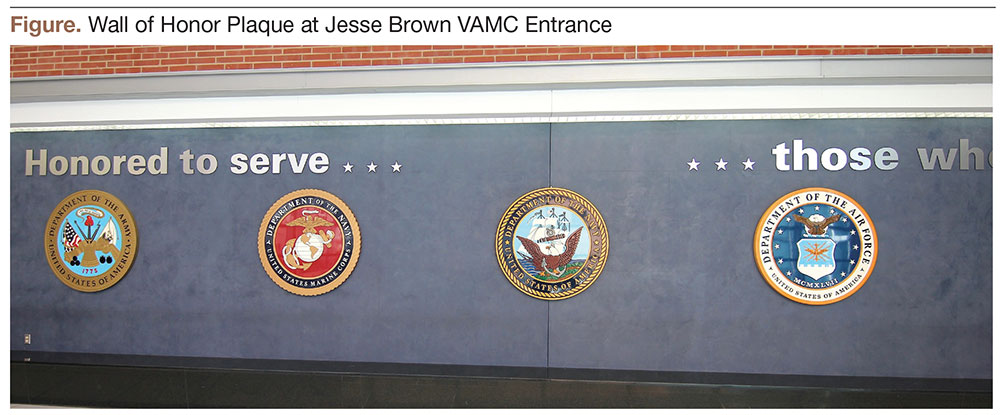
1. Snyder C. Donald Trump vows to take on ‘corrupt’ Veterans Affairs. Fox News. October 31, 2016. http://www.foxnews.com/politics/2015/10/31/donald-trump-vows-to-take-on-corrupt-veterans-affairs.html. Accessed August 30, 2016.
2. Veterans administration reforms that will make America great again. https://assets.donaldjtrump.com/veterans-administration-reforms.pdf. Accessed August 29, 2016.
3. Galvan A. Problems remain at Phoenix VA hospital after scandal. The Washington Times. April 9, 2015. http://www.washingtontimes.com/news/2015/apr/9/problems-remain-at-phoenix-va-hospital-after-scand. Accessed August 30, 2016.
4. Walsh S. How congress and the VA left many veterans without a ‘choice’ [transcript]. Morning Edition. National Public Radio. http://www.npr.org/2016/05/17/478215589/how-congress-and-the-va-left-many-veterans-without-a-choice. Published May 17, 2016. Accessed August 29, 2016.
5. VA Office of Inspector General. OIG determination of veterans health administration’s occupational staffing shortages. http://www.va.gov/oig/pubs/VAOIG-15-00430-103.pdf. Accessed August 30, 2016.
6. Oppel RA Jr, Goodnough A. Doctor shortage is cited in delays at VA hospitals. The New York Times. http://www.nytimes.com/2014/05/30/us/doctor-shortages-cited-in-va-hospital-waits.html. Published May 29, 2014. Accessed August 30, 2016.
7. Grover A, Prescott JE, Shick M. AAMC presentation to the Department of Veterans Affairs Commission on Care. https://commissiononcare.sites.usa.gov/files/2016/01/20151116-09-AAMC_Presentation_to_Commission_on_Care-111715.pdf. Published November 17, 2015. Accessed August 30, 2016.
8. McDonald RA. Viewpoint: VA’s affiliations with medical schools are good for veterans and all Americans. https://www.aamc.org/newsroom/reporter/april2015/429704/viewpoint.html. Published April 2015. Accessed August 30, 2016.
9. U.S. News and World Report. Best medical schools: Research. http://grad-schools.usnews.rankingsandreviews.com/best-graduate-schools/top-medical-schools/research-rankings. Accessed August 30, 2016.
10. The Match. 2015 residency match largest on record with more than 41,000 applicants vying for over 30,000 residency positions in 4,756 programs [press release]. http://www.nrmp.org/press-release-2015-residency-match-largest-on-record-with-more-than-41000-applicants-vying-for-over-30000-residency-positions-in-4756-programs. Accessed August 30, 2016.
11. Department of Veterans Affairs, Office of Public Affairs. America’s wars. http://www.va.gov/opa/publications/factsheets/fs_americas_wars.pdf. Accessed August 30, 2016.
12. U.S. Department of Defense. Casualty status. http://www.defense.gov/casualty.pdf. Accessed August 30, 2016.
In this presidential election cycle, health care issues are at the forefront of political discussions. In particular, presidential candidate Donald Trump has spotlighted the issue of caring for veterans by offering a 10-point plan.1 Mr. Trump insists that his plan would ensure that veterans have convenient access to the best quality care and “decrease wait time, improve health care outcomes, and facilitate a seamless transition from service to civilian life.”2
Whether one agrees with Mr. Trump’s policy proposals or not, one thing is clear: We need to provide better care for our veterans.3 Even the Veterans Choice Program, enacted 2 years ago, has shown signs of substantial difficulties.4 The improvement of veteran care likely requires a multifaceted approach. There are many factors that can, and do, hinder the optimal delivery of care, but the shortages of nurses, pharmacists, nurse practitioners, physician assistants, and other health care providers is one of the most important.5
The shortage of physicians, which is the focus of this editorial, is especially acute.5 The Office of Inspector General (OIG) determined that a shortage of medical officers (defined as health care providers with an MD or DO degree) was the top issue affecting veteran care and the nurse shortage was second.5 However, the study did not break down the physician shortage by clinical specialty. According to other reports, the VA’s specialty physician shortage seems to vary. While some VA medical centers (VAMCs) had a shortage of primary care physicians (PCPs), others had a greater need for specialists.6,7
Enhancing communication regarding the importance of veteran care, improving the VA physician recruitment process, and reducing the compensation disparity between VA physicians and non-VA physicians may help reduce the VA physician shortage indicated by OIG. Still the best way to resolve the VA physician shortage is unclear.
I propose that instituting a service requirement for graduating residents is possibly a more effective way to solve the VA physician shortage. I will delineate my argument in 3 simple points: fairness, feasibility, and altruism.
Fairness
The VAMCs have been the backbone of resident physician training and therefore deserve to be served by the graduating residents they help to train. Historically, VAMCs often have been affiliated with nearby medical schools to provide veterans with state-of-the-art health care. In turn, VAMCs provide some of the best training opportunities for resident physicians and medical students. Drs. Magnuson and DeBakey conceived the idea of a “marriage” between a VAMC and a medical school following World War II.8 With few exceptions, the best residency programs have at least 1 VAMC affiliation. According to the 2016 ranking of the best medical schools in the U.S. by U.S. News and World Report, 13 of the top 15 medical schools have a VAMC affiliate.9 Currently, the VA has formal affiliation agreements with 135 of 141 medical schools.8
Each year, VAMCs provide practical experience to medical students, resident physicians, and other health care trainees. In 2013, more than 20,000 medical students, 41,000 resident physicians, and 300 fellowship physicians received part or all of their training at VAMCs. Overall, about 70% of all U.S. physicians received their training at VA facilities.
Moreover, VAMCs provide not only the training facility and opportunity, but also substantial financial support to train residents: They currently fund more than 10,000 full-time equivalent positions for residents, about one-third of all resident positions in the U.S.8 While other federal government funding for residency training programs has flat-lined, the VA is the only federal government agency that has received increased funding recently.8 Most of the remaining federal funding for residency programs is provided through Medicare.
Given that the federal government (and the VA in particular) has provided so much support for resident physician training, it is perhaps fair that we ask our graduated residents to help solve the VA physician shortage. In addition, VA could consider tying in this service with a student loan reduction program, which would make this arrangement not only ethically compelling, but also financially practical.
Feasibility
Currently about 30,000 resident physicians graduate from 4,756 programs in the U.S. yearly.10 It has been estimated there is a shortage of 1,400 VA physicians in the U.S. The VA needs < 5% of graduating resident physicians to serve in VAMCs for 1 year in order to completely and certainly solve the physician shortage problem.
To be sure, the optimum resolution would be for the VA to recruit permanent physicians who build long-term, trusting relationships with patients and continuity of care. However, with the current situation in which permanent positions are left unfilled, a short-term program may be better than the status quo. In addition, having experienced the VA working environment, some of these newly graduated physicians serving short-term at the VA may decide later to make the VA a permanent home.
How do we then carry out this requirement? First, we could ask for volunteers once the VA determines the exact number of physicians needed in a given year. If resident physicians volunteers cannot meet VA’s needs, the remaining slots can be filled using a lottery.
Logistically, a lottery can be achieved in the following way. The process needs to be started 3 years before graduation due to residents’ need for advanced career planning. For the 3-year residency program, the lottery would be held at the beginning of the first year of residency. For the 5-year residency program, the lottery would be held at the beginning of third year of residency. All residency programs would be required to report the names of residents and residents who volunteer for 1 year VA service after residency to a central government depository, which would run a random, computerized process to generate names of the residents for the obligation. Residents would learn the lottery results no later than the end of that training year, so residents would have 2 years to plan for their careers, either for a permanent job or additional fellowship training, according to the lottery outcomes. Obviously, federal legislation would be needed to fund and establish the rightful authority to enforce the arrangement.
Altruism
Whether a person is a Republican, Democrat, or independent, we all sincerely appreciate the sacrifice that veterans provide to protect our nation through the ages. Regardless if one agrees with the objective of a particular war or not, our veterans served at the command of the presidents from both major parties. Veterans simply serve their country with their lives on the line. Since World War I, 116,516 World War I, 405,399 World War II, 54,246 Korean War, 90,220 Vietnam War, and 4,424 Operation Iraq Freedom U.S. soldiers and military personnel have died for our country during active duty.11,12 In addition, many more veterans experienced permanent injuries and illness while protecting our country and our freedom.11,12 Is it too much to ask our graduated residents, albeit a tiny percentage, to share some of the burden to care for our national heroes for just 1 year? I certainly do not think so.
One possible way to raise national awareness of the need for veteran health care is to make this issue a national service obligation, much like that of military service. We could promote the concept in a slogan, such as “The soldiers’ obligation: Serve the nation in the front lines; the nation’s obligation: Provides care when soldiers return home.” Volunteerism is the preferred method of military recruitment. However, if voluntary enlistment does not fulfill the military need, drafting may be the next necessity. The same logical argument can be used to promote the solution for the VA physician shortage.
Although I’ve focused on the solution for physicians, the same process can be expanded for the shortage of nurses, nurse practitioners, physician assistants, and other health care providers. That way, the VA patient would receive even better care.
I’ve served as a part-time VA physician for 25 consecutive years, and I have gladly provided care for our veterans and would be delighted to welcome our graduating residents in joining me and other dedicated VA physicians in this noble effort. As one Chicago VAMC banner beautifully depicted, “Honored to serve … those who served” (Figure), this is, indeed, the right thing to do.
In this presidential election cycle, health care issues are at the forefront of political discussions. In particular, presidential candidate Donald Trump has spotlighted the issue of caring for veterans by offering a 10-point plan.1 Mr. Trump insists that his plan would ensure that veterans have convenient access to the best quality care and “decrease wait time, improve health care outcomes, and facilitate a seamless transition from service to civilian life.”2
Whether one agrees with Mr. Trump’s policy proposals or not, one thing is clear: We need to provide better care for our veterans.3 Even the Veterans Choice Program, enacted 2 years ago, has shown signs of substantial difficulties.4 The improvement of veteran care likely requires a multifaceted approach. There are many factors that can, and do, hinder the optimal delivery of care, but the shortages of nurses, pharmacists, nurse practitioners, physician assistants, and other health care providers is one of the most important.5
The shortage of physicians, which is the focus of this editorial, is especially acute.5 The Office of Inspector General (OIG) determined that a shortage of medical officers (defined as health care providers with an MD or DO degree) was the top issue affecting veteran care and the nurse shortage was second.5 However, the study did not break down the physician shortage by clinical specialty. According to other reports, the VA’s specialty physician shortage seems to vary. While some VA medical centers (VAMCs) had a shortage of primary care physicians (PCPs), others had a greater need for specialists.6,7
Enhancing communication regarding the importance of veteran care, improving the VA physician recruitment process, and reducing the compensation disparity between VA physicians and non-VA physicians may help reduce the VA physician shortage indicated by OIG. Still the best way to resolve the VA physician shortage is unclear.
I propose that instituting a service requirement for graduating residents is possibly a more effective way to solve the VA physician shortage. I will delineate my argument in 3 simple points: fairness, feasibility, and altruism.
Fairness
The VAMCs have been the backbone of resident physician training and therefore deserve to be served by the graduating residents they help to train. Historically, VAMCs often have been affiliated with nearby medical schools to provide veterans with state-of-the-art health care. In turn, VAMCs provide some of the best training opportunities for resident physicians and medical students. Drs. Magnuson and DeBakey conceived the idea of a “marriage” between a VAMC and a medical school following World War II.8 With few exceptions, the best residency programs have at least 1 VAMC affiliation. According to the 2016 ranking of the best medical schools in the U.S. by U.S. News and World Report, 13 of the top 15 medical schools have a VAMC affiliate.9 Currently, the VA has formal affiliation agreements with 135 of 141 medical schools.8
Each year, VAMCs provide practical experience to medical students, resident physicians, and other health care trainees. In 2013, more than 20,000 medical students, 41,000 resident physicians, and 300 fellowship physicians received part or all of their training at VAMCs. Overall, about 70% of all U.S. physicians received their training at VA facilities.
Moreover, VAMCs provide not only the training facility and opportunity, but also substantial financial support to train residents: They currently fund more than 10,000 full-time equivalent positions for residents, about one-third of all resident positions in the U.S.8 While other federal government funding for residency training programs has flat-lined, the VA is the only federal government agency that has received increased funding recently.8 Most of the remaining federal funding for residency programs is provided through Medicare.
Given that the federal government (and the VA in particular) has provided so much support for resident physician training, it is perhaps fair that we ask our graduated residents to help solve the VA physician shortage. In addition, VA could consider tying in this service with a student loan reduction program, which would make this arrangement not only ethically compelling, but also financially practical.
Feasibility
Currently about 30,000 resident physicians graduate from 4,756 programs in the U.S. yearly.10 It has been estimated there is a shortage of 1,400 VA physicians in the U.S. The VA needs < 5% of graduating resident physicians to serve in VAMCs for 1 year in order to completely and certainly solve the physician shortage problem.
To be sure, the optimum resolution would be for the VA to recruit permanent physicians who build long-term, trusting relationships with patients and continuity of care. However, with the current situation in which permanent positions are left unfilled, a short-term program may be better than the status quo. In addition, having experienced the VA working environment, some of these newly graduated physicians serving short-term at the VA may decide later to make the VA a permanent home.
How do we then carry out this requirement? First, we could ask for volunteers once the VA determines the exact number of physicians needed in a given year. If resident physicians volunteers cannot meet VA’s needs, the remaining slots can be filled using a lottery.
Logistically, a lottery can be achieved in the following way. The process needs to be started 3 years before graduation due to residents’ need for advanced career planning. For the 3-year residency program, the lottery would be held at the beginning of the first year of residency. For the 5-year residency program, the lottery would be held at the beginning of third year of residency. All residency programs would be required to report the names of residents and residents who volunteer for 1 year VA service after residency to a central government depository, which would run a random, computerized process to generate names of the residents for the obligation. Residents would learn the lottery results no later than the end of that training year, so residents would have 2 years to plan for their careers, either for a permanent job or additional fellowship training, according to the lottery outcomes. Obviously, federal legislation would be needed to fund and establish the rightful authority to enforce the arrangement.
Altruism
Whether a person is a Republican, Democrat, or independent, we all sincerely appreciate the sacrifice that veterans provide to protect our nation through the ages. Regardless if one agrees with the objective of a particular war or not, our veterans served at the command of the presidents from both major parties. Veterans simply serve their country with their lives on the line. Since World War I, 116,516 World War I, 405,399 World War II, 54,246 Korean War, 90,220 Vietnam War, and 4,424 Operation Iraq Freedom U.S. soldiers and military personnel have died for our country during active duty.11,12 In addition, many more veterans experienced permanent injuries and illness while protecting our country and our freedom.11,12 Is it too much to ask our graduated residents, albeit a tiny percentage, to share some of the burden to care for our national heroes for just 1 year? I certainly do not think so.
One possible way to raise national awareness of the need for veteran health care is to make this issue a national service obligation, much like that of military service. We could promote the concept in a slogan, such as “The soldiers’ obligation: Serve the nation in the front lines; the nation’s obligation: Provides care when soldiers return home.” Volunteerism is the preferred method of military recruitment. However, if voluntary enlistment does not fulfill the military need, drafting may be the next necessity. The same logical argument can be used to promote the solution for the VA physician shortage.
Although I’ve focused on the solution for physicians, the same process can be expanded for the shortage of nurses, nurse practitioners, physician assistants, and other health care providers. That way, the VA patient would receive even better care.
I’ve served as a part-time VA physician for 25 consecutive years, and I have gladly provided care for our veterans and would be delighted to welcome our graduating residents in joining me and other dedicated VA physicians in this noble effort. As one Chicago VAMC banner beautifully depicted, “Honored to serve … those who served” (Figure), this is, indeed, the right thing to do.
1. Snyder C. Donald Trump vows to take on ‘corrupt’ Veterans Affairs. Fox News. October 31, 2016. http://www.foxnews.com/politics/2015/10/31/donald-trump-vows-to-take-on-corrupt-veterans-affairs.html. Accessed August 30, 2016.
2. Veterans administration reforms that will make America great again. https://assets.donaldjtrump.com/veterans-administration-reforms.pdf. Accessed August 29, 2016.
3. Galvan A. Problems remain at Phoenix VA hospital after scandal. The Washington Times. April 9, 2015. http://www.washingtontimes.com/news/2015/apr/9/problems-remain-at-phoenix-va-hospital-after-scand. Accessed August 30, 2016.
4. Walsh S. How congress and the VA left many veterans without a ‘choice’ [transcript]. Morning Edition. National Public Radio. http://www.npr.org/2016/05/17/478215589/how-congress-and-the-va-left-many-veterans-without-a-choice. Published May 17, 2016. Accessed August 29, 2016.
5. VA Office of Inspector General. OIG determination of veterans health administration’s occupational staffing shortages. http://www.va.gov/oig/pubs/VAOIG-15-00430-103.pdf. Accessed August 30, 2016.
6. Oppel RA Jr, Goodnough A. Doctor shortage is cited in delays at VA hospitals. The New York Times. http://www.nytimes.com/2014/05/30/us/doctor-shortages-cited-in-va-hospital-waits.html. Published May 29, 2014. Accessed August 30, 2016.
7. Grover A, Prescott JE, Shick M. AAMC presentation to the Department of Veterans Affairs Commission on Care. https://commissiononcare.sites.usa.gov/files/2016/01/20151116-09-AAMC_Presentation_to_Commission_on_Care-111715.pdf. Published November 17, 2015. Accessed August 30, 2016.
8. McDonald RA. Viewpoint: VA’s affiliations with medical schools are good for veterans and all Americans. https://www.aamc.org/newsroom/reporter/april2015/429704/viewpoint.html. Published April 2015. Accessed August 30, 2016.
9. U.S. News and World Report. Best medical schools: Research. http://grad-schools.usnews.rankingsandreviews.com/best-graduate-schools/top-medical-schools/research-rankings. Accessed August 30, 2016.
10. The Match. 2015 residency match largest on record with more than 41,000 applicants vying for over 30,000 residency positions in 4,756 programs [press release]. http://www.nrmp.org/press-release-2015-residency-match-largest-on-record-with-more-than-41000-applicants-vying-for-over-30000-residency-positions-in-4756-programs. Accessed August 30, 2016.
11. Department of Veterans Affairs, Office of Public Affairs. America’s wars. http://www.va.gov/opa/publications/factsheets/fs_americas_wars.pdf. Accessed August 30, 2016.
12. U.S. Department of Defense. Casualty status. http://www.defense.gov/casualty.pdf. Accessed August 30, 2016.
1. Snyder C. Donald Trump vows to take on ‘corrupt’ Veterans Affairs. Fox News. October 31, 2016. http://www.foxnews.com/politics/2015/10/31/donald-trump-vows-to-take-on-corrupt-veterans-affairs.html. Accessed August 30, 2016.
2. Veterans administration reforms that will make America great again. https://assets.donaldjtrump.com/veterans-administration-reforms.pdf. Accessed August 29, 2016.
3. Galvan A. Problems remain at Phoenix VA hospital after scandal. The Washington Times. April 9, 2015. http://www.washingtontimes.com/news/2015/apr/9/problems-remain-at-phoenix-va-hospital-after-scand. Accessed August 30, 2016.
4. Walsh S. How congress and the VA left many veterans without a ‘choice’ [transcript]. Morning Edition. National Public Radio. http://www.npr.org/2016/05/17/478215589/how-congress-and-the-va-left-many-veterans-without-a-choice. Published May 17, 2016. Accessed August 29, 2016.
5. VA Office of Inspector General. OIG determination of veterans health administration’s occupational staffing shortages. http://www.va.gov/oig/pubs/VAOIG-15-00430-103.pdf. Accessed August 30, 2016.
6. Oppel RA Jr, Goodnough A. Doctor shortage is cited in delays at VA hospitals. The New York Times. http://www.nytimes.com/2014/05/30/us/doctor-shortages-cited-in-va-hospital-waits.html. Published May 29, 2014. Accessed August 30, 2016.
7. Grover A, Prescott JE, Shick M. AAMC presentation to the Department of Veterans Affairs Commission on Care. https://commissiononcare.sites.usa.gov/files/2016/01/20151116-09-AAMC_Presentation_to_Commission_on_Care-111715.pdf. Published November 17, 2015. Accessed August 30, 2016.
8. McDonald RA. Viewpoint: VA’s affiliations with medical schools are good for veterans and all Americans. https://www.aamc.org/newsroom/reporter/april2015/429704/viewpoint.html. Published April 2015. Accessed August 30, 2016.
9. U.S. News and World Report. Best medical schools: Research. http://grad-schools.usnews.rankingsandreviews.com/best-graduate-schools/top-medical-schools/research-rankings. Accessed August 30, 2016.
10. The Match. 2015 residency match largest on record with more than 41,000 applicants vying for over 30,000 residency positions in 4,756 programs [press release]. http://www.nrmp.org/press-release-2015-residency-match-largest-on-record-with-more-than-41000-applicants-vying-for-over-30000-residency-positions-in-4756-programs. Accessed August 30, 2016.
11. Department of Veterans Affairs, Office of Public Affairs. America’s wars. http://www.va.gov/opa/publications/factsheets/fs_americas_wars.pdf. Accessed August 30, 2016.
12. U.S. Department of Defense. Casualty status. http://www.defense.gov/casualty.pdf. Accessed August 30, 2016.
Influence of Diet in Acne Vulgaris and Atopic Dermatitis
When I am in clinic, I often get at least 3 to 4 inquiries each day from patients about the necessity for dietary restrictions or alterations as well as the benefits of these changes in limiting their dermatological disease processes. I usually am restricted in my response because the research rarely indicates benefits of one diet versus another; however, this discussion has recently become a heavily researched area as patients have come to value natural nonpharmaceutical approaches to their holistic care. In this article, a few dietary restrictions and supplements are reviewed that may have a beneficial effect in managing patients with acne vulgaris and atopic dermatitis.
Acne Vulgaris
In 1969 Fulton et al1 conducted one of the first few trials on acne and diet management. In this crossover, patient-blinded, interventional study, patients were divided into 2 subgroups (N=65): 1 adolescent patient with moderate acne was compared to 1 male prisoner given a chocolate bar for 4 weeks or a control bar with equivalent caloric index. The results indicated no change in acne vulgaris lesions based on either intervention; however, there were obvious deficiencies in the study including small sample size, inappropriate grouping of an adolescent patient versus a prisoner, and limited study period.1
Since then, multiple studies have been conducted with parallel participants, large sample sizes, and at least a 12-week study period. In 2005, Adebamowo et al2 studied 47,355 women using a validated food frequency questionnaire that determined the amount of dairy consumed, specifically skim milk. The study showed a positive link between increased dairy consumption and acne formation; however, again due to the retrospective analysis and recall bias, it is difficult to determine if a link can truly be noted between acne and dairy in this study.2
More recently, LaRosa et al3 conducted a study that included 225 participants aged 14 to 19 years. Excluding participants with lactose intolerance and current use of oral contraceptives and isotretinoin, the study placed 120 participants in the test group versus 105 participants in the control group. The study was conducted using 3 telephone interviews and a 24-hour diet recall technique. The results supported a link between acne and skim milk consumption. Again, although the studied relied on participant self-reports of diet and followed a case-control design, a possible association was suspected but not validated.3 A longitudinal, questionnaire-based population study performed by Ulvestad et al4 included 2489 patients. This study further evaluated recall of dairy product consumption at 15 to 16 years of age and then 3 years later acne severity was self-assessed and reported at 18 to 19 years of age. Overall, this evaluation indicated that a high intake of dairy products and acne in adolescence have been positively associated. However, it was another retrospective study with recall bias.4 In 2009 Melnick and Schmitz5 concluded that milk causes the body to elevate both insulin and insulinlike growth factor 1 levels. In another study by Melnick6 in 2011, a definitive link between increased insulin and insulinlike growth factor 1 signaling in promoting comedogenesis was reported. Given the few studies that show the potential link between dairy products and acne, this dairy-free diet can be considered as a diet recommendation for acne patients.
Atopic Dermatitis
A Cochrane review conducted in 2012 regarding dietary supplements as a treatment of atopic dermatitis evaluated randomized controlled trials (N=596). Supplementation with vitamin D, fish oil, olive oil, zinc sulfate, selenium, vitamin E, pyridoxine, sea buckthorn seed oil, hempseed oil, sunflower oil (linoleic acid), and docosahexaenoic acid were evaluated among all the studies reviewed for atopic dermatitis.7 Bronsnick et al8 conducted a review of evidence supporting vitamin supplementation and atopic dermatitis, and for the most part determined that the studies had insufficient evidence. The only positive correlation was noted with prebiotics and probiotics in another Cochrane review in 2013, which evaluated 4 studies with 1428 infants showing prebiotic supplementation reduced atopic dermatitis.9 In 2014 Panduru et al10 evaluated 16 studies in a meta-analysis that showed how probiotics were possibly beneficial in both general and high-risk atopic populations. Specifically, a subgroup analysis showed that Lactobacillus and Lactobacillus with Bifidobacterium also can be protective against atopic dermatitis.10 Lastly, diet avoidance in pregnancy or during lactation in infants up to 18 months of age did not have any effect on improving the infant’s atopic dermatitis based on a 2012 Cochrane review that included 952 participants.11
Conclusion
Overall, there are some benefits to dietary restrictions and supplementation as indicated by the studies reviewed here; however, the extent to which these changes contribute to disease manifestation has only been linked, not definitively proven. Randomized controlled trials with large sample sizes, double-blind studies, and appropriately controlled studies with comparative patient populations are difficult to obtain, as diet cannot be completely restrictive for every patient. Patients should be provided with the latest data supporting a possible link between dairy consumption and acne production as well as prebiotics or probiotics during pregnancy and at infancy to reduce the risk for atopic dermatitis with the caveat of association. That said, future studies might prove that dietary and environmental alterations may prevent disease progression or appearance far more than previously assumed.
- Fulton JE Jr, Plewaig G, Kligman AM. Effect of chocolate on acne vulgaris. JAMA. 1969;210: 2071-2074.
- Adebamowo CA, Spiegelman D, Berkey CS, et al. High school dietary diary intake and teenage acne. J Am Acad Dermatol. 2005;52:207-214.
- LaRosa CL, Quach KA, Koons K, et al. Consumption of dairy in teenagers with and without acne. J Am Acad Dermatol. 2016;75:318-322.
- Ulvestad M, Bjertness E, Dalgard F, et al. Acne and dairy products in adolescence: results from a Norwegian longitudinal study [published online ahead of print July 16, 2016]. J Eur Acad Dermatol Venereol. doi:10.1111/jdv.13835.
- Melnick BC, Schmitz G. Role of insulin, insulin like growth factor 1, hyperglycemic food and milk consumption in the pathogenesis of acne vulgaris. Exp Dermatol. 2009;18:833-841.
- Melnick BC. Evidence for acne-promoting effect of milk and other insulinotropic dairy products. Nestle Nutr Worksop
Ser Pediatr Program. 2011;67:131-145. - Bath-Hextall FJ, Jenkinson C, Humphreys R, et al. Dietary supplements for established atopic eczema. Cochrane Database Syst Rev. 2012;2:CD005205.
- Bronsnick T, Murzaku EC, Rao BK. Diet in dermatology: part i. atopic dermatitis, acne, and nonmelanoma skin cancer [published online November 15, 2014]. J Am Acad Dermatol. 2014;71:1039.e1-1039.e12.
- Osborn DA, Sinn JKH. Prebiotics in infants for prevention of allergy. Cochrane Database Syst Rev. 2013;2:CD006474.
- Panduru M, Panduru NM, Saˇlaˇvaˇstru CM, et al. Probiotics and primary prevention of atopic dermatitis: a meta-analysis of randomized controlled studies [published online April 4, 2014]. J Eur Acad Dermatol Venereol. 2015;29:232-242.
- Kramer MS, Kakuma R. Maternal dietary antigen avoidance during pregnancy or lactation, or both, for preventing or treating atopic disease in the child. Cochrane Database Syst Rev. 2012;9:CD000133.
When I am in clinic, I often get at least 3 to 4 inquiries each day from patients about the necessity for dietary restrictions or alterations as well as the benefits of these changes in limiting their dermatological disease processes. I usually am restricted in my response because the research rarely indicates benefits of one diet versus another; however, this discussion has recently become a heavily researched area as patients have come to value natural nonpharmaceutical approaches to their holistic care. In this article, a few dietary restrictions and supplements are reviewed that may have a beneficial effect in managing patients with acne vulgaris and atopic dermatitis.
Acne Vulgaris
In 1969 Fulton et al1 conducted one of the first few trials on acne and diet management. In this crossover, patient-blinded, interventional study, patients were divided into 2 subgroups (N=65): 1 adolescent patient with moderate acne was compared to 1 male prisoner given a chocolate bar for 4 weeks or a control bar with equivalent caloric index. The results indicated no change in acne vulgaris lesions based on either intervention; however, there were obvious deficiencies in the study including small sample size, inappropriate grouping of an adolescent patient versus a prisoner, and limited study period.1
Since then, multiple studies have been conducted with parallel participants, large sample sizes, and at least a 12-week study period. In 2005, Adebamowo et al2 studied 47,355 women using a validated food frequency questionnaire that determined the amount of dairy consumed, specifically skim milk. The study showed a positive link between increased dairy consumption and acne formation; however, again due to the retrospective analysis and recall bias, it is difficult to determine if a link can truly be noted between acne and dairy in this study.2
More recently, LaRosa et al3 conducted a study that included 225 participants aged 14 to 19 years. Excluding participants with lactose intolerance and current use of oral contraceptives and isotretinoin, the study placed 120 participants in the test group versus 105 participants in the control group. The study was conducted using 3 telephone interviews and a 24-hour diet recall technique. The results supported a link between acne and skim milk consumption. Again, although the studied relied on participant self-reports of diet and followed a case-control design, a possible association was suspected but not validated.3 A longitudinal, questionnaire-based population study performed by Ulvestad et al4 included 2489 patients. This study further evaluated recall of dairy product consumption at 15 to 16 years of age and then 3 years later acne severity was self-assessed and reported at 18 to 19 years of age. Overall, this evaluation indicated that a high intake of dairy products and acne in adolescence have been positively associated. However, it was another retrospective study with recall bias.4 In 2009 Melnick and Schmitz5 concluded that milk causes the body to elevate both insulin and insulinlike growth factor 1 levels. In another study by Melnick6 in 2011, a definitive link between increased insulin and insulinlike growth factor 1 signaling in promoting comedogenesis was reported. Given the few studies that show the potential link between dairy products and acne, this dairy-free diet can be considered as a diet recommendation for acne patients.
Atopic Dermatitis
A Cochrane review conducted in 2012 regarding dietary supplements as a treatment of atopic dermatitis evaluated randomized controlled trials (N=596). Supplementation with vitamin D, fish oil, olive oil, zinc sulfate, selenium, vitamin E, pyridoxine, sea buckthorn seed oil, hempseed oil, sunflower oil (linoleic acid), and docosahexaenoic acid were evaluated among all the studies reviewed for atopic dermatitis.7 Bronsnick et al8 conducted a review of evidence supporting vitamin supplementation and atopic dermatitis, and for the most part determined that the studies had insufficient evidence. The only positive correlation was noted with prebiotics and probiotics in another Cochrane review in 2013, which evaluated 4 studies with 1428 infants showing prebiotic supplementation reduced atopic dermatitis.9 In 2014 Panduru et al10 evaluated 16 studies in a meta-analysis that showed how probiotics were possibly beneficial in both general and high-risk atopic populations. Specifically, a subgroup analysis showed that Lactobacillus and Lactobacillus with Bifidobacterium also can be protective against atopic dermatitis.10 Lastly, diet avoidance in pregnancy or during lactation in infants up to 18 months of age did not have any effect on improving the infant’s atopic dermatitis based on a 2012 Cochrane review that included 952 participants.11
Conclusion
Overall, there are some benefits to dietary restrictions and supplementation as indicated by the studies reviewed here; however, the extent to which these changes contribute to disease manifestation has only been linked, not definitively proven. Randomized controlled trials with large sample sizes, double-blind studies, and appropriately controlled studies with comparative patient populations are difficult to obtain, as diet cannot be completely restrictive for every patient. Patients should be provided with the latest data supporting a possible link between dairy consumption and acne production as well as prebiotics or probiotics during pregnancy and at infancy to reduce the risk for atopic dermatitis with the caveat of association. That said, future studies might prove that dietary and environmental alterations may prevent disease progression or appearance far more than previously assumed.
When I am in clinic, I often get at least 3 to 4 inquiries each day from patients about the necessity for dietary restrictions or alterations as well as the benefits of these changes in limiting their dermatological disease processes. I usually am restricted in my response because the research rarely indicates benefits of one diet versus another; however, this discussion has recently become a heavily researched area as patients have come to value natural nonpharmaceutical approaches to their holistic care. In this article, a few dietary restrictions and supplements are reviewed that may have a beneficial effect in managing patients with acne vulgaris and atopic dermatitis.
Acne Vulgaris
In 1969 Fulton et al1 conducted one of the first few trials on acne and diet management. In this crossover, patient-blinded, interventional study, patients were divided into 2 subgroups (N=65): 1 adolescent patient with moderate acne was compared to 1 male prisoner given a chocolate bar for 4 weeks or a control bar with equivalent caloric index. The results indicated no change in acne vulgaris lesions based on either intervention; however, there were obvious deficiencies in the study including small sample size, inappropriate grouping of an adolescent patient versus a prisoner, and limited study period.1
Since then, multiple studies have been conducted with parallel participants, large sample sizes, and at least a 12-week study period. In 2005, Adebamowo et al2 studied 47,355 women using a validated food frequency questionnaire that determined the amount of dairy consumed, specifically skim milk. The study showed a positive link between increased dairy consumption and acne formation; however, again due to the retrospective analysis and recall bias, it is difficult to determine if a link can truly be noted between acne and dairy in this study.2
More recently, LaRosa et al3 conducted a study that included 225 participants aged 14 to 19 years. Excluding participants with lactose intolerance and current use of oral contraceptives and isotretinoin, the study placed 120 participants in the test group versus 105 participants in the control group. The study was conducted using 3 telephone interviews and a 24-hour diet recall technique. The results supported a link between acne and skim milk consumption. Again, although the studied relied on participant self-reports of diet and followed a case-control design, a possible association was suspected but not validated.3 A longitudinal, questionnaire-based population study performed by Ulvestad et al4 included 2489 patients. This study further evaluated recall of dairy product consumption at 15 to 16 years of age and then 3 years later acne severity was self-assessed and reported at 18 to 19 years of age. Overall, this evaluation indicated that a high intake of dairy products and acne in adolescence have been positively associated. However, it was another retrospective study with recall bias.4 In 2009 Melnick and Schmitz5 concluded that milk causes the body to elevate both insulin and insulinlike growth factor 1 levels. In another study by Melnick6 in 2011, a definitive link between increased insulin and insulinlike growth factor 1 signaling in promoting comedogenesis was reported. Given the few studies that show the potential link between dairy products and acne, this dairy-free diet can be considered as a diet recommendation for acne patients.
Atopic Dermatitis
A Cochrane review conducted in 2012 regarding dietary supplements as a treatment of atopic dermatitis evaluated randomized controlled trials (N=596). Supplementation with vitamin D, fish oil, olive oil, zinc sulfate, selenium, vitamin E, pyridoxine, sea buckthorn seed oil, hempseed oil, sunflower oil (linoleic acid), and docosahexaenoic acid were evaluated among all the studies reviewed for atopic dermatitis.7 Bronsnick et al8 conducted a review of evidence supporting vitamin supplementation and atopic dermatitis, and for the most part determined that the studies had insufficient evidence. The only positive correlation was noted with prebiotics and probiotics in another Cochrane review in 2013, which evaluated 4 studies with 1428 infants showing prebiotic supplementation reduced atopic dermatitis.9 In 2014 Panduru et al10 evaluated 16 studies in a meta-analysis that showed how probiotics were possibly beneficial in both general and high-risk atopic populations. Specifically, a subgroup analysis showed that Lactobacillus and Lactobacillus with Bifidobacterium also can be protective against atopic dermatitis.10 Lastly, diet avoidance in pregnancy or during lactation in infants up to 18 months of age did not have any effect on improving the infant’s atopic dermatitis based on a 2012 Cochrane review that included 952 participants.11
Conclusion
Overall, there are some benefits to dietary restrictions and supplementation as indicated by the studies reviewed here; however, the extent to which these changes contribute to disease manifestation has only been linked, not definitively proven. Randomized controlled trials with large sample sizes, double-blind studies, and appropriately controlled studies with comparative patient populations are difficult to obtain, as diet cannot be completely restrictive for every patient. Patients should be provided with the latest data supporting a possible link between dairy consumption and acne production as well as prebiotics or probiotics during pregnancy and at infancy to reduce the risk for atopic dermatitis with the caveat of association. That said, future studies might prove that dietary and environmental alterations may prevent disease progression or appearance far more than previously assumed.
- Fulton JE Jr, Plewaig G, Kligman AM. Effect of chocolate on acne vulgaris. JAMA. 1969;210: 2071-2074.
- Adebamowo CA, Spiegelman D, Berkey CS, et al. High school dietary diary intake and teenage acne. J Am Acad Dermatol. 2005;52:207-214.
- LaRosa CL, Quach KA, Koons K, et al. Consumption of dairy in teenagers with and without acne. J Am Acad Dermatol. 2016;75:318-322.
- Ulvestad M, Bjertness E, Dalgard F, et al. Acne and dairy products in adolescence: results from a Norwegian longitudinal study [published online ahead of print July 16, 2016]. J Eur Acad Dermatol Venereol. doi:10.1111/jdv.13835.
- Melnick BC, Schmitz G. Role of insulin, insulin like growth factor 1, hyperglycemic food and milk consumption in the pathogenesis of acne vulgaris. Exp Dermatol. 2009;18:833-841.
- Melnick BC. Evidence for acne-promoting effect of milk and other insulinotropic dairy products. Nestle Nutr Worksop
Ser Pediatr Program. 2011;67:131-145. - Bath-Hextall FJ, Jenkinson C, Humphreys R, et al. Dietary supplements for established atopic eczema. Cochrane Database Syst Rev. 2012;2:CD005205.
- Bronsnick T, Murzaku EC, Rao BK. Diet in dermatology: part i. atopic dermatitis, acne, and nonmelanoma skin cancer [published online November 15, 2014]. J Am Acad Dermatol. 2014;71:1039.e1-1039.e12.
- Osborn DA, Sinn JKH. Prebiotics in infants for prevention of allergy. Cochrane Database Syst Rev. 2013;2:CD006474.
- Panduru M, Panduru NM, Saˇlaˇvaˇstru CM, et al. Probiotics and primary prevention of atopic dermatitis: a meta-analysis of randomized controlled studies [published online April 4, 2014]. J Eur Acad Dermatol Venereol. 2015;29:232-242.
- Kramer MS, Kakuma R. Maternal dietary antigen avoidance during pregnancy or lactation, or both, for preventing or treating atopic disease in the child. Cochrane Database Syst Rev. 2012;9:CD000133.
- Fulton JE Jr, Plewaig G, Kligman AM. Effect of chocolate on acne vulgaris. JAMA. 1969;210: 2071-2074.
- Adebamowo CA, Spiegelman D, Berkey CS, et al. High school dietary diary intake and teenage acne. J Am Acad Dermatol. 2005;52:207-214.
- LaRosa CL, Quach KA, Koons K, et al. Consumption of dairy in teenagers with and without acne. J Am Acad Dermatol. 2016;75:318-322.
- Ulvestad M, Bjertness E, Dalgard F, et al. Acne and dairy products in adolescence: results from a Norwegian longitudinal study [published online ahead of print July 16, 2016]. J Eur Acad Dermatol Venereol. doi:10.1111/jdv.13835.
- Melnick BC, Schmitz G. Role of insulin, insulin like growth factor 1, hyperglycemic food and milk consumption in the pathogenesis of acne vulgaris. Exp Dermatol. 2009;18:833-841.
- Melnick BC. Evidence for acne-promoting effect of milk and other insulinotropic dairy products. Nestle Nutr Worksop
Ser Pediatr Program. 2011;67:131-145. - Bath-Hextall FJ, Jenkinson C, Humphreys R, et al. Dietary supplements for established atopic eczema. Cochrane Database Syst Rev. 2012;2:CD005205.
- Bronsnick T, Murzaku EC, Rao BK. Diet in dermatology: part i. atopic dermatitis, acne, and nonmelanoma skin cancer [published online November 15, 2014]. J Am Acad Dermatol. 2014;71:1039.e1-1039.e12.
- Osborn DA, Sinn JKH. Prebiotics in infants for prevention of allergy. Cochrane Database Syst Rev. 2013;2:CD006474.
- Panduru M, Panduru NM, Saˇlaˇvaˇstru CM, et al. Probiotics and primary prevention of atopic dermatitis: a meta-analysis of randomized controlled studies [published online April 4, 2014]. J Eur Acad Dermatol Venereol. 2015;29:232-242.
- Kramer MS, Kakuma R. Maternal dietary antigen avoidance during pregnancy or lactation, or both, for preventing or treating atopic disease in the child. Cochrane Database Syst Rev. 2012;9:CD000133.
Direct-to-Consumer Marketing: Implications for Patient Care and Orthopedic Education
Direct-to-consumer marketing (DTCM) is the promotion of health-related products or services directly to patients. Although this topic is not new to orthopedics, several emerging trends hold troubling implications for patients as well as orthopedic surgeons, particularly surgeons in training.
Orthopedics DTCM most commonly involves television and print advertisements. Supporters contend DTCM is an empowering educational tool that increases awareness of medical ailments and encourages patients to seek treatment. Opponents point to inaccuracies and misleading claims. Bhattacharyya and colleagues1 found that about half the claims in orthopedic print advertisements were not supported by clinical evidence. Woloshin and colleagues2 found that information in DTCM was vague and often was designed to act on the emotions. Patients misled by these claims and innately seeking improvement could present with unreasonable expectations and difficult discussions that can be detrimental to the patient–physician relationship.3Given changing patient demographics and the information revolution, the effects of DTCM likely will continue to grow. Total joint arthroplasty (TJA), which represents Medicare’s largest expenditure,4 is a classic example. Today’s TJA patients are younger, more active, and better educated, and they live longer, have higher expectations, and are more reliant on the media.5 Television is no longer our main medium—the internet is the source of healthcare education for 70% of adults in the United States.6Healthcare reform has also brought significant changes in the delivery of DTCM. In an era of competition for market share brought by increased demand and decreased reimbursement, DTCM has evolved into sales pitches by hospitals and physicians. Robotic joint replacement, minimally invasive surgery (MIS), use of the anterior hip approach, use of sex-specific or high-flexion knee implants, and other practices have become popular marketing tools for surgery centers competing for new patients. As a result, patients often present not only with a complaint but with a request for a particular procedure.4,5 Labovitch and colleagues7 found that 70% of MIS information on the internet was produced by hospitals and private medical groups, and only 6% was produced by industry. Although the vast majority of the sources reported on the advantages of MIS, only 15% explained patient eligibility, and a mere 9% supplied references for examination of peer-reviewed data. Another unfortunate consequence of DCTM is “physician shopping.” Bozic and colleagues4 found that patients exposed to DCTM were more likely to demand a specific surgery, approach, or implant and were less open to alternatives; in addition, they saw more than one surgeon before deciding on joint arthroplasty.
The effects of DTCM on resident and fellowship training require serious consideration. An emphasis on technology has come at the expense of learning the science and art of orthopedics.8 Physicians in training are pressured both to produce more and to use whichever specific technique or product a patient requests.4 Similarly, orthopedic surgeons are seeing job advertisements that read, “Training in robotic surgery or anterior approach is preferred.” Employer pressure can have profound implications for residents and fellows, who may feel compelled to learn these techniques. To a large degree, residents and fellows learn by accompanying their mentors and closely observing their decision-making processes and interactions with patients. Decisions regarding fellowships should not be influenced by surgical techniques or implant choices but by the quality and breadth of clinical experience.
DTCM likely will continue to shape all aspects of care. Claims made by physicians and hospitals are especially troubling because patients trust these sources. We face the challenge of reaffirming our commitment to patients and orthopedic surgeons. As the leader in musculoskeletal education, the American Academy of Orthopaedic Surgeons (AAOS) not only must provide educational material that is compatible with current technological media but must address current controversies and misleading claims. Toward that end, AAOS can expand its patient website, OrthoInfo, to include information on new technologies and surgical techniques pertaining to each musculoskeletal condition. Educating the public about risk factors for poor surgical outcomes is equally important in order to moderate unrealistic expectations and stimulate discussions on risks involved in unnecessary or potentially harmful technologies. The American Association of Hip and Knee Surgeons (AAHKS) has already embarked on this approach. Orthopedic surgeons should continue to abide by the standards of professionalism—maintaining the tenet of “First do no harm,” resisting the temptations of consumerism, and giving patients accurate information. Taking these measures may help reduce physician shopping and strengthen the patient–physician relationship. We physicians are the guardians of patients’ well-being. We also owe it to orthopedic surgeons in training to provide well-balanced, unbiased education. The focus of training should not be on techniques for gaining market edge but on learning evidence-based medicine and surgical principles. In our burdened healthcare system, curbing DTCM has the potential to decrease unnecessary use of resources and improve the quality of education and patient care.
Am J Orthop. 2016;45(6):E335-E336. Copyright Frontline Medical Communications Inc. 2016. All rights reserved.
1. Bhattacharyya T, Tornetta P 3rd, Healy WL, Einhorn TA. The validity of claims made in orthopaedic print advertisements. J Bone Joint Surgery Am. 2003;85(7):1224-1228.
2. Woloshin S, Schwartz LM, Tremmel J, Welch HG. Direct-to-consumer advertisements for prescription drugs: what are Americans being sold? Lancet. 2001;358(9288):1141-1146.
3. Robinson AR, Hohmann KB, Rifkin JI, et al. Direct-to-consumer pharmaceutical advertising: physician and public opinion and potential effects on the physician-patient relationship. Arch Intern Med. 2004;164(4):427-432.
4. Bozic KJ, Smith AR, Hariri S, et al. The 2007 ABJS Marshall Urist award: the impact of direct-to-consumer advertising in orthopaedics. Clin Orthop Relat Res. 2007;(458):202-219.
5. Mason JB. The new demands by patients in the modern era of total joint arthroplasty: a point of view. Clin Orthop Relat Res. 2008;466(1):146-152.
6. Weinstein SL. Words from a “wise old hand”—guideposts for the future. Professor Stuart L. Weinstein. Iowa Orthop J. 2008;28:94-97.
7. Labovitch RS, Bozic KJ, Hansen E. An evaluation of information available on the internet regarding minimally invasive hip arthroplasty. J Arthroplasty. 2006;21(1):1-5.
8. Buckwalter JA. Advancing the science and art of orthopaedics. Lessons from history. J Bone Joint Surg Am. 2000;82(12):1782-1803.
Direct-to-consumer marketing (DTCM) is the promotion of health-related products or services directly to patients. Although this topic is not new to orthopedics, several emerging trends hold troubling implications for patients as well as orthopedic surgeons, particularly surgeons in training.
Orthopedics DTCM most commonly involves television and print advertisements. Supporters contend DTCM is an empowering educational tool that increases awareness of medical ailments and encourages patients to seek treatment. Opponents point to inaccuracies and misleading claims. Bhattacharyya and colleagues1 found that about half the claims in orthopedic print advertisements were not supported by clinical evidence. Woloshin and colleagues2 found that information in DTCM was vague and often was designed to act on the emotions. Patients misled by these claims and innately seeking improvement could present with unreasonable expectations and difficult discussions that can be detrimental to the patient–physician relationship.3Given changing patient demographics and the information revolution, the effects of DTCM likely will continue to grow. Total joint arthroplasty (TJA), which represents Medicare’s largest expenditure,4 is a classic example. Today’s TJA patients are younger, more active, and better educated, and they live longer, have higher expectations, and are more reliant on the media.5 Television is no longer our main medium—the internet is the source of healthcare education for 70% of adults in the United States.6Healthcare reform has also brought significant changes in the delivery of DTCM. In an era of competition for market share brought by increased demand and decreased reimbursement, DTCM has evolved into sales pitches by hospitals and physicians. Robotic joint replacement, minimally invasive surgery (MIS), use of the anterior hip approach, use of sex-specific or high-flexion knee implants, and other practices have become popular marketing tools for surgery centers competing for new patients. As a result, patients often present not only with a complaint but with a request for a particular procedure.4,5 Labovitch and colleagues7 found that 70% of MIS information on the internet was produced by hospitals and private medical groups, and only 6% was produced by industry. Although the vast majority of the sources reported on the advantages of MIS, only 15% explained patient eligibility, and a mere 9% supplied references for examination of peer-reviewed data. Another unfortunate consequence of DCTM is “physician shopping.” Bozic and colleagues4 found that patients exposed to DCTM were more likely to demand a specific surgery, approach, or implant and were less open to alternatives; in addition, they saw more than one surgeon before deciding on joint arthroplasty.
The effects of DTCM on resident and fellowship training require serious consideration. An emphasis on technology has come at the expense of learning the science and art of orthopedics.8 Physicians in training are pressured both to produce more and to use whichever specific technique or product a patient requests.4 Similarly, orthopedic surgeons are seeing job advertisements that read, “Training in robotic surgery or anterior approach is preferred.” Employer pressure can have profound implications for residents and fellows, who may feel compelled to learn these techniques. To a large degree, residents and fellows learn by accompanying their mentors and closely observing their decision-making processes and interactions with patients. Decisions regarding fellowships should not be influenced by surgical techniques or implant choices but by the quality and breadth of clinical experience.
DTCM likely will continue to shape all aspects of care. Claims made by physicians and hospitals are especially troubling because patients trust these sources. We face the challenge of reaffirming our commitment to patients and orthopedic surgeons. As the leader in musculoskeletal education, the American Academy of Orthopaedic Surgeons (AAOS) not only must provide educational material that is compatible with current technological media but must address current controversies and misleading claims. Toward that end, AAOS can expand its patient website, OrthoInfo, to include information on new technologies and surgical techniques pertaining to each musculoskeletal condition. Educating the public about risk factors for poor surgical outcomes is equally important in order to moderate unrealistic expectations and stimulate discussions on risks involved in unnecessary or potentially harmful technologies. The American Association of Hip and Knee Surgeons (AAHKS) has already embarked on this approach. Orthopedic surgeons should continue to abide by the standards of professionalism—maintaining the tenet of “First do no harm,” resisting the temptations of consumerism, and giving patients accurate information. Taking these measures may help reduce physician shopping and strengthen the patient–physician relationship. We physicians are the guardians of patients’ well-being. We also owe it to orthopedic surgeons in training to provide well-balanced, unbiased education. The focus of training should not be on techniques for gaining market edge but on learning evidence-based medicine and surgical principles. In our burdened healthcare system, curbing DTCM has the potential to decrease unnecessary use of resources and improve the quality of education and patient care.
Am J Orthop. 2016;45(6):E335-E336. Copyright Frontline Medical Communications Inc. 2016. All rights reserved.
Direct-to-consumer marketing (DTCM) is the promotion of health-related products or services directly to patients. Although this topic is not new to orthopedics, several emerging trends hold troubling implications for patients as well as orthopedic surgeons, particularly surgeons in training.
Orthopedics DTCM most commonly involves television and print advertisements. Supporters contend DTCM is an empowering educational tool that increases awareness of medical ailments and encourages patients to seek treatment. Opponents point to inaccuracies and misleading claims. Bhattacharyya and colleagues1 found that about half the claims in orthopedic print advertisements were not supported by clinical evidence. Woloshin and colleagues2 found that information in DTCM was vague and often was designed to act on the emotions. Patients misled by these claims and innately seeking improvement could present with unreasonable expectations and difficult discussions that can be detrimental to the patient–physician relationship.3Given changing patient demographics and the information revolution, the effects of DTCM likely will continue to grow. Total joint arthroplasty (TJA), which represents Medicare’s largest expenditure,4 is a classic example. Today’s TJA patients are younger, more active, and better educated, and they live longer, have higher expectations, and are more reliant on the media.5 Television is no longer our main medium—the internet is the source of healthcare education for 70% of adults in the United States.6Healthcare reform has also brought significant changes in the delivery of DTCM. In an era of competition for market share brought by increased demand and decreased reimbursement, DTCM has evolved into sales pitches by hospitals and physicians. Robotic joint replacement, minimally invasive surgery (MIS), use of the anterior hip approach, use of sex-specific or high-flexion knee implants, and other practices have become popular marketing tools for surgery centers competing for new patients. As a result, patients often present not only with a complaint but with a request for a particular procedure.4,5 Labovitch and colleagues7 found that 70% of MIS information on the internet was produced by hospitals and private medical groups, and only 6% was produced by industry. Although the vast majority of the sources reported on the advantages of MIS, only 15% explained patient eligibility, and a mere 9% supplied references for examination of peer-reviewed data. Another unfortunate consequence of DCTM is “physician shopping.” Bozic and colleagues4 found that patients exposed to DCTM were more likely to demand a specific surgery, approach, or implant and were less open to alternatives; in addition, they saw more than one surgeon before deciding on joint arthroplasty.
The effects of DTCM on resident and fellowship training require serious consideration. An emphasis on technology has come at the expense of learning the science and art of orthopedics.8 Physicians in training are pressured both to produce more and to use whichever specific technique or product a patient requests.4 Similarly, orthopedic surgeons are seeing job advertisements that read, “Training in robotic surgery or anterior approach is preferred.” Employer pressure can have profound implications for residents and fellows, who may feel compelled to learn these techniques. To a large degree, residents and fellows learn by accompanying their mentors and closely observing their decision-making processes and interactions with patients. Decisions regarding fellowships should not be influenced by surgical techniques or implant choices but by the quality and breadth of clinical experience.
DTCM likely will continue to shape all aspects of care. Claims made by physicians and hospitals are especially troubling because patients trust these sources. We face the challenge of reaffirming our commitment to patients and orthopedic surgeons. As the leader in musculoskeletal education, the American Academy of Orthopaedic Surgeons (AAOS) not only must provide educational material that is compatible with current technological media but must address current controversies and misleading claims. Toward that end, AAOS can expand its patient website, OrthoInfo, to include information on new technologies and surgical techniques pertaining to each musculoskeletal condition. Educating the public about risk factors for poor surgical outcomes is equally important in order to moderate unrealistic expectations and stimulate discussions on risks involved in unnecessary or potentially harmful technologies. The American Association of Hip and Knee Surgeons (AAHKS) has already embarked on this approach. Orthopedic surgeons should continue to abide by the standards of professionalism—maintaining the tenet of “First do no harm,” resisting the temptations of consumerism, and giving patients accurate information. Taking these measures may help reduce physician shopping and strengthen the patient–physician relationship. We physicians are the guardians of patients’ well-being. We also owe it to orthopedic surgeons in training to provide well-balanced, unbiased education. The focus of training should not be on techniques for gaining market edge but on learning evidence-based medicine and surgical principles. In our burdened healthcare system, curbing DTCM has the potential to decrease unnecessary use of resources and improve the quality of education and patient care.
Am J Orthop. 2016;45(6):E335-E336. Copyright Frontline Medical Communications Inc. 2016. All rights reserved.
1. Bhattacharyya T, Tornetta P 3rd, Healy WL, Einhorn TA. The validity of claims made in orthopaedic print advertisements. J Bone Joint Surgery Am. 2003;85(7):1224-1228.
2. Woloshin S, Schwartz LM, Tremmel J, Welch HG. Direct-to-consumer advertisements for prescription drugs: what are Americans being sold? Lancet. 2001;358(9288):1141-1146.
3. Robinson AR, Hohmann KB, Rifkin JI, et al. Direct-to-consumer pharmaceutical advertising: physician and public opinion and potential effects on the physician-patient relationship. Arch Intern Med. 2004;164(4):427-432.
4. Bozic KJ, Smith AR, Hariri S, et al. The 2007 ABJS Marshall Urist award: the impact of direct-to-consumer advertising in orthopaedics. Clin Orthop Relat Res. 2007;(458):202-219.
5. Mason JB. The new demands by patients in the modern era of total joint arthroplasty: a point of view. Clin Orthop Relat Res. 2008;466(1):146-152.
6. Weinstein SL. Words from a “wise old hand”—guideposts for the future. Professor Stuart L. Weinstein. Iowa Orthop J. 2008;28:94-97.
7. Labovitch RS, Bozic KJ, Hansen E. An evaluation of information available on the internet regarding minimally invasive hip arthroplasty. J Arthroplasty. 2006;21(1):1-5.
8. Buckwalter JA. Advancing the science and art of orthopaedics. Lessons from history. J Bone Joint Surg Am. 2000;82(12):1782-1803.
1. Bhattacharyya T, Tornetta P 3rd, Healy WL, Einhorn TA. The validity of claims made in orthopaedic print advertisements. J Bone Joint Surgery Am. 2003;85(7):1224-1228.
2. Woloshin S, Schwartz LM, Tremmel J, Welch HG. Direct-to-consumer advertisements for prescription drugs: what are Americans being sold? Lancet. 2001;358(9288):1141-1146.
3. Robinson AR, Hohmann KB, Rifkin JI, et al. Direct-to-consumer pharmaceutical advertising: physician and public opinion and potential effects on the physician-patient relationship. Arch Intern Med. 2004;164(4):427-432.
4. Bozic KJ, Smith AR, Hariri S, et al. The 2007 ABJS Marshall Urist award: the impact of direct-to-consumer advertising in orthopaedics. Clin Orthop Relat Res. 2007;(458):202-219.
5. Mason JB. The new demands by patients in the modern era of total joint arthroplasty: a point of view. Clin Orthop Relat Res. 2008;466(1):146-152.
6. Weinstein SL. Words from a “wise old hand”—guideposts for the future. Professor Stuart L. Weinstein. Iowa Orthop J. 2008;28:94-97.
7. Labovitch RS, Bozic KJ, Hansen E. An evaluation of information available on the internet regarding minimally invasive hip arthroplasty. J Arthroplasty. 2006;21(1):1-5.
8. Buckwalter JA. Advancing the science and art of orthopaedics. Lessons from history. J Bone Joint Surg Am. 2000;82(12):1782-1803.
Don’t balk at using medical therapy to manage alcohol use disorder
There is ample evidence in the medical literature, as well as clinical experience, that patients seeking help for chemical dependency benefit from pharmacotherapy. It is common, however, for physicians, patients, and family to balk at the idea. Even within the psychiatry community, where there should be better understanding of substance use disorders, many practitioners hesitate to employ medications, especially for alcohol use disorder (AUD).
Efficacy for such FDA-approved medications has been demonstrated in well-designed, randomized controlled trials, but many trainees, and even experienced professionals, have never seen these medications used effectively and appropriately. Medication-assisted treatment (MAT) is not an alternative to biopsychosocial approaches but is an augmentation that can (1) help stabilize the patient until he (she) can be educated in relapse prevention skills and (2) allow the brain to rewire and heal until he regains impulse control.
Diverse presentations
Do you remember that patient who often arrived for appointments intoxicated, promising that he plans to cut down? How about the man you saw in the emergency department with an elevated blood alcohol level, who was constantly endorsing suicidal thoughts that subsided when he reached clinical sobriety? What about the college student who often was treated for alcohol poisoning after binge drinking on weekends, but who never considered this behavior problematic? And, how about the elderly woman who was evaluated for anxiety, but had been drinking 4 beers nightly for the past 30 years?
Despite the diverse presentations, these patients all have a chronic disease and we fail them when we do not apply evidence-based medicine to their treatment.
As psychiatrists, we encounter many patients with AUD as a primary or comorbid diagnosis. This is a global problem associated with significant human and financial cost. With 80% of American adolescents having reported using alcohol in the past year, the problem will continue to grow.1 Furthermore, a greater prevalence of AUD is noted in clinical populations undergoing psychiatric treatment.2 Ongoing alcohol abuse complicates the course of medical and psychiatric conditions and incites significant societal exclusion.
Pharmacotherapy is underutilized
Despite an increase in the use of psychotropic medications for treating psychiatric illness, pharmacotherapy for AUD is underutilized: only 3% of patients have received an FDA-approved treatment.2,3 Nearly one-third of adults are affected by AUD during their lifetime, yet only 20% seek help.3 Management today remains limited to episodic, brief inpatient detoxification and psychosocial therapy.
Recovery rates are highest when addiction treatment that monitors abstinence is continuous; yet, for most part, alcohol addiction is treated in discrete episodes upon relapse. Although MAT is recommended by experts for “moderate” and “severe” substance use disorders, practitioners, in general, have demonstrated considerable resistance to using this modality as part of routine practice.4,5 This is regrettable: Regardless of terminology used to describe their condition, these people suffer a potentially fatal disease characterized by high post-treatment recidivism.
Neuroscience supports the brain disease model of addiction, with neuroplasticity changes being made during phases of drug use. Medications are shown to assist in preventing relapse while the brain is healing and normal emotional and decision-making capacities are being restored.6
Why hesitate to use pharmacotherapeutics?
There are diverse pharmacotherapeutic options that can be pursued for treating AUD with minimal disruption to home and work life. Alarmingly, many trainees have never prescribed or even considered such medications. Despite modest effect sizes in randomized controlled trials, efficacy has been demonstrated in reducing relapse rates and overall severity of drinking days.4,5 So, from where does the ambivalence of patients and providers about using these treatments to achieve lasting recovery stem?
Starting MAT certainly requires both parties to be in agreement. A patient might decline medication because of a fear of dependence or because he overestimates his ability to achieve remission on his own. There also may be financial barriers in a current alcohol treatment system that is traditionally non-medically oriented. Prescribers also fail to offer medications because of:
- lack of familiarity with available agents
- absence of guidelines for use
- disbelief that the condition is treatable.
Given that treatment often is based on a 12-step approach, such as Alcoholics Anonymous (AA), providers might hesitate to prescribe medication for an illness that is thought to be managed through psychosocial interventions, such as group and motivational therapy.
Therapeutic options
Choice of medication depends on the prescriber’s comfort level, reputation of the medication, potential side-effect profile, medical contraindications, and affordability; the most important consideration, however, should be the overall goals and expectations of the patient.
There are 4 FDA-approved medications for AUD (Table); many others are off-label. It is advisable to start with an FDA-approved medication such as disulfiram for the motivated patient who has a collaborator and desires complete abstinence; naltrexone for a patient who wants to cut down on intake (a long-acting formulation can be used for poorly adherent patients); and acamprosate for a patient with at least some established sobriety who needs help with post-withdrawal sleep disturbances.
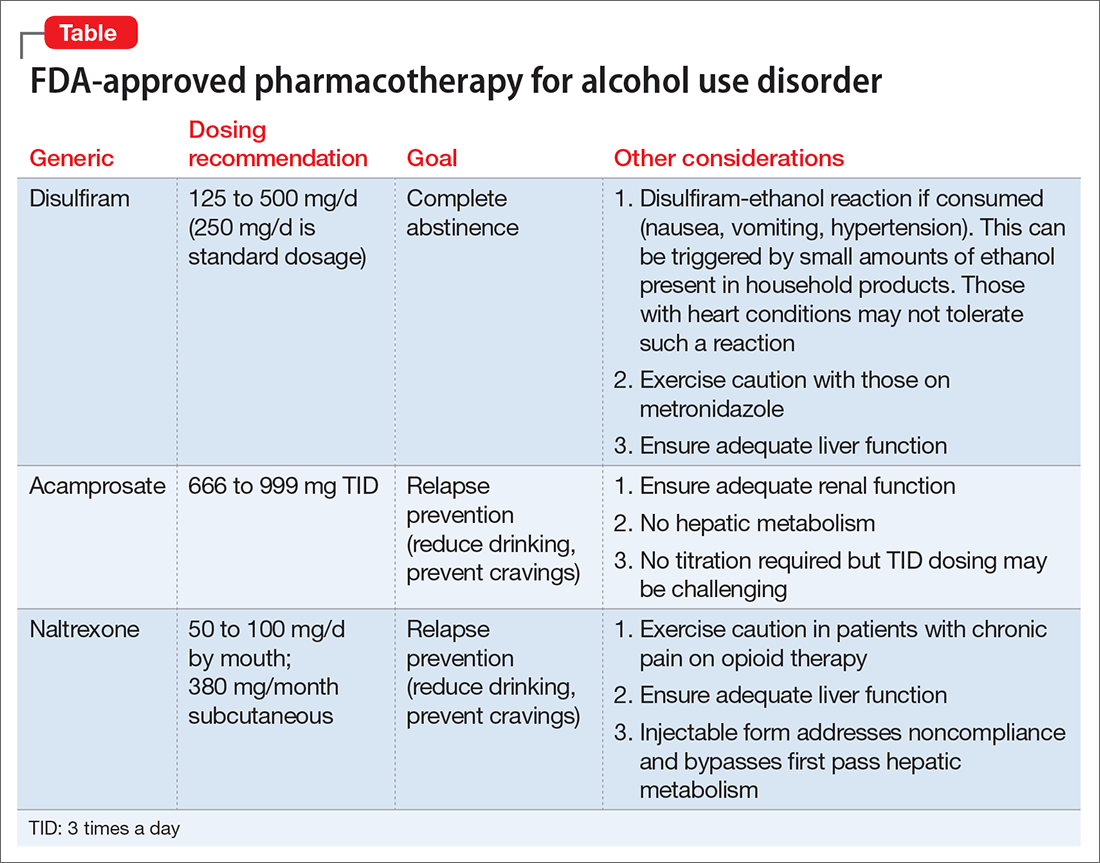
With regard to off-label medications, topiramate has the highest evidence for efficacy. Gabapentin can augment naltrexone and also helps with sleep, anxiety, withdrawal, and cravings.4,5
Psychosocial interventions
Medications are just 1 tool in recovery; patients should be engaged in a program of counseling. Encourage attendance at AA meetings. An up-and-coming concept is the use of smartphone applications to prevent relapse (or even induce remission); apps that provide an accurate blood alcohol tracking systems and integrated psychosocial therapies are in the pipeline. The novel Reddit online forum r/StopDrinking is a 24-hour peer-support community that relies on
fellowship, accountability, monitoring, and anonymity; the forum can compete with
motivational interviewing for efficacy in increasing abstinence and preventing relapse.
1. Johnson L, O’Malley P, Miech RA, et al. Monitoring the Future national survey results on drug use, 1975-2015: overview, key findings on adolescent drug use. http://www.monitoringthefuture.org/pubs/monographs/mtf-overview2015.pdf. Published February 2016. Accessed January 20, 2016.
2. Substance Abuse and Mental Health Services Administration. Results from the 2013 national survey on drug use and health: mental health findings, NSDUH Series H-49, HHS Publication No. (SMA) 14-4887. Rockville, MD: Substance Abuse and Mental Health Services Administration; 2014.
3. Grant BF, Goldstein RB, Saha TD, et al. Epidemiology of DSM-5 alcohol use disorder: results from the National Epidemiological Survey on Alcohol and Related Conditions III. JAMA Psychiatry. 2015;72(8):757-766.
4. Robinson S, Meeks TW, Geniza C. Medication for alcohol use disorder: which agents work best. Current Psychiatry. 2014;13(1):22-29.
5. Substance Abuse and Mental Health Services Administration and National Institute on Alcohol Abuse and Alcoholism. Medication for the treatment of alcohol use disorder: a brief guide. HHS Publication No. (SMA) 15-4907. Rockville, MD: Substance Abuse and Mental Health Services Administration; 2015.
6. Volkow ND, Koob GF, McLellan AT. Neurobiological advances from the brain disease model of addiction. N Engl J Med. 2016;374(4):363-371.
Acknowledgment
The authors would like to thank Thomas M. Penders, MS, MD, Medical Director for Consultation-Liaison Psychiatry at Cape Cod Healthcare, Hyannis, Massachusetts, and Affiliate Professor at East Carolina University, Greenville, North Carolina, for all his guidance, support, and mentorship.
Cornel N. Stanciu, MD

Samantha A. Gnanasegaram, MD
Drs. Stanciu and Gnanasegaram are PGY-4 Residents, Department of Psychiatric Medicine, Brody School of Medicine, East Carolina University, Greenville, North Carolina
Disclosures
The authors report no financial relationships with any company whose products are mentioned in this article or with manufacturers of competing products.
Cornel N. Stanciu, MD
Samantha A. Gnanasegaram, MD
Drs. Stanciu and Gnanasegaram are PGY-4 Residents, Department of Psychiatric Medicine, Brody School of Medicine, East Carolina University, Greenville, North Carolina
Disclosures
The authors report no financial relationships with any company whose products are mentioned in this article or with manufacturers of competing products.
Cornel N. Stanciu, MD
Samantha A. Gnanasegaram, MD
Drs. Stanciu and Gnanasegaram are PGY-4 Residents, Department of Psychiatric Medicine, Brody School of Medicine, East Carolina University, Greenville, North Carolina
Disclosures
The authors report no financial relationships with any company whose products are mentioned in this article or with manufacturers of competing products.
There is ample evidence in the medical literature, as well as clinical experience, that patients seeking help for chemical dependency benefit from pharmacotherapy. It is common, however, for physicians, patients, and family to balk at the idea. Even within the psychiatry community, where there should be better understanding of substance use disorders, many practitioners hesitate to employ medications, especially for alcohol use disorder (AUD).
Efficacy for such FDA-approved medications has been demonstrated in well-designed, randomized controlled trials, but many trainees, and even experienced professionals, have never seen these medications used effectively and appropriately. Medication-assisted treatment (MAT) is not an alternative to biopsychosocial approaches but is an augmentation that can (1) help stabilize the patient until he (she) can be educated in relapse prevention skills and (2) allow the brain to rewire and heal until he regains impulse control.
Diverse presentations
Do you remember that patient who often arrived for appointments intoxicated, promising that he plans to cut down? How about the man you saw in the emergency department with an elevated blood alcohol level, who was constantly endorsing suicidal thoughts that subsided when he reached clinical sobriety? What about the college student who often was treated for alcohol poisoning after binge drinking on weekends, but who never considered this behavior problematic? And, how about the elderly woman who was evaluated for anxiety, but had been drinking 4 beers nightly for the past 30 years?
Despite the diverse presentations, these patients all have a chronic disease and we fail them when we do not apply evidence-based medicine to their treatment.
As psychiatrists, we encounter many patients with AUD as a primary or comorbid diagnosis. This is a global problem associated with significant human and financial cost. With 80% of American adolescents having reported using alcohol in the past year, the problem will continue to grow.1 Furthermore, a greater prevalence of AUD is noted in clinical populations undergoing psychiatric treatment.2 Ongoing alcohol abuse complicates the course of medical and psychiatric conditions and incites significant societal exclusion.
Pharmacotherapy is underutilized
Despite an increase in the use of psychotropic medications for treating psychiatric illness, pharmacotherapy for AUD is underutilized: only 3% of patients have received an FDA-approved treatment.2,3 Nearly one-third of adults are affected by AUD during their lifetime, yet only 20% seek help.3 Management today remains limited to episodic, brief inpatient detoxification and psychosocial therapy.
Recovery rates are highest when addiction treatment that monitors abstinence is continuous; yet, for most part, alcohol addiction is treated in discrete episodes upon relapse. Although MAT is recommended by experts for “moderate” and “severe” substance use disorders, practitioners, in general, have demonstrated considerable resistance to using this modality as part of routine practice.4,5 This is regrettable: Regardless of terminology used to describe their condition, these people suffer a potentially fatal disease characterized by high post-treatment recidivism.
Neuroscience supports the brain disease model of addiction, with neuroplasticity changes being made during phases of drug use. Medications are shown to assist in preventing relapse while the brain is healing and normal emotional and decision-making capacities are being restored.6
Why hesitate to use pharmacotherapeutics?
There are diverse pharmacotherapeutic options that can be pursued for treating AUD with minimal disruption to home and work life. Alarmingly, many trainees have never prescribed or even considered such medications. Despite modest effect sizes in randomized controlled trials, efficacy has been demonstrated in reducing relapse rates and overall severity of drinking days.4,5 So, from where does the ambivalence of patients and providers about using these treatments to achieve lasting recovery stem?
Starting MAT certainly requires both parties to be in agreement. A patient might decline medication because of a fear of dependence or because he overestimates his ability to achieve remission on his own. There also may be financial barriers in a current alcohol treatment system that is traditionally non-medically oriented. Prescribers also fail to offer medications because of:
- lack of familiarity with available agents
- absence of guidelines for use
- disbelief that the condition is treatable.
Given that treatment often is based on a 12-step approach, such as Alcoholics Anonymous (AA), providers might hesitate to prescribe medication for an illness that is thought to be managed through psychosocial interventions, such as group and motivational therapy.
Therapeutic options
Choice of medication depends on the prescriber’s comfort level, reputation of the medication, potential side-effect profile, medical contraindications, and affordability; the most important consideration, however, should be the overall goals and expectations of the patient.
There are 4 FDA-approved medications for AUD (Table); many others are off-label. It is advisable to start with an FDA-approved medication such as disulfiram for the motivated patient who has a collaborator and desires complete abstinence; naltrexone for a patient who wants to cut down on intake (a long-acting formulation can be used for poorly adherent patients); and acamprosate for a patient with at least some established sobriety who needs help with post-withdrawal sleep disturbances.
With regard to off-label medications, topiramate has the highest evidence for efficacy. Gabapentin can augment naltrexone and also helps with sleep, anxiety, withdrawal, and cravings.4,5
Psychosocial interventions
Medications are just 1 tool in recovery; patients should be engaged in a program of counseling. Encourage attendance at AA meetings. An up-and-coming concept is the use of smartphone applications to prevent relapse (or even induce remission); apps that provide an accurate blood alcohol tracking systems and integrated psychosocial therapies are in the pipeline. The novel Reddit online forum r/StopDrinking is a 24-hour peer-support community that relies on
fellowship, accountability, monitoring, and anonymity; the forum can compete with
motivational interviewing for efficacy in increasing abstinence and preventing relapse.
There is ample evidence in the medical literature, as well as clinical experience, that patients seeking help for chemical dependency benefit from pharmacotherapy. It is common, however, for physicians, patients, and family to balk at the idea. Even within the psychiatry community, where there should be better understanding of substance use disorders, many practitioners hesitate to employ medications, especially for alcohol use disorder (AUD).
Efficacy for such FDA-approved medications has been demonstrated in well-designed, randomized controlled trials, but many trainees, and even experienced professionals, have never seen these medications used effectively and appropriately. Medication-assisted treatment (MAT) is not an alternative to biopsychosocial approaches but is an augmentation that can (1) help stabilize the patient until he (she) can be educated in relapse prevention skills and (2) allow the brain to rewire and heal until he regains impulse control.
Diverse presentations
Do you remember that patient who often arrived for appointments intoxicated, promising that he plans to cut down? How about the man you saw in the emergency department with an elevated blood alcohol level, who was constantly endorsing suicidal thoughts that subsided when he reached clinical sobriety? What about the college student who often was treated for alcohol poisoning after binge drinking on weekends, but who never considered this behavior problematic? And, how about the elderly woman who was evaluated for anxiety, but had been drinking 4 beers nightly for the past 30 years?
Despite the diverse presentations, these patients all have a chronic disease and we fail them when we do not apply evidence-based medicine to their treatment.
As psychiatrists, we encounter many patients with AUD as a primary or comorbid diagnosis. This is a global problem associated with significant human and financial cost. With 80% of American adolescents having reported using alcohol in the past year, the problem will continue to grow.1 Furthermore, a greater prevalence of AUD is noted in clinical populations undergoing psychiatric treatment.2 Ongoing alcohol abuse complicates the course of medical and psychiatric conditions and incites significant societal exclusion.
Pharmacotherapy is underutilized
Despite an increase in the use of psychotropic medications for treating psychiatric illness, pharmacotherapy for AUD is underutilized: only 3% of patients have received an FDA-approved treatment.2,3 Nearly one-third of adults are affected by AUD during their lifetime, yet only 20% seek help.3 Management today remains limited to episodic, brief inpatient detoxification and psychosocial therapy.
Recovery rates are highest when addiction treatment that monitors abstinence is continuous; yet, for most part, alcohol addiction is treated in discrete episodes upon relapse. Although MAT is recommended by experts for “moderate” and “severe” substance use disorders, practitioners, in general, have demonstrated considerable resistance to using this modality as part of routine practice.4,5 This is regrettable: Regardless of terminology used to describe their condition, these people suffer a potentially fatal disease characterized by high post-treatment recidivism.
Neuroscience supports the brain disease model of addiction, with neuroplasticity changes being made during phases of drug use. Medications are shown to assist in preventing relapse while the brain is healing and normal emotional and decision-making capacities are being restored.6
Why hesitate to use pharmacotherapeutics?
There are diverse pharmacotherapeutic options that can be pursued for treating AUD with minimal disruption to home and work life. Alarmingly, many trainees have never prescribed or even considered such medications. Despite modest effect sizes in randomized controlled trials, efficacy has been demonstrated in reducing relapse rates and overall severity of drinking days.4,5 So, from where does the ambivalence of patients and providers about using these treatments to achieve lasting recovery stem?
Starting MAT certainly requires both parties to be in agreement. A patient might decline medication because of a fear of dependence or because he overestimates his ability to achieve remission on his own. There also may be financial barriers in a current alcohol treatment system that is traditionally non-medically oriented. Prescribers also fail to offer medications because of:
- lack of familiarity with available agents
- absence of guidelines for use
- disbelief that the condition is treatable.
Given that treatment often is based on a 12-step approach, such as Alcoholics Anonymous (AA), providers might hesitate to prescribe medication for an illness that is thought to be managed through psychosocial interventions, such as group and motivational therapy.
Therapeutic options
Choice of medication depends on the prescriber’s comfort level, reputation of the medication, potential side-effect profile, medical contraindications, and affordability; the most important consideration, however, should be the overall goals and expectations of the patient.
There are 4 FDA-approved medications for AUD (Table); many others are off-label. It is advisable to start with an FDA-approved medication such as disulfiram for the motivated patient who has a collaborator and desires complete abstinence; naltrexone for a patient who wants to cut down on intake (a long-acting formulation can be used for poorly adherent patients); and acamprosate for a patient with at least some established sobriety who needs help with post-withdrawal sleep disturbances.
With regard to off-label medications, topiramate has the highest evidence for efficacy. Gabapentin can augment naltrexone and also helps with sleep, anxiety, withdrawal, and cravings.4,5
Psychosocial interventions
Medications are just 1 tool in recovery; patients should be engaged in a program of counseling. Encourage attendance at AA meetings. An up-and-coming concept is the use of smartphone applications to prevent relapse (or even induce remission); apps that provide an accurate blood alcohol tracking systems and integrated psychosocial therapies are in the pipeline. The novel Reddit online forum r/StopDrinking is a 24-hour peer-support community that relies on
fellowship, accountability, monitoring, and anonymity; the forum can compete with
motivational interviewing for efficacy in increasing abstinence and preventing relapse.
1. Johnson L, O’Malley P, Miech RA, et al. Monitoring the Future national survey results on drug use, 1975-2015: overview, key findings on adolescent drug use. http://www.monitoringthefuture.org/pubs/monographs/mtf-overview2015.pdf. Published February 2016. Accessed January 20, 2016.
2. Substance Abuse and Mental Health Services Administration. Results from the 2013 national survey on drug use and health: mental health findings, NSDUH Series H-49, HHS Publication No. (SMA) 14-4887. Rockville, MD: Substance Abuse and Mental Health Services Administration; 2014.
3. Grant BF, Goldstein RB, Saha TD, et al. Epidemiology of DSM-5 alcohol use disorder: results from the National Epidemiological Survey on Alcohol and Related Conditions III. JAMA Psychiatry. 2015;72(8):757-766.
4. Robinson S, Meeks TW, Geniza C. Medication for alcohol use disorder: which agents work best. Current Psychiatry. 2014;13(1):22-29.
5. Substance Abuse and Mental Health Services Administration and National Institute on Alcohol Abuse and Alcoholism. Medication for the treatment of alcohol use disorder: a brief guide. HHS Publication No. (SMA) 15-4907. Rockville, MD: Substance Abuse and Mental Health Services Administration; 2015.
6. Volkow ND, Koob GF, McLellan AT. Neurobiological advances from the brain disease model of addiction. N Engl J Med. 2016;374(4):363-371.
Acknowledgment
The authors would like to thank Thomas M. Penders, MS, MD, Medical Director for Consultation-Liaison Psychiatry at Cape Cod Healthcare, Hyannis, Massachusetts, and Affiliate Professor at East Carolina University, Greenville, North Carolina, for all his guidance, support, and mentorship.
1. Johnson L, O’Malley P, Miech RA, et al. Monitoring the Future national survey results on drug use, 1975-2015: overview, key findings on adolescent drug use. http://www.monitoringthefuture.org/pubs/monographs/mtf-overview2015.pdf. Published February 2016. Accessed January 20, 2016.
2. Substance Abuse and Mental Health Services Administration. Results from the 2013 national survey on drug use and health: mental health findings, NSDUH Series H-49, HHS Publication No. (SMA) 14-4887. Rockville, MD: Substance Abuse and Mental Health Services Administration; 2014.
3. Grant BF, Goldstein RB, Saha TD, et al. Epidemiology of DSM-5 alcohol use disorder: results from the National Epidemiological Survey on Alcohol and Related Conditions III. JAMA Psychiatry. 2015;72(8):757-766.
4. Robinson S, Meeks TW, Geniza C. Medication for alcohol use disorder: which agents work best. Current Psychiatry. 2014;13(1):22-29.
5. Substance Abuse and Mental Health Services Administration and National Institute on Alcohol Abuse and Alcoholism. Medication for the treatment of alcohol use disorder: a brief guide. HHS Publication No. (SMA) 15-4907. Rockville, MD: Substance Abuse and Mental Health Services Administration; 2015.
6. Volkow ND, Koob GF, McLellan AT. Neurobiological advances from the brain disease model of addiction. N Engl J Med. 2016;374(4):363-371.
Acknowledgment
The authors would like to thank Thomas M. Penders, MS, MD, Medical Director for Consultation-Liaison Psychiatry at Cape Cod Healthcare, Hyannis, Massachusetts, and Affiliate Professor at East Carolina University, Greenville, North Carolina, for all his guidance, support, and mentorship.
Unspoken ethical challenges of many psychiatric consultation services
A psychiatric consultation service in an academic medical center usually is a robust and busy setting. In addition to expert faculty, the service is staffed by trainees (psychosomatic medicine fellows and psychiatry residents), nurse practitioners, and medical students. I have been drawn to this growing field, which is evolving hand in hand with advances in medical therapy (eg, new antineoplastic, antiretroviral, and anticonvulsant regimens) and surgical intervention (eg, heart, lung, and gut transplantation).
As a consultant, I have learned that we have an obligation to a dual clientele:
- the patient, through an established doctor–patient relationship
- the primary team, which requires our assistance or raises questions about management.
While working as a trainee in providing psychiatric consultative services, I have noted a number of ethical challenges that consultants face. Below are noteworthy examples.
Justice: Is less, more?
We live in an era of growing advocacy of the recognition, acceptance, and treatment of mental illness.1 However, there does not appear to be enough psychiatric providers for the American population.2 Regrettably, a timely psychiatric assessment is, for many, a unaffordable luxury; in some regions of the United States, the wait for an outpatient psychiatric appointment is longer than 6 months.3
When a patient is admitted to the hospital, admitting physicians often consider ordering a psychiatric consult if they suspect an underlying psychiatric disorder or if they would like an expert’s opinion on some matter—such as (1) medications already prescribed for the patient as an outpatient and (2) a patient’s decision-making capacity in complex situations—without reflecting on how much of a commodity this expert opinion is. (After all, in an ideal world, concerns about cost shouldn’t factor in to what we offer our patients.)
Different practitioners have different thresholds for requesting a psychiatric consultation; no clear guidelines or recommendations exist as to how to “calibrate” one’s self to be a good consultee. As psychiatrists, we rarely call for a cardiology consult just because a patient is hypertensive and takes a diuretic at home, or call in an orthopedic surgeon because a patient with a history of arthroplasty has knee pain today. Sometimes, however, it seems to me that our non-psychiatry colleagues don’t think twice to ask for our services if their patients have a history of mental illness, even if it’s well controlled.
There is no winning formula for calculating how many psychiatric providers and resources (represented by the clinical currencies of, respectively, full-time equivalents and relative value units) a consultation service should have, but efforts have been made to solve this mystery.4 Some institutions track, with different methods and variable accuracy, the number of consults they provide annually; others wing it. Lack of accuracy and standardization means that the system is prone to sacrificing quality for quantity in the provision of services, and to provide services in an inconsistent manner (think: better quality on slower days).
Nonmaleficence: Good intentions…
Within the U.S. health care system, a consulting psychiatrist must diagnose a billable condition to be reimbursed for a consult. But what if a so-called soft consult is requested and, after the evaluation, a major mental disorder that warranted our time and expertise can’t be identified?
That situation places the provider in an awkward position. Up-diagnosing might seem like a necessity to ensure reimbursement but, in a society that still stigmatizes mental illness, the health risks of charting a major mental disorder (and prescribing a vaguely warranted psychotropic) might outweigh the benefits for some patients, in the long run.
Coding systems can impact and complicate this scenario even more. We are required to comply with coding systems by providing as many predetermined historical and clinical details of any specific major mental disorder as we can document. As we become more detail-oriented, I wonder if we are losing touch with the reality of our patients’ suffering and deviating from the human emotional experience, as we focus on complying with the health care system and maximizing hospital reimbursement.
Beneficence: The care you would want for your loved ones
For me, an attractive aspect of becoming a psychiatric consultant in the medical setting was to function as a mental health ambassador, so to speak. We often evaluate patients who have never seen a psychiatrist before (eg, when there are symptoms of acute stress disorder in a trauma patient or postoperative delirium in a patient who does not have a psychiatric history). On those occasions, we have the opportunity to make an effective, long-lasting intervention with our clinical encounter, accurate diagnosis, medication recommendations, and outpatient referrals.
Sometimes, the best follow-up plans and intentions are undone by uneven discharge coordination efforts and limited community resources. Some medical institutions have become better at tracking reasons for re-hospitalization and at making post-discharge telephone calls to support good transition to outpatient services. Often, it is necessary to call on nonprofit organizations and public institutions to provide referral and crisis services, but we can always do a better job at offering our patients a comprehensive mental health treatment plan, even from the consultation arena.
Autonomy: Who is in control?
Psychiatry provides varying levels of intervention for acutely mentally ill patients. Laws and criteria for involuntary commitment and the use of psychotropic medication under such circumstances vary from state to state.5
In the consultation-liaison setting, we often co-manage patients with a neuropsychiatric disorder that precludes them from participating fully in medical decisions. Other times, patients come to our attention involuntarily (eg, by way of medical admission) having a high level of premorbid autonomy: They make their own life decisions, choose not to engage in psychiatric treatment, administer their funds (when they have them), and so on.
Complex ethical situations can arise when (1) there is disagreement between physician and patient and (2) payment for care or insurance coverage plays a role in disposition plans or long-term placement. Public institutions might have a modus operandi that allows for extra room to deliberate and keep the treatment conversation going—more so than for-profit health centers, where financial forces can sway providers’ judgment toward autonomy, regardless of what is best for the patient.
Summing up: Let’s be Hippocratic psychiatrists
As many forces continue to influence the way we practice the art and science of medicine and psychiatry, it’s important to pay close attention to ongoing challenges and utilize organized medicine to advocate for better ways of running an effective consultation service in an ethical manner. As a trainee and future psychosomatic medicine psychiatrist, I am committed to starting these conversations wherever I go.
We need novel ways to look at, question, understand, study, and review our clinical practice to effectively tackle these challenges as we continue advancing as a field.
1. Remarks by the President at National Conference on Mental Health. Office of the Press Secretary. June 3, 2013. https://www.whitehouse.gov/the-press-office/2013/06/03/remarks-president-national-conference-mental-health. Accessed July 28, 2016.
2. Crary D. There’s a serious shortage of psychiatrists in the U.S. The Huffington Post. http://www.huffingtonpost.com/entry/theres-a-serious-shortage-of-psychiatrists-in-the-us_us_55eef13ce4b093be51bc128f. Published September 8, 2015. Accessed January 22, 2016.
3. Frantz J. Mental health care: average wait to see a psychiatrist in Dauphin County is 8 months. Penn Live. http://www.pennlive.com/midstate/index.ssf/2013/01/mental_illness_help_for_famili_1.html. Published January 24, 2013. Accessed January 22, 2016.
4. Kunkel E, Del Busto E, Kathol R, et al. Physician staffing for the practice of psychosomatic medicine in general hospitals: a pilot study. Psychosomatics. 2010;51(6):520-527.
5. Stettin B, Geller J, Ragosta K, et al. Mental health commitment laws: a survey of the states. http://tacreports.org/storage/documents/2014-state-survey-abridged.pdf. Published February 2014. Accessed February 25, 2016.
Dr. Jovel is a Public Psychiatry Fellow, Columbia University Medical Center/New York State Psychiatric Institute, New York, New York. He was a Psychosomatic Medicine Fellow, Jackson Health System/University of Miami, Miami, Florida, when he wrote this article.
Dr. Jovel is a Public Psychiatry Fellow, Columbia University Medical Center/New York State Psychiatric Institute, New York, New York. He was a Psychosomatic Medicine Fellow, Jackson Health System/University of Miami, Miami, Florida, when he wrote this article.
Dr. Jovel is a Public Psychiatry Fellow, Columbia University Medical Center/New York State Psychiatric Institute, New York, New York. He was a Psychosomatic Medicine Fellow, Jackson Health System/University of Miami, Miami, Florida, when he wrote this article.
A psychiatric consultation service in an academic medical center usually is a robust and busy setting. In addition to expert faculty, the service is staffed by trainees (psychosomatic medicine fellows and psychiatry residents), nurse practitioners, and medical students. I have been drawn to this growing field, which is evolving hand in hand with advances in medical therapy (eg, new antineoplastic, antiretroviral, and anticonvulsant regimens) and surgical intervention (eg, heart, lung, and gut transplantation).
As a consultant, I have learned that we have an obligation to a dual clientele:
- the patient, through an established doctor–patient relationship
- the primary team, which requires our assistance or raises questions about management.
While working as a trainee in providing psychiatric consultative services, I have noted a number of ethical challenges that consultants face. Below are noteworthy examples.
Justice: Is less, more?
We live in an era of growing advocacy of the recognition, acceptance, and treatment of mental illness.1 However, there does not appear to be enough psychiatric providers for the American population.2 Regrettably, a timely psychiatric assessment is, for many, a unaffordable luxury; in some regions of the United States, the wait for an outpatient psychiatric appointment is longer than 6 months.3
When a patient is admitted to the hospital, admitting physicians often consider ordering a psychiatric consult if they suspect an underlying psychiatric disorder or if they would like an expert’s opinion on some matter—such as (1) medications already prescribed for the patient as an outpatient and (2) a patient’s decision-making capacity in complex situations—without reflecting on how much of a commodity this expert opinion is. (After all, in an ideal world, concerns about cost shouldn’t factor in to what we offer our patients.)
Different practitioners have different thresholds for requesting a psychiatric consultation; no clear guidelines or recommendations exist as to how to “calibrate” one’s self to be a good consultee. As psychiatrists, we rarely call for a cardiology consult just because a patient is hypertensive and takes a diuretic at home, or call in an orthopedic surgeon because a patient with a history of arthroplasty has knee pain today. Sometimes, however, it seems to me that our non-psychiatry colleagues don’t think twice to ask for our services if their patients have a history of mental illness, even if it’s well controlled.
There is no winning formula for calculating how many psychiatric providers and resources (represented by the clinical currencies of, respectively, full-time equivalents and relative value units) a consultation service should have, but efforts have been made to solve this mystery.4 Some institutions track, with different methods and variable accuracy, the number of consults they provide annually; others wing it. Lack of accuracy and standardization means that the system is prone to sacrificing quality for quantity in the provision of services, and to provide services in an inconsistent manner (think: better quality on slower days).
Nonmaleficence: Good intentions…
Within the U.S. health care system, a consulting psychiatrist must diagnose a billable condition to be reimbursed for a consult. But what if a so-called soft consult is requested and, after the evaluation, a major mental disorder that warranted our time and expertise can’t be identified?
That situation places the provider in an awkward position. Up-diagnosing might seem like a necessity to ensure reimbursement but, in a society that still stigmatizes mental illness, the health risks of charting a major mental disorder (and prescribing a vaguely warranted psychotropic) might outweigh the benefits for some patients, in the long run.
Coding systems can impact and complicate this scenario even more. We are required to comply with coding systems by providing as many predetermined historical and clinical details of any specific major mental disorder as we can document. As we become more detail-oriented, I wonder if we are losing touch with the reality of our patients’ suffering and deviating from the human emotional experience, as we focus on complying with the health care system and maximizing hospital reimbursement.
Beneficence: The care you would want for your loved ones
For me, an attractive aspect of becoming a psychiatric consultant in the medical setting was to function as a mental health ambassador, so to speak. We often evaluate patients who have never seen a psychiatrist before (eg, when there are symptoms of acute stress disorder in a trauma patient or postoperative delirium in a patient who does not have a psychiatric history). On those occasions, we have the opportunity to make an effective, long-lasting intervention with our clinical encounter, accurate diagnosis, medication recommendations, and outpatient referrals.
Sometimes, the best follow-up plans and intentions are undone by uneven discharge coordination efforts and limited community resources. Some medical institutions have become better at tracking reasons for re-hospitalization and at making post-discharge telephone calls to support good transition to outpatient services. Often, it is necessary to call on nonprofit organizations and public institutions to provide referral and crisis services, but we can always do a better job at offering our patients a comprehensive mental health treatment plan, even from the consultation arena.
Autonomy: Who is in control?
Psychiatry provides varying levels of intervention for acutely mentally ill patients. Laws and criteria for involuntary commitment and the use of psychotropic medication under such circumstances vary from state to state.5
In the consultation-liaison setting, we often co-manage patients with a neuropsychiatric disorder that precludes them from participating fully in medical decisions. Other times, patients come to our attention involuntarily (eg, by way of medical admission) having a high level of premorbid autonomy: They make their own life decisions, choose not to engage in psychiatric treatment, administer their funds (when they have them), and so on.
Complex ethical situations can arise when (1) there is disagreement between physician and patient and (2) payment for care or insurance coverage plays a role in disposition plans or long-term placement. Public institutions might have a modus operandi that allows for extra room to deliberate and keep the treatment conversation going—more so than for-profit health centers, where financial forces can sway providers’ judgment toward autonomy, regardless of what is best for the patient.
Summing up: Let’s be Hippocratic psychiatrists
As many forces continue to influence the way we practice the art and science of medicine and psychiatry, it’s important to pay close attention to ongoing challenges and utilize organized medicine to advocate for better ways of running an effective consultation service in an ethical manner. As a trainee and future psychosomatic medicine psychiatrist, I am committed to starting these conversations wherever I go.
We need novel ways to look at, question, understand, study, and review our clinical practice to effectively tackle these challenges as we continue advancing as a field.
A psychiatric consultation service in an academic medical center usually is a robust and busy setting. In addition to expert faculty, the service is staffed by trainees (psychosomatic medicine fellows and psychiatry residents), nurse practitioners, and medical students. I have been drawn to this growing field, which is evolving hand in hand with advances in medical therapy (eg, new antineoplastic, antiretroviral, and anticonvulsant regimens) and surgical intervention (eg, heart, lung, and gut transplantation).
As a consultant, I have learned that we have an obligation to a dual clientele:
- the patient, through an established doctor–patient relationship
- the primary team, which requires our assistance or raises questions about management.
While working as a trainee in providing psychiatric consultative services, I have noted a number of ethical challenges that consultants face. Below are noteworthy examples.
Justice: Is less, more?
We live in an era of growing advocacy of the recognition, acceptance, and treatment of mental illness.1 However, there does not appear to be enough psychiatric providers for the American population.2 Regrettably, a timely psychiatric assessment is, for many, a unaffordable luxury; in some regions of the United States, the wait for an outpatient psychiatric appointment is longer than 6 months.3
When a patient is admitted to the hospital, admitting physicians often consider ordering a psychiatric consult if they suspect an underlying psychiatric disorder or if they would like an expert’s opinion on some matter—such as (1) medications already prescribed for the patient as an outpatient and (2) a patient’s decision-making capacity in complex situations—without reflecting on how much of a commodity this expert opinion is. (After all, in an ideal world, concerns about cost shouldn’t factor in to what we offer our patients.)
Different practitioners have different thresholds for requesting a psychiatric consultation; no clear guidelines or recommendations exist as to how to “calibrate” one’s self to be a good consultee. As psychiatrists, we rarely call for a cardiology consult just because a patient is hypertensive and takes a diuretic at home, or call in an orthopedic surgeon because a patient with a history of arthroplasty has knee pain today. Sometimes, however, it seems to me that our non-psychiatry colleagues don’t think twice to ask for our services if their patients have a history of mental illness, even if it’s well controlled.
There is no winning formula for calculating how many psychiatric providers and resources (represented by the clinical currencies of, respectively, full-time equivalents and relative value units) a consultation service should have, but efforts have been made to solve this mystery.4 Some institutions track, with different methods and variable accuracy, the number of consults they provide annually; others wing it. Lack of accuracy and standardization means that the system is prone to sacrificing quality for quantity in the provision of services, and to provide services in an inconsistent manner (think: better quality on slower days).
Nonmaleficence: Good intentions…
Within the U.S. health care system, a consulting psychiatrist must diagnose a billable condition to be reimbursed for a consult. But what if a so-called soft consult is requested and, after the evaluation, a major mental disorder that warranted our time and expertise can’t be identified?
That situation places the provider in an awkward position. Up-diagnosing might seem like a necessity to ensure reimbursement but, in a society that still stigmatizes mental illness, the health risks of charting a major mental disorder (and prescribing a vaguely warranted psychotropic) might outweigh the benefits for some patients, in the long run.
Coding systems can impact and complicate this scenario even more. We are required to comply with coding systems by providing as many predetermined historical and clinical details of any specific major mental disorder as we can document. As we become more detail-oriented, I wonder if we are losing touch with the reality of our patients’ suffering and deviating from the human emotional experience, as we focus on complying with the health care system and maximizing hospital reimbursement.
Beneficence: The care you would want for your loved ones
For me, an attractive aspect of becoming a psychiatric consultant in the medical setting was to function as a mental health ambassador, so to speak. We often evaluate patients who have never seen a psychiatrist before (eg, when there are symptoms of acute stress disorder in a trauma patient or postoperative delirium in a patient who does not have a psychiatric history). On those occasions, we have the opportunity to make an effective, long-lasting intervention with our clinical encounter, accurate diagnosis, medication recommendations, and outpatient referrals.
Sometimes, the best follow-up plans and intentions are undone by uneven discharge coordination efforts and limited community resources. Some medical institutions have become better at tracking reasons for re-hospitalization and at making post-discharge telephone calls to support good transition to outpatient services. Often, it is necessary to call on nonprofit organizations and public institutions to provide referral and crisis services, but we can always do a better job at offering our patients a comprehensive mental health treatment plan, even from the consultation arena.
Autonomy: Who is in control?
Psychiatry provides varying levels of intervention for acutely mentally ill patients. Laws and criteria for involuntary commitment and the use of psychotropic medication under such circumstances vary from state to state.5
In the consultation-liaison setting, we often co-manage patients with a neuropsychiatric disorder that precludes them from participating fully in medical decisions. Other times, patients come to our attention involuntarily (eg, by way of medical admission) having a high level of premorbid autonomy: They make their own life decisions, choose not to engage in psychiatric treatment, administer their funds (when they have them), and so on.
Complex ethical situations can arise when (1) there is disagreement between physician and patient and (2) payment for care or insurance coverage plays a role in disposition plans or long-term placement. Public institutions might have a modus operandi that allows for extra room to deliberate and keep the treatment conversation going—more so than for-profit health centers, where financial forces can sway providers’ judgment toward autonomy, regardless of what is best for the patient.
Summing up: Let’s be Hippocratic psychiatrists
As many forces continue to influence the way we practice the art and science of medicine and psychiatry, it’s important to pay close attention to ongoing challenges and utilize organized medicine to advocate for better ways of running an effective consultation service in an ethical manner. As a trainee and future psychosomatic medicine psychiatrist, I am committed to starting these conversations wherever I go.
We need novel ways to look at, question, understand, study, and review our clinical practice to effectively tackle these challenges as we continue advancing as a field.
1. Remarks by the President at National Conference on Mental Health. Office of the Press Secretary. June 3, 2013. https://www.whitehouse.gov/the-press-office/2013/06/03/remarks-president-national-conference-mental-health. Accessed July 28, 2016.
2. Crary D. There’s a serious shortage of psychiatrists in the U.S. The Huffington Post. http://www.huffingtonpost.com/entry/theres-a-serious-shortage-of-psychiatrists-in-the-us_us_55eef13ce4b093be51bc128f. Published September 8, 2015. Accessed January 22, 2016.
3. Frantz J. Mental health care: average wait to see a psychiatrist in Dauphin County is 8 months. Penn Live. http://www.pennlive.com/midstate/index.ssf/2013/01/mental_illness_help_for_famili_1.html. Published January 24, 2013. Accessed January 22, 2016.
4. Kunkel E, Del Busto E, Kathol R, et al. Physician staffing for the practice of psychosomatic medicine in general hospitals: a pilot study. Psychosomatics. 2010;51(6):520-527.
5. Stettin B, Geller J, Ragosta K, et al. Mental health commitment laws: a survey of the states. http://tacreports.org/storage/documents/2014-state-survey-abridged.pdf. Published February 2014. Accessed February 25, 2016.
1. Remarks by the President at National Conference on Mental Health. Office of the Press Secretary. June 3, 2013. https://www.whitehouse.gov/the-press-office/2013/06/03/remarks-president-national-conference-mental-health. Accessed July 28, 2016.
2. Crary D. There’s a serious shortage of psychiatrists in the U.S. The Huffington Post. http://www.huffingtonpost.com/entry/theres-a-serious-shortage-of-psychiatrists-in-the-us_us_55eef13ce4b093be51bc128f. Published September 8, 2015. Accessed January 22, 2016.
3. Frantz J. Mental health care: average wait to see a psychiatrist in Dauphin County is 8 months. Penn Live. http://www.pennlive.com/midstate/index.ssf/2013/01/mental_illness_help_for_famili_1.html. Published January 24, 2013. Accessed January 22, 2016.
4. Kunkel E, Del Busto E, Kathol R, et al. Physician staffing for the practice of psychosomatic medicine in general hospitals: a pilot study. Psychosomatics. 2010;51(6):520-527.
5. Stettin B, Geller J, Ragosta K, et al. Mental health commitment laws: a survey of the states. http://tacreports.org/storage/documents/2014-state-survey-abridged.pdf. Published February 2014. Accessed February 25, 2016.
Preventing, Identifying, and Managing Cosmetic Procedure Complications, Part 2: Lasers and Chemical Peels
The primary cosmetic procedures that dermatology residents will perform or assist in performing during their training are soft-tissue augmentation, botulinum toxin injections, laser therapy, and chemical peels. Because complications can occur from these procedures, it is important for residents to learn how to prevent, identify, and manage them for optimal patient outcomes. In part 2 of this series, laser therapy and chemical peels are discussed.
Lasers
In dermatology, lasers are used to treat dyschromia, resurface scars, remove skin growths, and rejuvenate aging skin.1,2 Ablative resurfacing lasers such as the CO2 laser are the most likely to lead to unwanted side effects. There is a risk for herpes simplex virus reactivation, impetigo, persistent erythema, dyschromia, and scarring.1-3 Some patients who undergo facial ablative resurfacing may develop a visible hypopigmented line of demarcation between treated and untreated skin along the jawline.3 With the development of fractional resurfacing lasers, the risk for dyschromia, persistent erythema, and scarring was lessened.1-3
Regardless of the type of resurfacing laser used, patients should be given adequate prophylaxis with an antiviral and antibiotic. For skin of color, fractional resurfacing lasers should be set at lower density settings with a higher fluence.1-3 Sites with fewer adnexal structures (eg, neck, dorsal hands) also should be treated at lower densities.3 When using Q-switched lasers that target pigment, caution should be used to avoid vesicle formation and/or skin crusting, which may lead to scarring or dyschromia.1-3 Some tattoo inks may paradoxically darken when treated with lasers.3 A test spot is advised, especially prior to treatment of permanent makeup tattoos. A pigmented lesion should never be treated if the diagnosis is unclear (eg, a biopsy to establish the diagnosis may be the best appropriate step for some pigmented lesions). For laser hair removal, the Nd:YAG laser is the safest for skin of color.2,3
Lasers that target vascular structures may cause unwanted purpura, hypopigmentation, or thermal injury.1-3 A larger spot size may help decrease the risk for purpura. The skin should be cooled properly and caution should be used to avoid pulse stacking. For intense pulsed light devices, overlap pulses slightly to avoid a zebralike pattern of slivers of untreated skin.1-3 For all laser procedures, strict sun protection is advised before and after the procedure.
Chemical Peels
Chemical peels are versatile and varied in their composition. They are categorized based on the depth to which the skin is affected by the peel: superficial (stratum corneum), medium (full-thickness epidermis), or deep (mid reticular dermis).4 Peels are most commonly used to treat dyschromia, aging, rhytides, actinic damage, and superficial scars.4,5 The success of a chemical peel depends largely on patient selection and preprocedure preparation. Patients who tend to develop postinflammatory hyperpigmention, have an underlying inflammatory or scarring skin disorder, are on photosensitizing medications, or have continued work- or hobby-related sun exposure are generally poor peel candidates.4,5 Strict sun protection should be advised both before and after a chemical peel.
While in training, residents are unlikely to perform a medium or deep peel. Superficial peels can be accomplished with trichloroacetic acid 10%, glycolic acid (GA) 30% to 50%, salicylic acid (SA) 20% to 30%, Jessner solution (SA, lactic acid, and resorcinol with ethanol), and tretinoin 1% to 5%.4 Glycolic acid and SA are known to be safer for patients with skin of color.4,5
Care should always be taken to prepare the skin for an even peel. Mild peeling agents such as tretinoin or adapalene may be used to prepare the skin in the weeks before the procedure.4 Skin of color may benefit from hydroquinone used before and after a chemical peel.5 At the time of the peel, acetone can be used to degrease the skin for a more even, effective peel. If a peel needs to be neutralized (eg, GA), make sure to have the neutralization solution on hand, as leaving the peel solution on for too long can lead to severe epidermolysis, which can be visualized by a graying of the skin and will not be seen with a properly performed superficial peel.4 Care should be taken at all times to protect the patient’s eyes. Eye flushes should be readily available. The medial canthus and perinasal folds may be protected with petrolatum. For a superficial peel, some desquamation (less with GA) and erythema may be noted for a few days.
Final Thoughts
For any cosmetic procedure, the patient’s expectations should be discussed. The provider may adeptly guide the patient toward realistic expectations for the procedure. Pretreatment and posttreatment photographs should always be taken to help document treatment progress; it may be helpful to show the patient the photographs at each visit. The expected skin reactions, recovery time, and risks should be fully discussed. Full informed consent should be obtained. Complications from cosmetic procedures will inevitably arise. As residents, we can take the opportunity to learn how to prevent, identify, and manage them.
- Hirsch R, Stier M. Complications and their management in cosmetic dermatology. Dermatol Clin. 2009;27:507-520.
- Oliaei A, Nelson JS, Fitzpatrick R, et al. Laser treatment of scars. Facial Plast Surg. 2012;28:518-524.
- Al Nomair N, Nazarian R, Marmur E. Complications in lasers, lights, and radiofrequency devices. Facial Plast Surg. 2012;28:340-346.
- Khunger N, IADVL Task Force. Standard guidelines of care for chemical peels. Indian J Dermatol Venereol Leprol. 2008;74(suppl):S5-S12.
- Sarkar R, Bansal S, Garg VK. Chemical peels for melasma in dark-skinned patients. J Cutan Aesthet Surg. 2012;5:247-253.
The primary cosmetic procedures that dermatology residents will perform or assist in performing during their training are soft-tissue augmentation, botulinum toxin injections, laser therapy, and chemical peels. Because complications can occur from these procedures, it is important for residents to learn how to prevent, identify, and manage them for optimal patient outcomes. In part 2 of this series, laser therapy and chemical peels are discussed.
Lasers
In dermatology, lasers are used to treat dyschromia, resurface scars, remove skin growths, and rejuvenate aging skin.1,2 Ablative resurfacing lasers such as the CO2 laser are the most likely to lead to unwanted side effects. There is a risk for herpes simplex virus reactivation, impetigo, persistent erythema, dyschromia, and scarring.1-3 Some patients who undergo facial ablative resurfacing may develop a visible hypopigmented line of demarcation between treated and untreated skin along the jawline.3 With the development of fractional resurfacing lasers, the risk for dyschromia, persistent erythema, and scarring was lessened.1-3
Regardless of the type of resurfacing laser used, patients should be given adequate prophylaxis with an antiviral and antibiotic. For skin of color, fractional resurfacing lasers should be set at lower density settings with a higher fluence.1-3 Sites with fewer adnexal structures (eg, neck, dorsal hands) also should be treated at lower densities.3 When using Q-switched lasers that target pigment, caution should be used to avoid vesicle formation and/or skin crusting, which may lead to scarring or dyschromia.1-3 Some tattoo inks may paradoxically darken when treated with lasers.3 A test spot is advised, especially prior to treatment of permanent makeup tattoos. A pigmented lesion should never be treated if the diagnosis is unclear (eg, a biopsy to establish the diagnosis may be the best appropriate step for some pigmented lesions). For laser hair removal, the Nd:YAG laser is the safest for skin of color.2,3
Lasers that target vascular structures may cause unwanted purpura, hypopigmentation, or thermal injury.1-3 A larger spot size may help decrease the risk for purpura. The skin should be cooled properly and caution should be used to avoid pulse stacking. For intense pulsed light devices, overlap pulses slightly to avoid a zebralike pattern of slivers of untreated skin.1-3 For all laser procedures, strict sun protection is advised before and after the procedure.
Chemical Peels
Chemical peels are versatile and varied in their composition. They are categorized based on the depth to which the skin is affected by the peel: superficial (stratum corneum), medium (full-thickness epidermis), or deep (mid reticular dermis).4 Peels are most commonly used to treat dyschromia, aging, rhytides, actinic damage, and superficial scars.4,5 The success of a chemical peel depends largely on patient selection and preprocedure preparation. Patients who tend to develop postinflammatory hyperpigmention, have an underlying inflammatory or scarring skin disorder, are on photosensitizing medications, or have continued work- or hobby-related sun exposure are generally poor peel candidates.4,5 Strict sun protection should be advised both before and after a chemical peel.
While in training, residents are unlikely to perform a medium or deep peel. Superficial peels can be accomplished with trichloroacetic acid 10%, glycolic acid (GA) 30% to 50%, salicylic acid (SA) 20% to 30%, Jessner solution (SA, lactic acid, and resorcinol with ethanol), and tretinoin 1% to 5%.4 Glycolic acid and SA are known to be safer for patients with skin of color.4,5
Care should always be taken to prepare the skin for an even peel. Mild peeling agents such as tretinoin or adapalene may be used to prepare the skin in the weeks before the procedure.4 Skin of color may benefit from hydroquinone used before and after a chemical peel.5 At the time of the peel, acetone can be used to degrease the skin for a more even, effective peel. If a peel needs to be neutralized (eg, GA), make sure to have the neutralization solution on hand, as leaving the peel solution on for too long can lead to severe epidermolysis, which can be visualized by a graying of the skin and will not be seen with a properly performed superficial peel.4 Care should be taken at all times to protect the patient’s eyes. Eye flushes should be readily available. The medial canthus and perinasal folds may be protected with petrolatum. For a superficial peel, some desquamation (less with GA) and erythema may be noted for a few days.
Final Thoughts
For any cosmetic procedure, the patient’s expectations should be discussed. The provider may adeptly guide the patient toward realistic expectations for the procedure. Pretreatment and posttreatment photographs should always be taken to help document treatment progress; it may be helpful to show the patient the photographs at each visit. The expected skin reactions, recovery time, and risks should be fully discussed. Full informed consent should be obtained. Complications from cosmetic procedures will inevitably arise. As residents, we can take the opportunity to learn how to prevent, identify, and manage them.
The primary cosmetic procedures that dermatology residents will perform or assist in performing during their training are soft-tissue augmentation, botulinum toxin injections, laser therapy, and chemical peels. Because complications can occur from these procedures, it is important for residents to learn how to prevent, identify, and manage them for optimal patient outcomes. In part 2 of this series, laser therapy and chemical peels are discussed.
Lasers
In dermatology, lasers are used to treat dyschromia, resurface scars, remove skin growths, and rejuvenate aging skin.1,2 Ablative resurfacing lasers such as the CO2 laser are the most likely to lead to unwanted side effects. There is a risk for herpes simplex virus reactivation, impetigo, persistent erythema, dyschromia, and scarring.1-3 Some patients who undergo facial ablative resurfacing may develop a visible hypopigmented line of demarcation between treated and untreated skin along the jawline.3 With the development of fractional resurfacing lasers, the risk for dyschromia, persistent erythema, and scarring was lessened.1-3
Regardless of the type of resurfacing laser used, patients should be given adequate prophylaxis with an antiviral and antibiotic. For skin of color, fractional resurfacing lasers should be set at lower density settings with a higher fluence.1-3 Sites with fewer adnexal structures (eg, neck, dorsal hands) also should be treated at lower densities.3 When using Q-switched lasers that target pigment, caution should be used to avoid vesicle formation and/or skin crusting, which may lead to scarring or dyschromia.1-3 Some tattoo inks may paradoxically darken when treated with lasers.3 A test spot is advised, especially prior to treatment of permanent makeup tattoos. A pigmented lesion should never be treated if the diagnosis is unclear (eg, a biopsy to establish the diagnosis may be the best appropriate step for some pigmented lesions). For laser hair removal, the Nd:YAG laser is the safest for skin of color.2,3
Lasers that target vascular structures may cause unwanted purpura, hypopigmentation, or thermal injury.1-3 A larger spot size may help decrease the risk for purpura. The skin should be cooled properly and caution should be used to avoid pulse stacking. For intense pulsed light devices, overlap pulses slightly to avoid a zebralike pattern of slivers of untreated skin.1-3 For all laser procedures, strict sun protection is advised before and after the procedure.
Chemical Peels
Chemical peels are versatile and varied in their composition. They are categorized based on the depth to which the skin is affected by the peel: superficial (stratum corneum), medium (full-thickness epidermis), or deep (mid reticular dermis).4 Peels are most commonly used to treat dyschromia, aging, rhytides, actinic damage, and superficial scars.4,5 The success of a chemical peel depends largely on patient selection and preprocedure preparation. Patients who tend to develop postinflammatory hyperpigmention, have an underlying inflammatory or scarring skin disorder, are on photosensitizing medications, or have continued work- or hobby-related sun exposure are generally poor peel candidates.4,5 Strict sun protection should be advised both before and after a chemical peel.
While in training, residents are unlikely to perform a medium or deep peel. Superficial peels can be accomplished with trichloroacetic acid 10%, glycolic acid (GA) 30% to 50%, salicylic acid (SA) 20% to 30%, Jessner solution (SA, lactic acid, and resorcinol with ethanol), and tretinoin 1% to 5%.4 Glycolic acid and SA are known to be safer for patients with skin of color.4,5
Care should always be taken to prepare the skin for an even peel. Mild peeling agents such as tretinoin or adapalene may be used to prepare the skin in the weeks before the procedure.4 Skin of color may benefit from hydroquinone used before and after a chemical peel.5 At the time of the peel, acetone can be used to degrease the skin for a more even, effective peel. If a peel needs to be neutralized (eg, GA), make sure to have the neutralization solution on hand, as leaving the peel solution on for too long can lead to severe epidermolysis, which can be visualized by a graying of the skin and will not be seen with a properly performed superficial peel.4 Care should be taken at all times to protect the patient’s eyes. Eye flushes should be readily available. The medial canthus and perinasal folds may be protected with petrolatum. For a superficial peel, some desquamation (less with GA) and erythema may be noted for a few days.
Final Thoughts
For any cosmetic procedure, the patient’s expectations should be discussed. The provider may adeptly guide the patient toward realistic expectations for the procedure. Pretreatment and posttreatment photographs should always be taken to help document treatment progress; it may be helpful to show the patient the photographs at each visit. The expected skin reactions, recovery time, and risks should be fully discussed. Full informed consent should be obtained. Complications from cosmetic procedures will inevitably arise. As residents, we can take the opportunity to learn how to prevent, identify, and manage them.
- Hirsch R, Stier M. Complications and their management in cosmetic dermatology. Dermatol Clin. 2009;27:507-520.
- Oliaei A, Nelson JS, Fitzpatrick R, et al. Laser treatment of scars. Facial Plast Surg. 2012;28:518-524.
- Al Nomair N, Nazarian R, Marmur E. Complications in lasers, lights, and radiofrequency devices. Facial Plast Surg. 2012;28:340-346.
- Khunger N, IADVL Task Force. Standard guidelines of care for chemical peels. Indian J Dermatol Venereol Leprol. 2008;74(suppl):S5-S12.
- Sarkar R, Bansal S, Garg VK. Chemical peels for melasma in dark-skinned patients. J Cutan Aesthet Surg. 2012;5:247-253.
- Hirsch R, Stier M. Complications and their management in cosmetic dermatology. Dermatol Clin. 2009;27:507-520.
- Oliaei A, Nelson JS, Fitzpatrick R, et al. Laser treatment of scars. Facial Plast Surg. 2012;28:518-524.
- Al Nomair N, Nazarian R, Marmur E. Complications in lasers, lights, and radiofrequency devices. Facial Plast Surg. 2012;28:340-346.
- Khunger N, IADVL Task Force. Standard guidelines of care for chemical peels. Indian J Dermatol Venereol Leprol. 2008;74(suppl):S5-S12.
- Sarkar R, Bansal S, Garg VK. Chemical peels for melasma in dark-skinned patients. J Cutan Aesthet Surg. 2012;5:247-253.