User login
We’re Hiring

At the 2008 SHM Annual Meeting in San Diego, I had the pleasure of serving as moderator for a panel commenting on the opportunities and challenges faced by hospitalists. I’m not sure how well our predictions will withstand the test of time, but two things came up that I’ll discuss here:
1) Nearly every group is recruiting, and many seem to think the hospitalist shortage will last throughout the careers of those in practice today.
2) Nearly all hospitalist groups are looking for more doctors. I asked the approximately 1,600 in attendance how many are recruiting for more hospitalists. Nearly every hand in the room shot up. It was impressive; one friend (Bob Reynolds) told me he was sitting in the back and could feel a breeze in the room from all the hands being raised. Only about three hands went up when I asked how many thought their staffing was adequate.
Bear in mind that based on the show of hands nearly every group in the country is recruiting. Many groups are looking to add three to six hospitalists this year alone. This is on top of the average group growing about 20% to 25% the past two years, based on my study of data from the “Society of Hospital Medicine 2007-08 Survey: The Authoritative Source on the State of the Hospitalist Movement.” The survey showed the number of FTE doctors in the average hospitalist group grew from a median six to eight hospitalists (the average went from eight to 9.7).
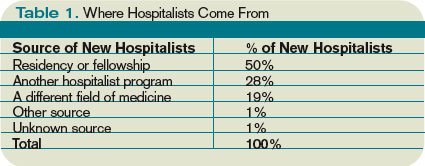
Hospital medicine is the fastest-growing field in the history of American medicine, and it looks like the demand for hospitalists may be increasing even faster than the supply.
I was tempted to ask for a show of hands from doctors at the meeting who were looking for a hospitalist position, but feared it could disrupt the whole conference as those seeking new doctors pounced on the potential candidates in a piranha-like feeding frenzy. So there is good news for anyone interested in joining a hospitalist group: You should have a lot of choices. If you’re recruiting, you’d better get to work to make sure you have really good plan. Let me offer a few ideas.
Never stop recruiting. Dr. Greg Mappin, VPMA at Self Regional Hospital in Greenwood, S.C., told me his philosophy is to “recruit forever, and hire when necessary.” I agree.
You should build and maintain a robust candidate pipeline by ensuring your practice maintains a high level of visibility before your best source of new doctors. The best source for most groups is the closest residency training program, though other nearby hospitalist or outpatient practices might be a secondary source of new manpower.
I suggest you engage residents by hosting a dinner near their hospital once or twice a year and inviting all second- and third-year residents to attend regardless of their interest in becoming hospitalists. You might do this even in years you may not need to add hospitalists to ensure your dinner becomes a regular event for them and to ensure they’re very familiar with your program. Some hospitals develop night and weekend moonlighting programs that employ nearby residents, which increases the chance some will join the practice upon completion of their training.
Ensure all hospitalists—especially the group leader—actively participate in recruiting. Your hospital or medical group’s physician recruiter can be a terrific asset. He/she can provide advice regarding how to find candidates, arranging interviews, etc. Yet, it is critical for the hospitalist group leader to actively communicate with every candidate, including responding to every inquiry within a day or so.
Too many group leaders make a big mistake by waiting many days to respond to new inquiries, or letting the recruiter handle all communication in advance of an interview. During the interview, be sure the candidate spends time with many of the current group members and provides contact information for every group member in case the candidate would like to call any who weren’t available on the interview day. Consider providing the candidate with a copy of the group schedule, any orientation documents you have, and other such printed materials to review after the visit.
Recruit specifically for short-term members of your practice. Despite concerns about turnover, I think it is reasonable to actively pursue candidates who may have as little as two years to work in your practice. For example, they may plan to move to another town (e.g., when their spouse finishes training) or start fellowship training. In my experience, at least half of new doctors who plan to be a hospitalist for only a year or two will choose to stay on long term.
If you want your classified ad to stand out, think about writing one that specifically targets short-term hospitalists. It could say something like: “Do you have only two years to work as a hospitalist? Then this is the place for you.” You even could add benefits, such as tuition to attend conferences that would be of value for the doctor regardless of their future specialty or practice setting. If you desperately need additional doctors, get creative in recruiting those who plan to stay with you for only a couple years. I’m confident some will end up staying long term.
Continue “recruiting” the doctors in your practice. For a number of reasons, hospitalist turnover may be higher than most other specialties. So it is particularly important to take steps to minimize it. SHM’s white paper on hospitalist career satisfaction (“A Challenge for a New Specialty: A White Paper on Hospitalist Career Satisfaction”) offers observations and valuable suggestions for any practice. Find it under the “Publications” link on SHM’s Web site, www. hospitalmedicine.org.
No End to Shortage
Now back to that panel discussion at SHM’s Annual Meeting in April. I asked the panelists what things would be like if in 10 years the demand for hospitalists decreased, and the supply finally caught up with and ultimately exceeded demand.
I thought this could be a provocative question that would lead to a discussion about how much of our current situation, such as recent increases in hospital financial support provided per hospitalist, are due to the current hospitalist shortage. Will hospitals decrease their support if there is ever an excess of hospitalists?
No one was buying it. Everyone was convinced that despite the incredible growth in numbers of doctors practicing as hospitalists, the demand for hospitalists will continue to grow even faster than the supply. Panelist Ron Greeno, MD, FCCP, chief medical officer of Cogent Healthcare in Irvine, Calif., thought this hospitalist shortage would continue throughout our lifetime. I’m not sure how long Ron thinks he (or I) will live, but that’s a pretty bold prediction.
It looks like the current intense recruiting environment is here to stay for a long time. Every practice should be thinking about how best to manage it. TH
Dr. Nelson has been a practicing hospitalist since 1988 and is co-founder and past president of SHM. He is a principal in Nelson/Flores Associates, a national hospitalist practice management consulting firm. He is also part of the faculty for SHM’s “Best Practices in Managing a Hospital Medicine Program” course. This column represents his views and is not intended to reflect an official position of SHM.
At the 2008 SHM Annual Meeting in San Diego, I had the pleasure of serving as moderator for a panel commenting on the opportunities and challenges faced by hospitalists. I’m not sure how well our predictions will withstand the test of time, but two things came up that I’ll discuss here:
1) Nearly every group is recruiting, and many seem to think the hospitalist shortage will last throughout the careers of those in practice today.
2) Nearly all hospitalist groups are looking for more doctors. I asked the approximately 1,600 in attendance how many are recruiting for more hospitalists. Nearly every hand in the room shot up. It was impressive; one friend (Bob Reynolds) told me he was sitting in the back and could feel a breeze in the room from all the hands being raised. Only about three hands went up when I asked how many thought their staffing was adequate.
Bear in mind that based on the show of hands nearly every group in the country is recruiting. Many groups are looking to add three to six hospitalists this year alone. This is on top of the average group growing about 20% to 25% the past two years, based on my study of data from the “Society of Hospital Medicine 2007-08 Survey: The Authoritative Source on the State of the Hospitalist Movement.” The survey showed the number of FTE doctors in the average hospitalist group grew from a median six to eight hospitalists (the average went from eight to 9.7).
Hospital medicine is the fastest-growing field in the history of American medicine, and it looks like the demand for hospitalists may be increasing even faster than the supply.
I was tempted to ask for a show of hands from doctors at the meeting who were looking for a hospitalist position, but feared it could disrupt the whole conference as those seeking new doctors pounced on the potential candidates in a piranha-like feeding frenzy. So there is good news for anyone interested in joining a hospitalist group: You should have a lot of choices. If you’re recruiting, you’d better get to work to make sure you have really good plan. Let me offer a few ideas.
Never stop recruiting. Dr. Greg Mappin, VPMA at Self Regional Hospital in Greenwood, S.C., told me his philosophy is to “recruit forever, and hire when necessary.” I agree.
You should build and maintain a robust candidate pipeline by ensuring your practice maintains a high level of visibility before your best source of new doctors. The best source for most groups is the closest residency training program, though other nearby hospitalist or outpatient practices might be a secondary source of new manpower.
I suggest you engage residents by hosting a dinner near their hospital once or twice a year and inviting all second- and third-year residents to attend regardless of their interest in becoming hospitalists. You might do this even in years you may not need to add hospitalists to ensure your dinner becomes a regular event for them and to ensure they’re very familiar with your program. Some hospitals develop night and weekend moonlighting programs that employ nearby residents, which increases the chance some will join the practice upon completion of their training.
Ensure all hospitalists—especially the group leader—actively participate in recruiting. Your hospital or medical group’s physician recruiter can be a terrific asset. He/she can provide advice regarding how to find candidates, arranging interviews, etc. Yet, it is critical for the hospitalist group leader to actively communicate with every candidate, including responding to every inquiry within a day or so.
Too many group leaders make a big mistake by waiting many days to respond to new inquiries, or letting the recruiter handle all communication in advance of an interview. During the interview, be sure the candidate spends time with many of the current group members and provides contact information for every group member in case the candidate would like to call any who weren’t available on the interview day. Consider providing the candidate with a copy of the group schedule, any orientation documents you have, and other such printed materials to review after the visit.
Recruit specifically for short-term members of your practice. Despite concerns about turnover, I think it is reasonable to actively pursue candidates who may have as little as two years to work in your practice. For example, they may plan to move to another town (e.g., when their spouse finishes training) or start fellowship training. In my experience, at least half of new doctors who plan to be a hospitalist for only a year or two will choose to stay on long term.
If you want your classified ad to stand out, think about writing one that specifically targets short-term hospitalists. It could say something like: “Do you have only two years to work as a hospitalist? Then this is the place for you.” You even could add benefits, such as tuition to attend conferences that would be of value for the doctor regardless of their future specialty or practice setting. If you desperately need additional doctors, get creative in recruiting those who plan to stay with you for only a couple years. I’m confident some will end up staying long term.
Continue “recruiting” the doctors in your practice. For a number of reasons, hospitalist turnover may be higher than most other specialties. So it is particularly important to take steps to minimize it. SHM’s white paper on hospitalist career satisfaction (“A Challenge for a New Specialty: A White Paper on Hospitalist Career Satisfaction”) offers observations and valuable suggestions for any practice. Find it under the “Publications” link on SHM’s Web site, www. hospitalmedicine.org.
No End to Shortage
Now back to that panel discussion at SHM’s Annual Meeting in April. I asked the panelists what things would be like if in 10 years the demand for hospitalists decreased, and the supply finally caught up with and ultimately exceeded demand.
I thought this could be a provocative question that would lead to a discussion about how much of our current situation, such as recent increases in hospital financial support provided per hospitalist, are due to the current hospitalist shortage. Will hospitals decrease their support if there is ever an excess of hospitalists?
No one was buying it. Everyone was convinced that despite the incredible growth in numbers of doctors practicing as hospitalists, the demand for hospitalists will continue to grow even faster than the supply. Panelist Ron Greeno, MD, FCCP, chief medical officer of Cogent Healthcare in Irvine, Calif., thought this hospitalist shortage would continue throughout our lifetime. I’m not sure how long Ron thinks he (or I) will live, but that’s a pretty bold prediction.
It looks like the current intense recruiting environment is here to stay for a long time. Every practice should be thinking about how best to manage it. TH
Dr. Nelson has been a practicing hospitalist since 1988 and is co-founder and past president of SHM. He is a principal in Nelson/Flores Associates, a national hospitalist practice management consulting firm. He is also part of the faculty for SHM’s “Best Practices in Managing a Hospital Medicine Program” course. This column represents his views and is not intended to reflect an official position of SHM.
At the 2008 SHM Annual Meeting in San Diego, I had the pleasure of serving as moderator for a panel commenting on the opportunities and challenges faced by hospitalists. I’m not sure how well our predictions will withstand the test of time, but two things came up that I’ll discuss here:
1) Nearly every group is recruiting, and many seem to think the hospitalist shortage will last throughout the careers of those in practice today.
2) Nearly all hospitalist groups are looking for more doctors. I asked the approximately 1,600 in attendance how many are recruiting for more hospitalists. Nearly every hand in the room shot up. It was impressive; one friend (Bob Reynolds) told me he was sitting in the back and could feel a breeze in the room from all the hands being raised. Only about three hands went up when I asked how many thought their staffing was adequate.
Bear in mind that based on the show of hands nearly every group in the country is recruiting. Many groups are looking to add three to six hospitalists this year alone. This is on top of the average group growing about 20% to 25% the past two years, based on my study of data from the “Society of Hospital Medicine 2007-08 Survey: The Authoritative Source on the State of the Hospitalist Movement.” The survey showed the number of FTE doctors in the average hospitalist group grew from a median six to eight hospitalists (the average went from eight to 9.7).
Hospital medicine is the fastest-growing field in the history of American medicine, and it looks like the demand for hospitalists may be increasing even faster than the supply.
I was tempted to ask for a show of hands from doctors at the meeting who were looking for a hospitalist position, but feared it could disrupt the whole conference as those seeking new doctors pounced on the potential candidates in a piranha-like feeding frenzy. So there is good news for anyone interested in joining a hospitalist group: You should have a lot of choices. If you’re recruiting, you’d better get to work to make sure you have really good plan. Let me offer a few ideas.
Never stop recruiting. Dr. Greg Mappin, VPMA at Self Regional Hospital in Greenwood, S.C., told me his philosophy is to “recruit forever, and hire when necessary.” I agree.
You should build and maintain a robust candidate pipeline by ensuring your practice maintains a high level of visibility before your best source of new doctors. The best source for most groups is the closest residency training program, though other nearby hospitalist or outpatient practices might be a secondary source of new manpower.
I suggest you engage residents by hosting a dinner near their hospital once or twice a year and inviting all second- and third-year residents to attend regardless of their interest in becoming hospitalists. You might do this even in years you may not need to add hospitalists to ensure your dinner becomes a regular event for them and to ensure they’re very familiar with your program. Some hospitals develop night and weekend moonlighting programs that employ nearby residents, which increases the chance some will join the practice upon completion of their training.
Ensure all hospitalists—especially the group leader—actively participate in recruiting. Your hospital or medical group’s physician recruiter can be a terrific asset. He/she can provide advice regarding how to find candidates, arranging interviews, etc. Yet, it is critical for the hospitalist group leader to actively communicate with every candidate, including responding to every inquiry within a day or so.
Too many group leaders make a big mistake by waiting many days to respond to new inquiries, or letting the recruiter handle all communication in advance of an interview. During the interview, be sure the candidate spends time with many of the current group members and provides contact information for every group member in case the candidate would like to call any who weren’t available on the interview day. Consider providing the candidate with a copy of the group schedule, any orientation documents you have, and other such printed materials to review after the visit.
Recruit specifically for short-term members of your practice. Despite concerns about turnover, I think it is reasonable to actively pursue candidates who may have as little as two years to work in your practice. For example, they may plan to move to another town (e.g., when their spouse finishes training) or start fellowship training. In my experience, at least half of new doctors who plan to be a hospitalist for only a year or two will choose to stay on long term.
If you want your classified ad to stand out, think about writing one that specifically targets short-term hospitalists. It could say something like: “Do you have only two years to work as a hospitalist? Then this is the place for you.” You even could add benefits, such as tuition to attend conferences that would be of value for the doctor regardless of their future specialty or practice setting. If you desperately need additional doctors, get creative in recruiting those who plan to stay with you for only a couple years. I’m confident some will end up staying long term.
Continue “recruiting” the doctors in your practice. For a number of reasons, hospitalist turnover may be higher than most other specialties. So it is particularly important to take steps to minimize it. SHM’s white paper on hospitalist career satisfaction (“A Challenge for a New Specialty: A White Paper on Hospitalist Career Satisfaction”) offers observations and valuable suggestions for any practice. Find it under the “Publications” link on SHM’s Web site, www. hospitalmedicine.org.
No End to Shortage
Now back to that panel discussion at SHM’s Annual Meeting in April. I asked the panelists what things would be like if in 10 years the demand for hospitalists decreased, and the supply finally caught up with and ultimately exceeded demand.
I thought this could be a provocative question that would lead to a discussion about how much of our current situation, such as recent increases in hospital financial support provided per hospitalist, are due to the current hospitalist shortage. Will hospitals decrease their support if there is ever an excess of hospitalists?
No one was buying it. Everyone was convinced that despite the incredible growth in numbers of doctors practicing as hospitalists, the demand for hospitalists will continue to grow even faster than the supply. Panelist Ron Greeno, MD, FCCP, chief medical officer of Cogent Healthcare in Irvine, Calif., thought this hospitalist shortage would continue throughout our lifetime. I’m not sure how long Ron thinks he (or I) will live, but that’s a pretty bold prediction.
It looks like the current intense recruiting environment is here to stay for a long time. Every practice should be thinking about how best to manage it. TH
Dr. Nelson has been a practicing hospitalist since 1988 and is co-founder and past president of SHM. He is a principal in Nelson/Flores Associates, a national hospitalist practice management consulting firm. He is also part of the faculty for SHM’s “Best Practices in Managing a Hospital Medicine Program” course. This column represents his views and is not intended to reflect an official position of SHM.
Bueller ... Bueller?

A sea of pimples and drooling yawns. That’s what was staring, glassy-eyed back at me.
More realistically they were staring through me—through space, actually—to 50 minutes into the future. The look inhabited the hinterlands between boredom and loathing. A less-trained eye would mistake their tranquil countenances as anticipatory rapture. However, years of educating medical students and residents taught me that this was the look of those residing serenely in their own world, eons away from the classroom.
Then the ring of the first-period bell jolted me from my thoughts.
It was 7:45 a.m., and I found myself back at my hometown high school—jettisoned 20 years back in time. Months earlier I had agreed to teach a health and biology class as a visiting teacher as part of a career-planning program. I was instructed to teach them about what I do in my professional life. At the time I foolishly imagined a cohort of eagerly engrossed students hanging on my every word. What I found was more in line with a pack of sedated sloths sleepily hanging from the tedium tree.
My folly became even more obvious when I introduced my title slide: “The Epidemic of Medical Error.”
What was I thinking trying to teach 14-year-old kids about patient safety and medical error? Months before the talk I had agreed to this topic only after the principal assured me this would be of great interest to high school freshman and sophomores. It wasn’t until the week before the talk that the unease set in.
Could I really interest hormone-raged pubescent teenagers in the intricacies of hospital patient safety? My wife, ever helpful, was instrumental in triggering this epiphany. She noted that 14-year-olds are really only interested in … well, nothing. The prospect of engaging them in the complexities of hospital healthcare seemed about as likely as getting a trout excited over a fish fry.
Engaged they were not; in fact, some narcoleptic kid in the back had already engaged REM sleep. I was only four minutes into this and I was already foundering miserably. I had become that teacher. You know the one. He is so exceptionally mind-numbing that you wonder if he was brought in as some sort of social experiment testing the currently known limits of boredom.
Then someone had an, er, gastric accident.
The ensuing hilarity made it difficult to pinpoint the exact source or even if this was a true gastroenterological event or its ever-comical cousin, the armpit version. Now, I’m young enough to remember the comic genius of well-timed and executed classroom flatus. As such I understood that this was clearly intended as a territorial marking. The natives had spoken; there was an enemy among them.
As the clock metamorphosed into one of those melting Dali timepieces, we commenced discussion of three cases. The first involved a man who had the wrong leg amputated. The second reviewed the case of young women who suffered devastating consequences after an ICU medication was dropped off her medication list upon transfer to a medical ward team. The final case involved a patient with a myocardial infarction who did not receive aspirin upon admission to the hospital.
An interesting thing happened after I presented the first case. They were interested. It seems cutting off the wrong leg resonates with high school students. Moreover they were aghast that these types of medical errors were occurring. They were shocked that such smart people could make such dumb mistakes. Mr. Narcolepsy slid out of stage 1 sleep long enough to sarcastically note that even he knew that heart attack patients should get aspirin.
I asked them how they thought we could avoid these mistakes. A girl in the front wondered if we couldn’t just ask the patient which leg they wanted cut off. I noted that patients are anesthetized when we meet them for the surgery. She then proffered that perhaps we could ask them while they were awake and then mark the correct leg with a marker prior to going into the operating room.
Regarding the ICU transfer patient who had a medication drop off her med list, a quiet kid in the front asked, “Why don’t you just compare the list of medications used in the ICU to those outside of the ICU?” Another suggested that the two different teams of doctors could sit down and discuss the patient’s medications to be sure nothing was left off.
They wondered if we could avoid forgetting important medications—such as was done with the aspirin for the MI patient—by making a list of the things every patient with a heart attack would need. For example, didn’t they need an EKG, some lab tests, and some medications? Wouldn’t it be best to just have this list so that we didn’t have to remember all these things?
Unwittingly, these teen-agers—none old enough to shave—had just in their own words recited some of the key tenets of the patient safety movement:
- Active communication with the patient prior to surgery;
- Time out prior to surgery to ensure correct patient and surgery;
- Marking the site of surgery;
- Improved communication around patient handoffs;
- Medication reconciliation at every transfer of care; and
- Use of protocols to ensure best practices.
I was floored. In 30 minutes, a group of teenagers had developed a list of hospital safety measures that it has taken modern medicine generations to grasp.
The amount of medical errors has risen in step with the complexity of the medical care we provide. However, this does not mean that the causes of these medical errors are complex. Rather, most errors result from simple mistakes and systems issues. In fact, as I was taught on that fateful spring morning, I learned everything I need to know about patient safety in high school. TH
Dr. Glasheen is associate professor of medicine at the University of Colorado, Denver, where he serves as director of the Hospital Medicine Program and the Hospitalist Training Program, and as associate program director of the Internal Medicine Residency Program.
A sea of pimples and drooling yawns. That’s what was staring, glassy-eyed back at me.
More realistically they were staring through me—through space, actually—to 50 minutes into the future. The look inhabited the hinterlands between boredom and loathing. A less-trained eye would mistake their tranquil countenances as anticipatory rapture. However, years of educating medical students and residents taught me that this was the look of those residing serenely in their own world, eons away from the classroom.
Then the ring of the first-period bell jolted me from my thoughts.
It was 7:45 a.m., and I found myself back at my hometown high school—jettisoned 20 years back in time. Months earlier I had agreed to teach a health and biology class as a visiting teacher as part of a career-planning program. I was instructed to teach them about what I do in my professional life. At the time I foolishly imagined a cohort of eagerly engrossed students hanging on my every word. What I found was more in line with a pack of sedated sloths sleepily hanging from the tedium tree.
My folly became even more obvious when I introduced my title slide: “The Epidemic of Medical Error.”
What was I thinking trying to teach 14-year-old kids about patient safety and medical error? Months before the talk I had agreed to this topic only after the principal assured me this would be of great interest to high school freshman and sophomores. It wasn’t until the week before the talk that the unease set in.
Could I really interest hormone-raged pubescent teenagers in the intricacies of hospital patient safety? My wife, ever helpful, was instrumental in triggering this epiphany. She noted that 14-year-olds are really only interested in … well, nothing. The prospect of engaging them in the complexities of hospital healthcare seemed about as likely as getting a trout excited over a fish fry.
Engaged they were not; in fact, some narcoleptic kid in the back had already engaged REM sleep. I was only four minutes into this and I was already foundering miserably. I had become that teacher. You know the one. He is so exceptionally mind-numbing that you wonder if he was brought in as some sort of social experiment testing the currently known limits of boredom.
Then someone had an, er, gastric accident.
The ensuing hilarity made it difficult to pinpoint the exact source or even if this was a true gastroenterological event or its ever-comical cousin, the armpit version. Now, I’m young enough to remember the comic genius of well-timed and executed classroom flatus. As such I understood that this was clearly intended as a territorial marking. The natives had spoken; there was an enemy among them.
As the clock metamorphosed into one of those melting Dali timepieces, we commenced discussion of three cases. The first involved a man who had the wrong leg amputated. The second reviewed the case of young women who suffered devastating consequences after an ICU medication was dropped off her medication list upon transfer to a medical ward team. The final case involved a patient with a myocardial infarction who did not receive aspirin upon admission to the hospital.
An interesting thing happened after I presented the first case. They were interested. It seems cutting off the wrong leg resonates with high school students. Moreover they were aghast that these types of medical errors were occurring. They were shocked that such smart people could make such dumb mistakes. Mr. Narcolepsy slid out of stage 1 sleep long enough to sarcastically note that even he knew that heart attack patients should get aspirin.
I asked them how they thought we could avoid these mistakes. A girl in the front wondered if we couldn’t just ask the patient which leg they wanted cut off. I noted that patients are anesthetized when we meet them for the surgery. She then proffered that perhaps we could ask them while they were awake and then mark the correct leg with a marker prior to going into the operating room.
Regarding the ICU transfer patient who had a medication drop off her med list, a quiet kid in the front asked, “Why don’t you just compare the list of medications used in the ICU to those outside of the ICU?” Another suggested that the two different teams of doctors could sit down and discuss the patient’s medications to be sure nothing was left off.
They wondered if we could avoid forgetting important medications—such as was done with the aspirin for the MI patient—by making a list of the things every patient with a heart attack would need. For example, didn’t they need an EKG, some lab tests, and some medications? Wouldn’t it be best to just have this list so that we didn’t have to remember all these things?
Unwittingly, these teen-agers—none old enough to shave—had just in their own words recited some of the key tenets of the patient safety movement:
- Active communication with the patient prior to surgery;
- Time out prior to surgery to ensure correct patient and surgery;
- Marking the site of surgery;
- Improved communication around patient handoffs;
- Medication reconciliation at every transfer of care; and
- Use of protocols to ensure best practices.
I was floored. In 30 minutes, a group of teenagers had developed a list of hospital safety measures that it has taken modern medicine generations to grasp.
The amount of medical errors has risen in step with the complexity of the medical care we provide. However, this does not mean that the causes of these medical errors are complex. Rather, most errors result from simple mistakes and systems issues. In fact, as I was taught on that fateful spring morning, I learned everything I need to know about patient safety in high school. TH
Dr. Glasheen is associate professor of medicine at the University of Colorado, Denver, where he serves as director of the Hospital Medicine Program and the Hospitalist Training Program, and as associate program director of the Internal Medicine Residency Program.
A sea of pimples and drooling yawns. That’s what was staring, glassy-eyed back at me.
More realistically they were staring through me—through space, actually—to 50 minutes into the future. The look inhabited the hinterlands between boredom and loathing. A less-trained eye would mistake their tranquil countenances as anticipatory rapture. However, years of educating medical students and residents taught me that this was the look of those residing serenely in their own world, eons away from the classroom.
Then the ring of the first-period bell jolted me from my thoughts.
It was 7:45 a.m., and I found myself back at my hometown high school—jettisoned 20 years back in time. Months earlier I had agreed to teach a health and biology class as a visiting teacher as part of a career-planning program. I was instructed to teach them about what I do in my professional life. At the time I foolishly imagined a cohort of eagerly engrossed students hanging on my every word. What I found was more in line with a pack of sedated sloths sleepily hanging from the tedium tree.
My folly became even more obvious when I introduced my title slide: “The Epidemic of Medical Error.”
What was I thinking trying to teach 14-year-old kids about patient safety and medical error? Months before the talk I had agreed to this topic only after the principal assured me this would be of great interest to high school freshman and sophomores. It wasn’t until the week before the talk that the unease set in.
Could I really interest hormone-raged pubescent teenagers in the intricacies of hospital patient safety? My wife, ever helpful, was instrumental in triggering this epiphany. She noted that 14-year-olds are really only interested in … well, nothing. The prospect of engaging them in the complexities of hospital healthcare seemed about as likely as getting a trout excited over a fish fry.
Engaged they were not; in fact, some narcoleptic kid in the back had already engaged REM sleep. I was only four minutes into this and I was already foundering miserably. I had become that teacher. You know the one. He is so exceptionally mind-numbing that you wonder if he was brought in as some sort of social experiment testing the currently known limits of boredom.
Then someone had an, er, gastric accident.
The ensuing hilarity made it difficult to pinpoint the exact source or even if this was a true gastroenterological event or its ever-comical cousin, the armpit version. Now, I’m young enough to remember the comic genius of well-timed and executed classroom flatus. As such I understood that this was clearly intended as a territorial marking. The natives had spoken; there was an enemy among them.
As the clock metamorphosed into one of those melting Dali timepieces, we commenced discussion of three cases. The first involved a man who had the wrong leg amputated. The second reviewed the case of young women who suffered devastating consequences after an ICU medication was dropped off her medication list upon transfer to a medical ward team. The final case involved a patient with a myocardial infarction who did not receive aspirin upon admission to the hospital.
An interesting thing happened after I presented the first case. They were interested. It seems cutting off the wrong leg resonates with high school students. Moreover they were aghast that these types of medical errors were occurring. They were shocked that such smart people could make such dumb mistakes. Mr. Narcolepsy slid out of stage 1 sleep long enough to sarcastically note that even he knew that heart attack patients should get aspirin.
I asked them how they thought we could avoid these mistakes. A girl in the front wondered if we couldn’t just ask the patient which leg they wanted cut off. I noted that patients are anesthetized when we meet them for the surgery. She then proffered that perhaps we could ask them while they were awake and then mark the correct leg with a marker prior to going into the operating room.
Regarding the ICU transfer patient who had a medication drop off her med list, a quiet kid in the front asked, “Why don’t you just compare the list of medications used in the ICU to those outside of the ICU?” Another suggested that the two different teams of doctors could sit down and discuss the patient’s medications to be sure nothing was left off.
They wondered if we could avoid forgetting important medications—such as was done with the aspirin for the MI patient—by making a list of the things every patient with a heart attack would need. For example, didn’t they need an EKG, some lab tests, and some medications? Wouldn’t it be best to just have this list so that we didn’t have to remember all these things?
Unwittingly, these teen-agers—none old enough to shave—had just in their own words recited some of the key tenets of the patient safety movement:
- Active communication with the patient prior to surgery;
- Time out prior to surgery to ensure correct patient and surgery;
- Marking the site of surgery;
- Improved communication around patient handoffs;
- Medication reconciliation at every transfer of care; and
- Use of protocols to ensure best practices.
I was floored. In 30 minutes, a group of teenagers had developed a list of hospital safety measures that it has taken modern medicine generations to grasp.
The amount of medical errors has risen in step with the complexity of the medical care we provide. However, this does not mean that the causes of these medical errors are complex. Rather, most errors result from simple mistakes and systems issues. In fact, as I was taught on that fateful spring morning, I learned everything I need to know about patient safety in high school. TH
Dr. Glasheen is associate professor of medicine at the University of Colorado, Denver, where he serves as director of the Hospital Medicine Program and the Hospitalist Training Program, and as associate program director of the Internal Medicine Residency Program.
How can we Reduce Indwelling Urinary Catheter Use and Complications?
Case
A 68-year-old male with a history of Alzheimer’s dementia and incontinence presents with failure to thrive. A Foley catheter is placed due to the patient’s incontinence and fall risk. Three days after admission while awaiting placement in a skilled nursing facility (SNF), he develops a urinary tract infection (UTI) complicated by delirium delaying his transfer to the SNF. What could have been done to prevent this complication?
Overview
It has been 50 years since Beeson, et al., recognized the potential harms stemming from urethral catheterization and penned an editorial to the American Journal of Medicine titled “The case against the catheter.”1
Since then, there has been considerable exploration of ways to limit urethral catheterization and ultimately decrease catheter-associated urinary tract infections (CAUTIs). Unfortunately, little progress has been made; indwelling urinary catheters remain ubiquitous in hospitals and CAUTIs remain the most common hospital-acquired infection in the United States.2 Given the emphasis on the quality and costs of healthcare, it is an opportune time to revisit catheter management and use as a way to combat the clinical and economic consequences of CAUTIs.
Clinicians may be lulled into thinking the clinical impact of CAUTI is less than that of other nosocomial infections. However, beyond the obvious patient harm from UTIs, associated bacteremia, and even death, the public health implications of CAUTI cannot be denied. Urinary tract infections constitute 40% of all nosocomial infections; accounting for an estimated 1 million cases annually.3 Further, 80% of all UTIs are associated with indwelling catheter use.
On average, nosocomial UTI necessitates one extra hospital day per patient, or approximately one million excess hospital days per year.4 Pooled cost analysis shows that UTIs consume an additional $400-$1,700 per event, or an estimated $425 million per year in the United States.5,6 Clearly, we cannot wait another 50 years to address this problem.
Review of the Data
Catheter duration as a risk factor for CAUTI: The indwelling catheter creates a portal of entry into a usually sterile body cavity and provides a surface on which microorganisms can colonize. At a finite rate of colonization—the incidence of bacteriuria is 3% to 10% per catheter day—the duration of urinary catheterization becomes the strongest predictor of catheter-associated bacteriuria.7 Even in relatively short-term catheter use of two to 10 days, the pooled cumulative incidence of developing bacteriuria is 26%.
Given the magnitude of these numbers, it should be no surprise that after one month of catheterization, bacteriuria develops in almost all patients. Twenty-four percent of patients with bacteriuria develop symptomatic UTIs with close to 5% suffering bacteremia. Consequently, nosocomial UTIs cause 15% of all hospital-acquired bacteremia.
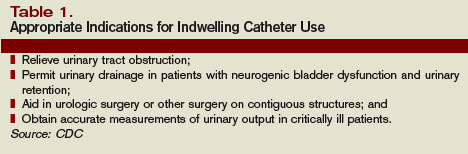
Optimal catheter management: The easiest and most effective means to prevent CAUTI is to limit the use of urinary catheters to clearly identified medical indications (see Table 1, above). However, as simple as this prevention practice may sound, studies have demonstrated that as many as 20% of patients have indwelling catheters initially placed for unjustified or even unknown medical indications.8 Additionally, continued catheter use is inappropriate in one-third to one-half of all catheter days.9 These data confirm misuse and overuse of indwelling urinary catheters in the hospital setting is common.
In 1981, the Centers for Disease Control and Prevention (CDC) recognized the importance of addressing this situation and published a guideline to aid prevention of CAUTIs.10 The CDC urged the limitation of catheter use to a carefully selected patient population. Furthermore, the report strongly stressed the importance of catheter removal as soon as possible and advised against the use of catheters solely for the convenience of healthcare workers.
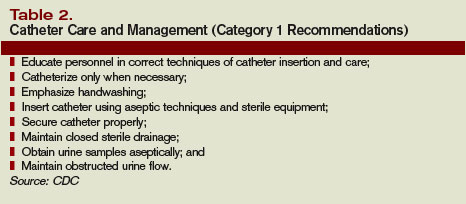
Evidence-based techniques for insertion and catheter care also were outlined in the guideline (see Table 2, p. 31). However, these recommendations have been poorly implemented, likely due to the competing priorities of providers and the difficulty operationalizing the guidelines. Additionally, evidence from the intervening 25 years has not yet been incorporated into the guideline, although a revision currently is underway.
Until that revision is complete, the Joanna Briggs Institute guideline published in 2001 addresses some of the same management techniques and incorporates newer evidence.11 Of note, practices that have been discredited due to contradictory evidence include aggressive meatal cleaning, bladder irrigation, and the application of antimicrobial agents in the drainage bag.12
Strategies to reduce unnecessary catheter days: One of the remediable reasons for catheter misuse lies in the fact physicians often are unaware of the presence of an indwelling catheter in their hospitalized patients.
Saint, et al., showed physicians were unaware of catheterization in 28% of their patients and that attending physicians were less conscious of a patient’s catheter status than residents, interns, or medical students.13 Further, the “forgotten” catheters were more likely to be unnecessary than those remembered by the healthcare team.
This information has prompted the use of various computer-based and multidisciplinary feedback protocols to readdress and re-evaluate the need for continued catheterization in a patient. For example, a study at the VAMC Puget Sound demonstrated that having a computerized order protocol for urinary catheters significantly increased the rate of documentation as well as decreased the duration of catheterization by an average of three days.14
Similar interventions to encourage early catheter removal have included daily reminders from nursing staff, allowing a nurse to discontinue catheter use independent of a physician’s order, and feedback in which nursing staff is educated about the incidence of UTI.15-17 All these relatively simple interventions showed significant improvement in the catheter removal rate and incidence of CAUTIs as well as documented cost savings.
Alternatives to indwelling catheters: In addition to efforts to decrease catheter days, alternatives to the indwelling catheters also should be explored. One such alternative method is intermittent catheterization.
Several studies in postoperative patients with hip fractures have demonstrated that the development of UTI is lower with intermittent catheterization when compared with indwelling catheterization.18 Nevertheless, since the risk of bacteriuria is 1% to 3% per episode of catheterization, after a few weeks the majority of patients will have bacteriuria. However, as the bulk of this bacteriuria often is asymptomatic, intermittent catheterization may still be an improvement. This is particularly true in postoperative patients undergoing rehabilitation and those patients only requiring catheterization for a limited number of days.
More recent studies have evaluated the use of bedside bladder ultrasound in an attempt to determine when intermittent catheterization is needed and thereby limit its use compared with standard timed catheterization. Frederickson, et al., demonstrated that this intervention resulted in significantly fewer catheterizations in surgical patients, thus delaying or avoiding the need for catheterization in 81% of the cases.19 Given this drastic improvement, it is no surprise bladder ultrasound use reduced the rates of UTI.20
External condom catheters present another alternative to indwelling catheter use but the outcomes data is conflicting. While the risk of bacteriuria is approximately 12% per month, this rate becomes increasingly higher with frequent manipulation of the condom catheter. 21,22
Two parallel cohort studies in a VA nursing home showed the incidence of symptomatic UTI to be 2.5 times greater in men with an indwelling catheter than those with a condom catheter.23 On the other hand, a cross-sectional Danish study reported higher rates of UTI with external condom catheters than urethral catheters in hospitalized patients.24 Complications from condom catheters include phimosis and local skin maceration, necessitating meticulous care with the use of these devices. Although the data surrounding external catheterization is somewhat contradictory, this device warrants consideration in incontinent males without urinary tract obstruction.
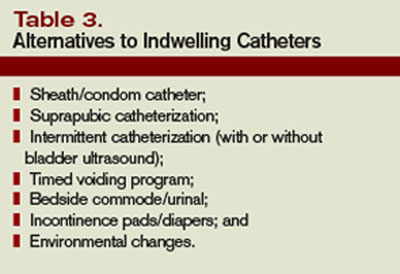
There are several other alternatives to urethral catheterization (see Table 3, p. 31), many of which have excellent face validity even in the absence of rigorous evidence.
Antimicrobial catheters: The development of antimicrobial urinary catheters, including silver-alloy and nitrofurazone-coated catheters, has been greeted with much excitement, however, the jury is still out about their best use. A 2006 systematic literature review reported that in comparison to standard catheters, antimicrobial catheters can delay or even prevent the development of bacteriuria with short-term usage.25
However, not all antimicrobial catheters are equally effective; assorted studies lack data about clinically relevant endpoints such as prevention of symptomatic UTI, bloodstream infection or death.26, 27 In addition, there are no good trials comparing nitrofurazone to silver-alloy catheters. Therefore, the level of excitement surrounding antimicrobial catheters—particularly silver-alloy catheters—must be tempered by the additional costs incurred by their use.
To date, the cost-effectiveness of antimicrobial catheters has not been demonstrated. Although additional research in this topic is still needed, some experts currently recommend the consideration of silver-alloy catheters in patients at the highest risk for developing serious consequences from UTIs.
Efforts to reduce CAUTI: In response to significant public interest in hospital-acquired infections including CAUTI, the federal government and many state governments are beginning to demand change. In August 2007, the Centers for Medicare and Medicaid Services instituted a mandate making hospitals financially responsible for selected preventable hospital-acquired harms, including CAUTIs.28 In addition, beginning with Pennsylvania in 2006, several states have mandated public reporting of hospital-acquired infections.29
Given the available information about CAUTI prevalence, risks, and preventive techniques, it is surprising the majority of hospitals in the United States have not taken appropriate measures to limit indwelling catheter use. A recent study by Saint, et al., demonstrated the startling fact that only a minority of hospitals monitor the use of urethral catheters in their patients.30
Among study hospitals, there was no widely used technique to prevent CAUTI including evidence-based practices such as daily catheter reminders. The results of this investigation illustrate the urgent need for a national strategy to reduce CAUTI. Until that time, however, hospital-based physicians must take the lead to champion collaborative efforts, to promote evidence-based catheter use.
Back to the Case
As incontinence and fall risk are not medically appropriate indications for a urethral catheter, a Foley catheter should not have been utilized. Alternatives to indwelling catheterization in this patient would include a bedside commode with nursing assistance, a timed voiding program, intermittent catheterization with or without bladder ultrasound, incontinence pads, or a condom catheter.
Attentiveness to the appropriate medical indications for catheter use, familiarity with catheter alternatives, and recognition of the clinical and economic impact of CAUTI may have prevented this patient’s UTI-induced delirium and facilitated his early transfer to SNF. TH
Dr. Wald is a getriatric hospitalist and assistant professor of medicine at the University of Colorado, Denver. Dr. Furfari is a hospital medicine fellow at the University of Colorado Denver.
References
- Beeson PB. The case against the catheter. Am J Med. 1958;24:1-3.
- Saint S. Clinical and economic consequences of nosocomial catheter-related bacteriuria. Am J Infect Control. 2000;28:68-75.
- Sedor J, Mulholland SG. Hospital-acquired UTIs associated with the indwelling catheter. Urol Clin North Am. 1999;26:821-828.
- Foxman B. Epidemiology of UTI: Incidence, morbidity and economic costs. Am J Med. 2002;113(1A):5S-13S.
- Tambyah PA, Knasinski V, Maki D. The direct costs of nosocomial catheter-associated UTI in the era of managed care. Infect Control Hosp Epidemiol. 2002;23:27-31.
- Jarvis, WR. Selected aspects of socioeconomic impact of nosocomial infections. Infect Control Hosp Epidemiol. 1996;17:552-557.
- Warren JW. Catheter-associated urinary tract infections. Infect Dis Clin North Am. 1997;11:609-622.
- Jain P, Parada JP, David A, Smith L. Overuse of the indwelling urinary catheter in hospitalized medical patients. Arch Internal Med. 1995;155:1425-1429.
- Hartstein AI, Garber SB, Ward TT, Jones SR, Morthland VH. Nosocomial urinary tract infection: a prospective evaluation of 108 catheterized patients. Infect Control. 1981;2:380-386.
- Wong E. Guideline for prevention of catheter-associated urinary tract infections. Center for Disease Control and Prevention 1981. Available at: www.cdc.gov/ncidod/dhqp/gl_catheter_assoc.html . Accessed May 8, 2008.
- Joanna Briggs Institute. Management of short term indwelling urethral catheters to prevent urinary tract infections. 2000;4(1):ISSN 1329-1874.
- Burke JP, Garibaldi RA, Britt MR, Jacobson JA, Conti M, Alling DW. Prevention of catheter-associated urinary tract infections. Am J Med. 1981;70:655-658.
- Saint S, Wiese J, Amory JK, et al. Are physicians aware of which of their patients have indwelling urinary catheters? Am J Med. 2000;109:476-480.
- Cornia PB, Amory JK, Fraser S, Saint S, Lipsky BA. Computer-based order entry decreases duration of indwelling urinary catheterization in hospitalized patients. Am J Med. 2003;114:404-406.
- Huang WC, Wann SR, Lin SL, et al. Catheter-associated urinary tract infections in intensive care units can be reduced by prompting physicians to remove unnecessary catheters. Infect Control Hosp Epidemiol. 2004;25(11):974-978.
- Topal J, Conklin S, Camp K, Morris TB, Herbert P. Prevention of nosocomial catheter-associated urinary tract infections through computerized feedback to physicians and a nurse-directed protocol. Am J Med Qual. 2005;20(3):121-126.
- Goetz AM, Kedzuf S, Wagener M, Muder R. Feedback to nursing staff as an intervention to reduce catheter-associated urinary tract infections. Am J Infect Control. 1999;27(5):402-404.
- Johansson I, Athlin E, Frykholm L, Bolinder H, Larsson G. Intermittent versus indwelling catheters for older patients with hip fractures. J Clin Nurs. 2002;11:651-656.
- Frederickson M, Neitzel JJ, Miller EH, Reuter S, Graner T, Heller J. The implementation of bedside bladder ultrasound technology: Effects of patient and cost postoperative outcomes in tertiary care. Orthop Nurs. 2000;19(3):79-87.
- Slappendel R, Weber EWG. Non-invasive measurement of bladder volume as an indication for bladder catheterization after orthopedic surgery and its effect on urinary tract infections. Eur J Anesthesiol. 1999;16:503-506.
- Hirsh D, Fainstein V, Musher DM. Do condom catheter collecting systems cause urinary tract infections? JAMA. 1979;242:340-341.
- Wong ES. Guideline for prevention of catheter-associated urinary tract infections. Am J Infect Control. 1983;11:28-36.
- Saint S, Lipsky BA. Preventing catheter-related bacteriuria. Should We? Can We? How? Arch Internal Med. 1999;159:800-808.
- Zimakoff J, Stickler DJ, Pontoppidan B, Larsen SO. Bladder management and urinary tract infection in Danish hospitals, nursing homes and home care: A national prevalence study. Infect Control Hosp Epidemiol. 1996;17(4):215-221.
- Johnson JR, Kuskowski MA, Wilt TJ. Systematic Review: Antimicrobial urinary catheters to prevent catheter-associated urinary tract infections in hospitalized patients. Ann Internal Med. 2006;144(2):116-126.
- Saint S, Elmore JG, Sullivan SD, Emerson SS, Koepsell TD. The efficacy of silver alloy-coated urinary catheters in preventing urinary tract infections; a meta-analysis. Am J Med. 1998;105(3):236-241.
- Bronahan J, Jull A, Tracy C. Cochrane incontinence group. Types of urethral catheters for management of short-term voiding problems in hospitalized adults. Cochrane Database Syst Rev. 2004;1:CD004013.
- Wald HL, Kramer AM. Nonpayment for harms resulting from medical care. JAMA. 2007;298(23):2782-2784.
- Goldstein J. Hospital infections’ cost tallied. The Philadelphia Inquirer. Nov. 15, 2006.
- Saint S, Kowalski CP, Kaufman SR, et al. Preventing hospital-acquired urinary tract infection in the United States: A national study. Clin Infect Dis. 2008;46(2):243-250.
Case
A 68-year-old male with a history of Alzheimer’s dementia and incontinence presents with failure to thrive. A Foley catheter is placed due to the patient’s incontinence and fall risk. Three days after admission while awaiting placement in a skilled nursing facility (SNF), he develops a urinary tract infection (UTI) complicated by delirium delaying his transfer to the SNF. What could have been done to prevent this complication?
Overview
It has been 50 years since Beeson, et al., recognized the potential harms stemming from urethral catheterization and penned an editorial to the American Journal of Medicine titled “The case against the catheter.”1
Since then, there has been considerable exploration of ways to limit urethral catheterization and ultimately decrease catheter-associated urinary tract infections (CAUTIs). Unfortunately, little progress has been made; indwelling urinary catheters remain ubiquitous in hospitals and CAUTIs remain the most common hospital-acquired infection in the United States.2 Given the emphasis on the quality and costs of healthcare, it is an opportune time to revisit catheter management and use as a way to combat the clinical and economic consequences of CAUTIs.
Clinicians may be lulled into thinking the clinical impact of CAUTI is less than that of other nosocomial infections. However, beyond the obvious patient harm from UTIs, associated bacteremia, and even death, the public health implications of CAUTI cannot be denied. Urinary tract infections constitute 40% of all nosocomial infections; accounting for an estimated 1 million cases annually.3 Further, 80% of all UTIs are associated with indwelling catheter use.
On average, nosocomial UTI necessitates one extra hospital day per patient, or approximately one million excess hospital days per year.4 Pooled cost analysis shows that UTIs consume an additional $400-$1,700 per event, or an estimated $425 million per year in the United States.5,6 Clearly, we cannot wait another 50 years to address this problem.
Review of the Data
Catheter duration as a risk factor for CAUTI: The indwelling catheter creates a portal of entry into a usually sterile body cavity and provides a surface on which microorganisms can colonize. At a finite rate of colonization—the incidence of bacteriuria is 3% to 10% per catheter day—the duration of urinary catheterization becomes the strongest predictor of catheter-associated bacteriuria.7 Even in relatively short-term catheter use of two to 10 days, the pooled cumulative incidence of developing bacteriuria is 26%.
Given the magnitude of these numbers, it should be no surprise that after one month of catheterization, bacteriuria develops in almost all patients. Twenty-four percent of patients with bacteriuria develop symptomatic UTIs with close to 5% suffering bacteremia. Consequently, nosocomial UTIs cause 15% of all hospital-acquired bacteremia.
Optimal catheter management: The easiest and most effective means to prevent CAUTI is to limit the use of urinary catheters to clearly identified medical indications (see Table 1, above). However, as simple as this prevention practice may sound, studies have demonstrated that as many as 20% of patients have indwelling catheters initially placed for unjustified or even unknown medical indications.8 Additionally, continued catheter use is inappropriate in one-third to one-half of all catheter days.9 These data confirm misuse and overuse of indwelling urinary catheters in the hospital setting is common.
In 1981, the Centers for Disease Control and Prevention (CDC) recognized the importance of addressing this situation and published a guideline to aid prevention of CAUTIs.10 The CDC urged the limitation of catheter use to a carefully selected patient population. Furthermore, the report strongly stressed the importance of catheter removal as soon as possible and advised against the use of catheters solely for the convenience of healthcare workers.
Evidence-based techniques for insertion and catheter care also were outlined in the guideline (see Table 2, p. 31). However, these recommendations have been poorly implemented, likely due to the competing priorities of providers and the difficulty operationalizing the guidelines. Additionally, evidence from the intervening 25 years has not yet been incorporated into the guideline, although a revision currently is underway.
Until that revision is complete, the Joanna Briggs Institute guideline published in 2001 addresses some of the same management techniques and incorporates newer evidence.11 Of note, practices that have been discredited due to contradictory evidence include aggressive meatal cleaning, bladder irrigation, and the application of antimicrobial agents in the drainage bag.12
Strategies to reduce unnecessary catheter days: One of the remediable reasons for catheter misuse lies in the fact physicians often are unaware of the presence of an indwelling catheter in their hospitalized patients.
Saint, et al., showed physicians were unaware of catheterization in 28% of their patients and that attending physicians were less conscious of a patient’s catheter status than residents, interns, or medical students.13 Further, the “forgotten” catheters were more likely to be unnecessary than those remembered by the healthcare team.
This information has prompted the use of various computer-based and multidisciplinary feedback protocols to readdress and re-evaluate the need for continued catheterization in a patient. For example, a study at the VAMC Puget Sound demonstrated that having a computerized order protocol for urinary catheters significantly increased the rate of documentation as well as decreased the duration of catheterization by an average of three days.14
Similar interventions to encourage early catheter removal have included daily reminders from nursing staff, allowing a nurse to discontinue catheter use independent of a physician’s order, and feedback in which nursing staff is educated about the incidence of UTI.15-17 All these relatively simple interventions showed significant improvement in the catheter removal rate and incidence of CAUTIs as well as documented cost savings.
Alternatives to indwelling catheters: In addition to efforts to decrease catheter days, alternatives to the indwelling catheters also should be explored. One such alternative method is intermittent catheterization.
Several studies in postoperative patients with hip fractures have demonstrated that the development of UTI is lower with intermittent catheterization when compared with indwelling catheterization.18 Nevertheless, since the risk of bacteriuria is 1% to 3% per episode of catheterization, after a few weeks the majority of patients will have bacteriuria. However, as the bulk of this bacteriuria often is asymptomatic, intermittent catheterization may still be an improvement. This is particularly true in postoperative patients undergoing rehabilitation and those patients only requiring catheterization for a limited number of days.
More recent studies have evaluated the use of bedside bladder ultrasound in an attempt to determine when intermittent catheterization is needed and thereby limit its use compared with standard timed catheterization. Frederickson, et al., demonstrated that this intervention resulted in significantly fewer catheterizations in surgical patients, thus delaying or avoiding the need for catheterization in 81% of the cases.19 Given this drastic improvement, it is no surprise bladder ultrasound use reduced the rates of UTI.20
External condom catheters present another alternative to indwelling catheter use but the outcomes data is conflicting. While the risk of bacteriuria is approximately 12% per month, this rate becomes increasingly higher with frequent manipulation of the condom catheter. 21,22
Two parallel cohort studies in a VA nursing home showed the incidence of symptomatic UTI to be 2.5 times greater in men with an indwelling catheter than those with a condom catheter.23 On the other hand, a cross-sectional Danish study reported higher rates of UTI with external condom catheters than urethral catheters in hospitalized patients.24 Complications from condom catheters include phimosis and local skin maceration, necessitating meticulous care with the use of these devices. Although the data surrounding external catheterization is somewhat contradictory, this device warrants consideration in incontinent males without urinary tract obstruction.
There are several other alternatives to urethral catheterization (see Table 3, p. 31), many of which have excellent face validity even in the absence of rigorous evidence.
Antimicrobial catheters: The development of antimicrobial urinary catheters, including silver-alloy and nitrofurazone-coated catheters, has been greeted with much excitement, however, the jury is still out about their best use. A 2006 systematic literature review reported that in comparison to standard catheters, antimicrobial catheters can delay or even prevent the development of bacteriuria with short-term usage.25
However, not all antimicrobial catheters are equally effective; assorted studies lack data about clinically relevant endpoints such as prevention of symptomatic UTI, bloodstream infection or death.26, 27 In addition, there are no good trials comparing nitrofurazone to silver-alloy catheters. Therefore, the level of excitement surrounding antimicrobial catheters—particularly silver-alloy catheters—must be tempered by the additional costs incurred by their use.
To date, the cost-effectiveness of antimicrobial catheters has not been demonstrated. Although additional research in this topic is still needed, some experts currently recommend the consideration of silver-alloy catheters in patients at the highest risk for developing serious consequences from UTIs.
Efforts to reduce CAUTI: In response to significant public interest in hospital-acquired infections including CAUTI, the federal government and many state governments are beginning to demand change. In August 2007, the Centers for Medicare and Medicaid Services instituted a mandate making hospitals financially responsible for selected preventable hospital-acquired harms, including CAUTIs.28 In addition, beginning with Pennsylvania in 2006, several states have mandated public reporting of hospital-acquired infections.29
Given the available information about CAUTI prevalence, risks, and preventive techniques, it is surprising the majority of hospitals in the United States have not taken appropriate measures to limit indwelling catheter use. A recent study by Saint, et al., demonstrated the startling fact that only a minority of hospitals monitor the use of urethral catheters in their patients.30
Among study hospitals, there was no widely used technique to prevent CAUTI including evidence-based practices such as daily catheter reminders. The results of this investigation illustrate the urgent need for a national strategy to reduce CAUTI. Until that time, however, hospital-based physicians must take the lead to champion collaborative efforts, to promote evidence-based catheter use.
Back to the Case
As incontinence and fall risk are not medically appropriate indications for a urethral catheter, a Foley catheter should not have been utilized. Alternatives to indwelling catheterization in this patient would include a bedside commode with nursing assistance, a timed voiding program, intermittent catheterization with or without bladder ultrasound, incontinence pads, or a condom catheter.
Attentiveness to the appropriate medical indications for catheter use, familiarity with catheter alternatives, and recognition of the clinical and economic impact of CAUTI may have prevented this patient’s UTI-induced delirium and facilitated his early transfer to SNF. TH
Dr. Wald is a getriatric hospitalist and assistant professor of medicine at the University of Colorado, Denver. Dr. Furfari is a hospital medicine fellow at the University of Colorado Denver.
References
- Beeson PB. The case against the catheter. Am J Med. 1958;24:1-3.
- Saint S. Clinical and economic consequences of nosocomial catheter-related bacteriuria. Am J Infect Control. 2000;28:68-75.
- Sedor J, Mulholland SG. Hospital-acquired UTIs associated with the indwelling catheter. Urol Clin North Am. 1999;26:821-828.
- Foxman B. Epidemiology of UTI: Incidence, morbidity and economic costs. Am J Med. 2002;113(1A):5S-13S.
- Tambyah PA, Knasinski V, Maki D. The direct costs of nosocomial catheter-associated UTI in the era of managed care. Infect Control Hosp Epidemiol. 2002;23:27-31.
- Jarvis, WR. Selected aspects of socioeconomic impact of nosocomial infections. Infect Control Hosp Epidemiol. 1996;17:552-557.
- Warren JW. Catheter-associated urinary tract infections. Infect Dis Clin North Am. 1997;11:609-622.
- Jain P, Parada JP, David A, Smith L. Overuse of the indwelling urinary catheter in hospitalized medical patients. Arch Internal Med. 1995;155:1425-1429.
- Hartstein AI, Garber SB, Ward TT, Jones SR, Morthland VH. Nosocomial urinary tract infection: a prospective evaluation of 108 catheterized patients. Infect Control. 1981;2:380-386.
- Wong E. Guideline for prevention of catheter-associated urinary tract infections. Center for Disease Control and Prevention 1981. Available at: www.cdc.gov/ncidod/dhqp/gl_catheter_assoc.html . Accessed May 8, 2008.
- Joanna Briggs Institute. Management of short term indwelling urethral catheters to prevent urinary tract infections. 2000;4(1):ISSN 1329-1874.
- Burke JP, Garibaldi RA, Britt MR, Jacobson JA, Conti M, Alling DW. Prevention of catheter-associated urinary tract infections. Am J Med. 1981;70:655-658.
- Saint S, Wiese J, Amory JK, et al. Are physicians aware of which of their patients have indwelling urinary catheters? Am J Med. 2000;109:476-480.
- Cornia PB, Amory JK, Fraser S, Saint S, Lipsky BA. Computer-based order entry decreases duration of indwelling urinary catheterization in hospitalized patients. Am J Med. 2003;114:404-406.
- Huang WC, Wann SR, Lin SL, et al. Catheter-associated urinary tract infections in intensive care units can be reduced by prompting physicians to remove unnecessary catheters. Infect Control Hosp Epidemiol. 2004;25(11):974-978.
- Topal J, Conklin S, Camp K, Morris TB, Herbert P. Prevention of nosocomial catheter-associated urinary tract infections through computerized feedback to physicians and a nurse-directed protocol. Am J Med Qual. 2005;20(3):121-126.
- Goetz AM, Kedzuf S, Wagener M, Muder R. Feedback to nursing staff as an intervention to reduce catheter-associated urinary tract infections. Am J Infect Control. 1999;27(5):402-404.
- Johansson I, Athlin E, Frykholm L, Bolinder H, Larsson G. Intermittent versus indwelling catheters for older patients with hip fractures. J Clin Nurs. 2002;11:651-656.
- Frederickson M, Neitzel JJ, Miller EH, Reuter S, Graner T, Heller J. The implementation of bedside bladder ultrasound technology: Effects of patient and cost postoperative outcomes in tertiary care. Orthop Nurs. 2000;19(3):79-87.
- Slappendel R, Weber EWG. Non-invasive measurement of bladder volume as an indication for bladder catheterization after orthopedic surgery and its effect on urinary tract infections. Eur J Anesthesiol. 1999;16:503-506.
- Hirsh D, Fainstein V, Musher DM. Do condom catheter collecting systems cause urinary tract infections? JAMA. 1979;242:340-341.
- Wong ES. Guideline for prevention of catheter-associated urinary tract infections. Am J Infect Control. 1983;11:28-36.
- Saint S, Lipsky BA. Preventing catheter-related bacteriuria. Should We? Can We? How? Arch Internal Med. 1999;159:800-808.
- Zimakoff J, Stickler DJ, Pontoppidan B, Larsen SO. Bladder management and urinary tract infection in Danish hospitals, nursing homes and home care: A national prevalence study. Infect Control Hosp Epidemiol. 1996;17(4):215-221.
- Johnson JR, Kuskowski MA, Wilt TJ. Systematic Review: Antimicrobial urinary catheters to prevent catheter-associated urinary tract infections in hospitalized patients. Ann Internal Med. 2006;144(2):116-126.
- Saint S, Elmore JG, Sullivan SD, Emerson SS, Koepsell TD. The efficacy of silver alloy-coated urinary catheters in preventing urinary tract infections; a meta-analysis. Am J Med. 1998;105(3):236-241.
- Bronahan J, Jull A, Tracy C. Cochrane incontinence group. Types of urethral catheters for management of short-term voiding problems in hospitalized adults. Cochrane Database Syst Rev. 2004;1:CD004013.
- Wald HL, Kramer AM. Nonpayment for harms resulting from medical care. JAMA. 2007;298(23):2782-2784.
- Goldstein J. Hospital infections’ cost tallied. The Philadelphia Inquirer. Nov. 15, 2006.
- Saint S, Kowalski CP, Kaufman SR, et al. Preventing hospital-acquired urinary tract infection in the United States: A national study. Clin Infect Dis. 2008;46(2):243-250.
Case
A 68-year-old male with a history of Alzheimer’s dementia and incontinence presents with failure to thrive. A Foley catheter is placed due to the patient’s incontinence and fall risk. Three days after admission while awaiting placement in a skilled nursing facility (SNF), he develops a urinary tract infection (UTI) complicated by delirium delaying his transfer to the SNF. What could have been done to prevent this complication?
Overview
It has been 50 years since Beeson, et al., recognized the potential harms stemming from urethral catheterization and penned an editorial to the American Journal of Medicine titled “The case against the catheter.”1
Since then, there has been considerable exploration of ways to limit urethral catheterization and ultimately decrease catheter-associated urinary tract infections (CAUTIs). Unfortunately, little progress has been made; indwelling urinary catheters remain ubiquitous in hospitals and CAUTIs remain the most common hospital-acquired infection in the United States.2 Given the emphasis on the quality and costs of healthcare, it is an opportune time to revisit catheter management and use as a way to combat the clinical and economic consequences of CAUTIs.
Clinicians may be lulled into thinking the clinical impact of CAUTI is less than that of other nosocomial infections. However, beyond the obvious patient harm from UTIs, associated bacteremia, and even death, the public health implications of CAUTI cannot be denied. Urinary tract infections constitute 40% of all nosocomial infections; accounting for an estimated 1 million cases annually.3 Further, 80% of all UTIs are associated with indwelling catheter use.
On average, nosocomial UTI necessitates one extra hospital day per patient, or approximately one million excess hospital days per year.4 Pooled cost analysis shows that UTIs consume an additional $400-$1,700 per event, or an estimated $425 million per year in the United States.5,6 Clearly, we cannot wait another 50 years to address this problem.
Review of the Data
Catheter duration as a risk factor for CAUTI: The indwelling catheter creates a portal of entry into a usually sterile body cavity and provides a surface on which microorganisms can colonize. At a finite rate of colonization—the incidence of bacteriuria is 3% to 10% per catheter day—the duration of urinary catheterization becomes the strongest predictor of catheter-associated bacteriuria.7 Even in relatively short-term catheter use of two to 10 days, the pooled cumulative incidence of developing bacteriuria is 26%.
Given the magnitude of these numbers, it should be no surprise that after one month of catheterization, bacteriuria develops in almost all patients. Twenty-four percent of patients with bacteriuria develop symptomatic UTIs with close to 5% suffering bacteremia. Consequently, nosocomial UTIs cause 15% of all hospital-acquired bacteremia.
Optimal catheter management: The easiest and most effective means to prevent CAUTI is to limit the use of urinary catheters to clearly identified medical indications (see Table 1, above). However, as simple as this prevention practice may sound, studies have demonstrated that as many as 20% of patients have indwelling catheters initially placed for unjustified or even unknown medical indications.8 Additionally, continued catheter use is inappropriate in one-third to one-half of all catheter days.9 These data confirm misuse and overuse of indwelling urinary catheters in the hospital setting is common.
In 1981, the Centers for Disease Control and Prevention (CDC) recognized the importance of addressing this situation and published a guideline to aid prevention of CAUTIs.10 The CDC urged the limitation of catheter use to a carefully selected patient population. Furthermore, the report strongly stressed the importance of catheter removal as soon as possible and advised against the use of catheters solely for the convenience of healthcare workers.
Evidence-based techniques for insertion and catheter care also were outlined in the guideline (see Table 2, p. 31). However, these recommendations have been poorly implemented, likely due to the competing priorities of providers and the difficulty operationalizing the guidelines. Additionally, evidence from the intervening 25 years has not yet been incorporated into the guideline, although a revision currently is underway.
Until that revision is complete, the Joanna Briggs Institute guideline published in 2001 addresses some of the same management techniques and incorporates newer evidence.11 Of note, practices that have been discredited due to contradictory evidence include aggressive meatal cleaning, bladder irrigation, and the application of antimicrobial agents in the drainage bag.12
Strategies to reduce unnecessary catheter days: One of the remediable reasons for catheter misuse lies in the fact physicians often are unaware of the presence of an indwelling catheter in their hospitalized patients.
Saint, et al., showed physicians were unaware of catheterization in 28% of their patients and that attending physicians were less conscious of a patient’s catheter status than residents, interns, or medical students.13 Further, the “forgotten” catheters were more likely to be unnecessary than those remembered by the healthcare team.
This information has prompted the use of various computer-based and multidisciplinary feedback protocols to readdress and re-evaluate the need for continued catheterization in a patient. For example, a study at the VAMC Puget Sound demonstrated that having a computerized order protocol for urinary catheters significantly increased the rate of documentation as well as decreased the duration of catheterization by an average of three days.14
Similar interventions to encourage early catheter removal have included daily reminders from nursing staff, allowing a nurse to discontinue catheter use independent of a physician’s order, and feedback in which nursing staff is educated about the incidence of UTI.15-17 All these relatively simple interventions showed significant improvement in the catheter removal rate and incidence of CAUTIs as well as documented cost savings.
Alternatives to indwelling catheters: In addition to efforts to decrease catheter days, alternatives to the indwelling catheters also should be explored. One such alternative method is intermittent catheterization.
Several studies in postoperative patients with hip fractures have demonstrated that the development of UTI is lower with intermittent catheterization when compared with indwelling catheterization.18 Nevertheless, since the risk of bacteriuria is 1% to 3% per episode of catheterization, after a few weeks the majority of patients will have bacteriuria. However, as the bulk of this bacteriuria often is asymptomatic, intermittent catheterization may still be an improvement. This is particularly true in postoperative patients undergoing rehabilitation and those patients only requiring catheterization for a limited number of days.
More recent studies have evaluated the use of bedside bladder ultrasound in an attempt to determine when intermittent catheterization is needed and thereby limit its use compared with standard timed catheterization. Frederickson, et al., demonstrated that this intervention resulted in significantly fewer catheterizations in surgical patients, thus delaying or avoiding the need for catheterization in 81% of the cases.19 Given this drastic improvement, it is no surprise bladder ultrasound use reduced the rates of UTI.20
External condom catheters present another alternative to indwelling catheter use but the outcomes data is conflicting. While the risk of bacteriuria is approximately 12% per month, this rate becomes increasingly higher with frequent manipulation of the condom catheter. 21,22
Two parallel cohort studies in a VA nursing home showed the incidence of symptomatic UTI to be 2.5 times greater in men with an indwelling catheter than those with a condom catheter.23 On the other hand, a cross-sectional Danish study reported higher rates of UTI with external condom catheters than urethral catheters in hospitalized patients.24 Complications from condom catheters include phimosis and local skin maceration, necessitating meticulous care with the use of these devices. Although the data surrounding external catheterization is somewhat contradictory, this device warrants consideration in incontinent males without urinary tract obstruction.
There are several other alternatives to urethral catheterization (see Table 3, p. 31), many of which have excellent face validity even in the absence of rigorous evidence.
Antimicrobial catheters: The development of antimicrobial urinary catheters, including silver-alloy and nitrofurazone-coated catheters, has been greeted with much excitement, however, the jury is still out about their best use. A 2006 systematic literature review reported that in comparison to standard catheters, antimicrobial catheters can delay or even prevent the development of bacteriuria with short-term usage.25
However, not all antimicrobial catheters are equally effective; assorted studies lack data about clinically relevant endpoints such as prevention of symptomatic UTI, bloodstream infection or death.26, 27 In addition, there are no good trials comparing nitrofurazone to silver-alloy catheters. Therefore, the level of excitement surrounding antimicrobial catheters—particularly silver-alloy catheters—must be tempered by the additional costs incurred by their use.
To date, the cost-effectiveness of antimicrobial catheters has not been demonstrated. Although additional research in this topic is still needed, some experts currently recommend the consideration of silver-alloy catheters in patients at the highest risk for developing serious consequences from UTIs.
Efforts to reduce CAUTI: In response to significant public interest in hospital-acquired infections including CAUTI, the federal government and many state governments are beginning to demand change. In August 2007, the Centers for Medicare and Medicaid Services instituted a mandate making hospitals financially responsible for selected preventable hospital-acquired harms, including CAUTIs.28 In addition, beginning with Pennsylvania in 2006, several states have mandated public reporting of hospital-acquired infections.29
Given the available information about CAUTI prevalence, risks, and preventive techniques, it is surprising the majority of hospitals in the United States have not taken appropriate measures to limit indwelling catheter use. A recent study by Saint, et al., demonstrated the startling fact that only a minority of hospitals monitor the use of urethral catheters in their patients.30
Among study hospitals, there was no widely used technique to prevent CAUTI including evidence-based practices such as daily catheter reminders. The results of this investigation illustrate the urgent need for a national strategy to reduce CAUTI. Until that time, however, hospital-based physicians must take the lead to champion collaborative efforts, to promote evidence-based catheter use.
Back to the Case
As incontinence and fall risk are not medically appropriate indications for a urethral catheter, a Foley catheter should not have been utilized. Alternatives to indwelling catheterization in this patient would include a bedside commode with nursing assistance, a timed voiding program, intermittent catheterization with or without bladder ultrasound, incontinence pads, or a condom catheter.
Attentiveness to the appropriate medical indications for catheter use, familiarity with catheter alternatives, and recognition of the clinical and economic impact of CAUTI may have prevented this patient’s UTI-induced delirium and facilitated his early transfer to SNF. TH
Dr. Wald is a getriatric hospitalist and assistant professor of medicine at the University of Colorado, Denver. Dr. Furfari is a hospital medicine fellow at the University of Colorado Denver.
References
- Beeson PB. The case against the catheter. Am J Med. 1958;24:1-3.
- Saint S. Clinical and economic consequences of nosocomial catheter-related bacteriuria. Am J Infect Control. 2000;28:68-75.
- Sedor J, Mulholland SG. Hospital-acquired UTIs associated with the indwelling catheter. Urol Clin North Am. 1999;26:821-828.
- Foxman B. Epidemiology of UTI: Incidence, morbidity and economic costs. Am J Med. 2002;113(1A):5S-13S.
- Tambyah PA, Knasinski V, Maki D. The direct costs of nosocomial catheter-associated UTI in the era of managed care. Infect Control Hosp Epidemiol. 2002;23:27-31.
- Jarvis, WR. Selected aspects of socioeconomic impact of nosocomial infections. Infect Control Hosp Epidemiol. 1996;17:552-557.
- Warren JW. Catheter-associated urinary tract infections. Infect Dis Clin North Am. 1997;11:609-622.
- Jain P, Parada JP, David A, Smith L. Overuse of the indwelling urinary catheter in hospitalized medical patients. Arch Internal Med. 1995;155:1425-1429.
- Hartstein AI, Garber SB, Ward TT, Jones SR, Morthland VH. Nosocomial urinary tract infection: a prospective evaluation of 108 catheterized patients. Infect Control. 1981;2:380-386.
- Wong E. Guideline for prevention of catheter-associated urinary tract infections. Center for Disease Control and Prevention 1981. Available at: www.cdc.gov/ncidod/dhqp/gl_catheter_assoc.html . Accessed May 8, 2008.
- Joanna Briggs Institute. Management of short term indwelling urethral catheters to prevent urinary tract infections. 2000;4(1):ISSN 1329-1874.
- Burke JP, Garibaldi RA, Britt MR, Jacobson JA, Conti M, Alling DW. Prevention of catheter-associated urinary tract infections. Am J Med. 1981;70:655-658.
- Saint S, Wiese J, Amory JK, et al. Are physicians aware of which of their patients have indwelling urinary catheters? Am J Med. 2000;109:476-480.
- Cornia PB, Amory JK, Fraser S, Saint S, Lipsky BA. Computer-based order entry decreases duration of indwelling urinary catheterization in hospitalized patients. Am J Med. 2003;114:404-406.
- Huang WC, Wann SR, Lin SL, et al. Catheter-associated urinary tract infections in intensive care units can be reduced by prompting physicians to remove unnecessary catheters. Infect Control Hosp Epidemiol. 2004;25(11):974-978.
- Topal J, Conklin S, Camp K, Morris TB, Herbert P. Prevention of nosocomial catheter-associated urinary tract infections through computerized feedback to physicians and a nurse-directed protocol. Am J Med Qual. 2005;20(3):121-126.
- Goetz AM, Kedzuf S, Wagener M, Muder R. Feedback to nursing staff as an intervention to reduce catheter-associated urinary tract infections. Am J Infect Control. 1999;27(5):402-404.
- Johansson I, Athlin E, Frykholm L, Bolinder H, Larsson G. Intermittent versus indwelling catheters for older patients with hip fractures. J Clin Nurs. 2002;11:651-656.
- Frederickson M, Neitzel JJ, Miller EH, Reuter S, Graner T, Heller J. The implementation of bedside bladder ultrasound technology: Effects of patient and cost postoperative outcomes in tertiary care. Orthop Nurs. 2000;19(3):79-87.
- Slappendel R, Weber EWG. Non-invasive measurement of bladder volume as an indication for bladder catheterization after orthopedic surgery and its effect on urinary tract infections. Eur J Anesthesiol. 1999;16:503-506.
- Hirsh D, Fainstein V, Musher DM. Do condom catheter collecting systems cause urinary tract infections? JAMA. 1979;242:340-341.
- Wong ES. Guideline for prevention of catheter-associated urinary tract infections. Am J Infect Control. 1983;11:28-36.
- Saint S, Lipsky BA. Preventing catheter-related bacteriuria. Should We? Can We? How? Arch Internal Med. 1999;159:800-808.
- Zimakoff J, Stickler DJ, Pontoppidan B, Larsen SO. Bladder management and urinary tract infection in Danish hospitals, nursing homes and home care: A national prevalence study. Infect Control Hosp Epidemiol. 1996;17(4):215-221.
- Johnson JR, Kuskowski MA, Wilt TJ. Systematic Review: Antimicrobial urinary catheters to prevent catheter-associated urinary tract infections in hospitalized patients. Ann Internal Med. 2006;144(2):116-126.
- Saint S, Elmore JG, Sullivan SD, Emerson SS, Koepsell TD. The efficacy of silver alloy-coated urinary catheters in preventing urinary tract infections; a meta-analysis. Am J Med. 1998;105(3):236-241.
- Bronahan J, Jull A, Tracy C. Cochrane incontinence group. Types of urethral catheters for management of short-term voiding problems in hospitalized adults. Cochrane Database Syst Rev. 2004;1:CD004013.
- Wald HL, Kramer AM. Nonpayment for harms resulting from medical care. JAMA. 2007;298(23):2782-2784.
- Goldstein J. Hospital infections’ cost tallied. The Philadelphia Inquirer. Nov. 15, 2006.
- Saint S, Kowalski CP, Kaufman SR, et al. Preventing hospital-acquired urinary tract infection in the United States: A national study. Clin Infect Dis. 2008;46(2):243-250.
OR Opportunity
In this era of increasing synergy between the surgical and hospital medicine services, Minnesota hospitalist David Frenz, MD, has taken perioperative management of surgical patients a step further.
One or two days a week, Dr. Frenz can be found in the operating room (OR) of St. Joseph’s Hospital in St. Paul, assisting on multilevel spine surgery cases.
Although Dr. Frenz may be a one-of-a-kind hospitalist acting as first assistant in the OR, the approach offers many advantages to his hospital and hospital medicine service, says Robert C. Moravec, MD.
“It seems more efficient having one assistant surgeon [rather than several scrub technicians] who knows exactly what’s going to happen next,” says Dr. Moravec, medical director for both the hospital service and St. Joseph’s Hospital. “More importantly, it’s a way to develop some expertise in the perioperative arena and to develop collaborative relationships with the surgeons.” In addition, the hospital service is able to bill for an assistant surgeon’s fee, which covers much of Dr. Frenz’ salary. And when he’s not on the medical floors seeing patients, Dr. Frenz is engaged in a monthslong quality improvement (QI) project to improve perioperative care and reduce same-day surgery cancellations at his institution.
The effectiveness of this QI project, which Dr. Moravec believes will go to HealthEast’s other two acute care hospitals in nine months, would not be possible without Dr. Frenz’ conversance with problems in the OR.
“When you are involved in this type of process improvement project, you don’t want, as a do-gooder, to create more cancellations and delays,” says Dr. Frenz. “And you don’t want to screw up their referral relationships. You’ve got to be super-sensitive to those issues as you’re trying to slowly bring about change. The fact that I’m known to the surgeons and that I’m in the OR getting dirty lends credibility to our efforts to bring change.”
Value in Surgical Assisting?
In medical school, Dr. Frenz had considered becoming a general surgeon before switching to family-practice medicine, so he is comfortable in the OR and finds assisting to be a stimulating change of pace. Although this long-standing pilot project is unique, it raises provocative possibilities for other hospitalists.
“Having a hospitalist go into the OR to assist with cases creates an interesting situation,” says Richard Rohr, MD, vice president for medical affairs at Cortland Regional Medical Center in Cortland, N.Y. “The hospitalist is then able to engage with more surgical aspects of the case, as well as the medical management.” Adding surgical assisting to the hospitalist’s role—although it could complicate scheduling and malpractice coverage—might dovetail with some hospitals’ difficulties retaining general surgeons, he says.
Combining the two functions could add to the hospital medicine group’s bottom line if relevant malpractice costs could be worked out, says hospitalist Kenneth Patrick, MD, the ICU director at Chestnut Hill Hospital in Philadelphia. Dr. Frenz’ malpractice is provided by his hospital, and pre-certification for his assistance on cases is handled by the neurosurgeon’s office staff.
In Dr. Patrick’s experience, there could be benefits to the patient if the hospitalist has direct involvement in the OR. For instance, the hospitalist would be better able to anticipate and deal with pre- and post-operative problems.
—David Frenz, MD, hospitalist, St. Joseph’s Hospital, St. Paul, Minn.
Surgery and ‘Outer Space’
Whether or not surgical assisting could become a new frontier for hospitalists, it illustrates the multiple collaborative roles the specialty increasingly offers.
David A. Hoffmann, MD, is medical director of a hospitalist group in Chambersburg, Pa. The group is made up of half family practice and half internal medicine hospitalists. Like so many other hospitalists, he’s seen tremendous growth in the number of surgical co-management cases his group handles at Chambersburg Hospital (see “The Surgical Surge,” December 2007, p. 1). His group tries “to make inroads with the surgeons,” he says. “We send a member of our group to their meetings, and we work with them on management protocols [such as DVT prophylaxis]. I can see the benefits of getting to know what’s going on down there [in the OR]. The truth of matter is, [despite co-management], sending the patient to the OR is like sending someone into outer space for the hospitalist. The rocket goes off, and you don’t see the patient until they come back in for a landing.”
Depending on the location of hospitalist groups, involvement as first assistants could represent additional opportunities for family medicine physicians, Dr. Hoffmann believes.
Air Force Maj. Heather Cereste, MD, agrees that the degree of symbiosis between surgeons and hospitalists likely will continue to be a location - and hospital-specific phenomenon. While serving in Iraq, she had significant experience with surgical procedures, and felt that from an internist’s perspective, she was more valuable to the surgical team. During her third-year residency in Maine, she observed many who planned to go into family practice assisting with gastrointestinal procedures and the like. “Certainly, in a smaller setting, with fewer available resources, the more autonomous a hospitalist can be, the better,” says Dr. Cereste, co-director of the geriatric medicine service at Wilford Hall Medical Center, Lackland Air Force Base, Texas, and chair of the bioethics committee.
Cautionary Tales

Though surgical assisting is an intriguing idea, such a set up “could have its own set of unintended consequences,” especially for a private model hospitalist group, says Brian Bossard, MD, medical director of Inpatient Physician Associates in Lincoln, Neb.
Dr. Bossard has personal experience with this configuration. When an internist in his hospitalist group began to do surgical assisting, the privately owned group (which contracts with Bryan LGH Hospital in Lincoln to provide hospitalist services) did not find this advantageous. The physician’s surgical participation was at times disruptive for the group, since he was unable to be immediately available and on call or to run codes while in the OR.
“It’s not clear to me that there would be an advantage to have a hospitalist [assisting in the OR], as opposed to another physician extender such as a physician assistant or a nurse practitioner,” says Jack M. Percelay, MD, a pediatric hospitalist at Saint Barnabas Medical Center in Livingston, N.J. Co-management of surgical patients is another matter, however, and Dr. Percelay does see value in having hospitalists help with maintenance of lines, wound care, and other post-surgical management duties.
“There is a certain set of procedures we’re supposed to master, such as vascular access and airway support,” Dr. Percelay continues. “But our value as hospitalists is in our cognitive skill set. I don’t know any hospitalists who consider a scalpel as one of their routine tools.”
Bryan Fine, MD, a pediatric hospital at Children’s National Medical Center in Washington, D.C., recently joined a general hospitalist group after spending three and a half years as the hospitalist in charge of medical management for the gastroenterology service. His opinion of hospitalists assisting in surgery? “I think it’s definitely valuable if it’s done in the context of a larger goal and to gain credibility from a hospital administrative level,” he suggests. However, he said, professional satisfaction for a hospitalist might be limited since he or she essentially would be serving as a physician extender.
Barriers
Family-practice physicians often are differentiated from their internal medicine colleagues by their skill sets in procedures.
“To the extent that a family-medicine physician may want to demonstrate that they can have a skill set that adds value in order to be hired or accepted, I think surgical assisting could have very specific application in specific places,” says A. Neal Axon, MD, assistant professor in the departments of internal medicine and pediatrics at the Medical University of South Carolina in Charleston. “I’ve certainly tried to market myself as a med-peds person, and as somebody who’s good at more than one thing.”
Dr. Axon concedes hospitalists as surgical assistants would not work at his institution. “In academic medical centers, the dividing lines between divisions and disciplines are very concrete,” he explains. “I think many people carry those cultural barriers or dividers—even if they are somewhat artificial outside the academic environment—when they leave and go into community practice.”
Those divisions are not felt as keenly in the Midwest, according to Dr. Frenz, where “family medicine has a long tradition.” St. Joseph’s Hospital has a family - medicine residency program, and more than half the credentialed physicians there are family- medicine trained.
“We think that family-medicine physicians have a skill set that is valuable in certain clinical settings,” he says. “For example, we do a lot of work on the behavioral health floors and are the principal medical providers on a 28-bed chemical dependency unit.” Dr. Frenz had a patient who was pregnant and alcohol dependent. Because of his expertise in addiction medicine (another of his self-described “insurgencies”) and residency training in obstetrics, Dr. Frenz is managing the patient without incurring an ob/gyn consultation.
How to Prepare
Every hospitalist’s path and skill set is unique, but for those medical students or residents who might be interested in combining some surgical work with hospitalist skills, Dr. Frenz advises adopting a calculated approach to electives. Besides taking as many surgical electives as possible, trainees should try to pick small community hospitals where they will not have to compete with surgical residents for time in the OR.
Although she thinks expanding into surgical assisting could improve recruitment (offering a varied hospital experience), Dr. Cereste also emphasizes that many questions regarding training standards, care standards, and expense hurdles would have to be addressed.
The bottom line, says Dr. Hoffmann, is that hospitalists “need to be able to play a lot of different roles. I think we’re like a utility infielder. If [surgical assisting] improves patient care, is a valuable service to the health system, and is viewed by consultants, specialists, and family doctors as an additional skill, it’s clearly going to benefit your program and your hospital. The key is to see what works in everyone’s little pond and try to be a team builder.” TH
Gretchen Henkel is a medical writer based in California
In this era of increasing synergy between the surgical and hospital medicine services, Minnesota hospitalist David Frenz, MD, has taken perioperative management of surgical patients a step further.
One or two days a week, Dr. Frenz can be found in the operating room (OR) of St. Joseph’s Hospital in St. Paul, assisting on multilevel spine surgery cases.
Although Dr. Frenz may be a one-of-a-kind hospitalist acting as first assistant in the OR, the approach offers many advantages to his hospital and hospital medicine service, says Robert C. Moravec, MD.
“It seems more efficient having one assistant surgeon [rather than several scrub technicians] who knows exactly what’s going to happen next,” says Dr. Moravec, medical director for both the hospital service and St. Joseph’s Hospital. “More importantly, it’s a way to develop some expertise in the perioperative arena and to develop collaborative relationships with the surgeons.” In addition, the hospital service is able to bill for an assistant surgeon’s fee, which covers much of Dr. Frenz’ salary. And when he’s not on the medical floors seeing patients, Dr. Frenz is engaged in a monthslong quality improvement (QI) project to improve perioperative care and reduce same-day surgery cancellations at his institution.
The effectiveness of this QI project, which Dr. Moravec believes will go to HealthEast’s other two acute care hospitals in nine months, would not be possible without Dr. Frenz’ conversance with problems in the OR.
“When you are involved in this type of process improvement project, you don’t want, as a do-gooder, to create more cancellations and delays,” says Dr. Frenz. “And you don’t want to screw up their referral relationships. You’ve got to be super-sensitive to those issues as you’re trying to slowly bring about change. The fact that I’m known to the surgeons and that I’m in the OR getting dirty lends credibility to our efforts to bring change.”
Value in Surgical Assisting?
In medical school, Dr. Frenz had considered becoming a general surgeon before switching to family-practice medicine, so he is comfortable in the OR and finds assisting to be a stimulating change of pace. Although this long-standing pilot project is unique, it raises provocative possibilities for other hospitalists.
“Having a hospitalist go into the OR to assist with cases creates an interesting situation,” says Richard Rohr, MD, vice president for medical affairs at Cortland Regional Medical Center in Cortland, N.Y. “The hospitalist is then able to engage with more surgical aspects of the case, as well as the medical management.” Adding surgical assisting to the hospitalist’s role—although it could complicate scheduling and malpractice coverage—might dovetail with some hospitals’ difficulties retaining general surgeons, he says.
Combining the two functions could add to the hospital medicine group’s bottom line if relevant malpractice costs could be worked out, says hospitalist Kenneth Patrick, MD, the ICU director at Chestnut Hill Hospital in Philadelphia. Dr. Frenz’ malpractice is provided by his hospital, and pre-certification for his assistance on cases is handled by the neurosurgeon’s office staff.
In Dr. Patrick’s experience, there could be benefits to the patient if the hospitalist has direct involvement in the OR. For instance, the hospitalist would be better able to anticipate and deal with pre- and post-operative problems.
—David Frenz, MD, hospitalist, St. Joseph’s Hospital, St. Paul, Minn.
Surgery and ‘Outer Space’
Whether or not surgical assisting could become a new frontier for hospitalists, it illustrates the multiple collaborative roles the specialty increasingly offers.
David A. Hoffmann, MD, is medical director of a hospitalist group in Chambersburg, Pa. The group is made up of half family practice and half internal medicine hospitalists. Like so many other hospitalists, he’s seen tremendous growth in the number of surgical co-management cases his group handles at Chambersburg Hospital (see “The Surgical Surge,” December 2007, p. 1). His group tries “to make inroads with the surgeons,” he says. “We send a member of our group to their meetings, and we work with them on management protocols [such as DVT prophylaxis]. I can see the benefits of getting to know what’s going on down there [in the OR]. The truth of matter is, [despite co-management], sending the patient to the OR is like sending someone into outer space for the hospitalist. The rocket goes off, and you don’t see the patient until they come back in for a landing.”
Depending on the location of hospitalist groups, involvement as first assistants could represent additional opportunities for family medicine physicians, Dr. Hoffmann believes.
Air Force Maj. Heather Cereste, MD, agrees that the degree of symbiosis between surgeons and hospitalists likely will continue to be a location - and hospital-specific phenomenon. While serving in Iraq, she had significant experience with surgical procedures, and felt that from an internist’s perspective, she was more valuable to the surgical team. During her third-year residency in Maine, she observed many who planned to go into family practice assisting with gastrointestinal procedures and the like. “Certainly, in a smaller setting, with fewer available resources, the more autonomous a hospitalist can be, the better,” says Dr. Cereste, co-director of the geriatric medicine service at Wilford Hall Medical Center, Lackland Air Force Base, Texas, and chair of the bioethics committee.
Cautionary Tales
Though surgical assisting is an intriguing idea, such a set up “could have its own set of unintended consequences,” especially for a private model hospitalist group, says Brian Bossard, MD, medical director of Inpatient Physician Associates in Lincoln, Neb.
Dr. Bossard has personal experience with this configuration. When an internist in his hospitalist group began to do surgical assisting, the privately owned group (which contracts with Bryan LGH Hospital in Lincoln to provide hospitalist services) did not find this advantageous. The physician’s surgical participation was at times disruptive for the group, since he was unable to be immediately available and on call or to run codes while in the OR.
“It’s not clear to me that there would be an advantage to have a hospitalist [assisting in the OR], as opposed to another physician extender such as a physician assistant or a nurse practitioner,” says Jack M. Percelay, MD, a pediatric hospitalist at Saint Barnabas Medical Center in Livingston, N.J. Co-management of surgical patients is another matter, however, and Dr. Percelay does see value in having hospitalists help with maintenance of lines, wound care, and other post-surgical management duties.
“There is a certain set of procedures we’re supposed to master, such as vascular access and airway support,” Dr. Percelay continues. “But our value as hospitalists is in our cognitive skill set. I don’t know any hospitalists who consider a scalpel as one of their routine tools.”
Bryan Fine, MD, a pediatric hospital at Children’s National Medical Center in Washington, D.C., recently joined a general hospitalist group after spending three and a half years as the hospitalist in charge of medical management for the gastroenterology service. His opinion of hospitalists assisting in surgery? “I think it’s definitely valuable if it’s done in the context of a larger goal and to gain credibility from a hospital administrative level,” he suggests. However, he said, professional satisfaction for a hospitalist might be limited since he or she essentially would be serving as a physician extender.
Barriers
Family-practice physicians often are differentiated from their internal medicine colleagues by their skill sets in procedures.
“To the extent that a family-medicine physician may want to demonstrate that they can have a skill set that adds value in order to be hired or accepted, I think surgical assisting could have very specific application in specific places,” says A. Neal Axon, MD, assistant professor in the departments of internal medicine and pediatrics at the Medical University of South Carolina in Charleston. “I’ve certainly tried to market myself as a med-peds person, and as somebody who’s good at more than one thing.”
Dr. Axon concedes hospitalists as surgical assistants would not work at his institution. “In academic medical centers, the dividing lines between divisions and disciplines are very concrete,” he explains. “I think many people carry those cultural barriers or dividers—even if they are somewhat artificial outside the academic environment—when they leave and go into community practice.”
Those divisions are not felt as keenly in the Midwest, according to Dr. Frenz, where “family medicine has a long tradition.” St. Joseph’s Hospital has a family - medicine residency program, and more than half the credentialed physicians there are family- medicine trained.
“We think that family-medicine physicians have a skill set that is valuable in certain clinical settings,” he says. “For example, we do a lot of work on the behavioral health floors and are the principal medical providers on a 28-bed chemical dependency unit.” Dr. Frenz had a patient who was pregnant and alcohol dependent. Because of his expertise in addiction medicine (another of his self-described “insurgencies”) and residency training in obstetrics, Dr. Frenz is managing the patient without incurring an ob/gyn consultation.
How to Prepare
Every hospitalist’s path and skill set is unique, but for those medical students or residents who might be interested in combining some surgical work with hospitalist skills, Dr. Frenz advises adopting a calculated approach to electives. Besides taking as many surgical electives as possible, trainees should try to pick small community hospitals where they will not have to compete with surgical residents for time in the OR.
Although she thinks expanding into surgical assisting could improve recruitment (offering a varied hospital experience), Dr. Cereste also emphasizes that many questions regarding training standards, care standards, and expense hurdles would have to be addressed.
The bottom line, says Dr. Hoffmann, is that hospitalists “need to be able to play a lot of different roles. I think we’re like a utility infielder. If [surgical assisting] improves patient care, is a valuable service to the health system, and is viewed by consultants, specialists, and family doctors as an additional skill, it’s clearly going to benefit your program and your hospital. The key is to see what works in everyone’s little pond and try to be a team builder.” TH
Gretchen Henkel is a medical writer based in California
In this era of increasing synergy between the surgical and hospital medicine services, Minnesota hospitalist David Frenz, MD, has taken perioperative management of surgical patients a step further.
One or two days a week, Dr. Frenz can be found in the operating room (OR) of St. Joseph’s Hospital in St. Paul, assisting on multilevel spine surgery cases.
Although Dr. Frenz may be a one-of-a-kind hospitalist acting as first assistant in the OR, the approach offers many advantages to his hospital and hospital medicine service, says Robert C. Moravec, MD.
“It seems more efficient having one assistant surgeon [rather than several scrub technicians] who knows exactly what’s going to happen next,” says Dr. Moravec, medical director for both the hospital service and St. Joseph’s Hospital. “More importantly, it’s a way to develop some expertise in the perioperative arena and to develop collaborative relationships with the surgeons.” In addition, the hospital service is able to bill for an assistant surgeon’s fee, which covers much of Dr. Frenz’ salary. And when he’s not on the medical floors seeing patients, Dr. Frenz is engaged in a monthslong quality improvement (QI) project to improve perioperative care and reduce same-day surgery cancellations at his institution.
The effectiveness of this QI project, which Dr. Moravec believes will go to HealthEast’s other two acute care hospitals in nine months, would not be possible without Dr. Frenz’ conversance with problems in the OR.
“When you are involved in this type of process improvement project, you don’t want, as a do-gooder, to create more cancellations and delays,” says Dr. Frenz. “And you don’t want to screw up their referral relationships. You’ve got to be super-sensitive to those issues as you’re trying to slowly bring about change. The fact that I’m known to the surgeons and that I’m in the OR getting dirty lends credibility to our efforts to bring change.”
Value in Surgical Assisting?
In medical school, Dr. Frenz had considered becoming a general surgeon before switching to family-practice medicine, so he is comfortable in the OR and finds assisting to be a stimulating change of pace. Although this long-standing pilot project is unique, it raises provocative possibilities for other hospitalists.
“Having a hospitalist go into the OR to assist with cases creates an interesting situation,” says Richard Rohr, MD, vice president for medical affairs at Cortland Regional Medical Center in Cortland, N.Y. “The hospitalist is then able to engage with more surgical aspects of the case, as well as the medical management.” Adding surgical assisting to the hospitalist’s role—although it could complicate scheduling and malpractice coverage—might dovetail with some hospitals’ difficulties retaining general surgeons, he says.
Combining the two functions could add to the hospital medicine group’s bottom line if relevant malpractice costs could be worked out, says hospitalist Kenneth Patrick, MD, the ICU director at Chestnut Hill Hospital in Philadelphia. Dr. Frenz’ malpractice is provided by his hospital, and pre-certification for his assistance on cases is handled by the neurosurgeon’s office staff.
In Dr. Patrick’s experience, there could be benefits to the patient if the hospitalist has direct involvement in the OR. For instance, the hospitalist would be better able to anticipate and deal with pre- and post-operative problems.
—David Frenz, MD, hospitalist, St. Joseph’s Hospital, St. Paul, Minn.
Surgery and ‘Outer Space’
Whether or not surgical assisting could become a new frontier for hospitalists, it illustrates the multiple collaborative roles the specialty increasingly offers.
David A. Hoffmann, MD, is medical director of a hospitalist group in Chambersburg, Pa. The group is made up of half family practice and half internal medicine hospitalists. Like so many other hospitalists, he’s seen tremendous growth in the number of surgical co-management cases his group handles at Chambersburg Hospital (see “The Surgical Surge,” December 2007, p. 1). His group tries “to make inroads with the surgeons,” he says. “We send a member of our group to their meetings, and we work with them on management protocols [such as DVT prophylaxis]. I can see the benefits of getting to know what’s going on down there [in the OR]. The truth of matter is, [despite co-management], sending the patient to the OR is like sending someone into outer space for the hospitalist. The rocket goes off, and you don’t see the patient until they come back in for a landing.”
Depending on the location of hospitalist groups, involvement as first assistants could represent additional opportunities for family medicine physicians, Dr. Hoffmann believes.
Air Force Maj. Heather Cereste, MD, agrees that the degree of symbiosis between surgeons and hospitalists likely will continue to be a location - and hospital-specific phenomenon. While serving in Iraq, she had significant experience with surgical procedures, and felt that from an internist’s perspective, she was more valuable to the surgical team. During her third-year residency in Maine, she observed many who planned to go into family practice assisting with gastrointestinal procedures and the like. “Certainly, in a smaller setting, with fewer available resources, the more autonomous a hospitalist can be, the better,” says Dr. Cereste, co-director of the geriatric medicine service at Wilford Hall Medical Center, Lackland Air Force Base, Texas, and chair of the bioethics committee.
Cautionary Tales
Though surgical assisting is an intriguing idea, such a set up “could have its own set of unintended consequences,” especially for a private model hospitalist group, says Brian Bossard, MD, medical director of Inpatient Physician Associates in Lincoln, Neb.
Dr. Bossard has personal experience with this configuration. When an internist in his hospitalist group began to do surgical assisting, the privately owned group (which contracts with Bryan LGH Hospital in Lincoln to provide hospitalist services) did not find this advantageous. The physician’s surgical participation was at times disruptive for the group, since he was unable to be immediately available and on call or to run codes while in the OR.
“It’s not clear to me that there would be an advantage to have a hospitalist [assisting in the OR], as opposed to another physician extender such as a physician assistant or a nurse practitioner,” says Jack M. Percelay, MD, a pediatric hospitalist at Saint Barnabas Medical Center in Livingston, N.J. Co-management of surgical patients is another matter, however, and Dr. Percelay does see value in having hospitalists help with maintenance of lines, wound care, and other post-surgical management duties.
“There is a certain set of procedures we’re supposed to master, such as vascular access and airway support,” Dr. Percelay continues. “But our value as hospitalists is in our cognitive skill set. I don’t know any hospitalists who consider a scalpel as one of their routine tools.”
Bryan Fine, MD, a pediatric hospital at Children’s National Medical Center in Washington, D.C., recently joined a general hospitalist group after spending three and a half years as the hospitalist in charge of medical management for the gastroenterology service. His opinion of hospitalists assisting in surgery? “I think it’s definitely valuable if it’s done in the context of a larger goal and to gain credibility from a hospital administrative level,” he suggests. However, he said, professional satisfaction for a hospitalist might be limited since he or she essentially would be serving as a physician extender.
Barriers
Family-practice physicians often are differentiated from their internal medicine colleagues by their skill sets in procedures.
“To the extent that a family-medicine physician may want to demonstrate that they can have a skill set that adds value in order to be hired or accepted, I think surgical assisting could have very specific application in specific places,” says A. Neal Axon, MD, assistant professor in the departments of internal medicine and pediatrics at the Medical University of South Carolina in Charleston. “I’ve certainly tried to market myself as a med-peds person, and as somebody who’s good at more than one thing.”
Dr. Axon concedes hospitalists as surgical assistants would not work at his institution. “In academic medical centers, the dividing lines between divisions and disciplines are very concrete,” he explains. “I think many people carry those cultural barriers or dividers—even if they are somewhat artificial outside the academic environment—when they leave and go into community practice.”
Those divisions are not felt as keenly in the Midwest, according to Dr. Frenz, where “family medicine has a long tradition.” St. Joseph’s Hospital has a family - medicine residency program, and more than half the credentialed physicians there are family- medicine trained.
“We think that family-medicine physicians have a skill set that is valuable in certain clinical settings,” he says. “For example, we do a lot of work on the behavioral health floors and are the principal medical providers on a 28-bed chemical dependency unit.” Dr. Frenz had a patient who was pregnant and alcohol dependent. Because of his expertise in addiction medicine (another of his self-described “insurgencies”) and residency training in obstetrics, Dr. Frenz is managing the patient without incurring an ob/gyn consultation.
How to Prepare
Every hospitalist’s path and skill set is unique, but for those medical students or residents who might be interested in combining some surgical work with hospitalist skills, Dr. Frenz advises adopting a calculated approach to electives. Besides taking as many surgical electives as possible, trainees should try to pick small community hospitals where they will not have to compete with surgical residents for time in the OR.
Although she thinks expanding into surgical assisting could improve recruitment (offering a varied hospital experience), Dr. Cereste also emphasizes that many questions regarding training standards, care standards, and expense hurdles would have to be addressed.
The bottom line, says Dr. Hoffmann, is that hospitalists “need to be able to play a lot of different roles. I think we’re like a utility infielder. If [surgical assisting] improves patient care, is a valuable service to the health system, and is viewed by consultants, specialists, and family doctors as an additional skill, it’s clearly going to benefit your program and your hospital. The key is to see what works in everyone’s little pond and try to be a team builder.” TH
Gretchen Henkel is a medical writer based in California
HM Goes Public
You know your industry is on the map when a trailblazer takes his company public. That signals the capital markets that top executives in a leading company are confident in their business model’s ability to grow the company enough to satisfy Wall Street’s voracious hunger for profits.
It’s a tall order, and Adam Singer, MD, founder and CEO of IPC-The Hospitalist Company, based in North Hollywood, Calif., accomplished it in January.
During 2007, Dr. Singer set the wheels in motion for taking IPC public the following year. “Our company is built right, has a solid revenue stream, and the nirvana of a real healthcare company—a battle-tested, proven business model,” he says.
Dr. Singer and his management team had the usual reasons for going public: raising capital to pay for operations and to allow for growth by acquisition, reducing debt, and creating liquidity for shareholders. He also had other fish to fry with a public offering. “I wanted to be the first in our industry to make it out of the box,’’ he says. “I also wanted IPC to be a model for the many hospital medicine companies that would like to mature beyond having a bunch of doctors running around a hospital and calling themselves a hospitalist medicine company.”
For Dr. Singer, going public went beyond the desire to produce quarterly financial results that would warm investors’ hearts. It spoke to his core belief in what the business of hospital medicine should be and, from his vantage point, isn’t.
“By leading a publicly traded hospital medicine company I am debunking the myth that hospitalist groups need hospital subsidies to survive,” he says. “This is a powerful myth, one that is mired in a work force’s idea that its members should get full-time pay for less than full-time work. IPC has raised the bar for our industry. We think that hospitals should demand the overall level of sophistication, physician commitment and productivity that IPC has.”
With few publicly traded physician companies for templates for a public offering, Dr. Singer looked to a colleague, Roger Medel, MD, for direction. Dr. Medel took his company public in 1979 and has grown Sunrise, Fla.-based Pediatrix Medical Group, a provider of neonatal, maternal-fetal, and pediatric intensivist/hospitalist services, from a company with $100 million in market capitalization to $3.32 billion and a recent stock price of $67 per share. The company has a “buy” consensus rating from analysts and respectable price-to-earning and earnings-per-share values.
Economic Evolution
Medical staffing firm IPOs, such as IPC’s, are relatively rare. Most venture capital chases the next hot thing in medical information technology, biotechnology, and medical testing. The quirks of the medical staffing industry, such as hospitalist hiring—where salary increases can consume sizable chunks of a firm’s revenues—may deter potential investors.
Why are publicly traded medical staffing companies like IPC and PDX the exception rather than the rule? Because they rely so heavily on human capital—primarily physicians—for bottom-line results, they must contend with recruiting and retaining from a highly sought after talent pool that have their choice of job opportunities.
Also, many physicians fear the corporatization of medicine, an anxiety that working for a publicly traded company tends to arouse. Physician idealism—wanting to make the world a better place—may clash with a public corporation’s raison d’etre: making money. In a young field like hospital medicine, where performance metrics are evolving, balancing shareholder demands for ROI versus quality patient care requires a delicate touch.
Larry Wellikson, MD, SHM’s chief executive officer, says IPC’s entry into the public markets has been received well, indicating the maturation and strong growth of hospital medicine.
IPC’s public offering took place Jan. 30. Lead underwriters Credit Suisse Securities and Jeffries & Co. offered 5.9 million shares of IPC stock under the ticker symbol IPCM, a four-letter symbol conforming with NASDAQ’s listing requirements. The stock traded mostly at $19 per share, above the original per share estimate of between $15 to $17, raising approximately $38.3 million in net proceeds.
Since then, IPCM shares have ranged from $16.25 to $23.09 per share, trading at a thin average daily volume of 162,000. As of March 31, IPC’s market capitalization was $296 million. Six months from the IPO, average daily volume should increase, as regulations on shareholder sales are eased according to stock exchange rules.
IPC’s latest financial results were upbeat. The firm reported record operating results for the fourth quarter and full year 2007. Total patient encounters rose 29%, compared with 460,000 over the same period in 2006. Fourth-quarter net revenues were $52.6 million, a 31% increase from $40.2 million in fourth-quarter 2006. Physician practice salaries and other expenses for the period were $36.9 million vs. $29.5 million for fourth-quarter 2006. As a percentage of net revenue, physician salaries declined to 70% from 73% in the fourth quarter of 2007 vs. 2006. Dr. Singer attributed the change to higher physician productivity and increased revenue per encounter.
With the stock market retrenching since its all-time high in October, IPC’s timing on going public might seem a bit off. Yet, venture capitalists are bullish on healthcare. They sank a record $9.97 billion into the sector in 2007, topping the previous high of $9.47 billion in 2000, during the dot.com craze. Three large venture capital firms specializing in healthcare have $1.25 billion looking for good homes. The worry on Wall Street is that there won’t be enough healthcare IPOs to satisfy demand; there were only 31 in 2007 vs. 60 in 2000.
Alternatives
Going public is not the only way hospital medicine companies and other physician-intensive enterprises can raise needed capital. Venture capital plays a critical role. Brentwood, Tenn.-based Cogent Healthcare received its first round of such funding in 1997, a second infusion in 2000, and $15 million in 2002. IPC is no stranger to venture capital either: It raised $47 million in venture capital since 1998. Such capital infusions helped IPC and Cogent in their early days by providing the money needed to start hospital medicine groups, recruit top managers, expand into new markets, and improve IT and communication infrastructures.
Some entrepreneurs favor keeping their companies private. For example, John Erickson, founder and CEO of Baltimore-based Erickson Retirement Communities (ERC), is committed to growing his business without going public. There are 19 Erickson campuses in 11 states, with 21,000 residents. ERC’s business plan involves adding sites, anticipating growth to 55,000 residents in five years. Such steady expansion gobbles up capital, but Erickson is adamant about staying private. On going public he says: “I consider it whenever I need capital, but it’s hard to keep public markets happy. If your business slows down for any reason, your stock tanks and the market will punish you harshly. I will not have stock analysts pressuring me about how to run and grow my business.”
Erickson admits the competing demands of raising capital and keeping the company private aren’t easy to reconcile. “We go to midsized and large banks and [real estate investment trusts], get letters of credit, tax bonds, debt financing, mezzanine financing, etc.,” he says. He considers that others in his industry, Sunrise Senior Living (SRZ) and Brookdale Senior Living (BKD) that have gone public show the industry’s strength. “Multiple sources of capitalization in an industry provide greater options for all,” he adds.
That said, Erickson intends to resist any temptation to go public because “I must have the flexibility to implement our five-year plan correctly. If I want to invest $30 million in a medical group or hire seven doctors at $150,000 a pop, I don’t have to answer to some 30-year-old stock analyst who doesn’t like that.”
As for IPC’s public offering, Erickson says the first company to do so in an industry opens new avenues for raising capital in the public arena. “Dr. Singer’s pushing the envelope for hospital medicine, and if he can tolerate the pressure of the market—even when the strings are very tight—that’s great,” he emphasizes.
Commenting on the legal and governance issues of a public offering, Peter Olberg, corporate and finance partner at Manhattan-based law firm of Manatt, Philips and Philips says IPC’s being the first publicly traded hospitalist medicine company is a sound way to raise capital and isn’t risky in terms of disclosure. However, a specialty care provider like IPC can “become a victim of its own success. Public payers can say reimbursement is too high and cut it based on the leader’s financial performance.”
Peer Perspective
SHM President Patrick Cawley, MD, MBA, calls IPC’s public offering a major milestone because it demonstrates the maturity of the hospitalist movement. He expects IPC to use the infusion of capital to step up physician hiring, acquire more groups, and improve its proprietary IT infrastructure by refining its tools to further link outcomes and performance.
“IPC’s emphasis on quality outcomes is clearly where medicine is going,” Dr. Cawley says. And, “Putting pressure on hospitalists to be more productive has a huge potential in helping hospital medicine get more efficient by seeing more patients.”
To put the IPC public offering in perspective Dr. Cawley captures Dr. Singer’s vision. “To run a public company, you focus beyond daily stock prices and on the intermediate and short-term. What Wall Street thinks about your business matters. Our product [hospital medicine] has a great future, and I applaud Adam Singer for taking this step.”
Giving Dr. Singer the last word, he says “I’m a big believer in not worrying about things I can’t control like stock market fluctuations. We can handle good news and bad. We have a good business model and we’ll stick to the knitting.” TH
Marlene Piturro is a medical writer based in New York.
You know your industry is on the map when a trailblazer takes his company public. That signals the capital markets that top executives in a leading company are confident in their business model’s ability to grow the company enough to satisfy Wall Street’s voracious hunger for profits.
It’s a tall order, and Adam Singer, MD, founder and CEO of IPC-The Hospitalist Company, based in North Hollywood, Calif., accomplished it in January.
During 2007, Dr. Singer set the wheels in motion for taking IPC public the following year. “Our company is built right, has a solid revenue stream, and the nirvana of a real healthcare company—a battle-tested, proven business model,” he says.
Dr. Singer and his management team had the usual reasons for going public: raising capital to pay for operations and to allow for growth by acquisition, reducing debt, and creating liquidity for shareholders. He also had other fish to fry with a public offering. “I wanted to be the first in our industry to make it out of the box,’’ he says. “I also wanted IPC to be a model for the many hospital medicine companies that would like to mature beyond having a bunch of doctors running around a hospital and calling themselves a hospitalist medicine company.”
For Dr. Singer, going public went beyond the desire to produce quarterly financial results that would warm investors’ hearts. It spoke to his core belief in what the business of hospital medicine should be and, from his vantage point, isn’t.
“By leading a publicly traded hospital medicine company I am debunking the myth that hospitalist groups need hospital subsidies to survive,” he says. “This is a powerful myth, one that is mired in a work force’s idea that its members should get full-time pay for less than full-time work. IPC has raised the bar for our industry. We think that hospitals should demand the overall level of sophistication, physician commitment and productivity that IPC has.”
With few publicly traded physician companies for templates for a public offering, Dr. Singer looked to a colleague, Roger Medel, MD, for direction. Dr. Medel took his company public in 1979 and has grown Sunrise, Fla.-based Pediatrix Medical Group, a provider of neonatal, maternal-fetal, and pediatric intensivist/hospitalist services, from a company with $100 million in market capitalization to $3.32 billion and a recent stock price of $67 per share. The company has a “buy” consensus rating from analysts and respectable price-to-earning and earnings-per-share values.
Economic Evolution
Medical staffing firm IPOs, such as IPC’s, are relatively rare. Most venture capital chases the next hot thing in medical information technology, biotechnology, and medical testing. The quirks of the medical staffing industry, such as hospitalist hiring—where salary increases can consume sizable chunks of a firm’s revenues—may deter potential investors.
Why are publicly traded medical staffing companies like IPC and PDX the exception rather than the rule? Because they rely so heavily on human capital—primarily physicians—for bottom-line results, they must contend with recruiting and retaining from a highly sought after talent pool that have their choice of job opportunities.
Also, many physicians fear the corporatization of medicine, an anxiety that working for a publicly traded company tends to arouse. Physician idealism—wanting to make the world a better place—may clash with a public corporation’s raison d’etre: making money. In a young field like hospital medicine, where performance metrics are evolving, balancing shareholder demands for ROI versus quality patient care requires a delicate touch.
Larry Wellikson, MD, SHM’s chief executive officer, says IPC’s entry into the public markets has been received well, indicating the maturation and strong growth of hospital medicine.
IPC’s public offering took place Jan. 30. Lead underwriters Credit Suisse Securities and Jeffries & Co. offered 5.9 million shares of IPC stock under the ticker symbol IPCM, a four-letter symbol conforming with NASDAQ’s listing requirements. The stock traded mostly at $19 per share, above the original per share estimate of between $15 to $17, raising approximately $38.3 million in net proceeds.
Since then, IPCM shares have ranged from $16.25 to $23.09 per share, trading at a thin average daily volume of 162,000. As of March 31, IPC’s market capitalization was $296 million. Six months from the IPO, average daily volume should increase, as regulations on shareholder sales are eased according to stock exchange rules.
IPC’s latest financial results were upbeat. The firm reported record operating results for the fourth quarter and full year 2007. Total patient encounters rose 29%, compared with 460,000 over the same period in 2006. Fourth-quarter net revenues were $52.6 million, a 31% increase from $40.2 million in fourth-quarter 2006. Physician practice salaries and other expenses for the period were $36.9 million vs. $29.5 million for fourth-quarter 2006. As a percentage of net revenue, physician salaries declined to 70% from 73% in the fourth quarter of 2007 vs. 2006. Dr. Singer attributed the change to higher physician productivity and increased revenue per encounter.
With the stock market retrenching since its all-time high in October, IPC’s timing on going public might seem a bit off. Yet, venture capitalists are bullish on healthcare. They sank a record $9.97 billion into the sector in 2007, topping the previous high of $9.47 billion in 2000, during the dot.com craze. Three large venture capital firms specializing in healthcare have $1.25 billion looking for good homes. The worry on Wall Street is that there won’t be enough healthcare IPOs to satisfy demand; there were only 31 in 2007 vs. 60 in 2000.
Alternatives
Going public is not the only way hospital medicine companies and other physician-intensive enterprises can raise needed capital. Venture capital plays a critical role. Brentwood, Tenn.-based Cogent Healthcare received its first round of such funding in 1997, a second infusion in 2000, and $15 million in 2002. IPC is no stranger to venture capital either: It raised $47 million in venture capital since 1998. Such capital infusions helped IPC and Cogent in their early days by providing the money needed to start hospital medicine groups, recruit top managers, expand into new markets, and improve IT and communication infrastructures.
Some entrepreneurs favor keeping their companies private. For example, John Erickson, founder and CEO of Baltimore-based Erickson Retirement Communities (ERC), is committed to growing his business without going public. There are 19 Erickson campuses in 11 states, with 21,000 residents. ERC’s business plan involves adding sites, anticipating growth to 55,000 residents in five years. Such steady expansion gobbles up capital, but Erickson is adamant about staying private. On going public he says: “I consider it whenever I need capital, but it’s hard to keep public markets happy. If your business slows down for any reason, your stock tanks and the market will punish you harshly. I will not have stock analysts pressuring me about how to run and grow my business.”
Erickson admits the competing demands of raising capital and keeping the company private aren’t easy to reconcile. “We go to midsized and large banks and [real estate investment trusts], get letters of credit, tax bonds, debt financing, mezzanine financing, etc.,” he says. He considers that others in his industry, Sunrise Senior Living (SRZ) and Brookdale Senior Living (BKD) that have gone public show the industry’s strength. “Multiple sources of capitalization in an industry provide greater options for all,” he adds.
That said, Erickson intends to resist any temptation to go public because “I must have the flexibility to implement our five-year plan correctly. If I want to invest $30 million in a medical group or hire seven doctors at $150,000 a pop, I don’t have to answer to some 30-year-old stock analyst who doesn’t like that.”
As for IPC’s public offering, Erickson says the first company to do so in an industry opens new avenues for raising capital in the public arena. “Dr. Singer’s pushing the envelope for hospital medicine, and if he can tolerate the pressure of the market—even when the strings are very tight—that’s great,” he emphasizes.
Commenting on the legal and governance issues of a public offering, Peter Olberg, corporate and finance partner at Manhattan-based law firm of Manatt, Philips and Philips says IPC’s being the first publicly traded hospitalist medicine company is a sound way to raise capital and isn’t risky in terms of disclosure. However, a specialty care provider like IPC can “become a victim of its own success. Public payers can say reimbursement is too high and cut it based on the leader’s financial performance.”
Peer Perspective
SHM President Patrick Cawley, MD, MBA, calls IPC’s public offering a major milestone because it demonstrates the maturity of the hospitalist movement. He expects IPC to use the infusion of capital to step up physician hiring, acquire more groups, and improve its proprietary IT infrastructure by refining its tools to further link outcomes and performance.
“IPC’s emphasis on quality outcomes is clearly where medicine is going,” Dr. Cawley says. And, “Putting pressure on hospitalists to be more productive has a huge potential in helping hospital medicine get more efficient by seeing more patients.”
To put the IPC public offering in perspective Dr. Cawley captures Dr. Singer’s vision. “To run a public company, you focus beyond daily stock prices and on the intermediate and short-term. What Wall Street thinks about your business matters. Our product [hospital medicine] has a great future, and I applaud Adam Singer for taking this step.”
Giving Dr. Singer the last word, he says “I’m a big believer in not worrying about things I can’t control like stock market fluctuations. We can handle good news and bad. We have a good business model and we’ll stick to the knitting.” TH
Marlene Piturro is a medical writer based in New York.
You know your industry is on the map when a trailblazer takes his company public. That signals the capital markets that top executives in a leading company are confident in their business model’s ability to grow the company enough to satisfy Wall Street’s voracious hunger for profits.
It’s a tall order, and Adam Singer, MD, founder and CEO of IPC-The Hospitalist Company, based in North Hollywood, Calif., accomplished it in January.
During 2007, Dr. Singer set the wheels in motion for taking IPC public the following year. “Our company is built right, has a solid revenue stream, and the nirvana of a real healthcare company—a battle-tested, proven business model,” he says.
Dr. Singer and his management team had the usual reasons for going public: raising capital to pay for operations and to allow for growth by acquisition, reducing debt, and creating liquidity for shareholders. He also had other fish to fry with a public offering. “I wanted to be the first in our industry to make it out of the box,’’ he says. “I also wanted IPC to be a model for the many hospital medicine companies that would like to mature beyond having a bunch of doctors running around a hospital and calling themselves a hospitalist medicine company.”
For Dr. Singer, going public went beyond the desire to produce quarterly financial results that would warm investors’ hearts. It spoke to his core belief in what the business of hospital medicine should be and, from his vantage point, isn’t.
“By leading a publicly traded hospital medicine company I am debunking the myth that hospitalist groups need hospital subsidies to survive,” he says. “This is a powerful myth, one that is mired in a work force’s idea that its members should get full-time pay for less than full-time work. IPC has raised the bar for our industry. We think that hospitals should demand the overall level of sophistication, physician commitment and productivity that IPC has.”
With few publicly traded physician companies for templates for a public offering, Dr. Singer looked to a colleague, Roger Medel, MD, for direction. Dr. Medel took his company public in 1979 and has grown Sunrise, Fla.-based Pediatrix Medical Group, a provider of neonatal, maternal-fetal, and pediatric intensivist/hospitalist services, from a company with $100 million in market capitalization to $3.32 billion and a recent stock price of $67 per share. The company has a “buy” consensus rating from analysts and respectable price-to-earning and earnings-per-share values.
Economic Evolution
Medical staffing firm IPOs, such as IPC’s, are relatively rare. Most venture capital chases the next hot thing in medical information technology, biotechnology, and medical testing. The quirks of the medical staffing industry, such as hospitalist hiring—where salary increases can consume sizable chunks of a firm’s revenues—may deter potential investors.
Why are publicly traded medical staffing companies like IPC and PDX the exception rather than the rule? Because they rely so heavily on human capital—primarily physicians—for bottom-line results, they must contend with recruiting and retaining from a highly sought after talent pool that have their choice of job opportunities.
Also, many physicians fear the corporatization of medicine, an anxiety that working for a publicly traded company tends to arouse. Physician idealism—wanting to make the world a better place—may clash with a public corporation’s raison d’etre: making money. In a young field like hospital medicine, where performance metrics are evolving, balancing shareholder demands for ROI versus quality patient care requires a delicate touch.
Larry Wellikson, MD, SHM’s chief executive officer, says IPC’s entry into the public markets has been received well, indicating the maturation and strong growth of hospital medicine.
IPC’s public offering took place Jan. 30. Lead underwriters Credit Suisse Securities and Jeffries & Co. offered 5.9 million shares of IPC stock under the ticker symbol IPCM, a four-letter symbol conforming with NASDAQ’s listing requirements. The stock traded mostly at $19 per share, above the original per share estimate of between $15 to $17, raising approximately $38.3 million in net proceeds.
Since then, IPCM shares have ranged from $16.25 to $23.09 per share, trading at a thin average daily volume of 162,000. As of March 31, IPC’s market capitalization was $296 million. Six months from the IPO, average daily volume should increase, as regulations on shareholder sales are eased according to stock exchange rules.
IPC’s latest financial results were upbeat. The firm reported record operating results for the fourth quarter and full year 2007. Total patient encounters rose 29%, compared with 460,000 over the same period in 2006. Fourth-quarter net revenues were $52.6 million, a 31% increase from $40.2 million in fourth-quarter 2006. Physician practice salaries and other expenses for the period were $36.9 million vs. $29.5 million for fourth-quarter 2006. As a percentage of net revenue, physician salaries declined to 70% from 73% in the fourth quarter of 2007 vs. 2006. Dr. Singer attributed the change to higher physician productivity and increased revenue per encounter.
With the stock market retrenching since its all-time high in October, IPC’s timing on going public might seem a bit off. Yet, venture capitalists are bullish on healthcare. They sank a record $9.97 billion into the sector in 2007, topping the previous high of $9.47 billion in 2000, during the dot.com craze. Three large venture capital firms specializing in healthcare have $1.25 billion looking for good homes. The worry on Wall Street is that there won’t be enough healthcare IPOs to satisfy demand; there were only 31 in 2007 vs. 60 in 2000.
Alternatives
Going public is not the only way hospital medicine companies and other physician-intensive enterprises can raise needed capital. Venture capital plays a critical role. Brentwood, Tenn.-based Cogent Healthcare received its first round of such funding in 1997, a second infusion in 2000, and $15 million in 2002. IPC is no stranger to venture capital either: It raised $47 million in venture capital since 1998. Such capital infusions helped IPC and Cogent in their early days by providing the money needed to start hospital medicine groups, recruit top managers, expand into new markets, and improve IT and communication infrastructures.
Some entrepreneurs favor keeping their companies private. For example, John Erickson, founder and CEO of Baltimore-based Erickson Retirement Communities (ERC), is committed to growing his business without going public. There are 19 Erickson campuses in 11 states, with 21,000 residents. ERC’s business plan involves adding sites, anticipating growth to 55,000 residents in five years. Such steady expansion gobbles up capital, but Erickson is adamant about staying private. On going public he says: “I consider it whenever I need capital, but it’s hard to keep public markets happy. If your business slows down for any reason, your stock tanks and the market will punish you harshly. I will not have stock analysts pressuring me about how to run and grow my business.”
Erickson admits the competing demands of raising capital and keeping the company private aren’t easy to reconcile. “We go to midsized and large banks and [real estate investment trusts], get letters of credit, tax bonds, debt financing, mezzanine financing, etc.,” he says. He considers that others in his industry, Sunrise Senior Living (SRZ) and Brookdale Senior Living (BKD) that have gone public show the industry’s strength. “Multiple sources of capitalization in an industry provide greater options for all,” he adds.
That said, Erickson intends to resist any temptation to go public because “I must have the flexibility to implement our five-year plan correctly. If I want to invest $30 million in a medical group or hire seven doctors at $150,000 a pop, I don’t have to answer to some 30-year-old stock analyst who doesn’t like that.”
As for IPC’s public offering, Erickson says the first company to do so in an industry opens new avenues for raising capital in the public arena. “Dr. Singer’s pushing the envelope for hospital medicine, and if he can tolerate the pressure of the market—even when the strings are very tight—that’s great,” he emphasizes.
Commenting on the legal and governance issues of a public offering, Peter Olberg, corporate and finance partner at Manhattan-based law firm of Manatt, Philips and Philips says IPC’s being the first publicly traded hospitalist medicine company is a sound way to raise capital and isn’t risky in terms of disclosure. However, a specialty care provider like IPC can “become a victim of its own success. Public payers can say reimbursement is too high and cut it based on the leader’s financial performance.”
Peer Perspective
SHM President Patrick Cawley, MD, MBA, calls IPC’s public offering a major milestone because it demonstrates the maturity of the hospitalist movement. He expects IPC to use the infusion of capital to step up physician hiring, acquire more groups, and improve its proprietary IT infrastructure by refining its tools to further link outcomes and performance.
“IPC’s emphasis on quality outcomes is clearly where medicine is going,” Dr. Cawley says. And, “Putting pressure on hospitalists to be more productive has a huge potential in helping hospital medicine get more efficient by seeing more patients.”
To put the IPC public offering in perspective Dr. Cawley captures Dr. Singer’s vision. “To run a public company, you focus beyond daily stock prices and on the intermediate and short-term. What Wall Street thinks about your business matters. Our product [hospital medicine] has a great future, and I applaud Adam Singer for taking this step.”
Giving Dr. Singer the last word, he says “I’m a big believer in not worrying about things I can’t control like stock market fluctuations. We can handle good news and bad. We have a good business model and we’ll stick to the knitting.” TH
Marlene Piturro is a medical writer based in New York.
The Healthy Hospitalist
Hospital medicine often is regarded as a young person’s field. Because the specialty is so new, most hospitalists are young, bright-eyed, energetic, and seemingly invincible. But how will they feel after they have logged thousands of miles down hospital corridors, eaten hundreds of late-night fast-food dinners, and spent countless hours worrying about their patients?
How this generation of hospitalists takes care of itself may determine if the practice can be a healthy, sustaining career throughout a lifetime.
Michael Ruhlen, MD, MHCM, FAAP, who spent 18 years as a hospitalist before his declining health forced him into an administrative position, hopes young hospitalists don’t end up with the health problems he has experienced. Dr. Ruhlen, vice president of medical affairs at Toledo Children’s Hospital in Ohio, offers a cautionary tale illustrating the need for physicians to take care of themselves so they can have a long and fulfilling career in their chosen specialty.
A self-proclaimed stress eater, Dr. Ruhlen gradually gained weight over the years, mainly because of late dinners grabbed at fast-food restaurants—the only ones open when he finished night duties. The caffeine he consumed to keep up with his demanding schedule increased his blood pressure so much that he ended up in the cardiac cath lab with chest pains. The extra weight and miles of hospital halls he walked put additional stress on his joints, aggravated his arthritis, and led to sleep apnea.
“When you are young it’s easy to burn off the extra calories from stress eating,” he says. “But as you age, you find it harder and harder to keep your weight stable, especially when your cholesterol starts going up. Your joints get sore when you walk the halls for 24 hours straight, and shift work can produce sleep apnea and other stress-related sleep problems. Sleep apnea leads to hypertension. I pushed myself for the benefit of my practice and my patients. As an older hospitalist looking back, I can say that I didn’t stop enough to smell the roses.”
Stigma Persists
Dr. Ruhlen is courageous to openly discuss his health problems. An international study by the British Medical Association in 2007 found many doctors who are sick do not seek help because of the stigma of ill health or because of peer pressure. “This stigma attached to ill health reinforces the perception that ill health is akin to inadequate performance and unacceptable conduct,” according to the report. These beliefs lead many physicians to work through illness and self-treat.
Another danger as hospitalists take on more and more patient care and co-management is overwork. A case in point is the harrowing story from one hospitalist who shared his insights on condition of anonymity.
“I suffered from a multiyear bout of workaholism,” he says. “I used to laugh about it when initially diagnosed thinking, ‘How could this be a bad thing?’ As time went by I realized it follows the same stages of nearly every other addiction—and the consequences can be just as devastating. I lost 90% of my friends. At one point I was within days of losing my wife and family. My overall work performance significantly worsened despite increasing time devoted to work. My patient satisfaction scores dropped.”
The load also took a physical toll.
“My personal health deteriorated as I stopped making time for the gym and moved from a healthy diet to a quick-carb/junk-food diet. Work became my drug, and like all drug abusers—I suffered a great deal. During my second year as a hospitalist I developed hyperthyroidism. I’m embarrassed to admit how far it progressed before I made the diagnosis.”
Initially, the symptoms are positive ones, this hospitalist notes.
“I could get by on less sleep, always had bundles of energy, could dictate three times faster than anyone around me, and could eat anything and everything in sight and still lose weight,” he recalls. “My daily hospital rounds that typically take eight to 10 hours were often completed in four to six hours. Then came the sweating … followed by the tremors, which is not very conducive to performing delicate procedures such as inserting central venous catheters. The palpitations and eventual chest pains came next and prompted me to seek care.”
This hospitalist has since found a healthy balance—but it took hard work.
“Once I accepted that I had a work addiction, I began setting boundaries and had my wife remind me (which she needed to do often at first) when I was pushing the bounds,” he explains. “Over time I was able to resume a more balanced life.”
Having overcome his work addiction, he finds the signs easy to spot among his peers.
“Workaholics (unless you work under them) often look like super heroes,” he notes. “They say yes to every assignment. They always put 120% in. They are often the go-to person. On the rare occasion I do identify it in a colleague, I’ll let them know. I’ll tell them what it did to me and my family. Sometimes they listen—usually they’re too busy working to listen.”
A Hard Life
While hospitalists experience the same unhealthy stresses as other physicians, they may face unique demands caused by their chosen specialty.
“Hospitalists are at the forefront of an evolving new specialty,” Dr. Ruhlen says. “In order to create satisfaction with the specialty and help it evolve, you’re willing to extend yourself above and beyond what others in different fields might be doing. So you take the extra shifts when you don’t quite have enough people in your group. You get up early and go to meetings to promote your practice within the hospital. And maybe you stay up later at night than you ordinarily would have because you want to make sure you absolutely provide the best care.”
All this, of course, takes a toll at home.
“You slight personal relationships and outside interests, which adds to the stress in your life,” Dr. Ruhlen says. “Every time you miss a birthday party or a family activity you’re digging yourself deeper into an unsatisfying family life and giving up things that help you to relax and be healthy.”
Hospitalists also have more to juggle these days because they need to know a lot about both human beings and machines, says Richard Gunderman, MD, PhD, MPH, who speaks internationally on doctors’ health and its role in sustaining a medical career. Dr. Gunderman is associate professor of radiology, pediatrics, medical education, philosophy, liberal arts, and philanthropy at Indiana University Medical School in Indianapolis.
He is passionate about the need for physicians to take care of themselves because “we spend so much time focused on the needs of our patients that we often don’t pay attention to our own health. We spend millions of dollars on the latest equipment but we spend almost no time thinking about our most important resource—our people.”
Another contributor to ill health among hospitalists is exposure to more infections and serious illnesses in the hospital setting. “At the same time they are asked to take care of the sickest people, which puts them under more stress,” Dr. Gunderman observes. “We have new information on the role high levels of stress hormones (catecholamines) play in metabolism and the breaking down and tearing of muscle tissue which can make hospitalists more prone to injuries.”
Dr. Gunderman believes getting to know patients is one of the most fulfilling aspects of being a physician and a stress reliever. Hospitalists may miss out on developing long-term relationships with their patients because of the nature of their jobs, he points out. They also are pressured by financial concerns to minimize the time patients spend in the hospital, which does not promote developing relationships with patients.
As for Dr. Ruhlen, he struggles to follow his own advice. He doesn’t stay up all night anymore. He’s trying to get back into a regular exercise routine and eat healthier. He has a strong relationship with his wife, which keeps him grounded. He also enjoys golfing, spends time with his granddaughter, has taken up photography, and is traveling a little.
Although he still works many hours at the hospital, he is convinced that making time to take care of himself is the answer to a long, healthy career. TH
Barbara Dillard is a medical journalist based in Chicago.
Hospital medicine often is regarded as a young person’s field. Because the specialty is so new, most hospitalists are young, bright-eyed, energetic, and seemingly invincible. But how will they feel after they have logged thousands of miles down hospital corridors, eaten hundreds of late-night fast-food dinners, and spent countless hours worrying about their patients?
How this generation of hospitalists takes care of itself may determine if the practice can be a healthy, sustaining career throughout a lifetime.
Michael Ruhlen, MD, MHCM, FAAP, who spent 18 years as a hospitalist before his declining health forced him into an administrative position, hopes young hospitalists don’t end up with the health problems he has experienced. Dr. Ruhlen, vice president of medical affairs at Toledo Children’s Hospital in Ohio, offers a cautionary tale illustrating the need for physicians to take care of themselves so they can have a long and fulfilling career in their chosen specialty.
A self-proclaimed stress eater, Dr. Ruhlen gradually gained weight over the years, mainly because of late dinners grabbed at fast-food restaurants—the only ones open when he finished night duties. The caffeine he consumed to keep up with his demanding schedule increased his blood pressure so much that he ended up in the cardiac cath lab with chest pains. The extra weight and miles of hospital halls he walked put additional stress on his joints, aggravated his arthritis, and led to sleep apnea.
“When you are young it’s easy to burn off the extra calories from stress eating,” he says. “But as you age, you find it harder and harder to keep your weight stable, especially when your cholesterol starts going up. Your joints get sore when you walk the halls for 24 hours straight, and shift work can produce sleep apnea and other stress-related sleep problems. Sleep apnea leads to hypertension. I pushed myself for the benefit of my practice and my patients. As an older hospitalist looking back, I can say that I didn’t stop enough to smell the roses.”
Stigma Persists
Dr. Ruhlen is courageous to openly discuss his health problems. An international study by the British Medical Association in 2007 found many doctors who are sick do not seek help because of the stigma of ill health or because of peer pressure. “This stigma attached to ill health reinforces the perception that ill health is akin to inadequate performance and unacceptable conduct,” according to the report. These beliefs lead many physicians to work through illness and self-treat.
Another danger as hospitalists take on more and more patient care and co-management is overwork. A case in point is the harrowing story from one hospitalist who shared his insights on condition of anonymity.
“I suffered from a multiyear bout of workaholism,” he says. “I used to laugh about it when initially diagnosed thinking, ‘How could this be a bad thing?’ As time went by I realized it follows the same stages of nearly every other addiction—and the consequences can be just as devastating. I lost 90% of my friends. At one point I was within days of losing my wife and family. My overall work performance significantly worsened despite increasing time devoted to work. My patient satisfaction scores dropped.”
The load also took a physical toll.
“My personal health deteriorated as I stopped making time for the gym and moved from a healthy diet to a quick-carb/junk-food diet. Work became my drug, and like all drug abusers—I suffered a great deal. During my second year as a hospitalist I developed hyperthyroidism. I’m embarrassed to admit how far it progressed before I made the diagnosis.”
Initially, the symptoms are positive ones, this hospitalist notes.
“I could get by on less sleep, always had bundles of energy, could dictate three times faster than anyone around me, and could eat anything and everything in sight and still lose weight,” he recalls. “My daily hospital rounds that typically take eight to 10 hours were often completed in four to six hours. Then came the sweating … followed by the tremors, which is not very conducive to performing delicate procedures such as inserting central venous catheters. The palpitations and eventual chest pains came next and prompted me to seek care.”
This hospitalist has since found a healthy balance—but it took hard work.
“Once I accepted that I had a work addiction, I began setting boundaries and had my wife remind me (which she needed to do often at first) when I was pushing the bounds,” he explains. “Over time I was able to resume a more balanced life.”
Having overcome his work addiction, he finds the signs easy to spot among his peers.
“Workaholics (unless you work under them) often look like super heroes,” he notes. “They say yes to every assignment. They always put 120% in. They are often the go-to person. On the rare occasion I do identify it in a colleague, I’ll let them know. I’ll tell them what it did to me and my family. Sometimes they listen—usually they’re too busy working to listen.”
A Hard Life
While hospitalists experience the same unhealthy stresses as other physicians, they may face unique demands caused by their chosen specialty.
“Hospitalists are at the forefront of an evolving new specialty,” Dr. Ruhlen says. “In order to create satisfaction with the specialty and help it evolve, you’re willing to extend yourself above and beyond what others in different fields might be doing. So you take the extra shifts when you don’t quite have enough people in your group. You get up early and go to meetings to promote your practice within the hospital. And maybe you stay up later at night than you ordinarily would have because you want to make sure you absolutely provide the best care.”
All this, of course, takes a toll at home.
“You slight personal relationships and outside interests, which adds to the stress in your life,” Dr. Ruhlen says. “Every time you miss a birthday party or a family activity you’re digging yourself deeper into an unsatisfying family life and giving up things that help you to relax and be healthy.”
Hospitalists also have more to juggle these days because they need to know a lot about both human beings and machines, says Richard Gunderman, MD, PhD, MPH, who speaks internationally on doctors’ health and its role in sustaining a medical career. Dr. Gunderman is associate professor of radiology, pediatrics, medical education, philosophy, liberal arts, and philanthropy at Indiana University Medical School in Indianapolis.
He is passionate about the need for physicians to take care of themselves because “we spend so much time focused on the needs of our patients that we often don’t pay attention to our own health. We spend millions of dollars on the latest equipment but we spend almost no time thinking about our most important resource—our people.”
Another contributor to ill health among hospitalists is exposure to more infections and serious illnesses in the hospital setting. “At the same time they are asked to take care of the sickest people, which puts them under more stress,” Dr. Gunderman observes. “We have new information on the role high levels of stress hormones (catecholamines) play in metabolism and the breaking down and tearing of muscle tissue which can make hospitalists more prone to injuries.”
Dr. Gunderman believes getting to know patients is one of the most fulfilling aspects of being a physician and a stress reliever. Hospitalists may miss out on developing long-term relationships with their patients because of the nature of their jobs, he points out. They also are pressured by financial concerns to minimize the time patients spend in the hospital, which does not promote developing relationships with patients.
As for Dr. Ruhlen, he struggles to follow his own advice. He doesn’t stay up all night anymore. He’s trying to get back into a regular exercise routine and eat healthier. He has a strong relationship with his wife, which keeps him grounded. He also enjoys golfing, spends time with his granddaughter, has taken up photography, and is traveling a little.
Although he still works many hours at the hospital, he is convinced that making time to take care of himself is the answer to a long, healthy career. TH
Barbara Dillard is a medical journalist based in Chicago.
Hospital medicine often is regarded as a young person’s field. Because the specialty is so new, most hospitalists are young, bright-eyed, energetic, and seemingly invincible. But how will they feel after they have logged thousands of miles down hospital corridors, eaten hundreds of late-night fast-food dinners, and spent countless hours worrying about their patients?
How this generation of hospitalists takes care of itself may determine if the practice can be a healthy, sustaining career throughout a lifetime.
Michael Ruhlen, MD, MHCM, FAAP, who spent 18 years as a hospitalist before his declining health forced him into an administrative position, hopes young hospitalists don’t end up with the health problems he has experienced. Dr. Ruhlen, vice president of medical affairs at Toledo Children’s Hospital in Ohio, offers a cautionary tale illustrating the need for physicians to take care of themselves so they can have a long and fulfilling career in their chosen specialty.
A self-proclaimed stress eater, Dr. Ruhlen gradually gained weight over the years, mainly because of late dinners grabbed at fast-food restaurants—the only ones open when he finished night duties. The caffeine he consumed to keep up with his demanding schedule increased his blood pressure so much that he ended up in the cardiac cath lab with chest pains. The extra weight and miles of hospital halls he walked put additional stress on his joints, aggravated his arthritis, and led to sleep apnea.
“When you are young it’s easy to burn off the extra calories from stress eating,” he says. “But as you age, you find it harder and harder to keep your weight stable, especially when your cholesterol starts going up. Your joints get sore when you walk the halls for 24 hours straight, and shift work can produce sleep apnea and other stress-related sleep problems. Sleep apnea leads to hypertension. I pushed myself for the benefit of my practice and my patients. As an older hospitalist looking back, I can say that I didn’t stop enough to smell the roses.”
Stigma Persists
Dr. Ruhlen is courageous to openly discuss his health problems. An international study by the British Medical Association in 2007 found many doctors who are sick do not seek help because of the stigma of ill health or because of peer pressure. “This stigma attached to ill health reinforces the perception that ill health is akin to inadequate performance and unacceptable conduct,” according to the report. These beliefs lead many physicians to work through illness and self-treat.
Another danger as hospitalists take on more and more patient care and co-management is overwork. A case in point is the harrowing story from one hospitalist who shared his insights on condition of anonymity.
“I suffered from a multiyear bout of workaholism,” he says. “I used to laugh about it when initially diagnosed thinking, ‘How could this be a bad thing?’ As time went by I realized it follows the same stages of nearly every other addiction—and the consequences can be just as devastating. I lost 90% of my friends. At one point I was within days of losing my wife and family. My overall work performance significantly worsened despite increasing time devoted to work. My patient satisfaction scores dropped.”
The load also took a physical toll.
“My personal health deteriorated as I stopped making time for the gym and moved from a healthy diet to a quick-carb/junk-food diet. Work became my drug, and like all drug abusers—I suffered a great deal. During my second year as a hospitalist I developed hyperthyroidism. I’m embarrassed to admit how far it progressed before I made the diagnosis.”
Initially, the symptoms are positive ones, this hospitalist notes.
“I could get by on less sleep, always had bundles of energy, could dictate three times faster than anyone around me, and could eat anything and everything in sight and still lose weight,” he recalls. “My daily hospital rounds that typically take eight to 10 hours were often completed in four to six hours. Then came the sweating … followed by the tremors, which is not very conducive to performing delicate procedures such as inserting central venous catheters. The palpitations and eventual chest pains came next and prompted me to seek care.”
This hospitalist has since found a healthy balance—but it took hard work.
“Once I accepted that I had a work addiction, I began setting boundaries and had my wife remind me (which she needed to do often at first) when I was pushing the bounds,” he explains. “Over time I was able to resume a more balanced life.”
Having overcome his work addiction, he finds the signs easy to spot among his peers.
“Workaholics (unless you work under them) often look like super heroes,” he notes. “They say yes to every assignment. They always put 120% in. They are often the go-to person. On the rare occasion I do identify it in a colleague, I’ll let them know. I’ll tell them what it did to me and my family. Sometimes they listen—usually they’re too busy working to listen.”
A Hard Life
While hospitalists experience the same unhealthy stresses as other physicians, they may face unique demands caused by their chosen specialty.
“Hospitalists are at the forefront of an evolving new specialty,” Dr. Ruhlen says. “In order to create satisfaction with the specialty and help it evolve, you’re willing to extend yourself above and beyond what others in different fields might be doing. So you take the extra shifts when you don’t quite have enough people in your group. You get up early and go to meetings to promote your practice within the hospital. And maybe you stay up later at night than you ordinarily would have because you want to make sure you absolutely provide the best care.”
All this, of course, takes a toll at home.
“You slight personal relationships and outside interests, which adds to the stress in your life,” Dr. Ruhlen says. “Every time you miss a birthday party or a family activity you’re digging yourself deeper into an unsatisfying family life and giving up things that help you to relax and be healthy.”
Hospitalists also have more to juggle these days because they need to know a lot about both human beings and machines, says Richard Gunderman, MD, PhD, MPH, who speaks internationally on doctors’ health and its role in sustaining a medical career. Dr. Gunderman is associate professor of radiology, pediatrics, medical education, philosophy, liberal arts, and philanthropy at Indiana University Medical School in Indianapolis.
He is passionate about the need for physicians to take care of themselves because “we spend so much time focused on the needs of our patients that we often don’t pay attention to our own health. We spend millions of dollars on the latest equipment but we spend almost no time thinking about our most important resource—our people.”
Another contributor to ill health among hospitalists is exposure to more infections and serious illnesses in the hospital setting. “At the same time they are asked to take care of the sickest people, which puts them under more stress,” Dr. Gunderman observes. “We have new information on the role high levels of stress hormones (catecholamines) play in metabolism and the breaking down and tearing of muscle tissue which can make hospitalists more prone to injuries.”
Dr. Gunderman believes getting to know patients is one of the most fulfilling aspects of being a physician and a stress reliever. Hospitalists may miss out on developing long-term relationships with their patients because of the nature of their jobs, he points out. They also are pressured by financial concerns to minimize the time patients spend in the hospital, which does not promote developing relationships with patients.
As for Dr. Ruhlen, he struggles to follow his own advice. He doesn’t stay up all night anymore. He’s trying to get back into a regular exercise routine and eat healthier. He has a strong relationship with his wife, which keeps him grounded. He also enjoys golfing, spends time with his granddaughter, has taken up photography, and is traveling a little.
Although he still works many hours at the hospital, he is convinced that making time to take care of himself is the answer to a long, healthy career. TH
Barbara Dillard is a medical journalist based in Chicago.
Note to Self: Document Wisely
One patient was as “fat as a whale,” according to his medical record. A patient who fell out of bed at night had “a nocturnal misadventure,” according to his chart, which provided no further information. Another medical record stated that a patient had been seen without the physician reviewing previous documentation. Yet another chart says the doctor referred the patient to a physician whose “credentials he was unsure of.”
Whether humorous or serious, medical records all too often include inappropriate information. While some of it may seem merely tasteless or silly, inappropriate remarks can cause serious problems—medical, legal, regulatory, and financial.
Because records are critical in so many areas of medical practice, hospitalists need to work harder to ensure they are accurate and appropriate. Experts say there should be more training in documentation.
“Doctors are trained to think about clinical and legal issues in documentation, but far less about the regulatory and billing aspects,” says David Grace, MD, area medical officer for The Schumacher Group, Hospital Medicine Division, in Lafayette, La., who saw the records of the obese patient and the one who fell at night.
As area medical officer, Dr. Grace reviews records and is developing a fellowship for Schumacher’s hospitalists in which documentation will be taught early on. “You have to teach doctors how to be hospitalists, and proper documentation is critical,” he says.
Patrick O’Rourke, an attorney for the University of Colorado, Denver, and legal columnist for The Hospitalist, also believes doctors need more training in documentation. He works with them on that in order to help them “stay out of court.”
The Courtroom
O’Rourke, who has worked on medical malpractice cases for his university’s Health Sciences Center and in private practice for 11 years, says the most common inappropriate wording he sees is back-handed denigration.
“Phrases like ‘hysterical’ or ‘oversensitive,’ ” he says. “Don’t question a patient’s mental condition when the presenting problem is physical. These kinds of comments can look very callous to a jury.”
O’Rourke also says while most physicians are good at documenting what they did or saw, they don’t usually do a lot to explain why. “Making clear your thought process is good in court, in part because doctors often don’t remember a lot years later in front of a jury.”
Documentation should reflect the process of differential diagnosis, O’Rourke says. “If a patient is having difficulty breathing, for example, it could be pneumonia, reactive airway disease, allergies, or a cold. The record should explain the basis for the doctor’s diagnosis and treatment actions.”
Never go back and change records—that undermines their credibility with juries, O’Rourke advises. “You have to make corrections with an addendum, the date and time, and reason for the change,” he says. “Since records go to insurers and other providers, they have to match. In court, the doctor really loses credibility when they don’t.”
It’s also risky to overuse medical abbreviations, says O’Rourke. “A recent study found that 5% of 30,000 medical errors were due to medical abbreviations.” He notes that the Institute for Safe Medication Practices has a list of error-prone abbreviations, symbols, and dose designations on its Web site (www.ismp.org/Tools/errorproneabbreviations.pdf).
Legibility
Another big problem with documentation is legibility, says O’Rourke, noting that many lawsuits have arisen from wrong medications and dosages. “Illegibility causes many medical errors that are preventable,” he says.
“Physicians must remember that just because they can read their writing doesn’t mean others can,” says O’Rourke. “Doctors think the records are their records, but they’re really the patients’ records. If other doctors, pharmacists, etc., can’t read them, why make them?”
Joseph Li, MD, director of hospital medicine at Beth Israel Deaconess Medical Center in Boston, also says illegibility is a big problem. “Physician signatures must be legible,” he notes. “It’s critical to know who wrote the notes. If someone doesn’t know something or can’t read something, they can find out.”
Yet “just telling physicians to write legibly doesn’t work,” says Dr. Li, who is also an assistant professor at Harvard Medical School. “Doctors need to print their name beneath their signature.”
Dr. Li’s group uses templates for admission and progress notes. They include the names of each physician with a check box so they can indicate who wrote the notes. “This is how we comply with that guideline from the Joint Commission on Hospital Accreditation,” he says.
Robert Rohr, MD, vice president for medical affairs at Cortland Regional Medical Center in New York, has reviewed malpractice cases for hospitals and lawyers and in his current role focuses on deficiencies in documentation. He has seen numerous kinds of inappropriate information in medical records. Among his suggestions:
—Patrick O’Rourke, an attorney for the University of Colorado, Denver
Don’t try to settle a dispute in a chart. Dr. Rohr recalls a patient who had a leaking abdominal hernia. A resident wrote in the chart the patient should have surgery within six hours or he would die. The surgeon disagreed. The patient lived without having surgery within the six hours, but if the case had been litigated, the chart note could have been used against the surgeon. “Settle things face to face or on the phone. The medical record must only detail your best thinking about the patient,” says Dr. Rohr. “Don’t be speculative. Agree on a course of action with other physicians and make documentation represent the agreed-upon plan. Showing differences of opinions helps plaintiffs’ lawyers.”
Don’t use charts as note pads for drawings, doodles, or other extraneous markings. “Nothing should be on the record that doesn’t help the next physician care for the patient,” says Dr. Rohr. “It makes the chart look unprofessional. Not good in court or anywhere else.”
Don’t leave the impression that you haven’t done a complete exam. Dr. Rohr saw the documentation that says a patient was “seen without chart.” Instead, he says, doctors should collect as much history as possible. “There are other ways to get information,” he asserts. “Doctors should shy away from making statements in charts about what isn’t available. Instead, outline all the information that is.”
Don’t just run through standard descriptions. Give a specific description of what you have actually examined and then state that “no other abnormalities were seen.” Errors and inappropriate information often go into records within standard exam information, Dr. Rohr and others say.
Avoid controversy in the chart—or, in Dr. Rohr’s words, “Don’t confess to malpractice.” “Don’t put things in charts that indicate you haven’t given the patient your best,” he says, recalling the physician whose chart mentioned a referral to a physician with uncertain credentials.
Be careful in documentation about whether a patient can afford a treatment. Payment issues should be worked out elsewhere. “You are in jeopardy if you give a patient less treatment because they can’t pay for it,” he warns. “It would look bad to a jury. You can include that a patient refused a treatment, but you don’t have to say why.”
Be as complete as possible, including all pertinent detail of a patient’s history. “You need to be thorough for the medical professionals who will treat the patient after you and you need to note certain conditions accurately for appropriate payments to physicians and facilities.” That need to create records that serve regulatory and billing purposes is becoming increasingly important to physicians and hospitals. TH
Karla Feuer is a journalist based in New York.
One patient was as “fat as a whale,” according to his medical record. A patient who fell out of bed at night had “a nocturnal misadventure,” according to his chart, which provided no further information. Another medical record stated that a patient had been seen without the physician reviewing previous documentation. Yet another chart says the doctor referred the patient to a physician whose “credentials he was unsure of.”
Whether humorous or serious, medical records all too often include inappropriate information. While some of it may seem merely tasteless or silly, inappropriate remarks can cause serious problems—medical, legal, regulatory, and financial.
Because records are critical in so many areas of medical practice, hospitalists need to work harder to ensure they are accurate and appropriate. Experts say there should be more training in documentation.
“Doctors are trained to think about clinical and legal issues in documentation, but far less about the regulatory and billing aspects,” says David Grace, MD, area medical officer for The Schumacher Group, Hospital Medicine Division, in Lafayette, La., who saw the records of the obese patient and the one who fell at night.
As area medical officer, Dr. Grace reviews records and is developing a fellowship for Schumacher’s hospitalists in which documentation will be taught early on. “You have to teach doctors how to be hospitalists, and proper documentation is critical,” he says.
Patrick O’Rourke, an attorney for the University of Colorado, Denver, and legal columnist for The Hospitalist, also believes doctors need more training in documentation. He works with them on that in order to help them “stay out of court.”
The Courtroom
O’Rourke, who has worked on medical malpractice cases for his university’s Health Sciences Center and in private practice for 11 years, says the most common inappropriate wording he sees is back-handed denigration.
“Phrases like ‘hysterical’ or ‘oversensitive,’ ” he says. “Don’t question a patient’s mental condition when the presenting problem is physical. These kinds of comments can look very callous to a jury.”
O’Rourke also says while most physicians are good at documenting what they did or saw, they don’t usually do a lot to explain why. “Making clear your thought process is good in court, in part because doctors often don’t remember a lot years later in front of a jury.”
Documentation should reflect the process of differential diagnosis, O’Rourke says. “If a patient is having difficulty breathing, for example, it could be pneumonia, reactive airway disease, allergies, or a cold. The record should explain the basis for the doctor’s diagnosis and treatment actions.”
Never go back and change records—that undermines their credibility with juries, O’Rourke advises. “You have to make corrections with an addendum, the date and time, and reason for the change,” he says. “Since records go to insurers and other providers, they have to match. In court, the doctor really loses credibility when they don’t.”
It’s also risky to overuse medical abbreviations, says O’Rourke. “A recent study found that 5% of 30,000 medical errors were due to medical abbreviations.” He notes that the Institute for Safe Medication Practices has a list of error-prone abbreviations, symbols, and dose designations on its Web site (www.ismp.org/Tools/errorproneabbreviations.pdf).
Legibility
Another big problem with documentation is legibility, says O’Rourke, noting that many lawsuits have arisen from wrong medications and dosages. “Illegibility causes many medical errors that are preventable,” he says.
“Physicians must remember that just because they can read their writing doesn’t mean others can,” says O’Rourke. “Doctors think the records are their records, but they’re really the patients’ records. If other doctors, pharmacists, etc., can’t read them, why make them?”
Joseph Li, MD, director of hospital medicine at Beth Israel Deaconess Medical Center in Boston, also says illegibility is a big problem. “Physician signatures must be legible,” he notes. “It’s critical to know who wrote the notes. If someone doesn’t know something or can’t read something, they can find out.”
Yet “just telling physicians to write legibly doesn’t work,” says Dr. Li, who is also an assistant professor at Harvard Medical School. “Doctors need to print their name beneath their signature.”
Dr. Li’s group uses templates for admission and progress notes. They include the names of each physician with a check box so they can indicate who wrote the notes. “This is how we comply with that guideline from the Joint Commission on Hospital Accreditation,” he says.
Robert Rohr, MD, vice president for medical affairs at Cortland Regional Medical Center in New York, has reviewed malpractice cases for hospitals and lawyers and in his current role focuses on deficiencies in documentation. He has seen numerous kinds of inappropriate information in medical records. Among his suggestions:
—Patrick O’Rourke, an attorney for the University of Colorado, Denver
Don’t try to settle a dispute in a chart. Dr. Rohr recalls a patient who had a leaking abdominal hernia. A resident wrote in the chart the patient should have surgery within six hours or he would die. The surgeon disagreed. The patient lived without having surgery within the six hours, but if the case had been litigated, the chart note could have been used against the surgeon. “Settle things face to face or on the phone. The medical record must only detail your best thinking about the patient,” says Dr. Rohr. “Don’t be speculative. Agree on a course of action with other physicians and make documentation represent the agreed-upon plan. Showing differences of opinions helps plaintiffs’ lawyers.”
Don’t use charts as note pads for drawings, doodles, or other extraneous markings. “Nothing should be on the record that doesn’t help the next physician care for the patient,” says Dr. Rohr. “It makes the chart look unprofessional. Not good in court or anywhere else.”
Don’t leave the impression that you haven’t done a complete exam. Dr. Rohr saw the documentation that says a patient was “seen without chart.” Instead, he says, doctors should collect as much history as possible. “There are other ways to get information,” he asserts. “Doctors should shy away from making statements in charts about what isn’t available. Instead, outline all the information that is.”
Don’t just run through standard descriptions. Give a specific description of what you have actually examined and then state that “no other abnormalities were seen.” Errors and inappropriate information often go into records within standard exam information, Dr. Rohr and others say.
Avoid controversy in the chart—or, in Dr. Rohr’s words, “Don’t confess to malpractice.” “Don’t put things in charts that indicate you haven’t given the patient your best,” he says, recalling the physician whose chart mentioned a referral to a physician with uncertain credentials.
Be careful in documentation about whether a patient can afford a treatment. Payment issues should be worked out elsewhere. “You are in jeopardy if you give a patient less treatment because they can’t pay for it,” he warns. “It would look bad to a jury. You can include that a patient refused a treatment, but you don’t have to say why.”
Be as complete as possible, including all pertinent detail of a patient’s history. “You need to be thorough for the medical professionals who will treat the patient after you and you need to note certain conditions accurately for appropriate payments to physicians and facilities.” That need to create records that serve regulatory and billing purposes is becoming increasingly important to physicians and hospitals. TH
Karla Feuer is a journalist based in New York.
One patient was as “fat as a whale,” according to his medical record. A patient who fell out of bed at night had “a nocturnal misadventure,” according to his chart, which provided no further information. Another medical record stated that a patient had been seen without the physician reviewing previous documentation. Yet another chart says the doctor referred the patient to a physician whose “credentials he was unsure of.”
Whether humorous or serious, medical records all too often include inappropriate information. While some of it may seem merely tasteless or silly, inappropriate remarks can cause serious problems—medical, legal, regulatory, and financial.
Because records are critical in so many areas of medical practice, hospitalists need to work harder to ensure they are accurate and appropriate. Experts say there should be more training in documentation.
“Doctors are trained to think about clinical and legal issues in documentation, but far less about the regulatory and billing aspects,” says David Grace, MD, area medical officer for The Schumacher Group, Hospital Medicine Division, in Lafayette, La., who saw the records of the obese patient and the one who fell at night.
As area medical officer, Dr. Grace reviews records and is developing a fellowship for Schumacher’s hospitalists in which documentation will be taught early on. “You have to teach doctors how to be hospitalists, and proper documentation is critical,” he says.
Patrick O’Rourke, an attorney for the University of Colorado, Denver, and legal columnist for The Hospitalist, also believes doctors need more training in documentation. He works with them on that in order to help them “stay out of court.”
The Courtroom
O’Rourke, who has worked on medical malpractice cases for his university’s Health Sciences Center and in private practice for 11 years, says the most common inappropriate wording he sees is back-handed denigration.
“Phrases like ‘hysterical’ or ‘oversensitive,’ ” he says. “Don’t question a patient’s mental condition when the presenting problem is physical. These kinds of comments can look very callous to a jury.”
O’Rourke also says while most physicians are good at documenting what they did or saw, they don’t usually do a lot to explain why. “Making clear your thought process is good in court, in part because doctors often don’t remember a lot years later in front of a jury.”
Documentation should reflect the process of differential diagnosis, O’Rourke says. “If a patient is having difficulty breathing, for example, it could be pneumonia, reactive airway disease, allergies, or a cold. The record should explain the basis for the doctor’s diagnosis and treatment actions.”
Never go back and change records—that undermines their credibility with juries, O’Rourke advises. “You have to make corrections with an addendum, the date and time, and reason for the change,” he says. “Since records go to insurers and other providers, they have to match. In court, the doctor really loses credibility when they don’t.”
It’s also risky to overuse medical abbreviations, says O’Rourke. “A recent study found that 5% of 30,000 medical errors were due to medical abbreviations.” He notes that the Institute for Safe Medication Practices has a list of error-prone abbreviations, symbols, and dose designations on its Web site (www.ismp.org/Tools/errorproneabbreviations.pdf).
Legibility
Another big problem with documentation is legibility, says O’Rourke, noting that many lawsuits have arisen from wrong medications and dosages. “Illegibility causes many medical errors that are preventable,” he says.
“Physicians must remember that just because they can read their writing doesn’t mean others can,” says O’Rourke. “Doctors think the records are their records, but they’re really the patients’ records. If other doctors, pharmacists, etc., can’t read them, why make them?”
Joseph Li, MD, director of hospital medicine at Beth Israel Deaconess Medical Center in Boston, also says illegibility is a big problem. “Physician signatures must be legible,” he notes. “It’s critical to know who wrote the notes. If someone doesn’t know something or can’t read something, they can find out.”
Yet “just telling physicians to write legibly doesn’t work,” says Dr. Li, who is also an assistant professor at Harvard Medical School. “Doctors need to print their name beneath their signature.”
Dr. Li’s group uses templates for admission and progress notes. They include the names of each physician with a check box so they can indicate who wrote the notes. “This is how we comply with that guideline from the Joint Commission on Hospital Accreditation,” he says.
Robert Rohr, MD, vice president for medical affairs at Cortland Regional Medical Center in New York, has reviewed malpractice cases for hospitals and lawyers and in his current role focuses on deficiencies in documentation. He has seen numerous kinds of inappropriate information in medical records. Among his suggestions:
—Patrick O’Rourke, an attorney for the University of Colorado, Denver
Don’t try to settle a dispute in a chart. Dr. Rohr recalls a patient who had a leaking abdominal hernia. A resident wrote in the chart the patient should have surgery within six hours or he would die. The surgeon disagreed. The patient lived without having surgery within the six hours, but if the case had been litigated, the chart note could have been used against the surgeon. “Settle things face to face or on the phone. The medical record must only detail your best thinking about the patient,” says Dr. Rohr. “Don’t be speculative. Agree on a course of action with other physicians and make documentation represent the agreed-upon plan. Showing differences of opinions helps plaintiffs’ lawyers.”
Don’t use charts as note pads for drawings, doodles, or other extraneous markings. “Nothing should be on the record that doesn’t help the next physician care for the patient,” says Dr. Rohr. “It makes the chart look unprofessional. Not good in court or anywhere else.”
Don’t leave the impression that you haven’t done a complete exam. Dr. Rohr saw the documentation that says a patient was “seen without chart.” Instead, he says, doctors should collect as much history as possible. “There are other ways to get information,” he asserts. “Doctors should shy away from making statements in charts about what isn’t available. Instead, outline all the information that is.”
Don’t just run through standard descriptions. Give a specific description of what you have actually examined and then state that “no other abnormalities were seen.” Errors and inappropriate information often go into records within standard exam information, Dr. Rohr and others say.
Avoid controversy in the chart—or, in Dr. Rohr’s words, “Don’t confess to malpractice.” “Don’t put things in charts that indicate you haven’t given the patient your best,” he says, recalling the physician whose chart mentioned a referral to a physician with uncertain credentials.
Be careful in documentation about whether a patient can afford a treatment. Payment issues should be worked out elsewhere. “You are in jeopardy if you give a patient less treatment because they can’t pay for it,” he warns. “It would look bad to a jury. You can include that a patient refused a treatment, but you don’t have to say why.”
Be as complete as possible, including all pertinent detail of a patient’s history. “You need to be thorough for the medical professionals who will treat the patient after you and you need to note certain conditions accurately for appropriate payments to physicians and facilities.” That need to create records that serve regulatory and billing purposes is becoming increasingly important to physicians and hospitals. TH
Karla Feuer is a journalist based in New York.
Bill by Time Spent on Case
In my recent columns, I addressed documentation guidelines with respect to the three key components: history, exam, and medical decision-making. However, time is considered the fourth key component.
Time-based billing places significant emphasis on the duration of the hospitalist-patient encounter more so than the detail or quality of the documentation. This month, I’ll focus on the guidelines for reporting inpatient hospital services based on time.
Counseling, Coordination
Hospitalists try to make their rounds as efficient as possible while still upholding a high standard of care. It is not unusual for a patient encounter to vary from the norm of updating the history, performing the necessary exam, and implementing the plan.
In fact, hospitalists often counsel patients with newly diagnosed conditions or when treatment options seem extensive and complicated. Based on these circumstances, physicians can document only a brief history and exam or none at all, since the bulk of the encounter focuses on medical decision-making, counseling, and coordination of care. Despite the minimal documentation compared with other physician services, it still is possible to report something more than the lowest service level (e.g., subsequent hospital care, 99231).
To use time as the determining factor for the visit level, more than 50% of the total visit time must involve counseling/coordination of care. The total visit time encompasses both the face-to-face time spent with the patient at the bedside and the additional time spent on the unit/floor reviewing data, obtaining relevant patient information, and discussing the case with other involved healthcare providers. Physicians providing care in academic settings cannot contribute teaching time toward the total visit time. Further, only the attending physician’s time counts.
Documentation
Hospitalists must document events during the patient encounter. There may be little or no history and an exam and counseling may dominate the entire visit.
Physicians must document both the counseling/coordination of care time and total visit time. The format may vary: “Total visit time = 25 minutes; more than 50% spent counseling/coordinating care,” or “20 of 25 minutes spent counseling/coordinating care.” Any given payer may prefer one documentation style over another. It always is best to query payers and review their documentation standards to determine the local preference.
In addition to the time, physicians must document the medical decision-making and details of the counseling/coordination of care. For example, patients with newly diagnosed diabetes need to be educated about their condition, lifestyle, and medication requirements. Physicians should include information regarding these factors in their progress notes as necessary.
Family Discussions
As noted in my previous article on critical care services (March 2008, p. 18), family discussions can contribute toward counseling/coordination of care time when:
- The patient is unable or clinically incompetent to participate in discussions;
- Time is spent on the unit/floor with family members or surrogate decision makers obtaining a medical history, reviewing the patient’s condition or prognosis, or discussing treatment or limitation(s) of treatment; or
- The conversation bears directly on the management of the patient.
Prolonged Care
A physician makes his rounds in the morning. He cares for a 72-year-old female with diabetes, end-stage renal disease, and hypertension. In the afternoon, he returns to find the family waiting with questions. He spends an additional 30 minutes speaking at the bedside with the patient and family. The additional afternoon effort may be captured as prolonged care if both services are documented appropriately.
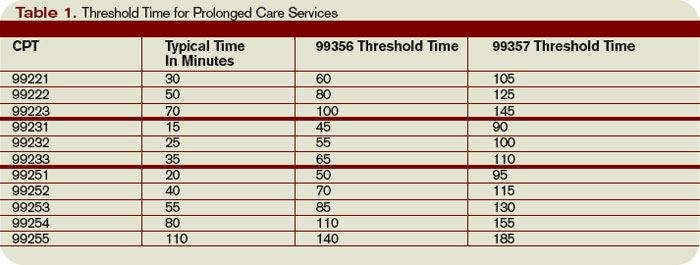
For inpatient services, CPT defines code 99356 as the first hour of prolonged physician services requiring face-to-face patient contact beyond the usual services (reportable after the initial 30 minutes). Code 99357 is used for each additional 30 minutes of prolonged care beyond the first hour (reportable after the first 15 minutes of each additional segment). Both codes are considered add-on codes and cannot be reported alone on a claim form; a primary code must be reported. Code 99357 must be used with 99356, and 99356 must be reported with one of the following inpatient service [primary] codes: 99221-99223, 99231-99233, or 99251-99255.
Prolonged care employs the concept of threshold time. This means total face-to-face physician visit time must exceed the time requirements associated with the primary codes by 30 minutes (e.g., 99232 plus 99356 = 25 minutes plus 30 minutes = 55 total face-to-face attending visit minutes). Accordingly, the physician must document the total face-to-face time spent during each portion of care in two separate notes or in one cumulative note. Be aware that this varies from the standard reporting of counseling and/or coordination of care time in that the physician must meet the threshold face-to-face-time requirements (see Table 1, left), making prolonged care services inefficient. When two providers from the same group practice split the threshold time (e.g., physician A provided morning rounds, and physician B spoke with the family in the afternoon), only one physician can report the cumulative service. To reiterate, 99356 must be reported on the same invoice as the primary visit code (e.g., 99232). Be sure once again to query payers, because most non-Medicare insurers do not recognize these codes. TH
Carol Pohlig is a billing and coding expert with the University of Pennsylvania Medical Center, Philadelphia. She also is on the faculty of SHM’s inpatient coding course.
In my recent columns, I addressed documentation guidelines with respect to the three key components: history, exam, and medical decision-making. However, time is considered the fourth key component.
Time-based billing places significant emphasis on the duration of the hospitalist-patient encounter more so than the detail or quality of the documentation. This month, I’ll focus on the guidelines for reporting inpatient hospital services based on time.
Counseling, Coordination
Hospitalists try to make their rounds as efficient as possible while still upholding a high standard of care. It is not unusual for a patient encounter to vary from the norm of updating the history, performing the necessary exam, and implementing the plan.
In fact, hospitalists often counsel patients with newly diagnosed conditions or when treatment options seem extensive and complicated. Based on these circumstances, physicians can document only a brief history and exam or none at all, since the bulk of the encounter focuses on medical decision-making, counseling, and coordination of care. Despite the minimal documentation compared with other physician services, it still is possible to report something more than the lowest service level (e.g., subsequent hospital care, 99231).
To use time as the determining factor for the visit level, more than 50% of the total visit time must involve counseling/coordination of care. The total visit time encompasses both the face-to-face time spent with the patient at the bedside and the additional time spent on the unit/floor reviewing data, obtaining relevant patient information, and discussing the case with other involved healthcare providers. Physicians providing care in academic settings cannot contribute teaching time toward the total visit time. Further, only the attending physician’s time counts.
Documentation
Hospitalists must document events during the patient encounter. There may be little or no history and an exam and counseling may dominate the entire visit.
Physicians must document both the counseling/coordination of care time and total visit time. The format may vary: “Total visit time = 25 minutes; more than 50% spent counseling/coordinating care,” or “20 of 25 minutes spent counseling/coordinating care.” Any given payer may prefer one documentation style over another. It always is best to query payers and review their documentation standards to determine the local preference.
In addition to the time, physicians must document the medical decision-making and details of the counseling/coordination of care. For example, patients with newly diagnosed diabetes need to be educated about their condition, lifestyle, and medication requirements. Physicians should include information regarding these factors in their progress notes as necessary.
Family Discussions
As noted in my previous article on critical care services (March 2008, p. 18), family discussions can contribute toward counseling/coordination of care time when:
- The patient is unable or clinically incompetent to participate in discussions;
- Time is spent on the unit/floor with family members or surrogate decision makers obtaining a medical history, reviewing the patient’s condition or prognosis, or discussing treatment or limitation(s) of treatment; or
- The conversation bears directly on the management of the patient.
Prolonged Care
A physician makes his rounds in the morning. He cares for a 72-year-old female with diabetes, end-stage renal disease, and hypertension. In the afternoon, he returns to find the family waiting with questions. He spends an additional 30 minutes speaking at the bedside with the patient and family. The additional afternoon effort may be captured as prolonged care if both services are documented appropriately.
For inpatient services, CPT defines code 99356 as the first hour of prolonged physician services requiring face-to-face patient contact beyond the usual services (reportable after the initial 30 minutes). Code 99357 is used for each additional 30 minutes of prolonged care beyond the first hour (reportable after the first 15 minutes of each additional segment). Both codes are considered add-on codes and cannot be reported alone on a claim form; a primary code must be reported. Code 99357 must be used with 99356, and 99356 must be reported with one of the following inpatient service [primary] codes: 99221-99223, 99231-99233, or 99251-99255.
Prolonged care employs the concept of threshold time. This means total face-to-face physician visit time must exceed the time requirements associated with the primary codes by 30 minutes (e.g., 99232 plus 99356 = 25 minutes plus 30 minutes = 55 total face-to-face attending visit minutes). Accordingly, the physician must document the total face-to-face time spent during each portion of care in two separate notes or in one cumulative note. Be aware that this varies from the standard reporting of counseling and/or coordination of care time in that the physician must meet the threshold face-to-face-time requirements (see Table 1, left), making prolonged care services inefficient. When two providers from the same group practice split the threshold time (e.g., physician A provided morning rounds, and physician B spoke with the family in the afternoon), only one physician can report the cumulative service. To reiterate, 99356 must be reported on the same invoice as the primary visit code (e.g., 99232). Be sure once again to query payers, because most non-Medicare insurers do not recognize these codes. TH
Carol Pohlig is a billing and coding expert with the University of Pennsylvania Medical Center, Philadelphia. She also is on the faculty of SHM’s inpatient coding course.
In my recent columns, I addressed documentation guidelines with respect to the three key components: history, exam, and medical decision-making. However, time is considered the fourth key component.
Time-based billing places significant emphasis on the duration of the hospitalist-patient encounter more so than the detail or quality of the documentation. This month, I’ll focus on the guidelines for reporting inpatient hospital services based on time.
Counseling, Coordination
Hospitalists try to make their rounds as efficient as possible while still upholding a high standard of care. It is not unusual for a patient encounter to vary from the norm of updating the history, performing the necessary exam, and implementing the plan.
In fact, hospitalists often counsel patients with newly diagnosed conditions or when treatment options seem extensive and complicated. Based on these circumstances, physicians can document only a brief history and exam or none at all, since the bulk of the encounter focuses on medical decision-making, counseling, and coordination of care. Despite the minimal documentation compared with other physician services, it still is possible to report something more than the lowest service level (e.g., subsequent hospital care, 99231).
To use time as the determining factor for the visit level, more than 50% of the total visit time must involve counseling/coordination of care. The total visit time encompasses both the face-to-face time spent with the patient at the bedside and the additional time spent on the unit/floor reviewing data, obtaining relevant patient information, and discussing the case with other involved healthcare providers. Physicians providing care in academic settings cannot contribute teaching time toward the total visit time. Further, only the attending physician’s time counts.
Documentation
Hospitalists must document events during the patient encounter. There may be little or no history and an exam and counseling may dominate the entire visit.
Physicians must document both the counseling/coordination of care time and total visit time. The format may vary: “Total visit time = 25 minutes; more than 50% spent counseling/coordinating care,” or “20 of 25 minutes spent counseling/coordinating care.” Any given payer may prefer one documentation style over another. It always is best to query payers and review their documentation standards to determine the local preference.
In addition to the time, physicians must document the medical decision-making and details of the counseling/coordination of care. For example, patients with newly diagnosed diabetes need to be educated about their condition, lifestyle, and medication requirements. Physicians should include information regarding these factors in their progress notes as necessary.
Family Discussions
As noted in my previous article on critical care services (March 2008, p. 18), family discussions can contribute toward counseling/coordination of care time when:
- The patient is unable or clinically incompetent to participate in discussions;
- Time is spent on the unit/floor with family members or surrogate decision makers obtaining a medical history, reviewing the patient’s condition or prognosis, or discussing treatment or limitation(s) of treatment; or
- The conversation bears directly on the management of the patient.
Prolonged Care
A physician makes his rounds in the morning. He cares for a 72-year-old female with diabetes, end-stage renal disease, and hypertension. In the afternoon, he returns to find the family waiting with questions. He spends an additional 30 minutes speaking at the bedside with the patient and family. The additional afternoon effort may be captured as prolonged care if both services are documented appropriately.
For inpatient services, CPT defines code 99356 as the first hour of prolonged physician services requiring face-to-face patient contact beyond the usual services (reportable after the initial 30 minutes). Code 99357 is used for each additional 30 minutes of prolonged care beyond the first hour (reportable after the first 15 minutes of each additional segment). Both codes are considered add-on codes and cannot be reported alone on a claim form; a primary code must be reported. Code 99357 must be used with 99356, and 99356 must be reported with one of the following inpatient service [primary] codes: 99221-99223, 99231-99233, or 99251-99255.
Prolonged care employs the concept of threshold time. This means total face-to-face physician visit time must exceed the time requirements associated with the primary codes by 30 minutes (e.g., 99232 plus 99356 = 25 minutes plus 30 minutes = 55 total face-to-face attending visit minutes). Accordingly, the physician must document the total face-to-face time spent during each portion of care in two separate notes or in one cumulative note. Be aware that this varies from the standard reporting of counseling and/or coordination of care time in that the physician must meet the threshold face-to-face-time requirements (see Table 1, left), making prolonged care services inefficient. When two providers from the same group practice split the threshold time (e.g., physician A provided morning rounds, and physician B spoke with the family in the afternoon), only one physician can report the cumulative service. To reiterate, 99356 must be reported on the same invoice as the primary visit code (e.g., 99232). Be sure once again to query payers, because most non-Medicare insurers do not recognize these codes. TH
Carol Pohlig is a billing and coding expert with the University of Pennsylvania Medical Center, Philadelphia. She also is on the faculty of SHM’s inpatient coding course.
Medicare too Costly?
In April, the Centers for Medicare and Medicaid (CMS) published its proposed Inpatient Prospective Payment System (IPPS) rule for fiscal year 2009. The rule contains many important components, including additional categories of hospital-acquired conditions (HACs) that no longer will earn higher Medicare payment.
The good news is that under the proposed rule, Medicare payments to hospitals would increase by nearly $4 billion. However, the requirements to earn that are causing concern among some individuals and organizations, including SHM.
This year, CMS announced it would begin withholding additional payments for eight specific HACs, including some “never events”—a practice that won’t take effect until October (May 2008, p. 25). Now, the agency proposes to add nine more. Why double these restrictions so soon?
—Gregory Maynard, MD, MSc, division chief of hospital medicine, University of California, San Diego
“I think it’s a combination of things,” says Gregory Maynard, MD, MSc, division chief of hospital medicine at the University of California, San Diego Medical Center. “Medicare is trying hard to find things that will improve quality and reduce costs, and there are many ways you can do both.”
CMS will pay the lesser Medicare Severity DRG (MS-DRG) amount if the complication was acquired at the hospital and the patient has no other complications or comorbidities.
“It’s not that Medicare won’t pay for the hospital stay—they won’t pay for that condition as a co-morbidity,” explains Dr. Maynard.
- The new HACs include:
- Surgical site infections following certain elective surgeries;
- Legionnaires’ disease;
- Glycemic control for diabetes;
- Iatrogenic pneumothorax;
- Delirium;
- Ventilator-associated pneumonia;
- Deep-vein thrombosis/pulmonary embolism (DVT/PE);
- Staphylococcus aureus septicemia; and
- Clostridium difficile-associated disease.
Unlike the original eight HACs, these proposed conditions are raising questions.
“The first round of conditions, such as objects left in during surgery, those are obvious and people can buy into them,” Dr. Maynard says. Regarding the proposed additions, he says, “Some of these are just out there.”
He singled out a couple of the new HACs. “DVT is a pet of mine, because we’ve done a lot of work in that area,’’ he notes. “We have good information about what patients are on when they develop DVTs or PEs, and we know that very, very few patients who do were neglected.”
As for C diff.-associated disease, he points out: “C diff.-associated diarrhea—that’s tough to totally avoid. In spite of a perfect process, it will still happen.”
SHM sent a letter to CMS regarding specific concerns with three HACs, stating: “SHM supports the CMS initiative to improve the quality of care for hospitalized patients by preventing avoidable hospital-acquired conditions as proposed in the Final Rule for fiscal year 2008. We have concerns about the conditions selected for FY 2009 and the potential for creating unintended consequences through the inclusion of these conditions.”
Dr. Maynard and others fear the new HACs will lead to the addition of processes and other expenses. “I can’t speak totally for SHM,” he says. “I know they support transparency—but you have to think carefully about the process of transparency. There are unintended consequences, like testing everyone who comes in the door for certain conditions, and even treating a condition that doesn’t need to be treated.”
In an April 28 post on his blog “Wachter’s World” (www.wachtersworld.org) Robert Wachter, MD, professor and associate chairman of the Department of Medicine at the University of California, San Francisco, says: “This new list is a case of too far, too fast. … I can’t argue with the premise—many of the [adverse events] on this list are no doubt partly preventable with more religious implementation of certain safety practices (for example, for C diff., avoiding unnecessary antibiotics and adhering to strict infection control practices with suspected cases). But they are nowhere near ready for prime time. Adoption of this new list will lead to all kinds of gaming, [present on admission] shenanigans, wasted effort on preventive strategies with no supportive evidence, and nasty unintended consequences.”
Too Many Measures?
The proposed rule also will significantly increase quality data reporting requirements for hospitals. The rule adds 43 quality measures to the existing 30, so hospitals would need to report on 73 measures to qualify for a full update to their FY 2009 payment rates. The new measures include:
- Surgical Care Improvement Project (one new measure);
- Hospital readmissions (three new measures);
- Nursing care (four new measures);
- Patient safety indicators developed by the Agency for Healthcare Research and Quality (AHRQ) (five new measures);
- Inpatient quality indicators by AHRQ (four new measures);
- Venous thromboembolism (six new measures);
- Stroke measures (five new measures); and
- Cardiac surgery measures (15 new measures).
Critics of the rule believe reporting on 73 measures is unreasonable—and perhaps impossible for smaller hospitals. In a statement released by the American Hospital Association (AHA), Nancy Foster, the AHA’s vice president for quality and patient safety. says, “… we are dismayed that CMS has proposed to add a long and confusing list of measures to those on which hospitals must report to get their full update.” Foster recommends CMS only include measures endorsed by the National Quality Forum as appropriate national standards and adopted by the Hospital Quality Alliance as useful for public reporting on hospital quality of care.
In the Middle
As with previous CMS programs and rules, the increased reporting requirements will mean a continued role for hospitalists.
“This will put hospitalists in the middle even more than they are now,” predicts Dr. Maynard. “It could be good—increasing their role of communicating and training hospital staff and leading quality improvement initiatives—or it could come down to a blame game. Hospitalists are taking care of half the patients in the hospital these days, so if something goes wrong, it may be seen as their fault.”
Read more about the proposed rule online at www.cms.hhs.gov. CMS will respond to comments in a final rule to be issued by Aug 1. TH
Jane Jerrard is a medical writer based in Chicago.
In April, the Centers for Medicare and Medicaid (CMS) published its proposed Inpatient Prospective Payment System (IPPS) rule for fiscal year 2009. The rule contains many important components, including additional categories of hospital-acquired conditions (HACs) that no longer will earn higher Medicare payment.
The good news is that under the proposed rule, Medicare payments to hospitals would increase by nearly $4 billion. However, the requirements to earn that are causing concern among some individuals and organizations, including SHM.
This year, CMS announced it would begin withholding additional payments for eight specific HACs, including some “never events”—a practice that won’t take effect until October (May 2008, p. 25). Now, the agency proposes to add nine more. Why double these restrictions so soon?
—Gregory Maynard, MD, MSc, division chief of hospital medicine, University of California, San Diego
“I think it’s a combination of things,” says Gregory Maynard, MD, MSc, division chief of hospital medicine at the University of California, San Diego Medical Center. “Medicare is trying hard to find things that will improve quality and reduce costs, and there are many ways you can do both.”
CMS will pay the lesser Medicare Severity DRG (MS-DRG) amount if the complication was acquired at the hospital and the patient has no other complications or comorbidities.
“It’s not that Medicare won’t pay for the hospital stay—they won’t pay for that condition as a co-morbidity,” explains Dr. Maynard.
- The new HACs include:
- Surgical site infections following certain elective surgeries;
- Legionnaires’ disease;
- Glycemic control for diabetes;
- Iatrogenic pneumothorax;
- Delirium;
- Ventilator-associated pneumonia;
- Deep-vein thrombosis/pulmonary embolism (DVT/PE);
- Staphylococcus aureus septicemia; and
- Clostridium difficile-associated disease.
Unlike the original eight HACs, these proposed conditions are raising questions.
“The first round of conditions, such as objects left in during surgery, those are obvious and people can buy into them,” Dr. Maynard says. Regarding the proposed additions, he says, “Some of these are just out there.”
He singled out a couple of the new HACs. “DVT is a pet of mine, because we’ve done a lot of work in that area,’’ he notes. “We have good information about what patients are on when they develop DVTs or PEs, and we know that very, very few patients who do were neglected.”
As for C diff.-associated disease, he points out: “C diff.-associated diarrhea—that’s tough to totally avoid. In spite of a perfect process, it will still happen.”
SHM sent a letter to CMS regarding specific concerns with three HACs, stating: “SHM supports the CMS initiative to improve the quality of care for hospitalized patients by preventing avoidable hospital-acquired conditions as proposed in the Final Rule for fiscal year 2008. We have concerns about the conditions selected for FY 2009 and the potential for creating unintended consequences through the inclusion of these conditions.”
Dr. Maynard and others fear the new HACs will lead to the addition of processes and other expenses. “I can’t speak totally for SHM,” he says. “I know they support transparency—but you have to think carefully about the process of transparency. There are unintended consequences, like testing everyone who comes in the door for certain conditions, and even treating a condition that doesn’t need to be treated.”
In an April 28 post on his blog “Wachter’s World” (www.wachtersworld.org) Robert Wachter, MD, professor and associate chairman of the Department of Medicine at the University of California, San Francisco, says: “This new list is a case of too far, too fast. … I can’t argue with the premise—many of the [adverse events] on this list are no doubt partly preventable with more religious implementation of certain safety practices (for example, for C diff., avoiding unnecessary antibiotics and adhering to strict infection control practices with suspected cases). But they are nowhere near ready for prime time. Adoption of this new list will lead to all kinds of gaming, [present on admission] shenanigans, wasted effort on preventive strategies with no supportive evidence, and nasty unintended consequences.”
Too Many Measures?
The proposed rule also will significantly increase quality data reporting requirements for hospitals. The rule adds 43 quality measures to the existing 30, so hospitals would need to report on 73 measures to qualify for a full update to their FY 2009 payment rates. The new measures include:
- Surgical Care Improvement Project (one new measure);
- Hospital readmissions (three new measures);
- Nursing care (four new measures);
- Patient safety indicators developed by the Agency for Healthcare Research and Quality (AHRQ) (five new measures);
- Inpatient quality indicators by AHRQ (four new measures);
- Venous thromboembolism (six new measures);
- Stroke measures (five new measures); and
- Cardiac surgery measures (15 new measures).
Critics of the rule believe reporting on 73 measures is unreasonable—and perhaps impossible for smaller hospitals. In a statement released by the American Hospital Association (AHA), Nancy Foster, the AHA’s vice president for quality and patient safety. says, “… we are dismayed that CMS has proposed to add a long and confusing list of measures to those on which hospitals must report to get their full update.” Foster recommends CMS only include measures endorsed by the National Quality Forum as appropriate national standards and adopted by the Hospital Quality Alliance as useful for public reporting on hospital quality of care.
In the Middle
As with previous CMS programs and rules, the increased reporting requirements will mean a continued role for hospitalists.
“This will put hospitalists in the middle even more than they are now,” predicts Dr. Maynard. “It could be good—increasing their role of communicating and training hospital staff and leading quality improvement initiatives—or it could come down to a blame game. Hospitalists are taking care of half the patients in the hospital these days, so if something goes wrong, it may be seen as their fault.”
Read more about the proposed rule online at www.cms.hhs.gov. CMS will respond to comments in a final rule to be issued by Aug 1. TH
Jane Jerrard is a medical writer based in Chicago.
In April, the Centers for Medicare and Medicaid (CMS) published its proposed Inpatient Prospective Payment System (IPPS) rule for fiscal year 2009. The rule contains many important components, including additional categories of hospital-acquired conditions (HACs) that no longer will earn higher Medicare payment.
The good news is that under the proposed rule, Medicare payments to hospitals would increase by nearly $4 billion. However, the requirements to earn that are causing concern among some individuals and organizations, including SHM.
This year, CMS announced it would begin withholding additional payments for eight specific HACs, including some “never events”—a practice that won’t take effect until October (May 2008, p. 25). Now, the agency proposes to add nine more. Why double these restrictions so soon?
—Gregory Maynard, MD, MSc, division chief of hospital medicine, University of California, San Diego
“I think it’s a combination of things,” says Gregory Maynard, MD, MSc, division chief of hospital medicine at the University of California, San Diego Medical Center. “Medicare is trying hard to find things that will improve quality and reduce costs, and there are many ways you can do both.”
CMS will pay the lesser Medicare Severity DRG (MS-DRG) amount if the complication was acquired at the hospital and the patient has no other complications or comorbidities.
“It’s not that Medicare won’t pay for the hospital stay—they won’t pay for that condition as a co-morbidity,” explains Dr. Maynard.
- The new HACs include:
- Surgical site infections following certain elective surgeries;
- Legionnaires’ disease;
- Glycemic control for diabetes;
- Iatrogenic pneumothorax;
- Delirium;
- Ventilator-associated pneumonia;
- Deep-vein thrombosis/pulmonary embolism (DVT/PE);
- Staphylococcus aureus septicemia; and
- Clostridium difficile-associated disease.
Unlike the original eight HACs, these proposed conditions are raising questions.
“The first round of conditions, such as objects left in during surgery, those are obvious and people can buy into them,” Dr. Maynard says. Regarding the proposed additions, he says, “Some of these are just out there.”
He singled out a couple of the new HACs. “DVT is a pet of mine, because we’ve done a lot of work in that area,’’ he notes. “We have good information about what patients are on when they develop DVTs or PEs, and we know that very, very few patients who do were neglected.”
As for C diff.-associated disease, he points out: “C diff.-associated diarrhea—that’s tough to totally avoid. In spite of a perfect process, it will still happen.”
SHM sent a letter to CMS regarding specific concerns with three HACs, stating: “SHM supports the CMS initiative to improve the quality of care for hospitalized patients by preventing avoidable hospital-acquired conditions as proposed in the Final Rule for fiscal year 2008. We have concerns about the conditions selected for FY 2009 and the potential for creating unintended consequences through the inclusion of these conditions.”
Dr. Maynard and others fear the new HACs will lead to the addition of processes and other expenses. “I can’t speak totally for SHM,” he says. “I know they support transparency—but you have to think carefully about the process of transparency. There are unintended consequences, like testing everyone who comes in the door for certain conditions, and even treating a condition that doesn’t need to be treated.”
In an April 28 post on his blog “Wachter’s World” (www.wachtersworld.org) Robert Wachter, MD, professor and associate chairman of the Department of Medicine at the University of California, San Francisco, says: “This new list is a case of too far, too fast. … I can’t argue with the premise—many of the [adverse events] on this list are no doubt partly preventable with more religious implementation of certain safety practices (for example, for C diff., avoiding unnecessary antibiotics and adhering to strict infection control practices with suspected cases). But they are nowhere near ready for prime time. Adoption of this new list will lead to all kinds of gaming, [present on admission] shenanigans, wasted effort on preventive strategies with no supportive evidence, and nasty unintended consequences.”
Too Many Measures?
The proposed rule also will significantly increase quality data reporting requirements for hospitals. The rule adds 43 quality measures to the existing 30, so hospitals would need to report on 73 measures to qualify for a full update to their FY 2009 payment rates. The new measures include:
- Surgical Care Improvement Project (one new measure);
- Hospital readmissions (three new measures);
- Nursing care (four new measures);
- Patient safety indicators developed by the Agency for Healthcare Research and Quality (AHRQ) (five new measures);
- Inpatient quality indicators by AHRQ (four new measures);
- Venous thromboembolism (six new measures);
- Stroke measures (five new measures); and
- Cardiac surgery measures (15 new measures).
Critics of the rule believe reporting on 73 measures is unreasonable—and perhaps impossible for smaller hospitals. In a statement released by the American Hospital Association (AHA), Nancy Foster, the AHA’s vice president for quality and patient safety. says, “… we are dismayed that CMS has proposed to add a long and confusing list of measures to those on which hospitals must report to get their full update.” Foster recommends CMS only include measures endorsed by the National Quality Forum as appropriate national standards and adopted by the Hospital Quality Alliance as useful for public reporting on hospital quality of care.
In the Middle
As with previous CMS programs and rules, the increased reporting requirements will mean a continued role for hospitalists.
“This will put hospitalists in the middle even more than they are now,” predicts Dr. Maynard. “It could be good—increasing their role of communicating and training hospital staff and leading quality improvement initiatives—or it could come down to a blame game. Hospitalists are taking care of half the patients in the hospital these days, so if something goes wrong, it may be seen as their fault.”
Read more about the proposed rule online at www.cms.hhs.gov. CMS will respond to comments in a final rule to be issued by Aug 1. TH
Jane Jerrard is a medical writer based in Chicago.
Change Jobs Wisely
In today’s wide-open job market, hospitalists can pick a plum position anywhere in the United States. With promising opportunities in sunny Hawaii, bustling New York City, and everywhere in between—likely including your own hometown—the temptation to move to a warmer climate, kid-friendly small town, or bigger paycheck may be irresistible.
Michael-Anthony Williams, MD, chief medical officer for the Rocky Mountain Region of Sound Inpatient Physicians, has hired hospitalists who come to Denver from across the country.
“Market competition [for hospitalists] is definitely fierce and will remain so,” he says. “But no matter where you’re looking or what you’re searching for, you need to get a sense of the group you’ll be joining.”
Sameer Badlani, MD, hospitalist and instructor at the University of Chicago, agrees location should come second to the job itself. “You have to do a lot of introspection and decide what you’re looking for,” he cautions. “If you’re unhappy, ask yourself why a new job would be different.”
After taking this advice into account, consider the challenges and opportunities of starting life anew somewhere else.
Reasons to Relocate
Why think about moving in the first place?
“Money might be the biggest reason,” speculates Dr. Badlani. “The only way to make significantly more money is to become a partner in the practice. I’d say if you’re a hospitalist who’s relocating, you should definitely try to become a partner.”
Another reason to consider moving might be family reasons. “If a spouse gets a job offer in a different city, it’s easy for the hospitalist to move there and find a job,” Dr. Badlani points out. “With the economy the way it is, I think that more and more you’ll see spouses’ jobs influencing where hospitalists relocate.”
Some hospitalists move because they are drawn to a certain region or lifestyle. Dr. Williams says. “We certainly see people who target geography as playing a big role in their job search.”
If you fall into this category, be careful to do your research to discover the realities of your dream location.
“I’d advise that you make more than one trip to a place if you’ve never lived there before,” Dr. Badlani says. “See exactly what it means to live there. Visit the hospital medicine group more than once. Go out with a real estate agent and look at houses.”
—Sameer Badlani, MD, hospitalist and instructor, University of Chicago
Timing Is Everything
Once you’ve decided you are interested in moving—or have to move—get started with your location scouting and your job search.
“You should start looking [for a job] even earlier when you’re relocating,” Dr. Badlani advises. “And be sure to tell your supervisor that you’re thinking of relocating. This seems like a bad idea to some people, but it will be worse if you wait and give two weeks’ notice. That is unfair to your employer and your colleagues who will have to cover your work, and you will end up burning your bridges.” He recommends telling your current employer while interviewing for next year. If you’re already deep into your search, that should be about six or seven months in advance, he says.
“Your current employer will appreciate it, and they may even try to make some changes in order to keep you,” Dr. Badlani says.
Try to negotiate to keep your transition dates flexible. Your plans to move may not go as smoothly as you’d like. “Recently, we’ve seen a couple of people have a tough time selling their house before they move,” Dr. Williams says. “If you live in a tough real estate market, you might want to see if your new employer can be flexible on your start date.”
Consider Cost of Living
As you compare compensation offered by hospital medicine practices in different parts of the country—or even different parts of the same county—consider cost of living in each area.
“If you make $150,000 in Tulsa, Oklahoma, (then you need to make) $210,000 in Chicago,” Dr. Badlani says, who has worked in both cities. Cost of living, he adds, “can be misleading. Do your research and find out housing costs for the area. Online calculators only give approximations; make sure you compare housing in desirable areas of the city, not across the board.”
In addition, Dr. Badlani says, “If you choose a smaller town, it’s likely that you can get paid more—because they need you more—and live in a cheaper place. And you’ll find more opportunities in a smaller town because there are fewer doctors.”
The biggest challenge when comparing jobs is assessing the work required to make that salary, Dr. Williams adds. “Find out how many shifts per month you’ll work to earn it, and how many patients you’ll see per shift,” he suggests.
Relocation, Negotiation
Before you start negotiating a new contract, Dr. Badlani advises you first look at your current one to see what you’re walking away from.
“Every place has a golden handcuff,” he says. “The University of Chicago gives you three years before you’re fully vested in your retirement benefits; I know an Oklahoma hospital where it takes seven years. Leave before you’re vested and you could lose thousands of dollars in employer contributions. You have to ask, will your new job help you recover that quickly? Can you get a signing bonus that’s equal to all or most of what you’re walking away from, or the promise of a partnership? Try to mitigate that loss with other opportunities.
“Places like Kaiser Permanente offer money to help with a down payment for a house—that’s their version of a golden handcuff. If you stay in the job long enough, that becomes a free loan.”
Dr. Williams adds: “Will the group cover your moving expenses? That’s a lot of money. Also check on the state’s licensing fees and how long it will take to get your license—it varies greatly from state to state.”
While you’re interviewing, keep the negotiation process in mind: “I would never tell a recruiter or prospective employer all the reasons why I’m moving,” Dr. Badlani says. “You don’t want to show how interested you are. It’s a game you have to play. Be sure to say you’re looking at other opportunities and other towns.”
Finally, weigh your options against the rest of the market—and against what your peers are getting in terms of compensation and benefits.
“Talk to your friends and try to figure out what the best deal is,” Dr. Badlani says.
Although you can choose a hospitalist position anywhere in the country, the most important thing to consider is the group you’re joining. If it is not a good fit for your values and personality, then the state you’ve decided to move to will be one of discontent. TH
Jane Jerrard also writes “Public Policy” for The Hospitalist.
In today’s wide-open job market, hospitalists can pick a plum position anywhere in the United States. With promising opportunities in sunny Hawaii, bustling New York City, and everywhere in between—likely including your own hometown—the temptation to move to a warmer climate, kid-friendly small town, or bigger paycheck may be irresistible.
Michael-Anthony Williams, MD, chief medical officer for the Rocky Mountain Region of Sound Inpatient Physicians, has hired hospitalists who come to Denver from across the country.
“Market competition [for hospitalists] is definitely fierce and will remain so,” he says. “But no matter where you’re looking or what you’re searching for, you need to get a sense of the group you’ll be joining.”
Sameer Badlani, MD, hospitalist and instructor at the University of Chicago, agrees location should come second to the job itself. “You have to do a lot of introspection and decide what you’re looking for,” he cautions. “If you’re unhappy, ask yourself why a new job would be different.”
After taking this advice into account, consider the challenges and opportunities of starting life anew somewhere else.
Reasons to Relocate
Why think about moving in the first place?
“Money might be the biggest reason,” speculates Dr. Badlani. “The only way to make significantly more money is to become a partner in the practice. I’d say if you’re a hospitalist who’s relocating, you should definitely try to become a partner.”
Another reason to consider moving might be family reasons. “If a spouse gets a job offer in a different city, it’s easy for the hospitalist to move there and find a job,” Dr. Badlani points out. “With the economy the way it is, I think that more and more you’ll see spouses’ jobs influencing where hospitalists relocate.”
Some hospitalists move because they are drawn to a certain region or lifestyle. Dr. Williams says. “We certainly see people who target geography as playing a big role in their job search.”
If you fall into this category, be careful to do your research to discover the realities of your dream location.
“I’d advise that you make more than one trip to a place if you’ve never lived there before,” Dr. Badlani says. “See exactly what it means to live there. Visit the hospital medicine group more than once. Go out with a real estate agent and look at houses.”
—Sameer Badlani, MD, hospitalist and instructor, University of Chicago
Timing Is Everything
Once you’ve decided you are interested in moving—or have to move—get started with your location scouting and your job search.
“You should start looking [for a job] even earlier when you’re relocating,” Dr. Badlani advises. “And be sure to tell your supervisor that you’re thinking of relocating. This seems like a bad idea to some people, but it will be worse if you wait and give two weeks’ notice. That is unfair to your employer and your colleagues who will have to cover your work, and you will end up burning your bridges.” He recommends telling your current employer while interviewing for next year. If you’re already deep into your search, that should be about six or seven months in advance, he says.
“Your current employer will appreciate it, and they may even try to make some changes in order to keep you,” Dr. Badlani says.
Try to negotiate to keep your transition dates flexible. Your plans to move may not go as smoothly as you’d like. “Recently, we’ve seen a couple of people have a tough time selling their house before they move,” Dr. Williams says. “If you live in a tough real estate market, you might want to see if your new employer can be flexible on your start date.”
Consider Cost of Living
As you compare compensation offered by hospital medicine practices in different parts of the country—or even different parts of the same county—consider cost of living in each area.
“If you make $150,000 in Tulsa, Oklahoma, (then you need to make) $210,000 in Chicago,” Dr. Badlani says, who has worked in both cities. Cost of living, he adds, “can be misleading. Do your research and find out housing costs for the area. Online calculators only give approximations; make sure you compare housing in desirable areas of the city, not across the board.”
In addition, Dr. Badlani says, “If you choose a smaller town, it’s likely that you can get paid more—because they need you more—and live in a cheaper place. And you’ll find more opportunities in a smaller town because there are fewer doctors.”
The biggest challenge when comparing jobs is assessing the work required to make that salary, Dr. Williams adds. “Find out how many shifts per month you’ll work to earn it, and how many patients you’ll see per shift,” he suggests.
Relocation, Negotiation
Before you start negotiating a new contract, Dr. Badlani advises you first look at your current one to see what you’re walking away from.
“Every place has a golden handcuff,” he says. “The University of Chicago gives you three years before you’re fully vested in your retirement benefits; I know an Oklahoma hospital where it takes seven years. Leave before you’re vested and you could lose thousands of dollars in employer contributions. You have to ask, will your new job help you recover that quickly? Can you get a signing bonus that’s equal to all or most of what you’re walking away from, or the promise of a partnership? Try to mitigate that loss with other opportunities.
“Places like Kaiser Permanente offer money to help with a down payment for a house—that’s their version of a golden handcuff. If you stay in the job long enough, that becomes a free loan.”
Dr. Williams adds: “Will the group cover your moving expenses? That’s a lot of money. Also check on the state’s licensing fees and how long it will take to get your license—it varies greatly from state to state.”
While you’re interviewing, keep the negotiation process in mind: “I would never tell a recruiter or prospective employer all the reasons why I’m moving,” Dr. Badlani says. “You don’t want to show how interested you are. It’s a game you have to play. Be sure to say you’re looking at other opportunities and other towns.”
Finally, weigh your options against the rest of the market—and against what your peers are getting in terms of compensation and benefits.
“Talk to your friends and try to figure out what the best deal is,” Dr. Badlani says.
Although you can choose a hospitalist position anywhere in the country, the most important thing to consider is the group you’re joining. If it is not a good fit for your values and personality, then the state you’ve decided to move to will be one of discontent. TH
Jane Jerrard also writes “Public Policy” for The Hospitalist.
In today’s wide-open job market, hospitalists can pick a plum position anywhere in the United States. With promising opportunities in sunny Hawaii, bustling New York City, and everywhere in between—likely including your own hometown—the temptation to move to a warmer climate, kid-friendly small town, or bigger paycheck may be irresistible.
Michael-Anthony Williams, MD, chief medical officer for the Rocky Mountain Region of Sound Inpatient Physicians, has hired hospitalists who come to Denver from across the country.
“Market competition [for hospitalists] is definitely fierce and will remain so,” he says. “But no matter where you’re looking or what you’re searching for, you need to get a sense of the group you’ll be joining.”
Sameer Badlani, MD, hospitalist and instructor at the University of Chicago, agrees location should come second to the job itself. “You have to do a lot of introspection and decide what you’re looking for,” he cautions. “If you’re unhappy, ask yourself why a new job would be different.”
After taking this advice into account, consider the challenges and opportunities of starting life anew somewhere else.
Reasons to Relocate
Why think about moving in the first place?
“Money might be the biggest reason,” speculates Dr. Badlani. “The only way to make significantly more money is to become a partner in the practice. I’d say if you’re a hospitalist who’s relocating, you should definitely try to become a partner.”
Another reason to consider moving might be family reasons. “If a spouse gets a job offer in a different city, it’s easy for the hospitalist to move there and find a job,” Dr. Badlani points out. “With the economy the way it is, I think that more and more you’ll see spouses’ jobs influencing where hospitalists relocate.”
Some hospitalists move because they are drawn to a certain region or lifestyle. Dr. Williams says. “We certainly see people who target geography as playing a big role in their job search.”
If you fall into this category, be careful to do your research to discover the realities of your dream location.
“I’d advise that you make more than one trip to a place if you’ve never lived there before,” Dr. Badlani says. “See exactly what it means to live there. Visit the hospital medicine group more than once. Go out with a real estate agent and look at houses.”
—Sameer Badlani, MD, hospitalist and instructor, University of Chicago
Timing Is Everything
Once you’ve decided you are interested in moving—or have to move—get started with your location scouting and your job search.
“You should start looking [for a job] even earlier when you’re relocating,” Dr. Badlani advises. “And be sure to tell your supervisor that you’re thinking of relocating. This seems like a bad idea to some people, but it will be worse if you wait and give two weeks’ notice. That is unfair to your employer and your colleagues who will have to cover your work, and you will end up burning your bridges.” He recommends telling your current employer while interviewing for next year. If you’re already deep into your search, that should be about six or seven months in advance, he says.
“Your current employer will appreciate it, and they may even try to make some changes in order to keep you,” Dr. Badlani says.
Try to negotiate to keep your transition dates flexible. Your plans to move may not go as smoothly as you’d like. “Recently, we’ve seen a couple of people have a tough time selling their house before they move,” Dr. Williams says. “If you live in a tough real estate market, you might want to see if your new employer can be flexible on your start date.”
Consider Cost of Living
As you compare compensation offered by hospital medicine practices in different parts of the country—or even different parts of the same county—consider cost of living in each area.
“If you make $150,000 in Tulsa, Oklahoma, (then you need to make) $210,000 in Chicago,” Dr. Badlani says, who has worked in both cities. Cost of living, he adds, “can be misleading. Do your research and find out housing costs for the area. Online calculators only give approximations; make sure you compare housing in desirable areas of the city, not across the board.”
In addition, Dr. Badlani says, “If you choose a smaller town, it’s likely that you can get paid more—because they need you more—and live in a cheaper place. And you’ll find more opportunities in a smaller town because there are fewer doctors.”
The biggest challenge when comparing jobs is assessing the work required to make that salary, Dr. Williams adds. “Find out how many shifts per month you’ll work to earn it, and how many patients you’ll see per shift,” he suggests.
Relocation, Negotiation
Before you start negotiating a new contract, Dr. Badlani advises you first look at your current one to see what you’re walking away from.
“Every place has a golden handcuff,” he says. “The University of Chicago gives you three years before you’re fully vested in your retirement benefits; I know an Oklahoma hospital where it takes seven years. Leave before you’re vested and you could lose thousands of dollars in employer contributions. You have to ask, will your new job help you recover that quickly? Can you get a signing bonus that’s equal to all or most of what you’re walking away from, or the promise of a partnership? Try to mitigate that loss with other opportunities.
“Places like Kaiser Permanente offer money to help with a down payment for a house—that’s their version of a golden handcuff. If you stay in the job long enough, that becomes a free loan.”
Dr. Williams adds: “Will the group cover your moving expenses? That’s a lot of money. Also check on the state’s licensing fees and how long it will take to get your license—it varies greatly from state to state.”
While you’re interviewing, keep the negotiation process in mind: “I would never tell a recruiter or prospective employer all the reasons why I’m moving,” Dr. Badlani says. “You don’t want to show how interested you are. It’s a game you have to play. Be sure to say you’re looking at other opportunities and other towns.”
Finally, weigh your options against the rest of the market—and against what your peers are getting in terms of compensation and benefits.
“Talk to your friends and try to figure out what the best deal is,” Dr. Badlani says.
Although you can choose a hospitalist position anywhere in the country, the most important thing to consider is the group you’re joining. If it is not a good fit for your values and personality, then the state you’ve decided to move to will be one of discontent. TH
Jane Jerrard also writes “Public Policy” for The Hospitalist.