User login
Do Women With Knee Osteoarthritis Experience Greater Pain Sensitivity Than Men?
Among patients with osteoarthritis of the knee, women experienced greater sensitivity to various pain modalities, such as lower tolerance to heat, cold, and pressure, and greater widespread pain than men, according to a study published online ahead of print October 5 in Arthritis Care & Research.
“Many questions still remain as to why women with knee osteoarthritis are more sensitive to painful stimuli than are men. While therapeutic approaches to control pain are only beginning to take these sex differences into account, there is still quite a bit of research yet to be done to help reduce this gender gap and improve clinical therapies for men and women alike,” said lead author Emily J. Bartley, PhD, a Research Assistant Professor at the University of Florida College of Dentistry in Gainsville.

For this study, 288 participants between the ages of 45 and 85 completed a battery of quantitative sensory pain procedures assessing sensitivity to contact heat, cold pressor, mechanical pressure, and punctate stimuli. Differences in temporal summation were examined, along with measures of clinical pain and functional performance.
When compared to men, women exhibited greater sensitivity to multiple pain modalities (eg, lower heat, cold, pressure thresholds/tolerances, greater temporal summation of pain). There were no sex differences in clinical pain with the exception of greater widespread pain observed in women. Although there were select age-related differences in pain sensitivity, sex differences in pain varied minimally across age cohort.
“Overall, these findings provide evidence for greater overall sensitivity to experimental pain in women with symptomatic knee osteoarthritis compared with men, suggesting that enhanced central sensitivity may be an important contributor to pain in this group,” wrote Dr. Bartley and colleagues.
Suggested Reading
Bartley EJ, King CD, Sibille KT, et al. Enhanced pain sensitivity among individuals with symptomatic knee osteoarthritis: potential sex differences in central sensitization. Arthritis Care Res (Hoboken). 2015 Oct 5. [Epub ahead of print].
Among patients with osteoarthritis of the knee, women experienced greater sensitivity to various pain modalities, such as lower tolerance to heat, cold, and pressure, and greater widespread pain than men, according to a study published online ahead of print October 5 in Arthritis Care & Research.
“Many questions still remain as to why women with knee osteoarthritis are more sensitive to painful stimuli than are men. While therapeutic approaches to control pain are only beginning to take these sex differences into account, there is still quite a bit of research yet to be done to help reduce this gender gap and improve clinical therapies for men and women alike,” said lead author Emily J. Bartley, PhD, a Research Assistant Professor at the University of Florida College of Dentistry in Gainsville.
For this study, 288 participants between the ages of 45 and 85 completed a battery of quantitative sensory pain procedures assessing sensitivity to contact heat, cold pressor, mechanical pressure, and punctate stimuli. Differences in temporal summation were examined, along with measures of clinical pain and functional performance.
When compared to men, women exhibited greater sensitivity to multiple pain modalities (eg, lower heat, cold, pressure thresholds/tolerances, greater temporal summation of pain). There were no sex differences in clinical pain with the exception of greater widespread pain observed in women. Although there were select age-related differences in pain sensitivity, sex differences in pain varied minimally across age cohort.
“Overall, these findings provide evidence for greater overall sensitivity to experimental pain in women with symptomatic knee osteoarthritis compared with men, suggesting that enhanced central sensitivity may be an important contributor to pain in this group,” wrote Dr. Bartley and colleagues.
Among patients with osteoarthritis of the knee, women experienced greater sensitivity to various pain modalities, such as lower tolerance to heat, cold, and pressure, and greater widespread pain than men, according to a study published online ahead of print October 5 in Arthritis Care & Research.
“Many questions still remain as to why women with knee osteoarthritis are more sensitive to painful stimuli than are men. While therapeutic approaches to control pain are only beginning to take these sex differences into account, there is still quite a bit of research yet to be done to help reduce this gender gap and improve clinical therapies for men and women alike,” said lead author Emily J. Bartley, PhD, a Research Assistant Professor at the University of Florida College of Dentistry in Gainsville.
For this study, 288 participants between the ages of 45 and 85 completed a battery of quantitative sensory pain procedures assessing sensitivity to contact heat, cold pressor, mechanical pressure, and punctate stimuli. Differences in temporal summation were examined, along with measures of clinical pain and functional performance.
When compared to men, women exhibited greater sensitivity to multiple pain modalities (eg, lower heat, cold, pressure thresholds/tolerances, greater temporal summation of pain). There were no sex differences in clinical pain with the exception of greater widespread pain observed in women. Although there were select age-related differences in pain sensitivity, sex differences in pain varied minimally across age cohort.
“Overall, these findings provide evidence for greater overall sensitivity to experimental pain in women with symptomatic knee osteoarthritis compared with men, suggesting that enhanced central sensitivity may be an important contributor to pain in this group,” wrote Dr. Bartley and colleagues.
Suggested Reading
Bartley EJ, King CD, Sibille KT, et al. Enhanced pain sensitivity among individuals with symptomatic knee osteoarthritis: potential sex differences in central sensitization. Arthritis Care Res (Hoboken). 2015 Oct 5. [Epub ahead of print].
Suggested Reading
Bartley EJ, King CD, Sibille KT, et al. Enhanced pain sensitivity among individuals with symptomatic knee osteoarthritis: potential sex differences in central sensitization. Arthritis Care Res (Hoboken). 2015 Oct 5. [Epub ahead of print].

Improved Appointment Reminders at a VA Ophthalmology Clinic
From the Gavin Herbert Eye Institute, Department of Ophthalmology, University of California-Irvine, Irvine, CA.
Abstract
- Objective: To describe a change in mail notification approach at a Veterans Affairs hospital and its impact on appointments.
- Methods: A new notification system was implemented in which the information on the notice was limited to the date, time, and location of the appointment. Previously, the notice contained information about patients’ appointment time in addition to listing methods of rescheduling, patient account information, and a variety of VA policies presented in a disorganized manner. We assessed whether there was a reduction in number of patients who had to be redirected by clinical staff at the ophthalmology clinic at the Long Beach Veterans Affairs Hospital.
- Results: The mean number patients who visited the clinic mistakenly during the 14 days prior to the new notification system was 14.93 (SD = 6.05) compared with 9.4 (SD = 3.45; P = 0.005) during the 15 days after.
- Conclusion: A simple abbreviated notification has the potential to improve patient understanding and can increase clinical efficiency, ultimately reducing health costs.
Across the United States, patients at Veterans Affairs (VA) hospitals are routinely informed of their clinic appointments via both telephone and conventional mail notifications. Prior studies have confirmed that appointment reminders reduce no-show rates, thus increasing clinical efficiency and decreasing health care costs [1–10]. At the same time, avoiding occasions where patients who do not have an appointment arrive erroneously also enhances efficiency, allowing clinic staff to focus their attention on patients assigned to their clinic.
Recently a new notification system was implemented at our medical center. This new notification system involves a folded mailer delivered by the US Postal Service that provides patients only with the essential information necessary for timely arrival at the correct location to their appointments. The telephone notification system that works in tandem with this has been retained. In this report, we describe the change and the results seen in our clinic.
Methods
Setting
The Veterans Affairs Long Beach Healthcare system maintains a large teaching medical campus in Long Beach, CA. The medical center and its community clinics employ more than 2200 full-time employees and provide care for more than 50,000 veterans. There are 37 outpatient clinics located on the main campus.
Our study was conducted in the outpatient ophthalmology clinic, located on the main campus. The clinic is open 8 am to 4 pm Monday through Friday and sees on average 30 to 40 patients per day with a front desk staffed with 2 secretaries. When a patient arrives to the clinic, their information (name, social security number, date/time of appointment, etc.) is looked up in a national database. If the patient arrives at the incorrect location, time is additionally spent redirecting patients.
Notification System
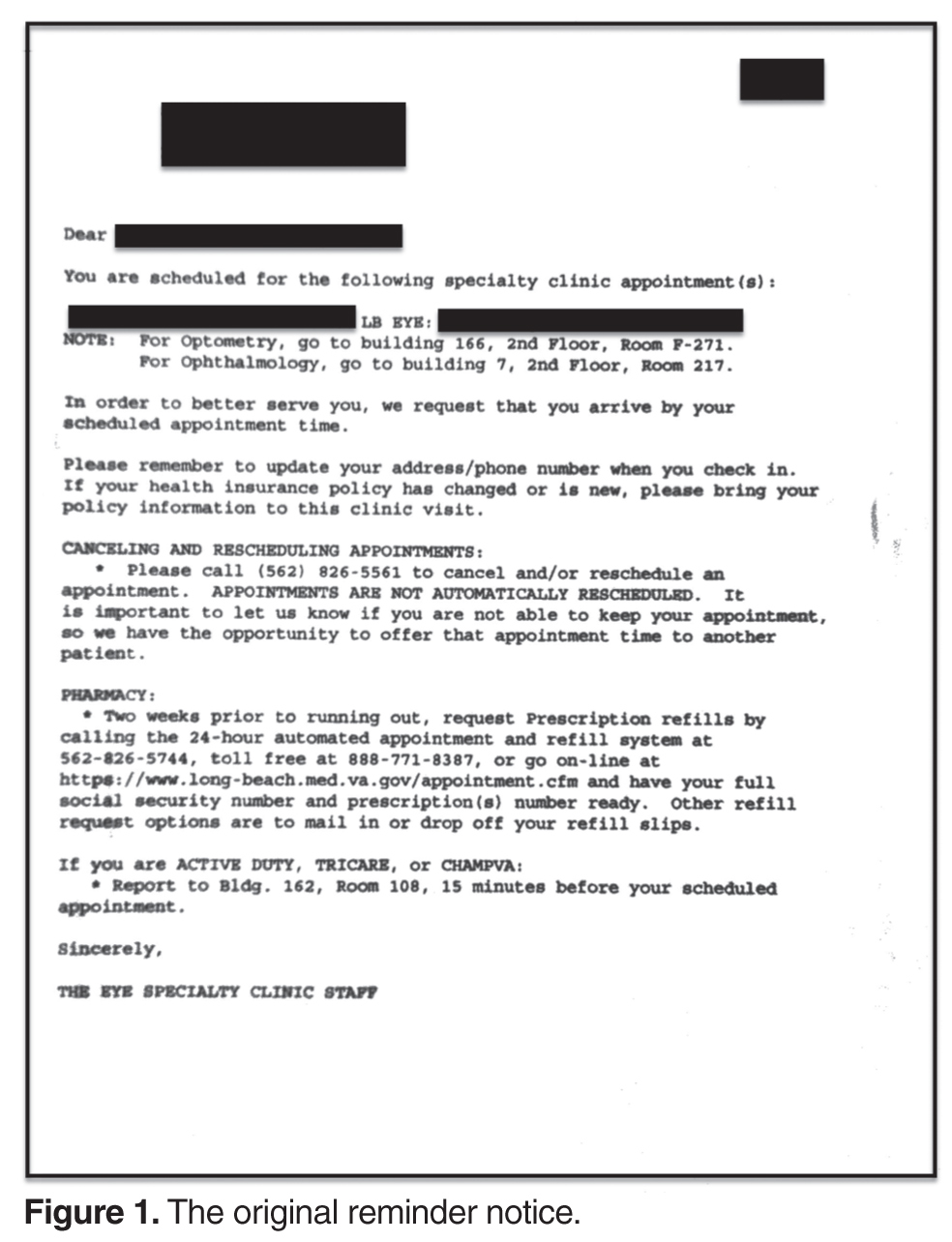
Assessment
We assessed the effectiveness of this new notification system by monitoring the number of patients who arrived at our clinic by mistake. The 2 clinic secretaries recorded daily on a piece of paper the number of patients who arrived in clinic 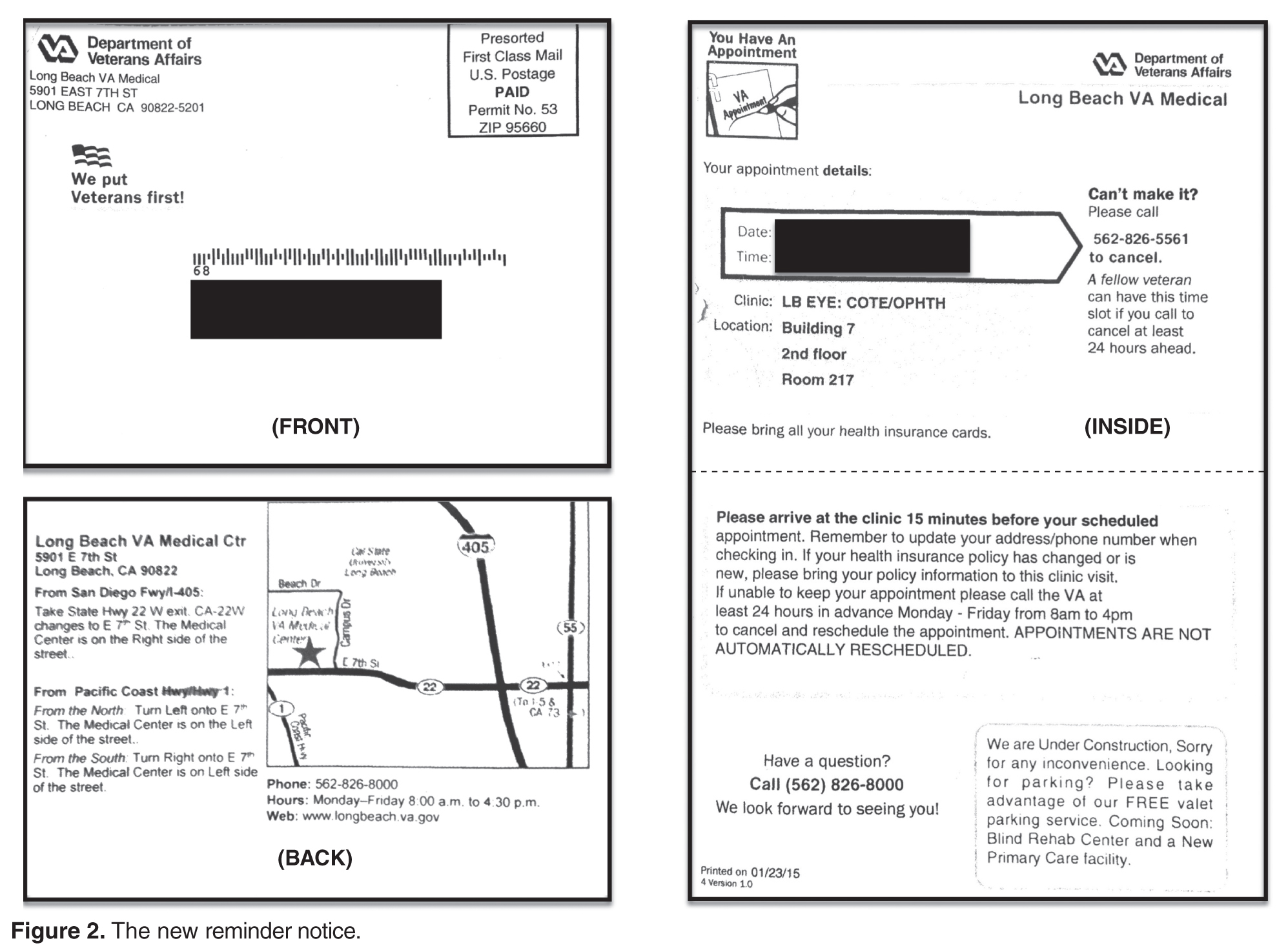
Results
During the 14 days prior to the change in notification system, the mean number patients per day who visited the clinic mistakenly was 14.93 (SD = 6.05). After the implementation of the new notification system, the mean number was 9.4 (SD = 3.45; P = 0.005) for the 15-day period after the change was implemented.
The mean number of minutes required to redirect patients was estimated to be 2.28 minutes prior to the change and 2.53 after (P = 0.507), which equates to an average of 40.64 minutes per day in the initial study period and 22.93 minutes per day in the second study period (P = 0.05). Assuming a secretary makes on average $22/hour, the Long Beach VA spent an average of $14.90 and $8.41 per day, respectively, redirecting mistaken patients to their correct clinic before and after the new notice system was implemented.
Discussion
The Veterans Health Administration is America’s largest integrated health care system, and is one of the few health systems—and by far the largest—that is virtually paperless [11]. Their medical records are nearly wholly electronic. The VA’s use of electronic health records has significantly enhanced the quality of patient care and improved productivity [12]. Their ongoing mission includes identifying and evaluating strategies that lead to high-quality and cost-effective care for veterans.
Effective appointment notifications have the potential to increase productivity and thus save money. Developing tailored methods of informing patients of the time and location of their clinic appointment improves the accuracy with which patients arrive at large medical campuses, which translates into a more efficient clinic flow. The simpler, abbreviated notification implemented at our VA appears to improve patient understanding of time/location of their clinic appointment, based on the decreased number of patients arriving in error to the ophthalmology clinic. It is unclear which specific aspect of this new mailed notification system is responsible for our results (addition of map, new layout, down-scaling of notification etc). Limitations to our study included reliance on the secretaries’ subjective reporting of time spent redirecting and limiting our data collection to one clinic. In addition, patients arriving at appointments may have received the old notice. Further investigations are underway to study appointment notification improvements across various hospitals and clinics.
In summary, efficiency is a key component in allowing the Veterans Affairs to provide quality care for the patients under its purview. We show that an abbreviated notification system was associated with a reduction in the need to redirect patients arriving by mistake to our office. Assuming that this abbreviated notification system would benefit the 37 outpatient clinics at the VA in Long Beach, CA as it did with the ophthalmology clinic, this new notification system has the potential to save $240 dollars/day and generate a yearly savings of $87,689.
Corresponding author: Bradley Jacobsen, Irvine School of Medicine, University of California, 1001 Health Sciences Road, 252 Irvine Hall Irvine, CA 92697 bjacobse@uci.edu.
1. Bigby J, Giblin J, Pappius EM, Goldman L. Appointment reminders to reduce no-show rates. A stratified analysis of their cost-effectiveness. JAMA 1983;250:1742–5.
2. Frankel BS, Hoevell MF. Health service appointment keeping: A behavioral view and critical review. Behav Modification 1978;2:435–64.
3. Friman PC, Finney JW, Rapoff MA, Christophersen ER. Improving pediatric appointment keeping with reminders and reduced response requirement. J Appl Behav Anal 1985;18:315–21.
4. Gariti P, Alterman AI, Holub-Beyer E, et al. Effects of an appointment reminder call on patient show rates. J Subst Abuse Treat 1995;12:207–12.
5. Grover S, Gagnon G, Flegel KM, Hoey JR. Improving appointment-keeping by patients new to a hospital medical clinic with telephone or mailed reminders. Can Med Assoc J 1983;129:1101–3.
6. Levy R, Claravall V. Differential effects of a phone reminder on appointment keeping for patients with long and short between-visit intervals. Med Care 1977;15:435–8.
7. Morse DL, Coulter MP, Nazarian LF, Napodano RJ. Waning effectiveness of mailed reminders on reducing broken appointments. Pediatrics 1981;68:846–9.
8. Schroeder SA. Lowering broken appointment rates at a medical clinic. Med Care 1973;11:75–8.
9. Shepard DS, Moseley TA 3rd. Mailed versus telephoned appointment reminders to reduce broken appointments in a hospital outpatient department. Med Care 1976;14:268–73.
10. Turner AJ, Vernon JC. Prompts to increase attendance in a community mental-health center. J Appl Behav Anal 1976;9:141–5.
11. Brown SH, Lincoln MJ, Groen PJ, Kolodner RM. VistA--US department of Veterans Affairs national-scale HIS. Int J Med Inform 2003;69:135–56.
12. Evans DC, Nichol WP, Perlin JB. Effect of the implementation of an enterprise-wide electronic health record on productivity in the Veterans Health Administration. Health Econ Policy Law 2006:1:163–9.
From the Gavin Herbert Eye Institute, Department of Ophthalmology, University of California-Irvine, Irvine, CA.
Abstract
- Objective: To describe a change in mail notification approach at a Veterans Affairs hospital and its impact on appointments.
- Methods: A new notification system was implemented in which the information on the notice was limited to the date, time, and location of the appointment. Previously, the notice contained information about patients’ appointment time in addition to listing methods of rescheduling, patient account information, and a variety of VA policies presented in a disorganized manner. We assessed whether there was a reduction in number of patients who had to be redirected by clinical staff at the ophthalmology clinic at the Long Beach Veterans Affairs Hospital.
- Results: The mean number patients who visited the clinic mistakenly during the 14 days prior to the new notification system was 14.93 (SD = 6.05) compared with 9.4 (SD = 3.45; P = 0.005) during the 15 days after.
- Conclusion: A simple abbreviated notification has the potential to improve patient understanding and can increase clinical efficiency, ultimately reducing health costs.
Across the United States, patients at Veterans Affairs (VA) hospitals are routinely informed of their clinic appointments via both telephone and conventional mail notifications. Prior studies have confirmed that appointment reminders reduce no-show rates, thus increasing clinical efficiency and decreasing health care costs [1–10]. At the same time, avoiding occasions where patients who do not have an appointment arrive erroneously also enhances efficiency, allowing clinic staff to focus their attention on patients assigned to their clinic.
Recently a new notification system was implemented at our medical center. This new notification system involves a folded mailer delivered by the US Postal Service that provides patients only with the essential information necessary for timely arrival at the correct location to their appointments. The telephone notification system that works in tandem with this has been retained. In this report, we describe the change and the results seen in our clinic.
Methods
Setting
The Veterans Affairs Long Beach Healthcare system maintains a large teaching medical campus in Long Beach, CA. The medical center and its community clinics employ more than 2200 full-time employees and provide care for more than 50,000 veterans. There are 37 outpatient clinics located on the main campus.
Our study was conducted in the outpatient ophthalmology clinic, located on the main campus. The clinic is open 8 am to 4 pm Monday through Friday and sees on average 30 to 40 patients per day with a front desk staffed with 2 secretaries. When a patient arrives to the clinic, their information (name, social security number, date/time of appointment, etc.) is looked up in a national database. If the patient arrives at the incorrect location, time is additionally spent redirecting patients.
Notification System
Assessment
We assessed the effectiveness of this new notification system by monitoring the number of patients who arrived at our clinic by mistake. The 2 clinic secretaries recorded daily on a piece of paper the number of patients who arrived in clinic
Results
During the 14 days prior to the change in notification system, the mean number patients per day who visited the clinic mistakenly was 14.93 (SD = 6.05). After the implementation of the new notification system, the mean number was 9.4 (SD = 3.45; P = 0.005) for the 15-day period after the change was implemented.
The mean number of minutes required to redirect patients was estimated to be 2.28 minutes prior to the change and 2.53 after (P = 0.507), which equates to an average of 40.64 minutes per day in the initial study period and 22.93 minutes per day in the second study period (P = 0.05). Assuming a secretary makes on average $22/hour, the Long Beach VA spent an average of $14.90 and $8.41 per day, respectively, redirecting mistaken patients to their correct clinic before and after the new notice system was implemented.
Discussion
The Veterans Health Administration is America’s largest integrated health care system, and is one of the few health systems—and by far the largest—that is virtually paperless [11]. Their medical records are nearly wholly electronic. The VA’s use of electronic health records has significantly enhanced the quality of patient care and improved productivity [12]. Their ongoing mission includes identifying and evaluating strategies that lead to high-quality and cost-effective care for veterans.
Effective appointment notifications have the potential to increase productivity and thus save money. Developing tailored methods of informing patients of the time and location of their clinic appointment improves the accuracy with which patients arrive at large medical campuses, which translates into a more efficient clinic flow. The simpler, abbreviated notification implemented at our VA appears to improve patient understanding of time/location of their clinic appointment, based on the decreased number of patients arriving in error to the ophthalmology clinic. It is unclear which specific aspect of this new mailed notification system is responsible for our results (addition of map, new layout, down-scaling of notification etc). Limitations to our study included reliance on the secretaries’ subjective reporting of time spent redirecting and limiting our data collection to one clinic. In addition, patients arriving at appointments may have received the old notice. Further investigations are underway to study appointment notification improvements across various hospitals and clinics.
In summary, efficiency is a key component in allowing the Veterans Affairs to provide quality care for the patients under its purview. We show that an abbreviated notification system was associated with a reduction in the need to redirect patients arriving by mistake to our office. Assuming that this abbreviated notification system would benefit the 37 outpatient clinics at the VA in Long Beach, CA as it did with the ophthalmology clinic, this new notification system has the potential to save $240 dollars/day and generate a yearly savings of $87,689.
Corresponding author: Bradley Jacobsen, Irvine School of Medicine, University of California, 1001 Health Sciences Road, 252 Irvine Hall Irvine, CA 92697 bjacobse@uci.edu.
From the Gavin Herbert Eye Institute, Department of Ophthalmology, University of California-Irvine, Irvine, CA.
Abstract
- Objective: To describe a change in mail notification approach at a Veterans Affairs hospital and its impact on appointments.
- Methods: A new notification system was implemented in which the information on the notice was limited to the date, time, and location of the appointment. Previously, the notice contained information about patients’ appointment time in addition to listing methods of rescheduling, patient account information, and a variety of VA policies presented in a disorganized manner. We assessed whether there was a reduction in number of patients who had to be redirected by clinical staff at the ophthalmology clinic at the Long Beach Veterans Affairs Hospital.
- Results: The mean number patients who visited the clinic mistakenly during the 14 days prior to the new notification system was 14.93 (SD = 6.05) compared with 9.4 (SD = 3.45; P = 0.005) during the 15 days after.
- Conclusion: A simple abbreviated notification has the potential to improve patient understanding and can increase clinical efficiency, ultimately reducing health costs.
Across the United States, patients at Veterans Affairs (VA) hospitals are routinely informed of their clinic appointments via both telephone and conventional mail notifications. Prior studies have confirmed that appointment reminders reduce no-show rates, thus increasing clinical efficiency and decreasing health care costs [1–10]. At the same time, avoiding occasions where patients who do not have an appointment arrive erroneously also enhances efficiency, allowing clinic staff to focus their attention on patients assigned to their clinic.
Recently a new notification system was implemented at our medical center. This new notification system involves a folded mailer delivered by the US Postal Service that provides patients only with the essential information necessary for timely arrival at the correct location to their appointments. The telephone notification system that works in tandem with this has been retained. In this report, we describe the change and the results seen in our clinic.
Methods
Setting
The Veterans Affairs Long Beach Healthcare system maintains a large teaching medical campus in Long Beach, CA. The medical center and its community clinics employ more than 2200 full-time employees and provide care for more than 50,000 veterans. There are 37 outpatient clinics located on the main campus.
Our study was conducted in the outpatient ophthalmology clinic, located on the main campus. The clinic is open 8 am to 4 pm Monday through Friday and sees on average 30 to 40 patients per day with a front desk staffed with 2 secretaries. When a patient arrives to the clinic, their information (name, social security number, date/time of appointment, etc.) is looked up in a national database. If the patient arrives at the incorrect location, time is additionally spent redirecting patients.
Notification System
Assessment
We assessed the effectiveness of this new notification system by monitoring the number of patients who arrived at our clinic by mistake. The 2 clinic secretaries recorded daily on a piece of paper the number of patients who arrived in clinic
Results
During the 14 days prior to the change in notification system, the mean number patients per day who visited the clinic mistakenly was 14.93 (SD = 6.05). After the implementation of the new notification system, the mean number was 9.4 (SD = 3.45; P = 0.005) for the 15-day period after the change was implemented.
The mean number of minutes required to redirect patients was estimated to be 2.28 minutes prior to the change and 2.53 after (P = 0.507), which equates to an average of 40.64 minutes per day in the initial study period and 22.93 minutes per day in the second study period (P = 0.05). Assuming a secretary makes on average $22/hour, the Long Beach VA spent an average of $14.90 and $8.41 per day, respectively, redirecting mistaken patients to their correct clinic before and after the new notice system was implemented.
Discussion
The Veterans Health Administration is America’s largest integrated health care system, and is one of the few health systems—and by far the largest—that is virtually paperless [11]. Their medical records are nearly wholly electronic. The VA’s use of electronic health records has significantly enhanced the quality of patient care and improved productivity [12]. Their ongoing mission includes identifying and evaluating strategies that lead to high-quality and cost-effective care for veterans.
Effective appointment notifications have the potential to increase productivity and thus save money. Developing tailored methods of informing patients of the time and location of their clinic appointment improves the accuracy with which patients arrive at large medical campuses, which translates into a more efficient clinic flow. The simpler, abbreviated notification implemented at our VA appears to improve patient understanding of time/location of their clinic appointment, based on the decreased number of patients arriving in error to the ophthalmology clinic. It is unclear which specific aspect of this new mailed notification system is responsible for our results (addition of map, new layout, down-scaling of notification etc). Limitations to our study included reliance on the secretaries’ subjective reporting of time spent redirecting and limiting our data collection to one clinic. In addition, patients arriving at appointments may have received the old notice. Further investigations are underway to study appointment notification improvements across various hospitals and clinics.
In summary, efficiency is a key component in allowing the Veterans Affairs to provide quality care for the patients under its purview. We show that an abbreviated notification system was associated with a reduction in the need to redirect patients arriving by mistake to our office. Assuming that this abbreviated notification system would benefit the 37 outpatient clinics at the VA in Long Beach, CA as it did with the ophthalmology clinic, this new notification system has the potential to save $240 dollars/day and generate a yearly savings of $87,689.
Corresponding author: Bradley Jacobsen, Irvine School of Medicine, University of California, 1001 Health Sciences Road, 252 Irvine Hall Irvine, CA 92697 bjacobse@uci.edu.
1. Bigby J, Giblin J, Pappius EM, Goldman L. Appointment reminders to reduce no-show rates. A stratified analysis of their cost-effectiveness. JAMA 1983;250:1742–5.
2. Frankel BS, Hoevell MF. Health service appointment keeping: A behavioral view and critical review. Behav Modification 1978;2:435–64.
3. Friman PC, Finney JW, Rapoff MA, Christophersen ER. Improving pediatric appointment keeping with reminders and reduced response requirement. J Appl Behav Anal 1985;18:315–21.
4. Gariti P, Alterman AI, Holub-Beyer E, et al. Effects of an appointment reminder call on patient show rates. J Subst Abuse Treat 1995;12:207–12.
5. Grover S, Gagnon G, Flegel KM, Hoey JR. Improving appointment-keeping by patients new to a hospital medical clinic with telephone or mailed reminders. Can Med Assoc J 1983;129:1101–3.
6. Levy R, Claravall V. Differential effects of a phone reminder on appointment keeping for patients with long and short between-visit intervals. Med Care 1977;15:435–8.
7. Morse DL, Coulter MP, Nazarian LF, Napodano RJ. Waning effectiveness of mailed reminders on reducing broken appointments. Pediatrics 1981;68:846–9.
8. Schroeder SA. Lowering broken appointment rates at a medical clinic. Med Care 1973;11:75–8.
9. Shepard DS, Moseley TA 3rd. Mailed versus telephoned appointment reminders to reduce broken appointments in a hospital outpatient department. Med Care 1976;14:268–73.
10. Turner AJ, Vernon JC. Prompts to increase attendance in a community mental-health center. J Appl Behav Anal 1976;9:141–5.
11. Brown SH, Lincoln MJ, Groen PJ, Kolodner RM. VistA--US department of Veterans Affairs national-scale HIS. Int J Med Inform 2003;69:135–56.
12. Evans DC, Nichol WP, Perlin JB. Effect of the implementation of an enterprise-wide electronic health record on productivity in the Veterans Health Administration. Health Econ Policy Law 2006:1:163–9.
1. Bigby J, Giblin J, Pappius EM, Goldman L. Appointment reminders to reduce no-show rates. A stratified analysis of their cost-effectiveness. JAMA 1983;250:1742–5.
2. Frankel BS, Hoevell MF. Health service appointment keeping: A behavioral view and critical review. Behav Modification 1978;2:435–64.
3. Friman PC, Finney JW, Rapoff MA, Christophersen ER. Improving pediatric appointment keeping with reminders and reduced response requirement. J Appl Behav Anal 1985;18:315–21.
4. Gariti P, Alterman AI, Holub-Beyer E, et al. Effects of an appointment reminder call on patient show rates. J Subst Abuse Treat 1995;12:207–12.
5. Grover S, Gagnon G, Flegel KM, Hoey JR. Improving appointment-keeping by patients new to a hospital medical clinic with telephone or mailed reminders. Can Med Assoc J 1983;129:1101–3.
6. Levy R, Claravall V. Differential effects of a phone reminder on appointment keeping for patients with long and short between-visit intervals. Med Care 1977;15:435–8.
7. Morse DL, Coulter MP, Nazarian LF, Napodano RJ. Waning effectiveness of mailed reminders on reducing broken appointments. Pediatrics 1981;68:846–9.
8. Schroeder SA. Lowering broken appointment rates at a medical clinic. Med Care 1973;11:75–8.
9. Shepard DS, Moseley TA 3rd. Mailed versus telephoned appointment reminders to reduce broken appointments in a hospital outpatient department. Med Care 1976;14:268–73.
10. Turner AJ, Vernon JC. Prompts to increase attendance in a community mental-health center. J Appl Behav Anal 1976;9:141–5.
11. Brown SH, Lincoln MJ, Groen PJ, Kolodner RM. VistA--US department of Veterans Affairs national-scale HIS. Int J Med Inform 2003;69:135–56.
12. Evans DC, Nichol WP, Perlin JB. Effect of the implementation of an enterprise-wide electronic health record on productivity in the Veterans Health Administration. Health Econ Policy Law 2006:1:163–9.
AAP: Return-to-play protocols for teen athletes often neglected
WASHINGTON Half of parents and two in five coaches would not follow required return-to-play rules after a child suffers a hard head hit in organized sports, suggests a recent study.
“The findings underscore the need for educating both coaches and parents on consequences leading to concussion,” concluded Edward J. Hass, Ph.D., director of research and outcomes at the Nemours Center for Children’s Health Media, and his associates in their abstract presented at the annual meeting of the American Academy of Pediatrics.

Return-to-play protocols refer to the series of steps that should be followed after a child’s head injury and before the child participates in the sports activity again, pulling them out of the practice or game and waiting for a doctor to medically okay them before they return to the practice or the game situation. Intermediate steps include ensuring the child can do aerobic activity, then begin strengthening activity, then start practice, and then finally enter a game situation, Dr. Hass explained in an interview.
“The implications of this work are not for the purposes of preventing a primary injury,” Dr. Hass said. “Increasing knowledge of symptoms and of what can result from concussion is not going to prevent the initial injury, but it can certainly prevent further damage to the young brain by having a child going back in before they’re healed from their concussive symptoms.”
Dr. Hass’s team conducted an online survey of 506 U.S. visitors to the KidsHealth.org website owned by Nemours, between Jan. 13, 2015, and Feb. 11, 2015. Respondents included 331 noncoach parents of children aged 18 years and under, 86 coach-parents, and 89 coaches without children – “people who were visiting our website and presumably involved in or interested in children’s health,” Dr. Hass said during his abstract presentation.
In the survey, 50% of noncoach parents and 56% of coaches reported they would follow the steps of return-to-play protocol, pulling the child out of play without a return until a medical approval. The remaining respondents would either allow the player to return if the player wanted to, have the player sit for 15 minutes and return when he or she felt okay, or only sit out the rest of the game or practice.
“These findings would suggest that 20% of the time on the field of play, you have a child who doesn’t have an advocate for brain safety,” Dr. Hass said during his presentation. The abstract notes that symptoms requiring emergency treatment “would not receive such urgency 25% to 50% of the time.”
The survey also asked about what respondents would do regarding each of several different symptoms following a head hit, using a 5-point scale for each symptom: no special care; let child rest at home; take the child to the doctor in a day or 2; call the doctor right away; or take the child to emergency care right away. Symptoms ranged from concussion symptoms, such as blurry vision, headache, walking unsteadily, vomiting, difficulty concentrating, and loss of consciousness, to unrelated concerns, such as sudden hunger or body aches.
Analysis of these answers and the question of whether the respondent would allow a child to sleep following a head hit revealed a two distinct groups, the researchers found.
“There’s clearly two different kinds of mentalities going on, the more cautious ‘take no chances’ group and the less cautious ‘watchful-waiting group,’ ” Dr. Hass said. Both groups are equally good at symptom discrimination, such as walking unsteadily or hearing a player say they have blurred vision or a headache, he said. But the watchful-waiters, 25% of the respondents and predominantly male, are less likely to follow return-to-play protocols.
“It’s lack of awareness of what the symptoms mean,” Dr. Hass said. “If the child is experiencing blurred vision, that could be a sign of concussion, and that’s a brain injury and something that requires medical attention.”
The study was funded by Dr. Hass’s employer, Nemours Center for Children’s Health Media. Dr. Hass reported no other disclosures.
WASHINGTON Half of parents and two in five coaches would not follow required return-to-play rules after a child suffers a hard head hit in organized sports, suggests a recent study.
“The findings underscore the need for educating both coaches and parents on consequences leading to concussion,” concluded Edward J. Hass, Ph.D., director of research and outcomes at the Nemours Center for Children’s Health Media, and his associates in their abstract presented at the annual meeting of the American Academy of Pediatrics.
Return-to-play protocols refer to the series of steps that should be followed after a child’s head injury and before the child participates in the sports activity again, pulling them out of the practice or game and waiting for a doctor to medically okay them before they return to the practice or the game situation. Intermediate steps include ensuring the child can do aerobic activity, then begin strengthening activity, then start practice, and then finally enter a game situation, Dr. Hass explained in an interview.
“The implications of this work are not for the purposes of preventing a primary injury,” Dr. Hass said. “Increasing knowledge of symptoms and of what can result from concussion is not going to prevent the initial injury, but it can certainly prevent further damage to the young brain by having a child going back in before they’re healed from their concussive symptoms.”
Dr. Hass’s team conducted an online survey of 506 U.S. visitors to the KidsHealth.org website owned by Nemours, between Jan. 13, 2015, and Feb. 11, 2015. Respondents included 331 noncoach parents of children aged 18 years and under, 86 coach-parents, and 89 coaches without children – “people who were visiting our website and presumably involved in or interested in children’s health,” Dr. Hass said during his abstract presentation.
In the survey, 50% of noncoach parents and 56% of coaches reported they would follow the steps of return-to-play protocol, pulling the child out of play without a return until a medical approval. The remaining respondents would either allow the player to return if the player wanted to, have the player sit for 15 minutes and return when he or she felt okay, or only sit out the rest of the game or practice.
“These findings would suggest that 20% of the time on the field of play, you have a child who doesn’t have an advocate for brain safety,” Dr. Hass said during his presentation. The abstract notes that symptoms requiring emergency treatment “would not receive such urgency 25% to 50% of the time.”
The survey also asked about what respondents would do regarding each of several different symptoms following a head hit, using a 5-point scale for each symptom: no special care; let child rest at home; take the child to the doctor in a day or 2; call the doctor right away; or take the child to emergency care right away. Symptoms ranged from concussion symptoms, such as blurry vision, headache, walking unsteadily, vomiting, difficulty concentrating, and loss of consciousness, to unrelated concerns, such as sudden hunger or body aches.
Analysis of these answers and the question of whether the respondent would allow a child to sleep following a head hit revealed a two distinct groups, the researchers found.
“There’s clearly two different kinds of mentalities going on, the more cautious ‘take no chances’ group and the less cautious ‘watchful-waiting group,’ ” Dr. Hass said. Both groups are equally good at symptom discrimination, such as walking unsteadily or hearing a player say they have blurred vision or a headache, he said. But the watchful-waiters, 25% of the respondents and predominantly male, are less likely to follow return-to-play protocols.
“It’s lack of awareness of what the symptoms mean,” Dr. Hass said. “If the child is experiencing blurred vision, that could be a sign of concussion, and that’s a brain injury and something that requires medical attention.”
The study was funded by Dr. Hass’s employer, Nemours Center for Children’s Health Media. Dr. Hass reported no other disclosures.
WASHINGTON Half of parents and two in five coaches would not follow required return-to-play rules after a child suffers a hard head hit in organized sports, suggests a recent study.
“The findings underscore the need for educating both coaches and parents on consequences leading to concussion,” concluded Edward J. Hass, Ph.D., director of research and outcomes at the Nemours Center for Children’s Health Media, and his associates in their abstract presented at the annual meeting of the American Academy of Pediatrics.
Return-to-play protocols refer to the series of steps that should be followed after a child’s head injury and before the child participates in the sports activity again, pulling them out of the practice or game and waiting for a doctor to medically okay them before they return to the practice or the game situation. Intermediate steps include ensuring the child can do aerobic activity, then begin strengthening activity, then start practice, and then finally enter a game situation, Dr. Hass explained in an interview.
“The implications of this work are not for the purposes of preventing a primary injury,” Dr. Hass said. “Increasing knowledge of symptoms and of what can result from concussion is not going to prevent the initial injury, but it can certainly prevent further damage to the young brain by having a child going back in before they’re healed from their concussive symptoms.”
Dr. Hass’s team conducted an online survey of 506 U.S. visitors to the KidsHealth.org website owned by Nemours, between Jan. 13, 2015, and Feb. 11, 2015. Respondents included 331 noncoach parents of children aged 18 years and under, 86 coach-parents, and 89 coaches without children – “people who were visiting our website and presumably involved in or interested in children’s health,” Dr. Hass said during his abstract presentation.
In the survey, 50% of noncoach parents and 56% of coaches reported they would follow the steps of return-to-play protocol, pulling the child out of play without a return until a medical approval. The remaining respondents would either allow the player to return if the player wanted to, have the player sit for 15 minutes and return when he or she felt okay, or only sit out the rest of the game or practice.
“These findings would suggest that 20% of the time on the field of play, you have a child who doesn’t have an advocate for brain safety,” Dr. Hass said during his presentation. The abstract notes that symptoms requiring emergency treatment “would not receive such urgency 25% to 50% of the time.”
The survey also asked about what respondents would do regarding each of several different symptoms following a head hit, using a 5-point scale for each symptom: no special care; let child rest at home; take the child to the doctor in a day or 2; call the doctor right away; or take the child to emergency care right away. Symptoms ranged from concussion symptoms, such as blurry vision, headache, walking unsteadily, vomiting, difficulty concentrating, and loss of consciousness, to unrelated concerns, such as sudden hunger or body aches.
Analysis of these answers and the question of whether the respondent would allow a child to sleep following a head hit revealed a two distinct groups, the researchers found.
“There’s clearly two different kinds of mentalities going on, the more cautious ‘take no chances’ group and the less cautious ‘watchful-waiting group,’ ” Dr. Hass said. Both groups are equally good at symptom discrimination, such as walking unsteadily or hearing a player say they have blurred vision or a headache, he said. But the watchful-waiters, 25% of the respondents and predominantly male, are less likely to follow return-to-play protocols.
“It’s lack of awareness of what the symptoms mean,” Dr. Hass said. “If the child is experiencing blurred vision, that could be a sign of concussion, and that’s a brain injury and something that requires medical attention.”
The study was funded by Dr. Hass’s employer, Nemours Center for Children’s Health Media. Dr. Hass reported no other disclosures.
AT THE AAP NATIONAL CONFERENCE
Key clinical point:Only about half of coaches and parents in a convenience sample would follow return-to-play protocol after head hits in adolescent sports.
Major finding: 56% of coaches and 50% of noncoach parents would follow return-to-play protocols after a teen player’s head hit.
Data source: The findings are based on an online survey of 506 U.S. parents and coaches conducted between Jan. 13, 2015, and Feb. 11, 2015.
Disclosures: The study was funded by Dr. Hass’s employer, Nemours Center for Children’s Health Media. Dr. Hass reported no other disclosures.

AAOS Guidelines Sum-Up Prevention and Treatment Strategies for ACL Injuries
The American Academy of Orthopaedic Surgeons (AAOS) Board of Directors has approved Appropriate Use Criteria (AUCs) for anterior cruciate ligament (ACL) injury prevention programs and treatment, as well as rehabilitation and function checklists to help guide and ensure a safe return to sports for the treated athlete. The AUCs and checklists are available online at http://www.orthoguidelines.org/go/auc/.
“Both prevention and treatment of ACL injuries can be confusing given the diversity of injured patients—from skeletally immature youth to older adults, low- and high-risk athletes playing a variety of sports, and patients with and without arthritis,” said Robert Quinn, MD, AUC Section Leader on the Committee on Evidence-Based Quality and Value.

Last year, the AAOS released the Clinical Practice Guideline (CPG) titled “Management of Anterior Cruciate Ligament Injuries.” The guideline recommends, with “moderate” supporting evidence, that reconstructive surgery occur within 5 months of an ACL injury to protect the knee joint. In addition, the CPG states that in young adults, ages 18 to 35, use of a patient's own tissue is preferable over donor tissue to repair an ACL tear.
The new “Appropriate Use Guideline for the Treatment of Anterior Cruciate Ligament Injuries" provides more specific guidance to orthopedic surgeons based on a patient’s various indications, including age, activity level, presence of advanced arthritis, and the status of the ACL tear. The guideline recommends specific next steps and procedures to ensure optimal recovery. Each treatment recommendation is ranked by level of appropriateness.
“The good news for patients and practitioners is that ACL reconstruction with autograft or allograft tissue is very successful,” said Dr. Quinn. “What these guidelines do is delineate, in a very easy-to-maneuver way, what the most appropriate treatments are in each category. It actually gives you the specific circumstances to plug in, and highlights where the evidence matches the recommendations.”
Most patients, especially high-level athletes, are eager to return to play following ACL surgery. However, there is a significant amount of post-surgical rehabilitation and functional recovery required before an athlete can resume sports play.
The new ACL Reconstruction Surgery “Return to Play” and “Postoperative Rehabilitation” checklists “are evidence-based lists on what should be going on before an athlete returns to play, and are constructed in a way that realistically sets expectations for what needs to be accomplished,” said Dr. Quinn.
The “Postoperative Rehabilitation” checklist outlines the post-surgical protocol, from early range of motion, weight bearing and closed and open chain quad and hamstring therapy, to optional rehabilitative bracing and neuromuscular stimulation.
According to the “Return to Play” checklist, a patient should feel confident that he or she can return to their sport of interest, and have been advised to participate in an ongoing ACL-prevention/movement-retraining program before resuming activities. In addition, the graft and surgical site have fully healed; and range of motion, balance, knee stability, strength and functional skills, have been restored.
For athletes involved in competitive or recreational athletics with no prior history of ACL reconstruction and no current history of ACL deficiency, the “Appropriate Use Guideline for ACL Injury Prevention Programs” provides advice regarding a supervised ACL injury prevention program, utilizing the best available scientific evidence and expert opinion.
“Injury prevention programs are very successful,” said Dr. Quinn. “This AUC helps alleviate some of the controversy about when these good options are most applicable.”
Like the treatment AUC, the injury prevention guidelines use patient indications and classifications. For example, sex, growth status, activity level, sports participation, and athlete risk can help determine whether or not a particular, supervised ACL injury prevention program is optimal.
The American Academy of Orthopaedic Surgeons (AAOS) Board of Directors has approved Appropriate Use Criteria (AUCs) for anterior cruciate ligament (ACL) injury prevention programs and treatment, as well as rehabilitation and function checklists to help guide and ensure a safe return to sports for the treated athlete. The AUCs and checklists are available online at http://www.orthoguidelines.org/go/auc/.
“Both prevention and treatment of ACL injuries can be confusing given the diversity of injured patients—from skeletally immature youth to older adults, low- and high-risk athletes playing a variety of sports, and patients with and without arthritis,” said Robert Quinn, MD, AUC Section Leader on the Committee on Evidence-Based Quality and Value.
Last year, the AAOS released the Clinical Practice Guideline (CPG) titled “Management of Anterior Cruciate Ligament Injuries.” The guideline recommends, with “moderate” supporting evidence, that reconstructive surgery occur within 5 months of an ACL injury to protect the knee joint. In addition, the CPG states that in young adults, ages 18 to 35, use of a patient's own tissue is preferable over donor tissue to repair an ACL tear.
The new “Appropriate Use Guideline for the Treatment of Anterior Cruciate Ligament Injuries" provides more specific guidance to orthopedic surgeons based on a patient’s various indications, including age, activity level, presence of advanced arthritis, and the status of the ACL tear. The guideline recommends specific next steps and procedures to ensure optimal recovery. Each treatment recommendation is ranked by level of appropriateness.
“The good news for patients and practitioners is that ACL reconstruction with autograft or allograft tissue is very successful,” said Dr. Quinn. “What these guidelines do is delineate, in a very easy-to-maneuver way, what the most appropriate treatments are in each category. It actually gives you the specific circumstances to plug in, and highlights where the evidence matches the recommendations.”
Most patients, especially high-level athletes, are eager to return to play following ACL surgery. However, there is a significant amount of post-surgical rehabilitation and functional recovery required before an athlete can resume sports play.
The new ACL Reconstruction Surgery “Return to Play” and “Postoperative Rehabilitation” checklists “are evidence-based lists on what should be going on before an athlete returns to play, and are constructed in a way that realistically sets expectations for what needs to be accomplished,” said Dr. Quinn.
The “Postoperative Rehabilitation” checklist outlines the post-surgical protocol, from early range of motion, weight bearing and closed and open chain quad and hamstring therapy, to optional rehabilitative bracing and neuromuscular stimulation.
According to the “Return to Play” checklist, a patient should feel confident that he or she can return to their sport of interest, and have been advised to participate in an ongoing ACL-prevention/movement-retraining program before resuming activities. In addition, the graft and surgical site have fully healed; and range of motion, balance, knee stability, strength and functional skills, have been restored.
For athletes involved in competitive or recreational athletics with no prior history of ACL reconstruction and no current history of ACL deficiency, the “Appropriate Use Guideline for ACL Injury Prevention Programs” provides advice regarding a supervised ACL injury prevention program, utilizing the best available scientific evidence and expert opinion.
“Injury prevention programs are very successful,” said Dr. Quinn. “This AUC helps alleviate some of the controversy about when these good options are most applicable.”
Like the treatment AUC, the injury prevention guidelines use patient indications and classifications. For example, sex, growth status, activity level, sports participation, and athlete risk can help determine whether or not a particular, supervised ACL injury prevention program is optimal.
The American Academy of Orthopaedic Surgeons (AAOS) Board of Directors has approved Appropriate Use Criteria (AUCs) for anterior cruciate ligament (ACL) injury prevention programs and treatment, as well as rehabilitation and function checklists to help guide and ensure a safe return to sports for the treated athlete. The AUCs and checklists are available online at http://www.orthoguidelines.org/go/auc/.
“Both prevention and treatment of ACL injuries can be confusing given the diversity of injured patients—from skeletally immature youth to older adults, low- and high-risk athletes playing a variety of sports, and patients with and without arthritis,” said Robert Quinn, MD, AUC Section Leader on the Committee on Evidence-Based Quality and Value.
Last year, the AAOS released the Clinical Practice Guideline (CPG) titled “Management of Anterior Cruciate Ligament Injuries.” The guideline recommends, with “moderate” supporting evidence, that reconstructive surgery occur within 5 months of an ACL injury to protect the knee joint. In addition, the CPG states that in young adults, ages 18 to 35, use of a patient's own tissue is preferable over donor tissue to repair an ACL tear.
The new “Appropriate Use Guideline for the Treatment of Anterior Cruciate Ligament Injuries" provides more specific guidance to orthopedic surgeons based on a patient’s various indications, including age, activity level, presence of advanced arthritis, and the status of the ACL tear. The guideline recommends specific next steps and procedures to ensure optimal recovery. Each treatment recommendation is ranked by level of appropriateness.
“The good news for patients and practitioners is that ACL reconstruction with autograft or allograft tissue is very successful,” said Dr. Quinn. “What these guidelines do is delineate, in a very easy-to-maneuver way, what the most appropriate treatments are in each category. It actually gives you the specific circumstances to plug in, and highlights where the evidence matches the recommendations.”
Most patients, especially high-level athletes, are eager to return to play following ACL surgery. However, there is a significant amount of post-surgical rehabilitation and functional recovery required before an athlete can resume sports play.
The new ACL Reconstruction Surgery “Return to Play” and “Postoperative Rehabilitation” checklists “are evidence-based lists on what should be going on before an athlete returns to play, and are constructed in a way that realistically sets expectations for what needs to be accomplished,” said Dr. Quinn.
The “Postoperative Rehabilitation” checklist outlines the post-surgical protocol, from early range of motion, weight bearing and closed and open chain quad and hamstring therapy, to optional rehabilitative bracing and neuromuscular stimulation.
According to the “Return to Play” checklist, a patient should feel confident that he or she can return to their sport of interest, and have been advised to participate in an ongoing ACL-prevention/movement-retraining program before resuming activities. In addition, the graft and surgical site have fully healed; and range of motion, balance, knee stability, strength and functional skills, have been restored.
For athletes involved in competitive or recreational athletics with no prior history of ACL reconstruction and no current history of ACL deficiency, the “Appropriate Use Guideline for ACL Injury Prevention Programs” provides advice regarding a supervised ACL injury prevention program, utilizing the best available scientific evidence and expert opinion.
“Injury prevention programs are very successful,” said Dr. Quinn. “This AUC helps alleviate some of the controversy about when these good options are most applicable.”
Like the treatment AUC, the injury prevention guidelines use patient indications and classifications. For example, sex, growth status, activity level, sports participation, and athlete risk can help determine whether or not a particular, supervised ACL injury prevention program is optimal.

Attitudes of Physicians in Training Regarding Reporting of Patient Safety Events
From the Department of Internal Medicine, Advocate Lutheran General Hospital, Park Ridge, IL.
Abstract
- Objective: To understand the attitudes and experiences of physicians in training with regard to patient safety event reporting.
- Methods: Residents and fellows in the department of internal medicine were surveyed using a questionnaire containing 5 closed-ended items. These items examined trainees’ attitudes, experiences and knowledge about safety event reporting and barriers to their reporting.
- Results: 61% of 80 eligible trainees responded. The majority of residents understood that it is their responsibility to report safety events. Identified barriers to reporting were the complexity of the reporting system, lack of feedback after reporting safety events to gain knowledge of system advances, and reporting was not a priority in clinical workflow.
- Conclusion: An inpatient safety and quality committee intends to develop solutions to the challenges faced by trainees’ in reporting patient safety events.
Nationwide, graduate medical education programs are changing to include a greater focus on quality improvement and patient safety [1,2]. This has been recognized as a priority by the Institute of Medicine, the Joint Commission, and the Accreditation Council for Graduate Medical Education (ACGME) [3–6]. Hospital safety event reporting systems have been implemented to improve patient safety. Despite national expectations and demonstrated benefits of reporting adverse events, most resident and attending physicians fail to understand the value, lack the skills to report, and do not participate in incident reporting [7–9].
Past attempts to increase awareness about patient safety reporting have resulted in minimal participation [10,11]. In relation to other health care providers, attending and resident physicians have the lowest rate of patient safety reporting [12]. Interventions aiming to improve reporting have had mixed results, with sustained improvement being a major challenge [13,14]. To advance our efforts to improve reporting of patient safety events as a means toward improving patient safety, we sought to understand the attitudes and beliefs of our physicians in training with regard to patient safety event reporting.
Methods
Setting
Our institution, a community teaching hospital located in Park Ridge, IL, began patient safety event reporting in 2006 by remote data entry using the Midas information management system (MidasPlus, Xerox, Tucson, AZ). In 2012, as part of the system-based practice ACGME competency, we asked residents enter at least 1 patient safety event for each rotation block. The events could be entered with identifying information or anonymously.
Quality Improvement Project
Given the national focus on patient safety and quality improvement, as well as our organizational goal of zero patient safety events by 2020, in 2014 we formed an inpatient safety and quality committee. This committee includes the medical director of patient safety, internal medicine program director, associate program director, chief resident, fellows, residents and attending physicians. The committee was formed with the long-term objective of advancing patient safety and quality improvement efforts and to decrease preventable errors. As physicians in training are key frontline personnel, the committee decided to focus its initial short-term efforts on this group.
Questionnaire
To understand the magnitude and context of resident reporting behavior, we surveyed the residents and fellows in the department of internal medicine. The fellowships were in cardiology, gastroenterology, and hematology/oncology. The questionnaire we used contained 5 closed-ended items that examined trainees attitudes, experiences, and knowledge about incident reporting. The survey was distributed to the residents and fellows via SurveyMonkeyduring August 2014.
Results
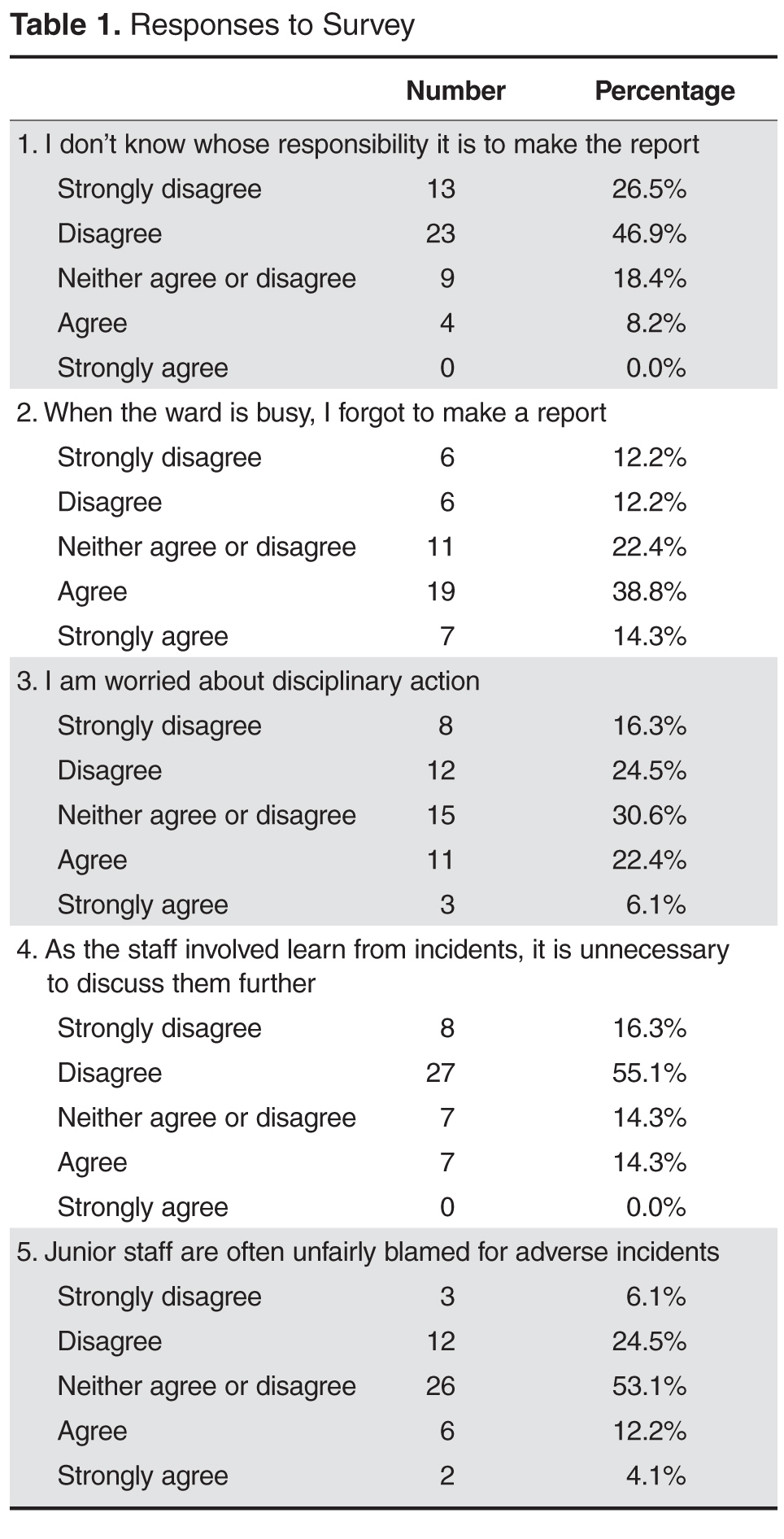
When asked to outline reasons for not reporting incidents, participating residents and fellows identified the complexity of reporting system, lack of feedback, lack of updates about new system changes resulting from safety event reporting, 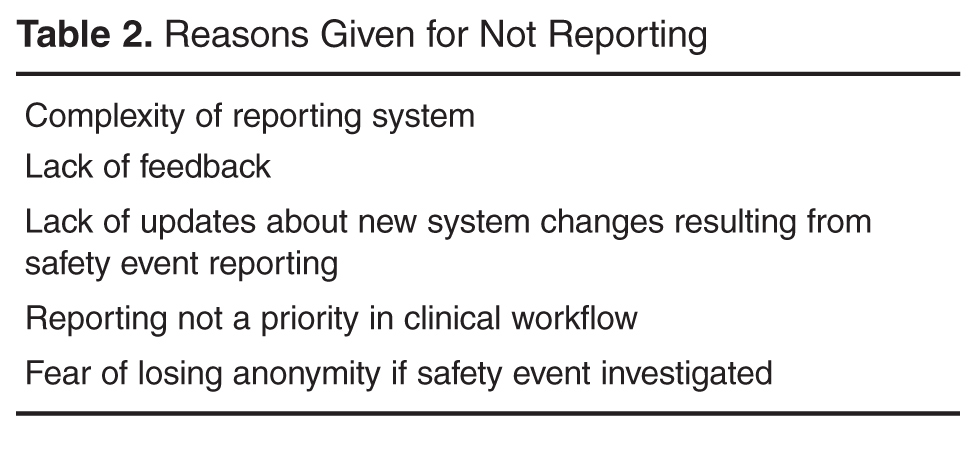
Discussion
This pilot study demonstrated that resident and fellow physicians in the department of internal medicine at our institution understand the necessity of reporting and that it is their responsibility; however, it is not a priority during the busy clinical workflow on the wards. Other investigators have observed similar attitudes/behaviors among physicians across teaching hospitals in the United States [10,12]. In a study by Boike et al [15], despite positive attitudes among internal medicine residents regarding reporting, increased reporting could not be sustained after the initial increase.
Our finding that 71.4% felt it was useful to discuss safety events is similar to Kaldjian et al’s [16] finding that 70% of generalist physicians in teaching hospitals believed that discussing mistakes strengthens professional relationships. The physicians in that study indicated that they usually discuss their errors with colleagues.
Prior to the development of the inpatient safety committee, the institution had a basic resource in place for reporting events, but there were minimal contributions from resident and fellow physicians. It is likely that the higher rates of reporting by nursing, laboratory, and pharmacy services (data not presented) that were seen are due to a required reporting protocol that is part of the workflow.
Since the inception of the inpatient safety committee, we have started several projects to build upon the foundation of positive resident and fellow physician attitudes. Based on the input of resident and fellow physicians, who are the front-line agents of process improvement, the existing patient safety reporting method was revised and reorganized. Previously, an online standardized patient safety event form was accessible after several click throughs on the institution’s homepage. This form was confusing and laborious to complete by residents and fellows, who were already operating on thin margins of spare time. The online reporting form was moved to the homepage for easy access and a free text option was enabled.
Another barrier to reporting was access to available computers. As such, the committee instituted a phone hotline reporting system. Instead of residents entering events using the Midas information management system, they now are able to call an in-house line and leave an anonymous voicemail to report safety events. Both the online and phone hotline reporting systems are integrated into a central database.
Lastly, resident and fellow physician education curricula were developed to instruct on the need to report patient safety events. Time is allotted at every monthly resident business meeting to discuss reportable patient safety events and offer feedback about concerns. In addition, the director of patient safety sends weekly safety updates, which are emailed to all faculty, residents, and fellows. These include de-identified safety event reports and any organizational and system improvements made in response to these events. Additionally, a mock root analysis takes place each quarter in which the patient safety director reviews a mock case with trainees to identify root causes and system failures. The committee has committed to transparency of reporting patient safety events as means to track the results of our efforts and interventions [17].
We plan to resurvey the resident and fellow physicians to reassess stability or changes in attitudes as a result of these physician-focused improvements. A more systematic analysis of temporal trends in reporting and comparisons across residency programs within our health system is being designed.
Conclusion
Reporting patient safety events should not be seen as a cumbersome task in an already busy clinical workday. We intend to develop scalable solutions that take into account the challenges faced by physicians in training. As the institution strives to become a high-reliability organization with a goal of zero serious patient safety events by 2020, we hope to share the lessons from our quality improvement efforts with other learning organizations.
Acknowledgements: The authors thank Suela Sulo, PhD, for manuscript review and editing.
Corresponding author: Jill Patton, DO, Advocate Lutheran General Hospital, 1775 Dempster St., Park Ridge, IL 60068, jill.patton@advocatehealth.com.
Financial disclosures: None.
1. Boonyasai RT, Windish DM, Chakraborti C, et al. Effectiveness of teaching quality improvement to clinicians: a systematic review. JAMA 2007;298:1023–37.
2. Wong BM, Etchells EE, Kuper A, et al. Teaching quality improvement and patient safety to trainees: a systematic review. Acad Med 2010;85:1425–39.
3. Leape LL, Berwick DM. Five years after To Err Is Human: what have we learned? JAMA. 2005;293:2384–90.
4. Kohn LT, Corrigan JM, Donaldson MS. To err is human: Building a safer health system. Washington, DC: National Academy Press; 1999.
5. Swing SR. The ACGME outcome project: retrospective and prospective. Med Teach 2007;29:648–54.
6. ACGME. Common program requirements. Available at www.acgme.org.
7. Kaldjian LC, Jones EW, Wu BJ, et al. Reporting medical errors to improve patient safety: a survey of physicians in teaching hospitals. Arch Intern Med 2008;168:40–6.
8. Kaldjian LC, Jones EW, Rosenthal GE, et al. An empirically derived taxonomy of factors affecting physicians’ willingness to disclose medical errors. J Gen Intern Med 2006;21:942–8.
9. White AA, Gallagher TH, Krauss MJ, et al. The attitudes and experiences of trainees regarding disclosing medical errors to patients. Acad Med 2008;83:250–6.
10. Farley DO, Haviland A, Champagne S, et al. Adverse-event-reporting practices by US hospitals: results of a national survey. Qual Saf Health Care 2008;17:416–23.
11. Schectman JM, Plews-Ogan ML. Physician perception of hospital safety and barriers to incident reporting. Jt Comm J Qual Patient Saf 2006;32:337–43.
12. Milch CE, Salem DN, Pauker SG, et al. Voluntary electronic reporting of medical errors and adverse events. An analysis of 92,547 reports from 26 acute care hospitals. J Gen Intern Med 2006;21:165–70.
13. Madigosky WS, Headrick LA, Nelson K, et al. Changing and sustaining medical students’ knowledge, skills, and attitudes about patient safety and medical fallibility. Acad Med 2006;81:94–101.
14. Jericho BG, Tassone RF, Centomani NM, et al. An assessment of an educational intervention on resident physician attitudes, knowledge, and skills related to adverse event reporting. J Grad Med Educ 2010;2:188–94.
15. Boike JR, Bortman JS, Radosta JM, et al. Patient safety event reporting expectation: does it influence residents’ attitudes and reporting behaviors? J Patient Saf 2013;9:59–67.
16.Kaldjian LC, Forman-Hoffman VL, Jones EW, et al. Do faculty and resident physicians discuss their medical errors? J Med Ethics 2008;34:717–22.
17. Willeumier D. Advocate health care: a systemwide approach to quality and safety. Jt Comm J Qual Saf 2004;30:559–66.
From the Department of Internal Medicine, Advocate Lutheran General Hospital, Park Ridge, IL.
Abstract
- Objective: To understand the attitudes and experiences of physicians in training with regard to patient safety event reporting.
- Methods: Residents and fellows in the department of internal medicine were surveyed using a questionnaire containing 5 closed-ended items. These items examined trainees’ attitudes, experiences and knowledge about safety event reporting and barriers to their reporting.
- Results: 61% of 80 eligible trainees responded. The majority of residents understood that it is their responsibility to report safety events. Identified barriers to reporting were the complexity of the reporting system, lack of feedback after reporting safety events to gain knowledge of system advances, and reporting was not a priority in clinical workflow.
- Conclusion: An inpatient safety and quality committee intends to develop solutions to the challenges faced by trainees’ in reporting patient safety events.
Nationwide, graduate medical education programs are changing to include a greater focus on quality improvement and patient safety [1,2]. This has been recognized as a priority by the Institute of Medicine, the Joint Commission, and the Accreditation Council for Graduate Medical Education (ACGME) [3–6]. Hospital safety event reporting systems have been implemented to improve patient safety. Despite national expectations and demonstrated benefits of reporting adverse events, most resident and attending physicians fail to understand the value, lack the skills to report, and do not participate in incident reporting [7–9].
Past attempts to increase awareness about patient safety reporting have resulted in minimal participation [10,11]. In relation to other health care providers, attending and resident physicians have the lowest rate of patient safety reporting [12]. Interventions aiming to improve reporting have had mixed results, with sustained improvement being a major challenge [13,14]. To advance our efforts to improve reporting of patient safety events as a means toward improving patient safety, we sought to understand the attitudes and beliefs of our physicians in training with regard to patient safety event reporting.
Methods
Setting
Our institution, a community teaching hospital located in Park Ridge, IL, began patient safety event reporting in 2006 by remote data entry using the Midas information management system (MidasPlus, Xerox, Tucson, AZ). In 2012, as part of the system-based practice ACGME competency, we asked residents enter at least 1 patient safety event for each rotation block. The events could be entered with identifying information or anonymously.
Quality Improvement Project
Given the national focus on patient safety and quality improvement, as well as our organizational goal of zero patient safety events by 2020, in 2014 we formed an inpatient safety and quality committee. This committee includes the medical director of patient safety, internal medicine program director, associate program director, chief resident, fellows, residents and attending physicians. The committee was formed with the long-term objective of advancing patient safety and quality improvement efforts and to decrease preventable errors. As physicians in training are key frontline personnel, the committee decided to focus its initial short-term efforts on this group.
Questionnaire
To understand the magnitude and context of resident reporting behavior, we surveyed the residents and fellows in the department of internal medicine. The fellowships were in cardiology, gastroenterology, and hematology/oncology. The questionnaire we used contained 5 closed-ended items that examined trainees attitudes, experiences, and knowledge about incident reporting. The survey was distributed to the residents and fellows via SurveyMonkeyduring August 2014.
Results
When asked to outline reasons for not reporting incidents, participating residents and fellows identified the complexity of reporting system, lack of feedback, lack of updates about new system changes resulting from safety event reporting,
Discussion
This pilot study demonstrated that resident and fellow physicians in the department of internal medicine at our institution understand the necessity of reporting and that it is their responsibility; however, it is not a priority during the busy clinical workflow on the wards. Other investigators have observed similar attitudes/behaviors among physicians across teaching hospitals in the United States [10,12]. In a study by Boike et al [15], despite positive attitudes among internal medicine residents regarding reporting, increased reporting could not be sustained after the initial increase.
Our finding that 71.4% felt it was useful to discuss safety events is similar to Kaldjian et al’s [16] finding that 70% of generalist physicians in teaching hospitals believed that discussing mistakes strengthens professional relationships. The physicians in that study indicated that they usually discuss their errors with colleagues.
Prior to the development of the inpatient safety committee, the institution had a basic resource in place for reporting events, but there were minimal contributions from resident and fellow physicians. It is likely that the higher rates of reporting by nursing, laboratory, and pharmacy services (data not presented) that were seen are due to a required reporting protocol that is part of the workflow.
Since the inception of the inpatient safety committee, we have started several projects to build upon the foundation of positive resident and fellow physician attitudes. Based on the input of resident and fellow physicians, who are the front-line agents of process improvement, the existing patient safety reporting method was revised and reorganized. Previously, an online standardized patient safety event form was accessible after several click throughs on the institution’s homepage. This form was confusing and laborious to complete by residents and fellows, who were already operating on thin margins of spare time. The online reporting form was moved to the homepage for easy access and a free text option was enabled.
Another barrier to reporting was access to available computers. As such, the committee instituted a phone hotline reporting system. Instead of residents entering events using the Midas information management system, they now are able to call an in-house line and leave an anonymous voicemail to report safety events. Both the online and phone hotline reporting systems are integrated into a central database.
Lastly, resident and fellow physician education curricula were developed to instruct on the need to report patient safety events. Time is allotted at every monthly resident business meeting to discuss reportable patient safety events and offer feedback about concerns. In addition, the director of patient safety sends weekly safety updates, which are emailed to all faculty, residents, and fellows. These include de-identified safety event reports and any organizational and system improvements made in response to these events. Additionally, a mock root analysis takes place each quarter in which the patient safety director reviews a mock case with trainees to identify root causes and system failures. The committee has committed to transparency of reporting patient safety events as means to track the results of our efforts and interventions [17].
We plan to resurvey the resident and fellow physicians to reassess stability or changes in attitudes as a result of these physician-focused improvements. A more systematic analysis of temporal trends in reporting and comparisons across residency programs within our health system is being designed.
Conclusion
Reporting patient safety events should not be seen as a cumbersome task in an already busy clinical workday. We intend to develop scalable solutions that take into account the challenges faced by physicians in training. As the institution strives to become a high-reliability organization with a goal of zero serious patient safety events by 2020, we hope to share the lessons from our quality improvement efforts with other learning organizations.
Acknowledgements: The authors thank Suela Sulo, PhD, for manuscript review and editing.
Corresponding author: Jill Patton, DO, Advocate Lutheran General Hospital, 1775 Dempster St., Park Ridge, IL 60068, jill.patton@advocatehealth.com.
Financial disclosures: None.
From the Department of Internal Medicine, Advocate Lutheran General Hospital, Park Ridge, IL.
Abstract
- Objective: To understand the attitudes and experiences of physicians in training with regard to patient safety event reporting.
- Methods: Residents and fellows in the department of internal medicine were surveyed using a questionnaire containing 5 closed-ended items. These items examined trainees’ attitudes, experiences and knowledge about safety event reporting and barriers to their reporting.
- Results: 61% of 80 eligible trainees responded. The majority of residents understood that it is their responsibility to report safety events. Identified barriers to reporting were the complexity of the reporting system, lack of feedback after reporting safety events to gain knowledge of system advances, and reporting was not a priority in clinical workflow.
- Conclusion: An inpatient safety and quality committee intends to develop solutions to the challenges faced by trainees’ in reporting patient safety events.
Nationwide, graduate medical education programs are changing to include a greater focus on quality improvement and patient safety [1,2]. This has been recognized as a priority by the Institute of Medicine, the Joint Commission, and the Accreditation Council for Graduate Medical Education (ACGME) [3–6]. Hospital safety event reporting systems have been implemented to improve patient safety. Despite national expectations and demonstrated benefits of reporting adverse events, most resident and attending physicians fail to understand the value, lack the skills to report, and do not participate in incident reporting [7–9].
Past attempts to increase awareness about patient safety reporting have resulted in minimal participation [10,11]. In relation to other health care providers, attending and resident physicians have the lowest rate of patient safety reporting [12]. Interventions aiming to improve reporting have had mixed results, with sustained improvement being a major challenge [13,14]. To advance our efforts to improve reporting of patient safety events as a means toward improving patient safety, we sought to understand the attitudes and beliefs of our physicians in training with regard to patient safety event reporting.
Methods
Setting
Our institution, a community teaching hospital located in Park Ridge, IL, began patient safety event reporting in 2006 by remote data entry using the Midas information management system (MidasPlus, Xerox, Tucson, AZ). In 2012, as part of the system-based practice ACGME competency, we asked residents enter at least 1 patient safety event for each rotation block. The events could be entered with identifying information or anonymously.
Quality Improvement Project
Given the national focus on patient safety and quality improvement, as well as our organizational goal of zero patient safety events by 2020, in 2014 we formed an inpatient safety and quality committee. This committee includes the medical director of patient safety, internal medicine program director, associate program director, chief resident, fellows, residents and attending physicians. The committee was formed with the long-term objective of advancing patient safety and quality improvement efforts and to decrease preventable errors. As physicians in training are key frontline personnel, the committee decided to focus its initial short-term efforts on this group.
Questionnaire
To understand the magnitude and context of resident reporting behavior, we surveyed the residents and fellows in the department of internal medicine. The fellowships were in cardiology, gastroenterology, and hematology/oncology. The questionnaire we used contained 5 closed-ended items that examined trainees attitudes, experiences, and knowledge about incident reporting. The survey was distributed to the residents and fellows via SurveyMonkeyduring August 2014.
Results
When asked to outline reasons for not reporting incidents, participating residents and fellows identified the complexity of reporting system, lack of feedback, lack of updates about new system changes resulting from safety event reporting,
Discussion
This pilot study demonstrated that resident and fellow physicians in the department of internal medicine at our institution understand the necessity of reporting and that it is their responsibility; however, it is not a priority during the busy clinical workflow on the wards. Other investigators have observed similar attitudes/behaviors among physicians across teaching hospitals in the United States [10,12]. In a study by Boike et al [15], despite positive attitudes among internal medicine residents regarding reporting, increased reporting could not be sustained after the initial increase.
Our finding that 71.4% felt it was useful to discuss safety events is similar to Kaldjian et al’s [16] finding that 70% of generalist physicians in teaching hospitals believed that discussing mistakes strengthens professional relationships. The physicians in that study indicated that they usually discuss their errors with colleagues.
Prior to the development of the inpatient safety committee, the institution had a basic resource in place for reporting events, but there were minimal contributions from resident and fellow physicians. It is likely that the higher rates of reporting by nursing, laboratory, and pharmacy services (data not presented) that were seen are due to a required reporting protocol that is part of the workflow.
Since the inception of the inpatient safety committee, we have started several projects to build upon the foundation of positive resident and fellow physician attitudes. Based on the input of resident and fellow physicians, who are the front-line agents of process improvement, the existing patient safety reporting method was revised and reorganized. Previously, an online standardized patient safety event form was accessible after several click throughs on the institution’s homepage. This form was confusing and laborious to complete by residents and fellows, who were already operating on thin margins of spare time. The online reporting form was moved to the homepage for easy access and a free text option was enabled.
Another barrier to reporting was access to available computers. As such, the committee instituted a phone hotline reporting system. Instead of residents entering events using the Midas information management system, they now are able to call an in-house line and leave an anonymous voicemail to report safety events. Both the online and phone hotline reporting systems are integrated into a central database.
Lastly, resident and fellow physician education curricula were developed to instruct on the need to report patient safety events. Time is allotted at every monthly resident business meeting to discuss reportable patient safety events and offer feedback about concerns. In addition, the director of patient safety sends weekly safety updates, which are emailed to all faculty, residents, and fellows. These include de-identified safety event reports and any organizational and system improvements made in response to these events. Additionally, a mock root analysis takes place each quarter in which the patient safety director reviews a mock case with trainees to identify root causes and system failures. The committee has committed to transparency of reporting patient safety events as means to track the results of our efforts and interventions [17].
We plan to resurvey the resident and fellow physicians to reassess stability or changes in attitudes as a result of these physician-focused improvements. A more systematic analysis of temporal trends in reporting and comparisons across residency programs within our health system is being designed.
Conclusion
Reporting patient safety events should not be seen as a cumbersome task in an already busy clinical workday. We intend to develop scalable solutions that take into account the challenges faced by physicians in training. As the institution strives to become a high-reliability organization with a goal of zero serious patient safety events by 2020, we hope to share the lessons from our quality improvement efforts with other learning organizations.
Acknowledgements: The authors thank Suela Sulo, PhD, for manuscript review and editing.
Corresponding author: Jill Patton, DO, Advocate Lutheran General Hospital, 1775 Dempster St., Park Ridge, IL 60068, jill.patton@advocatehealth.com.
Financial disclosures: None.
1. Boonyasai RT, Windish DM, Chakraborti C, et al. Effectiveness of teaching quality improvement to clinicians: a systematic review. JAMA 2007;298:1023–37.
2. Wong BM, Etchells EE, Kuper A, et al. Teaching quality improvement and patient safety to trainees: a systematic review. Acad Med 2010;85:1425–39.
3. Leape LL, Berwick DM. Five years after To Err Is Human: what have we learned? JAMA. 2005;293:2384–90.
4. Kohn LT, Corrigan JM, Donaldson MS. To err is human: Building a safer health system. Washington, DC: National Academy Press; 1999.
5. Swing SR. The ACGME outcome project: retrospective and prospective. Med Teach 2007;29:648–54.
6. ACGME. Common program requirements. Available at www.acgme.org.
7. Kaldjian LC, Jones EW, Wu BJ, et al. Reporting medical errors to improve patient safety: a survey of physicians in teaching hospitals. Arch Intern Med 2008;168:40–6.
8. Kaldjian LC, Jones EW, Rosenthal GE, et al. An empirically derived taxonomy of factors affecting physicians’ willingness to disclose medical errors. J Gen Intern Med 2006;21:942–8.
9. White AA, Gallagher TH, Krauss MJ, et al. The attitudes and experiences of trainees regarding disclosing medical errors to patients. Acad Med 2008;83:250–6.
10. Farley DO, Haviland A, Champagne S, et al. Adverse-event-reporting practices by US hospitals: results of a national survey. Qual Saf Health Care 2008;17:416–23.
11. Schectman JM, Plews-Ogan ML. Physician perception of hospital safety and barriers to incident reporting. Jt Comm J Qual Patient Saf 2006;32:337–43.
12. Milch CE, Salem DN, Pauker SG, et al. Voluntary electronic reporting of medical errors and adverse events. An analysis of 92,547 reports from 26 acute care hospitals. J Gen Intern Med 2006;21:165–70.
13. Madigosky WS, Headrick LA, Nelson K, et al. Changing and sustaining medical students’ knowledge, skills, and attitudes about patient safety and medical fallibility. Acad Med 2006;81:94–101.
14. Jericho BG, Tassone RF, Centomani NM, et al. An assessment of an educational intervention on resident physician attitudes, knowledge, and skills related to adverse event reporting. J Grad Med Educ 2010;2:188–94.
15. Boike JR, Bortman JS, Radosta JM, et al. Patient safety event reporting expectation: does it influence residents’ attitudes and reporting behaviors? J Patient Saf 2013;9:59–67.
16.Kaldjian LC, Forman-Hoffman VL, Jones EW, et al. Do faculty and resident physicians discuss their medical errors? J Med Ethics 2008;34:717–22.
17. Willeumier D. Advocate health care: a systemwide approach to quality and safety. Jt Comm J Qual Saf 2004;30:559–66.
1. Boonyasai RT, Windish DM, Chakraborti C, et al. Effectiveness of teaching quality improvement to clinicians: a systematic review. JAMA 2007;298:1023–37.
2. Wong BM, Etchells EE, Kuper A, et al. Teaching quality improvement and patient safety to trainees: a systematic review. Acad Med 2010;85:1425–39.
3. Leape LL, Berwick DM. Five years after To Err Is Human: what have we learned? JAMA. 2005;293:2384–90.
4. Kohn LT, Corrigan JM, Donaldson MS. To err is human: Building a safer health system. Washington, DC: National Academy Press; 1999.
5. Swing SR. The ACGME outcome project: retrospective and prospective. Med Teach 2007;29:648–54.
6. ACGME. Common program requirements. Available at www.acgme.org.
7. Kaldjian LC, Jones EW, Wu BJ, et al. Reporting medical errors to improve patient safety: a survey of physicians in teaching hospitals. Arch Intern Med 2008;168:40–6.
8. Kaldjian LC, Jones EW, Rosenthal GE, et al. An empirically derived taxonomy of factors affecting physicians’ willingness to disclose medical errors. J Gen Intern Med 2006;21:942–8.
9. White AA, Gallagher TH, Krauss MJ, et al. The attitudes and experiences of trainees regarding disclosing medical errors to patients. Acad Med 2008;83:250–6.
10. Farley DO, Haviland A, Champagne S, et al. Adverse-event-reporting practices by US hospitals: results of a national survey. Qual Saf Health Care 2008;17:416–23.
11. Schectman JM, Plews-Ogan ML. Physician perception of hospital safety and barriers to incident reporting. Jt Comm J Qual Patient Saf 2006;32:337–43.
12. Milch CE, Salem DN, Pauker SG, et al. Voluntary electronic reporting of medical errors and adverse events. An analysis of 92,547 reports from 26 acute care hospitals. J Gen Intern Med 2006;21:165–70.
13. Madigosky WS, Headrick LA, Nelson K, et al. Changing and sustaining medical students’ knowledge, skills, and attitudes about patient safety and medical fallibility. Acad Med 2006;81:94–101.
14. Jericho BG, Tassone RF, Centomani NM, et al. An assessment of an educational intervention on resident physician attitudes, knowledge, and skills related to adverse event reporting. J Grad Med Educ 2010;2:188–94.
15. Boike JR, Bortman JS, Radosta JM, et al. Patient safety event reporting expectation: does it influence residents’ attitudes and reporting behaviors? J Patient Saf 2013;9:59–67.
16.Kaldjian LC, Forman-Hoffman VL, Jones EW, et al. Do faculty and resident physicians discuss their medical errors? J Med Ethics 2008;34:717–22.
17. Willeumier D. Advocate health care: a systemwide approach to quality and safety. Jt Comm J Qual Saf 2004;30:559–66.
Women usually given dabigatran in lower dose
In real-world practice, women who are prescribed dabigatran for atrial fibrillation (AF) are usually given the lower dose of the drug, even though the higher dose appears to be more protective against stroke, according to Canadian database analysis published online Oct. 27 in Circulation: Cardiovascular Quality and Outcomes.
In RE-LY, the main randomized clinical trial showing that dabigatran is more effective at preventing stroke and provoked fewer bleeding episodes than warfarin, only 37% of the participants were women (N Engl J Med. 2009 Sep 17; 361[12]1139-51).This raises the question of whether the study’s results are truly applicable to women. In addition, the women in that trial showed plasma concentrations of dabigatran that were 30% higher than those in men, suggesting that the drug’s safety profile may differ between women and men. However, there was no mention of sex differences related to outcomes, said Meytal Avgil Tsadok, Ph.D., of the division of clinical epidemiology, McGill University Health Center, Montreal, and her associates.

To examine sex-based differences in prescribing patterns in real-world practice, the investigators performed a population-based cohort study among 631,110 residents of Quebec who were discharged from the hospital with either a primary or a secondary diagnosis of AF during a 14-year period. They identified 15,918 dabigatran users and matched them for comorbidity, age at AF diagnosis, and date of first prescription for anticoagulants with 47,192 warfarin users (control subjects). The 31,786 women and 31,324 men participating in this study were followed for a median of 1.3 years (range, 0-3.2 years) for the development of stroke/TIA, bleeding events, or hospitalization for MI.
The researchers found that dabigatran use differed markedly between women and men. Men were prescribed the lower dose (110 mg) in nearly equal numbers with the higher dose (150 mg) of dabigatran, but women were prescribed the lower dose (64.8%) much more often than the higher dose (35.2%). In a further analysis of the data, women were much more likely than men to fill prescriptions of the lower dose (odds ratio, 1.35). This was true even though women, but not men, showed a trend toward a lower incidence of stroke when prescribed the higher dose of dabigatran, compared with warfarin.
These prescribing practices remained consistent even when the participants were categorized according to age. More women than men used low-dose dabigatran whether they were younger than 75 years of age (22.8% vs. 18.5%) or older than 75 years (83.5% vs. 76.0%). These findings show that, regardless of patient age or comorbidities, “women have 35% higher chances to be prescribed a lower dabigatran dose than men, although women have a higher baseline risk for stroke,” Dr. Tsadok and her associates said (Circ Cardiovasc Qual Outcomes. 2015 Oct 27 [doi: 10.1161/circoutcomes.114.001398]).
The reason for this discrepancy is not yet known. A similar pattern of prescribing was noted in a Danish population-based cohort study. It’s possible that clinicians perceive women as frailer patients than men, “so they tend to be more concerned about safety and, therefore, prescribe women with a lower dose, compromising efficacy,” the investigators said.
Their study was limited in that follow-up was relatively short at approximately 1 year. It is therefore possible that they underestimated the risks of stroke/TIA, bleeding events, or MI hospitalization, Dr. Tsadok and her associates added.
This study was supported by the Canadian Institutes of Health Research. Dr. Tsadok and her associates reported having no relevant financial disclosures.
In real-world practice, women who are prescribed dabigatran for atrial fibrillation (AF) are usually given the lower dose of the drug, even though the higher dose appears to be more protective against stroke, according to Canadian database analysis published online Oct. 27 in Circulation: Cardiovascular Quality and Outcomes.
In RE-LY, the main randomized clinical trial showing that dabigatran is more effective at preventing stroke and provoked fewer bleeding episodes than warfarin, only 37% of the participants were women (N Engl J Med. 2009 Sep 17; 361[12]1139-51).This raises the question of whether the study’s results are truly applicable to women. In addition, the women in that trial showed plasma concentrations of dabigatran that were 30% higher than those in men, suggesting that the drug’s safety profile may differ between women and men. However, there was no mention of sex differences related to outcomes, said Meytal Avgil Tsadok, Ph.D., of the division of clinical epidemiology, McGill University Health Center, Montreal, and her associates.
To examine sex-based differences in prescribing patterns in real-world practice, the investigators performed a population-based cohort study among 631,110 residents of Quebec who were discharged from the hospital with either a primary or a secondary diagnosis of AF during a 14-year period. They identified 15,918 dabigatran users and matched them for comorbidity, age at AF diagnosis, and date of first prescription for anticoagulants with 47,192 warfarin users (control subjects). The 31,786 women and 31,324 men participating in this study were followed for a median of 1.3 years (range, 0-3.2 years) for the development of stroke/TIA, bleeding events, or hospitalization for MI.
The researchers found that dabigatran use differed markedly between women and men. Men were prescribed the lower dose (110 mg) in nearly equal numbers with the higher dose (150 mg) of dabigatran, but women were prescribed the lower dose (64.8%) much more often than the higher dose (35.2%). In a further analysis of the data, women were much more likely than men to fill prescriptions of the lower dose (odds ratio, 1.35). This was true even though women, but not men, showed a trend toward a lower incidence of stroke when prescribed the higher dose of dabigatran, compared with warfarin.
These prescribing practices remained consistent even when the participants were categorized according to age. More women than men used low-dose dabigatran whether they were younger than 75 years of age (22.8% vs. 18.5%) or older than 75 years (83.5% vs. 76.0%). These findings show that, regardless of patient age or comorbidities, “women have 35% higher chances to be prescribed a lower dabigatran dose than men, although women have a higher baseline risk for stroke,” Dr. Tsadok and her associates said (Circ Cardiovasc Qual Outcomes. 2015 Oct 27 [doi: 10.1161/circoutcomes.114.001398]).
The reason for this discrepancy is not yet known. A similar pattern of prescribing was noted in a Danish population-based cohort study. It’s possible that clinicians perceive women as frailer patients than men, “so they tend to be more concerned about safety and, therefore, prescribe women with a lower dose, compromising efficacy,” the investigators said.
Their study was limited in that follow-up was relatively short at approximately 1 year. It is therefore possible that they underestimated the risks of stroke/TIA, bleeding events, or MI hospitalization, Dr. Tsadok and her associates added.
This study was supported by the Canadian Institutes of Health Research. Dr. Tsadok and her associates reported having no relevant financial disclosures.
In real-world practice, women who are prescribed dabigatran for atrial fibrillation (AF) are usually given the lower dose of the drug, even though the higher dose appears to be more protective against stroke, according to Canadian database analysis published online Oct. 27 in Circulation: Cardiovascular Quality and Outcomes.
In RE-LY, the main randomized clinical trial showing that dabigatran is more effective at preventing stroke and provoked fewer bleeding episodes than warfarin, only 37% of the participants were women (N Engl J Med. 2009 Sep 17; 361[12]1139-51).This raises the question of whether the study’s results are truly applicable to women. In addition, the women in that trial showed plasma concentrations of dabigatran that were 30% higher than those in men, suggesting that the drug’s safety profile may differ between women and men. However, there was no mention of sex differences related to outcomes, said Meytal Avgil Tsadok, Ph.D., of the division of clinical epidemiology, McGill University Health Center, Montreal, and her associates.
To examine sex-based differences in prescribing patterns in real-world practice, the investigators performed a population-based cohort study among 631,110 residents of Quebec who were discharged from the hospital with either a primary or a secondary diagnosis of AF during a 14-year period. They identified 15,918 dabigatran users and matched them for comorbidity, age at AF diagnosis, and date of first prescription for anticoagulants with 47,192 warfarin users (control subjects). The 31,786 women and 31,324 men participating in this study were followed for a median of 1.3 years (range, 0-3.2 years) for the development of stroke/TIA, bleeding events, or hospitalization for MI.
The researchers found that dabigatran use differed markedly between women and men. Men were prescribed the lower dose (110 mg) in nearly equal numbers with the higher dose (150 mg) of dabigatran, but women were prescribed the lower dose (64.8%) much more often than the higher dose (35.2%). In a further analysis of the data, women were much more likely than men to fill prescriptions of the lower dose (odds ratio, 1.35). This was true even though women, but not men, showed a trend toward a lower incidence of stroke when prescribed the higher dose of dabigatran, compared with warfarin.
These prescribing practices remained consistent even when the participants were categorized according to age. More women than men used low-dose dabigatran whether they were younger than 75 years of age (22.8% vs. 18.5%) or older than 75 years (83.5% vs. 76.0%). These findings show that, regardless of patient age or comorbidities, “women have 35% higher chances to be prescribed a lower dabigatran dose than men, although women have a higher baseline risk for stroke,” Dr. Tsadok and her associates said (Circ Cardiovasc Qual Outcomes. 2015 Oct 27 [doi: 10.1161/circoutcomes.114.001398]).
The reason for this discrepancy is not yet known. A similar pattern of prescribing was noted in a Danish population-based cohort study. It’s possible that clinicians perceive women as frailer patients than men, “so they tend to be more concerned about safety and, therefore, prescribe women with a lower dose, compromising efficacy,” the investigators said.
Their study was limited in that follow-up was relatively short at approximately 1 year. It is therefore possible that they underestimated the risks of stroke/TIA, bleeding events, or MI hospitalization, Dr. Tsadok and her associates added.
This study was supported by the Canadian Institutes of Health Research. Dr. Tsadok and her associates reported having no relevant financial disclosures.
FROM CIRCULATION: CARDIOVASCULAR QUALITY AND OUTCOMES
Key clinical point: Women prescribed dabigatran for AF are usually given the lower dose of the drug, for unknown reasons.
Major finding: Men were prescribed the lower dose (110 mg) in nearly equal numbers with the higher dose (150 mg) of dabigatran, but women were prescribed the lower dose (64.8%) much more often than the higher dose (35.2%).
Data source: An analysis of prescribing patterns in a population-based cohort of 31,786 women and 31,324 men who had AF living in Quebec.
Disclosures: This study was supported by the Canadian Institutes of Health Research. Dr. Tsadok and her associates reported having no relevant financial disclosures.

VIDEO: ASAP 2 trial will test Watchman in warfarin-contraindicated patients
Now that the Watchman device for left atrial appendage closure is on the U.S. market, target patients are those with atrial fibrillation who can tolerate at least a brief, 6-week course of treatment with warfarin – which is what the device’s labeling demands – but are poor candidates for long-term treatment with oral anticoagulation because they have had a serious bleeding episode while on anticoagulant treatment, Dr. Vivek Y. Reddy said in an interview.
Another type of atrial fibrillation patient who is potentially a prime target for Watchman placement are those with a complete contraindication to warfarin treatment, but as of now this makes then ineligible to receive the device. This category of patient will be the target of the ASAP 2 trial, a large, multicenter trial planned to start by the end of 2015 that will randomize atrial fibrillation patients ineligible to receive any oral anticoagulation to receive Watchman followed by a 6-month period of dual antiplatelet therapy or to current standard therapy for such patients with aspirin alone, said Dr. Reddy, professor of medicine and director of the cardiac arrhythmia service at Mount Sinai Hospital in New York.
The ASAP 2 trial follows the pilot study ASAP (ASA Plavix Feasibility Study With WATCHMAN Left Atrial Appendage Closure Technology) that Dr. Reddy led and ran at four centers in Europe placing Watchman in patients ineligible to receive any oral anticoagulant treatment followed by 6 months of dual antiplatelet therapy. The ASAP results showed that this approach could be safe and effective (J Am Coll Cardiol. 2013 Jun 25;61[25]:2551-6.).
Patients with a total contraindication against treatment with warfarin or another oral anticoagulant “have the greatest need,” said Dr. Reddy. “The problem is we don’t have much safety data” for these patients, and while the results from the ASAP trial showed the device can be safely placed just using dual antiplatelet therapy the numbers were small and the device is not approved for use in this setting, he said.
Dr. Reddy has been an advisor to and received research grants from Atritech/Boston Scientific, the companies that developed and now market Watchman.
The video associated with this article is no longer available on this site. Please view all of our videos on the MDedge YouTube channel
On Twitter @mitchelzoler
Now that the Watchman device for left atrial appendage closure is on the U.S. market, target patients are those with atrial fibrillation who can tolerate at least a brief, 6-week course of treatment with warfarin – which is what the device’s labeling demands – but are poor candidates for long-term treatment with oral anticoagulation because they have had a serious bleeding episode while on anticoagulant treatment, Dr. Vivek Y. Reddy said in an interview.
Another type of atrial fibrillation patient who is potentially a prime target for Watchman placement are those with a complete contraindication to warfarin treatment, but as of now this makes then ineligible to receive the device. This category of patient will be the target of the ASAP 2 trial, a large, multicenter trial planned to start by the end of 2015 that will randomize atrial fibrillation patients ineligible to receive any oral anticoagulation to receive Watchman followed by a 6-month period of dual antiplatelet therapy or to current standard therapy for such patients with aspirin alone, said Dr. Reddy, professor of medicine and director of the cardiac arrhythmia service at Mount Sinai Hospital in New York.
The ASAP 2 trial follows the pilot study ASAP (ASA Plavix Feasibility Study With WATCHMAN Left Atrial Appendage Closure Technology) that Dr. Reddy led and ran at four centers in Europe placing Watchman in patients ineligible to receive any oral anticoagulant treatment followed by 6 months of dual antiplatelet therapy. The ASAP results showed that this approach could be safe and effective (J Am Coll Cardiol. 2013 Jun 25;61[25]:2551-6.).
Patients with a total contraindication against treatment with warfarin or another oral anticoagulant “have the greatest need,” said Dr. Reddy. “The problem is we don’t have much safety data” for these patients, and while the results from the ASAP trial showed the device can be safely placed just using dual antiplatelet therapy the numbers were small and the device is not approved for use in this setting, he said.
Dr. Reddy has been an advisor to and received research grants from Atritech/Boston Scientific, the companies that developed and now market Watchman.
The video associated with this article is no longer available on this site. Please view all of our videos on the MDedge YouTube channel
On Twitter @mitchelzoler
Now that the Watchman device for left atrial appendage closure is on the U.S. market, target patients are those with atrial fibrillation who can tolerate at least a brief, 6-week course of treatment with warfarin – which is what the device’s labeling demands – but are poor candidates for long-term treatment with oral anticoagulation because they have had a serious bleeding episode while on anticoagulant treatment, Dr. Vivek Y. Reddy said in an interview.
Another type of atrial fibrillation patient who is potentially a prime target for Watchman placement are those with a complete contraindication to warfarin treatment, but as of now this makes then ineligible to receive the device. This category of patient will be the target of the ASAP 2 trial, a large, multicenter trial planned to start by the end of 2015 that will randomize atrial fibrillation patients ineligible to receive any oral anticoagulation to receive Watchman followed by a 6-month period of dual antiplatelet therapy or to current standard therapy for such patients with aspirin alone, said Dr. Reddy, professor of medicine and director of the cardiac arrhythmia service at Mount Sinai Hospital in New York.
The ASAP 2 trial follows the pilot study ASAP (ASA Plavix Feasibility Study With WATCHMAN Left Atrial Appendage Closure Technology) that Dr. Reddy led and ran at four centers in Europe placing Watchman in patients ineligible to receive any oral anticoagulant treatment followed by 6 months of dual antiplatelet therapy. The ASAP results showed that this approach could be safe and effective (J Am Coll Cardiol. 2013 Jun 25;61[25]:2551-6.).
Patients with a total contraindication against treatment with warfarin or another oral anticoagulant “have the greatest need,” said Dr. Reddy. “The problem is we don’t have much safety data” for these patients, and while the results from the ASAP trial showed the device can be safely placed just using dual antiplatelet therapy the numbers were small and the device is not approved for use in this setting, he said.
Dr. Reddy has been an advisor to and received research grants from Atritech/Boston Scientific, the companies that developed and now market Watchman.
The video associated with this article is no longer available on this site. Please view all of our videos on the MDedge YouTube channel
On Twitter @mitchelzoler

Coronary artery disease and mental illness

Is There a Greater Risk of Mortality Following Hip Fracture Surgery Compared With Hip Replacement Surgery?
Hip fracture patients have worse outcomes in comparison with hip replacement surgery patients, and this finding is not entirely explained by age or medical condition, according to a study published September 15 in JAMA.
Researchers studied nearly 700,000 hip surgery patients older than 45 in France between 2010 and 2013 and found that the total hip replacement patients were younger, more commonly men, and had fewer comorbidities than hip fracture patients.

Investigators also found there were more deaths among the hip fracture patients, with 3.4% dying before hospital discharge compared with 0.18% of total hip replacement surgery patients.
Even when the demographics of the patients were matched by gender, age, and medical conditions, study authors found hip fracture patients had a 1.8% chance of dying compared with 0.3% of elective hip replacement patients. People with a hip fracture had a 5.9% chance of major postoperative complications, compared with 2.3% of those patients who underwent an elective hip replacement.
The research team was led by Yannick Le Manach, MD, PhD, an Assistant Professor of Anesthesia for the Michael G. DeGroote School of Medicine of McMaster University and a member of the Population Health Research Institute of McMaster and Hamilton Health Sciences in Hamilton, Ontario.
“The fact that the hip fracture patients were older and had more health problems does account for some of the difference in outcomes,” Dr. Le Manach said. “But it may be that hip fracture is tied to other physiologic processes that are not present in the circumstances of people going for an elective hip replacement. More research is needed.”
Senior author P.J. Devereaux, MD, PhD, Professor of Medicine and Director of Cardiology for the Michael G DeGroote School of Medicine stated, “These results are encouraging that there are likely risk factors specific to a hip fracture that are potentially modifiable.”
Suggested Reading
Le Manach Y, Collins G, Bhandari M, et al. Outcomes after hip fracture surgery compared with elective total hip replacement. JAMA. 2015;314(11):1159-1166.
Hip fracture patients have worse outcomes in comparison with hip replacement surgery patients, and this finding is not entirely explained by age or medical condition, according to a study published September 15 in JAMA.
Researchers studied nearly 700,000 hip surgery patients older than 45 in France between 2010 and 2013 and found that the total hip replacement patients were younger, more commonly men, and had fewer comorbidities than hip fracture patients.
Investigators also found there were more deaths among the hip fracture patients, with 3.4% dying before hospital discharge compared with 0.18% of total hip replacement surgery patients.
Even when the demographics of the patients were matched by gender, age, and medical conditions, study authors found hip fracture patients had a 1.8% chance of dying compared with 0.3% of elective hip replacement patients. People with a hip fracture had a 5.9% chance of major postoperative complications, compared with 2.3% of those patients who underwent an elective hip replacement.
The research team was led by Yannick Le Manach, MD, PhD, an Assistant Professor of Anesthesia for the Michael G. DeGroote School of Medicine of McMaster University and a member of the Population Health Research Institute of McMaster and Hamilton Health Sciences in Hamilton, Ontario.
“The fact that the hip fracture patients were older and had more health problems does account for some of the difference in outcomes,” Dr. Le Manach said. “But it may be that hip fracture is tied to other physiologic processes that are not present in the circumstances of people going for an elective hip replacement. More research is needed.”
Senior author P.J. Devereaux, MD, PhD, Professor of Medicine and Director of Cardiology for the Michael G DeGroote School of Medicine stated, “These results are encouraging that there are likely risk factors specific to a hip fracture that are potentially modifiable.”
Hip fracture patients have worse outcomes in comparison with hip replacement surgery patients, and this finding is not entirely explained by age or medical condition, according to a study published September 15 in JAMA.
Researchers studied nearly 700,000 hip surgery patients older than 45 in France between 2010 and 2013 and found that the total hip replacement patients were younger, more commonly men, and had fewer comorbidities than hip fracture patients.
Investigators also found there were more deaths among the hip fracture patients, with 3.4% dying before hospital discharge compared with 0.18% of total hip replacement surgery patients.
Even when the demographics of the patients were matched by gender, age, and medical conditions, study authors found hip fracture patients had a 1.8% chance of dying compared with 0.3% of elective hip replacement patients. People with a hip fracture had a 5.9% chance of major postoperative complications, compared with 2.3% of those patients who underwent an elective hip replacement.
The research team was led by Yannick Le Manach, MD, PhD, an Assistant Professor of Anesthesia for the Michael G. DeGroote School of Medicine of McMaster University and a member of the Population Health Research Institute of McMaster and Hamilton Health Sciences in Hamilton, Ontario.
“The fact that the hip fracture patients were older and had more health problems does account for some of the difference in outcomes,” Dr. Le Manach said. “But it may be that hip fracture is tied to other physiologic processes that are not present in the circumstances of people going for an elective hip replacement. More research is needed.”
Senior author P.J. Devereaux, MD, PhD, Professor of Medicine and Director of Cardiology for the Michael G DeGroote School of Medicine stated, “These results are encouraging that there are likely risk factors specific to a hip fracture that are potentially modifiable.”
Suggested Reading
Le Manach Y, Collins G, Bhandari M, et al. Outcomes after hip fracture surgery compared with elective total hip replacement. JAMA. 2015;314(11):1159-1166.
Suggested Reading
Le Manach Y, Collins G, Bhandari M, et al. Outcomes after hip fracture surgery compared with elective total hip replacement. JAMA. 2015;314(11):1159-1166.

Binge-Eating Disorder: Prevalence, Predictors, and Management in the Primary Care Setting
From the Department of Psychology, Eastern Michigan University, Ypsilanti, MI.
Abstract
- Objective: To describe the epidemiology, clinical features, clinical course, medical complications, and treatment of binge-eating disorder (BED).
- Methods: Review of the literature.
- Results: BED, the most common eating disorder, is a distinct pattern of binge eating accompanied by a sense of loss of control over eating without inappropriate compensatory behaviors. Because people with BED more commonly seek treatment for the psychological and medical factors that are associated with the disorder, patients’ first point of contact with the medical profession is likely to be the primary care physician (PCP). The PCP’s role includes making efforts to screen for BED symptoms, employing motivational interviewing strategies to enhance likelihood of following through with treatment, providing psychoeducational information about eating and weight control, monitoring eating, weight, and related medical problems at follow-up visits, and making referrals to behavioral health specialists who can deliver empirically supported treatments for BED.
- Conclusion: Proper screening and referral in the primary care setting can optimize the likelihood that patients obtain empirically supported treatment.
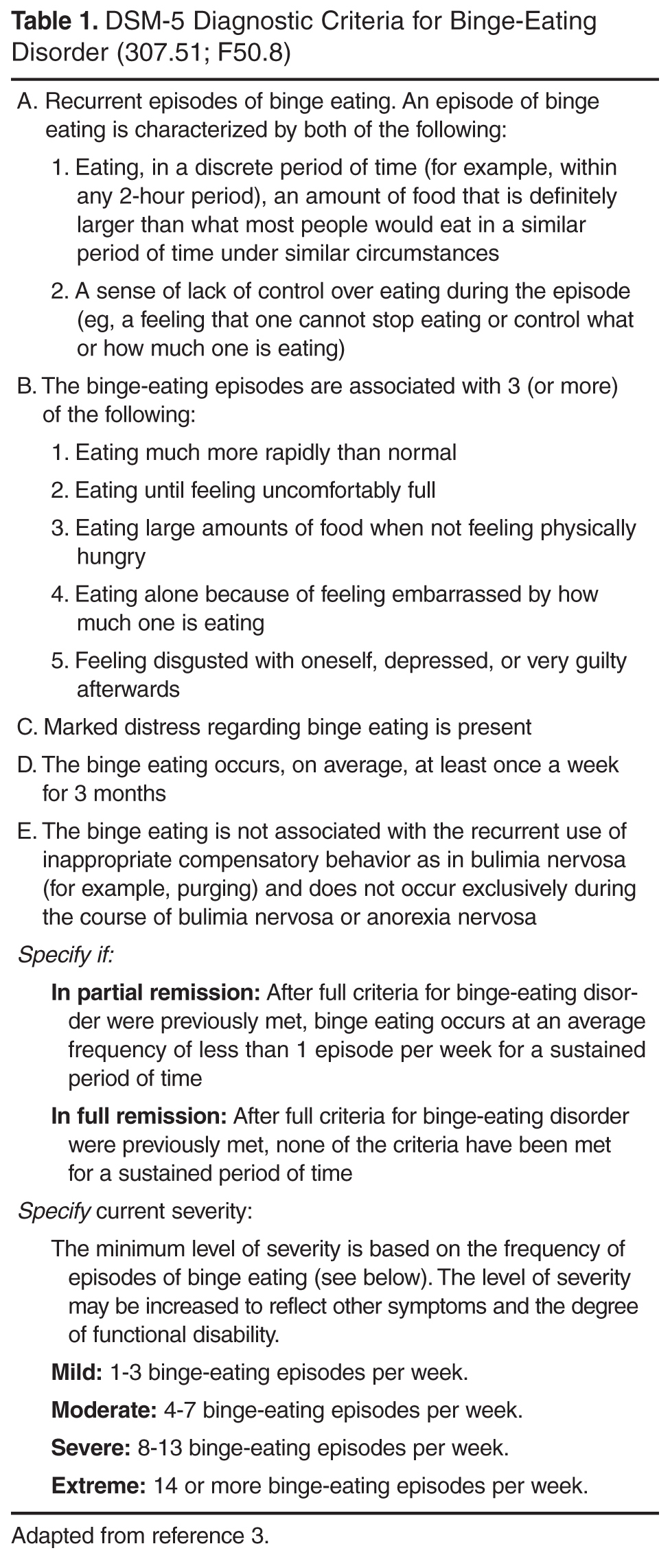
BED is the most common eating disorder, but it is one for which many do not seek treatment directly. Rather, those struggling with BED more commonly seek treatment for the psychological and medical factors that are strongly associated with the disorder. As will be reviewed below, these factors include poor social adjustment, functional impairment, psychological distress and psychiatric comorbidity, and myriad medical sequelae due to obesity and weight cycling. As such, the BED patient’s point of first contact with the medical profession is most likely to be with the primary care physician, who has several roles in the treatment of BED. There is a limited evidence base for pharmacological treatment of BED, with some medications yielding short-term reductions in binge eating, but none with strong support for long-term efficacy [4]. However, with the recent FDA approval of lisdexamfetamine dimesylate for the treatment of moderate to severe BED, this picture may change. Nonetheless, pharmacologic interventions for comorbid medical conditions will fall solidly in the bailiwick of the primary care physician. In addition, the primary care physician’s role includes making efforts to screen for BED symptoms; employing motivational interviewing strategies to enhance likelihood of following through with treatment; providing psychoeducational information about eating and weight control; monitoring eating, weight, and related medical problems at follow-up visits; and making referrals to behavioral health specialists who can deliver empirically supported treatments for BED. Finally, because BED is typically associated with weight gain over time [5], the primary care physician is encouraged to reinforce the clinical significance of weight maintenance as opposed to necessarily promoting a goal of weight loss. The rationale for this primary care approach is reviewed below, in consideration of the scientific literature and a case study highlighting common clinical features.
Case Study
Initial Presentation
A 35-year-old Caucasian woman schedules an appointment for her annual physical examination with her primary care physician. She reports generally good health but complains of low mood, joint pain, and difficulties managing her weight. Her blood pressure is managed with 100 mg/day of metoprolol. The only other medication she takes is birth control (ethinyl estradiol 20 mcg).
Physical Examination
During physical examination, it is determined that the patient is 5'6" and weighs 286 lb, with a body mass index (BMI) of 46.2 kg/m2, placing her in WHO obesity class III. The patient’s blood pressure is 130/85 mm Hg (medically managed), and her heart rate is 83 bpm. The patient states that she has been experiencing episodes of low mood off and on most of her life; she recently ended a relationship, which has exacerbated her symptoms. The physician states that the patient has gained a significant amount of weight since her last physical examination. The patient reports that she quit smoking 6 months ago and has since gained approximately 30 lb; she has considered smoking again to manage her weight.
• What are the diagnostic criteria for BED?
BED diagnostic criteria (Table 1) have been closely examined for their validity and clinical utility, and several have been the subject of intense debate in the BED literature. The first BED criterion, recurrent episodes of binge eating, refers to 3 essential components: amount of food, time period, and a subjective experience of loss of control. The majority of debate regarding this criterion revolves around the requirement for consumption of a “large amount of food.” There are 2 primary arguments against this criterion. First, it is inherently subjective and requires the person making the diagnosis to distinguish between normative food intake and excessive food intake [6]. There is also some debate as to whether or not individuals with BED actually consume large amounts of food when they binge. However, research supports that those with BED may consume over 1000 kcal during binge episodes, far more than those without BED who are asked to binge eat in the lab [7,8].
Nonetheless, a distinction has been made between objective binge-eating episodes (OBE) and subjective binge eating episodes (SBE) [9]. OBEs are binge eating episodes that meet the full criteria including a large amount of food and a subjective loss of control. SBEs, in contrast, are binge eating episodes that include a subjective loss of control but not a large quantity of food. If consumption of a large quantity of food is essential to the underlying pathology of BED, one would expect that OBEs and SBEs would be associated with different clinical characteristics. However, several studies have failed to find significant difference between individuals reporting OBEs and SBEs with regard to age, age of BE onset, BE severity, interpersonal problems, depressive symptoms, generalized psychopathology, and ED-related psychopathology [10–13]. Results regarding prognosis are mixed, with some suggesting that SBE more readily responds to placebo, while others suggest that SBEs are slower to remit than OBEs [11,13,14]. With respect to primary care, this literature suggests that it is not necessary for busy primary care physicians to devote time to understanding the amount of food consumed by the patient; if the patient perceives that her eating is out of control and excessive, that can generally be considered valid data in terms of considering a BED diagnosis, particularly when combined with even moderately overweight status.
In contrast to the controversy regarding amount of food, the majority of studies suggest that BED binge eating episodes fall within the 2-hour duration specified by the DSM-5 criteria, although longer durations have been reported [13]. The loss of control (LOC) criterion also appears to be relatively well-supported across studies [13,14]. LOC is a key defining feature of a binge eating episode for individuals with and without BED [15–18].Furthermore, the emotional distress associated with loss of control has been associated with depressive symptoms, appearance dissatisfaction, and poorer mental health-related quality of life [19]. In contrast, one study found that 18.6% of self-reported binges were not associated with loss of control [20]. Of note, there is some concern that the focus on LOC in the diagnostic criteria may lead to under diagnosis of BED among men, as women with BED were more likely than men to identify LOC as a core aspect of a binge eating episode [17].
The second DSM-5 criterion for BED requires that BE episodes be associated with 3 or more of the following: (a) eating more rapidly than normal; (b) eating until uncomfortably full; (c) eating large amounts of food in the absence of hunger; (d) eating alone because of embarrassment about how much one is eating; and (e) feeling disgusted with oneself, depressed, or very guilty after overeating. This criterion is not as controversial as the first, and has correspondingly not received as much attention in the BED literature. However, results from a handful of studies provide some support for their inclusion, particularly in light of the fact that individuals are only required to endorse 3 of the 5 symptoms [13–15,17,21].
The third criteria for BED requires that individuals experience “marked distress” about BE. Only one known study has directly evaluated the distress criterion, and its validity was confirmed by results that suggested individuals with full-threshold BED had significantly greater ED-related psychopathology and depressive symptoms as compared to individuals who met all but the distress criteria for a BED diagnosis [22].
The fourth criteria for BED stipulates that BE occurs an average of once a week for 3 months. Previously, DSM-IV-TR required more frequent episodes, at least 2 days a week for 6 months, but this was criticized as lacking in empirical basis [23]. The current state of the evidence suggests that, with regard to frequency of BE episodes, BED best fits a continuous model rather than a categorical model. That is, symptoms and related impairment exist across a severity spectrum as a function of how often BE episodes occur. For example, in a critical review, Wilson and Sysko noted that individuals with sub-threshold frequency of BE episodes had less severe psychopathology than those meeting criteria for DSM-IV BE frequency (ie, at least 2 days a week for 6 months), but they were still significantly more impaired than those who did not binge eat [24]. The authors asserted that there was no empirical rationale for preserving the criteria of 2 binge days per week for 6 months, and indeed, DSM-5 adopted a more relaxed standard. As is the case with symptoms of many psychological disorders, there does not appear to be a definitive and concrete point at which binge eating becomes pathological [23]. Fortunately, reliability for the new criteria is good and appears superior to the DSM-IV criteria [25].
Finally, the last criteria for BED—which remains unchanged from the provisional criteria in DSM-IV-TR —is essentially a rule-out that states that BE should not be accompanied by the regular use of “inappropriate compensatory behaviors” or exclusively occur during the course of anorexia or bulimia. These criteria have also been criticized as being subjective, particularly in light of the fact that individuals with BED often report a history of infrequent purging behavior and frequently engage in weight-loss attempts [6,13,14]. However, the need for a rule-out is clear given that BE also occurs during the course of bulimia and anorexia, binge-eating/purging type, and it is supported by the low rates of crossover from BED to bulimia and/or anorexia [26].
Remission and severity specifiers are new to DSM-5. With respect to the latter, a recent study observed small but significant elevations in eating pathology among those with moderate severity BED, relative to the eating pathology experienced by those with mild severity, but there were no differences in level of associated depression. Interestingly, a better differentiator of severity of eating pathology and depression among patients with BED was overvaluation of shape/weight [27]. As such, the primary care physician might be better advised to focus on indicators of this important variable by querying the extent to which the patient’s shape and weight have influenced how she feels about (judges/thinks/evaluates) herself as a person, rather than using the number of BED symptoms alone as the indicator of severity.
• What is the epidemiology of BED?
Based on DSM-IV-TR criteria, the overall lifetime prevalence rate for BED has been reported to be 2.8%, and it is more common in women (3.5%) than men (2%) [28]; the overall 12-month prevalence rate is 1.2% (1.6% in women and 0.8% in men) [28]. Using DSM-5 criteria, a recent study observed that lifetime prevalence of BED by age 20 was 3.0% for BED and an additional 3.6% for subthreshold BED, with peak age of onset (for both) between ages 18 to 20 years [29]. Notably, even though prevalence rates are slightly higher using DSM-5 criteria (presumably, due to the relaxed criteria for frequency and duration of binge eating), effect sizes for impairment are also higher, suggesting that the revised criteria are not identifying BED cases marked by less impairment [29]. Although often thought of as a disorder common among young women, BED prevalence among middle-aged women (40–60 years) has a prevalence of at least 1.5%, with additional subthreshold cases being common in this age-range; groups meeting full BED criteria and subthreshold cases are both characterized by high levels of distress and impairment [30].
Gender Differences
Men engage in overeating as much or more than women but are less likely to endorse a loss of control and/or distress associated with BE [28,31], and thus are less likely to meet full BED criteria. However, when men do meet criteria for BED, they experience as much clinical impairment as their female counterparts [32]. Additionally, men’s BE may be more directly affected by body image dissatisfaction than women’s BE, and although it is associated with negative affect, it is less likely to be associated with interactions between negative affect and dietary restraint than seems to be the case for women [33]. In addition, in the primary care setting, men with BED were strikingly similar to their female counterparts on most historical and developmental variables [33]. However, men reported more frequent strenuous exercise, whereas women reported that onset of overweight and dieting occurred earlier in life [34]. That same study observed that men (57%) were more likely than women with BED (31%) to meet criteria for metabolic syndrome, even after controlling for race and BMI. A second study by the same research group again demonstrated that men with BED are more likely to show elevated blood pressure, triglycerides, and meet criteria for metabolic syndrome, whereas women are more likely to have elevated total cholesterol [35].
Race/Ethnicity
The evidence related to rates of BED among ethnic minorities is equivocal, with some studies demonstrating that Caucasian women are more likely to experience clinical levels of BED symptoms [36,37], others finding comparable rates between Caucasian and African-American women [38,39], and still others discussing the possibility of finding the greatest rates of binge eating in ethnic minority samples [40], especially in light of the high rates of obesity observed in some ethnic minority groups [41,42]. Studies that focus on subclinical levels of eating pathology among undergraduate students are most likely to find significant ethnic differences, while studies of nonclinical samples utilizing diagnostic threshold find the fewest differences [43]. There is at least some research demonstrating the highest rates of body image disturbance or eating problems among Asian Americans [44,45]. In addition, Latino individuals with BED may have higher levels of ED-related psychopathology as compared with Caucasian individuals [46]. Finally, Caucasian individuals who experience BED may be more likely to utilize mental health services as compared with other ethnic groups [47].
Age
Lower rates of BED have been documented in elderly individuals relative to their younger counterparts in population-based studies [28]. However, this may be due to recall bias, birth cohort effects, restricted access to studies, and/or increased medical morbidity leading to premature mortality [48]. Guerdjikova et al [48] also noted that many treatment outcomes studies have exclusion criteria related to age. This is unfortunate, as elderly individuals and their younger counterparts appear to exhibit similar levels of BE behavior, distress due to BE, weight and shape concerns, psychiatric comorbidity, and obesity. However, elderly individuals have reported later onset, longer duration of illness, and less medical morbidity [48]. In another study, Mangweth-Matzek et al [30] surveyed women between the ages of 40 and 60; they found that very few respondents met full criteria for an eating disorder. However, when criteria were relaxed (ie, dropping associated symptomology for BED and frequency criteria for bulimia nervosa) an additional 4.8% of the sample met criteria. Notably, women with subthreshold eating disorders reported very similar levels of comorbid psychopathology as women whose symptoms met diagnostic criteria.
• What tools are available for assessment of BED in the primary care setting?
Two of the most commonly used questionnaires in specialty clinics are the Eating Disorders Examination– Questionnaire (EDE-Q [49]), and the Questionnaire on Eating and Weight Patterns – Revised (QEWP-R [50]). In the primary care setting, both appear to be low-cost and time-efficient methods of screening for BED. The EDE-Q, however, may underestimate frequency of binge eating episodes and overestimate the extent of eating-related pathology [51]. Notably, the QEWP has been revised to reflect DSM-5 criteria and is available free of charge (QEWP-5 [52]). The Binge Eating Scale [53] is a 16-item scale often used to assess severity of binge eating; it is free and easily accessible online. Regardless of what measure is used, research indicates that a higher proportion of people agree to having episodes where they ‘‘lose control over eating’’ than when asked about having episodes of ‘‘binge eating’’ [54], so asking about loss of control over eating might be the more advisable way to open the discussion with patients about their eating behavior. In assessing for binge eating, physicians should also be aware of some of the differences in clinical presentation observed for ethnic minorities (eg, lower drive for thinness among African-American women) as well as some research demonstrating that measures such as the Eating Disorder Diagnostic Scale do not assess equivalent constructs in African-American and Caucasian clients [55]. Finally, while self-report measures often serve a practical function of quickly assessing a large group, physicians may want to consider relying on interview-based techniques for clients with lower levels of education attainment and literacy; at least one study has demonstrated problems with readability and comprehensibility with most BED measures [56].
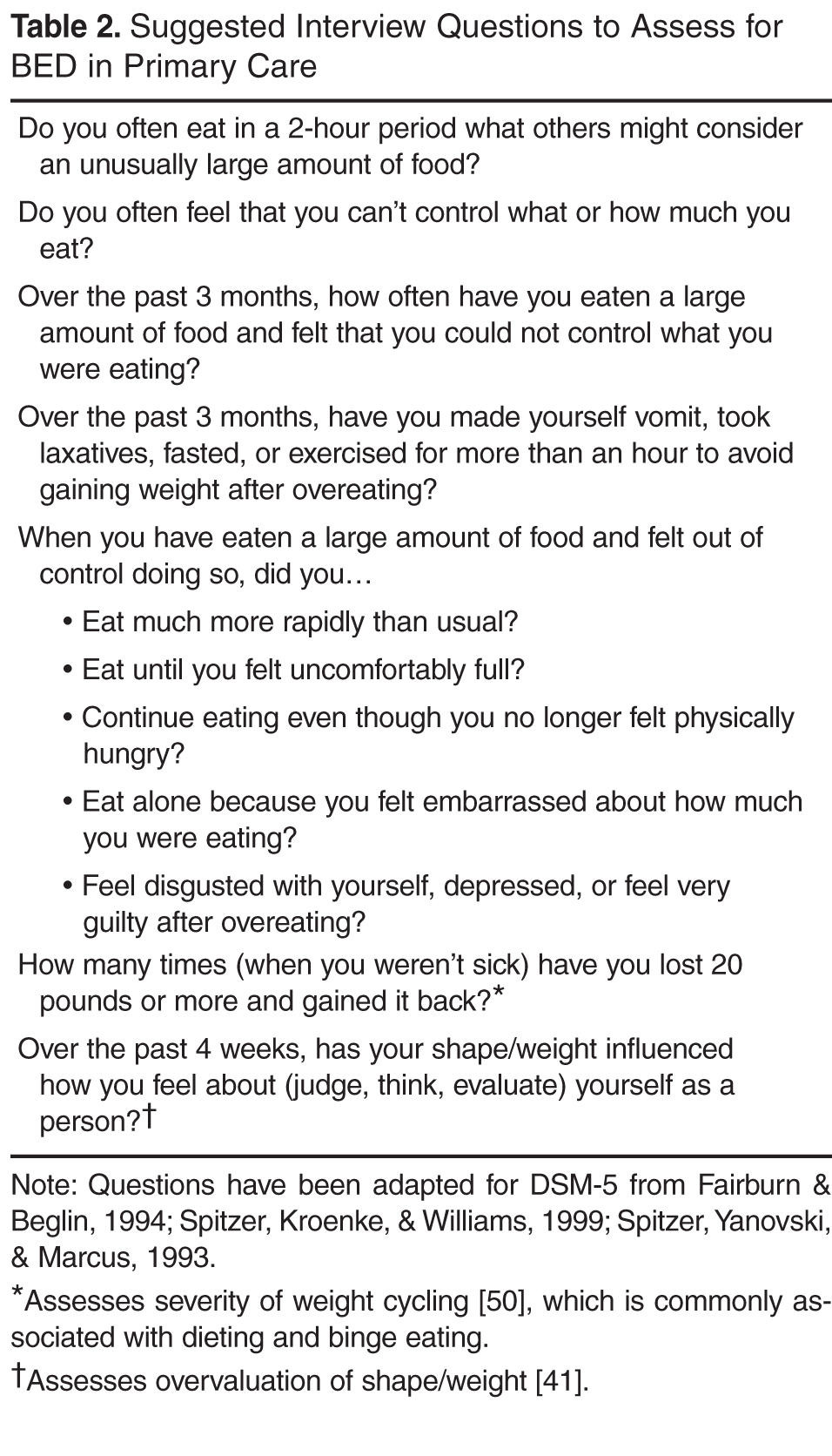
• What are the clinical features of BED?
BED and Obesity
The specific impact of BED on health is difficult to separate from the impact of obesity on health, as the two conditions frequently co-occur and are confounded in many studies. Of relevance to the primary care setting, many BED patients report gaining a substantial amount of weight in the year prior to seeking treatment [57].
Although individuals with BED are often obese, proponents of classifying BED as a separate DSM diagnosis argue that individuals with BED differ from their non-BED obese counterparts in regards to eating patterns, eating disordered psychopathology, and associated features and comorbidities. Individuals with BED consume more calories in laboratory studies than weight-matched controls [6,7,58]. In contrast, studies utilizing ecological momentary assessment (ie, real-time assessments) found no differences between BED obese and non-BED obese participants in the frequency of self-reported binge eating and caloric intake during binge eating episodes [59,60]. BED participants, however, were more likely to report higher stress, desire to binge, negative affect, dietary restraint, and being alone immediately before self-reported binge eating episodes. Furthermore, individuals with BED also demonstrate more ED-related psychopathology than non-BED obese individuals [61–63]. Psychiatric comorbidity is also higher among BED obese individuals as compared their non-BED obese counterparts, and the increased comorbidity is accounted for by the severity of binge eating as opposed to the severity of obesity [6,64–67]. In addition, research demonstrates that obese individuals with BED, as compared with non-obese BED patients, have a poorer quality of life [68].
BED and Bulimia Nervosa
Numerous studies have supported the distinction between bulimia nervosa and BED [69–76]. Diagnostically, bulimia nervosa differs from BED by its requirement of recurrent inappropriate compensatory behaviors in order to prevent weight gain, such as self-induced vomiting; misuse of laxatives, diuretics, or other medications; fasting; or excessive exercise [3]. BED and bulimia nervosa are distinguished by distinct risk factors, prevalence, course, and treatment outcomes [28,67,77]. Individuals with BED are less likely than individuals with bulimia to diet before onset of the disorder, and fewer individuals with BED cross over into other ED diagnostic categories [26,78–81]. Finally, BED and bulimia nervosa are associated with different constellations of ED-related symptoms and associated features [28,63,79]. For example, relative to BE patients, those with bulimia show greater work impairment and psychiatric comorbidity [28], higher dietary restraint and eating concerns [63], and lower rates of obesity [79].
Psychiatric Comorbidity
BED is associated with poor social adjustment, greater functional impairment, and significant psychiatric comorbidity, including overall distress and suicidality [67]. In a study of comorbidity with only selected disorders (mood, anxiety, impulse-control, and substance use disorder), 78.9% of individuals with BED had a lifetime history of at least one comorbidity, 20.2% had one comorbid disorder, 9.8% had two, and 48.9% had three or more [28]. Furthermore, the presence of current psychiatric comorbidity is associated with greater ED-related psychopathology and associated distress [40,41]. The most common comorbidities (lifetime rates) are specific phobia (37.1%), social phobia (31.9%), major depressive disorder (32.3%), post-traumatic stress disorder (PTSD) (26.3%), alcohol abuse/dependence (21.4%), conduct disorder (20%), attention-deficit/ hyperactivity disorder (19.8%), illicit drug use/dependence (19.4%), and oppositional-defiant disorder (18%) [28]. A recent report supports that this level of comorbidity is evident in primary care settings, noting that PTSD in particular is common and associated with a host of other difficulties, including depression, anxiety, drug use disorders, greater eating disorder pathology, and poorer psychological functioning [82]. Personality disorders are also commonly comorbid with BED, with the highest lifetime rates for avoidant (11%), obsessive compulsive (10%), and borderline (9%) personality disorders [83]. Finally, cigarette smoking is also associated with binge eating [83,84], likely evolving out of a weight-control smoking profile [85], and this is of relevance to the primary care setting in that smokers with BED gain more weight upon smoking cessation than do their non-BED counterparts [86].
Further Evaluation
To assess behavioral factors related to obesity and recent weight gain, the physician asks the patient if she ever eats what would be considered an unusually large amount of food for the circumstance. The patient acknowledges that she does so regularly, particularly in response to negative moods. The patient also describes that these episodes contribute to ongoing low mood, such that she feels highly depressed and hopeless following binge episodes. The physician then asks about the patient’s exercise habits and weight management techniques. While the patient denies engaging in compensatory behaviors (eg, vomiting, laxative use) to counteract excessive eating, she does report a history of dieting in which she dramatically restricts her food intake and subsequently loses weight. The patient states that these periods are inevitably followed by a resumption of overeating, and she typically gains back more weight than she originally lost. The patient estimates that she has lost and regained more than 20 lb at least 5 times during her lifetime. In addition, the patient reports difficulty maintaining a regular exercise regimen, especially since the onset of osteoarthritis-related joint pain in the past year. After the evaluation, the physician orders an electrocardiogram (ECG) and blood work. The ECG shows that the P-wave, QRS, and T-wave axes are shifted leftward, but within normal limits. A follow-up appointment is scheduled in 2 weeks.
• What are the medical complications of BED?
BED is associated with numerous negative health sequelae including obesity, sleeping problems, musculoskeletal pain, joint pain, headaches, gastrointestinal problems, menstrual problems, shortness of breath, chest pain, diabetes, low health-related quality of life, and functional health impairments [87–90], with many of these risks persisting even after controlling for BMI [91]. A 5-year follow-up of 134 individuals with BED and 134 individuals with no history of eating disorders, who were frequency-matched for age, sex, and baseline body mass index (BMI), provides further support that BED confers risk of components of metabolic syndrome beyond the risks associated with BMI alone [92]. Specifically, BED cases had higher longitudinal risk of developing dyslipidemia, hypertension, type 2 diabetes, any metabolic syndrome component, and two or more metabolic syndrome components. Alarmingly, these findings even emerge in studies of pediatric samples, wherein BED predicts development of metabolic syndrome, elevated triglycerides, and increases in visceral adiposity [93].
• What are risk factors for BED?
A number of risk factors for BED have been identified, although many are risk factors for a number of psychiatric disorders and not specific to BED. These general risk factors include depression/negative affectivity [94,95], parental mood and substance use disorder, maternal problematic parenting, and separation from parents [95]. A host of risk factors have been identified for disordered eating, in general, including body dissatisfaction [94], early onset of dieting [94], and perfectionism [96]. A number of other variables are risk factors for both BED and bulimia (but not anorexia), including a history of childhood bully and teasing, negative self-evaluation, parental depression, and negative family communication about shape and weight [81,96]. In a study comparing BED cases to psychiatric controls, childhood obesity, familial eating problems, family discord, and high parental demands differentiated the BED cases [95]. In summary, it has been suggested that BED risk is conferred by factors that increase risk of psychiatric disorder in general and those that confer risk for obesity [81]. Of note, the risk factors studied do not appear to differ between black and white women [95].
Genetic risk factors appear to play a strong role in the development of BED. Risk for BED tends to aggregate in families independently of the risk for obesity, although the presence of BED in a first-degree relative does increase risk for obesity [97]. Heritability estimates for BED range from 45% to 57% [98,99], which is greater than the heritability estimate for subthreshold binge eating (ie, overeating with a sense of loss of control, 41%) [100]. In addition, symptom-level analyses support moderate genetic contributions for each BED symptom [98], supporting the integrity of the diagnostic criteria. Finally, shared environment appears to play a very small role in the familial transmission of BED, and the contribution of unique environmental factors in development of BED appears to be substantial [97,101].
With regard to the neurobiological underpinnings of BED, it appears that BED may be associated with hypersensitivity to reward, a phenomenon that is strongly associated with the striatum and dopaminergic mechanisms [102,103]. In support of this hypothesis, Davis et al [102] reported that BED was differentially related to genotypes that reflect a greater density of D2 receptors and higher D2 binding potential as compared to obese controls. Additionally, greater increases in striatal DA and unique activation patterns in the right ventral striatum have been demonstrated in individuals with BED as compared to obese non-BED controls in response to food-related stimuli [103,104]. Other findings have implicated the orbitofrontal cortex (OFC) in BED, which is another brain region responsible for reward processing, particularly as it relates to the hedonic value of food stimuli [103]. Increased volume of grey matter has been documented in individuals with BED and bulimia as compared to normal weight controls, and stronger medial OFC activation while viewing pictures of food was observed in individuals with BED as compared to individuals with bulimia, overweight controls, and normal controls [105].
Difficulties with affect regulation have also been implicated in the development of BED. Two theories that implicate a primary and specific role for affect regulation in BED are cited most frequently in the extant literature: the affect regulation theory and the escape theory. The affect regulation theory [106] posits that BE is a conditioned response to negative affect which is correspondingly negatively reinforced by reductions in negative affect, which could occur during or after BE. Escape theory [107] posits that aversive self-awareness causes negative affect, which in turn triggers BE. BE is then negatively reinforced by reductions in negative affect during a binge via an escape from self-awareness that is accomplished through cognitive narrowing to the immediate stimulus environment. In contrast to the affect regulation theory, escape theory predicts that negative affect will increase after BE when self-awareness is restored. Results regarding changes in affect during BE episodes are conflicting as to whether BE is associated with decreases, no change [108–110], or even increases in negative affect. In particular, a meta-analytic review of 36 studies that examined affect via ecological momentary sampling found moderate increases in negative affect following binge episodes [111]. To some degree, results of this meta-analysis may not generalize to BED, per se, given that it included other binge eating groups, such as those with bulimia nervosa. However, in general, studies suggest that negative affect is an antecedent for BE and increased negative affect may be a consequence of BE, at least among women. More information is needed regarding aversive self-awareness before and after BE, cognitive narrowing, and changes in affect during BE. As such, the current state of the literature provides only partial support for affect regulation models of BED in women. Furthermore, it remains unknown if these results will generalize to men.
Clinical Course
Evidence regarding the course and stability of BED is conflicting and unclear. Several prospective studies have suggested that BED is not a stable disorder, exhibiting high rates of remission over time [26,99,112]. However, the samples have been criticized for being small, completely female, younger than typical individuals with BED, and post-ED treatment. In contrast, a prospective study that included older women and a combination of treated and untreated women suggested remission rates at 1 year that were much lower (7%) [78]. Additionally, a retrospective study [113] reported an average BED duration of 14.4 years. In a review of the studies cited above, Wonderlich et al [6] concluded that “[a]lthough there is variability in the data, it does appear that BED differs from other eating disorders in terms of a greater tendency toward recovery and fluctuation, although this may be embedded in a chronic pattern of remission and relapse.” Viewing BED as a disorder with a chronic pattern of remission and relapse could explain why individuals with BED retrospectively report a longer duration of illness, as they may be more likely to conceptualize their illness as one continuous course punctuated by different periods of severity rather than several distinct bouts of BED. Finally, although diagnostic crossover is a frequent phenomenon among other eating disorders, the crossover rate for BED appears relatively low as compared to anorexia and bulimia [6,26,28,66].
Follow-up
Laboratory examination shows TSH levels within normal limits and cholesterol levels of 48 mg/dL(HDL), 162 mg/dL (LDL), and 270 mg/dL (total). Triglyceride levels are 300 mg/dL and the patient’s fasting glucose level is 115 mg/dL. At the patient’s follow-up appointment, the physician states that a number of laboratory results indicated negative weight-related health consequences, including high cholesterol, high triglycerides, hypertension, and probable pre-diabetes. The patient initially disregards the significance of these results, stating she only gained weight due to her break-up and quitting smoking, and she is motivated to diet to lose weight in the near future. The physician asks for more information about the patient’s eating behavior, in particular asking if she ever feels as if she loses control over her eating. The patient reluctantly admits to this, and the physician provides a referral to a behavioral health specialist. The patient expresses ambivalence and a desire to try to manage her weight on her own. The physician uses motivational interviewing techniques to enhance motivation to follow up on this referral. In addition, the patient is encouraged to make small changes to her diet and slowly increase her exercise by taking walks. Another follow-up appointment is scheduled in 3 months.
• Which treatments are most effective for BED?
Despite the negative sequalae of BED, studies suggest that it often goes untreated [114]. Women with BED, as compared to women with anorexia and bulimia, are less likely to seek treatment for BED and less likely to receive treatment for their eating disorder when they do seek it out [114–116]. Barriers to treatment may include shame and internalized weight stigma, lack of knowledge about where to seek treatment, a belief that willpower should be sufficient to overcome the problem, lack of understanding that BED is a psychiatric disorder, finances/insurance barriers, and lack of BED detection by non-specialist treatment providers [115]. These barriers are particularly concerning, as women with BED report greater health care utilization and comprise a large segment of patients in weight control programs. Therefore, it appears individuals with BED seek help for the negative consequences of the disorder, but they are less likely to seek and receive help for the likely root cause of their concerns. This is a particularly damaging pattern, as the presence of BED may negatively impact the outcome of obesity treatment [117]. There are, however, a number of promising treatments for BED, as described below:
Cognitive Behavioral Therapy
Cognitive behavioral therapy (CBT) is generally considered to be the most well-established and empirically supported treatment for BED [118,119]. The cognitive behavioral conceptualization of BED is based on Fairburn, Cooper, and Shafran’s [120] transdiagnostic model of eating disorders (CBT-E), which is an expanded version of the cognitive behavioral model of bulimia nervosa [121]. CBT-E posits that the core pathology in eating disorders is a dysfunctional system in which self-worth is based on eating habits, shape, or weight, and the individual’s ability to control them. Attempts to maintain self-worth by controlling eating, shape, and weight result in extreme and brittle forms of dietary restraint. Inevitable violations of the individual’s dietary rules are then interpreted as lack of self-control, leading to a temporary abandonment of dietary restraint and consequent BE. These dietary slips and corresponding BE often occur in response to acute changes in mood, and BE is thus negatively reinforced by “neutralizing” negative mood states. Lapses in dietary restraint also result in secondary negative self-evaluation, which serves to further exacerbate a cycle of increased dietary restraint to improve self-worth and then inevitable dietary lapses leading to BE. CBT-E expanded upon CBT-BN by postulating 4 processes that maintain ED: severe perfectionism (clinical perfectionism), unconditional and pervasive low self-esteem (core low self-esteem), difficulties coping with intense mood states (mood intolerance), and developmental interpersonal difficulties (interpersonal difficulties). Of note, the CBT-E model explicitly states that individuals may differ in the extent to which they experience the 4 maintaining processes and not every individual will experience all four.
Overall, treatment is focused on normalizing eating patterns (ie, not weight loss), cognitive restructuring for weight/shape concerns and other triggers for binge eating, and relapse prevention [122]. CBT has produced substantial reductions in binge eating as compared to no treatment [123–125] and supportive therapy [126]. The majority of RCTs have reported remission rates greater than 50% [127]. Unfortunately, CBT has generally not produced meaningful weight loss [118,122,127–129], but this may be a contraindicated goal. CBT has demonstrated improvements in a number of features associated with BED including eating disordered psychopathology [122,124,130,131], depression [122,124,130,132], social adjustment [133], and self-esteem [132]. Treatment gains are generally well-maintained at 1-year to 4-year follow-up [122,123,130,133,134]. Individual and group treatments appear to produce similar results [134], and treatment completion rates have been estimated at approximately 80% across different delivery formats [127]. One strength of the CBT literature is the inclusion of participants with severe psychopathology, which facilitates the generalizability of these findings [127].
A number of factors have been associated with treatment outcome in CBT trials. Poor treatment outcomes have been associated with a history of weight problems during childhood, high levels of emotional eating at baseline, interpersonal dysfunction, and low group cohesion during group CBT [110,124,134]. Overvaluation of weight and shape demonstrated a statistical trend toward negatively impacting outcomes in one study. The presence of a cluster B personality disorder (ie, borderline histrionic, antisocial, and narcissistic personality disorders) predicted higher levels of binge eating at 1-year follow-up in a combined sample of participants treated with group CBT or group interpersonal psychotherapy (IPT) [135].
Alternatively, positive treatment outcomes have been associated with low levels of emotional eating at baseline, older age of onset, weight loss history that is negative for amphetamine use, and decreases in depressive symptoms during treatment [124,134,136,137]. In addition, early response to treatment (defined as a 65%–70% reduction in binge eating within 4 weeks of starting treatment) tends to be associated with greater long-term (ie, 1–2 year) remission from BED and lower eating disorder psychopathology, across a variety of psychological treatment approaches [138–144].
Interpersonal Psychotherapy
IPT for BED was adapted by Wilfley and colleagues [145] from IPT for depression, and the rationale for its use with BED is based on successful outcomes for individuals with bulimia and multiple studies documenting interpersonal deficits in individuals with BED [146]. IPT seeks to address interpersonal problems in 4 areas: interpersonal conflict, grief, role transitions, and interpersonal deficits [135]. While adapting IPT for BED, it was noted that the course of BED tends to be more chronic than the course of depression, thus the focus of IPT for BED was shifted from addressing the interpersonal precipitants of the disorder to the interpersonal factors that maintain the disorder [145]. Fewer studies examining the effectiveness of IPT in treating BED have been published than those examining CBT for BED, but it appears that IPT is as efficacious as CBT immediately post-treatment [130], and at 1- [130] and 4-year follow-up [147]. In addition, at least 2 studies have been published that compare IPT, cognitive behavioral therapy–guided self-help (CBTgsh), and behavioral weight loss [133,141]. Overall, results support the use of both IPT and CBTgsh (discussed in more detail below), with important moderators of treatment effects observed. For example, Wilson et al [133] found that clients with higher levels of psychopathology were better suited for IPT. The authors conclude that these results could inform a model of evidence-based stepped care, where CBTgsh, a low-cost, low-intensity treatment, should be considered as the first line of treatment. Secondarily, IPT, which represents a more specialized and expensive form of treatment, could be considered the next level of care, particularly for clients who are not demonstrating rapid improvement in response to CBTgsh.
Dialectic Behavior Therapy
A small number of studies have investigated the treatment of BED with dialectical behavior therapy (DBT). Originally developed to treat borderline personality disorder [148], DBT is of particular interest given its explicit targeting of emotion regulation. According to the DBT model of BED [149], emotional dysregulation is the core psychopathology in this disorder, and binge eating is viewed as attempts to influence, change, or control painful emotions. Initially, promising results were published showing positive treatment effects in an uncontrolled study [150] as well as wait-list controlled trials [151]. Notably, relative to wait-list controls, participants in a DBT guided self-help program (who received an orientation, DBT manual, and six 20-minute support calls across 13 weeks) reported reduced past-month binge eating, higher binge eating abstinence rates, and over the longer term improved quality of life and reductions in ED psychopathology. However, a comparison of DBT-BED with an active comparison control group (ie, nonspecific supportive therapy) failed to find significant differences between the 2 treatments (defined as effect size greater than 0.5) at 12-month follow-up in binge eating abstinence, binge eating frequency, most ED-related psychopathology, positive affect, depression, and self-esteem [152]. Therefore, DBT may have potential and, at a minimum, is equally efficacious as supportive therapy.
Mindfulness- and Meditation-Based Therapies
Treatment outcome studies utilizing mindfulness-based therapies, including mindfulness-based stress reduction (MBSR) and acceptance and commitment therapy (ACT), make up a small but promising body of literature. Reasoning that negative affect, eating in the absence of hunger, and emotional eating may comprise one pathway to binge eating [153,154], it follows that mindfulness-based therapies may act through their effects on emotion regulation, acceptance strategies for tolerating negative affect, and awareness of bodily cues. A recent review identified 19 studies exploring the effects of mindfulness-based interventions on binge eating severity and frequency as well as a number of related indicators, observing positive effects for this form of treatment [155]. For example, MB-EAT [156] is a group treatment for BED that is primarily based on MBSR. Treatment is targeted at cultivating mindfulness, mindful eating, emotional balance, and self-acceptance[157]. The treatment also places particular emphasis on developing self-awareness of internal hunger and satiety cues. A recent randomized controlled trial of MB-EAT produced significant improvements in binge eating frequency and BE-related psychopathology [158]. Furthermore, process variables including hunger awareness, satiety awareness, and mindfulness were correlated with positive outcomes. In addition, a small study (n = 39) that compared ACT to standard follow-up utilized by a bariatric surgery team demonstrated significantly greater improvements in disordered eating, body satisfaction, and quality of life for clients who participated in ACT [159]. In brief, results suggest that mindfulness-based interventions represent an additional treatment approach with supporting but limited evidence to date.
Self-Help Interventions
Self-help interventions for BED are categorized as pure self-help or guided self-help. In treatment outcome studies, pure self-help is generally conducted with a self-help manual, although several studies have examined more novel formats such as the internet, video, and CD-ROM. GSH also uses a self-help manual (or other format) with the addition of brief sessions with health care providers who have varying degrees of expertise with the type of therapy being utilized. CBT is the most commonly utilized therapeutic modality in treatment outcome studies of self-help interventions, and they most often utilize Fairburn’s Overcoming Binge Eating self-help manual [160].
Two studies have directly compared pure and guided self-help with Fairburn’s manual and produced conflicting results. Carter and Fairburn [161] found that in a sample of primarily white women with BED, pure self-help (CBTsh; n = 24) and guided self-help (CBTgsh; n = 24) were equally effective, and both were superior to wait-list controls at 6-month follow-up in producing BE abstinence (CBTsh = 40%, CBTgsh = 50%), reducing binge eating, ED-related psychopathology, and general psychiatric symptoms. In contrast, a study comparing CBTsh and CBTgsh in 40 primarily white women with recurrent binge eating (82.5% diagnosed with BED), guided self-help was superior to pure self-help at the end of treatment in reducing BE frequency, eating concern, and restraint [162]. CBTgsh and CBTsh were equally effective in producing BE abstinence (50% and 30%, respectively), and reducing shape concern, weight concern, and general psychiatric symptoms [162]. Higher levels of general psychiatric symptoms were predictive of higher BE frequency post-treatment for both treatments. It should be noted that participants in both conditions experienced statistically significant improvements on all variables as compared to baseline.
CBTgsh also performed as well or better than individualized treatments in one study [133]. CBTgsh, IPT, and behavioral weight loss (BWL) were compared in a large study of 205 primarily white, obese or overweight individuals diagnosed with BED. The 3 treatments produced equivalent outcomes for binge eating at post-treatment, but BWL produced significantly greater weight loss. However, at 2-year follow-up, the CBTgsh and IPT groups had maintained treatment gains and were significantly superior to BWL in reductions in binge eating. The 3 groups were equivalent with regard to weight loss at the 2-year follow-up, and none reported clinically significant weight loss. Of note, as compared to the IPT and BWL groups, the CBTgsh group received 10 sessions as opposed to 20, received 25-minute sessions as opposed to 60-minute sessions, and were treated by providers with limited levels of experience as opposed to doctoral-level clinical psychologists.
To summarize, CBT is the most often studied type of self-help treatment. Both CBTsh and CBTgsh produced improvements in binge eating and associated psychopathology as compared to baseline and wait-list controls, and treatment gains were maintained at 6-month follow-up. Conclusions regarding the relative superiority of pure self-help or guided self-help are premature given the small number of studies and conflicting results.
In addition, limited information is available regarding moderators and predictors of guided self-help outcomes. Masheb and Grilo [163] performed a cluster analysis of the sample for the CBTgsh vs. BWLgsh described above [164] and identified 2 clinically significant subtypes: a dietary-negative affect subtype characterized by high restraint, low self-esteem, and depressive symptoms; and an overvaluation of weight and shape subtype. For both the CBTgsh and BWLgsh groups, the dietary-negative affect subtype experienced higher levels of binge eating frequency, and the overvaluation of weight and shape subtype experienced higher levels of ED-related psychopathology. Additionally, individuals receiving BWLgsh who experienced a rapid response to treatment reported lower BE frequency, greater weight loss, and higher restraint than participants without a rapid response [142]. In contrast, rapid response did not appear to affect outcomes for CBTgsh participants. Finally, the combination of low self-esteem and high ED-related psychopathology negatively affected BE remission rates for CBTgsh recipients [133].
Pharmacologic Treatment
Currently only one medication, lisdexamfetamine dimesylate, has been FDA-approved for the treatment of BED. Previously approved for treating both adults and children with attention-deficit hyperactivity disorder, lisdexamfetamine dimesylate is a central nervous system stimulant and has been found to significantly reduce number of binge days, with robust effect sizes [165]. Beyond this medication, the evidence for pharmacologic treatment of BED is limited. A recent review identified only 22 studies exploring the effects of pharmacologic treatment in a methodologically rigorous way (eg, double-blind placebo design) [4]. To date, a number of different medication classes have been evaluated, including antidepressants, anticonvulsants, stimulants, anti-obesity drugs, and others. Overall, there is some evidence that antidepressant and anticonvulsant agents are efficacious at reducing BE frequency [166,167] and sometimes effective regarding statistically significant weight loss [168,169]. However, the majority of results are generally disappointing, both with respect to reductions in binge eating and sustained weight loss [48,170,171]. In addition, there are serious limitations in the literature that must be considered, including the limited number of studies that address the high placebo response observed in clinical samples, limited follow-up windows, and inadequate multiplicitious confirmatory trials. Despite these limitations, the evidence base related to pharmacologic treatment is continuously evolving and represents an important future direction for the treatment of BED.
Treatment
Prior to her next medical follow-up, the patient meets with a psychologist. The patient discloses that she has been binge eating several times per week for over a year; she also discloses a history of prolonged sexual abuse perpetrated by a step-parent during her childhood. When the patient returns to her follow-up medical appointment, she reports that her psychologist has diagnosed her with BED and PTSD. She states that they are using cognitive behavioral techniques to regulate her mood and eating behavior, with a specific aim of avoiding excessive dietary restraint. In addition, they are working together to discuss her unfulfilling romantic history and processing her experiences of trauma. Since her last appointment with the primary care physician, she reports an increased awareness of her eating habits, improvement in mood, and a 10-lb decrease in her weight.
The patient reports that she has continued to meet weekly with her psychologist and has slowly begun reintroducing low-impact exercise to her routine. She continues to lose weight gradually, but with a priority of stabilizing eating behavior and avoiding binge episodes versus aiming for weight loss. She reports that her mood has stabilized. Her cholesterol and triglycerides remain high, but her blood pressure is controlled effectively with medication. Her physician recommends continued psychological treatment, periodic meetings with a nutritionist, and prescribes medication for her cholesterol. A follow-up appointment with her physician is scheduled in 6 months.
Summary
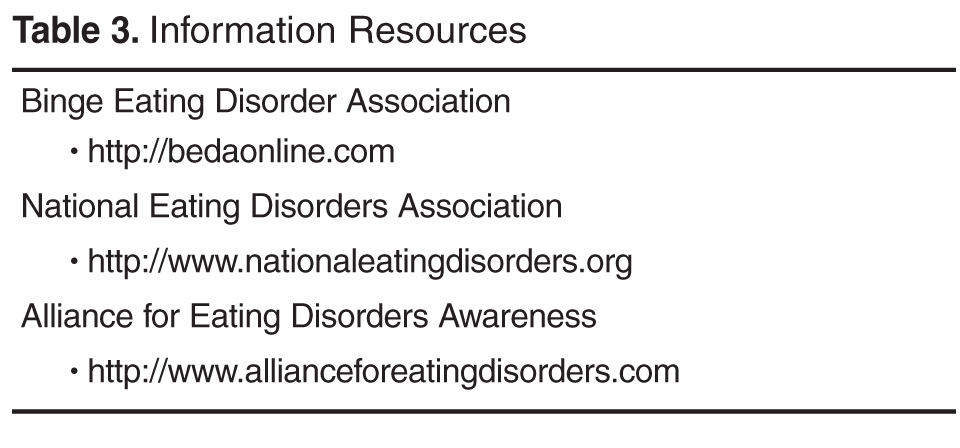
Corresponding author: Karen K. Saules, PhD, Eastern Michigan University, Psychology Clinic, 611 W. Cross St., Ypsilanti, MI 48197, ksaules@emich.edu
Financial disclosures: None.
1. Stunkard AJ. Eating patterns and obesity. Psychiatr Q 1959;33:284–95.
2. American Psychiatric Association. Diagnostic and statistical manual of mental disorders. 4th ed. Text revision. Washington (DC): The Association; 2000.
3. American Psychiatric Association. Diagnostic and statistical manual of mental disorders. 5th ed. Arlington: The Association; 2013.
4. Reas D, Grilo C. Pharmacological treatment of binge eating disorder: update review and synthesis. Hum Psychopharmacol Clin Exp 2015;23:1463–78.
5. Wilson G. Treatment of binge eating disorder. Psychiatr Clin North Am 2011;34:773–83.
6. Wonderlich SA, Gordon KH, Mitchell JE, et al. The validity and clinical utility of binge eating disorder. Int J Eat Disord 2009;42:687–705.
7. Walsh BT, Boudreau G. Laboratory studies of binge eating disorder. Int J Eat Disord 2003;34 Suppl:S30–8.
8. Guss JL, Kissileff HR, Devlin MJ, et al. Binge size increases with body mass index in women with binge-eating disorder. Obes Res 2002;10:1021–9.
9. Fairburn CG, Cooper Z. The eating disorder examination. In: Fairburn CG, Cooper Z, editors. Binge eating: nature, assessment, and treatment. New York: Guilford Press;1993:317–60.
10. Keel PK, Mayer SA, Harnden-Fischer JH. Importance of size in defining binge eating episodes in bulimia nervosa. Int J Eat Disord 2001;29:294–301.
11. Niego SH, Pratt EM, Agras WS. Subjective or objective binge: is the distinction valid? Int J Eat Disord 1997;22: 291–8.
12. Pratt E, Niego S, Agras W. Does the size of a binge matter? Int J Eat 1998;24:307–12.
13. Wolfe BE, Baker CW, Smith AT, et al. Validity and utility of the current definition of binge eating. Int J Eat Disord 2009;42:674–86.
14. Latner JD, Clyne C. The diagnostic validity of the criteria for binge eating disorder. Int J Eat Disord 2008;41:1–14.
15. Johnson WG, Boutelle KN, Torgrud L. What is a binge? The influence of amount, duration, and loss of control criterial on judgements of binge eating. Int J Eat Disord 2000;27:471–9.
16. Johnson WG, Roberson-NR, Rohan KJ, et al. An experimental investigation of DSM-IV binge-eating criteria. Eat Behav 2003;4:295–303.
17. Reslan S, Saules KK. College students’ definitions of an eating ‘binge’ differ as a function of gender and binge eating disorder status. Eat Behav 2011;12:225–7.
18. Telch CF, Pratt EM, Niego SH. Obese women with binge eating disorder define the term binge. Int J Eat Disord 1998;24:313–7.
19. Colles SL, Dixon JB, O’Brien PE. Loss of control is central to psychological disturbance associated with binge eating disorder. Obesity (Silver Spring) 2008;16:608–14.
20. Stein KF, Kenardy J, Wiseman C V, et al. What’s driving the binge in binge eating disorder? A prospective examination of precursors and consequences. Int J Eat Disord 2007;40:195–203.
21. Rossiter EM, Agras WS, Telch CF, et al. The eating patterns of non-purging bulimic subjects. Int J Eat Disord 1992;11:111–120.
22. Grilo CM, White MA. A controlled evaluation of the distress criterion for binge eating disorder. J Consult Clin Psychol 2011;79:509–14.
23. Trace SE, Thornton LM, Root TL, et al. Effects of reducing the frequency and duration criteria for binge eating on lifetime prevalence of bulimia nervosa and binge eating disorder: implications for DSM-5. Int J Eat Disord 2012;45: 531–6.
24. Wilson GT, Sysko R. Frequency of binge eating episodes in bulimia nervosa and binge eating disorder: diagnostic considerations. Int J Eat Disord 2009;42:603–10.
25. Sysko R, Roberto CA, Barnes RD, et al. Test-retest reliability of the proposed DSM-5 eating disorder diagnostic criteria. Psychiatry Res 2012;196:302–8.
26. Fairburn CG, Cooper Z, Doll HA, et al. The natural course of bulimia nervosa and binge eating disorder in young women. Arch Gen Psychiatry 2000;57:659–65.
27. Grilo CM, Ivezaj V, White MA. Evaluation of the DSM-5 severity indicator for binge eating disorder in a community sample. Behav Res Ther 2015;66:72–6.
28. Hudson JI, Hiripi E, Pope HG, et al. The prevalence and correlates of eating disorders in the National Comorbidity Survey Replication. Biol Psychiatry 2007;61:348–58.
29. Stice E, Marti CN, Rohde P. Prevalence, incidence, impairment, and course of the proposed DSM-5 eating disorder diagnoses in an 8-year prospective community study of young women. J Abnorm Psychol 2012;122:445–57.
30. Mangweth-Matzek B, Hoek HW, Rupp CI, et al. Prevalence of eating disorders in middle-aged women. Int J Eat Disord 2014;47:320–4.
31. Ivezaj V, Saules KK, Hoodin F, et al. The relationship between binge eating and weight status on depression, anxiety, and body image among a diverse college sample: a focus on bi/multiracial women. Eat Behav 2010;11:18–24.
32. Striegel-Moore RH, Bedrosian R, Wang C, et al. Why men should be included in research on binge eating: results from a comparison of psychosocial impairment in men and women. Int J Eat Disord 2012;45:233–40.
33. Womble LG, Williamson DA, Martin CK, et al. Psychosocial variables associated with binge eating in obese males and females. Int J Eat Disord 2001;30:217–21.
34. Udo T, McKee SA., White MA., et al. Sex differences in biopsychosocial correlates of binge eating disorder: a study of treatment-seeking obese adults in primary care setting. Gen Hosp Psychiatry 2013;35:587–91.
35. Udo T, McKee SA., White MA, et al. Menopause and metabolic syndrome in obese individuals with binge eating disorder. Eat Behav 2014;15:182–5.
36. Napolitano MA., Himes S. Race, weight, and correlates of binge eating in female college students. Eat Behav 2011;12:29–36.
37. Sorbara M, Geliebter A. Body image disturbance in obese outpatients before and after weight loss in relation to race, gender, binge eating, and age of onset of obesity. Int J Eat Disord 2002;31:416–23.
38. Alegria M, Woo M, Cao Z, et al. Prevalence and correlates of eating disorders in Latinos in the U.S. Int J Eat Disord 2007;40:S15–21.
39. Striegel-Moore RH, Wilfley DE, Pike KM, et al. Recurrent binge eating in black American women. Arch Fam Med 2000;9: 83–7.
40. Reslan S, Saules KK. Assessing the prevalence of and factors associated with overweight, obesity, and binge eating as a function of ethnicity. Eat Weight Disord-St 2013;18:209–19.
41. Grilo CM, White MA, Barnes RD, et al. Psychiatric disorder co-morbidity and correlates in an ethnically diverse sample of obese patients with binge eating disorder in primary care settings. Compr Psychiatry 2012;54:209–16.
42. Smolak L, Striegel Moore RH. Challenging the myth of the golden girl: ethnicity and eating disorders. In: Smolak L, Striegel Moore RH, editors. Eating disorders innovative directions in research and practice. Washington (DC): American Psychological Association;2001:111–32.
43. Wildes JE, Emery RE. The role of ethnicity and culture in the development of eating disturbance and body dissatisfaction: a meta-analutic review. Clin Phychology Rev 2001;21:521–50.
44. George JBE, Franko DL. Cultural issues in eating pathology and body image among children and adolescents. J Pediatr Psychol 2010;35:231–42.
45. Kelly NR, Cotter EW, Tanofsky-Kraff M, et al. Racial variations in binge eating, body image concerns, and compulsive exercise among men. Psychol Men Masc 2014;13:326-36.
46. Franko DL, Thompson-Brenner H, Thompson DR, et al. Racial/ethnic differences in adults in randomized clinical trials of binge eating disorder. J Consult Clin Psychol 2012;80:186–95.
47. Marques L, Alegria M, Becker AE, et al. Comparative prevalence, correlates of impairment, and service utilization for eating disorders across U.S. ethnic groups: Implications for reducing ethnic disparities in health care access for eating disorders. Int J Eat Disord 2012;44:412–20.
48. Guerdjikova AI, O’Melia AM, Mori N, et al. Binge eating disorder in elderly individuals. Int J Eat Disord 2012;45: 905–8.
49. Fairburn CG. Beglin SJ. Assessment of eating disorders: interview or self-report questionnaire? Int J Eat Disord 1994;16:363–70.
50. Spitzer R, Yanovski S, Marcus M. The questionnaire on eating and weight patterns-revised (QEWP-R). New York State Psychiatric Institute, Mew York 1993.
51. Barnes RD, Masheb RM, White MA, et al. Comparison of methods for identifying and assessing obese patients with binge eating disorder in primary care settings. Int J Eat Disord 2011;44:157–63.
52. Yanovski SZ, Marcus MD, Wadden TA, et al. The questionnaire on eating and weight patterns-5: an updated screening instrument for binge eating disorder. Int J Eat Disord 2015;48:259–61.
53. Gormally J, Black S, Daston S, et al. The assessment of binge eating severity among obese persons. Addict Behav 1982;7:47–55.
54. Alfonsson S. Replacing the term ‘binge eating’ with ‘loss of control over eating’ affects eating disorder screening in clinical care. Obes Res Clin Pract 2015;6–7.
55. Kelly NR, Mitchell KS, Gow RW, et al. An evaluation of the reliability and construct validity of eating disorder measures in white and black women. Psychol Assess 2012;24:608–17.
56. Richards LK, McHugh RK, Pratt EM, et al. Readability and comprehension of self-report binge eating measures. Eat Behav 2013;14:167–70.
57. Masheb RM, White MA, Grilo CM. Substantial weight gains are common prior to treatment-seeking in obese patients with binge eating disorder. Compr Psychiatry 2013;54:880–4.
58. Heaner MK, Walsh BT. A history of the identification of the characteristic eating disturbances of Bulimia Nervosa, Binge Eating Disorder and Anorexia Nervosa. Appetite 2013;65:185–8.
59. Greeno CG, Wing RR, Shiffman S. Binge antecedents in obese women with and without binge eating disorder. J Consult Clin Psychol 2000;68:95–102.
60. Le Grange D, Gorin A, Catley D, et al. Does momentary assessment detect binge eating in overweight women that is denied at interview? Eur Eat Disord Rev 2001;9:309–24.
61. Brody ML, Walsh BT, Devlin MJ. Binge eating disorder: reliability and validity of a new diagnostic category. J Consult Clin Psychol 1994;62:381–6.
62. Hsu LKG, Mulliken B, McDonagh B, et al. Binge eating disorder in extreme obesity. Int J Obes Relat Metab Disord 2002;26:1398–403.
63. Wilfley DE, Schwartz MB, Spurrell EB, et al. Using the eating disorder examination to identify the specific psychopathology of binge eating disorder. Int J Eat Disord 2000;27:259–69.
64. Grucza RA, Przybeck TR, Cloninger CR. Prevalence and correlates of binge eating disorder in a community sample. Compr Psychiatry 2007;48:124–31..
65. Telch CF, Stice E. Psychiatric comorbidity in women with binge eating disorder: prevalence rates from a non-treatment-seeking sample. J Consult Clin Psychol 1998;66:768–76.
66. Wilfley DE, Bishop ME, Wilson GT, et al. Classification of eating disorders: toward DSM-V. Int J Eat Disord 2007; 40:s123–9.
67. Wilfley DE, Wilson GT, Agras WS. The clinical significance of binge eating disorder. Int J Eat Disord 2003;34 Suppl:S96–106.
68. Perez M, Warren CS. The relationship between quality of life, binge-eating disorder, and obesity status in an ethnically diverse sample. Obesity (Silver Spring) 2012;20:879–85.
69. Bulik CM, Sullivan PF, Kendler KS. An empirical study of the classification of eating disorders. Am J Psychiatry 2000;157:886–95.
70. Keel PK, Heatherton TF, Dorer DJ, et al. Point prevalence of bulimia nervosa in 1982, 1992, and 2002. Psychol Med 2006;36:119–27.
71. Mitchell JE, Crosby RD, Wonderlich SA, et al. Latent profile analysis of a cohort of patients with eating disorders not otherwise specified. Int J Eat Disord 2007;40:s95–8.
72. Rockert W, Kaplan AS, Olmsted MP. Eating disorder not otherwise specified : the view from a tertiary care treatment center. Int J Eat Disord 2007;40:s99–103.
73. Striegel-Moore RH, Franko DL, Thompson D, et al. An empirical study of the typology of bulimia nervosa and its spectrum variants. Psychol Med 2005;35:1563–72.
74. Sullivan PF, Bulik CM, Kendler KS. The epidemiology and classification of bulimia nervosa. Psychol Med 1998;28:599–610.
75. Wade TD, Crosby RD, Martin NG. Use of latent profile analysis to identify eating disorder phenotypes in an adult Australian twin cohort. Arch Gen Psychiatry 2006;63:1377–84.
76. Striegel-Moore RH, Franko DL. Should binge eating disorder be included in the DSM-V? A critical review and state of the evidence. Annu Rev Clin Psychol 2008;4:305–24.
77. Striegel-Moore RH, Cachelin FM. Etiology of eating disorders in women. Couns Psychol 2001;29:635–61.
78. Crow SJ, Stewart Agras W, Halmi K, et al. Full syndromal versus subthreshold anorexia nervosa, bulimia nervosa, and binge eating disorder: a multicenter study. Int J Eat Disord 2002;32:309–18.
79. Striegel-Moore RH, Cachelin FM, Dohm F a, et al. Comparison of binge eating disorder and bulimia nervosa in a community sample. Int J Eat Disord 2001;29:157–65.
80. Wilfley DE, Schwartz MB, Spurrell EB, et al. Assessing the specific psychopathology of binge eating disorder patients: Interview or self-report? Behav Res Ther 1997;35:1151–9.
81. Fairburn CG, Doll HA, Welch SL, et al. Risk factors for binge eating disorder. Arch Gen Psychiatry 1998;55:425–32.
82. Grilo CM, White M a., Barnes RD, et al. Posttraumatic stress disorder in women with binge eating disorder in primary care. J Psychiatr Pract 2012;18:408–12.
83. Cassin SE, von Ranson KM. Is binge eating experienced as an addiction? Appetite 2007;49:687–90.
84. Kelly-Weeder S, Jennings KM, Wolfe BE. Gender differences in binge eating and behavioral correlates among college students. Eat Weight Disord 2012;17:e200–2.
85. Pomerleau CS, Ehrlich E, Tate JC, et al. The female weight-control smoker: a profile. J Subst Abuse 1993;5:391–400.
86. White MA, Masheb RM, Grilo CM. Function of binge eating behavior. Int J Eat Disord 2010;43:572–75.
87. Bulik CM, Reichborn-Kjennerud T. Medical morbidity in binge eating disorder. Int J Eat Disord 2003;34:S39–46.
88. Johnson JG, Spitzer RL, Williams JBW. Health problems, impairment and illnesses associated with bulimia nervosa and binge eating disorder among primary care and obstetric gynaecology patients. Psychol Med 2001;31.
89. Mond JM, Hay PJ, Rodgers B, et al. Assessing quality of life in eating disorder patients. Qual Life Res 2005;14:171–8.
90. Marchesini G, Natale S, Chierici S, et al. Effects of cognitive-behavioural therapy on health-related quality of life in obese subjects with and without binge eating disorder. Int J Obes Relat Metab Disord 2002;26:1261–7.
91. Reichborn-Kjennerud T, Bulik CM, Sullivan PF, et al. Psychiatric and medical symptoms in binge eating in the absence of compensatory behaviors. Obes Res 2004;12:1445–54.
92. Hudson JI, Lalonde JK, Coit CE, et al. Longitudinal study of the diagnosis of components of the metabolic syndrome in individuals with binge-eating disorder. Am J Clin Nutr 2010;91:1568–73.
93. Tanofsky-Kraff M, Shomaker LB, Stern EA, et al. Children’s binge eating and development of metabolic syndrome. Int J Obes 2012;36:956–62.
94. Stice E, Marti CN, Durant S. Risk factors for onset of eating disorders: evidence of multiple risk pathways from an 8-year prospective study. Behav Res Ther 2011;49:622–7.
95. Striegel-Moore RH, Fairburn CG, Wilfley DE, et al. Toward an understanding of risk factors for binge-eating disorder in black and white women: a community-based case-control study. Psychol Med 2005;35:907–17.
96. Hilbert A, Pike KM, Goldschmidt AB, et al. Risk factors across the eating disorders. Psychiatry Res 2014;220:500–6.
97. Hudson JI, Lalonde JK, Berry JM, et al. Binge-eating disorder as a distinct familial phenotype in obese individuals. Arch Gen Psychiatry 2006;63:313–19.
98. Mitchell KS, Neale MC, Bulik CM, et al. Binge eating disorder: a symptom-level investigation of genetic and environmental influences on liability. Psychol Med 2010;40:1899–906.
99. Javaras KN, Pope HG, Lalonde JK, et al. Co-occurrence of binge eating disorder with psychiatric and medical disorders. J Clin Psychiatry 2008;69:266–73.
100. Reichborn-Kjennerud T, Bulik CM, Tambs K, et al. Genetic and environmental influences on binge eating in the absence of compensatory behaviors: a population-based twin study. Int J Eat Disord 2004;36:307–14.
101. Javaras KN, Pope HG, Lalonde JK, et al. Co-occurrence of binge eating disorder with psychiatric and medical disorders. J Clin Psychiatry 2008;69:266–73.
102. Davis C, Levitan RD, Yilmaz Z, et al. Binge eating disorder and the dopamine D2 receptor: genotypes and sub-phenotypes. Prog Neuropsychopharmacol Biol Psychiatry 2012;38:328–35.
103. Weygandt M, Schaefer A, Schienle A, et al. Diagnosing different binge-eating disorders based on reward-related brain activation patterns. Hum Brain Mapp 2012;33:2135–46.
104. Wang G-J, Geliebter A, Volkow ND, et al. Enhanced striatal dopamine release during food stimulation in binge eating disorder. Obesity (Silver Spring) 2011;19:1601–8.
105. Schäfer A, Vaitl D, Schienle A. Regional grey matter volume abnormalities in bulimia nervosa and binge-eating disorder. Neuroimage 2010;50:639–43.
106. Hawkins RC, Clement PF. Binge eating: measurement problems and a conceptual model. In: Fremouw WJ, Clement PF, editors. The binge purge syndrome: diagnosis, treatment, and research. New York: Springer;1984:229–51.
107. Heatherton TF, Baumeister RF. Binge eating as escape from self-awareness. Psychol Bull 1991;110:86–108.
108. Deaver CM, Miltenberger RG, Smyth J, et al. An evaluation of affect and binge eating. Behav Modif 2003;27: 578–99.
109. Stickney MI, Miltenberger RG, Wolff G. A descriptive analysis of factors contributing to binge eating. J Behav Ther Exp Psychiatry 1999;30:177–89.
110. Hilbert A, Saelens BE, Stein RI, et al. Pretreatment and process predictors of outcome in interpersonal and cognitive behavioral psychotherapy for binge eating disorder. J Consult Clin Psychol 2007;75:645–51.
111. Haedt-Matt AA, Keel PK. Revisiting the affect regulation model of binge eating: a meta-analysis of studies using ecological momentary assessment. Psychol Bull 2012;137:660–81.
112. Cachelin FM, Striegel-Moore RH, Elder K a, et al. Natural course of a community sample of women with binge eating disorder. Int J Eat Disord 1999;25:45–54.
113. Pope HG, Lalonde JK, Pindyck LJ, et al. Binge eating disorder: a stable syndrome. Am J Psychiatry 2006;163:2181–3.
114. Pike KM, Dohm F a, Striegel-Moore RH, et al. A comparison of black and white women with binge eating disorder. Am J Psychiatry 2001;158:1455–60.
115. Cachelin FM, Striegel-Moore RH. Help seeking and barriers to treatment in a community sample of Mexican American and European American women with eating disorders. Int J Eat Disord 2006;39:154–61.
116. Cachelin FM, Rebeck R, Veisel C, et al. Barriers to treatment for eating disorders among ethnically diverse women. Int J Eat Disord 2001;30:269–78.
117. Blaine B, Rodman J. Responses to weight loss treatment among obese individuals with and without BED: a matched-study meta-analysis. Eat Weight Disord 2007;12:54–60.
118. Iacovino JM, Gredysa DM, Altman M, et al. Psychological treatments for binge eating disorder. Curr Psychiatry Rep 2012;14:432–46.
119. Wilson GT, Shafran R. Eating disorders guidelines from NICE. Lancet 2005;365:79–81.
120. Fairburn CG, Cooper Z, Shafran R. Cognitive behaviour therapy for eating disorders: a ‘transdiagnostic’ theory and treatment. Behav Res Ther 2003;41:509–28.
121. Fairburn CG, Cooper Z, Cooper PJ. The clinical features and maintenance of bulimia nervosa. In: Brownell KD, Foreyt JP, editors. Handbook of eating disorders: physiology, psychology and treatment of obesity, anorexia and bulimia. New York: Guiliford;1986:389–404.
122. Grilo CM, Masheb RM, Wilson GT, et al. Cognitive-behavioral therapy, behavioral weight loss, and sequential treatment for obese patients with binge-eating disorder: a randomized controlled trial. J Consult Clin Psychol 2011;79:675–85.
123. Agras WS, Telch CF, Arnow B, et al. One-year follow-up of cognitive-behavioral therapy for obese individuals with binge eating disorder. J Consult Clin Psychol 1997;65:343–7.
124. Dingemans AE, Spinhoven P, van Furth EF. Predictors and mediators of treatment outcome in patients with binge eating disorder. Behav Res Ther 2007;45:2551–62.
125. Eldredge KL, Stewart Agras W, Arnow B, et al. The effects of extending cognitive-behavioral therapy for binge eating disorder among initial treatment nonresponders. Int J Eat Disord 1997;21:347–52.
126. Kenardy J, Mensch M, Bowen K, et al. Group therapy for binge eating in type 2 diabetes: a randomized trial. Diabet Med 2002;19:234–9.
127. Wilson GT, Grilo CM, Vitousek KM. Psychological treatment of eating disorders. Am Psychol 2007;62:199–216.
128. Munsch S, Meyer AH, Biedert E. Efficacy and predictors of long-term treatment success for cognitive-behavioral treatment and behavioral weight-loss-treatment in overweight individuals with binge eating disorder. Behav Res Ther 2012;50:775–8.
129. Brown TA, Keel PK. Current and emerging directions in the treatment of eating disorders. Subst Abuse 2012;6: 33–61.
130. Wilfley DE, Welch RR, Stein RI, et al. A randomized comparison of group cognitive-behavioral therapy and group interpersonal psychotherapy for the treatment of overweight individuals with binge-eating disorder. Arch Gen Psychiatry 2002;59:713–21.
131. Grilo CM, Masheb RM, Wilson GT. Efficacy of cognitive behavioral therapy and fluoxetine for the treatment of binge eating disorder: a randomized double-blind placebo-controlled comparison. Biol Psychiatry 2005;57:301–9.
132. Gorin AA, Le Grange D, Stone AA. Effectiveness of spouse involvement in cognitive behavioral therapy for binge eating disorder. Int J Eat Disord 2003; 33: 421–33.
133. Wilson GT, Wilfley DE, Agras WS, et al. Psychological treatments for binge eating disorder. Arch Gen Psychiatry 2010;67:94–101.
134. Ricca V, Castellini G, Mannucci E, et al. Comparison of individual and group cognitive behavioral therapy for binge eating disorder. a randomized, three-year follow-up study. Appetite 2010;55:656–65.
135. Wilfley DE, Friedman MA, Dounchis JZ, et al. Comorbid psychopathology in binge eating disorder: relation to eating disorder severity at baseline and following treatment. J Consult Clin Psychol 2000;68:641–9.
136. Castellini G, Mannucci E, Lo Sauro C, et al. Different moderators of cognitive-behavioral therapy on subjective and objective binge eating in bulimia nervosa and binge eating disorder: a three-year follow-up study. Psychother Psychosom 2012;81:11–20.
137. Grilo CM, Masheb RM, Crosby RD. Predictors and moderators of response to cognitive behavioral therapy and medication for the treatment of binge eating disorder. J Consult Clin Psychol 2012;80:897–906.
138. Grilo CM, Masheb RM, Wilson GT. Rapid response to treatment for binge eating disorder. J Consult Clin Psychol 2006;74:602–13.
139. Grilo CM, Masheb RM. Rapid response predicts binge eating and weight loss in binge eating disorder: findings from a controlled trial of orlistat with guided self-help cognitive behavioral therapy. Behav Res Ther 2007;45:2537–50.
140. Grilo CM, White MA, Wilson GT, et al. Rapid response predicts 12-month post-treatment outcomes in binge-eating disorder: theoretical and clinical implications. Psychol Med 2012;42:807–17.
141. Hilbert A, Hildebrandt T, Agras WS, et al. Rapid response in psychological treatments for binge eating disorder. 2015;83:649–654.
142. Masheb RM, Grilo CM. Rapid response predicts treatment outcomes in binge eating disorder: implications for stepped care. J Consult Clin Psychol 2007;75:639–44.
143. Safer DL, Joyce EE. Does rapid response to two group psychotherapies for binge eating disorder predict abstinence? Behav Res Ther 2011;49:339–45.
144. Zunker C, Peterson CB, Cao L, et al. A receiver operator characteristics analysis of treatment outcome in binge eating disorder to identify patterns of rapid response. Behav Res Ther 2010;48:1227–31.
145. Wilfley DE, Frank M, Welch R, et al. Adapting interpersonal psychotherapy to a group format (IPT-G) for binge eating disorder: toward a model for adapting empirically supported treatments. Psychother Res 1998;8:379–81.
146. Blomquist KK, Ansell EB, White M a, et al. Interpersonal problems and developmental trajectories of binge eating disorder. Compr Psychiatry 2012;53:1088–95.
147. Hilbert A, Bishop ME, Stein RI, et al. Long-term efficacy of psychological treatments for binge eating disorder. Br J Psychiatry 2012;200:232–7.
148. Linehan MM. Cognitive-behavioral treatment of borderline personality disorders. New York: Guilford Press; 1993.
149. Wiser S, Telch CF. Dialectical behavior therapy for Binge-Eating Disorder. J Clin Psychol 1999;55:755–68.
150. Telch CF, Agras WS, Linehan MM. Group dialectical behavior therapy for binge-eating disorder:a preliminary, uncontrolled trial. Behav Ther 2000;31:569–82.
151. Telch CF, Agras WS, Linehan MM. Dialectical behavior therapy for binge eating disorder. J Consult Clin Psychol 2001;69:1061–5.
152. Safer DL, Robinson AH, JB. Outcome from a randomized controlled trial of group therapy for binge eating disorder: comparing dialectical behavior therapy adapted for binge eating to an active comparison group therapy. Behav Ther 2010;41:106–20.
153. Baer RA. Mindfulness-based treatment approaches: Clinician’s guide to evidence base and applications. San Diego: Academic Press; 2005.
154. Van Strien T Van, Engels RCME, Leeuwe J Van, et al. The Stice model of overeating: Tests in clinical and non-clinical samples. Appetite 2005;45:205–13.
155. Godfrey KM, Gallo LC, Afari N. Mindfulness-based interventions for binge eating: a systematic review and meta-analysis. J Behav Med 2015;38:348–362.
156. Kristeller JL, Hallett CB. An exploratory study of a meditation-based intervention for binge eating disorder. J Health Psychol 1999;4:357–63.
157. Kristeller JL, Wolever RQ. Mindfulness-based eating awareness training for treating binge eating disorder: the conceptual foundation. Eat Disord 2011;19:49–61.
158. Kristeller J, Wolever RQ, Sheets V. Mindfulness-based eating awareness training (MB-EAT) for binge eating: a randomized clinical trial. Mindfulness (N Y) 2014;5:282–97.
159. Weineland S, Arvidsson D, Kakoulidis TP, et al. Acceptance and commitment therapy for bariatric surgery patients, a pilot RCT. Obes Res Clin Pract 2012;6:e21–30.
160. Fairburn CG. Overcoming binge eating. 2nd ed. New York: Guilford Press; 2013.
161. Carter JC, Fairburn CG. Cognitive-behavioral self-help for binge eating disorder: a controlled effectiveness study. J Consult Clin Psychol 1998;66:616–23.
162. Loeb KL, Wilson GT, Gilbert JS, et al. Guided and unguided self-help for binge eating. Behav Res Ther 2000;38:259–72.
163. Masheb RM, Grilo CM. Prognostic significance of two sub-categorization methods for the treatment of binge eating disorder: Negative affect and overvaluation predict, but do not moderate, specific outcomes. Behav Res Ther 2008;46:428–37.
164. Grilo CM, Masheb RM. A randomized controlled comparison of guided self-help cognitive behavioral therapy and behavioral weight loss for binge eating disorder. Behav Res Ther 2005;43:1509–25.
165. Citrome L. Vortioxetine for major depressive disorder: A systematic review of the efficacy and safety profile for this newly approved antidepressant - What is the number needed to treat, number needed to harm and likelihood to be helped or harmed? Int J Clin Pract 2015; 68:60–82.
166. Guerdjikova A, McElroy S, Kotwal R, et al. High-dose escitalopram in the treatment of binge-eating disorder with obesity: a placebo-controlled monotherapy trial. Hum Psychopharmacol 2008;23:1–11.
167. McElroy S, Hudson J, Malhotra JL, et al. Citalopram in the treatment of binge-eating disorder: a placebo-controlled trial. J Clin Psychiatry 2003;64:807–13.
168. McElroy S, Casuto L, Nelson EB, et al. Placebo-controlled trial of sertraline in the treatment of binge eating disorder. Am J Psychiatry 2000;157:1004–6.
169. McElroy S, Hudson J, Mitchell JE, et al. Efficacy and safety of lisdexamfetamine for treatment of adults with moderate to severe binge-eating disorder: a randomized clinical trial. JAMA Psychiatry 2015;72:235–46.
170. Pearlstein T, Spurell E, Hohlstein LA, et al. A double-blind, placebo-controlled trial of fluvoxamine in binge eating disorder: a high placebo response. Arch Women’s Ment Health 2003;6:147–51.
171. Hudson J, McElroy S. Raymond NC, et al. Fluvoxamine in the treatment of binge-eating disorder: a multicenter placebo-controlled, double-blind trial. Am J Psychiatry 1998;155:1756–62.
172. Miller W, Rollnick S. Motivational Interviewing: helping people change. 3rd ed. New York: Guilford Press; 2013.
173. Rollnick S, Miller W, Butler C. Motivational interviewing in health care: helping patients change behavior. New York: Guilford Press; 2008.
From the Department of Psychology, Eastern Michigan University, Ypsilanti, MI.
Abstract
- Objective: To describe the epidemiology, clinical features, clinical course, medical complications, and treatment of binge-eating disorder (BED).
- Methods: Review of the literature.
- Results: BED, the most common eating disorder, is a distinct pattern of binge eating accompanied by a sense of loss of control over eating without inappropriate compensatory behaviors. Because people with BED more commonly seek treatment for the psychological and medical factors that are associated with the disorder, patients’ first point of contact with the medical profession is likely to be the primary care physician (PCP). The PCP’s role includes making efforts to screen for BED symptoms, employing motivational interviewing strategies to enhance likelihood of following through with treatment, providing psychoeducational information about eating and weight control, monitoring eating, weight, and related medical problems at follow-up visits, and making referrals to behavioral health specialists who can deliver empirically supported treatments for BED.
- Conclusion: Proper screening and referral in the primary care setting can optimize the likelihood that patients obtain empirically supported treatment.
BED is the most common eating disorder, but it is one for which many do not seek treatment directly. Rather, those struggling with BED more commonly seek treatment for the psychological and medical factors that are strongly associated with the disorder. As will be reviewed below, these factors include poor social adjustment, functional impairment, psychological distress and psychiatric comorbidity, and myriad medical sequelae due to obesity and weight cycling. As such, the BED patient’s point of first contact with the medical profession is most likely to be with the primary care physician, who has several roles in the treatment of BED. There is a limited evidence base for pharmacological treatment of BED, with some medications yielding short-term reductions in binge eating, but none with strong support for long-term efficacy [4]. However, with the recent FDA approval of lisdexamfetamine dimesylate for the treatment of moderate to severe BED, this picture may change. Nonetheless, pharmacologic interventions for comorbid medical conditions will fall solidly in the bailiwick of the primary care physician. In addition, the primary care physician’s role includes making efforts to screen for BED symptoms; employing motivational interviewing strategies to enhance likelihood of following through with treatment; providing psychoeducational information about eating and weight control; monitoring eating, weight, and related medical problems at follow-up visits; and making referrals to behavioral health specialists who can deliver empirically supported treatments for BED. Finally, because BED is typically associated with weight gain over time [5], the primary care physician is encouraged to reinforce the clinical significance of weight maintenance as opposed to necessarily promoting a goal of weight loss. The rationale for this primary care approach is reviewed below, in consideration of the scientific literature and a case study highlighting common clinical features.
Case Study
Initial Presentation
A 35-year-old Caucasian woman schedules an appointment for her annual physical examination with her primary care physician. She reports generally good health but complains of low mood, joint pain, and difficulties managing her weight. Her blood pressure is managed with 100 mg/day of metoprolol. The only other medication she takes is birth control (ethinyl estradiol 20 mcg).
Physical Examination
During physical examination, it is determined that the patient is 5'6" and weighs 286 lb, with a body mass index (BMI) of 46.2 kg/m2, placing her in WHO obesity class III. The patient’s blood pressure is 130/85 mm Hg (medically managed), and her heart rate is 83 bpm. The patient states that she has been experiencing episodes of low mood off and on most of her life; she recently ended a relationship, which has exacerbated her symptoms. The physician states that the patient has gained a significant amount of weight since her last physical examination. The patient reports that she quit smoking 6 months ago and has since gained approximately 30 lb; she has considered smoking again to manage her weight.
• What are the diagnostic criteria for BED?
BED diagnostic criteria (Table 1) have been closely examined for their validity and clinical utility, and several have been the subject of intense debate in the BED literature. The first BED criterion, recurrent episodes of binge eating, refers to 3 essential components: amount of food, time period, and a subjective experience of loss of control. The majority of debate regarding this criterion revolves around the requirement for consumption of a “large amount of food.” There are 2 primary arguments against this criterion. First, it is inherently subjective and requires the person making the diagnosis to distinguish between normative food intake and excessive food intake [6]. There is also some debate as to whether or not individuals with BED actually consume large amounts of food when they binge. However, research supports that those with BED may consume over 1000 kcal during binge episodes, far more than those without BED who are asked to binge eat in the lab [7,8].
Nonetheless, a distinction has been made between objective binge-eating episodes (OBE) and subjective binge eating episodes (SBE) [9]. OBEs are binge eating episodes that meet the full criteria including a large amount of food and a subjective loss of control. SBEs, in contrast, are binge eating episodes that include a subjective loss of control but not a large quantity of food. If consumption of a large quantity of food is essential to the underlying pathology of BED, one would expect that OBEs and SBEs would be associated with different clinical characteristics. However, several studies have failed to find significant difference between individuals reporting OBEs and SBEs with regard to age, age of BE onset, BE severity, interpersonal problems, depressive symptoms, generalized psychopathology, and ED-related psychopathology [10–13]. Results regarding prognosis are mixed, with some suggesting that SBE more readily responds to placebo, while others suggest that SBEs are slower to remit than OBEs [11,13,14]. With respect to primary care, this literature suggests that it is not necessary for busy primary care physicians to devote time to understanding the amount of food consumed by the patient; if the patient perceives that her eating is out of control and excessive, that can generally be considered valid data in terms of considering a BED diagnosis, particularly when combined with even moderately overweight status.
In contrast to the controversy regarding amount of food, the majority of studies suggest that BED binge eating episodes fall within the 2-hour duration specified by the DSM-5 criteria, although longer durations have been reported [13]. The loss of control (LOC) criterion also appears to be relatively well-supported across studies [13,14]. LOC is a key defining feature of a binge eating episode for individuals with and without BED [15–18].Furthermore, the emotional distress associated with loss of control has been associated with depressive symptoms, appearance dissatisfaction, and poorer mental health-related quality of life [19]. In contrast, one study found that 18.6% of self-reported binges were not associated with loss of control [20]. Of note, there is some concern that the focus on LOC in the diagnostic criteria may lead to under diagnosis of BED among men, as women with BED were more likely than men to identify LOC as a core aspect of a binge eating episode [17].
The second DSM-5 criterion for BED requires that BE episodes be associated with 3 or more of the following: (a) eating more rapidly than normal; (b) eating until uncomfortably full; (c) eating large amounts of food in the absence of hunger; (d) eating alone because of embarrassment about how much one is eating; and (e) feeling disgusted with oneself, depressed, or very guilty after overeating. This criterion is not as controversial as the first, and has correspondingly not received as much attention in the BED literature. However, results from a handful of studies provide some support for their inclusion, particularly in light of the fact that individuals are only required to endorse 3 of the 5 symptoms [13–15,17,21].
The third criteria for BED requires that individuals experience “marked distress” about BE. Only one known study has directly evaluated the distress criterion, and its validity was confirmed by results that suggested individuals with full-threshold BED had significantly greater ED-related psychopathology and depressive symptoms as compared to individuals who met all but the distress criteria for a BED diagnosis [22].
The fourth criteria for BED stipulates that BE occurs an average of once a week for 3 months. Previously, DSM-IV-TR required more frequent episodes, at least 2 days a week for 6 months, but this was criticized as lacking in empirical basis [23]. The current state of the evidence suggests that, with regard to frequency of BE episodes, BED best fits a continuous model rather than a categorical model. That is, symptoms and related impairment exist across a severity spectrum as a function of how often BE episodes occur. For example, in a critical review, Wilson and Sysko noted that individuals with sub-threshold frequency of BE episodes had less severe psychopathology than those meeting criteria for DSM-IV BE frequency (ie, at least 2 days a week for 6 months), but they were still significantly more impaired than those who did not binge eat [24]. The authors asserted that there was no empirical rationale for preserving the criteria of 2 binge days per week for 6 months, and indeed, DSM-5 adopted a more relaxed standard. As is the case with symptoms of many psychological disorders, there does not appear to be a definitive and concrete point at which binge eating becomes pathological [23]. Fortunately, reliability for the new criteria is good and appears superior to the DSM-IV criteria [25].
Finally, the last criteria for BED—which remains unchanged from the provisional criteria in DSM-IV-TR —is essentially a rule-out that states that BE should not be accompanied by the regular use of “inappropriate compensatory behaviors” or exclusively occur during the course of anorexia or bulimia. These criteria have also been criticized as being subjective, particularly in light of the fact that individuals with BED often report a history of infrequent purging behavior and frequently engage in weight-loss attempts [6,13,14]. However, the need for a rule-out is clear given that BE also occurs during the course of bulimia and anorexia, binge-eating/purging type, and it is supported by the low rates of crossover from BED to bulimia and/or anorexia [26].
Remission and severity specifiers are new to DSM-5. With respect to the latter, a recent study observed small but significant elevations in eating pathology among those with moderate severity BED, relative to the eating pathology experienced by those with mild severity, but there were no differences in level of associated depression. Interestingly, a better differentiator of severity of eating pathology and depression among patients with BED was overvaluation of shape/weight [27]. As such, the primary care physician might be better advised to focus on indicators of this important variable by querying the extent to which the patient’s shape and weight have influenced how she feels about (judges/thinks/evaluates) herself as a person, rather than using the number of BED symptoms alone as the indicator of severity.
• What is the epidemiology of BED?
Based on DSM-IV-TR criteria, the overall lifetime prevalence rate for BED has been reported to be 2.8%, and it is more common in women (3.5%) than men (2%) [28]; the overall 12-month prevalence rate is 1.2% (1.6% in women and 0.8% in men) [28]. Using DSM-5 criteria, a recent study observed that lifetime prevalence of BED by age 20 was 3.0% for BED and an additional 3.6% for subthreshold BED, with peak age of onset (for both) between ages 18 to 20 years [29]. Notably, even though prevalence rates are slightly higher using DSM-5 criteria (presumably, due to the relaxed criteria for frequency and duration of binge eating), effect sizes for impairment are also higher, suggesting that the revised criteria are not identifying BED cases marked by less impairment [29]. Although often thought of as a disorder common among young women, BED prevalence among middle-aged women (40–60 years) has a prevalence of at least 1.5%, with additional subthreshold cases being common in this age-range; groups meeting full BED criteria and subthreshold cases are both characterized by high levels of distress and impairment [30].
Gender Differences
Men engage in overeating as much or more than women but are less likely to endorse a loss of control and/or distress associated with BE [28,31], and thus are less likely to meet full BED criteria. However, when men do meet criteria for BED, they experience as much clinical impairment as their female counterparts [32]. Additionally, men’s BE may be more directly affected by body image dissatisfaction than women’s BE, and although it is associated with negative affect, it is less likely to be associated with interactions between negative affect and dietary restraint than seems to be the case for women [33]. In addition, in the primary care setting, men with BED were strikingly similar to their female counterparts on most historical and developmental variables [33]. However, men reported more frequent strenuous exercise, whereas women reported that onset of overweight and dieting occurred earlier in life [34]. That same study observed that men (57%) were more likely than women with BED (31%) to meet criteria for metabolic syndrome, even after controlling for race and BMI. A second study by the same research group again demonstrated that men with BED are more likely to show elevated blood pressure, triglycerides, and meet criteria for metabolic syndrome, whereas women are more likely to have elevated total cholesterol [35].
Race/Ethnicity
The evidence related to rates of BED among ethnic minorities is equivocal, with some studies demonstrating that Caucasian women are more likely to experience clinical levels of BED symptoms [36,37], others finding comparable rates between Caucasian and African-American women [38,39], and still others discussing the possibility of finding the greatest rates of binge eating in ethnic minority samples [40], especially in light of the high rates of obesity observed in some ethnic minority groups [41,42]. Studies that focus on subclinical levels of eating pathology among undergraduate students are most likely to find significant ethnic differences, while studies of nonclinical samples utilizing diagnostic threshold find the fewest differences [43]. There is at least some research demonstrating the highest rates of body image disturbance or eating problems among Asian Americans [44,45]. In addition, Latino individuals with BED may have higher levels of ED-related psychopathology as compared with Caucasian individuals [46]. Finally, Caucasian individuals who experience BED may be more likely to utilize mental health services as compared with other ethnic groups [47].
Age
Lower rates of BED have been documented in elderly individuals relative to their younger counterparts in population-based studies [28]. However, this may be due to recall bias, birth cohort effects, restricted access to studies, and/or increased medical morbidity leading to premature mortality [48]. Guerdjikova et al [48] also noted that many treatment outcomes studies have exclusion criteria related to age. This is unfortunate, as elderly individuals and their younger counterparts appear to exhibit similar levels of BE behavior, distress due to BE, weight and shape concerns, psychiatric comorbidity, and obesity. However, elderly individuals have reported later onset, longer duration of illness, and less medical morbidity [48]. In another study, Mangweth-Matzek et al [30] surveyed women between the ages of 40 and 60; they found that very few respondents met full criteria for an eating disorder. However, when criteria were relaxed (ie, dropping associated symptomology for BED and frequency criteria for bulimia nervosa) an additional 4.8% of the sample met criteria. Notably, women with subthreshold eating disorders reported very similar levels of comorbid psychopathology as women whose symptoms met diagnostic criteria.
• What tools are available for assessment of BED in the primary care setting?
Two of the most commonly used questionnaires in specialty clinics are the Eating Disorders Examination– Questionnaire (EDE-Q [49]), and the Questionnaire on Eating and Weight Patterns – Revised (QEWP-R [50]). In the primary care setting, both appear to be low-cost and time-efficient methods of screening for BED. The EDE-Q, however, may underestimate frequency of binge eating episodes and overestimate the extent of eating-related pathology [51]. Notably, the QEWP has been revised to reflect DSM-5 criteria and is available free of charge (QEWP-5 [52]). The Binge Eating Scale [53] is a 16-item scale often used to assess severity of binge eating; it is free and easily accessible online. Regardless of what measure is used, research indicates that a higher proportion of people agree to having episodes where they ‘‘lose control over eating’’ than when asked about having episodes of ‘‘binge eating’’ [54], so asking about loss of control over eating might be the more advisable way to open the discussion with patients about their eating behavior. In assessing for binge eating, physicians should also be aware of some of the differences in clinical presentation observed for ethnic minorities (eg, lower drive for thinness among African-American women) as well as some research demonstrating that measures such as the Eating Disorder Diagnostic Scale do not assess equivalent constructs in African-American and Caucasian clients [55]. Finally, while self-report measures often serve a practical function of quickly assessing a large group, physicians may want to consider relying on interview-based techniques for clients with lower levels of education attainment and literacy; at least one study has demonstrated problems with readability and comprehensibility with most BED measures [56].
• What are the clinical features of BED?
BED and Obesity
The specific impact of BED on health is difficult to separate from the impact of obesity on health, as the two conditions frequently co-occur and are confounded in many studies. Of relevance to the primary care setting, many BED patients report gaining a substantial amount of weight in the year prior to seeking treatment [57].
Although individuals with BED are often obese, proponents of classifying BED as a separate DSM diagnosis argue that individuals with BED differ from their non-BED obese counterparts in regards to eating patterns, eating disordered psychopathology, and associated features and comorbidities. Individuals with BED consume more calories in laboratory studies than weight-matched controls [6,7,58]. In contrast, studies utilizing ecological momentary assessment (ie, real-time assessments) found no differences between BED obese and non-BED obese participants in the frequency of self-reported binge eating and caloric intake during binge eating episodes [59,60]. BED participants, however, were more likely to report higher stress, desire to binge, negative affect, dietary restraint, and being alone immediately before self-reported binge eating episodes. Furthermore, individuals with BED also demonstrate more ED-related psychopathology than non-BED obese individuals [61–63]. Psychiatric comorbidity is also higher among BED obese individuals as compared their non-BED obese counterparts, and the increased comorbidity is accounted for by the severity of binge eating as opposed to the severity of obesity [6,64–67]. In addition, research demonstrates that obese individuals with BED, as compared with non-obese BED patients, have a poorer quality of life [68].
BED and Bulimia Nervosa
Numerous studies have supported the distinction between bulimia nervosa and BED [69–76]. Diagnostically, bulimia nervosa differs from BED by its requirement of recurrent inappropriate compensatory behaviors in order to prevent weight gain, such as self-induced vomiting; misuse of laxatives, diuretics, or other medications; fasting; or excessive exercise [3]. BED and bulimia nervosa are distinguished by distinct risk factors, prevalence, course, and treatment outcomes [28,67,77]. Individuals with BED are less likely than individuals with bulimia to diet before onset of the disorder, and fewer individuals with BED cross over into other ED diagnostic categories [26,78–81]. Finally, BED and bulimia nervosa are associated with different constellations of ED-related symptoms and associated features [28,63,79]. For example, relative to BE patients, those with bulimia show greater work impairment and psychiatric comorbidity [28], higher dietary restraint and eating concerns [63], and lower rates of obesity [79].
Psychiatric Comorbidity
BED is associated with poor social adjustment, greater functional impairment, and significant psychiatric comorbidity, including overall distress and suicidality [67]. In a study of comorbidity with only selected disorders (mood, anxiety, impulse-control, and substance use disorder), 78.9% of individuals with BED had a lifetime history of at least one comorbidity, 20.2% had one comorbid disorder, 9.8% had two, and 48.9% had three or more [28]. Furthermore, the presence of current psychiatric comorbidity is associated with greater ED-related psychopathology and associated distress [40,41]. The most common comorbidities (lifetime rates) are specific phobia (37.1%), social phobia (31.9%), major depressive disorder (32.3%), post-traumatic stress disorder (PTSD) (26.3%), alcohol abuse/dependence (21.4%), conduct disorder (20%), attention-deficit/ hyperactivity disorder (19.8%), illicit drug use/dependence (19.4%), and oppositional-defiant disorder (18%) [28]. A recent report supports that this level of comorbidity is evident in primary care settings, noting that PTSD in particular is common and associated with a host of other difficulties, including depression, anxiety, drug use disorders, greater eating disorder pathology, and poorer psychological functioning [82]. Personality disorders are also commonly comorbid with BED, with the highest lifetime rates for avoidant (11%), obsessive compulsive (10%), and borderline (9%) personality disorders [83]. Finally, cigarette smoking is also associated with binge eating [83,84], likely evolving out of a weight-control smoking profile [85], and this is of relevance to the primary care setting in that smokers with BED gain more weight upon smoking cessation than do their non-BED counterparts [86].
Further Evaluation
To assess behavioral factors related to obesity and recent weight gain, the physician asks the patient if she ever eats what would be considered an unusually large amount of food for the circumstance. The patient acknowledges that she does so regularly, particularly in response to negative moods. The patient also describes that these episodes contribute to ongoing low mood, such that she feels highly depressed and hopeless following binge episodes. The physician then asks about the patient’s exercise habits and weight management techniques. While the patient denies engaging in compensatory behaviors (eg, vomiting, laxative use) to counteract excessive eating, she does report a history of dieting in which she dramatically restricts her food intake and subsequently loses weight. The patient states that these periods are inevitably followed by a resumption of overeating, and she typically gains back more weight than she originally lost. The patient estimates that she has lost and regained more than 20 lb at least 5 times during her lifetime. In addition, the patient reports difficulty maintaining a regular exercise regimen, especially since the onset of osteoarthritis-related joint pain in the past year. After the evaluation, the physician orders an electrocardiogram (ECG) and blood work. The ECG shows that the P-wave, QRS, and T-wave axes are shifted leftward, but within normal limits. A follow-up appointment is scheduled in 2 weeks.
• What are the medical complications of BED?
BED is associated with numerous negative health sequelae including obesity, sleeping problems, musculoskeletal pain, joint pain, headaches, gastrointestinal problems, menstrual problems, shortness of breath, chest pain, diabetes, low health-related quality of life, and functional health impairments [87–90], with many of these risks persisting even after controlling for BMI [91]. A 5-year follow-up of 134 individuals with BED and 134 individuals with no history of eating disorders, who were frequency-matched for age, sex, and baseline body mass index (BMI), provides further support that BED confers risk of components of metabolic syndrome beyond the risks associated with BMI alone [92]. Specifically, BED cases had higher longitudinal risk of developing dyslipidemia, hypertension, type 2 diabetes, any metabolic syndrome component, and two or more metabolic syndrome components. Alarmingly, these findings even emerge in studies of pediatric samples, wherein BED predicts development of metabolic syndrome, elevated triglycerides, and increases in visceral adiposity [93].
• What are risk factors for BED?
A number of risk factors for BED have been identified, although many are risk factors for a number of psychiatric disorders and not specific to BED. These general risk factors include depression/negative affectivity [94,95], parental mood and substance use disorder, maternal problematic parenting, and separation from parents [95]. A host of risk factors have been identified for disordered eating, in general, including body dissatisfaction [94], early onset of dieting [94], and perfectionism [96]. A number of other variables are risk factors for both BED and bulimia (but not anorexia), including a history of childhood bully and teasing, negative self-evaluation, parental depression, and negative family communication about shape and weight [81,96]. In a study comparing BED cases to psychiatric controls, childhood obesity, familial eating problems, family discord, and high parental demands differentiated the BED cases [95]. In summary, it has been suggested that BED risk is conferred by factors that increase risk of psychiatric disorder in general and those that confer risk for obesity [81]. Of note, the risk factors studied do not appear to differ between black and white women [95].
Genetic risk factors appear to play a strong role in the development of BED. Risk for BED tends to aggregate in families independently of the risk for obesity, although the presence of BED in a first-degree relative does increase risk for obesity [97]. Heritability estimates for BED range from 45% to 57% [98,99], which is greater than the heritability estimate for subthreshold binge eating (ie, overeating with a sense of loss of control, 41%) [100]. In addition, symptom-level analyses support moderate genetic contributions for each BED symptom [98], supporting the integrity of the diagnostic criteria. Finally, shared environment appears to play a very small role in the familial transmission of BED, and the contribution of unique environmental factors in development of BED appears to be substantial [97,101].
With regard to the neurobiological underpinnings of BED, it appears that BED may be associated with hypersensitivity to reward, a phenomenon that is strongly associated with the striatum and dopaminergic mechanisms [102,103]. In support of this hypothesis, Davis et al [102] reported that BED was differentially related to genotypes that reflect a greater density of D2 receptors and higher D2 binding potential as compared to obese controls. Additionally, greater increases in striatal DA and unique activation patterns in the right ventral striatum have been demonstrated in individuals with BED as compared to obese non-BED controls in response to food-related stimuli [103,104]. Other findings have implicated the orbitofrontal cortex (OFC) in BED, which is another brain region responsible for reward processing, particularly as it relates to the hedonic value of food stimuli [103]. Increased volume of grey matter has been documented in individuals with BED and bulimia as compared to normal weight controls, and stronger medial OFC activation while viewing pictures of food was observed in individuals with BED as compared to individuals with bulimia, overweight controls, and normal controls [105].
Difficulties with affect regulation have also been implicated in the development of BED. Two theories that implicate a primary and specific role for affect regulation in BED are cited most frequently in the extant literature: the affect regulation theory and the escape theory. The affect regulation theory [106] posits that BE is a conditioned response to negative affect which is correspondingly negatively reinforced by reductions in negative affect, which could occur during or after BE. Escape theory [107] posits that aversive self-awareness causes negative affect, which in turn triggers BE. BE is then negatively reinforced by reductions in negative affect during a binge via an escape from self-awareness that is accomplished through cognitive narrowing to the immediate stimulus environment. In contrast to the affect regulation theory, escape theory predicts that negative affect will increase after BE when self-awareness is restored. Results regarding changes in affect during BE episodes are conflicting as to whether BE is associated with decreases, no change [108–110], or even increases in negative affect. In particular, a meta-analytic review of 36 studies that examined affect via ecological momentary sampling found moderate increases in negative affect following binge episodes [111]. To some degree, results of this meta-analysis may not generalize to BED, per se, given that it included other binge eating groups, such as those with bulimia nervosa. However, in general, studies suggest that negative affect is an antecedent for BE and increased negative affect may be a consequence of BE, at least among women. More information is needed regarding aversive self-awareness before and after BE, cognitive narrowing, and changes in affect during BE. As such, the current state of the literature provides only partial support for affect regulation models of BED in women. Furthermore, it remains unknown if these results will generalize to men.
Clinical Course
Evidence regarding the course and stability of BED is conflicting and unclear. Several prospective studies have suggested that BED is not a stable disorder, exhibiting high rates of remission over time [26,99,112]. However, the samples have been criticized for being small, completely female, younger than typical individuals with BED, and post-ED treatment. In contrast, a prospective study that included older women and a combination of treated and untreated women suggested remission rates at 1 year that were much lower (7%) [78]. Additionally, a retrospective study [113] reported an average BED duration of 14.4 years. In a review of the studies cited above, Wonderlich et al [6] concluded that “[a]lthough there is variability in the data, it does appear that BED differs from other eating disorders in terms of a greater tendency toward recovery and fluctuation, although this may be embedded in a chronic pattern of remission and relapse.” Viewing BED as a disorder with a chronic pattern of remission and relapse could explain why individuals with BED retrospectively report a longer duration of illness, as they may be more likely to conceptualize their illness as one continuous course punctuated by different periods of severity rather than several distinct bouts of BED. Finally, although diagnostic crossover is a frequent phenomenon among other eating disorders, the crossover rate for BED appears relatively low as compared to anorexia and bulimia [6,26,28,66].
Follow-up
Laboratory examination shows TSH levels within normal limits and cholesterol levels of 48 mg/dL(HDL), 162 mg/dL (LDL), and 270 mg/dL (total). Triglyceride levels are 300 mg/dL and the patient’s fasting glucose level is 115 mg/dL. At the patient’s follow-up appointment, the physician states that a number of laboratory results indicated negative weight-related health consequences, including high cholesterol, high triglycerides, hypertension, and probable pre-diabetes. The patient initially disregards the significance of these results, stating she only gained weight due to her break-up and quitting smoking, and she is motivated to diet to lose weight in the near future. The physician asks for more information about the patient’s eating behavior, in particular asking if she ever feels as if she loses control over her eating. The patient reluctantly admits to this, and the physician provides a referral to a behavioral health specialist. The patient expresses ambivalence and a desire to try to manage her weight on her own. The physician uses motivational interviewing techniques to enhance motivation to follow up on this referral. In addition, the patient is encouraged to make small changes to her diet and slowly increase her exercise by taking walks. Another follow-up appointment is scheduled in 3 months.
• Which treatments are most effective for BED?
Despite the negative sequalae of BED, studies suggest that it often goes untreated [114]. Women with BED, as compared to women with anorexia and bulimia, are less likely to seek treatment for BED and less likely to receive treatment for their eating disorder when they do seek it out [114–116]. Barriers to treatment may include shame and internalized weight stigma, lack of knowledge about where to seek treatment, a belief that willpower should be sufficient to overcome the problem, lack of understanding that BED is a psychiatric disorder, finances/insurance barriers, and lack of BED detection by non-specialist treatment providers [115]. These barriers are particularly concerning, as women with BED report greater health care utilization and comprise a large segment of patients in weight control programs. Therefore, it appears individuals with BED seek help for the negative consequences of the disorder, but they are less likely to seek and receive help for the likely root cause of their concerns. This is a particularly damaging pattern, as the presence of BED may negatively impact the outcome of obesity treatment [117]. There are, however, a number of promising treatments for BED, as described below:
Cognitive Behavioral Therapy
Cognitive behavioral therapy (CBT) is generally considered to be the most well-established and empirically supported treatment for BED [118,119]. The cognitive behavioral conceptualization of BED is based on Fairburn, Cooper, and Shafran’s [120] transdiagnostic model of eating disorders (CBT-E), which is an expanded version of the cognitive behavioral model of bulimia nervosa [121]. CBT-E posits that the core pathology in eating disorders is a dysfunctional system in which self-worth is based on eating habits, shape, or weight, and the individual’s ability to control them. Attempts to maintain self-worth by controlling eating, shape, and weight result in extreme and brittle forms of dietary restraint. Inevitable violations of the individual’s dietary rules are then interpreted as lack of self-control, leading to a temporary abandonment of dietary restraint and consequent BE. These dietary slips and corresponding BE often occur in response to acute changes in mood, and BE is thus negatively reinforced by “neutralizing” negative mood states. Lapses in dietary restraint also result in secondary negative self-evaluation, which serves to further exacerbate a cycle of increased dietary restraint to improve self-worth and then inevitable dietary lapses leading to BE. CBT-E expanded upon CBT-BN by postulating 4 processes that maintain ED: severe perfectionism (clinical perfectionism), unconditional and pervasive low self-esteem (core low self-esteem), difficulties coping with intense mood states (mood intolerance), and developmental interpersonal difficulties (interpersonal difficulties). Of note, the CBT-E model explicitly states that individuals may differ in the extent to which they experience the 4 maintaining processes and not every individual will experience all four.
Overall, treatment is focused on normalizing eating patterns (ie, not weight loss), cognitive restructuring for weight/shape concerns and other triggers for binge eating, and relapse prevention [122]. CBT has produced substantial reductions in binge eating as compared to no treatment [123–125] and supportive therapy [126]. The majority of RCTs have reported remission rates greater than 50% [127]. Unfortunately, CBT has generally not produced meaningful weight loss [118,122,127–129], but this may be a contraindicated goal. CBT has demonstrated improvements in a number of features associated with BED including eating disordered psychopathology [122,124,130,131], depression [122,124,130,132], social adjustment [133], and self-esteem [132]. Treatment gains are generally well-maintained at 1-year to 4-year follow-up [122,123,130,133,134]. Individual and group treatments appear to produce similar results [134], and treatment completion rates have been estimated at approximately 80% across different delivery formats [127]. One strength of the CBT literature is the inclusion of participants with severe psychopathology, which facilitates the generalizability of these findings [127].
A number of factors have been associated with treatment outcome in CBT trials. Poor treatment outcomes have been associated with a history of weight problems during childhood, high levels of emotional eating at baseline, interpersonal dysfunction, and low group cohesion during group CBT [110,124,134]. Overvaluation of weight and shape demonstrated a statistical trend toward negatively impacting outcomes in one study. The presence of a cluster B personality disorder (ie, borderline histrionic, antisocial, and narcissistic personality disorders) predicted higher levels of binge eating at 1-year follow-up in a combined sample of participants treated with group CBT or group interpersonal psychotherapy (IPT) [135].
Alternatively, positive treatment outcomes have been associated with low levels of emotional eating at baseline, older age of onset, weight loss history that is negative for amphetamine use, and decreases in depressive symptoms during treatment [124,134,136,137]. In addition, early response to treatment (defined as a 65%–70% reduction in binge eating within 4 weeks of starting treatment) tends to be associated with greater long-term (ie, 1–2 year) remission from BED and lower eating disorder psychopathology, across a variety of psychological treatment approaches [138–144].
Interpersonal Psychotherapy
IPT for BED was adapted by Wilfley and colleagues [145] from IPT for depression, and the rationale for its use with BED is based on successful outcomes for individuals with bulimia and multiple studies documenting interpersonal deficits in individuals with BED [146]. IPT seeks to address interpersonal problems in 4 areas: interpersonal conflict, grief, role transitions, and interpersonal deficits [135]. While adapting IPT for BED, it was noted that the course of BED tends to be more chronic than the course of depression, thus the focus of IPT for BED was shifted from addressing the interpersonal precipitants of the disorder to the interpersonal factors that maintain the disorder [145]. Fewer studies examining the effectiveness of IPT in treating BED have been published than those examining CBT for BED, but it appears that IPT is as efficacious as CBT immediately post-treatment [130], and at 1- [130] and 4-year follow-up [147]. In addition, at least 2 studies have been published that compare IPT, cognitive behavioral therapy–guided self-help (CBTgsh), and behavioral weight loss [133,141]. Overall, results support the use of both IPT and CBTgsh (discussed in more detail below), with important moderators of treatment effects observed. For example, Wilson et al [133] found that clients with higher levels of psychopathology were better suited for IPT. The authors conclude that these results could inform a model of evidence-based stepped care, where CBTgsh, a low-cost, low-intensity treatment, should be considered as the first line of treatment. Secondarily, IPT, which represents a more specialized and expensive form of treatment, could be considered the next level of care, particularly for clients who are not demonstrating rapid improvement in response to CBTgsh.
Dialectic Behavior Therapy
A small number of studies have investigated the treatment of BED with dialectical behavior therapy (DBT). Originally developed to treat borderline personality disorder [148], DBT is of particular interest given its explicit targeting of emotion regulation. According to the DBT model of BED [149], emotional dysregulation is the core psychopathology in this disorder, and binge eating is viewed as attempts to influence, change, or control painful emotions. Initially, promising results were published showing positive treatment effects in an uncontrolled study [150] as well as wait-list controlled trials [151]. Notably, relative to wait-list controls, participants in a DBT guided self-help program (who received an orientation, DBT manual, and six 20-minute support calls across 13 weeks) reported reduced past-month binge eating, higher binge eating abstinence rates, and over the longer term improved quality of life and reductions in ED psychopathology. However, a comparison of DBT-BED with an active comparison control group (ie, nonspecific supportive therapy) failed to find significant differences between the 2 treatments (defined as effect size greater than 0.5) at 12-month follow-up in binge eating abstinence, binge eating frequency, most ED-related psychopathology, positive affect, depression, and self-esteem [152]. Therefore, DBT may have potential and, at a minimum, is equally efficacious as supportive therapy.
Mindfulness- and Meditation-Based Therapies
Treatment outcome studies utilizing mindfulness-based therapies, including mindfulness-based stress reduction (MBSR) and acceptance and commitment therapy (ACT), make up a small but promising body of literature. Reasoning that negative affect, eating in the absence of hunger, and emotional eating may comprise one pathway to binge eating [153,154], it follows that mindfulness-based therapies may act through their effects on emotion regulation, acceptance strategies for tolerating negative affect, and awareness of bodily cues. A recent review identified 19 studies exploring the effects of mindfulness-based interventions on binge eating severity and frequency as well as a number of related indicators, observing positive effects for this form of treatment [155]. For example, MB-EAT [156] is a group treatment for BED that is primarily based on MBSR. Treatment is targeted at cultivating mindfulness, mindful eating, emotional balance, and self-acceptance[157]. The treatment also places particular emphasis on developing self-awareness of internal hunger and satiety cues. A recent randomized controlled trial of MB-EAT produced significant improvements in binge eating frequency and BE-related psychopathology [158]. Furthermore, process variables including hunger awareness, satiety awareness, and mindfulness were correlated with positive outcomes. In addition, a small study (n = 39) that compared ACT to standard follow-up utilized by a bariatric surgery team demonstrated significantly greater improvements in disordered eating, body satisfaction, and quality of life for clients who participated in ACT [159]. In brief, results suggest that mindfulness-based interventions represent an additional treatment approach with supporting but limited evidence to date.
Self-Help Interventions
Self-help interventions for BED are categorized as pure self-help or guided self-help. In treatment outcome studies, pure self-help is generally conducted with a self-help manual, although several studies have examined more novel formats such as the internet, video, and CD-ROM. GSH also uses a self-help manual (or other format) with the addition of brief sessions with health care providers who have varying degrees of expertise with the type of therapy being utilized. CBT is the most commonly utilized therapeutic modality in treatment outcome studies of self-help interventions, and they most often utilize Fairburn’s Overcoming Binge Eating self-help manual [160].
Two studies have directly compared pure and guided self-help with Fairburn’s manual and produced conflicting results. Carter and Fairburn [161] found that in a sample of primarily white women with BED, pure self-help (CBTsh; n = 24) and guided self-help (CBTgsh; n = 24) were equally effective, and both were superior to wait-list controls at 6-month follow-up in producing BE abstinence (CBTsh = 40%, CBTgsh = 50%), reducing binge eating, ED-related psychopathology, and general psychiatric symptoms. In contrast, a study comparing CBTsh and CBTgsh in 40 primarily white women with recurrent binge eating (82.5% diagnosed with BED), guided self-help was superior to pure self-help at the end of treatment in reducing BE frequency, eating concern, and restraint [162]. CBTgsh and CBTsh were equally effective in producing BE abstinence (50% and 30%, respectively), and reducing shape concern, weight concern, and general psychiatric symptoms [162]. Higher levels of general psychiatric symptoms were predictive of higher BE frequency post-treatment for both treatments. It should be noted that participants in both conditions experienced statistically significant improvements on all variables as compared to baseline.
CBTgsh also performed as well or better than individualized treatments in one study [133]. CBTgsh, IPT, and behavioral weight loss (BWL) were compared in a large study of 205 primarily white, obese or overweight individuals diagnosed with BED. The 3 treatments produced equivalent outcomes for binge eating at post-treatment, but BWL produced significantly greater weight loss. However, at 2-year follow-up, the CBTgsh and IPT groups had maintained treatment gains and were significantly superior to BWL in reductions in binge eating. The 3 groups were equivalent with regard to weight loss at the 2-year follow-up, and none reported clinically significant weight loss. Of note, as compared to the IPT and BWL groups, the CBTgsh group received 10 sessions as opposed to 20, received 25-minute sessions as opposed to 60-minute sessions, and were treated by providers with limited levels of experience as opposed to doctoral-level clinical psychologists.
To summarize, CBT is the most often studied type of self-help treatment. Both CBTsh and CBTgsh produced improvements in binge eating and associated psychopathology as compared to baseline and wait-list controls, and treatment gains were maintained at 6-month follow-up. Conclusions regarding the relative superiority of pure self-help or guided self-help are premature given the small number of studies and conflicting results.
In addition, limited information is available regarding moderators and predictors of guided self-help outcomes. Masheb and Grilo [163] performed a cluster analysis of the sample for the CBTgsh vs. BWLgsh described above [164] and identified 2 clinically significant subtypes: a dietary-negative affect subtype characterized by high restraint, low self-esteem, and depressive symptoms; and an overvaluation of weight and shape subtype. For both the CBTgsh and BWLgsh groups, the dietary-negative affect subtype experienced higher levels of binge eating frequency, and the overvaluation of weight and shape subtype experienced higher levels of ED-related psychopathology. Additionally, individuals receiving BWLgsh who experienced a rapid response to treatment reported lower BE frequency, greater weight loss, and higher restraint than participants without a rapid response [142]. In contrast, rapid response did not appear to affect outcomes for CBTgsh participants. Finally, the combination of low self-esteem and high ED-related psychopathology negatively affected BE remission rates for CBTgsh recipients [133].
Pharmacologic Treatment
Currently only one medication, lisdexamfetamine dimesylate, has been FDA-approved for the treatment of BED. Previously approved for treating both adults and children with attention-deficit hyperactivity disorder, lisdexamfetamine dimesylate is a central nervous system stimulant and has been found to significantly reduce number of binge days, with robust effect sizes [165]. Beyond this medication, the evidence for pharmacologic treatment of BED is limited. A recent review identified only 22 studies exploring the effects of pharmacologic treatment in a methodologically rigorous way (eg, double-blind placebo design) [4]. To date, a number of different medication classes have been evaluated, including antidepressants, anticonvulsants, stimulants, anti-obesity drugs, and others. Overall, there is some evidence that antidepressant and anticonvulsant agents are efficacious at reducing BE frequency [166,167] and sometimes effective regarding statistically significant weight loss [168,169]. However, the majority of results are generally disappointing, both with respect to reductions in binge eating and sustained weight loss [48,170,171]. In addition, there are serious limitations in the literature that must be considered, including the limited number of studies that address the high placebo response observed in clinical samples, limited follow-up windows, and inadequate multiplicitious confirmatory trials. Despite these limitations, the evidence base related to pharmacologic treatment is continuously evolving and represents an important future direction for the treatment of BED.
Treatment
Prior to her next medical follow-up, the patient meets with a psychologist. The patient discloses that she has been binge eating several times per week for over a year; she also discloses a history of prolonged sexual abuse perpetrated by a step-parent during her childhood. When the patient returns to her follow-up medical appointment, she reports that her psychologist has diagnosed her with BED and PTSD. She states that they are using cognitive behavioral techniques to regulate her mood and eating behavior, with a specific aim of avoiding excessive dietary restraint. In addition, they are working together to discuss her unfulfilling romantic history and processing her experiences of trauma. Since her last appointment with the primary care physician, she reports an increased awareness of her eating habits, improvement in mood, and a 10-lb decrease in her weight.
The patient reports that she has continued to meet weekly with her psychologist and has slowly begun reintroducing low-impact exercise to her routine. She continues to lose weight gradually, but with a priority of stabilizing eating behavior and avoiding binge episodes versus aiming for weight loss. She reports that her mood has stabilized. Her cholesterol and triglycerides remain high, but her blood pressure is controlled effectively with medication. Her physician recommends continued psychological treatment, periodic meetings with a nutritionist, and prescribes medication for her cholesterol. A follow-up appointment with her physician is scheduled in 6 months.
Summary
Corresponding author: Karen K. Saules, PhD, Eastern Michigan University, Psychology Clinic, 611 W. Cross St., Ypsilanti, MI 48197, ksaules@emich.edu
Financial disclosures: None.
From the Department of Psychology, Eastern Michigan University, Ypsilanti, MI.
Abstract
- Objective: To describe the epidemiology, clinical features, clinical course, medical complications, and treatment of binge-eating disorder (BED).
- Methods: Review of the literature.
- Results: BED, the most common eating disorder, is a distinct pattern of binge eating accompanied by a sense of loss of control over eating without inappropriate compensatory behaviors. Because people with BED more commonly seek treatment for the psychological and medical factors that are associated with the disorder, patients’ first point of contact with the medical profession is likely to be the primary care physician (PCP). The PCP’s role includes making efforts to screen for BED symptoms, employing motivational interviewing strategies to enhance likelihood of following through with treatment, providing psychoeducational information about eating and weight control, monitoring eating, weight, and related medical problems at follow-up visits, and making referrals to behavioral health specialists who can deliver empirically supported treatments for BED.
- Conclusion: Proper screening and referral in the primary care setting can optimize the likelihood that patients obtain empirically supported treatment.
BED is the most common eating disorder, but it is one for which many do not seek treatment directly. Rather, those struggling with BED more commonly seek treatment for the psychological and medical factors that are strongly associated with the disorder. As will be reviewed below, these factors include poor social adjustment, functional impairment, psychological distress and psychiatric comorbidity, and myriad medical sequelae due to obesity and weight cycling. As such, the BED patient’s point of first contact with the medical profession is most likely to be with the primary care physician, who has several roles in the treatment of BED. There is a limited evidence base for pharmacological treatment of BED, with some medications yielding short-term reductions in binge eating, but none with strong support for long-term efficacy [4]. However, with the recent FDA approval of lisdexamfetamine dimesylate for the treatment of moderate to severe BED, this picture may change. Nonetheless, pharmacologic interventions for comorbid medical conditions will fall solidly in the bailiwick of the primary care physician. In addition, the primary care physician’s role includes making efforts to screen for BED symptoms; employing motivational interviewing strategies to enhance likelihood of following through with treatment; providing psychoeducational information about eating and weight control; monitoring eating, weight, and related medical problems at follow-up visits; and making referrals to behavioral health specialists who can deliver empirically supported treatments for BED. Finally, because BED is typically associated with weight gain over time [5], the primary care physician is encouraged to reinforce the clinical significance of weight maintenance as opposed to necessarily promoting a goal of weight loss. The rationale for this primary care approach is reviewed below, in consideration of the scientific literature and a case study highlighting common clinical features.
Case Study
Initial Presentation
A 35-year-old Caucasian woman schedules an appointment for her annual physical examination with her primary care physician. She reports generally good health but complains of low mood, joint pain, and difficulties managing her weight. Her blood pressure is managed with 100 mg/day of metoprolol. The only other medication she takes is birth control (ethinyl estradiol 20 mcg).
Physical Examination
During physical examination, it is determined that the patient is 5'6" and weighs 286 lb, with a body mass index (BMI) of 46.2 kg/m2, placing her in WHO obesity class III. The patient’s blood pressure is 130/85 mm Hg (medically managed), and her heart rate is 83 bpm. The patient states that she has been experiencing episodes of low mood off and on most of her life; she recently ended a relationship, which has exacerbated her symptoms. The physician states that the patient has gained a significant amount of weight since her last physical examination. The patient reports that she quit smoking 6 months ago and has since gained approximately 30 lb; she has considered smoking again to manage her weight.
• What are the diagnostic criteria for BED?
BED diagnostic criteria (Table 1) have been closely examined for their validity and clinical utility, and several have been the subject of intense debate in the BED literature. The first BED criterion, recurrent episodes of binge eating, refers to 3 essential components: amount of food, time period, and a subjective experience of loss of control. The majority of debate regarding this criterion revolves around the requirement for consumption of a “large amount of food.” There are 2 primary arguments against this criterion. First, it is inherently subjective and requires the person making the diagnosis to distinguish between normative food intake and excessive food intake [6]. There is also some debate as to whether or not individuals with BED actually consume large amounts of food when they binge. However, research supports that those with BED may consume over 1000 kcal during binge episodes, far more than those without BED who are asked to binge eat in the lab [7,8].
Nonetheless, a distinction has been made between objective binge-eating episodes (OBE) and subjective binge eating episodes (SBE) [9]. OBEs are binge eating episodes that meet the full criteria including a large amount of food and a subjective loss of control. SBEs, in contrast, are binge eating episodes that include a subjective loss of control but not a large quantity of food. If consumption of a large quantity of food is essential to the underlying pathology of BED, one would expect that OBEs and SBEs would be associated with different clinical characteristics. However, several studies have failed to find significant difference between individuals reporting OBEs and SBEs with regard to age, age of BE onset, BE severity, interpersonal problems, depressive symptoms, generalized psychopathology, and ED-related psychopathology [10–13]. Results regarding prognosis are mixed, with some suggesting that SBE more readily responds to placebo, while others suggest that SBEs are slower to remit than OBEs [11,13,14]. With respect to primary care, this literature suggests that it is not necessary for busy primary care physicians to devote time to understanding the amount of food consumed by the patient; if the patient perceives that her eating is out of control and excessive, that can generally be considered valid data in terms of considering a BED diagnosis, particularly when combined with even moderately overweight status.
In contrast to the controversy regarding amount of food, the majority of studies suggest that BED binge eating episodes fall within the 2-hour duration specified by the DSM-5 criteria, although longer durations have been reported [13]. The loss of control (LOC) criterion also appears to be relatively well-supported across studies [13,14]. LOC is a key defining feature of a binge eating episode for individuals with and without BED [15–18].Furthermore, the emotional distress associated with loss of control has been associated with depressive symptoms, appearance dissatisfaction, and poorer mental health-related quality of life [19]. In contrast, one study found that 18.6% of self-reported binges were not associated with loss of control [20]. Of note, there is some concern that the focus on LOC in the diagnostic criteria may lead to under diagnosis of BED among men, as women with BED were more likely than men to identify LOC as a core aspect of a binge eating episode [17].
The second DSM-5 criterion for BED requires that BE episodes be associated with 3 or more of the following: (a) eating more rapidly than normal; (b) eating until uncomfortably full; (c) eating large amounts of food in the absence of hunger; (d) eating alone because of embarrassment about how much one is eating; and (e) feeling disgusted with oneself, depressed, or very guilty after overeating. This criterion is not as controversial as the first, and has correspondingly not received as much attention in the BED literature. However, results from a handful of studies provide some support for their inclusion, particularly in light of the fact that individuals are only required to endorse 3 of the 5 symptoms [13–15,17,21].
The third criteria for BED requires that individuals experience “marked distress” about BE. Only one known study has directly evaluated the distress criterion, and its validity was confirmed by results that suggested individuals with full-threshold BED had significantly greater ED-related psychopathology and depressive symptoms as compared to individuals who met all but the distress criteria for a BED diagnosis [22].
The fourth criteria for BED stipulates that BE occurs an average of once a week for 3 months. Previously, DSM-IV-TR required more frequent episodes, at least 2 days a week for 6 months, but this was criticized as lacking in empirical basis [23]. The current state of the evidence suggests that, with regard to frequency of BE episodes, BED best fits a continuous model rather than a categorical model. That is, symptoms and related impairment exist across a severity spectrum as a function of how often BE episodes occur. For example, in a critical review, Wilson and Sysko noted that individuals with sub-threshold frequency of BE episodes had less severe psychopathology than those meeting criteria for DSM-IV BE frequency (ie, at least 2 days a week for 6 months), but they were still significantly more impaired than those who did not binge eat [24]. The authors asserted that there was no empirical rationale for preserving the criteria of 2 binge days per week for 6 months, and indeed, DSM-5 adopted a more relaxed standard. As is the case with symptoms of many psychological disorders, there does not appear to be a definitive and concrete point at which binge eating becomes pathological [23]. Fortunately, reliability for the new criteria is good and appears superior to the DSM-IV criteria [25].
Finally, the last criteria for BED—which remains unchanged from the provisional criteria in DSM-IV-TR —is essentially a rule-out that states that BE should not be accompanied by the regular use of “inappropriate compensatory behaviors” or exclusively occur during the course of anorexia or bulimia. These criteria have also been criticized as being subjective, particularly in light of the fact that individuals with BED often report a history of infrequent purging behavior and frequently engage in weight-loss attempts [6,13,14]. However, the need for a rule-out is clear given that BE also occurs during the course of bulimia and anorexia, binge-eating/purging type, and it is supported by the low rates of crossover from BED to bulimia and/or anorexia [26].
Remission and severity specifiers are new to DSM-5. With respect to the latter, a recent study observed small but significant elevations in eating pathology among those with moderate severity BED, relative to the eating pathology experienced by those with mild severity, but there were no differences in level of associated depression. Interestingly, a better differentiator of severity of eating pathology and depression among patients with BED was overvaluation of shape/weight [27]. As such, the primary care physician might be better advised to focus on indicators of this important variable by querying the extent to which the patient’s shape and weight have influenced how she feels about (judges/thinks/evaluates) herself as a person, rather than using the number of BED symptoms alone as the indicator of severity.
• What is the epidemiology of BED?
Based on DSM-IV-TR criteria, the overall lifetime prevalence rate for BED has been reported to be 2.8%, and it is more common in women (3.5%) than men (2%) [28]; the overall 12-month prevalence rate is 1.2% (1.6% in women and 0.8% in men) [28]. Using DSM-5 criteria, a recent study observed that lifetime prevalence of BED by age 20 was 3.0% for BED and an additional 3.6% for subthreshold BED, with peak age of onset (for both) between ages 18 to 20 years [29]. Notably, even though prevalence rates are slightly higher using DSM-5 criteria (presumably, due to the relaxed criteria for frequency and duration of binge eating), effect sizes for impairment are also higher, suggesting that the revised criteria are not identifying BED cases marked by less impairment [29]. Although often thought of as a disorder common among young women, BED prevalence among middle-aged women (40–60 years) has a prevalence of at least 1.5%, with additional subthreshold cases being common in this age-range; groups meeting full BED criteria and subthreshold cases are both characterized by high levels of distress and impairment [30].
Gender Differences
Men engage in overeating as much or more than women but are less likely to endorse a loss of control and/or distress associated with BE [28,31], and thus are less likely to meet full BED criteria. However, when men do meet criteria for BED, they experience as much clinical impairment as their female counterparts [32]. Additionally, men’s BE may be more directly affected by body image dissatisfaction than women’s BE, and although it is associated with negative affect, it is less likely to be associated with interactions between negative affect and dietary restraint than seems to be the case for women [33]. In addition, in the primary care setting, men with BED were strikingly similar to their female counterparts on most historical and developmental variables [33]. However, men reported more frequent strenuous exercise, whereas women reported that onset of overweight and dieting occurred earlier in life [34]. That same study observed that men (57%) were more likely than women with BED (31%) to meet criteria for metabolic syndrome, even after controlling for race and BMI. A second study by the same research group again demonstrated that men with BED are more likely to show elevated blood pressure, triglycerides, and meet criteria for metabolic syndrome, whereas women are more likely to have elevated total cholesterol [35].
Race/Ethnicity
The evidence related to rates of BED among ethnic minorities is equivocal, with some studies demonstrating that Caucasian women are more likely to experience clinical levels of BED symptoms [36,37], others finding comparable rates between Caucasian and African-American women [38,39], and still others discussing the possibility of finding the greatest rates of binge eating in ethnic minority samples [40], especially in light of the high rates of obesity observed in some ethnic minority groups [41,42]. Studies that focus on subclinical levels of eating pathology among undergraduate students are most likely to find significant ethnic differences, while studies of nonclinical samples utilizing diagnostic threshold find the fewest differences [43]. There is at least some research demonstrating the highest rates of body image disturbance or eating problems among Asian Americans [44,45]. In addition, Latino individuals with BED may have higher levels of ED-related psychopathology as compared with Caucasian individuals [46]. Finally, Caucasian individuals who experience BED may be more likely to utilize mental health services as compared with other ethnic groups [47].
Age
Lower rates of BED have been documented in elderly individuals relative to their younger counterparts in population-based studies [28]. However, this may be due to recall bias, birth cohort effects, restricted access to studies, and/or increased medical morbidity leading to premature mortality [48]. Guerdjikova et al [48] also noted that many treatment outcomes studies have exclusion criteria related to age. This is unfortunate, as elderly individuals and their younger counterparts appear to exhibit similar levels of BE behavior, distress due to BE, weight and shape concerns, psychiatric comorbidity, and obesity. However, elderly individuals have reported later onset, longer duration of illness, and less medical morbidity [48]. In another study, Mangweth-Matzek et al [30] surveyed women between the ages of 40 and 60; they found that very few respondents met full criteria for an eating disorder. However, when criteria were relaxed (ie, dropping associated symptomology for BED and frequency criteria for bulimia nervosa) an additional 4.8% of the sample met criteria. Notably, women with subthreshold eating disorders reported very similar levels of comorbid psychopathology as women whose symptoms met diagnostic criteria.
• What tools are available for assessment of BED in the primary care setting?
Two of the most commonly used questionnaires in specialty clinics are the Eating Disorders Examination– Questionnaire (EDE-Q [49]), and the Questionnaire on Eating and Weight Patterns – Revised (QEWP-R [50]). In the primary care setting, both appear to be low-cost and time-efficient methods of screening for BED. The EDE-Q, however, may underestimate frequency of binge eating episodes and overestimate the extent of eating-related pathology [51]. Notably, the QEWP has been revised to reflect DSM-5 criteria and is available free of charge (QEWP-5 [52]). The Binge Eating Scale [53] is a 16-item scale often used to assess severity of binge eating; it is free and easily accessible online. Regardless of what measure is used, research indicates that a higher proportion of people agree to having episodes where they ‘‘lose control over eating’’ than when asked about having episodes of ‘‘binge eating’’ [54], so asking about loss of control over eating might be the more advisable way to open the discussion with patients about their eating behavior. In assessing for binge eating, physicians should also be aware of some of the differences in clinical presentation observed for ethnic minorities (eg, lower drive for thinness among African-American women) as well as some research demonstrating that measures such as the Eating Disorder Diagnostic Scale do not assess equivalent constructs in African-American and Caucasian clients [55]. Finally, while self-report measures often serve a practical function of quickly assessing a large group, physicians may want to consider relying on interview-based techniques for clients with lower levels of education attainment and literacy; at least one study has demonstrated problems with readability and comprehensibility with most BED measures [56].
• What are the clinical features of BED?
BED and Obesity
The specific impact of BED on health is difficult to separate from the impact of obesity on health, as the two conditions frequently co-occur and are confounded in many studies. Of relevance to the primary care setting, many BED patients report gaining a substantial amount of weight in the year prior to seeking treatment [57].
Although individuals with BED are often obese, proponents of classifying BED as a separate DSM diagnosis argue that individuals with BED differ from their non-BED obese counterparts in regards to eating patterns, eating disordered psychopathology, and associated features and comorbidities. Individuals with BED consume more calories in laboratory studies than weight-matched controls [6,7,58]. In contrast, studies utilizing ecological momentary assessment (ie, real-time assessments) found no differences between BED obese and non-BED obese participants in the frequency of self-reported binge eating and caloric intake during binge eating episodes [59,60]. BED participants, however, were more likely to report higher stress, desire to binge, negative affect, dietary restraint, and being alone immediately before self-reported binge eating episodes. Furthermore, individuals with BED also demonstrate more ED-related psychopathology than non-BED obese individuals [61–63]. Psychiatric comorbidity is also higher among BED obese individuals as compared their non-BED obese counterparts, and the increased comorbidity is accounted for by the severity of binge eating as opposed to the severity of obesity [6,64–67]. In addition, research demonstrates that obese individuals with BED, as compared with non-obese BED patients, have a poorer quality of life [68].
BED and Bulimia Nervosa
Numerous studies have supported the distinction between bulimia nervosa and BED [69–76]. Diagnostically, bulimia nervosa differs from BED by its requirement of recurrent inappropriate compensatory behaviors in order to prevent weight gain, such as self-induced vomiting; misuse of laxatives, diuretics, or other medications; fasting; or excessive exercise [3]. BED and bulimia nervosa are distinguished by distinct risk factors, prevalence, course, and treatment outcomes [28,67,77]. Individuals with BED are less likely than individuals with bulimia to diet before onset of the disorder, and fewer individuals with BED cross over into other ED diagnostic categories [26,78–81]. Finally, BED and bulimia nervosa are associated with different constellations of ED-related symptoms and associated features [28,63,79]. For example, relative to BE patients, those with bulimia show greater work impairment and psychiatric comorbidity [28], higher dietary restraint and eating concerns [63], and lower rates of obesity [79].
Psychiatric Comorbidity
BED is associated with poor social adjustment, greater functional impairment, and significant psychiatric comorbidity, including overall distress and suicidality [67]. In a study of comorbidity with only selected disorders (mood, anxiety, impulse-control, and substance use disorder), 78.9% of individuals with BED had a lifetime history of at least one comorbidity, 20.2% had one comorbid disorder, 9.8% had two, and 48.9% had three or more [28]. Furthermore, the presence of current psychiatric comorbidity is associated with greater ED-related psychopathology and associated distress [40,41]. The most common comorbidities (lifetime rates) are specific phobia (37.1%), social phobia (31.9%), major depressive disorder (32.3%), post-traumatic stress disorder (PTSD) (26.3%), alcohol abuse/dependence (21.4%), conduct disorder (20%), attention-deficit/ hyperactivity disorder (19.8%), illicit drug use/dependence (19.4%), and oppositional-defiant disorder (18%) [28]. A recent report supports that this level of comorbidity is evident in primary care settings, noting that PTSD in particular is common and associated with a host of other difficulties, including depression, anxiety, drug use disorders, greater eating disorder pathology, and poorer psychological functioning [82]. Personality disorders are also commonly comorbid with BED, with the highest lifetime rates for avoidant (11%), obsessive compulsive (10%), and borderline (9%) personality disorders [83]. Finally, cigarette smoking is also associated with binge eating [83,84], likely evolving out of a weight-control smoking profile [85], and this is of relevance to the primary care setting in that smokers with BED gain more weight upon smoking cessation than do their non-BED counterparts [86].
Further Evaluation
To assess behavioral factors related to obesity and recent weight gain, the physician asks the patient if she ever eats what would be considered an unusually large amount of food for the circumstance. The patient acknowledges that she does so regularly, particularly in response to negative moods. The patient also describes that these episodes contribute to ongoing low mood, such that she feels highly depressed and hopeless following binge episodes. The physician then asks about the patient’s exercise habits and weight management techniques. While the patient denies engaging in compensatory behaviors (eg, vomiting, laxative use) to counteract excessive eating, she does report a history of dieting in which she dramatically restricts her food intake and subsequently loses weight. The patient states that these periods are inevitably followed by a resumption of overeating, and she typically gains back more weight than she originally lost. The patient estimates that she has lost and regained more than 20 lb at least 5 times during her lifetime. In addition, the patient reports difficulty maintaining a regular exercise regimen, especially since the onset of osteoarthritis-related joint pain in the past year. After the evaluation, the physician orders an electrocardiogram (ECG) and blood work. The ECG shows that the P-wave, QRS, and T-wave axes are shifted leftward, but within normal limits. A follow-up appointment is scheduled in 2 weeks.
• What are the medical complications of BED?
BED is associated with numerous negative health sequelae including obesity, sleeping problems, musculoskeletal pain, joint pain, headaches, gastrointestinal problems, menstrual problems, shortness of breath, chest pain, diabetes, low health-related quality of life, and functional health impairments [87–90], with many of these risks persisting even after controlling for BMI [91]. A 5-year follow-up of 134 individuals with BED and 134 individuals with no history of eating disorders, who were frequency-matched for age, sex, and baseline body mass index (BMI), provides further support that BED confers risk of components of metabolic syndrome beyond the risks associated with BMI alone [92]. Specifically, BED cases had higher longitudinal risk of developing dyslipidemia, hypertension, type 2 diabetes, any metabolic syndrome component, and two or more metabolic syndrome components. Alarmingly, these findings even emerge in studies of pediatric samples, wherein BED predicts development of metabolic syndrome, elevated triglycerides, and increases in visceral adiposity [93].
• What are risk factors for BED?
A number of risk factors for BED have been identified, although many are risk factors for a number of psychiatric disorders and not specific to BED. These general risk factors include depression/negative affectivity [94,95], parental mood and substance use disorder, maternal problematic parenting, and separation from parents [95]. A host of risk factors have been identified for disordered eating, in general, including body dissatisfaction [94], early onset of dieting [94], and perfectionism [96]. A number of other variables are risk factors for both BED and bulimia (but not anorexia), including a history of childhood bully and teasing, negative self-evaluation, parental depression, and negative family communication about shape and weight [81,96]. In a study comparing BED cases to psychiatric controls, childhood obesity, familial eating problems, family discord, and high parental demands differentiated the BED cases [95]. In summary, it has been suggested that BED risk is conferred by factors that increase risk of psychiatric disorder in general and those that confer risk for obesity [81]. Of note, the risk factors studied do not appear to differ between black and white women [95].
Genetic risk factors appear to play a strong role in the development of BED. Risk for BED tends to aggregate in families independently of the risk for obesity, although the presence of BED in a first-degree relative does increase risk for obesity [97]. Heritability estimates for BED range from 45% to 57% [98,99], which is greater than the heritability estimate for subthreshold binge eating (ie, overeating with a sense of loss of control, 41%) [100]. In addition, symptom-level analyses support moderate genetic contributions for each BED symptom [98], supporting the integrity of the diagnostic criteria. Finally, shared environment appears to play a very small role in the familial transmission of BED, and the contribution of unique environmental factors in development of BED appears to be substantial [97,101].
With regard to the neurobiological underpinnings of BED, it appears that BED may be associated with hypersensitivity to reward, a phenomenon that is strongly associated with the striatum and dopaminergic mechanisms [102,103]. In support of this hypothesis, Davis et al [102] reported that BED was differentially related to genotypes that reflect a greater density of D2 receptors and higher D2 binding potential as compared to obese controls. Additionally, greater increases in striatal DA and unique activation patterns in the right ventral striatum have been demonstrated in individuals with BED as compared to obese non-BED controls in response to food-related stimuli [103,104]. Other findings have implicated the orbitofrontal cortex (OFC) in BED, which is another brain region responsible for reward processing, particularly as it relates to the hedonic value of food stimuli [103]. Increased volume of grey matter has been documented in individuals with BED and bulimia as compared to normal weight controls, and stronger medial OFC activation while viewing pictures of food was observed in individuals with BED as compared to individuals with bulimia, overweight controls, and normal controls [105].
Difficulties with affect regulation have also been implicated in the development of BED. Two theories that implicate a primary and specific role for affect regulation in BED are cited most frequently in the extant literature: the affect regulation theory and the escape theory. The affect regulation theory [106] posits that BE is a conditioned response to negative affect which is correspondingly negatively reinforced by reductions in negative affect, which could occur during or after BE. Escape theory [107] posits that aversive self-awareness causes negative affect, which in turn triggers BE. BE is then negatively reinforced by reductions in negative affect during a binge via an escape from self-awareness that is accomplished through cognitive narrowing to the immediate stimulus environment. In contrast to the affect regulation theory, escape theory predicts that negative affect will increase after BE when self-awareness is restored. Results regarding changes in affect during BE episodes are conflicting as to whether BE is associated with decreases, no change [108–110], or even increases in negative affect. In particular, a meta-analytic review of 36 studies that examined affect via ecological momentary sampling found moderate increases in negative affect following binge episodes [111]. To some degree, results of this meta-analysis may not generalize to BED, per se, given that it included other binge eating groups, such as those with bulimia nervosa. However, in general, studies suggest that negative affect is an antecedent for BE and increased negative affect may be a consequence of BE, at least among women. More information is needed regarding aversive self-awareness before and after BE, cognitive narrowing, and changes in affect during BE. As such, the current state of the literature provides only partial support for affect regulation models of BED in women. Furthermore, it remains unknown if these results will generalize to men.
Clinical Course
Evidence regarding the course and stability of BED is conflicting and unclear. Several prospective studies have suggested that BED is not a stable disorder, exhibiting high rates of remission over time [26,99,112]. However, the samples have been criticized for being small, completely female, younger than typical individuals with BED, and post-ED treatment. In contrast, a prospective study that included older women and a combination of treated and untreated women suggested remission rates at 1 year that were much lower (7%) [78]. Additionally, a retrospective study [113] reported an average BED duration of 14.4 years. In a review of the studies cited above, Wonderlich et al [6] concluded that “[a]lthough there is variability in the data, it does appear that BED differs from other eating disorders in terms of a greater tendency toward recovery and fluctuation, although this may be embedded in a chronic pattern of remission and relapse.” Viewing BED as a disorder with a chronic pattern of remission and relapse could explain why individuals with BED retrospectively report a longer duration of illness, as they may be more likely to conceptualize their illness as one continuous course punctuated by different periods of severity rather than several distinct bouts of BED. Finally, although diagnostic crossover is a frequent phenomenon among other eating disorders, the crossover rate for BED appears relatively low as compared to anorexia and bulimia [6,26,28,66].
Follow-up
Laboratory examination shows TSH levels within normal limits and cholesterol levels of 48 mg/dL(HDL), 162 mg/dL (LDL), and 270 mg/dL (total). Triglyceride levels are 300 mg/dL and the patient’s fasting glucose level is 115 mg/dL. At the patient’s follow-up appointment, the physician states that a number of laboratory results indicated negative weight-related health consequences, including high cholesterol, high triglycerides, hypertension, and probable pre-diabetes. The patient initially disregards the significance of these results, stating she only gained weight due to her break-up and quitting smoking, and she is motivated to diet to lose weight in the near future. The physician asks for more information about the patient’s eating behavior, in particular asking if she ever feels as if she loses control over her eating. The patient reluctantly admits to this, and the physician provides a referral to a behavioral health specialist. The patient expresses ambivalence and a desire to try to manage her weight on her own. The physician uses motivational interviewing techniques to enhance motivation to follow up on this referral. In addition, the patient is encouraged to make small changes to her diet and slowly increase her exercise by taking walks. Another follow-up appointment is scheduled in 3 months.
• Which treatments are most effective for BED?
Despite the negative sequalae of BED, studies suggest that it often goes untreated [114]. Women with BED, as compared to women with anorexia and bulimia, are less likely to seek treatment for BED and less likely to receive treatment for their eating disorder when they do seek it out [114–116]. Barriers to treatment may include shame and internalized weight stigma, lack of knowledge about where to seek treatment, a belief that willpower should be sufficient to overcome the problem, lack of understanding that BED is a psychiatric disorder, finances/insurance barriers, and lack of BED detection by non-specialist treatment providers [115]. These barriers are particularly concerning, as women with BED report greater health care utilization and comprise a large segment of patients in weight control programs. Therefore, it appears individuals with BED seek help for the negative consequences of the disorder, but they are less likely to seek and receive help for the likely root cause of their concerns. This is a particularly damaging pattern, as the presence of BED may negatively impact the outcome of obesity treatment [117]. There are, however, a number of promising treatments for BED, as described below:
Cognitive Behavioral Therapy
Cognitive behavioral therapy (CBT) is generally considered to be the most well-established and empirically supported treatment for BED [118,119]. The cognitive behavioral conceptualization of BED is based on Fairburn, Cooper, and Shafran’s [120] transdiagnostic model of eating disorders (CBT-E), which is an expanded version of the cognitive behavioral model of bulimia nervosa [121]. CBT-E posits that the core pathology in eating disorders is a dysfunctional system in which self-worth is based on eating habits, shape, or weight, and the individual’s ability to control them. Attempts to maintain self-worth by controlling eating, shape, and weight result in extreme and brittle forms of dietary restraint. Inevitable violations of the individual’s dietary rules are then interpreted as lack of self-control, leading to a temporary abandonment of dietary restraint and consequent BE. These dietary slips and corresponding BE often occur in response to acute changes in mood, and BE is thus negatively reinforced by “neutralizing” negative mood states. Lapses in dietary restraint also result in secondary negative self-evaluation, which serves to further exacerbate a cycle of increased dietary restraint to improve self-worth and then inevitable dietary lapses leading to BE. CBT-E expanded upon CBT-BN by postulating 4 processes that maintain ED: severe perfectionism (clinical perfectionism), unconditional and pervasive low self-esteem (core low self-esteem), difficulties coping with intense mood states (mood intolerance), and developmental interpersonal difficulties (interpersonal difficulties). Of note, the CBT-E model explicitly states that individuals may differ in the extent to which they experience the 4 maintaining processes and not every individual will experience all four.
Overall, treatment is focused on normalizing eating patterns (ie, not weight loss), cognitive restructuring for weight/shape concerns and other triggers for binge eating, and relapse prevention [122]. CBT has produced substantial reductions in binge eating as compared to no treatment [123–125] and supportive therapy [126]. The majority of RCTs have reported remission rates greater than 50% [127]. Unfortunately, CBT has generally not produced meaningful weight loss [118,122,127–129], but this may be a contraindicated goal. CBT has demonstrated improvements in a number of features associated with BED including eating disordered psychopathology [122,124,130,131], depression [122,124,130,132], social adjustment [133], and self-esteem [132]. Treatment gains are generally well-maintained at 1-year to 4-year follow-up [122,123,130,133,134]. Individual and group treatments appear to produce similar results [134], and treatment completion rates have been estimated at approximately 80% across different delivery formats [127]. One strength of the CBT literature is the inclusion of participants with severe psychopathology, which facilitates the generalizability of these findings [127].
A number of factors have been associated with treatment outcome in CBT trials. Poor treatment outcomes have been associated with a history of weight problems during childhood, high levels of emotional eating at baseline, interpersonal dysfunction, and low group cohesion during group CBT [110,124,134]. Overvaluation of weight and shape demonstrated a statistical trend toward negatively impacting outcomes in one study. The presence of a cluster B personality disorder (ie, borderline histrionic, antisocial, and narcissistic personality disorders) predicted higher levels of binge eating at 1-year follow-up in a combined sample of participants treated with group CBT or group interpersonal psychotherapy (IPT) [135].
Alternatively, positive treatment outcomes have been associated with low levels of emotional eating at baseline, older age of onset, weight loss history that is negative for amphetamine use, and decreases in depressive symptoms during treatment [124,134,136,137]. In addition, early response to treatment (defined as a 65%–70% reduction in binge eating within 4 weeks of starting treatment) tends to be associated with greater long-term (ie, 1–2 year) remission from BED and lower eating disorder psychopathology, across a variety of psychological treatment approaches [138–144].
Interpersonal Psychotherapy
IPT for BED was adapted by Wilfley and colleagues [145] from IPT for depression, and the rationale for its use with BED is based on successful outcomes for individuals with bulimia and multiple studies documenting interpersonal deficits in individuals with BED [146]. IPT seeks to address interpersonal problems in 4 areas: interpersonal conflict, grief, role transitions, and interpersonal deficits [135]. While adapting IPT for BED, it was noted that the course of BED tends to be more chronic than the course of depression, thus the focus of IPT for BED was shifted from addressing the interpersonal precipitants of the disorder to the interpersonal factors that maintain the disorder [145]. Fewer studies examining the effectiveness of IPT in treating BED have been published than those examining CBT for BED, but it appears that IPT is as efficacious as CBT immediately post-treatment [130], and at 1- [130] and 4-year follow-up [147]. In addition, at least 2 studies have been published that compare IPT, cognitive behavioral therapy–guided self-help (CBTgsh), and behavioral weight loss [133,141]. Overall, results support the use of both IPT and CBTgsh (discussed in more detail below), with important moderators of treatment effects observed. For example, Wilson et al [133] found that clients with higher levels of psychopathology were better suited for IPT. The authors conclude that these results could inform a model of evidence-based stepped care, where CBTgsh, a low-cost, low-intensity treatment, should be considered as the first line of treatment. Secondarily, IPT, which represents a more specialized and expensive form of treatment, could be considered the next level of care, particularly for clients who are not demonstrating rapid improvement in response to CBTgsh.
Dialectic Behavior Therapy
A small number of studies have investigated the treatment of BED with dialectical behavior therapy (DBT). Originally developed to treat borderline personality disorder [148], DBT is of particular interest given its explicit targeting of emotion regulation. According to the DBT model of BED [149], emotional dysregulation is the core psychopathology in this disorder, and binge eating is viewed as attempts to influence, change, or control painful emotions. Initially, promising results were published showing positive treatment effects in an uncontrolled study [150] as well as wait-list controlled trials [151]. Notably, relative to wait-list controls, participants in a DBT guided self-help program (who received an orientation, DBT manual, and six 20-minute support calls across 13 weeks) reported reduced past-month binge eating, higher binge eating abstinence rates, and over the longer term improved quality of life and reductions in ED psychopathology. However, a comparison of DBT-BED with an active comparison control group (ie, nonspecific supportive therapy) failed to find significant differences between the 2 treatments (defined as effect size greater than 0.5) at 12-month follow-up in binge eating abstinence, binge eating frequency, most ED-related psychopathology, positive affect, depression, and self-esteem [152]. Therefore, DBT may have potential and, at a minimum, is equally efficacious as supportive therapy.
Mindfulness- and Meditation-Based Therapies
Treatment outcome studies utilizing mindfulness-based therapies, including mindfulness-based stress reduction (MBSR) and acceptance and commitment therapy (ACT), make up a small but promising body of literature. Reasoning that negative affect, eating in the absence of hunger, and emotional eating may comprise one pathway to binge eating [153,154], it follows that mindfulness-based therapies may act through their effects on emotion regulation, acceptance strategies for tolerating negative affect, and awareness of bodily cues. A recent review identified 19 studies exploring the effects of mindfulness-based interventions on binge eating severity and frequency as well as a number of related indicators, observing positive effects for this form of treatment [155]. For example, MB-EAT [156] is a group treatment for BED that is primarily based on MBSR. Treatment is targeted at cultivating mindfulness, mindful eating, emotional balance, and self-acceptance[157]. The treatment also places particular emphasis on developing self-awareness of internal hunger and satiety cues. A recent randomized controlled trial of MB-EAT produced significant improvements in binge eating frequency and BE-related psychopathology [158]. Furthermore, process variables including hunger awareness, satiety awareness, and mindfulness were correlated with positive outcomes. In addition, a small study (n = 39) that compared ACT to standard follow-up utilized by a bariatric surgery team demonstrated significantly greater improvements in disordered eating, body satisfaction, and quality of life for clients who participated in ACT [159]. In brief, results suggest that mindfulness-based interventions represent an additional treatment approach with supporting but limited evidence to date.
Self-Help Interventions
Self-help interventions for BED are categorized as pure self-help or guided self-help. In treatment outcome studies, pure self-help is generally conducted with a self-help manual, although several studies have examined more novel formats such as the internet, video, and CD-ROM. GSH also uses a self-help manual (or other format) with the addition of brief sessions with health care providers who have varying degrees of expertise with the type of therapy being utilized. CBT is the most commonly utilized therapeutic modality in treatment outcome studies of self-help interventions, and they most often utilize Fairburn’s Overcoming Binge Eating self-help manual [160].
Two studies have directly compared pure and guided self-help with Fairburn’s manual and produced conflicting results. Carter and Fairburn [161] found that in a sample of primarily white women with BED, pure self-help (CBTsh; n = 24) and guided self-help (CBTgsh; n = 24) were equally effective, and both were superior to wait-list controls at 6-month follow-up in producing BE abstinence (CBTsh = 40%, CBTgsh = 50%), reducing binge eating, ED-related psychopathology, and general psychiatric symptoms. In contrast, a study comparing CBTsh and CBTgsh in 40 primarily white women with recurrent binge eating (82.5% diagnosed with BED), guided self-help was superior to pure self-help at the end of treatment in reducing BE frequency, eating concern, and restraint [162]. CBTgsh and CBTsh were equally effective in producing BE abstinence (50% and 30%, respectively), and reducing shape concern, weight concern, and general psychiatric symptoms [162]. Higher levels of general psychiatric symptoms were predictive of higher BE frequency post-treatment for both treatments. It should be noted that participants in both conditions experienced statistically significant improvements on all variables as compared to baseline.
CBTgsh also performed as well or better than individualized treatments in one study [133]. CBTgsh, IPT, and behavioral weight loss (BWL) were compared in a large study of 205 primarily white, obese or overweight individuals diagnosed with BED. The 3 treatments produced equivalent outcomes for binge eating at post-treatment, but BWL produced significantly greater weight loss. However, at 2-year follow-up, the CBTgsh and IPT groups had maintained treatment gains and were significantly superior to BWL in reductions in binge eating. The 3 groups were equivalent with regard to weight loss at the 2-year follow-up, and none reported clinically significant weight loss. Of note, as compared to the IPT and BWL groups, the CBTgsh group received 10 sessions as opposed to 20, received 25-minute sessions as opposed to 60-minute sessions, and were treated by providers with limited levels of experience as opposed to doctoral-level clinical psychologists.
To summarize, CBT is the most often studied type of self-help treatment. Both CBTsh and CBTgsh produced improvements in binge eating and associated psychopathology as compared to baseline and wait-list controls, and treatment gains were maintained at 6-month follow-up. Conclusions regarding the relative superiority of pure self-help or guided self-help are premature given the small number of studies and conflicting results.
In addition, limited information is available regarding moderators and predictors of guided self-help outcomes. Masheb and Grilo [163] performed a cluster analysis of the sample for the CBTgsh vs. BWLgsh described above [164] and identified 2 clinically significant subtypes: a dietary-negative affect subtype characterized by high restraint, low self-esteem, and depressive symptoms; and an overvaluation of weight and shape subtype. For both the CBTgsh and BWLgsh groups, the dietary-negative affect subtype experienced higher levels of binge eating frequency, and the overvaluation of weight and shape subtype experienced higher levels of ED-related psychopathology. Additionally, individuals receiving BWLgsh who experienced a rapid response to treatment reported lower BE frequency, greater weight loss, and higher restraint than participants without a rapid response [142]. In contrast, rapid response did not appear to affect outcomes for CBTgsh participants. Finally, the combination of low self-esteem and high ED-related psychopathology negatively affected BE remission rates for CBTgsh recipients [133].
Pharmacologic Treatment
Currently only one medication, lisdexamfetamine dimesylate, has been FDA-approved for the treatment of BED. Previously approved for treating both adults and children with attention-deficit hyperactivity disorder, lisdexamfetamine dimesylate is a central nervous system stimulant and has been found to significantly reduce number of binge days, with robust effect sizes [165]. Beyond this medication, the evidence for pharmacologic treatment of BED is limited. A recent review identified only 22 studies exploring the effects of pharmacologic treatment in a methodologically rigorous way (eg, double-blind placebo design) [4]. To date, a number of different medication classes have been evaluated, including antidepressants, anticonvulsants, stimulants, anti-obesity drugs, and others. Overall, there is some evidence that antidepressant and anticonvulsant agents are efficacious at reducing BE frequency [166,167] and sometimes effective regarding statistically significant weight loss [168,169]. However, the majority of results are generally disappointing, both with respect to reductions in binge eating and sustained weight loss [48,170,171]. In addition, there are serious limitations in the literature that must be considered, including the limited number of studies that address the high placebo response observed in clinical samples, limited follow-up windows, and inadequate multiplicitious confirmatory trials. Despite these limitations, the evidence base related to pharmacologic treatment is continuously evolving and represents an important future direction for the treatment of BED.
Treatment
Prior to her next medical follow-up, the patient meets with a psychologist. The patient discloses that she has been binge eating several times per week for over a year; she also discloses a history of prolonged sexual abuse perpetrated by a step-parent during her childhood. When the patient returns to her follow-up medical appointment, she reports that her psychologist has diagnosed her with BED and PTSD. She states that they are using cognitive behavioral techniques to regulate her mood and eating behavior, with a specific aim of avoiding excessive dietary restraint. In addition, they are working together to discuss her unfulfilling romantic history and processing her experiences of trauma. Since her last appointment with the primary care physician, she reports an increased awareness of her eating habits, improvement in mood, and a 10-lb decrease in her weight.
The patient reports that she has continued to meet weekly with her psychologist and has slowly begun reintroducing low-impact exercise to her routine. She continues to lose weight gradually, but with a priority of stabilizing eating behavior and avoiding binge episodes versus aiming for weight loss. She reports that her mood has stabilized. Her cholesterol and triglycerides remain high, but her blood pressure is controlled effectively with medication. Her physician recommends continued psychological treatment, periodic meetings with a nutritionist, and prescribes medication for her cholesterol. A follow-up appointment with her physician is scheduled in 6 months.
Summary
Corresponding author: Karen K. Saules, PhD, Eastern Michigan University, Psychology Clinic, 611 W. Cross St., Ypsilanti, MI 48197, ksaules@emich.edu
Financial disclosures: None.
1. Stunkard AJ. Eating patterns and obesity. Psychiatr Q 1959;33:284–95.
2. American Psychiatric Association. Diagnostic and statistical manual of mental disorders. 4th ed. Text revision. Washington (DC): The Association; 2000.
3. American Psychiatric Association. Diagnostic and statistical manual of mental disorders. 5th ed. Arlington: The Association; 2013.
4. Reas D, Grilo C. Pharmacological treatment of binge eating disorder: update review and synthesis. Hum Psychopharmacol Clin Exp 2015;23:1463–78.
5. Wilson G. Treatment of binge eating disorder. Psychiatr Clin North Am 2011;34:773–83.
6. Wonderlich SA, Gordon KH, Mitchell JE, et al. The validity and clinical utility of binge eating disorder. Int J Eat Disord 2009;42:687–705.
7. Walsh BT, Boudreau G. Laboratory studies of binge eating disorder. Int J Eat Disord 2003;34 Suppl:S30–8.
8. Guss JL, Kissileff HR, Devlin MJ, et al. Binge size increases with body mass index in women with binge-eating disorder. Obes Res 2002;10:1021–9.
9. Fairburn CG, Cooper Z. The eating disorder examination. In: Fairburn CG, Cooper Z, editors. Binge eating: nature, assessment, and treatment. New York: Guilford Press;1993:317–60.
10. Keel PK, Mayer SA, Harnden-Fischer JH. Importance of size in defining binge eating episodes in bulimia nervosa. Int J Eat Disord 2001;29:294–301.
11. Niego SH, Pratt EM, Agras WS. Subjective or objective binge: is the distinction valid? Int J Eat Disord 1997;22: 291–8.
12. Pratt E, Niego S, Agras W. Does the size of a binge matter? Int J Eat 1998;24:307–12.
13. Wolfe BE, Baker CW, Smith AT, et al. Validity and utility of the current definition of binge eating. Int J Eat Disord 2009;42:674–86.
14. Latner JD, Clyne C. The diagnostic validity of the criteria for binge eating disorder. Int J Eat Disord 2008;41:1–14.
15. Johnson WG, Boutelle KN, Torgrud L. What is a binge? The influence of amount, duration, and loss of control criterial on judgements of binge eating. Int J Eat Disord 2000;27:471–9.
16. Johnson WG, Roberson-NR, Rohan KJ, et al. An experimental investigation of DSM-IV binge-eating criteria. Eat Behav 2003;4:295–303.
17. Reslan S, Saules KK. College students’ definitions of an eating ‘binge’ differ as a function of gender and binge eating disorder status. Eat Behav 2011;12:225–7.
18. Telch CF, Pratt EM, Niego SH. Obese women with binge eating disorder define the term binge. Int J Eat Disord 1998;24:313–7.
19. Colles SL, Dixon JB, O’Brien PE. Loss of control is central to psychological disturbance associated with binge eating disorder. Obesity (Silver Spring) 2008;16:608–14.
20. Stein KF, Kenardy J, Wiseman C V, et al. What’s driving the binge in binge eating disorder? A prospective examination of precursors and consequences. Int J Eat Disord 2007;40:195–203.
21. Rossiter EM, Agras WS, Telch CF, et al. The eating patterns of non-purging bulimic subjects. Int J Eat Disord 1992;11:111–120.
22. Grilo CM, White MA. A controlled evaluation of the distress criterion for binge eating disorder. J Consult Clin Psychol 2011;79:509–14.
23. Trace SE, Thornton LM, Root TL, et al. Effects of reducing the frequency and duration criteria for binge eating on lifetime prevalence of bulimia nervosa and binge eating disorder: implications for DSM-5. Int J Eat Disord 2012;45: 531–6.
24. Wilson GT, Sysko R. Frequency of binge eating episodes in bulimia nervosa and binge eating disorder: diagnostic considerations. Int J Eat Disord 2009;42:603–10.
25. Sysko R, Roberto CA, Barnes RD, et al. Test-retest reliability of the proposed DSM-5 eating disorder diagnostic criteria. Psychiatry Res 2012;196:302–8.
26. Fairburn CG, Cooper Z, Doll HA, et al. The natural course of bulimia nervosa and binge eating disorder in young women. Arch Gen Psychiatry 2000;57:659–65.
27. Grilo CM, Ivezaj V, White MA. Evaluation of the DSM-5 severity indicator for binge eating disorder in a community sample. Behav Res Ther 2015;66:72–6.
28. Hudson JI, Hiripi E, Pope HG, et al. The prevalence and correlates of eating disorders in the National Comorbidity Survey Replication. Biol Psychiatry 2007;61:348–58.
29. Stice E, Marti CN, Rohde P. Prevalence, incidence, impairment, and course of the proposed DSM-5 eating disorder diagnoses in an 8-year prospective community study of young women. J Abnorm Psychol 2012;122:445–57.
30. Mangweth-Matzek B, Hoek HW, Rupp CI, et al. Prevalence of eating disorders in middle-aged women. Int J Eat Disord 2014;47:320–4.
31. Ivezaj V, Saules KK, Hoodin F, et al. The relationship between binge eating and weight status on depression, anxiety, and body image among a diverse college sample: a focus on bi/multiracial women. Eat Behav 2010;11:18–24.
32. Striegel-Moore RH, Bedrosian R, Wang C, et al. Why men should be included in research on binge eating: results from a comparison of psychosocial impairment in men and women. Int J Eat Disord 2012;45:233–40.
33. Womble LG, Williamson DA, Martin CK, et al. Psychosocial variables associated with binge eating in obese males and females. Int J Eat Disord 2001;30:217–21.
34. Udo T, McKee SA., White MA., et al. Sex differences in biopsychosocial correlates of binge eating disorder: a study of treatment-seeking obese adults in primary care setting. Gen Hosp Psychiatry 2013;35:587–91.
35. Udo T, McKee SA., White MA, et al. Menopause and metabolic syndrome in obese individuals with binge eating disorder. Eat Behav 2014;15:182–5.
36. Napolitano MA., Himes S. Race, weight, and correlates of binge eating in female college students. Eat Behav 2011;12:29–36.
37. Sorbara M, Geliebter A. Body image disturbance in obese outpatients before and after weight loss in relation to race, gender, binge eating, and age of onset of obesity. Int J Eat Disord 2002;31:416–23.
38. Alegria M, Woo M, Cao Z, et al. Prevalence and correlates of eating disorders in Latinos in the U.S. Int J Eat Disord 2007;40:S15–21.
39. Striegel-Moore RH, Wilfley DE, Pike KM, et al. Recurrent binge eating in black American women. Arch Fam Med 2000;9: 83–7.
40. Reslan S, Saules KK. Assessing the prevalence of and factors associated with overweight, obesity, and binge eating as a function of ethnicity. Eat Weight Disord-St 2013;18:209–19.
41. Grilo CM, White MA, Barnes RD, et al. Psychiatric disorder co-morbidity and correlates in an ethnically diverse sample of obese patients with binge eating disorder in primary care settings. Compr Psychiatry 2012;54:209–16.
42. Smolak L, Striegel Moore RH. Challenging the myth of the golden girl: ethnicity and eating disorders. In: Smolak L, Striegel Moore RH, editors. Eating disorders innovative directions in research and practice. Washington (DC): American Psychological Association;2001:111–32.
43. Wildes JE, Emery RE. The role of ethnicity and culture in the development of eating disturbance and body dissatisfaction: a meta-analutic review. Clin Phychology Rev 2001;21:521–50.
44. George JBE, Franko DL. Cultural issues in eating pathology and body image among children and adolescents. J Pediatr Psychol 2010;35:231–42.
45. Kelly NR, Cotter EW, Tanofsky-Kraff M, et al. Racial variations in binge eating, body image concerns, and compulsive exercise among men. Psychol Men Masc 2014;13:326-36.
46. Franko DL, Thompson-Brenner H, Thompson DR, et al. Racial/ethnic differences in adults in randomized clinical trials of binge eating disorder. J Consult Clin Psychol 2012;80:186–95.
47. Marques L, Alegria M, Becker AE, et al. Comparative prevalence, correlates of impairment, and service utilization for eating disorders across U.S. ethnic groups: Implications for reducing ethnic disparities in health care access for eating disorders. Int J Eat Disord 2012;44:412–20.
48. Guerdjikova AI, O’Melia AM, Mori N, et al. Binge eating disorder in elderly individuals. Int J Eat Disord 2012;45: 905–8.
49. Fairburn CG. Beglin SJ. Assessment of eating disorders: interview or self-report questionnaire? Int J Eat Disord 1994;16:363–70.
50. Spitzer R, Yanovski S, Marcus M. The questionnaire on eating and weight patterns-revised (QEWP-R). New York State Psychiatric Institute, Mew York 1993.
51. Barnes RD, Masheb RM, White MA, et al. Comparison of methods for identifying and assessing obese patients with binge eating disorder in primary care settings. Int J Eat Disord 2011;44:157–63.
52. Yanovski SZ, Marcus MD, Wadden TA, et al. The questionnaire on eating and weight patterns-5: an updated screening instrument for binge eating disorder. Int J Eat Disord 2015;48:259–61.
53. Gormally J, Black S, Daston S, et al. The assessment of binge eating severity among obese persons. Addict Behav 1982;7:47–55.
54. Alfonsson S. Replacing the term ‘binge eating’ with ‘loss of control over eating’ affects eating disorder screening in clinical care. Obes Res Clin Pract 2015;6–7.
55. Kelly NR, Mitchell KS, Gow RW, et al. An evaluation of the reliability and construct validity of eating disorder measures in white and black women. Psychol Assess 2012;24:608–17.
56. Richards LK, McHugh RK, Pratt EM, et al. Readability and comprehension of self-report binge eating measures. Eat Behav 2013;14:167–70.
57. Masheb RM, White MA, Grilo CM. Substantial weight gains are common prior to treatment-seeking in obese patients with binge eating disorder. Compr Psychiatry 2013;54:880–4.
58. Heaner MK, Walsh BT. A history of the identification of the characteristic eating disturbances of Bulimia Nervosa, Binge Eating Disorder and Anorexia Nervosa. Appetite 2013;65:185–8.
59. Greeno CG, Wing RR, Shiffman S. Binge antecedents in obese women with and without binge eating disorder. J Consult Clin Psychol 2000;68:95–102.
60. Le Grange D, Gorin A, Catley D, et al. Does momentary assessment detect binge eating in overweight women that is denied at interview? Eur Eat Disord Rev 2001;9:309–24.
61. Brody ML, Walsh BT, Devlin MJ. Binge eating disorder: reliability and validity of a new diagnostic category. J Consult Clin Psychol 1994;62:381–6.
62. Hsu LKG, Mulliken B, McDonagh B, et al. Binge eating disorder in extreme obesity. Int J Obes Relat Metab Disord 2002;26:1398–403.
63. Wilfley DE, Schwartz MB, Spurrell EB, et al. Using the eating disorder examination to identify the specific psychopathology of binge eating disorder. Int J Eat Disord 2000;27:259–69.
64. Grucza RA, Przybeck TR, Cloninger CR. Prevalence and correlates of binge eating disorder in a community sample. Compr Psychiatry 2007;48:124–31..
65. Telch CF, Stice E. Psychiatric comorbidity in women with binge eating disorder: prevalence rates from a non-treatment-seeking sample. J Consult Clin Psychol 1998;66:768–76.
66. Wilfley DE, Bishop ME, Wilson GT, et al. Classification of eating disorders: toward DSM-V. Int J Eat Disord 2007; 40:s123–9.
67. Wilfley DE, Wilson GT, Agras WS. The clinical significance of binge eating disorder. Int J Eat Disord 2003;34 Suppl:S96–106.
68. Perez M, Warren CS. The relationship between quality of life, binge-eating disorder, and obesity status in an ethnically diverse sample. Obesity (Silver Spring) 2012;20:879–85.
69. Bulik CM, Sullivan PF, Kendler KS. An empirical study of the classification of eating disorders. Am J Psychiatry 2000;157:886–95.
70. Keel PK, Heatherton TF, Dorer DJ, et al. Point prevalence of bulimia nervosa in 1982, 1992, and 2002. Psychol Med 2006;36:119–27.
71. Mitchell JE, Crosby RD, Wonderlich SA, et al. Latent profile analysis of a cohort of patients with eating disorders not otherwise specified. Int J Eat Disord 2007;40:s95–8.
72. Rockert W, Kaplan AS, Olmsted MP. Eating disorder not otherwise specified : the view from a tertiary care treatment center. Int J Eat Disord 2007;40:s99–103.
73. Striegel-Moore RH, Franko DL, Thompson D, et al. An empirical study of the typology of bulimia nervosa and its spectrum variants. Psychol Med 2005;35:1563–72.
74. Sullivan PF, Bulik CM, Kendler KS. The epidemiology and classification of bulimia nervosa. Psychol Med 1998;28:599–610.
75. Wade TD, Crosby RD, Martin NG. Use of latent profile analysis to identify eating disorder phenotypes in an adult Australian twin cohort. Arch Gen Psychiatry 2006;63:1377–84.
76. Striegel-Moore RH, Franko DL. Should binge eating disorder be included in the DSM-V? A critical review and state of the evidence. Annu Rev Clin Psychol 2008;4:305–24.
77. Striegel-Moore RH, Cachelin FM. Etiology of eating disorders in women. Couns Psychol 2001;29:635–61.
78. Crow SJ, Stewart Agras W, Halmi K, et al. Full syndromal versus subthreshold anorexia nervosa, bulimia nervosa, and binge eating disorder: a multicenter study. Int J Eat Disord 2002;32:309–18.
79. Striegel-Moore RH, Cachelin FM, Dohm F a, et al. Comparison of binge eating disorder and bulimia nervosa in a community sample. Int J Eat Disord 2001;29:157–65.
80. Wilfley DE, Schwartz MB, Spurrell EB, et al. Assessing the specific psychopathology of binge eating disorder patients: Interview or self-report? Behav Res Ther 1997;35:1151–9.
81. Fairburn CG, Doll HA, Welch SL, et al. Risk factors for binge eating disorder. Arch Gen Psychiatry 1998;55:425–32.
82. Grilo CM, White M a., Barnes RD, et al. Posttraumatic stress disorder in women with binge eating disorder in primary care. J Psychiatr Pract 2012;18:408–12.
83. Cassin SE, von Ranson KM. Is binge eating experienced as an addiction? Appetite 2007;49:687–90.
84. Kelly-Weeder S, Jennings KM, Wolfe BE. Gender differences in binge eating and behavioral correlates among college students. Eat Weight Disord 2012;17:e200–2.
85. Pomerleau CS, Ehrlich E, Tate JC, et al. The female weight-control smoker: a profile. J Subst Abuse 1993;5:391–400.
86. White MA, Masheb RM, Grilo CM. Function of binge eating behavior. Int J Eat Disord 2010;43:572–75.
87. Bulik CM, Reichborn-Kjennerud T. Medical morbidity in binge eating disorder. Int J Eat Disord 2003;34:S39–46.
88. Johnson JG, Spitzer RL, Williams JBW. Health problems, impairment and illnesses associated with bulimia nervosa and binge eating disorder among primary care and obstetric gynaecology patients. Psychol Med 2001;31.
89. Mond JM, Hay PJ, Rodgers B, et al. Assessing quality of life in eating disorder patients. Qual Life Res 2005;14:171–8.
90. Marchesini G, Natale S, Chierici S, et al. Effects of cognitive-behavioural therapy on health-related quality of life in obese subjects with and without binge eating disorder. Int J Obes Relat Metab Disord 2002;26:1261–7.
91. Reichborn-Kjennerud T, Bulik CM, Sullivan PF, et al. Psychiatric and medical symptoms in binge eating in the absence of compensatory behaviors. Obes Res 2004;12:1445–54.
92. Hudson JI, Lalonde JK, Coit CE, et al. Longitudinal study of the diagnosis of components of the metabolic syndrome in individuals with binge-eating disorder. Am J Clin Nutr 2010;91:1568–73.
93. Tanofsky-Kraff M, Shomaker LB, Stern EA, et al. Children’s binge eating and development of metabolic syndrome. Int J Obes 2012;36:956–62.
94. Stice E, Marti CN, Durant S. Risk factors for onset of eating disorders: evidence of multiple risk pathways from an 8-year prospective study. Behav Res Ther 2011;49:622–7.
95. Striegel-Moore RH, Fairburn CG, Wilfley DE, et al. Toward an understanding of risk factors for binge-eating disorder in black and white women: a community-based case-control study. Psychol Med 2005;35:907–17.
96. Hilbert A, Pike KM, Goldschmidt AB, et al. Risk factors across the eating disorders. Psychiatry Res 2014;220:500–6.
97. Hudson JI, Lalonde JK, Berry JM, et al. Binge-eating disorder as a distinct familial phenotype in obese individuals. Arch Gen Psychiatry 2006;63:313–19.
98. Mitchell KS, Neale MC, Bulik CM, et al. Binge eating disorder: a symptom-level investigation of genetic and environmental influences on liability. Psychol Med 2010;40:1899–906.
99. Javaras KN, Pope HG, Lalonde JK, et al. Co-occurrence of binge eating disorder with psychiatric and medical disorders. J Clin Psychiatry 2008;69:266–73.
100. Reichborn-Kjennerud T, Bulik CM, Tambs K, et al. Genetic and environmental influences on binge eating in the absence of compensatory behaviors: a population-based twin study. Int J Eat Disord 2004;36:307–14.
101. Javaras KN, Pope HG, Lalonde JK, et al. Co-occurrence of binge eating disorder with psychiatric and medical disorders. J Clin Psychiatry 2008;69:266–73.
102. Davis C, Levitan RD, Yilmaz Z, et al. Binge eating disorder and the dopamine D2 receptor: genotypes and sub-phenotypes. Prog Neuropsychopharmacol Biol Psychiatry 2012;38:328–35.
103. Weygandt M, Schaefer A, Schienle A, et al. Diagnosing different binge-eating disorders based on reward-related brain activation patterns. Hum Brain Mapp 2012;33:2135–46.
104. Wang G-J, Geliebter A, Volkow ND, et al. Enhanced striatal dopamine release during food stimulation in binge eating disorder. Obesity (Silver Spring) 2011;19:1601–8.
105. Schäfer A, Vaitl D, Schienle A. Regional grey matter volume abnormalities in bulimia nervosa and binge-eating disorder. Neuroimage 2010;50:639–43.
106. Hawkins RC, Clement PF. Binge eating: measurement problems and a conceptual model. In: Fremouw WJ, Clement PF, editors. The binge purge syndrome: diagnosis, treatment, and research. New York: Springer;1984:229–51.
107. Heatherton TF, Baumeister RF. Binge eating as escape from self-awareness. Psychol Bull 1991;110:86–108.
108. Deaver CM, Miltenberger RG, Smyth J, et al. An evaluation of affect and binge eating. Behav Modif 2003;27: 578–99.
109. Stickney MI, Miltenberger RG, Wolff G. A descriptive analysis of factors contributing to binge eating. J Behav Ther Exp Psychiatry 1999;30:177–89.
110. Hilbert A, Saelens BE, Stein RI, et al. Pretreatment and process predictors of outcome in interpersonal and cognitive behavioral psychotherapy for binge eating disorder. J Consult Clin Psychol 2007;75:645–51.
111. Haedt-Matt AA, Keel PK. Revisiting the affect regulation model of binge eating: a meta-analysis of studies using ecological momentary assessment. Psychol Bull 2012;137:660–81.
112. Cachelin FM, Striegel-Moore RH, Elder K a, et al. Natural course of a community sample of women with binge eating disorder. Int J Eat Disord 1999;25:45–54.
113. Pope HG, Lalonde JK, Pindyck LJ, et al. Binge eating disorder: a stable syndrome. Am J Psychiatry 2006;163:2181–3.
114. Pike KM, Dohm F a, Striegel-Moore RH, et al. A comparison of black and white women with binge eating disorder. Am J Psychiatry 2001;158:1455–60.
115. Cachelin FM, Striegel-Moore RH. Help seeking and barriers to treatment in a community sample of Mexican American and European American women with eating disorders. Int J Eat Disord 2006;39:154–61.
116. Cachelin FM, Rebeck R, Veisel C, et al. Barriers to treatment for eating disorders among ethnically diverse women. Int J Eat Disord 2001;30:269–78.
117. Blaine B, Rodman J. Responses to weight loss treatment among obese individuals with and without BED: a matched-study meta-analysis. Eat Weight Disord 2007;12:54–60.
118. Iacovino JM, Gredysa DM, Altman M, et al. Psychological treatments for binge eating disorder. Curr Psychiatry Rep 2012;14:432–46.
119. Wilson GT, Shafran R. Eating disorders guidelines from NICE. Lancet 2005;365:79–81.
120. Fairburn CG, Cooper Z, Shafran R. Cognitive behaviour therapy for eating disorders: a ‘transdiagnostic’ theory and treatment. Behav Res Ther 2003;41:509–28.
121. Fairburn CG, Cooper Z, Cooper PJ. The clinical features and maintenance of bulimia nervosa. In: Brownell KD, Foreyt JP, editors. Handbook of eating disorders: physiology, psychology and treatment of obesity, anorexia and bulimia. New York: Guiliford;1986:389–404.
122. Grilo CM, Masheb RM, Wilson GT, et al. Cognitive-behavioral therapy, behavioral weight loss, and sequential treatment for obese patients with binge-eating disorder: a randomized controlled trial. J Consult Clin Psychol 2011;79:675–85.
123. Agras WS, Telch CF, Arnow B, et al. One-year follow-up of cognitive-behavioral therapy for obese individuals with binge eating disorder. J Consult Clin Psychol 1997;65:343–7.
124. Dingemans AE, Spinhoven P, van Furth EF. Predictors and mediators of treatment outcome in patients with binge eating disorder. Behav Res Ther 2007;45:2551–62.
125. Eldredge KL, Stewart Agras W, Arnow B, et al. The effects of extending cognitive-behavioral therapy for binge eating disorder among initial treatment nonresponders. Int J Eat Disord 1997;21:347–52.
126. Kenardy J, Mensch M, Bowen K, et al. Group therapy for binge eating in type 2 diabetes: a randomized trial. Diabet Med 2002;19:234–9.
127. Wilson GT, Grilo CM, Vitousek KM. Psychological treatment of eating disorders. Am Psychol 2007;62:199–216.
128. Munsch S, Meyer AH, Biedert E. Efficacy and predictors of long-term treatment success for cognitive-behavioral treatment and behavioral weight-loss-treatment in overweight individuals with binge eating disorder. Behav Res Ther 2012;50:775–8.
129. Brown TA, Keel PK. Current and emerging directions in the treatment of eating disorders. Subst Abuse 2012;6: 33–61.
130. Wilfley DE, Welch RR, Stein RI, et al. A randomized comparison of group cognitive-behavioral therapy and group interpersonal psychotherapy for the treatment of overweight individuals with binge-eating disorder. Arch Gen Psychiatry 2002;59:713–21.
131. Grilo CM, Masheb RM, Wilson GT. Efficacy of cognitive behavioral therapy and fluoxetine for the treatment of binge eating disorder: a randomized double-blind placebo-controlled comparison. Biol Psychiatry 2005;57:301–9.
132. Gorin AA, Le Grange D, Stone AA. Effectiveness of spouse involvement in cognitive behavioral therapy for binge eating disorder. Int J Eat Disord 2003; 33: 421–33.
133. Wilson GT, Wilfley DE, Agras WS, et al. Psychological treatments for binge eating disorder. Arch Gen Psychiatry 2010;67:94–101.
134. Ricca V, Castellini G, Mannucci E, et al. Comparison of individual and group cognitive behavioral therapy for binge eating disorder. a randomized, three-year follow-up study. Appetite 2010;55:656–65.
135. Wilfley DE, Friedman MA, Dounchis JZ, et al. Comorbid psychopathology in binge eating disorder: relation to eating disorder severity at baseline and following treatment. J Consult Clin Psychol 2000;68:641–9.
136. Castellini G, Mannucci E, Lo Sauro C, et al. Different moderators of cognitive-behavioral therapy on subjective and objective binge eating in bulimia nervosa and binge eating disorder: a three-year follow-up study. Psychother Psychosom 2012;81:11–20.
137. Grilo CM, Masheb RM, Crosby RD. Predictors and moderators of response to cognitive behavioral therapy and medication for the treatment of binge eating disorder. J Consult Clin Psychol 2012;80:897–906.
138. Grilo CM, Masheb RM, Wilson GT. Rapid response to treatment for binge eating disorder. J Consult Clin Psychol 2006;74:602–13.
139. Grilo CM, Masheb RM. Rapid response predicts binge eating and weight loss in binge eating disorder: findings from a controlled trial of orlistat with guided self-help cognitive behavioral therapy. Behav Res Ther 2007;45:2537–50.
140. Grilo CM, White MA, Wilson GT, et al. Rapid response predicts 12-month post-treatment outcomes in binge-eating disorder: theoretical and clinical implications. Psychol Med 2012;42:807–17.
141. Hilbert A, Hildebrandt T, Agras WS, et al. Rapid response in psychological treatments for binge eating disorder. 2015;83:649–654.
142. Masheb RM, Grilo CM. Rapid response predicts treatment outcomes in binge eating disorder: implications for stepped care. J Consult Clin Psychol 2007;75:639–44.
143. Safer DL, Joyce EE. Does rapid response to two group psychotherapies for binge eating disorder predict abstinence? Behav Res Ther 2011;49:339–45.
144. Zunker C, Peterson CB, Cao L, et al. A receiver operator characteristics analysis of treatment outcome in binge eating disorder to identify patterns of rapid response. Behav Res Ther 2010;48:1227–31.
145. Wilfley DE, Frank M, Welch R, et al. Adapting interpersonal psychotherapy to a group format (IPT-G) for binge eating disorder: toward a model for adapting empirically supported treatments. Psychother Res 1998;8:379–81.
146. Blomquist KK, Ansell EB, White M a, et al. Interpersonal problems and developmental trajectories of binge eating disorder. Compr Psychiatry 2012;53:1088–95.
147. Hilbert A, Bishop ME, Stein RI, et al. Long-term efficacy of psychological treatments for binge eating disorder. Br J Psychiatry 2012;200:232–7.
148. Linehan MM. Cognitive-behavioral treatment of borderline personality disorders. New York: Guilford Press; 1993.
149. Wiser S, Telch CF. Dialectical behavior therapy for Binge-Eating Disorder. J Clin Psychol 1999;55:755–68.
150. Telch CF, Agras WS, Linehan MM. Group dialectical behavior therapy for binge-eating disorder:a preliminary, uncontrolled trial. Behav Ther 2000;31:569–82.
151. Telch CF, Agras WS, Linehan MM. Dialectical behavior therapy for binge eating disorder. J Consult Clin Psychol 2001;69:1061–5.
152. Safer DL, Robinson AH, JB. Outcome from a randomized controlled trial of group therapy for binge eating disorder: comparing dialectical behavior therapy adapted for binge eating to an active comparison group therapy. Behav Ther 2010;41:106–20.
153. Baer RA. Mindfulness-based treatment approaches: Clinician’s guide to evidence base and applications. San Diego: Academic Press; 2005.
154. Van Strien T Van, Engels RCME, Leeuwe J Van, et al. The Stice model of overeating: Tests in clinical and non-clinical samples. Appetite 2005;45:205–13.
155. Godfrey KM, Gallo LC, Afari N. Mindfulness-based interventions for binge eating: a systematic review and meta-analysis. J Behav Med 2015;38:348–362.
156. Kristeller JL, Hallett CB. An exploratory study of a meditation-based intervention for binge eating disorder. J Health Psychol 1999;4:357–63.
157. Kristeller JL, Wolever RQ. Mindfulness-based eating awareness training for treating binge eating disorder: the conceptual foundation. Eat Disord 2011;19:49–61.
158. Kristeller J, Wolever RQ, Sheets V. Mindfulness-based eating awareness training (MB-EAT) for binge eating: a randomized clinical trial. Mindfulness (N Y) 2014;5:282–97.
159. Weineland S, Arvidsson D, Kakoulidis TP, et al. Acceptance and commitment therapy for bariatric surgery patients, a pilot RCT. Obes Res Clin Pract 2012;6:e21–30.
160. Fairburn CG. Overcoming binge eating. 2nd ed. New York: Guilford Press; 2013.
161. Carter JC, Fairburn CG. Cognitive-behavioral self-help for binge eating disorder: a controlled effectiveness study. J Consult Clin Psychol 1998;66:616–23.
162. Loeb KL, Wilson GT, Gilbert JS, et al. Guided and unguided self-help for binge eating. Behav Res Ther 2000;38:259–72.
163. Masheb RM, Grilo CM. Prognostic significance of two sub-categorization methods for the treatment of binge eating disorder: Negative affect and overvaluation predict, but do not moderate, specific outcomes. Behav Res Ther 2008;46:428–37.
164. Grilo CM, Masheb RM. A randomized controlled comparison of guided self-help cognitive behavioral therapy and behavioral weight loss for binge eating disorder. Behav Res Ther 2005;43:1509–25.
165. Citrome L. Vortioxetine for major depressive disorder: A systematic review of the efficacy and safety profile for this newly approved antidepressant - What is the number needed to treat, number needed to harm and likelihood to be helped or harmed? Int J Clin Pract 2015; 68:60–82.
166. Guerdjikova A, McElroy S, Kotwal R, et al. High-dose escitalopram in the treatment of binge-eating disorder with obesity: a placebo-controlled monotherapy trial. Hum Psychopharmacol 2008;23:1–11.
167. McElroy S, Hudson J, Malhotra JL, et al. Citalopram in the treatment of binge-eating disorder: a placebo-controlled trial. J Clin Psychiatry 2003;64:807–13.
168. McElroy S, Casuto L, Nelson EB, et al. Placebo-controlled trial of sertraline in the treatment of binge eating disorder. Am J Psychiatry 2000;157:1004–6.
169. McElroy S, Hudson J, Mitchell JE, et al. Efficacy and safety of lisdexamfetamine for treatment of adults with moderate to severe binge-eating disorder: a randomized clinical trial. JAMA Psychiatry 2015;72:235–46.
170. Pearlstein T, Spurell E, Hohlstein LA, et al. A double-blind, placebo-controlled trial of fluvoxamine in binge eating disorder: a high placebo response. Arch Women’s Ment Health 2003;6:147–51.
171. Hudson J, McElroy S. Raymond NC, et al. Fluvoxamine in the treatment of binge-eating disorder: a multicenter placebo-controlled, double-blind trial. Am J Psychiatry 1998;155:1756–62.
172. Miller W, Rollnick S. Motivational Interviewing: helping people change. 3rd ed. New York: Guilford Press; 2013.
173. Rollnick S, Miller W, Butler C. Motivational interviewing in health care: helping patients change behavior. New York: Guilford Press; 2008.
1. Stunkard AJ. Eating patterns and obesity. Psychiatr Q 1959;33:284–95.
2. American Psychiatric Association. Diagnostic and statistical manual of mental disorders. 4th ed. Text revision. Washington (DC): The Association; 2000.
3. American Psychiatric Association. Diagnostic and statistical manual of mental disorders. 5th ed. Arlington: The Association; 2013.
4. Reas D, Grilo C. Pharmacological treatment of binge eating disorder: update review and synthesis. Hum Psychopharmacol Clin Exp 2015;23:1463–78.
5. Wilson G. Treatment of binge eating disorder. Psychiatr Clin North Am 2011;34:773–83.
6. Wonderlich SA, Gordon KH, Mitchell JE, et al. The validity and clinical utility of binge eating disorder. Int J Eat Disord 2009;42:687–705.
7. Walsh BT, Boudreau G. Laboratory studies of binge eating disorder. Int J Eat Disord 2003;34 Suppl:S30–8.
8. Guss JL, Kissileff HR, Devlin MJ, et al. Binge size increases with body mass index in women with binge-eating disorder. Obes Res 2002;10:1021–9.
9. Fairburn CG, Cooper Z. The eating disorder examination. In: Fairburn CG, Cooper Z, editors. Binge eating: nature, assessment, and treatment. New York: Guilford Press;1993:317–60.
10. Keel PK, Mayer SA, Harnden-Fischer JH. Importance of size in defining binge eating episodes in bulimia nervosa. Int J Eat Disord 2001;29:294–301.
11. Niego SH, Pratt EM, Agras WS. Subjective or objective binge: is the distinction valid? Int J Eat Disord 1997;22: 291–8.
12. Pratt E, Niego S, Agras W. Does the size of a binge matter? Int J Eat 1998;24:307–12.
13. Wolfe BE, Baker CW, Smith AT, et al. Validity and utility of the current definition of binge eating. Int J Eat Disord 2009;42:674–86.
14. Latner JD, Clyne C. The diagnostic validity of the criteria for binge eating disorder. Int J Eat Disord 2008;41:1–14.
15. Johnson WG, Boutelle KN, Torgrud L. What is a binge? The influence of amount, duration, and loss of control criterial on judgements of binge eating. Int J Eat Disord 2000;27:471–9.
16. Johnson WG, Roberson-NR, Rohan KJ, et al. An experimental investigation of DSM-IV binge-eating criteria. Eat Behav 2003;4:295–303.
17. Reslan S, Saules KK. College students’ definitions of an eating ‘binge’ differ as a function of gender and binge eating disorder status. Eat Behav 2011;12:225–7.
18. Telch CF, Pratt EM, Niego SH. Obese women with binge eating disorder define the term binge. Int J Eat Disord 1998;24:313–7.
19. Colles SL, Dixon JB, O’Brien PE. Loss of control is central to psychological disturbance associated with binge eating disorder. Obesity (Silver Spring) 2008;16:608–14.
20. Stein KF, Kenardy J, Wiseman C V, et al. What’s driving the binge in binge eating disorder? A prospective examination of precursors and consequences. Int J Eat Disord 2007;40:195–203.
21. Rossiter EM, Agras WS, Telch CF, et al. The eating patterns of non-purging bulimic subjects. Int J Eat Disord 1992;11:111–120.
22. Grilo CM, White MA. A controlled evaluation of the distress criterion for binge eating disorder. J Consult Clin Psychol 2011;79:509–14.
23. Trace SE, Thornton LM, Root TL, et al. Effects of reducing the frequency and duration criteria for binge eating on lifetime prevalence of bulimia nervosa and binge eating disorder: implications for DSM-5. Int J Eat Disord 2012;45: 531–6.
24. Wilson GT, Sysko R. Frequency of binge eating episodes in bulimia nervosa and binge eating disorder: diagnostic considerations. Int J Eat Disord 2009;42:603–10.
25. Sysko R, Roberto CA, Barnes RD, et al. Test-retest reliability of the proposed DSM-5 eating disorder diagnostic criteria. Psychiatry Res 2012;196:302–8.
26. Fairburn CG, Cooper Z, Doll HA, et al. The natural course of bulimia nervosa and binge eating disorder in young women. Arch Gen Psychiatry 2000;57:659–65.
27. Grilo CM, Ivezaj V, White MA. Evaluation of the DSM-5 severity indicator for binge eating disorder in a community sample. Behav Res Ther 2015;66:72–6.
28. Hudson JI, Hiripi E, Pope HG, et al. The prevalence and correlates of eating disorders in the National Comorbidity Survey Replication. Biol Psychiatry 2007;61:348–58.
29. Stice E, Marti CN, Rohde P. Prevalence, incidence, impairment, and course of the proposed DSM-5 eating disorder diagnoses in an 8-year prospective community study of young women. J Abnorm Psychol 2012;122:445–57.
30. Mangweth-Matzek B, Hoek HW, Rupp CI, et al. Prevalence of eating disorders in middle-aged women. Int J Eat Disord 2014;47:320–4.
31. Ivezaj V, Saules KK, Hoodin F, et al. The relationship between binge eating and weight status on depression, anxiety, and body image among a diverse college sample: a focus on bi/multiracial women. Eat Behav 2010;11:18–24.
32. Striegel-Moore RH, Bedrosian R, Wang C, et al. Why men should be included in research on binge eating: results from a comparison of psychosocial impairment in men and women. Int J Eat Disord 2012;45:233–40.
33. Womble LG, Williamson DA, Martin CK, et al. Psychosocial variables associated with binge eating in obese males and females. Int J Eat Disord 2001;30:217–21.
34. Udo T, McKee SA., White MA., et al. Sex differences in biopsychosocial correlates of binge eating disorder: a study of treatment-seeking obese adults in primary care setting. Gen Hosp Psychiatry 2013;35:587–91.
35. Udo T, McKee SA., White MA, et al. Menopause and metabolic syndrome in obese individuals with binge eating disorder. Eat Behav 2014;15:182–5.
36. Napolitano MA., Himes S. Race, weight, and correlates of binge eating in female college students. Eat Behav 2011;12:29–36.
37. Sorbara M, Geliebter A. Body image disturbance in obese outpatients before and after weight loss in relation to race, gender, binge eating, and age of onset of obesity. Int J Eat Disord 2002;31:416–23.
38. Alegria M, Woo M, Cao Z, et al. Prevalence and correlates of eating disorders in Latinos in the U.S. Int J Eat Disord 2007;40:S15–21.
39. Striegel-Moore RH, Wilfley DE, Pike KM, et al. Recurrent binge eating in black American women. Arch Fam Med 2000;9: 83–7.
40. Reslan S, Saules KK. Assessing the prevalence of and factors associated with overweight, obesity, and binge eating as a function of ethnicity. Eat Weight Disord-St 2013;18:209–19.
41. Grilo CM, White MA, Barnes RD, et al. Psychiatric disorder co-morbidity and correlates in an ethnically diverse sample of obese patients with binge eating disorder in primary care settings. Compr Psychiatry 2012;54:209–16.
42. Smolak L, Striegel Moore RH. Challenging the myth of the golden girl: ethnicity and eating disorders. In: Smolak L, Striegel Moore RH, editors. Eating disorders innovative directions in research and practice. Washington (DC): American Psychological Association;2001:111–32.
43. Wildes JE, Emery RE. The role of ethnicity and culture in the development of eating disturbance and body dissatisfaction: a meta-analutic review. Clin Phychology Rev 2001;21:521–50.
44. George JBE, Franko DL. Cultural issues in eating pathology and body image among children and adolescents. J Pediatr Psychol 2010;35:231–42.
45. Kelly NR, Cotter EW, Tanofsky-Kraff M, et al. Racial variations in binge eating, body image concerns, and compulsive exercise among men. Psychol Men Masc 2014;13:326-36.
46. Franko DL, Thompson-Brenner H, Thompson DR, et al. Racial/ethnic differences in adults in randomized clinical trials of binge eating disorder. J Consult Clin Psychol 2012;80:186–95.
47. Marques L, Alegria M, Becker AE, et al. Comparative prevalence, correlates of impairment, and service utilization for eating disorders across U.S. ethnic groups: Implications for reducing ethnic disparities in health care access for eating disorders. Int J Eat Disord 2012;44:412–20.
48. Guerdjikova AI, O’Melia AM, Mori N, et al. Binge eating disorder in elderly individuals. Int J Eat Disord 2012;45: 905–8.
49. Fairburn CG. Beglin SJ. Assessment of eating disorders: interview or self-report questionnaire? Int J Eat Disord 1994;16:363–70.
50. Spitzer R, Yanovski S, Marcus M. The questionnaire on eating and weight patterns-revised (QEWP-R). New York State Psychiatric Institute, Mew York 1993.
51. Barnes RD, Masheb RM, White MA, et al. Comparison of methods for identifying and assessing obese patients with binge eating disorder in primary care settings. Int J Eat Disord 2011;44:157–63.
52. Yanovski SZ, Marcus MD, Wadden TA, et al. The questionnaire on eating and weight patterns-5: an updated screening instrument for binge eating disorder. Int J Eat Disord 2015;48:259–61.
53. Gormally J, Black S, Daston S, et al. The assessment of binge eating severity among obese persons. Addict Behav 1982;7:47–55.
54. Alfonsson S. Replacing the term ‘binge eating’ with ‘loss of control over eating’ affects eating disorder screening in clinical care. Obes Res Clin Pract 2015;6–7.
55. Kelly NR, Mitchell KS, Gow RW, et al. An evaluation of the reliability and construct validity of eating disorder measures in white and black women. Psychol Assess 2012;24:608–17.
56. Richards LK, McHugh RK, Pratt EM, et al. Readability and comprehension of self-report binge eating measures. Eat Behav 2013;14:167–70.
57. Masheb RM, White MA, Grilo CM. Substantial weight gains are common prior to treatment-seeking in obese patients with binge eating disorder. Compr Psychiatry 2013;54:880–4.
58. Heaner MK, Walsh BT. A history of the identification of the characteristic eating disturbances of Bulimia Nervosa, Binge Eating Disorder and Anorexia Nervosa. Appetite 2013;65:185–8.
59. Greeno CG, Wing RR, Shiffman S. Binge antecedents in obese women with and without binge eating disorder. J Consult Clin Psychol 2000;68:95–102.
60. Le Grange D, Gorin A, Catley D, et al. Does momentary assessment detect binge eating in overweight women that is denied at interview? Eur Eat Disord Rev 2001;9:309–24.
61. Brody ML, Walsh BT, Devlin MJ. Binge eating disorder: reliability and validity of a new diagnostic category. J Consult Clin Psychol 1994;62:381–6.
62. Hsu LKG, Mulliken B, McDonagh B, et al. Binge eating disorder in extreme obesity. Int J Obes Relat Metab Disord 2002;26:1398–403.
63. Wilfley DE, Schwartz MB, Spurrell EB, et al. Using the eating disorder examination to identify the specific psychopathology of binge eating disorder. Int J Eat Disord 2000;27:259–69.
64. Grucza RA, Przybeck TR, Cloninger CR. Prevalence and correlates of binge eating disorder in a community sample. Compr Psychiatry 2007;48:124–31..
65. Telch CF, Stice E. Psychiatric comorbidity in women with binge eating disorder: prevalence rates from a non-treatment-seeking sample. J Consult Clin Psychol 1998;66:768–76.
66. Wilfley DE, Bishop ME, Wilson GT, et al. Classification of eating disorders: toward DSM-V. Int J Eat Disord 2007; 40:s123–9.
67. Wilfley DE, Wilson GT, Agras WS. The clinical significance of binge eating disorder. Int J Eat Disord 2003;34 Suppl:S96–106.
68. Perez M, Warren CS. The relationship between quality of life, binge-eating disorder, and obesity status in an ethnically diverse sample. Obesity (Silver Spring) 2012;20:879–85.
69. Bulik CM, Sullivan PF, Kendler KS. An empirical study of the classification of eating disorders. Am J Psychiatry 2000;157:886–95.
70. Keel PK, Heatherton TF, Dorer DJ, et al. Point prevalence of bulimia nervosa in 1982, 1992, and 2002. Psychol Med 2006;36:119–27.
71. Mitchell JE, Crosby RD, Wonderlich SA, et al. Latent profile analysis of a cohort of patients with eating disorders not otherwise specified. Int J Eat Disord 2007;40:s95–8.
72. Rockert W, Kaplan AS, Olmsted MP. Eating disorder not otherwise specified : the view from a tertiary care treatment center. Int J Eat Disord 2007;40:s99–103.
73. Striegel-Moore RH, Franko DL, Thompson D, et al. An empirical study of the typology of bulimia nervosa and its spectrum variants. Psychol Med 2005;35:1563–72.
74. Sullivan PF, Bulik CM, Kendler KS. The epidemiology and classification of bulimia nervosa. Psychol Med 1998;28:599–610.
75. Wade TD, Crosby RD, Martin NG. Use of latent profile analysis to identify eating disorder phenotypes in an adult Australian twin cohort. Arch Gen Psychiatry 2006;63:1377–84.
76. Striegel-Moore RH, Franko DL. Should binge eating disorder be included in the DSM-V? A critical review and state of the evidence. Annu Rev Clin Psychol 2008;4:305–24.
77. Striegel-Moore RH, Cachelin FM. Etiology of eating disorders in women. Couns Psychol 2001;29:635–61.
78. Crow SJ, Stewart Agras W, Halmi K, et al. Full syndromal versus subthreshold anorexia nervosa, bulimia nervosa, and binge eating disorder: a multicenter study. Int J Eat Disord 2002;32:309–18.
79. Striegel-Moore RH, Cachelin FM, Dohm F a, et al. Comparison of binge eating disorder and bulimia nervosa in a community sample. Int J Eat Disord 2001;29:157–65.
80. Wilfley DE, Schwartz MB, Spurrell EB, et al. Assessing the specific psychopathology of binge eating disorder patients: Interview or self-report? Behav Res Ther 1997;35:1151–9.
81. Fairburn CG, Doll HA, Welch SL, et al. Risk factors for binge eating disorder. Arch Gen Psychiatry 1998;55:425–32.
82. Grilo CM, White M a., Barnes RD, et al. Posttraumatic stress disorder in women with binge eating disorder in primary care. J Psychiatr Pract 2012;18:408–12.
83. Cassin SE, von Ranson KM. Is binge eating experienced as an addiction? Appetite 2007;49:687–90.
84. Kelly-Weeder S, Jennings KM, Wolfe BE. Gender differences in binge eating and behavioral correlates among college students. Eat Weight Disord 2012;17:e200–2.
85. Pomerleau CS, Ehrlich E, Tate JC, et al. The female weight-control smoker: a profile. J Subst Abuse 1993;5:391–400.
86. White MA, Masheb RM, Grilo CM. Function of binge eating behavior. Int J Eat Disord 2010;43:572–75.
87. Bulik CM, Reichborn-Kjennerud T. Medical morbidity in binge eating disorder. Int J Eat Disord 2003;34:S39–46.
88. Johnson JG, Spitzer RL, Williams JBW. Health problems, impairment and illnesses associated with bulimia nervosa and binge eating disorder among primary care and obstetric gynaecology patients. Psychol Med 2001;31.
89. Mond JM, Hay PJ, Rodgers B, et al. Assessing quality of life in eating disorder patients. Qual Life Res 2005;14:171–8.
90. Marchesini G, Natale S, Chierici S, et al. Effects of cognitive-behavioural therapy on health-related quality of life in obese subjects with and without binge eating disorder. Int J Obes Relat Metab Disord 2002;26:1261–7.
91. Reichborn-Kjennerud T, Bulik CM, Sullivan PF, et al. Psychiatric and medical symptoms in binge eating in the absence of compensatory behaviors. Obes Res 2004;12:1445–54.
92. Hudson JI, Lalonde JK, Coit CE, et al. Longitudinal study of the diagnosis of components of the metabolic syndrome in individuals with binge-eating disorder. Am J Clin Nutr 2010;91:1568–73.
93. Tanofsky-Kraff M, Shomaker LB, Stern EA, et al. Children’s binge eating and development of metabolic syndrome. Int J Obes 2012;36:956–62.
94. Stice E, Marti CN, Durant S. Risk factors for onset of eating disorders: evidence of multiple risk pathways from an 8-year prospective study. Behav Res Ther 2011;49:622–7.
95. Striegel-Moore RH, Fairburn CG, Wilfley DE, et al. Toward an understanding of risk factors for binge-eating disorder in black and white women: a community-based case-control study. Psychol Med 2005;35:907–17.
96. Hilbert A, Pike KM, Goldschmidt AB, et al. Risk factors across the eating disorders. Psychiatry Res 2014;220:500–6.
97. Hudson JI, Lalonde JK, Berry JM, et al. Binge-eating disorder as a distinct familial phenotype in obese individuals. Arch Gen Psychiatry 2006;63:313–19.
98. Mitchell KS, Neale MC, Bulik CM, et al. Binge eating disorder: a symptom-level investigation of genetic and environmental influences on liability. Psychol Med 2010;40:1899–906.
99. Javaras KN, Pope HG, Lalonde JK, et al. Co-occurrence of binge eating disorder with psychiatric and medical disorders. J Clin Psychiatry 2008;69:266–73.
100. Reichborn-Kjennerud T, Bulik CM, Tambs K, et al. Genetic and environmental influences on binge eating in the absence of compensatory behaviors: a population-based twin study. Int J Eat Disord 2004;36:307–14.
101. Javaras KN, Pope HG, Lalonde JK, et al. Co-occurrence of binge eating disorder with psychiatric and medical disorders. J Clin Psychiatry 2008;69:266–73.
102. Davis C, Levitan RD, Yilmaz Z, et al. Binge eating disorder and the dopamine D2 receptor: genotypes and sub-phenotypes. Prog Neuropsychopharmacol Biol Psychiatry 2012;38:328–35.
103. Weygandt M, Schaefer A, Schienle A, et al. Diagnosing different binge-eating disorders based on reward-related brain activation patterns. Hum Brain Mapp 2012;33:2135–46.
104. Wang G-J, Geliebter A, Volkow ND, et al. Enhanced striatal dopamine release during food stimulation in binge eating disorder. Obesity (Silver Spring) 2011;19:1601–8.
105. Schäfer A, Vaitl D, Schienle A. Regional grey matter volume abnormalities in bulimia nervosa and binge-eating disorder. Neuroimage 2010;50:639–43.
106. Hawkins RC, Clement PF. Binge eating: measurement problems and a conceptual model. In: Fremouw WJ, Clement PF, editors. The binge purge syndrome: diagnosis, treatment, and research. New York: Springer;1984:229–51.
107. Heatherton TF, Baumeister RF. Binge eating as escape from self-awareness. Psychol Bull 1991;110:86–108.
108. Deaver CM, Miltenberger RG, Smyth J, et al. An evaluation of affect and binge eating. Behav Modif 2003;27: 578–99.
109. Stickney MI, Miltenberger RG, Wolff G. A descriptive analysis of factors contributing to binge eating. J Behav Ther Exp Psychiatry 1999;30:177–89.
110. Hilbert A, Saelens BE, Stein RI, et al. Pretreatment and process predictors of outcome in interpersonal and cognitive behavioral psychotherapy for binge eating disorder. J Consult Clin Psychol 2007;75:645–51.
111. Haedt-Matt AA, Keel PK. Revisiting the affect regulation model of binge eating: a meta-analysis of studies using ecological momentary assessment. Psychol Bull 2012;137:660–81.
112. Cachelin FM, Striegel-Moore RH, Elder K a, et al. Natural course of a community sample of women with binge eating disorder. Int J Eat Disord 1999;25:45–54.
113. Pope HG, Lalonde JK, Pindyck LJ, et al. Binge eating disorder: a stable syndrome. Am J Psychiatry 2006;163:2181–3.
114. Pike KM, Dohm F a, Striegel-Moore RH, et al. A comparison of black and white women with binge eating disorder. Am J Psychiatry 2001;158:1455–60.
115. Cachelin FM, Striegel-Moore RH. Help seeking and barriers to treatment in a community sample of Mexican American and European American women with eating disorders. Int J Eat Disord 2006;39:154–61.
116. Cachelin FM, Rebeck R, Veisel C, et al. Barriers to treatment for eating disorders among ethnically diverse women. Int J Eat Disord 2001;30:269–78.
117. Blaine B, Rodman J. Responses to weight loss treatment among obese individuals with and without BED: a matched-study meta-analysis. Eat Weight Disord 2007;12:54–60.
118. Iacovino JM, Gredysa DM, Altman M, et al. Psychological treatments for binge eating disorder. Curr Psychiatry Rep 2012;14:432–46.
119. Wilson GT, Shafran R. Eating disorders guidelines from NICE. Lancet 2005;365:79–81.
120. Fairburn CG, Cooper Z, Shafran R. Cognitive behaviour therapy for eating disorders: a ‘transdiagnostic’ theory and treatment. Behav Res Ther 2003;41:509–28.
121. Fairburn CG, Cooper Z, Cooper PJ. The clinical features and maintenance of bulimia nervosa. In: Brownell KD, Foreyt JP, editors. Handbook of eating disorders: physiology, psychology and treatment of obesity, anorexia and bulimia. New York: Guiliford;1986:389–404.
122. Grilo CM, Masheb RM, Wilson GT, et al. Cognitive-behavioral therapy, behavioral weight loss, and sequential treatment for obese patients with binge-eating disorder: a randomized controlled trial. J Consult Clin Psychol 2011;79:675–85.
123. Agras WS, Telch CF, Arnow B, et al. One-year follow-up of cognitive-behavioral therapy for obese individuals with binge eating disorder. J Consult Clin Psychol 1997;65:343–7.
124. Dingemans AE, Spinhoven P, van Furth EF. Predictors and mediators of treatment outcome in patients with binge eating disorder. Behav Res Ther 2007;45:2551–62.
125. Eldredge KL, Stewart Agras W, Arnow B, et al. The effects of extending cognitive-behavioral therapy for binge eating disorder among initial treatment nonresponders. Int J Eat Disord 1997;21:347–52.
126. Kenardy J, Mensch M, Bowen K, et al. Group therapy for binge eating in type 2 diabetes: a randomized trial. Diabet Med 2002;19:234–9.
127. Wilson GT, Grilo CM, Vitousek KM. Psychological treatment of eating disorders. Am Psychol 2007;62:199–216.
128. Munsch S, Meyer AH, Biedert E. Efficacy and predictors of long-term treatment success for cognitive-behavioral treatment and behavioral weight-loss-treatment in overweight individuals with binge eating disorder. Behav Res Ther 2012;50:775–8.
129. Brown TA, Keel PK. Current and emerging directions in the treatment of eating disorders. Subst Abuse 2012;6: 33–61.
130. Wilfley DE, Welch RR, Stein RI, et al. A randomized comparison of group cognitive-behavioral therapy and group interpersonal psychotherapy for the treatment of overweight individuals with binge-eating disorder. Arch Gen Psychiatry 2002;59:713–21.
131. Grilo CM, Masheb RM, Wilson GT. Efficacy of cognitive behavioral therapy and fluoxetine for the treatment of binge eating disorder: a randomized double-blind placebo-controlled comparison. Biol Psychiatry 2005;57:301–9.
132. Gorin AA, Le Grange D, Stone AA. Effectiveness of spouse involvement in cognitive behavioral therapy for binge eating disorder. Int J Eat Disord 2003; 33: 421–33.
133. Wilson GT, Wilfley DE, Agras WS, et al. Psychological treatments for binge eating disorder. Arch Gen Psychiatry 2010;67:94–101.
134. Ricca V, Castellini G, Mannucci E, et al. Comparison of individual and group cognitive behavioral therapy for binge eating disorder. a randomized, three-year follow-up study. Appetite 2010;55:656–65.
135. Wilfley DE, Friedman MA, Dounchis JZ, et al. Comorbid psychopathology in binge eating disorder: relation to eating disorder severity at baseline and following treatment. J Consult Clin Psychol 2000;68:641–9.
136. Castellini G, Mannucci E, Lo Sauro C, et al. Different moderators of cognitive-behavioral therapy on subjective and objective binge eating in bulimia nervosa and binge eating disorder: a three-year follow-up study. Psychother Psychosom 2012;81:11–20.
137. Grilo CM, Masheb RM, Crosby RD. Predictors and moderators of response to cognitive behavioral therapy and medication for the treatment of binge eating disorder. J Consult Clin Psychol 2012;80:897–906.
138. Grilo CM, Masheb RM, Wilson GT. Rapid response to treatment for binge eating disorder. J Consult Clin Psychol 2006;74:602–13.
139. Grilo CM, Masheb RM. Rapid response predicts binge eating and weight loss in binge eating disorder: findings from a controlled trial of orlistat with guided self-help cognitive behavioral therapy. Behav Res Ther 2007;45:2537–50.
140. Grilo CM, White MA, Wilson GT, et al. Rapid response predicts 12-month post-treatment outcomes in binge-eating disorder: theoretical and clinical implications. Psychol Med 2012;42:807–17.
141. Hilbert A, Hildebrandt T, Agras WS, et al. Rapid response in psychological treatments for binge eating disorder. 2015;83:649–654.
142. Masheb RM, Grilo CM. Rapid response predicts treatment outcomes in binge eating disorder: implications for stepped care. J Consult Clin Psychol 2007;75:639–44.
143. Safer DL, Joyce EE. Does rapid response to two group psychotherapies for binge eating disorder predict abstinence? Behav Res Ther 2011;49:339–45.
144. Zunker C, Peterson CB, Cao L, et al. A receiver operator characteristics analysis of treatment outcome in binge eating disorder to identify patterns of rapid response. Behav Res Ther 2010;48:1227–31.
145. Wilfley DE, Frank M, Welch R, et al. Adapting interpersonal psychotherapy to a group format (IPT-G) for binge eating disorder: toward a model for adapting empirically supported treatments. Psychother Res 1998;8:379–81.
146. Blomquist KK, Ansell EB, White M a, et al. Interpersonal problems and developmental trajectories of binge eating disorder. Compr Psychiatry 2012;53:1088–95.
147. Hilbert A, Bishop ME, Stein RI, et al. Long-term efficacy of psychological treatments for binge eating disorder. Br J Psychiatry 2012;200:232–7.
148. Linehan MM. Cognitive-behavioral treatment of borderline personality disorders. New York: Guilford Press; 1993.
149. Wiser S, Telch CF. Dialectical behavior therapy for Binge-Eating Disorder. J Clin Psychol 1999;55:755–68.
150. Telch CF, Agras WS, Linehan MM. Group dialectical behavior therapy for binge-eating disorder:a preliminary, uncontrolled trial. Behav Ther 2000;31:569–82.
151. Telch CF, Agras WS, Linehan MM. Dialectical behavior therapy for binge eating disorder. J Consult Clin Psychol 2001;69:1061–5.
152. Safer DL, Robinson AH, JB. Outcome from a randomized controlled trial of group therapy for binge eating disorder: comparing dialectical behavior therapy adapted for binge eating to an active comparison group therapy. Behav Ther 2010;41:106–20.
153. Baer RA. Mindfulness-based treatment approaches: Clinician’s guide to evidence base and applications. San Diego: Academic Press; 2005.
154. Van Strien T Van, Engels RCME, Leeuwe J Van, et al. The Stice model of overeating: Tests in clinical and non-clinical samples. Appetite 2005;45:205–13.
155. Godfrey KM, Gallo LC, Afari N. Mindfulness-based interventions for binge eating: a systematic review and meta-analysis. J Behav Med 2015;38:348–362.
156. Kristeller JL, Hallett CB. An exploratory study of a meditation-based intervention for binge eating disorder. J Health Psychol 1999;4:357–63.
157. Kristeller JL, Wolever RQ. Mindfulness-based eating awareness training for treating binge eating disorder: the conceptual foundation. Eat Disord 2011;19:49–61.
158. Kristeller J, Wolever RQ, Sheets V. Mindfulness-based eating awareness training (MB-EAT) for binge eating: a randomized clinical trial. Mindfulness (N Y) 2014;5:282–97.
159. Weineland S, Arvidsson D, Kakoulidis TP, et al. Acceptance and commitment therapy for bariatric surgery patients, a pilot RCT. Obes Res Clin Pract 2012;6:e21–30.
160. Fairburn CG. Overcoming binge eating. 2nd ed. New York: Guilford Press; 2013.
161. Carter JC, Fairburn CG. Cognitive-behavioral self-help for binge eating disorder: a controlled effectiveness study. J Consult Clin Psychol 1998;66:616–23.
162. Loeb KL, Wilson GT, Gilbert JS, et al. Guided and unguided self-help for binge eating. Behav Res Ther 2000;38:259–72.
163. Masheb RM, Grilo CM. Prognostic significance of two sub-categorization methods for the treatment of binge eating disorder: Negative affect and overvaluation predict, but do not moderate, specific outcomes. Behav Res Ther 2008;46:428–37.
164. Grilo CM, Masheb RM. A randomized controlled comparison of guided self-help cognitive behavioral therapy and behavioral weight loss for binge eating disorder. Behav Res Ther 2005;43:1509–25.
165. Citrome L. Vortioxetine for major depressive disorder: A systematic review of the efficacy and safety profile for this newly approved antidepressant - What is the number needed to treat, number needed to harm and likelihood to be helped or harmed? Int J Clin Pract 2015; 68:60–82.
166. Guerdjikova A, McElroy S, Kotwal R, et al. High-dose escitalopram in the treatment of binge-eating disorder with obesity: a placebo-controlled monotherapy trial. Hum Psychopharmacol 2008;23:1–11.
167. McElroy S, Hudson J, Malhotra JL, et al. Citalopram in the treatment of binge-eating disorder: a placebo-controlled trial. J Clin Psychiatry 2003;64:807–13.
168. McElroy S, Casuto L, Nelson EB, et al. Placebo-controlled trial of sertraline in the treatment of binge eating disorder. Am J Psychiatry 2000;157:1004–6.
169. McElroy S, Hudson J, Mitchell JE, et al. Efficacy and safety of lisdexamfetamine for treatment of adults with moderate to severe binge-eating disorder: a randomized clinical trial. JAMA Psychiatry 2015;72:235–46.
170. Pearlstein T, Spurell E, Hohlstein LA, et al. A double-blind, placebo-controlled trial of fluvoxamine in binge eating disorder: a high placebo response. Arch Women’s Ment Health 2003;6:147–51.
171. Hudson J, McElroy S. Raymond NC, et al. Fluvoxamine in the treatment of binge-eating disorder: a multicenter placebo-controlled, double-blind trial. Am J Psychiatry 1998;155:1756–62.
172. Miller W, Rollnick S. Motivational Interviewing: helping people change. 3rd ed. New York: Guilford Press; 2013.
173. Rollnick S, Miller W, Butler C. Motivational interviewing in health care: helping patients change behavior. New York: Guilford Press; 2008.