User login
Efficacy and safety outcomes for patients taking warfarin who were switched from face-to-face to telephone anticoagulation clinics
Historically, the standard of care was for primary care providers to monitor warfarin therapy, but recently, there has been a shift to monitoring patients in anticoagulation clinics. This article from Federal Practitioner provides an overview of the studies done to evaluate the safety and efficacy of face-to-face vs telephone anticoagulation clinics. Find out which method was more effective—if any—at: http://www.fedprac.com/the-publication/issue-single-view/efficacy-and-safety-outcomes-for-patients-taking-warfarin-who-were-switched-from-face-to-face-to-telephone-anticoagulation-clinic/b1833e94751e2fa5c22da1ae82d20f47/ocregister.html.
Historically, the standard of care was for primary care providers to monitor warfarin therapy, but recently, there has been a shift to monitoring patients in anticoagulation clinics. This article from Federal Practitioner provides an overview of the studies done to evaluate the safety and efficacy of face-to-face vs telephone anticoagulation clinics. Find out which method was more effective—if any—at: http://www.fedprac.com/the-publication/issue-single-view/efficacy-and-safety-outcomes-for-patients-taking-warfarin-who-were-switched-from-face-to-face-to-telephone-anticoagulation-clinic/b1833e94751e2fa5c22da1ae82d20f47/ocregister.html.
Historically, the standard of care was for primary care providers to monitor warfarin therapy, but recently, there has been a shift to monitoring patients in anticoagulation clinics. This article from Federal Practitioner provides an overview of the studies done to evaluate the safety and efficacy of face-to-face vs telephone anticoagulation clinics. Find out which method was more effective—if any—at: http://www.fedprac.com/the-publication/issue-single-view/efficacy-and-safety-outcomes-for-patients-taking-warfarin-who-were-switched-from-face-to-face-to-telephone-anticoagulation-clinic/b1833e94751e2fa5c22da1ae82d20f47/ocregister.html.
TNF inhibitors slow hip deterioration in ankylosing spondylitis
DENVER – Treatment with a tumor necrosis factor inhibitor strongly linked with protection against progressive hip deterioration in observational data from 576 patients with ankylosing spondylitis enrolled in a prospective U.S. cohort.
But tumor necrosis factor (TNF) inhibitor treatment had less than full success for treating spondyloarthritis (SpA) disease activity in results from a separate registry study of 596 U.S. veterans diagnosed with SpA. About two-thirds were on a TNF inhibitor, and among these recipients, about 40% had suboptimal disease control, Delamo Bekele, MBBS, said at the annual meeting of the Spondyloarthritis (SpA) Research and Treatment Network.
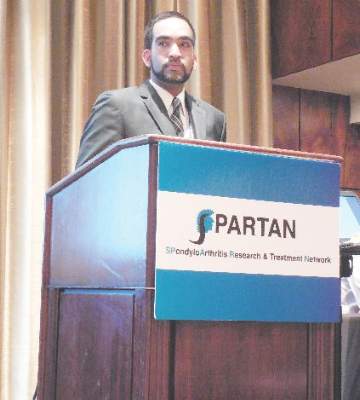
This substantial rate of SpA patients with high disease activity despite TNF inhibitor treatment “suggests a need for more aggressive treatment,” with either a higher TNF inhibitor dosage or by treatment with a different biological drug, said Dr. Bekele, a rheumatologist at Howard University Hospital in Washington.
The analysis that assessed the impact of TNF inhibitor treatment on hip status used data from 576 AS patients enrolled in the Prospective Study of Outcomes in AS (PSOAS) at any of five U.S. centers. PSOAS included patients diagnosed with AS for at least 20 years, and the new study focused on patients who had undergone hip imaging at least twice while in the study and who entered with a Bath AS Radiologic Index (BASRI) hip score of less than 4. The analysis considered patients to have experienced progressive hip deterioration if they had a follow-up BASRI score that was at least two points higher than their baseline score. During a median 3 years of follow-up, 25 patients had this level of hip-disease progression.

A multivariate analysis showed that the rate of hip disease progression was cut by 98% among patients on TNF inhibitor treatment, compared with those not on a TNF inhibitor, a highly significant difference between the two subgroups, reported Daphne Scaramangas-Plumley, MD, a rheumatologist at Cedars-Sinai Medical Center in Los Angeles. The only other variable identified that also correlated with the risk of hip progression was a patient’s hip score at baseline: For every additional point of the BASRI hip score the rate of later worsening rose by 60%.
The second study involved 596 U.S. veterans diagnosed with a type of SpA and enrolled in the Program to Understand the Longterm Outcomes in Spondyloarthritis (PULSAR) registry study at any of seven U.S. Department of Veterans Affairs centers. The analysis showed that about 64% of these SpA patients were receiving a TNF inhibitor. Among these patients on a TNF inhibitor, about 40% continued to have a Bath AS Disease Activity Index (BASDAI) score of 4 or higher, a level high enough to flag an inadequate response to current treatment.
Dr. Scaramangas-Plumley and Dr. Bekele had no disclosures.
On Twitter @mitchelzoler
DENVER – Treatment with a tumor necrosis factor inhibitor strongly linked with protection against progressive hip deterioration in observational data from 576 patients with ankylosing spondylitis enrolled in a prospective U.S. cohort.
But tumor necrosis factor (TNF) inhibitor treatment had less than full success for treating spondyloarthritis (SpA) disease activity in results from a separate registry study of 596 U.S. veterans diagnosed with SpA. About two-thirds were on a TNF inhibitor, and among these recipients, about 40% had suboptimal disease control, Delamo Bekele, MBBS, said at the annual meeting of the Spondyloarthritis (SpA) Research and Treatment Network.
This substantial rate of SpA patients with high disease activity despite TNF inhibitor treatment “suggests a need for more aggressive treatment,” with either a higher TNF inhibitor dosage or by treatment with a different biological drug, said Dr. Bekele, a rheumatologist at Howard University Hospital in Washington.
The analysis that assessed the impact of TNF inhibitor treatment on hip status used data from 576 AS patients enrolled in the Prospective Study of Outcomes in AS (PSOAS) at any of five U.S. centers. PSOAS included patients diagnosed with AS for at least 20 years, and the new study focused on patients who had undergone hip imaging at least twice while in the study and who entered with a Bath AS Radiologic Index (BASRI) hip score of less than 4. The analysis considered patients to have experienced progressive hip deterioration if they had a follow-up BASRI score that was at least two points higher than their baseline score. During a median 3 years of follow-up, 25 patients had this level of hip-disease progression.
A multivariate analysis showed that the rate of hip disease progression was cut by 98% among patients on TNF inhibitor treatment, compared with those not on a TNF inhibitor, a highly significant difference between the two subgroups, reported Daphne Scaramangas-Plumley, MD, a rheumatologist at Cedars-Sinai Medical Center in Los Angeles. The only other variable identified that also correlated with the risk of hip progression was a patient’s hip score at baseline: For every additional point of the BASRI hip score the rate of later worsening rose by 60%.
The second study involved 596 U.S. veterans diagnosed with a type of SpA and enrolled in the Program to Understand the Longterm Outcomes in Spondyloarthritis (PULSAR) registry study at any of seven U.S. Department of Veterans Affairs centers. The analysis showed that about 64% of these SpA patients were receiving a TNF inhibitor. Among these patients on a TNF inhibitor, about 40% continued to have a Bath AS Disease Activity Index (BASDAI) score of 4 or higher, a level high enough to flag an inadequate response to current treatment.
Dr. Scaramangas-Plumley and Dr. Bekele had no disclosures.
On Twitter @mitchelzoler
DENVER – Treatment with a tumor necrosis factor inhibitor strongly linked with protection against progressive hip deterioration in observational data from 576 patients with ankylosing spondylitis enrolled in a prospective U.S. cohort.
But tumor necrosis factor (TNF) inhibitor treatment had less than full success for treating spondyloarthritis (SpA) disease activity in results from a separate registry study of 596 U.S. veterans diagnosed with SpA. About two-thirds were on a TNF inhibitor, and among these recipients, about 40% had suboptimal disease control, Delamo Bekele, MBBS, said at the annual meeting of the Spondyloarthritis (SpA) Research and Treatment Network.
This substantial rate of SpA patients with high disease activity despite TNF inhibitor treatment “suggests a need for more aggressive treatment,” with either a higher TNF inhibitor dosage or by treatment with a different biological drug, said Dr. Bekele, a rheumatologist at Howard University Hospital in Washington.
The analysis that assessed the impact of TNF inhibitor treatment on hip status used data from 576 AS patients enrolled in the Prospective Study of Outcomes in AS (PSOAS) at any of five U.S. centers. PSOAS included patients diagnosed with AS for at least 20 years, and the new study focused on patients who had undergone hip imaging at least twice while in the study and who entered with a Bath AS Radiologic Index (BASRI) hip score of less than 4. The analysis considered patients to have experienced progressive hip deterioration if they had a follow-up BASRI score that was at least two points higher than their baseline score. During a median 3 years of follow-up, 25 patients had this level of hip-disease progression.
A multivariate analysis showed that the rate of hip disease progression was cut by 98% among patients on TNF inhibitor treatment, compared with those not on a TNF inhibitor, a highly significant difference between the two subgroups, reported Daphne Scaramangas-Plumley, MD, a rheumatologist at Cedars-Sinai Medical Center in Los Angeles. The only other variable identified that also correlated with the risk of hip progression was a patient’s hip score at baseline: For every additional point of the BASRI hip score the rate of later worsening rose by 60%.
The second study involved 596 U.S. veterans diagnosed with a type of SpA and enrolled in the Program to Understand the Longterm Outcomes in Spondyloarthritis (PULSAR) registry study at any of seven U.S. Department of Veterans Affairs centers. The analysis showed that about 64% of these SpA patients were receiving a TNF inhibitor. Among these patients on a TNF inhibitor, about 40% continued to have a Bath AS Disease Activity Index (BASDAI) score of 4 or higher, a level high enough to flag an inadequate response to current treatment.
Dr. Scaramangas-Plumley and Dr. Bekele had no disclosures.
On Twitter @mitchelzoler
AT THE 2016 SPARTAN ANNUAL MEETING
Key clinical point: Ankylosing spondylitis patients on tumor necrosis factor inhibitor treatment had substantially better maintenance of hip function. In a second study, 40% of spondyloarthritis patients on a TNF inhibitor failed to receive adequate treatment efficacy.
Major finding: Tumor necrosis factor inhibitor treatment cut the rate of hip deterioration by 98%, compared with treatment without a biological drug.
Data source: PSOAS, a prospective observational study of 576 U.S. spondyloarthritis patients, and 596 U.S. veterans with SpA enrolled in the PULSAR registry study.
Disclosures: Dr. Scaramangas-Plumley and Dr. Bekele had no disclosures.
Different approaches can combat negative online reviews
Like most physicians, Dr. Susan Hardwick-Smith was used to receiving the occasional negative online review about her practice. But a biting post from several years ago was so wrenching that it nearly drove the Houston ob.gyn. out of medicine for good.
The patient blasted Dr. Hardwick-Smith on a popular review site about her care during a delivery and accused the doctor of attempting to force an unnecessary C-section. The account was inaccurate, but privacy laws prevented Dr. Hardwick-Smith from defending herself online or sharing details of the actual encounter, she said.

“She wrote this very detailed account of what a terrible doctor I was, and in my version of reality, I had saved her baby’s life,” said Dr. Hardwick-Smith. “I felt extremely powerless. I lost a lot of sleep over it, and I was considering giving up delivering babies. It was a real turning point for me.”
Rather than hanging up her white coat, Dr. Hardwick-Smith began working with an online reputation company – eMerit – that works to dilute negative reviews by soliciting a greater number of reviews from patients. The offensive post is now buried under hundreds of other reviews that are primarily positive, she said.
Hiring a reputation management company is one strategy for coping with negative online reviews. But cyberlaw experts stress that removing negative posts altogether is no easy feat. The best move to take often depends on the post, the patient, and the circumstance.
By now, it’s no secret that negative online reviews can significantly impact a medical practice, from influencing patient recruitment to affecting practice revenue to ruining a reputation. A 2015 survey of 2,354 consumers by search marketing firm BrightLocal found that 92% of consumers read online reviews – up from 67% in 2010 – and 40% of consumers had formed an opinion by reading just one to three reviews. Of 2,137 patients who viewed online reviews, 35% selected a physician based on positive reviews, while 37% avoided doctors with negative reviews, according to a 2014 study in JAMA (doi:10.1001/jama.2013.283194).

Reviews have become a strong force in the health care industry, said Peter Yelkovac, an online defamation attorney in Northern Indiana.
“Online reviews have really replaced the common ‘word of mouth’ that used to be the primary source for doctors referrals,” Mr. Yelkovac said in an interview. “Now, [patients] go online. Anyone can type anything they want, whether it’s truthful, untruthful, positive, indifferent, or negative.”
Doctor vs. website
In some cases, contacting a website administrator and requesting a review be removed can end the dilemma, said Michael J. Sacopulos, a medical malpractice defense attorney based in Terre Haute, Ind.
Rating sites generally have “terms of use,” and posts that violate the terms usually will be taken down by site administrators with some nudging, Mr. Sacopulos said in an interview. Other sites have “strike policies,” where a reviewee can request that one or two negative reviews be removed.

Still other sites are not as accommodating. Amazon, for instance, has immunity against content posted on the site, Mr. Sacopulos said. Under the Communications Decency Act, interactive computer services, such as a consumer review website, cannot be liable for content independently created or developed by third-party users. Such sites are hardly motivated to remove negative comments when racy posts can drive traffic to the site, he said.
Eric M. Joseph, MD, a facial plastic surgeon in West Orange, N.J., learned this lesson firsthand when he attempted to have a video removed from YouTube. A poster had uploaded copyright-protected before and after photos from Dr. Joseph’s practice onto YouTube and made disparaging comments about the patients in a video that went viral. Dr. Joseph and the patient both flagged the video for removal, but to no avail.
“It was impossible to [talk to] a human being at Google,” Dr, Joseph said. “It almost didn’t come down, and we were in conversations about suing Google. It took months and a cyberattorney who specializes in copyright infringement.”

The video finally was removed, but not before Dr. Joseph spent $6,000 in legal fees and experienced significant distress from the incident. Although most reviews about his practice are positive, he said, it’s difficult not to be affected by negative posts.
“From a psychological standpoint, it stings,” he said. “The burn of a negative review outweighs the sweetness of a positive review 100 times.”
Reputation companies to the rescue?
Like Dr. Hardwick-Smith, Dr. Joseph has utilized the online reputation management company eMerit to improve his online presence. The company gathers reviews from patients at the point of service and posts them to dominate review sites.
The solution to pollution is dilution, which means counterbalancing negative reviews with more representative reviews,” said Jeffrey Segal, MD, a neurosurgeon and attorney, and the founder of eMerit. “The next step is to deescalate conflict if you know who the patient is – to see if the patient problem can be resolved. Typically a patient is pleasantly surprised that you took the effort to call. Because the bar is so low, it’s very easy to exceed it.”

Physicians subscribe to eMerit on a month-to-month basis, paying $100-$600 a month, depending on the practice’s needs, Dr. Segal said. He touted a greater than 90% renewal rate, and said eMerit has captured and uploaded more than 150,000 patient reviews since its inception.
For the online reputation management company Reputation.com, health care providers have become one of the its most frequent clients, said Michael Fertik, company founder. Reputation.com solicits reviews from patients after appointments and ensures their visibility on top review sites. The platform also integrates reviews from general and health care review sites to help providers address patient feedback and receive alerts when negative reviews are posted. Rates start at $50 a month.
Mr. Fertik noted that more reviews not only overtake negative posts, but they make physicians easier to find by patients.
“If you have more than 10-15 reviews, you have a higher chance of getting a new patient because the search engine is going to favor doctors that have more reviews,” he said. “Doctors that have a small number of reviews don’t exist as far as search engines are concerned.”
However, all online reputation management firms are not equal, Mr. Sacopulos warned. Some are unfamiliar with the health care space, while others are unclear on health care privacy regulations. Mr. Sacopulos learned of a company that was sending patients texts to request reviews, which was likely a privacy violation and a violation of the Telecommunications Act, he said.
““Some [companies] are much more credible, and they understand health care law more than others,” he said. “Some have the technological capabilities to do things, but don’t understand the legal environment, so you need to be very careful [about whom] you pick.”
Time to sue?
Litigation is generally the last resort to fighting unfavorable online reviews. If a doctor believes a review is unfair or defamatory, and all other efforts have been exhausted, a lawyer may be able to help, Mr. Yelkovac said.
“When someone says, ‘I want to sue,’ that’s a possibility, but that’s typically far down the road,” he said. “Lawsuits are expensive. Lawsuits have an unknown outcome, and I would say, many times when you do sue for defamation, [the poster] may or may not have a lot of money, so you may end up spending a lot of money and you don’t recover anything from the patient.”
The majority of the lawsuits Mr. Yelkovac handles related to online reviews seek to unmask the poster with the aid of subpoenas and at times computer forensics, he said. From there, doctors can decide which action to take, such as contacting the poster and asking to have the comment removed.
“Sometimes it’s a surprise,” he said. “Sometimes it’s an ex-employee. Sometimes it’s a family member, or it could potentially be a competitor. Many times it’s not even a patient, and sometimes it’s a patient [who] the doctor never thought would post a review.”
Reviews and malpractice risk
Remember that not all unfavorable reviews are necessarily negative for physicians, said Brant Avondet, founder of Searchlight Enterprises, a malpractice risk prediction and online physician ratings research company.

A pattern of reviews that express the same concerns or frustrations by patients can be used to address and change internal policies and problems, such as multiple complaints about long wait times or a crowded parking lot, he said. Perhaps the front desk staff is repeatedly unfriendly to patients. Taking steps to correct these concerns could help in the long run, Mr. Avondet said.
Searchlight Enterprises recently presented study findings about a suggested link between online ratings and legal risk for physicians at a national medical insurance conference. Mr. Avondet and his colleagues evaluated claims data for 4,000 Florida physicians from the Florida Healthcare Practitioner Data Portal from 2000 to 2016 and studied online physician reviews from top rating sites. Doctors were grouped into three categories: surgical, ob.gyn., and “other” specialties. Findings showed the bottom 10% of surgeons studied (those with the worst online reviews) had 150% as many claims as the average for all surgeons. Surgeons in the top 20% (doctors with the best online reviews) had roughly half of the risk of a claim, compared with the average surgeon. Similar results were found for ob.gyns. and other specialties.
“Low and behold, there’s a huge correlation,” Mr. Avondet said. “There’s no shadow of a doubt that there’s something there that predicts your malpractice risk based on how nice or mean you are in the eyes of the patient.”
Mr. Avondet said he encourages physicians to use online reviews to make improvements, thus lowering their liability.
“Look at these reviews as a lens into your practice and things you might need to correct,” he said. “Use it as [insight] for how you can improve your practice and decrease the risk of getting sued.”
On Twitter @legal_med
Like most physicians, Dr. Susan Hardwick-Smith was used to receiving the occasional negative online review about her practice. But a biting post from several years ago was so wrenching that it nearly drove the Houston ob.gyn. out of medicine for good.
The patient blasted Dr. Hardwick-Smith on a popular review site about her care during a delivery and accused the doctor of attempting to force an unnecessary C-section. The account was inaccurate, but privacy laws prevented Dr. Hardwick-Smith from defending herself online or sharing details of the actual encounter, she said.
“She wrote this very detailed account of what a terrible doctor I was, and in my version of reality, I had saved her baby’s life,” said Dr. Hardwick-Smith. “I felt extremely powerless. I lost a lot of sleep over it, and I was considering giving up delivering babies. It was a real turning point for me.”
Rather than hanging up her white coat, Dr. Hardwick-Smith began working with an online reputation company – eMerit – that works to dilute negative reviews by soliciting a greater number of reviews from patients. The offensive post is now buried under hundreds of other reviews that are primarily positive, she said.
Hiring a reputation management company is one strategy for coping with negative online reviews. But cyberlaw experts stress that removing negative posts altogether is no easy feat. The best move to take often depends on the post, the patient, and the circumstance.
By now, it’s no secret that negative online reviews can significantly impact a medical practice, from influencing patient recruitment to affecting practice revenue to ruining a reputation. A 2015 survey of 2,354 consumers by search marketing firm BrightLocal found that 92% of consumers read online reviews – up from 67% in 2010 – and 40% of consumers had formed an opinion by reading just one to three reviews. Of 2,137 patients who viewed online reviews, 35% selected a physician based on positive reviews, while 37% avoided doctors with negative reviews, according to a 2014 study in JAMA (doi:10.1001/jama.2013.283194).
Reviews have become a strong force in the health care industry, said Peter Yelkovac, an online defamation attorney in Northern Indiana.
“Online reviews have really replaced the common ‘word of mouth’ that used to be the primary source for doctors referrals,” Mr. Yelkovac said in an interview. “Now, [patients] go online. Anyone can type anything they want, whether it’s truthful, untruthful, positive, indifferent, or negative.”
Doctor vs. website
In some cases, contacting a website administrator and requesting a review be removed can end the dilemma, said Michael J. Sacopulos, a medical malpractice defense attorney based in Terre Haute, Ind.
Rating sites generally have “terms of use,” and posts that violate the terms usually will be taken down by site administrators with some nudging, Mr. Sacopulos said in an interview. Other sites have “strike policies,” where a reviewee can request that one or two negative reviews be removed.
Still other sites are not as accommodating. Amazon, for instance, has immunity against content posted on the site, Mr. Sacopulos said. Under the Communications Decency Act, interactive computer services, such as a consumer review website, cannot be liable for content independently created or developed by third-party users. Such sites are hardly motivated to remove negative comments when racy posts can drive traffic to the site, he said.
Eric M. Joseph, MD, a facial plastic surgeon in West Orange, N.J., learned this lesson firsthand when he attempted to have a video removed from YouTube. A poster had uploaded copyright-protected before and after photos from Dr. Joseph’s practice onto YouTube and made disparaging comments about the patients in a video that went viral. Dr. Joseph and the patient both flagged the video for removal, but to no avail.
“It was impossible to [talk to] a human being at Google,” Dr, Joseph said. “It almost didn’t come down, and we were in conversations about suing Google. It took months and a cyberattorney who specializes in copyright infringement.”
The video finally was removed, but not before Dr. Joseph spent $6,000 in legal fees and experienced significant distress from the incident. Although most reviews about his practice are positive, he said, it’s difficult not to be affected by negative posts.
“From a psychological standpoint, it stings,” he said. “The burn of a negative review outweighs the sweetness of a positive review 100 times.”
Reputation companies to the rescue?
Like Dr. Hardwick-Smith, Dr. Joseph has utilized the online reputation management company eMerit to improve his online presence. The company gathers reviews from patients at the point of service and posts them to dominate review sites.
The solution to pollution is dilution, which means counterbalancing negative reviews with more representative reviews,” said Jeffrey Segal, MD, a neurosurgeon and attorney, and the founder of eMerit. “The next step is to deescalate conflict if you know who the patient is – to see if the patient problem can be resolved. Typically a patient is pleasantly surprised that you took the effort to call. Because the bar is so low, it’s very easy to exceed it.”
Physicians subscribe to eMerit on a month-to-month basis, paying $100-$600 a month, depending on the practice’s needs, Dr. Segal said. He touted a greater than 90% renewal rate, and said eMerit has captured and uploaded more than 150,000 patient reviews since its inception.
For the online reputation management company Reputation.com, health care providers have become one of the its most frequent clients, said Michael Fertik, company founder. Reputation.com solicits reviews from patients after appointments and ensures their visibility on top review sites. The platform also integrates reviews from general and health care review sites to help providers address patient feedback and receive alerts when negative reviews are posted. Rates start at $50 a month.
Mr. Fertik noted that more reviews not only overtake negative posts, but they make physicians easier to find by patients.
“If you have more than 10-15 reviews, you have a higher chance of getting a new patient because the search engine is going to favor doctors that have more reviews,” he said. “Doctors that have a small number of reviews don’t exist as far as search engines are concerned.”
However, all online reputation management firms are not equal, Mr. Sacopulos warned. Some are unfamiliar with the health care space, while others are unclear on health care privacy regulations. Mr. Sacopulos learned of a company that was sending patients texts to request reviews, which was likely a privacy violation and a violation of the Telecommunications Act, he said.
““Some [companies] are much more credible, and they understand health care law more than others,” he said. “Some have the technological capabilities to do things, but don’t understand the legal environment, so you need to be very careful [about whom] you pick.”
Time to sue?
Litigation is generally the last resort to fighting unfavorable online reviews. If a doctor believes a review is unfair or defamatory, and all other efforts have been exhausted, a lawyer may be able to help, Mr. Yelkovac said.
“When someone says, ‘I want to sue,’ that’s a possibility, but that’s typically far down the road,” he said. “Lawsuits are expensive. Lawsuits have an unknown outcome, and I would say, many times when you do sue for defamation, [the poster] may or may not have a lot of money, so you may end up spending a lot of money and you don’t recover anything from the patient.”
The majority of the lawsuits Mr. Yelkovac handles related to online reviews seek to unmask the poster with the aid of subpoenas and at times computer forensics, he said. From there, doctors can decide which action to take, such as contacting the poster and asking to have the comment removed.
“Sometimes it’s a surprise,” he said. “Sometimes it’s an ex-employee. Sometimes it’s a family member, or it could potentially be a competitor. Many times it’s not even a patient, and sometimes it’s a patient [who] the doctor never thought would post a review.”
Reviews and malpractice risk
Remember that not all unfavorable reviews are necessarily negative for physicians, said Brant Avondet, founder of Searchlight Enterprises, a malpractice risk prediction and online physician ratings research company.
A pattern of reviews that express the same concerns or frustrations by patients can be used to address and change internal policies and problems, such as multiple complaints about long wait times or a crowded parking lot, he said. Perhaps the front desk staff is repeatedly unfriendly to patients. Taking steps to correct these concerns could help in the long run, Mr. Avondet said.
Searchlight Enterprises recently presented study findings about a suggested link between online ratings and legal risk for physicians at a national medical insurance conference. Mr. Avondet and his colleagues evaluated claims data for 4,000 Florida physicians from the Florida Healthcare Practitioner Data Portal from 2000 to 2016 and studied online physician reviews from top rating sites. Doctors were grouped into three categories: surgical, ob.gyn., and “other” specialties. Findings showed the bottom 10% of surgeons studied (those with the worst online reviews) had 150% as many claims as the average for all surgeons. Surgeons in the top 20% (doctors with the best online reviews) had roughly half of the risk of a claim, compared with the average surgeon. Similar results were found for ob.gyns. and other specialties.
“Low and behold, there’s a huge correlation,” Mr. Avondet said. “There’s no shadow of a doubt that there’s something there that predicts your malpractice risk based on how nice or mean you are in the eyes of the patient.”
Mr. Avondet said he encourages physicians to use online reviews to make improvements, thus lowering their liability.
“Look at these reviews as a lens into your practice and things you might need to correct,” he said. “Use it as [insight] for how you can improve your practice and decrease the risk of getting sued.”
On Twitter @legal_med
Like most physicians, Dr. Susan Hardwick-Smith was used to receiving the occasional negative online review about her practice. But a biting post from several years ago was so wrenching that it nearly drove the Houston ob.gyn. out of medicine for good.
The patient blasted Dr. Hardwick-Smith on a popular review site about her care during a delivery and accused the doctor of attempting to force an unnecessary C-section. The account was inaccurate, but privacy laws prevented Dr. Hardwick-Smith from defending herself online or sharing details of the actual encounter, she said.
“She wrote this very detailed account of what a terrible doctor I was, and in my version of reality, I had saved her baby’s life,” said Dr. Hardwick-Smith. “I felt extremely powerless. I lost a lot of sleep over it, and I was considering giving up delivering babies. It was a real turning point for me.”
Rather than hanging up her white coat, Dr. Hardwick-Smith began working with an online reputation company – eMerit – that works to dilute negative reviews by soliciting a greater number of reviews from patients. The offensive post is now buried under hundreds of other reviews that are primarily positive, she said.
Hiring a reputation management company is one strategy for coping with negative online reviews. But cyberlaw experts stress that removing negative posts altogether is no easy feat. The best move to take often depends on the post, the patient, and the circumstance.
By now, it’s no secret that negative online reviews can significantly impact a medical practice, from influencing patient recruitment to affecting practice revenue to ruining a reputation. A 2015 survey of 2,354 consumers by search marketing firm BrightLocal found that 92% of consumers read online reviews – up from 67% in 2010 – and 40% of consumers had formed an opinion by reading just one to three reviews. Of 2,137 patients who viewed online reviews, 35% selected a physician based on positive reviews, while 37% avoided doctors with negative reviews, according to a 2014 study in JAMA (doi:10.1001/jama.2013.283194).
Reviews have become a strong force in the health care industry, said Peter Yelkovac, an online defamation attorney in Northern Indiana.
“Online reviews have really replaced the common ‘word of mouth’ that used to be the primary source for doctors referrals,” Mr. Yelkovac said in an interview. “Now, [patients] go online. Anyone can type anything they want, whether it’s truthful, untruthful, positive, indifferent, or negative.”
Doctor vs. website
In some cases, contacting a website administrator and requesting a review be removed can end the dilemma, said Michael J. Sacopulos, a medical malpractice defense attorney based in Terre Haute, Ind.
Rating sites generally have “terms of use,” and posts that violate the terms usually will be taken down by site administrators with some nudging, Mr. Sacopulos said in an interview. Other sites have “strike policies,” where a reviewee can request that one or two negative reviews be removed.
Still other sites are not as accommodating. Amazon, for instance, has immunity against content posted on the site, Mr. Sacopulos said. Under the Communications Decency Act, interactive computer services, such as a consumer review website, cannot be liable for content independently created or developed by third-party users. Such sites are hardly motivated to remove negative comments when racy posts can drive traffic to the site, he said.
Eric M. Joseph, MD, a facial plastic surgeon in West Orange, N.J., learned this lesson firsthand when he attempted to have a video removed from YouTube. A poster had uploaded copyright-protected before and after photos from Dr. Joseph’s practice onto YouTube and made disparaging comments about the patients in a video that went viral. Dr. Joseph and the patient both flagged the video for removal, but to no avail.
“It was impossible to [talk to] a human being at Google,” Dr, Joseph said. “It almost didn’t come down, and we were in conversations about suing Google. It took months and a cyberattorney who specializes in copyright infringement.”
The video finally was removed, but not before Dr. Joseph spent $6,000 in legal fees and experienced significant distress from the incident. Although most reviews about his practice are positive, he said, it’s difficult not to be affected by negative posts.
“From a psychological standpoint, it stings,” he said. “The burn of a negative review outweighs the sweetness of a positive review 100 times.”
Reputation companies to the rescue?
Like Dr. Hardwick-Smith, Dr. Joseph has utilized the online reputation management company eMerit to improve his online presence. The company gathers reviews from patients at the point of service and posts them to dominate review sites.
The solution to pollution is dilution, which means counterbalancing negative reviews with more representative reviews,” said Jeffrey Segal, MD, a neurosurgeon and attorney, and the founder of eMerit. “The next step is to deescalate conflict if you know who the patient is – to see if the patient problem can be resolved. Typically a patient is pleasantly surprised that you took the effort to call. Because the bar is so low, it’s very easy to exceed it.”
Physicians subscribe to eMerit on a month-to-month basis, paying $100-$600 a month, depending on the practice’s needs, Dr. Segal said. He touted a greater than 90% renewal rate, and said eMerit has captured and uploaded more than 150,000 patient reviews since its inception.
For the online reputation management company Reputation.com, health care providers have become one of the its most frequent clients, said Michael Fertik, company founder. Reputation.com solicits reviews from patients after appointments and ensures their visibility on top review sites. The platform also integrates reviews from general and health care review sites to help providers address patient feedback and receive alerts when negative reviews are posted. Rates start at $50 a month.
Mr. Fertik noted that more reviews not only overtake negative posts, but they make physicians easier to find by patients.
“If you have more than 10-15 reviews, you have a higher chance of getting a new patient because the search engine is going to favor doctors that have more reviews,” he said. “Doctors that have a small number of reviews don’t exist as far as search engines are concerned.”
However, all online reputation management firms are not equal, Mr. Sacopulos warned. Some are unfamiliar with the health care space, while others are unclear on health care privacy regulations. Mr. Sacopulos learned of a company that was sending patients texts to request reviews, which was likely a privacy violation and a violation of the Telecommunications Act, he said.
““Some [companies] are much more credible, and they understand health care law more than others,” he said. “Some have the technological capabilities to do things, but don’t understand the legal environment, so you need to be very careful [about whom] you pick.”
Time to sue?
Litigation is generally the last resort to fighting unfavorable online reviews. If a doctor believes a review is unfair or defamatory, and all other efforts have been exhausted, a lawyer may be able to help, Mr. Yelkovac said.
“When someone says, ‘I want to sue,’ that’s a possibility, but that’s typically far down the road,” he said. “Lawsuits are expensive. Lawsuits have an unknown outcome, and I would say, many times when you do sue for defamation, [the poster] may or may not have a lot of money, so you may end up spending a lot of money and you don’t recover anything from the patient.”
The majority of the lawsuits Mr. Yelkovac handles related to online reviews seek to unmask the poster with the aid of subpoenas and at times computer forensics, he said. From there, doctors can decide which action to take, such as contacting the poster and asking to have the comment removed.
“Sometimes it’s a surprise,” he said. “Sometimes it’s an ex-employee. Sometimes it’s a family member, or it could potentially be a competitor. Many times it’s not even a patient, and sometimes it’s a patient [who] the doctor never thought would post a review.”
Reviews and malpractice risk
Remember that not all unfavorable reviews are necessarily negative for physicians, said Brant Avondet, founder of Searchlight Enterprises, a malpractice risk prediction and online physician ratings research company.
A pattern of reviews that express the same concerns or frustrations by patients can be used to address and change internal policies and problems, such as multiple complaints about long wait times or a crowded parking lot, he said. Perhaps the front desk staff is repeatedly unfriendly to patients. Taking steps to correct these concerns could help in the long run, Mr. Avondet said.
Searchlight Enterprises recently presented study findings about a suggested link between online ratings and legal risk for physicians at a national medical insurance conference. Mr. Avondet and his colleagues evaluated claims data for 4,000 Florida physicians from the Florida Healthcare Practitioner Data Portal from 2000 to 2016 and studied online physician reviews from top rating sites. Doctors were grouped into three categories: surgical, ob.gyn., and “other” specialties. Findings showed the bottom 10% of surgeons studied (those with the worst online reviews) had 150% as many claims as the average for all surgeons. Surgeons in the top 20% (doctors with the best online reviews) had roughly half of the risk of a claim, compared with the average surgeon. Similar results were found for ob.gyns. and other specialties.
“Low and behold, there’s a huge correlation,” Mr. Avondet said. “There’s no shadow of a doubt that there’s something there that predicts your malpractice risk based on how nice or mean you are in the eyes of the patient.”
Mr. Avondet said he encourages physicians to use online reviews to make improvements, thus lowering their liability.
“Look at these reviews as a lens into your practice and things you might need to correct,” he said. “Use it as [insight] for how you can improve your practice and decrease the risk of getting sued.”
On Twitter @legal_med

No one-size-fits-all approach for reducing hospital readmissions
SAN DIEGO – Despite advances in the way surgeons practice their craft and measure outcomes in a meaningful way, the rate of hospital readmissions remains unacceptably high, according to an Emory University surgeon who has studied the readmission patterns.
“Readmission is a problem, not only from a cost and penalties standpoint but also from the rates of readmission affecting patients’ lives and expectations,” Jyotirmay Sharma, MD, said at the American College of Surgeons/National Surgical Quality Improvement Program National Conference.

Dr. Sharma, director of thyroid and endocrine surgery at Emory University Hospital, Atlanta, cited recent federal data estimating that among Medicare patients discharged from a hospital, 20% are rehospitalized within 30 days, and 34% are rehospitalized within 90 days. In 2013 alone, the Centers for Medicare & Medicaid Services levied readmission penalties against 2,213 hospitals to the tune of $280 million. “So clearly it’s a major issue,” he said.
In a study conducted by one of Dr. Sharma’s associates, researchers evaluated the risk factors for 30-day hospital readmission among general surgery patients treated at Emory University Hospital (J Am Coll Surg. 2012 Sep;215[3]:322-30). Pancreatectomy accounted for 18% of readmissions, followed by colectomy/colostomy (13%), small bowel resection (12%), and gastrectomy and ventral hernia repair (both 11%).
An unrelated analysis of a 498,875 operations found that lower extremity vascular bypass procedures accounted for 16% of readmissions, followed by colectomy or proctectomy (11%), bariatric surgery (5%), and ventral hernia repair (4%). In addition, the readmission rates were 6% among patients with no complications, 16% among those with one complications such as surgical site infections (SSIs), bleeding, and ileus, 37% among those with two or more complications, and 29% among those with three or more complications (JAMA 2015;313[3]:483-95). The most common complication overall was SSI (20%), followed by ileus (10%).
When the Emory study researchers drilled down on their data, they found that the following preexisting conditions were associated with readmissions among colectomy patients: steroid use, hypertension, readmission, cancer, COPD, smoking, poor functional status, and diabetes. At the same time, preexisting conditions associated with readmissions among vascular patients were diabetes and renal failure. The only preexisting condition associated with readmissions among thyroidectomy was renal failure. When the researchers evaluated the association between readmission risk and system-wide complications, they found that vascular surgery and urinary surgery conferred the highest risks (sixfold and fivefold, respectively).
“Just looking at your semiannual report quickly can give you a sense of which complications are associated with that readmission,” Dr. Sharma said. “There are many areas of potential intervention.” Preoperatively, he recommends screening surgery patients for obstructive sleep apnea, hypertension, and diabetes. “Looking at preexisting comorbid dyspnea, cancer, and renal failure can give you those target populations very quickly,” he said.
Intraoperatively, “it’s all about reduction of complications,” he said. These include using the WHO checklist, employing SSI prevention practices and considering certain anesthesia techniques such as low tidal volume ventilation and fluid limitation, control of hyperglycemia, and enhanced recovery after surgery protocols (ERAS).
Postoperative strategies to reduce readmission risk include ERAS for multimodal analgesia, fluid restriction, oral intake, and ambulation, and being aggressive about follow-up with high-risk populations and discharge planning. “The strategies for readmission reduction should be based on the preoperative assessment and the ability to identify high-risk populations,” Dr. Sharma said. “At Emory, we found that ileostomy patients had the highest risk of readmission. This made sense from a dehydration standpoint. So a colorectal surgeon led the creation of an Emory-wide protocol for teaching patients and their families, giving them signs of dehydration, what to look for, direct access to a dedicated nurse for follow-up, and an arrangement with the infusion center for rehydration as needed.”
He concluded by noting that there is no one-size-fits-all approach to reducing hospital readmissions. “I think an overarching readmission improvement process is not the way to go, unless you’re talking about a preoperative assessment area,” he said. “Identifying high-risk patients and giving them a lifeline where they can call so you can intervene and avoid that readmission, is better.”
Dr. Sharma reported having no relevant disclosures.
SAN DIEGO – Despite advances in the way surgeons practice their craft and measure outcomes in a meaningful way, the rate of hospital readmissions remains unacceptably high, according to an Emory University surgeon who has studied the readmission patterns.
“Readmission is a problem, not only from a cost and penalties standpoint but also from the rates of readmission affecting patients’ lives and expectations,” Jyotirmay Sharma, MD, said at the American College of Surgeons/National Surgical Quality Improvement Program National Conference.
Dr. Sharma, director of thyroid and endocrine surgery at Emory University Hospital, Atlanta, cited recent federal data estimating that among Medicare patients discharged from a hospital, 20% are rehospitalized within 30 days, and 34% are rehospitalized within 90 days. In 2013 alone, the Centers for Medicare & Medicaid Services levied readmission penalties against 2,213 hospitals to the tune of $280 million. “So clearly it’s a major issue,” he said.
In a study conducted by one of Dr. Sharma’s associates, researchers evaluated the risk factors for 30-day hospital readmission among general surgery patients treated at Emory University Hospital (J Am Coll Surg. 2012 Sep;215[3]:322-30). Pancreatectomy accounted for 18% of readmissions, followed by colectomy/colostomy (13%), small bowel resection (12%), and gastrectomy and ventral hernia repair (both 11%).
An unrelated analysis of a 498,875 operations found that lower extremity vascular bypass procedures accounted for 16% of readmissions, followed by colectomy or proctectomy (11%), bariatric surgery (5%), and ventral hernia repair (4%). In addition, the readmission rates were 6% among patients with no complications, 16% among those with one complications such as surgical site infections (SSIs), bleeding, and ileus, 37% among those with two or more complications, and 29% among those with three or more complications (JAMA 2015;313[3]:483-95). The most common complication overall was SSI (20%), followed by ileus (10%).
When the Emory study researchers drilled down on their data, they found that the following preexisting conditions were associated with readmissions among colectomy patients: steroid use, hypertension, readmission, cancer, COPD, smoking, poor functional status, and diabetes. At the same time, preexisting conditions associated with readmissions among vascular patients were diabetes and renal failure. The only preexisting condition associated with readmissions among thyroidectomy was renal failure. When the researchers evaluated the association between readmission risk and system-wide complications, they found that vascular surgery and urinary surgery conferred the highest risks (sixfold and fivefold, respectively).
“Just looking at your semiannual report quickly can give you a sense of which complications are associated with that readmission,” Dr. Sharma said. “There are many areas of potential intervention.” Preoperatively, he recommends screening surgery patients for obstructive sleep apnea, hypertension, and diabetes. “Looking at preexisting comorbid dyspnea, cancer, and renal failure can give you those target populations very quickly,” he said.
Intraoperatively, “it’s all about reduction of complications,” he said. These include using the WHO checklist, employing SSI prevention practices and considering certain anesthesia techniques such as low tidal volume ventilation and fluid limitation, control of hyperglycemia, and enhanced recovery after surgery protocols (ERAS).
Postoperative strategies to reduce readmission risk include ERAS for multimodal analgesia, fluid restriction, oral intake, and ambulation, and being aggressive about follow-up with high-risk populations and discharge planning. “The strategies for readmission reduction should be based on the preoperative assessment and the ability to identify high-risk populations,” Dr. Sharma said. “At Emory, we found that ileostomy patients had the highest risk of readmission. This made sense from a dehydration standpoint. So a colorectal surgeon led the creation of an Emory-wide protocol for teaching patients and their families, giving them signs of dehydration, what to look for, direct access to a dedicated nurse for follow-up, and an arrangement with the infusion center for rehydration as needed.”
He concluded by noting that there is no one-size-fits-all approach to reducing hospital readmissions. “I think an overarching readmission improvement process is not the way to go, unless you’re talking about a preoperative assessment area,” he said. “Identifying high-risk patients and giving them a lifeline where they can call so you can intervene and avoid that readmission, is better.”
Dr. Sharma reported having no relevant disclosures.
SAN DIEGO – Despite advances in the way surgeons practice their craft and measure outcomes in a meaningful way, the rate of hospital readmissions remains unacceptably high, according to an Emory University surgeon who has studied the readmission patterns.
“Readmission is a problem, not only from a cost and penalties standpoint but also from the rates of readmission affecting patients’ lives and expectations,” Jyotirmay Sharma, MD, said at the American College of Surgeons/National Surgical Quality Improvement Program National Conference.
Dr. Sharma, director of thyroid and endocrine surgery at Emory University Hospital, Atlanta, cited recent federal data estimating that among Medicare patients discharged from a hospital, 20% are rehospitalized within 30 days, and 34% are rehospitalized within 90 days. In 2013 alone, the Centers for Medicare & Medicaid Services levied readmission penalties against 2,213 hospitals to the tune of $280 million. “So clearly it’s a major issue,” he said.
In a study conducted by one of Dr. Sharma’s associates, researchers evaluated the risk factors for 30-day hospital readmission among general surgery patients treated at Emory University Hospital (J Am Coll Surg. 2012 Sep;215[3]:322-30). Pancreatectomy accounted for 18% of readmissions, followed by colectomy/colostomy (13%), small bowel resection (12%), and gastrectomy and ventral hernia repair (both 11%).
An unrelated analysis of a 498,875 operations found that lower extremity vascular bypass procedures accounted for 16% of readmissions, followed by colectomy or proctectomy (11%), bariatric surgery (5%), and ventral hernia repair (4%). In addition, the readmission rates were 6% among patients with no complications, 16% among those with one complications such as surgical site infections (SSIs), bleeding, and ileus, 37% among those with two or more complications, and 29% among those with three or more complications (JAMA 2015;313[3]:483-95). The most common complication overall was SSI (20%), followed by ileus (10%).
When the Emory study researchers drilled down on their data, they found that the following preexisting conditions were associated with readmissions among colectomy patients: steroid use, hypertension, readmission, cancer, COPD, smoking, poor functional status, and diabetes. At the same time, preexisting conditions associated with readmissions among vascular patients were diabetes and renal failure. The only preexisting condition associated with readmissions among thyroidectomy was renal failure. When the researchers evaluated the association between readmission risk and system-wide complications, they found that vascular surgery and urinary surgery conferred the highest risks (sixfold and fivefold, respectively).
“Just looking at your semiannual report quickly can give you a sense of which complications are associated with that readmission,” Dr. Sharma said. “There are many areas of potential intervention.” Preoperatively, he recommends screening surgery patients for obstructive sleep apnea, hypertension, and diabetes. “Looking at preexisting comorbid dyspnea, cancer, and renal failure can give you those target populations very quickly,” he said.
Intraoperatively, “it’s all about reduction of complications,” he said. These include using the WHO checklist, employing SSI prevention practices and considering certain anesthesia techniques such as low tidal volume ventilation and fluid limitation, control of hyperglycemia, and enhanced recovery after surgery protocols (ERAS).
Postoperative strategies to reduce readmission risk include ERAS for multimodal analgesia, fluid restriction, oral intake, and ambulation, and being aggressive about follow-up with high-risk populations and discharge planning. “The strategies for readmission reduction should be based on the preoperative assessment and the ability to identify high-risk populations,” Dr. Sharma said. “At Emory, we found that ileostomy patients had the highest risk of readmission. This made sense from a dehydration standpoint. So a colorectal surgeon led the creation of an Emory-wide protocol for teaching patients and their families, giving them signs of dehydration, what to look for, direct access to a dedicated nurse for follow-up, and an arrangement with the infusion center for rehydration as needed.”
He concluded by noting that there is no one-size-fits-all approach to reducing hospital readmissions. “I think an overarching readmission improvement process is not the way to go, unless you’re talking about a preoperative assessment area,” he said. “Identifying high-risk patients and giving them a lifeline where they can call so you can intervene and avoid that readmission, is better.”
Dr. Sharma reported having no relevant disclosures.
EXPERT ANALYSIS AT THE ACS NSQIP NATIONAL CONFERENCE

Anthracycline benefit for high-risk breast cancer confirmed in joint analysis
CHICAGO – Docetaxel plus cyclophosphamide was significantly inferior to treatment with anthracycline/taxane-based chemotherapy, according to an interim joint analysis of the ABC (anthracyclines in early breast cancer) trials.
The ABC trials are three sequential trials from the US Oncology Research and National Surgical Adjuvant Breast and Bowel Project that randomized women with resected high-risk, early-stage breast cancer to receive docetaxel plus cyclophosphamide (TC) or one of several standard anthracycline/taxane-based chemotherapy (TaxAC) regimens.
A total of 4,130 patients met the ABC trials’ eligibility requirements and were randomly assigned to receive either TC therapy (n = 2,078) or TaxAC therapy (n = 2,052), Joanne Blum, MD, PhD, of the Texas Oncology-Baylor Charles A. Sammons Cancer Center, Dallas, reported at the annual meeting of the American Society of Clinical Oncology.
Patient and tumor characteristics were balanced among the two treatment arms, and the median follow-up time was 3.2 years.
Inferiority was predefined as a Cox model hazard ratio (HR) score of 1.18 or higher when the cohort was stratified by nodal status, hormone-receptor status, and parent trial, Dr. Blum said.
The HR for the initial 334 events was 1.2, which exceeded the threshold and demonstrated that TC was inferior to TaxAC.
At the interim analysis, 399 events had occurred: 220 in the TC treatment arm and 179 in the TaxAC arm. Overall, the 4-year invasive disease-free survival was 88.2% for the TC treatment arm and 90.7% for the TaxAC treatment arm (HR, 1.23; 95% confidence interval, 1.01-1.50; P = .04). TaxAC was equal or superior to TC when the cohort was stratified by parent trial, hormone status, and nodal status. TC regimen was favored only in ER-positive patients with zero nodes.
There was no difference in overall survival between the two treatment arms.
Exploratory subgroup analyses suggest that TaxAC provides little benefit in ER-positive, node-negative cohorts, small benefit in ER-positive one-to-three node and ER-negative node-negative cohorts, and the most benefit for patients who were ER-positive with more than four nodes or ER-negative node-positive, Dr. Blum said.
Acute leukemia occurred in 0.24% of patients in the TaxAC group and in none of the patients in the TC treatment arm.
“Additional follow-up and correlative studies to identify biomarkers of anthracycline benefit will be crucial for fully determining the utility of anthracyclines across this heterogeneous patient population,” Dr. Blum concluded.
Dr. Blum had no disclosures to report. Sanofi, Genentech, and CTEP funded the ABC trials.
On Twitter @jessnicolecraig
CHICAGO – Docetaxel plus cyclophosphamide was significantly inferior to treatment with anthracycline/taxane-based chemotherapy, according to an interim joint analysis of the ABC (anthracyclines in early breast cancer) trials.
The ABC trials are three sequential trials from the US Oncology Research and National Surgical Adjuvant Breast and Bowel Project that randomized women with resected high-risk, early-stage breast cancer to receive docetaxel plus cyclophosphamide (TC) or one of several standard anthracycline/taxane-based chemotherapy (TaxAC) regimens.
A total of 4,130 patients met the ABC trials’ eligibility requirements and were randomly assigned to receive either TC therapy (n = 2,078) or TaxAC therapy (n = 2,052), Joanne Blum, MD, PhD, of the Texas Oncology-Baylor Charles A. Sammons Cancer Center, Dallas, reported at the annual meeting of the American Society of Clinical Oncology.
Patient and tumor characteristics were balanced among the two treatment arms, and the median follow-up time was 3.2 years.
Inferiority was predefined as a Cox model hazard ratio (HR) score of 1.18 or higher when the cohort was stratified by nodal status, hormone-receptor status, and parent trial, Dr. Blum said.
The HR for the initial 334 events was 1.2, which exceeded the threshold and demonstrated that TC was inferior to TaxAC.
At the interim analysis, 399 events had occurred: 220 in the TC treatment arm and 179 in the TaxAC arm. Overall, the 4-year invasive disease-free survival was 88.2% for the TC treatment arm and 90.7% for the TaxAC treatment arm (HR, 1.23; 95% confidence interval, 1.01-1.50; P = .04). TaxAC was equal or superior to TC when the cohort was stratified by parent trial, hormone status, and nodal status. TC regimen was favored only in ER-positive patients with zero nodes.
There was no difference in overall survival between the two treatment arms.
Exploratory subgroup analyses suggest that TaxAC provides little benefit in ER-positive, node-negative cohorts, small benefit in ER-positive one-to-three node and ER-negative node-negative cohorts, and the most benefit for patients who were ER-positive with more than four nodes or ER-negative node-positive, Dr. Blum said.
Acute leukemia occurred in 0.24% of patients in the TaxAC group and in none of the patients in the TC treatment arm.
“Additional follow-up and correlative studies to identify biomarkers of anthracycline benefit will be crucial for fully determining the utility of anthracyclines across this heterogeneous patient population,” Dr. Blum concluded.
Dr. Blum had no disclosures to report. Sanofi, Genentech, and CTEP funded the ABC trials.
On Twitter @jessnicolecraig
CHICAGO – Docetaxel plus cyclophosphamide was significantly inferior to treatment with anthracycline/taxane-based chemotherapy, according to an interim joint analysis of the ABC (anthracyclines in early breast cancer) trials.
The ABC trials are three sequential trials from the US Oncology Research and National Surgical Adjuvant Breast and Bowel Project that randomized women with resected high-risk, early-stage breast cancer to receive docetaxel plus cyclophosphamide (TC) or one of several standard anthracycline/taxane-based chemotherapy (TaxAC) regimens.
A total of 4,130 patients met the ABC trials’ eligibility requirements and were randomly assigned to receive either TC therapy (n = 2,078) or TaxAC therapy (n = 2,052), Joanne Blum, MD, PhD, of the Texas Oncology-Baylor Charles A. Sammons Cancer Center, Dallas, reported at the annual meeting of the American Society of Clinical Oncology.
Patient and tumor characteristics were balanced among the two treatment arms, and the median follow-up time was 3.2 years.
Inferiority was predefined as a Cox model hazard ratio (HR) score of 1.18 or higher when the cohort was stratified by nodal status, hormone-receptor status, and parent trial, Dr. Blum said.
The HR for the initial 334 events was 1.2, which exceeded the threshold and demonstrated that TC was inferior to TaxAC.
At the interim analysis, 399 events had occurred: 220 in the TC treatment arm and 179 in the TaxAC arm. Overall, the 4-year invasive disease-free survival was 88.2% for the TC treatment arm and 90.7% for the TaxAC treatment arm (HR, 1.23; 95% confidence interval, 1.01-1.50; P = .04). TaxAC was equal or superior to TC when the cohort was stratified by parent trial, hormone status, and nodal status. TC regimen was favored only in ER-positive patients with zero nodes.
There was no difference in overall survival between the two treatment arms.
Exploratory subgroup analyses suggest that TaxAC provides little benefit in ER-positive, node-negative cohorts, small benefit in ER-positive one-to-three node and ER-negative node-negative cohorts, and the most benefit for patients who were ER-positive with more than four nodes or ER-negative node-positive, Dr. Blum said.
Acute leukemia occurred in 0.24% of patients in the TaxAC group and in none of the patients in the TC treatment arm.
“Additional follow-up and correlative studies to identify biomarkers of anthracycline benefit will be crucial for fully determining the utility of anthracyclines across this heterogeneous patient population,” Dr. Blum concluded.
Dr. Blum had no disclosures to report. Sanofi, Genentech, and CTEP funded the ABC trials.
On Twitter @jessnicolecraig
AT THE 2016 ASCO ANNUAL MEETING
Key clinical point: Anthracyclines continue to have a role in the treatment of high-risk, HER2-negative breast cancer.
Major finding: 4-year invasive disease-free survival was 88.2% for the TC treatment arm and 90.7% for the TaxAC treatment arm (HR, 1.23; 95% CI, 1.01-1.50; P = .04).
Data source: An interim analysis of the ABC trials involved a total of 4,130 patients with breast cancer.
Disclosures: Dr. Blum had no disclosures to report. Sanofi, Genentech, and CTEP funded the ABC trials.
McDonald to VFW—We’re Already Seeing Results
Addressing the Veterans of Foreign Wars National Convention on Tuesday, VA Secretary Robert A. McDonald insisted that the VA has made significant progress. “Not only can it be transformed, transformation is well underway—and we’re already seeing results,” he told the audience of more than 12,000 veterans.
In his speech, Secretary McDonald noted the significant change in 13 of the VA’s top 18 executive positions. Still, McDonald insisted, “We can’t fire our way to excellence….We won’t punish people based on opinions, recycled and embellished media accounts, or external pressure. It’s not in the best interest of the veterans we serve. Excellence is what we’re after.”
McDonald touted the VA’s unique approach to health care. “We have a unique lifetime relationship with our 9 million patients and a single electronic health record across the entire enterprise. Nobody else offers that,” he insisted. “Our mental health care’s integrated with primary care, with specialty care, and with psychosocial support to minimize barriers and help resolve problems early. Nobody else offers that.”
According to McDonald, “The VA is embracing what works to heal veterans. And VA care is integrated with nonmedical determinants of health and well-being that people often miss,” he told the VFW. “Under Secretary of Health Dr. David Shulkin is changing our system to proactive, holistic health care and wellness. It’s time we got beyond just reacting to disease when it happens.”
McDonald told the audience that in 2015, veterans had nearly 5 million more appointments than in 2014. Almost 57 million of these appointments were in VA-operated facilities and another 21 million in community settings. Now 97% of appointments are completed within 30 days of veterans’ preferred date, he told the audience, and 86% were completed within 7 days—22% are completed the same day.
“We are making important progress,” McDonald asserted. “But you rarely hear that in the media. You’d never know we lead in many fields of research that benefit all Americans—PTSD, traumatic brain injury, spinal cord injury, prosthetics, genetics.”
Addressing the Veterans of Foreign Wars National Convention on Tuesday, VA Secretary Robert A. McDonald insisted that the VA has made significant progress. “Not only can it be transformed, transformation is well underway—and we’re already seeing results,” he told the audience of more than 12,000 veterans.
In his speech, Secretary McDonald noted the significant change in 13 of the VA’s top 18 executive positions. Still, McDonald insisted, “We can’t fire our way to excellence….We won’t punish people based on opinions, recycled and embellished media accounts, or external pressure. It’s not in the best interest of the veterans we serve. Excellence is what we’re after.”
McDonald touted the VA’s unique approach to health care. “We have a unique lifetime relationship with our 9 million patients and a single electronic health record across the entire enterprise. Nobody else offers that,” he insisted. “Our mental health care’s integrated with primary care, with specialty care, and with psychosocial support to minimize barriers and help resolve problems early. Nobody else offers that.”
According to McDonald, “The VA is embracing what works to heal veterans. And VA care is integrated with nonmedical determinants of health and well-being that people often miss,” he told the VFW. “Under Secretary of Health Dr. David Shulkin is changing our system to proactive, holistic health care and wellness. It’s time we got beyond just reacting to disease when it happens.”
McDonald told the audience that in 2015, veterans had nearly 5 million more appointments than in 2014. Almost 57 million of these appointments were in VA-operated facilities and another 21 million in community settings. Now 97% of appointments are completed within 30 days of veterans’ preferred date, he told the audience, and 86% were completed within 7 days—22% are completed the same day.
“We are making important progress,” McDonald asserted. “But you rarely hear that in the media. You’d never know we lead in many fields of research that benefit all Americans—PTSD, traumatic brain injury, spinal cord injury, prosthetics, genetics.”
Addressing the Veterans of Foreign Wars National Convention on Tuesday, VA Secretary Robert A. McDonald insisted that the VA has made significant progress. “Not only can it be transformed, transformation is well underway—and we’re already seeing results,” he told the audience of more than 12,000 veterans.
In his speech, Secretary McDonald noted the significant change in 13 of the VA’s top 18 executive positions. Still, McDonald insisted, “We can’t fire our way to excellence….We won’t punish people based on opinions, recycled and embellished media accounts, or external pressure. It’s not in the best interest of the veterans we serve. Excellence is what we’re after.”
McDonald touted the VA’s unique approach to health care. “We have a unique lifetime relationship with our 9 million patients and a single electronic health record across the entire enterprise. Nobody else offers that,” he insisted. “Our mental health care’s integrated with primary care, with specialty care, and with psychosocial support to minimize barriers and help resolve problems early. Nobody else offers that.”
According to McDonald, “The VA is embracing what works to heal veterans. And VA care is integrated with nonmedical determinants of health and well-being that people often miss,” he told the VFW. “Under Secretary of Health Dr. David Shulkin is changing our system to proactive, holistic health care and wellness. It’s time we got beyond just reacting to disease when it happens.”
McDonald told the audience that in 2015, veterans had nearly 5 million more appointments than in 2014. Almost 57 million of these appointments were in VA-operated facilities and another 21 million in community settings. Now 97% of appointments are completed within 30 days of veterans’ preferred date, he told the audience, and 86% were completed within 7 days—22% are completed the same day.
“We are making important progress,” McDonald asserted. “But you rarely hear that in the media. You’d never know we lead in many fields of research that benefit all Americans—PTSD, traumatic brain injury, spinal cord injury, prosthetics, genetics.”

How we can support our LGBTQ patients
This past month has been a difficult one. The violence committed against people on the basis of presumed sexual orientation, color of skin, religion, and occupation has been difficult to make sense of. These tragic and horrible events highlight the continued need to focus on building inclusive environments and fostering communication between people with different backgrounds, points of view, and life experiences.
Several of my past articles have touched on the need to create inclusive environments for our LGBTQ (lesbian, gay, bisexual, transgender, questioning) patients, but have not included direct input from youth. With this in mind, I sat down with several youth from our local youth LGBTQ center in Ohio to ask them how we as health care providers could be more supportive of our patients.

Here are some of their suggestions:
• “Trust your patients. … Respect that I am knowledgeable about my body.”
Youth in the group stated that they want providers who listen to and trust what they say. Youth reported that they trust that their medical providers are experts in medicine and the care of patients, but they are the experts on themselves.
• “Don’t blame the hormones. Don’t blame things on puberty. … It’s not just a phase.”
Youth reported that they often get frustrated when providers assume that their sexual orientation or gender identity is “just a phase.” While adolescence can be a time of experimentation, it is important to acknowledge and respect youth’s emerging identities.
• “Know your patients. Educate yourselves.”
Many youth reported that while they are happy to share their stories, they do not want to be put in the role of having to educate their providers about the basics.
Youth expect that their providers have a general understanding of LGBTQ terminology and health care needs. They are happy to answer specific questions, but expect a degree of cultural competency from their providers.
• “Don’t push birth control. Don’t make assumptions about my behaviors; ask me first.”
Many female-bodied youth had the perception that providers make assumptions about their sexual orientation (assuming they are heterosexual), sexual behaviors, and risk of unintended pregnancy and sexually transmitted diseases.
Youth reported that they are open to conversations about reproductive health and safe sex, but get turned off when providers incorrectly assume they are heterosexual and in need of birth control. Asking about sexual attraction and the gender of partners as a routine part of any adolescent sexual history can help providers avoid these mistakes.
• “Have a discussion versus telling people what to do. Tell me why you are checking things and what they mean.”
Youth reported that they were interested in being active participants in their health care visits. They stated that if labs are being checked, they want to know why and what the results mean. When medications are prescribed or lifestyle changes are recommended, they want to discuss why these changes are necessary and have some input as to how these changes happen.
• “I like to have my privacy respected. It can be uncomfortable talking about things with my parents in the room.”
Many youth reported privacy and one-on-one time with their providers being important. They reported being uncomfortable or embarrassed talking about certain topics in front of their parents and valued providers who respected their privacy.
Private time with patients is not meant to cut parents out of the visit; rather it is meant to be a time when patients can openly discuss concerns with their providers and begin to take ownership of their health and bodies.
Many of the suggestions above are helpful in the care of all youth, regardless of sexual orientation and gender identity. Most of the qualities youth were looking for in providers were related to communication and respect and are in keeping with current research and guidelines on creating youth friendly services. Following these suggestions, and continuing to find ways to include youth in our conversations to improve health care, are just a few ways we can make youth feel more comfortable in this setting and hopefully begin to achieve health equity for all youth.
Acknowledgments
I appreciate the youth at Kaleidoscope Youth Center for giving their time and continually helping me improve the care I provide to all patients and allowing me to share this information with others.
Dr. Chelvakumar is an attending physician in the division of adolescent medicine at Nationwide Children’s Hospital and an assistant professor of clinical pediatrics at the Ohio State University, both in Columbus.
This past month has been a difficult one. The violence committed against people on the basis of presumed sexual orientation, color of skin, religion, and occupation has been difficult to make sense of. These tragic and horrible events highlight the continued need to focus on building inclusive environments and fostering communication between people with different backgrounds, points of view, and life experiences.
Several of my past articles have touched on the need to create inclusive environments for our LGBTQ (lesbian, gay, bisexual, transgender, questioning) patients, but have not included direct input from youth. With this in mind, I sat down with several youth from our local youth LGBTQ center in Ohio to ask them how we as health care providers could be more supportive of our patients.
Here are some of their suggestions:
• “Trust your patients. … Respect that I am knowledgeable about my body.”
Youth in the group stated that they want providers who listen to and trust what they say. Youth reported that they trust that their medical providers are experts in medicine and the care of patients, but they are the experts on themselves.
• “Don’t blame the hormones. Don’t blame things on puberty. … It’s not just a phase.”
Youth reported that they often get frustrated when providers assume that their sexual orientation or gender identity is “just a phase.” While adolescence can be a time of experimentation, it is important to acknowledge and respect youth’s emerging identities.
• “Know your patients. Educate yourselves.”
Many youth reported that while they are happy to share their stories, they do not want to be put in the role of having to educate their providers about the basics.
Youth expect that their providers have a general understanding of LGBTQ terminology and health care needs. They are happy to answer specific questions, but expect a degree of cultural competency from their providers.
• “Don’t push birth control. Don’t make assumptions about my behaviors; ask me first.”
Many female-bodied youth had the perception that providers make assumptions about their sexual orientation (assuming they are heterosexual), sexual behaviors, and risk of unintended pregnancy and sexually transmitted diseases.
Youth reported that they are open to conversations about reproductive health and safe sex, but get turned off when providers incorrectly assume they are heterosexual and in need of birth control. Asking about sexual attraction and the gender of partners as a routine part of any adolescent sexual history can help providers avoid these mistakes.
• “Have a discussion versus telling people what to do. Tell me why you are checking things and what they mean.”
Youth reported that they were interested in being active participants in their health care visits. They stated that if labs are being checked, they want to know why and what the results mean. When medications are prescribed or lifestyle changes are recommended, they want to discuss why these changes are necessary and have some input as to how these changes happen.
• “I like to have my privacy respected. It can be uncomfortable talking about things with my parents in the room.”
Many youth reported privacy and one-on-one time with their providers being important. They reported being uncomfortable or embarrassed talking about certain topics in front of their parents and valued providers who respected their privacy.
Private time with patients is not meant to cut parents out of the visit; rather it is meant to be a time when patients can openly discuss concerns with their providers and begin to take ownership of their health and bodies.
Many of the suggestions above are helpful in the care of all youth, regardless of sexual orientation and gender identity. Most of the qualities youth were looking for in providers were related to communication and respect and are in keeping with current research and guidelines on creating youth friendly services. Following these suggestions, and continuing to find ways to include youth in our conversations to improve health care, are just a few ways we can make youth feel more comfortable in this setting and hopefully begin to achieve health equity for all youth.
Acknowledgments
I appreciate the youth at Kaleidoscope Youth Center for giving their time and continually helping me improve the care I provide to all patients and allowing me to share this information with others.
Dr. Chelvakumar is an attending physician in the division of adolescent medicine at Nationwide Children’s Hospital and an assistant professor of clinical pediatrics at the Ohio State University, both in Columbus.
This past month has been a difficult one. The violence committed against people on the basis of presumed sexual orientation, color of skin, religion, and occupation has been difficult to make sense of. These tragic and horrible events highlight the continued need to focus on building inclusive environments and fostering communication between people with different backgrounds, points of view, and life experiences.
Several of my past articles have touched on the need to create inclusive environments for our LGBTQ (lesbian, gay, bisexual, transgender, questioning) patients, but have not included direct input from youth. With this in mind, I sat down with several youth from our local youth LGBTQ center in Ohio to ask them how we as health care providers could be more supportive of our patients.
Here are some of their suggestions:
• “Trust your patients. … Respect that I am knowledgeable about my body.”
Youth in the group stated that they want providers who listen to and trust what they say. Youth reported that they trust that their medical providers are experts in medicine and the care of patients, but they are the experts on themselves.
• “Don’t blame the hormones. Don’t blame things on puberty. … It’s not just a phase.”
Youth reported that they often get frustrated when providers assume that their sexual orientation or gender identity is “just a phase.” While adolescence can be a time of experimentation, it is important to acknowledge and respect youth’s emerging identities.
• “Know your patients. Educate yourselves.”
Many youth reported that while they are happy to share their stories, they do not want to be put in the role of having to educate their providers about the basics.
Youth expect that their providers have a general understanding of LGBTQ terminology and health care needs. They are happy to answer specific questions, but expect a degree of cultural competency from their providers.
• “Don’t push birth control. Don’t make assumptions about my behaviors; ask me first.”
Many female-bodied youth had the perception that providers make assumptions about their sexual orientation (assuming they are heterosexual), sexual behaviors, and risk of unintended pregnancy and sexually transmitted diseases.
Youth reported that they are open to conversations about reproductive health and safe sex, but get turned off when providers incorrectly assume they are heterosexual and in need of birth control. Asking about sexual attraction and the gender of partners as a routine part of any adolescent sexual history can help providers avoid these mistakes.
• “Have a discussion versus telling people what to do. Tell me why you are checking things and what they mean.”
Youth reported that they were interested in being active participants in their health care visits. They stated that if labs are being checked, they want to know why and what the results mean. When medications are prescribed or lifestyle changes are recommended, they want to discuss why these changes are necessary and have some input as to how these changes happen.
• “I like to have my privacy respected. It can be uncomfortable talking about things with my parents in the room.”
Many youth reported privacy and one-on-one time with their providers being important. They reported being uncomfortable or embarrassed talking about certain topics in front of their parents and valued providers who respected their privacy.
Private time with patients is not meant to cut parents out of the visit; rather it is meant to be a time when patients can openly discuss concerns with their providers and begin to take ownership of their health and bodies.
Many of the suggestions above are helpful in the care of all youth, regardless of sexual orientation and gender identity. Most of the qualities youth were looking for in providers were related to communication and respect and are in keeping with current research and guidelines on creating youth friendly services. Following these suggestions, and continuing to find ways to include youth in our conversations to improve health care, are just a few ways we can make youth feel more comfortable in this setting and hopefully begin to achieve health equity for all youth.
Acknowledgments
I appreciate the youth at Kaleidoscope Youth Center for giving their time and continually helping me improve the care I provide to all patients and allowing me to share this information with others.
Dr. Chelvakumar is an attending physician in the division of adolescent medicine at Nationwide Children’s Hospital and an assistant professor of clinical pediatrics at the Ohio State University, both in Columbus.

Psoriasis symptom measure could help rheumatologists assess severity
MIAMI – The Psoriasis Symptom Inventory measure could help rheumatologists more easily gauge the severity of moderate to severe psoriasis. The eight-item tool in development correlates well with the Psoriasis Area and Severity Index and is easier to use in rheumatology settings, according to a presentation at the annual meeting of the Group for Research and Assessment of Psoriasis and Psoriatic Arthritis.
“One of the ways it can be useful is in a rheumatology setting [to gauge psoriasis severity] when you’re looking at psoriatic arthritis patients,” said Philip J. Mease, MD. But “you might ask: Why is this of utility when we have an actual physical examination score like the PASI [Psoriasis Area and Severity Index] score?”

“Arguably, rheumatologists really don’t do PASI scores at all, practically speaking. If they do them, the quality of the evaluation is more questionable than [when] done by a dermatologist,” Dr. Mease said at the meeting.
The Psoriasis Symptom Inventory (PSI) focuses on redness, scaling, burning, stinging, peeling, flaking, and pain of skin lesions. The instrument was “rigorously developed by a team at Amgen that worked on it with patient groups and others to come up with a patient-reported outcome [tool],” said Dr. Mease, a rheumatologist at the Swedish Medical Center in Seattle. The first question, for example, is: “During the last 24 hours, how severe was the itch from your psoriasis?” Responses range from “not at all” to “very severe.”
Other researchers compared the PSI to PASI to assess symptom severity and clinical status changes, and the PSI “correlates very well,” Dr. Mease said (J Dermatolog Treat. 2014 Feb;25[1]:8-14). In addition, others have validated the PSI in both psoriasis and psoriatic arthritis and suggest a role in research (J Dermatolog Treat. 2013 Aug;24[4]:255-60).
“In a registry or clinical trial setting, this would be a very simple, eight-question patient-reported outcome that … could be employed as a potential substitute for the PASI where it may not be practical,” Dr. Mease said. The PSI can be adjusted to ask about symptoms over the previous 24 hours or past 7 days.
A current limitation is that “we don’t know how this instrument performs in patients with low body surface area psoriasis,” Dr. Mease said. Typically, psoriasis studies enroll participants with at least 10% body surface area involvement. During the Q&A, an attendee pointed out that even less than 3% body surface area psoriasis is relevant in clinical practice. Dr. Mease agreed, and said a future registry study could validate the PSI in this patient population. “There are discussions now with Amgen to possibly use the PSI in the CORRONA registry of psoriatic patients,” he said. “Because of its rigorous development and high psychometric properties, it would be great if it could be used more broadly. I know there are discussions going on in that regard.”
Amgen is evaluating responder definitions for the PSI that correlate with PASI-50, –75 and –90 responses. The firm is also looking at ways to share the PSI instrument with clinicians and researchers. Brian Ortmeier, executive director at Amgen in Los Angeles and one of the developers of PSI, said at the GRAPPA meeting, “Our intent is get the PSI out into the public domain as a disease management tool.”
Dr. Mease is a consultant to and speaker for Amgen and receives research support from the company.
MIAMI – The Psoriasis Symptom Inventory measure could help rheumatologists more easily gauge the severity of moderate to severe psoriasis. The eight-item tool in development correlates well with the Psoriasis Area and Severity Index and is easier to use in rheumatology settings, according to a presentation at the annual meeting of the Group for Research and Assessment of Psoriasis and Psoriatic Arthritis.
“One of the ways it can be useful is in a rheumatology setting [to gauge psoriasis severity] when you’re looking at psoriatic arthritis patients,” said Philip J. Mease, MD. But “you might ask: Why is this of utility when we have an actual physical examination score like the PASI [Psoriasis Area and Severity Index] score?”
“Arguably, rheumatologists really don’t do PASI scores at all, practically speaking. If they do them, the quality of the evaluation is more questionable than [when] done by a dermatologist,” Dr. Mease said at the meeting.
The Psoriasis Symptom Inventory (PSI) focuses on redness, scaling, burning, stinging, peeling, flaking, and pain of skin lesions. The instrument was “rigorously developed by a team at Amgen that worked on it with patient groups and others to come up with a patient-reported outcome [tool],” said Dr. Mease, a rheumatologist at the Swedish Medical Center in Seattle. The first question, for example, is: “During the last 24 hours, how severe was the itch from your psoriasis?” Responses range from “not at all” to “very severe.”
Other researchers compared the PSI to PASI to assess symptom severity and clinical status changes, and the PSI “correlates very well,” Dr. Mease said (J Dermatolog Treat. 2014 Feb;25[1]:8-14). In addition, others have validated the PSI in both psoriasis and psoriatic arthritis and suggest a role in research (J Dermatolog Treat. 2013 Aug;24[4]:255-60).
“In a registry or clinical trial setting, this would be a very simple, eight-question patient-reported outcome that … could be employed as a potential substitute for the PASI where it may not be practical,” Dr. Mease said. The PSI can be adjusted to ask about symptoms over the previous 24 hours or past 7 days.
A current limitation is that “we don’t know how this instrument performs in patients with low body surface area psoriasis,” Dr. Mease said. Typically, psoriasis studies enroll participants with at least 10% body surface area involvement. During the Q&A, an attendee pointed out that even less than 3% body surface area psoriasis is relevant in clinical practice. Dr. Mease agreed, and said a future registry study could validate the PSI in this patient population. “There are discussions now with Amgen to possibly use the PSI in the CORRONA registry of psoriatic patients,” he said. “Because of its rigorous development and high psychometric properties, it would be great if it could be used more broadly. I know there are discussions going on in that regard.”
Amgen is evaluating responder definitions for the PSI that correlate with PASI-50, –75 and –90 responses. The firm is also looking at ways to share the PSI instrument with clinicians and researchers. Brian Ortmeier, executive director at Amgen in Los Angeles and one of the developers of PSI, said at the GRAPPA meeting, “Our intent is get the PSI out into the public domain as a disease management tool.”
Dr. Mease is a consultant to and speaker for Amgen and receives research support from the company.
MIAMI – The Psoriasis Symptom Inventory measure could help rheumatologists more easily gauge the severity of moderate to severe psoriasis. The eight-item tool in development correlates well with the Psoriasis Area and Severity Index and is easier to use in rheumatology settings, according to a presentation at the annual meeting of the Group for Research and Assessment of Psoriasis and Psoriatic Arthritis.
“One of the ways it can be useful is in a rheumatology setting [to gauge psoriasis severity] when you’re looking at psoriatic arthritis patients,” said Philip J. Mease, MD. But “you might ask: Why is this of utility when we have an actual physical examination score like the PASI [Psoriasis Area and Severity Index] score?”
“Arguably, rheumatologists really don’t do PASI scores at all, practically speaking. If they do them, the quality of the evaluation is more questionable than [when] done by a dermatologist,” Dr. Mease said at the meeting.
The Psoriasis Symptom Inventory (PSI) focuses on redness, scaling, burning, stinging, peeling, flaking, and pain of skin lesions. The instrument was “rigorously developed by a team at Amgen that worked on it with patient groups and others to come up with a patient-reported outcome [tool],” said Dr. Mease, a rheumatologist at the Swedish Medical Center in Seattle. The first question, for example, is: “During the last 24 hours, how severe was the itch from your psoriasis?” Responses range from “not at all” to “very severe.”
Other researchers compared the PSI to PASI to assess symptom severity and clinical status changes, and the PSI “correlates very well,” Dr. Mease said (J Dermatolog Treat. 2014 Feb;25[1]:8-14). In addition, others have validated the PSI in both psoriasis and psoriatic arthritis and suggest a role in research (J Dermatolog Treat. 2013 Aug;24[4]:255-60).
“In a registry or clinical trial setting, this would be a very simple, eight-question patient-reported outcome that … could be employed as a potential substitute for the PASI where it may not be practical,” Dr. Mease said. The PSI can be adjusted to ask about symptoms over the previous 24 hours or past 7 days.
A current limitation is that “we don’t know how this instrument performs in patients with low body surface area psoriasis,” Dr. Mease said. Typically, psoriasis studies enroll participants with at least 10% body surface area involvement. During the Q&A, an attendee pointed out that even less than 3% body surface area psoriasis is relevant in clinical practice. Dr. Mease agreed, and said a future registry study could validate the PSI in this patient population. “There are discussions now with Amgen to possibly use the PSI in the CORRONA registry of psoriatic patients,” he said. “Because of its rigorous development and high psychometric properties, it would be great if it could be used more broadly. I know there are discussions going on in that regard.”
Amgen is evaluating responder definitions for the PSI that correlate with PASI-50, –75 and –90 responses. The firm is also looking at ways to share the PSI instrument with clinicians and researchers. Brian Ortmeier, executive director at Amgen in Los Angeles and one of the developers of PSI, said at the GRAPPA meeting, “Our intent is get the PSI out into the public domain as a disease management tool.”
Dr. Mease is a consultant to and speaker for Amgen and receives research support from the company.
EXPERT ANALYSIS FROM 2016 GRAPPA ANNUAL MEETING

Reversing Facial Fillers: How Much Hyaluronidase Is Needed to Dissolve Unwanted Filler?
Hyaluronic acid (HA) fillers are among the most commonly injected soft-tissue fillers worldwide. However, even with proper technique, there may be instances in which the filler becomes visible (Tyndall effect) or edematous, prompting the need to dissolve it. Not all HA fillers are identical; many differ in their degree of cross-linking or classification as monophasic or biphasic, which may affect the success in dissolving them with hyaluronidase. Rao et al (J Drugs Dermatol. 2014;13:1053-1056) published a study that looked at 2 commonly used hyaluronidase agents and how well they dissolved 4 commonly used HA fillers in the United States.
Rao et al performed an in vitro study using Vitrase (ovine testicular hyaluronidase)(Bausch & Lomb Incorporated) and Hylenex (recombinant human hyaluronidase)(Halozyme Therapeutics). The HA fillers tested were Restylane (Galderma Laboratories, LP), Juvéderm and Juvéderm Voluma (Allergan), and Belotero (Merz Aesthetics).
Phase 1 of the study looked at the volume of hyaluronidase on 3 of 4 fillers. The researchers utilized 0.1 mL of Vitrase or Hylenex to treat 0.2 mL of Restylane, Belotero, and Juvéderm. A control slide was kept for each filler. For Vitrase, 0.1 mL is 20 U of hyaluronidase. For Hylenex, 0.1 mL is 15 U of hyaluronidase. The filler and hyaluronidase were mixed together for 10 seconds using a 27-gauge needle. Photograph assessment of the slides was taken at 1 and 5 minutes.
Phase 2 of the study looked at the number of units of hyaluronidase on all 4 fillers. For this phase, 15 U and 30 U of Hylenex were mixed with 0.2 mL aliquots of each filler. Photographs and qualitative observations were taken at 1 and 5 minutes. The aliquots were observed for a total of 15 minutes.
For phase 1, the 2 hyaluronidase agents worked similarly on all 3 HA fillers. The greatest effect on dissolving or changing the shape of a filler was on Restylane, followed by Juvéderm and Belotero (a monophasic filler). The greatest effect was in the first minute and continued through the fifth minute. Even at 5 minutes, Belotero maintained most of its shape.
Phase 2 showed similar results with Restylane reacting the most to the hyaluronidase, followed by Juvéderm Voluma, Juvéderm, and Belotero. The higher dose (30 U) of hyaluronidase had a more dramatic effect on all fillers compared to the lower dose (15 U). Results were time dependent with the greatest changes seen at 5 minutes as opposed to 1 minute. The results of the 15-minute observation did not show any further changes. Belotero also maintained most of its shape during this phase.
What’s the issue?
With the increased number of HA fillers coming onto the market, it will become more important to understand the interaction between HA fillers and hyaluronidase. Hyaluronic acid fillers will vary in their degree of cross-linking, water absorption, and classification as monophasic (cohesive) or biphasic. Oftentimes, it is not until we use fillers in off-label manners that we realize some unintended consequences. We realized all too quickly that fillers, such as Restylane, placed superficially under eyelid skin gave an unsightly Tyndall effect. We then relied on hyaluronidase injections to resolve this issue. Furthermore, we learned that Juvéderm Ultra Plus XC could hold approximately 300% of its weight in water, causing unsightly eyelid edema in some patients. Luckily, the use of hyaluronidase can be a saving grace for physicians. However, the success of hyaluronidase injections varies. From the results of this study, it may be true that certain fillers need higher volumes or a higher number of units than other fillers to dissolve them. I would like to see this study expanded as newer HA fillers are brought onto the market.
Have you found that you have had to use varying amounts of hyaluronidase to address different filler complications?
Hyaluronic acid (HA) fillers are among the most commonly injected soft-tissue fillers worldwide. However, even with proper technique, there may be instances in which the filler becomes visible (Tyndall effect) or edematous, prompting the need to dissolve it. Not all HA fillers are identical; many differ in their degree of cross-linking or classification as monophasic or biphasic, which may affect the success in dissolving them with hyaluronidase. Rao et al (J Drugs Dermatol. 2014;13:1053-1056) published a study that looked at 2 commonly used hyaluronidase agents and how well they dissolved 4 commonly used HA fillers in the United States.
Rao et al performed an in vitro study using Vitrase (ovine testicular hyaluronidase)(Bausch & Lomb Incorporated) and Hylenex (recombinant human hyaluronidase)(Halozyme Therapeutics). The HA fillers tested were Restylane (Galderma Laboratories, LP), Juvéderm and Juvéderm Voluma (Allergan), and Belotero (Merz Aesthetics).
Phase 1 of the study looked at the volume of hyaluronidase on 3 of 4 fillers. The researchers utilized 0.1 mL of Vitrase or Hylenex to treat 0.2 mL of Restylane, Belotero, and Juvéderm. A control slide was kept for each filler. For Vitrase, 0.1 mL is 20 U of hyaluronidase. For Hylenex, 0.1 mL is 15 U of hyaluronidase. The filler and hyaluronidase were mixed together for 10 seconds using a 27-gauge needle. Photograph assessment of the slides was taken at 1 and 5 minutes.
Phase 2 of the study looked at the number of units of hyaluronidase on all 4 fillers. For this phase, 15 U and 30 U of Hylenex were mixed with 0.2 mL aliquots of each filler. Photographs and qualitative observations were taken at 1 and 5 minutes. The aliquots were observed for a total of 15 minutes.
For phase 1, the 2 hyaluronidase agents worked similarly on all 3 HA fillers. The greatest effect on dissolving or changing the shape of a filler was on Restylane, followed by Juvéderm and Belotero (a monophasic filler). The greatest effect was in the first minute and continued through the fifth minute. Even at 5 minutes, Belotero maintained most of its shape.
Phase 2 showed similar results with Restylane reacting the most to the hyaluronidase, followed by Juvéderm Voluma, Juvéderm, and Belotero. The higher dose (30 U) of hyaluronidase had a more dramatic effect on all fillers compared to the lower dose (15 U). Results were time dependent with the greatest changes seen at 5 minutes as opposed to 1 minute. The results of the 15-minute observation did not show any further changes. Belotero also maintained most of its shape during this phase.
What’s the issue?
With the increased number of HA fillers coming onto the market, it will become more important to understand the interaction between HA fillers and hyaluronidase. Hyaluronic acid fillers will vary in their degree of cross-linking, water absorption, and classification as monophasic (cohesive) or biphasic. Oftentimes, it is not until we use fillers in off-label manners that we realize some unintended consequences. We realized all too quickly that fillers, such as Restylane, placed superficially under eyelid skin gave an unsightly Tyndall effect. We then relied on hyaluronidase injections to resolve this issue. Furthermore, we learned that Juvéderm Ultra Plus XC could hold approximately 300% of its weight in water, causing unsightly eyelid edema in some patients. Luckily, the use of hyaluronidase can be a saving grace for physicians. However, the success of hyaluronidase injections varies. From the results of this study, it may be true that certain fillers need higher volumes or a higher number of units than other fillers to dissolve them. I would like to see this study expanded as newer HA fillers are brought onto the market.
Have you found that you have had to use varying amounts of hyaluronidase to address different filler complications?
Hyaluronic acid (HA) fillers are among the most commonly injected soft-tissue fillers worldwide. However, even with proper technique, there may be instances in which the filler becomes visible (Tyndall effect) or edematous, prompting the need to dissolve it. Not all HA fillers are identical; many differ in their degree of cross-linking or classification as monophasic or biphasic, which may affect the success in dissolving them with hyaluronidase. Rao et al (J Drugs Dermatol. 2014;13:1053-1056) published a study that looked at 2 commonly used hyaluronidase agents and how well they dissolved 4 commonly used HA fillers in the United States.
Rao et al performed an in vitro study using Vitrase (ovine testicular hyaluronidase)(Bausch & Lomb Incorporated) and Hylenex (recombinant human hyaluronidase)(Halozyme Therapeutics). The HA fillers tested were Restylane (Galderma Laboratories, LP), Juvéderm and Juvéderm Voluma (Allergan), and Belotero (Merz Aesthetics).
Phase 1 of the study looked at the volume of hyaluronidase on 3 of 4 fillers. The researchers utilized 0.1 mL of Vitrase or Hylenex to treat 0.2 mL of Restylane, Belotero, and Juvéderm. A control slide was kept for each filler. For Vitrase, 0.1 mL is 20 U of hyaluronidase. For Hylenex, 0.1 mL is 15 U of hyaluronidase. The filler and hyaluronidase were mixed together for 10 seconds using a 27-gauge needle. Photograph assessment of the slides was taken at 1 and 5 minutes.
Phase 2 of the study looked at the number of units of hyaluronidase on all 4 fillers. For this phase, 15 U and 30 U of Hylenex were mixed with 0.2 mL aliquots of each filler. Photographs and qualitative observations were taken at 1 and 5 minutes. The aliquots were observed for a total of 15 minutes.
For phase 1, the 2 hyaluronidase agents worked similarly on all 3 HA fillers. The greatest effect on dissolving or changing the shape of a filler was on Restylane, followed by Juvéderm and Belotero (a monophasic filler). The greatest effect was in the first minute and continued through the fifth minute. Even at 5 minutes, Belotero maintained most of its shape.
Phase 2 showed similar results with Restylane reacting the most to the hyaluronidase, followed by Juvéderm Voluma, Juvéderm, and Belotero. The higher dose (30 U) of hyaluronidase had a more dramatic effect on all fillers compared to the lower dose (15 U). Results were time dependent with the greatest changes seen at 5 minutes as opposed to 1 minute. The results of the 15-minute observation did not show any further changes. Belotero also maintained most of its shape during this phase.
What’s the issue?
With the increased number of HA fillers coming onto the market, it will become more important to understand the interaction between HA fillers and hyaluronidase. Hyaluronic acid fillers will vary in their degree of cross-linking, water absorption, and classification as monophasic (cohesive) or biphasic. Oftentimes, it is not until we use fillers in off-label manners that we realize some unintended consequences. We realized all too quickly that fillers, such as Restylane, placed superficially under eyelid skin gave an unsightly Tyndall effect. We then relied on hyaluronidase injections to resolve this issue. Furthermore, we learned that Juvéderm Ultra Plus XC could hold approximately 300% of its weight in water, causing unsightly eyelid edema in some patients. Luckily, the use of hyaluronidase can be a saving grace for physicians. However, the success of hyaluronidase injections varies. From the results of this study, it may be true that certain fillers need higher volumes or a higher number of units than other fillers to dissolve them. I would like to see this study expanded as newer HA fillers are brought onto the market.
Have you found that you have had to use varying amounts of hyaluronidase to address different filler complications?

Me? Address social determinants of health? How?
When I heard the American Academy of Pediatrics call for pediatricians to address poverty and social determinants of health, I – and maybe you, too – thought, “Great idea. But how am I, as a practicing pediatrician, supposed to help with such overwhelming and socially determined factors?”
It seems that the best way to reduce poverty, homelessness, and inadequate education is to advocate and vote to maintain or expand proven social programs. But there are also more proximal “relational” (relationship) factors we can address. The Adverse Childhood Experiences (ACE) study showed that the number of ACEs reported in their pasts by adults has a nearly linear relationship to long-term morbidities, including suicide, depression, obesity, smoking, substance abuse, heart disease, and early death. The ACE events during childhood – besides lack of food – came from the child’s relationships: abuse (emotional, physical, or sexual) and family dysfunction (mother abused; loss of a caregiver through divorce, separation, or death; household members with alcohol or substance abuse, mental illness, or time in prison).

The most important step you can take to prevent your patients from ACEs is detection. You have to ask parents, either verbally or with a screening tool about current factors that could be harmful to the child. You may think, “My patients don’t have these problems,” but abuse, intimate partner violence (IPV), depression, substance use, and loss occur in families of all kinds and means. Even the presence of food insecurity and imprisonment in some of my “put together” families has surprised me.
There are a number of tools available to screen for individual factors such as parental depression (Edinburgh Postnatal Screening, Patient Health Questionnaire-2 and -4), IPV, substance use (CRAFFT, which stands for Car, Relax, Alone, Forget, Friends, Trouble), and food insecurity. Tools covering multiple risk factors also are available on paper (Safe Environment for Every Kid [SEEK], Survey of Well-being of Young Children [SWYC]) or online (CHADIS). Rather than being overly intrusive, parents report accepting these questions as representing your caring about them as well as their child.
Coverage for screening and counseling for depression and IPV is mandated by the Affordable Care Act. As of July 2016, screening for maternal depression by pediatricians is paid for by Medicaid and many other insurers, often as part of the well-child visit, according to the Center for Medicaid and CHIP Services’ Informational Bulletin of May 11, 2016. For patient-centered medical homes, there is a mandate for referral and care coordination (AHRQ Publication No.11-M005-EF, December 2010). New value-based payment mechanisms are likely to pay you based on such screening and referral processes (e.g. New York), so we had best prepare (“Value-Based Payment Models for Medicaid Child Health Services,” Report to the Schuyler Center for Analysis and Advocacy and the United Hospital Fund, July 13, 2016).
But what to do when the screen or questions reveal a problem? Your first impulse is likely to be to refer. But unlike referrals for a physical health issue such as severe anemia for which the parent calls the hematologist immediately, in the case of these touchy, embarrassing, or emotionally charged problems, accepting help may not be so easy. It may be the financially critical partner who is the substance user or the mother herself who is too depressed to move towards help. For problems such as lack of food or the need to get a GED (general education development), the referral may be successful by supplying phone numbers. Referrals for IPV, one of the most common (greater than 29%) and damaging ACEs to the child, who is exposed to violence and often abused, have been found to mainly fail from simply making a referral.
Just as for a positive blood screen, for a referral to be effective more information is needed. In the case of a family stressor, you need to find out the nature and extent of the problem, the immediacy of the danger, and what has been done so far to reduce it. Research now shows that the most effective way to collect this information is using motivational interviewing (MI) techniques that nonjudgmentally determine not just the facts, but engage parents in weighing the pros and cons of changing the status quo, their readiness to change, the types of interventions that might be acceptable, and what would tell them that it was time to act. When using MI, you are actually doing more than making a referral, you are beginning to address the problem you uncovered.

The MI process strengthens the trust in your relationship with the parent, starting with reflecting on the issue (“It sounds as though you don’t always feel safe at home”), empathizing (“That must be really scary. I am sorry you are going through that”), and assessing (“May I try to help you with this?”).
After collecting the pros and cons for making a change, either in the interview or via the screening tool SEEK Plus in CHADIS, your job is to help the parent weigh them (“On the one hand you love him and need his income, but on the other hand you are so afraid that you can’t sleep and your children are too nervous to concentrate in school.”) Then you need to elicit what would be enough to move them (“How will you know when it is time to act?”) and to assess readiness to change (“What kinds of help would you be open to?”), then offer that kind of help (“I would like to connect you to a professional who has a lot of experience helping people in your situation. Is it okay if we call her right now?”). Provide written contact information, of course, but actually assisting by calling the appropriate resource or even doing a “warm handoff” in person is more effective.
Obviously, to make an effective referral, we need resources assembled in advance for the most common issues. UnitedWay.org is a good place to include on your list.
Our job, however, is not over with an “accepted” referral. Most referrals are not kept, help is never received, and risk to the child is not averted. There are many potential barriers to families’ accessing help – time off work, money, transportation, or child care – but difficulty generating the courage to change is understandable and may resolve only gradually with your work and support. It is wise to tell the parent that “I (or someone on your staff) will check in on how this goes, okay?”
Making a follow-up appointment with you is important, even if you feel helpless to do more than refer. Why? A return visit is a chance to show that you care, to be sure they went, and to get information on the quality and appropriateness of the care provided so you can support it or refer elsewhere. Perhaps most importantly, it shows that you do not reject them for revealing what they may see as personal failure or immoral behavior so that you can continue caring for and monitoring their at-risk child.
What if they decline help, no resources are to be found, or the damage has already occurred? You still have valuable help to provide. Our goal is to ameliorate the impact of the stressors on the child now and in the future. Just as relational factors can stress the child, improving supportive relationships is key to reducing their effects. Parents with ACE risk factors are often self-absorbed in their pain, using smoking, substances, or alcohol to dampen it and moving from one troubled relationship to another in response to past trauma; thus they are emotionally unavailable to the child.
You can help them by focusing on the wonders of their child, encouraging daily individual time for play, and modeling Reach Out and Read as a supportive, calm activity they can do even when stressed. You can encourage the practice of mindfulness – an exercise of letting thoughts pass over them without judgment while breathing rhythmically – for stressed parents and school-aged children. It has been shown to be an effective intervention for recovering from past as well as current stress. Children also should receive any needed mental health care.
An emotionally available, supportive, nurturing parent is the most important protective factor for the child’s development of emotion regulation, resilience, and the ability to cope with adversity throughout their life. Referring parents to services such as home visiting, Healthy Steps, or parent-child therapy to build these skills has evidence for improving relational health. Helping the parents avoid ACEs for their children and assisting them in ameliorating them, if they occur, are important investments in long-term health that you can provide.
Dr. Howard is assistant professor of pediatrics at Johns Hopkins University, Baltimore, and creator of CHADIS (www.CHADIS.com). She had no other relevant disclosures. Dr. Howard’s contribution to this publication was as a paid expert to Frontline Medical News. Email her at pdnews@frontlinemedcom.com.
When I heard the American Academy of Pediatrics call for pediatricians to address poverty and social determinants of health, I – and maybe you, too – thought, “Great idea. But how am I, as a practicing pediatrician, supposed to help with such overwhelming and socially determined factors?”
It seems that the best way to reduce poverty, homelessness, and inadequate education is to advocate and vote to maintain or expand proven social programs. But there are also more proximal “relational” (relationship) factors we can address. The Adverse Childhood Experiences (ACE) study showed that the number of ACEs reported in their pasts by adults has a nearly linear relationship to long-term morbidities, including suicide, depression, obesity, smoking, substance abuse, heart disease, and early death. The ACE events during childhood – besides lack of food – came from the child’s relationships: abuse (emotional, physical, or sexual) and family dysfunction (mother abused; loss of a caregiver through divorce, separation, or death; household members with alcohol or substance abuse, mental illness, or time in prison).
The most important step you can take to prevent your patients from ACEs is detection. You have to ask parents, either verbally or with a screening tool about current factors that could be harmful to the child. You may think, “My patients don’t have these problems,” but abuse, intimate partner violence (IPV), depression, substance use, and loss occur in families of all kinds and means. Even the presence of food insecurity and imprisonment in some of my “put together” families has surprised me.
There are a number of tools available to screen for individual factors such as parental depression (Edinburgh Postnatal Screening, Patient Health Questionnaire-2 and -4), IPV, substance use (CRAFFT, which stands for Car, Relax, Alone, Forget, Friends, Trouble), and food insecurity. Tools covering multiple risk factors also are available on paper (Safe Environment for Every Kid [SEEK], Survey of Well-being of Young Children [SWYC]) or online (CHADIS). Rather than being overly intrusive, parents report accepting these questions as representing your caring about them as well as their child.
Coverage for screening and counseling for depression and IPV is mandated by the Affordable Care Act. As of July 2016, screening for maternal depression by pediatricians is paid for by Medicaid and many other insurers, often as part of the well-child visit, according to the Center for Medicaid and CHIP Services’ Informational Bulletin of May 11, 2016. For patient-centered medical homes, there is a mandate for referral and care coordination (AHRQ Publication No.11-M005-EF, December 2010). New value-based payment mechanisms are likely to pay you based on such screening and referral processes (e.g. New York), so we had best prepare (“Value-Based Payment Models for Medicaid Child Health Services,” Report to the Schuyler Center for Analysis and Advocacy and the United Hospital Fund, July 13, 2016).
But what to do when the screen or questions reveal a problem? Your first impulse is likely to be to refer. But unlike referrals for a physical health issue such as severe anemia for which the parent calls the hematologist immediately, in the case of these touchy, embarrassing, or emotionally charged problems, accepting help may not be so easy. It may be the financially critical partner who is the substance user or the mother herself who is too depressed to move towards help. For problems such as lack of food or the need to get a GED (general education development), the referral may be successful by supplying phone numbers. Referrals for IPV, one of the most common (greater than 29%) and damaging ACEs to the child, who is exposed to violence and often abused, have been found to mainly fail from simply making a referral.
Just as for a positive blood screen, for a referral to be effective more information is needed. In the case of a family stressor, you need to find out the nature and extent of the problem, the immediacy of the danger, and what has been done so far to reduce it. Research now shows that the most effective way to collect this information is using motivational interviewing (MI) techniques that nonjudgmentally determine not just the facts, but engage parents in weighing the pros and cons of changing the status quo, their readiness to change, the types of interventions that might be acceptable, and what would tell them that it was time to act. When using MI, you are actually doing more than making a referral, you are beginning to address the problem you uncovered.
The MI process strengthens the trust in your relationship with the parent, starting with reflecting on the issue (“It sounds as though you don’t always feel safe at home”), empathizing (“That must be really scary. I am sorry you are going through that”), and assessing (“May I try to help you with this?”).
After collecting the pros and cons for making a change, either in the interview or via the screening tool SEEK Plus in CHADIS, your job is to help the parent weigh them (“On the one hand you love him and need his income, but on the other hand you are so afraid that you can’t sleep and your children are too nervous to concentrate in school.”) Then you need to elicit what would be enough to move them (“How will you know when it is time to act?”) and to assess readiness to change (“What kinds of help would you be open to?”), then offer that kind of help (“I would like to connect you to a professional who has a lot of experience helping people in your situation. Is it okay if we call her right now?”). Provide written contact information, of course, but actually assisting by calling the appropriate resource or even doing a “warm handoff” in person is more effective.
Obviously, to make an effective referral, we need resources assembled in advance for the most common issues. UnitedWay.org is a good place to include on your list.
Our job, however, is not over with an “accepted” referral. Most referrals are not kept, help is never received, and risk to the child is not averted. There are many potential barriers to families’ accessing help – time off work, money, transportation, or child care – but difficulty generating the courage to change is understandable and may resolve only gradually with your work and support. It is wise to tell the parent that “I (or someone on your staff) will check in on how this goes, okay?”
Making a follow-up appointment with you is important, even if you feel helpless to do more than refer. Why? A return visit is a chance to show that you care, to be sure they went, and to get information on the quality and appropriateness of the care provided so you can support it or refer elsewhere. Perhaps most importantly, it shows that you do not reject them for revealing what they may see as personal failure or immoral behavior so that you can continue caring for and monitoring their at-risk child.
What if they decline help, no resources are to be found, or the damage has already occurred? You still have valuable help to provide. Our goal is to ameliorate the impact of the stressors on the child now and in the future. Just as relational factors can stress the child, improving supportive relationships is key to reducing their effects. Parents with ACE risk factors are often self-absorbed in their pain, using smoking, substances, or alcohol to dampen it and moving from one troubled relationship to another in response to past trauma; thus they are emotionally unavailable to the child.
You can help them by focusing on the wonders of their child, encouraging daily individual time for play, and modeling Reach Out and Read as a supportive, calm activity they can do even when stressed. You can encourage the practice of mindfulness – an exercise of letting thoughts pass over them without judgment while breathing rhythmically – for stressed parents and school-aged children. It has been shown to be an effective intervention for recovering from past as well as current stress. Children also should receive any needed mental health care.
An emotionally available, supportive, nurturing parent is the most important protective factor for the child’s development of emotion regulation, resilience, and the ability to cope with adversity throughout their life. Referring parents to services such as home visiting, Healthy Steps, or parent-child therapy to build these skills has evidence for improving relational health. Helping the parents avoid ACEs for their children and assisting them in ameliorating them, if they occur, are important investments in long-term health that you can provide.
Dr. Howard is assistant professor of pediatrics at Johns Hopkins University, Baltimore, and creator of CHADIS (www.CHADIS.com). She had no other relevant disclosures. Dr. Howard’s contribution to this publication was as a paid expert to Frontline Medical News. Email her at pdnews@frontlinemedcom.com.
When I heard the American Academy of Pediatrics call for pediatricians to address poverty and social determinants of health, I – and maybe you, too – thought, “Great idea. But how am I, as a practicing pediatrician, supposed to help with such overwhelming and socially determined factors?”
It seems that the best way to reduce poverty, homelessness, and inadequate education is to advocate and vote to maintain or expand proven social programs. But there are also more proximal “relational” (relationship) factors we can address. The Adverse Childhood Experiences (ACE) study showed that the number of ACEs reported in their pasts by adults has a nearly linear relationship to long-term morbidities, including suicide, depression, obesity, smoking, substance abuse, heart disease, and early death. The ACE events during childhood – besides lack of food – came from the child’s relationships: abuse (emotional, physical, or sexual) and family dysfunction (mother abused; loss of a caregiver through divorce, separation, or death; household members with alcohol or substance abuse, mental illness, or time in prison).
The most important step you can take to prevent your patients from ACEs is detection. You have to ask parents, either verbally or with a screening tool about current factors that could be harmful to the child. You may think, “My patients don’t have these problems,” but abuse, intimate partner violence (IPV), depression, substance use, and loss occur in families of all kinds and means. Even the presence of food insecurity and imprisonment in some of my “put together” families has surprised me.
There are a number of tools available to screen for individual factors such as parental depression (Edinburgh Postnatal Screening, Patient Health Questionnaire-2 and -4), IPV, substance use (CRAFFT, which stands for Car, Relax, Alone, Forget, Friends, Trouble), and food insecurity. Tools covering multiple risk factors also are available on paper (Safe Environment for Every Kid [SEEK], Survey of Well-being of Young Children [SWYC]) or online (CHADIS). Rather than being overly intrusive, parents report accepting these questions as representing your caring about them as well as their child.
Coverage for screening and counseling for depression and IPV is mandated by the Affordable Care Act. As of July 2016, screening for maternal depression by pediatricians is paid for by Medicaid and many other insurers, often as part of the well-child visit, according to the Center for Medicaid and CHIP Services’ Informational Bulletin of May 11, 2016. For patient-centered medical homes, there is a mandate for referral and care coordination (AHRQ Publication No.11-M005-EF, December 2010). New value-based payment mechanisms are likely to pay you based on such screening and referral processes (e.g. New York), so we had best prepare (“Value-Based Payment Models for Medicaid Child Health Services,” Report to the Schuyler Center for Analysis and Advocacy and the United Hospital Fund, July 13, 2016).
But what to do when the screen or questions reveal a problem? Your first impulse is likely to be to refer. But unlike referrals for a physical health issue such as severe anemia for which the parent calls the hematologist immediately, in the case of these touchy, embarrassing, or emotionally charged problems, accepting help may not be so easy. It may be the financially critical partner who is the substance user or the mother herself who is too depressed to move towards help. For problems such as lack of food or the need to get a GED (general education development), the referral may be successful by supplying phone numbers. Referrals for IPV, one of the most common (greater than 29%) and damaging ACEs to the child, who is exposed to violence and often abused, have been found to mainly fail from simply making a referral.
Just as for a positive blood screen, for a referral to be effective more information is needed. In the case of a family stressor, you need to find out the nature and extent of the problem, the immediacy of the danger, and what has been done so far to reduce it. Research now shows that the most effective way to collect this information is using motivational interviewing (MI) techniques that nonjudgmentally determine not just the facts, but engage parents in weighing the pros and cons of changing the status quo, their readiness to change, the types of interventions that might be acceptable, and what would tell them that it was time to act. When using MI, you are actually doing more than making a referral, you are beginning to address the problem you uncovered.
The MI process strengthens the trust in your relationship with the parent, starting with reflecting on the issue (“It sounds as though you don’t always feel safe at home”), empathizing (“That must be really scary. I am sorry you are going through that”), and assessing (“May I try to help you with this?”).
After collecting the pros and cons for making a change, either in the interview or via the screening tool SEEK Plus in CHADIS, your job is to help the parent weigh them (“On the one hand you love him and need his income, but on the other hand you are so afraid that you can’t sleep and your children are too nervous to concentrate in school.”) Then you need to elicit what would be enough to move them (“How will you know when it is time to act?”) and to assess readiness to change (“What kinds of help would you be open to?”), then offer that kind of help (“I would like to connect you to a professional who has a lot of experience helping people in your situation. Is it okay if we call her right now?”). Provide written contact information, of course, but actually assisting by calling the appropriate resource or even doing a “warm handoff” in person is more effective.
Obviously, to make an effective referral, we need resources assembled in advance for the most common issues. UnitedWay.org is a good place to include on your list.
Our job, however, is not over with an “accepted” referral. Most referrals are not kept, help is never received, and risk to the child is not averted. There are many potential barriers to families’ accessing help – time off work, money, transportation, or child care – but difficulty generating the courage to change is understandable and may resolve only gradually with your work and support. It is wise to tell the parent that “I (or someone on your staff) will check in on how this goes, okay?”
Making a follow-up appointment with you is important, even if you feel helpless to do more than refer. Why? A return visit is a chance to show that you care, to be sure they went, and to get information on the quality and appropriateness of the care provided so you can support it or refer elsewhere. Perhaps most importantly, it shows that you do not reject them for revealing what they may see as personal failure or immoral behavior so that you can continue caring for and monitoring their at-risk child.
What if they decline help, no resources are to be found, or the damage has already occurred? You still have valuable help to provide. Our goal is to ameliorate the impact of the stressors on the child now and in the future. Just as relational factors can stress the child, improving supportive relationships is key to reducing their effects. Parents with ACE risk factors are often self-absorbed in their pain, using smoking, substances, or alcohol to dampen it and moving from one troubled relationship to another in response to past trauma; thus they are emotionally unavailable to the child.
You can help them by focusing on the wonders of their child, encouraging daily individual time for play, and modeling Reach Out and Read as a supportive, calm activity they can do even when stressed. You can encourage the practice of mindfulness – an exercise of letting thoughts pass over them without judgment while breathing rhythmically – for stressed parents and school-aged children. It has been shown to be an effective intervention for recovering from past as well as current stress. Children also should receive any needed mental health care.
An emotionally available, supportive, nurturing parent is the most important protective factor for the child’s development of emotion regulation, resilience, and the ability to cope with adversity throughout their life. Referring parents to services such as home visiting, Healthy Steps, or parent-child therapy to build these skills has evidence for improving relational health. Helping the parents avoid ACEs for their children and assisting them in ameliorating them, if they occur, are important investments in long-term health that you can provide.
Dr. Howard is assistant professor of pediatrics at Johns Hopkins University, Baltimore, and creator of CHADIS (www.CHADIS.com). She had no other relevant disclosures. Dr. Howard’s contribution to this publication was as a paid expert to Frontline Medical News. Email her at pdnews@frontlinemedcom.com.