User login
Dying cancer patients may be under-treated for pain

Photo courtesy of CDC
New research suggests that many patients who die of cancer do not receive strong opioid medications in their last year of life, despite the fact that these drugs are the recommended treatment for cancer-related pain.
Researchers used UK Cancer Registry Data to study more than 6000 cancer patients who died over a 7-year period.
Less than half of these patients received prescriptions for strong opioid medications in their last year of life.
Among those patients who did receive such prescriptions, many received them late.
Lucy Ziegler, PhD, of the University of Leeds in the UK, and her colleagues conducted this study and reported the results in PAIN.
The study included 6080 cancer patients who died between 2005 and 2012.
About 76% (n=4610) of these patients had received one or more prescriptions for analgesics, including 48% (n=2919) who received a strong opioid and 28% (n=1691) who received a non-opioid or weak opioid. The remaining 24% (n=1470) did not receive any prescription analgesic.
The chance of receiving strong opioids was not affected by patients’ age or sex.
However, patients who died in a hospital were 60% less likely to have a prescription for strong opioids during the last year of life, when compared with those who died in hospice.
And patients who received chemotherapy in the last year of life were 30% more likely to receive a strong opioid than patients who did not receive chemotherapy.
Timing of therapy
Among the patients who did receive strong opioids, the median time between receiving the medication and death was 9 weeks. By 6 weeks before death, just 30% of patients had been prescribed a strong opioid.
The researchers noted that these figures don’t match up with previous studies reporting that severe pain can occur “much earlier in the cancer trajectory.”
Older patients were more likely to receive their strong opioid prescription late (defined as later than 9 weeks before death). After other factors were taken into account, patients age 60 or older were about 2 to 4 times more likely to be in the late-prescribing group, compared with those age 50 or younger.
Compared to patients who died in hospice, patients who died in a hospital were 40% more likely to receive a late prescription for a strong opioid. Patients who died in their own home were 2.6 times more likely to receive a late prescription, and patients who died in a care home were 2.8 times more likely to receive a late prescription.
Patients who had surgery were 40% more likely to receive a late prescription than patients who did not undergo surgery.
But patients who received chemotherapy and/or radiotherapy were 30% more likely to have received an early prescription for a strong opioid than patients who did not receive chemo/radiotherapy.
Dr Ziegler and her colleagues noted that this study had its limitations; in particular, the lack of data on pain severity.
Still, the researchers believe their results support the hypothesis of potential under-treatment of cancer pain and suggest that many more patients with advanced cancer and pain may benefit from a strong opioid analgesic. 
Photo courtesy of CDC
New research suggests that many patients who die of cancer do not receive strong opioid medications in their last year of life, despite the fact that these drugs are the recommended treatment for cancer-related pain.
Researchers used UK Cancer Registry Data to study more than 6000 cancer patients who died over a 7-year period.
Less than half of these patients received prescriptions for strong opioid medications in their last year of life.
Among those patients who did receive such prescriptions, many received them late.
Lucy Ziegler, PhD, of the University of Leeds in the UK, and her colleagues conducted this study and reported the results in PAIN.
The study included 6080 cancer patients who died between 2005 and 2012.
About 76% (n=4610) of these patients had received one or more prescriptions for analgesics, including 48% (n=2919) who received a strong opioid and 28% (n=1691) who received a non-opioid or weak opioid. The remaining 24% (n=1470) did not receive any prescription analgesic.
The chance of receiving strong opioids was not affected by patients’ age or sex.
However, patients who died in a hospital were 60% less likely to have a prescription for strong opioids during the last year of life, when compared with those who died in hospice.
And patients who received chemotherapy in the last year of life were 30% more likely to receive a strong opioid than patients who did not receive chemotherapy.
Timing of therapy
Among the patients who did receive strong opioids, the median time between receiving the medication and death was 9 weeks. By 6 weeks before death, just 30% of patients had been prescribed a strong opioid.
The researchers noted that these figures don’t match up with previous studies reporting that severe pain can occur “much earlier in the cancer trajectory.”
Older patients were more likely to receive their strong opioid prescription late (defined as later than 9 weeks before death). After other factors were taken into account, patients age 60 or older were about 2 to 4 times more likely to be in the late-prescribing group, compared with those age 50 or younger.
Compared to patients who died in hospice, patients who died in a hospital were 40% more likely to receive a late prescription for a strong opioid. Patients who died in their own home were 2.6 times more likely to receive a late prescription, and patients who died in a care home were 2.8 times more likely to receive a late prescription.
Patients who had surgery were 40% more likely to receive a late prescription than patients who did not undergo surgery.
But patients who received chemotherapy and/or radiotherapy were 30% more likely to have received an early prescription for a strong opioid than patients who did not receive chemo/radiotherapy.
Dr Ziegler and her colleagues noted that this study had its limitations; in particular, the lack of data on pain severity.
Still, the researchers believe their results support the hypothesis of potential under-treatment of cancer pain and suggest that many more patients with advanced cancer and pain may benefit from a strong opioid analgesic.
Photo courtesy of CDC
New research suggests that many patients who die of cancer do not receive strong opioid medications in their last year of life, despite the fact that these drugs are the recommended treatment for cancer-related pain.
Researchers used UK Cancer Registry Data to study more than 6000 cancer patients who died over a 7-year period.
Less than half of these patients received prescriptions for strong opioid medications in their last year of life.
Among those patients who did receive such prescriptions, many received them late.
Lucy Ziegler, PhD, of the University of Leeds in the UK, and her colleagues conducted this study and reported the results in PAIN.
The study included 6080 cancer patients who died between 2005 and 2012.
About 76% (n=4610) of these patients had received one or more prescriptions for analgesics, including 48% (n=2919) who received a strong opioid and 28% (n=1691) who received a non-opioid or weak opioid. The remaining 24% (n=1470) did not receive any prescription analgesic.
The chance of receiving strong opioids was not affected by patients’ age or sex.
However, patients who died in a hospital were 60% less likely to have a prescription for strong opioids during the last year of life, when compared with those who died in hospice.
And patients who received chemotherapy in the last year of life were 30% more likely to receive a strong opioid than patients who did not receive chemotherapy.
Timing of therapy
Among the patients who did receive strong opioids, the median time between receiving the medication and death was 9 weeks. By 6 weeks before death, just 30% of patients had been prescribed a strong opioid.
The researchers noted that these figures don’t match up with previous studies reporting that severe pain can occur “much earlier in the cancer trajectory.”
Older patients were more likely to receive their strong opioid prescription late (defined as later than 9 weeks before death). After other factors were taken into account, patients age 60 or older were about 2 to 4 times more likely to be in the late-prescribing group, compared with those age 50 or younger.
Compared to patients who died in hospice, patients who died in a hospital were 40% more likely to receive a late prescription for a strong opioid. Patients who died in their own home were 2.6 times more likely to receive a late prescription, and patients who died in a care home were 2.8 times more likely to receive a late prescription.
Patients who had surgery were 40% more likely to receive a late prescription than patients who did not undergo surgery.
But patients who received chemotherapy and/or radiotherapy were 30% more likely to have received an early prescription for a strong opioid than patients who did not receive chemo/radiotherapy.
Dr Ziegler and her colleagues noted that this study had its limitations; in particular, the lack of data on pain severity.
Still, the researchers believe their results support the hypothesis of potential under-treatment of cancer pain and suggest that many more patients with advanced cancer and pain may benefit from a strong opioid analgesic.
Adding rituximab to chemo may improve EFS in ALL
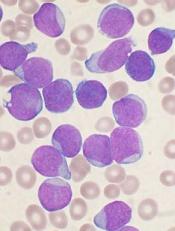
Image by Vashi Donsk
Adding rituximab to a chemotherapy regimen can improve event-free survival (EFS) in adults with newly diagnosed, CD20-positive acute lymphoblastic leukemia (ALL), according to the GRAALL-2005/R study.
The 2-year EFS was significantly higher for patients who received rituximab than for those who received chemotherapy alone.
However, there was no significant difference between the groups in 2-year overall survival.
Sébastien Maury, MD, PhD, of Hȏpital Hénri Mondor in Creteil, France, and his colleagues reported these results in NEJM. Results from this study were previously presented at the 2015 ASH Annual Meeting.
The study included 209 patients with newly diagnosed, Ph-negative, B-cell precursor ALL with 20% or more CD20-positive leukemic blasts.
The patients’ median age was 40.2 (range, 24.5–52.6), 13% had an ECOG performance status greater than 1, 6% had CNS involvement, and 21% had a white blood cell count of 30 x 109/L or higher.
Half of the patients (n=104) were randomized to receive the GRAALL-2005 regimen, and the other half (n=105) were randomized to receive the same regimen plus rituximab. Details on the regimens are available in the supplementary material published with the NEJM paper.
Baseline patient characteristics were well-balanced between the treatment groups.
Results
At a median follow-up of 30 months, 101 patients (48%) had at least 1 event, including 44 (42%) in the rituximab group and 57 (55%) in the control group.
There were 17 induction failures (8 in the rituximab group and 9 in the control group), 57 relapses (22 and 35, respectively), and 27 deaths during remission (14 and 13, respectively). Two patients in the rituximab group were lost to follow-up during the first 12 months.
The 2-year EFS was significantly higher in the rituximab group than the control group—65% and 52%, respectively (hazard ratio [HR]=0.66, P=0.04).
However, the EFS benefit did not translate into a significant improvement in overall survival. The 2-year overall survival was 71% in the rituximab group and 64% in the control group (HR=0.70, P=0.10).
Similarly, the cumulative incidence of death during first remission was not significantly different between the treatment groups—12% for both (HR=0.98, P=0.96).
The researchers said the difference in EFS was mostly due to a lower incidence of relapse in the rituximab group. The 2-year incidence of relapse was 18% in the rituximab group and 32% in the control group (HR=0.52, P=0.02).
In a multivariate analysis, receiving the control treatment, older age, higher white blood cell count at baseline, and CNS involvement were all significantly associated with poor EFS.
There were 245 severe adverse events (AEs) reported in 124 patients—67 patients with 1 event, 26 with 2 events, 13 with 3 events, and 18 with 4 or more events.
The overall incidence of severe AEs did not differ significantly between the treatment groups—96% in the rituximab group and 92% in the control group.
Severe AEs included infection, laboratory abnormalities, allergic reactions, neurologic events, pulmonary events, coagulopathy, cardiac events, gastrointestinal events, and “other” events.
The only severe AE for which there was a significant difference between the treatment groups was allergic reactions. There were 2 severe allergic events in the rituximab group and 14 in the control group (P=0.002). Of these 16 events, all but 1 were due to asparaginase.
The researchers therefore theorized that rituximab might inhibit B-cell protection of antibodies against asparaginase, although they could not confirm this hypothesis.
Image by Vashi Donsk
Adding rituximab to a chemotherapy regimen can improve event-free survival (EFS) in adults with newly diagnosed, CD20-positive acute lymphoblastic leukemia (ALL), according to the GRAALL-2005/R study.
The 2-year EFS was significantly higher for patients who received rituximab than for those who received chemotherapy alone.
However, there was no significant difference between the groups in 2-year overall survival.
Sébastien Maury, MD, PhD, of Hȏpital Hénri Mondor in Creteil, France, and his colleagues reported these results in NEJM. Results from this study were previously presented at the 2015 ASH Annual Meeting.
The study included 209 patients with newly diagnosed, Ph-negative, B-cell precursor ALL with 20% or more CD20-positive leukemic blasts.
The patients’ median age was 40.2 (range, 24.5–52.6), 13% had an ECOG performance status greater than 1, 6% had CNS involvement, and 21% had a white blood cell count of 30 x 109/L or higher.
Half of the patients (n=104) were randomized to receive the GRAALL-2005 regimen, and the other half (n=105) were randomized to receive the same regimen plus rituximab. Details on the regimens are available in the supplementary material published with the NEJM paper.
Baseline patient characteristics were well-balanced between the treatment groups.
Results
At a median follow-up of 30 months, 101 patients (48%) had at least 1 event, including 44 (42%) in the rituximab group and 57 (55%) in the control group.
There were 17 induction failures (8 in the rituximab group and 9 in the control group), 57 relapses (22 and 35, respectively), and 27 deaths during remission (14 and 13, respectively). Two patients in the rituximab group were lost to follow-up during the first 12 months.
The 2-year EFS was significantly higher in the rituximab group than the control group—65% and 52%, respectively (hazard ratio [HR]=0.66, P=0.04).
However, the EFS benefit did not translate into a significant improvement in overall survival. The 2-year overall survival was 71% in the rituximab group and 64% in the control group (HR=0.70, P=0.10).
Similarly, the cumulative incidence of death during first remission was not significantly different between the treatment groups—12% for both (HR=0.98, P=0.96).
The researchers said the difference in EFS was mostly due to a lower incidence of relapse in the rituximab group. The 2-year incidence of relapse was 18% in the rituximab group and 32% in the control group (HR=0.52, P=0.02).
In a multivariate analysis, receiving the control treatment, older age, higher white blood cell count at baseline, and CNS involvement were all significantly associated with poor EFS.
There were 245 severe adverse events (AEs) reported in 124 patients—67 patients with 1 event, 26 with 2 events, 13 with 3 events, and 18 with 4 or more events.
The overall incidence of severe AEs did not differ significantly between the treatment groups—96% in the rituximab group and 92% in the control group.
Severe AEs included infection, laboratory abnormalities, allergic reactions, neurologic events, pulmonary events, coagulopathy, cardiac events, gastrointestinal events, and “other” events.
The only severe AE for which there was a significant difference between the treatment groups was allergic reactions. There were 2 severe allergic events in the rituximab group and 14 in the control group (P=0.002). Of these 16 events, all but 1 were due to asparaginase.
The researchers therefore theorized that rituximab might inhibit B-cell protection of antibodies against asparaginase, although they could not confirm this hypothesis.
Image by Vashi Donsk
Adding rituximab to a chemotherapy regimen can improve event-free survival (EFS) in adults with newly diagnosed, CD20-positive acute lymphoblastic leukemia (ALL), according to the GRAALL-2005/R study.
The 2-year EFS was significantly higher for patients who received rituximab than for those who received chemotherapy alone.
However, there was no significant difference between the groups in 2-year overall survival.
Sébastien Maury, MD, PhD, of Hȏpital Hénri Mondor in Creteil, France, and his colleagues reported these results in NEJM. Results from this study were previously presented at the 2015 ASH Annual Meeting.
The study included 209 patients with newly diagnosed, Ph-negative, B-cell precursor ALL with 20% or more CD20-positive leukemic blasts.
The patients’ median age was 40.2 (range, 24.5–52.6), 13% had an ECOG performance status greater than 1, 6% had CNS involvement, and 21% had a white blood cell count of 30 x 109/L or higher.
Half of the patients (n=104) were randomized to receive the GRAALL-2005 regimen, and the other half (n=105) were randomized to receive the same regimen plus rituximab. Details on the regimens are available in the supplementary material published with the NEJM paper.
Baseline patient characteristics were well-balanced between the treatment groups.
Results
At a median follow-up of 30 months, 101 patients (48%) had at least 1 event, including 44 (42%) in the rituximab group and 57 (55%) in the control group.
There were 17 induction failures (8 in the rituximab group and 9 in the control group), 57 relapses (22 and 35, respectively), and 27 deaths during remission (14 and 13, respectively). Two patients in the rituximab group were lost to follow-up during the first 12 months.
The 2-year EFS was significantly higher in the rituximab group than the control group—65% and 52%, respectively (hazard ratio [HR]=0.66, P=0.04).
However, the EFS benefit did not translate into a significant improvement in overall survival. The 2-year overall survival was 71% in the rituximab group and 64% in the control group (HR=0.70, P=0.10).
Similarly, the cumulative incidence of death during first remission was not significantly different between the treatment groups—12% for both (HR=0.98, P=0.96).
The researchers said the difference in EFS was mostly due to a lower incidence of relapse in the rituximab group. The 2-year incidence of relapse was 18% in the rituximab group and 32% in the control group (HR=0.52, P=0.02).
In a multivariate analysis, receiving the control treatment, older age, higher white blood cell count at baseline, and CNS involvement were all significantly associated with poor EFS.
There were 245 severe adverse events (AEs) reported in 124 patients—67 patients with 1 event, 26 with 2 events, 13 with 3 events, and 18 with 4 or more events.
The overall incidence of severe AEs did not differ significantly between the treatment groups—96% in the rituximab group and 92% in the control group.
Severe AEs included infection, laboratory abnormalities, allergic reactions, neurologic events, pulmonary events, coagulopathy, cardiac events, gastrointestinal events, and “other” events.
The only severe AE for which there was a significant difference between the treatment groups was allergic reactions. There were 2 severe allergic events in the rituximab group and 14 in the control group (P=0.002). Of these 16 events, all but 1 were due to asparaginase.
The researchers therefore theorized that rituximab might inhibit B-cell protection of antibodies against asparaginase, although they could not confirm this hypothesis.
Collaborative depression care for teens: Cost effective over time
Team-based care for adolescent depression is cost effective in the long run, and easily meets the most rigid of third-party payer payment thresholds, a study found.
In a randomized, controlled, multisite study, 105 adolescents aged 13-17 years who screened positive for depression in the ROAD (Reaching Out to Adolescents in Distress) trial were given care as usual in a primary care setting or collaborative evidence-based treatment (with antidepressants, psychotherapy or both) plus regular follow-up with a behavioral health specialist. Controls were given their depression screening results and told they could access mental health services from a large health care network at their discretion. Non–English speaking teens, those already in psychiatric care, those with a bipolar or substance misuse diagnosis, and those with a suicide plan or a recent history of attempt were excluded. Ultimately, 101 youths completed the study, with 50 receiving the study intervention, said Davene R.Wright, PhD, of the University of Washington in Seattle, and associates (JAMA Pediatr. 2016. doi: 10.1001/jamapediatrics.2016.1721).

The overall health care plan costs did not differ significantly between the groups, with an average of $5,161 for the study group, compared with $5,752 for controls. The cost of delivering specialty care added an average of $1,475 to cost of care per patient – about 22% of the total collaborative care costs – making $883 the net mean difference in the cost of care between the groups.
The study group had a slightly higher daily utility value at 0.78, compared with 0.73 for controls, based on their Child Depression Rating Scale-Revised scores. This made the difference in the overall effectiveness of the two treatments 0.04 in quality-adjusted life-years (QALY).
When dividing the net cost of the collaborative model by its net effectiveness over time, the cost of treatment was $18,239 per QALY gained. Bootstrap uncertainty analyses used to determine confidence intervals in the study showed that 25.9% of cases would result in the intervention both costing less and increasing QALYs. Third-party payers consider an incremental cost-effectiveness ratio of $50,000 per QALY gained or below the threshold for payment.
The study did not take into account out-of-pocket or time costs incurred by patients’ families, nor did it consider school absenteeism and use of school counseling services, so the total societal costs and economic burden of treating adolescent depression are not accounted for in this study. However, the investigators concluded that collaborative teen depression care saves money and improves outcomes over time, at least from the payer’s perspective.
On Twitter @whitneymcknight
Team-based care for adolescent depression is cost effective in the long run, and easily meets the most rigid of third-party payer payment thresholds, a study found.
In a randomized, controlled, multisite study, 105 adolescents aged 13-17 years who screened positive for depression in the ROAD (Reaching Out to Adolescents in Distress) trial were given care as usual in a primary care setting or collaborative evidence-based treatment (with antidepressants, psychotherapy or both) plus regular follow-up with a behavioral health specialist. Controls were given their depression screening results and told they could access mental health services from a large health care network at their discretion. Non–English speaking teens, those already in psychiatric care, those with a bipolar or substance misuse diagnosis, and those with a suicide plan or a recent history of attempt were excluded. Ultimately, 101 youths completed the study, with 50 receiving the study intervention, said Davene R.Wright, PhD, of the University of Washington in Seattle, and associates (JAMA Pediatr. 2016. doi: 10.1001/jamapediatrics.2016.1721).
The overall health care plan costs did not differ significantly between the groups, with an average of $5,161 for the study group, compared with $5,752 for controls. The cost of delivering specialty care added an average of $1,475 to cost of care per patient – about 22% of the total collaborative care costs – making $883 the net mean difference in the cost of care between the groups.
The study group had a slightly higher daily utility value at 0.78, compared with 0.73 for controls, based on their Child Depression Rating Scale-Revised scores. This made the difference in the overall effectiveness of the two treatments 0.04 in quality-adjusted life-years (QALY).
When dividing the net cost of the collaborative model by its net effectiveness over time, the cost of treatment was $18,239 per QALY gained. Bootstrap uncertainty analyses used to determine confidence intervals in the study showed that 25.9% of cases would result in the intervention both costing less and increasing QALYs. Third-party payers consider an incremental cost-effectiveness ratio of $50,000 per QALY gained or below the threshold for payment.
The study did not take into account out-of-pocket or time costs incurred by patients’ families, nor did it consider school absenteeism and use of school counseling services, so the total societal costs and economic burden of treating adolescent depression are not accounted for in this study. However, the investigators concluded that collaborative teen depression care saves money and improves outcomes over time, at least from the payer’s perspective.
On Twitter @whitneymcknight
Team-based care for adolescent depression is cost effective in the long run, and easily meets the most rigid of third-party payer payment thresholds, a study found.
In a randomized, controlled, multisite study, 105 adolescents aged 13-17 years who screened positive for depression in the ROAD (Reaching Out to Adolescents in Distress) trial were given care as usual in a primary care setting or collaborative evidence-based treatment (with antidepressants, psychotherapy or both) plus regular follow-up with a behavioral health specialist. Controls were given their depression screening results and told they could access mental health services from a large health care network at their discretion. Non–English speaking teens, those already in psychiatric care, those with a bipolar or substance misuse diagnosis, and those with a suicide plan or a recent history of attempt were excluded. Ultimately, 101 youths completed the study, with 50 receiving the study intervention, said Davene R.Wright, PhD, of the University of Washington in Seattle, and associates (JAMA Pediatr. 2016. doi: 10.1001/jamapediatrics.2016.1721).
The overall health care plan costs did not differ significantly between the groups, with an average of $5,161 for the study group, compared with $5,752 for controls. The cost of delivering specialty care added an average of $1,475 to cost of care per patient – about 22% of the total collaborative care costs – making $883 the net mean difference in the cost of care between the groups.
The study group had a slightly higher daily utility value at 0.78, compared with 0.73 for controls, based on their Child Depression Rating Scale-Revised scores. This made the difference in the overall effectiveness of the two treatments 0.04 in quality-adjusted life-years (QALY).
When dividing the net cost of the collaborative model by its net effectiveness over time, the cost of treatment was $18,239 per QALY gained. Bootstrap uncertainty analyses used to determine confidence intervals in the study showed that 25.9% of cases would result in the intervention both costing less and increasing QALYs. Third-party payers consider an incremental cost-effectiveness ratio of $50,000 per QALY gained or below the threshold for payment.
The study did not take into account out-of-pocket or time costs incurred by patients’ families, nor did it consider school absenteeism and use of school counseling services, so the total societal costs and economic burden of treating adolescent depression are not accounted for in this study. However, the investigators concluded that collaborative teen depression care saves money and improves outcomes over time, at least from the payer’s perspective.
On Twitter @whitneymcknight
Key clinical point: Team-based care for treating adolescent depression is cost effective over time and meets strict willingness-to-pay thresholds.
Major finding: The cost of integrated care totaled between $18,239 and $24,408 in quality-adjusted life-years gained, well below the $50,000 per QALY demanded by most insurers.
Data source: Randomized, controlled, multisite study of 101 teens given depression care for a year.
Disclosures: None of the study authors reported any disclosures. The study was funded by the National Institute of Mental Health.

No link between vasectomy, prostate cancer in U.S. cohort
Vasectomy does not appear to be associated with prostate cancer mortality or prostate cancer incidence, according to findings from a large U.S. prospective cohort of men aged 40 years or older.
Prostate cancer mortality was examined in the overall Cancer Prevention Study II (CPS-II) cohort of 363,726 men, including 7,451 who died as a result of prostate cancer between 1982 and 2012, and no association was found with vasectomy (hazard ratio, 1.01).

Overall and high-grade prostate cancer incidence rates were examined among 66,542 men from the CPS-II Nutrition cohort subgroup, including 9,133 who were diagnosed with prostate cancer between 1991 and 2011, and again no associations were found with vasectomy (HR, 1.02 and 0.91, respectively), Eric J. Jacobs, PhD, and his colleagues at the American Cancer Society report (J Clin Oncol. 2016 Sep 19. doi: 10.1200/JCO.2015.66.2361).
Results were similar after adjusting for years since vasectomy and in analyses restricted to men aged 50 years and older, the investigators noted.
Findings from prior, smaller studies have been conflicting, but the current study – the largest-known study to date to examine the association between vasectomy and prostate cancer, according to the authors – provides “some reassurance that vasectomy is unlikely to meaningfully increase risk of prostate cancer,” they wrote.
The authors reported having no disclosures.
Vasectomy does not appear to be associated with prostate cancer mortality or prostate cancer incidence, according to findings from a large U.S. prospective cohort of men aged 40 years or older.
Prostate cancer mortality was examined in the overall Cancer Prevention Study II (CPS-II) cohort of 363,726 men, including 7,451 who died as a result of prostate cancer between 1982 and 2012, and no association was found with vasectomy (hazard ratio, 1.01).
Overall and high-grade prostate cancer incidence rates were examined among 66,542 men from the CPS-II Nutrition cohort subgroup, including 9,133 who were diagnosed with prostate cancer between 1991 and 2011, and again no associations were found with vasectomy (HR, 1.02 and 0.91, respectively), Eric J. Jacobs, PhD, and his colleagues at the American Cancer Society report (J Clin Oncol. 2016 Sep 19. doi: 10.1200/JCO.2015.66.2361).
Results were similar after adjusting for years since vasectomy and in analyses restricted to men aged 50 years and older, the investigators noted.
Findings from prior, smaller studies have been conflicting, but the current study – the largest-known study to date to examine the association between vasectomy and prostate cancer, according to the authors – provides “some reassurance that vasectomy is unlikely to meaningfully increase risk of prostate cancer,” they wrote.
The authors reported having no disclosures.
Vasectomy does not appear to be associated with prostate cancer mortality or prostate cancer incidence, according to findings from a large U.S. prospective cohort of men aged 40 years or older.
Prostate cancer mortality was examined in the overall Cancer Prevention Study II (CPS-II) cohort of 363,726 men, including 7,451 who died as a result of prostate cancer between 1982 and 2012, and no association was found with vasectomy (hazard ratio, 1.01).
Overall and high-grade prostate cancer incidence rates were examined among 66,542 men from the CPS-II Nutrition cohort subgroup, including 9,133 who were diagnosed with prostate cancer between 1991 and 2011, and again no associations were found with vasectomy (HR, 1.02 and 0.91, respectively), Eric J. Jacobs, PhD, and his colleagues at the American Cancer Society report (J Clin Oncol. 2016 Sep 19. doi: 10.1200/JCO.2015.66.2361).
Results were similar after adjusting for years since vasectomy and in analyses restricted to men aged 50 years and older, the investigators noted.
Findings from prior, smaller studies have been conflicting, but the current study – the largest-known study to date to examine the association between vasectomy and prostate cancer, according to the authors – provides “some reassurance that vasectomy is unlikely to meaningfully increase risk of prostate cancer,” they wrote.
The authors reported having no disclosures.
FROM THE JOURNAL OF CLINICAL ONCOLOGY
Key clinical point: Vasectomy does not appear to be associated with prostate cancer mortality or prostate cancer incidence, according to findings from a large U.S. prospective cohort of men aged 40 years or older.
Major finding: No association between vasectomy and prostate cancer mortality (HR, 1.01), or between vasectomy and overall and high-grade prostate cancer incidence (HR, 1.02 and 0.91, respectively).
Data source: The prospective CPS II cohort (363,726 men) and CPS-II Nutrition Cohort (66,542 men).
Disclosures: The authors reported having no disclosures.

Ocrelizumab Increases Likelihood of No Evidence of Disease Progression

Primary progressive MS is characterized by steadily increasing, objectively documented neurologic dysfunction or disability without recovery, although patients may have fluctuations and phases of stability.
Primary progressive MS remains a severely disabling condition with high unmet medical need. Investigators believe that B cells contribute to the pathogenesis of MS, including primary progressive MS. Ocrelizumab, a recombinant humanized monoclonal antibody that selectively targets CD20+ B cells, showed superior efficacy and favorable safety, compared with placebo, in the phase III ORATORIO study in patients with primary progressive MS.
Xavier Montalban, MD, PhD, Chair of the Department of Neurology-Neuroimmunology and Director of the Multiple Sclerosis Centre of Catalonia at Vall d’Hebron University Hospital in Barcelona, and colleagues sought to assess the effect of ocrelizumab from baseline to Week 120 on the proportion of patients with NEP in the ORATORIO study.
In all, 732 patients were randomized (2:1) to receive 600 mg of ocrelizumab as two 300-mg IV infusions 14 days apart, or placebo every 24 weeks for at least 120 weeks until a prespecified number of 12-week confirmed disability progression events (as measured by Expanded Disability Status Scale score) occurred. Patients with NEP were defined as having no 12-week confirmed disability progression, and no 12-week confirmed progression of 20% or more on the timed 25-foot walk test and on the nine-hole peg test. A total of 230 placebo-treated patients and 461 ocrelizumab-treated patients were evaluable in this exploratory analysis of the ORATORIO trial.
Compared with placebo, ocrelizumab significantly increased the proportion of patients with NEP at Week 120. The relative risk of NEP for ocrelizumab versus placebo was 1.47. The proportions of ocrelizumab- and placebo-treated patients with NEP up to Week 120 were 42.7% and 29.1%, respectively. This result represents a 47% relative increase in the ocrelizumab group. The proportions of ocrelizumab- and placebo-treated patients with NEP for the individual components of NEP up to Week 120 were 68.5% and 63.0%, respectively, for 12-week confirmed disability progression; 51.0% and 38.7%, respectively, for the timed 25-foot walk test; and 82.2% and 71.3%, respectively for the nine-hole peg test.
The study was sponsored by F. Hoffmann-La Roche.
Primary progressive MS is characterized by steadily increasing, objectively documented neurologic dysfunction or disability without recovery, although patients may have fluctuations and phases of stability.
Primary progressive MS remains a severely disabling condition with high unmet medical need. Investigators believe that B cells contribute to the pathogenesis of MS, including primary progressive MS. Ocrelizumab, a recombinant humanized monoclonal antibody that selectively targets CD20+ B cells, showed superior efficacy and favorable safety, compared with placebo, in the phase III ORATORIO study in patients with primary progressive MS.
Xavier Montalban, MD, PhD, Chair of the Department of Neurology-Neuroimmunology and Director of the Multiple Sclerosis Centre of Catalonia at Vall d’Hebron University Hospital in Barcelona, and colleagues sought to assess the effect of ocrelizumab from baseline to Week 120 on the proportion of patients with NEP in the ORATORIO study.
In all, 732 patients were randomized (2:1) to receive 600 mg of ocrelizumab as two 300-mg IV infusions 14 days apart, or placebo every 24 weeks for at least 120 weeks until a prespecified number of 12-week confirmed disability progression events (as measured by Expanded Disability Status Scale score) occurred. Patients with NEP were defined as having no 12-week confirmed disability progression, and no 12-week confirmed progression of 20% or more on the timed 25-foot walk test and on the nine-hole peg test. A total of 230 placebo-treated patients and 461 ocrelizumab-treated patients were evaluable in this exploratory analysis of the ORATORIO trial.
Compared with placebo, ocrelizumab significantly increased the proportion of patients with NEP at Week 120. The relative risk of NEP for ocrelizumab versus placebo was 1.47. The proportions of ocrelizumab- and placebo-treated patients with NEP up to Week 120 were 42.7% and 29.1%, respectively. This result represents a 47% relative increase in the ocrelizumab group. The proportions of ocrelizumab- and placebo-treated patients with NEP for the individual components of NEP up to Week 120 were 68.5% and 63.0%, respectively, for 12-week confirmed disability progression; 51.0% and 38.7%, respectively, for the timed 25-foot walk test; and 82.2% and 71.3%, respectively for the nine-hole peg test.
The study was sponsored by F. Hoffmann-La Roche.
Primary progressive MS is characterized by steadily increasing, objectively documented neurologic dysfunction or disability without recovery, although patients may have fluctuations and phases of stability.
Primary progressive MS remains a severely disabling condition with high unmet medical need. Investigators believe that B cells contribute to the pathogenesis of MS, including primary progressive MS. Ocrelizumab, a recombinant humanized monoclonal antibody that selectively targets CD20+ B cells, showed superior efficacy and favorable safety, compared with placebo, in the phase III ORATORIO study in patients with primary progressive MS.
Xavier Montalban, MD, PhD, Chair of the Department of Neurology-Neuroimmunology and Director of the Multiple Sclerosis Centre of Catalonia at Vall d’Hebron University Hospital in Barcelona, and colleagues sought to assess the effect of ocrelizumab from baseline to Week 120 on the proportion of patients with NEP in the ORATORIO study.
In all, 732 patients were randomized (2:1) to receive 600 mg of ocrelizumab as two 300-mg IV infusions 14 days apart, or placebo every 24 weeks for at least 120 weeks until a prespecified number of 12-week confirmed disability progression events (as measured by Expanded Disability Status Scale score) occurred. Patients with NEP were defined as having no 12-week confirmed disability progression, and no 12-week confirmed progression of 20% or more on the timed 25-foot walk test and on the nine-hole peg test. A total of 230 placebo-treated patients and 461 ocrelizumab-treated patients were evaluable in this exploratory analysis of the ORATORIO trial.
Compared with placebo, ocrelizumab significantly increased the proportion of patients with NEP at Week 120. The relative risk of NEP for ocrelizumab versus placebo was 1.47. The proportions of ocrelizumab- and placebo-treated patients with NEP up to Week 120 were 42.7% and 29.1%, respectively. This result represents a 47% relative increase in the ocrelizumab group. The proportions of ocrelizumab- and placebo-treated patients with NEP for the individual components of NEP up to Week 120 were 68.5% and 63.0%, respectively, for 12-week confirmed disability progression; 51.0% and 38.7%, respectively, for the timed 25-foot walk test; and 82.2% and 71.3%, respectively for the nine-hole peg test.
The study was sponsored by F. Hoffmann-La Roche.
Arbaclofen Extended-Release Tablets Are Effective for MS Spasticity

Spasticity is common in MS and is associated with significant morbidity. The standard treatment is oral administration of baclofen, a γ-aminobutyric acid-b (GABA-b) receptor agonist. Baclofen is a racemic mixture, and its efficacy is thought to result from the R-enantiomer (arbaclofen). Therapeutic doses of baclofen can cause CNS side effects, decreased adherence, and decreased tolerability. Arbaclofen extended-release tablets potentially could reduce dosing frequency and adverse events.
Daniel Kantor, MD, a neurologist from Coconut Creek, Florida, and colleagues conducted a multicenter, randomized, double-blind, parallel-group study to compare the efficacy and safety of arbaclofen extended-release tablets to those of placebo and baclofen over 12 weeks of treatment in patients with spasticity due to MS. Participants were randomized to receive 20 mg of arbaclofen bid, 20 mg of baclofen tablets qid, or matching placebo. The dose was titrated over four weeks, followed by a 12-week maintenance period. The primary end points were the mean changes in Total Numeric-transformed Modified Ashworth Scale (TNmAS) and Clinician Global Impression of Change (CGIC) at the end of the maintenance period.
Of 354 randomized participants, 59.0% had relapsing-remitting MS and 36.7% had secondary progressive MS. The average baseline TNmAS score was 7.78. Mean changes in TNmAS and CGIC were significantly greater for patients receiving arbaclofen, compared with patients receiving placebo. The researchers observed a greater difference in CGIC between arbaclofen and placebo, compared with that between baclofen and placebo, perhaps because of improved tolerability of arbaclofen, compared with baclofen. Differences between arbaclofen and baclofen were not statistically significant. MS Spasticity Scale (MSSS-88) showed a statistically significant improvement among patients receiving arbaclofen, compared with those receiving placebo. Epworth Sleepiness Scale (ESS) showed a statistically significant increase in sleepiness in the baclofen group, but not in the arbaclofen group, compared with placebo. Drowsiness and dizziness were less frequent in the arbaclofen group, compared with baclofen.
The study was supported by Osmotica Pharmaceutical.
Spasticity is common in MS and is associated with significant morbidity. The standard treatment is oral administration of baclofen, a γ-aminobutyric acid-b (GABA-b) receptor agonist. Baclofen is a racemic mixture, and its efficacy is thought to result from the R-enantiomer (arbaclofen). Therapeutic doses of baclofen can cause CNS side effects, decreased adherence, and decreased tolerability. Arbaclofen extended-release tablets potentially could reduce dosing frequency and adverse events.
Daniel Kantor, MD, a neurologist from Coconut Creek, Florida, and colleagues conducted a multicenter, randomized, double-blind, parallel-group study to compare the efficacy and safety of arbaclofen extended-release tablets to those of placebo and baclofen over 12 weeks of treatment in patients with spasticity due to MS. Participants were randomized to receive 20 mg of arbaclofen bid, 20 mg of baclofen tablets qid, or matching placebo. The dose was titrated over four weeks, followed by a 12-week maintenance period. The primary end points were the mean changes in Total Numeric-transformed Modified Ashworth Scale (TNmAS) and Clinician Global Impression of Change (CGIC) at the end of the maintenance period.
Of 354 randomized participants, 59.0% had relapsing-remitting MS and 36.7% had secondary progressive MS. The average baseline TNmAS score was 7.78. Mean changes in TNmAS and CGIC were significantly greater for patients receiving arbaclofen, compared with patients receiving placebo. The researchers observed a greater difference in CGIC between arbaclofen and placebo, compared with that between baclofen and placebo, perhaps because of improved tolerability of arbaclofen, compared with baclofen. Differences between arbaclofen and baclofen were not statistically significant. MS Spasticity Scale (MSSS-88) showed a statistically significant improvement among patients receiving arbaclofen, compared with those receiving placebo. Epworth Sleepiness Scale (ESS) showed a statistically significant increase in sleepiness in the baclofen group, but not in the arbaclofen group, compared with placebo. Drowsiness and dizziness were less frequent in the arbaclofen group, compared with baclofen.
The study was supported by Osmotica Pharmaceutical.
Spasticity is common in MS and is associated with significant morbidity. The standard treatment is oral administration of baclofen, a γ-aminobutyric acid-b (GABA-b) receptor agonist. Baclofen is a racemic mixture, and its efficacy is thought to result from the R-enantiomer (arbaclofen). Therapeutic doses of baclofen can cause CNS side effects, decreased adherence, and decreased tolerability. Arbaclofen extended-release tablets potentially could reduce dosing frequency and adverse events.
Daniel Kantor, MD, a neurologist from Coconut Creek, Florida, and colleagues conducted a multicenter, randomized, double-blind, parallel-group study to compare the efficacy and safety of arbaclofen extended-release tablets to those of placebo and baclofen over 12 weeks of treatment in patients with spasticity due to MS. Participants were randomized to receive 20 mg of arbaclofen bid, 20 mg of baclofen tablets qid, or matching placebo. The dose was titrated over four weeks, followed by a 12-week maintenance period. The primary end points were the mean changes in Total Numeric-transformed Modified Ashworth Scale (TNmAS) and Clinician Global Impression of Change (CGIC) at the end of the maintenance period.
Of 354 randomized participants, 59.0% had relapsing-remitting MS and 36.7% had secondary progressive MS. The average baseline TNmAS score was 7.78. Mean changes in TNmAS and CGIC were significantly greater for patients receiving arbaclofen, compared with patients receiving placebo. The researchers observed a greater difference in CGIC between arbaclofen and placebo, compared with that between baclofen and placebo, perhaps because of improved tolerability of arbaclofen, compared with baclofen. Differences between arbaclofen and baclofen were not statistically significant. MS Spasticity Scale (MSSS-88) showed a statistically significant improvement among patients receiving arbaclofen, compared with those receiving placebo. Epworth Sleepiness Scale (ESS) showed a statistically significant increase in sleepiness in the baclofen group, but not in the arbaclofen group, compared with placebo. Drowsiness and dizziness were less frequent in the arbaclofen group, compared with baclofen.
The study was supported by Osmotica Pharmaceutical.
Whole body cryotherapy improved mild cognitive impairment in small uncontrolled trial
SAN FRANCISCO – Whole body cryotherapy led to significant improvements in memory and significant but less durable reductions in depressive symptoms among older patients with mild cognitive impairment in a small, uncontrolled trial.
“We cannot call whole body cryotherapy a treatment yet, but we have some good preliminary results suggesting that this might be a natural method of treating memory impairment,” Joanna Rymaszewska, MD, PhD, of Wroclaw (Poland) Medical University said during an oral presentation at the at the 2016 congress of the International Psychogeriatric Association. Based on this and other work, whole body cryotherapy also might ease depression if patients were able to undergo regular long-term treatment, she said.
Very low temperatures have antioxidant and anti-inflammatory effects, which originally sparked the idea that cryotherapy might help prevent dementia, Dr. Rymaszewska said. To test that hypothesis, she and her colleagues exposed 21 patients with mild cognitive impairment (average baseline Montreal Cognitive Assessment (MoCA) score, 23.8; range, 20-26) to whole body cryotherapy for 2 minutes a day for 10 days, excluding weekends. Patients donned swimsuits, socks, gloves, and mouth covers to facilitate breathing and then walked in pairs around a chamber cooled to between –110° C and –160° C (–166° F to –256° F). “The temperature is so low that you actually cannot feel it,” Dr. Rymaszewska said. The group averaged 65 years of age, and two-thirds were women.
Immediately after the final cryotherapy session and 2 weeks later, patients had improved significantly (P less than .05) from baseline on two-word recall subscales of the DemTect, a psychometric screening tool; on the semantic and anterograde subscales of the 5-minute Test Your Memory (TYM) scale; and on the logical memory subscale of the Saint Louis University Mental Status (SLUMS) exam, Dr. Rymaszewska said.
Enzyme-linked immunoassays showed no significant changes in plasma levels of brain-derived neurotrophic factor or in the cytokines interleukin-6, IL-8, or IL-10 before and after cryotherapy, Dr. Rymaszewska said. But after treatment, patients produced significantly more brain-derived neurotrophic factor and significantly less IL-6 and IL-10 and in response to amyloid-beta, she added. “These preliminary results show a positive influence of whole body cryostimulation on mnestic processes in people with mild cognitive impairment, but the biological mechanisms need further investigation,” she concluded.
Patients also improved significantly on the short form,15-item Geriatric Depression Scale (GDS-15) immediately after finishing cryotherapy. However, the effect was less durable, having lost statistical significance 2 weeks later, Dr. Rymaszewska said. However, parallel studies of the effects of whole body cryotherapy on mood and depression are showing early positive results, she said.
Cryotherapy is so well known in Poland that it would not have been possible to blind a control group to a less-cold “placebo” intervention, Dr. Rymaszewska noted.
The Ministry of Science and Higher Education in Poland helped fund the research. Dr. Rymaszewska had no disclosures.
SAN FRANCISCO – Whole body cryotherapy led to significant improvements in memory and significant but less durable reductions in depressive symptoms among older patients with mild cognitive impairment in a small, uncontrolled trial.
“We cannot call whole body cryotherapy a treatment yet, but we have some good preliminary results suggesting that this might be a natural method of treating memory impairment,” Joanna Rymaszewska, MD, PhD, of Wroclaw (Poland) Medical University said during an oral presentation at the at the 2016 congress of the International Psychogeriatric Association. Based on this and other work, whole body cryotherapy also might ease depression if patients were able to undergo regular long-term treatment, she said.
Very low temperatures have antioxidant and anti-inflammatory effects, which originally sparked the idea that cryotherapy might help prevent dementia, Dr. Rymaszewska said. To test that hypothesis, she and her colleagues exposed 21 patients with mild cognitive impairment (average baseline Montreal Cognitive Assessment (MoCA) score, 23.8; range, 20-26) to whole body cryotherapy for 2 minutes a day for 10 days, excluding weekends. Patients donned swimsuits, socks, gloves, and mouth covers to facilitate breathing and then walked in pairs around a chamber cooled to between –110° C and –160° C (–166° F to –256° F). “The temperature is so low that you actually cannot feel it,” Dr. Rymaszewska said. The group averaged 65 years of age, and two-thirds were women.
Immediately after the final cryotherapy session and 2 weeks later, patients had improved significantly (P less than .05) from baseline on two-word recall subscales of the DemTect, a psychometric screening tool; on the semantic and anterograde subscales of the 5-minute Test Your Memory (TYM) scale; and on the logical memory subscale of the Saint Louis University Mental Status (SLUMS) exam, Dr. Rymaszewska said.
Enzyme-linked immunoassays showed no significant changes in plasma levels of brain-derived neurotrophic factor or in the cytokines interleukin-6, IL-8, or IL-10 before and after cryotherapy, Dr. Rymaszewska said. But after treatment, patients produced significantly more brain-derived neurotrophic factor and significantly less IL-6 and IL-10 and in response to amyloid-beta, she added. “These preliminary results show a positive influence of whole body cryostimulation on mnestic processes in people with mild cognitive impairment, but the biological mechanisms need further investigation,” she concluded.
Patients also improved significantly on the short form,15-item Geriatric Depression Scale (GDS-15) immediately after finishing cryotherapy. However, the effect was less durable, having lost statistical significance 2 weeks later, Dr. Rymaszewska said. However, parallel studies of the effects of whole body cryotherapy on mood and depression are showing early positive results, she said.
Cryotherapy is so well known in Poland that it would not have been possible to blind a control group to a less-cold “placebo” intervention, Dr. Rymaszewska noted.
The Ministry of Science and Higher Education in Poland helped fund the research. Dr. Rymaszewska had no disclosures.
SAN FRANCISCO – Whole body cryotherapy led to significant improvements in memory and significant but less durable reductions in depressive symptoms among older patients with mild cognitive impairment in a small, uncontrolled trial.
“We cannot call whole body cryotherapy a treatment yet, but we have some good preliminary results suggesting that this might be a natural method of treating memory impairment,” Joanna Rymaszewska, MD, PhD, of Wroclaw (Poland) Medical University said during an oral presentation at the at the 2016 congress of the International Psychogeriatric Association. Based on this and other work, whole body cryotherapy also might ease depression if patients were able to undergo regular long-term treatment, she said.
Very low temperatures have antioxidant and anti-inflammatory effects, which originally sparked the idea that cryotherapy might help prevent dementia, Dr. Rymaszewska said. To test that hypothesis, she and her colleagues exposed 21 patients with mild cognitive impairment (average baseline Montreal Cognitive Assessment (MoCA) score, 23.8; range, 20-26) to whole body cryotherapy for 2 minutes a day for 10 days, excluding weekends. Patients donned swimsuits, socks, gloves, and mouth covers to facilitate breathing and then walked in pairs around a chamber cooled to between –110° C and –160° C (–166° F to –256° F). “The temperature is so low that you actually cannot feel it,” Dr. Rymaszewska said. The group averaged 65 years of age, and two-thirds were women.
Immediately after the final cryotherapy session and 2 weeks later, patients had improved significantly (P less than .05) from baseline on two-word recall subscales of the DemTect, a psychometric screening tool; on the semantic and anterograde subscales of the 5-minute Test Your Memory (TYM) scale; and on the logical memory subscale of the Saint Louis University Mental Status (SLUMS) exam, Dr. Rymaszewska said.
Enzyme-linked immunoassays showed no significant changes in plasma levels of brain-derived neurotrophic factor or in the cytokines interleukin-6, IL-8, or IL-10 before and after cryotherapy, Dr. Rymaszewska said. But after treatment, patients produced significantly more brain-derived neurotrophic factor and significantly less IL-6 and IL-10 and in response to amyloid-beta, she added. “These preliminary results show a positive influence of whole body cryostimulation on mnestic processes in people with mild cognitive impairment, but the biological mechanisms need further investigation,” she concluded.
Patients also improved significantly on the short form,15-item Geriatric Depression Scale (GDS-15) immediately after finishing cryotherapy. However, the effect was less durable, having lost statistical significance 2 weeks later, Dr. Rymaszewska said. However, parallel studies of the effects of whole body cryotherapy on mood and depression are showing early positive results, she said.
Cryotherapy is so well known in Poland that it would not have been possible to blind a control group to a less-cold “placebo” intervention, Dr. Rymaszewska noted.
The Ministry of Science and Higher Education in Poland helped fund the research. Dr. Rymaszewska had no disclosures.
AT IPA 2016
Key clinical point: Whole body cryotherapy might improve memory in patients with mild cognitive impairment.
Major finding: Immediately after the final session and 2 weeks later, patients had improved significantly (P less than .05) from baseline on several subscales of the DemTect, the 5-minute Test Your Memory scale, and the Saint Louis University Mental Status (SLUMS) exam.
Data source: A single-arm study of 21 adults with mild cognitive impairment.
Disclosures: The Ministry of Science and Higher Education in Poland helped fund the research. Dr. Rymaszewska had no disclosures.
ESC’s new lipid guidelines keep LDL-cholesterol targets
ROME – LDL cholesterol treatment targets remain alive and well in non-U.S. lipid management guidelines.
New dyslipidemia management guidelines from the European Society of Cardiology, issued in late August, retain the same LDL cholesterol targets as the prior, 2011 guidelines, a sharp and purposeful departure from the “risk-based” U.S. guidelines introduced in 2013 that eliminated treating patients to specific LDL cholesterol targets.

The new ESC guidelines also incorporated the new class of lipid-lowering drugs, PCSK9 inhibitors (evolocumab [Repatha] and alirocumab [Praluent]), into the treatment algorithm, and carved out a role for ezetimibe (Zetia) following its proven success as an add-on agent to statins (Eur Heart J. 2016. doi: 10.1093/eurheartj/ehw272).
But it’s retention of LDL cholesterol targets as a cornerstone of dyslipidemia management in the new ESC report, written jointly with the European Atherosclerosis Society, that especially distinguishes the new guidelines.
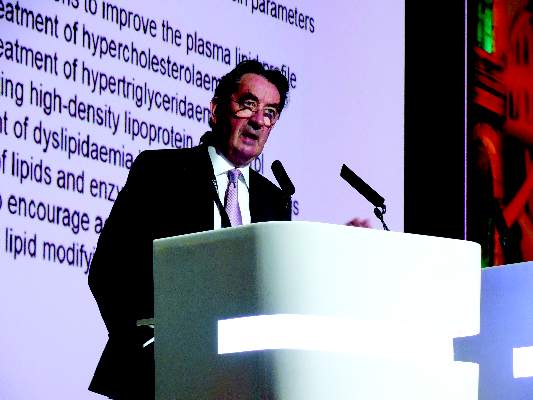
“It seemed to us logical that if you have drugs [statins] that lower LDL cholesterol, then you target LDL cholesterol,” explained Ian M. Graham, MD, professor of cardiovascular medicine at Trinity College in Dublin and cochair of the guidelines panel. “If a patient’s risk is high, they still need to lower LDL cholesterol. It’s not really contradictory to the U.S. approach,” Dr. Graham said in an interview.
The ESC panel’s discussions about the LDL cholesterol targets were “difficult and long,” said Guy De Backer, MD, a member of the guidelines committee and professor of cardiology at the University of Ghent, Belgium, in a session devoted to the new guidelines during the annual congress of the ESC.
The ESC’s decision to retain the 2011 LDL cholesterol targets won praise from U.S. cardiologist Eugene Braunwald, MD. “I think that not measuring and following LDL cholesterol is silly. I don’t agree” with current U.S. guidelines, he said in a talk during the congress. “If you don’t follow LDL cholesterol then you don’t know a patient’s compliance.
Regularly measuring LDL cholesterol is important,” said Dr. Braunwald, professor of medicine at Harvard Medical School in Boston. But he questioned the LDL cholesterol targets set by the ESC panel, specifically the LDL cholesterol goal of less than 70 mg/dL for very-high-risk patients.

“I don’t think the ESC went low enough; the goal should be less than 50 mg/dL,” declared Dr. Braunwald, who added “anything above 50 mg/dL is toxic.”
The new guidelines also made the definition of “very-high-risk” patients “stricter and more precise,” said Alberico L. Catapano, MD, cochair of the panel and professor of pharmacology at the University of Milan.
The guideline’s detailed list defining very-high-risk patients includes those with either clinical or “unequivocal” imaging evidence for cardiovascular disease, as well as patients with diabetes and target-organ damage, severe chronic kidney disease, or a 10% or greater 10-year risk for fatal cardiovascular disease calculated by the European Score risk formula.
The potent lipid-lowering PCSK9 inhibitors came onto the U.S. and European markets in 2015, labeled in the United States specifically for patients with familial hypercholesterolemia.
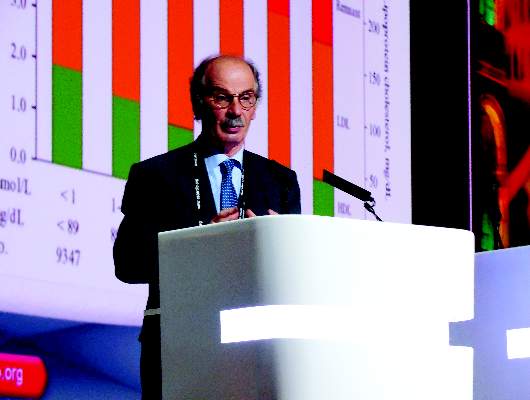
In July 2016, an American College of Cardiology Task Force issued a model clinical-decision pathway for lowering LDL cholesterol levels that for the first time included the PCSK9 inhibitors, specified as a “may be considered” option for selected patients (J Am Coll Cardiol. 2016 Jul;68[1]:92-125). This consensus decision pathway was not a set of actual guidelines, which means the ESC revision is the first guideline to include the PCSK9 inhibitors. The panel took the same stance as the U.S. decision pathway and designated the PCSK9 inhibitors as a “may be considered” option.
Dr. Graham explained that this designation was driven by the current absence of evidence for clinical benefit from the large lipid-lowering effect of the PCSK9 antibodies, although trial results that address this are expected to appear very soon. Experts not on the guidelines panel agreed with this decision.
“We know that it’s crucial to await results from the clinical endpoint studies” before the guidelines committee makes a more forceful recommendation, commented Erik S.G. Stroes, MD, professor of vascular medicine at the Academic Medical Center in Amsterdam. He added, however, that many clinicians, himself included, have been pleased to offer PCSK9-inhibitor treatment to very-high-risk patients with no good alternatives for effectively lowering their LDL cholesterol to target levels, such as statin-intolerant patients or those with LDL cholesterol levels that remain high despite maximal therapy.

The current ESC guideline’s statement on when to use a PCSK9 inhibitor “is vague” said Dr. Braunwald. “Within the next year, we’ll have results from two huge trials that will show clinical outcomes. We know that PCSK9 inhibitors are extremely powerful at lowering LDL cholesterol, but I would like to see the loop closed” with proven effects on clinical outcomes. “I would bet 100 to 1 that they will be effective, but LDL cholesterol is just a surrogate marker, and you need to look in large populations before you make a guideline recommendation to use these drugs, so we’ll wait.”
Once the clinical value of treatment with PCSK9 inhibitors is settled, the next issue will be the cost of these drugs, something that will become a big consideration once they become more widely used, Dr. Braunwald added.
Dr. De Backer and Dr. Graham had no disclosures. Dr. Catapano has been a consultant to Aegerion, Amgen, AstraZeneca, Merck, Pfizer, and Sigma-Tau. Dr. Braunwald has been a consultant to Bayer, Daiichi Sankyo, the Medicines Company, Merck, Novartis, and Sanofi. Dr. Stroes has been a consultant to Amgen, Bristol-Myers Squibb, Merck, and Sanofi.
On Twitter @mitchelzoler
ROME – LDL cholesterol treatment targets remain alive and well in non-U.S. lipid management guidelines.
New dyslipidemia management guidelines from the European Society of Cardiology, issued in late August, retain the same LDL cholesterol targets as the prior, 2011 guidelines, a sharp and purposeful departure from the “risk-based” U.S. guidelines introduced in 2013 that eliminated treating patients to specific LDL cholesterol targets.
The new ESC guidelines also incorporated the new class of lipid-lowering drugs, PCSK9 inhibitors (evolocumab [Repatha] and alirocumab [Praluent]), into the treatment algorithm, and carved out a role for ezetimibe (Zetia) following its proven success as an add-on agent to statins (Eur Heart J. 2016. doi: 10.1093/eurheartj/ehw272).
But it’s retention of LDL cholesterol targets as a cornerstone of dyslipidemia management in the new ESC report, written jointly with the European Atherosclerosis Society, that especially distinguishes the new guidelines.
“It seemed to us logical that if you have drugs [statins] that lower LDL cholesterol, then you target LDL cholesterol,” explained Ian M. Graham, MD, professor of cardiovascular medicine at Trinity College in Dublin and cochair of the guidelines panel. “If a patient’s risk is high, they still need to lower LDL cholesterol. It’s not really contradictory to the U.S. approach,” Dr. Graham said in an interview.
The ESC panel’s discussions about the LDL cholesterol targets were “difficult and long,” said Guy De Backer, MD, a member of the guidelines committee and professor of cardiology at the University of Ghent, Belgium, in a session devoted to the new guidelines during the annual congress of the ESC.
The ESC’s decision to retain the 2011 LDL cholesterol targets won praise from U.S. cardiologist Eugene Braunwald, MD. “I think that not measuring and following LDL cholesterol is silly. I don’t agree” with current U.S. guidelines, he said in a talk during the congress. “If you don’t follow LDL cholesterol then you don’t know a patient’s compliance.
Regularly measuring LDL cholesterol is important,” said Dr. Braunwald, professor of medicine at Harvard Medical School in Boston. But he questioned the LDL cholesterol targets set by the ESC panel, specifically the LDL cholesterol goal of less than 70 mg/dL for very-high-risk patients.
“I don’t think the ESC went low enough; the goal should be less than 50 mg/dL,” declared Dr. Braunwald, who added “anything above 50 mg/dL is toxic.”
The new guidelines also made the definition of “very-high-risk” patients “stricter and more precise,” said Alberico L. Catapano, MD, cochair of the panel and professor of pharmacology at the University of Milan.
The guideline’s detailed list defining very-high-risk patients includes those with either clinical or “unequivocal” imaging evidence for cardiovascular disease, as well as patients with diabetes and target-organ damage, severe chronic kidney disease, or a 10% or greater 10-year risk for fatal cardiovascular disease calculated by the European Score risk formula.
The potent lipid-lowering PCSK9 inhibitors came onto the U.S. and European markets in 2015, labeled in the United States specifically for patients with familial hypercholesterolemia.
In July 2016, an American College of Cardiology Task Force issued a model clinical-decision pathway for lowering LDL cholesterol levels that for the first time included the PCSK9 inhibitors, specified as a “may be considered” option for selected patients (J Am Coll Cardiol. 2016 Jul;68[1]:92-125). This consensus decision pathway was not a set of actual guidelines, which means the ESC revision is the first guideline to include the PCSK9 inhibitors. The panel took the same stance as the U.S. decision pathway and designated the PCSK9 inhibitors as a “may be considered” option.
Dr. Graham explained that this designation was driven by the current absence of evidence for clinical benefit from the large lipid-lowering effect of the PCSK9 antibodies, although trial results that address this are expected to appear very soon. Experts not on the guidelines panel agreed with this decision.
“We know that it’s crucial to await results from the clinical endpoint studies” before the guidelines committee makes a more forceful recommendation, commented Erik S.G. Stroes, MD, professor of vascular medicine at the Academic Medical Center in Amsterdam. He added, however, that many clinicians, himself included, have been pleased to offer PCSK9-inhibitor treatment to very-high-risk patients with no good alternatives for effectively lowering their LDL cholesterol to target levels, such as statin-intolerant patients or those with LDL cholesterol levels that remain high despite maximal therapy.
The current ESC guideline’s statement on when to use a PCSK9 inhibitor “is vague” said Dr. Braunwald. “Within the next year, we’ll have results from two huge trials that will show clinical outcomes. We know that PCSK9 inhibitors are extremely powerful at lowering LDL cholesterol, but I would like to see the loop closed” with proven effects on clinical outcomes. “I would bet 100 to 1 that they will be effective, but LDL cholesterol is just a surrogate marker, and you need to look in large populations before you make a guideline recommendation to use these drugs, so we’ll wait.”
Once the clinical value of treatment with PCSK9 inhibitors is settled, the next issue will be the cost of these drugs, something that will become a big consideration once they become more widely used, Dr. Braunwald added.
Dr. De Backer and Dr. Graham had no disclosures. Dr. Catapano has been a consultant to Aegerion, Amgen, AstraZeneca, Merck, Pfizer, and Sigma-Tau. Dr. Braunwald has been a consultant to Bayer, Daiichi Sankyo, the Medicines Company, Merck, Novartis, and Sanofi. Dr. Stroes has been a consultant to Amgen, Bristol-Myers Squibb, Merck, and Sanofi.
On Twitter @mitchelzoler
ROME – LDL cholesterol treatment targets remain alive and well in non-U.S. lipid management guidelines.
New dyslipidemia management guidelines from the European Society of Cardiology, issued in late August, retain the same LDL cholesterol targets as the prior, 2011 guidelines, a sharp and purposeful departure from the “risk-based” U.S. guidelines introduced in 2013 that eliminated treating patients to specific LDL cholesterol targets.
The new ESC guidelines also incorporated the new class of lipid-lowering drugs, PCSK9 inhibitors (evolocumab [Repatha] and alirocumab [Praluent]), into the treatment algorithm, and carved out a role for ezetimibe (Zetia) following its proven success as an add-on agent to statins (Eur Heart J. 2016. doi: 10.1093/eurheartj/ehw272).
But it’s retention of LDL cholesterol targets as a cornerstone of dyslipidemia management in the new ESC report, written jointly with the European Atherosclerosis Society, that especially distinguishes the new guidelines.
“It seemed to us logical that if you have drugs [statins] that lower LDL cholesterol, then you target LDL cholesterol,” explained Ian M. Graham, MD, professor of cardiovascular medicine at Trinity College in Dublin and cochair of the guidelines panel. “If a patient’s risk is high, they still need to lower LDL cholesterol. It’s not really contradictory to the U.S. approach,” Dr. Graham said in an interview.
The ESC panel’s discussions about the LDL cholesterol targets were “difficult and long,” said Guy De Backer, MD, a member of the guidelines committee and professor of cardiology at the University of Ghent, Belgium, in a session devoted to the new guidelines during the annual congress of the ESC.
The ESC’s decision to retain the 2011 LDL cholesterol targets won praise from U.S. cardiologist Eugene Braunwald, MD. “I think that not measuring and following LDL cholesterol is silly. I don’t agree” with current U.S. guidelines, he said in a talk during the congress. “If you don’t follow LDL cholesterol then you don’t know a patient’s compliance.
Regularly measuring LDL cholesterol is important,” said Dr. Braunwald, professor of medicine at Harvard Medical School in Boston. But he questioned the LDL cholesterol targets set by the ESC panel, specifically the LDL cholesterol goal of less than 70 mg/dL for very-high-risk patients.
“I don’t think the ESC went low enough; the goal should be less than 50 mg/dL,” declared Dr. Braunwald, who added “anything above 50 mg/dL is toxic.”
The new guidelines also made the definition of “very-high-risk” patients “stricter and more precise,” said Alberico L. Catapano, MD, cochair of the panel and professor of pharmacology at the University of Milan.
The guideline’s detailed list defining very-high-risk patients includes those with either clinical or “unequivocal” imaging evidence for cardiovascular disease, as well as patients with diabetes and target-organ damage, severe chronic kidney disease, or a 10% or greater 10-year risk for fatal cardiovascular disease calculated by the European Score risk formula.
The potent lipid-lowering PCSK9 inhibitors came onto the U.S. and European markets in 2015, labeled in the United States specifically for patients with familial hypercholesterolemia.
In July 2016, an American College of Cardiology Task Force issued a model clinical-decision pathway for lowering LDL cholesterol levels that for the first time included the PCSK9 inhibitors, specified as a “may be considered” option for selected patients (J Am Coll Cardiol. 2016 Jul;68[1]:92-125). This consensus decision pathway was not a set of actual guidelines, which means the ESC revision is the first guideline to include the PCSK9 inhibitors. The panel took the same stance as the U.S. decision pathway and designated the PCSK9 inhibitors as a “may be considered” option.
Dr. Graham explained that this designation was driven by the current absence of evidence for clinical benefit from the large lipid-lowering effect of the PCSK9 antibodies, although trial results that address this are expected to appear very soon. Experts not on the guidelines panel agreed with this decision.
“We know that it’s crucial to await results from the clinical endpoint studies” before the guidelines committee makes a more forceful recommendation, commented Erik S.G. Stroes, MD, professor of vascular medicine at the Academic Medical Center in Amsterdam. He added, however, that many clinicians, himself included, have been pleased to offer PCSK9-inhibitor treatment to very-high-risk patients with no good alternatives for effectively lowering their LDL cholesterol to target levels, such as statin-intolerant patients or those with LDL cholesterol levels that remain high despite maximal therapy.
The current ESC guideline’s statement on when to use a PCSK9 inhibitor “is vague” said Dr. Braunwald. “Within the next year, we’ll have results from two huge trials that will show clinical outcomes. We know that PCSK9 inhibitors are extremely powerful at lowering LDL cholesterol, but I would like to see the loop closed” with proven effects on clinical outcomes. “I would bet 100 to 1 that they will be effective, but LDL cholesterol is just a surrogate marker, and you need to look in large populations before you make a guideline recommendation to use these drugs, so we’ll wait.”
Once the clinical value of treatment with PCSK9 inhibitors is settled, the next issue will be the cost of these drugs, something that will become a big consideration once they become more widely used, Dr. Braunwald added.
Dr. De Backer and Dr. Graham had no disclosures. Dr. Catapano has been a consultant to Aegerion, Amgen, AstraZeneca, Merck, Pfizer, and Sigma-Tau. Dr. Braunwald has been a consultant to Bayer, Daiichi Sankyo, the Medicines Company, Merck, Novartis, and Sanofi. Dr. Stroes has been a consultant to Amgen, Bristol-Myers Squibb, Merck, and Sanofi.
On Twitter @mitchelzoler
EXPERT ANALYSIS FROM THE ESC CONGRESS 2016

Study eyes anastomotic failure in stapled vs. hand-sewn techniques
WAIKOLOA, HAWAII – The risk of anastomotic failure among emergency general surgery patients requiring bowel resection and anastomosis stands at 12.5% and is similar between stapled and hand-sewn techniques, results from a multicenter analysis demonstrated.
Surgeons participating in the study, known as Stapled vs. Handsewn: A Prospective Emergency Surgery Study (SHAPES), “appear to be performing hand-sewn techniques in patients who have a higher burden of disease,” Brandon R. Bruns, MD, said at the annual meeting of the American Association for the Surgery of Trauma. “Without adjustment and despite being performed in a more ill population, there was no difference in failure rate between hand-sewn and stapled techniques. After modeling, only being managed with an open abdomen and contamination at initial operation were associated with anastomotic failure.”

For SHAPES, which is the largest study of its kind and was sponsored by the AAST Multi-Institutional Studies Committee, Dr. Bruns and his associates set out to prospectively evaluate anastomotic failure rates for hand-sewn and stapled anastomoses in patients undergoing urgent/emergent operations. A 1999 study by Seattle researchers found that stapled techniques seemed to be associated with anastomotic failure (J Trauma. 1999;47[3]:500-08). Two years later, the same researchers pooled 4-year retrospective data from four trauma centers and concluded that again, hand-sewn techniques appeared to be superior to stapled techniques after traumatic bowel resection and anastomosis (J Trauma. 2001;51[6]:1054-61). Also in 2001, AAST sponsored a multi-institutional study that examined the same question, this time in penetrative colonic injury. Investigators found no difference in complications between the two groups (J Trauma. 2002;52[1]:117-21). They did, however, find a 22.7% overall incidence of colon-related complications.
“With this background we hypothesized that anastomotic failure rate would be high for emergency general surgery patients undergoing bowel resection and anastomosis,” said Dr. Bruns, an acute care surgeon at the R. Adams Cowley Shock Trauma Center at the University of Maryland Medical Center, Baltimore. “We also hypothesized that failure rates would be higher for stapled techniques, compared with hand-sewn.”
The SHAPES researchers prospectively enrolled 595 patients at 15 medical centers in the United States who underwent urgent/emergent bowel resection for emergency general surgery pathology between July 22, 2013, and Dec. 31, 2015. The patients were grouped by hand-sewn vs. stapled anastomoses and demographic and clinical variables were collected. The primary outcome was anastomotic failure. As in other studies, anastomotic failure was evaluated at the anastomosis level. Multivariable logistic regression was done, controlling for age and risk factors for anastomotic failure.
Dr. Bruns reported that the 595 patients had 649 anastomoses. Of these, 61% were stapled and 39% were hand-sewn. The mean age of patients was 62 years, 51% were male, and the overall mortality rate was 7.7%. More than two-thirds of the patients (35%) had more than one indication for operative intervention. The most common single indication for operation was small bowel obstruction, at 23%. The majority of the anastomoses were small bowel to small bowel (72%), while 21% were small bowel to large bowel, and 7% were large bowel to large bowel. There were a total of 81 anastomotic failures, for a rate of 12.5%.
When the researchers compared the hand-sewn and stapled groups, they were similar with respect to sex and age, with higher Charlson comorbidity indices in stapled and a higher body mass index in the hand-sewn group. They also observed a lower hemoglobin, higher INR, higher lactate, lower albumin, and worse renal function in the hand-sewn group, compared with the stapled group. Moreover, hand-sewn anastomotic techniques were performed more frequently in patients that were on vasopressor support. “Despite patients receiving hand-sewn techniques, having worse laboratory values, and more intraoperative vasopressors, the two techniques had equivalent failure rates, at 15.4% for hand-sewn and 10.6% for stapled,” Dr. Bruns said. “Patients with hand-sewn techniques had longer hospital length of stay, longer ICU length of stay, and a significantly higher mortality, compared with those who underwent stapled techniques. Interestingly and different from most other studies on the topic, operating time between the two groups was equivalent.”
On multivariate regression, the presence of contamination at initial bowel resection (OR 1.96) and the patient being managed with an open abdomen (OR 2.53) were independently associated with anastomotic failure, while the type of anastomosis (hand-sewn vs. stapled) was not.
The researchers also conducted a subanalysis of 165 patients managed with an open abdomen who had bowel resection and anastomosis. These patients had higher BMIs, higher lactates, higher INRs, and more negative base deficits, compared with those who were not managed with an open abdomen. “Perhaps not unexpectedly, open abdomen patients were more likely to be on vasopressor agents,” Dr. Bruns said. “They had longer hospital lengths of stay, more ICU days, and an 18.2% overall mortality. Overall there was an almost 22% anastomotic failure rate in patients managed with an open abdomen, compared with an 8.5% rate in patients managed with non-open techniques.” Comparing hand-sewn and stapled techniques, there was no difference in failure rate in patients managed with an open abdomen (25.2% vs. 17.5%, respectively; P = .20).
“An overall mortality rate of 8% and an anastomotic complication rate of 12.5% should emphasize the dire needs for these operations and the need for meticulous operative as well as surgically directed perioperative care in these patients,” the invited discussant, Gregory Jurkovich, MD, professor of surgery at the Davis Medical Center, University of California, said at the meeting. “We as surgeons must pay attention to all aspects of care in these patients.”
Dr. Bruns acknowledged certain limitations of the study, including the fact that it was not a randomized, controlled trial. Also, “surgeon preference did dictate the type of anastomosis that was created, and the patient and surgeon populations were heterogeneous,” he said. “The multivariable model was limited by missing laboratory data, likely given the urgent nature of some of the operative procedures.”
He reported having no financial disclosures.
WAIKOLOA, HAWAII – The risk of anastomotic failure among emergency general surgery patients requiring bowel resection and anastomosis stands at 12.5% and is similar between stapled and hand-sewn techniques, results from a multicenter analysis demonstrated.
Surgeons participating in the study, known as Stapled vs. Handsewn: A Prospective Emergency Surgery Study (SHAPES), “appear to be performing hand-sewn techniques in patients who have a higher burden of disease,” Brandon R. Bruns, MD, said at the annual meeting of the American Association for the Surgery of Trauma. “Without adjustment and despite being performed in a more ill population, there was no difference in failure rate between hand-sewn and stapled techniques. After modeling, only being managed with an open abdomen and contamination at initial operation were associated with anastomotic failure.”
For SHAPES, which is the largest study of its kind and was sponsored by the AAST Multi-Institutional Studies Committee, Dr. Bruns and his associates set out to prospectively evaluate anastomotic failure rates for hand-sewn and stapled anastomoses in patients undergoing urgent/emergent operations. A 1999 study by Seattle researchers found that stapled techniques seemed to be associated with anastomotic failure (J Trauma. 1999;47[3]:500-08). Two years later, the same researchers pooled 4-year retrospective data from four trauma centers and concluded that again, hand-sewn techniques appeared to be superior to stapled techniques after traumatic bowel resection and anastomosis (J Trauma. 2001;51[6]:1054-61). Also in 2001, AAST sponsored a multi-institutional study that examined the same question, this time in penetrative colonic injury. Investigators found no difference in complications between the two groups (J Trauma. 2002;52[1]:117-21). They did, however, find a 22.7% overall incidence of colon-related complications.
“With this background we hypothesized that anastomotic failure rate would be high for emergency general surgery patients undergoing bowel resection and anastomosis,” said Dr. Bruns, an acute care surgeon at the R. Adams Cowley Shock Trauma Center at the University of Maryland Medical Center, Baltimore. “We also hypothesized that failure rates would be higher for stapled techniques, compared with hand-sewn.”
The SHAPES researchers prospectively enrolled 595 patients at 15 medical centers in the United States who underwent urgent/emergent bowel resection for emergency general surgery pathology between July 22, 2013, and Dec. 31, 2015. The patients were grouped by hand-sewn vs. stapled anastomoses and demographic and clinical variables were collected. The primary outcome was anastomotic failure. As in other studies, anastomotic failure was evaluated at the anastomosis level. Multivariable logistic regression was done, controlling for age and risk factors for anastomotic failure.
Dr. Bruns reported that the 595 patients had 649 anastomoses. Of these, 61% were stapled and 39% were hand-sewn. The mean age of patients was 62 years, 51% were male, and the overall mortality rate was 7.7%. More than two-thirds of the patients (35%) had more than one indication for operative intervention. The most common single indication for operation was small bowel obstruction, at 23%. The majority of the anastomoses were small bowel to small bowel (72%), while 21% were small bowel to large bowel, and 7% were large bowel to large bowel. There were a total of 81 anastomotic failures, for a rate of 12.5%.
When the researchers compared the hand-sewn and stapled groups, they were similar with respect to sex and age, with higher Charlson comorbidity indices in stapled and a higher body mass index in the hand-sewn group. They also observed a lower hemoglobin, higher INR, higher lactate, lower albumin, and worse renal function in the hand-sewn group, compared with the stapled group. Moreover, hand-sewn anastomotic techniques were performed more frequently in patients that were on vasopressor support. “Despite patients receiving hand-sewn techniques, having worse laboratory values, and more intraoperative vasopressors, the two techniques had equivalent failure rates, at 15.4% for hand-sewn and 10.6% for stapled,” Dr. Bruns said. “Patients with hand-sewn techniques had longer hospital length of stay, longer ICU length of stay, and a significantly higher mortality, compared with those who underwent stapled techniques. Interestingly and different from most other studies on the topic, operating time between the two groups was equivalent.”
On multivariate regression, the presence of contamination at initial bowel resection (OR 1.96) and the patient being managed with an open abdomen (OR 2.53) were independently associated with anastomotic failure, while the type of anastomosis (hand-sewn vs. stapled) was not.
The researchers also conducted a subanalysis of 165 patients managed with an open abdomen who had bowel resection and anastomosis. These patients had higher BMIs, higher lactates, higher INRs, and more negative base deficits, compared with those who were not managed with an open abdomen. “Perhaps not unexpectedly, open abdomen patients were more likely to be on vasopressor agents,” Dr. Bruns said. “They had longer hospital lengths of stay, more ICU days, and an 18.2% overall mortality. Overall there was an almost 22% anastomotic failure rate in patients managed with an open abdomen, compared with an 8.5% rate in patients managed with non-open techniques.” Comparing hand-sewn and stapled techniques, there was no difference in failure rate in patients managed with an open abdomen (25.2% vs. 17.5%, respectively; P = .20).
“An overall mortality rate of 8% and an anastomotic complication rate of 12.5% should emphasize the dire needs for these operations and the need for meticulous operative as well as surgically directed perioperative care in these patients,” the invited discussant, Gregory Jurkovich, MD, professor of surgery at the Davis Medical Center, University of California, said at the meeting. “We as surgeons must pay attention to all aspects of care in these patients.”
Dr. Bruns acknowledged certain limitations of the study, including the fact that it was not a randomized, controlled trial. Also, “surgeon preference did dictate the type of anastomosis that was created, and the patient and surgeon populations were heterogeneous,” he said. “The multivariable model was limited by missing laboratory data, likely given the urgent nature of some of the operative procedures.”
He reported having no financial disclosures.
WAIKOLOA, HAWAII – The risk of anastomotic failure among emergency general surgery patients requiring bowel resection and anastomosis stands at 12.5% and is similar between stapled and hand-sewn techniques, results from a multicenter analysis demonstrated.
Surgeons participating in the study, known as Stapled vs. Handsewn: A Prospective Emergency Surgery Study (SHAPES), “appear to be performing hand-sewn techniques in patients who have a higher burden of disease,” Brandon R. Bruns, MD, said at the annual meeting of the American Association for the Surgery of Trauma. “Without adjustment and despite being performed in a more ill population, there was no difference in failure rate between hand-sewn and stapled techniques. After modeling, only being managed with an open abdomen and contamination at initial operation were associated with anastomotic failure.”
For SHAPES, which is the largest study of its kind and was sponsored by the AAST Multi-Institutional Studies Committee, Dr. Bruns and his associates set out to prospectively evaluate anastomotic failure rates for hand-sewn and stapled anastomoses in patients undergoing urgent/emergent operations. A 1999 study by Seattle researchers found that stapled techniques seemed to be associated with anastomotic failure (J Trauma. 1999;47[3]:500-08). Two years later, the same researchers pooled 4-year retrospective data from four trauma centers and concluded that again, hand-sewn techniques appeared to be superior to stapled techniques after traumatic bowel resection and anastomosis (J Trauma. 2001;51[6]:1054-61). Also in 2001, AAST sponsored a multi-institutional study that examined the same question, this time in penetrative colonic injury. Investigators found no difference in complications between the two groups (J Trauma. 2002;52[1]:117-21). They did, however, find a 22.7% overall incidence of colon-related complications.
“With this background we hypothesized that anastomotic failure rate would be high for emergency general surgery patients undergoing bowel resection and anastomosis,” said Dr. Bruns, an acute care surgeon at the R. Adams Cowley Shock Trauma Center at the University of Maryland Medical Center, Baltimore. “We also hypothesized that failure rates would be higher for stapled techniques, compared with hand-sewn.”
The SHAPES researchers prospectively enrolled 595 patients at 15 medical centers in the United States who underwent urgent/emergent bowel resection for emergency general surgery pathology between July 22, 2013, and Dec. 31, 2015. The patients were grouped by hand-sewn vs. stapled anastomoses and demographic and clinical variables were collected. The primary outcome was anastomotic failure. As in other studies, anastomotic failure was evaluated at the anastomosis level. Multivariable logistic regression was done, controlling for age and risk factors for anastomotic failure.
Dr. Bruns reported that the 595 patients had 649 anastomoses. Of these, 61% were stapled and 39% were hand-sewn. The mean age of patients was 62 years, 51% were male, and the overall mortality rate was 7.7%. More than two-thirds of the patients (35%) had more than one indication for operative intervention. The most common single indication for operation was small bowel obstruction, at 23%. The majority of the anastomoses were small bowel to small bowel (72%), while 21% were small bowel to large bowel, and 7% were large bowel to large bowel. There were a total of 81 anastomotic failures, for a rate of 12.5%.
When the researchers compared the hand-sewn and stapled groups, they were similar with respect to sex and age, with higher Charlson comorbidity indices in stapled and a higher body mass index in the hand-sewn group. They also observed a lower hemoglobin, higher INR, higher lactate, lower albumin, and worse renal function in the hand-sewn group, compared with the stapled group. Moreover, hand-sewn anastomotic techniques were performed more frequently in patients that were on vasopressor support. “Despite patients receiving hand-sewn techniques, having worse laboratory values, and more intraoperative vasopressors, the two techniques had equivalent failure rates, at 15.4% for hand-sewn and 10.6% for stapled,” Dr. Bruns said. “Patients with hand-sewn techniques had longer hospital length of stay, longer ICU length of stay, and a significantly higher mortality, compared with those who underwent stapled techniques. Interestingly and different from most other studies on the topic, operating time between the two groups was equivalent.”
On multivariate regression, the presence of contamination at initial bowel resection (OR 1.96) and the patient being managed with an open abdomen (OR 2.53) were independently associated with anastomotic failure, while the type of anastomosis (hand-sewn vs. stapled) was not.
The researchers also conducted a subanalysis of 165 patients managed with an open abdomen who had bowel resection and anastomosis. These patients had higher BMIs, higher lactates, higher INRs, and more negative base deficits, compared with those who were not managed with an open abdomen. “Perhaps not unexpectedly, open abdomen patients were more likely to be on vasopressor agents,” Dr. Bruns said. “They had longer hospital lengths of stay, more ICU days, and an 18.2% overall mortality. Overall there was an almost 22% anastomotic failure rate in patients managed with an open abdomen, compared with an 8.5% rate in patients managed with non-open techniques.” Comparing hand-sewn and stapled techniques, there was no difference in failure rate in patients managed with an open abdomen (25.2% vs. 17.5%, respectively; P = .20).
“An overall mortality rate of 8% and an anastomotic complication rate of 12.5% should emphasize the dire needs for these operations and the need for meticulous operative as well as surgically directed perioperative care in these patients,” the invited discussant, Gregory Jurkovich, MD, professor of surgery at the Davis Medical Center, University of California, said at the meeting. “We as surgeons must pay attention to all aspects of care in these patients.”
Dr. Bruns acknowledged certain limitations of the study, including the fact that it was not a randomized, controlled trial. Also, “surgeon preference did dictate the type of anastomosis that was created, and the patient and surgeon populations were heterogeneous,” he said. “The multivariable model was limited by missing laboratory data, likely given the urgent nature of some of the operative procedures.”
He reported having no financial disclosures.
AT THE AAST ANNUAL MEETING
Key clinical point: In patients requiring emergency bowel resection and anastomosis, surgeons appear to be performing hand-sewn techniques in patients who have a higher burden of disease.
Major finding: There were 81 anastomotic failures in the study group, for a rate of 12.5%.
Data source: A prospective evaluation of 595 patients at 15 medical centers in the United States who underwent urgent/emergent bowel resection for emergency general surgery pathology between July 22, 2013, and Dec. 31, 2015.
Disclosures: Dr. Bruns reported having no financial disclosures.

Racial gaps persist in lung cancer trial enrollment
Elderly women, blacks, Asians, Pacific Islanders, and Hispanics are all still underrepresented in lung cancer clinical trials, while gender- and age-based disparities have improved, according to a report published online in Journal of Clinical Oncology.
Herbert H. Pang, PhD, of the Li Ka Shing Faculty of Medicine, Hong Kong, and his coauthors noted that enrollment disparities in cancer clinical trials have existed for many years, with previous research showing underenrollment of the elderly, women, blacks, and racial and ethnic minorities.
In this study, they analyzed data from 23,006 participants in National Cancer Institute lung cancer trials, and 578,476 patients with lung cancer from the SEER registry (J Clin Oncol. 2016 Sep 19. doi: 10.1200/JCO.2016.67.7088).
When they compared the proportion of each subgroup in the trial population with the proportion in the U.S. lung cancer population over time, they noted consistent underrepresentation of blacks, Asian/Pacific Islander, and Hispanic patients across the entire study period.
The enrollment disparity for patients aged 70 years or older with non–small-cell lung cancer improved significantly from 1990 to 2012, but while there has been an increase in the proportion of elderly patients with small-cell lung cancer in the U.S. population from 1990 to 2012, the proportion of elderly patients in trials for small-cell lung cancer remained static.
The authors suggested that this may have been the result of local enrollment patterns for the mostly smaller, phase II trials in small-cell lung cancer, but also the fact that the therapies investigated for small-cell lung cancer may have posed a greater risk of treatment toxicity, which would limit the enrollment of older patients.
Significant improvements were seen in the proportion of women enrolled in lung cancer trials, with the enrollment gap between the genders closing in 2012, although elderly women were still underrepresented in lung cancer clinical trials.
“These findings suggest a beneficial effect of the NIH Revitalization Act of 1993 that mandated the inclusion of women and minorities in all NIH-funded research,” the authors wrote. “However, other important enrollment disparities, especially for older patients with SCLC, elderly women, and racial/ethnic minorities, continue to persist and require ongoing work to eliminate underrepresentation in lung cancer treatment trials.”
Elderly women, blacks, Asians, Pacific Islanders, and Hispanics are all still underrepresented in lung cancer clinical trials, while gender- and age-based disparities have improved, according to a report published online in Journal of Clinical Oncology.
Herbert H. Pang, PhD, of the Li Ka Shing Faculty of Medicine, Hong Kong, and his coauthors noted that enrollment disparities in cancer clinical trials have existed for many years, with previous research showing underenrollment of the elderly, women, blacks, and racial and ethnic minorities.
In this study, they analyzed data from 23,006 participants in National Cancer Institute lung cancer trials, and 578,476 patients with lung cancer from the SEER registry (J Clin Oncol. 2016 Sep 19. doi: 10.1200/JCO.2016.67.7088).
When they compared the proportion of each subgroup in the trial population with the proportion in the U.S. lung cancer population over time, they noted consistent underrepresentation of blacks, Asian/Pacific Islander, and Hispanic patients across the entire study period.
The enrollment disparity for patients aged 70 years or older with non–small-cell lung cancer improved significantly from 1990 to 2012, but while there has been an increase in the proportion of elderly patients with small-cell lung cancer in the U.S. population from 1990 to 2012, the proportion of elderly patients in trials for small-cell lung cancer remained static.
The authors suggested that this may have been the result of local enrollment patterns for the mostly smaller, phase II trials in small-cell lung cancer, but also the fact that the therapies investigated for small-cell lung cancer may have posed a greater risk of treatment toxicity, which would limit the enrollment of older patients.
Significant improvements were seen in the proportion of women enrolled in lung cancer trials, with the enrollment gap between the genders closing in 2012, although elderly women were still underrepresented in lung cancer clinical trials.
“These findings suggest a beneficial effect of the NIH Revitalization Act of 1993 that mandated the inclusion of women and minorities in all NIH-funded research,” the authors wrote. “However, other important enrollment disparities, especially for older patients with SCLC, elderly women, and racial/ethnic minorities, continue to persist and require ongoing work to eliminate underrepresentation in lung cancer treatment trials.”
Elderly women, blacks, Asians, Pacific Islanders, and Hispanics are all still underrepresented in lung cancer clinical trials, while gender- and age-based disparities have improved, according to a report published online in Journal of Clinical Oncology.
Herbert H. Pang, PhD, of the Li Ka Shing Faculty of Medicine, Hong Kong, and his coauthors noted that enrollment disparities in cancer clinical trials have existed for many years, with previous research showing underenrollment of the elderly, women, blacks, and racial and ethnic minorities.
In this study, they analyzed data from 23,006 participants in National Cancer Institute lung cancer trials, and 578,476 patients with lung cancer from the SEER registry (J Clin Oncol. 2016 Sep 19. doi: 10.1200/JCO.2016.67.7088).
When they compared the proportion of each subgroup in the trial population with the proportion in the U.S. lung cancer population over time, they noted consistent underrepresentation of blacks, Asian/Pacific Islander, and Hispanic patients across the entire study period.
The enrollment disparity for patients aged 70 years or older with non–small-cell lung cancer improved significantly from 1990 to 2012, but while there has been an increase in the proportion of elderly patients with small-cell lung cancer in the U.S. population from 1990 to 2012, the proportion of elderly patients in trials for small-cell lung cancer remained static.
The authors suggested that this may have been the result of local enrollment patterns for the mostly smaller, phase II trials in small-cell lung cancer, but also the fact that the therapies investigated for small-cell lung cancer may have posed a greater risk of treatment toxicity, which would limit the enrollment of older patients.
Significant improvements were seen in the proportion of women enrolled in lung cancer trials, with the enrollment gap between the genders closing in 2012, although elderly women were still underrepresented in lung cancer clinical trials.
“These findings suggest a beneficial effect of the NIH Revitalization Act of 1993 that mandated the inclusion of women and minorities in all NIH-funded research,” the authors wrote. “However, other important enrollment disparities, especially for older patients with SCLC, elderly women, and racial/ethnic minorities, continue to persist and require ongoing work to eliminate underrepresentation in lung cancer treatment trials.”
FROM THE JOURNAL OF CLINICAL ONCOLOGY
Key clinical point: Elderly women, blacks, Asians, Pacific Islanders, and Hispanics are all still underrepresented in lung cancer clinical trials, while gender- and age-based disparities have improved.
Major finding: There is consistent underrepresentation of blacks, Asian/Pacific Islander, and Hispanic patients in lung cancer clinical trials, but the enrollment gap between genders has closed.
Data source: Analysis of data from 23,006 participants in National Cancer Institute lung cancer trials, and 578,476 patients with lung cancer from the SEER registry.
Disclosures: The study was supported by the National Institutes of Health, National Institute on Aging, and the Health and Medical Research Fund of Hong Kong, and by the National Institute on Aging. Dr. Wang had no disclosures to report; several coauthors reported relationships with various pharmaceutical companies.