User login
Trial of mesh vs. hysterectomy for prolapse yields inconclusive results
Transvaginal mesh hysteropexy for symptomatic uterovaginal prolapse may not significantly reduce treatment failure after 3 years, compared with vaginal hysterectomy with uterosacral ligament suspension, according to randomized trial results.

Nevertheless, “the point estimate favored hysteropexy,” the study authors wrote in JAMA. The 36-month cumulative treatment failure outcomes – defined as retreatment of prolapse, prolapse beyond the hymen, or prolapse symptoms – were 33% for patients who underwent hysteropexy, compared with 42% for patients who underwent hysterectomy. In addition, mean operative time was 45 minutes less for patients who underwent hysteropexy.
The publication follows the Food and Drug Administration’s ruling in April 2019 that manufacturers must cease marketing transvaginal mesh kits for repair of anterior or apical compartment prolapse. The investigators plan to continue evaluating patient outcomes to 5 years, and they noted that longer follow-up may lead to different conclusions.
From a class II device to class III
Surgical repair of uterovaginal prolapse is common. Although vaginal hysterectomy is the procedure of choice for many surgeons, “uterine-sparing suspension techniques ... are increasing in usage,” wrote Charles W. Nager, MD, chair and professor of obstetrics, gynecology, and reproductive sciences at the University of California, San Diego, and coauthors. However, few high-quality, long-term studies have compared apical transvaginal mesh with native tissue procedures.
The FDA first approved a mesh device for transvaginal repair of prolapse in 2002. In 2008, the agency notified clinicians and patients about an increase in adverse event reports related to vaginal mesh. It later advised that mesh for the treatment of pelvic organ prolapse does not conclusively improve clinical outcomes and that serious adverse events are not rare.
In 2016, the FDA reclassified surgical mesh to repair pelvic organ prolapse transvaginally as high risk, citing safety concerns such as severe pelvic pain and organ perforation. And in April 2019, the FDA ordered companies to stop selling transvaginal mesh intended for pelvic organ prolapse repair. “Even though these products can no longer be used in patients moving forward, [manufacturers] are required to continue follow-up” of patients in post–market surveillance studies, the FDA said in a statement.
An FDA panel had concluded that 3-year outcomes for prolapse repair with mesh should be better than the outcomes for repair with native tissue, and that the procedures should have comparable safety profiles.
The SUPeR trial
To compare the efficacy and adverse events of vaginal hysterectomy with suture apical suspension and transvaginal mesh hysteropexy, Dr. Nager and colleagues conducted the Study of Uterine Prolapse Procedures Randomized (SUPeR) trial.
Researchers enrolled 183 postmenopausal women with symptomatic uterovaginal prolapse undergoing surgical intervention at nine sites between April 2013 and February 2015. Investigators randomized 93 women to undergo vaginal mesh hysteropexy and 90 to undergo vaginal hysterectomy with uterosacral ligament suspension. Hysteropexy used the UpholdLITE transvaginal mesh support system (Boston Scientific). Uterosacral ligament suspension required one permanent and one delayed absorbable suture on each side. The primary analysis included data from 175 patients.
Compared with hysterectomy, hysteropexy resulted in an adjusted hazard ratio of treatment failure of 0.62 after 3 years, which was not statistically significant (P = .06). The 95% confidence interval of 0.38-1.02 “was wide and only slightly crossed the null value,” the researchers said. “The remaining uncertainty is too great” to establish or rule out the benefit of vaginal mesh hysteropexy.
Mean operative time was about 45 minutes shorter in the hysteropexy group versus the hysterectomy group (111.5 minutes vs. 156.7 minutes). Adverse events in the hysteropexy versus hysterectomy groups included mesh exposure (8% vs. 0%), ureteral kinking managed intraoperatively (0% vs. 7%), excessive granulation tissue after 12 weeks (1% vs. 11%), and suture exposure after 12 weeks (3% vs. 21%).
“Both groups reported improvements in sexual function, and dyspareunia and pain and de novo dyspareunia rates were low,” Dr. Nager and colleagues wrote. “All other complications with long-term sequelae were not different between groups.”
“Patients in the current study are being followed up for 60 months and the results and conclusions at 36 months could change with extended follow-up,” they added.
A role for mesh?
“The report ... by Nager and colleagues is particularly timely and important,” Cynthia A. Brincat, MD, PhD, wrote in an accompanying editorial. Dr. Brincat is affiliated with the division of female pelvic medicine and reconstructive surgery at Rush Medical College, Chicago.
Although the mesh exposures, granulation tissue, or suture exposures during the trial did not require reoperation, “management of these adverse events was not described,” the editorialist noted. “Clinically important differences could exist between the management of these reported adverse events.”
Based on the findings, gynecologic surgeons “will need to reconsider several important questions regarding the repair of pelvic organ prolapse. For instance, is hysterectomy a necessary component for the repair? What is the role of mesh, and can its use reduce the use of otherwise unnecessary procedures (i.e., hysterectomy) without increasing risk to patients?” she wrote. Other questions center on what constitutes operative failure and how surgeons should augment prolapse repair.
“This study also provides a potential new and well-defined role for the use of mesh in pelvic prolapse surgery, with no significant difference, and perhaps some benefit (i.e., no hysterectomy), compared with a native tissue repair,” Dr. Brincat wrote. “The study also provides useful information for shared decision-making discussions between patients and gynecologic surgeons with respect to selection of procedures and use of mesh for treatment of women with symptomatic uterovaginal prolapse undergoing vaginal surgery.”
The trial was funded by the Eunice Kennedy Shriver National Institute of Child Health and Human Development and the National Institutes of Health Office of Research on Women’s Health. Boston Scientific provided support through an unrestricted grant. One author reported stock ownership in a medical device company, and others reported grants from medical device companies outside the submitted work. Dr. Brincat reported no conflicts of interest.
SOURCES: Nager CW et al. JAMA. 2019 Sep 17;322(11):1054-65; Brincat CA. JAMA. 2019 Sep 17;322(11):1047-8.
Transvaginal mesh hysteropexy for symptomatic uterovaginal prolapse may not significantly reduce treatment failure after 3 years, compared with vaginal hysterectomy with uterosacral ligament suspension, according to randomized trial results.
Nevertheless, “the point estimate favored hysteropexy,” the study authors wrote in JAMA. The 36-month cumulative treatment failure outcomes – defined as retreatment of prolapse, prolapse beyond the hymen, or prolapse symptoms – were 33% for patients who underwent hysteropexy, compared with 42% for patients who underwent hysterectomy. In addition, mean operative time was 45 minutes less for patients who underwent hysteropexy.
The publication follows the Food and Drug Administration’s ruling in April 2019 that manufacturers must cease marketing transvaginal mesh kits for repair of anterior or apical compartment prolapse. The investigators plan to continue evaluating patient outcomes to 5 years, and they noted that longer follow-up may lead to different conclusions.
From a class II device to class III
Surgical repair of uterovaginal prolapse is common. Although vaginal hysterectomy is the procedure of choice for many surgeons, “uterine-sparing suspension techniques ... are increasing in usage,” wrote Charles W. Nager, MD, chair and professor of obstetrics, gynecology, and reproductive sciences at the University of California, San Diego, and coauthors. However, few high-quality, long-term studies have compared apical transvaginal mesh with native tissue procedures.
The FDA first approved a mesh device for transvaginal repair of prolapse in 2002. In 2008, the agency notified clinicians and patients about an increase in adverse event reports related to vaginal mesh. It later advised that mesh for the treatment of pelvic organ prolapse does not conclusively improve clinical outcomes and that serious adverse events are not rare.
In 2016, the FDA reclassified surgical mesh to repair pelvic organ prolapse transvaginally as high risk, citing safety concerns such as severe pelvic pain and organ perforation. And in April 2019, the FDA ordered companies to stop selling transvaginal mesh intended for pelvic organ prolapse repair. “Even though these products can no longer be used in patients moving forward, [manufacturers] are required to continue follow-up” of patients in post–market surveillance studies, the FDA said in a statement.
An FDA panel had concluded that 3-year outcomes for prolapse repair with mesh should be better than the outcomes for repair with native tissue, and that the procedures should have comparable safety profiles.
The SUPeR trial
To compare the efficacy and adverse events of vaginal hysterectomy with suture apical suspension and transvaginal mesh hysteropexy, Dr. Nager and colleagues conducted the Study of Uterine Prolapse Procedures Randomized (SUPeR) trial.
Researchers enrolled 183 postmenopausal women with symptomatic uterovaginal prolapse undergoing surgical intervention at nine sites between April 2013 and February 2015. Investigators randomized 93 women to undergo vaginal mesh hysteropexy and 90 to undergo vaginal hysterectomy with uterosacral ligament suspension. Hysteropexy used the UpholdLITE transvaginal mesh support system (Boston Scientific). Uterosacral ligament suspension required one permanent and one delayed absorbable suture on each side. The primary analysis included data from 175 patients.
Compared with hysterectomy, hysteropexy resulted in an adjusted hazard ratio of treatment failure of 0.62 after 3 years, which was not statistically significant (P = .06). The 95% confidence interval of 0.38-1.02 “was wide and only slightly crossed the null value,” the researchers said. “The remaining uncertainty is too great” to establish or rule out the benefit of vaginal mesh hysteropexy.
Mean operative time was about 45 minutes shorter in the hysteropexy group versus the hysterectomy group (111.5 minutes vs. 156.7 minutes). Adverse events in the hysteropexy versus hysterectomy groups included mesh exposure (8% vs. 0%), ureteral kinking managed intraoperatively (0% vs. 7%), excessive granulation tissue after 12 weeks (1% vs. 11%), and suture exposure after 12 weeks (3% vs. 21%).
“Both groups reported improvements in sexual function, and dyspareunia and pain and de novo dyspareunia rates were low,” Dr. Nager and colleagues wrote. “All other complications with long-term sequelae were not different between groups.”
“Patients in the current study are being followed up for 60 months and the results and conclusions at 36 months could change with extended follow-up,” they added.
A role for mesh?
“The report ... by Nager and colleagues is particularly timely and important,” Cynthia A. Brincat, MD, PhD, wrote in an accompanying editorial. Dr. Brincat is affiliated with the division of female pelvic medicine and reconstructive surgery at Rush Medical College, Chicago.
Although the mesh exposures, granulation tissue, or suture exposures during the trial did not require reoperation, “management of these adverse events was not described,” the editorialist noted. “Clinically important differences could exist between the management of these reported adverse events.”
Based on the findings, gynecologic surgeons “will need to reconsider several important questions regarding the repair of pelvic organ prolapse. For instance, is hysterectomy a necessary component for the repair? What is the role of mesh, and can its use reduce the use of otherwise unnecessary procedures (i.e., hysterectomy) without increasing risk to patients?” she wrote. Other questions center on what constitutes operative failure and how surgeons should augment prolapse repair.
“This study also provides a potential new and well-defined role for the use of mesh in pelvic prolapse surgery, with no significant difference, and perhaps some benefit (i.e., no hysterectomy), compared with a native tissue repair,” Dr. Brincat wrote. “The study also provides useful information for shared decision-making discussions between patients and gynecologic surgeons with respect to selection of procedures and use of mesh for treatment of women with symptomatic uterovaginal prolapse undergoing vaginal surgery.”
The trial was funded by the Eunice Kennedy Shriver National Institute of Child Health and Human Development and the National Institutes of Health Office of Research on Women’s Health. Boston Scientific provided support through an unrestricted grant. One author reported stock ownership in a medical device company, and others reported grants from medical device companies outside the submitted work. Dr. Brincat reported no conflicts of interest.
SOURCES: Nager CW et al. JAMA. 2019 Sep 17;322(11):1054-65; Brincat CA. JAMA. 2019 Sep 17;322(11):1047-8.
Transvaginal mesh hysteropexy for symptomatic uterovaginal prolapse may not significantly reduce treatment failure after 3 years, compared with vaginal hysterectomy with uterosacral ligament suspension, according to randomized trial results.
Nevertheless, “the point estimate favored hysteropexy,” the study authors wrote in JAMA. The 36-month cumulative treatment failure outcomes – defined as retreatment of prolapse, prolapse beyond the hymen, or prolapse symptoms – were 33% for patients who underwent hysteropexy, compared with 42% for patients who underwent hysterectomy. In addition, mean operative time was 45 minutes less for patients who underwent hysteropexy.
The publication follows the Food and Drug Administration’s ruling in April 2019 that manufacturers must cease marketing transvaginal mesh kits for repair of anterior or apical compartment prolapse. The investigators plan to continue evaluating patient outcomes to 5 years, and they noted that longer follow-up may lead to different conclusions.
From a class II device to class III
Surgical repair of uterovaginal prolapse is common. Although vaginal hysterectomy is the procedure of choice for many surgeons, “uterine-sparing suspension techniques ... are increasing in usage,” wrote Charles W. Nager, MD, chair and professor of obstetrics, gynecology, and reproductive sciences at the University of California, San Diego, and coauthors. However, few high-quality, long-term studies have compared apical transvaginal mesh with native tissue procedures.
The FDA first approved a mesh device for transvaginal repair of prolapse in 2002. In 2008, the agency notified clinicians and patients about an increase in adverse event reports related to vaginal mesh. It later advised that mesh for the treatment of pelvic organ prolapse does not conclusively improve clinical outcomes and that serious adverse events are not rare.
In 2016, the FDA reclassified surgical mesh to repair pelvic organ prolapse transvaginally as high risk, citing safety concerns such as severe pelvic pain and organ perforation. And in April 2019, the FDA ordered companies to stop selling transvaginal mesh intended for pelvic organ prolapse repair. “Even though these products can no longer be used in patients moving forward, [manufacturers] are required to continue follow-up” of patients in post–market surveillance studies, the FDA said in a statement.
An FDA panel had concluded that 3-year outcomes for prolapse repair with mesh should be better than the outcomes for repair with native tissue, and that the procedures should have comparable safety profiles.
The SUPeR trial
To compare the efficacy and adverse events of vaginal hysterectomy with suture apical suspension and transvaginal mesh hysteropexy, Dr. Nager and colleagues conducted the Study of Uterine Prolapse Procedures Randomized (SUPeR) trial.
Researchers enrolled 183 postmenopausal women with symptomatic uterovaginal prolapse undergoing surgical intervention at nine sites between April 2013 and February 2015. Investigators randomized 93 women to undergo vaginal mesh hysteropexy and 90 to undergo vaginal hysterectomy with uterosacral ligament suspension. Hysteropexy used the UpholdLITE transvaginal mesh support system (Boston Scientific). Uterosacral ligament suspension required one permanent and one delayed absorbable suture on each side. The primary analysis included data from 175 patients.
Compared with hysterectomy, hysteropexy resulted in an adjusted hazard ratio of treatment failure of 0.62 after 3 years, which was not statistically significant (P = .06). The 95% confidence interval of 0.38-1.02 “was wide and only slightly crossed the null value,” the researchers said. “The remaining uncertainty is too great” to establish or rule out the benefit of vaginal mesh hysteropexy.
Mean operative time was about 45 minutes shorter in the hysteropexy group versus the hysterectomy group (111.5 minutes vs. 156.7 minutes). Adverse events in the hysteropexy versus hysterectomy groups included mesh exposure (8% vs. 0%), ureteral kinking managed intraoperatively (0% vs. 7%), excessive granulation tissue after 12 weeks (1% vs. 11%), and suture exposure after 12 weeks (3% vs. 21%).
“Both groups reported improvements in sexual function, and dyspareunia and pain and de novo dyspareunia rates were low,” Dr. Nager and colleagues wrote. “All other complications with long-term sequelae were not different between groups.”
“Patients in the current study are being followed up for 60 months and the results and conclusions at 36 months could change with extended follow-up,” they added.
A role for mesh?
“The report ... by Nager and colleagues is particularly timely and important,” Cynthia A. Brincat, MD, PhD, wrote in an accompanying editorial. Dr. Brincat is affiliated with the division of female pelvic medicine and reconstructive surgery at Rush Medical College, Chicago.
Although the mesh exposures, granulation tissue, or suture exposures during the trial did not require reoperation, “management of these adverse events was not described,” the editorialist noted. “Clinically important differences could exist between the management of these reported adverse events.”
Based on the findings, gynecologic surgeons “will need to reconsider several important questions regarding the repair of pelvic organ prolapse. For instance, is hysterectomy a necessary component for the repair? What is the role of mesh, and can its use reduce the use of otherwise unnecessary procedures (i.e., hysterectomy) without increasing risk to patients?” she wrote. Other questions center on what constitutes operative failure and how surgeons should augment prolapse repair.
“This study also provides a potential new and well-defined role for the use of mesh in pelvic prolapse surgery, with no significant difference, and perhaps some benefit (i.e., no hysterectomy), compared with a native tissue repair,” Dr. Brincat wrote. “The study also provides useful information for shared decision-making discussions between patients and gynecologic surgeons with respect to selection of procedures and use of mesh for treatment of women with symptomatic uterovaginal prolapse undergoing vaginal surgery.”
The trial was funded by the Eunice Kennedy Shriver National Institute of Child Health and Human Development and the National Institutes of Health Office of Research on Women’s Health. Boston Scientific provided support through an unrestricted grant. One author reported stock ownership in a medical device company, and others reported grants from medical device companies outside the submitted work. Dr. Brincat reported no conflicts of interest.
SOURCES: Nager CW et al. JAMA. 2019 Sep 17;322(11):1054-65; Brincat CA. JAMA. 2019 Sep 17;322(11):1047-8.
FROM JAMA

SFA awards grants to 15 researchers
Since its inception, the Sarcoma Foundation of America (SFA) has awarded research grants for the best, most promising research to cure sarcoma. This year SFA awarded $750,000 in research funds to 15 scientists as part of its 2019 SFA Research Grant program. The grants, worth $50,000 each, explore numerous sarcoma subtypes, multiple strategies, and different approaches to find effective treatments for many forms of the disease. Research projects are listed below alphabetically by investigator last name. More details are available on the SFA’s grant pages, available at https://www.curesarcoma.org/grant

Since its inception, the Sarcoma Foundation of America (SFA) has awarded research grants for the best, most promising research to cure sarcoma. This year SFA awarded $750,000 in research funds to 15 scientists as part of its 2019 SFA Research Grant program. The grants, worth $50,000 each, explore numerous sarcoma subtypes, multiple strategies, and different approaches to find effective treatments for many forms of the disease. Research projects are listed below alphabetically by investigator last name. More details are available on the SFA’s grant pages, available at https://www.curesarcoma.org/grant
Since its inception, the Sarcoma Foundation of America (SFA) has awarded research grants for the best, most promising research to cure sarcoma. This year SFA awarded $750,000 in research funds to 15 scientists as part of its 2019 SFA Research Grant program. The grants, worth $50,000 each, explore numerous sarcoma subtypes, multiple strategies, and different approaches to find effective treatments for many forms of the disease. Research projects are listed below alphabetically by investigator last name. More details are available on the SFA’s grant pages, available at https://www.curesarcoma.org/grant
Significant clinical response induced by vismodegib in advanced sarcoma: Hedgehog pathway inhibition
Spindle cell sarcomas are part of a rare, heterogeneous family of connective tissue tumors. These tumors are primarily treated with surgery and have a high risk of recurrence and distant metastasis with elevated mortality rates.1 Other than the evidence for first-line therapy with doxorubicin in advanced soft tissue sarcoma, little evidence exists to point to an optimal second-line therapy. This is due to the diversity of soft tissue sarcomas, which encompass approximately 70 different histologic subtypes that can each respond differently to treatment.2 As such, newer strategies, including immunotherapy and targeted molecular drugs, are being developed.
Quiescent in most adult tissues, the Hedgehog signaling pathway, when inappropriately activated, has been implicated in the development of multiple types of cancers, including basal cell, breast, prostate, hepatocellular, pancreatic, and brain cancer.3 The Hedgehog signaling pathway is an important regulator of cell growth and differentiation in early development, but when inappropriately activated can lead to cell proliferation and increased angiogenic factors, decreased apoptosis, and breakdown of tight junctions promoting cancer growth and metastasis.4 Recent data reveal that the Hedgehog pathway plays a specific role in activation of satellite cells, proliferation of myoblasts, and differentiation of skeletal muscle.5 Activation of this embryonic pathway has been implicated in embryonal rhabdoymyosarcoma, osteosarcoma, and chondrosarcoma.5-7
This pathway has recently been recognized as a therapeutic target, with the development of vismodegib, a targeted Hedgehog pathway inhibitor. This novel agent is in active use for treatment of advanced basal cell carcinoma and is currently undergoing trials for various other malignancies. Recently, a phase 2a basket study, called MyPathway, evaluated the use of targeted therapies in 35 different advanced refractory solid tumors harboring specific molecular alterations. Out of 21 patients with mutations in the Hedgehog pathway, 3 had a partial response to vismodegib—one had an unknown primary tumor, another a squamous skin cancer, and the third a salivary gland cancer.8 Vismodegib (GDC-0449) was also evaluated in a phase 2 multicenter clinical trial in patients with progressive advanced chondrosarcoma.7 Although the study did not meet its primary endpoint, the proportion of patients with non-progressive disease was 25.6% at 6 months. Investigators observed that the benefit occurred in the subset of patients with overexpression of the Hedgehog ligand. Genomic studies for mutations in SMO and PTCH genes were available for only 28 and 26 patients, respectively, of the 45 patients enrolled on the trial. While there were no mutations identified, expression data revealed that overexpression of the Hedgehog ligand was present in 65% of cases tested (13 out of 20 patients). In patients with stable disease at 6 months, all had overexpression of the Hedgehog ligand.7 These studies point to the potential use of vismodegib in both bone and soft tissue sarcomas, and more specifically, to the importance of genomic testing in these cases.
Case Presentation and Summary
This report describes the novel use of vismodegib, an oral Hedgehog signaling pathway inhibitor, in the treatment of a patient with metastatic soft tissue sarcoma.
An 18-year-old female with no particular previous illnesses was initially diagnosed with superficial soft tissue sarcoma overlying the right hip in 2013. Due to the complexity of pathology, a second opinion was requested and revealed atypical cellular spindle and epithelioid cells, morphologically and immunohistochemically suggestive of spindle cell sarcoma, not otherwise specified. She underwent negative-margin resection in January 2014. Her course was complicated by two recurrences in the right inguinal lymph nodes in July 2014 and July 2015. She was treated with lymph node dissection in 2014, followed by numerous right lymph node dissections and adjuvant radiation in 2015.
A routine computerized tomography (CT) scan of the thorax-abdomen and pelvis in August 2016 revealed recurrence of disease, with multiple lung nodules as well as metastases in the retroperitoneum. She received 6 cycles of gemcitabine and docetaxel with stability of disease. The patient was then started on a PI3K inhibitor as part of a clinical trial, as genotypic analysis of the tumor revealed an activating mutation of the PI3K gene. The patient’s course was complicated by acute obstructive renal failure requiring a double J stent for right-sided hydronephrosis.
Repeat imaging revealed disease progression, and the patient was then switched to liposomal doxorubicin alone for 4 months and then in combination with olaratumab. She received the combined treatment for a total of 3 months, which was then stopped when she was found to have new peritoneal implants and worsening ascites. At this time, tissue was sent for FoundationOne® next generation sequencing (NGS)-based genomic testing, and the patient received one dose of nivolumab.
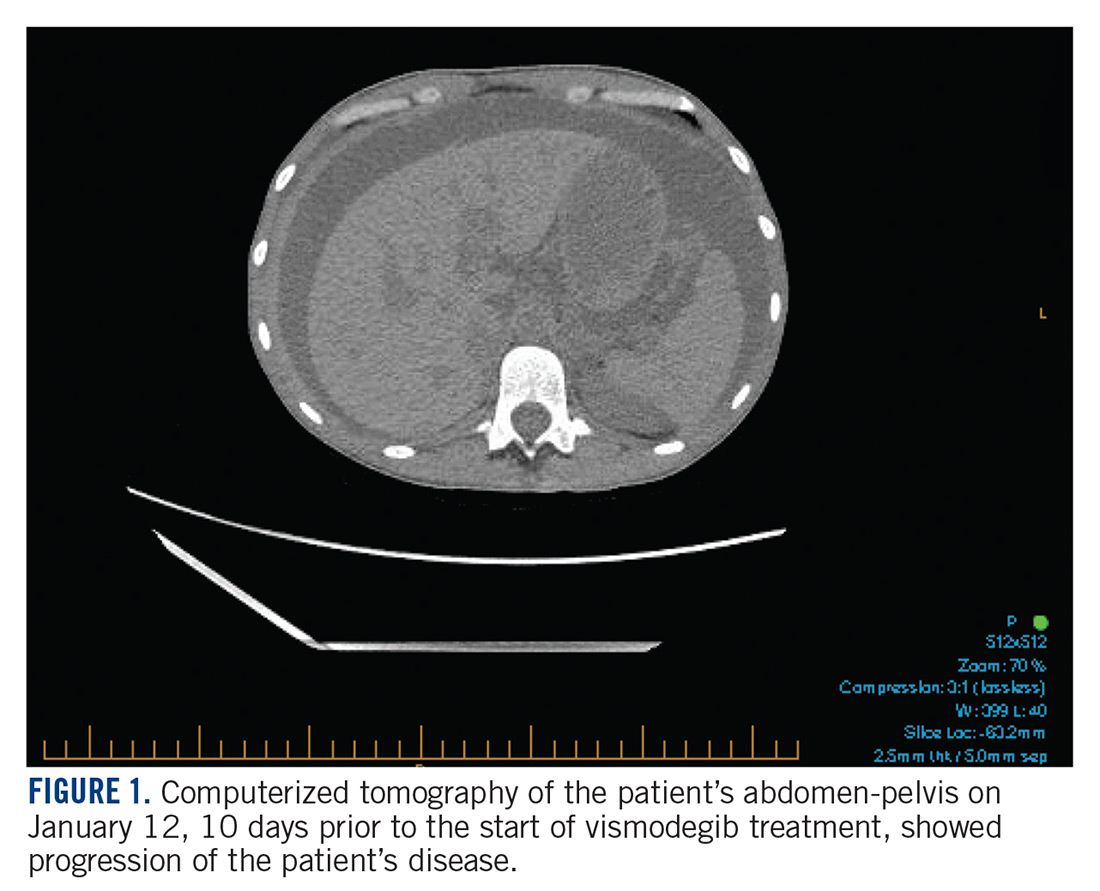
In January 2018, 2 days after receiving her first dose of nivolumab, the patient required admission for worsening abdominal pain secondary to progression of her disease (FIGURE 1). She was found to have acute kidney injury on top of chronic kidney disease due to hydronephrosis requiring a left-sided double J stent. She also had transaminitis resulting from a common bile duct stricture treated with a biliary stent and worsening ascites requiring regular paracentesis. This was all in the context of new or growing metastatic implants.
At this time, the result of the FoundationOne genomic testing revealed PTCH1 loss of exons 1-24 and CDKN2A/B loss. Mutation of tumor suppressor gene PTCH1 leads to Hedgehog pathway activation and therefore the patient was started on vismodegib on January 22, 2018. She was discharged from the hospital in stable condition a day later, on January 23.
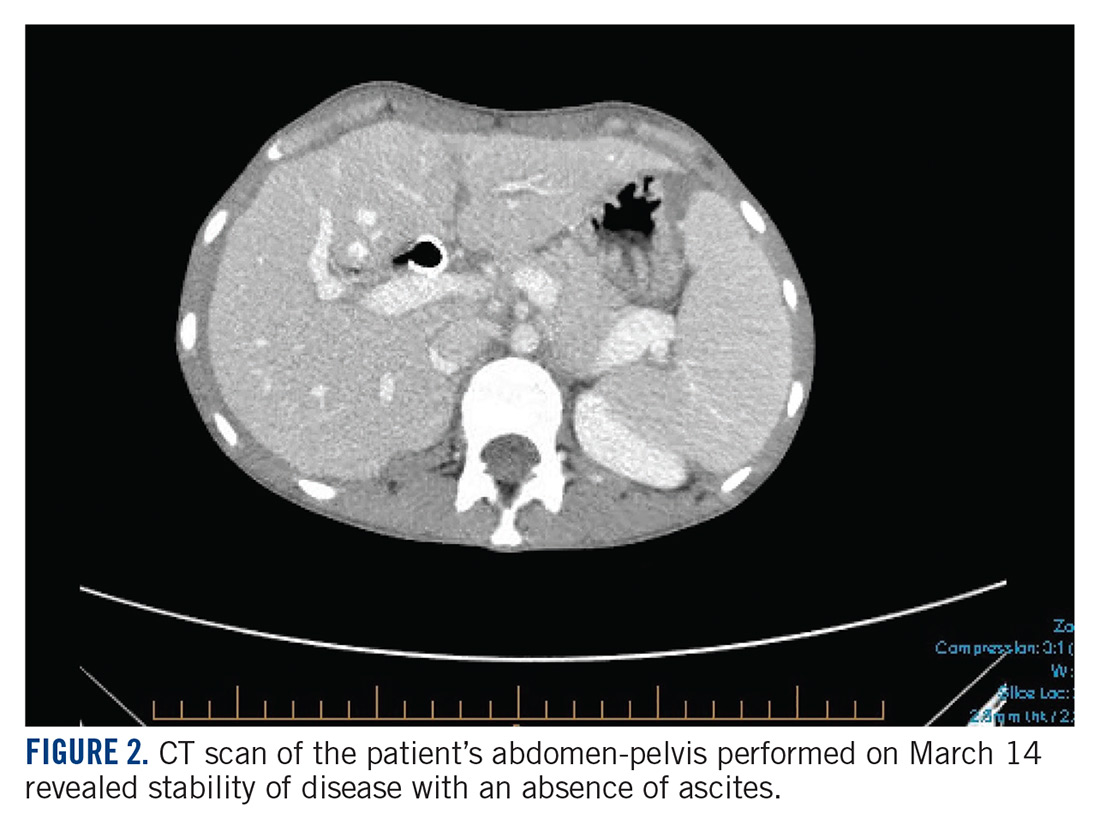
The patient’s clinical status subsequently improved, with significant reduction in her chronic abdominal pain and very minimal side effects. Clinically, the patient’s acute kidney injury resolved (from a creatinine of 272 μmol/L at discharge to 85 μmol/L after a week of treatment) and her liver enzymes normalized (from an alkaline phosphatase of 301 U/L to 83 U/L, and alanine transaminase of 111 U/L to 38 U/L). CT scan of her chest and abdomen, which was performed 1 month post treatment, revealed stability of disease with absence of ascites (FIGURE 2). The patient continued to have a good response to treatment for 6 months, with no recurrence of pain or ascites.
Six months later, in July 2018, the patient developed increasing pain and a CT scan revealed worsening of abdominopelvic carcinomatosis. In this context, vismodegib was discontinued on July 17. In the next 5 months, she went on to receive carboplatin and paclitaxel, gemcitabine, and nivolumab consecutively with no response. She was admitted to hospital on December 30 for a pain crisis. She passed away on January 9, 2019, from fecal peritonitis.
Discussion
To the best of our knowledge, this is the first patient with metastatic sarcoma to receive vismodegib, a Hedgehog signaling pathway inhibitor. She achieved an excellent clinical response with progression- free disease for approximately 6 months after starting treatment.
There is no current standard second- line treatment for metastatic soft tissue sarcoma. The choice of systemic therapy is histology-driven and therefore treatment is individualized for each patient. The future of oncology is heading towards an even more personalized approach with molecular profiling. Our case report highlights the relevance of genomic testing and targeted therapies, especially in cases of diverse clinical and biological disease behavior.
Molecular targeting is even more necessary in patients with advanced cancer who have failed multiple lines of treatment. As in our study, these patients can obtain a significant response with meaningful improvement in their quality of life. Future research is currently focusing on identifying new molecular targets in patients with advanced refractory cancers. Further studies will need to be done to determine whether these molecular targeting agents, such as vismodegib, lead to significant outcome changes in these patients.
1. Collini P, Sorensen PHB, Patel S, et al. Sarcomas with spindle cell morphology. Semin Oncol. 2009;36(4):324-337.
2. Frezza AM, Stacchiotti S, Gronchi A. Systemic treatment in advanced soft tissue sarcoma: what is standard, what is new. BMC Med. 2017;15(1):109.
3. Hanna A, Shevde LA. Hedgehog signaling: modulation of cancer properties and tumor microenvironment. Mol Cancer. 2016;15:24.
4. Abidi A. Hedgehog signaling pathway: a novel target for cancer therapy: vismodegib, a promising therapeutic option in treatment of basal cell carcinomas. Indian J Pharmacol. 2014;46(1): 3-12.
5. Belyea B, Kephart JG, Blum J, Kirsch DG, Linardic CM. Embryonic signaling pathways and rhabdomyosarcoma: contributions to cancer development and opportunities for therapeutic targeting. Sarcoma. 2012;2012:13.
6. Yao Z, Han L, Chen Y, et al. Hedgehog signalling in the tumourigenesis and metastasis of osteosarcoma, and its potential value in the clinical therapy of osteosarcoma. Cell Death Dis. 2018;9(6):701.
7. Italiano A, Le Cesne A, Bellera C, et al. GDC- 0449 in patients with advanced chondrosarcomas: a French Sarcoma Group/US and French National Cancer Institute Single-Arm Phase II Collaborative Study. Ann Oncol. 2013;24(11):2922-2926.
8. Hainsworth JD, Meric-Bernstam F, Swanton C, et al. Targeted therapy for advanced solid tumors on the basis of molecular profiles: results from MyPathway, an open-label, phase IIa multiple basket study. J Clin Oncol. 2018;36(6): 536-542.
Spindle cell sarcomas are part of a rare, heterogeneous family of connective tissue tumors. These tumors are primarily treated with surgery and have a high risk of recurrence and distant metastasis with elevated mortality rates.1 Other than the evidence for first-line therapy with doxorubicin in advanced soft tissue sarcoma, little evidence exists to point to an optimal second-line therapy. This is due to the diversity of soft tissue sarcomas, which encompass approximately 70 different histologic subtypes that can each respond differently to treatment.2 As such, newer strategies, including immunotherapy and targeted molecular drugs, are being developed.
Quiescent in most adult tissues, the Hedgehog signaling pathway, when inappropriately activated, has been implicated in the development of multiple types of cancers, including basal cell, breast, prostate, hepatocellular, pancreatic, and brain cancer.3 The Hedgehog signaling pathway is an important regulator of cell growth and differentiation in early development, but when inappropriately activated can lead to cell proliferation and increased angiogenic factors, decreased apoptosis, and breakdown of tight junctions promoting cancer growth and metastasis.4 Recent data reveal that the Hedgehog pathway plays a specific role in activation of satellite cells, proliferation of myoblasts, and differentiation of skeletal muscle.5 Activation of this embryonic pathway has been implicated in embryonal rhabdoymyosarcoma, osteosarcoma, and chondrosarcoma.5-7
This pathway has recently been recognized as a therapeutic target, with the development of vismodegib, a targeted Hedgehog pathway inhibitor. This novel agent is in active use for treatment of advanced basal cell carcinoma and is currently undergoing trials for various other malignancies. Recently, a phase 2a basket study, called MyPathway, evaluated the use of targeted therapies in 35 different advanced refractory solid tumors harboring specific molecular alterations. Out of 21 patients with mutations in the Hedgehog pathway, 3 had a partial response to vismodegib—one had an unknown primary tumor, another a squamous skin cancer, and the third a salivary gland cancer.8 Vismodegib (GDC-0449) was also evaluated in a phase 2 multicenter clinical trial in patients with progressive advanced chondrosarcoma.7 Although the study did not meet its primary endpoint, the proportion of patients with non-progressive disease was 25.6% at 6 months. Investigators observed that the benefit occurred in the subset of patients with overexpression of the Hedgehog ligand. Genomic studies for mutations in SMO and PTCH genes were available for only 28 and 26 patients, respectively, of the 45 patients enrolled on the trial. While there were no mutations identified, expression data revealed that overexpression of the Hedgehog ligand was present in 65% of cases tested (13 out of 20 patients). In patients with stable disease at 6 months, all had overexpression of the Hedgehog ligand.7 These studies point to the potential use of vismodegib in both bone and soft tissue sarcomas, and more specifically, to the importance of genomic testing in these cases.
Case Presentation and Summary
This report describes the novel use of vismodegib, an oral Hedgehog signaling pathway inhibitor, in the treatment of a patient with metastatic soft tissue sarcoma.
An 18-year-old female with no particular previous illnesses was initially diagnosed with superficial soft tissue sarcoma overlying the right hip in 2013. Due to the complexity of pathology, a second opinion was requested and revealed atypical cellular spindle and epithelioid cells, morphologically and immunohistochemically suggestive of spindle cell sarcoma, not otherwise specified. She underwent negative-margin resection in January 2014. Her course was complicated by two recurrences in the right inguinal lymph nodes in July 2014 and July 2015. She was treated with lymph node dissection in 2014, followed by numerous right lymph node dissections and adjuvant radiation in 2015.
A routine computerized tomography (CT) scan of the thorax-abdomen and pelvis in August 2016 revealed recurrence of disease, with multiple lung nodules as well as metastases in the retroperitoneum. She received 6 cycles of gemcitabine and docetaxel with stability of disease. The patient was then started on a PI3K inhibitor as part of a clinical trial, as genotypic analysis of the tumor revealed an activating mutation of the PI3K gene. The patient’s course was complicated by acute obstructive renal failure requiring a double J stent for right-sided hydronephrosis.
Repeat imaging revealed disease progression, and the patient was then switched to liposomal doxorubicin alone for 4 months and then in combination with olaratumab. She received the combined treatment for a total of 3 months, which was then stopped when she was found to have new peritoneal implants and worsening ascites. At this time, tissue was sent for FoundationOne® next generation sequencing (NGS)-based genomic testing, and the patient received one dose of nivolumab.
In January 2018, 2 days after receiving her first dose of nivolumab, the patient required admission for worsening abdominal pain secondary to progression of her disease (FIGURE 1). She was found to have acute kidney injury on top of chronic kidney disease due to hydronephrosis requiring a left-sided double J stent. She also had transaminitis resulting from a common bile duct stricture treated with a biliary stent and worsening ascites requiring regular paracentesis. This was all in the context of new or growing metastatic implants.
At this time, the result of the FoundationOne genomic testing revealed PTCH1 loss of exons 1-24 and CDKN2A/B loss. Mutation of tumor suppressor gene PTCH1 leads to Hedgehog pathway activation and therefore the patient was started on vismodegib on January 22, 2018. She was discharged from the hospital in stable condition a day later, on January 23.
The patient’s clinical status subsequently improved, with significant reduction in her chronic abdominal pain and very minimal side effects. Clinically, the patient’s acute kidney injury resolved (from a creatinine of 272 μmol/L at discharge to 85 μmol/L after a week of treatment) and her liver enzymes normalized (from an alkaline phosphatase of 301 U/L to 83 U/L, and alanine transaminase of 111 U/L to 38 U/L). CT scan of her chest and abdomen, which was performed 1 month post treatment, revealed stability of disease with absence of ascites (FIGURE 2). The patient continued to have a good response to treatment for 6 months, with no recurrence of pain or ascites.
Six months later, in July 2018, the patient developed increasing pain and a CT scan revealed worsening of abdominopelvic carcinomatosis. In this context, vismodegib was discontinued on July 17. In the next 5 months, she went on to receive carboplatin and paclitaxel, gemcitabine, and nivolumab consecutively with no response. She was admitted to hospital on December 30 for a pain crisis. She passed away on January 9, 2019, from fecal peritonitis.
Discussion
To the best of our knowledge, this is the first patient with metastatic sarcoma to receive vismodegib, a Hedgehog signaling pathway inhibitor. She achieved an excellent clinical response with progression- free disease for approximately 6 months after starting treatment.
There is no current standard second- line treatment for metastatic soft tissue sarcoma. The choice of systemic therapy is histology-driven and therefore treatment is individualized for each patient. The future of oncology is heading towards an even more personalized approach with molecular profiling. Our case report highlights the relevance of genomic testing and targeted therapies, especially in cases of diverse clinical and biological disease behavior.
Molecular targeting is even more necessary in patients with advanced cancer who have failed multiple lines of treatment. As in our study, these patients can obtain a significant response with meaningful improvement in their quality of life. Future research is currently focusing on identifying new molecular targets in patients with advanced refractory cancers. Further studies will need to be done to determine whether these molecular targeting agents, such as vismodegib, lead to significant outcome changes in these patients.
Spindle cell sarcomas are part of a rare, heterogeneous family of connective tissue tumors. These tumors are primarily treated with surgery and have a high risk of recurrence and distant metastasis with elevated mortality rates.1 Other than the evidence for first-line therapy with doxorubicin in advanced soft tissue sarcoma, little evidence exists to point to an optimal second-line therapy. This is due to the diversity of soft tissue sarcomas, which encompass approximately 70 different histologic subtypes that can each respond differently to treatment.2 As such, newer strategies, including immunotherapy and targeted molecular drugs, are being developed.
Quiescent in most adult tissues, the Hedgehog signaling pathway, when inappropriately activated, has been implicated in the development of multiple types of cancers, including basal cell, breast, prostate, hepatocellular, pancreatic, and brain cancer.3 The Hedgehog signaling pathway is an important regulator of cell growth and differentiation in early development, but when inappropriately activated can lead to cell proliferation and increased angiogenic factors, decreased apoptosis, and breakdown of tight junctions promoting cancer growth and metastasis.4 Recent data reveal that the Hedgehog pathway plays a specific role in activation of satellite cells, proliferation of myoblasts, and differentiation of skeletal muscle.5 Activation of this embryonic pathway has been implicated in embryonal rhabdoymyosarcoma, osteosarcoma, and chondrosarcoma.5-7
This pathway has recently been recognized as a therapeutic target, with the development of vismodegib, a targeted Hedgehog pathway inhibitor. This novel agent is in active use for treatment of advanced basal cell carcinoma and is currently undergoing trials for various other malignancies. Recently, a phase 2a basket study, called MyPathway, evaluated the use of targeted therapies in 35 different advanced refractory solid tumors harboring specific molecular alterations. Out of 21 patients with mutations in the Hedgehog pathway, 3 had a partial response to vismodegib—one had an unknown primary tumor, another a squamous skin cancer, and the third a salivary gland cancer.8 Vismodegib (GDC-0449) was also evaluated in a phase 2 multicenter clinical trial in patients with progressive advanced chondrosarcoma.7 Although the study did not meet its primary endpoint, the proportion of patients with non-progressive disease was 25.6% at 6 months. Investigators observed that the benefit occurred in the subset of patients with overexpression of the Hedgehog ligand. Genomic studies for mutations in SMO and PTCH genes were available for only 28 and 26 patients, respectively, of the 45 patients enrolled on the trial. While there were no mutations identified, expression data revealed that overexpression of the Hedgehog ligand was present in 65% of cases tested (13 out of 20 patients). In patients with stable disease at 6 months, all had overexpression of the Hedgehog ligand.7 These studies point to the potential use of vismodegib in both bone and soft tissue sarcomas, and more specifically, to the importance of genomic testing in these cases.
Case Presentation and Summary
This report describes the novel use of vismodegib, an oral Hedgehog signaling pathway inhibitor, in the treatment of a patient with metastatic soft tissue sarcoma.
An 18-year-old female with no particular previous illnesses was initially diagnosed with superficial soft tissue sarcoma overlying the right hip in 2013. Due to the complexity of pathology, a second opinion was requested and revealed atypical cellular spindle and epithelioid cells, morphologically and immunohistochemically suggestive of spindle cell sarcoma, not otherwise specified. She underwent negative-margin resection in January 2014. Her course was complicated by two recurrences in the right inguinal lymph nodes in July 2014 and July 2015. She was treated with lymph node dissection in 2014, followed by numerous right lymph node dissections and adjuvant radiation in 2015.
A routine computerized tomography (CT) scan of the thorax-abdomen and pelvis in August 2016 revealed recurrence of disease, with multiple lung nodules as well as metastases in the retroperitoneum. She received 6 cycles of gemcitabine and docetaxel with stability of disease. The patient was then started on a PI3K inhibitor as part of a clinical trial, as genotypic analysis of the tumor revealed an activating mutation of the PI3K gene. The patient’s course was complicated by acute obstructive renal failure requiring a double J stent for right-sided hydronephrosis.
Repeat imaging revealed disease progression, and the patient was then switched to liposomal doxorubicin alone for 4 months and then in combination with olaratumab. She received the combined treatment for a total of 3 months, which was then stopped when she was found to have new peritoneal implants and worsening ascites. At this time, tissue was sent for FoundationOne® next generation sequencing (NGS)-based genomic testing, and the patient received one dose of nivolumab.
In January 2018, 2 days after receiving her first dose of nivolumab, the patient required admission for worsening abdominal pain secondary to progression of her disease (FIGURE 1). She was found to have acute kidney injury on top of chronic kidney disease due to hydronephrosis requiring a left-sided double J stent. She also had transaminitis resulting from a common bile duct stricture treated with a biliary stent and worsening ascites requiring regular paracentesis. This was all in the context of new or growing metastatic implants.
At this time, the result of the FoundationOne genomic testing revealed PTCH1 loss of exons 1-24 and CDKN2A/B loss. Mutation of tumor suppressor gene PTCH1 leads to Hedgehog pathway activation and therefore the patient was started on vismodegib on January 22, 2018. She was discharged from the hospital in stable condition a day later, on January 23.
The patient’s clinical status subsequently improved, with significant reduction in her chronic abdominal pain and very minimal side effects. Clinically, the patient’s acute kidney injury resolved (from a creatinine of 272 μmol/L at discharge to 85 μmol/L after a week of treatment) and her liver enzymes normalized (from an alkaline phosphatase of 301 U/L to 83 U/L, and alanine transaminase of 111 U/L to 38 U/L). CT scan of her chest and abdomen, which was performed 1 month post treatment, revealed stability of disease with absence of ascites (FIGURE 2). The patient continued to have a good response to treatment for 6 months, with no recurrence of pain or ascites.
Six months later, in July 2018, the patient developed increasing pain and a CT scan revealed worsening of abdominopelvic carcinomatosis. In this context, vismodegib was discontinued on July 17. In the next 5 months, she went on to receive carboplatin and paclitaxel, gemcitabine, and nivolumab consecutively with no response. She was admitted to hospital on December 30 for a pain crisis. She passed away on January 9, 2019, from fecal peritonitis.
Discussion
To the best of our knowledge, this is the first patient with metastatic sarcoma to receive vismodegib, a Hedgehog signaling pathway inhibitor. She achieved an excellent clinical response with progression- free disease for approximately 6 months after starting treatment.
There is no current standard second- line treatment for metastatic soft tissue sarcoma. The choice of systemic therapy is histology-driven and therefore treatment is individualized for each patient. The future of oncology is heading towards an even more personalized approach with molecular profiling. Our case report highlights the relevance of genomic testing and targeted therapies, especially in cases of diverse clinical and biological disease behavior.
Molecular targeting is even more necessary in patients with advanced cancer who have failed multiple lines of treatment. As in our study, these patients can obtain a significant response with meaningful improvement in their quality of life. Future research is currently focusing on identifying new molecular targets in patients with advanced refractory cancers. Further studies will need to be done to determine whether these molecular targeting agents, such as vismodegib, lead to significant outcome changes in these patients.
1. Collini P, Sorensen PHB, Patel S, et al. Sarcomas with spindle cell morphology. Semin Oncol. 2009;36(4):324-337.
2. Frezza AM, Stacchiotti S, Gronchi A. Systemic treatment in advanced soft tissue sarcoma: what is standard, what is new. BMC Med. 2017;15(1):109.
3. Hanna A, Shevde LA. Hedgehog signaling: modulation of cancer properties and tumor microenvironment. Mol Cancer. 2016;15:24.
4. Abidi A. Hedgehog signaling pathway: a novel target for cancer therapy: vismodegib, a promising therapeutic option in treatment of basal cell carcinomas. Indian J Pharmacol. 2014;46(1): 3-12.
5. Belyea B, Kephart JG, Blum J, Kirsch DG, Linardic CM. Embryonic signaling pathways and rhabdomyosarcoma: contributions to cancer development and opportunities for therapeutic targeting. Sarcoma. 2012;2012:13.
6. Yao Z, Han L, Chen Y, et al. Hedgehog signalling in the tumourigenesis and metastasis of osteosarcoma, and its potential value in the clinical therapy of osteosarcoma. Cell Death Dis. 2018;9(6):701.
7. Italiano A, Le Cesne A, Bellera C, et al. GDC- 0449 in patients with advanced chondrosarcomas: a French Sarcoma Group/US and French National Cancer Institute Single-Arm Phase II Collaborative Study. Ann Oncol. 2013;24(11):2922-2926.
8. Hainsworth JD, Meric-Bernstam F, Swanton C, et al. Targeted therapy for advanced solid tumors on the basis of molecular profiles: results from MyPathway, an open-label, phase IIa multiple basket study. J Clin Oncol. 2018;36(6): 536-542.
1. Collini P, Sorensen PHB, Patel S, et al. Sarcomas with spindle cell morphology. Semin Oncol. 2009;36(4):324-337.
2. Frezza AM, Stacchiotti S, Gronchi A. Systemic treatment in advanced soft tissue sarcoma: what is standard, what is new. BMC Med. 2017;15(1):109.
3. Hanna A, Shevde LA. Hedgehog signaling: modulation of cancer properties and tumor microenvironment. Mol Cancer. 2016;15:24.
4. Abidi A. Hedgehog signaling pathway: a novel target for cancer therapy: vismodegib, a promising therapeutic option in treatment of basal cell carcinomas. Indian J Pharmacol. 2014;46(1): 3-12.
5. Belyea B, Kephart JG, Blum J, Kirsch DG, Linardic CM. Embryonic signaling pathways and rhabdomyosarcoma: contributions to cancer development and opportunities for therapeutic targeting. Sarcoma. 2012;2012:13.
6. Yao Z, Han L, Chen Y, et al. Hedgehog signalling in the tumourigenesis and metastasis of osteosarcoma, and its potential value in the clinical therapy of osteosarcoma. Cell Death Dis. 2018;9(6):701.
7. Italiano A, Le Cesne A, Bellera C, et al. GDC- 0449 in patients with advanced chondrosarcomas: a French Sarcoma Group/US and French National Cancer Institute Single-Arm Phase II Collaborative Study. Ann Oncol. 2013;24(11):2922-2926.
8. Hainsworth JD, Meric-Bernstam F, Swanton C, et al. Targeted therapy for advanced solid tumors on the basis of molecular profiles: results from MyPathway, an open-label, phase IIa multiple basket study. J Clin Oncol. 2018;36(6): 536-542.
Even with no disease activity, recurrence risk near 50% when stopping DMTs for MS
STOCKHOLM – according to data presented at the annual congress of the European Committee for Treatment and Research in Multiple Sclerosis.
Of 49 patients who had been on DMT for at least 5 years and had shown no evidence of disease activity (NEDA) during that time, 26 continued to have NEDA through at least 5 years of follow-up, explained Tobias Monschein, MD, of the department of neurology at the Medical University of Vienna.
The cohort of patients had all been taking either interferon beta or glatiramer acetate after a first clinical episode leading to an initial diagnosis of MS. Patients all met Barkhof criteria for MS diagnosis on MRI, and all but six patients had oligoclonal bands found on examination of cerebrospinal fluid.
All patients in the cohort thus met criteria for clinically isolated syndrome (CIS) and MS under the 2017 revisions to the McDonald diagnostic criteria. “To our knowledge, this is the first study determining the risk of disease recurrence in a homogenous cohort of patients with CIS,” reported Dr. Monschein and collaborators.
Before stopping DMT, patients had to show at least 5 years of NEDA status; at that point, patients were offered the opportunity to discontinue medication. The decision to stop or continue taking a DMT was left to individual patient choice, Dr. Monschein said in an interview.
The cohort of patients who decided to discontinue DMT was seen yearly; they received a clinical examination that included expanded disability status scale (EDSS) rating. Patients also received an annual MRI.
Age at DMT discontinuation was predictive of remaining disease free, found Dr. Monschein and collaborators. The 26 patients who continued disease free after DMT discontinuation were a mean 29.7 years old, while patients who had disease recurrence were a mean 22.7 years old.
Looking at age as a dichotomous variable, the investigators found that the 16 patients who were 40 years or older when they stopped DMT had an 18.8% risk of MS recurrence, while the 33 patients younger than 40 years at the time of ceasing DMT had a 60.6% risk of recurrence.
Age, in fact, was the only patient, disease, or therapy characteristic that Dr. Monschein and colleagues found predictive of relapse: “Gender, type of DMT, treatment duration, and CIS symptom did not differ significantly between groups,” they reported.
The data “should not encourage patients to generally stop DMTs after a long NEDA period,” they noted.
In the context of shared patient decision-making, though, the data can inform discussion with patients who wish to discontinue DMTS after long disease-free periods, Dr. Monschein said.
“Physicians should encourage younger people to stay on DMTS despite long lasting NEDA status while in patients [older than] 40 years stopping DMTs together with regular clinical and radiological monitoring could be a reasonable option,” he and his colleagues advised.
Dr. Monschein reported no outside sources of funding and no conflicts of interest.
SOURCE: Monschein T et al. ECTRIMS 2019, Abstract P654.
STOCKHOLM – according to data presented at the annual congress of the European Committee for Treatment and Research in Multiple Sclerosis.
Of 49 patients who had been on DMT for at least 5 years and had shown no evidence of disease activity (NEDA) during that time, 26 continued to have NEDA through at least 5 years of follow-up, explained Tobias Monschein, MD, of the department of neurology at the Medical University of Vienna.
The cohort of patients had all been taking either interferon beta or glatiramer acetate after a first clinical episode leading to an initial diagnosis of MS. Patients all met Barkhof criteria for MS diagnosis on MRI, and all but six patients had oligoclonal bands found on examination of cerebrospinal fluid.
All patients in the cohort thus met criteria for clinically isolated syndrome (CIS) and MS under the 2017 revisions to the McDonald diagnostic criteria. “To our knowledge, this is the first study determining the risk of disease recurrence in a homogenous cohort of patients with CIS,” reported Dr. Monschein and collaborators.
Before stopping DMT, patients had to show at least 5 years of NEDA status; at that point, patients were offered the opportunity to discontinue medication. The decision to stop or continue taking a DMT was left to individual patient choice, Dr. Monschein said in an interview.
The cohort of patients who decided to discontinue DMT was seen yearly; they received a clinical examination that included expanded disability status scale (EDSS) rating. Patients also received an annual MRI.
Age at DMT discontinuation was predictive of remaining disease free, found Dr. Monschein and collaborators. The 26 patients who continued disease free after DMT discontinuation were a mean 29.7 years old, while patients who had disease recurrence were a mean 22.7 years old.
Looking at age as a dichotomous variable, the investigators found that the 16 patients who were 40 years or older when they stopped DMT had an 18.8% risk of MS recurrence, while the 33 patients younger than 40 years at the time of ceasing DMT had a 60.6% risk of recurrence.
Age, in fact, was the only patient, disease, or therapy characteristic that Dr. Monschein and colleagues found predictive of relapse: “Gender, type of DMT, treatment duration, and CIS symptom did not differ significantly between groups,” they reported.
The data “should not encourage patients to generally stop DMTs after a long NEDA period,” they noted.
In the context of shared patient decision-making, though, the data can inform discussion with patients who wish to discontinue DMTS after long disease-free periods, Dr. Monschein said.
“Physicians should encourage younger people to stay on DMTS despite long lasting NEDA status while in patients [older than] 40 years stopping DMTs together with regular clinical and radiological monitoring could be a reasonable option,” he and his colleagues advised.
Dr. Monschein reported no outside sources of funding and no conflicts of interest.
SOURCE: Monschein T et al. ECTRIMS 2019, Abstract P654.
STOCKHOLM – according to data presented at the annual congress of the European Committee for Treatment and Research in Multiple Sclerosis.
Of 49 patients who had been on DMT for at least 5 years and had shown no evidence of disease activity (NEDA) during that time, 26 continued to have NEDA through at least 5 years of follow-up, explained Tobias Monschein, MD, of the department of neurology at the Medical University of Vienna.
The cohort of patients had all been taking either interferon beta or glatiramer acetate after a first clinical episode leading to an initial diagnosis of MS. Patients all met Barkhof criteria for MS diagnosis on MRI, and all but six patients had oligoclonal bands found on examination of cerebrospinal fluid.
All patients in the cohort thus met criteria for clinically isolated syndrome (CIS) and MS under the 2017 revisions to the McDonald diagnostic criteria. “To our knowledge, this is the first study determining the risk of disease recurrence in a homogenous cohort of patients with CIS,” reported Dr. Monschein and collaborators.
Before stopping DMT, patients had to show at least 5 years of NEDA status; at that point, patients were offered the opportunity to discontinue medication. The decision to stop or continue taking a DMT was left to individual patient choice, Dr. Monschein said in an interview.
The cohort of patients who decided to discontinue DMT was seen yearly; they received a clinical examination that included expanded disability status scale (EDSS) rating. Patients also received an annual MRI.
Age at DMT discontinuation was predictive of remaining disease free, found Dr. Monschein and collaborators. The 26 patients who continued disease free after DMT discontinuation were a mean 29.7 years old, while patients who had disease recurrence were a mean 22.7 years old.
Looking at age as a dichotomous variable, the investigators found that the 16 patients who were 40 years or older when they stopped DMT had an 18.8% risk of MS recurrence, while the 33 patients younger than 40 years at the time of ceasing DMT had a 60.6% risk of recurrence.
Age, in fact, was the only patient, disease, or therapy characteristic that Dr. Monschein and colleagues found predictive of relapse: “Gender, type of DMT, treatment duration, and CIS symptom did not differ significantly between groups,” they reported.
The data “should not encourage patients to generally stop DMTs after a long NEDA period,” they noted.
In the context of shared patient decision-making, though, the data can inform discussion with patients who wish to discontinue DMTS after long disease-free periods, Dr. Monschein said.
“Physicians should encourage younger people to stay on DMTS despite long lasting NEDA status while in patients [older than] 40 years stopping DMTs together with regular clinical and radiological monitoring could be a reasonable option,” he and his colleagues advised.
Dr. Monschein reported no outside sources of funding and no conflicts of interest.
SOURCE: Monschein T et al. ECTRIMS 2019, Abstract P654.
REPORTING FROM ECTRIMS 2019
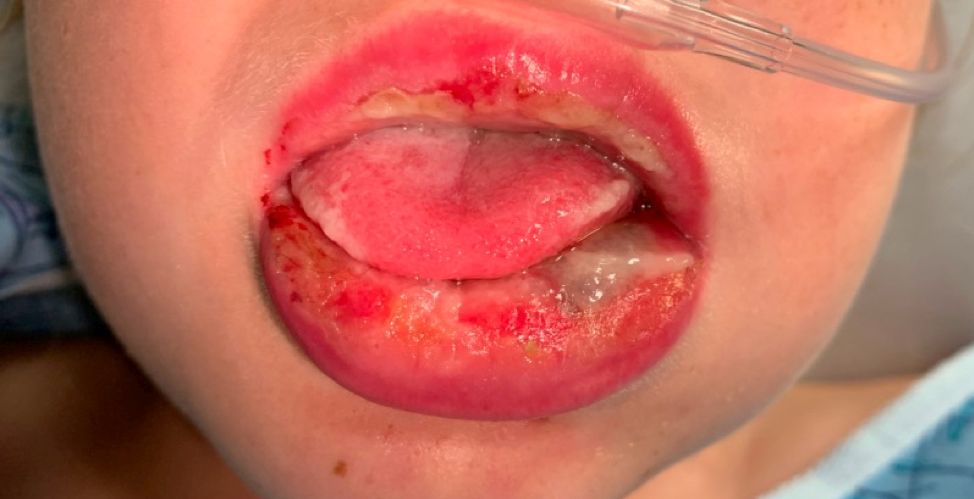
Pneumonia with tender, dry, crusted lips
Mycoplasma pneumoniae infection commonly manifests as an upper or lower respiratory tract infection with associated fever, dyspnea, cough, and coryza. However, patients can present with extrapulmonary complications with dermatologic findings including mucocutaneous eruptions. M. pneumoniae–associated mucocutaneous disease has prominent mucositis and typically sparse cutaneous involvement. The mucositis usually involves the lips and oral mucosa, eye conjunctivae, and nasal mucosa and can involve urogenital lesions. It predominantly is observed in children and adolescents. This condition is essentially a subtype of Stevens-Johnson syndrome, with a specific infection-associated etiology, and has been called “Mycoplasma pneumoniae–induced rash and mucositis,” shortened to “MIRM.”

Severe reactive mucocutaneous eruptions include erythema multiforme (EM), Stevens-Johnson syndrome (SJS), and toxic epidermal necrolysis (TEN). While there has been semantic confusion over the years, there are some distinctive characteristics.
EM is characterized by typical three-ringed target papules that are predominantly acral in location and often without mucosal involvement. The lesions are “multiforme” in that they can appear polymorphous and evolve during an episode, with erythematous macules progressing to edematous papules, sometimes with a halo of pallor and concentric “target-like” appearance. Lesions of EM are fixed, meaning individual lesions last 7-10 days, unlike urticarial lesions that last hours. EM classically is associated with herpes simplex virus infections which usually precede its development.
SJS and TEN display atypical macules and papules which develop into erythematous vesicles, bullae, and potentially extensive desquamation, usually presenting with fever and systemic symptoms, with multiple mucosal sites involved. SJS usually is defined by having bullae restricted to less than 10% of body surface area (BSA), TEN as greater than 30% BSA, and “overlap SJS-TEN” as 20%-30% skin detachment.1 SJS and TEN commonly are induced by medications and on a spectrum of drug hypersensitivity–induced epidermal necrolysis.
MIRM has been highlighted as a distinct, common condition, usually mucous-membrane predominant with involvement of two or more mucosal sites, less than 10% total BSA, the presence of few vesiculobullous lesions or scattered atypical targets with or without targetoid lesions (without rash is called MIRM sine rash), and clinical and laboratory evidence of atypical pneumonia.2 Other infections can cause similar eruptions (for example, Chlamydia pneumoniae), and a recent proposal by the Pediatric Dermatology Research Alliance has suggested the term “Reactive Infectious Mucocutaneous Eruption” (RIME) to include MIRM and other infection-induced reactions.
Laboratory diagnosis of M. pneumoniae is via serology or polymerase chain reaction. Antibody titers begin to rise approximately 7-9 days after infection and peak at 3-4 weeks. Enzyme immunoassay is more sensitive in detecting acute infection than culture and has sensitivity comparable to the polymerase chain reaction if there has been sufficient time to develop an antibody response.
The differential diagnosis between RIME/MIRM, SJS, and TEN may be difficult to distinguish in the first few days of presentation, and consideration of infections and possible medication causes is important. DRESS syndrome (drug reaction with eosinophilia and systemic symptoms) also is in the differential diagnosis. DRESS usually has a long latency (2-8 weeks) between drug exposure and disease onset.
Treatment of RIME/MIRM is supportive care and treatment of any underlying infection. Steroids and intravenous immune globulin (IVIG) have been used to treat reactive mucositis, as well as cyclosporine and biologic agents (such as etanercept), in an attempt to minimize the extent and duration of mucous membrane vesiculation and denudation. While these drugs may help shorten the duration of the disease course, controlled trials are lacking and there is little comparative literature on efficacy or safety of these agents.
Dr. Eichenfield is chief of pediatric and adolescent dermatology at Rady Children’s Hospital–San Diego. He is vice chair of the department of dermatology and professor of dermatology and pediatrics at the University of California, San Diego. Dr. Bhatti is a research fellow in pediatric dermatology at Rady Children’s Hospital and the University of California, San Diego. They said they have no financial disclosures. Email Dr. Eichenfield and Dr. Bhatti at pdnews@mdedge.com.
References
1. Arch Dermatol. 1993 Jan;129(1):92-6.
2. J Am Acad Dermatol. 2015 Feb;72(2):239-45.
Mycoplasma pneumoniae infection commonly manifests as an upper or lower respiratory tract infection with associated fever, dyspnea, cough, and coryza. However, patients can present with extrapulmonary complications with dermatologic findings including mucocutaneous eruptions. M. pneumoniae–associated mucocutaneous disease has prominent mucositis and typically sparse cutaneous involvement. The mucositis usually involves the lips and oral mucosa, eye conjunctivae, and nasal mucosa and can involve urogenital lesions. It predominantly is observed in children and adolescents. This condition is essentially a subtype of Stevens-Johnson syndrome, with a specific infection-associated etiology, and has been called “Mycoplasma pneumoniae–induced rash and mucositis,” shortened to “MIRM.”
Severe reactive mucocutaneous eruptions include erythema multiforme (EM), Stevens-Johnson syndrome (SJS), and toxic epidermal necrolysis (TEN). While there has been semantic confusion over the years, there are some distinctive characteristics.
EM is characterized by typical three-ringed target papules that are predominantly acral in location and often without mucosal involvement. The lesions are “multiforme” in that they can appear polymorphous and evolve during an episode, with erythematous macules progressing to edematous papules, sometimes with a halo of pallor and concentric “target-like” appearance. Lesions of EM are fixed, meaning individual lesions last 7-10 days, unlike urticarial lesions that last hours. EM classically is associated with herpes simplex virus infections which usually precede its development.
SJS and TEN display atypical macules and papules which develop into erythematous vesicles, bullae, and potentially extensive desquamation, usually presenting with fever and systemic symptoms, with multiple mucosal sites involved. SJS usually is defined by having bullae restricted to less than 10% of body surface area (BSA), TEN as greater than 30% BSA, and “overlap SJS-TEN” as 20%-30% skin detachment.1 SJS and TEN commonly are induced by medications and on a spectrum of drug hypersensitivity–induced epidermal necrolysis.
MIRM has been highlighted as a distinct, common condition, usually mucous-membrane predominant with involvement of two or more mucosal sites, less than 10% total BSA, the presence of few vesiculobullous lesions or scattered atypical targets with or without targetoid lesions (without rash is called MIRM sine rash), and clinical and laboratory evidence of atypical pneumonia.2 Other infections can cause similar eruptions (for example, Chlamydia pneumoniae), and a recent proposal by the Pediatric Dermatology Research Alliance has suggested the term “Reactive Infectious Mucocutaneous Eruption” (RIME) to include MIRM and other infection-induced reactions.
Laboratory diagnosis of M. pneumoniae is via serology or polymerase chain reaction. Antibody titers begin to rise approximately 7-9 days after infection and peak at 3-4 weeks. Enzyme immunoassay is more sensitive in detecting acute infection than culture and has sensitivity comparable to the polymerase chain reaction if there has been sufficient time to develop an antibody response.
The differential diagnosis between RIME/MIRM, SJS, and TEN may be difficult to distinguish in the first few days of presentation, and consideration of infections and possible medication causes is important. DRESS syndrome (drug reaction with eosinophilia and systemic symptoms) also is in the differential diagnosis. DRESS usually has a long latency (2-8 weeks) between drug exposure and disease onset.
Treatment of RIME/MIRM is supportive care and treatment of any underlying infection. Steroids and intravenous immune globulin (IVIG) have been used to treat reactive mucositis, as well as cyclosporine and biologic agents (such as etanercept), in an attempt to minimize the extent and duration of mucous membrane vesiculation and denudation. While these drugs may help shorten the duration of the disease course, controlled trials are lacking and there is little comparative literature on efficacy or safety of these agents.
Dr. Eichenfield is chief of pediatric and adolescent dermatology at Rady Children’s Hospital–San Diego. He is vice chair of the department of dermatology and professor of dermatology and pediatrics at the University of California, San Diego. Dr. Bhatti is a research fellow in pediatric dermatology at Rady Children’s Hospital and the University of California, San Diego. They said they have no financial disclosures. Email Dr. Eichenfield and Dr. Bhatti at pdnews@mdedge.com.
References
1. Arch Dermatol. 1993 Jan;129(1):92-6.
2. J Am Acad Dermatol. 2015 Feb;72(2):239-45.
Mycoplasma pneumoniae infection commonly manifests as an upper or lower respiratory tract infection with associated fever, dyspnea, cough, and coryza. However, patients can present with extrapulmonary complications with dermatologic findings including mucocutaneous eruptions. M. pneumoniae–associated mucocutaneous disease has prominent mucositis and typically sparse cutaneous involvement. The mucositis usually involves the lips and oral mucosa, eye conjunctivae, and nasal mucosa and can involve urogenital lesions. It predominantly is observed in children and adolescents. This condition is essentially a subtype of Stevens-Johnson syndrome, with a specific infection-associated etiology, and has been called “Mycoplasma pneumoniae–induced rash and mucositis,” shortened to “MIRM.”
Severe reactive mucocutaneous eruptions include erythema multiforme (EM), Stevens-Johnson syndrome (SJS), and toxic epidermal necrolysis (TEN). While there has been semantic confusion over the years, there are some distinctive characteristics.
EM is characterized by typical three-ringed target papules that are predominantly acral in location and often without mucosal involvement. The lesions are “multiforme” in that they can appear polymorphous and evolve during an episode, with erythematous macules progressing to edematous papules, sometimes with a halo of pallor and concentric “target-like” appearance. Lesions of EM are fixed, meaning individual lesions last 7-10 days, unlike urticarial lesions that last hours. EM classically is associated with herpes simplex virus infections which usually precede its development.
SJS and TEN display atypical macules and papules which develop into erythematous vesicles, bullae, and potentially extensive desquamation, usually presenting with fever and systemic symptoms, with multiple mucosal sites involved. SJS usually is defined by having bullae restricted to less than 10% of body surface area (BSA), TEN as greater than 30% BSA, and “overlap SJS-TEN” as 20%-30% skin detachment.1 SJS and TEN commonly are induced by medications and on a spectrum of drug hypersensitivity–induced epidermal necrolysis.
MIRM has been highlighted as a distinct, common condition, usually mucous-membrane predominant with involvement of two or more mucosal sites, less than 10% total BSA, the presence of few vesiculobullous lesions or scattered atypical targets with or without targetoid lesions (without rash is called MIRM sine rash), and clinical and laboratory evidence of atypical pneumonia.2 Other infections can cause similar eruptions (for example, Chlamydia pneumoniae), and a recent proposal by the Pediatric Dermatology Research Alliance has suggested the term “Reactive Infectious Mucocutaneous Eruption” (RIME) to include MIRM and other infection-induced reactions.
Laboratory diagnosis of M. pneumoniae is via serology or polymerase chain reaction. Antibody titers begin to rise approximately 7-9 days after infection and peak at 3-4 weeks. Enzyme immunoassay is more sensitive in detecting acute infection than culture and has sensitivity comparable to the polymerase chain reaction if there has been sufficient time to develop an antibody response.
The differential diagnosis between RIME/MIRM, SJS, and TEN may be difficult to distinguish in the first few days of presentation, and consideration of infections and possible medication causes is important. DRESS syndrome (drug reaction with eosinophilia and systemic symptoms) also is in the differential diagnosis. DRESS usually has a long latency (2-8 weeks) between drug exposure and disease onset.
Treatment of RIME/MIRM is supportive care and treatment of any underlying infection. Steroids and intravenous immune globulin (IVIG) have been used to treat reactive mucositis, as well as cyclosporine and biologic agents (such as etanercept), in an attempt to minimize the extent and duration of mucous membrane vesiculation and denudation. While these drugs may help shorten the duration of the disease course, controlled trials are lacking and there is little comparative literature on efficacy or safety of these agents.
Dr. Eichenfield is chief of pediatric and adolescent dermatology at Rady Children’s Hospital–San Diego. He is vice chair of the department of dermatology and professor of dermatology and pediatrics at the University of California, San Diego. Dr. Bhatti is a research fellow in pediatric dermatology at Rady Children’s Hospital and the University of California, San Diego. They said they have no financial disclosures. Email Dr. Eichenfield and Dr. Bhatti at pdnews@mdedge.com.
References
1. Arch Dermatol. 1993 Jan;129(1):92-6.
2. J Am Acad Dermatol. 2015 Feb;72(2):239-45.
Clinical trials in sarcoma bring hope and promise
In this issue of The Sarcoma Journal, we highlight research and developments presented at the 2019 ASCO annual meeting. Despite the rarity of sarcoma, it was not lost among the thousands of abstracts, posters, and talks presented during the four-and-a-half days of the meeting.
In the past 5 years, there has been a resurgence of phase 3 clinical trials in sarcoma, including several large first-line studies comparing combination therapies to doxorubicin—the gold standard since the mid-1970s. None have shown superiority. Despite this, there has been a gradual improvement in overall survival. This is attributed to advances in the multidisciplinary management of sarcomas and available supportive care services as well as a better understanding of and emergent therapies for individual sarcoma subtypes.
In the United States, we have seen the approval of several agents in sarcoma: pazopanib, with a 3-month improvement in progression-free survival (PFS) over placebo; trabectedin in liposarcoma and leiomyosarcoma, with a 2.7-month improvement in PFS over dacarbazine; and eribulin, based on a liposarcoma subgroup analysis that showed a 7-month improvement in overall survival over dacarbazine.None of these therapies are approved in the US in the front-line setting; rather, all after a patient generally receives a doxorubicin- based therapy.
We have learned a great deal from these studies. They highlight some of the challenges in designing clinical trials in a rare and heterogeneous group of malignancies. The sarcoma community is very much focused on overcoming these challenges by designing clinical trials appropriate to the disease and the therapy that is being studied. This includes the incorporation of novel endpoints, imaging modalities, patient-reported outcome measures, and statistical methodologies to best serve the patient and to determine whether and how the therapy is helping them.
There is tremendous hope and promise in sarcoma due to significant advancements in our understanding of mesenchymal biology and of the genetic diversity in these diseases. This has led to an influx of promising agents and trials, many of which have transformed treatment paradigms on specific sarcoma subtypes. This issue provides a glimpse into the progress being made.
From Dr. Tap’s plenary presentation at ASCO 2019
In this issue of The Sarcoma Journal, we highlight research and developments presented at the 2019 ASCO annual meeting. Despite the rarity of sarcoma, it was not lost among the thousands of abstracts, posters, and talks presented during the four-and-a-half days of the meeting.
In the past 5 years, there has been a resurgence of phase 3 clinical trials in sarcoma, including several large first-line studies comparing combination therapies to doxorubicin—the gold standard since the mid-1970s. None have shown superiority. Despite this, there has been a gradual improvement in overall survival. This is attributed to advances in the multidisciplinary management of sarcomas and available supportive care services as well as a better understanding of and emergent therapies for individual sarcoma subtypes.
In the United States, we have seen the approval of several agents in sarcoma: pazopanib, with a 3-month improvement in progression-free survival (PFS) over placebo; trabectedin in liposarcoma and leiomyosarcoma, with a 2.7-month improvement in PFS over dacarbazine; and eribulin, based on a liposarcoma subgroup analysis that showed a 7-month improvement in overall survival over dacarbazine.None of these therapies are approved in the US in the front-line setting; rather, all after a patient generally receives a doxorubicin- based therapy.
We have learned a great deal from these studies. They highlight some of the challenges in designing clinical trials in a rare and heterogeneous group of malignancies. The sarcoma community is very much focused on overcoming these challenges by designing clinical trials appropriate to the disease and the therapy that is being studied. This includes the incorporation of novel endpoints, imaging modalities, patient-reported outcome measures, and statistical methodologies to best serve the patient and to determine whether and how the therapy is helping them.
There is tremendous hope and promise in sarcoma due to significant advancements in our understanding of mesenchymal biology and of the genetic diversity in these diseases. This has led to an influx of promising agents and trials, many of which have transformed treatment paradigms on specific sarcoma subtypes. This issue provides a glimpse into the progress being made.
From Dr. Tap’s plenary presentation at ASCO 2019
In this issue of The Sarcoma Journal, we highlight research and developments presented at the 2019 ASCO annual meeting. Despite the rarity of sarcoma, it was not lost among the thousands of abstracts, posters, and talks presented during the four-and-a-half days of the meeting.
In the past 5 years, there has been a resurgence of phase 3 clinical trials in sarcoma, including several large first-line studies comparing combination therapies to doxorubicin—the gold standard since the mid-1970s. None have shown superiority. Despite this, there has been a gradual improvement in overall survival. This is attributed to advances in the multidisciplinary management of sarcomas and available supportive care services as well as a better understanding of and emergent therapies for individual sarcoma subtypes.
In the United States, we have seen the approval of several agents in sarcoma: pazopanib, with a 3-month improvement in progression-free survival (PFS) over placebo; trabectedin in liposarcoma and leiomyosarcoma, with a 2.7-month improvement in PFS over dacarbazine; and eribulin, based on a liposarcoma subgroup analysis that showed a 7-month improvement in overall survival over dacarbazine.None of these therapies are approved in the US in the front-line setting; rather, all after a patient generally receives a doxorubicin- based therapy.
We have learned a great deal from these studies. They highlight some of the challenges in designing clinical trials in a rare and heterogeneous group of malignancies. The sarcoma community is very much focused on overcoming these challenges by designing clinical trials appropriate to the disease and the therapy that is being studied. This includes the incorporation of novel endpoints, imaging modalities, patient-reported outcome measures, and statistical methodologies to best serve the patient and to determine whether and how the therapy is helping them.
There is tremendous hope and promise in sarcoma due to significant advancements in our understanding of mesenchymal biology and of the genetic diversity in these diseases. This has led to an influx of promising agents and trials, many of which have transformed treatment paradigms on specific sarcoma subtypes. This issue provides a glimpse into the progress being made.
From Dr. Tap’s plenary presentation at ASCO 2019
Meta-analysis finds platelet-rich plasma may improve hair growth
Treatment with intradermal injections of autologous compared with placebo, according to a meta-analysis of seven studies.
In the report of the results, published in the Journal of Cosmetic Dermatology, Gezim Dervishi, from University Hospital Cologne (Germany), and coauthors noted that autologous PRP contains cytokines and growth factors – including platelet‐derived growth factor, vascular endothelial growth factor, and insulinlike growth factor–1 – that are believed to play a role in new hair growth. While the evidence to support the clinical efficacy of this approach is currently limited and PRP is not approved for hair-loss treatment, it is being used in clinical trials and off label for hair restoration in Europe and the United States.
The authors reviewed 13 randomized, controlled trials involving 343 people with pattern hair loss randomized to PRP control treatment, or placebo in a simple-parallel or half-head design, and assessed at 3-6 months after starting treatment. The studies were conducted in countries that included the United States, Brazil, Spain, and Italy.
The meta-analysis included seven studies that used change in hair density as the primary outcome. Six of these studies compared PRP with placebo and one compared PRP plus minoxidil or finasteride versus placebo plus minoxidil or finasteride. Five evaluated outcomes 6 months after the intervention, and two studies evaluated outcomes 3 months afterwards.
Of these seven studies, five reported statistically significant increases in hair density in favor of PRP over placebo, while the remaining two did not find any significant treatment effect. In the seven studies, the pooled mean difference in increasing hair density between treatment and placebo was 30.35 (95% confidence interval, 1.77-58.93; P less than .00001).
The 13 studies involved applications of platelet-rich plasma one to eight times over treatment periods of 1-5 months. Three studies compared PRP in conjunction with either minoxidil, finasteride, or polydeoxyribonucleotide, compared with those same therapies without PRP, and 10 studies compared PRP with either normal saline or distilled water. Five studies were judged to be at high risk of bias for at least one item, but none of these studies were included in the meta-analysis.
None of the studies identified any significant short-term treatment-related adverse effects, but the authors suggested that future studies look at potential long-term adverse effects of treatment.
“We recommend further [randomized, controlled trials] that should ensure adequate random sequence generation, adequate allocation concealment, blinding of performance and detection, and that should prevent incomplete data and selective reporting,” they wrote.
Funding and conflicts of interest statements were not available.
SOURCE: Dervishi G et al. J Cosmet Dermatol. 2019 Aug 12. doi: 10.1111/jocd.13113.
Treatment with intradermal injections of autologous compared with placebo, according to a meta-analysis of seven studies.
In the report of the results, published in the Journal of Cosmetic Dermatology, Gezim Dervishi, from University Hospital Cologne (Germany), and coauthors noted that autologous PRP contains cytokines and growth factors – including platelet‐derived growth factor, vascular endothelial growth factor, and insulinlike growth factor–1 – that are believed to play a role in new hair growth. While the evidence to support the clinical efficacy of this approach is currently limited and PRP is not approved for hair-loss treatment, it is being used in clinical trials and off label for hair restoration in Europe and the United States.
The authors reviewed 13 randomized, controlled trials involving 343 people with pattern hair loss randomized to PRP control treatment, or placebo in a simple-parallel or half-head design, and assessed at 3-6 months after starting treatment. The studies were conducted in countries that included the United States, Brazil, Spain, and Italy.
The meta-analysis included seven studies that used change in hair density as the primary outcome. Six of these studies compared PRP with placebo and one compared PRP plus minoxidil or finasteride versus placebo plus minoxidil or finasteride. Five evaluated outcomes 6 months after the intervention, and two studies evaluated outcomes 3 months afterwards.
Of these seven studies, five reported statistically significant increases in hair density in favor of PRP over placebo, while the remaining two did not find any significant treatment effect. In the seven studies, the pooled mean difference in increasing hair density between treatment and placebo was 30.35 (95% confidence interval, 1.77-58.93; P less than .00001).
The 13 studies involved applications of platelet-rich plasma one to eight times over treatment periods of 1-5 months. Three studies compared PRP in conjunction with either minoxidil, finasteride, or polydeoxyribonucleotide, compared with those same therapies without PRP, and 10 studies compared PRP with either normal saline or distilled water. Five studies were judged to be at high risk of bias for at least one item, but none of these studies were included in the meta-analysis.
None of the studies identified any significant short-term treatment-related adverse effects, but the authors suggested that future studies look at potential long-term adverse effects of treatment.
“We recommend further [randomized, controlled trials] that should ensure adequate random sequence generation, adequate allocation concealment, blinding of performance and detection, and that should prevent incomplete data and selective reporting,” they wrote.
Funding and conflicts of interest statements were not available.
SOURCE: Dervishi G et al. J Cosmet Dermatol. 2019 Aug 12. doi: 10.1111/jocd.13113.
Treatment with intradermal injections of autologous compared with placebo, according to a meta-analysis of seven studies.
In the report of the results, published in the Journal of Cosmetic Dermatology, Gezim Dervishi, from University Hospital Cologne (Germany), and coauthors noted that autologous PRP contains cytokines and growth factors – including platelet‐derived growth factor, vascular endothelial growth factor, and insulinlike growth factor–1 – that are believed to play a role in new hair growth. While the evidence to support the clinical efficacy of this approach is currently limited and PRP is not approved for hair-loss treatment, it is being used in clinical trials and off label for hair restoration in Europe and the United States.
The authors reviewed 13 randomized, controlled trials involving 343 people with pattern hair loss randomized to PRP control treatment, or placebo in a simple-parallel or half-head design, and assessed at 3-6 months after starting treatment. The studies were conducted in countries that included the United States, Brazil, Spain, and Italy.
The meta-analysis included seven studies that used change in hair density as the primary outcome. Six of these studies compared PRP with placebo and one compared PRP plus minoxidil or finasteride versus placebo plus minoxidil or finasteride. Five evaluated outcomes 6 months after the intervention, and two studies evaluated outcomes 3 months afterwards.
Of these seven studies, five reported statistically significant increases in hair density in favor of PRP over placebo, while the remaining two did not find any significant treatment effect. In the seven studies, the pooled mean difference in increasing hair density between treatment and placebo was 30.35 (95% confidence interval, 1.77-58.93; P less than .00001).
The 13 studies involved applications of platelet-rich plasma one to eight times over treatment periods of 1-5 months. Three studies compared PRP in conjunction with either minoxidil, finasteride, or polydeoxyribonucleotide, compared with those same therapies without PRP, and 10 studies compared PRP with either normal saline or distilled water. Five studies were judged to be at high risk of bias for at least one item, but none of these studies were included in the meta-analysis.
None of the studies identified any significant short-term treatment-related adverse effects, but the authors suggested that future studies look at potential long-term adverse effects of treatment.
“We recommend further [randomized, controlled trials] that should ensure adequate random sequence generation, adequate allocation concealment, blinding of performance and detection, and that should prevent incomplete data and selective reporting,” they wrote.
Funding and conflicts of interest statements were not available.
SOURCE: Dervishi G et al. J Cosmet Dermatol. 2019 Aug 12. doi: 10.1111/jocd.13113.
FROM THE JOURNAL OF COSMETIC DERMATOLOGY
Benefits of peanut desensitization may not last
based on data from a phase 2 randomized trial of individuals with confirmed peanut allergies.

Previous studies have shown that desensitization to peanuts can be successful, but sustained response to oral immunotherapy after treatment reduction or discontinuation has not been well studied, wrote R. Sharon Chinthrajah, MD, of Stanford (Calif.)University, and colleagues.
“We found that OIT with peanut was able to desensitise people with peanut allergy to 4,000 mg of peanut protein, but that discontinuation of peanut, or even a reduction to 300 mg daily, increased the likelihood of regaining clinical reactivity to peanut,” they wrote. “With peanut allergy therapies in varying stages of clinical development, and some nearing [Food and Drug Administration] approval, vital questions remain regarding the durability of treatment effects and the appropriate maintenance doses.”
In the Peanut Oral Immunotherapy Study: Safety Efficacy and Discovery (POISED), published in The Lancet, the researchers randomized 120 participants to three groups:
• 60 patients built up to a maintenance dose of 4,000 mg of peanut protein for 104 weeks followed by total discontinuation (peanut-0).
• 35 patients built up to a maintenance dose of 4,000 mg of peanut protein for 104 weeks followed by a 300-mg maintenance dose of peanut protein in the form of peanut flour (peanut-300).
• 25 patients to an oat flour placebo.
All participants were trained on how and when to use epinephrine autoinjector devices to treat allergic symptoms such as respiratory problems (cough, shortness of breath, or change in voice), widespread hives or erythema, repetitive vomiting, persistent abdominal pain, angioedema of the face, or feeling faint.
The primary outcome was passing a double-blind, placebo-controlled, food challenge (DBPCFC) to 4,000 mg of peanut protein, which was measured at baseline and at weeks 104, 117, 130, 143, and 156.
Overall, 35% of the peanut-0 group passed the challenge at 104 and 117 weeks, compared with 4% of the placebo group. At week 156 after discontinuing OIT, 13% of the peanut-0 group met the DBPCFC challenge, compared with 4% of the placebo group. However, 37% of participants randomized to a reduced peanut protein dose of 300 mg passed the challenge at 156 weeks, suggesting that more data are needed on optimal maintenance dosing strategies.
Baseline demographics were similar across all groups. The median age at study enrollment was 11 years and the median allergy duration was 9 years. The most common adverse events were mild gastrointestinal and respiratory problems. Adverse events decreased over time in all three groups.
“Higher levels of peanut-specific IgE to total IgE ratio, peanut sIgE, Ara h 1, Ara h 2, and Ara h 1 IgE to peanut-specific IgE ratio at baseline in participants were associated with increased frequencies of adverse events during active peanut OIT,” the researchers noted.
The study findings were limited by several factors including the ability of participants to tolerate 4,000 mg of peanut protein after achieving a maintenance dose but conducting serial testing only for those who passed the challenge. In addition, the results may be limited to peanut and not generalizable to other food allergies, the researchers said.
However, the results suggest that OIT remains a promising treatment for peanut allergies, and the association of biomarkers with clinical outcomes “might help the practitioner in identifying good candidates for OIT and those individuals who warrant increased vigilance against allergic reactions during OIT,” they said.
The National Institutes of Health supported the study. The researchers had no financial conflicts to disclose.
SOURCE: Chinthrajah RS et al. Lancet. 2019 Sep 12. doi: 10.1016/S0140-6736(19)31793-3.
based on data from a phase 2 randomized trial of individuals with confirmed peanut allergies.
Previous studies have shown that desensitization to peanuts can be successful, but sustained response to oral immunotherapy after treatment reduction or discontinuation has not been well studied, wrote R. Sharon Chinthrajah, MD, of Stanford (Calif.)University, and colleagues.
“We found that OIT with peanut was able to desensitise people with peanut allergy to 4,000 mg of peanut protein, but that discontinuation of peanut, or even a reduction to 300 mg daily, increased the likelihood of regaining clinical reactivity to peanut,” they wrote. “With peanut allergy therapies in varying stages of clinical development, and some nearing [Food and Drug Administration] approval, vital questions remain regarding the durability of treatment effects and the appropriate maintenance doses.”
In the Peanut Oral Immunotherapy Study: Safety Efficacy and Discovery (POISED), published in The Lancet, the researchers randomized 120 participants to three groups:
• 60 patients built up to a maintenance dose of 4,000 mg of peanut protein for 104 weeks followed by total discontinuation (peanut-0).
• 35 patients built up to a maintenance dose of 4,000 mg of peanut protein for 104 weeks followed by a 300-mg maintenance dose of peanut protein in the form of peanut flour (peanut-300).
• 25 patients to an oat flour placebo.
All participants were trained on how and when to use epinephrine autoinjector devices to treat allergic symptoms such as respiratory problems (cough, shortness of breath, or change in voice), widespread hives or erythema, repetitive vomiting, persistent abdominal pain, angioedema of the face, or feeling faint.
The primary outcome was passing a double-blind, placebo-controlled, food challenge (DBPCFC) to 4,000 mg of peanut protein, which was measured at baseline and at weeks 104, 117, 130, 143, and 156.
Overall, 35% of the peanut-0 group passed the challenge at 104 and 117 weeks, compared with 4% of the placebo group. At week 156 after discontinuing OIT, 13% of the peanut-0 group met the DBPCFC challenge, compared with 4% of the placebo group. However, 37% of participants randomized to a reduced peanut protein dose of 300 mg passed the challenge at 156 weeks, suggesting that more data are needed on optimal maintenance dosing strategies.
Baseline demographics were similar across all groups. The median age at study enrollment was 11 years and the median allergy duration was 9 years. The most common adverse events were mild gastrointestinal and respiratory problems. Adverse events decreased over time in all three groups.
“Higher levels of peanut-specific IgE to total IgE ratio, peanut sIgE, Ara h 1, Ara h 2, and Ara h 1 IgE to peanut-specific IgE ratio at baseline in participants were associated with increased frequencies of adverse events during active peanut OIT,” the researchers noted.
The study findings were limited by several factors including the ability of participants to tolerate 4,000 mg of peanut protein after achieving a maintenance dose but conducting serial testing only for those who passed the challenge. In addition, the results may be limited to peanut and not generalizable to other food allergies, the researchers said.
However, the results suggest that OIT remains a promising treatment for peanut allergies, and the association of biomarkers with clinical outcomes “might help the practitioner in identifying good candidates for OIT and those individuals who warrant increased vigilance against allergic reactions during OIT,” they said.
The National Institutes of Health supported the study. The researchers had no financial conflicts to disclose.
SOURCE: Chinthrajah RS et al. Lancet. 2019 Sep 12. doi: 10.1016/S0140-6736(19)31793-3.
based on data from a phase 2 randomized trial of individuals with confirmed peanut allergies.
Previous studies have shown that desensitization to peanuts can be successful, but sustained response to oral immunotherapy after treatment reduction or discontinuation has not been well studied, wrote R. Sharon Chinthrajah, MD, of Stanford (Calif.)University, and colleagues.
“We found that OIT with peanut was able to desensitise people with peanut allergy to 4,000 mg of peanut protein, but that discontinuation of peanut, or even a reduction to 300 mg daily, increased the likelihood of regaining clinical reactivity to peanut,” they wrote. “With peanut allergy therapies in varying stages of clinical development, and some nearing [Food and Drug Administration] approval, vital questions remain regarding the durability of treatment effects and the appropriate maintenance doses.”
In the Peanut Oral Immunotherapy Study: Safety Efficacy and Discovery (POISED), published in The Lancet, the researchers randomized 120 participants to three groups:
• 60 patients built up to a maintenance dose of 4,000 mg of peanut protein for 104 weeks followed by total discontinuation (peanut-0).
• 35 patients built up to a maintenance dose of 4,000 mg of peanut protein for 104 weeks followed by a 300-mg maintenance dose of peanut protein in the form of peanut flour (peanut-300).
• 25 patients to an oat flour placebo.
All participants were trained on how and when to use epinephrine autoinjector devices to treat allergic symptoms such as respiratory problems (cough, shortness of breath, or change in voice), widespread hives or erythema, repetitive vomiting, persistent abdominal pain, angioedema of the face, or feeling faint.
The primary outcome was passing a double-blind, placebo-controlled, food challenge (DBPCFC) to 4,000 mg of peanut protein, which was measured at baseline and at weeks 104, 117, 130, 143, and 156.
Overall, 35% of the peanut-0 group passed the challenge at 104 and 117 weeks, compared with 4% of the placebo group. At week 156 after discontinuing OIT, 13% of the peanut-0 group met the DBPCFC challenge, compared with 4% of the placebo group. However, 37% of participants randomized to a reduced peanut protein dose of 300 mg passed the challenge at 156 weeks, suggesting that more data are needed on optimal maintenance dosing strategies.
Baseline demographics were similar across all groups. The median age at study enrollment was 11 years and the median allergy duration was 9 years. The most common adverse events were mild gastrointestinal and respiratory problems. Adverse events decreased over time in all three groups.
“Higher levels of peanut-specific IgE to total IgE ratio, peanut sIgE, Ara h 1, Ara h 2, and Ara h 1 IgE to peanut-specific IgE ratio at baseline in participants were associated with increased frequencies of adverse events during active peanut OIT,” the researchers noted.
The study findings were limited by several factors including the ability of participants to tolerate 4,000 mg of peanut protein after achieving a maintenance dose but conducting serial testing only for those who passed the challenge. In addition, the results may be limited to peanut and not generalizable to other food allergies, the researchers said.
However, the results suggest that OIT remains a promising treatment for peanut allergies, and the association of biomarkers with clinical outcomes “might help the practitioner in identifying good candidates for OIT and those individuals who warrant increased vigilance against allergic reactions during OIT,” they said.
The National Institutes of Health supported the study. The researchers had no financial conflicts to disclose.
SOURCE: Chinthrajah RS et al. Lancet. 2019 Sep 12. doi: 10.1016/S0140-6736(19)31793-3.
FROM THE LANCET

Prolonged Antibiotic Treatment in Newborns May Promote Multidrug Resistance
Antibiotics given to preterm infants can set them up for health problems later in life; research has shown, including allergies, psoriasis, diabetes, and inflammatory bowel disease. Researchers who conducted a National Institutes of Health (NIH)-funded study have added to that body of knowledge with their finding that treating preterm infants with long-term antibiotics could have lasting effects by promoting multidrug-resistant gut bacteria.
They used high-speed DNA sequencing and advanced computational analysis to study stool samples from 32 infants born very preterm who received antibiotic treatment for 21 months in the hospital and after discharge, then compared those with results from 9 very preterm infants treated with antibiotics for > 1 week and 17 healthy term and late-term infants who had not received antibiotics.
The infants on long-term antibiotics had less diverse bacterial populations in their gut, and those bacteria contained more antibiotic-resistant genes.
Strikingly, the genomes of the high-antibiotic-use samples contained genes for resistance to antibiotics typically not given to newborns, such as ciprofloxacin and chloramphenicol. The researchers say this may mean that the genes originate in multidrug-resistant bacteria. Using a particular antibiotic may trigger resistance to other antibiotics even if they were not used.
“The collateral damage of early-life antibiotic treatment and hospitalization in preterm infants is long lasting,” the researchers say. They urge development of strategies to protect these highly vulnerable patients.
Antibiotics given to preterm infants can set them up for health problems later in life; research has shown, including allergies, psoriasis, diabetes, and inflammatory bowel disease. Researchers who conducted a National Institutes of Health (NIH)-funded study have added to that body of knowledge with their finding that treating preterm infants with long-term antibiotics could have lasting effects by promoting multidrug-resistant gut bacteria.
They used high-speed DNA sequencing and advanced computational analysis to study stool samples from 32 infants born very preterm who received antibiotic treatment for 21 months in the hospital and after discharge, then compared those with results from 9 very preterm infants treated with antibiotics for > 1 week and 17 healthy term and late-term infants who had not received antibiotics.
The infants on long-term antibiotics had less diverse bacterial populations in their gut, and those bacteria contained more antibiotic-resistant genes.
Strikingly, the genomes of the high-antibiotic-use samples contained genes for resistance to antibiotics typically not given to newborns, such as ciprofloxacin and chloramphenicol. The researchers say this may mean that the genes originate in multidrug-resistant bacteria. Using a particular antibiotic may trigger resistance to other antibiotics even if they were not used.
“The collateral damage of early-life antibiotic treatment and hospitalization in preterm infants is long lasting,” the researchers say. They urge development of strategies to protect these highly vulnerable patients.
Antibiotics given to preterm infants can set them up for health problems later in life; research has shown, including allergies, psoriasis, diabetes, and inflammatory bowel disease. Researchers who conducted a National Institutes of Health (NIH)-funded study have added to that body of knowledge with their finding that treating preterm infants with long-term antibiotics could have lasting effects by promoting multidrug-resistant gut bacteria.
They used high-speed DNA sequencing and advanced computational analysis to study stool samples from 32 infants born very preterm who received antibiotic treatment for 21 months in the hospital and after discharge, then compared those with results from 9 very preterm infants treated with antibiotics for > 1 week and 17 healthy term and late-term infants who had not received antibiotics.
The infants on long-term antibiotics had less diverse bacterial populations in their gut, and those bacteria contained more antibiotic-resistant genes.
Strikingly, the genomes of the high-antibiotic-use samples contained genes for resistance to antibiotics typically not given to newborns, such as ciprofloxacin and chloramphenicol. The researchers say this may mean that the genes originate in multidrug-resistant bacteria. Using a particular antibiotic may trigger resistance to other antibiotics even if they were not used.
“The collateral damage of early-life antibiotic treatment and hospitalization in preterm infants is long lasting,” the researchers say. They urge development of strategies to protect these highly vulnerable patients.
Narrative Medicine: A Re-emerging Philosophy of Patient Care
Narrative medicine (NM) centers on understanding patients’ lives, caring for the caregivers (including the clinicians), and giving voice to the suffering.1 It is an antidote for medical “progress,” which often stresses technology and pharmacologic interventions, leaving the patient out of his/her own medical story—with negative consequences.
This missing patient narrative goes beyond the template information solicited and recorded in the history of present illness (HPI) and review of systems (ROS). It is well expressed by Francis W. Peabody, MD, (1881-1927) in a published lecture for Harvard Medical School students: “One of the essential qualities of the clinician is an interest in humanity, for the secret of the care of the patient is in caring for the patient.”2
This article serves as an introduction to NM, its evolution, and its power to improve medical diagnoses and reduce clinician burnout. While its roots are in palliative and chronic care, NM has a place in the day-to-day care of patients in acute settings as well.
VIGNETTE
It’s been a busy day in clinic; the clock ticks toward closing. Scanning the monitor, you permit a brief moment of relief as you spy the perfect end-of-shift, quickie patient case: “Sore throat x 2 days,” with a rapid strep test under way. You quickly check lab coat pockets for examination tools and hasten down the hall noting age 22, white female, self-pay. Vitals reveal a low-grade fever. Maybe this sore throat will be bacterial; all the easier as there will be no need to do the “antibiotics don’t work for viruses” sermon.
You knock briefly, enter the exam room, place the laptop on the counter, and immediately recognize the patient from multiple visits over the past 2 years, mostly for gynecologic issues. You recall treating her for gonorrhea and discussing her worry about HIV. She told you that she’s a graduate student, although she is overdressed for a week night, wearing a silk blouse, short skirt, and high heels. She offers a winning smile and tells you with her pleasant accent that she is running late for an appointment.
The patient describes her symptoms: unrelenting sore throat for 2 days and pain with swallowing. She complains of feeling feverish and fatigued, with no appetite and “swollen glands.” She denies cough and runny nose; she looks and sounds exhausted. She denies smoking and excessive alcohol intake. You vaguely hone in on the accent, thinking it might be South African. Her HPI and ROS completed, you record her physical findings of pharyngeal erythema, no exudates, and moderate anterior lymphadenopathy.
You have a nagging thought about her “story.” As an urgent care clinician, you know you are likely her only health care provider and you feel some connection. It is late, and the patient is in a rush, so you promise yourself to delve deeper the next time she presents.
Continue to: You confirm the negative strep test results...
You confirm the negative strep test results and deliver the well-rehearsed sermon. She appears surprised, asking if you are sure. You suggest that she schedule a full physical in the near future. She hops off the table, heels clicking on the tile floor, as you complete your note. You do not suspect she is off to meet her scheduled man of the evening as assigned by her escort service.
Before you clock out, you check the extended patient appointment schedule and do not see her name. You vow to call her the next day and discover that she has no listed phone number. An uncomfortable feeling settles in: Are you missing something?
IN URGENT CARE
NM is an interactive patient approach more often applied to seriously ill or chronic disease patients, for whom it meaningfully supports a patient’s existence as central to the diagnostic testing and treatment of health care concerns. One can professionally debate that NM has no place in urgent care; however, this is where many patients’ acute and chronic conditions are discovered. It is where elevated blood glucose becomes type 2 diabetes and abnormal complete blood counts become blood cancer. With deeper application of NM’s principles, our simple-appearing acute pharyngitis case might have received a different workup.
NM practitioners subscribe to careful listening. Rita Charon, MD, a leading proponent of NM, describes this approach to patient care as a “rigorous intellectual and clinical discipline to fortify health care with its capacity to skillfully receive the accounts persons give of themselves—to recognize, absorb, interpret, and be moved to action by the stories of others.”3 It is a patient care revival that helps clinicians recognize and shield themselves from the powerful stampede of technology, templated patient interviews, digital documentation, and diminution of clinician and patient bonding.
The clinician in this patient encounter has functionally intact radar, sensing something awry, but communication falls short. NM’s strength is to bond the clinician to the patient, enhancing subtle, and at times pivotal, information exchange. It generates patient trust even in brief encounters, fostering improved clinical decision-making. A stronger NM focus might have encouraged this clinician to investigate more deeply the patient’s fancy clothing and surprised response to the negative strep test results by posing a simple query, such as ”What do you think might be going on?”
Continue to: MEDICAL ERROR
MEDICAL ERROR
Pharyngitis is common, making it prime territory for medical error—even for experienced clinicians—because of 3 human tendencies that NM recognizes and seeks to avoid.4 These human tendencies, insightfully delineated decades ago by experimental psychologists Amos Tversky and Daniel Kahneman, authors of Anchoring, Availability and Attribution, appear most commonly under uncertain conditions and time pressures, such as in urgent care. How does this patient encounter reflect these tendencies?5
Anchoring refers to the tendency to grasp the first symptom, physical finding, or laboratory abnormality, and hold onto it tightly.5 Such initial diagnostic impressions/information may prove true; however, other unconsidered diagnoses may include the correct one. In this encounter, the clinician entered the exam room with an early fixed diagnosis and applied the rapid strep results to diagnose viral pharyngitis. Other, conflicting hints were fleetingly noted and not addressed.
Availability refers to the tendency to assume that a quickly recalled experience explains a novel situation.5 Clinicians regularly diagnose viral pharyngitis, leading to familiarity and availability. This is contrary to NM’s view of every patient having a unique and noteworthy story.
Attribution refers to the tendency to invoke stereotypical images and assign symptoms and findings to the stereotype, which is often negative (eg, hypochondriac, drinker).5
In this encounter, the clinician would have benefited from considering other categories of diagnoses that could occur in this patient, expanding the differential diagnosis list, by soliciting a deeper patient story, fostering trust, and following clinical intuition. Had this bond been cultivated over prior visits, even in an urgent care setting, the graduate student ruse would have been discovered and the patient’s true occupation—female sex worker—revealed. The clinician would have modified the laboratory testing, discovering human herpesvirus type 8 (HHV-8) as the pharyngitis etiology, which is disproportionately linked to HIV co-infection and increases the risk for Kaposi sarcoma (KS) 20,000-fold. The prevalence of HHV-8 is 17% in the United States and is much higher (50%) in South Africa, the origin of the patient’s accent.6 Deeper patient relationships enable uncomfortable history-taking questions, with improved reliability. This missed diagnosis has wide-ranging negative consequences for the patient and her escort encounters.6
Continue to: THE FLEXNER REPORT
THE FLEXNER REPORT: NARRATIVE MEDICINE'S EXCISION
It is clear that the scientific revolution prompted the removal of NM from clinical practice. The 1910 Flexner Report, funded by the Carnegie Foundation for the Advancement of Teaching Science and authored by research scholar and physician Abraham Flexner, analyzed the functioning of 155 US and Canadian medical schools.7 His report supported the socially desirable goal of reforming medical education by exposing mediocre quality, unsavory profit motives, inadequate facilities, and nonscientific approaches, and publishing a list of those falling below the gold standard (which was the German medical education system). Harvard and Johns Hopkins received a gold seal, many other medical schools closed, and several responded to the challenge and excelled.8
Medical school curricula transitioned to exclusively theoretical and scientific teaching, objectifying values and rewarding research and efficiency. The subjective patient story was surgically excised and replaced with objective science. Not all change is good, however, and years later, Flexner reflected that scientific medicine was “sadly deficient in cultural and philosophic background.”8 His report also dramatically suppressed the use of complementary and alternative medicine and psychiatry, another medical boomerang.9 Scientific rigor is desirable—but not to the exclusion of the central patient role and other potential health care modalities.
THE PROBLEM-ORIENTED MEDICAL RECORD AND EHR
Decades after Flexner’s report on medical education curricula, another reformer, Lawrence Weed, MD, trained his eye on medical documentation’s organization and structure. He published a seminal article, “Medical Records that Guide and Teach” in the New England Journal of Medicine.10 Truly a pioneer, he demonstrated how typical medical record case documentation circa 1967 could be more efficient and espoused the problem-oriented medical record. He conceptualized designs for reorganizing medical records, prophetically promoted use of “paramedical” personnel, and encouraged computer integration.10
Coinciding with the birth of the PA profession and the recent inception of the NP profession, Weed endorsed the use of trained interviewers who would apply a “branching” question algorithm with associated computer data entry designed to protect expensive physician time. The patient story would be a jigsaw puzzle, as physicians could fill in missing information.10
Weed’s goals had merit by stressing structure for the disorganized, then-handwritten medical record, benefitting the growth of team-based patient care. However, efficiency and precision continued to marginalize a key component of the patient’s illness narrative in favor of speed, objectivity, and achievable billing essentials.11 His recommendations have eradicated the free-text box, replacing it with a selection of pull-down choices or prewritten templates. With a series of clicks, the subjective patient’s own narrative is sterilized, removing valuable details from the team’s view.11 The “s” of the Subjective Objective Assessment and Plan note is washed away (Table 1).
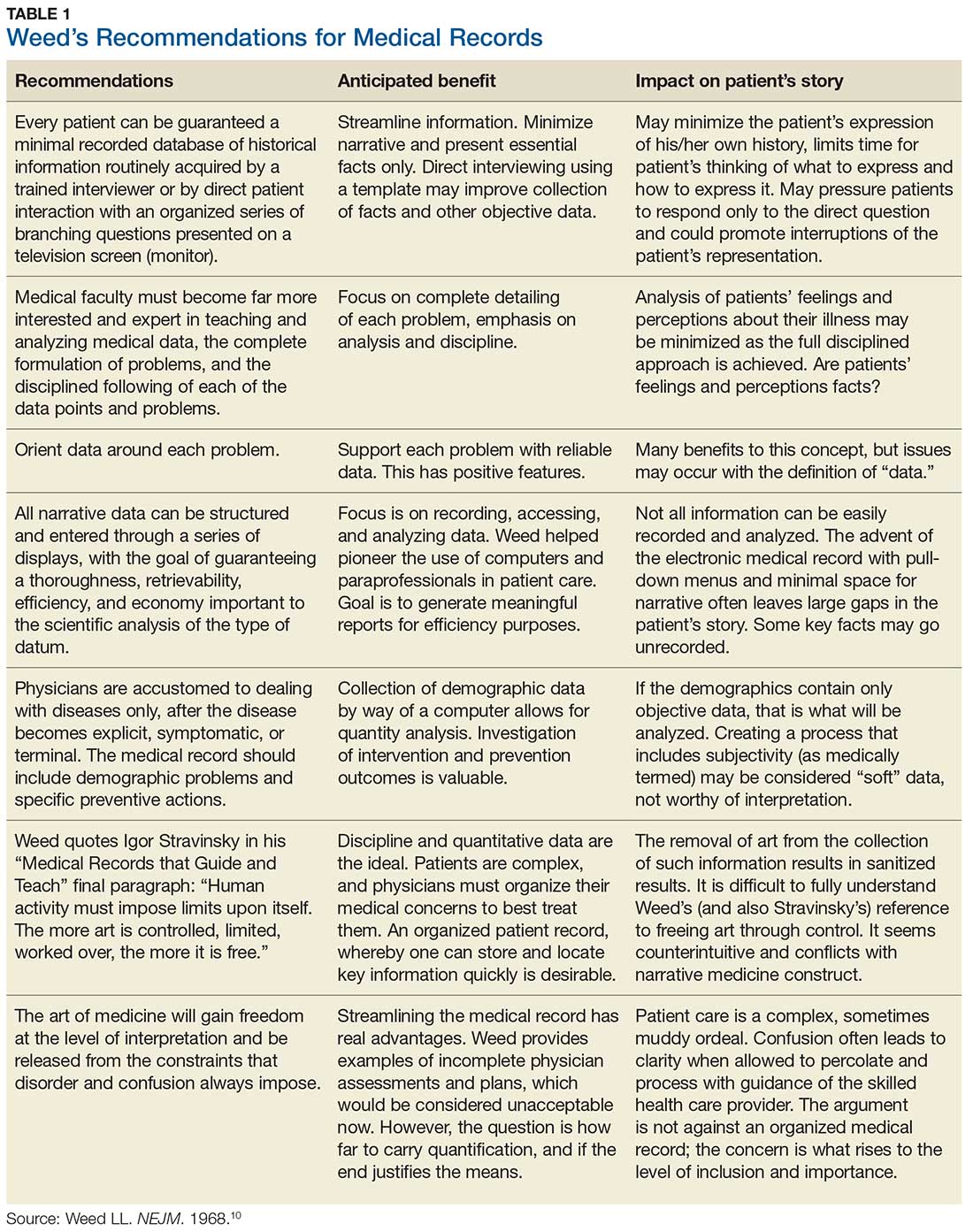
Continue to: Weed's clinical documentation...
Weed’s clinical documentation efficiency system caught fire. However, similar to Flexner’s later second thoughts, Weed also cast doubt on the full effect of his recommendations. In a 2009 interview conducted by a former medical student of his, Weed revealed views that more closely resemble our current competency-based medical education and stress the value of interpersonal skills in patient care12:
- Computerization of the medical record—with its vast amount of information and physician-processing capacity—“inevitably” leads to dangerous cognitive shortcuts. Medical education seeks to instill “medical knowledge and clinical judgment,” giving students “misplaced faith in the completeness and accuracy of their own intellects and is the antithesis of a truly scientific education.”12
- Medical student recruitment and instruction have long emphasized memory and regurgitation of facts, while students should be selected for their hands-on and interpersonal skills. Medical school should be “teaching a core of behavior instead of a core of knowledge.”12 These are areas in which NM helps.
FLEXNER, WEED, AND NOW, CHARON
Medicine’s history is blemished by errors, some significant. Flexner neatly compartmentalized medical education, Weed digitized the clinician/patient interaction, and Charon revitalizes the reason clinicians chose a health care profession. Charon—as a practicing internist, as well as a professor in the Department of Medicine and Executive Director of the Program in Narrative Medicine at Columbia University’s Vagelos College of Physicians and Surgeons in New York City—is fully qualified to speak to the importance of NM in medical education and medical practice. Her 2006 book reminds us that sore throats are not always simple, boring, and routine; each one is as unique as the person housing that particular pharynx.13
How does NM drive clinicians to be better, countering cognitive errors while incorporating the patient’s cultural and philosophic background? According to Charon, the NM concept results from conversation among scholars and clinicians teaching and practicing at Columbia University in early 2000, fueled by decades of insight from literature, medical (health care) humanities, ethics, health care communication, and primary care medicine.3 NM supports patient-centric teaching and care, reminding us that it combines the historical doctor-at-bedside, who exhibited careful, empathetic questioning and listening, with the benefits of modern medical science.
Charon describes 3 main clinician-to-patient interactions, allowing us to regain some of what we have lost: attention, representation, and affiliation (Table 2). In addition to medical error reduction, these 3 interactive behaviors counter the aforementioned 3As (anchoring, availability, and attribution) of cognitive error.5Attention initiates the clinician’s heightened and committed listening to the patient.3 In our patient encounter, essential information is undisclosed, leading to a missed diagnosis and an incomplete representation in the written note. The clinician, due to insufficient attention, missed important clues such as the patient’s dress, accent, and profession, which limited the representation. This almost seems nonsensical; who would care about a patient’s dress or accent and, of practical concern today, where would one record it? And could another urgent care clinician or specialist find these notes? How might a more serious future medical outcome be averted? Affiliation results in a connection of careful listening and full documentation as the clinician becomes invested in the whole patient, not just the sore throat.3
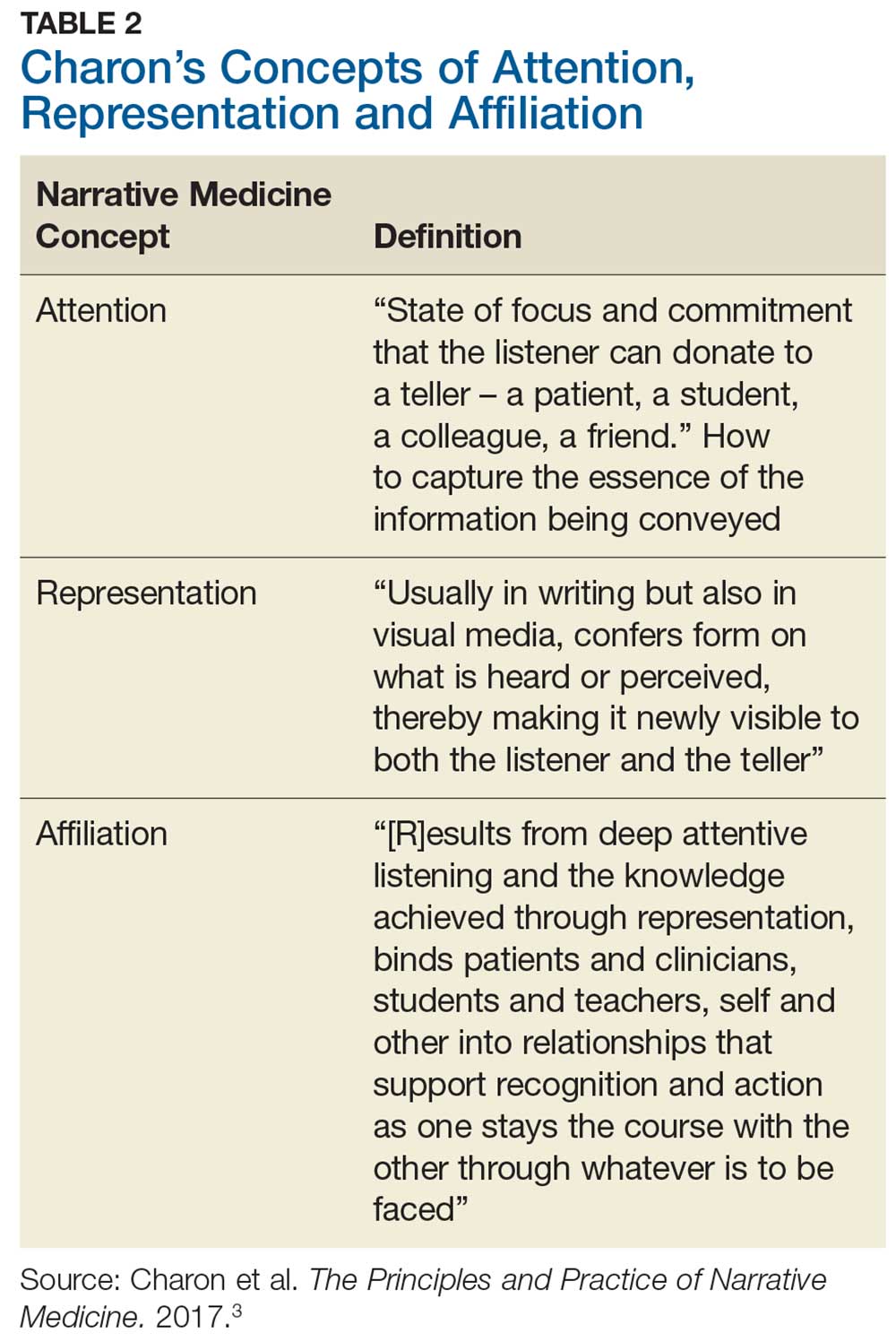
PREPROFESSIONAL AND PROFESSIONAL EDUCATION
Preprofessional humanities education may result in stronger NM conceptualization. The Association of American Medical Colleges (AAMC) recognizes the value of arts and humanities in medical education in developing qualities of professionalism, communication skills, and emotional intelligence in physicians. The AAMC Curriculum Inventory and Reports (2015-2016) shows that 119 medical schools require humanities education, including
- Visual arts to improve observational skills
- History education to frame modern-day Ebola outbreaks (eg, using the framework of the Black Death),
- Literature and poetry to enhance insight into different ways of living and thinking, fostering critical thinking.14
Continue to: NM has been offered in...
NM has been offered in medical schools with positive outcomes. Published results of a 2010 qualitative study of 130 Columbia University medical students who completed a required intensive half-semester of NM seminars testify to its salience.15 Students articulated NM’s importance to critical thinking and reflection, through improved attention and affiliation with their patients, improved ability to examine assumptions and develop new skills, and improved clarity of communication.15
A small number of PA programs, far fewer than medical schools, are incorporating NM coursework, through application of literature, visual media, creative writing, and other approaches based on the humanities.16 The nursing profession, which prefers the term narrative health care to narrative medicine, endorses its inclusion in nursing education. A 2018 article in Nursing Education Perspectives supports the study of humanities to complement technical competencies such as the ability to “absorb, analyze, and interpret complex artifacts” and to “participate effectively in deliberative conversations.”17
THE PRACTICING CLINICIAN: MENTAL HEALTH AND NARRATIVE MEDICINE
The value of NM extends beyond the patient to embrace caregivers as well; this is important, in light of increased attention to mental health status among clinicians. Although the term used most frequently is physician burnout, data indicate that patient management by MDs, NPs, and PAs is becoming indistinguishable—and thus risk for associated negative mental health consequences may be shared
The National Academy of Medicine is also addressing the issues of clinician well-being (see https://nam.edu/initiatives/clinician-resilience-and-well-being/). Former US Surgeon General Vivek Murthy, MD, has spoken about the epidemic of loneliness that affects clinicians. This can result from playing the physician role, lack of family support, and increased dependency on technology—yet, on a basic level, lack of interpersonal communication and connection are at the core.21 Communication between clinicians can lead to greater social cohesion and compassion, and effective uninterrupted listening and expression of their feelings helps. This begs the question: If physicians need to communicate better and practice active listening among themselves, how does this translate to the physician-to-patient bond?
THE CLINICIANS' PERSONAL BALM
Caruso Brown and Garden describe how the illness experiences of physicians, through their own reflective writing, create an empathy bridge between the professional healer and a sick patient, allowing them to be better and healthier clinicians.22 Recent best-selling physician narratives such as those by Atul Gawande,23 Siddhartha Mukherjee,24 and Paul Kalanithi25 support the similarities between the sick physician and the sick patient. Illness narratives written by physicians-turned-patients are not dissimilar to illness narratives written by patients. Reflective writing by clinicians fosters a deeper understanding not only of how patients feel, but also of the relationship they desire and deserve.22
Continue to: Writing a novel...
Writing a novel is beyond the time and ability of many clinicians. However, they can closely read literature (another NM tool), discuss books and other types of writing, participate in a book club, establish a hospital or office support group, and find a buddy or trustworthy confidant with whom to decompress and vent.3 Active journal clubs can alternate clinical guidelines with literature to expand their perspectives. An international voice, Maria Giulia Marini, Research and Health Director of the Fondazione ISTUD in Milan, Italy, and European proponent of NM, offers similar suggestions, indicating that making nonmedical works parts of a clinician’s life encourages empathy and promotes understanding between clinician and patient, as well as a holistic management approach, encourages personal and collegial reflection (eg, sharing tough experiences), sets a patient-centered agenda, and challenges the norm.26
NARRATIVE MEDICINE'S FUTURE ROLE
The field of medical humanities has experienced growth through publications, national and international conferences, and formal discussion between executives of the AAMC and the National Endowment for the Humanities to design and incorporate joint programs teaching humanities in medical schools.27 As of March 2019, there were 85 established baccalaureate health humanities programs in the US, with additional programs in development.28
Clinicians and professional organizations cannot help but see the suffering of patients, with its concomitant provider burden. The urgent care patient encounter in our example met the standard of care of the typical interaction that achieves billing protocols; the HPI, ROS, and physical exam would not raise an eyebrow. Yet, an NM approach provides more. Asking the atypical questions about accents, out-of-the-ordinary dress and behavior, and wondering about the mentioned late-night appointment attends to NM’s focused active listening, with resultant quality documentation and a whole patient encounter, even in an acute care case.
Don’t be afraid. Consider that as in novels and movies, strange things happen. The iconic book The House of God reminds clinicians that, upon hearing hoof beats, we should first think of horses—however, sometimes a zebra is correct.29 When an urgent care clinician interprets the hoof beats, a zebra may be in the differential diagnosis; in the case presented, the patient might fortunately be spared a future KS diagnosis. And the clinician may avoid personal anguish at what could have been a better outcome. NM can help clinicians remember that sore throats are as unique as people.
1. Krisberg K. Narrative medicine: Every patient has a story. AAMC News. March 28, 2018. https://news.aamc.org/medical-education/article/narrative-medicine-every-patient-has-story. Accessed October 10, 2018.
2. Peabody FW. The care of the patient. JAMA. 1927;80(12):877-882.
3. Charon R, DasGupta S, Hermann N, et al. The Principles and Practice of Narrative Medicine. New York, NY: Oxford University Press; 2017:1, 3.
4. Murphy JG , Stee LA, McAvoy MT, Oshiro J. Journal reporting of medical errors: the wisdom of Solomon, the bravery of Achilles, and the foolishness of Pan. Chest. 2007;131(3):890-896.
5. Groopman J, Hartzband P. Mindful medicine: Critical thinking leads to right diagnosis. ACP Internist. January 2008. https://acpinternist.org/archives/2008/01/groopman.htm. Accessed May 11, 2018.
6. Nzivo MM, Lwembe RM, Odari EO, Budambula NLM. Human herpes virus type 8 among female-sex workers. J Hum Virol Retrovirol 2017;5(6):00176.
7. Flexner A. Medical education in the United States and Canada—a report to the Carnegie Foundation for the Advancement of Teaching. Bulletin No. 4. Boston, MA: DB Updike, Merrymount Press; 1910.
8. Cooke M, Irby DM, Sullivan W, Ludmerer KM. American medical education 100 years after the Flexner Report. N Engl J Med. 2006;355(13):1339-1344.
9. Stahnisch FW, Verhoef M. The Flexner Report of 1910 and its impact on complementary and alternative medicine and psychiatry in North America in the 20th Century. Evid Based Complement Alternat Med. 2012;2012:647896.
10. Weed LL. Medical records that guide and teach. NEJM. 1968;278(12):652-657.
11. Ommaya AK, Cipriano PF, Hoyt DB, et al. Care-centered clinical documentation in the digital environment: solutions to alleviate burnout. NAM.edu/Perspectives. January 29, 2018. Accessed June 19, 2018.
12. Jacobs L. Interview with Lawrence Weed, MD - The father of the problem-oriented medical record looks ahead. The Permanente Journal. Summer 2009;13(3):84-89. https://doi.org/10.7812/TPP/09-068. Accessed August 2, 2019.
13. Charon R. Narrative Medicine: Honoring the Stories of Illness. New York, NY: Oxford University Press; 2006.
14. Mann S. Focusing on arts, humanities to develop well-rounded physicians. AAMC News. August 15, 2017. https://news.aamc.org/medical-education/article/focusing-arts-humanities-well-rounded-physicians/. Accessed Oct 10, 2018.
15. Miller E, Balmer D, Hermann N, et al. Sounding narrative medicine: studying students’ professional identity development at Columbia University College of Physicians and Surgeons. Acad Med. 2014;89(2):335-342.
16. Grant JP, Gregory T. The Sacred Seven elective: integrating the health humanities into physician assistant education. J Physician Assist Educ. 2017;28(4):220-222.
17. Lim F, Marsaglia MJ. Nursing humanities: teaching for a sense of salience. Nurs Educ Perspect. 2018;39(2):121-122.
18. Hooker RS. PAs, NPs, PAs, physicians and regression to the mean. JAAPA. 2018;31(7):13-14.
19. West CP, Dyrbye LN, Erwin PJ, Shanafelt TD. Interventions to prevent and reduce physician burnout: a systematic review and meta-analysis. Lancet. 2016;338:2272-2281.
20. Kearney MK, Weininger RB, Vachon ML, et al. Self-care of physicians caring for patients at the end of life: “Being connected … a key to my survival.” JAMA. 2009;301(11):1155–1164, E1.
21. Firth S. Former Surgeon General talks love, loneliness, and burnout: NAM panel addresses growing crisis in medicine. Medpage Today. May 4, 2018. www.medpagetoday.com/publichealthpolicy/generalprofessionalissues/72720. Accessed June 15, 2018.
22. Caruso Brown AE, Garden R. Images of healing and learning: from silence into language: Questioning the power of physician illness narratives. AMA J Ethics. 2017;19(5):501-507.
23. Gawande A. Being Mortal: Medicine and What Matters in the End. 1st ed. New York, NY: Metropolitan Books; 2014.
24. Mukherjee S. The Emperor of All Maladies: A Biography of Cancer. New York, NY: Simon & Schuster; 2010.
25. Kalanithi P. When Breath Becomes Air. New York, NY: Penguin Random House; 2016.
26. Marini MG. Narrative Medicine: Bridging the Gap Between Evidence-Based Care and Medical Humanities. Cham, Switzerland: Springer International Publishing; 2016.
27. Charon R. To see the suffering. Acad Med. 2017;92(12):1668-1670.
28. Lamb EG, Berry SL, Jones T. Health Humanities Baccalaureate Programs in the United States. Hiram, OH: Center for Literature and Medicine, Hiram College; March 2019.
29. Shem S. The House of God. New York, NY: Berkley Random House; 1978.
Narrative medicine (NM) centers on understanding patients’ lives, caring for the caregivers (including the clinicians), and giving voice to the suffering.1 It is an antidote for medical “progress,” which often stresses technology and pharmacologic interventions, leaving the patient out of his/her own medical story—with negative consequences.
This missing patient narrative goes beyond the template information solicited and recorded in the history of present illness (HPI) and review of systems (ROS). It is well expressed by Francis W. Peabody, MD, (1881-1927) in a published lecture for Harvard Medical School students: “One of the essential qualities of the clinician is an interest in humanity, for the secret of the care of the patient is in caring for the patient.”2
This article serves as an introduction to NM, its evolution, and its power to improve medical diagnoses and reduce clinician burnout. While its roots are in palliative and chronic care, NM has a place in the day-to-day care of patients in acute settings as well.
VIGNETTE
It’s been a busy day in clinic; the clock ticks toward closing. Scanning the monitor, you permit a brief moment of relief as you spy the perfect end-of-shift, quickie patient case: “Sore throat x 2 days,” with a rapid strep test under way. You quickly check lab coat pockets for examination tools and hasten down the hall noting age 22, white female, self-pay. Vitals reveal a low-grade fever. Maybe this sore throat will be bacterial; all the easier as there will be no need to do the “antibiotics don’t work for viruses” sermon.
You knock briefly, enter the exam room, place the laptop on the counter, and immediately recognize the patient from multiple visits over the past 2 years, mostly for gynecologic issues. You recall treating her for gonorrhea and discussing her worry about HIV. She told you that she’s a graduate student, although she is overdressed for a week night, wearing a silk blouse, short skirt, and high heels. She offers a winning smile and tells you with her pleasant accent that she is running late for an appointment.
The patient describes her symptoms: unrelenting sore throat for 2 days and pain with swallowing. She complains of feeling feverish and fatigued, with no appetite and “swollen glands.” She denies cough and runny nose; she looks and sounds exhausted. She denies smoking and excessive alcohol intake. You vaguely hone in on the accent, thinking it might be South African. Her HPI and ROS completed, you record her physical findings of pharyngeal erythema, no exudates, and moderate anterior lymphadenopathy.
You have a nagging thought about her “story.” As an urgent care clinician, you know you are likely her only health care provider and you feel some connection. It is late, and the patient is in a rush, so you promise yourself to delve deeper the next time she presents.
Continue to: You confirm the negative strep test results...
You confirm the negative strep test results and deliver the well-rehearsed sermon. She appears surprised, asking if you are sure. You suggest that she schedule a full physical in the near future. She hops off the table, heels clicking on the tile floor, as you complete your note. You do not suspect she is off to meet her scheduled man of the evening as assigned by her escort service.
Before you clock out, you check the extended patient appointment schedule and do not see her name. You vow to call her the next day and discover that she has no listed phone number. An uncomfortable feeling settles in: Are you missing something?
IN URGENT CARE
NM is an interactive patient approach more often applied to seriously ill or chronic disease patients, for whom it meaningfully supports a patient’s existence as central to the diagnostic testing and treatment of health care concerns. One can professionally debate that NM has no place in urgent care; however, this is where many patients’ acute and chronic conditions are discovered. It is where elevated blood glucose becomes type 2 diabetes and abnormal complete blood counts become blood cancer. With deeper application of NM’s principles, our simple-appearing acute pharyngitis case might have received a different workup.
NM practitioners subscribe to careful listening. Rita Charon, MD, a leading proponent of NM, describes this approach to patient care as a “rigorous intellectual and clinical discipline to fortify health care with its capacity to skillfully receive the accounts persons give of themselves—to recognize, absorb, interpret, and be moved to action by the stories of others.”3 It is a patient care revival that helps clinicians recognize and shield themselves from the powerful stampede of technology, templated patient interviews, digital documentation, and diminution of clinician and patient bonding.
The clinician in this patient encounter has functionally intact radar, sensing something awry, but communication falls short. NM’s strength is to bond the clinician to the patient, enhancing subtle, and at times pivotal, information exchange. It generates patient trust even in brief encounters, fostering improved clinical decision-making. A stronger NM focus might have encouraged this clinician to investigate more deeply the patient’s fancy clothing and surprised response to the negative strep test results by posing a simple query, such as ”What do you think might be going on?”
Continue to: MEDICAL ERROR
MEDICAL ERROR
Pharyngitis is common, making it prime territory for medical error—even for experienced clinicians—because of 3 human tendencies that NM recognizes and seeks to avoid.4 These human tendencies, insightfully delineated decades ago by experimental psychologists Amos Tversky and Daniel Kahneman, authors of Anchoring, Availability and Attribution, appear most commonly under uncertain conditions and time pressures, such as in urgent care. How does this patient encounter reflect these tendencies?5
Anchoring refers to the tendency to grasp the first symptom, physical finding, or laboratory abnormality, and hold onto it tightly.5 Such initial diagnostic impressions/information may prove true; however, other unconsidered diagnoses may include the correct one. In this encounter, the clinician entered the exam room with an early fixed diagnosis and applied the rapid strep results to diagnose viral pharyngitis. Other, conflicting hints were fleetingly noted and not addressed.
Availability refers to the tendency to assume that a quickly recalled experience explains a novel situation.5 Clinicians regularly diagnose viral pharyngitis, leading to familiarity and availability. This is contrary to NM’s view of every patient having a unique and noteworthy story.
Attribution refers to the tendency to invoke stereotypical images and assign symptoms and findings to the stereotype, which is often negative (eg, hypochondriac, drinker).5
In this encounter, the clinician would have benefited from considering other categories of diagnoses that could occur in this patient, expanding the differential diagnosis list, by soliciting a deeper patient story, fostering trust, and following clinical intuition. Had this bond been cultivated over prior visits, even in an urgent care setting, the graduate student ruse would have been discovered and the patient’s true occupation—female sex worker—revealed. The clinician would have modified the laboratory testing, discovering human herpesvirus type 8 (HHV-8) as the pharyngitis etiology, which is disproportionately linked to HIV co-infection and increases the risk for Kaposi sarcoma (KS) 20,000-fold. The prevalence of HHV-8 is 17% in the United States and is much higher (50%) in South Africa, the origin of the patient’s accent.6 Deeper patient relationships enable uncomfortable history-taking questions, with improved reliability. This missed diagnosis has wide-ranging negative consequences for the patient and her escort encounters.6
Continue to: THE FLEXNER REPORT
THE FLEXNER REPORT: NARRATIVE MEDICINE'S EXCISION
It is clear that the scientific revolution prompted the removal of NM from clinical practice. The 1910 Flexner Report, funded by the Carnegie Foundation for the Advancement of Teaching Science and authored by research scholar and physician Abraham Flexner, analyzed the functioning of 155 US and Canadian medical schools.7 His report supported the socially desirable goal of reforming medical education by exposing mediocre quality, unsavory profit motives, inadequate facilities, and nonscientific approaches, and publishing a list of those falling below the gold standard (which was the German medical education system). Harvard and Johns Hopkins received a gold seal, many other medical schools closed, and several responded to the challenge and excelled.8
Medical school curricula transitioned to exclusively theoretical and scientific teaching, objectifying values and rewarding research and efficiency. The subjective patient story was surgically excised and replaced with objective science. Not all change is good, however, and years later, Flexner reflected that scientific medicine was “sadly deficient in cultural and philosophic background.”8 His report also dramatically suppressed the use of complementary and alternative medicine and psychiatry, another medical boomerang.9 Scientific rigor is desirable—but not to the exclusion of the central patient role and other potential health care modalities.
THE PROBLEM-ORIENTED MEDICAL RECORD AND EHR
Decades after Flexner’s report on medical education curricula, another reformer, Lawrence Weed, MD, trained his eye on medical documentation’s organization and structure. He published a seminal article, “Medical Records that Guide and Teach” in the New England Journal of Medicine.10 Truly a pioneer, he demonstrated how typical medical record case documentation circa 1967 could be more efficient and espoused the problem-oriented medical record. He conceptualized designs for reorganizing medical records, prophetically promoted use of “paramedical” personnel, and encouraged computer integration.10
Coinciding with the birth of the PA profession and the recent inception of the NP profession, Weed endorsed the use of trained interviewers who would apply a “branching” question algorithm with associated computer data entry designed to protect expensive physician time. The patient story would be a jigsaw puzzle, as physicians could fill in missing information.10
Weed’s goals had merit by stressing structure for the disorganized, then-handwritten medical record, benefitting the growth of team-based patient care. However, efficiency and precision continued to marginalize a key component of the patient’s illness narrative in favor of speed, objectivity, and achievable billing essentials.11 His recommendations have eradicated the free-text box, replacing it with a selection of pull-down choices or prewritten templates. With a series of clicks, the subjective patient’s own narrative is sterilized, removing valuable details from the team’s view.11 The “s” of the Subjective Objective Assessment and Plan note is washed away (Table 1).
Continue to: Weed's clinical documentation...
Weed’s clinical documentation efficiency system caught fire. However, similar to Flexner’s later second thoughts, Weed also cast doubt on the full effect of his recommendations. In a 2009 interview conducted by a former medical student of his, Weed revealed views that more closely resemble our current competency-based medical education and stress the value of interpersonal skills in patient care12:
- Computerization of the medical record—with its vast amount of information and physician-processing capacity—“inevitably” leads to dangerous cognitive shortcuts. Medical education seeks to instill “medical knowledge and clinical judgment,” giving students “misplaced faith in the completeness and accuracy of their own intellects and is the antithesis of a truly scientific education.”12
- Medical student recruitment and instruction have long emphasized memory and regurgitation of facts, while students should be selected for their hands-on and interpersonal skills. Medical school should be “teaching a core of behavior instead of a core of knowledge.”12 These are areas in which NM helps.
FLEXNER, WEED, AND NOW, CHARON
Medicine’s history is blemished by errors, some significant. Flexner neatly compartmentalized medical education, Weed digitized the clinician/patient interaction, and Charon revitalizes the reason clinicians chose a health care profession. Charon—as a practicing internist, as well as a professor in the Department of Medicine and Executive Director of the Program in Narrative Medicine at Columbia University’s Vagelos College of Physicians and Surgeons in New York City—is fully qualified to speak to the importance of NM in medical education and medical practice. Her 2006 book reminds us that sore throats are not always simple, boring, and routine; each one is as unique as the person housing that particular pharynx.13
How does NM drive clinicians to be better, countering cognitive errors while incorporating the patient’s cultural and philosophic background? According to Charon, the NM concept results from conversation among scholars and clinicians teaching and practicing at Columbia University in early 2000, fueled by decades of insight from literature, medical (health care) humanities, ethics, health care communication, and primary care medicine.3 NM supports patient-centric teaching and care, reminding us that it combines the historical doctor-at-bedside, who exhibited careful, empathetic questioning and listening, with the benefits of modern medical science.
Charon describes 3 main clinician-to-patient interactions, allowing us to regain some of what we have lost: attention, representation, and affiliation (Table 2). In addition to medical error reduction, these 3 interactive behaviors counter the aforementioned 3As (anchoring, availability, and attribution) of cognitive error.5Attention initiates the clinician’s heightened and committed listening to the patient.3 In our patient encounter, essential information is undisclosed, leading to a missed diagnosis and an incomplete representation in the written note. The clinician, due to insufficient attention, missed important clues such as the patient’s dress, accent, and profession, which limited the representation. This almost seems nonsensical; who would care about a patient’s dress or accent and, of practical concern today, where would one record it? And could another urgent care clinician or specialist find these notes? How might a more serious future medical outcome be averted? Affiliation results in a connection of careful listening and full documentation as the clinician becomes invested in the whole patient, not just the sore throat.3
PREPROFESSIONAL AND PROFESSIONAL EDUCATION
Preprofessional humanities education may result in stronger NM conceptualization. The Association of American Medical Colleges (AAMC) recognizes the value of arts and humanities in medical education in developing qualities of professionalism, communication skills, and emotional intelligence in physicians. The AAMC Curriculum Inventory and Reports (2015-2016) shows that 119 medical schools require humanities education, including
- Visual arts to improve observational skills
- History education to frame modern-day Ebola outbreaks (eg, using the framework of the Black Death),
- Literature and poetry to enhance insight into different ways of living and thinking, fostering critical thinking.14
Continue to: NM has been offered in...
NM has been offered in medical schools with positive outcomes. Published results of a 2010 qualitative study of 130 Columbia University medical students who completed a required intensive half-semester of NM seminars testify to its salience.15 Students articulated NM’s importance to critical thinking and reflection, through improved attention and affiliation with their patients, improved ability to examine assumptions and develop new skills, and improved clarity of communication.15
A small number of PA programs, far fewer than medical schools, are incorporating NM coursework, through application of literature, visual media, creative writing, and other approaches based on the humanities.16 The nursing profession, which prefers the term narrative health care to narrative medicine, endorses its inclusion in nursing education. A 2018 article in Nursing Education Perspectives supports the study of humanities to complement technical competencies such as the ability to “absorb, analyze, and interpret complex artifacts” and to “participate effectively in deliberative conversations.”17
THE PRACTICING CLINICIAN: MENTAL HEALTH AND NARRATIVE MEDICINE
The value of NM extends beyond the patient to embrace caregivers as well; this is important, in light of increased attention to mental health status among clinicians. Although the term used most frequently is physician burnout, data indicate that patient management by MDs, NPs, and PAs is becoming indistinguishable—and thus risk for associated negative mental health consequences may be shared
The National Academy of Medicine is also addressing the issues of clinician well-being (see https://nam.edu/initiatives/clinician-resilience-and-well-being/). Former US Surgeon General Vivek Murthy, MD, has spoken about the epidemic of loneliness that affects clinicians. This can result from playing the physician role, lack of family support, and increased dependency on technology—yet, on a basic level, lack of interpersonal communication and connection are at the core.21 Communication between clinicians can lead to greater social cohesion and compassion, and effective uninterrupted listening and expression of their feelings helps. This begs the question: If physicians need to communicate better and practice active listening among themselves, how does this translate to the physician-to-patient bond?
THE CLINICIANS' PERSONAL BALM
Caruso Brown and Garden describe how the illness experiences of physicians, through their own reflective writing, create an empathy bridge between the professional healer and a sick patient, allowing them to be better and healthier clinicians.22 Recent best-selling physician narratives such as those by Atul Gawande,23 Siddhartha Mukherjee,24 and Paul Kalanithi25 support the similarities between the sick physician and the sick patient. Illness narratives written by physicians-turned-patients are not dissimilar to illness narratives written by patients. Reflective writing by clinicians fosters a deeper understanding not only of how patients feel, but also of the relationship they desire and deserve.22
Continue to: Writing a novel...
Writing a novel is beyond the time and ability of many clinicians. However, they can closely read literature (another NM tool), discuss books and other types of writing, participate in a book club, establish a hospital or office support group, and find a buddy or trustworthy confidant with whom to decompress and vent.3 Active journal clubs can alternate clinical guidelines with literature to expand their perspectives. An international voice, Maria Giulia Marini, Research and Health Director of the Fondazione ISTUD in Milan, Italy, and European proponent of NM, offers similar suggestions, indicating that making nonmedical works parts of a clinician’s life encourages empathy and promotes understanding between clinician and patient, as well as a holistic management approach, encourages personal and collegial reflection (eg, sharing tough experiences), sets a patient-centered agenda, and challenges the norm.26
NARRATIVE MEDICINE'S FUTURE ROLE
The field of medical humanities has experienced growth through publications, national and international conferences, and formal discussion between executives of the AAMC and the National Endowment for the Humanities to design and incorporate joint programs teaching humanities in medical schools.27 As of March 2019, there were 85 established baccalaureate health humanities programs in the US, with additional programs in development.28
Clinicians and professional organizations cannot help but see the suffering of patients, with its concomitant provider burden. The urgent care patient encounter in our example met the standard of care of the typical interaction that achieves billing protocols; the HPI, ROS, and physical exam would not raise an eyebrow. Yet, an NM approach provides more. Asking the atypical questions about accents, out-of-the-ordinary dress and behavior, and wondering about the mentioned late-night appointment attends to NM’s focused active listening, with resultant quality documentation and a whole patient encounter, even in an acute care case.
Don’t be afraid. Consider that as in novels and movies, strange things happen. The iconic book The House of God reminds clinicians that, upon hearing hoof beats, we should first think of horses—however, sometimes a zebra is correct.29 When an urgent care clinician interprets the hoof beats, a zebra may be in the differential diagnosis; in the case presented, the patient might fortunately be spared a future KS diagnosis. And the clinician may avoid personal anguish at what could have been a better outcome. NM can help clinicians remember that sore throats are as unique as people.
Narrative medicine (NM) centers on understanding patients’ lives, caring for the caregivers (including the clinicians), and giving voice to the suffering.1 It is an antidote for medical “progress,” which often stresses technology and pharmacologic interventions, leaving the patient out of his/her own medical story—with negative consequences.
This missing patient narrative goes beyond the template information solicited and recorded in the history of present illness (HPI) and review of systems (ROS). It is well expressed by Francis W. Peabody, MD, (1881-1927) in a published lecture for Harvard Medical School students: “One of the essential qualities of the clinician is an interest in humanity, for the secret of the care of the patient is in caring for the patient.”2
This article serves as an introduction to NM, its evolution, and its power to improve medical diagnoses and reduce clinician burnout. While its roots are in palliative and chronic care, NM has a place in the day-to-day care of patients in acute settings as well.
VIGNETTE
It’s been a busy day in clinic; the clock ticks toward closing. Scanning the monitor, you permit a brief moment of relief as you spy the perfect end-of-shift, quickie patient case: “Sore throat x 2 days,” with a rapid strep test under way. You quickly check lab coat pockets for examination tools and hasten down the hall noting age 22, white female, self-pay. Vitals reveal a low-grade fever. Maybe this sore throat will be bacterial; all the easier as there will be no need to do the “antibiotics don’t work for viruses” sermon.
You knock briefly, enter the exam room, place the laptop on the counter, and immediately recognize the patient from multiple visits over the past 2 years, mostly for gynecologic issues. You recall treating her for gonorrhea and discussing her worry about HIV. She told you that she’s a graduate student, although she is overdressed for a week night, wearing a silk blouse, short skirt, and high heels. She offers a winning smile and tells you with her pleasant accent that she is running late for an appointment.
The patient describes her symptoms: unrelenting sore throat for 2 days and pain with swallowing. She complains of feeling feverish and fatigued, with no appetite and “swollen glands.” She denies cough and runny nose; she looks and sounds exhausted. She denies smoking and excessive alcohol intake. You vaguely hone in on the accent, thinking it might be South African. Her HPI and ROS completed, you record her physical findings of pharyngeal erythema, no exudates, and moderate anterior lymphadenopathy.
You have a nagging thought about her “story.” As an urgent care clinician, you know you are likely her only health care provider and you feel some connection. It is late, and the patient is in a rush, so you promise yourself to delve deeper the next time she presents.
Continue to: You confirm the negative strep test results...
You confirm the negative strep test results and deliver the well-rehearsed sermon. She appears surprised, asking if you are sure. You suggest that she schedule a full physical in the near future. She hops off the table, heels clicking on the tile floor, as you complete your note. You do not suspect she is off to meet her scheduled man of the evening as assigned by her escort service.
Before you clock out, you check the extended patient appointment schedule and do not see her name. You vow to call her the next day and discover that she has no listed phone number. An uncomfortable feeling settles in: Are you missing something?
IN URGENT CARE
NM is an interactive patient approach more often applied to seriously ill or chronic disease patients, for whom it meaningfully supports a patient’s existence as central to the diagnostic testing and treatment of health care concerns. One can professionally debate that NM has no place in urgent care; however, this is where many patients’ acute and chronic conditions are discovered. It is where elevated blood glucose becomes type 2 diabetes and abnormal complete blood counts become blood cancer. With deeper application of NM’s principles, our simple-appearing acute pharyngitis case might have received a different workup.
NM practitioners subscribe to careful listening. Rita Charon, MD, a leading proponent of NM, describes this approach to patient care as a “rigorous intellectual and clinical discipline to fortify health care with its capacity to skillfully receive the accounts persons give of themselves—to recognize, absorb, interpret, and be moved to action by the stories of others.”3 It is a patient care revival that helps clinicians recognize and shield themselves from the powerful stampede of technology, templated patient interviews, digital documentation, and diminution of clinician and patient bonding.
The clinician in this patient encounter has functionally intact radar, sensing something awry, but communication falls short. NM’s strength is to bond the clinician to the patient, enhancing subtle, and at times pivotal, information exchange. It generates patient trust even in brief encounters, fostering improved clinical decision-making. A stronger NM focus might have encouraged this clinician to investigate more deeply the patient’s fancy clothing and surprised response to the negative strep test results by posing a simple query, such as ”What do you think might be going on?”
Continue to: MEDICAL ERROR
MEDICAL ERROR
Pharyngitis is common, making it prime territory for medical error—even for experienced clinicians—because of 3 human tendencies that NM recognizes and seeks to avoid.4 These human tendencies, insightfully delineated decades ago by experimental psychologists Amos Tversky and Daniel Kahneman, authors of Anchoring, Availability and Attribution, appear most commonly under uncertain conditions and time pressures, such as in urgent care. How does this patient encounter reflect these tendencies?5
Anchoring refers to the tendency to grasp the first symptom, physical finding, or laboratory abnormality, and hold onto it tightly.5 Such initial diagnostic impressions/information may prove true; however, other unconsidered diagnoses may include the correct one. In this encounter, the clinician entered the exam room with an early fixed diagnosis and applied the rapid strep results to diagnose viral pharyngitis. Other, conflicting hints were fleetingly noted and not addressed.
Availability refers to the tendency to assume that a quickly recalled experience explains a novel situation.5 Clinicians regularly diagnose viral pharyngitis, leading to familiarity and availability. This is contrary to NM’s view of every patient having a unique and noteworthy story.
Attribution refers to the tendency to invoke stereotypical images and assign symptoms and findings to the stereotype, which is often negative (eg, hypochondriac, drinker).5
In this encounter, the clinician would have benefited from considering other categories of diagnoses that could occur in this patient, expanding the differential diagnosis list, by soliciting a deeper patient story, fostering trust, and following clinical intuition. Had this bond been cultivated over prior visits, even in an urgent care setting, the graduate student ruse would have been discovered and the patient’s true occupation—female sex worker—revealed. The clinician would have modified the laboratory testing, discovering human herpesvirus type 8 (HHV-8) as the pharyngitis etiology, which is disproportionately linked to HIV co-infection and increases the risk for Kaposi sarcoma (KS) 20,000-fold. The prevalence of HHV-8 is 17% in the United States and is much higher (50%) in South Africa, the origin of the patient’s accent.6 Deeper patient relationships enable uncomfortable history-taking questions, with improved reliability. This missed diagnosis has wide-ranging negative consequences for the patient and her escort encounters.6
Continue to: THE FLEXNER REPORT
THE FLEXNER REPORT: NARRATIVE MEDICINE'S EXCISION
It is clear that the scientific revolution prompted the removal of NM from clinical practice. The 1910 Flexner Report, funded by the Carnegie Foundation for the Advancement of Teaching Science and authored by research scholar and physician Abraham Flexner, analyzed the functioning of 155 US and Canadian medical schools.7 His report supported the socially desirable goal of reforming medical education by exposing mediocre quality, unsavory profit motives, inadequate facilities, and nonscientific approaches, and publishing a list of those falling below the gold standard (which was the German medical education system). Harvard and Johns Hopkins received a gold seal, many other medical schools closed, and several responded to the challenge and excelled.8
Medical school curricula transitioned to exclusively theoretical and scientific teaching, objectifying values and rewarding research and efficiency. The subjective patient story was surgically excised and replaced with objective science. Not all change is good, however, and years later, Flexner reflected that scientific medicine was “sadly deficient in cultural and philosophic background.”8 His report also dramatically suppressed the use of complementary and alternative medicine and psychiatry, another medical boomerang.9 Scientific rigor is desirable—but not to the exclusion of the central patient role and other potential health care modalities.
THE PROBLEM-ORIENTED MEDICAL RECORD AND EHR
Decades after Flexner’s report on medical education curricula, another reformer, Lawrence Weed, MD, trained his eye on medical documentation’s organization and structure. He published a seminal article, “Medical Records that Guide and Teach” in the New England Journal of Medicine.10 Truly a pioneer, he demonstrated how typical medical record case documentation circa 1967 could be more efficient and espoused the problem-oriented medical record. He conceptualized designs for reorganizing medical records, prophetically promoted use of “paramedical” personnel, and encouraged computer integration.10
Coinciding with the birth of the PA profession and the recent inception of the NP profession, Weed endorsed the use of trained interviewers who would apply a “branching” question algorithm with associated computer data entry designed to protect expensive physician time. The patient story would be a jigsaw puzzle, as physicians could fill in missing information.10
Weed’s goals had merit by stressing structure for the disorganized, then-handwritten medical record, benefitting the growth of team-based patient care. However, efficiency and precision continued to marginalize a key component of the patient’s illness narrative in favor of speed, objectivity, and achievable billing essentials.11 His recommendations have eradicated the free-text box, replacing it with a selection of pull-down choices or prewritten templates. With a series of clicks, the subjective patient’s own narrative is sterilized, removing valuable details from the team’s view.11 The “s” of the Subjective Objective Assessment and Plan note is washed away (Table 1).
Continue to: Weed's clinical documentation...
Weed’s clinical documentation efficiency system caught fire. However, similar to Flexner’s later second thoughts, Weed also cast doubt on the full effect of his recommendations. In a 2009 interview conducted by a former medical student of his, Weed revealed views that more closely resemble our current competency-based medical education and stress the value of interpersonal skills in patient care12:
- Computerization of the medical record—with its vast amount of information and physician-processing capacity—“inevitably” leads to dangerous cognitive shortcuts. Medical education seeks to instill “medical knowledge and clinical judgment,” giving students “misplaced faith in the completeness and accuracy of their own intellects and is the antithesis of a truly scientific education.”12
- Medical student recruitment and instruction have long emphasized memory and regurgitation of facts, while students should be selected for their hands-on and interpersonal skills. Medical school should be “teaching a core of behavior instead of a core of knowledge.”12 These are areas in which NM helps.
FLEXNER, WEED, AND NOW, CHARON
Medicine’s history is blemished by errors, some significant. Flexner neatly compartmentalized medical education, Weed digitized the clinician/patient interaction, and Charon revitalizes the reason clinicians chose a health care profession. Charon—as a practicing internist, as well as a professor in the Department of Medicine and Executive Director of the Program in Narrative Medicine at Columbia University’s Vagelos College of Physicians and Surgeons in New York City—is fully qualified to speak to the importance of NM in medical education and medical practice. Her 2006 book reminds us that sore throats are not always simple, boring, and routine; each one is as unique as the person housing that particular pharynx.13
How does NM drive clinicians to be better, countering cognitive errors while incorporating the patient’s cultural and philosophic background? According to Charon, the NM concept results from conversation among scholars and clinicians teaching and practicing at Columbia University in early 2000, fueled by decades of insight from literature, medical (health care) humanities, ethics, health care communication, and primary care medicine.3 NM supports patient-centric teaching and care, reminding us that it combines the historical doctor-at-bedside, who exhibited careful, empathetic questioning and listening, with the benefits of modern medical science.
Charon describes 3 main clinician-to-patient interactions, allowing us to regain some of what we have lost: attention, representation, and affiliation (Table 2). In addition to medical error reduction, these 3 interactive behaviors counter the aforementioned 3As (anchoring, availability, and attribution) of cognitive error.5Attention initiates the clinician’s heightened and committed listening to the patient.3 In our patient encounter, essential information is undisclosed, leading to a missed diagnosis and an incomplete representation in the written note. The clinician, due to insufficient attention, missed important clues such as the patient’s dress, accent, and profession, which limited the representation. This almost seems nonsensical; who would care about a patient’s dress or accent and, of practical concern today, where would one record it? And could another urgent care clinician or specialist find these notes? How might a more serious future medical outcome be averted? Affiliation results in a connection of careful listening and full documentation as the clinician becomes invested in the whole patient, not just the sore throat.3
PREPROFESSIONAL AND PROFESSIONAL EDUCATION
Preprofessional humanities education may result in stronger NM conceptualization. The Association of American Medical Colleges (AAMC) recognizes the value of arts and humanities in medical education in developing qualities of professionalism, communication skills, and emotional intelligence in physicians. The AAMC Curriculum Inventory and Reports (2015-2016) shows that 119 medical schools require humanities education, including
- Visual arts to improve observational skills
- History education to frame modern-day Ebola outbreaks (eg, using the framework of the Black Death),
- Literature and poetry to enhance insight into different ways of living and thinking, fostering critical thinking.14
Continue to: NM has been offered in...
NM has been offered in medical schools with positive outcomes. Published results of a 2010 qualitative study of 130 Columbia University medical students who completed a required intensive half-semester of NM seminars testify to its salience.15 Students articulated NM’s importance to critical thinking and reflection, through improved attention and affiliation with their patients, improved ability to examine assumptions and develop new skills, and improved clarity of communication.15
A small number of PA programs, far fewer than medical schools, are incorporating NM coursework, through application of literature, visual media, creative writing, and other approaches based on the humanities.16 The nursing profession, which prefers the term narrative health care to narrative medicine, endorses its inclusion in nursing education. A 2018 article in Nursing Education Perspectives supports the study of humanities to complement technical competencies such as the ability to “absorb, analyze, and interpret complex artifacts” and to “participate effectively in deliberative conversations.”17
THE PRACTICING CLINICIAN: MENTAL HEALTH AND NARRATIVE MEDICINE
The value of NM extends beyond the patient to embrace caregivers as well; this is important, in light of increased attention to mental health status among clinicians. Although the term used most frequently is physician burnout, data indicate that patient management by MDs, NPs, and PAs is becoming indistinguishable—and thus risk for associated negative mental health consequences may be shared
The National Academy of Medicine is also addressing the issues of clinician well-being (see https://nam.edu/initiatives/clinician-resilience-and-well-being/). Former US Surgeon General Vivek Murthy, MD, has spoken about the epidemic of loneliness that affects clinicians. This can result from playing the physician role, lack of family support, and increased dependency on technology—yet, on a basic level, lack of interpersonal communication and connection are at the core.21 Communication between clinicians can lead to greater social cohesion and compassion, and effective uninterrupted listening and expression of their feelings helps. This begs the question: If physicians need to communicate better and practice active listening among themselves, how does this translate to the physician-to-patient bond?
THE CLINICIANS' PERSONAL BALM
Caruso Brown and Garden describe how the illness experiences of physicians, through their own reflective writing, create an empathy bridge between the professional healer and a sick patient, allowing them to be better and healthier clinicians.22 Recent best-selling physician narratives such as those by Atul Gawande,23 Siddhartha Mukherjee,24 and Paul Kalanithi25 support the similarities between the sick physician and the sick patient. Illness narratives written by physicians-turned-patients are not dissimilar to illness narratives written by patients. Reflective writing by clinicians fosters a deeper understanding not only of how patients feel, but also of the relationship they desire and deserve.22
Continue to: Writing a novel...
Writing a novel is beyond the time and ability of many clinicians. However, they can closely read literature (another NM tool), discuss books and other types of writing, participate in a book club, establish a hospital or office support group, and find a buddy or trustworthy confidant with whom to decompress and vent.3 Active journal clubs can alternate clinical guidelines with literature to expand their perspectives. An international voice, Maria Giulia Marini, Research and Health Director of the Fondazione ISTUD in Milan, Italy, and European proponent of NM, offers similar suggestions, indicating that making nonmedical works parts of a clinician’s life encourages empathy and promotes understanding between clinician and patient, as well as a holistic management approach, encourages personal and collegial reflection (eg, sharing tough experiences), sets a patient-centered agenda, and challenges the norm.26
NARRATIVE MEDICINE'S FUTURE ROLE
The field of medical humanities has experienced growth through publications, national and international conferences, and formal discussion between executives of the AAMC and the National Endowment for the Humanities to design and incorporate joint programs teaching humanities in medical schools.27 As of March 2019, there were 85 established baccalaureate health humanities programs in the US, with additional programs in development.28
Clinicians and professional organizations cannot help but see the suffering of patients, with its concomitant provider burden. The urgent care patient encounter in our example met the standard of care of the typical interaction that achieves billing protocols; the HPI, ROS, and physical exam would not raise an eyebrow. Yet, an NM approach provides more. Asking the atypical questions about accents, out-of-the-ordinary dress and behavior, and wondering about the mentioned late-night appointment attends to NM’s focused active listening, with resultant quality documentation and a whole patient encounter, even in an acute care case.
Don’t be afraid. Consider that as in novels and movies, strange things happen. The iconic book The House of God reminds clinicians that, upon hearing hoof beats, we should first think of horses—however, sometimes a zebra is correct.29 When an urgent care clinician interprets the hoof beats, a zebra may be in the differential diagnosis; in the case presented, the patient might fortunately be spared a future KS diagnosis. And the clinician may avoid personal anguish at what could have been a better outcome. NM can help clinicians remember that sore throats are as unique as people.
1. Krisberg K. Narrative medicine: Every patient has a story. AAMC News. March 28, 2018. https://news.aamc.org/medical-education/article/narrative-medicine-every-patient-has-story. Accessed October 10, 2018.
2. Peabody FW. The care of the patient. JAMA. 1927;80(12):877-882.
3. Charon R, DasGupta S, Hermann N, et al. The Principles and Practice of Narrative Medicine. New York, NY: Oxford University Press; 2017:1, 3.
4. Murphy JG , Stee LA, McAvoy MT, Oshiro J. Journal reporting of medical errors: the wisdom of Solomon, the bravery of Achilles, and the foolishness of Pan. Chest. 2007;131(3):890-896.
5. Groopman J, Hartzband P. Mindful medicine: Critical thinking leads to right diagnosis. ACP Internist. January 2008. https://acpinternist.org/archives/2008/01/groopman.htm. Accessed May 11, 2018.
6. Nzivo MM, Lwembe RM, Odari EO, Budambula NLM. Human herpes virus type 8 among female-sex workers. J Hum Virol Retrovirol 2017;5(6):00176.
7. Flexner A. Medical education in the United States and Canada—a report to the Carnegie Foundation for the Advancement of Teaching. Bulletin No. 4. Boston, MA: DB Updike, Merrymount Press; 1910.
8. Cooke M, Irby DM, Sullivan W, Ludmerer KM. American medical education 100 years after the Flexner Report. N Engl J Med. 2006;355(13):1339-1344.
9. Stahnisch FW, Verhoef M. The Flexner Report of 1910 and its impact on complementary and alternative medicine and psychiatry in North America in the 20th Century. Evid Based Complement Alternat Med. 2012;2012:647896.
10. Weed LL. Medical records that guide and teach. NEJM. 1968;278(12):652-657.
11. Ommaya AK, Cipriano PF, Hoyt DB, et al. Care-centered clinical documentation in the digital environment: solutions to alleviate burnout. NAM.edu/Perspectives. January 29, 2018. Accessed June 19, 2018.
12. Jacobs L. Interview with Lawrence Weed, MD - The father of the problem-oriented medical record looks ahead. The Permanente Journal. Summer 2009;13(3):84-89. https://doi.org/10.7812/TPP/09-068. Accessed August 2, 2019.
13. Charon R. Narrative Medicine: Honoring the Stories of Illness. New York, NY: Oxford University Press; 2006.
14. Mann S. Focusing on arts, humanities to develop well-rounded physicians. AAMC News. August 15, 2017. https://news.aamc.org/medical-education/article/focusing-arts-humanities-well-rounded-physicians/. Accessed Oct 10, 2018.
15. Miller E, Balmer D, Hermann N, et al. Sounding narrative medicine: studying students’ professional identity development at Columbia University College of Physicians and Surgeons. Acad Med. 2014;89(2):335-342.
16. Grant JP, Gregory T. The Sacred Seven elective: integrating the health humanities into physician assistant education. J Physician Assist Educ. 2017;28(4):220-222.
17. Lim F, Marsaglia MJ. Nursing humanities: teaching for a sense of salience. Nurs Educ Perspect. 2018;39(2):121-122.
18. Hooker RS. PAs, NPs, PAs, physicians and regression to the mean. JAAPA. 2018;31(7):13-14.
19. West CP, Dyrbye LN, Erwin PJ, Shanafelt TD. Interventions to prevent and reduce physician burnout: a systematic review and meta-analysis. Lancet. 2016;338:2272-2281.
20. Kearney MK, Weininger RB, Vachon ML, et al. Self-care of physicians caring for patients at the end of life: “Being connected … a key to my survival.” JAMA. 2009;301(11):1155–1164, E1.
21. Firth S. Former Surgeon General talks love, loneliness, and burnout: NAM panel addresses growing crisis in medicine. Medpage Today. May 4, 2018. www.medpagetoday.com/publichealthpolicy/generalprofessionalissues/72720. Accessed June 15, 2018.
22. Caruso Brown AE, Garden R. Images of healing and learning: from silence into language: Questioning the power of physician illness narratives. AMA J Ethics. 2017;19(5):501-507.
23. Gawande A. Being Mortal: Medicine and What Matters in the End. 1st ed. New York, NY: Metropolitan Books; 2014.
24. Mukherjee S. The Emperor of All Maladies: A Biography of Cancer. New York, NY: Simon & Schuster; 2010.
25. Kalanithi P. When Breath Becomes Air. New York, NY: Penguin Random House; 2016.
26. Marini MG. Narrative Medicine: Bridging the Gap Between Evidence-Based Care and Medical Humanities. Cham, Switzerland: Springer International Publishing; 2016.
27. Charon R. To see the suffering. Acad Med. 2017;92(12):1668-1670.
28. Lamb EG, Berry SL, Jones T. Health Humanities Baccalaureate Programs in the United States. Hiram, OH: Center for Literature and Medicine, Hiram College; March 2019.
29. Shem S. The House of God. New York, NY: Berkley Random House; 1978.
1. Krisberg K. Narrative medicine: Every patient has a story. AAMC News. March 28, 2018. https://news.aamc.org/medical-education/article/narrative-medicine-every-patient-has-story. Accessed October 10, 2018.
2. Peabody FW. The care of the patient. JAMA. 1927;80(12):877-882.
3. Charon R, DasGupta S, Hermann N, et al. The Principles and Practice of Narrative Medicine. New York, NY: Oxford University Press; 2017:1, 3.
4. Murphy JG , Stee LA, McAvoy MT, Oshiro J. Journal reporting of medical errors: the wisdom of Solomon, the bravery of Achilles, and the foolishness of Pan. Chest. 2007;131(3):890-896.
5. Groopman J, Hartzband P. Mindful medicine: Critical thinking leads to right diagnosis. ACP Internist. January 2008. https://acpinternist.org/archives/2008/01/groopman.htm. Accessed May 11, 2018.
6. Nzivo MM, Lwembe RM, Odari EO, Budambula NLM. Human herpes virus type 8 among female-sex workers. J Hum Virol Retrovirol 2017;5(6):00176.
7. Flexner A. Medical education in the United States and Canada—a report to the Carnegie Foundation for the Advancement of Teaching. Bulletin No. 4. Boston, MA: DB Updike, Merrymount Press; 1910.
8. Cooke M, Irby DM, Sullivan W, Ludmerer KM. American medical education 100 years after the Flexner Report. N Engl J Med. 2006;355(13):1339-1344.
9. Stahnisch FW, Verhoef M. The Flexner Report of 1910 and its impact on complementary and alternative medicine and psychiatry in North America in the 20th Century. Evid Based Complement Alternat Med. 2012;2012:647896.
10. Weed LL. Medical records that guide and teach. NEJM. 1968;278(12):652-657.
11. Ommaya AK, Cipriano PF, Hoyt DB, et al. Care-centered clinical documentation in the digital environment: solutions to alleviate burnout. NAM.edu/Perspectives. January 29, 2018. Accessed June 19, 2018.
12. Jacobs L. Interview with Lawrence Weed, MD - The father of the problem-oriented medical record looks ahead. The Permanente Journal. Summer 2009;13(3):84-89. https://doi.org/10.7812/TPP/09-068. Accessed August 2, 2019.
13. Charon R. Narrative Medicine: Honoring the Stories of Illness. New York, NY: Oxford University Press; 2006.
14. Mann S. Focusing on arts, humanities to develop well-rounded physicians. AAMC News. August 15, 2017. https://news.aamc.org/medical-education/article/focusing-arts-humanities-well-rounded-physicians/. Accessed Oct 10, 2018.
15. Miller E, Balmer D, Hermann N, et al. Sounding narrative medicine: studying students’ professional identity development at Columbia University College of Physicians and Surgeons. Acad Med. 2014;89(2):335-342.
16. Grant JP, Gregory T. The Sacred Seven elective: integrating the health humanities into physician assistant education. J Physician Assist Educ. 2017;28(4):220-222.
17. Lim F, Marsaglia MJ. Nursing humanities: teaching for a sense of salience. Nurs Educ Perspect. 2018;39(2):121-122.
18. Hooker RS. PAs, NPs, PAs, physicians and regression to the mean. JAAPA. 2018;31(7):13-14.
19. West CP, Dyrbye LN, Erwin PJ, Shanafelt TD. Interventions to prevent and reduce physician burnout: a systematic review and meta-analysis. Lancet. 2016;338:2272-2281.
20. Kearney MK, Weininger RB, Vachon ML, et al. Self-care of physicians caring for patients at the end of life: “Being connected … a key to my survival.” JAMA. 2009;301(11):1155–1164, E1.
21. Firth S. Former Surgeon General talks love, loneliness, and burnout: NAM panel addresses growing crisis in medicine. Medpage Today. May 4, 2018. www.medpagetoday.com/publichealthpolicy/generalprofessionalissues/72720. Accessed June 15, 2018.
22. Caruso Brown AE, Garden R. Images of healing and learning: from silence into language: Questioning the power of physician illness narratives. AMA J Ethics. 2017;19(5):501-507.
23. Gawande A. Being Mortal: Medicine and What Matters in the End. 1st ed. New York, NY: Metropolitan Books; 2014.
24. Mukherjee S. The Emperor of All Maladies: A Biography of Cancer. New York, NY: Simon & Schuster; 2010.
25. Kalanithi P. When Breath Becomes Air. New York, NY: Penguin Random House; 2016.
26. Marini MG. Narrative Medicine: Bridging the Gap Between Evidence-Based Care and Medical Humanities. Cham, Switzerland: Springer International Publishing; 2016.
27. Charon R. To see the suffering. Acad Med. 2017;92(12):1668-1670.
28. Lamb EG, Berry SL, Jones T. Health Humanities Baccalaureate Programs in the United States. Hiram, OH: Center for Literature and Medicine, Hiram College; March 2019.
29. Shem S. The House of God. New York, NY: Berkley Random House; 1978.