User login
Lucas Franki is an associate editor for MDedge News, and has been with the company since 2014. He has a BA in English from Penn State University and is an Eagle Scout.
Southeast U.S. continues to experience obesity issues
Among four adult age groups, the top-five lists for obesity are dominated by five states: Arkansas, Alabama, Louisiana, Mississippi, and West Virginia, which all appear three times each, according to a report on 2013 obesity rates produced by the Trust for America’s Health and the Robert Wood Johnson Foundation.
At just below 40%, Mississippi and Louisiana were tied for the highest obesity rate among adults aged 45-64 years. Mississippi had the highest obesity rate for 26- to 44-year-olds at 37.8%, with Louisiana having the highest obesity prevalence for adults over age 65 at 30.5%. Arkansas had the highest rate among adults aged 18-25 years, the trust and foundation reported.
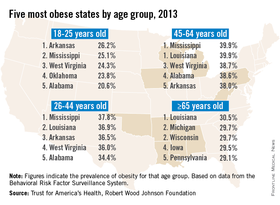
Of the five other states that appear on the list, four appear only for adults over age 65. The fifth, Oklahoma, had the fourth-highest obesity rate for adults aged 18-25 years, at 23.8%, the report showed.
West Virginia and Mississippi shared the highest overall obesity rate in the country, both at 35.1%, with Arkansas third at 34.6%. Of the 10 most obese states, 9 were in the Southeast, with Indiana – the ninth most obese state, with a prevalence of 31.8% – the only exception. The West and Northeast tended to have lower obesity rates than the Southeast and Midwest, with Colorado having the lowest obesity rate at 21.3%, Hawaii at 21.8%, and the District of Columbia at 22.9% None of the 10 least obese states appeared outside the West or Northeast, the report said.
The upward trend of obesity has seemed to slow in recent years, with only six states reporting a significant increase in obesity prevalence since 2012, compared with 2005, when only one state did not report an increase in obesity from the previous year. Some regions and groups have seen their obesity rates actually decline, particularly preschoolers from low-income families. However, people in black and Latino commmunities, as well as low-income adults, still have significantly higher obesity rates than higher-income white adults, the report stated.
The State of Obesity report used data collected by the Behavioral Risk Factor Surveillance System.
Among four adult age groups, the top-five lists for obesity are dominated by five states: Arkansas, Alabama, Louisiana, Mississippi, and West Virginia, which all appear three times each, according to a report on 2013 obesity rates produced by the Trust for America’s Health and the Robert Wood Johnson Foundation.
At just below 40%, Mississippi and Louisiana were tied for the highest obesity rate among adults aged 45-64 years. Mississippi had the highest obesity rate for 26- to 44-year-olds at 37.8%, with Louisiana having the highest obesity prevalence for adults over age 65 at 30.5%. Arkansas had the highest rate among adults aged 18-25 years, the trust and foundation reported.
Of the five other states that appear on the list, four appear only for adults over age 65. The fifth, Oklahoma, had the fourth-highest obesity rate for adults aged 18-25 years, at 23.8%, the report showed.
West Virginia and Mississippi shared the highest overall obesity rate in the country, both at 35.1%, with Arkansas third at 34.6%. Of the 10 most obese states, 9 were in the Southeast, with Indiana – the ninth most obese state, with a prevalence of 31.8% – the only exception. The West and Northeast tended to have lower obesity rates than the Southeast and Midwest, with Colorado having the lowest obesity rate at 21.3%, Hawaii at 21.8%, and the District of Columbia at 22.9% None of the 10 least obese states appeared outside the West or Northeast, the report said.
The upward trend of obesity has seemed to slow in recent years, with only six states reporting a significant increase in obesity prevalence since 2012, compared with 2005, when only one state did not report an increase in obesity from the previous year. Some regions and groups have seen their obesity rates actually decline, particularly preschoolers from low-income families. However, people in black and Latino commmunities, as well as low-income adults, still have significantly higher obesity rates than higher-income white adults, the report stated.
The State of Obesity report used data collected by the Behavioral Risk Factor Surveillance System.
Among four adult age groups, the top-five lists for obesity are dominated by five states: Arkansas, Alabama, Louisiana, Mississippi, and West Virginia, which all appear three times each, according to a report on 2013 obesity rates produced by the Trust for America’s Health and the Robert Wood Johnson Foundation.
At just below 40%, Mississippi and Louisiana were tied for the highest obesity rate among adults aged 45-64 years. Mississippi had the highest obesity rate for 26- to 44-year-olds at 37.8%, with Louisiana having the highest obesity prevalence for adults over age 65 at 30.5%. Arkansas had the highest rate among adults aged 18-25 years, the trust and foundation reported.
Of the five other states that appear on the list, four appear only for adults over age 65. The fifth, Oklahoma, had the fourth-highest obesity rate for adults aged 18-25 years, at 23.8%, the report showed.
West Virginia and Mississippi shared the highest overall obesity rate in the country, both at 35.1%, with Arkansas third at 34.6%. Of the 10 most obese states, 9 were in the Southeast, with Indiana – the ninth most obese state, with a prevalence of 31.8% – the only exception. The West and Northeast tended to have lower obesity rates than the Southeast and Midwest, with Colorado having the lowest obesity rate at 21.3%, Hawaii at 21.8%, and the District of Columbia at 22.9% None of the 10 least obese states appeared outside the West or Northeast, the report said.
The upward trend of obesity has seemed to slow in recent years, with only six states reporting a significant increase in obesity prevalence since 2012, compared with 2005, when only one state did not report an increase in obesity from the previous year. Some regions and groups have seen their obesity rates actually decline, particularly preschoolers from low-income families. However, people in black and Latino commmunities, as well as low-income adults, still have significantly higher obesity rates than higher-income white adults, the report stated.
The State of Obesity report used data collected by the Behavioral Risk Factor Surveillance System.

Mali reports Ebola death
The Ebola epidemic continues to worsen in West Africa, and in the past week initial cases have been reported in new areas, according to the World Health Organization.
Mali has become the sixth African nation to report localized Ebola transmission, though the outbreaks in Nigeria and Senegal have both been declared over, the WHO reported.
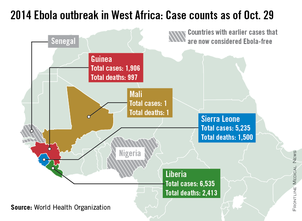
The case in Mali involved a 2-year-old girl who died on Oct. 24 after traveling from Guinea; a total of 82 of her contacts are being monitored. In the United States, a health care worker in New York City developed symptoms on Oct. 23, while the two health care workers who contracted the disease in Dallas are both negative for Ebola and have been released from the hospital. Nearly half of 176 potential contacts have completed a 21-day follow-up, with 92 still being monitored.
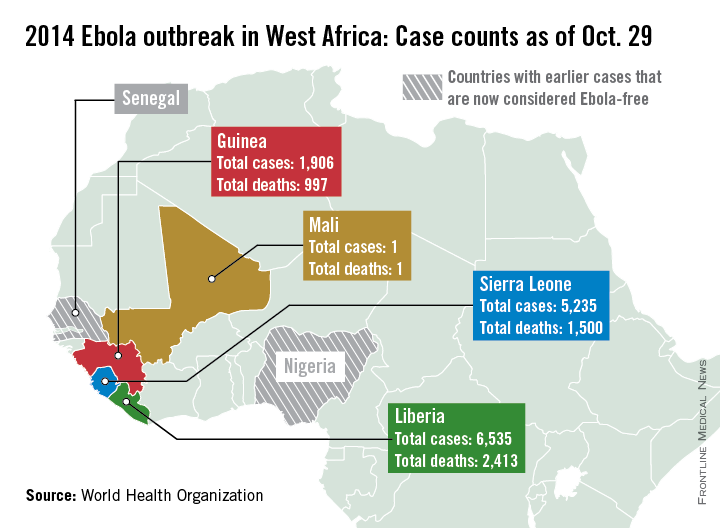
Overall, just under 13,700 cases of Ebola have been reported, with nearly 5,000 deaths in Liberia, Guinea, and Sierra Leone as of Oct. 29, the WHO reported, noting that the jump of nearly 4,000 cases represents “a more comprehensive assessment of patient databases,” and that the cases “have occurred throughout the epidemic period, not only since October 22.”
Nearly half of those cases have been in Liberia, which now has over 6,500 cases and over 2,400 reported deaths. Guinea has reported about 1,900 cases and just under 1,000 deaths. Sierra Leone has had over 5,200 cases and 1,500 reported deaths. Data are missing for Sierra Leone for Oct. 23 and for Liberia for Oct. 19-21, 26, and 27, the WHO said.
The single Ebola patient in Spain tested negative for the disease on Oct. 21, and if no additional cases are reported Spain will be Ebola-free 42 days from that date. The unrelated Ebola outbreak in the Democratic Republic of the Congo also seems to have come to an end, with the last case testing negative on Oct. 8, 18 days prior to the last report published on Oct. 26.
The Ebola epidemic continues to worsen in West Africa, and in the past week initial cases have been reported in new areas, according to the World Health Organization.
Mali has become the sixth African nation to report localized Ebola transmission, though the outbreaks in Nigeria and Senegal have both been declared over, the WHO reported.
The case in Mali involved a 2-year-old girl who died on Oct. 24 after traveling from Guinea; a total of 82 of her contacts are being monitored. In the United States, a health care worker in New York City developed symptoms on Oct. 23, while the two health care workers who contracted the disease in Dallas are both negative for Ebola and have been released from the hospital. Nearly half of 176 potential contacts have completed a 21-day follow-up, with 92 still being monitored.
Overall, just under 13,700 cases of Ebola have been reported, with nearly 5,000 deaths in Liberia, Guinea, and Sierra Leone as of Oct. 29, the WHO reported, noting that the jump of nearly 4,000 cases represents “a more comprehensive assessment of patient databases,” and that the cases “have occurred throughout the epidemic period, not only since October 22.”
Nearly half of those cases have been in Liberia, which now has over 6,500 cases and over 2,400 reported deaths. Guinea has reported about 1,900 cases and just under 1,000 deaths. Sierra Leone has had over 5,200 cases and 1,500 reported deaths. Data are missing for Sierra Leone for Oct. 23 and for Liberia for Oct. 19-21, 26, and 27, the WHO said.
The single Ebola patient in Spain tested negative for the disease on Oct. 21, and if no additional cases are reported Spain will be Ebola-free 42 days from that date. The unrelated Ebola outbreak in the Democratic Republic of the Congo also seems to have come to an end, with the last case testing negative on Oct. 8, 18 days prior to the last report published on Oct. 26.
The Ebola epidemic continues to worsen in West Africa, and in the past week initial cases have been reported in new areas, according to the World Health Organization.
Mali has become the sixth African nation to report localized Ebola transmission, though the outbreaks in Nigeria and Senegal have both been declared over, the WHO reported.
The case in Mali involved a 2-year-old girl who died on Oct. 24 after traveling from Guinea; a total of 82 of her contacts are being monitored. In the United States, a health care worker in New York City developed symptoms on Oct. 23, while the two health care workers who contracted the disease in Dallas are both negative for Ebola and have been released from the hospital. Nearly half of 176 potential contacts have completed a 21-day follow-up, with 92 still being monitored.
Overall, just under 13,700 cases of Ebola have been reported, with nearly 5,000 deaths in Liberia, Guinea, and Sierra Leone as of Oct. 29, the WHO reported, noting that the jump of nearly 4,000 cases represents “a more comprehensive assessment of patient databases,” and that the cases “have occurred throughout the epidemic period, not only since October 22.”
Nearly half of those cases have been in Liberia, which now has over 6,500 cases and over 2,400 reported deaths. Guinea has reported about 1,900 cases and just under 1,000 deaths. Sierra Leone has had over 5,200 cases and 1,500 reported deaths. Data are missing for Sierra Leone for Oct. 23 and for Liberia for Oct. 19-21, 26, and 27, the WHO said.
The single Ebola patient in Spain tested negative for the disease on Oct. 21, and if no additional cases are reported Spain will be Ebola-free 42 days from that date. The unrelated Ebola outbreak in the Democratic Republic of the Congo also seems to have come to an end, with the last case testing negative on Oct. 8, 18 days prior to the last report published on Oct. 26.
Women with depression more susceptible to obesity
Adult women who are depressed are more likely to be obese than women who are not depressed at any age. Depressed adult men over 60 are more likely to be obese than nondepressed men, a recent report from the National Center for Health Statistics shows.
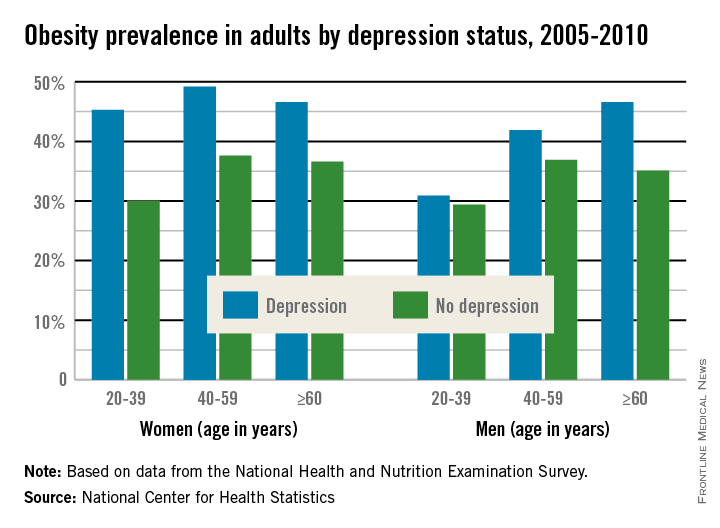
A significant statistical difference was found in obesity rates for all identified age groups of women. For women aged 20-39, 45% of those who were depressed were obese, compared with 30% of nondepressed women. Among women aged 40-59, 49% of depressed women were obese, compared with 38% of nondepressed women, and among women over 60, 47% of depressed women were obese, compared with 37% of nondepressed women.
Among depressed men, only those over 60 had a significant difference in obesity rates, at 47%, compared with 35% of nondepressed men, the NCHS found. Overall, 43% of adults with depression were obese, compared with 33% of adults who were not depressed.
The report cited no statistical differences in obesity rates by ethnicity or race except for non-Hispanic white women. Among that group, 45% of those who were depressed were obese, and 32% of those who were not depressed were obese.
In addition, the NCHS found, adults who were taking antidepressants were more likely to be obese than those who were not taking antidepressants, regardless of the severity or presence of depressive symptoms. The report cited an obesity rate of nearly 55% for adults with moderate to severe depressive symptoms who also were taking antidepressants; that rate was 16% higher than it was for people with similar symptoms but not taking antidepressants, the NCHS reported. People with mild to no depressive symptoms who were taking antidepressants had an obesity rate of 38%. That was 5% higher than it was for those not on antidepressants but with similar symptoms.
It could not be determined whether depression or obesity occurred first, the report said, because “they were both measured at the same time.”
The NCHS study used data collected from the National Health and Nutrition Examination Survey.
Adult women who are depressed are more likely to be obese than women who are not depressed at any age. Depressed adult men over 60 are more likely to be obese than nondepressed men, a recent report from the National Center for Health Statistics shows.
A significant statistical difference was found in obesity rates for all identified age groups of women. For women aged 20-39, 45% of those who were depressed were obese, compared with 30% of nondepressed women. Among women aged 40-59, 49% of depressed women were obese, compared with 38% of nondepressed women, and among women over 60, 47% of depressed women were obese, compared with 37% of nondepressed women.
Among depressed men, only those over 60 had a significant difference in obesity rates, at 47%, compared with 35% of nondepressed men, the NCHS found. Overall, 43% of adults with depression were obese, compared with 33% of adults who were not depressed.
The report cited no statistical differences in obesity rates by ethnicity or race except for non-Hispanic white women. Among that group, 45% of those who were depressed were obese, and 32% of those who were not depressed were obese.
In addition, the NCHS found, adults who were taking antidepressants were more likely to be obese than those who were not taking antidepressants, regardless of the severity or presence of depressive symptoms. The report cited an obesity rate of nearly 55% for adults with moderate to severe depressive symptoms who also were taking antidepressants; that rate was 16% higher than it was for people with similar symptoms but not taking antidepressants, the NCHS reported. People with mild to no depressive symptoms who were taking antidepressants had an obesity rate of 38%. That was 5% higher than it was for those not on antidepressants but with similar symptoms.
It could not be determined whether depression or obesity occurred first, the report said, because “they were both measured at the same time.”
The NCHS study used data collected from the National Health and Nutrition Examination Survey.
Adult women who are depressed are more likely to be obese than women who are not depressed at any age. Depressed adult men over 60 are more likely to be obese than nondepressed men, a recent report from the National Center for Health Statistics shows.
A significant statistical difference was found in obesity rates for all identified age groups of women. For women aged 20-39, 45% of those who were depressed were obese, compared with 30% of nondepressed women. Among women aged 40-59, 49% of depressed women were obese, compared with 38% of nondepressed women, and among women over 60, 47% of depressed women were obese, compared with 37% of nondepressed women.
Among depressed men, only those over 60 had a significant difference in obesity rates, at 47%, compared with 35% of nondepressed men, the NCHS found. Overall, 43% of adults with depression were obese, compared with 33% of adults who were not depressed.
The report cited no statistical differences in obesity rates by ethnicity or race except for non-Hispanic white women. Among that group, 45% of those who were depressed were obese, and 32% of those who were not depressed were obese.
In addition, the NCHS found, adults who were taking antidepressants were more likely to be obese than those who were not taking antidepressants, regardless of the severity or presence of depressive symptoms. The report cited an obesity rate of nearly 55% for adults with moderate to severe depressive symptoms who also were taking antidepressants; that rate was 16% higher than it was for people with similar symptoms but not taking antidepressants, the NCHS reported. People with mild to no depressive symptoms who were taking antidepressants had an obesity rate of 38%. That was 5% higher than it was for those not on antidepressants but with similar symptoms.
It could not be determined whether depression or obesity occurred first, the report said, because “they were both measured at the same time.”
The NCHS study used data collected from the National Health and Nutrition Examination Survey.
Nigeria and Senegal now free of Ebola, averting potential urban crisis
Nigeria and Senegal have officially been declared Ebola-free, according to the World Health Organization.
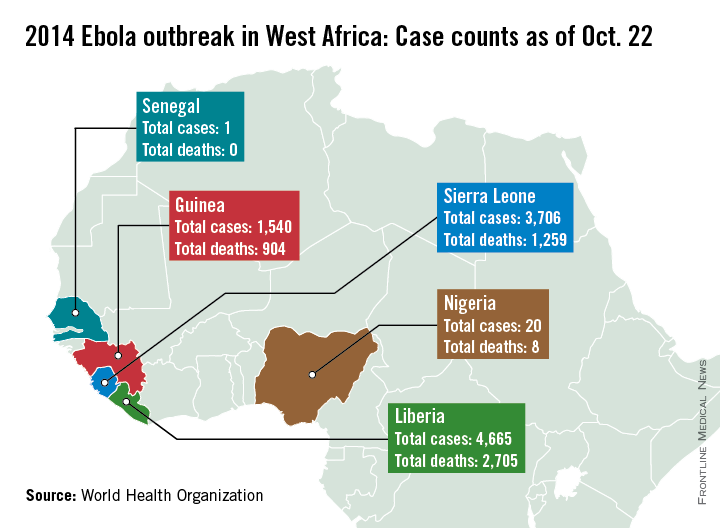
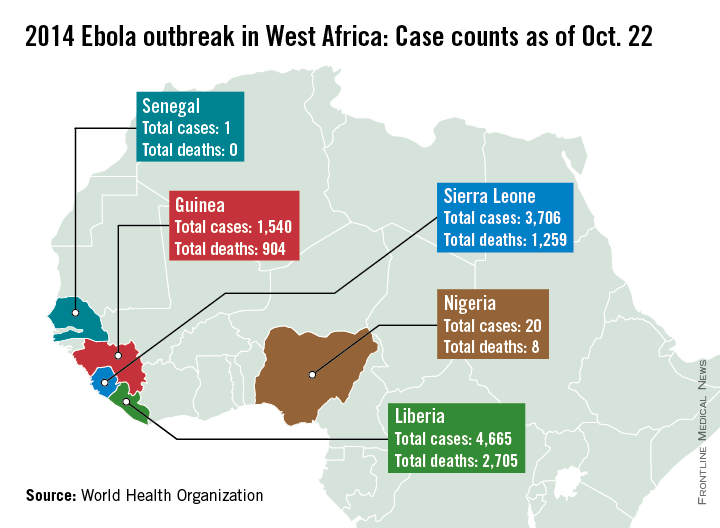
In Nigeria, there were 20 cases of Ebola and eight deaths, with the last case testing negative on Sept. 8. Nigeria represents a remarkable success story for containment of the disease, after cases were confirmed in Lagos, Africa’s largest city, the WHO said. With a population of 21 million, nearly the combined population of Liberia, Sierra Leone, and Guinea, and a large number of people living in slums, an outbreak in Lagos could have been catastrophic. But 100% of contacts in Lagos were reached and monitored, along with 99.8% of contacts in Port Harcourt, an important oil city and the second potential flash point. Nigeria was declared to be free of Ebola Oct. 20.
On Sept. 5, the man who was Senegal’s lone Ebola case tested negative for the disease, and after 42 days, no additional cases were reported in any of the monitored contacts, so on Oct. 17, the WHO officiallydeclaredSenegal Ebola free.
However, the outbreak continues to worsen in Guinea, Sierra Leone, and Liberia, with more than 9,900 cases and nearly 4,900 confirmed Ebola-related deaths as of Oct. 13. With more than 4,650 reported cases and more than 2,700 deaths, Liberia remains the hardest hit of the three nations. Sierra Leone has more than 3,700 cases and more than 1,250 deaths, and Guinea has reported nearly 1,550 cases and more than 900 deaths, the WHO reports.
No additional cases have been reported in the United States or in Spain, the other two countries with local transmission. Spain has had one case with no deaths, and the United States has had three cases with one death. On Oct. 21, the patient in Spain tested negative for the disease, and if no new cases appear, Spain will be declared free of Ebola 42 days later, according to the WHO.
The outbreak in the Democratic Republic of the Congo also seems to be under control, after extensive laboratory tests, 68 cases of Ebola have been confirmed with 49 deaths. The last confirmed case was isolated on Oct. 4, according to the WHO. More than 850 people have completed a 21-day follow-up, and about 270 are still being monitored. The outbreak in that country is unrelated to the outbreak in West Africa, according to the CDC.
Nigeria and Senegal have officially been declared Ebola-free, according to the World Health Organization.
In Nigeria, there were 20 cases of Ebola and eight deaths, with the last case testing negative on Sept. 8. Nigeria represents a remarkable success story for containment of the disease, after cases were confirmed in Lagos, Africa’s largest city, the WHO said. With a population of 21 million, nearly the combined population of Liberia, Sierra Leone, and Guinea, and a large number of people living in slums, an outbreak in Lagos could have been catastrophic. But 100% of contacts in Lagos were reached and monitored, along with 99.8% of contacts in Port Harcourt, an important oil city and the second potential flash point. Nigeria was declared to be free of Ebola Oct. 20.
On Sept. 5, the man who was Senegal’s lone Ebola case tested negative for the disease, and after 42 days, no additional cases were reported in any of the monitored contacts, so on Oct. 17, the WHO officiallydeclaredSenegal Ebola free.
However, the outbreak continues to worsen in Guinea, Sierra Leone, and Liberia, with more than 9,900 cases and nearly 4,900 confirmed Ebola-related deaths as of Oct. 13. With more than 4,650 reported cases and more than 2,700 deaths, Liberia remains the hardest hit of the three nations. Sierra Leone has more than 3,700 cases and more than 1,250 deaths, and Guinea has reported nearly 1,550 cases and more than 900 deaths, the WHO reports.
No additional cases have been reported in the United States or in Spain, the other two countries with local transmission. Spain has had one case with no deaths, and the United States has had three cases with one death. On Oct. 21, the patient in Spain tested negative for the disease, and if no new cases appear, Spain will be declared free of Ebola 42 days later, according to the WHO.
The outbreak in the Democratic Republic of the Congo also seems to be under control, after extensive laboratory tests, 68 cases of Ebola have been confirmed with 49 deaths. The last confirmed case was isolated on Oct. 4, according to the WHO. More than 850 people have completed a 21-day follow-up, and about 270 are still being monitored. The outbreak in that country is unrelated to the outbreak in West Africa, according to the CDC.
Nigeria and Senegal have officially been declared Ebola-free, according to the World Health Organization.
In Nigeria, there were 20 cases of Ebola and eight deaths, with the last case testing negative on Sept. 8. Nigeria represents a remarkable success story for containment of the disease, after cases were confirmed in Lagos, Africa’s largest city, the WHO said. With a population of 21 million, nearly the combined population of Liberia, Sierra Leone, and Guinea, and a large number of people living in slums, an outbreak in Lagos could have been catastrophic. But 100% of contacts in Lagos were reached and monitored, along with 99.8% of contacts in Port Harcourt, an important oil city and the second potential flash point. Nigeria was declared to be free of Ebola Oct. 20.
On Sept. 5, the man who was Senegal’s lone Ebola case tested negative for the disease, and after 42 days, no additional cases were reported in any of the monitored contacts, so on Oct. 17, the WHO officiallydeclaredSenegal Ebola free.
However, the outbreak continues to worsen in Guinea, Sierra Leone, and Liberia, with more than 9,900 cases and nearly 4,900 confirmed Ebola-related deaths as of Oct. 13. With more than 4,650 reported cases and more than 2,700 deaths, Liberia remains the hardest hit of the three nations. Sierra Leone has more than 3,700 cases and more than 1,250 deaths, and Guinea has reported nearly 1,550 cases and more than 900 deaths, the WHO reports.
No additional cases have been reported in the United States or in Spain, the other two countries with local transmission. Spain has had one case with no deaths, and the United States has had three cases with one death. On Oct. 21, the patient in Spain tested negative for the disease, and if no new cases appear, Spain will be declared free of Ebola 42 days later, according to the WHO.
The outbreak in the Democratic Republic of the Congo also seems to be under control, after extensive laboratory tests, 68 cases of Ebola have been confirmed with 49 deaths. The last confirmed case was isolated on Oct. 4, according to the WHO. More than 850 people have completed a 21-day follow-up, and about 270 are still being monitored. The outbreak in that country is unrelated to the outbreak in West Africa, according to the CDC.
Clinical trial begins for new Ebola vaccine
A second potential Ebola vaccine has moved to human testing as part of a clinical trial at two Maryland facilities, according to the National Institutes of Health.
The study, conducted by the National Institute of Allergy and Infectious Diseases, is designed to test for safety and immune system response, enlisting 39 healthy adults aged 18-65 years, the NIH reported.

Participants will be split into three groups and given two intramuscular doses of the vaccine, or a prime-boost strategy, with each group receiving a different dose. Three patients in each group will receive a placebo, and a second dose will be delivered 28 days later. The testing is staggered so safety assessments can be made for the group receiving a lower dose before groups receiving a higher dose are given the vaccine.
The Walter Reed Army Institute of Research is conducting similar testing as part of the same trial, but will deliver the vaccine in single doses to “evaluate in real time the safety profile of the investigational vaccine when provided at different dosages and compare the immune responses induced by one injection versus two injections,” the NIH reported.
The vaccine, developed by Canada’s National Microbiology Laboratory and licensed to NewLink Genetics Corp., is called VSV-ZEBOV, and is based on a genetically engineered version of vesicular stomatitis virus, a disease which mostly affects other mammals, only rarely infecting humans.
In VSV-ZEBOV, “the gene for the outer protein of the vesicular stomatitis virus has been replaced with a segment of the gene for the outer protein of the Zaire Ebola virus species,” according to the NIH. People with the vaccine are completely incapable of contracting Ebola, the NIH added.
Initial data on the study should be available by the end of 2014. The testing for the vaccine has been vastly accelerated from normal clinical trials, from years to weeks, as the “need for a vaccine to protect against Ebola infection is urgent,” Dr. Anthony S. Fauci, director of the NIAID, said in the NIH press release.
A second potential Ebola vaccine has moved to human testing as part of a clinical trial at two Maryland facilities, according to the National Institutes of Health.
The study, conducted by the National Institute of Allergy and Infectious Diseases, is designed to test for safety and immune system response, enlisting 39 healthy adults aged 18-65 years, the NIH reported.
Participants will be split into three groups and given two intramuscular doses of the vaccine, or a prime-boost strategy, with each group receiving a different dose. Three patients in each group will receive a placebo, and a second dose will be delivered 28 days later. The testing is staggered so safety assessments can be made for the group receiving a lower dose before groups receiving a higher dose are given the vaccine.
The Walter Reed Army Institute of Research is conducting similar testing as part of the same trial, but will deliver the vaccine in single doses to “evaluate in real time the safety profile of the investigational vaccine when provided at different dosages and compare the immune responses induced by one injection versus two injections,” the NIH reported.
The vaccine, developed by Canada’s National Microbiology Laboratory and licensed to NewLink Genetics Corp., is called VSV-ZEBOV, and is based on a genetically engineered version of vesicular stomatitis virus, a disease which mostly affects other mammals, only rarely infecting humans.
In VSV-ZEBOV, “the gene for the outer protein of the vesicular stomatitis virus has been replaced with a segment of the gene for the outer protein of the Zaire Ebola virus species,” according to the NIH. People with the vaccine are completely incapable of contracting Ebola, the NIH added.
Initial data on the study should be available by the end of 2014. The testing for the vaccine has been vastly accelerated from normal clinical trials, from years to weeks, as the “need for a vaccine to protect against Ebola infection is urgent,” Dr. Anthony S. Fauci, director of the NIAID, said in the NIH press release.
A second potential Ebola vaccine has moved to human testing as part of a clinical trial at two Maryland facilities, according to the National Institutes of Health.
The study, conducted by the National Institute of Allergy and Infectious Diseases, is designed to test for safety and immune system response, enlisting 39 healthy adults aged 18-65 years, the NIH reported.
Participants will be split into three groups and given two intramuscular doses of the vaccine, or a prime-boost strategy, with each group receiving a different dose. Three patients in each group will receive a placebo, and a second dose will be delivered 28 days later. The testing is staggered so safety assessments can be made for the group receiving a lower dose before groups receiving a higher dose are given the vaccine.
The Walter Reed Army Institute of Research is conducting similar testing as part of the same trial, but will deliver the vaccine in single doses to “evaluate in real time the safety profile of the investigational vaccine when provided at different dosages and compare the immune responses induced by one injection versus two injections,” the NIH reported.
The vaccine, developed by Canada’s National Microbiology Laboratory and licensed to NewLink Genetics Corp., is called VSV-ZEBOV, and is based on a genetically engineered version of vesicular stomatitis virus, a disease which mostly affects other mammals, only rarely infecting humans.
In VSV-ZEBOV, “the gene for the outer protein of the vesicular stomatitis virus has been replaced with a segment of the gene for the outer protein of the Zaire Ebola virus species,” according to the NIH. People with the vaccine are completely incapable of contracting Ebola, the NIH added.
Initial data on the study should be available by the end of 2014. The testing for the vaccine has been vastly accelerated from normal clinical trials, from years to weeks, as the “need for a vaccine to protect against Ebola infection is urgent,” Dr. Anthony S. Fauci, director of the NIAID, said in the NIH press release.

U.S. infant mortality rate lower than ever in 2012
The national infant mortality rate fell to a record low in 2012, according to a report from the National Center for Health Statistics.
Overall mortality for children aged less than 1 year was 597.8 deaths/100,000 births in 2012, down 1.5% from 2011’s 606.7/100,000 births and the lowest rate ever recorded, the NCHS said.
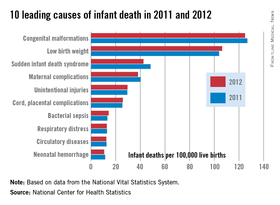
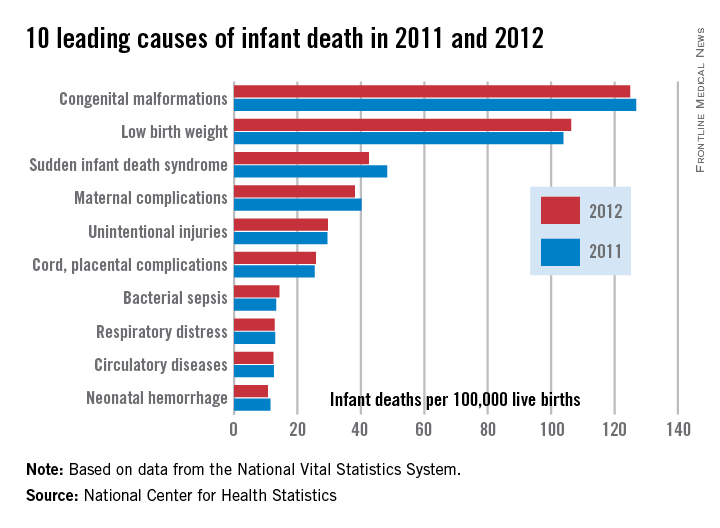
Among the 10 leading causes of infant mortality, the rate decreased slightly for congenital malformations from 126.8/100,000 births in 2011 to 12/100,000 births in 2012, while the rate for low birth weight increased slightly from 2011 to 2012, rising from 103.9/100,000 births to 106.3/100,000 births. With a decrease of 12%, the mortality rate for sudden infant death syndrome had the only significant change, falling from 48.3/100,000 births to 42.5/100,000 births, the NCHS reported. All leading causes of death remained the same from 2011 to 2012.
In total, there were 23,629 infant deaths in 2012, 356 fewer than in 2011, with the 10 leading causes accounting for about 70% of infant deaths, according to data collected by the National Vital Statistics System.
The national infant mortality rate fell to a record low in 2012, according to a report from the National Center for Health Statistics.
Overall mortality for children aged less than 1 year was 597.8 deaths/100,000 births in 2012, down 1.5% from 2011’s 606.7/100,000 births and the lowest rate ever recorded, the NCHS said.
Among the 10 leading causes of infant mortality, the rate decreased slightly for congenital malformations from 126.8/100,000 births in 2011 to 12/100,000 births in 2012, while the rate for low birth weight increased slightly from 2011 to 2012, rising from 103.9/100,000 births to 106.3/100,000 births. With a decrease of 12%, the mortality rate for sudden infant death syndrome had the only significant change, falling from 48.3/100,000 births to 42.5/100,000 births, the NCHS reported. All leading causes of death remained the same from 2011 to 2012.
In total, there were 23,629 infant deaths in 2012, 356 fewer than in 2011, with the 10 leading causes accounting for about 70% of infant deaths, according to data collected by the National Vital Statistics System.
The national infant mortality rate fell to a record low in 2012, according to a report from the National Center for Health Statistics.
Overall mortality for children aged less than 1 year was 597.8 deaths/100,000 births in 2012, down 1.5% from 2011’s 606.7/100,000 births and the lowest rate ever recorded, the NCHS said.
Among the 10 leading causes of infant mortality, the rate decreased slightly for congenital malformations from 126.8/100,000 births in 2011 to 12/100,000 births in 2012, while the rate for low birth weight increased slightly from 2011 to 2012, rising from 103.9/100,000 births to 106.3/100,000 births. With a decrease of 12%, the mortality rate for sudden infant death syndrome had the only significant change, falling from 48.3/100,000 births to 42.5/100,000 births, the NCHS reported. All leading causes of death remained the same from 2011 to 2012.
In total, there were 23,629 infant deaths in 2012, 356 fewer than in 2011, with the 10 leading causes accounting for about 70% of infant deaths, according to data collected by the National Vital Statistics System.
Link found between sleep disorders and osteoporosis risk
Patients with sleep disorders are much more likely to develop osteoporosis than are those without sleep disorders, according to Dr. Chia-Ming Yen and her associates.
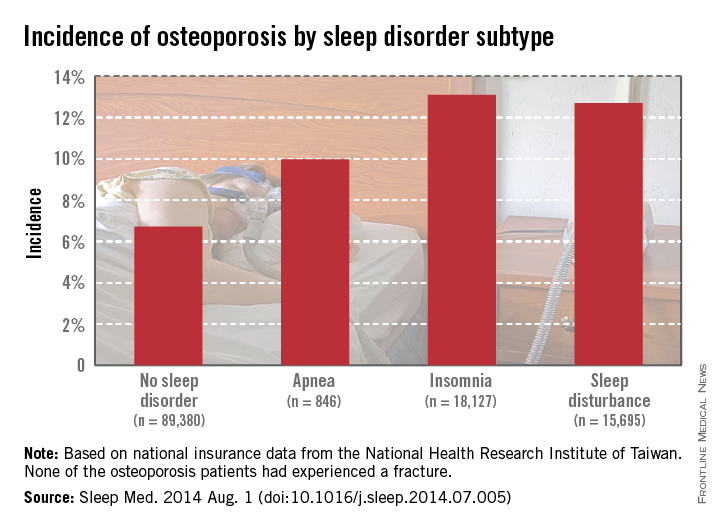
Patients diagnosed with sleep apnea between 1998 and 2001 had an osteoporosis incidence of nearly 10% at the end of 2010, while those without sleep disorders had incidence of 6.7%. Patients with insomnia developed osteoporosis at a rate of 13.1%, and patients with other sleep disturbances had an incidence of 12.7%, Dr. Yen of the National Formosa University in Taiwan, and her associates reported (Sleep Med. 2014 Aug. 1 [doi:10.1016/j.sleep.2014.07.005]).

Women and the elderly were particularly likely to develop osteoporosis if a sleep disorder was present. Of patients aged 64 years and older who were diagnosed with osteoporosis, 36.2% also had sleep apnea, and 31.9% had another sleep disorder. Incidences of osteoporosis in women in all cases were three to five times higher than those in men, and patients with multiple comorbidities also had an increased risk of osteoporosis, the investigators reported.
The study used data collected from 1996-2010 by the National Health Research Institute of Taiwan.
Patients with sleep disorders are much more likely to develop osteoporosis than are those without sleep disorders, according to Dr. Chia-Ming Yen and her associates.
Patients diagnosed with sleep apnea between 1998 and 2001 had an osteoporosis incidence of nearly 10% at the end of 2010, while those without sleep disorders had incidence of 6.7%. Patients with insomnia developed osteoporosis at a rate of 13.1%, and patients with other sleep disturbances had an incidence of 12.7%, Dr. Yen of the National Formosa University in Taiwan, and her associates reported (Sleep Med. 2014 Aug. 1 [doi:10.1016/j.sleep.2014.07.005]).
Women and the elderly were particularly likely to develop osteoporosis if a sleep disorder was present. Of patients aged 64 years and older who were diagnosed with osteoporosis, 36.2% also had sleep apnea, and 31.9% had another sleep disorder. Incidences of osteoporosis in women in all cases were three to five times higher than those in men, and patients with multiple comorbidities also had an increased risk of osteoporosis, the investigators reported.
The study used data collected from 1996-2010 by the National Health Research Institute of Taiwan.
Patients with sleep disorders are much more likely to develop osteoporosis than are those without sleep disorders, according to Dr. Chia-Ming Yen and her associates.
Patients diagnosed with sleep apnea between 1998 and 2001 had an osteoporosis incidence of nearly 10% at the end of 2010, while those without sleep disorders had incidence of 6.7%. Patients with insomnia developed osteoporosis at a rate of 13.1%, and patients with other sleep disturbances had an incidence of 12.7%, Dr. Yen of the National Formosa University in Taiwan, and her associates reported (Sleep Med. 2014 Aug. 1 [doi:10.1016/j.sleep.2014.07.005]).
Women and the elderly were particularly likely to develop osteoporosis if a sleep disorder was present. Of patients aged 64 years and older who were diagnosed with osteoporosis, 36.2% also had sleep apnea, and 31.9% had another sleep disorder. Incidences of osteoporosis in women in all cases were three to five times higher than those in men, and patients with multiple comorbidities also had an increased risk of osteoporosis, the investigators reported.
The study used data collected from 1996-2010 by the National Health Research Institute of Taiwan.
Ebola deaths near 4,500 in West Africa
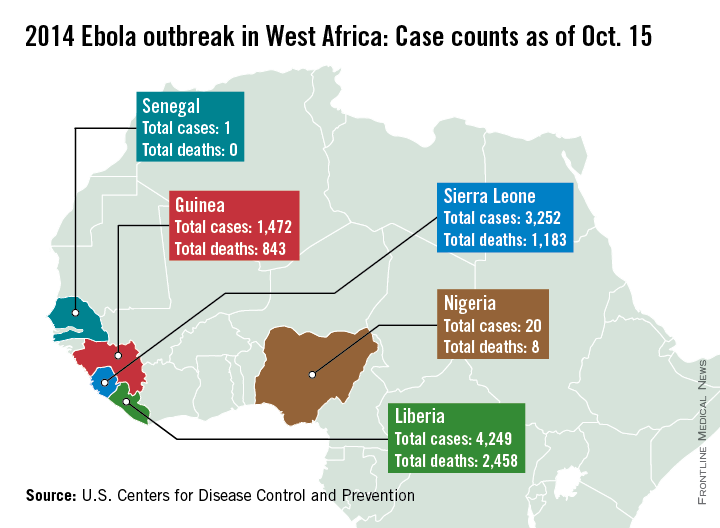
The Ebola outbreak continues to worsen in West Africa, with almost 9,000 cases and nearly 4,500 deaths in Liberia, Guinea, and Sierra Leone as of Oct. 15, according to the Centers for Disease Control and Prevention.
With nearly 4,250 reported cases and more than 2,450 deaths, Liberia accounts for almost half of the known Ebola cases, and more than half of Ebola-related deaths, according to the CDC data.

More than 3,250 cases have been reported in Sierra Leone, but with fewer than 1,200 deaths, mortality is lower there than in the other affected countries. With almost 1,500 official cases, Guinea has the fewest Ebola cases of the three nations, but with more than 840 deaths, it has the highest mortality among the afflicted countries.
Nigeria and Senegal also have reported Ebola cases related to the outbreak in West Africa. Nigeria has reported 20 cases and 8 deaths, with the last case reported on Sept. 5, according to the CDC. Senegal has reported one case of Ebola, with no deaths. Both countries have completed the required 21-day follow-up with no additional Ebola cases, the CDC reported.
Spain and the United States have reported locally transmitted Ebola cases, one in Spain and two in the United States. All three cases involve health care workers who attended to Ebola patients.
The Democratic Republic of the Congo reported 70 cases of Ebola as of Oct. 5 in an isolated area of the country, the seventh outbreak in the Congo since the discovery of Ebola there in 1976. That outbreak is considered to be separate from the one in West Africa, according to the CDC, and seems to be contained, with no new cases reported since Sept. 24.
The Ebola outbreak continues to worsen in West Africa, with almost 9,000 cases and nearly 4,500 deaths in Liberia, Guinea, and Sierra Leone as of Oct. 15, according to the Centers for Disease Control and Prevention.
With nearly 4,250 reported cases and more than 2,450 deaths, Liberia accounts for almost half of the known Ebola cases, and more than half of Ebola-related deaths, according to the CDC data.
More than 3,250 cases have been reported in Sierra Leone, but with fewer than 1,200 deaths, mortality is lower there than in the other affected countries. With almost 1,500 official cases, Guinea has the fewest Ebola cases of the three nations, but with more than 840 deaths, it has the highest mortality among the afflicted countries.
Nigeria and Senegal also have reported Ebola cases related to the outbreak in West Africa. Nigeria has reported 20 cases and 8 deaths, with the last case reported on Sept. 5, according to the CDC. Senegal has reported one case of Ebola, with no deaths. Both countries have completed the required 21-day follow-up with no additional Ebola cases, the CDC reported.
Spain and the United States have reported locally transmitted Ebola cases, one in Spain and two in the United States. All three cases involve health care workers who attended to Ebola patients.
The Democratic Republic of the Congo reported 70 cases of Ebola as of Oct. 5 in an isolated area of the country, the seventh outbreak in the Congo since the discovery of Ebola there in 1976. That outbreak is considered to be separate from the one in West Africa, according to the CDC, and seems to be contained, with no new cases reported since Sept. 24.
The Ebola outbreak continues to worsen in West Africa, with almost 9,000 cases and nearly 4,500 deaths in Liberia, Guinea, and Sierra Leone as of Oct. 15, according to the Centers for Disease Control and Prevention.
With nearly 4,250 reported cases and more than 2,450 deaths, Liberia accounts for almost half of the known Ebola cases, and more than half of Ebola-related deaths, according to the CDC data.
More than 3,250 cases have been reported in Sierra Leone, but with fewer than 1,200 deaths, mortality is lower there than in the other affected countries. With almost 1,500 official cases, Guinea has the fewest Ebola cases of the three nations, but with more than 840 deaths, it has the highest mortality among the afflicted countries.
Nigeria and Senegal also have reported Ebola cases related to the outbreak in West Africa. Nigeria has reported 20 cases and 8 deaths, with the last case reported on Sept. 5, according to the CDC. Senegal has reported one case of Ebola, with no deaths. Both countries have completed the required 21-day follow-up with no additional Ebola cases, the CDC reported.
Spain and the United States have reported locally transmitted Ebola cases, one in Spain and two in the United States. All three cases involve health care workers who attended to Ebola patients.
The Democratic Republic of the Congo reported 70 cases of Ebola as of Oct. 5 in an isolated area of the country, the seventh outbreak in the Congo since the discovery of Ebola there in 1976. That outbreak is considered to be separate from the one in West Africa, according to the CDC, and seems to be contained, with no new cases reported since Sept. 24.
Study finds few data on long-term opioid treatment for chronic pain
Long-term opioid treatment for chronic pain may carry risk for serious harm depending on the dosage, but evidence is minimal at best, a report from the Agency for Healthcare Research and Quality suggests.
The report sought to answer key questions about long-term opioid treatment in four categories: effectiveness and comparative effectiveness with nonopioids, harms and adverse events, dosing strategies, and risk assessment and risk mitigation strategies. In the report, which was based on the results of 39 separate studies, many key questions in all categories were unaddressed because of a lack of studies meeting inclusion criteria, and no key questions were addressed under effectiveness and comparative effectiveness. All but one that addressed a key question had low strength of evidence.

Relevant studies for harms and adverse events found that rates of diagnosed opioid abuse ranged from 0.6%-8% and dependence rates were 3.1%-26% in primary care settings. Abnormal drug-related behavior rates occurred in 5.7%-37.1%. Long-term opioid treatment was associated with increased risk of abuse, overdose, fracture, myocardial infarction, and markers of sexual dysfunction. Higher doses also were associated with increased risk of those outcomes, reported Dr. Roger Chou and his associates at the Pacific Northwest Evidence-based Practice Center at Oregon Health and Science University, Portland, and the University of Washington, Seattle.
The report’s authors found very few studies relating dosing strategies to risk for serious harm. One study found that methadone had a lower mortality risk than did long-acting morphine in a veteran population, the opposite of what would normally be expected, according to the agency. Multiple studies showed that buccal or intranasal fentanyl was more effective in treating acute pain of patients who were undergoing long-term opioid treatment, but these studies focused on short-term outcomes only. No relevant studies could be found to answer key questions about risk assessment and mitigation strategies.
While evidence does point toward a dose-based increase in serious harm from long-term opioid treatment, “more research is needed to understand long-term benefits, risk of abuse and related outcomes, and effectiveness of different opioid prescribing methods and risk mitigation strategies,” the authors wrote.
Long-term opioid treatment for chronic pain may carry risk for serious harm depending on the dosage, but evidence is minimal at best, a report from the Agency for Healthcare Research and Quality suggests.
The report sought to answer key questions about long-term opioid treatment in four categories: effectiveness and comparative effectiveness with nonopioids, harms and adverse events, dosing strategies, and risk assessment and risk mitigation strategies. In the report, which was based on the results of 39 separate studies, many key questions in all categories were unaddressed because of a lack of studies meeting inclusion criteria, and no key questions were addressed under effectiveness and comparative effectiveness. All but one that addressed a key question had low strength of evidence.
Relevant studies for harms and adverse events found that rates of diagnosed opioid abuse ranged from 0.6%-8% and dependence rates were 3.1%-26% in primary care settings. Abnormal drug-related behavior rates occurred in 5.7%-37.1%. Long-term opioid treatment was associated with increased risk of abuse, overdose, fracture, myocardial infarction, and markers of sexual dysfunction. Higher doses also were associated with increased risk of those outcomes, reported Dr. Roger Chou and his associates at the Pacific Northwest Evidence-based Practice Center at Oregon Health and Science University, Portland, and the University of Washington, Seattle.
The report’s authors found very few studies relating dosing strategies to risk for serious harm. One study found that methadone had a lower mortality risk than did long-acting morphine in a veteran population, the opposite of what would normally be expected, according to the agency. Multiple studies showed that buccal or intranasal fentanyl was more effective in treating acute pain of patients who were undergoing long-term opioid treatment, but these studies focused on short-term outcomes only. No relevant studies could be found to answer key questions about risk assessment and mitigation strategies.
While evidence does point toward a dose-based increase in serious harm from long-term opioid treatment, “more research is needed to understand long-term benefits, risk of abuse and related outcomes, and effectiveness of different opioid prescribing methods and risk mitigation strategies,” the authors wrote.
Long-term opioid treatment for chronic pain may carry risk for serious harm depending on the dosage, but evidence is minimal at best, a report from the Agency for Healthcare Research and Quality suggests.
The report sought to answer key questions about long-term opioid treatment in four categories: effectiveness and comparative effectiveness with nonopioids, harms and adverse events, dosing strategies, and risk assessment and risk mitigation strategies. In the report, which was based on the results of 39 separate studies, many key questions in all categories were unaddressed because of a lack of studies meeting inclusion criteria, and no key questions were addressed under effectiveness and comparative effectiveness. All but one that addressed a key question had low strength of evidence.
Relevant studies for harms and adverse events found that rates of diagnosed opioid abuse ranged from 0.6%-8% and dependence rates were 3.1%-26% in primary care settings. Abnormal drug-related behavior rates occurred in 5.7%-37.1%. Long-term opioid treatment was associated with increased risk of abuse, overdose, fracture, myocardial infarction, and markers of sexual dysfunction. Higher doses also were associated with increased risk of those outcomes, reported Dr. Roger Chou and his associates at the Pacific Northwest Evidence-based Practice Center at Oregon Health and Science University, Portland, and the University of Washington, Seattle.
The report’s authors found very few studies relating dosing strategies to risk for serious harm. One study found that methadone had a lower mortality risk than did long-acting morphine in a veteran population, the opposite of what would normally be expected, according to the agency. Multiple studies showed that buccal or intranasal fentanyl was more effective in treating acute pain of patients who were undergoing long-term opioid treatment, but these studies focused on short-term outcomes only. No relevant studies could be found to answer key questions about risk assessment and mitigation strategies.
While evidence does point toward a dose-based increase in serious harm from long-term opioid treatment, “more research is needed to understand long-term benefits, risk of abuse and related outcomes, and effectiveness of different opioid prescribing methods and risk mitigation strategies,” the authors wrote.

New test will speed enterovirus D68 case confirmation from weeks to days
A new lab test for enterovirus D68 is expected to speed up testing and confirmation of cases, according to a press release from the Centers for Disease Control and Prevention.
The new test is a “real-time” reverse transcription polymerase chain reaction and can identify all strains of EV-D68. The previous test could be used to detect almost any enterovirus, but was labor intensive to perform and not conducive to large-scale testing.
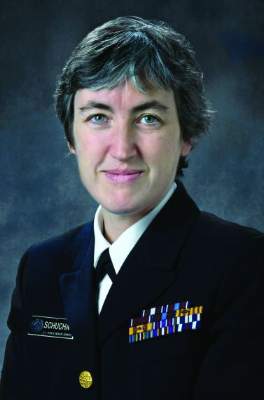
Of the 1,200 samples from 45 states sent to the CDC for EV-D68 testing between Aug. 1 to Oct. 10, less than 200 have been tested and about half have tested positive. The CDC now expects to be able to test around 180 samples a day and complete in 7-10 days the testing on samples received since mid-September, The new method will “reduce what would normally take several weeks to get results to a few days,” Dr. Anne Schuchat, assistant surgeon general and director of the CDC’s National Center for Immunization and Respiratory Diseases, said in the press release.
As with other enteroviruses, the CDC expects new cases of EV-D68 will decrease in the fall, but faster testing will more accurately show trends of the disease and will help to monitor changes in the outbreak as it winds down, according to the CDC press release.
A new lab test for enterovirus D68 is expected to speed up testing and confirmation of cases, according to a press release from the Centers for Disease Control and Prevention.
The new test is a “real-time” reverse transcription polymerase chain reaction and can identify all strains of EV-D68. The previous test could be used to detect almost any enterovirus, but was labor intensive to perform and not conducive to large-scale testing.
Of the 1,200 samples from 45 states sent to the CDC for EV-D68 testing between Aug. 1 to Oct. 10, less than 200 have been tested and about half have tested positive. The CDC now expects to be able to test around 180 samples a day and complete in 7-10 days the testing on samples received since mid-September, The new method will “reduce what would normally take several weeks to get results to a few days,” Dr. Anne Schuchat, assistant surgeon general and director of the CDC’s National Center for Immunization and Respiratory Diseases, said in the press release.
As with other enteroviruses, the CDC expects new cases of EV-D68 will decrease in the fall, but faster testing will more accurately show trends of the disease and will help to monitor changes in the outbreak as it winds down, according to the CDC press release.
A new lab test for enterovirus D68 is expected to speed up testing and confirmation of cases, according to a press release from the Centers for Disease Control and Prevention.
The new test is a “real-time” reverse transcription polymerase chain reaction and can identify all strains of EV-D68. The previous test could be used to detect almost any enterovirus, but was labor intensive to perform and not conducive to large-scale testing.
Of the 1,200 samples from 45 states sent to the CDC for EV-D68 testing between Aug. 1 to Oct. 10, less than 200 have been tested and about half have tested positive. The CDC now expects to be able to test around 180 samples a day and complete in 7-10 days the testing on samples received since mid-September, The new method will “reduce what would normally take several weeks to get results to a few days,” Dr. Anne Schuchat, assistant surgeon general and director of the CDC’s National Center for Immunization and Respiratory Diseases, said in the press release.
As with other enteroviruses, the CDC expects new cases of EV-D68 will decrease in the fall, but faster testing will more accurately show trends of the disease and will help to monitor changes in the outbreak as it winds down, according to the CDC press release.