User login
Mitchel is a reporter for MDedge based in the Philadelphia area. He started with the company in 1992, when it was International Medical News Group (IMNG), and has since covered a range of medical specialties. Mitchel trained as a virologist at Roswell Park Memorial Institute in Buffalo, and then worked briefly as a researcher at Boston Children's Hospital before pivoting to journalism as a AAAS Mass Media Fellow in 1980. His first reporting job was with Science Digest magazine, and from the mid-1980s to early-1990s he was a reporter with Medical World News. @mitchelzoler
Release nears for revised U.S. hypertension guidelines
Authoritative U.S. guidelines for managing high blood pressure have traveled a rocky and serpentine path ever since the expert group originally constituted as the Eighth Joint National Committee (JNC 8) released its controversial report in early 2014, when it relaxed the target blood pressure for most adults aged 60-79 years from less than 140 mm Hg to under 150/90 mm Hg (JAMA. 2014 Feb 5;3311[5]:507-20). A few months before those recommendations came out, the National Heart, Lung, and Blood Institute, which since 1977 had organized seven preceding iterations of U.S. blood pressure guidelines, handed off oversight of the project and any future updates to the American Heart Association, the American College of Cardiology, and the American Society of Hypertension. A year later, an expert panel organized by those three groups reset the blood pressure target for most U.S. adults with coronary artery disease back to a pressure of less than 140/90 mm Hg (Hypertension. 2015 Jun;65[6]:1372-1407), and that has been the prevailing U.S. standard in the 2-plus years since.
A few months later, in September 2015, data from the SPRINT trial in more than 9,000 patients with high cardiovascular risk first came out and showed that treating to a target systolic blood pressure of less than 120 mm Hg led to a significant 25% reduction in cardiovascular disease events, compared with controls treated to a systolic pressure of less than 140 mm Hg (N Engl J Med. 2015 Nov 26;373[22]:2103-16). Ever since, the big question surrounding blood pressure targets in U.S. practice has been, when would new official guidelines emerge that took the SPRINT findings into consideration? It now looks like it will finally happen in September 2017.
That’s when the ASH and the AHA’s Hypertension Council will for the first time hold a joint annual meeting, after many years when each organization had its own, individual annual meeting. The ASH’s traditional spring meeting didn’t happen this year; early fall has traditionally been when the AHA’s Hypertension Council meets.
The Council’s posted preliminary program for the September meeting showed, as of late July, an opening session the morning of September 14 called a “Review of AHA Scientific Statement 2017.” On the ASH’s website is a virtual flier for a session the afternoon of September 15 on the “2017 Guidelines for Adult and Pediatric Hypertension.”

“I know that something will be discussed on September 14,” he told me recently. “I am not sure the full report will be ready then, but I think something will be presented that will at least describe the ‘attitude’ of the guidelines, if not the whole report. There will be more presented at the AHA Sessions in November.” Of course, there will also be “an accompanying evidence document describing the studies and evidence that generated the report, but I don’t know the release date,” he added.
Some of the suspense is already gone from the new guidelines, because the punch line – the new target blood pressure to treat toward for most U.S. adults with hypertension – is already known to be less than 130/80 mm Hg. That was the treatment goal set in April in updated guidelines for treating patients with heart failure by a panel of the ACC, the AHA, and the Heart Failure Society of America (J Am Coll Cardiol. 2017 Apr 30. doi: 10.1016/j.jacc.2017.04.025). Among the heart failure patients subject to this blood pressure target are adults with stage A heart failure, which the panel defined as any adult diagnosed with hypertension, as well as those with diabetes, coronary artery disease, or other risk factors that clearly predispose patients to develop heart failure.
Last April, the heart failure panel’s vice-chair, Mariell Jessup, MD, told me that the group chose a treatment target of less than 130/80 mm Hg to “harmonize” with the target that the hypertension guideline group had already selected.
So, in truth, an official U.S. hypertension treatment target of less than 130/80 mm Hg is already on the books for clinicians to follow that’s endorsed by the ACC and AHA. Unless the hypertension group throws a real curve ball its target will be identical.
But just knowing this lower target leaves important questions unanswered that presumably the hypertension panel will address. Questions like the best drug combinations to use to get blood pressures this low, and how aggressively to treat older patients with comorbidities who may need upward of four drugs to achieve a systolic blood pressure in this target range.
“I suspect some will say that the heart failure guidelines are for patients with heart failure, and thus the hypertension guidelines will complement them,” said Dr. Lackland. On the other hand, the SPRINT evidence is so persuasive that at least “some physicians will move to 130/80 mm Hg” readily, he predicted. “Others will probably wait and see, and some will wait even longer for follow-up comments” to come out.
Dr. Lackland also stressed the usual caveat about any medical guideline, that both the heart failure and hypertension statements simply give clinicians the recommended approach but “should not override clinical judgment for specific patients.”
But before the medical community can embrace or question the new hypertension guidelines it needs to at least see them. That finally seems ready to happen in September, and perhaps in November too.
mzoler@frontlinemedcom.com
On Twitter @mitchelzoler
Authoritative U.S. guidelines for managing high blood pressure have traveled a rocky and serpentine path ever since the expert group originally constituted as the Eighth Joint National Committee (JNC 8) released its controversial report in early 2014, when it relaxed the target blood pressure for most adults aged 60-79 years from less than 140 mm Hg to under 150/90 mm Hg (JAMA. 2014 Feb 5;3311[5]:507-20). A few months before those recommendations came out, the National Heart, Lung, and Blood Institute, which since 1977 had organized seven preceding iterations of U.S. blood pressure guidelines, handed off oversight of the project and any future updates to the American Heart Association, the American College of Cardiology, and the American Society of Hypertension. A year later, an expert panel organized by those three groups reset the blood pressure target for most U.S. adults with coronary artery disease back to a pressure of less than 140/90 mm Hg (Hypertension. 2015 Jun;65[6]:1372-1407), and that has been the prevailing U.S. standard in the 2-plus years since.
A few months later, in September 2015, data from the SPRINT trial in more than 9,000 patients with high cardiovascular risk first came out and showed that treating to a target systolic blood pressure of less than 120 mm Hg led to a significant 25% reduction in cardiovascular disease events, compared with controls treated to a systolic pressure of less than 140 mm Hg (N Engl J Med. 2015 Nov 26;373[22]:2103-16). Ever since, the big question surrounding blood pressure targets in U.S. practice has been, when would new official guidelines emerge that took the SPRINT findings into consideration? It now looks like it will finally happen in September 2017.
That’s when the ASH and the AHA’s Hypertension Council will for the first time hold a joint annual meeting, after many years when each organization had its own, individual annual meeting. The ASH’s traditional spring meeting didn’t happen this year; early fall has traditionally been when the AHA’s Hypertension Council meets.
The Council’s posted preliminary program for the September meeting showed, as of late July, an opening session the morning of September 14 called a “Review of AHA Scientific Statement 2017.” On the ASH’s website is a virtual flier for a session the afternoon of September 15 on the “2017 Guidelines for Adult and Pediatric Hypertension.”
“I know that something will be discussed on September 14,” he told me recently. “I am not sure the full report will be ready then, but I think something will be presented that will at least describe the ‘attitude’ of the guidelines, if not the whole report. There will be more presented at the AHA Sessions in November.” Of course, there will also be “an accompanying evidence document describing the studies and evidence that generated the report, but I don’t know the release date,” he added.
Some of the suspense is already gone from the new guidelines, because the punch line – the new target blood pressure to treat toward for most U.S. adults with hypertension – is already known to be less than 130/80 mm Hg. That was the treatment goal set in April in updated guidelines for treating patients with heart failure by a panel of the ACC, the AHA, and the Heart Failure Society of America (J Am Coll Cardiol. 2017 Apr 30. doi: 10.1016/j.jacc.2017.04.025). Among the heart failure patients subject to this blood pressure target are adults with stage A heart failure, which the panel defined as any adult diagnosed with hypertension, as well as those with diabetes, coronary artery disease, or other risk factors that clearly predispose patients to develop heart failure.
Last April, the heart failure panel’s vice-chair, Mariell Jessup, MD, told me that the group chose a treatment target of less than 130/80 mm Hg to “harmonize” with the target that the hypertension guideline group had already selected.
So, in truth, an official U.S. hypertension treatment target of less than 130/80 mm Hg is already on the books for clinicians to follow that’s endorsed by the ACC and AHA. Unless the hypertension group throws a real curve ball its target will be identical.
But just knowing this lower target leaves important questions unanswered that presumably the hypertension panel will address. Questions like the best drug combinations to use to get blood pressures this low, and how aggressively to treat older patients with comorbidities who may need upward of four drugs to achieve a systolic blood pressure in this target range.
“I suspect some will say that the heart failure guidelines are for patients with heart failure, and thus the hypertension guidelines will complement them,” said Dr. Lackland. On the other hand, the SPRINT evidence is so persuasive that at least “some physicians will move to 130/80 mm Hg” readily, he predicted. “Others will probably wait and see, and some will wait even longer for follow-up comments” to come out.
Dr. Lackland also stressed the usual caveat about any medical guideline, that both the heart failure and hypertension statements simply give clinicians the recommended approach but “should not override clinical judgment for specific patients.”
But before the medical community can embrace or question the new hypertension guidelines it needs to at least see them. That finally seems ready to happen in September, and perhaps in November too.
mzoler@frontlinemedcom.com
On Twitter @mitchelzoler
Authoritative U.S. guidelines for managing high blood pressure have traveled a rocky and serpentine path ever since the expert group originally constituted as the Eighth Joint National Committee (JNC 8) released its controversial report in early 2014, when it relaxed the target blood pressure for most adults aged 60-79 years from less than 140 mm Hg to under 150/90 mm Hg (JAMA. 2014 Feb 5;3311[5]:507-20). A few months before those recommendations came out, the National Heart, Lung, and Blood Institute, which since 1977 had organized seven preceding iterations of U.S. blood pressure guidelines, handed off oversight of the project and any future updates to the American Heart Association, the American College of Cardiology, and the American Society of Hypertension. A year later, an expert panel organized by those three groups reset the blood pressure target for most U.S. adults with coronary artery disease back to a pressure of less than 140/90 mm Hg (Hypertension. 2015 Jun;65[6]:1372-1407), and that has been the prevailing U.S. standard in the 2-plus years since.
A few months later, in September 2015, data from the SPRINT trial in more than 9,000 patients with high cardiovascular risk first came out and showed that treating to a target systolic blood pressure of less than 120 mm Hg led to a significant 25% reduction in cardiovascular disease events, compared with controls treated to a systolic pressure of less than 140 mm Hg (N Engl J Med. 2015 Nov 26;373[22]:2103-16). Ever since, the big question surrounding blood pressure targets in U.S. practice has been, when would new official guidelines emerge that took the SPRINT findings into consideration? It now looks like it will finally happen in September 2017.
That’s when the ASH and the AHA’s Hypertension Council will for the first time hold a joint annual meeting, after many years when each organization had its own, individual annual meeting. The ASH’s traditional spring meeting didn’t happen this year; early fall has traditionally been when the AHA’s Hypertension Council meets.
The Council’s posted preliminary program for the September meeting showed, as of late July, an opening session the morning of September 14 called a “Review of AHA Scientific Statement 2017.” On the ASH’s website is a virtual flier for a session the afternoon of September 15 on the “2017 Guidelines for Adult and Pediatric Hypertension.”
“I know that something will be discussed on September 14,” he told me recently. “I am not sure the full report will be ready then, but I think something will be presented that will at least describe the ‘attitude’ of the guidelines, if not the whole report. There will be more presented at the AHA Sessions in November.” Of course, there will also be “an accompanying evidence document describing the studies and evidence that generated the report, but I don’t know the release date,” he added.
Some of the suspense is already gone from the new guidelines, because the punch line – the new target blood pressure to treat toward for most U.S. adults with hypertension – is already known to be less than 130/80 mm Hg. That was the treatment goal set in April in updated guidelines for treating patients with heart failure by a panel of the ACC, the AHA, and the Heart Failure Society of America (J Am Coll Cardiol. 2017 Apr 30. doi: 10.1016/j.jacc.2017.04.025). Among the heart failure patients subject to this blood pressure target are adults with stage A heart failure, which the panel defined as any adult diagnosed with hypertension, as well as those with diabetes, coronary artery disease, or other risk factors that clearly predispose patients to develop heart failure.
Last April, the heart failure panel’s vice-chair, Mariell Jessup, MD, told me that the group chose a treatment target of less than 130/80 mm Hg to “harmonize” with the target that the hypertension guideline group had already selected.
So, in truth, an official U.S. hypertension treatment target of less than 130/80 mm Hg is already on the books for clinicians to follow that’s endorsed by the ACC and AHA. Unless the hypertension group throws a real curve ball its target will be identical.
But just knowing this lower target leaves important questions unanswered that presumably the hypertension panel will address. Questions like the best drug combinations to use to get blood pressures this low, and how aggressively to treat older patients with comorbidities who may need upward of four drugs to achieve a systolic blood pressure in this target range.
“I suspect some will say that the heart failure guidelines are for patients with heart failure, and thus the hypertension guidelines will complement them,” said Dr. Lackland. On the other hand, the SPRINT evidence is so persuasive that at least “some physicians will move to 130/80 mm Hg” readily, he predicted. “Others will probably wait and see, and some will wait even longer for follow-up comments” to come out.
Dr. Lackland also stressed the usual caveat about any medical guideline, that both the heart failure and hypertension statements simply give clinicians the recommended approach but “should not override clinical judgment for specific patients.”
But before the medical community can embrace or question the new hypertension guidelines it needs to at least see them. That finally seems ready to happen in September, and perhaps in November too.
mzoler@frontlinemedcom.com
On Twitter @mitchelzoler
Blocking a lipoprotein lipase inhibitor improves lipid profiles
Two different approaches to shutting down the function of a human liver protein that inhibits lipoprotein lipase showed preliminary evidence of safely producing favorable lipid changes in healthy volunteers in two separate, phase 1 studies.
These findings, coupled with promising observational data from people who carry loss-of-function mutations in the gene for this protein, angiopoietin-like 3 (ANGPTL3), have raised hopes that interventions that interfere with the function of the ANGPTL3 protein may provide new and effective ways to improve lipid levels and cut the incidence of cardiovascular disease events.
“There is now a growing body of epidemiologic, genetic, and genomewide association studies supporting the hypothesis that lowering levels of ANGPTL3 in plasma by inhibiting hepatic ANGPTL3 synthesis will be beneficial in terms of reducing plasma levels of atherogenic apolipoprotein B and in improving metabolic measures associated with dyslipidemia,” wrote Mark J. Graham and his associates in a recently published article (N Engl J Med. 2017 Jul 20;377[3]:222-32).
The phase 1 study results reported by this group came from 44 healthy adults aged 18-65 years who received varying doses of a commercially developed antisense drug, ANGPTL3-LRX, as either single or serial subcutaneous injections. ANGPTL3-LRX is an oligonucleotide designed to inhibit production of messenger RNA for the ANGPTL3 protein.
Six people received the highest ANGPTL3-LRX dosage administered, 60 mg given as a weekly injection for 6 weeks, and after this regimen they showed an average 50% cut in triglycerides levels, compared with baseline, and an average 33% drop in their low LDL cholesterol levels from baseline. None of the 33 people treated with ANGPTL3-LRX in the trial had a documented serious adverse event, and the only treatment dropout was a patient who was lost to follow-up during the treatment phase, reported Mr. Graham, a researcher at Ionis Pharmaceuticals, the sponsor of the study and the company developing the antisense drug, and his associates.
The second phase 1 study examined a different way to block ANGPTL3 activity, with a human monoclonal antibody to this protein. The study involved 83 healthy adults aged 18-65 years with fasting triglyceride levels of 150-450 mg/dL and fasting LDL cholesterol levels of at least 100 mg/dL. Each participant received a single subcutaneous injection or intravenous dose of the antibody, evinacumab, at varying amounts or placebo. The maximum observed lipid changes seen was a drop in triglycerides of 76% and a fall in LDL cholesterol by 23%. Treatment also produced a maximum drop in HDL cholesterol of 18%. No person left the study because of an adverse event. The most common adverse event was headache, in seven people (11% of evinacumab recipients), reported Frederick E. Dewey, MD, a researcher at Regeneron Pharmaceuticals, the company developing evinacumab, and his associates (N Engl J Med. 2017 Jul 20;377[3]:211-21).
The Regeneron report also included results from population studies they ran. They reported performing genome sequencing on specimens from 58,335 adults enrolled in the DiscovEHR study, and identified 13 distinct loss-of-function variants in the ANGPTL3 genes that occurred individually in a small number of these people.
They then ran analyses of lipid levels and coronary artery disease prevalence rates in people who carry one of these 13 loss-of-function genetic signatures in one of their ANGTPL3 genes. Among 45,226 of the people in DiscovEHR those with a variant had on average a 27% lower triglyceride level, a 9% lower LDL cholesterol level, and a 4% lower HDL cholesterol level than noncarriers, after adjustment for covariates. Analysis of coronary artery disease prevalence showed that, after adjusting for age, sex, and ancestry, carrying a loss-of-function variant was linked with a statistically significant 41% lower prevalence of all coronary artery disease, and a 34% lower prevalence of myocardial infarction that fell short of statistical significance.
A second population study looked at links between loss-of-function variants and coronary artery disease in more than 130,000 Danish people. This showed a nonsignificant 37% lower prevalence of coronary artery disease in people with a variant. Two different types of meta-analyses of the data from both the DiscovEHR and Danish studies showed coronary disease rates reduced by either 31% or 39% in variant carriers depending on which meta-analysis approach the researchers used, both statistically significant reductions.
mzoler@frontlinemedcom.com
On Twitter @mitchelzoler
The findings from these two studies together with other recent study results open a new therapeutic window for reducing elevated levels of triglyceride-rich lipoproteins by activating lipoprotein lipase.
The findings also suggest that inhibition of the ANGPTL3 gene or protein is potentially an effective way to treat patients with familial hypercholesterolemia because of a deficiency in the receptor for low density lipoprotein. It is likely that lowering triglyceride levels with an agent that boosts the activity of lipoprotein lipase will result in a different spectrum of benefits and adverse effects, compared with agents that boost the number of LDL receptors.
New approaches to boost lipoprotein lipase activity, such as inhibiting ANGPTL3 function as was done in these two reports, represents a fresh frontier for treatment of hypertriglyceridemia and coronary artery disease.
Alan R. Tall, MD , professor of medicine at Columbia University, New York, made these comments in an editorial ( N Engl J Med. 2017 Jul 20;377[3]:280-3 ).
The findings from these two studies together with other recent study results open a new therapeutic window for reducing elevated levels of triglyceride-rich lipoproteins by activating lipoprotein lipase.
The findings also suggest that inhibition of the ANGPTL3 gene or protein is potentially an effective way to treat patients with familial hypercholesterolemia because of a deficiency in the receptor for low density lipoprotein. It is likely that lowering triglyceride levels with an agent that boosts the activity of lipoprotein lipase will result in a different spectrum of benefits and adverse effects, compared with agents that boost the number of LDL receptors.
New approaches to boost lipoprotein lipase activity, such as inhibiting ANGPTL3 function as was done in these two reports, represents a fresh frontier for treatment of hypertriglyceridemia and coronary artery disease.
Alan R. Tall, MD , professor of medicine at Columbia University, New York, made these comments in an editorial ( N Engl J Med. 2017 Jul 20;377[3]:280-3 ).
The findings from these two studies together with other recent study results open a new therapeutic window for reducing elevated levels of triglyceride-rich lipoproteins by activating lipoprotein lipase.
The findings also suggest that inhibition of the ANGPTL3 gene or protein is potentially an effective way to treat patients with familial hypercholesterolemia because of a deficiency in the receptor for low density lipoprotein. It is likely that lowering triglyceride levels with an agent that boosts the activity of lipoprotein lipase will result in a different spectrum of benefits and adverse effects, compared with agents that boost the number of LDL receptors.
New approaches to boost lipoprotein lipase activity, such as inhibiting ANGPTL3 function as was done in these two reports, represents a fresh frontier for treatment of hypertriglyceridemia and coronary artery disease.
Alan R. Tall, MD , professor of medicine at Columbia University, New York, made these comments in an editorial ( N Engl J Med. 2017 Jul 20;377[3]:280-3 ).
Two different approaches to shutting down the function of a human liver protein that inhibits lipoprotein lipase showed preliminary evidence of safely producing favorable lipid changes in healthy volunteers in two separate, phase 1 studies.
These findings, coupled with promising observational data from people who carry loss-of-function mutations in the gene for this protein, angiopoietin-like 3 (ANGPTL3), have raised hopes that interventions that interfere with the function of the ANGPTL3 protein may provide new and effective ways to improve lipid levels and cut the incidence of cardiovascular disease events.
“There is now a growing body of epidemiologic, genetic, and genomewide association studies supporting the hypothesis that lowering levels of ANGPTL3 in plasma by inhibiting hepatic ANGPTL3 synthesis will be beneficial in terms of reducing plasma levels of atherogenic apolipoprotein B and in improving metabolic measures associated with dyslipidemia,” wrote Mark J. Graham and his associates in a recently published article (N Engl J Med. 2017 Jul 20;377[3]:222-32).
The phase 1 study results reported by this group came from 44 healthy adults aged 18-65 years who received varying doses of a commercially developed antisense drug, ANGPTL3-LRX, as either single or serial subcutaneous injections. ANGPTL3-LRX is an oligonucleotide designed to inhibit production of messenger RNA for the ANGPTL3 protein.
Six people received the highest ANGPTL3-LRX dosage administered, 60 mg given as a weekly injection for 6 weeks, and after this regimen they showed an average 50% cut in triglycerides levels, compared with baseline, and an average 33% drop in their low LDL cholesterol levels from baseline. None of the 33 people treated with ANGPTL3-LRX in the trial had a documented serious adverse event, and the only treatment dropout was a patient who was lost to follow-up during the treatment phase, reported Mr. Graham, a researcher at Ionis Pharmaceuticals, the sponsor of the study and the company developing the antisense drug, and his associates.
The second phase 1 study examined a different way to block ANGPTL3 activity, with a human monoclonal antibody to this protein. The study involved 83 healthy adults aged 18-65 years with fasting triglyceride levels of 150-450 mg/dL and fasting LDL cholesterol levels of at least 100 mg/dL. Each participant received a single subcutaneous injection or intravenous dose of the antibody, evinacumab, at varying amounts or placebo. The maximum observed lipid changes seen was a drop in triglycerides of 76% and a fall in LDL cholesterol by 23%. Treatment also produced a maximum drop in HDL cholesterol of 18%. No person left the study because of an adverse event. The most common adverse event was headache, in seven people (11% of evinacumab recipients), reported Frederick E. Dewey, MD, a researcher at Regeneron Pharmaceuticals, the company developing evinacumab, and his associates (N Engl J Med. 2017 Jul 20;377[3]:211-21).
The Regeneron report also included results from population studies they ran. They reported performing genome sequencing on specimens from 58,335 adults enrolled in the DiscovEHR study, and identified 13 distinct loss-of-function variants in the ANGPTL3 genes that occurred individually in a small number of these people.
They then ran analyses of lipid levels and coronary artery disease prevalence rates in people who carry one of these 13 loss-of-function genetic signatures in one of their ANGTPL3 genes. Among 45,226 of the people in DiscovEHR those with a variant had on average a 27% lower triglyceride level, a 9% lower LDL cholesterol level, and a 4% lower HDL cholesterol level than noncarriers, after adjustment for covariates. Analysis of coronary artery disease prevalence showed that, after adjusting for age, sex, and ancestry, carrying a loss-of-function variant was linked with a statistically significant 41% lower prevalence of all coronary artery disease, and a 34% lower prevalence of myocardial infarction that fell short of statistical significance.
A second population study looked at links between loss-of-function variants and coronary artery disease in more than 130,000 Danish people. This showed a nonsignificant 37% lower prevalence of coronary artery disease in people with a variant. Two different types of meta-analyses of the data from both the DiscovEHR and Danish studies showed coronary disease rates reduced by either 31% or 39% in variant carriers depending on which meta-analysis approach the researchers used, both statistically significant reductions.
mzoler@frontlinemedcom.com
On Twitter @mitchelzoler
Two different approaches to shutting down the function of a human liver protein that inhibits lipoprotein lipase showed preliminary evidence of safely producing favorable lipid changes in healthy volunteers in two separate, phase 1 studies.
These findings, coupled with promising observational data from people who carry loss-of-function mutations in the gene for this protein, angiopoietin-like 3 (ANGPTL3), have raised hopes that interventions that interfere with the function of the ANGPTL3 protein may provide new and effective ways to improve lipid levels and cut the incidence of cardiovascular disease events.
“There is now a growing body of epidemiologic, genetic, and genomewide association studies supporting the hypothesis that lowering levels of ANGPTL3 in plasma by inhibiting hepatic ANGPTL3 synthesis will be beneficial in terms of reducing plasma levels of atherogenic apolipoprotein B and in improving metabolic measures associated with dyslipidemia,” wrote Mark J. Graham and his associates in a recently published article (N Engl J Med. 2017 Jul 20;377[3]:222-32).
The phase 1 study results reported by this group came from 44 healthy adults aged 18-65 years who received varying doses of a commercially developed antisense drug, ANGPTL3-LRX, as either single or serial subcutaneous injections. ANGPTL3-LRX is an oligonucleotide designed to inhibit production of messenger RNA for the ANGPTL3 protein.
Six people received the highest ANGPTL3-LRX dosage administered, 60 mg given as a weekly injection for 6 weeks, and after this regimen they showed an average 50% cut in triglycerides levels, compared with baseline, and an average 33% drop in their low LDL cholesterol levels from baseline. None of the 33 people treated with ANGPTL3-LRX in the trial had a documented serious adverse event, and the only treatment dropout was a patient who was lost to follow-up during the treatment phase, reported Mr. Graham, a researcher at Ionis Pharmaceuticals, the sponsor of the study and the company developing the antisense drug, and his associates.
The second phase 1 study examined a different way to block ANGPTL3 activity, with a human monoclonal antibody to this protein. The study involved 83 healthy adults aged 18-65 years with fasting triglyceride levels of 150-450 mg/dL and fasting LDL cholesterol levels of at least 100 mg/dL. Each participant received a single subcutaneous injection or intravenous dose of the antibody, evinacumab, at varying amounts or placebo. The maximum observed lipid changes seen was a drop in triglycerides of 76% and a fall in LDL cholesterol by 23%. Treatment also produced a maximum drop in HDL cholesterol of 18%. No person left the study because of an adverse event. The most common adverse event was headache, in seven people (11% of evinacumab recipients), reported Frederick E. Dewey, MD, a researcher at Regeneron Pharmaceuticals, the company developing evinacumab, and his associates (N Engl J Med. 2017 Jul 20;377[3]:211-21).
The Regeneron report also included results from population studies they ran. They reported performing genome sequencing on specimens from 58,335 adults enrolled in the DiscovEHR study, and identified 13 distinct loss-of-function variants in the ANGPTL3 genes that occurred individually in a small number of these people.
They then ran analyses of lipid levels and coronary artery disease prevalence rates in people who carry one of these 13 loss-of-function genetic signatures in one of their ANGTPL3 genes. Among 45,226 of the people in DiscovEHR those with a variant had on average a 27% lower triglyceride level, a 9% lower LDL cholesterol level, and a 4% lower HDL cholesterol level than noncarriers, after adjustment for covariates. Analysis of coronary artery disease prevalence showed that, after adjusting for age, sex, and ancestry, carrying a loss-of-function variant was linked with a statistically significant 41% lower prevalence of all coronary artery disease, and a 34% lower prevalence of myocardial infarction that fell short of statistical significance.
A second population study looked at links between loss-of-function variants and coronary artery disease in more than 130,000 Danish people. This showed a nonsignificant 37% lower prevalence of coronary artery disease in people with a variant. Two different types of meta-analyses of the data from both the DiscovEHR and Danish studies showed coronary disease rates reduced by either 31% or 39% in variant carriers depending on which meta-analysis approach the researchers used, both statistically significant reductions.
mzoler@frontlinemedcom.com
On Twitter @mitchelzoler
FROM THE NEW ENGLAND JOURNAL OF MEDICINE
Key clinical point:
Major finding: Serial doses of the antisense oligonucleotide ANGPTL3-LRX produced an average 50% cut in triglycerides and 33% cut in LDL cholesterol.
Data source: The ANGPTL3-LRX phase 1 trial enrolled 44 healthy adults. The evinacumab phase 1 trial enrolled 83 healthy adults.
Disclosures: The ANGPTL3-LRX study was funded by Ionis. Mr. Graham is an employee of Ionis. The evinacumab study was funded by Regeneron. Dr. Dewey is an employee of Regeneron.
Enhanced antimicrobial prophylaxis cuts advanced HIV mortality
An enhanced antimicrobial prophylaxis regimen administered to patients with advanced HIV infection who were starting antiretroviral therapy for the first time led to significantly reduced mortality after 24 weeks, compared with patients who received standard antimicrobial prophylaxis, in a randomized, multicenter trial with 1,805 patients.
The enhanced prophylaxis regimen tested “is relatively inexpensive, has a low pill burden and an acceptable side effect profile, and would be easy to implement at primary health centers,” according to James Hakim, MD, and his associates. The report was published July 20 (N Engl J Med. 2017 July 20;377[3]:233-45).
The researchers who ran the Reduction of Early Mortality in HIV-Infected Adults and Children Starting Antiretroviral Therapy (REALITY) trial enrolled HIV-infected patients who were at least 5 years old who had not previously received antiretroviral therapy and had a CD4+ T cell count of fewer than 100 cells/mm3 at the time of entry. Enrollment occurred during June 2013–April 2015 at eight centers in Kenya, Malawi, Uganda, or Zimbabwe. All patients started treatment with two nucleoside and one non-nucleoside reverse-transcriptase inhibitors.
After randomization, 906 patients entered the subgroup that received enhanced prophylaxis with a single dose of albendazole, 5 days of azithromycin, 12 weeks of fluconazole, and open-ended prophylaxis with trimethoprim-sulfamethoxazole, isoniazid, and pyridoxine (use of isoniazid and pyridoxine beyond 12 weeks depended on national guidelines in each country). Another 899 patients entered the subgroup that received standard antimicrobial prophylaxis with trimethoprim-sulfamethoxazole and isoniazid only.
All-cause mortality at 24 weeks after entry was the primary endpoint. This occurred in about 9% of patients on enhanced prophylaxis and about 12% of those on standard prophylaxis, which calculated to a statistically significant relative risk reduction of 27% with enhanced prophylaxis, and a number needed to treat of 30 patients with enhanced prophylaxis to prevent one additional death. At 48 weeks after entry, the relative risk reduction for all-cause mortality with enhanced prophylaxis was a statistically significant 24% lower with enhanced prophylaxis.
Enhanced prophylaxis also led to significant gains in life years and quality-adjusted life years. Based on actual drug costs, enhanced prophylaxis cost $613 per life year gained and $761 per quality-adjusted life year gained.
The REALITY trial received no commercial support. Dr. Hakim has been an adviser to Mylan and a consultant to Gilead and Johnson & Johnson.
mzoler@frontlinemedcom.com
On Twitter @mitchelzoler
A substantial number of HIV patients, when first diagnosed, continue to have advanced infection, defined by the World Health Organization as a CD4+ T cell count of fewer than 200 cell/mm3. In the REALITY trial, nearly half the patients with a CD4+ T cell count of fewer than 100 cells/mm3 at the time of their initial HIV diagnosis had mild or no symptoms. This finding highlights the limitations of relying on clinical assessment alone to identify people infected with HIV and needing testing and treatment.
In addition to showing the efficacy of enhanced antimicrobial prophylaxis compared with standard prophylaxis in the types of patients studied in REALITY, the results showed that the enhanced prophylaxis regimen had an acceptable side-effect profile, a high level of patient adherence to prophylaxis treatment, and no discernible effect on adherence to antiretroviral therapy. Nevertheless, the regimen used raises some concerns that warrant careful assessment: What is the risk posed by the enhanced regimen tested to producing microbial resistance to fluconazole or azithromycin? And is blanket use of this prophylaxis cost effective in locations where diagnostic testing for microbial infections is available?
The relatively consistent proportion of HIV-infected patients who newly present with a low CD4+ T cell count, as well as the seriously ill patients who return for care after an interruption in their HIV treatment, both call for renewed focus on the needs of patients with advanced HIV infection who have a high risk for illness and death.
Nathan Ford, PhD, and Meg Doherty, MD , are in the department of HIV/AIDS at the World Health Organization in Geneva. They had no disclosures. Their comments appeared in an editorial that accompanied the REALITY trial report ( N Engl J Med. 2017 Jul 20;377[3]:283-4 ).
A substantial number of HIV patients, when first diagnosed, continue to have advanced infection, defined by the World Health Organization as a CD4+ T cell count of fewer than 200 cell/mm3. In the REALITY trial, nearly half the patients with a CD4+ T cell count of fewer than 100 cells/mm3 at the time of their initial HIV diagnosis had mild or no symptoms. This finding highlights the limitations of relying on clinical assessment alone to identify people infected with HIV and needing testing and treatment.
In addition to showing the efficacy of enhanced antimicrobial prophylaxis compared with standard prophylaxis in the types of patients studied in REALITY, the results showed that the enhanced prophylaxis regimen had an acceptable side-effect profile, a high level of patient adherence to prophylaxis treatment, and no discernible effect on adherence to antiretroviral therapy. Nevertheless, the regimen used raises some concerns that warrant careful assessment: What is the risk posed by the enhanced regimen tested to producing microbial resistance to fluconazole or azithromycin? And is blanket use of this prophylaxis cost effective in locations where diagnostic testing for microbial infections is available?
The relatively consistent proportion of HIV-infected patients who newly present with a low CD4+ T cell count, as well as the seriously ill patients who return for care after an interruption in their HIV treatment, both call for renewed focus on the needs of patients with advanced HIV infection who have a high risk for illness and death.
Nathan Ford, PhD, and Meg Doherty, MD , are in the department of HIV/AIDS at the World Health Organization in Geneva. They had no disclosures. Their comments appeared in an editorial that accompanied the REALITY trial report ( N Engl J Med. 2017 Jul 20;377[3]:283-4 ).
A substantial number of HIV patients, when first diagnosed, continue to have advanced infection, defined by the World Health Organization as a CD4+ T cell count of fewer than 200 cell/mm3. In the REALITY trial, nearly half the patients with a CD4+ T cell count of fewer than 100 cells/mm3 at the time of their initial HIV diagnosis had mild or no symptoms. This finding highlights the limitations of relying on clinical assessment alone to identify people infected with HIV and needing testing and treatment.
In addition to showing the efficacy of enhanced antimicrobial prophylaxis compared with standard prophylaxis in the types of patients studied in REALITY, the results showed that the enhanced prophylaxis regimen had an acceptable side-effect profile, a high level of patient adherence to prophylaxis treatment, and no discernible effect on adherence to antiretroviral therapy. Nevertheless, the regimen used raises some concerns that warrant careful assessment: What is the risk posed by the enhanced regimen tested to producing microbial resistance to fluconazole or azithromycin? And is blanket use of this prophylaxis cost effective in locations where diagnostic testing for microbial infections is available?
The relatively consistent proportion of HIV-infected patients who newly present with a low CD4+ T cell count, as well as the seriously ill patients who return for care after an interruption in their HIV treatment, both call for renewed focus on the needs of patients with advanced HIV infection who have a high risk for illness and death.
Nathan Ford, PhD, and Meg Doherty, MD , are in the department of HIV/AIDS at the World Health Organization in Geneva. They had no disclosures. Their comments appeared in an editorial that accompanied the REALITY trial report ( N Engl J Med. 2017 Jul 20;377[3]:283-4 ).
An enhanced antimicrobial prophylaxis regimen administered to patients with advanced HIV infection who were starting antiretroviral therapy for the first time led to significantly reduced mortality after 24 weeks, compared with patients who received standard antimicrobial prophylaxis, in a randomized, multicenter trial with 1,805 patients.
The enhanced prophylaxis regimen tested “is relatively inexpensive, has a low pill burden and an acceptable side effect profile, and would be easy to implement at primary health centers,” according to James Hakim, MD, and his associates. The report was published July 20 (N Engl J Med. 2017 July 20;377[3]:233-45).
The researchers who ran the Reduction of Early Mortality in HIV-Infected Adults and Children Starting Antiretroviral Therapy (REALITY) trial enrolled HIV-infected patients who were at least 5 years old who had not previously received antiretroviral therapy and had a CD4+ T cell count of fewer than 100 cells/mm3 at the time of entry. Enrollment occurred during June 2013–April 2015 at eight centers in Kenya, Malawi, Uganda, or Zimbabwe. All patients started treatment with two nucleoside and one non-nucleoside reverse-transcriptase inhibitors.
After randomization, 906 patients entered the subgroup that received enhanced prophylaxis with a single dose of albendazole, 5 days of azithromycin, 12 weeks of fluconazole, and open-ended prophylaxis with trimethoprim-sulfamethoxazole, isoniazid, and pyridoxine (use of isoniazid and pyridoxine beyond 12 weeks depended on national guidelines in each country). Another 899 patients entered the subgroup that received standard antimicrobial prophylaxis with trimethoprim-sulfamethoxazole and isoniazid only.
All-cause mortality at 24 weeks after entry was the primary endpoint. This occurred in about 9% of patients on enhanced prophylaxis and about 12% of those on standard prophylaxis, which calculated to a statistically significant relative risk reduction of 27% with enhanced prophylaxis, and a number needed to treat of 30 patients with enhanced prophylaxis to prevent one additional death. At 48 weeks after entry, the relative risk reduction for all-cause mortality with enhanced prophylaxis was a statistically significant 24% lower with enhanced prophylaxis.
Enhanced prophylaxis also led to significant gains in life years and quality-adjusted life years. Based on actual drug costs, enhanced prophylaxis cost $613 per life year gained and $761 per quality-adjusted life year gained.
The REALITY trial received no commercial support. Dr. Hakim has been an adviser to Mylan and a consultant to Gilead and Johnson & Johnson.
mzoler@frontlinemedcom.com
On Twitter @mitchelzoler
An enhanced antimicrobial prophylaxis regimen administered to patients with advanced HIV infection who were starting antiretroviral therapy for the first time led to significantly reduced mortality after 24 weeks, compared with patients who received standard antimicrobial prophylaxis, in a randomized, multicenter trial with 1,805 patients.
The enhanced prophylaxis regimen tested “is relatively inexpensive, has a low pill burden and an acceptable side effect profile, and would be easy to implement at primary health centers,” according to James Hakim, MD, and his associates. The report was published July 20 (N Engl J Med. 2017 July 20;377[3]:233-45).
The researchers who ran the Reduction of Early Mortality in HIV-Infected Adults and Children Starting Antiretroviral Therapy (REALITY) trial enrolled HIV-infected patients who were at least 5 years old who had not previously received antiretroviral therapy and had a CD4+ T cell count of fewer than 100 cells/mm3 at the time of entry. Enrollment occurred during June 2013–April 2015 at eight centers in Kenya, Malawi, Uganda, or Zimbabwe. All patients started treatment with two nucleoside and one non-nucleoside reverse-transcriptase inhibitors.
After randomization, 906 patients entered the subgroup that received enhanced prophylaxis with a single dose of albendazole, 5 days of azithromycin, 12 weeks of fluconazole, and open-ended prophylaxis with trimethoprim-sulfamethoxazole, isoniazid, and pyridoxine (use of isoniazid and pyridoxine beyond 12 weeks depended on national guidelines in each country). Another 899 patients entered the subgroup that received standard antimicrobial prophylaxis with trimethoprim-sulfamethoxazole and isoniazid only.
All-cause mortality at 24 weeks after entry was the primary endpoint. This occurred in about 9% of patients on enhanced prophylaxis and about 12% of those on standard prophylaxis, which calculated to a statistically significant relative risk reduction of 27% with enhanced prophylaxis, and a number needed to treat of 30 patients with enhanced prophylaxis to prevent one additional death. At 48 weeks after entry, the relative risk reduction for all-cause mortality with enhanced prophylaxis was a statistically significant 24% lower with enhanced prophylaxis.
Enhanced prophylaxis also led to significant gains in life years and quality-adjusted life years. Based on actual drug costs, enhanced prophylaxis cost $613 per life year gained and $761 per quality-adjusted life year gained.
The REALITY trial received no commercial support. Dr. Hakim has been an adviser to Mylan and a consultant to Gilead and Johnson & Johnson.
mzoler@frontlinemedcom.com
On Twitter @mitchelzoler
FROM THE NEW ENGLAND JOURNAL OF MEDICINE
Key clinical point:
Major finding: Enhanced prophylaxis cut mortality by a relative 27% compared with standard prophylaxis after 24 weeks.
Data source: REALITY, a multicenter randomized trial with 1,805 patients.
Disclosures: REALITY received no commercial support. Dr. Hakim has been an adviser to Mylan and a consultant to Gilead and Johnson & Johnson.
Unresolved fatigue lingers for most PsA patients
MADRID – Fatigue is an important symptom in patients with psoriatic arthritis but often goes unaddressed when treatment only involves disease modifying drugs.
A survey of more than 1,000 patients with psoriatic arthritis (PsA) in Denmark found that more than half had moderate or severe levels of fatigue, and a principal component analysis of the sources of fatigue found three factors responsible for the majority of reported patient fatigue: chronic inflammation, chronic pain, and chronification of the PsA, Tanja S. Jørgensen, PhD, said at the European Congress of Rheumatology.
“Pain is the most important symptom in patients with psoriatic arthritis, but fatigue is second-most important. It has a huge impact on patient quality of life,” she said.
“Just treating inflammation doesn’t do it all. We need to do more, think differently, think outside the box” of relying primarily on disease-modifying antirheumatic drugs, especially biological drugs, to resolve symptoms in PsA patients. “We should not think that biologicals do it all.”
The upshot is that PsA patients may have their inflammatory markers under control with treatment but still report that they don’t feel well, have pain, are tired, and have no energy.
But Dr. Jørgensen admitted that she couldn’t say with any certainty what additional interventions might help resolve pain and fatigue in PsA patients.
“I tell them to walk and be active; I think that may help. But we don’t really know what to do,” she said in an interview.
Her study included 1,062 PsA patients enrolled during December 2013-December 2014 in the Danish DANBIO registry of patients with inflammatory arthritides who received treatment with a biological drug. These participants also agreed to both complete a painDETECT Questionnaire and to rate their fatigue on a visual analog scale.
Dr. Jørgensen and her associates designated a visual analog scale score of at least 57 out of 100 as representing moderate or severe fatigue and found that 542 (51%) of the patients had fatigue self-ratings that fell in this range. Patients with this higher fatigue level also had significantly worse PsA with significantly higher numbers of swollen and tender joints, higher painDETECT scores, and higher scores on their Health Assessment Questionnaire and their 28-joint Disease Activity Score using C-reactive protein.
When the researchers ran a principal component analysis on these data, they identified three primary factors contributing to fatigue. Chronic inflammation contributed 31% of the fatigue effect, chronification contributed 17%, and chronic pain contributed 15%, Dr. Jørgensen reported.
Dr. Jørgensen has received research support from AbbVie, Biogen, Novartis, Pfizer, Roche, and UCB.
mzoler@frontlinemedcom.com
On Twitter @mitchelzoler
MADRID – Fatigue is an important symptom in patients with psoriatic arthritis but often goes unaddressed when treatment only involves disease modifying drugs.
A survey of more than 1,000 patients with psoriatic arthritis (PsA) in Denmark found that more than half had moderate or severe levels of fatigue, and a principal component analysis of the sources of fatigue found three factors responsible for the majority of reported patient fatigue: chronic inflammation, chronic pain, and chronification of the PsA, Tanja S. Jørgensen, PhD, said at the European Congress of Rheumatology.
“Pain is the most important symptom in patients with psoriatic arthritis, but fatigue is second-most important. It has a huge impact on patient quality of life,” she said.
“Just treating inflammation doesn’t do it all. We need to do more, think differently, think outside the box” of relying primarily on disease-modifying antirheumatic drugs, especially biological drugs, to resolve symptoms in PsA patients. “We should not think that biologicals do it all.”
The upshot is that PsA patients may have their inflammatory markers under control with treatment but still report that they don’t feel well, have pain, are tired, and have no energy.
But Dr. Jørgensen admitted that she couldn’t say with any certainty what additional interventions might help resolve pain and fatigue in PsA patients.
“I tell them to walk and be active; I think that may help. But we don’t really know what to do,” she said in an interview.
Her study included 1,062 PsA patients enrolled during December 2013-December 2014 in the Danish DANBIO registry of patients with inflammatory arthritides who received treatment with a biological drug. These participants also agreed to both complete a painDETECT Questionnaire and to rate their fatigue on a visual analog scale.
Dr. Jørgensen and her associates designated a visual analog scale score of at least 57 out of 100 as representing moderate or severe fatigue and found that 542 (51%) of the patients had fatigue self-ratings that fell in this range. Patients with this higher fatigue level also had significantly worse PsA with significantly higher numbers of swollen and tender joints, higher painDETECT scores, and higher scores on their Health Assessment Questionnaire and their 28-joint Disease Activity Score using C-reactive protein.
When the researchers ran a principal component analysis on these data, they identified three primary factors contributing to fatigue. Chronic inflammation contributed 31% of the fatigue effect, chronification contributed 17%, and chronic pain contributed 15%, Dr. Jørgensen reported.
Dr. Jørgensen has received research support from AbbVie, Biogen, Novartis, Pfizer, Roche, and UCB.
mzoler@frontlinemedcom.com
On Twitter @mitchelzoler
MADRID – Fatigue is an important symptom in patients with psoriatic arthritis but often goes unaddressed when treatment only involves disease modifying drugs.
A survey of more than 1,000 patients with psoriatic arthritis (PsA) in Denmark found that more than half had moderate or severe levels of fatigue, and a principal component analysis of the sources of fatigue found three factors responsible for the majority of reported patient fatigue: chronic inflammation, chronic pain, and chronification of the PsA, Tanja S. Jørgensen, PhD, said at the European Congress of Rheumatology.
“Pain is the most important symptom in patients with psoriatic arthritis, but fatigue is second-most important. It has a huge impact on patient quality of life,” she said.
“Just treating inflammation doesn’t do it all. We need to do more, think differently, think outside the box” of relying primarily on disease-modifying antirheumatic drugs, especially biological drugs, to resolve symptoms in PsA patients. “We should not think that biologicals do it all.”
The upshot is that PsA patients may have their inflammatory markers under control with treatment but still report that they don’t feel well, have pain, are tired, and have no energy.
But Dr. Jørgensen admitted that she couldn’t say with any certainty what additional interventions might help resolve pain and fatigue in PsA patients.
“I tell them to walk and be active; I think that may help. But we don’t really know what to do,” she said in an interview.
Her study included 1,062 PsA patients enrolled during December 2013-December 2014 in the Danish DANBIO registry of patients with inflammatory arthritides who received treatment with a biological drug. These participants also agreed to both complete a painDETECT Questionnaire and to rate their fatigue on a visual analog scale.
Dr. Jørgensen and her associates designated a visual analog scale score of at least 57 out of 100 as representing moderate or severe fatigue and found that 542 (51%) of the patients had fatigue self-ratings that fell in this range. Patients with this higher fatigue level also had significantly worse PsA with significantly higher numbers of swollen and tender joints, higher painDETECT scores, and higher scores on their Health Assessment Questionnaire and their 28-joint Disease Activity Score using C-reactive protein.
When the researchers ran a principal component analysis on these data, they identified three primary factors contributing to fatigue. Chronic inflammation contributed 31% of the fatigue effect, chronification contributed 17%, and chronic pain contributed 15%, Dr. Jørgensen reported.
Dr. Jørgensen has received research support from AbbVie, Biogen, Novartis, Pfizer, Roche, and UCB.
mzoler@frontlinemedcom.com
On Twitter @mitchelzoler
AT THE EULAR 2017 CONGRESS
Key clinical point:
Major finding: Visual analog scoring showed 51% of patients rated their fatigue as 57 or higher on a 0-100 scale.
Data source: A review of 1,062 Danish psoriatic arthritis patients treated with a biological drug and enrolled in the DANBIO registry
Disclosures: Dr. Jørgensen has received research support from AbbVie, Biogen, Novartis, Pfizer, Roche, and UCB.
Plasma biomarker distinguishes ARDS, acute heart failure
WASHINGTON – Plasma levels of an interleukin-33 receptor that’s involved in inflammation regulation appeared able to discriminate between acute respiratory distress syndrome and acute decompensated heart failure in an analysis with 72 patients.
In a second study, high plasma levels of the same interleukin-33 receptor, known as soluble suppressor of tumorgenicity 2 (sST2), identified acute respiratory distress syndrome (ARDS) patients who were sicker and more responsive to conservative fluid management, Sean D. Levy, MD, said at an international conference of the American Thoracic Society.
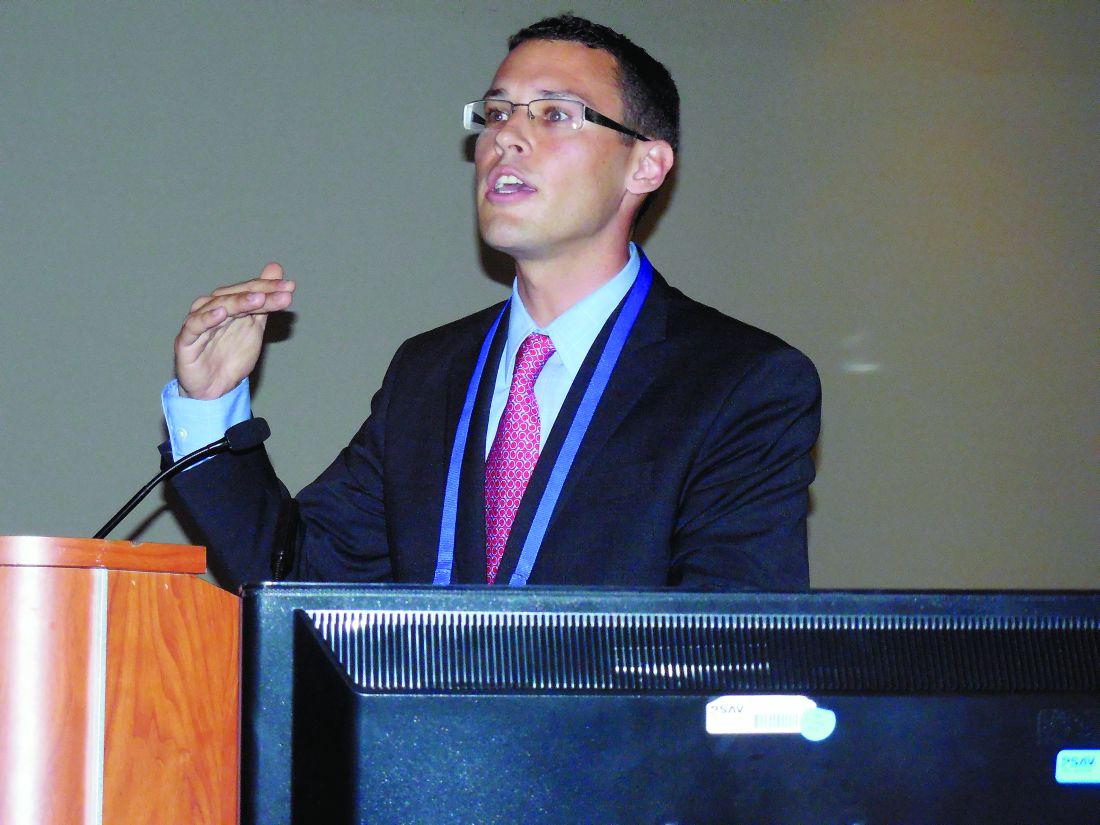
In order to assess the ability of sST2 to reliably distinguish patients with ARDS from those with acute decompensated heart failure, he and his associates selected 72 patients seen at the Massachusetts General Hospital in Boston with an initial diagnosis of acute decompensated heart failure accompanied by bilateral lung infiltrates and acute hypoxemia respiratory failure requiring endotracheal intubation and mechanical ventilation. The investigators measured the sST2 level in a plasma specimen from each patient. In addition, after each patient either left the hospital or died, their case underwent review by two critical care physicians who retrospectively rediagnosed the patients as either having ARDS or acute decompensated heart failure. This divided the cohort into 30 patients with ARDS and 42 with true acute heart failure. The two subgroups matched up fairly closely for most clinical measures and comorbidities, but APACHE III (Acute Physiology and Chronic Health Evaluation III) scores averaged significantly higher in the ARDS patients.
The plasma levels of sST2 showed a dramatic split between the two subgroups. The 30 patients retrospectively diagnosed with ARDS had an average level of 386 ng/mL with an interquartile range of 318-611 ng/mL. The 42 acute decompensated heart failure patients averaged a sST2 level of 148 ng/mL, with an interquartile range of 84-225 ng/mL. The area under the receiver operator curve for discriminating between ARDS and acute heart failure using a cutpoint of 271 mg/mL was 0.86, showing “good” discrimination, Dr. Levy said. This cutpoint had a sensitivity of 83% and specificity of 88% for correctly distinguishing between ARDS and acute heart failure.
In a second analysis, Dr. Levy and his associates looked at the ability of sST2 levels to separate out patients with acute lung injury who had a more robust response to either the conservative or liberal fluid-management strategies tested in the Fluid and Catheter Treatment Trial (FACTT), run by the National Heart, Lung, and Blood Institute’s ARDS Clinical Trials Network. The primary outcome of FACTT was death from any cause 60 days after entry, and this showed no significant difference between conservative (restricted fluids and increased urine output) and liberal (the reverse) fluid management strategies in acute lung injury patients (N Engl J Med. 2006 Jun 15;354[14]:2564-75). From among the 1,001 patients enrolled in FACTT, 826 had specimens available for measuring sST2 (Crit Care Med. 2013 Nov;41[11]:2521-31),
The researchers applied the sST2 cut point they derived in the first analysis to the FACTT cohort and identified 133 (16%) patients with a low sST2 level and 693 (84%) with a high level. The patients with high sST2 were sicker, with significantly higher APACHE III scores, worse acidemia, and worse renal function.
Patients with high sST2 levels had a significant increase in ventilator-free days on conservative fluid management, compared with liberal management, while the two management strategies produced virtually identical results in the patients with low levels of sST2. Patients with high sST2 also had a significantly quicker time to extubation on a conservative strategy compared with the liberal strategy, and again this correlation did not exist among patients with low sST2. However, as in the overall trial a conservative strategy had no discernible impact on 60-day mortality, compared with the liberal strategy, even in the subgroup with high sST2.
Dr. Levy had no disclosures.
mzoler@frontlinemedcom.com
On Twitter @mitchelzoler
WASHINGTON – Plasma levels of an interleukin-33 receptor that’s involved in inflammation regulation appeared able to discriminate between acute respiratory distress syndrome and acute decompensated heart failure in an analysis with 72 patients.
In a second study, high plasma levels of the same interleukin-33 receptor, known as soluble suppressor of tumorgenicity 2 (sST2), identified acute respiratory distress syndrome (ARDS) patients who were sicker and more responsive to conservative fluid management, Sean D. Levy, MD, said at an international conference of the American Thoracic Society.
In order to assess the ability of sST2 to reliably distinguish patients with ARDS from those with acute decompensated heart failure, he and his associates selected 72 patients seen at the Massachusetts General Hospital in Boston with an initial diagnosis of acute decompensated heart failure accompanied by bilateral lung infiltrates and acute hypoxemia respiratory failure requiring endotracheal intubation and mechanical ventilation. The investigators measured the sST2 level in a plasma specimen from each patient. In addition, after each patient either left the hospital or died, their case underwent review by two critical care physicians who retrospectively rediagnosed the patients as either having ARDS or acute decompensated heart failure. This divided the cohort into 30 patients with ARDS and 42 with true acute heart failure. The two subgroups matched up fairly closely for most clinical measures and comorbidities, but APACHE III (Acute Physiology and Chronic Health Evaluation III) scores averaged significantly higher in the ARDS patients.
The plasma levels of sST2 showed a dramatic split between the two subgroups. The 30 patients retrospectively diagnosed with ARDS had an average level of 386 ng/mL with an interquartile range of 318-611 ng/mL. The 42 acute decompensated heart failure patients averaged a sST2 level of 148 ng/mL, with an interquartile range of 84-225 ng/mL. The area under the receiver operator curve for discriminating between ARDS and acute heart failure using a cutpoint of 271 mg/mL was 0.86, showing “good” discrimination, Dr. Levy said. This cutpoint had a sensitivity of 83% and specificity of 88% for correctly distinguishing between ARDS and acute heart failure.
In a second analysis, Dr. Levy and his associates looked at the ability of sST2 levels to separate out patients with acute lung injury who had a more robust response to either the conservative or liberal fluid-management strategies tested in the Fluid and Catheter Treatment Trial (FACTT), run by the National Heart, Lung, and Blood Institute’s ARDS Clinical Trials Network. The primary outcome of FACTT was death from any cause 60 days after entry, and this showed no significant difference between conservative (restricted fluids and increased urine output) and liberal (the reverse) fluid management strategies in acute lung injury patients (N Engl J Med. 2006 Jun 15;354[14]:2564-75). From among the 1,001 patients enrolled in FACTT, 826 had specimens available for measuring sST2 (Crit Care Med. 2013 Nov;41[11]:2521-31),
The researchers applied the sST2 cut point they derived in the first analysis to the FACTT cohort and identified 133 (16%) patients with a low sST2 level and 693 (84%) with a high level. The patients with high sST2 were sicker, with significantly higher APACHE III scores, worse acidemia, and worse renal function.
Patients with high sST2 levels had a significant increase in ventilator-free days on conservative fluid management, compared with liberal management, while the two management strategies produced virtually identical results in the patients with low levels of sST2. Patients with high sST2 also had a significantly quicker time to extubation on a conservative strategy compared with the liberal strategy, and again this correlation did not exist among patients with low sST2. However, as in the overall trial a conservative strategy had no discernible impact on 60-day mortality, compared with the liberal strategy, even in the subgroup with high sST2.
Dr. Levy had no disclosures.
mzoler@frontlinemedcom.com
On Twitter @mitchelzoler
WASHINGTON – Plasma levels of an interleukin-33 receptor that’s involved in inflammation regulation appeared able to discriminate between acute respiratory distress syndrome and acute decompensated heart failure in an analysis with 72 patients.
In a second study, high plasma levels of the same interleukin-33 receptor, known as soluble suppressor of tumorgenicity 2 (sST2), identified acute respiratory distress syndrome (ARDS) patients who were sicker and more responsive to conservative fluid management, Sean D. Levy, MD, said at an international conference of the American Thoracic Society.
In order to assess the ability of sST2 to reliably distinguish patients with ARDS from those with acute decompensated heart failure, he and his associates selected 72 patients seen at the Massachusetts General Hospital in Boston with an initial diagnosis of acute decompensated heart failure accompanied by bilateral lung infiltrates and acute hypoxemia respiratory failure requiring endotracheal intubation and mechanical ventilation. The investigators measured the sST2 level in a plasma specimen from each patient. In addition, after each patient either left the hospital or died, their case underwent review by two critical care physicians who retrospectively rediagnosed the patients as either having ARDS or acute decompensated heart failure. This divided the cohort into 30 patients with ARDS and 42 with true acute heart failure. The two subgroups matched up fairly closely for most clinical measures and comorbidities, but APACHE III (Acute Physiology and Chronic Health Evaluation III) scores averaged significantly higher in the ARDS patients.
The plasma levels of sST2 showed a dramatic split between the two subgroups. The 30 patients retrospectively diagnosed with ARDS had an average level of 386 ng/mL with an interquartile range of 318-611 ng/mL. The 42 acute decompensated heart failure patients averaged a sST2 level of 148 ng/mL, with an interquartile range of 84-225 ng/mL. The area under the receiver operator curve for discriminating between ARDS and acute heart failure using a cutpoint of 271 mg/mL was 0.86, showing “good” discrimination, Dr. Levy said. This cutpoint had a sensitivity of 83% and specificity of 88% for correctly distinguishing between ARDS and acute heart failure.
In a second analysis, Dr. Levy and his associates looked at the ability of sST2 levels to separate out patients with acute lung injury who had a more robust response to either the conservative or liberal fluid-management strategies tested in the Fluid and Catheter Treatment Trial (FACTT), run by the National Heart, Lung, and Blood Institute’s ARDS Clinical Trials Network. The primary outcome of FACTT was death from any cause 60 days after entry, and this showed no significant difference between conservative (restricted fluids and increased urine output) and liberal (the reverse) fluid management strategies in acute lung injury patients (N Engl J Med. 2006 Jun 15;354[14]:2564-75). From among the 1,001 patients enrolled in FACTT, 826 had specimens available for measuring sST2 (Crit Care Med. 2013 Nov;41[11]:2521-31),
The researchers applied the sST2 cut point they derived in the first analysis to the FACTT cohort and identified 133 (16%) patients with a low sST2 level and 693 (84%) with a high level. The patients with high sST2 were sicker, with significantly higher APACHE III scores, worse acidemia, and worse renal function.
Patients with high sST2 levels had a significant increase in ventilator-free days on conservative fluid management, compared with liberal management, while the two management strategies produced virtually identical results in the patients with low levels of sST2. Patients with high sST2 also had a significantly quicker time to extubation on a conservative strategy compared with the liberal strategy, and again this correlation did not exist among patients with low sST2. However, as in the overall trial a conservative strategy had no discernible impact on 60-day mortality, compared with the liberal strategy, even in the subgroup with high sST2.
Dr. Levy had no disclosures.
mzoler@frontlinemedcom.com
On Twitter @mitchelzoler
AT ATS 2017
Key clinical point:
Major finding: An sST2 cutpoint of 271 ng/mL discriminated between ARDS and acute heart failure with 83% sensitivity and 88% specificity.
Data source: Review of 72 patients admitted for acute decompensated heart failure at one U.S. center.
Disclosures: Dr. Levy had no disclosures.
Ixekizumab helps PsA patients who failed a TNFi
MADRID – The anti–interleukin-17 drug ixekizumab, already on the U.S. market for treating psoriasis, showed efficacy and safety for treating psoriatic arthritis in patients who previously failed to respond to or tolerate a tumor necrosis factor inhibitor in a pivotal, phase 3 trial with 363 patients.
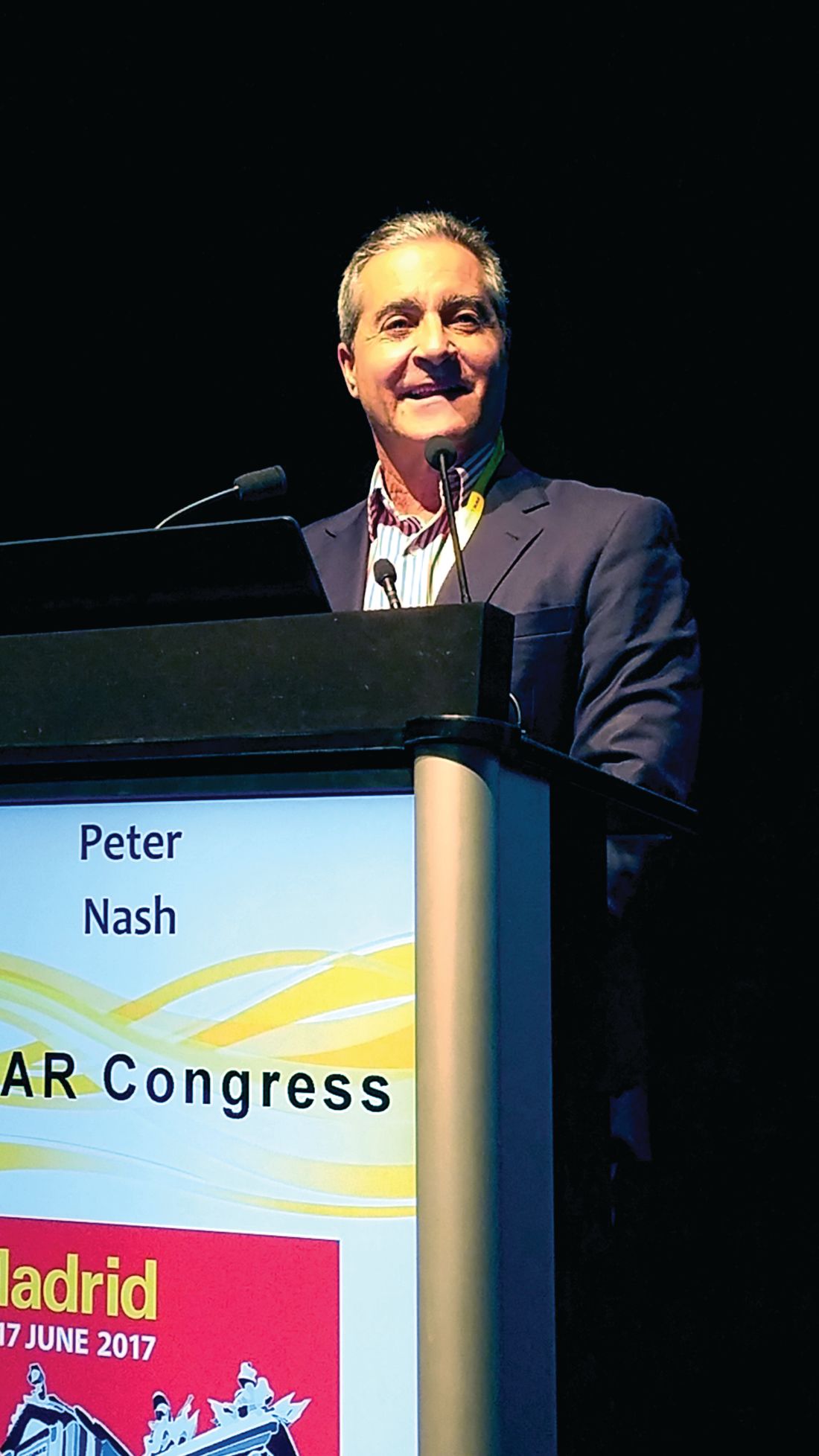
Treatment of patients with psoriatic arthritis (PsA) with ixekizumab (Taltz) led to improvements, compared with placebo, in arthritis, physical function, and psoriasis. These patients were unresponsive to or intolerant of a tumor necrosis factor inhibitor (TNFi) at rates similar to previously reported response rates for PsA patients who were TNFi naive, Peter Nash, MD, said at the European Congress of Rheumatology.
A published report with the data presented by Dr. Nash also recently appeared (Lancet. 2017;389[10086]:2317-27).
Based in part on the results from this trial, as well as results from a companion phase 3 trial that enrolled PsA patients naive to a TNFi (Ann Rheum Dis. 2017 Jan; 6[1]:79-87), the company that markets ixekizumab, Eli Lilly, filed an application with the Food and Drug Administration in early 2017 to have a new label indication for PsA, said a company spokeswoman.
“At least half of PsA patients don’t get at least a 20% improvement [an ACR20 response] on a TNFi, and so they are looking for something else,” explained Mark C. Genovese, MD, professor of medicine and director of the Rheumatology Clinic at Stanford (Calif.) University and a coinvestigator on the trial reported by Dr. Nash. “There is pent up demand” for an alternative to a TNFi for treating PsA, Dr. Genovese said in an interview.

The finding also sets ixekizumab apart from secukinumab (Cosentyx), another interleukin-17 inhibitor that already has FDA approval for treating PsA but that has not been specifically tested in PsA patients who failed or didn’t tolerate a TNFi, he noted.
The SPIRIT-P2 results also showed superior outcomes for patients treated with an ixekizumab injection once every 2 or 4 weeks, compared with placebo, by several secondary measures, including ACR50 and ACR70 rates and minimal disease activity. The ACR70 rate after 24 weeks on treatment was 23% with a dose of ixekizumab every 4 weeks and none with placebo. Minimal disease activity was reached by about a quarter of patients on either dosage of the active drug and by 3% of patients on placebo.
Despite the apparent role for ixekizumab when TNFi treatment fails, the TNFi drug class remains the clear first-line choice for PsA patients who are starting a biological drug for the first time. Not only do the TNFis have a much longer and more extensive track record but they also generally receive better insurance coverage that minimizes out-of-pocket expenses for patients, Dr. Genovese said.
SPIRIT-P2 was sponsored by Eli Lilly, the company that markets ixekizumab. Dr. Nash has been a speaker for or consultant to and has received research funding from Eli Lily and for several other companies. Dr. Genovese has been a consultant to and has received research funding from Eli Lilly, AbbVie, Astellas, Galapagos, Pfizer, and Vertex.
mzoler@frontlinemedcom.com
On Twitter @mitchelzoler
MADRID – The anti–interleukin-17 drug ixekizumab, already on the U.S. market for treating psoriasis, showed efficacy and safety for treating psoriatic arthritis in patients who previously failed to respond to or tolerate a tumor necrosis factor inhibitor in a pivotal, phase 3 trial with 363 patients.
Treatment of patients with psoriatic arthritis (PsA) with ixekizumab (Taltz) led to improvements, compared with placebo, in arthritis, physical function, and psoriasis. These patients were unresponsive to or intolerant of a tumor necrosis factor inhibitor (TNFi) at rates similar to previously reported response rates for PsA patients who were TNFi naive, Peter Nash, MD, said at the European Congress of Rheumatology.
A published report with the data presented by Dr. Nash also recently appeared (Lancet. 2017;389[10086]:2317-27).
Based in part on the results from this trial, as well as results from a companion phase 3 trial that enrolled PsA patients naive to a TNFi (Ann Rheum Dis. 2017 Jan; 6[1]:79-87), the company that markets ixekizumab, Eli Lilly, filed an application with the Food and Drug Administration in early 2017 to have a new label indication for PsA, said a company spokeswoman.
“At least half of PsA patients don’t get at least a 20% improvement [an ACR20 response] on a TNFi, and so they are looking for something else,” explained Mark C. Genovese, MD, professor of medicine and director of the Rheumatology Clinic at Stanford (Calif.) University and a coinvestigator on the trial reported by Dr. Nash. “There is pent up demand” for an alternative to a TNFi for treating PsA, Dr. Genovese said in an interview.
The finding also sets ixekizumab apart from secukinumab (Cosentyx), another interleukin-17 inhibitor that already has FDA approval for treating PsA but that has not been specifically tested in PsA patients who failed or didn’t tolerate a TNFi, he noted.
The SPIRIT-P2 results also showed superior outcomes for patients treated with an ixekizumab injection once every 2 or 4 weeks, compared with placebo, by several secondary measures, including ACR50 and ACR70 rates and minimal disease activity. The ACR70 rate after 24 weeks on treatment was 23% with a dose of ixekizumab every 4 weeks and none with placebo. Minimal disease activity was reached by about a quarter of patients on either dosage of the active drug and by 3% of patients on placebo.
Despite the apparent role for ixekizumab when TNFi treatment fails, the TNFi drug class remains the clear first-line choice for PsA patients who are starting a biological drug for the first time. Not only do the TNFis have a much longer and more extensive track record but they also generally receive better insurance coverage that minimizes out-of-pocket expenses for patients, Dr. Genovese said.
SPIRIT-P2 was sponsored by Eli Lilly, the company that markets ixekizumab. Dr. Nash has been a speaker for or consultant to and has received research funding from Eli Lily and for several other companies. Dr. Genovese has been a consultant to and has received research funding from Eli Lilly, AbbVie, Astellas, Galapagos, Pfizer, and Vertex.
mzoler@frontlinemedcom.com
On Twitter @mitchelzoler
MADRID – The anti–interleukin-17 drug ixekizumab, already on the U.S. market for treating psoriasis, showed efficacy and safety for treating psoriatic arthritis in patients who previously failed to respond to or tolerate a tumor necrosis factor inhibitor in a pivotal, phase 3 trial with 363 patients.
Treatment of patients with psoriatic arthritis (PsA) with ixekizumab (Taltz) led to improvements, compared with placebo, in arthritis, physical function, and psoriasis. These patients were unresponsive to or intolerant of a tumor necrosis factor inhibitor (TNFi) at rates similar to previously reported response rates for PsA patients who were TNFi naive, Peter Nash, MD, said at the European Congress of Rheumatology.
A published report with the data presented by Dr. Nash also recently appeared (Lancet. 2017;389[10086]:2317-27).
Based in part on the results from this trial, as well as results from a companion phase 3 trial that enrolled PsA patients naive to a TNFi (Ann Rheum Dis. 2017 Jan; 6[1]:79-87), the company that markets ixekizumab, Eli Lilly, filed an application with the Food and Drug Administration in early 2017 to have a new label indication for PsA, said a company spokeswoman.
“At least half of PsA patients don’t get at least a 20% improvement [an ACR20 response] on a TNFi, and so they are looking for something else,” explained Mark C. Genovese, MD, professor of medicine and director of the Rheumatology Clinic at Stanford (Calif.) University and a coinvestigator on the trial reported by Dr. Nash. “There is pent up demand” for an alternative to a TNFi for treating PsA, Dr. Genovese said in an interview.
The finding also sets ixekizumab apart from secukinumab (Cosentyx), another interleukin-17 inhibitor that already has FDA approval for treating PsA but that has not been specifically tested in PsA patients who failed or didn’t tolerate a TNFi, he noted.
The SPIRIT-P2 results also showed superior outcomes for patients treated with an ixekizumab injection once every 2 or 4 weeks, compared with placebo, by several secondary measures, including ACR50 and ACR70 rates and minimal disease activity. The ACR70 rate after 24 weeks on treatment was 23% with a dose of ixekizumab every 4 weeks and none with placebo. Minimal disease activity was reached by about a quarter of patients on either dosage of the active drug and by 3% of patients on placebo.
Despite the apparent role for ixekizumab when TNFi treatment fails, the TNFi drug class remains the clear first-line choice for PsA patients who are starting a biological drug for the first time. Not only do the TNFis have a much longer and more extensive track record but they also generally receive better insurance coverage that minimizes out-of-pocket expenses for patients, Dr. Genovese said.
SPIRIT-P2 was sponsored by Eli Lilly, the company that markets ixekizumab. Dr. Nash has been a speaker for or consultant to and has received research funding from Eli Lily and for several other companies. Dr. Genovese has been a consultant to and has received research funding from Eli Lilly, AbbVie, Astellas, Galapagos, Pfizer, and Vertex.
mzoler@frontlinemedcom.com
On Twitter @mitchelzoler
AT THE EULAR 2017 CONGRESS
Key clinical point:
Major finding: The ACR20 rate after 24 weeks of treatment was 53% with monthly ixekizumab and 20% on placebo.
Data source: The SPIRIT-P2 trial, a phase 3 multicenter trial with 363 patients.
Disclosures: SPIRIT-P2 was sponsored by Eli Lilly, the company that markets ixekizumab (Taltz). Dr. Nash has been a speaker for or consultant to and has received research funding from Eli Lily and for several other companies. Dr. Genovese has been a consultant to and has received research funding from Eli Lilly, AbbVie, Astellas, Galapagos, Pfizer, and Vertex.
VIDEO: Software predicts septic shock in hospitalized patients
WASHINGTON – Researchers have devised a program that can predict severe sepsis or septic shock about 12-30 hours in advance of its onset in hospitalized patients, a feat they hope will allow them to apply early interventions to stave off impending sepsis.
“We’d love to see a change in sepsis mortality. Will earlier recognition and implementation of the sepsis bundle – fluids, antibiotics, etc. – improve outcomes?” wondered Heather M. Giannini, MD, in a video interview at an international conference of the American Thoracic Society.
The computer program works by monitoring all the data that enter a patient’s electronic health record during hospitalization. Researchers developed it and designed it specifically for inpatients who are not in the intensive care unit or emergency department.
Results from initial testing during October-December 2015 in 10,448 patients hospitalized at one of three participating Philadelphia hospitals showed the program predicted subsequent severe sepsis or septic shock with a sensitivity of 26% and a specificity of 98%, reported Dr. Giannini, a researcher in the Center for Evidence-Based Practice at the University of Pennsylvania in Philadelphia. Analysis also showed a positive likelihood ratio of 13 for severe sepsis or septic shock actually occurring following an alert generated by the computer program, a level indicating a “very strong” ability to predict sepsis, she said.
Dr. Giannini and her associates developed the prediction program using a technique called “computational machine learning,” an alternative to standard logistic regression modeling that is better suited to analyzing large data sets and can better integrate outlier data points. They took EHR data for all non-ICU, non-ED inpatients at three Philadelphia hospitals during a 3-year period during 2011-2014 and had the program focus particularly on EHR data gleaned from the nearly 1,000 patients who developed severe sepsis or septic shock during the 12 hours preceding the start of these sepsis events. The analysis identified patients as having developed severe sepsis or shock if they had a blood draw positive for infection at the same time as having a blood lactate level above 2.2 mmol/L or a systolic blood pressure below 90 mm Hg.
To create the algorithm the machine-learning device compared the EHR entries for patients who developed severe sepsis or septic shock with EHR data from patients who did not, a process that involved hundred of thousands of data points, Dr. Giannini said. This identified 587 individual types of relevant EHR data entries and ranked them from most important to least important. Important, novel determinants of impending severe sepsis identified this way included anion gap, blood urea nitrogen, and platelet count. The development process also confirmed an important role for many classic markers of septic shock, such as respiration rate, heart rate, and temperature.
The researchers designed the algorithm to have a moderate level of sensitivity to avoid “alert fatigue” from generating too many alarms for impending severe sepsis. Their goal was for clinicians to receive no more than about 10 alerts per day for each hospital.
“We are satisfied with the sensitivity. We felt it was better to have too few alerts rather than overwhelm clinicians. About 10 alerts a day is reasonable,” Dr. Giannini explained. During initial 2015 testing, the system generated a daily average of 11 alerts.
mzoler@frontlinemedcom.com
On Twitter @mitchelzoler

WASHINGTON – Researchers have devised a program that can predict severe sepsis or septic shock about 12-30 hours in advance of its onset in hospitalized patients, a feat they hope will allow them to apply early interventions to stave off impending sepsis.
“We’d love to see a change in sepsis mortality. Will earlier recognition and implementation of the sepsis bundle – fluids, antibiotics, etc. – improve outcomes?” wondered Heather M. Giannini, MD, in a video interview at an international conference of the American Thoracic Society.
The computer program works by monitoring all the data that enter a patient’s electronic health record during hospitalization. Researchers developed it and designed it specifically for inpatients who are not in the intensive care unit or emergency department.
Results from initial testing during October-December 2015 in 10,448 patients hospitalized at one of three participating Philadelphia hospitals showed the program predicted subsequent severe sepsis or septic shock with a sensitivity of 26% and a specificity of 98%, reported Dr. Giannini, a researcher in the Center for Evidence-Based Practice at the University of Pennsylvania in Philadelphia. Analysis also showed a positive likelihood ratio of 13 for severe sepsis or septic shock actually occurring following an alert generated by the computer program, a level indicating a “very strong” ability to predict sepsis, she said.
Dr. Giannini and her associates developed the prediction program using a technique called “computational machine learning,” an alternative to standard logistic regression modeling that is better suited to analyzing large data sets and can better integrate outlier data points. They took EHR data for all non-ICU, non-ED inpatients at three Philadelphia hospitals during a 3-year period during 2011-2014 and had the program focus particularly on EHR data gleaned from the nearly 1,000 patients who developed severe sepsis or septic shock during the 12 hours preceding the start of these sepsis events. The analysis identified patients as having developed severe sepsis or shock if they had a blood draw positive for infection at the same time as having a blood lactate level above 2.2 mmol/L or a systolic blood pressure below 90 mm Hg.
To create the algorithm the machine-learning device compared the EHR entries for patients who developed severe sepsis or septic shock with EHR data from patients who did not, a process that involved hundred of thousands of data points, Dr. Giannini said. This identified 587 individual types of relevant EHR data entries and ranked them from most important to least important. Important, novel determinants of impending severe sepsis identified this way included anion gap, blood urea nitrogen, and platelet count. The development process also confirmed an important role for many classic markers of septic shock, such as respiration rate, heart rate, and temperature.
The researchers designed the algorithm to have a moderate level of sensitivity to avoid “alert fatigue” from generating too many alarms for impending severe sepsis. Their goal was for clinicians to receive no more than about 10 alerts per day for each hospital.
“We are satisfied with the sensitivity. We felt it was better to have too few alerts rather than overwhelm clinicians. About 10 alerts a day is reasonable,” Dr. Giannini explained. During initial 2015 testing, the system generated a daily average of 11 alerts.
mzoler@frontlinemedcom.com
On Twitter @mitchelzoler
WASHINGTON – Researchers have devised a program that can predict severe sepsis or septic shock about 12-30 hours in advance of its onset in hospitalized patients, a feat they hope will allow them to apply early interventions to stave off impending sepsis.
“We’d love to see a change in sepsis mortality. Will earlier recognition and implementation of the sepsis bundle – fluids, antibiotics, etc. – improve outcomes?” wondered Heather M. Giannini, MD, in a video interview at an international conference of the American Thoracic Society.
The computer program works by monitoring all the data that enter a patient’s electronic health record during hospitalization. Researchers developed it and designed it specifically for inpatients who are not in the intensive care unit or emergency department.
Results from initial testing during October-December 2015 in 10,448 patients hospitalized at one of three participating Philadelphia hospitals showed the program predicted subsequent severe sepsis or septic shock with a sensitivity of 26% and a specificity of 98%, reported Dr. Giannini, a researcher in the Center for Evidence-Based Practice at the University of Pennsylvania in Philadelphia. Analysis also showed a positive likelihood ratio of 13 for severe sepsis or septic shock actually occurring following an alert generated by the computer program, a level indicating a “very strong” ability to predict sepsis, she said.
Dr. Giannini and her associates developed the prediction program using a technique called “computational machine learning,” an alternative to standard logistic regression modeling that is better suited to analyzing large data sets and can better integrate outlier data points. They took EHR data for all non-ICU, non-ED inpatients at three Philadelphia hospitals during a 3-year period during 2011-2014 and had the program focus particularly on EHR data gleaned from the nearly 1,000 patients who developed severe sepsis or septic shock during the 12 hours preceding the start of these sepsis events. The analysis identified patients as having developed severe sepsis or shock if they had a blood draw positive for infection at the same time as having a blood lactate level above 2.2 mmol/L or a systolic blood pressure below 90 mm Hg.
To create the algorithm the machine-learning device compared the EHR entries for patients who developed severe sepsis or septic shock with EHR data from patients who did not, a process that involved hundred of thousands of data points, Dr. Giannini said. This identified 587 individual types of relevant EHR data entries and ranked them from most important to least important. Important, novel determinants of impending severe sepsis identified this way included anion gap, blood urea nitrogen, and platelet count. The development process also confirmed an important role for many classic markers of septic shock, such as respiration rate, heart rate, and temperature.
The researchers designed the algorithm to have a moderate level of sensitivity to avoid “alert fatigue” from generating too many alarms for impending severe sepsis. Their goal was for clinicians to receive no more than about 10 alerts per day for each hospital.
“We are satisfied with the sensitivity. We felt it was better to have too few alerts rather than overwhelm clinicians. About 10 alerts a day is reasonable,” Dr. Giannini explained. During initial 2015 testing, the system generated a daily average of 11 alerts.
mzoler@frontlinemedcom.com
On Twitter @mitchelzoler
AT ATS 2017
Key clinical point:
Major finding: The program predicted severe sepsis with a sensitivity of 26% and specificity of 98%.
Data source: A total of 10,448 inpatients at three Philadelphia hospitals during October-December 2015.
Disclosures: Dr. Giannini had no disclosures.
Adverse childhood experiences link to worse SLE
MADRID – Adult patients with systemic lupus erythematosus (SLE) who had several adverse experiences as children generally had a worse disease state than did similar adult lupus patients with no adverse childhood experiences in a study of 166 California lupus patients.
Higher numbers of self-reported episodes of household challenges, neglect, and especially childhood abuse were associated with worse SLE outcomes, Kimberly DeQuattro, MD, said while presenting a poster at the European Congress of Rheumatology.
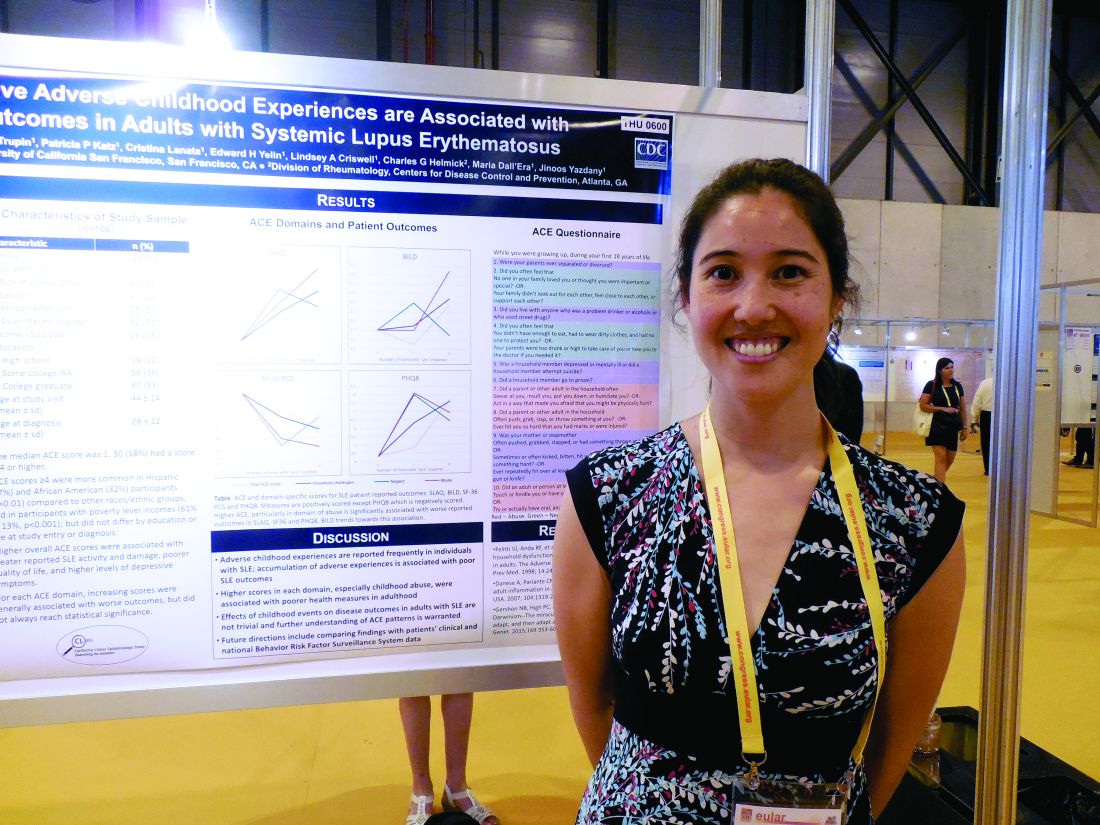
It remains unclear “why there is an association between childhood trauma and outcomes of chronic disease, especially autoimmune disease,” she said in an interview. “We want to know, What does it mean [clinically] to have been abused or neglected, and is it irreversible?” She called for further understanding of childhood adverse experiences and their consequences. These patients might benefit from referrals to psychologists or social workers, Dr. DeQuattro suggested.
The data for her analysis came from 166 adult SLE patients who participated in the California Lupus Epidemiology Study and completed several disease activity surveys, as well as the Adverse Childhood Experience survey, which measures episodes of abuse, neglect, and household challenges. The patients averaged 44 years old and had been diagnosed with SLE for an average of about 16 years. More than 60% of the 166 participants reported at least one episode on this survey. “One event does not make a big difference,” Dr. DeQuattro said, but that wasn’t the case for the SLE patients who reported having four of more of these childhood events.
Patients with a higher number of adverse childhood experiences had worse disease states, as measured by the Systemic Lupus Activity Questionnaire; the Brief Index of Lupus Damage; the 36-Item Short Form Health Survey, a measure of quality of life; and the Patient Health Questionnaire 8, a measure of depression, the researchers said in their report. For example, the average score on the Systemic Lupus Activity Questionnaire was 6.0 in 66 patients with no adverse childhood experiences and 11.8 in the 30 patients who reported having four or more adverse childhood experiences.
Dr. DeQuattro had no relevant financial disclosures.
mzoler@frontlinemedcom.com
On Twitter @mitchelzoler
MADRID – Adult patients with systemic lupus erythematosus (SLE) who had several adverse experiences as children generally had a worse disease state than did similar adult lupus patients with no adverse childhood experiences in a study of 166 California lupus patients.
Higher numbers of self-reported episodes of household challenges, neglect, and especially childhood abuse were associated with worse SLE outcomes, Kimberly DeQuattro, MD, said while presenting a poster at the European Congress of Rheumatology.
It remains unclear “why there is an association between childhood trauma and outcomes of chronic disease, especially autoimmune disease,” she said in an interview. “We want to know, What does it mean [clinically] to have been abused or neglected, and is it irreversible?” She called for further understanding of childhood adverse experiences and their consequences. These patients might benefit from referrals to psychologists or social workers, Dr. DeQuattro suggested.
The data for her analysis came from 166 adult SLE patients who participated in the California Lupus Epidemiology Study and completed several disease activity surveys, as well as the Adverse Childhood Experience survey, which measures episodes of abuse, neglect, and household challenges. The patients averaged 44 years old and had been diagnosed with SLE for an average of about 16 years. More than 60% of the 166 participants reported at least one episode on this survey. “One event does not make a big difference,” Dr. DeQuattro said, but that wasn’t the case for the SLE patients who reported having four of more of these childhood events.
Patients with a higher number of adverse childhood experiences had worse disease states, as measured by the Systemic Lupus Activity Questionnaire; the Brief Index of Lupus Damage; the 36-Item Short Form Health Survey, a measure of quality of life; and the Patient Health Questionnaire 8, a measure of depression, the researchers said in their report. For example, the average score on the Systemic Lupus Activity Questionnaire was 6.0 in 66 patients with no adverse childhood experiences and 11.8 in the 30 patients who reported having four or more adverse childhood experiences.
Dr. DeQuattro had no relevant financial disclosures.
mzoler@frontlinemedcom.com
On Twitter @mitchelzoler
MADRID – Adult patients with systemic lupus erythematosus (SLE) who had several adverse experiences as children generally had a worse disease state than did similar adult lupus patients with no adverse childhood experiences in a study of 166 California lupus patients.
Higher numbers of self-reported episodes of household challenges, neglect, and especially childhood abuse were associated with worse SLE outcomes, Kimberly DeQuattro, MD, said while presenting a poster at the European Congress of Rheumatology.
It remains unclear “why there is an association between childhood trauma and outcomes of chronic disease, especially autoimmune disease,” she said in an interview. “We want to know, What does it mean [clinically] to have been abused or neglected, and is it irreversible?” She called for further understanding of childhood adverse experiences and their consequences. These patients might benefit from referrals to psychologists or social workers, Dr. DeQuattro suggested.
The data for her analysis came from 166 adult SLE patients who participated in the California Lupus Epidemiology Study and completed several disease activity surveys, as well as the Adverse Childhood Experience survey, which measures episodes of abuse, neglect, and household challenges. The patients averaged 44 years old and had been diagnosed with SLE for an average of about 16 years. More than 60% of the 166 participants reported at least one episode on this survey. “One event does not make a big difference,” Dr. DeQuattro said, but that wasn’t the case for the SLE patients who reported having four of more of these childhood events.
Patients with a higher number of adverse childhood experiences had worse disease states, as measured by the Systemic Lupus Activity Questionnaire; the Brief Index of Lupus Damage; the 36-Item Short Form Health Survey, a measure of quality of life; and the Patient Health Questionnaire 8, a measure of depression, the researchers said in their report. For example, the average score on the Systemic Lupus Activity Questionnaire was 6.0 in 66 patients with no adverse childhood experiences and 11.8 in the 30 patients who reported having four or more adverse childhood experiences.
Dr. DeQuattro had no relevant financial disclosures.
mzoler@frontlinemedcom.com
On Twitter @mitchelzoler
AT THE EULAR 2017 CONGRESS
Key clinical point:
Major finding: The Systemic Lupus Activity Questionnaire score averaged 6.0 with no adverse childhood experiences and 11.8 with four or more experiences.
Data source: Survey results from 166 adult lupus patients enrolled in the California Lupus Epidemiology Study.
Disclosures: Dr. DeQuattro had no relevant financial disclosures.
Allopurinol and ventricular arrhythmias: Is there a link?
MADRID – Newly begun allopurinol treatment of elderly patients was linked with a significantly reduced incidence of ventricular arrhythmias in a review of more than 28,000 Medicare beneficiaries.
The antiarrhythmic effect appeared to strengthen with more prolonged allopurinol treatment, reaching a 28% reduction in ventricular arrhythmia incidence among patients on allopurinol for more than 2 years, compared with patients who never received the uric acid reducer, Jasvinder A. Singh, MD, reported in a poster at the European Congress of Rheumatology.

He and his associates used data collected from more than 3 million U.S. Medicare beneficiaries during 2006-2012 from a random Medicare 5% sample. This group included 28,755 patients who began a prescription for allopurinol after not having filled a prescription for the drug during the prior 365 days. The patients averaged 77 years of age.
The outcome of interest was a new onset ventricular arrhythmia, defined as an arrhythmia episode in a patient with no prior record of arrhythmia during the previous 365 days. Arrhythmia occurred in 2,538 of the patients on new allopurinol treatment (9%).
In a multivariate analysis that compared new allopurinol users with patients without allopurinol exposure and controlled for several demographic and clinical features, allopurinol use was linked with a statistically significant 18% reduced rate of incident ventricular arrhythmias in those who recieved it, compared with similar patients who did not receive allopurinol, Dr. Singh and his associates reported.
An additional analysis looked at the relative risk reduction associated with various lengths of allopurinol use. Compared with patients not on allopurinol, those taking it for more than 2 years had a significant 28% reduced rate of arrhythmias; those on it for 6 months to 2 years had a significant 24% reduction in incident arrhythmias; and those on it for 1-180 days had no significant change in their arrhythmia incidence.
Other individual factors that significantly correlated with increased ventricular arrhythmias included older age, male sex, African American race, presence of comorbidities, and treatment with a beta-blockers. Like allopurinol, treatment with a statin linked with a significantly reduced arrhythmia incidence.
In a second, related report at the meeting, Dr. Singh and his associates used a very similar data set to see if a link existed between new-onset allopurinol treatment and a reduced incidence of peripheral artery disease. This analysis showed that allopurinol use linked with a statistically significant 12% reduction in new onset peripheral artery disease. They again found that the clinical impact of allopurinol treatment grew larger as the duration of allopurinol treatment increased.
Dr. Singh has financial ties to Allergan, Bioiberica, Crealta, Iroko, Merz, Regeneron, Savient, and Takeda.
mzoler@frontlinemedcom.com
On Twitter @mitchelzoler
MADRID – Newly begun allopurinol treatment of elderly patients was linked with a significantly reduced incidence of ventricular arrhythmias in a review of more than 28,000 Medicare beneficiaries.
The antiarrhythmic effect appeared to strengthen with more prolonged allopurinol treatment, reaching a 28% reduction in ventricular arrhythmia incidence among patients on allopurinol for more than 2 years, compared with patients who never received the uric acid reducer, Jasvinder A. Singh, MD, reported in a poster at the European Congress of Rheumatology.
He and his associates used data collected from more than 3 million U.S. Medicare beneficiaries during 2006-2012 from a random Medicare 5% sample. This group included 28,755 patients who began a prescription for allopurinol after not having filled a prescription for the drug during the prior 365 days. The patients averaged 77 years of age.
The outcome of interest was a new onset ventricular arrhythmia, defined as an arrhythmia episode in a patient with no prior record of arrhythmia during the previous 365 days. Arrhythmia occurred in 2,538 of the patients on new allopurinol treatment (9%).
In a multivariate analysis that compared new allopurinol users with patients without allopurinol exposure and controlled for several demographic and clinical features, allopurinol use was linked with a statistically significant 18% reduced rate of incident ventricular arrhythmias in those who recieved it, compared with similar patients who did not receive allopurinol, Dr. Singh and his associates reported.
An additional analysis looked at the relative risk reduction associated with various lengths of allopurinol use. Compared with patients not on allopurinol, those taking it for more than 2 years had a significant 28% reduced rate of arrhythmias; those on it for 6 months to 2 years had a significant 24% reduction in incident arrhythmias; and those on it for 1-180 days had no significant change in their arrhythmia incidence.
Other individual factors that significantly correlated with increased ventricular arrhythmias included older age, male sex, African American race, presence of comorbidities, and treatment with a beta-blockers. Like allopurinol, treatment with a statin linked with a significantly reduced arrhythmia incidence.
In a second, related report at the meeting, Dr. Singh and his associates used a very similar data set to see if a link existed between new-onset allopurinol treatment and a reduced incidence of peripheral artery disease. This analysis showed that allopurinol use linked with a statistically significant 12% reduction in new onset peripheral artery disease. They again found that the clinical impact of allopurinol treatment grew larger as the duration of allopurinol treatment increased.
Dr. Singh has financial ties to Allergan, Bioiberica, Crealta, Iroko, Merz, Regeneron, Savient, and Takeda.
mzoler@frontlinemedcom.com
On Twitter @mitchelzoler
MADRID – Newly begun allopurinol treatment of elderly patients was linked with a significantly reduced incidence of ventricular arrhythmias in a review of more than 28,000 Medicare beneficiaries.
The antiarrhythmic effect appeared to strengthen with more prolonged allopurinol treatment, reaching a 28% reduction in ventricular arrhythmia incidence among patients on allopurinol for more than 2 years, compared with patients who never received the uric acid reducer, Jasvinder A. Singh, MD, reported in a poster at the European Congress of Rheumatology.
He and his associates used data collected from more than 3 million U.S. Medicare beneficiaries during 2006-2012 from a random Medicare 5% sample. This group included 28,755 patients who began a prescription for allopurinol after not having filled a prescription for the drug during the prior 365 days. The patients averaged 77 years of age.
The outcome of interest was a new onset ventricular arrhythmia, defined as an arrhythmia episode in a patient with no prior record of arrhythmia during the previous 365 days. Arrhythmia occurred in 2,538 of the patients on new allopurinol treatment (9%).
In a multivariate analysis that compared new allopurinol users with patients without allopurinol exposure and controlled for several demographic and clinical features, allopurinol use was linked with a statistically significant 18% reduced rate of incident ventricular arrhythmias in those who recieved it, compared with similar patients who did not receive allopurinol, Dr. Singh and his associates reported.
An additional analysis looked at the relative risk reduction associated with various lengths of allopurinol use. Compared with patients not on allopurinol, those taking it for more than 2 years had a significant 28% reduced rate of arrhythmias; those on it for 6 months to 2 years had a significant 24% reduction in incident arrhythmias; and those on it for 1-180 days had no significant change in their arrhythmia incidence.
Other individual factors that significantly correlated with increased ventricular arrhythmias included older age, male sex, African American race, presence of comorbidities, and treatment with a beta-blockers. Like allopurinol, treatment with a statin linked with a significantly reduced arrhythmia incidence.
In a second, related report at the meeting, Dr. Singh and his associates used a very similar data set to see if a link existed between new-onset allopurinol treatment and a reduced incidence of peripheral artery disease. This analysis showed that allopurinol use linked with a statistically significant 12% reduction in new onset peripheral artery disease. They again found that the clinical impact of allopurinol treatment grew larger as the duration of allopurinol treatment increased.
Dr. Singh has financial ties to Allergan, Bioiberica, Crealta, Iroko, Merz, Regeneron, Savient, and Takeda.
mzoler@frontlinemedcom.com
On Twitter @mitchelzoler
AT THE EULAR 2017 CONGRESS
Key clinical point:
Major finding: Patients on allopurinol for more than 2 years had a 28% reduced rate of ventricular arrhythmias, compared with those not on allopurinol treatment.
Data source: A 5% random sample of Medicare beneficiaries during 2006-2012.
Disclosures: Dr. Singh has been a consultant to Allergan, Bioiberica, Crealta, Iroko, Merz, Regeneron, Savient, and Takeda and has received research support from Savient and Takeda.
Comorbidities in psoriatic arthritis flag worse prognosis
MADRID – Comorbidities are relatively common in psoriatic arthritis patients, and they are more prevalent in patients with a worse disease course while on initial treatment with a tumor necrosis factor inhibitor, based on data from more than 1,700 Danish patients.
The presence of comorbidities in psoriatic arthritis (PsA) patients on initial tumor necrosis factor inhibitor (TNFi) treatment “was associated with higher disease activity, shorter adherence to the first TNFi, and reduced clinical response,” Lars Erik Kristensen, MD, said at the European Congress of Rheumatology.
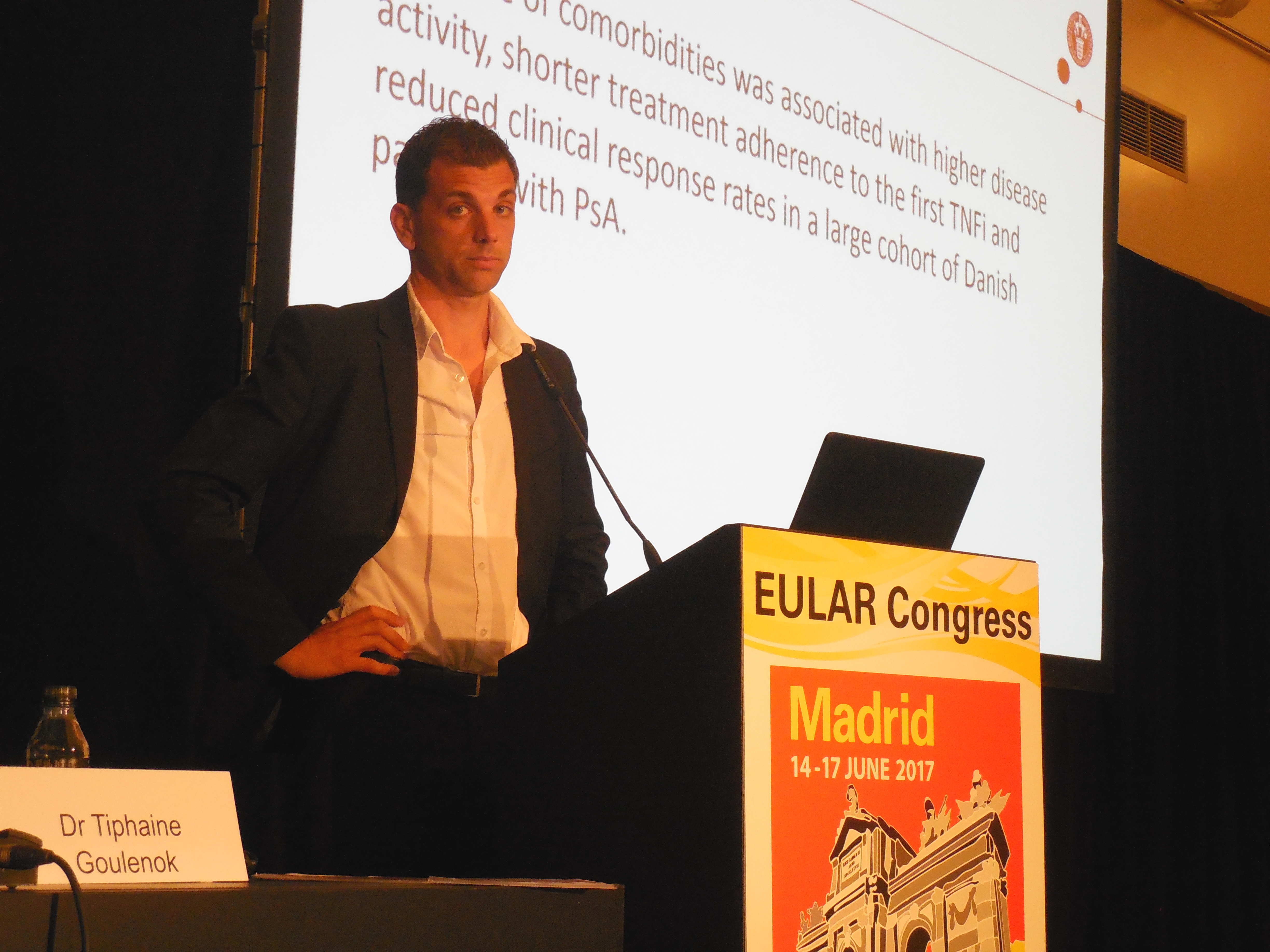
To better understand the possible impact of comorbidities on PsA, he and his associates reviewed 1,750 Danish patients with PsA enrolled in a national registry at the time they began treatment with a TNFi. At the time they started treatment, 1,066 (61%) had no comorbidities, 493 (28%) had one comorbidity, and 191 (11%) had two or more comorbidities.
A comparison of the subgroups with no comorbidities and those with two or more showed several important and statistically significant differences in their baseline characteristics. Patients with at least two comorbidities had longer disease duration, and they had more active disease as measured by parameters including the Disease Activity Score 28 and the Health Assessment Questionnaire. Patients with two or more comorbidities also were older and had a higher average body mass index.
Further analyses showed that patients with two or more comorbidities were 72% more like to discontinue their TNFi treatment, compared with patients with no comorbidities – a statistically significant difference, Dr. Kristensen reported.
After 6 months of TNFi treatment, patients with two or more comorbidities had lower rates of achieving the American College of Rheumatology 20%, 50%, or 70% improvement criteria compared with patients with no comorbidities. For example, an ACR20 response occurred in 40% of patients with no comorbidities and in 31% of patients with two or more comorbidities after 6 months in an adjusted analysis.
Dr. Kristensen has been a consultant to or a speaker for several drug companies.
mzoler@frontlinemedcom.com
On Twitter @mitchelzoler
MADRID – Comorbidities are relatively common in psoriatic arthritis patients, and they are more prevalent in patients with a worse disease course while on initial treatment with a tumor necrosis factor inhibitor, based on data from more than 1,700 Danish patients.
The presence of comorbidities in psoriatic arthritis (PsA) patients on initial tumor necrosis factor inhibitor (TNFi) treatment “was associated with higher disease activity, shorter adherence to the first TNFi, and reduced clinical response,” Lars Erik Kristensen, MD, said at the European Congress of Rheumatology.
To better understand the possible impact of comorbidities on PsA, he and his associates reviewed 1,750 Danish patients with PsA enrolled in a national registry at the time they began treatment with a TNFi. At the time they started treatment, 1,066 (61%) had no comorbidities, 493 (28%) had one comorbidity, and 191 (11%) had two or more comorbidities.
A comparison of the subgroups with no comorbidities and those with two or more showed several important and statistically significant differences in their baseline characteristics. Patients with at least two comorbidities had longer disease duration, and they had more active disease as measured by parameters including the Disease Activity Score 28 and the Health Assessment Questionnaire. Patients with two or more comorbidities also were older and had a higher average body mass index.
Further analyses showed that patients with two or more comorbidities were 72% more like to discontinue their TNFi treatment, compared with patients with no comorbidities – a statistically significant difference, Dr. Kristensen reported.
After 6 months of TNFi treatment, patients with two or more comorbidities had lower rates of achieving the American College of Rheumatology 20%, 50%, or 70% improvement criteria compared with patients with no comorbidities. For example, an ACR20 response occurred in 40% of patients with no comorbidities and in 31% of patients with two or more comorbidities after 6 months in an adjusted analysis.
Dr. Kristensen has been a consultant to or a speaker for several drug companies.
mzoler@frontlinemedcom.com
On Twitter @mitchelzoler
MADRID – Comorbidities are relatively common in psoriatic arthritis patients, and they are more prevalent in patients with a worse disease course while on initial treatment with a tumor necrosis factor inhibitor, based on data from more than 1,700 Danish patients.
The presence of comorbidities in psoriatic arthritis (PsA) patients on initial tumor necrosis factor inhibitor (TNFi) treatment “was associated with higher disease activity, shorter adherence to the first TNFi, and reduced clinical response,” Lars Erik Kristensen, MD, said at the European Congress of Rheumatology.
To better understand the possible impact of comorbidities on PsA, he and his associates reviewed 1,750 Danish patients with PsA enrolled in a national registry at the time they began treatment with a TNFi. At the time they started treatment, 1,066 (61%) had no comorbidities, 493 (28%) had one comorbidity, and 191 (11%) had two or more comorbidities.
A comparison of the subgroups with no comorbidities and those with two or more showed several important and statistically significant differences in their baseline characteristics. Patients with at least two comorbidities had longer disease duration, and they had more active disease as measured by parameters including the Disease Activity Score 28 and the Health Assessment Questionnaire. Patients with two or more comorbidities also were older and had a higher average body mass index.
Further analyses showed that patients with two or more comorbidities were 72% more like to discontinue their TNFi treatment, compared with patients with no comorbidities – a statistically significant difference, Dr. Kristensen reported.
After 6 months of TNFi treatment, patients with two or more comorbidities had lower rates of achieving the American College of Rheumatology 20%, 50%, or 70% improvement criteria compared with patients with no comorbidities. For example, an ACR20 response occurred in 40% of patients with no comorbidities and in 31% of patients with two or more comorbidities after 6 months in an adjusted analysis.
Dr. Kristensen has been a consultant to or a speaker for several drug companies.
mzoler@frontlinemedcom.com
On Twitter @mitchelzoler
AT THE EULAR 2017 CONGRESS
Key clinical point: , compared with patients with no comorbidities.
Major finding: An ACR20 response occurred in 40% of patients with no comorbidities but only 31% of those with two or more comorbidities.
Data source: Review of national registry data for 1,750 Danish psoriatic arthritis patients.
Disclosures: Dr. Kristensen has been a consultant to or a speaker for several drug companies.