User login
VIDEO: How informatics can help your hospital prevent infections
Hospitalists have a powerful tool to help them fight outbreaks of Clostridium difficile and other infectious agents: electronic health record data.
Sara Murray, MD, an assistant professor of medicine at the University of California, San Francisco, and her colleagues, used EHR data to map temporal and spatial coordinates to determine where patients in their hospital were at highest risk for C. difficile. Patients who’d had a CT scan on a particular machine in the emergency department within 24 hours of an infected person having been scanned there had a threefold higher risk of infection, they found. This information helped the hospital’s infection control team to create a more effective sterilization plan for that specific machine.
“The takeaway is that we should be leveraging our EHR data to inform our quality improvement efforts,” Dr. Murray said in this video interview, recorded during HM17.
The video associated with this article is no longer available on this site. Please view all of our videos on the MDedge YouTube channel
Hospitalists have a powerful tool to help them fight outbreaks of Clostridium difficile and other infectious agents: electronic health record data.
Sara Murray, MD, an assistant professor of medicine at the University of California, San Francisco, and her colleagues, used EHR data to map temporal and spatial coordinates to determine where patients in their hospital were at highest risk for C. difficile. Patients who’d had a CT scan on a particular machine in the emergency department within 24 hours of an infected person having been scanned there had a threefold higher risk of infection, they found. This information helped the hospital’s infection control team to create a more effective sterilization plan for that specific machine.
“The takeaway is that we should be leveraging our EHR data to inform our quality improvement efforts,” Dr. Murray said in this video interview, recorded during HM17.
The video associated with this article is no longer available on this site. Please view all of our videos on the MDedge YouTube channel
Hospitalists have a powerful tool to help them fight outbreaks of Clostridium difficile and other infectious agents: electronic health record data.
Sara Murray, MD, an assistant professor of medicine at the University of California, San Francisco, and her colleagues, used EHR data to map temporal and spatial coordinates to determine where patients in their hospital were at highest risk for C. difficile. Patients who’d had a CT scan on a particular machine in the emergency department within 24 hours of an infected person having been scanned there had a threefold higher risk of infection, they found. This information helped the hospital’s infection control team to create a more effective sterilization plan for that specific machine.
“The takeaway is that we should be leveraging our EHR data to inform our quality improvement efforts,” Dr. Murray said in this video interview, recorded during HM17.
The video associated with this article is no longer available on this site. Please view all of our videos on the MDedge YouTube channel

VIDEO: Advocacy efforts spur CMS to drop HCAHPS pain domain assessment
How pain management is evaluated in the Hospital Consumer Assessment of Healthcare Providers and Systems (HCAHPS) survey is changing, thanks in part to the advocacy efforts of the Society of Hospital Medicine’s public policy committee.
Based on input from SHM and other organizations, the Centers for Medicare & Medicaid Services decided that the way the survey was worded concerning pain management could be leading to unintended consequences, particularly in light of the opioid epidemic.
In a video interview recorded during HM17, John Biebelhausen, MD, MBA, discussed how SHM worked with the CMS to help “improve the HCAHPS survey to make a better patient satisfaction tool for our assessments and also eliminate some of the competing pressures the physician might face.”
Dr. Biebelhausen is a hospitalist and physician lead for quality reporting at Virginia Mason Hospital in Seattle. He had no relevant disclosures.hospitalist and Physician Lead for Quality Reporting.
The video associated with this article is no longer available on this site. Please view all of our videos on the MDedge YouTube channel
How pain management is evaluated in the Hospital Consumer Assessment of Healthcare Providers and Systems (HCAHPS) survey is changing, thanks in part to the advocacy efforts of the Society of Hospital Medicine’s public policy committee.
Based on input from SHM and other organizations, the Centers for Medicare & Medicaid Services decided that the way the survey was worded concerning pain management could be leading to unintended consequences, particularly in light of the opioid epidemic.
In a video interview recorded during HM17, John Biebelhausen, MD, MBA, discussed how SHM worked with the CMS to help “improve the HCAHPS survey to make a better patient satisfaction tool for our assessments and also eliminate some of the competing pressures the physician might face.”
Dr. Biebelhausen is a hospitalist and physician lead for quality reporting at Virginia Mason Hospital in Seattle. He had no relevant disclosures.hospitalist and Physician Lead for Quality Reporting.
The video associated with this article is no longer available on this site. Please view all of our videos on the MDedge YouTube channel
How pain management is evaluated in the Hospital Consumer Assessment of Healthcare Providers and Systems (HCAHPS) survey is changing, thanks in part to the advocacy efforts of the Society of Hospital Medicine’s public policy committee.
Based on input from SHM and other organizations, the Centers for Medicare & Medicaid Services decided that the way the survey was worded concerning pain management could be leading to unintended consequences, particularly in light of the opioid epidemic.
In a video interview recorded during HM17, John Biebelhausen, MD, MBA, discussed how SHM worked with the CMS to help “improve the HCAHPS survey to make a better patient satisfaction tool for our assessments and also eliminate some of the competing pressures the physician might face.”
Dr. Biebelhausen is a hospitalist and physician lead for quality reporting at Virginia Mason Hospital in Seattle. He had no relevant disclosures.hospitalist and Physician Lead for Quality Reporting.
The video associated with this article is no longer available on this site. Please view all of our videos on the MDedge YouTube channel

VIDEO: Low-tech system tweaks help hospitalists minimize workflow disruptions
What are some of the most common interruptions physicians face, and what simple solutions exist to help minimize the breaks in workflow?
Physicians are interrupted, on average, 15 times an hour, according to Roberta Himebaugh, a senior vice president at TeamHealth in Pleasanton, Calif., but as she explains in this video recorded at HM17, there are some simple, low-tech – and other – solutions that health systems can use to help hospitalists streamline workflow.

What are some of the most common interruptions physicians face, and what simple solutions exist to help minimize the breaks in workflow?
Physicians are interrupted, on average, 15 times an hour, according to Roberta Himebaugh, a senior vice president at TeamHealth in Pleasanton, Calif., but as she explains in this video recorded at HM17, there are some simple, low-tech – and other – solutions that health systems can use to help hospitalists streamline workflow.
What are some of the most common interruptions physicians face, and what simple solutions exist to help minimize the breaks in workflow?
Physicians are interrupted, on average, 15 times an hour, according to Roberta Himebaugh, a senior vice president at TeamHealth in Pleasanton, Calif., but as she explains in this video recorded at HM17, there are some simple, low-tech – and other – solutions that health systems can use to help hospitalists streamline workflow.

VIDEO: Dr. Lisa Newman on triple negative breast cancer in African American women
LAS VEGAS – The heavy burden of triple negative and other aggressive breast cancers among African American women cannot be simplified to socioeconomic factors alone.
International investigations by Lisa Newman, MD, director of the Breast Oncology Program at the Henry Ford Health System, Detroit, and other researchers are making it clear that genetic factors play a significant role.
She explained the latest findings and what they mean for screening, genetic referral, and treatment in an interview at the American Society of Breast Surgeons annual meeting.
The video associated with this article is no longer available on this site. Please view all of our videos on the MDedge YouTube channel
LAS VEGAS – The heavy burden of triple negative and other aggressive breast cancers among African American women cannot be simplified to socioeconomic factors alone.
International investigations by Lisa Newman, MD, director of the Breast Oncology Program at the Henry Ford Health System, Detroit, and other researchers are making it clear that genetic factors play a significant role.
She explained the latest findings and what they mean for screening, genetic referral, and treatment in an interview at the American Society of Breast Surgeons annual meeting.
The video associated with this article is no longer available on this site. Please view all of our videos on the MDedge YouTube channel
LAS VEGAS – The heavy burden of triple negative and other aggressive breast cancers among African American women cannot be simplified to socioeconomic factors alone.
International investigations by Lisa Newman, MD, director of the Breast Oncology Program at the Henry Ford Health System, Detroit, and other researchers are making it clear that genetic factors play a significant role.
She explained the latest findings and what they mean for screening, genetic referral, and treatment in an interview at the American Society of Breast Surgeons annual meeting.
The video associated with this article is no longer available on this site. Please view all of our videos on the MDedge YouTube channel
AT ASBS 2017

Opioid abuse
The video associated with this article is no longer available on this site. Please view all of our videos on the MDedge YouTube channel
The video associated with this article is no longer available on this site. Please view all of our videos on the MDedge YouTube channel
The video associated with this article is no longer available on this site. Please view all of our videos on the MDedge YouTube channel
VIDEO: How to pick surgical margins with mixed breast lesions
LAS VEGAS – According to recent guidelines, no ink on tumor is the right surgical margin for early stage invasive breast cancer and 2 mm is the right lumpectomy margin for ductal carcinoma in situ (DCIS) treated with whole breast radiation. But, what do you do when invasive carcinoma is associated with DCIS?
It’s a common question for breast surgeons. Monica Morrow, MD, chief of breast surgery at Memorial Sloan-Kettering Cancer Center in New York City, explained how to handle the situation in a video interview at the annual meeting of the American Society of Breast Surgeons.
She was the senior author on the 2014 invasive breast cancer guidelines and the lead author on the 2016 DCIS guidelines, both of which were consensus statements on surgical margins from the Society of Surgical Oncology and other groups (Ann Surg Oncol. 2014 Mar;21[3]:704-16; Ann Surg Oncol. 2016 Nov;23[12]:3801-10).
Dr. Morrow explained the thinking behind the guidelines and how to apply them to mixed lesions and other clinical scenarios, as well as their limitations and what remains to be determined. A key point is that a margin less than 2 mm is not by itself an indication for mastectomy in DCIS.
The video associated with this article is no longer available on this site. Please view all of our videos on the MDedge YouTube channel
LAS VEGAS – According to recent guidelines, no ink on tumor is the right surgical margin for early stage invasive breast cancer and 2 mm is the right lumpectomy margin for ductal carcinoma in situ (DCIS) treated with whole breast radiation. But, what do you do when invasive carcinoma is associated with DCIS?
It’s a common question for breast surgeons. Monica Morrow, MD, chief of breast surgery at Memorial Sloan-Kettering Cancer Center in New York City, explained how to handle the situation in a video interview at the annual meeting of the American Society of Breast Surgeons.
She was the senior author on the 2014 invasive breast cancer guidelines and the lead author on the 2016 DCIS guidelines, both of which were consensus statements on surgical margins from the Society of Surgical Oncology and other groups (Ann Surg Oncol. 2014 Mar;21[3]:704-16; Ann Surg Oncol. 2016 Nov;23[12]:3801-10).
Dr. Morrow explained the thinking behind the guidelines and how to apply them to mixed lesions and other clinical scenarios, as well as their limitations and what remains to be determined. A key point is that a margin less than 2 mm is not by itself an indication for mastectomy in DCIS.
The video associated with this article is no longer available on this site. Please view all of our videos on the MDedge YouTube channel
LAS VEGAS – According to recent guidelines, no ink on tumor is the right surgical margin for early stage invasive breast cancer and 2 mm is the right lumpectomy margin for ductal carcinoma in situ (DCIS) treated with whole breast radiation. But, what do you do when invasive carcinoma is associated with DCIS?
It’s a common question for breast surgeons. Monica Morrow, MD, chief of breast surgery at Memorial Sloan-Kettering Cancer Center in New York City, explained how to handle the situation in a video interview at the annual meeting of the American Society of Breast Surgeons.
She was the senior author on the 2014 invasive breast cancer guidelines and the lead author on the 2016 DCIS guidelines, both of which were consensus statements on surgical margins from the Society of Surgical Oncology and other groups (Ann Surg Oncol. 2014 Mar;21[3]:704-16; Ann Surg Oncol. 2016 Nov;23[12]:3801-10).
Dr. Morrow explained the thinking behind the guidelines and how to apply them to mixed lesions and other clinical scenarios, as well as their limitations and what remains to be determined. A key point is that a margin less than 2 mm is not by itself an indication for mastectomy in DCIS.
The video associated with this article is no longer available on this site. Please view all of our videos on the MDedge YouTube channel
From ASBS 2017
VIDEO: Surgery use declines for non–small cell lung cancer
BOSTON – The use of surgical therapy for early stage lung cancer in the United States has declined as other nonsurgical treatment options have become available, according to a study reported at the annual meeting of the American Association for Thoracic Surgery.
Most notably, the study finds that surgery for early stage non–small cell lung cancer decreased by 12% from 2004 to 2013.
In a video interview, Keith Naunheim, MD, a professor of surgery at Saint Louis University, discusses the study findings and the potential reasons behind declining surgery use for lung cancer. Dr. Naunheim also addresses why physicians should keep an open mind about alternative therapy options for lung cancer, while ensuring that the treatments are safe and effective for patients.
The video associated with this article is no longer available on this site. Please view all of our videos on the MDedge YouTube channel
agallegos@frontlinemedcom.com
On Twitter @legal_med
BOSTON – The use of surgical therapy for early stage lung cancer in the United States has declined as other nonsurgical treatment options have become available, according to a study reported at the annual meeting of the American Association for Thoracic Surgery.
Most notably, the study finds that surgery for early stage non–small cell lung cancer decreased by 12% from 2004 to 2013.
In a video interview, Keith Naunheim, MD, a professor of surgery at Saint Louis University, discusses the study findings and the potential reasons behind declining surgery use for lung cancer. Dr. Naunheim also addresses why physicians should keep an open mind about alternative therapy options for lung cancer, while ensuring that the treatments are safe and effective for patients.
The video associated with this article is no longer available on this site. Please view all of our videos on the MDedge YouTube channel
agallegos@frontlinemedcom.com
On Twitter @legal_med
BOSTON – The use of surgical therapy for early stage lung cancer in the United States has declined as other nonsurgical treatment options have become available, according to a study reported at the annual meeting of the American Association for Thoracic Surgery.
Most notably, the study finds that surgery for early stage non–small cell lung cancer decreased by 12% from 2004 to 2013.
In a video interview, Keith Naunheim, MD, a professor of surgery at Saint Louis University, discusses the study findings and the potential reasons behind declining surgery use for lung cancer. Dr. Naunheim also addresses why physicians should keep an open mind about alternative therapy options for lung cancer, while ensuring that the treatments are safe and effective for patients.
The video associated with this article is no longer available on this site. Please view all of our videos on the MDedge YouTube channel
agallegos@frontlinemedcom.com
On Twitter @legal_med
AT THE AATS ANNUAL MEETING

VIDEO: Setbacks of serelaxin, ularitide prompt rethinking acute heart failure strategies
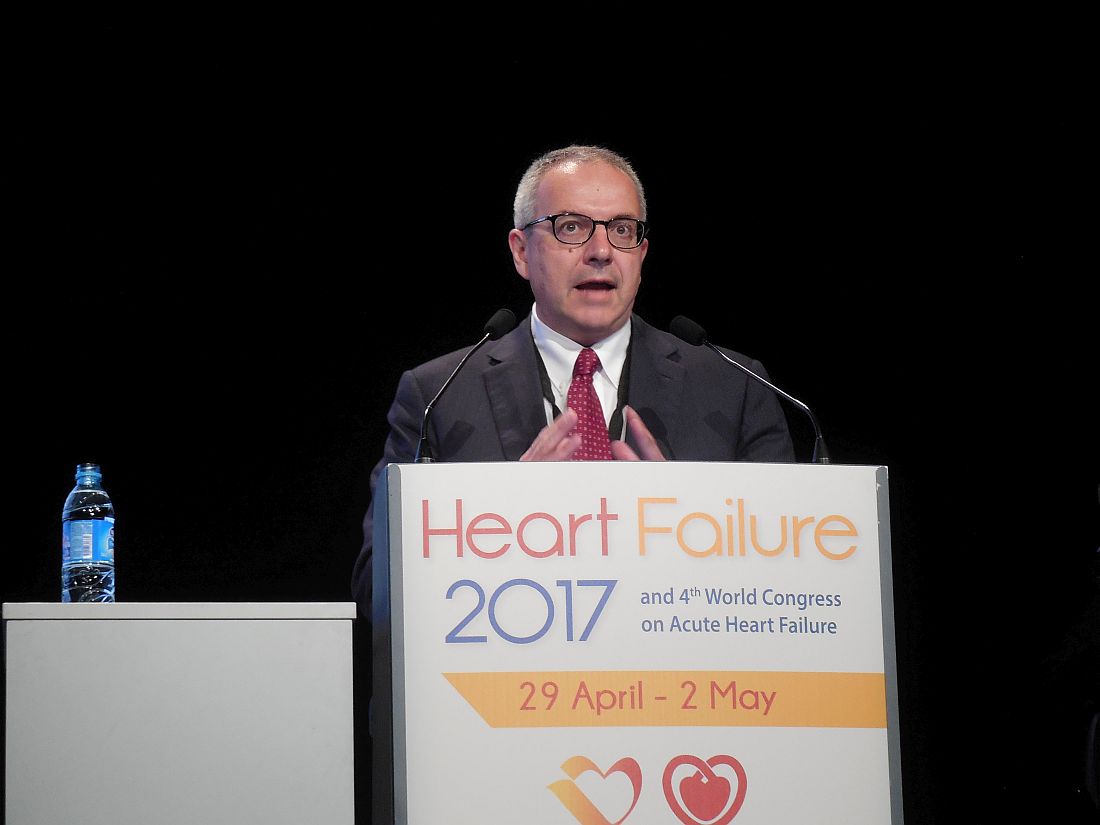
PARIS – Serelaxin’s failure to meet its primary endpoints in an acute heart failure trial with more than 6,500 patients, coupled with a similar failure by ularitide in the same patient population in pivotal trial results first reported in November 2016, led some experts to rethink their conception of potential interventions for patients hospitalized for acute heart failure decompensations.
“We learned in TRUE-AHF that giving a drug very early [in acute heart failure] does not prevent [long-term] death. It means that early is not early enough,” Alexandre Mebazaa, MD, said in a video interview at a meeting held by the Heart Failure Association of the European Society of Cardiology.

In terms of finding new management strategies for patients who develop acute decompensations, “we need to better understand acute heart failure and the best subset of patients who might benefit” from existing or new drugs, he said.
The RELAX-AHF-2 trial enrolled and analyzed 6,545 patients hospitalized with an acute heart failure decompensation at more than 500 sites in 34 countries. The study compared the impact of a 48-hour IV infusion of serelaxin with placebo when begun within 16 hours of hospitalization for acute heart failure and added to standard treatment.
These findings closely matched the performance of ularitide in a similar study design, TRUE-AHF (New Engl J Med. 2017 Apr 12. doi: 10.1056/NEJMoa1601895).
At the 2016 meeting of the Heart Failure Association of the ESC, the organization released revised guidelines for diagnosing and managing heart failure that stressed the importance of rapid response to acute heart failure, including possible treatment with vasodilator drugs. The guidelines acknowledged that while “Vasodilators are the second most often used agents in acute heart failure for symptomatic relief; however, there is no robust evidence confirming their beneficial effects” (Eur Heart J. 2016 Jul 14;37[27]:2129-200).
Both ularitide and serelaxin are potent IV vasodilators, and their failure to meet their efficacy endpoints in these two trials put vasodilation and rapid decongestion into question as strategies to improve midterm prognosis in heart failure patients following acute decompensation episodes.
Serelaxin has been developed by Novartis, and ularitide has been developed by Cardiorentis. Dr. Mebazaa has received honoraria from Novartis and Cardiorentis, as well as from several other companies. Dr. Metra has been a consultant to Novartis. She has also served as consultant or spokesperson for Abbott Vascular, Amgen, AstraZeneca, Fresenius, Relypsa, and Servier.
The video associated with this article is no longer available on this site. Please view all of our videos on the MDedge YouTube channel
mzoler@frontlinemedcom.com
On Twitter @mitchelzoler
PARIS – Serelaxin’s failure to meet its primary endpoints in an acute heart failure trial with more than 6,500 patients, coupled with a similar failure by ularitide in the same patient population in pivotal trial results first reported in November 2016, led some experts to rethink their conception of potential interventions for patients hospitalized for acute heart failure decompensations.
“We learned in TRUE-AHF that giving a drug very early [in acute heart failure] does not prevent [long-term] death. It means that early is not early enough,” Alexandre Mebazaa, MD, said in a video interview at a meeting held by the Heart Failure Association of the European Society of Cardiology.
In terms of finding new management strategies for patients who develop acute decompensations, “we need to better understand acute heart failure and the best subset of patients who might benefit” from existing or new drugs, he said.
The RELAX-AHF-2 trial enrolled and analyzed 6,545 patients hospitalized with an acute heart failure decompensation at more than 500 sites in 34 countries. The study compared the impact of a 48-hour IV infusion of serelaxin with placebo when begun within 16 hours of hospitalization for acute heart failure and added to standard treatment.
These findings closely matched the performance of ularitide in a similar study design, TRUE-AHF (New Engl J Med. 2017 Apr 12. doi: 10.1056/NEJMoa1601895).
At the 2016 meeting of the Heart Failure Association of the ESC, the organization released revised guidelines for diagnosing and managing heart failure that stressed the importance of rapid response to acute heart failure, including possible treatment with vasodilator drugs. The guidelines acknowledged that while “Vasodilators are the second most often used agents in acute heart failure for symptomatic relief; however, there is no robust evidence confirming their beneficial effects” (Eur Heart J. 2016 Jul 14;37[27]:2129-200).
Both ularitide and serelaxin are potent IV vasodilators, and their failure to meet their efficacy endpoints in these two trials put vasodilation and rapid decongestion into question as strategies to improve midterm prognosis in heart failure patients following acute decompensation episodes.
Serelaxin has been developed by Novartis, and ularitide has been developed by Cardiorentis. Dr. Mebazaa has received honoraria from Novartis and Cardiorentis, as well as from several other companies. Dr. Metra has been a consultant to Novartis. She has also served as consultant or spokesperson for Abbott Vascular, Amgen, AstraZeneca, Fresenius, Relypsa, and Servier.
The video associated with this article is no longer available on this site. Please view all of our videos on the MDedge YouTube channel
mzoler@frontlinemedcom.com
On Twitter @mitchelzoler
PARIS – Serelaxin’s failure to meet its primary endpoints in an acute heart failure trial with more than 6,500 patients, coupled with a similar failure by ularitide in the same patient population in pivotal trial results first reported in November 2016, led some experts to rethink their conception of potential interventions for patients hospitalized for acute heart failure decompensations.
“We learned in TRUE-AHF that giving a drug very early [in acute heart failure] does not prevent [long-term] death. It means that early is not early enough,” Alexandre Mebazaa, MD, said in a video interview at a meeting held by the Heart Failure Association of the European Society of Cardiology.
In terms of finding new management strategies for patients who develop acute decompensations, “we need to better understand acute heart failure and the best subset of patients who might benefit” from existing or new drugs, he said.
The RELAX-AHF-2 trial enrolled and analyzed 6,545 patients hospitalized with an acute heart failure decompensation at more than 500 sites in 34 countries. The study compared the impact of a 48-hour IV infusion of serelaxin with placebo when begun within 16 hours of hospitalization for acute heart failure and added to standard treatment.
These findings closely matched the performance of ularitide in a similar study design, TRUE-AHF (New Engl J Med. 2017 Apr 12. doi: 10.1056/NEJMoa1601895).
At the 2016 meeting of the Heart Failure Association of the ESC, the organization released revised guidelines for diagnosing and managing heart failure that stressed the importance of rapid response to acute heart failure, including possible treatment with vasodilator drugs. The guidelines acknowledged that while “Vasodilators are the second most often used agents in acute heart failure for symptomatic relief; however, there is no robust evidence confirming their beneficial effects” (Eur Heart J. 2016 Jul 14;37[27]:2129-200).
Both ularitide and serelaxin are potent IV vasodilators, and their failure to meet their efficacy endpoints in these two trials put vasodilation and rapid decongestion into question as strategies to improve midterm prognosis in heart failure patients following acute decompensation episodes.
Serelaxin has been developed by Novartis, and ularitide has been developed by Cardiorentis. Dr. Mebazaa has received honoraria from Novartis and Cardiorentis, as well as from several other companies. Dr. Metra has been a consultant to Novartis. She has also served as consultant or spokesperson for Abbott Vascular, Amgen, AstraZeneca, Fresenius, Relypsa, and Servier.
The video associated with this article is no longer available on this site. Please view all of our videos on the MDedge YouTube channel
mzoler@frontlinemedcom.com
On Twitter @mitchelzoler
EXPERT ANALYSIS FROM HEART FAILURE 2017
VIDEO: Cannabidiol reduces convulsive seizures in Dravet syndrome
BOSTON – Adjunctive treatment with cannabidiol significantly reduced convulsive seizure frequency in Dravet syndrome patients in a randomized, double-blind, placebo-controlled trial.
Over a 14-week treatment period, including 2 weeks of titration and 12 weeks of maintenance, convulsive seizure frequency in 61 treated children and adolescents decreased from a median of 12.4 to 5.9 per month (median reduction of 39%), compared with a decrease from a median of 14.9 to 14.1 per month (median reduction of 13%) in 59 patients who received placebo, J. Helen Cross, MD, reported at the annual meeting of the American Academy of Neurology.
The proportion of patients with at least a 50% reduction in convulsive seizures was 42.6% with cannabidiol vs. 27.1% with placebo (odds ratio, 2.0), but this difference did not reach statistical significance, said Dr. Cross of the University College London Great Ormond Street Institute of Child Health and the Great Ormond Street Hospital for Children NHS Trust, London.
In a video interview, Dr. Cross discussed the findings and the importance of improving seizure control in patients with Dravet syndrome, a rare infantile-onset developmental and epileptic encephalopathy with very poor prognosis for long-term seizure control and neurodevelopmental outcomes.
Participants in the study (GWPCARE1) had a mean age of 10 years, but nearly a third were younger than 6 years. All had Dravet syndrome and drug-resistant seizures; the median number of antiepilepsy drugs previously tried was four, and the median number being used was three. Those randomized to the treatment group received cannabidiol oral solution up to 20 mg/kg per day.
Adverse events were common, occurring in 93.4% and 74.6% of treatment group and placebo group patients, respectively. But adverse events reported in the treatment group were mild or moderate in 84% of patients, and treatment was generally well tolerated.
“These are very complex patients with a high seizure burden... and therefore, to have another medication that looks as if it can be of benefit is really very exciting for this population,” Dr. Cross said, noting that cannabidiol was also shown in other studies presented at the AAN meeting (GWPCARE3 and GWPCARE4) to reduce seizure frequency in patients with Lennox-Gastaut syndrome.
GW Research sponsored the study. Dr. Cross is a member of the advisory boards for Eisai, GW Pharmaceuticals, Shire, and Zogenix.
The video associated with this article is no longer available on this site. Please view all of our videos on the MDedge YouTube channel
BOSTON – Adjunctive treatment with cannabidiol significantly reduced convulsive seizure frequency in Dravet syndrome patients in a randomized, double-blind, placebo-controlled trial.
Over a 14-week treatment period, including 2 weeks of titration and 12 weeks of maintenance, convulsive seizure frequency in 61 treated children and adolescents decreased from a median of 12.4 to 5.9 per month (median reduction of 39%), compared with a decrease from a median of 14.9 to 14.1 per month (median reduction of 13%) in 59 patients who received placebo, J. Helen Cross, MD, reported at the annual meeting of the American Academy of Neurology.
The proportion of patients with at least a 50% reduction in convulsive seizures was 42.6% with cannabidiol vs. 27.1% with placebo (odds ratio, 2.0), but this difference did not reach statistical significance, said Dr. Cross of the University College London Great Ormond Street Institute of Child Health and the Great Ormond Street Hospital for Children NHS Trust, London.
In a video interview, Dr. Cross discussed the findings and the importance of improving seizure control in patients with Dravet syndrome, a rare infantile-onset developmental and epileptic encephalopathy with very poor prognosis for long-term seizure control and neurodevelopmental outcomes.
Participants in the study (GWPCARE1) had a mean age of 10 years, but nearly a third were younger than 6 years. All had Dravet syndrome and drug-resistant seizures; the median number of antiepilepsy drugs previously tried was four, and the median number being used was three. Those randomized to the treatment group received cannabidiol oral solution up to 20 mg/kg per day.
Adverse events were common, occurring in 93.4% and 74.6% of treatment group and placebo group patients, respectively. But adverse events reported in the treatment group were mild or moderate in 84% of patients, and treatment was generally well tolerated.
“These are very complex patients with a high seizure burden... and therefore, to have another medication that looks as if it can be of benefit is really very exciting for this population,” Dr. Cross said, noting that cannabidiol was also shown in other studies presented at the AAN meeting (GWPCARE3 and GWPCARE4) to reduce seizure frequency in patients with Lennox-Gastaut syndrome.
GW Research sponsored the study. Dr. Cross is a member of the advisory boards for Eisai, GW Pharmaceuticals, Shire, and Zogenix.
The video associated with this article is no longer available on this site. Please view all of our videos on the MDedge YouTube channel
BOSTON – Adjunctive treatment with cannabidiol significantly reduced convulsive seizure frequency in Dravet syndrome patients in a randomized, double-blind, placebo-controlled trial.
Over a 14-week treatment period, including 2 weeks of titration and 12 weeks of maintenance, convulsive seizure frequency in 61 treated children and adolescents decreased from a median of 12.4 to 5.9 per month (median reduction of 39%), compared with a decrease from a median of 14.9 to 14.1 per month (median reduction of 13%) in 59 patients who received placebo, J. Helen Cross, MD, reported at the annual meeting of the American Academy of Neurology.
The proportion of patients with at least a 50% reduction in convulsive seizures was 42.6% with cannabidiol vs. 27.1% with placebo (odds ratio, 2.0), but this difference did not reach statistical significance, said Dr. Cross of the University College London Great Ormond Street Institute of Child Health and the Great Ormond Street Hospital for Children NHS Trust, London.
In a video interview, Dr. Cross discussed the findings and the importance of improving seizure control in patients with Dravet syndrome, a rare infantile-onset developmental and epileptic encephalopathy with very poor prognosis for long-term seizure control and neurodevelopmental outcomes.
Participants in the study (GWPCARE1) had a mean age of 10 years, but nearly a third were younger than 6 years. All had Dravet syndrome and drug-resistant seizures; the median number of antiepilepsy drugs previously tried was four, and the median number being used was three. Those randomized to the treatment group received cannabidiol oral solution up to 20 mg/kg per day.
Adverse events were common, occurring in 93.4% and 74.6% of treatment group and placebo group patients, respectively. But adverse events reported in the treatment group were mild or moderate in 84% of patients, and treatment was generally well tolerated.
“These are very complex patients with a high seizure burden... and therefore, to have another medication that looks as if it can be of benefit is really very exciting for this population,” Dr. Cross said, noting that cannabidiol was also shown in other studies presented at the AAN meeting (GWPCARE3 and GWPCARE4) to reduce seizure frequency in patients with Lennox-Gastaut syndrome.
GW Research sponsored the study. Dr. Cross is a member of the advisory boards for Eisai, GW Pharmaceuticals, Shire, and Zogenix.
The video associated with this article is no longer available on this site. Please view all of our videos on the MDedge YouTube channel
At ANN 2017
Key clinical point:
Major finding: Children and adolescents treated with cannabidiol had a decline in convulsive seizure frequency, from a median of 12.4 to 5.9 per month (median reduction of 39%), compared with a decrease from a median of 14.9 to 14.1 per month with placebo (median reduction of 13%).
Data source: A randomized, double-blind, placebo-controlled trial of adjunctive treatment with cannabidiol in 120 children and adolescents with Dravet syndrome.
Disclosures: GW Research sponsored the study. Dr. Cross is a member of the advisory boards for Eisai, GW Pharmaceuticals, Shire, and Zogenix.
VIDEO: Big research trials at AAN bring up important cost decisions
BOSTON – Some of the most influential clinical research reports coming out of the annual meeting of the American Academy of Neurology raise questions on how neurologists will strike a balance between the improved efficacy and safety of drugs in new therapeutic classes and their affordability for patients.
Natalia Rost, MD, vice chair of the AAN Science Committee, discussed phase III clinical trials (ARISE and STRIVE) in episodic migraine with erenumab, an investigational humanized monoclonal antibody against calcitonin gene-related peptide receptor; phase III clinical trials (ENDEAR and CHERISH) of the antisense oligonucleotide drug nusinersen (Spinraza) that was approved by the Food and Drug Administration for spinal muscular atrophy in late 2016; as well as phase III trials of a pharmaceutical-grade extract of the cannabis-derived compound cannabidiol in patients with Dravet syndrome and Lennox-Gastaut syndrome.
Erenumab and nusinersen are “disease-specific targeted biologics” that have been developed over decades to target a specific disease pathway, and hence translate into high prices, Dr. Rost said in a video interview at the meeting.
“How you value the cost of a drug against improvement in a physiological outcome is very difficult to measure,” she noted, for relatively small gains in reducing migraine days per month and improvements in functional outcome and disability against placebo.
But this calculation is different with the potentially lifesaving effects of nusinersen for spinal muscular atrophy patients, in which “we’re not talking about days of improvement, we’re talking about days of life,” said Dr. Rost, director of acute stroke services at Massachusetts General Hospital, Boston. “And so that becomes an ethical dilemma in terms of the cost of administration, who is paying for the drug, and how this is covered. Whom do you offer treatment to?”
The development of cannabidiol as a potential adjunctive treatment for Dravet and Lennox-Gastaut syndromes is a welcome addition to the armamentarium against these conditions, Dr. Rost added, because it offers an alternative to the unregulated use of herbal medications and supplements – particularly cannabis in its various forms – that patients ask about but are difficult to dose consistently and to ensure a pharmaceutical-grade level of purity.
The video associated with this article is no longer available on this site. Please view all of our videos on the MDedge YouTube channel
BOSTON – Some of the most influential clinical research reports coming out of the annual meeting of the American Academy of Neurology raise questions on how neurologists will strike a balance between the improved efficacy and safety of drugs in new therapeutic classes and their affordability for patients.
Natalia Rost, MD, vice chair of the AAN Science Committee, discussed phase III clinical trials (ARISE and STRIVE) in episodic migraine with erenumab, an investigational humanized monoclonal antibody against calcitonin gene-related peptide receptor; phase III clinical trials (ENDEAR and CHERISH) of the antisense oligonucleotide drug nusinersen (Spinraza) that was approved by the Food and Drug Administration for spinal muscular atrophy in late 2016; as well as phase III trials of a pharmaceutical-grade extract of the cannabis-derived compound cannabidiol in patients with Dravet syndrome and Lennox-Gastaut syndrome.
Erenumab and nusinersen are “disease-specific targeted biologics” that have been developed over decades to target a specific disease pathway, and hence translate into high prices, Dr. Rost said in a video interview at the meeting.
“How you value the cost of a drug against improvement in a physiological outcome is very difficult to measure,” she noted, for relatively small gains in reducing migraine days per month and improvements in functional outcome and disability against placebo.
But this calculation is different with the potentially lifesaving effects of nusinersen for spinal muscular atrophy patients, in which “we’re not talking about days of improvement, we’re talking about days of life,” said Dr. Rost, director of acute stroke services at Massachusetts General Hospital, Boston. “And so that becomes an ethical dilemma in terms of the cost of administration, who is paying for the drug, and how this is covered. Whom do you offer treatment to?”
The development of cannabidiol as a potential adjunctive treatment for Dravet and Lennox-Gastaut syndromes is a welcome addition to the armamentarium against these conditions, Dr. Rost added, because it offers an alternative to the unregulated use of herbal medications and supplements – particularly cannabis in its various forms – that patients ask about but are difficult to dose consistently and to ensure a pharmaceutical-grade level of purity.
The video associated with this article is no longer available on this site. Please view all of our videos on the MDedge YouTube channel
BOSTON – Some of the most influential clinical research reports coming out of the annual meeting of the American Academy of Neurology raise questions on how neurologists will strike a balance between the improved efficacy and safety of drugs in new therapeutic classes and their affordability for patients.
Natalia Rost, MD, vice chair of the AAN Science Committee, discussed phase III clinical trials (ARISE and STRIVE) in episodic migraine with erenumab, an investigational humanized monoclonal antibody against calcitonin gene-related peptide receptor; phase III clinical trials (ENDEAR and CHERISH) of the antisense oligonucleotide drug nusinersen (Spinraza) that was approved by the Food and Drug Administration for spinal muscular atrophy in late 2016; as well as phase III trials of a pharmaceutical-grade extract of the cannabis-derived compound cannabidiol in patients with Dravet syndrome and Lennox-Gastaut syndrome.
Erenumab and nusinersen are “disease-specific targeted biologics” that have been developed over decades to target a specific disease pathway, and hence translate into high prices, Dr. Rost said in a video interview at the meeting.
“How you value the cost of a drug against improvement in a physiological outcome is very difficult to measure,” she noted, for relatively small gains in reducing migraine days per month and improvements in functional outcome and disability against placebo.
But this calculation is different with the potentially lifesaving effects of nusinersen for spinal muscular atrophy patients, in which “we’re not talking about days of improvement, we’re talking about days of life,” said Dr. Rost, director of acute stroke services at Massachusetts General Hospital, Boston. “And so that becomes an ethical dilemma in terms of the cost of administration, who is paying for the drug, and how this is covered. Whom do you offer treatment to?”
The development of cannabidiol as a potential adjunctive treatment for Dravet and Lennox-Gastaut syndromes is a welcome addition to the armamentarium against these conditions, Dr. Rost added, because it offers an alternative to the unregulated use of herbal medications and supplements – particularly cannabis in its various forms – that patients ask about but are difficult to dose consistently and to ensure a pharmaceutical-grade level of purity.
The video associated with this article is no longer available on this site. Please view all of our videos on the MDedge YouTube channel
AT AAN 2017