User login
Pacemaker Rash
A24-year-old white female is admitted directly to the hospital by her cardiologist for a wound infection. She is a medical technology student who underwent a pacemaker implantation three weeks prior for persistent symptomatic bradycardia. She now complains of pain, redness, and swelling at the site of her pacemaker incision site. She reports fevers, chills, night sweats, and multiple other systemic symptoms.
On physical exam, she appears quite pleasant, in no apparent distress, and without any abnormalities in vital signs. Her incision site reveals an erythematous, geometric, annular patch with no edema, warmth, induration or discharge. (See photo.)
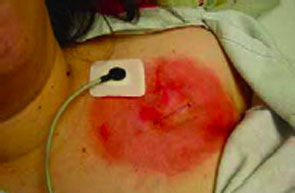
What is the most appropriate treatment for this patient?
- Draw blood cultures, place central line, and begin broad-spectrum antibiotics.
- Draw blood cultures, place central line, and begin broad-spectrum antibiotics and also itraconazole to cover atypical mycobacteria infection.
- Schedule surgery to remove pacemaker.
- Gently approach patient about stressors and possible underlying psychiatric issues and consult psychiatry.
- Obtain wound cultures and apply mupirocin ointment twice daily.
Discussion
The correct answer is D: Gently approach patient about stressors and possible underlying psychiatric issues and consult psychiatry.
This patient had been applying an external agent (most likely makeup) to her wound site. On questioning, the patient and her family continued to deny any manipulation of the wound even when the substance was wiped away with an alcohol pad. (See photo above.) Additionally, a half-empty bottle of clonidine was found under her pillow. The clonidine was apparently used as an attempt to feign hypotension. She denied taking the medication, but the medical team suspected that the use of these antihypertensives led to her previous symptomatic bradycardia and eventual pacemaker implantation.
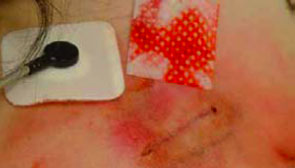
Despite gentle questioning and evaluation for stressors and signs of depression, the patient left the hospital against medical advice before psychiatric consult could be obtained. The patient eventually returned to the cardiology clinic complaining again of wound infection. A wound culture revealed Enterococcus faecalis consistent with fecal contamination of her incision site. Eventually, her pacemaker was removed. She did continue to see different physicians and visit different hospitals before being permanently lost to follow up.
This case of Munchausen syndrome demonstrates many of its defining characteristics. Munchausen syndrome was originally described by Asher in 1951 in Lancet. Its name is derived from Baron von Munchausen, a German nobleman who told humorous but outlandish tales about his travels, including riding on cannonballs, traveling to the moon, and discovering an island made of cheese. Munchausen syndrome is a factitious disorder (symptoms are intentionally produced), but unlike malingering there is no apparent secondary gain except to satisfy the psychological need to receive attention or support. These patients often undergo medical evaluations and multiple, invasive, surgical procedures simply to have them. The DSM-IV points out that the motivation for the behavior is only to assume the sick role.
Patients tend to be young adults and are more often male. They may describe and have physical findings of any number of illnesses. They may have undergone many prior surgical procedures and have several scars on physical exam. Classically, they have seen several different physicians and often have some medical knowledge including medical terminology.
Treatment is often difficult. It is appropriate to address any possible underlying organic disease by systemic approach to avoid overlooking any dangerous conditions. If none is found, the patient should be assessed for stressors, signs of psychosis or depression, and any possible financial or other secondary gains. It is important to recognize Munchausen syndrome as a factitious disorder as opposed to a somatoform disorder (somatization, conversion, hypochondriasis). A factitious disorder is produced artificially by the patient, whereas symptoms of a somatoform disorder are not under the patient’s control. TH
Bibliography
- Asher R. Munchausen’s syndrome. Lancet. 1951;1:339-341.
- Hammerschmidt DE. The adventures of Freiherr von Munchausen. J Lab Clin Med. 2004 Dec;144(6):320-321.
- Park TA, Borsch MA, Dyer AR, et al. Cardiopathia fantastica: the cardiac variant of Munchausen syndrome. South Med J. 2004;97(1):48-52;quiz 53.
- Reich P, Gottfried LA. Factitious disorders in a teaching hospital. Ann Intern Med. 1983;99:240–247.
- Lad SP, Jobe KW, Polley J, et al. Munchausen’s syndrome in neurosurgery: report of two cases and review of the literature. Neurosurgery. 2004 Dec;55(6):1436.
- Huffman JC, Stern TA. The diagnosis and treatment of Munchausen’s syndrome. General Hospital Psychiatry. 2003 Sept-Oct;25(5):358-363.
A24-year-old white female is admitted directly to the hospital by her cardiologist for a wound infection. She is a medical technology student who underwent a pacemaker implantation three weeks prior for persistent symptomatic bradycardia. She now complains of pain, redness, and swelling at the site of her pacemaker incision site. She reports fevers, chills, night sweats, and multiple other systemic symptoms.
On physical exam, she appears quite pleasant, in no apparent distress, and without any abnormalities in vital signs. Her incision site reveals an erythematous, geometric, annular patch with no edema, warmth, induration or discharge. (See photo.)
What is the most appropriate treatment for this patient?
- Draw blood cultures, place central line, and begin broad-spectrum antibiotics.
- Draw blood cultures, place central line, and begin broad-spectrum antibiotics and also itraconazole to cover atypical mycobacteria infection.
- Schedule surgery to remove pacemaker.
- Gently approach patient about stressors and possible underlying psychiatric issues and consult psychiatry.
- Obtain wound cultures and apply mupirocin ointment twice daily.
Discussion
The correct answer is D: Gently approach patient about stressors and possible underlying psychiatric issues and consult psychiatry.
This patient had been applying an external agent (most likely makeup) to her wound site. On questioning, the patient and her family continued to deny any manipulation of the wound even when the substance was wiped away with an alcohol pad. (See photo above.) Additionally, a half-empty bottle of clonidine was found under her pillow. The clonidine was apparently used as an attempt to feign hypotension. She denied taking the medication, but the medical team suspected that the use of these antihypertensives led to her previous symptomatic bradycardia and eventual pacemaker implantation.
Despite gentle questioning and evaluation for stressors and signs of depression, the patient left the hospital against medical advice before psychiatric consult could be obtained. The patient eventually returned to the cardiology clinic complaining again of wound infection. A wound culture revealed Enterococcus faecalis consistent with fecal contamination of her incision site. Eventually, her pacemaker was removed. She did continue to see different physicians and visit different hospitals before being permanently lost to follow up.
This case of Munchausen syndrome demonstrates many of its defining characteristics. Munchausen syndrome was originally described by Asher in 1951 in Lancet. Its name is derived from Baron von Munchausen, a German nobleman who told humorous but outlandish tales about his travels, including riding on cannonballs, traveling to the moon, and discovering an island made of cheese. Munchausen syndrome is a factitious disorder (symptoms are intentionally produced), but unlike malingering there is no apparent secondary gain except to satisfy the psychological need to receive attention or support. These patients often undergo medical evaluations and multiple, invasive, surgical procedures simply to have them. The DSM-IV points out that the motivation for the behavior is only to assume the sick role.
Patients tend to be young adults and are more often male. They may describe and have physical findings of any number of illnesses. They may have undergone many prior surgical procedures and have several scars on physical exam. Classically, they have seen several different physicians and often have some medical knowledge including medical terminology.
Treatment is often difficult. It is appropriate to address any possible underlying organic disease by systemic approach to avoid overlooking any dangerous conditions. If none is found, the patient should be assessed for stressors, signs of psychosis or depression, and any possible financial or other secondary gains. It is important to recognize Munchausen syndrome as a factitious disorder as opposed to a somatoform disorder (somatization, conversion, hypochondriasis). A factitious disorder is produced artificially by the patient, whereas symptoms of a somatoform disorder are not under the patient’s control. TH
Bibliography
- Asher R. Munchausen’s syndrome. Lancet. 1951;1:339-341.
- Hammerschmidt DE. The adventures of Freiherr von Munchausen. J Lab Clin Med. 2004 Dec;144(6):320-321.
- Park TA, Borsch MA, Dyer AR, et al. Cardiopathia fantastica: the cardiac variant of Munchausen syndrome. South Med J. 2004;97(1):48-52;quiz 53.
- Reich P, Gottfried LA. Factitious disorders in a teaching hospital. Ann Intern Med. 1983;99:240–247.
- Lad SP, Jobe KW, Polley J, et al. Munchausen’s syndrome in neurosurgery: report of two cases and review of the literature. Neurosurgery. 2004 Dec;55(6):1436.
- Huffman JC, Stern TA. The diagnosis and treatment of Munchausen’s syndrome. General Hospital Psychiatry. 2003 Sept-Oct;25(5):358-363.
A24-year-old white female is admitted directly to the hospital by her cardiologist for a wound infection. She is a medical technology student who underwent a pacemaker implantation three weeks prior for persistent symptomatic bradycardia. She now complains of pain, redness, and swelling at the site of her pacemaker incision site. She reports fevers, chills, night sweats, and multiple other systemic symptoms.
On physical exam, she appears quite pleasant, in no apparent distress, and without any abnormalities in vital signs. Her incision site reveals an erythematous, geometric, annular patch with no edema, warmth, induration or discharge. (See photo.)
What is the most appropriate treatment for this patient?
- Draw blood cultures, place central line, and begin broad-spectrum antibiotics.
- Draw blood cultures, place central line, and begin broad-spectrum antibiotics and also itraconazole to cover atypical mycobacteria infection.
- Schedule surgery to remove pacemaker.
- Gently approach patient about stressors and possible underlying psychiatric issues and consult psychiatry.
- Obtain wound cultures and apply mupirocin ointment twice daily.
Discussion
The correct answer is D: Gently approach patient about stressors and possible underlying psychiatric issues and consult psychiatry.
This patient had been applying an external agent (most likely makeup) to her wound site. On questioning, the patient and her family continued to deny any manipulation of the wound even when the substance was wiped away with an alcohol pad. (See photo above.) Additionally, a half-empty bottle of clonidine was found under her pillow. The clonidine was apparently used as an attempt to feign hypotension. She denied taking the medication, but the medical team suspected that the use of these antihypertensives led to her previous symptomatic bradycardia and eventual pacemaker implantation.
Despite gentle questioning and evaluation for stressors and signs of depression, the patient left the hospital against medical advice before psychiatric consult could be obtained. The patient eventually returned to the cardiology clinic complaining again of wound infection. A wound culture revealed Enterococcus faecalis consistent with fecal contamination of her incision site. Eventually, her pacemaker was removed. She did continue to see different physicians and visit different hospitals before being permanently lost to follow up.
This case of Munchausen syndrome demonstrates many of its defining characteristics. Munchausen syndrome was originally described by Asher in 1951 in Lancet. Its name is derived from Baron von Munchausen, a German nobleman who told humorous but outlandish tales about his travels, including riding on cannonballs, traveling to the moon, and discovering an island made of cheese. Munchausen syndrome is a factitious disorder (symptoms are intentionally produced), but unlike malingering there is no apparent secondary gain except to satisfy the psychological need to receive attention or support. These patients often undergo medical evaluations and multiple, invasive, surgical procedures simply to have them. The DSM-IV points out that the motivation for the behavior is only to assume the sick role.
Patients tend to be young adults and are more often male. They may describe and have physical findings of any number of illnesses. They may have undergone many prior surgical procedures and have several scars on physical exam. Classically, they have seen several different physicians and often have some medical knowledge including medical terminology.
Treatment is often difficult. It is appropriate to address any possible underlying organic disease by systemic approach to avoid overlooking any dangerous conditions. If none is found, the patient should be assessed for stressors, signs of psychosis or depression, and any possible financial or other secondary gains. It is important to recognize Munchausen syndrome as a factitious disorder as opposed to a somatoform disorder (somatization, conversion, hypochondriasis). A factitious disorder is produced artificially by the patient, whereas symptoms of a somatoform disorder are not under the patient’s control. TH
Bibliography
- Asher R. Munchausen’s syndrome. Lancet. 1951;1:339-341.
- Hammerschmidt DE. The adventures of Freiherr von Munchausen. J Lab Clin Med. 2004 Dec;144(6):320-321.
- Park TA, Borsch MA, Dyer AR, et al. Cardiopathia fantastica: the cardiac variant of Munchausen syndrome. South Med J. 2004;97(1):48-52;quiz 53.
- Reich P, Gottfried LA. Factitious disorders in a teaching hospital. Ann Intern Med. 1983;99:240–247.
- Lad SP, Jobe KW, Polley J, et al. Munchausen’s syndrome in neurosurgery: report of two cases and review of the literature. Neurosurgery. 2004 Dec;55(6):1436.
- Huffman JC, Stern TA. The diagnosis and treatment of Munchausen’s syndrome. General Hospital Psychiatry. 2003 Sept-Oct;25(5):358-363.
Recruitment Revised
Recruiting hospitalists—or any other medical personnel—is all about supply and demand. Right now, the demand for hospitalists exceeds the supply. Many hospital medicine groups are growing rapidly, and more such groups are being created across the country. These groups are aggressively recruiting residents and physicians from the relatively small pool of hospitalists for hire, even as they lament the lack of candidates.
“Recruiting hospitalists is as competitive as I’ve ever seen,” says Vikas Parekh, MD, assistant professor and director, Non-House-staff Hospitalist Services, Department of Internal Medicine, University of Michigan, Ann Arbor. “This even trumps the primary care crisis of years ago.”
The Carrot: Repayment of Student Loans
Like many healthcare organizations today, the University of Michigan’s Department of Internal Medicine has a fast-growing hospitalist program, and continues to seek out additional physicians. “Our group of hospitalists went from zero to 16 by the end of this year—all in two years,” explains Dr. Parekh. “We’ve literally doubled each year.”
The university has implemented a unique method that provides an advantage against competition in recruiting new hospitalists. Beginning in 2006, they are offering a “loan forgiveness” program for new hires to their hospitalist program. Any hospitalist who joins the program this year can get up to $50,000 of student loans paid off by the university.
“The university did this about 10 years ago, when primary care had a similar problem,” recalls Dr. Parekh. “It was very successful.”
Hospitalists at the University of Michigan believe they have a unique benefit for recruitment. “I don’t know if any other hospitalist programs are doing this—there aren’t many [loan forgiveness programs] for physicians in general,” says Dr. Parekh.
How Loan Forgiveness Works
The University of Michigan loan forgiveness program will pay back any student loans—with a limit of $10,000 per year for five years. The university makes direct payments to the loaning institutions, which are typically federal government agencies. The newly hired physician is not under contract to stay until his or her loan is paid. “It works year to year,” explains Dr. Parekh.
The value of loan forgiveness can be overlooked. “People negotiate salary, but they don’t think of this,” says Scott A. Flanders, MD, associate professor and director, Hospitalist Program, Department of Internal Medicine, University of Michigan. “When you add up the value of benefits and loan forgiveness, that can add up to $50,000 to your compensation.”
Offering loan forgiveness on a set amount is more economical than offering a higher starting salary. The employer can set the cap on how much they’re willing to pay, thus controlling the investment in each new hire.
Recruitment Realities
The University of Michigan hospitalist program has been recruiting physicians through the university’s residency program, as well as advertisements in national journals.
“We’ve had a lot of success locally, but we’ve also seen response from around the country,” says Dr. Parekh. “We’ve had good success already; we’ve already recruited 75% of the physicians, in part due to the loan forgiveness program.”
The concept of lifting student loans from the shoulders of new physicians is a perfect fit for hospitalists in particular. “Hospital medicine is a young field, so by definition the physicians are young,” Dr. Parekh points out.
Dr. Flanders adds, “You’re not going to attract 40- or 50-year-old physicians who want to go into academics. But this [might] apply to someone shifting from one academic field to another.”
One problem that loan forgiveness can’t solve, however, is the number of residents choosing hospital medicine. “Internal medicine needs to get more people to pursue hospital medicine,” says Dr. Flanders. “And as it is, there’s only a small trickle of people pursuing internal medicine.”
The short supply of trained hospitalists severely affects the ability of hospital medicine groups to find and hire new physicians. Investing in value-added offerings such as loan forgiveness may prove worth the cost, if the investment brings quality candidates to your group. TH
Contributor Jane Jerrard regularly writes for “Career Development.”
Recruiting hospitalists—or any other medical personnel—is all about supply and demand. Right now, the demand for hospitalists exceeds the supply. Many hospital medicine groups are growing rapidly, and more such groups are being created across the country. These groups are aggressively recruiting residents and physicians from the relatively small pool of hospitalists for hire, even as they lament the lack of candidates.
“Recruiting hospitalists is as competitive as I’ve ever seen,” says Vikas Parekh, MD, assistant professor and director, Non-House-staff Hospitalist Services, Department of Internal Medicine, University of Michigan, Ann Arbor. “This even trumps the primary care crisis of years ago.”
The Carrot: Repayment of Student Loans
Like many healthcare organizations today, the University of Michigan’s Department of Internal Medicine has a fast-growing hospitalist program, and continues to seek out additional physicians. “Our group of hospitalists went from zero to 16 by the end of this year—all in two years,” explains Dr. Parekh. “We’ve literally doubled each year.”
The university has implemented a unique method that provides an advantage against competition in recruiting new hospitalists. Beginning in 2006, they are offering a “loan forgiveness” program for new hires to their hospitalist program. Any hospitalist who joins the program this year can get up to $50,000 of student loans paid off by the university.
“The university did this about 10 years ago, when primary care had a similar problem,” recalls Dr. Parekh. “It was very successful.”
Hospitalists at the University of Michigan believe they have a unique benefit for recruitment. “I don’t know if any other hospitalist programs are doing this—there aren’t many [loan forgiveness programs] for physicians in general,” says Dr. Parekh.
How Loan Forgiveness Works
The University of Michigan loan forgiveness program will pay back any student loans—with a limit of $10,000 per year for five years. The university makes direct payments to the loaning institutions, which are typically federal government agencies. The newly hired physician is not under contract to stay until his or her loan is paid. “It works year to year,” explains Dr. Parekh.
The value of loan forgiveness can be overlooked. “People negotiate salary, but they don’t think of this,” says Scott A. Flanders, MD, associate professor and director, Hospitalist Program, Department of Internal Medicine, University of Michigan. “When you add up the value of benefits and loan forgiveness, that can add up to $50,000 to your compensation.”
Offering loan forgiveness on a set amount is more economical than offering a higher starting salary. The employer can set the cap on how much they’re willing to pay, thus controlling the investment in each new hire.
Recruitment Realities
The University of Michigan hospitalist program has been recruiting physicians through the university’s residency program, as well as advertisements in national journals.
“We’ve had a lot of success locally, but we’ve also seen response from around the country,” says Dr. Parekh. “We’ve had good success already; we’ve already recruited 75% of the physicians, in part due to the loan forgiveness program.”
The concept of lifting student loans from the shoulders of new physicians is a perfect fit for hospitalists in particular. “Hospital medicine is a young field, so by definition the physicians are young,” Dr. Parekh points out.
Dr. Flanders adds, “You’re not going to attract 40- or 50-year-old physicians who want to go into academics. But this [might] apply to someone shifting from one academic field to another.”
One problem that loan forgiveness can’t solve, however, is the number of residents choosing hospital medicine. “Internal medicine needs to get more people to pursue hospital medicine,” says Dr. Flanders. “And as it is, there’s only a small trickle of people pursuing internal medicine.”
The short supply of trained hospitalists severely affects the ability of hospital medicine groups to find and hire new physicians. Investing in value-added offerings such as loan forgiveness may prove worth the cost, if the investment brings quality candidates to your group. TH
Contributor Jane Jerrard regularly writes for “Career Development.”
Recruiting hospitalists—or any other medical personnel—is all about supply and demand. Right now, the demand for hospitalists exceeds the supply. Many hospital medicine groups are growing rapidly, and more such groups are being created across the country. These groups are aggressively recruiting residents and physicians from the relatively small pool of hospitalists for hire, even as they lament the lack of candidates.
“Recruiting hospitalists is as competitive as I’ve ever seen,” says Vikas Parekh, MD, assistant professor and director, Non-House-staff Hospitalist Services, Department of Internal Medicine, University of Michigan, Ann Arbor. “This even trumps the primary care crisis of years ago.”
The Carrot: Repayment of Student Loans
Like many healthcare organizations today, the University of Michigan’s Department of Internal Medicine has a fast-growing hospitalist program, and continues to seek out additional physicians. “Our group of hospitalists went from zero to 16 by the end of this year—all in two years,” explains Dr. Parekh. “We’ve literally doubled each year.”
The university has implemented a unique method that provides an advantage against competition in recruiting new hospitalists. Beginning in 2006, they are offering a “loan forgiveness” program for new hires to their hospitalist program. Any hospitalist who joins the program this year can get up to $50,000 of student loans paid off by the university.
“The university did this about 10 years ago, when primary care had a similar problem,” recalls Dr. Parekh. “It was very successful.”
Hospitalists at the University of Michigan believe they have a unique benefit for recruitment. “I don’t know if any other hospitalist programs are doing this—there aren’t many [loan forgiveness programs] for physicians in general,” says Dr. Parekh.
How Loan Forgiveness Works
The University of Michigan loan forgiveness program will pay back any student loans—with a limit of $10,000 per year for five years. The university makes direct payments to the loaning institutions, which are typically federal government agencies. The newly hired physician is not under contract to stay until his or her loan is paid. “It works year to year,” explains Dr. Parekh.
The value of loan forgiveness can be overlooked. “People negotiate salary, but they don’t think of this,” says Scott A. Flanders, MD, associate professor and director, Hospitalist Program, Department of Internal Medicine, University of Michigan. “When you add up the value of benefits and loan forgiveness, that can add up to $50,000 to your compensation.”
Offering loan forgiveness on a set amount is more economical than offering a higher starting salary. The employer can set the cap on how much they’re willing to pay, thus controlling the investment in each new hire.
Recruitment Realities
The University of Michigan hospitalist program has been recruiting physicians through the university’s residency program, as well as advertisements in national journals.
“We’ve had a lot of success locally, but we’ve also seen response from around the country,” says Dr. Parekh. “We’ve had good success already; we’ve already recruited 75% of the physicians, in part due to the loan forgiveness program.”
The concept of lifting student loans from the shoulders of new physicians is a perfect fit for hospitalists in particular. “Hospital medicine is a young field, so by definition the physicians are young,” Dr. Parekh points out.
Dr. Flanders adds, “You’re not going to attract 40- or 50-year-old physicians who want to go into academics. But this [might] apply to someone shifting from one academic field to another.”
One problem that loan forgiveness can’t solve, however, is the number of residents choosing hospital medicine. “Internal medicine needs to get more people to pursue hospital medicine,” says Dr. Flanders. “And as it is, there’s only a small trickle of people pursuing internal medicine.”
The short supply of trained hospitalists severely affects the ability of hospital medicine groups to find and hire new physicians. Investing in value-added offerings such as loan forgiveness may prove worth the cost, if the investment brings quality candidates to your group. TH
Contributor Jane Jerrard regularly writes for “Career Development.”
Meeting Expectations
Spring is in the air: Flowers are blooming, trees are budding, and the SHM Annual Meeting is fast approaching.
Held Wednesday, May 3, through Friday, May 5, 2006, in Washington, D.C., the 9th Annual Meeting will include comprehensive education designed for hospitalists, networking with physicians from around the country, and chatting with your representatives in Congress. (See “Legislative Advocacy Day Debuts,” p. 10.)
“The SHM Annual Meeting is the largest gathering of all the stakeholders in hospital medicine, presenting a unique networking opportunity,” says Larry Wellikson, MD, FACP, CEO of SHM. “In 2006 we’re using the meeting’s location in our nation’s capitol to help hospitalists to be advocates for their patients and their specialty by meeting with their elected Members of Congress.”
The focus of the meeting, as always, will be the education offered. “Whatever your specialty, this meeting allows you to get something out of it,” says Alpesh Amin, MD, course director for the Annual Meeting. “There will be something for beginning hospitalists as well as more mature hospitalists. We’ll cover a lot of core topics.”
Education Covers Core Competencies
The basis for all education offered during the meeting is SHM’s new core competencies, developed by the Education Committee and released in January 2006. (The Core Competencies in Hospital Medicine: A Framework for Curriculum Development debuted in a supplement to the first issue of the Journal of Hospital Medicine.) The goal is to have these core competencies serve as the backbone for how hospitalists are recruited, trained, and certified in hospital medicine, as well as to standardize expectations for learning and proficiency.
“Our goal was to include [the core competencies] as a base for developing sessions, workshops, and lectures” at the Annual Meeting, says Dr. Amin. “We’re asking speakers to incorporate relevant core competencies into their lectures.”
To learn more about the new framework, Annual Meeting attendees can come to a session about the core competencies offered on Thursday, May 4 from 10:10 to 10:35 a.m.
Choose from Multiple Learning Tracks
Attendees at the Annual Meeting can customize their educational experience by choosing sessions from one or more of six general tracks:
Adult clinical: This track emphasizes recent advances that should be incorporated into the hospitalist’s approach to clinical care delivery. Sessions will cover diabetes management, acute coronary syndromes, chronic heart failure, addiction medicine, resuscitation, and much more.
Pediatric clinical: This track covers pediatric hospitalist practice management as well as current clinical issues. Sessions will cover controversies surrounding management of respiratory illnesses and the febrile infant, as well as practice management topics such as contract and salary negotiation and billing and coding.
Academic: This track covers the unique challenges faced by hospitalists in academic medical centers, including dealing with the 80-hour workweek and developing a curriculum for quality improvement and patient safety. The track also covers how to structure a research project and how to write for scientific publications.
Quality: This track addresses the imperative around development and implementation of improvement efforts in the hospital. Practical sessions cover improving physician/nurse communication, rapid response teams, and improving VTE prophylaxis.
Operational: This track covers some of the latest information and ideas for organizational infrastructure in topics such as value-added services, hospitalist burnout, performance management and advances in staffing projections.
New track! Developmental: This new track focuses on career satisfaction, building palliative care services, creating a hospitalist procedure service, and developing and implementing a perioperative care and consultative medicine program.
Regardless of which track or tracks you choose, you’ll have ample opportunity to improve your clinical skills, address operational issues with possible solutions for your hospital medicine group, and be prepared to lead change and innovation at your hospital.
Attendees should also note: You can earn a maximum of 13.25 category 1 credits toward the AMA Physician’s Recognition Award—plus additional credits for pre-courses. (See “Four Pre-Courses Offer In-Depth Education,” above.)
Nationwide Networking
In addition to dozens of educational sessions, the Annual Meeting includes many opportunities to network with colleagues from across the country, including leading experts and trendsetters. Networking events provide natural settings to search for a job or potential candidate, make connections, and get answers to clinical and organizational dilemmas. You can also network with more than 100 exhibitors in the Exhibit Hall to find new information and solutions.
“The networking aspect is beneficial,” says Dr. Amin. “The Mentorship Breakfast on the second day is particularly valuable.” The Mentorship Breakfast matches new or aspiring hospitalists—or those experiencing new challenges in their practice—with experienced hospitalist mentors for small-group discussions. Pre-registration is required for the breakfast. (For more information, visit www.hospitalmedicine.org.)
Another excellent event for networking is Thursday afternoon’s Special Interest Forums. Meet hospitalists with similar interests:
- Community-based hospitalists;
- Medical directors/leadership;
- Pediatric hospitalists;
- Family practice hospitalists;
- Geriatric hospitalists;
- Women in hospital medicine;
- Early career hospitalists;
- Nurse practitioners and physician assistants;
- Education;
- Research; and
- History of medicine.
In addition to the Special Interest Forums, you’ll have the opportunity to meet other hospitalists at a “town hall meeting.” Scheduled for Friday, the town hall meeting will feature a facilitated discussion of pressing topics in hospital medicine, as chosen by those in attendance.
Whether you attend the meeting or not, rest assured that everyone who comes to Washington, D.C., in May will help to advance the profession through learning the new core competencies, through sharing ideas and solutions, and through continuing to make an impact as hospitalists.
For more information on the Annual Meeting and to register online, visit www.hospitalmedicine.org. TH
Spring is in the air: Flowers are blooming, trees are budding, and the SHM Annual Meeting is fast approaching.
Held Wednesday, May 3, through Friday, May 5, 2006, in Washington, D.C., the 9th Annual Meeting will include comprehensive education designed for hospitalists, networking with physicians from around the country, and chatting with your representatives in Congress. (See “Legislative Advocacy Day Debuts,” p. 10.)
“The SHM Annual Meeting is the largest gathering of all the stakeholders in hospital medicine, presenting a unique networking opportunity,” says Larry Wellikson, MD, FACP, CEO of SHM. “In 2006 we’re using the meeting’s location in our nation’s capitol to help hospitalists to be advocates for their patients and their specialty by meeting with their elected Members of Congress.”
The focus of the meeting, as always, will be the education offered. “Whatever your specialty, this meeting allows you to get something out of it,” says Alpesh Amin, MD, course director for the Annual Meeting. “There will be something for beginning hospitalists as well as more mature hospitalists. We’ll cover a lot of core topics.”
Education Covers Core Competencies
The basis for all education offered during the meeting is SHM’s new core competencies, developed by the Education Committee and released in January 2006. (The Core Competencies in Hospital Medicine: A Framework for Curriculum Development debuted in a supplement to the first issue of the Journal of Hospital Medicine.) The goal is to have these core competencies serve as the backbone for how hospitalists are recruited, trained, and certified in hospital medicine, as well as to standardize expectations for learning and proficiency.
“Our goal was to include [the core competencies] as a base for developing sessions, workshops, and lectures” at the Annual Meeting, says Dr. Amin. “We’re asking speakers to incorporate relevant core competencies into their lectures.”
To learn more about the new framework, Annual Meeting attendees can come to a session about the core competencies offered on Thursday, May 4 from 10:10 to 10:35 a.m.
Choose from Multiple Learning Tracks
Attendees at the Annual Meeting can customize their educational experience by choosing sessions from one or more of six general tracks:
Adult clinical: This track emphasizes recent advances that should be incorporated into the hospitalist’s approach to clinical care delivery. Sessions will cover diabetes management, acute coronary syndromes, chronic heart failure, addiction medicine, resuscitation, and much more.
Pediatric clinical: This track covers pediatric hospitalist practice management as well as current clinical issues. Sessions will cover controversies surrounding management of respiratory illnesses and the febrile infant, as well as practice management topics such as contract and salary negotiation and billing and coding.
Academic: This track covers the unique challenges faced by hospitalists in academic medical centers, including dealing with the 80-hour workweek and developing a curriculum for quality improvement and patient safety. The track also covers how to structure a research project and how to write for scientific publications.
Quality: This track addresses the imperative around development and implementation of improvement efforts in the hospital. Practical sessions cover improving physician/nurse communication, rapid response teams, and improving VTE prophylaxis.
Operational: This track covers some of the latest information and ideas for organizational infrastructure in topics such as value-added services, hospitalist burnout, performance management and advances in staffing projections.
New track! Developmental: This new track focuses on career satisfaction, building palliative care services, creating a hospitalist procedure service, and developing and implementing a perioperative care and consultative medicine program.
Regardless of which track or tracks you choose, you’ll have ample opportunity to improve your clinical skills, address operational issues with possible solutions for your hospital medicine group, and be prepared to lead change and innovation at your hospital.
Attendees should also note: You can earn a maximum of 13.25 category 1 credits toward the AMA Physician’s Recognition Award—plus additional credits for pre-courses. (See “Four Pre-Courses Offer In-Depth Education,” above.)
Nationwide Networking
In addition to dozens of educational sessions, the Annual Meeting includes many opportunities to network with colleagues from across the country, including leading experts and trendsetters. Networking events provide natural settings to search for a job or potential candidate, make connections, and get answers to clinical and organizational dilemmas. You can also network with more than 100 exhibitors in the Exhibit Hall to find new information and solutions.
“The networking aspect is beneficial,” says Dr. Amin. “The Mentorship Breakfast on the second day is particularly valuable.” The Mentorship Breakfast matches new or aspiring hospitalists—or those experiencing new challenges in their practice—with experienced hospitalist mentors for small-group discussions. Pre-registration is required for the breakfast. (For more information, visit www.hospitalmedicine.org.)
Another excellent event for networking is Thursday afternoon’s Special Interest Forums. Meet hospitalists with similar interests:
- Community-based hospitalists;
- Medical directors/leadership;
- Pediatric hospitalists;
- Family practice hospitalists;
- Geriatric hospitalists;
- Women in hospital medicine;
- Early career hospitalists;
- Nurse practitioners and physician assistants;
- Education;
- Research; and
- History of medicine.
In addition to the Special Interest Forums, you’ll have the opportunity to meet other hospitalists at a “town hall meeting.” Scheduled for Friday, the town hall meeting will feature a facilitated discussion of pressing topics in hospital medicine, as chosen by those in attendance.
Whether you attend the meeting or not, rest assured that everyone who comes to Washington, D.C., in May will help to advance the profession through learning the new core competencies, through sharing ideas and solutions, and through continuing to make an impact as hospitalists.
For more information on the Annual Meeting and to register online, visit www.hospitalmedicine.org. TH
Spring is in the air: Flowers are blooming, trees are budding, and the SHM Annual Meeting is fast approaching.
Held Wednesday, May 3, through Friday, May 5, 2006, in Washington, D.C., the 9th Annual Meeting will include comprehensive education designed for hospitalists, networking with physicians from around the country, and chatting with your representatives in Congress. (See “Legislative Advocacy Day Debuts,” p. 10.)
“The SHM Annual Meeting is the largest gathering of all the stakeholders in hospital medicine, presenting a unique networking opportunity,” says Larry Wellikson, MD, FACP, CEO of SHM. “In 2006 we’re using the meeting’s location in our nation’s capitol to help hospitalists to be advocates for their patients and their specialty by meeting with their elected Members of Congress.”
The focus of the meeting, as always, will be the education offered. “Whatever your specialty, this meeting allows you to get something out of it,” says Alpesh Amin, MD, course director for the Annual Meeting. “There will be something for beginning hospitalists as well as more mature hospitalists. We’ll cover a lot of core topics.”
Education Covers Core Competencies
The basis for all education offered during the meeting is SHM’s new core competencies, developed by the Education Committee and released in January 2006. (The Core Competencies in Hospital Medicine: A Framework for Curriculum Development debuted in a supplement to the first issue of the Journal of Hospital Medicine.) The goal is to have these core competencies serve as the backbone for how hospitalists are recruited, trained, and certified in hospital medicine, as well as to standardize expectations for learning and proficiency.
“Our goal was to include [the core competencies] as a base for developing sessions, workshops, and lectures” at the Annual Meeting, says Dr. Amin. “We’re asking speakers to incorporate relevant core competencies into their lectures.”
To learn more about the new framework, Annual Meeting attendees can come to a session about the core competencies offered on Thursday, May 4 from 10:10 to 10:35 a.m.
Choose from Multiple Learning Tracks
Attendees at the Annual Meeting can customize their educational experience by choosing sessions from one or more of six general tracks:
Adult clinical: This track emphasizes recent advances that should be incorporated into the hospitalist’s approach to clinical care delivery. Sessions will cover diabetes management, acute coronary syndromes, chronic heart failure, addiction medicine, resuscitation, and much more.
Pediatric clinical: This track covers pediatric hospitalist practice management as well as current clinical issues. Sessions will cover controversies surrounding management of respiratory illnesses and the febrile infant, as well as practice management topics such as contract and salary negotiation and billing and coding.
Academic: This track covers the unique challenges faced by hospitalists in academic medical centers, including dealing with the 80-hour workweek and developing a curriculum for quality improvement and patient safety. The track also covers how to structure a research project and how to write for scientific publications.
Quality: This track addresses the imperative around development and implementation of improvement efforts in the hospital. Practical sessions cover improving physician/nurse communication, rapid response teams, and improving VTE prophylaxis.
Operational: This track covers some of the latest information and ideas for organizational infrastructure in topics such as value-added services, hospitalist burnout, performance management and advances in staffing projections.
New track! Developmental: This new track focuses on career satisfaction, building palliative care services, creating a hospitalist procedure service, and developing and implementing a perioperative care and consultative medicine program.
Regardless of which track or tracks you choose, you’ll have ample opportunity to improve your clinical skills, address operational issues with possible solutions for your hospital medicine group, and be prepared to lead change and innovation at your hospital.
Attendees should also note: You can earn a maximum of 13.25 category 1 credits toward the AMA Physician’s Recognition Award—plus additional credits for pre-courses. (See “Four Pre-Courses Offer In-Depth Education,” above.)
Nationwide Networking
In addition to dozens of educational sessions, the Annual Meeting includes many opportunities to network with colleagues from across the country, including leading experts and trendsetters. Networking events provide natural settings to search for a job or potential candidate, make connections, and get answers to clinical and organizational dilemmas. You can also network with more than 100 exhibitors in the Exhibit Hall to find new information and solutions.
“The networking aspect is beneficial,” says Dr. Amin. “The Mentorship Breakfast on the second day is particularly valuable.” The Mentorship Breakfast matches new or aspiring hospitalists—or those experiencing new challenges in their practice—with experienced hospitalist mentors for small-group discussions. Pre-registration is required for the breakfast. (For more information, visit www.hospitalmedicine.org.)
Another excellent event for networking is Thursday afternoon’s Special Interest Forums. Meet hospitalists with similar interests:
- Community-based hospitalists;
- Medical directors/leadership;
- Pediatric hospitalists;
- Family practice hospitalists;
- Geriatric hospitalists;
- Women in hospital medicine;
- Early career hospitalists;
- Nurse practitioners and physician assistants;
- Education;
- Research; and
- History of medicine.
In addition to the Special Interest Forums, you’ll have the opportunity to meet other hospitalists at a “town hall meeting.” Scheduled for Friday, the town hall meeting will feature a facilitated discussion of pressing topics in hospital medicine, as chosen by those in attendance.
Whether you attend the meeting or not, rest assured that everyone who comes to Washington, D.C., in May will help to advance the profession through learning the new core competencies, through sharing ideas and solutions, and through continuing to make an impact as hospitalists.
For more information on the Annual Meeting and to register online, visit www.hospitalmedicine.org. TH
New Task Forces Formed
Always searching for new ways to enhance the value of SHM membership, the SHM Membership Committee has created several task forces to work on special projects.
Designed to build upon the success of the Annual Meeting’s Mentorship Breakfast (a one-time opportunity for SHM members to meet with experienced hospitalist clinicians and leaders), the Mentorship Task Force was convened to study opportunities to expand the use of mentoring programs for SHM members. The task force has suggested mechanisms on how to assist SHM local chapter leaders, suggestions that have resulted in the creation of recurrent conference calls between members of the Midwest Region Council and local chapter leaders in the Midwest. The Task Force has also studied creating a yearlong longitudinal mentoring program on leadership skills and continues to work on this project.
The Industry Support of Local Chapters Task Force is critically looking at the role of industry sponsorship of local chapter activities. This task force (comprising participants from the SHM Ethics and Membership Committees, Regional Councils, and local chapters) is studying two issues:
- How to assist local leaders in finding and securing sponsorship for chapter functions, and
- How to create a process to review industry sponsored grants to support local chapter meetings.
Preliminary recommendations from this task force include additions and revisions to the SHM Local Chapter Handbook about strategies and techniques to employ when negotiating with industry representatives.
Finally, the Family Practice Task Force was recently convened to study how family practice hospitalists differ from their internal-medicine-trained colleagues. Initial efforts will focus on gathering data about family-practice-trained hospitalists, defining the unique skill set that family practice has to offer hospital medicine, and reviewing the post-graduate medical training needs of family practitioner hospital medicine physicians.
In addition to these task forces, the Membership Committee will launch a new research initiative. During 2006 SHM members will be invited to share their opinions on a variety of topics via electronic surveys. Data from each survey will be regularly shared with SHM leadership for review and use in future planning.
Your support of SHM has played a vital role in helping the society to assume the leadership position that it currently holds in the hospital medicine community. Your continued support will enable us to continue to grow and provide each member with the tools they need to best serve their patients and grow their practices in the process.
Ethics Policies Revised
Real and potential conflicts addressed in revisions
By Tom Baudendistel, MD, FACP, chair, SHM Ethics Committee
Conflicts of interest have been the major theme of the SHM Ethics Committee this past year. As SHM has grown into a major force shaping healthcare policy, the need for transparency in all of the organization’s endeavors has never been greater. Rather than being reactive to individual issues that arise, the ethics committee has adopted a proactive stance in identifying potential areas of tension. Building on the general guidelines of the 2003 SHM “Principles for Organizational Relationships,” this year’s ethics committee has refined SHM policies to address the latest real and potential conflicts of interest in several areas: the Annual Meeting Abstract competitions, the Journal of Hospital Medicine, and the SHM Board.
Prior to the 2005 Annual Meeting, chairs of the Research, Innovations, and Vignettes (RIV) Committees augmented previous disclosure policy in requiring more transparent and detailed statements of disclosure from authors submitting abstracts to the national meeting. Anjala Tess, MD, and Sunil Kripilani, MD, took the lead in this initiative, preserving the integrity of the academic process while shielding the SHM RIV competition from potential misuse by third parties.
Later in 2005, in preparation for publication of the Journal of Hospital Medicine, the ethics committee worked with the editors to develop a policy regarding potential conflicts of interest between the journal’s editors, editorial board, reviewers, and authors. Ethical dilemmas within academic journals generally arise in two main areas: academic or financial. An example of the former would include an editor or a reviewer who might benefit from affiliation with the authors or from the publication of material contained in a manuscript. Financial conflicts might arise when, for instance, an editor or author receives monetary support from an industry source and selectively publishes only manuscripts that cast the sponsoring company in a favorable light.
The SHM Ethics committee contacted editors from major journals, including Annals of Internal Medicine, Journal of the American Medical Association, The New England Journal of Medicine, and The American Journal of Medicine, and consulted the International Committee of Medical Journal Editors before crafting a policy for the Journal of Hospital Medicine’s Editorial Board. This policy directs JHM to obtain annual disclosure of potential academic and financial conflicts from its editors and editorial board members, and requests similar information from its authors and reviewers on an article-by-article basis. Thanks to Brian Harte, MD, and Don Krause, MD, for their leadership in this process.
More recently, the SHM Ethics Committee was asked to join the SHM Task Force to identify areas of potential conflict for the SHM Board. As leaders of a major organization in U.S. medical care, members of the board are obvious targets of outside interests including healthcare or pharmaceutical industry, legal associations, and other organizations to represent those outside parties’ viewpoints—either implicitly or explicitly. Should the leaders of SHM participate in malpractice litigation involving hospitalists? What restrictions should SHM place on its board members pertaining to relationships with outside academic and industry organizations? Should SHM accept funding from industry to support regional and national meetings? Should the SHM board endorse pay-for-performance initiatives? How should hospitalist scope of practice be defined?
The answers to these and similar questions will guide SHM policy in the coming years, and the SHM Ethics Committee will be there every step of the way.
The SHM Ethics Committee is now 15 members strong and continues to convene regularly via conference calls and as a group at the Annual Meeting. Check out the recent article by Erin Egan, MD, in The Hospitalist discussing the safe and ethical care of disaster victims (Jan. 2006, p. 10), or attend the “Ethical Dilemmas in the ICU” talk at the upcoming critical care precourse at the Annual Meeting on May 3 at 9 a.m. to catch other glimpses of the committee’s work. With the continued support and membership from SHM members, the committee aims to chart a clear and ethically acceptable course for SHM for years to come.
Quality of Work-Life Tools
An interim report from the SHM Career Satisfaction Task Force
By Sylvia McKean, MD, Tosha Wetterneck, MD, and Win Whitcomb, MD
A variety of career satisfaction issues threaten the evolution of hospital medicine as a specialty. These issues are analogous to the experience of other, well-established specialties essential to the smooth functioning of a hospital, including critical care and emergency medicine.
Hospitalists encounter daily disruptions in their workflow due to the unpredictability of acute medical illness, paging interruptions that require immediate attention, and an increasing variety of other demands on their time in an already stressed healthcare system. In addition, hospitalist services staffed with junior physicians may not have input into the patients triaged to their service or how the service is structured. They may encounter changing job descriptions as hospital administrators in charge of their salaries rely upon them to solve important problems.
Hospitalists face conflict as they try to control their work life. The role of the hospitalist has evolved from direct patient care, to improving throughput and related outcomes, and increasingly to one of leadership, quality improvement, and teaching. The challenges of this discipline continue to expand exponentially. In addition, community hospitals rely upon academic hospitalist programs to train and recruit physicians into the field of hospital medicine. Academic hospitalist services, therefore, need to ensure time to mentor trainees and serve as role models that hospital medicine is a satisfying, respected, and sustainable career.
In 2005 SHM’s career satisfaction task force reviewed available literature and started developing a series of chapters relating to the following “domains” related to job satisfaction:
- Control/autonomy;
- Workload/schedule;
- Reward/recognition; and
- Community/environment.
These chapters acknowledge that on-the-job challenges should be viewed from two different but related perspectives: the individual hospitalist and the hospital medicine group/service. Neither the individual nor the hospitalist service can work independently of the other because cohesiveness among hospitalist members is critical to promoting job satisfaction for the service. The task force is developing a career satisfaction tool kit consisting of individual and group self-assessment questionnaires and preventive strategies. Specific case examples from the academic and community settings will be provided to avoid pitfalls and false starts when seeking a job in hospital medicine or when responding to pressures in the hospital.
SHM has also funded additional research into career satisfaction under the leadership of Tosha Wetterneck, MD, from the University of Wisconsin Hospital and Clinic. Joe Miller, SHM senior vice president, and professional writer Phyllis Hanlon have joined the Career Satisfaction Task Force to translate our findings into a workable document for physician leaders and hospitalists. They were the editors of the supplement to The Hospitalist on “value added services” of hospitalists (vol. 9, suppl. 1, 2005).
The goals of these papers are to assist hospital administrators and hospitalist services to recruit and retain hospitalists and to help individual hospitalists to find new, more rewarding employment opportunities. The document will include practical tools for self and program analysis. As more information becomes available through survey research results and focus group analysis, the tools will be refined.
The goals of the Career Satisfaction Task Force for 2006-2007 include:
- Complete the focused interviews;
- Complete the first draft of the SHM Career Satisfaction Tool Kit;
- Start the survey process at the 2006 SHM Annual Meeting;
- Hold a workshop at the SHM Annual Meeting;
- Utilize additional research data to modify the tool kit; and
- Position the tool kit as a working document for structuring hospitalist programs and as a self-assessment tool for practicing hospitalists. TH
Always searching for new ways to enhance the value of SHM membership, the SHM Membership Committee has created several task forces to work on special projects.
Designed to build upon the success of the Annual Meeting’s Mentorship Breakfast (a one-time opportunity for SHM members to meet with experienced hospitalist clinicians and leaders), the Mentorship Task Force was convened to study opportunities to expand the use of mentoring programs for SHM members. The task force has suggested mechanisms on how to assist SHM local chapter leaders, suggestions that have resulted in the creation of recurrent conference calls between members of the Midwest Region Council and local chapter leaders in the Midwest. The Task Force has also studied creating a yearlong longitudinal mentoring program on leadership skills and continues to work on this project.
The Industry Support of Local Chapters Task Force is critically looking at the role of industry sponsorship of local chapter activities. This task force (comprising participants from the SHM Ethics and Membership Committees, Regional Councils, and local chapters) is studying two issues:
- How to assist local leaders in finding and securing sponsorship for chapter functions, and
- How to create a process to review industry sponsored grants to support local chapter meetings.
Preliminary recommendations from this task force include additions and revisions to the SHM Local Chapter Handbook about strategies and techniques to employ when negotiating with industry representatives.
Finally, the Family Practice Task Force was recently convened to study how family practice hospitalists differ from their internal-medicine-trained colleagues. Initial efforts will focus on gathering data about family-practice-trained hospitalists, defining the unique skill set that family practice has to offer hospital medicine, and reviewing the post-graduate medical training needs of family practitioner hospital medicine physicians.
In addition to these task forces, the Membership Committee will launch a new research initiative. During 2006 SHM members will be invited to share their opinions on a variety of topics via electronic surveys. Data from each survey will be regularly shared with SHM leadership for review and use in future planning.
Your support of SHM has played a vital role in helping the society to assume the leadership position that it currently holds in the hospital medicine community. Your continued support will enable us to continue to grow and provide each member with the tools they need to best serve their patients and grow their practices in the process.
Ethics Policies Revised
Real and potential conflicts addressed in revisions
By Tom Baudendistel, MD, FACP, chair, SHM Ethics Committee
Conflicts of interest have been the major theme of the SHM Ethics Committee this past year. As SHM has grown into a major force shaping healthcare policy, the need for transparency in all of the organization’s endeavors has never been greater. Rather than being reactive to individual issues that arise, the ethics committee has adopted a proactive stance in identifying potential areas of tension. Building on the general guidelines of the 2003 SHM “Principles for Organizational Relationships,” this year’s ethics committee has refined SHM policies to address the latest real and potential conflicts of interest in several areas: the Annual Meeting Abstract competitions, the Journal of Hospital Medicine, and the SHM Board.
Prior to the 2005 Annual Meeting, chairs of the Research, Innovations, and Vignettes (RIV) Committees augmented previous disclosure policy in requiring more transparent and detailed statements of disclosure from authors submitting abstracts to the national meeting. Anjala Tess, MD, and Sunil Kripilani, MD, took the lead in this initiative, preserving the integrity of the academic process while shielding the SHM RIV competition from potential misuse by third parties.
Later in 2005, in preparation for publication of the Journal of Hospital Medicine, the ethics committee worked with the editors to develop a policy regarding potential conflicts of interest between the journal’s editors, editorial board, reviewers, and authors. Ethical dilemmas within academic journals generally arise in two main areas: academic or financial. An example of the former would include an editor or a reviewer who might benefit from affiliation with the authors or from the publication of material contained in a manuscript. Financial conflicts might arise when, for instance, an editor or author receives monetary support from an industry source and selectively publishes only manuscripts that cast the sponsoring company in a favorable light.
The SHM Ethics committee contacted editors from major journals, including Annals of Internal Medicine, Journal of the American Medical Association, The New England Journal of Medicine, and The American Journal of Medicine, and consulted the International Committee of Medical Journal Editors before crafting a policy for the Journal of Hospital Medicine’s Editorial Board. This policy directs JHM to obtain annual disclosure of potential academic and financial conflicts from its editors and editorial board members, and requests similar information from its authors and reviewers on an article-by-article basis. Thanks to Brian Harte, MD, and Don Krause, MD, for their leadership in this process.
More recently, the SHM Ethics Committee was asked to join the SHM Task Force to identify areas of potential conflict for the SHM Board. As leaders of a major organization in U.S. medical care, members of the board are obvious targets of outside interests including healthcare or pharmaceutical industry, legal associations, and other organizations to represent those outside parties’ viewpoints—either implicitly or explicitly. Should the leaders of SHM participate in malpractice litigation involving hospitalists? What restrictions should SHM place on its board members pertaining to relationships with outside academic and industry organizations? Should SHM accept funding from industry to support regional and national meetings? Should the SHM board endorse pay-for-performance initiatives? How should hospitalist scope of practice be defined?
The answers to these and similar questions will guide SHM policy in the coming years, and the SHM Ethics Committee will be there every step of the way.
The SHM Ethics Committee is now 15 members strong and continues to convene regularly via conference calls and as a group at the Annual Meeting. Check out the recent article by Erin Egan, MD, in The Hospitalist discussing the safe and ethical care of disaster victims (Jan. 2006, p. 10), or attend the “Ethical Dilemmas in the ICU” talk at the upcoming critical care precourse at the Annual Meeting on May 3 at 9 a.m. to catch other glimpses of the committee’s work. With the continued support and membership from SHM members, the committee aims to chart a clear and ethically acceptable course for SHM for years to come.
Quality of Work-Life Tools
An interim report from the SHM Career Satisfaction Task Force
By Sylvia McKean, MD, Tosha Wetterneck, MD, and Win Whitcomb, MD
A variety of career satisfaction issues threaten the evolution of hospital medicine as a specialty. These issues are analogous to the experience of other, well-established specialties essential to the smooth functioning of a hospital, including critical care and emergency medicine.
Hospitalists encounter daily disruptions in their workflow due to the unpredictability of acute medical illness, paging interruptions that require immediate attention, and an increasing variety of other demands on their time in an already stressed healthcare system. In addition, hospitalist services staffed with junior physicians may not have input into the patients triaged to their service or how the service is structured. They may encounter changing job descriptions as hospital administrators in charge of their salaries rely upon them to solve important problems.
Hospitalists face conflict as they try to control their work life. The role of the hospitalist has evolved from direct patient care, to improving throughput and related outcomes, and increasingly to one of leadership, quality improvement, and teaching. The challenges of this discipline continue to expand exponentially. In addition, community hospitals rely upon academic hospitalist programs to train and recruit physicians into the field of hospital medicine. Academic hospitalist services, therefore, need to ensure time to mentor trainees and serve as role models that hospital medicine is a satisfying, respected, and sustainable career.
In 2005 SHM’s career satisfaction task force reviewed available literature and started developing a series of chapters relating to the following “domains” related to job satisfaction:
- Control/autonomy;
- Workload/schedule;
- Reward/recognition; and
- Community/environment.
These chapters acknowledge that on-the-job challenges should be viewed from two different but related perspectives: the individual hospitalist and the hospital medicine group/service. Neither the individual nor the hospitalist service can work independently of the other because cohesiveness among hospitalist members is critical to promoting job satisfaction for the service. The task force is developing a career satisfaction tool kit consisting of individual and group self-assessment questionnaires and preventive strategies. Specific case examples from the academic and community settings will be provided to avoid pitfalls and false starts when seeking a job in hospital medicine or when responding to pressures in the hospital.
SHM has also funded additional research into career satisfaction under the leadership of Tosha Wetterneck, MD, from the University of Wisconsin Hospital and Clinic. Joe Miller, SHM senior vice president, and professional writer Phyllis Hanlon have joined the Career Satisfaction Task Force to translate our findings into a workable document for physician leaders and hospitalists. They were the editors of the supplement to The Hospitalist on “value added services” of hospitalists (vol. 9, suppl. 1, 2005).
The goals of these papers are to assist hospital administrators and hospitalist services to recruit and retain hospitalists and to help individual hospitalists to find new, more rewarding employment opportunities. The document will include practical tools for self and program analysis. As more information becomes available through survey research results and focus group analysis, the tools will be refined.
The goals of the Career Satisfaction Task Force for 2006-2007 include:
- Complete the focused interviews;
- Complete the first draft of the SHM Career Satisfaction Tool Kit;
- Start the survey process at the 2006 SHM Annual Meeting;
- Hold a workshop at the SHM Annual Meeting;
- Utilize additional research data to modify the tool kit; and
- Position the tool kit as a working document for structuring hospitalist programs and as a self-assessment tool for practicing hospitalists. TH
Always searching for new ways to enhance the value of SHM membership, the SHM Membership Committee has created several task forces to work on special projects.
Designed to build upon the success of the Annual Meeting’s Mentorship Breakfast (a one-time opportunity for SHM members to meet with experienced hospitalist clinicians and leaders), the Mentorship Task Force was convened to study opportunities to expand the use of mentoring programs for SHM members. The task force has suggested mechanisms on how to assist SHM local chapter leaders, suggestions that have resulted in the creation of recurrent conference calls between members of the Midwest Region Council and local chapter leaders in the Midwest. The Task Force has also studied creating a yearlong longitudinal mentoring program on leadership skills and continues to work on this project.
The Industry Support of Local Chapters Task Force is critically looking at the role of industry sponsorship of local chapter activities. This task force (comprising participants from the SHM Ethics and Membership Committees, Regional Councils, and local chapters) is studying two issues:
- How to assist local leaders in finding and securing sponsorship for chapter functions, and
- How to create a process to review industry sponsored grants to support local chapter meetings.
Preliminary recommendations from this task force include additions and revisions to the SHM Local Chapter Handbook about strategies and techniques to employ when negotiating with industry representatives.
Finally, the Family Practice Task Force was recently convened to study how family practice hospitalists differ from their internal-medicine-trained colleagues. Initial efforts will focus on gathering data about family-practice-trained hospitalists, defining the unique skill set that family practice has to offer hospital medicine, and reviewing the post-graduate medical training needs of family practitioner hospital medicine physicians.
In addition to these task forces, the Membership Committee will launch a new research initiative. During 2006 SHM members will be invited to share their opinions on a variety of topics via electronic surveys. Data from each survey will be regularly shared with SHM leadership for review and use in future planning.
Your support of SHM has played a vital role in helping the society to assume the leadership position that it currently holds in the hospital medicine community. Your continued support will enable us to continue to grow and provide each member with the tools they need to best serve their patients and grow their practices in the process.
Ethics Policies Revised
Real and potential conflicts addressed in revisions
By Tom Baudendistel, MD, FACP, chair, SHM Ethics Committee
Conflicts of interest have been the major theme of the SHM Ethics Committee this past year. As SHM has grown into a major force shaping healthcare policy, the need for transparency in all of the organization’s endeavors has never been greater. Rather than being reactive to individual issues that arise, the ethics committee has adopted a proactive stance in identifying potential areas of tension. Building on the general guidelines of the 2003 SHM “Principles for Organizational Relationships,” this year’s ethics committee has refined SHM policies to address the latest real and potential conflicts of interest in several areas: the Annual Meeting Abstract competitions, the Journal of Hospital Medicine, and the SHM Board.
Prior to the 2005 Annual Meeting, chairs of the Research, Innovations, and Vignettes (RIV) Committees augmented previous disclosure policy in requiring more transparent and detailed statements of disclosure from authors submitting abstracts to the national meeting. Anjala Tess, MD, and Sunil Kripilani, MD, took the lead in this initiative, preserving the integrity of the academic process while shielding the SHM RIV competition from potential misuse by third parties.
Later in 2005, in preparation for publication of the Journal of Hospital Medicine, the ethics committee worked with the editors to develop a policy regarding potential conflicts of interest between the journal’s editors, editorial board, reviewers, and authors. Ethical dilemmas within academic journals generally arise in two main areas: academic or financial. An example of the former would include an editor or a reviewer who might benefit from affiliation with the authors or from the publication of material contained in a manuscript. Financial conflicts might arise when, for instance, an editor or author receives monetary support from an industry source and selectively publishes only manuscripts that cast the sponsoring company in a favorable light.
The SHM Ethics committee contacted editors from major journals, including Annals of Internal Medicine, Journal of the American Medical Association, The New England Journal of Medicine, and The American Journal of Medicine, and consulted the International Committee of Medical Journal Editors before crafting a policy for the Journal of Hospital Medicine’s Editorial Board. This policy directs JHM to obtain annual disclosure of potential academic and financial conflicts from its editors and editorial board members, and requests similar information from its authors and reviewers on an article-by-article basis. Thanks to Brian Harte, MD, and Don Krause, MD, for their leadership in this process.
More recently, the SHM Ethics Committee was asked to join the SHM Task Force to identify areas of potential conflict for the SHM Board. As leaders of a major organization in U.S. medical care, members of the board are obvious targets of outside interests including healthcare or pharmaceutical industry, legal associations, and other organizations to represent those outside parties’ viewpoints—either implicitly or explicitly. Should the leaders of SHM participate in malpractice litigation involving hospitalists? What restrictions should SHM place on its board members pertaining to relationships with outside academic and industry organizations? Should SHM accept funding from industry to support regional and national meetings? Should the SHM board endorse pay-for-performance initiatives? How should hospitalist scope of practice be defined?
The answers to these and similar questions will guide SHM policy in the coming years, and the SHM Ethics Committee will be there every step of the way.
The SHM Ethics Committee is now 15 members strong and continues to convene regularly via conference calls and as a group at the Annual Meeting. Check out the recent article by Erin Egan, MD, in The Hospitalist discussing the safe and ethical care of disaster victims (Jan. 2006, p. 10), or attend the “Ethical Dilemmas in the ICU” talk at the upcoming critical care precourse at the Annual Meeting on May 3 at 9 a.m. to catch other glimpses of the committee’s work. With the continued support and membership from SHM members, the committee aims to chart a clear and ethically acceptable course for SHM for years to come.
Quality of Work-Life Tools
An interim report from the SHM Career Satisfaction Task Force
By Sylvia McKean, MD, Tosha Wetterneck, MD, and Win Whitcomb, MD
A variety of career satisfaction issues threaten the evolution of hospital medicine as a specialty. These issues are analogous to the experience of other, well-established specialties essential to the smooth functioning of a hospital, including critical care and emergency medicine.
Hospitalists encounter daily disruptions in their workflow due to the unpredictability of acute medical illness, paging interruptions that require immediate attention, and an increasing variety of other demands on their time in an already stressed healthcare system. In addition, hospitalist services staffed with junior physicians may not have input into the patients triaged to their service or how the service is structured. They may encounter changing job descriptions as hospital administrators in charge of their salaries rely upon them to solve important problems.
Hospitalists face conflict as they try to control their work life. The role of the hospitalist has evolved from direct patient care, to improving throughput and related outcomes, and increasingly to one of leadership, quality improvement, and teaching. The challenges of this discipline continue to expand exponentially. In addition, community hospitals rely upon academic hospitalist programs to train and recruit physicians into the field of hospital medicine. Academic hospitalist services, therefore, need to ensure time to mentor trainees and serve as role models that hospital medicine is a satisfying, respected, and sustainable career.
In 2005 SHM’s career satisfaction task force reviewed available literature and started developing a series of chapters relating to the following “domains” related to job satisfaction:
- Control/autonomy;
- Workload/schedule;
- Reward/recognition; and
- Community/environment.
These chapters acknowledge that on-the-job challenges should be viewed from two different but related perspectives: the individual hospitalist and the hospital medicine group/service. Neither the individual nor the hospitalist service can work independently of the other because cohesiveness among hospitalist members is critical to promoting job satisfaction for the service. The task force is developing a career satisfaction tool kit consisting of individual and group self-assessment questionnaires and preventive strategies. Specific case examples from the academic and community settings will be provided to avoid pitfalls and false starts when seeking a job in hospital medicine or when responding to pressures in the hospital.
SHM has also funded additional research into career satisfaction under the leadership of Tosha Wetterneck, MD, from the University of Wisconsin Hospital and Clinic. Joe Miller, SHM senior vice president, and professional writer Phyllis Hanlon have joined the Career Satisfaction Task Force to translate our findings into a workable document for physician leaders and hospitalists. They were the editors of the supplement to The Hospitalist on “value added services” of hospitalists (vol. 9, suppl. 1, 2005).
The goals of these papers are to assist hospital administrators and hospitalist services to recruit and retain hospitalists and to help individual hospitalists to find new, more rewarding employment opportunities. The document will include practical tools for self and program analysis. As more information becomes available through survey research results and focus group analysis, the tools will be refined.
The goals of the Career Satisfaction Task Force for 2006-2007 include:
- Complete the focused interviews;
- Complete the first draft of the SHM Career Satisfaction Tool Kit;
- Start the survey process at the 2006 SHM Annual Meeting;
- Hold a workshop at the SHM Annual Meeting;
- Utilize additional research data to modify the tool kit; and
- Position the tool kit as a working document for structuring hospitalist programs and as a self-assessment tool for practicing hospitalists. TH
Hospitalist: the iPod of Medicine

Have you ever looked out your window and wondered, “When did that tree get planted?” Or wonder when you pass a new building that wasn’t there last week, “When did they build that?” Or remember a time when everyone didn’t have an iPod or a Treo Smartphone or Blackberry?
Well, hospital medicine and SHM are rapidly becoming the iPods of healthcare. We are still catching some by surprise. Others think we are everywhere, touching everything, and sometimes leaving them asking the universal question from Butch Cassidy and the Sundance Kids, “Who are those guys?”
Most of you know that while the adoption of hospital medicine and its meteoric rise seems at times a force of nature on a random and indeterminate course, the all too true reality is that many of the “sudden” advances by SHM have been many years in the planning. More than that, they have required key partnerships and significant behind the scenes activity.
It is very much akin to the sudden stardom of veteran performers who have been honing their craft under a smaller spotlight waiting for their time to come. The time for hospital medicine is now.
This is all the more important because hospital medicine has been getting by as a growth story for a while now and it is time to add the substance that will propel our specialty forward as a permanent part of the medical landscape and a key partner in improvement strategies for hospitals and our patients’ care.
Hospital medicine has its own repository now for our contributions to science and the formulation of the hospital of the future in the Journal of Hospital Medicine. The inaugural issue has met with accolades and acceptance. The second issue is on the way and soon it will seem like there has always been a JHM.
The first issue of JHM was all the more important and noteworthy because it was accompanied by a supplement: The Core Competencies in Hospital Medicine. Years in the making, this thoughtful document put SHM’s nickel down and said “Here is what makes hospital medicine unique: an evolving specialty, emanating from our roots in internal medicine, family practice, and pediatrics, but with a relevance to the practice of medicine in our nation’s hospitals in the 21st century.”
Fully accepting the hospitalists’ role in building teams, improving quality, driving hospital efficiencies, and promoting effective care, we hope the Competencies will be part of our road map as we participate in such important but disparate efforts as redesigning internal medicine training, developing a unique credential for hospitalists, and planning the hospital of the future.
These efforts, like JHM or The Core Competencies just a few years ago, are concepts today that will form the reality in the near term. As they develop I will use this space to bring you new developments and prepare all of us for our active roles in defining, participating in, and implementing the new future.
Recognition of Hospitalists
For several years SHM has been talking with the thought leaders in internal medicine including American Board of Internal Medicine (ABIM), American College of Physicians (ACP), Alliance for Academic Internal Medicine (AAIM), and others about not only the growth in size of hospital medicine, but the unique practice of hospitalists that defines us as related and as distinct from the rest of internal medicine as cardiology or critical care.
We started with internal medicine because more than 85% of hospitalists are trained as internists. But our strategy is to soon follow on with discussions with the American Board of Family Practice (ABFP), the American Board of Pediatrics (ABP), osteopathic certification organizations, and others who oversee any part of credentialing hospitalists.
The ABIM with the support of the ACP, the AAIM, SHM, and others has embarked on a process to use the Maintenance of Certification (MOC) to create a unique recognition for hospital medicine without requiring additional formal training beyond current residencies. The plan for now is that all graduates of an internal medicine residency would take the same initial certification, but that after entering practice and sometime within the first 10 years of practice, hospitalists could use the elements of the MOC process (e.g., self assessment, a quality improvement process, and a secure test—all specific to hospital medicine practice) to create a recognition of them as hospitalists. Presently, the ABIM has formed a Hospital Medicine Task Force to develop the details that will make this rigorous and meaningful to the key stakeholders (e.g., hospitals, patients, hospitalist employers, referring physicians, and hospitalists).
Getting this far was not in any way a slam dunk or a rubber stamp. SHM didn’t just send in a postcard asking for a credential for hospitalists and ABIM said, “Fine.” This has taken several years of reasoned conversations, meetings to clarify our position, and opportunities to understand the broader aspects of the emergence of hospital medicine’s effect on the rest of medicine. More recently it has taken the courageous leadership and vision of the ABIM, the ACP, the AAIM, and others to meet their missions of promoting quality of care for our patients.
Work still needs to be done and the devil is always in the details. But the current direction is forward, and that is surely welcome.
Working to Improve Quality
There has been much heat and fury around quality—defining it, measuring it, even possibly paying for it, instead of just paying for units of work whether they are any good or not. For many years the role of the professional medical society in the quality arena was to pull together the smartest people in their specialty, latch on to the diseases they knew the most about, define quality, write guidelines, issue a white paper, and declare victory.
From its beginning SHM has taken a different tactic. We believe many smart people have already defined the best quality for DVT or diabetes or CHF, but the remaining gaps have been in implementation strategies to export all these great ideas to 5,000 hospitals and the millions of patients who occupy them.
With this in mind SHM has sought funding in the diseases defined in our Core Competencies such as DVT, diabetes, CHF, and others, and we have looked for ways to provide hospitalists with key tools as well as looking for implementation strategies (e.g., mentorship, training courses in leadership and the quality improvement process, demonstration projects) to make a measurable difference. And as hospitalists begin to become change agents at their hospitals, we hope to use our meetings and our publications to report your successes and the barriers to success.
Once again SHM will not be able to do much on our own. Therefore, our strategy has been to involve very early on the leaders in nursing, pharmacy, case management, and relevant specialties of medicine. In fashioning a strategy for glycemic control in the hospital, for example, SHM works with the American Association of Clinical Endocrinologists, the American Diabetic Association, and others. Once again as early vague ideas take shape and become real programs, it seems as if they have appeared fully formed in short order. But SHM has been working on many of these for years, and we expect that we will be in the quality improvement implementation realm for many years to come. We are just getting started.
But here is where you are so important. At its best SHM is not much more than an aggregator of good ideas and the developer of strategies. You make it happen. We can design the Ferrari and maybe even provide a shopping list for parts and an instruction manual for assembling and operating. But you have to assemble the car and take it out on the road. It is our nation’s hospitalists, along with key partners and team members at their local institutions, who will provide the coefficients for change and the impetus for improvement.
Once you do this, SHM will have a role to praise, reward, and even prod you and to shine a bright light on all your work so others will be encouraged to take their shot and make great things happen.
SHM, like the hospitalists who form us, is a paradox. On first glance, we are patient and thoughtful with a longer look at the future and all the changes that will be required. At the same time we want to take our innovations and put them in place this week. We think the fearlessness of youth and open-box thinking is just what we need in healthcare today. We rely on our partners to temper our rush to action with their experience and wisdom and additional perspectives. The times require change. Together we can make sure it is a change for the better. TH
Dr. Wellikson has been CEO of SHM since 2000.
Have you ever looked out your window and wondered, “When did that tree get planted?” Or wonder when you pass a new building that wasn’t there last week, “When did they build that?” Or remember a time when everyone didn’t have an iPod or a Treo Smartphone or Blackberry?
Well, hospital medicine and SHM are rapidly becoming the iPods of healthcare. We are still catching some by surprise. Others think we are everywhere, touching everything, and sometimes leaving them asking the universal question from Butch Cassidy and the Sundance Kids, “Who are those guys?”
Most of you know that while the adoption of hospital medicine and its meteoric rise seems at times a force of nature on a random and indeterminate course, the all too true reality is that many of the “sudden” advances by SHM have been many years in the planning. More than that, they have required key partnerships and significant behind the scenes activity.
It is very much akin to the sudden stardom of veteran performers who have been honing their craft under a smaller spotlight waiting for their time to come. The time for hospital medicine is now.
This is all the more important because hospital medicine has been getting by as a growth story for a while now and it is time to add the substance that will propel our specialty forward as a permanent part of the medical landscape and a key partner in improvement strategies for hospitals and our patients’ care.
Hospital medicine has its own repository now for our contributions to science and the formulation of the hospital of the future in the Journal of Hospital Medicine. The inaugural issue has met with accolades and acceptance. The second issue is on the way and soon it will seem like there has always been a JHM.
The first issue of JHM was all the more important and noteworthy because it was accompanied by a supplement: The Core Competencies in Hospital Medicine. Years in the making, this thoughtful document put SHM’s nickel down and said “Here is what makes hospital medicine unique: an evolving specialty, emanating from our roots in internal medicine, family practice, and pediatrics, but with a relevance to the practice of medicine in our nation’s hospitals in the 21st century.”
Fully accepting the hospitalists’ role in building teams, improving quality, driving hospital efficiencies, and promoting effective care, we hope the Competencies will be part of our road map as we participate in such important but disparate efforts as redesigning internal medicine training, developing a unique credential for hospitalists, and planning the hospital of the future.
These efforts, like JHM or The Core Competencies just a few years ago, are concepts today that will form the reality in the near term. As they develop I will use this space to bring you new developments and prepare all of us for our active roles in defining, participating in, and implementing the new future.
Recognition of Hospitalists
For several years SHM has been talking with the thought leaders in internal medicine including American Board of Internal Medicine (ABIM), American College of Physicians (ACP), Alliance for Academic Internal Medicine (AAIM), and others about not only the growth in size of hospital medicine, but the unique practice of hospitalists that defines us as related and as distinct from the rest of internal medicine as cardiology or critical care.
We started with internal medicine because more than 85% of hospitalists are trained as internists. But our strategy is to soon follow on with discussions with the American Board of Family Practice (ABFP), the American Board of Pediatrics (ABP), osteopathic certification organizations, and others who oversee any part of credentialing hospitalists.
The ABIM with the support of the ACP, the AAIM, SHM, and others has embarked on a process to use the Maintenance of Certification (MOC) to create a unique recognition for hospital medicine without requiring additional formal training beyond current residencies. The plan for now is that all graduates of an internal medicine residency would take the same initial certification, but that after entering practice and sometime within the first 10 years of practice, hospitalists could use the elements of the MOC process (e.g., self assessment, a quality improvement process, and a secure test—all specific to hospital medicine practice) to create a recognition of them as hospitalists. Presently, the ABIM has formed a Hospital Medicine Task Force to develop the details that will make this rigorous and meaningful to the key stakeholders (e.g., hospitals, patients, hospitalist employers, referring physicians, and hospitalists).
Getting this far was not in any way a slam dunk or a rubber stamp. SHM didn’t just send in a postcard asking for a credential for hospitalists and ABIM said, “Fine.” This has taken several years of reasoned conversations, meetings to clarify our position, and opportunities to understand the broader aspects of the emergence of hospital medicine’s effect on the rest of medicine. More recently it has taken the courageous leadership and vision of the ABIM, the ACP, the AAIM, and others to meet their missions of promoting quality of care for our patients.
Work still needs to be done and the devil is always in the details. But the current direction is forward, and that is surely welcome.
Working to Improve Quality
There has been much heat and fury around quality—defining it, measuring it, even possibly paying for it, instead of just paying for units of work whether they are any good or not. For many years the role of the professional medical society in the quality arena was to pull together the smartest people in their specialty, latch on to the diseases they knew the most about, define quality, write guidelines, issue a white paper, and declare victory.
From its beginning SHM has taken a different tactic. We believe many smart people have already defined the best quality for DVT or diabetes or CHF, but the remaining gaps have been in implementation strategies to export all these great ideas to 5,000 hospitals and the millions of patients who occupy them.
With this in mind SHM has sought funding in the diseases defined in our Core Competencies such as DVT, diabetes, CHF, and others, and we have looked for ways to provide hospitalists with key tools as well as looking for implementation strategies (e.g., mentorship, training courses in leadership and the quality improvement process, demonstration projects) to make a measurable difference. And as hospitalists begin to become change agents at their hospitals, we hope to use our meetings and our publications to report your successes and the barriers to success.
Once again SHM will not be able to do much on our own. Therefore, our strategy has been to involve very early on the leaders in nursing, pharmacy, case management, and relevant specialties of medicine. In fashioning a strategy for glycemic control in the hospital, for example, SHM works with the American Association of Clinical Endocrinologists, the American Diabetic Association, and others. Once again as early vague ideas take shape and become real programs, it seems as if they have appeared fully formed in short order. But SHM has been working on many of these for years, and we expect that we will be in the quality improvement implementation realm for many years to come. We are just getting started.
But here is where you are so important. At its best SHM is not much more than an aggregator of good ideas and the developer of strategies. You make it happen. We can design the Ferrari and maybe even provide a shopping list for parts and an instruction manual for assembling and operating. But you have to assemble the car and take it out on the road. It is our nation’s hospitalists, along with key partners and team members at their local institutions, who will provide the coefficients for change and the impetus for improvement.
Once you do this, SHM will have a role to praise, reward, and even prod you and to shine a bright light on all your work so others will be encouraged to take their shot and make great things happen.
SHM, like the hospitalists who form us, is a paradox. On first glance, we are patient and thoughtful with a longer look at the future and all the changes that will be required. At the same time we want to take our innovations and put them in place this week. We think the fearlessness of youth and open-box thinking is just what we need in healthcare today. We rely on our partners to temper our rush to action with their experience and wisdom and additional perspectives. The times require change. Together we can make sure it is a change for the better. TH
Dr. Wellikson has been CEO of SHM since 2000.
Have you ever looked out your window and wondered, “When did that tree get planted?” Or wonder when you pass a new building that wasn’t there last week, “When did they build that?” Or remember a time when everyone didn’t have an iPod or a Treo Smartphone or Blackberry?
Well, hospital medicine and SHM are rapidly becoming the iPods of healthcare. We are still catching some by surprise. Others think we are everywhere, touching everything, and sometimes leaving them asking the universal question from Butch Cassidy and the Sundance Kids, “Who are those guys?”
Most of you know that while the adoption of hospital medicine and its meteoric rise seems at times a force of nature on a random and indeterminate course, the all too true reality is that many of the “sudden” advances by SHM have been many years in the planning. More than that, they have required key partnerships and significant behind the scenes activity.
It is very much akin to the sudden stardom of veteran performers who have been honing their craft under a smaller spotlight waiting for their time to come. The time for hospital medicine is now.
This is all the more important because hospital medicine has been getting by as a growth story for a while now and it is time to add the substance that will propel our specialty forward as a permanent part of the medical landscape and a key partner in improvement strategies for hospitals and our patients’ care.
Hospital medicine has its own repository now for our contributions to science and the formulation of the hospital of the future in the Journal of Hospital Medicine. The inaugural issue has met with accolades and acceptance. The second issue is on the way and soon it will seem like there has always been a JHM.
The first issue of JHM was all the more important and noteworthy because it was accompanied by a supplement: The Core Competencies in Hospital Medicine. Years in the making, this thoughtful document put SHM’s nickel down and said “Here is what makes hospital medicine unique: an evolving specialty, emanating from our roots in internal medicine, family practice, and pediatrics, but with a relevance to the practice of medicine in our nation’s hospitals in the 21st century.”
Fully accepting the hospitalists’ role in building teams, improving quality, driving hospital efficiencies, and promoting effective care, we hope the Competencies will be part of our road map as we participate in such important but disparate efforts as redesigning internal medicine training, developing a unique credential for hospitalists, and planning the hospital of the future.
These efforts, like JHM or The Core Competencies just a few years ago, are concepts today that will form the reality in the near term. As they develop I will use this space to bring you new developments and prepare all of us for our active roles in defining, participating in, and implementing the new future.
Recognition of Hospitalists
For several years SHM has been talking with the thought leaders in internal medicine including American Board of Internal Medicine (ABIM), American College of Physicians (ACP), Alliance for Academic Internal Medicine (AAIM), and others about not only the growth in size of hospital medicine, but the unique practice of hospitalists that defines us as related and as distinct from the rest of internal medicine as cardiology or critical care.
We started with internal medicine because more than 85% of hospitalists are trained as internists. But our strategy is to soon follow on with discussions with the American Board of Family Practice (ABFP), the American Board of Pediatrics (ABP), osteopathic certification organizations, and others who oversee any part of credentialing hospitalists.
The ABIM with the support of the ACP, the AAIM, SHM, and others has embarked on a process to use the Maintenance of Certification (MOC) to create a unique recognition for hospital medicine without requiring additional formal training beyond current residencies. The plan for now is that all graduates of an internal medicine residency would take the same initial certification, but that after entering practice and sometime within the first 10 years of practice, hospitalists could use the elements of the MOC process (e.g., self assessment, a quality improvement process, and a secure test—all specific to hospital medicine practice) to create a recognition of them as hospitalists. Presently, the ABIM has formed a Hospital Medicine Task Force to develop the details that will make this rigorous and meaningful to the key stakeholders (e.g., hospitals, patients, hospitalist employers, referring physicians, and hospitalists).
Getting this far was not in any way a slam dunk or a rubber stamp. SHM didn’t just send in a postcard asking for a credential for hospitalists and ABIM said, “Fine.” This has taken several years of reasoned conversations, meetings to clarify our position, and opportunities to understand the broader aspects of the emergence of hospital medicine’s effect on the rest of medicine. More recently it has taken the courageous leadership and vision of the ABIM, the ACP, the AAIM, and others to meet their missions of promoting quality of care for our patients.
Work still needs to be done and the devil is always in the details. But the current direction is forward, and that is surely welcome.
Working to Improve Quality
There has been much heat and fury around quality—defining it, measuring it, even possibly paying for it, instead of just paying for units of work whether they are any good or not. For many years the role of the professional medical society in the quality arena was to pull together the smartest people in their specialty, latch on to the diseases they knew the most about, define quality, write guidelines, issue a white paper, and declare victory.
From its beginning SHM has taken a different tactic. We believe many smart people have already defined the best quality for DVT or diabetes or CHF, but the remaining gaps have been in implementation strategies to export all these great ideas to 5,000 hospitals and the millions of patients who occupy them.
With this in mind SHM has sought funding in the diseases defined in our Core Competencies such as DVT, diabetes, CHF, and others, and we have looked for ways to provide hospitalists with key tools as well as looking for implementation strategies (e.g., mentorship, training courses in leadership and the quality improvement process, demonstration projects) to make a measurable difference. And as hospitalists begin to become change agents at their hospitals, we hope to use our meetings and our publications to report your successes and the barriers to success.
Once again SHM will not be able to do much on our own. Therefore, our strategy has been to involve very early on the leaders in nursing, pharmacy, case management, and relevant specialties of medicine. In fashioning a strategy for glycemic control in the hospital, for example, SHM works with the American Association of Clinical Endocrinologists, the American Diabetic Association, and others. Once again as early vague ideas take shape and become real programs, it seems as if they have appeared fully formed in short order. But SHM has been working on many of these for years, and we expect that we will be in the quality improvement implementation realm for many years to come. We are just getting started.
But here is where you are so important. At its best SHM is not much more than an aggregator of good ideas and the developer of strategies. You make it happen. We can design the Ferrari and maybe even provide a shopping list for parts and an instruction manual for assembling and operating. But you have to assemble the car and take it out on the road. It is our nation’s hospitalists, along with key partners and team members at their local institutions, who will provide the coefficients for change and the impetus for improvement.
Once you do this, SHM will have a role to praise, reward, and even prod you and to shine a bright light on all your work so others will be encouraged to take their shot and make great things happen.
SHM, like the hospitalists who form us, is a paradox. On first glance, we are patient and thoughtful with a longer look at the future and all the changes that will be required. At the same time we want to take our innovations and put them in place this week. We think the fearlessness of youth and open-box thinking is just what we need in healthcare today. We rely on our partners to temper our rush to action with their experience and wisdom and additional perspectives. The times require change. Together we can make sure it is a change for the better. TH
Dr. Wellikson has been CEO of SHM since 2000.
Milestones

A good friend once said of parenthood, “The nights are long and the years are short.” That has certainly been my experience as a parent, and as I get older, the years seem to get even shorter. As president of SHM, this past year has seemed especially short and time has flown by. It has been a year of fun, excitement, and pride as I have had the privilege of leading our growing organization and having a front-row seat to all that is happening at SHM.
As I write this column—my last as president—I am flying back from a meeting of our board of directors. We spent two days discussing the business and future of SHM. Reflecting on all that we considered, I am again amazed at what our young organization and field have accomplished, what we’ve done in the past year, and where we are going. I want to share with you some of the highlights and close with some thoughts about our work.
Education
The most important advance in education this year has been the publication of the Core Competencies in Hospital Medicine as a supplement to the first issue of the Journal of Hospital Medicine (JHM). The core competencies delineate the clinical conditions, procedures, and systems issues that form the basis of hospital medicine and define what a hospitalist needs to know and what our field is about.
I am particularly proud that our core competencies include a section on systems issues. Reflecting the central role of hospitalists in improving the systems of care in addition to focusing on the single patient, the systems section has the most chapters in the core competencies. Topics such as quality improvement, information management, patient handoff, patient safety, palliative care, communication, care of the elderly patient, and professionalism and medical ethics demonstrate that we understand that to really improve the care of patients you need to see the big picture of how care is delivered and to understand how to make the system work better.
If you haven’t yet done so, I encourage you to peruse the core competencies to see what you know and what you want to learn. You will see us use the core competencies in The Hospitalist, JHM, the SHM web site, and our educational programs at the annual meeting and elsewhere.
I want to thank Alpesh Amin, MD, Daniel Dressler, MD, Sylvia McKean, MD, Michael Pistoria, MD, and Tina Budnitz, MPH, who spent countless hours on this project and the many other hospitalists and others who contributed time and expertise to producing such an important document for our field.
Quality
SHM continues to take a lead in improving patient safety and quality of care, reflecting our belief that hospitalists play a key role in these important areas. I invite you to visit the SHM Web site page titled “Quality and Safety” to see the impressive resource rooms that have been developed. Covering topics from antimicrobial resistance to stroke to venous thromboembolism to heart failure, these resource rooms provide all the elements you need to implement a quality improvement project at your hospital.
Each resource room was developed with a project team of experts in the area. The team collected all the best evidence, outlined arguments for why to act, provided tools that can be adapted or used as is, and offered an opportunity to ask questions of the experts. A geriatrics resource room is coming soon. If you are asked to implement a quality improvement or patient safety project, take advantage of this outstanding resource.
Journal of Hospital Medicine
By now all SHM members should have received the first issue of the JHM. Another project that was years in the making, the journal represents one more important step forward in the growth and maturation of our field. I remember the first discussions at a board meeting several years ago when we decided to develop a journal. We worried whether the field was ready and whether there would be enough content of sufficient quality to support a journal.
One look at JHM and you can see that any worries were unfounded. The quality of the journal and of the content is outstanding. Kudos go to Mark Williams, MD, the editor of JHM, his coeditors, and the many staff at SHM and our publisher, John Wiley & Sons, who brought this to fruition.
As we move ahead with other important initiatives such as certification, the presence of a high quality journal for our field only strengthens our position. Please submit your papers to JHM. Share your work with your colleagues. Contribute to the success of this important publication.
Recognition for Hospitalists
In another sign of the growth of our field, we have been pursuing recognition of expertise in hospital medicine. Unlike the core competencies, resource rooms, and journal that have already come to pass, formal recognition is still a ways off. And while the final outcome is far from certain, the signs all point toward a separate recognition for hospitalists.
There are many details to be worked out. I wish I had more details to share with you, but I can tell you that we are committed to a formal recognition that will have meaning to hospitalists, our employers, our patients, and to a process that is not burdensome. Also, recognition will not involve another test, but will occur during the maintenance of certification process that is currently in place for all physicians certified by the American Board of Internal Medicine (ABIM). Our initial efforts are with the ABIM because the majority of hospitalists are internists and because the ABIM has been very interested in working with us. I can promise you that once we figure out a process in internal medicine we will use our knowledge to pursue similar certification in pediatrics and family practice.
Public Policy and Advocacy
This year, SHM has taken a big step forward in public policy and advocacy to address the key policy issues affecting hospital medicine. We have a very active public policy committee chaired by Eric Siegal, MD, and a new senior advisor for policy, Laura Allendorf, who have been leading our efforts in this area.
Two key issues being discussed are pay for performance and incentive alignment. Look to The Hospitalist for future articles on these important topics. We also commissioned a white paper on policy issues in hospital medicine that will teach readers about our field and outline our top legislative priorities. This white paper and the recommendations it contains will form the foundation of our first Legislative Day on May 3, 2006 (the precourse day for the annual meeting). Any SHM member who signs up in advance can participate in Legislative Day and have a chance to meet with their elected members of Congress or their staff to educate them about hospitalists and the issues that are important to the field of hospital medicine. Increasingly we see that our new field is raising issues that need to be addressed on the national level. The work of the public policy committee will give a clear voice to SHM in this arena.
Research
At last year’s annual meeting I shared with you my vision for research in hospital medicine and the role of SHM in research. Last month I further outlined my ideas. With a new journal and the largest number of submissions to our research, innovations and vignettes competition ever, we are well on our way to taking a leading role in research in hospital medicine.
Research projects directly sponsored by SHM include a demonstration project evaluating interventions to improve care of patients with heart failure, a planned survey of hospitalist involvement in managing heart failure in the emergency department and observation units, and a project to develop and evaluate a toolkit to support discharge planning for elders. Stay tuned for more projects in this area and please apply when we send out a call for applications.
Palliative Care
As you probably know by now, palliative care is near and dear to my heart. Hospital medicine can fulfill the promise of compassionate care for people with serious and life-threatening illness and ensure that all patients have access to high quality palliative care. The palliative care task force that I appointed under the leadership of Chad Whelan, MD, has shown enormous energy and enthusiasm. The task force is planning a resource room and a series of articles about palliative care for JHM.
In addition, the task force is sponsoring two sessions at this year’s annual meeting: Pain Management (Thurs., May 4 from 1:20-2:35 p.m.) and The Basic “Why” and “How” to Develop a Hospital-Based Palliative Care Program (Fri., May 5 from 1:35 to 3:05 p.m.). I encourage you to attend one or both. From the flurry of activity already generated by the palliative care task force, I know that we will see much more relating to palliative care. As a core competency for hospital medicine, palliative care is central to our work. As a compassionate response to the suffering of our patients, it is one of the most rewarding parts of practicing medicine.
All in Service of Caring for the Patient
With all the exciting initiatives happening at SHM, we must never lose sight of why all this activity is important. Ultimately all of this work comes down to caring for our patients. At our core, hospitalists and hospital medicine are about providing the highest quality care to hospitalized patients. Our educational programs, journal, quality projects, policy initiatives, research, and palliative care task force as well as the many other important programs at SHM are all in service of caring for the patient. All that we do to improve the care of patients improves us, our field, and our society.
In the end, as a field, as an organization, and as individual hospitalists, we will be judged by whether our work improved the care of our patients. From my front row seat, I am confident that we will be judged a success because I see firsthand all of the great work being done around the country and within SHM to advance this goal.
It has been a supreme privilege to serve as president of this outstanding organization and to get to know so many of you who make it what it is. I offer my deep gratitude to everyone who has made this past year so great. With all that we have accomplished, there is still much more to do. If you are not yet a member of SHM, join. If you are a member of SHM, get involved. Help shape our growing field. Help make care better, safer, and more compassionate for our patients. This rocket is still gaining speed—join the ride. TH
Dr. Pantilat is the outgoing president of SHM.
A good friend once said of parenthood, “The nights are long and the years are short.” That has certainly been my experience as a parent, and as I get older, the years seem to get even shorter. As president of SHM, this past year has seemed especially short and time has flown by. It has been a year of fun, excitement, and pride as I have had the privilege of leading our growing organization and having a front-row seat to all that is happening at SHM.
As I write this column—my last as president—I am flying back from a meeting of our board of directors. We spent two days discussing the business and future of SHM. Reflecting on all that we considered, I am again amazed at what our young organization and field have accomplished, what we’ve done in the past year, and where we are going. I want to share with you some of the highlights and close with some thoughts about our work.
Education
The most important advance in education this year has been the publication of the Core Competencies in Hospital Medicine as a supplement to the first issue of the Journal of Hospital Medicine (JHM). The core competencies delineate the clinical conditions, procedures, and systems issues that form the basis of hospital medicine and define what a hospitalist needs to know and what our field is about.
I am particularly proud that our core competencies include a section on systems issues. Reflecting the central role of hospitalists in improving the systems of care in addition to focusing on the single patient, the systems section has the most chapters in the core competencies. Topics such as quality improvement, information management, patient handoff, patient safety, palliative care, communication, care of the elderly patient, and professionalism and medical ethics demonstrate that we understand that to really improve the care of patients you need to see the big picture of how care is delivered and to understand how to make the system work better.
If you haven’t yet done so, I encourage you to peruse the core competencies to see what you know and what you want to learn. You will see us use the core competencies in The Hospitalist, JHM, the SHM web site, and our educational programs at the annual meeting and elsewhere.
I want to thank Alpesh Amin, MD, Daniel Dressler, MD, Sylvia McKean, MD, Michael Pistoria, MD, and Tina Budnitz, MPH, who spent countless hours on this project and the many other hospitalists and others who contributed time and expertise to producing such an important document for our field.
Quality
SHM continues to take a lead in improving patient safety and quality of care, reflecting our belief that hospitalists play a key role in these important areas. I invite you to visit the SHM Web site page titled “Quality and Safety” to see the impressive resource rooms that have been developed. Covering topics from antimicrobial resistance to stroke to venous thromboembolism to heart failure, these resource rooms provide all the elements you need to implement a quality improvement project at your hospital.
Each resource room was developed with a project team of experts in the area. The team collected all the best evidence, outlined arguments for why to act, provided tools that can be adapted or used as is, and offered an opportunity to ask questions of the experts. A geriatrics resource room is coming soon. If you are asked to implement a quality improvement or patient safety project, take advantage of this outstanding resource.
Journal of Hospital Medicine
By now all SHM members should have received the first issue of the JHM. Another project that was years in the making, the journal represents one more important step forward in the growth and maturation of our field. I remember the first discussions at a board meeting several years ago when we decided to develop a journal. We worried whether the field was ready and whether there would be enough content of sufficient quality to support a journal.
One look at JHM and you can see that any worries were unfounded. The quality of the journal and of the content is outstanding. Kudos go to Mark Williams, MD, the editor of JHM, his coeditors, and the many staff at SHM and our publisher, John Wiley & Sons, who brought this to fruition.
As we move ahead with other important initiatives such as certification, the presence of a high quality journal for our field only strengthens our position. Please submit your papers to JHM. Share your work with your colleagues. Contribute to the success of this important publication.
Recognition for Hospitalists
In another sign of the growth of our field, we have been pursuing recognition of expertise in hospital medicine. Unlike the core competencies, resource rooms, and journal that have already come to pass, formal recognition is still a ways off. And while the final outcome is far from certain, the signs all point toward a separate recognition for hospitalists.
There are many details to be worked out. I wish I had more details to share with you, but I can tell you that we are committed to a formal recognition that will have meaning to hospitalists, our employers, our patients, and to a process that is not burdensome. Also, recognition will not involve another test, but will occur during the maintenance of certification process that is currently in place for all physicians certified by the American Board of Internal Medicine (ABIM). Our initial efforts are with the ABIM because the majority of hospitalists are internists and because the ABIM has been very interested in working with us. I can promise you that once we figure out a process in internal medicine we will use our knowledge to pursue similar certification in pediatrics and family practice.
Public Policy and Advocacy
This year, SHM has taken a big step forward in public policy and advocacy to address the key policy issues affecting hospital medicine. We have a very active public policy committee chaired by Eric Siegal, MD, and a new senior advisor for policy, Laura Allendorf, who have been leading our efforts in this area.
Two key issues being discussed are pay for performance and incentive alignment. Look to The Hospitalist for future articles on these important topics. We also commissioned a white paper on policy issues in hospital medicine that will teach readers about our field and outline our top legislative priorities. This white paper and the recommendations it contains will form the foundation of our first Legislative Day on May 3, 2006 (the precourse day for the annual meeting). Any SHM member who signs up in advance can participate in Legislative Day and have a chance to meet with their elected members of Congress or their staff to educate them about hospitalists and the issues that are important to the field of hospital medicine. Increasingly we see that our new field is raising issues that need to be addressed on the national level. The work of the public policy committee will give a clear voice to SHM in this arena.
Research
At last year’s annual meeting I shared with you my vision for research in hospital medicine and the role of SHM in research. Last month I further outlined my ideas. With a new journal and the largest number of submissions to our research, innovations and vignettes competition ever, we are well on our way to taking a leading role in research in hospital medicine.
Research projects directly sponsored by SHM include a demonstration project evaluating interventions to improve care of patients with heart failure, a planned survey of hospitalist involvement in managing heart failure in the emergency department and observation units, and a project to develop and evaluate a toolkit to support discharge planning for elders. Stay tuned for more projects in this area and please apply when we send out a call for applications.
Palliative Care
As you probably know by now, palliative care is near and dear to my heart. Hospital medicine can fulfill the promise of compassionate care for people with serious and life-threatening illness and ensure that all patients have access to high quality palliative care. The palliative care task force that I appointed under the leadership of Chad Whelan, MD, has shown enormous energy and enthusiasm. The task force is planning a resource room and a series of articles about palliative care for JHM.
In addition, the task force is sponsoring two sessions at this year’s annual meeting: Pain Management (Thurs., May 4 from 1:20-2:35 p.m.) and The Basic “Why” and “How” to Develop a Hospital-Based Palliative Care Program (Fri., May 5 from 1:35 to 3:05 p.m.). I encourage you to attend one or both. From the flurry of activity already generated by the palliative care task force, I know that we will see much more relating to palliative care. As a core competency for hospital medicine, palliative care is central to our work. As a compassionate response to the suffering of our patients, it is one of the most rewarding parts of practicing medicine.
All in Service of Caring for the Patient
With all the exciting initiatives happening at SHM, we must never lose sight of why all this activity is important. Ultimately all of this work comes down to caring for our patients. At our core, hospitalists and hospital medicine are about providing the highest quality care to hospitalized patients. Our educational programs, journal, quality projects, policy initiatives, research, and palliative care task force as well as the many other important programs at SHM are all in service of caring for the patient. All that we do to improve the care of patients improves us, our field, and our society.
In the end, as a field, as an organization, and as individual hospitalists, we will be judged by whether our work improved the care of our patients. From my front row seat, I am confident that we will be judged a success because I see firsthand all of the great work being done around the country and within SHM to advance this goal.
It has been a supreme privilege to serve as president of this outstanding organization and to get to know so many of you who make it what it is. I offer my deep gratitude to everyone who has made this past year so great. With all that we have accomplished, there is still much more to do. If you are not yet a member of SHM, join. If you are a member of SHM, get involved. Help shape our growing field. Help make care better, safer, and more compassionate for our patients. This rocket is still gaining speed—join the ride. TH
Dr. Pantilat is the outgoing president of SHM.
A good friend once said of parenthood, “The nights are long and the years are short.” That has certainly been my experience as a parent, and as I get older, the years seem to get even shorter. As president of SHM, this past year has seemed especially short and time has flown by. It has been a year of fun, excitement, and pride as I have had the privilege of leading our growing organization and having a front-row seat to all that is happening at SHM.
As I write this column—my last as president—I am flying back from a meeting of our board of directors. We spent two days discussing the business and future of SHM. Reflecting on all that we considered, I am again amazed at what our young organization and field have accomplished, what we’ve done in the past year, and where we are going. I want to share with you some of the highlights and close with some thoughts about our work.
Education
The most important advance in education this year has been the publication of the Core Competencies in Hospital Medicine as a supplement to the first issue of the Journal of Hospital Medicine (JHM). The core competencies delineate the clinical conditions, procedures, and systems issues that form the basis of hospital medicine and define what a hospitalist needs to know and what our field is about.
I am particularly proud that our core competencies include a section on systems issues. Reflecting the central role of hospitalists in improving the systems of care in addition to focusing on the single patient, the systems section has the most chapters in the core competencies. Topics such as quality improvement, information management, patient handoff, patient safety, palliative care, communication, care of the elderly patient, and professionalism and medical ethics demonstrate that we understand that to really improve the care of patients you need to see the big picture of how care is delivered and to understand how to make the system work better.
If you haven’t yet done so, I encourage you to peruse the core competencies to see what you know and what you want to learn. You will see us use the core competencies in The Hospitalist, JHM, the SHM web site, and our educational programs at the annual meeting and elsewhere.
I want to thank Alpesh Amin, MD, Daniel Dressler, MD, Sylvia McKean, MD, Michael Pistoria, MD, and Tina Budnitz, MPH, who spent countless hours on this project and the many other hospitalists and others who contributed time and expertise to producing such an important document for our field.
Quality
SHM continues to take a lead in improving patient safety and quality of care, reflecting our belief that hospitalists play a key role in these important areas. I invite you to visit the SHM Web site page titled “Quality and Safety” to see the impressive resource rooms that have been developed. Covering topics from antimicrobial resistance to stroke to venous thromboembolism to heart failure, these resource rooms provide all the elements you need to implement a quality improvement project at your hospital.
Each resource room was developed with a project team of experts in the area. The team collected all the best evidence, outlined arguments for why to act, provided tools that can be adapted or used as is, and offered an opportunity to ask questions of the experts. A geriatrics resource room is coming soon. If you are asked to implement a quality improvement or patient safety project, take advantage of this outstanding resource.
Journal of Hospital Medicine
By now all SHM members should have received the first issue of the JHM. Another project that was years in the making, the journal represents one more important step forward in the growth and maturation of our field. I remember the first discussions at a board meeting several years ago when we decided to develop a journal. We worried whether the field was ready and whether there would be enough content of sufficient quality to support a journal.
One look at JHM and you can see that any worries were unfounded. The quality of the journal and of the content is outstanding. Kudos go to Mark Williams, MD, the editor of JHM, his coeditors, and the many staff at SHM and our publisher, John Wiley & Sons, who brought this to fruition.
As we move ahead with other important initiatives such as certification, the presence of a high quality journal for our field only strengthens our position. Please submit your papers to JHM. Share your work with your colleagues. Contribute to the success of this important publication.
Recognition for Hospitalists
In another sign of the growth of our field, we have been pursuing recognition of expertise in hospital medicine. Unlike the core competencies, resource rooms, and journal that have already come to pass, formal recognition is still a ways off. And while the final outcome is far from certain, the signs all point toward a separate recognition for hospitalists.
There are many details to be worked out. I wish I had more details to share with you, but I can tell you that we are committed to a formal recognition that will have meaning to hospitalists, our employers, our patients, and to a process that is not burdensome. Also, recognition will not involve another test, but will occur during the maintenance of certification process that is currently in place for all physicians certified by the American Board of Internal Medicine (ABIM). Our initial efforts are with the ABIM because the majority of hospitalists are internists and because the ABIM has been very interested in working with us. I can promise you that once we figure out a process in internal medicine we will use our knowledge to pursue similar certification in pediatrics and family practice.
Public Policy and Advocacy
This year, SHM has taken a big step forward in public policy and advocacy to address the key policy issues affecting hospital medicine. We have a very active public policy committee chaired by Eric Siegal, MD, and a new senior advisor for policy, Laura Allendorf, who have been leading our efforts in this area.
Two key issues being discussed are pay for performance and incentive alignment. Look to The Hospitalist for future articles on these important topics. We also commissioned a white paper on policy issues in hospital medicine that will teach readers about our field and outline our top legislative priorities. This white paper and the recommendations it contains will form the foundation of our first Legislative Day on May 3, 2006 (the precourse day for the annual meeting). Any SHM member who signs up in advance can participate in Legislative Day and have a chance to meet with their elected members of Congress or their staff to educate them about hospitalists and the issues that are important to the field of hospital medicine. Increasingly we see that our new field is raising issues that need to be addressed on the national level. The work of the public policy committee will give a clear voice to SHM in this arena.
Research
At last year’s annual meeting I shared with you my vision for research in hospital medicine and the role of SHM in research. Last month I further outlined my ideas. With a new journal and the largest number of submissions to our research, innovations and vignettes competition ever, we are well on our way to taking a leading role in research in hospital medicine.
Research projects directly sponsored by SHM include a demonstration project evaluating interventions to improve care of patients with heart failure, a planned survey of hospitalist involvement in managing heart failure in the emergency department and observation units, and a project to develop and evaluate a toolkit to support discharge planning for elders. Stay tuned for more projects in this area and please apply when we send out a call for applications.
Palliative Care
As you probably know by now, palliative care is near and dear to my heart. Hospital medicine can fulfill the promise of compassionate care for people with serious and life-threatening illness and ensure that all patients have access to high quality palliative care. The palliative care task force that I appointed under the leadership of Chad Whelan, MD, has shown enormous energy and enthusiasm. The task force is planning a resource room and a series of articles about palliative care for JHM.
In addition, the task force is sponsoring two sessions at this year’s annual meeting: Pain Management (Thurs., May 4 from 1:20-2:35 p.m.) and The Basic “Why” and “How” to Develop a Hospital-Based Palliative Care Program (Fri., May 5 from 1:35 to 3:05 p.m.). I encourage you to attend one or both. From the flurry of activity already generated by the palliative care task force, I know that we will see much more relating to palliative care. As a core competency for hospital medicine, palliative care is central to our work. As a compassionate response to the suffering of our patients, it is one of the most rewarding parts of practicing medicine.
All in Service of Caring for the Patient
With all the exciting initiatives happening at SHM, we must never lose sight of why all this activity is important. Ultimately all of this work comes down to caring for our patients. At our core, hospitalists and hospital medicine are about providing the highest quality care to hospitalized patients. Our educational programs, journal, quality projects, policy initiatives, research, and palliative care task force as well as the many other important programs at SHM are all in service of caring for the patient. All that we do to improve the care of patients improves us, our field, and our society.
In the end, as a field, as an organization, and as individual hospitalists, we will be judged by whether our work improved the care of our patients. From my front row seat, I am confident that we will be judged a success because I see firsthand all of the great work being done around the country and within SHM to advance this goal.
It has been a supreme privilege to serve as president of this outstanding organization and to get to know so many of you who make it what it is. I offer my deep gratitude to everyone who has made this past year so great. With all that we have accomplished, there is still much more to do. If you are not yet a member of SHM, join. If you are a member of SHM, get involved. Help shape our growing field. Help make care better, safer, and more compassionate for our patients. This rocket is still gaining speed—join the ride. TH
Dr. Pantilat is the outgoing president of SHM.
Start Me Up
Hospital medicine groups, like the people who design and populate them, come in all shapes and sizes. Because the field has matured rapidly with the number of hospitalists growing from 8,700 to 12,000 in the past two years and 50% of hospitals with 200 beds or more having hospitalist programs according to Health and Hospitals Network, there’s naturally been some excessive exuberance, fits and starts, and successes and failures along the way. These stories from the trenches of hospitalist group start-ups reveal just how tricky it is to get it right.
Norma Malgoza, MPA, assistant vice president of Chicago-based Sinai Health Systems, launched that 532-bed academic medical center’s
hospital medicine program in July 2005. The department of internal medicine, which wanted to decrease patients’ length of stay, improve care quality, handle large numbers of unassigned patients, and provide 24/7 coverage, prompted Sinai to hire hospitalists.
After conducting a feasibility study and networking with peers at local hospitals that had hospitalist services, Malgoza struggled to start a program that wouldn’t bust the budget but would attract hospitalists attuned to the department of internal medicine’s goals. Attending an SHM one-day conference, “Best Practices in Managing a Hospital Medicine Program,” (see www.hospitalmedicine.org) helped her with financial modeling, projecting volumes, and devising schedules and compensation packages.
With a grasp of what’s involved in starting a hospitalist service, Malgoza launched the program with 6.5 full-time employees and a physician’s assistant who helped with busy emergency department (ED) night admissions. Now, with a hospitalist average daily census (ADC) of 22 and an attractive compensation system, Malgoza says of the hospitalists, “They are so energetic, always accessible, and will find a pharmacist to get a prescription filled, or push the social workers and nurses to get assessments done. It’s wonderful.”
Recognizing the limited amenities of the aging inner-city hospital, Malgoza hopes to offer hospitalists better facilities. “We want to keep them happy, to give them their own space and a library,” she says. In hindsight she’d add a case manager’s salary to the start-up budget and is working on getting that support.
Developing hospitalist programs using a business plan, such as that developed by Sinai Hospital Systems, is one approach. Anne Borik, MD, created an alternative plan. In the 1990s she grew a program in Phoenix from “ground zero,” as she calls it. Unsatisfied professionally in a large multi-specialty group, she sought a transition to inpatient work only.
“Something ignited the fire within me to be a hospitalist,” she says. “I knew I could reduce bed days and increase patient satisfaction because I wouldn’t be in a rush when I saw patients.”
She sent resumes to hospital administrators, colleagues, and her mentor, who introduced Dr. Borik to North Hollywood, Calif.-based IPC-The Hospitalist Company. Dr. Borik and two other physicians launched IPC-Phoenix at Phoenix Arizona Heart Hospital, generating initial referrals by knocking on primary care physicians’ doors, offering to cover night call and vacations. They agreed to take all unassigned patients at the hospital. “We did things that didn’t threaten other doctors. Only what would make their lives easier,” she adds.
Much has changed since the program’s launch. All IPC physicians now use PDAs with proprietary software, leading to 100% compliance with billing, and discharge reports sent directly to primary care physicians. Call centers contact every patient within 48 hours of discharge to follow-up on recommendations. Recognizing that becoming a hospitalist is a difficult transition for any physician, IPC has a six-month orientation period, especially vital for doctors just out of residency.
“We helped kick off this medical specialty,” says Dr. Borik. “What a great feeling that is.”
—Michael Pistoria, DO
Second Time’s a Charm
Sometimes all the planning for a hospitalist program doesn’t produce expected results, and the launch has to be rethought. Mark Krivopal, MD, director of the Hospitalist Program at Beth Israel Deaconess (BID), Needham (Mass.) faced that challenge. Although BID’s main hospital (an academic medical center) had a thriving hospitalist program, the first attempt three years ago to start one at BID-Needham, a 45-bed community hospital, went awry.
“The community physicians didn’t want to cover night call so they hired third-year residents and moonlighters to do so,” says Dr. Krivopal. “There were problems: no 24/7 coverage, the residents capped the number of admissions and called the medical staff to come in beyond that number, the billing system was sub par, and the community doctors felt they were overcharged.”
The program foundered and BID went back to the drawing board with an internal request for proposals to hospital medicine groups. Dr. Krivopal’s group, Affiliated Physicians Group Hospitalists, proposed a program starting with three hospitalists taking referrals from seven of Needham’s medical groups already familiar with them. They eliminated caps on admissions, implemented 24/7 coverage, fixed the billing system, started covering the seven-bed ICU, and decreased moonlighters’ hours.
Twenty medical groups now use Affiliated Physicians Group Hospitalists. As for relationships among the hospitalists, Dr. Krivopal aims for democratic decision-making held over quarterly dinners, frequent e-mails to share information and derail hidden agendas, and financial incentives that reward a steady increase in ADC. He has integrated hospitalists into BID-Needham’s committees, including the executive committee, P&T, medical review, and patient safety. “It’s not billable hours, but committee work gives us knowledge of what goes on in the hospital, from A to Z,” he concludes.
The hospitalists at Dallas’ Presbyterian Hospital also did better the second time around. In 1992 local physicians grew tired of night admissions; they paid two residents to cover for them and then billed payers. Several years later the referring physicians became unhappy with these arrangements and approached the hospital to start a hospitalist service. In 1997 Scott Fitzgerald, MD, who was then chief resident, contemplated the debt and hassles of opening an office, saw a good fit for Dallas Presbyterian’s need for a hospitalist service and his professional goals. He founded MD on Call, a private hospital medicine group, which still serves Dallas Presbyterian and now employs 16 hospitalists. Having experimented with staffing for a 180 patient load, each physician has an ADC of 12-13. “We keep it lower than most groups’ 16-20 patients,” says Dr. Fitzgerald. “Because I scrutinize quarterly data I know that above 16 our costs and LOS creep up.”
In 1999 the program hit a speed bump when the hospital threatened to reduce the group’s rates. The group, in turn, threatened to leave. “We resolved it by demonstrating that every dollar they paid us earned seven dollars for the hospital, not to mention the growing scope of our activities,” says Dr. Fitzgerald. “In the beginning we were forbidden to do consults, particularly for surgeons. Two years later, we were doing it all.”
He says that the hospital loves the group because it serves the medical staff’s goals and helps grow market share, as hospitalists continue to market to physician practices in outlying suburbs.
Rundsarah Tahboub, MD, medical director of the Hospital Medicine Service at Grant Medical Center in Columbus, Ohio, also succeeded the second time around. With a passion for inpatient medicine, she helped launched a hospitalist program in response to restrictions on residents’ hours at Ohio State University. Having just completed a residency herself, Dr. Tahboub struggled with her lack of experience and, she felt, credibility to lead the program.
“I felt I wasn’t being heard, that I had no autonomy or support,” she says. “When my mentor, the program director of family practice residency at Grant, contacted me to establish a hospitalist program there, I took the challenge.”
Dr. Tahboub evaluated her management style, realizing that she values communication and congeniality with colleagues, getting input and analysis before moving ahead, and flexibility in dealing with obstacles. Citing the example of night call, she explains that hospitalists started with day hours only, leaving residents swamped at night and needing an attending physician.
“We [hospitalists] all talked about it,” says Dr. Tahboub. “While we weren’t thrilled to take night call, we each agreed to cover every fourth night because it was necessary for us to do so.”
Dr. Tahboub also had to figure out how to integrate two previously hired nurse practitioners (NPs) into the hospitalist service. “At first we were unsure how to work with them, but we learned that they enable us to see up to 17 patients on average per day rather than the 12-15 without them. They help us with ED admissions, patient education, and discharges,” says Dr. Tahboub. “The hospitalists love having NPs around and it has become a recruiting point in our favor.”
A recent hire—an office manager—helps the physicians keep paperwork on track.
Hindsight
Looking back, the professionals who have started hospitalist programs have some important lessons to share. Discerning the practice climate, both internal and external, is task number one.
“Make sure you understand the political climate in which you are starting the program, give community doctors time to get used to the idea, expect hospitalist turnover in the early stages, and be ready to hire new hospitalists quickly as demand builds,” advises Michael Pistoria, DO, chief of hospital medicine at Lehigh Valley Hospital and Health Network, Allentown, Pa.
Dr. Tahboub emphasizes the importance of hiring hospitalists in tune with the internal practice climate. “Rigid rules don’t work with us, and some physicians can’t tolerate the amount of flexibility in our program,” she notes.
For executives such as Sinai’s Malgoza, speaking with administrators at other institutions and going to conferences to learn about different hospitalist models helps design a program that fits the hospital’s culture.
Dallas Presbyterian’s Dr. Fitzgerald focuses on hiring great physicians. “Hire the best doctors from the best training programs you can,” he says. “Hiring warm bodies just doesn’t cut it. If you have poor quality docs someone else will take your spot.”
Dr. Fitzgerald also advises that slow program growth allows the chief hospitalist to find physicians who mesh with the group’s personalities and culture. “Find those who want a career as hospitalists rather than those putting in a year or two,” he concludes.
Dr. Borik points out that the hospitalist movement has boomed since she started in the 1990s, with hospitals much more in tune with hospitalist values because they save money and rates for malpractice insurance.
“After you’ve done the groundwork the program can operate like a well-oiled machine to accommodate physicians who want to work in this specialty,” she says, cautioning that ”we can’t ever forget that we don’t own the patients. Their loyalty is to their PCPs. If we drop the ball, either in service or communication, we can lose them.” TH
Marlene Piturro wrote about hospital business drivers in the March 2006 issue.
Hospital medicine groups, like the people who design and populate them, come in all shapes and sizes. Because the field has matured rapidly with the number of hospitalists growing from 8,700 to 12,000 in the past two years and 50% of hospitals with 200 beds or more having hospitalist programs according to Health and Hospitals Network, there’s naturally been some excessive exuberance, fits and starts, and successes and failures along the way. These stories from the trenches of hospitalist group start-ups reveal just how tricky it is to get it right.
Norma Malgoza, MPA, assistant vice president of Chicago-based Sinai Health Systems, launched that 532-bed academic medical center’s
hospital medicine program in July 2005. The department of internal medicine, which wanted to decrease patients’ length of stay, improve care quality, handle large numbers of unassigned patients, and provide 24/7 coverage, prompted Sinai to hire hospitalists.
After conducting a feasibility study and networking with peers at local hospitals that had hospitalist services, Malgoza struggled to start a program that wouldn’t bust the budget but would attract hospitalists attuned to the department of internal medicine’s goals. Attending an SHM one-day conference, “Best Practices in Managing a Hospital Medicine Program,” (see www.hospitalmedicine.org) helped her with financial modeling, projecting volumes, and devising schedules and compensation packages.
With a grasp of what’s involved in starting a hospitalist service, Malgoza launched the program with 6.5 full-time employees and a physician’s assistant who helped with busy emergency department (ED) night admissions. Now, with a hospitalist average daily census (ADC) of 22 and an attractive compensation system, Malgoza says of the hospitalists, “They are so energetic, always accessible, and will find a pharmacist to get a prescription filled, or push the social workers and nurses to get assessments done. It’s wonderful.”
Recognizing the limited amenities of the aging inner-city hospital, Malgoza hopes to offer hospitalists better facilities. “We want to keep them happy, to give them their own space and a library,” she says. In hindsight she’d add a case manager’s salary to the start-up budget and is working on getting that support.
Developing hospitalist programs using a business plan, such as that developed by Sinai Hospital Systems, is one approach. Anne Borik, MD, created an alternative plan. In the 1990s she grew a program in Phoenix from “ground zero,” as she calls it. Unsatisfied professionally in a large multi-specialty group, she sought a transition to inpatient work only.
“Something ignited the fire within me to be a hospitalist,” she says. “I knew I could reduce bed days and increase patient satisfaction because I wouldn’t be in a rush when I saw patients.”
She sent resumes to hospital administrators, colleagues, and her mentor, who introduced Dr. Borik to North Hollywood, Calif.-based IPC-The Hospitalist Company. Dr. Borik and two other physicians launched IPC-Phoenix at Phoenix Arizona Heart Hospital, generating initial referrals by knocking on primary care physicians’ doors, offering to cover night call and vacations. They agreed to take all unassigned patients at the hospital. “We did things that didn’t threaten other doctors. Only what would make their lives easier,” she adds.
Much has changed since the program’s launch. All IPC physicians now use PDAs with proprietary software, leading to 100% compliance with billing, and discharge reports sent directly to primary care physicians. Call centers contact every patient within 48 hours of discharge to follow-up on recommendations. Recognizing that becoming a hospitalist is a difficult transition for any physician, IPC has a six-month orientation period, especially vital for doctors just out of residency.
“We helped kick off this medical specialty,” says Dr. Borik. “What a great feeling that is.”
—Michael Pistoria, DO
Second Time’s a Charm
Sometimes all the planning for a hospitalist program doesn’t produce expected results, and the launch has to be rethought. Mark Krivopal, MD, director of the Hospitalist Program at Beth Israel Deaconess (BID), Needham (Mass.) faced that challenge. Although BID’s main hospital (an academic medical center) had a thriving hospitalist program, the first attempt three years ago to start one at BID-Needham, a 45-bed community hospital, went awry.
“The community physicians didn’t want to cover night call so they hired third-year residents and moonlighters to do so,” says Dr. Krivopal. “There were problems: no 24/7 coverage, the residents capped the number of admissions and called the medical staff to come in beyond that number, the billing system was sub par, and the community doctors felt they were overcharged.”
The program foundered and BID went back to the drawing board with an internal request for proposals to hospital medicine groups. Dr. Krivopal’s group, Affiliated Physicians Group Hospitalists, proposed a program starting with three hospitalists taking referrals from seven of Needham’s medical groups already familiar with them. They eliminated caps on admissions, implemented 24/7 coverage, fixed the billing system, started covering the seven-bed ICU, and decreased moonlighters’ hours.
Twenty medical groups now use Affiliated Physicians Group Hospitalists. As for relationships among the hospitalists, Dr. Krivopal aims for democratic decision-making held over quarterly dinners, frequent e-mails to share information and derail hidden agendas, and financial incentives that reward a steady increase in ADC. He has integrated hospitalists into BID-Needham’s committees, including the executive committee, P&T, medical review, and patient safety. “It’s not billable hours, but committee work gives us knowledge of what goes on in the hospital, from A to Z,” he concludes.
The hospitalists at Dallas’ Presbyterian Hospital also did better the second time around. In 1992 local physicians grew tired of night admissions; they paid two residents to cover for them and then billed payers. Several years later the referring physicians became unhappy with these arrangements and approached the hospital to start a hospitalist service. In 1997 Scott Fitzgerald, MD, who was then chief resident, contemplated the debt and hassles of opening an office, saw a good fit for Dallas Presbyterian’s need for a hospitalist service and his professional goals. He founded MD on Call, a private hospital medicine group, which still serves Dallas Presbyterian and now employs 16 hospitalists. Having experimented with staffing for a 180 patient load, each physician has an ADC of 12-13. “We keep it lower than most groups’ 16-20 patients,” says Dr. Fitzgerald. “Because I scrutinize quarterly data I know that above 16 our costs and LOS creep up.”
In 1999 the program hit a speed bump when the hospital threatened to reduce the group’s rates. The group, in turn, threatened to leave. “We resolved it by demonstrating that every dollar they paid us earned seven dollars for the hospital, not to mention the growing scope of our activities,” says Dr. Fitzgerald. “In the beginning we were forbidden to do consults, particularly for surgeons. Two years later, we were doing it all.”
He says that the hospital loves the group because it serves the medical staff’s goals and helps grow market share, as hospitalists continue to market to physician practices in outlying suburbs.
Rundsarah Tahboub, MD, medical director of the Hospital Medicine Service at Grant Medical Center in Columbus, Ohio, also succeeded the second time around. With a passion for inpatient medicine, she helped launched a hospitalist program in response to restrictions on residents’ hours at Ohio State University. Having just completed a residency herself, Dr. Tahboub struggled with her lack of experience and, she felt, credibility to lead the program.
“I felt I wasn’t being heard, that I had no autonomy or support,” she says. “When my mentor, the program director of family practice residency at Grant, contacted me to establish a hospitalist program there, I took the challenge.”
Dr. Tahboub evaluated her management style, realizing that she values communication and congeniality with colleagues, getting input and analysis before moving ahead, and flexibility in dealing with obstacles. Citing the example of night call, she explains that hospitalists started with day hours only, leaving residents swamped at night and needing an attending physician.
“We [hospitalists] all talked about it,” says Dr. Tahboub. “While we weren’t thrilled to take night call, we each agreed to cover every fourth night because it was necessary for us to do so.”
Dr. Tahboub also had to figure out how to integrate two previously hired nurse practitioners (NPs) into the hospitalist service. “At first we were unsure how to work with them, but we learned that they enable us to see up to 17 patients on average per day rather than the 12-15 without them. They help us with ED admissions, patient education, and discharges,” says Dr. Tahboub. “The hospitalists love having NPs around and it has become a recruiting point in our favor.”
A recent hire—an office manager—helps the physicians keep paperwork on track.
Hindsight
Looking back, the professionals who have started hospitalist programs have some important lessons to share. Discerning the practice climate, both internal and external, is task number one.
“Make sure you understand the political climate in which you are starting the program, give community doctors time to get used to the idea, expect hospitalist turnover in the early stages, and be ready to hire new hospitalists quickly as demand builds,” advises Michael Pistoria, DO, chief of hospital medicine at Lehigh Valley Hospital and Health Network, Allentown, Pa.
Dr. Tahboub emphasizes the importance of hiring hospitalists in tune with the internal practice climate. “Rigid rules don’t work with us, and some physicians can’t tolerate the amount of flexibility in our program,” she notes.
For executives such as Sinai’s Malgoza, speaking with administrators at other institutions and going to conferences to learn about different hospitalist models helps design a program that fits the hospital’s culture.
Dallas Presbyterian’s Dr. Fitzgerald focuses on hiring great physicians. “Hire the best doctors from the best training programs you can,” he says. “Hiring warm bodies just doesn’t cut it. If you have poor quality docs someone else will take your spot.”
Dr. Fitzgerald also advises that slow program growth allows the chief hospitalist to find physicians who mesh with the group’s personalities and culture. “Find those who want a career as hospitalists rather than those putting in a year or two,” he concludes.
Dr. Borik points out that the hospitalist movement has boomed since she started in the 1990s, with hospitals much more in tune with hospitalist values because they save money and rates for malpractice insurance.
“After you’ve done the groundwork the program can operate like a well-oiled machine to accommodate physicians who want to work in this specialty,” she says, cautioning that ”we can’t ever forget that we don’t own the patients. Their loyalty is to their PCPs. If we drop the ball, either in service or communication, we can lose them.” TH
Marlene Piturro wrote about hospital business drivers in the March 2006 issue.
Hospital medicine groups, like the people who design and populate them, come in all shapes and sizes. Because the field has matured rapidly with the number of hospitalists growing from 8,700 to 12,000 in the past two years and 50% of hospitals with 200 beds or more having hospitalist programs according to Health and Hospitals Network, there’s naturally been some excessive exuberance, fits and starts, and successes and failures along the way. These stories from the trenches of hospitalist group start-ups reveal just how tricky it is to get it right.
Norma Malgoza, MPA, assistant vice president of Chicago-based Sinai Health Systems, launched that 532-bed academic medical center’s
hospital medicine program in July 2005. The department of internal medicine, which wanted to decrease patients’ length of stay, improve care quality, handle large numbers of unassigned patients, and provide 24/7 coverage, prompted Sinai to hire hospitalists.
After conducting a feasibility study and networking with peers at local hospitals that had hospitalist services, Malgoza struggled to start a program that wouldn’t bust the budget but would attract hospitalists attuned to the department of internal medicine’s goals. Attending an SHM one-day conference, “Best Practices in Managing a Hospital Medicine Program,” (see www.hospitalmedicine.org) helped her with financial modeling, projecting volumes, and devising schedules and compensation packages.
With a grasp of what’s involved in starting a hospitalist service, Malgoza launched the program with 6.5 full-time employees and a physician’s assistant who helped with busy emergency department (ED) night admissions. Now, with a hospitalist average daily census (ADC) of 22 and an attractive compensation system, Malgoza says of the hospitalists, “They are so energetic, always accessible, and will find a pharmacist to get a prescription filled, or push the social workers and nurses to get assessments done. It’s wonderful.”
Recognizing the limited amenities of the aging inner-city hospital, Malgoza hopes to offer hospitalists better facilities. “We want to keep them happy, to give them their own space and a library,” she says. In hindsight she’d add a case manager’s salary to the start-up budget and is working on getting that support.
Developing hospitalist programs using a business plan, such as that developed by Sinai Hospital Systems, is one approach. Anne Borik, MD, created an alternative plan. In the 1990s she grew a program in Phoenix from “ground zero,” as she calls it. Unsatisfied professionally in a large multi-specialty group, she sought a transition to inpatient work only.
“Something ignited the fire within me to be a hospitalist,” she says. “I knew I could reduce bed days and increase patient satisfaction because I wouldn’t be in a rush when I saw patients.”
She sent resumes to hospital administrators, colleagues, and her mentor, who introduced Dr. Borik to North Hollywood, Calif.-based IPC-The Hospitalist Company. Dr. Borik and two other physicians launched IPC-Phoenix at Phoenix Arizona Heart Hospital, generating initial referrals by knocking on primary care physicians’ doors, offering to cover night call and vacations. They agreed to take all unassigned patients at the hospital. “We did things that didn’t threaten other doctors. Only what would make their lives easier,” she adds.
Much has changed since the program’s launch. All IPC physicians now use PDAs with proprietary software, leading to 100% compliance with billing, and discharge reports sent directly to primary care physicians. Call centers contact every patient within 48 hours of discharge to follow-up on recommendations. Recognizing that becoming a hospitalist is a difficult transition for any physician, IPC has a six-month orientation period, especially vital for doctors just out of residency.
“We helped kick off this medical specialty,” says Dr. Borik. “What a great feeling that is.”
—Michael Pistoria, DO
Second Time’s a Charm
Sometimes all the planning for a hospitalist program doesn’t produce expected results, and the launch has to be rethought. Mark Krivopal, MD, director of the Hospitalist Program at Beth Israel Deaconess (BID), Needham (Mass.) faced that challenge. Although BID’s main hospital (an academic medical center) had a thriving hospitalist program, the first attempt three years ago to start one at BID-Needham, a 45-bed community hospital, went awry.
“The community physicians didn’t want to cover night call so they hired third-year residents and moonlighters to do so,” says Dr. Krivopal. “There were problems: no 24/7 coverage, the residents capped the number of admissions and called the medical staff to come in beyond that number, the billing system was sub par, and the community doctors felt they were overcharged.”
The program foundered and BID went back to the drawing board with an internal request for proposals to hospital medicine groups. Dr. Krivopal’s group, Affiliated Physicians Group Hospitalists, proposed a program starting with three hospitalists taking referrals from seven of Needham’s medical groups already familiar with them. They eliminated caps on admissions, implemented 24/7 coverage, fixed the billing system, started covering the seven-bed ICU, and decreased moonlighters’ hours.
Twenty medical groups now use Affiliated Physicians Group Hospitalists. As for relationships among the hospitalists, Dr. Krivopal aims for democratic decision-making held over quarterly dinners, frequent e-mails to share information and derail hidden agendas, and financial incentives that reward a steady increase in ADC. He has integrated hospitalists into BID-Needham’s committees, including the executive committee, P&T, medical review, and patient safety. “It’s not billable hours, but committee work gives us knowledge of what goes on in the hospital, from A to Z,” he concludes.
The hospitalists at Dallas’ Presbyterian Hospital also did better the second time around. In 1992 local physicians grew tired of night admissions; they paid two residents to cover for them and then billed payers. Several years later the referring physicians became unhappy with these arrangements and approached the hospital to start a hospitalist service. In 1997 Scott Fitzgerald, MD, who was then chief resident, contemplated the debt and hassles of opening an office, saw a good fit for Dallas Presbyterian’s need for a hospitalist service and his professional goals. He founded MD on Call, a private hospital medicine group, which still serves Dallas Presbyterian and now employs 16 hospitalists. Having experimented with staffing for a 180 patient load, each physician has an ADC of 12-13. “We keep it lower than most groups’ 16-20 patients,” says Dr. Fitzgerald. “Because I scrutinize quarterly data I know that above 16 our costs and LOS creep up.”
In 1999 the program hit a speed bump when the hospital threatened to reduce the group’s rates. The group, in turn, threatened to leave. “We resolved it by demonstrating that every dollar they paid us earned seven dollars for the hospital, not to mention the growing scope of our activities,” says Dr. Fitzgerald. “In the beginning we were forbidden to do consults, particularly for surgeons. Two years later, we were doing it all.”
He says that the hospital loves the group because it serves the medical staff’s goals and helps grow market share, as hospitalists continue to market to physician practices in outlying suburbs.
Rundsarah Tahboub, MD, medical director of the Hospital Medicine Service at Grant Medical Center in Columbus, Ohio, also succeeded the second time around. With a passion for inpatient medicine, she helped launched a hospitalist program in response to restrictions on residents’ hours at Ohio State University. Having just completed a residency herself, Dr. Tahboub struggled with her lack of experience and, she felt, credibility to lead the program.
“I felt I wasn’t being heard, that I had no autonomy or support,” she says. “When my mentor, the program director of family practice residency at Grant, contacted me to establish a hospitalist program there, I took the challenge.”
Dr. Tahboub evaluated her management style, realizing that she values communication and congeniality with colleagues, getting input and analysis before moving ahead, and flexibility in dealing with obstacles. Citing the example of night call, she explains that hospitalists started with day hours only, leaving residents swamped at night and needing an attending physician.
“We [hospitalists] all talked about it,” says Dr. Tahboub. “While we weren’t thrilled to take night call, we each agreed to cover every fourth night because it was necessary for us to do so.”
Dr. Tahboub also had to figure out how to integrate two previously hired nurse practitioners (NPs) into the hospitalist service. “At first we were unsure how to work with them, but we learned that they enable us to see up to 17 patients on average per day rather than the 12-15 without them. They help us with ED admissions, patient education, and discharges,” says Dr. Tahboub. “The hospitalists love having NPs around and it has become a recruiting point in our favor.”
A recent hire—an office manager—helps the physicians keep paperwork on track.
Hindsight
Looking back, the professionals who have started hospitalist programs have some important lessons to share. Discerning the practice climate, both internal and external, is task number one.
“Make sure you understand the political climate in which you are starting the program, give community doctors time to get used to the idea, expect hospitalist turnover in the early stages, and be ready to hire new hospitalists quickly as demand builds,” advises Michael Pistoria, DO, chief of hospital medicine at Lehigh Valley Hospital and Health Network, Allentown, Pa.
Dr. Tahboub emphasizes the importance of hiring hospitalists in tune with the internal practice climate. “Rigid rules don’t work with us, and some physicians can’t tolerate the amount of flexibility in our program,” she notes.
For executives such as Sinai’s Malgoza, speaking with administrators at other institutions and going to conferences to learn about different hospitalist models helps design a program that fits the hospital’s culture.
Dallas Presbyterian’s Dr. Fitzgerald focuses on hiring great physicians. “Hire the best doctors from the best training programs you can,” he says. “Hiring warm bodies just doesn’t cut it. If you have poor quality docs someone else will take your spot.”
Dr. Fitzgerald also advises that slow program growth allows the chief hospitalist to find physicians who mesh with the group’s personalities and culture. “Find those who want a career as hospitalists rather than those putting in a year or two,” he concludes.
Dr. Borik points out that the hospitalist movement has boomed since she started in the 1990s, with hospitals much more in tune with hospitalist values because they save money and rates for malpractice insurance.
“After you’ve done the groundwork the program can operate like a well-oiled machine to accommodate physicians who want to work in this specialty,” she says, cautioning that ”we can’t ever forget that we don’t own the patients. Their loyalty is to their PCPs. If we drop the ball, either in service or communication, we can lose them.” TH
Marlene Piturro wrote about hospital business drivers in the March 2006 issue.