User login
Novel epigenetic treatment showed activity in hematologic cancers
SAN DIEGO – OTX015, an investigational agent that blocks the activity of bromodomain and extraterminal bromodomain proteins, demonstrated activity against a variety of hematologic cancers, preliminary results from a phase I trial demonstrated.
The finding is believed to be the first clinical proof that BET bromodomain inhibitors, a new class of anticancer agents that intervene with the down-regulation of the critical oncogene MYC may play a role in the treatment of human malignancies.
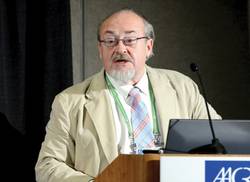
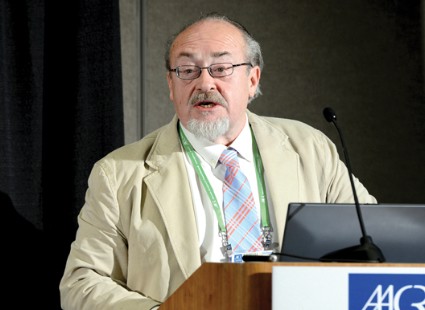
"We are seeing things that we did not expect to see," Dr. Esteban Cvitkovic, chief scientific officer of Lausanne, Switzerland–based OncoEthix, said during a press briefing at the annual meeting of the American Association for Cancer Research. OncoEthix is developing OTX015, an orally available molecule.
Dr. Cvitkovic presented findings from 42 patients with hematologic malignancies who were enrolled in a trial designed to determine the recommended dose and schedule of OTX015 to be given orally as a single agent. Of the 42 patients, 21 had acute leukemia – primarily acute myelogenous leukemia – and the remaining 21 had other hematologic malignancies, including diffuse large B-cell lymphoma and multiple myeloma. The researchers assigned study participants to a single dose of 10, 20, 40, or 80 mg of OTX015 daily, or to two 40-mg doses of OTX015 daily. Each dosing regimen included three to six patients with acute leukemia and three to six patients with another hematologic malignancy. The drug was administered in 21-day cycles, with a 14 days on, 7 days off regimen for acute leukemia patients and a continuous dosing regimen for patients with other hematologic malignancies.
The mean age of patients was 69 years and 60% were male. Complete data were available on 38 patients. Among these, the researchers observed significant clinical activity in seven patients: four with acute myelogenous leukemia (including one case of complete remission) and three with lymphoma. Of the seven patients, four received a single dose of 80 mg OTX015 daily, one received 10 mg daily, and the other two received 40 mg daily.
"The drug was very well tolerated, and half of the patients had at least three cycles [of the drug]," Dr. Cvitkovic said. Among acute leukemia patients, no dose-limiting toxicity was observed; the maximum tolerated dose was not reached at the 80-mg everyday or 40-mg b.i.d. doses.
Among patients with other hematologic malignancies, thrombocytopenia is emerging as a dose-related toxicity. "Thrombocytopenia is very peculiar, because as with this and any other adverse events, we stopped the drug and within 3 or 4 days everything went back to normal," Dr. Cvitkovic said. "Every adverse event is reversible upon discontinuation of the drug." Enrollment in the trial is continuing, and dose escalation with single doses of 120 mg OTX015 daily is being explored.
Other adverse events reported to date included increased blood glucose levels in previously diabetic patients, mild to moderate digestive symptoms, and declining platelet counts. No cumulative toxicity has been observed, Dr. Cvitkovic said.
"You look at cancer right now, and you look at tumors that are driven by c-Myc, RAS, RB, and p53," Dr. Thomas Lynch, director of the Yale Cancer Center, New Haven, Conn., said at the briefing. "Those are the four big actors in cancer, and we can do [nothing] for all of those major genetic abnormalities. If this approach works, and this is a way of targeting C-Myc or related genes, this would be a major breakthrough. If it works, it offers a [treatment for a] huge unmet medical need."
The study was supported by OncoEthix. Dr. Cvitkovic is chief scientific officer of the company. Dr. Lynch disclosed that he is on the board of directors for Bristol-Myers Squibb and Infinity Pharmaceuticals, and that he receives honoraria and stock from both companies. He is also on the scientific advisory board for Arvinas, and receives honoraria and stock from that company. In addition, Dr. Lynch is a patent holder with Partners Healthcare for an EGFR mutation testing patent and receives royalties.
SAN DIEGO – OTX015, an investigational agent that blocks the activity of bromodomain and extraterminal bromodomain proteins, demonstrated activity against a variety of hematologic cancers, preliminary results from a phase I trial demonstrated.
The finding is believed to be the first clinical proof that BET bromodomain inhibitors, a new class of anticancer agents that intervene with the down-regulation of the critical oncogene MYC may play a role in the treatment of human malignancies.
"We are seeing things that we did not expect to see," Dr. Esteban Cvitkovic, chief scientific officer of Lausanne, Switzerland–based OncoEthix, said during a press briefing at the annual meeting of the American Association for Cancer Research. OncoEthix is developing OTX015, an orally available molecule.
Dr. Cvitkovic presented findings from 42 patients with hematologic malignancies who were enrolled in a trial designed to determine the recommended dose and schedule of OTX015 to be given orally as a single agent. Of the 42 patients, 21 had acute leukemia – primarily acute myelogenous leukemia – and the remaining 21 had other hematologic malignancies, including diffuse large B-cell lymphoma and multiple myeloma. The researchers assigned study participants to a single dose of 10, 20, 40, or 80 mg of OTX015 daily, or to two 40-mg doses of OTX015 daily. Each dosing regimen included three to six patients with acute leukemia and three to six patients with another hematologic malignancy. The drug was administered in 21-day cycles, with a 14 days on, 7 days off regimen for acute leukemia patients and a continuous dosing regimen for patients with other hematologic malignancies.
The mean age of patients was 69 years and 60% were male. Complete data were available on 38 patients. Among these, the researchers observed significant clinical activity in seven patients: four with acute myelogenous leukemia (including one case of complete remission) and three with lymphoma. Of the seven patients, four received a single dose of 80 mg OTX015 daily, one received 10 mg daily, and the other two received 40 mg daily.
"The drug was very well tolerated, and half of the patients had at least three cycles [of the drug]," Dr. Cvitkovic said. Among acute leukemia patients, no dose-limiting toxicity was observed; the maximum tolerated dose was not reached at the 80-mg everyday or 40-mg b.i.d. doses.
Among patients with other hematologic malignancies, thrombocytopenia is emerging as a dose-related toxicity. "Thrombocytopenia is very peculiar, because as with this and any other adverse events, we stopped the drug and within 3 or 4 days everything went back to normal," Dr. Cvitkovic said. "Every adverse event is reversible upon discontinuation of the drug." Enrollment in the trial is continuing, and dose escalation with single doses of 120 mg OTX015 daily is being explored.
Other adverse events reported to date included increased blood glucose levels in previously diabetic patients, mild to moderate digestive symptoms, and declining platelet counts. No cumulative toxicity has been observed, Dr. Cvitkovic said.
"You look at cancer right now, and you look at tumors that are driven by c-Myc, RAS, RB, and p53," Dr. Thomas Lynch, director of the Yale Cancer Center, New Haven, Conn., said at the briefing. "Those are the four big actors in cancer, and we can do [nothing] for all of those major genetic abnormalities. If this approach works, and this is a way of targeting C-Myc or related genes, this would be a major breakthrough. If it works, it offers a [treatment for a] huge unmet medical need."
The study was supported by OncoEthix. Dr. Cvitkovic is chief scientific officer of the company. Dr. Lynch disclosed that he is on the board of directors for Bristol-Myers Squibb and Infinity Pharmaceuticals, and that he receives honoraria and stock from both companies. He is also on the scientific advisory board for Arvinas, and receives honoraria and stock from that company. In addition, Dr. Lynch is a patent holder with Partners Healthcare for an EGFR mutation testing patent and receives royalties.
SAN DIEGO – OTX015, an investigational agent that blocks the activity of bromodomain and extraterminal bromodomain proteins, demonstrated activity against a variety of hematologic cancers, preliminary results from a phase I trial demonstrated.
The finding is believed to be the first clinical proof that BET bromodomain inhibitors, a new class of anticancer agents that intervene with the down-regulation of the critical oncogene MYC may play a role in the treatment of human malignancies.
"We are seeing things that we did not expect to see," Dr. Esteban Cvitkovic, chief scientific officer of Lausanne, Switzerland–based OncoEthix, said during a press briefing at the annual meeting of the American Association for Cancer Research. OncoEthix is developing OTX015, an orally available molecule.
Dr. Cvitkovic presented findings from 42 patients with hematologic malignancies who were enrolled in a trial designed to determine the recommended dose and schedule of OTX015 to be given orally as a single agent. Of the 42 patients, 21 had acute leukemia – primarily acute myelogenous leukemia – and the remaining 21 had other hematologic malignancies, including diffuse large B-cell lymphoma and multiple myeloma. The researchers assigned study participants to a single dose of 10, 20, 40, or 80 mg of OTX015 daily, or to two 40-mg doses of OTX015 daily. Each dosing regimen included three to six patients with acute leukemia and three to six patients with another hematologic malignancy. The drug was administered in 21-day cycles, with a 14 days on, 7 days off regimen for acute leukemia patients and a continuous dosing regimen for patients with other hematologic malignancies.
The mean age of patients was 69 years and 60% were male. Complete data were available on 38 patients. Among these, the researchers observed significant clinical activity in seven patients: four with acute myelogenous leukemia (including one case of complete remission) and three with lymphoma. Of the seven patients, four received a single dose of 80 mg OTX015 daily, one received 10 mg daily, and the other two received 40 mg daily.
"The drug was very well tolerated, and half of the patients had at least three cycles [of the drug]," Dr. Cvitkovic said. Among acute leukemia patients, no dose-limiting toxicity was observed; the maximum tolerated dose was not reached at the 80-mg everyday or 40-mg b.i.d. doses.
Among patients with other hematologic malignancies, thrombocytopenia is emerging as a dose-related toxicity. "Thrombocytopenia is very peculiar, because as with this and any other adverse events, we stopped the drug and within 3 or 4 days everything went back to normal," Dr. Cvitkovic said. "Every adverse event is reversible upon discontinuation of the drug." Enrollment in the trial is continuing, and dose escalation with single doses of 120 mg OTX015 daily is being explored.
Other adverse events reported to date included increased blood glucose levels in previously diabetic patients, mild to moderate digestive symptoms, and declining platelet counts. No cumulative toxicity has been observed, Dr. Cvitkovic said.
"You look at cancer right now, and you look at tumors that are driven by c-Myc, RAS, RB, and p53," Dr. Thomas Lynch, director of the Yale Cancer Center, New Haven, Conn., said at the briefing. "Those are the four big actors in cancer, and we can do [nothing] for all of those major genetic abnormalities. If this approach works, and this is a way of targeting C-Myc or related genes, this would be a major breakthrough. If it works, it offers a [treatment for a] huge unmet medical need."
The study was supported by OncoEthix. Dr. Cvitkovic is chief scientific officer of the company. Dr. Lynch disclosed that he is on the board of directors for Bristol-Myers Squibb and Infinity Pharmaceuticals, and that he receives honoraria and stock from both companies. He is also on the scientific advisory board for Arvinas, and receives honoraria and stock from that company. In addition, Dr. Lynch is a patent holder with Partners Healthcare for an EGFR mutation testing patent and receives royalties.
AT THE AACR ANNUAL MEETING
Major Finding: Among 38 patients with a variety of hematologic cancers who were treated with the novel bromodomain and extraterminal bromodomain inhibitor OTX015, significant clinical activity was observed in 7 patients, including 1 case of complete remission.
Data Source: An ongoing study in which patients with acute leukemia and patients with other hematologic malignancies were assigned, in 21-day cycles, to a single dose of 10, 20, 40, or 80 mg of OTX015 daily, or to two 40-mg doses of OTX015 daily.
Disclosures: The study was supported by OncoEthix. Dr. Cvitkovic is the company’s chief scientific officer.
Protective cells are impaired in aggressive CLL

Credit: Monash University
New research may explain why patients with chronic lymphocytic leukemia (CLL) are vulnerable to severe, recurrent infections.
The study showed that plasmacytoid dendritic cells (pDCs), which orchestrate innate and adaptive immune responses, were eliminated in patients with aggressive CLL.
However, patients with a milder form of CLL appeared to have more pDCs, which suggests some protective effect.
Researchers reported these findings in Leukemia.
“These unprecedented findings reveal that these rare but critical cells can be restored at the experiment level, resulting in re-activated immune functions, including the destruction of cancer cells,” said study author Fabienne Mackay, PhD, of Monash University in Melbourne, Victoria, Australia.
“These results provide supporting evidence that a similar approach might have therapeutic benefits in patients with CLL.”
Dr Mackay and her colleagues noted that CLL patients’ vulnerability to infection is caused by a variety of immunological defects. But the initiating events of immunodeficiency in CLL are unclear.
To gain more insight, the researchers studied samples from CLL patients and conducted experiments in mouse models of the disease.
They found that, in progressive CLL, pDC numbers decreased, and their functionality was impaired. As a result, interferon alpha (IFNα) production decreased.
Additional investigation revealed that the decrease in pDCs and reduction in IFNα production resulted from decreased expression of FLT3 and TLR9.
However, the researchers were able to increase FLT3 expression using inhibitors of TGF-β and TNF. And this reduced the tumor load.
The team said these results offer new insight into mechanisms underpinning the immunodeficiency observed in CLL.
And they hope their discoveries will aid the development of new therapeutic strategies that reactivate the immune system and enhance the long-term survival of those CLL patients who are particularly vulnerable to fatal infectious complications. 
Credit: Monash University
New research may explain why patients with chronic lymphocytic leukemia (CLL) are vulnerable to severe, recurrent infections.
The study showed that plasmacytoid dendritic cells (pDCs), which orchestrate innate and adaptive immune responses, were eliminated in patients with aggressive CLL.
However, patients with a milder form of CLL appeared to have more pDCs, which suggests some protective effect.
Researchers reported these findings in Leukemia.
“These unprecedented findings reveal that these rare but critical cells can be restored at the experiment level, resulting in re-activated immune functions, including the destruction of cancer cells,” said study author Fabienne Mackay, PhD, of Monash University in Melbourne, Victoria, Australia.
“These results provide supporting evidence that a similar approach might have therapeutic benefits in patients with CLL.”
Dr Mackay and her colleagues noted that CLL patients’ vulnerability to infection is caused by a variety of immunological defects. But the initiating events of immunodeficiency in CLL are unclear.
To gain more insight, the researchers studied samples from CLL patients and conducted experiments in mouse models of the disease.
They found that, in progressive CLL, pDC numbers decreased, and their functionality was impaired. As a result, interferon alpha (IFNα) production decreased.
Additional investigation revealed that the decrease in pDCs and reduction in IFNα production resulted from decreased expression of FLT3 and TLR9.
However, the researchers were able to increase FLT3 expression using inhibitors of TGF-β and TNF. And this reduced the tumor load.
The team said these results offer new insight into mechanisms underpinning the immunodeficiency observed in CLL.
And they hope their discoveries will aid the development of new therapeutic strategies that reactivate the immune system and enhance the long-term survival of those CLL patients who are particularly vulnerable to fatal infectious complications.
Credit: Monash University
New research may explain why patients with chronic lymphocytic leukemia (CLL) are vulnerable to severe, recurrent infections.
The study showed that plasmacytoid dendritic cells (pDCs), which orchestrate innate and adaptive immune responses, were eliminated in patients with aggressive CLL.
However, patients with a milder form of CLL appeared to have more pDCs, which suggests some protective effect.
Researchers reported these findings in Leukemia.
“These unprecedented findings reveal that these rare but critical cells can be restored at the experiment level, resulting in re-activated immune functions, including the destruction of cancer cells,” said study author Fabienne Mackay, PhD, of Monash University in Melbourne, Victoria, Australia.
“These results provide supporting evidence that a similar approach might have therapeutic benefits in patients with CLL.”
Dr Mackay and her colleagues noted that CLL patients’ vulnerability to infection is caused by a variety of immunological defects. But the initiating events of immunodeficiency in CLL are unclear.
To gain more insight, the researchers studied samples from CLL patients and conducted experiments in mouse models of the disease.
They found that, in progressive CLL, pDC numbers decreased, and their functionality was impaired. As a result, interferon alpha (IFNα) production decreased.
Additional investigation revealed that the decrease in pDCs and reduction in IFNα production resulted from decreased expression of FLT3 and TLR9.
However, the researchers were able to increase FLT3 expression using inhibitors of TGF-β and TNF. And this reduced the tumor load.
The team said these results offer new insight into mechanisms underpinning the immunodeficiency observed in CLL.
And they hope their discoveries will aid the development of new therapeutic strategies that reactivate the immune system and enhance the long-term survival of those CLL patients who are particularly vulnerable to fatal infectious complications.
Group describes mechanism of resistance in CLL
SAN DIEGO—Preclinical research has revealed a mechanism of rituximab resistance in chronic lymphocytic leukemia (CLL), as well as a possible new treatment approach.
The study suggests the TNF-family member BAFF contributes to CLL cells’ resistance to direct and rituximab-induced natural killer (NK) cell reactivity.
However, the BAFF-specific antibody belimumab can overcome this resistance and restore CLL cells’ sensitivity to chemotherapy.
Julia Wild, a PhD student at Eberhard Karls University in Tuebingen, Germany, and her colleagues presented these findings at the AACR Annual Meeting 2014 as abstract 148.
“It is widely known that NK cells’ ability to react against lymphoblastic leukemia is impaired, as compared to myeloid leukemia,” Wild said. “And we now think we’ve identified a factor involved in this—a member of the tumor necrosis factor family called BAFF.”
Previous research showed that NK cells’ ability to target malignant cells and mediate antibody-dependent cellular cytotoxicity (ADCC) is compromised in CLL, but the underlying mechanisms were not clear. Wild and her colleagues therefore speculated that BAFF, which regulates B-cell proliferation and survival, plays a role.
The researchers’ initial experiments revealed that NK cells express BAFF at the mRNA level and release the protein in a soluble form, with levels depending on the state of activation.
The team then assessed BAFF expression in primary CLL cells. They collected cells from 17 CLL patients and analyzed surface expression of the 3 BAFF receptors. All 17 samples were positive for BAFF-R and TACI, and about 53% (9/17) were positive for BCMA.
Additional experiments revealed that BAFF enhances the metabolic activity of primary CLL cells. To uncover this result, the researchers incubated the cells with increasing concentrations of BAFF. And they compared untreated cells to cells treated with belimumab, isotype control, BAFF, BAFF plus belimumab, and BAFF plus isotype control.
The team then compared untreated CLL cells to cells treated with fludarabine and cyclophosphamide (Flu/Cy); Flu/Cy plus BAFF; and Flu/Cy, BAFF, and belimumab.
They found that BAFF protects CLL cells from chemotherapy-induced death. However, belimumab inhibits the protective effects of BAFF and restores CLL cells’ sensitivity to chemotherapy.
The researchers then performed cytotoxicity assays in primary CLL cells, comparing untreated cells to cells exposed to BAFF alone; rituximab alone; BAFF and rituximab; BAFF and belimumab; and rituximab, BAFF, and belimumab.
They found that lysis was highest among cells treated with rituximab alone or rituximab, BAFF, and belimumab, with comparable results in these 2 groups.
The team also evaluated CLL cell lysis due to ADCC induction. They analyzed peripheral blood mononuclear cells from CLL patients, comparing untreated cells to cells exposed to rituximab alone; rituximab and BAFF; rituximab, belimumab, and BAFF; and rituximab, bevacizumab, and BAFF.
Results showed that CLL cell survival was lowest (and comparable) in cells treated with rituximab alone or rituximab, belimumab, and BAFF.
“When CLL cells are cultured in the presence of BAFF, cytotoxicity is decreased as compared to untreated cells, and this is not only for direct NK-cell activity, but also for ADCC-mediated activity,” Wild summarized.
“But we can block this effect with belimumab, which suggests we could use this antibody for CLL treatment.”
SAN DIEGO—Preclinical research has revealed a mechanism of rituximab resistance in chronic lymphocytic leukemia (CLL), as well as a possible new treatment approach.
The study suggests the TNF-family member BAFF contributes to CLL cells’ resistance to direct and rituximab-induced natural killer (NK) cell reactivity.
However, the BAFF-specific antibody belimumab can overcome this resistance and restore CLL cells’ sensitivity to chemotherapy.
Julia Wild, a PhD student at Eberhard Karls University in Tuebingen, Germany, and her colleagues presented these findings at the AACR Annual Meeting 2014 as abstract 148.
“It is widely known that NK cells’ ability to react against lymphoblastic leukemia is impaired, as compared to myeloid leukemia,” Wild said. “And we now think we’ve identified a factor involved in this—a member of the tumor necrosis factor family called BAFF.”
Previous research showed that NK cells’ ability to target malignant cells and mediate antibody-dependent cellular cytotoxicity (ADCC) is compromised in CLL, but the underlying mechanisms were not clear. Wild and her colleagues therefore speculated that BAFF, which regulates B-cell proliferation and survival, plays a role.
The researchers’ initial experiments revealed that NK cells express BAFF at the mRNA level and release the protein in a soluble form, with levels depending on the state of activation.
The team then assessed BAFF expression in primary CLL cells. They collected cells from 17 CLL patients and analyzed surface expression of the 3 BAFF receptors. All 17 samples were positive for BAFF-R and TACI, and about 53% (9/17) were positive for BCMA.
Additional experiments revealed that BAFF enhances the metabolic activity of primary CLL cells. To uncover this result, the researchers incubated the cells with increasing concentrations of BAFF. And they compared untreated cells to cells treated with belimumab, isotype control, BAFF, BAFF plus belimumab, and BAFF plus isotype control.
The team then compared untreated CLL cells to cells treated with fludarabine and cyclophosphamide (Flu/Cy); Flu/Cy plus BAFF; and Flu/Cy, BAFF, and belimumab.
They found that BAFF protects CLL cells from chemotherapy-induced death. However, belimumab inhibits the protective effects of BAFF and restores CLL cells’ sensitivity to chemotherapy.
The researchers then performed cytotoxicity assays in primary CLL cells, comparing untreated cells to cells exposed to BAFF alone; rituximab alone; BAFF and rituximab; BAFF and belimumab; and rituximab, BAFF, and belimumab.
They found that lysis was highest among cells treated with rituximab alone or rituximab, BAFF, and belimumab, with comparable results in these 2 groups.
The team also evaluated CLL cell lysis due to ADCC induction. They analyzed peripheral blood mononuclear cells from CLL patients, comparing untreated cells to cells exposed to rituximab alone; rituximab and BAFF; rituximab, belimumab, and BAFF; and rituximab, bevacizumab, and BAFF.
Results showed that CLL cell survival was lowest (and comparable) in cells treated with rituximab alone or rituximab, belimumab, and BAFF.
“When CLL cells are cultured in the presence of BAFF, cytotoxicity is decreased as compared to untreated cells, and this is not only for direct NK-cell activity, but also for ADCC-mediated activity,” Wild summarized.
“But we can block this effect with belimumab, which suggests we could use this antibody for CLL treatment.”
SAN DIEGO—Preclinical research has revealed a mechanism of rituximab resistance in chronic lymphocytic leukemia (CLL), as well as a possible new treatment approach.
The study suggests the TNF-family member BAFF contributes to CLL cells’ resistance to direct and rituximab-induced natural killer (NK) cell reactivity.
However, the BAFF-specific antibody belimumab can overcome this resistance and restore CLL cells’ sensitivity to chemotherapy.
Julia Wild, a PhD student at Eberhard Karls University in Tuebingen, Germany, and her colleagues presented these findings at the AACR Annual Meeting 2014 as abstract 148.
“It is widely known that NK cells’ ability to react against lymphoblastic leukemia is impaired, as compared to myeloid leukemia,” Wild said. “And we now think we’ve identified a factor involved in this—a member of the tumor necrosis factor family called BAFF.”
Previous research showed that NK cells’ ability to target malignant cells and mediate antibody-dependent cellular cytotoxicity (ADCC) is compromised in CLL, but the underlying mechanisms were not clear. Wild and her colleagues therefore speculated that BAFF, which regulates B-cell proliferation and survival, plays a role.
The researchers’ initial experiments revealed that NK cells express BAFF at the mRNA level and release the protein in a soluble form, with levels depending on the state of activation.
The team then assessed BAFF expression in primary CLL cells. They collected cells from 17 CLL patients and analyzed surface expression of the 3 BAFF receptors. All 17 samples were positive for BAFF-R and TACI, and about 53% (9/17) were positive for BCMA.
Additional experiments revealed that BAFF enhances the metabolic activity of primary CLL cells. To uncover this result, the researchers incubated the cells with increasing concentrations of BAFF. And they compared untreated cells to cells treated with belimumab, isotype control, BAFF, BAFF plus belimumab, and BAFF plus isotype control.
The team then compared untreated CLL cells to cells treated with fludarabine and cyclophosphamide (Flu/Cy); Flu/Cy plus BAFF; and Flu/Cy, BAFF, and belimumab.
They found that BAFF protects CLL cells from chemotherapy-induced death. However, belimumab inhibits the protective effects of BAFF and restores CLL cells’ sensitivity to chemotherapy.
The researchers then performed cytotoxicity assays in primary CLL cells, comparing untreated cells to cells exposed to BAFF alone; rituximab alone; BAFF and rituximab; BAFF and belimumab; and rituximab, BAFF, and belimumab.
They found that lysis was highest among cells treated with rituximab alone or rituximab, BAFF, and belimumab, with comparable results in these 2 groups.
The team also evaluated CLL cell lysis due to ADCC induction. They analyzed peripheral blood mononuclear cells from CLL patients, comparing untreated cells to cells exposed to rituximab alone; rituximab and BAFF; rituximab, belimumab, and BAFF; and rituximab, bevacizumab, and BAFF.
Results showed that CLL cell survival was lowest (and comparable) in cells treated with rituximab alone or rituximab, belimumab, and BAFF.
“When CLL cells are cultured in the presence of BAFF, cytotoxicity is decreased as compared to untreated cells, and this is not only for direct NK-cell activity, but also for ADCC-mediated activity,” Wild summarized.
“But we can block this effect with belimumab, which suggests we could use this antibody for CLL treatment.”
Patient perception of control affects satisfaction

patient and her father
Credit: Rhoda Baer
Feeling as though they play an active role in their treatment decisions increases satisfaction among cancer patients undergoing radiotherapy (RT), according to research published in Cancer.
In a study of more than 300 RT patients, those who were involved in their treatment decisions—or perceived they had some control over their treatment—were more satisfied than their peers.
On the other hand, patients who wanted control over their treatment but did not feel they had any were more likely than their peers to experience anxiety, depression, and fatigue.
“Our findings emphasize the value of patient-physician relationships and communication, specifically in radiation oncology, and their impact on patient experience in a way that hasn’t been shown before,” said study author Neha Vapiwala, MD, of the Perelman School of Medicine at the University of Pennsylvania.
Dr Vapiwala and her colleagues noted that past studies of shared decision-making (SDM)—in which patients and providers make healthcare decisions together, taking into account scientific evidence and patient preferences—have shown an association between patient satisfaction and quality of life.
However, none of these studies has evaluated the impact of SDM on patients undergoing RT. Often, radiation oncology is seen as a treatment avenue that is ultimately left to the physician to dictate. But there are tailored options, decisions, and discussions that can apply to individual patients.
With this in mind, the researchers conducted a survey of SDM in 305 patients undergoing RT. In all, 31% of patients said they experienced SDM, 32% perceived control in their treatment decisions, and 76% reported feeling very satisfied with their radiation treatment course overall.
Patient satisfaction was significantly higher among those who perceived SDM than among those who did not—84.4% and 71.4%, respectively (P<0.02).
And satisfaction was higher among patients who perceived control over their treatment than among those who did not—89.7% and 69.2%, respectively (P<0.001).
Patients who expressed a desire for control over their treatment decisions but did not perceive having any control were significantly more likely than their peers to experience symptoms tied to psychological distress.
Anxiety was reported in 44% and 20% of patients, respectively (P<0.02). Depression was reported in 44% and 15%, respectively (P<0.01). And fatigue was reported in 68% and 39.2%, respectively (P<0.01).
The researchers said one of this study’s strengths is the diverse group of patients enrolled. Ages ranged from 18 to 87 years, and a variety of ethnic/racial groups were represented. Patients had a range of cancers at all stages, and could participate in the study as long as they were well enough.
The team said the next step for this research is to determine both physician and patient barriers to SDM and identify methods to break down these barriers.
“As providers, it doesn’t matter what treatment you are offering, or how complicated it is, or how busy you may be,” Dr Vapiwala said. “It’s worth taking even a few minutes to talk to patients about seemingly minor decisions in which they can provide some input.”
“It’s not only critical in today’s healthcare setting, where both information and misinformation are rampant, but will very likely lead to the patient feeling positively about the encounter.”
patient and her father
Credit: Rhoda Baer
Feeling as though they play an active role in their treatment decisions increases satisfaction among cancer patients undergoing radiotherapy (RT), according to research published in Cancer.
In a study of more than 300 RT patients, those who were involved in their treatment decisions—or perceived they had some control over their treatment—were more satisfied than their peers.
On the other hand, patients who wanted control over their treatment but did not feel they had any were more likely than their peers to experience anxiety, depression, and fatigue.
“Our findings emphasize the value of patient-physician relationships and communication, specifically in radiation oncology, and their impact on patient experience in a way that hasn’t been shown before,” said study author Neha Vapiwala, MD, of the Perelman School of Medicine at the University of Pennsylvania.
Dr Vapiwala and her colleagues noted that past studies of shared decision-making (SDM)—in which patients and providers make healthcare decisions together, taking into account scientific evidence and patient preferences—have shown an association between patient satisfaction and quality of life.
However, none of these studies has evaluated the impact of SDM on patients undergoing RT. Often, radiation oncology is seen as a treatment avenue that is ultimately left to the physician to dictate. But there are tailored options, decisions, and discussions that can apply to individual patients.
With this in mind, the researchers conducted a survey of SDM in 305 patients undergoing RT. In all, 31% of patients said they experienced SDM, 32% perceived control in their treatment decisions, and 76% reported feeling very satisfied with their radiation treatment course overall.
Patient satisfaction was significantly higher among those who perceived SDM than among those who did not—84.4% and 71.4%, respectively (P<0.02).
And satisfaction was higher among patients who perceived control over their treatment than among those who did not—89.7% and 69.2%, respectively (P<0.001).
Patients who expressed a desire for control over their treatment decisions but did not perceive having any control were significantly more likely than their peers to experience symptoms tied to psychological distress.
Anxiety was reported in 44% and 20% of patients, respectively (P<0.02). Depression was reported in 44% and 15%, respectively (P<0.01). And fatigue was reported in 68% and 39.2%, respectively (P<0.01).
The researchers said one of this study’s strengths is the diverse group of patients enrolled. Ages ranged from 18 to 87 years, and a variety of ethnic/racial groups were represented. Patients had a range of cancers at all stages, and could participate in the study as long as they were well enough.
The team said the next step for this research is to determine both physician and patient barriers to SDM and identify methods to break down these barriers.
“As providers, it doesn’t matter what treatment you are offering, or how complicated it is, or how busy you may be,” Dr Vapiwala said. “It’s worth taking even a few minutes to talk to patients about seemingly minor decisions in which they can provide some input.”
“It’s not only critical in today’s healthcare setting, where both information and misinformation are rampant, but will very likely lead to the patient feeling positively about the encounter.”
patient and her father
Credit: Rhoda Baer
Feeling as though they play an active role in their treatment decisions increases satisfaction among cancer patients undergoing radiotherapy (RT), according to research published in Cancer.
In a study of more than 300 RT patients, those who were involved in their treatment decisions—or perceived they had some control over their treatment—were more satisfied than their peers.
On the other hand, patients who wanted control over their treatment but did not feel they had any were more likely than their peers to experience anxiety, depression, and fatigue.
“Our findings emphasize the value of patient-physician relationships and communication, specifically in radiation oncology, and their impact on patient experience in a way that hasn’t been shown before,” said study author Neha Vapiwala, MD, of the Perelman School of Medicine at the University of Pennsylvania.
Dr Vapiwala and her colleagues noted that past studies of shared decision-making (SDM)—in which patients and providers make healthcare decisions together, taking into account scientific evidence and patient preferences—have shown an association between patient satisfaction and quality of life.
However, none of these studies has evaluated the impact of SDM on patients undergoing RT. Often, radiation oncology is seen as a treatment avenue that is ultimately left to the physician to dictate. But there are tailored options, decisions, and discussions that can apply to individual patients.
With this in mind, the researchers conducted a survey of SDM in 305 patients undergoing RT. In all, 31% of patients said they experienced SDM, 32% perceived control in their treatment decisions, and 76% reported feeling very satisfied with their radiation treatment course overall.
Patient satisfaction was significantly higher among those who perceived SDM than among those who did not—84.4% and 71.4%, respectively (P<0.02).
And satisfaction was higher among patients who perceived control over their treatment than among those who did not—89.7% and 69.2%, respectively (P<0.001).
Patients who expressed a desire for control over their treatment decisions but did not perceive having any control were significantly more likely than their peers to experience symptoms tied to psychological distress.
Anxiety was reported in 44% and 20% of patients, respectively (P<0.02). Depression was reported in 44% and 15%, respectively (P<0.01). And fatigue was reported in 68% and 39.2%, respectively (P<0.01).
The researchers said one of this study’s strengths is the diverse group of patients enrolled. Ages ranged from 18 to 87 years, and a variety of ethnic/racial groups were represented. Patients had a range of cancers at all stages, and could participate in the study as long as they were well enough.
The team said the next step for this research is to determine both physician and patient barriers to SDM and identify methods to break down these barriers.
“As providers, it doesn’t matter what treatment you are offering, or how complicated it is, or how busy you may be,” Dr Vapiwala said. “It’s worth taking even a few minutes to talk to patients about seemingly minor decisions in which they can provide some input.”
“It’s not only critical in today’s healthcare setting, where both information and misinformation are rampant, but will very likely lead to the patient feeling positively about the encounter.”
ASCO releases guidelines for managing cancer survivors

with a cancer patient
NCI/Mathews Media Group
The American Society of Clinical Oncology (ASCO) has issued 3 practice guidelines for preventing and managing symptoms that can affect adult cancer survivors—neuropathy, fatigue, and depression/anxiety.
The guideline on chemotherapy-induced peripheral neuropathy (CIPN) lists a few options for treating the condition but discourages interventions to prevent CIPN, as there is insufficient evidence that these interventions benefit patients.
The guideline on fatigue recommends that healthcare providers start screening cancer patients for the condition at diagnosis and emphasizes the importance of educating patients about fatigue.
The guideline on depression and anxiety recommends periodic evaluations for symptoms of depression and anxiety in all cancer patients. It also suggests that all patients be offered supportive care services.
All 3 of these guidelines are published in the Journal of Clinical Oncology.
Treating and preventing CIPN
ASCO’s guideline on CIPN lists a handful of drugs that may be helpful in diminishing the symptoms of CIPN, but it does not recommend any agents for preventing the condition.
In fact, the guideline provides a list of agents that should not be offered for the prevention of CIPN, including acetyl-L-carnitine, amifostine, amitriptyline, CaMg, diethyldithio-carbamate, glutathione, nimodipine, Org 2766, all-trans retinoic acid, rhuLIF, and vitamin E.
“There is no clear panacea for neuropathy,” said Gary Lyman, MD, MPH, co-chair of the ASCO Survivorship Guidelines Advisory Group.
“Some of the drugs used for prevention or treatment of neuropathy may cause side effects or interfere with other drugs. We want to be clear that if there is no evidence of benefit from those drugs, it’s probably best not to take them.”
As for treatment, the guideline states that data support a “moderate” recommendation for duloxetine.
It also notes that there is no strong evidence of benefit for the use of tricyclic antidepressants, gabapentin, and a topical gel containing baclofen, amitriptyline, and ketamine. However, it may be reasonable to try those agents in select patients.
To develop this guideline, an ASCO panel conducted a systematic review of relevant medical literature. They analyzed data from 48 randomized, clinical trials focused on managing CIPN.
Screening and managing fatigue
ASCO’s guideline on fatigue recommends that all patients be screened for fatigue from the point of diagnosis onward. Healthcare providers should assess fatigue history, disease status, and treatable contributing factors.
All patients should be educated about the differences between normal and cancer-related fatigue, causes of fatigue, and contributing factors.
Healthcare providers should discuss with patients strategies to manage fatigue, including physical activity, psychosocial interventions (such as cognitive and behavioral therapies or psycho-educational therapies), and mind-body interventions (such as yoga or acupuncture).
To develop this guideline, an ASCO panel conducted a systematic review of clinical practice guideline databases and relevant medical literature. The adaptation is based on a Pan-Canadian guideline on fatigue and 2 National Comprehensive Cancer Network guidelines on cancer-related fatigue and survivorship.
Handling anxiety and depression
ASCO’s guideline on anxiety and depression recommends that healthcare providers periodically evaluate all cancer patients for symptoms of depression and anxiety. The assessments should be performed using validated, published measures and procedures.
All patients should have the option of receiving supportive care services, such as education about the normalcy of stress in the context of cancer, signs and symptoms of distress, and stress reduction strategies.
Patients who display moderate or severe symptoms of anxiety and depression should be referred for the appropriate psychological, psychosocial, or psychiatric interventions.
“Doctors sometimes don’t give these symptoms much attention because they think it’s normal that their patients are a little anxious or depressed about their disease,” Dr Lyman said. “But it’s important to keep an eye on the symptoms and step in when they start to interfere with the patients’ quality of life.”
To develop this guideline, an ASCO panel conducted a systematic review of clinical practice guideline databases and relevant medical literature. The adaptation is based on a Pan-Canadian practice guideline on psychological distress in adults with cancer.
with a cancer patient
NCI/Mathews Media Group
The American Society of Clinical Oncology (ASCO) has issued 3 practice guidelines for preventing and managing symptoms that can affect adult cancer survivors—neuropathy, fatigue, and depression/anxiety.
The guideline on chemotherapy-induced peripheral neuropathy (CIPN) lists a few options for treating the condition but discourages interventions to prevent CIPN, as there is insufficient evidence that these interventions benefit patients.
The guideline on fatigue recommends that healthcare providers start screening cancer patients for the condition at diagnosis and emphasizes the importance of educating patients about fatigue.
The guideline on depression and anxiety recommends periodic evaluations for symptoms of depression and anxiety in all cancer patients. It also suggests that all patients be offered supportive care services.
All 3 of these guidelines are published in the Journal of Clinical Oncology.
Treating and preventing CIPN
ASCO’s guideline on CIPN lists a handful of drugs that may be helpful in diminishing the symptoms of CIPN, but it does not recommend any agents for preventing the condition.
In fact, the guideline provides a list of agents that should not be offered for the prevention of CIPN, including acetyl-L-carnitine, amifostine, amitriptyline, CaMg, diethyldithio-carbamate, glutathione, nimodipine, Org 2766, all-trans retinoic acid, rhuLIF, and vitamin E.
“There is no clear panacea for neuropathy,” said Gary Lyman, MD, MPH, co-chair of the ASCO Survivorship Guidelines Advisory Group.
“Some of the drugs used for prevention or treatment of neuropathy may cause side effects or interfere with other drugs. We want to be clear that if there is no evidence of benefit from those drugs, it’s probably best not to take them.”
As for treatment, the guideline states that data support a “moderate” recommendation for duloxetine.
It also notes that there is no strong evidence of benefit for the use of tricyclic antidepressants, gabapentin, and a topical gel containing baclofen, amitriptyline, and ketamine. However, it may be reasonable to try those agents in select patients.
To develop this guideline, an ASCO panel conducted a systematic review of relevant medical literature. They analyzed data from 48 randomized, clinical trials focused on managing CIPN.
Screening and managing fatigue
ASCO’s guideline on fatigue recommends that all patients be screened for fatigue from the point of diagnosis onward. Healthcare providers should assess fatigue history, disease status, and treatable contributing factors.
All patients should be educated about the differences between normal and cancer-related fatigue, causes of fatigue, and contributing factors.
Healthcare providers should discuss with patients strategies to manage fatigue, including physical activity, psychosocial interventions (such as cognitive and behavioral therapies or psycho-educational therapies), and mind-body interventions (such as yoga or acupuncture).
To develop this guideline, an ASCO panel conducted a systematic review of clinical practice guideline databases and relevant medical literature. The adaptation is based on a Pan-Canadian guideline on fatigue and 2 National Comprehensive Cancer Network guidelines on cancer-related fatigue and survivorship.
Handling anxiety and depression
ASCO’s guideline on anxiety and depression recommends that healthcare providers periodically evaluate all cancer patients for symptoms of depression and anxiety. The assessments should be performed using validated, published measures and procedures.
All patients should have the option of receiving supportive care services, such as education about the normalcy of stress in the context of cancer, signs and symptoms of distress, and stress reduction strategies.
Patients who display moderate or severe symptoms of anxiety and depression should be referred for the appropriate psychological, psychosocial, or psychiatric interventions.
“Doctors sometimes don’t give these symptoms much attention because they think it’s normal that their patients are a little anxious or depressed about their disease,” Dr Lyman said. “But it’s important to keep an eye on the symptoms and step in when they start to interfere with the patients’ quality of life.”
To develop this guideline, an ASCO panel conducted a systematic review of clinical practice guideline databases and relevant medical literature. The adaptation is based on a Pan-Canadian practice guideline on psychological distress in adults with cancer.
with a cancer patient
NCI/Mathews Media Group
The American Society of Clinical Oncology (ASCO) has issued 3 practice guidelines for preventing and managing symptoms that can affect adult cancer survivors—neuropathy, fatigue, and depression/anxiety.
The guideline on chemotherapy-induced peripheral neuropathy (CIPN) lists a few options for treating the condition but discourages interventions to prevent CIPN, as there is insufficient evidence that these interventions benefit patients.
The guideline on fatigue recommends that healthcare providers start screening cancer patients for the condition at diagnosis and emphasizes the importance of educating patients about fatigue.
The guideline on depression and anxiety recommends periodic evaluations for symptoms of depression and anxiety in all cancer patients. It also suggests that all patients be offered supportive care services.
All 3 of these guidelines are published in the Journal of Clinical Oncology.
Treating and preventing CIPN
ASCO’s guideline on CIPN lists a handful of drugs that may be helpful in diminishing the symptoms of CIPN, but it does not recommend any agents for preventing the condition.
In fact, the guideline provides a list of agents that should not be offered for the prevention of CIPN, including acetyl-L-carnitine, amifostine, amitriptyline, CaMg, diethyldithio-carbamate, glutathione, nimodipine, Org 2766, all-trans retinoic acid, rhuLIF, and vitamin E.
“There is no clear panacea for neuropathy,” said Gary Lyman, MD, MPH, co-chair of the ASCO Survivorship Guidelines Advisory Group.
“Some of the drugs used for prevention or treatment of neuropathy may cause side effects or interfere with other drugs. We want to be clear that if there is no evidence of benefit from those drugs, it’s probably best not to take them.”
As for treatment, the guideline states that data support a “moderate” recommendation for duloxetine.
It also notes that there is no strong evidence of benefit for the use of tricyclic antidepressants, gabapentin, and a topical gel containing baclofen, amitriptyline, and ketamine. However, it may be reasonable to try those agents in select patients.
To develop this guideline, an ASCO panel conducted a systematic review of relevant medical literature. They analyzed data from 48 randomized, clinical trials focused on managing CIPN.
Screening and managing fatigue
ASCO’s guideline on fatigue recommends that all patients be screened for fatigue from the point of diagnosis onward. Healthcare providers should assess fatigue history, disease status, and treatable contributing factors.
All patients should be educated about the differences between normal and cancer-related fatigue, causes of fatigue, and contributing factors.
Healthcare providers should discuss with patients strategies to manage fatigue, including physical activity, psychosocial interventions (such as cognitive and behavioral therapies or psycho-educational therapies), and mind-body interventions (such as yoga or acupuncture).
To develop this guideline, an ASCO panel conducted a systematic review of clinical practice guideline databases and relevant medical literature. The adaptation is based on a Pan-Canadian guideline on fatigue and 2 National Comprehensive Cancer Network guidelines on cancer-related fatigue and survivorship.
Handling anxiety and depression
ASCO’s guideline on anxiety and depression recommends that healthcare providers periodically evaluate all cancer patients for symptoms of depression and anxiety. The assessments should be performed using validated, published measures and procedures.
All patients should have the option of receiving supportive care services, such as education about the normalcy of stress in the context of cancer, signs and symptoms of distress, and stress reduction strategies.
Patients who display moderate or severe symptoms of anxiety and depression should be referred for the appropriate psychological, psychosocial, or psychiatric interventions.
“Doctors sometimes don’t give these symptoms much attention because they think it’s normal that their patients are a little anxious or depressed about their disease,” Dr Lyman said. “But it’s important to keep an eye on the symptoms and step in when they start to interfere with the patients’ quality of life.”
To develop this guideline, an ASCO panel conducted a systematic review of clinical practice guideline databases and relevant medical literature. The adaptation is based on a Pan-Canadian practice guideline on psychological distress in adults with cancer.
Dual kinase inhibitor targets heterogeneity in AML
SAN DIEGO—A dual kinase inhibitor shows potential for treating the heterogeneous acute myeloid leukemia (AML) population, researchers say.
The inhibitor, SEL24-B489, targets both PIM and FLT3 mutants. In experiments, it exhibited more consistent activity across AML cell lines than inhibitors directed only at PIM or FLT3.
SEL24-B489 also demonstrated synergistic activity with cytarabine, both in AML cell lines and mouse models of the disease.
The researchers believe these results suggest SEL24-B489 could potentially treat a range of AML patients and might prove effective regardless of FLT3 status.
“When you have a very heterogeneous population of AML patients, some of them have different FLT mutations, and the problem with FLT inhibitors has been the resistance that occurs in the tyrosine kinase domain,” said Krzysztof D. Brzózka, PhD, of Selvita, the Kraków, Poland-based company developing SEL24-B489.
“We believe that since FLT is upstream, and PIM kinases are downstream of the FLT signaling, we will have higher chances
of overcoming resistance because we are targeting the same pathway at 2 independent nodes.”
Dr Brzózka and his colleagues presented research to support this theory at the AACR Annual Meeting 2014 as abstract 1749.*
The researchers evaluated SEL24-B489 in a range of AML cell lines: MV4-11, MOLM-13, MOLM-16, KG-1, CMK, and HL-60. The drug showed “strong cytotoxicity” across the cell lines, independent of FLT3 status.
The team also compared SEL24-B489 to the PIM inhibitor AZD1208 and the FLT3 inhibitor AC220 in MV4-11 cell lines and MOLM-16 cell lines.
In MV4-11 cells, the IC50 was 0.003 μM for AC220, 0.15 μM for SEL24-B489, and 2.24 μM for AZD1208. In MOLM-16 cells, the IC50 was 0.07 μM for AZD1208, 0.1 μM for SEL24-B489, and >10 μM for AC220.
The researchers then evaluated SEL24-B489 in combination with cytarabine.
“The molecule shows very strong synergistic effects with cytarabine, both in vitro and in vivo,” Dr Brzózka said. “The combination index in vitro is approximately 0.1, 0.2. And in vivo, that translates to [nearly] 100% tumor growth inhibition.”
Tumor growth inhibition (TGI) measured 60% when mice received cytarabine alone at 50 mg/kg. TGI was 77% with SEL24-B489 alone at 25 mg/kg and 82% with SEL24-B489 alone at 50 mg/kg.
But with 25 mg/kg of SEL24-B489 and 50 mg/kg of cytarabine, TGI was 89%. And when both drugs were given at 50 mg/kg, TGI was 99%.
The researchers also assessed SEL24-B489 alone in mouse models of AML. In mice injected with MV4-11 cells, SEL24-B489 at 25 mg/kg BID reduced tumor volume by more than 50%, when compared to untreated control mice. And SEL24-B489 at 75 mg/kg BID reduced tumor volume by more than 80%.
In mice injected with MOLM-16 cells, SEL24-B489 at 25 mg/kg BID reduced tumor volume by more than 80%, when compared to untreated control mice. And SEL24-B489 at 75 mg/kg BID reduced tumor volume by more than 100%.
Finally, the team evaluated the safety of SEL24-B489 via repeated 5-day and 10-day toxicology studies in rats.
And they concluded that doses of 100 mg/kg QD x 5 and 25 mg/kg BID x 10 were safe, based on data concerning body weight gain, as well as results of clinical chemistry, hematology, necropsy, and histological analyses.
“Overall, SEL24-B489 has very good oral bioavailability and initial safety profiling,” Dr Brzózka said. “Both in vitro and in vivo, it shows a pretty promising therapeutic index.”
He and his colleagues are now studying SEL24-B489 in dogs, and Selvita is looking for a partner company to help move the drug to phase 1 trials.
*Information in the abstract differs from that presented at the meeting.
SAN DIEGO—A dual kinase inhibitor shows potential for treating the heterogeneous acute myeloid leukemia (AML) population, researchers say.
The inhibitor, SEL24-B489, targets both PIM and FLT3 mutants. In experiments, it exhibited more consistent activity across AML cell lines than inhibitors directed only at PIM or FLT3.
SEL24-B489 also demonstrated synergistic activity with cytarabine, both in AML cell lines and mouse models of the disease.
The researchers believe these results suggest SEL24-B489 could potentially treat a range of AML patients and might prove effective regardless of FLT3 status.
“When you have a very heterogeneous population of AML patients, some of them have different FLT mutations, and the problem with FLT inhibitors has been the resistance that occurs in the tyrosine kinase domain,” said Krzysztof D. Brzózka, PhD, of Selvita, the Kraków, Poland-based company developing SEL24-B489.
“We believe that since FLT is upstream, and PIM kinases are downstream of the FLT signaling, we will have higher chances
of overcoming resistance because we are targeting the same pathway at 2 independent nodes.”
Dr Brzózka and his colleagues presented research to support this theory at the AACR Annual Meeting 2014 as abstract 1749.*
The researchers evaluated SEL24-B489 in a range of AML cell lines: MV4-11, MOLM-13, MOLM-16, KG-1, CMK, and HL-60. The drug showed “strong cytotoxicity” across the cell lines, independent of FLT3 status.
The team also compared SEL24-B489 to the PIM inhibitor AZD1208 and the FLT3 inhibitor AC220 in MV4-11 cell lines and MOLM-16 cell lines.
In MV4-11 cells, the IC50 was 0.003 μM for AC220, 0.15 μM for SEL24-B489, and 2.24 μM for AZD1208. In MOLM-16 cells, the IC50 was 0.07 μM for AZD1208, 0.1 μM for SEL24-B489, and >10 μM for AC220.
The researchers then evaluated SEL24-B489 in combination with cytarabine.
“The molecule shows very strong synergistic effects with cytarabine, both in vitro and in vivo,” Dr Brzózka said. “The combination index in vitro is approximately 0.1, 0.2. And in vivo, that translates to [nearly] 100% tumor growth inhibition.”
Tumor growth inhibition (TGI) measured 60% when mice received cytarabine alone at 50 mg/kg. TGI was 77% with SEL24-B489 alone at 25 mg/kg and 82% with SEL24-B489 alone at 50 mg/kg.
But with 25 mg/kg of SEL24-B489 and 50 mg/kg of cytarabine, TGI was 89%. And when both drugs were given at 50 mg/kg, TGI was 99%.
The researchers also assessed SEL24-B489 alone in mouse models of AML. In mice injected with MV4-11 cells, SEL24-B489 at 25 mg/kg BID reduced tumor volume by more than 50%, when compared to untreated control mice. And SEL24-B489 at 75 mg/kg BID reduced tumor volume by more than 80%.
In mice injected with MOLM-16 cells, SEL24-B489 at 25 mg/kg BID reduced tumor volume by more than 80%, when compared to untreated control mice. And SEL24-B489 at 75 mg/kg BID reduced tumor volume by more than 100%.
Finally, the team evaluated the safety of SEL24-B489 via repeated 5-day and 10-day toxicology studies in rats.
And they concluded that doses of 100 mg/kg QD x 5 and 25 mg/kg BID x 10 were safe, based on data concerning body weight gain, as well as results of clinical chemistry, hematology, necropsy, and histological analyses.
“Overall, SEL24-B489 has very good oral bioavailability and initial safety profiling,” Dr Brzózka said. “Both in vitro and in vivo, it shows a pretty promising therapeutic index.”
He and his colleagues are now studying SEL24-B489 in dogs, and Selvita is looking for a partner company to help move the drug to phase 1 trials.
*Information in the abstract differs from that presented at the meeting.
SAN DIEGO—A dual kinase inhibitor shows potential for treating the heterogeneous acute myeloid leukemia (AML) population, researchers say.
The inhibitor, SEL24-B489, targets both PIM and FLT3 mutants. In experiments, it exhibited more consistent activity across AML cell lines than inhibitors directed only at PIM or FLT3.
SEL24-B489 also demonstrated synergistic activity with cytarabine, both in AML cell lines and mouse models of the disease.
The researchers believe these results suggest SEL24-B489 could potentially treat a range of AML patients and might prove effective regardless of FLT3 status.
“When you have a very heterogeneous population of AML patients, some of them have different FLT mutations, and the problem with FLT inhibitors has been the resistance that occurs in the tyrosine kinase domain,” said Krzysztof D. Brzózka, PhD, of Selvita, the Kraków, Poland-based company developing SEL24-B489.
“We believe that since FLT is upstream, and PIM kinases are downstream of the FLT signaling, we will have higher chances
of overcoming resistance because we are targeting the same pathway at 2 independent nodes.”
Dr Brzózka and his colleagues presented research to support this theory at the AACR Annual Meeting 2014 as abstract 1749.*
The researchers evaluated SEL24-B489 in a range of AML cell lines: MV4-11, MOLM-13, MOLM-16, KG-1, CMK, and HL-60. The drug showed “strong cytotoxicity” across the cell lines, independent of FLT3 status.
The team also compared SEL24-B489 to the PIM inhibitor AZD1208 and the FLT3 inhibitor AC220 in MV4-11 cell lines and MOLM-16 cell lines.
In MV4-11 cells, the IC50 was 0.003 μM for AC220, 0.15 μM for SEL24-B489, and 2.24 μM for AZD1208. In MOLM-16 cells, the IC50 was 0.07 μM for AZD1208, 0.1 μM for SEL24-B489, and >10 μM for AC220.
The researchers then evaluated SEL24-B489 in combination with cytarabine.
“The molecule shows very strong synergistic effects with cytarabine, both in vitro and in vivo,” Dr Brzózka said. “The combination index in vitro is approximately 0.1, 0.2. And in vivo, that translates to [nearly] 100% tumor growth inhibition.”
Tumor growth inhibition (TGI) measured 60% when mice received cytarabine alone at 50 mg/kg. TGI was 77% with SEL24-B489 alone at 25 mg/kg and 82% with SEL24-B489 alone at 50 mg/kg.
But with 25 mg/kg of SEL24-B489 and 50 mg/kg of cytarabine, TGI was 89%. And when both drugs were given at 50 mg/kg, TGI was 99%.
The researchers also assessed SEL24-B489 alone in mouse models of AML. In mice injected with MV4-11 cells, SEL24-B489 at 25 mg/kg BID reduced tumor volume by more than 50%, when compared to untreated control mice. And SEL24-B489 at 75 mg/kg BID reduced tumor volume by more than 80%.
In mice injected with MOLM-16 cells, SEL24-B489 at 25 mg/kg BID reduced tumor volume by more than 80%, when compared to untreated control mice. And SEL24-B489 at 75 mg/kg BID reduced tumor volume by more than 100%.
Finally, the team evaluated the safety of SEL24-B489 via repeated 5-day and 10-day toxicology studies in rats.
And they concluded that doses of 100 mg/kg QD x 5 and 25 mg/kg BID x 10 were safe, based on data concerning body weight gain, as well as results of clinical chemistry, hematology, necropsy, and histological analyses.
“Overall, SEL24-B489 has very good oral bioavailability and initial safety profiling,” Dr Brzózka said. “Both in vitro and in vivo, it shows a pretty promising therapeutic index.”
He and his colleagues are now studying SEL24-B489 in dogs, and Selvita is looking for a partner company to help move the drug to phase 1 trials.
*Information in the abstract differs from that presented at the meeting.
New indices risk-stratify adults with cytogenetically normal acute myeloid leukemia
A pair of new indices may help individualize prognostication and treatment for adults with cytogenetically normal acute myeloid leukemia, the largest and most heterogeneous cytogenetic subgroup, Dr. Friederike Pastore and associates reported in Journal of Clinical Oncology.
The indices are likely the first that can be applied to adult patients with acute myeloid leukemia (AML) of all ages, wrote Dr. Pastore of University Hospital Munich, Germany, and his associates.
The investigators developed and validated the indices using data from 669 patients with cytogenetically normal disease who were treated within the German AML Cooperative Group 99 study.
Median age of the patients was 60 years, with a range from 17 to 85 years. Median overall survival was 1.9 years and median relapse-free survival was 1.5 years. About two-thirds of the patients had a treatment response, Dr. Pastore and associates reported.
The indices were based on the 572 patients with complete data and included age, performance status, white blood cell count, and mutation status of NPM1, CEBPA, and FLT3-internal tandem duplication, the investigators reported (J. Clin. Oncol. 2014 April 7 [doi:10.1200/JCO.2013.52.3480).
The prognostic index for cytogenetically normal AML for overall survival classified 29%, 56%, and 15% of all patients as having low-, intermediate-, and high-risk disease, respectively. Their corresponding 5-year rates of overall survival were 74%, 28%, and 3% (P less than .001).
The prognostic index for cytogenetically normal AML for relapse-free survival classified 32%, 39%, and 29% of patients a treatment response as having low-, intermediate-, and high-risk disease. Their corresponding 5-year rates of relapse-free survival were 55%, 27%, and 5% (P less than .001).
Both indices performed well at stratifying patients within European LeukemiaNet genetic groups, and both were externally validated in a cohort of 529 patients treated in Cancer and Leukemia Group B/Alliance trials.
"We have developed and validated, to our knowledge, the first prognostic indices specifically designed for adult patients of all ages with [cytogenetically normal AML] that combine well-established molecular and clinical variables and that are easily applicable in routine clinical care," the investigators wrote, noting that web-based calculators for the indices are now accessible online.
"The new prognostic indices should be able to be easily adopted in routine practice for prognostication and guidance of risk-adapted postremission therapy in analogy to the Euro score ... in chronic myelogenous leukemia or the mantle cell lymphoma international prognostic index," they concluded.
The investigators disclosed no potential conflicts of interest.
A pair of new indices may help individualize prognostication and treatment for adults with cytogenetically normal acute myeloid leukemia, the largest and most heterogeneous cytogenetic subgroup, Dr. Friederike Pastore and associates reported in Journal of Clinical Oncology.
The indices are likely the first that can be applied to adult patients with acute myeloid leukemia (AML) of all ages, wrote Dr. Pastore of University Hospital Munich, Germany, and his associates.
The investigators developed and validated the indices using data from 669 patients with cytogenetically normal disease who were treated within the German AML Cooperative Group 99 study.
Median age of the patients was 60 years, with a range from 17 to 85 years. Median overall survival was 1.9 years and median relapse-free survival was 1.5 years. About two-thirds of the patients had a treatment response, Dr. Pastore and associates reported.
The indices were based on the 572 patients with complete data and included age, performance status, white blood cell count, and mutation status of NPM1, CEBPA, and FLT3-internal tandem duplication, the investigators reported (J. Clin. Oncol. 2014 April 7 [doi:10.1200/JCO.2013.52.3480).
The prognostic index for cytogenetically normal AML for overall survival classified 29%, 56%, and 15% of all patients as having low-, intermediate-, and high-risk disease, respectively. Their corresponding 5-year rates of overall survival were 74%, 28%, and 3% (P less than .001).
The prognostic index for cytogenetically normal AML for relapse-free survival classified 32%, 39%, and 29% of patients a treatment response as having low-, intermediate-, and high-risk disease. Their corresponding 5-year rates of relapse-free survival were 55%, 27%, and 5% (P less than .001).
Both indices performed well at stratifying patients within European LeukemiaNet genetic groups, and both were externally validated in a cohort of 529 patients treated in Cancer and Leukemia Group B/Alliance trials.
"We have developed and validated, to our knowledge, the first prognostic indices specifically designed for adult patients of all ages with [cytogenetically normal AML] that combine well-established molecular and clinical variables and that are easily applicable in routine clinical care," the investigators wrote, noting that web-based calculators for the indices are now accessible online.
"The new prognostic indices should be able to be easily adopted in routine practice for prognostication and guidance of risk-adapted postremission therapy in analogy to the Euro score ... in chronic myelogenous leukemia or the mantle cell lymphoma international prognostic index," they concluded.
The investigators disclosed no potential conflicts of interest.
A pair of new indices may help individualize prognostication and treatment for adults with cytogenetically normal acute myeloid leukemia, the largest and most heterogeneous cytogenetic subgroup, Dr. Friederike Pastore and associates reported in Journal of Clinical Oncology.
The indices are likely the first that can be applied to adult patients with acute myeloid leukemia (AML) of all ages, wrote Dr. Pastore of University Hospital Munich, Germany, and his associates.
The investigators developed and validated the indices using data from 669 patients with cytogenetically normal disease who were treated within the German AML Cooperative Group 99 study.
Median age of the patients was 60 years, with a range from 17 to 85 years. Median overall survival was 1.9 years and median relapse-free survival was 1.5 years. About two-thirds of the patients had a treatment response, Dr. Pastore and associates reported.
The indices were based on the 572 patients with complete data and included age, performance status, white blood cell count, and mutation status of NPM1, CEBPA, and FLT3-internal tandem duplication, the investigators reported (J. Clin. Oncol. 2014 April 7 [doi:10.1200/JCO.2013.52.3480).
The prognostic index for cytogenetically normal AML for overall survival classified 29%, 56%, and 15% of all patients as having low-, intermediate-, and high-risk disease, respectively. Their corresponding 5-year rates of overall survival were 74%, 28%, and 3% (P less than .001).
The prognostic index for cytogenetically normal AML for relapse-free survival classified 32%, 39%, and 29% of patients a treatment response as having low-, intermediate-, and high-risk disease. Their corresponding 5-year rates of relapse-free survival were 55%, 27%, and 5% (P less than .001).
Both indices performed well at stratifying patients within European LeukemiaNet genetic groups, and both were externally validated in a cohort of 529 patients treated in Cancer and Leukemia Group B/Alliance trials.
"We have developed and validated, to our knowledge, the first prognostic indices specifically designed for adult patients of all ages with [cytogenetically normal AML] that combine well-established molecular and clinical variables and that are easily applicable in routine clinical care," the investigators wrote, noting that web-based calculators for the indices are now accessible online.
"The new prognostic indices should be able to be easily adopted in routine practice for prognostication and guidance of risk-adapted postremission therapy in analogy to the Euro score ... in chronic myelogenous leukemia or the mantle cell lymphoma international prognostic index," they concluded.
The investigators disclosed no potential conflicts of interest.
FROM JOURNAL OF CLINICAL ONCOLOGY
Major Finding: Patients with index-defined low-, intermediate-, and high-risk disease had respective 5-year overall survival rates of 74%, 28%, and 3%, and relapse-free survival rates of 55%, 27%, and 5%.
Data Source: A study of 572 adult patients with cytogenetically normal AML
Disclosures: The authors disclosed no relevant conflicts of interest.
Minimal residual disease associated with overall survival in leukemia
Eradication of minimal residual disease was associated with longer progression-free and overall survival in chronic lymphocytic leukemia patients on first-line chemoimmunotherapy, according to a study published in the journal Blood.
Dr. Paolo Strati and his associates studied 237 chronic lymphocytic leukemia (CLL) patients who were undergoing first-line treatment with fludarabine, cyclophosphamide, and rituximab (FCR). Bone-marrow minimal residual disease (MRD) was measured by flow cytometry in samples after the third course of treatment and 2 months after the last course. Results were categorized as either positive (greater than .01%) or negative (less than .01%), and assessment was performed on individuals who achieved complete or partial remission.
Results showed that 75% of participants received more than three courses of treatment with FCR and 25% received one to three courses. Complete remission was achieved in 65% of patients, complete remission with incomplete marrow recovery was achieved in 7%, nodular partial remission in 12%, and partial remission in 13%, reported Dr. Strati of the University of Texas MD Anderson Cancer Center, Houston, and his associates (Blood 2014 Apr. 4 [doi:10.1182/blood-2013-11-538116]).
At final assessment, 70 patients were MRD negative. MRD-negative status was achieved in 62 patients who had also achieved complete remission, 3 patients in complete remission with incomplete marrow recovery, and 5 patients in partial remission.
A multivariable analysis showed that progression-free survival was associated with MRD-negative status (hazard ratio, 0.1; 95% confidence interval, 0.01-0.8; P = .03), as was overall survival (HR, 0.6; 95% CI, 0.4-0.9; P = .02).
The improved outcomes in CLL patients on first-line chemoimmunotherapy treatment may indicate MRD-negative remission as a viable endpoint, the investigators wrote, though screening for MRD in blood versus bone marrow still needs to be studied. Early MRD eradication may be a desirable goal, prompting consideration of early discontinuation of treatment, they said.
The investigators did not disclose any conflicts of interest.
Eradication of minimal residual disease was associated with longer progression-free and overall survival in chronic lymphocytic leukemia patients on first-line chemoimmunotherapy, according to a study published in the journal Blood.
Dr. Paolo Strati and his associates studied 237 chronic lymphocytic leukemia (CLL) patients who were undergoing first-line treatment with fludarabine, cyclophosphamide, and rituximab (FCR). Bone-marrow minimal residual disease (MRD) was measured by flow cytometry in samples after the third course of treatment and 2 months after the last course. Results were categorized as either positive (greater than .01%) or negative (less than .01%), and assessment was performed on individuals who achieved complete or partial remission.
Results showed that 75% of participants received more than three courses of treatment with FCR and 25% received one to three courses. Complete remission was achieved in 65% of patients, complete remission with incomplete marrow recovery was achieved in 7%, nodular partial remission in 12%, and partial remission in 13%, reported Dr. Strati of the University of Texas MD Anderson Cancer Center, Houston, and his associates (Blood 2014 Apr. 4 [doi:10.1182/blood-2013-11-538116]).
At final assessment, 70 patients were MRD negative. MRD-negative status was achieved in 62 patients who had also achieved complete remission, 3 patients in complete remission with incomplete marrow recovery, and 5 patients in partial remission.
A multivariable analysis showed that progression-free survival was associated with MRD-negative status (hazard ratio, 0.1; 95% confidence interval, 0.01-0.8; P = .03), as was overall survival (HR, 0.6; 95% CI, 0.4-0.9; P = .02).
The improved outcomes in CLL patients on first-line chemoimmunotherapy treatment may indicate MRD-negative remission as a viable endpoint, the investigators wrote, though screening for MRD in blood versus bone marrow still needs to be studied. Early MRD eradication may be a desirable goal, prompting consideration of early discontinuation of treatment, they said.
The investigators did not disclose any conflicts of interest.
Eradication of minimal residual disease was associated with longer progression-free and overall survival in chronic lymphocytic leukemia patients on first-line chemoimmunotherapy, according to a study published in the journal Blood.
Dr. Paolo Strati and his associates studied 237 chronic lymphocytic leukemia (CLL) patients who were undergoing first-line treatment with fludarabine, cyclophosphamide, and rituximab (FCR). Bone-marrow minimal residual disease (MRD) was measured by flow cytometry in samples after the third course of treatment and 2 months after the last course. Results were categorized as either positive (greater than .01%) or negative (less than .01%), and assessment was performed on individuals who achieved complete or partial remission.
Results showed that 75% of participants received more than three courses of treatment with FCR and 25% received one to three courses. Complete remission was achieved in 65% of patients, complete remission with incomplete marrow recovery was achieved in 7%, nodular partial remission in 12%, and partial remission in 13%, reported Dr. Strati of the University of Texas MD Anderson Cancer Center, Houston, and his associates (Blood 2014 Apr. 4 [doi:10.1182/blood-2013-11-538116]).
At final assessment, 70 patients were MRD negative. MRD-negative status was achieved in 62 patients who had also achieved complete remission, 3 patients in complete remission with incomplete marrow recovery, and 5 patients in partial remission.
A multivariable analysis showed that progression-free survival was associated with MRD-negative status (hazard ratio, 0.1; 95% confidence interval, 0.01-0.8; P = .03), as was overall survival (HR, 0.6; 95% CI, 0.4-0.9; P = .02).
The improved outcomes in CLL patients on first-line chemoimmunotherapy treatment may indicate MRD-negative remission as a viable endpoint, the investigators wrote, though screening for MRD in blood versus bone marrow still needs to be studied. Early MRD eradication may be a desirable goal, prompting consideration of early discontinuation of treatment, they said.
The investigators did not disclose any conflicts of interest.
FROM BLOOD
Major finding: MRD-negative status was independently associated with significantly longer progression-free survival and overall survival (P = 0.03 and 0.02, respectively).
Data source: A multivariable analysis of 237 CLL patients who received first-line treatment with fludarabine, cyclophosphamide, and rituximab.
Disclosures: The investigators did not disclose any conflicts of interest.
Predicting risk of death in childhood cancer survivors

Logan Tuttle
Factors other than cancer treatment or chronic health conditions can influence the risk of death among survivors of childhood cancers, according to a study published in the Journal of Cancer Survivorship.
The researchers found an increased risk of death among cancer survivors who rarely exercised, were underweight, visited the doctor 5 or more times a year, considered themselves in “fair” or “poor” health, and had concerns about their future health.
Cheryl Cox, PhD, of the St Jude Children’s Research Hospital in Memphis, Tennessee, and her colleagues conducted this research using data from the Childhood Cancer Survivor Study.
The team compared 7162 childhood cancer survivors to 445 subjects who survived childhood cancer but ultimately died from causes other than cancer or non-health-related events (such as accidents).
The researchers matched subjects according to their primary diagnosis, age at the time of baseline questionnaire, and the time from diagnosis to baseline questionnaire.
Among the 445 subjects who died, the median age at death was 37.6 years. Malignant neoplasms (42%), cardiac conditions (20%), and pulmonary conditions (7%) caused the most deaths.
Subjects who died were slightly older than living subjects and more often of black race (vs white, Hispanic, or “other”). They were less likely to have a post-high school education or to be married. And they were more likely to have a household income below $20,000 or have an existing grade 3 or 4 chronic health condition.
When the researchers adjusted their analyses for sociodemographic characteristics, exposure to chemotherapy and/or radiation, and the number and severity of chronic health conditions, they identified a number of factors associated with an increased risk for all-cause mortality.
One of these factors was a lack of exercise—specifically, not exercising at all (odds ratio [OR]=1.72, P<0.001) or exercising 1 to 2 days a week (OR=1.65, P=0.004), compared to exercising 3 or more days a week.
On the other hand, being overweight or obese did not significantly increase a subject’s risk of death, but being underweight did (OR=2.58, P<0.001).
As one might expect, increased use of medical care was associated with an increased risk of mortality.
Subjects who reported 5 to 6 doctor visits per year had twice the risk of death as subjects who reported 1 to 2 visits (OR=2.07, P<0.001). And subjects who reported more than 20 annual doctor visits had a nearly 4-fold greater risk of death than subjects who reported 1 to 2 visits (OR=3.87, P<0.001).
Similarly, subjects had an increased risk of mortality if they described their general health as being “poor” or “fair” (OR=1.98, P<0.001). And being “concerned” or “very concerned” about future health was associated with an increased risk of mortality as well (OR=1.54, P=0.01)
On the other hand, smoking did not have a significant impact on the risk of death, and alcohol consumption appeared to have a positive impact on life expectancy.
Subjects who reported consuming 5 or more drinks per month had a lower risk of mortality than subjects who said they did not consume alcohol at all (OR=0.75, P=0.05).
Dr Cox and her colleagues said this research has revealed novel predictors of mortality not associated with a cancer survivor’s primary disease, treatment, or late effects. And continued observation could point to interventions for reducing the risk of death in these patients.
Logan Tuttle
Factors other than cancer treatment or chronic health conditions can influence the risk of death among survivors of childhood cancers, according to a study published in the Journal of Cancer Survivorship.
The researchers found an increased risk of death among cancer survivors who rarely exercised, were underweight, visited the doctor 5 or more times a year, considered themselves in “fair” or “poor” health, and had concerns about their future health.
Cheryl Cox, PhD, of the St Jude Children’s Research Hospital in Memphis, Tennessee, and her colleagues conducted this research using data from the Childhood Cancer Survivor Study.
The team compared 7162 childhood cancer survivors to 445 subjects who survived childhood cancer but ultimately died from causes other than cancer or non-health-related events (such as accidents).
The researchers matched subjects according to their primary diagnosis, age at the time of baseline questionnaire, and the time from diagnosis to baseline questionnaire.
Among the 445 subjects who died, the median age at death was 37.6 years. Malignant neoplasms (42%), cardiac conditions (20%), and pulmonary conditions (7%) caused the most deaths.
Subjects who died were slightly older than living subjects and more often of black race (vs white, Hispanic, or “other”). They were less likely to have a post-high school education or to be married. And they were more likely to have a household income below $20,000 or have an existing grade 3 or 4 chronic health condition.
When the researchers adjusted their analyses for sociodemographic characteristics, exposure to chemotherapy and/or radiation, and the number and severity of chronic health conditions, they identified a number of factors associated with an increased risk for all-cause mortality.
One of these factors was a lack of exercise—specifically, not exercising at all (odds ratio [OR]=1.72, P<0.001) or exercising 1 to 2 days a week (OR=1.65, P=0.004), compared to exercising 3 or more days a week.
On the other hand, being overweight or obese did not significantly increase a subject’s risk of death, but being underweight did (OR=2.58, P<0.001).
As one might expect, increased use of medical care was associated with an increased risk of mortality.
Subjects who reported 5 to 6 doctor visits per year had twice the risk of death as subjects who reported 1 to 2 visits (OR=2.07, P<0.001). And subjects who reported more than 20 annual doctor visits had a nearly 4-fold greater risk of death than subjects who reported 1 to 2 visits (OR=3.87, P<0.001).
Similarly, subjects had an increased risk of mortality if they described their general health as being “poor” or “fair” (OR=1.98, P<0.001). And being “concerned” or “very concerned” about future health was associated with an increased risk of mortality as well (OR=1.54, P=0.01)
On the other hand, smoking did not have a significant impact on the risk of death, and alcohol consumption appeared to have a positive impact on life expectancy.
Subjects who reported consuming 5 or more drinks per month had a lower risk of mortality than subjects who said they did not consume alcohol at all (OR=0.75, P=0.05).
Dr Cox and her colleagues said this research has revealed novel predictors of mortality not associated with a cancer survivor’s primary disease, treatment, or late effects. And continued observation could point to interventions for reducing the risk of death in these patients.
Logan Tuttle
Factors other than cancer treatment or chronic health conditions can influence the risk of death among survivors of childhood cancers, according to a study published in the Journal of Cancer Survivorship.
The researchers found an increased risk of death among cancer survivors who rarely exercised, were underweight, visited the doctor 5 or more times a year, considered themselves in “fair” or “poor” health, and had concerns about their future health.
Cheryl Cox, PhD, of the St Jude Children’s Research Hospital in Memphis, Tennessee, and her colleagues conducted this research using data from the Childhood Cancer Survivor Study.
The team compared 7162 childhood cancer survivors to 445 subjects who survived childhood cancer but ultimately died from causes other than cancer or non-health-related events (such as accidents).
The researchers matched subjects according to their primary diagnosis, age at the time of baseline questionnaire, and the time from diagnosis to baseline questionnaire.
Among the 445 subjects who died, the median age at death was 37.6 years. Malignant neoplasms (42%), cardiac conditions (20%), and pulmonary conditions (7%) caused the most deaths.
Subjects who died were slightly older than living subjects and more often of black race (vs white, Hispanic, or “other”). They were less likely to have a post-high school education or to be married. And they were more likely to have a household income below $20,000 or have an existing grade 3 or 4 chronic health condition.
When the researchers adjusted their analyses for sociodemographic characteristics, exposure to chemotherapy and/or radiation, and the number and severity of chronic health conditions, they identified a number of factors associated with an increased risk for all-cause mortality.
One of these factors was a lack of exercise—specifically, not exercising at all (odds ratio [OR]=1.72, P<0.001) or exercising 1 to 2 days a week (OR=1.65, P=0.004), compared to exercising 3 or more days a week.
On the other hand, being overweight or obese did not significantly increase a subject’s risk of death, but being underweight did (OR=2.58, P<0.001).
As one might expect, increased use of medical care was associated with an increased risk of mortality.
Subjects who reported 5 to 6 doctor visits per year had twice the risk of death as subjects who reported 1 to 2 visits (OR=2.07, P<0.001). And subjects who reported more than 20 annual doctor visits had a nearly 4-fold greater risk of death than subjects who reported 1 to 2 visits (OR=3.87, P<0.001).
Similarly, subjects had an increased risk of mortality if they described their general health as being “poor” or “fair” (OR=1.98, P<0.001). And being “concerned” or “very concerned” about future health was associated with an increased risk of mortality as well (OR=1.54, P=0.01)
On the other hand, smoking did not have a significant impact on the risk of death, and alcohol consumption appeared to have a positive impact on life expectancy.
Subjects who reported consuming 5 or more drinks per month had a lower risk of mortality than subjects who said they did not consume alcohol at all (OR=0.75, P=0.05).
Dr Cox and her colleagues said this research has revealed novel predictors of mortality not associated with a cancer survivor’s primary disease, treatment, or late effects. And continued observation could point to interventions for reducing the risk of death in these patients.
Molecule can increase Hb in anemic cancer patients
SAN DIEGO—Results of a pilot study suggest an experimental molecule can increase hemoglobin levels in patients with hematologic malignancies who are suffering from anemia.
The molecule, lexaptepid pegol (NOX-H94), is a pegylated L-stereoisomer RNA aptamer that binds and neutralizes hepcidin.
In this phase 2 study, 5 of 12 patients who received lexaptepid pegol experienced a hemoglobin increase of 1 g/dL or greater and qualified as responders.
Researchers presented these results at the AACR Annual Meeting 2014 as abstract 3847. The study was supported by NOXXON Pharma AG, the Berlin, Germany-based company developing lexaptepid pegol.
“Our concept is to treat anemia by inhibiting the activity of hepcidin,” said study investigator Kai Riecke, MD, of NOXXON Pharma.
“Hepcidin regulates iron in the blood. The problem is that, in quite a few tumors, hepcidin reduces iron in the circulation, and, over a long period of time, that leads to iron-restricted anemia.”
So Dr Riecke and his colleagues tested their antihepcidin molecule, lexaptepid pegol, in anemic cancer patients. The team enrolled patients with hemoglobin levels less than 10 g/dL who had been diagnosed with multiple myeloma, chronic lymphocytic leukemia, Hodgkin lymphoma, or non-Hodgkin lymphoma.
The patients had a median age of 64 years (range, 35-77). At baseline, the mean hemoglobin was 9.5 ± 0.2 g/dL, the mean serum ferritin was 1067 ± 297 μg/L, the mean serum iron was 34 ± 6 μg/dL, and the mean transferrin saturation was 16.7 ± 3.4%.
The patients received twice-weekly intravenous infusions of lexaptepid pegol for 4 weeks, and the researchers observed patients for 1 month after treatment. Patients were not allowed to receive erythropoiesis-stimulating agents or iron products during the study period.
The results showed increases in hemoglobin of 1 g/dL or greater, which qualified as a response, in 5 of the 12 patients (42%). Three patients achieved a response within 2 weeks of treatment initiation. All 5 patients maintained the increase in hemoglobin throughout the follow-up period.
There was no clear difference in response among the different malignancies, Dr Reike said. But he also noted that, as the study included a small number of patients, it wasn’t really possible for the researchers to make a fair comparison.
In addition to increasing hemoglobin levels, lexaptepid pegol decreased the mean serum ferritin from 1067 μg/L to 815 μg/L in the entire cohort of patients (P=0.014) and from 772 μg/L to 462 μg/L in responders (but this was not significant).
Reticulocyte hemoglobin increased from 22.7 pg to 24.9 pg (P=0.019) in responding patients, but there was no increase in non-responders. (Data for this measurement were only available for 3 of the responders—but all 7 of the non-responders—due to differences in measurement capabilities at the different research sites).
“During the treatment, we saw a very nice increase in reticulocyte hemoglobin, which shows, in these patients, the red blood cells were able to take up iron and build up more hemoglobin,” Dr Riecke said.
The researchers also observed an increase in the mean reticulocyte index in responding patients, from 0.9 to 1.2, although the increase was not significant.
“So this shows that, not only do you have an increase in hemoglobin within each reticulocyte, but you have an increase in the number of reticulocytes—something that we didn’t really expect in the beginning,” Dr Riecke said. “And this may be a sign that the efficacy of erythropoiesis is improved.”
Additionally, responding patients experienced a decrease in soluble transferrin receptor levels, from 10.0 mg/L to 8.6 mg/L, although this was not significant. Soluble transferrin receptor levels remained unchanged in non-responders. (Data for this measurement were only available for 3 of the responders and 4 of the non-responders.)
“The decrease in soluble transferrin receptor levels is a sign that, in the beginning, the cells were very iron-hungry, and then their hunger was satisfied—at least to a certain extent—during the treatment with our drug,” Dr Reike said. “This is a sign that, by reducing hepcidin, more iron is being released into the circulation, and this iron can effectively be used for erythropoiesis.”
Dr Reike added that, although the researchers did observe some adverse effects in the patients, none of these could be clearly attributed to lexaptepid pegol.
Some of the patients did have low blood pressure shortly after treatment, but that may have been influenced by factors other than treatment, he said. Furthermore, in the phase 1 study of lexaptepid pegol in healthy subjects, the only adverse effect that occurred in the treatment arm (and not in the placebo arm) was headache.
Based on these results, NOXXON is now planning—and recruiting for—a study of lexaptepid pegol in dialysis patients.
SAN DIEGO—Results of a pilot study suggest an experimental molecule can increase hemoglobin levels in patients with hematologic malignancies who are suffering from anemia.
The molecule, lexaptepid pegol (NOX-H94), is a pegylated L-stereoisomer RNA aptamer that binds and neutralizes hepcidin.
In this phase 2 study, 5 of 12 patients who received lexaptepid pegol experienced a hemoglobin increase of 1 g/dL or greater and qualified as responders.
Researchers presented these results at the AACR Annual Meeting 2014 as abstract 3847. The study was supported by NOXXON Pharma AG, the Berlin, Germany-based company developing lexaptepid pegol.
“Our concept is to treat anemia by inhibiting the activity of hepcidin,” said study investigator Kai Riecke, MD, of NOXXON Pharma.
“Hepcidin regulates iron in the blood. The problem is that, in quite a few tumors, hepcidin reduces iron in the circulation, and, over a long period of time, that leads to iron-restricted anemia.”
So Dr Riecke and his colleagues tested their antihepcidin molecule, lexaptepid pegol, in anemic cancer patients. The team enrolled patients with hemoglobin levels less than 10 g/dL who had been diagnosed with multiple myeloma, chronic lymphocytic leukemia, Hodgkin lymphoma, or non-Hodgkin lymphoma.
The patients had a median age of 64 years (range, 35-77). At baseline, the mean hemoglobin was 9.5 ± 0.2 g/dL, the mean serum ferritin was 1067 ± 297 μg/L, the mean serum iron was 34 ± 6 μg/dL, and the mean transferrin saturation was 16.7 ± 3.4%.
The patients received twice-weekly intravenous infusions of lexaptepid pegol for 4 weeks, and the researchers observed patients for 1 month after treatment. Patients were not allowed to receive erythropoiesis-stimulating agents or iron products during the study period.
The results showed increases in hemoglobin of 1 g/dL or greater, which qualified as a response, in 5 of the 12 patients (42%). Three patients achieved a response within 2 weeks of treatment initiation. All 5 patients maintained the increase in hemoglobin throughout the follow-up period.
There was no clear difference in response among the different malignancies, Dr Reike said. But he also noted that, as the study included a small number of patients, it wasn’t really possible for the researchers to make a fair comparison.
In addition to increasing hemoglobin levels, lexaptepid pegol decreased the mean serum ferritin from 1067 μg/L to 815 μg/L in the entire cohort of patients (P=0.014) and from 772 μg/L to 462 μg/L in responders (but this was not significant).
Reticulocyte hemoglobin increased from 22.7 pg to 24.9 pg (P=0.019) in responding patients, but there was no increase in non-responders. (Data for this measurement were only available for 3 of the responders—but all 7 of the non-responders—due to differences in measurement capabilities at the different research sites).
“During the treatment, we saw a very nice increase in reticulocyte hemoglobin, which shows, in these patients, the red blood cells were able to take up iron and build up more hemoglobin,” Dr Riecke said.
The researchers also observed an increase in the mean reticulocyte index in responding patients, from 0.9 to 1.2, although the increase was not significant.
“So this shows that, not only do you have an increase in hemoglobin within each reticulocyte, but you have an increase in the number of reticulocytes—something that we didn’t really expect in the beginning,” Dr Riecke said. “And this may be a sign that the efficacy of erythropoiesis is improved.”
Additionally, responding patients experienced a decrease in soluble transferrin receptor levels, from 10.0 mg/L to 8.6 mg/L, although this was not significant. Soluble transferrin receptor levels remained unchanged in non-responders. (Data for this measurement were only available for 3 of the responders and 4 of the non-responders.)
“The decrease in soluble transferrin receptor levels is a sign that, in the beginning, the cells were very iron-hungry, and then their hunger was satisfied—at least to a certain extent—during the treatment with our drug,” Dr Reike said. “This is a sign that, by reducing hepcidin, more iron is being released into the circulation, and this iron can effectively be used for erythropoiesis.”
Dr Reike added that, although the researchers did observe some adverse effects in the patients, none of these could be clearly attributed to lexaptepid pegol.
Some of the patients did have low blood pressure shortly after treatment, but that may have been influenced by factors other than treatment, he said. Furthermore, in the phase 1 study of lexaptepid pegol in healthy subjects, the only adverse effect that occurred in the treatment arm (and not in the placebo arm) was headache.
Based on these results, NOXXON is now planning—and recruiting for—a study of lexaptepid pegol in dialysis patients.
SAN DIEGO—Results of a pilot study suggest an experimental molecule can increase hemoglobin levels in patients with hematologic malignancies who are suffering from anemia.
The molecule, lexaptepid pegol (NOX-H94), is a pegylated L-stereoisomer RNA aptamer that binds and neutralizes hepcidin.
In this phase 2 study, 5 of 12 patients who received lexaptepid pegol experienced a hemoglobin increase of 1 g/dL or greater and qualified as responders.
Researchers presented these results at the AACR Annual Meeting 2014 as abstract 3847. The study was supported by NOXXON Pharma AG, the Berlin, Germany-based company developing lexaptepid pegol.
“Our concept is to treat anemia by inhibiting the activity of hepcidin,” said study investigator Kai Riecke, MD, of NOXXON Pharma.
“Hepcidin regulates iron in the blood. The problem is that, in quite a few tumors, hepcidin reduces iron in the circulation, and, over a long period of time, that leads to iron-restricted anemia.”
So Dr Riecke and his colleagues tested their antihepcidin molecule, lexaptepid pegol, in anemic cancer patients. The team enrolled patients with hemoglobin levels less than 10 g/dL who had been diagnosed with multiple myeloma, chronic lymphocytic leukemia, Hodgkin lymphoma, or non-Hodgkin lymphoma.
The patients had a median age of 64 years (range, 35-77). At baseline, the mean hemoglobin was 9.5 ± 0.2 g/dL, the mean serum ferritin was 1067 ± 297 μg/L, the mean serum iron was 34 ± 6 μg/dL, and the mean transferrin saturation was 16.7 ± 3.4%.
The patients received twice-weekly intravenous infusions of lexaptepid pegol for 4 weeks, and the researchers observed patients for 1 month after treatment. Patients were not allowed to receive erythropoiesis-stimulating agents or iron products during the study period.
The results showed increases in hemoglobin of 1 g/dL or greater, which qualified as a response, in 5 of the 12 patients (42%). Three patients achieved a response within 2 weeks of treatment initiation. All 5 patients maintained the increase in hemoglobin throughout the follow-up period.
There was no clear difference in response among the different malignancies, Dr Reike said. But he also noted that, as the study included a small number of patients, it wasn’t really possible for the researchers to make a fair comparison.
In addition to increasing hemoglobin levels, lexaptepid pegol decreased the mean serum ferritin from 1067 μg/L to 815 μg/L in the entire cohort of patients (P=0.014) and from 772 μg/L to 462 μg/L in responders (but this was not significant).
Reticulocyte hemoglobin increased from 22.7 pg to 24.9 pg (P=0.019) in responding patients, but there was no increase in non-responders. (Data for this measurement were only available for 3 of the responders—but all 7 of the non-responders—due to differences in measurement capabilities at the different research sites).
“During the treatment, we saw a very nice increase in reticulocyte hemoglobin, which shows, in these patients, the red blood cells were able to take up iron and build up more hemoglobin,” Dr Riecke said.
The researchers also observed an increase in the mean reticulocyte index in responding patients, from 0.9 to 1.2, although the increase was not significant.
“So this shows that, not only do you have an increase in hemoglobin within each reticulocyte, but you have an increase in the number of reticulocytes—something that we didn’t really expect in the beginning,” Dr Riecke said. “And this may be a sign that the efficacy of erythropoiesis is improved.”
Additionally, responding patients experienced a decrease in soluble transferrin receptor levels, from 10.0 mg/L to 8.6 mg/L, although this was not significant. Soluble transferrin receptor levels remained unchanged in non-responders. (Data for this measurement were only available for 3 of the responders and 4 of the non-responders.)
“The decrease in soluble transferrin receptor levels is a sign that, in the beginning, the cells were very iron-hungry, and then their hunger was satisfied—at least to a certain extent—during the treatment with our drug,” Dr Reike said. “This is a sign that, by reducing hepcidin, more iron is being released into the circulation, and this iron can effectively be used for erythropoiesis.”
Dr Reike added that, although the researchers did observe some adverse effects in the patients, none of these could be clearly attributed to lexaptepid pegol.
Some of the patients did have low blood pressure shortly after treatment, but that may have been influenced by factors other than treatment, he said. Furthermore, in the phase 1 study of lexaptepid pegol in healthy subjects, the only adverse effect that occurred in the treatment arm (and not in the placebo arm) was headache.
Based on these results, NOXXON is now planning—and recruiting for—a study of lexaptepid pegol in dialysis patients.