User login
Delayed Fracture of a Zirconium Head After Total Hip Arthroplasty
Argyria Associated With Use of Systemic Colloidal Silver
Bleeding Ear Growth...
Inhalation of Baby Powder
Metacarpal Coccidioidal Osteomyelitis
Nonunion of a Pertrochanteric Femur Fracture Due to a Low-Velocity Gunshot
Chondrosarcoma of the Foot
Fever, rash, and peeling skin
• Ask about inciting factors for SJS/TEN— anti-gout agents, anti-epileptics, NSAIDs, sulfonamides, penicillins, and cephalosporins—when a patient seeks care for a painful rash involving mucous membranes.
• Rule out look-alike conditions, including erythema multiforme, sunburn, toxic shock syndrome, staphylococcal scalded skin syndrome, and paraneoplastic pemphigus.
• Withdraw the causative agent as the first step in the treatment of SJS/TEN.
• Refer patients with SJS/TEN to a burn unit for supportive treatment, including wound care, fluid replacement, and electrolyte and ocular monitoring.
CASE A 21-year-old woman sought care at our emergency department (ED) for an extensive rash that began approximately 1 week earlier and hurt “like a sunburn.” She said that 2 weeks earlier, she’d been seen at another hospital for an incision and drainage of a thigh abscess. She was started on sulfamethoxazole/trimethoprim (Bactrim) at that time.
She returned to that ED several times, complaining of headache and fever, then went to a different ED because her lips were swollen and she was developing a rash (FIGURES 1A AND 1B). Initially the rash was red, slightly rough, and covered most of her body (except for her palms and soles). Providers at the second ED discontinued the Bactrim, started her on a course of steroids by mouth, and sent her home.
On this particular morning, she woke up feeling that her mouth was burning and her throat was “closing up.” She was admitted to our intensive care unit (ICU) for monitoring of respiratory compromise related to angioedema. She did not require intubation, but her skin began to desquamate.
FIGURE 1
Swollen lips and rash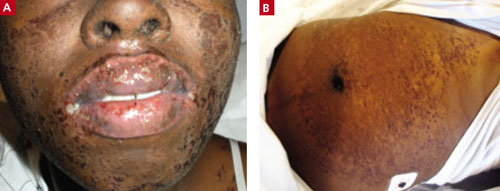
This 21-year-old patient had swollen lips and a rash that hurt “like a sunburn.” She said that when she woke up that morning, her mouth was burning and her throat felt like it was “closing up.”
WHAT IS THE MOST LIKELY EXPLANATION FOR HER CONDITION?
Stevens-Johnson syndrome
A painful rash involving mucous membranes, along with fever, should alert the clinician to the possibility of Stevens-Johnson syndrome (SJS) or toxic epidermal necrolysis (TEN). The 2 conditions are distinguished by how much of the body surface area (BSA) is involved: If the rash covers <10% of the BSA (as it did with our patient), the condition is called SJS; if >90%, it’s referred to as TEN.1 Skin involvement that falls between these 2 parameters is referred to as SJS/TEN overlap syndrome.
Mucous membranes are involved in more than 90% of SJS cases and in virtually all cases of TEN.1 Illnesses on this spectrum typically start with prodromal fever and malaise, followed by the onset of a maculopapular rash. The rash then becomes vesicular and eventually progresses to desquamation and epidermal necrolysis.2
Common inciting factors. SJS/TEN is most commonly caused by an infection or a reaction to medication. In adults, medication reaction is the more common etiology. In children, medications are still the leading cause but a larger proportion of pediatric cases are associated with infection. Multiple drug classifications can lead to the disorder, including anti-gout agents, anti-epileptics, nonsteroidal anti-inflammatory drugs (NSAIDs), and certain antibiotics—sulfonamides, penicillins, and cephalosporins (TABLE).3
TABLE
Agents implicated in SJS/TEN
| Allopurinol |
| Amoxicillin |
| Ampicillin |
| Lamotrigine |
| Phenylbutazone |
| Piroxicam |
| Sulfadiazine |
| Trimethoprim/sulfamethoxazole |
| SJS/TEN, Stevens-Johnson syndrome/toxic epidermal necrolysis. Adapted from: Sharma VK et al. Indian J Dermatol Venerol Leprol. 2008.3 |
Slow metabolizers may be at risk
The pathophysiology that underlies these conditions is not entirely understood. Recent research indicates a possible role of granulysin, a product of cytotoxic T and natural killer cells.4 People with slow medication metabolism due to lower rates of N-acetylation may be at increased risk because of the greater accumulation of potentially toxic metabolites.5
In addition, the risk for SJS/TEN is 3 times higher in patients who are positive for human immunodeficiency virus (HIV). If an HIV patient is exposed to Bactrim—the off ending agent in this case—the relative risk increases to 40-fold.6 (Our patient was not infected with HIV.)
Other conditions associated with higher risk are malignancy, systemic lupus erythematosus (SLE), rapid titration or high doses of medication, and radiation exposure. Patients with HLA B 1502 haplotype are at increased risk when exposed to aromatic anticonvulsant agents, such as phenobarbital and phenytoin.7
The differential was large, but the diagnosis was clear
Conditions with a presentation similar to SJS/ TEN include erythema multiforme, erythematous drug reaction, pustular drug eruptions, sunburn, toxic shock syndrome, staphylococcal scalded skin syndrome, and paraneoplastic pemphigus.
While the differential diagnosis for acute rash is large, the diagnosis in this case was clear because of the combination of prodromal symptoms, pain that was out of proportion to the appearance of the skin, and skin sloughing. In addition, a classic inciting drug (Bactrim) was easily identified and the timing of the drug exposure—1 to 3 weeks before the onset of the rash—was consistent with SJS/ TEN. Sparing of the palms and soles helped us differentiate SJS/TEN from toxic shock syndrome.
Why so long to diagnosis?
We suspected that the diagnosis was missed during our patient’s earlier ED visits because she initially had nonspecific symptoms and did not have mucosal involvement early on. Further complicating matters: She went to multiple EDs.
Labwork is of limited value
No laboratory values or pathologic tests are pathognomonic for SJS/TEN. Anemia and lymphopenia are possible findings, and neutropenia is an indicator for a poor prognosis.8 Elevated liver enzymes are common, reaching levels approximately 2 to 3 times the upper limit of normal.8 All of these laboratory findings become increasingly more likely as BSA involved increases.8 Our patient’s laboratory values were unremarkable.
Tx: Discontinue drug, replace fluids
This syndrome is potentially deadly and must be treated as an emergency as soon as it is recognized. The mortality rate is 1% to 3% for SJS and 25% to 35% for TEN.9
Discontinuing the causative agent is the first step in treatment. In our patient’s case, Bactrim had been discontinued before she came to our ED. The next step, ideally, is to transfer the patient to a burn unit where she can receive the same type of supportive care burn victims require. Diligent wound care, fluid replacement, electrolyte monitoring, and raised ambient temperature are vital elements in proper care. The patient should also be evaluated throughout the treatment period for any ocular involvement, such as conjunctivitis, keratitis, or severe dryness.10
As is the case with burn victims, the major risks are secondary infection and sepsis. Skin, blood, and access-line cultures should be gathered throughout the hospitalization to evaluate for infection. Some authorities believe glucocorticoids are helpful in children with SJS/TEN, but the adverse effects are sufficiently significant that the risks may outweigh the benefits. In adults, the evidence favors the use of glucocorticoids in SJS, but not in TEN, where the increased risk of sepsis following immunosuppression may outweigh the benefits.11
Intravenous immunoglobulin (IVIG) may benefit both children and adults, and the benefit appears to outweigh risks associated with this therapy.12 Plasmaphoresis to remove toxic metabolites from the circulation is an additional treatment option, but there is no strong evidence to support this approach.13
A positive outcome for our patient
Our patient was transferred to a facility with an inpatient burn unit and a consulting dermatology service. She was maintained on steroids, but neither plasmapheresis nor IVIG was necessary.
She was discharged to her home with prescriptions for topical emollients and an oral steroid solution for her mouth irritation. Systemic steroids were not continued, as the relatively small area of desquamation made this unnecessary.
Staying safe hinges on education. Our patient was advised that going forward, she needed to avoid Bactrim and any other sulfa drugs. She was told that when medications are prescribed for her in the future, she must consult with the pharmacist to make sure sulfonamides are not included.11
CORRESPONDENCE Bryan Cairns, MD, 2123 Auburn Avenue, Cincinnati, OH 45219; Bryancairns@gmail.com
1. Bastuji-Garin S, Rzany B, Stern RS, et al. Clinical classification of cases of toxic epidermal necrolysis, Stevens-Johnson syndrome, and erythema multiforme. Arch Dermatol. 1993;129:92-96.
2. Roujeau JC, Stern RS. Severe adverse cutaneous reactions to drugs. N Engl J Med. 1994;331:1272-1285.
3. Sharma VK, Sethuraman G, Minz A. Stevens Johnson syndrome, toxic epidermal necrolysis, and SJS-TEN overlap: a retrospective study of causative drugs and clinical outcome. Indian J Dermatol Venereol Leprol. 2008;74:238-240.
4. Chung WH, Hung SI, Yang JY, et al. Granulysin is a key mediator for disseminated keratinocyte death in Stevens-Johnson syndrome and toxic epidermal necrolysis. Nat Med. 2008;14:1343-1350.
5. Dietrich A, Kawakubo Y, Rzany B, et al. Low N-acetylating capacity in patients with Stevens-Johnson syndrome and toxic epidermal necrolysis. Exp Dermatol. 1995;4:313-316.
6. Rotunda A, Hirsch RJ, Scheinfeld N, et al. Severe cutaneous reactions associated with the use of human immunodeficiency virus medications. Acta Derm Venerol. 2003;83:1-9.
7. US Food and Drug administration. Information for healthcare professionals: dangerous or even fatal skin reactions—carbamazepine (marketed as Carbatrol, Equetro, Tegretol, and generics). Available at: http://www.fda.gov/Drugs/DrugSafety/PostmarketdrugsafetyinformationforPatientsandProviders/ucm124718.htm. Page last updated: January 25, 2010. Accessed December 20, 2010.
8. Roujeau JC, Chosidow O, Saiag P, et al. Toxic epidermal necrolysis (Lyell syndrome). J Am Acad Dermatol. 1990;23:1039-1058.
9. Letko E, Papaliodis GN, Daoud YJ, et al. Stevens-Johnson syndrome and toxic epidermal necrolysis: a review of the literature. Ann Allergy Asthma Immunol. 2005;94:419-436.
10. Williams PM, Conklin RJ. Erythema multiforme: a review and contrast from Stevens-Johnson syndrome/toxic epidermal necrolysis. Dent Clin North Am. 2005;49:67-76, viii.
11. Nirken M, High W. Stevens-Johnson syndrome and toxic epidermal necrolysis: clinical manifestations, pathogenesis, and diagnosis. In: Ofori A, Levy M, Adkinson NF, eds. UpToDate [online database]. Version 18.2. Waltham, Mass: UpToDate; 2010.
12. French LE, Trent JT, Kerdel FA. Use of intravenous immunoglobulin in toxic epidermal necrolysis and Stevens-Johnson syndrome: our current understanding. Int Immunopharmacol. 2006;6:543-549.
13. Furubacke A, Berlin G, Anderson C, et al. Lack of significant treatment effect of plasma exchange in the treatment of drug-induced toxic epidermal necrolysis? Intensive Care Med. 1999;25:1307-1310.
• Ask about inciting factors for SJS/TEN— anti-gout agents, anti-epileptics, NSAIDs, sulfonamides, penicillins, and cephalosporins—when a patient seeks care for a painful rash involving mucous membranes.
• Rule out look-alike conditions, including erythema multiforme, sunburn, toxic shock syndrome, staphylococcal scalded skin syndrome, and paraneoplastic pemphigus.
• Withdraw the causative agent as the first step in the treatment of SJS/TEN.
• Refer patients with SJS/TEN to a burn unit for supportive treatment, including wound care, fluid replacement, and electrolyte and ocular monitoring.
CASE A 21-year-old woman sought care at our emergency department (ED) for an extensive rash that began approximately 1 week earlier and hurt “like a sunburn.” She said that 2 weeks earlier, she’d been seen at another hospital for an incision and drainage of a thigh abscess. She was started on sulfamethoxazole/trimethoprim (Bactrim) at that time.
She returned to that ED several times, complaining of headache and fever, then went to a different ED because her lips were swollen and she was developing a rash (FIGURES 1A AND 1B). Initially the rash was red, slightly rough, and covered most of her body (except for her palms and soles). Providers at the second ED discontinued the Bactrim, started her on a course of steroids by mouth, and sent her home.
On this particular morning, she woke up feeling that her mouth was burning and her throat was “closing up.” She was admitted to our intensive care unit (ICU) for monitoring of respiratory compromise related to angioedema. She did not require intubation, but her skin began to desquamate.
FIGURE 1
Swollen lips and rash
This 21-year-old patient had swollen lips and a rash that hurt “like a sunburn.” She said that when she woke up that morning, her mouth was burning and her throat felt like it was “closing up.”
WHAT IS THE MOST LIKELY EXPLANATION FOR HER CONDITION?
Stevens-Johnson syndrome
A painful rash involving mucous membranes, along with fever, should alert the clinician to the possibility of Stevens-Johnson syndrome (SJS) or toxic epidermal necrolysis (TEN). The 2 conditions are distinguished by how much of the body surface area (BSA) is involved: If the rash covers <10% of the BSA (as it did with our patient), the condition is called SJS; if >90%, it’s referred to as TEN.1 Skin involvement that falls between these 2 parameters is referred to as SJS/TEN overlap syndrome.
Mucous membranes are involved in more than 90% of SJS cases and in virtually all cases of TEN.1 Illnesses on this spectrum typically start with prodromal fever and malaise, followed by the onset of a maculopapular rash. The rash then becomes vesicular and eventually progresses to desquamation and epidermal necrolysis.2
Common inciting factors. SJS/TEN is most commonly caused by an infection or a reaction to medication. In adults, medication reaction is the more common etiology. In children, medications are still the leading cause but a larger proportion of pediatric cases are associated with infection. Multiple drug classifications can lead to the disorder, including anti-gout agents, anti-epileptics, nonsteroidal anti-inflammatory drugs (NSAIDs), and certain antibiotics—sulfonamides, penicillins, and cephalosporins (TABLE).3
TABLE
Agents implicated in SJS/TEN
| Allopurinol |
| Amoxicillin |
| Ampicillin |
| Lamotrigine |
| Phenylbutazone |
| Piroxicam |
| Sulfadiazine |
| Trimethoprim/sulfamethoxazole |
| SJS/TEN, Stevens-Johnson syndrome/toxic epidermal necrolysis. Adapted from: Sharma VK et al. Indian J Dermatol Venerol Leprol. 2008.3 |
Slow metabolizers may be at risk
The pathophysiology that underlies these conditions is not entirely understood. Recent research indicates a possible role of granulysin, a product of cytotoxic T and natural killer cells.4 People with slow medication metabolism due to lower rates of N-acetylation may be at increased risk because of the greater accumulation of potentially toxic metabolites.5
In addition, the risk for SJS/TEN is 3 times higher in patients who are positive for human immunodeficiency virus (HIV). If an HIV patient is exposed to Bactrim—the off ending agent in this case—the relative risk increases to 40-fold.6 (Our patient was not infected with HIV.)
Other conditions associated with higher risk are malignancy, systemic lupus erythematosus (SLE), rapid titration or high doses of medication, and radiation exposure. Patients with HLA B 1502 haplotype are at increased risk when exposed to aromatic anticonvulsant agents, such as phenobarbital and phenytoin.7
The differential was large, but the diagnosis was clear
Conditions with a presentation similar to SJS/ TEN include erythema multiforme, erythematous drug reaction, pustular drug eruptions, sunburn, toxic shock syndrome, staphylococcal scalded skin syndrome, and paraneoplastic pemphigus.
While the differential diagnosis for acute rash is large, the diagnosis in this case was clear because of the combination of prodromal symptoms, pain that was out of proportion to the appearance of the skin, and skin sloughing. In addition, a classic inciting drug (Bactrim) was easily identified and the timing of the drug exposure—1 to 3 weeks before the onset of the rash—was consistent with SJS/ TEN. Sparing of the palms and soles helped us differentiate SJS/TEN from toxic shock syndrome.
Why so long to diagnosis?
We suspected that the diagnosis was missed during our patient’s earlier ED visits because she initially had nonspecific symptoms and did not have mucosal involvement early on. Further complicating matters: She went to multiple EDs.
Labwork is of limited value
No laboratory values or pathologic tests are pathognomonic for SJS/TEN. Anemia and lymphopenia are possible findings, and neutropenia is an indicator for a poor prognosis.8 Elevated liver enzymes are common, reaching levels approximately 2 to 3 times the upper limit of normal.8 All of these laboratory findings become increasingly more likely as BSA involved increases.8 Our patient’s laboratory values were unremarkable.
Tx: Discontinue drug, replace fluids
This syndrome is potentially deadly and must be treated as an emergency as soon as it is recognized. The mortality rate is 1% to 3% for SJS and 25% to 35% for TEN.9
Discontinuing the causative agent is the first step in treatment. In our patient’s case, Bactrim had been discontinued before she came to our ED. The next step, ideally, is to transfer the patient to a burn unit where she can receive the same type of supportive care burn victims require. Diligent wound care, fluid replacement, electrolyte monitoring, and raised ambient temperature are vital elements in proper care. The patient should also be evaluated throughout the treatment period for any ocular involvement, such as conjunctivitis, keratitis, or severe dryness.10
As is the case with burn victims, the major risks are secondary infection and sepsis. Skin, blood, and access-line cultures should be gathered throughout the hospitalization to evaluate for infection. Some authorities believe glucocorticoids are helpful in children with SJS/TEN, but the adverse effects are sufficiently significant that the risks may outweigh the benefits. In adults, the evidence favors the use of glucocorticoids in SJS, but not in TEN, where the increased risk of sepsis following immunosuppression may outweigh the benefits.11
Intravenous immunoglobulin (IVIG) may benefit both children and adults, and the benefit appears to outweigh risks associated with this therapy.12 Plasmaphoresis to remove toxic metabolites from the circulation is an additional treatment option, but there is no strong evidence to support this approach.13
A positive outcome for our patient
Our patient was transferred to a facility with an inpatient burn unit and a consulting dermatology service. She was maintained on steroids, but neither plasmapheresis nor IVIG was necessary.
She was discharged to her home with prescriptions for topical emollients and an oral steroid solution for her mouth irritation. Systemic steroids were not continued, as the relatively small area of desquamation made this unnecessary.
Staying safe hinges on education. Our patient was advised that going forward, she needed to avoid Bactrim and any other sulfa drugs. She was told that when medications are prescribed for her in the future, she must consult with the pharmacist to make sure sulfonamides are not included.11
CORRESPONDENCE Bryan Cairns, MD, 2123 Auburn Avenue, Cincinnati, OH 45219; Bryancairns@gmail.com
• Ask about inciting factors for SJS/TEN— anti-gout agents, anti-epileptics, NSAIDs, sulfonamides, penicillins, and cephalosporins—when a patient seeks care for a painful rash involving mucous membranes.
• Rule out look-alike conditions, including erythema multiforme, sunburn, toxic shock syndrome, staphylococcal scalded skin syndrome, and paraneoplastic pemphigus.
• Withdraw the causative agent as the first step in the treatment of SJS/TEN.
• Refer patients with SJS/TEN to a burn unit for supportive treatment, including wound care, fluid replacement, and electrolyte and ocular monitoring.
CASE A 21-year-old woman sought care at our emergency department (ED) for an extensive rash that began approximately 1 week earlier and hurt “like a sunburn.” She said that 2 weeks earlier, she’d been seen at another hospital for an incision and drainage of a thigh abscess. She was started on sulfamethoxazole/trimethoprim (Bactrim) at that time.
She returned to that ED several times, complaining of headache and fever, then went to a different ED because her lips were swollen and she was developing a rash (FIGURES 1A AND 1B). Initially the rash was red, slightly rough, and covered most of her body (except for her palms and soles). Providers at the second ED discontinued the Bactrim, started her on a course of steroids by mouth, and sent her home.
On this particular morning, she woke up feeling that her mouth was burning and her throat was “closing up.” She was admitted to our intensive care unit (ICU) for monitoring of respiratory compromise related to angioedema. She did not require intubation, but her skin began to desquamate.
FIGURE 1
Swollen lips and rash
This 21-year-old patient had swollen lips and a rash that hurt “like a sunburn.” She said that when she woke up that morning, her mouth was burning and her throat felt like it was “closing up.”
WHAT IS THE MOST LIKELY EXPLANATION FOR HER CONDITION?
Stevens-Johnson syndrome
A painful rash involving mucous membranes, along with fever, should alert the clinician to the possibility of Stevens-Johnson syndrome (SJS) or toxic epidermal necrolysis (TEN). The 2 conditions are distinguished by how much of the body surface area (BSA) is involved: If the rash covers <10% of the BSA (as it did with our patient), the condition is called SJS; if >90%, it’s referred to as TEN.1 Skin involvement that falls between these 2 parameters is referred to as SJS/TEN overlap syndrome.
Mucous membranes are involved in more than 90% of SJS cases and in virtually all cases of TEN.1 Illnesses on this spectrum typically start with prodromal fever and malaise, followed by the onset of a maculopapular rash. The rash then becomes vesicular and eventually progresses to desquamation and epidermal necrolysis.2
Common inciting factors. SJS/TEN is most commonly caused by an infection or a reaction to medication. In adults, medication reaction is the more common etiology. In children, medications are still the leading cause but a larger proportion of pediatric cases are associated with infection. Multiple drug classifications can lead to the disorder, including anti-gout agents, anti-epileptics, nonsteroidal anti-inflammatory drugs (NSAIDs), and certain antibiotics—sulfonamides, penicillins, and cephalosporins (TABLE).3
TABLE
Agents implicated in SJS/TEN
| Allopurinol |
| Amoxicillin |
| Ampicillin |
| Lamotrigine |
| Phenylbutazone |
| Piroxicam |
| Sulfadiazine |
| Trimethoprim/sulfamethoxazole |
| SJS/TEN, Stevens-Johnson syndrome/toxic epidermal necrolysis. Adapted from: Sharma VK et al. Indian J Dermatol Venerol Leprol. 2008.3 |
Slow metabolizers may be at risk
The pathophysiology that underlies these conditions is not entirely understood. Recent research indicates a possible role of granulysin, a product of cytotoxic T and natural killer cells.4 People with slow medication metabolism due to lower rates of N-acetylation may be at increased risk because of the greater accumulation of potentially toxic metabolites.5
In addition, the risk for SJS/TEN is 3 times higher in patients who are positive for human immunodeficiency virus (HIV). If an HIV patient is exposed to Bactrim—the off ending agent in this case—the relative risk increases to 40-fold.6 (Our patient was not infected with HIV.)
Other conditions associated with higher risk are malignancy, systemic lupus erythematosus (SLE), rapid titration or high doses of medication, and radiation exposure. Patients with HLA B 1502 haplotype are at increased risk when exposed to aromatic anticonvulsant agents, such as phenobarbital and phenytoin.7
The differential was large, but the diagnosis was clear
Conditions with a presentation similar to SJS/ TEN include erythema multiforme, erythematous drug reaction, pustular drug eruptions, sunburn, toxic shock syndrome, staphylococcal scalded skin syndrome, and paraneoplastic pemphigus.
While the differential diagnosis for acute rash is large, the diagnosis in this case was clear because of the combination of prodromal symptoms, pain that was out of proportion to the appearance of the skin, and skin sloughing. In addition, a classic inciting drug (Bactrim) was easily identified and the timing of the drug exposure—1 to 3 weeks before the onset of the rash—was consistent with SJS/ TEN. Sparing of the palms and soles helped us differentiate SJS/TEN from toxic shock syndrome.
Why so long to diagnosis?
We suspected that the diagnosis was missed during our patient’s earlier ED visits because she initially had nonspecific symptoms and did not have mucosal involvement early on. Further complicating matters: She went to multiple EDs.
Labwork is of limited value
No laboratory values or pathologic tests are pathognomonic for SJS/TEN. Anemia and lymphopenia are possible findings, and neutropenia is an indicator for a poor prognosis.8 Elevated liver enzymes are common, reaching levels approximately 2 to 3 times the upper limit of normal.8 All of these laboratory findings become increasingly more likely as BSA involved increases.8 Our patient’s laboratory values were unremarkable.
Tx: Discontinue drug, replace fluids
This syndrome is potentially deadly and must be treated as an emergency as soon as it is recognized. The mortality rate is 1% to 3% for SJS and 25% to 35% for TEN.9
Discontinuing the causative agent is the first step in treatment. In our patient’s case, Bactrim had been discontinued before she came to our ED. The next step, ideally, is to transfer the patient to a burn unit where she can receive the same type of supportive care burn victims require. Diligent wound care, fluid replacement, electrolyte monitoring, and raised ambient temperature are vital elements in proper care. The patient should also be evaluated throughout the treatment period for any ocular involvement, such as conjunctivitis, keratitis, or severe dryness.10
As is the case with burn victims, the major risks are secondary infection and sepsis. Skin, blood, and access-line cultures should be gathered throughout the hospitalization to evaluate for infection. Some authorities believe glucocorticoids are helpful in children with SJS/TEN, but the adverse effects are sufficiently significant that the risks may outweigh the benefits. In adults, the evidence favors the use of glucocorticoids in SJS, but not in TEN, where the increased risk of sepsis following immunosuppression may outweigh the benefits.11
Intravenous immunoglobulin (IVIG) may benefit both children and adults, and the benefit appears to outweigh risks associated with this therapy.12 Plasmaphoresis to remove toxic metabolites from the circulation is an additional treatment option, but there is no strong evidence to support this approach.13
A positive outcome for our patient
Our patient was transferred to a facility with an inpatient burn unit and a consulting dermatology service. She was maintained on steroids, but neither plasmapheresis nor IVIG was necessary.
She was discharged to her home with prescriptions for topical emollients and an oral steroid solution for her mouth irritation. Systemic steroids were not continued, as the relatively small area of desquamation made this unnecessary.
Staying safe hinges on education. Our patient was advised that going forward, she needed to avoid Bactrim and any other sulfa drugs. She was told that when medications are prescribed for her in the future, she must consult with the pharmacist to make sure sulfonamides are not included.11
CORRESPONDENCE Bryan Cairns, MD, 2123 Auburn Avenue, Cincinnati, OH 45219; Bryancairns@gmail.com
1. Bastuji-Garin S, Rzany B, Stern RS, et al. Clinical classification of cases of toxic epidermal necrolysis, Stevens-Johnson syndrome, and erythema multiforme. Arch Dermatol. 1993;129:92-96.
2. Roujeau JC, Stern RS. Severe adverse cutaneous reactions to drugs. N Engl J Med. 1994;331:1272-1285.
3. Sharma VK, Sethuraman G, Minz A. Stevens Johnson syndrome, toxic epidermal necrolysis, and SJS-TEN overlap: a retrospective study of causative drugs and clinical outcome. Indian J Dermatol Venereol Leprol. 2008;74:238-240.
4. Chung WH, Hung SI, Yang JY, et al. Granulysin is a key mediator for disseminated keratinocyte death in Stevens-Johnson syndrome and toxic epidermal necrolysis. Nat Med. 2008;14:1343-1350.
5. Dietrich A, Kawakubo Y, Rzany B, et al. Low N-acetylating capacity in patients with Stevens-Johnson syndrome and toxic epidermal necrolysis. Exp Dermatol. 1995;4:313-316.
6. Rotunda A, Hirsch RJ, Scheinfeld N, et al. Severe cutaneous reactions associated with the use of human immunodeficiency virus medications. Acta Derm Venerol. 2003;83:1-9.
7. US Food and Drug administration. Information for healthcare professionals: dangerous or even fatal skin reactions—carbamazepine (marketed as Carbatrol, Equetro, Tegretol, and generics). Available at: http://www.fda.gov/Drugs/DrugSafety/PostmarketdrugsafetyinformationforPatientsandProviders/ucm124718.htm. Page last updated: January 25, 2010. Accessed December 20, 2010.
8. Roujeau JC, Chosidow O, Saiag P, et al. Toxic epidermal necrolysis (Lyell syndrome). J Am Acad Dermatol. 1990;23:1039-1058.
9. Letko E, Papaliodis GN, Daoud YJ, et al. Stevens-Johnson syndrome and toxic epidermal necrolysis: a review of the literature. Ann Allergy Asthma Immunol. 2005;94:419-436.
10. Williams PM, Conklin RJ. Erythema multiforme: a review and contrast from Stevens-Johnson syndrome/toxic epidermal necrolysis. Dent Clin North Am. 2005;49:67-76, viii.
11. Nirken M, High W. Stevens-Johnson syndrome and toxic epidermal necrolysis: clinical manifestations, pathogenesis, and diagnosis. In: Ofori A, Levy M, Adkinson NF, eds. UpToDate [online database]. Version 18.2. Waltham, Mass: UpToDate; 2010.
12. French LE, Trent JT, Kerdel FA. Use of intravenous immunoglobulin in toxic epidermal necrolysis and Stevens-Johnson syndrome: our current understanding. Int Immunopharmacol. 2006;6:543-549.
13. Furubacke A, Berlin G, Anderson C, et al. Lack of significant treatment effect of plasma exchange in the treatment of drug-induced toxic epidermal necrolysis? Intensive Care Med. 1999;25:1307-1310.
1. Bastuji-Garin S, Rzany B, Stern RS, et al. Clinical classification of cases of toxic epidermal necrolysis, Stevens-Johnson syndrome, and erythema multiforme. Arch Dermatol. 1993;129:92-96.
2. Roujeau JC, Stern RS. Severe adverse cutaneous reactions to drugs. N Engl J Med. 1994;331:1272-1285.
3. Sharma VK, Sethuraman G, Minz A. Stevens Johnson syndrome, toxic epidermal necrolysis, and SJS-TEN overlap: a retrospective study of causative drugs and clinical outcome. Indian J Dermatol Venereol Leprol. 2008;74:238-240.
4. Chung WH, Hung SI, Yang JY, et al. Granulysin is a key mediator for disseminated keratinocyte death in Stevens-Johnson syndrome and toxic epidermal necrolysis. Nat Med. 2008;14:1343-1350.
5. Dietrich A, Kawakubo Y, Rzany B, et al. Low N-acetylating capacity in patients with Stevens-Johnson syndrome and toxic epidermal necrolysis. Exp Dermatol. 1995;4:313-316.
6. Rotunda A, Hirsch RJ, Scheinfeld N, et al. Severe cutaneous reactions associated with the use of human immunodeficiency virus medications. Acta Derm Venerol. 2003;83:1-9.
7. US Food and Drug administration. Information for healthcare professionals: dangerous or even fatal skin reactions—carbamazepine (marketed as Carbatrol, Equetro, Tegretol, and generics). Available at: http://www.fda.gov/Drugs/DrugSafety/PostmarketdrugsafetyinformationforPatientsandProviders/ucm124718.htm. Page last updated: January 25, 2010. Accessed December 20, 2010.
8. Roujeau JC, Chosidow O, Saiag P, et al. Toxic epidermal necrolysis (Lyell syndrome). J Am Acad Dermatol. 1990;23:1039-1058.
9. Letko E, Papaliodis GN, Daoud YJ, et al. Stevens-Johnson syndrome and toxic epidermal necrolysis: a review of the literature. Ann Allergy Asthma Immunol. 2005;94:419-436.
10. Williams PM, Conklin RJ. Erythema multiforme: a review and contrast from Stevens-Johnson syndrome/toxic epidermal necrolysis. Dent Clin North Am. 2005;49:67-76, viii.
11. Nirken M, High W. Stevens-Johnson syndrome and toxic epidermal necrolysis: clinical manifestations, pathogenesis, and diagnosis. In: Ofori A, Levy M, Adkinson NF, eds. UpToDate [online database]. Version 18.2. Waltham, Mass: UpToDate; 2010.
12. French LE, Trent JT, Kerdel FA. Use of intravenous immunoglobulin in toxic epidermal necrolysis and Stevens-Johnson syndrome: our current understanding. Int Immunopharmacol. 2006;6:543-549.
13. Furubacke A, Berlin G, Anderson C, et al. Lack of significant treatment effect of plasma exchange in the treatment of drug-induced toxic epidermal necrolysis? Intensive Care Med. 1999;25:1307-1310.