User login
Bringing you the latest news, research and reviews, exclusive interviews, podcasts, quizzes, and more.
Powered by CHEST Physician, Clinician Reviews, MDedge Family Medicine, Internal Medicine News, and The Journal of Clinical Outcomes Management.
Surgeon General report links smoking to diseases beyond cancer
While smoking rates have dropped precipitously since the landmark 1964 Surgeon General’s report, "Smoking and Health," smoking is still the leading cause of preventable disease and death in the United States and is now causally linked to additional diseases and conditions across most organ systems.
A new Surgeon General's report, "The Health Consequences of Smoking – 50 Years of Progress," released at a White House event Jan. 17, synthesizes original and review evidence in an effort to further federal antismoking efforts.

The report causally links cigarette smoking to type 2 diabetes, rheumatoid arthritis, ectopic pregnancy, and erectile dysfunction. Secondhand smoke is now causally linked to cancers, respiratory diseases, and cardiovascular diseases, as well as adverse effects on the health of children, the authors wrote.
In addition, the 980-page report establishes that secondhand smoke is a cause of stroke, and that smoking increases the risk of dying in cancer patients and cancer survivors.
Another finding: Cigarette smokers today have a higher risk of lung cancer than did those who smoked in 1964, because of the higher number of chemical additives now used.
Women smokers now have the same risk of death from lung cancer as that of men and a higher relative risk of dying from coronary heart disease than that of men. Because of smoking, the number of women dying from chronic obstructive pulmonary disease (COPD) is now higher than in men.
With this report, the federal government is launching a new effort to prevent children from using tobacco.

"Today, we’re asking Americans to join a sustained effort to make the next generation a tobacco-free generation," Health and Human Services Secretary Kathleen Sebelius said in a statement. "This is not something the federal government can do alone. We need to partner with the business community, local elected officials, schools and universities, the medical community, the faith community, and committed citizens in communities across the country to make the next generation tobacco free."
The report finds that youth smoking rates declined by 50% between 1997 and 2011, but 3,200 children under age 18 still start smoking each day, and an additional 2,100 youth and young adults become daily smokers. The report places most of the blame for continued interest in smoking on the tobacco industry, saying it has used "aggressive strategies" to deliberately mislead the public about the harms of smoking.
Acting Surgeon General Boris Lushniak noted that smoking rates are disproportionately higher among people with less education and lower incomes, among the mentally ill, and among gay, lesbian, bisexual, and transgender individuals.
Dr. Lushniak and other officials at the White House event called for greater tobacco control efforts, including stricter regulation. The Food and Drug Administration was given the power to regulate tobacco through the 2009 Family Smoking Prevention and Tobacco Control Act.

FDA Commissioner Margaret Hamburg said that the agency is ready to take action.
"The FDA is funding and conducting regulatory science research on tobacco products, enforcing the laws that reduce the access and attractiveness of tobacco products to young people, and preparing to launch an unprecedented national public education campaign to prevent youth tobacco use," Dr. Hamburg said in a statement.
Dr. Thomas R. Frieden, director of the Centers for Disease Control and Prevention, noted that while states collect some $80 per person a year in tobacco taxes and payments from the 1998 tobacco industry master settlement agreement, they spend an average of $1.50 per person on control.
The CDC has urged states to spend $12 per person on control, Dr. Frieden said.
Dr. Lushniak noted that for current and about-to-start smokers, "the clock is ticking – they can’t wait for slow and steady progress to end the epidemic. Enough is enough."
On Twitter @aliciaault
While smoking rates have dropped precipitously since the landmark 1964 Surgeon General’s report, "Smoking and Health," smoking is still the leading cause of preventable disease and death in the United States and is now causally linked to additional diseases and conditions across most organ systems.
A new Surgeon General's report, "The Health Consequences of Smoking – 50 Years of Progress," released at a White House event Jan. 17, synthesizes original and review evidence in an effort to further federal antismoking efforts.
The report causally links cigarette smoking to type 2 diabetes, rheumatoid arthritis, ectopic pregnancy, and erectile dysfunction. Secondhand smoke is now causally linked to cancers, respiratory diseases, and cardiovascular diseases, as well as adverse effects on the health of children, the authors wrote.
In addition, the 980-page report establishes that secondhand smoke is a cause of stroke, and that smoking increases the risk of dying in cancer patients and cancer survivors.
Another finding: Cigarette smokers today have a higher risk of lung cancer than did those who smoked in 1964, because of the higher number of chemical additives now used.
Women smokers now have the same risk of death from lung cancer as that of men and a higher relative risk of dying from coronary heart disease than that of men. Because of smoking, the number of women dying from chronic obstructive pulmonary disease (COPD) is now higher than in men.
With this report, the federal government is launching a new effort to prevent children from using tobacco.
"Today, we’re asking Americans to join a sustained effort to make the next generation a tobacco-free generation," Health and Human Services Secretary Kathleen Sebelius said in a statement. "This is not something the federal government can do alone. We need to partner with the business community, local elected officials, schools and universities, the medical community, the faith community, and committed citizens in communities across the country to make the next generation tobacco free."
The report finds that youth smoking rates declined by 50% between 1997 and 2011, but 3,200 children under age 18 still start smoking each day, and an additional 2,100 youth and young adults become daily smokers. The report places most of the blame for continued interest in smoking on the tobacco industry, saying it has used "aggressive strategies" to deliberately mislead the public about the harms of smoking.
Acting Surgeon General Boris Lushniak noted that smoking rates are disproportionately higher among people with less education and lower incomes, among the mentally ill, and among gay, lesbian, bisexual, and transgender individuals.
Dr. Lushniak and other officials at the White House event called for greater tobacco control efforts, including stricter regulation. The Food and Drug Administration was given the power to regulate tobacco through the 2009 Family Smoking Prevention and Tobacco Control Act.
FDA Commissioner Margaret Hamburg said that the agency is ready to take action.
"The FDA is funding and conducting regulatory science research on tobacco products, enforcing the laws that reduce the access and attractiveness of tobacco products to young people, and preparing to launch an unprecedented national public education campaign to prevent youth tobacco use," Dr. Hamburg said in a statement.
Dr. Thomas R. Frieden, director of the Centers for Disease Control and Prevention, noted that while states collect some $80 per person a year in tobacco taxes and payments from the 1998 tobacco industry master settlement agreement, they spend an average of $1.50 per person on control.
The CDC has urged states to spend $12 per person on control, Dr. Frieden said.
Dr. Lushniak noted that for current and about-to-start smokers, "the clock is ticking – they can’t wait for slow and steady progress to end the epidemic. Enough is enough."
On Twitter @aliciaault
While smoking rates have dropped precipitously since the landmark 1964 Surgeon General’s report, "Smoking and Health," smoking is still the leading cause of preventable disease and death in the United States and is now causally linked to additional diseases and conditions across most organ systems.
A new Surgeon General's report, "The Health Consequences of Smoking – 50 Years of Progress," released at a White House event Jan. 17, synthesizes original and review evidence in an effort to further federal antismoking efforts.
The report causally links cigarette smoking to type 2 diabetes, rheumatoid arthritis, ectopic pregnancy, and erectile dysfunction. Secondhand smoke is now causally linked to cancers, respiratory diseases, and cardiovascular diseases, as well as adverse effects on the health of children, the authors wrote.
In addition, the 980-page report establishes that secondhand smoke is a cause of stroke, and that smoking increases the risk of dying in cancer patients and cancer survivors.
Another finding: Cigarette smokers today have a higher risk of lung cancer than did those who smoked in 1964, because of the higher number of chemical additives now used.
Women smokers now have the same risk of death from lung cancer as that of men and a higher relative risk of dying from coronary heart disease than that of men. Because of smoking, the number of women dying from chronic obstructive pulmonary disease (COPD) is now higher than in men.
With this report, the federal government is launching a new effort to prevent children from using tobacco.
"Today, we’re asking Americans to join a sustained effort to make the next generation a tobacco-free generation," Health and Human Services Secretary Kathleen Sebelius said in a statement. "This is not something the federal government can do alone. We need to partner with the business community, local elected officials, schools and universities, the medical community, the faith community, and committed citizens in communities across the country to make the next generation tobacco free."
The report finds that youth smoking rates declined by 50% between 1997 and 2011, but 3,200 children under age 18 still start smoking each day, and an additional 2,100 youth and young adults become daily smokers. The report places most of the blame for continued interest in smoking on the tobacco industry, saying it has used "aggressive strategies" to deliberately mislead the public about the harms of smoking.
Acting Surgeon General Boris Lushniak noted that smoking rates are disproportionately higher among people with less education and lower incomes, among the mentally ill, and among gay, lesbian, bisexual, and transgender individuals.
Dr. Lushniak and other officials at the White House event called for greater tobacco control efforts, including stricter regulation. The Food and Drug Administration was given the power to regulate tobacco through the 2009 Family Smoking Prevention and Tobacco Control Act.
FDA Commissioner Margaret Hamburg said that the agency is ready to take action.
"The FDA is funding and conducting regulatory science research on tobacco products, enforcing the laws that reduce the access and attractiveness of tobacco products to young people, and preparing to launch an unprecedented national public education campaign to prevent youth tobacco use," Dr. Hamburg said in a statement.
Dr. Thomas R. Frieden, director of the Centers for Disease Control and Prevention, noted that while states collect some $80 per person a year in tobacco taxes and payments from the 1998 tobacco industry master settlement agreement, they spend an average of $1.50 per person on control.
The CDC has urged states to spend $12 per person on control, Dr. Frieden said.
Dr. Lushniak noted that for current and about-to-start smokers, "the clock is ticking – they can’t wait for slow and steady progress to end the epidemic. Enough is enough."
On Twitter @aliciaault

Perception of safety spurs e-cigarette use in young adults
Debunking popular notions about electronic cigarettes – that they’re safer than real ones and help people quit smoking – might deter young adults from trying them, according to a study published online in the American Journal of Preventive Medicine.
They asked 1,379 20-somethings who had never tried e-cigarettes what they thought about the products, and then resurveyed the group a year later to see who had tried them.
More than 10% of those who thought e-cigarettes were less harmful than tobacco ones , but only 4.6% of those who did not, had tried e-cigarettes within a year (odds ratio, 2.34; 95% confidence interval, 1.49-3.69). Similarly, 10% who thought that e-cigarettes could help people quit smoking, but only 5.4% who did not, had tried them (OR, 1.98; 95% CI, 1.29-3.04). The results were adjusted for age, sex, education, and baseline smoking status (Am. J. Prev. Med. 2014;46:175-8).

The findings "suggest that messages about the lack of evidence on e-cigarettes being cessation aids, and the uncertainty of the risks associated with e-cigarette use" – addiction, pneumonia, heart failure, and so on – "may discourage young adults from experimenting with e-cigarettes," said investigators Kelvin Choi, Ph.D., of the National Institute on Minority Health and Health Disparities in Bethesda, Md., and Jean Forster, Ph.D., of the University of Minnesota, Minneapolis.
"Although a recent review of the literature on e-cigarettes suggests that [they] may be a viable reduced-harm alternative to cigarettes, previous studies have found that experimentation with e-cigarettes was not associated with intention to quit, making quit attempts, or smoking cessation," they said.
At the 1-year follow-up, 7.4% (102) of the sample reported trying e-cigarettes, including 2.9% (28) of baseline nonsmokers. Almost 22% (53) of smokers and 11.9% (21) of former smokers had, as well, meaning that almost 12% of people who said they had quit smoking at baseline were reintroduced to nicotine through e-cigarettes, the authors noted.

Participants were members of the Minnesota Adolescent Community Cohort. The study sample was split about evenly between men and women, and most of the subjects were white, which could limit the findings’ generalizability, the authors said. They also noted that since "smokers were more likely to drop out from the study, the prevalence of experimentation of e-cigarettes and potentially the associations between beliefs and subsequent e-cigarette experimentation could have been underestimated." A majority were enrolled in or graduated from a 4-year college.
E-cigarettes look like tobacco cigarettes but contain a device that heats liquid nicotine into a vapor, which is then inhaled.
The investigators have no disclosures. The work was funded by the National Cancer Institute.
Debunking popular notions about electronic cigarettes – that they’re safer than real ones and help people quit smoking – might deter young adults from trying them, according to a study published online in the American Journal of Preventive Medicine.
They asked 1,379 20-somethings who had never tried e-cigarettes what they thought about the products, and then resurveyed the group a year later to see who had tried them.
More than 10% of those who thought e-cigarettes were less harmful than tobacco ones , but only 4.6% of those who did not, had tried e-cigarettes within a year (odds ratio, 2.34; 95% confidence interval, 1.49-3.69). Similarly, 10% who thought that e-cigarettes could help people quit smoking, but only 5.4% who did not, had tried them (OR, 1.98; 95% CI, 1.29-3.04). The results were adjusted for age, sex, education, and baseline smoking status (Am. J. Prev. Med. 2014;46:175-8).
The findings "suggest that messages about the lack of evidence on e-cigarettes being cessation aids, and the uncertainty of the risks associated with e-cigarette use" – addiction, pneumonia, heart failure, and so on – "may discourage young adults from experimenting with e-cigarettes," said investigators Kelvin Choi, Ph.D., of the National Institute on Minority Health and Health Disparities in Bethesda, Md., and Jean Forster, Ph.D., of the University of Minnesota, Minneapolis.
"Although a recent review of the literature on e-cigarettes suggests that [they] may be a viable reduced-harm alternative to cigarettes, previous studies have found that experimentation with e-cigarettes was not associated with intention to quit, making quit attempts, or smoking cessation," they said.
At the 1-year follow-up, 7.4% (102) of the sample reported trying e-cigarettes, including 2.9% (28) of baseline nonsmokers. Almost 22% (53) of smokers and 11.9% (21) of former smokers had, as well, meaning that almost 12% of people who said they had quit smoking at baseline were reintroduced to nicotine through e-cigarettes, the authors noted.
Participants were members of the Minnesota Adolescent Community Cohort. The study sample was split about evenly between men and women, and most of the subjects were white, which could limit the findings’ generalizability, the authors said. They also noted that since "smokers were more likely to drop out from the study, the prevalence of experimentation of e-cigarettes and potentially the associations between beliefs and subsequent e-cigarette experimentation could have been underestimated." A majority were enrolled in or graduated from a 4-year college.
E-cigarettes look like tobacco cigarettes but contain a device that heats liquid nicotine into a vapor, which is then inhaled.
The investigators have no disclosures. The work was funded by the National Cancer Institute.
Debunking popular notions about electronic cigarettes – that they’re safer than real ones and help people quit smoking – might deter young adults from trying them, according to a study published online in the American Journal of Preventive Medicine.
They asked 1,379 20-somethings who had never tried e-cigarettes what they thought about the products, and then resurveyed the group a year later to see who had tried them.
More than 10% of those who thought e-cigarettes were less harmful than tobacco ones , but only 4.6% of those who did not, had tried e-cigarettes within a year (odds ratio, 2.34; 95% confidence interval, 1.49-3.69). Similarly, 10% who thought that e-cigarettes could help people quit smoking, but only 5.4% who did not, had tried them (OR, 1.98; 95% CI, 1.29-3.04). The results were adjusted for age, sex, education, and baseline smoking status (Am. J. Prev. Med. 2014;46:175-8).
The findings "suggest that messages about the lack of evidence on e-cigarettes being cessation aids, and the uncertainty of the risks associated with e-cigarette use" – addiction, pneumonia, heart failure, and so on – "may discourage young adults from experimenting with e-cigarettes," said investigators Kelvin Choi, Ph.D., of the National Institute on Minority Health and Health Disparities in Bethesda, Md., and Jean Forster, Ph.D., of the University of Minnesota, Minneapolis.
"Although a recent review of the literature on e-cigarettes suggests that [they] may be a viable reduced-harm alternative to cigarettes, previous studies have found that experimentation with e-cigarettes was not associated with intention to quit, making quit attempts, or smoking cessation," they said.
At the 1-year follow-up, 7.4% (102) of the sample reported trying e-cigarettes, including 2.9% (28) of baseline nonsmokers. Almost 22% (53) of smokers and 11.9% (21) of former smokers had, as well, meaning that almost 12% of people who said they had quit smoking at baseline were reintroduced to nicotine through e-cigarettes, the authors noted.
Participants were members of the Minnesota Adolescent Community Cohort. The study sample was split about evenly between men and women, and most of the subjects were white, which could limit the findings’ generalizability, the authors said. They also noted that since "smokers were more likely to drop out from the study, the prevalence of experimentation of e-cigarettes and potentially the associations between beliefs and subsequent e-cigarette experimentation could have been underestimated." A majority were enrolled in or graduated from a 4-year college.
E-cigarettes look like tobacco cigarettes but contain a device that heats liquid nicotine into a vapor, which is then inhaled.
The investigators have no disclosures. The work was funded by the National Cancer Institute.
THE AMERICAN JOURNAL OF PREVENTIVE MEDICINE
Major finding: More than 10% of young adults who think e-cigarettes are safer than the usual kind, but only 4.6% of those who do not, will try an e-cigarette within a year (OR, 2.34; 95% CI, 1.49-3.69).
Data source: Telephone surveys of 1,379 people in their 20s.
Disclosures: The investigators have no disclosures. The work was funded by the National Cancer Institute.
Oseltamivir suspension back in production
Manufacturing delays that led to a nationwide shortage of oseltamivir oral suspension have been resolved, according to a spokeswoman for Genentech, which makes the drug.
"We now anticipate having sufficient supply of both the liquid and capsule forms ... to meet demand for this flu season," Tara Iannuccillo said in an interview.
Ms. Iannuccillo said that distributors who supply the product to retail pharmacies now have access to it. However, she added, "Given the widespread flu activity in 35 states nationally, there may be some instances where a local pharmacy may not have the liquid formulation in stock."
There are no shortages of the oseltamivir capsules, which are available in 30 mg, 45 mg, and 75 mg. Patients older than 1 year can be dosed correctly using the 30 mg and 45 mg capsules, according to the Food and Drug Administration.
"For those patients who cannot swallow capsules, the capsules can be opened and the contents may be mixed with chocolate syrup or some other thick, sweet liquid," FDA noted.
Alternatively, a suspension can be compounded using the 75-mg oseltamivir capsules. The instructions are on the package insert, and also available on Genetech’s website.
Manufacturing delays that led to a nationwide shortage of oseltamivir oral suspension have been resolved, according to a spokeswoman for Genentech, which makes the drug.
"We now anticipate having sufficient supply of both the liquid and capsule forms ... to meet demand for this flu season," Tara Iannuccillo said in an interview.
Ms. Iannuccillo said that distributors who supply the product to retail pharmacies now have access to it. However, she added, "Given the widespread flu activity in 35 states nationally, there may be some instances where a local pharmacy may not have the liquid formulation in stock."
There are no shortages of the oseltamivir capsules, which are available in 30 mg, 45 mg, and 75 mg. Patients older than 1 year can be dosed correctly using the 30 mg and 45 mg capsules, according to the Food and Drug Administration.
"For those patients who cannot swallow capsules, the capsules can be opened and the contents may be mixed with chocolate syrup or some other thick, sweet liquid," FDA noted.
Alternatively, a suspension can be compounded using the 75-mg oseltamivir capsules. The instructions are on the package insert, and also available on Genetech’s website.
Manufacturing delays that led to a nationwide shortage of oseltamivir oral suspension have been resolved, according to a spokeswoman for Genentech, which makes the drug.
"We now anticipate having sufficient supply of both the liquid and capsule forms ... to meet demand for this flu season," Tara Iannuccillo said in an interview.
Ms. Iannuccillo said that distributors who supply the product to retail pharmacies now have access to it. However, she added, "Given the widespread flu activity in 35 states nationally, there may be some instances where a local pharmacy may not have the liquid formulation in stock."
There are no shortages of the oseltamivir capsules, which are available in 30 mg, 45 mg, and 75 mg. Patients older than 1 year can be dosed correctly using the 30 mg and 45 mg capsules, according to the Food and Drug Administration.
"For those patients who cannot swallow capsules, the capsules can be opened and the contents may be mixed with chocolate syrup or some other thick, sweet liquid," FDA noted.
Alternatively, a suspension can be compounded using the 75-mg oseltamivir capsules. The instructions are on the package insert, and also available on Genetech’s website.
Statins reduce recurrent thromboembolism risk
DALLAS – Current use of a statin was associated with significantly reduced risk of recurrent venous thromboembolism in a large national Danish observational study.
The fully adjusted 17% reduction in risk noted in statin users compared with nonusers was driven by a sharp reduction in the risk of recurrent deep venous thrombosis. In contrast, statin use provided no protection against recurrent pulmonary embolism, Dr. Morten Schmidt said at the American Heart Association scientific sessions.
He reported on all 40,780 Danish patients who experienced a first-ever venous thromboembolism (VTE) as recorded in the national hospital registry during 2004-2011.
Statin nonusers had close to an 8% cumulative incidence of recurrent VTE through 12 months of follow-up. The unadjusted risk of a recurrent VTE during months 3-12 after the initial event was 29% lower in current statin users as compared to nonusers. However, statin users were on average older and had a greater burden of comorbidities than nonusers. In a multivariate logistic regression analysis adjusted for these and other potential confounders, including aspirin or anticoagulant use, current statin use remained associated with a 17% lower relative risk of recurrent VTE, according to Dr. Schmidt of Aarhus (Denmark) University.
Current statin users had an unadjusted 48% reduction in the risk of deep venous thrombosis, which in a multivariate regression analysis was modified to a still-highly-significant 26% relative risk reduction.
Session cochair Dr. Brendan M. Everett commented that the results of the earlier landmark JUPITER trial support the Danish national observational study findings. In the nearly 19,000-subject, randomized, double-blind JUPITER study, subjects assigned to rosuvastatin had a highly significant 43% reduction in the risk of incident VTE during follow-up compared with placebo-treated controls. This was driven by a 55% reduction in the risk of incident deep venous thrombosis, with statin therapy having no significant effect on the risk of incident pulmonary embolism (N. Engl. J. Med. 2009;360:1851-61).
The JUPITER results strengthen the Danish study conclusions because JUPITER’s randomized design balances out inherent potential confounders in the observational study design, such as the possibility that statin-treated Danes with a first VTE might have received more comprehensive medical care, noted Dr. Everett, director of the general cardiology inpatient service at Brigham and Women’s Hospital, Boston.
Dr. Schmidt reported having no financial conflicts of interest with regard to his study, which was funded by Danish scientific research grants.
DALLAS – Current use of a statin was associated with significantly reduced risk of recurrent venous thromboembolism in a large national Danish observational study.
The fully adjusted 17% reduction in risk noted in statin users compared with nonusers was driven by a sharp reduction in the risk of recurrent deep venous thrombosis. In contrast, statin use provided no protection against recurrent pulmonary embolism, Dr. Morten Schmidt said at the American Heart Association scientific sessions.
He reported on all 40,780 Danish patients who experienced a first-ever venous thromboembolism (VTE) as recorded in the national hospital registry during 2004-2011.
Statin nonusers had close to an 8% cumulative incidence of recurrent VTE through 12 months of follow-up. The unadjusted risk of a recurrent VTE during months 3-12 after the initial event was 29% lower in current statin users as compared to nonusers. However, statin users were on average older and had a greater burden of comorbidities than nonusers. In a multivariate logistic regression analysis adjusted for these and other potential confounders, including aspirin or anticoagulant use, current statin use remained associated with a 17% lower relative risk of recurrent VTE, according to Dr. Schmidt of Aarhus (Denmark) University.
Current statin users had an unadjusted 48% reduction in the risk of deep venous thrombosis, which in a multivariate regression analysis was modified to a still-highly-significant 26% relative risk reduction.
Session cochair Dr. Brendan M. Everett commented that the results of the earlier landmark JUPITER trial support the Danish national observational study findings. In the nearly 19,000-subject, randomized, double-blind JUPITER study, subjects assigned to rosuvastatin had a highly significant 43% reduction in the risk of incident VTE during follow-up compared with placebo-treated controls. This was driven by a 55% reduction in the risk of incident deep venous thrombosis, with statin therapy having no significant effect on the risk of incident pulmonary embolism (N. Engl. J. Med. 2009;360:1851-61).
The JUPITER results strengthen the Danish study conclusions because JUPITER’s randomized design balances out inherent potential confounders in the observational study design, such as the possibility that statin-treated Danes with a first VTE might have received more comprehensive medical care, noted Dr. Everett, director of the general cardiology inpatient service at Brigham and Women’s Hospital, Boston.
Dr. Schmidt reported having no financial conflicts of interest with regard to his study, which was funded by Danish scientific research grants.
DALLAS – Current use of a statin was associated with significantly reduced risk of recurrent venous thromboembolism in a large national Danish observational study.
The fully adjusted 17% reduction in risk noted in statin users compared with nonusers was driven by a sharp reduction in the risk of recurrent deep venous thrombosis. In contrast, statin use provided no protection against recurrent pulmonary embolism, Dr. Morten Schmidt said at the American Heart Association scientific sessions.
He reported on all 40,780 Danish patients who experienced a first-ever venous thromboembolism (VTE) as recorded in the national hospital registry during 2004-2011.
Statin nonusers had close to an 8% cumulative incidence of recurrent VTE through 12 months of follow-up. The unadjusted risk of a recurrent VTE during months 3-12 after the initial event was 29% lower in current statin users as compared to nonusers. However, statin users were on average older and had a greater burden of comorbidities than nonusers. In a multivariate logistic regression analysis adjusted for these and other potential confounders, including aspirin or anticoagulant use, current statin use remained associated with a 17% lower relative risk of recurrent VTE, according to Dr. Schmidt of Aarhus (Denmark) University.
Current statin users had an unadjusted 48% reduction in the risk of deep venous thrombosis, which in a multivariate regression analysis was modified to a still-highly-significant 26% relative risk reduction.
Session cochair Dr. Brendan M. Everett commented that the results of the earlier landmark JUPITER trial support the Danish national observational study findings. In the nearly 19,000-subject, randomized, double-blind JUPITER study, subjects assigned to rosuvastatin had a highly significant 43% reduction in the risk of incident VTE during follow-up compared with placebo-treated controls. This was driven by a 55% reduction in the risk of incident deep venous thrombosis, with statin therapy having no significant effect on the risk of incident pulmonary embolism (N. Engl. J. Med. 2009;360:1851-61).
The JUPITER results strengthen the Danish study conclusions because JUPITER’s randomized design balances out inherent potential confounders in the observational study design, such as the possibility that statin-treated Danes with a first VTE might have received more comprehensive medical care, noted Dr. Everett, director of the general cardiology inpatient service at Brigham and Women’s Hospital, Boston.
Dr. Schmidt reported having no financial conflicts of interest with regard to his study, which was funded by Danish scientific research grants.
AT THE AHA SCIENTIFIC SESSIONS
Major finding: Patients on statin therapy had an adjusted 17% lower risk of recurrent venous thromboembolism in the year following their first such event, compared with those not on a statin.
Data source: This was a retrospective observational study involving nearly 41,000 Danes who had a first venous thromboembolism during 2004-2011.
Disclosures: Dr. Schmidt reported having no financial conflicts of interest with regard to his study, which was funded by Danish scientific research grants.
In the real world, persistence on warfarin is low
DALLAS – Less than half of patients with a first venous thromboembolism in real-world clinical practice started on warfarin within 10 days after the event, according to a large U.S. study.
Among those who did start, three-quarters discontinued use of the anticoagulant within 1 year.
"Effective and convenient anticoagulants with significant reduction in bleeding risk are needed for long-term treatment of venous thromboembolism and prevention of VTE recurrence," Dr. Xianchen Liu said at the American Heart Association scientific sessions.
Dr. Liu, director of global health economics and outcomes research at Pfizer, presented an analysis of 153,809 adults with a first deep venous thrombosis and/or pulmonary embolus was recorded in the Truven Health MarketScan Commercial and Medicare Supplemental databases. Within 10 days of diagnosis, 46% were treated with warfarin.
Dr. Liu focused on the 39,719 patients with at least 1 year of follow-up, of whom 73% had DVT as their index VTE, 24% had a pulmonary embolism, and 3% had both.
Nearly one in four patients who started on warfarin within 10 days after their index VTE discontinued the anticoagulant after 3 months, 47% after 6 months, and 75% within 1 year. The average treatment duration was 5 months, according to Dr. Liu.
Factors linked to reduced likelihood of warfarin discontinuation included comorbid atrial fibrillation, which was associated with a 25% reduction in risk of discontinuation; thrombophilia, with a 34% relative risk reduction; and pulmonary embolism, with a 24% reduction in discontinuation compared to patients with DVT only.
On the other hand, history of fracture, pregnancy, hormone therapy, or major bleeding within 6 months prior to the index VTE was associated with 24%, 35%, 13%, and 9% increased risks for warfarin discontinuation, respectively.
The clinical importance of these observations lies in the fact that roughly 900,000 incident cases of VTE occur annually in the United States. It is the most common preventable cause of death in hospitalized patients. Indeed, 2%-10% of all hospital deaths are attributed to pulmonary embolism. The VTE recurrence rate is 7%-14% within 1 year, Dr. Liu said.
Pfizer is codeveloper of the novel oral anticoagulant apixaban. Dr. Liu’s MarketScan study is based on data from 2006-2011, before novel anticoagulants became available.
Stroke prevention’s ‘major problem’
In a separate presentation, Dr. Geoffrey D. Barnes called poor warfarin persistence for stroke prevention in patients with atrial fibrillation "a major problem," citing the 38% probability of discontinuation within 1 year in his study of patients started on the drug for this indication at seven anticoagulation clinics participating in the Michigan Anticoagulation Quality Improvement Initiative.
A silver lining: One-year persistence with warfarin therapy was significantly associated with increasing CHADS2 scores. The 1-year persistence rate among the 1,901 subjects was 29% in those with a CHADS2 score of 0, 56% with a CHADS2 of 1, and 71% in those with a high CHADS2 of 2-6.
In contrast, bleeding risk as determined by baseline HAS-BLED score was unrelated to warfarin persistence, said Dr. Barnes, a cardiologist at the University of Michigan, Ann Arbor.
He reported that 85% of the Michigan patients with atrial fibrillation who discontinued warfarin did so for a known reason. That reason was a bleeding event in 8.3% of cases, change in bleeding risk in 4.7%, death in 9.5%, and ‘indication resolved’ in two-thirds of discontinuations. The likelihood of warfarin discontinuation was particularly high in patients who underwent cardioversion or catheter ablation, even though the implications of those procedures in terms of stroke risk are unresolved.
The ongoing Michigan Anticoagulation Quality Improvement Initiative is funded by Blue Cross Blue Shield of Michigan. Dr. Barnes reported having no financial conflicts of interest.
DALLAS – Less than half of patients with a first venous thromboembolism in real-world clinical practice started on warfarin within 10 days after the event, according to a large U.S. study.
Among those who did start, three-quarters discontinued use of the anticoagulant within 1 year.
"Effective and convenient anticoagulants with significant reduction in bleeding risk are needed for long-term treatment of venous thromboembolism and prevention of VTE recurrence," Dr. Xianchen Liu said at the American Heart Association scientific sessions.
Dr. Liu, director of global health economics and outcomes research at Pfizer, presented an analysis of 153,809 adults with a first deep venous thrombosis and/or pulmonary embolus was recorded in the Truven Health MarketScan Commercial and Medicare Supplemental databases. Within 10 days of diagnosis, 46% were treated with warfarin.
Dr. Liu focused on the 39,719 patients with at least 1 year of follow-up, of whom 73% had DVT as their index VTE, 24% had a pulmonary embolism, and 3% had both.
Nearly one in four patients who started on warfarin within 10 days after their index VTE discontinued the anticoagulant after 3 months, 47% after 6 months, and 75% within 1 year. The average treatment duration was 5 months, according to Dr. Liu.
Factors linked to reduced likelihood of warfarin discontinuation included comorbid atrial fibrillation, which was associated with a 25% reduction in risk of discontinuation; thrombophilia, with a 34% relative risk reduction; and pulmonary embolism, with a 24% reduction in discontinuation compared to patients with DVT only.
On the other hand, history of fracture, pregnancy, hormone therapy, or major bleeding within 6 months prior to the index VTE was associated with 24%, 35%, 13%, and 9% increased risks for warfarin discontinuation, respectively.
The clinical importance of these observations lies in the fact that roughly 900,000 incident cases of VTE occur annually in the United States. It is the most common preventable cause of death in hospitalized patients. Indeed, 2%-10% of all hospital deaths are attributed to pulmonary embolism. The VTE recurrence rate is 7%-14% within 1 year, Dr. Liu said.
Pfizer is codeveloper of the novel oral anticoagulant apixaban. Dr. Liu’s MarketScan study is based on data from 2006-2011, before novel anticoagulants became available.
Stroke prevention’s ‘major problem’
In a separate presentation, Dr. Geoffrey D. Barnes called poor warfarin persistence for stroke prevention in patients with atrial fibrillation "a major problem," citing the 38% probability of discontinuation within 1 year in his study of patients started on the drug for this indication at seven anticoagulation clinics participating in the Michigan Anticoagulation Quality Improvement Initiative.
A silver lining: One-year persistence with warfarin therapy was significantly associated with increasing CHADS2 scores. The 1-year persistence rate among the 1,901 subjects was 29% in those with a CHADS2 score of 0, 56% with a CHADS2 of 1, and 71% in those with a high CHADS2 of 2-6.
In contrast, bleeding risk as determined by baseline HAS-BLED score was unrelated to warfarin persistence, said Dr. Barnes, a cardiologist at the University of Michigan, Ann Arbor.
He reported that 85% of the Michigan patients with atrial fibrillation who discontinued warfarin did so for a known reason. That reason was a bleeding event in 8.3% of cases, change in bleeding risk in 4.7%, death in 9.5%, and ‘indication resolved’ in two-thirds of discontinuations. The likelihood of warfarin discontinuation was particularly high in patients who underwent cardioversion or catheter ablation, even though the implications of those procedures in terms of stroke risk are unresolved.
The ongoing Michigan Anticoagulation Quality Improvement Initiative is funded by Blue Cross Blue Shield of Michigan. Dr. Barnes reported having no financial conflicts of interest.
DALLAS – Less than half of patients with a first venous thromboembolism in real-world clinical practice started on warfarin within 10 days after the event, according to a large U.S. study.
Among those who did start, three-quarters discontinued use of the anticoagulant within 1 year.
"Effective and convenient anticoagulants with significant reduction in bleeding risk are needed for long-term treatment of venous thromboembolism and prevention of VTE recurrence," Dr. Xianchen Liu said at the American Heart Association scientific sessions.
Dr. Liu, director of global health economics and outcomes research at Pfizer, presented an analysis of 153,809 adults with a first deep venous thrombosis and/or pulmonary embolus was recorded in the Truven Health MarketScan Commercial and Medicare Supplemental databases. Within 10 days of diagnosis, 46% were treated with warfarin.
Dr. Liu focused on the 39,719 patients with at least 1 year of follow-up, of whom 73% had DVT as their index VTE, 24% had a pulmonary embolism, and 3% had both.
Nearly one in four patients who started on warfarin within 10 days after their index VTE discontinued the anticoagulant after 3 months, 47% after 6 months, and 75% within 1 year. The average treatment duration was 5 months, according to Dr. Liu.
Factors linked to reduced likelihood of warfarin discontinuation included comorbid atrial fibrillation, which was associated with a 25% reduction in risk of discontinuation; thrombophilia, with a 34% relative risk reduction; and pulmonary embolism, with a 24% reduction in discontinuation compared to patients with DVT only.
On the other hand, history of fracture, pregnancy, hormone therapy, or major bleeding within 6 months prior to the index VTE was associated with 24%, 35%, 13%, and 9% increased risks for warfarin discontinuation, respectively.
The clinical importance of these observations lies in the fact that roughly 900,000 incident cases of VTE occur annually in the United States. It is the most common preventable cause of death in hospitalized patients. Indeed, 2%-10% of all hospital deaths are attributed to pulmonary embolism. The VTE recurrence rate is 7%-14% within 1 year, Dr. Liu said.
Pfizer is codeveloper of the novel oral anticoagulant apixaban. Dr. Liu’s MarketScan study is based on data from 2006-2011, before novel anticoagulants became available.
Stroke prevention’s ‘major problem’
In a separate presentation, Dr. Geoffrey D. Barnes called poor warfarin persistence for stroke prevention in patients with atrial fibrillation "a major problem," citing the 38% probability of discontinuation within 1 year in his study of patients started on the drug for this indication at seven anticoagulation clinics participating in the Michigan Anticoagulation Quality Improvement Initiative.
A silver lining: One-year persistence with warfarin therapy was significantly associated with increasing CHADS2 scores. The 1-year persistence rate among the 1,901 subjects was 29% in those with a CHADS2 score of 0, 56% with a CHADS2 of 1, and 71% in those with a high CHADS2 of 2-6.
In contrast, bleeding risk as determined by baseline HAS-BLED score was unrelated to warfarin persistence, said Dr. Barnes, a cardiologist at the University of Michigan, Ann Arbor.
He reported that 85% of the Michigan patients with atrial fibrillation who discontinued warfarin did so for a known reason. That reason was a bleeding event in 8.3% of cases, change in bleeding risk in 4.7%, death in 9.5%, and ‘indication resolved’ in two-thirds of discontinuations. The likelihood of warfarin discontinuation was particularly high in patients who underwent cardioversion or catheter ablation, even though the implications of those procedures in terms of stroke risk are unresolved.
The ongoing Michigan Anticoagulation Quality Improvement Initiative is funded by Blue Cross Blue Shield of Michigan. Dr. Barnes reported having no financial conflicts of interest.
AT THE AHA SCIENTIFIC SESSIONS
Major finding: Less than one-half of patients with a first VTE started on warfarin within 10 days; of those who did, nearly 75% discontinued therapy within 1 year. In a separate study, 38% of Michigan patients with AF placed on warfarin for stroke prevention discontinued treatment within 1 year.
Data source: The VTE study included nearly data from 40,000 patients placed on warfarin within 10 days after the index event and followed for at least 1 year. The atrial fibrillation study included 1,901 patients placed on warfarin for stroke prevention.
Disclosures: The VTE study was funded by Pfizer and presented by a company executive. The AF study was conducted by the Michigan Anticoagulation Quality Improvement Initiative and presented by a cardiologist without financial conflicts of interest.
Combo therapy for tobacco dependence
The Jan. 8 issue of JAMA marked the 50th anniversary of the first surgeon general’s report on smoking and health. We are all witness to the human catastrophe we call tobacco use. What will future generations think when they look back on us and see that we accepted something that killed so many? Or why we don’t have more medications to treat it – only two new drugs in the last two decades.
I have spent the last 15 years researching how to help people quit tobacco use. One may think that I would have a panel free of patients who continue to smoke – or who may know better than to show up for visits with me.
Far from true. I can think of one patient in particular whom I am watching slowly die from this addiction. Three years ago, his forced expiratory volume in 1 second was 1.04 L, and he continues to smoke a pack of cigarettes per day and is now on supplemental oxygen (although, he tells me, not at the same time).
Tobacco addiction engages a dizzying network of neurotransmitters. Given this complexity, one may wonder if we would gain traction by administering therapies attacking the problem from different angles. Previous research, for example, has shown that combining the nicotine patch with bupropion is better than the nicotine patch alone.
Varenicline is one of the most effective therapies for smoking cessation and acts on the acetylcholine nicotinic receptor. Bupropion, the other first-line nonnicotine drug for smoking cessation, inhibits the reuptake of norepinephrine and dopamine. Some researchers have hypothesized that these medications may act together synergistically.
In that 50th anniversary issue, we published data from our multicenter, randomized clinical trial with our colleagues at the University of Minnesota (JAMA 2014;311:155-63). In this study, we randomized 506 smokers to either combination therapy with bupropion sustained release (SR) and varenicline or varenicline alone given for 3 months.
We were particularly intrigued by the subgroup analysis, which showed that among heavier (20 or more cigarettes per day) and more dependent smokers, combination therapy was superior to monotherapy out to 12 months. Importantly, 12 months is 9 months after stopping the medications.
As a treating clinician who sees smokers in both my primary care and addiction practices, I find these data helpful and motivating.
Helpful because they lead me to conclude that varenicline will work for my lighter smokers, and varenicline combined with bupropion SR may increase the chances of success in heavier ones. As in all good clinical practice, patients should be alerted to the possibility of mood changes and symptoms.
Motivating because I now have data supporting me to step up my game in helping my patients quit before they become another statistic.
Dr. Ebbert is professor of medicine and a general internist at the Mayo Clinic in Rochester, Minn., and a diplomate of the American Board of Addiction Medicine. He reported ties to Pfizer, GlaxoSmithKline, Orexigen, and JHP Pharmaceuticals.
The Jan. 8 issue of JAMA marked the 50th anniversary of the first surgeon general’s report on smoking and health. We are all witness to the human catastrophe we call tobacco use. What will future generations think when they look back on us and see that we accepted something that killed so many? Or why we don’t have more medications to treat it – only two new drugs in the last two decades.
I have spent the last 15 years researching how to help people quit tobacco use. One may think that I would have a panel free of patients who continue to smoke – or who may know better than to show up for visits with me.
Far from true. I can think of one patient in particular whom I am watching slowly die from this addiction. Three years ago, his forced expiratory volume in 1 second was 1.04 L, and he continues to smoke a pack of cigarettes per day and is now on supplemental oxygen (although, he tells me, not at the same time).
Tobacco addiction engages a dizzying network of neurotransmitters. Given this complexity, one may wonder if we would gain traction by administering therapies attacking the problem from different angles. Previous research, for example, has shown that combining the nicotine patch with bupropion is better than the nicotine patch alone.
Varenicline is one of the most effective therapies for smoking cessation and acts on the acetylcholine nicotinic receptor. Bupropion, the other first-line nonnicotine drug for smoking cessation, inhibits the reuptake of norepinephrine and dopamine. Some researchers have hypothesized that these medications may act together synergistically.
In that 50th anniversary issue, we published data from our multicenter, randomized clinical trial with our colleagues at the University of Minnesota (JAMA 2014;311:155-63). In this study, we randomized 506 smokers to either combination therapy with bupropion sustained release (SR) and varenicline or varenicline alone given for 3 months.
We were particularly intrigued by the subgroup analysis, which showed that among heavier (20 or more cigarettes per day) and more dependent smokers, combination therapy was superior to monotherapy out to 12 months. Importantly, 12 months is 9 months after stopping the medications.
As a treating clinician who sees smokers in both my primary care and addiction practices, I find these data helpful and motivating.
Helpful because they lead me to conclude that varenicline will work for my lighter smokers, and varenicline combined with bupropion SR may increase the chances of success in heavier ones. As in all good clinical practice, patients should be alerted to the possibility of mood changes and symptoms.
Motivating because I now have data supporting me to step up my game in helping my patients quit before they become another statistic.
Dr. Ebbert is professor of medicine and a general internist at the Mayo Clinic in Rochester, Minn., and a diplomate of the American Board of Addiction Medicine. He reported ties to Pfizer, GlaxoSmithKline, Orexigen, and JHP Pharmaceuticals.
The Jan. 8 issue of JAMA marked the 50th anniversary of the first surgeon general’s report on smoking and health. We are all witness to the human catastrophe we call tobacco use. What will future generations think when they look back on us and see that we accepted something that killed so many? Or why we don’t have more medications to treat it – only two new drugs in the last two decades.
I have spent the last 15 years researching how to help people quit tobacco use. One may think that I would have a panel free of patients who continue to smoke – or who may know better than to show up for visits with me.
Far from true. I can think of one patient in particular whom I am watching slowly die from this addiction. Three years ago, his forced expiratory volume in 1 second was 1.04 L, and he continues to smoke a pack of cigarettes per day and is now on supplemental oxygen (although, he tells me, not at the same time).
Tobacco addiction engages a dizzying network of neurotransmitters. Given this complexity, one may wonder if we would gain traction by administering therapies attacking the problem from different angles. Previous research, for example, has shown that combining the nicotine patch with bupropion is better than the nicotine patch alone.
Varenicline is one of the most effective therapies for smoking cessation and acts on the acetylcholine nicotinic receptor. Bupropion, the other first-line nonnicotine drug for smoking cessation, inhibits the reuptake of norepinephrine and dopamine. Some researchers have hypothesized that these medications may act together synergistically.
In that 50th anniversary issue, we published data from our multicenter, randomized clinical trial with our colleagues at the University of Minnesota (JAMA 2014;311:155-63). In this study, we randomized 506 smokers to either combination therapy with bupropion sustained release (SR) and varenicline or varenicline alone given for 3 months.
We were particularly intrigued by the subgroup analysis, which showed that among heavier (20 or more cigarettes per day) and more dependent smokers, combination therapy was superior to monotherapy out to 12 months. Importantly, 12 months is 9 months after stopping the medications.
As a treating clinician who sees smokers in both my primary care and addiction practices, I find these data helpful and motivating.
Helpful because they lead me to conclude that varenicline will work for my lighter smokers, and varenicline combined with bupropion SR may increase the chances of success in heavier ones. As in all good clinical practice, patients should be alerted to the possibility of mood changes and symptoms.
Motivating because I now have data supporting me to step up my game in helping my patients quit before they become another statistic.
Dr. Ebbert is professor of medicine and a general internist at the Mayo Clinic in Rochester, Minn., and a diplomate of the American Board of Addiction Medicine. He reported ties to Pfizer, GlaxoSmithKline, Orexigen, and JHP Pharmaceuticals.

Comfort care informs critical care societies’ Choosing Wisely list
SAN FRANCISCO – Four critical care societies released a list of the top five things that intensivists should avoid doing, part of the larger Choosing Wisely campaign to reduce unnecessary and costly medical practices. The list includes a potentially difficult issue: offering patients' families the option of comfort care in lieu of continuing life support.
Fifth on the list, the life-support item may be the most controversial and is also the one that the representatives felt the most strongly about including, whether or not it saves many resources, according to Dr. Hannah Wunsch, who served on the collaborative task force. "Many ... patients receive aggressive life-sustaining therapies, in part due to clinicians’ failures to elicit patients’ values and goals, and to provide patient-centered recommendations," the task force wrote.
The video associated with this article is no longer available on this site. Please view all of our videos on the MDedge YouTube channel
Discussion of the list, which was announced at the Critical Care Congress, quickly turned to how to implement the recommendations, including how to empower families to challenge physicians or nurses when they see these steps being taken in the care of a loved one.
The Society for Critical Care Medicine, which sponsored the Congress, collaborated with the American College of Chest Physicians, the American Thoracic Society, and the American Association of Critical Care Nurses to create the list. It’s the first Choosing Wisely list to include collaboration with a nursing organization and only the second that’s a product of collaboration instead of being issued by a sole medical society, said Dr. Scott D. Halpern of the University of Pennsylvania, Philadelphia, chair of the collaborative group.
The four groups – the Critical Care Societies Collaborative – started with a list of 58 medical practices that they found objectionable, which they trimmed to 9 items based on the strength of evidence and their prevalence, relevance, and cost, explained Dr. Wunsch of the department of anesthesiology at Columbia University Medical Center, N.Y. Discussion winnowed that to the Top 5, an arbitrary number selected by the Choosing Wisely campaign that everyone should recognize as "a starting point," she said.
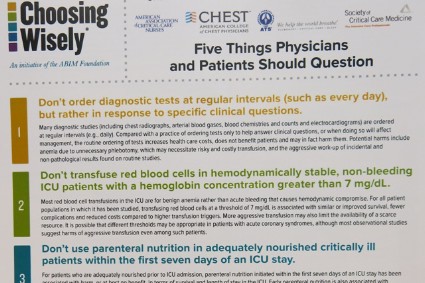
A two-page document of the critical care list can be downloaded from the Choosing Wisely website. It includes some of the sources for the recommendations and these top five "don’ts" displayed on the front:
1. Don’t order diagnostic tests at regular intervals (such as every day), but rather in response to specific clinical questions. Ordering diagnostic studies such as x-rays, arterial blood gases, blood counts, blood chemistries, or ECGs daily or at routine intervals drives up costs, doesn’t benefit patients, and may harm them through radiation exposure, inducing anemia, or triggering aggressive follow-up of incidental results. "I think this has become more prevalent with electronic medical records," where one click can order x-rays for the next 5 days, she said.

2. Don’t transfuse red blood cells in hemodynamically stable, non-bleeding ICU patients with a hemoglobin concentration greater than 7 mg/dL. Blood is a scarce resource, and studies show that limiting red blood cell transfusions to thresholds of 7 mg/dL or higher does not worsen survival, complications, or costs, and causes fewer complications. Different thresholds may be appropriate for patients with acute coronary syndrome, but even in this subgroup aggressive transfusion is harmful, most observational studies suggest.
3. Don’t use parenteral nutrition in adequately nourished critically ill patients within the first 7 days of an ICU stay. Early parenteral nutrition is harmful, even in patients who cannot tolerate enteral nutrition, if they were adequately nourished prior to ICU admission. The evidence is less clear for patients with nosocomial infections, and early parenteral nutrition may benefit patients who were severely malnourished right before ICU admission.
A study to be published soon shows that 90% of parenteral nutrition in the United States starts within 7 days of admission, usually within the first 2 days, Dr. Wunsch said. "It’s definitely more prevalent than I think many of us realize," she said.
4. Don’t deeply sedate mechanically ventilated patients without a specific indication and without daily attempts to lighten sedation. Deep sedation of patients on mechanical ventilation prolongs the duration of ventilation and hospitalization. Several protocols for limiting sedation have been shown to improve patient outcomes.
5. Don’t continue life support for patients at high risk of death or severely impaired functional recovery without offering patients and their families the alternative of care focused entirely on comfort. When an audience member expressed concern about discontinuation of life support possibly increasing premature deaths, Dr. Wunsch stressed that the second part of the statement is key – giving the family the choice of comfort care or continuing life support.
The simplicity of the Choosing Wisely list and its focus on overuse and costs make it possible to pursue unconventional ways of making it widely adopted, such as empowering families to question care, said Dr. Jeremy M. Kahn of the University of Pittsburgh. The 5 recommendations are far fewer than the 85 recommendations in the 2002 Surviving Sepsis campaign, for example, and the Choosing Wisely campaign has partnered with Consumer Reports and engaged the lay press to help spread the word, he said.
Dr. Kahn described a recent uncomfortable experience in which he had to question some of the medical care being offered to a hospitalized family member. It wasn’t easy to speak up, even though he’s a physician, and it must be even harder for lay people, he said. Hanging a sign in every ICU with the Choosing Wisely list might help empower families to speak up, one physician suggested during the discussion.
Incorporating decision-support prompts in electronic health records also could help physicians adhere to the Choosing Wisely recommendations, Dr. Kahn said.
Beyond the five items that made the Choosing Wisely list, the four runners-up were issues of antimicrobial duration; CT or MRI scanning for altered level of consciousness; vascular catheter indications; and ICU admission criteria for patients with poor prognosis, Dr. Wunsch said.
The Critical Care Societies Collaborative represents approximately 150,000 critical care providers, according to Dr. Curtis Sessler, president-designate of the American College of Chest Physicians.
The Choosing Wisely campaign, a project of the ABIM Foundation, released lists of "Five Things Physicians and Patients Should Question" by 9 medical societies in April 2012 and 17 more in February 2013, with the development of more lists ongoing.
The speakers reported having no financial disclosures.
On Twitter @sherryboschert
SAN FRANCISCO – Four critical care societies released a list of the top five things that intensivists should avoid doing, part of the larger Choosing Wisely campaign to reduce unnecessary and costly medical practices. The list includes a potentially difficult issue: offering patients' families the option of comfort care in lieu of continuing life support.
Fifth on the list, the life-support item may be the most controversial and is also the one that the representatives felt the most strongly about including, whether or not it saves many resources, according to Dr. Hannah Wunsch, who served on the collaborative task force. "Many ... patients receive aggressive life-sustaining therapies, in part due to clinicians’ failures to elicit patients’ values and goals, and to provide patient-centered recommendations," the task force wrote.
The video associated with this article is no longer available on this site. Please view all of our videos on the MDedge YouTube channel
Discussion of the list, which was announced at the Critical Care Congress, quickly turned to how to implement the recommendations, including how to empower families to challenge physicians or nurses when they see these steps being taken in the care of a loved one.
The Society for Critical Care Medicine, which sponsored the Congress, collaborated with the American College of Chest Physicians, the American Thoracic Society, and the American Association of Critical Care Nurses to create the list. It’s the first Choosing Wisely list to include collaboration with a nursing organization and only the second that’s a product of collaboration instead of being issued by a sole medical society, said Dr. Scott D. Halpern of the University of Pennsylvania, Philadelphia, chair of the collaborative group.
The four groups – the Critical Care Societies Collaborative – started with a list of 58 medical practices that they found objectionable, which they trimmed to 9 items based on the strength of evidence and their prevalence, relevance, and cost, explained Dr. Wunsch of the department of anesthesiology at Columbia University Medical Center, N.Y. Discussion winnowed that to the Top 5, an arbitrary number selected by the Choosing Wisely campaign that everyone should recognize as "a starting point," she said.
A two-page document of the critical care list can be downloaded from the Choosing Wisely website. It includes some of the sources for the recommendations and these top five "don’ts" displayed on the front:
1. Don’t order diagnostic tests at regular intervals (such as every day), but rather in response to specific clinical questions. Ordering diagnostic studies such as x-rays, arterial blood gases, blood counts, blood chemistries, or ECGs daily or at routine intervals drives up costs, doesn’t benefit patients, and may harm them through radiation exposure, inducing anemia, or triggering aggressive follow-up of incidental results. "I think this has become more prevalent with electronic medical records," where one click can order x-rays for the next 5 days, she said.
2. Don’t transfuse red blood cells in hemodynamically stable, non-bleeding ICU patients with a hemoglobin concentration greater than 7 mg/dL. Blood is a scarce resource, and studies show that limiting red blood cell transfusions to thresholds of 7 mg/dL or higher does not worsen survival, complications, or costs, and causes fewer complications. Different thresholds may be appropriate for patients with acute coronary syndrome, but even in this subgroup aggressive transfusion is harmful, most observational studies suggest.
3. Don’t use parenteral nutrition in adequately nourished critically ill patients within the first 7 days of an ICU stay. Early parenteral nutrition is harmful, even in patients who cannot tolerate enteral nutrition, if they were adequately nourished prior to ICU admission. The evidence is less clear for patients with nosocomial infections, and early parenteral nutrition may benefit patients who were severely malnourished right before ICU admission.
A study to be published soon shows that 90% of parenteral nutrition in the United States starts within 7 days of admission, usually within the first 2 days, Dr. Wunsch said. "It’s definitely more prevalent than I think many of us realize," she said.
4. Don’t deeply sedate mechanically ventilated patients without a specific indication and without daily attempts to lighten sedation. Deep sedation of patients on mechanical ventilation prolongs the duration of ventilation and hospitalization. Several protocols for limiting sedation have been shown to improve patient outcomes.
5. Don’t continue life support for patients at high risk of death or severely impaired functional recovery without offering patients and their families the alternative of care focused entirely on comfort. When an audience member expressed concern about discontinuation of life support possibly increasing premature deaths, Dr. Wunsch stressed that the second part of the statement is key – giving the family the choice of comfort care or continuing life support.
The simplicity of the Choosing Wisely list and its focus on overuse and costs make it possible to pursue unconventional ways of making it widely adopted, such as empowering families to question care, said Dr. Jeremy M. Kahn of the University of Pittsburgh. The 5 recommendations are far fewer than the 85 recommendations in the 2002 Surviving Sepsis campaign, for example, and the Choosing Wisely campaign has partnered with Consumer Reports and engaged the lay press to help spread the word, he said.
Dr. Kahn described a recent uncomfortable experience in which he had to question some of the medical care being offered to a hospitalized family member. It wasn’t easy to speak up, even though he’s a physician, and it must be even harder for lay people, he said. Hanging a sign in every ICU with the Choosing Wisely list might help empower families to speak up, one physician suggested during the discussion.
Incorporating decision-support prompts in electronic health records also could help physicians adhere to the Choosing Wisely recommendations, Dr. Kahn said.
Beyond the five items that made the Choosing Wisely list, the four runners-up were issues of antimicrobial duration; CT or MRI scanning for altered level of consciousness; vascular catheter indications; and ICU admission criteria for patients with poor prognosis, Dr. Wunsch said.
The Critical Care Societies Collaborative represents approximately 150,000 critical care providers, according to Dr. Curtis Sessler, president-designate of the American College of Chest Physicians.
The Choosing Wisely campaign, a project of the ABIM Foundation, released lists of "Five Things Physicians and Patients Should Question" by 9 medical societies in April 2012 and 17 more in February 2013, with the development of more lists ongoing.
The speakers reported having no financial disclosures.
On Twitter @sherryboschert
SAN FRANCISCO – Four critical care societies released a list of the top five things that intensivists should avoid doing, part of the larger Choosing Wisely campaign to reduce unnecessary and costly medical practices. The list includes a potentially difficult issue: offering patients' families the option of comfort care in lieu of continuing life support.
Fifth on the list, the life-support item may be the most controversial and is also the one that the representatives felt the most strongly about including, whether or not it saves many resources, according to Dr. Hannah Wunsch, who served on the collaborative task force. "Many ... patients receive aggressive life-sustaining therapies, in part due to clinicians’ failures to elicit patients’ values and goals, and to provide patient-centered recommendations," the task force wrote.
The video associated with this article is no longer available on this site. Please view all of our videos on the MDedge YouTube channel
Discussion of the list, which was announced at the Critical Care Congress, quickly turned to how to implement the recommendations, including how to empower families to challenge physicians or nurses when they see these steps being taken in the care of a loved one.
The Society for Critical Care Medicine, which sponsored the Congress, collaborated with the American College of Chest Physicians, the American Thoracic Society, and the American Association of Critical Care Nurses to create the list. It’s the first Choosing Wisely list to include collaboration with a nursing organization and only the second that’s a product of collaboration instead of being issued by a sole medical society, said Dr. Scott D. Halpern of the University of Pennsylvania, Philadelphia, chair of the collaborative group.
The four groups – the Critical Care Societies Collaborative – started with a list of 58 medical practices that they found objectionable, which they trimmed to 9 items based on the strength of evidence and their prevalence, relevance, and cost, explained Dr. Wunsch of the department of anesthesiology at Columbia University Medical Center, N.Y. Discussion winnowed that to the Top 5, an arbitrary number selected by the Choosing Wisely campaign that everyone should recognize as "a starting point," she said.
A two-page document of the critical care list can be downloaded from the Choosing Wisely website. It includes some of the sources for the recommendations and these top five "don’ts" displayed on the front:
1. Don’t order diagnostic tests at regular intervals (such as every day), but rather in response to specific clinical questions. Ordering diagnostic studies such as x-rays, arterial blood gases, blood counts, blood chemistries, or ECGs daily or at routine intervals drives up costs, doesn’t benefit patients, and may harm them through radiation exposure, inducing anemia, or triggering aggressive follow-up of incidental results. "I think this has become more prevalent with electronic medical records," where one click can order x-rays for the next 5 days, she said.
2. Don’t transfuse red blood cells in hemodynamically stable, non-bleeding ICU patients with a hemoglobin concentration greater than 7 mg/dL. Blood is a scarce resource, and studies show that limiting red blood cell transfusions to thresholds of 7 mg/dL or higher does not worsen survival, complications, or costs, and causes fewer complications. Different thresholds may be appropriate for patients with acute coronary syndrome, but even in this subgroup aggressive transfusion is harmful, most observational studies suggest.
3. Don’t use parenteral nutrition in adequately nourished critically ill patients within the first 7 days of an ICU stay. Early parenteral nutrition is harmful, even in patients who cannot tolerate enteral nutrition, if they were adequately nourished prior to ICU admission. The evidence is less clear for patients with nosocomial infections, and early parenteral nutrition may benefit patients who were severely malnourished right before ICU admission.
A study to be published soon shows that 90% of parenteral nutrition in the United States starts within 7 days of admission, usually within the first 2 days, Dr. Wunsch said. "It’s definitely more prevalent than I think many of us realize," she said.
4. Don’t deeply sedate mechanically ventilated patients without a specific indication and without daily attempts to lighten sedation. Deep sedation of patients on mechanical ventilation prolongs the duration of ventilation and hospitalization. Several protocols for limiting sedation have been shown to improve patient outcomes.
5. Don’t continue life support for patients at high risk of death or severely impaired functional recovery without offering patients and their families the alternative of care focused entirely on comfort. When an audience member expressed concern about discontinuation of life support possibly increasing premature deaths, Dr. Wunsch stressed that the second part of the statement is key – giving the family the choice of comfort care or continuing life support.
The simplicity of the Choosing Wisely list and its focus on overuse and costs make it possible to pursue unconventional ways of making it widely adopted, such as empowering families to question care, said Dr. Jeremy M. Kahn of the University of Pittsburgh. The 5 recommendations are far fewer than the 85 recommendations in the 2002 Surviving Sepsis campaign, for example, and the Choosing Wisely campaign has partnered with Consumer Reports and engaged the lay press to help spread the word, he said.
Dr. Kahn described a recent uncomfortable experience in which he had to question some of the medical care being offered to a hospitalized family member. It wasn’t easy to speak up, even though he’s a physician, and it must be even harder for lay people, he said. Hanging a sign in every ICU with the Choosing Wisely list might help empower families to speak up, one physician suggested during the discussion.
Incorporating decision-support prompts in electronic health records also could help physicians adhere to the Choosing Wisely recommendations, Dr. Kahn said.
Beyond the five items that made the Choosing Wisely list, the four runners-up were issues of antimicrobial duration; CT or MRI scanning for altered level of consciousness; vascular catheter indications; and ICU admission criteria for patients with poor prognosis, Dr. Wunsch said.
The Critical Care Societies Collaborative represents approximately 150,000 critical care providers, according to Dr. Curtis Sessler, president-designate of the American College of Chest Physicians.
The Choosing Wisely campaign, a project of the ABIM Foundation, released lists of "Five Things Physicians and Patients Should Question" by 9 medical societies in April 2012 and 17 more in February 2013, with the development of more lists ongoing.
The speakers reported having no financial disclosures.
On Twitter @sherryboschert
AT THE CRITICAL CARE CONGRESS
VIDEO: What's next for lung cancer detection and treatment?
In an interview at the Joint Conference on the Molecular Origins of Lung Cancer, Dr. Roy Herbst, chief of medical oncology at the Yale Cancer Center in New Haven, Conn., offers his perspectives on new developments in lung cancer screening and treatment, and he discusses the promise that genetically targeted approaches and immunotherapy may offer.
In an interview at the Joint Conference on the Molecular Origins of Lung Cancer, Dr. Roy Herbst, chief of medical oncology at the Yale Cancer Center in New Haven, Conn., offers his perspectives on new developments in lung cancer screening and treatment, and he discusses the promise that genetically targeted approaches and immunotherapy may offer.
In an interview at the Joint Conference on the Molecular Origins of Lung Cancer, Dr. Roy Herbst, chief of medical oncology at the Yale Cancer Center in New Haven, Conn., offers his perspectives on new developments in lung cancer screening and treatment, and he discusses the promise that genetically targeted approaches and immunotherapy may offer.

Intussusception risk seen with newer rotavirus vaccines
Two large U.S.-based studies have found the risk of intussusception, a rare type of bowel obstruction in infants, to be elevated after rotavirus vaccination.
Concerns about intussusception risk date back to 1999, when a tetravalent rotavirus vaccine was withdrawn by its manufacturer after being shown to be associated with between 1 and 2 excess cases per 10,000 infants vaccinated.
Findings from clinical trials of newer pentavalent and monovalent vaccines, introduced in 2006 and 2008, respectively, showed no such excess intussusception risk. However, recent studies from Australia, Mexico, and Brazil have indicated that excess risk is associated with these newer vaccines as well, though to a far lesser degree than with the earlier vaccine.
The first of the new studies, published online Jan. 14 in the New England Journal of Medicine (doi: 10.1056/NEJMoal1303164), offers evidence for a slight but statistically significant increase in intussusception risk associated with use of Merck’s pentavalent vaccine, RV5 (RotaTeq).

For their research, Katherine Yih, Ph.D., of Harvard Medical School and the Harvard Pilgrim Health Care Institute, Boston, and her associates looked at data from more than 1.2 million doses of RV5. The Food and Drug Administration (FDA) sponsored the study, and data were derived from health plans included in the FDA’s Mini-Sentinel surveillance program.
Using data from 507,874 first doses and 1,277,556 total doses of RV5, Dr. Yih’s team found an excess risk of 1.5 cases per 100,000 within 21 days after the first dose (95% confidence interval, 0.2-3.2), with no further increases in risk seen after the second or third dose. This represents about one tenth of the excess risk seen with the first-generation vaccine.
Dr. Yih and her associates also looked at data from 103,098 doses of a monovalent vaccine, GlaxoSmithKline’s RV1 (Rotarix). Risk was seen as increased after the second dose. However, this study was insufficiently powered to demonstrate a statistically significant risk in association with the monovalent vaccine.
The team acknowledged that some missing chart information reduced the power and precision of their study.
A separate study, also published online Jan. 14 in the New England Journal of Medicine (doi: 10.1056/NEJMoa1311708), looked at data from 207,955 doses of the monovalent vaccine, identifying intussusception cases recorded within 7 days after a first or second dose.
The investigators, led by Eric Weintraub, of the Centers for Disease Control and Prevention (CDC) in Atlanta, found 5.3 excess cases over expected background rates per 100,000 infants vaccinated with two doses. The authors acknowledged that their findings of elevated risk could be due to chance, given the small number of cases seen in the study.
In the same study, Mr. Weintraub and his colleagues found no increase in risk associated with the pentavalent vaccine, for which there were data on 1,301,810 doses. However, they noted, the confidence intervals for this finding were wide.
The data used in Mr. Weintraub and colleagues’ study came from the Vaccine Safety Datalink surveillance program run by the CDC. The CDC program collects data from health care plans different from those used in the FDA’s program.
Mr. Weintraub and his associates acknowledged that other studies, including that of Dr. Yih and colleagues, had shown elevated risk associated with the pentavalent vaccine. The difference in results, the investigators wrote, might be attributable to different study methodologies, uncontrolled confounding, and varying background rates of intussusception in the study populations.
Mr. Weintraub’s study was funded by the CDC. Three of his coauthors reported commercial grant support from GlaxoSmithKline, Inviragen, Merck, and other companies. One of Dr. Yih’s coauthors disclosed being an employee and stockholder of Aetna, which participates in the Mini-Sentinel program.
The results of these studies provide the most comprehensive description of the risk of intussusception after immunization with each of the rotavirus vaccines in the United States, according to Dr. Roger I. Glass of the National Institutes of Health and Dr. Umesh D. Parasharof the Centers for Disease Control and Prevention.
The abundance of evidence in the United States and beyond indicates that intussusception can occur as a result of vaccination with either RV5 or RV1. The risk is low, on the order of approximately 1-5 cases per 100,000 infants, with wide confidence interval limits.
Given this low risk and the major impact that these vaccines have had on the reduction of hospitalizations, emergency department visits, and, in some cases, deaths from diarrhea, policy makers have concluded that rotavirus vaccine remains a valuable addition to the national program for childhood immunizations.
Dr. Glass disclosed owning a patent on an Indian rotavirus vaccine given by the CDC to the government of India. Dr. Parashar had no financial conflicts to disclose.
The results of these studies provide the most comprehensive description of the risk of intussusception after immunization with each of the rotavirus vaccines in the United States, according to Dr. Roger I. Glass of the National Institutes of Health and Dr. Umesh D. Parasharof the Centers for Disease Control and Prevention.
The abundance of evidence in the United States and beyond indicates that intussusception can occur as a result of vaccination with either RV5 or RV1. The risk is low, on the order of approximately 1-5 cases per 100,000 infants, with wide confidence interval limits.
Given this low risk and the major impact that these vaccines have had on the reduction of hospitalizations, emergency department visits, and, in some cases, deaths from diarrhea, policy makers have concluded that rotavirus vaccine remains a valuable addition to the national program for childhood immunizations.
Dr. Glass disclosed owning a patent on an Indian rotavirus vaccine given by the CDC to the government of India. Dr. Parashar had no financial conflicts to disclose.
The results of these studies provide the most comprehensive description of the risk of intussusception after immunization with each of the rotavirus vaccines in the United States, according to Dr. Roger I. Glass of the National Institutes of Health and Dr. Umesh D. Parasharof the Centers for Disease Control and Prevention.
The abundance of evidence in the United States and beyond indicates that intussusception can occur as a result of vaccination with either RV5 or RV1. The risk is low, on the order of approximately 1-5 cases per 100,000 infants, with wide confidence interval limits.
Given this low risk and the major impact that these vaccines have had on the reduction of hospitalizations, emergency department visits, and, in some cases, deaths from diarrhea, policy makers have concluded that rotavirus vaccine remains a valuable addition to the national program for childhood immunizations.
Dr. Glass disclosed owning a patent on an Indian rotavirus vaccine given by the CDC to the government of India. Dr. Parashar had no financial conflicts to disclose.
Two large U.S.-based studies have found the risk of intussusception, a rare type of bowel obstruction in infants, to be elevated after rotavirus vaccination.
Concerns about intussusception risk date back to 1999, when a tetravalent rotavirus vaccine was withdrawn by its manufacturer after being shown to be associated with between 1 and 2 excess cases per 10,000 infants vaccinated.
Findings from clinical trials of newer pentavalent and monovalent vaccines, introduced in 2006 and 2008, respectively, showed no such excess intussusception risk. However, recent studies from Australia, Mexico, and Brazil have indicated that excess risk is associated with these newer vaccines as well, though to a far lesser degree than with the earlier vaccine.
The first of the new studies, published online Jan. 14 in the New England Journal of Medicine (doi: 10.1056/NEJMoal1303164), offers evidence for a slight but statistically significant increase in intussusception risk associated with use of Merck’s pentavalent vaccine, RV5 (RotaTeq).
For their research, Katherine Yih, Ph.D., of Harvard Medical School and the Harvard Pilgrim Health Care Institute, Boston, and her associates looked at data from more than 1.2 million doses of RV5. The Food and Drug Administration (FDA) sponsored the study, and data were derived from health plans included in the FDA’s Mini-Sentinel surveillance program.
Using data from 507,874 first doses and 1,277,556 total doses of RV5, Dr. Yih’s team found an excess risk of 1.5 cases per 100,000 within 21 days after the first dose (95% confidence interval, 0.2-3.2), with no further increases in risk seen after the second or third dose. This represents about one tenth of the excess risk seen with the first-generation vaccine.
Dr. Yih and her associates also looked at data from 103,098 doses of a monovalent vaccine, GlaxoSmithKline’s RV1 (Rotarix). Risk was seen as increased after the second dose. However, this study was insufficiently powered to demonstrate a statistically significant risk in association with the monovalent vaccine.
The team acknowledged that some missing chart information reduced the power and precision of their study.
A separate study, also published online Jan. 14 in the New England Journal of Medicine (doi: 10.1056/NEJMoa1311708), looked at data from 207,955 doses of the monovalent vaccine, identifying intussusception cases recorded within 7 days after a first or second dose.
The investigators, led by Eric Weintraub, of the Centers for Disease Control and Prevention (CDC) in Atlanta, found 5.3 excess cases over expected background rates per 100,000 infants vaccinated with two doses. The authors acknowledged that their findings of elevated risk could be due to chance, given the small number of cases seen in the study.
In the same study, Mr. Weintraub and his colleagues found no increase in risk associated with the pentavalent vaccine, for which there were data on 1,301,810 doses. However, they noted, the confidence intervals for this finding were wide.
The data used in Mr. Weintraub and colleagues’ study came from the Vaccine Safety Datalink surveillance program run by the CDC. The CDC program collects data from health care plans different from those used in the FDA’s program.
Mr. Weintraub and his associates acknowledged that other studies, including that of Dr. Yih and colleagues, had shown elevated risk associated with the pentavalent vaccine. The difference in results, the investigators wrote, might be attributable to different study methodologies, uncontrolled confounding, and varying background rates of intussusception in the study populations.
Mr. Weintraub’s study was funded by the CDC. Three of his coauthors reported commercial grant support from GlaxoSmithKline, Inviragen, Merck, and other companies. One of Dr. Yih’s coauthors disclosed being an employee and stockholder of Aetna, which participates in the Mini-Sentinel program.
Two large U.S.-based studies have found the risk of intussusception, a rare type of bowel obstruction in infants, to be elevated after rotavirus vaccination.
Concerns about intussusception risk date back to 1999, when a tetravalent rotavirus vaccine was withdrawn by its manufacturer after being shown to be associated with between 1 and 2 excess cases per 10,000 infants vaccinated.
Findings from clinical trials of newer pentavalent and monovalent vaccines, introduced in 2006 and 2008, respectively, showed no such excess intussusception risk. However, recent studies from Australia, Mexico, and Brazil have indicated that excess risk is associated with these newer vaccines as well, though to a far lesser degree than with the earlier vaccine.
The first of the new studies, published online Jan. 14 in the New England Journal of Medicine (doi: 10.1056/NEJMoal1303164), offers evidence for a slight but statistically significant increase in intussusception risk associated with use of Merck’s pentavalent vaccine, RV5 (RotaTeq).
For their research, Katherine Yih, Ph.D., of Harvard Medical School and the Harvard Pilgrim Health Care Institute, Boston, and her associates looked at data from more than 1.2 million doses of RV5. The Food and Drug Administration (FDA) sponsored the study, and data were derived from health plans included in the FDA’s Mini-Sentinel surveillance program.
Using data from 507,874 first doses and 1,277,556 total doses of RV5, Dr. Yih’s team found an excess risk of 1.5 cases per 100,000 within 21 days after the first dose (95% confidence interval, 0.2-3.2), with no further increases in risk seen after the second or third dose. This represents about one tenth of the excess risk seen with the first-generation vaccine.
Dr. Yih and her associates also looked at data from 103,098 doses of a monovalent vaccine, GlaxoSmithKline’s RV1 (Rotarix). Risk was seen as increased after the second dose. However, this study was insufficiently powered to demonstrate a statistically significant risk in association with the monovalent vaccine.
The team acknowledged that some missing chart information reduced the power and precision of their study.
A separate study, also published online Jan. 14 in the New England Journal of Medicine (doi: 10.1056/NEJMoa1311708), looked at data from 207,955 doses of the monovalent vaccine, identifying intussusception cases recorded within 7 days after a first or second dose.
The investigators, led by Eric Weintraub, of the Centers for Disease Control and Prevention (CDC) in Atlanta, found 5.3 excess cases over expected background rates per 100,000 infants vaccinated with two doses. The authors acknowledged that their findings of elevated risk could be due to chance, given the small number of cases seen in the study.
In the same study, Mr. Weintraub and his colleagues found no increase in risk associated with the pentavalent vaccine, for which there were data on 1,301,810 doses. However, they noted, the confidence intervals for this finding were wide.
The data used in Mr. Weintraub and colleagues’ study came from the Vaccine Safety Datalink surveillance program run by the CDC. The CDC program collects data from health care plans different from those used in the FDA’s program.
Mr. Weintraub and his associates acknowledged that other studies, including that of Dr. Yih and colleagues, had shown elevated risk associated with the pentavalent vaccine. The difference in results, the investigators wrote, might be attributable to different study methodologies, uncontrolled confounding, and varying background rates of intussusception in the study populations.
Mr. Weintraub’s study was funded by the CDC. Three of his coauthors reported commercial grant support from GlaxoSmithKline, Inviragen, Merck, and other companies. One of Dr. Yih’s coauthors disclosed being an employee and stockholder of Aetna, which participates in the Mini-Sentinel program.

Methotrexate less risky for lungs in RA than previously thought
Methotrexate poses only a slight risk of pulmonary complications in rheumatoid arthritis patients, according to a meta-analysis of 22 double-blind, randomized trials comparing methotrexate to other drugs.
Physicians have worried for years that methotrexate might damage the already-frail lungs of RA patients, but the results suggest "the risk may be lower than previously believed," said the Irish investigators, led by Dr. Richard Conway, a senior research fellow in the department of rheumatology at Galway (Ireland) University Hospitals (Arthritis Rheum. 2013 Dec. 24 [doi: 10.1002/art.38322]).

Previous reports estimated that the incidence of methotrexate-induced lung disease was as high as 7.6% in RA patients, but the team found a modest increase in the risk of overall respiratory adverse events (relative risk, 1.10; 95% confidence interval, 1.02-1.19) and respiratory infections (RR, 1.11; 95% CI, 1.02-1.21), and no increase in noninfectious respiratory events (RR, 1.02; 95% CI, 0.65-1.60) and pulmonary deaths (RR, 1.53; 95% CI, 0.46-5.01).
The meta-analysis pooled trial results from as far back as 1990. Overall, 4,544 patients were treated with methotrexate, and 4,040 with active comparators. The studies ranged from 6 to 24 months in duration.
The findings matter because "the suspicion of methotrexate-induced lung injury frequently leads to the cessation of methotrexate in patients who may otherwise be benefiting from the treatment. It is ... of vital importance not to implicate methotrexate as a causative agent in adverse events with insufficient evidence, as the drug may save the patient’s life," the investigators wrote.
"In our experience, many cases of lung disease initially attributed to methotrexate are due to other causative factors including, but not limited to, rheumatoid interstitial lung disease and opportunistic infections, with some experiencing worsening lung disease following cessation of their methotrexate," they noted.
However, the team found that methotrexate users had an increased risk of pneumonitis in the studies that specifically reported pneumonitis rates (RR, 7.81; 95% CI, 1.76-34.72); one case was fatal.
But the finding "must be interpreted with caution due to the reduced number of patients in each group." Also, none of the 13 trials published after 2001 reported pneumonitis. Perhaps methotrexate complications were less well understood in the 1990s, so earlier trials included patients at higher risk for pulmonary problems. Also, investigators may have been more likely to pin pulmonary issues on methotrexate, the authors said.
The mean age in the studies that reported pneumonitis was 54.3 years, and 28% of the subjects were men, whereas the mean age in studies that did not report pneumonitis was 50.7 years and 22% of the patients were men.
"Historically, intramuscular gold and sulfasalazine, and more recently disease-modifying antirheumatic drugs such as leflunomide have [also] been linked to the development of interstitial lung disease. In recent times, a possible link has emerged with the use of a number of the biologic agents, initially anti-TNF-alpha agents and more recently rituximab and tocilizumab," the investigators wrote. All of those agents were among the comparators in the pooled trials.
"Rather than each single drug causing interstitial lung disease ... it is perhaps more likely that if a link is present, it involves the modification of the underlying pulmonary disease process in rheumatoid arthritis by the implicated agents," they suggested.
Dr. Conway and his colleagues had no external funding for the study, but he and three of the other four investigators reported grants and payments from almost 20 companies, including Roche, UCB, and Merck.
Methotrexate poses only a slight risk of pulmonary complications in rheumatoid arthritis patients, according to a meta-analysis of 22 double-blind, randomized trials comparing methotrexate to other drugs.
Physicians have worried for years that methotrexate might damage the already-frail lungs of RA patients, but the results suggest "the risk may be lower than previously believed," said the Irish investigators, led by Dr. Richard Conway, a senior research fellow in the department of rheumatology at Galway (Ireland) University Hospitals (Arthritis Rheum. 2013 Dec. 24 [doi: 10.1002/art.38322]).
Previous reports estimated that the incidence of methotrexate-induced lung disease was as high as 7.6% in RA patients, but the team found a modest increase in the risk of overall respiratory adverse events (relative risk, 1.10; 95% confidence interval, 1.02-1.19) and respiratory infections (RR, 1.11; 95% CI, 1.02-1.21), and no increase in noninfectious respiratory events (RR, 1.02; 95% CI, 0.65-1.60) and pulmonary deaths (RR, 1.53; 95% CI, 0.46-5.01).
The meta-analysis pooled trial results from as far back as 1990. Overall, 4,544 patients were treated with methotrexate, and 4,040 with active comparators. The studies ranged from 6 to 24 months in duration.
The findings matter because "the suspicion of methotrexate-induced lung injury frequently leads to the cessation of methotrexate in patients who may otherwise be benefiting from the treatment. It is ... of vital importance not to implicate methotrexate as a causative agent in adverse events with insufficient evidence, as the drug may save the patient’s life," the investigators wrote.
"In our experience, many cases of lung disease initially attributed to methotrexate are due to other causative factors including, but not limited to, rheumatoid interstitial lung disease and opportunistic infections, with some experiencing worsening lung disease following cessation of their methotrexate," they noted.
However, the team found that methotrexate users had an increased risk of pneumonitis in the studies that specifically reported pneumonitis rates (RR, 7.81; 95% CI, 1.76-34.72); one case was fatal.
But the finding "must be interpreted with caution due to the reduced number of patients in each group." Also, none of the 13 trials published after 2001 reported pneumonitis. Perhaps methotrexate complications were less well understood in the 1990s, so earlier trials included patients at higher risk for pulmonary problems. Also, investigators may have been more likely to pin pulmonary issues on methotrexate, the authors said.
The mean age in the studies that reported pneumonitis was 54.3 years, and 28% of the subjects were men, whereas the mean age in studies that did not report pneumonitis was 50.7 years and 22% of the patients were men.
"Historically, intramuscular gold and sulfasalazine, and more recently disease-modifying antirheumatic drugs such as leflunomide have [also] been linked to the development of interstitial lung disease. In recent times, a possible link has emerged with the use of a number of the biologic agents, initially anti-TNF-alpha agents and more recently rituximab and tocilizumab," the investigators wrote. All of those agents were among the comparators in the pooled trials.
"Rather than each single drug causing interstitial lung disease ... it is perhaps more likely that if a link is present, it involves the modification of the underlying pulmonary disease process in rheumatoid arthritis by the implicated agents," they suggested.
Dr. Conway and his colleagues had no external funding for the study, but he and three of the other four investigators reported grants and payments from almost 20 companies, including Roche, UCB, and Merck.
Methotrexate poses only a slight risk of pulmonary complications in rheumatoid arthritis patients, according to a meta-analysis of 22 double-blind, randomized trials comparing methotrexate to other drugs.
Physicians have worried for years that methotrexate might damage the already-frail lungs of RA patients, but the results suggest "the risk may be lower than previously believed," said the Irish investigators, led by Dr. Richard Conway, a senior research fellow in the department of rheumatology at Galway (Ireland) University Hospitals (Arthritis Rheum. 2013 Dec. 24 [doi: 10.1002/art.38322]).
Previous reports estimated that the incidence of methotrexate-induced lung disease was as high as 7.6% in RA patients, but the team found a modest increase in the risk of overall respiratory adverse events (relative risk, 1.10; 95% confidence interval, 1.02-1.19) and respiratory infections (RR, 1.11; 95% CI, 1.02-1.21), and no increase in noninfectious respiratory events (RR, 1.02; 95% CI, 0.65-1.60) and pulmonary deaths (RR, 1.53; 95% CI, 0.46-5.01).
The meta-analysis pooled trial results from as far back as 1990. Overall, 4,544 patients were treated with methotrexate, and 4,040 with active comparators. The studies ranged from 6 to 24 months in duration.
The findings matter because "the suspicion of methotrexate-induced lung injury frequently leads to the cessation of methotrexate in patients who may otherwise be benefiting from the treatment. It is ... of vital importance not to implicate methotrexate as a causative agent in adverse events with insufficient evidence, as the drug may save the patient’s life," the investigators wrote.
"In our experience, many cases of lung disease initially attributed to methotrexate are due to other causative factors including, but not limited to, rheumatoid interstitial lung disease and opportunistic infections, with some experiencing worsening lung disease following cessation of their methotrexate," they noted.
However, the team found that methotrexate users had an increased risk of pneumonitis in the studies that specifically reported pneumonitis rates (RR, 7.81; 95% CI, 1.76-34.72); one case was fatal.
But the finding "must be interpreted with caution due to the reduced number of patients in each group." Also, none of the 13 trials published after 2001 reported pneumonitis. Perhaps methotrexate complications were less well understood in the 1990s, so earlier trials included patients at higher risk for pulmonary problems. Also, investigators may have been more likely to pin pulmonary issues on methotrexate, the authors said.
The mean age in the studies that reported pneumonitis was 54.3 years, and 28% of the subjects were men, whereas the mean age in studies that did not report pneumonitis was 50.7 years and 22% of the patients were men.
"Historically, intramuscular gold and sulfasalazine, and more recently disease-modifying antirheumatic drugs such as leflunomide have [also] been linked to the development of interstitial lung disease. In recent times, a possible link has emerged with the use of a number of the biologic agents, initially anti-TNF-alpha agents and more recently rituximab and tocilizumab," the investigators wrote. All of those agents were among the comparators in the pooled trials.
"Rather than each single drug causing interstitial lung disease ... it is perhaps more likely that if a link is present, it involves the modification of the underlying pulmonary disease process in rheumatoid arthritis by the implicated agents," they suggested.
Dr. Conway and his colleagues had no external funding for the study, but he and three of the other four investigators reported grants and payments from almost 20 companies, including Roche, UCB, and Merck.
FROM ARTHRITIS & RHEUMATISM
Major finding: Methotrexate only slightly increases the risk for overall respiratory adverse events (RR, 1.10; 95% CI, 1.02-1.19) and respiratory infections (RR, 1.11; 95% CI, 1.02-1.21) in RA patients, and does not increase the risk of noninfectious respiratory events (RR, 1.02; 95% CI, 0.65-1.60) or pulmonary death (RR, 1.53; 95% CI, 0.46-5.01).
Data Source: A meta-analysis of 22 double-blind, randomized trials comparing methotrexate to other drugs in 8,584 RA patients.
Disclosures: Dr. Conway and his colleagues had no external funding for the study, but he and three of the other four investigators reported grants and payments from almost 20 companies, including Roche, UCB, and Merck.