User login
April 2016 Quiz 2
Q2: ANSWER: D
Critique
This series of endoscopic findings shows changes consistent with inflammation of the cuff.

Up to 20%-30% of patients with ulcerative colitis ultimately require colectomy due to medically refractory colitis or to the development of dysplasia. A total abdominal protocolectomy with ileal pouch anal anastomosis has become the surgical procedure of choice for most ulcerative colitis patients who require surgery.
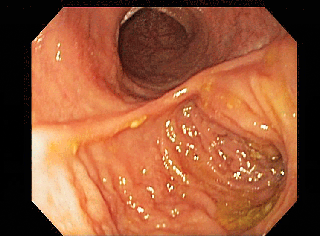
There are both early and late complications of this type of surgery. Late complications include anastomotic stricture, pouchitis, abscesses, inflammation of the cuff or cuffitis, and functional difficulties such as irritable pouch syndrome, anal pain, and pouch stasis. Patients may also present with inflammation of the pouch and the prepouch ileum that is consistent with Crohn’s disease. Endoscopy can help to narrow down the differential diagnosis of these pouch complications.
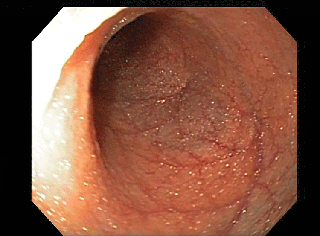
In this series of photos the prepouch ileum has no inflammation. The pouch also has no ulcerations or evidence of pouchitis or Crohn’s disease. The cuff is inflamed consistent with a diagnosis of cuffitis. If the inflammation becomes difficult to manage, immunosuppressive therapy may be required but at this point it is reasonable to start with topical therapy to the inflamed area.
Reference
- Li, Y. Shen, B. Evaluating pouch problems. Gastroenterology Clinics North Am. 2012;41:355-78.
- Shen, G. Diagnosis and management of post-operative ileal pouch disorders. Clin Colon Rectal Surg. 2010;23:259-68.
Q2: ANSWER: D
Critique
This series of endoscopic findings shows changes consistent with inflammation of the cuff.
Up to 20%-30% of patients with ulcerative colitis ultimately require colectomy due to medically refractory colitis or to the development of dysplasia. A total abdominal protocolectomy with ileal pouch anal anastomosis has become the surgical procedure of choice for most ulcerative colitis patients who require surgery.
There are both early and late complications of this type of surgery. Late complications include anastomotic stricture, pouchitis, abscesses, inflammation of the cuff or cuffitis, and functional difficulties such as irritable pouch syndrome, anal pain, and pouch stasis. Patients may also present with inflammation of the pouch and the prepouch ileum that is consistent with Crohn’s disease. Endoscopy can help to narrow down the differential diagnosis of these pouch complications.
In this series of photos the prepouch ileum has no inflammation. The pouch also has no ulcerations or evidence of pouchitis or Crohn’s disease. The cuff is inflamed consistent with a diagnosis of cuffitis. If the inflammation becomes difficult to manage, immunosuppressive therapy may be required but at this point it is reasonable to start with topical therapy to the inflamed area.
Reference
- Li, Y. Shen, B. Evaluating pouch problems. Gastroenterology Clinics North Am. 2012;41:355-78.
- Shen, G. Diagnosis and management of post-operative ileal pouch disorders. Clin Colon Rectal Surg. 2010;23:259-68.
Q2: ANSWER: D
Critique
This series of endoscopic findings shows changes consistent with inflammation of the cuff.
Up to 20%-30% of patients with ulcerative colitis ultimately require colectomy due to medically refractory colitis or to the development of dysplasia. A total abdominal protocolectomy with ileal pouch anal anastomosis has become the surgical procedure of choice for most ulcerative colitis patients who require surgery.
There are both early and late complications of this type of surgery. Late complications include anastomotic stricture, pouchitis, abscesses, inflammation of the cuff or cuffitis, and functional difficulties such as irritable pouch syndrome, anal pain, and pouch stasis. Patients may also present with inflammation of the pouch and the prepouch ileum that is consistent with Crohn’s disease. Endoscopy can help to narrow down the differential diagnosis of these pouch complications.
In this series of photos the prepouch ileum has no inflammation. The pouch also has no ulcerations or evidence of pouchitis or Crohn’s disease. The cuff is inflamed consistent with a diagnosis of cuffitis. If the inflammation becomes difficult to manage, immunosuppressive therapy may be required but at this point it is reasonable to start with topical therapy to the inflamed area.
Reference
- Li, Y. Shen, B. Evaluating pouch problems. Gastroenterology Clinics North Am. 2012;41:355-78.
- Shen, G. Diagnosis and management of post-operative ileal pouch disorders. Clin Colon Rectal Surg. 2010;23:259-68.
Why the AMA is (now) worth joining

Until recently, I was not a member of the American Medical Association (AMA). For the past 30 years, I chose not to join because I was troubled by the organization’s direction and the way it seemed to be dominated by special interests. But things have changed—and so has its focus.
The AMA has a new strategy entitled, “A vision for a healthier nation.” Well aligned with the needs of family physicians, the campaign addresses 3 specific areas: better patient health, smarter medical training, and sustainable practices.
Better patient health. The AMA is partnering with several public health-oriented organizations, including the Centers for Disease Control and Prevention, to reach out to individuals with diabetes, cardiovascular disease, and cardiac risk factors to promote primary and secondary prevention strategies at a population level. This is a very different posture than the AMA assumed in the early 20th century, when it was more likely to resist public health programs.
Smarter medical training. Under the direction of family physician Susan Skochelak, MD, MPH, group vice president for medical education, the AMA has provided grant funding to 31 US medical schools to assist with curricular redesign and innovation to train physicians to be effective leaders in the health care system of the future.
Sustainable practices. This area houses what is perhaps the AMA’s most meaningful new program for primary care clinicians. Under the leadership of general internist Christine A. Sinsky, MD, PhD, vice president for professional satisfaction, the AMA has developed a suite of Web tools to help physicians improve the quality and efficiency of their clinical practices.
Specifically, the AMA is offering the STEPS Forward program, a collection of interactive, educational modules developed by physicians for physicians to help address common practice challenges and to achieve the quadruple aim of a better patient experience, better population health, lower overall costs, and improved professional satisfaction.1 The 27 modules are self-directed, group learning exercises that encompass a wide range of thorny issues we deal with on a daily basis. A sampling of topics includes: preparing your practice for change, revenue cycle management, synchronized prescription renewals, and creating a strong team culture.
Programs like these are evidence that the new AMA is a different organization from the one I chose not to join for the past 30 years. I am now a member. Check it out; it might be time for you to join, too.
1. STEPS Forward Series and CME Accreditation. American Medical Association Web site. Available at http://www.ama-assn.org/ama/pub/about-ama/strategic-focus/physician-practices/steps-forward.page. Accessed March 16, 2016.
Until recently, I was not a member of the American Medical Association (AMA). For the past 30 years, I chose not to join because I was troubled by the organization’s direction and the way it seemed to be dominated by special interests. But things have changed—and so has its focus.
The AMA has a new strategy entitled, “A vision for a healthier nation.” Well aligned with the needs of family physicians, the campaign addresses 3 specific areas: better patient health, smarter medical training, and sustainable practices.
Better patient health. The AMA is partnering with several public health-oriented organizations, including the Centers for Disease Control and Prevention, to reach out to individuals with diabetes, cardiovascular disease, and cardiac risk factors to promote primary and secondary prevention strategies at a population level. This is a very different posture than the AMA assumed in the early 20th century, when it was more likely to resist public health programs.
Smarter medical training. Under the direction of family physician Susan Skochelak, MD, MPH, group vice president for medical education, the AMA has provided grant funding to 31 US medical schools to assist with curricular redesign and innovation to train physicians to be effective leaders in the health care system of the future.
Sustainable practices. This area houses what is perhaps the AMA’s most meaningful new program for primary care clinicians. Under the leadership of general internist Christine A. Sinsky, MD, PhD, vice president for professional satisfaction, the AMA has developed a suite of Web tools to help physicians improve the quality and efficiency of their clinical practices.
Specifically, the AMA is offering the STEPS Forward program, a collection of interactive, educational modules developed by physicians for physicians to help address common practice challenges and to achieve the quadruple aim of a better patient experience, better population health, lower overall costs, and improved professional satisfaction.1 The 27 modules are self-directed, group learning exercises that encompass a wide range of thorny issues we deal with on a daily basis. A sampling of topics includes: preparing your practice for change, revenue cycle management, synchronized prescription renewals, and creating a strong team culture.
Programs like these are evidence that the new AMA is a different organization from the one I chose not to join for the past 30 years. I am now a member. Check it out; it might be time for you to join, too.
Until recently, I was not a member of the American Medical Association (AMA). For the past 30 years, I chose not to join because I was troubled by the organization’s direction and the way it seemed to be dominated by special interests. But things have changed—and so has its focus.
The AMA has a new strategy entitled, “A vision for a healthier nation.” Well aligned with the needs of family physicians, the campaign addresses 3 specific areas: better patient health, smarter medical training, and sustainable practices.
Better patient health. The AMA is partnering with several public health-oriented organizations, including the Centers for Disease Control and Prevention, to reach out to individuals with diabetes, cardiovascular disease, and cardiac risk factors to promote primary and secondary prevention strategies at a population level. This is a very different posture than the AMA assumed in the early 20th century, when it was more likely to resist public health programs.
Smarter medical training. Under the direction of family physician Susan Skochelak, MD, MPH, group vice president for medical education, the AMA has provided grant funding to 31 US medical schools to assist with curricular redesign and innovation to train physicians to be effective leaders in the health care system of the future.
Sustainable practices. This area houses what is perhaps the AMA’s most meaningful new program for primary care clinicians. Under the leadership of general internist Christine A. Sinsky, MD, PhD, vice president for professional satisfaction, the AMA has developed a suite of Web tools to help physicians improve the quality and efficiency of their clinical practices.
Specifically, the AMA is offering the STEPS Forward program, a collection of interactive, educational modules developed by physicians for physicians to help address common practice challenges and to achieve the quadruple aim of a better patient experience, better population health, lower overall costs, and improved professional satisfaction.1 The 27 modules are self-directed, group learning exercises that encompass a wide range of thorny issues we deal with on a daily basis. A sampling of topics includes: preparing your practice for change, revenue cycle management, synchronized prescription renewals, and creating a strong team culture.
Programs like these are evidence that the new AMA is a different organization from the one I chose not to join for the past 30 years. I am now a member. Check it out; it might be time for you to join, too.
1. STEPS Forward Series and CME Accreditation. American Medical Association Web site. Available at http://www.ama-assn.org/ama/pub/about-ama/strategic-focus/physician-practices/steps-forward.page. Accessed March 16, 2016.
1. STEPS Forward Series and CME Accreditation. American Medical Association Web site. Available at http://www.ama-assn.org/ama/pub/about-ama/strategic-focus/physician-practices/steps-forward.page. Accessed March 16, 2016.
Flamin’ hots
If you have been practicing for a while, you’re probably old enough to remember the Life cereal commercial that featured Mikey, the “he likes it” kid, who would eat anything. It was falsely rumored that he died from eating too many Pop Rocks candy with soda pop, causing his stomach to explode. Although there was no truth to any of it, it was the rumor of the day. Well, today there is a new snack on the block that is sending many children and teens to the emergency department.

Flamin’ Hots characterize several brands of chips in which the snacks are covered in a chili pepper mixture. As the name implies, the chips are very hot, which only adds to the excitement associated with them. But we have seen an increase in ED visits by teens for severe abdominal pain and red stools.
If you examine the label, it lists “natural flavors,” which is the industry’s code word for their secret formula. In fact, nowhere on the label is chili or any other spicy seasoning listed. Even more interesting is that you can’t find anywhere on the Internet what makes Flamin’ Hot chips so hot. There is evidence to support that red pepper and chili peppers are related to gastric ulcers (Crit Rev Food Sci Nutr. 2006;46[4]:275-328).
Examining the food label, one might be misled into thinking it’s is actually a reasonable snack. The serving size is listed as 21 pieces, but the likelihood that anyone stops at 21 pieces is small. In fact, there are reports that there is an addictive component. As the chili pepper hits the stomach, it causes pain, which causes a release of endorphins. This leads to a feeling of pleasure, which in turns encourages the person to want more chips, hence the ingestion of multiple bags prior to the trip to the ED.

There have been many warnings of the deleterious effects of the chips. In 2011 California, and soon after that Illinois, banned it from schools, stating it was unhealthy. Many schools since then have followed suit. But despite all the hype, kids are eating them by the dozen. Although there are no data to support that there is a cause and effect relationship with Flamin’ Hots and ulcers, it is safe to assume with the number of ED visits and the diet of the average teen, that at least gastritis is an issue.
Beyond stomach pain, prolonged intake of spicy hot snacks will contribute to high cholesterol and obesity. Many children are under the false assumption that because they don’t eat big meals, they are eating well. But because so many of these unhealthy snacks are empty calories and increase fat intake (N Engl J Med. 2006 Apr 13;354[15]:1601-13), children’s body mass indices continue to rise. Informing parents about the harmful effect is important so they can monitor intake as well as encourage healthier snacks. Understanding how to read a food label is another important thing to teach during well visits so that parents can understand how much fat is in these snacks and can adjust accordingly.
Dr. Pearce is a pediatrician in Frankfort, Ill. Email her at pdnews@frontlinemedcom.com.
If you have been practicing for a while, you’re probably old enough to remember the Life cereal commercial that featured Mikey, the “he likes it” kid, who would eat anything. It was falsely rumored that he died from eating too many Pop Rocks candy with soda pop, causing his stomach to explode. Although there was no truth to any of it, it was the rumor of the day. Well, today there is a new snack on the block that is sending many children and teens to the emergency department.
Flamin’ Hots characterize several brands of chips in which the snacks are covered in a chili pepper mixture. As the name implies, the chips are very hot, which only adds to the excitement associated with them. But we have seen an increase in ED visits by teens for severe abdominal pain and red stools.
If you examine the label, it lists “natural flavors,” which is the industry’s code word for their secret formula. In fact, nowhere on the label is chili or any other spicy seasoning listed. Even more interesting is that you can’t find anywhere on the Internet what makes Flamin’ Hot chips so hot. There is evidence to support that red pepper and chili peppers are related to gastric ulcers (Crit Rev Food Sci Nutr. 2006;46[4]:275-328).
Examining the food label, one might be misled into thinking it’s is actually a reasonable snack. The serving size is listed as 21 pieces, but the likelihood that anyone stops at 21 pieces is small. In fact, there are reports that there is an addictive component. As the chili pepper hits the stomach, it causes pain, which causes a release of endorphins. This leads to a feeling of pleasure, which in turns encourages the person to want more chips, hence the ingestion of multiple bags prior to the trip to the ED.
There have been many warnings of the deleterious effects of the chips. In 2011 California, and soon after that Illinois, banned it from schools, stating it was unhealthy. Many schools since then have followed suit. But despite all the hype, kids are eating them by the dozen. Although there are no data to support that there is a cause and effect relationship with Flamin’ Hots and ulcers, it is safe to assume with the number of ED visits and the diet of the average teen, that at least gastritis is an issue.
Beyond stomach pain, prolonged intake of spicy hot snacks will contribute to high cholesterol and obesity. Many children are under the false assumption that because they don’t eat big meals, they are eating well. But because so many of these unhealthy snacks are empty calories and increase fat intake (N Engl J Med. 2006 Apr 13;354[15]:1601-13), children’s body mass indices continue to rise. Informing parents about the harmful effect is important so they can monitor intake as well as encourage healthier snacks. Understanding how to read a food label is another important thing to teach during well visits so that parents can understand how much fat is in these snacks and can adjust accordingly.
Dr. Pearce is a pediatrician in Frankfort, Ill. Email her at pdnews@frontlinemedcom.com.
If you have been practicing for a while, you’re probably old enough to remember the Life cereal commercial that featured Mikey, the “he likes it” kid, who would eat anything. It was falsely rumored that he died from eating too many Pop Rocks candy with soda pop, causing his stomach to explode. Although there was no truth to any of it, it was the rumor of the day. Well, today there is a new snack on the block that is sending many children and teens to the emergency department.
Flamin’ Hots characterize several brands of chips in which the snacks are covered in a chili pepper mixture. As the name implies, the chips are very hot, which only adds to the excitement associated with them. But we have seen an increase in ED visits by teens for severe abdominal pain and red stools.
If you examine the label, it lists “natural flavors,” which is the industry’s code word for their secret formula. In fact, nowhere on the label is chili or any other spicy seasoning listed. Even more interesting is that you can’t find anywhere on the Internet what makes Flamin’ Hot chips so hot. There is evidence to support that red pepper and chili peppers are related to gastric ulcers (Crit Rev Food Sci Nutr. 2006;46[4]:275-328).
Examining the food label, one might be misled into thinking it’s is actually a reasonable snack. The serving size is listed as 21 pieces, but the likelihood that anyone stops at 21 pieces is small. In fact, there are reports that there is an addictive component. As the chili pepper hits the stomach, it causes pain, which causes a release of endorphins. This leads to a feeling of pleasure, which in turns encourages the person to want more chips, hence the ingestion of multiple bags prior to the trip to the ED.
There have been many warnings of the deleterious effects of the chips. In 2011 California, and soon after that Illinois, banned it from schools, stating it was unhealthy. Many schools since then have followed suit. But despite all the hype, kids are eating them by the dozen. Although there are no data to support that there is a cause and effect relationship with Flamin’ Hots and ulcers, it is safe to assume with the number of ED visits and the diet of the average teen, that at least gastritis is an issue.
Beyond stomach pain, prolonged intake of spicy hot snacks will contribute to high cholesterol and obesity. Many children are under the false assumption that because they don’t eat big meals, they are eating well. But because so many of these unhealthy snacks are empty calories and increase fat intake (N Engl J Med. 2006 Apr 13;354[15]:1601-13), children’s body mass indices continue to rise. Informing parents about the harmful effect is important so they can monitor intake as well as encourage healthier snacks. Understanding how to read a food label is another important thing to teach during well visits so that parents can understand how much fat is in these snacks and can adjust accordingly.
Dr. Pearce is a pediatrician in Frankfort, Ill. Email her at pdnews@frontlinemedcom.com.

Biologics for Psoriasis

Review the PDF of the fact sheet on biologics for psoriasis with board-relevant, easy-to-review material. This month's fact sheet discusses the current US Food and Drug Administration–approved biologic medications for psoriasis and psoriatic arthritis, including the mechanism of action, dosing, and side effects.
Practice Questions
1. Which biologic is administered as an intravenous infusion?
a. adalimumab
b. etanercept
c. infliximab
d. secukinumab
e. ustekinumab
2. Which biologic is dosed based on body weight?
a. adalimumab
b. etanercept
c. infliximab
d. secukinumab
e. ustekinumab
3. Which biologic has been shown to worsen existing Crohn disease?
a. adalimumab
b. etanercept
c. infliximab
d. secukinumab
e. ustekinumab
4. Which biologic is a fusion protein?
a. adalimumab
b. etanercept
c. infliximab
d. secukinumab
e. ustekinumab
5. Which biologic has been shown to cause reversible posterior leukoencephalopathy syndrome?
a. adalimumab
b. etanercept
c. infliximab
d. secukinumab
e. ustekinumab
Answers to practice questions provided on next page
Practice Question Answers
1. Which biologic is administered as an intravenous infusion?
a. adalimumab
b. etanercept
c. infliximab
d. secukinumab
e. ustekinumab
2. Which biologic is dosed based on body weight?
a. adalimumab
b. etanercept
c. infliximab
d. secukinumab
e. ustekinumab
3. Which biologic has been shown to worsen existing Crohn disease?
a. adalimumab
b. etanercept
c. infliximab
d. secukinumab
e. ustekinumab
4. Which biologic is a fusion protein?
a. adalimumab
b. etanercept
c. infliximab
d. secukinumab
e. ustekinumab
5. Which biologic has been shown to cause reversible posterior leukoencephalopathy syndrome?
a. adalimumab
b. etanercept
c. infliximab
d. secukinumab
e. ustekinumab
Review the PDF of the fact sheet on biologics for psoriasis with board-relevant, easy-to-review material. This month's fact sheet discusses the current US Food and Drug Administration–approved biologic medications for psoriasis and psoriatic arthritis, including the mechanism of action, dosing, and side effects.
Practice Questions
1. Which biologic is administered as an intravenous infusion?
a. adalimumab
b. etanercept
c. infliximab
d. secukinumab
e. ustekinumab
2. Which biologic is dosed based on body weight?
a. adalimumab
b. etanercept
c. infliximab
d. secukinumab
e. ustekinumab
3. Which biologic has been shown to worsen existing Crohn disease?
a. adalimumab
b. etanercept
c. infliximab
d. secukinumab
e. ustekinumab
4. Which biologic is a fusion protein?
a. adalimumab
b. etanercept
c. infliximab
d. secukinumab
e. ustekinumab
5. Which biologic has been shown to cause reversible posterior leukoencephalopathy syndrome?
a. adalimumab
b. etanercept
c. infliximab
d. secukinumab
e. ustekinumab
Answers to practice questions provided on next page
Practice Question Answers
1. Which biologic is administered as an intravenous infusion?
a. adalimumab
b. etanercept
c. infliximab
d. secukinumab
e. ustekinumab
2. Which biologic is dosed based on body weight?
a. adalimumab
b. etanercept
c. infliximab
d. secukinumab
e. ustekinumab
3. Which biologic has been shown to worsen existing Crohn disease?
a. adalimumab
b. etanercept
c. infliximab
d. secukinumab
e. ustekinumab
4. Which biologic is a fusion protein?
a. adalimumab
b. etanercept
c. infliximab
d. secukinumab
e. ustekinumab
5. Which biologic has been shown to cause reversible posterior leukoencephalopathy syndrome?
a. adalimumab
b. etanercept
c. infliximab
d. secukinumab
e. ustekinumab
Review the PDF of the fact sheet on biologics for psoriasis with board-relevant, easy-to-review material. This month's fact sheet discusses the current US Food and Drug Administration–approved biologic medications for psoriasis and psoriatic arthritis, including the mechanism of action, dosing, and side effects.
Practice Questions
1. Which biologic is administered as an intravenous infusion?
a. adalimumab
b. etanercept
c. infliximab
d. secukinumab
e. ustekinumab
2. Which biologic is dosed based on body weight?
a. adalimumab
b. etanercept
c. infliximab
d. secukinumab
e. ustekinumab
3. Which biologic has been shown to worsen existing Crohn disease?
a. adalimumab
b. etanercept
c. infliximab
d. secukinumab
e. ustekinumab
4. Which biologic is a fusion protein?
a. adalimumab
b. etanercept
c. infliximab
d. secukinumab
e. ustekinumab
5. Which biologic has been shown to cause reversible posterior leukoencephalopathy syndrome?
a. adalimumab
b. etanercept
c. infliximab
d. secukinumab
e. ustekinumab
Answers to practice questions provided on next page
Practice Question Answers
1. Which biologic is administered as an intravenous infusion?
a. adalimumab
b. etanercept
c. infliximab
d. secukinumab
e. ustekinumab
2. Which biologic is dosed based on body weight?
a. adalimumab
b. etanercept
c. infliximab
d. secukinumab
e. ustekinumab
3. Which biologic has been shown to worsen existing Crohn disease?
a. adalimumab
b. etanercept
c. infliximab
d. secukinumab
e. ustekinumab
4. Which biologic is a fusion protein?
a. adalimumab
b. etanercept
c. infliximab
d. secukinumab
e. ustekinumab
5. Which biologic has been shown to cause reversible posterior leukoencephalopathy syndrome?
a. adalimumab
b. etanercept
c. infliximab
d. secukinumab
e. ustekinumab

Statins inversely linked to colorectal cancer in patients with IBD
Patients with inflammatory bowel disease who were prescribed statins had 65% lower odds of subsequent colorectal cancer, compared with other IBD patients, even after controlling for multiple potential confounders, researchers reported in Clinical Gastroenterology and Hepatology.
“Further confirmation from other cohorts may provide support for the use of statins as a chemopreventive in patients with IBD,” said Dr. Ashwin Ananthakrishnan of Massachusetts General Hospital in Boston, and his associates.

Patients with long-standing ulcerative colitis or colonic Crohn’s disease have about twice the risk of colorectal cancer (CRC), compared with the general population, and up to an 18% lifetime risk of CRC by 30 years after diagnosis, the researchers noted. Early results supporting mesalamine as chemoprophylaxis did not hold up in later trials. Although several studies suggested that statins might help prevent sporadic colon cancer, the only such study in IBD patients was small and did not control for key covariates such as smoking, the investigators added. Therefore, they collected data from 11,001 patients with IBD who were seen at Boston area hospitals between 1998 and 2010. They identified CRC diagnoses based on ICD-9 codes, and analyzed electronic prescriptions to see whether and when patients had used statins (Clin Gastroenterol Hepatol. 2016 Feb 21. doi: 10.1016/j.cgh.2016.02.017).
A total of 1,376 patients (12.5%) were prescribed at least one statin. Over 9 years of follow-up, 2% of statin users developed CRC, compared with 3% of nonusers (age-adjusted odds ratio, 0.35; 95% confidence interval, 0.24-0.53). Statin users were more likely to be older, male, white, smokers, and had more comorbidities than nonusers. Nonetheless, the protective effect of statins remained significant after controlling for demographic factors, smoking status, number of colonoscopies, use of steroids and immunomodulators, the presence of primary sclerosing cholangitis, and increases in inflammatory biomarkers (OR, 0.42; 95% CI, 0.28-0.62). The effect occurred for both Crohn’s disease and ulcerative colitis. Notably, the inverse association was even stronger among patients who had been prescribed at least two statins or who had at least a 2-year interval between statin use and CRC diagnosis.
Statins might help prevent CRC through HMG-CoA reductase inhibition and other mechanisms, according to the researchers. By inhibiting HMG-CoA reductase, statins lower production of farnesyl pyrophosphate and geranylgeranyl pyrophosphate, which are needed for post-translational activation of Ras, Rho, and other proteins that are overexpressed in CRC and that have been linked to tumor invasion. Statins also might help prevent CRC through antioxidant effects or by inhibiting inflammation, cell adhesion, and angiogenesis, the investigators added. “Although we did not see a difference in median C-reactive protein levels between statin users and nonusers, statin users were less likely to require immunomodulator or biologic therapy for their IBD, supporting a potential anti-inflammatory role for statins.”
Because patients mainly were treated at two tertiary referral hospitals, they may have had more severe disease than the general population of patients with IBD, the investigators acknowledged. They noted that in some meta-analyses, referral center studies yielded chemopreventive effects that did not hold up in population-based cohorts.
The study was funded by the National Institutes of Health, the American Gastroenterological Association, and the Harold and Duval Bowen Fund. The researchers had no disclosures.
Patients with inflammatory bowel disease who were prescribed statins had 65% lower odds of subsequent colorectal cancer, compared with other IBD patients, even after controlling for multiple potential confounders, researchers reported in Clinical Gastroenterology and Hepatology.
“Further confirmation from other cohorts may provide support for the use of statins as a chemopreventive in patients with IBD,” said Dr. Ashwin Ananthakrishnan of Massachusetts General Hospital in Boston, and his associates.
Patients with long-standing ulcerative colitis or colonic Crohn’s disease have about twice the risk of colorectal cancer (CRC), compared with the general population, and up to an 18% lifetime risk of CRC by 30 years after diagnosis, the researchers noted. Early results supporting mesalamine as chemoprophylaxis did not hold up in later trials. Although several studies suggested that statins might help prevent sporadic colon cancer, the only such study in IBD patients was small and did not control for key covariates such as smoking, the investigators added. Therefore, they collected data from 11,001 patients with IBD who were seen at Boston area hospitals between 1998 and 2010. They identified CRC diagnoses based on ICD-9 codes, and analyzed electronic prescriptions to see whether and when patients had used statins (Clin Gastroenterol Hepatol. 2016 Feb 21. doi: 10.1016/j.cgh.2016.02.017).
A total of 1,376 patients (12.5%) were prescribed at least one statin. Over 9 years of follow-up, 2% of statin users developed CRC, compared with 3% of nonusers (age-adjusted odds ratio, 0.35; 95% confidence interval, 0.24-0.53). Statin users were more likely to be older, male, white, smokers, and had more comorbidities than nonusers. Nonetheless, the protective effect of statins remained significant after controlling for demographic factors, smoking status, number of colonoscopies, use of steroids and immunomodulators, the presence of primary sclerosing cholangitis, and increases in inflammatory biomarkers (OR, 0.42; 95% CI, 0.28-0.62). The effect occurred for both Crohn’s disease and ulcerative colitis. Notably, the inverse association was even stronger among patients who had been prescribed at least two statins or who had at least a 2-year interval between statin use and CRC diagnosis.
Statins might help prevent CRC through HMG-CoA reductase inhibition and other mechanisms, according to the researchers. By inhibiting HMG-CoA reductase, statins lower production of farnesyl pyrophosphate and geranylgeranyl pyrophosphate, which are needed for post-translational activation of Ras, Rho, and other proteins that are overexpressed in CRC and that have been linked to tumor invasion. Statins also might help prevent CRC through antioxidant effects or by inhibiting inflammation, cell adhesion, and angiogenesis, the investigators added. “Although we did not see a difference in median C-reactive protein levels between statin users and nonusers, statin users were less likely to require immunomodulator or biologic therapy for their IBD, supporting a potential anti-inflammatory role for statins.”
Because patients mainly were treated at two tertiary referral hospitals, they may have had more severe disease than the general population of patients with IBD, the investigators acknowledged. They noted that in some meta-analyses, referral center studies yielded chemopreventive effects that did not hold up in population-based cohorts.
The study was funded by the National Institutes of Health, the American Gastroenterological Association, and the Harold and Duval Bowen Fund. The researchers had no disclosures.
Patients with inflammatory bowel disease who were prescribed statins had 65% lower odds of subsequent colorectal cancer, compared with other IBD patients, even after controlling for multiple potential confounders, researchers reported in Clinical Gastroenterology and Hepatology.
“Further confirmation from other cohorts may provide support for the use of statins as a chemopreventive in patients with IBD,” said Dr. Ashwin Ananthakrishnan of Massachusetts General Hospital in Boston, and his associates.
Patients with long-standing ulcerative colitis or colonic Crohn’s disease have about twice the risk of colorectal cancer (CRC), compared with the general population, and up to an 18% lifetime risk of CRC by 30 years after diagnosis, the researchers noted. Early results supporting mesalamine as chemoprophylaxis did not hold up in later trials. Although several studies suggested that statins might help prevent sporadic colon cancer, the only such study in IBD patients was small and did not control for key covariates such as smoking, the investigators added. Therefore, they collected data from 11,001 patients with IBD who were seen at Boston area hospitals between 1998 and 2010. They identified CRC diagnoses based on ICD-9 codes, and analyzed electronic prescriptions to see whether and when patients had used statins (Clin Gastroenterol Hepatol. 2016 Feb 21. doi: 10.1016/j.cgh.2016.02.017).
A total of 1,376 patients (12.5%) were prescribed at least one statin. Over 9 years of follow-up, 2% of statin users developed CRC, compared with 3% of nonusers (age-adjusted odds ratio, 0.35; 95% confidence interval, 0.24-0.53). Statin users were more likely to be older, male, white, smokers, and had more comorbidities than nonusers. Nonetheless, the protective effect of statins remained significant after controlling for demographic factors, smoking status, number of colonoscopies, use of steroids and immunomodulators, the presence of primary sclerosing cholangitis, and increases in inflammatory biomarkers (OR, 0.42; 95% CI, 0.28-0.62). The effect occurred for both Crohn’s disease and ulcerative colitis. Notably, the inverse association was even stronger among patients who had been prescribed at least two statins or who had at least a 2-year interval between statin use and CRC diagnosis.
Statins might help prevent CRC through HMG-CoA reductase inhibition and other mechanisms, according to the researchers. By inhibiting HMG-CoA reductase, statins lower production of farnesyl pyrophosphate and geranylgeranyl pyrophosphate, which are needed for post-translational activation of Ras, Rho, and other proteins that are overexpressed in CRC and that have been linked to tumor invasion. Statins also might help prevent CRC through antioxidant effects or by inhibiting inflammation, cell adhesion, and angiogenesis, the investigators added. “Although we did not see a difference in median C-reactive protein levels between statin users and nonusers, statin users were less likely to require immunomodulator or biologic therapy for their IBD, supporting a potential anti-inflammatory role for statins.”
Because patients mainly were treated at two tertiary referral hospitals, they may have had more severe disease than the general population of patients with IBD, the investigators acknowledged. They noted that in some meta-analyses, referral center studies yielded chemopreventive effects that did not hold up in population-based cohorts.
The study was funded by the National Institutes of Health, the American Gastroenterological Association, and the Harold and Duval Bowen Fund. The researchers had no disclosures.
FROM CLINICAL GASTROENTEROLOGY AND HEPATOLOGY
Key clinical point: Preliminary evidence suggests that statins might help prevent colorectal cancer in patients with inflammatory bowel disease.
Major finding: A total of 2% of statin users developed CRC over 9 years of follow-up, compared with 3% of nonusers (age-adjusted odds ratio, 0.35).
Data source: An analysis of ICD-9 codes and electronic prescription data for 11,001 patients with IBD.
Disclosures: The study was funded by the National Institutes of Health, the American Gastroenterological Association, and the Harold and Duval Bowen Fund. The researchers had no disclosures.
Surgery vs conservative management for AC joint repair: How do the 2 compare?
When not considering the grade of acromioclavicular (AC) joint dislocation, both conservative and surgical management lead to positive outcomes, although surgically managed patients require more time out of work (strength of recommendation [SOR]: B, Cochrane review of low-quality randomized controlled trials [RCTs]).
For Rockwood grade III dislocations, surgical intervention provides a better cosmetic outcome but increases infection risk (SOR: B, meta-analysis of retrospective case series).
Consensus guidelines suggest conservative management for Rockwood grade I to II dislocations and surgical repair for Rockwood grade IV to VI dislocations (SOR: C, expert opinion).
Similar outcomes, except when it comes to return to work
A 2010 Cochrane review of 2 RCTs and one quasi-randomized trial (174 patients, 93% male, moderate to high risk of bias) compared surgical intervention with conservative management of acute AC separations of unspecified Rockwood classification.1 Surgeries included coracoclavicular fixation with a cancellous screw or transfixation of the AC joint with Steinmann pins or Kirschner wires.
Conservative treatment included immobilization of the shoulder using an arm sling for 2 to 4 weeks. Patients were evaluated for a minimum of 12 months with a nonvalidated scoring system that measured pain, motion, and function or strength.
At one year, 63 of 76 patients (83%) in the post-surgical group and 74 of 84 patients (88%) in the conservative intervention group had either good or excellent results with no significant difference in unsatisfactory outcomes (relative risk [RR]=1.49; 95% confidence interval [CI], 0.75-2.95). (Fourteen patients—7 in each group—were lost to follow-up.) Moreover, the review found no significant difference in treatment failures requiring a subsequent operation between the groups—11 of 83 (13%) surgical patients and 7 of 91 (8%) conservatively managed patients (RR=1.72; 95% CI, 0.72-4.12).
Notably, regardless of activity level, surgical patients consistently returned to previous work functions later than patients managed conservatively. The mean convalescence time ranged from 8 to 11 weeks for surgical patients and 4 to 6 weeks for conservatively managed patients (P<.05).
A look at cosmetic results and risk of infection
A 2011 meta-analysis of 6 retrospective case series (379 patients, approximately 88% male) compared operative with nonoperative management in patients with acute, closed Rockwood grade III AC dislocations.2 Operative techniques varied; nonoperative patients each received physiotherapy or rehabilitation therapy and most were treated with a sling. Patient follow-up varied from 32 months to 10.8 years.
Four of the included studies suggested that nonoperative management resulted in poorer cosmetic results (methods not defined) compared with the operative group (11 of 115 surgical patients [10%], 74 of 88 nonoperative patients [84%]; risk difference [RD]=−0.79; 95% CI, −0.92 to −0.66; number needed to harm [NNH]=>2). Two of the studies evaluated the duration of sick leave and found a longer leave with operative management (50 operative and 54 nonoperative patients; mean difference=3.3; 95% CI, 2.1-4.5).
Five of the studies observed an increased risk of infection following operative management (8 of 175 [5%] operative patients compared with 0 of 152 [0%] nonoperative patients; RD=0.05; 95% CI, 0.01-0.09; NNH=20).
Recommendations depend on the grade of the injury
The American College of Occupational and Environmental Medicine recommends against routine surgical repair for Grade III AC joint separations.3 The College also recommends nonoperative management for patients with grade I to II AC dislocations and surgical repair for patients with grades IV to VI and select grade III AC dislocations.
1. Tamaoki MJS, Belloti JC, Lenza M, et al. Surgical versus conservative interventions for treating acromioclavicular dislocation of the shoulder in adults. Cochrane Database Syst Rev. 2010;(8):CD007429.
2. Smith TO, Chester R, Pearse EO, et al. Operative versus non-operative management following Rockwood grade III acromioclavicular separation: a meta-analysis of the current evidence base. J Orthopaed Traumatol. 2011;12:19–27.
3. Hegmann KT. Shoulder disorders. In: Occupational Medicine Practice Guidelines. Evaluation and Management of Common Health Problems and Functional Recovery in Workers. 3rd ed. Elk Grove Village, IL: American College of Occupational and Environmental Medicine; 2011:1-297.
When not considering the grade of acromioclavicular (AC) joint dislocation, both conservative and surgical management lead to positive outcomes, although surgically managed patients require more time out of work (strength of recommendation [SOR]: B, Cochrane review of low-quality randomized controlled trials [RCTs]).
For Rockwood grade III dislocations, surgical intervention provides a better cosmetic outcome but increases infection risk (SOR: B, meta-analysis of retrospective case series).
Consensus guidelines suggest conservative management for Rockwood grade I to II dislocations and surgical repair for Rockwood grade IV to VI dislocations (SOR: C, expert opinion).
Similar outcomes, except when it comes to return to work
A 2010 Cochrane review of 2 RCTs and one quasi-randomized trial (174 patients, 93% male, moderate to high risk of bias) compared surgical intervention with conservative management of acute AC separations of unspecified Rockwood classification.1 Surgeries included coracoclavicular fixation with a cancellous screw or transfixation of the AC joint with Steinmann pins or Kirschner wires.
Conservative treatment included immobilization of the shoulder using an arm sling for 2 to 4 weeks. Patients were evaluated for a minimum of 12 months with a nonvalidated scoring system that measured pain, motion, and function or strength.
At one year, 63 of 76 patients (83%) in the post-surgical group and 74 of 84 patients (88%) in the conservative intervention group had either good or excellent results with no significant difference in unsatisfactory outcomes (relative risk [RR]=1.49; 95% confidence interval [CI], 0.75-2.95). (Fourteen patients—7 in each group—were lost to follow-up.) Moreover, the review found no significant difference in treatment failures requiring a subsequent operation between the groups—11 of 83 (13%) surgical patients and 7 of 91 (8%) conservatively managed patients (RR=1.72; 95% CI, 0.72-4.12).
Notably, regardless of activity level, surgical patients consistently returned to previous work functions later than patients managed conservatively. The mean convalescence time ranged from 8 to 11 weeks for surgical patients and 4 to 6 weeks for conservatively managed patients (P<.05).
A look at cosmetic results and risk of infection
A 2011 meta-analysis of 6 retrospective case series (379 patients, approximately 88% male) compared operative with nonoperative management in patients with acute, closed Rockwood grade III AC dislocations.2 Operative techniques varied; nonoperative patients each received physiotherapy or rehabilitation therapy and most were treated with a sling. Patient follow-up varied from 32 months to 10.8 years.
Four of the included studies suggested that nonoperative management resulted in poorer cosmetic results (methods not defined) compared with the operative group (11 of 115 surgical patients [10%], 74 of 88 nonoperative patients [84%]; risk difference [RD]=−0.79; 95% CI, −0.92 to −0.66; number needed to harm [NNH]=>2). Two of the studies evaluated the duration of sick leave and found a longer leave with operative management (50 operative and 54 nonoperative patients; mean difference=3.3; 95% CI, 2.1-4.5).
Five of the studies observed an increased risk of infection following operative management (8 of 175 [5%] operative patients compared with 0 of 152 [0%] nonoperative patients; RD=0.05; 95% CI, 0.01-0.09; NNH=20).
Recommendations depend on the grade of the injury
The American College of Occupational and Environmental Medicine recommends against routine surgical repair for Grade III AC joint separations.3 The College also recommends nonoperative management for patients with grade I to II AC dislocations and surgical repair for patients with grades IV to VI and select grade III AC dislocations.
When not considering the grade of acromioclavicular (AC) joint dislocation, both conservative and surgical management lead to positive outcomes, although surgically managed patients require more time out of work (strength of recommendation [SOR]: B, Cochrane review of low-quality randomized controlled trials [RCTs]).
For Rockwood grade III dislocations, surgical intervention provides a better cosmetic outcome but increases infection risk (SOR: B, meta-analysis of retrospective case series).
Consensus guidelines suggest conservative management for Rockwood grade I to II dislocations and surgical repair for Rockwood grade IV to VI dislocations (SOR: C, expert opinion).
Similar outcomes, except when it comes to return to work
A 2010 Cochrane review of 2 RCTs and one quasi-randomized trial (174 patients, 93% male, moderate to high risk of bias) compared surgical intervention with conservative management of acute AC separations of unspecified Rockwood classification.1 Surgeries included coracoclavicular fixation with a cancellous screw or transfixation of the AC joint with Steinmann pins or Kirschner wires.
Conservative treatment included immobilization of the shoulder using an arm sling for 2 to 4 weeks. Patients were evaluated for a minimum of 12 months with a nonvalidated scoring system that measured pain, motion, and function or strength.
At one year, 63 of 76 patients (83%) in the post-surgical group and 74 of 84 patients (88%) in the conservative intervention group had either good or excellent results with no significant difference in unsatisfactory outcomes (relative risk [RR]=1.49; 95% confidence interval [CI], 0.75-2.95). (Fourteen patients—7 in each group—were lost to follow-up.) Moreover, the review found no significant difference in treatment failures requiring a subsequent operation between the groups—11 of 83 (13%) surgical patients and 7 of 91 (8%) conservatively managed patients (RR=1.72; 95% CI, 0.72-4.12).
Notably, regardless of activity level, surgical patients consistently returned to previous work functions later than patients managed conservatively. The mean convalescence time ranged from 8 to 11 weeks for surgical patients and 4 to 6 weeks for conservatively managed patients (P<.05).
A look at cosmetic results and risk of infection
A 2011 meta-analysis of 6 retrospective case series (379 patients, approximately 88% male) compared operative with nonoperative management in patients with acute, closed Rockwood grade III AC dislocations.2 Operative techniques varied; nonoperative patients each received physiotherapy or rehabilitation therapy and most were treated with a sling. Patient follow-up varied from 32 months to 10.8 years.
Four of the included studies suggested that nonoperative management resulted in poorer cosmetic results (methods not defined) compared with the operative group (11 of 115 surgical patients [10%], 74 of 88 nonoperative patients [84%]; risk difference [RD]=−0.79; 95% CI, −0.92 to −0.66; number needed to harm [NNH]=>2). Two of the studies evaluated the duration of sick leave and found a longer leave with operative management (50 operative and 54 nonoperative patients; mean difference=3.3; 95% CI, 2.1-4.5).
Five of the studies observed an increased risk of infection following operative management (8 of 175 [5%] operative patients compared with 0 of 152 [0%] nonoperative patients; RD=0.05; 95% CI, 0.01-0.09; NNH=20).
Recommendations depend on the grade of the injury
The American College of Occupational and Environmental Medicine recommends against routine surgical repair for Grade III AC joint separations.3 The College also recommends nonoperative management for patients with grade I to II AC dislocations and surgical repair for patients with grades IV to VI and select grade III AC dislocations.
1. Tamaoki MJS, Belloti JC, Lenza M, et al. Surgical versus conservative interventions for treating acromioclavicular dislocation of the shoulder in adults. Cochrane Database Syst Rev. 2010;(8):CD007429.
2. Smith TO, Chester R, Pearse EO, et al. Operative versus non-operative management following Rockwood grade III acromioclavicular separation: a meta-analysis of the current evidence base. J Orthopaed Traumatol. 2011;12:19–27.
3. Hegmann KT. Shoulder disorders. In: Occupational Medicine Practice Guidelines. Evaluation and Management of Common Health Problems and Functional Recovery in Workers. 3rd ed. Elk Grove Village, IL: American College of Occupational and Environmental Medicine; 2011:1-297.
1. Tamaoki MJS, Belloti JC, Lenza M, et al. Surgical versus conservative interventions for treating acromioclavicular dislocation of the shoulder in adults. Cochrane Database Syst Rev. 2010;(8):CD007429.
2. Smith TO, Chester R, Pearse EO, et al. Operative versus non-operative management following Rockwood grade III acromioclavicular separation: a meta-analysis of the current evidence base. J Orthopaed Traumatol. 2011;12:19–27.
3. Hegmann KT. Shoulder disorders. In: Occupational Medicine Practice Guidelines. Evaluation and Management of Common Health Problems and Functional Recovery in Workers. 3rd ed. Elk Grove Village, IL: American College of Occupational and Environmental Medicine; 2011:1-297.
Evidence-based answers from the Family Physicians Inquiries Network

Creating safe spaces for LGBTQ youth, families in health care settings
Ryan is a 15-year-old transmale patient (natal sex female who identifies as male and prefers male pronouns, he/him/his) who presents to the emergency department (ED) with suicidal thoughts that have increased with his period this month. His father explains to the registration staff that Ryan is transgender and while his legal name is still Rachel, he prefers to be addressed as Ryan and uses male pronouns. The registration person passes this on to the nurse who will be caring for Ryan. While in the ED, Ryan is frequently referred to by his birth name, Rachel, and female pronouns by various staff members. Dad corrects them, and staff are responsive to his feedback, but the continued misgendering increases Ryan’s suicidality to the point that dad considers leaving the ED.
Nakeia is a 2-month-old infant female brought to the clinic by her parents Shayla and Marie, who are a married lesbian couple. When the doctor walks in, she introduces herself to Shayla and when she sees Marie, she says, “It’s so nice that your mother came with you to the appointment today.” Marie is taken aback and wonders if they should search for another pediatrician who has experience working with LGB couples.

The two cases above are fictional cases created from a collection of experiences shared by patients and families that have presented to our clinics. While unintentional, the assumptions of staff and providers resulted in distress for the patient and families being cared for. What could have been done differently?
Lesbian, gay, bisexual, transgender, and questioning (LGBTQ) youth are less likely to access health care than are their non-LGBTQ peers for a variety of reasons. Perceived discrimination within the health care system, and health care providers’ lack of awareness and knowledge of LGBTQ specific health issues are factors that lead to decreased use of health care services.1 In a 2009 survey of LGBT adults, 56% of LGB respondents and 70% of transgender and gender nonconforming respondents reported experiencing at least one incident of discrimination in the health care setting.2 The Institute of Medicine (IOM), the Association of American Medical Colleges (AAMC), and the Joint Commission recommend specific training of health care providers on issues of LGBTQ health as one way of addressing these barriers.2,3,4 Despite these recommendations, many providers report that they are not adequately trained to provide care for LGBT patients.1
A number of resources are available to help health care providers and staff increase their competency in caring for LGBTQ patients and families. The National LGBT Health Education Center is one easy-to-use resource that has information on disparities in the LGBT community and strategies that can be implemented in practice to address these disparities. These strategies are not expensive to implement, but do require time, effort, and dedication from staff and providers to provide best quality care to all patients. Below are a few suggestions to create an inclusive health care environment adapted from the center’s guide on creating inclusive health care environments for LGBT people5:
All staff receive training on culturally affirming care for LGBT people.
• Training on terminology, health disparities, and how to avoid assumptions and stereotypes is important for all staff members. A positive or negative encounter with one staff member can set the tone for the whole visit.
• Respectful, nonjudgmental communication can help patients and families feel safe and comfortable and increases the likelihood that they remain engaged in care.
Processes and forms reflect the diversity of LGBT people and their relationships.
• Preferred names/pronouns. Many transgender patients have insurance cards and legal documents that do not reflect their current identity. Having a process where preferred names and pronouns can be recorded in the chart and easily communicated to other staff members is important. It is equally important that staff members are trained to recognize and use this information.
• Relationship questions. All staff members should ask the relationship of people accompanying patients to visits and not assume relationships.
• Sexual history questions. When asking or collecting information about sexual history, do not assume heterosexuality.
All patients receive routine sexual health histories.

• A confidential sexual health history should be part of the comprehensive history for all adolescent patients.
• Discussions should be broad, not only focusing on sexual behaviors and risks, but also addressing attraction, readiness for sex, health of relationships, sexual satisfaction, and history of trauma or abuse.
• Ask open-ended and inclusive questions, such as “Are you in a relationship?” “Are you attracted to men, women, both, neither?”
• Ask patients and parents if they have any concerns about gender identity. This offers an opportunity for patients and parents to discuss these issues.
• Avoid assumptions by asking these questions of all patients.
Clinical care and services incorporate LGBT health care needs.
LGBTQ youth in general have the same health and wellness needs as those of all patients. There are, however, health disparities that exist in this community related to stigma and minority stress. Clinicians should be aware of these disparities so they can provide targeted, individualized care.
• Gay men, bisexual men, and transgender women face higher rates of HIV and STIs. Culturally responsive prevention and testing is important, including availability of post-exposure prophylaxis (PEP) and pre-exposure prophylaxis (PrEP) therapy for HIV as appropriate.
• Smoking and substance use rates are higher in LGBTQ youth; assessing for this and providing appropriate support is important.
• LGBTQ youth are at higher risk of depression, anxiety, suicidality, and bullying. Assessing for family and social support is important as these can be protective. Connecting parents and youth to support groups can be helpful.
• Transgender youth may require specialized services including counseling, psychiatric services, pubertal suppression, and cross-sex hormone therapy. Knowledge of where patients can be appropriately referred is important.
The physical environment welcomes and includes LGBT people.
Studies have shown that many LGBTQ youth and parents look for signs or clues that a clinic or facility is welcoming or safe. Below are some easy ways to communicate openness through the physical space.
• Signs and brochures. Prominently display clinic or institutional nondiscrimination policies. LGBT-friendly symbols such as the rainbow flag or safe zone signs can be displayed on placards, bulletin boards, or staff badges.
• Reading materials. Brochures, magazines and décor that contain images of couples and families should include same-sex couples and LGBT families. Reading materials should include topics relevant to the LGBTQ patients. Information about local LGBTQ resources should be available.
• Restrooms. Transgender and gender nonconforming youth often experience anxiety using public restrooms in part due to fear of harassment. Health care spaces should have policies that allow patients to use restrooms based on their gender identity rather than birth sex. If possible, it is helpful to provide access to single occupancy unisex restrooms.
Creating a space that is safe, welcoming, and respectful of LGBTQ patients and families is one way to begin addressing the health disparities that exist in this community. Below are resources to help your clinic or institution become one of these spaces.
1. The Health of Lesbian, Gay, Bisexual, and Transgender People: Building a Foundation for Better Understanding. (National Academies Press: Washington, 2011).
2. When Health Care Isn’t Caring: Lambda Legal’s Survey of Discrimination Against LGBT People and People with HIV (New York: Lambda Legal, 2010).
3. Implementing Curricular and Institutional Climate Changes to Improve Health Care for Individuals Who are LGBT, Gender Non-Conforming, or born with DSD: A Resource for Medical Educators. (AAMC: Washington, 2014).
4. The Joint Commission: Advancing Effective Communication, Cultural Competence, and Patient and Family Centered Care for the Lesbian, Gay, Bisexual, and Transgender (LGBT) Community: A Field Guide. (The Joint Commission: Oak Brook, Ill. 2011)
5. Ten Things: Creating Inclusive Health Care Environments for LGBT People. National LGBT Health Education Center (www.lgbthealtheducation.org).
Dr. Chelvakumar is an attending physician in the division of adolescent medicine at Nationwide Children’s Hospital and an assistant professor of clinical pediatrics at the Ohio State University, both in Columbus.
Ryan is a 15-year-old transmale patient (natal sex female who identifies as male and prefers male pronouns, he/him/his) who presents to the emergency department (ED) with suicidal thoughts that have increased with his period this month. His father explains to the registration staff that Ryan is transgender and while his legal name is still Rachel, he prefers to be addressed as Ryan and uses male pronouns. The registration person passes this on to the nurse who will be caring for Ryan. While in the ED, Ryan is frequently referred to by his birth name, Rachel, and female pronouns by various staff members. Dad corrects them, and staff are responsive to his feedback, but the continued misgendering increases Ryan’s suicidality to the point that dad considers leaving the ED.
Nakeia is a 2-month-old infant female brought to the clinic by her parents Shayla and Marie, who are a married lesbian couple. When the doctor walks in, she introduces herself to Shayla and when she sees Marie, she says, “It’s so nice that your mother came with you to the appointment today.” Marie is taken aback and wonders if they should search for another pediatrician who has experience working with LGB couples.
The two cases above are fictional cases created from a collection of experiences shared by patients and families that have presented to our clinics. While unintentional, the assumptions of staff and providers resulted in distress for the patient and families being cared for. What could have been done differently?
Lesbian, gay, bisexual, transgender, and questioning (LGBTQ) youth are less likely to access health care than are their non-LGBTQ peers for a variety of reasons. Perceived discrimination within the health care system, and health care providers’ lack of awareness and knowledge of LGBTQ specific health issues are factors that lead to decreased use of health care services.1 In a 2009 survey of LGBT adults, 56% of LGB respondents and 70% of transgender and gender nonconforming respondents reported experiencing at least one incident of discrimination in the health care setting.2 The Institute of Medicine (IOM), the Association of American Medical Colleges (AAMC), and the Joint Commission recommend specific training of health care providers on issues of LGBTQ health as one way of addressing these barriers.2,3,4 Despite these recommendations, many providers report that they are not adequately trained to provide care for LGBT patients.1
A number of resources are available to help health care providers and staff increase their competency in caring for LGBTQ patients and families. The National LGBT Health Education Center is one easy-to-use resource that has information on disparities in the LGBT community and strategies that can be implemented in practice to address these disparities. These strategies are not expensive to implement, but do require time, effort, and dedication from staff and providers to provide best quality care to all patients. Below are a few suggestions to create an inclusive health care environment adapted from the center’s guide on creating inclusive health care environments for LGBT people5:
All staff receive training on culturally affirming care for LGBT people.
• Training on terminology, health disparities, and how to avoid assumptions and stereotypes is important for all staff members. A positive or negative encounter with one staff member can set the tone for the whole visit.
• Respectful, nonjudgmental communication can help patients and families feel safe and comfortable and increases the likelihood that they remain engaged in care.
Processes and forms reflect the diversity of LGBT people and their relationships.
• Preferred names/pronouns. Many transgender patients have insurance cards and legal documents that do not reflect their current identity. Having a process where preferred names and pronouns can be recorded in the chart and easily communicated to other staff members is important. It is equally important that staff members are trained to recognize and use this information.
• Relationship questions. All staff members should ask the relationship of people accompanying patients to visits and not assume relationships.
• Sexual history questions. When asking or collecting information about sexual history, do not assume heterosexuality.
All patients receive routine sexual health histories.
• A confidential sexual health history should be part of the comprehensive history for all adolescent patients.
• Discussions should be broad, not only focusing on sexual behaviors and risks, but also addressing attraction, readiness for sex, health of relationships, sexual satisfaction, and history of trauma or abuse.
• Ask open-ended and inclusive questions, such as “Are you in a relationship?” “Are you attracted to men, women, both, neither?”
• Ask patients and parents if they have any concerns about gender identity. This offers an opportunity for patients and parents to discuss these issues.
• Avoid assumptions by asking these questions of all patients.
Clinical care and services incorporate LGBT health care needs.
LGBTQ youth in general have the same health and wellness needs as those of all patients. There are, however, health disparities that exist in this community related to stigma and minority stress. Clinicians should be aware of these disparities so they can provide targeted, individualized care.
• Gay men, bisexual men, and transgender women face higher rates of HIV and STIs. Culturally responsive prevention and testing is important, including availability of post-exposure prophylaxis (PEP) and pre-exposure prophylaxis (PrEP) therapy for HIV as appropriate.
• Smoking and substance use rates are higher in LGBTQ youth; assessing for this and providing appropriate support is important.
• LGBTQ youth are at higher risk of depression, anxiety, suicidality, and bullying. Assessing for family and social support is important as these can be protective. Connecting parents and youth to support groups can be helpful.
• Transgender youth may require specialized services including counseling, psychiatric services, pubertal suppression, and cross-sex hormone therapy. Knowledge of where patients can be appropriately referred is important.
The physical environment welcomes and includes LGBT people.
Studies have shown that many LGBTQ youth and parents look for signs or clues that a clinic or facility is welcoming or safe. Below are some easy ways to communicate openness through the physical space.
• Signs and brochures. Prominently display clinic or institutional nondiscrimination policies. LGBT-friendly symbols such as the rainbow flag or safe zone signs can be displayed on placards, bulletin boards, or staff badges.
• Reading materials. Brochures, magazines and décor that contain images of couples and families should include same-sex couples and LGBT families. Reading materials should include topics relevant to the LGBTQ patients. Information about local LGBTQ resources should be available.
• Restrooms. Transgender and gender nonconforming youth often experience anxiety using public restrooms in part due to fear of harassment. Health care spaces should have policies that allow patients to use restrooms based on their gender identity rather than birth sex. If possible, it is helpful to provide access to single occupancy unisex restrooms.
Creating a space that is safe, welcoming, and respectful of LGBTQ patients and families is one way to begin addressing the health disparities that exist in this community. Below are resources to help your clinic or institution become one of these spaces.
1. The Health of Lesbian, Gay, Bisexual, and Transgender People: Building a Foundation for Better Understanding. (National Academies Press: Washington, 2011).
2. When Health Care Isn’t Caring: Lambda Legal’s Survey of Discrimination Against LGBT People and People with HIV (New York: Lambda Legal, 2010).
3. Implementing Curricular and Institutional Climate Changes to Improve Health Care for Individuals Who are LGBT, Gender Non-Conforming, or born with DSD: A Resource for Medical Educators. (AAMC: Washington, 2014).
4. The Joint Commission: Advancing Effective Communication, Cultural Competence, and Patient and Family Centered Care for the Lesbian, Gay, Bisexual, and Transgender (LGBT) Community: A Field Guide. (The Joint Commission: Oak Brook, Ill. 2011)
5. Ten Things: Creating Inclusive Health Care Environments for LGBT People. National LGBT Health Education Center (www.lgbthealtheducation.org).
Dr. Chelvakumar is an attending physician in the division of adolescent medicine at Nationwide Children’s Hospital and an assistant professor of clinical pediatrics at the Ohio State University, both in Columbus.
Ryan is a 15-year-old transmale patient (natal sex female who identifies as male and prefers male pronouns, he/him/his) who presents to the emergency department (ED) with suicidal thoughts that have increased with his period this month. His father explains to the registration staff that Ryan is transgender and while his legal name is still Rachel, he prefers to be addressed as Ryan and uses male pronouns. The registration person passes this on to the nurse who will be caring for Ryan. While in the ED, Ryan is frequently referred to by his birth name, Rachel, and female pronouns by various staff members. Dad corrects them, and staff are responsive to his feedback, but the continued misgendering increases Ryan’s suicidality to the point that dad considers leaving the ED.
Nakeia is a 2-month-old infant female brought to the clinic by her parents Shayla and Marie, who are a married lesbian couple. When the doctor walks in, she introduces herself to Shayla and when she sees Marie, she says, “It’s so nice that your mother came with you to the appointment today.” Marie is taken aback and wonders if they should search for another pediatrician who has experience working with LGB couples.
The two cases above are fictional cases created from a collection of experiences shared by patients and families that have presented to our clinics. While unintentional, the assumptions of staff and providers resulted in distress for the patient and families being cared for. What could have been done differently?
Lesbian, gay, bisexual, transgender, and questioning (LGBTQ) youth are less likely to access health care than are their non-LGBTQ peers for a variety of reasons. Perceived discrimination within the health care system, and health care providers’ lack of awareness and knowledge of LGBTQ specific health issues are factors that lead to decreased use of health care services.1 In a 2009 survey of LGBT adults, 56% of LGB respondents and 70% of transgender and gender nonconforming respondents reported experiencing at least one incident of discrimination in the health care setting.2 The Institute of Medicine (IOM), the Association of American Medical Colleges (AAMC), and the Joint Commission recommend specific training of health care providers on issues of LGBTQ health as one way of addressing these barriers.2,3,4 Despite these recommendations, many providers report that they are not adequately trained to provide care for LGBT patients.1
A number of resources are available to help health care providers and staff increase their competency in caring for LGBTQ patients and families. The National LGBT Health Education Center is one easy-to-use resource that has information on disparities in the LGBT community and strategies that can be implemented in practice to address these disparities. These strategies are not expensive to implement, but do require time, effort, and dedication from staff and providers to provide best quality care to all patients. Below are a few suggestions to create an inclusive health care environment adapted from the center’s guide on creating inclusive health care environments for LGBT people5:
All staff receive training on culturally affirming care for LGBT people.
• Training on terminology, health disparities, and how to avoid assumptions and stereotypes is important for all staff members. A positive or negative encounter with one staff member can set the tone for the whole visit.
• Respectful, nonjudgmental communication can help patients and families feel safe and comfortable and increases the likelihood that they remain engaged in care.
Processes and forms reflect the diversity of LGBT people and their relationships.
• Preferred names/pronouns. Many transgender patients have insurance cards and legal documents that do not reflect their current identity. Having a process where preferred names and pronouns can be recorded in the chart and easily communicated to other staff members is important. It is equally important that staff members are trained to recognize and use this information.
• Relationship questions. All staff members should ask the relationship of people accompanying patients to visits and not assume relationships.
• Sexual history questions. When asking or collecting information about sexual history, do not assume heterosexuality.
All patients receive routine sexual health histories.
• A confidential sexual health history should be part of the comprehensive history for all adolescent patients.
• Discussions should be broad, not only focusing on sexual behaviors and risks, but also addressing attraction, readiness for sex, health of relationships, sexual satisfaction, and history of trauma or abuse.
• Ask open-ended and inclusive questions, such as “Are you in a relationship?” “Are you attracted to men, women, both, neither?”
• Ask patients and parents if they have any concerns about gender identity. This offers an opportunity for patients and parents to discuss these issues.
• Avoid assumptions by asking these questions of all patients.
Clinical care and services incorporate LGBT health care needs.
LGBTQ youth in general have the same health and wellness needs as those of all patients. There are, however, health disparities that exist in this community related to stigma and minority stress. Clinicians should be aware of these disparities so they can provide targeted, individualized care.
• Gay men, bisexual men, and transgender women face higher rates of HIV and STIs. Culturally responsive prevention and testing is important, including availability of post-exposure prophylaxis (PEP) and pre-exposure prophylaxis (PrEP) therapy for HIV as appropriate.
• Smoking and substance use rates are higher in LGBTQ youth; assessing for this and providing appropriate support is important.
• LGBTQ youth are at higher risk of depression, anxiety, suicidality, and bullying. Assessing for family and social support is important as these can be protective. Connecting parents and youth to support groups can be helpful.
• Transgender youth may require specialized services including counseling, psychiatric services, pubertal suppression, and cross-sex hormone therapy. Knowledge of where patients can be appropriately referred is important.
The physical environment welcomes and includes LGBT people.
Studies have shown that many LGBTQ youth and parents look for signs or clues that a clinic or facility is welcoming or safe. Below are some easy ways to communicate openness through the physical space.
• Signs and brochures. Prominently display clinic or institutional nondiscrimination policies. LGBT-friendly symbols such as the rainbow flag or safe zone signs can be displayed on placards, bulletin boards, or staff badges.
• Reading materials. Brochures, magazines and décor that contain images of couples and families should include same-sex couples and LGBT families. Reading materials should include topics relevant to the LGBTQ patients. Information about local LGBTQ resources should be available.
• Restrooms. Transgender and gender nonconforming youth often experience anxiety using public restrooms in part due to fear of harassment. Health care spaces should have policies that allow patients to use restrooms based on their gender identity rather than birth sex. If possible, it is helpful to provide access to single occupancy unisex restrooms.
Creating a space that is safe, welcoming, and respectful of LGBTQ patients and families is one way to begin addressing the health disparities that exist in this community. Below are resources to help your clinic or institution become one of these spaces.
1. The Health of Lesbian, Gay, Bisexual, and Transgender People: Building a Foundation for Better Understanding. (National Academies Press: Washington, 2011).
2. When Health Care Isn’t Caring: Lambda Legal’s Survey of Discrimination Against LGBT People and People with HIV (New York: Lambda Legal, 2010).
3. Implementing Curricular and Institutional Climate Changes to Improve Health Care for Individuals Who are LGBT, Gender Non-Conforming, or born with DSD: A Resource for Medical Educators. (AAMC: Washington, 2014).
4. The Joint Commission: Advancing Effective Communication, Cultural Competence, and Patient and Family Centered Care for the Lesbian, Gay, Bisexual, and Transgender (LGBT) Community: A Field Guide. (The Joint Commission: Oak Brook, Ill. 2011)
5. Ten Things: Creating Inclusive Health Care Environments for LGBT People. National LGBT Health Education Center (www.lgbthealtheducation.org).
Dr. Chelvakumar is an attending physician in the division of adolescent medicine at Nationwide Children’s Hospital and an assistant professor of clinical pediatrics at the Ohio State University, both in Columbus.

April 2016 Quiz 1
Q1: ANSWER: E
Critique
Different types of meat have different risks of resulting in meat impaction in patients with predisposing esophageal factors. The ranking order is as follows: Beef more than pork more than turkey more than chicken more than fish.
Reference
1. Gasiorowska, A. et al. Gasteroenterol Hepatol. 2009;5:269-79.
Q1: ANSWER: E
Critique
Different types of meat have different risks of resulting in meat impaction in patients with predisposing esophageal factors. The ranking order is as follows: Beef more than pork more than turkey more than chicken more than fish.
Reference
1. Gasiorowska, A. et al. Gasteroenterol Hepatol. 2009;5:269-79.
Q1: ANSWER: E
Critique
Different types of meat have different risks of resulting in meat impaction in patients with predisposing esophageal factors. The ranking order is as follows: Beef more than pork more than turkey more than chicken more than fish.
Reference
1. Gasiorowska, A. et al. Gasteroenterol Hepatol. 2009;5:269-79.
A 45-year-old male, who has experienced two episodes of meat impaction in the last 10 years, was found to have a lower esophageal ring as the underlying cause. The patient underwent dilations but was still concerned about another future episode of meat impaction. The patient would like to know which type of meat is the least likely to result in food impaction.
Echocardiogram goes unread ... Call to help line is too late
Echocardiograms were done, but who was reading them?
A 67-YEAR-OLD MAN had been under the care of his primary care physician for aortic stenosis. The physician was aware of this diagnosis and did periodic echocardiograms to monitor the patient’s heart. The patient was sent to a cardiologist for additional care. Over the next year and a half, the decedent’s condition worsened, and he died of heart failure.
PLAINTIFF’S CLAIM The defendants deviated from the standard of care in not reading the echocardiograms. If they had, they could have treated him and extended his life.
THE DEFENSE The cardiologist said it was not up to him to read the echocardiogram. The primary care physician acknowledged that he deviated from the standard of care.
VERDICT $3 million Connecticut verdict.
COMMENT This is a clear case of failure to take responsibility. I suspect the failure was based on the assumption by both physicians that the other physician was monitoring the patient’s status.
This happened to me with a patient who gradually drifted into acute heart failure while I assumed the nephrologist was managing his diuretics. A phone call and more furosemide would have prevented that hospital admission. (Luckily, my patient recovered uneventfully.)
Don’t assume the specialist has taken charge; verify or manage the patient yourself.
Third call to help line finally leads to office visit, but it’s too late
A 42-YEAR-OLD WOMAN called a phone help line and told a nurse that she had a fever, chills, sore throat, and severe chest pain. The next day she called again and spoke with a nurse who routed her call to a physician. The physician diagnosed the woman with influenza during their 4-minute conversation. She called again the next day and was told to come in for examination. The woman did so and was admitted. One day later, she died of sepsis secondary to pneumonia.
PLAINTIFF’S CLAIM The standard of care required immediate examination by the time of the second call.
THE DEFENSE The plaintiff did not actually report chest pain until the second call, and she contracted an unusually fast-acting strain of pneumonia.
VERDICT $3.5 million California arbitration award.
COMMENT Delayed diagnosis is one of the main reasons family physicians are successfully sued. Management of this patient may have been reasonable the first day. The second call should have prompted a same day visit or instructions to go to the emergency department or at least an urgent care facility. The third call was too late.
Echocardiograms were done, but who was reading them?
A 67-YEAR-OLD MAN had been under the care of his primary care physician for aortic stenosis. The physician was aware of this diagnosis and did periodic echocardiograms to monitor the patient’s heart. The patient was sent to a cardiologist for additional care. Over the next year and a half, the decedent’s condition worsened, and he died of heart failure.
PLAINTIFF’S CLAIM The defendants deviated from the standard of care in not reading the echocardiograms. If they had, they could have treated him and extended his life.
THE DEFENSE The cardiologist said it was not up to him to read the echocardiogram. The primary care physician acknowledged that he deviated from the standard of care.
VERDICT $3 million Connecticut verdict.
COMMENT This is a clear case of failure to take responsibility. I suspect the failure was based on the assumption by both physicians that the other physician was monitoring the patient’s status.
This happened to me with a patient who gradually drifted into acute heart failure while I assumed the nephrologist was managing his diuretics. A phone call and more furosemide would have prevented that hospital admission. (Luckily, my patient recovered uneventfully.)
Don’t assume the specialist has taken charge; verify or manage the patient yourself.
Third call to help line finally leads to office visit, but it’s too late
A 42-YEAR-OLD WOMAN called a phone help line and told a nurse that she had a fever, chills, sore throat, and severe chest pain. The next day she called again and spoke with a nurse who routed her call to a physician. The physician diagnosed the woman with influenza during their 4-minute conversation. She called again the next day and was told to come in for examination. The woman did so and was admitted. One day later, she died of sepsis secondary to pneumonia.
PLAINTIFF’S CLAIM The standard of care required immediate examination by the time of the second call.
THE DEFENSE The plaintiff did not actually report chest pain until the second call, and she contracted an unusually fast-acting strain of pneumonia.
VERDICT $3.5 million California arbitration award.
COMMENT Delayed diagnosis is one of the main reasons family physicians are successfully sued. Management of this patient may have been reasonable the first day. The second call should have prompted a same day visit or instructions to go to the emergency department or at least an urgent care facility. The third call was too late.
Echocardiograms were done, but who was reading them?
A 67-YEAR-OLD MAN had been under the care of his primary care physician for aortic stenosis. The physician was aware of this diagnosis and did periodic echocardiograms to monitor the patient’s heart. The patient was sent to a cardiologist for additional care. Over the next year and a half, the decedent’s condition worsened, and he died of heart failure.
PLAINTIFF’S CLAIM The defendants deviated from the standard of care in not reading the echocardiograms. If they had, they could have treated him and extended his life.
THE DEFENSE The cardiologist said it was not up to him to read the echocardiogram. The primary care physician acknowledged that he deviated from the standard of care.
VERDICT $3 million Connecticut verdict.
COMMENT This is a clear case of failure to take responsibility. I suspect the failure was based on the assumption by both physicians that the other physician was monitoring the patient’s status.
This happened to me with a patient who gradually drifted into acute heart failure while I assumed the nephrologist was managing his diuretics. A phone call and more furosemide would have prevented that hospital admission. (Luckily, my patient recovered uneventfully.)
Don’t assume the specialist has taken charge; verify or manage the patient yourself.
Third call to help line finally leads to office visit, but it’s too late
A 42-YEAR-OLD WOMAN called a phone help line and told a nurse that she had a fever, chills, sore throat, and severe chest pain. The next day she called again and spoke with a nurse who routed her call to a physician. The physician diagnosed the woman with influenza during their 4-minute conversation. She called again the next day and was told to come in for examination. The woman did so and was admitted. One day later, she died of sepsis secondary to pneumonia.
PLAINTIFF’S CLAIM The standard of care required immediate examination by the time of the second call.
THE DEFENSE The plaintiff did not actually report chest pain until the second call, and she contracted an unusually fast-acting strain of pneumonia.
VERDICT $3.5 million California arbitration award.
COMMENT Delayed diagnosis is one of the main reasons family physicians are successfully sued. Management of this patient may have been reasonable the first day. The second call should have prompted a same day visit or instructions to go to the emergency department or at least an urgent care facility. The third call was too late.
Care Teams Work Best When Members Have a Voice
I stumbled upon an absolutely brilliant TED talk about how we need to forget about the “pecking order” within workplaces and how we need to focus on team social connectedness as a strategy to enhance teamwork and productivity.1 I found the analogy in the presenter’s talk so incredibly poignant for the work we do every day in hospital medicine. As we work to solve incredibly challenging problems daily, we do so among continuously changing and highly charged teams. How can we create our teams to be the most effective and productive to serve the greater good?
The speaker, Margaret Heffernan, is an entrepreneur and former CEO of five companies. She tells a story about a study performed by an evolutionary biologist by the name of William Muir of Purdue University in West Lafayette, Ind.2 Muir undertook a series of studies evaluating the social order and productivity of chickens (as measured by egg production) and the team characteristics that make chickens more or less productive. After watching flocks of chickens for several generations, he picked out the most productive chickens and put them all together in a “super flock.” He then watched their productivity over the next several generations and compared their productivity to those in the regular flock.
What he found was that the regular flock became more productive and most of the members of the super flock were dead!
The most productive members of the super flock had essentially pecked the other members to death. He surmised that the only reason the super chickens were initially productive was by suppressing the productivity of the original flock members. The chickens in the regular flock that were initially less aggressive (and less productive) over time sustained fewer injuries and were able to be more productive in the absence of super chickens. The energy that the animals had previously invested in negative behaviors (pecking, injuries, and healing) was redirected into positive behaviors (making eggs).
Muir and his team have gone on to research a tool to predict social aggressiveness and social agreeableness in individual animals. Those high on the socially agreeable scales (and low on the socially aggressive scales) are more valuable for producing highly effective teams of agricultural animals by enhancing group dynamics, social interactions, and actual productivity.
Backward Thinking
Heffernan argues that we have run most businesses (hospitals included) and many societies (at least capitalistic ones) in the super chicken model. In this model, we view leadership as a trait to be individually owned and perfected, and we think that leaders are supposed to have all the answers. In order to determine our leaders, we charge highly competent people to compete against one another as if in a talent contest. It has long been thought that to be successful as teams, we should recruit the best and brightest, pit them against on another, and see who wins, then promote the winner, put them in charge of everything, and give them all the resources they could want or need to be a super chicken.
But this model inevitably suppresses the remainder of the flock and leads to aggression and waste.
In many scenarios in our hospitals, physicians view themselves as and act like super chickens; we try to be the hardest working, the brightest, and the most powerful. How many times have we heard of or witnessed circumstances where a physician suppresses the candor or opinion from other disciplines on the care team? I think we all know physicians (ourselves included) who demand the role of decision maker and ignore the opinions or needs of the remainder of the team, including patients or their family.
Alternatives
So if we should not be subscribing to the super chicken theory, then what type of leadership structures should we be subscribing to within medical teams to produce the best outcomes for ourselves and for our patients and their families?
A study performed by MIT scientists gives us some insight. Researchers found that when random groups of people are given very difficult problems to solve (e.g., think about diagnostic dilemmas or very difficult patients), certain group attributes made it more likely that the group would be successful in solving these difficult problems. The groups that were most effective were not those with a few people with extremely high IQs or with the highest collective IQ. The teams that were most effective and able to solve difficult problems were those that showed high degrees of social sensitivity among members (i.e., empathy). The highest-performing teams gave roughly equal time to each member (e.g., think about physicians, pharmacists, social workers, case managers, consultants on a typical medical team). They also found the highest-performing teams had more women in them. (I feel so redeemed!)
In summary, what they learned from these experiments was that the most successful teams were more socially connected and more highly attuned and sensitive to one another. This is not to say that highly successful teams were leaderless. There is absolutely a vital role that leaders play in such teams. In Jim Collins’ famous book Good to Great, in studying leadership and teams, he did not find the best leaders were super chickens who autocratically made unilateral decisions. Instead, he found the best leaders function more like facilitators, having the humility and skill to draw out shared solutions from large participatory teams.3 Doesn’t this sound like how a hospitalist should run multidisciplinary rounds?
The other major attribute that the MIT researchers noticed about highly functional teams is that each and every member of the team was extremely willing and able to give and receive help. They found that teams with high mutual understanding and trust were more likely to seamlessly—and almost effortlessly—give and receive help from one another. They ended up acting as one another’s social support network. If any team member was confronted by a difficult problem or situation, each felt confident that it could be easily solved with the collective skill and wisdom of the team.
As a result of such research, some companies have developed and implemented strategies to enhance such social capital, such as synchronizing coffee breaks and disallowing coffee mugs at individual desks. These companies consider it a vital strategic mission to ensure that team members get to know and understand one another and that they serve as a social support network at work. They believe that it is reliance and interdependency that ensures trust and enhances productivity.
So what really matters is the mortar, not just the bricks.
HM Takeaway
For hospital medicine teams, what we need to do is accept that teams work best when every member has a voice and is valued. When others look to us (usually seen as team leaders) to make all the decisions (as if we are super chickens), we need to empower our team members to make decisions with us.
We need to actively work toward this model of being a team leader, break any cycles of dependency that we have set up, and produce better outcomes.
We need to avoid acting like super chickens and appreciate and empower a true team effort.
We need to stop accepting that management and promotions occur by talent contests that pit employees against one another and insist that rivalry at every level has to be replaced by social capital and social connectedness.
Only then will our leadership result in creating effective and productive bricks and mortar. TH
References
- Heffernan M. Margaret Heffernan: why it’s time to forget the pecking order at work. TED Talks. June 16, 2015. Available at: https://www.youtube.com/watch?v=Vyn_xLrtZaY&feature=youtu.be.
- Steeves SA. Scientists find method to pick non-competitive animals, improve production. Available at: https://news.uns.purdue.edu/x/2007a/070212MuirSelection.html.
- Collins J. Good to Great. New York, N.Y.: HarperBusiness; 2011.

I stumbled upon an absolutely brilliant TED talk about how we need to forget about the “pecking order” within workplaces and how we need to focus on team social connectedness as a strategy to enhance teamwork and productivity.1 I found the analogy in the presenter’s talk so incredibly poignant for the work we do every day in hospital medicine. As we work to solve incredibly challenging problems daily, we do so among continuously changing and highly charged teams. How can we create our teams to be the most effective and productive to serve the greater good?
The speaker, Margaret Heffernan, is an entrepreneur and former CEO of five companies. She tells a story about a study performed by an evolutionary biologist by the name of William Muir of Purdue University in West Lafayette, Ind.2 Muir undertook a series of studies evaluating the social order and productivity of chickens (as measured by egg production) and the team characteristics that make chickens more or less productive. After watching flocks of chickens for several generations, he picked out the most productive chickens and put them all together in a “super flock.” He then watched their productivity over the next several generations and compared their productivity to those in the regular flock.
What he found was that the regular flock became more productive and most of the members of the super flock were dead!
The most productive members of the super flock had essentially pecked the other members to death. He surmised that the only reason the super chickens were initially productive was by suppressing the productivity of the original flock members. The chickens in the regular flock that were initially less aggressive (and less productive) over time sustained fewer injuries and were able to be more productive in the absence of super chickens. The energy that the animals had previously invested in negative behaviors (pecking, injuries, and healing) was redirected into positive behaviors (making eggs).
Muir and his team have gone on to research a tool to predict social aggressiveness and social agreeableness in individual animals. Those high on the socially agreeable scales (and low on the socially aggressive scales) are more valuable for producing highly effective teams of agricultural animals by enhancing group dynamics, social interactions, and actual productivity.
Backward Thinking
Heffernan argues that we have run most businesses (hospitals included) and many societies (at least capitalistic ones) in the super chicken model. In this model, we view leadership as a trait to be individually owned and perfected, and we think that leaders are supposed to have all the answers. In order to determine our leaders, we charge highly competent people to compete against one another as if in a talent contest. It has long been thought that to be successful as teams, we should recruit the best and brightest, pit them against on another, and see who wins, then promote the winner, put them in charge of everything, and give them all the resources they could want or need to be a super chicken.
But this model inevitably suppresses the remainder of the flock and leads to aggression and waste.
In many scenarios in our hospitals, physicians view themselves as and act like super chickens; we try to be the hardest working, the brightest, and the most powerful. How many times have we heard of or witnessed circumstances where a physician suppresses the candor or opinion from other disciplines on the care team? I think we all know physicians (ourselves included) who demand the role of decision maker and ignore the opinions or needs of the remainder of the team, including patients or their family.
Alternatives
So if we should not be subscribing to the super chicken theory, then what type of leadership structures should we be subscribing to within medical teams to produce the best outcomes for ourselves and for our patients and their families?
A study performed by MIT scientists gives us some insight. Researchers found that when random groups of people are given very difficult problems to solve (e.g., think about diagnostic dilemmas or very difficult patients), certain group attributes made it more likely that the group would be successful in solving these difficult problems. The groups that were most effective were not those with a few people with extremely high IQs or with the highest collective IQ. The teams that were most effective and able to solve difficult problems were those that showed high degrees of social sensitivity among members (i.e., empathy). The highest-performing teams gave roughly equal time to each member (e.g., think about physicians, pharmacists, social workers, case managers, consultants on a typical medical team). They also found the highest-performing teams had more women in them. (I feel so redeemed!)
In summary, what they learned from these experiments was that the most successful teams were more socially connected and more highly attuned and sensitive to one another. This is not to say that highly successful teams were leaderless. There is absolutely a vital role that leaders play in such teams. In Jim Collins’ famous book Good to Great, in studying leadership and teams, he did not find the best leaders were super chickens who autocratically made unilateral decisions. Instead, he found the best leaders function more like facilitators, having the humility and skill to draw out shared solutions from large participatory teams.3 Doesn’t this sound like how a hospitalist should run multidisciplinary rounds?
The other major attribute that the MIT researchers noticed about highly functional teams is that each and every member of the team was extremely willing and able to give and receive help. They found that teams with high mutual understanding and trust were more likely to seamlessly—and almost effortlessly—give and receive help from one another. They ended up acting as one another’s social support network. If any team member was confronted by a difficult problem or situation, each felt confident that it could be easily solved with the collective skill and wisdom of the team.
As a result of such research, some companies have developed and implemented strategies to enhance such social capital, such as synchronizing coffee breaks and disallowing coffee mugs at individual desks. These companies consider it a vital strategic mission to ensure that team members get to know and understand one another and that they serve as a social support network at work. They believe that it is reliance and interdependency that ensures trust and enhances productivity.
So what really matters is the mortar, not just the bricks.
HM Takeaway
For hospital medicine teams, what we need to do is accept that teams work best when every member has a voice and is valued. When others look to us (usually seen as team leaders) to make all the decisions (as if we are super chickens), we need to empower our team members to make decisions with us.
We need to actively work toward this model of being a team leader, break any cycles of dependency that we have set up, and produce better outcomes.
We need to avoid acting like super chickens and appreciate and empower a true team effort.
We need to stop accepting that management and promotions occur by talent contests that pit employees against one another and insist that rivalry at every level has to be replaced by social capital and social connectedness.
Only then will our leadership result in creating effective and productive bricks and mortar. TH
References
- Heffernan M. Margaret Heffernan: why it’s time to forget the pecking order at work. TED Talks. June 16, 2015. Available at: https://www.youtube.com/watch?v=Vyn_xLrtZaY&feature=youtu.be.
- Steeves SA. Scientists find method to pick non-competitive animals, improve production. Available at: https://news.uns.purdue.edu/x/2007a/070212MuirSelection.html.
- Collins J. Good to Great. New York, N.Y.: HarperBusiness; 2011.
I stumbled upon an absolutely brilliant TED talk about how we need to forget about the “pecking order” within workplaces and how we need to focus on team social connectedness as a strategy to enhance teamwork and productivity.1 I found the analogy in the presenter’s talk so incredibly poignant for the work we do every day in hospital medicine. As we work to solve incredibly challenging problems daily, we do so among continuously changing and highly charged teams. How can we create our teams to be the most effective and productive to serve the greater good?
The speaker, Margaret Heffernan, is an entrepreneur and former CEO of five companies. She tells a story about a study performed by an evolutionary biologist by the name of William Muir of Purdue University in West Lafayette, Ind.2 Muir undertook a series of studies evaluating the social order and productivity of chickens (as measured by egg production) and the team characteristics that make chickens more or less productive. After watching flocks of chickens for several generations, he picked out the most productive chickens and put them all together in a “super flock.” He then watched their productivity over the next several generations and compared their productivity to those in the regular flock.
What he found was that the regular flock became more productive and most of the members of the super flock were dead!
The most productive members of the super flock had essentially pecked the other members to death. He surmised that the only reason the super chickens were initially productive was by suppressing the productivity of the original flock members. The chickens in the regular flock that were initially less aggressive (and less productive) over time sustained fewer injuries and were able to be more productive in the absence of super chickens. The energy that the animals had previously invested in negative behaviors (pecking, injuries, and healing) was redirected into positive behaviors (making eggs).
Muir and his team have gone on to research a tool to predict social aggressiveness and social agreeableness in individual animals. Those high on the socially agreeable scales (and low on the socially aggressive scales) are more valuable for producing highly effective teams of agricultural animals by enhancing group dynamics, social interactions, and actual productivity.
Backward Thinking
Heffernan argues that we have run most businesses (hospitals included) and many societies (at least capitalistic ones) in the super chicken model. In this model, we view leadership as a trait to be individually owned and perfected, and we think that leaders are supposed to have all the answers. In order to determine our leaders, we charge highly competent people to compete against one another as if in a talent contest. It has long been thought that to be successful as teams, we should recruit the best and brightest, pit them against on another, and see who wins, then promote the winner, put them in charge of everything, and give them all the resources they could want or need to be a super chicken.
But this model inevitably suppresses the remainder of the flock and leads to aggression and waste.
In many scenarios in our hospitals, physicians view themselves as and act like super chickens; we try to be the hardest working, the brightest, and the most powerful. How many times have we heard of or witnessed circumstances where a physician suppresses the candor or opinion from other disciplines on the care team? I think we all know physicians (ourselves included) who demand the role of decision maker and ignore the opinions or needs of the remainder of the team, including patients or their family.
Alternatives
So if we should not be subscribing to the super chicken theory, then what type of leadership structures should we be subscribing to within medical teams to produce the best outcomes for ourselves and for our patients and their families?
A study performed by MIT scientists gives us some insight. Researchers found that when random groups of people are given very difficult problems to solve (e.g., think about diagnostic dilemmas or very difficult patients), certain group attributes made it more likely that the group would be successful in solving these difficult problems. The groups that were most effective were not those with a few people with extremely high IQs or with the highest collective IQ. The teams that were most effective and able to solve difficult problems were those that showed high degrees of social sensitivity among members (i.e., empathy). The highest-performing teams gave roughly equal time to each member (e.g., think about physicians, pharmacists, social workers, case managers, consultants on a typical medical team). They also found the highest-performing teams had more women in them. (I feel so redeemed!)
In summary, what they learned from these experiments was that the most successful teams were more socially connected and more highly attuned and sensitive to one another. This is not to say that highly successful teams were leaderless. There is absolutely a vital role that leaders play in such teams. In Jim Collins’ famous book Good to Great, in studying leadership and teams, he did not find the best leaders were super chickens who autocratically made unilateral decisions. Instead, he found the best leaders function more like facilitators, having the humility and skill to draw out shared solutions from large participatory teams.3 Doesn’t this sound like how a hospitalist should run multidisciplinary rounds?
The other major attribute that the MIT researchers noticed about highly functional teams is that each and every member of the team was extremely willing and able to give and receive help. They found that teams with high mutual understanding and trust were more likely to seamlessly—and almost effortlessly—give and receive help from one another. They ended up acting as one another’s social support network. If any team member was confronted by a difficult problem or situation, each felt confident that it could be easily solved with the collective skill and wisdom of the team.
As a result of such research, some companies have developed and implemented strategies to enhance such social capital, such as synchronizing coffee breaks and disallowing coffee mugs at individual desks. These companies consider it a vital strategic mission to ensure that team members get to know and understand one another and that they serve as a social support network at work. They believe that it is reliance and interdependency that ensures trust and enhances productivity.
So what really matters is the mortar, not just the bricks.
HM Takeaway
For hospital medicine teams, what we need to do is accept that teams work best when every member has a voice and is valued. When others look to us (usually seen as team leaders) to make all the decisions (as if we are super chickens), we need to empower our team members to make decisions with us.
We need to actively work toward this model of being a team leader, break any cycles of dependency that we have set up, and produce better outcomes.
We need to avoid acting like super chickens and appreciate and empower a true team effort.
We need to stop accepting that management and promotions occur by talent contests that pit employees against one another and insist that rivalry at every level has to be replaced by social capital and social connectedness.
Only then will our leadership result in creating effective and productive bricks and mortar. TH
References
- Heffernan M. Margaret Heffernan: why it’s time to forget the pecking order at work. TED Talks. June 16, 2015. Available at: https://www.youtube.com/watch?v=Vyn_xLrtZaY&feature=youtu.be.
- Steeves SA. Scientists find method to pick non-competitive animals, improve production. Available at: https://news.uns.purdue.edu/x/2007a/070212MuirSelection.html.
- Collins J. Good to Great. New York, N.Y.: HarperBusiness; 2011.