User login
‘Unprecedented’ efficacy for daratumumab in rel/ref MM

CHICAGO—The addition of the monoclonal antibody daratumumab to bortezomib and dexamethasone, the current standard of care for relapsed/refractory multiple myeloma (MM), has achieved progression-free survival that is “unprecedented in randomized studies that compared novel treatment” for this disease, according to Antonio Palumbo, MD, lead author of the phase 3 CASTOR study.
Dr Palumbo, of the University of Torino in Torino, Italy, presented the results on behalf of the CASTOR investigators during the plenary session of the 2016 ASCO Annual Meeting (abstract LBA4).
Daratumumab (Darzalex) is a human CD38 monoclonal antibody, which means it is targeted very specifically to the most relevant tumor antigen for plasma cells.
It also has direct major cytotoxic activity through the complement, which translates into major tumor reduction and a profound cytoreduction, Dr Palumbo said.
Even more important, he added, is that this is an immunomodulatory agent able to both increase the T-cell activity in the immune system, which controls the tumor, and also reduce the immunosuppressive regulatory cells that are suppressing the activity of the immune system.
Daratumumab is already approved by the US Food and Drug Administration and conditionally approved by the European Commission as a single agent for the treatment of relapsed/refractory multiple myeloma.
Study design
The CASTOR study was a multicenter, randomized, open-label, active-controlled phase 3 study.
Patients were eligible to enroll if they had relapsed or refractory MM with at least 1 prior line of therapy, which could include prior treatment with bortezomib, but they were not eligible if they were refractory to it.
Investigators randomized 251 patients to the experimental arm of daratumumab, bortezomib (Velcade), and dexamethasone (DVd) and 247 to the control arm of bortezomib and dexamethasone (Vd).
The dosing schedule was the same in both arms for bortezomib and dexamethasone. Patients in the experimental arm received daratumumab (16 mg/kg IV) every week for the first 3 cycles, on day 1 of cycles 4 – 8, and then every 4 weeks until progression.
The primary endpoint of the study was progression-free survival (PFS). Secondary endpoints included time to progression (TTP), overall survival (OS), overall response rate (ORR), very good partial response (VGPR), complete response (CR), minimal residual disease (MRD), time to response, and duration of response.
Patient demographics
Overall, patients had advanced stage disease with a long history of prior treatment.
They were a median age of 64 in both groups, and the time from diagnosis was a median 3.87 years in the experimental arm and 3.72 years in the control arm.
About 60% in both groups had had prior autologous stem cell transplant. Seventy-one percent in the experimental arm and 80% in the control arm had received a prior immunomodulatory drug, and 30% in the experimental arm and 34% in the control arm were refractory to their last line of therapy.
Dr Palumbo pointed out that accrual for the trial was rapid; 500 patients enrolled in 1 year, from September 2014 to September 2015.
“After 3 months, we already saw a difference in terms of efficacy,” he added, and the trial was stopped early. “So the median follow-up is short for this reason,” he explained, “and is around 7 months.”
The discontinuation rate was “as expected,” he said, “higher in the control arm,” with 44% discontinuing compared with 31% in the experimental arm.
Discontinuation for progressive disease was 25% in the control arm and 19% in the experimental arm, “showing already an advantage for the novel combination.”
Adverse events as reasons for discontinuation were 8% in the experimental arm and 10% in the control arm, “showing that the new agent is not adding any extra toxicity to the combination of bortezomib and dexamethasone.”
Efficacy
The “unprecedented” PFS, with a hazard ratio (HR) of 0.39 (95% CI, 0.28-0.53; P<0.0001), translated into a 61% reduction in the risk of disease progression or death for the experimental arm compared with the control arm.
The median PFS was not yet reached in the experimental arm, while the median PFS was 7.2 months in the control arm.
At 1 year, the PFS was 26.9% in the control arm and 60.7% in the experimental arm, “and this translates into a doubling in terms of remission duration for those patients,” Dr Palumbo stated.
“Even better was the outcome for the time to progression,” he said, with an HR of 0.30, “which means a 70% reduction in the risk of disease progression for DVd versus Vd, a more than doubling of time to disease progression.”
PFS by subgroup analysis showed that early intervention with daratumumab maximizes the efficacy of the combination.
For those patients who had received only 1 line of prior treatment, the HR was 0.31 (95% CI, 0.18 – 0.52; P<0.0001), which translated to a 69% reduction in the risk of progression or death for DVd compared with Vd.
The overall response rate revealed the profound cytoreduction achieved by the addition of daratumumab.
The CR rate increased from 9% in the control group to 19% in the experimental arm (P=0.0012), and the VGPR increased from 29% to 59%, in the control and experimental arms, respectively.
“So there is a doubling in the rate of CR and VGPR,” Dr Palumbo pointed out, “and this is quite relevant because more patients do achieve a profound cytoreduction.”
The rate of MRD negativity was 5 times higher for daratumumab-treated patients. Three percent of patients in the control arm were MRD negative (10-4) compared with 14% in the experimental arm.
Time to response, “in my opinion, is an important issue because . . . you can reach PR in around 1 month [with DVd] and this is clinically relevant because those patients are symptomatic,” he explained. “Reaching PR in 1 month means getting rid of pain in a quick way.”
“On the other hand, the achieving of CR requires a prolonged treatment,” he added. “CR is being achieved after 12 months of therapy, and MRD negativity might need even longer treatment.”
Safety
Daratumumab-treated patients experienced more thrombocytopenia and peripheral neuropathy (PN) of any grade than the control arm, 47% compared with 38%, respectively.
“But this is not due to the addition of the third agent,” Dr Palumbo clarified. “This is mainly the consequence, in the experimental arm, that treatment with bortezomib was longer in comparison to the control arm, and therefore, the typical toxicity of bortezomib—thrombocytopenia and PN—were slightly higher.”
There was also an increase in upper respiratory tract infections and cough in daratumumab-treated patients.
Grade 3-4 treatment-emergent adverse events occurring in more than 5% of patients included thrombocytopenia, anemia, neutropenia, lymphopenia, pneumonia, hypertension, and sensory PN.
However, grade 4 thrombocyotpenia, Dr Palumbo noted, did not translate into an increase in bleeding.
The major increase in toxicity due to daratumumab was in infusion-related reactions (IRRs), which occurred in 45% of patients. IRRs were consistent with the infusion of other monoclonal antibodies in cancer patients, he said, and 98% of patients with IRRs experienced them on the first infusion.
Conclusions
Dr Palumbo stressed that daratumumab did not increase the cumulative toxicity or the toxicity of the bortezomib-dexamethasone combination.
Daratumumab significantly improved PFS and the response rate; the experimental combination was associated with a 61% reduction in the risk of progression or death.
The benefit was maintained across different subgroups—whether younger, older, good prognosis, bad prognosis, previously exposed to bortezomib or not exposed to bortezomib.
And DVd doubled both VGPR rates and CR rates.
In a press briefing, Dr Palumbo said that in the myeloma field, “we hope to have our R-CHOP, that has been a major treatment for lymphoma now also available with a different antibody for multiple myeloma.”
So the final conclusion, he added, is that “daratumumab-Vd might be considered today a new standard of care for relapsed and refractory multiple myeloma.”
The study was funded by Janssen Research & Development. 
CHICAGO—The addition of the monoclonal antibody daratumumab to bortezomib and dexamethasone, the current standard of care for relapsed/refractory multiple myeloma (MM), has achieved progression-free survival that is “unprecedented in randomized studies that compared novel treatment” for this disease, according to Antonio Palumbo, MD, lead author of the phase 3 CASTOR study.
Dr Palumbo, of the University of Torino in Torino, Italy, presented the results on behalf of the CASTOR investigators during the plenary session of the 2016 ASCO Annual Meeting (abstract LBA4).
Daratumumab (Darzalex) is a human CD38 monoclonal antibody, which means it is targeted very specifically to the most relevant tumor antigen for plasma cells.
It also has direct major cytotoxic activity through the complement, which translates into major tumor reduction and a profound cytoreduction, Dr Palumbo said.
Even more important, he added, is that this is an immunomodulatory agent able to both increase the T-cell activity in the immune system, which controls the tumor, and also reduce the immunosuppressive regulatory cells that are suppressing the activity of the immune system.
Daratumumab is already approved by the US Food and Drug Administration and conditionally approved by the European Commission as a single agent for the treatment of relapsed/refractory multiple myeloma.
Study design
The CASTOR study was a multicenter, randomized, open-label, active-controlled phase 3 study.
Patients were eligible to enroll if they had relapsed or refractory MM with at least 1 prior line of therapy, which could include prior treatment with bortezomib, but they were not eligible if they were refractory to it.
Investigators randomized 251 patients to the experimental arm of daratumumab, bortezomib (Velcade), and dexamethasone (DVd) and 247 to the control arm of bortezomib and dexamethasone (Vd).
The dosing schedule was the same in both arms for bortezomib and dexamethasone. Patients in the experimental arm received daratumumab (16 mg/kg IV) every week for the first 3 cycles, on day 1 of cycles 4 – 8, and then every 4 weeks until progression.
The primary endpoint of the study was progression-free survival (PFS). Secondary endpoints included time to progression (TTP), overall survival (OS), overall response rate (ORR), very good partial response (VGPR), complete response (CR), minimal residual disease (MRD), time to response, and duration of response.
Patient demographics
Overall, patients had advanced stage disease with a long history of prior treatment.
They were a median age of 64 in both groups, and the time from diagnosis was a median 3.87 years in the experimental arm and 3.72 years in the control arm.
About 60% in both groups had had prior autologous stem cell transplant. Seventy-one percent in the experimental arm and 80% in the control arm had received a prior immunomodulatory drug, and 30% in the experimental arm and 34% in the control arm were refractory to their last line of therapy.
Dr Palumbo pointed out that accrual for the trial was rapid; 500 patients enrolled in 1 year, from September 2014 to September 2015.
“After 3 months, we already saw a difference in terms of efficacy,” he added, and the trial was stopped early. “So the median follow-up is short for this reason,” he explained, “and is around 7 months.”
The discontinuation rate was “as expected,” he said, “higher in the control arm,” with 44% discontinuing compared with 31% in the experimental arm.
Discontinuation for progressive disease was 25% in the control arm and 19% in the experimental arm, “showing already an advantage for the novel combination.”
Adverse events as reasons for discontinuation were 8% in the experimental arm and 10% in the control arm, “showing that the new agent is not adding any extra toxicity to the combination of bortezomib and dexamethasone.”
Efficacy
The “unprecedented” PFS, with a hazard ratio (HR) of 0.39 (95% CI, 0.28-0.53; P<0.0001), translated into a 61% reduction in the risk of disease progression or death for the experimental arm compared with the control arm.
The median PFS was not yet reached in the experimental arm, while the median PFS was 7.2 months in the control arm.
At 1 year, the PFS was 26.9% in the control arm and 60.7% in the experimental arm, “and this translates into a doubling in terms of remission duration for those patients,” Dr Palumbo stated.
“Even better was the outcome for the time to progression,” he said, with an HR of 0.30, “which means a 70% reduction in the risk of disease progression for DVd versus Vd, a more than doubling of time to disease progression.”
PFS by subgroup analysis showed that early intervention with daratumumab maximizes the efficacy of the combination.
For those patients who had received only 1 line of prior treatment, the HR was 0.31 (95% CI, 0.18 – 0.52; P<0.0001), which translated to a 69% reduction in the risk of progression or death for DVd compared with Vd.
The overall response rate revealed the profound cytoreduction achieved by the addition of daratumumab.
The CR rate increased from 9% in the control group to 19% in the experimental arm (P=0.0012), and the VGPR increased from 29% to 59%, in the control and experimental arms, respectively.
“So there is a doubling in the rate of CR and VGPR,” Dr Palumbo pointed out, “and this is quite relevant because more patients do achieve a profound cytoreduction.”
The rate of MRD negativity was 5 times higher for daratumumab-treated patients. Three percent of patients in the control arm were MRD negative (10-4) compared with 14% in the experimental arm.
Time to response, “in my opinion, is an important issue because . . . you can reach PR in around 1 month [with DVd] and this is clinically relevant because those patients are symptomatic,” he explained. “Reaching PR in 1 month means getting rid of pain in a quick way.”
“On the other hand, the achieving of CR requires a prolonged treatment,” he added. “CR is being achieved after 12 months of therapy, and MRD negativity might need even longer treatment.”
Safety
Daratumumab-treated patients experienced more thrombocytopenia and peripheral neuropathy (PN) of any grade than the control arm, 47% compared with 38%, respectively.
“But this is not due to the addition of the third agent,” Dr Palumbo clarified. “This is mainly the consequence, in the experimental arm, that treatment with bortezomib was longer in comparison to the control arm, and therefore, the typical toxicity of bortezomib—thrombocytopenia and PN—were slightly higher.”
There was also an increase in upper respiratory tract infections and cough in daratumumab-treated patients.
Grade 3-4 treatment-emergent adverse events occurring in more than 5% of patients included thrombocytopenia, anemia, neutropenia, lymphopenia, pneumonia, hypertension, and sensory PN.
However, grade 4 thrombocyotpenia, Dr Palumbo noted, did not translate into an increase in bleeding.
The major increase in toxicity due to daratumumab was in infusion-related reactions (IRRs), which occurred in 45% of patients. IRRs were consistent with the infusion of other monoclonal antibodies in cancer patients, he said, and 98% of patients with IRRs experienced them on the first infusion.
Conclusions
Dr Palumbo stressed that daratumumab did not increase the cumulative toxicity or the toxicity of the bortezomib-dexamethasone combination.
Daratumumab significantly improved PFS and the response rate; the experimental combination was associated with a 61% reduction in the risk of progression or death.
The benefit was maintained across different subgroups—whether younger, older, good prognosis, bad prognosis, previously exposed to bortezomib or not exposed to bortezomib.
And DVd doubled both VGPR rates and CR rates.
In a press briefing, Dr Palumbo said that in the myeloma field, “we hope to have our R-CHOP, that has been a major treatment for lymphoma now also available with a different antibody for multiple myeloma.”
So the final conclusion, he added, is that “daratumumab-Vd might be considered today a new standard of care for relapsed and refractory multiple myeloma.”
The study was funded by Janssen Research & Development.
CHICAGO—The addition of the monoclonal antibody daratumumab to bortezomib and dexamethasone, the current standard of care for relapsed/refractory multiple myeloma (MM), has achieved progression-free survival that is “unprecedented in randomized studies that compared novel treatment” for this disease, according to Antonio Palumbo, MD, lead author of the phase 3 CASTOR study.
Dr Palumbo, of the University of Torino in Torino, Italy, presented the results on behalf of the CASTOR investigators during the plenary session of the 2016 ASCO Annual Meeting (abstract LBA4).
Daratumumab (Darzalex) is a human CD38 monoclonal antibody, which means it is targeted very specifically to the most relevant tumor antigen for plasma cells.
It also has direct major cytotoxic activity through the complement, which translates into major tumor reduction and a profound cytoreduction, Dr Palumbo said.
Even more important, he added, is that this is an immunomodulatory agent able to both increase the T-cell activity in the immune system, which controls the tumor, and also reduce the immunosuppressive regulatory cells that are suppressing the activity of the immune system.
Daratumumab is already approved by the US Food and Drug Administration and conditionally approved by the European Commission as a single agent for the treatment of relapsed/refractory multiple myeloma.
Study design
The CASTOR study was a multicenter, randomized, open-label, active-controlled phase 3 study.
Patients were eligible to enroll if they had relapsed or refractory MM with at least 1 prior line of therapy, which could include prior treatment with bortezomib, but they were not eligible if they were refractory to it.
Investigators randomized 251 patients to the experimental arm of daratumumab, bortezomib (Velcade), and dexamethasone (DVd) and 247 to the control arm of bortezomib and dexamethasone (Vd).
The dosing schedule was the same in both arms for bortezomib and dexamethasone. Patients in the experimental arm received daratumumab (16 mg/kg IV) every week for the first 3 cycles, on day 1 of cycles 4 – 8, and then every 4 weeks until progression.
The primary endpoint of the study was progression-free survival (PFS). Secondary endpoints included time to progression (TTP), overall survival (OS), overall response rate (ORR), very good partial response (VGPR), complete response (CR), minimal residual disease (MRD), time to response, and duration of response.
Patient demographics
Overall, patients had advanced stage disease with a long history of prior treatment.
They were a median age of 64 in both groups, and the time from diagnosis was a median 3.87 years in the experimental arm and 3.72 years in the control arm.
About 60% in both groups had had prior autologous stem cell transplant. Seventy-one percent in the experimental arm and 80% in the control arm had received a prior immunomodulatory drug, and 30% in the experimental arm and 34% in the control arm were refractory to their last line of therapy.
Dr Palumbo pointed out that accrual for the trial was rapid; 500 patients enrolled in 1 year, from September 2014 to September 2015.
“After 3 months, we already saw a difference in terms of efficacy,” he added, and the trial was stopped early. “So the median follow-up is short for this reason,” he explained, “and is around 7 months.”
The discontinuation rate was “as expected,” he said, “higher in the control arm,” with 44% discontinuing compared with 31% in the experimental arm.
Discontinuation for progressive disease was 25% in the control arm and 19% in the experimental arm, “showing already an advantage for the novel combination.”
Adverse events as reasons for discontinuation were 8% in the experimental arm and 10% in the control arm, “showing that the new agent is not adding any extra toxicity to the combination of bortezomib and dexamethasone.”
Efficacy
The “unprecedented” PFS, with a hazard ratio (HR) of 0.39 (95% CI, 0.28-0.53; P<0.0001), translated into a 61% reduction in the risk of disease progression or death for the experimental arm compared with the control arm.
The median PFS was not yet reached in the experimental arm, while the median PFS was 7.2 months in the control arm.
At 1 year, the PFS was 26.9% in the control arm and 60.7% in the experimental arm, “and this translates into a doubling in terms of remission duration for those patients,” Dr Palumbo stated.
“Even better was the outcome for the time to progression,” he said, with an HR of 0.30, “which means a 70% reduction in the risk of disease progression for DVd versus Vd, a more than doubling of time to disease progression.”
PFS by subgroup analysis showed that early intervention with daratumumab maximizes the efficacy of the combination.
For those patients who had received only 1 line of prior treatment, the HR was 0.31 (95% CI, 0.18 – 0.52; P<0.0001), which translated to a 69% reduction in the risk of progression or death for DVd compared with Vd.
The overall response rate revealed the profound cytoreduction achieved by the addition of daratumumab.
The CR rate increased from 9% in the control group to 19% in the experimental arm (P=0.0012), and the VGPR increased from 29% to 59%, in the control and experimental arms, respectively.
“So there is a doubling in the rate of CR and VGPR,” Dr Palumbo pointed out, “and this is quite relevant because more patients do achieve a profound cytoreduction.”
The rate of MRD negativity was 5 times higher for daratumumab-treated patients. Three percent of patients in the control arm were MRD negative (10-4) compared with 14% in the experimental arm.
Time to response, “in my opinion, is an important issue because . . . you can reach PR in around 1 month [with DVd] and this is clinically relevant because those patients are symptomatic,” he explained. “Reaching PR in 1 month means getting rid of pain in a quick way.”
“On the other hand, the achieving of CR requires a prolonged treatment,” he added. “CR is being achieved after 12 months of therapy, and MRD negativity might need even longer treatment.”
Safety
Daratumumab-treated patients experienced more thrombocytopenia and peripheral neuropathy (PN) of any grade than the control arm, 47% compared with 38%, respectively.
“But this is not due to the addition of the third agent,” Dr Palumbo clarified. “This is mainly the consequence, in the experimental arm, that treatment with bortezomib was longer in comparison to the control arm, and therefore, the typical toxicity of bortezomib—thrombocytopenia and PN—were slightly higher.”
There was also an increase in upper respiratory tract infections and cough in daratumumab-treated patients.
Grade 3-4 treatment-emergent adverse events occurring in more than 5% of patients included thrombocytopenia, anemia, neutropenia, lymphopenia, pneumonia, hypertension, and sensory PN.
However, grade 4 thrombocyotpenia, Dr Palumbo noted, did not translate into an increase in bleeding.
The major increase in toxicity due to daratumumab was in infusion-related reactions (IRRs), which occurred in 45% of patients. IRRs were consistent with the infusion of other monoclonal antibodies in cancer patients, he said, and 98% of patients with IRRs experienced them on the first infusion.
Conclusions
Dr Palumbo stressed that daratumumab did not increase the cumulative toxicity or the toxicity of the bortezomib-dexamethasone combination.
Daratumumab significantly improved PFS and the response rate; the experimental combination was associated with a 61% reduction in the risk of progression or death.
The benefit was maintained across different subgroups—whether younger, older, good prognosis, bad prognosis, previously exposed to bortezomib or not exposed to bortezomib.
And DVd doubled both VGPR rates and CR rates.
In a press briefing, Dr Palumbo said that in the myeloma field, “we hope to have our R-CHOP, that has been a major treatment for lymphoma now also available with a different antibody for multiple myeloma.”
So the final conclusion, he added, is that “daratumumab-Vd might be considered today a new standard of care for relapsed and refractory multiple myeloma.”
The study was funded by Janssen Research & Development.
Hispanic, black AYA more likely to die of their cancer

© ASCO/Zach Boyden-Holmes
CHICAGO—Hispanic white and non-Hispanic black adolescents and young adults (AYA) are more likely to die of their disease than the same-aged white patients, according to a study presented at the 2016 ASCO Annual Meeting.
If the chance of a young-adult white patient dying within 2 years of receiving a liver cancer diagnosis is a baseline of 1, the chance of a similar Hispanic white patient dying is 1.77 and a non-Hispanic black patient's chance of dying is 1.76.
And this holds true across cancer types, including germ cell tumors, soft tissue sarcomas, lymphomas, and leukemias.
"What this means is that black and Hispanic young adult patients are almost 75% more likely to die after being diagnosed with liver cancer than are white young adult patients," said co-investigator Meryl Colton, a medical student at the University of Colorado.
Using data from the Surveillance, Epidemiologic and End Results (SEER) database, Colton and Adam L. Green, MD, of Children’s Hospital Colorado in Aurora, compared adolescents and young adults between the ages of 15 and 29 to evaluate racial/ethnic disparities in this age population, which is at particular risk for disparities in socioeconomic status and delayed diagnosis.
Even after controlling for insurance status and stage at diagnosis, the researchers determined that there were disparities in death rates for Hispanic whites, non-Hispanic blacks, and Hispanic blacks.
This implies that there is an influence of race/ethnicity independent of financial resources.
For leukemia, the hazard ratio was 1.15 for Hispanic whites and 1.05 for non-Hispanic blacks compared with non-Hispanic whites.
And for lymphoma, the hazard ratio was 1.28 for Hispanic whites and 1.07 for non-Hispanic blacks compared with the control group.
Colton points to 3 possible reasons for the disparity—residual socioeconomic factors that could influence a patient’s diagnosis and/or care, the possibility for genetically distinct forms of the diseases to make cancers more dangerous in certain populations, or the medical system fails to offer equal diagnosis and treatment across racial/ethnic groups.
The researchers presented these findings as abstract 6557. They recommend further exploration to determine the mechanisms of these disparities.
© ASCO/Zach Boyden-Holmes
CHICAGO—Hispanic white and non-Hispanic black adolescents and young adults (AYA) are more likely to die of their disease than the same-aged white patients, according to a study presented at the 2016 ASCO Annual Meeting.
If the chance of a young-adult white patient dying within 2 years of receiving a liver cancer diagnosis is a baseline of 1, the chance of a similar Hispanic white patient dying is 1.77 and a non-Hispanic black patient's chance of dying is 1.76.
And this holds true across cancer types, including germ cell tumors, soft tissue sarcomas, lymphomas, and leukemias.
"What this means is that black and Hispanic young adult patients are almost 75% more likely to die after being diagnosed with liver cancer than are white young adult patients," said co-investigator Meryl Colton, a medical student at the University of Colorado.
Using data from the Surveillance, Epidemiologic and End Results (SEER) database, Colton and Adam L. Green, MD, of Children’s Hospital Colorado in Aurora, compared adolescents and young adults between the ages of 15 and 29 to evaluate racial/ethnic disparities in this age population, which is at particular risk for disparities in socioeconomic status and delayed diagnosis.
Even after controlling for insurance status and stage at diagnosis, the researchers determined that there were disparities in death rates for Hispanic whites, non-Hispanic blacks, and Hispanic blacks.
This implies that there is an influence of race/ethnicity independent of financial resources.
For leukemia, the hazard ratio was 1.15 for Hispanic whites and 1.05 for non-Hispanic blacks compared with non-Hispanic whites.
And for lymphoma, the hazard ratio was 1.28 for Hispanic whites and 1.07 for non-Hispanic blacks compared with the control group.
Colton points to 3 possible reasons for the disparity—residual socioeconomic factors that could influence a patient’s diagnosis and/or care, the possibility for genetically distinct forms of the diseases to make cancers more dangerous in certain populations, or the medical system fails to offer equal diagnosis and treatment across racial/ethnic groups.
The researchers presented these findings as abstract 6557. They recommend further exploration to determine the mechanisms of these disparities.
© ASCO/Zach Boyden-Holmes
CHICAGO—Hispanic white and non-Hispanic black adolescents and young adults (AYA) are more likely to die of their disease than the same-aged white patients, according to a study presented at the 2016 ASCO Annual Meeting.
If the chance of a young-adult white patient dying within 2 years of receiving a liver cancer diagnosis is a baseline of 1, the chance of a similar Hispanic white patient dying is 1.77 and a non-Hispanic black patient's chance of dying is 1.76.
And this holds true across cancer types, including germ cell tumors, soft tissue sarcomas, lymphomas, and leukemias.
"What this means is that black and Hispanic young adult patients are almost 75% more likely to die after being diagnosed with liver cancer than are white young adult patients," said co-investigator Meryl Colton, a medical student at the University of Colorado.
Using data from the Surveillance, Epidemiologic and End Results (SEER) database, Colton and Adam L. Green, MD, of Children’s Hospital Colorado in Aurora, compared adolescents and young adults between the ages of 15 and 29 to evaluate racial/ethnic disparities in this age population, which is at particular risk for disparities in socioeconomic status and delayed diagnosis.
Even after controlling for insurance status and stage at diagnosis, the researchers determined that there were disparities in death rates for Hispanic whites, non-Hispanic blacks, and Hispanic blacks.
This implies that there is an influence of race/ethnicity independent of financial resources.
For leukemia, the hazard ratio was 1.15 for Hispanic whites and 1.05 for non-Hispanic blacks compared with non-Hispanic whites.
And for lymphoma, the hazard ratio was 1.28 for Hispanic whites and 1.07 for non-Hispanic blacks compared with the control group.
Colton points to 3 possible reasons for the disparity—residual socioeconomic factors that could influence a patient’s diagnosis and/or care, the possibility for genetically distinct forms of the diseases to make cancers more dangerous in certain populations, or the medical system fails to offer equal diagnosis and treatment across racial/ethnic groups.
The researchers presented these findings as abstract 6557. They recommend further exploration to determine the mechanisms of these disparities.
Subclinical hypothyroidism: Treat or not?
The benefits of treating subclinical hypothyroidism with low-dose levothyroxine may outweigh the harms of delaying treatment until the condition has become symptomatic, requiring higher doses, according to one of the authors of a “Beyond the Guidelines” assessment of this controversy.
Last year, the U.S. Preventive Services Task Force issued guidelines and updated its 2004 recommendations, which essentially stated that there is no evidence to support treating subclinical hypothyroidism. In their own guidelines, the American Association of Clinical Endocrinologists and American Thyroid Association have instead advocated aggressive case-finding and recommend screening individuals who may be a high risk. These societies also argue that subclinical hypothyroidism can have an adverse effect on cardiovascular outcomes and therefore it merits case-findings.

In the June 6, 2016 issue of the Annals of Internal Medicine (doi: 10.7326/M16-0857), experts from Beth Israel Deaconess Medical Center in Boston offered differing perspectives on the issue, as to whether or not subclinical hypothyroidism should be treated.
They gave their viewpoints in the context of a case study:
Mrs. C is a 60-year-old woman who has experienced mild symptoms such as fatigue and constipation for about 10 years, and has a family history of “thyroid problems.” In 2012, her TSH level was slightly elevated (5.8 uIU/L), and in 2013, she reported fatigue, although her TSH level was similar (5.9 uIU/L) to the year before.
Her free thyroxine (T4) was normal (0.93 ng/dL), and given the stability of her TSH level, treatment was not initiated. Recently, she reported weight gain, intermittent constipation, and persistent fatigue. Currently she is being treated for hyperlipidemia with atorvastatin 10 mg daily as well as for cervical radiculitis. Two of her three sisters receive thyroid medication, and recently, her blood pressure was 136/79 mm Hg with a heart rate of 77 beats per minute. Her weight had increased by 9 pounds, to 156 pounds (body mass index, 29.6 kg/m2). Her thyroid examination was normal, and her TSH measurement was 6.5 uIU/ML and free T4 was 1 ng/dL.
Should she begin thyroid replacement therapy?
Dr. Pamela Hartzband noted that there is an “evidence base suggesting that patients like Ms. C may benefit with respect to both morbidity and mortality,” given her family history and elevated cholesterol levels. TSH is a sensitive indicator of primary hypothyroidism, and given that the patient’s levels have gradually increased, this is significant and suggests early thyroid failure. That said, in “reviewing the evidence for benefit of treatment, there are not only conflicting data but also conflicting interpretation[s] of the same data by different experts,” according to Dr. Hartzband.
However, subclinical hypothyroidism has been associated with a greater risk for both cardiovascular morbidity and mortality in some but not all prospective population-based studies.
Symptom relief is the primary goal for patients, and Mrs. C has described symptoms that are suggestive of hypothyroidism including fatigue, constipation, scalp hair loss, and weight gain and elevated TSH. There is a “paucity of evidence” demonstrating improvement with treatment of subclinical hypothyroidism. And while harms associated with treatment can also be a concern, there is remarkably limited evidence for harms related to the treatment of subclinical hypothyroidism, noted Dr. Hartzband of the division of endocrinology and metabolism and medical director of the Thyroid Biopsy Clinic at Beth Israel Deaconess Medical Center, Boston.
There is, however, speculation that patients might develop hyperthyroidism from being given excessive doses of levothyroxine, but this can be avoided by initiating treatment of subclinical hypothyroidism with low-dose levothyroxine (25-50 mcg).
Overall, when weighing the benefits and harms of treatment in this case, Dr. Hartzband would consider offering Ms. C a trial of levothyroxine. The reasoning is that based on family history, she is at increased risk for thyroid disease and was appropriately tested by measuring TSH. In addition, levothyroxine could lower her cholesterol levels and risk for heart disease, and she might be able to reduce or even discontinue her statin therapy.
“I believe that for Ms. C the potential for benefit outweighs potential risk,” wrote Dr. Hartzband. “If she does not feel better and if cholesterol is not improved, then levothyroxine could be stopped until her TSH rises further.”
Dr. Carol K. Bates of the division of general medicine and primary care at Beth Israel Deaconess Medical Center, Boston, leaned more toward holding back on treatment. For one thing, since there is a diurnal variation in TSH, the patient’s TSH values might have been normal if measured in the afternoon instead of the morning.
As far as the risk of heart disease, where much of the treatment debate is focused, she pointed out that while there is an association between congestive heart failure, coronary artery disease, and subclinical hypothyroidism, Mrs. C only has a mildly increased TSH.
There have also been arguments that treating subclinical hypothyroidism could lower cholesterol levels. Ms. C started on a statin in 2003 when her TSH was 3.5 and thus euthyroid. Any efforts to lower cholesterol might be done by adjusting her statin dose rather than adding levothyroxine.
Both over- and undertreatment with thyroid hormone replacement are common, she pointed out, and overtreatment has been associated with an increased risk for hip and major osteoporotic fracture, as well as increasing the risk for atrial fibrillation. She also noted that there is harm in medicalizing a normal condition, as the upper range of TSH is arbitrarily set based upon population data.
In the case of Mrs. C, Dr. Bates would explain that there is no risk for heart disease given the degree of thyroid dysfunction and, especially, that her goal of weight loss and symptom relief likely won’t happen.
If she did wish to be treated, Dr. Bates would also start her on a low dose. “If she were to embark on treatment, I would suggest monitoring her weight and symptoms,” she wrote. “While many authorities would recommend treatment at a calculated full replacement dose, my experience suggests that this risks overtreatment, and I would recommend starting at 25 to 50 mcg.”
The benefits of treating subclinical hypothyroidism with low-dose levothyroxine may outweigh the harms of delaying treatment until the condition has become symptomatic, requiring higher doses, according to one of the authors of a “Beyond the Guidelines” assessment of this controversy.
Last year, the U.S. Preventive Services Task Force issued guidelines and updated its 2004 recommendations, which essentially stated that there is no evidence to support treating subclinical hypothyroidism. In their own guidelines, the American Association of Clinical Endocrinologists and American Thyroid Association have instead advocated aggressive case-finding and recommend screening individuals who may be a high risk. These societies also argue that subclinical hypothyroidism can have an adverse effect on cardiovascular outcomes and therefore it merits case-findings.
In the June 6, 2016 issue of the Annals of Internal Medicine (doi: 10.7326/M16-0857), experts from Beth Israel Deaconess Medical Center in Boston offered differing perspectives on the issue, as to whether or not subclinical hypothyroidism should be treated.
They gave their viewpoints in the context of a case study:
Mrs. C is a 60-year-old woman who has experienced mild symptoms such as fatigue and constipation for about 10 years, and has a family history of “thyroid problems.” In 2012, her TSH level was slightly elevated (5.8 uIU/L), and in 2013, she reported fatigue, although her TSH level was similar (5.9 uIU/L) to the year before.
Her free thyroxine (T4) was normal (0.93 ng/dL), and given the stability of her TSH level, treatment was not initiated. Recently, she reported weight gain, intermittent constipation, and persistent fatigue. Currently she is being treated for hyperlipidemia with atorvastatin 10 mg daily as well as for cervical radiculitis. Two of her three sisters receive thyroid medication, and recently, her blood pressure was 136/79 mm Hg with a heart rate of 77 beats per minute. Her weight had increased by 9 pounds, to 156 pounds (body mass index, 29.6 kg/m2). Her thyroid examination was normal, and her TSH measurement was 6.5 uIU/ML and free T4 was 1 ng/dL.
Should she begin thyroid replacement therapy?
Dr. Pamela Hartzband noted that there is an “evidence base suggesting that patients like Ms. C may benefit with respect to both morbidity and mortality,” given her family history and elevated cholesterol levels. TSH is a sensitive indicator of primary hypothyroidism, and given that the patient’s levels have gradually increased, this is significant and suggests early thyroid failure. That said, in “reviewing the evidence for benefit of treatment, there are not only conflicting data but also conflicting interpretation[s] of the same data by different experts,” according to Dr. Hartzband.
However, subclinical hypothyroidism has been associated with a greater risk for both cardiovascular morbidity and mortality in some but not all prospective population-based studies.
Symptom relief is the primary goal for patients, and Mrs. C has described symptoms that are suggestive of hypothyroidism including fatigue, constipation, scalp hair loss, and weight gain and elevated TSH. There is a “paucity of evidence” demonstrating improvement with treatment of subclinical hypothyroidism. And while harms associated with treatment can also be a concern, there is remarkably limited evidence for harms related to the treatment of subclinical hypothyroidism, noted Dr. Hartzband of the division of endocrinology and metabolism and medical director of the Thyroid Biopsy Clinic at Beth Israel Deaconess Medical Center, Boston.
There is, however, speculation that patients might develop hyperthyroidism from being given excessive doses of levothyroxine, but this can be avoided by initiating treatment of subclinical hypothyroidism with low-dose levothyroxine (25-50 mcg).
Overall, when weighing the benefits and harms of treatment in this case, Dr. Hartzband would consider offering Ms. C a trial of levothyroxine. The reasoning is that based on family history, she is at increased risk for thyroid disease and was appropriately tested by measuring TSH. In addition, levothyroxine could lower her cholesterol levels and risk for heart disease, and she might be able to reduce or even discontinue her statin therapy.
“I believe that for Ms. C the potential for benefit outweighs potential risk,” wrote Dr. Hartzband. “If she does not feel better and if cholesterol is not improved, then levothyroxine could be stopped until her TSH rises further.”
Dr. Carol K. Bates of the division of general medicine and primary care at Beth Israel Deaconess Medical Center, Boston, leaned more toward holding back on treatment. For one thing, since there is a diurnal variation in TSH, the patient’s TSH values might have been normal if measured in the afternoon instead of the morning.
As far as the risk of heart disease, where much of the treatment debate is focused, she pointed out that while there is an association between congestive heart failure, coronary artery disease, and subclinical hypothyroidism, Mrs. C only has a mildly increased TSH.
There have also been arguments that treating subclinical hypothyroidism could lower cholesterol levels. Ms. C started on a statin in 2003 when her TSH was 3.5 and thus euthyroid. Any efforts to lower cholesterol might be done by adjusting her statin dose rather than adding levothyroxine.
Both over- and undertreatment with thyroid hormone replacement are common, she pointed out, and overtreatment has been associated with an increased risk for hip and major osteoporotic fracture, as well as increasing the risk for atrial fibrillation. She also noted that there is harm in medicalizing a normal condition, as the upper range of TSH is arbitrarily set based upon population data.
In the case of Mrs. C, Dr. Bates would explain that there is no risk for heart disease given the degree of thyroid dysfunction and, especially, that her goal of weight loss and symptom relief likely won’t happen.
If she did wish to be treated, Dr. Bates would also start her on a low dose. “If she were to embark on treatment, I would suggest monitoring her weight and symptoms,” she wrote. “While many authorities would recommend treatment at a calculated full replacement dose, my experience suggests that this risks overtreatment, and I would recommend starting at 25 to 50 mcg.”
The benefits of treating subclinical hypothyroidism with low-dose levothyroxine may outweigh the harms of delaying treatment until the condition has become symptomatic, requiring higher doses, according to one of the authors of a “Beyond the Guidelines” assessment of this controversy.
Last year, the U.S. Preventive Services Task Force issued guidelines and updated its 2004 recommendations, which essentially stated that there is no evidence to support treating subclinical hypothyroidism. In their own guidelines, the American Association of Clinical Endocrinologists and American Thyroid Association have instead advocated aggressive case-finding and recommend screening individuals who may be a high risk. These societies also argue that subclinical hypothyroidism can have an adverse effect on cardiovascular outcomes and therefore it merits case-findings.
In the June 6, 2016 issue of the Annals of Internal Medicine (doi: 10.7326/M16-0857), experts from Beth Israel Deaconess Medical Center in Boston offered differing perspectives on the issue, as to whether or not subclinical hypothyroidism should be treated.
They gave their viewpoints in the context of a case study:
Mrs. C is a 60-year-old woman who has experienced mild symptoms such as fatigue and constipation for about 10 years, and has a family history of “thyroid problems.” In 2012, her TSH level was slightly elevated (5.8 uIU/L), and in 2013, she reported fatigue, although her TSH level was similar (5.9 uIU/L) to the year before.
Her free thyroxine (T4) was normal (0.93 ng/dL), and given the stability of her TSH level, treatment was not initiated. Recently, she reported weight gain, intermittent constipation, and persistent fatigue. Currently she is being treated for hyperlipidemia with atorvastatin 10 mg daily as well as for cervical radiculitis. Two of her three sisters receive thyroid medication, and recently, her blood pressure was 136/79 mm Hg with a heart rate of 77 beats per minute. Her weight had increased by 9 pounds, to 156 pounds (body mass index, 29.6 kg/m2). Her thyroid examination was normal, and her TSH measurement was 6.5 uIU/ML and free T4 was 1 ng/dL.
Should she begin thyroid replacement therapy?
Dr. Pamela Hartzband noted that there is an “evidence base suggesting that patients like Ms. C may benefit with respect to both morbidity and mortality,” given her family history and elevated cholesterol levels. TSH is a sensitive indicator of primary hypothyroidism, and given that the patient’s levels have gradually increased, this is significant and suggests early thyroid failure. That said, in “reviewing the evidence for benefit of treatment, there are not only conflicting data but also conflicting interpretation[s] of the same data by different experts,” according to Dr. Hartzband.
However, subclinical hypothyroidism has been associated with a greater risk for both cardiovascular morbidity and mortality in some but not all prospective population-based studies.
Symptom relief is the primary goal for patients, and Mrs. C has described symptoms that are suggestive of hypothyroidism including fatigue, constipation, scalp hair loss, and weight gain and elevated TSH. There is a “paucity of evidence” demonstrating improvement with treatment of subclinical hypothyroidism. And while harms associated with treatment can also be a concern, there is remarkably limited evidence for harms related to the treatment of subclinical hypothyroidism, noted Dr. Hartzband of the division of endocrinology and metabolism and medical director of the Thyroid Biopsy Clinic at Beth Israel Deaconess Medical Center, Boston.
There is, however, speculation that patients might develop hyperthyroidism from being given excessive doses of levothyroxine, but this can be avoided by initiating treatment of subclinical hypothyroidism with low-dose levothyroxine (25-50 mcg).
Overall, when weighing the benefits and harms of treatment in this case, Dr. Hartzband would consider offering Ms. C a trial of levothyroxine. The reasoning is that based on family history, she is at increased risk for thyroid disease and was appropriately tested by measuring TSH. In addition, levothyroxine could lower her cholesterol levels and risk for heart disease, and she might be able to reduce or even discontinue her statin therapy.
“I believe that for Ms. C the potential for benefit outweighs potential risk,” wrote Dr. Hartzband. “If she does not feel better and if cholesterol is not improved, then levothyroxine could be stopped until her TSH rises further.”
Dr. Carol K. Bates of the division of general medicine and primary care at Beth Israel Deaconess Medical Center, Boston, leaned more toward holding back on treatment. For one thing, since there is a diurnal variation in TSH, the patient’s TSH values might have been normal if measured in the afternoon instead of the morning.
As far as the risk of heart disease, where much of the treatment debate is focused, she pointed out that while there is an association between congestive heart failure, coronary artery disease, and subclinical hypothyroidism, Mrs. C only has a mildly increased TSH.
There have also been arguments that treating subclinical hypothyroidism could lower cholesterol levels. Ms. C started on a statin in 2003 when her TSH was 3.5 and thus euthyroid. Any efforts to lower cholesterol might be done by adjusting her statin dose rather than adding levothyroxine.
Both over- and undertreatment with thyroid hormone replacement are common, she pointed out, and overtreatment has been associated with an increased risk for hip and major osteoporotic fracture, as well as increasing the risk for atrial fibrillation. She also noted that there is harm in medicalizing a normal condition, as the upper range of TSH is arbitrarily set based upon population data.
In the case of Mrs. C, Dr. Bates would explain that there is no risk for heart disease given the degree of thyroid dysfunction and, especially, that her goal of weight loss and symptom relief likely won’t happen.
If she did wish to be treated, Dr. Bates would also start her on a low dose. “If she were to embark on treatment, I would suggest monitoring her weight and symptoms,” she wrote. “While many authorities would recommend treatment at a calculated full replacement dose, my experience suggests that this risks overtreatment, and I would recommend starting at 25 to 50 mcg.”
FROM THE ANNALS OF INTERNAL MEDICINE

Transcatheter aortic valve implantation equivalent to surgical replacement
Transcatheter aortic valve implantation shows reductions in early and mid-term all-cause mortality similar to those with surgical aortic valve replacement, even in patients with low to intermediate surgical risk, a meta-analysis and systematic review has shown.
Dr. Giuseppe Gargiulo of Federico II University in Naples, Italy, and coauthors analyzed data from five randomized trials and 31 observational matched studies comparing mortality outcomes in 16,638 patients undergoing transcatheter aortic valve implantation (TAVI) or surgical aortic valve replacement (SAVR).
Their analysis found no statistically significant difference between the two procedures in terms of early or midterm all-cause mortality, even among patients judged as being at low to intermediate surgical risk (Ann Intern Med. 2016 Jun 7. doi: 10.7326/M16-0060).
In terms of 2- to 5-year mortality, overall there was a statistically nonsignificant increase in the risk of all-cause mortality with TAVI (odds ratio, 1.28; 95% confidence interval, 0.97-1.69), although the long-term mortality outcomes in patients in the low to intermediate surgical risk subgroup were inconclusive.
However, the authors did note significantly reduced early all-cause mortality in individuals who underwent transfemoral TAVI compared to those who underwent SAVR (OR 0.68, 95%CI, 0.53 to 0.87).
The analysis also showed that individuals who underwent TAVI had a higher incidence of permanent pacemaker implantation, vascular complications, and moderate to severe paravalvular leak, while those who underwent SAVR had more frequent incidence of major bleeding, acute kidney injury, and new-onset atrial fibrillation.
“These findings, which apply to adults with severe aortic stenosis, consolidate the role of TAVI as an alternative to SAVR,” the authors wrote. “Indeed, TAVI techniques continue to improve, newer valves address the issue of paravalvular leak, the percentage of pacemakers is decreasing, and the rate of vascular complications is expected to be lowered as the result of smaller sheaths and improved procedural techniques.”
The researchers noted that elderly patients and those with coronary artery disease showed a greater benefit from TAVI than from SAVR, suggesting that this may be because these groups have a heightened risk that favors less invasive surgical approaches.
They also found greater reductions in early mortality with TAVI when a Sapien valve was implanted, compared to a CoreValve. They noted that this was due mostly to a single large study and the effect did not persist through to the midterm follow-up.
One author reported grants from the CardioPath PhD Program, Federico II University of Naples, and from the European Association of Percutaneous Coronary Interventions, outside the submitted work. Another author declared a consultancy for Edwards Lifesciences. There were no other conflicts of interest declared.
Transcatheter aortic valve implantation shows reductions in early and mid-term all-cause mortality similar to those with surgical aortic valve replacement, even in patients with low to intermediate surgical risk, a meta-analysis and systematic review has shown.
Dr. Giuseppe Gargiulo of Federico II University in Naples, Italy, and coauthors analyzed data from five randomized trials and 31 observational matched studies comparing mortality outcomes in 16,638 patients undergoing transcatheter aortic valve implantation (TAVI) or surgical aortic valve replacement (SAVR).
Their analysis found no statistically significant difference between the two procedures in terms of early or midterm all-cause mortality, even among patients judged as being at low to intermediate surgical risk (Ann Intern Med. 2016 Jun 7. doi: 10.7326/M16-0060).
In terms of 2- to 5-year mortality, overall there was a statistically nonsignificant increase in the risk of all-cause mortality with TAVI (odds ratio, 1.28; 95% confidence interval, 0.97-1.69), although the long-term mortality outcomes in patients in the low to intermediate surgical risk subgroup were inconclusive.
However, the authors did note significantly reduced early all-cause mortality in individuals who underwent transfemoral TAVI compared to those who underwent SAVR (OR 0.68, 95%CI, 0.53 to 0.87).
The analysis also showed that individuals who underwent TAVI had a higher incidence of permanent pacemaker implantation, vascular complications, and moderate to severe paravalvular leak, while those who underwent SAVR had more frequent incidence of major bleeding, acute kidney injury, and new-onset atrial fibrillation.
“These findings, which apply to adults with severe aortic stenosis, consolidate the role of TAVI as an alternative to SAVR,” the authors wrote. “Indeed, TAVI techniques continue to improve, newer valves address the issue of paravalvular leak, the percentage of pacemakers is decreasing, and the rate of vascular complications is expected to be lowered as the result of smaller sheaths and improved procedural techniques.”
The researchers noted that elderly patients and those with coronary artery disease showed a greater benefit from TAVI than from SAVR, suggesting that this may be because these groups have a heightened risk that favors less invasive surgical approaches.
They also found greater reductions in early mortality with TAVI when a Sapien valve was implanted, compared to a CoreValve. They noted that this was due mostly to a single large study and the effect did not persist through to the midterm follow-up.
One author reported grants from the CardioPath PhD Program, Federico II University of Naples, and from the European Association of Percutaneous Coronary Interventions, outside the submitted work. Another author declared a consultancy for Edwards Lifesciences. There were no other conflicts of interest declared.
Transcatheter aortic valve implantation shows reductions in early and mid-term all-cause mortality similar to those with surgical aortic valve replacement, even in patients with low to intermediate surgical risk, a meta-analysis and systematic review has shown.
Dr. Giuseppe Gargiulo of Federico II University in Naples, Italy, and coauthors analyzed data from five randomized trials and 31 observational matched studies comparing mortality outcomes in 16,638 patients undergoing transcatheter aortic valve implantation (TAVI) or surgical aortic valve replacement (SAVR).
Their analysis found no statistically significant difference between the two procedures in terms of early or midterm all-cause mortality, even among patients judged as being at low to intermediate surgical risk (Ann Intern Med. 2016 Jun 7. doi: 10.7326/M16-0060).
In terms of 2- to 5-year mortality, overall there was a statistically nonsignificant increase in the risk of all-cause mortality with TAVI (odds ratio, 1.28; 95% confidence interval, 0.97-1.69), although the long-term mortality outcomes in patients in the low to intermediate surgical risk subgroup were inconclusive.
However, the authors did note significantly reduced early all-cause mortality in individuals who underwent transfemoral TAVI compared to those who underwent SAVR (OR 0.68, 95%CI, 0.53 to 0.87).
The analysis also showed that individuals who underwent TAVI had a higher incidence of permanent pacemaker implantation, vascular complications, and moderate to severe paravalvular leak, while those who underwent SAVR had more frequent incidence of major bleeding, acute kidney injury, and new-onset atrial fibrillation.
“These findings, which apply to adults with severe aortic stenosis, consolidate the role of TAVI as an alternative to SAVR,” the authors wrote. “Indeed, TAVI techniques continue to improve, newer valves address the issue of paravalvular leak, the percentage of pacemakers is decreasing, and the rate of vascular complications is expected to be lowered as the result of smaller sheaths and improved procedural techniques.”
The researchers noted that elderly patients and those with coronary artery disease showed a greater benefit from TAVI than from SAVR, suggesting that this may be because these groups have a heightened risk that favors less invasive surgical approaches.
They also found greater reductions in early mortality with TAVI when a Sapien valve was implanted, compared to a CoreValve. They noted that this was due mostly to a single large study and the effect did not persist through to the midterm follow-up.
One author reported grants from the CardioPath PhD Program, Federico II University of Naples, and from the European Association of Percutaneous Coronary Interventions, outside the submitted work. Another author declared a consultancy for Edwards Lifesciences. There were no other conflicts of interest declared.
FROM ANNALS OF INTERNAL MEDICINE
Key clinical point: Transcatheter aortic valve implantation shows reductions in early and mid-term all-cause mortality similar to those of surgical aortic valve replacement.
Major finding: Transcatheter aortic valve implantation and surgical aortic valve replacement show similar reductions in mortality, even in patients at low to intermediate surgical risk.
Data source: Systematic review and meta-analysis.
Disclosures: One author reported grants from the CardioPath PhD Program, Federico II University of Naples, and from the European Association of Percutaneous Coronary Interventions, outside the submitted work. Another author declared a consultancy for Edwards Lifesciences. There were no other conflicts of interest declared.
Webcast: Oral contraceptives and breast cancer: What’s the risk?
Access Dr. Burkman's Webcasts on contraception:
- Factors that contribute to overall contraceptive efficacy and risks
- Obesity and contraceptive efficacy and risks
- How to use the CDC's online tools to manage complex cases in contraception
Helpful resource for your practice:
Access Dr. Burkman's Webcasts on contraception:
- Factors that contribute to overall contraceptive efficacy and risks
- Obesity and contraceptive efficacy and risks
- How to use the CDC's online tools to manage complex cases in contraception
Helpful resource for your practice:
Access Dr. Burkman's Webcasts on contraception:
- Factors that contribute to overall contraceptive efficacy and risks
- Obesity and contraceptive efficacy and risks
- How to use the CDC's online tools to manage complex cases in contraception
Helpful resource for your practice:

Bezlotoxumab beats placebo at preventing recurrent C. difficile infections in high-risk patients
SAN DIEGO – Bezlotoxumab prevented recurrent Clostridium difficile infections (CDIs) among high-risk patients even more effectively than in the overall populations of the placebo-controlled MODIFY I and MODIFY II trials, according to a report at the annual Digestive Disease Week.
“In those key subpopulations at high risk for recurrence [of C. difficile infection], bezlotoxumab both reduced recurrence and increased rates of global cure,” said Dr. Ciaran P. Kelly of Harvard Medical School and Beth Israel Deaconess Medical Center in Boston. The biologic was especially effective among older adults and patients with at least one recent episode of CDI, Dr. Kelly and his associates found.

Bezlotoxumab is a monoclonal antibody targeting Clostridium difficile toxin B. The international, randomized, double-blind, 12-week MODIFY I and II trials included 2,656 patients with laboratory-confirmed CDI who were randomly assigned to receive either a single intravenous dose of the biologic (10 mg per kg) or placebo in addition to standard care antibiotics – that is, oral metronidazole and vancomycin; intravenous metronidazole with oral vancomycin; oral fidaxomicin; or oral fidaxomicin with intravenous metronidazole.
In both trials, bezlotoxumab was associated with a 10% decrease in rates of recurrent CDI, compared with placebo (P = .0003). Bezlotoxumab also achieved a 9.7% increase in rates of global cure, defined as clinical cure of the initial episode with no recurrence, Dr. Kelly said.
For the current analysis, he and his associates examined the efficacy of bezlotoxumab among patients at increased risk for recurrent CDI. These patients were older than 65 years, were immunocompromised, had a history of recurrent CDI, had been diagnosed with CDI within 6 months, and/or had severe CDI or were infected with hypervirulent, binary toxin positive strain. Most patients in the trials fell into at least one of these categories, Dr. Kelly said.
For each subgroup, bezlotoxumab was associated with lower rates of CDI recurrence and higher rates of global cure than in the overall study population, he emphasized. Compared with placebo, the most dramatic improvements in recurrence and global cure rates were among older patients (a 16% decrease and a 16% increase, respectively), patients with recent CDI (a 16% increase and a 12% decrease), patients with a history of recurrent CDI (a 13% decrease and a 12% increase) and immunocompromised patients (a 13% decrease and a 15% increase).
Neither trial generated a concerning safety signal, according to Dr. Kelly. There were “slight increases” in infusion reactions in the bezlotoxumab arms, but these were mostly minor and short lived, he added. “Serious adverse events were, in fact, slightly more common in the placebo group, mainly because of adverse events related to recurrence.”
The MODIFY trials were funded by Merck. Dr. Kelly reported consulting and advisory relationships with Merck, Sanofi Pasteur, Seres Therapeutics, Summit, and Alba.
SAN DIEGO – Bezlotoxumab prevented recurrent Clostridium difficile infections (CDIs) among high-risk patients even more effectively than in the overall populations of the placebo-controlled MODIFY I and MODIFY II trials, according to a report at the annual Digestive Disease Week.
“In those key subpopulations at high risk for recurrence [of C. difficile infection], bezlotoxumab both reduced recurrence and increased rates of global cure,” said Dr. Ciaran P. Kelly of Harvard Medical School and Beth Israel Deaconess Medical Center in Boston. The biologic was especially effective among older adults and patients with at least one recent episode of CDI, Dr. Kelly and his associates found.
Bezlotoxumab is a monoclonal antibody targeting Clostridium difficile toxin B. The international, randomized, double-blind, 12-week MODIFY I and II trials included 2,656 patients with laboratory-confirmed CDI who were randomly assigned to receive either a single intravenous dose of the biologic (10 mg per kg) or placebo in addition to standard care antibiotics – that is, oral metronidazole and vancomycin; intravenous metronidazole with oral vancomycin; oral fidaxomicin; or oral fidaxomicin with intravenous metronidazole.
In both trials, bezlotoxumab was associated with a 10% decrease in rates of recurrent CDI, compared with placebo (P = .0003). Bezlotoxumab also achieved a 9.7% increase in rates of global cure, defined as clinical cure of the initial episode with no recurrence, Dr. Kelly said.
For the current analysis, he and his associates examined the efficacy of bezlotoxumab among patients at increased risk for recurrent CDI. These patients were older than 65 years, were immunocompromised, had a history of recurrent CDI, had been diagnosed with CDI within 6 months, and/or had severe CDI or were infected with hypervirulent, binary toxin positive strain. Most patients in the trials fell into at least one of these categories, Dr. Kelly said.
For each subgroup, bezlotoxumab was associated with lower rates of CDI recurrence and higher rates of global cure than in the overall study population, he emphasized. Compared with placebo, the most dramatic improvements in recurrence and global cure rates were among older patients (a 16% decrease and a 16% increase, respectively), patients with recent CDI (a 16% increase and a 12% decrease), patients with a history of recurrent CDI (a 13% decrease and a 12% increase) and immunocompromised patients (a 13% decrease and a 15% increase).
Neither trial generated a concerning safety signal, according to Dr. Kelly. There were “slight increases” in infusion reactions in the bezlotoxumab arms, but these were mostly minor and short lived, he added. “Serious adverse events were, in fact, slightly more common in the placebo group, mainly because of adverse events related to recurrence.”
The MODIFY trials were funded by Merck. Dr. Kelly reported consulting and advisory relationships with Merck, Sanofi Pasteur, Seres Therapeutics, Summit, and Alba.
SAN DIEGO – Bezlotoxumab prevented recurrent Clostridium difficile infections (CDIs) among high-risk patients even more effectively than in the overall populations of the placebo-controlled MODIFY I and MODIFY II trials, according to a report at the annual Digestive Disease Week.
“In those key subpopulations at high risk for recurrence [of C. difficile infection], bezlotoxumab both reduced recurrence and increased rates of global cure,” said Dr. Ciaran P. Kelly of Harvard Medical School and Beth Israel Deaconess Medical Center in Boston. The biologic was especially effective among older adults and patients with at least one recent episode of CDI, Dr. Kelly and his associates found.
Bezlotoxumab is a monoclonal antibody targeting Clostridium difficile toxin B. The international, randomized, double-blind, 12-week MODIFY I and II trials included 2,656 patients with laboratory-confirmed CDI who were randomly assigned to receive either a single intravenous dose of the biologic (10 mg per kg) or placebo in addition to standard care antibiotics – that is, oral metronidazole and vancomycin; intravenous metronidazole with oral vancomycin; oral fidaxomicin; or oral fidaxomicin with intravenous metronidazole.
In both trials, bezlotoxumab was associated with a 10% decrease in rates of recurrent CDI, compared with placebo (P = .0003). Bezlotoxumab also achieved a 9.7% increase in rates of global cure, defined as clinical cure of the initial episode with no recurrence, Dr. Kelly said.
For the current analysis, he and his associates examined the efficacy of bezlotoxumab among patients at increased risk for recurrent CDI. These patients were older than 65 years, were immunocompromised, had a history of recurrent CDI, had been diagnosed with CDI within 6 months, and/or had severe CDI or were infected with hypervirulent, binary toxin positive strain. Most patients in the trials fell into at least one of these categories, Dr. Kelly said.
For each subgroup, bezlotoxumab was associated with lower rates of CDI recurrence and higher rates of global cure than in the overall study population, he emphasized. Compared with placebo, the most dramatic improvements in recurrence and global cure rates were among older patients (a 16% decrease and a 16% increase, respectively), patients with recent CDI (a 16% increase and a 12% decrease), patients with a history of recurrent CDI (a 13% decrease and a 12% increase) and immunocompromised patients (a 13% decrease and a 15% increase).
Neither trial generated a concerning safety signal, according to Dr. Kelly. There were “slight increases” in infusion reactions in the bezlotoxumab arms, but these were mostly minor and short lived, he added. “Serious adverse events were, in fact, slightly more common in the placebo group, mainly because of adverse events related to recurrence.”
The MODIFY trials were funded by Merck. Dr. Kelly reported consulting and advisory relationships with Merck, Sanofi Pasteur, Seres Therapeutics, Summit, and Alba.
AT DDW® 2016
Key clinical point: The monoclonal antibody bezlotoxumab prevented recurrent CDIs among patients at high risk for this outcome.
Major finding: Compared with placebo, bezlotoxumab achieved the most dramatic differences in rates of CDI recurrence and global cure for older patients (a 16% decrease and a 16% increase, respectively).
Data source: An analysis of the international, randomized, double-blind, 12-week MODIFY I and II trials, which included 2,656 patients with laboratory-confirmed CDI.
Disclosures: The MODIFY trials were funded by Merck. Dr. Kelly reported consulting and advisory relationships with Merck, Sanofi Pasteur, Seres Therapeutics, Summit, and Alba.

VIDEO: Immune checkpoint inhibitor is efficacious as first-line therapy for advanced bladder cancer
CHICAGO – Atezolizumab, an antibody that targets PD-L1, achieves a median survival of 14.8 months in cisplatin-ineligible patients with locally advanced or metastatic urothelial carcinoma, according to findings of the IMvigor210 trial’s cohort 1. Researchers presented the findings this week at the annual meeting of the American Society of Clinical Oncology.
In an interview at the meeting, lead author Dr. Arjun Vasant Balar of the department of medicine at the New York University Langone Medical Center and director of genitourinary medical oncology at the NYU Perlmutter Cancer Center, discussed the study and its implications. In particular, he weighed in on key issues, such as whether PD-L1 status predicts benefit and where atezolizumab may ultimately fit into the treatment armamentarium for this disease.
The video associated with this article is no longer available on this site. Please view all of our videos on the MDedge YouTube channel
On Twitter @OncologyPractic
CHICAGO – Atezolizumab, an antibody that targets PD-L1, achieves a median survival of 14.8 months in cisplatin-ineligible patients with locally advanced or metastatic urothelial carcinoma, according to findings of the IMvigor210 trial’s cohort 1. Researchers presented the findings this week at the annual meeting of the American Society of Clinical Oncology.
In an interview at the meeting, lead author Dr. Arjun Vasant Balar of the department of medicine at the New York University Langone Medical Center and director of genitourinary medical oncology at the NYU Perlmutter Cancer Center, discussed the study and its implications. In particular, he weighed in on key issues, such as whether PD-L1 status predicts benefit and where atezolizumab may ultimately fit into the treatment armamentarium for this disease.
The video associated with this article is no longer available on this site. Please view all of our videos on the MDedge YouTube channel
On Twitter @OncologyPractic
CHICAGO – Atezolizumab, an antibody that targets PD-L1, achieves a median survival of 14.8 months in cisplatin-ineligible patients with locally advanced or metastatic urothelial carcinoma, according to findings of the IMvigor210 trial’s cohort 1. Researchers presented the findings this week at the annual meeting of the American Society of Clinical Oncology.
In an interview at the meeting, lead author Dr. Arjun Vasant Balar of the department of medicine at the New York University Langone Medical Center and director of genitourinary medical oncology at the NYU Perlmutter Cancer Center, discussed the study and its implications. In particular, he weighed in on key issues, such as whether PD-L1 status predicts benefit and where atezolizumab may ultimately fit into the treatment armamentarium for this disease.
The video associated with this article is no longer available on this site. Please view all of our videos on the MDedge YouTube channel
On Twitter @OncologyPractic
AT THE 2016 ASCO ANNUAL MEETING

Study spotlights link between mental illness, gun-related suicide
Enacting risk-based gun removal laws and prohibiting guns from people involuntarily detained in short-term psychiatric hospitalization may have a positive impact on gun-related suicide and violent crime among people with serious mental illnesses.
Those are among the recommendations published June 6 by Jeffrey W. Swanson, Ph.D., and his associates, who studied 81,704 adults diagnosed with schizophrenia, bipolar disorder, or major depression in two large Florida counties between 2002 and 2011 (Health Aff. 2016 Jun 6;35[6]:1067-75. doi:10.1377/hlthaff.2016.0017).

Dr. Swanson and his associates found that 62% of arrests from gun crimes and 28% of suicides by gun involved individuals who were not legally permitted to have a gun. In addition, they found that suicide was nearly four times as prevalent among adults diagnosed with a serious mental illness, compared with their counterparts in the general population (64.4 vs.17.7 per 100,000 persons).
Also, 20% of suicides among adults with a serious mental illness were by firearm, compared with 48% of adults in the general Florida population, reported Dr. Swanson, a professor in the department of psychiatry and behavioral sciences at Duke University, Durham, N.C.
Gun violence by suicide claims the lives of 33,000 people each year in the United States, and two-thirds of the country’s gun fatalities are suicides, Dr. Swanson said in a video describing his study.
“We’re focused on laws that restrict access to guns as public health interventions,” Dr. Swanson said. “One of the things that sticks with me is there’s a lost public health opportunity, because people with mental illnesses ... who end their life in suicide often are not going to be prohibited people – they can go and legally buy a gun on the day that they use one to end their life. But many of them actually are known to the mental health care system. That’s the opportunity. States could say, ‘let’s use this as a time to separate that individual from guns.’ ”
The study was funded by the National Science Foundation, the Robert Wood Johnson Foundation program in Public Health Law Research, the Brain and Behavior Research Foundation, and the Elizabeth K. Dollard Charitable Trust.
Enacting risk-based gun removal laws and prohibiting guns from people involuntarily detained in short-term psychiatric hospitalization may have a positive impact on gun-related suicide and violent crime among people with serious mental illnesses.
Those are among the recommendations published June 6 by Jeffrey W. Swanson, Ph.D., and his associates, who studied 81,704 adults diagnosed with schizophrenia, bipolar disorder, or major depression in two large Florida counties between 2002 and 2011 (Health Aff. 2016 Jun 6;35[6]:1067-75. doi:10.1377/hlthaff.2016.0017).
Dr. Swanson and his associates found that 62% of arrests from gun crimes and 28% of suicides by gun involved individuals who were not legally permitted to have a gun. In addition, they found that suicide was nearly four times as prevalent among adults diagnosed with a serious mental illness, compared with their counterparts in the general population (64.4 vs.17.7 per 100,000 persons).
Also, 20% of suicides among adults with a serious mental illness were by firearm, compared with 48% of adults in the general Florida population, reported Dr. Swanson, a professor in the department of psychiatry and behavioral sciences at Duke University, Durham, N.C.
Gun violence by suicide claims the lives of 33,000 people each year in the United States, and two-thirds of the country’s gun fatalities are suicides, Dr. Swanson said in a video describing his study.
“We’re focused on laws that restrict access to guns as public health interventions,” Dr. Swanson said. “One of the things that sticks with me is there’s a lost public health opportunity, because people with mental illnesses ... who end their life in suicide often are not going to be prohibited people – they can go and legally buy a gun on the day that they use one to end their life. But many of them actually are known to the mental health care system. That’s the opportunity. States could say, ‘let’s use this as a time to separate that individual from guns.’ ”
The study was funded by the National Science Foundation, the Robert Wood Johnson Foundation program in Public Health Law Research, the Brain and Behavior Research Foundation, and the Elizabeth K. Dollard Charitable Trust.
Enacting risk-based gun removal laws and prohibiting guns from people involuntarily detained in short-term psychiatric hospitalization may have a positive impact on gun-related suicide and violent crime among people with serious mental illnesses.
Those are among the recommendations published June 6 by Jeffrey W. Swanson, Ph.D., and his associates, who studied 81,704 adults diagnosed with schizophrenia, bipolar disorder, or major depression in two large Florida counties between 2002 and 2011 (Health Aff. 2016 Jun 6;35[6]:1067-75. doi:10.1377/hlthaff.2016.0017).
Dr. Swanson and his associates found that 62% of arrests from gun crimes and 28% of suicides by gun involved individuals who were not legally permitted to have a gun. In addition, they found that suicide was nearly four times as prevalent among adults diagnosed with a serious mental illness, compared with their counterparts in the general population (64.4 vs.17.7 per 100,000 persons).
Also, 20% of suicides among adults with a serious mental illness were by firearm, compared with 48% of adults in the general Florida population, reported Dr. Swanson, a professor in the department of psychiatry and behavioral sciences at Duke University, Durham, N.C.
Gun violence by suicide claims the lives of 33,000 people each year in the United States, and two-thirds of the country’s gun fatalities are suicides, Dr. Swanson said in a video describing his study.
“We’re focused on laws that restrict access to guns as public health interventions,” Dr. Swanson said. “One of the things that sticks with me is there’s a lost public health opportunity, because people with mental illnesses ... who end their life in suicide often are not going to be prohibited people – they can go and legally buy a gun on the day that they use one to end their life. But many of them actually are known to the mental health care system. That’s the opportunity. States could say, ‘let’s use this as a time to separate that individual from guns.’ ”
The study was funded by the National Science Foundation, the Robert Wood Johnson Foundation program in Public Health Law Research, the Brain and Behavior Research Foundation, and the Elizabeth K. Dollard Charitable Trust.
FROM HEALTH AFFAIRS

Ebola research update: May 2016
The struggle to defeat Ebola virus disease continues globally, although it may not always make the headlines. To catch up on what you may have missed, here are some notable news items and journal articles published over the past few weeks that are worth a second look.
New evidence exists of the persistence of Ebola virus RNA for up to 9 months in the semen of male survivors in Guinea, according to a research letter from the Journal of Infectious Diseases. The investigators said they cannot yet make conclusions about the infectivity of the semen, but warn that in the absence of evidence on noninfectivity, clinicians should reinforce the importance of safe sex practices among Ebola survivors.

Americans traveling to countries affected by Ebola virus disease (EVD) frequently did not use major health precautions, reported a research letter in Emerging Infectious Diseases, despite federal travel warnings for EVD-affected countries and the consequences of a febrile illness developing. The authors said public health agencies should work closely with communities whose members are likely to visit friends or relatives abroad and with medical providers to increase the use of travel health precautions.
Using histories of household members of Ebola virus disease survivors, researchers in London and Sierra Leone calculated the risk of EVD by age and exposure level, adjusting for confounding and clustering. They found a decidedly lower risk for children aged 5-19 years which, after adjustment for exposure, suggests decreased susceptibility in that age group.
Researchers are adopting an increasingly complex view of antibody-mediated immunity to enveloped viruses like Ebola, according to a commentary in Pathogens and Disease. The authors note that with Ebola and other filoviruses, there are multiple discordances in which neutralizing antibodies fail to protect animals, and others in which antibody-mediated protection is observed in the absence of measured virus neutralization.
Patients recovering from EVD who do not meet the case definition for acute disease pose a low infection risk to health care providers 6 weeks after clearance of viremia, according to a report in The Lancet Infectious Diseases.
A study of Ebola virus disease (EVD) survivors in Western Area, Sierra Leone, found that late recrudescence of severe EVD appears to be rare. The investigators discovered no evidence for an effect of infecting dose (as measured by exposure level) on the severity of disease.
A study in the journal Virus Evolution showed that linked genomic and epidemiologic data can not only support contact tracing of EVD cases, but also can identify unconventional transmission chains involving body fluids, including semen. The authors said rapid Ebola virus genome sequencing, when linked to epidemiologic information and a comprehensive database of virus sequences across the 2013 Sierra Leone outbreak, provided a powerful tool for public health epidemic control efforts.
A cluster of health care workers with EVD in Sierra Leone is one of the largest ever reported, according to a recent study in Clinical Infectious Diseases, and most health care workers with EVD had potential virus exposure both inside and outside of hospitals. The authors said prevention measures for health care workers must address a spectrum of infection risks in both formal and informal care settings as well as in the community.
Previously unanticipated, late, severe relapses of Ebola virus can occur, says a report in The Lancet, and fundamentally redefines what is known about the natural history of Ebola virus infection. The authors said vigilance should be maintained in the thousands of Ebola survivors for cases of relapsed infection.
A report in Emerging Infectious Diseases relates the case of an Ebola virus disease survivor who became pregnant and gave birth to her child in the United States, and the implications of the case for infection control practices in obstetric services.
Four global commissions reviewing the recent EVD epidemic response consistently recommended strengthening national health systems, consolidating and strengthening World Health Organization emergency and outbreak response activities, and enhancing research and development in a PLOS Medicine report.
A recent study in Infection Control and Hospital Epidemiology claimed that implementation of checklists and scheduled pauses could potentially mitigate 76.5% of all risks to health care providers who are providing care to Ebola virus–infected patients while wearing high-level personal protective equipment.
On Twitter @richpizzi
The struggle to defeat Ebola virus disease continues globally, although it may not always make the headlines. To catch up on what you may have missed, here are some notable news items and journal articles published over the past few weeks that are worth a second look.
New evidence exists of the persistence of Ebola virus RNA for up to 9 months in the semen of male survivors in Guinea, according to a research letter from the Journal of Infectious Diseases. The investigators said they cannot yet make conclusions about the infectivity of the semen, but warn that in the absence of evidence on noninfectivity, clinicians should reinforce the importance of safe sex practices among Ebola survivors.
Americans traveling to countries affected by Ebola virus disease (EVD) frequently did not use major health precautions, reported a research letter in Emerging Infectious Diseases, despite federal travel warnings for EVD-affected countries and the consequences of a febrile illness developing. The authors said public health agencies should work closely with communities whose members are likely to visit friends or relatives abroad and with medical providers to increase the use of travel health precautions.
Using histories of household members of Ebola virus disease survivors, researchers in London and Sierra Leone calculated the risk of EVD by age and exposure level, adjusting for confounding and clustering. They found a decidedly lower risk for children aged 5-19 years which, after adjustment for exposure, suggests decreased susceptibility in that age group.
Researchers are adopting an increasingly complex view of antibody-mediated immunity to enveloped viruses like Ebola, according to a commentary in Pathogens and Disease. The authors note that with Ebola and other filoviruses, there are multiple discordances in which neutralizing antibodies fail to protect animals, and others in which antibody-mediated protection is observed in the absence of measured virus neutralization.
Patients recovering from EVD who do not meet the case definition for acute disease pose a low infection risk to health care providers 6 weeks after clearance of viremia, according to a report in The Lancet Infectious Diseases.
A study of Ebola virus disease (EVD) survivors in Western Area, Sierra Leone, found that late recrudescence of severe EVD appears to be rare. The investigators discovered no evidence for an effect of infecting dose (as measured by exposure level) on the severity of disease.
A study in the journal Virus Evolution showed that linked genomic and epidemiologic data can not only support contact tracing of EVD cases, but also can identify unconventional transmission chains involving body fluids, including semen. The authors said rapid Ebola virus genome sequencing, when linked to epidemiologic information and a comprehensive database of virus sequences across the 2013 Sierra Leone outbreak, provided a powerful tool for public health epidemic control efforts.
A cluster of health care workers with EVD in Sierra Leone is one of the largest ever reported, according to a recent study in Clinical Infectious Diseases, and most health care workers with EVD had potential virus exposure both inside and outside of hospitals. The authors said prevention measures for health care workers must address a spectrum of infection risks in both formal and informal care settings as well as in the community.
Previously unanticipated, late, severe relapses of Ebola virus can occur, says a report in The Lancet, and fundamentally redefines what is known about the natural history of Ebola virus infection. The authors said vigilance should be maintained in the thousands of Ebola survivors for cases of relapsed infection.
A report in Emerging Infectious Diseases relates the case of an Ebola virus disease survivor who became pregnant and gave birth to her child in the United States, and the implications of the case for infection control practices in obstetric services.
Four global commissions reviewing the recent EVD epidemic response consistently recommended strengthening national health systems, consolidating and strengthening World Health Organization emergency and outbreak response activities, and enhancing research and development in a PLOS Medicine report.
A recent study in Infection Control and Hospital Epidemiology claimed that implementation of checklists and scheduled pauses could potentially mitigate 76.5% of all risks to health care providers who are providing care to Ebola virus–infected patients while wearing high-level personal protective equipment.
On Twitter @richpizzi
The struggle to defeat Ebola virus disease continues globally, although it may not always make the headlines. To catch up on what you may have missed, here are some notable news items and journal articles published over the past few weeks that are worth a second look.
New evidence exists of the persistence of Ebola virus RNA for up to 9 months in the semen of male survivors in Guinea, according to a research letter from the Journal of Infectious Diseases. The investigators said they cannot yet make conclusions about the infectivity of the semen, but warn that in the absence of evidence on noninfectivity, clinicians should reinforce the importance of safe sex practices among Ebola survivors.
Americans traveling to countries affected by Ebola virus disease (EVD) frequently did not use major health precautions, reported a research letter in Emerging Infectious Diseases, despite federal travel warnings for EVD-affected countries and the consequences of a febrile illness developing. The authors said public health agencies should work closely with communities whose members are likely to visit friends or relatives abroad and with medical providers to increase the use of travel health precautions.
Using histories of household members of Ebola virus disease survivors, researchers in London and Sierra Leone calculated the risk of EVD by age and exposure level, adjusting for confounding and clustering. They found a decidedly lower risk for children aged 5-19 years which, after adjustment for exposure, suggests decreased susceptibility in that age group.
Researchers are adopting an increasingly complex view of antibody-mediated immunity to enveloped viruses like Ebola, according to a commentary in Pathogens and Disease. The authors note that with Ebola and other filoviruses, there are multiple discordances in which neutralizing antibodies fail to protect animals, and others in which antibody-mediated protection is observed in the absence of measured virus neutralization.
Patients recovering from EVD who do not meet the case definition for acute disease pose a low infection risk to health care providers 6 weeks after clearance of viremia, according to a report in The Lancet Infectious Diseases.
A study of Ebola virus disease (EVD) survivors in Western Area, Sierra Leone, found that late recrudescence of severe EVD appears to be rare. The investigators discovered no evidence for an effect of infecting dose (as measured by exposure level) on the severity of disease.
A study in the journal Virus Evolution showed that linked genomic and epidemiologic data can not only support contact tracing of EVD cases, but also can identify unconventional transmission chains involving body fluids, including semen. The authors said rapid Ebola virus genome sequencing, when linked to epidemiologic information and a comprehensive database of virus sequences across the 2013 Sierra Leone outbreak, provided a powerful tool for public health epidemic control efforts.
A cluster of health care workers with EVD in Sierra Leone is one of the largest ever reported, according to a recent study in Clinical Infectious Diseases, and most health care workers with EVD had potential virus exposure both inside and outside of hospitals. The authors said prevention measures for health care workers must address a spectrum of infection risks in both formal and informal care settings as well as in the community.
Previously unanticipated, late, severe relapses of Ebola virus can occur, says a report in The Lancet, and fundamentally redefines what is known about the natural history of Ebola virus infection. The authors said vigilance should be maintained in the thousands of Ebola survivors for cases of relapsed infection.
A report in Emerging Infectious Diseases relates the case of an Ebola virus disease survivor who became pregnant and gave birth to her child in the United States, and the implications of the case for infection control practices in obstetric services.
Four global commissions reviewing the recent EVD epidemic response consistently recommended strengthening national health systems, consolidating and strengthening World Health Organization emergency and outbreak response activities, and enhancing research and development in a PLOS Medicine report.
A recent study in Infection Control and Hospital Epidemiology claimed that implementation of checklists and scheduled pauses could potentially mitigate 76.5% of all risks to health care providers who are providing care to Ebola virus–infected patients while wearing high-level personal protective equipment.
On Twitter @richpizzi

Strangulation of Radial Nerve Within Nondisplaced Fracture Component of Humeral Shaft Fracture
A radial nerve injury in association with a humeral shaft fracture is not an infrequent occurrence.1,2 The nerve injury typically is thought to be a neurapraxia caused by a contusion, as spontaneous recovery rates range from 70% to 90%.2-4 In cases in which acute nerve exploration and open reduction and internal fixation (ORIF) are not indicated, patient and clinician wait months for the nerve to recover. In some conservatively treated cases, the nerve is lacerated or entrapped. Patients with a lacerated or entrapped nerve may have better outcomes with early operative management.
We report on a rare case of the radial nerve entrapped within a nondisplaced segment of a closed humeral shaft fracture and describe the clinical outcome of early operative management. The patient provided written informed consent for print and electronic publication of this case report.
Case Report
An intoxicated, restrained 18-year-old driver in a motor vehicle collision sustained multiple injuries, including rib fracture, apical pneumothorax with pulmonary contusion, and corneal abrasion. Orthopedic injuries included right subtrochanteric femur fracture and midshaft right humeral shaft fracture (Figure 1).
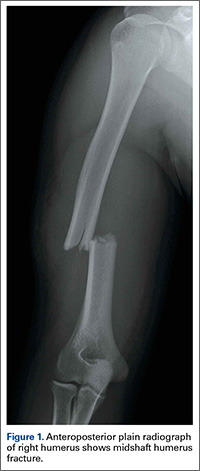
Initial orthopedic evaluation of the right arm revealed decreased sensation in the radial nerve distribution. Motor function in the radial nerve was absent; the patient was incapable of active wrist extension or finger extension. Median and ulnar nerves were motor- and sensory-intact. Radiographs showed a displaced transverse midshaft humeral shaft fracture with a minimally displaced vertical fracture line extending from the fracture site about 3 cm into the proximal segment. The patient was placed in a coaptation splint. The femur fracture was treated with an antegrade piriformis entry intramedullary nail.
ORIF of the humerus was performed to facilitate mobilization of this polytrauma patient. He was positioned prone on a flat-top table with his right arm over a radiolucent extension. The arm was abducted at the shoulder and the elbow flexed. A posterior midline skin incision was made to reflect the triceps in a lateral-to-medial direction, facilitating dissection of the lateral brachial cutaneous nerve on the lateral aspect of the triceps, with resultant localization of the radial nerve. At that time, the radial nerve was noted to be entrapped in the fracture site (Figure 2). In the proximal segment was a sagittal split, displaced about 1 mm, and it was in this interval the nerve was held. This sagittal fracture appeared incomplete as it was followed more proximally. A unicortical Kirschner wire was placed in a posterior-to-anterior direction in each fragment alongside the nerve. A lamina spreader engaged the wires and distracted the fracture site as the tines were spread apart, releasing the nerve (Figure 3). The nerve was in continuity but was severely contused at that location. After the sagittal split was reduced, two 2.7-mm lag screws were used in lag fashion, and the transverse midshaft component was fixed with a 10-hole, 4.5-mm narrow locking compression plate. The radial nerve lay on the posterior aspect of the plate, between holes 4 and 5 (Figures 4, 5). The wound was closed, and the patient was made weight-bearing as tolerated in the right upper extremity. He was sent to occupational therapy, and static and dynamic splints were made for his wrist and hand.
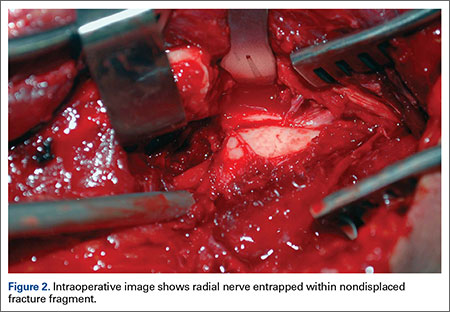
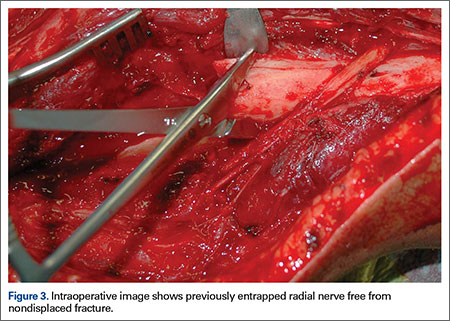
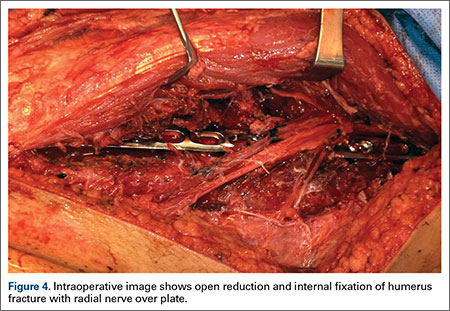
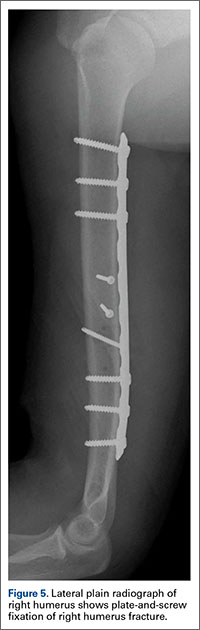
Two months after injury, radial nerve examination findings were unchanged: decreased sensation on dorsum of hand and no motor function. At 3 months, electrodiagnostic testing showed neurophysiologic evidence of severe right radial neuropathy proximal to the innervation of the right brachioradialis. There were electrodiagnostic signs of ongoing axonal loss and no signs of ongoing reinnervation. At 4 months, only motor strength in wrist extension was improved (2/5). At 5 months, the patient had 4–/5 wrist extension, 3/5 metacarpophalangeal (MCP) extension of fingers, and 0/5 MCP/interphalangeal extension of thumb. Sensation in the radial nerve distribution was still decreased. At 7 months, strength in wrist extension and finger MCP extension was 4+/5. The fracture was now well healed, with maintained alignment and no changes in hardware appearance.
Discussion
In most cases, closed treatment of a humeral shaft fracture with an associated radial nerve injury has a successful outcome.5 The etiology of the neurapraxia likely is nerve contusion after the fracture. A neurapraxia is by definition a temporary injury to the myelin sheath with an intact nerve; the nerve function recovers rapidly.
Some humeral shaft fractures, however, have been associated with radial nerve injuries more severe than contusions, resulting in axonotmesis or neurotmesis. These more severe injuries make up 10% to 30% of humeral shaft fractures, including those with a frank laceration of the nerve and those with an entrapped nerve.2,3 Shao and colleagues2 reported a 90% recovery rate for patients who delayed extrication of the entrapped radial nerve. Although there is no consensus on timing of surgical exploration, motor and sensory function of the nerve is temporally related, which may indicate that earlier diagnosis and treatment lead to improved outcome.6,7 Loss of radial nerve function can have devastating effects on upper extremity function. Often, patients lose all or some extension of the wrist and fingers and abduction and extension of the thumb.
In a standard history or physical examination, there are no particular features indicating nerve entrapment. Absolute indications for humeral shaft fractures with radial palsy are limited to open fractures, vascular injuries, and unacceptable fracture alignment. Relative indications are polytrauma and secondary palsy after attempted fracture reduction. For all other humeral shaft fractures with radial nerve palsy, observation is still the mainstay of treatment, with spontaneous recovery occurring in up to 90% of patients.2,8-12 Our patient did not have an absolute indication for operative treatment; surgery was nevertheless performed to address the polytrauma and to facilitate earlier mobilization.
Electromyelogram (EMG) studies typically are not useful after acute injury. EMG studies are better used serially to evaluate reinnervation after the acute phase. Bodner and colleagues13,14 used ultrasonography to identify the radial nerve in a patient with unimproved radial nerve palsy 6 weeks after humeral shaft fracture. They found the nerve within the fracture site, whereas magnetic resonance imaging (MRI) could not follow its course. Neither ultrasonography nor MRI would likely be used after acute injury. More research is needed to improve evaluation of patients with continued palsy after nonoperative treatment.
In the case of our patient’s humeral shaft fracture, surgery was performed early because of polytrauma and radial nerve entrapment. If left interposed between 2 fracture fragments, the nerve would have been subjected to continued ischemia and likely would not have recovered spontaneously. Ikeda and Osamura7 reported on a case of radial nerve palsy that occurred after humerus shaft fracture. The nerve, entrapped between fracture fragments, was explored later, after function failed to return. As it was found within callus, the nerve was cut and then repaired end-to-end. In our patient’s case, early exploration led to release of the radial nerve from the fracture site—preventing irreversible nerve damage and allowing for spontaneous recovery over subsequent months.
Surgery for polytrauma patients with a humeral shaft fracture and radial nerve palsy may also be beneficial with respect to early nerve exploration and early mobilization. Although our patient’s fracture was well aligned and as an isolated injury would not have required surgery, the polytrauma called for early surgical management, which revealed radial nerve entrapment and led to early recovery of nerve function.
1. Ekholm R, Adami J, Tidermark J, Hansson K, Törnkvist H, Ponzer S. Fractures of the shaft of the humerus. An epidemiological study of 401 fractures. J Bone Joint Surg Br. 2006;88(11):1469-1473.
2. Shao YC, Harwood P, Grotz MR, Limb D, Giannoudis PV. Radial nerve palsy associated with fractures of the shaft of the humerus: a systematic review. J Bone Joint Surg Br. 2005;87(12):1647-1652.
3. Shah JJ, Bhatti NA. Radial nerve paralysis associated with fractures of the humerus. A review of 62 cases. Clin Orthop Relat Res. 1983;(172):171-176.
4. Ring D, Chin K, Jupiter JB. Radial nerve palsy associated with high-energy humeral shaft fractures. J Hand Surg. 2004;29(1):144-147.
5. Sarmiento A, Zagorski JB, Zych GA, Latta LL, Capps CA. Functional bracing for the treatment of fractures of the humeral diaphysis. J Bone Joint Surg Am. 2000;82(4):478-486.
6. Hugon S, Daubresse F, Depierreux L. Radial nerve entrapment in a humeral fracture callus. Acta Orthop Belg. 2008;74(1):118-121.
7. Ikeda K, Osamura N. The radial nerve palsy caused by embedding in the humeral shaft fracture—a case report. Hand Surg. 2014;19(1):91-93.
8. Green DP, Hotchkiss RN, Pederson WC, Wolfe SW, eds. Green’s Operative Hand Surgery. 2 vols. 5th ed. Philadelphia, PA: Elsevier/Churchill Livingstone; 2005.
9. Kettelkamp DB, Alexander H. Clinical review of radial nerve injury. J Trauma. 1967;7(3):424-432.
10. Pollock FH, Drake D, Bovill EG, Day L, Trafton PG. Treatment of radial neuropathy associated with fractures of the humerus. J Bone Joint Surg Am. 1981;63(2):239-243.
11. Li Y, Ning G, Wu Q, Wu Q, Li Y, Feng S. Review of literature of radial nerve injuries associated with humeral fractures—an integrated management strategy. PloS One. 2013;8(11):e78576.
12. DeFranco MJ, Lawton JN. Radial nerve injuries associated with humeral fractures. J Hand Surg. 2006;31(4):655-663.
13. Bodner G, Huber B, Schwabegger A, Lutz M, Waldenberger P. Sonographic detection of radial nerve entrapment within a humerus fracture. J Ultrasound Med. 1999;18(10):703-706.
14. Bodner G, Buchberger W, Schocke M, et al. Radial nerve palsy associated with humeral shaft fracture: evaluation with US—initial experience. Radiology. 2001;219(3):811-816.
A radial nerve injury in association with a humeral shaft fracture is not an infrequent occurrence.1,2 The nerve injury typically is thought to be a neurapraxia caused by a contusion, as spontaneous recovery rates range from 70% to 90%.2-4 In cases in which acute nerve exploration and open reduction and internal fixation (ORIF) are not indicated, patient and clinician wait months for the nerve to recover. In some conservatively treated cases, the nerve is lacerated or entrapped. Patients with a lacerated or entrapped nerve may have better outcomes with early operative management.
We report on a rare case of the radial nerve entrapped within a nondisplaced segment of a closed humeral shaft fracture and describe the clinical outcome of early operative management. The patient provided written informed consent for print and electronic publication of this case report.
Case Report
An intoxicated, restrained 18-year-old driver in a motor vehicle collision sustained multiple injuries, including rib fracture, apical pneumothorax with pulmonary contusion, and corneal abrasion. Orthopedic injuries included right subtrochanteric femur fracture and midshaft right humeral shaft fracture (Figure 1).
Initial orthopedic evaluation of the right arm revealed decreased sensation in the radial nerve distribution. Motor function in the radial nerve was absent; the patient was incapable of active wrist extension or finger extension. Median and ulnar nerves were motor- and sensory-intact. Radiographs showed a displaced transverse midshaft humeral shaft fracture with a minimally displaced vertical fracture line extending from the fracture site about 3 cm into the proximal segment. The patient was placed in a coaptation splint. The femur fracture was treated with an antegrade piriformis entry intramedullary nail.
ORIF of the humerus was performed to facilitate mobilization of this polytrauma patient. He was positioned prone on a flat-top table with his right arm over a radiolucent extension. The arm was abducted at the shoulder and the elbow flexed. A posterior midline skin incision was made to reflect the triceps in a lateral-to-medial direction, facilitating dissection of the lateral brachial cutaneous nerve on the lateral aspect of the triceps, with resultant localization of the radial nerve. At that time, the radial nerve was noted to be entrapped in the fracture site (Figure 2). In the proximal segment was a sagittal split, displaced about 1 mm, and it was in this interval the nerve was held. This sagittal fracture appeared incomplete as it was followed more proximally. A unicortical Kirschner wire was placed in a posterior-to-anterior direction in each fragment alongside the nerve. A lamina spreader engaged the wires and distracted the fracture site as the tines were spread apart, releasing the nerve (Figure 3). The nerve was in continuity but was severely contused at that location. After the sagittal split was reduced, two 2.7-mm lag screws were used in lag fashion, and the transverse midshaft component was fixed with a 10-hole, 4.5-mm narrow locking compression plate. The radial nerve lay on the posterior aspect of the plate, between holes 4 and 5 (Figures 4, 5). The wound was closed, and the patient was made weight-bearing as tolerated in the right upper extremity. He was sent to occupational therapy, and static and dynamic splints were made for his wrist and hand.
Two months after injury, radial nerve examination findings were unchanged: decreased sensation on dorsum of hand and no motor function. At 3 months, electrodiagnostic testing showed neurophysiologic evidence of severe right radial neuropathy proximal to the innervation of the right brachioradialis. There were electrodiagnostic signs of ongoing axonal loss and no signs of ongoing reinnervation. At 4 months, only motor strength in wrist extension was improved (2/5). At 5 months, the patient had 4–/5 wrist extension, 3/5 metacarpophalangeal (MCP) extension of fingers, and 0/5 MCP/interphalangeal extension of thumb. Sensation in the radial nerve distribution was still decreased. At 7 months, strength in wrist extension and finger MCP extension was 4+/5. The fracture was now well healed, with maintained alignment and no changes in hardware appearance.
Discussion
In most cases, closed treatment of a humeral shaft fracture with an associated radial nerve injury has a successful outcome.5 The etiology of the neurapraxia likely is nerve contusion after the fracture. A neurapraxia is by definition a temporary injury to the myelin sheath with an intact nerve; the nerve function recovers rapidly.
Some humeral shaft fractures, however, have been associated with radial nerve injuries more severe than contusions, resulting in axonotmesis or neurotmesis. These more severe injuries make up 10% to 30% of humeral shaft fractures, including those with a frank laceration of the nerve and those with an entrapped nerve.2,3 Shao and colleagues2 reported a 90% recovery rate for patients who delayed extrication of the entrapped radial nerve. Although there is no consensus on timing of surgical exploration, motor and sensory function of the nerve is temporally related, which may indicate that earlier diagnosis and treatment lead to improved outcome.6,7 Loss of radial nerve function can have devastating effects on upper extremity function. Often, patients lose all or some extension of the wrist and fingers and abduction and extension of the thumb.
In a standard history or physical examination, there are no particular features indicating nerve entrapment. Absolute indications for humeral shaft fractures with radial palsy are limited to open fractures, vascular injuries, and unacceptable fracture alignment. Relative indications are polytrauma and secondary palsy after attempted fracture reduction. For all other humeral shaft fractures with radial nerve palsy, observation is still the mainstay of treatment, with spontaneous recovery occurring in up to 90% of patients.2,8-12 Our patient did not have an absolute indication for operative treatment; surgery was nevertheless performed to address the polytrauma and to facilitate earlier mobilization.
Electromyelogram (EMG) studies typically are not useful after acute injury. EMG studies are better used serially to evaluate reinnervation after the acute phase. Bodner and colleagues13,14 used ultrasonography to identify the radial nerve in a patient with unimproved radial nerve palsy 6 weeks after humeral shaft fracture. They found the nerve within the fracture site, whereas magnetic resonance imaging (MRI) could not follow its course. Neither ultrasonography nor MRI would likely be used after acute injury. More research is needed to improve evaluation of patients with continued palsy after nonoperative treatment.
In the case of our patient’s humeral shaft fracture, surgery was performed early because of polytrauma and radial nerve entrapment. If left interposed between 2 fracture fragments, the nerve would have been subjected to continued ischemia and likely would not have recovered spontaneously. Ikeda and Osamura7 reported on a case of radial nerve palsy that occurred after humerus shaft fracture. The nerve, entrapped between fracture fragments, was explored later, after function failed to return. As it was found within callus, the nerve was cut and then repaired end-to-end. In our patient’s case, early exploration led to release of the radial nerve from the fracture site—preventing irreversible nerve damage and allowing for spontaneous recovery over subsequent months.
Surgery for polytrauma patients with a humeral shaft fracture and radial nerve palsy may also be beneficial with respect to early nerve exploration and early mobilization. Although our patient’s fracture was well aligned and as an isolated injury would not have required surgery, the polytrauma called for early surgical management, which revealed radial nerve entrapment and led to early recovery of nerve function.
A radial nerve injury in association with a humeral shaft fracture is not an infrequent occurrence.1,2 The nerve injury typically is thought to be a neurapraxia caused by a contusion, as spontaneous recovery rates range from 70% to 90%.2-4 In cases in which acute nerve exploration and open reduction and internal fixation (ORIF) are not indicated, patient and clinician wait months for the nerve to recover. In some conservatively treated cases, the nerve is lacerated or entrapped. Patients with a lacerated or entrapped nerve may have better outcomes with early operative management.
We report on a rare case of the radial nerve entrapped within a nondisplaced segment of a closed humeral shaft fracture and describe the clinical outcome of early operative management. The patient provided written informed consent for print and electronic publication of this case report.
Case Report
An intoxicated, restrained 18-year-old driver in a motor vehicle collision sustained multiple injuries, including rib fracture, apical pneumothorax with pulmonary contusion, and corneal abrasion. Orthopedic injuries included right subtrochanteric femur fracture and midshaft right humeral shaft fracture (Figure 1).
Initial orthopedic evaluation of the right arm revealed decreased sensation in the radial nerve distribution. Motor function in the radial nerve was absent; the patient was incapable of active wrist extension or finger extension. Median and ulnar nerves were motor- and sensory-intact. Radiographs showed a displaced transverse midshaft humeral shaft fracture with a minimally displaced vertical fracture line extending from the fracture site about 3 cm into the proximal segment. The patient was placed in a coaptation splint. The femur fracture was treated with an antegrade piriformis entry intramedullary nail.
ORIF of the humerus was performed to facilitate mobilization of this polytrauma patient. He was positioned prone on a flat-top table with his right arm over a radiolucent extension. The arm was abducted at the shoulder and the elbow flexed. A posterior midline skin incision was made to reflect the triceps in a lateral-to-medial direction, facilitating dissection of the lateral brachial cutaneous nerve on the lateral aspect of the triceps, with resultant localization of the radial nerve. At that time, the radial nerve was noted to be entrapped in the fracture site (Figure 2). In the proximal segment was a sagittal split, displaced about 1 mm, and it was in this interval the nerve was held. This sagittal fracture appeared incomplete as it was followed more proximally. A unicortical Kirschner wire was placed in a posterior-to-anterior direction in each fragment alongside the nerve. A lamina spreader engaged the wires and distracted the fracture site as the tines were spread apart, releasing the nerve (Figure 3). The nerve was in continuity but was severely contused at that location. After the sagittal split was reduced, two 2.7-mm lag screws were used in lag fashion, and the transverse midshaft component was fixed with a 10-hole, 4.5-mm narrow locking compression plate. The radial nerve lay on the posterior aspect of the plate, between holes 4 and 5 (Figures 4, 5). The wound was closed, and the patient was made weight-bearing as tolerated in the right upper extremity. He was sent to occupational therapy, and static and dynamic splints were made for his wrist and hand.
Two months after injury, radial nerve examination findings were unchanged: decreased sensation on dorsum of hand and no motor function. At 3 months, electrodiagnostic testing showed neurophysiologic evidence of severe right radial neuropathy proximal to the innervation of the right brachioradialis. There were electrodiagnostic signs of ongoing axonal loss and no signs of ongoing reinnervation. At 4 months, only motor strength in wrist extension was improved (2/5). At 5 months, the patient had 4–/5 wrist extension, 3/5 metacarpophalangeal (MCP) extension of fingers, and 0/5 MCP/interphalangeal extension of thumb. Sensation in the radial nerve distribution was still decreased. At 7 months, strength in wrist extension and finger MCP extension was 4+/5. The fracture was now well healed, with maintained alignment and no changes in hardware appearance.
Discussion
In most cases, closed treatment of a humeral shaft fracture with an associated radial nerve injury has a successful outcome.5 The etiology of the neurapraxia likely is nerve contusion after the fracture. A neurapraxia is by definition a temporary injury to the myelin sheath with an intact nerve; the nerve function recovers rapidly.
Some humeral shaft fractures, however, have been associated with radial nerve injuries more severe than contusions, resulting in axonotmesis or neurotmesis. These more severe injuries make up 10% to 30% of humeral shaft fractures, including those with a frank laceration of the nerve and those with an entrapped nerve.2,3 Shao and colleagues2 reported a 90% recovery rate for patients who delayed extrication of the entrapped radial nerve. Although there is no consensus on timing of surgical exploration, motor and sensory function of the nerve is temporally related, which may indicate that earlier diagnosis and treatment lead to improved outcome.6,7 Loss of radial nerve function can have devastating effects on upper extremity function. Often, patients lose all or some extension of the wrist and fingers and abduction and extension of the thumb.
In a standard history or physical examination, there are no particular features indicating nerve entrapment. Absolute indications for humeral shaft fractures with radial palsy are limited to open fractures, vascular injuries, and unacceptable fracture alignment. Relative indications are polytrauma and secondary palsy after attempted fracture reduction. For all other humeral shaft fractures with radial nerve palsy, observation is still the mainstay of treatment, with spontaneous recovery occurring in up to 90% of patients.2,8-12 Our patient did not have an absolute indication for operative treatment; surgery was nevertheless performed to address the polytrauma and to facilitate earlier mobilization.
Electromyelogram (EMG) studies typically are not useful after acute injury. EMG studies are better used serially to evaluate reinnervation after the acute phase. Bodner and colleagues13,14 used ultrasonography to identify the radial nerve in a patient with unimproved radial nerve palsy 6 weeks after humeral shaft fracture. They found the nerve within the fracture site, whereas magnetic resonance imaging (MRI) could not follow its course. Neither ultrasonography nor MRI would likely be used after acute injury. More research is needed to improve evaluation of patients with continued palsy after nonoperative treatment.
In the case of our patient’s humeral shaft fracture, surgery was performed early because of polytrauma and radial nerve entrapment. If left interposed between 2 fracture fragments, the nerve would have been subjected to continued ischemia and likely would not have recovered spontaneously. Ikeda and Osamura7 reported on a case of radial nerve palsy that occurred after humerus shaft fracture. The nerve, entrapped between fracture fragments, was explored later, after function failed to return. As it was found within callus, the nerve was cut and then repaired end-to-end. In our patient’s case, early exploration led to release of the radial nerve from the fracture site—preventing irreversible nerve damage and allowing for spontaneous recovery over subsequent months.
Surgery for polytrauma patients with a humeral shaft fracture and radial nerve palsy may also be beneficial with respect to early nerve exploration and early mobilization. Although our patient’s fracture was well aligned and as an isolated injury would not have required surgery, the polytrauma called for early surgical management, which revealed radial nerve entrapment and led to early recovery of nerve function.
1. Ekholm R, Adami J, Tidermark J, Hansson K, Törnkvist H, Ponzer S. Fractures of the shaft of the humerus. An epidemiological study of 401 fractures. J Bone Joint Surg Br. 2006;88(11):1469-1473.
2. Shao YC, Harwood P, Grotz MR, Limb D, Giannoudis PV. Radial nerve palsy associated with fractures of the shaft of the humerus: a systematic review. J Bone Joint Surg Br. 2005;87(12):1647-1652.
3. Shah JJ, Bhatti NA. Radial nerve paralysis associated with fractures of the humerus. A review of 62 cases. Clin Orthop Relat Res. 1983;(172):171-176.
4. Ring D, Chin K, Jupiter JB. Radial nerve palsy associated with high-energy humeral shaft fractures. J Hand Surg. 2004;29(1):144-147.
5. Sarmiento A, Zagorski JB, Zych GA, Latta LL, Capps CA. Functional bracing for the treatment of fractures of the humeral diaphysis. J Bone Joint Surg Am. 2000;82(4):478-486.
6. Hugon S, Daubresse F, Depierreux L. Radial nerve entrapment in a humeral fracture callus. Acta Orthop Belg. 2008;74(1):118-121.
7. Ikeda K, Osamura N. The radial nerve palsy caused by embedding in the humeral shaft fracture—a case report. Hand Surg. 2014;19(1):91-93.
8. Green DP, Hotchkiss RN, Pederson WC, Wolfe SW, eds. Green’s Operative Hand Surgery. 2 vols. 5th ed. Philadelphia, PA: Elsevier/Churchill Livingstone; 2005.
9. Kettelkamp DB, Alexander H. Clinical review of radial nerve injury. J Trauma. 1967;7(3):424-432.
10. Pollock FH, Drake D, Bovill EG, Day L, Trafton PG. Treatment of radial neuropathy associated with fractures of the humerus. J Bone Joint Surg Am. 1981;63(2):239-243.
11. Li Y, Ning G, Wu Q, Wu Q, Li Y, Feng S. Review of literature of radial nerve injuries associated with humeral fractures—an integrated management strategy. PloS One. 2013;8(11):e78576.
12. DeFranco MJ, Lawton JN. Radial nerve injuries associated with humeral fractures. J Hand Surg. 2006;31(4):655-663.
13. Bodner G, Huber B, Schwabegger A, Lutz M, Waldenberger P. Sonographic detection of radial nerve entrapment within a humerus fracture. J Ultrasound Med. 1999;18(10):703-706.
14. Bodner G, Buchberger W, Schocke M, et al. Radial nerve palsy associated with humeral shaft fracture: evaluation with US—initial experience. Radiology. 2001;219(3):811-816.
1. Ekholm R, Adami J, Tidermark J, Hansson K, Törnkvist H, Ponzer S. Fractures of the shaft of the humerus. An epidemiological study of 401 fractures. J Bone Joint Surg Br. 2006;88(11):1469-1473.
2. Shao YC, Harwood P, Grotz MR, Limb D, Giannoudis PV. Radial nerve palsy associated with fractures of the shaft of the humerus: a systematic review. J Bone Joint Surg Br. 2005;87(12):1647-1652.
3. Shah JJ, Bhatti NA. Radial nerve paralysis associated with fractures of the humerus. A review of 62 cases. Clin Orthop Relat Res. 1983;(172):171-176.
4. Ring D, Chin K, Jupiter JB. Radial nerve palsy associated with high-energy humeral shaft fractures. J Hand Surg. 2004;29(1):144-147.
5. Sarmiento A, Zagorski JB, Zych GA, Latta LL, Capps CA. Functional bracing for the treatment of fractures of the humeral diaphysis. J Bone Joint Surg Am. 2000;82(4):478-486.
6. Hugon S, Daubresse F, Depierreux L. Radial nerve entrapment in a humeral fracture callus. Acta Orthop Belg. 2008;74(1):118-121.
7. Ikeda K, Osamura N. The radial nerve palsy caused by embedding in the humeral shaft fracture—a case report. Hand Surg. 2014;19(1):91-93.
8. Green DP, Hotchkiss RN, Pederson WC, Wolfe SW, eds. Green’s Operative Hand Surgery. 2 vols. 5th ed. Philadelphia, PA: Elsevier/Churchill Livingstone; 2005.
9. Kettelkamp DB, Alexander H. Clinical review of radial nerve injury. J Trauma. 1967;7(3):424-432.
10. Pollock FH, Drake D, Bovill EG, Day L, Trafton PG. Treatment of radial neuropathy associated with fractures of the humerus. J Bone Joint Surg Am. 1981;63(2):239-243.
11. Li Y, Ning G, Wu Q, Wu Q, Li Y, Feng S. Review of literature of radial nerve injuries associated with humeral fractures—an integrated management strategy. PloS One. 2013;8(11):e78576.
12. DeFranco MJ, Lawton JN. Radial nerve injuries associated with humeral fractures. J Hand Surg. 2006;31(4):655-663.
13. Bodner G, Huber B, Schwabegger A, Lutz M, Waldenberger P. Sonographic detection of radial nerve entrapment within a humerus fracture. J Ultrasound Med. 1999;18(10):703-706.
14. Bodner G, Buchberger W, Schocke M, et al. Radial nerve palsy associated with humeral shaft fracture: evaluation with US—initial experience. Radiology. 2001;219(3):811-816.